EENGM0014 Mathematics for Signal Processing and
Communications
Tutorial 4
Soon Yau Cheong
University of Bristol
28 Oct 2016
Soon Yau Cheong (University of Bristol) EENGM0014 Mathematics for Signal Processing and Communications28 Oct 2016 1 / 12
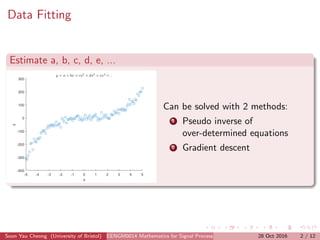
Data Fitting
Estimate a, b, c, d, e, ...
Can be solved with 2 methods:
1 Pseudo inverse of
over-determined equations
2 Gradient descent
Soon Yau Cheong (University of Bristol) EENGM0014 Mathematics for Signal Processing and Communications28 Oct 2016 2 / 12
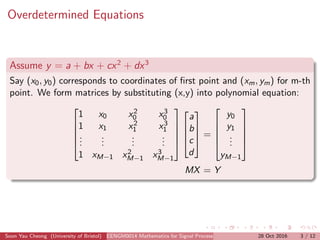
Overdetermined Equations
Assume y = a + bx + cx2
+ dx3
Say (x0, y0) corresponds to coordinates of first point and (xm, ym) for m-th
point. We form matrices by substituting (x,y) into polynomial equation:





1 x0 x2
0 x3
0
1 x1 x2
1 x3
1
...
...
...
...
1 xM−1 x2
M−1 x3
M−1









a
b
c
d



 =





y0
y1
...
yM−1





MX = Y
Soon Yau Cheong (University of Bristol) EENGM0014 Mathematics for Signal Processing and Communications28 Oct 2016 3 / 12
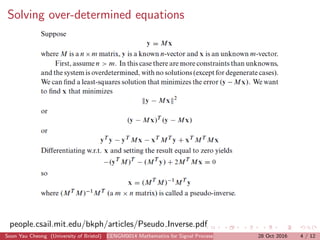
Solving over-determined equations
people.csail.mit.edu/bkph/articles/Pseudo Inverse.pdf
Soon Yau Cheong (University of Bristol) EENGM0014 Mathematics for Signal Processing and Communications28 Oct 2016 4 / 12
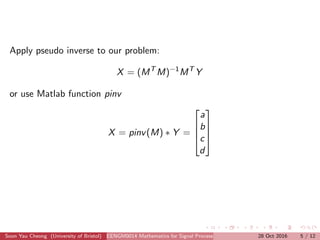
Apply pseudo inverse to our problem:
X = (MT
M)−1
MT
Y
or use Matlab function pinv
X = pinv(M) ∗ Y =




a
b
c
d




Soon Yau Cheong (University of Bristol) EENGM0014 Mathematics for Signal Processing and Communications28 Oct 2016 5 / 12
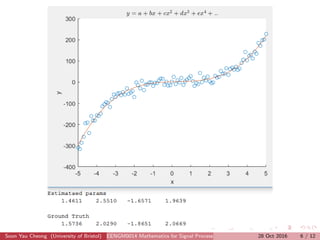
Soon Yau Cheong (University of Bristol) EENGM0014 Mathematics for Signal Processing and Communications28 Oct 2016 6 / 12
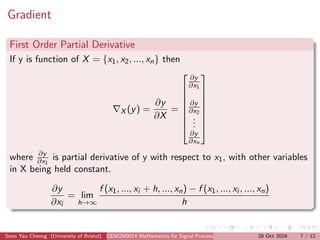
Gradient
First Order Partial Derivative
If y is function of X = {x1, x2, ..., xn} then
X (y) =
∂y
∂X
=








∂y
∂x1
∂y
∂x2
...
∂y
∂xn








where ∂y
∂x1
is partial derivative of y with respect to x1, with other variables
in X being held constant.
∂y
∂xi
= lim
h→∞
f (x1, ..., xi + h, ..., xn) − f (x1, ..., xi , ..., xn)
h
Soon Yau Cheong (University of Bristol) EENGM0014 Mathematics for Signal Processing and Communications28 Oct 2016 7 / 12
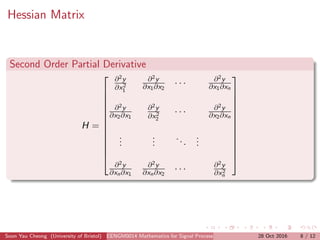
Hessian Matrix
Second Order Partial Derivative
H =













∂2y
∂x2
1
∂2y
∂x1∂x2
· · · ∂2y
∂x1∂xn
∂2y
∂x2∂x1
∂2y
∂x2
2
· · · ∂2y
∂x2∂xn
...
...
...
...
∂2y
∂xn∂x1
∂2y
∂xn∂x2
· · · ∂2y
∂x2
n













Soon Yau Cheong (University of Bristol) EENGM0014 Mathematics for Signal Processing and Communications28 Oct 2016 8 / 12
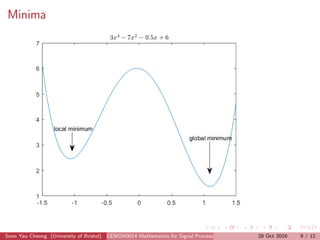
Minima
Soon Yau Cheong (University of Bristol) EENGM0014 Mathematics for Signal Processing and Communications28 Oct 2016 9 / 12
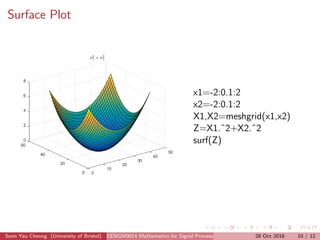
Surface Plot
x1=-2:0.1:2
x2=-2:0.1:2
X1,X2=meshgrid(x1,x2)
Z=X1.ˆ2+X2.ˆ2
surf(Z)
Soon Yau Cheong (University of Bristol) EENGM0014 Mathematics for Signal Processing and Communications28 Oct 2016 10 / 12
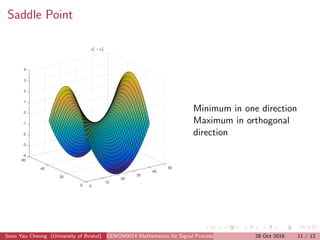
Saddle Point
Minimum in one direction
Maximum in orthogonal
direction
Soon Yau Cheong (University of Bristol) EENGM0014 Mathematics for Signal Processing and Communications28 Oct 2016 11 / 12
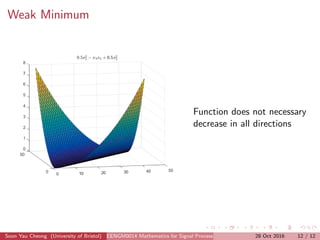
Weak Minimum
Function does not necessary
decrease in all directions
Soon Yau Cheong (University of Bristol) EENGM0014 Mathematics for Signal Processing and Communications28 Oct 2016 12 / 12

tutorial4

  • 1.
    EENGM0014 Mathematics forSignal Processing and Communications Tutorial 4 Soon Yau Cheong University of Bristol 28 Oct 2016 Soon Yau Cheong (University of Bristol) EENGM0014 Mathematics for Signal Processing and Communications28 Oct 2016 1 / 12
  • 2.
    Data Fitting Estimate a,b, c, d, e, ... Can be solved with 2 methods: 1 Pseudo inverse of over-determined equations 2 Gradient descent Soon Yau Cheong (University of Bristol) EENGM0014 Mathematics for Signal Processing and Communications28 Oct 2016 2 / 12
  • 3.
    Overdetermined Equations Assume y= a + bx + cx2 + dx3 Say (x0, y0) corresponds to coordinates of first point and (xm, ym) for m-th point. We form matrices by substituting (x,y) into polynomial equation:      1 x0 x2 0 x3 0 1 x1 x2 1 x3 1 ... ... ... ... 1 xM−1 x2 M−1 x3 M−1          a b c d     =      y0 y1 ... yM−1      MX = Y Soon Yau Cheong (University of Bristol) EENGM0014 Mathematics for Signal Processing and Communications28 Oct 2016 3 / 12
  • 4.
    Solving over-determined equations people.csail.mit.edu/bkph/articles/PseudoInverse.pdf Soon Yau Cheong (University of Bristol) EENGM0014 Mathematics for Signal Processing and Communications28 Oct 2016 4 / 12
  • 5.
    Apply pseudo inverseto our problem: X = (MT M)−1 MT Y or use Matlab function pinv X = pinv(M) ∗ Y =     a b c d     Soon Yau Cheong (University of Bristol) EENGM0014 Mathematics for Signal Processing and Communications28 Oct 2016 5 / 12
  • 6.
    Soon Yau Cheong(University of Bristol) EENGM0014 Mathematics for Signal Processing and Communications28 Oct 2016 6 / 12
  • 7.
    Gradient First Order PartialDerivative If y is function of X = {x1, x2, ..., xn} then X (y) = ∂y ∂X =         ∂y ∂x1 ∂y ∂x2 ... ∂y ∂xn         where ∂y ∂x1 is partial derivative of y with respect to x1, with other variables in X being held constant. ∂y ∂xi = lim h→∞ f (x1, ..., xi + h, ..., xn) − f (x1, ..., xi , ..., xn) h Soon Yau Cheong (University of Bristol) EENGM0014 Mathematics for Signal Processing and Communications28 Oct 2016 7 / 12
  • 8.
    Hessian Matrix Second OrderPartial Derivative H =              ∂2y ∂x2 1 ∂2y ∂x1∂x2 · · · ∂2y ∂x1∂xn ∂2y ∂x2∂x1 ∂2y ∂x2 2 · · · ∂2y ∂x2∂xn ... ... ... ... ∂2y ∂xn∂x1 ∂2y ∂xn∂x2 · · · ∂2y ∂x2 n              Soon Yau Cheong (University of Bristol) EENGM0014 Mathematics for Signal Processing and Communications28 Oct 2016 8 / 12
  • 9.
    Minima Soon Yau Cheong(University of Bristol) EENGM0014 Mathematics for Signal Processing and Communications28 Oct 2016 9 / 12
  • 10.
    Surface Plot x1=-2:0.1:2 x2=-2:0.1:2 X1,X2=meshgrid(x1,x2) Z=X1.ˆ2+X2.ˆ2 surf(Z) Soon YauCheong (University of Bristol) EENGM0014 Mathematics for Signal Processing and Communications28 Oct 2016 10 / 12
  • 11.
    Saddle Point Minimum inone direction Maximum in orthogonal direction Soon Yau Cheong (University of Bristol) EENGM0014 Mathematics for Signal Processing and Communications28 Oct 2016 11 / 12
  • 12.
    Weak Minimum Function doesnot necessary decrease in all directions Soon Yau Cheong (University of Bristol) EENGM0014 Mathematics for Signal Processing and Communications28 Oct 2016 12 / 12