1
Motor Basics
AGSM 325
Motors vs Engines
• Motors convert
electrical energy to
mechanical energy.
• Engines convert
chemical energy to
mechanical energy.
www.PAControl.com
2
Motors
• Advantages
– Low Initial Cost - $/Hp
– Simple & Efficient Operation
– Compact Size – cubic inches/Hp
– Long Life – 30,000 to 50,000 hours
– Low Noise
– No Exhaust Emissions
– Withstand high temporary overloads
– Automatic/Remote Start & Control
• Disadvantages
– Portability
– Speed Control
– No Demand Charge
Magnetic Induction
• Simple Electromagnet
• Like Poles Repel
• Opposite Poles Attract
www.PAControl.com
3
Operating Principle
Motor Parts
• Enclosure
• Stator
• Rotor
• Bearings
• Conduit Box
• Eye Bolt
www.PAControl.com
4
Enclosure
• Holds parts together
• Helps with heat dissipation
• In some cases, protects internal components
from the environment.
Stator (Windings)
• “Stationary” part of the motor sometimes referred to as “the
windings”.
• Slotted cores made of thin sections of soft iron are wound
with insulated copper wire to form one or more pairs of
magnetic poles.
www.PAControl.com
5
Rotor
• “Rotating” part of the
motor.
• Magnetic field from
the stator induces an
opposing magnetic
field onto the rotor
causing the rotor to
“push” away from the
stator field.
Wound Rotor Motors
• Older motor designed to operate at “variable speed”
• Advantages
– Speed Control, High Starting Torque, Low Starting Current
• Disadvantages
– Expensive, High Maintenance, Low Efficiency
www.PAControl.com
6
Bearings
• Sleeve Bearings
– Standard on most motors
– Quiet
– Horizontal shafts only
– Oil lubricated
• Ball (Roller) Bearings
– Support shaft in any
position
– Grease lubricated
– Many come sealed
requiring no maintenance
Other Parts
• Conduit Box
– Point of connection of
electrical power to the
motor’s stator windings.
• Eye Bolt
– Used to lift heavy motors
with a hoist or crane to
prevent motor damage.
www.PAControl.com
7
Motor Speed
• Synchronous Speed
– Speed the motor’s
magnetic field rotates.
– Theoretical speed with
not torque or friction.
• Rated Speed
– Speed the motor
operates when fully
loaded.
– Actual speed at full
load when supplied
rated voltage.
Synchronous Speed
• Theoretical Speed
• A well built motor may
approach synchronous
speed when it has no load.
• Factors
– Electrical Frequency
(cycles/second)
– # of poles in motor
www.PAControl.com
8
Rated Speed
• Speed the motor
runs at when fully
loaded and supplied
rated nameplate
voltage.
Motor Slip
• Percent difference between a motor’s
synchronous speed and rated speed.
• The rotor in an induction motor lags slightly
behind the synchronous speed of the changing
polarity of the magnetic field.
– Low Slip Motors
• “Stiff”….High Efficiency motors
– High Slip Motors
• Used for applications where load varies significantly…oil
pump jacks.
www.PAControl.com
9
Torque
• Measure of force
producing a rotation
– Turning Effort
– Measured in pound-feet
(foot-pounds)
Torque-Speed Curve
• Amount of Torque
produced by motors
varies with Speed.
• Torque Speed Curves
– Starting Torque
– Pull Up Torque
– Breakdown Torque
www.PAControl.com
10
Motor Power
• Output Power
– Horsepower
– Amount of power
motor can produce at
shaft and not reduce
life of motor.
• Input Power
– Kilowatts
– Amount of power the
motor consumes to
produce the output
power.
Calculating Horsepower
• Need Speed and
Torque
• Speed is easy
– Tachometer
• Torque is difficult
– Dynamometer
– Prony Brake
www.PAControl.com
11
Watt’s Law
• Input Power
• Single Phase
– Watts = Volts X Amps X p.f.
• Three Phase
– Watts = Avg Volts X Avg Amps X p.f. X 1.74
Example
• Is a 1 Hp 1-phase motor driving a fan overloaded?
– Voltage = 123 volts
– Current = 9 amps
– p.f. = 78%
• Watts = Volts X Amps X p.f.
Watts = 123 volts X 9 amps X 0.78 = 863.5 Watts
864 Watts / 746 Watts/Hp = 1.16 Hp
• Is the motor overloaded?
www.PAControl.com
12
Electrical = Input
• We measured Input
• Motors are rated as Output
• Difference?
– Efficiency
• If the motor is 75%
efficient, is it overloaded?
• Eff = Output / Input
• Output = Eff X Input
0.75 X 1.16 Hp = 0.87 Hp
• The motor is NOT
overloaded
1.16 Hp
Input
HP
Output?
Example #2
• Is this 10 Hp, 3-phase motor overloaded?
– Voltages = 455, 458, and 461 volts
– Currents = 14.1, 14.0 and 13.9 amps
– P.f. = 82%
• Watts = Voltsavg X Ampsavg X p.f. X 1.74
Watts = 458v X 14a X 0.82 X 1.74 = 9148.6 Watts
9148.6 Watts / 746 Watts/Hp = 12.26 Hp
• Is the motor overloaded?
www.PAControl.com
13
Example #2
• We measured Input
• Motor is rated as Output
• Difference?
– Efficiency
• If the motor is 90%
efficient, is it overloaded?
• Eff = Output / Input
• Output = Eff X Input
0.90 X 12.26 Hp = 11.0 Hp
• The motor IS overloaded!
• How bad is the overload?
12.26 Hp
Input
Hp
Output ?
Motor Types
CLASSIFICATION OF MOTORS
Synchronous Induction
Hysteresis
Reluctance
Permanent
Magnet
Wound Rotor
Synchronous
Squirrel
Cage Wound
Rotor
Design A
Design B
Design C
Design D
Synchronous Induction
Hysteresis
Reluctance
Wound
Rotor
Repulsion
Repulsion Start
Squirrel
Cage
Split Phase
Capacitor Run
Capacitor Start
Capacitor Start/Run
Polyphase Universal Single-Phase
AC MOTORS
www.PAControl.com
14
Synchronous vs Induction Motors
• Synchronous Motors
– Turn at exactly the
same speed as the
rotating magnetic field.
– 3600 rpm, 1800 rpm,
etc.
• Induction Motors
– Turn at less than
synchronous speed
under load.
– 3450 rpm, 1740 rpm,
etc.
NEMA 3 Phase Motors
• 3 Phase Induction
Motors
• NEMA Torque-
Speed Design
Types
– A,B,C,D,E
www.PAControl.com
15
Design Type B
• Today’s “Standard” 3-
Phase Motor
• Good Starting Torque
– In-rush amps 4-6 times
full load amps
– Good breakdown-
torque
– Medium Slip
Design Type A
• The “old” Standard
• Higher starting torque
than “B”.
• Higher in-rush current
(5-8 times full load
amps)
• Good breakdown
torque
www.PAControl.com
16
Design Type C
• Common OEM
equipment on
reciprocating pumps,
compressors and other
“hard starting” loads.
• High starting torque
• Moderate starting
current (5-8 times
FLA)
• Moderate breakdown
torque
Design Type D
• Common on
applications with
significant loading
changes as a machine
operates.
• Impact Loads
– Punch Presses, Metal
Shears, etc.
– Pump Jacks
www.PAControl.com
17
Design Type E
• Newest NEMA Category
• Newer ultra-high efficiency motors
– Higher Starting Torque
– Higher Starting Current (8-12 times Running)
– Ultra Low Slip (Higher Rated Speed)
Single Phase Induction Motors
• Are not “self starting”
– Require a starting mechanism.
• The name generally
describes its “starting
mechanism”.
– Split Phase
– Capacitor Run
– Capacitor Start
– Capacitor Start-Capacitor Run
– Shaded Pole
– Synchronous
– Universal
www.PAControl.com
18
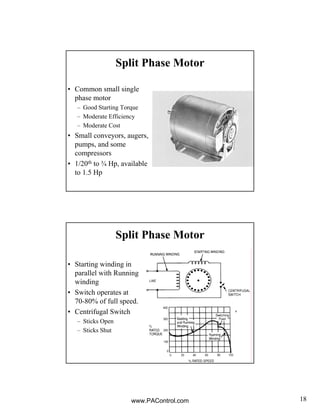
Split Phase Motor
• Common small single
phase motor
– Good Starting Torque
– Moderate Efficiency
– Moderate Cost
• Small conveyors, augers,
pumps, and some
compressors
• 1/20th to ¾ Hp, available
to 1.5 Hp
Split Phase Motor
• Starting winding in
parallel with Running
winding
• Switch operates at
70-80% of full speed.
• Centrifugal Switch
– Sticks Open
– Sticks Shut
www.PAControl.com
19
Capacitor Run Motor
(Permanent Split Capacitor or PSC)
• Primarily a fan
and blower
motor.
• Poor starting
torque
• Very low cost
motor.
Permanent Split Capacitor (PSC)
• Capacitor in
“Capacitor Winding”
– Provides a “phase
shift” for starting.
– Optimizes running
characteristics.
• No centrifugal switch
www.PAControl.com
20
Capacitor Start Motor
• Larger single phase
motors up to about 10
Hp.
• A split phase motor
with the addition of a
capacitor in the
starting winding.
• Capacitor sized for
high starting torque.
Capacitor Start Motor
• Very high starting
torque.
• Very high starting
current.
• Common on
compressors and other
hard starting
equipment.
www.PAControl.com
21
Capacitor Start-Capacitor Run
• Both starting and
running characteristics
are optimized.
– High starting torque
– Low starting current
– Highest cost
• For hard starting loads
like compressors and
pumps.
• Up to 10 Hp or higher
is some situations.
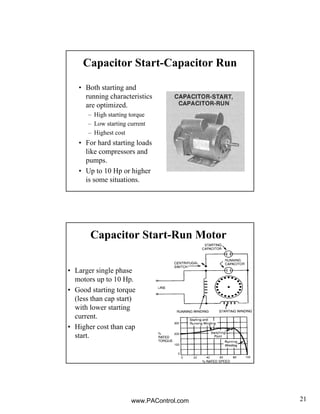
Capacitor Start-Run Motor
• Larger single phase
motors up to 10 Hp.
• Good starting torque
(less than cap start)
with lower starting
current.
• Higher cost than cap
start.
www.PAControl.com
22
Synchronous Motor
• Special design for
“constant speed” at
rated horsepower and
below.
• Used where
maintaining speed is
critical when the load
changes.
Universal Motor
• Runs on AC or DC
• Commutator and
brushes
• Generally found in
portable power tools.
• Lower Hp sizes
www.PAControl.com
23
Universal Motor
• Very high starting
torque.
• Higher torque on DC
than AC (battery
operated tools)
• The higher the rpm,
the lower the torque.
www.PAControl.com

Tutorial motor-basics-lecture

  • 1.
    1 Motor Basics AGSM 325 Motorsvs Engines • Motors convert electrical energy to mechanical energy. • Engines convert chemical energy to mechanical energy. www.PAControl.com
  • 2.
    2 Motors • Advantages – LowInitial Cost - $/Hp – Simple & Efficient Operation – Compact Size – cubic inches/Hp – Long Life – 30,000 to 50,000 hours – Low Noise – No Exhaust Emissions – Withstand high temporary overloads – Automatic/Remote Start & Control • Disadvantages – Portability – Speed Control – No Demand Charge Magnetic Induction • Simple Electromagnet • Like Poles Repel • Opposite Poles Attract www.PAControl.com
  • 3.
    3 Operating Principle Motor Parts •Enclosure • Stator • Rotor • Bearings • Conduit Box • Eye Bolt www.PAControl.com
  • 4.
    4 Enclosure • Holds partstogether • Helps with heat dissipation • In some cases, protects internal components from the environment. Stator (Windings) • “Stationary” part of the motor sometimes referred to as “the windings”. • Slotted cores made of thin sections of soft iron are wound with insulated copper wire to form one or more pairs of magnetic poles. www.PAControl.com
  • 5.
    5 Rotor • “Rotating” partof the motor. • Magnetic field from the stator induces an opposing magnetic field onto the rotor causing the rotor to “push” away from the stator field. Wound Rotor Motors • Older motor designed to operate at “variable speed” • Advantages – Speed Control, High Starting Torque, Low Starting Current • Disadvantages – Expensive, High Maintenance, Low Efficiency www.PAControl.com
  • 6.
    6 Bearings • Sleeve Bearings –Standard on most motors – Quiet – Horizontal shafts only – Oil lubricated • Ball (Roller) Bearings – Support shaft in any position – Grease lubricated – Many come sealed requiring no maintenance Other Parts • Conduit Box – Point of connection of electrical power to the motor’s stator windings. • Eye Bolt – Used to lift heavy motors with a hoist or crane to prevent motor damage. www.PAControl.com
  • 7.
    7 Motor Speed • SynchronousSpeed – Speed the motor’s magnetic field rotates. – Theoretical speed with not torque or friction. • Rated Speed – Speed the motor operates when fully loaded. – Actual speed at full load when supplied rated voltage. Synchronous Speed • Theoretical Speed • A well built motor may approach synchronous speed when it has no load. • Factors – Electrical Frequency (cycles/second) – # of poles in motor www.PAControl.com
  • 8.
    8 Rated Speed • Speedthe motor runs at when fully loaded and supplied rated nameplate voltage. Motor Slip • Percent difference between a motor’s synchronous speed and rated speed. • The rotor in an induction motor lags slightly behind the synchronous speed of the changing polarity of the magnetic field. – Low Slip Motors • “Stiff”….High Efficiency motors – High Slip Motors • Used for applications where load varies significantly…oil pump jacks. www.PAControl.com
  • 9.
    9 Torque • Measure offorce producing a rotation – Turning Effort – Measured in pound-feet (foot-pounds) Torque-Speed Curve • Amount of Torque produced by motors varies with Speed. • Torque Speed Curves – Starting Torque – Pull Up Torque – Breakdown Torque www.PAControl.com
  • 10.
    10 Motor Power • OutputPower – Horsepower – Amount of power motor can produce at shaft and not reduce life of motor. • Input Power – Kilowatts – Amount of power the motor consumes to produce the output power. Calculating Horsepower • Need Speed and Torque • Speed is easy – Tachometer • Torque is difficult – Dynamometer – Prony Brake www.PAControl.com
  • 11.
    11 Watt’s Law • InputPower • Single Phase – Watts = Volts X Amps X p.f. • Three Phase – Watts = Avg Volts X Avg Amps X p.f. X 1.74 Example • Is a 1 Hp 1-phase motor driving a fan overloaded? – Voltage = 123 volts – Current = 9 amps – p.f. = 78% • Watts = Volts X Amps X p.f. Watts = 123 volts X 9 amps X 0.78 = 863.5 Watts 864 Watts / 746 Watts/Hp = 1.16 Hp • Is the motor overloaded? www.PAControl.com
  • 12.
    12 Electrical = Input •We measured Input • Motors are rated as Output • Difference? – Efficiency • If the motor is 75% efficient, is it overloaded? • Eff = Output / Input • Output = Eff X Input 0.75 X 1.16 Hp = 0.87 Hp • The motor is NOT overloaded 1.16 Hp Input HP Output? Example #2 • Is this 10 Hp, 3-phase motor overloaded? – Voltages = 455, 458, and 461 volts – Currents = 14.1, 14.0 and 13.9 amps – P.f. = 82% • Watts = Voltsavg X Ampsavg X p.f. X 1.74 Watts = 458v X 14a X 0.82 X 1.74 = 9148.6 Watts 9148.6 Watts / 746 Watts/Hp = 12.26 Hp • Is the motor overloaded? www.PAControl.com
  • 13.
    13 Example #2 • Wemeasured Input • Motor is rated as Output • Difference? – Efficiency • If the motor is 90% efficient, is it overloaded? • Eff = Output / Input • Output = Eff X Input 0.90 X 12.26 Hp = 11.0 Hp • The motor IS overloaded! • How bad is the overload? 12.26 Hp Input Hp Output ? Motor Types CLASSIFICATION OF MOTORS Synchronous Induction Hysteresis Reluctance Permanent Magnet Wound Rotor Synchronous Squirrel Cage Wound Rotor Design A Design B Design C Design D Synchronous Induction Hysteresis Reluctance Wound Rotor Repulsion Repulsion Start Squirrel Cage Split Phase Capacitor Run Capacitor Start Capacitor Start/Run Polyphase Universal Single-Phase AC MOTORS www.PAControl.com
  • 14.
    14 Synchronous vs InductionMotors • Synchronous Motors – Turn at exactly the same speed as the rotating magnetic field. – 3600 rpm, 1800 rpm, etc. • Induction Motors – Turn at less than synchronous speed under load. – 3450 rpm, 1740 rpm, etc. NEMA 3 Phase Motors • 3 Phase Induction Motors • NEMA Torque- Speed Design Types – A,B,C,D,E www.PAControl.com
  • 15.
    15 Design Type B •Today’s “Standard” 3- Phase Motor • Good Starting Torque – In-rush amps 4-6 times full load amps – Good breakdown- torque – Medium Slip Design Type A • The “old” Standard • Higher starting torque than “B”. • Higher in-rush current (5-8 times full load amps) • Good breakdown torque www.PAControl.com
  • 16.
    16 Design Type C •Common OEM equipment on reciprocating pumps, compressors and other “hard starting” loads. • High starting torque • Moderate starting current (5-8 times FLA) • Moderate breakdown torque Design Type D • Common on applications with significant loading changes as a machine operates. • Impact Loads – Punch Presses, Metal Shears, etc. – Pump Jacks www.PAControl.com
  • 17.
    17 Design Type E •Newest NEMA Category • Newer ultra-high efficiency motors – Higher Starting Torque – Higher Starting Current (8-12 times Running) – Ultra Low Slip (Higher Rated Speed) Single Phase Induction Motors • Are not “self starting” – Require a starting mechanism. • The name generally describes its “starting mechanism”. – Split Phase – Capacitor Run – Capacitor Start – Capacitor Start-Capacitor Run – Shaded Pole – Synchronous – Universal www.PAControl.com
  • 18.
    18 Split Phase Motor •Common small single phase motor – Good Starting Torque – Moderate Efficiency – Moderate Cost • Small conveyors, augers, pumps, and some compressors • 1/20th to ¾ Hp, available to 1.5 Hp Split Phase Motor • Starting winding in parallel with Running winding • Switch operates at 70-80% of full speed. • Centrifugal Switch – Sticks Open – Sticks Shut www.PAControl.com
  • 19.
    19 Capacitor Run Motor (PermanentSplit Capacitor or PSC) • Primarily a fan and blower motor. • Poor starting torque • Very low cost motor. Permanent Split Capacitor (PSC) • Capacitor in “Capacitor Winding” – Provides a “phase shift” for starting. – Optimizes running characteristics. • No centrifugal switch www.PAControl.com
  • 20.
    20 Capacitor Start Motor •Larger single phase motors up to about 10 Hp. • A split phase motor with the addition of a capacitor in the starting winding. • Capacitor sized for high starting torque. Capacitor Start Motor • Very high starting torque. • Very high starting current. • Common on compressors and other hard starting equipment. www.PAControl.com
  • 21.
    21 Capacitor Start-Capacitor Run •Both starting and running characteristics are optimized. – High starting torque – Low starting current – Highest cost • For hard starting loads like compressors and pumps. • Up to 10 Hp or higher is some situations. Capacitor Start-Run Motor • Larger single phase motors up to 10 Hp. • Good starting torque (less than cap start) with lower starting current. • Higher cost than cap start. www.PAControl.com
  • 22.
    22 Synchronous Motor • Specialdesign for “constant speed” at rated horsepower and below. • Used where maintaining speed is critical when the load changes. Universal Motor • Runs on AC or DC • Commutator and brushes • Generally found in portable power tools. • Lower Hp sizes www.PAControl.com
  • 23.
    23 Universal Motor • Veryhigh starting torque. • Higher torque on DC than AC (battery operated tools) • The higher the rpm, the lower the torque. www.PAControl.com