Behavioral BasedBehavioral Based
Safety ObservationSafety Observation
ProgramProgram
The following presentation provides an example of a (basic)
Behavior Based HSE Observation Program
Note: the Observation card used as an example includes a
Behavior Observation Checklist, Hazard ID, and Near Miss
observations
as well as R+ ( positive recognition)
A Behavior Based Safety program is intended to enable
company employees to record safety observations, most
importantly, stopping of work that is unsafe.
Behavior Based Safety BasicsBehavior Based Safety Basics
HSE Observation ProgramHSE Observation Program (Definition)(Definition)
Peer to peer method of coaching, counseling, and encouraging
all employees to reinforce safe behavior
Safety Observation Cycle:
1. Observe people
2. Analyze their work practices by focusing on safe and
unsafe behaviors
3. Talk with them about safety
4. Actively correct and prevent unsafe acts and
conditions
5. Reinforce safe behavior
6. Report your observations
Making Common Sense - Common Practice!
SAFETY- IT’S NOT JUST AT WORK!
SAFESTART works…..
On the job
Off the job
On the highway
1. Something unexpected has to happen
They may increase the risk while performing a task but no
one intentionally tries to hurt themselves
No one is trying to make a mistake or bad decision
2. Most accidents follow simple patterns of
behavior
Making Common Sense - Common Practice!
There are 3 Types of At Risk Behavior
Conscious Behavior
Habitual Behavior
Unintentional Behavior
SafeStart is about Unintentional Behavior and
Habitual Behavior.
Or to be more specific, It’s about how to prevent
mistakes or errors you never wanted to make in the
first place.
• Four Behaviors or States
that can lead to one or more Four Critical
Errors are:
Rushing
Frustration
Fatigue
Complacency
Making Common Sense - Common Practice!
Rushing
When you exceed the pace at which you
normally perform the task, whether it’s
working, driving, walking or running, lifting,
moving, etc.
Four Behaviors or States
Frustration
Caused by relationships inside and outside
of the workplace, malfunctioning equipment,
inadequate tools, conflicting objectives and
pressures, etc.
Four Behaviors or States
Fatigue
Too tired physically or mentally to do the job
safely. It includes being too tired to react
quickly, prolonged concentration is difficult, etc.
Four Behaviors or States
Complacency
Familiar enough with the hazards to become
considerably less concerned over time. It
contributes significantly to not watching or
thinking about what you are doing.
Four Behaviors or States
Four Critical Errors
We have gone over the Four States,
now we will look at the
Four Critical Errors
that can lead to Increased Risk
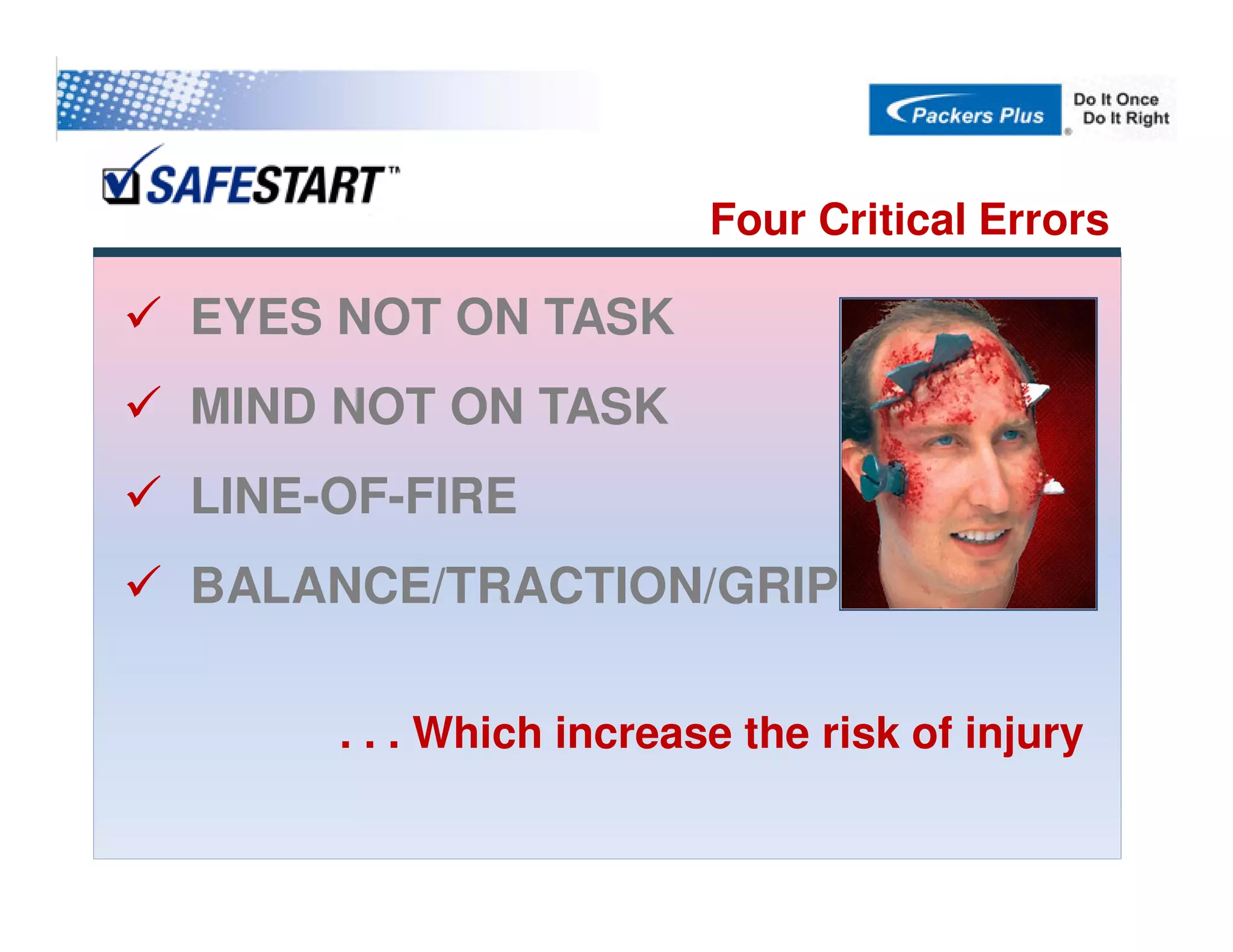
EYES NOT ON TASK
MIND NOT ON TASK
LINE-OF-FIRE
BALANCE/TRACTION/GRIP
. . . Which increase the risk of injury
Four Critical Errors
Eyes Not On Task
Not looking at where you are going or what is
coming at you. It includes not moving your
eyes before moving your body or not being able
to see where you are stepping, where your
hands are reaching into, etc.
Four Critical Errors
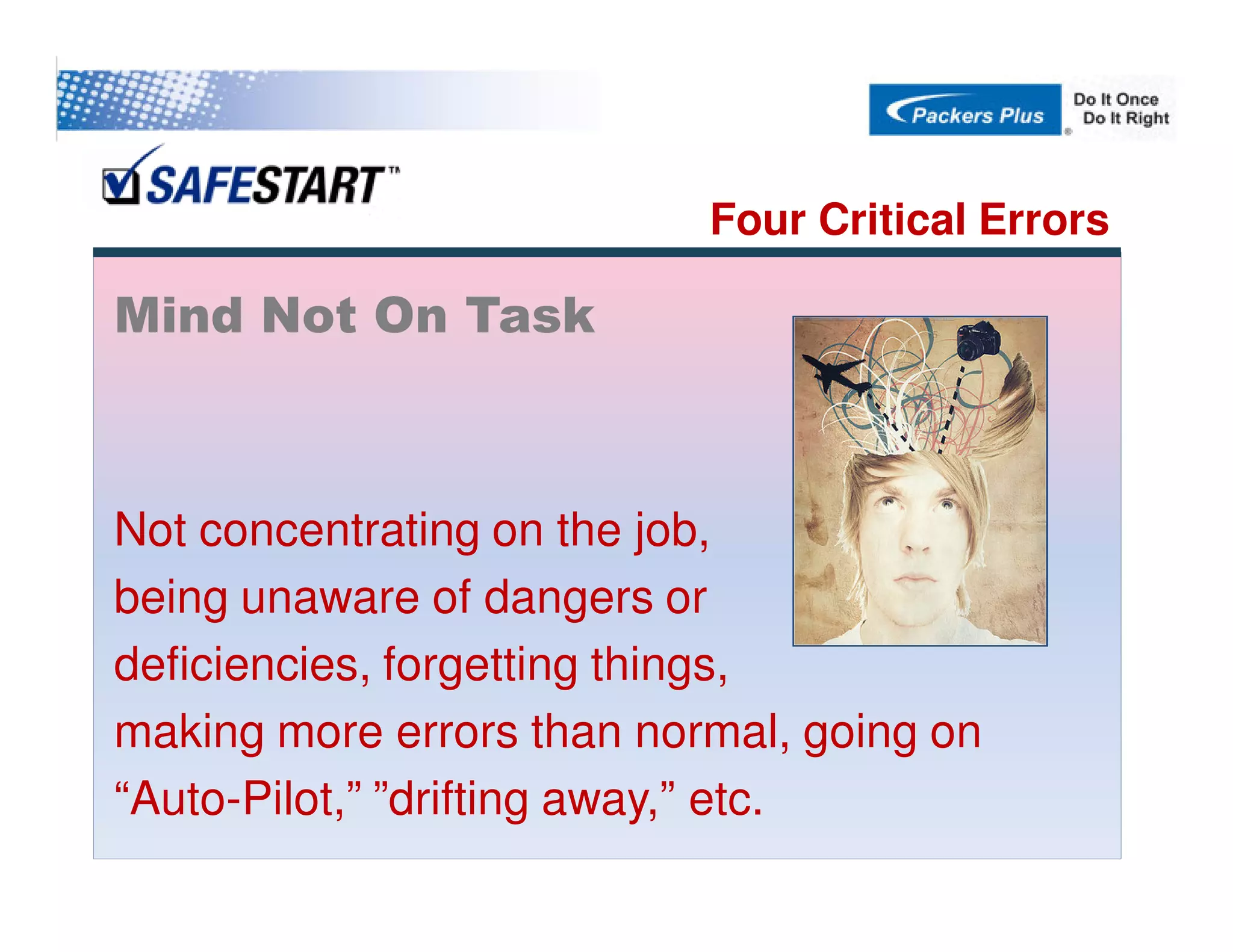
Mind Not On Task
Not concentrating on the job,
being unaware of dangers or
deficiencies, forgetting things,
making more errors than normal, going on
“Auto-Pilot,” ”drifting away,” etc.
Four Critical Errors
Line-Of-Fire
Being conscious of where you are or
where you are going in relation to the
direction of the hazardous energy.
It includes protection barriers and
PPE if line-of-fire cannot be
predicted accurately.
Four Critical Errors
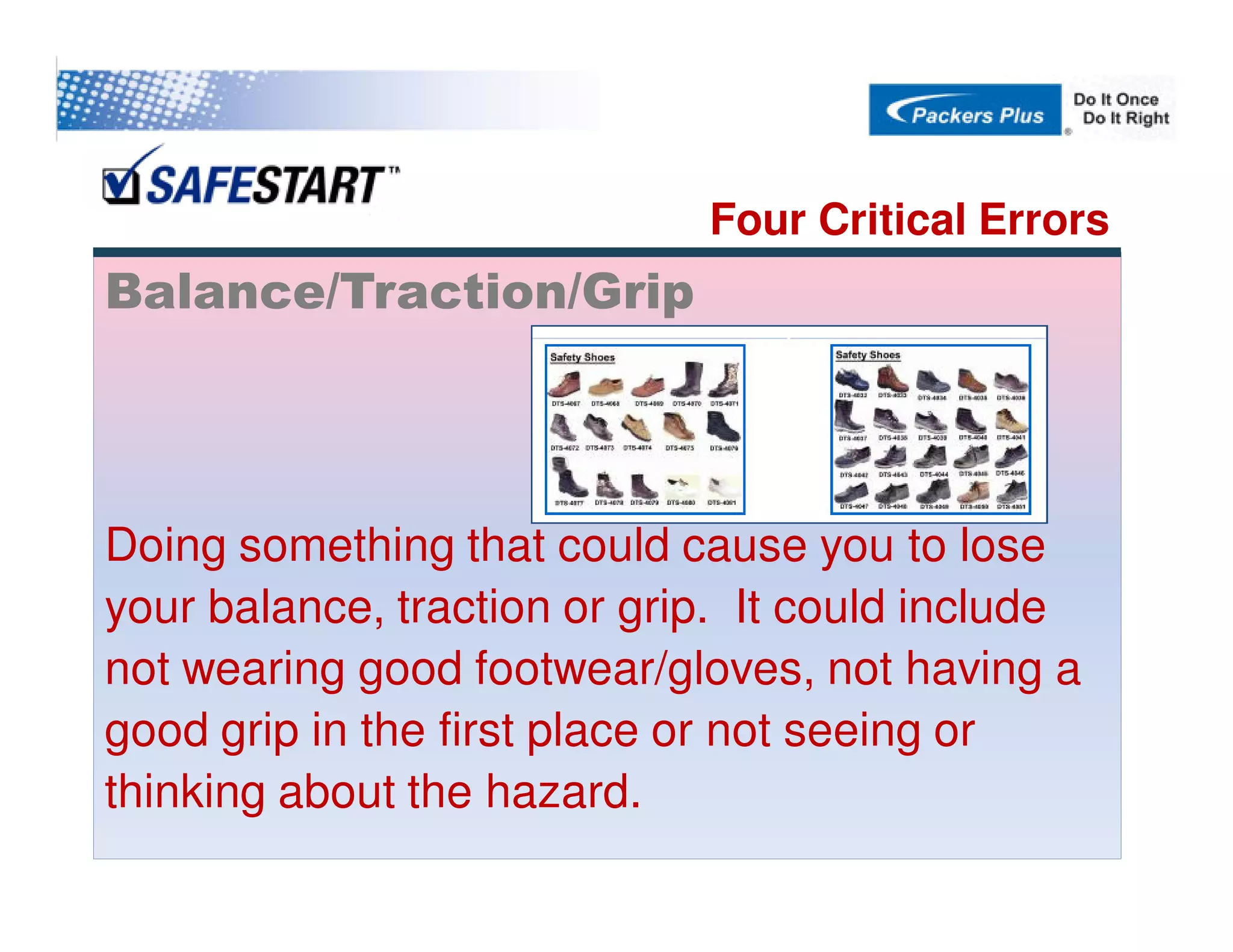
Balance/Traction/Grip
Doing something that could cause you to lose
your balance, traction or grip. It could include
not wearing good footwear/gloves, not having a
good grip in the first place or not seeing or
thinking about the hazard.
Four Critical Errors
Now that we have
looked at the Four States
that can lead to the Four
Critical Errors, let’s look
at the Increased Risk.
Increased Risk
Safety is a function of Risk
There is a certain amount of Risk in
everything we do
On the Job
Off the Job
Or while Driving
We may not be able to eliminate all the
Risk, but we can lower the Risk by using
the SafeStart principles
Increased Risk
Every task that we perform has
a different amount of Risk
associated with it.
The Risk of performing each of these tasks can be increased by
the States to Error Pattern as defined by SafeStart.
Eliminate the States to Pattern…
Eliminate RISK!
Increased Risk
Tools
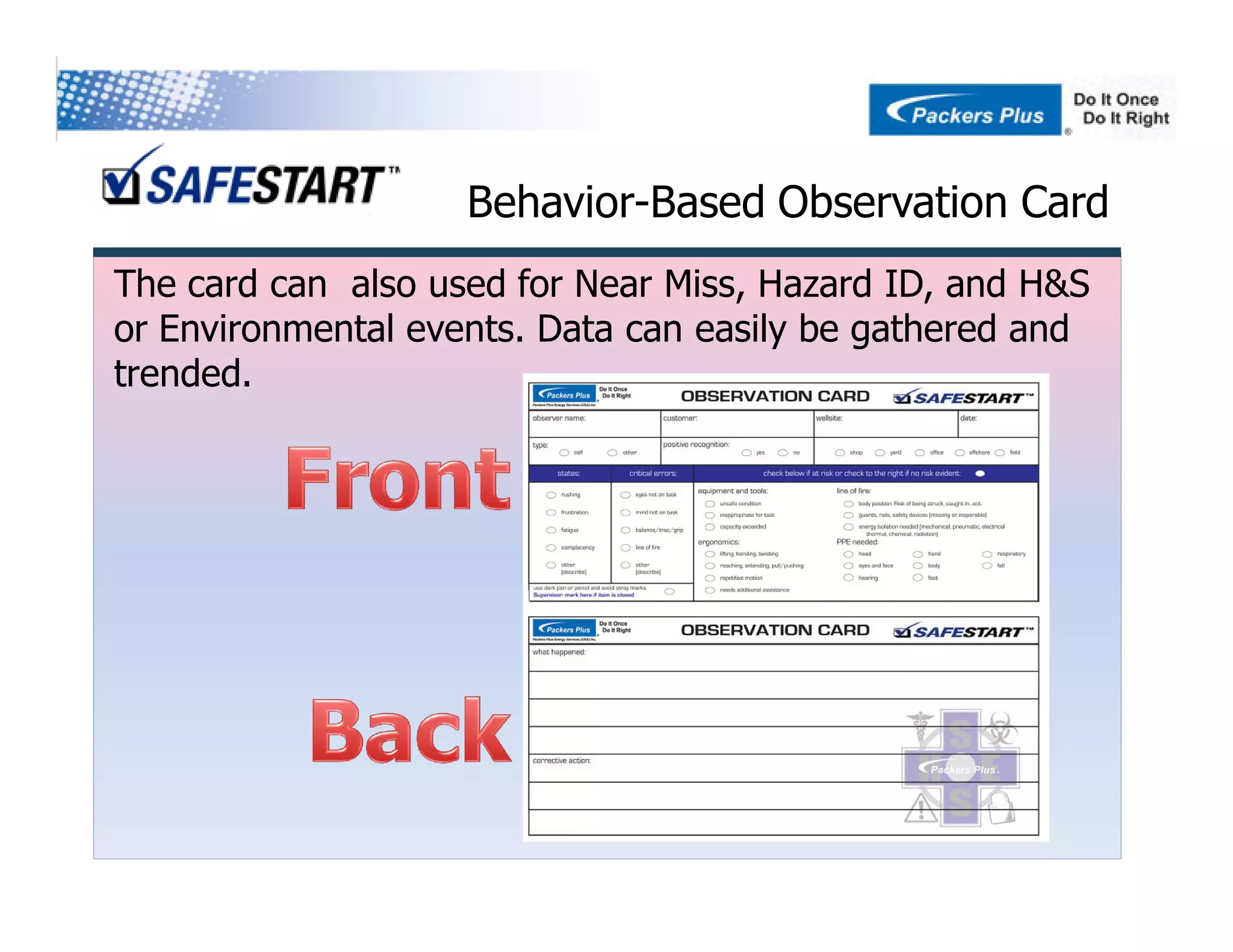
The card can also used for Near Miss, Hazard ID, and H&S
or Environmental events. Data can easily be gathered and
trended.
Behavior-Based Observation Card
Behavior Based Safety BasicsBehavior Based Safety Basics
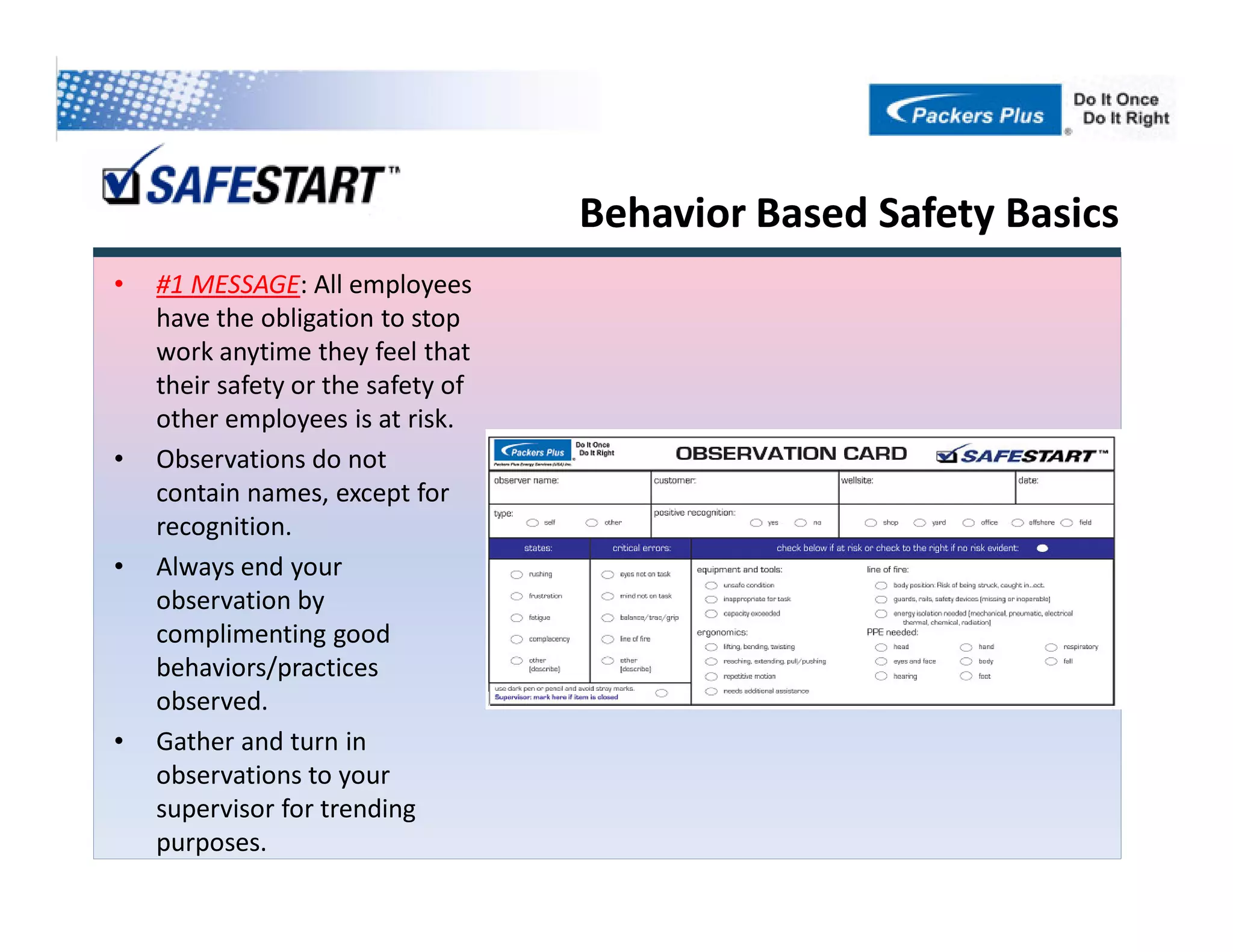
• #1 MESSAGE: All employees
have the obligation to stop
work anytime they feel that
their safety or the safety of
other employees is at risk.
• Observations do not
contain names, except for
recognition.
• Always end your
observation by
complimenting good
behaviors/practices
observed.
• Gather and turn in
observations to your
supervisor for trending
purposes.
Behavior Based Safety BasicsBehavior Based Safety Basics
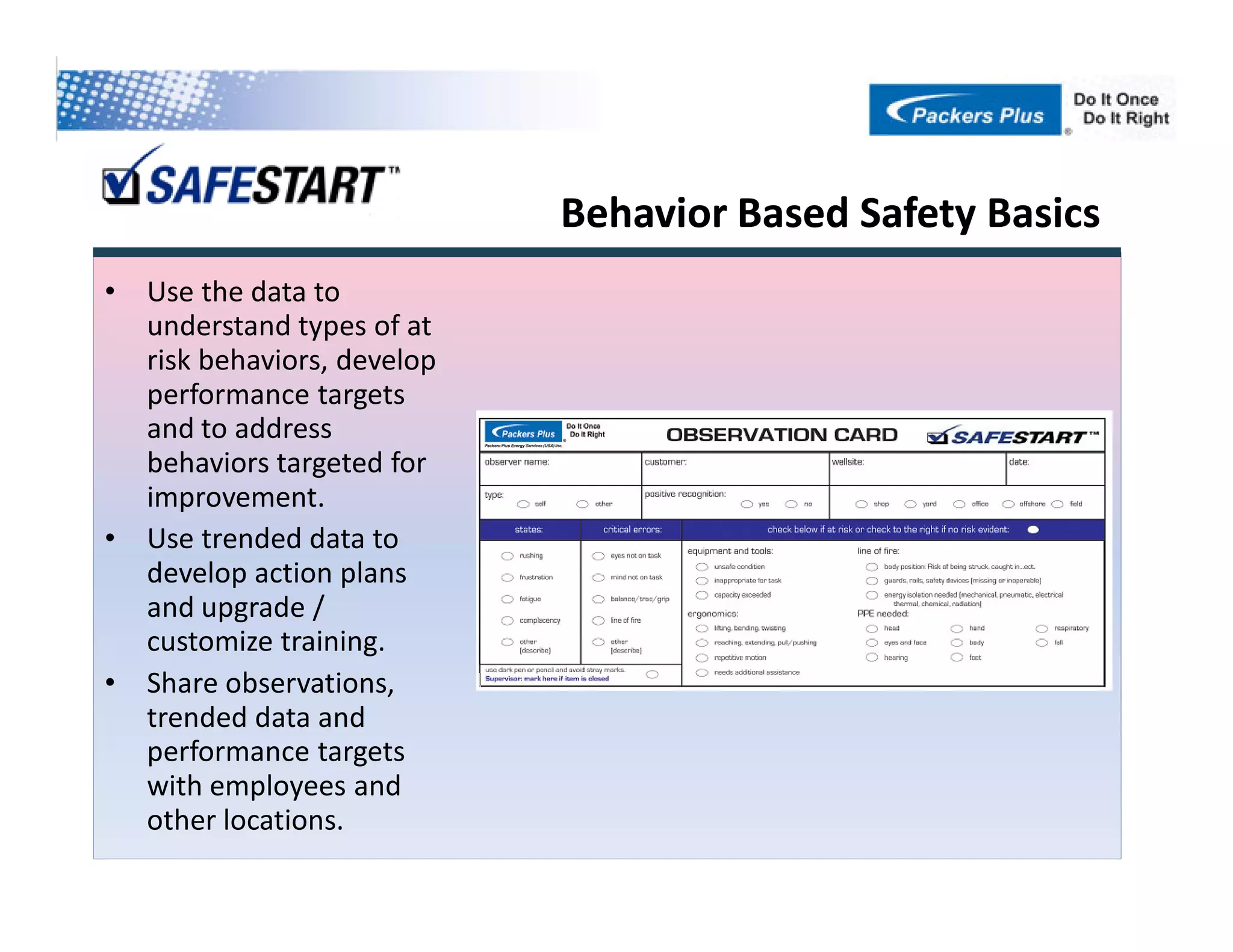
• Use the data to
understand types of at
risk behaviors, develop
performance targets
and to address
behaviors targeted for
improvement.
• Use trended data to
develop action plans
and upgrade /
customize training.
• Share observations,
trended data and
performance targets
with employees and
other locations.
Behavior Based Safety BasicsBehavior Based Safety Basics
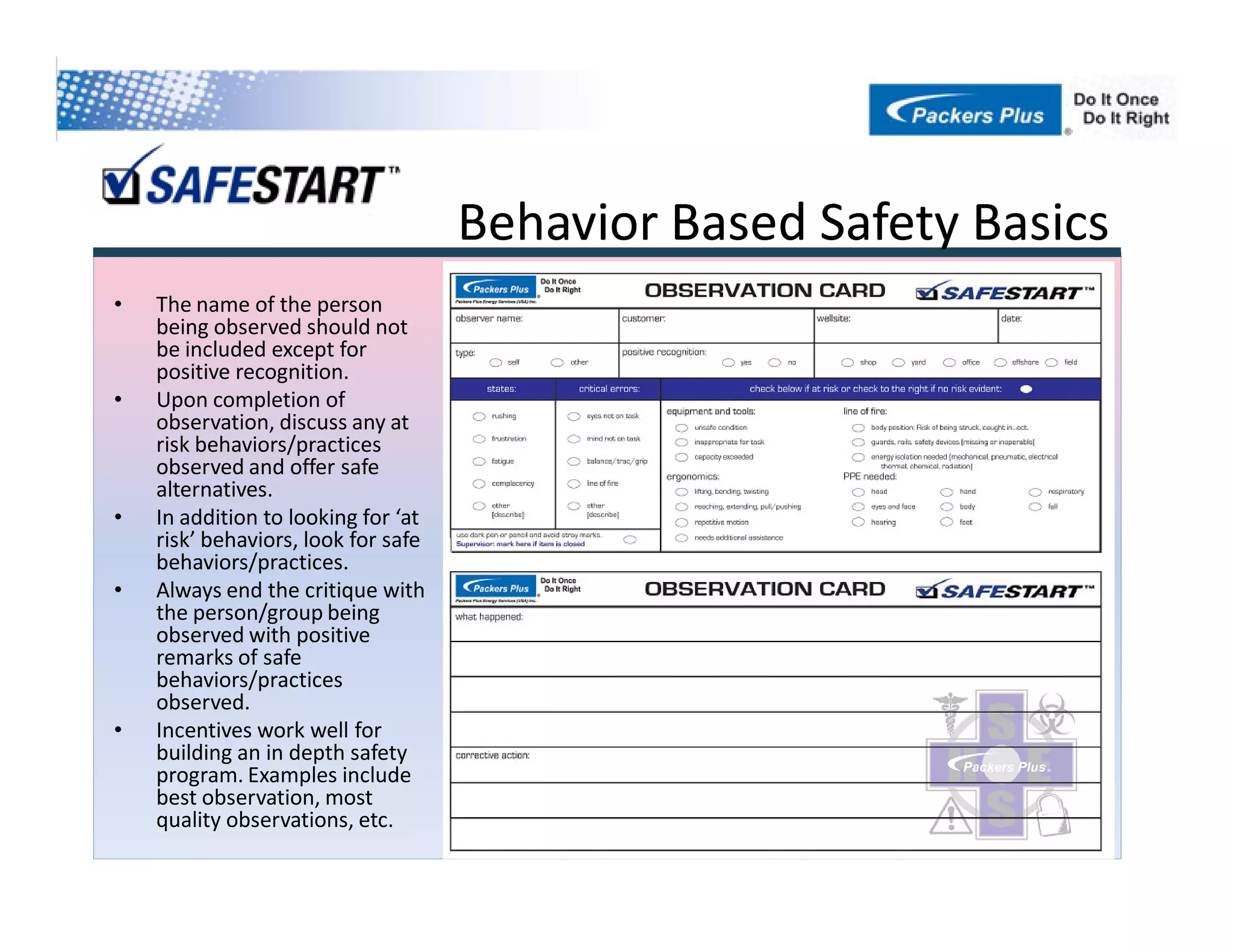
• The name of the person
being observed should not
be included except for
positive recognition.
• Upon completion of
observation, discuss any at
risk behaviors/practices
observed and offer safe
alternatives.
• In addition to looking for ‘at
risk’ behaviors, look for safe
behaviors/practices.
• Always end the critique with
the person/group being
observed with positive
remarks of safe
behaviors/practices
observed.
• Incentives work well for
building an in depth safety
program. Examples include
best observation, most
quality observations, etc.
Behavior Based Safety BasicsBehavior Based Safety Basics
Benefits of BBS for the Company
• Enhanced reporting
• Increased Hazard Recognition
• Share Recognized Hazards
• Data gathered is used to develop trends
• Trended data can be used to improve overall safety for
employees
• Employees have greater sense of ownership of the HSE
program
• Incentives may be tied to best quality observations
• Increased Employee Retention
Basic Steps of an ObservationBasic Steps of an Observation
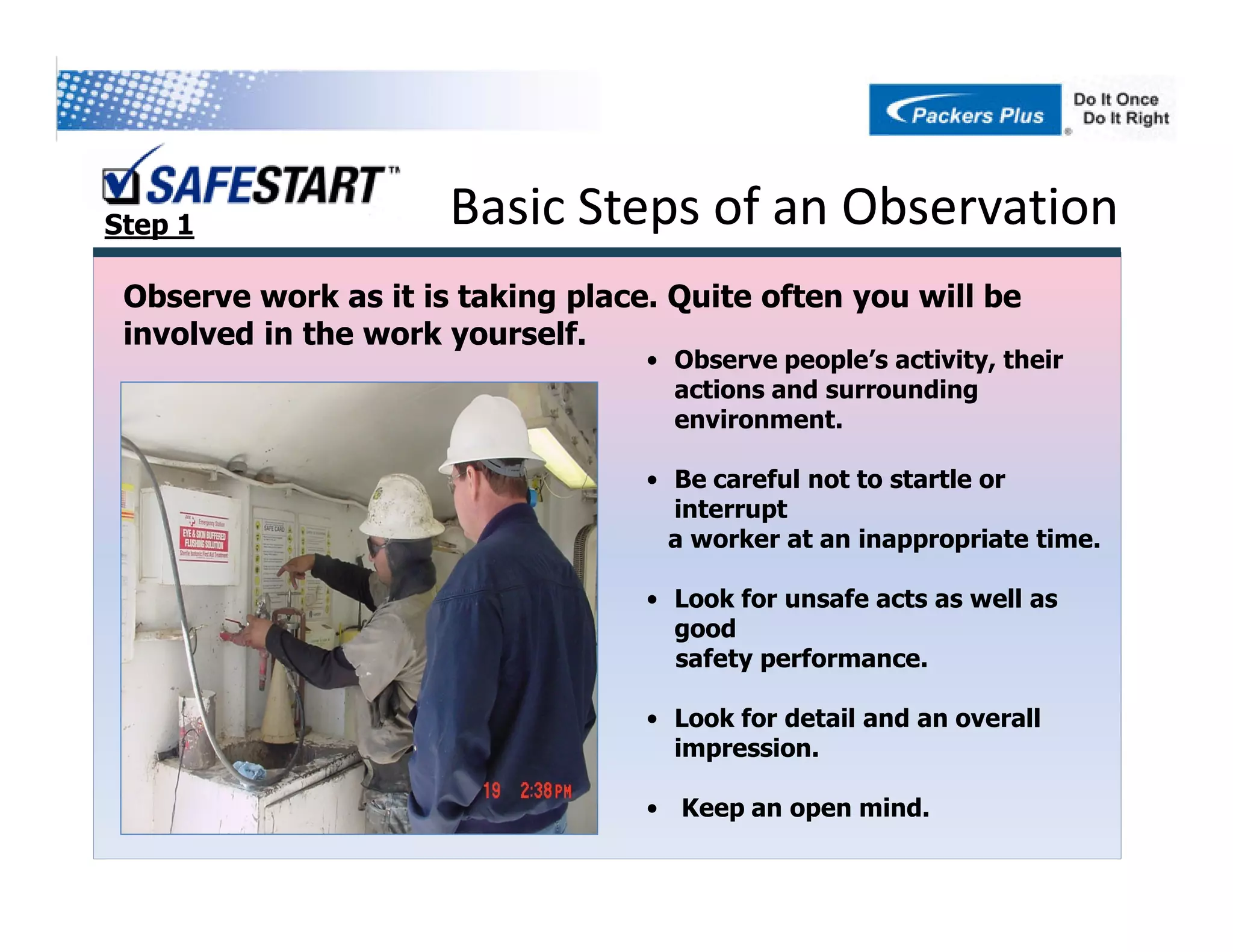
Observe work as it is taking place. Quite often you will be
involved in the work yourself.
• Observe people’s activity, their
actions and surrounding
environment.
• Be careful not to startle or
interrupt
a worker at an inappropriate time.
• Look for unsafe acts as well as
good
safety performance.
• Look for detail and an overall
impression.
• Keep an open mind.
Step 1
Basic Steps ofBasic Steps of anan ObservationObservation
If you see an act or condition that is unsafe or you think may be unsafe,
stop the job and discuss the situation with the individual(s) involved.
• Stop unsafe acts
immediately, unless stopping
the worker will create a
greater hazard. If the action is
not immediately dangerous to
life and health, use your
judgment to decide if it is
better to wait for a few
moments.
• Be considerate and
understanding, treat a worker
the way you would expected to
be treated.
Step 2
Ask the person or persons involved in the job to explain what they are
trying to accomplish and what the procedures are.
Basic Steps of an ObservationBasic Steps of an Observation
Ask:
• Can you tell me about the
job?
• What are the hazards and
risks?
• Have you completed a
JSA/RAT?
• Do you have a written
procedure?
• Why do you think I stopped
you?
Step 3
Ask them, what are some things that could go wrong and
how are some ways they could get hurt during the job.
Basic Steps of an ObservationBasic Steps of an Observation
Ask:
• What could go wrong
with the job?
• How could you or others
be hurt?
• Who else would be
affected if you were
injured?
Step 4
Basic Steps of an ObservationBasic Steps of an Observation
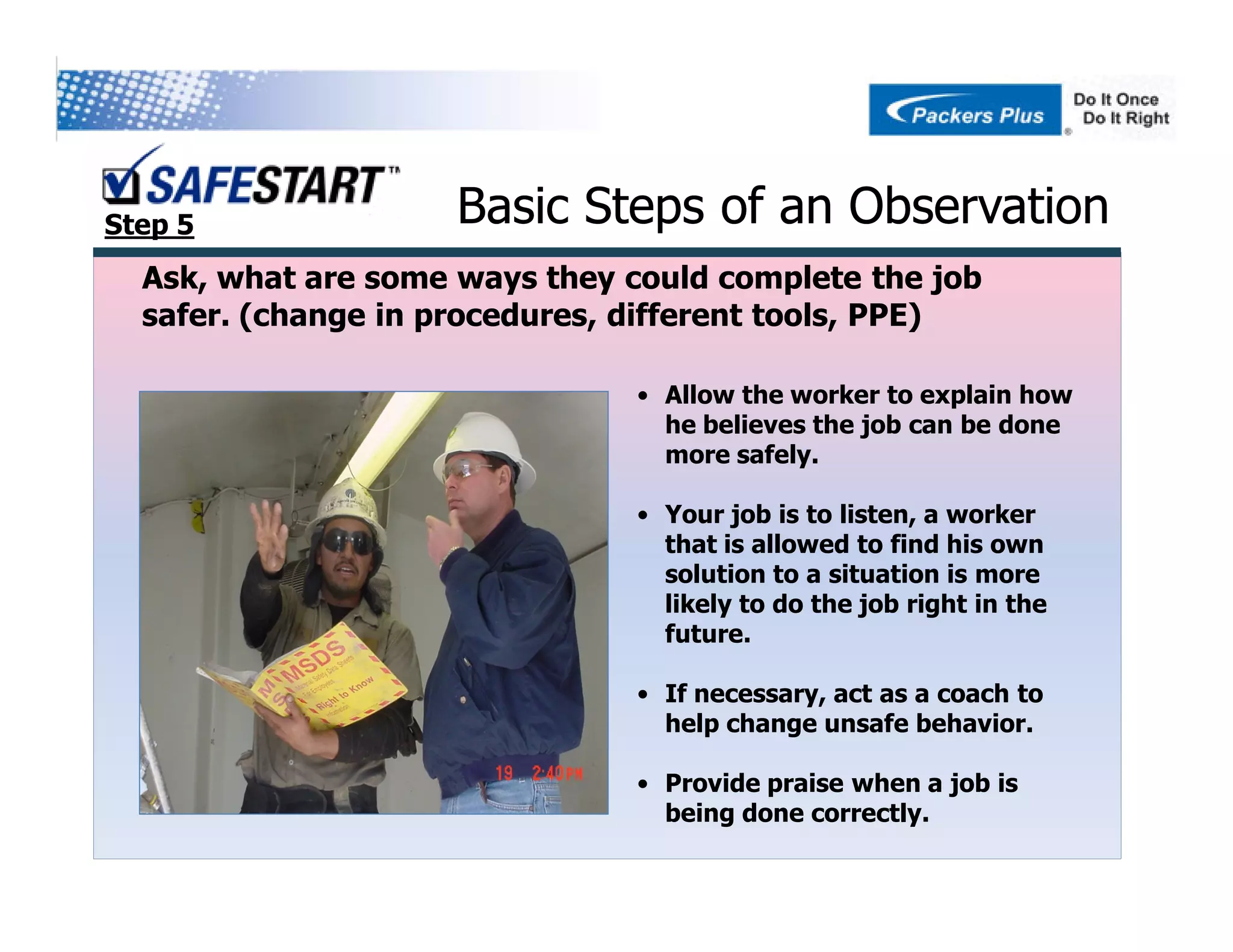
Ask, what are some ways they could complete the job
safer. (change in procedures, different tools, PPE)
• Allow the worker to explain how
he believes the job can be done
more safely.
• Your job is to listen, a worker
that is allowed to find his own
solution to a situation is more
likely to do the job right in the
future.
• If necessary, act as a coach to
help change unsafe behavior.
• Provide praise when a job is
being done correctly.
Step 5
Basic Steps of an ObservationBasic Steps of an Observation
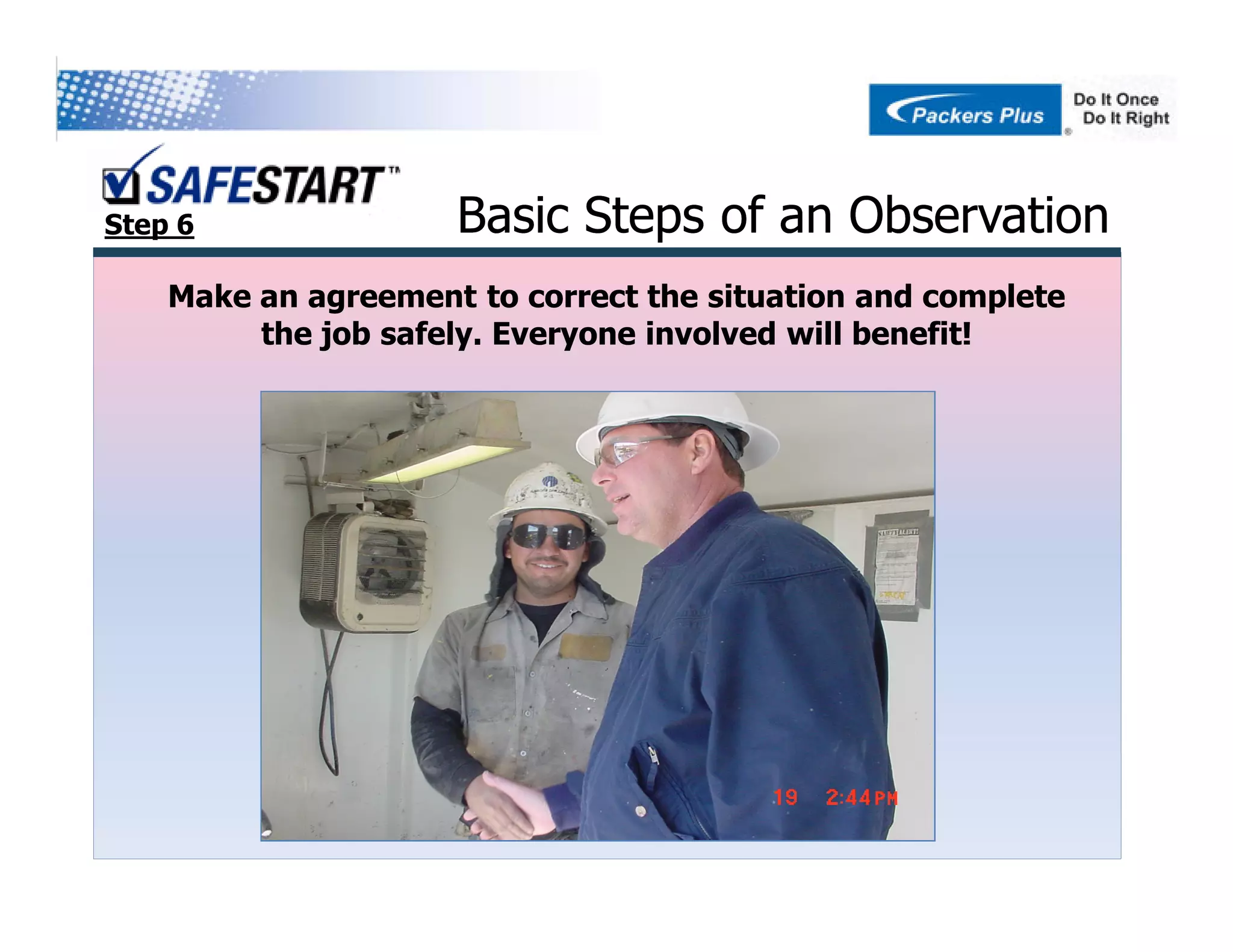
Make an agreement to correct the situation and complete
the job safely. Everyone involved will benefit!
Step 6
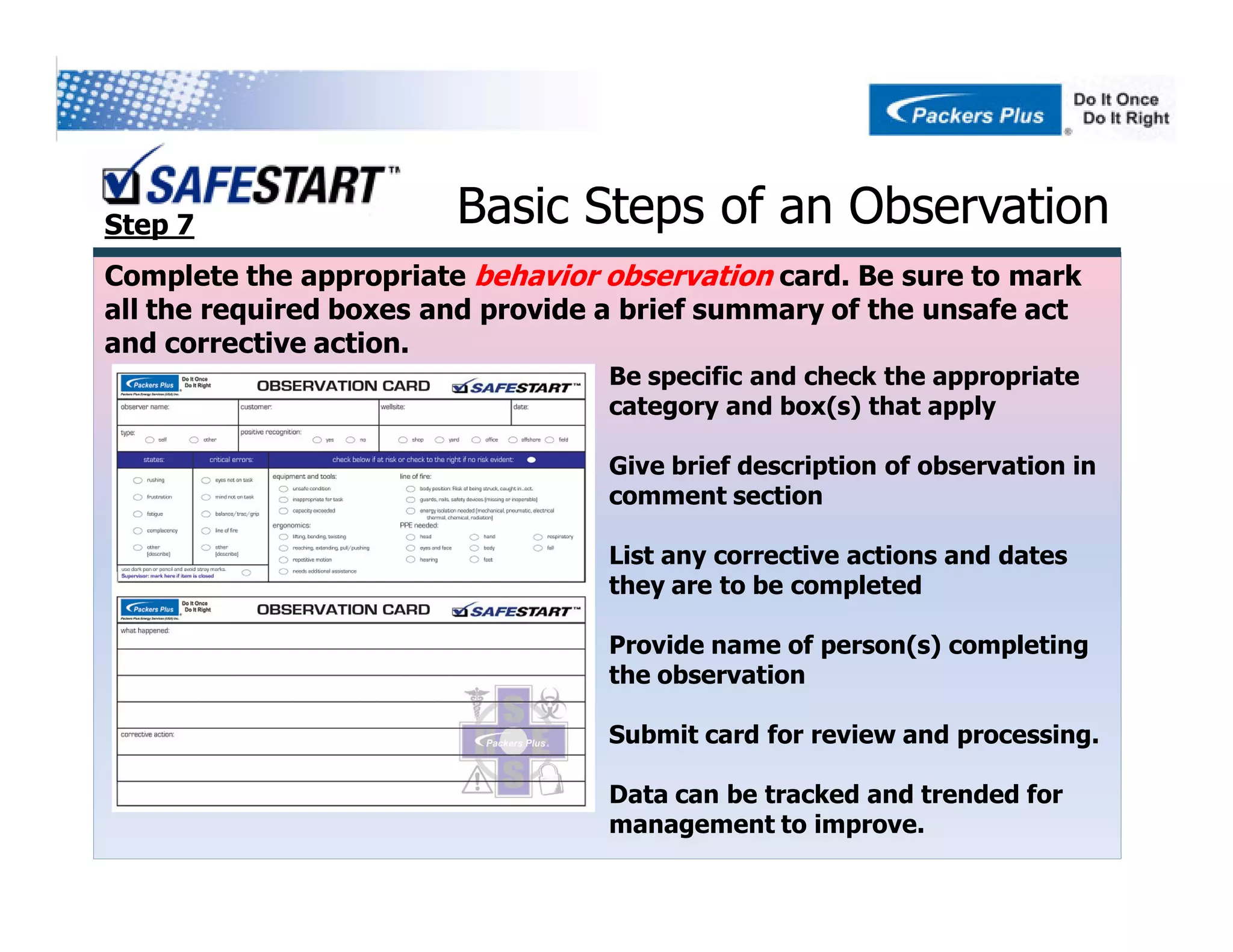
Complete the appropriate behavior observation card. Be sure to mark
all the required boxes and provide a brief summary of the unsafe act
and corrective action.
Basic Steps of an ObservationBasic Steps of an Observation
• Be specific and check the appropriate
category and box(s) that apply
• Give brief description of observation in
comment section
• List any corrective actions and dates
they are to be completed
• Provide name of person(s) completing
the observation
• Submit card for review and processing.
• Data can be tracked and trended for
management to improve.
Step 7
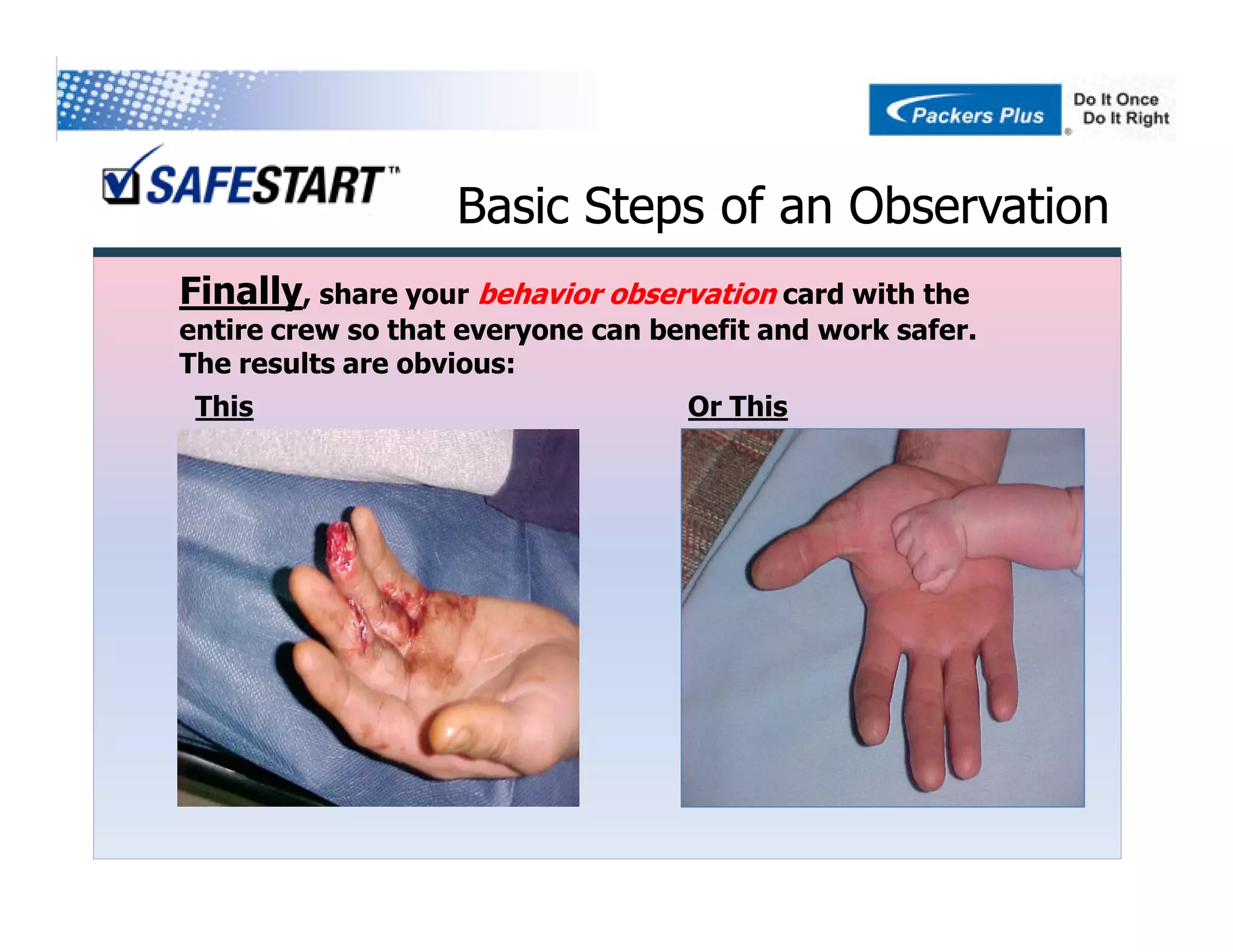
Finally, share your behavior observation card with the
entire crew so that everyone can benefit and work safer.
The results are obvious:
Basic Steps of an ObservationBasic Steps of an Observation
This Or This
PracticePractice BBSBBS, Reduce Risk and, Reduce Risk and
Prevent this from happening toPrevent this from happening to
you or one of your coyou or one of your co--workers!workers!
ConclusionConclusion

behavior based safety

  • 1.
    Behavioral BasedBehavioral Based SafetyObservationSafety Observation ProgramProgram
  • 2.
    The following presentationprovides an example of a (basic) Behavior Based HSE Observation Program Note: the Observation card used as an example includes a Behavior Observation Checklist, Hazard ID, and Near Miss observations as well as R+ ( positive recognition) A Behavior Based Safety program is intended to enable company employees to record safety observations, most importantly, stopping of work that is unsafe. Behavior Based Safety BasicsBehavior Based Safety Basics
  • 3.
    HSE Observation ProgramHSEObservation Program (Definition)(Definition) Peer to peer method of coaching, counseling, and encouraging all employees to reinforce safe behavior Safety Observation Cycle: 1. Observe people 2. Analyze their work practices by focusing on safe and unsafe behaviors 3. Talk with them about safety 4. Actively correct and prevent unsafe acts and conditions 5. Reinforce safe behavior 6. Report your observations
  • 4.
    Making Common Sense- Common Practice! SAFETY- IT’S NOT JUST AT WORK! SAFESTART works….. On the job Off the job On the highway 1. Something unexpected has to happen They may increase the risk while performing a task but no one intentionally tries to hurt themselves No one is trying to make a mistake or bad decision 2. Most accidents follow simple patterns of behavior
  • 5.
    Making Common Sense- Common Practice! There are 3 Types of At Risk Behavior Conscious Behavior Habitual Behavior Unintentional Behavior SafeStart is about Unintentional Behavior and Habitual Behavior. Or to be more specific, It’s about how to prevent mistakes or errors you never wanted to make in the first place.
  • 6.
    • Four Behaviorsor States that can lead to one or more Four Critical Errors are: Rushing Frustration Fatigue Complacency Making Common Sense - Common Practice!
  • 7.
    Rushing When you exceedthe pace at which you normally perform the task, whether it’s working, driving, walking or running, lifting, moving, etc. Four Behaviors or States
  • 8.
    Frustration Caused by relationshipsinside and outside of the workplace, malfunctioning equipment, inadequate tools, conflicting objectives and pressures, etc. Four Behaviors or States
  • 9.
    Fatigue Too tired physicallyor mentally to do the job safely. It includes being too tired to react quickly, prolonged concentration is difficult, etc. Four Behaviors or States
  • 10.
    Complacency Familiar enough withthe hazards to become considerably less concerned over time. It contributes significantly to not watching or thinking about what you are doing. Four Behaviors or States
  • 11.
    Four Critical Errors Wehave gone over the Four States, now we will look at the Four Critical Errors that can lead to Increased Risk
  • 12.
    EYES NOT ONTASK MIND NOT ON TASK LINE-OF-FIRE BALANCE/TRACTION/GRIP . . . Which increase the risk of injury Four Critical Errors
  • 13.
    Eyes Not OnTask Not looking at where you are going or what is coming at you. It includes not moving your eyes before moving your body or not being able to see where you are stepping, where your hands are reaching into, etc. Four Critical Errors
  • 14.
    Mind Not OnTask Not concentrating on the job, being unaware of dangers or deficiencies, forgetting things, making more errors than normal, going on “Auto-Pilot,” ”drifting away,” etc. Four Critical Errors
  • 15.
    Line-Of-Fire Being conscious ofwhere you are or where you are going in relation to the direction of the hazardous energy. It includes protection barriers and PPE if line-of-fire cannot be predicted accurately. Four Critical Errors
  • 16.
    Balance/Traction/Grip Doing something thatcould cause you to lose your balance, traction or grip. It could include not wearing good footwear/gloves, not having a good grip in the first place or not seeing or thinking about the hazard. Four Critical Errors
  • 17.
    Now that wehave looked at the Four States that can lead to the Four Critical Errors, let’s look at the Increased Risk. Increased Risk
  • 18.
    Safety is afunction of Risk There is a certain amount of Risk in everything we do On the Job Off the Job Or while Driving We may not be able to eliminate all the Risk, but we can lower the Risk by using the SafeStart principles Increased Risk
  • 19.
    Every task thatwe perform has a different amount of Risk associated with it. The Risk of performing each of these tasks can be increased by the States to Error Pattern as defined by SafeStart. Eliminate the States to Pattern… Eliminate RISK! Increased Risk
  • 20.
  • 21.
    The card canalso used for Near Miss, Hazard ID, and H&S or Environmental events. Data can easily be gathered and trended. Behavior-Based Observation Card
  • 22.
    Behavior Based SafetyBasicsBehavior Based Safety Basics • #1 MESSAGE: All employees have the obligation to stop work anytime they feel that their safety or the safety of other employees is at risk. • Observations do not contain names, except for recognition. • Always end your observation by complimenting good behaviors/practices observed. • Gather and turn in observations to your supervisor for trending purposes.
  • 23.
    Behavior Based SafetyBasicsBehavior Based Safety Basics • Use the data to understand types of at risk behaviors, develop performance targets and to address behaviors targeted for improvement. • Use trended data to develop action plans and upgrade / customize training. • Share observations, trended data and performance targets with employees and other locations.
  • 24.
    Behavior Based SafetyBasicsBehavior Based Safety Basics • The name of the person being observed should not be included except for positive recognition. • Upon completion of observation, discuss any at risk behaviors/practices observed and offer safe alternatives. • In addition to looking for ‘at risk’ behaviors, look for safe behaviors/practices. • Always end the critique with the person/group being observed with positive remarks of safe behaviors/practices observed. • Incentives work well for building an in depth safety program. Examples include best observation, most quality observations, etc.
  • 25.
    Behavior Based SafetyBasicsBehavior Based Safety Basics Benefits of BBS for the Company • Enhanced reporting • Increased Hazard Recognition • Share Recognized Hazards • Data gathered is used to develop trends • Trended data can be used to improve overall safety for employees • Employees have greater sense of ownership of the HSE program • Incentives may be tied to best quality observations • Increased Employee Retention
  • 26.
    Basic Steps ofan ObservationBasic Steps of an Observation Observe work as it is taking place. Quite often you will be involved in the work yourself. • Observe people’s activity, their actions and surrounding environment. • Be careful not to startle or interrupt a worker at an inappropriate time. • Look for unsafe acts as well as good safety performance. • Look for detail and an overall impression. • Keep an open mind. Step 1
  • 27.
    Basic Steps ofBasicSteps of anan ObservationObservation If you see an act or condition that is unsafe or you think may be unsafe, stop the job and discuss the situation with the individual(s) involved. • Stop unsafe acts immediately, unless stopping the worker will create a greater hazard. If the action is not immediately dangerous to life and health, use your judgment to decide if it is better to wait for a few moments. • Be considerate and understanding, treat a worker the way you would expected to be treated. Step 2
  • 28.
    Ask the personor persons involved in the job to explain what they are trying to accomplish and what the procedures are. Basic Steps of an ObservationBasic Steps of an Observation Ask: • Can you tell me about the job? • What are the hazards and risks? • Have you completed a JSA/RAT? • Do you have a written procedure? • Why do you think I stopped you? Step 3
  • 29.
    Ask them, whatare some things that could go wrong and how are some ways they could get hurt during the job. Basic Steps of an ObservationBasic Steps of an Observation Ask: • What could go wrong with the job? • How could you or others be hurt? • Who else would be affected if you were injured? Step 4
  • 30.
    Basic Steps ofan ObservationBasic Steps of an Observation Ask, what are some ways they could complete the job safer. (change in procedures, different tools, PPE) • Allow the worker to explain how he believes the job can be done more safely. • Your job is to listen, a worker that is allowed to find his own solution to a situation is more likely to do the job right in the future. • If necessary, act as a coach to help change unsafe behavior. • Provide praise when a job is being done correctly. Step 5
  • 31.
    Basic Steps ofan ObservationBasic Steps of an Observation Make an agreement to correct the situation and complete the job safely. Everyone involved will benefit! Step 6
  • 32.
    Complete the appropriatebehavior observation card. Be sure to mark all the required boxes and provide a brief summary of the unsafe act and corrective action. Basic Steps of an ObservationBasic Steps of an Observation • Be specific and check the appropriate category and box(s) that apply • Give brief description of observation in comment section • List any corrective actions and dates they are to be completed • Provide name of person(s) completing the observation • Submit card for review and processing. • Data can be tracked and trended for management to improve. Step 7
  • 33.
    Finally, share yourbehavior observation card with the entire crew so that everyone can benefit and work safer. The results are obvious: Basic Steps of an ObservationBasic Steps of an Observation This Or This
  • 34.
    PracticePractice BBSBBS, ReduceRisk and, Reduce Risk and Prevent this from happening toPrevent this from happening to you or one of your coyou or one of your co--workers!workers! ConclusionConclusion