BHRM 1313: Human Resource Management 1
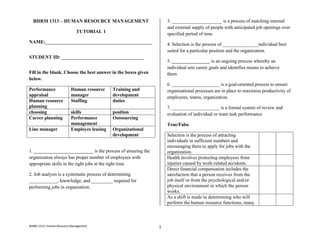
BHRM 1313 – HUMAN RESOURCE MANAGEMENT
TUTORIAL 1
NAME:____________________________________________
STUDENT ID: __________________________________
Fill in the blank. Choose the best answer in the boxes given
below.
Performance
appraisal
Human resource
manager
Training and
development
Human resource
planning
Staffing duties
choosing skills position
Career planning Performance
management
Outsourcing
Line manager Employee leasing Organizational
development
1. _________________________ is the process of ensuring the
organization always has proper number of employees with
appropriate skills in the right jobs at the right time
2. Job analysis is a systematic process of determining
____________, knowledge, and _________ required for
performing jobs in organisation.
3. _____________________ is a process of matching internal
and external supply of people with anticipated job openings over
specified period of time
4. Selection is the process of _______________individual best
suited for a particular position and the organization.
5. ________________ is an ongoing process whereby an
individual sets career goals and identifies means to achieve
them.
6. ____________________ is a goal-oriented process to ensure
organisational processes are in place to maximise productivity of
employees, teams, organization.
7. ____________________ is a formal system of review and
evaluation of individual or team task performance
True/False
Selection is the process of attracting
individuals in sufficient numbers and
encouraging them to apply for jobs with the
organization.
Health involves protecting employees from
injuries caused by work-related accidents.
Direct financial compensation includes the
satisfaction that a person receives from the
job itself or from the psychological and/or
physical environment in which the person
works.
As a shift is made in determining who will
perform the human resource functions, many
BHRM 1313: Human Resource Management 2
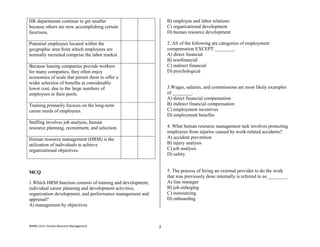
HR departments continue to get smaller
because others are now accomplishing certain
functions.
Potential employees located within the
geographic area from which employees are
normally recruited comprise the labor market.
Because leasing companies provide workers
for many companies, they often enjoy
economies of scale that permit them to offer a
wider selection of benefits at considerably
lower cost, due to the large numbers of
employees in their pools.
Training primarily focuses on the long-term
career needs of employees.
Staffing involves job analysis, human
resource planning, recruitment, and selection.
Human resource management (HRM) is the
utilization of individuals to achieve
organizational objectives.
MCQ
1.Which HRM function consists of training and development,
individual career planning and development activities,
organization development, and performance management and
appraisal?
A) management by objectives
B) employee and labor relations
C) organizational development
D) human resource development
2. All of the following are categories of employment
compensation EXCEPT ________.
A) direct financial
B) nonfinancial
C) indirect financial
D) psychological
3.Wages, salaries, and commissions are most likely examples
of ________.
A) direct financial compensation
B) indirect financial compensation
C) employment incentives
D) employment benefits
4. What human resource management task involves protecting
employees from injuries caused by work-related accidents?
A) accident prevention
B) injury analysis
C) job analysis
D) safety
5. The process of hiring an external provider to do the work
that was previously done internally is referred to as ________.
A) line manager
B) job enlarging
C) outsourcing
D) onboarding
BHRM 1313: Human Resource Management 3
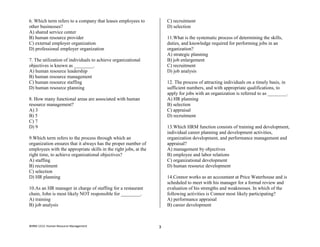
6. Which term refers to a company that leases employees to
other businesses?
A) shared service center
B) human resource provider
C) external employer organization
D) professional employer organization
7. The utilization of individuals to achieve organizational
objectives is known as ________.
A) human resource leadership
B) human resource management
C) human resource staffing
D) human resource planning
8. How many functional areas are associated with human
resource management?
A) 3
B) 5
C) 7
D) 9
9.Which term refers to the process through which an
organization ensures that it always has the proper number of
employees with the appropriate skills in the right jobs, at the
right time, to achieve organizational objectives?
A) staffing
B) recruitment
C) selection
D) HR planning
10.As an HR manager in charge of staffing for a restaurant
chain, John is most likely NOT responsible for ________.
A) training
B) job analysis
C) recruitment
D) selection
11.What is the systematic process of determining the skills,
duties, and knowledge required for performing jobs in an
organization?
A) strategic planning
B) job enlargement
C) recruitment
D) job analysis
12. The process of attracting individuals on a timely basis, in
sufficient numbers, and with appropriate qualifications, to
apply for jobs with an organization is referred to as ________.
A) HR planning
B) selection
C) appraisal
D) recruitment
13.Which HRM function consists of training and development,
individual career planning and development activities,
organization development, and performance management and
appraisal?
A) management by objectives
B) employee and labor relations
C) organizational development
D) human resource development
14.Connor works as an accountant at Price Waterhouse and is
scheduled to meet with his manager for a formal review and
evaluation of his strengths and weaknesses. In which of the
following activities is Connor most likely participating?
A) performance appraisal
B) career development
BHRM 1313: Human Resource Management 4
C) succession planning
D) job analysis
15.Which of the following terms refers to a goal-oriented
process that is directed toward ensuring that organizational
processes are in place to maximize the productivity of
employees, teams, and the organization?
A) team strategic management
B) performance management
C) organization development
D) career development
16. All of the following are categories of employment
compensation EXCEPT ________.
A) direct financial
B) nonfinancial
C) indirect financial
D) psychological
17.Wages, salaries, and commissions are most likely examples
of ________.
A) direct financial compensation
B) indirect financial compensation
C) employment incentives
D) employment benefits
18.Ellen enjoys working at Starbucks because of her
interactions with customers and co-workers. The satisfaction
that Ellen feels would best be categorized as ________.
A) emotional health
B) nonfinancial compensation
C) performance satisfaction
D) indirect financial compensation
19.As a public school teacher, Molly has accrued 14 days of
sick leave, which is a type of ________ compensation.
A) direct financial
B) indirect financial
C) nonfinancial
D) mandatory
20.What human resource management task involves protecting
employees from injuries caused by work-related accidents?
A) accident prevention
B) injury analysis
C) job analysis
D) safety
21.Healthy and safe employees are more likely to ________.
A) earn managerial promotions
B) request salary increases
C) remain productive
D) join labor unions
22.Which of the following is NOT an external environment
factor?
A) competition
B) customers
C) mission
D) shareholders
23. Which term refers to potential employees located within a
specific geographic area?
A) forecasted allocation
B) labor market
C) labor union
D) employee relations

Tutorial 1.pdf

  • 1.
    BHRM 1313: HumanResource Management 1 BHRM 1313 – HUMAN RESOURCE MANAGEMENT TUTORIAL 1 NAME:____________________________________________ STUDENT ID: __________________________________ Fill in the blank. Choose the best answer in the boxes given below. Performance appraisal Human resource manager Training and development Human resource planning Staffing duties choosing skills position Career planning Performance management Outsourcing Line manager Employee leasing Organizational development 1. _________________________ is the process of ensuring the organization always has proper number of employees with appropriate skills in the right jobs at the right time 2. Job analysis is a systematic process of determining ____________, knowledge, and _________ required for performing jobs in organisation. 3. _____________________ is a process of matching internal and external supply of people with anticipated job openings over specified period of time 4. Selection is the process of _______________individual best suited for a particular position and the organization. 5. ________________ is an ongoing process whereby an individual sets career goals and identifies means to achieve them. 6. ____________________ is a goal-oriented process to ensure organisational processes are in place to maximise productivity of employees, teams, organization. 7. ____________________ is a formal system of review and evaluation of individual or team task performance True/False Selection is the process of attracting individuals in sufficient numbers and encouraging them to apply for jobs with the organization. Health involves protecting employees from injuries caused by work-related accidents. Direct financial compensation includes the satisfaction that a person receives from the job itself or from the psychological and/or physical environment in which the person works. As a shift is made in determining who will perform the human resource functions, many
  • 2.
    BHRM 1313: HumanResource Management 2 HR departments continue to get smaller because others are now accomplishing certain functions. Potential employees located within the geographic area from which employees are normally recruited comprise the labor market. Because leasing companies provide workers for many companies, they often enjoy economies of scale that permit them to offer a wider selection of benefits at considerably lower cost, due to the large numbers of employees in their pools. Training primarily focuses on the long-term career needs of employees. Staffing involves job analysis, human resource planning, recruitment, and selection. Human resource management (HRM) is the utilization of individuals to achieve organizational objectives. MCQ 1.Which HRM function consists of training and development, individual career planning and development activities, organization development, and performance management and appraisal? A) management by objectives B) employee and labor relations C) organizational development D) human resource development 2. All of the following are categories of employment compensation EXCEPT ________. A) direct financial B) nonfinancial C) indirect financial D) psychological 3.Wages, salaries, and commissions are most likely examples of ________. A) direct financial compensation B) indirect financial compensation C) employment incentives D) employment benefits 4. What human resource management task involves protecting employees from injuries caused by work-related accidents? A) accident prevention B) injury analysis C) job analysis D) safety 5. The process of hiring an external provider to do the work that was previously done internally is referred to as ________. A) line manager B) job enlarging C) outsourcing D) onboarding
  • 3.
    BHRM 1313: HumanResource Management 3 6. Which term refers to a company that leases employees to other businesses? A) shared service center B) human resource provider C) external employer organization D) professional employer organization 7. The utilization of individuals to achieve organizational objectives is known as ________. A) human resource leadership B) human resource management C) human resource staffing D) human resource planning 8. How many functional areas are associated with human resource management? A) 3 B) 5 C) 7 D) 9 9.Which term refers to the process through which an organization ensures that it always has the proper number of employees with the appropriate skills in the right jobs, at the right time, to achieve organizational objectives? A) staffing B) recruitment C) selection D) HR planning 10.As an HR manager in charge of staffing for a restaurant chain, John is most likely NOT responsible for ________. A) training B) job analysis C) recruitment D) selection 11.What is the systematic process of determining the skills, duties, and knowledge required for performing jobs in an organization? A) strategic planning B) job enlargement C) recruitment D) job analysis 12. The process of attracting individuals on a timely basis, in sufficient numbers, and with appropriate qualifications, to apply for jobs with an organization is referred to as ________. A) HR planning B) selection C) appraisal D) recruitment 13.Which HRM function consists of training and development, individual career planning and development activities, organization development, and performance management and appraisal? A) management by objectives B) employee and labor relations C) organizational development D) human resource development 14.Connor works as an accountant at Price Waterhouse and is scheduled to meet with his manager for a formal review and evaluation of his strengths and weaknesses. In which of the following activities is Connor most likely participating? A) performance appraisal B) career development
  • 4.
    BHRM 1313: HumanResource Management 4 C) succession planning D) job analysis 15.Which of the following terms refers to a goal-oriented process that is directed toward ensuring that organizational processes are in place to maximize the productivity of employees, teams, and the organization? A) team strategic management B) performance management C) organization development D) career development 16. All of the following are categories of employment compensation EXCEPT ________. A) direct financial B) nonfinancial C) indirect financial D) psychological 17.Wages, salaries, and commissions are most likely examples of ________. A) direct financial compensation B) indirect financial compensation C) employment incentives D) employment benefits 18.Ellen enjoys working at Starbucks because of her interactions with customers and co-workers. The satisfaction that Ellen feels would best be categorized as ________. A) emotional health B) nonfinancial compensation C) performance satisfaction D) indirect financial compensation 19.As a public school teacher, Molly has accrued 14 days of sick leave, which is a type of ________ compensation. A) direct financial B) indirect financial C) nonfinancial D) mandatory 20.What human resource management task involves protecting employees from injuries caused by work-related accidents? A) accident prevention B) injury analysis C) job analysis D) safety 21.Healthy and safe employees are more likely to ________. A) earn managerial promotions B) request salary increases C) remain productive D) join labor unions 22.Which of the following is NOT an external environment factor? A) competition B) customers C) mission D) shareholders 23. Which term refers to potential employees located within a specific geographic area? A) forecasted allocation B) labor market C) labor union D) employee relations