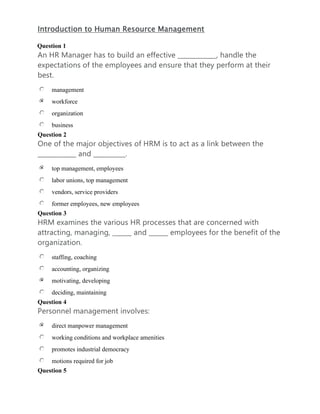
Introduction to Human Resource Management
Question 1
An HR Manager has to build an effective ____________, handle the
expectations of the employees and ensure that they perform at their
best.
management
workforce
organization
business
Question 2
One of the major objectives of HRM is to act as a link between the
____________ and __________.
top management, employees
labor unions, top management
vendors, service providers
former employees, new employees
Question 3
HRM examines the various HR processes that are concerned with
attracting, managing, ______ and ______ employees for the benefit of the
organization.
staffing, coaching
accounting, organizing
motivating, developing
deciding, maintaining
Question 4
Personnel management involves:
direct manpower management
working conditions and workplace amenities
promotes industrial democracy
motions required for job
Question 5
Employee welfare entails:
employee productivity
supportive work environment
working conditions and workplace amenities
motions required for job
Question 6
Industrial relations helps _______________________.
supervise employee safety
promote industrial democracy
contribute to organizational development
ascertain individual growth
Question 7
_________ is considered to be the father of scientific management.
Fredrick Taylor
Hawthorne
Robert Mathis
Josh Goldfaden
Question 8
__________ suggested that employee productivity was not only
influenced by the way the job was designed and the economic rewards
but also by certain social and psychological factors.
Fredrick Taylor
Hawthorne studies
Robert Mathis
Josh Goldfaden
Question 9
The __________ approach states that HR policies and practices should be
in alignment with the goal of balancing individual and organizations
needs.
Scientific management
Human relations
Human resources
Historical
Question 10
__________ is the future course of action that includes identifying human
resource requirements and forecasting personnel needs.
Job analysis
Recruitment
Selection
Planning
Question 11
___________ are the rewards that an employee earns in addition to
regular wages or salary based on the performance of the individual,
team or the organization.
Performance appraisal
Wage or salary benefits
Incentives
Fringe benefits
Question 12
____________ are monetary and non-monetary benefits given to
employees during their employment.
Incentives
Fringe benefits
Performance appraisal
Wage or salary benefits
Question 13
The administrative role of the HR involves record keeping and
____________.
legal compliances
market strategies
performance appraisals
wage administration
Question 14
As an ___________ HR employees link the top management and
employees.
administrative expert
auditor
employee advocate
facilitator
Question 15
As an _______ HR specialists are responsible for ensuring that all
members of the management perform their respective roles concerned
with the effective use of HR.
consultant
administrative expert
service provider
auditor
HRM in India
Question 1
The challenges HR managers face is the issue of upgrading the skill set of employees through
________ in the face of high att
coaching and motivating
mentoring and leading
managing and staffing
training and development
Question 2
Most of Indian companies are committed to provide ___________ opportunities for all.
many
equal
just
few
Question 3
Human Resource Management has taken a leading role in encouraging ________ activities at all
levels.
Corporate Social Responsibility
social service
community service
public service
Question 4
Organizations are changing their HR policies to retain their _________.
required resources
important customers
valuable employees
reputed services
Question 5
The most important use of technology in HRM is an organization�s __________.
Human Resource Management System
Human Resource Planning System
Human Resource Information System
Human Resource Relations System
Question 6
Technological and ___________ trends are in turn producing changes in the nature of jobs and
work.
economic
globalization
sustainable
progressive
Question 7
___________ means establishing a heterogeneous workforce to perform to its potential in an
equitable work environment where
Managing diversity
Managing technology
Homogenizing
Multiplicity
Question 8
An enormous shift from manufacturing jobs to _____ is observed in workforce diversity.
production economy
closed economy
mixed economy
service economy
Question 9
HRM Practices in Indian Organizations is structurally well-researched.
True
False
Question 10
The tolerance for ambiguity and uncertainty is high in the Indian workforce.
True
False
Question 11
Tolerance for diversity is high among Indians and therefore not much HR efforts are needed to
practice tolerance towards othe
True
False
Question 12
Indian employees require cultural events and activities in the organization.
True
False
Question 13
There is a natural urge for Indian employees to collaborate at the workplace,
True
False
Human Resource Planning
Question 1
HRP has to take into account the __________ for individual employees
and ___________ in the organization.
career planning, succession planning
training, development
coaching, mentoring
education
Question 2
Human resource planning helps to __________ the turnover or attrition
rates.
plan
delegate
manage
forecast
Question 3
Manpower planning consists of ___________ future manpower and
developing manpower plans for the __________ of the projections.
forecasting, creating
projecting, implementation
training, development
predicting, records
Question 4
Manpower planning is required in order to meet the needs of _________
programs that become necessary because of increase in the demand
for goods and services.
welfare
benefit
expansion
surplus
Question 5
Manpower planning is also needed in order to identify areas in which
there is a __________ of personnel.
shortage
scarcity
surplus
excess
Question 6
The success of HR plans depends on the accuracy of the ________ that
are needed to implement the organizational strategies.
HR forecasts
Delphi technique
Index or Trend analysis
HR budgets
Question 7
______ calls for selection of a panel of experts either from within or
outside the organization.
Time series
Delphi technique
Index or Trend analysis
HR budgets
Question 8
In __________ past staffing levels (instead of workload indicators) are
used to project future human resource requirements.
Delphi technique
Nominal group method
Index or Trend analysis
Time series
Question 9
Successful HR planning calls for establishing HRP as an integral part of
the _______________ activities.
corporate planning
economic planning
financial planning
security planning
Question 10
___________________of the HRP process every year is necessary to
incorporate changes in it to make it more useful.
Maintenance
Development
Modification
Review
Recruitment and Selection
Question 1
Recruitment is the process of searching for _________ employees and
stimulating them to apply for the jobs in the organizations.
prospective
skilled
talented
smart
Question 2
The aim of ________ program is to attract the best people for the job
and aid the recruiter by making a wide choice available.
useful selection
job application
effective recruitment
employee referral
Question 3
Employees who are already working in the organization ______ their
friends or acquaintances for the vacant positions in the organization.
This is known as employee referral.
recommend
allocate
hire
employ
Question 4
______ invite applications from interested candidates, short-list them or
interview them for a second round of short listing and finally arrive at
the list of suitable candidates for the vacant position.
HR department
Private agencies
Advertising agencies
Consulting firms
Question 5
One of the sources of recruitment for an organization might be
__________ applications from candidates interested in working with the
organization.
referral
multiple
external
unsolicited
Question 6
______ are using information technology as an aid in recruiting people.
HR personnel
Managers
Employers
Executives
Question 7
The process of choosing the most suitable candidate for a job from
among the available applicants is called ____________.
application
employment
referral
selection
Question 8
Rejecting an unsuitable candidate will have a _______ effect on the
organization.
negative
positive
ripple
strong
Question 9
The applicants are called for a test or an interview, after __________.
selection
initial screening
telephonic interview
employee referral
Question 10
Interviews are generally conducted to test the ___________ of the
candidate.
personality
knowledge
intelligence
skill levels
Question 11
_________ in an application form normally includes the candidates name,
date of birth, gender, marital status, details of family, and address.
Background information
Educational qualification
Experience
Personal information
Question 12
________ check the credibility of the candidates and get information of
their experience.
Personality items
Reference checks
Educational qualification
Personal information
Question 13
Under ________ items, the applicant is required to provide information
such as strengths and weaknesses.
personality
salary
reference checks
work experience
Question 14
_________ measures the general mental ability of individuals. This is the
first standardized and most widely used test developed by
psychologists.
Personality test
Aptitude test
Intelligence test
Interest test
Question 15
_________ measures the job related proficiency and knowledge of the
applicants.
Aptitude test
Achievement test
Interest test
Situational test
Question 16
In _________, the candidates are exposed to simulated business
situations and their responses are recorded and evaluated.
Situational test
Achievement test
Interest test
Intelligence test
Question 17
_____________ is an important part of the interview. It should be done in
a smooth manner. Interviewer should make an overt sign to indicate
the end of the interview.
Preparation
Closing an interview
Setting
Conducting an interview
Question 18
_________ are first round interviews that aim to eliminate the applicants
who are obviously unqualified for the job.
In-depth interviews
Group interviews
Preliminary interviews
Selection interviews
Question 19
________ are deliberate attempts to create pressure to observe how an
applicant performs under stress.
Preliminary interviews
Group interviews
Decision-making interviews
Stress interviews
Question 20
___________ is the period of familiarization for the employee, with the
organization, his colleagues, and his job.
Induction
Evaluation
Placement
Medical examination
Training and Management Development
Question 1
___________ enhances the skills and capabilities of the individuals in an
organization.
Training
Education
Practice
Profit
Question 2
Training helps an employee acquire the skills required to assume
greater ______.
responsibilities
monetary benefits
experience
role appreciation
Question 3
A manager who has well trained and well equipped employees needs
to spend less time ___________ them.
training
supervising
meeting with
testing
Question 4
Understanding ________ and procedures is important for any employee
of the organization.
hierarchy
policies
the mission
the business environment
Question 5
Training in ____________ equips an employee to deal successfully with
the problems he is facing.
problem solving
grievance redressal
job-related skills
business communication
Question 6
________ of/on employee performance after the training also enables
the employee to adopt and employ the newly acquired knowledge and
skills.
Tests
Supervision
Feedback
Monitoring
Question 7
In the _________ method, a trainee can discuss problems in performing
the job immediately with the trainer.
computer modeling
job instruction training
vestibule training
job rotation
Question 8
_________ is a training method where the trainee is placed on various
jobs across different functions in the organization.
Committee assignments
Role playing
Vestibule training
Job rotation
Question 9
Under ___________, a group of employees are given an actual
organizational problem and are asked to find the solution.
committee assignments
role playing
case studies
job rotation
Question 10
___________ is a technique whereby the dimensions of the job are
programmed into the computer.
Computer modeling
Role playing
Case studies
Apprenticeship
Question 11
In ____________ training, the actual work conditions are simulated and
the equipment used by the trainees is similar to what is used in the job.
computer modeling
job instruction training
vestibule training
job rotation
Question 12
In the _____________ method, the trainees are divided into different
groups and teams. They play the roles of competing firms in a
simulated market.
business games
role play
case study
incidental
Question 13
The ________ technique enables junior managers to participate in board
and committee meetings, which are normally attended only by senior
and top level managers.
understudy assignments
multiple management
coaching
job rotation
Question 14
The ______ method aims to develop the intellectual ability, practical
judgment and social awareness of the employees
business games
role play
case study
incidental
Question 15
The __________ is a method of development that simulates the aspect of
a managers job. Trainees receive documents similar to the items
normally found in managers in basket.
business games method
role play method
case study method
In-basket method
Question 16
_________ is a method which helps to change the behavior through
unstructured group interaction.
Sensitivity training
Role play
Case study
Job rotation
Question 17
___________ is a theory of personality development and provides an
approach for defining and analyzing the interaction between people.
Job rotation
Transactional analysis
Multiple management
The incidental method
Question 18
___________________ helps in determining the relationship between
acquired knowledge, transfer of knowledge at the work place, and
training.
Feedback
Research
Control
Power games
Question 19
_____________ helps in giving feedback to the candidates by defining the
objectives and linking it to learning outcomes.
Feedback
Intervention
Control
Power games
Question 20
Using __________________, the top management (higher authoritative
employee) uses the evaluative data to manipulate it for their own
benefits.
Research
Intervention
Control
Power games
Question 21
______________ helps in determining whether the actual outcomes are
aligned with the expected outcomes.
Intervention
Control
Supervision
Power games
Employee Career Planning and Growth
Question 1
Companies are designing __________________________ to increase employee productivity,
prevent job burnout and obsolescence, and improve the quality of employees work lives.
employee recruitment programmes
employee evaluation programmes
employee growth programmes
employee retention programmes
Question 2
To cope in todays turbulent times, it has become increasingly important for both
_______________ and ______________ to better redress employee career needs.
HR, employers
the government, employees
trade unions, employees
employees, employers
Question 3
The end result for a ____________ workforce is one that has self-reliant workers who are
capable of reinventing themselves to keep us with the fast pace of organizational changes.
motivated
career-resilient
growing
developed
Question 4
A _________ can be defined as a sequence of positions, roles or jobs held by one person over a
relatively long time span and over his/her life time.
position
career
plan
path
Question 5
___________refers to the process by which an individual selects career goals and the path to
these goals.
Career development
Career planning
Training
Mentoring
Question 6
A _________ is an attitudinal characteristic that guides people throughout their careers.
career anchor
career goal
career plan
career milestone
Question 7
Which if the following are the elements of career planning programme:1. Individual assessment
and need analysis. 2. Organisational financial analysis.3. Need � opportunity alignment. 4.
Career counselling.
1, 2, 3
1, 3, 4
2, 3, 4
1, 2, 4
Question 8
Traditionally, succession planning was usually restricted to senior-level management positions
and was _________________or ____________.
formal, informal
short-term, long-term
0
0
Question 9
Formal succession planning involves an examination of strategic (long-range) plans and HR
forecasts and a review of the data on all ___________________ employees.
Current
Potential
Senior
New
Question 10
Succession planning reduces ___________________ of managerial development movements.
regularity
frequency
predictability
randomness
Question 11
One of the other career programmes is the ________.
Placement oppurtunities
Outplacement programme
Need � opportunity alignment
Succession planning
Question 12
One of the other career programmes is the Work-family programme.
True
False
Performance Appraisal
Question 1
Companies are designing __________________________ to increase
employee productivity, prevent job burnout and obsolescence, and
improve the quality of employees work lives.
employee recruitment programmes
employee evaluation programmes
employee growth programmes
employee retention programmes
Question 2
To cope in todays turbulent times, it has become increasingly
important for both _______________ and ______________ to better redress
employee career needs.
HR, employers
the government, employees
trade unions, employees
employees, employers
Question 3
The end result for a ____________ workforce is one that has self-reliant
workers who are capable of reinventing themselves to keep us with the
fast pace of organizational changes.
motivated
career-resilient
growing
developed
Question 4
Performance is defined as the record of outcomes produced on a
specific job function or activity during a/an ______________________.
infinite time period
employees career
specific time period
a period of never more than six months
Question 5
Performance includes a number of _______ involved in performing a job.
number of tasks or activities
number of skills or abilities
0
0
Question 6
Two aspects that need to be considered while establishing a PMS are
________ and ___________.
reliability of the assessment tool
impracticality
clarity
ambiguity
Question 7
In the ______ technique, the performance is assessed on effective or
ineffective performance incidents.
critical incident
essay evaluation
Management by Objectives (MBO)
Behaviourally Anchored Rating Scale (BARS)
Question 8
In _______________, the evaluator must choose from a set of descriptive
statements about the employee.
forced distribution
paired comparison
checklists and weighted checklists
forced choice
Question 9
In the ________________ method of evaluation, the evaluator is asked to
describe the strong and weak aspects of the employees behaviour.
ranking
essay evaluation
Behaviourally Anchored Rating Scale (BARS)
Management by Objectives (MBO)
Question 10
In ________________, the targets are set in advance.
Management by Objectives (MBO)
The Behaviourally Anchored Rating Scale (BARS)
The critical incident technique
The graphic rating scale
Question 11
In ________________, the evaluator is asked to rate employees from
highest to lowest on some overall criterion.
paired comparison
critical incident technique
ranking
graphic rating scale
Question 12
In the _______________________ approach, first the names of the persons
to be evaluated are placed on separate sheets in a predetermined
order, so that each person is compared to all others to be evaluated.
paired comparison
critical incident technique
ranking
graphic rating scale
Question 13
The __________________________ is similar to grading on a curve.
forced distribution
paired comparison
checklists and weighted checklists
forced choice
Question 14
Identify the sources of feedback in 360 Degree Appraisals:1.
Managers/Superiors2. Peers3. Friends4. Customers5. Oneself
1, 2, 4
1, 2, 3, 5
1, 2, 4, 5
1, 2, 3, 4, 5
Question 15
________ ratings can be used when the employee's expertise is known or
the performance and results can be observed.
Managers
Customers
Peers
Oneself
Question 16
Organisations have realised that feedback from different sources
should be taken into account.
True
False
Question 17
Self assessment includes both the ratings of individuals by managers
on elements in an employee's performance plan and the evaluation of
programmes and teams by senior managers.
True
False
Compensation Management
Question 1
The term _________ is defined in the Oxford Dictionary as fixed
periodical payment to a person doing other than manual or mechanical
work.
salary
wage
incentive
benefit
Question 2
The _________ theory is also known as Iron Law of Wages.
The bargaining theory of wages
The wage fund theory
The subsistence theory
The marginal productivity theory
Question 3
The _________ theory was propounded by Francis A. Walker.
The wage fund theory
The residual claimant theory
The standard of living theory
The purchasing power theory
Question 4
_________ has been defined by the Committee as "the wage which must
provide not only for the bare sustenance of life, but for the
preservation of the efficiency of the worker.”
Living wage
Fair wage
Minimum wage
Luxury wages
Question 5
Recognition of an employees contribution by giving an award is a
_______ incentive.
short term
long term
non-monetary
0
Question 6
In the ________ incentive method, employees earn a share of the
companys profit, which is normally calculated as a percentage of local
profit. Rewarding groups for their successful performance is known as
________________.
profit sharing, gain sharing
annual bonus, weekly bonus
gain sharing, profit sharing
employee stock plans, buyback plans
Question 7
There is no scientific way of ascertaining the impact of ___________ on
factors such as employee satisfaction and employee retention or
productivity.
benefits
salary
wages
incentives
Question 8
Some organisations might insist on few benefits to be _____________
where the employee might need to bear part of the cost.
supplementary
contributory
negligible
deferred
Job Evaluation
Question 1
________ is a systematic process of analyzing and evaluating jobs to
determine the relative worth of jobs in an organization.
Job evaluation
Competency mapping
Succession planning
0
Question 2
Job evaluation is the evaluation or rating of jobs to determine their
position in the ____________.
job hierarchy
organizational hierarchy
pay scale
department
Question 3
______________________ determines the position and place of the job in
the organizational hierarchy.
job hierarchy
job evaluation
job rotation
Role
Question 4
The objective of job evaluation is to measure employee satisfaction
with respect to ____________.
compensation
incentives
benefits
expereince
Question 5
Maintaining complete and accurate data relating to ___________ and
_________ of various jobs is an objective of job evaluation.
skills, safety level
description, specification
objectives, requirements
0
Question 6
______ is a method where a quantitative point scale is developed to
evaluate the jobs.
The Point rating method
The Ranking Method
The Factor-Comparison Method
The Job Classification or Grading Method
Question 7
In the _________ method the jobs in an organization are assessed based
on the knowledge, skills effort and other job s associated with each job.
The Point rating method
The Ranking Method
The Factor-Comparison Method
The Job Classification or Grading Method
Question 8
___________ are formulated on the job of the nature of tasks and
responsibilities of the job.
Evaluations
Grades
Scales
Designations
Question 9
In _______________, each job is compared with every other job in the
organization.
The Paired Comparison method
Relative ranking
Single factor ranking
0
Question 10
Job evaluation is a ___________ and an objective method of ranking jobs
relatively to each other.
logical
standardized
subjective
unfounded
Question 11
Job evaluation simplifies the process of___________.
termination
wage administration
succession planning
assigning designations
Question 12
__________ are underlying characteristics of a person which results in
effective and/or superior performance on the job.
Traits
Competencies
Skills
Drivers
Question 13
There are two sets of competencies, ___________________________ and
__________________________.
threshold competencies and differentiating competencies
similar competencies and phantom competencies
identical competencies and perceived competencies
0
Question 14
____________ is the process of ensuring that pools of skilled employees
are trained and available to meet the strategic objectives of the
organization.
Succession planning
Competency mapping
Promotion
Training
Human Resource Information System
Question 1
HRIS has three elements, namely _________, ___________, and _______.
input, process and output.
input, evaluation and balance
forecasting, evaluating and output
forecasting, evaluating and balance
Question 2
The objective of HRIS is to increase the ability of the ________________ to
influence new opportunities.
shareholders
human resource management
employees
line mangers
Question 3
An ________ allows HR managers to devote more time to strategic
issues.
IT system
HRM system
HRIS
QMS
Question 4
________ refers to all employee-related data. HR policies, procedures,
corporate goals and information about the statutory provisions entered
into HRIS for conversion into the desired form of output.
Input
Output
Corporate information
A curriculum vitae
Question 5
__________ helps in the storing and processing of data in a computer
with help of the software that issues instructions for processing.
IT system
HRM system
HRIS
QMS
Question 6
______ is the final stage of HRIS process.
Input
Output
Resolution
Processing
Question 7
The ____________ is used to support to and streamline the overall
recruitment process.
performance management system
applicant tracking system
manpower planning system
succession planning system
Question 8
The ________ aims at computing employee payments through an
integrated payroll system.
compensation management system
applicant tracking system
training and development system
succession planning system
Question 9
The ______ module brings identified and selected employees into the
succession channel.
compensation management system
applicant tracking system
training and development system
succession planning system
Question 10
________ must clearly decide about the need for HRIS in the
organization.
Shareholders
Management
The HR department
The Board of Directors
Question 11
Implementation of HRIS is __________ for an organization.
economical
cheap
vital
expensive
Question 12
________ projects are typically quoted either on daily rate basis or by
project basis.
HRIS implementation
IT implementation
HRM implementation
QMS implementation
Question 13
HRIS _____ the processes for key HR functions which ensure that there
is uniformity in the performance of HR activities in the entire
organization.
standardises
decentralizes
eliminates
coordinates
Question 14
HRIS has the ability to significantly reduce the _________ in the HR
department.
labour requirement
overhead costs
management supervision
organizational interference
Question 15
HRIS _____ the processes for key HR functions which ensure that there
is uniformity in the performance of HR activities in the entire
organization.
standardises
decentralizes
eliminates
coordinates
Question 16
HRIS has the ability to significantly reduce the _________ in the HR
department.
labour requirement
overhead costs
management supervision
organizational interference
Question 17
The benefits of HRIS are as follows:1. Effective use of human
resource2. Ability to manage voluminous data3. Reduction in labour
cost4. Faster and effective HR decisions
1 and 3 are incorrect.
2 and 4 are correct.
1, 2, 3 and 4 are correct.
1, 2, 3 and 4 are incorrect.
Question 18
The primary activities in an HRIS implementation: 1. Configuring the
HRIS for the organisation�s business processes and policies.2.
Interfacing data with other systems and converting historical data into
the HRIS.3. Preparing the organisation for the HRIS.4. Providing
feedback
1 and 3 are incorrect.
2 and 4 are correct.
1, 2, 3 are correct.
1, 2, 3 and 4 are incorrect.
Question 19
The HRIS project team must track progress not only on the technical
aspects of implementing the HRIS, but also on the softer side of
managing the organisation as a whole to accept the new business
processes that come with the
HRIS. State True or False
True
False
Question 20
HRIS enables its users to have anytime, anywhere access with multiple
channels. State True or False:
True
False
Job Analysis and Design
Question 1
__________________________ is a recording of all the activities involved in a job and the skills
and knowledge requirements of the performer of the job.
Job analysis
Job design
Selection
Recruitment
Question 2
Job analysis helps in identifying the _________ for a position.
appraisal
training
key responsibility areas
compensation
Question 3
Job analysis plays a key role in ______ and ______ the performance appraisal system in an
organization.
designing, managing
identifying, evaluating
creating, identifying
managing, evaluating
Question 4
The first stage in job analysis is to gather all the necessary ___________.
development needs
job descriptions
information
job specifications
Question 5
In ________ the tasks, responsibilities, duties and functions of the job are prepared.
development needs
job description
information
job specifications
Question 6
In the___________method, individuals performing a job are observed and relevant points are
noted. It includes what was done and how was it done.
diary
observation
technical conference
individual interview
Question 7
The ___________ is a method of gathering the job related information from Experts
(Supervisors) and not from the employee.
diary method
observation method
technical conference method
functional job analysis method
Question 8
In the_________ method, incumbents of that particular job make immediate note of the activities
they perform.
diary Method
observation method
PAQ method
questionnaire method
Question 9
A ________ is a written statement of the minimum acceptable qualifications, knowledge, skill
traits, and physical and mental characteristics that an employee can perform the job successfully.
job analysis
job specification
job description
job evaluation
Question 10
The _________ describes in detail the various aspects of a job such as the tasks involved, the
responsibilities of the job and the deliverables. It also describes the setting and work
environment of the job.
job analysis
job specification
job description
job evaluation
Question 11
_________ include stability, adaptability and flexibility. Social specifications include ability to
work in a team, lead a team, and maintain interpersonal relationship.
Physical specifications
Mental specifications
Emotional specifications
Behavioral specifications
Employee Misconduct and Disciplinary Procedure
Question 1
________________ is the observance of principles, rules or any other laid
down procedures, practices, written or otherwise in the organization by
the employees or group of employees, to whom these apply, for
smooth and effective functioning of the organization.
Discipline
Order
Obedience
Punishment
Question 2
Conditions contributing to ______________________ are caused by
weaknesses within the organizational structure or by external factors.
poor management
poor discipline
organizational breakdown
employee dissatisfaction
Question 3
As far as possible, all the rules should be framed in cooperation and
collaboration with the ___________ of employees.
representatives
managers
peers
unions
Question 4
___________ should be uniformly enforced if they are to be effective.
Incentives
Rules
Benefits
Disciplinary action
Question 5
A disciplinary policy should be __________ rather than punitive.
disciplinary
corrective
preventive
remedial
Question 6
The ___________________ should issue only verbal and written warnings.
Industrial Relations Officer
organizations legal consultant
line manager
HR department
Question 7
The ___________________ should issue only verbal and written warnings.
Industrial Relations Officer
organizations legal consultant
line manager
HR department
Question 8
The supervisor must know his or her employee in determining how to
give a ________________.
pay cut
reprimand
dismissal
incentive
Question 9
Since a written reprimand is more permanent than a/an ________________
one, it is considered a more severe penalty.
oral
mutually understood
silent
0
Question 10
When the management of an organization wants to initiate an enquiry
against an employee for alleged misconduct, the employee concerned
is issued an/a ________.
pink slip
charge sheet
warning notice
order for dismissal
Question 11
The _________ should clearly indicate the charges against the employee
and seek an explanation for the employees misconduct.
pink slip
order for dismissal
warning notice
charge sheet
Question 12
According to ____________________, "discipline may be considered as a
force that prompts individuals or groups to observe the rules,
regulations and procedures which are deemed to be necessary for the
effective functioning of an organization.”
Richard. D Calhoon
Bremblett, Earl R
Dr. Jeffrey Spiegel
0
Grievance and Grievance Procedure
Question 1
The broadest interpretation of the term grievance could include any
discontent or dissatisfaction that affects ________________________.
organizational performance
employee behavior
environmental conditions
government policy
Question 2
In the language of the labor management relations, a grievance is a
complaint formally presented by the _______________________ to the
management.
wage worker
employee or employees
NGO
government
Question 3
The __________________________ states that complaints affecting one or
more individual workers with respect to their wage payments, overtime,
leave, transfer, promotion, seniority, work assignment, and discharges
would constitute grievances.
Constitution of India
Indian Penal Code
International Labor Organization
National Commission of Labor
Question 4
Employees may feel that they are _____ when compared to others.
paid more
paid less
paid enough
paid most
Question 5
Poor physical conditions at the _________, tight production norms,
defective tools and equipment, poor quality of materials, unfair rules,
lack of recognitions, etc. are work environment causes of grievance.
environment
residence
workplace
infrastructure
Question 6
Employee is unable to adjust with _________ and suffers from feelings of
neglect, humiliations.
colleagues
family
friends
society
Question 7
A _________ arises when legitimate needs of the employees remain
unfulfilled.
factual grievance
imaginary grievance
disguised grievance
unnecessary grievance
Question 8
_______ is when an employees dissatisfaction is not because of any valid
reason but because of a wrong perception.
Factual grievance
Imaginary grievance
Disguised grievance
Unnecessary grievance
Question 9
Grievances, if not identified and redressed, may affect ____ the workers,
managers and the entire organization.
favorably
adversely
satisfactorily
abruptly
Question 10
It should be ensured by the organization that its grievance procedure is
in _________ with the existing laws of nation.
disagreement
deviation
contact
conformity
Question 11
The grievance handling procedure cannot __________ any of the rights of
the employees guaranteed by the law.
supplement
change
violate
contain
Question 12
The number of stages in grievance procedure should be kept to a
_______.
minimum
maximum
satisfactory number
sufficient
Question 13
When a grievance arises, it has to be settled at the _______ level in the
redressal procedure.
highest possible
disciplinary
first
lowest possible
Question 14
The grievance committee consists of two representatives from the
_______, two from the union and one from the same department in
which the concerned employee works.
government
management
International Labor Organization
neutral committee
Question 15
Grievance procedures keep a check on __________.
arbitrary action
corruption
racial abuse
gender discrimination
Employee Welfare and Working Conditions
Question 1
Organizations are obliged to provide employees with a ___ and ____
environment.
safe, healthy
healthy, clean
small, safe
big, healthy
Question 2
Main purpose of health and safety _______ is the protection of people
and the work environment.
measures
policies
initiatives
practices
Question 3
The objective of labor welfare is to make people _____ and _______.
strong, content
fit, flexible
happy, satisfied
robust, healthy
Question 4
Employee welfare measures increase the _______ of an organization.
profit
revenue
productivity
sales
Question 5
Facilities such as housing schemes, medical benefits, and education and
recreation facilities for workers families help in raising their ________.
income
health standards
education level
standards of living
Question 6
The purpose of labor welfare is to bring about the development of the
whole personality of the workers to make a _______.
better workforce
better organization
better management
productive organization
Question 7
Two types of welfare measures are ________ and ___________.
local, national
internal, external
personal, organizational
statutory, non-statutory
Question 8
_______ offered by the organizations in compliance with the central and
state government regulations.
Statutory welfare facilities
Non-statutory welfare schemes
Tax benefits
Employee welfare schemes
Question 9
________ are to be provided by the employer so as to provide hygienic
and nutritious food to the employees.
Kitchens
Canteens
Hotels
Restaurants
Question 10
Proper and sufficient _____ are to be provided for employees so that
they can work safely during the night shifts.
urinals
restrooms
lights
bathrooms
Question 11
______ have the direct responsibility to provide welfare facilities to the
employees.
Employers
Central governments
State governments
Trade unions
Question 12
The ___________ is empowered to make rules to protect the health,
safety and welfare of the employees working in factory premises.
employer
central government
state government
trade union
Question 13
________ takes an active role in offering welfare facilities to the
employees in order to improve their well-being.
Employer
Central government
State government
Trade union
Question 14
When attrition rate is low in an organisation then the employer needs
to earn employee ___________ and ___________.
Salary Hike and loyalty
2 and 4 are correct.
hike and renumeration
Goodwill and loyalty
Question 15
An organisation is made up of its ________.
people
customers
products
stakeholders
Question 16
Profitability of an organisation has a direct relationship with the
employees productivity.
State TRUE or FALSE
True
False
Question 17
Welfare benefits of the employee affects the business as a whole.
True
False
Emerging Trends in HRM
Question 1
__________ is a process that identifies key competencies for an organization and/or a job and
incorporating those competencies of the organization.
Job analysis
Job identification
Competency
Mapping
Question 2
To conduct a __________ by asking incumbents to complete a position information
questionnaire (PIQ) is the first step in competency mapping.
job analysis
job review
job survey
job appraisal
Question 3
_______ is contracting with another company or person to perform a particular function.
Tying-in
Outsourcing
Contract management
Vendor management
Question 4
Business process outsourcing is the assignment of one or more important business processes to
___________.
internal providers
business unit providers
external providers
Shareholders
Question 5
The outside firms that provide outsourcing services are _______.
service providers
first-party providers
second-party providers
information providers
Question 6
_________ refers to employing and maintaining an exact number of employees with the required
skills, abilities and knowledge to perform the existing number of jobs in an organization.
Under sizing
Down sizing
Over sizing
Right sizing
Question 7
___________ results in high labour cost and high cost of production.
Understaffing
Outsourcing
Overstaffing
Recruitment
Question 8
Indian organizations retrench employees through various schemes like___________ and
______________.
voluntary retirement schemes, golden handshakes
compulsory retrenchment, golden handshakes
severance contracts, voluntary retirement schemes
compulsory retrenchment, severance contracts
Question 9
________ is a scheme where an organization gives its employees the opportunity of a flexible
working hours arrangement.
Work from home
Flexi time
Outsourcing
Employee ownership
Question 10
Flexi time increases employee ____________ and ______________.
workload, productivity
satisfaction, idleness
satisfaction, production
work-life balance, anxiety
Question 11
Flexi time benefits employees by helping them avoid the _______of commuting at peak hours if
their start and finish times are staggered.
satisfaction
time
efficiency
stress
Question 12
__________ refers to a multi-disciplined approach to achieving organizational objectives by
making the best use of knowledge.
Knowledge Management
Talent Management
Employee Management
Organizational Management
Question 13
Knowledge management focuses on processes such as ________, _____________
_____________ knowledge and the cultural and technical foundations that support them.
collecting, transferring and documenting
understanding, gathering and disseminating
acquiring, creating and sharing
collating, filing and distributing
Question 14
_______ need/s to be chosen only after all the requirements of a knowledge management
initiative have been established
People
Processes
Technology
Systems
Question 15 0 / 1 point
The term ___________ is usually associated with competency-based HRM practices.
knowledge management
talent management
employee management
HR management
Question 16
Matching the __________ to the right job is an acknowledged need in organizations.
right employer
right job description
right environment
right person
Question 17
People are not _________; they cannot be owned or controlled.
knowledge agents
human capital
organizational assets
stakeholders

Human Resource Management.0.pdf

  • 1.
    Introduction to HumanResource Management Question 1 An HR Manager has to build an effective ____________, handle the expectations of the employees and ensure that they perform at their best. management workforce organization business Question 2 One of the major objectives of HRM is to act as a link between the ____________ and __________. top management, employees labor unions, top management vendors, service providers former employees, new employees Question 3 HRM examines the various HR processes that are concerned with attracting, managing, ______ and ______ employees for the benefit of the organization. staffing, coaching accounting, organizing motivating, developing deciding, maintaining Question 4 Personnel management involves: direct manpower management working conditions and workplace amenities promotes industrial democracy motions required for job Question 5
  • 2.
    Employee welfare entails: employeeproductivity supportive work environment working conditions and workplace amenities motions required for job Question 6 Industrial relations helps _______________________. supervise employee safety promote industrial democracy contribute to organizational development ascertain individual growth Question 7 _________ is considered to be the father of scientific management. Fredrick Taylor Hawthorne Robert Mathis Josh Goldfaden Question 8 __________ suggested that employee productivity was not only influenced by the way the job was designed and the economic rewards but also by certain social and psychological factors. Fredrick Taylor Hawthorne studies Robert Mathis Josh Goldfaden Question 9 The __________ approach states that HR policies and practices should be in alignment with the goal of balancing individual and organizations needs. Scientific management Human relations
  • 3.
    Human resources Historical Question 10 __________is the future course of action that includes identifying human resource requirements and forecasting personnel needs. Job analysis Recruitment Selection Planning Question 11 ___________ are the rewards that an employee earns in addition to regular wages or salary based on the performance of the individual, team or the organization. Performance appraisal Wage or salary benefits Incentives Fringe benefits Question 12 ____________ are monetary and non-monetary benefits given to employees during their employment. Incentives Fringe benefits Performance appraisal Wage or salary benefits Question 13 The administrative role of the HR involves record keeping and ____________. legal compliances market strategies performance appraisals wage administration Question 14
  • 4.
    As an ___________HR employees link the top management and employees. administrative expert auditor employee advocate facilitator Question 15 As an _______ HR specialists are responsible for ensuring that all members of the management perform their respective roles concerned with the effective use of HR. consultant administrative expert service provider auditor HRM in India Question 1 The challenges HR managers face is the issue of upgrading the skill set of employees through ________ in the face of high att coaching and motivating mentoring and leading managing and staffing training and development Question 2 Most of Indian companies are committed to provide ___________ opportunities for all. many equal just few Question 3 Human Resource Management has taken a leading role in encouraging ________ activities at all levels.
  • 5.
    Corporate Social Responsibility socialservice community service public service Question 4 Organizations are changing their HR policies to retain their _________. required resources important customers valuable employees reputed services Question 5 The most important use of technology in HRM is an organization�s __________. Human Resource Management System Human Resource Planning System Human Resource Information System Human Resource Relations System Question 6 Technological and ___________ trends are in turn producing changes in the nature of jobs and work. economic globalization sustainable progressive Question 7 ___________ means establishing a heterogeneous workforce to perform to its potential in an equitable work environment where Managing diversity Managing technology Homogenizing Multiplicity Question 8 An enormous shift from manufacturing jobs to _____ is observed in workforce diversity. production economy
  • 6.
    closed economy mixed economy serviceeconomy Question 9 HRM Practices in Indian Organizations is structurally well-researched. True False Question 10 The tolerance for ambiguity and uncertainty is high in the Indian workforce. True False Question 11 Tolerance for diversity is high among Indians and therefore not much HR efforts are needed to practice tolerance towards othe True False Question 12 Indian employees require cultural events and activities in the organization. True False Question 13 There is a natural urge for Indian employees to collaborate at the workplace, True False Human Resource Planning Question 1 HRP has to take into account the __________ for individual employees and ___________ in the organization. career planning, succession planning training, development coaching, mentoring
  • 7.
    education Question 2 Human resourceplanning helps to __________ the turnover or attrition rates. plan delegate manage forecast Question 3 Manpower planning consists of ___________ future manpower and developing manpower plans for the __________ of the projections. forecasting, creating projecting, implementation training, development predicting, records Question 4 Manpower planning is required in order to meet the needs of _________ programs that become necessary because of increase in the demand for goods and services. welfare benefit expansion surplus Question 5 Manpower planning is also needed in order to identify areas in which there is a __________ of personnel. shortage scarcity surplus excess Question 6
  • 8.
    The success ofHR plans depends on the accuracy of the ________ that are needed to implement the organizational strategies. HR forecasts Delphi technique Index or Trend analysis HR budgets Question 7 ______ calls for selection of a panel of experts either from within or outside the organization. Time series Delphi technique Index or Trend analysis HR budgets Question 8 In __________ past staffing levels (instead of workload indicators) are used to project future human resource requirements. Delphi technique Nominal group method Index or Trend analysis Time series Question 9 Successful HR planning calls for establishing HRP as an integral part of the _______________ activities. corporate planning economic planning financial planning security planning Question 10 ___________________of the HRP process every year is necessary to incorporate changes in it to make it more useful. Maintenance
  • 9.
    Development Modification Review Recruitment and Selection Question1 Recruitment is the process of searching for _________ employees and stimulating them to apply for the jobs in the organizations. prospective skilled talented smart Question 2 The aim of ________ program is to attract the best people for the job and aid the recruiter by making a wide choice available. useful selection job application effective recruitment employee referral Question 3 Employees who are already working in the organization ______ their friends or acquaintances for the vacant positions in the organization. This is known as employee referral. recommend allocate hire employ Question 4
  • 10.
    ______ invite applicationsfrom interested candidates, short-list them or interview them for a second round of short listing and finally arrive at the list of suitable candidates for the vacant position. HR department Private agencies Advertising agencies Consulting firms Question 5 One of the sources of recruitment for an organization might be __________ applications from candidates interested in working with the organization. referral multiple external unsolicited Question 6 ______ are using information technology as an aid in recruiting people. HR personnel Managers Employers Executives Question 7 The process of choosing the most suitable candidate for a job from among the available applicants is called ____________. application employment referral selection Question 8 Rejecting an unsuitable candidate will have a _______ effect on the organization.
  • 11.
    negative positive ripple strong Question 9 The applicantsare called for a test or an interview, after __________. selection initial screening telephonic interview employee referral Question 10 Interviews are generally conducted to test the ___________ of the candidate. personality knowledge intelligence skill levels Question 11 _________ in an application form normally includes the candidates name, date of birth, gender, marital status, details of family, and address. Background information Educational qualification Experience Personal information Question 12 ________ check the credibility of the candidates and get information of their experience. Personality items Reference checks Educational qualification Personal information
  • 12.
    Question 13 Under ________items, the applicant is required to provide information such as strengths and weaknesses. personality salary reference checks work experience Question 14 _________ measures the general mental ability of individuals. This is the first standardized and most widely used test developed by psychologists. Personality test Aptitude test Intelligence test Interest test Question 15 _________ measures the job related proficiency and knowledge of the applicants. Aptitude test Achievement test Interest test Situational test Question 16 In _________, the candidates are exposed to simulated business situations and their responses are recorded and evaluated. Situational test Achievement test Interest test Intelligence test Question 17
  • 13.
    _____________ is animportant part of the interview. It should be done in a smooth manner. Interviewer should make an overt sign to indicate the end of the interview. Preparation Closing an interview Setting Conducting an interview Question 18 _________ are first round interviews that aim to eliminate the applicants who are obviously unqualified for the job. In-depth interviews Group interviews Preliminary interviews Selection interviews Question 19 ________ are deliberate attempts to create pressure to observe how an applicant performs under stress. Preliminary interviews Group interviews Decision-making interviews Stress interviews Question 20 ___________ is the period of familiarization for the employee, with the organization, his colleagues, and his job. Induction Evaluation Placement Medical examination Training and Management Development Question 1
  • 14.
    ___________ enhances theskills and capabilities of the individuals in an organization. Training Education Practice Profit Question 2 Training helps an employee acquire the skills required to assume greater ______. responsibilities monetary benefits experience role appreciation Question 3 A manager who has well trained and well equipped employees needs to spend less time ___________ them. training supervising meeting with testing Question 4 Understanding ________ and procedures is important for any employee of the organization. hierarchy policies the mission the business environment Question 5 Training in ____________ equips an employee to deal successfully with the problems he is facing. problem solving
  • 15.
    grievance redressal job-related skills businesscommunication Question 6 ________ of/on employee performance after the training also enables the employee to adopt and employ the newly acquired knowledge and skills. Tests Supervision Feedback Monitoring Question 7 In the _________ method, a trainee can discuss problems in performing the job immediately with the trainer. computer modeling job instruction training vestibule training job rotation Question 8 _________ is a training method where the trainee is placed on various jobs across different functions in the organization. Committee assignments Role playing Vestibule training Job rotation Question 9 Under ___________, a group of employees are given an actual organizational problem and are asked to find the solution. committee assignments role playing case studies
  • 16.
    job rotation Question 10 ___________is a technique whereby the dimensions of the job are programmed into the computer. Computer modeling Role playing Case studies Apprenticeship Question 11 In ____________ training, the actual work conditions are simulated and the equipment used by the trainees is similar to what is used in the job. computer modeling job instruction training vestibule training job rotation Question 12 In the _____________ method, the trainees are divided into different groups and teams. They play the roles of competing firms in a simulated market. business games role play case study incidental Question 13 The ________ technique enables junior managers to participate in board and committee meetings, which are normally attended only by senior and top level managers. understudy assignments multiple management coaching job rotation Question 14
  • 17.
    The ______ methodaims to develop the intellectual ability, practical judgment and social awareness of the employees business games role play case study incidental Question 15 The __________ is a method of development that simulates the aspect of a managers job. Trainees receive documents similar to the items normally found in managers in basket. business games method role play method case study method In-basket method Question 16 _________ is a method which helps to change the behavior through unstructured group interaction. Sensitivity training Role play Case study Job rotation Question 17 ___________ is a theory of personality development and provides an approach for defining and analyzing the interaction between people. Job rotation Transactional analysis Multiple management The incidental method Question 18 ___________________ helps in determining the relationship between acquired knowledge, transfer of knowledge at the work place, and training.
  • 18.
    Feedback Research Control Power games Question 19 _____________helps in giving feedback to the candidates by defining the objectives and linking it to learning outcomes. Feedback Intervention Control Power games Question 20 Using __________________, the top management (higher authoritative employee) uses the evaluative data to manipulate it for their own benefits. Research Intervention Control Power games Question 21 ______________ helps in determining whether the actual outcomes are aligned with the expected outcomes. Intervention Control Supervision Power games Employee Career Planning and Growth Question 1 Companies are designing __________________________ to increase employee productivity, prevent job burnout and obsolescence, and improve the quality of employees work lives.
  • 19.
    employee recruitment programmes employeeevaluation programmes employee growth programmes employee retention programmes Question 2 To cope in todays turbulent times, it has become increasingly important for both _______________ and ______________ to better redress employee career needs. HR, employers the government, employees trade unions, employees employees, employers Question 3 The end result for a ____________ workforce is one that has self-reliant workers who are capable of reinventing themselves to keep us with the fast pace of organizational changes. motivated career-resilient growing developed Question 4 A _________ can be defined as a sequence of positions, roles or jobs held by one person over a relatively long time span and over his/her life time. position career plan path Question 5 ___________refers to the process by which an individual selects career goals and the path to these goals. Career development Career planning Training Mentoring Question 6 A _________ is an attitudinal characteristic that guides people throughout their careers.
  • 20.
    career anchor career goal careerplan career milestone Question 7 Which if the following are the elements of career planning programme:1. Individual assessment and need analysis. 2. Organisational financial analysis.3. Need � opportunity alignment. 4. Career counselling. 1, 2, 3 1, 3, 4 2, 3, 4 1, 2, 4 Question 8 Traditionally, succession planning was usually restricted to senior-level management positions and was _________________or ____________. formal, informal short-term, long-term 0 0 Question 9 Formal succession planning involves an examination of strategic (long-range) plans and HR forecasts and a review of the data on all ___________________ employees. Current Potential Senior New Question 10 Succession planning reduces ___________________ of managerial development movements. regularity frequency predictability randomness Question 11 One of the other career programmes is the ________.
  • 21.
    Placement oppurtunities Outplacement programme Need� opportunity alignment Succession planning Question 12 One of the other career programmes is the Work-family programme. True False Performance Appraisal Question 1 Companies are designing __________________________ to increase employee productivity, prevent job burnout and obsolescence, and improve the quality of employees work lives. employee recruitment programmes employee evaluation programmes employee growth programmes employee retention programmes Question 2 To cope in todays turbulent times, it has become increasingly important for both _______________ and ______________ to better redress employee career needs. HR, employers the government, employees trade unions, employees employees, employers Question 3 The end result for a ____________ workforce is one that has self-reliant workers who are capable of reinventing themselves to keep us with the fast pace of organizational changes. motivated
  • 22.
    career-resilient growing developed Question 4 Performance isdefined as the record of outcomes produced on a specific job function or activity during a/an ______________________. infinite time period employees career specific time period a period of never more than six months Question 5 Performance includes a number of _______ involved in performing a job. number of tasks or activities number of skills or abilities 0 0 Question 6 Two aspects that need to be considered while establishing a PMS are ________ and ___________. reliability of the assessment tool impracticality clarity ambiguity Question 7 In the ______ technique, the performance is assessed on effective or ineffective performance incidents. critical incident essay evaluation Management by Objectives (MBO) Behaviourally Anchored Rating Scale (BARS) Question 8
  • 23.
    In _______________, theevaluator must choose from a set of descriptive statements about the employee. forced distribution paired comparison checklists and weighted checklists forced choice Question 9 In the ________________ method of evaluation, the evaluator is asked to describe the strong and weak aspects of the employees behaviour. ranking essay evaluation Behaviourally Anchored Rating Scale (BARS) Management by Objectives (MBO) Question 10 In ________________, the targets are set in advance. Management by Objectives (MBO) The Behaviourally Anchored Rating Scale (BARS) The critical incident technique The graphic rating scale Question 11 In ________________, the evaluator is asked to rate employees from highest to lowest on some overall criterion. paired comparison critical incident technique ranking graphic rating scale Question 12 In the _______________________ approach, first the names of the persons to be evaluated are placed on separate sheets in a predetermined order, so that each person is compared to all others to be evaluated. paired comparison
  • 24.
    critical incident technique ranking graphicrating scale Question 13 The __________________________ is similar to grading on a curve. forced distribution paired comparison checklists and weighted checklists forced choice Question 14 Identify the sources of feedback in 360 Degree Appraisals:1. Managers/Superiors2. Peers3. Friends4. Customers5. Oneself 1, 2, 4 1, 2, 3, 5 1, 2, 4, 5 1, 2, 3, 4, 5 Question 15 ________ ratings can be used when the employee's expertise is known or the performance and results can be observed. Managers Customers Peers Oneself Question 16 Organisations have realised that feedback from different sources should be taken into account. True False Question 17 Self assessment includes both the ratings of individuals by managers on elements in an employee's performance plan and the evaluation of programmes and teams by senior managers.
  • 25.
    True False Compensation Management Question 1 Theterm _________ is defined in the Oxford Dictionary as fixed periodical payment to a person doing other than manual or mechanical work. salary wage incentive benefit Question 2 The _________ theory is also known as Iron Law of Wages. The bargaining theory of wages The wage fund theory The subsistence theory The marginal productivity theory Question 3 The _________ theory was propounded by Francis A. Walker. The wage fund theory The residual claimant theory The standard of living theory The purchasing power theory Question 4 _________ has been defined by the Committee as "the wage which must provide not only for the bare sustenance of life, but for the preservation of the efficiency of the worker.” Living wage Fair wage Minimum wage
  • 26.
    Luxury wages Question 5 Recognitionof an employees contribution by giving an award is a _______ incentive. short term long term non-monetary 0 Question 6 In the ________ incentive method, employees earn a share of the companys profit, which is normally calculated as a percentage of local profit. Rewarding groups for their successful performance is known as ________________. profit sharing, gain sharing annual bonus, weekly bonus gain sharing, profit sharing employee stock plans, buyback plans Question 7 There is no scientific way of ascertaining the impact of ___________ on factors such as employee satisfaction and employee retention or productivity. benefits salary wages incentives Question 8 Some organisations might insist on few benefits to be _____________ where the employee might need to bear part of the cost. supplementary contributory negligible deferred
  • 27.
    Job Evaluation Question 1 ________is a systematic process of analyzing and evaluating jobs to determine the relative worth of jobs in an organization. Job evaluation Competency mapping Succession planning 0 Question 2 Job evaluation is the evaluation or rating of jobs to determine their position in the ____________. job hierarchy organizational hierarchy pay scale department Question 3 ______________________ determines the position and place of the job in the organizational hierarchy. job hierarchy job evaluation job rotation Role Question 4 The objective of job evaluation is to measure employee satisfaction with respect to ____________. compensation incentives benefits expereince Question 5
  • 28.
    Maintaining complete andaccurate data relating to ___________ and _________ of various jobs is an objective of job evaluation. skills, safety level description, specification objectives, requirements 0 Question 6 ______ is a method where a quantitative point scale is developed to evaluate the jobs. The Point rating method The Ranking Method The Factor-Comparison Method The Job Classification or Grading Method Question 7 In the _________ method the jobs in an organization are assessed based on the knowledge, skills effort and other job s associated with each job. The Point rating method The Ranking Method The Factor-Comparison Method The Job Classification or Grading Method Question 8 ___________ are formulated on the job of the nature of tasks and responsibilities of the job. Evaluations Grades Scales Designations Question 9 In _______________, each job is compared with every other job in the organization. The Paired Comparison method
  • 29.
    Relative ranking Single factorranking 0 Question 10 Job evaluation is a ___________ and an objective method of ranking jobs relatively to each other. logical standardized subjective unfounded Question 11 Job evaluation simplifies the process of___________. termination wage administration succession planning assigning designations Question 12 __________ are underlying characteristics of a person which results in effective and/or superior performance on the job. Traits Competencies Skills Drivers Question 13 There are two sets of competencies, ___________________________ and __________________________. threshold competencies and differentiating competencies similar competencies and phantom competencies identical competencies and perceived competencies 0 Question 14
  • 30.
    ____________ is theprocess of ensuring that pools of skilled employees are trained and available to meet the strategic objectives of the organization. Succession planning Competency mapping Promotion Training Human Resource Information System Question 1 HRIS has three elements, namely _________, ___________, and _______. input, process and output. input, evaluation and balance forecasting, evaluating and output forecasting, evaluating and balance Question 2 The objective of HRIS is to increase the ability of the ________________ to influence new opportunities. shareholders human resource management employees line mangers Question 3 An ________ allows HR managers to devote more time to strategic issues. IT system HRM system HRIS
  • 31.
    QMS Question 4 ________ refersto all employee-related data. HR policies, procedures, corporate goals and information about the statutory provisions entered into HRIS for conversion into the desired form of output. Input Output Corporate information A curriculum vitae Question 5 __________ helps in the storing and processing of data in a computer with help of the software that issues instructions for processing. IT system HRM system HRIS QMS Question 6 ______ is the final stage of HRIS process. Input Output Resolution Processing Question 7 The ____________ is used to support to and streamline the overall recruitment process. performance management system applicant tracking system manpower planning system succession planning system Question 8 The ________ aims at computing employee payments through an integrated payroll system.
  • 32.
    compensation management system applicanttracking system training and development system succession planning system Question 9 The ______ module brings identified and selected employees into the succession channel. compensation management system applicant tracking system training and development system succession planning system Question 10 ________ must clearly decide about the need for HRIS in the organization. Shareholders Management The HR department The Board of Directors Question 11 Implementation of HRIS is __________ for an organization. economical cheap vital expensive Question 12 ________ projects are typically quoted either on daily rate basis or by project basis. HRIS implementation IT implementation HRM implementation QMS implementation
  • 33.
    Question 13 HRIS _____the processes for key HR functions which ensure that there is uniformity in the performance of HR activities in the entire organization. standardises decentralizes eliminates coordinates Question 14 HRIS has the ability to significantly reduce the _________ in the HR department. labour requirement overhead costs management supervision organizational interference Question 15 HRIS _____ the processes for key HR functions which ensure that there is uniformity in the performance of HR activities in the entire organization. standardises decentralizes eliminates coordinates Question 16 HRIS has the ability to significantly reduce the _________ in the HR department. labour requirement overhead costs management supervision organizational interference Question 17
  • 34.
    The benefits ofHRIS are as follows:1. Effective use of human resource2. Ability to manage voluminous data3. Reduction in labour cost4. Faster and effective HR decisions 1 and 3 are incorrect. 2 and 4 are correct. 1, 2, 3 and 4 are correct. 1, 2, 3 and 4 are incorrect. Question 18 The primary activities in an HRIS implementation: 1. Configuring the HRIS for the organisation�s business processes and policies.2. Interfacing data with other systems and converting historical data into the HRIS.3. Preparing the organisation for the HRIS.4. Providing feedback 1 and 3 are incorrect. 2 and 4 are correct. 1, 2, 3 are correct. 1, 2, 3 and 4 are incorrect. Question 19 The HRIS project team must track progress not only on the technical aspects of implementing the HRIS, but also on the softer side of managing the organisation as a whole to accept the new business processes that come with the HRIS. State True or False True False Question 20 HRIS enables its users to have anytime, anywhere access with multiple channels. State True or False: True False
  • 35.
    Job Analysis andDesign Question 1 __________________________ is a recording of all the activities involved in a job and the skills and knowledge requirements of the performer of the job. Job analysis Job design Selection Recruitment Question 2 Job analysis helps in identifying the _________ for a position. appraisal training key responsibility areas compensation Question 3 Job analysis plays a key role in ______ and ______ the performance appraisal system in an organization. designing, managing identifying, evaluating creating, identifying managing, evaluating Question 4 The first stage in job analysis is to gather all the necessary ___________. development needs job descriptions information job specifications Question 5 In ________ the tasks, responsibilities, duties and functions of the job are prepared. development needs job description
  • 36.
    information job specifications Question 6 Inthe___________method, individuals performing a job are observed and relevant points are noted. It includes what was done and how was it done. diary observation technical conference individual interview Question 7 The ___________ is a method of gathering the job related information from Experts (Supervisors) and not from the employee. diary method observation method technical conference method functional job analysis method Question 8 In the_________ method, incumbents of that particular job make immediate note of the activities they perform. diary Method observation method PAQ method questionnaire method Question 9 A ________ is a written statement of the minimum acceptable qualifications, knowledge, skill traits, and physical and mental characteristics that an employee can perform the job successfully. job analysis job specification job description job evaluation Question 10 The _________ describes in detail the various aspects of a job such as the tasks involved, the responsibilities of the job and the deliverables. It also describes the setting and work environment of the job.
  • 37.
    job analysis job specification jobdescription job evaluation Question 11 _________ include stability, adaptability and flexibility. Social specifications include ability to work in a team, lead a team, and maintain interpersonal relationship. Physical specifications Mental specifications Emotional specifications Behavioral specifications Employee Misconduct and Disciplinary Procedure Question 1 ________________ is the observance of principles, rules or any other laid down procedures, practices, written or otherwise in the organization by the employees or group of employees, to whom these apply, for smooth and effective functioning of the organization. Discipline Order Obedience Punishment Question 2 Conditions contributing to ______________________ are caused by weaknesses within the organizational structure or by external factors. poor management poor discipline organizational breakdown employee dissatisfaction Question 3 As far as possible, all the rules should be framed in cooperation and collaboration with the ___________ of employees.
  • 38.
    representatives managers peers unions Question 4 ___________ shouldbe uniformly enforced if they are to be effective. Incentives Rules Benefits Disciplinary action Question 5 A disciplinary policy should be __________ rather than punitive. disciplinary corrective preventive remedial Question 6 The ___________________ should issue only verbal and written warnings. Industrial Relations Officer organizations legal consultant line manager HR department Question 7 The ___________________ should issue only verbal and written warnings. Industrial Relations Officer organizations legal consultant line manager HR department Question 8 The supervisor must know his or her employee in determining how to give a ________________.
  • 39.
    pay cut reprimand dismissal incentive Question 9 Sincea written reprimand is more permanent than a/an ________________ one, it is considered a more severe penalty. oral mutually understood silent 0 Question 10 When the management of an organization wants to initiate an enquiry against an employee for alleged misconduct, the employee concerned is issued an/a ________. pink slip charge sheet warning notice order for dismissal Question 11 The _________ should clearly indicate the charges against the employee and seek an explanation for the employees misconduct. pink slip order for dismissal warning notice charge sheet Question 12 According to ____________________, "discipline may be considered as a force that prompts individuals or groups to observe the rules, regulations and procedures which are deemed to be necessary for the effective functioning of an organization.” Richard. D Calhoon
  • 40.
    Bremblett, Earl R Dr.Jeffrey Spiegel 0 Grievance and Grievance Procedure Question 1 The broadest interpretation of the term grievance could include any discontent or dissatisfaction that affects ________________________. organizational performance employee behavior environmental conditions government policy Question 2 In the language of the labor management relations, a grievance is a complaint formally presented by the _______________________ to the management. wage worker employee or employees NGO government Question 3 The __________________________ states that complaints affecting one or more individual workers with respect to their wage payments, overtime, leave, transfer, promotion, seniority, work assignment, and discharges would constitute grievances. Constitution of India Indian Penal Code International Labor Organization National Commission of Labor Question 4 Employees may feel that they are _____ when compared to others.
  • 41.
    paid more paid less paidenough paid most Question 5 Poor physical conditions at the _________, tight production norms, defective tools and equipment, poor quality of materials, unfair rules, lack of recognitions, etc. are work environment causes of grievance. environment residence workplace infrastructure Question 6 Employee is unable to adjust with _________ and suffers from feelings of neglect, humiliations. colleagues family friends society Question 7 A _________ arises when legitimate needs of the employees remain unfulfilled. factual grievance imaginary grievance disguised grievance unnecessary grievance Question 8 _______ is when an employees dissatisfaction is not because of any valid reason but because of a wrong perception. Factual grievance Imaginary grievance
  • 42.
    Disguised grievance Unnecessary grievance Question9 Grievances, if not identified and redressed, may affect ____ the workers, managers and the entire organization. favorably adversely satisfactorily abruptly Question 10 It should be ensured by the organization that its grievance procedure is in _________ with the existing laws of nation. disagreement deviation contact conformity Question 11 The grievance handling procedure cannot __________ any of the rights of the employees guaranteed by the law. supplement change violate contain Question 12 The number of stages in grievance procedure should be kept to a _______. minimum maximum satisfactory number sufficient Question 13
  • 43.
    When a grievancearises, it has to be settled at the _______ level in the redressal procedure. highest possible disciplinary first lowest possible Question 14 The grievance committee consists of two representatives from the _______, two from the union and one from the same department in which the concerned employee works. government management International Labor Organization neutral committee Question 15 Grievance procedures keep a check on __________. arbitrary action corruption racial abuse gender discrimination Employee Welfare and Working Conditions Question 1 Organizations are obliged to provide employees with a ___ and ____ environment. safe, healthy healthy, clean small, safe big, healthy Question 2
  • 44.
    Main purpose ofhealth and safety _______ is the protection of people and the work environment. measures policies initiatives practices Question 3 The objective of labor welfare is to make people _____ and _______. strong, content fit, flexible happy, satisfied robust, healthy Question 4 Employee welfare measures increase the _______ of an organization. profit revenue productivity sales Question 5 Facilities such as housing schemes, medical benefits, and education and recreation facilities for workers families help in raising their ________. income health standards education level standards of living Question 6 The purpose of labor welfare is to bring about the development of the whole personality of the workers to make a _______. better workforce better organization better management
  • 45.
    productive organization Question 7 Twotypes of welfare measures are ________ and ___________. local, national internal, external personal, organizational statutory, non-statutory Question 8 _______ offered by the organizations in compliance with the central and state government regulations. Statutory welfare facilities Non-statutory welfare schemes Tax benefits Employee welfare schemes Question 9 ________ are to be provided by the employer so as to provide hygienic and nutritious food to the employees. Kitchens Canteens Hotels Restaurants Question 10 Proper and sufficient _____ are to be provided for employees so that they can work safely during the night shifts. urinals restrooms lights bathrooms Question 11 ______ have the direct responsibility to provide welfare facilities to the employees.
  • 46.
    Employers Central governments State governments Tradeunions Question 12 The ___________ is empowered to make rules to protect the health, safety and welfare of the employees working in factory premises. employer central government state government trade union Question 13 ________ takes an active role in offering welfare facilities to the employees in order to improve their well-being. Employer Central government State government Trade union Question 14 When attrition rate is low in an organisation then the employer needs to earn employee ___________ and ___________. Salary Hike and loyalty 2 and 4 are correct. hike and renumeration Goodwill and loyalty Question 15 An organisation is made up of its ________. people customers products stakeholders
  • 47.
    Question 16 Profitability ofan organisation has a direct relationship with the employees productivity. State TRUE or FALSE True False Question 17 Welfare benefits of the employee affects the business as a whole. True False Emerging Trends in HRM Question 1 __________ is a process that identifies key competencies for an organization and/or a job and incorporating those competencies of the organization. Job analysis Job identification Competency Mapping Question 2 To conduct a __________ by asking incumbents to complete a position information questionnaire (PIQ) is the first step in competency mapping. job analysis job review job survey job appraisal Question 3 _______ is contracting with another company or person to perform a particular function. Tying-in Outsourcing Contract management Vendor management Question 4
  • 48.
    Business process outsourcingis the assignment of one or more important business processes to ___________. internal providers business unit providers external providers Shareholders Question 5 The outside firms that provide outsourcing services are _______. service providers first-party providers second-party providers information providers Question 6 _________ refers to employing and maintaining an exact number of employees with the required skills, abilities and knowledge to perform the existing number of jobs in an organization. Under sizing Down sizing Over sizing Right sizing Question 7 ___________ results in high labour cost and high cost of production. Understaffing Outsourcing Overstaffing Recruitment Question 8 Indian organizations retrench employees through various schemes like___________ and ______________. voluntary retirement schemes, golden handshakes compulsory retrenchment, golden handshakes severance contracts, voluntary retirement schemes compulsory retrenchment, severance contracts Question 9
  • 49.
    ________ is ascheme where an organization gives its employees the opportunity of a flexible working hours arrangement. Work from home Flexi time Outsourcing Employee ownership Question 10 Flexi time increases employee ____________ and ______________. workload, productivity satisfaction, idleness satisfaction, production work-life balance, anxiety Question 11 Flexi time benefits employees by helping them avoid the _______of commuting at peak hours if their start and finish times are staggered. satisfaction time efficiency stress Question 12 __________ refers to a multi-disciplined approach to achieving organizational objectives by making the best use of knowledge. Knowledge Management Talent Management Employee Management Organizational Management Question 13 Knowledge management focuses on processes such as ________, _____________ _____________ knowledge and the cultural and technical foundations that support them. collecting, transferring and documenting understanding, gathering and disseminating acquiring, creating and sharing collating, filing and distributing Question 14
  • 50.
    _______ need/s tobe chosen only after all the requirements of a knowledge management initiative have been established People Processes Technology Systems Question 15 0 / 1 point The term ___________ is usually associated with competency-based HRM practices. knowledge management talent management employee management HR management Question 16 Matching the __________ to the right job is an acknowledged need in organizations. right employer right job description right environment right person Question 17 People are not _________; they cannot be owned or controlled. knowledge agents human capital organizational assets stakeholders