TUBE STRUCTURES
PRESENTED BY
AGLAIA
CONTENT
 ITRODUCTION
 CONCEPT
 HISTORY
 TYPES
 COMPARISON
INTRODUCTION
The tube is the name given to the systems where in order to
resist lateral loads (wind, seismic, etc.) a building is designed to act like a
three-dimensional hollow tube. The system was introduced by Fazlur
Rahman Khan while at Skidmore, Owings and Merrill's (SOM) Chicago
office. The first example of the tube’s use is the 43-story Khan-designed
DeWitt-Chestnut Apartment Building in Chicago, Illinois, completed in
1963.
The system can be constructed using steel, concrete, or composite
construction (the discrete use of both steel and concrete). It can be used
for office, apartment and mixed-use buildings. Most buildings in excess
of 40 stories constructed in the United States since the 1960s are of this
structural type.
CONCEPT
 The tube system concept is based on the idea that a building can be
designed to resist lateral loads by designing it as a hollow cantilever
perpendicular to the ground.
 In the simplest incarnation of the tube, the perimeter of the exterior
consists of closely spaced columns that are tied together with deep
beams through moment connections. This assembly of columns and
beams forms a rigid frame that amounts to a dense and strong structural
wall along the exterior of the building.
 This exterior framing is designed sufficiently strong to resist all lateral
loads on the building, thereby allowing the interior of the building to be
simply framed for gravity loads. Interior columns are comparatively few
and located at the core.
 The distance between the exterior and the core frames is spanned
with beams or trusses. This maximizes the effectiveness of the perimeter
tube by transferring some of the gravity loads within the structure to it
and increases its ability to resist overturning due to lateral loads.
HISTORY
Since 1963, a new structural system of framed tubes appeared in
skyscraper design and construction.
Fazlur Khan defined the framed tube structure as "a three dimensional
space structure composed of three, four, or possibly more frames,
braced frames, or shear walls, joined at or near their edges to form a
vertical tube-like structural system capable of resisting lateral forces in
any direction by cantilevering from the foundation."Closely spaced
interconnected exterior columns form the tube. Horizontal loads, for
example wind, are supported by the structure as a whole. About half the
exterior surface is available for windows. Framed tubes allow fewer
interior columns, and so create more usable floor space. Where larger
openings like garage doors are required, the tube frame must be
interrupted, with transfer girders used to maintain structural integrity.
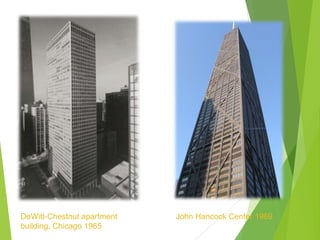
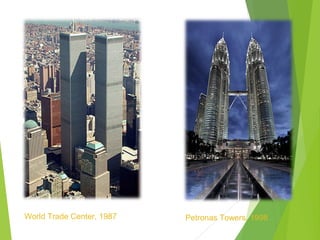
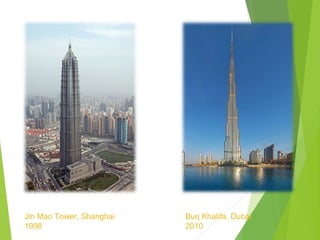
The first building to apply the tube-frame construction was the DeWitt-
Chestnut apartment building which Khan designed(1963) and was
completed in Chicago by 1965. This laid the foundations for the tube
structures of many other later skyscrapers, including his own John
Hancock Center and Willis Tower, and can been seen in the construction
of the World Trade Center, Petronas Towers, Jin Mao Building, and most
other supertall skyscrapers since the 1960s. The strong influence of tube
structure design is also evident in the construction of the current tallest
skyscraper, the Burj Khalifa.
Contd…..
DeWitt-Chestnut apartment
building, Chicago 1965
John Hancock Center 1969
World Trade Center, 1987 Petronas Towers, 1998
Jin Mao Tower, Shanghai
1998
Burj Khalifa, Dubai
2010
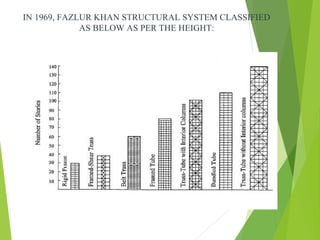
IN 1969, FAZLUR KHAN STRUCTURAL SYSTEM CLASSIFIED
AS BELOW AS PER THE HEIGHT:
TYPES
1)Framed tube system
2)Tube -in a tube system
3)Bundled tube system
4)Braced tube system
FRAMED TUBE SYSTEM
This is the simplest incarnation of the tube. Closely spaced
perimeter columns interconnected by beams.
It can take a variety of floor plan shapes from square and
rectangular, circular. This design was first used in Chicago's
DeWitt-Chestnut apartment building, designed by Khan and
completed in 1965, but the most notable examples are the
Aon Center and the destroyed World Trade Center towers.
FRAMED TUBE SYSTEM
• Closely spaced perimeter columns interconnected
by deep spandrels.
• Whole building works as a huge vertical cantilever
to resist overturning moments.
• Efficient system to provide lateral resistance with
or without interior columns.
• Exterior tube carries all the lateral loading.
• Gravity loading is shared between the tube and
the interior columns or walls, if they exist.
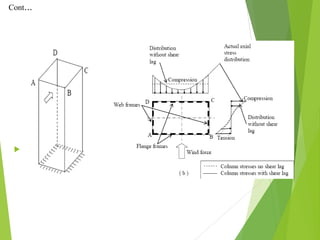
SHEAR LAG :-
(a) (b)
 If the tube loaded on side AB, then the whole frames AB and
CD are called ‘Flange frames’ and the frames AD and BC are
called ‘Web frame’
Cont…
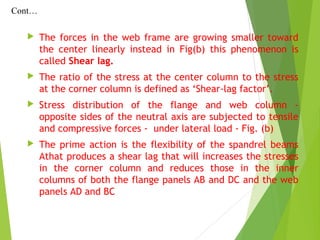
 The forces in the web frame are growing smaller toward
the center linearly instead in Fig(b) this phenomenon is
called Shear lag.
 The ratio of the stress at the center column to the stress
at the corner column is defined as ‘Shear-lag factor’.
 Stress distribution of the flange and web column -
opposite sides of the neutral axis are subjected to tensile
and compressive forces - under lateral load - Fig. (b)
 The prime action is the flexibility of the spandrel beams
Athat produces a shear lag that will increases the stresses
in the corner column and reduces those in the inner
columns of both the flange panels AB and DC and the web
panels AD and BC
Cont…
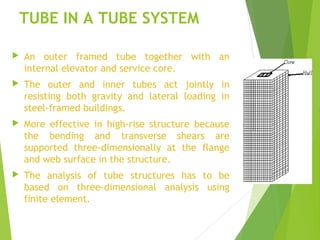
TUBE IN A TUBE SYSTEM
 An outer framed tube together with an
internal elevator and service core.
 The outer and inner tubes act jointly in
resisting both gravity and lateral loading in
steel-framed buildings.
 More effective in high-rise structure because
the bending and transverse shears are
supported three-dimensionally at the flange
and web surface in the structure.
 The analysis of tube structures has to be
based on three-dimensional analysis using
finite element.
Proportioning:
 30m minimum floor dimension
 Centrally stability core around lifts/stairs,
moment frame around perimeter
 30 to 60 floor, 100 to 160m height
 Clear floor plates, but wide perimeter columns
and deep perimeter beam constrains view
 Traditionally 2 or 3 zone elevator arrangement,
but would benefit from optimization using
double decks or sky lobbies.
Cont…
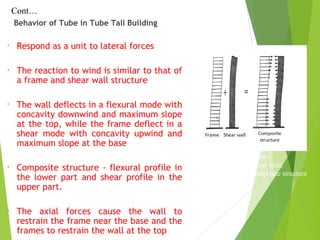
Behavior of Tube in Tube Tall Building
(a) Deform shape of frame;
(b) Deform shape of shear wall;
(c) Deform shape of composite structure
Cont…
• Respond as a unit to lateral forces
• The reaction to wind is similar to that of
a frame and shear wall structure
• The wall deflects in a flexural mode with
concavity downwind and maximum slope
at the top, while the frame deflect in a
shear mode with concavity upwind and
maximum slope at the base
• Composite structure - flexural profile in
the lower part and shear profile in the
upper part.
• The axial forces cause the wall to
restrain the frame near the base and the
frames to restrain the wall at the top
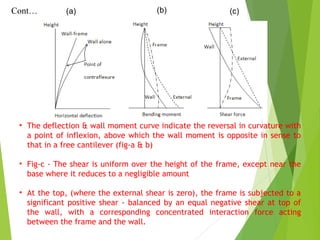
• The deflection & wall moment curve indicate the reversal in curvature with
a point of inflexion, above which the wall moment is opposite in sense to
that in a free cantilever (fig-a & b)
• Fig-c - The shear is uniform over the height of the frame, except near the
base where it reduces to a negligible amount
• At the top, (where the external shear is zero), the frame is subjected to a
significant positive shear - balanced by an equal negative shear at top of
the wall, with a corresponding concentrated interaction force acting
between the frame and the wall.
Cont… (a) (b) (c)
Advantages:
 The wind- resisting system located on the perimeter of the
building – more resistance to overturning moments.
 Core framing leads to a significant gain in rentable space.
 Identical framing for all which are no subjected to varying
internal forces due to lateral loads.
 From a practical point of view, the final analysis and design
of the tube can proceed unaffected by the lengthy process
of resolving detail layout and service requirements in the
core area.
Cont…
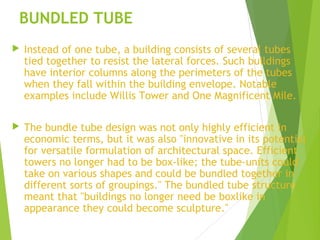
BUNDLED TUBE
 Instead of one tube, a building consists of several tubes
tied together to resist the lateral forces. Such buildings
have interior columns along the perimeters of the tubes
when they fall within the building envelope. Notable
examples include Willis Tower and One Magnificent Mile.
 The bundle tube design was not only highly efficient in
economic terms, but it was also "innovative in its potential
for versatile formulation of architectural space. Efficient
towers no longer had to be box-like; the tube-units could
take on various shapes and could be bundled together in
different sorts of groupings." The bundled tube structure
meant that "buildings no longer need be boxlike in
appearance they could become sculpture."
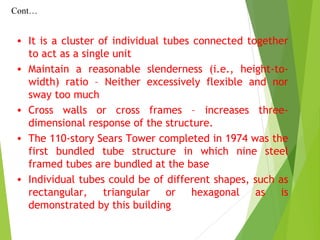
• It is a cluster of individual tubes connected together
to act as a single unit
• Maintain a reasonable slenderness (i.e., height-to-
width) ratio – Neither excessively flexible and nor
sway too much
• Cross walls or cross frames – increases three-
dimensional response of the structure.
• The 110-story Sears Tower completed in 1974 was the
first bundled tube structure in which nine steel
framed tubes are bundled at the base
• Individual tubes could be of different shapes, such as
rectangular, triangular or hexagonal as is
demonstrated by this building
Cont…
Diagrammatic view of the bundled tube
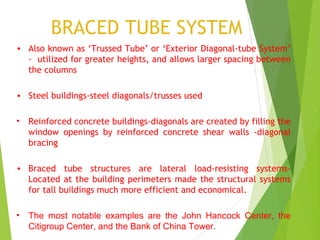
• Also known as ‘Trussed Tube’ or ‘Exterior Diagonal-tube System’
- utilized for greater heights, and allows larger spacing between
the columns
• Steel buildings-steel diagonals/trusses used
• Reinforced concrete buildings-diagonals are created by filling the
window openings by reinforced concrete shear walls -diagonal
bracing
• Braced tube structures are lateral load-resisting systems-
Located at the building perimeters made the structural systems
for tall buildings much more efficient and economical.
• The most notable examples are the John Hancock Center, the
Citigroup Center, and the Bank of China Tower.
BRACED TUBE SYSTEM
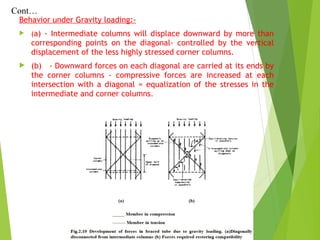
Behavior under Gravity loading:-
 (a) - Intermediate columns will displace downward by more than
corresponding points on the diagonal- controlled by the vertical
displacement of the less highly stressed corner columns.
 (b) - Downward forces on each diagonal are carried at its ends by
the corner columns - compressive forces are increased at each
intersection with a diagonal = equalization of the stresses in the
intermediate and corner columns.
Cont…
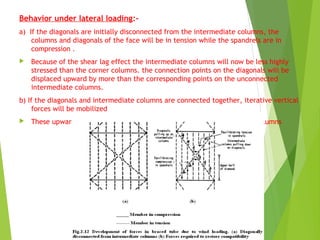
Behavior under lateral loading:-
a) If the diagonals are initially disconnected from the intermediate columns, the
columns and diagonals of the face will be in tension while the spandrels are in
compression .
 Because of the shear lag effect the intermediate columns will now be less highly
stressed than the corner columns. the connection points on the diagonals will be
displaced upward by more than the corresponding points on the unconnected
intermediate columns.
b) If the diagonals and intermediate columns are connected together, iterative vertical
forces will be mobilized
 These upward forces cause an increase in tension in the intermediate columns
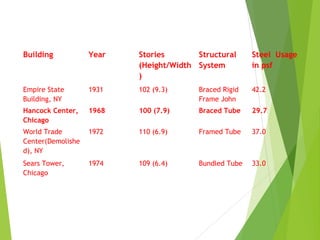
Building Year Stories
(Height/Width
)
Structural
System
Steel Usage
in psf
Empire State
Building, NY
1931 102 (9.3) Braced Rigid
Frame John
42.2
Hancock Center,
Chicago
1968 100 (7.9) Braced Tube 29.7
World Trade
Center(Demolishe
d), NY
1972 110 (6.9) Framed Tube 37.0
Sears Tower,
Chicago
1974 109 (6.4) Bundled Tube 33.0
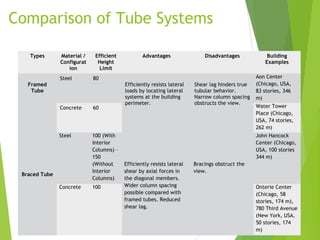
Types Material /
Configurat
ion
Efficient
Height
Limit
Advantages Disadvantages Building
Examples
Framed
Tube
Steel 80
Efficiently resists lateral
loads by locating lateral
systems at the building
perimeter.
Shear lag hinders true
tubular behavior.
Narrow column spacing
obstructs the view.
Aon Center
(Chicago, USA,
83 stories, 346
m)
Concrete 60 Water Tower
Place (Chicago,
USA, 74 stories,
262 m)
Braced Tube
Steel 100 (With
Interior
Columns) –
150
(Without
Interior
Columns)
Efficiently resists lateral
shear by axial forces in
the diagonal members.
Wider column spacing
possible compared with
framed tubes. Reduced
shear lag.
Bracings obstruct the
view.
John Hancock
Center (Chicago,
USA, 100 stories
344 m)
Concrete 100 Onterie Center
(Chicago, 58
stories, 174 m),
780 Third Avenue
(New York, USA,
50 stories, 174
m)
Comparison of Tube Systems
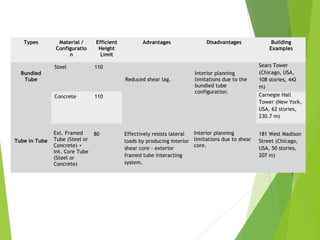
Types Material /
Configuratio
n
Efficient
Height
Limit
Advantages Disadvantages Building
Examples
Bundled
Tube
Steel 110
Reduced shear lag.
Interior planning
limitations due to the
bundled tube
configuration.
Sears Tower
(Chicago, USA,
108 stories, 442
m)
Concrete 110 Carnegie Hall
Tower (New York,
USA, 62 stories,
230.7 m)
Tube in Tube
Ext. Framed
Tube (Steel or
Concrete) +
Int. Core Tube
(Steel or
Concrete)
80 Effectively resists lateral
loads by producing interior
shear core - exterior
framed tube interacting
system.
Interior planning
limitations due to shear
core.
181 West Madison
Street (Chicago,
USA, 50 stories,
207 m)
REFERENCES
 Mir M.Ali and Kyoung Sun Moon “Structural
Developments in Tall Buildings: Current Trends and
Future Prospects”
 en.wikipedia.org
 Kyoung Sun Moon “Material-Saving Design Strategies
for Tall Building Structures”
 Text book- Engineering Architecture the vision of Fazlur R. Khan by
Yasmin Sabina Khan
 sefindia.org
Thank you
For more…. Mail to
aglaiaconnect2018@gmail.com

Tube structures

  • 1.
  • 2.
    CONTENT  ITRODUCTION  CONCEPT HISTORY  TYPES  COMPARISON
  • 3.
    INTRODUCTION The tube isthe name given to the systems where in order to resist lateral loads (wind, seismic, etc.) a building is designed to act like a three-dimensional hollow tube. The system was introduced by Fazlur Rahman Khan while at Skidmore, Owings and Merrill's (SOM) Chicago office. The first example of the tube’s use is the 43-story Khan-designed DeWitt-Chestnut Apartment Building in Chicago, Illinois, completed in 1963. The system can be constructed using steel, concrete, or composite construction (the discrete use of both steel and concrete). It can be used for office, apartment and mixed-use buildings. Most buildings in excess of 40 stories constructed in the United States since the 1960s are of this structural type.
  • 4.
    CONCEPT  The tubesystem concept is based on the idea that a building can be designed to resist lateral loads by designing it as a hollow cantilever perpendicular to the ground.  In the simplest incarnation of the tube, the perimeter of the exterior consists of closely spaced columns that are tied together with deep beams through moment connections. This assembly of columns and beams forms a rigid frame that amounts to a dense and strong structural wall along the exterior of the building.  This exterior framing is designed sufficiently strong to resist all lateral loads on the building, thereby allowing the interior of the building to be simply framed for gravity loads. Interior columns are comparatively few and located at the core.  The distance between the exterior and the core frames is spanned with beams or trusses. This maximizes the effectiveness of the perimeter tube by transferring some of the gravity loads within the structure to it and increases its ability to resist overturning due to lateral loads.
  • 5.
    HISTORY Since 1963, anew structural system of framed tubes appeared in skyscraper design and construction. Fazlur Khan defined the framed tube structure as "a three dimensional space structure composed of three, four, or possibly more frames, braced frames, or shear walls, joined at or near their edges to form a vertical tube-like structural system capable of resisting lateral forces in any direction by cantilevering from the foundation."Closely spaced interconnected exterior columns form the tube. Horizontal loads, for example wind, are supported by the structure as a whole. About half the exterior surface is available for windows. Framed tubes allow fewer interior columns, and so create more usable floor space. Where larger openings like garage doors are required, the tube frame must be interrupted, with transfer girders used to maintain structural integrity.
  • 6.
    The first buildingto apply the tube-frame construction was the DeWitt- Chestnut apartment building which Khan designed(1963) and was completed in Chicago by 1965. This laid the foundations for the tube structures of many other later skyscrapers, including his own John Hancock Center and Willis Tower, and can been seen in the construction of the World Trade Center, Petronas Towers, Jin Mao Building, and most other supertall skyscrapers since the 1960s. The strong influence of tube structure design is also evident in the construction of the current tallest skyscraper, the Burj Khalifa. Contd…..
  • 7.
    DeWitt-Chestnut apartment building, Chicago1965 John Hancock Center 1969
  • 8.
    World Trade Center,1987 Petronas Towers, 1998
  • 9.
    Jin Mao Tower,Shanghai 1998 Burj Khalifa, Dubai 2010
  • 10.
    IN 1969, FAZLURKHAN STRUCTURAL SYSTEM CLASSIFIED AS BELOW AS PER THE HEIGHT:
  • 11.
    TYPES 1)Framed tube system 2)Tube-in a tube system 3)Bundled tube system 4)Braced tube system
  • 12.
    FRAMED TUBE SYSTEM Thisis the simplest incarnation of the tube. Closely spaced perimeter columns interconnected by beams. It can take a variety of floor plan shapes from square and rectangular, circular. This design was first used in Chicago's DeWitt-Chestnut apartment building, designed by Khan and completed in 1965, but the most notable examples are the Aon Center and the destroyed World Trade Center towers.
  • 13.
    FRAMED TUBE SYSTEM •Closely spaced perimeter columns interconnected by deep spandrels. • Whole building works as a huge vertical cantilever to resist overturning moments. • Efficient system to provide lateral resistance with or without interior columns. • Exterior tube carries all the lateral loading. • Gravity loading is shared between the tube and the interior columns or walls, if they exist.
  • 14.
    SHEAR LAG :- (a)(b)  If the tube loaded on side AB, then the whole frames AB and CD are called ‘Flange frames’ and the frames AD and BC are called ‘Web frame’ Cont…
  • 15.
     The forcesin the web frame are growing smaller toward the center linearly instead in Fig(b) this phenomenon is called Shear lag.  The ratio of the stress at the center column to the stress at the corner column is defined as ‘Shear-lag factor’.  Stress distribution of the flange and web column - opposite sides of the neutral axis are subjected to tensile and compressive forces - under lateral load - Fig. (b)  The prime action is the flexibility of the spandrel beams Athat produces a shear lag that will increases the stresses in the corner column and reduces those in the inner columns of both the flange panels AB and DC and the web panels AD and BC Cont…
  • 16.
    TUBE IN ATUBE SYSTEM  An outer framed tube together with an internal elevator and service core.  The outer and inner tubes act jointly in resisting both gravity and lateral loading in steel-framed buildings.  More effective in high-rise structure because the bending and transverse shears are supported three-dimensionally at the flange and web surface in the structure.  The analysis of tube structures has to be based on three-dimensional analysis using finite element.
  • 17.
    Proportioning:  30m minimumfloor dimension  Centrally stability core around lifts/stairs, moment frame around perimeter  30 to 60 floor, 100 to 160m height  Clear floor plates, but wide perimeter columns and deep perimeter beam constrains view  Traditionally 2 or 3 zone elevator arrangement, but would benefit from optimization using double decks or sky lobbies. Cont…
  • 18.
    Behavior of Tubein Tube Tall Building (a) Deform shape of frame; (b) Deform shape of shear wall; (c) Deform shape of composite structure Cont… • Respond as a unit to lateral forces • The reaction to wind is similar to that of a frame and shear wall structure • The wall deflects in a flexural mode with concavity downwind and maximum slope at the top, while the frame deflect in a shear mode with concavity upwind and maximum slope at the base • Composite structure - flexural profile in the lower part and shear profile in the upper part. • The axial forces cause the wall to restrain the frame near the base and the frames to restrain the wall at the top
  • 19.
    • The deflection& wall moment curve indicate the reversal in curvature with a point of inflexion, above which the wall moment is opposite in sense to that in a free cantilever (fig-a & b) • Fig-c - The shear is uniform over the height of the frame, except near the base where it reduces to a negligible amount • At the top, (where the external shear is zero), the frame is subjected to a significant positive shear - balanced by an equal negative shear at top of the wall, with a corresponding concentrated interaction force acting between the frame and the wall. Cont… (a) (b) (c)
  • 20.
    Advantages:  The wind-resisting system located on the perimeter of the building – more resistance to overturning moments.  Core framing leads to a significant gain in rentable space.  Identical framing for all which are no subjected to varying internal forces due to lateral loads.  From a practical point of view, the final analysis and design of the tube can proceed unaffected by the lengthy process of resolving detail layout and service requirements in the core area. Cont…
  • 21.
    BUNDLED TUBE  Insteadof one tube, a building consists of several tubes tied together to resist the lateral forces. Such buildings have interior columns along the perimeters of the tubes when they fall within the building envelope. Notable examples include Willis Tower and One Magnificent Mile.  The bundle tube design was not only highly efficient in economic terms, but it was also "innovative in its potential for versatile formulation of architectural space. Efficient towers no longer had to be box-like; the tube-units could take on various shapes and could be bundled together in different sorts of groupings." The bundled tube structure meant that "buildings no longer need be boxlike in appearance they could become sculpture."
  • 22.
    • It isa cluster of individual tubes connected together to act as a single unit • Maintain a reasonable slenderness (i.e., height-to- width) ratio – Neither excessively flexible and nor sway too much • Cross walls or cross frames – increases three- dimensional response of the structure. • The 110-story Sears Tower completed in 1974 was the first bundled tube structure in which nine steel framed tubes are bundled at the base • Individual tubes could be of different shapes, such as rectangular, triangular or hexagonal as is demonstrated by this building Cont…
  • 23.
    Diagrammatic view ofthe bundled tube
  • 24.
    • Also knownas ‘Trussed Tube’ or ‘Exterior Diagonal-tube System’ - utilized for greater heights, and allows larger spacing between the columns • Steel buildings-steel diagonals/trusses used • Reinforced concrete buildings-diagonals are created by filling the window openings by reinforced concrete shear walls -diagonal bracing • Braced tube structures are lateral load-resisting systems- Located at the building perimeters made the structural systems for tall buildings much more efficient and economical. • The most notable examples are the John Hancock Center, the Citigroup Center, and the Bank of China Tower. BRACED TUBE SYSTEM
  • 25.
    Behavior under Gravityloading:-  (a) - Intermediate columns will displace downward by more than corresponding points on the diagonal- controlled by the vertical displacement of the less highly stressed corner columns.  (b) - Downward forces on each diagonal are carried at its ends by the corner columns - compressive forces are increased at each intersection with a diagonal = equalization of the stresses in the intermediate and corner columns. Cont…
  • 26.
    Behavior under lateralloading:- a) If the diagonals are initially disconnected from the intermediate columns, the columns and diagonals of the face will be in tension while the spandrels are in compression .  Because of the shear lag effect the intermediate columns will now be less highly stressed than the corner columns. the connection points on the diagonals will be displaced upward by more than the corresponding points on the unconnected intermediate columns. b) If the diagonals and intermediate columns are connected together, iterative vertical forces will be mobilized  These upward forces cause an increase in tension in the intermediate columns
  • 27.
    Building Year Stories (Height/Width ) Structural System SteelUsage in psf Empire State Building, NY 1931 102 (9.3) Braced Rigid Frame John 42.2 Hancock Center, Chicago 1968 100 (7.9) Braced Tube 29.7 World Trade Center(Demolishe d), NY 1972 110 (6.9) Framed Tube 37.0 Sears Tower, Chicago 1974 109 (6.4) Bundled Tube 33.0
  • 28.
    Types Material / Configurat ion Efficient Height Limit AdvantagesDisadvantages Building Examples Framed Tube Steel 80 Efficiently resists lateral loads by locating lateral systems at the building perimeter. Shear lag hinders true tubular behavior. Narrow column spacing obstructs the view. Aon Center (Chicago, USA, 83 stories, 346 m) Concrete 60 Water Tower Place (Chicago, USA, 74 stories, 262 m) Braced Tube Steel 100 (With Interior Columns) – 150 (Without Interior Columns) Efficiently resists lateral shear by axial forces in the diagonal members. Wider column spacing possible compared with framed tubes. Reduced shear lag. Bracings obstruct the view. John Hancock Center (Chicago, USA, 100 stories 344 m) Concrete 100 Onterie Center (Chicago, 58 stories, 174 m), 780 Third Avenue (New York, USA, 50 stories, 174 m) Comparison of Tube Systems
  • 29.
    Types Material / Configuratio n Efficient Height Limit AdvantagesDisadvantages Building Examples Bundled Tube Steel 110 Reduced shear lag. Interior planning limitations due to the bundled tube configuration. Sears Tower (Chicago, USA, 108 stories, 442 m) Concrete 110 Carnegie Hall Tower (New York, USA, 62 stories, 230.7 m) Tube in Tube Ext. Framed Tube (Steel or Concrete) + Int. Core Tube (Steel or Concrete) 80 Effectively resists lateral loads by producing interior shear core - exterior framed tube interacting system. Interior planning limitations due to shear core. 181 West Madison Street (Chicago, USA, 50 stories, 207 m)
  • 30.
    REFERENCES  Mir M.Aliand Kyoung Sun Moon “Structural Developments in Tall Buildings: Current Trends and Future Prospects”  en.wikipedia.org  Kyoung Sun Moon “Material-Saving Design Strategies for Tall Building Structures”  Text book- Engineering Architecture the vision of Fazlur R. Khan by Yasmin Sabina Khan  sefindia.org
  • 31.
    Thank you For more….Mail to aglaiaconnect2018@gmail.com