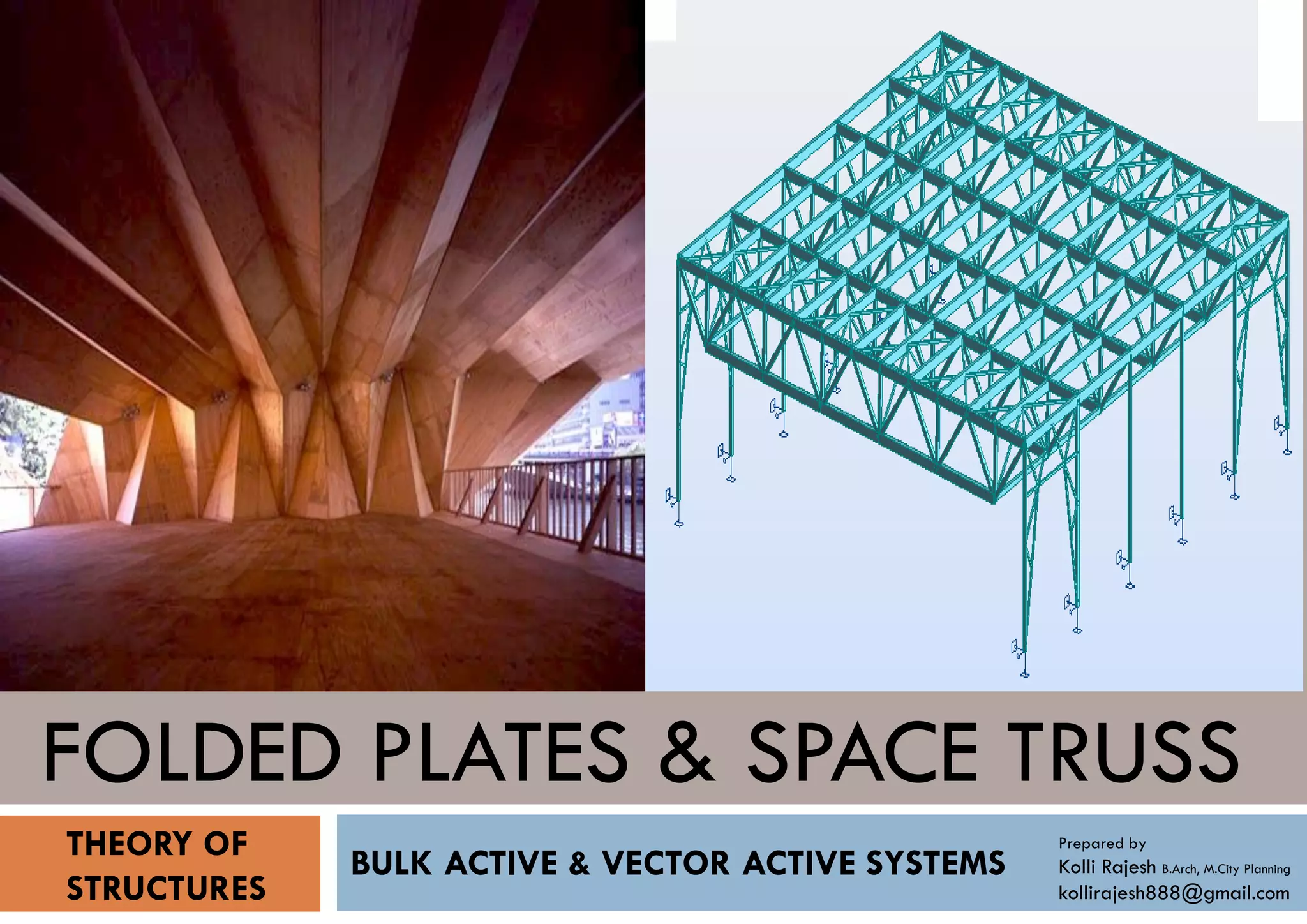
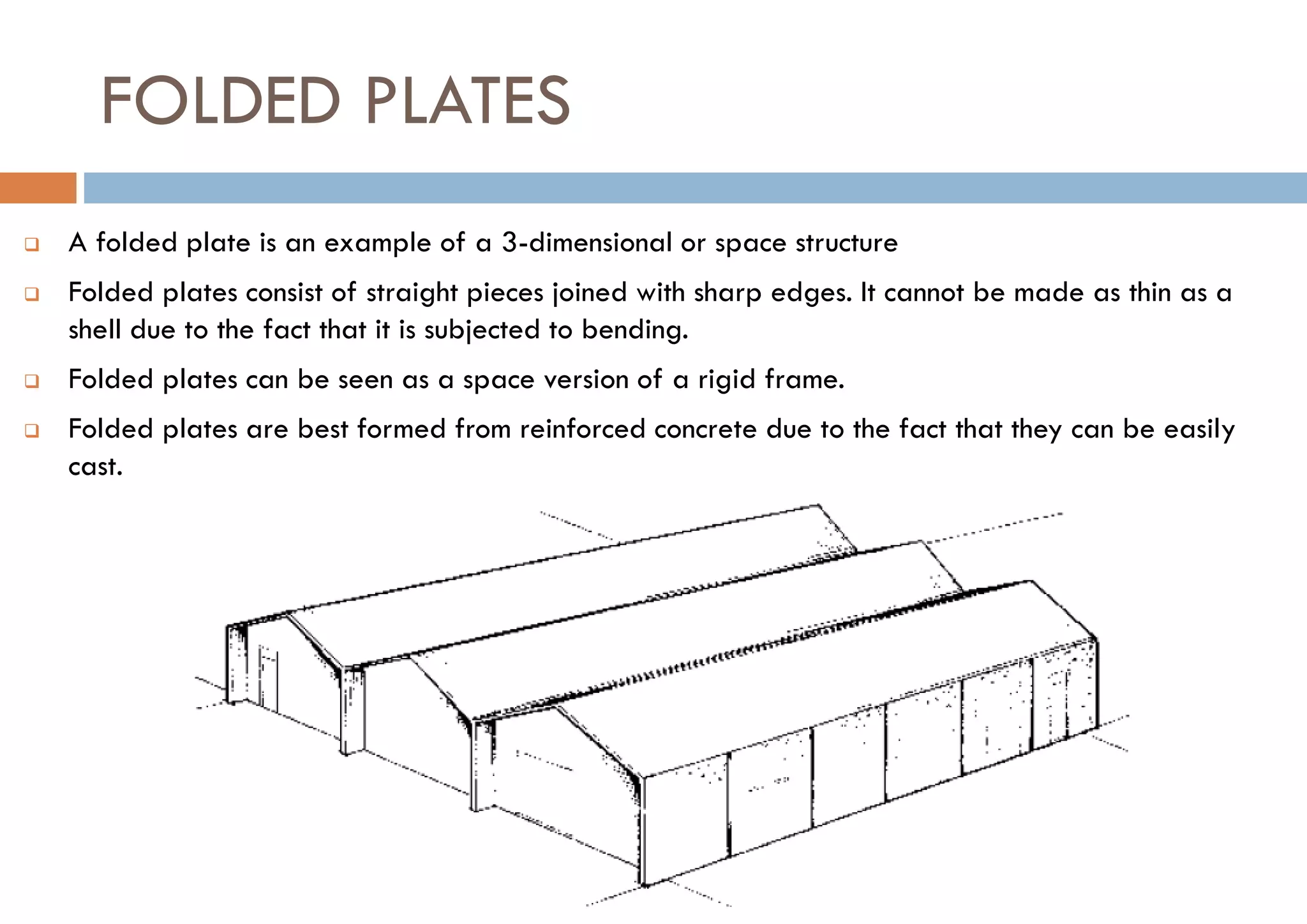
FOLDED PLATES & SPACE TRUSS
BULK ACTIVE & VECTOR ACTIVE SYSTEMS
THEORY OF
STRUCTURES
Prepared by
Kolli Rajesh B.Arch, M.City Planning
kollirajesh888@gmail.com
FOLDED PLATES
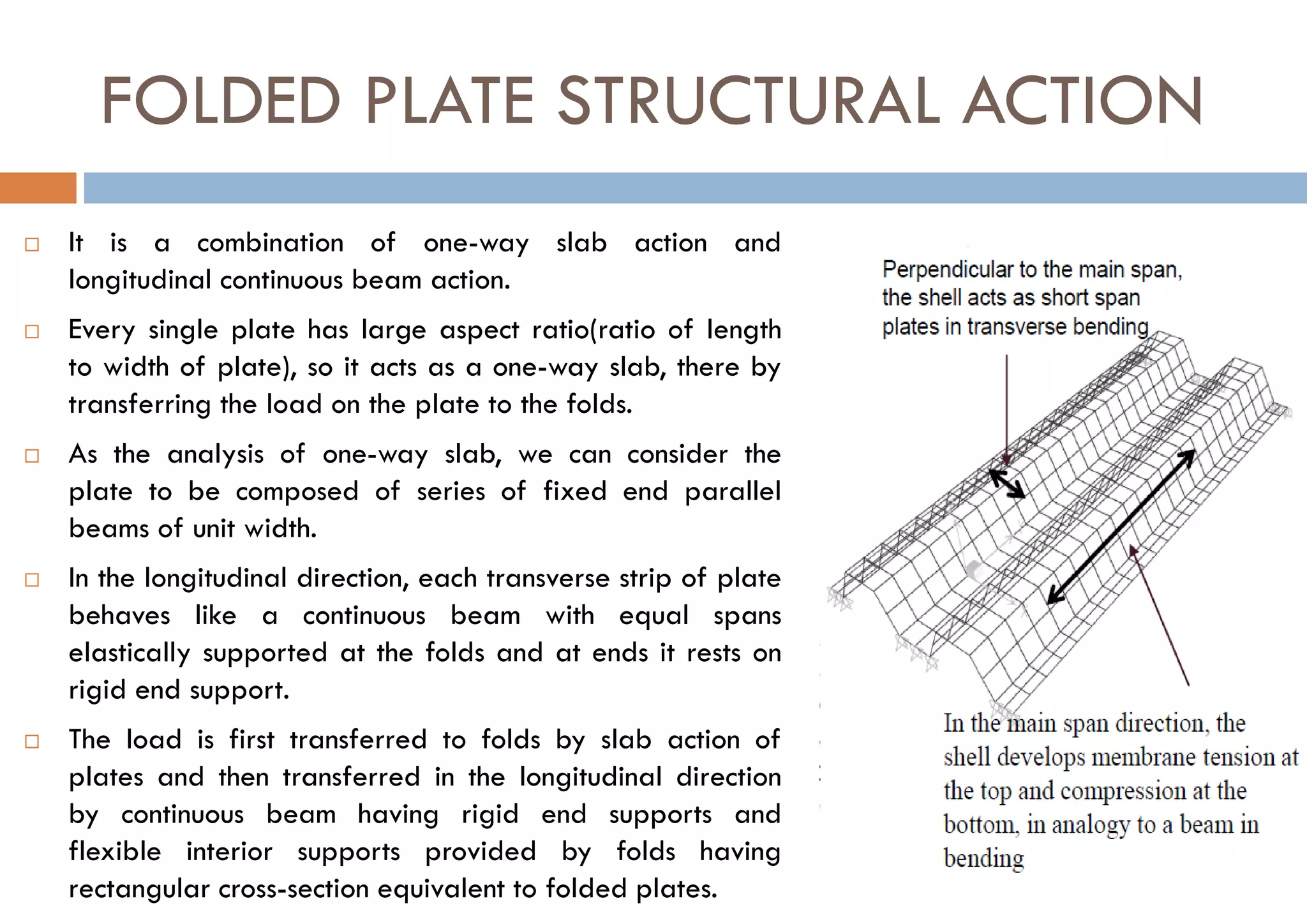
 A folded plate is an example of a 3-dimensional or space structure
 Folded plates consist of straight pieces joined with sharp edges. It cannot be made as thin as a
shell due to the fact that it is subjected to bending.
 Folded plates can be seen as a space version of a rigid frame.
 Folded plates are best formed from reinforced concrete due to the fact that they can be easily
cast.
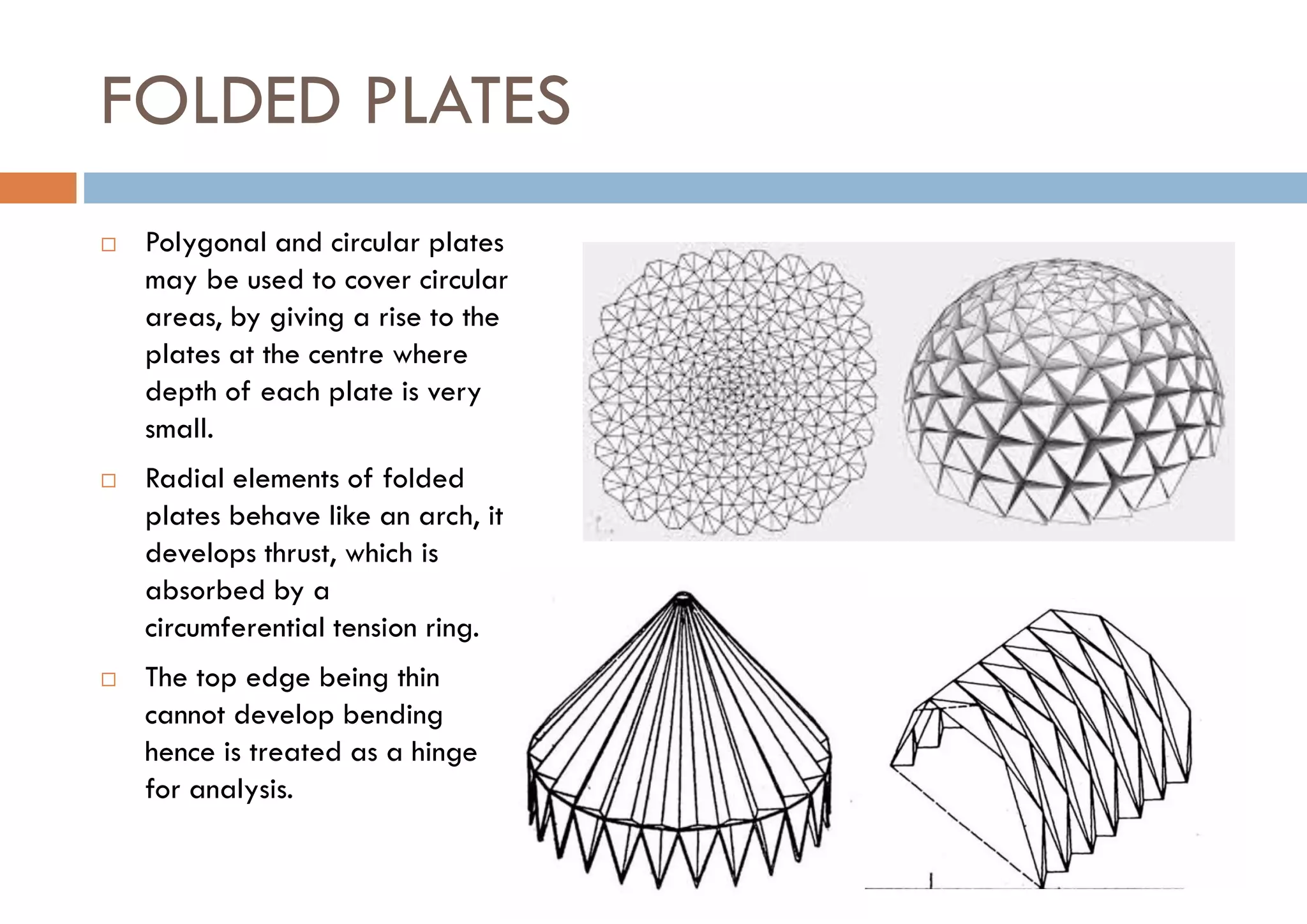
FOLDED PLATE STRUCTURAL ACTION
 It is a combination of one-way slab action and
longitudinal continuous beam action.
 Every single plate has large aspect ratio(ratio of length
to width of plate), so it acts as a one-way slab, there by
transferring the load on the plate to the folds.
 As the analysis of one-way slab, we can consider the
plate to be composed of series of fixed end parallel
beams of unit width.
 In the longitudinal direction, each transverse strip of plate
behaves like a continuous beam with equal spans
elastically supported at the folds and at ends it rests on
rigid end support.
 The load is first transferred to folds by slab action of
plates and then transferred in the longitudinal direction
by continuous beam having rigid end supports and
flexible interior supports provided by folds having
rectangular cross-section equivalent to folded plates.
FOLDED PLATES
 Polygonal and circular plates
may be used to cover circular
areas, by giving a rise to the
plates at the centre where
depth of each plate is very
small.
 Radial elements of folded
plates behave like an arch, it
develops thrust, which is
absorbed by a
circumferential tension ring.
 The top edge being thin
cannot develop bending
hence is treated as a hinge
for analysis.
Advantages and Disadvantages of
Folded-Plate Structure
DISADVANTAGES:
 Shuttering is difficult.
 Greater accuracy in
formwork is required.
 Good labor and
supervision necessary.
 Rise of roof may be a
disadvantage.
ADVANTAGES:
Very light form of construction.
To span 30 m shell thickness required is
60 mm only.
The use of concrete as a building
material reduces both materials cost and
a construction cost.
Longer span can be provided.
Flat shapes by choosing certain arched
shapes.
Esthetically it looks good over other
forms of construction.
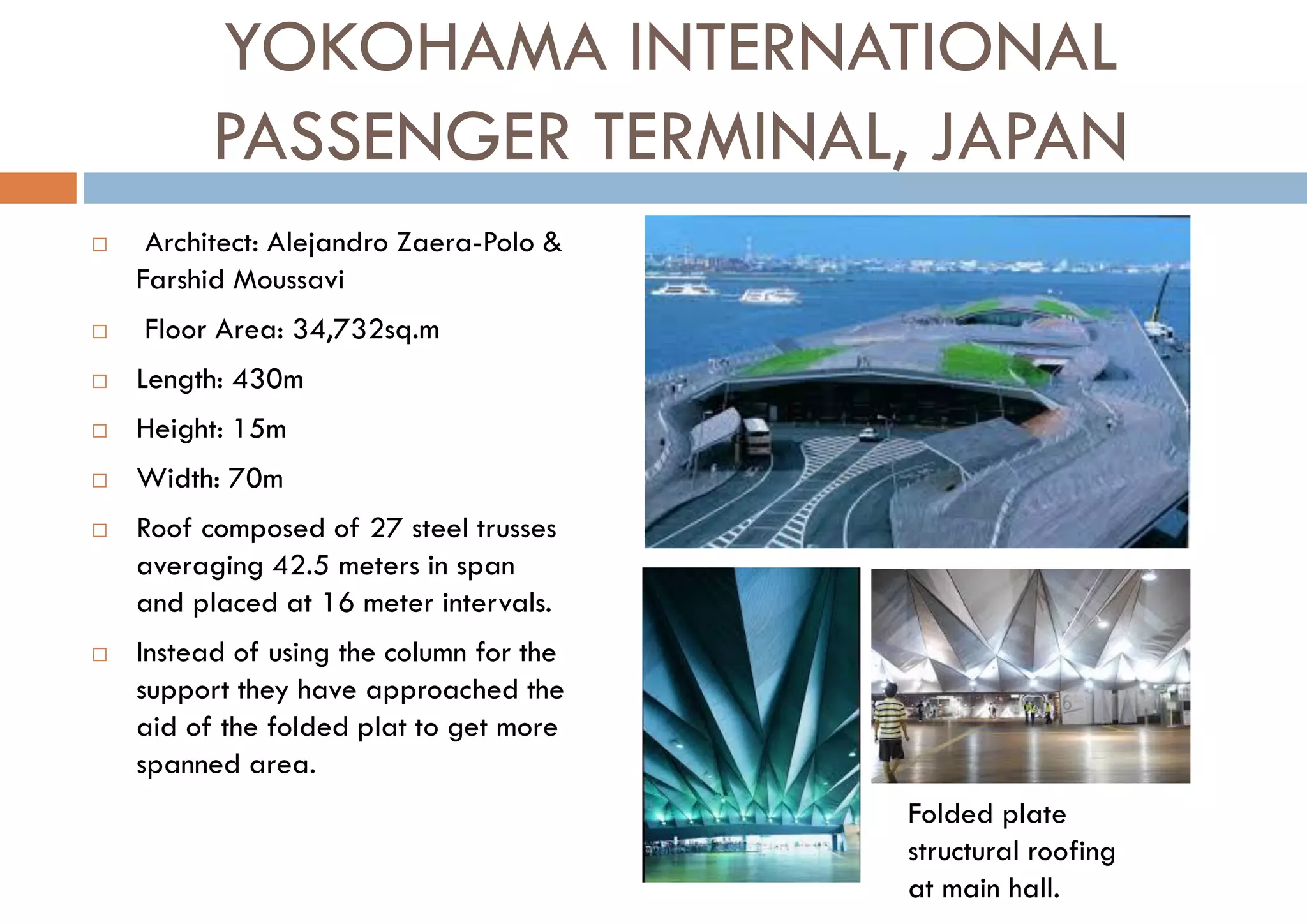
YOKOHAMA INTERNATIONAL
PASSENGER TERMINAL, JAPAN
 Architect: Alejandro Zaera-Polo &
Farshid Moussavi
 Floor Area: 34,732sq.m
 Length: 430m
 Height: 15m
 Width: 70m
 Roof composed of 27 steel trusses
averaging 42.5 meters in span
and placed at 16 meter intervals.
 Instead of using the column for the
support they have approached the
aid of the folded plat to get more
spanned area.
Folded plate
structural roofing
at main hall.
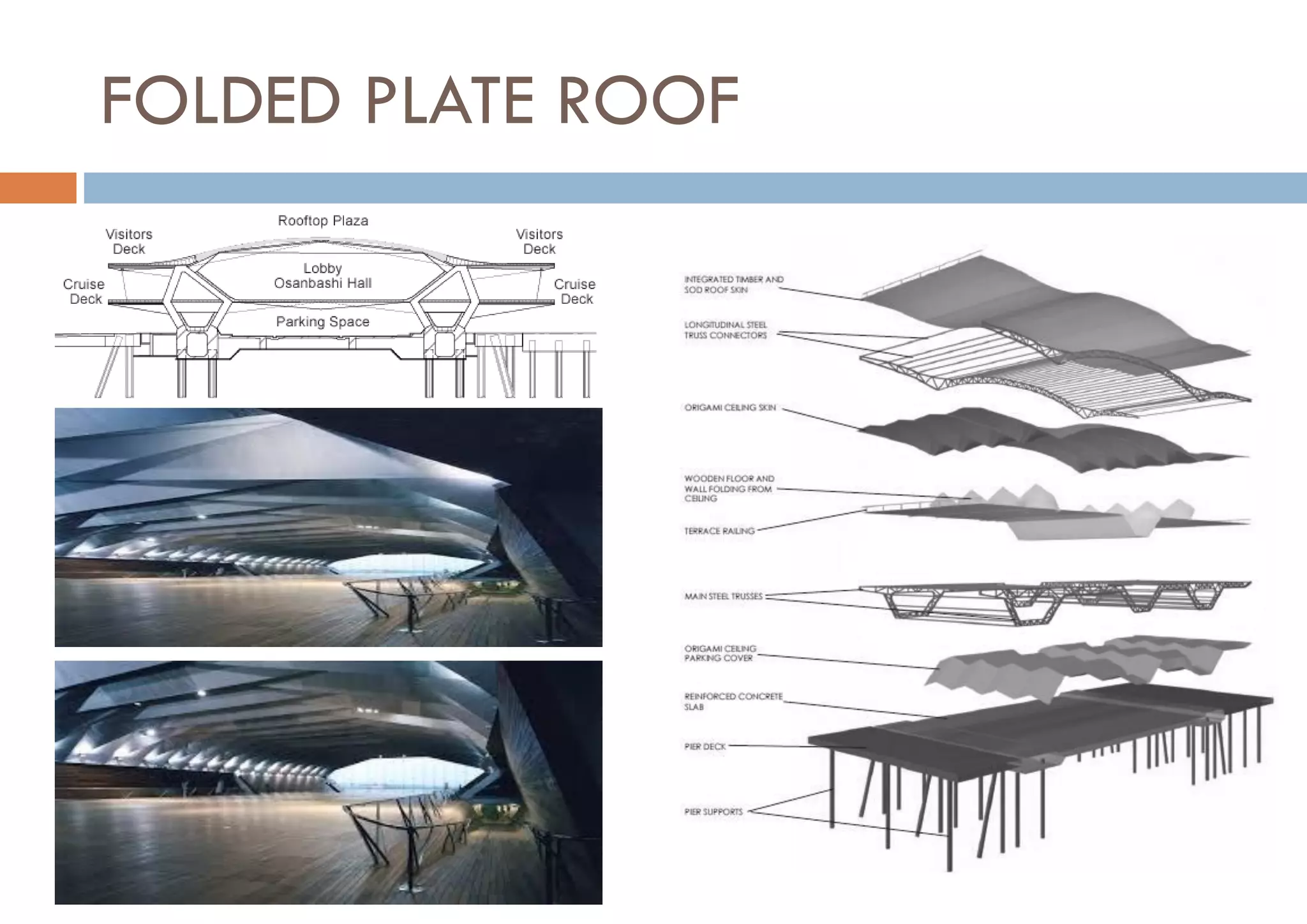
FOLDED PLATE ROOF
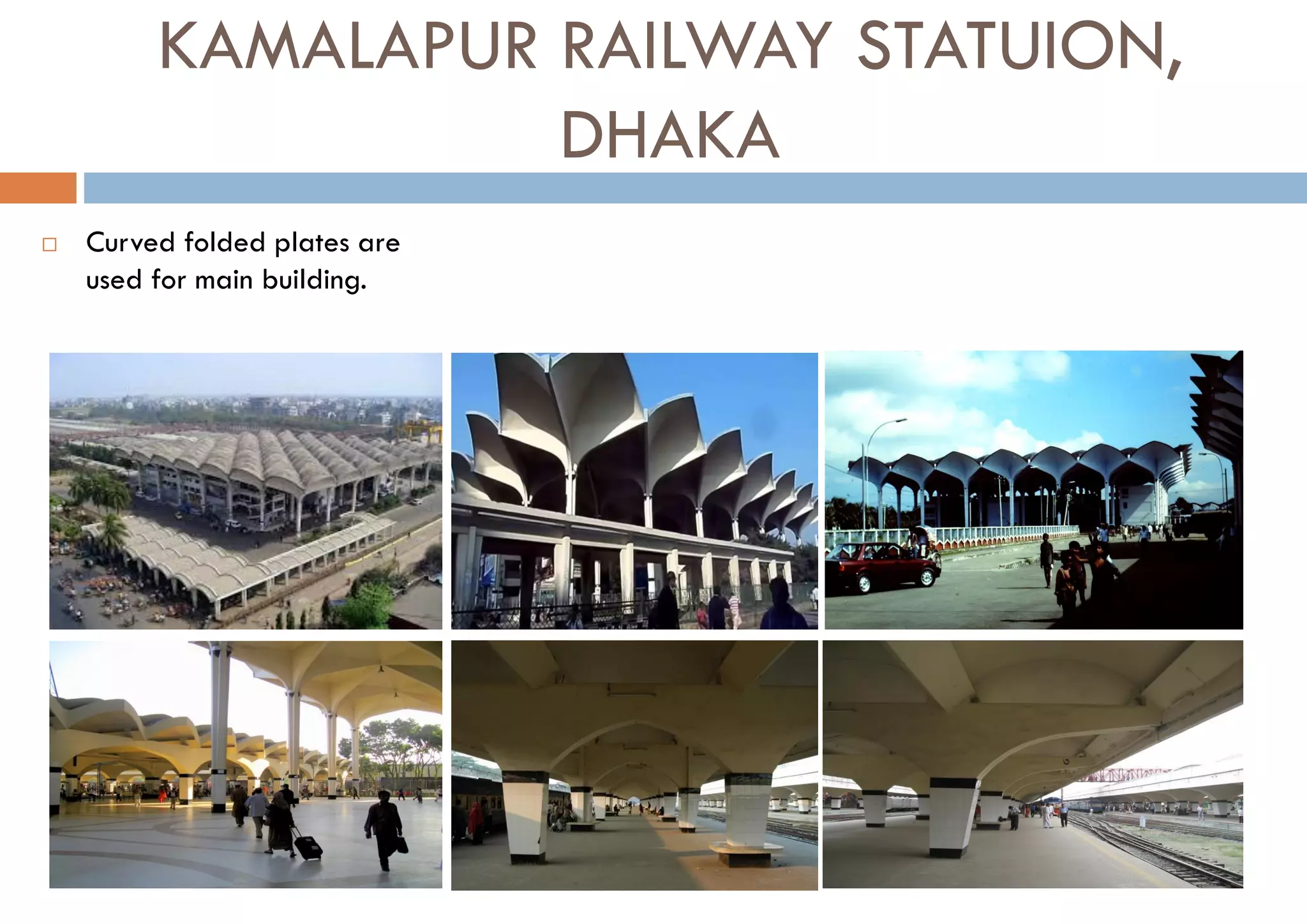
KAMALAPUR RAILWAY STATUION,
DHAKA
 Curved folded plates are
used for main building.
SPACE TRUSS
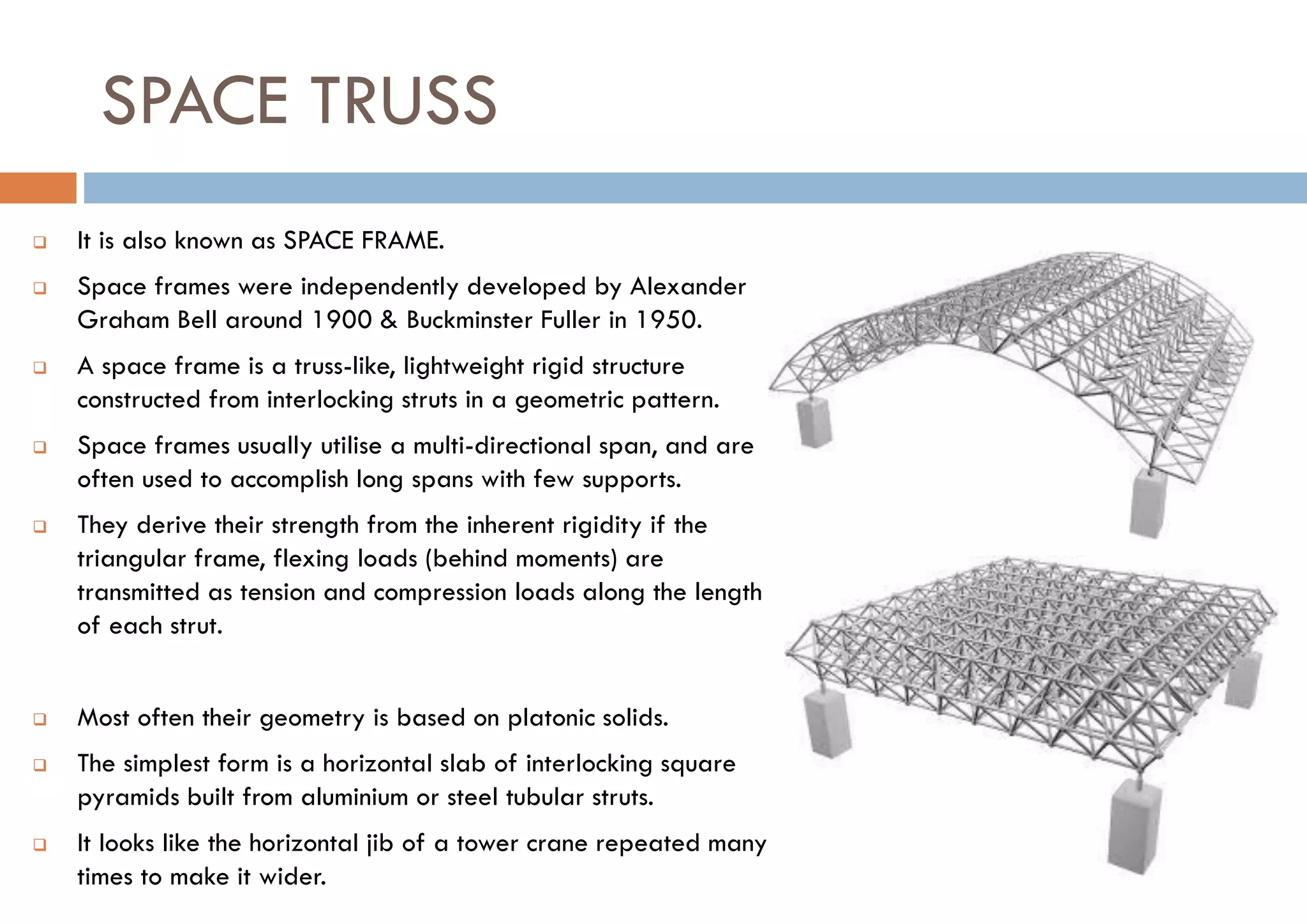
 It is also known as SPACE FRAME.
 Space frames were independently developed by Alexander
Graham Bell around 1900 & Buckminster Fuller in 1950.
 A space frame is a truss-like, lightweight rigid structure
constructed from interlocking struts in a geometric pattern.
 Space frames usually utilise a multi-directional span, and are
often used to accomplish long spans with few supports.
 They derive their strength from the inherent rigidity if the
triangular frame, flexing loads (behind moments) are
transmitted as tension and compression loads along the length
of each strut.
 Most often their geometry is based on platonic solids.
 The simplest form is a horizontal slab of interlocking square
pyramids built from aluminium or steel tubular struts.
 It looks like the horizontal jib of a tower crane repeated many
times to make it wider.
Advantages of Space Frames
Factor Description
1. Lightweight This is mainly due to the fact that material is distributed spatially in such a way that
the load transfer mechanism is primarily axial; tension or compression.
Consequently, all material in any given element is utilized to its full extent.
Furthermore, most space frames are now constructed with aluminum, which
decreases considerably their self-weight.
2. Mass Productivity Space frames can be built from simple prefabricated units, which are often of
standard size and shape. Such units can be easily transported and rapidly
assembled on site by semi-skilled labor. Consequently, space frames can be built at
a lower cost.
3. Stiffness A space frame is usually sufficiently stiff in spite of its lightness. This is due to its
three dimensional character and to the full participation of its constituent elements.
4. Versatility Space frames possess a versatility of shape and form and can utilize a standard
module to generate various flat space grids, latticed shell, or even free-form
shapes. Architects appreciate the visual beauty and the impressive simplicity of lines
in space frames.
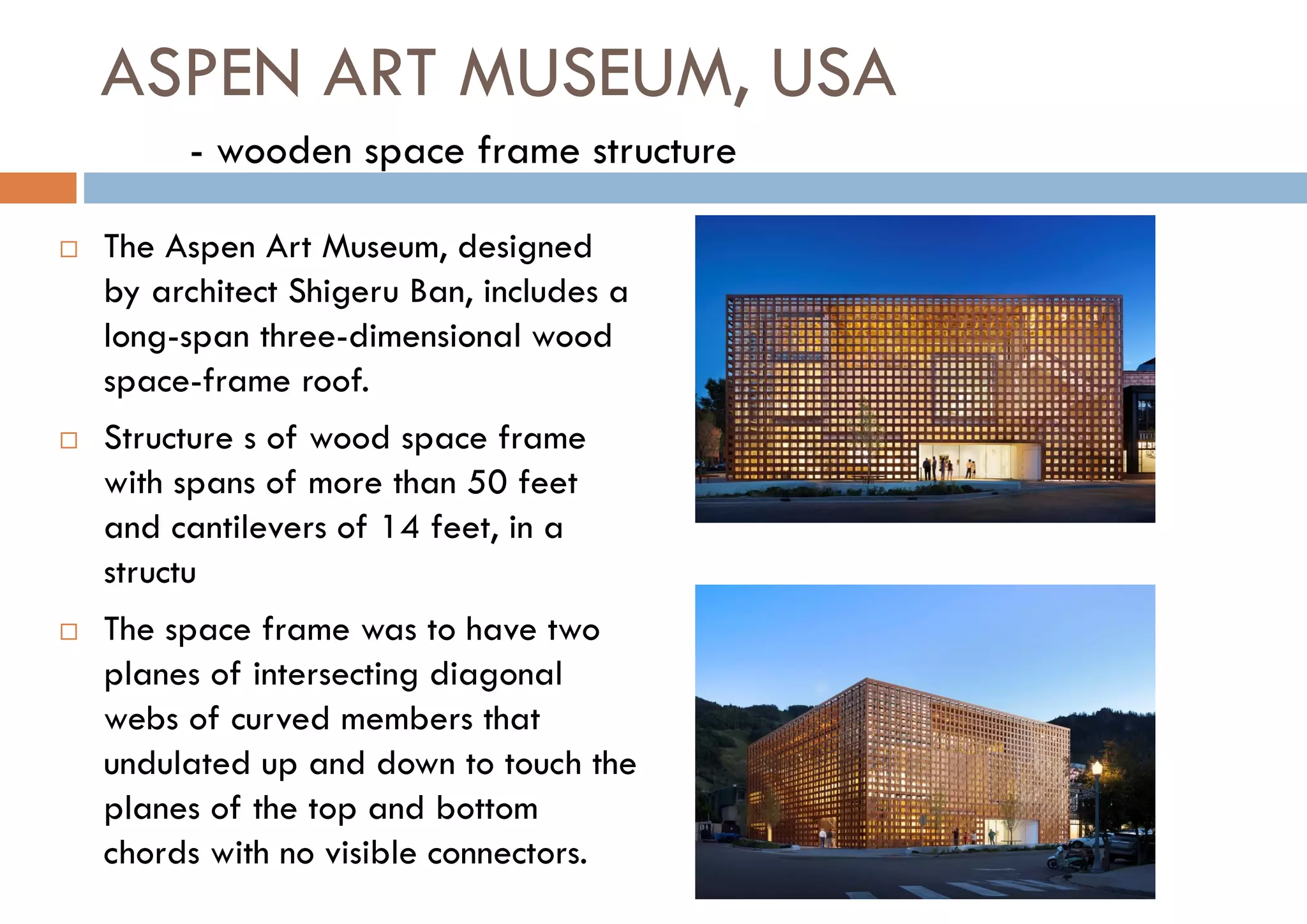
ASPEN ART MUSEUM, USA
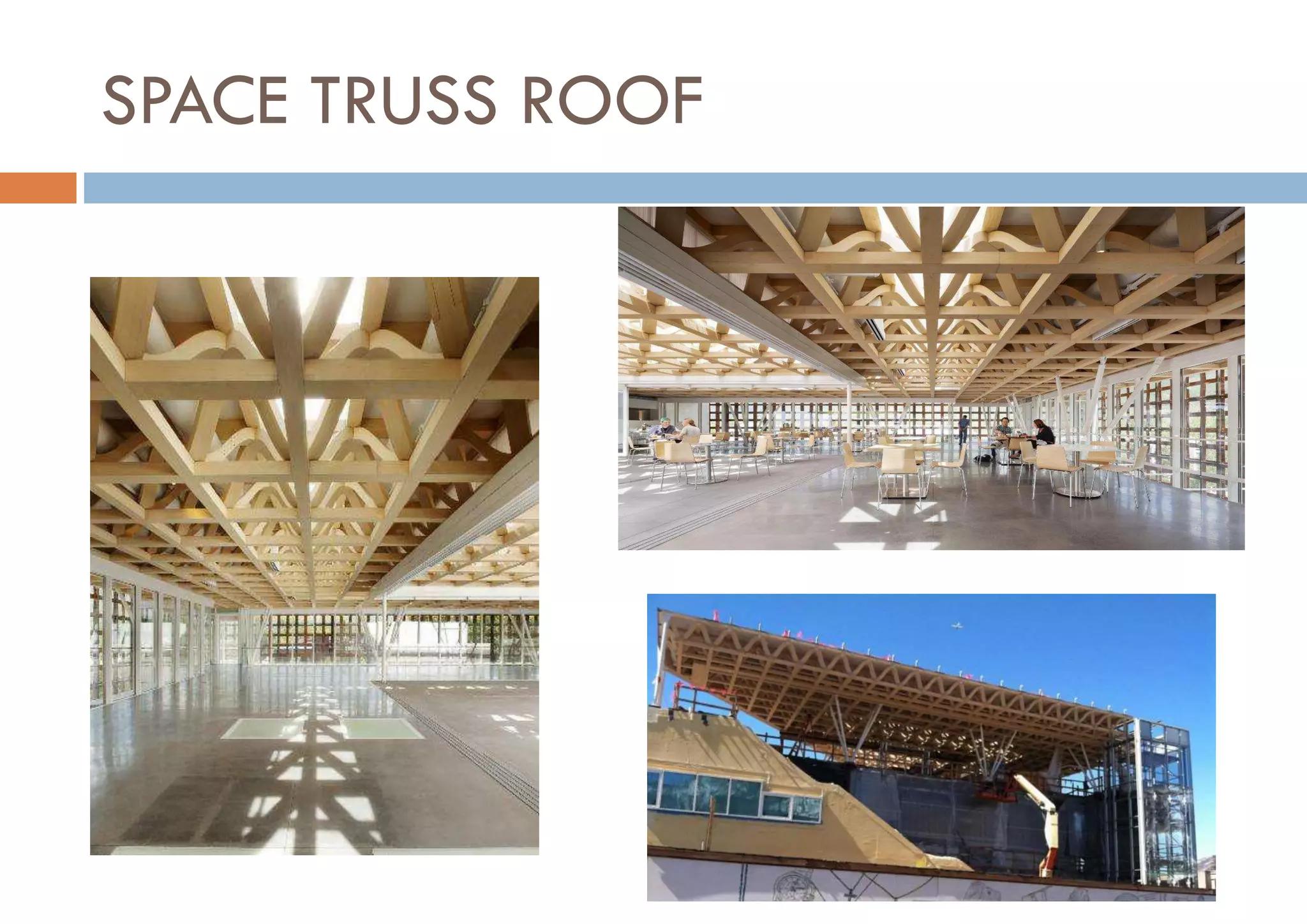
 The Aspen Art Museum, designed
by architect Shigeru Ban, includes a
long-span three-dimensional wood
space-frame roof.
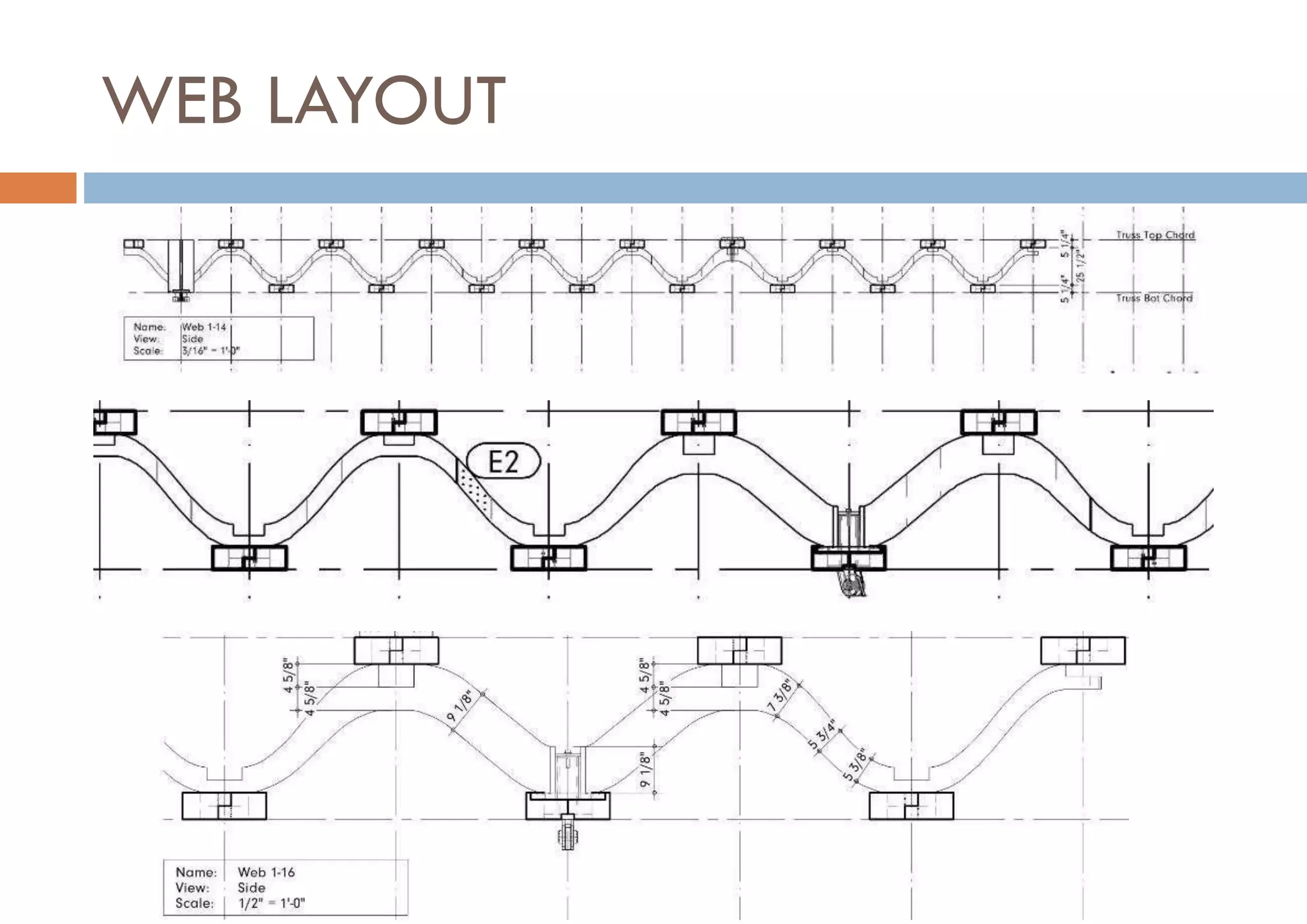
 Structure s of wood space frame
with spans of more than 50 feet
and cantilevers of 14 feet, in a
structu
 The space frame was to have two
planes of intersecting diagonal
webs of curved members that
undulated up and down to touch the
planes of the top and bottom
chords with no visible connectors.
- wooden space frame structure
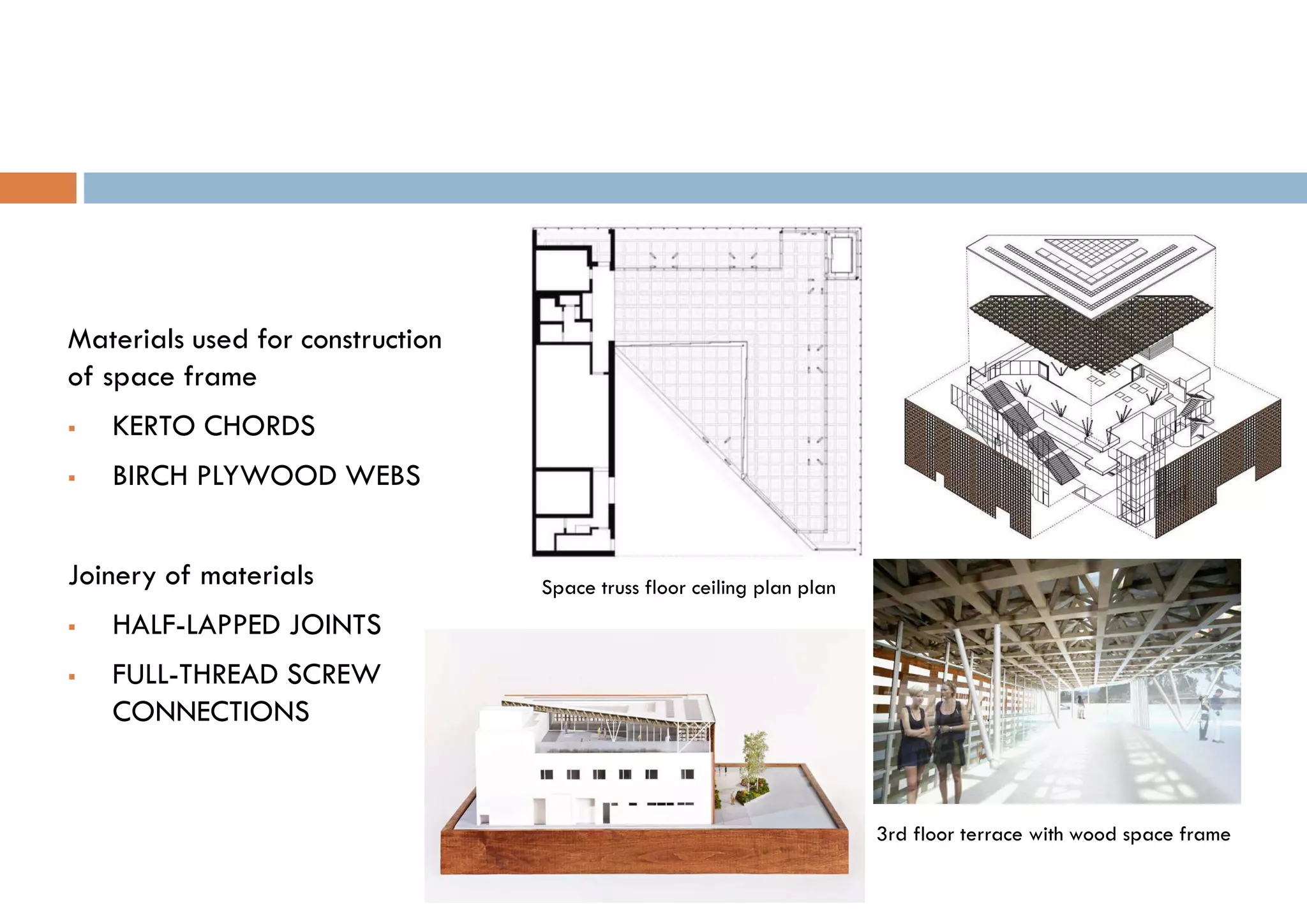
3rd floor terrace with wood space frame
Space truss floor ceiling plan plan
Materials used for construction
of space frame
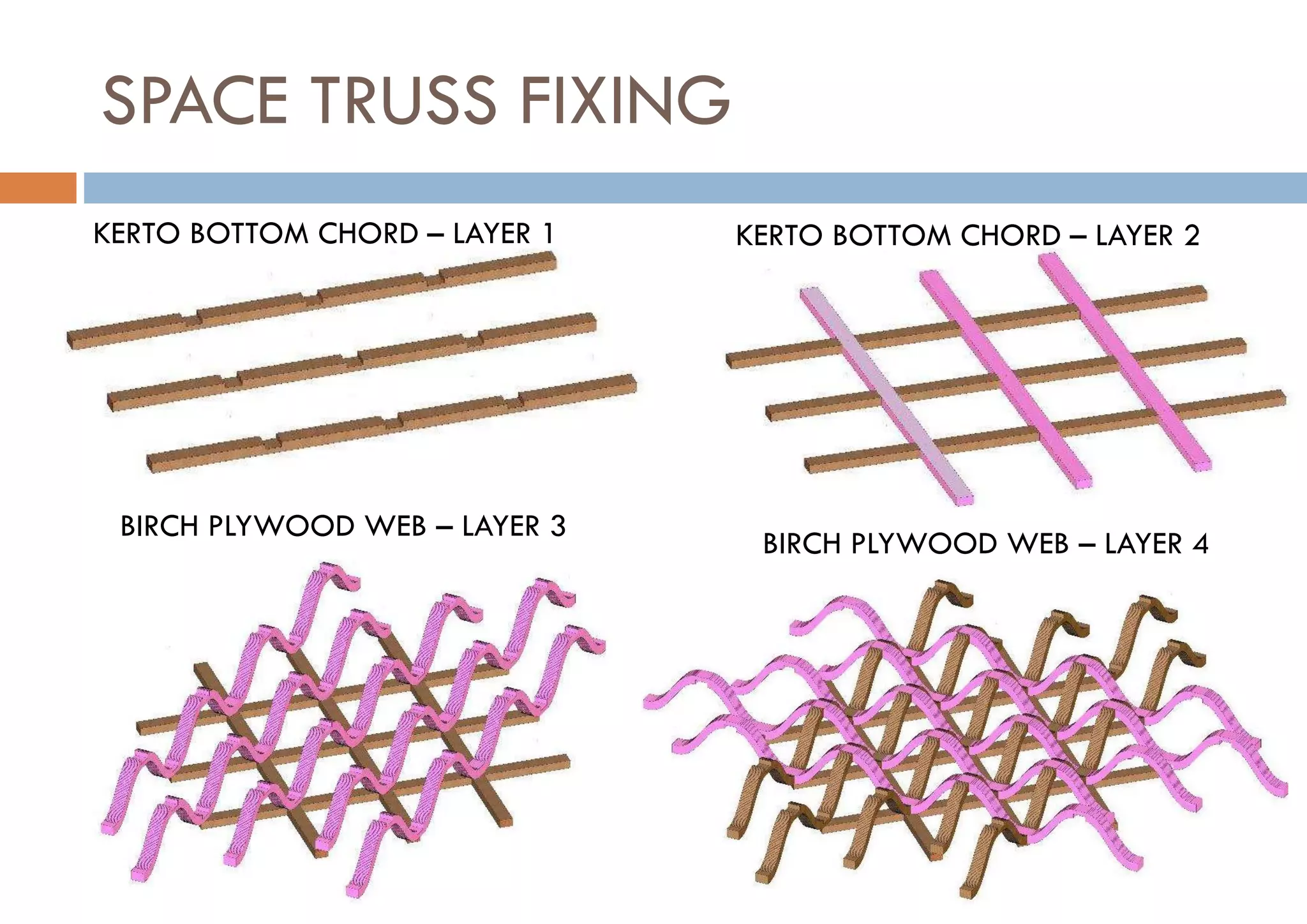
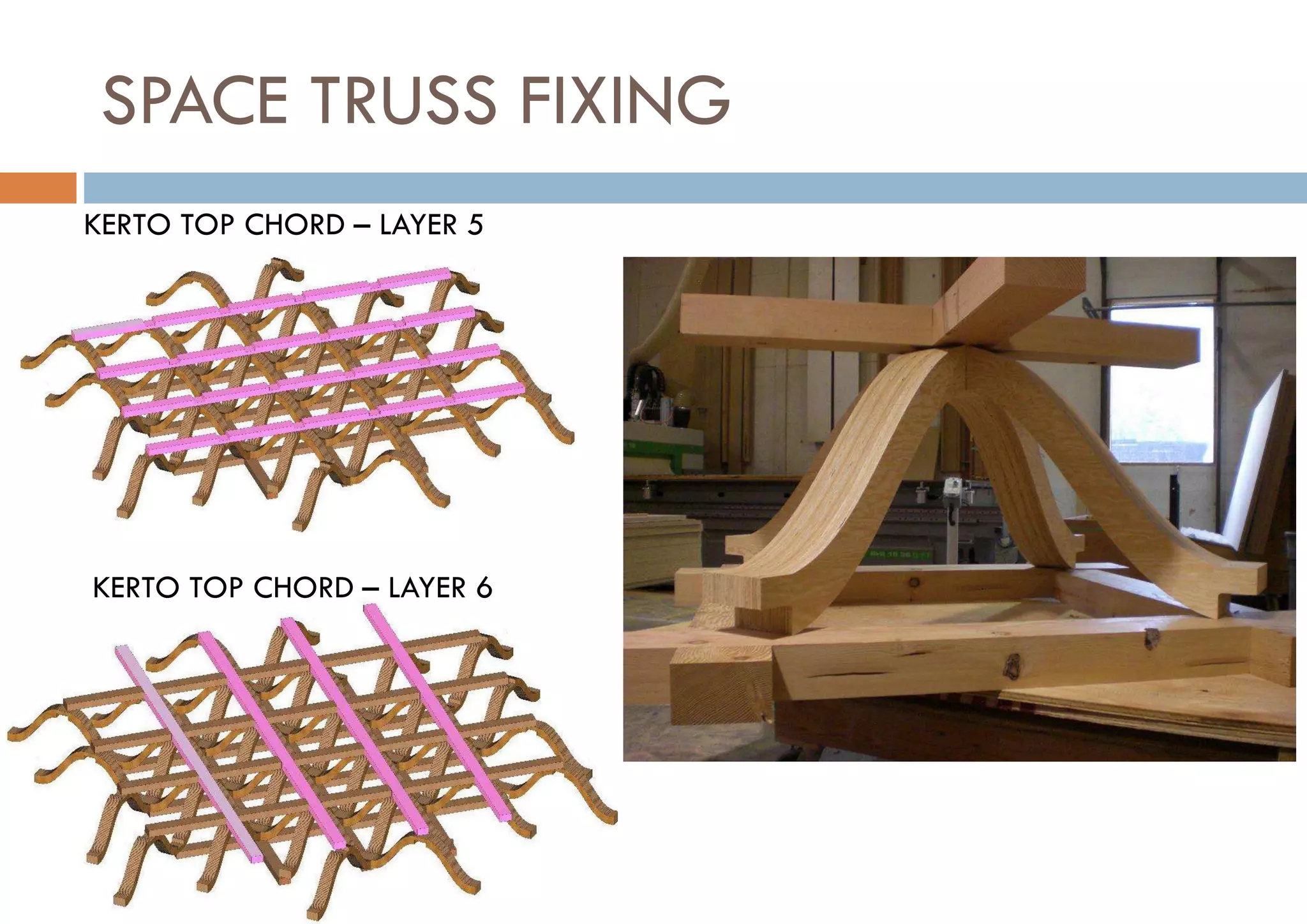
 KERTO CHORDS
 BIRCH PLYWOOD WEBS
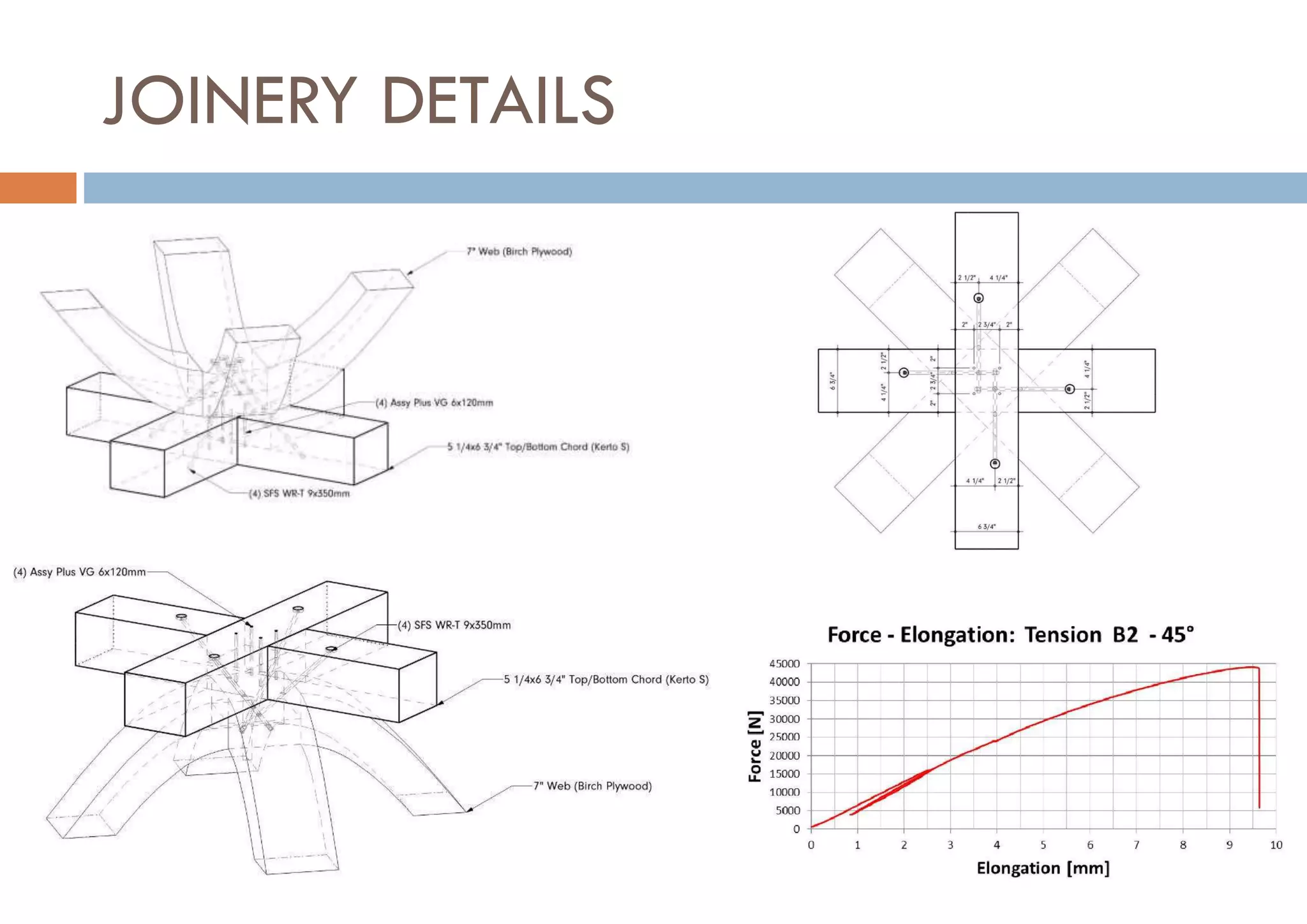
Joinery of materials
 HALF-LAPPED JOINTS
 FULL-THREAD SCREW
CONNECTIONS
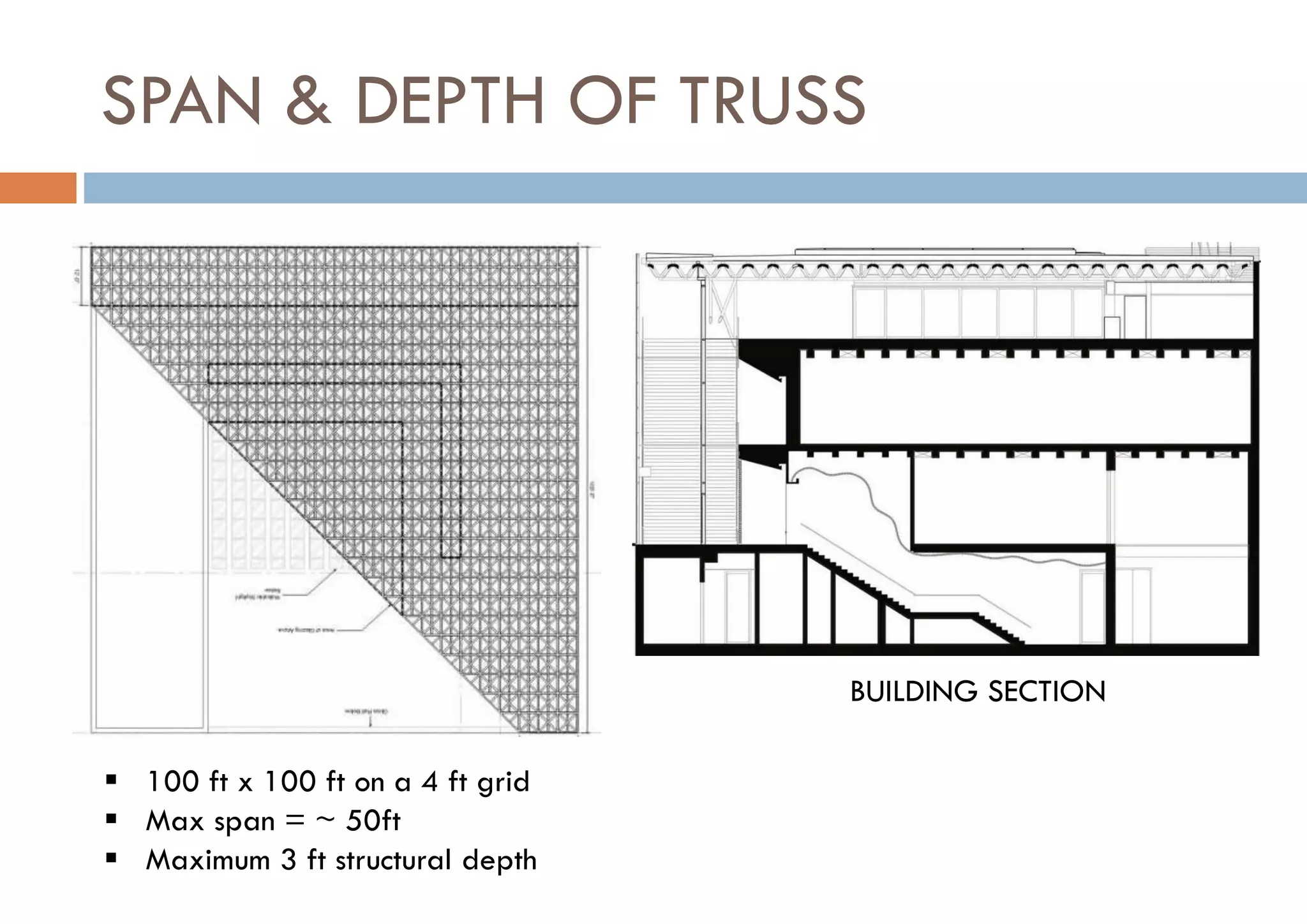
SPAN & DEPTH OF TRUSS
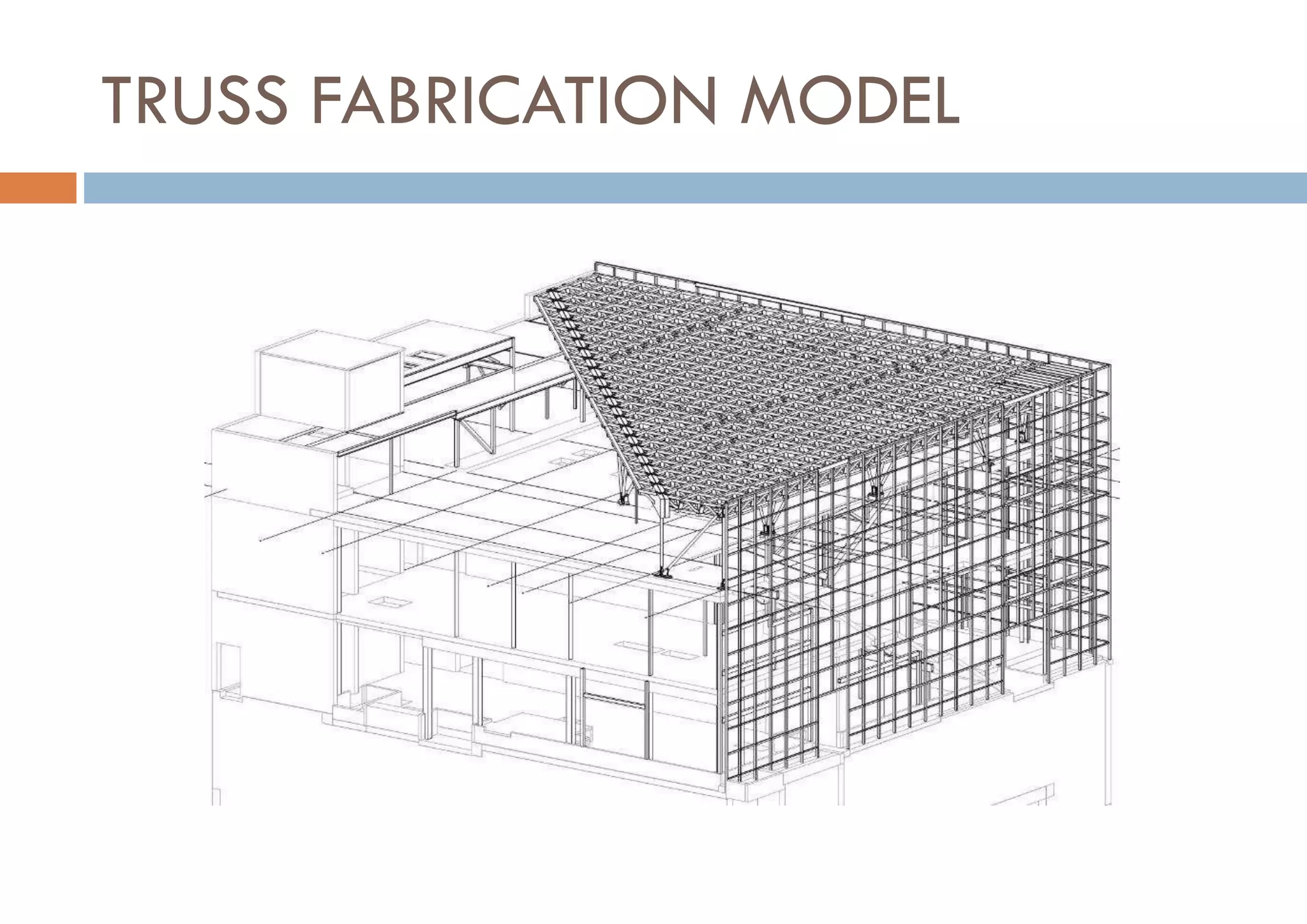
 100 ft x 100 ft on a 4 ft grid
 Max span = ~ 50ft
 Maximum 3 ft structural depth
BUILDING SECTION
SPACE TRUSS FIXING
KERTO BOTTOM CHORD – LAYER 1 KERTO BOTTOM CHORD – LAYER 2
BIRCH PLYWOOD WEB – LAYER 3
BIRCH PLYWOOD WEB – LAYER 4
SPACE TRUSS FIXING
KERTO TOP CHORD – LAYER 5
KERTO TOP CHORD – LAYER 6
JOINERY DETAILS
WEB LAYOUT
TRUSS FABRICATION MODEL
SPACE TRUSS ROOF
THANK YOU
Prepared by
Kolli Rajesh B.Arch, M.City Planning
kollirajesh888@gmail.com

Folded plates and space truss structures

  • 1.
    FOLDED PLATES &SPACE TRUSS BULK ACTIVE & VECTOR ACTIVE SYSTEMS THEORY OF STRUCTURES Prepared by Kolli Rajesh B.Arch, M.City Planning kollirajesh888@gmail.com
  • 2.
    FOLDED PLATES  Afolded plate is an example of a 3-dimensional or space structure  Folded plates consist of straight pieces joined with sharp edges. It cannot be made as thin as a shell due to the fact that it is subjected to bending.  Folded plates can be seen as a space version of a rigid frame.  Folded plates are best formed from reinforced concrete due to the fact that they can be easily cast.
  • 3.
    FOLDED PLATE STRUCTURALACTION  It is a combination of one-way slab action and longitudinal continuous beam action.  Every single plate has large aspect ratio(ratio of length to width of plate), so it acts as a one-way slab, there by transferring the load on the plate to the folds.  As the analysis of one-way slab, we can consider the plate to be composed of series of fixed end parallel beams of unit width.  In the longitudinal direction, each transverse strip of plate behaves like a continuous beam with equal spans elastically supported at the folds and at ends it rests on rigid end support.  The load is first transferred to folds by slab action of plates and then transferred in the longitudinal direction by continuous beam having rigid end supports and flexible interior supports provided by folds having rectangular cross-section equivalent to folded plates.
  • 4.
    FOLDED PLATES  Polygonaland circular plates may be used to cover circular areas, by giving a rise to the plates at the centre where depth of each plate is very small.  Radial elements of folded plates behave like an arch, it develops thrust, which is absorbed by a circumferential tension ring.  The top edge being thin cannot develop bending hence is treated as a hinge for analysis.
  • 5.
    Advantages and Disadvantagesof Folded-Plate Structure DISADVANTAGES:  Shuttering is difficult.  Greater accuracy in formwork is required.  Good labor and supervision necessary.  Rise of roof may be a disadvantage. ADVANTAGES: Very light form of construction. To span 30 m shell thickness required is 60 mm only. The use of concrete as a building material reduces both materials cost and a construction cost. Longer span can be provided. Flat shapes by choosing certain arched shapes. Esthetically it looks good over other forms of construction.
  • 6.
    YOKOHAMA INTERNATIONAL PASSENGER TERMINAL,JAPAN  Architect: Alejandro Zaera-Polo & Farshid Moussavi  Floor Area: 34,732sq.m  Length: 430m  Height: 15m  Width: 70m  Roof composed of 27 steel trusses averaging 42.5 meters in span and placed at 16 meter intervals.  Instead of using the column for the support they have approached the aid of the folded plat to get more spanned area. Folded plate structural roofing at main hall.
  • 7.
  • 8.
    KAMALAPUR RAILWAY STATUION, DHAKA Curved folded plates are used for main building.
  • 9.
    SPACE TRUSS  Itis also known as SPACE FRAME.  Space frames were independently developed by Alexander Graham Bell around 1900 & Buckminster Fuller in 1950.  A space frame is a truss-like, lightweight rigid structure constructed from interlocking struts in a geometric pattern.  Space frames usually utilise a multi-directional span, and are often used to accomplish long spans with few supports.  They derive their strength from the inherent rigidity if the triangular frame, flexing loads (behind moments) are transmitted as tension and compression loads along the length of each strut.  Most often their geometry is based on platonic solids.  The simplest form is a horizontal slab of interlocking square pyramids built from aluminium or steel tubular struts.  It looks like the horizontal jib of a tower crane repeated many times to make it wider.
  • 10.
    Advantages of SpaceFrames Factor Description 1. Lightweight This is mainly due to the fact that material is distributed spatially in such a way that the load transfer mechanism is primarily axial; tension or compression. Consequently, all material in any given element is utilized to its full extent. Furthermore, most space frames are now constructed with aluminum, which decreases considerably their self-weight. 2. Mass Productivity Space frames can be built from simple prefabricated units, which are often of standard size and shape. Such units can be easily transported and rapidly assembled on site by semi-skilled labor. Consequently, space frames can be built at a lower cost. 3. Stiffness A space frame is usually sufficiently stiff in spite of its lightness. This is due to its three dimensional character and to the full participation of its constituent elements. 4. Versatility Space frames possess a versatility of shape and form and can utilize a standard module to generate various flat space grids, latticed shell, or even free-form shapes. Architects appreciate the visual beauty and the impressive simplicity of lines in space frames.
  • 11.
    ASPEN ART MUSEUM,USA  The Aspen Art Museum, designed by architect Shigeru Ban, includes a long-span three-dimensional wood space-frame roof.  Structure s of wood space frame with spans of more than 50 feet and cantilevers of 14 feet, in a structu  The space frame was to have two planes of intersecting diagonal webs of curved members that undulated up and down to touch the planes of the top and bottom chords with no visible connectors. - wooden space frame structure
  • 12.
    3rd floor terracewith wood space frame Space truss floor ceiling plan plan Materials used for construction of space frame  KERTO CHORDS  BIRCH PLYWOOD WEBS Joinery of materials  HALF-LAPPED JOINTS  FULL-THREAD SCREW CONNECTIONS
  • 13.
    SPAN & DEPTHOF TRUSS  100 ft x 100 ft on a 4 ft grid  Max span = ~ 50ft  Maximum 3 ft structural depth BUILDING SECTION
  • 14.
    SPACE TRUSS FIXING KERTOBOTTOM CHORD – LAYER 1 KERTO BOTTOM CHORD – LAYER 2 BIRCH PLYWOOD WEB – LAYER 3 BIRCH PLYWOOD WEB – LAYER 4
  • 15.
    SPACE TRUSS FIXING KERTOTOP CHORD – LAYER 5 KERTO TOP CHORD – LAYER 6
  • 16.
  • 17.
  • 18.
  • 19.
  • 20.
    THANK YOU Prepared by KolliRajesh B.Arch, M.City Planning kollirajesh888@gmail.com