
ETSI TS 136 331 V10.2.0 (2011-07)
                                         Technical Specification


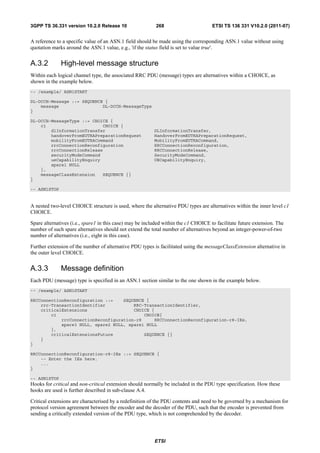
                                                 LTE;
Evolved Universal Terrestrial Radio Access (E-UTRA);
                      Radio Resource Control (RRC);
                                Protocol specification
         (3GPP TS 36.331 version 10.2.0 Release 10)
3GPP TS 36.331 version 10.2.0 Release 10                          1                           ETSI TS 136 331 V10.2.0 (2011-07)


                                                             Reference
                                                    RTS/TSGR-0236331va20

                                                             Keywords
                                                                 LTE


                                                                ETSI

                                                   650 Route des Lucioles
                                          F-06921 Sophia Antipolis Cedex - FRANCE

                                        Tel.: +33 4 92 94 42 00 Fax: +33 4 93 65 47 16

                                              Siret N° 348 623 562 00017 - NAF 742 C
                                             Association à but non lucratif enregistrée à la
                                             Sous-Préfecture de Grasse (06) N° 7803/88


                                                      Important notice

                             Individual copies of the present document can be downloaded from:
                                                       http://www.etsi.org

 The present document may be made available in more than one electronic version or in print. In any case of existing or
 perceived difference in contents between such versions, the reference version is the Portable Document Format (PDF).
In case of dispute, the reference shall be the printing on ETSI printers of the PDF version kept on a specific network drive
                                                   within ETSI Secretariat.

   Users of the present document should be aware that the document may be subject to revision or change of status.
                   Information on the current status of this and other ETSI documents is available at
                                        http://portal.etsi.org/tb/status/status.asp

           If you find errors in the present document, please send your comment to one of the following services:
                                         http://portal.etsi.org/chaircor/ETSI_support.asp

                                                  Copyright Notification

                         No part may be reproduced except as authorized by written permission.
                      The copyright and the foregoing restriction extend to reproduction in all media.

                                 © European Telecommunications Standards Institute 2011.
                                                  All rights reserved.
      TM                TM         TM
DECT , PLUGTESTS , UMTS and the ETSI logo are Trade Marks of ETSI registered for the benefit of its Members.
               TM
           3GPP and LTE™ are Trade Marks of ETSI registered for the benefit of its Members and
                                of the 3GPP Organizational Partners.
          GSM® and the GSM logo are Trade Marks registered and owned by the GSM Association.


                                                                ETSI
3GPP TS 36.331 version 10.2.0 Release 10                   2                        ETSI TS 136 331 V10.2.0 (2011-07)


Intellectual Property Rights
IPRs essential or potentially essential to the present document may have been declared to ETSI. The information
pertaining to these essential IPRs, if any, is publicly available for ETSI members and non-members, and can be found
in ETSI SR 000 314: "Intellectual Property Rights (IPRs); Essential, or potentially Essential, IPRs notified to ETSI in
respect of ETSI standards", which is available from the ETSI Secretariat. Latest updates are available on the ETSI Web
server (http://ipr.etsi.org).

Pursuant to the ETSI IPR Policy, no investigation, including IPR searches, has been carried out by ETSI. No guarantee
can be given as to the existence of other IPRs not referenced in ETSI SR 000 314 (or the updates on the ETSI Web
server) which are, or may be, or may become, essential to the present document.


Foreword
This Technical Specification (TS) has been produced by ETSI 3rd Generation Partnership Project (3GPP).

The present document may refer to technical specifications or reports using their 3GPP identities, UMTS identities or
GSM identities. These should be interpreted as being references to the corresponding ETSI deliverables.

The cross reference between GSM, UMTS, 3GPP and ETSI identities can be found under
http://webapp.etsi.org/key/queryform.asp.


                                                         ETSI
3GPP TS 36.331 version 10.2.0 Release 10                                                3                                     ETSI TS 136 331 V10.2.0 (2011-07)


Contents
Intellectual Property Rights ................................................................................................................................2
Foreword.............................................................................................................................................................2
Foreword...........................................................................................................................................................13
1        Scope ......................................................................................................................................................14
2        References ..............................................................................................................................................14
3        Definitions, symbols and abbreviations .................................................................................................17
3.1           Definitions ........................................................................................................................................................ 17
3.2           Abbreviations ................................................................................................................................................... 17
4        General ...................................................................................................................................................19
4.1           Introduction ...................................................................................................................................................... 19
4.2           Architecture ...................................................................................................................................................... 19
4.2.1             UE states and state transitions including inter RAT ................................................................................... 19
4.2.2             Signalling radio bearers .............................................................................................................................. 21
4.3           Services ............................................................................................................................................................ 22
4.3.1             Services provided to upper layers ............................................................................................................... 22
4.3.2             Services expected from lower layers .......................................................................................................... 22
4.4           Functions .......................................................................................................................................................... 22
5        Procedures ..............................................................................................................................................23
5.1           General ............................................................................................................................................................. 23
5.1.1            Introduction................................................................................................................................................. 23
5.1.2            General requirements .................................................................................................................................. 23
5.2           System information .......................................................................................................................................... 24
5.2.1            Introduction................................................................................................................................................. 24
5.2.1.1              General .................................................................................................................................................. 24
5.2.1.2              Scheduling............................................................................................................................................. 25
5.2.1.3              System information validity and notification of changes ...................................................................... 25
5.2.1.4              Indication of ETWS notification ........................................................................................................... 26
5.2.1.5              Indication of CMAS notification........................................................................................................... 26
5.2.2            System information acquisition .................................................................................................................. 26
5.2.2.1              General .................................................................................................................................................. 26
5.2.2.2              Initiation ................................................................................................................................................ 27
5.2.2.3              System information required by the UE ................................................................................................ 27
5.2.2.4              System information acquisition by the UE............................................................................................ 27
5.2.2.5              Essential system information missing ................................................................................................... 28
5.2.2.6              Actions upon reception of the MasterInformationBlock message ......................................................... 29
5.2.2.7              Actions upon reception of the SystemInformationBlockType1 message ............................................... 29
5.2.2.8              Actions upon reception of SystemInformation messages ...................................................................... 29
5.2.2.9              Actions upon reception of SystemInformationBlockType2 ................................................................... 29
5.2.2.10             Actions upon reception of SystemInformationBlockType3 ................................................................... 30
5.2.2.11             Actions upon reception of SystemInformationBlockType4 ................................................................... 30
5.2.2.12             Actions upon reception of SystemInformationBlockType5 ................................................................... 30
5.2.2.13             Actions upon reception of SystemInformationBlockType6 ................................................................... 30
5.2.2.14             Actions upon reception of SystemInformationBlockType7 ................................................................... 30
5.2.2.15             Actions upon reception of SystemInformationBlockType8 ................................................................... 30
5.2.2.16             Actions upon reception of SystemInformationBlockType9 ................................................................... 31
5.2.2.17             Actions upon reception of SystemInformationBlockType10 ................................................................. 31
5.2.2.18             Actions upon reception of SystemInformationBlockType11 ................................................................. 31
5.2.2.19             Actions upon reception of SystemInformationBlockType12 ................................................................. 32
5.2.2.20             Actions upon reception of SystemInformationBlockType13 ................................................................. 33
5.2.3            Acquisition of an SI message ...................................................................................................................... 33
5.3           Connection control ........................................................................................................................................... 33
5.3.1            Introduction................................................................................................................................................. 33
5.3.1.1              RRC connection control ........................................................................................................................ 33


                                                                                     ETSI
3GPP TS 36.331 version 10.2.0 Release 10                                         4                                     ETSI TS 136 331 V10.2.0 (2011-07)


5.3.1.2         Security ................................................................................................................................................. 34
5.3.1.2a        RN security ........................................................................................................................................... 35
5.3.1.3         Connected mode mobility ..................................................................................................................... 35
5.3.2       Paging ......................................................................................................................................................... 36
5.3.2.1         General .................................................................................................................................................. 36
5.3.2.2         Initiation ................................................................................................................................................ 36
5.3.2.3         Reception of the Paging message by the UE ........................................................................................ 36
5.3.3       RRC connection establishment ................................................................................................................... 37
5.3.3.1         General .................................................................................................................................................. 37
5.3.3.2         Initiation ................................................................................................................................................ 38
5.3.3.3         Actions related to transmission of RRCConnectionRequest message ................................................... 39
5.3.3.4         Reception of the RRCConnectionSetup by the UE................................................................................ 40
5.3.3.5         Cell re-selection while T300, T302, T303, T305 or T306 is running ................................................... 41
5.3.3.6         T300 expiry ........................................................................................................................................... 41
5.3.3.7         T302, T303, T305 or T306 expiry or stop ............................................................................................. 41
5.3.3.8         Reception of the RRCConnectionReject by the UE .............................................................................. 42
5.3.3.9         Abortion of RRC connection establishment .......................................................................................... 42
5.3.3.10    Handling of SSAC related parameters ........................................................................................................ 42
5.3.3.11        Access barring check............................................................................................................................. 43
5.3.4       Initial security activation ............................................................................................................................ 44
5.3.4.1         General .................................................................................................................................................. 44
5.3.4.2         Initiation ................................................................................................................................................ 44
5.3.4.3         Reception of the SecurityModeCommand by the UE ............................................................................ 44
5.3.5       RRC connection reconfiguration ................................................................................................................ 45
5.3.5.1         General .................................................................................................................................................. 45
5.3.5.2         Initiation ................................................................................................................................................ 46
5.3.5.3         Reception of an RRCConnectionReconfiguration not including the mobilityControlInfo by the
                UE ......................................................................................................................................................... 46
5.3.5.4         Reception of an RRCConnectionReconfiguration including the mobilityControlInfo by the UE
                (handover) ............................................................................................................................................. 47
5.3.5.5         Reconfiguration failure ......................................................................................................................... 49
5.3.5.6         T304 expiry (handover failure) ............................................................................................................. 49
5.3.5.7         Void....................................................................................................................................................... 50
5.3.5.8         Radio Configuration involving full configuration option...................................................................... 50
5.3.6       Counter check ............................................................................................................................................. 51
5.3.6.1         General .................................................................................................................................................. 51
5.3.6.2         Initiation ................................................................................................................................................ 52
5.3.6.3         Reception of the CounterCheck message by the UE ............................................................................. 52
5.3.7       RRC connection re-establishment............................................................................................................... 52
5.3.7.1         General .................................................................................................................................................. 52
5.3.7.2         Initiation ................................................................................................................................................ 53
5.3.7.3         Actions following cell selection while T311 is running ........................................................................ 54
5.3.7.4         Actions related to transmission of RRCConnectionReestablishmentRequest message ......................... 54
5.3.7.5         Reception of the RRCConnectionReestablishment by the UE .............................................................. 55
5.3.7.6         T311 expiry ........................................................................................................................................... 56
5.3.7.7         T301 expiry or selected cell no longer suitable ..................................................................................... 56
5.3.7.8         Reception of RRCConnectionReestablishmentReject by the UE .......................................................... 56
5.3.8       RRC connection release .............................................................................................................................. 56
5.3.8.1         General .................................................................................................................................................. 56
5.3.8.2         Initiation ................................................................................................................................................ 56
5.3.8.3         Reception of the RRCConnectionRelease by the UE ............................................................................ 56
5.3.8.4         T320 expiry ........................................................................................................................................... 57
5.3.9       RRC connection release requested by upper layers .................................................................................... 57
5.3.9.1         General .................................................................................................................................................. 57
5.3.9.2         Initiation ................................................................................................................................................ 57
5.3.10      Radio resource configuration ...................................................................................................................... 58
5.3.10.0        General .................................................................................................................................................. 58
5.3.10.1        SRB addition/ modification................................................................................................................... 58
5.3.10.2        DRB release .......................................................................................................................................... 58
5.3.10.3        DRB addition/ modification .................................................................................................................. 59
5.3.10.3a       SCell release .......................................................................................................................................... 60
5.3.10.3b       SCell addition/ modification ................................................................................................................. 60


                                                                              ETSI
3GPP TS 36.331 version 10.2.0 Release 10                                             5                                    ETSI TS 136 331 V10.2.0 (2011-07)


5.3.10.4           MAC main reconfiguration ................................................................................................................... 60
5.3.10.5           Semi-persistent scheduling reconfiguration .......................................................................................... 60
5.3.10.6           Physical channel reconfiguration .......................................................................................................... 60
5.3.10.7           Radio Link Failure Timers and Constants reconfiguration ................................................................... 61
5.3.10.8           Time domain measurement resource restriction for serving cell........................................................... 61
5.3.11         Radio link failure related actions ................................................................................................................ 61
5.3.11.1           Detection of physical layer problems in RRC_CONNECTED ............................................................. 61
5.3.11.2           Recovery of physical layer problems .................................................................................................... 61
5.3.11.3           Detection of radio link failure ............................................................................................................... 62
5.3.12         UE actions upon leaving RRC_CONNECTED .......................................................................................... 63
5.3.13         UE actions upon PUCCH/ SRS release request .......................................................................................... 63
5.3.14         Proximity indication ................................................................................................................................... 63
5.3.14.1           General .................................................................................................................................................. 63
5.3.14.2           Initiation ................................................................................................................................................ 64
5.3.14.3           Actions related to transmission of ProximityIndication message.......................................................... 64
5.4        Inter-RAT mobility........................................................................................................................................... 65
5.4.1          Introduction................................................................................................................................................. 65
5.4.2          Handover to E-UTRA ................................................................................................................................. 65
5.4.2.1            General .................................................................................................................................................. 65
5.4.2.2            Initiation ................................................................................................................................................ 65
5.4.2.3            Reception of the RRCConnectionReconfiguration by the UE............................................................... 65
5.4.2.4            Reconfiguration failure ......................................................................................................................... 67
5.4.2.5            T304 expiry (handover to E-UTRA failure).......................................................................................... 67
5.4.3          Mobility from E-UTRA .............................................................................................................................. 67
5.4.3.1            General .................................................................................................................................................. 67
5.4.3.2            Initiation ................................................................................................................................................ 68
5.4.3.3            Reception of the MobilityFromEUTRACommand by the UE ............................................................... 68
5.4.3.4            Successful completion of the mobility from E-UTRA .......................................................................... 69
5.4.3.5            Mobility from E-UTRA failure ............................................................................................................. 70
5.4.4          Handover from E-UTRA preparation request (CDMA2000) ..................................................................... 70
5.4.4.1            General .................................................................................................................................................. 70
5.4.4.2            Initiation ................................................................................................................................................ 70
5.4.4.3            Reception of the HandoverFromEUTRAPreparationRequest by the UE ............................................. 71
5.4.5          UL handover preparation transfer (CDMA2000) ....................................................................................... 71
5.4.5.1            General .................................................................................................................................................. 71
5.4.5.2            Initiation ................................................................................................................................................ 71
5.4.5.3            Actions related to transmission of the ULHandoverPreparationTransfer message .............................. 71
5.4.5.4            Failure to deliver the ULHandoverPreparationTransfer message ........................................................ 72
5.4.6          Inter-RAT cell change order to E-UTRAN ................................................................................................. 72
5.4.6.1            General .................................................................................................................................................. 72
5.4.6.2            Initiation ................................................................................................................................................ 72
5.4.6.3            UE fails to complete an inter-RAT cell change order ........................................................................... 72
5.5        Measurements................................................................................................................................................... 73
5.5.1          Introduction................................................................................................................................................. 73
5.5.2          Measurement configuration ........................................................................................................................ 74
5.5.2.1            General .................................................................................................................................................. 74
5.5.2.2            Measurement identity removal .............................................................................................................. 75
5.5.2.2a           Measurement identity autonomous removal ......................................................................................... 75
5.5.2.3            Measurement identity addition/ modification ....................................................................................... 76
5.5.2.4            Measurement object removal ................................................................................................................ 76
5.5.2.5            Measurement object addition/ modification .......................................................................................... 77
5.5.2.6            Reporting configuration removal .......................................................................................................... 78
5.5.2.7            Reporting configuration addition/ modification .................................................................................... 78
5.5.2.8            Quantity configuration .......................................................................................................................... 78
5.5.2.9            Measurement gap configuration ............................................................................................................ 78
5.5.3          Performing measurements .......................................................................................................................... 79
5.5.3.1            General .................................................................................................................................................. 79
5.5.3.2            Layer 3 filtering .................................................................................................................................... 80
5.5.4          Measurement report triggering ................................................................................................................... 81
5.5.4.1            General .................................................................................................................................................. 81
5.5.4.2            Event A1 (Serving becomes better than threshold) ............................................................................... 83
5.5.4.3            Event A2 (Serving becomes worse than threshold) .............................................................................. 84


                                                                                  ETSI
3GPP TS 36.331 version 10.2.0 Release 10                                              6                                      ETSI TS 136 331 V10.2.0 (2011-07)


5.5.4.4            Event A3 (Neighbour becomes offset better than PCell) ...................................................................... 84
5.5.4.5            Event A4 (Neighbour becomes better than threshold) .......................................................................... 85
5.5.4.6            Event A5 (PCell becomes worse than threshold1 and neighbour becomes better than threshold2) ...... 85
5.5.4.6a           Event A6 (Neighbour becomes offset better than SCell) ...................................................................... 86
5.5.4.7            Event B1 (Inter RAT neighbour becomes better than threshold) .......................................................... 87
5.5.4.8            Event B2 (PCell becomes worse than threshold1 and inter RAT neighbour becomes better than
                   threshold2) ............................................................................................................................................ 87
5.5.5         Measurement reporting ............................................................................................................................... 88
5.5.6         Measurement related actions....................................................................................................................... 90
5.5.6.1            Actions upon handover and re-establishment........................................................................................ 90
5.5.6.2            Speed dependant scaling of measurement related parameters ............................................................... 91
5.5.7         Inter-frequency RSTD measurement indication ......................................................................................... 92
5.5.7.1            General .................................................................................................................................................. 92
5.5.7.2            Initiation ................................................................................................................................................ 92
5.5.7.3            Actions related to transmission of InterFreqRSTDMeasurementIndication message ........................... 92
5.6        Other ................................................................................................................................................................. 93
5.6.1         DL information transfer .............................................................................................................................. 93
5.6.1.1            General .................................................................................................................................................. 93
5.6.1.2            Initiation ................................................................................................................................................ 93
5.6.1.3            Reception of the DLInformationTransfer by the UE ............................................................................ 93
5.6.2         UL information transfer .............................................................................................................................. 93
5.6.2.1            General .................................................................................................................................................. 93
5.6.2.2            Initiation ................................................................................................................................................ 94
5.6.2.3            Actions related to transmission of ULInformationTransfer message .................................................... 94
5.6.2.4            Failure to deliver ULInformationTransfer message .............................................................................. 94
5.6.3         UE capability transfer ................................................................................................................................. 94
5.6.3.1            General .................................................................................................................................................. 94
5.6.3.2            Initiation ................................................................................................................................................ 95
5.6.3.3            Reception of the UECapabilityEnquiry by the UE ............................................................................... 95
5.6.4         CSFB to 1x Parameter transfer ................................................................................................................... 95
5.6.4.1            General .................................................................................................................................................. 95
5.6.4.2            Initiation ................................................................................................................................................ 96
5.6.4.3            Actions related to transmission of CSFBParametersRequestCDMA2000 message .............................. 96
5.6.4.4            Reception of the CSFBParametersResponseCDMA2000 message ....................................................... 96
5.6.5         UE Information ........................................................................................................................................... 96
5.6.5.1            General .................................................................................................................................................. 96
5.6.5.2            Initiation ................................................................................................................................................ 96
5.6.5.3            Reception of the UEInformationRequest message ................................................................................ 96
5.6.6         Logged Measurement Configuration .......................................................................................................... 97
5.6.6.1            General .................................................................................................................................................. 97
5.6.6.2            Initiation ................................................................................................................................................ 98
5.6.6.3            Reception of the LoggedMeasurementConfiguration by the UE .......................................................... 98
5.6.6.4            T330 expiry ........................................................................................................................................... 98
5.6.7         Release of Logged Measurement Configuration......................................................................................... 98
5.6.7.1            General .................................................................................................................................................. 98
5.6.7.2            Initiation ................................................................................................................................................ 98
5.6.8         Measurements logging ................................................................................................................................ 98
5.6.8.1            General .................................................................................................................................................. 98
5.6.8.2            Initiation ................................................................................................................................................ 99
5.7        Generic error handling...................................................................................................................................... 99
5.7.1         General........................................................................................................................................................ 99
5.7.2         ASN.1 violation or encoding error.............................................................................................................. 99
5.7.3         Field set to a not comprehended value ...................................................................................................... 100
5.7.4         Mandatory field missing ........................................................................................................................... 100
5.7.5         Not comprehended field ............................................................................................................................ 101
5.8        MBMS ............................................................................................................................................................ 101
5.8.1         Introduction............................................................................................................................................... 101
5.8.1.1            General ................................................................................................................................................ 101
5.8.1.2            Scheduling........................................................................................................................................... 102
5.8.1.3            MCCH information validity and notification of changes .................................................................... 102
5.8.2         MCCH information acquisition ................................................................................................................ 103
5.8.2.1            General ................................................................................................................................................ 103


                                                                                   ETSI
3GPP TS 36.331 version 10.2.0 Release 10                                               7                                     ETSI TS 136 331 V10.2.0 (2011-07)


5.8.2.2            Initiation .............................................................................................................................................. 103
5.8.2.3            MCCH information acquisition by the UE.......................................................................................... 103
5.8.2.4            Actions upon reception of the MBSFNAreaConfiguration message ................................................... 104
5.8.2.5            Actions upon reception of the MBMSCountingRequest message........................................................ 104
5.8.3          MBMS PTM radio bearer configuration................................................................................................... 104
5.8.3.1            General ................................................................................................................................................ 104
5.8.3.2            Initiation .............................................................................................................................................. 104
5.8.3.3            MRB establishment ............................................................................................................................. 104
5.8.3.4            MRB release ........................................................................................................................................ 105
5.8.4          MBMS Counting Procedure ..................................................................................................................... 105
5.8.4.1            General ................................................................................................................................................ 105
5.8.4.2            Initiation .............................................................................................................................................. 105
5.8.4.3            Reception of the MBMSCountingRequest message by the UE ........................................................... 105
5.9          RN procedures ................................................................................................................................................ 106
5.9.1          RN reconfiguration ................................................................................................................................... 106
5.9.1.1            General ................................................................................................................................................ 106
5.9.1.2            Initiation .............................................................................................................................................. 106
5.9.1.3            Reception of the RNReconfiguration by the RN ................................................................................. 106
6         Protocol data units, formats and parameters (tabular & ASN.1) ..........................................................107
6.1          General ........................................................................................................................................................... 107
6.2          RRC messages ................................................................................................................................................ 108
6.2.1          General message structure ........................................................................................................................ 108
–                  EUTRA-RRC-Definitions .................................................................................................................... 108
–                  BCCH-BCH-Message ......................................................................................................................... 108
–                  BCCH-DL-SCH-Message ................................................................................................................... 108
–                  MCCH-Message .................................................................................................................................. 108
–                  PCCH-Message ................................................................................................................................... 109
–                  DL-CCCH-Message ............................................................................................................................ 109
–                  DL-DCCH-Message ............................................................................................................................ 109
–                  UL-CCCH-Message ............................................................................................................................ 110
–                  UL-DCCH-Message ............................................................................................................................ 110
6.2.2          Message definitions .................................................................................................................................. 111
–                  CounterCheck...................................................................................................................................... 111
–                  CounterCheckResponse....................................................................................................................... 112
–                  CSFBParametersRequestCDMA2000 ................................................................................................. 112
–                  CSFBParametersResponseCDMA2000 .............................................................................................. 113
–                  DLInformationTransfer ....................................................................................................................... 114
–                  HandoverFromEUTRAPreparationRequest (CDMA2000) ................................................................ 114
–                  InterFreqRSTDMeasurementIndication.............................................................................................. 115
–                  LoggedMeasurementConfiguration .................................................................................................... 116
–                  MasterInformationBlock ..................................................................................................................... 117
–                  MBMSCountingRequest ...................................................................................................................... 118
–                  MBMSCountingResponse .................................................................................................................... 118
–                  MBSFNAreaConfiguration ................................................................................................................. 119
–                  MeasurementReport ............................................................................................................................ 119
–                  MobilityFromEUTRACommand.......................................................................................................... 120
–                  Paging ................................................................................................................................................. 123
–                  ProximityIndication............................................................................................................................. 124
–                  RNReconfiguration.............................................................................................................................. 125
–                  RNReconfigurationComplete .............................................................................................................. 125
–                  RRCConnectionReconfiguration ......................................................................................................... 126
–                  RRCConnectionReconfigurationComplete .......................................................................................... 128
–                  RRCConnectionReestablishment ......................................................................................................... 128
–                  RRCConnectionReestablishmentComplete ......................................................................................... 129
–                  RRCConnectionReestablishmentReject ............................................................................................... 129
–                  RRCConnectionReestablishmentRequest ............................................................................................ 130
–                  RRCConnectionReject ......................................................................................................................... 131
–                  RRCConnectionRelease ...................................................................................................................... 131
–                  RRCConnectionRequest ...................................................................................................................... 134
–                  RRCConnectionSetup .......................................................................................................................... 135
–                  RRCConnectionSetupComplete ........................................................................................................... 136


                                                                                    ETSI
3GPP TS 36.331 version 10.2.0 Release 10                                         8                                   ETSI TS 136 331 V10.2.0 (2011-07)


–              SecurityModeCommand ...................................................................................................................... 137
–              SecurityModeComplete ....................................................................................................................... 137
–              SecurityModeFailure........................................................................................................................... 138
–              SystemInformation .............................................................................................................................. 138
–              SystemInformationBlockType1 ............................................................................................................ 139
–              UECapabilityEnquiry.......................................................................................................................... 141
–              UECapabilityInformation ................................................................................................................... 142
–              UEInformationRequest........................................................................................................................ 143
–              UEInformationResponse ..................................................................................................................... 143
–              ULHandoverPreparationTransfer (CDMA2000) ................................................................................ 146
–              ULInformationTransfer ....................................................................................................................... 147
6.3      RRC information elements ............................................................................................................................. 147
6.3.1      System information blocks ....................................................................................................................... 147
–              SystemInformationBlockType2 ............................................................................................................ 147
–              SystemInformationBlockType3 ............................................................................................................ 149
–              SystemInformationBlockType4 ............................................................................................................ 151
–              SystemInformationBlockType5 ............................................................................................................ 152
–              SystemInformationBlockType6 ............................................................................................................ 153
–              SystemInformationBlockType7 ............................................................................................................ 154
–              SystemInformationBlockType8 ............................................................................................................ 155
–              SystemInformationBlockType9 ............................................................................................................ 159
–              SystemInformationBlockType10 .......................................................................................................... 159
–              SystemInformationBlockType11 .......................................................................................................... 160
–              SystemInformationBlockType12 .......................................................................................................... 161
–              SystemInformationBlockType13 .......................................................................................................... 161
6.3.2      Radio resource control information elements ........................................................................................... 162
–              AntennaInfo ......................................................................................................................................... 162
–              AntennaInfoUL .................................................................................................................................... 163
–              CQI-ReportConfig ............................................................................................................................... 163
–              CrossCarrierSchedulingConfig ........................................................................................................... 167
–              CSI-RS-Config ..................................................................................................................................... 167
–              DRB-Identity ....................................................................................................................................... 168
–              LogicalChannelConfig ........................................................................................................................ 168
–              MAC-MainConfig ................................................................................................................................ 169
–              PDCP-Config ...................................................................................................................................... 171
–              PDSCH-Config.................................................................................................................................... 173
–              PHICH-Config .................................................................................................................................... 173
–              PhysicalConfigDedicated .................................................................................................................... 174
–              P-Max .................................................................................................................................................. 175
–              PRACH-Config.................................................................................................................................... 175
–              PresenceAntennaPort1........................................................................................................................ 176
–              PUCCH-Config ................................................................................................................................... 176
–              PUSCH-Config.................................................................................................................................... 178
–              RACH-ConfigCommon ........................................................................................................................ 180
–              RACH-ConfigDedicated ...................................................................................................................... 181
–              RadioResourceConfigCommon ........................................................................................................... 181
–              RadioResourceConfigDedicated ......................................................................................................... 183
–              RLC-Config ......................................................................................................................................... 185
–              RLF-TimersAndConstants ................................................................................................................... 187
–              RN-SubframeConfig ............................................................................................................................ 187
–              SchedulingRequestConfig ................................................................................................................... 188
–              SoundingRS-UL-Config....................................................................................................................... 189
–              SPS-Config .......................................................................................................................................... 191
–              TDD-Config ........................................................................................................................................ 192
–              TimeAlignmentTimer ........................................................................................................................... 193
–              TPC-PDCCH-Config .......................................................................................................................... 193
–              UplinkPowerControl ........................................................................................................................... 194
6.3.3      Security control information elements ...................................................................................................... 195
–              NextHopChainingCount ...................................................................................................................... 195
–              SecurityAlgorithmConfig..................................................................................................................... 196
–              ShortMAC-I ......................................................................................................................................... 196
6.3.4      Mobility control information elements ..................................................................................................... 196


                                                                              ETSI
3GPP TS 36.331 version 10.2.0 Release 10                                       9                                   ETSI TS 136 331 V10.2.0 (2011-07)


–             AdditionalSpectrumEmission .............................................................................................................. 196
–             ARFCN-ValueCDMA2000 .................................................................................................................. 196
–             ARFCN-ValueEUTRA ......................................................................................................................... 197
–             ARFCN-ValueGERAN......................................................................................................................... 197
–             ARFCN-ValueUTRA ........................................................................................................................... 197
–             BandclassCDMA2000 ......................................................................................................................... 197
–             BandIndicatorGERAN......................................................................................................................... 198
–             CarrierFreqCDMA2000 ..................................................................................................................... 198
–             CarrierFreqGERAN ............................................................................................................................ 198
–             CarrierFreqsGERAN .......................................................................................................................... 198
–             CDMA2000-Type ................................................................................................................................ 199
–             CellIdentity .......................................................................................................................................... 199
–             CellIndexList ....................................................................................................................................... 199
–             CellReselectionPriority ....................................................................................................................... 200
–             CSFB-RegistrationParam1XRTT ........................................................................................................ 200
–             CellGlobalIdEUTRA ........................................................................................................................... 201
–             CellGlobalIdUTRA.............................................................................................................................. 201
–             CellGlobalIdGERAN ........................................................................................................................... 202
–             CellGlobalIdCDMA2000 .................................................................................................................... 202
–             CSG-Identity........................................................................................................................................ 203
–             MobilityControlInfo ............................................................................................................................ 203
–             MobilityParametersCDMA2000 (1xRTT) ........................................................................................... 204
–             MobilityStateParameters..................................................................................................................... 204
–             PhysCellId ........................................................................................................................................... 205
–             PhysCellIdRange ................................................................................................................................. 205
–             PhysCellIdRangeUTRA-FDDList ....................................................................................................... 205
–             PhysCellIdCDMA2000 ........................................................................................................................ 206
–             PhysCellIdGERAN .............................................................................................................................. 206
–             PhysCellIdUTRA-FDD ....................................................................................................................... 206
–             PhysCellIdUTRA-TDD ........................................................................................................................ 207
–             PLMN-Identity .................................................................................................................................... 207
–             PreRegistrationInfoHRPD .................................................................................................................. 207
–             Q-QualMin .......................................................................................................................................... 208
–             Q-RxLevMin ........................................................................................................................................ 208
–             Q-OffsetRange ..................................................................................................................................... 208
–             Q-OffsetRangeInterRAT ...................................................................................................................... 209
–             ReselectionThreshold .......................................................................................................................... 209
–             ReselectionThresholdQ ....................................................................................................................... 209
–             SCellIndex ........................................................................................................................................... 209
–             ServCellIndex ...................................................................................................................................... 209
–             SpeedStateScaleFactors ...................................................................................................................... 210
–             SystemInfoListGERAN ........................................................................................................................ 210
–             SystemTimeInfoCDMA2000 ................................................................................................................ 210
–             TrackingAreaCode .............................................................................................................................. 211
–             T-Reselection ....................................................................................................................................... 211
6.3.5       Measurement information elements .......................................................................................................... 211
–             AllowedMeasBandwidth ...................................................................................................................... 211
–             Hysteresis ............................................................................................................................................ 212
–             LocationInfo ........................................................................................................................................ 212
–             MeasConfig ......................................................................................................................................... 212
–             MeasGapConfig .................................................................................................................................. 213
–             MeasId................................................................................................................................................. 214
–             MeasIdToAddModList ......................................................................................................................... 214
–             MeasObjectCDMA2000 ...................................................................................................................... 214
–             MeasObjectEUTRA ............................................................................................................................. 215
–             MeasObjectGERAN............................................................................................................................. 216
–             MeasObjectId ...................................................................................................................................... 216
–             MeasObjectToAddModList ................................................................................................................. 217
–             MeasObjectUTRA ............................................................................................................................... 217
–             MeasResults ........................................................................................................................................ 218
–             QuantityConfig .................................................................................................................................... 221
–             ReportConfigEUTRA........................................................................................................................... 222


                                                                            ETSI
3GPP TS 36.331 version 10.2.0 Release 10                                             10                                     ETSI TS 136 331 V10.2.0 (2011-07)


–                ReportConfigId.................................................................................................................................... 224
–                ReportConfigInterRAT ........................................................................................................................ 224
–                ReportConfigToAddModList ............................................................................................................... 225
–                ReportInterval ..................................................................................................................................... 226
–                RSRP-Range ........................................................................................................................................ 226
–                RSRQ-Range ....................................................................................................................................... 226
–                TimeToTrigger .................................................................................................................................... 226
6.3.6         Other information elements ...................................................................................................................... 227
–                AbsoluteTimeInfo ................................................................................................................................ 227
–                AreaConfiguration .............................................................................................................................. 227
–                C-RNTI ................................................................................................................................................ 227
–                DedicatedInfoCDMA2000................................................................................................................... 227
–                DedicatedInfoNAS ............................................................................................................................... 228
–                FilterCoefficient .................................................................................................................................. 228
–                LoggingDuration ................................................................................................................................. 228
–                LoggingInterval ................................................................................................................................... 228
–                MeasSubframePattern ......................................................................................................................... 229
–                MMEC ................................................................................................................................................. 229
–                NeighCellConfig.................................................................................................................................. 229
–                OtherConfig ........................................................................................................................................ 230
–                RAND-CDMA2000 (1xRTT) ............................................................................................................... 230
–                RAT-Type ............................................................................................................................................ 230
–                RRC-TransactionIdentifier .................................................................................................................. 230
–                S-TMSI ................................................................................................................................................ 231
–                TraceReference ................................................................................................................................... 231
–                UE-CapabilityRAT-ContainerList ....................................................................................................... 231
–                UE-EUTRA-Capability ....................................................................................................................... 232
–                UE-TimersAndConstants..................................................................................................................... 238
6.3.7         MBMS information elements ................................................................................................................... 239
–                MBMS-NotificationConfig .................................................................................................................. 239
–                MBSFN-AreaInfoList .......................................................................................................................... 239
–                MBSFN-SubframeConfig .................................................................................................................... 240
–                PMCH-InfoList.................................................................................................................................... 241
6.4         RRC multiplicity and type constraint values .................................................................................................. 242
–             Multiplicity and type constraint definitions .............................................................................................. 242
–             End of EUTRA-RRC-Definitions ............................................................................................................. 243
7       Variables and constants ........................................................................................................................243
7.1         UE variables ................................................................................................................................................... 243
–                 EUTRA-UE-Variables ......................................................................................................................... 243
–                 VarLogMeasConfig ............................................................................................................................. 244
–                 VarLogMeasReport ............................................................................................................................. 244
–                 VarMeasConfig ................................................................................................................................... 245
–                 VarMeasReportList ............................................................................................................................. 245
–                 VarRLF-Report ................................................................................................................................... 245
–                 VarShortMAC-Input ............................................................................................................................ 246
–                 Multiplicity and type constraint definitions ........................................................................................ 246
–                 End of EUTRA-UE-Variables ............................................................................................................. 246
7.2         Counters ......................................................................................................................................................... 246
7.3         Timers (Informative) ...................................................................................................................................... 247
7.4         Constants ........................................................................................................................................................ 248
8       Protocol data unit abstract syntax .........................................................................................................248
8.1     General .................................................................................................................................................248
8.2         Structure of encoded RRC messages .............................................................................................................. 248
8.3         Basic production ............................................................................................................................................. 249
8.4         Extension ........................................................................................................................................................ 249
8.5         Padding ........................................................................................................................................................... 249
9       Specified and default radio configurations ...........................................................................................250
9.1         Specified configurations ................................................................................................................................. 250
9.1.1          Logical channel configurations ................................................................................................................. 250


                                                                                   ETSI
3GPP TS 36.331 version 10.2.0 Release 10                                               11                                     ETSI TS 136 331 V10.2.0 (2011-07)


9.1.1.1            BCCH configuration ........................................................................................................................... 250
9.1.1.2            CCCH configuration ........................................................................................................................... 250
9.1.1.3            PCCH configuration ............................................................................................................................ 250
9.1.1.4            MCCH and MTCH configuration ....................................................................................................... 250
9.1.2           SRB configurations ................................................................................................................................... 251
9.1.2.1            SRB1 ................................................................................................................................................... 251
9.1.2.2            SRB2 ................................................................................................................................................... 251
9.2          Default radio configurations ........................................................................................................................... 251
9.2.1           SRB configurations ................................................................................................................................... 251
9.2.1.1            SRB1 ................................................................................................................................................... 251
9.2.1.2            SRB2 ................................................................................................................................................... 252
9.2.2           Default MAC main configuration ............................................................................................................. 252
9.2.3           Default semi-persistent scheduling configuration ..................................................................................... 252
9.2.4           Default physical channel configuration .................................................................................................... 252
9.2.5           Default values timers and constants .......................................................................................................... 253
10        Radio information related interactions between network nodes ..........................................................253
10.1         General ........................................................................................................................................................... 253
10.2         Inter-node RRC messages .............................................................................................................................. 253
10.2.1           General...................................................................................................................................................... 253
–                EUTRA-InterNodeDefinitions ................................................................................................................... 253
10.2.2           Message definitions .................................................................................................................................. 254
–                   HandoverCommand ............................................................................................................................ 254
–                   HandoverPreparationInformation ...................................................................................................... 254
–                   UERadioAccessCapabilityInformation ............................................................................................... 256
10.3         Inter-node RRC information element definitions ........................................................................................... 256
–                   AS-Config ............................................................................................................................................ 256
–                   AS-Context .......................................................................................................................................... 257
–                   ReestablishmentInfo ............................................................................................................................ 258
–                   RRM-Config ........................................................................................................................................ 258
10.4         Inter-node RRC multiplicity and type constraint values ................................................................................ 259
–                Multiplicity and type constraints definitions ............................................................................................ 259
–                End of EUTRA-InterNodeDefinitions ....................................................................................................... 259
10.5         Mandatory information in AS-Config ............................................................................................................. 259
11        UE capability related constraints and performance requirements ........................................................262
11.1         UE capability related constraints .................................................................................................................... 262
11.2         Processing delay requirements for RRC procedures ...................................................................................... 262
11.3         Void ................................................................................................................................................................ 264

Annex A (informative):                          Guidelines, mainly on use of ASN.1 ...........................................................265
A.1          Introduction .................................................................................................................................................... 265
A.2          Procedural specification ................................................................................................................................. 265
A.2.1            General principles ..................................................................................................................................... 265
A.2.2            More detailed aspects................................................................................................................................ 265
A.3          PDU specification........................................................................................................................................... 265
A.3.1            General principles ..................................................................................................................................... 265
A.3.1.1              ASN.1 sections .................................................................................................................................... 265
A.3.1.2              ASN.1 identifier naming conventions ................................................................................................. 266
A.3.1.3              Text references using ASN.1 identifiers ............................................................................................. 267
A.3.2            High-level message structure .................................................................................................................... 268
A.3.3            Message definition .................................................................................................................................... 268
A.3.4            Information elements ................................................................................................................................ 270
A.3.5            Fields with optional presence.................................................................................................................... 271
A.3.6            Fields with conditional presence ............................................................................................................... 271
A.3.7            Guidelines on use of lists with elements of SEQUENCE type ................................................................. 272
A.4          Extension of the PDU specifications .............................................................................................................. 272
A.4.1            General principles to ensure compatibility ............................................................................................... 272
A.4.2            Critical extension of messages .................................................................................................................. 273
A.4.3            Non-critical extension of messages .......................................................................................................... 274
A.4.3.1              General principles ............................................................................................................................... 274
A.4.3.2              Further guidelines ............................................................................................................................... 274
A.4.3.3              Typical example of evolution of IE with local extensions .................................................................. 275


                                                                                     ETSI
3GPP TS 36.331 version 10.2.0 Release 10                                             12                                    ETSI TS 136 331 V10.2.0 (2011-07)


A.4.3.4              Typical examples of non critical extension at the end of a message ................................................... 276
A.4.3.5              Examples of non-critical extensions not placed at the default extension location .............................. 276
–                    ParentIE-WithEM ............................................................................................................................... 277
–                    ChildIE1-WithoutEM .......................................................................................................................... 277
–                    ChildIE2-WithoutEM .......................................................................................................................... 278
A.5           Guidelines regarding inclusion of transaction identifiers in RRC messages .................................................. 278
A.6           Protection of RRC messages (informative) .................................................................................................... 279
A.7           Miscellaneous ................................................................................................................................................. 281

Annex B (normative):                            Release 8 AS feature handling ....................................................................282
B.1           Feature group indicators ................................................................................................................................. 282
B.2           CSG support ................................................................................................................................................... 285

Annex C (normative):                            Release 10 AS feature handling ..................................................................286
C.1           Feature group indicators ................................................................................................................................. 286

Annex D (informative):                          Change history .............................................................................................289
History ............................................................................................................................................................297


                                                                                   ETSI
3GPP TS 36.331 version 10.2.0 Release 10                  13                       ETSI TS 136 331 V10.2.0 (2011-07)


Foreword
This Technical Specification has been produced by the 3rd Generation Partnership Project (3GPP).

The contents of the present document are subject to continuing work within the TSG and may change following formal
TSG approval. Should the TSG modify the contents of the present document, it will be re-released by the TSG with an
identifying change of release date and an increase in version number as follows:

   Version x.y.z

   where:

      x the first digit:

            1 presented to TSG for information;

            2 presented to TSG for approval;

            3 or greater indicates TSG approved document under change control.

      y the second digit is incremented for all changes of substance, i.e. technical enhancements, corrections,
        updates, etc.

      z the third digit is incremented when editorial only changes have been incorporated in the document.


                                                        ETSI
3GPP TS 36.331 version 10.2.0 Release 10                     14                        ETSI TS 136 331 V10.2.0 (2011-07)


1                Scope
The present document specifies the Radio Resource Control protocol for the radio interface between UE and E-UTRAN
as well as for the radio interface between RN and E-UTRAN.

The scope of the present document also includes:

    -     the radio related information transported in a transparent container between source eNB and target eNB upon
          inter eNB handover;

    -     the radio related information transported in a transparent container between a source or target eNB and another
          system upon inter RAT handover.


2                References
The following documents contain provisions which, through reference in this text, constitute provisions of the present
document.

    • References are either specific (identified by date of publication, edition number, version number, etc.) or
      non-specific.

    • For a specific reference, subsequent revisions do not apply.

    • For a non-specific reference, the latest version applies. In the case of a reference to a 3GPP document (including
      a GSM document), a non-specific reference implicitly refers to the latest version of that document in the same
      Release as the present document.

    [1]                 3GPP TR 21.905: "Vocabulary for 3GPP Specifications".

    [2]                 Void.

    [3]                 3GPP TS 36.302: "Evolved Universal Terrestrial Radio Access (E-UTRA); Services provided by
                        the physical layer ".

    [4]                 3GPP TS 36.304: "Evolved Universal Terrestrial Radio Access (E-UTRA); UE Procedures in Idle
                        Mode".

    [5]                 3GPP TS 36.306 "Evolved Universal Terrestrial Radio Access (E-UTRA); UE Radio Access
                        Capabilities".

    [6]                 3GPP TS 36.321: "Evolved Universal Terrestrial Radio Access (E-UTRA); Medium Access
                        Control (MAC) protocol specification".

    [7]                 3GPP TS 36.322:"Evolved Universal Terrestrial Radio Access (E-UTRA); Radio Link Control
                        (RLC) protocol specification".

    [8]                 3GPP TS 36.323: "Evolved Universal Terrestrial Radio Access (E-UTRA); Packet Data
                        Convergence Protocol (PDCP) Specification".

    [9]                 3GPP TS 36.300: "Evolved Universal Terrestrial Radio Access (E-UTRA) and Evolved Universal
                        Terrestrial Radio Access (E-UTRAN); Overall description; Stage 2".

    [10]                3GPP TS 22.011: "Service accessibility".

    [11]                3GPP TS 23.122: "Non-Access-Stratum (NAS) functions related to Mobile Station (MS) in idle
                        mode".

    [12]                3GPP2 C.S0002-A v6.0: "Physical Layer Standard for cdma2000 Spread Spectrum Systems –
                        Release A".


                                                            ETSI
3GPP TS 36.331 version 10.2.0 Release 10              15                        ETSI TS 136 331 V10.2.0 (2011-07)


   [13]           ITU-T Recommendation X.680 (07/2002) "Information Technology - Abstract Syntax Notation
                  One (ASN.1): Specification of basic notation" (Same as the ISO/IEC International Standard 8824-
                  1).

   [14]           ITU-T Recommendation X.681 (07/2002) "Information Technology - Abstract Syntax Notation
                  One (ASN.1): Information object specification" (Same as the ISO/IEC International Standard
                  8824-2).

   [15]           ITU-T Recommendation X.691 (07/2002) "Information technology - ASN.1 encoding rules:
                  Specification of Packed Encoding Rules (PER)" (Same as the ISO/IEC International Standard
                  8825-2).

   [16]           3GPP TS 36.133: "Evolved Universal Terrestrial Radio Access (E-UTRA); Requirements for
                  support of radio resource management".

   [17]           3GPP TS 25.101: "Universal Terrestrial Radio Access (UTRA); User Equipment (UE) radio
                  transmission and reception (FDD)".

   [18]           3GPP TS 25.102: "Universal Terrestrial Radio Access (UTRA); User Equipment (UE) radio
                  transmission and reception (TDD)".

   [19]           3GPP TS 25.331:"Universal Terrestrial Radio Access (UTRA); Radio Resource Control (RRC);
                  Protocol specification".

   [20]           3GPP TS 45.005: "Radio transmission and reception".

   [21]           3GPP TS 36.211: "Evolved Universal Terrestrial Radio Access (E-UTRA); Physical Channels and
                  Modulation".

   [22]           3GPP TS 36.212: "Evolved Universal Terrestrial Radio Access (E-UTRA); Multiplexing and
                  channel coding".

   [23]           3GPP TS 36.213: "Evolved Universal Terrestrial Radio Access (E-UTRA); Physical layer
                  procedures".

   [24]           3GPP2 C.S0057-B v1.0: "Band Class Specification for cdma2000 Spread Spectrum Systems".

   [25]           3GPP2 C.S0005-A v6.0: "Upper Layer (Layer 3) Signaling Standard for cdma2000 Spread
                  Spectrum Systems – Release A, Addendum 2".

   [26]           3GPP2 C.S0024-A v3.0: "cdma2000 High Rate Packet Data Air Interface Specification".

   [27]           3GPP TS 23.003: "Numbering, addressing and identification".

   [28]           3GPP TS 45.008: "Radio subsystem link control".

   [29]           3GPP TS 25.133: "Requirements for Support of Radio Resource Management (FDD)".

   [30]           3GPP TS 25.123: "Requirements for Support of Radio Resource Management (TDD)".

   [31]           3GPP TS 36.401: "Evolved Universal Terrestrial Radio Access (E-UTRA); Architecture
                  description".

   [32]           3GPP TS 33.401: "3GPP System Architecture Evolution (SAE); Security architecture".

   [33]           3GPP2 A.S0008-C v2.0: "Interoperability Specification (IOS) for High Rate Packet Data (HRPD)
                  Radio Access Network Interfaces with Session Control in the Access Network"

   [34]           3GPP2 C.S0004-A v6.0: "Signaling Link Access Control (LAC) Standard for cdma2000 Spread
                  Spectrum Systems – Addendum 2"

   [35]           3GPP TS 24.301: "Non-Access-Stratum (NAS) protocol for Evolved Packet System (EPS); Stage
                  3".

   [36]           3GPP TS 44.060: "General Packet Radio Service (GPRS); Mobile Station (MS) - Base Station
                  System (BSS) interface; Radio Link Control/Medium Access Control (RLC/MAC) protocol".


                                                     ETSI
3GPP TS 36.331 version 10.2.0 Release 10                 16                       ETSI TS 136 331 V10.2.0 (2011-07)


   [37]             3GPP TS 23.041: "Technical realization of Cell Broadcast Service (CBS)".

   [38]             3GPP TS 23.038: "Alphabets and Language".

   [39]             3GPP TS 36.413: "Evolved Universal Terrestrial Radio Access (E-UTRAN); S1 Application
                    Protocol (S1 AP)".

   [40]             3GPP TS 25.304: "Universal Terrestrial Radio Access (UTRAN); User Equipment (UE)
                    procedures in idle mode and procedures for cell reselection in connected mode".

   [41]             3GPP TS 23.401: "General Packet Radio Service (GPRS) enhancements for Evolved Universal
                    Terrestrial Radio Access Network (E-UTRAN) access".

   [42]             3GPP TS 36.101: "Evolved Universal Terrestrial Radio Access (E-UTRA); User Equipment (UE)
                    radio transmission and reception".

   [43]             3GPP TS 44.005: "Data Link (DL) Layer General Aspects".

   [44]             3GPP2 C.P0087-A: "E-UTRAN - cdma2000 HRPD Connectivity and Interworking: Air Interface
                    Specification"

   Editor's note: The above document cannot be formally referenced until it is published by 3GPP2, at which time it
              will be designated as C.S0087-A v1.0 rather than C.P0087-A.

   [45]             3GPP TS 44.018: "Mobile radio interface layer 3 specification; Radio Resource Control (RRC)
                    protocol".

   [46]             3GPP TS 25.223: "Spreading and modulation (TDD)".

   [47]             3GPP TS 36.104: "Evolved Universal Terrestrial Radio Access (E-UTRA); Base Station (BS)
                    radio transmission and reception".

   [48]             3GPP TS 36.214: "Evolved Universal Terrestrial Radio Access (E-UTRA); Physical layer -
                    Measurements".

   [49]             3GPP TS 24.008: "Mobile radio interface layer 3 specification; Core network protocols; Stage 3".

   [50]             3GPP TS 45.010: "Radio subsystem synchronization".

   [51]             3GPP TS 23.272: "Circuit Switched Fallback in Evolved Packet System; Stage 2".

   [52]             3GPP TS 29.061: "Interworking between the Public Land Mobile Network (PLMN) supporting
                    packet based services and Packet Data Networks (PDN)".

   [53]             3GPP2 C.S0097-0 v1.0: "E-UTRAN - cdma2000 1x Connectivity and Interworking Air Interface
                    Specification".

   [54]             3GPP TS 36.355: "LTE Positioning Protocol (LPP)".

   [55]             3GPP TS 36.216: "Evolved Universal Terrestrial Radio Access (E-UTRA); Physical layer for
                    relaying operation".

   [56]             3GPP TS 23.246: "Multimedia Broadcast/Multicast Service (MBMS); Architecture and functional
                    description".

   [57]             3GPP TS 26.346: "Multimedia Broadcast/Multicast Service (MBMS); Protocols and codecs".

   [58]             3GPP TS 32.422: "Telecommunication management; Subsriber and equipment trace; Trace control
                    and confiuration management".

   [59]             3GPP TS 22.368: "Service Requirements for Machine Type Communications; Stage 1".

   [60]             3GPP TS 37.320: "Universal Terrestrial Radio Access (UTRA) and Evolved Universal Terrestrial
                    Radio Access (E-UTRA); Radio measurement collection for Minimization of Drive Tests (MDT);
                    Overall description; Stage 2".

   [61]             3GPP TS 23.216: "Single Radio Voice Call Continuity (SRVCC); Stage 2".


                                                        ETSI
3GPP TS 36.331 version 10.2.0 Release 10                    17                        ETSI TS 136 331 V10.2.0 (2011-07)


3             Definitions, symbols and abbreviations

3.1           Definitions
For the purposes of the present document, the terms and definitions given in TR 21.905 [1] and the following apply. A
term defined in the present document takes precedence over the definition of the same term, if any, in TR 21.905 [1].

Information element: A structural element containing a single or multiple fields is referred as information element.

Field: The individual contents of an information element are referred as fields.

Floor: Mathematical function used to 'round down' i.e. to the nearest integer having a lower value.

MBMS service: MBMS bearer service as defined in TS 23.246 [56] (i.e. provided via an MRB).

Primary Cell: the cell, operating on the primary frequency, in which the UE either performs the initial connection
establishment procedure or initiates the connection re-establishment procedure, or the cell indicated as the primary cell
in the handover procedure.

Secondary Cell: a cell, operating on a secondary frequency, which may be configured once an RRC connection is
established and which may be used to provide additional radio resources.

Serving Cell: For a UE in RRC_CONNECTED not configured with CA there is only one serving cell comprising of the
primary cell. For a UE in RRC_CONNECTED configured with CA the term 'serving cells' is used to denote the set of
one or more cells comprising of the primary cell and all secondary cells.


3.2           Abbreviations
For the purposes of the present document, the abbreviations given in TR 21.905 [1] and the following apply. An
abbreviation defined in the present document takes precedence over the definition of the same abbreviation, if any, in
TR 21.905 [1].

    1xRTT            CDMA2000 1x Radio Transmission Technology
    AM               Acknowledged Mode
    ASN.1            Abstract Syntax Notation One
    ARQ              Automatic Repeat Request
    AS               Access Stratum
    BCCH             Broadcast Control Channel
    BCD              Binary Coded Decimal
    BCH              Broadcast Channel
    CA               Carrier Aggregation
    CCCH             Common Control Channel
    CCO              Cell Change Order
    CMAS             Commercial Mobile Alert Service
    CP               Control Plane
    C-RNTI           Cell RNTI
    CSFB             CS fallback
    CSG              Closed Subscriber Group
    DCCH             Dedicated Control Channel
    DRB              (user) Data Radio Bearer
    DRX              Discontinuous Reception
    DTCH             Dedicated Traffic Channel
    DL               Downlink
    DL-SCH           Downlink Shared Channel
    ETWS             Earthquake and Tsunami Warning System
    E-UTRA           Evolved Universal Terrestrial Radio Access
    E-UTRAN          Evolved Universal Terrestrial Radio Access Network
    ENB              Evolved Node B
    EPC              Enhanced Packet Core
    EHPLMN           Equivalent Home Public Land Mobile Network


                                                          ETSI
3GPP TS 36.331 version 10.2.0 Release 10             18                      ETSI TS 136 331 V10.2.0 (2011-07)


   EPS            Enhanced Packet System
   FDD            Frequency Division Duplex
   FFS            For Further Study
   GERAN          GSM/EDGE Radio Access Network
   GSM            Global System for Mobile Communications
   HARQ           Hybrid Automatic Repeat Request
   HPLMN          Home Public Land Mobile Network
   HRPD           CDMA2000 High Rate Packet Data
   IE             Information element
   IMEI           International Mobile Equipment Identity
   IMSI           International Mobile Subscriber Identity
   kB             Kilobyte (1000 bytes)
   L1             Layer 1
   L2             Layer 2
   L3             Layer 3
   MAC            Medium Access Control
   MBMS           Multimedia Broadcast Multicast Service
   MBSFN          Multimedia Broadcast multicast service Single Frequency Network
   MDT            Minimization of Drive Tests
   MIB            Master Information Block
   MO             Mobile Originating
   MT             Mobile Terminating
   MRB            MBMS Point to Multipoint Radio Bearer
   MSI            MCH Scheduling Information
   N/A            Not Applicable
   NACC           Network Assisted Cell Change
   NAS            Non Access Stratum
   PCCH           Paging Control Channel
   PCell          Primary Cell
   PDU            Protocol Data Unit
   PDCP           Packet Data Convergence Protocol
   PLMN           Public Land Mobile Network
   QoS            Quality of Service
   RACH           Random Access CHannel
   RAT            Radio Access Technology
   RB             Radio Bearer
   RLC            Radio Link Control
   RN             Relay Node
   RNTI           Radio Network Temporary Identifier
   RPLMN          Registered Public Land Mobile Network
   RRC            Radio Resource Control
   RSCP           Received Signal Code Power
   RSRP           Reference Signal Received Power
   RSSI           Received Signal Strength Indicator
   SAE            System Architecture Evolution
   SAP            Service Access Point
   SCell          Secondary Cell
   SFN            System Frame Number
   SI             System Information
   SIB            System Information Block
   SI-RNTI        System Information RNTI
   SPS            Semi-Persistent Scheduling
   SRB            Signalling Radio Bearer
   SSAC           Service Specific Access Control
   S-TMSI         SAE Temporary Mobile Station Identifier
   TA             Tracking Area
   TDD            Time Division Duplex
   TM             Transparent Mode
   TPC-RNTI       Transmit Power Control RNTI
   UE             User Equipment
   UICC           Universal Integrated Circuit Card
   UL             Uplink


                                                    ETSI
3GPP TS 36.331 version 10.2.0 Release 10                     19                       ETSI TS 136 331 V10.2.0 (2011-07)


    UM                Unacknowledged Mode
    UL-SCH            Uplink Shared Channel
    UP                User Plane
    UTRAN             Universal Terrestrial Radio Access Network
    VoLTE             Voice over Long Term Evolution

In the ASN.1, lower case may be used for some (parts) of the above abbreviations e.g. c-RNTI


4               General

4.1             Introduction
In this specification, (parts of) procedures and messages specified for the UE equally apply to the RN for functionality
necessary for the RN. There are also (parts of) procedures and messages which are only applicable to the RN in its
communication with the E-UTRAN, in which case the specification denotes the RN instead of the UE. Such
RN-specific aspects are not applicable to the UE.

This specification is organised as follows:

    -   sub-clause 4.2 describes the RRC protocol model;

    -   sub-clause 4.3 specifies the services provided to upper layers as well as the services expected from lower layers;

    -   sub-clause 4.4 lists the RRC functions;

    -   clause 5 specifies RRC procedures, including UE state transitions;

    -   clause 6 specifies the RRC message in a mixed format (i.e. tabular & ASN.1 together);

    -   clause 7 specifies the variables (including protocol timers and constants) and counters to be used by the UE;

    -   clause 8 specifies the encoding of the RRC messages;

    -   clause 9 specifies the specified and default radio configurations;

    -   clause 10 specifies the RRC messages transferred across network nodes;

    -   clause 11 specifies the UE capability related constraints and performance requirements.


4.2             Architecture
4.2.1           UE states and state transitions including inter RAT
A UE is in RRC_CONNECTED when an RRC connection has been established. If this is not the case, i.e. no RRC
connection is established, the UE is in RRC_IDLE state. The RRC states can further be characterised as follows:

    -   RRC_IDLE:

        -   A UE specific DRX may be configured by upper layers.

        -   UE controlled mobility;

        -   The UE:

            -   Monitors a Paging channel to detect incoming calls, system information change, for ETWS capable UEs,
                ETWS notification, and for CMAS capable UEs, CMAS notification;

            -   Performs neighbouring cell measurements and cell (re-)selection;

            -   Acquires system information.


                                                            ETSI
3GPP TS 36.331 version 10.2.0 Release 10                      20                        ETSI TS 136 331 V10.2.0 (2011-07)


           -     Performs logging of available measurements together with location and time for logged measurement
                 configured UEs.

   -   RRC_CONNECTED:

       -   Transfer of unicast data to/from UE.

       -   At lower layers, the UE may be configured with a UE specific DRX.

       -   For UEs supporting CA, use of one or more SCells, aggregated with the PCell, for increased bandwidth;

       -   Network controlled mobility, i.e. handover and cell change order with optional network assistance (NACC)
           to GERAN;

       -   The UE:

           -     Monitors a Paging channel and/ or System Information Block Type 1 contents to detect system
                 information change, for ETWS capable UEs, ETWS notification, and for CMAS capable UEs, CMAS
                 notification;

           -     Monitors control channels associated with the shared data channel to determine if data is scheduled for it;

           -     Provides channel quality and feedback information;

           -     Performs neighbouring cell measurements and measurement reporting;

           -     Acquires system information.

The following figure not only provides an overview of the RRC states in E-UTRA, but also illustrates the mobility
support between E-UTRAN, UTRAN and GERAN.


                                                                                                    GSM_Connected
           CELL_DCH                  Handover            E-UTRA                Handover
                                                     RRC_CONNECTED
                                                                                                        GPRS Packet
                                                                                                        transfer mode
           CELL_FACH
                                                                      CCO with
                                                                       optional                CCO,
           CELL_PCH                                                     NACC              Reselection
           URA_PCH                  Reselection
                                                          Connection                                   Connection
            Connection                               establishment/release                        establishment/release
       establishment/release

                                    Reselection            E-UTRA              Reselection          GSM_Idle/GPRS
               UTRA_Idle
                                                          RRC_IDLE                                    Packet_Idle
                                                                             CCO, Reselection

                    Figure 4.2.1-1: E-UTRA states and inter RAT mobility procedures, 3GPP

The following figure illustrates the mobility support between E-UTRAN, CDMA2000 1xRTT and CDMA2000 HRPD.
The details of the CDMA2000 state models are out of the scope of this specification.


                                                             ETSI
3GPP TS 36.331 version 10.2.0 Release 10                    21                       ETSI TS 136 331 V10.2.0 (2011-07)


        1xRTT CS Active           Handover             E-UTRA                Handover           HRPD Dormant
                                                   RRC_CONNECTED                                HRPD Active


                                                        Connection
                                                   establishment/release


                                 Reselection                                 Reselection           HRPD Idle
         1xRTT Dormant                                  E-UTRA
                                                       RRC_IDLE


                    Figure 4.2.1-2: Mobility procedures between E-UTRA and CDMA2000

The inter-RAT handover procedure(s) supports the case of signalling, conversational services, non-conversational
services and combinations of these.

In addition to the state transitions shown in Figure 4.2.1-1 and Figure 4.2.1-2, there is support for connection release
with redirection information from E-UTRA RRC_CONNECTED to GERAN, UTRAN and CDMA2000 (HRPD Idle/
1xRTT Dormant mode).


4.2.2         Signalling radio bearers
"Signalling Radio Bearers" (SRBs) are defined as Radio Bearers (RB) that are used only for the transmission of RRC
and NAS messages. More specifically, the following three SRBs are defined:

   -   SRB0 is for RRC messages using the CCCH logical channel;

   -   SRB1 is for RRC messages (which may include a piggybacked NAS message) as well as for NAS messages
       prior to the establishment of SRB2, all using DCCH logical channel;

   -   SRB2 is for RRC messages which include logged measurement information as well as for NAS messages, all
       using DCCH logical channel. SRB2 has a lower-priority than SRB1 and is always configured by E-UTRAN after
       security activation.

In downlink piggybacking of NAS messages is used only for one dependant (i.e. with joint success/ failure) procedure:
bearer establishment/ modification/ release. In uplink NAS message piggybacking is used only for transferring the
initial NAS message during connection setup.

   NOTE:      The NAS messages transferred via SRB2 are also contained in RRC messages, which however do not
              include any RRC protocol control information.

Once security is activated, all RRC messages on SRB1 and SRB2, including those containing NAS or non-3GPP
messages, are integrity protected and ciphered by PDCP. NAS independently applies integrity protection and ciphering
to the NAS messages.


                                                          ETSI
3GPP TS 36.331 version 10.2.0 Release 10                     22                        ETSI TS 136 331 V10.2.0 (2011-07)


4.3           Services
4.3.1         Services provided to upper layers
The RRC protocol offers the following services to upper layers:

   -   Broadcast of common control information;

   -   Notification of UEs in RRC_IDLE, e.g. about a terminating call, for ETWS, for CMAS;

   -   Transfer of dedicated control information, i.e. information for one specific UE.


4.3.2         Services expected from lower layers
In brief, the following are the main services that RRC expects from lower layers:

   -   PDCP: integrity protection and ciphering;

   -   RLC: reliable and in-sequence transfer of information, without introducing duplicates and with support for
       segmentation and concatenation.

Further details about the services provided by Packet Data Convergence Protocol layer (e.g. integrity and ciphering) are
provided in TS 36.323 [8]. The services provided by Radio Link Control layer (e.g. the RLC modes) are specified in TS
36.322 [7]. Further details about the services provided by Medium Access Control layer (e.g. the logical channels) are
provided in TS 36.321 [6]. The services provided by physical layer (e.g. the transport channels) are specified in TS
36.302 [3].


4.4           Functions
The RRC protocol includes the following main functions:

   -   Broadcast of system information:

       -   Including NAS common information;

       -   Information applicable for UEs in RRC_IDLE, e.g. cell (re-)selection parameters, neighbouring cell
           information and information (also) applicable for UEs in RRC_CONNECTED, e.g. common channel
           configuration information.

       -   Including ETWS notification, CMAS notification;

   -   RRC connection control:

       -   Paging;

       -   Establishment/ modification/ release of RRC connection, including e.g. assignment/ modification of UE
           identity (C-RNTI), establishment/ modification/ release of SRB1 and SRB2, access class barring;

       -   Initial security activation, i.e. initial configuration of AS integrity protection (SRBs) and AS ciphering
           (SRBs, DRBs);

       -   For RNs, configuration of AS integrity protection for DRBs;

       -   RRC connection mobility including e.g. intra-frequency and inter-frequency handover, associated security
           handling, i.e. key/ algorithm change, specification of RRC context information transferred between network
           nodes;

       -   Establishment/ modification/ release of RBs carrying user data (DRBs);

       -   Radio configuration control including e.g. assignment/ modification of ARQ configuration, HARQ
           configuration, DRX configuration;

       -   For RNs, RN-specific radio configuration control for the radio interface between RN and E-UTRAN;


                                                           ETSI
3GPP TS 36.331 version 10.2.0 Release 10                       23                     ETSI TS 136 331 V10.2.0 (2011-07)


        -   In case of CA, cell management including e.g. change of PCell and addition/ modification/ release of
            SCell(s);

        -   QoS control including assignment/ modification of semi-persistent scheduling (SPS) configuration
            information for DL and UL, assignment/ modification of parameters for UL rate control in the UE, i.e.
            allocation of a priority and a prioritised bit rate (PBR) for each RB;

        -   Recovery from radio link failure;

    -   Inter-RAT mobility including e.g. security activation, transfer of RRC context information;

    -   Measurement configuration and reporting:

        -   Establishment/ modification/ release of measurements (e.g. intra-frequency, inter-frequency and inter- RAT
            measurements);

        -   Setup and release of measurement gaps;

        -   Measurement reporting;

    -   Other functions including e.g. transfer of dedicated NAS information and non-3GPP dedicated information,
        transfer of UE radio access capability information, support for E-UTRAN sharing (multiple PLMN identities);

    -   Generic protocol error handling;

    -   Support of self-configuration and self-optimisation;

    -   Support of measurement logging and reporting for network performance optimisation [60];

    NOTE:       Random access is specified entirely in the MAC including initial transmission power estimation.


5               Procedures

5.1             General
5.1.1           Introduction
The procedural requirements are structured according to the main functional areas: system information (5.2), connection
control (5.3), inter-RAT mobility (5.4) and measurements (5.5). In addition sub-clause 5.6 covers other aspects e.g.
NAS dedicated information transfer, UE capability transfer, sub-clause 5.7 specifies the generic error handling, sub-
clause 5.8 covers MBMS and sub-clause 5.9 specifies relays.


5.1.2           General requirements
The UE shall:

    1> process the received messages in order of reception by RRC, i.e. the processing of a message shall be completed
       before starting the processing of a subsequent message;

    NOTE 1: E-UTRAN may initiate a subsequent procedure prior to receiving the UE's response of a previously
            initiated procedure.

    1> within a sub-clause execute the steps according to the order specified in the procedural description;

    1> consider the term 'radio bearer' (RB) to cover SRBs and DRBs but not MRBs unless explicitly stated otherwise;

    1> set the rrc-TransactionIdentifier in the response message, if included, to the same value as included in the
       message received from E-UTRAN that triggered the response message;

    1> upon receiving a choice value set to setup:


                                                          ETSI
3GPP TS 36.331 version 10.2.0 Release 10                   24                         ETSI TS 136 331 V10.2.0 (2011-07)


      2> apply the corresponding received configuration and start using the associated resources, unless explicitly
         specified otherwise;

   1> upon receiving a choice value set to release:

      2> clear the corresponding configuration and stop using the associated resources;

   1> upon handover to E-UTRA; or

   1> upon receiving an RRCConnectionReconfiguration message including the fullConfig:

      2> apply the Conditions in the ASN.1 for inclusion of the fields for the DRB/PDCP/RLC setup during the
         reconfiguration of the DRBs included in the drb-ToAddModList;

   NOTE 2: At each point in time, the UE keeps a single value for each field except for during handover when the UE
           temporarily stores the previous configuration so it can revert back upon handover failure. In other words:
           when the UE reconfigures a field, the existing value is released except for during handover.

   NOTE 3: Although not explicitly stated, the UE initially considers all functionality to be deactivated/ released until
           it is explicitly stated that the functionality is setup/ activated. Correspondingly, the UE initially considers
           lists to be empty e.g. the list of radio bearers, the list of measurements.


5.2          System information
5.2.1        Introduction

5.2.1.1          General
System information is divided into the MasterInformationBlock (MIB) and a number of SystemInformationBlocks
(SIBs). The MIB includes a limited number of most essential and most frequently transmitted parameters that are
needed to acquire other information from the cell, and is transmitted on BCH. SIBs other than
SystemInformationBlockType1 are carried in SystemInformation (SI) messages and mapping of SIBs to SI messages is
flexibly configurable by schedulingInfoList included in SystemInformationBlockType1, with restrictions that: each SIB
is contained only in a single SI message, only SIBs having the same scheduling requirement (periodicity) can be
mapped to the same SI message, and SystemInformationBlockType2 is always mapped to the SI message that
corresponds to the first entry in the list of SI messages in schedulingInfoList. There may be multiple SI messages
transmitted with the same periodicity. SystemInformationBlockType1 and all SI messages are transmitted on DL-SCH.

   NOTE 1: The physical layer imposes a limit to the maximum size a SIB can take. When DCI format 1C is used the
           maximum allowed by the physical layer is 1736 bits (217 bytes) while for format 1A the limit is 2216 bits
           (277 bytes), see TS 36.212 [22] and TS 36.213 [23].

The UE applies the system information acquisition and change monitoring procedures for the PCell only. For an SCell,
E-UTRAN provides, via dedicated signalling, all system information relevant for operation in RRC_CONNECTED
when adding the SCell. Upon change of the relevant system information of a configured SCell, E-UTRAN releases and
subsequently adds the concerned SCell, which may be done with a single RRCConnectionReconfiguration message.

   NOTE 2: E-UTRAN may configure via dedicated signalling different parameter values than the ones broadcast in
           the concerned SCell.

An RN configured with an RN subframe configuration does not need to apply the system information acquisition and
change monitoring procedures. Upon change of any system information relevant to an RN, E-UTRAN provides the
system information blocks containing the relevant system information to an RN configured with an RN subframe
configuration via dedicated signalling using the RNReconfiguration message. For RNs configured with an RN subframe
configuration, the system information contained in this dedicated signalling replaces any corresponding stored system
information and takes precedence over any corresponding system information acquired through the system information
acquisition procedure. The dedicated system information remains valid until overridden.

   NOTE 3: E-UTRAN may configure an RN, via dedicated signalling, with different parameter values than the ones
           broadcast in the concerned cell.


                                                          ETSI
3GPP TS 36.331 version 10.2.0 Release 10                   25                        ETSI TS 136 331 V10.2.0 (2011-07)


5.2.1.2          Scheduling
The MIB uses a fixed schedule with a periodicity of 40 ms and repetitions made within 40 ms. The first transmission of
the MIB is scheduled in subframe #0 of radio frames for which the SFN mod 4 = 0, and repetitions are scheduled in
subframe #0 of all other radio frames.

The SystemInformationBlockType1 uses a fixed schedule with a periodicity of 80 ms and repetitions made within 80 ms.
The first transmission of SystemInformationBlockType1 is scheduled in subframe #5 of radio frames for which the SFN
mod 8 = 0, and repetitions are scheduled in subframe #5 of all other radio frames for which SFN mod 2 = 0.

The SI messages are transmitted within periodically occurring time domain windows (referred to as SI-windows) using
dynamic scheduling. Each SI message is associated with a SI-window and the SI-windows of different SI messages do
not overlap. That is, within one SI-window only the corresponding SI is transmitted. The length of the SI-window is
common for all SI messages, and is configurable. Within the SI-window, the corresponding SI message can be
transmitted a number of times in any subframe other than MBSFN subframes, uplink subframes in TDD, and subframe
#5 of radio frames for which SFN mod 2 = 0. The UE acquires the detailed time-domain scheduling (and other
information, e.g. frequency-domain scheduling, used transport format) from decoding SI-RNTI on PDCCH (see TS
36.321 [6]).

A single SI-RNTI is used to address SystemInformationBlockType1 as well as all SI messages.

SystemInformationBlockType1 configures the SI-window length and the transmission periodicity for the SI messages.

5.2.1.3          System information validity and notification of changes
Change of system information (other than for ETWS and CMAS) only occurs at specific radio frames, i.e. the concept
of a modification period is used. System information may be transmitted a number of times with the same content
within a modification period, as defined by its scheduling. The modification period boundaries are defined by SFN
values for which SFN mod m= 0, where m is the number of radio frames comprising the modification period. The
modification period is configured by system information.

When the network changes (some of the) system information, it first notifies the UEs about this change, i.e. this may be
done throughout a modification period. In the next modification period, the network transmits the updated system
information. These general principles are illustrated in figure 5.2.1.3-1, in which different colours indicate different
system information. Upon receiving a change notification, the UE acquires the new system information immediately
from the start of the next modification period. The UE applies the previously acquired system information until the UE
acquires the new system information.

                        Change notification                                   Updated information


                  BCCH modification period (n)                         BCCH modification period (n+1)


                                Figure 5.2.1.3-1: Change of system Information

The Paging message is used to inform UEs in RRC_IDLE and UEs in RRC_CONNECTED about a system information
change. If the UE receives a Paging message including the systemInfoModification, it knows that the system
information will change at the next modification period boundary. Although the UE may be informed about changes in
system information, no further details are provided e.g. regarding which system information will change.

SystemInformationBlockType1 includes a value tag, systemInfoValueTag, that indicates if a change has occurred in the
SI messages. UEs may use systemInfoValueTag, e.g. upon return from out of coverage, to verify if the previously stored
SI messages are still valid. Additionally, the UE considers stored system information to be invalid after 3 hours from the
moment it was successfully confirmed as valid, unless specified otherwise.

E-UTRAN may not update systemInfoValueTag upon change of some system information e.g. ETWS information,
CMAS information, regularly changing parameters like CDMA2000 system time (see 6.3). Similarly, E-UTRAN may
not include the systemInfoModification within the Paging message upon change of some system information.


                                                          ETSI
3GPP TS 36.331 version 10.2.0 Release 10                    26                       ETSI TS 136 331 V10.2.0 (2011-07)


The UE verifies that stored system information remains valid by either checking systemInfoValueTag in
SystemInformationBlockType1 after the modification period boundary, or attempting to find the systemInfoModification
indication at least modificationPeriodCoeff times during the modification period in case no paging is received, in every
modification period. If no paging message is received by the UE during a modification period, the UE may assume that
no change of system information will occur at the next modification period boundary. If UE in RRC_CONNECTED,
during a modification period, receives one paging message, it may deduce from the presence/ absence of
systemInfoModification whether a change of system information other than ETWS and CMAS information will occur in
the next modification period or not.

ETWS and/or CMAS capable UEs in RRC_CONNECTED shall attempt to read paging at least once every
defaultPagingCycle to check whether ETWS and/or CMAS notification is present or not.

5.2.1.4          Indication of ETWS notification
ETWS primary notification and/ or ETWS secondary notification can occur at any point in time. The Paging message is
used to inform ETWS capable UEs in RRC_IDLE and UEs in RRC_CONNECTED about presence of an ETWS
primary notification and/ or ETWS secondary notification. If the UE receives a Paging message including the etws-
Indication, it shall start receiving the ETWS primary notification and/ or ETWS secondary notification according to
schedulingInfoList contained in SystemInformationBlockType1.
ETWS primary notification is contained in SystemInformationBlockType10 and ETWS secondary notification is
contained in SystemInformationBlockType11. Segmentation can be applied for the delivery of a secondary notification.
The segmentation is fixed for transmission of a given secondary notification within a cell (i.e. the same segment size for
a given segment with the same messageIdentifier, serialNumber and warningMessageSegmentNumber). An ETWS
secondary notification corresponds to a single CB data IE as defined according to TS 23.041 [37].

5.2.1.5          Indication of CMAS notification
CMAS notification can occur at any point in time. The Paging message is used to inform CMAS capable UEs in
RRC_IDLE and UEs in RRC_CONNECTED about presence of one or more CMAS notifications. If the UE receives a
Paging message including the cmas-Indication, it shall start receiving the CMAS notifications according to
schedulingInfoList contained in SystemInformationBlockType1.
CMAS notification is contained in SystemInformationBlockType12. Segmentation can be applied for the delivery of a
CMAS notification. The segmentation is fixed for transmission of a given CMAS notification within a cell (i.e. the
same segment size for a given segment with the same messageIdentifier, serialNumber and
warningMessageSegmentNumber). E-UTRAN does not interleave transmissions of CMAS notifications, i.e. all
segments of a given CMAS notification transmission are transmitted prior to those of another CMAS notification. A
CMAS notification corresponds to a single CB data IE as defined according to TS 23.041 [37].


5.2.2         System information acquisition

5.2.2.1           General

                              UE                                                     E-UTRAN


                                                  MasterInformationBlock

                                                SystemInformationBlockType1


                                                     SystemInformation


                           Figure 5.2.2.1-1: System information acquisition, normal

The UE applies the system information acquisition procedure to acquire the AS- and NAS- system information that is
broadcasted by the E-UTRAN. The procedure applies to UEs in RRC_IDLE and UEs in RRC_CONNECTED.


                                                          ETSI
3GPP TS 36.331 version 10.2.0 Release 10                   27                        ETSI TS 136 331 V10.2.0 (2011-07)


5.2.2.2          Initiation
The UE shall apply the system information acquisition procedure upon selecting (e.g. upon power on) and upon re-
selecting a cell, after handover completion, after entering E-UTRA from another RAT, upon return from out of
coverage, upon receiving a notification that the system information has changed, upon receiving an indication about the
presence of an ETWS notification, upon receiving an indication about the presence of a CMAS notification, upon
receiving a request from CDMA2000 upper layers and upon exceeding the maximum validity duration. Unless
explicitly stated otherwise in the procedural specification, the system information acquisition procedure overwrites any
stored system information, i.e. delta configuration is not applicable for system information and the UE discontinues
using a field if it is absent in system information unless explicitly specified otherwise.

5.2.2.3          System information required by the UE
The UE shall:

   1> ensure having a valid version, as defined below, of (at least) the following system information, also referred to as
      the 'required' system information:

       2> if in RRC_IDLE:

          3> the MasterInformationBlock and SystemInformationBlockType1 as well as SystemInformationBlockType2
             through SystemInformationBlockType8, depending on support of the concerned RATs;

       2> if in RRC_CONNECTED:

          3> the MasterInformationBlock, SystemInformationBlockType1 and SystemInformationBlockType2 as well as
             SystemInformationBlockType8, depending on support of CDMA2000;

   1> delete any stored system information after 3 hours from the moment it was confirmed to be valid as defined in
      5.2.1.3, unless specified otherwise;

   1> consider any stored system information except SystemInformationBlockType10, SystemInformationBlockType11
      and systemInformationBlockType12 to be invalid if systemInfoValueTag included in the
      SystemInformationBlockType1 is different from the one of the stored system information;

5.2.2.4          System information acquisition by the UE
The UE shall:

   1> apply the specified BCCH configuration defined in 9.1.1.1;

   1> if the procedure is triggered by a system information change notification:

       2> start acquiring the required system information, as defined in 5.2.2.3, from the beginning of the modification
          period following the one in which the change notification was received;

   NOTE 1: The UE continues using the previously received system information until the new system information has
           been acquired.

   1> if the UE is in RRC_IDLE and enters a cell for which the UE does not have stored a valid version of the system
      information required in RRC_IDLE, as defined in 5.2.2.3:

       2> acquire, using the system information acquisition procedure as defined in 5.2.3, the system information
          required in RRC_IDLE, as defined in 5.2.2.3;

   1> following successful handover completion to a PCell for which the UE does not have stored a valid version of
      the system information required in RRC_CONNECTED, as defined in 5.2.2.3:

       2> acquire, using the system information acquisition procedure as defined in 5.2.3, the system information
          required in RRC_CONNECTED, as defined in 5.2.2.3;

       2> upon acquiring the concerned system information:

          3> discard the corresponding radio resource configuration information included in the
             radioResourceConfigCommon previously received in a dedicated message, if any;


                                                          ETSI
3GPP TS 36.331 version 10.2.0 Release 10                  28                        ETSI TS 136 331 V10.2.0 (2011-07)


   1> following a request from CDMA2000 upper layers:

      2> acquire SystemInformationBlockType8, as defined in 5.2.3;

   1> neither initiate the RRC connection establishment procedure nor initiate transmission of the
      RRCConnectionReestablishmentRequest message until the UE has a valid version of the
      MasterInformationBlock and SystemInformationBlockType1 messages as well as SystemInformationBlockType2 ;

   1> if the UE is ETWS capable:

      2> upon entering a cell during RRC_IDLE, following successful handover or upon connection re-establishment:

          3> discard any previously buffered warningMessageSegment;

          3> clear, if any, the current values of messageIdentifier and serialNumber for
             SystemInformationBlockType11;

      2> when the UE acquires SystemInformationBlockType1 following ETWS indication, upon entering a cell
         during RRC_IDLE, following successful handover or upon connection re-establishment:

          3> if schedulingInfoList indicates that SystemInformationBlockType10 is present:

               4> start acquiring SystemInformationBlockType10 immediately;

          3> if schedulingInfoList indicates that SystemInformationBlockType11 is present:

               4> start acquiring SystemInformationBlockType11 immediately;

   NOTE 2: UEs shall start acquiring SystemInformationBlockType10 and SystemInformationBlockType11 as
           described above even when systemInfoValueTag in SystemInformationBlockType1 has not changed.
   1> if the UE is CMAS capable:

      2> upon entering a cell during RRC_IDLE, following successful handover or upon connection re-establishment:

          3> discard any previously buffered warningMessageSegment;

          3> clear, if any, stored values of messageIdentifier and serialNumber for SystemInformationBlockType12
             associated with the discarded warningMessageSegment ;

      2> when the UE acquires SystemInformationBlockType1 following CMAS indication, upon entering a cell
         during RRC_IDLE, following successful handover and upon connection re-establishment:

          3> if schedulingInfoList indicates that SystemInformationBlockType12 is present:

               4> acquire SystemInformationBlockType12;

   NOTE 3: UEs shall start acquiring SystemInformationBlockType12 as described above even when
           systemInfoValueTag in SystemInformationBlockType1 has not changed.
   1> if the UE is interested to receive MBMS services; and

   1> if schedulingInfoList indicates that SystemInformationBlockType13 is present and the UE does not have stored a
      valid version of this system information block:

      2> aquire SystemInformationBlockType13;

The UE may apply the received SIBs immediately, i.e. the UE does not need to delay using a SIB until all SI messages
have been received. The UE may delay applying the received SIBs until completing lower layer procedures associated
with a received or a UE originated RRC message, e.g. an ongoing random access procedure.

   NOTE 4: While attempting to acquire a particular SIB, if the UE detects from schedulingInfoList that it is no longer
           present, the UE should stop trying to acquire the particular SIB.

5.2.2.5           Essential system information missing
The UE shall


                                                         ETSI
3GPP TS 36.331 version 10.2.0 Release 10                   29                        ETSI TS 136 331 V10.2.0 (2011-07)


   1> if in RRC_IDLE or in RRC_CONNECTED while T311 is running:

      2> if the UE is unable to acquire the MasterInformationBlock or the SystemInformationBlockType1:

          3> consider the cell as barred in accordance with TS 36.304 [4] and;

          3> perform barring as if intraFreqReselection is set to allowed, and as if the csg-Indication is set to FALSE;

      2> else if the UE is unable to acquire the SystemInformationBlockType2:

          3> treat the cell as barred in accordance with TS 36.304 [4];

5.2.2.6          Actions upon reception of the MasterInformationBlock message
Upon receiving the MasterInformationBlock message the UE shall:

   1> apply the radio resource configuration included in the phich-Config;

   1> if the UE is in RRC_IDLE or if the UE is in RRC_CONNECTED while T311 is running:

      2> if the UE has no valid system information stored according to 5.2.2.3 for the concerned cell:

          3> apply the received value of dl-Bandwidth to the ul-Bandwidth until SystemInformationBlockType2 is
             received;

5.2.2.7          Actions upon reception of the SystemInformationBlockType1 message
Upon receiving the SystemInformationBlockType1 message the UE shall:

   1> if the frequency band indicated in the freqBandIndicator is not part of the frequency bands supported by the UE:

      2> consider the cell as barred in accordance with TS 36.304 [4] and;

      2> perform barring as if intraFreqReselection is set to notAllowed, and as if the csg-Indication is set to FALSE;

   1> else:

      2> forward the cellIdentity to upper layers;

      2> forward the trackingAreaCode to upper layers;

5.2.2.8          Actions upon reception of SystemInformation messages
No UE requirements related to the contents of the SystemInformation messages apply other than those specified
elsewhere e.g. within procedures using the concerned system information, and/ or within the corresponding field
descriptions.

5.2.2.9          Actions upon reception of SystemInformationBlockType2
Upon receiving SystemInformationBlockType2, the UE shall:

   1> apply the configuration included in the radioResourceConfigCommon;

   1> if upper layers indicate that a (UE specific) paging cycle is configured:

      2> apply the shortest of the (UE specific) paging cycle and the defaultPagingCycle included in the
         radioResourceConfigCommon;

   1> if the mbsfn-SubframeConfigList is included:

      2> consider that DL assignments may occur in the MBSFN subframes indicated in the mbsfn-
         SubframeConfigList under the conditions specified in [23, 7.1];

   1> apply the specified PCCH configuration defined in 9.1.1.3;


                                                          ETSI
3GPP TS 36.331 version 10.2.0 Release 10                 30                       ETSI TS 136 331 V10.2.0 (2011-07)


   1> not apply the timeAlignmentTimerCommon;

   1> if in RRC_CONNECTED and UE is configured with RLF timer and constants values received within rlf-
      TimersAndConstants:

      2> not update its values of the timers and constants in ue-TimersAndConstants except for the value of timer
         T300.

5.2.2.10         Actions upon reception of SystemInformationBlockType3
No UE requirements related to the contents of this SystemInformationBlock apply other than those specified elsewhere
e.g. within procedures using the concerned system information, and/ or within the corresponding field descriptions.

5.2.2.11         Actions upon reception of SystemInformationBlockType4
No UE requirements related to the contents of this SystemInformationBlock apply other than those specified elsewhere
e.g. within procedures using the concerned system information, and/ or within the corresponding field descriptions.

5.2.2.12         Actions upon reception of SystemInformationBlockType5
No UE requirements related to the contents of this SystemInformationBlock apply other than those specified elsewhere
e.g. within procedures using the concerned system information, and/ or within the corresponding field descriptions.

5.2.2.13         Actions upon reception of SystemInformationBlockType6
No UE requirements related to the contents of this SystemInformationBlock apply other than those specified elsewhere
e.g. within procedures using the concerned system information, and/ or within the corresponding field descriptions.

5.2.2.14         Actions upon reception of SystemInformationBlockType7
No UE requirements related to the contents of this SystemInformationBlock apply other than those specified elsewhere
e.g. within procedures using the concerned system information, and/ or within the corresponding field descriptions.

5.2.2.15         Actions upon reception of SystemInformationBlockType8
Upon receiving SystemInformationBlockType8, the UE shall:

   1> if the systemTimeInfo is included:

      2> forward the systemTimeInfo to CDMA2000 upper layers;

   1> if the UE is in RRC_IDLE and if searchWindowSize is included:

      2> forward the searchWindowSize to CDMA2000 upper layers;

   1> if parametersHRPD is included;

      2> forward the preRegistrationInfoHRPD to CDMA2000 upper layers only if the UE has not received the
         preRegistrationInfoHRPD within an RRCConnectionReconfiguration message after entering this cell;

      2> if the cellReselectionParametersHRPD is included:

          3> forward the neighCellList to the CDMA2000 upper layers;

   1> if the parameters1XRTT is included:

      2> if the csfb-RegistrationParam1XRTT is included:

          3> forward the csfb-RegistrationParam1XRTT to the CDMA2000 upper layers which will use this
             information to determine if a CS registration/re-registration towards CDMA2000 1xRTT in the EUTRA
             cell is required;

      2> else:


                                                        ETSI
3GPP TS 36.331 version 10.2.0 Release 10                   31                        ETSI TS 136 331 V10.2.0 (2011-07)


          3> indicate to CDMA2000 upper layers that CSFB Registration to CDMA2000 1xRTT is not allowed;

      2> if the longCodeState1XRTT is included:

          3> forward the longCodeState1XRTT to CDMA2000 upper layers;

      2> if the cellReselectionParameters1XRTT is included:

          3> forward the neighCellList to the CDMA2000 upper layers;

      2> if the csfb-SupportForDualRxUEs is included:

          3> forward csfb-SupportForDualRxUEs to the CDMA2000 upper layers;

      2> else

          3> forward csfb-SupportForDualRxUEs, with its value set to FALSE, to the CDMA2000 upper layers;

      2> forward the ac-BarringConfig1XRTT to CDMA2000 upper layers, if included;

      2> if the csfb-DualRxTxSupport is included:

          3> forward csfb-DualRxTxSupport to the CDMA2000 upper layers;

      2> else

          3> forward csfb-DualRxTxSupport, with its value set to FALSE, to the CDMA2000 upper layers;

5.2.2.16         Actions upon reception of SystemInformationBlockType9
Upon receiving SystemInformationBlockType9, the UE shall:

   1> if hnb-Name is included, forward the hnb-Name to upper layers;

5.2.2.17         Actions upon reception of SystemInformationBlockType10
Upon receiving SystemInformationBlockType10, the UE shall:
   1> forward the received warningType, warningSecurityInfo (if present), messageIdentifier and serialNumber to
      upper layers;

5.2.2.18         Actions upon reception of SystemInformationBlockType11
Upon receiving SystemInformationBlockType11, the UE shall:
   1> if there is no current value for messageIdentifier and serialNumber for SystemInformationBlockType11; or

   1> if either the received value of messageIdentifier or of serialNumber or of both are different from the current
      values of messageIdentifier and serialNumber for SystemInformationBlockType11:

      2> use the received values of messageIdentifier and serialNumber for SystemInformationBlockType11 as the
         current values of messageIdentifier and serialNumber for SystemInformationBlockType11;

      2> discard any previously buffered warningMessageSegment;

      2> if all segments of a warning message have been received:

          3> assemble the warning message from the received warningMessageSegment;

          3> forward the received warning message, messageIdentifier, serialNumber and dataCodingScheme to upper
             layers;

          3> stop reception of SystemInformationBlockType11;

          3> discard the current values of messageIdentifier and serialNumber for SystemInformationBlockType11;

      2> else:


                                                         ETSI
3GPP TS 36.331 version 10.2.0 Release 10                  32                       ETSI TS 136 331 V10.2.0 (2011-07)


         3> store the received warningMessageSegment;

         3> continue reception of SystemInformationBlockType11;

   1> else if all segments of a warning message have been received:

      2> assemble the warning message from the received warningMessageSegment;

      2> forward the received complete warning message, messageIdentifier, serialNumber and dataCodingScheme to
         upper layers;

      2> stop reception of SystemInformationBlockType11;

      2> discard the current values of messageIdentifier and serialNumber for SystemInformationBlockType11;

   1> else:

      2> store the received warningMessageSegment;

      2> continue reception of SystemInformationBlockType11;

The UE should discard any stored warningMessageSegment and the current value of messageIdentifier and
serialNumber for SystemInformationBlockType11 if the complete warning message has not been assembled within a
period of 3 hours.

5.2.2.19         Actions upon reception of SystemInformationBlockType12
Upon receiving SystemInformationBlockType12, the UE shall:
   1> if the SystemInformationBlockType12 contains a complete warning message:

      2> forward the received warning message, messageIdentifier, serialNumber and dataCodingScheme to upper
         layers;

      2> continue reception of SystemInformationBlockType12;

   1> else:

      2> if the received values of messageIdentifier and serialNumber are the same (each value is the same) as a pair
         for which a warning message is currently being assembled:

         3> store the received warningMessageSegment;

         3> if all segments of a warning message have been received:

              4> assemble the warning message from the received warningMessageSegment;

              4> forward the received warning message, messageIdentifier, serialNumber and dataCodingScheme to
                 upper layers;

              4> stop assembling a warning message for this messageIdentifier and serialNumber and delete all stored
                 information held for it;

         3> continue reception of SystemInformationBlockType12;

      2> else if the received values of messageIdentifier and/or serialNumber are not the same as any of the pairs for
         which a warning message is currently being assembled:

         3> start assembling a warning message for this messageIdentifier and serialNumber pair;

         3> store the received warningMessageSegment;

         3> continue reception of SystemInformationBlockType12;

The UE should discard warningMessageSegment and the associated values of messageIdentifier and serialNumber for
SystemInformationBlockType12 if the complete warning message has not been assembled within a period of 3 hours.


                                                         ETSI
3GPP TS 36.331 version 10.2.0 Release 10                    33                        ETSI TS 136 331 V10.2.0 (2011-07)


   NOTE:      The number of warning messages that a UE can re-assemble simultaneously is a function of UE
              implementation.

5.2.2.20          Actions upon reception of SystemInformationBlockType13
No UE requirements related to the contents of this SystemInformationBlock apply other than those specified elsewhere
e.g. within procedures using the concerned system information, and/ or within the corresponding field descriptions.


5.2.3         Acquisition of an SI message
When acquiring an SI message, the UE shall:

   1> determine the start of the SI-window for the concerned SI message as follows:

       2> for the concerned SI message, determine the number n which corresponds to the order of entry in the list of
          SI messages configured by schedulingInfoList in SystemInformationBlockType1;

       2> determine the integer value x = (n – 1)*w, where w is the si-WindowLength;

       2> the SI-window starts at the subframe #a, where a = x mod 10, in the radio frame for which SFN mod T =
          FLOOR(x/10), where T is the si-Periodicity of the concerned SI message;

   NOTE:      E-UTRAN should configure an SI-window of 1 ms only if all SIs are scheduled before subframe #5 in
              radio frames for which SFN mod 2 = 0.

   1> receive DL-SCH using the SI-RNTI from the start of the SI-window and continue until the end of the SI-window
      whose absolute length in time is given by si-WindowLength, or until the SI message was received, excluding the
      following subframes:

       2> subframe #5 in radio frames for which SFN mod 2 = 0;

       2> any MBSFN subframes;

       2> any uplink subframes in TDD;

   1> if the SI message was not received by the end of the SI-window, repeat reception at the next SI-window occasion
      for the concerned SI message;


5.3           Connection control
5.3.1         Introduction

5.3.1.1           RRC connection control
RRC connection establishment involves the establishment of SRB1. E-UTRAN completes RRC connection
establishment prior to completing the establishment of the S1 connection, i.e. prior to receiving the UE context
information from the EPC. Consequently, AS security is not activated during the initial phase of the RRC connection.
During this initial phase of the RRC connection, the E-UTRAN may configure the UE to perform measurement
reporting. However, the UE only accepts a handover message when security has been activated.

Upon receiving the UE context from the EPC, E-UTRAN activates security (both ciphering and integrity protection)
using the initial security activation procedure. The RRC messages to activate security (command and successful
response) are integrity protected, while ciphering is started only after completion of the procedure. That is, the response
to the message used to activate security is not ciphered, while the subsequent messages (e.g. used to establish SRB2 and
DRBs) are both integrity protected and ciphered.

After having initiated the initial security activation procedure, E-UTRAN initiates the establishment of SRB2 and
DRBs, i.e. E-UTRAN may do this prior to receiving the confirmation of the initial security activation from the UE. In
any case, E-UTRAN will apply both ciphering and integrity protection for the RRC connection reconfiguration
messages used to establish SRB2 and DRBs. E-UTRAN should release the RRC connection if the initial security


                                                           ETSI
3GPP TS 36.331 version 10.2.0 Release 10                    34                        ETSI TS 136 331 V10.2.0 (2011-07)


activation and/ or the radio bearer establishment fails (i.e. security activation and DRB establishment are triggered by a
joint S1-procedure, which does not support partial success).

For SRB2 and DRBs, security is always activated from the start, i.e. the E-UTRAN does not establish these bearers
prior to activating security.

After having initiated the initial security activation procedure, E-UTRAN may configure a UE that supports CA, with
one or more SCells in addition to the PCell that was initially configured during connection establishment. The PCell is
used to provide the security inputs and upper layer system information (i.e. the NAS mobility information e.g. TAI).
SCells are used to provide additional downlink and optionally uplink radio resources.

The release of the RRC connection normally is initiated by E-UTRAN. The procedure may be used to re-direct the UE
to an E-UTRA frequency or an inter-RAT carrier frequency. Only in exceptional cases, as specified within this
specification, TS 36.300 [9], TS 36.304 [4] or TS 24.301 [35], may the UE abort the RRC connection, i.e. move to
RRC_IDLE without notifying E-UTRAN.

5.3.1.2           Security
AS security comprises of the integrity protection of RRC signalling (SRBs) as well as the ciphering of RRC signalling
(SRBs) and user data (DRBs).

RRC handles the configuration of the security parameters which are part of the AS configuration: the integrity
protection algorithm, the ciphering algorithm and two parameters, namely the keyChangeIndicator and the
nextHopChainingCount, which are used by the UE to determine the AS security keys upon handover and/ or connection
re-establishment.

The integrity protection algorithm is common for signalling radio bearers SRB1 and SRB2. The ciphering algorithm is
common for all radio bearers (i.e. SRB1, SRB2 and DRBs). Neither integrity protection nor ciphering applies for SRB0.

RRC integrity and ciphering are always activated together, i.e. in one message/ procedure. RRC integrity and ciphering
are never de-activated. However, it is possible to switch to a 'NULL' ciphering algorithm (eea0).

The 'NULL' integrity protection algorithm (eia0) is used only for the UE in limited service mode [32, TS33.401]. In
case the 'NULL' integrity protection algorithm is used, 'NULL' ciphering algorithm is also used.

   NOTE 1: Lower layers discard RRC messages for which the integrity check has failed and indicate the integrity
           verification check failure to RRC.

The AS applies three different security keys: one for the integrity protection of RRC signalling (KRRCint), one for the
ciphering of RRC signalling (KRRCenc) and one for the ciphering of user data (KUPenc). All three AS keys are derived
from the KeNB key. The KeNB is based on the KASME key, which is handled by upper layers.

Upon connection establishment new AS keys are derived. No AS-parameters are exchanged to serve as inputs for the
derivation of the new AS keys at connection establishment.

The integrity and ciphering of the RRC message used to perform handover is based on the security configuration used
prior to the handover and is performed by the source eNB.

The integrity and ciphering algorithms can only be changed upon handover. The four AS keys (KeNB, KRRCint, KRRCenc
and KUPenc) change upon every handover and connection re-establishment. The keyChangeIndicator is used upon
handover and indicates whether the UE should use the keys associated with the latest available KASME key. The
nextHopChainingCount parameter is used upon handover and connection re-establishment by the UE when deriving the
new KeNB that is used to generate KRRCint, KRRCenc and KUPenc (see TS 33.401 [32]). An intra cell handover procedure may
be used to change the keys in RRC_CONNECTED.

For each radio bearer an independent counter (COUNT, as specified in TS 36.323 [8]) is maintained for each direction.
For each DRB, the COUNT is used as input for ciphering. For each SRB, the COUNT is used as input for both
ciphering and integrity protection. It is not allowed to use the same COUNT value more than once for a given security
key. In order to limit the signalling overhead, individual messages/ packets include a short sequence number (PDCP
SN, as specified in TS 36.323 [8]). In addition, an overflow counter mechanism is used: the hyper frame number
(TX_HFN and RX_HFN, as specified in TS 36.323 [8]). The HFN needs to be synchronized between the UE and the
eNB. The eNB is responsible for avoiding reuse of the COUNT with the same RB identity and with the same KeNB, e.g.
due to the transfer of large volumes of data, release and establishment of new RBs. In order to avoid such re-use, the


                                                           ETSI
3GPP TS 36.331 version 10.2.0 Release 10                   35                        ETSI TS 136 331 V10.2.0 (2011-07)


eNB may e.g. use different RB identities for successive RB establishments, trigger an intra cell handover or an
RRC_CONNECTED to RRC_IDLE to RRC_CONNECTED transition.

For each SRB, the value provided by RRC to lower layers to derive the 5-bit BEARER parameter used as input for
ciphering and for integrity protection is the value of the corresponding srb-Identity with the MSBs padded with zeroes.

5.3.1.2a         RN security
For RNs, AS security follows the procedures in 5.3.1.2. Furthermore, E-UTRAN may configure per DRB whether or
not integrity protection is used. The use of integrity protection may be configured only upon DRB establishment and
reconfigured only upon handover or upon the first reconfiguration following RRC connection re-establishment.

To provide integrity protection on DRBs between the RN and the E-UTRAN, the KUPint key is derived from the KeNB
key as described in TS33.401 [32]. The same integrity protection algorithm used for SRBs also applies to the DRBs.
The KUPint changes at every handover and RRC connection re-establishment and is based on an updated KeNB which is
derived by taking into account the nextHopChainingCount. The COUNT value maintained for DRB ciphering is also
used for integrity protection, if the integrity protection is configured for the DRB.

5.3.1.3          Connected mode mobility
In RRC_CONNECTED, the network controls UE mobility, i.e. the network decides when the UE shall connect to
which E-UTRA cell(s), or inter-RAT cell. For network controlled mobility in RRC_CONNECTED, the PCell can be
changed using an RRCConnectionReconfiguration message including the mobilityControlInfo (handover), whereas the
SCell(s) can be changed using the RRCConnectionReconfiguration message either with or without the
mobilityControlInfo. The network triggers the handover procedure e.g. based on radio conditions, load. To facilitate
this, the network may configure the UE to perform measurement reporting (possibly including the configuration of
measurement gaps). The network may also initiate handover blindly, i.e. without having received measurement reports
from the UE.

Before sending the handover message to the UE, the source eNB prepares one or more target cells. The source eNB
selects the target PCell. The source eNB may also provide the target eNB with a list of best cells on each frequency for
which measurement information is available, in order of decreasing RSRP. The source eNB may also include available
measurement information for the cells provided in the list. The target eNB decides which SCells are configured for use
after handover, which may include cells other than the ones indicated by the source eNB.

The target eNB generates the message used to perform the handover, i.e. the message including the AS-configuration to
be used in the target cell(s). The source eNB transparently (i.e. does not alter values/ content) forwards the handover
message/ information received from the target to the UE. When appropriate, the source eNB may initiate data
forwarding for (a subset of) the DRBs.

After receiving the handover message, the UE attempts to access the target PCell at the first available RACH occasion
according to Random Access resource selection defined in TS 36.321 [6], i.e. the handover is asynchronous.
Consequently, when allocating a dedicated preamble for the random access in the target PCell, E-UTRA shall ensure it
is available from the first RACH occasion the UE may use. Upon successful completion of the handover, the UE sends
a message used to confirm the handover.

If the target eNB does not support the release of RRC protocol which the source eNB used to configure the UE, the
target eNB may be unable to comprehend the UE configuration provided by the source eNB. In this case, the target eNB
should use the full configuration option to reconfigure the UE for Handover and Re-establishment. Full configuration
option includes an initialization of the radio configuration, which makes the procedure independent of the configuration
used in the source cell(s) with the exception that the security algorithms are continued for the RRC re-establishment.

After the successful completion of handover, PDCP SDUs may be re-transmitted in the target cell(s). This only applies
for DRBs using RLC-AM mode and for handovers not involving full configuration option. The further details are
specified in TS 36.323 [8]. After the successful completion of handover not involving full configuration option, the SN
and the HFN are reset except for the DRBs using RLC-AM mode (for which both SN and HFN continue). For
reconfigurations involving the full configuration option, the PDCP entities are newly established (SN and HFN do not
continue) for all DRBs irrespective of the RLC mode. The further details are specified in TS 36.323 [8].

One UE behaviour to be performed upon handover is specified, i.e. this is regardless of the handover procedures used
within the network (e.g. whether the handover includes X2 or S1 signalling procedures).


                                                          ETSI
3GPP TS 36.331 version 10.2.0 Release 10                   36                        ETSI TS 136 331 V10.2.0 (2011-07)


The source eNB should, for some time, maintain a context to enable the UE to return in case of handover failure. After
having detected handover failure, the UE attempts to resume the RRC connection either in the source PCell or in
another cell using the RRC re-establishment procedure. This connection resumption succeeds only if the accessed cell is
prepared, i.e. concerns a cell of the source eNB or of another eNB towards which handover preparation has been
performed. The cell in which the re-establishment procedure succeeds becomes the PCell while SCells, if configured,
are released.

Normal measurement and mobility procedures are used to support handover to cells broadcasting a CSG identity. In
addition, E-UTRAN may configure the UE to report that it is entering or leaving the proximity of cell(s) included in its
CSG whitelist. Furthermore, E-UTRAN may request the UE to provide additional information broadcast by the
handover candidate cell e.g. cell global identity, CSG identity, CSG membership status.

   NOTE       E-UTRAN may use the ‘proximity report’ to configure measurements as well as to decide whether or not
              to request additional information broadcast by the handover candidate cell. The additional information is
              used to verify whether or not the UE is authorised to access the target PCell and may also be needed to
              identify handover candidate cell (PCI confusion i.e. when the physical layer identity that is included in
              the measurement report does not uniquely identify the cell).


5.3.2         Paging

5.3.2.1          General

                         UE                                                             EUTRAN


                            Paging


                                              Figure 5.3.2.1-1: Paging

The purpose of this procedure is:

   -   to transmit paging information to a UE in RRC_IDLE and/ or;

   -   to inform UEs in RRC_IDLE and UEs in RRC_CONNECTED about a system information change and/ or;

   -   to inform about an ETWS primary notification and/ or ETWS secondary notification and/ or;

   -   to inform about a CMAS notification.

The paging information is provided to upper layers, which in response may initiate RRC connection establishment, e.g.
to receive an incoming call.

5.3.2.2          Initiation
E-UTRAN initiates the paging procedure by transmitting the Paging message at the UE's paging occasion as specified
in TS 36.304 [4]. E-UTRAN may address multiple UEs within a Paging message by including one PagingRecord for
each UE. E-UTRAN may also indicate a change of system information, and/ or provide an ETWS notification or a
CMAS notification in the Paging message.

5.3.2.3          Reception of the Paging message by the UE
Upon receiving the Paging message, the UE shall:

   1> if in RRC_IDLE, for each of the PagingRecord, if any, included in the Paging message:

       2> if the ue-Identity included in the PagingRecord matches one of the UE identities allocated by upper layers:


                                                          ETSI
3GPP TS 36.331 version 10.2.0 Release 10                 37                       ETSI TS 136 331 V10.2.0 (2011-07)


          3> forward the ue-Identity and the cn-Domain to the upper layers;

   1> if the systemInfoModification is included:

      2> re-acquire the required system information using the system information acquisition procedure as specified in
         5.2.2.

   1> if the etws-Indication is included and the UE is ETWS capable:

      2> re-acquire SystemInformationBlockType1 immediately, i.e., without waiting until the next system information
         modification period boundary;
      2> if the schedulingInfoList indicates that SystemInformationBlockType10 is present:

          3> acquire SystemInformationBlockType10;

      2> if the schedulingInfoList indicates that SystemInformationBlockType11 is present:
          3> acquire SystemInformationBlockType11;

   1> if the cmas-Indication is included and the UE is CMAS capable:

      2> re-acquire SystemInformationBlockType1 immediately, i.e., without waiting until the next system information
         modification period boundary as specified in 5.2.1.5;
      2> if the schedulingInfoList indicates that SystemInformationBlockType12 is present:

          3> acquire SystemInformationBlockType12;


5.3.3        RRC connection establishment

5.3.3.1 General

                        UE                                                            EUTRAN


                                                               RRCConnectionRequest


                           RRCConnectionSetup


                                                       RRCConnectionSetupComplete


                        Figure 5.3.3.1-1: RRC connection establishment, successful


                        UE                                                            EUTRAN


                                                               RRCConnectionRequest


                           RRCConnectionReject

                      Figure 5.3.3.1-2: RRC connection establishment, network reject


                                                        ETSI
3GPP TS 36.331 version 10.2.0 Release 10                       38                      ETSI TS 136 331 V10.2.0 (2011-07)


The purpose of this procedure is to establish an RRC connection. RRC connection establishment involves SRB1
establishment. The procedure is also used to transfer the initial NAS dedicated information/ message from the UE to E-
UTRAN.

E-UTRAN applies the procedure as follows:

   -   to establish SRB1 only.

5.3.3.2 Initiation
The UE initiates the procedure when upper layers request establishment of an RRC connection while the UE is in
RRC_IDLE.

Upon initiation of the procedure, the UE shall:

  1> if the UE is establishing the RRC connection for mobile terminating calls:

       2> if timer T302 is running:
           3> inform upper layers about the failure to establish the RRC connection and that access barring for mobile
              terminating calls is applicable, upon which the procedure ends;

  1> else if the UE is establishing the RRC connection for emergency calls:
       2> if SystemInformationBlockType2 includes the ac-BarringInfo:
           3> if the ac-BarringForEmergency is set to TRUE:

              4> if the UE has one or more Access Classes, as stored on the USIM, with a value in the range 11..15,
                 which is valid for the UE to use according to TS 22.011 [10] and TS 23.122 [11]:

   NOTE 1: ACs 12, 13, 14 are only valid for use in the home country and ACs 11, 15 are only valid for use in the
           HPLMN/ EHPLMN.

                  5> if the ac-BarringInfo includes ac-BarringForMO-Data, and for all of these valid Access Classes
                     for the UE, the corresponding bit in the ac-BarringForSpecialAC contained in ac-BarringForMO-
                     Data is set to one:

                      6> consider access to the cell as barred;

           4> else:

                  5> consider access to the cell as barred;

       2> if access to the cell is barred:

           3> inform upper layers about the failure to establish the RRC connection, upon which the procedure ends;

  1> else if the UE is establishing the RRC connection for mobile originating calls:

       2> perform access barring check as specified in 5.3.3.11, using T303 as "Tbarring" and ac-BarringForMO-Data
          as "AC barring parameter";
       2> if access to the cell is barred:
           3> if SystemInformationBlockType2 includes ac-BarringForCSFB or the UE does not support CS fallback:

           4> inform upper layers about the failure to establish the RRC connection and that access barring for mobile
              originating calls is applicable, upon which the procedure ends;

           3> else (SystemInformationBlockType2 does not include ac-BarringForCSFB and the UE supports CS
              fallback):

           4> if timer T306 is not running, start T306 with the timer value of T303;

           4> inform upper layers about the failure to establish the RRC connection and that access barring for mobile
              originating calls and mobile originating CS fallback is applicable, upon which the procedure ends;


                                                              ETSI
3GPP TS 36.331 version 10.2.0 Release 10                   39                        ETSI TS 136 331 V10.2.0 (2011-07)


  1> else if the UE is establishing the RRC connection for mobile originating signalling:

      2> perform access barring check as specified in 5.3.3.11, using T305 as "Tbarring" and ac-BarringForMO-
         Signalling as "AC barring parameter";
      2> if access to the cell is barred:
          3> inform upper layers about the failure to establish the RRC connection and that access barring for mobile
             originating signalling is applicable, upon which the procedure ends;

  1> else (the UE is establishing the RRC connection for mobile originating CS fallback):

      2> if SystemInformationBlockType2 includes ac-BarringForCSFB:

          3> perform access barring check as specified in 5.3.3.11, using T306 as "Tbarring" and ac-BarringForCSFB
             as "AC barring parameter";

          3> if access to the cell is barred:

             4> inform upper layers about the failure to establish the RRC connection and that access barring for
                mobile originating CS fallback is applicable, due to ac-BarringForCSFB, upon which the procedure
                ends;

      2> else:

          3> perform access barring check as specified in 5.3.3.11, using T306 as "Tbarring" and ac-BarringForMO-
             Data as "AC barring parameter";

          3> if access to the cell is barred:

             4> if timer T303 is not running, start T303 with the timer value of T306;

             4> inform upper layers about the failure to establish the RRC connection and that access barring for
                mobile originating CS fallback and mobile originating calls is applicable, due to ac-BarringForMO-
                Data, upon which the procedure ends;

   1> apply the default physical channel configuration as specified in 9.2.4;

   1> apply the default semi-persistent scheduling configuration as specified in 9.2.3;

   1> apply the default MAC main configuration as specified in 9.2.2;

   1> apply the CCCH configuration as specified in 9.1.1.2;

   1> apply the timeAlignmentTimerCommon included in SystemInformationBlockType2;

   1> start timer T300;

   1> initiate transmission of the RRCConnectionRequest message in accordance with 5.3.3.3;

   NOTE 2: Upon initiating the connection establishment procedure, the UE is not required to ensure it maintains up
           to date system information applicable only for UEs in RRC_IDLE state. However, the UE needs to
           perform system information acquisition upon cell re-selection.


5.3.3.3          Actions related to transmission of RRCConnectionRequest message
The UE shall set the contents of RRCConnectionRequest message as follows:

   1> set the ue-Identity as follows:

      2> if upper layers provide an S-TMSI:

          3> set the ue-Identity to the value received from upper layers;

      2> else:


                                                          ETSI
3GPP TS 36.331 version 10.2.0 Release 10                      40                        ETSI TS 136 331 V10.2.0 (2011-07)


          3> draw a random value in the range 0 .. 240-1 and set the ue-Identity to this value;

   NOTE 1: Upper layers provide the S-TMSI if the UE is registered in the TA of the current cell.

   1> set the establishmentCause in accordance with the information received from upper layers;

The UE shall submit the RRCConnectionRequest message to lower layers for transmission.

The UE shall continue cell re-selection related measurements as well as cell re-selection evaluation. If the conditions for
cell re-selection are fulfilled, the UE shall perform cell re-selection as specified in 5.3.3.5.

5.3.3.4            Reception of the RRCConnectionSetup by the UE
   NOTE:        Prior to this, lower layer signalling is used to allocate a C-RNTI. For further details see TS 36.321 [6];

The UE shall:

   1> perform the radio resource configuration procedure in accordance with the received
      radioResourceConfigDedicated and as specified in 5.3.10;

   1> if stored, discard the cell reselection priority information provided by the idleModeMobilityControlInfo or
      inherited from another RAT;

   1> stop timer T300;

   1> stop timer T302, if running;

   1> stop timer T303, if running;

   1> stop timer T305, if running;

   1> stop timer T306, if running;

   1> perform the actions as specified in 5.3.3.7;

   1> stop timer T320, if running;

   1> enter RRC_CONNECTED;

   1> stop the cell re-selection procedure;

   1> consider the current cell to be the PCell;

   1> set the content of RRCConnectionSetupComplete message as follows:

       2> set the selectedPLMN-Identity to the PLMN selected by upper layers (see TS 23.122 [11], TS 24.301 [35])
          from the PLMN(s) included in the plmn-IdentityList in SystemInformationBlockType1;

       2> if upper layers provide the 'Registered MME', include and set the registeredMME as follows:

          3> if the PLMN identity of the 'Registered MME' is different from the PLMN selected by the upper layers:

                4> include the plmnIdentity in the registeredMME and set it to the value of the PLMN identity in the
                   'Registered MME' received from upper layers;

          3> set the mmegi and the mmec to the value received from upper layers;

       2> if upper layers provided the 'Registered MME':

          3> include and set the gummei-Type to the value provided by the upper layers;

       2> if connecting as an RN:

          3> include the rn-SubframeConfigReq;

       2> set the dedicatedInfoNAS to include the information received from upper layers;


                                                             ETSI
3GPP TS 36.331 version 10.2.0 Release 10                     41                       ETSI TS 136 331 V10.2.0 (2011-07)


      2> if the UE has radio link failure or handover failure information available in VarRLF-Report and plmn-
         Identity stored in VarRLF-Report is equal to the RPLMN:

          3> include rlf-InfoAvailable;

      2> if the UE has logged measurements available for E-UTRA and plmn-Identity stored in VarLogMeasReport is
         equal to the RPLMN:

          3> include logMeasAvailable;

      2> submit the RRCConnectionSetupComplete message to lower layers for transmission, upon which the
         procedure ends;

5.3.3.5          Cell re-selection while T300, T302, T303, T305 or T306 is running
The UE shall:

   1> if cell reselection occurs while T300, T302, T303, T305 or T306 is running:

      2> if timer T302, T303, T305 and/ or T306 is running:

          3> stop timer T302, T303, T305 and T306, whichever ones were running;

          3> perform the actions as specified in 5.3.3.7;

      2> if timer T300 is running:

          3> stop timer T300;

          3> reset MAC, release the MAC configuration and re-establish RLC for all RBs that are established;

          3> inform upper layers about the failure to establish the RRC connection;

5.3.3.6 T300 expiry
The UE shall:

   1> if timer T300 expires:

      2> reset MAC, release the MAC configuration and re-establish RLC for all RBs that are established;

      2> inform upper layers about the failure to establish the RRC connection, upon which the procedure ends;

5.3.3.7 T302, T303, T305 or T306 expiry or stop
The UE shall:

   1> if timer T302 expires or is stopped:

      2> inform upper layers about barring alleviation for mobile terminating access;

      2> if timer T303 is not running:

          3> inform upper layers about barring alleviation for mobile originating calls;

      2> if timer T305 is not running:

          3> inform upper layers about barring alleviation for mobile originating signalling;

      2> if timer T306 is not running:

          3> inform upper layers about barring alleviation for mobile originating CS fallback;

   1> if timer T303 expires or is stopped:

      2> if timer T302 is not running:


                                                            ETSI
3GPP TS 36.331 version 10.2.0 Release 10                    42                        ETSI TS 136 331 V10.2.0 (2011-07)


          3> inform upper layers about barring alleviation for mobile originating calls;

   1> if timer T305 expires or is stopped:

      2> if timer T302 is not running:

          3> inform upper layers about barring alleviation for mobile originating signalling;

   1> if timer T306 expires or is stopped:

      2> if timer T302 is not running:

          3> inform upper layers about barring alleviation for mobile originating CS fallback;

5.3.3.8 Reception of the RRCConnectionReject by the UE
The UE shall:

   1> stop timer T300;

   1> reset MAC and release the MAC configuration;

   1> start timer T302, with the timer value set to the waitTime;

   1> if the extendedWaitTime is present and the UE supports delay tolerant access:

      2> forward the extendedWaitTime to upper layers;

   1> inform upper layers about the failure to establish the RRC connection and that access barring for mobile
      originating calls, mobile originating signalling, mobile terminating access and mobile originating CS fallback is
      applicable, upon which the procedure ends;

5.3.3.9 Abortion of RRC connection establishment
If upper layers abort the RRC connection establishment procedure while the UE has not yet entered
RRC_CONNECTED, the UE shall:

   1> stop timer T300, if running;

   1> reset MAC, release the MAC configuration and re-establish RLC for all RBs that are established;

5.3.3.10        Handling of SSAC related parameters
Upon request from the upper layers, the UE shall:

   1> set the local variables BarringFactorForMMTEL-Voice and BarringTimeForMMTEL-Voice as follows:

      2> if the UE is in RRC_IDLE and ssac-BarringForMMTEL-Voice is present:

          3> if the UE has one or more Access Classes, as stored on the USIM, with a value in the range 11..15, which
             is valid for the UE to use according to TS 22.011 [10] and TS 23.122 [11], and

   NOTE:        ACs 12, 13, 14 are only valid for use in the home country and ACs 11, 15 are only valid for use in the
                HPLMN/ EHPLMN.

          3> if, for at least one of these Access Classes, the corresponding bit in the ac-BarringForSpecialAC
             contained in ssac-BarringForMMTEL-Voice is set to zero:

                4> set BarringFactorForMMTEL-Voice to one and BarringTimeForMMTEL-Voice to zero;

          3> else:

                4> set BarringFactorForMMTEL-Voice and BarringTimeForMMTEL-Voice to the value of ac-
                   BarringFactor and ac-BarringTime included in ssac-BarringForMMTEL-Voice, respectively;

      2> else set BarringFactorForMMTEL-Voice to one and BarringTimeForMMTEL-Voice to zero;


                                                           ETSI
3GPP TS 36.331 version 10.2.0 Release 10                      43                      ETSI TS 136 331 V10.2.0 (2011-07)


   1> set the local variables BarringFactorForMMTEL-Video and BarringTimeForMMTEL-Video as follows:

      2> if the UE is in RRC_IDLE and ssac-BarringForMMTEL-Video is present:

          3> if the UE has one or more Access Classes, as stored on the USIM, with a value in the range 11..15, which
             is valid for the UE to use according to TS 22.011 [10] and TS 23.122 [11], and

          3> if, for at least one of these Access Classes, the corresponding bit in the ac-BarringForSpecialAC
             contained in ssac-BarringForMMTEL-Video is set to zero:

              4> set BarringFactorForMMTEL-Video to one and BarringTimeForMMTEL-Video to zero;

          3> else:

              4> set BarringFactorForMMTEL-Video and BarringTimeForMMTEL-Video to the value of ac-
                 BarringFactor and ac-BarringTime included in ssac-BarringForMMTEL-Video, respectively;

      2> else set BarringFactorForMMTEL-Video to one and BarringTimeForMMTEL-Video to zero;

   1> forward the variables BarringFactorForMMTEL-Voice, BarringTimeForMMTEL-Voice,
      BarringFactorForMMTEL-Video and BarringTimeForMMTEL-Video to the upper layers;

5.3.3.11         Access barring check
   1> if timer T302 or "Tbarring" is running:

      2> consider access to the cell as barred;

   1> else if SystemInformationBlockType2 includes "AC barring parameter":

      2> if the UE has one or more Access Classes, as stored on the USIM, with a value in the range 11..15, which is
         valid for the UE to use according to TS 22.011 [10] and TS 23.122 [11], and

   NOTE:      ACs 12, 13, 14 are only valid for use in the home country and ACs 11, 15 are only valid for use in the
              HPLMN/ EHPLMN.

      2> for at least one of these valid Access Classes the corresponding bit in the ac-BarringForSpecialAC contained
         in "AC barring parameter" is set to zero:

          3> consider access to the cell as not barred;

      2> else:

          3> draw a random number 'rand' uniformly distributed in the range: 0   ≤   rand < 1;

          3> if 'rand' is lower than the value indicated by ac-BarringFactor included in "AC barring parameter":

              4> consider access to the cell as not barred;

          3> else:

              4> consider access to the cell as barred;

   1> else:

      2> consider access to the cell as not barred;

   1> if access to the cell is barred and both timers T302 and "Tbarring" are not running:

      2> draw a random number 'rand' that is uniformly distributed in the range 0    ≤   rand < 1;

      2> start timer "Tbarring" with the timer value calculated as follows, using the ac-BarringTime included in "AC
         barring parameter":

          "Tbarring" = (0.7+ 0.6 * rand) * ac-BarringTime.


                                                          ETSI
3GPP TS 36.331 version 10.2.0 Release 10                     44                    ETSI TS 136 331 V10.2.0 (2011-07)


5.3.4           Initial security activation

5.3.4.1           General

                        UE                                                             EUTRAN


                            SecurityModeCommand


                                                                  SecurityModeComplete


                            Figure 5.3.4.1-1: Security mode command, successful


                        UE                                                             EUTRAN


                            SecurityModeCommand


                                                                   SecurityModeFailure


                               Figure 5.3.4.1-2: Security mode command, failure

The purpose of this procedure is to activate AS security upon RRC connection establishment.

5.3.4.2           Initiation
E-UTRAN initiates the security mode command procedure to a UE in RRC_CONNECTED. Moreover, E-UTRAN
applies the procedure as follows:

   -   when only SRB1 is established, i.e. prior to establishment of SRB2 and/ or DRBs.

5.3.4.3           Reception of the SecurityModeCommand by the UE
The UE shall:

   1> derive the KeNB key, as specified in TS 33.401 [32];

   1> derive the KRRCint key associated with the integrityProtAlgorithm indicated in the SecurityModeCommand
      message, as specified in TS 33.401 [32];

   1> request lower layers to verify the integrity protection of the SecurityModeCommand message, using the
      algorithm indicated by the integrityProtAlgorithm as included in the SecurityModeCommand message and the
      KRRCint key;

   1> if the SecurityModeCommand message passes the integrity protection check:

       2> derive the KRRCenc key and the KUPenc key associated with the cipheringAlgorithm indicated in the
          SecurityModeCommand message, as specified in TS 33.401 [32];

       2> if connected as an RN:


                                                         ETSI
3GPP TS 36.331 version 10.2.0 Release 10                   45                        ETSI TS 136 331 V10.2.0 (2011-07)


          3> derive the KUPint key associated with the integrityProtAlgorithm indicated in the SecurityModeCommand
             message, as specified in TS 33.401 [32];

      2> configure lower layers to apply integrity protection using the indicated algorithm and the KRRCint key
         immediately, i.e. integrity protection shall be applied to all subsequent messages received and sent by the UE,
         including the SecurityModeComplete message;

      2> configure lower layers to apply ciphering using the indicated algorithm, the KRRCenc key and the KUPenc key
         after completing the procedure, i.e. ciphering shall be applied to all subsequent messages received and sent
         by the UE, except for the SecurityModeComplete message which is sent unciphered;

      2> if connected as an RN:

          3> configure lower layers to apply integrity protection using the indicated algorithm and the KUPint key, for
             DRBs that are subsequently configured to apply integrity protection, if any;

      2> consider AS security to be activated;

      2> submit the SecurityModeComplete message to lower layers for transmission, upon which the procedure ends;

   1> else:

      2> continue using the configuration used prior to the reception of the SecurityModeCommand message, i.e.
         neither apply integrity protection nor ciphering.

      2> submit the SecurityModeFailure message to lower layers for transmission, upon which the procedure ends;


5.3.5         RRC connection reconfiguration

5.3.5.1          General

                        UE                                                              EUTRAN


                            RRCConnectionReconfiguration


                                            RRCConnectionReconfigurationComplete


                       Figure 5.3.5.1-1: RRC connection reconfiguration, successful


                        UE                                                              EUTRAN


                            RRCConnectionReconfiguration


                                         RRC connection re-establishment


                          Figure 5.3.5.1-2: RRC connection reconfiguration, failure

The purpose of this procedure is to modify an RRC connection, e.g. to establish/ modify/ release RBs, to perform
handover, to setup/ modify/ release measurements, to add/ modify/ release SCells. As part of the procedure, NAS
dedicated information may be transferred from E-UTRAN to the UE.


                                                         ETSI
3GPP TS 36.331 version 10.2.0 Release 10                     46                       ETSI TS 136 331 V10.2.0 (2011-07)


5.3.5.2          Initiation
E-UTRAN may initiate the RRC connection reconfiguration procedure to a UE in RRC_CONNECTED. E-UTRAN
applies the procedure as follows:

   -   the mobilityControlInfo is included only when AS-security has been activated, and SRB2 with at least one DRB
       are setup and not suspended;

   -   the establishment of RBs (other than SRB1, that is established during RRC connection establishment) is included
       only when AS security has been activated;

   -   the addition of SCells is performed only when AS security has been activated;

5.3.5.3          Reception of an RRCConnectionReconfiguration not including the
                 mobilityControlInfo by the UE
If the RRCConnectionReconfiguration message does not include the mobilityControlInfo and the UE is able to comply
with the configuration included in this message, the UE shall:

   1> if this is the first RRCConnectionReconfiguration message after successful completion of the RRC Connection
      Re-establishment procedure:

       2> re-establish PDCP for SRB2 and for all DRBs that are established, if any;

       2> re-establish RLC for SRB2 and for all DRBs that are established, if any;

       2> if the RRCConnectionReconfiguration message includes the fullConfig:

          3> perform the radio configuration procedure as specified in section 5.3.5.8;

       2> if the RRCConnectionReconfiguration message includes the radioResourceConfigDedicated:

          3> perform the radio resource configuration procedure as specified in 5.3.10;

       2> resume SRB2 and all DRBs that are suspended, if any;

   NOTE 1: The handling of the radio bearers after the successful completion of the PDCP re-establishment, e.g. the
           re-transmission of unacknowledged PDCP SDUs (as well as the associated status reporting), the handling
           of the SN and the HFN, is specified in TS 36.323 [8].

   1> else:

       2> if the RRCConnectionReconfiguration message includes the radioResourceConfigDedicated:

          3> perform the radio resource configuration procedure as specified in 5.3.10;

   NOTE 2: If the RRCConnectionReconfiguration message includes the establishment of radio bearers other than
           SRB1, the UE may start using these radio bearers immediately, i.e. there is no need to wait for an
           outstanding acknowledgment of the SecurityModeComplete message.

   1> if the received RRCConnectionReconfiguration includes the sCellToReleaseList:

       2> perform SCell release as specified in 5.3.10.3a;

   1> if the received RRCConnectionReconfiguration includes the sCellToAddModList:

       2> perform SCell addition or modification as specified in 5.3.10.3b;

   1> if the RRCConnectionReconfiguration message includes the dedicatedInfoNASList:

       2> forward each element of the dedicatedInfoNASList to upper layers in the same order as listed;

   1> if the RRCConnectionReconfiguration message includes the measConfig:

       2> perform the measurement configuration procedure as specified in 5.5.2;

   1> perform the measurement identity autonomous removal as specified in 5.5.2.2a;


                                                         ETSI
3GPP TS 36.331 version 10.2.0 Release 10                     47                       ETSI TS 136 331 V10.2.0 (2011-07)


   1> if the RRCConnectionReconfiguration message includes the reportProximityConfig:

      2> perform the proximity indication in accordance with the received reportProximityConfig;

   1> submit the RRCConnectionReconfigurationComplete message to lower layers for transmission using the new
      configuration, upon which the procedure ends;

5.3.5.4          Reception of an RRCConnectionReconfiguration including the
                 mobilityControlInfo by the UE (handover)
If the RRCConnectionReconfiguration message includes the mobilityControlInfo and the UE is able to comply with the
configuration included in this message, the UE shall:

   1> stop timer T310, if running;

   1> start timer T304 with the timer value set to t304, as included in the mobilityControlInfo;

   1> if the carrierFreq is included:

      2> consider the target PCell to be one on the frequency indicated by the carrierFreq with a physical cell identity
         indicated by the targetPhysCellId;

   1> else:

      2> consider the target PCell to be one on the frequency of the source PCell with a physical cell identity indicated
         by the targetPhysCellId;

   1> start synchronising to the DL of the target PCell;

   NOTE 1: The UE should perform the handover as soon as possible following the reception of the RRC message
           triggering the handover, which could be before confirming successful reception (HARQ and ARQ) of this
           message.

   1> reset MAC;

   1> re-establish PDCP for all RBs that are established;

   NOTE 2: The handling of the radio bearers after the successful completion of the PDCP re-establishment, e.g. the
           re-transmission of unacknowledged PDCP SDUs (as well as the associated status reporting), the handling
           of the SN and the HFN, is specified in TS 36.323 [8].

   1> re-establish RLC for all RBs that are established;

   1> configure lower layers to consider the SCell(s), if configured, to be in deactivated state;

   1> apply the value of the newUE-Identity as the C-RNTI;

   1> if the RRCConnectionReconfiguration message includes the fullConfig:

      2> perform the radio configuration procedure as specified in section 5.3.5.8;

   1> configure lower layers in accordance with the received radioResourceConfigCommon;

   1> configure lower layers in accordance with any additional fields, not covered in the previous, if included in the
      received mobilityControlInfo;

   1> if the RRCConnectionReconfiguration message includes the radioResourceConfigDedicated:

      2> perform the radio resource configuration procedure as specified in 5.3.10;

   1> if the keyChangeIndicator received in the securityConfigHO is set to TRUE:

      2> update the KeNB key based on the fresh KASME key taken into use with the previous successful NAS SMC
         procedure, as specified in TS 33.401 [32];

   1> else:


                                                            ETSI
3GPP TS 36.331 version 10.2.0 Release 10                    48                        ETSI TS 136 331 V10.2.0 (2011-07)


      2> update the KeNB key based on the current KeNB or the NH, using the nextHopChainingCount value indicated
         in the securityConfigHO, as specified in TS 33.401 [32];

   1> store the nextHopChainingCount value;

   1> if the securityAlgorithmConfig is included in the securityConfigHO:

      2> derive the KRRCint key associated with the integrityProtAlgorithm, as specified in TS 33.401 [32];

      2> if connected as an RN:

          3> derive the KUPint key associated with the integrityProtAlgorithm, as specified in TS 33.401 [32];

      2> derive the KRRCenc key and the KUPenc key associated with the cipheringAlgorithm, as specified in TS 33.401
         [32];

   1> else:

      2> derive the KRRCint key associated with the current integrity algorithm, as specified in TS 33.401 [32];

      2> if connected as an RN:

          3> derive the KUPint key associated with the current integrity algorithm, as specified in TS 33.401 [32];

      2> derive the KRRCenc key and the KUPenc key associated with the current ciphering algorithm, as specified in TS
         33.401 [32];

   1> configure lower layers to apply the integrity protection algorithm and the KRRCint key, i.e. the integrity protection
      configuration shall be applied to all subsequent messages received and sent by the UE, including the message
      used to indicate the successful completion of the procedure;

   1> configure lower layers to apply the ciphering algorithm, the KRRCenc key and the KUPenc key, i.e. the ciphering
      configuration shall be applied to all subsequent messages received and sent by the UE, including the message
      used to indicate the successful completion of the procedure;

   1> if connected as an RN:

      2> configure lower layers to apply the integrity protection algorithm and the KUPint key, for current or
         subsequently established DRBs that are configured to apply integrity protection, if any;

   1> if the received RRCConnectionReconfiguration includes the sCellToReleaseList:

      2> perform SCell release as specified in 5.3.10.3a;

   1> if the received RRCConnectionReconfiguration includes the sCellToAddModList:

      2> perform SCell addition or modification as specified in 5.3.10.3b;

   1> perform the measurement related actions as specified in 5.5.6.1;

   1> if the RRCConnectionReconfiguration message includes the measConfig:

      2> perform the measurement configuration procedure as specified in 5.5.2;

   1> perform the measurement identity autonomous removal as specified in 5.5.2.2a;

   1> release reportProximityConfig and clear any associated proximity status reporting timer;

   1> if the RRCConnectionReconfiguration message includes the reportProximityConfig:

      2> perform the proximity indication in accordance with the received reportProximityConfig;

   1> set the content of RRCConnectionReconfigurationComplete message as follows:

      2> if the UE has radio link failure or handover failure information available in VarRLF-Report and plmn-Identity
         stored in VarRLF-Report is equal to the RPLMN:

          3> include rlf-InfoAvailable;


                                                           ETSI
3GPP TS 36.331 version 10.2.0 Release 10                   49                      ETSI TS 136 331 V10.2.0 (2011-07)


      2> if the UE has logged measurements available for E-UTRA and plmn-Identity stored in VarLogMeasReport is
         equal to the RPLMN:

          3> include the logMeasAvailable;

   1> submit the RRCConnectionReconfigurationComplete message to lower layers for transmission;

   1> if MAC successfully completes the random access procedure:

      2> stop timer T304;

      2> apply the parts of the CQI reporting configuration, the scheduling request configuration and the sounding RS
         configuration that do not require the UE to know the SFN of the target PCell, if any;

      2> apply the parts of the measurement and the radio resource configuration that require the UE to know the SFN
         of the target PCell (e.g. measurement gaps, periodic CQI reporting, scheduling request configuration,
         sounding RS configuration), if any, upon acquiring the SFN of the target PCell;

   NOTE 3: Whenever the UE shall setup or reconfigure a configuration in accordance with a field that is received it
           applies the new configuration, except for the cases addressed by the above statements.

      2> the procedure ends;

   NOTE 4: The UE is not required to determine the SFN of the target PCell by acquiring system information from
           that cell before performing RACH access in the target PCell.

5.3.5.5            Reconfiguration failure
The UE shall:

   1> if the UE is unable to comply with (part of) the configuration included in the RRCConnectionReconfiguration
      message:

      2> continue using the configuration used prior to the reception of RRCConnectionReconfiguration message;

      2> if security has not been activated:

          3> perform the actions upon leaving RRC_CONNECTED as specified in 5.3.12, with release cause other;

      2> else:

          3> initiate the connection re-establishment procedure as specified in 5.3.7, upon which the connection
             reconfiguration procedure ends;

   NOTE 1: The UE may apply above failure handling also in case the RRCConnectionReconfiguration message
           causes a protocol error for which the generic error handling as defined in 5.7 specifies that the UE shall
           ignore the message.

   NOTE 2: If the UE is unable to comply with part of the configuration, it does not apply any part of the
           configuration, i.e. there is no partial success/ failure.

5.3.5.6            T304 expiry (handover failure)
The UE shall:

   1> if T304 expires (handover failure):

   NOTE:        Following T304 expiry any dedicated preamble, if provided within the rach-ConfigDedicated, is not
                available for use by the UE anymore.

      2> revert back to the configuration used in the source PCell, excluding the configuration configured by the
         physicalConfigDedicated, the mac-MainConfig and the sps-Config;

      2> store the following handover failure information in VarRLF-Report by setting its fields as follows:

          3> clear the information included in VarRLF-Report, if any;


                                                          ETSI
3GPP TS 36.331 version 10.2.0 Release 10                      50                       ETSI TS 136 331 V10.2.0 (2011-07)


          3> set the plmn-Identity to the RPLMN;

          3> set the measResultLastServCell to include the RSRP and RSRQ, if available, of the PCell based on
             measurements collected up to the moment the UE detected handover failure;

          3> set the measResultNeighCells to include the best measured cells, other than the PCell, ordered such that
             the best cell is listed first, and based on measurements collected up to the moment the UE detected
             handover failure, and set its fields as follows;

                4> if the UE was configured to perform measurements for one or more EUTRA frequencies, include the
                   measResultListEUTRA;

                4> if the UE was configured to perform measurement reporting for one or more neighbouring UTRA
                   frequencies, include the measResultListUTRA;

                4> if the UE was configured to perform measurement reporting for one or more neighbouring GERAN
                   frequencies, include the measResultListGERAN;

                4> if the UE was configured to perform measurement reporting for one or more neighbouring
                   CDMA2000 frequencies, include the measResultsCDMA2000;

   NOTE 1: The measured quantities are filtered by the L3 filter as configured in the mobility measurement
           configuration. The measurements are based on the time domain measurement resource restriction, if
           configured. Blacklisted cells are not required to be reported.

          3> if detailed location information is available, set the content of the locationInfo as follows:

                4> include the locationCoordinates;

                4> include the horizontalVelocity, if available;

          3> set the failedPCellId to the global cell identity, if available, and otherwise to the physical cell identity and
             carrier frequency of the target PCell of the failed handover;

          3> include previousPCellId and set it to the global cell identity of the PCell where the last
             RRCConnectionReconfiguration message including mobilityControlInfo was received;

          3> set the timeConnFailure to the elapsed time since reception of the last RRCConnectionReconfiguration
             message including the mobilityControlInfo;

          3> set the connectionFailureType to 'hof';

      2> initiate the connection re-establishment procedure as specified in 5.3.7, upon which the RRC connection
         reconfiguration procedure ends;

The UE may discard the handover failure information, i.e. release the UE variable VarRLF-Report 48 hours after the
failure is detected.

   NOTE 2: E-UTRAN may retrieve the handover failure information using the UE information procedure with rlf-
           ReportReq set to true, as specified in 5.6.5.3.

5.3.5.7            Void

5.3.5.8            Radio Configuration involving full configuration option
The UE shall:

   1> release/ clear all current dedicated radio configurations except the C-RNTI, the security configuration and the
      PDCP, RLC, logical channel configurations for the RBs and the logged measurement configuration;

   NOTE 1: Radio configuration is not just the resource configuration but includes other configurations like
           MeasConfig and OtherConfig.

   1> if the RRCConnectionReconfiguration message includes the mobilityControlInfo:


                                                            ETSI
3GPP TS 36.331 version 10.2.0 Release 10                   51                        ETSI TS 136 331 V10.2.0 (2011-07)


      2> release/ clear all current common radio configurations;

      2> use the default values specified in 9.2.5 for timer T310, T311 and constant N310, N311;

   1> else:

      2> use values for timers T301, T310, T311 and constants N310, N311, as included in ue-TimersAndConstants
         received in SystemInformationBlockType2;

   1> apply the default physical channel configuration as specified in 9.2.4;

   1> apply the default semi-persistent scheduling configuration as specified in 9.2.3;

   1> apply the default MAC main configuration as specified in 9.2.2;

   1> for each srb-Identity value included in the srb-ToAddModList (SRB reconfiguration):

      2> apply the specified configuration defined in 9.1.2 for the corresponding SRB;

      2> apply the corresponding default RLC configuration for the SRB specified in 9.2.1.1 for SRB1 or in 9.2.1.2
         for SRB2;

      2> apply the corresponding default logical channel configuration for the SRB as specified in 9.2.1.1 for SRB1 or
         in 9.2.1.2 for SRB2;

   NOTE 2: This is to get the SRBs (SRB1 and SRB2 for handover and SRB2 for reconfiguration after
           reestablishment) to a known state from which the reconfiguration message can do further configuration.

   1> for each eps-BearerIdentity value included in the drb-ToAddModList that is part of the current UE configuration:

      2> release the PDCP entity;

      2> release the RLC entity or entities;

      2> release the DTCH logical channel;

      2> release the drb-identity;

   NOTE 3: This will retain the eps-bearerIdentity but remove the DRBs including drb-identity of these bearers from
           the current UE configuration and trigger the setup of the DRBs within the AS in Section 5.3.10.3 using
           the new configuration. The eps-bearerIdentity acts as the anchor for associating the released and re-setup
           DRB.

   1> for each eps-BearerIdentity value that is part of the current UE configuration but not part of the drb-
      ToAddModList:

      2> perform DRB release as specified in 5.3.10.2;


5.3.6         Counter check

5.3.6.1          General

                         UE                                                               EUTRAN


                            CounterCheck


                                                                   CounterCheckResponse


                                     Figure 5.3.6.1-1: Counter check procedure


                                                          ETSI
3GPP TS 36.331 version 10.2.0 Release 10                   52                        ETSI TS 136 331 V10.2.0 (2011-07)


The counter check procedure is used by E-UTRAN to request the UE to verify the amount of data sent/ received on
each DRB. More specifically, the UE is requested to check if, for each DRB, the most significant bits of the COUNT
match with the values indicated by E-UTRAN.

   NOTE:     The procedure enables E-UTRAN to detect packet insertion by an intruder (a 'man in the middle').

5.3.6.2          Initiation
E-UTRAN initiates the procedure by sending a CounterCheck message.

   NOTE:     E-UTRAN may initiate the procedure when any of the COUNT values reaches a specific value.

5.3.6.3          Reception of the CounterCheck message by the UE
Upon receiving the CounterCheck message, the UE shall:

   1> for each DRB that is established:

      2> if no COUNT exists for a given direction (uplink or downlink) because it is a uni-directional bearer
         configured only for the other direction:

          3> assume the COUNT value to be 0 for the unused direction;

      2> if the drb-Identity is not included in the drb-CountMSB-InfoList:

          3> include the DRB in the drb-CountInfoList in the CounterCheckResponse message by including the drb-
             Identity, the count-Uplink and the count-Downlink set to the value of the corresponding COUNT;

      2> else if, for at least one direction, the most significant bits of the COUNT are different from the value
         indicated in the drb-CountMSB-InfoList:

          3> include the DRB in the drb-CountInfoList in the CounterCheckResponse message by including the drb-
             Identity, the count-Uplink and the count-Downlink set to the value of the corresponding COUNT;

   1> for each DRB that is included in the drb-CountMSB-InfoList in the CounterCheck message that is not
      established:

      2> include the DRB in the drb-CountInfoList in the CounterCheckResponse message by including the drb-
         Identity, the count-Uplink and the count-Downlink with the most significant bits set identical to the
         corresponding values in the drb-CountMSB-InfoList and the least significant bits set to zero;

   1> submit the CounterCheckResponse message to lower layers for transmission upon which the procedure ends;


5.3.7        RRC connection re-establishment

5.3.7.1          General

                              UE                                                      EUTRAN


                                           RRCConnectionReestablishmentRequest


                                  RRCConnectionReestablishment


                                          RRCConnectionReestablishmentComplete


                      Figure 5.3.7.1-1: RRC connection re-establishment, successful


                                                          ETSI
3GPP TS 36.331 version 10.2.0 Release 10                   53                       ETSI TS 136 331 V10.2.0 (2011-07)


                               UE                                                    EUTRAN


                                          RRCConnectionReestablishmentRequest


                                  RRCConnectionReestablishmentReject


                          Figure 5.3.7.1-2: RRC connection re-establishment, failure

The purpose of this procedure is to re-establish the RRC connection, which involves the resumption of SRB1 operation,
the re-activation of security and the configuration of only the PCell.

A UE in RRC_CONNECTED, for which security has been activated, may initiate the procedure in order to continue the
RRC connection. The connection re-establishment succeeds only if the concerned cell is prepared i.e. has a valid UE
context. In case E-UTRAN accepts the re-establishment, SRB1 operation resumes while the operation of other radio
bearers remains suspended. If AS security has not been activated, the UE does not initiate the procedure but instead
moves to RRC_IDLE directly.

E-UTRAN applies the procedure as follows:

   -   to reconfigure SRB1 and to resume data transfer only for this RB;

   -   to re-activate AS security without changing algorithms.

5.3.7.2          Initiation
The UE shall only initiate the procedure when AS security has been activated. The UE initiates the procedure when one
of the following conditions is met:

   1> upon detecting radio link failure, in accordance with 5.3.11; or

   1> upon handover failure, in accordance with 5.3.5.6; or

   1> upon mobility from E-UTRA failure, in accordance with 5.4.3.5; or

   1> upon integrity check failure indication from lower layers; or

   1> upon an RRC connection reconfiguration failure, in accordance with 5.3.5.5;

Upon initiation of the procedure, the UE shall:

   1> stop timer T310, if running;

   1> start timer T311;

   1> suspend all RBs except SRB0;

   1> reset MAC;

   1> release the SCell(s), if configured, in accordance with 5.3.10.3a;

   1> apply the default physical channel configuration as specified in 9.2.4;

   1> apply the default semi-persistent scheduling configuration as specified in 9.2.3;

   1> apply the default MAC main configuration as specified in 9.2.2;

   1> release reportProximityConfig and clear any associated proximity status reporting timer;

   1> release measSubframePatternPCell, if configured;

   1> release csi-SubframePatternConfig, if configured;


                                                          ETSI
3GPP TS 36.331 version 10.2.0 Release 10                     54                        ETSI TS 136 331 V10.2.0 (2011-07)


   1> if connected as an RN and configured with an RN subframe configuration:

       2> release the RN subframe configuration;

   1> perform cell selection in accordance with the cell selection process as specified in TS 36.304 [4];

5.3.7.3           Actions following cell selection while T311 is running
Upon selecting a suitable E-UTRA cell, the UE shall:

   1> stop timer T311;

   1> start timer T301;

   1> apply the timeAlignmentTimerCommon included in SystemInformationBlockType2;

   1> initiate transmission of the RRCConnectionReestablishmentRequest message in accordance with 5.3.7.4;

   NOTE:      This procedure applies also if the UE returns to the source PCell.

Upon selecting an inter-RAT cell, the UE shall:

   1> perform the actions upon leaving RRC_CONNECTED as specified in 5.3.12, with release cause 'RRC
      connection failure';

5.3.7.4           Actions related to transmission of RRCConnectionReestablishmentRequest
                  message
If the procedure was initiated due to radio link failure or handover failure, the UE shall:

   1> set the reestablishmentCellId in the VarRLF-Report to the global cell identity of the selected cell;

The UE shall set the contents of RRCConnectionReestablishmentRequest message as follows:

   1> set the ue-Identity as follows:

       2> set the c-RNTI to the C-RNTI used in the source PCell (handover and mobility from E-UTRA failure) or used
          in the PCell in which the trigger for the re-establishment occurred (other cases);

       2> set the physCellId to the physical cell identity of the source PCell (handover and mobility from E-UTRA
          failure) or of the PCell in which the trigger for the re-establishment occurred (other cases);

       2> set the shortMAC-I to the 16 least significant bits of the MAC-I calculated:

           3> over the ASN.1 encoded as per section 8 (i.e., a multiple of 8 bits) VarShortMAC-Input;

           3> with the KRRCint key and integrity protection algorithm that was used in the source PCell (handover and
              mobility from E-UTRA failure) or of the PCell in which the trigger for the re-establishment occurred
              (other cases); and

           3> with all input bits for COUNT, BEARER and DIRECTION set to binary ones;

   1> set the reestablishmentCause as follows:

       2> if the re-establishment procedure was initiated due to reconfiguration failure as specified in 5.3.5.5 (the UE is
          unable to comply with the reconfiguration):

           3> set the reestablishmentCause to the value reconfigurationFailure;

       2> else if the re-establishment procedure was initiated due to handover failure as specified in 5.3.5.6 (intra-LTE
          handover failure) or 5.4.3.5 (inter-RAT mobility from EUTRA failure):

           3> set the reestablishmentCause to the value handoverFailure;

       2> else:


                                                           ETSI
3GPP TS 36.331 version 10.2.0 Release 10                      55                        ETSI TS 136 331 V10.2.0 (2011-07)


          3> set the reestablishmentCause to the value otherFailure;

The UE shall submit the RRCConnectionReestablishmentRequest message to lower layers for transmission.

5.3.7.5            Reception of the RRCConnectionReestablishment by the UE
   NOTE:        Prior to this, lower layer signalling is used to allocate a C-RNTI. For further details see TS 36.321 [6];

The UE shall:

   1> stop timer T301;

   1> consider the current cell to be the PCell;

   1> re-establish PDCP for SRB1;

   1> re-establish RLC for SRB1;

   1> perform the radio resource configuration procedure in accordance with the received
      radioResourceConfigDedicated and as specified in 5.3.10;

   1> resume SRB1;

   1> update the KeNB key based on the KASME key to which the current KeNB is associated, using the
      nextHopChainingCount value indicated in the RRCConnectionReestablishment message, as specified in TS
      33.401 [32];

   1> store the nextHopChainingCount value;

   1> derive the KRRCint key associated with the previously configured integrity algorithm, as specified in TS 33.401
      [32];

   1> derive the KRRCenc key and the KUPenc key associated with the previously configured ciphering algorithm, as
      specified in TS 33.401 [32];

   1> if connected as an RN:

      2> derive the KUPint key associated with the previously configured integrity algorithm, as specified in TS 33.401
         [32];

   1> configure lower layers to activate integrity protection using the previously configured algorithm and the KRRCint
      key immediately, i.e., integrity protection shall be applied to all subsequent messages received and sent by the
      UE, including the message used to indicate the successful completion of the procedure;

   1> if connected as an RN:

      2> configure lower layers to apply integrity protection using the previously configured algorithm and the KUPint
         key, for subsequently resumed or subsequently established DRBs that are configured to apply integrity
         protection, if any;

   1> configure lower layers to apply ciphering using the previously configured algorithm, the KRRCenc key and the
      KUPenc key immediately, i.e., ciphering shall be applied to all subsequent messages received and sent by the UE,
      including the message used to indicate the successful completion of the procedure;

   1> set the content of RRCConnectionReestablishmentComplete message as follows:

      2> if the UE has radio link failure or handover failure information available in VarRLF-Report and plmn-Identity
         stored in VarRLF-Report is equal to the RPLMN:

          3> include the rlf-InfoAvailable;

      2> if the UE has logged measurements available for E-UTRA and plmn-Identity stored in VarLogMeasReport is
         equal to the RPLMN:

          3> include the logMeasAvailable;

   1> perform the measurement related actions as specified in 5.5.6.1;


                                                             ETSI
3GPP TS 36.331 version 10.2.0 Release 10                    56                        ETSI TS 136 331 V10.2.0 (2011-07)


   1> perform the measurement identity autonomous removal as specified in 5.5.2.2a;

   1> submit the RRCConnectionReestablishmentComplete message to lower layers for transmission, upon which the
      procedure ends;

5.3.7.6           T311 expiry
Upon T311 expiry, the UE shall:

   1> perform the actions upon leaving RRC_CONNECTED as specified in 5.3.12, with release cause 'RRC
      connection failure';

5.3.7.7           T301 expiry or selected cell no longer suitable
The UE shall:
   1> if timer T301 expires; or

   1> if the selected cell becomes no longer suitable according to the cell selection criteria as specified in TS 36.304
      [4]:

       2> perform the actions upon leaving RRC_CONNECTED as specified in 5.3.12, with release cause 'RRC
          connection failure';

5.3.7.8           Reception of RRCConnectionReestablishmentReject by the UE
Upon receiving the RRCConnectionReestablishmentReject message, the UE shall:

   1> perform the actions upon leaving RRC_CONNECTED as specified in 5.3.12, with release cause 'RRC
      connection failure';


5.3.8           RRC connection release

5.3.8.1           General

                         UE                                                              EUTRAN


                            RRCConnectionRelease

                              Figure 5.3.8.1-1: RRC connection release, successful

The purpose of this procedure is to release the RRC connection, which includes the release of the established radio
bearers as well as all radio resources.

5.3.8.2           Initiation
E-UTRAN initiates the RRC connection release procedure to a UE in RRC_CONNECTED.

5.3.8.3           Reception of the RRCConnectionRelease by the UE
The UE shall:

   1> delay the following actions defined in this sub-clause 60 ms from the moment the RRCConnectionRelease
      message was received or optionally when lower layers indicate that the receipt of the RRCConnectionRelease
      message has been successfully acknowledged, whichever is earlier;

   1> if the RRCConnectionRelease message includes the idleModeMobilityControlInfo:


                                                          ETSI
3GPP TS 36.331 version 10.2.0 Release 10                    57                       ETSI TS 136 331 V10.2.0 (2011-07)


       2> store the cell reselection priority information provided by the idleModeMobilityControlInfo;

       2> if the t320 is included:

          3> start timer T320, with the timer value set according to the value of t320;

   1> else:

       2> apply the cell reselection priority information broadcast in the system information;

   1> if the releaseCause received in the RRCConnectionRelease message indicates loadBalancingTAURequired:

       2> perform the actions upon leaving RRC_CONNECTED as specified in 5.3.12, with release cause 'load
          balancing TAU required';

   1> else if the releaseCause received in the RRCConnectionRelease message indicates cs-FallbackHighPriority:

       2> perform the actions upon leaving RRC_CONNECTED as specified in 5.3.12, with release cause 'CS Fallback
          High Priority';

   1> else:

       2> if the extendedWaitTime is present and the UE supports delay tolerant access:

          3> forward the extendedWaitTime to upper layers;

       2> perform the actions upon leaving RRC_CONNECTED as specified in 5.3.12, with release cause other';

5.3.8.4            T320 expiry
The UE shall:

   1> if T320 expires:

       2> if stored, discard the cell reselection priority information provided by the idleModeMobilityControlInfo or
          inherited from another RAT;

       2> apply the cell reselection priority information broadcast in the system information;


5.3.9           RRC connection release requested by upper layers

5.3.9.1            General
The purpose of this procedure is to release the RRC connection. Access to the current PCell may be barred as a result of
this procedure.

   NOTE:        Upper layers invoke the procedure, e.g. upon determining that the network has failed an authentication
                check, see TS 24.301 [35].

5.3.9.2            Initiation
The UE initiates the procedure when upper layers request the release of the RRC connection. The UE shall not initiate
the procedure for power saving purposes.

The UE shall:

   1> if the upper layers indicate barring of the PCell:

       2> treat the PCell used prior to entering RRC_IDLE as barred according to TS 36.304 [4];

   1> perform the actions upon leaving RRC_CONNECTED as specified in 5.3.12, with release cause 'other';


                                                           ETSI
3GPP TS 36.331 version 10.2.0 Release 10                   58                        ETSI TS 136 331 V10.2.0 (2011-07)


5.3.10          Radio resource configuration

5.3.10.0          General
The UE shall:

   1> if the received radioResourceConfigDedicated includes the srb-ToAddModList:

      2> perform the SRB addition or reconfiguration as specified in 5.3.10.1;

   1> if the received radioResourceConfigDedicated includes the drb-ToReleaseList:

      2> perform DRB release as specified in 5.3.10.2;

   1> if the received radioResourceConfigDedicated includes the drb-ToAddModList:

      2> perform DRB addition or reconfiguration as specified in 5.3.10.3;

   1> if the received radioResourceConfigDedicated includes the mac-MainConfig:

      2> perform MAC main reconfiguration as specified in 5.3.10.4;

   1> if the received radioResourceConfigDedicated includes sps-Config:

      2> perform SPS reconfiguration according to 5.3.10.5;

   1> if the received radioResourceConfigDedicated includes the physicalConfigDedicated:

      2> reconfigure the physical channel configuration as specified in 5.3.10. 6.

   1> if the received radioResourceConfigDedicated includes the rlf-TimersAndConstants:

      2> reconfigure the values of timers and constants as specified in 5.3.10.7;

   1> if the received radioResourceConfigDedicated includes the measSubframePatternPCell:

      2> reconfigure the time domain measurement resource restriction for the serving cell as specified in 5.3.10.8;

5.3.10.1          SRB addition/ modification
The UE shall:

   1> for each srb-Identity value included in the srb-ToAddModList that is not part of the current UE configuration
      (SRB establishment):

      2> apply the specified configuration defined in 9.1.2 for the corresponding SRB;

      2> establish a PDCP entity and configure it with the current security configuration, if applicable;

      2> establish an RLC entity in accordance with the received rlc-Config;

      2> establish a DCCH logical channel in accordance with the received logicalChannelConfig and with the logical
         channel identity set in accordance with 9.1.2;

   1> for each srb-Identity value included in the srb-ToAddModList that is part of the current UE configuration (SRB
      reconfiguration):

      2> reconfigure the RLC entity in accordance with the received rlc-Config;

      2> reconfigure the DCCH logical channel in accordance with the received logicalChannelConfig;

5.3.10.2          DRB release
The UE shall:


                                                         ETSI
3GPP TS 36.331 version 10.2.0 Release 10                    59                         ETSI TS 136 331 V10.2.0 (2011-07)


   1> for each drb-Identity value included in the drb-ToReleaseList that is part of the current UE configuration (DRB
      release); or

   1> for each drb-identity value that is to be released as the result of full configuration option according to 5.3.5.8:

      2> release the PDCP entity;

      2> release the RLC entity or entities;

      2> release the DTCH logical channel;

   1> if the procedure was triggered due to handover:

      2> indicate the release of the DRB(s) and the eps-BearerIdentity of the released DRB(s) to upper layers after
         successful handover;

   1> else:

      2> indicate the release of the DRB(s) and the eps-BearerIdentity of the released DRB(s) to upper layers
         immediately.

   NOTE:        The UE does not consider the message as erroneous if the drb-ToReleaseList includes any drb-Identity
                value that is not part of the current UE configuration.

5.3.10.3           DRB addition/ modification
The UE shall:

   1> for each drb-Identity value included in the drb-ToAddModList that is not part of the current UE configuration
      (DRB establishment including the case when full configuration option is used):

      2> establish a PDCP entity and configure it with the current security configuration and in accordance with the
         received pdcp-Config;

      2> establish an RLC entity or entities in accordance with the received rlc-Config;

      2> establish a DTCH logical channel in accordance with the received logicalChannelIdentity and the received
         logicalChannelConfig;

   1> if the RRCConnectionReconfiguration message includes the fullConfig IE:

      2> associate the established DRB with corresponding included eps-BearerIdentity;

   1> else:

      2> indicate the establishment of the DRB(s) and the eps-BearerIdentity of the established DRB(s) to upper
         layers;

   1> for each drb-Identity value included in the drb-ToAddModList that is part of the current UE configuration (DRB
      reconfiguration):

      2> if the pdcp-Config is included:

          3> reconfigure the PDCP entity in accordance with the received pdcp-Config;

      2> if the rlc-Config is included:

          3> reconfigure the RLC entity or entities in accordance with the received rlc-Config;

      2> if the logicalChannelConfig is included:

          3> reconfigure the DTCH logical channel in accordance with the received logicalChannelConfig;

   NOTE:        Removal and addition of the same drb-Identity in single radioResourceConfiguration is not supported.


                                                           ETSI
3GPP TS 36.331 version 10.2.0 Release 10                     60                        ETSI TS 136 331 V10.2.0 (2011-07)


5.3.10.3a          SCell release
The UE shall:

   1> if the release is triggered by reception of the sCellToReleaseList:

      2> for each sCellIndex value included in the sCellToReleaseList:

          3> if the current UE configuration includes an SCell with value sCellIndex:

                4> release the SCell;

   1> if the release is triggered by RRC connection re-establishment:

      2> release all SCells that are part of the current UE configuration;

5.3.10.3b          SCell addition/ modification
The UE shall:

   1> for each sCellIndex value included in the sCellToAddModList that is not part of the current UE configuration
      (SCell addition):

      2> add the SCell, corresponding to the cellIdentification, in accordance with the received
         radioResourceConfigCommonSCell and radioResourceConfigDedicatedSCell;

      2> configure lower layers to consider the SCell to be in deactivated state;

   1> for each sCellIndex value included in the sCellToAddModList that is part of the current UE configuration (SCell
      modification):

      2> modify the SCell configuration in accordance with the received radioResourceConfigDedicatedSCell;

5.3.10.4           MAC main reconfiguration
The UE shall:

   1> reconfigure the MAC main configuration in accordance with the received mac-MainConfig;

5.3.10.5           Semi-persistent scheduling reconfiguration
The UE shall:

   1> reconfigure the semi-persistent scheduling in accordance with the received sps-Config:

5.3.10.6           Physical channel reconfiguration
The UE shall:

   1> if the antennaInfo-r10 is included in the received physicalConfigDedicated and the previous version of this field
      that was received by the UE was antennaInfo (without suffix i.e. the version defined in REL-8):

      2> apply the default antenna configuration as specified in section 9.2.4;

   1> if the cqi-ReportConfig-r10 is included in the received physicalConfigDedicated and the previous version of this
      field that was received by the UE was cqi-ReportConfig (without suffix i.e. the version defined in REL-8):

      2> apply the default CQI reporting configuration as specified in 9.2.4;

   NOTE:        Application of the default configuration involves release of all extensions introduced in REL-9 and later.

   1> reconfigure the physical channel configuration in accordance with the received physicalConfigDedicated;

   1> if the antennaInfo is included and set to explicitValue:


                                                            ETSI
3GPP TS 36.331 version 10.2.0 Release 10                   61                       ETSI TS 136 331 V10.2.0 (2011-07)


      2> if the configured transmissionMode is not tm3 or tm4 or tm8 or tm9; or

      2> if the configured transmissionMode is tm8 and pmi-RI-Report is not present; or

      2> if the configured transmissionMode is tm9 and pmi-RI-Report is not present; or

      2> if the configured transmissionMode is tm9 and pmi-RI-Report is present and antennaPortsCount within csi-
         RS is set to an1:

          3> release ri-ConfigIndex in cqi-ReportPeriodic, if previously configured;

   1> else if the antennaInfo is included and set to defaultValue:

      2> release ri-ConfigIndex in cqi-ReportPeriodic, if previously configured;

5.3.10.7           Radio Link Failure Timers and Constants reconfiguration
The UE shall:

   1> if the received rlf-TimersAndConstants is set to release:

      2> use values for timers T301, T310, T311 and constants N310, N311, as included in ue-TimersAndConstants
         received in SystemInformationBlockType2;

   1> else:

      2> reconfigure the value of timers and constants in accordance with received rlf-TimersAndConstants;

5.3.10.8           Time domain measurement resource restriction for serving cell
The UE shall:

   1> if the received measSubframePatternPCell is set to release:

      2> release the time domain measurement resource restriction for the PCell, if previously configured

   1> else:

      2> apply the time domain measurement resource restriction for the PCell in accordance with the received
         measSubframePattern;


5.3.11          Radio link failure related actions

5.3.11.1           Detection of physical layer problems in RRC_CONNECTED
The UE shall:

   1> upon receiving N310 consecutive "out-of-sync" indications for the PCell from lower layers while neither T300,
      T301, T304 nor T311 is running:

      2> start timer T310;

   NOTE:        Physical layer monitoring and related autonomous actions do not apply to SCells.


5.3.11.2           Recovery of physical layer problems
Upon receiving N311 consecutive "in-sync" indications for the PCell from lower layers while T310 is running, the UE
shall:

   1> stop timer T310;


                                                          ETSI
3GPP TS 36.331 version 10.2.0 Release 10                      62                       ETSI TS 136 331 V10.2.0 (2011-07)


   NOTE 1: In this case, the UE maintains the RRC connection without explicit signalling, i.e. the UE maintains the
           entire radio resource configuration.

   NOTE 2: Periods in time where neither "in-sync" nor "out-of-sync" is reported by layer 1 do not affect the
           evaluation of the number of consecutive "in-sync" or "out-of-sync" indications.

5.3.11.3           Detection of radio link failure
The UE shall:

   1> upon T310 expiry; or

   1> upon random access problem indication from MAC while neither T300, T301, T304 nor T311 is running; or

   1> upon indication from RLC that the maximum number of retransmissions has been reached:

      2> consider radio link failure to be detected;

      2> store the following radio link failure information in the VarRLF-Report by setting its fields as follows:

          3> clear the information included in VarRLF-Report, if any;

          3> set the plmn-Identity to the RPLMN;

          3> set the measResultLastServCell to include the RSRP and RSRQ, if available, of the PCell based on
             measurements collected up to the moment the UE detected radio link failure;

          3> set the measResultNeighCells to include the best measured cells, other than the PCell, ordered such that
             the best cell is listed first, and based on measurements collected up to the moment the UE detected radio
             link failure, and set its fields as follows;

                4> if the UE was configured to perform measurements for one or more EUTRA frequencies, include the
                   measResultListEUTRA;

                4> if the UE was configured to perform measurement reporting for one or more neighbouring UTRA
                   frequencies, include the measResultListUTRA;

                4> if the UE was configured to perform measurement reporting for one or more neighbouring GERAN
                   frequencies, include the measResultListGERAN;

                4> if the UE was configured to perform measurement reporting for one or more neighbouring
                   CDMA2000 frequencies, include the measResultsCDMA2000;

   NOTE:        The measured quantities are filtered by the L3 filter as configured in the mobility measurement
                configuration. The measurements are based on the time domain measurement resource restriction, if
                configured. Blacklisted cells are not required to be reported.

          3> if detailed location information is available, set the content of the locationInfo as follows:

                4> include the locationCoordinates;

                4> include the horizontalVelocity, if available;

          3> set the failedPCellId to the global cell identity, if available, and otherwise to the physical cell identity and
             carrier frequency of the PCell where radio link failure is detected;

          3> if an RRCConnectionReconfiguration message including the mobilityControlInfo was received before the
             connection failure:

                4> include previousPCellId and set it to the global cell identity of the PCell where the last
                   RRCConnectionReconfiguration including the mobilityControlInfo message was received;

                4> set the timeConnFailure to the elapsed time since reception of the last
                   RRCConnectionReconfiguration message including the mobilityControlInfo;

          3> set the connectionFailureType to rlf;


                                                            ETSI
3GPP TS 36.331 version 10.2.0 Release 10                    63                        ETSI TS 136 331 V10.2.0 (2011-07)


       2> if AS security has not been activated:

          3> perform the actions upon leaving RRC_CONNECTED as specified in 5.3.12, with release cause 'other';

       2> else:

          3> initiate the connection re-establishment procedure as specified in 5.3.7;

The UE may discard the radio link failure information, i.e. release the UE variable VarRLF-Report 48 hours after the
radio link failure is detected.


5.3.12        UE actions upon leaving RRC_CONNECTED
Upon leaving RRC_CONNECTED, the UE shall:

   1> reset MAC;

   1> stop all timers that are running except T320 and T330;

   1> release all radio resources, including release of the RLC entity, the MAC configuration and the associated PDCP
      entity for all established RBs;

   1> indicate the release of the RRC connection to upper layers together with the release cause;

   1> if leaving RRC_CONNECTED was triggered neither by reception of the MobilityFromEUTRACommand
      message nor by selecting an inter-RAT cell while T311 was running:

       2> enter RRC_IDLE and perform procedures as specified in TS 36.304 [4, 5.2.7];


5.3.13        UE actions upon PUCCH/ SRS release request
Upon receiving a PUCCH/ SRS release request from lower layers, the UE shall:

   1> apply the default physical channel configuration for CQI-ReportConfig and cqi-Mask if configured as specified
      in 9.2.4;

   1> apply the default physical channel configuration for soundingRS-UL-ConfigDedicated as specified in 9.2.4;

   1> apply the default physical channel configuration for schedulingRequestConfig as specified in 9.2.4;

   NOTE:      Upon PUCCH/ SRS release request, the UE does not modify the soundingRS-UL-
              ConfigDedicatedAperiodic i.e. it does not apply the default for this field (release).


5.3.14        Proximity indication

5.3.14.1          General

                               UE                                                      EUTRAN


                                           RRC connection reconfiguration


                                                                  ProximityIndication


                                      Figure 5.3.14.1-1: Proximity indication


                                                           ETSI
3GPP TS 36.331 version 10.2.0 Release 10                   64                        ETSI TS 136 331 V10.2.0 (2011-07)


The purpose of this procedure is to indicate that the UE is entering or leaving the proximity of one or more cells whose
CSG IDs are in the UEs CSG whitelist. The detection of proximity is based on an autonomous search function as
defined in TS 36.304 [4].

5.3.14.2         Initiation
A UE in RRC_CONNECTED shall:

   1> if the UE enters the proximity of one or more cell(s), whose CSG IDs are in the UEs CSG whitelist, on an E-
      UTRA frequency while proximity indication is enabled for such E-UTRA cells; or

   1> if the UE enters the proximity of one or more cell(s), whose CSG IDs are in the UEs CSG whitelist, on an UTRA
      frequency while proximity indication is enabled for such UTRA cells; or

   1> if the UE leaves the proximity of all cell(s), whose CSG IDs are in the UEs CSG whitelist, on an E-UTRA
      frequency while proximity indication is enabled for such E-UTRA cells; or

   1> if the UE leaves the proximity of all cell(s), whose CSG IDs are in the UEs CSG whitelist, on an UTRA
      frequency while proximity indication is enabled for such UTRA cells:

       2> if the UE has previously not transmitted a ProximityIndication for the RAT and frequency during the current
          RRC connection, or if more than 5 s has elapsed since the UE has last transmitted a ProximityIndication
          (either entering or leaving) for the RAT and frequency:

          3> initiate transmission of the ProximityIndication message in accordance with 5.3.14.3;

   NOTE:      In the conditions above, "if the UE enters the proximity of one or more cells whose CSG IDs are in the
              CSG whitelist" includes the case of already being in the proximity of such cell(s) at the time proximity
              indication for the corresponding RAT is enabled.

5.3.14.3         Actions related to transmission of ProximityIndication message
The UE shall set the contents of ProximityIndication message as follows:

   1> if the UE applies the procedure to report entering the proximity of cell(s) whose CSG IDs are in the UEs CSG
      whitelist:

       2> set type to entering;

   1> else if the UE applies the procedure to report leaving the proximity of cell(s) whose CSG IDs are in the UEs
      CSG whitelist:

       2> set type to leaving;

   1> if the proximity indication was triggered for one or more cell(s), whose CSG IDs are in the UEs CSG whitelist,
      on an E-UTRA frequency:

       2> set the carrierFreq to eutra with the value set to the E-ARFCN value of the E-UTRA cell(s) for which
          proximity indication was triggered;

   1> else if the proximity indication was triggered for one or more cell(s), whose CSG IDs are in the UEs CSG
      whitelist, on a UTRA frequency:

       2> set the carrierFreq to utra with the value set to the ARFCN value of the UTRA cell(s) for which proximity
          indication was triggered;

The UE shall submit the ProximityIndication message to lower layers for transmission.


                                                          ETSI
3GPP TS 36.331 version 10.2.0 Release 10                   65                        ETSI TS 136 331 V10.2.0 (2011-07)


5.4           Inter-RAT mobility
5.4.1         Introduction
The general principles of connected mode mobility are described in 5.3.1.3. The general principles of the security
handling upon connected mode mobility are described in 5.3.1.2.

For the (network controlled) inter RAT mobility from E-UTRA for a UE in RRC_CONNECTED, a single procedure is
defined that supports both handover, cell change order with optional network assistance (NACC) and enhanced CS
fallback to CDMA2000 1xRTT. In case of mobility to CDMA2000, the eNB decides when to move to the other RAT
while the target RAT determines to which cell the UE shall move.


5.4.2         Handover to E-UTRA

5.4.2.1          General

                         UE                                                               EUTRAN


                            RRCConnectionReconfiguration
                            (sent via other RAT)

                                             RRCConnectionReconfigurationComplete


                              Figure 5.4.2.1-1: Handover to E-UTRA, successful

The purpose of this procedure is to, under the control of the network, transfer a connection between the UE and another
Radio Access Network (e.g. GERAN or UTRAN) to E-UTRAN.

The handover to E-UTRA procedure applies when SRBs, possibly in combination with DRBs, are established in
another RAT. Handover from UTRAN to E-UTRAN applies only after integrity has been activated in UTRAN.

5.4.2.2          Initiation
The RAN using another RAT initiates the Handover to E-UTRA procedure, in accordance with the specifications
applicable for the other RAT, by sending the RRCConnectionReconfiguration message via the radio access technology
from which the inter-RAT handover is performed.

E-UTRAN applies the procedure as follows:

   -   to activate ciphering, possibly using NULL algorithm, if not yet activated in the other RAT;

   -   to establish SRB1, SRB2 and one or more DRBs, i.e. at least the DRB associated with the default EPS bearer is
       established;

5.4.2.3          Reception of the RRCConnectionReconfiguration by the UE
If the UE is able to comply with the configuration included in the RRCConnectionReconfiguration message, the UE
shall:

   1> apply the default physical channel configuration as specified in 9.2.4;

   1> apply the default semi-persistent scheduling configuration as specified in 9.2.3;

   1> apply the default MAC main configuration as specified in 9.2.2;

   1> start timer T304 with the timer value set to t304, as included in the mobilityControlInfo;


                                                          ETSI
3GPP TS 36.331 version 10.2.0 Release 10                     66                      ETSI TS 136 331 V10.2.0 (2011-07)


   1> consider the target PCell to be one on the frequency indicated by the carrierFreq with a physical cell identity
      indicated by the targetPhysCellId;

   1> start synchronising to the DL of the target PCell;

   1> set the C-RNTI to the value of the newUE-Identity;

   1> for the target PCell, apply the downlink bandwidth indicated by the dl-Bandwidth;

   1> for the target PCell, apply the uplink bandwidth indicated by (the absence or presence of) the ul-Bandwidth;

   1> configure lower layers in accordance with the received radioResourceConfigCommon;

   1> configure lower layers in accordance with any additional fields, not covered in the previous, if included in the
      received mobilityControlInfo;

   1> perform the radio resource configuration procedure as specified in 5.3.10;

   1> forward the nas-SecurityParamToEUTRA to the upper layers;

   1> derive the KeNB key, as specified in TS 33.401 [32];

   1> derive the KRRCint key associated with the integrityProtAlgorithm, as specified in TS 33.401 [32];

   1> derive the KRRCenc key and the KUPenc key associated with the cipheringAlgorithm, as specified in TS 33.401 [32];

   1> configure lower layers to apply the indicated integrity protection algorithm and the KRRCint key immediately, i.e.
      the indicated integrity protection configuration shall be applied to all subsequent messages received and sent by
      the UE, including the message used to indicate the successful completion of the procedure;

   1> configure lower layers to apply the indicated ciphering algorithm, the KRRCenc key and the KUPenc key
      immediately, i.e. the indicated ciphering configuration shall be applied to all subsequent messages received and
      sent by the UE, including the message used to indicate the successful completion of the procedure;

   1> if the received RRCConnectionReconfiguration includes the sCellToAddModList:

      2> perform SCell addition as specified in 5.3.10.3b;

   1> if the RRCConnectionReconfiguration message includes the measConfig:

      2> perform the measurement configuration procedure as specified in 5.5.2;

   1> perform the measurement identity autonomous removal as specified in 5.5.2.2a;

   1> if the RRCConnectionReconfiguration message includes the reportProximityConfig:

      2> perform the proximity indication configuration in accordance with the received reportProximityConfig;

   1> set the content of RRCConnectionReconfigurationComplete message as follows:

      2> if the UE has radio link failure or handover failure information available in VarRLF-Report and plmn-Identity
         stored in VarRLF-Report is equal to the RPLMN:

          3> include rlf-InfoAvailable;

      2> if the UE has logged measurements available for E-UTRA and plmn-Identity stored in VarLogMeasReport is
         equal to the RPLMN:

          3> include the logMeasAvailable;

   1> submit the RRCConnectionReconfigurationComplete message to lower layers for transmission using the new
      configuration;

   1> if the RRCConnectionReconfiguration message does not include rlf-TimersAndConstants set to setup:

      2> use the default values specified in 9.2.5 for timer T310, T311 and constant N310, N311;

   1> if MAC successfully completes the random access procedure:


                                                           ETSI
3GPP TS 36.331 version 10.2.0 Release 10                   67                        ETSI TS 136 331 V10.2.0 (2011-07)


      2> stop timer T304;

      2> apply the parts of the CQI reporting configuration, the scheduling request configuration and the sounding RS
         configuration that do not require the UE to know the SFN of the target PCell, if any;

      2> apply the parts of the measurement and the radio resource configuration that require the UE to know the SFN
         of the target PCell (e.g. measurement gaps, periodic CQI reporting, scheduling request configuration,
         sounding RS configuration), if any, upon acquiring the SFN of the target PCell;

   NOTE 1: Whenever the UE shall setup or reconfigure a configuration in accordance with a field that is received it
           applies the new configuration, except for the cases addressed by the above statements.

      2> enter E-UTRA RRC_CONNECTED, upon which the procedure ends;

   NOTE 2: The UE is not required to determine the SFN of the target PCell by acquiring system information from
           that cell before performing RACH access in the target PCell.

5.4.2.4           Reconfiguration failure
The UE shall:

   1> if the UE is unable to comply with (part of) the configuration included in the RRCConnectionReconfiguration
      message:

      2> perform the actions defined for this failure case as defined in the specifications applicable for the other RAT;

   NOTE 1: The UE may apply above failure handling also in case the RRCConnectionReconfiguration message
           causes a protocol error for which the generic error handling as defined in 5.7 specifies that the UE shall
           ignore the message.

   NOTE 2: If the UE is unable to comply with part of the configuration, it does not apply any part of the
           configuration, i.e. there is no partial success/ failure.

5.4.2.5           T304 expiry (handover to E-UTRA failure)
The UE shall:

   1> upon T304 expiry (handover to E-UTRA failure):

      2> reset MAC;

      2> perform the actions defined for this failure case as defined in the specifications applicable for the other RAT;


5.4.3           Mobility from E-UTRA

5.4.3.1           General

                        UE                                                              EUTRAN


                            MobilityFromEUTRACommand


                             Figure 5.4.3.1-1: Mobility from E-UTRA, successful


                                                         ETSI
3GPP TS 36.331 version 10.2.0 Release 10                    68                       ETSI TS 136 331 V10.2.0 (2011-07)


                         UE                                                             EUTRAN


                            MobilityFromEUTRACommand


                                         RRC connection re-establishment


                                 Figure 5.4.3.1-2: Mobility from E-UTRA, failure

The purpose of this procedure is to move a UE in RRC_CONNECTED to a cell using another Radio Access
Technology (RAT), e.g. GERAN, UTRA or CDMA2000 systems. The mobility from E-UTRA procedure covers the
following type of mobility:

   -   handover, i.e. the MobilityFromEUTRACommand message includes radio resources that have been allocated for
       the UE in the target cell;

   -   cell change order, i.e. the MobilityFromEUTRACommand message may include information facilitating access
       of and/ or connection establishment in the target cell, e.g. system information. Cell change order is applicable
       only to GERAN; and

   -   enhanced CS fallback to CDMA2000 1xRTT, i.e. the MobilityFromEUTRACommand message includes radio
       resources that have been allocated for the UE in the target cell. The enhanced CS fallback to CDMA2000 1xRTT
       may be combined with concurrent handover or redirection to CDMA2000 HRPD.

   NOTE:        For the case of dual receiver/transmitter enhanced CS fallback to CDMA2000 1xRTT, the
                DLInformationTransfer message is used instead of the MobilityFromEUTRACommand message (see TS
                36.300 [9]).

5.4.3.2            Initiation
E-UTRAN initiates the mobility from E-UTRA procedure to a UE in RRC_CONNECTED, possibly in response to a
MeasurementReport message or in response to reception of CS fallback indication for the UE from MME, by sending a
MobilityFromEUTRACommand message. E-UTRAN applies the procedure as follows:

   -   the procedure is initiated only when AS-security has been activated, and SRB2 with at least one DRB are setup
       and not suspended;

5.4.3.3            Reception of the MobilityFromEUTRACommand by the UE
The UE shall be able to receive a MobilityFromEUTRACommand message and perform a cell change order to GERAN,
even if no prior UE measurements have been performed on the target cell.

The UE shall:

   1> stop timer T310, if running;
   1> if the MobilityFromEUTRACommand message includes the purpose set to handover:

       2> if the targetRAT-Type is set to utra or geran:

          3> consider inter-RAT mobility as initiated towards the RAT indicated by the targetRAT-Type included in
             the MobilityFromEUTRACommand message;

          3> forward the nas-SecurityParamFromEUTRA to the upper layers;

          3> access the target cell indicated in the inter-RAT message in accordance with the specifications of the
             target RAT;

          3> if the targetRAT-Type is set to geran:


                                                           ETSI
3GPP TS 36.331 version 10.2.0 Release 10                  69                        ETSI TS 136 331 V10.2.0 (2011-07)


             4> use the contents of systemInformation, if provided for PS Handover, as the system information to
                begin access on the target GERAN cell;

   NOTE 1: If there are DRBs for which no radio bearers are established in the target RAT as indicated in the
           targetRAT-MessageContainer in the message, the E-UTRA RRC part of the UE does not indicate the
           release of the concerned DRBs to the upper layers. Upper layers may derive which bearers are not
           established from information received from the AS of the target RAT.

   NOTE 2: In case of SR-VCC, the DRB to be replaced is specified in [61].

      2> else if the targetRAT-Type is set to cdma2000-1XRTT or cdma2000-HRPD:

          3> forward the targetRAT-Type and the targetRAT-MessageContainer to the CDMA2000 upper layers for
             the UE to access the cell(s) indicated in the inter-RAT message in accordance with the specifications of
             the CDMA2000 target-RAT;

   1> else if the MobilityFromEUTRACommand message includes the purpose set to cellChangeOrder:

      2> start timer T304 with the timer value set to t304, as included in the MobilityFromEUTRACommand message;

      2> if the targetRAT-Type is set to geran:

          3> if networkControlOrder is included in the MobilityFromEUTRACommand message:

             4> apply the value as specified in TS 44.060 [36];

          3> else:

             4> acquire networkControlOrder and apply the value as specified in TS 44.060 [36];

          3> use the contents of systemInformation, if provided, as the system information to begin access on the target
             GERAN cell;

   NOTE 3: The systemInformation is constructed in the same way as in 2G to 2G NACC, i.e. the PSI messages are
           encoded as such, whereas the SI messages exclude 2 octets of headers, see TS 44.060[36].

      2> establish the connection to the target cell indicated in the CellChangeOrder;

   NOTE 4: The criteria for success or failure of the cell change order to GERAN are specified in TS 44.060[36].

   1> if the MobilityFromEUTRACommand message includes the purpose set to e-CSFB:

      2> if messageContCDMA2000-1XRTT is present:

          3> forward the messageContCDMA2000-1XRTT to the CDMA2000 upper layers for the UE to access the
             cell(s) indicated in the inter-RAT message in accordance with the specification of the target RAT;

      2> if mobilityCDMA2000-HRPD is present and is set to handover:

          3> forward the messageContCDMA2000-HRPD to the CDMA2000 upper layers for the UE to access the
             cell(s) indicated in the inter-RAT message in accordance with the specification of the target RAT;

      2> if mobilityCDMA2000-HRPD is present and is set to redirection:

          3> forward the redirectedCarrierInfoCDMA2000-HRPD to the CDMA2000 upper layers;

   NOTE 5: When the CDMA2000 upper layers in the UE receive both the messageContCDMA2000-1XRTT and
           messageContCDMA2000-HRPD the UE performs concurrent access to both CDMA2000 1xRTT and
           CDMA2000 HRPD RAT.

5.4.3.4          Successful completion of the mobility from E-UTRA
Upon successfully completing the handover, the cell change order or enhanced 1xRTT CS fallback, the UE shall:

   1> perform the actions upon leaving RRC_CONNECTED as specified in 5.3.12, with release cause 'other';


                                                         ETSI
3GPP TS 36.331 version 10.2.0 Release 10                   70                        ETSI TS 136 331 V10.2.0 (2011-07)


   NOTE:        If the UE performs enhanced 1xRTT CS fallback along with concurrent mobility to CDMA2000 HRPD
                and the connection to either CDMA2000 1xRTT or CDMA2000 HRPD succeeds, then the mobility from
                E-UTRA is considered successful.

5.4.3.5            Mobility from E-UTRA failure
The UE shall:

   1> if T304 expires (mobility from E-UTRA failure); or

   1> if the UE does not succeed in establishing the connection to the target radio access technology; or

   1> if the UE is unable to comply with (part of) the configuration included in the MobilityFromEUTRACommand
      message; or

   1> if there is a protocol error in the inter RAT information included in the MobilityFromEUTRACommand message,
      causing the UE to fail the procedure according to the specifications applicable for the target RAT:

      2> stop T304, if running;

      2> if the cs-FallbackIndicator in the MobilityFromEUTRACommand message was set to TRUE:

          3> indicate to upper layers that the CS Fallback procedure has failed;

      2> revert back to the configuration used in the source PCell, excluding the configuration configured by the
         physicalConfigDedicated, mac-MainConfig and sps-Config;

      2> initiate the connection re-establishment procedure as specified in 5.3.7;

   NOTE:        For enhanced CS fallback to CDMA2000 1xRTT, the above UE behavior applies only when the UE is
                attempting the enhanced 1xRTT CS fallback and connection to the target radio access technology fails or
                if the UE is attempting enhanced 1xRTT CS fallback along with concurrent mobility to CDMA2000
                HRPD and connection to both the target radio access technologies fails.


5.4.4           Handover from E-UTRA preparation request (CDMA2000)

5.4.4.1            General

                          UE                                                            EUTRAN


                              HandoverFromEUTRAPreparationRequest


                         Figure 5.4.4.1-1: Handover from E-UTRA preparation request

The purpose of this procedure is to trigger the UE to prepare for handover or enhanced 1xRTT CS fallback to
CDMA2000 by requesting a connection with this network. The UE may use this procedure to concurrently prepare for
handover to CDMA2000 HRPD along with preparation for enhanced CS fallback to CDMA2000 1xRTT. This
procedure applies to CDMA2000 capable UEs only.

This procedure is also used to trigger the UE which supports dual Rx/Tx enhanced 1xCSFB to redirect its second radio
to CDMA2000 1xRTT.

The handover from E-UTRA preparation request procedure applies when signalling radio bearers are established.

5.4.4.2            Initiation
E-UTRAN initiates the handover from E-UTRA preparation request procedure to a UE in RRC_CONNECTED,
possibly in response to a MeasurementReport message or CS fallback indication for the UE, by sending a


                                                          ETSI
3GPP TS 36.331 version 10.2.0 Release 10                 71                     ETSI TS 136 331 V10.2.0 (2011-07)


HandoverFromEUTRAPreparationRequest message. E-UTRA initiates the procedure only when AS security has been
activated.

5.4.4.3         Reception of the HandoverFromEUTRAPreparationRequest by the UE
Upon reception of the HandoverFromEUTRAPreparationRequest message, the UE shall:

   1> if dualRxTxRedirectIndicator is present in the received message:

      2> forward dualRxTxRedirectIndicator to the CDMA2000 upper layers;

      2> forward redirectCarrierCDMA2000-1XRTT to the CDMA2000 upper layers, if included;

   1> else

      2> indicate the request to prepare handover or enhanced 1xRTT CS fallback and forward the cdma2000-Type to
         the CDMA2000 upper layers;

      2> if cdma2000-Type is set to type1XRTT:

          3> forward the rand and the mobilityParameters to the CDMA2000 upper layers;

      2> if concurrPrepCDMA2000-HRPD is present in the received message:

          3> forward concurrPrepCDMA2000-HRPD to the CDMA2000 upper layers;

      2> else

          3> forward concurrPrepCDMA2000-HRPD, with its value set to FALSE, to the CDMA2000 upper layers;


5.4.5        UL handover preparation transfer (CDMA2000)

5.4.5.1         General

                        UE                                                         EUTRAN


                           ULHandoverPreparationTransfer


                             Figure 5.4.5.1-1: UL handover preparation transfer

The purpose of this procedure is to tunnel the handover related CDMA2000 dedicated information or enhanced 1xRTT
CS fallback related CDMA2000 dedicated information from UE to E-UTRAN when requested by the higher layers. The
procedure is triggered by the higher layers on receipt of HandoverFromEUTRAPreparationRequest message. If
preparing for enhanced CS fallback to CDMA2000 1xRTT and handover to CDMA2000 HRPD, the UE sends two
consecutive ULHandoverPreparationTransfer messages to E-UTRAN, one per addressed CDMA2000 RAT Type. This
procedure applies to CDMA2000 capable UEs only.

5.4.5.2         Initiation
A UE in RRC_CONNECTED initiates the UL Handover Preparation Transfer procedure whenever there is a need to
transfer handover or enhanced 1xRTT CS fallback related non-3GPP dedicated information. The UE initiates the UL
handover preparation transfer procedure by sending the ULHandoverPreparationTransfer message.

5.4.5.3         Actions related to transmission of the ULHandoverPreparationTransfer
                message
The UE shall set the contents of the ULHandoverPreparationTransfer message as follows:


                                                        ETSI
3GPP TS 36.331 version 10.2.0 Release 10                    72                        ETSI TS 136 331 V10.2.0 (2011-07)


   1> include the cdma2000-Type and the dedicatedInfo;

   1> if the cdma2000-Type is set to type1XRTT:

       2> include the meid and set it to the value received from the CDMA2000 upper layers;

   1> submit the ULHandoverPreparationTransfer message to lower layers for transmission, upon which the
      procedure ends;

5.4.5.4            Failure to deliver the ULHandoverPreparationTransfer message
The UE shall:

   1> if the UE is unable to guarantee successful delivery of ULHandoverPreparationTransfer messages:

       2> inform upper layers about the possible failure to deliver the information contained in the concerned
          ULHandoverPreparationTransfer message;


5.4.6           Inter-RAT cell change order to E-UTRAN

5.4.6.1            General
The purpose of the inter-RAT cell change order to E-UTRAN procedure is to transfer, under the control of the source
radio access technology, a connection between the UE and another radio access technology (e.g. GSM/ GPRS) to E-
UTRAN.

5.4.6.2            Initiation
The procedure is initiated when a radio access technology other than E-UTRAN, e.g. GSM/GPRS, using procedures
specific for that RAT, orders the UE to change to an E-UTRAN cell. In response, upper layers request the establishment
of an RRC connection as specified in subclause 5.3.3.

   NOTE:        Within the message used to order the UE to change to an E-UTRAN cell, the source RAT should specify
                the identity of the target E-UTRAN cell as specified in the specifications for that RAT.

The UE shall:

   1> upon receiving an RRCConnectionSetup message:

       2> consider the inter-RAT cell change order procedure to have completed successfully;

5.4.6.3            UE fails to complete an inter-RAT cell change order
If the inter-RAT cell change order fails the UE shall return to the other radio access technology and proceed as specified
in the appropriate specifications for that RAT.

The UE shall:

   1> upon failure to establish the RRC connection as specified in subclause 5.3.3:

       2> consider the inter-RAT cell change order procedure to have failed;

   NOTE:        The cell change was network ordered. Therefore, failure to change to the target PCell should not cause the
                UE to move to UE-controlled cell selection.


                                                           ETSI
3GPP TS 36.331 version 10.2.0 Release 10                   73                        ETSI TS 136 331 V10.2.0 (2011-07)


5.5           Measurements
5.5.1         Introduction
The UE reports measurement information in accordance with the measurement configuration as provided by E-
UTRAN. E-UTRAN provides the measurement configuration applicable for a UE in RRC_CONNECTED by means of
dedicated signalling, i.e. using the RRCConnectionReconfiguration message.

The UE can be requested to perform the following types of measurements:

   -   Intra-frequency measurements: measurements at the downlink carrier frequency(ies) of the serving cell(s).

   -   Inter-frequency measurements: measurements at frequencies that differ from any of the downlink carrier
       frequency(ies) of the serving cell(s).

   -   Inter-RAT measurements of UTRA frequencies.

   -   Inter-RAT measurements of GERAN frequencies.

   -   Inter-RAT measurements of CDMA2000 HRPD or CDMA2000 1xRTT frequencies.

The measurement configuration includes the following parameters:

   1. Measurement objects: The objects on which the UE shall perform the measurements.

       -   For intra-frequency and inter-frequency measurements a measurement object is a single E-UTRA carrier
           frequency. Associated with this carrier frequency, E-UTRAN can configure a list of cell specific offsets and a
           list of 'blacklisted' cells. Blacklisted cells are not considered in event evaluation or measurement reporting.

       -   For inter-RAT UTRA measurements a measurement object is a set of cells on a single UTRA carrier
           frequency.

       -   For inter-RAT GERAN measurements a measurement object is a set of GERAN carrier frequencies.

       -   For inter-RAT CDMA2000 measurements a measurement object is a set of cells on a single (HRPD or
           1xRTT) carrier frequency.

   NOTE 1: Some measurements using the above mentioned measurement objects, only concern a single cell, e.g.
           measurements used to report neighbouring cell system information, PCell UE Rx-Tx time difference.

   2. Reporting configurations: A list of reporting configurations where each reporting configuration consists of the
      following:

       -   Reporting criterion: The criterion that triggers the UE to send a measurement report. This can either be
           periodical or a single event description.

       -   Reporting format: The quantities that the UE includes in the measurement report and associated information
           (e.g. number of cells to report).

   3. Measurement identities: A list of measurement identities where each measurement identity links one
      measurement object with one reporting configuration. By configuring multiple measurement identities it is
      possible to link more than one measurement object to the same reporting configuration, as well as to link more
      than one reporting configuration to the same measurement object. The measurement identity is used as a
      reference number in the measurement report.

   4. Quantity configurations: One quantity configuration is configured per RAT type. The quantity configuration
      defines the measurement quantities and associated filtering used for all event evaluation and related reporting of
      that measurement type. One filter can be configured per measurement quantity.

   5. Measurement gaps: Periods that the UE may use to perform measurements, i.e. no (UL, DL) transmissions are
      scheduled.

E-UTRAN only configures a single measurement object for a given frequency, i.e. it is not possible to configure two or
more measurement objects for the same frequency with different associated parameters, e.g. different offsets and/ or


                                                          ETSI
3GPP TS 36.331 version 10.2.0 Release 10                    74                       ETSI TS 136 331 V10.2.0 (2011-07)


blacklists. E-UTRAN may configure multiple instances of the same event e.g. by configuring two reporting
configurations with different thresholds.

The UE maintains a single measurement object list, a single reporting configuration list, and a single measurement
identities list. The measurement object list includes measurement objects, that are specified per RAT type, possibly
including intra-frequency object(s) (i.e. the object(s) corresponding to the serving frequency(ies)), inter-frequency
object(s) and inter-RAT objects. Similarly, the reporting configuration list includes E-UTRA and inter-RAT reporting
configurations. Any measurement object can be linked to any reporting configuration of the same RAT type. Some
reporting configurations may not be linked to a measurement object. Likewise, some measurement objects may not be
linked to a reporting configuration.

The measurement procedures distinguish the following types of cells:

   1. The serving cell(s)– these are the PCell and one or more SCells, if configured for a UE supporting CA.

   2. Listed cells - these are cells listed within the measurement object(s).

   3. Detected cells - these are cells that are not listed within the measurement object(s) but are detected by the UE on
      the carrier frequency(ies) indicated by the measurement object(s).

For E-UTRA, the UE measures and reports on the serving cell(s), listed cells and detected cells. For inter-RAT UTRA,
the UE measures and reports on listed cells and optionally on cells that are within a range for which reporting is allowed
by E-UTRAN. For inter-RAT GERAN, the UE measures and reports on detected cells. For inter-RAT CDMA2000, the
UE measures and reports on listed cells.

   NOTE 2: For inter-RAT UTRA and CDMA2000, the UE measures and reports also on detected cells for the
           purpose of SON.

   NOTE 3: This specification is based on the assumption that typically CSG cells of home deployment type are not
           indicated within the neighbour list. Furthermore, the assumption is that for non-home deployments, the
           physical cell identity is unique within the area of a large macro cell (i.e. as for UTRAN).

Whenever the procedural specification, other than contained in sub-clause 5.5.2, refers to a field it concerns a field
included in the VarMeasConfig unless explicitly stated otherwise i.e. only the measurement configuration procedure
covers the direct UE action related to the received measConfig.


5.5.2           Measurement configuration

5.5.2.1           General
E-UTRAN applies the procedure as follows:

   -   to ensure that, whenever the UE has a measConfig, it includes a measObject for each serving frequency;

   -   to configure at most one measurement identity using a reporting configuration with the purpose set to
       reportCGI;

The UE shall:

   1> if the received measConfig includes the measObjectToRemoveList:

       2> perform the measurement object removal procedure as specified in 5.5.2.4;

   1> if the received measConfig includes the measObjectToAddModList:

       2> perform the measurement object addition/ modification procedure as specified in 5.5.2.5;

   1> if the received measConfig includes the reportConfigToRemoveList:

       2> perform the reporting configuration removal procedure as specified in 5.5.2.6;

   1> if the received measConfig includes the reportConfigToAddModList:

       2> perform the reporting configuration addition/ modification procedure as specified in 5.5.2.7;


                                                          ETSI
3GPP TS 36.331 version 10.2.0 Release 10                   75                       ETSI TS 136 331 V10.2.0 (2011-07)


   1> if the received measConfig includes the quantityConfig:

      2> perform the quantity configuration procedure as specified in 5.5.2.8;

   1> if the received measConfig includes the measIdToRemoveList:

      2> perform the measurement identity removal procedure as specified in 5.5.2.2;

   1> if the received measConfig includes the measIdToAddModList:

      2> perform the measurement identity addition/ modification procedure as specified in 5.5.2.3;

   1> if the received measConfig includes the measGapConfig:

      2> perform the measurement gap configuration procedure as specified in 5.5.2.9;

   1> if the received measConfig includes the s-Measure:

      2> set the parameter s-Measure within VarMeasConfig to the lowest value of the RSRP ranges indicated by the
         received value of s-Measure;

   1> if the received measConfig includes the preRegistrationInfoHRPD:

      2> forward the preRegistrationInfoHRPD to CDMA2000 upper layers;

   1> if the received measConfig includes the speedStatePars:

      2> set the parameter speedStatePars within VarMeasConfig to the received value of speedStatePars;

5.5.2.2            Measurement identity removal
The UE shall:

   1> for each measId included in the received measIdToRemoveList that is part of the current UE configuration in
      VarMeasConfig:

      2> remove the entry with the matching measId from the measIdList within the VarMeasConfig;

      2> remove the measurement reporting entry for this measId from the VarMeasReportList, if included;

      2> stop the periodical reporting timer or timer T321, whichever one is running, and reset the associated
         information (e.g. timeToTrigger) for this measId;

   NOTE:        The UE does not consider the message as erroneous if the measIdToRemoveList includes any measId
                value that is not part of the current UE configuration.

5.5.2.2a           Measurement identity autonomous removal
The UE shall:

   1> for each measId included in the measIdList within VarMeasConfig:

      2> if the associated reportConfig concerns an event involving a serving cell while the concerned serving cell is
         not configured:

          3> remove the measId from the measIdList within the VarMeasConfig;

          3> remove the measurement reporting entry for this measId from the VarMeasReportList, if included;

          3> stop the periodical reporting timer if running, and reset the associated information (e.g. timeToTrigger)
             for this measId;

   NOTE 1: The above UE autonomous removal of measId's applies only for measurement events A1, A2 and A6.

   NOTE 2: When performed during re-establishment, the UE is only configured with a primary frequency (i.e. the
           SCell(s) are released, if configured).


                                                         ETSI
3GPP TS 36.331 version 10.2.0 Release 10                     76                        ETSI TS 136 331 V10.2.0 (2011-07)


5.5.2.3            Measurement identity addition/ modification
E-UTRAN applies the procedure as follows:

   -   configure a measId only if the corresponding measurement object, the corresponding reporting configuration and
       the corresponding quantity configuration, are configured;

The UE shall:

   1> for each measId included in the received measIdToAddModList:

       2> if an entry with the matching measId exists in the measIdList within the VarMeasConfig:

          3> replace the entry with the value received for this measId;

       2> else:

          3> add a new entry for this measId within the VarMeasConfig ;

       2> remove the measurement reporting entry for this measId from the VarMeasReportList, if included;

       2> stop the periodical reporting timer or timer T321, whichever one is running, and reset the associated
          information (e.g. timeToTrigger) for this measId;

       2> if the triggerType is set to periodical and the purpose is set to reportCGI in the reportConfig associated with
          this measId:

          3> if the measObject associated with this measId concerns E-UTRA:

                4> if the si-RequestForHO is included in the reportConfig associated with this measId:

                   5> start timer T321 with the timer value set to 150 ms for this measId;

                4> else:

                   5> start timer T321 with the timer value set to 1 second for this measId;

          3> else if the measObject associated with this measId concerns UTRA:

                4> if the si-RequestForHO is included in the reportConfig associated with this measId:

                   5> start timer T321 with the timer value set to [1 second] for this measId;

                4> else:

                   5> start timer T321 with the timer value set to 8 seconds for this measId;

          3> else:

                4> start timer T321 with the timer value set to 8 seconds for this measId;

5.5.2.4            Measurement object removal
The UE shall:

   1> for each measObjectId included in the received measObjectToRemoveList that is part of the current UE
      configuration in VarMeasConfig:

       2> remove the entry with the matching measObjectId from the measObjectList within the VarMeasConfig;

       2> remove all measId associated with this measObjectId from the measIdList within the VarMeasConfig, if any;

       2> if a measId is removed from the measIdList:

          3> remove the measurement reporting entry for this measId from the VarMeasReportList, if included;


                                                            ETSI
3GPP TS 36.331 version 10.2.0 Release 10                     77                           ETSI TS 136 331 V10.2.0 (2011-07)


          3> stop the periodical reporting timer or timer T321, whichever one is running, and reset the associated
             information (e.g. timeToTrigger) for this measId;

   NOTE:        The UE does not consider the message as erroneous if the measObjectToRemoveList includes any
                measObjectId value that is not part of the current UE configuration.

5.5.2.5            Measurement object addition/ modification
The UE shall:

   1> for each measObjectId included in the received measObjectToAddModList:

      2> if an entry with the matching measObjectId exists in the measObjectList within the VarMeasConfig, for this
         entry:

          3> replace the entry with the value received for this measObject, except for the fields cellsToAddModList,
             blackCellsToAddModList, cellsToRemoveList, blackCellsToRemoveList and
             measSubframePatternConfigNeigh;

          3> if the received measObject includes the cellsToRemoveList:

                4> for each cellIndex included in the cellsToRemoveList:

                   5> remove the entry with the matching cellIndex from the cellsToAddModList;

          3> if the received measObject includes the cellsToAddModList:

                4> for each cellIndex value included in the cellsToAddModList:

                   5> if an entry with the matching cellIndex exists in the cellsToAddModList:

                       6> replace the entry with the value received for this cellIndex;

                   5> else:

                       6> add a new entry for the received cellIndex to the cellsToAddModList;

          3> if the received measObject includes the blackCellsToRemoveList:

                4> for each cellIndex included in the blackCellsToRemoveList:

                   5> remove the entry with the matching cellIndex from the blackCellsToAddModList;

          3> if the received measObject includes the blackCellsToAddModList:

                4> for each cellIndex included in the blackCellsToAddModList:

                   5> if an entry with the matching cellIndex is included in the blackCellsToAddModList:

                       6> replace the entry with the value received for this cellIndex;

                   5> else:

                       6> add a new entry for the received cellIndex to the blackCellsToAddModList;

          3> if the received measObject includes measSubframePatternConfigNeigh:

                4> set measSubframePatternConfigNeigh within the VarMeasConfig to the value of the received field

          3> for each measId associated with this measObjectId in the measIdList within the VarMeasConfig, if any:

                4> remove the measurement reporting entry for this measId from the VarMeasReportList, if included;

                4> stop the periodical reporting timer or timer T321, whichever one is running, and reset the associated
                   information (e.g. timeToTrigger) for this measId;

      2> else:


                                                            ETSI
3GPP TS 36.331 version 10.2.0 Release 10                     78                       ETSI TS 136 331 V10.2.0 (2011-07)


          3> add a new entry for the received measObject to the measObjectList within VarMeasConfig;

5.5.2.6            Reporting configuration removal
The UE shall:

   1> for each reportConfigId included in the received reportConfigToRemoveList that is part of the current UE
      configuration in VarMeasConfig:

      2> remove the entry with the matching reportConfigId from the reportConfigList within the VarMeasConfig;

      2> remove all measId associated with the reportConfigId from the measIdList within the VarMeasConfig, if any;

      2> if a measId is removed from the measIdList:

          3> remove the measurement reporting entry for this measId from the VarMeasReportList, if included;

          3> stop the periodical reporting timer or timer T321, whichever one is running, and reset the associated
             information (e.g. timeToTrigger) for this measId;

   NOTE:        The UE does not consider the message as erroneous if the reportConfigToRemoveList includes any
                reportConfigId value that is not part of the current UE configuration.

5.5.2.7            Reporting configuration addition/ modification
The UE shall:

   1> for each reportConfigId included in the received reportConfigToAddModList:

      2> if an entry with the matching reportConfigId exists in the reportConfigList within the VarMeasConfig, for
         this entry:

          3> replace the entry with the value received for this reportConfig;

          3> for each measId associated with this reportConfigId included in the measIdList within the
             VarMeasConfig, if any:

                4> remove the measurement reporting entry for this measId from in VarMeasReportList, if included;

                4> stop the periodical reporting timer or timer T321, whichever one is running, and reset the associated
                   information (e.g. timeToTrigger) for this measId;

      2> else:

          3> add a new entry for the received reportConfig to the reportConfigList within the VarMeasConfig;

5.5.2.8            Quantity configuration
The UE shall:

   1> for each RAT for which the received quantityConfig includes parameter(s):

      2> set the corresponding parameter(s) in quantityConfig within VarMeasConfig to the value of the received
         quantityConfig parameter(s);

   1> for each measId included in the measIdList within VarMeasConfig:

      2> remove the measurement reporting entry for this measId from the VarMeasReportList, if included;

      2> stop the periodical reporting timer or timer T321, whichever one is running, and reset the associated
         information (e.g. timeToTrigger) for this measId;

5.5.2.9            Measurement gap configuration
The UE shall:


                                                           ETSI
3GPP TS 36.331 version 10.2.0 Release 10                     79                         ETSI TS 136 331 V10.2.0 (2011-07)


   1> if measGapConfig is set to setup:

       2> if a measurement gap configuration is already setup, release the measurement gap configuration;

       2> setup the measurement gap configuration indicated by the measGapConfig in accordance with the received
          gapOffset, i.e., each gap starts at an SFN and subframe meeting the following condition:

                SFN mod T = FLOOR(gapOffset/10);

                subframe = gapOffset mod 10;

          with T = MGRP/10 as defined in TS 36.133 [16];

   1> else:

       2> release the measurement gap configuration;


5.5.3           Performing measurements

5.5.3.1            General
For all measurements the UE applies the layer 3 filtering as specified in 5.5.3.2, before using the measured results for
evaluation of reporting criteria or for measurement reporting.

The UE shall:

   1> whenever the UE has a measConfig, perform RSRP and RSRQ measurements for each serving cell, applying for
      the PCell the time domain measurement resource restriction in accordance with measSubframePatternPCell, if
      configured;

   1> for each measId included in the measIdList within VarMeasConfig:

       2> if the purpose for the associated reportConfig is set to reportCGI:

          3> if si-RequestForHO is configured for the associated reportConfig:

                4> perform the corresponding measurements on the frequency and RAT indicated in the associated
                   measObject using autonomous gaps as necessary;

          3> else:

                4> perform the corresponding measurements on the frequency and RAT indicated in the associated
                   measObject using available idle periods or using autonomous gaps as necessary;

   NOTE 1: If autonomous gaps are used to perform measurements, the UE is allowed to temporarily abort
           communication with all serving cell(s), i.e. create autonomous gaps to perform the corresponding
           measurements within the limits specified in TS 36.133 [16]. Otherwise, the UE only supports the
           measurements with the purpose set to reportCGI only if E-UTRAN has provided sufficient idle periods.

          3> try to acquire the global cell identity of the cell indicated by the cellForWhichToReportCGI in the
             associated measObject by acquiring the relevant system information from the concerned cell;

          3> if the cell indicated by the cellForWhichToReportCGI included in the associated measObject is an E-
             UTRAN cell:

                4> try to acquire the CSG identity, if the CSG identity is broadcast in the concerned cell;

                4> try to acquire the trackingAreaCode in the concerned cell;

                4> if si-RequestForHO is not configured for the associated reportConfig:

                   5> try to acquire the list of additional PLMN Identities, as included in the plmn-IdentityList, if
                      multiple PLMN identities are broadcast in the concerned cell;

   NOTE 2: The 'primary' PLMN is part of the global cell identity.


                                                            ETSI
3GPP TS 36.331 version 10.2.0 Release 10                     80                         ETSI TS 136 331 V10.2.0 (2011-07)


          3> if the cell indicated by the cellForWhichToReportCGI included in the associated measObject is a UTRAN
             cell:

                4> try to acquire the LAC, the RAC and the list of additional PLMN Identities, if multiple PLMN
                   identities are broadcast in the concerned cell;

                4> try to acquire the CSG identity, if the CSG identity is broadcast in the concerned cell;

          3> if the cell indicated by the cellForWhichToReportCGI included in the associated measObject is a GERAN
             cell:

                4> try to acquire the RAC in the concerned cell;

          3> if the cell indicated by the cellForWhichToReportCGI included in the associated measObject is a
             CDMA2000 cell and the cdma2000-Type included in the measObject is typeHRPD:

                4> try to acquire the Sector ID in the concerned cell;

          3> if the cell indicated by the cellForWhichToReportCGI included in the associated measObject is a
             CDMA2000 cell and the cdma2000-Type included in the measObject is type1XRTT:

                4> try to acquire the BASE ID, SID and NID in the concerned cell;

      2> else:

          3> if a measurement gap configuration is setup; or

          3> if the UE does not require measurement gaps to perform the concerned measurements:

                4> if s-Measure is not configured; or

                4> if s-Measure is configured and the PCell RSRP, after layer 3 filtering, is lower than this value:

                   5> perform the corresponding measurements of neighbouring cells on the frequencies and RATs
                      indicated in the concerned measObject, applying for neighbouring cells on the primary frequency
                      the time domain measurement resource restriction in accordance with
                      measSubframePatternConfigNeigh, if configured in the concerned measObject;

                4> if the ue-RxTxTimeDiffPeriodical is configured in the associated reportConfig:

                   5> perform the UE Rx–Tx time difference measurements on the PCell;

      2> perform the evaluation of reporting criteria as specified in 5.5.4;

   NOTE 3: The s-Measure defines when the UE is required to perform measurements. The UE is however allowed to
           perform measurements also when the PCell RSRP exceeds s-Measure, e.g., to measure cells broadcasting
           a CSG identity following use of the autonomous search function as defined in TS 36.304 [4].

5.5.3.2            Layer 3 filtering
The UE shall:

   1> for each measurement quantity that the UE performs measurements according to 5.5.3.1:

   NOTE 1: This does not include quantities configured solely for UE Rx-Tx time difference measurements i.e. for
           those type of measurements the UE ignores the triggerQuantity and reportQuantity.

      2> filter the measured result, before using for evaluation of reporting criteria or for measurement reporting, by
         the following formula:

                                            Fn = (1 − a ) ⋅ Fn−1 + a ⋅ M n
          where

                Mn is the latest received measurement result from the physical layer;


                                                            ETSI
3GPP TS 36.331 version 10.2.0 Release 10                      81                         ETSI TS 136 331 V10.2.0 (2011-07)


                Fn is the updated filtered measurement result, that is used for evaluation of reporting criteria or for
                measurement reporting;

                Fn-1 is the old filtered measurement result, where F0 is set to M1 when the first measurement result from
                the physical layer is received; and

                a = 1/2(k/4), where k is the filterCoefficent for the corresponding measurement quantity received by the
                quantityConfig;

      2> adapt the filter such that the time characteristics of the filter are preserved at different input rates, observing
         that the filterCoefficent k assumes a sample rate equal to 200 ms;

   NOTE 2: If k is set to 0, no layer 3 filtering is applicable.

   NOTE 3: The filtering is performed in the same domain as used for evaluation of reporting criteria or for
           measurement reporting, i.e., logarithmic filtering for logarithmic measurements.

   NOTE 4: The filter input rate is implementation dependent, to fulfil the performance requirements set in [16]. For
           further details about the physical layer measurements, see TS 36.133 [16].


5.5.4           Measurement report triggering

5.5.4.1            General
The UE shall:

   1> for each measId included in the measIdList within VarMeasConfig:

      2> if the corresponding reportConfig includes a purpose set to reportStrongestCellsForSON:

          3> consider any neighbouring cell detected on the associated frequency to be applicable;

      2> else if the corresponding reportConfig includes a purpose set to reportCGI:

          3> consider any neighbouring cell detected on the associated frequency/ set of frequencies (GERAN) which
             has a physical cell identity matching the value of the cellForWhichToReportCGI included in the
             corresponding measObject within the VarMeasConfig to be applicable;

      2> else:

          3> if the corresponding measObject concerns E-UTRA:

                4> if the ue-RxTxTimeDiffPeriodical is configured in the corresponding reportConfig:

                   5> consider only the PCell to be applicable;

                4> else if the eventA1 or eventA2 is configured in the corresponding reportConfig:

                   5> consider only the serving cell to be applicable;

                4> else:

                   5> consider any neighbouring cell detected on the associated frequency to be applicable when the
                      concerned cell is not included in the blackCellsToAddModList defined within the VarMeasConfig
                      for this measId;

                   5> for events involving a serving cell on one frequency and neighbours on another frequency,
                      consider the serving cell on the other frequency as a neighbouring cell;

          3> else if the corresponding measObject concerns UTRA or CDMA2000:

                4> consider a neighbouring cell on the associated frequency to be applicable when the concerned cell is
                   included in the cellsToAddModList defined within the VarMeasConfig for this measId (i.e. the cell is
                   included in the white-list);


                                                             ETSI
3GPP TS 36.331 version 10.2.0 Release 10                   82                        ETSI TS 136 331 V10.2.0 (2011-07)


   NOTE 0: The UE may also consider a neighbouring cell on the associated UTRA frequency to be applicable when
           the concerned cell is included in the csg-allowedReportingCells within the VarMeasConfig for this
           measId, if configured in the corresponding measObjectUTRA (i.e. the cell is included in the range of
           physical cell identities for which reporting is allowed).

         3> else if the corresponding measObject concerns GERAN:

             4> consider a neighbouring cell on the associated set of frequencies to be applicable when the concerned
                cell matches the ncc-Permitted defined within the VarMeasConfig for this measId;

      2> if the triggerType is set to event and if the entry condition applicable for this event, i.e. the event
         corresponding with the eventId of the corresponding reportConfig within VarMeasConfig, is fulfilled for one
         or more applicable cells for all measurements after layer 3 filtering taken during timeToTrigger defined for
         this event within the VarMeasConfig, while the VarMeasReportList does not include an measurement
         reporting entry for this measId (a first cell triggers the event):

         3> include a measurement reporting entry within the VarMeasReportList for this measId;

         3> set the numberOfReportsSent defined within the VarMeasReportList for this measId to 0;

         3> include the concerned cell(s) in the cellsTriggeredList defined within the VarMeasReportList for this
            measId;

         3> initiate the measurement reporting procedure, as specified in 5.5.5;

      2> if the triggerType is set to event and if the entry condition applicable for this event, i.e. the event
         corresponding with the eventId of the corresponding reportConfig within VarMeasConfig, is fulfilled for one
         or more applicable cells not included in the cellsTriggeredList for all measurements after layer 3 filtering
         taken during timeToTrigger defined for this event within the VarMeasConfig (a subsequent cell triggers the
         event):

         3> set the numberOfReportsSent defined within the VarMeasReportList for this measId to 0;

         3> include the concerned cell(s) in the cellsTriggeredList defined within the VarMeasReportList for this
            measId;

         3> initiate the measurement reporting procedure, as specified in 5.5.5;

      2> if the triggerType is set to event and if the leaving condition applicable for this event is fulfilled for one or
         more of the cells included in the cellsTriggeredList defined within the VarMeasReportList for this measId for
         all measurements after layer 3 filtering taken during timeToTrigger defined within the VarMeasConfig for
         this event:

         3> remove the concerned cell(s) in the cellsTriggeredList defined within the VarMeasReportList for this
            measId;

         3> if reportOnLeave is set to TRUE for the corresponding reporting configuration or if a6-ReportOnLeave is
            set to TRUE for the corresponding reporting configuration:

             4> initiate the measurement reporting procedure, as specified in 5.5.5;

         3> if the cellsTriggeredList defined within the VarMeasReportList for this measId is empty:

             4> remove the measurement reporting entry within the VarMeasReportList for this measId;

             4> stop the periodical reporting timer for this measId, if running;

      2> if the purpose is included and set to reportStrongestCells or to reportStrongestCellsForSON and if a (first)
         measurement result is available for one or more applicable cells:

         3> include a measurement reporting entry within the VarMeasReportList for this measId;

         3> set the numberOfReportsSent defined within the VarMeasReportList for this measId to 0;

         3> initiate the measurement reporting procedure, as specified in 5.5.5;


                                                         ETSI
3GPP TS 36.331 version 10.2.0 Release 10                   83                         ETSI TS 136 331 V10.2.0 (2011-07)


   NOTE 1: If the purpose is set to reportStrongestCells, the UE initiates a first measurement report immediately after
           the quantity to be reported becomes available for at least either all serving cells or one of the applicable
           cells. If the purpose is set to reportStrongestCellsForSON, the UE initiates a first measurement report
           when it has determined the strongest cells on the associated frequency.

       2> upon expiry of the periodical reporting timer for this measId:

          3> initiate the measurement reporting procedure, as specified in 5.5.5;

       2> if the purpose is included and set to reportCGI and if the UE acquired the information needed to set all fields
          of cgi-Info for the requested cell:

          3> include a measurement reporting entry within the VarMeasReportList for this measId;

          3> set the numberOfReportsSent defined within the VarMeasReportList for this measId to 0;

          3> stop timer T321;

          3> initiate the measurement reporting procedure, as specified in 5.5.5;

       2> upon expiry of the T321 for this measId:

          3> include a measurement reporting entry within the VarMeasReportList for this measId;

          3> set the numberOfReportsSent defined within the VarMeasReportList for this measId to 0;

          3> initiate the measurement reporting procedure, as specified in 5.5.5;

   NOTE 2: The UE does not stop the periodical reporting with triggerType set to event or to periodical while the
           corresponding measurement is not performed due to the PCell RSRP being equal to or better than s-
           Measure or due to the measurement gap not being setup.

   NOTE 3: If the UE is configured with DRX, the UE may delay the measurement reporting for event triggered and
           periodical triggered measurements until the Active Time, which is defined in TS 36.321 [6].

5.5.4.2             Event A1 (Serving becomes better than threshold)
The UE shall:

   1> consider the entering condition for this event to be satisfied when condition A1-1, as specified below, is fulfilled;

   1> consider the leaving condition for this event to be satisfied when condition A1-2, as specified below, is fulfilled;

   1> for this measurement, consider the primary or secondary cell that is configured on the frequency indicated in the
      associated measObjectEUTRA to be the serving cell;

Inequality A1-1 (Entering condition)

Ms − Hys > Thresh

Inequality A1-2 (Leaving condition)

Ms + Hys < Thresh

The variables in the formula are defined as follows:

   Ms is the measurement result of the serving cell, not taking into account any offsets.

   Hys is the hysteresis parameter for this event (i.e. hysteresis as defined within reportConfigEUTRA for this event).

   Thresh is the threshold parameter for this event (i.e. a1-Threshold as defined within reportConfigEUTRA for this
      event).

   Ms is expressed in dBm in case of RSRP, or in dB in case of RSRQ.

   Hys is expressed in dB.


                                                          ETSI
3GPP TS 36.331 version 10.2.0 Release 10                    84                        ETSI TS 136 331 V10.2.0 (2011-07)


   Thresh is expressed in the same unit as Ms.

5.5.4.3            Event A2 (Serving becomes worse than threshold)
The UE shall:

   1> consider the entering condition for this event to be satisfied when condition A2-1, as specified below, is fulfilled;

   1> consider the leaving condition for this event to be satisfied when condition A2-2, as specified below, is fulfilled;

   1> for this measurement, consider the primary or secondary cell that is configured on the frequency indicated in the
      associated measObjectEUTRA to be the serving cell;

Inequality A2-1 (Entering condition)

Ms + Hys < Thresh

Inequality A2-2 (Leaving condition)

Ms − Hys > Thresh

The variables in the formula are defined as follows:

   Ms is the measurement result of the serving cell, not taking into account any offsets.

   Hys is the hysteresis parameter for this event (i.e. hysteresis as defined within reportConfigEUTRA for this event).

   Thresh is the threshold parameter for this event (i.e. a2-Threshold as defined within reportConfigEUTRA for this
      event).

   Ms is expressed in dBm in case of RSRP, or in dB in case of RSRQ.

   Hys is expressed in dB.

   Thresh is expressed in the same unit as Ms.

5.5.4.4            Event A3 (Neighbour becomes offset better than PCell)
The UE shall:

   1> consider the entering condition for this event to be satisfied when condition A3-1, as specified below, is fulfilled;

   1> consider the leaving condition for this event to be satisfied when condition A3-2, as specified below, is fulfilled;

   NOTE         The cell(s) that triggers the event is on the frequency indicated in the associated measObject which may
                be different from the (primary) frequency used by the PCell.

Inequality A3-1 (Entering condition)

Mn + Ofn + Ocn − Hys > Mp + Ofp + Ocp + Off

Inequality A3-2 (Leaving condition)

Mn + Ofn + Ocn + Hys < Mp + Ofp + Ocp + Off

The variables in the formula are defined as follows:

   Mn is the measurement result of the neighbouring cell, not taking into account any offsets.

   Ofn is the frequency specific offset of the frequency of the neighbour cell (i.e. offsetFreq as defined within
      measObjectEUTRA corresponding to the frequency of the neighbour cell).

   Ocn is the cell specific offset of the neighbour cell (i.e. cellIndividualOffset as defined within measObjectEUTRA
     corresponding to the frequency of the neighbour cell), and set to zero if not configured for the neighbour cell.

   Mp is the measurement result of the PCell, not taking into account any offsets.


                                                           ETSI
3GPP TS 36.331 version 10.2.0 Release 10                    85                        ETSI TS 136 331 V10.2.0 (2011-07)


   Ofp is the frequency specific offset of the primary frequency (i.e. offsetFreq as defined within measObjectEUTRA
      corresponding to the primary frequency).

   Ocp is the cell specific offset of the PCell (i.e. cellIndividualOffset as defined within measObjectEUTRA
      corresponding to the primary frequency), and is set to zero if not configured for the PCell.

   Hys is the hysteresis parameter for this event (i.e. hysteresis as defined within reportConfigEUTRA for this event).

   Off is the offset parameter for this event (i.e. a3-Offset as defined within reportConfigEUTRA for this event).

   Mn, Mp are expressed in dBm in case of RSRP, or in dB in case of RSRQ.

   Ofn, Ocn, Ofp, Ocp, Hys, Off are expressed in dB.

5.5.4.5            Event A4 (Neighbour becomes better than threshold)
The UE shall:

   1> consider the entering condition for this event to be satisfied when condition A4-1, as specified below, is fulfilled;

   1> consider the leaving condition for this event to be satisfied when condition A4-2, as specified below, is fulfilled;

Inequality A4-1 (Entering condition)

Mn + Ofn + Ocn − Hys > Thresh

Inequality A4-2 (Leaving condition)

Mn + Ofn + Ocn + Hys < Thresh

The variables in the formula are defined as follows:

   Mn is the measurement result of the neighbouring cell, not taking into account any offsets.

   Ofn is the frequency specific offset of the frequency of the neighbour cell (i.e. offsetFreq as defined within
      measObjectEUTRA corresponding to the frequency of the neighbour cell).

   Ocn is the cell specific offset of the neighbour cell (i.e. cellIndividualOffset as defined within measObjectEUTRA
     corresponding to the frequency of the neighbour cell), and set to zero if not configured for the neighbour cell.

   Hys is the hysteresis parameter for this event (i.e. hysteresis as defined within reportConfigEUTRA for this event).

   Thresh is the threshold parameter for this event (i.e. a4-Threshold as defined within reportConfigEUTRA for this
      event).

   Mn is expressed in dBm in case of RSRP, or in dB in case of RSRQ.

   Ofn, Ocn, Hys are expressed in dB.

   Thresh is expressed in the same unit as Ms.

5.5.4.6            Event A5 (PCell becomes worse than threshold1 and neighbour becomes
                   better than threshold2)
The UE shall:

   1> consider the entering condition for this event to be satisfied when both condition A5-1 and condition A5-2, as
      specified below, are fulfilled;

   1> consider the leaving condition for this event to be satisfied when condition A5-3 or condition A5-4, i.e. at least
      one of the two, as specified below, is fulfilled;

   NOTE:        The cell(s) that triggers the event is on the frequency indicated in the associated measObject which may
                be different from the (primary) frequency used by the PCell.

Inequality A5-1 (Entering condition 1)


                                                           ETSI
3GPP TS 36.331 version 10.2.0 Release 10                     86                       ETSI TS 136 331 V10.2.0 (2011-07)


Mp + Hys < Thresh1

Inequality A5-2 (Entering condition 2)

Mn + Ofn + Ocn − Hys > Thresh2

Inequality A5-3 (Leaving condition 1)

Mp − Hys > Thresh1

Inequality A5-4 (Leaving condition 2)

Mn + Ofn + Ocn + Hys < Thresh2

The variables in the formula are defined as follows:

   Mp is the measurement result of the PCell, not taking into account any offsets.

   Mn is the measurement result of the neighbouring cell, not taking into account any offsets.

   Ofn is the frequency specific offset of the frequency of the neighbour cell (i.e. offsetFreq as defined within
      measObjectEUTRA corresponding to the frequency of the neighbour cell).

   Ocn is the cell specific offset of the neighbour cell (i.e. cellIndividualOffset as defined within measObjectEUTRA
     corresponding to the frequency of the neighbour cell), and set to zero if not configured for the neighbour cell.

   Hys is the hysteresis parameter for this event (i.e. hysteresis as defined within reportConfigEUTRA for this event).

   Thresh1 is the threshold parameter for this event (i.e. a5-Threshold1 as defined within reportConfigEUTRA for this
      event).

   Thresh2 is the threshold parameter for this event (i.e. a5-Threshold2 as defined within reportConfigEUTRA for this
      event).

   Mn, Mp are expressed in dBm in case of RSRP, or in dB in case of RSRQ.

   Ofn, Ocn, Hys are expressed in dB.

   Thresh1 is expressed in the same unit as Mp.

   Thresh2 is expressed in the same unit as Mn.

5.5.4.6a           Event A6 (Neighbour becomes offset better than SCell)
The UE shall:

   1> consider the entering condition for this event to be satisfied when condition A6-1, as specified below, is fulfilled;

   1> consider the leaving condition for this event to be satisfied when condition A6-2, as specified below, is fulfilled;

   1> for this measurement, consider the (secondary) cell that is configured on the frequency indicated in the
      associated measObjectEUTRA to be the serving cell;

   NOTE:        The neighbour(s) is on the same frequency as the SCell i.e. both are on the frequency indicated in the
                associated measObject.

Inequality A6-1 (Entering condition)

Mn + Ocn − Hys > Ms + Ocs + Off

Inequality A6-2 (Leaving condition)

Mn + Ocn + Hys < Ms + Ocs + Off

The variables in the formula are defined as follows:

   Mn is the measurement result of the neighbouring cell, not taking into account any offsets.


                                                           ETSI
3GPP TS 36.331 version 10.2.0 Release 10                    87                        ETSI TS 136 331 V10.2.0 (2011-07)


   Ocn is the cell specific offset of the neighbour cell (i.e. cellIndividualOffset as defined within measObjectEUTRA
     corresponding to the frequency of the neighbour cell), and set to zero if not configured for the neighbour cell.

   Ms is the measurement result of the serving cell, not taking into account any offsets.

   Ocs is the cell specific offset of the serving cell (i.e. cellIndividualOffset as defined within measObjectEUTRA
      corresponding to the serving frequency), and is set to zero if not configured for the serving cell.

   Hys is the hysteresis parameter for this event (i.e. hysteresis as defined within reportConfigEUTRA for this event).

   Off is the offset parameter for this event (i.e. a6-Offset as defined within reportConfigEUTRA for this event).

   Mn, Ms are expressed in dBm in case of RSRP, or in dB in case of RSRQ.

   Ocn, Ocs, Hys, Off are expressed in dB.

5.5.4.7          Event B1 (Inter RAT neighbour becomes better than threshold)
The UE shall:

   1> for UTRA and CDMA2000, only trigger the event for cells included in the corresponding measurement object;

   1> consider the entering condition for this event to be satisfied when condition B1-1, as specified below, is fulfilled;

   1> consider the leaving condition for this event to be satisfied when condition B1-2, as specified below, is fulfilled;

Inequality B1-1 (Entering condition)

Mn + Ofn − Hys > Thresh

Inequality B1-2 (Leaving condition)

Mn + Ofn + Hys < Thresh

The variables in the formula are defined as follows:

   Mn is the measurement result of the inter-RAT neighbour cell, not taking into account any offsets. For CDMA 2000
     measurement result, pilotStrength is divided by -2.

   Ofn is the frequency specific offset of the frequency of the inter-RAT neighbour cell (i.e. offsetFreq as defined
      within the measObject corresponding to the frequency of the neighbour inter-RAT cell).

   Hys is the hysteresis parameter for this event (i.e. hysteresis as defined within reportConfigInterRAT for this event).

   Thresh is the threshold parameter for this event (i.e. b1-Threshold as defined within reportConfigInterRAT for this
      event). For CDMA2000, b1-Threshold is divided by -2.

   Mn is expressed in dBm or in dB, depending on the measurement quantity of the inter-RAT neighbour cell.

   Ofn, Hys are expressed in dB.

   Thresh is expressed in the same unit as Mn.

5.5.4.8          Event B2 (PCell becomes worse than threshold1 and inter RAT neighbour
                 becomes better than threshold2)
The UE shall:

   1> for UTRA and CDMA2000, only trigger the event for cells included in the corresponding measurement object;

   1> consider the entering condition for this event to be satisfied when both condition B2-1 and condition B2-2, as
      specified below, are fulfilled;

   1> consider the leaving condition for this event to be satisfied when condition B2-3 or condition B2-4, i.e. at least
      one of the two, as specified below, is fulfilled;


                                                          ETSI
3GPP TS 36.331 version 10.2.0 Release 10                   88                         ETSI TS 136 331 V10.2.0 (2011-07)


Inequality B2-1 (Entering condition 1)

Mp + Hys < Thresh1

Inequality B2-2 (Entering condition 2)

Mn + Ofn − Hys > Thresh2

Inequality B2-3 (Leaving condition 1)

Mp − Hys > Thresh1

Inequality B2-4 (Leaving condition 2)

Mn + Ofn + Hys < Thresh2

The variables in the formula are defined as follows:

   Mp is the measurement result of the PCell, not taking into account any offsets.

   Mn is the measurement result of the inter-RAT neighbour cell, not taking into account any offsets. For CDMA2000
     measurement result, pilotStrength is divided by -2.

   Ofn is the frequency specific offset of the frequency of the inter-RAT neighbour cell (i.e. offsetFreq as defined
      within the measObject corresponding to the frequency of the inter-RAT neighbour cell).

   Hys is the hysteresis parameter for this event (i.e. hysteresis as defined within reportConfigInterRAT for this event).

   Thresh1 is the threshold parameter for this event (i.e. b2-Threshold1 as defined within reportConfigInterRAT for
      this event).

   Thresh2 is the threshold parameter for this event (i.e. b2-Threshold2 as defined within reportConfigInterRAT for
      this event). For CDMA2000, b2-Threshold2 is divided by -2.

   Mp is expressed in dBm in case of RSRP, or in dB in case of RSRQ.

   Mn is expressed in dBm or dB, depending on the measurement quantity of the inter-RAT neighbour cell.

   Ofn, Hys are expressed in dB.

   Thresh1 is expressed in the same unit as Mp.

   Thresh2 is expressed in the same unit as Mn.


5.5.5         Measurement reporting

                           UE                                                            EUTRAN


                                                                      MeasurementReport


                                     Figure 5.5.5-1: Measurement reporting

The purpose of this procedure is to transfer measurement results from the UE to E-UTRAN.

For the measId for which the measurement reporting procedure was triggered, the UE shall set the measResults within
the MeasurementReport message as follows:

   1> set the measId to the measurement identity that triggered the measurement reporting;

   1> set the measResultPCell to include the quantities of the PCell;


                                                          ETSI
3GPP TS 36.331 version 10.2.0 Release 10                     89                        ETSI TS 136 331 V10.2.0 (2011-07)


   1> set the measResultServFreqList to include for each SCell that is configured, if any, within measResultSCell the
      quantities of the concerned SCell;

   1> if the reportConfig associated with the measId that triggered the measurement reporting includes
      reportAddNeighMeas:

      2> for each serving frequency for which measObjectId is referenced in the measIdList, other than the frequency
         corresponding with the measId that triggered the measurement reporting:

          3> set the measResultServFreqList to include within measResultBestNeighCell the physCellId and the
             quantities of the best non-serving cell, based on RSRP, on the concerned serving frequency;

   1> if there is at least one applicable neighbouring cell to report:

      2> set the measResultNeighCells to include the best neighbouring cells up to maxReportCells in accordance with
         the following:

          3> if the triggerType is set to event:

              4> include the cells included in the cellsTriggeredList as defined within the VarMeasReportList for this
                 measId;

          3> else:

              4> include the applicable cells for which the new measurement results became available since the last
                 periodical reporting or since the measurement was initiated or reset;

   NOTE:      The reliability of the report (i.e. the certainty it contains the strongest cells on the concerned frequency)
              depends on the measurement configuration i.e. the reportInterval. The related performance requirements
              are specified in TS 36.133 [16].

          3> for each cell that is included in the measResultNeighCells, include the physCellId;

          3> if the triggerType is set to event; or the purpose is set to reportStrongestCells or to
             reportStrongestCellsForSON:

              4> for each included cell, include the layer 3 filtered measured results in accordance with the
                 reportConfig for this measId, ordered as follows:

                 5> if the measObject associated with this measId concerns E-UTRA:

                     6> set the measResult to include the quantity(ies) indicated in the reportQuantity within the
                        concerned reportConfig in order of decreasing triggerQuantity, i.e. the best cell is included
                        first;

                 5> if the measObject associated with this measId concerns UTRA FDD and if ReportConfigInterRAT
                    includes the reportQuantityUTRA-FDD:

                     6> set the measResult to include the quantities indicated by the reportQuantityUTRA-FDD in
                        order of decreasing measQuantityUTRA-FDD within the quantityConfig, i.e. the best cell is
                        included first;

                 5> if the measObject associated with this measId concerns UTRA FDD and if ReportConfigInterRAT
                    does not include the reportQuantityUTRA-FDD; or

                 5> if the measObject associated with this measId concerns UTRA TDD, GERAN or CDMA2000:

                     6> set the measResult to the quantity as configured for the concerned RAT within the
                        quantityConfig in order of either decreasing quantity for UTRA and GERAN or increasing
                        quantity for CDMA2000 pilotStrength, i.e. the best cell is included first;

          3> else if the purpose is set to reportCGI:

              4> if the mandatory present fields of the cgi-Info for the cell indicated by the cellForWhichToReportCGI
                 in the associated measObject have been obtained:

                 5> if the cell broadcasts a CSG identity:


                                                           ETSI
3GPP TS 36.331 version 10.2.0 Release 10                   90                        ETSI TS 136 331 V10.2.0 (2011-07)


                     6> include the csg-Identity;

                     6> include the csg-MemberStatus and set it to member if the CSG identity is included in the UE’s
                        CSG whitelist;

                  5> if the si-RequestForHO is configured within the reportConfig associated with this measId:

                     6> include the cgi-Info containing all the fields that have been successfully acquired, except for
                        the plmn-IdentityList;

                  5> else:

                     6> include the cgi-Info containing all the fields that have been successfully acquired;

   1> if the ue-RxTxTimeDiffPeriodical is configured within the corresponding reportConfig for this measId;

       2> set the ue-RxTxTimeDiffResult to the measurement result provided by lower layers;

       2> set the currentSFN;

   1> if the includeLocationInfo is configured in the corresponding reportConfig for this measId and detailed location
      information that has not been reported is available, set the content of the locationInfo as follows:

       2> include the locationCoordinates;

       2> if available, include the gnss-TOD-msec;

   1> increment the numberOfReportsSent as defined within the VarMeasReportList for this measId by 1;

   1> stop the periodical reporting timer, if running;

   1> if the numberOfReportsSent as defined within the VarMeasReportList for this measId is less than the
      reportAmount as defined within the corresponding reportConfig for this measId:

       2> start the periodical reporting timer with the value of reportInterval as defined within the corresponding
          reportConfig for this measId;

   1> else:

       2> if the triggerType is set to periodical:

          3> remove the entry within the VarMeasReportList for this measId;

          3> remove this measId from the measIdList within VarMeasConfig;

   1> if the measured results are for CDMA2000 HRPD:

       2> set the preRegistrationStatusHRPD to the UE's CDMA2000 upper layer's HRPD preRegistrationStatus;

   1> if the measured results are for CDMA2000 1xRTT:

       2> set the preRegistrationStatusHRPD to FALSE;

   1> submit the MeasurementReport message to lower layers for transmission, upon which the procedure ends;


5.5.6         Measurement related actions

5.5.6.1           Actions upon handover and re-establishment
E-UTRAN applies the handover procedure as follows:

   -   when performing the handover procedure, as specified in 5.3.5.4, ensure that a measObjectId corresponding to
       each handover target serving frequency is configured as a result of the procedures described in this sub-clause
       and in 5.3.5.4;

E-UTRAN applies the re-establishment procedure as follows:


                                                          ETSI
3GPP TS 36.331 version 10.2.0 Release 10                     91                       ETSI TS 136 331 V10.2.0 (2011-07)


   -   when performing the connection re-establishment procedure, as specified in 5.3.7, ensure that a measObjectId
       corresponding each target serving frequency is configured as a result of the procedure described in this sub-
       clause and the subsequent connection reconfiguration procedure immediately following the re-establishment
       procedure;

The UE shall:

   1> for each measId included in the measIdList within VarMeasConfig:

       2> if the triggerType is set to periodical:

          3> remove this measId from the measIdList within VarMeasConfig:

   1> if the procedure was triggered due to a handover or successful re-establishment and the procedure involves a
      change of primary frequency, update the measId values in the measIdList within VarMeasConfig as follows:

       2> if a measObjectId value corresponding to the target primary frequency exists in the measObjectList within
          VarMeasConfig:

          3> for each measId value in the measIdList:

                4> if the measId value is linked to the measObjectId value corresponding to the source primary
                   frequency:

                   5> link this measId value to the measObjectId value corresponding to the target primary frequency;

                4> else if the measId value is linked to the measObjectId value corresponding to the target primary
                   frequency:

                   5> link this measId value to the measObjectId value corresponding to the source primary frequency;

       2> else:

          3> remove all measId values that are linked to the measObjectId value corresponding to the source primary
             frequency;

   1> remove all measurement reporting entries within VarMeasReportList;

   1> stop the periodical reporting timer or timer T321, whichever one is running, as well as associated information
      (e.g. timeToTrigger) for all measId;

   1> release the measurement gaps, if activated;

   NOTE:        If the UE requires measurement gaps to perform inter-frequency or inter-RAT measurements, the UE
                resumes the inter-frequency and inter-RAT measurements after the E-UTRAN has setup the measurement
                gaps.

5.5.6.2            Speed dependant scaling of measurement related parameters
The UE shall adjust the value of the following parameter configured by the E-UTRAN depending on the UE speed:
timeToTrigger. The UE shall apply 3 different levels, which are selected as follows:

The UE shall:

   1> perform mobility state detection using the mobility state detection as specified in TS 36.304 [4] with the
      following modifications:

       2> counting handovers instead of cell reselections;

       2> applying the parameter applicable for RRC_CONNECTED as included in speedStatePars within
          VarMeasConfig;

   1> if high mobility state is detected:

       2> use the timeToTrigger value multiplied by sf-High within VarMeasConfig;

   1> else if medium mobility state is detected:


                                                           ETSI
3GPP TS 36.331 version 10.2.0 Release 10                    92                      ETSI TS 136 331 V10.2.0 (2011-07)


       2> use the timeToTrigger value multiplied by sf-Medium within VarMeasConfig;

   1> else

       2> no scaling is applied;


5.5.7           Inter-frequency RSTD measurement indication

5.5.7.1            General


                          UE                                                           EUTRAN


                              InterFreqRSTDMeasurementIndication


                        Figure 5.5.7.1-1: Inter-frequency RSTD measurement indication

The purpose of this procedure is to indicate to the network that the UE is going to start/stop OTDOA inter-frequency
RSTD measurements which require measurement gaps as specified in [16, 8.1.2.6].

   NOTE:        It is a network decision to configure the measurement gap.

5.5.7.2            Initiation
The UE shall:

   1> if and only if upper layers indicate to start performing inter-frequency RSTD measurements; and the UE requires
      measurement gaps for these measurements while measurement gaps are either not configured or not sufficient:

       2> initiate the procedure to indicate start;

   NOTE 1: The UE verifies the measurement gap situation only upon receiving the indication from upper layers. If at
           this point in time sufficient gaps are available, the UE does not initiate the procedure. Also if at a later
           point in time the measurement gaps become insufficient, the UE does not initiate the procedure unless it
           receives a new indication from upper layers.

   1> if and only if upper layers indicate to stop performing inter-frequency RSTD measurements:

       2> initiate the procedure to indicate stop;

   NOTE 2: The UE may initiate the procedure to indicate stop even if it did not previously initiate the procedure to
           indicate start.

5.5.7.3            Actions related to transmission of InterFreqRSTDMeasurementIndication
                   message
The UE shall set the contents of InterFreqRSTDMeasurementIndication message as follows:

   1> set the rstd-InterFreqIndication as follows:

       2> if the procedure is initiated to indicate start of inter-frequency RSTD measurements:

          3> set the rstd-InterFreqInfoList according to the information received from upper layers;

       2> else if the procedure is initiated to indicate stop of inter-frequency RSTD measurements:

          3> set the rstd-InterFreqIndication to the value stop;


                                                           ETSI
3GPP TS 36.331 version 10.2.0 Release 10                 93                      ETSI TS 136 331 V10.2.0 (2011-07)


   1> submit the InterFreqRSTDMeasurementIndication message to lower layers for transmission, upon which the
      procedure ends;


5.6          Other
5.6.1        DL information transfer

5.6.1.1          General

                        UE                                                           EUTRAN


                           DLInformationTransfer


                                   Figure 5.6.1.1-1: DL information transfer

The purpose of this procedure is to transfer NAS or (tunnelled) non-3GPP dedicated information from E-UTRAN to a
UE in RRC_CONNECTED.

5.6.1.2          Initiation
E-UTRAN initiates the DL information transfer procedure whenever there is a need to transfer NAS or non-3GPP
dedicated information. E-UTRAN initiates the DL information transfer procedure by sending the
DLInformationTransfer message.

5.6.1.3          Reception of the DLInformationTransfer by the UE
Upon receiving DLInformationTransfer message, the UE shall:

   1> if the dedicatedInfoType is set to dedicatedInfoNAS:

      2> forward the dedicatedInfoNAS to the NAS upper layers.

   1> if the dedicatedInfoType is set to dedicatedInfoCDMA2000-1XRTT or to dedicatedInfoCDMA2000-HRPD:

      2> forward the dedicatedInfoCDMA2000 to the CDMA2000 upper layers;


5.6.2        UL information transfer

5.6.2.1          General

                        UE                                                           EUTRAN


                                                               ULInformationTransfer


                                   Figure 5.6.2.1-1: UL information transfer

The purpose of this procedure is to transfer NAS or (tunnelled) non-3GPP dedicated information from the UE to E-
UTRAN.


                                                        ETSI
3GPP TS 36.331 version 10.2.0 Release 10                  94                       ETSI TS 136 331 V10.2.0 (2011-07)


5.6.2.2            Initiation
A UE in RRC_CONNECTED initiates the UL information transfer procedure whenever there is a need to transfer NAS
or non-3GPP dedicated information, except at RRC connection establishment in which case the NAS information is
piggybacked to the RRCConnectionSetupComplete message. The UE initiates the UL information transfer procedure by
sending the ULInformationTransfer message. When CDMA2000 information has to be transferred, the UE shall initiate
the procedure only if SRB2 is established.

5.6.2.3            Actions related to transmission of ULInformationTransfer message
The UE shall set the contents of the ULInformationTransfer message as follows:

   1> if there is a need to transfer NAS information:

      2> set the dedicatedInfoType to include the dedicatedInfoNAS;

   1> if there is a need to transfer CDMA2000 1XRTT information:

      2> set the dedicatedInfoType to include the dedicatedInfoCDMA2000-1XRTT;

   1> if there is a need to transfer CDMA2000 HRPD information:

      2> set the dedicatedInfoType to include the dedicatedInfoCDMA2000-HRPD;

   1> submit the ULInformationTransfer message to lower layers for transmission, upon which the procedure ends;

5.6.2.4            Failure to deliver ULInformationTransfer message
The UE shall:

   1> if mobility (i.e. handover, RRC connection re-establishment) occurs before the successful delivery of
      ULInformationTransfer messages has been confirmed by lower layers:

      2> inform upper layers about the possible failure to deliver the information contained in the concerned
         ULInformationTransfer messages;


5.6.3 UE capability transfer

5.6.3.1 General

                         UE                                                           EUTRAN


                                                                  UECapabilityEnquiry


                             UECapabilityInformation


                                     Figure 5.6.3.1-1: UE capability transfer

The purpose of this procedure is to transfer UE radio access capability information from the UE to E-UTRAN.

If the UE has changed its E-UTRAN radio access capabilities, the UE shall request higher layers to initiate the
necessary NAS procedures (see TS 23.401 [41]) that would result in the update of UE radio access capabilities using a
new RRC connection.

   NOTE:        Change of the UE's GERAN UE radio capabilities in RRC_IDLE is supported by use of Tracking Area
                Update.


                                                         ETSI
3GPP TS 36.331 version 10.2.0 Release 10                95                        ETSI TS 136 331 V10.2.0 (2011-07)


5.6.3.2 Initiation
E-UTRAN initiates the procedure to a UE in RRC_CONNECTED when it needs (additional) UE radio access
capability information.

5.6.3.3 Reception of the UECapabilityEnquiry by the UE
The UE shall:

   1> set the contents of UECapabilityInformation message as follows:

      2> if the ue-CapabilityRequest includes eutra:

          3> include the UE-EUTRA-Capability within a ue-CapabilityRAT-Container and with the rat-Type set to
             eutra;

      2> if the ue-CapabilityRequest includes geran-cs and if the UE supports GERAN CS domain:

          3> include the UE radio access capabilities for GERAN CS within a ue-CapabilityRAT-Container and with
             the rat-Type set to geran-cs;

      2> if the ue-CapabilityRequest includes geran-ps and if the UE supports GERAN PS domain:

          3> include the UE radio access capabilities for GERAN PS within a ue-CapabilityRAT-Container and with
             the rat-Type set to geran-ps;

      2> if the ue-CapabilityRequest includes utra and if the UE supports UTRA:

          3> include the UE radio access capabilities for UTRA within a ue-CapabilityRAT-Container and with the
             rat-Type set to utra;

      2> if the ue-CapabilityRequest includes cdma2000-1XRTT and if the UE supports CDMA2000 1xRTT:

          3> include the UE radio access capabilities for CDMA2000 within a ue-CapabilityRAT-Container and with
             the rat-Type set to cdma2000-1XRTT;

   1> submit the UECapabilityInformation message to lower layers for transmission, upon which the procedure ends;


5.6.4 CSFB to 1x Parameter transfer

5.6.4.1 General

                        UE                                                           EUTRAN


                           CSFBParametersRequestCDMA2000


                                              CSFBParametersResponseCDMA2000


                               Figure 5.6.4.1-1: CSFB to 1x Parameter transfer

The purpose of this procedure is to transfer the CDMA2000 1xRTT parameters required to register the UE in the
CDMA2000 1xRTT network for CSFB support.


                                                       ETSI
3GPP TS 36.331 version 10.2.0 Release 10                   96                       ETSI TS 136 331 V10.2.0 (2011-07)


5.6.4.2 Initiation
A UE in RRC_CONNECTED initiates the CSFB to 1x Parameter transfer procedure upon request from the CDMA2000
upper layers. The UE initiates the CSFB to 1x Parameter transfer procedure by sending the
CSFBParametersRequestCDMA2000 message.

5.6.4.3 Actions related to transmission of CSFBParametersRequestCDMA2000 message
The UE shall:

   1> submit the CSFBParametersRequestCDMA2000 message to lower layers for transmission using the current
      configuration;

5.6.4.4 Reception of the CSFBParametersResponseCDMA2000 message
Upon reception of the CSFBParametersResponseCDMA2000 message, the UE shall:

   1> forward the rand and the mobilityParameters to the CDMA2000 1xRTT upper layers;


5.6.5           UE Information

5.6.5.1           General

                        UE                                                              EUTRAN


                            UEInformationRequest


                                                                UEInformationResponse


                                  Figure 5.6.5.1-1: UE information procedure

The UE information procedure is used by E-UTRAN to request the UE to report information.

5.6.5.2           Initiation
E-UTRAN initiates the procedure by sending the UEInformationRequest message.

5.6.5.3           Reception of the UEInformationRequest message
Upon receiving the UEInformationRequest message, the UE shall:

   1> if rach-ReportReq is set to true, set the contents of the rach-Report in the UEInformationResponse message as
      follows:

      2> set the numberOfPreamblesSent to indicate the number of preambles sent by MAC for the last successfully
         completed random access procedure;

      2> if contention resolution was not successful as specified in TS 36.321 [6] for at least one of the transmitted
         preambles for the last successfully completed random access procedure:
          3> set the contentionDetected to true;

      2> else:
          3> set the contentionDetected to false;


                                                         ETSI
3GPP TS 36.331 version 10.2.0 Release 10                  97                        ETSI TS 136 331 V10.2.0 (2011-07)


   1> if rlf-ReportReq is set to true and the UE has radio link failure information or handover failure information
      available in VarRLF-Report and plmn-Identity stored in VarRLF-Report is equal to the RPLMN, set the rlf-
      Report in the UEInformationResponse message to the value of rlf-Report in VarRLF-Report;

  1> if the rlf-Report is included in UEInformationResponse:

      2> discard the rlf-Report from VarRLF-Report upon successful delivery of the UEInformationResponse message
         confirmed by lower layers.

   1> if the logMeasReportReq is present and the plmn-Identity stored in VarLogMeasReport is equal to the RPLMN:

      2> if VarLogMeasReport includes one or more logged measurement entries, set the contents of the
         logMeasReport in the UEInformationResponse message as follows:

          3> include the absoluteTimeStamp and set it to the value of absoluteTimeInfo in the VarLogMeasReport;

          3> include the traceReference and set it to the value of traceReference in the VarLogMeasReport;

          3> include the traceRecordingSessionRef and set it to the value of traceRecordingSessionRef in the
             VarLogMeasReport;

          3> include the tce-Id and set it to the value of tce-Id in the VarLogMeasReport;

          3> include the logMeasInfoList and set it to include one or more entries from VarLogMeasReport starting
             from the entries logged first;

          3> if the VarLogMeasReport includes one or more additional logged measurement entries that are not
             included in the logMeasInfoList within the UEInformationResponse message:

              4> include the logMeasAvailable;

   1> if the logMeasReport is included in the UEInformationResponse:

      2> submit the UEInformationResponse message to lower layers for transmission via SRB2;

      2> discard the logged measurement entries included in the logMeasInfoList from VarLogMeasReport upon
         successful delivery of the UEInformationResponse message confirmed by lower layers;

   1> else:

      2> submit the UEInformationResponse message to lower layers for transmission via SRB1;


5.6.6         Logged Measurement Configuration

5.6.6.1          General


                        UE                                                             EUTRAN


                            LoggedMeasurementConfiguration


                             Figure 5.6.6.1-1: Logged measurement configuration


                                                         ETSI
3GPP TS 36.331 version 10.2.0 Release 10                  98                      ETSI TS 136 331 V10.2.0 (2011-07)


The purpose of this procedure is to configure the UE to perform logging of measurement results while in RRC_IDLE.
The procedure applies to logged measurements capable UEs that are in RRC_CONNECTED.

   NOTE         E-UTRAN may retrieve stored logged measurement information by means of the UE Information
                procedure.

5.6.6.2            Initiation
E-UTRAN initiates the logged measurement configuration procedure to UE in RRC_CONNECTED by sending the
LoggedMeasurementConfiguration message.

5.6.6.3            Reception of the LoggedMeasurementConfiguration by the UE
Upon receiving the LoggedMeasurementConfiguration message the UE shall:

   1> discard the logged measurement configuration as well as the logged measurement information as specified in
      5.6.7;

   1> store the received loggingDuration, loggingInterval and areaConfiguration, if included, in VarLogMeasConfig;

   1> store the RPLMN as plmn-Identity in VarLogMeasReport;

   1> store the received absoluteTimeInfo, traceReference, traceRecordingSessionRef and tce-Id in
      VarLogMeasReport;

   1> start timer T330 with the timer value set to the loggingDuration;

5.6.6.4            T330 expiry
Upon expiry of T330 the UE shall:

   1> release VarLogMeasConfig;

The UE is allowed to discard stored logged measurements, i.e. to release VarLogMeasReport 48 hours after T330
expiry.


5.6.7           Release of Logged Measurement Configuration

5.6.7.1            General
The purpose of this procedure is to release the logged measurement configuration as well as the logged measurement
information.

5.6.7.2            Initiation
The UE shall initiate the procedure upon receiving a logged measurement configuration in another RAT. The UE shall
also initiate the procedure upon power off or detach.

The UE shall:

   1> stop timer T330, if running;

   1> if stored, discard the logged measurement configuration as well as the logged measurement information, i.e.
      release the UE variables VarLogMeasConfig and VarLogMeasReport;


5.6.8           Measurements logging

5.6.8.1 General
This procedure specifies the logging of available measurements by a UE in RRC_IDLE that has a logged measurement
configuration.


                                                         ETSI
3GPP TS 36.331 version 10.2.0 Release 10                     99                        ETSI TS 136 331 V10.2.0 (2011-07)


5.6.8.2            Initiation
While T330 is running, the UE shall:

   1> perform the logging in accordance with the following:

       2> if the UE is camping normally on an E-UTRA cell and the RPLMN of the UE is the same as the plmn-
          Identity stored in VarLogMeasReport and, if the cell is part of the area indicated by areaConfiguration if
          configured in VarLogMeasConfig:

          3> perform the logging at regular time intervals, as defined by the loggingInterval in VarLogMeasConfig;

       2> when adding a logged measurement entry in VarLogMeasReport, include the fields in accordance with the
          following:

          3> set the relativeTimeStamp to indicate the elapsed time since the moment at which the logged
             measurement configuration was received;

          3> if detailed location information became available during the last logging interval, set the content of the
             locationInfo as follows:

                4> include the locationCoordinates;

          3> set the servCellIdentity to indicate global cell identity of the cell the UE is camping on;

          3> set the measResultServCell to include the quantities of the cell the UE is camping on;

          3> if available, set the measResultNeighCells, in order of decreasing ranking-criterion as used for cell re-
             selection, to include neighbouring cell measurements that became available during the last logging
             interval for at most the following number of neighbouring cells; 6 intra-frequency and 3 inter-frequency
             neighbours per frequency as well as 3 inter-RAT neighbours, per frequency/ set of frequencies (GERAN)
             per RAT;

   NOTE:        The UE includes the latest results of the available measurements as used for cell reselection evaluation,
                which are performed in accordance with the performance requirements as specified in TS 36.133 [16].

       2> when the memory reserved for the logged measurement information becomes full, stop timer T330 and
          perform the same actions as performed upon expiry of T330, as specified in 5.6.6.4;


5.7             Generic error handling
5.7.1           General
The generic error handling defined in the subsequent sub-clauses applies unless explicitly specified otherwise e.g.
within the procedure specific error handling.

The UE shall consider a value as not comprehended when it is set:

   -   to an extended value that is not defined in the version of the transfer syntax supported by the UE.

   -   to a spare or reserved value unless the specification defines specific behaviour that the UE shall apply upon
       receiving the concerned spare/ reserved value.

The UE shall consider a field as not comprehended when it is defined:

   -   as spare or reserved unless the specification defines specific behaviour that the UE shall apply upon receiving the
       concerned spare/ reserved field.


5.7.2           ASN.1 violation or encoding error
The UE shall:


                                                            ETSI
3GPP TS 36.331 version 10.2.0 Release 10                      100                         ETSI TS 136 331 V10.2.0 (2011-07)


   1> when receiving an RRC message on the BCCH, PCCH, CCCH, or MCCH for which the abstract syntax is
      invalid [13]:

      2> ignore the message;

   NOTE         This section applies in case one or more fields is set to a value, other than a spare, reserved or extended
                value, not defined in this version of the transfer syntax. E.g. in the case the UE receives value 12 for a
                field defined as INTEGER (1..11). In cases like this, it may not be possible to reliably detect which field
                is in the error hence the error handling is at the message level.


5.7.3           Field set to a not comprehended value
The UE shall, when receiving an RRC message on any logical channel:

   1> if the message includes a field that has a value that the UE does not comprehend:

      2> if a default value is defined for this field:

          3> treat the message while using the default value defined for this field;

      2> else if the concerned field is optional:

          3> treat the message as if the field were absent and in accordance with the need code for absence of the
             concerned field;

      2> else:

          3> treat the message as if the field were absent and in accordance with sub-clause 5.7.4;


5.7.4 Mandatory field missing
The UE shall:

   1> if the message includes a field that is mandatory to include in the message (e.g. because conditions for
      mandatory presence are fulfilled) and that field is absent or treated as absent:

      2> if the RRC message was received on DCCH or CCCH:

          3> ignore the message;

      2> else:

          3> if the field concerns a (sub-field of) an entry of a list (i.e. a SEQUENCE OF):

                4> treat the list as if the entry including the missing or not comprehended field was not present;

          3> else if the field concerns a sub-field of another field, referred to as the 'parent' field i.e. the field that is one
             nesting level up compared to the erroneous field:

                4> consider the 'parent' field to be set to a not comprehended value;

                4> apply the generic error handling to the subsequent 'parent' field(s), until reaching the top nesting level
                   i.e. the message level;

          3> else (field at message level):

                4> ignore the message;

   NOTE 1: The error handling defined in these sub-clauses implies that the UE ignores a message with the message
           type or version set to a not comprehended value.

   NOTE 2: The nested error handling for messages received on logical channels other than DCCH and CCCH applies
           for errors in extensions also, even for errors that can be regarded as invalid E-UTRAN operation e.g. E-
           UTRAN not observing conditional presence.


                                                             ETSI
3GPP TS 36.331 version 10.2.0 Release 10                    101                       ETSI TS 136 331 V10.2.0 (2011-07)


The following ASN.1 further clarifies the levels applicable in case of nested error handling for errors in extension
fields.
-- /example/ ASN1START

-- Example with extension addition group

ItemInfoList ::=                            SEQUENCE (SIZE (1..max)) OF ItemInfo

ItemInfo ::=                                SEQUENCE {
    itemIdentity                                INTEGER (1..max),
    field1                                      Field1,
    field2                                      Field2                        OPTIONAL,               -- Need ON
    ...
    [[ field3-r9                                 Field3-r9                    OPTIONAL,               -- Cond Cond1
        field4-r9                                Field4-r9                    OPTIONAL                -- Need ON
    ]]
}

-- Example with traditional non-critical extension (empty sequence)

BroadcastInfoBlock1 ::=                     SEQUENCE {
    itemIdentity                                INTEGER (1..max),
    field1                                      Field1,
    field2                                      Field2                  OPTIONAL,                     -- Need ON
    nonCriticalExtension                        BroadcastInfoBlock1-v940-IEs    OPTIONAL
}

BroadcastInfoBlock1-v940-IEs::= SEQUENCE {
    field3-r9                           Field3-r9                             OPTIONAL,               -- Cond Cond1
    field4-r9                           Field4-r9                             OPTIONAL,               -- Need ON
    nonCriticalExtension                SEQUENCE {}                           OPTIONAL                -- Need OP
}

-- ASN1STOP


The UE shall, apply the following principles regarding the levels applicable in case of nested error handling:

   -   an extension additon group is not regarded as a level on its own. E.g. in the ASN.1 extract in the previous, a error
       regarding the conditionality of field3 would result in the entire itemInfo entry to be ignored (rather than just the
       extension addition group containing field3 and field4)

   -    a traditional nonCriticalExtension is not regarded as a level on its own. E.g. in the ASN.1 extract in the
       previous, a error regarding the conditionality of field3 would result in the entire BroadcastInfoBlock1 to be
       ignored (rather than just the non critical extension containing field3 and field4).


5.7.5 Not comprehended field
The UE shall, when receiving an RRC message on any logical channel:

   1> if the message includes a field that the UE does not comprehend:

       2> treat the rest of the message as if the field was absent;

   NOTE:      This section does not apply to the case of an extension to the value range of a field. Such cases are
              addressed instead by the requirements in section 5.7.3.


5.8 MBMS
5.8.1         Introduction

5.8.1.1           General
In general the control information relevant only for UEs supporting MBMS is separated as much as possible from
unicast control information. Most of the MBMS control information is provided on a logical channel specific for
MBMS common control information: the MCCH. E-UTRA employs one MCCH logical channel per MBSFN area. In


                                                           ETSI
3GPP TS 36.331 version 10.2.0 Release 10                    102                        ETSI TS 136 331 V10.2.0 (2011-07)


case the network configures multiple MBSFN areas, the UE acquires the MBMS control information from the MCCHs
that are configured to identify if services it is interested to receive are ongoing. The action applicable when the UE is
unable to simultaneously receive MBMS and unicast services is up to UE implementation. In this release of the
specification, an MBMS capable UE is only required to support reception of a single MBMS service at a time, and
reception of more than one MBMS service (also possibly on more than one MBSFN area) in parallel is left for UE
implementation. The MCCH carries the MBSFNAreaConfiguration message, which indicates the MBMS sessions that
are ongoing as well as the (corresponding) radio resource configuration. The MCCH may also carry the
MBMSCountingRequest message, when E-UTRAN wishes to count the number of UEs in RRC_CONNECTED that are
receiving or interested to receive one or more specific MBMS services.

A limited amount of MBMS control information is provided on the BCCH. This primarily concerns the information
needed to acquire the MCCH(s). This information is carried by means of a single MBMS specific
SystemInformationBlock: SystemInformationBlockType13. An MBSFN area is identified solely by the mbsfn-AreaId in
SystemInformationBlockType13. At mobility, the UE considers that the MBSFN area is continuous when the source cell
and the target cell broadcast the same value in the mbsfn-AreaId.

5.8.1.2           Scheduling
The MCCH information is transmitted periodically, using a configurable repetition period. Scheduling information is
not provided for MCCH i.e. both the time domain scheduling as well as the lower layer configuration are semi-statically
configured, as defined within SystemInformationBlockType13.

For MBMS user data, which is carried by the MTCH logical channel, E-UTRAN periodically provides MCH
scheduling information (MSI) at lower layers (MAC). This MCH information only concerns the time domain
scheduling i.e. the frequency domain scheduling and the lower layer configuration are semi-statically configured. The
periodicity of the MSI is configurable and defined by the MCH scheduling period.

5.8.1.3           MCCH information validity and notification of changes
Change of MCCH information only occurs at specific radio frames, i.e. the concept of a modification period is used.
Within a modification period, the same MCCH information may be transmitted a number of times, as defined by its
scheduling (which is based on a repetition period). The modification period boundaries are defined by SFN values for
which SFN mod m= 0, where m is the number of radio frames comprising the modification period. The modification
period is configured by means of SystemInformationBlockType13.

When the network changes (some of) the MCCH information, it notifies the UEs about the change during a first
modification period. In the next modification period, the network transmits the updated MCCH information. These
general principles are illustrated in figure 5.8.1.3-1, in which different colours indicate different MCCH information.
Upon receiving a change notification, a UE interested to receive MBMS services acquires the new MCCH information
immediately from the start of the next modification period. The UE applies the previously acquired MCCH information
until the UE acquires the new MCCH information.

                         Change notification                                     Updated information


                   MCCH modification period (n)                           MCCH modification period (n+1)

     MCCH repetition
        period

                                  Figure 5.8.1.3-1: Change of MCCH Information

Indication of an MBMS specific RNTI, the M-RNTI (see TS 36.321 [6]), on PDCCH is used to inform UEs in
RRC_IDLE and UEs in RRC_CONNECTED about an MCCH information change. When receiving an MCCH
information change notification, the UE knows that the MCCH information will change at the next modification period
boundary. The notification on PDCCH indicates which of the MCCHs will change, which is done by means of an 8-bit
bitmap. Within this bitmap, the bit at the position indicated by the field notificationIndicator is used to indicate changes
for that MBSFN area: if the bit is set to "1", the corresponding MCCH will change. No further details are provided e.g.
regarding which MCCH information will change. The MCCH information change notification is used to inform the UE
about a change of MCCH information upon session start or about the start of MBMS counting.


                                                           ETSI
3GPP TS 36.331 version 10.2.0 Release 10                   103                       ETSI TS 136 331 V10.2.0 (2011-07)


The MCCH information change notifications on PDCCH are transmitted periodically and are carried on MBSFN
subframes only. These MCCH information change notification occasions are common for all MCCHs that are
configured, and configurable by parameters included in SystemInformationBlockType13: a repetition coefficient, a radio
frame offset and a subframe index. These common notification occasions are based on the MCCH with the shortest
modification period.

   NOTE 1: E-UTRAN may modify the MBMS configuration information provided on MCCH at the same time as
           updating the MBMS configuration information carried on BCCH i.e. at a coinciding BCCH and MCCH
           modification period. Upon detecting that a new MCCH is configured on BCCH, a UE interested to
           receive one or more MBMS services should acquire the MCCH, unless it knows that the services it is
           interested in are not provided by the corresponding MBSFN area.

A UE that is receiving an MBMS service shall acquire the MCCH information from the start of each modification
period. A UE that is not receiving an MBMS service, as well as UEs that are receiving an MBMS service but potentially
interested to receive other services not started yet in another MBSFN area, shall verify that the stored MCCH
information remains valid by attempting to find the MCCH information change notification at least
notificationRepetitionCoeff times during the modification period of the applicable MCCH(s), if no MCCH information
change notification is received.

   NOTE 2: In case the UE is aware which MCCH(s) E-UTRAN uses for the service(s) it is interested to receive, the
           UE may only need to monitor change notifications for a subset of the MCCHs that are configured,
           referred to as the 'applicable MCCH(s)' in the above.


5.8.2         MCCH information acquisition

5.8.2.1          General

                              UE                                                     E-UTRAN


                                                 MBSFNAreaConfiguration

                                                  MBMSCountingRequest


                                Figure 5.8.2.1-1: MCCH information acquisition

The UE applies the MCCH information acquisition procedure to acquire the MBMS control information that is
broadcasted by the E-UTRAN. The procedure applies to MBMS capable UEs that are in RRC_IDLE or in
RRC_CONNECTED.

5.8.2.2          Initiation
A UE interested to receive MBMS services shall apply the MCCH information acquisition procedure upon entering the
corresponding MBSFN area (e.g. upon power on, following UE mobility) and upon receiving a notification that the
MCCH information has changed. A UE that is receiving an MBMS service shall apply the MCCH information
acquisition procedure to acquire the MCCH, that corresponds with the service that is being received, at the start of each
modification period.

Unless explicitly stated otherwise in the procedural specification, the MCCH information acquisition procedure
overwrites any stored MCCH information, i.e. delta configuration is not applicable for MCCH information and the UE
discontinues using a field if it is absent in MCCH information unless explicitly specified otherwise.

5.8.2.3          MCCH information acquisition by the UE
An MBMS capable UE shall:

   1> if the procedure is triggered by an MCCH information change notification:


                                                          ETSI
3GPP TS 36.331 version 10.2.0 Release 10                 104                        ETSI TS 136 331 V10.2.0 (2011-07)


       2> start acquiring the MBSFNAreaConfiguration message and the MBMSCountingRequest message if present,
          from the beginning of the modification period following the one in which the change notification was
          received;

   NOTE 1: The UE continues using the previously received MCCH information until the new MCCH information
           has been acquired.

   1> if the UE enters an MBSFN area:

       2> acquire the MBSFNAreaConfiguration message and the MBMSCountingRequest message if present, at the
          next repetition period;

   1> if the UE is receiving an MBMS service:

       2> start acquiring the MBSFNAreaConfiguration message and the MBMSCountingRequest message if present,
          that both concern the MBSFN area of the service that is being received, from the beginning of each
          modification period;

5.8.2.4          Actions upon reception of the MBSFNAreaConfiguration message
No UE requirements related to the contents of this MBSFNAreaConfiguration apply other than those specified
elsewhere e.g. within procedures using the concerned system information, the corresponding field descriptions.

5.8.2.5 Actions upon reception of the MBMSCountingRequest message
Upon receiving MBMSCountingRequest message, the UE shall perform the MBMS Counting procedure as specified in
section 5.8.4.


5.8.3        MBMS PTM radio bearer configuration

5.8.3.1          General
The MBMS PTM radio bearer configuration procedure is used by the UE to configure RLC, MAC and the physical
layer upon starting and/or stopping to receive an MRB. The procedure applies to UEs interested to receive one or more
MBMS services.

   NOTE:      In case the UE is unable to receive an MBMS service due to capability limitations, upper layers may take
              appropriate action e.g. terminate a lower priority unicast service.

5.8.3.2          Initiation
The UE applies the MRB establishment procedure to start receiving a session of a service it has an interest in. The
procedure may be initiated e.g. upon start of the MBMS session, upon (re-)entry of the corresponding MBSFN service
area, upon becoming interested in the MBMS service, upon removal of UE capability limitations inhibiting reception of
the concerned service.

The UE applies the MRB release procedure to stop receiving a session. The procedure may be initiated e.g. upon stop of
the MBMS session, upon leaving the corresponding MBSFN service area, upon losing interest in the MBMS service,
when capability limitations start inhibiting reception of the concerned service.

5.8.3.3          MRB establishment
Upon MRB establishment, the UE shall:

   1> establish an RLC entity in accordance with the configuration specified in 9.1.1.4;

   1> configure an MTCH logical channel in accordance with the received locgicalChannelIdentity, applicable for the
      MRB, as included in the MBSFNAreaConfiguration message;

   1> configure the physical layer in accordance with the pmch-Config, applicable for the MRB, as included in the
      MBSFNAreaConfiguration message;


                                                         ETSI
3GPP TS 36.331 version 10.2.0 Release 10                  105                       ETSI TS 136 331 V10.2.0 (2011-07)


   1> inform upper layers about the establishment of the MRB by indicating the corresponding tmgi and sessionId;

5.8.3.4          MRB release
Upon MRB release, the UE shall:

   1> release the RLC entity as well as the related MAC and physical layer configuration;

   1> inform upper layers about the release of the MRB by indicating the corresponding tmgi and sessionId;


5.8.4 MBMS Counting Procedure

5.8.4.1 General


                            UE                                                              EUTRAN


                               MBMSCountingRequest


                                                                  MBMSCountingResponse


                                  Figure 5.8.4.1-1: MBMS Counting procedure

The MBMS Counting procedure is used by the E-UTRAN to count the number of RRC_CONNECTED mode UEs
which are receiving via an MRB or interested to receive via an MRB the specified MBMS services.

The UE determines interest in an MBMS service, that is identified by the TMGI, by interaction with upper layers.

5.8.4.2 Initiation
E-UTRAN initiates the procedure by sending an MBMSCountingRequest message.

5.8.4.3 Reception of the MBMSCountingRequest message by the UE
Upon receiving the MBMSCountingRequest message, the UE in RRC_CONNECTED mode shall:

   1> if the UE is receiving via an MRB or interested to receive via an MRB at least one of the services in the received
      countingRequestList:

      2> if more than one entry is included in the mbsfn-AreaInfoList received in SystemInformationBlockType13:

          3> include the mbsfn-AreaIndex in the MBMSCountingResponse message and set it to the index of the entry
             in the mbsfn-AreaInfoList within the received SystemInformationBlockType13 that corresponds with the
             MBSFN area used to transfer the received MBMSCountingRequest message;

      2> for each MBMS service included in the received countingRequestList:

          3> if the UE is receiving via an MRB or interested to receive via an MRB this MBMS service:

             4> include an entry in the countingResponseList within the MBMSCountingResponse message with
                countingResponseService set it to the index of the entry in the countingRequestList within the received
                MBMSCountingRequest that corresponds with the MBMS service the UE is receiving or interested to
                receive;


                                                         ETSI
3GPP TS 36.331 version 10.2.0 Release 10                 106                      ETSI TS 136 331 V10.2.0 (2011-07)


      2> submit the MBMSCountingResponse message to lower layers for transmission upon which the procedure
         ends;

   NOTE 1: UEs that are receiving an MBMS User Service [56] by means of a Unicast Bearer Service [57] (i.e. via a
           DRB), but are interested to receive the concerned MBMS User Service [56] via an MBMS Bearer Service
           (i.e. via an MRB), respond to the counting request.

   NOTE 2: The UE treats the MBMSCountingRequest messages received in each modification period independently.
           In the unlikely case E-UTRAN would repeat an MBMSCountingRequest (i.e. including the same services)
           in a subsequent modification period, the UE responds again.


5.9             RN procedures
5.9.1           RN reconfiguration

5.9.1.1 General

                        RN                                                            EUTRAN


                            RNReconfiguration


                                                           RNReconfigurationComplete


                                      Figure 5.9.1.1-1: RN reconfiguration

The purpose of this procedure is to configure/reconfigure the RN subframe configuration and/or to update the system
information relevant for the RN in RRC_CONNECTED.

5.9.1.2 Initiation
E-UTRAN may initiate the RN reconfiguration procedure to an RN in RRC_CONNECTED when AS security has been
activated.

5.9.1.3 Reception of the RNReconfiguration by the RN
The RN shall:

   1> if the rn-SystemInfo is included:

      2> if the systemInformationBlockType1 is included:

          3> act upon the received SystemInformationBlockType1 as specified in 5.2.2.7;

      2> if the SystemInformationBlockType2 is included:

          3> act upon the received SystemInformationBlockType2 as specified in 5.2.2.9;

   1> if the rn-SubframeConfig is included:

      2> reconfigure lower layers in accordance with the received subframeConfigPatternFDD or
         subframeConfigPatternTDD;

      2> if the rpdcch-Config is included:


                                                        ETSI
3GPP TS 36.331 version 10.2.0 Release 10                      107                       ETSI TS 136 331 V10.2.0 (2011-07)


             3> reconfigure lower layers in accordance with the received rpdcch-Config;

    1> submit the RNReconfigurationComplete message to lower layers for transmission, upon which the procedure
       ends;


6                Protocol data units, formats and parameters (tabular
                 & ASN.1)

6.1              General
The contents of each RRC message is specified in sub-clause 6.2 using ASN.1 to specify the message syntax and using
tables when needed to provide further detailed information about the information elements specified in the message
syntax. The syntax of the information elements that are defined as stand-alone abstract types is further specified in a
similar manner in sub-clause 6.3.

The need for information elements to be present in a message or an abstract type, i.e., the ASN.1 fields that are
specified as OPTIONAL in the abstract notation (ASN.1), is specified by means of comment text tags attached to the
OPTIONAL statement in the abstract syntax. All comment text tags are available for use in the downlink direction only.
The meaning of each tag is specified in table 6.1-1.

        Table 6.1-1: Meaning of abbreviations used to specify the need for information elements to be
                                                  present

     Abbreviation                                                           Meaning
Cond conditionTag              Conditionally present
(Used in downlink only)        An information element for which the need is specified by means of conditions. For each
                               conditionTag, the need is specified in a tabular form following the ASN.1 segment. In case,
                               according to the conditions, a field is not present, the UE takes no action and where
                               applicable shall continue to use the existing value (and/ or the associated functionality)
                               unless explicitly stated otherwise in the description of the field itself.
Need OP                         Optionally present
(Used in downlink only)        An information element that is optional to signal. For downlink messages, the UE is not
                               required to take any special action on absence of the IE beyond what is specified in the
                               procedural text or the field description table following the ASN.1 segment. The UE behaviour
                               on absence should be captured either in the procedural text or in the field description.
Need ON                        Optionally present, No action
(Used in downlink only)        An information element that is optional to signal. If the message is received by the UE, and
                               in case the information element is absent, the UE takes no action and where applicable shall
                               continue to use the existing value (and/ or the associated functionality).
Need OR                         Optionally present, Release
(Used in downlink only)        An information element that is optional to signal. If the message is received by the UE, and
                               in case the information element is absent, the UE shall discontinue/ stop using/ delete any
                               existing value (and/ or the associated functionality).


Any IE with Need ON in system information shall be interpreted as Need OR.

Need codes may not be specified for a group, used in downlink, which includes one or more extensions. Upon absence
of such a field, the UE shall:

    -     For each individual extension, including extensions that are mandatory to include in the optional group, act in
          accordance with the need code that is defined for the extension;

    -     Apply this behaviour not only for extensions included directly within the optional field, but also for extensions
          defined at further nesting levels;

    NOTE:        The above applies for groups of non critical extensions using double brackets, as well as non-critical
                 extensions at the end of a message or at the end of a structure contained in a BIT STRING or OCTET
                 STRING.


                                                             ETSI
3GPP TS 36.331 version 10.2.0 Release 10                  108                        ETSI TS 136 331 V10.2.0 (2011-07)


6.2           RRC messages
    NOTE:     The messages included in this section reflect the current status of the discussions. Additional messages
              may be included at a later stage.


6.2.1         General message structure

–                EUTRA-RRC-Definitions
This ASN.1 segment is the start of the E-UTRA RRC PDU definitions.
-- ASN1START

EUTRA-RRC-Definitions DEFINITIONS AUTOMATIC TAGS ::=

BEGIN

-- ASN1STOP


–                BCCH-BCH-Message
The BCCH-BCH-Message class is the set of RRC messages that may be sent from the E-UTRAN to the UE via BCH on
the BCCH logical channel.
-- ASN1START

BCCH-BCH-Message ::= SEQUENCE {
    message                 BCCH-BCH-MessageType
}

BCCH-BCH-MessageType ::=                                 MasterInformationBlock

-- ASN1STOP


–                BCCH-DL-SCH-Message
The BCCH-DL-SCH-Message class is the set of RRC messages that may be sent from the E-UTRAN to the UE via
DL-SCH on the BCCH logical channel.
-- ASN1START

BCCH-DL-SCH-Message ::= SEQUENCE {
    message                 BCCH-DL-SCH-MessageType
}

BCCH-DL-SCH-MessageType ::= CHOICE {
    c1                      CHOICE {
        systemInformation                                SystemInformation,
        systemInformationBlockType1                      SystemInformationBlockType1
    },
    messageClassExtension   SEQUENCE {}
}

-- ASN1STOP


–                MCCH-Message
The MCCH-Message class is the set of RRC messages that may be sent from the E-UTRAN to the UE on the MCCH
logical channel.
-- ASN1START

MCCH-Message ::=            SEQUENCE {
    message                     MCCH-MessageType
}


                                                          ETSI
3GPP TS 36.331 version 10.2.0 Release 10             109                     ETSI TS 136 331 V10.2.0 (2011-07)


MCCH-MessageType ::= CHOICE {
    c1                          CHOICE {
        mbsfnAreaConfiguration-r9       MBSFNAreaConfiguration-r9
    },
    later                       CHOICE {
        c2                              CHOICE{
            mbmsCountingRequest-r10         MBMSCountingRequest-r10
        },
        messageClassExtension   SEQUENCE {}
    }
}

-- ASN1STOP


–               PCCH-Message
The PCCH-Message class is the set of RRC messages that may be sent from the E-UTRAN to the UE on the PCCH
logical channel.
-- ASN1START

PCCH-Message ::= SEQUENCE {
    message                 PCCH-MessageType
}

PCCH-MessageType ::= CHOICE {
    c1                      CHOICE {
        paging                                      Paging
    },
    messageClassExtension   SEQUENCE {}
}

-- ASN1STOP


–               DL-CCCH-Message
The DL-CCCH-Message class is the set of RRC messages that may be sent from the E-UTRAN to the UE on the
downlink CCCH logical channel.
-- ASN1START

DL-CCCH-Message ::= SEQUENCE {
    message                 DL-CCCH-MessageType
}

DL-CCCH-MessageType ::= CHOICE {
    c1                      CHOICE {
        rrcConnectionReestablishment                RRCConnectionReestablishment,
        rrcConnectionReestablishmentReject          RRCConnectionReestablishmentReject,
        rrcConnectionReject                         RRCConnectionReject,
        rrcConnectionSetup                          RRCConnectionSetup
    },
    messageClassExtension   SEQUENCE {}
}

-- ASN1STOP


–               DL-DCCH-Message
The DL-DCCH-Message class is the set of RRC messages that may be sent from the E-UTRAN to the UE or from the
E-UTRAN to the RN on the downlink DCCH logical channel.
-- ASN1START

DL-DCCH-Message ::= SEQUENCE {
    message                 DL-DCCH-MessageType
}


                                                    ETSI
3GPP TS 36.331 version 10.2.0 Release 10             110                     ETSI TS 136 331 V10.2.0 (2011-07)

DL-DCCH-MessageType ::= CHOICE {
    c1                      CHOICE {
        csfbParametersResponseCDMA2000              CSFBParametersResponseCDMA2000,
        dlInformationTransfer                       DLInformationTransfer,
        handoverFromEUTRAPreparationRequest         HandoverFromEUTRAPreparationRequest,
        mobilityFromEUTRACommand                    MobilityFromEUTRACommand,
        rrcConnectionReconfiguration                RRCConnectionReconfiguration,
        rrcConnectionRelease                        RRCConnectionRelease,
        securityModeCommand                         SecurityModeCommand,
        ueCapabilityEnquiry                         UECapabilityEnquiry,
        counterCheck                                CounterCheck,
        ueInformationRequest-r9                     UEInformationRequest-r9,
        loggedMeasurementConfiguration-r10          LoggedMeasurementConfiguration-r10,
        rnReconfiguration-r10                       RNReconfiguration-r10,
        spare4 NULL,
        spare3 NULL, spare2 NULL, spare1 NULL
    },
    messageClassExtension   SEQUENCE {}
}

-- ASN1STOP


–               UL-CCCH-Message
The UL-CCCH-Message class is the set of RRC messages that may be sent from the UE to the E-UTRAN on the uplink
CCCH logical channel.
-- ASN1START

UL-CCCH-Message ::= SEQUENCE {
    message                 UL-CCCH-MessageType
}

UL-CCCH-MessageType ::= CHOICE {
    c1                      CHOICE {
        rrcConnectionReestablishmentRequest         RRCConnectionReestablishmentRequest,
        rrcConnectionRequest                        RRCConnectionRequest
    },
    messageClassExtension   SEQUENCE {}
}

-- ASN1STOP


–               UL-DCCH-Message
The UL-DCCH-Message class is the set of RRC messages that may be sent from the UE to the E-UTRAN or from the
RN to the E-UTRAN on the uplink DCCH logical channel.
-- ASN1START

UL-DCCH-Message ::= SEQUENCE {
    message                 UL-DCCH-MessageType
}

UL-DCCH-MessageType ::= CHOICE {
    c1                      CHOICE {
        csfbParametersRequestCDMA2000               CSFBParametersRequestCDMA2000,
        measurementReport                           MeasurementReport,
        rrcConnectionReconfigurationComplete        RRCConnectionReconfigurationComplete,
        rrcConnectionReestablishmentComplete        RRCConnectionReestablishmentComplete,
        rrcConnectionSetupComplete                  RRCConnectionSetupComplete,
        securityModeComplete                        SecurityModeComplete,
        securityModeFailure                         SecurityModeFailure,
        ueCapabilityInformation                     UECapabilityInformation,
        ulHandoverPreparationTransfer               ULHandoverPreparationTransfer,
        ulInformationTransfer                       ULInformationTransfer,
        counterCheckResponse                        CounterCheckResponse,
        ueInformationResponse-r9                    UEInformationResponse-r9,
        proximityIndication-r9                      ProximityIndication-r9,
        rnReconfigurationComplete-r10               RNReconfigurationComplete-r10,
        mbmsCountingResponse-r10                    MBMSCountingResponse-r10,
        interFreqRSTDMeasurementIndication-r10      InterFreqRSTDMeasurementIndication-r10


                                                    ETSI
3GPP TS 36.331 version 10.2.0 Release 10                 111                     ETSI TS 136 331 V10.2.0 (2011-07)

       },
       messageClassExtension      SEQUENCE {}
}

-- ASN1STOP


6.2.2           Message definitions

–                  CounterCheck
The CounterCheck message is used by the E-UTRAN to indicate the current COUNT MSB values associated to each
DRB and to request the UE to compare these to its COUNT MSB values and to report the comparison results to E-
UTRAN.

      Signalling radio bearer: SRB1

      RLC-SAP: AM

      Logical channel: DCCH

      Direction: E-UTRAN to UE

                                              CounterCheck message
-- ASN1START

CounterCheck ::=            SEQUENCE {
    rrc-TransactionIdentifier           RRC-TransactionIdentifier,
    criticalExtensions                  CHOICE {
        c1                                  CHOICE {
            counterCheck-r8                     CounterCheck-r8-IEs,
            spare3 NULL, spare2 NULL, spare1 NULL
        },
        criticalExtensionsFuture            SEQUENCE {}
    }
}

CounterCheck-r8-IEs ::= SEQUENCE {
    drb-CountMSB-InfoList                       DRB-CountMSB-InfoList,
    nonCriticalExtension                        CounterCheck-v8a0-IEs                               OPTIONAL
}

CounterCheck-v8a0-IEs ::= SEQUENCE {
    lateNonCriticalExtension                    OCTET STRING                           OPTIONAL,    -- Need OP
    nonCriticalExtension                        SEQUENCE {}                            OPTIONAL     -- Need OP
}

DRB-CountMSB-InfoList ::=              SEQUENCE (SIZE (1..maxDRB)) OF DRB-CountMSB-Info

DRB-CountMSB-Info ::=         SEQUENCE {
    drb-Identity                           DRB-Identity,
    countMSB-Uplink                        INTEGER(0..33554431),
    countMSB-Downlink                      INTEGER(0..33554431)
}

-- ASN1STOP


                                             CounterCheck field descriptions
    count-MSB-Uplink
    Indicates the value of 25 MSBs from uplink COUNT associated to this DRB.
    count-MSB-Downlink
    Indicates the value of 25 MSBs from downlink COUNT associated to this DRB.
    drb-CountMSB-InfoList
    Indicates the MSBs of the COUNT values of the DRBs.


                                                         ETSI
3GPP TS 36.331 version 10.2.0 Release 10             112                      ETSI TS 136 331 V10.2.0 (2011-07)


–                CounterCheckResponse
The CounterCheckResponse message is used by the UE to respond to a CounterCheck message.

    Signalling radio bearer: SRB1

    RLC-SAP: AM

    Logical channel: DCCH

    Direction: UE to E-UTRAN

                                     CounterCheckResponse message
-- ASN1START

CounterCheckResponse ::=               SEQUENCE {
    rrc-TransactionIdentifier              RRC-TransactionIdentifier,
    criticalExtensions                     CHOICE {
        counterCheckResponse-r8                CounterCheckResponse-r8-IEs,
        criticalExtensionsFuture               SEQUENCE {}
    }
}

CounterCheckResponse-r8-IEs ::= SEQUENCE {
    drb-CountInfoList                   DRB-CountInfoList,
    nonCriticalExtension                CounterCheckResponse-v8a0-IEs
    OPTIONAL
}

CounterCheckResponse-v8a0-IEs ::= SEQUENCE {
    lateNonCriticalExtension            OCTET STRING                                OPTIONAL,
    nonCriticalExtension                SEQUENCE {}                                 OPTIONAL
}

DRB-CountInfoList ::=               SEQUENCE (SIZE (0..maxDRB)) OF DRB-CountInfo

DRB-CountInfo ::=      SEQUENCE {
    drb-Identity                        DRB-Identity,
    count-Uplink                        INTEGER(0..4294967295),
    count-Downlink                      INTEGER(0..4294967295)
}

-- ASN1STOP


                                    CounterCheckResponse field descriptions
 count-Uplink
 Indicates the value of uplink COUNT associated to this DRB.
 count-Downlink
 Indicates the value of downlink COUNT associated to this DRB.
 drb-CountInfoList
 Indicates the COUNT values of the DRBs.


–                CSFBParametersRequestCDMA2000
The CSFBParametersRequestCDMA2000 message is used by the UE to obtain the CDMA2000 1xRTT Parameters
from the network. The UE needs these parameters to generate the CDMA2000 1xRTT Registration message used to
register with the CDMA2000 1xRTT Network which is required to support CSFB to CDMA2000 1xRTT.


                                                     ETSI
3GPP TS 36.331 version 10.2.0 Release 10          113                   ETSI TS 136 331 V10.2.0 (2011-07)


    Signalling radio bearer: SRB1

    RLC-SAP: AM

    Logical channel: DCCH

    Direction: UE to E-UTRAN

                                CSFBParametersRequestCDMA2000 message
-- ASN1START

CSFBParametersRequestCDMA2000 ::= SEQUENCE {
    criticalExtensions                  CHOICE {
        csfbParametersRequestCDMA2000-r8    CSFBParametersRequestCDMA2000-r8-IEs,
        criticalExtensionsFuture            SEQUENCE {}
    }
}

CSFBParametersRequestCDMA2000-r8-IEs ::= SEQUENCE {
    nonCriticalExtension                CSFBParametersRequestCDMA2000-v8a0-IEs
    OPTIONAL
}

CSFBParametersRequestCDMA2000-v8a0-IEs ::= SEQUENCE {
    lateNonCriticalExtension            OCTET STRING                          OPTIONAL,
    nonCriticalExtension                SEQUENCE {}                           OPTIONAL
}

-- ASN1STOP


–                CSFBParametersResponseCDMA2000
The CSFBParametersResponseCDMA2000 message is used to provide the CDMA2000 1xRTT Parameters to the UE
so the UE can register with the CDMA2000 1xRTT Network to support CSFB to CDMA2000 1xRTT.

    Signalling radio bearer: SRB1

    RLC-SAP: AM

    Logical channel: DCCH

    Direction: E-UTRAN to UE

                               CSFBParametersResponseCDMA2000 message
-- ASN1START

CSFBParametersResponseCDMA2000 ::= SEQUENCE {
    rrc-TransactionIdentifier           RRC-TransactionIdentifier,
    criticalExtensions                      CHOICE {
        csfbParametersResponseCDMA2000-r8       CSFBParametersResponseCDMA2000-r8-IEs,
        criticalExtensionsFuture                SEQUENCE {}
    }
}

CSFBParametersResponseCDMA2000-r8-IEs ::= SEQUENCE {
    rand                                    RAND-CDMA2000,
    mobilityParameters                      MobilityParametersCDMA2000,
    nonCriticalExtension                    CSFBParametersResponseCDMA2000-v8a0-IEs
    OPTIONAL
}

CSFBParametersResponseCDMA2000-v8a0-IEs ::= SEQUENCE {
    lateNonCriticalExtension            OCTET STRING                          OPTIONAL,    -- Need OP
    nonCriticalExtension                SEQUENCE {}                           OPTIONAL     -- Need OP
}

-- ASN1STOP


                                                 ETSI
3GPP TS 36.331 version 10.2.0 Release 10               114                      ETSI TS 136 331 V10.2.0 (2011-07)


–                DLInformationTransfer
The DLInformationTransfer message is used for the downlink transfer of NAS or non-3GPP dedicated information.

    Signalling radio bearer: SRB2 or SRB1 (only if SRB2 not established yet. If SRB2 is suspended, E-UTRAN does
       not send this message until SRB2 is resumed.)

    RLC-SAP: AM

    Logical channel: DCCH

    Direction: E-UTRAN to UE

                                       DLInformationTransfer message
-- ASN1START

DLInformationTransfer ::=           SEQUENCE {
    rrc-TransactionIdentifier           RRC-TransactionIdentifier,
    criticalExtensions                  CHOICE {
        c1                                  CHOICE {
            dlInformationTransfer-r8            DLInformationTransfer-r8-IEs,
            spare3 NULL, spare2 NULL, spare1 NULL
        },
        criticalExtensionsFuture            SEQUENCE {}
    }
}

DLInformationTransfer-r8-IEs ::=    SEQUENCE {
    dedicatedInfoType                   CHOICE {
        dedicatedInfoNAS                    DedicatedInfoNAS,
        dedicatedInfoCDMA2000-1XRTT         DedicatedInfoCDMA2000,
        dedicatedInfoCDMA2000-HRPD          DedicatedInfoCDMA2000
    },
    nonCriticalExtension                DLInformationTransfer-v8a0-IEs                                  OPTIONAL
}

DLInformationTransfer-v8a0-IEs ::= SEQUENCE {
    lateNonCriticalExtension            OCTET STRING                                  OPTIONAL,     -- Need OP
    nonCriticalExtension                SEQUENCE {}                                   OPTIONAL      -- Need OP
}

-- ASN1STOP


–                HandoverFromEUTRAPreparationRequest (CDMA2000)
The HandoverFromEUTRAPreparationRequest message is used to trigger the handover preparation procedure with a
CDMA2000 RAT. This message is also used to trigger a tunneled preparation procedure with a CDMA2000 1xRTT
RAT to obtain traffic channel resources for the enhanced CS fallback to CDMA2000 1xRTT, which may also involve a
concurrent preparation for handover to CDMA2000 HRPD. Also, this message is used to trigger the dual Rx/Tx
redirection procedure with a CDMA2000 1xRTT RAT.

    Signalling radio bearer: SRB1

    RLC-SAP: AM

    Logical channel: DCCH

    Direction: E-UTRAN to UE

                            HandoverFromEUTRAPreparationRequest message
-- ASN1START

HandoverFromEUTRAPreparationRequest ::= SEQUENCE {
    rrc-TransactionIdentifier       RRC-TransactionIdentifier,
    criticalExtensions                  CHOICE {
        c1                                  CHOICE {
            handoverFromEUTRAPreparationRequest-r8
                                                HandoverFromEUTRAPreparationRequest-r8-IEs,


                                                       ETSI
3GPP TS 36.331 version 10.2.0 Release 10                   115                       ETSI TS 136 331 V10.2.0 (2011-07)

               spare3 NULL, spare2 NULL, spare1 NULL
           },
           criticalExtensionsFuture            SEQUENCE {}
       }
}

HandoverFromEUTRAPreparationRequest-r8-IEs ::= SEQUENCE {
    cdma2000-Type                   CDMA2000-Type,
    rand                            RAND-CDMA2000               OPTIONAL,   -- Cond cdma2000-Type
    mobilityParameters              MobilityParametersCDMA2000 OPTIONAL,    -- Cond cdma2000-Type
    nonCriticalExtension                HandoverFromEUTRAPreparationRequest-v890-IEs    OPTIONAL
}

HandoverFromEUTRAPreparationRequest-v890-IEs ::= SEQUENCE {
    lateNonCriticalExtension            OCTET STRING                OPTIONAL,   -- Need OP
    nonCriticalExtension                HandoverFromEUTRAPreparationRequest-v920-IEs    OPTIONAL
}

HandoverFromEUTRAPreparationRequest-v920-IEs ::= SEQUENCE {
    concurrPrepCDMA2000-HRPD-r9         BOOLEAN                 OPTIONAL,   -- Cond cdma2000-Type
    nonCriticalExtension                HandoverFromEUTRAPreparationRequest-v1020-IEs   OPTIONAL
}

HandoverFromEUTRAPreparationRequest-v1020-IEs ::= SEQUENCE {
    dualRxTxRedirectIndicator-r10       ENUMERATED {true}                     OPTIONAL,    -- Cond cdma2000-1XRTT
    redirectCarrierCDMA2000-1XRTT-r10   CarrierFreqCDMA2000                   OPTIONAL,    -- Cond dualRxTxRedirect
    nonCriticalExtension                SEQUENCE {}                           OPTIONAL     -- Need OP
}

-- ASN1STOP


                                      HandoverFromEUTRAPreparationRequest field descriptions
    concurrPrepCDMA2000-HRPD
    Value TRUE indicates that upper layers should initiate concurrent preparation for handover to CDMA2000 HRPD in
    addition to preparation for enhanced CS fallback to CDMA2000 1xRTT.
    dualRxTxRedirectIndicator
    Value TRUE indicates that the second radio of the dual Rx/Tx UE is being redirected to CDMA2000 1xRTT [51].
    redirectCarrierCDMA2000-1XRTT
    Used to indicate the CDMA2000 1xRTT carrier frequency where the UE is being redirected to.


     Conditional presence                                              Explanation
    cdma2000-1XRTT             The field is optionally present, need ON, if the cdma2000-Type = type1XRTT; otherwise it
                               is not present.
    cdma2000-Type              The field is mandatory present if the cdma2000-Type = type1XRTT; otherwise it is not
                               present.
    dualRxTxRedirect           The field is optionally present, need ON, if dualRxTxRedirectIndicator is present;
                               otherwise it is not present.


–                   InterFreqRSTDMeasurementIndication
The InterFreqRSTDMeasurementIndication message is used to indicate that the UE is going to either start or stop
OTDOA inter-frequency RSTD measurement which requires measurement gaps as specified in TS 36.133 [16, 8.1.2.6].

      Signalling radio bearer: SRB1

      RLC-SAP: AM

      Logical channel: DCCH

      Direction: UE to E-UTRAN

                                 InterFreqRSTDMeasurementIndication message
-- ASN1START

InterFreqRSTDMeasurementIndication-r10 ::=                       SEQUENCE {


                                                          ETSI
3GPP TS 36.331 version 10.2.0 Release 10                     116                        ETSI TS 136 331 V10.2.0 (2011-07)

       criticalExtensions                  CHOICE {
           c1                                  CHOICE {
               interFreqRSTDMeasurementIndication-r10 InterFreqRSTDMeasurementIndication-r10-IEs,
               spare3 NULL, spare2 NULL, spare1 NULL
           },
           criticalExtensionsFuture            SEQUENCE {}
       }
}

InterFreqRSTDMeasurementIndication-r10-IEs ::=      SEQUENCE {
    rstd-InterFreqIndication-r10        CHOICE {
        start                               SEQUENCE {
            rstd-InterFreqInfoList-r10              RSTD-InterFreqInfoList-r10
        },
        stop                                NULL
    },
    lateNonCriticalExtension            OCTET STRING                        OPTIONAL,
    nonCriticalExtension                SEQUENCE {}                         OPTIONAL
}

RSTD-InterFreqInfoList-r10 ::=           SEQUENCE (SIZE(1..maxRSTD-Freq-r10)) OF RSTD-InterFreqInfo-r10

RSTD-InterFreqInfo-r10 ::=               SEQUENCE {
    carrierFreq-r10                          ARFCN-ValueEUTRA,
    measPRS-Offset-r10                       INTEGER (0..39),
    ...
}

-- ASN1STOP


                                  InterFreqRSTDMeasurementIndication field descriptions
    carrierFreq
    The EARFCN value of the carrier received from upper layers for which the UE needs to perform the inter-frequency
    RSTD measurements.
    measPRS-Offset
    Indicates the smallest offset of the PRS positioning occasions in the carrier frequency carrierFreq for which the UE
    needs to perform the inter-frequency RSTD measurements. The PRS positioning occasion information is received
    from upper layers. The value of measPRS-Offset is obtained by mapping the starting subframe of the PRS positioning
    occasion in the measured cell to the corresponding subframe in the serving cell and is calculated as the serving cell’s
    subframe number mod 40ms.
    rstd-InterFreqIndication
    Indicates the inter-frequency RSTD measurement action, i.e. the UE is going to start or stop inter-frequency RSTD
    measurement.


–                   LoggedMeasurementConfiguration
The LoggedMeasurementConfiguration message is used by E-UTRAN to configure the UE to perform logging of
measurement results while in RRC_IDLE. It is used to transfer the logged measurement configuration for network
performance optimisation, see TS 37.320 [60].

      Signalling radio bearer: SRB1

      RLC-SAP: AM

      Logical channel: DCCH

      Direction: E-UTRAN to UE

                                    LoggedMeasurementConfiguration message
-- ASN1START

LoggedMeasurementConfiguration-r10 ::= SEQUENCE {
    criticalExtensions                  CHOICE {
        c1                                  CHOICE {
            loggedMeasurementConfiguration-r10      LoggedMeasurementConfiguration-r10-IEs,
            spare3 NULL, spare2 NULL, spare1 NULL
        },
        criticalExtensionsFuture                SEQUENCE {}
    }


                                                             ETSI
3GPP TS 36.331 version 10.2.0 Release 10                       117                        ETSI TS 136 331 V10.2.0 (2011-07)

}


LoggedMeasurementConfiguration-r10-IEs ::= SEQUENCE {
    traceReference-r10              TraceReference-r10,
    traceRecordingSessionRef-r10    OCTET STRING (SIZE (2)),
    tce-Id-r10                      OCTET STRING (SIZE (1)),
    absoluteTimeInfo-r10            AbsoluteTimeInfo-r10,
    areaConfiguration-r10           AreaConfiguration-r10                         OPTIONAL,      -- Need OR
    loggingDuration-r10             LoggingDuration-r10,
    loggingInterval-r10             LoggingInterval-r10,
    nonCriticalExtension            SEQUENCE {}                                   OPTIONAL       -- Need OP

}

-- ASN1STOP


                                    LoggedMeasurementConfiguration field descriptions
    absoluteTimeInfo
    Indicates the absolute time in the current cell.
    tce-Id
    Parameter Trace Collection Entity Id: See TS 32.422 [58].
    traceRecordingSessionRef
    Parameter Trace Recording Session Reference: See TS 32.422 [58]


–                    MasterInformationBlock
The MasterInformationBlock includes the system information transmitted on BCH.

      Signalling radio bearer: N/A

      RLC-SAP: TM

      Logical channel: BCCH

      Direction: E-UTRAN to UE

                                                  MasterInformationBlock
-- ASN1START

MasterInformationBlock ::=                     SEQUENCE {
    dl-Bandwidth                                   ENUMERATED {
                                                       n6, n15, n25, n50, n75, n100},
       phich-Config                                PHICH-Config,
       systemFrameNumber                           BIT STRING (SIZE (8)),
       spare                                       BIT STRING (SIZE (10))
}


-- ASN1STOP


                                           MasterInformationBlock field descriptions
    dl-Bandwidth
    Parameter: transmission bandwidth configuration, NRB in downlink, see TS 36.101 [42, table 5.6-1]. n6 corresponds to
    6 resource blocks, n15 to 15 resource blocks and so on.
    systemFrameNumber
    Defines the 8 most significant bits of the SFN. As indicated in TS 36.211 [21, 6.6.1], the 2 least significant bits of the
    SFN are acquired implicitly in the P-BCH decoding, i.e. timing of 40ms P-BCH TTI indicates 2 least significant bits
    (within 40ms P-BCH TTI, the first radio frame: 00, the second radio frame: 01, the third radio frame: 10, the last radio
    frame: 11). One value apples for all serving cells (the associated functionality is common i.e. not performed
    independently for each cell).


                                                              ETSI
3GPP TS 36.331 version 10.2.0 Release 10               118                    ETSI TS 136 331 V10.2.0 (2011-07)


–                MBMSCountingRequest
The MBMSCountingRequest message is used by E-UTRAN to count the UEs that are receiving or interested to receive
specific MBMS services.

    Signalling radio bearer: N/A

    RLC-SAP: UM

    Logical channel: MCCH

    Direction: E-UTRAN to UE

                                     MBMSCountingRequest message
-- ASN1START

MBMSCountingRequest-r10 ::=         SEQUENCE {
    countingRequestList-r10             CountingRequestList-r10,
    lateNonCriticalExtension            OCTET STRING                            OPTIONAL,     -- Need OP
    nonCriticalExtension                SEQUENCE {}                             OPTIONAL      -- Need OP
}

CountingRequestList-r10 ::= SEQUENCE (SIZE (1..maxServiceCount)) OF CountingRequestInfo-r10

CountingRequestInfo-r10 ::=         SEQUENCE {
    tmgi-r10                                TMGI-r9,
    ...
}

-- ASN1STOP


–                MBMSCountingResponse
The MBMSCountingResponse message is used by the UE to respond to an MBMSCountingRequest message.

    Signalling radio bearer: SRB1

    RLC-SAP: AM

    Logical channel: DCCH

    Direction: UE to E-UTRAN

                                    MBMSCountingResponse message
-- ASN1START

MBMSCountingResponse-r10 ::=            SEQUENCE {
    criticalExtensions                  CHOICE {
        c1                                  CHOICE {
            countingResponse-r10                MBMSCountingResponse-r10-IEs,
            spare3 NULL, spare2 NULL, spare1 NULL
        },
        criticalExtensionsFuture            SEQUENCE {}
    }
}

MBMSCountingResponse-r10-IEs ::=        SEQUENCE {
    mbsfn-AreaIndex-r10                 INTEGER (0..maxMBSFN-Area-1)                              OPTIONAL,
    countingResponseList-r10            CountingResponseList-r10                OPTIONAL,
    lateNonCriticalExtension            OCTET STRING                            OPTIONAL,
    nonCriticalExtension                SEQUENCE {}                             OPTIONAL
}

CountingResponseList-r10 ::=            SEQUENCE (SIZE (1..maxServiceCount)) OF CountingResponseInfo-r10

CountingResponseInfo-r10 ::=        SEQUENCE {
    countingResponseService-r10 INTEGER (0..maxServiceCount-1),
    ...
}


                                                       ETSI
3GPP TS 36.331 version 10.2.0 Release 10                     119                        ETSI TS 136 331 V10.2.0 (2011-07)


-- ASN1STOP


                                         MBMSCountingResponse field descriptions
    countingResponseList
    List of MBMS services which the UE is receiving or interested to receive. Value 0 for field countingResponseService
    corresponds to the first entry in countingRequestList within MBMSCountingRequest, value 1 corresponds to the
    second entry in this list and so on.
    mbsfn-AreaIndex
    Index of the entry in field mbsfn-AreaInfoList within SystemInformationBlockType13. Value 0 corresponds to the first
    entry in mbsfn-AreaInfoList within SystemInformationBlockType13, value 1 corresponds to the second entry in this list
    and so on.


–                   MBSFNAreaConfiguration
The MBSFNAreaConfiguration message contains the MBMS control information applicable for an MBSFN area. E-
UTRAN configures an MCCH for each MBSFN area i.e. the MCCH identifies the MBSFN area.

      Signalling radio bearer: N/A

      RLC-SAP: UM

      Logical channel: MCCH

      Direction: E-UTRAN to UE

                                          MBSFNAreaConfiguration message
-- ASN1START

MBSFNAreaConfiguration-r9 ::=                 SEQUENCE {
    commonSF-Alloc-r9                             CommonSF-AllocPatternList-r9,
    commonSF-AllocPeriod-r9                       ENUMERATED {
                                                          rf4, rf8, rf16, rf32, rf64, rf128, rf256},
       pmch-InfoList-r9                           PMCH-InfoList-r9,
       nonCriticalExtension                       MBSFNAreaConfiguration-v930-IEs         OPTIONAL
}

MBSFNAreaConfiguration-v930-IEs ::= SEQUENCE {
    lateNonCriticalExtension            OCTET STRING                                          OPTIONAL,      -- Need OP
    nonCriticalExtension                SEQUENCE {}                                           OPTIONAL       -- Need OP
}

CommonSF-AllocPatternList-r9 ::=              SEQUENCE (SIZE (1..maxMBSFN-Allocations)) OF MBSFN-
SubframeConfig

-- ASN1STOP


                                        MBSFNAreaConfiguration field descriptions
    commonSF-Alloc
    Indicates the subframes allocated to the MBSFN area
    commonSF-AllocPeriod
    Indicates the period during which resources corresponding with field commonSF-Alloc are divided between the
    (P)MCH that are configured for this MBSFN area. The subframe allocation patterns, as defined by commonSF-Alloc,
    repeat continously during this period. Value rf4 corresponds to 4 radio frames, rf8 corresponds to 8 radio frames and
    so on. The commonSF-AllocPeriod starts in the radio frames for which: SFN mod commonSF-AllocPeriod = 0.


–                   MeasurementReport
The MeasurementReport message is used for the indication of measurement results.


                                                            ETSI
3GPP TS 36.331 version 10.2.0 Release 10            120                   ETSI TS 136 331 V10.2.0 (2011-07)


    Signalling radio bearer: SRB1

    RLC-SAP: AM

    Logical channel: DCCH

    Direction: UE to E-UTRAN

                                        MeasurementReport message
-- ASN1START

MeasurementReport ::=               SEQUENCE {
    criticalExtensions                  CHOICE {
        c1                                  CHOICE{
            measurementReport-r8                MeasurementReport-r8-IEs,
            spare7 NULL,
            spare6 NULL, spare5 NULL, spare4 NULL,
            spare3 NULL, spare2 NULL, spare1 NULL
        },
        criticalExtensionsFuture            SEQUENCE {}
    }
}

MeasurementReport-r8-IEs ::=            SEQUENCE {
    measResults                             MeasResults,
    nonCriticalExtension                    MeasurementReport-v8a0-IEs                           OPTIONAL
}

MeasurementReport-v8a0-IEs ::= SEQUENCE {
    lateNonCriticalExtension            OCTET STRING                            OPTIONAL,
    nonCriticalExtension                SEQUENCE {}                             OPTIONAL
}

-- ASN1STOP


–                MobilityFromEUTRACommand
The MobilityFromEUTRACommand message is used to command handover or a cell change from E-UTRA to another
RAT (3GPP or non-3GPP), or enhanced CS fallback to CDMA2000 1xRTT.

    Signalling radio bearer: SRB1

    RLC-SAP: AM

    Logical channel: DCCH

    Direction: E-UTRAN to UE

                                    MobilityFromEUTRACommand message
-- ASN1START

MobilityFromEUTRACommand ::=        SEQUENCE {
    rrc-TransactionIdentifier           RRC-TransactionIdentifier,
    criticalExtensions                  CHOICE {
        c1                                  CHOICE{
            mobilityFromEUTRACommand-r8     MobilityFromEUTRACommand-r8-IEs,
            mobilityFromEUTRACommand-r9         MobilityFromEUTRACommand-r9-IEs,
            spare2 NULL, spare1     NULL
        },
        criticalExtensionsFuture            SEQUENCE {}
    }
}

MobilityFromEUTRACommand-r8-IEs ::= SEQUENCE {
    cs-FallbackIndicator                BOOLEAN,
    purpose                             CHOICE{
        handover                            Handover,
        cellChangeOrder                     CellChangeOrder
    },


                                                    ETSI
3GPP TS 36.331 version 10.2.0 Release 10           121                   ETSI TS 136 331 V10.2.0 (2011-07)

    nonCriticalExtension                   MobilityFromEUTRACommand-v8a0-IEs
    OPTIONAL
}

MobilityFromEUTRACommand-v8a0-IEs ::= SEQUENCE {
    lateNonCriticalExtension            OCTET STRING                           OPTIONAL,    -- Need OP
    nonCriticalExtension                MobilityFromEUTRACommand-v8d0-IEs      OPTIONAL
}

MobilityFromEUTRACommand-v8d0-IEs ::= SEQUENCE {
    bandIndicator                       BandIndicatorGERAN            OPTIONAL,    -- Cond GERAN
    nonCriticalExtension                SEQUENCE {}                   OPTIONAL     -- Need OP
}

MobilityFromEUTRACommand-r9-IEs ::= SEQUENCE {
    cs-FallbackIndicator                BOOLEAN,
    purpose                             CHOICE{
        handover                            Handover,
        cellChangeOrder                     CellChangeOrder,
        e-CSFB-r9                           E-CSFB-r9,
        ...
    },
    nonCriticalExtension                MobilityFromEUTRACommand-v930-IEs
    OPTIONAL
}

MobilityFromEUTRACommand-v930-IEs ::= SEQUENCE {
    lateNonCriticalExtension            OCTET STRING                           OPTIONAL,    -- Need OP
    nonCriticalExtension                MobilityFromEUTRACommand-v960-IEs      OPTIONAL
}

MobilityFromEUTRACommand-v960-IEs ::= SEQUENCE {
    bandIndicator                       BandIndicatorGERAN            OPTIONAL,    -- Cond GERAN
    nonCriticalExtension                SEQUENCE {}                   OPTIONAL     -- Need OP
}

Handover ::=                          SEQUENCE {
    targetRAT-Type                        ENUMERATED {
                                              utra, geran, cdma2000-1XRTT, cdma2000-HRPD,
                                              spare4, spare3, spare2, spare1, ...},
    targetRAT-MessageContainer            OCTET STRING,
    nas-SecurityParamFromEUTRA            OCTET STRING (SIZE (1))     OPTIONAL,   -- Cond UTRAGERAN
    systemInformation                     SI-OrPSI-GERAN              OPTIONAL    -- Cond PSHO
}

CellChangeOrder ::=             SEQUENCE {
    t304                                ENUMERATED {
                                            ms100, ms200, ms500, ms1000,
                                            ms2000, ms4000, ms8000, spare1},
    targetRAT-Type                      CHOICE {
            geran                           SEQUENCE {
                physCellId                      PhysCellIdGERAN,
                carrierFreq                     CarrierFreqGERAN,
                networkControlOrder             BIT STRING (SIZE (2))       OPTIONAL,       -- Need OP
                systemInformation               SI-OrPSI-GERAN              OPTIONAL        -- Need OP
            },
            ...
    }
}

SI-OrPSI-GERAN ::=                    CHOICE {
    si                                    SystemInfoListGERAN,
    psi                                   SystemInfoListGERAN
}

E-CSFB-r9 ::=                       SEQUENCE {
    messageContCDMA2000-1XRTT-r9        OCTET STRING        OPTIONAL,   -- Need ON
    mobilityCDMA2000-HRPD-r9            ENUMERATED {
                                            handover, redirection
                                        }                   OPTIONAL,   -- Need OP
    messageContCDMA2000-HRPD-r9     OCTET STRING        OPTIONAL,   -- Cond concHO
    redirectCarrierCDMA2000-HRPD-r9 CarrierFreqCDMA2000 OPTIONAL    -- Cond concRedir
}

-- ASN1STOP


                                                   ETSI
3GPP TS 36.331 version 10.2.0 Release 10                  122                        ETSI TS 136 331 V10.2.0 (2011-07)


                                    MobilityFromEUTRACommand field descriptions
 bandIndicator
 Indicates how to interpret the ARFCN of the BCCH carrier.
 carrierFreq
 contains the carrier frequency of the target GERAN cell.
 cs-FallbackIndicator
 Value true indicates that the CS Fallback procedure to UTRAN or GERAN is triggered.
 messageContCDMA2000-1XRTT
 This field contains a message specified in CDMA2000 1xRTT standard that either tells the UE to move to specific
 1xRTT target cell(s) or indicates a failure to allocate resources for the enhanced CS fallback to CDMA2000 1xRTT.
 messageContCDMA2000-HRPD
 This field contains a message specified in CDMA2000 HRPD standard that either tells the UE to move to specific
 HRPD target cell(s) or indicates a failure to allocate resources for the handover to CDMA2000 HRPD.
 mobilityCDMA2000-HRPD
 This field indicates whether or not mobility to CDMA2000 HRPD is to be performed by the UE and it also indicates the
 type of mobility to CDMA2000 HRPD that is to be performed; If this field is not present the UE shall perform only the
 enhanced CS fallback to CDMA2000 1xRTT.
 nas-SecurityParamFromEUTRA
 Used to deliver the key synchronisation and Key freshness for the E-UTRAN to UTRAN handovers as specified in TS
 33.401. The content of the parameter is defined in TS24.301.
 networkControlOrder
 Parameter NETWORK_CONTROL_ORDER in TS 44.060 [36].
 purpose
 Indicates which type of mobility procedure the UE is requested to perform. EUTRAN always applies value e-CSFB in
 case of enhanced CS fallback to CDMA2000 (e.g. also when that procedure results in handover to CDMA2000 1XRTT
 only, in handover to CDMA2000 HRPD only or in redirection to CDMA2000 HRPD only),
 redirectCarrierCDMA2000-HRPD
 The redirectCarrierCDMA2000-HRPD indicates a CDMA2000 carrier frequency and is used to redirect the UE to a
 HRPD carrier frequency.
 SystemInfoListGERAN
 If purpose = CellChangeOrder and if the field is not present, the UE has to acquire SI/PSI from the GERAN cell.
 t304
 Timer T304 as described in section 7.3. Value ms100 corresponds with 100 ms, ms200 corresponds with 200 ms and
 so on.
 targetRAT-Type
 Indicates the target RAT type.
 targetRAT-MessageContainer
 The field contains a message specified in another standard, as indicated by the targetRAT-Type, and carries
 information about the target cell identifier(s) and radio parameters relevant for the target radio access technology.
 NOTE 1.

 A complete message is included, as specified in the other standard.


  Conditional presence                                                Explanation
 concHO                      The field is mandatory present if the mobilityCDMA2000-HRPD is set to “handover”;
                             otherwise the field is optional present, need ON.
 concRedir                   The field is mandatory present if the mobilityCDMA2000-HRPD is set to “redirection”;
                             otherwise the field is not present.
 GERAN                       The field should be present if the purpose is set to “handover” and the targetRAT-Type is
                             set to “geran”; otherwise the field is not present
 PSHO                        The field is mandatory present in case of PS handover toward GERAN; otherwise the
                             field is optionally present, but not used by the UE
 UTRAGERAN                   The field is mandatory present if the targetRAT-Type is set to “utra” or “geran”; otherwise
                             the field is not present


   NOTE 1: The correspondence between the value of the targetRAT-Type, the standard to apply and the message
           contained within the targetRAT-MessageContainer is shown in the table below:


                                                         ETSI
3GPP TS 36.331 version 10.2.0 Release 10                 123                     ETSI TS 136 331 V10.2.0 (2011-07)


  targetRAT-Type                       Standard to apply                        targetRAT-MessageContainer
 cdma2000-1XRTT       C.S0001 or later, C.S0007 or later, C.S0008 or later
 cdma2000-HRPD        C.S0024 or later
 geran                GSM TS 04.18, version 8.5.0 or later, or 3GPP TS       HANDOVER COMMAND
                      44.018 (clause 9.1.15)

                      3GPP TS 44.060, version 6.13.0 or later (clause        PS HANDOVER COMMAND
                      11.2.43)

                      3GPP TS 44.060, version 7.6.0 or later (clause         DTM HANDOVER COMMAND
                      11.2.46)
 utra                 3GPP TS 25.331 (clause 10.2.16a)                       HANDOVER TO UTRAN COMMAND


–                Paging
The Paging message is used for the notification of one or more UEs.

    Signalling radio bearer: N/A

    RLC-SAP: TM

    Logical channel: PCCH

    Direction: E-UTRAN to UE

                                                 Paging message
-- ASN1START

Paging ::=                         SEQUENCE {
    pagingRecordList                       PagingRecordList                        OPTIONAL,   -- Need ON
    systemInfoModification                 ENUMERATED {true}                       OPTIONAL,   -- Need ON
    etws-Indication                        ENUMERATED {true}                       OPTIONAL,   -- Need ON
    nonCriticalExtension                       Paging-v890-IEs                         OPTIONAL
}

Paging-v890-IEs ::=         SEQUENCE {
    lateNonCriticalExtension        OCTET STRING                                       OPTIONAL,    -- Need OP
    nonCriticalExtension            Paging-v920-IEs                                    OPTIONAL
}

Paging-v920-IEs ::=                SEQUENCE {
    cmas-Indication-r9                     ENUMERATED {true}                       OPTIONAL,   -- Need ON
    nonCriticalExtension                       SEQUENCE {}                             OPTIONAL    -- Need OP
}

PagingRecordList ::=                      SEQUENCE (SIZE (1..maxPageRec)) OF PagingRecord

PagingRecord ::=                          SEQUENCE {
    ue-Identity                               PagingUE-Identity,
    cn-Domain                                 ENUMERATED {ps, cs},
    ...
}

PagingUE-Identity ::=                     CHOICE {
    s-TMSI                                    S-TMSI,
    imsi                                      IMSI,
    ...
}

IMSI ::=                                  SEQUENCE (SIZE (6..21)) OF IMSI-Digit

IMSI-Digit ::=                            INTEGER (0..9)

-- ASN1STOP


                                                         ETSI
3GPP TS 36.331 version 10.2.0 Release 10                  124                       ETSI TS 136 331 V10.2.0 (2011-07)


                                                   Paging field descriptions
 cmas-Indication
 If present: indication of a CMAS notification.
 cn-Domain
 Indicates the origin of paging.
 etws-Indication
 If present: indication of an ETWS primary notification and/ or ETWS secondary notification.
 imsi
 The International Mobile Subscriber Identity, a globally unique permanent subscriber identity, see TS 23.003 [27]. The
 first element contains the first IMSI digit, the second element contains the second IMSI digit and so on.
 systemInfoModification
 If present: indication of a BCCH modification other than SIB10, SIB11 and SIB12.
 ue-Identity
 Provides the NAS identity of the UE that is being paged.


–                ProximityIndication
The ProximityIndication message is used to indicate that the UE is entering or leaving the proximity of one or more
cells whose CSG IDs are in the UEs CSG whitelist.

    Signalling radio bearer: SRB1

    RLC-SAP: AM

    Logical channel: DCCH

    Direction: UE to E-UTRAN

                                          ProximityIndication message
-- ASN1START

ProximityIndication-r9 ::= SEQUENCE {
    criticalExtensions                  CHOICE {
        c1                                  CHOICE {
            proximityIndication-r9              ProximityIndication-r9-IEs,
            spare3 NULL, spare2 NULL, spare1 NULL
            },
        criticalExtensionsFuture            SEQUENCE {}
    }
}

ProximityIndication-r9-IEs ::= SEQUENCE {
    type-r9                             ENUMERATED {entering, leaving},
    carrierFreq-r9                      CHOICE {
        eutra-r9                            ARFCN-ValueEUTRA,
        utra-r9                             ARFCN-ValueUTRA,
        ...
    },
    nonCriticalExtension                ProximityIndication-v930-IEs
    OPTIONAL
}

ProximityIndication-v930-IEs ::= SEQUENCE {
    lateNonCriticalExtension            OCTET STRING                                       OPTIONAL,
    nonCriticalExtension                SEQUENCE {}                                        OPTIONAL
}

-- ASN1STOP


                                       ProximityIndication field descriptions
 carrierFreq
 Indicates the RAT and frequency of the cell(s), whose CSG IDs are in the UEs CSG whitelist, for which the proximity
 indication is sent.
 type
 Used to indicate whether the UE is entering or leaving the proximity of cell(s) whose CSG IDs are in the UEs CSG
 whitelist.


                                                         ETSI
3GPP TS 36.331 version 10.2.0 Release 10               125                     ETSI TS 136 331 V10.2.0 (2011-07)


–                RNReconfiguration
The RNReconfiguration is a command to modify the RN subframe configuration and/or to convey changed system
information.

    Signalling radio bearer: SRB1

    RLC-SAP: AM

    Logical channel: DCCH

    Direction: E-UTRAN to RN

                                        RNReconfiguration message
-- ASN1START

RNReconfiguration-r10 ::=       SEQUENCE {
    rrc-TransactionIdentifier       RRC-TransactionIdentifier,
    criticalExtensions              CHOICE {
        c1                              CHOICE {
            rnReconfiguration-r10       RNReconfiguration-r10-IEs,
            spare3 NULL, spare2 NULL, spare1 NULL
        },
        criticalExtensionsFuture        SEQUENCE {}
    }
}

RNReconfiguration-r10-IEs ::=           SEQUENCE {
    rn-SystemInfo-r10                       RN-SystemInfo-r10                OPTIONAL,   -- Need ON
    rn-SubframeConfig-r10                   RN-SubframeConfig-r10                OPTIONAL,   -- Need ON
    lateNonCriticalExtension                OCTET STRING                         OPTIONAL,   -- Need OP
    nonCriticalExtension                    SEQUENCE {}                          OPTIONAL    -- Need OP
}

RN-SystemInfo-r10 ::=           SEQUENCE {
    systemInformationBlockType1-r10     OCTET STRING (CONTAINING SystemInformationBlockType1)
    OPTIONAL,   -- Need ON
    systemInformationBlockType2-r10     SystemInformationBlockType2     OPTIONAL,   -- Need ON
    ...
}

-- ASN1STOP


–                RNReconfigurationComplete
The RNReconfigurationComplete message is used to confirm the successful completion of an RN reconfiguration.

    Signalling radio bearer: SRB1

    RLC-SAP: AM

    Logical channel: DCCH

    Direction: RN to E-UTRAN

                                    RNReconfigurationComplete message
-- ASN1START

RNReconfigurationComplete-r10 ::=       SEQUENCE {
    rrc-TransactionIdentifier               RRC-TransactionIdentifier,
    criticalExtensions                      CHOICE {
        c1                                      CHOICE{
            rnReconfigurationComplete-r10           RNReconfigurationComplete-r10-IEs,
            spare3 NULL, spare2 NULL, spare1 NULL
        },
        criticalExtensionsFuture                SEQUENCE {}
    }
}


                                                      ETSI
3GPP TS 36.331 version 10.2.0 Release 10                126                      ETSI TS 136 331 V10.2.0 (2011-07)

RNReconfigurationComplete-r10-IEs ::=         SEQUENCE {
    lateNonCriticalExtension                      OCTET STRING                    OPTIONAL,
    nonCriticalExtension                          SEQUENCE {}                     OPTIONAL
}

-- ASN1STOP


–                RRCConnectionReconfiguration
The RRCConnectionReconfiguration message is the command to modify an RRC connection. It may convey
information for measurement configuration, mobility control, radio resource configuration (including RBs, MAC main
configuration and physical channel configuration) including any associated dedicated NAS information and security
configuration.

    Signalling radio bearer: SRB1

    RLC-SAP: AM

    Logical channel: DCCH

    Direction: E-UTRAN to UE

                                    RRCConnectionReconfiguration message
-- ASN1START

RRCConnectionReconfiguration ::=    SEQUENCE {
    rrc-TransactionIdentifier           RRC-TransactionIdentifier,
    criticalExtensions                  CHOICE {
        c1                                  CHOICE{
            rrcConnectionReconfiguration-r8     RRCConnectionReconfiguration-r8-IEs,
            spare7 NULL,
            spare6 NULL, spare5 NULL, spare4 NULL,
            spare3 NULL, spare2 NULL, spare1 NULL
        },
        criticalExtensionsFuture            SEQUENCE {}
    }
}

RRCConnectionReconfiguration-r8-IEs ::= SEQUENCE {
    measConfig                          MeasConfig                      OPTIONAL,   -- Need ON
    mobilityControlInfo                 MobilityControlInfo             OPTIONAL,   -- Cond HO
    dedicatedInfoNASList                SEQUENCE (SIZE(1..maxDRB)) OF
                                            DedicatedInfoNAS            OPTIONAL,   -- Cond nonHO
    radioResourceConfigDedicated        RadioResourceConfigDedicated    OPTIONAL, -- Cond HO-toEUTRA
    securityConfigHO                    SecurityConfigHO                OPTIONAL,   -- Cond HO
    nonCriticalExtension                RRCConnectionReconfiguration-v890-IEs   OPTIONAL
}

RRCConnectionReconfiguration-v890-IEs ::= SEQUENCE {
    lateNonCriticalExtension            OCTET STRING                    OPTIONAL,               -- Need OP
    nonCriticalExtension                RRCConnectionReconfiguration-v920-IEs                   OPTIONAL
}

RRCConnectionReconfiguration-v920-IEs ::= SEQUENCE {
    otherConfig-r9                      OtherConfig-r9                  OPTIONAL,               -- Need ON
    fullConfig-r9                       ENUMERATED {true}               OPTIONAL,               -- Cond HO-
Reestab
    nonCriticalExtension                RRCConnectionReconfiguration-v1020-IEs                  OPTIONAL
}

RRCConnectionReconfiguration-v1020-IEs ::= SEQUENCE {
    sCellToReleaseList-r10              SCellToReleaseList-r10                    OPTIONAL,     -- Need ON
    sCellToAddModList-r10               SCellToAddModList-r10                     OPTIONAL,     -- Need ON
    nonCriticalExtension                SEQUENCE {}                               OPTIONAL      -- Need OP
}

SCellToAddModList-r10 ::=             SEQUENCE (SIZE (1..maxSCell-r10)) OF SCellToAddMod-r10

SCellToAddMod-r10 ::=                 SEQUENCE {
    sCellIndex-r10                            SCellIndex-r10,
    cellIdentification-r10                    SEQUENCE {
        physCellId-r10                            PhysCellId,


                                                       ETSI
3GPP TS 36.331 version 10.2.0 Release 10                  127                        ETSI TS 136 331 V10.2.0 (2011-07)

        dl-CarrierFreq-r10                           ARFCN-ValueEUTRA
    }                                                                        OPTIONAL,          -- Cond SCellAdd
    radioResourceConfigCommonSCell-r10               RadioResourceConfigCommonSCell-r10         OPTIONAL,   -- Cond
SCellAdd
    radioResourceConfigDedicatedSCell-r10            RadioResourceConfigDedicatedSCell-r10           OPTIONAL,      --
Cond SCellAdd2
    ...
}

SCellToReleaseList-r10 ::=                 SEQUENCE (SIZE (1..maxSCell-r10)) OF SCellIndex-r10

SecurityConfigHO ::=                SEQUENCE {
    handoverType                        CHOICE {
        intraLTE                            SEQUENCE {
            securityAlgorithmConfig             SecurityAlgorithmConfig                     OPTIONAL,     -- Cond
fullConfig
            keyChangeIndicator                  BOOLEAN,
            nextHopChainingCount                NextHopChainingCount
        },
        interRAT                            SEQUENCE {
            securityAlgorithmConfig             SecurityAlgorithmConfig,
            nas-SecurityParamToEUTRA            OCTET STRING (SIZE(6))
        }
    },
    ...
}


-- ASN1STOP


                                    RRCConnectionReconfiguration field descriptions
 dedicatedInfoNASList
 This field is used to transfer UE specific NAS layer information between the network and the UE. The RRC layer is
 transparent for each PDU in the list.
 fullConfig
 Indicates the full configuration option is applicable for the RRC Connection Reconfiguration message.
 keyChangeIndicator
 true is used only in an intra-cell handover when a KeNB key is derived from a native KASME key taken into use through
 the successful NAS SMC, as described in TS 33.401 [32] for KeNB re-keying. false is used in an intra-LTE handover
 when the new KeNB key is obtained from the current KeNB key or from the NH as described in TS 33.401 [32].
 nas-securityParamToEUTRA
 This field is used to transfer UE specific NAS layer information between the network and the UE. The RRC layer is
 transparent for this field, although it affects activation of AS- security after inter-RAT handover to E-UTRA. The
 content is defined in TS 24.301.
 nextHopChainingCount
 Parameter NCC: See TS 33.401 [32]


   Conditional presence                                               Explanation
 fullConfig                  This field is mandatory present for handover within E-UTRA when the fullConfig is
                             included; otherwise it is optionally present, Need OP.
 HO                          The field is mandatory present in case of handover within E-UTRA or to E-UTRA;
                             otherwise the field is not present.
 HO-Reestab                  This field is optionally present, need ON, in case of handover within E-UTRA or upon the
                             first reconfiguration after RRC connection re-establishment; otherwise the field is not
                             present.
 HO-toEUTRA                  The field is mandatory present in case of handover to E-UTRA or for reconfigurations
                             when fullConfig is included; otherwise the field is optionally present, need ON.
 nonHO                       The field is not present in case of handover within E-UTRA or to E-UTRA; otherwise it is
                             optional present, need ON.
 SCellAdd                    The field is mandatory present upon SCell addition; otherwise it is not present.
 SCellAdd2                   The field is mandatory present upon SCell addition; otherwise it is optionally present,
                             need ON.


                                                          ETSI
3GPP TS 36.331 version 10.2.0 Release 10              128                    ETSI TS 136 331 V10.2.0 (2011-07)


–                RRCConnectionReconfigurationComplete
The RRCConnectionReconfigurationComplete message is used to confirm the successful completion of an RRC
connection reconfiguration.

    Signalling radio bearer: SRB1

    RLC-SAP: AM

    Logical channel: DCCH

    Direction: UE to E-UTRAN

                             RRCConnectionReconfigurationComplete message
-- ASN1START

RRCConnectionReconfigurationComplete ::= SEQUENCE {
    rrc-TransactionIdentifier           RRC-TransactionIdentifier,
    criticalExtensions                  CHOICE {
        rrcConnectionReconfigurationComplete-r8
                                            RRCConnectionReconfigurationComplete-r8-IEs,
        criticalExtensionsFuture            SEQUENCE {}
    }
}

RRCConnectionReconfigurationComplete-r8-IEs ::= SEQUENCE {
    nonCriticalExtension                RRCConnectionReconfigurationComplete-v8a0-IEs            OPTIONAL
}

RRCConnectionReconfigurationComplete-v8a0-IEs ::= SEQUENCE {
    lateNonCriticalExtension            OCTET STRING                        OPTIONAL,
    nonCriticalExtension                RRCConnectionReconfigurationComplete-v1020-IEs           OPTIONAL
}

RRCConnectionReconfigurationComplete-v1020-IEs ::= SEQUENCE {
    rlf-InfoAvailable-r10               ENUMERATED {true}                      OPTIONAL,
    logMeasAvailable-r10                ENUMERATED {true}                      OPTIONAL,
    nonCriticalExtension                SEQUENCE {}                            OPTIONAL
}

-- ASN1STOP


–                RRCConnectionReestablishment
The RRCConnectionReestablishment message is used to re-establish SRB1.

    Signalling radio bearer: SRB0

    RLC-SAP: TM

    Logical channel: CCCH

    Direction: E-UTRAN to UE

                                    RRCConnectionReestablishment message
-- ASN1START

RRCConnectionReestablishment ::=    SEQUENCE {
    rrc-TransactionIdentifier           RRC-TransactionIdentifier,
    criticalExtensions                  CHOICE {
        c1                                  CHOICE{
            rrcConnectionReestablishment-r8     RRCConnectionReestablishment-r8-IEs,
            spare7 NULL,
            spare6 NULL, spare5 NULL, spare4    NULL,
            spare3 NULL, spare2 NULL, spare1    NULL
        },
        criticalExtensionsFuture            SEQUENCE {}
    }
}


                                                     ETSI
3GPP TS 36.331 version 10.2.0 Release 10                 129                      ETSI TS 136 331 V10.2.0 (2011-07)


RRCConnectionReestablishment-r8-IEs ::= SEQUENCE {
    radioResourceConfigDedicated        RadioResourceConfigDedicated,
    nextHopChainingCount                NextHopChainingCount,
    nonCriticalExtension                RRCConnectionReestablishment-v8a0-IEs                 OPTIONAL
}

RRCConnectionReestablishment-v8a0-IEs ::= SEQUENCE {
    lateNonCriticalExtension            OCTET STRING                                     OPTIONAL,   -- Need OP
    nonCriticalExtension                SEQUENCE {}                                      OPTIONAL    -- Need OP
}

-- ASN1STOP


–                RRCConnectionReestablishmentComplete
The RRCConnectionReestablishmentComplete message is used to confirm the successful completion of an RRC
connection reestablishment.

    Signalling radio bearer: SRB1

    RLC-SAP: AM

    Logical channel: DCCH

    Direction: UE to E-UTRAN

                            RRCConnectionReestablishmentComplete message
-- ASN1START

RRCConnectionReestablishmentComplete ::= SEQUENCE {
    rrc-TransactionIdentifier           RRC-TransactionIdentifier,
    criticalExtensions                  CHOICE {
        rrcConnectionReestablishmentComplete-r8
                                            RRCConnectionReestablishmentComplete-r8-IEs,
        criticalExtensionsFuture            SEQUENCE {}
    }
}

RRCConnectionReestablishmentComplete-r8-IEs ::= SEQUENCE {
    nonCriticalExtension                RRCConnectionReestablishmentComplete-v920-IEs                OPTIONAL
}

RRCConnectionReestablishmentComplete-v920-IEs ::= SEQUENCE {
    rlf-InfoAvailable-r9                ENUMERATED {true}               OPTIONAL,
    nonCriticalExtension                RRCConnectionReestablishmentComplete-v8a0-IEs                OPTIONAL
}

RRCConnectionReestablishmentComplete-v8a0-IEs ::= SEQUENCE {
    lateNonCriticalExtension            OCTET STRING                        OPTIONAL,
    nonCriticalExtension                RRCConnectionReestablishmentComplete-v1020-IEs               OPTIONAL
}

RRCConnectionReestablishmentComplete-v1020-IEs ::= SEQUENCE {
    logMeasAvailable-r10                ENUMERATED {true}                           OPTIONAL,
    nonCriticalExtension                SEQUENCE {}                                 OPTIONAL
}

-- ASN1STOP


                              RRCConnectionReestablishmentComplete field descriptions
 rlf-InfoAvailable
 This field is used to indicate the availability of radio link failure related measurements


–                RRCConnectionReestablishmentReject
The RRCConnectionReestablishmentReject message is used to indicate the rejection of an RRC connection
reestablishment request.


                                                        ETSI
3GPP TS 36.331 version 10.2.0 Release 10              130                     ETSI TS 136 331 V10.2.0 (2011-07)


    Signalling radio bearer: SRB0

    RLC-SAP: TM

    Logical channel: CCCH

    Direction: E-UTRAN to UE

                              RRCConnectionReestablishmentReject message
-- ASN1START

RRCConnectionReestablishmentReject ::= SEQUENCE {
    criticalExtensions                  CHOICE {
        rrcConnectionReestablishmentReject-r8
                                            RRCConnectionReestablishmentReject-r8-IEs,
        criticalExtensionsFuture            SEQUENCE {}
    }
}

RRCConnectionReestablishmentReject-r8-IEs ::= SEQUENCE {
    nonCriticalExtension                RRCConnectionReestablishmentReject-v8a0-IEs
        OPTIONAL
}

RRCConnectionReestablishmentReject-v8a0-IEs ::= SEQUENCE {
    lateNonCriticalExtension            OCTET STRING                                 OPTIONAL,    -- Need OP
    nonCriticalExtension                SEQUENCE {}                                  OPTIONAL     -- Need OP
}

-- ASN1STOP


–                RRCConnectionReestablishmentRequest
The RRCConnectionReestablishmentRequest message is used to request the reestablishment of an RRC connection.

    Signalling radio bearer: SRB0

    RLC-SAP: TM

    Logical channel: CCCH

    Direction: UE to E-UTRAN

                             RRCConnectionReestablishmentRequest message
-- ASN1START

RRCConnectionReestablishmentRequest ::= SEQUENCE {
    criticalExtensions                  CHOICE {
        rrcConnectionReestablishmentRequest-r8
                                            RRCConnectionReestablishmentRequest-r8-IEs,
        criticalExtensionsFuture            SEQUENCE {}
    }
}

RRCConnectionReestablishmentRequest-r8-IEs ::= SEQUENCE {
    ue-Identity                         ReestabUE-Identity,
    reestablishmentCause                ReestablishmentCause,
    spare                               BIT STRING (SIZE (2))
}

ReestabUE-Identity ::=                  SEQUENCE {
    c-RNTI                                  C-RNTI,
    physCellId                              PhysCellId,
    shortMAC-I                              ShortMAC-I
}

ReestablishmentCause ::=                ENUMERATED {
                                            reconfigurationFailure, handoverFailure,
                                            otherFailure, spare1}


                                                     ETSI
3GPP TS 36.331 version 10.2.0 Release 10                    131                         ETSI TS 136 331 V10.2.0 (2011-07)

-- ASN1STOP


                              RRCConnectionReestablishmentRequest field descriptions
 physCellId
 The Physical Cell Identity of the PCell the UE was connected to prior to the failure.
 reestablishmentCause
 Indicates the failure cause that triggered the re-establishment procedure.
 ue-Identity
 UE identity included to retrieve UE context and to facilitate contention resolution by lower layers.


–                 RRCConnectionReject
The RRCConnectionReject message is used to reject the RRC connection establishment.

    Signalling radio bearer: SRB0

    RLC-SAP: TM

    Logical channel: CCCH

    Direction: E-UTRAN to UE

                                          RRCConnectionReject message
-- ASN1START

RRCConnectionReject ::=             SEQUENCE {
    criticalExtensions                  CHOICE {
        c1                                  CHOICE {
            rrcConnectionReject-r8              RRCConnectionReject-r8-IEs,
            spare3 NULL, spare2 NULL, spare1 NULL
        },
        criticalExtensionsFuture            SEQUENCE {}
    }
}

RRCConnectionReject-r8-IEs ::=              SEQUENCE {
    waitTime                                    INTEGER (1..16),
    nonCriticalExtension                        RRCConnectionReject-v8a0-IEs                   OPTIONAL
}

RRCConnectionReject-v8a0-IEs ::= SEQUENCE {
    lateNonCriticalExtension            OCTET STRING                                           OPTIONAL,    -- Need OP
    nonCriticalExtension                RRCConnectionReject-v1020-IEs                          OPTIONAL
}

RRCConnectionReject-v1020-IEs ::=           SEQUENCE {
    extendedWaitTime-r10                        INTEGER (1..1800)              OPTIONAL,       -- Need ON
    nonCriticalExtension                        SEQUENCE {}                    OPTIONAL        -- Need OP
}

-- ASN1STOP


                                        RRCConnectionReject field descriptions
 extendedWaitTime
 Value in seconds for the wait time for Delay Tolerant access requests.
 waitTime
 Wait time value in seconds.


–                 RRCConnectionRelease
The RRCConnectionRelease message is used to command the release of an RRC connection.


                                                            ETSI
3GPP TS 36.331 version 10.2.0 Release 10           132                    ETSI TS 136 331 V10.2.0 (2011-07)


   Signalling radio bearer: SRB1

   RLC-SAP: AM

   Logical channel: DCCH

   Direction: E-UTRAN to UE

                                    RRCConnectionRelease message
-- ASN1START

RRCConnectionRelease ::=            SEQUENCE {
    rrc-TransactionIdentifier           RRC-TransactionIdentifier,
    criticalExtensions                  CHOICE {
        c1                                  CHOICE {
            rrcConnectionRelease-r8             RRCConnectionRelease-r8-IEs,
            spare3 NULL, spare2 NULL, spare1 NULL
        },
        criticalExtensionsFuture            SEQUENCE {}
    }
}

RRCConnectionRelease-r8-IEs ::=       SEQUENCE {
    releaseCause                          ReleaseCause,
    redirectedCarrierInfo                 RedirectedCarrierInfo                 OPTIONAL,    -- Need ON
    idleModeMobilityControlInfo           IdleModeMobilityControlInfo           OPTIONAL,    -- Need OP
    nonCriticalExtension                  RRCConnectionRelease-v890-IEs         OPTIONAL
}

RRCConnectionRelease-v890-IEs ::=     SEQUENCE {
    lateNonCriticalExtension              OCTET STRING                          OPTIONAL,    -- Need OP
    nonCriticalExtension                  RRCConnectionRelease-v920-IEs         OPTIONAL
}

RRCConnectionRelease-v920-IEs ::=     SEQUENCE {
    cellInfoList-r9                       CHOICE {
        geran-r9                              CellInfoListGERAN-r9,
        utra-FDD-r9                           CellInfoListUTRA-FDD-r9,
        utra-TDD-r9                           CellInfoListUTRA-TDD-r9,
        ...,
        utra-TDD-r10                           CellInfoListUTRA-TDD-r10
    }                                                                  OPTIONAL,   -- Cond Redirection
    nonCriticalExtension                   RRCConnectionRelease-v1020-IEs      OPTIONAL
}

RRCConnectionRelease-v1020-IEs ::=    SEQUENCE {
    extendedWaitTime-r10                  INTEGER (1..1800)       OPTIONAL,     -- Need ON
    nonCriticalExtension                  SEQUENCE {}             OPTIONAL      -- Need OP
}

ReleaseCause ::=                   ENUMERATED {loadBalancingTAUrequired,
                                               other, cs-FallbackHighPriority, spare1}

RedirectedCarrierInfo ::=             CHOICE {
    eutra                                 ARFCN-ValueEUTRA,
    geran                                 CarrierFreqsGERAN,
    utra-FDD                              ARFCN-ValueUTRA,
    utra-TDD                              ARFCN-ValueUTRA,
    cdma2000-HRPD                         CarrierFreqCDMA2000,
    cdma2000-1xRTT                        CarrierFreqCDMA2000,
    ...,
    utra-TDD-r10                           CarrierFreqListUTRA-TDD-r10
}

CarrierFreqListUTRA-TDD-r10 ::=            SEQUENCE (SIZE (1..maxFreqUTRA-TDD-r10)) OF ARFCN-ValueUTRA

IdleModeMobilityControlInfo ::=       SEQUENCE {
    freqPriorityListEUTRA                 FreqPriorityListEUTRA           OPTIONAL,       -- Need     ON
    freqPriorityListGERAN                 FreqsPriorityListGERAN          OPTIONAL,       -- Need     ON
    freqPriorityListUTRA-FDD              FreqPriorityListUTRA-FDD        OPTIONAL,       -- Need     ON
    freqPriorityListUTRA-TDD              FreqPriorityListUTRA-TDD        OPTIONAL,       -- Need     ON
    bandClassPriorityListHRPD             BandClassPriorityListHRPD       OPTIONAL,       -- Need     ON
    bandClassPriorityList1XRTT            BandClassPriorityList1XRTT      OPTIONAL,       -- Need     ON
    t320                                  ENUMERATED {
                                              min5, min10, min20, min30, min60, min120, min180,
                                              spare1}                     OPTIONAL,       -- Need     OR


                                                   ETSI
3GPP TS 36.331 version 10.2.0 Release 10          133                   ETSI TS 136 331 V10.2.0 (2011-07)

    ...
}

FreqPriorityListEUTRA ::=             SEQUENCE (SIZE (1..maxFreq)) OF FreqPriorityEUTRA

FreqPriorityEUTRA ::=                 SEQUENCE {
    carrierFreq                           ARFCN-ValueEUTRA,
    cellReselectionPriority               CellReselectionPriority
}

FreqsPriorityListGERAN ::=            SEQUENCE (SIZE (1..maxGNFG)) OF FreqsPriorityGERAN

FreqsPriorityGERAN ::=                SEQUENCE {
    carrierFreqs                          CarrierFreqsGERAN,
    cellReselectionPriority               CellReselectionPriority
}

FreqPriorityListUTRA-FDD ::=          SEQUENCE (SIZE (1..maxUTRA-FDD-Carrier)) OF FreqPriorityUTRA-FDD

FreqPriorityUTRA-FDD ::=              SEQUENCE {
    carrierFreq                           ARFCN-ValueUTRA,
    cellReselectionPriority               CellReselectionPriority
}

FreqPriorityListUTRA-TDD ::=          SEQUENCE (SIZE (1..maxUTRA-TDD-Carrier)) OF FreqPriorityUTRA-TDD

FreqPriorityUTRA-TDD ::=              SEQUENCE {
    carrierFreq                           ARFCN-ValueUTRA,
    cellReselectionPriority               CellReselectionPriority
}

BandClassPriorityListHRPD ::=         SEQUENCE (SIZE (1..maxCDMA-BandClass)) OF BandClassPriorityHRPD

BandClassPriorityHRPD ::=             SEQUENCE {
    bandClass                             BandclassCDMA2000,
    cellReselectionPriority               CellReselectionPriority
}

BandClassPriorityList1XRTT ::=    SEQUENCE (SIZE (1..maxCDMA-BandClass)) OF BandClassPriority1XRTT

BandClassPriority1XRTT ::=            SEQUENCE {
    bandClass                             BandclassCDMA2000,
    cellReselectionPriority               CellReselectionPriority
}

CellInfoListGERAN-r9 ::=          SEQUENCE (SIZE (1..maxCellInfoGERAN-r9)) OF CellInfoGERAN-r9

CellInfoGERAN-r9 ::=                  SEQUENCE {
    physCellId-r9                         PhysCellIdGERAN,
    carrierFreq-r9                        CarrierFreqGERAN,
    systemInformation-r9                  SystemInfoListGERAN
}

CellInfoListUTRA-FDD-r9 ::=           SEQUENCE (SIZE (1..maxCellInfoUTRA-r9)) OF CellInfoUTRA-FDD-r9

CellInfoUTRA-FDD-r9 ::=               SEQUENCE {
    physCellId-r9                         PhysCellIdUTRA-FDD,
    utra-BCCH-Container-r9                OCTET STRING
}

CellInfoListUTRA-TDD-r9 ::=           SEQUENCE (SIZE (1..maxCellInfoUTRA-r9)) OF CellInfoUTRA-TDD-r9

CellInfoUTRA-TDD-r9 ::=               SEQUENCE {
    physCellId-r9                         PhysCellIdUTRA-TDD,
    utra-BCCH-Container-r9                OCTET STRING
}

CellInfoListUTRA-TDD-r10 ::=          SEQUENCE (SIZE (1..maxCellInfoUTRA-r9)) OF CellInfoUTRA-TDD-r10

CellInfoUTRA-TDD-r10 ::=              SEQUENCE {
    physCellId-r10                        PhysCellIdUTRA-TDD,
    carrierFreq-r10                       ARFCN-ValueUTRA,
    utra-BCCH-Container-r10               OCTET STRING
}

-- ASN1STOP


                                                  ETSI
3GPP TS 36.331 version 10.2.0 Release 10                    134                        ETSI TS 136 331 V10.2.0 (2011-07)


                                        RRCConnectionRelease field descriptions
 carrierFreq or bandClass
 The carrier frequency (UTRA and E-UTRA) and band class (HRPD and 1xRTT) for which the associated
 cellReselectionPriority is applied.
 carrierFreqs
 The list of GERAN carrier frequencies organised into one group of GERAN carrier frequencies.
 cellInfoList
 Used to provide system information of one or more cells on the redirected inter-RAT carrier frequency. The system
 information can be used if, upon redirection, the UE selects an inter-RAT cell indicated by the physCellId and
 carrierFreq (GERAN and UTRA TDD) or by the physCellId (other RATs). The choice shall match the
 redirectedCarrierInfo.
 extendedWaitTime
 Value in seconds for the wait time for Delay Tolerant access requests.
 freqPriorityListX
 Provides a cell reselection priority for each frequency, by means of separate lists for each RAT (including E-UTRA).
 idleModeMobilityControlInfo
 Provides dedicated cell reselection priorities. Used for cell reselection as specified in TS 36.304 [4].
 redirectedCarrierInfo
 The redirectedCarrierInfo indicates a carrier frequency (downlink for FDD) and is used to redirect the UE to an
 E-UTRA or an inter-RAT carrier frequency, by means of the cell selection upon leaving RRC_CONNECTED as
 specified in TS 36.304 [4]. E-UTRAN only applies value utra-TDD-r10 for redirectedCarrierInfo if cellInfoList-r9 is set to
 utra-TDD-r10.
 releaseCause
 The releaseCause is used to indicate the reason for releasing the RRC Connection. The cause value cs-
 FallbackHighPriority is only applicable when redirectedCarrierInfo is present with the value set to utra-FDD or utra-
 TDD.
 E-UTRAN should not set the releaseCause to loadBalancingTAURequired or to cs-FallbackHighPriority if the
 extendedWaitTime is present.
 systemInformation
 Container for system information of the GERAN cell. Each OCTET STRING in SystemInfoListGERAN contains one
 complete System Information (SI) message as defined in TS 44.018 [45, table 9.1.1].
 t320
 Timer T320 as described in section 7.3. Value minN corresponds to N minutes.
 utra-BCCH-Container
 Contains System Information Container message as defined in TS 25.331 [19].


  Conditional presence                                               Explanation
 Redirection                  The field is optionally present, need ON, if the redirectedCarrierInfo is included and set to
                              geran, utra-FDD, utra-TDD or utra-TDD-r10; otherwise the field is not present.


–                RRCConnectionRequest
The RRCConnectionRequest message is used to request the establishment of an RRC connection.

    Signalling radio bearer: SRB0

    RLC-SAP: TM

    Logical channel: CCCH

    Direction: UE to E-UTRAN

                                         RRCConnectionRequest message
-- ASN1START

RRCConnectionRequest ::=                    SEQUENCE {
    criticalExtensions                          CHOICE {
        rrcConnectionRequest-r8                     RRCConnectionRequest-r8-IEs,
        criticalExtensionsFuture                    SEQUENCE {}
    }
}

RRCConnectionRequest-r8-IEs ::=             SEQUENCE {
    ue-Identity                                 InitialUE-Identity,
    establishmentCause                          EstablishmentCause,


                                                           ETSI
3GPP TS 36.331 version 10.2.0 Release 10                    135                      ETSI TS 136 331 V10.2.0 (2011-07)

       spare                                     BIT STRING (SIZE (1))
}

InitialUE-Identity ::=                       CHOICE {
    s-TMSI                                       S-TMSI,
    randomValue                                  BIT STRING (SIZE (40))
}

EstablishmentCause ::=                       ENUMERATED {
                                                 emergency, highPriorityAccess, mt-Access, mo-Signalling,
                                                 mo-Data, delayTolerantAccess-v1020, spare2, spare1}

-- ASN1STOP


                                           RRCConnectionRequest field descriptions
    establishmentCause
    Provides the establishment cause for the RRC connection request as provided by the upper layers. W.r.t. the cause
    value names: highPriorityAccess concerns AC11..AC15, ‘mt’ stands for ‘Mobile Terminating’ and ‘mo’ for ‘Mobile
    Originating.
    randomValue
                                       40
    Integer value in the range 0 to 2 − 1.
    ue-Identity
    UE identity included to facilitate contention resolution by lower layers.


–                   RRCConnectionSetup
The RRCConnectionSetup message is used to establish SRB1.

      Signalling radio bearer: SRB0

      RLC-SAP: TM

      Logical channel: CCCH

      Direction: E-UTRAN to UE

                                           RRCConnectionSetup message
-- ASN1START

RRCConnectionSetup ::=              SEQUENCE {
    rrc-TransactionIdentifier           RRC-TransactionIdentifier,
    criticalExtensions                  CHOICE {
        c1                                  CHOICE {
            rrcConnectionSetup-r8               RRCConnectionSetup-r8-IEs,
            spare7 NULL,
            spare6 NULL, spare5 NULL, spare4 NULL,
            spare3 NULL, spare2 NULL, spare1 NULL
        },
        criticalExtensionsFuture            SEQUENCE {}
    }
}

RRCConnectionSetup-r8-IEs ::=                SEQUENCE {
    radioResourceConfigDedicated                 RadioResourceConfigDedicated,
    nonCriticalExtension                         RRCConnectionSetup-v8a0-IEs                                   OPTIONAL
}

RRCConnectionSetup-v8a0-IEs ::= SEQUENCE {
    lateNonCriticalExtension            OCTET STRING                                        OPTIONAL,     -- Need OP
    nonCriticalExtension                SEQUENCE {}                                         OPTIONAL      -- Need OP
}

-- ASN1STOP


                                                           ETSI
3GPP TS 36.331 version 10.2.0 Release 10                   136                       ETSI TS 136 331 V10.2.0 (2011-07)


–                RRCConnectionSetupComplete
The RRCConnectionSetupComplete message is used to confirm the successful completion of an RRC connection
establishment.

    Signalling radio bearer: SRB1

    RLC-SAP: AM

    Logical channel: DCCH

    Direction: UE to E-UTRAN

                                    RRCConnectionSetupComplete message
-- ASN1START

RRCConnectionSetupComplete ::=      SEQUENCE {
    rrc-TransactionIdentifier           RRC-TransactionIdentifier,
    criticalExtensions                  CHOICE {
        c1                                  CHOICE{
            rrcConnectionSetupComplete-r8       RRCConnectionSetupComplete-r8-IEs,
            spare3 NULL, spare2 NULL, spare1 NULL
        },
        criticalExtensionsFuture            SEQUENCE {}
    }
}

RRCConnectionSetupComplete-r8-IEs ::= SEQUENCE {
    selectedPLMN-Identity               INTEGER (1..6),
    registeredMME                       RegisteredMME                       OPTIONAL,
    dedicatedInfoNAS                    DedicatedInfoNAS,
    nonCriticalExtension                RRCConnectionSetupComplete-v8a0-IEs OPTIONAL
}

RRCConnectionSetupComplete-v8a0-IEs ::= SEQUENCE {
    lateNonCriticalExtension            OCTET STRING                        OPTIONAL,
    nonCriticalExtension                RRCConnectionSetupComplete-v1020-IEs    OPTIONAL
}

RRCConnectionSetupComplete-v1020-IEs ::= SEQUENCE {
    gummei-Type-r10                     ENUMERATED {native, mapped}                         OPTIONAL,
    rlf-InfoAvailable-r10               ENUMERATED {true}                                   OPTIONAL,
    logMeasAvailable-r10                ENUMERATED {true}                                   OPTIONAL,
    rn-SubframeConfigReq-r10            ENUMERATED {required, notRequired}                  OPTIONAL,
    nonCriticalExtension                SEQUENCE {}                                         OPTIONAL
}

RegisteredMME ::=                          SEQUENCE {
    plmn-Identity                              PLMN-Identity                                OPTIONAL,
    mmegi                                      BIT STRING (SIZE (16)),
    mmec                                       MMEC
}

-- ASN1STOP


                                     RRCConnectionSetupComplete field descriptions
 gummei-Type
 This field is used to indicate whether the GUMMEI included is native (assigned by EPC) or mapped (from 2G/3G
 identifiers).
 mmegi
 Provides the Group Identity of the registered MME within the PLMN, as provided by upper layers, see TS 23.003 [27].
 registeredMME
 This field is used to transfer the GUMMEI of the MME where the UE is registered, as provided by upper layers.
 rn-SubframeConfigReq
 If present, this field indicates that the connection establishment is for an RN and whether a subframe configuration is
 requested or not.
 selectedPLMN-Identity
 Index of the PLMN selected by the UE from the plmn-IdentityList included in SIB1. 1 if the 1st PLMN is selected from
 the plmn-IdentityList included in SIB1, 2 if the 2nd PLMN is selected from the plmn-IdentityList included in SIB1 and so
 on.


                                                          ETSI
3GPP TS 36.331 version 10.2.0 Release 10              137                     ETSI TS 136 331 V10.2.0 (2011-07)


–                SecurityModeCommand
The SecurityModeCommand message is used to command the activation of AS security.

    Signalling radio bearer: SRB1

    RLC-SAP: AM

    Logical channel: DCCH

    Direction: E-UTRAN to UE

                                     SecurityModeCommand message
-- ASN1START

SecurityModeCommand ::=             SEQUENCE {
    rrc-TransactionIdentifier           RRC-TransactionIdentifier,
    criticalExtensions                  CHOICE {
        c1                                  CHOICE{
            securityModeCommand-r8              SecurityModeCommand-r8-IEs,
            spare3 NULL, spare2 NULL, spare1 NULL
        },
        criticalExtensionsFuture            SEQUENCE {}
    }
}

SecurityModeCommand-r8-IEs ::=          SEQUENCE {
    securityConfigSMC                       SecurityConfigSMC,
    nonCriticalExtension                    SecurityModeCommand-v8a0-IEs
    OPTIONAL
}

SecurityModeCommand-v8a0-IEs ::= SEQUENCE {
    lateNonCriticalExtension            OCTET STRING                                 OPTIONAL,    -- Need OP
    nonCriticalExtension                SEQUENCE {}                                  OPTIONAL     -- Need OP
}

SecurityConfigSMC ::=                       SEQUENCE {
    securityAlgorithmConfig                     SecurityAlgorithmConfig,
    ...
}

-- ASN1STOP


–                SecurityModeComplete
The SecurityModeComplete message is used to confirm the successful completion of a security mode command.

    Signalling radio bearer: SRB1

    RLC-SAP: AM

    Logical channel: DCCH

    Direction: UE to E-UTRAN

                                     SecurityModeComplete message
-- ASN1START

SecurityModeComplete ::=                SEQUENCE {
    rrc-TransactionIdentifier               RRC-TransactionIdentifier,
    criticalExtensions                      CHOICE {
        securityModeComplete-r8                 SecurityModeComplete-r8-IEs,
        criticalExtensionsFuture                SEQUENCE {}
    }
}

SecurityModeComplete-r8-IEs ::=         SEQUENCE {
    nonCriticalExtension                    SecurityModeComplete-v8a0-IEs
    OPTIONAL


                                                     ETSI
3GPP TS 36.331 version 10.2.0 Release 10               138                      ETSI TS 136 331 V10.2.0 (2011-07)

}

SecurityModeComplete-v8a0-IEs ::= SEQUENCE {
    lateNonCriticalExtension            OCTET STRING                                  OPTIONAL,
    nonCriticalExtension                SEQUENCE {}                                   OPTIONAL
}

-- ASN1STOP


–                SecurityModeFailure
The SecurityModeFailure message is used to indicate an unsuccessful completion of a security mode command.

    Signalling radio bearer: SRB1

    RLC-SAP: AM

    Logical channel: DCCH

    Direction: UE to E-UTRAN

                                        SecurityModeFailure message
-- ASN1START

SecurityModeFailure ::=                  SEQUENCE {
    rrc-TransactionIdentifier                RRC-TransactionIdentifier,
    criticalExtensions                       CHOICE {
        securityModeFailure-r8                   SecurityModeFailure-r8-IEs,
        criticalExtensionsFuture                 SEQUENCE {}
    }
}

SecurityModeFailure-r8-IEs ::=           SEQUENCE {
    nonCriticalExtension                     SecurityModeFailure-v8a0-IEs
    OPTIONAL
}

SecurityModeFailure-v8a0-IEs ::= SEQUENCE {
    lateNonCriticalExtension            OCTET STRING                                  OPTIONAL,
    nonCriticalExtension                SEQUENCE {}                                   OPTIONAL
}

-- ASN1STOP


–                SystemInformation
The SystemInformation message is used to convey one or more System Information Blocks. All the SIBs included are
transmitted with the same periodicity.

    Signalling radio bearer: N/A

    RLC-SAP: TM

    Logical channel: BCCH

    Direction: E-UTRAN to UE

                                         SystemInformation message
-- ASN1START

SystemInformation ::=                    SEQUENCE {
    criticalExtensions                       CHOICE {
        systemInformation-r8                     SystemInformation-r8-IEs,
        criticalExtensionsFuture                 SEQUENCE {}
    }
}
SystemInformation-r8-IEs ::=             SEQUENCE {


                                                      ETSI
3GPP TS 36.331 version 10.2.0 Release 10                139                       ETSI TS 136 331 V10.2.0 (2011-07)

     sib-TypeAndInfo                          SEQUENCE (SIZE (1..maxSIB)) OF CHOICE {
         sib2                                     SystemInformationBlockType2,
         sib3                                     SystemInformationBlockType3,
         sib4                                     SystemInformationBlockType4,
         sib5                                     SystemInformationBlockType5,
         sib6                                     SystemInformationBlockType6,
         sib7                                     SystemInformationBlockType7,
         sib8                                     SystemInformationBlockType8,
         sib9                                     SystemInformationBlockType9,
         sib10                                    SystemInformationBlockType10,
         sib11                                    SystemInformationBlockType11,
         ...,
         sib12-v920                                SystemInformationBlockType12-r9,
         sib13-v920                                SystemInformationBlockType13-r9
     },
     nonCriticalExtension                     SystemInformation-v8a0-IEs                                   OPTIONAL
}

SystemInformation-v8a0-IEs ::= SEQUENCE {
    lateNonCriticalExtension            OCTET STRING                                    OPTIONAL,     -- Need OP
    nonCriticalExtension                SEQUENCE {}                                     OPTIONAL      -- Need OP
}

-- ASN1STOP


–                SystemInformationBlockType1
SystemInformationBlockType1 contains information relevant when evaluating if a UE is allowed to access a cell and
defines the scheduling of other system information.

    Signalling radio bearer: N/A

    RLC-SAP: TM

    Logical channel: BCCH

    Direction: E-UTRAN to UE

                                   SystemInformationBlockType1 message
-- ASN1START

SystemInformationBlockType1 ::=          SEQUENCE {
    cellAccessRelatedInfo                    SEQUENCE {
        plmn-IdentityList                        PLMN-IdentityList,
        trackingAreaCode                         TrackingAreaCode,
        cellIdentity                             CellIdentity,
        cellBarred                               ENUMERATED {barred, notBarred},
        intraFreqReselection                     ENUMERATED {allowed, notAllowed},
        csg-Indication                           BOOLEAN,
        csg-Identity                             CSG-Identity            OPTIONAL            -- Need OR
    },
    cellSelectionInfo                         SEQUENCE {
        q-RxLevMin                                Q-RxLevMin,
        q-RxLevMinOffset                          INTEGER (1..8)               OPTIONAL      -- Need OP
    },
    p-Max                                     P-Max                       OPTIONAL,                   -- Need OP
    freqBandIndicator                         INTEGER (1..64),
    schedulingInfoList                        SchedulingInfoList,
    tdd-Config                                TDD-Config                  OPTIONAL,          -- Cond TDD
    si-WindowLength                           ENUMERATED {
                                                  ms1, ms2, ms5, ms10, ms15, ms20,
                                                  ms40},
     systemInfoValueTag                       INTEGER (0..31),
     nonCriticalExtension                     SystemInformationBlockType1-v890-IEs
     OPTIONAL
}

SystemInformationBlockType1-v890-IEs::= SEQUENCE {
    lateNonCriticalExtension            OCTET STRING            OPTIONAL,   -- Need OP
    nonCriticalExtension                SystemInformationBlockType1-v920-IEs    OPTIONAL
}

SystemInformationBlockType1-v920-IEs ::=           SEQUENCE {


                                                        ETSI
3GPP TS 36.331 version 10.2.0 Release 10           140                   ETSI TS 136 331 V10.2.0 (2011-07)

    ims-EmergencySupport-r9                ENUMERATED {true}          OPTIONAL,     -- Need OR
    cellSelectionInfo-v920                 CellSelectionInfo-v920     OPTIONAL,     -- Cond RSRQ
    nonCriticalExtension                   SEQUENCE {}                OPTIONAL      -- Need OP
}

PLMN-IdentityList ::=                      SEQUENCE (SIZE (1..6)) OF PLMN-IdentityInfo

PLMN-IdentityInfo ::=                      SEQUENCE {
    plmn-Identity                              PLMN-Identity,
    cellReservedForOperatorUse                 ENUMERATED {reserved, notReserved}
}

SchedulingInfoList ::= SEQUENCE (SIZE (1..maxSI-Message)) OF SchedulingInfo

SchedulingInfo ::=    SEQUENCE {
    si-Periodicity                         ENUMERATED {
                                               rf8, rf16, rf32, rf64, rf128, rf256, rf512},
    sib-MappingInfo                        SIB-MappingInfo
}

SIB-MappingInfo ::= SEQUENCE (SIZE (0..maxSIB-1)) OF SIB-Type

SIB-Type ::=                          ENUMERATED {
                                          sibType3, sibType4, sibType5, sibType6,
                                          sibType7, sibType8, sibType9, sibType10,
                                          sibType11, sibType12-v920, sibType13-v920, spare5,
                                          spare4, spare3, spare2, spare1, ...}

CellSelectionInfo-v920 ::=            SEQUENCE {
    q-QualMin-r9                          Q-QualMin-r9,
    q-QualMinOffset-r9                    INTEGER (1..8)                       OPTIONAL     -- Need OP
}

-- ASN1STOP


                                                   ETSI
3GPP TS 36.331 version 10.2.0 Release 10                    141                         ETSI TS 136 331 V10.2.0 (2011-07)


                                     SystemInformationBlockType1 field descriptions
 cellBarred
 barred means the cell is barred, as defined in TS 36.304 [4].
 cellReservedForOperatorUse
 As defined in TS 36.304 [4].
 csg-Identity
 Identity of the Closed Subscriber Group within the primary PLMN the cell belongs to.
 csg-Indication
 If set to TRUE the UE is only allowed to access the cell if the CSG identity matches an entry in the CSG whitelist that
 the UE has stored.
 freqBandIndicator
 Defined in TS 36.101 [42, table 5.5-1].
 ims-EmergencySupport
 Indicates whether the cell supports IMS emergency bearer services for UEs in limited service mode. If absent, IMS
 emergency call is not supported by the network in the cell for UEs in limited service mode.
 intraFreqReselection
 Used to control cell reselection to intra-frequency cells when the highest ranked cell is barred, or treated as barred by
 the UE, as specified in TS 36.304 [4].
 plmn-IdentityList
 List of PLMN identities. The first listed PLMN-Identity is the primary PLMN.
 p-Max
 Value applicable for the cell. If absent the UE applies the maximum power according to the UE capability.
 q-QualMin
 Parameter “Qqualmin” in TS 36.304 [4]. If cellSelectionInfo-v920 is not present, the UE applies the (default) value of
 negative infinity for Qqualmin.
 q-QualMinOffset
 Parameter “Qqualminoffset” in TS 36.304 [4]. Actual value Qqualminoffset = IE value [dB]. If cellSelectionInfo-v920 is not
 present or the field is not present, the UE applies the (default) value of 0 dB for Qqualminoffset. Affects the minimum
 required quality level in the cell.
 q-RxLevMinOffset
 Parameter Qrxlevminoffset in TS 36.304 [4]. Actual value Qrxlevminoffset = IE value * 2 [dB]. If absent, the UE applies the
 (default) value of 0 dB for Qrxlevminoffset. Affects the minimum required Rx level in the cell.
 sib-MappingInfo
 List of the SIBs mapped to this SystemInformation message.There is no mapping information of SIB2; it is always
 present in the first SystemInformation message listed in the schedulingInfoList list.
 si-Periodicity
 Periodicity of the SI-message in radio frames, such that rf8 denotes 8 radio frames, rf16 denotes 16 radio frames, and
 so on.
 si-WindowLength
 Common SI scheduling window for all SIs. Unit in milliseconds, where ms1 denotes 1 millisecond, ms2 denotes 2
 milliseconds and so on.
 systemInfoValueTag
 Common for all SIBs other than MIB, SIB1, SIB10, SIB11 and SIB12. Change of MIB and SIB1 is detected by
 acquisition of the corresponding message.
 trackingAreaCode
 A trackingAreaCode that is common for all the PLMNs listed.


  Conditional presence                                               Explanation
 RSRQ                         The field is mandatory present if SIB3 is being broadcast and threshServingLowQ is
                              present in SIB3; otherwise optionally present, Need OP.
 TDD                          This field is mandatory present for TDD; it is not present for FDD and the UE shall delete
                              any existing value for this field.


–                 UECapabilityEnquiry
The UECapabilityEnquiry message is used to request the transfer of UE radio access capabilities for E-UTRA as well
as for other RATs.


                                                            ETSI
3GPP TS 36.331 version 10.2.0 Release 10                  142                       ETSI TS 136 331 V10.2.0 (2011-07)


    Signalling radio bearer: SRB1

    RLC-SAP: AM

    Logical channel: DCCH

    Direction: E-UTRAN to UE

                                         UECapabilityEnquiry message
-- ASN1START

UECapabilityEnquiry ::=             SEQUENCE {
    rrc-TransactionIdentifier           RRC-TransactionIdentifier,
    criticalExtensions                  CHOICE {
        c1                                  CHOICE {
            ueCapabilityEnquiry-r8              UECapabilityEnquiry-r8-IEs,
            spare3 NULL, spare2 NULL, spare1 NULL
        },
        criticalExtensionsFuture            SEQUENCE {}
    }
}

UECapabilityEnquiry-r8-IEs ::=            SEQUENCE {
    ue-CapabilityRequest                      UE-CapabilityRequest,
    nonCriticalExtension                      UECapabilityEnquiry-v8a0-IEs
    OPTIONAL
}

UECapabilityEnquiry-v8a0-IEs ::= SEQUENCE {
    lateNonCriticalExtension            OCTET STRING                                      OPTIONAL,      -- Need OP
    nonCriticalExtension                SEQUENCE {}                                       OPTIONAL       -- Need OP
}

UE-CapabilityRequest ::=              SEQUENCE (SIZE (1..maxRAT-Capabilities)) OF RAT-Type

-- ASN1STOP


                                        UECapabilityEnquiry field descriptions
 ue-CapabilityRequest
 List of the RATs for which the UE is requested to transfer the UE radio access capabilities i.e. E-UTRA, UTRA,
 GERAN-CS, GERAN-PS, CDMA2000.


–                UECapabilityInformation
The UECapabilityInformation message is used to transfer of UE radio access capabilities requested by the E-UTRAN.

    Signalling radio bearer: SRB1

    RLC-SAP: AM

    Logical channel: DCCH

    Direction: UE to E-UTRAN

                                       UECapabilityInformation message
-- ASN1START

UECapabilityInformation ::=         SEQUENCE {
    rrc-TransactionIdentifier           RRC-TransactionIdentifier,
    criticalExtensions                  CHOICE {
        c1                                  CHOICE{
            ueCapabilityInformation-r8          UECapabilityInformation-r8-IEs,
            spare7 NULL,
            spare6 NULL, spare5 NULL, spare4 NULL,
            spare3 NULL, spare2 NULL, spare1 NULL
        },
        criticalExtensionsFuture            SEQUENCE {}
    }


                                                         ETSI
3GPP TS 36.331 version 10.2.0 Release 10                     143                       ETSI TS 136 331 V10.2.0 (2011-07)

}

UECapabilityInformation-r8-IEs ::=            SEQUENCE {
    ue-CapabilityRAT-ContainerList                UE-CapabilityRAT-ContainerList,
    nonCriticalExtension                          UECapabilityInformation-v8a0-IEs
    OPTIONAL
}

UECapabilityInformation-v8a0-IEs ::= SEQUENCE {
    lateNonCriticalExtension            OCTET STRING                                          OPTIONAL,
    nonCriticalExtension                SEQUENCE {}                                           OPTIONAL
}

-- ASN1STOP


–                   UEInformationRequest
The UEInformationRequest is the command used by E-UTRAN to retrieve information from the UE.

      Signalling radio bearer: SRB1

      RLC-SAP: AM

      Logical channel: DCCH

      Direction: E-UTRAN to UE

                                           UEInformationRequest message
-- ASN1START

UEInformationRequest-r9     ::=             SEQUENCE {
    rrc-TransactionIdentifier       RRC-TransactionIdentifier,
    criticalExtensions              CHOICE {
        c1                              CHOICE {
            ueInformationRequest-r9             UEInformationRequest-r9-IEs,
            spare3 NULL, spare2 NULL, spare1 NULL
        },
        criticalExtensionsFuture            SEQUENCE {}
    }
}

UEInformationRequest-r9-IEs ::=               SEQUENCE {
    rach-ReportReq-r9                                      BOOLEAN,
    rlf-ReportReq-r9                                       BOOLEAN,
    nonCriticalExtension                               UEInformationRequest-v930-IEs                            OPTIONAL
}

UEInformationRequest-v930-IEs ::= SEQUENCE {
    lateNonCriticalExtension            OCTET STRING                                          OPTIONAL,     -- Need OP
    nonCriticalExtension                UEInformationRequest-v1020-IEs                        OPTIONAL
}

UEInformationRequest-v1020-IEs ::=                SEQUENCE {
    logMeasReportReq-r10                                  ENUMERATED {true}                   OPTIONAL,     -- Need ON
    nonCriticalExtension                                  SEQUENCE {}                         OPTIONAL      -- Need OP
}

-- ASN1STOP


                                           UEInformationRequest field descriptions
    rach-ReportReq
    This field is used to indicate whether the UE shall report information about the random access procedure.


–                   UEInformationResponse
The UEInformationResponse message is used by the UE to transfer the information requested by the E-UTRAN.

      Signalling radio bearer: SRB1 or SRB2 (when logged measurement information is included)


                                                            ETSI
3GPP TS 36.331 version 10.2.0 Release 10           144                      ETSI TS 136 331 V10.2.0 (2011-07)


   RLC-SAP: AM

   Logical channel: DCCH

   Direction: UE to E-UTRAN

                                    UEInformationResponse message
-- ASN1START

UEInformationResponse-r9    ::=         SEQUENCE {
    rrc-TransactionIdentifier           RRC-TransactionIdentifier,
    criticalExtensions                  CHOICE {
        c1                              CHOICE {
            ueInformationResponse-r9                UEInformationResponse-r9-IEs,
            spare3 NULL, spare2 NULL, spare1 NULL
        },
        criticalExtensionsFuture                SEQUENCE {}
    }
}

UEInformationResponse-r9-IEs ::=           SEQUENCE {
    rach-Report-r9                             SEQUENCE {
        numberOfPreamblesSent-r9                   INTEGER (1..200),
        contentionDetected-r9                      BOOLEAN
    }                                                                  OPTIONAL,
    rlf-Report-r9                              RLF-Report-r9           OPTIONAL,
    nonCriticalExtension                       UEInformationResponse-v930-IEs                  OPTIONAL
}

UEInformationResponse-v930-IEs ::=    SEQUENCE {
    lateNonCriticalExtension              OCTET STRING                            OPTIONAL,
    nonCriticalExtension                  UEInformationResponse-v1020-IEs         OPTIONAL
}

UEInformationResponse-v1020-IEs ::= SEQUENCE {
    logMeasReport-r10                   LogMeasReport-r10                    OPTIONAL,
    nonCriticalExtension                SEQUENCE {}                          OPTIONAL
}

RLF-Report-r9 ::=                     SEQUENCE {
    measResultLastServCell-r9                 SEQUENCE {
        rsrpResult-r9                             RSRP-Range,
        rsrqResult-r9                             RSRQ-Range           OPTIONAL
    },
    measResultNeighCells-r9                SEQUENCE {
        measResultListEUTRA-r9                 MeasResultList2EUTRA-r9            OPTIONAL,
        measResultListUTRA-r9                  MeasResultList2UTRA-r9             OPTIONAL,
        measResultListGERAN-r9                 MeasResultListGERAN                OPTIONAL,
        measResultsCDMA2000-r9                 MeasResultList2CDMA2000-r9         OPTIONAL
    }   OPTIONAL,
    ...,
    [[ locationInfo-r10                    LocationInfo-r10        OPTIONAL,
        failedPCellId-r10                          CHOICE {
            cellGlobalId-r10                           CellGlobalIdEUTRA,
            pci-arfcn-r10                              SEQUENCE {
                physCellId-r10                             PhysCellId,
                carrierFreq-r10                            ARFCN-ValueEUTRA
            }
        }                                                                    OPTIONAL,
        reestablishmentCellId-r10          CellGlobalIdEUTRA                 OPTIONAL,
        timeConnFailure-r10                INTEGER (0..1023)                 OPTIONAL,
        connectionFailureType-r10          ENUMERATED {rlf, hof}             OPTIONAL,
        previousPCellId-r10                CellGlobalIdEUTRA                 OPTIONAL
    ]]
}

MeasResultList2EUTRA-r9 ::=                SEQUENCE (SIZE (1..maxFreq)) OF MeasResult2EUTRA-r9

MeasResult2EUTRA-r9 ::=               SEQUENCE {
    carrierFreq-r9                        ARFCN-ValueEUTRA,
    measResultList-r9                     MeasResultListEUTRA
}

MeasResultList2UTRA-r9 ::=            SEQUENCE (SIZE (1..maxFreq)) OF MeasResult2UTRA-r9

MeasResult2UTRA-r9 ::=                SEQUENCE {


                                                   ETSI
3GPP TS 36.331 version 10.2.0 Release 10           145                      ETSI TS 136 331 V10.2.0 (2011-07)

    carrierFreq-r9                         ARFCN-ValueUTRA,
    measResultList-r9                      MeasResultListUTRA
}

MeasResultList2CDMA2000-r9 ::=        SEQUENCE (SIZE (1..maxFreq)) OF MeasResult2CDMA2000-r9

MeasResult2CDMA2000-r9 ::=            SEQUENCE {
    carrierFreq-r9                        CarrierFreqCDMA2000,
    measResultList-r9                     MeasResultsCDMA2000
}

LogMeasReport-r10 ::=                 SEQUENCE {
    absoluteTimeStamp-r10                 AbsoluteTimeInfo-r10,
    traceReference-r10                    TraceReference-r10,
    traceRecordingSessionRef-r10          OCTET STRING (SIZE (2)),
    tce-Id-r10                            OCTET STRING (SIZE (1)),
    logMeasInfoList-r10                   LogMeasInfoList-r10,
    logMeasAvailable-r10                  ENUMERATED {true}                  OPTIONAL,
    ...
}

LogMeasInfoList-r10 ::=           SEQUENCE (SIZE (1..maxLogMeasReport-r10)) OF LogMeasInfo-r10

LogMeasInfo-r10 ::=         SEQUENCE {
    locationInfo-r10                       LocationInfo-r10       OPTIONAL,
    relativeTimeStamp-r10                  INTEGER (0..7200),
    servCellIdentity-r10                   CellGlobalIdEUTRA,
    measResultServCell-r10                 SEQUENCE {
        rsrpResult-r10                         RSRP-Range,
        rsrqResult-r10                         RSRQ-Range
    },
    measResultNeighCells-r10               SEQUENCE {
        measResultListEUTRA-r10                MeasResultList2EUTRA-r9       OPTIONAL,
        measResultListUTRA-r10                 MeasResultList2UTRA-r9        OPTIONAL,
        measResultListGERAN-r10                MeasResultList2GERAN-r10      OPTIONAL,
        measResultListCDMA2000-r10             MeasResultList2CDMA2000-r9    OPTIONAL
    }   OPTIONAL,
    ...
}

MeasResultList2GERAN-r10 ::=               SEQUENCE (SIZE (1..maxCellListGERAN)) OF MeasResultListGERAN

-- ASN1STOP


                                                   ETSI
3GPP TS 36.331 version 10.2.0 Release 10                     146                         ETSI TS 136 331 V10.2.0 (2011-07)


                                         UEInformationResponse field descriptions
 absoluteTimeStamp
 Indicates the absolute time when the logged measurement configuration logging is provided, as indicated by E-
 UTRAN within absoluteTimeInfo.
 connectionFailureType
 This field is used to indicate whether the connection failure is due to radio link failure or handover failure.
 contentionDetected
 This field is used to indicate that contention was detected for at least one of the transmitted preambles, see also [6].
 failedPCellId
 This field is used to indicate the PCell in which RLF is detected or the target PCell of the failed handover.
 measResultLastServCell
 This field refers to the last measurement results taken in the PCell, where radio link failure happened.
 numberOfPreamblesSent
 This field is used to indicate the number of RACH preambles that were transmitted. Corresponds to parameter
 PREAMBLE_TRANSMISSION_COUNTER in TS 36.321 [6].
 previousPCellId
 This field is used to indicate the source PCell of the last handover (source PCell when the last RRC-Connection-
 Reconfiguration message including mobilityControlInfowas received).
 reestablishmentCellId
 This field is used to indicate the cell in which the re-establishment attempt was made after connection failure.
 relativeTimeStamp
 Indicates the time of logging measurement results, measured relative to the absoluteTimeStamp. Value in seconds.
 tce-Id
 Parameter Trace Collection Entity Id: See TS 32.422 [58].
 timeConnFailure
 This field is used to indicate the time elapsed since the last HO initialization until connection failure. Actual value = IE
 value * 100ms. The maximum value 1023 means 102.3s or longer.
 traceRecordingSessionRef
 Parameter Trace Recording Session Reference: See TS 32.422 [58].


–                 ULHandoverPreparationTransfer (CDMA2000)
The ULHandoverPreparationTransfer message is used for the uplink transfer of handover related CDMA2000
information when requested by the higher layers.

    Signalling radio bearer: SRB1

    RLC-SAP: AM

    Logical channel: DCCH

    Direction: UE to E-UTRAN

                                     ULHandoverPreparationTransfer message
-- ASN1START

ULHandoverPreparationTransfer ::=   SEQUENCE {
    criticalExtensions                  CHOICE {
        c1                                  CHOICE {
            ulHandoverPreparationTransfer-r8        ULHandoverPreparationTransfer-r8-IEs,
            spare3 NULL, spare2 NULL, spare1 NULL
        },
        criticalExtensionsFuture                SEQUENCE {}
    }
}

ULHandoverPreparationTransfer-r8-IEs ::= SEQUENCE {
    cdma2000-Type                       CDMA2000-Type,
    meid                                BIT STRING (SIZE (56)) OPTIONAL,
    dedicatedInfo                       DedicatedInfoCDMA2000,
    nonCriticalExtension                ULHandoverPreparationTransfer-v8a0-IEs
    OPTIONAL
}

ULHandoverPreparationTransfer-v8a0-IEs ::= SEQUENCE {
    lateNonCriticalExtension            OCTET STRING                                             OPTIONAL,
    nonCriticalExtension                SEQUENCE {}                                              OPTIONAL
}


                                                             ETSI
3GPP TS 36.331 version 10.2.0 Release 10                 147                       ETSI TS 136 331 V10.2.0 (2011-07)


-- ASN1STOP


                                   ULHandoverPreparationTransfer field descriptions
 meid
 The 56 bit mobile identification number provided by the CDMA2000 Upper layers.


–                ULInformationTransfer
The ULInformationTransfer message is used for the uplink transfer of NAS or non-3GPP dedicated information.

    Signalling radio bearer: SRB2 or SRB1(only if SRB2 not established yet). If SRB2 is suspended, the UE does not
       send this message until SRB2 is resumed

    RLC-SAP: AM

    Logical channel: DCCH

    Direction: UE to E-UTRAN

                                        ULInformationTransfer message
-- ASN1START

ULInformationTransfer ::=           SEQUENCE {
    criticalExtensions                  CHOICE {
        c1                                  CHOICE {
            ulInformationTransfer-r8            ULInformationTransfer-r8-IEs,
            spare3 NULL, spare2 NULL, spare1 NULL
        },
        criticalExtensionsFuture            SEQUENCE {}
    }
}

ULInformationTransfer-r8-IEs ::=    SEQUENCE {
    dedicatedInfoType           CHOICE {
        dedicatedInfoNAS                    DedicatedInfoNAS,
        dedicatedInfoCDMA2000-1XRTT         DedicatedInfoCDMA2000,
        dedicatedInfoCDMA2000-HRPD          DedicatedInfoCDMA2000
    },
    nonCriticalExtension                ULInformationTransfer-v8a0-IEs
    OPTIONAL
}

ULInformationTransfer-v8a0-IEs ::= SEQUENCE {
    lateNonCriticalExtension            OCTET STRING                                      OPTIONAL,
    nonCriticalExtension                SEQUENCE {}                                       OPTIONAL
}

-- ASN1STOP


6.3           RRC information elements
6.3.1         System information blocks

–                SystemInformationBlockType2
The IE SystemInformationBlockType2 contains radio resource configuration information that is common for all UEs.

    NOTE:     UE timers and constants related to functionality for which parameters are provided in another SIB are
              included in the corresponding SIB.

                             SystemInformationBlockType2 information element
-- ASN1START


                                                         ETSI
3GPP TS 36.331 version 10.2.0 Release 10           148                   ETSI TS 136 331 V10.2.0 (2011-07)


SystemInformationBlockType2 ::=       SEQUENCE {
    ac-BarringInfo                        SEQUENCE {
        ac-BarringForEmergency                BOOLEAN,
        ac-BarringForMO-Signalling            AC-BarringConfig                 OPTIONAL,    -- Need OP
        ac-BarringForMO-Data                  AC-BarringConfig                 OPTIONAL     -- Need OP
    }                                                                          OPTIONAL,    -- Need OP
    radioResourceConfigCommon              RadioResourceConfigCommonSIB,
    ue-TimersAndConstants                  UE-TimersAndConstants,
    freqInfo                               SEQUENCE {
        ul-CarrierFreq                         ARFCN-ValueEUTRA                OPTIONAL,    -- Need OP
        ul-Bandwidth                           ENUMERATED {n6, n15, n25, n50, n75, n100}
                                                                               OPTIONAL,    -- Need OP
        additionalSpectrumEmission             AdditionalSpectrumEmission
    },
    mbsfn-SubframeConfigList            MBSFN-SubframeConfigList               OPTIONAL,    -- Need OR
    timeAlignmentTimerCommon            TimeAlignmentTimer,
    ...,
    lateNonCriticalExtension        OCTET STRING                          OPTIONAL,   -- Need OP
    [[ ssac-BarringForMMTEL-Voice-r9        AC-BarringConfig                  OPTIONAL,   -- Need OP
        ssac-BarringForMMTEL-Video-r9       AC-BarringConfig                  OPTIONAL    -- Need OP
    ]],
    [[ ac-BarringForCSFB-r10                AC-BarringConfig              OPTIONAL     -- Need OP
    ]]
}

AC-BarringConfig ::=                  SEQUENCE {
    ac-BarringFactor                      ENUMERATED {
                                              p00, p05, p10, p15, p20, p25, p30, p40,
                                              p50, p60, p70, p75, p80, p85, p90, p95},
    ac-BarringTime                        ENUMERATED {s4, s8, s16, s32, s64, s128, s256, s512},
    ac-BarringForSpecialAC                BIT STRING (SIZE(5))
}

MBSFN-SubframeConfigList ::=          SEQUENCE (SIZE (1..maxMBSFN-Allocations)) OF MBSFN-
SubframeConfig

-- ASN1STOP


                                                   ETSI
3GPP TS 36.331 version 10.2.0 Release 10                   149                        ETSI TS 136 331 V10.2.0 (2011-07)


                                      SystemInformationBlockType2 field descriptions
 ac-BarringFactor
 If the random number drawn by the UE is lower than this value, access is allowed. Otherwise the access is barred.
 The values are interpreted in the range [0,1): p00 = 0, p05 = 0.05, p10 = 0.10,…,p95 = 0.95. Values other than p00
 can only be set if all bits of the corresponding ac-BarringForSpecialAC are set to 0.
 ac-BarringForCSFB
 Access class barring for mobile originating CS fallback.
 ac-BarringForEmergency
 Access class barring for AC 10.
 ac-BarringForMO-Data
 Access class barring for mobile originating calls.
 ac-BarringForMO-Signalling
 Access class barring for mobile originating signalling.
 ac-BarringForSpecialAC
 Access class barring for AC 11-15. The first/ leftmost bit is for AC 11, the second bit is for AC 12, and so on.
 ac-BarringTime
 Mean access barring time value in seconds.
 mbsfn-SubframeConfigList
 Defines the subframes that are reserved for MBSFN in downlink.
 ssac-BarringForMMTEL-Video
 Service specific access class barring for MMTEL video originating calls.
 ssac-BarringForMMTEL-Voice
 Service specific access class barring for MMTEL voice originating calls.
 ul-Bandwidth
 Parameter: transmission bandwidth configuration, NRB, in uplink, see TS 36.101 [42, table 5.6-1]. Value n6
 corresponds to 6 resource blocks, n15 to 15 resource blocks and so on. If for FDD this parameter is absent, the uplink
 bandwidth is equal to the downlink bandwidth. For TDD this parameter is absent and it is equal to the downlink
 bandwidth.
 ul-CarrierFreq
 For FDD: If absent, the (default) value determined from the default TX-RX frequency separation defined in TS 36.101
 [42, table 5.7.3-1] applies.
 For TDD: This parameter is absent and it is equal to the downlink frequency.


–                 SystemInformationBlockType3
The IE SystemInformationBlockType3 contains cell re-selection information common for intra-frequency, inter-
frequency and/ or inter-RAT cell re-selection (i.e. applicable for more than one type of cell re-selection but not
necessarily all) as well as intra-frequency cell re-selection information other than neighbouring cell related.

                              SystemInformationBlockType3 information element
-- ASN1START

SystemInformationBlockType3 ::=      SEQUENCE {
    cellReselectionInfoCommon            SEQUENCE {
        q-Hyst                               ENUMERATED {
                                                 dB0, dB1, dB2, dB3, dB4, dB5, dB6, dB8, dB10,
                                                 dB12, dB14, dB16, dB18, dB20, dB22, dB24},
         speedStateReselectionPars           SEQUENCE {
             mobilityStateParameters             MobilityStateParameters,
             q-HystSF                        SEQUENCE {
                 sf-Medium                       ENUMERATED {
                                                         dB-6, dB-4, dB-2, dB0},
                 sf-High                         ENUMERATED {
                                                         dB-6, dB-4, dB-2, dB0}
             }
         }                                                               OPTIONAL        -- Need OP
    },
    cellReselectionServingFreqInfo              SEQUENCE {
        s-NonIntraSearch                            ReselectionThreshold                OPTIONAL,          -- Need OP
        threshServingLow                            ReselectionThreshold,
        cellReselectionPriority                     CellReselectionPriority
    },
    intraFreqCellReselectionInfo                SEQUENCE {
        q-RxLevMin                                  Q-RxLevMin,
        p-Max                                       P-Max                               OPTIONAL,          -- Need OP
        s-IntraSearch                               ReselectionThreshold                OPTIONAL,          -- Need OP
        allowedMeasBandwidth                        AllowedMeasBandwidth                OPTIONAL,          -- Need OP
        presenceAntennaPort1                        PresenceAntennaPort1,


                                                          ETSI
3GPP TS 36.331 version 10.2.0 Release 10       150                   ETSI TS 136 331 V10.2.0 (2011-07)

        neighCellConfig                    NeighCellConfig,
        t-ReselectionEUTRA                 T-Reselection,
        t-ReselectionEUTRA-SF              SpeedStateScaleFactors     OPTIONAL          -- Need OP
    },
    ...,
    lateNonCriticalExtension               OCTET STRING            OPTIONAL,   -- Need OP
    [[ s-IntraSearch-v920                  SEQUENCE {
            s-IntraSearchP-r9                  ReselectionThreshold,
            s-IntraSearchQ-r9                  ReselectionThresholdQ-r9
        }                                                              OPTIONAL,       -- Need OP
        s-NonIntraSearch-v920              SEQUENCE {
            s-NonIntraSearchP-r9               ReselectionThreshold,
            s-NonIntraSearchQ-r9               ReselectionThresholdQ-r9
        }                                                              OPTIONAL,       -- Need OP
        q-QualMin-r9                       Q-QualMin-r9                OPTIONAL,       -- Need OP
        threshServingLowQ-r9               ReselectionThresholdQ-r9    OPTIONAL        -- Need OP
    ]]
}

-- ASN1STOP


                                               ETSI
3GPP TS 36.331 version 10.2.0 Release 10                    151                        ETSI TS 136 331 V10.2.0 (2011-07)


                                       SystemInformationBlockType3 field descriptions
 allowedMeasBandwidth
 If absent, the value corresponding to the downlink bandwidth indicated by the dl-Bandwidth included in
 MasterInformationBlock applies.
 cellReselectionInfoCommon
 Cell re-selection information common for cells.
 cellReselectionServingFreqInfo
 Information common for Cell re-selection to inter-frequency and inter-RAT cells.
 intraFreqcellReselectionInfo
 Cell re-selection information common for intra-frequency cells.
 p-Max
 Value applicable for the intra-frequency neighbouring E-UTRA cells. If absent the UE applies the maximum power
 according to the UE capability.
 q-Hyst
 Parameter Qhyst in 36.304 [4], Value in dB. Value dB1 corresponds to 1 dB, dB2 corresponds to 2 dB and so on.
 q-HystSF
 Parameter “Speed dependent ScalingFactor for Qhyst” in TS 36.304 [4]. The sf-Medium and sf-High concern the
 additional hysteresis to be applied, in Medium and High Mobility state respectively, to Qhyst as defined in TS 36.304
 [4]. In dB. Value dB-6 corresponds to -6dB, dB-4 corresponds to -4dB and so on.
 q-QualMin
 Parameter “Qqualmin” in TS 36.304 [4], applicable for intra-frequency neighrbour cells. If the field is not present, the UE
 applies the (default) value of negative infinity for Qqualmin.
 q-RxLevMin
 Parameter “Qrxlevmin” in TS 36.304 [4], applicable for intra-frequency neighbour cells.
 s-IntraSearch
 Parameter “SIntraSearchP” in TS 36.304 [4]. If the field s-IntraSearchP is present, the UE applies the value of s-
 IntraSearchP instead. Otherwise if neither s-IntraSearch nor s-IntraSearchP is present, the UE applies the (default)
 value of infinity for SIntraSearchP.
 s-IntraSearchP
 Parameter “SIntraSearchP” in TS 36.304 [4]. See descriptions under s-IntraSearch.
 s-IntraSearchQ
 Parameter “SIntraSearchQ” in TS 36.304 [4]. If the field is not present, the UE applies the (default) value of 0 dB for
 SIntraSearchQ.
 s-NonIntraSearch
 Parameter “SnonIntraSearchP” in TS 36.304 [4]. If the field s-NonIntraSearchP is present, the UE applies the value of s-
 NonIntraSearchP instead. Otherwise if neither s-NonIntraSearch nor s-NonIntraSearchP is present, the UE applies the
 (default) value of infinity for SnonIntraSearchP.
 s-NonIntraSearchP
 Parameter “SnonIntraSearchP” in TS 36.304 [4]. See descriptions under s-NonIntraSearch.
 s-NonIntraSearchQ
 Parameter “SnonIntraSearchQ” in TS 36.304 [4]. If the field is not present, the UE applies the (default) value of 0 dB for
 SnonIntraSearchQ.
 speedStateReselectionPars
 Speed dependent reselection parameters, see TS 36.304 [4]. If this field is absent, i.e, mobilityStateParameters is also
 not present, UE behaviour is specified in TS 36.304 [4].
 threshServingLow
 Parameter “ThreshServing, LowP” in TS 36.304 [4].
 threshServingLowQ
 Parameter “ThreshServing, LowQ” in TS 36.304 [4].
 t-ReselectionEUTRA
 Parameter “TreselectionEUTRA” in TS 36.304 [4].
 t-ReselectionEUTRA-SF
 Parameter “Speed dependent ScalingFactor for TreselectionEUTRA” in TS 36.304 [4]. If the field is not present, the UE
 behaviour is specified in TS 36.304 [4].


–                 SystemInformationBlockType4
The IE SystemInformationBlockType4 contains neighbouring cell related information relevant only for intra-frequency
cell re-selection. The IE includes cells with specific re-selection parameters as well as blacklisted cells.

                              SystemInformationBlockType4 information element
-- ASN1START

SystemInformationBlockType4 ::=             SEQUENCE {
    intraFreqNeighCellList                      IntraFreqNeighCellList              OPTIONAL,      -- Need OR


                                                           ETSI
3GPP TS 36.331 version 10.2.0 Release 10                     152                        ETSI TS 136 331 V10.2.0 (2011-07)

       intraFreqBlackCellList                      IntraFreqBlackCellList                    OPTIONAL,   -- Need OR
       csg-PhysCellIdRange                         PhysCellIdRange                   OPTIONAL,   -- Cond CSG
       ...,
       lateNonCriticalExtension                         OCTET STRING                      OPTIONAL           -- Need OP
}

IntraFreqNeighCellList ::=               SEQUENCE (SIZE (1..maxCellIntra)) OF IntraFreqNeighCellInfo

IntraFreqNeighCellInfo ::=               SEQUENCE {
    physCellId                                          PhysCellId,
    q-OffsetCell                                        Q-OffsetRange,
    ...
}

IntraFreqBlackCellList ::=               SEQUENCE (SIZE (1..maxCellBlack)) OF PhysCellIdRange

-- ASN1STOP


                                        SystemInformationBlockType4 field descriptions
    csg-PhysCellIdRange
    Set of physical cell identities reserved for CSG cells on the frequency on which this field was received. The received
    csg-PhysCellIdRange applies if less than 24 hours has elapsed since it was received and it was received in the same
    primary PLMN. The 3 hour validity restriction (section 5.2.1.3) does not apply to this field.
    intraFreqBlackCellList
    List of blacklisted intra-frequency neighbouring cells.
    intraFreqNeighbCellList
    List of intra-frequency neighbouring cells with specific cell re-selection parameters.
    q-OffsetCell
    Parameter “Qoffsets,n” in TS 36.304 [4].


     Conditional presence                                               Explanation
    CSG                         This field is optional, need OP, for non-CSG cells, and mandatory for CSG cells.


–                   SystemInformationBlockType5
The IE SystemInformationBlockType5 contains information relevant only for inter-frequency cell re-selection i.e.
information about other E-UTRA frequencies and inter-frequency neighbouring cells relevant for cell re-selection. The
IE includes cell re-selection parameters common for a frequency as well as cell specific re-selection parameters.

                                SystemInformationBlockType5 information element
-- ASN1START

SystemInformationBlockType5 ::=               SEQUENCE {
    interFreqCarrierFreqList                      InterFreqCarrierFreqList,
    ...,
    lateNonCriticalExtension                            OCTET STRING                      OPTIONAL      -- Need OP
}

InterFreqCarrierFreqList ::=                  SEQUENCE (SIZE (1..maxFreq)) OF InterFreqCarrierFreqInfo

InterFreqCarrierFreqInfo ::=             SEQUENCE {
    dl-CarrierFreq                               ARFCN-ValueEUTRA,
    q-RxLevMin                                   Q-RxLevMin,
    p-Max                                        P-Max                                    OPTIONAL,          -- Need OP
    t-ReselectionEUTRA                           T-Reselection,
    t-ReselectionEUTRA-SF                        SpeedStateScaleFactors                   OPTIONAL,          -- Need OP
    threshX-High                                 ReselectionThreshold,
    threshX-Low                                  ReselectionThreshold,
    allowedMeasBandwidth                         AllowedMeasBandwidth,
    presenceAntennaPort1                         PresenceAntennaPort1,
    cellReselectionPriority                      CellReselectionPriority                  OPTIONAL,          -- Need OP
    neighCellConfig                              NeighCellConfig,
    q-OffsetFreq                                 Q-OffsetRange                            DEFAULT dB0,
    interFreqNeighCellList                       InterFreqNeighCellList                   OPTIONAL,          -- Need OR
    interFreqBlackCellList                       InterFreqBlackCellList                   OPTIONAL,          -- Need OR
    ...,
    [[ q-QualMin-r9                                Q-QualMin-r9                           OPTIONAL,          -- Need OP
        threshX-Q-r9                               SEQUENCE {
            threshX-HighQ-r9                           ReselectionThresholdQ-r9,


                                                             ETSI
3GPP TS 36.331 version 10.2.0 Release 10                         153                         ETSI TS 136 331 V10.2.0 (2011-07)

                  threshX-LowQ-r9                          ReselectionThresholdQ-r9
            }                                                                                  OPTIONAL             -- Cond RSRQ
       ]]
}

InterFreqNeighCellList ::=                       SEQUENCE (SIZE (1..maxCellInter)) OF InterFreqNeighCellInfo

InterFreqNeighCellInfo ::=                       SEQUENCE {
    physCellId                                       PhysCellId,
    q-OffsetCell                                     Q-OffsetRange
}

InterFreqBlackCellList ::=                       SEQUENCE (SIZE (1..maxCellBlack)) OF PhysCellIdRange

-- ASN1STOP


                                       SystemInformationBlockType5 field descriptions
    interFreqBlackCellList
    List of blacklisted inter-frequency neighbouring cells.
    interFreqNeighCellList
    List of inter-frequency neighbouring cells with specific cell re-selection parameters.
    p-Max
    Value applicable for the neighbouring E-UTRA cells on this carrier frequency. If absent the UE applies the maximum
    power according to the UE capability.
    q-OffsetCell
    Parameter “Qoffsets,n” in TS 36.304 [4].
    q-OffsetFreq
    Parameter “Qoffsetfrequency” in TS 36.304 [4].
    q-QualMin
    Parameter “Qqualmin” in TS 36.304 [4]. If the field is not present, the UE applies the (default) value of negative infinity for
    Qqualmin.
    threshX-High
    Parameter “ThreshX, HighP” in TS 36.304 [4].
    threshX-HighQ
    Parameter “ThreshX, HighQ” in TS 36.304 [4].
    threshX-Low
    Parameter “ThreshX, LowP” in TS 36.304 [4].
    threshX-LowQ
    Parameter “ThreshX, LowQ” in TS 36.304 [4].
    t-ReselectionEUTRA
    Parameter “TreselectionEUTRA” in TS 36.304 [4].
    t-ReselectionEUTRA-SF
    Parameter “Speed dependent ScalingFactor for TreselectionEUTRA” in TS 36.304 [4]. If the field is not present, the UE
    behaviour is specified in TS 36.304 [4].


     Conditional presence                                                 Explanation
    RSRQ                          The field is mandatory present if threshServingLowQ is present in
                                  systemInformationBlockType3; otherwise it is not present.


–                    SystemInformationBlockType6
The IE SystemInformationBlockType6 contains information relevant only for inter-RAT cell re-selection i.e.
information about UTRA frequencies and UTRA neighbouring cells relevant for cell re-selection. The IE includes cell
re-selection parameters common for a frequency.

                                  SystemInformationBlockType6 information element
-- ASN1START

SystemInformationBlockType6 ::=                  SEQUENCE {
    carrierFreqListUTRA-FDD                          CarrierFreqListUTRA-FDD                   OPTIONAL,            -- Need OR
    carrierFreqListUTRA-TDD                          CarrierFreqListUTRA-TDD                   OPTIONAL,            -- Need OR
    t-ReselectionUTRA                                T-Reselection,
    t-ReselectionUTRA-SF                             SpeedStateScaleFactors                    OPTIONAL,            -- Need OP
    ...,
    lateNonCriticalExtension                          OCTET STRING                             OPTIONAL        -- Need OP
}


                                                                ETSI
3GPP TS 36.331 version 10.2.0 Release 10                  154                        ETSI TS 136 331 V10.2.0 (2011-07)


CarrierFreqListUTRA-FDD ::=           SEQUENCE (SIZE (1..maxUTRA-FDD-Carrier)) OF CarrierFreqUTRA-FDD

CarrierFreqUTRA-FDD ::=                    SEQUENCE {
    carrierFreq                                ARFCN-ValueUTRA,
    cellReselectionPriority                    CellReselectionPriority                OPTIONAL,           -- Need OP
    threshX-High                               ReselectionThreshold,
    threshX-Low                                ReselectionThreshold,
    q-RxLevMin                                 INTEGER (-60..-13),
    p-MaxUTRA                                  INTEGER (-50..33),
    q-QualMin                                  INTEGER (-24..0),
    ...,
    [[ threshX-Q-r9                             SEQUENCE {
            threshX-HighQ-r9                        ReselectionThresholdQ-r9,
            threshX-LowQ-r9                         ReselectionThresholdQ-r9
        }                                                                             OPTIONAL            -- Cond RSRQ
    ]]
}

CarrierFreqListUTRA-TDD ::=           SEQUENCE (SIZE (1..maxUTRA-TDD-Carrier)) OF CarrierFreqUTRA-TDD

CarrierFreqUTRA-TDD ::=                    SEQUENCE {
    carrierFreq                                ARFCN-ValueUTRA,
    cellReselectionPriority                    CellReselectionPriority                OPTIONAL,           -- Need OP
    threshX-High                               ReselectionThreshold,
    threshX-Low                                ReselectionThreshold,
    q-RxLevMin                                 INTEGER (-60..-13),
    p-MaxUTRA                                  INTEGER (-50..33),
    ...
}

-- ASN1STOP


                                   SystemInformationBlockType6 field descriptions
 carrierFreqListUTRA-FDD
 List of carrier frequencies of UTRA FDD.
 carrierFreqListUTRA-TDD
 List of carrier frequencies of UTRA TDD.
 p-MaxUTRA
 The maximum allowed transmission power on the (uplink) carrier frequency, see TS 25.304 [40]. In dBm
 q-RxLevMin
 Parameter “Qrxlevmin” in TS 25.304 [40]. Actual value = IE value * 2+1 [dBm].
 q-QualMin
 Parameter “Qqualmin” in TS 25.304 [40]. Actual value = IE value [dB].
 t-ReselectionUTRA
 Parameter “TreselectionUTRAN” in TS 36.304 [4].
 t-ReselectionUTRA-SF
 Parameter “Speed dependent ScalingFactor for TreselectionUTRA” in TS 36.304 [4]. If the field is not present, the UE
 behaviour is specified in TS 36.304 [4].
 threshX-High
 Parameter “ThreshX, HighP” in TS 36.304 [4].
 threshX-HighQ
 Parameter “ThreshX, HighQ” in TS 36.304 [4].
 threshX-Low
  Parameter “ThreshX, LowP” in TS 36.304 [4].
 threshX-LowQ
  Parameter “ThreshX, LowQ” in TS 36.304 [4].


  Conditional presence                                               Explanation
 RSRQ                        The field is mandatory present if the threshServingLowQ is present in
                             systemInformationBlockType3; otherwise it is not present.


–                SystemInformationBlockType7
The IE SystemInformationBlockType7 contains information relevant only for inter-RAT cell re-selection i.e.
information about GERAN frequencies relevant for cell re-selection. The IE includes cell re-selection parameters for
each frequency.


                                                         ETSI
3GPP TS 36.331 version 10.2.0 Release 10                  155                        ETSI TS 136 331 V10.2.0 (2011-07)


                             SystemInformationBlockType7 information element
-- ASN1START

SystemInformationBlockType7 ::=            SEQUENCE {
    t-ReselectionGERAN                         T-Reselection,
    t-ReselectionGERAN-SF                      SpeedStateScaleFactors                      OPTIONAL,      -- Need OR
    carrierFreqsInfoList                       CarrierFreqsInfoListGERAN                   OPTIONAL,      -- Need OR
    ...,
    lateNonCriticalExtension                         OCTET STRING                      OPTIONAL           -- Need OP
}

CarrierFreqsInfoListGERAN ::=                   SEQUENCE (SIZE (1..maxGNFG)) OF CarrierFreqsInfoGERAN

CarrierFreqsInfoGERAN ::=                  SEQUENCE {
    carrierFreqs                               CarrierFreqsGERAN,
    commonInfo                                 SEQUENCE {
        cellReselectionPriority                    CellReselectionPriority                 OPTIONAL,      -- Need OP
        ncc-Permitted                              BIT STRING (SIZE (8)),
        q-RxLevMin                                 INTEGER (0..45),
        p-MaxGERAN                                 INTEGER (0..39)                         OPTIONAL,      -- Need OP
        threshX-High                               ReselectionThreshold,
        threshX-Low                                ReselectionThreshold
    },
    ...
}

-- ASN1STOP


                                    SystemInformationBlockType7 field descriptions
 carrierFreqs
 The list of GERAN carrier frequencies organised into one group of GERAN carrier frequencies.
 carrierFreqsInfoList
 Provides a list of neighbouring GERAN carrier frequencies, which may be monitored for neighbouring GERAN cells.
 The GERAN carrier frequencies are organised in groups and the cell reselection parameters are provided per group of
 GERAN carrier frequencies.
 commonInfo
 Defines the set of cell reselection parameters for the group of GERAN carrier frequencies.
 ncc-Permitted
 Field encoded as a bit map, where bit N is set to "0" if a BCCH carrier with NCC = N-1 is not permitted for monitoring
 and set to "1" if the BCCH carrier with NCC = N-1 is permitted for monitoring; N = 1 to 8; bit 1 of the bitmap is the
 leading bit of the bit string.
 p-MaxGERAN
 Maximum allowed transmission power for GERAN on an uplink carrier frequency, see TS 45.008 [28]. Value in dBm.
 Applicable for the neighbouring GERAN cells on this carrier frequency. If pmaxGERAN is absent, the maximum power
 according to the UE capability is used.
 q-RxLevMin
 Parameter “Qrxlevmin” in TS 36.304 [1], minimum required RX level in the GSM cell. The actual value of Qrxlevmin in dBm
 = (IE value * 2) − 115.
 threshX-High
 Parameter “ThreshX, HighP” in TS 36.304 [4].
 threshX-Low
 Parameter “ThreshX, LowP” in TS 36.304 [4].
 t-ReselectionGERAN
 Parameter “TreselectionGERAN” in TS 36.304 [4].
 t-ReselectionGERAN-SF
 Parameter “Speed dependent ScalingFactor for TreselectionGERAN” in TS 36.304 [4]. If the field is not present, the UE
 behaviour is specified in TS 36.304 [4].


–                SystemInformationBlockType8
The IE SystemInformationBlockType8 contains information relevant only for inter-RAT cell re-selection i.e.
information about CDMA2000 frequencies and CDMA2000 neighbouring cells relevant for cell re-selection. The IE
includes cell re-selection parameters common for a frequency as well as cell specific re-selection parameters.

                             SystemInformationBlockType8 information element
-- ASN1START


                                                          ETSI
3GPP TS 36.331 version 10.2.0 Release 10           156                   ETSI TS 136 331 V10.2.0 (2011-07)


SystemInformationBlockType8 ::=     SEQUENCE {
    systemTimeInfo                      SystemTimeInfoCDMA2000              OPTIONAL,   -- Need OR
    searchWindowSize                    INTEGER (0..15)                     OPTIONAL,   -- Need OR
    parametersHRPD                      SEQUENCE {
        preRegistrationInfoHRPD             PreRegistrationInfoHRPD,
        cellReselectionParametersHRPD       CellReselectionParametersCDMA2000   OPTIONAL -- Need OR
    }                                                                       OPTIONAL,   -- Need OR
    parameters1XRTT                     SEQUENCE {
        csfb-RegistrationParam1XRTT         CSFB-RegistrationParam1XRTT     OPTIONAL,   -- Need OP
        longCodeState1XRTT                  BIT STRING (SIZE (42))          OPTIONAL,   -- Need OR
        cellReselectionParameters1XRTT      CellReselectionParametersCDMA2000   OPTIONAL -- Need OR
    }                                                                       OPTIONAL,   -- Need OR
    ...,
    lateNonCriticalExtension            OCTET STRING                        OPTIONAL,   -- Need OP
    [[ csfb-SupportForDualRxUEs-r9          BOOLEAN                         OPTIONAL,   -- Need OR
        cellReselectionParametersHRPD-v920 CellReselectionParametersCDMA2000-v920 OPTIONAL,     --
Cond NCL-HRPD
        cellReselectionParameters1XRTT-v920 CellReselectionParametersCDMA2000-v920 OPTIONAL,    --
Cond NCL-1XRTT
        csfb-RegistrationParam1XRTT-v920    CSFB-RegistrationParam1XRTT-v920        OPTIONAL,   --
Cond REG-1XRTT
        ac-BarringConfig1XRTT-r9            AC-BarringConfig1XRTT-r9        OPTIONAL    -- Cond REG-
1XRTT
    ]],
    [[ csfb-DualRxTxSupport-r10             ENUMERATED {true}               OPTIONAL    -- Cond REG-
1XRTT
    ]]
}

CellReselectionParametersCDMA2000 ::= SEQUENCE {
    bandClassList                       BandClassListCDMA2000,
    neighCellList                       NeighCellListCDMA2000,
    t-ReselectionCDMA2000           T-Reselection,
    t-ReselectionCDMA2000-SF            SpeedStateScaleFactors                  OPTIONAL    -- Need OP
}

CellReselectionParametersCDMA2000-v920 ::= SEQUENCE {
    neighCellList-v920                      NeighCellListCDMA2000-v920
}

NeighCellListCDMA2000 ::=             SEQUENCE (SIZE (1..16)) OF NeighCellCDMA2000

NeighCellCDMA2000 ::=   SEQUENCE {
    bandClass                              BandclassCDMA2000,
    neighCellsPerFreqList                  NeighCellsPerBandclassListCDMA2000
}

NeighCellsPerBandclassListCDMA2000 ::= SEQUENCE (SIZE (1..16)) OF NeighCellsPerBandclassCDMA2000

NeighCellsPerBandclassCDMA2000 ::=    SEQUENCE {
    arfcn                                 ARFCN-ValueCDMA2000,
    physCellIdList                        PhysCellIdListCDMA2000
}

NeighCellListCDMA2000-v920 ::=        SEQUENCE (SIZE (1..16)) OF NeighCellCDMA2000-v920

NeighCellCDMA2000-v920 ::=            SEQUENCE {
    neighCellsPerFreqList-v920            NeighCellsPerBandclassListCDMA2000-v920
}

NeighCellsPerBandclassListCDMA2000-v920 ::= SEQUENCE (SIZE (1..16)) OF
NeighCellsPerBandclassCDMA2000-v920

NeighCellsPerBandclassCDMA2000-v920 ::= SEQUENCE {
    physCellIdList-v920                 PhysCellIdListCDMA2000-v920
}

PhysCellIdListCDMA2000 ::=            SEQUENCE (SIZE (1..16)) OF PhysCellIdCDMA2000

PhysCellIdListCDMA2000-v920 ::=       SEQUENCE (SIZE (0..24)) OF PhysCellIdCDMA2000

BandClassListCDMA2000 ::=             SEQUENCE (SIZE (1..maxCDMA-BandClass)) OF BandClassInfoCDMA2000

BandClassInfoCDMA2000 ::=   SEQUENCE {
    bandClass                              BandclassCDMA2000,
    cellReselectionPriority                CellReselectionPriority              OPTIONAL,   -- Need OP
    threshX-High                           INTEGER (0..63),


                                                   ETSI
3GPP TS 36.331 version 10.2.0 Release 10                     157                       ETSI TS 136 331 V10.2.0 (2011-07)

       threshX-Low                                INTEGER (0..63),
       ...
}

AC-BarringConfig1XRTT-r9 ::=                 SEQUENCE {
    ac-Barring0to9-r9                            INTEGER    (0..63),
    ac-Barring10-r9                              INTEGER    (0..7),
    ac-Barring11-r9                              INTEGER    (0..7),
    ac-Barring12-r9                              INTEGER    (0..7),
    ac-Barring13-r9                              INTEGER    (0..7),
    ac-Barring14-r9                              INTEGER    (0..7),
    ac-Barring15-r9                              INTEGER    (0..7),
    ac-BarringMsg-r9                             INTEGER    (0..7),
    ac-BarringReg-r9                             INTEGER    (0..7),
    ac-BarringEmg-r9                             INTEGER    (0..7)
}

-- ASN1STOP


                                     SystemInformationBlockType8 field descriptions
    ac-BarringConfig1XRTT
    Contains the access class barring parameters the UE uses to calculate the access class barring factor, see C.S0097
    [53].
    ac-Barring0to9
    Parameter used for calculating the access class barring factor for access overload classes 0 through 9. It is the
    parameter “PSIST” in C.S0004-A [34] for access overload classes 0 through 9.
    ac-BarringN
    Parameter used for calculating the access class barring factor for access overload class N (N = 10 to 15). It is the
    parameter “PSIST” in C.S0004-A [34] for access overload class N.
    ac-BarringMsg
    Parameter used for modifying the access class barring factor for message transmissions. It is the parameter
    “MSG_PSIST” in C.S0004-A [34].
    ac-BarringReg
    Parameter used for modifying the access class barring factor for autonomous registrations. It is the parameter
    “REG_PSIST” in C.S0004-A [34].
    ac-BarringEmg
    Parameter used for calculating the access class barring factor for emergency calls and emergency message
    transmissions for access overload classes 0 through 9. It is the parameter “PSIST_EMG” in C.S0004-A [34].
    bandClass
    Identifies the Frequency Band in which the Carrier can be found. Details can be found in C.S0057-B [24, Table 1.5].
    bandClassList
    List of CDMA2000 frequency bands.
    cellReselectionParameters1XRTT
    Cell reselection parameters applicable only to CDMA2000 1xRTT system.
    cellReselectionParameters1XRTT-v920
    Cell reselection parameters applicable for cell reselection to CDMA2000 1XRTT system. The field is not present if
    cellReselectionParameters1XRTT is not present; otherwise it is optionally present.
    cellReselectionParametersHRPD
    Cell reselection parameters applicable for cell reselection to CDMA2000 HRPD system
    cellReselectionParametersHRPD-v920
    Cell reselection parameters applicable for cell reselection to CDMA2000 HRPD system. The field is not present if
    cellReselectionParametersHRPD is not present; otherwise it is optionally present.


                                                            ETSI
3GPP TS 36.331 version 10.2.0 Release 10                  158                       ETSI TS 136 331 V10.2.0 (2011-07)


                                 SystemInformationBlockType8 field descriptions
 csfb-DualRxTxSupport
 Value TRUE indicates that the network supports dual Rx/Tx enhanced 1xCSFB, which enables UEs capable of dual
 Rx/Tx enhanced 1xCSFB to switch off their 1xRTT receiver/transmitter while camped in E-UTRAN [51].
 csfb-RegistrationParam1XRTT
 Contains the parameters the UE will use to determine if it should perform a CDMA2000 1xRTT Registration/Re-
 Registration. This field is included if either CSFB or enhanced CS fallback to CDMA2000 1xRTT is supported.
 csfb-SupportForDualRxUEs
 Value TRUE indicates that the network supports dual Rx CSFB [51].
 longCodeState1XRTT
 The state of long code generation registers in CDMA2000 1XRTT system as defined in C.S0002-A [12, Section 1.3] at
 ⎡t / 10⎤ × 10 + 320 ms, where t equals to the cdma-SystemTime. This field is required for SRVCC handover and
 enhanced CS fallback to CDMA2000 1xRTT operation. Otherwise this IE is not needed. This field is excluded when
 estimating changes in system information, i.e. changes of longCodeState1XRTT should neither result in system
 information change notifications nor in a modification of systemInfoValueTag in SIB1.
 neighCellList
 List of CDMA2000 neighbouring cells. The total number of neighbouring cells in neighCellList for each RAT (1XRTT or
 HRPD) is limited to 32.
 neighCellList-v920
 Extended List of CDMA2000 neighbouring cells. The combined total number of CDMA2000 neighbouring cells in both
 neighCellList and neighCellList-v920 is limited to 32 for HRPD and 40 for 1xRTT.
 neighCellsPerFreqList
 List of carrier frequencies and neighbour cell ids in each frequency within a CDMA2000 Band, see C.S0002-A [12] or
 C.S0024-A [26].
 neighCellsPerFreqList-v920
 Extended list of neighbour cell ids, in the same CDMA2000 Frequency Band as the corresponding instance in
 “NeighCellListCDMA2000”.
 parameters1XRTT
 Parameters applicable for interworking with CDMA2000 1XRTT system.
 parametersHRPD
 Parameters applicable only for interworking with CDMA2000 HRPD systems.
 physCellIdList
 Identifies the list of CDMA2000 cell ids, see C.S0002-A [12] or C.S0024-A [26].
 physCellIdList-v920
 Extended list of CDMA2000 cell ids, in the same CDMA2000 ARFCN as the corresponding instance in
 “NeighCellsPerBandclassCDMA2000”.
 preRegistrationInfoHRPD
 The CDMA2000 HRPD Pre-Registration Information tells the UE if it should pre-register with the CDMA2000 HRPD
 network and identifies the Pre-registration zone to the UE.
 searchWindowSize
 The search window size is a CDMA2000 parameter to be used to assist in searching for the neighbouring pilots. For
 values see C.S0005-A [25, Table 2.6.6.2.1-1] and C.S0024-A [26, Table 8.7.6.2-4]. This field is required for a UE with
 rx-ConfigHRPD= single and/ or rx-Config1XRTT= single to perform handover, cell re-selection, UE measurement
 based redirection and enhanced 1xRTT CS fallback from E-UTRAN to CDMA2000 according to this specification and
 TS 36.304 [4].
 systemTimeInfo
 Information on CDMA2000 system time. This field is required for a UE with rx-ConfigHRPD= single and/ or rx-
 Config1XRTT= single to perform handover, cell re-selection, UE measurement based redirection and enhanced
 1xRTT CS fallback from E-UTRAN to CDMA2000 according to this specification and TS 36.304 [4]. This field is
 excluded when estimating changes in system information, i.e. changes of systemTimeInfo should neither result in
 system information change notifications nor in a modification of systemInfoValueTag in SIB1.
 threshX-High
 Parameter “ThreshX, HighP” in TS 36.304 [4]. This specifies the high threshold used in reselection towards this
 CDMA2000 band class expressed as an unsigned binary number equal to FLOOR (-2 x 10 x log10 Ec/Io) in units of 0.5
 dB, as defined in C.S0005-A [25].
 threshX-Low
 Parameter “ThreshX, LowP” in TS 36.304 [4]. This specifies the low threshold used in reselection towards this
 CDMA2000 band class expressed as an unsigned binary number equal to FLOOR (-2 x 10 x log10 Ec/Io) in units of 0.5
 dB, as defined in C.S0005-A [25].


                                                         ETSI
3GPP TS 36.331 version 10.2.0 Release 10                  159                       ETSI TS 136 331 V10.2.0 (2011-07)


                                 SystemInformationBlockType8 field descriptions
 t-ReselectionCDMA2000
 Parameter “TreselectionCDMA_HRPD” or “TreselectionCDMA_1xRTT” in TS 36.304 [4].
 t-ReselectionCDMA2000-SF
 Parameter “Speed dependent ScalingFactor for TreselectionCDMA-HRPD” or TreselectionCDMA-1xRTT” in TS 36.304 [4]. If
 the field is not present, the UE behaviour is specified in TS 36.304 [4].


  Conditional presence                                              Explanation
 NCL-1XRTT                   The field is optional present, need OR, if cellReselectionParameters1xRTT is present;
                             otherwise it is not present.
 NCL-HRPD                    The field is optional present, need OR, if cellReselectionParametersHRPD is present;
                             otherwise it is not present.
 REG-1XRTT                   The field is optional present, need OR, if csfb-RegistrationParam1XRTT is present;
                             otherwise it is not present.


–                SystemInformationBlockType9
The IE SystemInformationBlockType9 contains a home eNB name (HNB Name).

                             SystemInformationBlockType9 information element
-- ASN1START

SystemInformationBlockType9 ::=           SEQUENCE {
    hnb-Name                                  OCTET STRING (SIZE(1..48))              OPTIONAL,     -- Need OR
    ...,
    lateNonCriticalExtension                        OCTET STRING                      OPTIONAL           -- Need OP
}

-- ASN1STOP


                                 SystemInformationBlockType9 field descriptions
 hnb-Name
 Carries the name of the home eNB, coded in UTF-8 with variable number of bytes per character, see TS 22.011 [10].


–             SystemInformationBlockType10
The IE SystemInformationBlockType10 contains an ETWS primary notification.

                            SystemInformationBlockType10 information element
-- ASN1START

SystemInformationBlockType10 ::=          SEQUENCE {
    messageIdentifier                         BIT STRING (SIZE (16)),
    serialNumber                              BIT STRING (SIZE (16)),
    warningType                               OCTET STRING (SIZE (2)),
    warningSecurityInfo                       OCTET STRING (SIZE (50))                OPTIONAL,          -- Need OP
    ...,
    lateNonCriticalExtension                        OCTET STRING                      OPTIONAL           -- Need OP
}

-- ASN1STOP


                                                         ETSI
3GPP TS 36.331 version 10.2.0 Release 10                    160                        ETSI TS 136 331 V10.2.0 (2011-07)


                                  SystemInformationBlockType10 field descriptions
 messageIdentifier
 Identifies the source and type of ETWS notification. The leading bit (which is equivalent to the leading bit of the
 equivalent IE defined in TS 36.413 [39, 9.2.1.44]) contains bit 7 of the first octet of the equivalent IE, defined in and
 encoded according to TS 23.041 [37, 9.4.1.2.2], while the trailing bit contains bit 0 of the second octet of the same
 equivalent IE.
 serialNumber
 Identifies variations of an ETWS notification. The leading bit (which is equivalent to the leading bit of the equivalent IE
 defined in TS 36.413 [39, 9.2.1.45]) contains bit 7 of the first octet of the equivalent IE, defined in and encoded
 according to TS 23.041 [37, 9.4.1.2.1], while the trailing bit contains bit 0 of the second octet of the same equivalent
 IE.
 warningSecurityInfo
 Provides security information for the ETWS notification. The first octet (which is equivalent to the first octet of the
 equivalent IE defined in TS 36.413 [39, 9.2.1.51]) contains the first octet of the equivalent IE defined in and encoded
 according to TS 23.041 [37, 9.3.25], and so on.
 warningType
 Identifies the warning type of the ETWS primary notification and provides information on emergency user alert and UE
 popup. The first octet (which is equivalent to the first octet of the equivalent IE defined in TS 36.413 [39, 9.2.1.50])
 contains the first octet of the equivalent IE defined in and encoded according to TS 23.041 [37, 9.3.24], and so on.


–             SystemInformationBlockType11
The IE SystemInformationBlockType11 contains an ETWS secondary notification.

                             SystemInformationBlockType11 information element
-- ASN1START

SystemInformationBlockType11 ::=            SEQUENCE {
    messageIdentifier                           BIT STRING (SIZE (16)),
    serialNumber                                BIT STRING (SIZE (16)),
    warningMessageSegmentType                   ENUMERATED {notLastSegment, lastSegment},
    warningMessageSegmentNumber                 INTEGER (0..63),
    warningMessageSegment                       OCTET STRING,
    dataCodingScheme                            OCTET STRING (SIZE (1))         OPTIONAL,               -- Cond Segment1
    ...,
    lateNonCriticalExtension                          OCTET STRING                       OPTIONAL            -- Need OP
}

-- ASN1STOP


                                  SystemInformationBlockType11 field descriptions
 dataCodingScheme
 Identifies the alphabet/coding and the language applied variations of an ETWS notification. The octet (which is
 equivalent to the octet of the equivalent IE defined in TS 36.413 [39, 9.2.1.52]) contains the octet of the equivalent IE
 defined in TS 23.041 [37, 9.4.2.2.4] and encoded according to TS 23.038 [38].
 messageIdentifier
 Identifies the source and type of ETWS notification. The leading bit (which is equivalent to the leading bit of the
 equivalent IE defined in TS 36.413 [39, 9.2.1.44]) contains bit 7 of the first octet of the equivalent IE, defined in and
 encoded according to TS 23.041 [37, 9.4.1.2.2], while the trailing bit contains bit 0 of second octet of the same
 equivalent IE.
 serialNumber
 Identifies variations of an ETWS notification. The leading bit (which is equivalent to the leading bit of the equivalent IE
 defined in TS 36.413 [39, 9.2.1.45]) contains bit 7 of the first octet of the equivalent IE, defined in and encoded
 according to TS 23.041 [37, 9.4.1.2.1], while the trailing bit contains bit 0 of second octet of the same equivalent IE.
 warningMessageSegment
 Carries a segment of the Warning Message Contents IE defined in TS 36.413 [39, 9.2.1.53]. The first octet of the
 Warning Message Contents IE is equivalent to the first octet of the CB data IE defined in and encoded according to TS
 23.041 [37, 9.4.2.2.5] and so on.


                                                           ETSI
3GPP TS 36.331 version 10.2.0 Release 10                    161                         ETSI TS 136 331 V10.2.0 (2011-07)


                                  SystemInformationBlockType11 field descriptions
 warningMessageSegmentNumber
 Segment number of the ETWS warning message segment contained in the SIB. A segment number of zero
 corresponds to the first segment, one corresponds to the second segment, and so on.
 warningMessageSegmentType
 Indicates whether the included ETWS warning message segment is the last segment or not.


  Conditional presence                                                Explanation
 Segment1                     The field is mandatory present in the first segment of SIB11, otherwise it is not present.


–             SystemInformationBlockType12
The IE SystemInformationBlockType12 contains a CMAS notification.

                             SystemInformationBlockType12 information element
-- ASN1START

SystemInformationBlockType12-r9 ::= SEQUENCE {
    messageIdentifier-r9                BIT STRING (SIZE (16)),
    serialNumber-r9                     BIT STRING (SIZE (16)),
    warningMessageSegmentType-r9        ENUMERATED {notLastSegment, lastSegment},
    warningMessageSegmentNumber-r9      INTEGER (0..63),
    warningMessageSegment-r9            OCTET STRING,
    dataCodingScheme-r9                 OCTET STRING (SIZE (1))         OPTIONAL,                        -- Cond Segment1
    lateNonCriticalExtension            OCTET STRING                    OPTIONAL,                        -- Need OP
    ...
}

-- ASN1STOP


                                   SystemInformationBlockType12 field descriptions
 dataCodingScheme
 Identifies the alphabet/coding and the language applied variations of a CMAS notification. The octet (which is
 equivalent to the octet of the equivalent IE defined in TS 36.413 [39, 9.2.1.52]) contains the octet of the equivalent IE
 defined in TS 23.041 [37, 9.4.2.2.4] and encoded according to TS 23.038 [38].
 messageIdentifier
 Identifies the source and type of CMAS notification. The leading bit (which is equivalent to the leading bit of the
 equivalent IE defined in TS 36.413 [39, 9.2.1.44]) contains bit 7 of the first octet of the equivalent IE, defined in and
 encoded according to TS 23.041 [37, 9.4.1.2.2], while the trailing bit contains bit 0 of second octet of the same
 equivalent IE.
 serialNumber
 Identifies variations of a CMAS notification. The leading bit (which is equivalent to the leading bit of the equivalent IE
 defined in TS 36.413 [39, 9.2.1.45]) contains bit 7 of the first octet of the equivalent IE, defined in and encoded
 according to TS 23.041 [37, 9.4.1.2.1], while the trailing bit contains bit 0 of second octet of the same equivalent IE.
 warningMessageSegment
 Carries a segment of the Warning Message Contents IE defined in TS 36.413 [39]. The first octet of the Warning
 Message Contents IE is equivalent to the first octet of the CB data IE defined in and encoded according to TS 23.041
 [37, 9.4.2.2.5] and so on.
 warningMessageSegmentNumber
 Segment number of the CMAS warning message segment contained in the SIB. A segment number of zero
 corresponds to the first segment, one corresponds to the second segment, and so on.
 warningMessageSegmentType
 Indicates whether the included CMAS warning message segment is the last segment or not.


  Conditional presence                                                Explanation
 Segment1                     The field is mandatory present in the first segment of SIB12, otherwise it is not present.


–                 SystemInformationBlockType13
The IE SystemInformationBlockType13 contains the information required to acquire the MBMS control information
associated with one or more MBSFN areas.


                                                            ETSI
3GPP TS 36.331 version 10.2.0 Release 10             162                     ETSI TS 136 331 V10.2.0 (2011-07)


                           SystemInformationBlockType13 information element
-- ASN1START

SystemInformationBlockType13-r9 ::= SEQUENCE {
    mbsfn-AreaInfoList-r9               MBSFN-AreaInfoList-r9,

    notificationConfig-r9                   MBMS-NotificationConfig-r9,
    lateNonCriticalExtension                OCTET STRING                       OPTIONAL,     -- Need OP
    ...
}

-- ASN1STOP


6.3.2         Radio resource control information elements

–               AntennaInfo
The IE AntennaInfoCommon and the AntennaInfoDedicated are used to specify the common and the UE specific
antenna configuration respectively.

                                    AntennaInfo information elements
-- ASN1START

AntennaInfoCommon ::=                  SEQUENCE {
    antennaPortsCount                      ENUMERATED {an1, an2, an4, spare1}
}

AntennaInfoDedicated ::=               SEQUENCE {
    transmissionMode                       ENUMERATED {
                                               tm1, tm2, tm3, tm4, tm5, tm6,
                                               tm7, tm8-v920},
    codebookSubsetRestriction              CHOICE {
        n2TxAntenna-tm3                        BIT STRING (SIZE (2)),
        n4TxAntenna-tm3                        BIT STRING (SIZE (4)),
        n2TxAntenna-tm4                        BIT STRING (SIZE (6)),
        n4TxAntenna-tm4                        BIT STRING (SIZE (64)),
        n2TxAntenna-tm5                        BIT STRING (SIZE (4)),
        n4TxAntenna-tm5                        BIT STRING (SIZE (16)),
        n2TxAntenna-tm6                        BIT STRING (SIZE (4)),
        n4TxAntenna-tm6                        BIT STRING (SIZE (16))
    }       OPTIONAL,                                                                   -- Cond TM
    ue-TransmitAntennaSelection             CHOICE{
            release                             NULL,
            setup                               ENUMERATED {closedLoop, openLoop}
    }
}

AntennaInfoDedicated-v920 ::=          SEQUENCE {
    codebookSubsetRestriction-v920         CHOICE {
        n2TxAntenna-tm8-r9                     BIT STRING (SIZE (6)),
        n4TxAntenna-tm8-r9                     BIT STRING (SIZE (32))
    }       OPTIONAL                                                                    -- Cond TM8
}

AntennaInfoDedicated-r10 ::=           SEQUENCE {
    transmissionMode-r10                   ENUMERATED {
                                               tm1, tm2, tm3, tm4, tm5, tm6, tm7, tm8-v920,
                                               tm9-v1020, spare7, spare6, spare5, spare4,
                                               spare3, spare2, spare1},
    codebookSubsetRestriction-r10          BIT STRING          OPTIONAL,           -- Cond TMX
    ue-TransmitAntennaSelection        CHOICE{
        release                            NULL,
        setup                              ENUMERATED {closedLoop, openLoop}
    }
}

-- ASN1STOP


                                                     ETSI
3GPP TS 36.331 version 10.2.0 Release 10                   163                        ETSI TS 136 331 V10.2.0 (2011-07)


                                              AntennaInfo field descriptions
 antennaPortsCount
 Parameter represents the number of cell specific antenna ports where an1 corresponds to 1, an2 to 2 antenna ports
 etc. see TS 36.211 [21, 6.2.1].
 codebookSubsetRestriction
 Parameter: codebookSubsetRestriction, see TS 36.213 [23, 7.2] and TS 36.211 [21, 6.3.4.2.3]. The number of bits in
 the codebookSubsetRestriction for applicable transmission modes is defined in TS 36.213 [23, Table 7.2-1b]. If the UE
 is configured with transmissionMode tm8, E-UTRAN only configures the field codebookSubsetRestriction if PMI/RI
 reporting is configured. If the UE is configured with transmissionMode tm9, E-UTRAN only configures the field
 codebookSubsetRestriction if PMI/RI reporting is configured and if the number of CSI-RS ports is greater than 1.
 transmissionMode
 Points to one of Transmission modes defined in TS 36.213 [23, 7.1] where tm1 refers to transmission mode 1, tm2 to
 transmission mode 2 etc.
 ue-TransmitAntennaSelection
 For value setup the field indicates whether UE transmit antenna selection control is closed-loop or open-loop as
 described in TS 36.213 [23, 8.7]. EUTRAN configures the same value for all serving cells.


  Conditional presence                                                 Explanation
 TM                          The field is mandatory present if the transmissionMode is set to tm3, tm4, tm5 or tm6.
                             Otherwise the field is not present and the UE shall delete any existing value for this field.
 TM8                         The field is optional present, need OR, if AntennaInfoDedicated is included and
                             transmissionMode is set to tm8. If AntennaInfoDedicated is included and
                             transmissionMode is set to a value other than tm8, the field is not present and the UE
                             shall delete any existing value for this field. Otherwise the field is not present and the UE
                             takes no action i.e. continues to use the existing value, if previously configured.
 TMX                         The field is mandatory present if the transmissionMode-r10 is set to tm3, tm4, tm5, tm6,
                             tm8 or tm9. Otherwise the field is not present and the UE shall delete any existing value
                             for this field.


–                AntennaInfoUL
The IE AntennaInfoUL is used to specify the UL antenna configuration.

                                      AntennaInfoUL information elements
-- ASN1START

AntennaInfoUL-r10 ::=            SEQUENCE {
    transmissionModeUL-r10                      ENUMERATED {tm1, tm2, spare6, spare5,
                                                            spare4, spare3, spare2, spare1} OPTIONAL,                  --
Need OR
    fourAntennaPortActivated-r10                     ENUMERATED {setup}                 OPTIONAL             -- Need OR
}

-- ASN1STOP


                                           AntennaInfoUL field descriptions
 fourAntennaPortActivated
 Parameter indicates if four antenna ports are used for UL transmission mode 2. See TS 36.213 [23, 8.2].
 transmissionModeUL
 Points to one of UL Transmission modes defined in TS 36.213 [23, 8.0] where tm1 refers to transmission mode 1, tm2
 to transmission mode 2 etc.


–                CQI-ReportConfig
The IE CQI-ReportConfig is used to specify the CQI reporting configuration.

                                    CQI-ReportConfig information elements
-- ASN1START

CQI-ReportConfig ::=                       SEQUENCE {
    cqi-ReportModeAperiodic                CQI-ReportModeAperiodic OPTIONAL,                       -- Need OR


                                                          ETSI
3GPP TS 36.331 version 10.2.0 Release 10           164                    ETSI TS 136 331 V10.2.0 (2011-07)

    nomPDSCH-RS-EPRE-Offset               INTEGER (-1..6),
    cqi-ReportPeriodic                CQI-ReportPeriodic OPTIONAL                   -- Need ON
}

CQI-ReportConfig-v920 ::=         SEQUENCE {
    cqi-Mask-r9                       ENUMERATED {setup}      OPTIONAL,         -- Cond cqi-Setup
    pmi-RI-Report-r9                  ENUMERATED {setup}      OPTIONAL          -- Cond PMIRI
}

CQI-ReportConfig-r10 ::=    SEQUENCE {
    cqi-ReportAperiodic-r10             CQI-ReportAperiodic-r10         OPTIONAL,       -- Need ON
    nomPDSCH-RS-EPRE-Offset         INTEGER (-1..6),
    cqi-ReportPeriodic-r10              CQI-ReportPeriodic-r10          OPTIONAL,       -- Need ON
    pmi-RI-Report-r9                    ENUMERATED {setup}              OPTIONAL,       -- Cond PMIRI
    csi-SubframePatternConfig-r10       CHOICE {
        release                         NULL,
        setup                           SEQUENCE {
            csi-MeasSubframeSet1-r10            MeasSubframePattern-r10,
            csi-MeasSubframeSet2-r10            MeasSubframePattern-r10
        }
    }                                                                   OPTIONAL        -- Need ON
}

CQI-ReportConfigSCell-r10 ::=                  SEQUENCE {
    cqi-ReportModeAperiodic-r10            CQI-ReportModeAperiodic OPTIONAL,            -- Need OR
    nomPDSCH-RS-EPRE-Offset-r10                INTEGER (-1..6),

    cqi-ReportPeriodicSCell-r10            CQI-ReportPeriodic-r10          OPTIONAL,    -- Need ON
    pmi-RI-Report-r10                      ENUMERATED {setup}              OPTIONAL     -- Cond PMIRI
}

CQI-ReportPeriodic ::=      CHOICE {
    release                         NULL,
    setup                           SEQUENCE {
        cqi-PUCCH-ResourceIndex             INTEGER (0..1185),
        cqi-pmi-ConfigIndex                 INTEGER (0..1023),
        cqi-FormatIndicatorPeriodic         CHOICE {
            widebandCQI                         NULL,
            subbandCQI                          SEQUENCE {
                k                                   INTEGER (1..4)
            }
        },
        ri-ConfigIndex                      INTEGER (0..1023)   OPTIONAL,                    -- Need OR
        simultaneousAckNackAndCQI           BOOLEAN
    }
}

CQI-ReportPeriodic-r10 ::=      CHOICE {
    release                             NULL,
    setup                               SEQUENCE {
        cqi-PUCCH-ResourceIndex-r10         INTEGER (0..1184),
        cqi-PUCCH-ResourceIndexP1-r10       INTEGER (0..1184)               OPTIONAL,        -- Need OR
        cqi-pmi-ConfigIndex             INTEGER (0..1023),
        cqi-FormatIndicatorPeriodic-r10     CHOICE {
            widebandCQI-r10                     SEQUENCE {
                csi-ReportMode-r10      ENUMERATED {submode1, submode2}     OPTIONAL         -- Need OR
            },
            subbandCQI-r10                      SEQUENCE {
                k                               INTEGER (1..4),
                periodicityFactor-r10               ENUMERATED {n2, n4}
            }
        },
        ri-ConfigIndex                  INTEGER (0..1023)       OPTIONAL,                    -- Need OR
        simultaneousAckNackAndCQI       BOOLEAN,
        cqi-Mask-r9                     ENUMERATED {setup}      OPTIONAL,                    -- Need OR
        csi-ConfigIndex-r10             CHOICE {
            release                         NULL,
            setup                           SEQUENCE {
                cqi-pmi-ConfigIndex2-r10        INTEGER (0..1023),
                ri-ConfigIndex2-r10             INTEGER (0..1023)       OPTIONAL             -- Need OR
            }
        }       OPTIONAL                                                                     -- Need ON
    }
}

CQI-ReportAperiodic-r10 ::=       CHOICE {
    release                               NULL,
    setup                                 SEQUENCE {


                                                   ETSI
3GPP TS 36.331 version 10.2.0 Release 10           165                   ETSI TS 136 331 V10.2.0 (2011-07)

        cqi-ReportModeAperiodic-r10           ENUMERATED {
                                              rm12, rm20, rm22, rm30, rm31,
                                              spare3, spare2, spare1},
        aperiodicCSI-Trigger-r10              SEQUENCE {
            trigger1-r10                      BIT STRING (SIZE (8)),
            trigger2-r10                      BIT STRING (SIZE (8))
        }                                                                       OPTIONAL    -- Need OR
    }
}

CQI-ReportModeAperiodic ::=                ENUMERATED {
                                               rm12, rm20, rm22, rm30, rm31,
                                               spare3, spare2, spare1
}

-- ASN1STOP


                                                   ETSI
3GPP TS 36.331 version 10.2.0 Release 10                      166                        ETSI TS 136 331 V10.2.0 (2011-07)


                                             CQI-ReportConfig field descriptions
 aperiodicCSI-Trigger
 indicates for which serving cell(s) the aperiodic CSI report is triggered when one or more SCells are configured.
 trigger1 corresponds to the CSI request field 10 and trigger2 corresponds to the CSI request field 11, see TS 36.213
 [23, table 7.2.1-1A]. The leftmost bit, bit 0 in the bit string corresponds to the cell with ServCellIndex=0 and bit 1 in the
 bit string corresponds to the cell with ServCellIndex=1 etc. Each bit has either value 0 (means no aperiodic CSI report
 is triggered) or value 1 (means the aperiodic CSI report is triggered). At most 5 bits can be set to value 1 in the bit
 string. One value apples for all serving cells (the associated functionality is common i.e. not performed independently
 for each cell).
 cqi-Mask
 Limits CQI/PMI/PTI/RI reports to the on-duration period of the DRX cycle, see TS 36.321 [6]. One value apples for all
 serving cells (the associated functionality is common i.e. not performed independently for each cell).
 csi-ConfigIndex
 E-UTRAN configures csi-ConfigIndex only for PCell and only if csi-SubframePatternConfig is configured.
 csi-ReportMode
 Parameter: PUCCH_format1-1_CSI_reporting_mode, see TS 36.213 [23, 7.2.2].
 cqi-FormatIndicatorPeriodic
 Parameter: PUCCH CQI Feedback Type, see TS 36.213 [23, table 7.2.2-1]. Depending on transmissionMode,
 reporting mode is implicitly given from the table.
 cqi-pmi-ConfigIndex
 Parameter: CQI/PMI Periodicity and Offset Configuration Index ICQI/PMI, see TS 36.213 [23, tables 7.2.2-1A and 7.2.2-
 1C]. If subframe patterns for CSI (CQI/PMI/PTI/RI) reporting are configured (i.e. csi-SubframePatternConfig is
 configured), the parameter applies to the subframe pattern corresponding to csi-MeasSubframeSet1.
 cqi-pmi-ConfigIndex2
 Parameter: CQI/PMI Periodicity and Offset Configuration Index ICQI/PMI, see TS 36.213 [23, tables 7.2.2-1A and 7.2.2-
 1C]. The parameter applies to the subframe pattern corresponding to csi-MeasSubframeSet2.
 cqi-PUCCH-ResourceIndex, cqi-PUCCH-ResourceIndexP1
              ( 2, p )
 Parameter n PUCCH for antenna port P0 and for antenna port P1 respectively, see TS 36.213 [23, 7.2]. E-UTRAN does
 not apply value 1185.
 cqi-ReportModeAperiodic
 Parameter: reporting mode. Value rm12 corresponds to Mode 1-2, rm20 corresponds to Mode 2-0, rm22 corresponds
 to Mode 2-2 etc. PUSCH reporting modes are described in TS 36.213 [23, 7.2.1].
 K
 Parameter: K, see TS 36.213 [23, 7.2.2].
 nomPDSCH-RS-EPRE-Offset
 Parameter:   Δ offset   see TS 36.213 [23, 7.2.3]. Actual value = IE value * 2 [dB].

 periodicityFactor
 Parameter: H ′ , see TS 36.213 [23, 7.2.2].
 pmi-RI-Report
 See TS 36.213 [23, 7.2]. The presence of this field means PMI/RI reporting is configured; otherwise the PMI/RI
 reporting is not configured. EUTRAN configures this field only when transmissionMode is set to tm8 or tm9.
 ri-ConfigIndex
 Parameter: RI Config Index IRI, see TS 36.213 [23, 7.2.2-1B]. If subframe patterns for CSI (CQI/PMI/PTI/RI) reporting
 are configured (i.e. csi-SubframePatternConfig is configured), the parameter applies to the subframe pattern
 corresponding to csi-MeasSubframeSet1.
 ri-ConfigIndex2
 Parameter: RI Config Index IRI, see TS 36.213 [23, 7.2.2-1B]. The parameter applies to the subframe pattern
 corresponding to csi-MeasSubframeSet2. E-UTRAN configures ri-ConfigIndex2 only if ri-ConfigIndex is configured.
 simultaneousAckNackAndCQI
 Parameter: Simultaneous-AN-and-CQI. see TS 36.213 [23, 10.1] TRUE indicates that simultaneous transmission of
 ACK/NACK and CQI is allowed. For SCells this field is not applicable and the UE shall ignore the value.


  Conditional presence                                                     Explanation
 cqi-Setup                       The field is optional present, need OR, if the cqi-ReportPeriodic in the cqi-ReportConfig is
                                 set to setup. If the field cqi-ReportPeriodic is present and set to release, the field is not
                                 present and the UE shall delete any existing value for this field. Otherwise the field is not
                                 present and the UE takes no action i.e. continues to use the existing value, if previously
                                 configured.
 PMIRI                           The field is optional present, need OR, if cqi-ReportPeriodic is included and set to setup,
                                 or cqi-ReportModeAperiodic is included. If the field cqi-ReportPeriodic is present and set
                                 to release and cqi-ReportModeAperiodic is absent, the field is not present and the UE
                                 shall delete any existing value for this field. Otherwise the field is not present and the UE
                                 takes no action i.e. continues to use the existing value, if previously configured.


                                                              ETSI
3GPP TS 36.331 version 10.2.0 Release 10                  167                       ETSI TS 136 331 V10.2.0 (2011-07)


–                CrossCarrierSchedulingConfig
The IE CrossCarrierSchedulingConfig is used to specify the configuration when the cross carrier scheduling is used in a
cell.

                            CrossCarrierSchedulingConfig information elements
-- ASN1START

CrossCarrierSchedulingConfig-r10 ::=               SEQUENCE {
    schedulingCellInfo-r10                     CHOICE {
        own-r10                                    SEQUENCE {                         -- No cross carrier
scheduling
            cif-Presence-r10                                    BOOLEAN
        },
        other-r10                                        SEQUENCE {                        -- Cross carrier
scheduling
            schedulingCellId-r10                         ServCellIndex-r10,
            pdsch-Start-r10                              INTEGER (1..4)
        }
    }
}

-- ASN1STOP


                                   CrossCarrierSchedulingConfig field descriptions
 cif-Presence
 The field is used to indicate whether carrier indicator field is present (value TRUE) or not (value FALSE) in PDCCH
 DCI formats, see TS 36.212 [22, 5.3.3.1].
 pdsch-Start
 The starting OFDM symbol of PDSCH for the concerned SCell, see TS 36.213 [23. 7.1.6.4]. Values 1, 2, 3 are
 applicable when dl-Bandwidth for the concerned SCell is greater than 10 resource blocks, values 2, 3, 4 are applicable
 when dl-Bandwidth for the concerned SCell is less than or equal to 10 resource blocks, see TS 36.211 [21, Table 6,7-
 1].
 schedulingCellId
 Indicates which cell signals the downlink allocations and uplink grants, if applicable, for the concerned SCell.


–                CSI-RS-Config
The IE CSI-RS-Config is used to specify the CSI (Channel-State Information) reference signal configuration.

                                      CSI-RS-Config information elements
-- ASN1START

CSI-RS-Config-r10 ::=       SEQUENCE {
    csi-RS-r10                  CHOICE {
        release                     NULL,
        setup                       SEQUENCE {
            antennaPortsCount-r10           ENUMERATED {an1, an2, an4, an8},
            resourceConfig-r10              INTEGER (0..31),
            subframeConfig-r10              INTEGER (0..154),
            p-C-r10                         INTEGER (-8..15)
        }
    }                                                               OPTIONAL,                            -- Need ON
    zeroTxPowerCSI-RS-r10       CHOICE {
        release                     NULL,
        setup                       SEQUENCE {
            zeroTxPowerResourceConfigList-r10   BIT STRING (SIZE (16)),
            zeroTxPowerSubframeConfig-r10       INTEGER (0..154)
        }
    }                                                               OPTIONAL                             -- Need ON
}

-- ASN1STOP


                                                         ETSI
3GPP TS 36.331 version 10.2.0 Release 10                     168                       ETSI TS 136 331 V10.2.0 (2011-07)


                                             CSI-RS-Config field descriptions
    antennaPortsCount
    Parameter represents the number of antenna ports used for transmission of CSI reference signals where an1
    corresponds to 1, an2 to 2 antenna ports etc. see TS 36.211 [21, 6.10.5].
    p-C
    Parameter: Pc , see TS 36.213 [23, 7.2.5].
    resourceConfig
    Parameter: CSI reference signal configuration, see TS 36.211 [21, table 6.10.5.2-1 and 6.10.5.2-2].
    subframeConfig
    Parameter: I CSI− RS , see TS 36.211 [21, table 6.10.5.3-1].
    zeroTxPowerResourceConfigList
    Parameter: ZeroPowerCSI-RS, see TS 36.211 [21, 6.10.5.2].
    zeroTxPowerSubframeConfig
    Parameter: I CSI− RS , see TS 36.211 [21, table 6.10.5.3-1].


–                   DRB-Identity
The IE DRB-Identity is used to identify a DRB used by a UE.

                                          DRB-Identity information elements
-- ASN1START

DRB-Identity ::=                              INTEGER (1..32)

-- ASN1STOP


–                   LogicalChannelConfig
The IE LogicalChannelConfig is used to configure the logical channel parameters.

                                     LogicalChannelConfig information element
-- ASN1START

LogicalChannelConfig ::=                      SEQUENCE {
    ul-SpecificParameters                         SEQUENCE {
        priority                                      INTEGER (1..16),
        prioritisedBitRate                            ENUMERATED {
                                                          kBps0, kBps8, kBps16, kBps32, kBps64, kBps128,
                                                          kBps256, infinity, kBps512-v1020, kBps1024-v1020,
                                                          kBps2048-v1020, spare5, spare4, spare3, spare2,
                                                          spare1},
            bucketSizeDuration                        ENUMERATED {
                                                          ms50, ms100, ms150, ms300, ms500, ms1000, spare2,
                                                          spare1},
           logicalChannelGroup                        INTEGER (0..3)          OPTIONAL            -- Need OR
       }       OPTIONAL,                                                                          -- Cond UL
       ...,
       [[ logicalChannelSR-Mask-r9                     ENUMERATED {setup}           OPTIONAL              -- Cond SRmask
       ]]
}

-- ASN1STOP


                                                            ETSI
3GPP TS 36.331 version 10.2.0 Release 10                     169                         ETSI TS 136 331 V10.2.0 (2011-07)


                                             LogicalChannelConfig field descriptions
    bucketSizeDuration
    Bucket Size Duration for logical channel prioritization in TS 36.321 [6]. Value in milliseconds. Value ms50 corresponds
    to 50 ms, ms100 corresponds to 100 ms and so on.
    logicalChannelGroup
    Mapping of logical channel to logical channel group for BSR reporting in TS 36.321 [6].
    logicalChannelSR-Mask
    Controlling SR triggering on a logical channel basis when an uplink grant is configured. See TS 36.321 [6].
    priority
    Logical channel priority in TS 36.321 [6]. Value is an integer.
    prioritisedBitRate
    Prioritized Bit Rate for logical channel prioritization in TS 36.321 [6]. Value in kilobytes/second. Value kBps0
    corresponds to 0 kB/second, kBps8 corresponds to 8 kB/second, kBps16 corresponds to 16 kB/second and so on.
    Infinity is the only applicable value for SRB1 and SRB2


     Conditional presence                                                Explanation
    SRmask                      The field is optionally present if ul-SpecificParameters is present, need OR; otherwise it is
                                not present.
    UL                          The field is mandatory present for UL logical channels; otherwise it is not present.


–                   MAC-MainConfig
The IE MAC-MainConfig is used to specify the MAC main configuration for signalling and data radio bearers.

                                        MAC-MainConfig information element
-- ASN1START

MAC-MainConfig ::=                            SEQUENCE {
    ul-SCH-Config                                 SEQUENCE {
        maxHARQ-Tx                                    ENUMERATED {
                                                          n1, n2, n3, n4, n5, n6, n7, n8,
                                                          n10, n12, n16, n20, n24, n28,
                                                          spare2, spare1}     OPTIONAL,   -- Need ON
              periodicBSR-Timer                       ENUMERATED {
                                                          sf5, sf10, sf16, sf20, sf32, sf40, sf64, sf80,
                                                          sf128, sf160, sf320, sf640, sf1280, sf2560,
                                                          infinity, spare1}   OPTIONAL,   -- Need ON
              retxBSR-Timer                           ENUMERATED {
                                                          sf320, sf640, sf1280, sf2560, sf5120,
                                                          sf10240, spare2, spare1},
             ttiBundling                              BOOLEAN
         }                                                                    OPTIONAL,   -- Need ON
         drx-Config                               DRX-Config                  OPTIONAL,   -- Need ON
         timeAlignmentTimerDedicated              TimeAlignmentTimer,
         phr-Config                               CHOICE {
             release                                  NULL,
             setup                                    SEQUENCE {
                 periodicPHR-Timer                        ENUMERATED {sf10, sf20, sf50, sf100, sf200,
                                                                      sf500, sf1000, infinity},
                  prohibitPHR-Timer                       ENUMERATED {sf0, sf10, sf20, sf50, sf100,
                                                                          sf200, sf500, sf1000},
                  dl-PathlossChange                       ENUMERATED {dB1, dB3, dB6, infinity}
              }
         }                                                                            OPTIONAL,      -- Need ON
         ...,
         [[ sr-ProhibitTimer-r9                         INTEGER (0..7)                OPTIONAL       -- Need ON
         ]],
         [[ mac-MainConfig-v1020                        SEQUENCE {
                sCellDeactivationTimer-r10                  ENUMERATED {
                                                                rf2, rf4, rf8, rf16, rf32, rf64, rf128,
                                                                spare}          OPTIONAL,   -- Need OP
                  extendedBSR-Sizes-r10                     ENUMERATED {setup}      OPTIONAL,   -- Need OR
                  extendedPHR-r10                           ENUMERATED {setup}      OPTIONAL    -- Need OR
              }                                                                 OPTIONAL    -- Need ON
         ]]
}

DRX-Config ::=                                CHOICE {
    release                                       NULL,
    setup                                         SEQUENCE {


                                                             ETSI
3GPP TS 36.331 version 10.2.0 Release 10           170                   ETSI TS 136 331 V10.2.0 (2011-07)

        onDurationTimer                        ENUMERATED {
                                                   psf1, psf2, psf3, psf4, psf5, psf6,
                                                   psf8, psf10, psf20, psf30, psf40,
                                                   psf50, psf60, psf80, psf100,
                                                   psf200},
        drx-InactivityTimer                    ENUMERATED {
                                                   psf1, psf2, psf3, psf4, psf5, psf6,
                                                   psf8, psf10, psf20, psf30, psf40,
                                                   psf50, psf60, psf80, psf100,
                                                   psf200, psf300, psf500, psf750,
                                                   psf1280, psf1920, psf2560, psf0-v1020,
                                                   spare9, spare8, spare7, spare6,
                                                   spare5, spare4, spare3, spare2,
                                                   spare1},
        drx-RetransmissionTimer                ENUMERATED {
                                                   psf1, psf2, psf4, psf6, psf8, psf16,
                                                   psf24, psf33},
        longDRX-CycleStartOffset           CHOICE {
            sf10                               INTEGER(0..9),
            sf20                               INTEGER(0..19),
            sf32                               INTEGER(0..31),
            sf40                               INTEGER(0..39),
            sf64                               INTEGER(0..63),
            sf80                               INTEGER(0..79),
            sf128                              INTEGER(0..127),
            sf160                              INTEGER(0..159),
            sf256                              INTEGER(0..255),
            sf320                              INTEGER(0..319),
            sf512                              INTEGER(0..511),
            sf640                              INTEGER(0..639),
            sf1024                             INTEGER(0..1023),
            sf1280                             INTEGER(0..1279),
            sf2048                             INTEGER(0..2047),
            sf2560                             INTEGER(0..2559)
        },
        shortDRX                               SEQUENCE {
            shortDRX-Cycle                         ENUMERATED {
                                                       sf2, sf5, sf8, sf10, sf16, sf20,
                                                       sf32, sf40, sf64, sf80, sf128, sf160,
                                                       sf256, sf320, sf512, sf640},
              drxShortCycleTimer                   INTEGER (1..16)
        }         OPTIONAL                                                     -- Need OR
    }
}

-- ASN1STOP


                                                   ETSI
3GPP TS 36.331 version 10.2.0 Release 10                   171                       ETSI TS 136 331 V10.2.0 (2011-07)


                                            MAC-MainConfig field descriptions
 dl-PathlossChange
 DL Pathloss Change for PHR reporting in TS 36.321 [6]. Value in dB. Value dB1 corresponds to 1 dB, dB3
 corresponds to 3 dB and so on. The same value applies for each serving cell (although the associated functionality is
 performed independently for each cell).
 drx-InactivityTimer
 Timer for DRX in TS 36.321 [6]. Value in number of PDCCH sub-frames. Value psf1 corresponds to 1 PDCCH sub-
 frame, psf2 corresponds to 2 PDCCH sub-frames and so on.
 drx-RetransmissionTimer
 Timer for DRX in TS 36.321 [6]. Value in number of PDCCH sub-frames. Value psf1 corresponds to 1 PDCCH sub-
 frame, psf2 corresponds to 2 PDCCH sub-frames and so on.
 drxShortCycleTimer
 Timer for DRX in TS 36.321 [6]. Value in multiples of shortDRX-Cycle. A value of 1 corresponds to shortDRX-Cycle, a
 value of 2 corresponds to 2 * shortDRX-Cycle and so on.
 extendedBSR-Sizes
 If value TRUE is configured, the BSR index indicates extended BSR size levels as defined in TS 36.321 [6, Table
 6.1.3.1-2].
 extendedPHR
 Indicates if power headroom shall be reported using the Extended Power Headroom Report MAC control element
 defined in TS 36.321 [6] (value TRUE) or the Power Headroom Report MAC control element defined in TS 36.321 [6]
 (value FALSE). E-UTRAN always configures the value “TRUE” if more than one Serving Cell with uplink is configured.
 longDRX-CycleStartOffset
 longDRX-Cycle and drxStartOffset in TS 36.321 [6]. The value of longDRX-Cycle is in number of sub-frames. Value
 sf10 corresponds to 10 sub-frames, sf20 corresponds to 20 sub-frames and so on. If shortDRX-Cycle is configured,
 the value of longDRX-Cycle shall be a multiple of the shortDRX-Cycle value. The value of drxStartOffset value is in
 number of sub-frames.
 maxHARQ-Tx
 Maximum number of transmissions for UL HARQ in TS 36.321 [6].
 onDurationTimer
 Timer for DRX in TS 36.321 [6]. Value in number of PDCCH sub-frames. Value psf1 corresponds to 1 PDCCH sub-
 frame, psf2 corresponds to 2 PDCCH sub-frames and so on.
 periodicBSR-Timer
 Timer for BSR reporting in TS 36.321 [6]. Value in number of sub-frames. Value sf10 corresponds to 10 sub-frames,
 sf20 corresponds to 20 sub-frames and so on.
 periodicPHR-Timer
 Timer for PHR reporting in TS 36.321 [6]. Value in number of sub-frames. Value sf10 corresponds to 10 subframes,
 sf20 corresponds to 20 subframes and so on.
 prohibitPHR-Timer
 Timer for PHR reporting in TS 36.321 [6]. Value in number of sub-frames. Value sf0 corresponds to 0 subframes,
 sf100 corresponds to 100 subframes and so on.
 retxBSR-Timer
 Timer for BSR reporting in TS 36.321 [6]. Value in number of sub-frames. Value sf640 corresponds to 640 sub-
 frames, sf1280 corresponds to 1280 sub-frames and so on.
 sCellDeactivationTimer
 SCell deactivation timer in TS 36.321 [6]. Value in number of radio frames. Value rf4 corresponds to 4 radio frames,
 value rf8 corresponds to 8 radio frames and so on. E-UTRAN only configures the field if the UE is configured with one
 or more SCells. If the field is absent, the UE shall delete any existing value for this field and assume the value to be
 set to infinity. The same value applies for each SCell (although the associated functionality is performed independently
 for each SCell).
 shortDRX-Cycle
 Short DRX cycle in TS 36.321 [6]. Value in number of sub-frames. Value sf2 corresponds to 2 sub-frames, sf5
 corresponds to 5 subframes and so on.
 sr-ProhibitTimer
 Timer for SR transmission on PUCCH in TS 36.321 [6]. Value in number of SR period(s). Value 0 means no timer for
 SR transmission on PUCCH is configured. Value 1 corresponds to one SR period, Value 2 corresponds to 2*SR
 periods and so on.
 ttiBundling
 TRUE indicates that TTI bundling TS 36.321 [6] is enabled while FALSE indicates that TTI bundling is disabled. TTI
 bundling can be enabled for FDD and for TDD only for configurations 0, 1 and 6. For TDD, E-UTRAN does not
 simultaneously enable TTI bundling and semi-persistent scheduling in this release of specification. Furthermore, E-
 UTRAN does not simultaneously configure TTI bundling and SCells with configured uplink.


–                PDCP-Config
The IE PDCP-Config is used to set the configurable PDCP parameters for data radio bearers.


                                                          ETSI
3GPP TS 36.331 version 10.2.0 Release 10                      172                        ETSI TS 136 331 V10.2.0 (2011-07)


                                           PDCP-Config information element
-- ASN1START

PDCP-Config ::=                               SEQUENCE {
    discardTimer                                  ENUMERATED {
                                                      ms50, ms100, ms150, ms300, ms500,
                                                      ms750, ms1500, infinity
       }                                                                  OPTIONAL,                      -- Cond Setup
       rlc-AM                                     SEQUENCE {
           statusReportRequired                       BOOLEAN
       }                                                                  OPTIONAL,                      -- Cond Rlc-AM
       rlc-UM                                     SEQUENCE {
           pdcp-SN-Size                               ENUMERATED {len7bits, len12bits}
       }                                                                  OPTIONAL,                      -- Cond Rlc-UM
       headerCompression                          CHOICE {
           notUsed                                    NULL,
           rohc                                       SEQUENCE {
               maxCID                                     INTEGER (1..16383)                        DEFAULT 15,
               profiles                                   SEQUENCE {
                   profile0x0001                              BOOLEAN,
                   profile0x0002                              BOOLEAN,
                   profile0x0003                              BOOLEAN,
                   profile0x0004                              BOOLEAN,
                   profile0x0006                              BOOLEAN,
                   profile0x0101                              BOOLEAN,
                   profile0x0102                              BOOLEAN,
                   profile0x0103                              BOOLEAN,
                   profile0x0104                              BOOLEAN
               },
               ...
           }
       },
       ...,
       [[ rn-IntegrityProtection-r10               ENUMERATED {enabled}          OPTIONAL      -- Cond RN
       ]]
}

-- ASN1STOP


                                                   PDCP-Config field descriptions
    discardTimer
    Indicates the discard timer value specified in TS 36.323 [8]. Value in milliseconds. Value ms50 means 50 ms, ms100
    means 100 ms and so on.
    maxCID
    Indicates the value of the MAX_CID parameter as specified in TS 36.323 [8].
    pdcp-SN-Size
    Indicates the PDCP Sequence Number length in bits. Value len7bits means that the 7-bit PDCP SN format is used
    and len12bits means that the 12-bit PDCP SN format is used, as specified in TS 36.323 [8].
    profiles
    The profiles used by both compressor and decompressor in both UE and E-UTRAN. The field indicates which of the
    ROHC profiles specified in TS 36.323 [8] are supported, i.e. value true indicates that the profile is supported. Profile
    0x0000 shall always be supported when the use of ROHC is configured. If support of two ROHC profile identifiers with
    the same 8 LSB’s is signalled, only the profile corresponding to the highest value shall be applied.
    rn-IntegrityProtection
    Indicates that integrity protection or verification shall be applied for all subsequent packets received and sent by the
    RN on the DRB.
    statusReportRequired
    Indicates whether or not the UE shall send a PDCP Status Report upon re-establishment of the PDCP entity as
    specified in TS 36.323 [8].


                                                             ETSI
3GPP TS 36.331 version 10.2.0 Release 10                    173                        ETSI TS 136 331 V10.2.0 (2011-07)


     Conditional presence                                             Explanation

    Rlc-AM                     The field is mandatory present upon setup of a PDCP entity for a radio bearer configured
                               with RLC AM. The field is optional, need ON, in case of reconfiguration of a PDCP entity
                               at handover for a radio bearer configured with RLC AM. Otherwise the field is not present.

    Rlc-UM                     The field is mandatory present upon setup of a PDCP entity for a radio bearer configured
                               with RLC UM. Otherwise the field is not present.

    RN                         The field is optionally present when signalled to the RN, need OR. Otherwise the field is
                               not present.

    Setup                      The field is mandatory present in case of radio bearer setup. Otherwise the field is
                               optionally present, need ON.


–                   PDSCH-Config
The IE PDSCH-ConfigCommon and the IE PDSCH-ConfigDedicated are used to specify the common and the UE
specific PDSCH configuration respectively.

                                         PDSCH-Config information element
-- ASN1START

PDSCH-ConfigCommon ::=             SEQUENCE {
    referenceSignalPower                         INTEGER (-60..50),
    p-b                                          INTEGER (0..3)
}

PDSCH-ConfigDedicated::=                SEQUENCE {
    p-a                                         ENUMERATED {
                                                    dB-6, dB-4dot77, dB-3, dB-1dot77,
                                                    dB0, dB1, dB2, dB3}
}

-- ASN1STOP


                                             PDSCH-Config field descriptions
    p-a
    Parameter: PA , see TS 36.213 [23, 5.2]. Value dB-6 corresponds to -6 dB, dB-4dot77 corresponds to -4.77 dB etc.
    p-b
    Parameter: PB , see TS 36.213 [23, Table 5.2-1].
    referenceSignalPower
    Parameter: Reference-signal power, which provides the downlink reference-signal EPRE, see TS 36.213 [23, 5.2].
    The actual value in dBm.


–                   PHICH-Config
The IE PHICH-Config is used to specify the PHICH configuration.

                                         PHICH-Config information element
-- ASN1START

PHICH-Config ::=                             SEQUENCE {
    phich-Duration                               ENUMERATED {normal, extended},
    phich-Resource                               ENUMERATED {oneSixth, half, one, two}
}

-- ASN1STOP


                                                           ETSI
3GPP TS 36.331 version 10.2.0 Release 10                 174                       ETSI TS 136 331 V10.2.0 (2011-07)


                                          PHICH-Config field descriptions
 phich-Duration
 Parameter: PHICH-Duration, see TS 36.211 [21, Table 6.9.3-1].
 phich-Resource
 Parameter: Ng, see TS 36.211 [21, 6.9]. Value oneSixth corresponds to 1/6, half corresponds to 1/2 and so on.


–                PhysicalConfigDedicated
The IE PhysicalConfigDedicated is used to specify the UE specific physical channel configuration.

                                PhysicalConfigDedicated information element
-- ASN1START

PhysicalConfigDedicated ::=     SEQUENCE {
    pdsch-ConfigDedicated               PDSCH-ConfigDedicated           OPTIONAL,       -- Need ON
    pucch-ConfigDedicated               PUCCH-ConfigDedicated           OPTIONAL,       -- Need ON
    pusch-ConfigDedicated               PUSCH-ConfigDedicated           OPTIONAL,       -- Need ON
    uplinkPowerControlDedicated         UplinkPowerControlDedicated     OPTIONAL,       -- Need ON
    tpc-PDCCH-ConfigPUCCH               TPC-PDCCH-Config                OPTIONAL,       -- Need ON
    tpc-PDCCH-ConfigPUSCH               TPC-PDCCH-Config                OPTIONAL,       -- Need ON
    cqi-ReportConfig                    CQI-ReportConfig                OPTIONAL,       -- Cond CQI-
r8
    soundingRS-UL-ConfigDedicated       SoundingRS-UL-ConfigDedicated   OPTIONAL,       -- Need ON
    antennaInfo                         CHOICE {
        explicitValue                       AntennaInfoDedicated,
        defaultValue                        NULL
    }       OPTIONAL,                                                               -- Cond AI-r8
    schedulingRequestConfig             SchedulingRequestConfig     OPTIONAL,           -- Need ON
    ...,
    [[ cqi-ReportConfig-v920                CQI-ReportConfig-v920       OPTIONAL,       -- Cond CQI-
r8
        antennaInfo-v920                    AntennaInfoDedicated-v920   OPTIONAL        -- Cond AI-
r8
    ]],
    [[ antennaInfo-r10                  CHOICE {
            explicitValue-r10               AntennaInfoDedicated-r10,
            defaultValue                    NULL
        }       OPTIONAL,                                                           -- Cond AI-r10
        antennaInfoUL-r10               AntennaInfoUL-r10               OPTIONAL,       -- Need ON
        cif-Presence-r10                    BOOLEAN                         OPTIONAL,   -- Need ON
        cqi-ReportConfig-r10            CQI-ReportConfig-r10            OPTIONAL,       -- Cond CQI-
r10
        csi-RS-Config-r10               CSI-RS-Config-r10               OPTIONAL,       -- Need ON
        pucch-ConfigDedicated-v1020     PUCCH-ConfigDedicated-v1020     OPTIONAL,       -- Need ON
        pusch-ConfigDedicated-v1020     PUSCH-ConfigDedicated-v1020     OPTIONAL,       -- Need ON
        schedulingRequestConfig-v1020   SchedulingRequestConfig-v1020   OPTIONAL,       -- Need ON
        soundingRS-UL-ConfigDedicated-v1020
                                SoundingRS-UL-ConfigDedicated-v1020 OPTIONAL,       -- Need ON
        soundingRS-UL-ConfigDedicatedAperiodic-r10
                                SoundingRS-UL-ConfigDedicatedAperiodic-r10 OPTIONAL,    -- Need ON
        uplinkPowerControlDedicated-v1020   UplinkPowerControlDedicated-v1020   OPTIONAL    -- Need
ON
    ]]
}

PhysicalConfigDedicatedSCell-r10 ::=        SEQUENCE {
    -- DL configuration as well as configuration applicable for DL and UL
    nonUL-Configuration-r10                 SEQUENCE {
        antennaInfo-r10                         AntennaInfoDedicated-r10    OPTIONAL,   -- Need ON
        crossCarrierSchedulingConfig-r10        CrossCarrierSchedulingConfig-r10    OPTIONAL,   --
Need ON
        csi-RS-Config-r10                       CSI-RS-Config-r10           OPTIONAL,   -- Need ON
        pdsch-ConfigDedicated-r10               PDSCH-ConfigDedicated       OPTIONAL    -- Need ON
    }                                                               OPTIONAL,   -- Cond SCellAdd
    -- UL configuration
    ul-Configuration-r10                    SEQUENCE {
        antennaInfoUL-r10                       AntennaInfoUL-r10           OPTIONAL,   -- Need ON
        pusch-ConfigDedicatedSCell-r10          PUSCH-ConfigDedicatedSCell-r10      OPTIONAL,   --
Need ON
        uplinkPowerControlDedicatedSCell-r10    UplinkPowerControlDedicatedSCell-r10    OPTIONAL, --
Need ON
        cqi-ReportConfigSCell-r10               CQI-ReportConfigSCell-r10   OPTIONAL,   -- Need ON


                                                        ETSI
3GPP TS 36.331 version 10.2.0 Release 10                       175                         ETSI TS 136 331 V10.2.0 (2011-07)

              soundingRS-UL-ConfigDedicated-r10               SoundingRS-UL-ConfigDedicated            OPTIONAL,      -- Need
ON
              soundingRS-UL-ConfigDedicated-v1020
                                      SoundingRS-UL-ConfigDedicated-v1020 OPTIONAL,      -- Need ON
              soundingRS-UL-ConfigDedicatedAperiodic-r10
                                      SoundingRS-UL-ConfigDedicatedAperiodic-r10 OPTIONAL    -- Need ON
       }                                                                      OPTIONAL,  -- Cond CommonUL
       ...
}

-- ASN1STOP


                                        PhysicalConfigDedicated field descriptions
    antennaInfo
    A choice is used to indicate whether the antennaInfo is signalled explicitly or set to the default antenna configuration
    as specified in section 9.2.4.
    tpc-PDCCH-ConfigPUCCH
    PDCCH configuration for power control of PUCCH using format 3/3A, see TS 36.212 [22].
    tpc-PDCCH-ConfigPUSCH
    PDCCH configuration for power control of PUSCH using format 3/3A, see TS 36.212 [22].


     Conditional presence                                                  Explanation
    AI-r8                        The field is optionally present, need ON, if antennaInfoDedicated-r10 is absent. Otherwise
                                 the field is not present
    AI-r10                       The field is optionally present, need ON, if antennaInfoDedicated is absent. Otherwise the
                                 field is not present
    CommonUL                     The field is mandatory present if ul-Configuration of RadioResourceConfigCommonSCell-
                                 r10 is present; otherwise it is optional, need ON.
    CQI-r8                       The field is optionally present, need ON, if cqi-ReportConfig-r10 is absent. Otherwise the
                                 field is not present
    CQI-r10                      The field is optionally present, need ON, if cqi-ReportConfig is absent. Otherwise the field
                                 is not present
    SCellAdd                     The field is mandatory present if cellIdentification is present; otherwise it is optional, need
                                 ON.


      NOTE 1: During handover, the UE performs a MAC reset, which involves reverting to the default CQI/ SRS/ SR
              configuration in accordance with subclause 5.3.13 and TS 36.321 [6, 5.9 & 5.2]. Hence, for these parts of
              the dedicated radio resource configuration, the default configuration (rather than the configuration used in
              the source PCell) is used as the basis for the delta signalling that is included in the message used to
              perform handover.

      NOTE 2: Since delta signalling is not supported for the common SCell configuration, E-UTRAN can only add or
              release the uplink of an SCell by releasing and adding the concerned SCell.

–                    P-Max
The IE P-Max is used to limit the UE's uplink transmission power on a carrier frequency and is used to calculate the
parameter Pcompensation defined in TS 36.304 [4]. Corresponds to parameter PEMAX in TS 36.101 [42]. The UE
transmit power shall not exceed the configured maximum UE output power determined by this value as specified in TS
36.101 [42, 6.2.5].

                                                P-Max information element
-- ASN1START

P-Max ::=                       INTEGER (-30..33)

-- ASN1STOP


–                    PRACH-Config
The IE PRACH-ConfigSIB and IE PRACH-Config are used to specify the PRACH configuration in the system
information and in the mobility control information, respectively.


                                                              ETSI
3GPP TS 36.331 version 10.2.0 Release 10                 176                       ETSI TS 136 331 V10.2.0 (2011-07)


                                     PRACH-Config information elements
-- ASN1START

PRACH-ConfigSIB ::=                  SEQUENCE {
    rootSequenceIndex                        INTEGER (0..837),
    prach-ConfigInfo                         PRACH-ConfigInfo
}

PRACH-Config ::=                          SEQUENCE {
    rootSequenceIndex                         INTEGER (0..837),
    prach-ConfigInfo                          PRACH-ConfigInfo                            OPTIONAL      -- Need ON
}

PRACH-ConfigSCell-r10 ::=                      SEQUENCE {
    prach-ConfigIndex-r10                          INTEGER (0..63)
}

PRACH-ConfigInfo ::=                      SEQUENCE {
    prach-ConfigIndex                         INTEGER (0..63),
    highSpeedFlag                             BOOLEAN,
    zeroCorrelationZoneConfig                 INTEGER (0..15),
    prach-FreqOffset                          INTEGER (0..94)
}

-- ASN1STOP


                                            PRACH-Config field descriptions
 highSpeedFlag
 Parameter: High-speed-flag, see TS 36.211, [21, 5.7.2].TRUE corresponds to Restricted set and FALSE to
 Unrestricted set.
 prach-ConfigIndex
 Parameter: prach-ConfigurationIndex, see TS 36.211 [21, 5.7.1].
 prach-FreqOffset
 Parameter: prach-FrequencyOffset, see TS 36.211, [21, 5.7.1]. For TDD the value range is dependent on the value of
 prach-ConfigIndex.
 rootSequenceIndex
 Parameter: RACH_ROOT_SEQUENCE, see TS 36.211 [21, 5.7.1].
 zeroCorrelationZoneConfig
 Parameter: NCS configuration, see TS 36.211, [21, 5.7.2: table 5.7.2-2] for preamble format 0..3 and TS 36.211, [21,
 5.7.2: table 5.7.2-3] for preamble format 4.


–                PresenceAntennaPort1
The IE PresenceAntennaPort1 is used to indicate whether all the neighbouring cells use Antenna Port 1. When set to
TRUE, the UE may assume that at least two cell-specific antenna ports are used in all neighbouring cells.

                                 PresenceAntennaPort1 information element
-- ASN1START

PresenceAntennaPort1 ::=                       BOOLEAN

-- ASN1STOP


–                PUCCH-Config
The IE PUCCH-ConfigCommon and IE PUCCH-ConfigDedicated are used to specify the common and the UE specific
PUCCH configuration respectively.

                                     PUCCH-Config information elements
-- ASN1START

PUCCH-ConfigCommon ::=                    SEQUENCE {
    deltaPUCCH-Shift                          ENUMERATED {ds1, ds2, ds3},
    nRB-CQI                                   INTEGER (0..98),
    nCS-AN                                    INTEGER (0..7),


                                                         ETSI
3GPP TS 36.331 version 10.2.0 Release 10           177                   ETSI TS 136 331 V10.2.0 (2011-07)

    n1PUCCH-AN                             INTEGER (0..2047)
}

PUCCH-ConfigDedicated ::=             SEQUENCE {
    ackNackRepetition                     CHOICE{
        release                               NULL,
        setup                                 SEQUENCE {
            repetitionFactor                      ENUMERATED {n2, n4, n6, spare1},
            n1PUCCH-AN-Rep                        INTEGER (0..2047)
        }
    },
    tdd-AckNackFeedbackMode                ENUMERATED {bundling, multiplexing} OPTIONAL     -- Cond TDD
}

PUCCH-ConfigDedicated-v1020 ::=     SEQUENCE {
    pucch-Format-r10                    CHOICE {
        format3-r10                             SEQUENCE {
            n3PUCCH-AN-List-r10 SEQUENCE (SIZE (1..4)) OF INTEGER (0..549) OPTIONAL,    -- Need ON
            twoAntennaPortActivatedPUCCH-Format3-r10        CHOICE {
                release                                         NULL,
                setup                                           SEQUENCE {
                    n3PUCCH-AN-ListP1-r10   SEQUENCE (SIZE (1..4)) OF INTEGER (0..549)
                }
            }                                                               OPTIONAL    -- Need ON
        },
        channelSelection-r10                SEQUENCE {
            n1PUCCH-AN-CS-r10                   CHOICE {
                release                             NULL,
                setup                               SEQUENCE {
                    n1PUCCH-AN-CS-List-r10              SEQUENCE (SIZE (1..2)) OF N1PUCCH-AN-CS-r10
                }
            }                                                               OPTIONAL    -- Need ON
        }
    }                                                                       OPTIONAL,   -- Need OR
    twoAntennaPortActivatedPUCCH-Format1a1b-r10     ENUMERATED {true}       OPTIONAL,   -- Need OR
    simultaneousPUCCH-PUSCH-r10                     ENUMERATED {true}       OPTIONAL,   -- Need OR
    n1PUCCH-AN-RepP1-r10                            INTEGER (0..2047)       OPTIONAL    -- Need OR
}

N1PUCCH-AN-CS-r10    ::= SEQUENCE (SIZE (1..4)) OF INTEGER (0..2047)

-- ASN1STOP


                                                   ETSI
3GPP TS 36.331 version 10.2.0 Release 10                       178                       ETSI TS 136 331 V10.2.0 (2011-07)


                                      PUCCH-Config field descriptions
 ackNackRepetition
 Parameter indicates whether ACK/NACK repetition is configured, see TS 36.213 [23, 10.1].
 deltaPUCCH-Shift
             ΔPUCCH
 Parameter: shift         , see 36.211, 5.4.1, where ds1 corresponds to value 1 ds2 to 2 etc.
 n1PUCCH-AN
                (1)
 Parameter: N PUCCH , see TS 36.213 [23, 10.1].
 n1PUCCH-AN-Rep, n1PUCCH-AN-RepP1
               (1, p )
 Parameter: nPUCCH, ANRep for antenna port P0 and for antenna port P1 respectively, see TS 36.213 [23, 10.1].
 n1PUCCH-AN-CS-List
 Parameter and reference: tbd
 n3PUCCH-AN-List, n3PUCCH-AN-ListP1
               ( 3, p )
 Parameter: nPUCCH for antenna port P0 and for antenna port P1 respectively, see TS 36.213 [23, 10.1].
 nCS-An
 Parameter: N cs) see TS 36.211 [21, 5.4].
              (1

 nRB-CQI
                (2)
 Parameter: N RB , see TS 36.211 [21, 5.4].
 pucch-Format
 Parameter indicates one of the PUCCH formats for transmission of HARQ-ACK, see TS 36.213 [23, 10.1]. For TDD, if
 the UE is configured with PCell only, the channelSelection indicates the transmission of HARQ-ACK multiplexing as
 defined in Tables 10.1.3-5, 10.1.3-6, and 10.1.3-7 in TS 36.213 [23].
 repetitionFactor
 Parameter   N ANRep      see TS 36.213 [23, 10.1] where n2 corresponds to repetition factor 2, n4 to 4.
 simultaneousPUCCH-PUSCH
 Parameter indicates whether simultaneous PUCCH and PUSCH transmissions is configured, see TS 36.213 [23, 10.1
 and 5.1.1].
 tdd-AckNackFeedbackMode
 Parameter indicates one of the TDD ACK/NACK feedback modes used, see TS 36.213 [23, 7.3 and 10.1.3]. The value
 bundling corresponds to use of ACK/NACK bundling whereas, the value multiplexing corresponds to ACK/NACK
 multiplexing as defined in Tables 10.1.3-2, 10.1.3-3, and 10.1.3-4 in TS 36.213 [23]. The same value applies to both
 ACK/NACK feedback modes on PUCCH as well as on PUSCH.
 twoAntennaPortActivatedPUCCH-Format1a1b
 Indicates whether two antenna ports are configured for PUCCH format 1a/1b for HARQ-ACK, see TS 36.213 [23,
 10.1].


  Conditional presence                                                      Explanation
 TDD                              The field is mandatory present for TDD if the pucch-Format is not present. If the pucch-
                                  Format is present, the field is not present. It is not present for FDD and the UE shall
                                  delete any existing value for this field.


–                     PUSCH-Config
The IE PUSCH-ConfigCommon is used to specify the common PUSCH configuration and the reference signal
configuration for PUSCH and PUCCH. The IE PUSCH-ConfigDedicated is used to specify the UE specific PUSCH
configuration.

                                           PUSCH-Config information element
-- ASN1START

PUSCH-ConfigCommon ::=                         SEQUENCE {
    pusch-ConfigBasic                              SEQUENCE {
        n-SB                                           INTEGER (1..4),
        hoppingMode                                    ENUMERATED {interSubFrame, intraAndInterSubFrame},
        pusch-HoppingOffset                            INTEGER (0..98),
        enable64QAM                                    BOOLEAN
    },
    ul-ReferenceSignalsPUSCH                        UL-ReferenceSignalsPUSCH
}

PUSCH-ConfigDedicated ::=                      SEQUENCE {


                                                              ETSI
3GPP TS 36.331 version 10.2.0 Release 10                       179                        ETSI TS 136 331 V10.2.0 (2011-07)

       betaOffset-ACK-Index                         INTEGER (0..15),
       betaOffset-RI-Index                          INTEGER (0..15),
       betaOffset-CQI-Index                         INTEGER (0..15)
}

PUSCH-ConfigDedicated-v1020 ::=     SEQUENCE {
    betaOffsetMC-r10                    SEQUENCE {
        betaOffset-ACK-Index-MC-r10         INTEGER (0..15),
        betaOffset-RI-Index-MC-r10          INTEGER (0..15),
        betaOffset-CQI-Index-MC-r10         INTEGER (0..15)
    }                                                                                            OPTIONAL,      -- Need OR
    groupHoppingDisabled-r10            ENUMERATED {true}                                        OPTIONAL,      -- Need OR
    dmrs-WithOCC-Activated-r10          ENUMERATED {true}                                        OPTIONAL       -- Need OR
}

PUSCH-ConfigDedicatedSCell-r10 ::=                  SEQUENCE {
    groupHoppingDisabled-r10                            ENUMERATED {true}                        OPTIONAL,      -- Need OR
    dmrs-WithOCC-Activated-r10                          ENUMERATED {true}                        OPTIONAL       -- Need OR
}

UL-ReferenceSignalsPUSCH ::=                   SEQUENCE {
    groupHoppingEnabled                            BOOLEAN,
    groupAssignmentPUSCH                           INTEGER (0..29),
    sequenceHoppingEnabled                         BOOLEAN,
    cyclicShift                                    INTEGER (0..7)
}

-- ASN1STOP


                                        PUSCH-Config field descriptions
    betaOffset-ACK-Index, betaOffset-ACK-Index-MC
    Parameter:   I offset − ACK , for single- and multiple-codeword respectively, see TS 36.213 [23, Table 8.6.3-1]. One value
                   HARQ

    apples for all serving cells with an uplink (the associated functionality is common i.e. not performed independently for
    each cell).
    betaOffset-CQI-Index, betaOffset-CQI-Index-MC
                   CQI
    Parameter:   I offset , for single- and multiple-codeword respectively, see TS 36.213 [23, Table 8.6.3-3]. One value
    apples for all serving cells with an uplink (the associated functionality is common i.e. not performed independently for
    each cell).
    betaOffset-RI-Index, betaOffset-RI-Index-MC
                   RI
    Parameter:   I offset , for single- and multiple-codeword respectively, see TS 36.213 [23, Table 8.6.3-2]. One value
    apples for all serving cells with an uplink (the associated functionality is common i.e. not performed independently for
    each cell).
    cyclicShift
    Parameters: cyclicShift, see TS 36.211 [21, Table 5.5.2.1.1-2].
    dmrs-WithOCC-Activated
    Parameter: Activate-DMRS-with OCC, see TS 36.211 [21, 5.5.2.1].
    enable64QAM
    See TS 36.213 [23, 8.6.1]. TRUE indicates that 64QAM is allowed while FALSE indicates that 64QAM is not allowed.
    groupHoppingEnabled
    Parameter: Group-hopping-enabled, see TS 36.211 [21, 5.5.1.3].
    groupHoppingDisabled
    Parameter: Disable-sequence-group-hopping, see TS 36.211 [21, 5.5.1.3].
    groupAssignmentPUSCH
    Parameter: ΔSS See TS 36.211 [21, 5.5.1.3].
    hoppingMode
    Parameter: Hopping-mode, see TS 36.211 [21, 5.3.4].
    n-SB
    Parameter: Nsb see TS 36.211 [21, 5.3.4].
    pusch-hoppingOffset
                 HO
    Parameter: N RB , see TS 36.211 [21, 5.3.4].
    sequenceHoppingEnabled
    Parameter: Sequence-hopping-enabled, see TS 36.211 [21, 5.5.1.4].
    ul- ReferenceSignalsPUSCH
    Used to specify parameters needed for the transmission on PUSCH (or PUCCH).


                                                              ETSI
3GPP TS 36.331 version 10.2.0 Release 10             180                     ETSI TS 136 331 V10.2.0 (2011-07)


–               RACH-ConfigCommon
The IE RACH-ConfigCommon is used to specify the generic random access parameters.

                               RACH-ConfigCommon information element
-- ASN1START

RACH-ConfigCommon ::=       SEQUENCE {
    preambleInfo                            SEQUENCE {
        numberOfRA-Preambles                    ENUMERATED {
                                                    n4, n8, n12, n16 ,n20, n24, n28,
                                                    n32, n36, n40, n44, n48, n52, n56,
                                                    n60, n64},
        preamblesGroupAConfig                   SEQUENCE {
            sizeOfRA-PreamblesGroupA                ENUMERATED {
                                                        n4, n8, n12, n16 ,n20, n24, n28,
                                                        n32, n36, n40, n44, n48, n52, n56,
                                                        n60},
              messageSizeGroupA                     ENUMERATED {b56, b144, b208, b256},
              messagePowerOffsetGroupB              ENUMERATED {
                                                        minusinfinity, dB0, dB5, dB8, dB10, dB12,
                                                        dB15, dB18},
              ...
        }           OPTIONAL                                                    -- Need OP
    },
    powerRampingParameters              SEQUENCE {
        powerRampingStep                    ENUMERATED {dB0, dB2,dB4, dB6},
        preambleInitialReceivedTargetPower ENUMERATED {
                                                dBm-120, dBm-118, dBm-116, dBm-114, dBm-112,
                                                dBm-110, dBm-108, dBm-106, dBm-104, dBm-102,
                                                dBm-100, dBm-98, dBm-96, dBm-94,
                                                dBm-92, dBm-90}
    },
    ra-SupervisionInfo                  SEQUENCE {
        preambleTransMax                    ENUMERATED {
                                                n3, n4, n5, n6, n7, n8, n10, n20, n50,
                                                n100, n200},
        ra-ResponseWindowSize               ENUMERATED {
                                                sf2, sf3, sf4, sf5, sf6, sf7,
                                                sf8, sf10},
        mac-ContentionResolutionTimer       ENUMERATED {
                                                sf8, sf16, sf24, sf32, sf40, sf48,
                                                sf56, sf64}
    },
    maxHARQ-Msg3Tx                      INTEGER (1..8),
    ...
}

-- ASN1STOP


                                                     ETSI
3GPP TS 36.331 version 10.2.0 Release 10                   181                       ETSI TS 136 331 V10.2.0 (2011-07)


                                       RACH-ConfigCommon field descriptions
 mac-ContentionResolutionTimer
 Timer for contention resolution in TS 36.321 [6]. Value in subframes. Value sf8 corresponds to 8 subframes, sf16
 corresponds to 16 subframes and so on.
 maxHARQ-Msg3Tx
 Maximum number of Msg3 HARQ transmissions in TS 36.321 [6], used for contention based random access. Value is
 an integer.
 messageSizeGroupA
 Threshold for preamble selection in TS 36.321 [6]. Value in bits. Value b56 corresponds to 56 bits, b144 corresponds
 to 144 bits and so on.
 messagePowerOffsetGroupB
 Threshold for preamble selection in TS 36.321 [6]. Value in dB. Value minusinfinity corresponds to –infinity. Value dB0
 corresponds to 0 dB, dB5 corresponds to 5 dB and so on.
 numberOfRA-Preambles
 Number of non-dedicated random access preambles in TS 36.321 [6]. Value is an integer. Value n4 corresponds to 4,
 n8 corresponds to 8 and so on.
 powerRampingStep
 Power ramping factor in TS 36.321 [6]. Value in dB. Value dB0 corresponds to 0 dB, dB2 corresponds to 2 dB and so
 on.
 preambleInitialReceivedTargetPower
 Initial preamble power in TS 36.321 [6]. Value in dBm. Value dBm-120 corresponds to -120 dBm, dBm-118
 corresponds to -118 dBm and so on.
 preamblesGroupAConfig
 Provides the configuration for preamble grouping in TS 36.321 [6]. If the field is not signalled, the size of the random
 access preambles group A [6] is equal to numberOfRA-Preambles.
 preambleTransMax
 Maximum number of preamble transmission in TS 36.321 [6]. Value is an integer. Value n3 corresponds to 3, n4
 corresponds to 4 and so on.
 ra-ResponseWindowSize
 Duration of the RA response window in TS 36.321 [6]. Value in subframes. Value sf2 corresponds to 2 subframes, sf3
 corresponds to 3 subframes and so on.
 sizeOfRA-PreamblesGroupA
 Size of the random access preambles group A in TS 36.321 [6]. Value is an integer. Value n4 corresponds to 4, n8
 corresponds to 8 and so on.


–                RACH-ConfigDedicated
The IE RACH-ConfigDedicated is used to specify the dedicated random access parameters.

                                  RACH-ConfigDedicated information element
-- ASN1START

RACH-ConfigDedicated ::=              SEQUENCE {
    ra-PreambleIndex                          INTEGER (0..63),
    ra-PRACH-MaskIndex                        INTEGER (0..15)
}

-- ASN1STOP


                                     RACH-ConfigDedicated field descriptions
 ra-PRACH-MaskIndex
 Explicitly signalled PRACH Mask Index for RA Resource selection in TS 36.321 [6].
 ra-PreambleIndex
 Explicitly signalled Random Access Preamble for RA Resource selection in TS 36.321 [6].


–                RadioResourceConfigCommon
The IE RadioResourceConfigCommonSIB and IE RadioResourceConfigCommon are used to specify common radio
resource configurations in the system information and in the mobility control information, respectively, e.g., the random
access parameters and the static physical layer parameters.


                                                          ETSI
3GPP TS 36.331 version 10.2.0 Release 10          182                    ETSI TS 136 331 V10.2.0 (2011-07)


                          RadioResourceConfigCommon information element
-- ASN1START

RadioResourceConfigCommonSIB ::=   SEQUENCE {
    rach-ConfigCommon                  RACH-ConfigCommon,
    bcch-Config                        BCCH-Config,
    pcch-Config                        PCCH-Config,
    prach-Config                       PRACH-ConfigSIB,
    pdsch-ConfigCommon                 PDSCH-ConfigCommon,
    pusch-ConfigCommon                 PUSCH-ConfigCommon,
    pucch-ConfigCommon                 PUCCH-ConfigCommon,
    soundingRS-UL-ConfigCommon         SoundingRS-UL-ConfigCommon,
    uplinkPowerControlCommon           UplinkPowerControlCommon,
    ul-CyclicPrefixLength              UL-CyclicPrefixLength,
    ...,
    [[ uplinkPowerControlCommon-v1020 UplinkPowerControlCommon-v1020           OPTIONAL     -- Need OR
    ]]
}

RadioResourceConfigCommon ::=      SEQUENCE {
    rach-ConfigCommon                  RACH-ConfigCommon                  OPTIONAL,         -- Need ON
    prach-Config                       PRACH-Config,
    pdsch-ConfigCommon                 PDSCH-ConfigCommon                 OPTIONAL,         -- Need ON
    pusch-ConfigCommon                 PUSCH-ConfigCommon,
    phich-Config                       PHICH-Config                       OPTIONAL,         --   Need   ON
    pucch-ConfigCommon                 PUCCH-ConfigCommon                 OPTIONAL,         --   Need   ON
    soundingRS-UL-ConfigCommon         SoundingRS-UL-ConfigCommon         OPTIONAL,         --   Need   ON
    uplinkPowerControlCommon           UplinkPowerControlCommon           OPTIONAL,         --   Need   ON
    antennaInfoCommon                  AntennaInfoCommon          OPTIONAL,   -- Need       ON
    p-Max                              P-Max                              OPTIONAL,         --   Need OP
    tdd-Config                         TDD-Config                         OPTIONAL,         --   Cond TDD
    ul-CyclicPrefixLength              UL-CyclicPrefixLength,
    ...,
    [[ uplinkPowerControlCommon-v1020 UplinkPowerControlCommon-v1020      OPTIONAL          -- Need ON
    ]]
}

RadioResourceConfigCommonSCell-r10 ::= SEQUENCE {
    -- DL configuration as well as configuration applicable for DL and UL
    nonUL-Configuration-r10                 SEQUENCE {
        -- 1: Cell characteristics
        dl-Bandwidth-r10                        ENUMERATED {n6, n15, n25, n50, n75, n100},
        -- 2: Physical configuration, general
        antennaInfoCommon-r10                   AntennaInfoCommon,
        mbsfn-SubframeConfigList-r10            MBSFN-SubframeConfigList    OPTIONAL,   -- Need         OR
        -- 3: Physical configuration, control
        phich-Config-r10                        PHICH-Config,
        -- 4: Physical configuration, physical channels
        pdsch-ConfigCommon-r10                  PDSCH-ConfigCommon,
        tdd-Config-r10                          TDD-Config                  OPTIONAL    -- Cond         TDD
    },
    -- UL configuration
    ul-Configuration-r10                        SEQUENCE {
        ul-FreqInfo-r10                     SEQUENCE {
            ul-CarrierFreq-r10                  ARFCN-ValueEUTRA            OPTIONAL,   -- Need         OP
            ul-Bandwidth-r10                    ENUMERATED {n6, n15,
                                                    n25, n50, n75, n100}    OPTIONAL,   -- Need         OP
            additionalSpectrumEmission-r10      AdditionalSpectrumEmission
        },
        p-Max-r10                           P-Max                       OPTIONAL,   -- Need OP
        uplinkPowerControlCommonSCell-r10       UplinkPowerControlCommonSCell-r10,
        -- A special version of IE UplinkPowerControlCommon may be introduced
        -- 3: Physical configuration, control
        soundingRS-UL-ConfigCommon-r10      SoundingRS-UL-ConfigCommon,
        ul-CyclicPrefixLength-r10           UL-CyclicPrefixLength,
        -- 4: Physical configuration, physical channels
        prach-ConfigSCell-r10                   PRACH-ConfigSCell-r10       OPTIONAL,   -- Cond         TDD-
OR
        pusch-ConfigCommon-r10              PUSCH-ConfigCommon
    }                                                                   OPTIONAL,   -- Need OR
    ...
}

BCCH-Config ::=                       SEQUENCE {
    modificationPeriodCoeff               ENUMERATED {n2, n4, n8, n16}
}


                                                  ETSI
3GPP TS 36.331 version 10.2.0 Release 10                      183                        ETSI TS 136 331 V10.2.0 (2011-07)

PCCH-Config ::=                                SEQUENCE {
    defaultPagingCycle                             ENUMERATED {
                                                       rf32, rf64, rf128, rf256},
       nB                                          ENUMERATED {
                                                       fourT, twoT, oneT, halfT, quarterT, oneEighthT,
                                                       oneSixteenthT, oneThirtySecondT}
}

UL-CyclicPrefixLength ::=                      ENUMERATED {len1, len2}

-- ASN1STOP


                                       RadioResourceConfigCommon field descriptions
    defaultPagingCycle
    Default paging cycle, used to derive ‘T’ in TS 36.304 [4]. Value rf32 corresponds to 32 radio frames, rf64 corresponds
    to 64 radio frames and so on.
    modificationPeriodCoeff
    Actual modification period, expressed in number of radio frames= modificationPeriodCoeff * defaultPagingCycle. n2
    corresponds to value 2, n4 corresponds to value 4, n8 corresponds to value 8 and n16 corresponds to value 16.
    nB
    Parameter: nB is used as one of parameters to derive the Paging Frame and Paging Occasion according to TS
    36.304 [4]. Value in multiples of 'T' as defined in TS 36.304 [4]. A value of fourT corresponds to 4 * T, a value of twoT
    corresponds to 2 * T and so on.
    p-Max
    Pmax to be used in the target cell. If absent the UE applies the maximum power according to the UE capability.
    ul-Bandwidth
    Parameter: transmission bandwidth configuration, NRB, in uplink, see TS 36.101 [42, table 5.6-1]. Value n6
    corresponds to 6 resource blocks, n15 to 15 resource blocks and so on. If for FDD this parameter is absent, the uplink
    bandwidth is equal to the downlink bandwidth. For TDD this parameter is absent and it is equal to the downlink
    bandwidth.
    ul-CarrierFreq
    For FDD: If absent, the (default) value determined from the default TX-RX frequency separation defined in TS 36.101
    [42, table 5.7.3-1] applies.
    For TDD: This parameter is absent and it is equal to the downlink frequency.
    UL-CyclicPrefixLength
    Parameter: Uplink cyclic prefix length see 36.211 [21, 5.2.1] where len1 corresponds to normal cyclic prefix and len2
    corresponds to extended cyclic prefix.


     Conditional presence                                              Explanation
    TDD                          The field is optional for TDD, Need ON; it is not present for FDD and the UE shall delete
                                 any existing value for this field.
    TDD-OR                       The field is optional for TDD, Need OR; it is not present for FDD and the UE shall delete
                                 any existing value for this field.


–                   RadioResourceConfigDedicated
The IE RadioResourceConfigDedicated is used to setup/modify/release RBs, to modify the MAC main configuration, to
modify the SPS configuration and to modify dedicated physical configuration.

                                RadioResourceConfigDedicated information element
-- ASN1START

RadioResourceConfigDedicated ::=                    SEQUENCE {
    srb-ToAddModList                                SRB-ToAddModList                  OPTIONAL,           -- Cond HO-Conn
    drb-ToAddModList                                DRB-ToAddModList                  OPTIONAL,           -- Cond HO-
toEUTRA
    drb-ToReleaseList                               DRB-ToReleaseList                 OPTIONAL,           -- Need ON
    mac-MainConfig                                  CHOICE {
            explicitValue                               MAC-MainConfig,
            defaultValue                                NULL
    }       OPTIONAL,                                                                                     -- Cond HO-
toEUTRA2
    sps-Config                                      SPS-Config                        OPTIONAL,           -- Need ON
    physicalConfigDedicated                         PhysicalConfigDedicated           OPTIONAL,           -- Need ON
    ...,
    [[ rlf-TimersAndConstants-r9                         RLF-TimersAndConstants-r9              OPTIONAL       -- Need ON


                                                              ETSI
3GPP TS 36.331 version 10.2.0 Release 10           184                    ETSI TS 136 331 V10.2.0 (2011-07)

    ]],
    [[ measSubframePatternPCell-r10        MeasSubframePatternPCell-r10         OPTIONAL        -- Need ON
    ]]
}

RadioResourceConfigDedicatedSCell-r10 ::=   SEQUENCE {
    -- UE specific configuration extensions applicable for an SCell
    physicalConfigDedicatedSCell-r10        PhysicalConfigDedicatedSCell-r10        OPTIONAL,      -- Need
ON
    ...
}

SRB-ToAddModList ::=                  SEQUENCE (SIZE (1..2)) OF SRB-ToAddMod

SRB-ToAddMod ::=    SEQUENCE {
    srb-Identity                           INTEGER (1..2),
    rlc-Config                             CHOICE {
        explicitValue                          RLC-Config,
        defaultValue                           NULL
    }       OPTIONAL,                                                                     -- Cond Setup
    logicalChannelConfig                   CHOICE {
        explicitValue                          LogicalChannelConfig,
        defaultValue                           NULL
    }       OPTIONAL,                                                                     -- Cond Setup
    ...
}

DRB-ToAddModList ::=                  SEQUENCE (SIZE (1..maxDRB)) OF DRB-ToAddMod

DRB-ToAddMod ::=    SEQUENCE {
    eps-BearerIdentity                     INTEGER (0..15)        OPTIONAL,         -- Cond DRB-Setup
    drb-Identity                           DRB-Identity,
    pdcp-Config                            PDCP-Config            OPTIONAL,         --   Cond   PDCP
    rlc-Config                             RLC-Config             OPTIONAL,         --   Cond   Setup
    logicalChannelIdentity                 INTEGER (3..10)        OPTIONAL,         --   Cond   DRB-Setup
    logicalChannelConfig                   LogicalChannelConfig   OPTIONAL,         --   Cond   Setup
    ...
}

DRB-ToReleaseList ::=                 SEQUENCE (SIZE (1..maxDRB)) OF DRB-Identity

MeasSubframePatternPCell-r10 ::=          CHOICE {
    release                               NULL,
    setup                             MeasSubframePattern-r10
}

-- ASN1STOP


                                                   ETSI
3GPP TS 36.331 version 10.2.0 Release 10                   185                       ETSI TS 136 331 V10.2.0 (2011-07)


                                   RadioResourceConfigDedicated field descriptions
 logicalChannelConfig
 For SRBs a choice is used to indicate whether the logical channel configuration is signalled explicitly or set to the
 default logical channel configuration for SRB1 as specified in 9.2.1.1 or for SRB2 as specified in 9.2.1.2.
 logicalChannelIdentity
 The logical channel identity for both UL and DL.
 mac-MainConfig
 Although the ASN.1 includes a choice that is used to indicate whether the mac-MainConfig is signalled explicitly or set
 to the default MAC main configuration as specified in 9.2.2, EUTRAN does not apply "defaultValue".
 measSubframePatternPCell
 Time domain measurement resource restriction pattern for the PCell measurements (RSRP, RSRQ and the radio link
 monitoring).
 physicalConfigDedicated
 The default dedicated physical configuration is specified in 9.2.4.
 rlc-Config
 For SRBs a choice is used to indicate whether the RLC configuration is signalled explicitly or set to the values defined
 in the default RLC configuration for SRB1 in 9.2.1.1 or for SRB2 in 9.2.1.2. RLC AM is the only applicable RLC mode
 for SRB1 and SRB2. E-UTRAN does not reconfigure the RLC mode of DRBs except when a full configuration option is
 used, and may reconfigure the UM RLC SN field size only upon handover within E-UTRA or upon the first
 reconfiguration after RRC connection re-establishment.
 sps-Config
 The default SPS configuration is specified in 9.2.3.
 srb-Identity
 Value 1 is applicable for SRB1 only.
 Value 2 is applicable for SRB2 only.


  Conditional presence                                               Explanation
 DRB-Setup                   The field is mandatory present if the corresponding DRB is being set up; otherwise it is
                             not present.
 HO-Conn                     The field is mandatory present in case of handover to E-UTRA or when the fullConfig is
                             included in the RRCConnectionReconfiguration message or in case of RRC connection
                             establishment; otherwise the field is optionally present, need ON. Upon connection
                             establishment/ re-establishment only SRB1 is applicable.
 HO-toEUTRA                  The field is mandatory present in case of handover to E-UTRA or when the fullConfig is
                             included in the RRCConnectionReconfiguration message; In case of RRC connection
                             establishment and RRC connection re-establishment the field is not present; otherwise
                             the field is optionally present, need ON.
 HO-toEUTRA2                 The field is mandatory present in case of handover to E-UTRA or when the fullConfig is
                             included in the RRCConnectionReconfiguration message; otherwise the field is optionally
                             present, need ON.
 PDCP                        The field is mandatory present if the corresponding DRB is being setup; the field is
                             optionally present, need ON, upon handover within E-UTRA and upon the first
                             reconfiguration after re-establishment but in both these cases only when fullConfig is not
                             included in the RRCConnectionReconfiguration message; otherwise it is not present.
 Setup                       The field is mandatory present if the corresponding SRB/DRB is being setup; otherwise
                             the field is optionally present, need ON.


–                RLC-Config
The IE RLC-Config is used to specify the RLC configuration of SRBs and DRBs.

                                         RLC-Config information element
-- ASN1START

RLC-Config ::=                   CHOICE {
    am                                          SEQUENCE {
        ul-AM-RLC                                   UL-AM-RLC,
        dl-AM-RLC                                   DL-AM-RLC
    },
    um-Bi-Directional                           SEQUENCE {
        ul-UM-RLC                                   UL-UM-RLC,
        dl-UM-RLC                                   DL-UM-RLC
    },
    um-Uni-Directional-UL                       SEQUENCE {
        ul-UM-RLC                                   UL-UM-RLC


                                                          ETSI
3GPP TS 36.331 version 10.2.0 Release 10           186                  ETSI TS 136 331 V10.2.0 (2011-07)

    },
    um-Uni-Directional-DL                  SEQUENCE {
        dl-UM-RLC                              DL-UM-RLC
    },
    ...
}

UL-AM-RLC ::=                         SEQUENCE {
    t-PollRetransmit                      T-PollRetransmit,
    pollPDU                               PollPDU,
    pollByte                              PollByte,
    maxRetxThreshold                      ENUMERATED {
                                              t1, t2, t3, t4, t6, t8, t16, t32}
}

DL-AM-RLC ::=                         SEQUENCE {
    t-Reordering                          T-Reordering,
    t-StatusProhibit                      T-StatusProhibit
}

UL-UM-RLC ::=                         SEQUENCE {
    sn-FieldLength                        SN-FieldLength
}

DL-UM-RLC ::=                         SEQUENCE {
    sn-FieldLength                        SN-FieldLength,
    t-Reordering                          T-Reordering
}

SN-FieldLength ::=                    ENUMERATED {size5, size10}

T-PollRetransmit ::=                  ENUMERATED {
                                          ms5, ms10, ms15, ms20, ms25, ms30, ms35,
                                          ms40, ms45, ms50, ms55, ms60, ms65, ms70,
                                          ms75, ms80, ms85, ms90, ms95, ms100, ms105,
                                          ms110, ms115, ms120, ms125, ms130, ms135,
                                          ms140, ms145, ms150, ms155, ms160, ms165,
                                          ms170, ms175, ms180, ms185, ms190, ms195,
                                          ms200, ms205, ms210, ms215, ms220, ms225,
                                          ms230, ms235, ms240, ms245, ms250, ms300,
                                          ms350, ms400, ms450, ms500, spare9, spare8,
                                          spare7, spare6, spare5, spare4, spare3,
                                          spare2, spare1}

PollPDU ::=                           ENUMERATED {
                                          p4, p8, p16, p32, p64, p128, p256, pInfinity}

PollByte ::=                          ENUMERATED {
                                          kB25, kB50, kB75, kB100, kB125, kB250, kB375,
                                          kB500, kB750, kB1000, kB1250, kB1500, kB2000,
                                          kB3000, kBinfinity, spare1}

T-Reordering ::=                      ENUMERATED {
                                          ms0, ms5, ms10, ms15, ms20, ms25, ms30, ms35,
                                          ms40, ms45, ms50, ms55, ms60, ms65, ms70,
                                          ms75, ms80, ms85, ms90, ms95, ms100, ms110,
                                          ms120, ms130, ms140, ms150, ms160, ms170,
                                          ms180, ms190, ms200, spare1}

T-StatusProhibit ::=                  ENUMERATED {
                                          ms0, ms5, ms10, ms15, ms20, ms25, ms30, ms35,
                                          ms40, ms45, ms50, ms55, ms60, ms65, ms70,
                                          ms75, ms80, ms85, ms90, ms95, ms100, ms105,
                                          ms110, ms115, ms120, ms125, ms130, ms135,
                                          ms140, ms145, ms150, ms155, ms160, ms165,
                                          ms170, ms175, ms180, ms185, ms190, ms195,
                                          ms200, ms205, ms210, ms215, ms220, ms225,
                                          ms230, ms235, ms240, ms245, ms250, ms300,
                                          ms350, ms400, ms450, ms500, spare8, spare7,
                                          spare6, spare5, spare4, spare3, spare2,
                                          spare1}

-- ASN1STOP


                                                   ETSI
3GPP TS 36.331 version 10.2.0 Release 10                    187                      ETSI TS 136 331 V10.2.0 (2011-07)


                                                 RLC-Config field descriptions
    maxRetxThreshold
    Parameter for RLC AM in TS 36.322 [7]. Value t1 corresponds to 1 retransmission, t2 to 2 retransmissions and so on.
    pollPDU
    Parameter for RLC AM in TS 36.322 [7]. Value p4 corresponds to 4 PDUs, p8 to 8 PDUs and so on. pInfinity
    corresponds to an infinite number of PDUs.
    pollByte
    Parameter for RLC AM in TS 36.322 [7]. Value kB25 corresponds to 25 kBytes, kB50 to 50 kBytes and so on.
    kBInfinity corresponds to an infinite amount of kBytes.
    sn-FieldLength
    Indicates the UM RLC SN field size, see TS 36.322 [7], in bits. Value size5 means 5 bits, size10 means 10 bits.
    t-PollRetransmit
    Timer for RLC AM in TS 36.322 [7], in milliseconds. Value ms5 means 5ms, ms10 means 10ms and so on.
    t-Reordering
    Timer for reordering in TS 36.322 [7], in milliseconds. Value ms0 means 0ms, ms5 means 5ms and so on.
    t-StatusProhibit
    Timer for status reporting in TS 36.322 [7], in milliseconds. Value ms0 means 0ms, ms5 means 5ms and so on.


–                   RLF-TimersAndConstants
The IE RLF-TimersAndConstants contains UE specific timers and constants applicable for UEs in
RRC_CONNECTED.

                                  RLF-TimersAndConstants information element
-- ASN1START

RLF-TimersAndConstants-r9 ::=                     CHOICE {
    release                                           NULL,
    setup                                             SEQUENCE {
        t301-r9                                       ENUMERATED {
                                                          ms100, ms200, ms300, ms400, ms600, ms1000, ms1500,
                                                          ms2000},
            t310-r9                                   ENUMERATED {
                                                          ms0, ms50, ms100, ms200, ms500, ms1000, ms2000},
            n310-r9                                   ENUMERATED {
                                                          n1, n2, n3, n4, n6, n8, n10, n20},
            t311-r9                                   ENUMERATED {
                                                          ms1000, ms3000, ms5000, ms10000, ms15000,
                                                          ms20000, ms30000},
            n311-r9                                   ENUMERATED {
                                                          n1, n2, n3, n4, n5, n6, n8, n10},
            ...
       }
}

-- ASN1STOP


                                       RLF-TimersAndConstants field descriptions
    n3xy
    Constants are described in section 7.4. n1 corresponds with 1, n2 corresponds with 2 and so on.
    t3xy
    Timers are described in section 7.3. Value ms0 corresponds with 0 ms, ms50 corresponds with 50 ms and so on.


–                   RN-SubframeConfig
The IE RN-SubframeConfig is used to specify the subframe configuration for an RN.

                                      RN-SubframeConfig information element
-- ASN1START

RN-SubframeConfig-r10 ::=       SEQUENCE {
    subframeConfigPattern-r10           CHOICE {
        subframeConfigPatternFDD-r10    BIT STRING (SIZE(8)),
        subframeConfigPatternTDD-r10    INTEGER (0..31)


                                                           ETSI
3GPP TS 36.331 version 10.2.0 Release 10                     188                       ETSI TS 136 331 V10.2.0 (2011-07)

       }                                                                     OPTIONAL,   -- Need ON
       rpdcch-Config-r10                 SEQUENCE {
           resourceAllocationType-r10        ENUMERATED {type0, type1, type2Localized, type2Distributed,
                                                         spare4, spare3, spare2, spare1},
             resourceBlockAssignment-r10         CHOICE {
                 type01-r10                          CHOICE {
                     nrb6-r10                            BIT STRING (SIZE(6)),
                     nrb15-r10                           BIT STRING (SIZE(8)),
                     nrb25-r10                           BIT STRING (SIZE(13)),
                     nrb50-r10                           BIT STRING (SIZE(17)),
                     nrb75-r10                           BIT STRING (SIZE(19)),
                     nrb100-r10                          BIT STRING (SIZE(25))
                 },
                 type2-r10                           CHOICE {
                     nrb6-r10                            BIT STRING (SIZE(5)),
                     nrb15-r10                           BIT STRING (SIZE(7)),
                     nrb25-r10                           BIT STRING (SIZE(9)),
                     nrb50-r10                           BIT STRING (SIZE(11)),
                     nrb75-r10                           BIT STRING (SIZE(12)),
                     nrb100-r10                          BIT STRING (SIZE(13))
                 },
                 ...
             },
             demodulationRS-r10              CHOICE {
                 interleaving-r10                ENUMERATED {crs},
                 noInterleaving-r10              ENUMERATED {crs, dmrs}
             },
             pdsch-Start-r10                 INTEGER (1..3),
             pucch-Config-r10                SEQUENCE {
                 n1PUCCH-AN-P0-r10           INTEGER (0..2047),
                 n1PUCCH-AN-P1-r10           INTEGER (0..2047)
             },
             ...
       }                                                                     OPTIONAL,   -- Need ON
       ...
}

-- ASN1STOP


                                            RN-SubframeConfig field descriptions
    demodulationRS
    Indicates which reference signals are used for R-PDCCH demodulation according to TS 36.216 [55, 7.4.1]. Value
    interleaving corresponds to cross-interleaving and value noInterleaving corresponds to no cross-interleaving according
    to TS 36.216 [55, 7.4.2 and 7.4.3].
    n1PUCCH-AN-P0, n1PUCCH-AN-P1
                 (1, p )
    Parameter: nPUCCH , for antenna port P0 and for antenna port P1 respectively, see TS 36.216, [55, 7.5.1].
    pdsch-Start
    Parameter: DL-StartSymbol, see TS 36.216 [55, Table 5.4-1].
    resourceAllocationType
    Represents the resource allocation used: type 0, type 1 or type 2 according to TS 36.213 [23, 7.1.6]. Value type0
    corresponds to type 0, value type1 corresponds to type 1, value type2Localized corresponds to type 2 with localized
    virtual resource blocks and type2Distributed corresponds to type 2 with distributed virtual resource blocks.
    resourceBlockAssignment
    Indicates the resource block assignment bits according to TS 36.213 [23, 7.1.6]. Value type01 corresponds to type 0
    and type 1, and the value type2 corresponds to type 2. Value nrb6 corresponds to a downlink system bandwidth
    of 6 resource blocks, value nrb15 corresponds to a downlink system bandwidth of 15 resource blocks, and
    so on.
    subframeConfigPatternFDD
    Parameter: SubframeConfigurationFDD, see TS 36.216 [55, Table 5.2-1]. Defines the DL subframe configuration for
    eNB-to-RN transmission, i.e. those subframes in which the eNB may indicate downlink assignments for the RN. The
    radio frame in which the pattern starts (i.e. the radio frame in which the first bit of the subframeConfigPatternFDD
    corresponds to subframe #0) occurs when SFN mod 4 = 0.
    subframeConfigPatternTDD
    Parameter: SubframeConfigurationTDD, see TS 36.216 [55, Table 5.2-2]. Defines the DL and UL subframe
    configuration for eNB-RN transmission.


–                    SchedulingRequestConfig
The IE SchedulingRequestConfig is used to specify the Scheduling Request related parameters


                                                            ETSI
3GPP TS 36.331 version 10.2.0 Release 10                   189                       ETSI TS 136 331 V10.2.0 (2011-07)


                                  SchedulingRequestConfig information element
-- ASN1START

SchedulingRequestConfig ::=             CHOICE {
    release                                     NULL,
    setup                                       SEQUENCE {
        sr-PUCCH-ResourceIndex                      INTEGER (0..2047),
        sr-ConfigIndex                              INTEGER (0..157),
        dsr-TransMax                                ENUMERATED {
                                                        n4, n8, n16, n32, n64, spare3, spare2, spare1}
       }
}

SchedulingRequestConfig-v1020 ::=            SEQUENCE {
    sr-PUCCH-ResourceIndexP1-r10                 INTEGER (0..2047)                OPTIONAL           -- Need OR
}

-- ASN1STOP


                                       SchedulingRequestConfig field descriptions
    dsr-TransMax
    Parameter for SR transmission in TS 36.321 [6, 5.4.4]. The value n4 corresponds to 4 transmissions, n8 corresponds
    to 8 transmissions and so on.
    sr-ConfigIndex
    Parameter I SR . See TS 36.213 [23,10.1]. The values 156 and 157 are not applicable for Release 8.
    sr-PUCCH-ResourceIndex, sr-PUCCH-ResourceIndexP1
                 (1, p )
    Parameter: nPUCCH,SRI for antenna port P0 and for antenna port P1 respectively, see TS 36.213 [23, 10.1].


–                    SoundingRS-UL-Config
The IE SoundingRS-UL-Config is used to specify the uplink Sounding RS configuration for periodic and aperiodic
sounding.

                                   SoundingRS-UL-Config information element
-- ASN1START

SoundingRS-UL-ConfigCommon ::=          CHOICE {
    release                                 NULL,
    setup                                   SEQUENCE {
        srs-BandwidthConfig                     ENUMERATED {bw0, bw1, bw2, bw3, bw4, bw5, bw6, bw7},
        srs-SubframeConfig                      ENUMERATED {
                                                    sc0, sc1, sc2, sc3, sc4, sc5, sc6, sc7,
                                                    sc8, sc9, sc10, sc11, sc12, sc13, sc14, sc15},
            ackNackSRS-SimultaneousTransmission BOOLEAN,
            srs-MaxUpPts                        ENUMERATED {true}           OPTIONAL    -- Cond TDD
       }
}

SoundingRS-UL-ConfigDedicated ::=            CHOICE{
    release                                      NULL,
    setup                                        SEQUENCE {
        srs-Bandwidth                                ENUMERATED {bw0, bw1, bw2, bw3},
        srs-HoppingBandwidth                         ENUMERATED {hbw0, hbw1, hbw2, hbw3},
        freqDomainPosition                           INTEGER (0..23),
        duration                                     BOOLEAN,
        srs-ConfigIndex                              INTEGER (0..1023),
        transmissionComb                             INTEGER (0..1),
        cyclicShift                                  ENUMERATED {cs0, cs1, cs2, cs3, cs4, cs5, cs6, cs7}
    }
}

SoundingRS-UL-ConfigDedicated-v1020 ::= SEQUENCE {
    srs-AntennaPort-r10                 ENUMERATED {an1, an2, an4, spare1}
}

SoundingRS-UL-ConfigDedicatedAperiodic-r10 ::= CHOICE{
    release                             NULL,
    setup                               SEQUENCE {


                                                           ETSI
3GPP TS 36.331 version 10.2.0 Release 10                      190                        ETSI TS 136 331 V10.2.0 (2011-07)

            srs-ConfigIndexAp-r10                        INTEGER (0..31),
            srs-ConfigApDCI-Format4-r10                  SEQUENCE (SIZE (1..3)) OF SRS-ConfigAp-r10                OPTIONAL,--
Need ON
            srs-ActivateAp-r10                  CHOICE {
                    release                         NULL,
                    setup                           SEQUENCE {
                        srs-ConfigApDCI-Format0-r10         SRS-ConfigAp-r10,
                        srs-ConfigApDCI-Format1a2b2c-r10        SRS-ConfigAp-r10,
                        ...
                    }
            }                                                                   OPTIONAL                           -- Need ON
       }
}

SRS-ConfigAp-r10 ::= SEQUENCE {
    srs-AntennaPortAp-r10                           ENUMERATED {an1, an2, an4, spare1},
    srs-BandwidthAp-r10                             ENUMERATED {bw0, bw1, bw2, bw3},
    freqDomainPositionAp-r10                        INTEGER (0..23),
    transmissionCombAp-r10                          INTEGER (0..1),
    cyclicShiftAp-r10                               ENUMERATED {cs0, cs1, cs2, cs3, cs4, cs5, cs6, cs7}
}

-- ASN1STOP


                                        SoundingRS-UL-Config field descriptions
    ackNackSRS-SimultaneousTransmission
    Parameter: Simultaneous-AN-and-SRS, see TS 36.213 [23, 8.2]. For SCells this field is not applicable and the UE
    shall ignore the value.
    cyclicShift, cyclicShiftAp
    Parameter: n_SRS for periodic and aperiodic sounding reference signal transmission respectively. See TS 36.211 [21,
    5.5.3.1], where cs0 corresponds to 0 etc.
    duration
    Parameter: Duration for periodic sounding reference signal transmission. See TS 36.213 [21, 8.2]. FALSE
    corresponds to “single” and value TRUE to “indefinite”.
    freqDomainPosition, freqDomainPositionAp
    Parameter: n RRC for periodic and aperiodic sounding reference signal transmission respectively, see TS 36.211 [21,
    5.5.3.2].
    srs-AntennaPort, srs-AntennaPortAp
    Indicates the number of antenna ports used for periodic and aperiodic sounding reference signal transmission
    respectively, see TS 36.211 [21, 5.5.3].
    srs-Bandwidth, srs-BandwidthAp
    Parameter: BSRS for periodic and aperiodic sounding reference signal transmission respectively, see TS 36.211 [21,
    tables 5.5.3.2-1, 5.5.3.2-2, 5.5.3.2-3 and 5.5.3.2-4].
    srs-BandwidthConfig
    Parameter: SRS Bandwidth Configuration. See TS 36.211, [21, table 5.5.3.2-1, 5.5.3.2-2, 5.5.3.2-3 and 5.5.3.2-4].
    Actual configuration depends on UL bandwidth. bw0 corresponds to value 0, bw1 to value 1 and so on.
    srs-ConfigApDCI-Format0 / srs-ConfigApDCI-Format1a2b2c / srs-ConfigApDCI-Format4
    Parameters indicate the resource configurations for aperiodic sounding reference signal transmissions triggered by
    DCI formats 0, 1A, 2B, 2C, 4. See TS 36.213 [23, 8.2].
    srs-ConfigIndex, srs-ConfigIndexAp
    Parameter: ISRS for periodic and aperiodic sounding reference signal transmission respectively. See TS 36.213 [23,
    table 8.2-1 and table 8.2-2] for periodic and TS 36.213 [23, table 8.2-4 and table 8.2-5] for aperiodic SRS
    transmission.
    srs-HoppingBandwidth
    Parameter: SRS hopping bandwidth      bhop ∈ {0,1,2,3} for periodic sounding reference signal transmission, see TS
    36.211 [21, 5.5.3.2] where hbw0 corresponds to value 0, hbw1 to value 1 and so on.
    srs-MaxUpPts
                                                                                                         max
    Parameter: srsMaxUpPts, see TS 36.211 [21, 5.5.3.2]. If this field is present, reconfiguration of   mSRS, 0   applies for
    UpPts, otherwise reconfiguration does not apply.
    srs-SubframeConfig
    Parameter: SRS SubframeConfiguration. See TS 36.211, [21, table 5.5.3.3-1] applies for FDD whereas TS 36.211,
    [21, table 5.5.3.3-2] applies for TDD. sc0 corresponds to value 0, sc1 to value 1 and so on.
    transmissionComb, transmissionCombAp
    Parameter: k TC ∈ {0,1} for periodic and aperiodic sounding reference signal transmission respectively, see TS
    36.211 [21, 5.5.3.2].


                                                              ETSI
3GPP TS 36.331 version 10.2.0 Release 10                  191                        ETSI TS 136 331 V10.2.0 (2011-07)


     Conditional presence                                              Explanation
    TDD                      This field is optional present for TDD, need OR; it is not present for FDD and the UE shall
                             delete any existing value for this field.


– SPS-Config
The IE SPS-Config is used to specify the semi-persistent scheduling configuration.

                                        SPS-Config information element
-- ASN1START

SPS-Config ::= SEQUENCE {
    semiPersistSchedC-RNTI                C-RNTI                        OPTIONAL,               -- Need OR
    sps-ConfigDL                          SPS-ConfigDL                  OPTIONAL,               -- Need ON
    sps-ConfigUL                          SPS-ConfigUL                  OPTIONAL                -- Need ON
}

SPS-ConfigDL ::=    CHOICE{
    release                               NULL,
    setup                                 SEQUENCE {
        semiPersistSchedIntervalDL                ENUMERATED {
                                                      sf10, sf20, sf32, sf40, sf64, sf80,
                                                      sf128, sf160, sf320, sf640, spare6,
                                                      spare5, spare4, spare3, spare2,
                                                      spare1},
           numberOfConfSPS-Processes              INTEGER (1..8),
           n1PUCCH-AN-PersistentList              N1PUCCH-AN-PersistentList,
           ...,
           [[ twoAntennaPortActivated-r10      CHOICE {
                   release                         NULL,
                   setup                           SEQUENCE {
                       n1PUCCH-AN-PersistentListP1-r10 N1PUCCH-AN-PersistentList
                   }
               }                                                               OPTIONAL                   -- Need ON
           ]]
      }
}

SPS-ConfigUL ::=    CHOICE {
    release                            NULL,
    setup                              SEQUENCE {
        semiPersistSchedIntervalUL             ENUMERATED {
                                                   sf10, sf20, sf32, sf40, sf64, sf80,
                                                   sf128, sf160, sf320, sf640, spare6,
                                                   spare5, spare4, spare3, spare2,
                                                   spare1},
           implicitReleaseAfter                ENUMERATED {e2, e3, e4, e8},
           p0-Persistent                       SEQUENCE {
               p0-NominalPUSCH-Persistent          INTEGER (-126..24),
               p0-UE-PUSCH-Persistent              INTEGER (-8..7)
           }       OPTIONAL,                                               -- Need OP
           twoIntervalsConfig                  ENUMERATED {true}           OPTIONAL,   -- Cond TDD
           ...
      }
}

N1PUCCH-AN-PersistentList ::=             SEQUENCE (SIZE (1..4)) OF INTEGER (0..2047)

-- ASN1STOP


                                                         ETSI
3GPP TS 36.331 version 10.2.0 Release 10                       192                        ETSI TS 136 331 V10.2.0 (2011-07)


                                              SPS-Config field descriptions
    implicitReleaseAfter
    Number of empty transmissions before implicit release, see TS 36.321 [6, 5.10.2]. Value e2 corresponds to 2
    transmissions, e3 corresponds to 3 transmissions and so on.
    n1PUCCH-AN-PersistentList , n1PUCCH-AN-PersistentListP1
                        (1, p )
    List of parameter: nPUCCH for antenna port P0 and for antenna port P1 respectively, see TS 36.213 [23, 10.1]. Field
    n1-PUCCH-AN-PersistentListP1 is applicable only if the twoAntennaPortActivatedPUCCH-Format1a1b in PUCCH-
    ConfigDedicated-v1020 is set to true. Otherwise the field is not configured.
    numberOfConfSPS-Processes
    The number of configured HARQ processes for Semi-Persistent Scheduling, see TS 36.321 [6].
    p0-NominalPUSCH-Persistent
    Parameter: PO_NOMINAL_ PUSCH ( 0) . See TS 36.213 [23, 5.1.1.1], unit dBm step 1. This field is applicable for persistent
    scheduling, only. If choice setup is used and p0-Persistent is absent, apply the value of p0-NominalPUSCH for p0-
    NominalPUSCH-Persistent.
    p0-UE-PUSCH-Persistent
    Parameter: PO_UE_PUSCH ( 0) . See TS 36.213 [23, 5.1.1.1], unit dB. This field is applicable for persistent scheduling,
    only. If choice setup is used and p0-Persistent is absent, apply the value of p0-UE-PUSCH for p0-UE-PUSCH-
    Persistent.
    semiPersistSchedC-RNTI
    Semi-persistent Scheduling C-RNTI, see TS 36.321 [6].
    semiPersistSchedIntervalDL
    Semi-persistent scheduling interval in downlink, see TS 36.321 [6]. Value in number of sub-frames. Value sf10
    corresponds to 10 sub-frames, sf20 corresponds to 20 sub-frames and so on. For TDD, the UE shall round this
    parameter down to the nearest integer (of 10 sub-frames), e.g. sf10 corresponds to 10 sub-frames, sf32 corresponds
    to 30 sub-frames, sf128 corresponds to 120 sub-frames.
    semiPersistSchedIntervalUL
    Semi-persistent scheduling interval in uplink, see TS 36.321 [6]. Value in number of sub-frames. Value sf10
    corresponds to 10 sub-frames, sf20 corresponds to 20 sub-frames and so on. For TDD, the UE shall round this
    parameter down to the nearest integer (of 10 sub-frames), e.g. sf10 corresponds to 10 sub-frames, sf32 corresponds
    to 30 sub-frames, sf128 corresponds to 120 sub-frames.
    twoIntervalsConfig
    Trigger of two-intervals-Semi-Persistent Scheduling in uplink. See TS 36.321 [6, 5.10]. If this field is present, two-
    intervals-SPS is enabled for uplink. Otherwise, two-intervals-SPS is disabled.


     Conditional presence                                                   Explanation
    TDD                           This field is optional present for TDD, need OR; it is not present for FDD and the UE shall
                                  delete any existing value for this field.


–                    TDD-Config
The IE TDD-Config is used to specify the TDD specific physical channel configuration.

                                             TDD-Config information element
-- ASN1START

TDD-Config ::=                                 SEQUENCE {
    subframeAssignment                             ENUMERATED {
                                                       sa0, sa1, sa2, sa3, sa4, sa5, sa6},
       specialSubframePatterns                     ENUMERATED {
                                                       ssp0, ssp1, ssp2, ssp3, ssp4,ssp5, ssp6, ssp7,
                                                       ssp8}
}

-- ASN1STOP


                                                              ETSI
3GPP TS 36.331 version 10.2.0 Release 10                  193                       ETSI TS 136 331 V10.2.0 (2011-07)


                                            TDD-Config field descriptions
 specialSubframePatterns
 Indicates Configuration as in TS 36.211 [21, table 4.2-1] where ssp0 point to Configuration 0, ssp1 to Configuration 1
 etc.
 subframeAssignment
 Indicates DL/UL subframe configuration where sa0 point to Configuration 0, sa1 to Configuration 1 etc. as specified in
 TS 36.211 [21, table 4.2-2]. One value apples for all serving cells (the associated functionality is common i.e. not
 performed independently for each cell)


–                TimeAlignmentTimer
The IE TimeAlignmentTimer is used to control how long the UE is considered uplink time aligned. Corresponds to the
Timer for time alignment in TS 36.321 [6]. Value in number of sub-frames. Value sf500 corresponds to 500 sub-frames,
sf750 corresponds to 750 sub-frames and so on. In this release of the specification, uplink time alignment is common
for all serving cells.

                                   TimeAlignmentTimer information element
-- ASN1START

TimeAlignmentTimer ::=                          ENUMERATED {
                                                        sf500, sf750, sf1280, sf1920, sf2560, sf5120,
                                                        sf10240, infinity}
-- ASN1STOP


–                TPC-PDCCH-Config
The IE TPC-PDCCH-Config is used to specify the RNTIs and indexes for PUCCH and PUSCH power control
according to TS 36.212 [22]. The power control function can either be setup or released with the IE.

                                    TPC-PDCCH-Config information element
-- ASN1START

TPC-PDCCH-Config ::=                            CHOICE {
    release                                     NULL,
    setup                                       SEQUENCE {
        tpc-RNTI                                    BIT STRING (SIZE (16)),
        tpc-Index                                   TPC-Index
    }
}

TPC-Index ::=                                   CHOICE {
    indexOfFormat3                                  INTEGER (1..15),
    indexOfFormat3A                                 INTEGER (1..31)
}

-- ASN1STOP


                                       TPC-PDCCH-Config field descriptions
 indexOfFormat3
 Index of N when DCI format 3 is used. See TS 36.212 [22, 5.3.3.1.6].
 IndexOfFormat3A
 Index of M when DCI format 3A is used. See TS 36.212 [22, 5.3.3.1.7].
 tpc-Index
 Index of N or M, see TS 36.212 [22, 5.3.3.1.6 and 5.3.3.1.7], where N or M is dependent on the used DCI format (i.e.
 format 3 or 3a).
 tpc-RNTI
 RNTI for power control using DCI format 3/3A, see TS 36.212 [22].


                                                         ETSI
3GPP TS 36.331 version 10.2.0 Release 10             194                     ETSI TS 136 331 V10.2.0 (2011-07)


–               UplinkPowerControl
The IE UplinkPowerControlCommon and IE UplinkPowerControlDedicated are used to specify parameters for uplink
power control in the system information and in the dedicated signalling, respectively.

                                UplinkPowerControl information elements
-- ASN1START

UplinkPowerControlCommon ::=           SEQUENCE {
    p0-NominalPUSCH                        INTEGER (-126..24),
    alpha                                  ENUMERATED {al0, al04, al05, al06, al07, al08, al09, al1},
    p0-NominalPUCCH                        INTEGER (-127..-96),
    deltaFList-PUCCH                       DeltaFList-PUCCH,
    deltaPreambleMsg3                      INTEGER (-1..6)
}

UplinkPowerControlCommon-v1020 ::=     SEQUENCE {
    deltaF-PUCCH-Format3-r10                   ENUMERATED {deltaF-1, deltaF0, deltaF1, deltaF2,
                                                           deltaF3, deltaF4, deltaF5, deltaF6},
    deltaF-PUCCH-Format1bCS-r10                ENUMERATED {deltaF1, deltaF2, spare2, spare1}
}

UplinkPowerControlCommonSCell-r10 ::=      SEQUENCE {
    p0-NominalPUSCH-r10                    INTEGER (-126..24),
    alpha-r10                              ENUMERATED {al0, al04, al05, al06, al07, al08, al09, al1}
}

UplinkPowerControlDedicated ::=        SEQUENCE {
    p0-UE-PUSCH                            INTEGER (-8..7),
    deltaMCS-Enabled                       ENUMERATED {en0, en1},
    accumulationEnabled                    BOOLEAN,
    p0-UE-PUCCH                            INTEGER (-8..7),
    pSRS-Offset                            INTEGER (0..15),
    filterCoefficient                      FilterCoefficient                       DEFAULT fc4
}

UplinkPowerControlDedicated-v1020 ::= SEQUENCE {
    deltaTxD-OffsetListPUCCH-r10        DeltaTxD-OffsetListPUCCH-r10          OPTIONAL,          -- Need OR
    pSRS-OffsetAp-r10                   INTEGER (0..15)                       OPTIONAL           -- Need OR
}

UplinkPowerControlDedicatedSCell-r10 ::=        SEQUENCE {
    p0-UE-PUSCH-r10                     INTEGER (-8..7),
    deltaMCS-Enabled-r10                    ENUMERATED {en0, en1},
    accumulationEnabled-r10             BOOLEAN,
    pSRS-Offset-r10                     INTEGER (0..15),
    pSRS-OffsetAp-r10                   INTEGER (0..15)                            OPTIONAL,   -- Need OR
    filterCoefficient-r10               FilterCoefficient                          DEFAULT fc4,
    pathlossReferenceLinking-r10        ENUMERATED {pCell, sCell}
}

DeltaFList-PUCCH ::=                   SEQUENCE {
    deltaF-PUCCH-Format1                   ENUMERATED   {deltaF-2, deltaF0, deltaF2},
    deltaF-PUCCH-Format1b                  ENUMERATED   {deltaF1, deltaF3, deltaF5},
    deltaF-PUCCH-Format2                   ENUMERATED   {deltaF-2, deltaF0, deltaF1, deltaF2},
    deltaF-PUCCH-Format2a                  ENUMERATED   {deltaF-2, deltaF0, deltaF2},
    deltaF-PUCCH-Format2b                  ENUMERATED   {deltaF-2, deltaF0, deltaF2}
}

DeltaTxD-OffsetListPUCCH-r10 ::=    SEQUENCE {
    deltaTxD-OffsetPUCCH-Format1-r10        ENUMERATED      {dB0,   dB-2},
    deltaTxD-OffsetPUCCH-Format1a1b-r10     ENUMERATED      {dB0,   dB-2},
    deltaTxD-OffsetPUCCH-Format22a2b-r10    ENUMERATED      {dB0,   dB-2},
    deltaTxD-OffsetPUCCH-Format3-r10        ENUMERATED      {dB0,   dB-2},
    ...
}

-- ASN1STOP


                                                    ETSI
3GPP TS 36.331 version 10.2.0 Release 10                        195                        ETSI TS 136 331 V10.2.0 (2011-07)


                                           UplinkPowerControl field descriptions
 accumulationEnabled
 Parameter: Accumulation-enabled, see TS 36.213 [23, 5.1.1.1]. TRUE corresponds to “enabled” whereas FALSE
 corresponds to “disabled”.
 alpha
 Parameter: See TS 36.213, 5.1.1.1 where al0 corresponds to 0, al04 corresponds to value 0.4, al05 to 0.5, al06 to
              α
 0.6, al07 to 0.7, al08 to 0.8, al09 to 0.9 and al1 corresponds to 1.
 deltaF-PUCCH-FormatX
 Parameter: Δ F_PUCCH ( F ) for the PUCCH formats 1, 1b, 2, 2a, 2b, 3 and 1b with channel selection. See TS 36.213
 [23, 5.1.2] where deltaF-2 corresponds to -2 dB, deltaF0 corresponds to 0 dB and so on.
 deltaMCS-Enabled
 Parameter: Ks See TS 36.213 [23, 5.1.1.1]. en0 corresponds to value 0 corresponding to state “disabled”. en1
 corresponds to value 1.25 corresponding to “enabled”.
 deltaPreambleMsg3
 Parameter:   Δ PREAMBLE _ Msg 3   see TS 36.213 [23, 5.1.1.1]. Actual value = IE value * 2 [dB].
 deltaTxD-OffsetPUCCH-FormatX
 Parameter: Δ TxD ( F ' ) for the PUCCH formats 1, 1a/1b, 2/2a/2b and 3 when two antenna ports are configured for
 PUCCH transmission. See TS 36.213 [23, 5.1.2.1] where dB0 corresponds to 0 dB, dB-2 corresponds to -2 dB.
 filterCoefficient
 Specifies the filtering coefficient for RSRP measurements used to calculate path loss, as specified in TS 36.213 [23,
 5.1.1.1]. The same filtering mechanism applies as for quantityConfig described in 5.5.3.2.
 p0-NominalPUCCH
 Parameter:   PO_NOMINAL_ PUCCH       See TS 36.213, 5.1.2.1, unit dBm.
 p0-NominalPUSCH
 Parameter:   PO_NOMINAL_ PUSCH (1)      See TS 36.213, 5.1.1.1, unit dBm. This field is applicable for non-persistent
 scheduling, only.
 p0-UE-PUCCH
 Parameter:   PO_UE_PUCCH   See TS 36.213 [23, 5.1.2.1]. Unit dB
 p0-UE-PUSCH
 Parameter:   PO_UE_PUSCH (1)      See TS 36.213 [23, 5.1.1.1], unit dB. This field is applicable for non-persistent
 scheduling, only.
 pathlossReferenceLinking
 Indicates whether the UE shall apply as pathloss reference either the downlink of the PCell or of the SCell that
 corresponds with this uplink (i.e. according to the cellIdentification within the field sCellToAddMod).
 pSRS-Offset, pSRS-OffsetAp
 Parameter: PSRS_OFFSET for periodic and aperiodic sounding reference signal transmission repectively. See TS 36.213
 [23, 5.1.3.1]. For Ks=1.25, the actual parameter value is pSRS-Offset value – 3. For Ks=0, the actual parameter value
 is -10.5 + 1.5*pSRS-Offset value.


6.3.3         Security control information elements

–         NextHopChainingCount
The IE NextHopChainingCount is used to update the KeNB key and corresponds to parameter NCC: See TS 33.401 [32,
7.2.8.4].

                                      NextHopChainingCount information element
-- ASN1START

NextHopChainingCount ::=                                  INTEGER (0..7)

-- ASN1STOP


                                                               ETSI
3GPP TS 36.331 version 10.2.0 Release 10                      196                        ETSI TS 136 331 V10.2.0 (2011-07)


–                   SecurityAlgorithmConfig
The IE SecurityAlgorithmConfig is used to configure AS integrity protection algorithm (SRBs) and AS ciphering
algorithm (SRBs and DRBs). For RNs, the IE SecurityAlgorithmConfig is also used to configure AS integrity protection
algorithm for DRBs between the RN and the E-UTRAN.

                                    SecurityAlgorithmConfig information element
-- ASN1START

SecurityAlgorithmConfig ::=                    SEQUENCE {
    cipheringAlgorithm                             ENUMERATED {
                                                       eea0, eea1, eea2, spare5, spare4, spare3,
                                                       spare2, spare1, ...},
       integrityProtAlgorithm                      ENUMERATED {
                                                       eia0-v920, eia1, eia2, spare5, spare4, spare3,
                                                       spare2, spare1, ...}
}

-- ASN1STOP


                                           SecurityAlgorithmConfig field descriptions
    cipheringAlgorithm
    Indicates the ciphering algorithm to be used for SRBs and DRBs, as specified in TS 33.401 [32, 5.1.3.2].
    integrityProtAlgorithm
    Indicates the integrity protection algorithm to be used for SRBs, as specified in TS 33.401 [32, 5.1.4.2]. For RNs, also
    indicates the integrity protection algorithm to be used for integrity protection-enabled DRB(s).


–                 ShortMAC-I
The IE ShortMAC-I is used to identify and verify the UE at RRC connection re-establishment. The 16 least significant
bits of the MAC-I calculated using the security configuration of the source PCell, as specified in 5.3.7.4.

                                            ShortMAC-I information element
-- ASN1START

ShortMAC-I ::=                                 BIT STRING (SIZE (16))

-- ASN1STOP


6.3.4            Mobility control information elements

–                   AdditionalSpectrumEmission
The UE requirements related to IE AdditionalSpectrumEmission are defined in TS 36.101 [42, table 6.2.4-1].

                                  AdditionalSpectrumEmission information element
-- ASN1START

AdditionalSpectrumEmission ::=                 INTEGER (1..32)

-- ASN1STOP


–                   ARFCN-ValueCDMA2000
The IE ARFCN-ValueCDMA2000 used to indicate the CDMA2000 carrier frequency within a CDMA2000 band, see
C.S0002-A [12].

                                    ARFCN-ValueCDMA2000 information element
-- ASN1START


                                                              ETSI
3GPP TS 36.331 version 10.2.0 Release 10              197                     ETSI TS 136 331 V10.2.0 (2011-07)


ARFCN-ValueCDMA2000 ::=            INTEGER (0..2047)

-- ASN1STOP


–               ARFCN-ValueEUTRA
The IE ARFCN-ValueEUTRA is used to indicate the ARFCN applicable for a downlink, uplink or bi-directional (TDD)
E-UTRA carrier frequency, as defined in TS 36.101 [42].

                                 ARFCN-ValueEUTRA information element
-- ASN1START

ARFCN-ValueEUTRA ::=                    INTEGER (0..maxEARFCN)

-- ASN1STOP


–               ARFCN-ValueGERAN
The IE ARFCN-ValueGERAN is used to specify the ARFCN value applicable for a GERAN BCCH carrier frequency,
see TS 45.005 [20].

                                ARFCN-ValueGERAN information element
-- ASN1START

ARFCN-ValueGERAN ::=               INTEGER (0..1023)

-- ASN1STOP


–               ARFCN-ValueUTRA
The IE ARFCN-ValueUTRA is used to indicate the ARFCN applicable for a downlink (Nd, FDD) or bi-directional (Nt,
TDD) UTRA carrier frequency, as defined in TS 25.331 [19].

                                 ARFCN-ValueUTRA information element
-- ASN1START

ARFCN-ValueUTRA ::=                     INTEGER (0..16383)

-- ASN1STOP


–               BandclassCDMA2000
The IE BandclassCDMA2000 is used to define the CDMA2000 band in which the CDMA2000 carrier frequency can be
found, as defined in C.S0057-B [24, table 1.5-1].

                                BandclassCDMA2000 information element
-- ASN1START

BandclassCDMA2000 ::=                       ENUMERATED {
                                                bc0, bc1, bc2, bc3, bc4, bc5, bc6, bc7, bc8,
                                                bc9, bc10, bc11, bc12, bc13, bc14, bc15, bc16,
                                                bc17, spare14, spare13, spare12, spare11, spare10,
                                                spare9, spare8, spare7, spare6, spare5, spare4,
                                                spare3, spare2, spare1, ...}

-- ASN1STOP


                                                     ETSI
3GPP TS 36.331 version 10.2.0 Release 10               198                      ETSI TS 136 331 V10.2.0 (2011-07)


–               BandIndicatorGERAN
The IE BandIndicatorGERAN indicates how to interpret an associated GERAN carrier ARFCN, see TS 45.005 [20].
More specifically, the IE indicates the GERAN frequency band in case the ARFCN value can concern either a
DCS 1800 or a PCS 1900 carrier frequency. For ARFCN values not associated with one of these bands, the indicator
has no meaning.

                                 BandIndicatorGERAN information element
-- ASN1START

BandIndicatorGERAN ::=              ENUMERATED {dcs1800, pcs1900}

-- ASN1STOP


–               CarrierFreqCDMA2000
The IE CarrierFreqCDMA2000 used to provide the CDMA2000 carrier information.

                                 CarrierFreqCDMA2000 information element
-- ASN1START

CarrierFreqCDMA2000 ::=             SEQUENCE {
    bandClass                               BandclassCDMA2000,
    arfcn                               ARFCN-ValueCDMA2000
}

-- ASN1STOP


–               CarrierFreqGERAN
The IE CarrierFreqGERAN is used to provide an unambiguous carrier frequency description of a GERAN cell.

                                   CarrierFreqGERAN information element
-- ASN1START

CarrierFreqGERAN ::=                SEQUENCE {
    arfcn                               ARFCN-ValueGERAN,
    bandIndicator                       BandIndicatorGERAN
}

-- ASN1STOP


                                       CarrierFreqGERAN field descriptions
 arfcn
 GERAN ARFCN of BCCH carrier.
 bandIndicator
 Indicates how to interpret the ARFCN of the BCCH carrier.


–               CarrierFreqsGERAN
The IE CarrierFreqListGERAN is used to provide one or more GERAN ARFCN values, as defined in TS 44.005 [43],
which represents a list of GERAN BCCH carrier frequencies.

                                  CarrierFreqsGERAN information element
-- ASN1START

CarrierFreqsGERAN ::=               SEQUENCE {
    startingARFCN                           ARFCN-ValueGERAN,
    bandIndicator                           BandIndicatorGERAN,
    followingARFCNs                         CHOICE {


                                                       ETSI
3GPP TS 36.331 version 10.2.0 Release 10                    199                       ETSI TS 136 331 V10.2.0 (2011-07)

            explicitListOfARFCNs                       ExplicitListOfARFCNs,
            equallySpacedARFCNs                        SEQUENCE {
                arfcn-Spacing                              INTEGER (1..8),
                numberOfFollowingARFCNs                    INTEGER (0..31)
            },
            variableBitMapOfARFCNs                     OCTET STRING (SIZE (1..16))
       }
}

ExplicitListOfARFCNs ::=                     SEQUENCE (SIZE (0..31)) OF ARFCN-ValueGERAN

-- ASN1STOP


                                             CarrierFreqsGERAN field descriptions
    arfcn-Spacing
    Space, d, between a set of equally spaced ARFCN values.
    bandIndicator
    Indicates how to interpret the ARFCN of the BCCH carrier.
    explicitListOfARFCNs
    The remaining ARFCN values in the set are explicitly listed one by one.
    followingARFCNs
    Field containing a representation of the remaining ARFCN values in the set.
    numberOfFollowingARFCNs
    The number, n, of the remaining equally spaced ARFCN values in the set. The complete set of (n+1) ARFCN values is
    defined as: {s, ((s + d) mod 1024), ((s + 2*d) mod 1024) ... ((s + n*d) mod 1024)}.
    startingARFCN
    The first ARFCN value, s, in the set.
    variableBitMapOfARFCNs
    Bitmap field representing the remaining ARFCN values in the set. The leading bit of the first octet in the bitmap
    corresponds to the ARFCN = ((s + 1) mod 1024), the next bit to the ARFCN = ((s + 2) mod 1024), and so on. If the
    bitmap consist of N octets, the trailing bit of octet N corresponds to ARFCN = ((s + 8*N) mod 1024). The complete set
    of ARFCN values consists of ARFCN = s and the ARFCN values, where the corresponding bit in the bitmap is set to
    "1".


–                   CDMA2000-Type
The IE CDMA2000-Type is used to describe the type of CDMA2000 network.

                                        CDMA2000-Type information element
-- ASN1START

CDMA2000-Type ::=                            ENUMERATED {type1XRTT, typeHRPD}

-- ASN1STOP


–                   CellIdentity
The IE CellIdentity is used to unambiguously identify a cell within a PLMN.

                                           CellIdentity information element
-- ASN1START

CellIdentity ::=                             BIT STRING (SIZE (28))

-- ASN1STOP


–                   CellIndexList
The IE CellIndexList concerns a list of cell indices, which may be used for different purposes.


                                                            ETSI
3GPP TS 36.331 version 10.2.0 Release 10                200                      ETSI TS 136 331 V10.2.0 (2011-07)


                                      CellIndexList information element
-- ASN1START

CellIndexList ::=                             SEQUENCE (SIZE (1..maxCellMeas)) OF CellIndex

CellIndex ::=                                 INTEGER (1..maxCellMeas)

-- ASN1STOP


–                CellReselectionPriority
The IE CellReselectionPriority concerns the absolute priority of the concerned carrier frequency/ set of frequencies
(GERAN)/ bandclass (CDMA2000), as used by the cell reselection procedure. Corresponds with parameter "priority" in
TS 36.304 [4]. Value 0 means: lowest priority. The UE behaviour for the case the field is absent, if applicable, is
specified in TS 36.304 [4].

                                 CellReselectionPriority information element
-- ASN1START

CellReselectionPriority ::=                   INTEGER (0..7)

-- ASN1STOP


–                CSFB-RegistrationParam1XRTT
The IE CSFB-RegistrationParam1XRTT is used to indicate whether or not the UE shall perform a CDMA2000 1xRTT
pre-registration if the UE does not have a valid / current pre-registration.
-- ASN1START

CSFB-RegistrationParam1XRTT ::=          SEQUENCE {
    sid                                      BIT STRING    (SIZE (15)),
    nid                                      BIT STRING    (SIZE (16)),
    multipleSID                              BOOLEAN,
    multipleNID                              BOOLEAN,
    homeReg                                  BOOLEAN,
    foreignSIDReg                            BOOLEAN,
    foreignNIDReg                            BOOLEAN,
    parameterReg                             BOOLEAN,
    powerUpReg                               BOOLEAN,
    registrationPeriod                       BIT STRING    (SIZE   (7)),
    registrationZone                         BIT STRING    (SIZE   (12)),
    totalZone                                BIT STRING    (SIZE   (3)),
    zoneTimer                                BIT STRING    (SIZE   (3))
}

CSFB-RegistrationParam1XRTT-v920 ::=          SEQUENCE {
    powerDownReg-r9                           ENUMERATED {true}
}

-- ASN1STOP


                                                       ETSI
3GPP TS 36.331 version 10.2.0 Release 10                    201                        ETSI TS 136 331 V10.2.0 (2011-07)


                                  CSFB-RegistrationParam1XRTT field descriptions
 foreignNIDReg
 The CDMA2000 1xRTT NID roamer registration indicator.
 foreignSIDReg
 The CDMA2000 1xRTT SID roamer registration indicator.
 homeReg
 The CDMA2000 1xRTT Home registration indicator.
 multipleSID
 The CDMA2000 1xRTT Multiple SID storage indicator.
 multipleNID
 The CDMA2000 1xRTT Multiple NID storage indicator.
 nid
 Used along with the sid as a pair to control when the UE should Register or Re-Register with the CDMA2000 1xRTT
 network.
 parameterReg
 The CDMA2000 1xRTT Parameter-change registration indicator.
 powerDownReg
 The CDMA2000 1xRTT Power-down registration indicator. If set to TRUE, the UE that has a valid / current
 CDMA2000 1xRTT pre-registration will perform a CDMA2000 1xRTT power down registration when it is switched off.
 powerUpReg
 The CDMA2000 1xRTT Power-up registration indicator.
 registrationPeriod
 The CDMA2000 1xRTT Registration period.
 registrationZone
 The CDMA2000 1xRTT Registration zone.
 sid
 Used along with the nid as a pair to control when the UE should Register or Re-Register with the CDMA2000 1xRTT
 network.
 totalZone
 The CDMA2000 1xRTT Number of registration zones to be retained.
 zoneTimer
 The CDMA2000 1xRTT Zone timer length.


–                 CellGlobalIdEUTRA
The IE CellGlobalIdEUTRA specifies the Evolved Cell Global Identifier (ECGI), the globally unique identity of a cell
in E-UTRA.

                                     CellGlobalIdEUTRA information element
-- ASN1START

CellGlobalIdEUTRA ::=                            SEQUENCE {
    plmn-Identity                                    PLMN-Identity,
    cellIdentity                                     CellIdentity
}

-- ASN1STOP


                                            CellGlobalIdEUTRA field descriptions
 cellIdentity
 Identity of the cell within the context of the PLMN.
 plmn-Identity
 Identifies the PLMN of the cell as given by the first PLMN entry in the plmn-IdentityList in
 SystemInformationBlockType1.


–                 CellGlobalIdUTRA
The IE CellGlobalIdUTRA specifies the global UTRAN Cell Identifier, the globally unique identity of a cell in UTRA.

                                      CellGlobalIdUTRA information element
-- ASN1START


                                                           ETSI
3GPP TS 36.331 version 10.2.0 Release 10                   202                       ETSI TS 136 331 V10.2.0 (2011-07)

CellGlobalIdUTRA ::=                            SEQUENCE {
    plmn-Identity                                   PLMN-Identity,
    cellIdentity                                    BIT STRING (SIZE (28))
}

-- ASN1STOP


                                          CellGlobalIdUTRA field descriptions
 cellIdentity
 UTRA Cell Identifier which is unique within the context of the identified PLMN as defined in TS 25.331 [19].
 plmn-Identity
 Identifies the PLMN of the cell as given by the common PLMN broadcast in the MIB, as defined in TS 25.331 [19].


–                CellGlobalIdGERAN
The IE CellGlobalIdGERAN specifies the Cell Global Identification (CGI), the globally unique identity of a cell in
GERAN.

                                    CellGlobalIdGERAN information element
-- ASN1START

CellGlobalIdGERAN ::=                           SEQUENCE {
    plmn-Identity                                   PLMN-Identity,
    locationAreaCode                                BIT STRING (SIZE (16)),
    cellIdentity                                BIT STRING (SIZE (16))
}

-- ASN1STOP


                                          CellGlobalIdGERAN field descriptions
 cellIdentity
 Cell Identifier which is unique within the context of the GERAN location area as defined in TS 23.003 [27].
 locationAreaCode
 A fixed length code identifying the location area within a PLMN as defined in TS 23.003 [27].
 plmn-Identity
 Identifies the PLMN of the cell, as defined in TS 23.003 [27]..


–                CellGlobalIdCDMA2000
The IE CellGlobalIdCDMA2000 specifies the Cell Global Identification (CGI), the globally unique identity of a cell in
CDMA2000.

                                  CellGlobalIdCDMA2000 information element
-- ASN1START

CellGlobalIdCDMA2000 ::=                        CHOICE {
    cellGlobalId1XRTT                               BIT STRING (SIZE (47)),
    cellGlobalIdHRPD                                BIT STRING (SIZE (128))
}

-- ASN1STOP


                                    CellGlobalIdCDMA2000 field descriptions
 cellGlobalId1XRTT
 Unique identifier for a CDMA2000 1xRTT cell, corresponds to BASEID, SID and NID parameters (in that order)
 defined in C.S0005-A [25].
 cellGlobalIdHRPD
 Unique identifier for a CDMA2000 HRPD cell, corresponds to SECTOR ID parameter defined in C.S0024-A [26, 14.9].


                                                          ETSI
3GPP TS 36.331 version 10.2.0 Release 10                 203                     ETSI TS 136 331 V10.2.0 (2011-07)


–                CSG-Identity
The IE CSG-Identity is used to identify a Closed Subscriber Group.

                                       CSG-Identity information element
-- ASN1START

CSG-Identity ::=                          BIT STRING (SIZE (27))

-- ASN1STOP


–                MobilityControlInfo
The IE MobilityControlInfo includes parameters relevant for network controlled mobility to/within E-UTRA.

                                   MobilityControlInfo information element
-- ASN1START

MobilityControlInfo ::=     SEQUENCE {
    targetPhysCellId                          PhysCellId,
    carrierFreq                               CarrierFreqEUTRA                         OPTIONAL,     -- Cond HO-
toEUTRA
    carrierBandwidth                          CarrierBandwidthEUTRA                    OPTIONAL,     -- Cond HO-
toEUTRA
    additionalSpectrumEmission                AdditionalSpectrumEmission               OPTIONAL,     -- Cond HO-
toEUTRA
    t304                                      ENUMERATED {
                                                  ms50, ms100, ms150, ms200, ms500, ms1000,
                                                  ms2000, spare1},
    newUE-Identity                            C-RNTI,
    radioResourceConfigCommon                 RadioResourceConfigCommon,
    rach-ConfigDedicated                      RACH-ConfigDedicated                OPTIONAL,          -- Need OP
    ...
}

CarrierBandwidthEUTRA ::=                 SEQUENCE {
    dl-Bandwidth                              ENUMERATED {
                                                      n6, n15, n25, n50, n75,     n100, spare10,
                                                      spare9, spare8, spare7,     spare6, spare5,
                                                      spare4, spare3, spare2,     spare1},
    ul-Bandwidth                              ENUMERATED {
                                                      n6, n15, n25, n50, n75,     n100, spare10,
                                                      spare9, spare8, spare7,     spare6, spare5,
                                                      spare4, spare3, spare2,     spare1} OPTIONAL -- Need OP
}

CarrierFreqEUTRA ::=                      SEQUENCE {
    dl-CarrierFreq                            ARFCN-ValueEUTRA,
    ul-CarrierFreq                            ARFCN-ValueEUTRA                    OPTIONAL      -- Cond FDD
}

-- ASN1STOP


                                                        ETSI
3GPP TS 36.331 version 10.2.0 Release 10                    204                       ETSI TS 136 331 V10.2.0 (2011-07)


                                          MobilityControlInfo field descriptions
    carrierBandwidth
    Provides the parameters Downlink bandwidth, and Uplink bandwidth, see TS 36.101 [42].
    dl-Bandwidth
    Parameter: Downlink bandwidth, see TS 36.101 [42].
    rach-ConfigDedicated
    The dedicated random access parameters. If absent the UE applies contention based random access as specified in
    TS 36.321 [6].
    t304
    Timer T304 as described in section 7.3. ms50 corresponds with 50 ms, ms100 corresponds with 100 ms and so on.
    ul-Bandwidth
    Parameter: Uplink bandwidth, see TS 36.101 [42, table 5.6-1]. For TDD, the parameter is absent and it is equal to
    downlink bandwidth. If absent for FDD, apply the same value as applies for the downlink bandwidth.


     Conditional presence                                              Explanation
    FDD                        The field is mandatory with default value (the default duplex distance defined for the
                               concerned band, as specified in TS 36.101 [42]) in case of “FDD”; otherwise the field is
                               not present.
    HO-toEUTRA                 The field is mandatory present in case of inter-RAT handover to E-UTRA; otherwise the
                               field is optionally present, need ON.


–                  MobilityParametersCDMA2000 (1xRTT)
The MobilityParametersCDMA2000 contains the parameters provided to the UE for handover and (enhanced) CSFB to
1xRTT support, as defined in C.S0097 [53].

                               MobilityParametersCDMA2000 information element
-- ASN1START

MobilityParametersCDMA2000 ::=                   OCTET STRING

-- ASN1STOP


–                  MobilityStateParameters
The IE MobilityStateParameters contains parameters to determine UE mobility state.

                                   MobilityStateParameters information element
-- ASN1START

MobilityStateParameters ::=                 SEQUENCE {
    t-Evaluation                                ENUMERATED {
                                                    s30, s60, s120, s180, s240, spare3, spare2, spare1},
       t-HystNormal                             ENUMERATED {
                                                    s30, s60, s120, s180, s240, spare3, spare2, spare1},
       n-CellChangeMedium                       INTEGER (1..16),
       n-CellChangeHigh                         INTEGER (1..16)
}

-- ASN1STOP


                                                           ETSI
3GPP TS 36.331 version 10.2.0 Release 10                       205                        ETSI TS 136 331 V10.2.0 (2011-07)


                                           MobilityStateParameters field descriptions
    n-CellChangeHigh
    The number of cell changes to enter high mobility state. Corresponds to NCR_H in TS 36.304 [4].
    n-CellChangeMedium
    The number of cell changes to enter medium mobility state. Corresponds to NCR_M in TS 36.304 [4].
    t-Evaluation
    The duration for evaluating criteria to enter mobility states. Corresponds to TCRmax in TS 36.304 [4]. Value in seconds,
    s30 corresponds to 30 s and so on.
    t-HystNormal
    The additional duration for evaluating criteria to enter normal mobility state. Corresponds to TCRmaxHyst in TS 36.304 [4].
    Value in seconds, s30 corresponds to 30 s and so on.


–                    PhysCellId
The IE PhysCellId is used to indicate the physical layer identity of the cell, as defined in TS 36.211 [21].

                                              PhysCellId information element
-- ASN1START

PhysCellId ::=                                 INTEGER (0..503)

-- ASN1STOP


–                    PhysCellIdRange
The IE PhysCellIdRange is used to encode either a single or a range of physical cell identities. The range is encoded by
using a start value and by indicating the number of consecutive physical cell identities (including start) in the range.

                                         PhysCellIdRange information element
-- ASN1START

PhysCellIdRange ::=                       SEQUENCE {
    start                                     PhysCellId,
    range                                     ENUMERATED {
                                                  n4, n8, n12, n16, n24, n32, n48, n64, n84,
                                                  n96, n128, n168, n252, n504, spare2,
                                                  spare1}                     OPTIONAL    -- Need OP
}

-- ASN1STOP


                                                PhysCellIdRange field descriptions
    range
    Indicates the number of physical cell identities in the range (including start). Value n4 corresponds with 4, n8
    corresponds with 8 and so on. The UE shall apply value 1 in case the field is absent, in which case only the physical
    cell identity value indicated by start applies.
    start
    Indicates the lowest physical cell identity in the range.


–                    PhysCellIdRangeUTRA-FDDList
The IE PhysCellIdRangeUTRA-FDDList is used to encode one or more of PhysCellIdRangeUTRA-FDD. While the IE
PhysCellIdRangeUTRA-FDD is used to encode either a single physical layer identity or a range of physical layer
identities, i.e. primary scrambling codes. Each range is encoded by using a start value and by indicating the number of
consecutive physical cell identities (including start) in the range.

                                PhysCellIdRangeUTRA-FDDList information element
-- ASN1START


                                                              ETSI
3GPP TS 36.331 version 10.2.0 Release 10                  206                       ETSI TS 136 331 V10.2.0 (2011-07)

PhysCellIdRangeUTRA-FDDList-r9::=               SEQUENCE (SIZE (1.. maxPhysCellIdRange-r9)) OF
PhysCellIdRangeUTRA-FDD-r9

PhysCellIdRangeUTRA-FDD-r9 ::=                  SEQUENCE {
        start-r9                                    PhysCellIdUTRA-FDD,
        range-r9                                    INTEGER (2..512)                       OPTIONAL       -- Need OP
}

-- ASN1STOP


                                   PhysCellIdRangeUTRA-FDDList field descriptions
 range
 Indicates the number of primary scrambling codes in the range (including start). The UE shall apply value 1 in case
 the field is absent, in which case only the primary scrambling code value indicated by start applies.
 start
 Indicates the lowest primary scrambling code in the range.


–                PhysCellIdCDMA2000
The IE PhysCellIdCDMA2000 identifies the PNOffset that represents the "Physical cell identity" in CDMA2000.

                                  PhysCellIdCDMA2000 information element
-- ASN1START

PhysCellIdCDMA2000 ::=                INTEGER (0..maxPNOffset)

-- ASN1STOP


–                PhysCellIdGERAN
The IE PhysCellIdGERAN contains the Base Station Identity Code (BSIC).

                                    PhysCellIdGERAN information element
-- ASN1START

PhysCellIdGERAN ::=                   SEQUENCE {
    networkColourCode                         BIT STRING (SIZE (3)),
    baseStationColourCode                     BIT STRING (SIZE (3))
}

-- ASN1STOP


                                        PhysCellIdGERAN field descriptions
 baseStationColourCode
 Base station Colour Code as defined in TS 23.003 [27].
 networkColourCode
 Network Colour Code as defined in TS 23.003 [27].


–                PhysCellIdUTRA-FDD
The IE PhysCellIdUTRA-FDD is used to indicate the physical layer identity of the cell, i.e. the primary scrambling
code, as defined in TS 25.331 [19].

                                  PhysCellIdUTRA-FDD information element
-- ASN1START

PhysCellIdUTRA-FDD ::=                     INTEGER (0..511)

-- ASN1STOP


                                                         ETSI
3GPP TS 36.331 version 10.2.0 Release 10                  207                       ETSI TS 136 331 V10.2.0 (2011-07)


–                PhysCellIdUTRA-TDD
The IE PhysCellIdUTRA-TDD is used to indicate the physical layer identity of the cell, i.e. the cell parameters ID
(TDD), as specified in TS 25.331 [19]. Also corresponds to the Initial Cell Parameter Assignment in TS 25.223 [46].

                                  PhysCellIdUTRA-TDD information element
-- ASN1START

PhysCellIdUTRA-TDD ::=                    INTEGER (0..127)

-- ASN1STOP


–                PLMN-Identity
The IE PLMN-Identity identifies a Public Land Mobile Network. Further information regarding how to set the IE are
specified in TS 23.003 [27].

                                       PLMN-Identity information element
-- ASN1START

PLMN-Identity ::=                         SEQUENCE {
    mcc                                       MCC                      OPTIONAL,                          -- Cond MCC
    mnc                                       MNC
}

MCC ::=                                   SEQUENCE (SIZE (3)) OF
                                                  MCC-MNC-Digit

MNC ::=                                   SEQUENCE (SIZE (2..3)) OF
                                                  MCC-MNC-Digit

MCC-MNC-Digit ::=                         INTEGER (0..9)


-- ASN1STOP


                                            PLMN-Identity field descriptions
 mcc
 The first element contains the first MCC digit, the second element the second MCC digit and so on. If the field is
 absent, it takes the same value as the mcc of the immediately preceding IE PLMN-Identity. See TS 23.003 [27].
 mnc
 The first element contains the first MNC digit, the second element the second MNC digit and so on. See TS 23.003
 [27].


  Conditional presence                                              Explanation
 MCC                         This IE is mandatory when PLMN-Identity is included in CellGlobalIdEUTRA, in
                             CellGlobalIdUTRA, in CellGlobalIdGERAN or in RegisteredMME. This IE is also
                             mandatory in the first occurrence of the IE PLMN-Identity within the IE PLMN-IdentityList.
                             Otherwise it is optional, need OP.


–                PreRegistrationInfoHRPD
-- ASN1START

PreRegistrationInfoHRPD ::=         SEQUENCE {
    preRegistrationAllowed              BOOLEAN,
    preRegistrationZoneId               PreRegistrationZoneIdHRPD  OPTIONAL, -- cond PreRegAllowed
    secondaryPreRegistrationZoneIdList SecondaryPreRegistrationZoneIdListHRPD OPTIONAL -- Need OR
}

SecondaryPreRegistrationZoneIdListHRPD ::=          SEQUENCE (SIZE (1..2)) OF PreRegistrationZoneIdHRPD

PreRegistrationZoneIdHRPD ::=                  INTEGER (0..255)


                                                         ETSI
3GPP TS 36.331 version 10.2.0 Release 10                   208                        ETSI TS 136 331 V10.2.0 (2011-07)

-- ASN1STOP


                                    PreRegistrationInfoHRPD field descriptions
 preRegistrationAllowed
 TRUE indicates that a UE shall perform a CDMA2000 HRPD pre-registration if the UE does not have a valid / current
 pre-registration. FALSE indicates that the UE is not allowed to perform CDMA2000 HRPD pre-registration in the
 current cell.
 preRegistrationZoneID
 ColorCode (see C.S0024-A [26], C.S0087-0 [44]) of the CDMA2000 Reference Cell corresponding to the HRPD sector
 under the HRPD AN that is configured for this LTE cell. It is used to control when the UE should register or re-register.
 secondaryPreRegistrationZoneIdList
 List of SecondaryColorCodes (see C.S0024-A [26], C.S0087-0 [44]) of the CDMA2000 Reference Cell corresponding
 to the HRPD sector under the HRPD AN that is configured for this LTE cell. They are used to control when the UE
 should re-register.


  Conditional presence                                                Explanation
 PreRegAllowed                The field is mandatory in case the preRegistrationAllowed is set to true. Otherwise the
                              field is not present and the UE shall delete any existing value for this field.


–                Q-QualMin
The IE Q-QualMin is used to indicate for cell selection/ re-selection the required minimum received RSRQ level in the
(E-UTRA) cell. Corresponds to parameter Qqualmin in 36.304 [4]. Actual value Qqualmin = IE value [dB].

                                          Q-QualMin information element
-- ASN1START

Q-QualMin-r9 ::=                           INTEGER (-34..-3)

-- ASN1STOP


–                Q-RxLevMin
The IE Q-RxLevMin is used to indicate for cell selection/ re-selection the required minimum received RSRP level in the
(E-UTRA) cell. Corresponds to parameter Qrxlevmin in 36.304 [4]. Actual value Qrxlevmin = IE value * 2 [dBm].

                                         Q-RxLevMin information element
-- ASN1START

Q-RxLevMin ::=                             INTEGER (-70..-22)

-- ASN1STOP


–                Q-OffsetRange
The IE Q-OffsetRange is used to indicate a cell or frequency specific offset to be applied when evaluating candidates for
cell re-selection or when evaluating triggering conditions for measurement reporting. The value in dB. Value dB-24
corresponds to -24 dB, dB-22 corresponds to -22 dB and so on.

                                       Q- OffsetRange information element
-- ASN1START

Q-OffsetRange ::=                               ENUMERATED {
                                                        dB-24, dB-22, dB-20, dB-18, dB-16, dB-14,
                                                        dB-12, dB-10, dB-8, dB-6, dB-5, dB-4, dB-3,
                                                        dB-2, dB-1, dB0, dB1, dB2, dB3, dB4, dB5,
                                                        dB6, dB8, dB10, dB12, dB14, dB16, dB18,
                                                        dB20, dB22, dB24}


                                                          ETSI
3GPP TS 36.331 version 10.2.0 Release 10                    209                       ETSI TS 136 331 V10.2.0 (2011-07)

-- ASN1STOP


–                 Q-OffsetRangeInterRAT
The IE Q-OffsetRangeInterRAT is used to indicate a frequency specific offset to be applied when evaluating triggering
conditions for measurement reporting. The value in dB.

                                  Q-OffsetRangeInterRAT information element
-- ASN1START

Q-OffsetRangeInterRAT ::=                             INTEGER (-15..15)

-- ASN1STOP


–                 ReselectionThreshold
The IE ReselectionThreshold is used to indicate an Rx level threshold for cell reselection. Actual value of threshold =
IE value * 2 [dB].

                                   ReselectionThreshold information element
-- ASN1START

ReselectionThreshold ::=                         INTEGER (0..31)

-- ASN1STOP


–                 ReselectionThresholdQ
The IE ReselectionThresholdQ is used to indicate a quality level threshold for cell reselection. Actual value of threshold
= IE value [dB].

                                  ReselectionThresholdQ information element
-- ASN1START

ReselectionThresholdQ-r9 ::=                     INTEGER (0..31)

-- ASN1STOP


–                 SCellIndex
The IE SCellIndex concerns a short identity, used to identify an SCell.

                                          SCellIndex information element
-- ASN1START

SCellIndex-r10 ::=                               INTEGER (1..7)

-- ASN1STOP


–                 ServCellIndex
The IE ServCellIndex concerns a short identity, used to identify a serving cell (i.e. the PCell or an SCell). Value 0
applies for the PCell, while the SCellIndex that has previously been assigned applies for SCells.

                                        ServCellIndex information element
-- ASN1START


                                                           ETSI
3GPP TS 36.331 version 10.2.0 Release 10                    210                        ETSI TS 136 331 V10.2.0 (2011-07)


ServCellIndex-r10 ::=                            INTEGER (0..7)

-- ASN1STOP


–                SpeedStateScaleFactors
The IE SpeedStateScaleFactors concerns factors, to be applied when the UE is in medium or high speed state, used for
scaling a mobility control related parameter.

                                  SpeedStateScaleFactors information element
-- ASN1START

SpeedStateScaleFactors ::=                  SEQUENCE {
    sf-Medium                                   ENUMERATED {oDot25, oDot5, oDot75, lDot0},
    sf-High                                     ENUMERATED {oDot25, oDot5, oDot75, lDot0}
}
-- ASN1STOP


                                     SpeedStateScaleFactors field descriptions
 sf-High
 The concerned mobility control related parameter is multiplied with this factor if the UE is in High Mobility state as
 defined in TS 36.304 [4]. Value oDot25 corresponds to 0.25, oDot5 corresponds to 0.5 , oDot75 corresponds to 0.75
 and so on.
 sf-Medium
 The concerned mobility control related parameter is multiplied with this factor if the UE is in Medium Mobility state as
 defined in TS 36.304 [4]. Value oDot25 corresponds to 0.25, oDot5 corresponds to 0.5 , oDot75 corresponds to 0.75
 and so on.


–                SystemInfoListGERAN
The IE SystemInfoListGERAN contains system information of a GERAN cell.

                                   SystemInfoListGERAN information element
-- ASN1START

SystemInfoListGERAN ::=                     SEQUENCE (SIZE (1..maxGERAN-SI)) OF
                                                OCTET STRING (SIZE (1..23))

-- ASN1STOP


                                     SystemInfoListGERAN field descriptions
 SystemInfoListGERAN
 Each OCTET STRING contains one complete System Information (SI) message as defined in TS 44.018 [45, table
 9.1.1] or a complete Packet System Information (PSI) message as defined in TS 44.060 [36, table 11.2.1].


–                SystemTimeInfoCDMA2000
The IE SystemTimeInfoCDMA2000 informs the UE about the absolute time in the current cell. The UE uses this
absolute time knowledge to derive the CDMA2000 Physical cell identity, expressed as PNOffset, of neighbour
CDMA2000 cells.

    NOTE:     The UE needs the CDMA2000 system time with a certain level of accuracy for performing measurements
              as well as for communicating with the CDMA2000 network (HRPD or 1xRTT).

                                SystemTimeInfoCDMA2000 information element
-- ASN1START

SystemTimeInfoCDMA2000 ::=                  SEQUENCE {


                                                           ETSI
3GPP TS 36.331 version 10.2.0 Release 10                   211                      ETSI TS 136 331 V10.2.0 (2011-07)

       cdma-EUTRA-Synchronisation                BOOLEAN,
       cdma-SystemTime                           CHOICE {
           synchronousSystemTime                     BIT STRING (SIZE (39)),
           asynchronousSystemTime                    BIT STRING (SIZE (49))
       }
}

-- ASN1STOP


                                      SystemTimeInfoCDMA2000 field descriptions
    asynchronousSystemTime
    The CDMA2000 system time corresponding to the SFN boundary at or after the ending boundary of the SI-Window in
    which SystemInformationBlockType8 is transmitted. If not synchronized then the size is 49 bits and the unit is [8
    CDMA2000 chips based on 1.2288 Mcps].
    cdma-EUTRA-Synchronisation
    TRUE indicates that the networks are synchronised i.e. there is no drift in the timing between E-UTRA and
    CDMA2000. FALSE indicates that the networks are not synchronised, i.e. the timing between E-UTRA and
    CDMA2000 can drift.
    synchronousSystemTime
    CDMA2000 system time corresponding to the SFN boundary at or after the ending boundary of the SI-window in
    which SystemInformationBlockType8 is transmitted. If synchronized to CDMA2000 system time then the size is 39 bits
    and the unit is 10 ms based on a 1.2288 Mcps chip rate.


–                  TrackingAreaCode
The IE TrackingAreaCode is used to identify a tracking area within the scope of a PLMN, see TS 24.301 [35].

                                      TrackingAreaCode information element
-- ASN1START

TrackingAreaCode ::=                        BIT STRING (SIZE (16))

-- ASN1STOP


–                  T-Reselection
The IE T-Reselection concerns the cell reselection timer TreselectionRAT for E-UTRA, UTRA, GERAN or CDMA2000.
Value in seconds.

                                         T-Reselection information element
-- ASN1START

T-Reselection ::=                           INTEGER (0..7)

-- ASN1STOP


6.3.5           Measurement information elements

–                  AllowedMeasBandwidth
The IE AllowedMeasBandwidth is used to indicate the maximum allowed measurement bandwidth on a carrier
frequency as defined by the parameter Transmission Bandwidth Configuration "NRB" TS 36.104 [47]. The values
mbw6, mbw15, mbw25, mbw50, mbw75, mbw100 indicate 6, 15, 25, 50, 75 and 100 resource blocks respectively.

                                   AllowedMeasBandwidth information element
-- ASN1START

AllowedMeasBandwidth ::=                         ENUMERATED {mbw6, mbw15, mbw25, mbw50, mbw75, mbw100}

-- ASN1STOP


                                                          ETSI
3GPP TS 36.331 version 10.2.0 Release 10                  212                        ETSI TS 136 331 V10.2.0 (2011-07)


–                Hysteresis
The IE Hysteresis is a parameter used within the entry and leave condition of an event triggered reporting condition.
The actual value is IE value * 0.5 dB.

                                         Hysteresis information element
-- ASN1START

Hysteresis ::=                                  INTEGER (0..30)

-- ASN1STOP


–                LocationInfo
The IE LocationInfo is used to transfer detailed location information available at the UE to correlate measurements and
UE position information.

                                        LocationInfo information element
-- ASN1START

LocationInfo-r10 ::=    SEQUENCE {
    locationCoordinates-r10                          CHOICE {
        ellipsoid-Point-r10                              OCTET STRING,
        ellipsoidPointWithAltitude-r10                   OCTET STRING,
    ...
    },
    horizontalVelocity-r10                           OCTET STRING                     OPTIONAL,
    gnss-TOD-msec-r10                                OCTET STRING                     OPTIONAL,
    ...
}

-- ASN1STOP


                                           LocationInfo field descriptions
 ellipsoid-Point
 Parameter Ellipsoid-Point defined in TS36.355 [54].
 ellipsoidPointWithAltitude
 Parameter EllipsoidPointWithAltitude defined in TS36.355 [54].
 gnss-TOD-msec
 Parameter Gnss-TOD-msec defined in TS36.355 [54]
 horizontalVelocity
 Parameter HorizontalVelocity defined in TS36.355 [54].


–                MeasConfig
The IE MeasConfig specifies measurements to be performed by the UE, and covers intra-frequency, inter-frequency and
inter-RAT mobility as well as configuration of measurement gaps.

                                         MeasConfig information element
-- ASN1START

MeasConfig ::=                             SEQUENCE {
    -- Measurement objects
    measObjectToRemoveList                      MeasObjectToRemoveList                     OPTIONAL,      -- Need ON
    measObjectToAddModList                      MeasObjectToAddModList                     OPTIONAL,      -- Need ON
    -- Reporting configurations
    reportConfigToRemoveList                    ReportConfigToRemoveList                   OPTIONAL,      -- Need ON
    reportConfigToAddModList                    ReportConfigToAddModList                   OPTIONAL,      -- Need ON
    -- Measurement identities
    measIdToRemoveList                          MeasIdToRemoveList                         OPTIONAL,      -- Need ON
    measIdToAddModList                          MeasIdToAddModList                         OPTIONAL,      -- Need ON


                                                          ETSI
3GPP TS 36.331 version 10.2.0 Release 10                    213                       ETSI TS 136 331 V10.2.0 (2011-07)

       -- Other parameters
       quantityConfig                             QuantityConfig                            OPTIONAL,     --   Need   ON
       measGapConfig                              MeasGapConfig                             OPTIONAL,     --   Need   ON
       s-Measure                                  RSRP-Range                                OPTIONAL,     --   Need   ON
       preRegistrationInfoHRPD                    PreRegistrationInfoHRPD                   OPTIONAL,     --   Need   OP
       speedStatePars          CHOICE {
           release                                    NULL,
           setup                                      SEQUENCE {
               mobilityStateParameters                    MobilityStateParameters,
               timeToTrigger-SF                           SpeedStateScaleFactors
           }
       }                                                                                    OPTIONAL,     -- Need ON
       ...
}

MeasIdToRemoveList ::=                       SEQUENCE (SIZE (1..maxMeasId)) OF MeasId

MeasObjectToRemoveList ::=                   SEQUENCE (SIZE (1..maxObjectId)) OF MeasObjectId

ReportConfigToRemoveList ::=                 SEQUENCE (SIZE (1..maxReportConfigId)) OF ReportConfigId

-- ASN1STOP


                                                 MeasConfig field descriptions
    measGapConfig
    Used to setup and release measurement gaps.
    measIdToRemoveList
    List of measurement identities to remove.
    measObjectToRemoveList
    List of measurement objects to remove.
    PreRegistrationInfoHRPD
    The CDMA2000 HRPD Pre-Registration Information tells the UE if it should pre-register with the CDMA2000 HRPD
    network and identifies the Pre-registration zone to the UE.
    reportConfigToRemoveList
    List of measurement reporting configurations to remove.
    s-Measure
    PCell quality threshold controlling whether or not the UE is required to perform measurements of intra-frequency,
    inter-frequency and inter-RAT neighbouring cells. Value “0” indicates to disable s-Measure.
    timeToTrigger-SF
    The timeToTrigger in ReportConfigEUTRA and in ReportConfigInterRAT are multiplied with the scaling factor
    applicable for the UE’s speed state.


–                   MeasGapConfig
The IE MeasGapConfig specifies the measurement gap configuration and controls setup/ release of measurement gaps.

                                        MeasGapConfig information element
-- ASN1START

MeasGapConfig ::=                            CHOICE {
    release                                      NULL,
    setup                                        SEQUENCE {
        gapOffset                                    CHOICE {
                gp0                                          INTEGER (0..39),
                gp1                                          INTEGER (0..79),
                ...
        }
    }
}

-- ASN1STOP


                                                           ETSI
3GPP TS 36.331 version 10.2.0 Release 10                 214                       ETSI TS 136 331 V10.2.0 (2011-07)


                                           MeasGapConfig field descriptions
 gapOffset
 Value gapOffset of gp0 corresponds to gap offset of Gap Pattern Id “0” with MGRP = 40ms, gapOffset of gp1
 corresponds to gap offset of Gap Pattern Id “1” with MGRP = 80ms. Also used to specify the measurement gap
 pattern to be applied, as defined in TS 36.133 [16].


–                MeasId
The IE MeasId is used to identify a measurement configuration, i.e., linking of a measurement object and a reporting
configuration.

                                           MeasId information element
-- ASN1START

MeasId ::=                                INTEGER (1..maxMeasId)

-- ASN1STOP


–                MeasIdToAddModList
The IE MeasIdToAddModList concerns a list of measurement identities to add or modify, with for each entry the
measId, the associated measObjectId and the associated reportConfigId.

                                  MeasIdToAddModList information element
-- ASN1START

MeasIdToAddModList ::=                    SEQUENCE (SIZE (1..maxMeasId)) OF MeasIdToAddMod

MeasIdToAddMod ::=     SEQUENCE {
    measId                                     MeasId,
    measObjectId                               MeasObjectId,
    reportConfigId                             ReportConfigId
}

-- ASN1STOP


–                MeasObjectCDMA2000
The IE MeasObjectCDMA2000 specifies information applicable for inter-RAT CDMA2000 neighbouring cells.

                                  MeasObjectCDMA2000 information element
-- ASN1START

MeasObjectCDMA2000 ::=                    SEQUENCE {
    cdma2000-Type                             CDMA2000-Type,
    carrierFreq                               CarrierFreqCDMA2000,
    searchWindowSize                          INTEGER (0..15)                             OPTIONAL,     -- Need ON
    offsetFreq                                Q-OffsetRangeInterRAT                       DEFAULT 0,
    cellsToRemoveList                         CellIndexList                               OPTIONAL,     -- Need ON
    cellsToAddModList                         CellsToAddModListCDMA2000                   OPTIONAL,     -- Need ON
    cellForWhichToReportCGI                   PhysCellIdCDMA2000                          OPTIONAL,     -- Need ON
    ...
}

CellsToAddModListCDMA2000 ::=             SEQUENCE (SIZE (1..maxCellMeas)) OF CellsToAddModCDMA2000

CellsToAddModCDMA2000 ::=        SEQUENCE {
    cellIndex                                  INTEGER (1..maxCellMeas),
    physCellId                                 PhysCellIdCDMA2000
}

-- ASN1STOP


                                                         ETSI
3GPP TS 36.331 version 10.2.0 Release 10                 215                       ETSI TS 136 331 V10.2.0 (2011-07)


                                         MeasObjectCDMA2000 field descriptions
 carrierInfo
 Identifies CDMA2000 carrier frequency for which this configuration is valid.
 cdma2000-Type
 The type of CDMA2000 network: CDMA2000 1xRTT or CDMA2000 HRPD.
 cellIndex
 Entry index in the neighbouring cell list.
 cellsToAddModList
 List of cells to add/ modify in the neighbouring cell list.
 cellsToRemoveList
 List of cells to remove from the neighbouring cell list.
 physCellId
 CDMA2000 Physical cell identity of a cell in neighbouring cell list expressed as PNOffset.
 searchWindowSize
 Provides the search window size to be used by the UE for the neighbouring pilot, see C.S0005-A [25].


–                MeasObjectEUTRA
The IE MeasObjectEUTRA specifies information applicable for intra-frequency or inter-frequency E-UTRA cells.

                                   MeasObjectEUTRA information element
-- ASN1START

MeasObjectEUTRA ::=                 SEQUENCE {
    carrierFreq                         ARFCN-ValueEUTRA,
    allowedMeasBandwidth                AllowedMeasBandwidth,
    presenceAntennaPort1                PresenceAntennaPort1,
    neighCellConfig                     NeighCellConfig,
    offsetFreq                          Q-OffsetRange              DEFAULT dB0,
    -- Cell list
    cellsToRemoveList                   CellIndexList              OPTIONAL,       -- Need                 ON
    cellsToAddModList                   CellsToAddModList          OPTIONAL,       -- Need                 ON
    -- Black list
    blackCellsToRemoveList              CellIndexList              OPTIONAL,       -- Need                 ON
    blackCellsToAddModList              BlackCellsToAddModList     OPTIONAL,       -- Need                 ON
    cellForWhichToReportCGI             PhysCellId                 OPTIONAL,       -- Need                 ON
    ...,
    [[measCycleSCell-r10                MeasCycleSCell-r10     OPTIONAL,       -- Need ON
        measSubframePatternConfigNeigh-r10 MeasSubframePatternConfigNeigh-r10 OPTIONAL
                -- Need ON
    ]]
}

CellsToAddModList ::=                     SEQUENCE (SIZE (1..maxCellMeas)) OF CellsToAddMod

CellsToAddMod ::=   SEQUENCE {
    cellIndex                                  INTEGER (1..maxCellMeas),
    physCellId                                 PhysCellId,
    cellIndividualOffset                       Q-OffsetRange
}

BlackCellsToAddModList ::=                SEQUENCE (SIZE (1..maxCellMeas)) OF BlackCellsToAddMod

BlackCellsToAddMod ::=      SEQUENCE {
    cellIndex                                  INTEGER (1..maxCellMeas),
    physCellIdRange                            PhysCellIdRange
}

MeasCycleSCell-r10 ::=                    ENUMERATED {sf160, sf256, sf320, sf512,
                                                          sf640, sf1024, sf1280, spare1}

MeasSubframePatternConfigNeigh-r10 ::=         CHOICE {
    release                                        NULL,
    setup                                          SEQUENCE {
        measSubframePatternNeigh-r10                   MeasSubframePattern-r10,
        measSubframeCellList-r10                       MeasSubframeCellList-r10          OPTIONAL       -- Need OP
    }
}

MeasSubframeCellList-r10 ::=         SEQUENCE (SIZE (1..maxCellMeas)) OF PhysCellIdRange


                                                        ETSI
3GPP TS 36.331 version 10.2.0 Release 10                    216                        ETSI TS 136 331 V10.2.0 (2011-07)

-- ASN1STOP


                                              MeasObjectEUTRA field descriptions
 blackCellsToAddMoList
 List of cells to add/ modify in the black list of cells.
 blackCellsToRemoveList
 List of cells to remove from the black list of cells.
 carrierFreq
 Identifies E-UTRA carrier frequency for which this configuration is valid.
 cellIndex
 Entry index in the cell list. An entry may concern a range of cells, in which case this value applies to the entire range.
 cellIndividualOffset
 Cell individual offset applicable to a specific cell. Value dB-24 corresponds to -24 dB, dB-22 corresponds to -22 dB
 and so on.
 cellsToAddModList
 List of cells to add/ modify in the cell list.
 cellsToRemoveList
 List of cells to remove from the cell list.
 measCycleSCell
 Parameter: Tmeasure_scc See TS 36.133 [16, 8.3.3]. The parameter is used only when an SCell is configured on the
 frequency indicated by the measObject and is in deactivated state, but the field may also be signalled when an SCell
 is not configured. Value sf160 corresponds to 160 sub-frames, sf256 corresponds to 256 sub-frames and so on.
 measSubframeCellList
 List of cells for which measSubframePatternNeigh is applied. If not included the UE applies time domain measurement
 resource restriction for all neighbour cells.
 measSubframePatternNeigh
 Time domain measurement resource restriction pattern applicable to neighbour cell RSRP and RSRQ measurements
 on the carrier frequency indicated by carrierFreq.
 offsetFreq
 Offset value applicable to the carrier frequency. Value dB-24 corresponds to -24 dB, dB-22 corresponds to -22 dB and
 so on.
 physCellId
 Physical cell identity of a cell in the cell list.
 physCellIdRange
 Physical cell identity or a range of physical cell identities of cells in the black list.


–                MeasObjectGERAN
The IE MeasObjectGERAN specifies information applicable for inter-RAT GERAN neighbouring frequencies.

                                     MeasObjectGERAN information element
-- ASN1START

MeasObjectGERAN ::=                         SEQUENCE {
    carrierFreqs                                CarrierFreqsGERAN,
    offsetFreq                                  Q-OffsetRangeInterRAT               DEFAULT 0,
    ncc-Permitted                               BIT STRING(SIZE (8))                DEFAULT '11111111'B,
    cellForWhichToReportCGI                     PhysCellIdGERAN                     OPTIONAL,   -- Need ON
    ...
}

-- ASN1STOP


                                         MeasObjectGERAN field descriptions
 ncc-Permitted
 Field encoded as a bit map, where bit N is set to "0" if a BCCH carrier with NCC = N-1 is not permitted for monitoring
 and set to "1" if a BCCH carrier with NCC = N-1 is permitted for monitoring; N = 1 to 8; bit 1 of the bitmap is the
 leading bit of the bit string.


–                MeasObjectId
The IE MeasObjectId used to identify a measurement object configuration.


                                                           ETSI
3GPP TS 36.331 version 10.2.0 Release 10              217                     ETSI TS 136 331 V10.2.0 (2011-07)


                                     MeasObjectId information element
-- ASN1START

MeasObjectId ::=                        INTEGER (1..maxObjectId)

-- ASN1STOP


–               MeasObjectToAddModList
The IE MeasObjectToAddModList concerns a list of measurement objects to add or modify

                             MeasObjectToAddModList information element
-- ASN1START

MeasObjectToAddModList ::=              SEQUENCE (SIZE (1..maxObjectId)) OF MeasObjectToAddMod

MeasObjectToAddMod ::= SEQUENCE {
    measObjectId                            MeasObjectId,
    measObject                              CHOICE {
        measObjectEUTRA                         MeasObjectEUTRA,
        measObjectUTRA                          MeasObjectUTRA,
        measObjectGERAN                         MeasObjectGERAN,
        measObjectCDMA2000                      MeasObjectCDMA2000,
        ...
    }
}

-- ASN1STOP


–               MeasObjectUTRA
The IE MeasObjectUTRA specifies information applicable for inter-RAT UTRA neighbouring cells.

                                  MeasObjectUTRA information element
-- ASN1START

MeasObjectUTRA ::=                 SEQUENCE {
    carrierFreq                        ARFCN-ValueUTRA,
    offsetFreq                         Q-OffsetRangeInterRAT       DEFAULT 0,
    cellsToRemoveList                  CellIndexList               OPTIONAL,                     -- Need ON
    cellsToAddModList                  CHOICE {
        cellsToAddModListUTRA-FDD          CellsToAddModListUTRA-FDD,
        cellsToAddModListUTRA-TDD          CellsToAddModListUTRA-TDD
    }                                                              OPTIONAL,                     -- Need ON
    cellForWhichToReportCGI            CHOICE {
        utra-FDD                           PhysCellIdUTRA-FDD,
        utra-TDD                           PhysCellIdUTRA-TDD
    }                                                              OPTIONAL,             -- Need ON
    ...,
    [[ csg-allowedReportingCells-v930          CSG-AllowedReportingCells-r9              OPTIONAL         --
Need ON
    ]]
}

CellsToAddModListUTRA-FDD ::=           SEQUENCE (SIZE (1..maxCellMeas)) OF CellsToAddModUTRA-FDD

CellsToAddModUTRA-FDD ::=      SEQUENCE {
    cellIndex                               INTEGER (1..maxCellMeas),
    physCellId                              PhysCellIdUTRA-FDD
}

CellsToAddModListUTRA-TDD ::=           SEQUENCE (SIZE (1..maxCellMeas)) OF CellsToAddModUTRA-TDD

CellsToAddModUTRA-TDD ::=      SEQUENCE {
    cellIndex                               INTEGER (1..maxCellMeas),
    physCellId                              PhysCellIdUTRA-TDD
}


                                                     ETSI
3GPP TS 36.331 version 10.2.0 Release 10                 218                       ETSI TS 136 331 V10.2.0 (2011-07)

CSG-AllowedReportingCells-r9 ::=               SEQUENCE {
    physCellIdRangeUTRA-FDDList-r9                 PhysCellIdRangeUTRA-FDDList-r9          OPTIONAL    -- Need OR
}
-- ASN1STOP


                                            MeasObjectUTRA field descriptions
 carrierFreq
 Identifies UTRA carrier frequency for which this configuration is valid.
 cellIndex
 Entry index in the neighbouring cell list.
 cellsToAddModListUTRA-FDD
 List of UTRA FDD cells to add/ modify in the neighbouring cell list.
 cellsToAddModListUTRA-TDD
 List of UTRA TDD cells to add/modify in the neighbouring cell list.
 cellsToRemoveList
 List of cells to remove from the neighbouring cell list.
 csg-allowedReportingCells
 One or more ranges of physical cell identities for which UTRA-FDD reporting is allowed.


–                MeasResults
The IE MeasResults covers measured results for intra-frequency, inter-frequency and inter- RAT mobility.

                                       MeasResults information element
-- ASN1START

MeasResults ::=                           SEQUENCE {
    measId                                    MeasId,
    measResultPCell                       SEQUENCE {
        rsrpResult                                RSRP-Range,
        rsrqResult                                RSRQ-Range
    },
    measResultNeighCells                       CHOICE {
        measResultListEUTRA                        MeasResultListEUTRA,
        measResultListUTRA                         MeasResultListUTRA,
        measResultListGERAN                        MeasResultListGERAN,
        measResultsCDMA2000                        MeasResultsCDMA2000,
        ...
    }                                                                                      OPTIONAL,
    ...,
    [[ measResultForECID-r9                         MeasResultForECID-r9                   OPTIONAL
    ]],
    [[ locationInfo-r10                             LocationInfo-r10                       OPTIONAL,
        measResultServFreqList-r10                  MeasResultServFreqList-r10             OPTIONAL
    ]]
}

MeasResultListEUTRA ::=                   SEQUENCE (SIZE (1..maxCellReport)) OF MeasResultEUTRA

MeasResultEUTRA ::= SEQUENCE {
    physCellId                                 PhysCellId,
    cgi-Info                                   SEQUENCE {
        cellGlobalId                               CellGlobalIdEUTRA,
        trackingAreaCode                           TrackingAreaCode,
        plmn-IdentityList                          PLMN-IdentityList2                      OPTIONAL
    }                                                                       OPTIONAL,
    measResult                                 SEQUENCE {
        rsrpResult                                 RSRP-Range                              OPTIONAL,
        rsrqResult                                 RSRQ-Range                              OPTIONAL,
        ...,
        [[ additionalSI-Info-r9                          AdditionalSI-Info-r9                     OPTIONAL
        ]]
    }
}

MeasResultServFreqList-r10 ::=       SEQUENCE (SIZE (1..maxServCell-r10)) OF MeasResultServFreq-r10

MeasResultServFreq-r10 ::=                SEQUENCE {
    servFreqId-r10                            ServCellIndex-r10,
    measResultSCell-r10                       SEQUENCE {


                                                         ETSI
3GPP TS 36.331 version 10.2.0 Release 10           219                     ETSI TS 136 331 V10.2.0 (2011-07)

        rsrpResultSCell-r10                    RSRP-Range,
        rsrqResultSCell-r10                    RSRQ-Range
    }                                                                OPTIONAL,
    measResultBestNeighCell-r10            SEQUENCE {
        physCellId-r10                         PhysCellId,
        rsrpResultNCell-r10                    RSRP-Range,
        rsrqResultNCell-r10                    RSRQ-Range
    }                                                                OPTIONAL,
    ...
}

MeasResultListUTRA ::=                 SEQUENCE (SIZE (1..maxCellReport)) OF MeasResultUTRA

MeasResultUTRA ::= SEQUENCE {
    physCellId                             CHOICE {
        fdd                                    PhysCellIdUTRA-FDD,
        tdd                                    PhysCellIdUTRA-TDD
    },
    cgi-Info                               SEQUENCE {
        cellGlobalId                           CellGlobalIdUTRA,
        locationAreaCode                       BIT STRING (SIZE (16))            OPTIONAL,
        routingAreaCode                        BIT STRING (SIZE (8))             OPTIONAL,
        plmn-IdentityList                      PLMN-IdentityList2                OPTIONAL
    }                                                              OPTIONAL,
    measResult                             SEQUENCE {
        utra-RSCP                              INTEGER (-5..91)                  OPTIONAL,
        utra-EcN0                              INTEGER (0..49)                   OPTIONAL,
        ...,
        [[ additionalSI-Info-r9                   AdditionalSI-Info-r9                   OPTIONAL
        ]]
    }
}

MeasResultListGERAN ::=                SEQUENCE (SIZE (1..maxCellReport)) OF MeasResultGERAN

MeasResultGERAN ::= SEQUENCE {
    carrierFreq                            CarrierFreqGERAN,
    physCellId                             PhysCellIdGERAN,
    cgi-Info                               SEQUENCE {
        cellGlobalId                           CellGlobalIdGERAN,
        routingAreaCode                        BIT STRING (SIZE (8))             OPTIONAL
    }                                                                            OPTIONAL,
    measResult                             SEQUENCE {
        rssi                                   INTEGER (0..63),
        ...
    }
}

MeasResultsCDMA2000 ::=                SEQUENCE {
    preRegistrationStatusHRPD              BOOLEAN,
    measResultListCDMA2000                 MeasResultListCDMA2000
}

MeasResultListCDMA2000 ::=             SEQUENCE (SIZE (1..maxCellReport)) OF MeasResultCDMA2000

MeasResultCDMA2000 ::=    SEQUENCE {
    physCellId                             PhysCellIdCDMA2000,
    cgi-Info                               CellGlobalIdCDMA2000                  OPTIONAL,
    measResult                             SEQUENCE {
        pilotPnPhase                           INTEGER (0..32767)                OPTIONAL,
        pilotStrength                          INTEGER (0..63),
        ...
    }
}

MeasResultForECID-r9 ::=          SEQUENCE {
    ue-RxTxTimeDiffResult-r9                   INTEGER (0..4095),
    currentSFN-r9                              BIT STRING (SIZE (10))
}

PLMN-IdentityList2 ::=                 SEQUENCE (SIZE (1..5)) OF PLMN-Identity

AdditionalSI-Info-r9 ::=               SEQUENCE {
    csg-MemberStatus-r9                ENUMERATED {member}              OPTIONAL,
    csg-Identity-r9                        CSG-Identity                         OPTIONAL
}

-- ASN1STOP


                                                   ETSI
3GPP TS 36.331 version 10.2.0 Release 10                  220                        ETSI TS 136 331 V10.2.0 (2011-07)


                                                MeasResults field descriptions
 measId
 Identifies the measurement identity for which the reporting is being performed.
 measResult
 Measured result of an E-UTRA cell;
 Measured result of a UTRA cell;
 Measured result of a GERAN cell or frequency; or
 Measured result of a CDMA2000 cell.
 Measured result of UE Rx–Tx time difference.
 measResultListCDMA2000
 List of measured results for the maximum number of reported best cells for a CDMA2000 measurement identity.
 measResultListEUTRA
 List of measured results for the maximum number of reported best cells for an E-UTRA measurement identity.
 measResultListGERAN
 List of measured results for the maximum number of reported best cells or frequencies for a GERAN measurement
 identity.
 measResultListUTRA
 List of measured results for the maximum number of reported best cells for a UTRA measurement identity.
 measResultPCell
 Measured result of the PCell.
 measResultsCDMA2000
 Contains the CDMA2000 HRPD pre-registration status and the list of CDMA2000 measurements.
 csg-MemberStatus
 Indicates whether or not the UE is a member of the CSG of the neighbour cell.
 currentSFN
 Indicates the current system frame number when receiving the UE Rx-Tx time difference measurement results from
 lower layer.
 locationAreaCode
 A fixed length code identifying the location area within a PLMN, as defined in TS 23.003 [27].
 MeasResultServFreqList
 Measured results of the serving frequencies: the measurement result of each SCell, if any, and of the best
 neighbouring cell on each serving frequency.
 pilotPnPhase
 Indicates the arrival time of a CDMA2000 pilot, measured relative to the UE’s time reference in units of PN chips, see
 C.S0005-A [25]. This information is used in either SRVCC handover or enhanced 1xRTT CS fallback procedure to
 CDMA2000 1xRTT.
 pilotStrength
 CDMA2000 Pilot Strength, the ratio of pilot power to total power in the signal bandwidth of a CDMA2000 Forward
 Channel. See C.S0005-A [25] for CDMA2000 1xRTT and C.S0024-A [26] for CDMA2000 HRPD.
 plmn-IdentityList
 The list of PLMN Identity read from broadcast information when the multiple PLMN Identities are broadcast. This field
 contains the list of identities starting from the second entry of PLMN Identities in the broadcast information.
 preRegistrationStatusHRPD
 Set to TRUE if the UE is currently pre-registered with CDMA2000 HRPD. Otherwise set to FALSE. This can be
 ignored by the eNB for CDMA2000 1xRTT.


                                                          ETSI
3GPP TS 36.331 version 10.2.0 Release 10                 221                       ETSI TS 136 331 V10.2.0 (2011-07)


                                               MeasResults field descriptions
 routingAreaCode
 The RAC identity read from broadcast information, as defined in TS 23.003 [27].
 rsrpResult
 Measured RSRP result of an E-UTRA cell.
 The rsrpResult is only reported if configured by the eNB.
 rsrqResult
 Measured RSRQ result of an E-UTRA cell.
 The rsrqResult is only reported if configured by the eNB.
 rssi
 GERAN Carrier RSSI. RXLEV is mapped to a value between 0 and 63, TS 45.008 [28]. When mapping the RXLEV
 value to the RSSI bit string, the first/leftmost bit of the bit string contains the most significant bit.
 ue-RxTxTimeDiffResult
 UE Rx-Tx time difference measurement result of the PCell, provided by lower layers. According to UE Rx-Tx time
 difference report mapping in TS 36.133 [16].

 utra-EcN0
 According to CPICH_Ec/No in TS 25.133 [29] for FDD. Fourteen spare values. The field is not present for TDD.
 utra-RSCP
 According to CPICH_RSCP in TS 25.133 [29] for FDD and P-CCPCH_RSCP in TS 25.123 [30] for TDD. Thirty-one
 spare values.


–                QuantityConfig
The IE QuantityConfig specifies the measurement quantities and layer 3 filtering coefficients for E-UTRA and inter-
RAT measurements.

                                      QuantityConfig information element
-- ASN1START

QuantityConfig ::=                        SEQUENCE {
    quantityConfigEUTRA                       QuantityConfigEUTRA                        OPTIONAL,      --   Need   ON
    quantityConfigUTRA                        QuantityConfigUTRA                         OPTIONAL,      --   Need   ON
    quantityConfigGERAN                       QuantityConfigGERAN                        OPTIONAL,      --   Need   ON
    quantityConfigCDMA2000                    QuantityConfigCDMA2000                     OPTIONAL,      --   Need   ON
    ...,
    [[ quantityConfigUTRA-v1020                QuantityConfigUTRA-v1020                  OPTIONAL       -- Need ON
    ]]
}

QuantityConfigEUTRA ::=                   SEQUENCE {
    filterCoefficientRSRP                     FilterCoefficient                          DEFAULT fc4,
    filterCoefficientRSRQ                     FilterCoefficient                          DEFAULT fc4
}

QuantityConfigUTRA ::=                    SEQUENCE {
    measQuantityUTRA-FDD                      ENUMERATED {cpich-RSCP, cpich-EcN0},
    measQuantityUTRA-TDD                      ENUMERATED {pccpch-RSCP},
    filterCoefficient                         FilterCoefficient                   DEFAULT fc4
}

QuantityConfigUTRA-v1020 ::=              SEQUENCE {
    filterCoefficient2-FDD-r10                FilterCoefficient                          DEFAULT fc4
}

QuantityConfigGERAN ::=                   SEQUENCE {
    measQuantityGERAN                         ENUMERATED {rssi},
    filterCoefficient                         FilterCoefficient                          DEFAULT fc2
}

QuantityConfigCDMA2000 ::=                SEQUENCE {
    measQuantityCDMA2000                      ENUMERATED {pilotStrength, pilotPnPhaseAndPilotStrength}
}

-- ASN1STOP


                                                        ETSI
3GPP TS 36.331 version 10.2.0 Release 10                222                        ETSI TS 136 331 V10.2.0 (2011-07)


                                              QuantityConfig field descriptions
 filterCoefficient2-FDD
 Specifies the filtering coefficient used for the UTRAN FDD measurement quantity, which is not included in
 measQuantityUTRA-FDD, when reportQuantityUTRA-FDD is present in ReportConfigInterRAT.
 filterCoefficientRSRP
 Specifies the filtering coefficient used for RSRP.
 filterCoefficientRSRQ
 Specifies the filtering coefficient used for RSRQ.
 measQuantityCDMA2000
 Measurement quantity used for CDMA2000 measurements. pilotPnPhaseAndPilotStrength is only applicable for
 MeasObjectCDMA2000 of cdma2000-Type = type1XRTT.
 measQuantityGERAN
 Measurement quantity used for GERAN measurements.
 measQuantityUTRA
 Measurement quantity used for UTRA measurements.
 quantityConfigCDMA2000
 Specifies quantity configurations for CDMA2000 measurements.
 quantityConfigEUTRA
 Specifies filter configurations for E-UTRA measurements.
 quantityConfigGERAN
 Specifies quantity and filter configurations for GERAN measurements.
 quantityConfigUTRA
 Specifies quantity and filter configurations for UTRA measurements. Field quantityConfigUTRA-v1020 is applicable
 only when reportQuantityUTRA-FDD is configured.


–                ReportConfigEUTRA
The IE ReportConfigEUTRA specifies criteria for triggering of an E-UTRA measurement reporting event. The E-UTRA
measurement reporting events are labelled AN with N equal to 1, 2 and so on.

    Event A1:    Serving becomes better than absolute threshold;

    Event A2:    Serving becomes worse than absolute threshold;

    Event A3:    Neighbour becomes amount of offset better than PCell;

    Event A4:    Neighbour becomes better than absolute threshold;

    Event A5:    PCell becomes worse than absolute threshold1 AND Neighbour becomes better than another absolute
                 threshold2.

    Event A6:    Neighbour becomes amount of offset better than SCell.

                                  ReportConfigEUTRA information element
-- ASN1START

ReportConfigEUTRA ::=                     SEQUENCE {
    triggerType                               CHOICE {
        event                                     SEQUENCE {
            eventId                                   CHOICE {
                eventA1                                   SEQUENCE {
                    a1-Threshold                              ThresholdEUTRA
                },
                eventA2                                       SEQUENCE {
                    a2-Threshold                                  ThresholdEUTRA
                },
                eventA3                                       SEQUENCE {
                    a3-Offset                                     INTEGER (-30..30),
                    reportOnLeave                                 BOOLEAN
                },
                eventA4                                       SEQUENCE {
                    a4-Threshold                                  ThresholdEUTRA
                },
                eventA5                                       SEQUENCE {
                    a5-Threshold1                                 ThresholdEUTRA,
                    a5-Threshold2                                 ThresholdEUTRA
                },
                ...,


                                                        ETSI
3GPP TS 36.331 version 10.2.0 Release 10                      223                        ETSI TS 136 331 V10.2.0 (2011-07)

                      eventA6-r10                                   SEQUENCE {
                          a6-Offset-r10                                 INTEGER (-30..30),
                          a6-ReportOnLeave-r10                          BOOLEAN
                      }
                 },
                 hysteresis                                  Hysteresis,
                 timeToTrigger                               TimeToTrigger
            },
            periodical                                       SEQUENCE {
                purpose                                          ENUMERATED {
                                                                     reportStrongestCells, reportCGI}
           }
       },
       triggerQuantity                             ENUMERATED {rsrp, rsrq},
       reportQuantity                              ENUMERATED {sameAsTriggerQuantity, both},
       maxReportCells                              INTEGER (1..maxCellReport),
       reportInterval                              ReportInterval,
       reportAmount                                ENUMERATED {r1, r2, r4, r8, r16, r32, r64, infinity},
       ...,
       [[ si-RequestForHO-r9                            ENUMERATED {setup}            OPTIONAL,      -- Cond reportCGI
           ue-RxTxTimeDiffPeriodical-r9                 ENUMERATED {setup}            OPTIONAL       -- Need OR
       ]],
       [[ includeLocationInfo-r10                       ENUMERATED {true}             OPTIONAL,      -- Cond reportMDT
           reportAddNeighMeas-r10                       ENUMERATED {setup}            OPTIONAL       -- Need OR
       ]]
}

ThresholdEUTRA ::=                             CHOICE{
    threshold-RSRP                                 RSRP-Range,
    threshold-RSRQ                                 RSRQ-Range
}

-- ASN1STOP


                                               ReportConfigEUTRA field descriptions
    a3-Offset/ a6-Offset
    Offset value to be used in EUTRA measurement report triggering condition for event a3/ a6. The actual value is IE
    value * 0.5 dB.
    aN-ThresholdM
    Threshold to be used in EUTRA measurement report triggering condition for event number aN. If multiple thresholds
    are defined for event number aN, the thresholds are differentiated by M.
    eventId
    Choice of E-UTRA event triggered reporting criteria.
    maxReportCells
    Max number of cells, excluding the serving cell, to include in the measurement report.
    reportAmount
    Number of measurement reports applicable for triggerType event as well as for triggerType periodical. In case
    purpose is set to reportCGI only value 1 applies.
    reportOnLeave/ a6-ReportOnLeave
    Indicates whether or not the UE shall initiate the measurement reporting procedure when the leaving condition is met
    for a cell in cellsTriggeredList, as specified in 5.5.4.1.
    reportQuantity
    The quantities to be included in the measurement report. The value both means that both the rsrp and rsrq quantities
    are to be included in the measurement report.
    si-RequestForHO
    The field applies to the reportCGI functionality, and when the field is included, the UE is allowed to use autonomous
    gaps in acquiring system information from the neighbour cell, applies a different value for T321, and includes different
    fields in the measurement report.
    ThresholdEUTRA
    For RSRP: RSRP based threshold for event evaluation. The actual value is IE value – 140 dBm.
    For RSRQ: RSRQ based threshold for event evaluation. The actual value is (IE value – 40)/2 dB.
    timeToTrigger
    Time during which specific criteria for the event needs to be met in order to trigger a measurement report.
    triggerQuantity
    The quantities used to evaluate the triggering condition for the event. The values rsrp and rsrq correspond to
    Reference Signal Received Power (RSRP) and Reference Signal Received Quality (RSRQ), see TS 36.214 [48].
    ue-RxTxTimeDiffPeriodical
    If this field is present, the UE shall perform UE Rx-Tx time difference measurement reporting and ignore the fields
    triggerQuantity, reportQuantity and maxReportCells. If the field is present, the only applicable values for the
    corresponding triggerType and purpose are periodical and reportStrongestCells respectively.


                                                             ETSI
3GPP TS 36.331 version 10.2.0 Release 10                  224                        ETSI TS 136 331 V10.2.0 (2011-07)


  Conditional presence                                               Explanation
 reportCGI                   The field is optional, need OR, in case purpose is included and set to reportCGI;
                             otherwise the field is not present.
 reportMDT                   The field is optional, need OR, in case triggerType is set to eventA2 or periodical;
                             otherwise the field is not present.


–                ReportConfigId
The IE ReportConfigId is used to identify a measurement reporting configuration.

                                      ReportConfigId information element
-- ASN1START

ReportConfigId ::=                         INTEGER (1..maxReportConfigId)

-- ASN1STOP


–                ReportConfigInterRAT
The IE ReportConfigInterRAT specifies criteria for triggering of an inter-RAT measurement reporting event. The inter-
RAT measurement reporting events are labelled BN with N equal to 1, 2 and so on.

    Event B1:    Neighbour becomes better than absolute threshold;

    Event B2:    PCell becomes worse than absolute threshold1 AND Neighbour becomes better than another absolute
                 threshold2.

The b1 and b2 event thresholds for CDMA2000 are the CDMA2000 pilot detection thresholds are expressed as an
unsigned binary number equal to [-2 x 10 log 10 Ec/Io] in units of 0.5dB, see C.S0005-A [25] for details.

                                  ReportConfigInterRAT information element
-- ASN1START

ReportConfigInterRAT ::=            SEQUENCE {
    triggerType                         CHOICE {
        event                               SEQUENCE {
            eventId                             CHOICE {
                eventB1                             SEQUENCE {
                    b1-Threshold                        CHOICE {
                        b1-ThresholdUTRA                    ThresholdUTRA,
                        b1-ThresholdGERAN                   ThresholdGERAN,
                        b1-ThresholdCDMA2000                ThresholdCDMA2000
                    }
                },
                eventB2                             SEQUENCE {
                    b2-Threshold1                       ThresholdEUTRA,
                    b2-Threshold2                       CHOICE {
                        b2-Threshold2UTRA                   ThresholdUTRA,
                        b2-Threshold2GERAN                  ThresholdGERAN,
                        b2-Threshold2CDMA2000               ThresholdCDMA2000
                    }
                },
                ...
            },
            hysteresis                      Hysteresis,
            timeToTrigger                   TimeToTrigger
        },
        periodical                              SEQUENCE {
            purpose                                 ENUMERATED {
                                                        reportStrongestCells,
                                                        reportStrongestCellsForSON,
                                                        reportCGI}
        }
    },
    maxReportCells                      INTEGER (1..maxCellReport),
    reportInterval                      ReportInterval,
    reportAmount                        ENUMERATED {r1, r2, r4, r8, r16, r32, r64, infinity},


                                                          ETSI
3GPP TS 36.331 version 10.2.0 Release 10                      225                       ETSI TS 136 331 V10.2.0 (2011-07)

       ...,
       [[ si-RequestForHO-r9                            ENUMERATED {setup}            OPTIONAL      -- Cond reportCGI
       ]],
       [[ reportQuantityUTRA-FDD-r10                    ENUMERATED {both}             OPTIONAL      -- Need OR
       ]]
}

ThresholdUTRA ::=                             CHOICE{
    utra-RSCP                                     INTEGER (-5..91),
    utra-EcN0                                     INTEGER (0..49)
}

ThresholdGERAN ::=                       INTEGER (0..63)

ThresholdCDMA2000 ::=                    INTEGER (0..63)

-- ASN1STOP


                                           ReportConfigInterRAT field descriptions
    bN-ThresholdM
    Threshold to be used in inter RAT measurement report triggering condition for event number bN. If multiple thresholds
    are defined for event number bN, the thresholds are differentiated by M.
    eventId
    Choice of inter-RAT event triggered reporting criteria.
    maxReportCells
    Max number of cells, excluding the serving cell, to include in the measurement report. In case purpose is set to
    reportStrongestCellsForSON only value 1 applies.
    Purpose
    reportStrongestCellsForSON applies only in case reportConfig is linked to a measObject set to measObjectUTRA or
    measObjectCDMA2000.
    reportAmount
    Number of measurement reports applicable for triggerType event as well as for triggerType periodical. In case
    purpose is set to reportCGI or reportStrongestCellsForSON only value 1 applies.
    reportQuantityUTRA-FDD
    The quantities to be included in the UTRA measurement report. The value both means that both the cpich RSCP and
    cpich EcN0 quantities are to be included in the measurement report.
    si-RequestForHO
    The field applies to the reportCGI functionality, and when the field is included, the UE is allowed to use autonomous
    gaps in acquiring system information from the neighbour cell, applies a different value for T321, and includes different
    fields in the measurement report.
    ThresholdGERAN
    The actual value is IE value – 110 dBm.
    ThresholdUTRA
    utra-RSCP corresponds to CPICH_RSCP in TS 25.133 [29] for FDD and P-CCPCH_RSCP in TS 25.123 [30] for TDD.
    utra-EcN0 corresponds to CPICH_Ec/No in TS 25.133 [29] for FDD, and is not applicable for TDD.
    For utra-RSCP: The actual value is IE value – 115 dBm.
    For utra-EcN0: The actual value is (IE value – 49)/2 dB.
    timeToTrigger
    Time during which specific criteria for the event needs to be met in order to trigger a measurement report.


     Conditional presence                                              Explanation
    reportCGI                   The field is optional, need OR, in case purpose is included and set to reportCGI;
                                otherwise the field is not present.


–                   ReportConfigToAddModList
The IE ReportConfigToAddModList concerns a list of reporting configurations to add or modify

                                  ReportConfigToAddModList information element
-- ASN1START

ReportConfigToAddModList ::=                  SEQUENCE (SIZE (1..maxReportConfigId)) OF ReportConfigToAddMod

ReportConfigToAddMod ::=            SEQUENCE {
    reportConfigId                                 ReportConfigId,
    reportConfig                                   CHOICE {


                                                             ETSI
3GPP TS 36.331 version 10.2.0 Release 10                  226                       ETSI TS 136 331 V10.2.0 (2011-07)

         reportConfigEUTRA                          ReportConfigEUTRA,
         reportConfigInterRAT                       ReportConfigInterRAT
    }
}


-- ASN1STOP


–                ReportInterval
The ReportInterval indicates the interval between periodical reports. The ReportInterval is applicable if the UE
performs periodical reporting (i.e. when reportAmount exceeds 1), for triggerType event as well as for triggerType
periodical. Value ms120 corresponds with 120 ms, ms240 corresponds with 240 ms and so on, while value min1
corresponds with 1 min, min6 corresponds with 6 min and so on.

                                       ReportInterval information element
-- ASN1START

ReportInterval ::=                         ENUMERATED {
                                               ms120, ms240, ms480, ms640, ms1024, ms2048, ms5120, ms10240,
                                               min1, min6, min12, min30, min60, spare3, spare2, spare1}

-- ASN1STOP


–                RSRP-Range
The IE RSRP-Range specifies the value range used in RSRP measurements and thresholds. Integer value for RSRP
measurements according to mapping table in TS 36.133 [16].

                                        RSRP-Range information element
-- ASN1START

RSRP-Range ::=                             INTEGER(0..97)

-- ASN1STOP


–                RSRQ-Range
The IE RSRQ-Range specifies the value range used in RSRQ measurements and thresholds. Integer value for RSRQ
measurements according to mapping table in TS 36.133 [16].

                                        RSRQ-Range information element
-- ASN1START

RSRQ-Range ::=                             INTEGER(0..34)

-- ASN1STOP


–                TimeToTrigger
The IE TimeToTrigger specifies the value range used for time to trigger parameter, which concerns the time during
which specific criteria for the event needs to be met in order to trigger a measurement report. Value ms0 corresponds to
0 ms, ms40 corresponds to 40 ms, and so on.

                                       TimeToTrigger information element
-- ASN1START

TimeToTrigger ::=                          ENUMERATED {
                                               ms0, ms40, ms64, ms80, ms100, ms128, ms160, ms256,


                                                         ETSI
3GPP TS 36.331 version 10.2.0 Release 10                      227                        ETSI TS 136 331 V10.2.0 (2011-07)

                                                   ms320, ms480, ms512, ms640, ms1024, ms1280, ms2560,
                                                   ms5120}

-- ASN1STOP


6.3.6          Other information elements

–                 AbsoluteTimeInfo
The IE AbsoluteTimeInfo indicates an absolute time in a format YY-MM-DD HH:MM:SS and using BCD encoding.
The first/ leftmost bit of the bit string contains the most significant bit of the most significant digit of the year and so on.

                                       AbsoluteTimeInfo information element
-- ASN1START

AbsoluteTimeInfo-r10 ::=                           BIT STRING (SIZE (48))

-- ASN1STOP


–                 AreaConfiguration
The AreaConfiguration indicates area for which UE is requested to perform measurement logging. If not configured,
measurement logging applies in the entire RPLMN of the UE at the point of receiving the configuration

                                       AreaConfiguration information element
-- ASN1START

AreaConfiguration-r10 ::=   CHOICE {
    cellGlobalIdList-r10            CellGlobalIdList-r10,
    trackingAreaCodeList-r10        TrackingAreaCodeList-r10
}

CellGlobalIdList-r10 ::=                           SEQUENCE (SIZE (1..32)) OF CellGlobalIdEUTRA

TrackingAreaCodeList-r10 ::=                       SEQUENCE (SIZE (1..8)) OF TrackingAreaCode

-- ASN1STOP


–                 C-RNTI
The IE C-RNTI identifies a UE having a RRC connection within a cell.

                                              C-RNTI information element
-- ASN1START

C-RNTI ::=                                   BIT STRING (SIZE (16))

-- ASN1STOP


–                 DedicatedInfoCDMA2000
The DedicatedInfoCDMA2000 is used to transfer UE specific CDMA2000 information between the network and the
UE. The RRC layer is transparent for this information.

                                   DedicatedInfoCDMA2000 information element
-- ASN1START

DedicatedInfoCDMA2000 ::=                          OCTET STRING


                                                             ETSI
3GPP TS 36.331 version 10.2.0 Release 10                  228                        ETSI TS 136 331 V10.2.0 (2011-07)

-- ASN1STOP


–                DedicatedInfoNAS
The IE DedicatedInfoNAS is used to transfer UE specific NAS layer information between the network and the UE. The
RRC layer is transparent for this information.

                                     DedicatedInfoNAS information element
-- ASN1START

DedicatedInfoNAS ::=             OCTET STRING

-- ASN1STOP


–                FilterCoefficient
The IE FilterCoefficient specifies the measurement filtering coefficient. Value fc0 corresponds to k = 0, fc1 corresponds
to k = 1, and so on.

                                      FilterCoefficient information element
-- ASN1START

FilterCoefficient ::=                           ENUMERATED {
                                                    fc0, fc1, fc2, fc3, fc4, fc5,
                                                    fc6, fc7, fc8, fc9, fc11, fc13,
                                                    fc15, fc17, fc19, spare1, ...}

-- ASN1STOP


–                LoggingDuration
The LoggingDuration indicates the duration for which UE is requested to perform measurement logging. Value min10
corresponds to 10 minutes, value min20 corresponds to 20 minutes and so on.

                                      LoggingDuration information element
-- ASN1START

LoggingDuration-r10 ::=               ENUMERATED {
                                          min10, min20, min40, min60, min90, min120, spare2, spare1}

-- ASN1STOP


–                LoggingInterval
The LoggingInterval indicates the periodicity for logging measurement results. Value ms1280 corresponds to 1.28s,
value ms2560 corresponds to 2.56s and so on.

                                      LoggingInterval information element
-- ASN1START

LoggingInterval-r10 ::=               ENUMERATED {
                                          ms1280, ms2560, ms5120, ms10240, ms20480,
                                          ms30720, ms40960, ms61440}

-- ASN1STOP


                                                          ETSI
3GPP TS 36.331 version 10.2.0 Release 10                   229                        ETSI TS 136 331 V10.2.0 (2011-07)


–                MeasSubframePattern
The IE MeasSubframePattern is used to specify time domain measurement resource restriction. The first/leftmost bit
corresponds to the subframe #0 of the radio frame satisfying SFN mod x = 0, where SFN is that of PCell and x is the
size of the bit string divided by 10. "1" denotes that the corresponding subframe is used for measurement.

                                   MeasSubframePattern information element
-- ASN1START

MeasSubframePattern-r10 ::= CHOICE {
    subframePatternFDD-r10                       BIT STRING (SIZE (40)),
    subframePatternTDD-r10                       CHOICE {
        subframeConfig1-5-r10                            BIT STRING (SIZE (20)),
        subframeConfig0-r10                              BIT STRING (SIZE (70)),
        subframeConfig6-r10                              BIT STRING (SIZE (60)),
        ...
    },
    ...
}

-- ASN1STOP


–                MMEC
The IE MMEC identifies an MME within the scope of an MME Group within a PLMN, see TS 23.003 [27].

                                             MMEC information element
-- ASN1START

MMEC ::=                                    BIT STRING (SIZE (8))

-- ASN1STOP


–                NeighCellConfig
The IE NeighCellConfig is used to provide the information related to MBSFN and TDD UL/DL configuration of
neighbour cells.

                                       NeighCellConfig information element
-- ASN1START

NeighCellConfig ::=               BIT STRING (SIZE (2))

-- ASN1STOP


                                            NeighCellConfig field descriptions
 neighCellConfig
 Provides information related to MBSFN and TDD UL/DL configuration of neighbour cells of this frequency
 00: Not all neighbour cells have the same MBSFN subframe allocation as the serving cell on this frequency, if
 configured, and as the PCell otherwise
 10: The MBSFN subframe allocations of all neighbour cells are identical to or subsets of that in the serving cell on this
 frequency, if configured, and of that in the PCell otherwise
 01: No MBSFN subframes are present in all neighbour cells
 11: Different UL/DL allocation in neighbouring cells for TDD compared to the serving cell on this frequency, if
 configured, and compared to the PCell otherwise
 For TDD, 00, 10 and 01 are only used for same UL/DL allocation in neighbouring cells compared to the serving cell on
 this frequency, if configured, and compared to the PCell otherwise.


                                                           ETSI
3GPP TS 36.331 version 10.2.0 Release 10                   230                        ETSI TS 136 331 V10.2.0 (2011-07)


–                OtherConfig
The IE OtherConfig contains configuration related to other configuration

                                         OtherConfig information element
-- ASN1START

OtherConfig-r9 ::= SEQUENCE {
    reportProximityConfig-r9                    ReportProximityConfig-r9               OPTIONAL,      -- Need ON
    ...
}

ReportProximityConfig-r9 ::= SEQUENCE {
    proximityIndicationEUTRA-r9     ENUMERATED {enabled}                           OPTIONAL,          -- Need OR
    proximityIndicationUTRA-r9      ENUMERATED {enabled}                           OPTIONAL           -- Need OR
}

-- ASN1STOP


                                             OtherConfig field descriptions
 reportProximityConfig
 Indicates, for each of the applicable RATs (EUTRA, UTRA), whether or not proximity indication is enabled for cells of
 the concerned RAT whose CSG IDs are in the UEs CSG whitelist. Note.


    NOTE:     Enabling/ disabling of proximity indication includes enabling/ disabling of the related functionality e.g.
              autonomous search in connected mode.

–                RAND-CDMA2000 (1xRTT)
The RAND-CDMA2000 concerns a random value, generated by the eNB, to be passed to the CDMA2000 upper layers.

                                     RAND-CDMA2000 information element
-- ASN1START

RAND-CDMA2000 ::=                               BIT STRING (SIZE (32))

-- ASN1STOP


–                RAT-Type
The IE RAT-Type is used to indicate the radio access technology (RAT), including E-UTRA, of the requested/
transferred UE capabilities.

                                          RAT-Type information element
-- ASN1START

RAT-Type ::=                               ENUMERATED {
                                               eutra, utra, geran-cs, geran-ps, cdma2000-1XRTT,
                                               spare3, spare2, spare1, ...}

-- ASN1STOP


–                RRC-TransactionIdentifier
The IE RRC-TransactionIdentifier is used, together with the message type, for the identification of an RRC procedure
(transaction).

                                RRC-TransactionIdentifier information element
-- ASN1START


                                                          ETSI
3GPP TS 36.331 version 10.2.0 Release 10                      231                            ETSI TS 136 331 V10.2.0 (2011-07)

RRC-TransactionIdentifier ::=                 INTEGER (0..3)

-- ASN1STOP


–                 S-TMSI
The IE S-TMSI contains an S-Temporary Mobile Subscriber Identity, a temporary UE identity provided by the EPC
which uniquely identifies the UE within the tracking area, see TS 23.003 [27].

                                              S-TMSI information element
-- ASN1START

S-TMSI ::=                                    SEQUENCE {
    mmec                                          MMEC,
    m-TMSI                                        BIT STRING (SIZE (32))
}

-- ASN1STOP


                                                    S-TMSI field descriptions
 m-TMSI
 The first/leftmost bit of the bit string contains the most significant bit of the M-TMSI.


–                 TraceReference
The TraceReference contains parameter Trace Reference as defined in TS 32.422 [58].

                                         TraceReference information element
-- ASN1START

TraceReference-r10 ::=                   SEQUENCE {
    plmn-Identity-r10                        PLMN-Identity,
    traceId-r10                              OCTET STRING (SIZE (3))
}

-- ASN1STOP


–                 UE-CapabilityRAT-ContainerList
The IE UE-CapabilityRAT-ContainerList contains list of containers, one for each RAT for which UE capabilities are
transferred, if any.

                              UE-CapabilityRAT-ContainerList information element
-- ASN1START

UE-CapabilityRAT-ContainerList ::=SEQUENCE (SIZE (0..maxRAT-Capabilities)) OF UE-CapabilityRAT-
Container

UE-CapabilityRAT-Container ::= SEQUENCE {
    rat-Type                            RAT-Type,
    ueCapabilityRAT-Container           OCTET STRING
}

-- ASN1STOP


                                                             ETSI
3GPP TS 36.331 version 10.2.0 Release 10                     232                         ETSI TS 136 331 V10.2.0 (2011-07)


                                    UECapabilityRAT-ContainerList field descriptions
 ueCapabilityRAT-Container
 Container for the UE capabilities of the indicated RAT. The encoding is defined in the specification of each RAT:
 For E-UTRA: the encoding of UE capabilities is defined in IE UE-EUTRA-Capability.
 For UTRA: the octet string contains the INTER RAT HANDOVER INFO message defined in TS 25.331 [19].
 For GERAN CS: the octet string contains the concatenated string of the Mobile Station Classmark 2 and Mobile
 Station Classmark 3. The first 5 octets correspond to Mobile Station Classmark 2 and the following octets correspond
 to Mobile Station Classmark 3. The Mobile Station Classmark 2 is formatted as 'TLV' and is coded in the same way as
 the Mobile Station Classmark 2 information element in TS 24.008 [49]. The first octet is the Mobile station classmark 2
 IEI and its value shall be set to 33H. The second octet is the Length of mobile station classmark 2 and its value shall
 be set to 3. The octet 3 contains the first octet of the value part of the Mobile Station Classmark 2 information element,
 the octet 4 contains the second octet of the value part of the Mobile Station Classmark 2 information element and so
 on. For each of these octets, the first/ leftmost/ most significant bit of the octet contains b8 of the corresponding octet
 of the Mobile Station Classmark 2. The Mobile Station Classmark 3 is formatted as 'V' and is coded in the same way
 as the value part in the Mobile station classmark 3 information element in TS 24.008 [49]. The sixth octet of this octet
 string contains octet 1 of the value part of Mobile station classmark 3, the seventh of octet of this octet string contains
 octet 2 of the value part of Mobile station classmark 3 and so on. Note.
 For GERAN PS: the encoding of UE capabilities is formatted as 'V' and is coded in the same way as the value part in
 the MS Radio Access Capability information element in TS 24.008 [49].
 For CDMA2000-1XRTT: the octet string contains the A21 Mobile Subscription Information and the encoding of this is
 defined in A.S0008 [33]. The A21 Mobile Subscription Information contains the supported CDMA2000 1xRTT band
 class and band sub-class information.
    NOTE:     The value part is specified by means of CSN.1, which encoding results in a bit string, to which final
              padding may be appended up to the next octet boundary TS 24.008 [49]. The first/ leftmost bit of the
              CSN.1 bit string is placed in the first/ leftmost/ most significant bit of the first octet. This continues until
              the last bit of the CSN.1 bit string, which is placed in the last/ rightmost/ least significant bit of the last
              octet.

–                 UE-EUTRA-Capability
The IE UE-EUTRA-Capability is used to convey the E-UTRA UE Radio Access Capability Parameters, see TS 36.306
[5], and the Feature Group Indicators for mandatory features (defined in Annex B.1) to the network. The IE UE-
EUTRA-Capability is transferred in E-UTRA or in another RAT.

                                    UE-EUTRA-Capability information element
-- ASN1START

UE-EUTRA-Capability ::=                SEQUENCE {
    accessStratumRelease                       AccessStratumRelease,
    ue-Category                                INTEGER (1..5),
    pdcp-Parameters                            PDCP-Parameters,
    phyLayerParameters                         PhyLayerParameters,
    rf-Parameters                              RF-Parameters,
    measParameters                             MeasParameters,
    featureGroupIndicators                     BIT STRING (SIZE (32))                           OPTIONAL,
    interRAT-Parameters                    SEQUENCE {
        utraFDD                                    IRAT-ParametersUTRA-FDD                           OPTIONAL,
        utraTDD128                                 IRAT-ParametersUTRA-TDD128                            OPTIONAL,
        utraTDD384                                 IRAT-ParametersUTRA-TDD384                            OPTIONAL,
        utraTDD768                                 IRAT-ParametersUTRA-TDD768                            OPTIONAL,
        geran                                      IRAT-ParametersGERAN                                  OPTIONAL,
        cdma2000-HRPD                              IRAT-ParametersCDMA2000-HRPD                          OPTIONAL,
        cdma2000-1xRTT                             IRAT-ParametersCDMA2000-1XRTT                         OPTIONAL
    },
    nonCriticalExtension                          UE-EUTRA-Capability-v920-IEs                  OPTIONAL
}

UE-EUTRA-Capability-v920-IEs ::=        SEQUENCE {
    phyLayerParameters-v920             PhyLayerParameters-v920,
    interRAT-ParametersGERAN-v920           IRAT-ParametersGERAN-v920,
    interRAT-ParametersUTRA-v920            IRAT-ParametersUTRA-v920            OPTIONAL,
    interRAT-ParametersCDMA2000-v920        IRAT-ParametersCDMA2000-1XRTT-v920 OPTIONAL,
    deviceType-r9                           ENUMERATED {noBenFromBatConsumpOpt} OPTIONAL,
    csg-ProximityIndicationParameters-r9    CSG-ProximityIndicationParameters-r9,
    neighCellSI-AcquisitionParameters-r9    NeighCellSI-AcquisitionParameters-r9,
    son-Parameters-r9                       SON-Parameters-r9,
    nonCriticalExtension                    UE-EUTRA-Capability-v940-IEs        OPTIONAL
}

UE-EUTRA-Capability-v940-IEs ::=             SEQUENCE {


                                                            ETSI
3GPP TS 36.331 version 10.2.0 Release 10             233                   ETSI TS 136 331 V10.2.0 (2011-07)

    lateNonCriticalExtension               OCTET STRING                          OPTIONAL,
    nonCriticalExtension                   UE-EUTRA-Capability-v1020-IEs         OPTIONAL
}

UE-EUTRA-Capability-v1020-IEs ::=   SEQUENCE {
    ue-Category-v1020                   INTEGER (6..8)                               OPTIONAL,
    phyLayerParameters-v1020            PhyLayerParameters-v1020                     OPTIONAL,
    rf-Parameters-v1020                 RF-Parameters-v1020                          OPTIONAL,
    measParameters-v1020                MeasParameters-v1020                         OPTIONAL,
    featureGroupIndicators-v1020        BIT STRING (SIZE (32))                       OPTIONAL,
    interRAT-ParametersCDMA2000-v1020   IRAT-ParametersCDMA2000-1XRTT-v1020          OPTIONAL,
    ue-BasedNetwPerfMeasParameters-r10 UE-BasedNetwPerfMeasParameters-r10            OPTIONAL,
    interRAT-ParametersUTRA-TDD-v1020   IRAT-ParametersUTRA-TDD-v1020                OPTIONAL,
    nonCriticalExtension                SEQUENCE {}                                  OPTIONAL
}

AccessStratumRelease ::=              ENUMERATED {
                                          rel8, rel9, rel10, spare5, spare4, spare3,
                                          spare2, spare1, ...}

PDCP-Parameters ::=             SEQUENCE {
    supportedROHC-Profiles              SEQUENCE {
        profile0x0001                       BOOLEAN,
        profile0x0002                       BOOLEAN,
        profile0x0003                       BOOLEAN,
        profile0x0004                       BOOLEAN,
        profile0x0006                       BOOLEAN,
        profile0x0101                       BOOLEAN,
        profile0x0102                       BOOLEAN,
        profile0x0103                       BOOLEAN,
        profile0x0104                       BOOLEAN
    },
    maxNumberROHC-ContextSessions       ENUMERATED {
                                            cs2, cs4, cs8, cs12, cs16, cs24, cs32,
                                            cs48, cs64, cs128, cs256, cs512, cs1024,
                                            cs16384, spare2, spare1}                DEFAULT cs16,
    ...
}

PhyLayerParameters ::=                SEQUENCE {
    ue-TxAntennaSelectionSupported        BOOLEAN,
    ue-SpecificRefSigsSupported       BOOLEAN
}

PhyLayerParameters-v920 ::=       SEQUENCE {
    enhancedDualLayerFDD-r9           ENUMERATED {supported}          OPTIONAL,
    enhancedDualLayerTDD-r9           ENUMERATED {supported}          OPTIONAL
}

PhyLayerParameters-v1020 ::=            SEQUENCE {
    twoAntennaPortsForPUCCH-r10             ENUMERATED {supported}                       OPTIONAL,
    tm9-With-8Tx-FDD-r10                    ENUMERATED {supported}                       OPTIONAL,
    pmi-Disabling-r10                       ENUMERATED {supported}                       OPTIONAL,
    crossCarrierScheduling-r10              ENUMERATED {supported}                       OPTIONAL,
    simultaneousPUCCH-PUSCH-r10             ENUMERATED {supported}                       OPTIONAL,
    multiClusterPUSCH-WithinCC-r10          ENUMERATED {supported}                       OPTIONAL,
    nonContiguousUL-RA-WithinCC-List-r10    NonContiguousUL-RA-WithinCC-List-r10         OPTIONAL
}

NonContiguousUL-RA-WithinCC-List-r10 ::= SEQUENCE (SIZE (1..maxBands)) OF NonContiguousUL-RA-
WithinCC-r10

NonContiguousUL-RA-WithinCC-r10 ::=     SEQUENCE {
    nonContiguousUL-RA-WithinCC-Info-r10    ENUMERATED {supported}                       OPTIONAL
}

RF-Parameters ::=                     SEQUENCE {
    supportedBandListEUTRA                SupportedBandListEUTRA
}

RF-Parameters-v1020 ::=               SEQUENCE {
    supportedBandCombination-r10              SupportedBandCombination-r10
}

SupportedBandCombination-r10 ::= SEQUENCE (SIZE (1..maxBandComb-r10)) OF BandCombinationParameters-
r10


                                                     ETSI
3GPP TS 36.331 version 10.2.0 Release 10            234                  ETSI TS 136 331 V10.2.0 (2011-07)

BandCombinationParameters-r10 ::= SEQUENCE (SIZE (1..maxSimultaneousBands-r10)) OF BandParameters-
r10

BandParameters-r10 ::= SEQUENCE {
    bandEUTRA-r10                     INTEGER (1..64),
    bandParametersUL-r10              BandParametersUL-r10                     OPTIONAL,
    bandParametersDL-r10              BandParametersDL-r10                     OPTIONAL
}

BandParametersUL-r10 ::= SEQUENCE (SIZE (1..maxBandwidthClass-r10)) OF CA-MIMO-ParametersUL-r10

CA-MIMO-ParametersUL-r10 ::= SEQUENCE {
    ca-BandwidthClassUL-r10             CA-BandwidthClass-r10,
    supportedMIMO-CapabilityUL-r10      MIMO-CapabilityUL-r10                  OPTIONAL
}

BandParametersDL-r10 ::= SEQUENCE (SIZE (1..maxBandwidthClass-r10)) OF CA-MIMO-ParametersDL-r10

CA-MIMO-ParametersDL-r10 ::= SEQUENCE {
    ca-BandwidthClassDL-r10             CA-BandwidthClass-r10,
    supportedMIMO-CapabilityDL-r10      MIMO-CapabilityDL-r10                  OPTIONAL
}

CA-BandwidthClass-r10 ::= ENUMERATED {a, b, c, d, e, f, ...}

MIMO-CapabilityUL-r10 ::= ENUMERATED {twoLayers, fourLayers}

MIMO-CapabilityDL-r10 ::= ENUMERATED {twoLayers, fourLayers, eightLayers}

SupportedBandListEUTRA ::=            SEQUENCE (SIZE (1..maxBands)) OF SupportedBandEUTRA

SupportedBandEUTRA ::=                SEQUENCE {
    bandEUTRA                             INTEGER (1..64),
    halfDuplex                            BOOLEAN
}

MeasParameters ::=                    SEQUENCE {
    bandListEUTRA                         BandListEUTRA
}

MeasParameters-v1020 ::=              SEQUENCE {
    bandCombinationListEUTRA-r10              BandCombinationListEUTRA-r10
}

BandListEUTRA ::=                     SEQUENCE (SIZE (1..maxBands)) OF BandInfoEUTRA

BandCombinationListEUTRA-r10 ::=      SEQUENCE (SIZE (1..maxBandComb-r10)) OF BandInfoEUTRA

BandInfoEUTRA ::=                     SEQUENCE {
    interFreqBandList                     InterFreqBandList,
    interRAT-BandList                     InterRAT-BandList        OPTIONAL
}

InterFreqBandList ::=                 SEQUENCE (SIZE (1..maxBands)) OF InterFreqBandInfo

InterFreqBandInfo ::=                 SEQUENCE {
    interFreqNeedForGaps                  BOOLEAN
}

InterRAT-BandList ::=                 SEQUENCE (SIZE (1..maxBands)) OF InterRAT-BandInfo

InterRAT-BandInfo ::=                 SEQUENCE {
    interRAT-NeedForGaps                  BOOLEAN
}

IRAT-ParametersUTRA-FDD ::=       SEQUENCE {
    supportedBandListUTRA-FDD             SupportedBandListUTRA-FDD
}

IRAT-ParametersUTRA-v920 ::=          SEQUENCE {
    e-RedirectionUTRA-r9                  ENUMERATED {supported}
}

SupportedBandListUTRA-FDD ::=         SEQUENCE (SIZE (1..maxBands)) OF SupportedBandUTRA-FDD

SupportedBandUTRA-FDD ::=             ENUMERATED {
                                          bandI, bandII, bandIII, bandIV, bandV, bandVI,
                                          bandVII, bandVIII, bandIX, bandX, bandXI,


                                                    ETSI
3GPP TS 36.331 version 10.2.0 Release 10           235                   ETSI TS 136 331 V10.2.0 (2011-07)

                                           bandXII, bandXIII, bandXIV, bandXV, bandXVI, ...,
                                           bandXVII-8a0, bandXVIII-8a0, bandXIX-8a0, bandXX-8a0,
                                           bandXXI-8a0, bandXXII-8a0, bandXXIII-8a0, bandXXIV-8a0,
                                           bandXXV-8a0, bandXXVI-8a0, bandXXVII-8a0, bandXXVIII-8a0,
                                           bandXXIX-8a0, bandXXX-8a0, bandXXXI-8a0, bandXXXII-8a0}

IRAT-ParametersUTRA-TDD128 ::=        SEQUENCE {
    supportedBandListUTRA-TDD128          SupportedBandListUTRA-TDD128
}

SupportedBandListUTRA-TDD128 ::=      SEQUENCE (SIZE (1..maxBands)) OF SupportedBandUTRA-TDD128

SupportedBandUTRA-TDD128 ::=          ENUMERATED {
                                          a, b, c, d, e, f, g, h, i, j, k, l, m, n,
                                          o, p, ...}

IRAT-ParametersUTRA-TDD384 ::=        SEQUENCE {
    supportedBandListUTRA-TDD384          SupportedBandListUTRA-TDD384
}

SupportedBandListUTRA-TDD384 ::=      SEQUENCE (SIZE (1..maxBands)) OF SupportedBandUTRA-TDD384

SupportedBandUTRA-TDD384 ::=          ENUMERATED {
                                              a, b, c, d, e, f, g, h, i, j, k, l, m, n,
                                              o, p, ...}

IRAT-ParametersUTRA-TDD768 ::=        SEQUENCE {
    supportedBandListUTRA-TDD768          SupportedBandListUTRA-TDD768
}

SupportedBandListUTRA-TDD768 ::=      SEQUENCE (SIZE (1..maxBands)) OF SupportedBandUTRA-TDD768

SupportedBandUTRA-TDD768 ::=          ENUMERATED {
                                          a, b, c, d, e, f, g, h, i, j, k, l, m, n,
                                          o, p, ...}

IRAT-ParametersUTRA-TDD-v1020 ::=          SEQUENCE {
    e-RedirectionUTRA-TDD-r10                  ENUMERATED {supported}
}

IRAT-ParametersGERAN ::=              SEQUENCE {
    supportedBandListGERAN                SupportedBandListGERAN,
    interRAT-PS-HO-ToGERAN                BOOLEAN
}

IRAT-ParametersGERAN-v920 ::=         SEQUENCE {
    dtm-r9                                ENUMERATED {supported}          OPTIONAL,
    e-RedirectionGERAN-r9                 ENUMERATED {supported}          OPTIONAL
}

SupportedBandListGERAN ::=            SEQUENCE (SIZE (1..maxBands)) OF SupportedBandGERAN

SupportedBandGERAN ::=                ENUMERATED {
                                          gsm450, gsm480, gsm710, gsm750, gsm810, gsm850,
                                          gsm900P, gsm900E, gsm900R, gsm1800, gsm1900,
                                          spare5, spare4, spare3, spare2, spare1, ...}

IRAT-ParametersCDMA2000-HRPD ::=      SEQUENCE {
    supportedBandListHRPD                 SupportedBandListHRPD,
    tx-ConfigHRPD                         ENUMERATED {single, dual},
    rx-ConfigHRPD                         ENUMERATED {single, dual}
}

SupportedBandListHRPD ::=             SEQUENCE (SIZE (1..maxCDMA-BandClass)) OF BandclassCDMA2000

IRAT-ParametersCDMA2000-1XRTT ::=     SEQUENCE {
    supportedBandList1XRTT                SupportedBandList1XRTT,
    tx-Config1XRTT                        ENUMERATED {single, dual},
    rx-Config1XRTT                        ENUMERATED {single, dual}
}

IRAT-ParametersCDMA2000-1XRTT-v920 ::=     SEQUENCE {
    e-CSFB-1XRTT-r9                        ENUMERATED {supported},
    e-CSFB-ConcPS-Mob1XRTT-r9              ENUMERATED {supported}         OPTIONAL
}

IRAT-ParametersCDMA2000-1XRTT-v1020 ::= SEQUENCE {
    e-CSFB-dual-1XRTT-r10               ENUMERATED {supported}


                                                   ETSI
3GPP TS 36.331 version 10.2.0 Release 10           236                    ETSI TS 136 331 V10.2.0 (2011-07)

}

SupportedBandList1XRTT ::=            SEQUENCE (SIZE (1..maxCDMA-BandClass)) OF BandclassCDMA2000

CSG-ProximityIndicationParameters-r9 ::=    SEQUENCE {
    intraFreqProximityIndication-r9 ENUMERATED {supported}              OPTIONAL,
    interFreqProximityIndication-r9 ENUMERATED {supported}              OPTIONAL,
    utran-ProximityIndication-r9        ENUMERATED {supported}              OPTIONAL
}

NeighCellSI-AcquisitionParameters-r9 ::=    SEQUENCE {
    intraFreqSI-AcquisitionForHO-r9 ENUMERATED {supported}              OPTIONAL,
    interFreqSI-AcquisitionForHO-r9 ENUMERATED {supported}              OPTIONAL,
    utran-SI-AcquisitionForHO-r9        ENUMERATED {supported}              OPTIONAL
}

SON-Parameters-r9 ::=                 SEQUENCE {
    rach-Report-r9                        ENUMERATED {supported}           OPTIONAL
}

UE-BasedNetwPerfMeasParameters-r10 ::=     SEQUENCE {
    loggedMeasurementsIdle-r10                 ENUMERATED {supported}      OPTIONAL,
    standaloneGNSS-Location-r10                ENUMERATED {supported}      OPTIONAL
}

-- ASN1STOP


                                                   ETSI
3GPP TS 36.331 version 10.2.0 Release 10                  237                       ETSI TS 136 331 V10.2.0 (2011-07)


                                            UE-EUTRA-Capability field descriptions
 accessStratumRelease
 Set to rel10 in this version of the specification.
 bandCombinationListEUTRA
 One entry corresponding to each supported band combination listed in the same order as in
 supportedBandCombination.
 bandEUTRA
 E-UTRA band as defined in TS 36.101 [42].
 bandListEUTRA
 One entry corresponding to each supported E-UTRA band listed in the same order as in supportedBandListEUTRA.
 This field shall include all bands which are indicated in BandCombinationParameters-r10.
 CA-BandwidthClass
 The CA bandwidth class supported by the UE as defined in TS 36.101 [42, Table 5.6A-1].
 deviceType
 UE may set the value to “noBenFromBatConsumpOpt” when it does not foresee to particularly benefit from NW-based
 battery consumption optimisation. Absence of this value means that the device does benefit from NW-based battery
 consumption optimisation.
 dtm
 Indicates whether the UE supports DTM in GERAN.
 e-CSFB-1XRTT
 Indicates whether the UE supports enhanced CS fallback to CDMA2000 1xRTT or not.
 e-CSFB-ConcPS-Mob1XRTT
 Indicates whether the UE supports concurrent enhanced CS fallback to CDMA2000 1xRTT and PS handover/
 redirection to CDMA2000 HRPD.
 e-CSFB-dual-1XRTT
 Indicates whether the UE supports enhanced CS fallback to CDMA2000 1xRTT for dual Rx/Tx configuration. This bit
 can only be set to supported if tx-Config1XRTT and rx-Config1XRTT are both set to dual.
 enhancedDualLayerTDD-Supported
 Indicates whether the UE supports enhanced dual layer (PDSCH transmission mode 8) for TDD or not. This bit shall
 be set to “TRUE” by a Rel-9 TDD UE when the functionality has been IOT tested.
 e-RedirectionUTRA-TDD
 Indicates whether the UE supports enhanced redirection to UTRA TDD using SIB related to multiple carrier
 frequencies provided by RRCConnectionRelease or not.
 featureGroupIndicators
 The definitions of the bits in the bit string are described in Annex B.
 halfDuplex
 If halfDuplex is set to true, only half duplex operation is supported for the band, otherwise full duplex operation is
 supported.
 intraFreqProximityIndication
 Indicates whether the UE supports proximity indication for intra-frequency E-UTRAN cells whose CSG Identities are in
 the UE’s CSG Whitelist.
 intraFreqSI-AcquisitionForHO
 Indicates whether the UE supports, upon configuration of si-RequestForHO by the network, acquisition and reporting
 of relevant information using autonomous gaps by reading the SI from a neighbouring intra-frequency cell.
 interFreqBandList
 One entry corresponding to each supported E-UTRA band listed in the same order as in supportedBandListEUTRA.
 interFreqNeedForGaps
 Indicates need for measurement gaps when operating on the E-UTRA band given by the entry in bandListEUTRA or
 on the E-UTRA band combination given by the entry in bandCombinationListEUTRA and measuring on the E-UTRA
 band given by the entry in interFreqBandList.
 interFreqProximityIndication
 Indicates whether the UE supports proximity indication for inter-frequency E-UTRAN cells whose CSG Identities are in
 the UE’s CSG Whitelist.
 interFreqSI-AcquisitionForHO
 Indicates whether the UE supports, upon configuration of si-RequestForHO by the network, acquisition and reporting
 of relevant information using autonomous gaps by reading the SI from a neighbouring inter-frequency cell.
 interRAT-BandList
 One entry corresponding to each supported band of another RAT listed in the same order as in the interRAT-
 Parameters.
 interRAT-NeedForGaps
 Indicates need for DL measurement gaps when operating on the E-UTRA band given by the entry in bandListEUTRA
 or on the E-UTRA band combination given by the entry in bandCombinationListEUTRA and measuring on the inter-
 RAT band given by the entry in the interRAT-BandList.
 interRAT-PS-HO-ToGERAN
 Indicates whether the UE supports inter-RAT PS handover to GERAN or not.
 loggedMeasurementsIdle
 Indicates whether the UE supports logged measurements in Idle mode.


                                                         ETSI
3GPP TS 36.331 version 10.2.0 Release 10                    238                        ETSI TS 136 331 V10.2.0 (2011-07)


                                       UE-EUTRA-Capability field descriptions
 maxNumberROHC-ContextSessions
 Set to the maximum number of concurrently active ROHC contexts supported by the UE. cs2 corresponds with 2
 (context sessions), cs4 corresponds with 4 and so on.
 MIMO-CapabilityDL
 The number of supported layers for spatial multiplexing in DL.
 MIMO-CapabilityUL
 The number of supported layers for spatial multiplexing in UL.
 NonContiguousUL-RA-WithinCC-List
 One entry corresponding to each supported E-UTRA band listed in the same order as in supportedBandListEUTRA.
 rach-Report
 Indicates whether the UE supports delivery of rachReport.
 standaloneGNSS-Location
 Indicates whether the UE is equipped with a standalone GNSS receiver that may be used to provide detailed location
 information in RRC measurement report and logged measurements.
 SupportedBandGERAN
 GERAN band as defined in TS 45.005 [20].
 SupportedBandList1XRTT
 One entry corresponding to each supported CDMA2000 1xRTT band class.
 SupportedBandListHRPD
 One entry corresponding to each supported CDMA2000 HRPD band class.
 SupportedBandUTRA-FDD
 UTRA band as defined in TS 25.101 [17].
 SupportedBandUTRA-TDD128
 UTRA band as defined in TS 25.102 [18].
 SupportedBandUTRA-TDD384
 UTRA band as defined in TS 25.102 [18].
 SupportedBandUTRA-TDD768
 UTRA band as defined in TS 25.102 [18].
 ue-Category
 UE category as defined in TS 36.306 [5]. Set to values 1 to 8 in this version of the specification. If the UE includes ue-
 Category-v1020 (category 6 to 8) it shall also include rf-Parameters-v1020 even if it does not support carrier
 aggregation.
 ue-TxAntennaSelectionSupported
 TRUE indicates that the UE is capable of supporting UE transmit antenna selection as described in TS 36.213 [23,
 8.7].
 utran-ProximityIndication
 Indicates whether the UE supports proximity indication for UTRAN cells whose CSG IDs are in the UE’s CSG
 Whitelist.
 utran-SI-AcquisitionForHO
 Indicates whether the UE supports, upon configuration of si-RequestForHO by the network, acquisition and reporting
 of relevant information using autonomous gaps by reading the SI from a neighbouring UMTS cell.


    NOTE 1: The IE UE-EUTRA-Capability does not include AS security capability information, since these are the
            same as the security capabilities that are signalled by NAS. Consequently AS need not provide "man-in-
            the-middle" protection for the security capabilities.

    NOTE 2: All the combinations of CA-MIMO-ParametersUL and CA-MIMO-ParametersDL for one band and
            across all the bands in each BandCombinationParameters are supported by the UE and have the same
            measurement gap requirement (i.e. the same BandInfoEUTRA applies). The BandCombinationParameters
            for the same band combination can be included more than once.

–                 UE-TimersAndConstants
The IE UE-TimersAndConstants contains timers and constants used by the UE in either RRC_CONNECTED or
RRC_IDLE.

                                  UE-TimersAndConstants information element
-- ASN1START

UE-TimersAndConstants ::=                   SEQUENCE {
    t300                                        ENUMERATED {
                                                    ms100, ms200, ms300, ms400, ms600, ms1000, ms1500,
                                                    ms2000},
     t301                                       ENUMERATED {


                                                           ETSI
3GPP TS 36.331 version 10.2.0 Release 10                     239                       ETSI TS 136 331 V10.2.0 (2011-07)

                                                      ms100, ms200, ms300, ms400, ms600, ms1000, ms1500,
                                                      ms2000},
       t310                                       ENUMERATED {
                                                      ms0, ms50, ms100, ms200, ms500, ms1000, ms2000},
       n310                                       ENUMERATED {
                                                      n1, n2, n3, n4, n6, n8, n10, n20},
       t311                                       ENUMERATED {
                                                      ms1000, ms3000, ms5000, ms10000, ms15000,
                                                      ms20000, ms30000},
       n311                                       ENUMERATED {
                                                      n1, n2, n3, n4, n5, n6, n8, n10},
       ...
}

-- ASN1STOP


                                        UE-TimersAndConstants field descriptions
    n3xy
    Constants are described in section 7.4. n1 corresponds with 1, n2 corresponds with 2 and so on.
    t3xy
    Timers are described in section 7.3. Value ms0 corresponds with 0 ms, ms50 corresponds with 50 ms and so on.


6.3.7           MBMS information elements


–                   MBMS-NotificationConfig
The IE MBMS-NotificationConfig specifies the MBMS notification related configuration parameters, that are applicable
for all MBSFN areas.

                                   MBMS-NotificationConfig information element
-- ASN1START

MBMS-NotificationConfig-r9 ::=                        SEQUENCE {
    notificationRepetitionCoeff-r9                ENUMERATED {n2, n4},
    notificationOffset-r9                         INTEGER (0..10),
    notificationSF-Index-r9                       INTEGER (1..6)
}

-- ASN1STOP


                                           MBMS-NotificationConfig field descriptions
    notificationOffset
    Indicates, together with the notificationRepetitionCoeff, the radio frames in which the MCCH information change
    notification is scheduled i.e. the MCCH information change notification is scheduled in radio frames for which: SFN
    mod notification repetition period = notificationOffset
    notificationSF-Index
    Indicates the subframe used to transmit MCCH change notifications on PDCCH.
    FDD: Value 1, 2, 3, 4, 5 and 6 correspond with subframe #1, #2, #3 #6, #7, and #8 respectively.
    TDD: Value 1, 2, 3, 4, and 5 correspond with subframe #3, #4, #7, #8, and #9 respectively.
    notificationRepetitionCoeff
    Actual change notification repetition period common for all MCCHs that are configured= shortest modification period/
    notificationRepetitionCoeff. The ‘shortest modificaton period’ corresponds with the lowest value of mcch-
    ModificationPeriod of all MCCHs that are configured. Value n2 corresponds to coefficient 2, and so on.


–                   MBSFN-AreaInfoList
The IE MBSFN-AreaInfoList contains the information required to acquire the MBMS control information associated
with one or more MBSFN areas.


                                                            ETSI
3GPP TS 36.331 version 10.2.0 Release 10                      240                         ETSI TS 136 331 V10.2.0 (2011-07)


                                      MBSFN-AreaInfoList information element
-- ASN1START

MBSFN-AreaInfoList-r9 ::=                     SEQUENCE (SIZE(1..maxMBSFN-Area)) OF MBSFN-AreaInfo-r9

MBSFN-AreaInfo-r9 ::=                         SEQUENCE {
    mbsfn-AreaId-r9                               INTEGER (0..255),
    non-MBSFNregionLength                         ENUMERATED {s1, s2},
    notificationIndicator-r9                          INTEGER (0..7),
    mcch-Config-r9                                SEQUENCE {
        mcch-RepetitionPeriod-r9                      ENUMERATED {rf32, rf64, rf128, rf256},
        mcch-Offset-r9                                INTEGER (0..10),
        mcch-ModificationPeriod-r9                    ENUMERATED {rf512, rf1024},
        sf-AllocInfo-r9                               BIT STRING (SIZE(6)),
        signallingMCS-r9                              ENUMERATED {n2, n7, n13, n19}
    },
    ...
}

-- ASN1STOP


                                         MBSFN-AreaInfoList field descriptions
 mbsfn-AreaId
                                                MBSFN
 Indicates the MBSFN area ID, parameter NID           in TS 36.211 [21, 6.10.2.1].
 mcch-ModificationPeriod
 Defines periodically appearing boundaries, i.e. radio frames for which SFN mod mcch-ModificationPeriod = 0, The
 contents of different transmissions of MCCH information can only be different if there is at least one such boundary in-
 between them.
 mcch-Offset
 Indicates, together with the mcch-RepetitionPeriod, the radio frames in which MCCH is scheduled i.e. MCCH is
 scheduled in radio frames for which: SFN mod mcch-RepetitionPeriod = mcch-Offset
 mcch-RepetitionPeriod
 Defines the interval between transmissions of MCCH information, in radio frames, Value rf32 corresponds to 32 radio
 frames, rf64 corresponds to 64 radio frames and so on.
 non-MBSFNregionLength
 Indicates how many symbols from the beginning of the subframe constitute the non-MBSFN region. This value applies
 in all subframes of the MBSFN area used for PMCH transmissions as indicated in the MSI. The values s1 and s2
 correspond with 1 and 2 symbols, respectively: see TS 36.211 [21, Table 6.7-1].
 notificationIndicator
 Indicates which PDCCH bit is used to notify the UE about change of the MCCH applicable for this MBSFN area. Value
 0 corresponds with the least significant bit as defined in TS 36.212 [22, Section 5.3.3.1] and so on.
 signallingMCS
 Indicates the Modulation and Coding Scheme (MCS) applicable for the subframes indicated by the field sf-AllocInfo
 and for the first subframe of each MCH scheduling period (which may contain the MCH scheduling information
                                                                               I
 provided by MAC). Value n2 corresponds with the value 2 for parameter MCS in TS 36.213 [23, Table 7.1.7.1-1], and
 so on.
 sf-AllocInfo
 Indicates the subframes of the radio frames indicated by the mcch-RepetitionPeriod and the mcch-Offset, that may
 carry MCCH. Value “1” indicates that the corresponding subframe is allocated. The following mapping applies:
 FDD: The first/ leftmost bit defines the allocation for subframe #1 of the radio frame indicated by mcch-
 RepetitionPeriod and mcch-Offset, the second bit for #2, the third bit for #3 , the fourth bit for #6, the fifth bit for #7 and
 the sixth bit for #8.
 TDD: The first/leftmost bit defines the allocation for subframe #3 of the radio frame indicated by mcch-
 RepetitionPeriod and mcch-Offset, the second bit for #4, third bit for #7, fourth bit for #8, fifth bit for #9. Uplink
 subframes are not allocated. The last bit is not used.


–                 MBSFN-SubframeConfig
The IE MBSFN-SubframeConfig defines subframes that are reserved for MBSFN in downlink.

                                   MBSFN-SubframeConfig information element
-- ASN1START

MBSFN-SubframeConfig ::=                      SEQUENCE {
    radioframeAllocationPeriod                    ENUMERATED {n1, n2, n4, n8, n16, n32},
    radioframeAllocationOffset                    INTEGER (0..7),


                                                              ETSI
3GPP TS 36.331 version 10.2.0 Release 10                         241                         ETSI TS 136 331 V10.2.0 (2011-07)

       subframeAllocation                             CHOICE {
           oneFrame                                       BIT STRING (SIZE(6)),
           fourFrames                                     BIT STRING (SIZE(24))
       }
}
-- ASN1STOP


                                                MBSFN-SubframeConfig field descriptions
    fourFrames
    A bit-map indicating MBSFN subframe allocation in four consecutive radio frames, “1” denotes that the corresponding
    subframe is allocated for MBSFN. The bitmap is interpreted as follows:
    FDD: Starting from the first radioframe and from the first/leftmost bit in the bitmap, the allocation applies to subframes
    #1, #2, #3 , #6, #7, and #8 in the sequence of the four radio-frames.
    TDD: Starting from the first radioframe and from the first/leftmost bit in the bitmap, the allocation applies to subframes
    #3, #4, #7, #8, and #9 in the sequence of the four radio-frames. The last four bits are not used. Uplink subframes are
    not allocated.
    oneFrame
    “1” denotes that the corresponding subframe is allocated for MBSFN. The following mapping applies:
    FDD: The first/leftmost bit defines the MBSFN allocation for subframe #1, the second bit for #2, third bit for #3 , fourth
    bit for #6, fifth bit for #7, sixth bit for #8.
    TDD: The first/leftmost bit defines the allocation for subframe #3, the second bit for #4, third bit for #7, fourth bit for #8,
    fifth bit for #9. Uplink subframes are not allocated. The last bit is not used.
    radioFrameAllocationPeriod, radioFrameAllocationOffset
    Radio-frames that contain MBSFN subframes occur when equation SFN mod radioFrameAllocationPeriod =
    radioFrameAllocationOffset is satisfied. Value n1 for radioframeAllocationPeriod denotes value 1, n2 denotes value 2,
    and so on. When fourFrames is used for subframeAllocation, the equation defines the first radio frame referred to in
    the description below. Values n1 and n2 are not applicable when fourFrames is used.
    subframeAllocation
    Defines the subframes that are allocated for MBSFN within the radio frame allocation period defined by the
    radioFrameAllocationPeriod and the radioFrameAllocationOffset.


–                    PMCH-InfoList
The IE PMCH-InfoList specifies configuration of all PMCHs of an MBSFN area. The information provided for an
individual PMCH includes the configuration parameters of the sessions that are carried by the concerned PMCH.

                                             PMCH-InfoList information element
-- ASN1START

PMCH-InfoList-r9 ::=                             SEQUENCE (SIZE (0..maxPMCH-PerMBSFN)) OF PMCH-Info-r9

PMCH-Info-r9 ::=                                 SEQUENCE {
    pmch-Config-r9                                   PMCH-Config-r9,
    mbms-SessionInfoList-r9                      MBMS-SessionInfoList-r9,
    ...
}

MBMS-SessionInfoList-r9 ::=                 SEQUENCE (SIZE (0..maxSessionPerPMCH)) OF MBMS-SessionInfo-r9

MBMS-SessionInfo-r9 ::=                     SEQUENCE {
    tmgi-r9                                         TMGI-r9,
    sessionId-r9                                    OCTET STRING (SIZE (1))         OPTIONAL,                  -- Need OR
    logicalChannelIdentity-r9                       INTEGER (0..maxSessionPerPMCH-1),
    ...
}

PMCH-Config-r9 ::=                               SEQUENCE {
    sf-AllocEnd-r9                                   INTEGER (0..1535),
    dataMCS-r9                                       INTEGER (0..28),
    mch-SchedulingPeriod-r9                      ENUMERATED {
                                                     rf8, rf16, rf32, rf64, rf128, rf256, rf512, rf1024},
       ...
}

TMGI-r9 ::=                                 SEQUENCE {
    plmn-Id-r9                                      CHOICE {
        plmn-Index-r9                                   INTEGER (1..6),
        explicitValue-r9                                PLMN-Identity
    },


                                                                 ETSI
3GPP TS 36.331 version 10.2.0 Release 10                      242                       ETSI TS 136 331 V10.2.0 (2011-07)

       serviceId-r9                                 OCTET STRING (SIZE (3))
}

-- ASN1STOP


                                              PMCH-InfoList field descriptions
    dataMCS
                                      I
    Indicates the value for parameter MCS in TS 36.213 [23, Table 7.1.7.1-1], which defines the Modulation and Coding
    Scheme (MCS) applicable for the subframes of this (P)MCH as indicated by the field commonSF-Alloc. The MCS
    does however neither apply to the subframes that may carry MCCH i.e. the subframes indicated by the field sf-
    AllocInfo within SystemInformationBlockType13 nor for the first subframe of each MCH scheduling period (which may
    contain the MCH scheduling information provided by MAC).
    mch-SchedulingPeriod
    Indicates the MCH scheduling period i.e. the periodicity used for providing MCH scheduling information at lower layers
    (MAC) applicable for an MCH. Value rf8 corresponds to 8 radio frames, rf16 corresponds to 16 radio frames and so
    on. The mch-SchedulingPeriod starts in the radio frames for which: SFN mod mch-SchedulingPeriod = 0.
    plmn-Index
    Index of the entry in field plmn-IdentityList within SystemInformationBlockType1.
    sessionId
    Indicates the optional MBMS Session Identity, which together with TMGI identifies a transmission or a possible
    retransmission of a specific MBMS session: see TS 29.061 [51, Sections 20.5, 17.7.11, 17.7.15]. The field is included
    whenever upper layers have assigned a session identity i.e. one is available for the MBMS session in E-UTRAN.
    sessionId
    Identifies the identity of a session of an MBMS service.
    serviceId
    Uniquely identifies the identity of an MBMS service within a PLMN. The field contains octet 3- 5 of the IE Temporary
    Mobile Group Identity (TMGI) as defined in TS 24.008 [49]. The first octet contains the third octet of the TMGI, the
    second octet contains the fourth octet of the TMGI and so on.
    sf-AllocEnd
    Indicates the last subframe allocated to this (P)MCH within a period identified by field commonSF-AllocPeriod. The
                                                                 th
    subframes allocated to (P)MCH corresponding with the n entry in pmch-InfoList are the subsequent subframes
                                                                            th
    starting from either the subframe identified by sf-AllocEnd of the (n-1) listed (P)MCH or, for n=1, the first subframe,
                                                              th
    through the subframe identified by sf-AllocEnd of the n listed (P)MCH. Value 0 corresponds with the first subframe
    defined by field commonSF-Alloc.


6.4             RRC multiplicity and type constraint values
–               Multiplicity and type constraint definitions
-- ASN1START

maxBandComb-r10                     INTEGER   ::=   128 --   Maximum number of band combinations.
maxBands                            INTEGER   ::=   64  --   Maximum number of bands listed in EUTRA UE caps
maxBandwidthClass-r10               INTEGER   ::=   16  --   Maximum number of supported CA BW classes per band
maxCDMA-BandClass                   INTEGER   ::=   32  --   Maximum value of the CDMA band classes
maxCellBlack                        INTEGER   ::=   16  --   Maximum number of blacklisted physical cell identity
                                                        --   ranges listed in SIB type 4 and 5
maxCellInfoGERAN-r9                 INTEGER ::=     32 --    Maximum number of GERAN cells for which system in-
                                                        --   formation can be provided as redirection assistance
maxCellInfoUTRA-r9                  INTEGER ::=     16 --    Maximum number of UTRA cells for which system
                                                        --   information can be provided as redirection
                                                        --   assistance
maxFreqUTRA-TDD-r10                 INTEGER ::=     6   --   Maximum number of UTRA TDD carrier frequencies for
                                                        --   which system information can be provided as
                                                        --   redirection assistance
maxCellInter                        INTEGER ::=     16 --    Maximum number of neighbouring inter-frequency
                                                        --   cells listed in SIB type 5
maxCellIntra                        INTEGER ::=     16 --    Maximum number of neighbouring intra-frequency
                                                        --   cells listed in SIB type 4
maxCellListGERAN                    INTEGER ::=     3   --   Maximum number of lists of GERAN cells
maxCellMeas                         INTEGER ::=     32 --    Maximum number of entries in each of the
                                                        --   cell lists in a measurement object
maxCellReport                       INTEGER ::=     8   --   Maximum number of reported cells
maxDRB                              INTEGER ::=     11 --    Maximum number of Data Radio Bearers
maxEARFCN                           INTEGER ::=     65535     -- Maximum value of EUTRA carrier fequency


                                                              ETSI
3GPP TS 36.331 version 10.2.0 Release 10                  243                        ETSI TS 136 331 V10.2.0 (2011-07)

maxFreq                          INTEGER ::= 8     --   Maximum number of carrier frequencies
maxGERAN-SI                      INTEGER ::= 10    --   Maximum number of GERAN SI blocks that can be
                                                   --   provided as part of NACC information
maxGNFG                          INTEGER   ::= 16 --    Maximum number of GERAN neighbour freq groups
maxLogMeasReport-r10             INTEGER   ::= 520 --   Maximum number of logged measurement entries
                                                   --    that can be reported by the UE in one message
maxMBSFN-Allocations             INTEGER   ::= 8   --   Maximum number of MBSFN frame allocations with
                                                   --   different offset
maxMBSFN-Area                    INTEGER   ::= 8
maxMBSFN-Area-1                  INTEGER   ::= 7
maxMeasId                        INTEGER   ::= 32
maxObjectId                      INTEGER   ::= 32
maxPageRec                       INTEGER   ::= 16 --
maxPhysCellIdRange-r9            INTEGER   ::= 4   --   Maximum number of physical cell identity ranges
maxPNOffset                      INTEGER   ::= 511 --   Maximum number of CDMA2000 PNOffsets
maxPMCH-PerMBSFN                 INTEGER   ::= 15
maxRAT-Capabilities              INTEGER   ::= 8   --   Maximum number of interworking RATs (incl EUTRA)
maxReportConfigId                INTEGER   ::= 32
maxRSTD-Freq-r10                 INTEGER   ::= 3   --   Maximum number of frequency layers for RSTD
                                                   --   measurement
maxSCell-r10                     INTEGER   ::= 4   --   Maximum number of SCells
maxServCell-r10                  INTEGER   ::= 5   --   Maximum number of Serving cells
maxServiceCount                  INTEGER   ::= 16 --    Maximum number of MBMS services that can be included
                                                   --    in an MBMS counting request and response
maxServiceCount-1                INTEGER   ::= 15
maxSessionPerPMCH                INTEGER   ::= 29
maxSessionPerPMCH-1              INTEGER   ::= 28
maxSIB                           INTEGER   ::= 32 --    Maximum number of SIBs
maxSIB-1                         INTEGER   ::= 31
maxSI-Message                    INTEGER   ::= 32 --    Maximum   number   of   SI messages
maxSimultaneousBands-r10         INTEGER   ::= 64 --    Maximum   number   of   simultaneously aggregated bands
maxUTRA-FDD-Carrier              INTEGER   ::= 16 --    Maximum   number   of   UTRA FDD carrier frequencies
maxUTRA-TDD-Carrier              INTEGER   ::= 16 --    Maximum   number   of   UTRA TDD carrier frequencies

-- ASN1STOP
    NOTE: The value of maxDRB align with SA2.


–             End of EUTRA-RRC-Definitions
-- ASN1START

END

-- ASN1STOP


7             Variables and constants

7.1           UE variables
    NOTE:     To facilitate the specification of the UE behavioural requirements, UE variables are represented using
              ASN.1. Unless explicitly specified otherwise, it is however up to UE implementation how to store the
              variables. The optionality of the IEs in ASN.1 is used only to indicate that the values may not always be
              available.

–                EUTRA-UE-Variables
This ASN.1 segment is the start of the E-UTRA UE variable definitions.
-- ASN1START

EUTRA-UE-Variables DEFINITIONS AUTOMATIC TAGS ::=

BEGIN

IMPORTS
    AbsoluteTimeInfo-r10,
    AreaConfiguration-r10,
    CarrierFreqGERAN,


                                                         ETSI
3GPP TS 36.331 version 10.2.0 Release 10               244                     ETSI TS 136 331 V10.2.0 (2011-07)

    CellIdentity,
    SpeedStateScaleFactors,
    C-RNTI,
    LoggingDuration-r10,
    LoggingInterval-r10,
    LogMeasInfo-r10,
    MeasId,
    MeasIdToAddModList,
    MeasObjectToAddModList,
    MobilityStateParameters,
    NeighCellConfig,
    PhysCellId,
    PhysCellIdCDMA2000,
    PhysCellIdGERAN,
    PhysCellIdUTRA-FDD,
    PhysCellIdUTRA-TDD,
    PLMN-Identity,
    QuantityConfig,
    ReportConfigToAddModList,
    RLF-Report-r9,
    RSRP-Range,
-- TraceRecordingSessionRef-r10,
    TraceReference-r10,
    maxCellMeas,
    maxMeasId
FROM EUTRA-RRC-Definitions;

-- ASN1STOP


–               VarLogMeasConfig
The UE variable VarLogMeasConfig includes the configuration of the logging of measurements to be performed by the
UE while in RRC_IDLE, covering intra-frequency, inter-frequency and inter-RAT mobility related measurements.

                                       VarLogMeasConfig UE variable
-- ASN1START

VarLogMeasConfig-r10 ::=                    SEQUENCE {
    areaConfiguration-r10               AreaConfiguration-r10           OPTIONAL,
    loggingDuration-r10                 LoggingDuration-r10,
    loggingInterval-r10                 LoggingInterval-r10
}

-- ASN1STOP


–               VarLogMeasReport
The UE variable VarLogMeasReport includes the logged measurements information.

                                       VarLogMeasReport UE variable
-- ASN1START

VarLogMeasReport-r10 ::=                     SEQUENCE {
    traceReference-r10                       TraceReference-r10,
    traceRecordingSessionRef-r10                 OCTET STRING (SIZE (2)),
    tce-Id-r10                               OCTET STRING (SIZE (1)),
    plmn-Identity-r10                        PLMN-Identity,
    absoluteTimeInfo-r10                     AbsoluteTimeInfo-r10,
    logMeasInfoList-r10                      LogMeasInfoList-r10
}

LogMeasInfoList-r10 ::=                 SEQUENCE (SIZE (1..maxLogMeas-r10)) OF LogMeasInfo-r10

-- ASN1STOP


                                                      ETSI
3GPP TS 36.331 version 10.2.0 Release 10                 245                      ETSI TS 136 331 V10.2.0 (2011-07)


–                VarMeasConfig
The UE variable VarMeasConfig includes the accumulated configuration of the measurements to be performed by the
UE, covering intra-frequency, inter-frequency and inter-RAT mobility related measurements.

                                           VarMeasConfig UE variable
-- ASN1START

VarMeasConfig ::=                   SEQUENCE {
    -- Measurement identities
    measIdList                          MeasIdToAddModList                               OPTIONAL,
    -- Measurement objects
    measObjectList                      MeasObjectToAddModList                           OPTIONAL,
    -- Reporting configurations
    reportConfigList                    ReportConfigToAddModList                         OPTIONAL,
    -- Other parameters
    quantityConfig                      QuantityConfig                                   OPTIONAL,
    s-Measure                           INTEGER (-140..-44)                              OPTIONAL,
    speedStatePars                      CHOICE {
        release                             NULL,
        setup                               SEQUENCE {
            mobilityStateParameters             MobilityStateParameters,
            timeToTrigger-SF                    SpeedStateScaleFactors
        }
    }                                                                                    OPTIONAL
}

-- ASN1STOP


–                VarMeasReportList
The UE variable VarMeasReportList includes information about the measurements for which the triggering conditions
have been met.

                                        VarMeasReportList UE variable
-- ASN1START

VarMeasReportList ::=                     SEQUENCE (SIZE (1..maxMeasId)) OF VarMeasReport

VarMeasReport ::=                   SEQUENCE {
    -- List of measurement that have been triggered
    measId                              MeasId,
    cellsTriggeredList                  CellsTriggeredList                          OPTIONAL,
    numberOfReportsSent                 INTEGER
}

CellsTriggeredList ::=                    SEQUENCE (SIZE (1..maxCellMeas)) OF CHOICE {
    physCellIdEUTRA                               PhysCellId,
    physCellIdUTRA                                CHOICE {
        fdd                                           PhysCellIdUTRA-FDD,
        tdd                                           PhysCellIdUTRA-TDD
    },
    physCellIdGERAN                                SEQUENCE {
        carrierFreq                                    CarrierFreqGERAN,
        physCellId                                     PhysCellIdGERAN
    },
    physCellIdCDMA2000                             PhysCellIdCDMA2000
}
-- ASN1STOP


–                VarRLF-Report
The UE variable VarRLF-Report includes the radio link failure information or handover failure information.

                                           VarRLF-Report UE variable
-- ASN1START


                                                        ETSI
3GPP TS 36.331 version 10.2.0 Release 10                     246                         ETSI TS 136 331 V10.2.0 (2011-07)

VarRLF-Report-r10 ::=                        SEQUENCE {
    rlf-Report-r10                                   RLF-Report-r9,
    plmn-Identity-r10                                PLMN-Identity
}

-- ASN1STOP


–                 VarShortMAC-Input
The UE variable VarShortMAC-Input specifies the input used to generate the shortMAC-I.

                                           VarShortMAC-Input UE variable
-- ASN1START

VarShortMAC-Input ::=                             SEQUENCE {
    cellIdentity                                      CellIdentity,
    physCellId                                        PhysCellId,
    c-RNTI                                            C-RNTI
}
-- ASN1STOP


                                           VarShortMAC-Input field descriptions
 cellIdentity
 Set to CellIdentity of the current cell.
 c-RNTI
 Set to C-RNTI that the UE had in the PCell it was connected to prior to the failure.
 physCellId
 Set to the physical cell identity of the PCell the UE was connected to prior to the failure.


–                 Multiplicity and type constraint definitions
This section includes multiplicity and type constraints applicable (only) for UE variables.
-- ASN1START

maxLogMeas-r10                     INTEGER ::= 4060-- Maximum number of logged measurement entries
                                                   -- that can be stored by the UE

-- ASN1STOP


–                 End of EUTRA-UE-Variables
-- ASN1START

END

-- ASN1STOP


7.2           Counters
      Counter                 Reset                         Incremented                   When reaching max value


                                                            ETSI
3GPP TS 36.331 version 10.2.0 Release 10                  247                       ETSI TS 136 331 V10.2.0 (2011-07)


7.3           Timers (Informative)
      Timer               Start                               Stop                            At expiry
    T300         Transmission of              Reception of                         Perform the actions as specified
                 RRCConnectionRequest         RRCConnectionSetup or                in 5.3.3.6
                                              RRCConnectionReject
                                              message, cell re-selection and
                                              upon abortion of connection
                                              establishment by upper layers
    T301         Transmission of              Reception of                         Go to RRC_IDLE
                 RRCConnectionReestabil       RRCConnectionReestablishmen
                 shmentRequest                t or
                                              RRCConnectionReestablishmen
                                              tReject message as well as
                                              when the selected cell becomes
                                              unsuitable
    T302         Reception of                 Upon entering                        Inform upper layers about
                 RRCConnectionReject          RRC_CONNECTED and upon               barring alleviation as specified in
                 while performing RRC         cell re-selection                    5.3.3.7
                 connection establishment
    T303         Access barred while          Upon entering                        Inform upper layers about
                 performing RRC               RRC_CONNECTED and upon               barring alleviation as specified in
                 connection establishment     cell re-selection                    5.3.3.7
                 for mobile originating
                 calls
    T304         Reception of                 Criterion for successful             In case of cell change order
                 RRCConnectionReconfig        completion of handover to            from E-UTRA or intra E-UTRA
                 uration message              EUTRA or cell change order is        handover, initiate the RRC
                 including the                met (the criterion is specified in   connection re-establishment
                 MobilityControl Info or      the target RAT in case of inter-     procedure; In case of handover
                 reception of                 RAT)                                 to E-UTRA, perform the actions
                 MobilityFromEUTRACom                                              defined in the specifications
                 mand message including                                            applicable for the source RAT.
                 CellChangeOrder
    T305         Access barred while          Upon entering                        Inform upper layers about
                 performing RRC               RRC_CONNECTED and upon               barring alleviation as specified in
                 connection establishment     cell re-selection                    5.3.3.7
                 for mobile originating
                 signalling
    T306         Access barred while          Upon entering                        Inform upper layers about
                 performing RRC               RRC_CONNECTED and upon               barring alleviation as specified in
                 connection establishment     cell re-selection                    5.3.3.7
                 for mobile originating CS
                 fallback.
    T310         Upon detecting physical      Upon receiving N311                  If security is not activated: go to
                 layer problems i.e. upon     consecutive in-sync indications      RRC_IDLE else: initiate the
                 receiving N310               from lower layers, upon              connection re-establishment
                 consecutive out-of-sync      triggering the handover              procedure
                 indications from lower       procedure and upon initiating
                 layers                       the connection re-establishment
                                              procedure
    T311         Upon initiating the RRC      Selection of a suitable E-UTRA       Enter RRC_IDLE
                 connection re-               cell or a cell using another RAT.
                 establishment procedure
    T320         Upon receiving t320 or       Upon entering                        Discard the cell reselection
                 upon cell (re)selection to   RRC_CONNECTED, when                  priority information provided by
                 E-UTRA from another          PLMN selection is performed on       dedicated signalling.
                 RAT with validity time       request by NAS, or upon cell
                 configured for dedicated     (re)selection to another RAT (in
                 priorities (in which case    which case the timer is carried
                 the remaining validity       on to the other RAT).
                 time is applied).


                                                         ETSI
3GPP TS 36.331 version 10.2.0 Release 10                          248                         ETSI TS 136 331 V10.2.0 (2011-07)


          Timer                 Start                                 Stop                                At expiry
        T321           Upon receiving                 Upon acquiring the information         Initiate the measurement
                       measConfig including a         needed to set all fields of            reporting procedure, stop
                       reportConfig with the          cellGlobalId for the requested         performing the related
                       purpose set to reportCGI       cell, upon receiving measConfig        measurements and remove the
                                                      that includes removal of the           corresponding measId
                                                      reportConfig with the purpose
                                                      set to reportCGI
        T330           Upon receiving                 Upon log volume exceeding the          Perform the actions specified in
                       LoggedMeasurementCon           suitable UE memory, upon               5.6.6.4
                       figuration message             initiating the release of
                                                      LoggedMeasurementConfigurati
                                                      on procedure


7.4               Constants
           Constant                                                  Usage
        N310                   Maximum number of consecutive "out-of-sync" indications received from lower layers
        N311                   Maximum number of consecutive "in-sync" indications received from lower layers


8                 Protocol data unit abstract syntax

8.1               General
The RRC PDU contents in clause 6 and clause 10 are described using abstract syntax notation one (ASN.1) as specified
in ITU-T Rec. X.680 [13] and X.681 [14]. Transfer syntax for RRC PDUs is derived from their ASN.1 definitions by
use of Packed Encoding Rules, unaligned as specified in ITU-T Rec. X.691 [15].

The following encoding rules apply in addition to what has been specified in X.691:

    -    When a bit string value is placed in a bit-field as specified in 15.6 to 15.11 in X.691, the leading bit of the bit
         string value shall be placed in the leading bit of the bit-field, and the trailing bit of the bit string value shall be
         placed in the trailing bit of the bit-field.

    NOTE:         The terms 'leading bit' and 'trailing bit' are defined in ITU-T Rec. X.680. When using the 'bstring'
                  notation, the leading bit of the bit string value is on the left, and the trailing bit of the bit string value is on
                  the right.

    -    When decoding types constrained with the ASN.1 Contents Constraint ("CONTAINING"), automatic decoding
         of the contained type should not be performed because errors in the decoding of the contained type should not
         cause the decoding of the entire RRC message PDU to fail. It is recommended that the decoder first decodes the
         outer PDU type that contains the OCTET STRING or BIT STRING with the Contents Constraint, and then
         decodes the contained type that is nested within the OCTET STRING or BIT STRING as a separate step.

    -    When decoding a) RRC message PDUs, b) BIT STRING constrained with a Contents Constraint, or c) OCTET
         STRING constrained with a Contents Constraint, PER decoders are required to never report an error if there are
         extraneous zero or non-zero bits at the end of the encoded RRC message PDU, BIT STRING or OCTET
         STRING.


8.2 Structure of encoded RRC messages
An RRC PDU, which is the bit string that is exchanged between peer entities/ across the radio interface contains the
basic production as defined in X.691.

RRC PDUs shall be mapped to and from PDCP SDUs (in case of DCCH) or RLC SDUs (in case of PCCH, BCCH,
CCCH or MCCH) upon transmission and reception as follows:


                                                                 ETSI
3GPP TS 36.331 version 10.2.0 Release 10                    249                        ETSI TS 136 331 V10.2.0 (2011-07)


   -   when delivering an RRC PDU as an PDCP SDU to the PDCP layer for transmission, the first bit of the RRC
       PDU shall be represented as the first bit in the PDCP SDU and onwards; and

   -   when delivering an RRC PDU as an RLC SDU to the RLC layer for transmission, the first bit of the RRC PDU
       shall be represented as the first bit in the RLC SDU and onwards; and

   -   upon reception of an PDCP SDU from the PDCP layer, the first bit of the PDCP SDU shall represent the first bit
       of the RRC PDU and onwards; and

   -   upon reception of an RLC SDU from the RLC layer, the first bit of the RLC SDU shall represent the first bit of
       the RRC PDU and onwards.


8.3 Basic production
The 'basic production' is obtained by applying UNALIGNED PER to the abstract syntax value (the ASN.1 description)
as specified in X.691. It always contains a multiple of 8 bits.


8.4 Extension
The following rules apply with respect to the use of protocol extensions:

   -   A transmitter compliant with this version of the specification shall, unless explicitly indicated otherwise on a
       PDU type basis, set the extension part empty. Transmitters compliant with a later version may send non-empty
       extensions;

   -   A transmitter compliant with this version of the specification shall set spare bits to zero;


8.5 Padding
If the encoded RRC message does not fill a transport block, the RRC layer shall add padding bits. This applies to PCCH
and BCCH.

Padding bits shall be set to 0 and the number of padding bits is a multiple of 8.

  RRC- ASN.1                RRC message                                      Extension


                                                  ASN.1 encoder


                          Basic production (always a multiple of 8 bits)


                                                    RRC padding                               RRC level
                                                                                               padding

 RRC- PDU
                            Basic production


                                          Figure 8.5-1: RRC level padding


                                                           ETSI
3GPP TS 36.331 version 10.2.0 Release 10                    250                       ETSI TS 136 331 V10.2.0 (2011-07)


9             Specified and default radio configurations
Specified and default configurations are configurations of which the details are specified in the standard. Specified
configurations are fixed while default configurations can be modified using dedicated signalling.


9.1           Specified configurations
9.1.1 Logical channel configurations

9.1.1.1           BCCH configuration
Parameters
                    Name                                 Value                 Semantics description                  Ver
     PDCP configuration                       N/A
     RLC configuration                        TM
     MAC configuration                        TM


    NOTE:     RRC will perform padding, if required due to the granularity of the TF signalling, as defined in 8.5.

9.1.1.2           CCCH configuration
Parameters

                      Name                               Value                 Semantics description                  Ver
     PDCP configuration                       N/A
     RLC configuration                        TM
     MAC configuration                                                 Normal MAC headers are used
     Logical channel configuration
     priority                                 1                        Highest priority
     prioritisedBitRate                       infinity
     bucketSizeDuration                       N/A
     logicalChannelGroup                      0
     logicalChannelSR-Mask-r9                 release                                                              v920


9.1.1.3           PCCH configuration
Parameters
                    Name                                 Value                 Semantics description                  Ver
     PDCP configuration                       N/A
     RLC configuration                        TM
     MAC configuration                        TM


    NOTE:     RRC will perform padding, if required due to the granularity of the TF signalling, as defined in 8.5.

9.1.1.4           MCCH and MTCH configuration
Parameters
                    Name                                 Value                 Semantics description                  Ver
     PDCP configuration                       N/A
     RLC configuration                        UM
     Sn-FieldLength                           size5
     t-Reordering                             0


                                                            ETSI
3GPP TS 36.331 version 10.2.0 Release 10                    251                       ETSI TS 136 331 V10.2.0 (2011-07)


9.1.2 SRB configurations

9.1.2.1 SRB1
Parameters
                      Name                               Value                  Semantics description                Ver
       RLC configuration
       logicalChannelIdentity                 1


9.1.2.2 SRB2
Parameters

                      Name                               Value                  Semantics description                Ver
       RLC configuration
       logicalChannelIdentity                 2


9.2             Default radio configurations
The following sections only list default values for REL-8 parameters included in protocol version v8.5.0. For all fields
introduced in a later protocol version, the default value is "released" unless explicitly specified otherwise. For the
following fields, introduced in a protocol version later than v8.5.0, the default corresponds with "value not applicable":

   -     codeBookSubsetRestriction-v920;

   -     pmi-RI-Report;

   NOTE 1: Value "N/A" indicates that the UE does not apply a specific value (i.e. upon switching to a default
           configuration, E-UTRAN can not assume the UE keeps the previously configured value). This implies
           that E-UTRAN needs to configure a value before invoking the related functionality.

   NOTE 2: In general, the signalling should preferably support a "release" option for fields introduced after v8.5.0.
           The "value not applicable" should be used restrictively, mainly limited to for fields which value is
           relevant only if another field is set to a value other than its default.


9.2.1 SRB configurations

9.2.1.1 SRB1
Parameters
                        Name                             Value                  Semantics description                Ver
       RLC configuration CHOICE               am
       ul-RLC-Config
       >t-PollRetransmit                      ms45
       >pollPDU                               infinity
       >pollByte                              infinity
       >maxRetxThreshold                      t4
       dl-RLC-Config
       >t-Reordering                          ms35
       >t-StatusProhibit                      ms0
       Logical channel configuration
       priority                               1                         Highest priority
       prioritisedBitRate                     infinity
       bucketSizeDuration                     N/A
       logicalChannelGroup                    0


                                                            ETSI
3GPP TS 36.331 version 10.2.0 Release 10                 252                 ETSI TS 136 331 V10.2.0 (2011-07)


9.2.1.2 SRB2
Parameters
                     Name                             Value            Semantics description            Ver
    RLC configuration CHOICE               am
    ul-RLC-Config
    >t-PollRetransmit                      ms45
    >pollPDU                               infinity
    >pollByte                              infinity
    >maxRetxThreshold                      t4
    dl-RLC-Config
    >t-Reordering                          ms35
    >t-StatusProhibit                      ms0
    Logical channel configuration
    priority                               3
    prioritisedBitRate                     infinity
    bucketSizeDuration                     N/A
    logicalChannelGroup                    0


9.2.2 Default MAC main configuration
Parameters

                    Name                              Value            Semantics description            Ver
    MAC main configuration
    maxHARQ-tx                             n5
    periodicBSR-Timer                      infinity
    retxBSR-Timer                          sf2560
    ttiBundling                            FALSE
    drx-Config                             release
    phr-Config                             release
    sr-ProhibitTimer                       0


9.2.3 Default semi-persistent scheduling configuration
    SPS-Config
    >sps-ConfigDL                          release
    >sps-ConfigUL                          release


9.2.4        Default physical channel configuration
Parameters

                      Name                            Value            Semantics description            Ver
    PDSCH-ConfigDedicated
    >p-a                                   dB0
    PUCCH-ConfigDedicated
    > tdd-AckNackFeedbackMode              bundling             Only valid for TDD mode
    >ackNackRepetition                     release
    PUSCH-ConfigDedicated
    >betaOffset-ACK-Index                  10
    >betaOffset-RI-Index                   12
    >betaOffset-CQI-Index                  15
    UplinkPowerControlDedicated
    >p0-UE-PUSCH                           0
    >deltaMCS-Enabled                      en0 (disabled)
    >accumulationEnabled                   TRUE
    >p0-UE-PUCCH                           0
    >pSRS-Offset                           7
    > filterCoefficient                    fc4


                                                         ETSI
3GPP TS 36.331 version 10.2.0 Release 10                   253                       ETSI TS 136 331 V10.2.0 (2011-07)


                   Name                                 Value                  Semantics description                 Ver
    tpc-pdcch-ConfigPUCCH                     release
    tpc-pdcch-ConfigPUSCH                     release
    CQI-ReportConfig
    > CQI-ReportPeriodic                      release
    > cqi-ReportModeAperiodic                 N/A
    > nomPDSCH-RS-EPRE-Offset                 N/A
    SoundingRS-UL-ConfigDedicated             release
    AntennaInfoDedicated
    >transmissionMode                         tm1, tm2                 If the number of PBCH antenna ports is
                                                                       one, tm1 is used as default; otherwise
                                                                       tm2 is used as default

    >codebookSubsetRestriction                N/A
    >ue-TransmitAntennaSelection              release
    SchedulingRequestConfig                   release


9.2.5 Default values timers and constants
Parameters
                     Name                               Value                  Semantics description                 Ver
    t310                                      ms1000
    n310                                      n1
    t311                                      ms1000
    n311                                      n1


10            Radio information related interactions between
              network nodes

10.1          General
This section specifies RRC messages that are transferred between network nodes. These RRC messages may be
transferred to or from the UE via another Radio Access Technology. Consequently, these messages have similar
characteristics as the RRC messages that are transferred across the E-UTRA radio interface, i.e. the same transfer
syntax and protocol extension mechanisms apply.


10.2          Inter-node RRC messages
10.2.1        General
This section specifies RRC messages that are sent either across the X2- or the S1-interface, either to or from the eNB,
i.e. a single 'logical channel' is used for all RRC messages transferred across network nodes. The information could
originate from or be destined for another RAT.


–             EUTRA-InterNodeDefinitions
This ASN.1 segment is the start of the E-UTRA inter-node PDU definitions.
-- ASN1START

EUTRA-InterNodeDefinitions DEFINITIONS AUTOMATIC TAGS ::=

BEGIN

IMPORTS
    AntennaInfoCommon,


                                                           ETSI
3GPP TS 36.331 version 10.2.0 Release 10                 254                      ETSI TS 136 331 V10.2.0 (2011-07)

    CellIdentity,
    C-RNTI,
    DL-DCCH-Message,
    ARFCN-ValueEUTRA,
    MasterInformationBlock,
    maxFreq,
    MeasConfig,
    OtherConfig-r9,
    PhysCellId,
    RadioResourceConfigDedicated,
    RSRP-Range,
    RSRQ-Range,
    SCellToAddModList-r10,
    SecurityAlgorithmConfig,
    ShortMAC-I,
    SystemInformationBlockType1,
    SystemInformationBlockType1-v890-IEs,
    SystemInformationBlockType2,
    UECapabilityInformation,
    UE-CapabilityRAT-ContainerList
FROM EUTRA-RRC-Definitions;

-- ASN1STOP


10.2.2        Message definitions

–                HandoverCommand
This message is used to transfer the handover command generated by the target eNB, which is transparently transferred
by the source RAN to the UE.

    Direction: target eNB to source eNB/ source RAN

                                         HandoverCommand message
-- ASN1START

HandoverCommand ::=                 SEQUENCE {
    criticalExtensions                  CHOICE {
        c1                                  CHOICE{
            handoverCommand-r8                  HandoverCommand-r8-IEs,
            spare7 NULL,
            spare6 NULL, spare5 NULL, spare4 NULL,
            spare3 NULL, spare2 NULL, spare1 NULL
        },
        criticalExtensionsFuture            SEQUENCE {}
    }
}

HandoverCommand-r8-IEs ::=                SEQUENCE {
    handoverCommandMessage                    OCTET STRING (CONTAINING DL-DCCH-Message),
    nonCriticalExtension                      SEQUENCE {}                         OPTIONAL
}

-- ASN1STOP


                                              HandoverCommand field descriptions
 handoverCommandMessage
 Contains the entire DL-DCCH-Message including the RRCConnectionReconfiguration message used to perform
 handover to E-UTRAN, generated (entirely) by the target eNB.


–                HandoverPreparationInformation
This message is used to transfer the E-UTRA RRC information used by the target eNB during handover preparation,
including UE capability information.


                                                        ETSI
3GPP TS 36.331 version 10.2.0 Release 10                    255                        ETSI TS 136 331 V10.2.0 (2011-07)


   Direction: source eNB/ source RAN to target eNB

                                    HandoverPreparationInformation message
-- ASN1START

HandoverPreparationInformation ::= SEQUENCE {
    criticalExtensions                  CHOICE {
        c1                                  CHOICE{
            handoverPreparationInformation-r8   HandoverPreparationInformation-r8-IEs,
            spare7 NULL,
            spare6 NULL, spare5 NULL, spare4 NULL,
            spare3 NULL, spare2 NULL, spare1 NULL
        },
        criticalExtensionsFuture            SEQUENCE {}
    }
}

HandoverPreparationInformation-r8-IEs ::= SEQUENCE {
    ue-RadioAccessCapabilityInfo        UE-CapabilityRAT-ContainerList,
    as-Config                           AS-Config                   OPTIONAL,       -- Cond HO
    rrm-Config                          RRM-Config                  OPTIONAL,
    as-Context                          AS-Context              OPTIONAL,       -- Cond HO
    nonCriticalExtension                HandoverPreparationInformation-v920-IEs     OPTIONAL
}

HandoverPreparationInformation-v920-IEs ::= SEQUENCE {
    ue-ConfigRelease-r9                 ENUMERATED {
                                        rel9, rel10, spare6, spare5, spare4, spare3,
                                        spare2, spare1, ...}            OPTIONAL,   -- Cond HO2
    nonCriticalExtension                SEQUENCE {}                     OPTIONAL
}

-- ASN1STOP


                                         HandoverPreparationInformation field descriptions
 as-Config
 The radio resource configuration. Applicable in case of intra-E-UTRA handover. If the target receives an incomplete
 MeasConfig and RadioResourceConfigDedicated in the as-Config, the target eNB may decide to apply the full
 configuration option based on the ue-ConfigRelease.
 as-Context
 Local E-UTRAN context required by the target eNB.
 rrm-Config
 Local E-UTRAN context used depending on the target node’s implementation, which is mainly used for the RRM
 purpose.
 ue-ConfigRelease
 Indicates the RRC protocol release applicable for the current UE configuration. This could be used by target eNB to
 decide if the full configuration approach should be used. If this field is not present, the target assumes that the current
 UE configuration is based on the release 8 version of RRC protocol. NOTE 1.
 ue-RadioAccessCapabilityInfo
 E-UTRA radio access capabilities are always included and in case of inter-RAT handover to E-UTRA, UTRA radio
 access capabilities may be included. (If UTRA radio access capabilities are received from the source RAN, they are
 ignored by target eNB.) In case of inter-RAT handover to E-UTRA and the source is GERAN, GERAN capabilities are
 always included.


   NOTE 1: The source typically sets the ue-ConfigRelease to the release corresponding with the current dedicated
           radio configuration. The source may however also consider the common radio resource configuration e.g.
           in case interoperability problems would appear if the UE temporary continues extensions of this part of
           the configuration in a target PCell not supporting them.


  Conditional presence                                                 Explanation
 HO                           The field is mandatory present in case of handover within E-UTRA; otherwise the field is
                              not present.
 HO2                          The field is optional present in case of handover within E-UTRA; otherwise the field is not
                              present.


                                                           ETSI
3GPP TS 36.331 version 10.2.0 Release 10                 256                      ETSI TS 136 331 V10.2.0 (2011-07)


–                 UERadioAccessCapabilityInformation
This message is used to transfer UE radio access capability information, covering both upload to and download from the
EPC.

     Direction: eNB to/ from EPC

                               UERadioAccessCapabilityInformation message
-- ASN1START

UERadioAccessCapabilityInformation ::= SEQUENCE {
    criticalExtensions                  CHOICE {
        c1                                  CHOICE{
            ueRadioAccessCapabilityInformation-r8
                                                UERadioAccessCapabilityInformation-r8-IEs,
            spare7 NULL,
            spare6 NULL, spare5 NULL, spare4 NULL,
            spare3 NULL, spare2 NULL, spare1 NULL
        },
        criticalExtensionsFuture            SEQUENCE {}
    }
}

UERadioAccessCapabilityInformation-r8-IEs ::= SEQUENCE {
    ue-RadioAccessCapabilityInfo        OCTET STRING (CONTAINING UECapabilityInformation),
    nonCriticalExtension                SEQUENCE {}                         OPTIONAL
}

-- ASN1STOP


                                          UERadioAccessCapabilityInformation field descriptions
    ue-RadioAccessCapabilityInfo
    Including E-UTRA, GERAN, and CDMA2000-1xRTT Bandclass radio access capabilities (separated). UTRA radio
    access capabilities are not included.


10.3           Inter-node RRC information element definitions
–                 AS-Config
The AS-Config IE contains information about RRC configuration information in the source eNB which can be utilized
by target eNB to determine the need to change the RRC configuration during the handover preparation phase. The
information can also be used after the handover is successfully performed or during the RRC connection re-
establishment.

                                         AS-Config information element
-- ASN1START

AS-Config ::=               SEQUENCE {
    sourceMeasConfig                           MeasConfig,
    sourceRadioResourceConfig                  RadioResourceConfigDedicated,
    sourceSecurityAlgorithmConfig              SecurityAlgorithmConfig,
    sourceUE-Identity                          C-RNTI,
    sourceMasterInformationBlock               MasterInformationBlock,
    sourceSystemInformationBlockType1          SystemInformationBlockType1(WITH COMPONENTS
                                                   {..., nonCriticalExtension ABSENT}),
       sourceSystemInformationBlockType2       SystemInformationBlockType2,
       antennaInfoCommon                       AntennaInfoCommon,
       sourceDl-CarrierFreq                    ARFCN-ValueEUTRA,
       ...,
       [[ sourceSystemInformationBlockType1Ext         OCTET STRING (CONTAINING
                                                       SystemInformationBlockType1-v890-IEs)           OPTIONAL,
           sourceOtherConfig-r9                    OtherConfig-r9
       ]],
       [[ sourceSCellConfigList-r10                SCellToAddModList-r10                 OPTIONAL
       ]]
}


                                                        ETSI
3GPP TS 36.331 version 10.2.0 Release 10                   257                       ETSI TS 136 331 V10.2.0 (2011-07)


-- ASN1STOP
    NOTE:     The AS-Config re-uses information elements primarily created to cover the radio interface signalling
              requirements. Consequently, the information elements may include some parameters that are not relevant
              for the target eNB e.g. the SFN as included in the MasterInformationBlock.


                                             AS-Config field descriptions
 antennaInfoCommon
 This field provides information about the number of antenna ports in the source PCell.
 sourceDL-CarrierFreq
 Provides the parameter Downlink EARFCN in the source PCell, see TS 36.101 [42].
 sourceOtherConfig
 Provides other configuration in the source PCell.
 sourceMasterInformationBlock
 MasterInformationBlock transmitted in the source PCell.
 sourceMeasConfig
 Measurement configuration in the source cell. The measurement configuration for all measurements existing in the
 source eNB when handover is triggered shall be included. See 10.5.
 sourceRadioResourceConfig
 Radio configuration in the source PCell. The radio resource configuration for all radio bearers existing in the source
           PCell when handover is triggered shall be included. See 10.5.
 sourceSCellConfigList
 Radio resource configuration (common and dedicated) of the SCells configured in the source eNB.
 sourceSecurityAlgorithmConfig
 This field provides the AS integrity protection (SRBs) and AS ciphering (SRBs and DRBs) algorithm configuration used
 in the source PCell.
 sourceSystemInformationBlockType1
 SystemInformationBlockType1 transmitted in the source PCell.
 sourceSystemInformationBlockType2
 SystemInformationBlockType2 transmitted in the source PCell.


–         AS-Context
The IE AS-Context is used to transfer local E-UTRAN context required by the target eNB.


                                         AS-Context information element
-- ASN1START

AS-Context ::=                                  SEQUENCE {
    reestablishmentInfo                             ReestablishmentInfo               OPTIONAL      -- Cond HO
}

-- ASN1STOP


                                                     AS-Context field descriptions
 reestablishmentInfo
 Including information needed for the RRC connection re-establishment.


  Conditional presence                                              Explanation
 HO                          The field is mandatory present in case of handover within E-UTRA; otherwise the field is
                             not present.


                                                           ETSI
3GPP TS 36.331 version 10.2.0 Release 10                      258                       ETSI TS 136 331 V10.2.0 (2011-07)


–                   ReestablishmentInfo
The ReestablishmentInfo IE contains information needed for the RRC connection re-establishment.

                                       ReestablishmentInfo information element
-- ASN1START

ReestablishmentInfo ::=                       SEQUENCE {
    sourcePhysCellId                              PhysCellId,
    targetCellShortMAC-I                          ShortMAC-I,
    additionalReestabInfoList                     AdditionalReestabInfoList                         OPTIONAL,
    ...
}

AdditionalReestabInfoList ::=                 SEQUENCE ( SIZE (1..maxReestabInfo) ) OF AdditionalReestabInfo

AdditionalReestabInfo ::=           SEQUENCE{
    cellIdentity                                   CellIdentity,
    key-eNodeB-Star                                Key-eNodeB-Star,
    shortMAC-I                                     ShortMAC-I
}

Key-eNodeB-Star ::=                           BIT STRING (SIZE (256))

-- ASN1STOP


                                            ReestablishmentInfo field descriptions
    additionalReestabInfoList
    Contains a list of shortMAC-I and KeNB* for cells under control of the target eNB, required for potential re-
    establishment by the UE in these cells to succeed.
    Key-eNodeB-Star
    Parameter KeNB*: See TS 33.401 [32, 7.2.8.4]. This parameter is only used for X2 handover, and for S1 handover, it
    shall be ignored by target eNB.
    sourcePhyCellId
    The physical cell identity of the source PCell, used to determine the UE context in the target eNB at re-establishment.
    targetCellShortMAC-I
    The ShortMAC-I for the handover target PCell, in order for potential re-establishment to succeed.


–                   RRM-Config
The RRM-Config IE contains information about UE specific RRM information before the handover which can be
utilized by target eNB.

                                            RRM-Config information element
-- ASN1START

RRM-Config ::=                      SEQUENCE {
    ue-InactiveTime                     ENUMERATED {
                                            s1, s2, s3, s5, s7, s10, s15, s20,
                                            s25, s30, s40, s50, min1, min1s20c, min1s40,
                                            min2, min2s30, min3, min3s30, min4, min5, min6,
                                            min7, min8, min9, min10, min12, min14, min17, min20,
                                            min24, min28, min33, min38, min44, min50, hr1,
                                            hr1min30, hr2, hr2min30, hr3, hr3min30, hr4, hr5, hr6,
                                            hr8, hr10, hr13, hr16, hr20, day1, day1hr12, day2,
                                            day2hr12, day3, day4, day5, day7, day10, day14, day19,
                                            day24, day30, dayMoreThan30}        OPTIONAL,
       ...,
       [[ candidateCellInfoList-r10           CandidateCellInfoList-r10              OPTIONAL
       ]]
}

CandidateCellInfoList-r10 ::=            SEQUENCE (SIZE (1..maxFreq)) OF CandidateCellInfo-r10

CandidateCellInfo-r10 ::=                SEQUENCE {
    -- cellIdentification
    physCellId-r10                            PhysCellId,
    dl-CarrierFreq-r10                        ARFCN-ValueEUTRA,


                                                             ETSI
3GPP TS 36.331 version 10.2.0 Release 10                        259                        ETSI TS 136 331 V10.2.0 (2011-07)

          -- available measurement results
          rsrpResult-r10                  RSRP-Range                     OPTIONAL,
          rsrqResult-r10                  RSRQ-Range                     OPTIONAL,
          ...
}

-- ASN1STOP


                                                         RRM-Config field descriptions
    candidateCellInfoList
    A list of the best cells on each frequency for which measurement information was available, in order of decreasing
    RSRP.
    ue-InactiveTime
    Duration while UE has not received or transmitted any user data. Thus the timer is still running in case e.g., UE
    measures the neighbour cells for the HO purpose. Value s1 corresponds to 1 second, s2 corresponds to 2 seconds
    and so on. Value min1 corresponds to 1 minute, value min1s20 corresponds to 1 minute and 20 seconds, value
    min1s40 corresponds to 1 minute and 40 seconds and so on. Value hr1 corresponds to 1 hour, hr1min30 corresponds
    to 1 hour and 30 minutes and so on.


10.4              Inter-node RRC multiplicity and type constraint values
–                 Multiplicity and type constraints definitions
-- ASN1START

maxReestabInfo                        INTEGER ::= 32      -- Maximum number of KeNB* and shortMAC-I forwarded
                                                          -- at handover for re-establishment preparation

-- ASN1STOP


–                 End of EUTRA-InterNodeDefinitions
-- ASN1START

END

-- ASN1STOP


10.5              Mandatory information in AS-Config
The AS-Config transferred between source eNB and target-eNB shall include all IEs necessary to describe the AS
context. The conditional presence in section 6 is only applicable for eNB to UE communication.

The "need" or "cond" statements are not applied in case of sending the IEs from source eNB to target eNB. Some
information elements shall be included regardless of the "need" or "cond" e.g. discardTimer. The AS-Config re-uses
information elements primarily created to cover the radio interface signalling requirements. The information elements
may include some parameters that are not relevant for the target eNB e.g. the SFN as included in the
MasterInformationBlock.

All the fields in the AS-Config as defined in 10.3 that are introduced after v9.2.0 and that are optional for eNB to UE
communication shall be included, if the functionality is configured. The fields in the AS-Config that are defined before
and including v9.2.0 shall be included as specified in the following.

Within the sourceRadioResourceConfig the source eNB shall include fields that are optional for eNB to UE
communication, if the functionality is configured unless explicitly specified otherwise in the following:

      -    in accordance with a condition that is explicitly stated to be applicable; or


                                                               ETSI
3GPP TS 36.331 version 10.2.0 Release 10                    260                        ETSI TS 136 331 V10.2.0 (2011-07)


   -   a default value is defined for the concerned field; and the configured value is the same as the default value that is
       defined; or

   -   the need of the field is OP and the current UE configuration corresponds with the behaviour defined for absence
       of the field;


                 Name                              Presence in clause 6                           Comment
RadioResourceConfigDedicated
> srb-ToAddModList                           OPTIONAL, -Cond HO-Conn               -
>> rlc-Config                                OPTIONAL, -Cond Setup                 -
>> logicalChannelConfig                      OPTIONAL, -Cond Setup                 -
>>> ul-SpecificParameters                    OPTIONAL, -Cond UL                    - The conditional presence applies
>>>> logicalChannelGroup                     OPTIONAL, -Need OR                    -
>>> logicalChannelSR-Mask-r9                 OPTIONAL, -Cond SRmask                - The conditional presence applies
>drb-ToAddModList                            OPTIONAL, -Cond HO-toEUTRA            -
>> eps-BearerIdentity                        OPTIONAL, -Cond DRB-Setup             -
>> pdcp-Config                               OPTIONAL, -Cond PDCP                  -
>>> discardTimer                             OPTIONAL, -Cond Setup                 -
>>> rlc-AM                                   OPTIONAL, -Cond Rlc-AM                - The conditional presence applies
>>> rlc-UM                                   OPTIONAL, -Cond Rlc-UM                - The conditional presence applies
>> rlc-Config                                OPTIONAL, -Cond Setup                 -
>> logicalChannelIdentity                    OPTIONAL, -Cond DRB-Setup             -
>> logicalChannelConfig                      OPTIONAL, -Cond Setup                 -
>>> ul-SpecificParameters                    OPTIONAL, -Cond UL                    - The conditional presence applies
>>>> logicalChannelGroup                     OPTIONAL, -Need OR                    -
>>> logicalChannelSR-Mask-r9                 OPTIONAL, -Cond SRmask                - The conditional presence applies
> mac-MainConfig                             OPTIONAL, -Need ON                    -
>> ul-SCH-Config                             OPTIONAL, -Need ON                    -
>>> maxHARQ-Tx                               OPTIONAL, -Need ON                    -
>> periodicBSR-Timer                         OPTIONAL, -Need ON                    -
>> drx-Config                                OPTIONAL, -Need ON                    -
>>> shortDRX                                 OPTIONAL, -Need OR                    -
>> phr-Config                                OPTIONAL, -Need ON                    -
>> sr-ProhibitTimer                          OPTIONAL, -Need ON                    -
> sps-Config                                 OPTIONAL, -Need ON                    -
>> sps-ConfigDL                              OPTIONAL, -Need ON                    -
>> sps-ConfigUL                              OPTIONAL, -Need ON                    -
>>> p0-Persistent                            OPTIONAL, -Need OP                    -
>>> twoIntervalsConfig                       OPTIONAL, -Cond TDD                   - The conditional presence applies
> physicalConfigDedicated                    OPTIONAL, -Need ON                    -
>> pdsch-ConfigDedicated                     OPTIONAL, -Need ON                    -
>> pucch-ConfigDedicated                     OPTIONAL, -Need ON                    -
>>> tdd-AckNackFeedbackMode                  OPTIONAL, -Cond TDD                   - The conditional presence applies
>> pusch-ConfigDedicated                     OPTIONAL, -Need ON                    -
>> uplinkPowerControlDedicated               OPTIONAL, -Need ON                    -
>> tpc-PDCCH-ConfigPUCCH                     OPTIONAL, -Need ON                    -
>> tpc-PDCCH-ConfigPUSCH                     OPTIONAL, -Need ON                    -
>> cqi-ReportConfig                          OPTIONAL, -Need ON                    -
>>> cqi-ReportingModeAperiodic               OPTIONAL, -Need OR                    -
>>> cqi-ReportPeriodic                       OPTIONAL, -Need ON                    -
>> soundingRS-UL-ConfigDedicated             OPTIONAL, -Need ON                    -
>> antennaInfo                               OPTIONAL, -Need ON                    -
>>> codebookSubsetRestriction                OPTIONAL, -Cond TM                    - The conditional presence applies
>> schedulingRequestConfig                   OPTIONAL, -Need ON                    -
>> cqi-ReportConfig-v920                     OPTIONAL, -Need ON                    -
>>> cqi-Mask-r9                              OPTIONAL, -Cond cqi-Setup             - The conditional presence applies
>>> pmi-RI-Report-r9                         OPTIONAL, -Cond PMIRI                 - The conditional presence applies
>> antennaInfo-v920                          OPTIONAL, -Need ON                    -
>>> codebookSubsetRestriction-v920           OPTIONAL, -Cond TM8                   - The conditional presence applies

> rlf-TimersAndConstants-r9                  OPTIONAL, -Need ON                    -


For the measurement configuration, a corresponding operation as 5.5.6.1 and 5.5.2.2a is executed by target eNB.


                                                           ETSI
3GPP TS 36.331 version 10.2.0 Release 10                    261                        ETSI TS 136 331 V10.2.0 (2011-07)


Within the sourceMeasConfig the source eNB shall include fields that are optional for eNB to UE communication, if the
functionality is configured unless explicitly specified otherwise in the following:

   -   in accordance with a condition that is explicitly stated to be applicable; or

   -   a default value is defined for the concerned field; and the configured value is the same as the default value that is
       defined; or

   -   the need of the field is OP and the current UE configuration corresponds with the behaviour defined for absence
       of the field;

                 Name                                 Presence in clause 6                           Comment
MeasConfig
> measObjectToAddModList                     OPTIONAL, -Need ON                          -
>> measObject                                -                                           -
>>> measObjectEUTRA                          -                                           -
>>>> cellsToAddModList                       OPTIONAL, -Need ON                          -
>>>> blackCellsToAddModList                  OPTIONAL, -Need ON                          -
>>>> cellForWhichToReportCGI                 OPTIONAL, -Need ON                          -
>>> measObjectUTRA                           -                                           -
>>>> cellsToAddModList                       OPTIONAL, -Need ON                          -
>>>> cellForWhichToReportCGI                 OPTIONAL, -Need ON                          -
>>>> csg-allowedReportingCells-v930          OPTIONAL, -Need ON                          -
>>> measObjectGERAN                          -                                           -
>>>> cellForWhichToReportCGI                 OPTIONAL, -Need ON                          -
>>> measObjectCDMA2000                       -                                           -
>>>> searchWindowSize                        OPTIONAL, -Need ON                          -
>>>> cellsToAddModList                       OPTIONAL, -Need ON                          -
>>>> cellForWhichToReportCGI                 OPTIONAL, -Need ON
> reportConfigToAddModList                   OPTIONAL, -Need ON                          -
> measIdToAddModList                         OPTIONAL, -Need ON                          -
> quantityConfig                             OPTIONAL, -Need ON                          -
>> quantityConfigEUTRA                       OPTIONAL, -Need ON                          -
>> quantityConfigUTRA                        OPTIONAL, -Need ON                          -
>> quantityConfigGERAN                       OPTIONAL, -Need ON                          -
>> quantityConfigCDMA2000                    OPTIONAL, -Need ON                          -
> s-Measure                                  OPTIONAL, -Need ON                          -
> preRegistrationInfoHRPD                    OPTIONAL, -Need OP
>> preRegistrationZoneId                     OPTIONAL, -Cond PreRegAllowed               - The conditional presence applies
>> secondaryPreRegistrationZoneIdList        OPTIONAL, -Need OR                          -
> speedStatePars                             OPTIONAL, -Need ON                          -


Within the sourceOtherConfig the source eNB shall include fields that are optional for eNB to UE communication, if
the functionality is configured unless explicitly specified otherwise in the following:

   -   in accordance with a condition that is explicitly stated to be applicable; or

   -   a default value is defined for the concerned field; and the configured value is the same as the default value that is
       defined; or

   -   the need of the field is OP and the current UE configuration corresponds with the behaviour defined for absence
       of the field;

                 Name                                 Presence in clause 6                           Comment
OtherConfig
> reportProximityConfig-r9                   OPTIONAL, -Need ON                          -


                                                           ETSI
3GPP TS 36.331 version 10.2.0 Release 10                  262                        ETSI TS 136 331 V10.2.0 (2011-07)


11            UE capability related constraints and performance
              requirements

11.1          UE capability related constraints
The following table lists constraints regarding the UE capabilities that E-UTRAN is assumed to take into account.

         Parameter                                        Description                                    Value
    #DRBs                      The number of DRBs that a UE shall support                          8
    #RLC-AM                    The number of RLC AM entities that a UE shall support               10
    #minCellperMeasObject      The minimum number of neighbour cells (excluding black list         32
    EUTRA                      cells) that a UE shall be able to store within a
                               MeasObjectEUTRA
    #minBlackCellRangesp       The minimum number of blacklist cell PCI ranges that a UE           32
    erMeasObjectEUTRA          shall be able to store within a MeasObjectEUTRA
    #minCellperMeasObject      The minimum number of neighbour cells that a UE shall be able       32
    UTRA                       to store within a MeasObjectUTRA
    #minCellperMeasObject      The minimum number of neighbour cells that a UE shall be able       32
    GERAN                      to store within a measObjectGERAN
    #minCellperMeasObject      The minimum number of neighbour cells that a UE shall be able       32
    CDMA2000                   to store within a measObjectCDMA2000
    #minCellTotal              The minimum number of neighbour cells (excluding black list         256
                               cells) that UE shall be able to store in total in all measurement
                               objects configured


11.2          Processing delay requirements for RRC procedures
The UE performance requirements for RRC procedures are specified in the following table, by means of a value N:

N = the number of 1ms subframes from the end of reception of the E-UTRAN -> UE message on the UE physical layer
up to when the UE shall be ready for the reception of uplink grant for the UE -> E-UTRAN response message with no
access delay other than the TTI-alignment (e.g. excluding delays caused by scheduling, the random access procedure or
physical layer synchronisation).

   NOTE:      No processing delay requirements are specified for RN-specific procedures.


                              Figure 11.2-1: Illustration of RRC procedure delay


                                                         ETSI
3GPP TS 36.331 version 10.2.0 Release 10               263                       ETSI TS 136 331 V10.2.0 (2011-07)


 Procedure title:     E-UTRAN -> UE               UE -> E-UTRAN             N          Notes
 RRC Connection Control Procedures
 RRC connection       RRCConnectionSetu           RRCConnectionSetupCo      15
 establishment        p                           mplete

 RRC connection            RRCConnectionRele                                NA
 release                   ase
 RRC connection re-        RRCConnectionReco      RRCConnectionReconfigu    15
 configuration (radio      nfiguration            rationComplete
 resource configuration)

 RRC connection re-        RRCConnectionReco      RRCConnectionReconfigu    15
 configuration             nfiguration            rationComplete
 (measurement
 configuration)

 RRC connection re-        RRCConnectionReco      RRCConnectionReconfigu    15
 configuration (intra-     nfiguration            rationComplete
 LTE mobility)

 RRC connection re-        RRCConnectionRees      RRCConnectionReestabli    15
 establishment             tablishment            shmentComplete

 Initial security          SecurityModeComma      SecurityModeCommandC      10
 activation                nd                     omplete/SecurityModeCo
                                                  mmandFailure
 Initial security          SecurityModeComma      RRCConnectionReconfigu    20         The two DL messages are
 activation + RRC          nd,                    rationComplete                       transmitted in the same TTI
 connection re-            RRCConnectionReco
 configuration (RB         nfiguration
 establishment)
 Paging                    Paging                                           NA


 Inter RAT mobility
 Handover to E-UTRA        RRCConnectionReco      RRCConnectionReconfigu    NA         The performance of this
                           nfiguration (sent by   rationComplete                       procedure is specified in
                           other RAT)                                                  [50] in case of handover
                                                                                       from GSM and [29], [30] in
                                                                                       case of handover from
                                                                                       UTRA.
 Handover from E-          MobilityFromEUTRA                                NA         The performance of this
 UTRA                      Command                                                     procedure is specified in
                                                                                       [16]
 Handover from E-          HandoverFromEUTR                                 NA         Used to trigger the
 UTRA to CDMA2000          APreparationRequest                                         handover preparation
                           (CDMA2000)                                                  procedure with a
                                                                                       CDMA2000 RAT.
                                                                                       The performance of this
                                                                                       procedure is specified in
                                                                                       [16]
 Measurement procedures
 Measurement                                      MeasurementReport         NA
 Reporting
 Other procedures
 UE capability transfer UECapabilityEnquiry       UECapabilityInformation   10
 Counter check          CounterCheck              CounterCheckResponse      10
 Proximity indication                             ProximityIndication       NA
 UE information         UEInformationReque        UEInformationResponse     15
                        st
 MBMS counting          MBMSCountingRequ          MBMSCountingResponse      NA
                        est


                                                       ETSI
3GPP TS 36.331 version 10.2.0 Release 10   264    ETSI TS 136 331 V10.2.0 (2011-07)


11.3        Void


                                           ETSI
3GPP TS 36.331 version 10.2.0 Release 10                     265                        ETSI TS 136 331 V10.2.0 (2011-07)


Annex A (informative):
Guidelines, mainly on use of ASN.1
   Editor's note No agreements have been reached concerning the extension of RRC PDUs so far. Any statements in
              this section about the protocol extension mechanism should be considered as FFS.


A.1           Introduction
The following clauses contain guidelines for the specification of RRC protocol data units (PDUs) with ASN.1.


A.2           Procedural specification
A.2.1         General principles
The procedural specification provides an overall high level description regarding the UE behaviour in a particular
scenario.

It should be noted that most of the UE behaviour associated with the reception of a particular field is covered by the
applicable parts of the PDU specification. The procedural specification may also include specific details of the UE
behaviour upon reception of a field, but typically this should be done only for cases that are not easy to capture in the
PDU section e.g. general actions, more complicated actions depending on the value of multiple fields.

Likewise, the procedural specification need not specify the UE requirements regarding the setting of fields within the
messages that are send to E-UTRAN i.e. this may also be covered by the PDU specification.


A.2.2         More detailed aspects
The following more detailed conventions should be used:

   -   Bullets:

       -   Capitals should be used in the same manner as in other parts of the procedural text i.e. in most cases no
           capital applies since the bullets are part of the sentence starting with 'The UE shall:'

       -   All bullets, including the last one in a sub-clause, should end with a semi-colon i.e. an ';'

   -   Conditions

       -   Whenever multiple conditions apply, a semi-colon should be used at the end of each conditions with the
           exception of the last one, i.e. as in 'if cond1; or cond2:


A.3           PDU specification
A.3.1         General principles

A.3.1.1           ASN.1 sections
The RRC PDU contents are formally and completely described using abstract syntax notation (ASN.1), see X.680 [13],
X.681 (02/2002) [14].

The complete ASN.1 code is divided into a number of ASN.1 sections in the specifications. In order to facilitate the
extraction of the complete ASN.1 code from the specification, each ASN.1 section begins with a text paragraph
consisting entirely of an ASN.1 start tag, which consists of a double hyphen followed by a single space and the text
string "ASN1START" (in all upper case letters). Each ASN.1 section ends with a text paragraph consisting entirely of


                                                            ETSI
3GPP TS 36.331 version 10.2.0 Release 10                    266                        ETSI TS 136 331 V10.2.0 (2011-07)


an ASN.1 stop tag, which consists of a double hyphen followed by a single space and the text "ASN1STOP" (in all
upper case letters):
-- ASN1START

-- ASN1STOP


The text paragraphs containing the ASN.1 start and stop tags should not contain any ASN.1 code significant for the
complete description of the RRC PDU contents. The complete ASN.1 code may be extracted by copying all the text
paragraphs between an ASN.1 start tag and the following ASN.1 stop tag in the order they appear, throughout the
specification.

   NOTE:      A typical procedure for extraction of the complete ASN.1 code consists of a first step where the entire
              RRC PDU contents description (ultimately the entire specification) is saved into a plain text (ASCII) file
              format, followed by a second step where the actual extraction takes place, based on the occurrence of the
              ASN.1 start and stop tags.

A.3.1.2           ASN.1 identifier naming conventions
The naming of identifiers (i.e., the ASN.1 field and type identifiers) should be based on the following guidelines:

   -   Message (PDU) identifiers should be ordinary mixed case without hyphenation. These identifiers, e.g., the
       RRCConnectionModificationCommand, should be used for reference in the procedure text. Abbreviated forms of
       these identifiers should not be used.

   -   Type identifiers other than PDU identifiers should be ordinary mixed case, with hyphenation used to set off
       acronyms only where an adjacent letter is a capital, e.g., EstablishmentCause, SelectedPLMN (not Selected-
       PLMN, since the "d" in "Selected" is lowercase), InitialUE-Identity and MeasSFN-SFN-TimeDifference.

   -   Field identifiers shall start with a lowercase letter and use mixed case thereafter, e.g., establishmentCause. If a
       field identifier begins with an acronym (which would normally be in upper case), the entire acronym is
       lowercase (plmn-Identity, not pLMN-Identity). The acronym is set off with a hyphen (ue-Identity, not ueIdentity),
       in order to facilitate a consistent search pattern with corresponding type identifiers.

   -   Identifiers that are likely to be keywords of some language, especially widely used languages, such as C++ or
       Java, should be avoided to the extent possible.

   -   Identifiers, other than PDU identifiers, longer than 25 characters should be avoided where possible. It is
       recommended to use abbreviations, which should be done in a consistent manner i.e. use 'Meas' instead of
       'Measurement' for all occurrences. Examples of typical abbreviations are given in table A.3.1.2.1-1 below.

   -   For future extension: When an extension is introduced a suffix is added to the identifier of the concerned ASN.1
       field and/ or type. A suffix of the form "-rX" is used, with X indicating the release, for ASN.1 fields or types
       introduced in a later release (i.e. a release later than the original/ first release of the protocol) as well as for
       ASN.1 fields or types for which a revision is introduced in a later release replacing a previous version, e.g., Foo-
       r9 for the Rel-9 version of the ASN.1 type Foo. A suffix of the form "-vXYZ" is used for ASN.1 fields or types
       that only are an extension of a corresponding earlier field or type (see sub-clause A.4), e.g., AnElement-v10b0
       for the extension of the ASN.1 type AnElement introduced in version 10.11.0 of the specification. A number
       0...9, 10, 11, etc. is used to represent the first part of the version number, indicating the release of the protocol.
       Lower case letters a, b, c, etc. are used to represent the second (and third) part of the version number if they are
       greater than 9. In the procedural specification, in field descriptions as well as in headings suffices are not used,
       unless there is a clear need to distinguish the extension from the original field.

   -   More generally, in case there is a need to distinguish different variants of an ASN.1 field or IE, a suffix should
       be added at the end of the identifiers e.g. MeasObjectUTRA, ConfigCommon. When there is no particular need to
       distinguish the fields (e.g. because the field is included in different IEs), a common field identifier name may be
       used. This may be attractive e.g. in case the procedural specification is the same for the different variants.


                                                           ETSI
3GPP TS 36.331 version 10.2.0 Release 10                    267                        ETSI TS 136 331 V10.2.0 (2011-07)


               Table A.3.1.2-1: Examples of typical abbreviations used in ASN.1 identifiers

                                 Abbreviation           Abbreviated word
                                 Conf                   Confirmation
                                 Config                 Configuration
                                 DL                     Downlink
                                 Freq                   Frequency
                                 Id                     Identity
                                 Ind                    Indication
                                 Info                   Information
                                 Meas                   Measurement
                                 Neigh                  Neighbour(ing)
                                 Param(s)               Parameter(s)
                                 Persist                Persistent
                                 Phys                   Physical
                                 Reestab                Reestablishment
                                 Req                    Request
                                 Sched                  Scheduling
                                 Thresh                 Threshold
                                 Transm                 Transmission
                                 UL                     Uplink


   NOTE:      The table A.3.1.2.1-1 is not exhaustive. Additional abbreviations may be used in ASN.1 identifiers when
              needed.

A.3.1.3           Text references using ASN.1 identifiers
A text reference into the RRC PDU contents description from other parts of the specification is made using the ASN.1
field or type identifier of the referenced element. The ASN.1 field and type identifiers used in text references should be
in the italic font style. The "do not check spelling and grammar" attribute in Word should be set. Quotation marks (i.e.,
" ") should not be used around the ASN.1 field or type identifier.

A reference to an RRC PDU type should be made using the corresponding ASN.1 type identifier followed by the word
"message", e.g., a reference to the RRCConnectionRelease message.

A reference to a specific part of an RRC PDU, or to a specific part of any other ASN.1 type, should be made using the
corresponding ASN.1 field identifier followed by the word "field", e.g., a reference to the prioritisedBitRate field in the
example below.
-- /example/ ASN1START

LogicalChannelConfig ::=                    SEQUENCE {
    ul-SpecificParameters                       SEQUENCE {
        priority                                    Priority,
        prioritisedBitRate                          PrioritisedBitRate,
        bucketSizeDuration                          BucketSizeDuration,
        logicalChannelGroup                         INTEGER (0..3)
    }       OPTIONAL
}

-- ASN1STOP


   NOTE:      All the ASN.1 start tags in the ASN.1 sections, used as examples in this annex to the specification, are
              deliberately distorted, in order not to include them when the ASN.1 description of the RRC PDU contents
              is extracted from the specification.

A reference to a specific type of information element should be made using the corresponding ASN.1 type identifier
preceded by the acronym "IE", e.g., a reference to the IE LogicalChannelConfig in the example above.

References to a specific type of information element should only be used when those are generic, i.e., without regard to
the particular context wherein the specific type of information element is used. If the reference is related to a particular
context, e.g., an RRC PDU type (message) wherein the information element is used, the corresponding field identifier in
that context should be used in the text reference.


                                                           ETSI
3GPP TS 36.331 version 10.2.0 Release 10                   268                       ETSI TS 136 331 V10.2.0 (2011-07)


A reference to a specific value of an ASN.1 field should be made using the corresponding ASN.1 value without using
quotation marks around the ASN.1 value, e.g., 'if the status field is set to value true'.


A.3.2         High-level message structure
Within each logical channel type, the associated RRC PDU (message) types are alternatives within a CHOICE, as
shown in the example below.
-- /example/ ASN1START

DL-DCCH-Message ::= SEQUENCE {
    message                 DL-DCCH-MessageType
}

DL-DCCH-MessageType ::= CHOICE {
    c1                      CHOICE {
        dlInformationTransfer                             DLInformationTransfer,
        handoverFromEUTRAPreparationRequest               HandoverFromEUTRAPreparationRequest,
        mobilityFromEUTRACommand                          MobilityFromEUTRACommand,
        rrcConnectionReconfiguration                      RRCConnectionReconfiguration,
        rrcConnectionRelease                              RRCConnectionRelease,
        securityModeCommand                               SecurityModeCommand,
        ueCapabilityEnquiry                               UECapabilityEnquiry,
        spare1 NULL
    },
    messageClassExtension   SEQUENCE {}
}

-- ASN1STOP


A nested two-level CHOICE structure is used, where the alternative PDU types are alternatives within the inner level c1
CHOICE.

Spare alternatives (i.e., spare1 in this case) may be included within the c1 CHOICE to facilitate future extension. The
number of such spare alternatives should not extend the total number of alternatives beyond an integer-power-of-two
number of alternatives (i.e., eight in this case).

Further extension of the number of alternative PDU types is facilitated using the messageClassExtension alternative in
the outer level CHOICE.


A.3.3         Message definition
Each PDU (message) type is specified in an ASN.1 section similar to the one shown in the example below.
-- /example/ ASN1START

RRCConnectionReconfiguration ::=    SEQUENCE {
    rrc-TransactionIdentifier           RRC-TransactionIdentifier,
    criticalExtensions                  CHOICE {
        c1                                  CHOICE{
            rrcConnectionReconfiguration-r8     RRCConnectionReconfiguration-r8-IEs,
            spare3 NULL, spare2 NULL, spare1 NULL
        },
        criticalExtensionsFuture            SEQUENCE {}
    }
}

RRCConnectionReconfiguration-r8-IEs ::= SEQUENCE {
    -- Enter the IEs here.
    ...
}

-- ASN1STOP
Hooks for critical and non-critical extension should normally be included in the PDU type specification. How these
hooks are used is further described in sub-clause A.4.

Critical extensions are characterised by a redefinition of the PDU contents and need to be governed by a mechanism for
protocol version agreement between the encoder and the decoder of the PDU, such that the encoder is prevented from
sending a critically extended version of the PDU type, which is not comprehended by the decoder.


                                                          ETSI
3GPP TS 36.331 version 10.2.0 Release 10                    269                         ETSI TS 136 331 V10.2.0 (2011-07)


Critical extension of a PDU type is facilitated by a two-level CHOICE structure, where the alternative PDU contents are
alternatives within the inner level c1 CHOICE. Spare alternatives (i.e., spare3 down to spare1 in this case) may be
included within the c1 CHOICE. The number of spare alternatives to be included in the original PDU specification
should be decided case by case, based on the expected rate of critical extension in the future releases of the protocol.

Further critical extension, when the spare alternatives from the original specifications are used up, is facilitated using
the criticalExtensionsFuture in the outer level CHOICE.

In PDU types where critical extension is not expected in the future releases of the protocol, the inner level c1 CHOICE
and the spare alternatives may be excluded, as shown in the example below.
-- /example/ ASN1START

RRCConnectionReconfigurationComplete ::= SEQUENCE {
    rrc-TransactionIdentifier           RRC-TransactionIdentifier,
    criticalExtensions                  CHOICE {
        rrcConnectionReconfigurationComplete-r8
                                            RRCConnectionReconfigurationComplete-r8-IEs,
        criticalExtensionsFuture            SEQUENCE {}
    }
}

RRCConnectionReconfigurationComplete-r8-IEs ::= SEQUENCE {
    -- Enter the IEs here. --                                                                            -- Cond condTag
    ...
}

-- ASN1STOP


Non-critical extensions are characterised by the addition of new information to the original specification of the PDU
type. If not comprehended, a non-critical extension may be skipped by the decoder, whilst the decoder is still able to
complete the decoding of the comprehended parts of the PDU contents.

Non-critical extensions at locations other than the end of the message or other than at the end of a field contained in a
BIT or OCTET STRING are facilitated by use of the ASN.1 extension marker "...". The original specification of a PDU
type should normally include the extension marker at the end of the sequence of information elements contained.

Non-critical extensions at the end of the message or at the end of a field that is contained in a BIT or OCTET STRING
are facilitated by use of an empty sequence that is marked OPTIONAL e.g. as shown in the following example:
-- /example/ ASN1START

RRCMessage-r8-IEs ::=                             SEQUENCE {
    field1                                            InformationElement1,
    field2                                            InformationElement2,
    nonCriticalExtension                              SEQUENCE {}                              OPTIONAL       -- Need OP
}

-- ASN1STOP


The ASN.1 section specifying the contents of a PDU type may be followed by a field description table where a further
description of, e.g., the semantic properties of the fields may be included. The general format of this table is shown in
the example below. The field description table is absent in case there are no fields for which further description needs to
be provided e.g. because the PDU does not include any fields, or because an IE is defined for each field while there is
nothing specific regarding the use of this IE that needs to be specified.

                                        %PDU-TypeIdentifier% field descriptions
 %field identifier%
 Field description.
 %field identifier%
 Field description.


The field description table has one column. The header row shall contain the ASN.1 type identifier of the PDU type.

The following rows are used to provide field descriptions. Each row shall include a first paragraph with a field identifier
(in bold and italic font style) referring to the part of the PDU to which it applies. The following paragraphs at the same


                                                            ETSI
3GPP TS 36.331 version 10.2.0 Release 10                    270                        ETSI TS 136 331 V10.2.0 (2011-07)


row may include (in regular font style), e.g., semantic description, references to other specifications and/ or
specification of value units, which are relevant for the particular part of the PDU.

The parts of the PDU contents that do not require a field description shall be omitted from the field description table.


A.3.4         Information elements
Each IE (information element) type is specified in an ASN.1 section similar to the one shown in the example below.
-- /example/ ASN1START

PRACH-ConfigSIB ::=                         SEQUENCE {
    rootSequenceIndex                           INTEGER (0..1023),
    prach-ConfigInfo                            PRACH-ConfigInfo
}

PRACH-Config ::=                            SEQUENCE {
    rootSequenceIndex                           INTEGER (0..1023),
    prach-ConfigInfo                            PRACH-ConfigInfo                              OPTIONAL       -- Need ON
}

PRACH-ConfigInfo ::=                        SEQUENCE {
    prach-ConfigIndex                           ENUMERATED {ffs},
    highSpeedFlag                               ENUMERATED {ffs},
    zeroCorrelationZoneConfig                   ENUMERATED {ffs}
}

-- ASN1STOP


IEs should be introduced whenever there are multiple fields for which the same set of values apply. IEs may also be
defined for other reasons e.g. to break down a ASN.1 definition in to smaller pieces.

A group of closely related IE type definitions, like the IEs PRACH-ConfigSIB and PRACH-Config in this example, are
preferably placed together in a common ASN.1 section. The IE type identifiers should in this case have a common base,
defined as the generic type identifier. It may be complemented by a suffix to distinguish the different variants. The
"PRACH-Config" is the generic type identifier in this example, and the "SIB" suffix is added to distinguish the variant.
The sub-clause heading and generic references to a group of closely related IEs defined in this way should use the
generic type identifier.

The same principle should apply if a new version, or an extension version, of an existing IE is created for critical or
non-critical extension of the protocol (see sub-clause A.4). The new version, or the extension version, of the IE is
included in the same ASN.1 section defining the original. A suffix is added to the type identifier, using the naming
conventions defined in sub-clause A.3.1.2, indicating the release or version of the where the new version, or extension
version, was introduced.

Local IE type definitions, like the IE PRACH-ConfigInfo in the example above, may be included in the ASN.1 section
and be referenced in the other IE types defined in the same ASN.1 section. The use of locally defined IE types should
be encouraged, as a tool to break up large and complex IE type definitions. It can improve the readability of the code.
There may also be a benefit for the software implementation of the protocol end-points, as these IE types are typically
provided by the ASN.1 compiler as independent data elements, to be used in the software implementation.

An IE type defined in a local context, like the IE PRACH-ConfigInfo, should not be referenced directly from other
ASN.1 sections in the RRC specification. An IE type which is referenced in more than one ASN.1 section should be
defined in a separate sub-clause, with a separate heading and a separate ASN.1 section (possibly as one in a set of
closely related IE types, like the IEs PRACH-ConfigSIB and PRACH-Config in the example above). Such IE types are
also referred to as 'global IEs'.

   NOTE:      Referring to an IE type, that is defined as a local IE type in the context of another ASN.1 section, does not
              generate an ASN.1 compilation error. Nevertheless, using a locally defined IE type in that way makes the
              IE type definition difficult to find, as it would not be visible at an outline level of the specification. It
              should be avoided.

The ASN.1 section specifying the contents of one or more IE types, like in the example above, may be followed by a
field description table, where a further description of, e.g., the semantic properties of the fields of the information
elements may be included. This table may be absent, similar as indicated in sub-clause A.3.3 for the specification of the


                                                           ETSI
3GPP TS 36.331 version 10.2.0 Release 10                   271                        ETSI TS 136 331 V10.2.0 (2011-07)


PDU type. The general format of the field description table is the same as shown in sub-clause A.3.3 for the
specification of the PDU type.


A.3.5         Fields with optional presence
A field with optional presence may be declared with the keyword DEFAULT. It identifies a default value to be
assumed, if the sender does not include a value for that field in the encoding:
-- /example/ ASN1START

PreambleInfo ::=                            SEQUENCE {
    numberOfRA-Preambles                        INTEGER (1..64)                             DEFAULT 1,
    ...
}

-- ASN1STOP


Alternatively, a field with optional presence may be declared with the keyword OPTIONAL. It identifies a field for
which a value can be omitted. The omission carries semantics, which is different from any normal value of the field:
-- /example/ ASN1START

PRACH-Config ::=                       SEQUENCE {
    rootSequenceIndex                          INTEGER (0..1023),
    prach-ConfigInfo                           PRACH-ConfigInfo                             OPTIONAL       -- Need ON
}

-- ASN1STOP


The semantics of an optionally present field, in the case it is omitted, should be indicated at the end of the paragraph
including the keyword OPTIONAL, using a short comment text with a need statement. The need statement includes the
keyword "Need", followed by one of the predefined semantics tags (OP, ON or OR) defined in sub-clause 6.1. If the
semantics tag OP is used, the semantics of the absent field are further specified either in the field description table
following the ASN.1 section, or in procedure text.


A.3.6         Fields with conditional presence
A field with conditional presence is declared with the keyword OPTIONAL. In addition, a short comment text shall be
included at the end of the paragraph including the keyword OPTIONAL. The comment text includes the keyword
"Cond", followed by a condition tag associated with the field ("UL" in this example):
-- /example/ ASN1START

LogicalChannelConfig ::=                    SEQUENCE {
    ul-SpecificParameters                       SEQUENCE {
        priority                                    INTEGER (0),
        ...
    }       OPTIONAL                                                                                       -- Cond UL
}

-- ASN1STOP


When conditionally present fields are included in an ASN.1 section, the field description table after the ASN.1 section
shall be followed by a conditional presence table. The conditional presence table specifies the conditions for including
the fields with conditional presence in the particular ASN.1 section.

  Conditional presence                                             Explanation
 UL                           Specification of the conditions for including the field associated with the condition
                              tag = "UL". Semantics in case of optional presence under certain conditions may
                              also be specified.


The conditional presence table has two columns. The first column (heading: "Conditional presence") contains the
condition tag (in italic font style), which links the fields with a condition tag in the ASN.1 section to an entry in the
table. The second column (heading: "Explanation") contains a text specification of the conditions and requirements for


                                                          ETSI
3GPP TS 36.331 version 10.2.0 Release 10                      272                        ETSI TS 136 331 V10.2.0 (2011-07)


the presence of the field. The second column may also include semantics, in case of an optional presence of the field,
under certain conditions i.e. using the same predefined tags as defined for optional fields in A.3.5.

Conditional presence should primarily be used when presence of a field despends on the presence and/ or value of other
fields within the same message. If the presence of a field depends on whether another feature/ function has been
configured, while this function can be configured indepedently e.g. by another message and/ or at another point in time,
the relation is best reflected by means of a statement in the field description table.

If the ASN.1 section does not include any fields with conditional presence, the conditional presence table shall not be
included.

Whenever a field is only applicable in specific cases e.g. TDD, use of conditional presence should be considered.


A.3.7          Guidelines on use of lists with elements of SEQUENCE type
Where an information element has the form of a list (the SEQUENCE OF construct in ASN.1) with the type of the list
elements being a SEQUENCE data type, an information element shall be defined for the list elements even if it would
not otherwise be needed.

For example, a list of PLMN identities with reservation flags is defined as in the following example:
-- /example/ ASN1START

PLMN-IdentityInfoList ::=                         SEQUENCE (SIZE (1..6)) OF PLMN-IdentityInfo

PLMN-IdentityInfo ::=                        SEQUENCE {
    plmn-Identity                                PLMN-Identity,
    cellReservedForOperatorUse                   ENUMERATED {reserved, notReserved}
}

-- ASN1STOP

rather than as in the following (bad) example, which may cause generated code to contain types with unpredictable
names:
-- /bad example/ ASN1START

PLMN-IdentityList ::=                             SEQUENCE (SIZE (1..6)) OF SEQUENCE {
    plmn-Identity                                     PLMN-Identity,
    cellReservedForOperatorUse                        ENUMERATED {reserved, notReserved}
}

-- ASN1STOP


A.4            Extension of the PDU specifications
A.4.1          General principles to ensure compatibility
It is essential that extension of the protocol does not affect interoperability i.e. it is essential that implementations based
on different versions of the RRC protocol are able to interoperate. In particular, this requirement applies for the
following kind of protocol extensions:

   -   Introduction of new PDU types (i.e. these should not cause unexpected behaviour or damage).

   -   Introduction of additional fields in an extensible PDUs (i.e. it should be possible to ignore uncomprehended
       extensions without affecting the handling of the other parts of the message).

   -   Introduction of additional values of an extensible field of PDUs. If used, the behaviour upon reception of an
       uncomprehended value should be defined.

It should be noted that the PDU extension mechanism may depend on the logical channel used to transfer the message
e.g. for some PDUs an implementation may be aware of the protocol version of the peer in which case selective
ignoring of extensions may not be required.


                                                             ETSI
3GPP TS 36.331 version 10.2.0 Release 10                    273                         ETSI TS 136 331 V10.2.0 (2011-07)


The non-critical extension mechanism is the primary mechanism for introducing protocol extensions i.e. the critical
extension mechanism is used merely when there is a need to introduce a 'clean' message version. Such a need appears
when the last message version includes a large number of non-critical extensions, which results in issues like
readability, overhead associated with the extension markers. The critical extension mechanism may also be considered
when it is complicated to accommodate the extensions by means of non-critical extension mechanisms.


A.4.2         Critical extension of messages
The mechanisms to critically extend a message are defined in A.3.3. There are both "outer branch" and "inner branch"
mechanisms available. The "outer branch" consists of a CHOICE having the name criticalExtensions, with two values,
c1 and criticalExtensionsFuture. The criticalExtensionsFuture branch consists of an empty SEQUENCE, while the c1
branch contains the "inner branch" mechanism.

The "inner branch" structure is a CHOICE with values of the form "MessageName-rX-IEs" (e.g.,
"RRCConnectionReconfiguration-r8-IEs") or "spareX", with the spare values having type NULL. The "-rX-IEs"
structures contain the complete structure of the message IEs for the appropriate release; i.e., the critical extension
branch for the Rel-10 version of a message includes all Rel-8 and Rel-9 fields (that are not obviated in the later
version), rather than containing only the additional Rel-10 fields.

The following guidelines may be used when deciding which mechanism to introduce for a particular message, i.e. only
an 'outer branch', or an 'outer branch' in combination with an 'inner branch' including a certain number of spares:

   -   For certain messages, e.g. initial uplink messages, messages transmitted on a broadcast channel, critical
       extension may not be applicable.

   -   An outer branch may be sufficient for messages not including any fields.

   -   The number of spares within inner branch should reflect the likelihood that the message will be critically
       extended in future releases (since each release with a critical extension for the message consumes one of the
       spare values). The estimation of the critical extension likelyhood may be based on the number, size and
       changeability of the fields included in the message.

   -   In messages where an inner branch extension mechanism is available, all spare values of the inner branch should
       be used before any critical extensions are added using the outer branch.

The following example illustrates the use of the critical extension mechanism by showing the ASN.1 of the original and
of a later release
-- /example/ ASN1START                            -- Original release

RRCMessage ::=                          SEQUENCE {
    rrc-TransactionIdentifier               RRC-TransactionIdentifier,
    criticalExtensions                  CHOICE {
        c1                                  CHOICE{
            rrcMessage-r8                       RRCMessage-r8-IEs,
            spare3 NULL, spare2 NULL, spare1 NULL
        },
        criticalExtensionsFuture            SEQUENCE {}
    }
}

-- ASN1STOP


-- /example/ ASN1START                            -- Later release

RRCMessage ::=                          SEQUENCE {
    rrc-TransactionIdentifier               RRC-TransactionIdentifier,
    criticalExtensions                  CHOICE {
        c1                                  CHOICE{
            rrcMessage-r8                       RRCMessage-r8-IEs,
            rrcMessage-r10                      RRCMessage-r10-IEs,
            rrcMessage-r11                      RRCMessage-r11-IEs,
            rrcMessage-r14                      RRCMessage-r14-IEs
        },
        later                           CHOICE {
            c2                                  CHOICE{
                rrcMessage-r16                      RRCMessage-r16-IEs,
                spare7 NULL, spare6 NULL, spare5 NULL, spare4 NULL,


                                                            ETSI
3GPP TS 36.331 version 10.2.0 Release 10                        274                        ETSI TS 136 331 V10.2.0 (2011-07)

                        spare3 NULL, spare2 NULL, spare1 NULL
                    },
                    criticalExtensionsFuture                SEQUENCE {}
                }
        }
}

-- ASN1STOP


A.4.3               Non-critical extension of messages

A.4.3.1                General principles
The mechanisms to extend a message in a non-critical manner are defined in A.3.3. W.r.t. the use of extension markers,
the following additional guidelines apply:

    -       When further non-critical extensions are added to a message that has been critically extended, the inclusion of
            these non-critical extensions in earlier critical branches of the message should be avoided when possible.

    -       The extension marker ("…") is the primary non-critical extension mechanism that is used unless a length
            determinant is not required. Examples of cases where a length determinant is not required:

            -   at the end of a message,

            -   at the end of a structure contained in a BIT STRING or OCTET STRING

    -       When an extension marker is available, non-critical extensions are preferably placed at the location (e.g. the IE)
            where the concerned parameter belongs from a logical/ functional perspective (referred to as the 'default
            extension location')

    -       It is desirable to aggregate extensions of the same release or version of the specification into a group, which
            should be placed at the lowest possible level.

    -       In specific cases it may be preferrable to place extensions elsewhere (referred to as the 'actual extension
            location') e.g. when it is possible to aggregate several extensions in a group. In such a case, the group should be
            placed at the lowest suitable level in the message. <TBD: ref to seperate example>

    -       In case placement at the default extension location affects earlier critical branches of the message, locating the
            extension at a following higher level in the message should be considered.

    -       In case an extension is not placed at the default extension location, an IE should be defined. The IE's ASN.1
            definition should be placed in the same ASN.1 section as the default extension location. In case there are
            intermediate levels in-between the actual and the default extension location, an IE may be defined for each level.
            Intermediate levels are primarily introduced for readability and overview. Hence intermediate levels need not
            allways be introduced e.g. they may not be needed when the default and the actual extension location are within
            the same ASN.1 section. <TBD: ref to seperate example>

A.4.3.2                Further guidelines
Further to the general principles defined in the previous section, the following additional guidelines apply regarding the
use of extension markers:

    -       Extension markers within SEQUENCE

            -   Extension markers are primarily, but not exclusively, introduced at the higher nesting levels

            -   Extension markers are introduced for a SEQUENCE comprising several fields as well as for information
                elements whose extension would result in complex structures without it (e.g. re-introducing another list)

            -   Extension markers are introduced to make it possible to maintain important information structures e.g.
                parameters relevant for one particular RAT

            -   Extension markers are also used for size critical messages (i.e. messages on BCCH, PCCH and CCCH),
                although introduced somewhat more carefully


                                                                ETSI
3GPP TS 36.331 version 10.2.0 Release 10                     275                        ETSI TS 136 331 V10.2.0 (2011-07)


         -   The extension fields introduced (or frozen) in a specific version of the specification are grouped together
             using double brackets.

    -    Extension markers within ENUMERATED

         -   Spare values are used until the number of values reaches the next power of 2, while the extension marker
             caters for extension beyond that limit

         -   A suffix of the form "vXYZ" is used for the identifier of each new value, e.g. "value-vXYZ".

    -    Extension markers within CHOICE:

         -   Extension markers are introduced when extension is foreseen and when comprehension is not required by the
             receiver i.e. behaviour is defined for the case where the receiver cannot comprehend the extended value (e.g.
             ignoring an optional CHOICE field). It should be noted that defining the behaviour of a receiver upon
             receiving a not comprehended choice value is not required if the sender is aware whether or not the receiver
             supports the extended value.

         -   A suffix of the form "vXYZ" is used for the identifier of each new choice value, e.g. "choice-vXYZ".

Non-critical extensions at the end of a message/ of a field contained in an OCTET or BIT STRING:

    -    When a nonCriticalExtension is actually used, a "Need" statement is not provided for the field, which always is a
         group including at least one extension and a field facilitating further possible extensions.

Further, more general, guidelines:

    -    In case a need statement is not provided for a group, a "Need" statement is provided for all individual extension
         fields within the group i.e. including for fields that are not marked as OPTIONAL. The latter is to clarify the
         action upon absence of the whole group.

A.4.3.3             Typical example of evolution of IE with local extensions
The following example illustrates the use of the extension marker for a number of elementary cases (sequence,
enumerated, choice). The example also illustrates how the IE may be revised in case the critical extension mechanism is
used.

    NOTE        In case there is a need to support further extensions of release n while the ASN.1 of release (n+1) has
                been frozen, without requiring the release n receiver to support decoding of release (n+1) extensions,
                more advanced mechanisms are needed e.g. including multiple extension markers.
-- /example/ ASN1START

InformationElement1 ::=                       SEQUENCE {
    field1                                        ENUMERATED {
                                                      value1, value2, value3, value4-v880,
                                                      ..., value5-v960 },
        field2                                    CHOICE {
            field2a                                   BOOLEAN,
            field2b                                   InformationElement2b,
            ...,
            field2c-v960                                InformationElement2c-r9
        },
        ...,
        [[ field3-r9                                    InformationElement3-r9            OPTIONAL            -- Need OR
        ]],
        [[ field3-v9a0                                  InformationElement3-v9a0          OPTIONAL,           -- Need OR
            field4-r9                                   InformationElement4               OPTIONAL            -- Need OR
        ]]
}

InformationElement1-r10 ::=                   SEQUENCE {
    field1                                        ENUMERATED {
                                                      value1, value2, value3, value4-v880,
                                                      value5-v960, value6-v1170, spare2, spare1, ... },
        field2                                    CHOICE {
            field2a                                   BOOLEAN,
            field2b                                   InformationElement2b,
            field2c-v960                              InformationElement2c-r9,
            ...,


                                                             ETSI
3GPP TS 36.331 version 10.2.0 Release 10                    276                        ETSI TS 136 331 V10.2.0 (2011-07)

         field2d-v12b0                                INTEGER (0..63)
     },
     field3-r9                                   InformationElement3-r10                 OPTIONAL,     -- Need OR
     field4-r9                                   InformationElement4                     OPTIONAL,     -- Need OR
     field5-r10                                  BOOLEAN,
     field6-r10                                  InformationElement6-r10                 OPTIONAL,     -- Need OR
     ...,
     [[ field3-v1170                                  InformationElement3-v1170               OPTIONAL      -- Need OR
     ]]
}

-- ASN1STOP


Some remarks regarding the extensions of InformationElement1 as shown in the above example:

    – The InformationElement1 is initially extended with a number of non-critical extensions. In release 10 however, a
      critical extension is introduced for the message using this IE. Consequently, a new version of the IE
      InformationElement1 (i.e. InformationElement1-r10) is defined in which the earlier non-critical extensions are
      incorporated by means of a revision of the original field.

    – The value4-v880 is replacing a spare value defined in the original protocol version for field1. Likewise value6-
      v1170 replaces spare3 that was originally defined in the r10 version of field1

    – Within the critically extended release 10 version of InformationElement1, the names of the original fields/ IEs
      are not changed, unless there is a real need to distinguish them from other fields/ IEs. E.g. the field1 and
      InformationElement4 were defined in the original protocol version (release 8) and hence not tagged. Moreover,
      the field3-r9 is introduced in release 9 and not re-tagged; although, the InformationElement3 is also critically
      extended and therefore tagged InformationElement3-r10 in the release 10 version of InformationElement1.

A.4.3.4           Typical examples of non critical extension at the end of a message
The following example illustrates the use of non-critical extensions at the end of the message or at the end of a field that
is contained in a BIT or OCTET STRING i.e. when an empty sequence is used.
-- /example/ ASN1START

RRCMessage-r8-IEs ::=                  SEQUENCE {
    field1                                 InformationElement1,
    field2                                 InformationElement2,
    field3                                 InformationElement3                           OPTIONAL,     -- Need ON
    nonCriticalExtension                   RRCMessage-v860-IEs                           OPTIONAL
}

RRCMessage-v860-IEs ::=                SEQUENCE {
    field4-v860                            InformationElement4                           OPTIONAL,   -- Need OP
    field5-v860                            BOOLEAN                                           OPTIONAL,   -- Cond C54
    nonCriticalExtension                   RRCMessage-v940-IEs
}

RRCMessage-v940-IEs ::=                SEQUENCE {
    field6-v940                            InformationElement6-r9                             OPTIONAL,     -- Need OR
    nonCriticalExtensions                  SEQUENCE {}                                        OPTIONAL      -- Need OP
}

-- ASN1STOP


Some remarks regarding the extensions shown in the above example:

    – The InformationElement4 is introduced in the original version of the protocol (release 8) and hence no suffix is
      used.

A.4.3.5           Examples of non-critical extensions not placed at the default extension
                  location
The following example illustrates the use of non-critical extensions in case an extension is not placed at the default
extension location.


                                                           ETSI
3GPP TS 36.331 version 10.2.0 Release 10                  277                        ETSI TS 136 331 V10.2.0 (2011-07)


–                 ParentIE-WithEM
The IE ParentIE-WithEM is an example of a high level IE including the extension marker (EM). The root encoding of
this IE includes two lower level IEs ChildIE1-WithoutEM and ChildIE2-WithoutEM which not include the extension
marker. Consequently, non-critical extensions of the Child-IEs have to be included at the level of the Parent-IE.

The example illustrates how the two extension IEs ChildIE1-WithoutEM-vNx0 and ChildIE2-WithoutEM-vNx0 (both in
release N) are used to connect non-critical extensions with a default extension location in the lower level IEs to the
actual extension location in this IE.

                                      ParentIE-WithEM information element
-- /example/ ASN1START

ParentIE-WithEM ::=                        SEQUENCE {
    -- Root encoding, including:
    childIE1-WithoutEM                          ChildIE1-WithoutEM                    OPTIONAL,           -- Need ON
    childIE2-WithoutEM                          ChildIE2-WithoutEM                    OPTIONAL,           -- Need ON
    ...,
    [[ childIE1-WithoutEM-vNx0                       ChildIE1-WithoutEM-vNx0          OPTIONAL,           -- Need ON
        childIE2-WithoutEM-vNx0                      ChildIE2-WithoutEM-vNx0          OPTIONAL            -- Need ON
    ]]
}

-- ASN1STOP


Some remarks regarding the extensions shown in the above example:

    – The fields childIEx-WithoutEM-vNx0 may not really need to be optional (depends on what is defined at the next
      lower level).

    – In general, especially when there are several nesting levels, fields should be marked as optional only when there
      is a clear reason.


–                 ChildIE1-WithoutEM
The IE ChildIE1-WithoutEM is an example of a lower level IE, used to control certain radio configurations including a
configurable feature which can be setup or released using the local IE ChIE1-ConfigurableFeature. The example
illustrates how the new field chIE1-NewField is added in release N to the configuration of the configurable feature. The
example is based on the following assumptions:

    – when initially configuring as well as when modifying the new field, the original fields of the configurable feature
      have to be provided also i.e. as if the extended ones were present within the setup branch of this feature.

    – when the configurable feature is released, the new field should be released also.

    – when omitting the original fields of the configurable feature the UE continues using the existing values (which is
      used to optimise the signalling for features that typically continue unchanged upon handover).

    – when omitting the new field of the configurable feature the UE releases the existing values and discontinues the
      associated functionality (which may be used to support release of unsupported functionality upon handover to an
      eNB supporting an earlier protocol version).

The above assumptions, which affect the use of conditions and need codes, may not always apply. Hence, the example
should not be re-used blindly.

                                   ChildIE1-WithoutEM information elements
-- /example/ ASN1START

ChildIE1-WithoutEM ::=                     SEQUENCE {
    -- Root encoding, including:
    chIE1-ConfigurableFeature                   ChIE1-ConfigurableFeature             OPTIONAL             -- Need ON
}


                                                          ETSI
3GPP TS 36.331 version 10.2.0 Release 10                  278                        ETSI TS 136 331 V10.2.0 (2011-07)

ChildIE1-WithoutEM-vNx0 ::=     SEQUENCE {
    chIE1-ConfigurableFeature-vNx0      ChIE1-ConfigurableFeature-vNx0                 OPTIONAL       -- Cond ConfigF
}

ChIE1-ConfigurableFeature ::=              CHOICE {
    release                                    NULL,
    setup                                      SEQUENCE {
        -- Root encoding
    }
}

ChIE1-ConfigurableFeature-vNx0 ::=         SEQUENCE {
    chIE1-NewField-rN                          INTEGER (0..31)
}

-- ASN1STOP


  Conditional presence                                                Explanation
 ConfigF                     The field is optional present, need OR, in case of chIE1-ConfigurableFeature is included
                             and set to "setup"; otherwise the field is not present and the UE shall delete any existing
                             value for this field.


–                ChildIE2-WithoutEM
The IE ChildIE2-WithoutEM is an example of a lower level IE, typically used to control certain radio configurations.
The example illustrates how the new field chIE1-NewField is added in release N to the configuration of the
configurable feature.

                                   ChildIE2-WithoutEM information element
-- /example/ ASN1START

ChildIE2-WithoutEM ::=                     CHOICE {
    release                                    NULL,
    setup                                      SEQUENCE {
        -- Root encoding
    }
}

ChildIE2-WithoutEM-vNx0 ::=                SEQUENCE {
    chIE2-NewField-rN                          INTEGER (0..31)                         OPTIONAL       -- Cond ConfigF
}

-- ASN1STOP


  Conditional presence                                                Explanation
 ConfigF                     The field is optional present, need OR, in case of chIE2-ConfigurableFeature is included
                             and set to "setup"; otherwise the field is not present and the UE shall delete any existing
                             value for this field.


A.5           Guidelines regarding inclusion of transaction identifiers in
              RRC messages
The following rules provide guidance on which messages should include a Transaction identifier

    1: DL messages on CCCH that move UE to RRC-Idle should not include the RRC transaction identifier.

    2: All network initiated DL messages by default should include the RRC transaction identifier.

    3: All UL messages that are direct response to a DL message with an RRC Transaction identifier should include the
       RRC Transaction identifier.

    4: All UL messages that require a direct DL response message should include an RRC transaction identifier.


                                                          ETSI
3GPP TS 36.331 version 10.2.0 Release 10                  279                        ETSI TS 136 331 V10.2.0 (2011-07)


   5: All UL messages that are not in response to a DL message nor require a corresponding response from the
      network should not include the RRC Transaction identifier.


A.6           Protection of RRC messages (informative)
The following list provides information which messages can be sent (unprotected) prior to security activation and which
messages can be sent unprotected after security activation.

P…Messages that can be sent (unprotected) prior to security activation

A - I…Messages that can be sent without integrity protection after security activation

A - C…Messages that can be sent unciphered after security activation

NA… Message can never be sent after security activation


                                                          ETSI
3GPP TS 36.331 version 10.2.0 Release 10               280                      ETSI TS 136 331 V10.2.0 (2011-07)


             Message                    P        A-I             A-C                    Comment
 CSFBParametersRequestCDMA20       +        -                -
 00
 CSFBParametersResponseCDMA        +        -                -
 2000
 CounterCheck                      -        -                -
 CounterCheckResponse              -        -                -
 DLInformationTransfer             +        -                -
 HandoverFromEUTRAPreparation      -        -                -
 Request (CDMA2000)
 InterFreqRSTDMeasurementIndica    -        -                -
 tion
 LoggedMeasurementsConfiguration    -       -                -
 MasterInformationBlock            +        +                +
 MBMSCountingRequest               +        +                +
 MBMSCountingResponse              -        -                -
 MBSFNAreaConfiguration            +        +                +
 MeasurementReport                 +        -                -         Justification for case “P”: RAN2 agreed that
                                                                       measurement configuration may be sent
                                                                       prior to security activation
 MobilityFromEUTRACommand          -        -                -
 Paging                            +        +                +
 ProximityIndication               -        -                -
 RNReconfiguration                 -        -                -
 RNReconfigurationComplete         -        -                -
 RRCConnectionReconfiguration      +        -                -         The message shall not be sent unprotected
                                                                       before security activation if it is used to
                                                                       perform handover or to establish SRB2 and
                                                                       DRBs
 RRCConnectionReconfigurationCo    +        -                -         Unprotected, if sent as response to
 mplete                                                                RRCConnectionReconfiguration which was
                                                                       sent before security activation
 RRCConnectionReestablishment      -        +                +         This message is not protected by PDCP
                                                                       operation.
 RRCConnectionReestablishmentC     -        -                -
 omplete
 RRCConnectionReestablishmentR     -        +                +         One reason to send this may be that the
 eject                                                                 security context has been lost, therefore
                                                                       sent as unprotected.
 RRCConnectionReestablishmentR     -        -                +         This message is not protected by PDCP
 equest                                                                operation. However a short MAC-I is
                                                                       included.
 RRCConnectionReject               +        NA               NA
 RRCConnectionRelease              +        -                -         Justification for P: If the RRC connection
                                                                       only for signalling not requiring DRBs or
                                                                       ciphered messages, or the signalling
                                                                       connection has to be released prematurely,
                                                                       this message is sent as unprotected.
 RRCConnectionRequest              +        NA               NA
 RRCConnectionSetup                +        NA               NA
 RRCConnectionSetupComplete        +        NA               NA
 SecurityModeCommand               +        NA               NA        Integrity protection applied, but no
                                                                       ciphering (integrity verification done after
                                                                       the message received by RRC)
 SecurityModeComplete              -        NA               NA        Integrity protection applied, but no
                                                                       ciphering. Ciphering is applied after
                                                                       completing the procedure.
 SecurityModeFailure               +        NA               NA        Neither integrity protection nor ciphering
                                                                       applied.
 SystemInformation                 +        +                +
 SystemInformationBlockType1       +        +                +
 UECapabilityEnquiry               +        -                -
 UECapabilityInformation           +        -                -
 UEInformationRequest              -        -                -
 UEInformationResponse             -        -                -
 ULHandoverPreparationTransfer     -        -                -         This message should follow
 (CDMA2000)                                                            HandoverFromEUTRAPreparationRequest


                                                   ETSI
3GPP TS 36.331 version 10.2.0 Release 10                       281                     ETSI TS 136 331 V10.2.0 (2011-07)


             Message                         P           A-I             A-C                   Comment
 ULInformationTransfer                  +            -               -


A.7           Miscellaneous
The following miscellaneous conventions should be used:

   -   References: Whenever another specification is referenced, the specification number and optionally the relevant
       subclause, table or figure, should be indicated in addition to the pointer to the References section e.g. as follows:
       'see TS 36.212 [22, 5.3.3.1.6]'.


                                                           ETSI
3GPP TS 36.331 version 10.2.0 Release 10                     282                         ETSI TS 136 331 V10.2.0 (2011-07)


Annex B (normative): Release 8 AS feature handling

B.1           Feature group indicators
This annex contains the definitions of the bits in field featureGroupIndicators.

In this release of the protocol, the UE shall include the field featureGroupIndicators in the IE UE-EUTRA-Capability.
All the functionalities defined within the field featureGroupIndicators defined in Table B.1-1 are mandatory for the UE,
if the related capability (frequency band, RAT or SR-VCC) is also supported. For a specific indicator, if all
functionalities for a feature group listed in Table B.1-1 have been implemented and tested, the UE shall set the indicator
as one (1), else (i.e. if any one of the functionalities in a feature group listed in Table B.1-1, which have not been
implemented or tested), the UE shall set the indicator as zero (0).

The UE shall set all indicators that correspond to RATs not supported by the UE as zero (0).

The UE shall set all indicators, which do not have a definition in Table B.1-1, as zero (0).

If the optional field featureGroupIndicators is not included by a UE of a future release, the network may assume that all
features pertaining to the RATs supported by the UE, listed in Table B.1-1 and deployed in the network, have been
implemented and tested by the UE.

In Table B.1-1, a 'VoLTE capable UE' corresponds to a UE that is capable of the "Voice domain preference for E-
UTRAN" defined in TS 24.301 [35] being set to "IMS PS voice only", "IMS PS voice preferred, CS voice as
secondary" or "CS voice preferred, IMS PS voice as secondary".

                               Table B.1-1: Definitions of feature group indicators

 Index of                         Definition                                    Notes                If indicated "Yes" the
indicator       (description of the supported functionality, if                                          feature shall be
    (bit                    indicator set to one)                                                       implemented and
 number)                                                                                            successfully tested for
                                                                                                       this version of the
                                                                                                          specification
1            - Intra-subframe frequency hopping for PUSCH
(leftmost    scheduled by UL grant
bit)         - DCI format 3a (TPC commands for PUCCH
             and PUSCH with single bit power adjustments)
             - PDSCH transmission mode 5
             - Aperiodic CQI/PMI/RI reporting on PUSCH:
             Mode 2-0 – UE selected subband CQI without
             PMI
             - Aperiodic CQI/PMI/RI reporting on PUSCH:
             Mode 2-2 – UE selected subband CQI with
             multiple PMI
2            - Simultaneous CQI and ACK/NACK on PUCCH,
             i.e. PUCCH format 2a and 2b
             - Absolute TPC command for PUSCH
             - Resource allocation type 1 for PDSCH
             - Periodic CQI/PMI/RI reporting on PUCCH:
             Mode 2-0 – UE selected subband CQI without
             PMI
             - Periodic CQI/PMI/RI reporting on PUCCH:
             Mode 2-1 – UE selected subband CQI with
             single PMI
3            - 5bit RLC UM SN                                       - can only be set to 1 if the   Yes, if UE supports
             - 7bit PDCP SN                                         UE has set bit number 7 to      VoLTE
                                                                    1.
4            - Short DRX cycle                                      - can only be set to 1 if the
                                                                    UE has set bit number 5 to
                                                                    1.


                                                             ETSI
3GPP TS 36.331 version 10.2.0 Release 10                283                         ETSI TS 136 331 V10.2.0 (2011-07)


5          - Long DRX cycle                                                                     Yes
           - DRX command MAC control element
6          - Prioritised bit rate                                                               Yes
7          - RLC UM                                            - can only be set to 0 if the    Yes, if UE supports
                                                               UE does not support VoLTE        VoLTE
8          - EUTRA RRC_CONNECTED to UTRA                       - can only be set to 1 if the    Yes, if UE supports
           CELL_DCH PS handover                                UE has set bit number 22 to      UTRA
                                                               1
9          - EUTRA RRC_CONNECTED to GERAN                      - related to SR-VCC
           GSM_Dedicated handover                              - can only be set to 1 if the
                                                               UE has set bit number 23 to
                                                               1
10         - EUTRA RRC_CONNECTED to GERAN
           (Packet_) Idle by Cell Change Order
           - EUTRA RRC_CONNECTED to GERAN
           (Packet_) Idle by Cell Change Order with NACC
           (Network Assisted Cell Change)
11         - EUTRA RRC_CONNECTED to CDMA2000                   - related to SR-VCC
           1xRTT CS Active handover                            - can only be set to 1 if the
                                                               UE has sets bit number 24
                                                               to 1
12         - EUTRA RRC_CONNECTED to CDMA2000                   - can only be set to 1 if the
           HRPD Active handover                                UE has set bit number 26 to
                                                               1
13         - Inter-frequency handover (within FDD or TDD)      - can only be set to 1 if the    Yes, unless UE only
                                                               UE has set bit number 25 to      supports band 13
                                                               1
14         - Measurement reporting event: Event A4 –
           Neighbour > threshold
           - Measurement reporting event: Event A5 –
           Serving < threshold1 & Neighbour > threshold2
15         - Measurement reporting event: Event B1 –           - can only be set to 1 if the
           Neighbour > threshold                               UE has set at least one of
                                                               the bit number 22, 23, 24 or
                                                               26 to 1.
16         - non-ANR related intra-frequency periodical                                         Yes
           measurement reporting;
           - non-ANR related inter-frequency periodical
           measurement reporting, if the UE has set bit
           number 25 to 1; and
           - non-ANR related inter-RAT periodical
           measurement reporting for UTRAN, GERAN,
           1xRTT or HRPD, if the UE has set bit number
           22, 23, 24 or 26 to 1, respectively.

           NOTE: “non-ANR related periodical
           measurement reporting” corresponds only to
           periodical trigger type with purpose set to
           reportStrongestCells. Event triggered periodical
           reporting (i.e., event trigger type with
           reportAmount > 1) is a mandatory functionality of
           event triggered reporting and therefore not the
           subject of this bit.
17         - Periodical measurement reporting for SON /        - can only be set to 1 if the    Yes
           ANR                                                 UE has set bit number 5 to
           - ANR related intra-frequency measurement           1.
           reporting events
18         - ANR related inter-frequency measurement           - can only be set to 1 if the    Yes, unless UE only
           reporting events                                    UE has set bit number 5 to       supports band 13
                                                               1.
19         - ANR related inter-RAT measurement reporting       - can only be set to 1 if the
           events                                              UE has set bit number 5 to
                                                               1.
20         If bit number 7 is set to 0:                        - Regardless of what bit         Yes
           - SRB1 and SRB2 for DCCH + 8x AM DRB                number 7 and bit number 20
                                                               is set to, UE shall support at
           If bit number 7 is set to 1:                        least SRB1 and SRB2 for
           - SRB1 and SRB2 for DCCH + 8x AM DRB                DCCH + 4x AM DRB


                                                       ETSI
3GPP TS 36.331 version 10.2.0 Release 10                   284                         ETSI TS 136 331 V10.2.0 (2011-07)


              - SRB1 and SRB2 for DCCH + 5x AM DRB + 3x           - Regardless of what bit
              UM DRB                                              number 20 is set to, if bit
                                                                  number 7 is set to 1, UE
              NOTE: UE which indicate support for a DRB           shall support at least SRB1
              combination also support all subsets of the DRB     and SRB2 for DCCH + 4x
              combination. Therefore, release of DRB(s) never     AM DRB + 1x UM DRB
              results in an unsupported DRB combination.

21            - Predefined intra- and inter-subframe frequency
              hopping for PUSCH with N_sb > 1
              - Predefined inter-subframe frequency hopping
              for PUSCH with N_sb > 1
22            - UTRAN measurements, reporting and                                                 Yes, if UE supports
              measurement reporting event B2 in E-UTRA                                            UTRA
              connected mode
23            - GERAN measurements, reporting and
              measurement reporting event B2 in E-UTRA
              connected mode
24            - 1xRTT measurements, reporting and                                                 Yes, if UE supports
              measurement reporting event B2 in E-UTRA                                            enhanced 1xRTT CSFB
              connected mode
25            - Inter-frequency measurements and reporting in                                     Yes, unless UE only
              E-UTRA connected mode                                                               supports band 13

              NOTE: The UE setting this bit to 1 and indicating
              support for FDD and TDD frequency bands in the
              UE capability signalling implements and is tested
              for FDD measurements while the UE is in TDD,
              and for TDD measurements while the UE is in
              FDD.
26            - HRPD measurements, reporting and                                                  Yes, if UE supports
              measurement reporting event B2 in E-UTRA                                            HRPD
              connected mode
27            - EUTRA RRC_CONNECTED to UTRA                       - related to SR-VCC
              CELL_DCH CS handover                                - can only be set to 1 if the
                                                                  UE has set bit number 8 to
                                                                  1
28            - TTI bundling
29            - Semi-Persistent Scheduling
30            - Handover between FDD and TDD                      - can only be set to 1 if the
                                                                  UE has set bit number 13 to
                                                                  1
31            Undefined
32            Undefined


Clarification for mobility from EUTRAN and inter-frequency handover within EUTRAN

There are several feature groups related to mobility from E-UTRAN and inter-frequency handover within EUTRAN.
The description of these features is based on the assumption that we have 5 main "functions" related to mobility from E-
UTRAN:

     A. Support of measurements and cell reselection procedure in idle mode

     B. Support of RRC release with redirection procedure in connected mode

     C. Support of Network Assisted Cell Change in connected mode

     D. Support of measurements and reporting in connected mode

     E. Support of handover procedure in connected mode

All functions can be applied for mobility to Inter-frequency to EUTRAN, GERAN, UTRAN, CDMA2000 HRPD and
CDMA2000 1xRTT except for function C) which is only applicable for mobility to GERAN. Table B.1-2 below
summarises the mobility functions that are supported based on the UE capability signaling (band support) and the
setting of the feature group support indicators.


                                                          ETSI
3GPP TS 36.331 version 10.2.0 Release 10                    285                        ETSI TS 136 331 V10.2.0 (2011-07)


                                        Table B.1-2: Mobility from E-UTRAN

                Feature                          GERAN               UTRAN              HRPD               1xRTT             EUTRAN
                                                                                   Supported if       Supported if
                                            Supported if          Supported if
                                                                                   CDMA2000           CDMA2000             Supported for
A. Measurements and cell reselection        GERAN band            UTRAN band
                                                                                   HRPD band          1xRTT band           supported
procedure in E-UTRA idle mode               support is            support is
                                                                                   support is         support is           bands
                                            indicated             indicated
                                                                                   indicated          indicated
                                                                                   Supported if       Supported if
                                            Supported if          Supported if
                                                                                   CDMA2000           CDMA2000             Supported for
B. RRC release with blind redirection       GERAN band            UTRAN band
                                                                                   HRPD band          1xRTT band           supported
procedure in E-UTRA connected mode          support is            support is
                                                                                   support is         support is           bands
                                            indicated             indicated
                                                                                   indicated          indicated
C. Cell Change Order (with or without)
Network Assisted Cell Change) in E-         Group 10              N.A.             N.A                N.A                  N.A.
UTRA connected mode
D. Inter-frequency/RAT measurements,
reporting and measurement reporting
                                            Group 23              Group 22         Group 26           Group 24             Group 25
event B2 (for inter-RAT) in E-UTRA
connected mode
                                            Group 9
                                            (GSM_connected                                                                 Group 13
                                                                  Group 8 (PS
                                            handover)                                                                      (within FDD or
                                                                  handover) or
E. Inter-frequency/RAT handover             Separate UE                                                                    TDD)
                                                                  Group 27         Group 12           Group 11
procedure in E-UTRA connected mode          capability bit                                                                 Group 30
                                                                  (SRVCC
                                            defined in TS                                                                  (between FDD
                                                                  handover)
                                            36.306 for PS                                                                  and TDD)
                                            handover


In case measurements and reporting function is not supported by UE, the network may still issue the mobility
procedures redirection (B) and CCO (C) in a blind fashion.


B.2           CSG support
In this release of the protocol, it is mandatory for the UE to support a minimum set of CSG functionality consisting of:

   -   Identifying whether a cell is CSG or not;

   -   Ignoring CSG cells in cell selection/reselection.

Additional CSG functionality in AS, i.e. the requirement to detect and camp on CSG cells when the "CSG whitelist" is
available or when manual CSG selection is triggered by the user, are related to the corresponding NAS features. This
additional AS functionality consists of:

   -   Manual CSG selection;

   -   Autonomous CSG search;

   -   Implicit priority handling for cell reselection with CSG cells.

It is possible that this additional CSG functionality in AS is not supported or tested in early UE implementations.

Note that since the above AS features relate to idle mode operations, the capability support is not signalled to the
network. For these reasons, no "feature group indicator" is assigned to this feature to indicate early support in Rel-8.


                                                           ETSI
3GPP TS 36.331 version 10.2.0 Release 10                     286                       ETSI TS 136 331 V10.2.0 (2011-07)


Annex C (normative): Release 10 AS feature handling

C.1           Feature group indicators
This annex contains the definitions of the bits in field featureGroupIndicators-v1020.

In this release of the protocol, the UE shall include the field featureGroupIndicators-v1020 in the IE UE-EUTRA-
Capability-v1020-IEs. All the functionalities defined within the field featureGroupIndicators-v1020 defined in Table
C.1-1 are mandatory for the UE, if the related capability (spatial multiplexing in UL, PDSCH transmission mode 9,
carrier aggregation, handover to EUTRA, or RAT) is also supported. For a specific indicator, if all functionalities for a
feature group listed in Table C.1-1 have been implemented and tested, the UE shall set the indicator as one (1), else (i.e.
if any one of the functionalities in a feature group listed in Table C.1-1 have not been implemented or tested), the UE
shall set the indicator as zero (0).

The UE shall set all indicators that correspond to RATs not supported by the UE as zero (0).

The UE shall set all indicators, which do not have a definition in Table C.1-1, as zero (0).

If the optional field featureGroupIndicators-v1020 is not included by a UE of a future release, the network may assume
that all features, listed in Table C.1-1 and deployed in the network, have been implemented and tested by the UE.

The indexing in Table C.1-1 starts from index 101, which is the leftmost bit in the field featureGroupIndicators-v1020.

                              Table C.1-1: Definitions of feature group indicators

  Index of                        Definition                                   Notes                 If indicated "Yes" the
 indicator      (description of the supported functionality, if                                           feature shall be
                            indicator set to one)                                                       implemented and
                                                                                                      successfully tested
                                                                                                        for this version of
                                                                                                         the specification
101           - DMRS with OCC (orthogonal cover code) and          - if the UE supports two or
(leftmost     SGH (sequence group hopping) disabling               more layers for spatial
bit)                                                               multiplexing in UL, this bit
                                                                   shall be set to 1.
102           - Trigger type 1 SRS (aperiodic SRS)
              transmission (Up to X ports)

              NOTE: X = number of supported layers on given
              band
103           - PDSCH transmission mode 9 when up to 4 CSI         - for Category 8 UEs, this bit
              reference signal ports are configured                shall be set to 1.
104           - PDSCH transmission mode 9 for TDD when 8           - if the UE does not support
              CSI reference signal ports are configured            TDD, this bit is irrelevant
                                                                   (capability signalling exists
                                                                   for FDD for this feature), and
                                                                   this bit shall be set to 0.
                                                                   - for Category 8 UEs, this bit
                                                                   shall be set to 1.
105           - Periodic CQI/PMI/RI reporting on PUCCH:            - this bit can be set to 1 only
              Mode 2-0 – UE selected subband CQI without           if indices 2 (Table B.1-1) and
              PMI, when PDSCH transmission mode 9 is               103 are set to 1.
              configured
              - Periodic CQI/PMI/RI reporting on PUCCH:
              Mode 2-1 – UE selected subband CQI with
              single PMI, when PDSCH transmission mode 9
              and up to 4 CSI reference signal ports are
              configured


                                                            ETSI
3GPP TS 36.331 version 10.2.0 Release 10                 287                        ETSI TS 136 331 V10.2.0 (2011-07)


106         - Periodic CQI/PMI/RI/PTI reporting on PUCCH:      - this bit can be set to 1 only
            Mode 2-1 – UE selected subband CQI with            if the UE supports PDSCH
            single PMI, when PDSCH transmission mode 9         transmission mode 9 with 8
            and 8 CSI reference signal ports are configured    CSI reference signal ports
                                                               (i.e., for TDD, if index 104 is
                                                               set to 1, and for FDD, if tm9-
                                                               With-8Tx-FDD-r10 is set to
                                                               ‘supported’) and if index 2
                                                               (Table B.1-1) is set to 1.
107         - Aperiodic CQI/PMI/RI reporting on PUSCH:         - this bit can be set to 1 only
            Mode 2-0 – UE selected subband CQI without         if indices 1 (Table B.1-1) and
            PMI, when PDSCH transmission mode 9 is             103 are set to 1.
            configured
            - Aperiodic CQI/PMI/RI reporting on PUSCH:
            Mode 2-2 – UE selected subband CQI with
            multiple PMI, when PDSCH transmission mode
            9 and up to 4 CSI reference signal ports are
            configured
108         - Aperiodic CQI/PMI/RI reporting on PUSCH:         - this bit can be set to 1 only
            Mode 2-2 – UE selected subband CQI with            if the UE supports PDSCH
            multiple PMI, when PDSCH transmission mode         transmission mode 9 with 8
            9 and 8 CSI reference signal ports are             CSI reference signal ports
            configured                                         (i.e., for TDD, if index 104 is
                                                               set to 1, and for FDD, if tm9-
                                                               With-8Tx-FDD-r10 is set to
                                                               ‘supported’) and if index 1
                                                               (Table B.1-1) is set to 1.
109         - Periodic CQI/PMI/RI reporting on PUCCH           - this bit can be set to 1 only
            Mode 1-1, submode 1                                if the UE supports PDSCH
                                                               transmission mode 9 with 8
                                                               CSI reference signal ports
                                                               (i.e., for TDD, if index 104 is
                                                               set to 1, and for FDD, if tm9-
                                                               With-8Tx-FDD-r10 is set to
                                                               ‘supported’).
110         - Periodic CQI/PMI/RI reporting on PUCCH           - this bit can be set to 1 only
            Mode 1-1, submode 2                                if the UE supports PDSCH
                                                               transmission mode 9 with 8
                                                               CSI reference signal ports
                                                               (i.e., for TDD, if index 104 is
                                                               set to 1, and for FDD, if tm9-
                                                               With-8Tx-FDD-r10 is set to
                                                               ‘supported’).
111         - Measurement reporting trigger Event A6           - this bit can be set to 1 only
                                                               if the UE supports carrier
                                                               aggregation.
112         - SCell addition within the Handover to EUTRA      - this bit can be set to 1 only
            procedure                                          if the UE supports carrier
                                                               aggregation and the
                                                               Handover to EUTRA
                                                               procedure.
113         - Trigger type 0 SRS (periodic SRS)                - this bit can be set to 1 only
            transmission on X Serving Cells                    if the UE supports carrier
                                                               aggregation in UL.
            NOTE: X = number of supported component
            carriers in a given band combination
114         - Reporting of both UTRA CPICH RSCP and            - this bit can be set to 1 only
            Ec/N0 in a Measurement Report                      if index 22 (Table B.1-1) is
                                                               set to 1.
115         - time domain ICIC RLM/RRM measurement
            subframe restriction for the serving cell
            - time domain ICIC RRM measurement
            subframe restriction for neighbour cells
            - time domain ICIC CSI measurement subframe
            restriction
116         - Relative transmit phase continuity for spatial   - this bit can be set to 1 only
            multiplexing in UL                                 if the UE supports two or
                                                               more layers for spatial


                                                        ETSI
3GPP TS 36.331 version 10.2.0 Release 10   288                          ETSI TS 136 331 V10.2.0 (2011-07)


                                                  multiplexing in UL.
117         Undefined
118         Undefined
119         Undefined
120         Undefined
121         Undefined
122         Undefined
123         Undefined
124         Undefined
125         Undefined
126         Undefined
127         Undefined
128         Undefined
129         Undefined
130         Undefined
131         Undefined
132         Undefined


                                           ETSI
3GPP TS 36.331 version 10.2.0 Release 10   289    ETSI TS 136 331 V10.2.0 (2011-07)


Annex D (informative):
Change history


                                           ETSI
3GPP TS 36.331 version 10.2.0 Release 10                 290                         ETSI TS 136 331 V10.2.0 (2011-07)


                                                  Change history
Date      TSG #   TSG Doc.    CR     Rev Subject/Comment                                                    Old     New
12/2007   RP-38   RP-070920   -          Approved at TSG-RAN #38 and placed under Change Control            1.0.0   8.0.0
03/2008   RP-39   RP-080163   0001   4   CR to 36.331 with Miscellaneous corrections                        8.0.0   8.1.0
03/2008   RP-39   RP-080164   0002   2   CR to 36.331 to convert RRC to agreed ASN.1 format                 8.0.0   8.1.0
05/2008   RP-40   RP-080361   0003   1   CR to 36.331 on Miscellaneous clarifications/ corrections          8.1.0   8.2.0
09/2008   RP-41   RP-080693   0005   -   CR on Miscellaneous corrections and clarifications                 8.2.0   8.3.0
12/2008   RP-42   RP-081021   0006   -   Miscellaneous corrections and clarifications                       8.3.0   8.4.0
03/2009   RP-43   RP-090131   0007   -   Correction to the Counter Check procedure                          8.4.0   8.5.0
          RP-43   RP-090131   0008   -   CR to 36.331-UE Actions on Receiving SIB11                         8.4.0   8.5.0
          RP-43   RP-090131   0009   1   Spare usage on BCCH                                                8.4.0   8.5.0
          RP-43   RP-090131   0010   -   Issues in handling optional IE upon absence in GERAN NCL           8.4.0   8.5.0
          RP-43   RP-090131   0011   -   CR to 36.331 on Removal of useless RLC re-establishment at RB      8.4.0   8.5.0
                                         release
          RP-43   RP-090131   0012   1   Clarification to RRC level padding at PCCH and BCCH                8.4.0   8.5.0
          RP-43   RP-090131   0013   -   Removal of Inter-RAT message                                       8.4.0   8.5.0
          RP-43   RP-090131   0014   -   Padding of the SRB-ID for security input                           8.4.0   8.5.0
          RP-43   RP-090131   0015   -   Validity of ETWS SIB                                               8.4.0   8.5.0
          RP-43   RP-090131   0016   1   Configuration of the Two-Intervals-SPS                             8.4.0   8.5.0
          RP-43   RP-090131   0017   -   Corrections on Scaling Factor Values of Qhyst                      8.4.0   8.5.0
          RP-43   RP-090131   0018   1   Optionality of srsMaxUppts                                         8.4.0   8.5.0
          RP-43   RP-090131   0019   -   CR for discussion on field name for common and dedicated IE        8.4.0   8.5.0
          RP-43   RP-090131   0020   -   Corrections to Connected mode mobility                             8.4.0   8.5.0
          RP-43   RP-090131   0021   -   Clarification regarding the measurement reporting procedure        8.4.0   8.5.0
          RP-43   RP-090131   0022   1   Corrections on s-Measure                                           8.4.0   8.5.0
          RP-43   RP-090131   0023   1   R1 of CR0023 (R2-091029) on combination of SPS and TTI             8.4.0   8.5.0
                                         bundling for TDD
          RP-43   RP-090131   0024   -   L3 filtering for path loss measurements                            8.4.0   8.5.0
          RP-43   RP-090131   0025   1   S-measure handling for reportCGI                                   8.4.0   8.5.0
          RP-43   RP-090131   0026   1   Measurement configuration clean up                                 8.4.0   8.5.0
          RP-43   RP-090131   0027   -   Alignment of measurement quantities for UTRA                       8.4.0   8.5.0
          RP-43   RP-090131   0028   -   CR to 36.331 on L1 parameters ranges alignment                     8.4.0   8.5.0
          RP-43   RP-090131   0029   -   Default configuration for transmissionMode                         8.4.0   8.5.0
          RP-43   RP-090131   0030   -   CR to 36.331 on RRC Parameters for MAC, RLC and PDCP               8.4.0   8.5.0
          RP-43   RP-090131   0031   1   CR to 36.331 - Clarification on Configured PRACH Freq Offset       8.4.0   8.5.0
          RP-43   RP-090131   0032   -   Clarification on TTI bundling configuration                        8.4.0   8.5.0
          RP-43   RP-090131   0033   1   Update of R2-091039 on Inter-RAT UE Capability                     8.4.0   8.5.0
          RP-43   RP-090133   0034   -   Feature Group Support Indicators                                   8.4.0   8.5.0
          RP-43   RP-090131   0036   -   Corrections to RLF detection                                       8.4.0   8.5.0
          RP-43   RP-090131   0037   -   Indication of Dedicated Priority                                   8.4.0   8.5.0
          RP-43   RP-090131   0038   2   Security Clean up                                                  8.4.0   8.5.0
          RP-43   RP-090131   0039   -   Correction of TTT value range                                      8.4.0   8.5.0
          RP-43   RP-090131   0040   -   Correction on CDMA measurement result IE                           8.4.0   8.5.0
          RP-43   RP-090131   0041   1   Clarification of Measurement Reporting                             8.4.0   8.5.0
          RP-43   RP-090131   0042   -   Spare values in DL and UL Bandwidth in MIB and SIB2                8.4.0   8.5.0
          RP-43   RP-090131   0044   1   Clarifications to System Information Block Type 8                  8.4.0   8.5.0
          RP-43   RP-090131   0045   -   Reception of ETWS secondary notification                           8.4.0   8.5.0
          RP-43   RP-090131   0046   1   Validity time for ETWS message Id and Sequence No                  8.4.0   8.5.0
          RP-43   RP-090131   0047   -   CR for Timers and constants values used during handover to E-      8.4.0   8.5.0
                                         UTRA
          RP-43   RP-090131   0048   -   Inter-RAT Security Clarification                                   8.4.0   8.5.0
          RP-43   RP-090131   0049   -   CR to 36.331 on consistent naming of 1xRTT identifiers             8.4.0   8.5.0
          RP-43   RP-090131   0050   -   Capturing RRC behavior regarding NAS local release                 8.4.0   8.5.0
          RP-43   RP-090131   0051   -   Report CGI before T321 expiry and UE null reporting                8.4.0   8.5.0
          RP-43   RP-090131   0052   -   System Information and 3 hour validity                             8.4.0   8.5.0
          RP-43   RP-090131   0053   1   Inter-Node AS Signalling                                           8.4.0   8.5.0
          RP-43   RP-090131   0054   -   Set of values for the parameter "messagePowerOffsetGroupB"         8.4.0   8.5.0
          RP-43   RP-090131   0055   -   CR to paging reception for ETWS capable UEs in                     8.4.0   8.5.0
                                         RRC_CONNECTED
          RP-43   RP-090131   0056   1   CR for CSG related items in 36.331                                 8.4.0   8.5.0
          RP-43   RP-090131   0057   1   SRS common configuration                                           8.4.0   8.5.0
          RP-43   RP-090131   0058   -   RRC processing delay                                               8.4.0   8.5.0
          RP-43   RP-090131   0059   -   CR for HNB Name                                                    8.4.0   8.5.0
          RP-43   RP-090131   0060   3   Handover to EUTRA delta configuration                              8.4.0   8.5.0
          RP-43   RP-090131   0063   -   Delivery of Message Identifier and Serial Number to upper layers   8.4.0   8.5.0
                                         for ETWS
          RP-43   RP-090131 0066     -   Clarification on the maximum size of cell lists                    8.4.0   8.5.0


                                                        ETSI
3GPP TS 36.331 version 10.2.0 Release 10                  291                           ETSI TS 136 331 V10.2.0 (2011-07)


          RP-43   RP-090131   0067   -     Missing RRC messages in 'Protection of RRC messages'                    8.4.0   8.5.0
          RP-43   RP-090131   0069   1     Clarification on NAS Security Container                                 8.4.0   8.5.0
          RP-43   RP-090131   0071   -     Extension of range of CQI/PMI configuration index                       8.4.0   8.5.0
          RP-43   RP-090131   0072   1     Access barring alleviation in RRC connection establishment              8.4.0   8.5.0
          RP-43   RP-090367   0077   6     Corrections to feature group support indicators                         8.4.0   8.5.0
          RP-43   RP-090131   0078   -     CR from email discussion to capture DRX and TTT handling                8.4.0   8.5.0
          RP-43   RP-090131   0079   1     Need Code handling on BCCH messages                                     8.4.0   8.5.0
          RP-43   RP-090131   0080   -     Unification of T300 and T301 and removal of miscallaneous FFSs          8.4.0   8.5.0
          RP-43   RP-090131   0084   1     Proposed CR modifying the code-point definitions of                     8.4.0   8.5.0
                                           neighbourCellConfiguration
          RP-43   RP-090131   0087   2     Remove Redundant Optionality in SIB8                                    8.4.0   8.5.0
          RP-43   RP-090131   0089   -     Corrections to the generic error handling                               8.4.0   8.5.0
          RP-43   RP-090131   0090   -     Configurability of T301                                                 8.4.0   8.5.0
          RP-43   RP-090131   0091   1     Correction related to TTT                                               8.4.0   8.5.0
          RP-43   RP-090131   0095   -     CR for 36.331 on SPS-config                                             8.4.0   8.5.0
          RP-43   RP-090131   0096   2     CR for Deactivation of periodical measurement                           8.4.0   8.5.0
          RP-43   RP-090131   0099   2     SMC and reconfiguration                                                 8.4.0   8.5.0
          RP-43   RP-090131   0101   -     TDD handover                                                            8.4.0   8.5.0
          RP-43   RP-090131   0102   -     Corrections to system information acquisition                           8.4.0   8.5.0
          RP-43   RP-090131   0106   -     Some Corrections and Clarifications to 36.331                           8.4.0   8.5.0
          RP-43   RP-090131   0109   -     Clarification on the Maximum number of ROHC context sessions            8.4.0   8.5.0
                                           parameter
          RP-43   RP-090131   0110   -     Transmission of rrm-Config at Inter-RAT Handover                        8.4.0   8.5.0
          RP-43   RP-090131   0111   1     Use of SameRefSignalsInNeighbor parameter                               8.4.0   8.5.0
          RP-43   RP-090131   0112   -     Default serving cell offset for measurement event A3                    8.4.0   8.5.0
          RP-43   RP-090131   0114   -     dl-EARFCN missing in HandoverPreparationInformation                     8.4.0   8.5.0
          RP-43   RP-090131   0115   -     Cleanup of references to 36.101                                         8.4.0   8.5.0
          RP-43   RP-090131   0117   -     Correction to the value range of UE-Categories                          8.4.0   8.5.0
          RP-43   RP-090131   0122   1     Correction on RRC connection re-establishment                           8.4.0   8.5.0
          RP-43   RP-090131   0124   -     Performing Measurements to report CGI for CDMA2000                      8.4.0   8.5.0
          RP-43   RP-090131   0125   -     CDMA2000-SystemTimeInfo in VarMeasurementConfiguration                  8.4.0   8.5.0
          RP-43   RP-090131   0126   -     UE Capability Information for CDMA2000 1xRTT                            8.4.0   8.5.0
          RP-43   RP-090131   0127   -     CDMA2000 related editorial changes                                      8.4.0   8.5.0
          RP-43   RP-090131   0128   -     Draft CR to 36.331 on State mismatch recovery at re-establishment       8.4.0   8.5.0
          RP-43   RP-090131   0129   1     Draft CR to 36.331 on Renaming of AC barring related IEs                8.4.0   8.5.0
          RP-43   RP-090131   0130   2     Draft CR to 36.331 on Inheriting of dedicated priorities at inter-RAT   8.4.0   8.5.0
                                           reselection
          RP-43   RP-090131 0135     -     Proposed CR to 36.331 Description alignment for paging                  8.4.0   8.5.0
                                           parameter, nB
          RP-43   RP-090131 0139     2     Miscellaneous corrections and clarifications resulting from ASN.1       8.4.0   8.5.0
                                           review
          RP-43   RP-090131   0141   1     Correction regarding Redirection Information fo GERAN                   8.4.0   8.5.0
          RP-43   RP-090131   0142   -     Further ASN.1 review related issues                                     8.4.0   8.5.0
          RP-43   RP-090131   0143   -     Periodic measurements                                                   8.4.0   8.5.0
          RP-43   RP-090131   0144   1     Further analysis on code point "OFF" for ri-ConfigIndex                 8.4.0   8.5.0
          RP-43   RP-090131   0145   1     Adding and deleting same measurement or configuration in one            8.4.0   8.5.0
                                           message
          RP-43   RP-090131   0147   -     Corrections to IE dataCodingScheme in SIB11                             8.4.0   8.5.0
          RP-43   RP-090131   0148   -     Clarification on Mobility from E-UTRA                                   8.4.0   8.5.0
          RP-43   RP-090131   0149   -     36.331 CR related to “not applicable”                                   8.4.0   8.5.0
          RP-43   RP-090131   0150   1     UE radio capability transfer                                            8.4.0   8.5.0
          RP-43   RP-090131   0151   -     CR to 36.331 on value of CDMA band classes                              8.4.0   8.5.0
          RP-43   RP-090131   0152   -     Corrections to DRB modification                                         8.4.0   8.5.0
          RP-43   RP-090131   0153   -     Correction to presence condition for pdcp-config                        8.4.0   8.5.0
          RP-43   RP-090131   0155   -     TDD HARQ-ACK feedback mode                                              8.4.0   8.5.0
          RP-43   RP-090275   0157   -     Corrections regarding use of carrierFreq for CDMA (SIB8) and            8.4.0   8.5.0
                                           GERAN (measObject)
          RP-43   RP-090321   0156   1     Sending of GERAN SI/PSI information at Inter-RAT Handover               8.4.0   8.5.0
          RP-43   RP-090339   0158   -     Clarification of CSG support                                            8.4.0   8.5.0
06/2009   RP-44   RP-090516   0159   -     Octet alignment of VarShortMAC-Input                                    8.5.0   8.6.0
          RP-44   RP-090516   0160   3     Minor corrections to the feature grouping                               8.5.0   8.6.0
          RP-44   RP-090516   0161   -     Security clarification                                                  8.5.0   8.6.0
          RP-44   RP-090516   0162   1     Sending of GERAN SI/PSI information at Inter-RAT Handover               8.5.0   8.6.0
          RP-44   RP-090516   0163   1     Correction of UE measurement model                                      8.5.0   8.6.0
          RP-44   RP-090516   0164   -     Restricting the reconfiguration of UM RLC SN field size                 8.5.0   8.6.0
          RP-44   RP-090516   0165   1     36.331 CR on Clarification on cell change order from GERAN to E-        8.5.0   8.6.0
                                           UTRAN


                                                         ETSI
3GPP TS 36.331 version 10.2.0 Release 10                 292                          ETSI TS 136 331 V10.2.0 (2011-07)


          RP-44   RP-090516 0166     -     36.331 CR - Handling of expired TAT and failed D-SR                 8.5.0   8.6.0
          RP-44   RP-090516 0167     1     Proposed CR to 36.331 Clarification on mandatory information in     8.5.0   8.6.0
                                           AS-Config
          RP-44   RP-090516 0168     2     Miscellaneous small corrections                                     8.5.0   8.6.0
          RP-44   RP-090516 0173     -     Clarification on the basis of delta signalling                      8.5.0   8.6.0
          RP-44   RP-090516 0177     -     CR on Alignment of CCCH and DCCH handling of missing                8.5.0   8.6.0
                                           mandatory field
          RP-44   RP-090516   0180   2     Handling of Measurement Context During HO Preparation               8.5.0   8.6.0
          RP-44   RP-090516   0181   -     Clarification of key-eNodeB-Star in AdditionalReestabInfo           8.5.0   8.6.0
          RP-44   RP-090516   0182   1     UE Capability Transfer                                              8.5.0   8.6.0
          RP-44   RP-090516   0186   1     Clarification regarding mobility from E-UTRA in-between SMC and     8.5.0   8.6.0
                                           SRB2/DRB setup
          RP-44   RP-090516   0188   1     Correction and completion of specification conventions              8.5.0   8.6.0
          RP-44   RP-090516   0195   2     RB combination in feature group indicator                           8.5.0   8.6.0
          RP-44   RP-090516   0196   1     CR for need code for fields in mobilityControlInfo                  8.5.0   8.6.0
          RP-44   RP-090497   0197   -     Alignment of pusch-HoppingOffset with 36.211                        8.5.0   8.6.0
          RP-44   RP-090570   0198   -     Explicit srb-Identity values for SRB1 and SRB2                      8.5.0   8.6.0
          RP-44   RP-090516   0199   -     Removing use of defaultValue for mac-MainConfig                     8.5.0   8.6.0
09/2009   RP-45   RP-090906   0200   -     Proposed update of the feature grouping                             8.6.0   8.7.0
          RP-45   RP-090906   0201   -     Clarification on measurement object configuration for serving       8.6.0   8.7.0
                                           frequency
          RP-45   RP-090906 0202     -     Correction regarding SRVCC                                          8.6.0   8.7.0
          RP-45   RP-090906 0203     -     Indication of DRB Release during HO                                 8.6.0   8.7.0
          RP-45   RP-090906 0204     1     Correction regarding application of dedicated resource              8.6.0   8.7.0
                                           configuration upon handover
          RP-45   RP-090906   0205   -     REL-9 protocol extensions in RRC                                    8.6.0   8.7.0
          RP-45   RP-090906   0206   -     In-order delivery of NAS PDUs at RRC connection reconfiguration     8.6.0   8.7.0
          RP-45   RP-090906   0207   -     Correction on Threshold of Measurement Event                        8.6.0   8.7.0
          RP-45   RP-090906   0210   -     Clarification on dedicated resource of RA procedure                 8.6.0   8.7.0
          RP-45   RP-090906   0213   1     Cell barring when MasterInformationBlock or                         8.6.0   8.7.0
                                           SystemInformationBlock1 is missing
          RP-45   RP-090915 0218     -     Security threat with duplicate detection for ETWS                   8.6.0   8.7.0
          RP-45   RP-090906 0224     -     Clarification on supported handover types in feature grouping       8.6.0   8.7.0
          RP-45   RP-090906 0250     1     Handling of unsupported / non-comprehended frequency band and       8.6.0   8.7.0
                                           emission requirement
          RP-45   RP-090906   0251   -     RB combinations in feature group indicator 20                       8.6.0   8.7.0
09/2009   RP-45   RP-090934   0220   1     Introduction of Per-QCI radio link failure timers (option 1)        8.7.0   9.0.0
          RP-45   RP-090926   0222   -     Null integrity protection algorithm                                 8.7.0   9.0.0
          RP-45   RP-090926   0223   -     Emergency Support Indicator in BCCH                                 8.70    9.0.0
          RP-45   RP-090934   0230   2     CR to 36.331 for Enhanced CSFB to 1xRTT with concurrent PS          8.7.0   9.0.0
                                           handover
          RP-45   RP-090934   0243   -     REL-9 on Miscellaneous editorial corrections                        8.7.0   9.0.0
          RP-45   RP-090934   0247   -     Periodic CQI/PMI/RI masking                                         8.7.0   9.0.0
          RP-45   RP-090933   0252   -     Introduction of CMAS                                                8.7.0   9.0.0
12/2009   RP-46   RP-091346   0253   1     (Rel-9)-clarification on the description of redirectedCarrierInfo   9.0.0   9.1.0
          RP-46   RP-091346   0254   1     Adding references to RRC processing delay for inter-RAT mobiltiy    9.0.0   9.1.0
                                           messages
          RP-46   RP-091314   0256   -     Alignment of srs-Bandwidth with 36.211                              9.0.0   9.1.0
          RP-46   RP-091341   0257   5     Baseline CR capturing eMBMS agreements                              9.0.0   9.1.0
          RP-46   RP-091343   0258   3     Capturing agreements on inbound mobility                            9.0.0   9.1.0
          RP-46   RP-091314   0260   -     Clarification of                                                    9.0.0   9.1.0
                                           preRegistrationZoneID/secondaryPreRegistrationZoneID
          RP-46   RP-091346   0261   -     Clarification on NCC for IRAT HO                                    9.0.0   9.1.0
          RP-46   RP-091314   0263   -     Clarification on P-max                                              9.0.0   9.1.0
          RP-46   RP-091314   0265   1     Clarification on the definition of maxCellMeas                      9.0.0   9.1.0
          RP-46   RP-091346   0266   -     Correction of q-RxLevMin reference in SIB7                          9.0.0   9.1.0
          RP-46   RP-091346   0267   -     Correction on SPS-Config field descriptions                         9.0.0   9.1.0
          RP-46   RP-091346   0268   1     correction on the definition of CellsTriggeredList                  9.0.0   9.1.0
          RP-46   RP-091345   0269   -     Correction relating to CMAS UE capability                           9.0.0   9.1.0
          RP-46   RP-091314   0271   1     Feature grouping bit for SRVCC handover                             9.0.0   9.1.0
          RP-46   RP-091314   0272   1     Correction and completion of extension guidelines                   9.0.0   9.1.0
          RP-46   RP-091344   0273   -     RACH optimization Stage-3                                           9.0.0   9.1.0
          RP-46   RP-091345   0274   -     Stage 3 correction for CMAS                                         9.0.0   9.1.0
          RP-46   RP-091346   0276   1     SR prohibit mechanism for UL SPS                                    9.0.0   9.1.0
          RP-46   RP-091346   0277   -     Parameters used for enhanced 1xRTT CS fallback                      9.0.0   9.1.0
          RP-46   RP-091346   0281   -     Correction on UTRAN UE Capability transfer                          9.0.0   9.1.0
          RP-46   RP-091346   0285   -     Maximum number of CDMA2000 neighbors in SIB8                        9.0.0   9.1.0
          RP-46   RP-091340   0288   1     Introduction of UE Rx-Tx Time Difference measurement                9.0.0   9.1.0


                                                         ETSI
3GPP TS 36.331 version 10.2.0 Release 10                  293                           ETSI TS 136 331 V10.2.0 (2011-07)


          RP-46   RP-091346   0297   -     Introduction of SR prohibit timer                                       9.0.0   9.1.0
          RP-46   RP-091346   0298   -     Remove FFSs from RAN2 specifications                                    9.0.0   9.1.0
          RP-46   RP-091343   0301   1     Renaming Allowed CSG List (36.331 Rel-9)                                9.0.0   9.1.0
          RP-46   RP-091346   0305   -     Re-introduction of message segment discard time                         9.0.0   9.1.0
          RP-46   RP-091346   0306   1     Application of ASN.1 extension guidelines                               9.0.0   9.1.0
          RP-46   RP-091346   0309   1     Support for Dual Radio 1xCSFB                                           9.0.0   9.1.0
          RP-46   RP-091346   0311   -     Shorter SR periodicity                                                  9.0.0   9.1.0
          RP-46   RP-091342   0316   -     CR to 36.331 for Introduction of Dual Layer Transmission                9.0.0   9.1.0
          RP-46   RP-091343   0318   1     Draft CR to 36.331 on Network ordered SI reporting                      9.0.0   9.1.0
          RP-46   RP-091346   0322   -     UE e1xcsfb capabilities correction                                      9.0.0   9.1.0
          RP-46   RP-091331   0327   1     Clarification on coding of ETWS related IEs                             9.0.0   9.1.0
03/2010   RP-47   RP-100285   0331   -     Clarification of CGI reporting                                          9.1.0   9.2.0
          RP-47   RP-100305   0332   -     Clarification on MCCH change notification                               9.1.0   9.2.0
          RP-47   RP-100308   0333   -     Clarification on measurement for serving cell only                      9.1.0   9.2.0
          RP-47   RP-100306   0334   -     Clarification on proximity indication configuraiton in handover to E-   9.1.0   9.2.0
                                           UTRA
          RP-47   RP-100308 0335     -     Clarification on radio resource configuration in handover to E-UTRA     9.1.0   9.2.0
                                           procedure
          RP-47   RP-100308   0336   -     Clarification on UE maximum transmission power                          9.1.0   9.2.0
          RP-47   RP-100308   0337   -     Correction to field descriptions of UE-EUTRA-Capability                 9.1.0   9.2.0
          RP-47   RP-100305   0338   -     Correction to MBMS scheduling terminology                               9.1.0   9.2.0
          RP-47   RP-100308   0339   -     Corrections to SIB8                                                     9.1.0   9.2.0
          RP-47   RP-100306   0340   -     CR 36.331 R9 for Unifying SI reading for ANR and inbound mobility       9.1.0   9.2.0
          RP-47   RP-100308   0341   1     CR to 36.331 for 1xRTT pre-registration information in SIB8             9.1.0   9.2.0
          RP-47   RP-100305   0342   -     CR to 36.331 on corrections for MBMS                                    9.1.0   9.2.0
          RP-47   RP-100306   0343   1     CR to 36.331 on CSG identity reporting                                  9.1.0   9.2.0
          RP-47   RP-100308   0344   2     CR to 36.331 on Optionality of Rel-9 UE features                        9.1.0   9.2.0
          RP-47   RP-100308   0345   1     CR to 36.331 on Service Specific Acces Control (SSAC)                   9.1.0   9.2.0
          RP-47   RP-100308   0346   -     Introduction of power-limited device indication in UE capability.       9.1.0   9.2.0
          RP-47   RP-100305   0347   -     Missing agreement in MCCH change notification.                          9.1.0   9.2.0
          RP-47   RP-100305   0348   1     Corrections related to MCCH change notification and value ranges        9.1.0   9.2.0
          RP-47   RP-100306   0349   2     Prohibit timer for proximity indication                                 9.1.0   9.2.0
          RP-47   RP-100306   0350   1     Proximity Indication after handover and re-establishment                9.1.0   9.2.0
          RP-47   RP-100305   0351   -     Specifying the exact mapping of notificationIndicator in SIB13 to       9.1.0   9.2.0
                                           PDCCH bits
          RP-47   RP-100308   0352   -     Corrections out of ASN.1 review scope                                   9.1.0   9.2.0
          RP-47   RP-100308   0353   -     CR on clarification of system information change                        9.1.0   9.2.0
          RP-47   RP-100285   0358   -     Measurement Result CDMA2000 Cell                                        9.1.0   9.2.0
          RP-47   RP-100304   0361   -     Correction on the range of UE Rx-Tx time difference measurement         9.1.0   9.2.0
                                           result
          RP-47   RP-100305   0362   -     Small clarifications regarding MBMS                                     9.1.0   9.2.0
          RP-47   RP-100308   0363   -     Introduction of REL-9 indication within field accessStratumRelease      9.1.0   9.2.0
          RP-47   RP-100306   0364   -     Extending mobility description to cover inbound mobility                9.1.0   9.2.0
          RP-47   RP-100308   0365   1     Clarification regarding enhanced CSFB to 1XRTT                          9.1.0   9.2.0
          RP-47   RP-100308   0368   -     Handling of dedicated RLF timers                                        9.1.0   9.2.0
          RP-47   RP-100305   0370   1     Clarification on UE's behavior of receiving MBMS service                9.1.0   9.2.0
          RP-47   RP-100305   0371   -     MBMS Service ID and Session ID                                          9.1.0   9.2.0
          RP-47   RP-100305   0372   1     Inclusion of non-MBSFN region length in SIB13                           9.1.0   9.2.0
          RP-47   RP-100309   0374   1     CR to 36.331 for e1xCSFB access class barring parameters in             9.1.0   9.2.0
                                           SIB8
          RP-47   RP-100308 0375     -     Multiple 1xRTT/HRPD target cells in                                     9.1.0   9.2.0
                                           MobilityFromEUTRACommand
          RP-47   RP-100308 0376     -     Independent support indicators for Dual-Rx CSFB and S102 in             9.1.0   9.2.0
                                           SIB8
          RP-47   RP-100285   0378   -     Clarification on DRX StartOffset for TDD                                9.1.0   9.2.0
          RP-47   RP-100308   0379   1     Miscellaneous corrections from REL-9 ASN.1 review                       9.1.0   9.2.0
          RP-47   RP-100308   0381   -     Need codes and missing conventions                                      9.1.0   9.2.0
          RP-47   RP-100308   0383   1     Introduction of Full Configuration Handover for handling earlier eNB    9.1.0   9.2.0
                                           releases
          RP-47   RP-100308   0385   -     Clarification to SFN reference in RRC                                   9.1.0   9.2.0
          RP-47   RP-100308   0390   -     RSRP and RSRQ based Thresholds                                          9.1.0   9.2.0
          RP-47   RP-100189   0392   3     Redirection enhancements to GERAN                                       9.1.0   9.2.0
          RP-47   RP-100308   0398   -     Cell reselection enhancements CR for 36.331                             9.1.0   9.2.0
          RP-47   RP-100307   0401   3     CR on UE-originated RLFreporting for MRO SON use case                   9.1.0   9.2.0
          RP-47   RP-100309   0402   3     CR to 36.331 on Redirection enhancements to UTRAN                       9.1.0   9.2.0
          RP-47   RP-100306   0403   2     Proximity status indication handling at mobility                        9.1.0   9.2.0
          RP-47   RP-100305   0404   -     Upper layer aspect of MBSFN area id                                     9.1.0   9.2.0


                                                         ETSI
3GPP TS 36.331 version 10.2.0 Release 10                  294                            ETSI TS 136 331 V10.2.0 (2011-07)


          RP-47   RP-100308 0405     -     Redirection for enhanced 1xRTT CS fallback with concurrent             9.1.0    9.2.0
                                           PSHO
          RP-47   RP-100301   0406   -     Avoiding interleaving transmission of CMAS notifications               9.1.0    9.2.0
          RP-47   RP-100308   0407   1     Introduction of UE GERAN DTM capability indicator                      9.1.0    9.2.0
          RP-47   RP-100381   0408   2     Introducing provisions for late ASN.1 corrections                      9.1.0    9.2.0
          RP-47   RP-100245   0411   -     Correction/ alignment of REL-9 UE capability signalling                9.1.0    9.2.0
06/2010   RP-48   RP-100553   0412   -     Clarification for mapping between warning message and CB-data          9.2.0    9.3.0
          RP-48   RP-100556   0413   -     Clarification of radio link failure related actions                    9.2.0    9.3.0
          RP-48   RP-100554   0414   -     Clarification on UE actions upon leaving RRC_CONNECTED                 9.2.0    9.3.0
          RP-48   RP-100553   0415   -     Correction on CMAS system information                                  9.2.0    9.3.0
          RP-48   RP-100554   0416   1     Corrections to MBMS                                                    9.2.0    9.3.0
          RP-48   RP-100536   0418   -     Decoding of unknown future extensions                                  9.2.0    9.3.0
          RP-48   RP-100556   0419   1     Miscellaneous small corrections and clarifications                     9.2.0    9.3.0
          RP-48   RP-100551   0420   -     Prohibit timer for proximity indication                                9.2.0    9.3.0
          RP-48   RP-100556   0421   -     RLF report for MRO correction                                          9.2.0    9.3.0
          RP-48   RP-100546   0423   1     Missing UTRA bands in IRAT-ParametersUTRA-FDD                          9.2.0    9.3.0
          RP-48   RP-100556   0424   -     Correction on handling of dedicated RLF timers                         9.2.0    9.3.0
          RP-48   RP-100556   0431   1     Protection of RRC messages                                             9.2.0    9.3.0
          RP-48   RP-100556   0433   -     Handling missing Essential system information                          9.2.0    9.3.0
          RP-48   RP-100551   0434   1     Clarification on UMTS CSG detected cell reporting in LTE               9.2.0    9.3.0
          RP-48   RP-100556   0436   -     Introducing provisions for late corrections                            9.2.0    9.3.0
          RP-48   RP-100556   0437   -     Clarification regarding / alignment of REL-9 UE capabilities           9.2.0    9.3.0
09/2010   RP-49   RP-100845   0440   -     Correction to 3GPP2 reference for interworking with cdma2000 1x        9.3.0    9.4.0
          RP-49   RP-100851   0441   -     Clarification on UL handover preparation transfer                      9.3.0    9.4.0
          RP-49   RP-100851   0442   1     Clarifications regarding fullConfiguration                             9.3.0    9.4.0
          RP-49   RP-100851   0443   -     Clarifications regarding handover to E-UTRAN                           9.3.0    9.4.0
          RP-49   RP-100854   0444   -     Correction on the table of conditionally mandatory Release 9           9.3.0    9.4.0
                                           features
          RP-49   RP-100851 0445     -     Corrections to TS36.331 on MeasConfig IE                               9.3.0    9.4.0
          RP-49   RP-100853 0446     2     CR to 36.331 on clarification for MBMS PTM RBs                         9.3.0    9.4.0
          RP-49   RP-100851 0447     -     Introduction of late corrections container for E-UTRA UE               9.3.0    9.4.0
                                           capabilities
          RP-49   RP-100851 0448     -     Renaming of containers for late non-critical extensions                9.3.0    9.4.0
          RP-49   RP-100851 0452     -     Clarifications Regarding Redirection from LTE                          9.3.0    9.4.0
          RP-49   RP-100845 0456     -     Description of multi-user MIMO functionality in feature group          9.3.0    9.4.0
                                           indicator table
          RP-49   RP-100845 0458     -     Correct the PEMAX_H to PEMAX                                           9.3.0    9.4.0
          RP-49   RP-100851 0460     -     Clarification for feature group indicator bit 11                       9.3.0    9.4.0
          RP-49   RP-100851 0465     1     Clarification of FGI setting for inter-RAT features not supported by   9.3.0    9.4.0
                                           the UE
          RP-49   RP-101008   0475   1     FGI settings in Rel-9                                                  9.3.0    9.4.0
12/2010   RP-50   RP-101197   0483   -     Clarification on Meaning of FGI Bits                                   9.4.0    9.5.0
          RP-50   RP-101197   0485   -     Clarification regarding reconfiguration of the quantityConfig          9.4.0    9.5.0
          RP-50   RP-101210   0486   1     Corrections to the presence of IE regarding DRX and CQI                9.4.0    9.5.0
          RP-50   RP-101210   0493   -     The field descriptions of MeasObjectEUTRA                              9.4.0    9.5.0
          RP-50   RP-101197   0498   1     Clarification of FGI settings non ANR periodical measurement           9.4.0    9.5.0
                                           reporting
          RP-50   RP-101209   0500   -     Corrections to RLF Report                                              9.4.0    9.5.0
          RP-50   RP-101206   0519   1     T321 timer fix                                                         9.4.0    9.5.0
          RP-50   RP-101197   0524   -     Restriction of AC barring parameter setting                            9.4.0    9.5.0
          RP-50   RP-101210   0525   -     Removal of SEQUENCE OF SEQUENCE in                                     9.4.0    9.5.0
                                           UEInformationResponse
          RP-50   RP-101197   0526   1     Clarification regarding default configuration value N/A                9.4.0    9.5.0
          RP-50   RP-101431   0532   -     Splitting FGI bit 3                                                    9.4.0    9.5.0
          RP-50   RP-101183   0476   4     36.331 CR on Introduction of Minimization of Drive Tests               9.4.0    10.0.0
          RP-50   RP-101293   0477   4     AC-Barring for Mobile Originating CSFB call                            9.4.0    10.0.0
          RP-50   RP-101214   0478   -     Addition of UE-EUTRA-Capability descriptions                           9.4.0    10.0.0
          RP-50   RP-101214   0481   -     Clarification on Default Configuration for CQI-ReportConfig            9.4.0    10.0.0
          RP-50   RP-101215   0487   -     CR to 36.331 adding e1xCSFB support for dual Rx/Tx UE                  9.4.0    10.0.0
          RP-50   RP-101227   0488   1     Introduction of Carrier Aggregation and UL/ DL MIMO                    9.4.0    10.0.0
          RP-50   RP-101228   0489   1     Introduction of relays in RRC                                          9.4.0    10.0.0
          RP-50   RP-101214   0490   1     Priority indication for CSFB with re-direction                         9.4.0    10.0.0
          RP-50   RP-101214   0491   -     SIB Size Limitations                                                   9.4.0    10.0.0
          RP-50   RP-101214   0513   -     Combined Quantity Report for IRAT measurement of UTRAN                 9.4.0    10.0.0
          RP-50   RP-101214   0527   1     UE power saving and Local release                                      9.4.0    10.0.0
          RP-50   RP-101429   0530   1     Inclusion of new UE categories in Rel-10                               9.4.0    10.0.0
03/2011   RP-51   RP-110282   0533   -     36331_CRxxx_Protection of Logged Measurements Configuration            10.0.0   10.1.0


                                                         ETSI
3GPP TS 36.331 version 10.2.0 Release 10                  295                           ETSI TS 136 331 V10.2.0 (2011-07)


         RP-51    RP-110294   0534   1     Stage-3 CR for MBMS enhancement                                        10.0.0   10.1.0
         RP-51    RP-110282   0535   -     Clean up MDT-related text                                              10.0.0   10.1.0
         RP-51    RP-110282   0536   -     Clear MDT configuration and logs when the UE is not registered         10.0.0   10.1.0
         RP-51    RP-110280   0537   -     Correction to the field description of nB                              10.0.0   10.1.0
         RP-51    RP-110289   0538   -     CR on impact on UP with remove&add approach_2                          10.0.0   10.1.0
         RP-51    RP-110282   0539   -     CR to 36.331 on corrections for MDT                                    10.0.0   10.1.0
         RP-51    RP-110290   0543   -     Introduction of CA/MIMO capability signalling and measurement          10.0.0   10.1.0
                                           capability signalling in CA
         RP-51    RP-110282 0544     -     MDT PDU related clarifications                                         10.0.0 10.1.0
         RP-51    RP-110282 0545     -     Correction on release of logged measurement configuration while        10.0.0 10.1.0
                                           in another RAT
         RP-51    RP-110289   0546   -     Miscellaneous Corrections for CA Running RRC CR                        10.0.0   10.1.0
         RP-51    RP-110280   0547   1     Miscellaneous small clarifications and corrections                     10.0.0   10.1.0
         RP-51    RP-110293   0548   4     Necessary changes for RLF reporting enhancements                       10.0.0   10.1.0
         RP-51    RP-110282   0549   1     Memory size for logged measurements capable UE                         10.0.0   10.1.0
         RP-51    RP-110289   0550   -     Parameters confusion of non-CA and CA configurations                   10.0.0   10.1.0
         RP-51    RP-110272   0553   -     Presence condition for cellSelectionInfo-v920 in SIB1                  10.0.0   10.1.0
         RP-51    RP-110282   0554   1     Removal of MDT configuration at T330 expiry                            10.0.0   10.1.0
         RP-51    RP-110289   0556   1     Signalling aspects of existing LTE-A parameters                        10.0.0   10.1.0
         RP-51    RP-110280   0557   1     Some Corrections on measurement                                        10.0.0   10.1.0
         RP-51    RP-110291   0558   -     Stored system information for RNs                                      10.0.0   10.1.0
         RP-51    RP-110291   0559   -     Support of Integrity Protection for Relay                              10.0.0   10.1.0
         RP-51    RP-110290   0561   2     Updates of L1 parameters for CA and UL/DL MIMO                         10.0.0   10.1.0
         RP-51    RP-110291   0571   1     Note for Dedicated SIB for RNs                                         10.0.0   10.1.0
         RP-51    RP-110272   0579   -     Correction to cs-fallbackIndicator field description                   10.0.0   10.1.0
         RP-51    RP-110289   0580   -     Clarification to the default configuration of sCellDeactivationTimer   10.0.0   10.1.0
         RP-51    RP-110289   0581   -     Miscellaneous corrections to TS 36.331 on Carrier Aggregation          10.0.0   10.1.0
         RP-51    RP-110280   0584   -     Correction of configuration description in SIB2                        10.0.0   10.1.0
         RP-51    RP-110265   0587   -     Clarification of band indicator in handover from E-UTRAN to            10.0.0   10.1.0
                                           GERAN
         RP-51    RP-110285 0588     1     36331_CRxxxx Support of Delay Tolerant access requests                 10.0.0 10.1.0
         RP-51    RP-110292 0590     -     Update of R2-110807 on CSI measurement resource restriction for        10.0.0 10.1.0
                                           time domain ICIC
         RP-51    RP-110292 0591     -     Update of R2-110821 on RRM/RLM resource restriction for time           10.0.0 10.1.0
                                           domain ICIC
         RP-51    RP-110290 0592     -     Corrections on UE capability related parameters                        10.0.0 10.1.0
         RP-51    RP-110282 0596     -     Validity time for location information in Immediate MDT                10.0.0 10.1.0
         RP-51    RP-110280 0597     -     CR to 36.331 adding UE capability indicator for dual Rx/Tx             10.0.0 10.1.0
                                           e1xCSFB
         RP-51    RP-110289   0598   -     Miscellaneous corrections to CA                                        10.0.0   10.1.0
         RP-51    RP-110280   0599   -     Further correction to combined measurement report of UTRAN             10.0.0   10.1.0
         RP-51    RP-110280   0600   -     Correction to the reference of ETWS                                    10.0.0   10.1.0
         RP-51    RP-110269   0602   1     Introduction of OTDOA inter-freq RSTD measurement indication           10.0.0   10.1.0
                                           procedure
         RP-51    RP-110280 0603     -     Correction of use of RRCConnectionReestablishment message for          10.0.0 10.1.0
                                           contention resolution
         RP-51    RP-110282   0604   -     CR to 36.331 on MDT neighbour cell measurements logging                10.0.0   10.1.0
         RP-51    RP-110272   0609   -     Minor ASN.1 corrections for the UEInformationResponse message          10.0.0   10.1.0
         RP-51    RP-110280   0613   -     Clarification regarding dedicated RLF timers and constants             10.0.0   10.1.0
         RP-51    RP-110282   0615   -     Release of Logged Measurement Configuration                            10.0.0   10.1.0
         RP-51    RP-110280   0616   -     Some corrections on TS 36.331                                          10.0.0   10.1.0
         RP-51    RP-110280   0623   -     AC barring procedure clean up                                          10.0.0   10.1.0
         RP-51    RP-110282   0624   -     Counter proposal to R2-110826 on UE capabilities for MDT               10.0.0   10.1.0
         RP-51    RP-110280   0628   1     UE information report for RACH                                         10.0.0   10.1.0
         RP-51    RP-110289   0629   2     Measurement on the deactivated SCells                                  10.0.0   10.1.0
         RP-51    RP-110282   0632   1     Trace configuration paremeters for Logged MDT                          10.0.0   10.1.0
         RP-51    RP-110282   0635   -     Clarification on stop condition for timer T3330                        10.0.0   10.1.0
         RP-51    RP-110282   0637   -     User consent for MDT                                                   10.0.0   10.1.0
         RP-51    RP-110280   0638   -     Correction on the range of CQI resource index                          10.0.0   10.1.0
         RP-51    RP-110272   0640   1     Small corrections to ETWS & CMAS system information                    10.0.0   10.1.0
         RP-51    RP-110290   0641   1     UE capability signaling structure w.r.t carrier aggregation, MIMO      10.0.0   10.1.0
                                           and measurement gap
         RP-51    RP-110289   0642   1     Normal PHR and the multiple uplink carriers                            10.0.0   10.1.0
         RP-51    RP-110280   0643   1     Corrections to TS36.331 on SIB2 handling                               10.0.0   10.1.0
         RP-51    RP-110280   0644   1     Adding a Power Management indication in PHR                            10.0.0   10.1.0
         RP-51    RP-110289   0646   1     Clarification for CA and TTI bundling in RRC                           10.0.0   10.1.0
         RP-51    RP-110443   0648   1     Updates to FGI settings                                                10.0.0   10.1.0


                                                         ETSI
3GPP TS 36.331 version 10.2.0 Release 10                 296                          ETSI TS 136 331 V10.2.0 (2011-07)


06/2011   RP-52   RP-110836 0651     -     Add MBMS counting procedure to processing delay requirement for      10.1.0 10.2.0
                                           RRC procedure Section 11.2
          RP-52   RP-110830 0653     -     Add pre Rel-10 procedures to processing delay requirement for        10.1.0 10.2.0
                                           RRC procedure Section 11.2
          RP-52   RP-110847 0654     1     Addition of a specific reference for physical configuration fields   10.1.0 10.2.0
          RP-52   RP-110839 0656     -     Clarification of inter-frequency RSTD measurement indication         10.1.0 10.2.0
                                           procedure
          RP-52   RP-110830   0658   -     Clarification of optionality of UE features without capability       10.1.0   10.2.0
          RP-52   RP-110839   0660   -     Clarification on the definition of maxCellBlack                      10.1.0   10.2.0
          RP-52   RP-110839   0661   -     Clarification on upper layer requested connection release            10.1.0   10.2.0
          RP-52   RP-110850   0662   3     Clarification regarding eICIC measurements                           10.1.0   10.2.0
          RP-52   RP-110839   0663   -     CR for s-measure handling                                            10.1.0   10.2.0
          RP-52   RP-110851   0664   1     CR on clarification of RLF Report in Carrier Aggregation             10.1.0   10.2.0
          RP-52   RP-110830   0669   -     FGI bit for handover between LTE FDD/TDD                             10.1.0   10.2.0
          RP-52   RP-110847   0670   2     Further updates on L1 parameters                                     10.1.0   10.2.0
          RP-52   RP-110839   0671   2     General error handling for extension fields                          10.1.0   10.2.0
          RP-52   RP-110851   0672   2     Additional information for RLF report                                10.1.0   10.2.0
          RP-52   RP-110843   0673   -     Introduction of TCE ID for logged MDT                                10.1.0   10.2.0
          RP-52   RP-110670   0674   4     Miscellaneous corrections (related to review in preparation for      10.1.0   10.2.0
                                           ASN.1 freeze)
          RP-52   RP-110843   0675   -     PLMN check for MDT logging                                           10.1.0   10.2.0
          RP-52   RP-110839   0677   -     UE actions upon leaving RRC_CONNECTED                                10.1.0   10.2.0
          RP-52   RP-110847   0678   -     Clarification on bandEUTRA-r10 and supportedBandListEUTRA            10.1.0   10.2.0
          RP-52   RP-110837   0679   -     Updated value range for the Extended Wait Timer                      10.1.0   10.2.0
          RP-52   RP-110839   0680   1     Value range of DRX-InactivityTimer                                   10.1.0   10.2.0
          RP-52   RP-110828   0693   1     Correction for SR-VCC and QCI usage                                  10.1.0   10.2.0
          RP-52   RP-110847   0694   -     Restructuring of CQI-ReportConfig-r10                                10.1.0   10.2.0
          RP-52   RP-110839   0695   2     Correction on DL allocations in MBSFN subframes                      10.1.0   10.2.0
          RP-52   RP-110850   0700   -     Reference SFN for MeasSubframePattern                                10.1.0   10.2.0
          RP-52   RP-110846   0701   -     Clarifications to CA related field descriptions                      10.1.0   10.2.0
          RP-52   RP-110847   0702   -     Corrections to codebookSubsetRestriction and SRS parameters          10.1.0   10.2.0
          RP-52   RP-110834   0704   -     Corrections to the handling of ri-ConfigIndex for TM9                10.1.0   10.2.0
          RP-52   RP-110715   0710   2     UE capabilities for Rel-10 LTE features with eICIC measurement       10.1.0   10.2.0
                                           restrictions as FGI (Alt.1)
          RP-52   RP-110839 0713     -     CR to 36.331 on redirected utra-TDD carrier frequency                10.1.0 10.2.0
          RP-52   RP-110839 0714     -     Explicit AS signalling for mapped PTMSI/GUTI                         10.1.0 10.2.0
          RP-52   RP-110847 0718     -     Counter proposal for Updates of mandatory information in AS-         10.1.0 10.2.0
                                           Config
          RP-52   RP-110839   0719   -     CR for Reconfiguration of discardTimer in PDCP-Config                10.1.0   10.2.0
          RP-52   RP-110847   0723   -     On the missing multiplicity of UE capability parameters              10.1.0   10.2.0
          RP-52   RP-110830   0735   -     Radio frame alignment of CSA and MSP                                 10.1.0   10.2.0
          RP-52   RP-110847   0740   -     Reconfiguration involving critically extended IEs (using             10.1.0   10.2.0
                                           fullFieldConfig i.e. option 2)
          RP-52   RP-110839 0744     -     Counter proposal to R2-112753 on CR to remove CSG Identity           10.1.0 10.2.0
                                           validity limited to CSG cell
          RP-52   RP-110839 0746     1     Increase of prioritisedBitRate                                       10.1.0 10.2.0
          RP-52   RP-110847 0747     -     CA and MIMO Capabilities in LTE Rel-10                               10.1.0 10.2.0


                                                         ETSI
3GPP TS 36.331 version 10.2.0 Release 10            297          ETSI TS 136 331 V10.2.0 (2011-07)


History
                                              Document history
V10.0.0       January 2011      Publication

V10.1.0       April 2011        Publication

V10.2.0       July 2011         Publication


                                                    ETSI

Ts 136331v100200p

  • 1.
    ETSI TS 136331 V10.2.0 (2011-07) Technical Specification LTE; Evolved Universal Terrestrial Radio Access (E-UTRA); Radio Resource Control (RRC); Protocol specification (3GPP TS 36.331 version 10.2.0 Release 10)
  • 2.
    3GPP TS 36.331version 10.2.0 Release 10 1 ETSI TS 136 331 V10.2.0 (2011-07) Reference RTS/TSGR-0236331va20 Keywords LTE ETSI 650 Route des Lucioles F-06921 Sophia Antipolis Cedex - FRANCE Tel.: +33 4 92 94 42 00 Fax: +33 4 93 65 47 16 Siret N° 348 623 562 00017 - NAF 742 C Association à but non lucratif enregistrée à la Sous-Préfecture de Grasse (06) N° 7803/88 Important notice Individual copies of the present document can be downloaded from: http://www.etsi.org The present document may be made available in more than one electronic version or in print. In any case of existing or perceived difference in contents between such versions, the reference version is the Portable Document Format (PDF). In case of dispute, the reference shall be the printing on ETSI printers of the PDF version kept on a specific network drive within ETSI Secretariat. Users of the present document should be aware that the document may be subject to revision or change of status. Information on the current status of this and other ETSI documents is available at http://portal.etsi.org/tb/status/status.asp If you find errors in the present document, please send your comment to one of the following services: http://portal.etsi.org/chaircor/ETSI_support.asp Copyright Notification No part may be reproduced except as authorized by written permission. The copyright and the foregoing restriction extend to reproduction in all media. © European Telecommunications Standards Institute 2011. All rights reserved. TM TM TM DECT , PLUGTESTS , UMTS and the ETSI logo are Trade Marks of ETSI registered for the benefit of its Members. TM 3GPP and LTE™ are Trade Marks of ETSI registered for the benefit of its Members and of the 3GPP Organizational Partners. GSM® and the GSM logo are Trade Marks registered and owned by the GSM Association. ETSI
  • 3.
    3GPP TS 36.331version 10.2.0 Release 10 2 ETSI TS 136 331 V10.2.0 (2011-07) Intellectual Property Rights IPRs essential or potentially essential to the present document may have been declared to ETSI. The information pertaining to these essential IPRs, if any, is publicly available for ETSI members and non-members, and can be found in ETSI SR 000 314: "Intellectual Property Rights (IPRs); Essential, or potentially Essential, IPRs notified to ETSI in respect of ETSI standards", which is available from the ETSI Secretariat. Latest updates are available on the ETSI Web server (http://ipr.etsi.org). Pursuant to the ETSI IPR Policy, no investigation, including IPR searches, has been carried out by ETSI. No guarantee can be given as to the existence of other IPRs not referenced in ETSI SR 000 314 (or the updates on the ETSI Web server) which are, or may be, or may become, essential to the present document. Foreword This Technical Specification (TS) has been produced by ETSI 3rd Generation Partnership Project (3GPP). The present document may refer to technical specifications or reports using their 3GPP identities, UMTS identities or GSM identities. These should be interpreted as being references to the corresponding ETSI deliverables. The cross reference between GSM, UMTS, 3GPP and ETSI identities can be found under http://webapp.etsi.org/key/queryform.asp. ETSI
  • 4.
    3GPP TS 36.331version 10.2.0 Release 10 3 ETSI TS 136 331 V10.2.0 (2011-07) Contents Intellectual Property Rights ................................................................................................................................2 Foreword.............................................................................................................................................................2 Foreword...........................................................................................................................................................13 1 Scope ......................................................................................................................................................14 2 References ..............................................................................................................................................14 3 Definitions, symbols and abbreviations .................................................................................................17 3.1 Definitions ........................................................................................................................................................ 17 3.2 Abbreviations ................................................................................................................................................... 17 4 General ...................................................................................................................................................19 4.1 Introduction ...................................................................................................................................................... 19 4.2 Architecture ...................................................................................................................................................... 19 4.2.1 UE states and state transitions including inter RAT ................................................................................... 19 4.2.2 Signalling radio bearers .............................................................................................................................. 21 4.3 Services ............................................................................................................................................................ 22 4.3.1 Services provided to upper layers ............................................................................................................... 22 4.3.2 Services expected from lower layers .......................................................................................................... 22 4.4 Functions .......................................................................................................................................................... 22 5 Procedures ..............................................................................................................................................23 5.1 General ............................................................................................................................................................. 23 5.1.1 Introduction................................................................................................................................................. 23 5.1.2 General requirements .................................................................................................................................. 23 5.2 System information .......................................................................................................................................... 24 5.2.1 Introduction................................................................................................................................................. 24 5.2.1.1 General .................................................................................................................................................. 24 5.2.1.2 Scheduling............................................................................................................................................. 25 5.2.1.3 System information validity and notification of changes ...................................................................... 25 5.2.1.4 Indication of ETWS notification ........................................................................................................... 26 5.2.1.5 Indication of CMAS notification........................................................................................................... 26 5.2.2 System information acquisition .................................................................................................................. 26 5.2.2.1 General .................................................................................................................................................. 26 5.2.2.2 Initiation ................................................................................................................................................ 27 5.2.2.3 System information required by the UE ................................................................................................ 27 5.2.2.4 System information acquisition by the UE............................................................................................ 27 5.2.2.5 Essential system information missing ................................................................................................... 28 5.2.2.6 Actions upon reception of the MasterInformationBlock message ......................................................... 29 5.2.2.7 Actions upon reception of the SystemInformationBlockType1 message ............................................... 29 5.2.2.8 Actions upon reception of SystemInformation messages ...................................................................... 29 5.2.2.9 Actions upon reception of SystemInformationBlockType2 ................................................................... 29 5.2.2.10 Actions upon reception of SystemInformationBlockType3 ................................................................... 30 5.2.2.11 Actions upon reception of SystemInformationBlockType4 ................................................................... 30 5.2.2.12 Actions upon reception of SystemInformationBlockType5 ................................................................... 30 5.2.2.13 Actions upon reception of SystemInformationBlockType6 ................................................................... 30 5.2.2.14 Actions upon reception of SystemInformationBlockType7 ................................................................... 30 5.2.2.15 Actions upon reception of SystemInformationBlockType8 ................................................................... 30 5.2.2.16 Actions upon reception of SystemInformationBlockType9 ................................................................... 31 5.2.2.17 Actions upon reception of SystemInformationBlockType10 ................................................................. 31 5.2.2.18 Actions upon reception of SystemInformationBlockType11 ................................................................. 31 5.2.2.19 Actions upon reception of SystemInformationBlockType12 ................................................................. 32 5.2.2.20 Actions upon reception of SystemInformationBlockType13 ................................................................. 33 5.2.3 Acquisition of an SI message ...................................................................................................................... 33 5.3 Connection control ........................................................................................................................................... 33 5.3.1 Introduction................................................................................................................................................. 33 5.3.1.1 RRC connection control ........................................................................................................................ 33 ETSI
  • 5.
    3GPP TS 36.331version 10.2.0 Release 10 4 ETSI TS 136 331 V10.2.0 (2011-07) 5.3.1.2 Security ................................................................................................................................................. 34 5.3.1.2a RN security ........................................................................................................................................... 35 5.3.1.3 Connected mode mobility ..................................................................................................................... 35 5.3.2 Paging ......................................................................................................................................................... 36 5.3.2.1 General .................................................................................................................................................. 36 5.3.2.2 Initiation ................................................................................................................................................ 36 5.3.2.3 Reception of the Paging message by the UE ........................................................................................ 36 5.3.3 RRC connection establishment ................................................................................................................... 37 5.3.3.1 General .................................................................................................................................................. 37 5.3.3.2 Initiation ................................................................................................................................................ 38 5.3.3.3 Actions related to transmission of RRCConnectionRequest message ................................................... 39 5.3.3.4 Reception of the RRCConnectionSetup by the UE................................................................................ 40 5.3.3.5 Cell re-selection while T300, T302, T303, T305 or T306 is running ................................................... 41 5.3.3.6 T300 expiry ........................................................................................................................................... 41 5.3.3.7 T302, T303, T305 or T306 expiry or stop ............................................................................................. 41 5.3.3.8 Reception of the RRCConnectionReject by the UE .............................................................................. 42 5.3.3.9 Abortion of RRC connection establishment .......................................................................................... 42 5.3.3.10 Handling of SSAC related parameters ........................................................................................................ 42 5.3.3.11 Access barring check............................................................................................................................. 43 5.3.4 Initial security activation ............................................................................................................................ 44 5.3.4.1 General .................................................................................................................................................. 44 5.3.4.2 Initiation ................................................................................................................................................ 44 5.3.4.3 Reception of the SecurityModeCommand by the UE ............................................................................ 44 5.3.5 RRC connection reconfiguration ................................................................................................................ 45 5.3.5.1 General .................................................................................................................................................. 45 5.3.5.2 Initiation ................................................................................................................................................ 46 5.3.5.3 Reception of an RRCConnectionReconfiguration not including the mobilityControlInfo by the UE ......................................................................................................................................................... 46 5.3.5.4 Reception of an RRCConnectionReconfiguration including the mobilityControlInfo by the UE (handover) ............................................................................................................................................. 47 5.3.5.5 Reconfiguration failure ......................................................................................................................... 49 5.3.5.6 T304 expiry (handover failure) ............................................................................................................. 49 5.3.5.7 Void....................................................................................................................................................... 50 5.3.5.8 Radio Configuration involving full configuration option...................................................................... 50 5.3.6 Counter check ............................................................................................................................................. 51 5.3.6.1 General .................................................................................................................................................. 51 5.3.6.2 Initiation ................................................................................................................................................ 52 5.3.6.3 Reception of the CounterCheck message by the UE ............................................................................. 52 5.3.7 RRC connection re-establishment............................................................................................................... 52 5.3.7.1 General .................................................................................................................................................. 52 5.3.7.2 Initiation ................................................................................................................................................ 53 5.3.7.3 Actions following cell selection while T311 is running ........................................................................ 54 5.3.7.4 Actions related to transmission of RRCConnectionReestablishmentRequest message ......................... 54 5.3.7.5 Reception of the RRCConnectionReestablishment by the UE .............................................................. 55 5.3.7.6 T311 expiry ........................................................................................................................................... 56 5.3.7.7 T301 expiry or selected cell no longer suitable ..................................................................................... 56 5.3.7.8 Reception of RRCConnectionReestablishmentReject by the UE .......................................................... 56 5.3.8 RRC connection release .............................................................................................................................. 56 5.3.8.1 General .................................................................................................................................................. 56 5.3.8.2 Initiation ................................................................................................................................................ 56 5.3.8.3 Reception of the RRCConnectionRelease by the UE ............................................................................ 56 5.3.8.4 T320 expiry ........................................................................................................................................... 57 5.3.9 RRC connection release requested by upper layers .................................................................................... 57 5.3.9.1 General .................................................................................................................................................. 57 5.3.9.2 Initiation ................................................................................................................................................ 57 5.3.10 Radio resource configuration ...................................................................................................................... 58 5.3.10.0 General .................................................................................................................................................. 58 5.3.10.1 SRB addition/ modification................................................................................................................... 58 5.3.10.2 DRB release .......................................................................................................................................... 58 5.3.10.3 DRB addition/ modification .................................................................................................................. 59 5.3.10.3a SCell release .......................................................................................................................................... 60 5.3.10.3b SCell addition/ modification ................................................................................................................. 60 ETSI
  • 6.
    3GPP TS 36.331version 10.2.0 Release 10 5 ETSI TS 136 331 V10.2.0 (2011-07) 5.3.10.4 MAC main reconfiguration ................................................................................................................... 60 5.3.10.5 Semi-persistent scheduling reconfiguration .......................................................................................... 60 5.3.10.6 Physical channel reconfiguration .......................................................................................................... 60 5.3.10.7 Radio Link Failure Timers and Constants reconfiguration ................................................................... 61 5.3.10.8 Time domain measurement resource restriction for serving cell........................................................... 61 5.3.11 Radio link failure related actions ................................................................................................................ 61 5.3.11.1 Detection of physical layer problems in RRC_CONNECTED ............................................................. 61 5.3.11.2 Recovery of physical layer problems .................................................................................................... 61 5.3.11.3 Detection of radio link failure ............................................................................................................... 62 5.3.12 UE actions upon leaving RRC_CONNECTED .......................................................................................... 63 5.3.13 UE actions upon PUCCH/ SRS release request .......................................................................................... 63 5.3.14 Proximity indication ................................................................................................................................... 63 5.3.14.1 General .................................................................................................................................................. 63 5.3.14.2 Initiation ................................................................................................................................................ 64 5.3.14.3 Actions related to transmission of ProximityIndication message.......................................................... 64 5.4 Inter-RAT mobility........................................................................................................................................... 65 5.4.1 Introduction................................................................................................................................................. 65 5.4.2 Handover to E-UTRA ................................................................................................................................. 65 5.4.2.1 General .................................................................................................................................................. 65 5.4.2.2 Initiation ................................................................................................................................................ 65 5.4.2.3 Reception of the RRCConnectionReconfiguration by the UE............................................................... 65 5.4.2.4 Reconfiguration failure ......................................................................................................................... 67 5.4.2.5 T304 expiry (handover to E-UTRA failure).......................................................................................... 67 5.4.3 Mobility from E-UTRA .............................................................................................................................. 67 5.4.3.1 General .................................................................................................................................................. 67 5.4.3.2 Initiation ................................................................................................................................................ 68 5.4.3.3 Reception of the MobilityFromEUTRACommand by the UE ............................................................... 68 5.4.3.4 Successful completion of the mobility from E-UTRA .......................................................................... 69 5.4.3.5 Mobility from E-UTRA failure ............................................................................................................. 70 5.4.4 Handover from E-UTRA preparation request (CDMA2000) ..................................................................... 70 5.4.4.1 General .................................................................................................................................................. 70 5.4.4.2 Initiation ................................................................................................................................................ 70 5.4.4.3 Reception of the HandoverFromEUTRAPreparationRequest by the UE ............................................. 71 5.4.5 UL handover preparation transfer (CDMA2000) ....................................................................................... 71 5.4.5.1 General .................................................................................................................................................. 71 5.4.5.2 Initiation ................................................................................................................................................ 71 5.4.5.3 Actions related to transmission of the ULHandoverPreparationTransfer message .............................. 71 5.4.5.4 Failure to deliver the ULHandoverPreparationTransfer message ........................................................ 72 5.4.6 Inter-RAT cell change order to E-UTRAN ................................................................................................. 72 5.4.6.1 General .................................................................................................................................................. 72 5.4.6.2 Initiation ................................................................................................................................................ 72 5.4.6.3 UE fails to complete an inter-RAT cell change order ........................................................................... 72 5.5 Measurements................................................................................................................................................... 73 5.5.1 Introduction................................................................................................................................................. 73 5.5.2 Measurement configuration ........................................................................................................................ 74 5.5.2.1 General .................................................................................................................................................. 74 5.5.2.2 Measurement identity removal .............................................................................................................. 75 5.5.2.2a Measurement identity autonomous removal ......................................................................................... 75 5.5.2.3 Measurement identity addition/ modification ....................................................................................... 76 5.5.2.4 Measurement object removal ................................................................................................................ 76 5.5.2.5 Measurement object addition/ modification .......................................................................................... 77 5.5.2.6 Reporting configuration removal .......................................................................................................... 78 5.5.2.7 Reporting configuration addition/ modification .................................................................................... 78 5.5.2.8 Quantity configuration .......................................................................................................................... 78 5.5.2.9 Measurement gap configuration ............................................................................................................ 78 5.5.3 Performing measurements .......................................................................................................................... 79 5.5.3.1 General .................................................................................................................................................. 79 5.5.3.2 Layer 3 filtering .................................................................................................................................... 80 5.5.4 Measurement report triggering ................................................................................................................... 81 5.5.4.1 General .................................................................................................................................................. 81 5.5.4.2 Event A1 (Serving becomes better than threshold) ............................................................................... 83 5.5.4.3 Event A2 (Serving becomes worse than threshold) .............................................................................. 84 ETSI
  • 7.
    3GPP TS 36.331version 10.2.0 Release 10 6 ETSI TS 136 331 V10.2.0 (2011-07) 5.5.4.4 Event A3 (Neighbour becomes offset better than PCell) ...................................................................... 84 5.5.4.5 Event A4 (Neighbour becomes better than threshold) .......................................................................... 85 5.5.4.6 Event A5 (PCell becomes worse than threshold1 and neighbour becomes better than threshold2) ...... 85 5.5.4.6a Event A6 (Neighbour becomes offset better than SCell) ...................................................................... 86 5.5.4.7 Event B1 (Inter RAT neighbour becomes better than threshold) .......................................................... 87 5.5.4.8 Event B2 (PCell becomes worse than threshold1 and inter RAT neighbour becomes better than threshold2) ............................................................................................................................................ 87 5.5.5 Measurement reporting ............................................................................................................................... 88 5.5.6 Measurement related actions....................................................................................................................... 90 5.5.6.1 Actions upon handover and re-establishment........................................................................................ 90 5.5.6.2 Speed dependant scaling of measurement related parameters ............................................................... 91 5.5.7 Inter-frequency RSTD measurement indication ......................................................................................... 92 5.5.7.1 General .................................................................................................................................................. 92 5.5.7.2 Initiation ................................................................................................................................................ 92 5.5.7.3 Actions related to transmission of InterFreqRSTDMeasurementIndication message ........................... 92 5.6 Other ................................................................................................................................................................. 93 5.6.1 DL information transfer .............................................................................................................................. 93 5.6.1.1 General .................................................................................................................................................. 93 5.6.1.2 Initiation ................................................................................................................................................ 93 5.6.1.3 Reception of the DLInformationTransfer by the UE ............................................................................ 93 5.6.2 UL information transfer .............................................................................................................................. 93 5.6.2.1 General .................................................................................................................................................. 93 5.6.2.2 Initiation ................................................................................................................................................ 94 5.6.2.3 Actions related to transmission of ULInformationTransfer message .................................................... 94 5.6.2.4 Failure to deliver ULInformationTransfer message .............................................................................. 94 5.6.3 UE capability transfer ................................................................................................................................. 94 5.6.3.1 General .................................................................................................................................................. 94 5.6.3.2 Initiation ................................................................................................................................................ 95 5.6.3.3 Reception of the UECapabilityEnquiry by the UE ............................................................................... 95 5.6.4 CSFB to 1x Parameter transfer ................................................................................................................... 95 5.6.4.1 General .................................................................................................................................................. 95 5.6.4.2 Initiation ................................................................................................................................................ 96 5.6.4.3 Actions related to transmission of CSFBParametersRequestCDMA2000 message .............................. 96 5.6.4.4 Reception of the CSFBParametersResponseCDMA2000 message ....................................................... 96 5.6.5 UE Information ........................................................................................................................................... 96 5.6.5.1 General .................................................................................................................................................. 96 5.6.5.2 Initiation ................................................................................................................................................ 96 5.6.5.3 Reception of the UEInformationRequest message ................................................................................ 96 5.6.6 Logged Measurement Configuration .......................................................................................................... 97 5.6.6.1 General .................................................................................................................................................. 97 5.6.6.2 Initiation ................................................................................................................................................ 98 5.6.6.3 Reception of the LoggedMeasurementConfiguration by the UE .......................................................... 98 5.6.6.4 T330 expiry ........................................................................................................................................... 98 5.6.7 Release of Logged Measurement Configuration......................................................................................... 98 5.6.7.1 General .................................................................................................................................................. 98 5.6.7.2 Initiation ................................................................................................................................................ 98 5.6.8 Measurements logging ................................................................................................................................ 98 5.6.8.1 General .................................................................................................................................................. 98 5.6.8.2 Initiation ................................................................................................................................................ 99 5.7 Generic error handling...................................................................................................................................... 99 5.7.1 General........................................................................................................................................................ 99 5.7.2 ASN.1 violation or encoding error.............................................................................................................. 99 5.7.3 Field set to a not comprehended value ...................................................................................................... 100 5.7.4 Mandatory field missing ........................................................................................................................... 100 5.7.5 Not comprehended field ............................................................................................................................ 101 5.8 MBMS ............................................................................................................................................................ 101 5.8.1 Introduction............................................................................................................................................... 101 5.8.1.1 General ................................................................................................................................................ 101 5.8.1.2 Scheduling........................................................................................................................................... 102 5.8.1.3 MCCH information validity and notification of changes .................................................................... 102 5.8.2 MCCH information acquisition ................................................................................................................ 103 5.8.2.1 General ................................................................................................................................................ 103 ETSI
  • 8.
    3GPP TS 36.331version 10.2.0 Release 10 7 ETSI TS 136 331 V10.2.0 (2011-07) 5.8.2.2 Initiation .............................................................................................................................................. 103 5.8.2.3 MCCH information acquisition by the UE.......................................................................................... 103 5.8.2.4 Actions upon reception of the MBSFNAreaConfiguration message ................................................... 104 5.8.2.5 Actions upon reception of the MBMSCountingRequest message........................................................ 104 5.8.3 MBMS PTM radio bearer configuration................................................................................................... 104 5.8.3.1 General ................................................................................................................................................ 104 5.8.3.2 Initiation .............................................................................................................................................. 104 5.8.3.3 MRB establishment ............................................................................................................................. 104 5.8.3.4 MRB release ........................................................................................................................................ 105 5.8.4 MBMS Counting Procedure ..................................................................................................................... 105 5.8.4.1 General ................................................................................................................................................ 105 5.8.4.2 Initiation .............................................................................................................................................. 105 5.8.4.3 Reception of the MBMSCountingRequest message by the UE ........................................................... 105 5.9 RN procedures ................................................................................................................................................ 106 5.9.1 RN reconfiguration ................................................................................................................................... 106 5.9.1.1 General ................................................................................................................................................ 106 5.9.1.2 Initiation .............................................................................................................................................. 106 5.9.1.3 Reception of the RNReconfiguration by the RN ................................................................................. 106 6 Protocol data units, formats and parameters (tabular & ASN.1) ..........................................................107 6.1 General ........................................................................................................................................................... 107 6.2 RRC messages ................................................................................................................................................ 108 6.2.1 General message structure ........................................................................................................................ 108 – EUTRA-RRC-Definitions .................................................................................................................... 108 – BCCH-BCH-Message ......................................................................................................................... 108 – BCCH-DL-SCH-Message ................................................................................................................... 108 – MCCH-Message .................................................................................................................................. 108 – PCCH-Message ................................................................................................................................... 109 – DL-CCCH-Message ............................................................................................................................ 109 – DL-DCCH-Message ............................................................................................................................ 109 – UL-CCCH-Message ............................................................................................................................ 110 – UL-DCCH-Message ............................................................................................................................ 110 6.2.2 Message definitions .................................................................................................................................. 111 – CounterCheck...................................................................................................................................... 111 – CounterCheckResponse....................................................................................................................... 112 – CSFBParametersRequestCDMA2000 ................................................................................................. 112 – CSFBParametersResponseCDMA2000 .............................................................................................. 113 – DLInformationTransfer ....................................................................................................................... 114 – HandoverFromEUTRAPreparationRequest (CDMA2000) ................................................................ 114 – InterFreqRSTDMeasurementIndication.............................................................................................. 115 – LoggedMeasurementConfiguration .................................................................................................... 116 – MasterInformationBlock ..................................................................................................................... 117 – MBMSCountingRequest ...................................................................................................................... 118 – MBMSCountingResponse .................................................................................................................... 118 – MBSFNAreaConfiguration ................................................................................................................. 119 – MeasurementReport ............................................................................................................................ 119 – MobilityFromEUTRACommand.......................................................................................................... 120 – Paging ................................................................................................................................................. 123 – ProximityIndication............................................................................................................................. 124 – RNReconfiguration.............................................................................................................................. 125 – RNReconfigurationComplete .............................................................................................................. 125 – RRCConnectionReconfiguration ......................................................................................................... 126 – RRCConnectionReconfigurationComplete .......................................................................................... 128 – RRCConnectionReestablishment ......................................................................................................... 128 – RRCConnectionReestablishmentComplete ......................................................................................... 129 – RRCConnectionReestablishmentReject ............................................................................................... 129 – RRCConnectionReestablishmentRequest ............................................................................................ 130 – RRCConnectionReject ......................................................................................................................... 131 – RRCConnectionRelease ...................................................................................................................... 131 – RRCConnectionRequest ...................................................................................................................... 134 – RRCConnectionSetup .......................................................................................................................... 135 – RRCConnectionSetupComplete ........................................................................................................... 136 ETSI
  • 9.
    3GPP TS 36.331version 10.2.0 Release 10 8 ETSI TS 136 331 V10.2.0 (2011-07) – SecurityModeCommand ...................................................................................................................... 137 – SecurityModeComplete ....................................................................................................................... 137 – SecurityModeFailure........................................................................................................................... 138 – SystemInformation .............................................................................................................................. 138 – SystemInformationBlockType1 ............................................................................................................ 139 – UECapabilityEnquiry.......................................................................................................................... 141 – UECapabilityInformation ................................................................................................................... 142 – UEInformationRequest........................................................................................................................ 143 – UEInformationResponse ..................................................................................................................... 143 – ULHandoverPreparationTransfer (CDMA2000) ................................................................................ 146 – ULInformationTransfer ....................................................................................................................... 147 6.3 RRC information elements ............................................................................................................................. 147 6.3.1 System information blocks ....................................................................................................................... 147 – SystemInformationBlockType2 ............................................................................................................ 147 – SystemInformationBlockType3 ............................................................................................................ 149 – SystemInformationBlockType4 ............................................................................................................ 151 – SystemInformationBlockType5 ............................................................................................................ 152 – SystemInformationBlockType6 ............................................................................................................ 153 – SystemInformationBlockType7 ............................................................................................................ 154 – SystemInformationBlockType8 ............................................................................................................ 155 – SystemInformationBlockType9 ............................................................................................................ 159 – SystemInformationBlockType10 .......................................................................................................... 159 – SystemInformationBlockType11 .......................................................................................................... 160 – SystemInformationBlockType12 .......................................................................................................... 161 – SystemInformationBlockType13 .......................................................................................................... 161 6.3.2 Radio resource control information elements ........................................................................................... 162 – AntennaInfo ......................................................................................................................................... 162 – AntennaInfoUL .................................................................................................................................... 163 – CQI-ReportConfig ............................................................................................................................... 163 – CrossCarrierSchedulingConfig ........................................................................................................... 167 – CSI-RS-Config ..................................................................................................................................... 167 – DRB-Identity ....................................................................................................................................... 168 – LogicalChannelConfig ........................................................................................................................ 168 – MAC-MainConfig ................................................................................................................................ 169 – PDCP-Config ...................................................................................................................................... 171 – PDSCH-Config.................................................................................................................................... 173 – PHICH-Config .................................................................................................................................... 173 – PhysicalConfigDedicated .................................................................................................................... 174 – P-Max .................................................................................................................................................. 175 – PRACH-Config.................................................................................................................................... 175 – PresenceAntennaPort1........................................................................................................................ 176 – PUCCH-Config ................................................................................................................................... 176 – PUSCH-Config.................................................................................................................................... 178 – RACH-ConfigCommon ........................................................................................................................ 180 – RACH-ConfigDedicated ...................................................................................................................... 181 – RadioResourceConfigCommon ........................................................................................................... 181 – RadioResourceConfigDedicated ......................................................................................................... 183 – RLC-Config ......................................................................................................................................... 185 – RLF-TimersAndConstants ................................................................................................................... 187 – RN-SubframeConfig ............................................................................................................................ 187 – SchedulingRequestConfig ................................................................................................................... 188 – SoundingRS-UL-Config....................................................................................................................... 189 – SPS-Config .......................................................................................................................................... 191 – TDD-Config ........................................................................................................................................ 192 – TimeAlignmentTimer ........................................................................................................................... 193 – TPC-PDCCH-Config .......................................................................................................................... 193 – UplinkPowerControl ........................................................................................................................... 194 6.3.3 Security control information elements ...................................................................................................... 195 – NextHopChainingCount ...................................................................................................................... 195 – SecurityAlgorithmConfig..................................................................................................................... 196 – ShortMAC-I ......................................................................................................................................... 196 6.3.4 Mobility control information elements ..................................................................................................... 196 ETSI
  • 10.
    3GPP TS 36.331version 10.2.0 Release 10 9 ETSI TS 136 331 V10.2.0 (2011-07) – AdditionalSpectrumEmission .............................................................................................................. 196 – ARFCN-ValueCDMA2000 .................................................................................................................. 196 – ARFCN-ValueEUTRA ......................................................................................................................... 197 – ARFCN-ValueGERAN......................................................................................................................... 197 – ARFCN-ValueUTRA ........................................................................................................................... 197 – BandclassCDMA2000 ......................................................................................................................... 197 – BandIndicatorGERAN......................................................................................................................... 198 – CarrierFreqCDMA2000 ..................................................................................................................... 198 – CarrierFreqGERAN ............................................................................................................................ 198 – CarrierFreqsGERAN .......................................................................................................................... 198 – CDMA2000-Type ................................................................................................................................ 199 – CellIdentity .......................................................................................................................................... 199 – CellIndexList ....................................................................................................................................... 199 – CellReselectionPriority ....................................................................................................................... 200 – CSFB-RegistrationParam1XRTT ........................................................................................................ 200 – CellGlobalIdEUTRA ........................................................................................................................... 201 – CellGlobalIdUTRA.............................................................................................................................. 201 – CellGlobalIdGERAN ........................................................................................................................... 202 – CellGlobalIdCDMA2000 .................................................................................................................... 202 – CSG-Identity........................................................................................................................................ 203 – MobilityControlInfo ............................................................................................................................ 203 – MobilityParametersCDMA2000 (1xRTT) ........................................................................................... 204 – MobilityStateParameters..................................................................................................................... 204 – PhysCellId ........................................................................................................................................... 205 – PhysCellIdRange ................................................................................................................................. 205 – PhysCellIdRangeUTRA-FDDList ....................................................................................................... 205 – PhysCellIdCDMA2000 ........................................................................................................................ 206 – PhysCellIdGERAN .............................................................................................................................. 206 – PhysCellIdUTRA-FDD ....................................................................................................................... 206 – PhysCellIdUTRA-TDD ........................................................................................................................ 207 – PLMN-Identity .................................................................................................................................... 207 – PreRegistrationInfoHRPD .................................................................................................................. 207 – Q-QualMin .......................................................................................................................................... 208 – Q-RxLevMin ........................................................................................................................................ 208 – Q-OffsetRange ..................................................................................................................................... 208 – Q-OffsetRangeInterRAT ...................................................................................................................... 209 – ReselectionThreshold .......................................................................................................................... 209 – ReselectionThresholdQ ....................................................................................................................... 209 – SCellIndex ........................................................................................................................................... 209 – ServCellIndex ...................................................................................................................................... 209 – SpeedStateScaleFactors ...................................................................................................................... 210 – SystemInfoListGERAN ........................................................................................................................ 210 – SystemTimeInfoCDMA2000 ................................................................................................................ 210 – TrackingAreaCode .............................................................................................................................. 211 – T-Reselection ....................................................................................................................................... 211 6.3.5 Measurement information elements .......................................................................................................... 211 – AllowedMeasBandwidth ...................................................................................................................... 211 – Hysteresis ............................................................................................................................................ 212 – LocationInfo ........................................................................................................................................ 212 – MeasConfig ......................................................................................................................................... 212 – MeasGapConfig .................................................................................................................................. 213 – MeasId................................................................................................................................................. 214 – MeasIdToAddModList ......................................................................................................................... 214 – MeasObjectCDMA2000 ...................................................................................................................... 214 – MeasObjectEUTRA ............................................................................................................................. 215 – MeasObjectGERAN............................................................................................................................. 216 – MeasObjectId ...................................................................................................................................... 216 – MeasObjectToAddModList ................................................................................................................. 217 – MeasObjectUTRA ............................................................................................................................... 217 – MeasResults ........................................................................................................................................ 218 – QuantityConfig .................................................................................................................................... 221 – ReportConfigEUTRA........................................................................................................................... 222 ETSI
  • 11.
    3GPP TS 36.331version 10.2.0 Release 10 10 ETSI TS 136 331 V10.2.0 (2011-07) – ReportConfigId.................................................................................................................................... 224 – ReportConfigInterRAT ........................................................................................................................ 224 – ReportConfigToAddModList ............................................................................................................... 225 – ReportInterval ..................................................................................................................................... 226 – RSRP-Range ........................................................................................................................................ 226 – RSRQ-Range ....................................................................................................................................... 226 – TimeToTrigger .................................................................................................................................... 226 6.3.6 Other information elements ...................................................................................................................... 227 – AbsoluteTimeInfo ................................................................................................................................ 227 – AreaConfiguration .............................................................................................................................. 227 – C-RNTI ................................................................................................................................................ 227 – DedicatedInfoCDMA2000................................................................................................................... 227 – DedicatedInfoNAS ............................................................................................................................... 228 – FilterCoefficient .................................................................................................................................. 228 – LoggingDuration ................................................................................................................................. 228 – LoggingInterval ................................................................................................................................... 228 – MeasSubframePattern ......................................................................................................................... 229 – MMEC ................................................................................................................................................. 229 – NeighCellConfig.................................................................................................................................. 229 – OtherConfig ........................................................................................................................................ 230 – RAND-CDMA2000 (1xRTT) ............................................................................................................... 230 – RAT-Type ............................................................................................................................................ 230 – RRC-TransactionIdentifier .................................................................................................................. 230 – S-TMSI ................................................................................................................................................ 231 – TraceReference ................................................................................................................................... 231 – UE-CapabilityRAT-ContainerList ....................................................................................................... 231 – UE-EUTRA-Capability ....................................................................................................................... 232 – UE-TimersAndConstants..................................................................................................................... 238 6.3.7 MBMS information elements ................................................................................................................... 239 – MBMS-NotificationConfig .................................................................................................................. 239 – MBSFN-AreaInfoList .......................................................................................................................... 239 – MBSFN-SubframeConfig .................................................................................................................... 240 – PMCH-InfoList.................................................................................................................................... 241 6.4 RRC multiplicity and type constraint values .................................................................................................. 242 – Multiplicity and type constraint definitions .............................................................................................. 242 – End of EUTRA-RRC-Definitions ............................................................................................................. 243 7 Variables and constants ........................................................................................................................243 7.1 UE variables ................................................................................................................................................... 243 – EUTRA-UE-Variables ......................................................................................................................... 243 – VarLogMeasConfig ............................................................................................................................. 244 – VarLogMeasReport ............................................................................................................................. 244 – VarMeasConfig ................................................................................................................................... 245 – VarMeasReportList ............................................................................................................................. 245 – VarRLF-Report ................................................................................................................................... 245 – VarShortMAC-Input ............................................................................................................................ 246 – Multiplicity and type constraint definitions ........................................................................................ 246 – End of EUTRA-UE-Variables ............................................................................................................. 246 7.2 Counters ......................................................................................................................................................... 246 7.3 Timers (Informative) ...................................................................................................................................... 247 7.4 Constants ........................................................................................................................................................ 248 8 Protocol data unit abstract syntax .........................................................................................................248 8.1 General .................................................................................................................................................248 8.2 Structure of encoded RRC messages .............................................................................................................. 248 8.3 Basic production ............................................................................................................................................. 249 8.4 Extension ........................................................................................................................................................ 249 8.5 Padding ........................................................................................................................................................... 249 9 Specified and default radio configurations ...........................................................................................250 9.1 Specified configurations ................................................................................................................................. 250 9.1.1 Logical channel configurations ................................................................................................................. 250 ETSI
  • 12.
    3GPP TS 36.331version 10.2.0 Release 10 11 ETSI TS 136 331 V10.2.0 (2011-07) 9.1.1.1 BCCH configuration ........................................................................................................................... 250 9.1.1.2 CCCH configuration ........................................................................................................................... 250 9.1.1.3 PCCH configuration ............................................................................................................................ 250 9.1.1.4 MCCH and MTCH configuration ....................................................................................................... 250 9.1.2 SRB configurations ................................................................................................................................... 251 9.1.2.1 SRB1 ................................................................................................................................................... 251 9.1.2.2 SRB2 ................................................................................................................................................... 251 9.2 Default radio configurations ........................................................................................................................... 251 9.2.1 SRB configurations ................................................................................................................................... 251 9.2.1.1 SRB1 ................................................................................................................................................... 251 9.2.1.2 SRB2 ................................................................................................................................................... 252 9.2.2 Default MAC main configuration ............................................................................................................. 252 9.2.3 Default semi-persistent scheduling configuration ..................................................................................... 252 9.2.4 Default physical channel configuration .................................................................................................... 252 9.2.5 Default values timers and constants .......................................................................................................... 253 10 Radio information related interactions between network nodes ..........................................................253 10.1 General ........................................................................................................................................................... 253 10.2 Inter-node RRC messages .............................................................................................................................. 253 10.2.1 General...................................................................................................................................................... 253 – EUTRA-InterNodeDefinitions ................................................................................................................... 253 10.2.2 Message definitions .................................................................................................................................. 254 – HandoverCommand ............................................................................................................................ 254 – HandoverPreparationInformation ...................................................................................................... 254 – UERadioAccessCapabilityInformation ............................................................................................... 256 10.3 Inter-node RRC information element definitions ........................................................................................... 256 – AS-Config ............................................................................................................................................ 256 – AS-Context .......................................................................................................................................... 257 – ReestablishmentInfo ............................................................................................................................ 258 – RRM-Config ........................................................................................................................................ 258 10.4 Inter-node RRC multiplicity and type constraint values ................................................................................ 259 – Multiplicity and type constraints definitions ............................................................................................ 259 – End of EUTRA-InterNodeDefinitions ....................................................................................................... 259 10.5 Mandatory information in AS-Config ............................................................................................................. 259 11 UE capability related constraints and performance requirements ........................................................262 11.1 UE capability related constraints .................................................................................................................... 262 11.2 Processing delay requirements for RRC procedures ...................................................................................... 262 11.3 Void ................................................................................................................................................................ 264 Annex A (informative): Guidelines, mainly on use of ASN.1 ...........................................................265 A.1 Introduction .................................................................................................................................................... 265 A.2 Procedural specification ................................................................................................................................. 265 A.2.1 General principles ..................................................................................................................................... 265 A.2.2 More detailed aspects................................................................................................................................ 265 A.3 PDU specification........................................................................................................................................... 265 A.3.1 General principles ..................................................................................................................................... 265 A.3.1.1 ASN.1 sections .................................................................................................................................... 265 A.3.1.2 ASN.1 identifier naming conventions ................................................................................................. 266 A.3.1.3 Text references using ASN.1 identifiers ............................................................................................. 267 A.3.2 High-level message structure .................................................................................................................... 268 A.3.3 Message definition .................................................................................................................................... 268 A.3.4 Information elements ................................................................................................................................ 270 A.3.5 Fields with optional presence.................................................................................................................... 271 A.3.6 Fields with conditional presence ............................................................................................................... 271 A.3.7 Guidelines on use of lists with elements of SEQUENCE type ................................................................. 272 A.4 Extension of the PDU specifications .............................................................................................................. 272 A.4.1 General principles to ensure compatibility ............................................................................................... 272 A.4.2 Critical extension of messages .................................................................................................................. 273 A.4.3 Non-critical extension of messages .......................................................................................................... 274 A.4.3.1 General principles ............................................................................................................................... 274 A.4.3.2 Further guidelines ............................................................................................................................... 274 A.4.3.3 Typical example of evolution of IE with local extensions .................................................................. 275 ETSI
  • 13.
    3GPP TS 36.331version 10.2.0 Release 10 12 ETSI TS 136 331 V10.2.0 (2011-07) A.4.3.4 Typical examples of non critical extension at the end of a message ................................................... 276 A.4.3.5 Examples of non-critical extensions not placed at the default extension location .............................. 276 – ParentIE-WithEM ............................................................................................................................... 277 – ChildIE1-WithoutEM .......................................................................................................................... 277 – ChildIE2-WithoutEM .......................................................................................................................... 278 A.5 Guidelines regarding inclusion of transaction identifiers in RRC messages .................................................. 278 A.6 Protection of RRC messages (informative) .................................................................................................... 279 A.7 Miscellaneous ................................................................................................................................................. 281 Annex B (normative): Release 8 AS feature handling ....................................................................282 B.1 Feature group indicators ................................................................................................................................. 282 B.2 CSG support ................................................................................................................................................... 285 Annex C (normative): Release 10 AS feature handling ..................................................................286 C.1 Feature group indicators ................................................................................................................................. 286 Annex D (informative): Change history .............................................................................................289 History ............................................................................................................................................................297 ETSI
  • 14.
    3GPP TS 36.331version 10.2.0 Release 10 13 ETSI TS 136 331 V10.2.0 (2011-07) Foreword This Technical Specification has been produced by the 3rd Generation Partnership Project (3GPP). The contents of the present document are subject to continuing work within the TSG and may change following formal TSG approval. Should the TSG modify the contents of the present document, it will be re-released by the TSG with an identifying change of release date and an increase in version number as follows: Version x.y.z where: x the first digit: 1 presented to TSG for information; 2 presented to TSG for approval; 3 or greater indicates TSG approved document under change control. y the second digit is incremented for all changes of substance, i.e. technical enhancements, corrections, updates, etc. z the third digit is incremented when editorial only changes have been incorporated in the document. ETSI
  • 15.
    3GPP TS 36.331version 10.2.0 Release 10 14 ETSI TS 136 331 V10.2.0 (2011-07) 1 Scope The present document specifies the Radio Resource Control protocol for the radio interface between UE and E-UTRAN as well as for the radio interface between RN and E-UTRAN. The scope of the present document also includes: - the radio related information transported in a transparent container between source eNB and target eNB upon inter eNB handover; - the radio related information transported in a transparent container between a source or target eNB and another system upon inter RAT handover. 2 References The following documents contain provisions which, through reference in this text, constitute provisions of the present document. • References are either specific (identified by date of publication, edition number, version number, etc.) or non-specific. • For a specific reference, subsequent revisions do not apply. • For a non-specific reference, the latest version applies. In the case of a reference to a 3GPP document (including a GSM document), a non-specific reference implicitly refers to the latest version of that document in the same Release as the present document. [1] 3GPP TR 21.905: "Vocabulary for 3GPP Specifications". [2] Void. [3] 3GPP TS 36.302: "Evolved Universal Terrestrial Radio Access (E-UTRA); Services provided by the physical layer ". [4] 3GPP TS 36.304: "Evolved Universal Terrestrial Radio Access (E-UTRA); UE Procedures in Idle Mode". [5] 3GPP TS 36.306 "Evolved Universal Terrestrial Radio Access (E-UTRA); UE Radio Access Capabilities". [6] 3GPP TS 36.321: "Evolved Universal Terrestrial Radio Access (E-UTRA); Medium Access Control (MAC) protocol specification". [7] 3GPP TS 36.322:"Evolved Universal Terrestrial Radio Access (E-UTRA); Radio Link Control (RLC) protocol specification". [8] 3GPP TS 36.323: "Evolved Universal Terrestrial Radio Access (E-UTRA); Packet Data Convergence Protocol (PDCP) Specification". [9] 3GPP TS 36.300: "Evolved Universal Terrestrial Radio Access (E-UTRA) and Evolved Universal Terrestrial Radio Access (E-UTRAN); Overall description; Stage 2". [10] 3GPP TS 22.011: "Service accessibility". [11] 3GPP TS 23.122: "Non-Access-Stratum (NAS) functions related to Mobile Station (MS) in idle mode". [12] 3GPP2 C.S0002-A v6.0: "Physical Layer Standard for cdma2000 Spread Spectrum Systems – Release A". ETSI
  • 16.
    3GPP TS 36.331version 10.2.0 Release 10 15 ETSI TS 136 331 V10.2.0 (2011-07) [13] ITU-T Recommendation X.680 (07/2002) "Information Technology - Abstract Syntax Notation One (ASN.1): Specification of basic notation" (Same as the ISO/IEC International Standard 8824- 1). [14] ITU-T Recommendation X.681 (07/2002) "Information Technology - Abstract Syntax Notation One (ASN.1): Information object specification" (Same as the ISO/IEC International Standard 8824-2). [15] ITU-T Recommendation X.691 (07/2002) "Information technology - ASN.1 encoding rules: Specification of Packed Encoding Rules (PER)" (Same as the ISO/IEC International Standard 8825-2). [16] 3GPP TS 36.133: "Evolved Universal Terrestrial Radio Access (E-UTRA); Requirements for support of radio resource management". [17] 3GPP TS 25.101: "Universal Terrestrial Radio Access (UTRA); User Equipment (UE) radio transmission and reception (FDD)". [18] 3GPP TS 25.102: "Universal Terrestrial Radio Access (UTRA); User Equipment (UE) radio transmission and reception (TDD)". [19] 3GPP TS 25.331:"Universal Terrestrial Radio Access (UTRA); Radio Resource Control (RRC); Protocol specification". [20] 3GPP TS 45.005: "Radio transmission and reception". [21] 3GPP TS 36.211: "Evolved Universal Terrestrial Radio Access (E-UTRA); Physical Channels and Modulation". [22] 3GPP TS 36.212: "Evolved Universal Terrestrial Radio Access (E-UTRA); Multiplexing and channel coding". [23] 3GPP TS 36.213: "Evolved Universal Terrestrial Radio Access (E-UTRA); Physical layer procedures". [24] 3GPP2 C.S0057-B v1.0: "Band Class Specification for cdma2000 Spread Spectrum Systems". [25] 3GPP2 C.S0005-A v6.0: "Upper Layer (Layer 3) Signaling Standard for cdma2000 Spread Spectrum Systems – Release A, Addendum 2". [26] 3GPP2 C.S0024-A v3.0: "cdma2000 High Rate Packet Data Air Interface Specification". [27] 3GPP TS 23.003: "Numbering, addressing and identification". [28] 3GPP TS 45.008: "Radio subsystem link control". [29] 3GPP TS 25.133: "Requirements for Support of Radio Resource Management (FDD)". [30] 3GPP TS 25.123: "Requirements for Support of Radio Resource Management (TDD)". [31] 3GPP TS 36.401: "Evolved Universal Terrestrial Radio Access (E-UTRA); Architecture description". [32] 3GPP TS 33.401: "3GPP System Architecture Evolution (SAE); Security architecture". [33] 3GPP2 A.S0008-C v2.0: "Interoperability Specification (IOS) for High Rate Packet Data (HRPD) Radio Access Network Interfaces with Session Control in the Access Network" [34] 3GPP2 C.S0004-A v6.0: "Signaling Link Access Control (LAC) Standard for cdma2000 Spread Spectrum Systems – Addendum 2" [35] 3GPP TS 24.301: "Non-Access-Stratum (NAS) protocol for Evolved Packet System (EPS); Stage 3". [36] 3GPP TS 44.060: "General Packet Radio Service (GPRS); Mobile Station (MS) - Base Station System (BSS) interface; Radio Link Control/Medium Access Control (RLC/MAC) protocol". ETSI
  • 17.
    3GPP TS 36.331version 10.2.0 Release 10 16 ETSI TS 136 331 V10.2.0 (2011-07) [37] 3GPP TS 23.041: "Technical realization of Cell Broadcast Service (CBS)". [38] 3GPP TS 23.038: "Alphabets and Language". [39] 3GPP TS 36.413: "Evolved Universal Terrestrial Radio Access (E-UTRAN); S1 Application Protocol (S1 AP)". [40] 3GPP TS 25.304: "Universal Terrestrial Radio Access (UTRAN); User Equipment (UE) procedures in idle mode and procedures for cell reselection in connected mode". [41] 3GPP TS 23.401: "General Packet Radio Service (GPRS) enhancements for Evolved Universal Terrestrial Radio Access Network (E-UTRAN) access". [42] 3GPP TS 36.101: "Evolved Universal Terrestrial Radio Access (E-UTRA); User Equipment (UE) radio transmission and reception". [43] 3GPP TS 44.005: "Data Link (DL) Layer General Aspects". [44] 3GPP2 C.P0087-A: "E-UTRAN - cdma2000 HRPD Connectivity and Interworking: Air Interface Specification" Editor's note: The above document cannot be formally referenced until it is published by 3GPP2, at which time it will be designated as C.S0087-A v1.0 rather than C.P0087-A. [45] 3GPP TS 44.018: "Mobile radio interface layer 3 specification; Radio Resource Control (RRC) protocol". [46] 3GPP TS 25.223: "Spreading and modulation (TDD)". [47] 3GPP TS 36.104: "Evolved Universal Terrestrial Radio Access (E-UTRA); Base Station (BS) radio transmission and reception". [48] 3GPP TS 36.214: "Evolved Universal Terrestrial Radio Access (E-UTRA); Physical layer - Measurements". [49] 3GPP TS 24.008: "Mobile radio interface layer 3 specification; Core network protocols; Stage 3". [50] 3GPP TS 45.010: "Radio subsystem synchronization". [51] 3GPP TS 23.272: "Circuit Switched Fallback in Evolved Packet System; Stage 2". [52] 3GPP TS 29.061: "Interworking between the Public Land Mobile Network (PLMN) supporting packet based services and Packet Data Networks (PDN)". [53] 3GPP2 C.S0097-0 v1.0: "E-UTRAN - cdma2000 1x Connectivity and Interworking Air Interface Specification". [54] 3GPP TS 36.355: "LTE Positioning Protocol (LPP)". [55] 3GPP TS 36.216: "Evolved Universal Terrestrial Radio Access (E-UTRA); Physical layer for relaying operation". [56] 3GPP TS 23.246: "Multimedia Broadcast/Multicast Service (MBMS); Architecture and functional description". [57] 3GPP TS 26.346: "Multimedia Broadcast/Multicast Service (MBMS); Protocols and codecs". [58] 3GPP TS 32.422: "Telecommunication management; Subsriber and equipment trace; Trace control and confiuration management". [59] 3GPP TS 22.368: "Service Requirements for Machine Type Communications; Stage 1". [60] 3GPP TS 37.320: "Universal Terrestrial Radio Access (UTRA) and Evolved Universal Terrestrial Radio Access (E-UTRA); Radio measurement collection for Minimization of Drive Tests (MDT); Overall description; Stage 2". [61] 3GPP TS 23.216: "Single Radio Voice Call Continuity (SRVCC); Stage 2". ETSI
  • 18.
    3GPP TS 36.331version 10.2.0 Release 10 17 ETSI TS 136 331 V10.2.0 (2011-07) 3 Definitions, symbols and abbreviations 3.1 Definitions For the purposes of the present document, the terms and definitions given in TR 21.905 [1] and the following apply. A term defined in the present document takes precedence over the definition of the same term, if any, in TR 21.905 [1]. Information element: A structural element containing a single or multiple fields is referred as information element. Field: The individual contents of an information element are referred as fields. Floor: Mathematical function used to 'round down' i.e. to the nearest integer having a lower value. MBMS service: MBMS bearer service as defined in TS 23.246 [56] (i.e. provided via an MRB). Primary Cell: the cell, operating on the primary frequency, in which the UE either performs the initial connection establishment procedure or initiates the connection re-establishment procedure, or the cell indicated as the primary cell in the handover procedure. Secondary Cell: a cell, operating on a secondary frequency, which may be configured once an RRC connection is established and which may be used to provide additional radio resources. Serving Cell: For a UE in RRC_CONNECTED not configured with CA there is only one serving cell comprising of the primary cell. For a UE in RRC_CONNECTED configured with CA the term 'serving cells' is used to denote the set of one or more cells comprising of the primary cell and all secondary cells. 3.2 Abbreviations For the purposes of the present document, the abbreviations given in TR 21.905 [1] and the following apply. An abbreviation defined in the present document takes precedence over the definition of the same abbreviation, if any, in TR 21.905 [1]. 1xRTT CDMA2000 1x Radio Transmission Technology AM Acknowledged Mode ASN.1 Abstract Syntax Notation One ARQ Automatic Repeat Request AS Access Stratum BCCH Broadcast Control Channel BCD Binary Coded Decimal BCH Broadcast Channel CA Carrier Aggregation CCCH Common Control Channel CCO Cell Change Order CMAS Commercial Mobile Alert Service CP Control Plane C-RNTI Cell RNTI CSFB CS fallback CSG Closed Subscriber Group DCCH Dedicated Control Channel DRB (user) Data Radio Bearer DRX Discontinuous Reception DTCH Dedicated Traffic Channel DL Downlink DL-SCH Downlink Shared Channel ETWS Earthquake and Tsunami Warning System E-UTRA Evolved Universal Terrestrial Radio Access E-UTRAN Evolved Universal Terrestrial Radio Access Network ENB Evolved Node B EPC Enhanced Packet Core EHPLMN Equivalent Home Public Land Mobile Network ETSI
  • 19.
    3GPP TS 36.331version 10.2.0 Release 10 18 ETSI TS 136 331 V10.2.0 (2011-07) EPS Enhanced Packet System FDD Frequency Division Duplex FFS For Further Study GERAN GSM/EDGE Radio Access Network GSM Global System for Mobile Communications HARQ Hybrid Automatic Repeat Request HPLMN Home Public Land Mobile Network HRPD CDMA2000 High Rate Packet Data IE Information element IMEI International Mobile Equipment Identity IMSI International Mobile Subscriber Identity kB Kilobyte (1000 bytes) L1 Layer 1 L2 Layer 2 L3 Layer 3 MAC Medium Access Control MBMS Multimedia Broadcast Multicast Service MBSFN Multimedia Broadcast multicast service Single Frequency Network MDT Minimization of Drive Tests MIB Master Information Block MO Mobile Originating MT Mobile Terminating MRB MBMS Point to Multipoint Radio Bearer MSI MCH Scheduling Information N/A Not Applicable NACC Network Assisted Cell Change NAS Non Access Stratum PCCH Paging Control Channel PCell Primary Cell PDU Protocol Data Unit PDCP Packet Data Convergence Protocol PLMN Public Land Mobile Network QoS Quality of Service RACH Random Access CHannel RAT Radio Access Technology RB Radio Bearer RLC Radio Link Control RN Relay Node RNTI Radio Network Temporary Identifier RPLMN Registered Public Land Mobile Network RRC Radio Resource Control RSCP Received Signal Code Power RSRP Reference Signal Received Power RSSI Received Signal Strength Indicator SAE System Architecture Evolution SAP Service Access Point SCell Secondary Cell SFN System Frame Number SI System Information SIB System Information Block SI-RNTI System Information RNTI SPS Semi-Persistent Scheduling SRB Signalling Radio Bearer SSAC Service Specific Access Control S-TMSI SAE Temporary Mobile Station Identifier TA Tracking Area TDD Time Division Duplex TM Transparent Mode TPC-RNTI Transmit Power Control RNTI UE User Equipment UICC Universal Integrated Circuit Card UL Uplink ETSI
  • 20.
    3GPP TS 36.331version 10.2.0 Release 10 19 ETSI TS 136 331 V10.2.0 (2011-07) UM Unacknowledged Mode UL-SCH Uplink Shared Channel UP User Plane UTRAN Universal Terrestrial Radio Access Network VoLTE Voice over Long Term Evolution In the ASN.1, lower case may be used for some (parts) of the above abbreviations e.g. c-RNTI 4 General 4.1 Introduction In this specification, (parts of) procedures and messages specified for the UE equally apply to the RN for functionality necessary for the RN. There are also (parts of) procedures and messages which are only applicable to the RN in its communication with the E-UTRAN, in which case the specification denotes the RN instead of the UE. Such RN-specific aspects are not applicable to the UE. This specification is organised as follows: - sub-clause 4.2 describes the RRC protocol model; - sub-clause 4.3 specifies the services provided to upper layers as well as the services expected from lower layers; - sub-clause 4.4 lists the RRC functions; - clause 5 specifies RRC procedures, including UE state transitions; - clause 6 specifies the RRC message in a mixed format (i.e. tabular & ASN.1 together); - clause 7 specifies the variables (including protocol timers and constants) and counters to be used by the UE; - clause 8 specifies the encoding of the RRC messages; - clause 9 specifies the specified and default radio configurations; - clause 10 specifies the RRC messages transferred across network nodes; - clause 11 specifies the UE capability related constraints and performance requirements. 4.2 Architecture 4.2.1 UE states and state transitions including inter RAT A UE is in RRC_CONNECTED when an RRC connection has been established. If this is not the case, i.e. no RRC connection is established, the UE is in RRC_IDLE state. The RRC states can further be characterised as follows: - RRC_IDLE: - A UE specific DRX may be configured by upper layers. - UE controlled mobility; - The UE: - Monitors a Paging channel to detect incoming calls, system information change, for ETWS capable UEs, ETWS notification, and for CMAS capable UEs, CMAS notification; - Performs neighbouring cell measurements and cell (re-)selection; - Acquires system information. ETSI
  • 21.
    3GPP TS 36.331version 10.2.0 Release 10 20 ETSI TS 136 331 V10.2.0 (2011-07) - Performs logging of available measurements together with location and time for logged measurement configured UEs. - RRC_CONNECTED: - Transfer of unicast data to/from UE. - At lower layers, the UE may be configured with a UE specific DRX. - For UEs supporting CA, use of one or more SCells, aggregated with the PCell, for increased bandwidth; - Network controlled mobility, i.e. handover and cell change order with optional network assistance (NACC) to GERAN; - The UE: - Monitors a Paging channel and/ or System Information Block Type 1 contents to detect system information change, for ETWS capable UEs, ETWS notification, and for CMAS capable UEs, CMAS notification; - Monitors control channels associated with the shared data channel to determine if data is scheduled for it; - Provides channel quality and feedback information; - Performs neighbouring cell measurements and measurement reporting; - Acquires system information. The following figure not only provides an overview of the RRC states in E-UTRA, but also illustrates the mobility support between E-UTRAN, UTRAN and GERAN. GSM_Connected CELL_DCH Handover E-UTRA Handover RRC_CONNECTED GPRS Packet transfer mode CELL_FACH CCO with optional CCO, CELL_PCH NACC Reselection URA_PCH Reselection Connection Connection Connection establishment/release establishment/release establishment/release Reselection E-UTRA Reselection GSM_Idle/GPRS UTRA_Idle RRC_IDLE Packet_Idle CCO, Reselection Figure 4.2.1-1: E-UTRA states and inter RAT mobility procedures, 3GPP The following figure illustrates the mobility support between E-UTRAN, CDMA2000 1xRTT and CDMA2000 HRPD. The details of the CDMA2000 state models are out of the scope of this specification. ETSI
  • 22.
    3GPP TS 36.331version 10.2.0 Release 10 21 ETSI TS 136 331 V10.2.0 (2011-07) 1xRTT CS Active Handover E-UTRA Handover HRPD Dormant RRC_CONNECTED HRPD Active Connection establishment/release Reselection Reselection HRPD Idle 1xRTT Dormant E-UTRA RRC_IDLE Figure 4.2.1-2: Mobility procedures between E-UTRA and CDMA2000 The inter-RAT handover procedure(s) supports the case of signalling, conversational services, non-conversational services and combinations of these. In addition to the state transitions shown in Figure 4.2.1-1 and Figure 4.2.1-2, there is support for connection release with redirection information from E-UTRA RRC_CONNECTED to GERAN, UTRAN and CDMA2000 (HRPD Idle/ 1xRTT Dormant mode). 4.2.2 Signalling radio bearers "Signalling Radio Bearers" (SRBs) are defined as Radio Bearers (RB) that are used only for the transmission of RRC and NAS messages. More specifically, the following three SRBs are defined: - SRB0 is for RRC messages using the CCCH logical channel; - SRB1 is for RRC messages (which may include a piggybacked NAS message) as well as for NAS messages prior to the establishment of SRB2, all using DCCH logical channel; - SRB2 is for RRC messages which include logged measurement information as well as for NAS messages, all using DCCH logical channel. SRB2 has a lower-priority than SRB1 and is always configured by E-UTRAN after security activation. In downlink piggybacking of NAS messages is used only for one dependant (i.e. with joint success/ failure) procedure: bearer establishment/ modification/ release. In uplink NAS message piggybacking is used only for transferring the initial NAS message during connection setup. NOTE: The NAS messages transferred via SRB2 are also contained in RRC messages, which however do not include any RRC protocol control information. Once security is activated, all RRC messages on SRB1 and SRB2, including those containing NAS or non-3GPP messages, are integrity protected and ciphered by PDCP. NAS independently applies integrity protection and ciphering to the NAS messages. ETSI
  • 23.
    3GPP TS 36.331version 10.2.0 Release 10 22 ETSI TS 136 331 V10.2.0 (2011-07) 4.3 Services 4.3.1 Services provided to upper layers The RRC protocol offers the following services to upper layers: - Broadcast of common control information; - Notification of UEs in RRC_IDLE, e.g. about a terminating call, for ETWS, for CMAS; - Transfer of dedicated control information, i.e. information for one specific UE. 4.3.2 Services expected from lower layers In brief, the following are the main services that RRC expects from lower layers: - PDCP: integrity protection and ciphering; - RLC: reliable and in-sequence transfer of information, without introducing duplicates and with support for segmentation and concatenation. Further details about the services provided by Packet Data Convergence Protocol layer (e.g. integrity and ciphering) are provided in TS 36.323 [8]. The services provided by Radio Link Control layer (e.g. the RLC modes) are specified in TS 36.322 [7]. Further details about the services provided by Medium Access Control layer (e.g. the logical channels) are provided in TS 36.321 [6]. The services provided by physical layer (e.g. the transport channels) are specified in TS 36.302 [3]. 4.4 Functions The RRC protocol includes the following main functions: - Broadcast of system information: - Including NAS common information; - Information applicable for UEs in RRC_IDLE, e.g. cell (re-)selection parameters, neighbouring cell information and information (also) applicable for UEs in RRC_CONNECTED, e.g. common channel configuration information. - Including ETWS notification, CMAS notification; - RRC connection control: - Paging; - Establishment/ modification/ release of RRC connection, including e.g. assignment/ modification of UE identity (C-RNTI), establishment/ modification/ release of SRB1 and SRB2, access class barring; - Initial security activation, i.e. initial configuration of AS integrity protection (SRBs) and AS ciphering (SRBs, DRBs); - For RNs, configuration of AS integrity protection for DRBs; - RRC connection mobility including e.g. intra-frequency and inter-frequency handover, associated security handling, i.e. key/ algorithm change, specification of RRC context information transferred between network nodes; - Establishment/ modification/ release of RBs carrying user data (DRBs); - Radio configuration control including e.g. assignment/ modification of ARQ configuration, HARQ configuration, DRX configuration; - For RNs, RN-specific radio configuration control for the radio interface between RN and E-UTRAN; ETSI
  • 24.
    3GPP TS 36.331version 10.2.0 Release 10 23 ETSI TS 136 331 V10.2.0 (2011-07) - In case of CA, cell management including e.g. change of PCell and addition/ modification/ release of SCell(s); - QoS control including assignment/ modification of semi-persistent scheduling (SPS) configuration information for DL and UL, assignment/ modification of parameters for UL rate control in the UE, i.e. allocation of a priority and a prioritised bit rate (PBR) for each RB; - Recovery from radio link failure; - Inter-RAT mobility including e.g. security activation, transfer of RRC context information; - Measurement configuration and reporting: - Establishment/ modification/ release of measurements (e.g. intra-frequency, inter-frequency and inter- RAT measurements); - Setup and release of measurement gaps; - Measurement reporting; - Other functions including e.g. transfer of dedicated NAS information and non-3GPP dedicated information, transfer of UE radio access capability information, support for E-UTRAN sharing (multiple PLMN identities); - Generic protocol error handling; - Support of self-configuration and self-optimisation; - Support of measurement logging and reporting for network performance optimisation [60]; NOTE: Random access is specified entirely in the MAC including initial transmission power estimation. 5 Procedures 5.1 General 5.1.1 Introduction The procedural requirements are structured according to the main functional areas: system information (5.2), connection control (5.3), inter-RAT mobility (5.4) and measurements (5.5). In addition sub-clause 5.6 covers other aspects e.g. NAS dedicated information transfer, UE capability transfer, sub-clause 5.7 specifies the generic error handling, sub- clause 5.8 covers MBMS and sub-clause 5.9 specifies relays. 5.1.2 General requirements The UE shall: 1> process the received messages in order of reception by RRC, i.e. the processing of a message shall be completed before starting the processing of a subsequent message; NOTE 1: E-UTRAN may initiate a subsequent procedure prior to receiving the UE's response of a previously initiated procedure. 1> within a sub-clause execute the steps according to the order specified in the procedural description; 1> consider the term 'radio bearer' (RB) to cover SRBs and DRBs but not MRBs unless explicitly stated otherwise; 1> set the rrc-TransactionIdentifier in the response message, if included, to the same value as included in the message received from E-UTRAN that triggered the response message; 1> upon receiving a choice value set to setup: ETSI
  • 25.
    3GPP TS 36.331version 10.2.0 Release 10 24 ETSI TS 136 331 V10.2.0 (2011-07) 2> apply the corresponding received configuration and start using the associated resources, unless explicitly specified otherwise; 1> upon receiving a choice value set to release: 2> clear the corresponding configuration and stop using the associated resources; 1> upon handover to E-UTRA; or 1> upon receiving an RRCConnectionReconfiguration message including the fullConfig: 2> apply the Conditions in the ASN.1 for inclusion of the fields for the DRB/PDCP/RLC setup during the reconfiguration of the DRBs included in the drb-ToAddModList; NOTE 2: At each point in time, the UE keeps a single value for each field except for during handover when the UE temporarily stores the previous configuration so it can revert back upon handover failure. In other words: when the UE reconfigures a field, the existing value is released except for during handover. NOTE 3: Although not explicitly stated, the UE initially considers all functionality to be deactivated/ released until it is explicitly stated that the functionality is setup/ activated. Correspondingly, the UE initially considers lists to be empty e.g. the list of radio bearers, the list of measurements. 5.2 System information 5.2.1 Introduction 5.2.1.1 General System information is divided into the MasterInformationBlock (MIB) and a number of SystemInformationBlocks (SIBs). The MIB includes a limited number of most essential and most frequently transmitted parameters that are needed to acquire other information from the cell, and is transmitted on BCH. SIBs other than SystemInformationBlockType1 are carried in SystemInformation (SI) messages and mapping of SIBs to SI messages is flexibly configurable by schedulingInfoList included in SystemInformationBlockType1, with restrictions that: each SIB is contained only in a single SI message, only SIBs having the same scheduling requirement (periodicity) can be mapped to the same SI message, and SystemInformationBlockType2 is always mapped to the SI message that corresponds to the first entry in the list of SI messages in schedulingInfoList. There may be multiple SI messages transmitted with the same periodicity. SystemInformationBlockType1 and all SI messages are transmitted on DL-SCH. NOTE 1: The physical layer imposes a limit to the maximum size a SIB can take. When DCI format 1C is used the maximum allowed by the physical layer is 1736 bits (217 bytes) while for format 1A the limit is 2216 bits (277 bytes), see TS 36.212 [22] and TS 36.213 [23]. The UE applies the system information acquisition and change monitoring procedures for the PCell only. For an SCell, E-UTRAN provides, via dedicated signalling, all system information relevant for operation in RRC_CONNECTED when adding the SCell. Upon change of the relevant system information of a configured SCell, E-UTRAN releases and subsequently adds the concerned SCell, which may be done with a single RRCConnectionReconfiguration message. NOTE 2: E-UTRAN may configure via dedicated signalling different parameter values than the ones broadcast in the concerned SCell. An RN configured with an RN subframe configuration does not need to apply the system information acquisition and change monitoring procedures. Upon change of any system information relevant to an RN, E-UTRAN provides the system information blocks containing the relevant system information to an RN configured with an RN subframe configuration via dedicated signalling using the RNReconfiguration message. For RNs configured with an RN subframe configuration, the system information contained in this dedicated signalling replaces any corresponding stored system information and takes precedence over any corresponding system information acquired through the system information acquisition procedure. The dedicated system information remains valid until overridden. NOTE 3: E-UTRAN may configure an RN, via dedicated signalling, with different parameter values than the ones broadcast in the concerned cell. ETSI
  • 26.
    3GPP TS 36.331version 10.2.0 Release 10 25 ETSI TS 136 331 V10.2.0 (2011-07) 5.2.1.2 Scheduling The MIB uses a fixed schedule with a periodicity of 40 ms and repetitions made within 40 ms. The first transmission of the MIB is scheduled in subframe #0 of radio frames for which the SFN mod 4 = 0, and repetitions are scheduled in subframe #0 of all other radio frames. The SystemInformationBlockType1 uses a fixed schedule with a periodicity of 80 ms and repetitions made within 80 ms. The first transmission of SystemInformationBlockType1 is scheduled in subframe #5 of radio frames for which the SFN mod 8 = 0, and repetitions are scheduled in subframe #5 of all other radio frames for which SFN mod 2 = 0. The SI messages are transmitted within periodically occurring time domain windows (referred to as SI-windows) using dynamic scheduling. Each SI message is associated with a SI-window and the SI-windows of different SI messages do not overlap. That is, within one SI-window only the corresponding SI is transmitted. The length of the SI-window is common for all SI messages, and is configurable. Within the SI-window, the corresponding SI message can be transmitted a number of times in any subframe other than MBSFN subframes, uplink subframes in TDD, and subframe #5 of radio frames for which SFN mod 2 = 0. The UE acquires the detailed time-domain scheduling (and other information, e.g. frequency-domain scheduling, used transport format) from decoding SI-RNTI on PDCCH (see TS 36.321 [6]). A single SI-RNTI is used to address SystemInformationBlockType1 as well as all SI messages. SystemInformationBlockType1 configures the SI-window length and the transmission periodicity for the SI messages. 5.2.1.3 System information validity and notification of changes Change of system information (other than for ETWS and CMAS) only occurs at specific radio frames, i.e. the concept of a modification period is used. System information may be transmitted a number of times with the same content within a modification period, as defined by its scheduling. The modification period boundaries are defined by SFN values for which SFN mod m= 0, where m is the number of radio frames comprising the modification period. The modification period is configured by system information. When the network changes (some of the) system information, it first notifies the UEs about this change, i.e. this may be done throughout a modification period. In the next modification period, the network transmits the updated system information. These general principles are illustrated in figure 5.2.1.3-1, in which different colours indicate different system information. Upon receiving a change notification, the UE acquires the new system information immediately from the start of the next modification period. The UE applies the previously acquired system information until the UE acquires the new system information. Change notification Updated information BCCH modification period (n) BCCH modification period (n+1) Figure 5.2.1.3-1: Change of system Information The Paging message is used to inform UEs in RRC_IDLE and UEs in RRC_CONNECTED about a system information change. If the UE receives a Paging message including the systemInfoModification, it knows that the system information will change at the next modification period boundary. Although the UE may be informed about changes in system information, no further details are provided e.g. regarding which system information will change. SystemInformationBlockType1 includes a value tag, systemInfoValueTag, that indicates if a change has occurred in the SI messages. UEs may use systemInfoValueTag, e.g. upon return from out of coverage, to verify if the previously stored SI messages are still valid. Additionally, the UE considers stored system information to be invalid after 3 hours from the moment it was successfully confirmed as valid, unless specified otherwise. E-UTRAN may not update systemInfoValueTag upon change of some system information e.g. ETWS information, CMAS information, regularly changing parameters like CDMA2000 system time (see 6.3). Similarly, E-UTRAN may not include the systemInfoModification within the Paging message upon change of some system information. ETSI
  • 27.
    3GPP TS 36.331version 10.2.0 Release 10 26 ETSI TS 136 331 V10.2.0 (2011-07) The UE verifies that stored system information remains valid by either checking systemInfoValueTag in SystemInformationBlockType1 after the modification period boundary, or attempting to find the systemInfoModification indication at least modificationPeriodCoeff times during the modification period in case no paging is received, in every modification period. If no paging message is received by the UE during a modification period, the UE may assume that no change of system information will occur at the next modification period boundary. If UE in RRC_CONNECTED, during a modification period, receives one paging message, it may deduce from the presence/ absence of systemInfoModification whether a change of system information other than ETWS and CMAS information will occur in the next modification period or not. ETWS and/or CMAS capable UEs in RRC_CONNECTED shall attempt to read paging at least once every defaultPagingCycle to check whether ETWS and/or CMAS notification is present or not. 5.2.1.4 Indication of ETWS notification ETWS primary notification and/ or ETWS secondary notification can occur at any point in time. The Paging message is used to inform ETWS capable UEs in RRC_IDLE and UEs in RRC_CONNECTED about presence of an ETWS primary notification and/ or ETWS secondary notification. If the UE receives a Paging message including the etws- Indication, it shall start receiving the ETWS primary notification and/ or ETWS secondary notification according to schedulingInfoList contained in SystemInformationBlockType1. ETWS primary notification is contained in SystemInformationBlockType10 and ETWS secondary notification is contained in SystemInformationBlockType11. Segmentation can be applied for the delivery of a secondary notification. The segmentation is fixed for transmission of a given secondary notification within a cell (i.e. the same segment size for a given segment with the same messageIdentifier, serialNumber and warningMessageSegmentNumber). An ETWS secondary notification corresponds to a single CB data IE as defined according to TS 23.041 [37]. 5.2.1.5 Indication of CMAS notification CMAS notification can occur at any point in time. The Paging message is used to inform CMAS capable UEs in RRC_IDLE and UEs in RRC_CONNECTED about presence of one or more CMAS notifications. If the UE receives a Paging message including the cmas-Indication, it shall start receiving the CMAS notifications according to schedulingInfoList contained in SystemInformationBlockType1. CMAS notification is contained in SystemInformationBlockType12. Segmentation can be applied for the delivery of a CMAS notification. The segmentation is fixed for transmission of a given CMAS notification within a cell (i.e. the same segment size for a given segment with the same messageIdentifier, serialNumber and warningMessageSegmentNumber). E-UTRAN does not interleave transmissions of CMAS notifications, i.e. all segments of a given CMAS notification transmission are transmitted prior to those of another CMAS notification. A CMAS notification corresponds to a single CB data IE as defined according to TS 23.041 [37]. 5.2.2 System information acquisition 5.2.2.1 General UE E-UTRAN MasterInformationBlock SystemInformationBlockType1 SystemInformation Figure 5.2.2.1-1: System information acquisition, normal The UE applies the system information acquisition procedure to acquire the AS- and NAS- system information that is broadcasted by the E-UTRAN. The procedure applies to UEs in RRC_IDLE and UEs in RRC_CONNECTED. ETSI
  • 28.
    3GPP TS 36.331version 10.2.0 Release 10 27 ETSI TS 136 331 V10.2.0 (2011-07) 5.2.2.2 Initiation The UE shall apply the system information acquisition procedure upon selecting (e.g. upon power on) and upon re- selecting a cell, after handover completion, after entering E-UTRA from another RAT, upon return from out of coverage, upon receiving a notification that the system information has changed, upon receiving an indication about the presence of an ETWS notification, upon receiving an indication about the presence of a CMAS notification, upon receiving a request from CDMA2000 upper layers and upon exceeding the maximum validity duration. Unless explicitly stated otherwise in the procedural specification, the system information acquisition procedure overwrites any stored system information, i.e. delta configuration is not applicable for system information and the UE discontinues using a field if it is absent in system information unless explicitly specified otherwise. 5.2.2.3 System information required by the UE The UE shall: 1> ensure having a valid version, as defined below, of (at least) the following system information, also referred to as the 'required' system information: 2> if in RRC_IDLE: 3> the MasterInformationBlock and SystemInformationBlockType1 as well as SystemInformationBlockType2 through SystemInformationBlockType8, depending on support of the concerned RATs; 2> if in RRC_CONNECTED: 3> the MasterInformationBlock, SystemInformationBlockType1 and SystemInformationBlockType2 as well as SystemInformationBlockType8, depending on support of CDMA2000; 1> delete any stored system information after 3 hours from the moment it was confirmed to be valid as defined in 5.2.1.3, unless specified otherwise; 1> consider any stored system information except SystemInformationBlockType10, SystemInformationBlockType11 and systemInformationBlockType12 to be invalid if systemInfoValueTag included in the SystemInformationBlockType1 is different from the one of the stored system information; 5.2.2.4 System information acquisition by the UE The UE shall: 1> apply the specified BCCH configuration defined in 9.1.1.1; 1> if the procedure is triggered by a system information change notification: 2> start acquiring the required system information, as defined in 5.2.2.3, from the beginning of the modification period following the one in which the change notification was received; NOTE 1: The UE continues using the previously received system information until the new system information has been acquired. 1> if the UE is in RRC_IDLE and enters a cell for which the UE does not have stored a valid version of the system information required in RRC_IDLE, as defined in 5.2.2.3: 2> acquire, using the system information acquisition procedure as defined in 5.2.3, the system information required in RRC_IDLE, as defined in 5.2.2.3; 1> following successful handover completion to a PCell for which the UE does not have stored a valid version of the system information required in RRC_CONNECTED, as defined in 5.2.2.3: 2> acquire, using the system information acquisition procedure as defined in 5.2.3, the system information required in RRC_CONNECTED, as defined in 5.2.2.3; 2> upon acquiring the concerned system information: 3> discard the corresponding radio resource configuration information included in the radioResourceConfigCommon previously received in a dedicated message, if any; ETSI
  • 29.
    3GPP TS 36.331version 10.2.0 Release 10 28 ETSI TS 136 331 V10.2.0 (2011-07) 1> following a request from CDMA2000 upper layers: 2> acquire SystemInformationBlockType8, as defined in 5.2.3; 1> neither initiate the RRC connection establishment procedure nor initiate transmission of the RRCConnectionReestablishmentRequest message until the UE has a valid version of the MasterInformationBlock and SystemInformationBlockType1 messages as well as SystemInformationBlockType2 ; 1> if the UE is ETWS capable: 2> upon entering a cell during RRC_IDLE, following successful handover or upon connection re-establishment: 3> discard any previously buffered warningMessageSegment; 3> clear, if any, the current values of messageIdentifier and serialNumber for SystemInformationBlockType11; 2> when the UE acquires SystemInformationBlockType1 following ETWS indication, upon entering a cell during RRC_IDLE, following successful handover or upon connection re-establishment: 3> if schedulingInfoList indicates that SystemInformationBlockType10 is present: 4> start acquiring SystemInformationBlockType10 immediately; 3> if schedulingInfoList indicates that SystemInformationBlockType11 is present: 4> start acquiring SystemInformationBlockType11 immediately; NOTE 2: UEs shall start acquiring SystemInformationBlockType10 and SystemInformationBlockType11 as described above even when systemInfoValueTag in SystemInformationBlockType1 has not changed. 1> if the UE is CMAS capable: 2> upon entering a cell during RRC_IDLE, following successful handover or upon connection re-establishment: 3> discard any previously buffered warningMessageSegment; 3> clear, if any, stored values of messageIdentifier and serialNumber for SystemInformationBlockType12 associated with the discarded warningMessageSegment ; 2> when the UE acquires SystemInformationBlockType1 following CMAS indication, upon entering a cell during RRC_IDLE, following successful handover and upon connection re-establishment: 3> if schedulingInfoList indicates that SystemInformationBlockType12 is present: 4> acquire SystemInformationBlockType12; NOTE 3: UEs shall start acquiring SystemInformationBlockType12 as described above even when systemInfoValueTag in SystemInformationBlockType1 has not changed. 1> if the UE is interested to receive MBMS services; and 1> if schedulingInfoList indicates that SystemInformationBlockType13 is present and the UE does not have stored a valid version of this system information block: 2> aquire SystemInformationBlockType13; The UE may apply the received SIBs immediately, i.e. the UE does not need to delay using a SIB until all SI messages have been received. The UE may delay applying the received SIBs until completing lower layer procedures associated with a received or a UE originated RRC message, e.g. an ongoing random access procedure. NOTE 4: While attempting to acquire a particular SIB, if the UE detects from schedulingInfoList that it is no longer present, the UE should stop trying to acquire the particular SIB. 5.2.2.5 Essential system information missing The UE shall ETSI
  • 30.
    3GPP TS 36.331version 10.2.0 Release 10 29 ETSI TS 136 331 V10.2.0 (2011-07) 1> if in RRC_IDLE or in RRC_CONNECTED while T311 is running: 2> if the UE is unable to acquire the MasterInformationBlock or the SystemInformationBlockType1: 3> consider the cell as barred in accordance with TS 36.304 [4] and; 3> perform barring as if intraFreqReselection is set to allowed, and as if the csg-Indication is set to FALSE; 2> else if the UE is unable to acquire the SystemInformationBlockType2: 3> treat the cell as barred in accordance with TS 36.304 [4]; 5.2.2.6 Actions upon reception of the MasterInformationBlock message Upon receiving the MasterInformationBlock message the UE shall: 1> apply the radio resource configuration included in the phich-Config; 1> if the UE is in RRC_IDLE or if the UE is in RRC_CONNECTED while T311 is running: 2> if the UE has no valid system information stored according to 5.2.2.3 for the concerned cell: 3> apply the received value of dl-Bandwidth to the ul-Bandwidth until SystemInformationBlockType2 is received; 5.2.2.7 Actions upon reception of the SystemInformationBlockType1 message Upon receiving the SystemInformationBlockType1 message the UE shall: 1> if the frequency band indicated in the freqBandIndicator is not part of the frequency bands supported by the UE: 2> consider the cell as barred in accordance with TS 36.304 [4] and; 2> perform barring as if intraFreqReselection is set to notAllowed, and as if the csg-Indication is set to FALSE; 1> else: 2> forward the cellIdentity to upper layers; 2> forward the trackingAreaCode to upper layers; 5.2.2.8 Actions upon reception of SystemInformation messages No UE requirements related to the contents of the SystemInformation messages apply other than those specified elsewhere e.g. within procedures using the concerned system information, and/ or within the corresponding field descriptions. 5.2.2.9 Actions upon reception of SystemInformationBlockType2 Upon receiving SystemInformationBlockType2, the UE shall: 1> apply the configuration included in the radioResourceConfigCommon; 1> if upper layers indicate that a (UE specific) paging cycle is configured: 2> apply the shortest of the (UE specific) paging cycle and the defaultPagingCycle included in the radioResourceConfigCommon; 1> if the mbsfn-SubframeConfigList is included: 2> consider that DL assignments may occur in the MBSFN subframes indicated in the mbsfn- SubframeConfigList under the conditions specified in [23, 7.1]; 1> apply the specified PCCH configuration defined in 9.1.1.3; ETSI
  • 31.
    3GPP TS 36.331version 10.2.0 Release 10 30 ETSI TS 136 331 V10.2.0 (2011-07) 1> not apply the timeAlignmentTimerCommon; 1> if in RRC_CONNECTED and UE is configured with RLF timer and constants values received within rlf- TimersAndConstants: 2> not update its values of the timers and constants in ue-TimersAndConstants except for the value of timer T300. 5.2.2.10 Actions upon reception of SystemInformationBlockType3 No UE requirements related to the contents of this SystemInformationBlock apply other than those specified elsewhere e.g. within procedures using the concerned system information, and/ or within the corresponding field descriptions. 5.2.2.11 Actions upon reception of SystemInformationBlockType4 No UE requirements related to the contents of this SystemInformationBlock apply other than those specified elsewhere e.g. within procedures using the concerned system information, and/ or within the corresponding field descriptions. 5.2.2.12 Actions upon reception of SystemInformationBlockType5 No UE requirements related to the contents of this SystemInformationBlock apply other than those specified elsewhere e.g. within procedures using the concerned system information, and/ or within the corresponding field descriptions. 5.2.2.13 Actions upon reception of SystemInformationBlockType6 No UE requirements related to the contents of this SystemInformationBlock apply other than those specified elsewhere e.g. within procedures using the concerned system information, and/ or within the corresponding field descriptions. 5.2.2.14 Actions upon reception of SystemInformationBlockType7 No UE requirements related to the contents of this SystemInformationBlock apply other than those specified elsewhere e.g. within procedures using the concerned system information, and/ or within the corresponding field descriptions. 5.2.2.15 Actions upon reception of SystemInformationBlockType8 Upon receiving SystemInformationBlockType8, the UE shall: 1> if the systemTimeInfo is included: 2> forward the systemTimeInfo to CDMA2000 upper layers; 1> if the UE is in RRC_IDLE and if searchWindowSize is included: 2> forward the searchWindowSize to CDMA2000 upper layers; 1> if parametersHRPD is included; 2> forward the preRegistrationInfoHRPD to CDMA2000 upper layers only if the UE has not received the preRegistrationInfoHRPD within an RRCConnectionReconfiguration message after entering this cell; 2> if the cellReselectionParametersHRPD is included: 3> forward the neighCellList to the CDMA2000 upper layers; 1> if the parameters1XRTT is included: 2> if the csfb-RegistrationParam1XRTT is included: 3> forward the csfb-RegistrationParam1XRTT to the CDMA2000 upper layers which will use this information to determine if a CS registration/re-registration towards CDMA2000 1xRTT in the EUTRA cell is required; 2> else: ETSI
  • 32.
    3GPP TS 36.331version 10.2.0 Release 10 31 ETSI TS 136 331 V10.2.0 (2011-07) 3> indicate to CDMA2000 upper layers that CSFB Registration to CDMA2000 1xRTT is not allowed; 2> if the longCodeState1XRTT is included: 3> forward the longCodeState1XRTT to CDMA2000 upper layers; 2> if the cellReselectionParameters1XRTT is included: 3> forward the neighCellList to the CDMA2000 upper layers; 2> if the csfb-SupportForDualRxUEs is included: 3> forward csfb-SupportForDualRxUEs to the CDMA2000 upper layers; 2> else 3> forward csfb-SupportForDualRxUEs, with its value set to FALSE, to the CDMA2000 upper layers; 2> forward the ac-BarringConfig1XRTT to CDMA2000 upper layers, if included; 2> if the csfb-DualRxTxSupport is included: 3> forward csfb-DualRxTxSupport to the CDMA2000 upper layers; 2> else 3> forward csfb-DualRxTxSupport, with its value set to FALSE, to the CDMA2000 upper layers; 5.2.2.16 Actions upon reception of SystemInformationBlockType9 Upon receiving SystemInformationBlockType9, the UE shall: 1> if hnb-Name is included, forward the hnb-Name to upper layers; 5.2.2.17 Actions upon reception of SystemInformationBlockType10 Upon receiving SystemInformationBlockType10, the UE shall: 1> forward the received warningType, warningSecurityInfo (if present), messageIdentifier and serialNumber to upper layers; 5.2.2.18 Actions upon reception of SystemInformationBlockType11 Upon receiving SystemInformationBlockType11, the UE shall: 1> if there is no current value for messageIdentifier and serialNumber for SystemInformationBlockType11; or 1> if either the received value of messageIdentifier or of serialNumber or of both are different from the current values of messageIdentifier and serialNumber for SystemInformationBlockType11: 2> use the received values of messageIdentifier and serialNumber for SystemInformationBlockType11 as the current values of messageIdentifier and serialNumber for SystemInformationBlockType11; 2> discard any previously buffered warningMessageSegment; 2> if all segments of a warning message have been received: 3> assemble the warning message from the received warningMessageSegment; 3> forward the received warning message, messageIdentifier, serialNumber and dataCodingScheme to upper layers; 3> stop reception of SystemInformationBlockType11; 3> discard the current values of messageIdentifier and serialNumber for SystemInformationBlockType11; 2> else: ETSI
  • 33.
    3GPP TS 36.331version 10.2.0 Release 10 32 ETSI TS 136 331 V10.2.0 (2011-07) 3> store the received warningMessageSegment; 3> continue reception of SystemInformationBlockType11; 1> else if all segments of a warning message have been received: 2> assemble the warning message from the received warningMessageSegment; 2> forward the received complete warning message, messageIdentifier, serialNumber and dataCodingScheme to upper layers; 2> stop reception of SystemInformationBlockType11; 2> discard the current values of messageIdentifier and serialNumber for SystemInformationBlockType11; 1> else: 2> store the received warningMessageSegment; 2> continue reception of SystemInformationBlockType11; The UE should discard any stored warningMessageSegment and the current value of messageIdentifier and serialNumber for SystemInformationBlockType11 if the complete warning message has not been assembled within a period of 3 hours. 5.2.2.19 Actions upon reception of SystemInformationBlockType12 Upon receiving SystemInformationBlockType12, the UE shall: 1> if the SystemInformationBlockType12 contains a complete warning message: 2> forward the received warning message, messageIdentifier, serialNumber and dataCodingScheme to upper layers; 2> continue reception of SystemInformationBlockType12; 1> else: 2> if the received values of messageIdentifier and serialNumber are the same (each value is the same) as a pair for which a warning message is currently being assembled: 3> store the received warningMessageSegment; 3> if all segments of a warning message have been received: 4> assemble the warning message from the received warningMessageSegment; 4> forward the received warning message, messageIdentifier, serialNumber and dataCodingScheme to upper layers; 4> stop assembling a warning message for this messageIdentifier and serialNumber and delete all stored information held for it; 3> continue reception of SystemInformationBlockType12; 2> else if the received values of messageIdentifier and/or serialNumber are not the same as any of the pairs for which a warning message is currently being assembled: 3> start assembling a warning message for this messageIdentifier and serialNumber pair; 3> store the received warningMessageSegment; 3> continue reception of SystemInformationBlockType12; The UE should discard warningMessageSegment and the associated values of messageIdentifier and serialNumber for SystemInformationBlockType12 if the complete warning message has not been assembled within a period of 3 hours. ETSI
  • 34.
    3GPP TS 36.331version 10.2.0 Release 10 33 ETSI TS 136 331 V10.2.0 (2011-07) NOTE: The number of warning messages that a UE can re-assemble simultaneously is a function of UE implementation. 5.2.2.20 Actions upon reception of SystemInformationBlockType13 No UE requirements related to the contents of this SystemInformationBlock apply other than those specified elsewhere e.g. within procedures using the concerned system information, and/ or within the corresponding field descriptions. 5.2.3 Acquisition of an SI message When acquiring an SI message, the UE shall: 1> determine the start of the SI-window for the concerned SI message as follows: 2> for the concerned SI message, determine the number n which corresponds to the order of entry in the list of SI messages configured by schedulingInfoList in SystemInformationBlockType1; 2> determine the integer value x = (n – 1)*w, where w is the si-WindowLength; 2> the SI-window starts at the subframe #a, where a = x mod 10, in the radio frame for which SFN mod T = FLOOR(x/10), where T is the si-Periodicity of the concerned SI message; NOTE: E-UTRAN should configure an SI-window of 1 ms only if all SIs are scheduled before subframe #5 in radio frames for which SFN mod 2 = 0. 1> receive DL-SCH using the SI-RNTI from the start of the SI-window and continue until the end of the SI-window whose absolute length in time is given by si-WindowLength, or until the SI message was received, excluding the following subframes: 2> subframe #5 in radio frames for which SFN mod 2 = 0; 2> any MBSFN subframes; 2> any uplink subframes in TDD; 1> if the SI message was not received by the end of the SI-window, repeat reception at the next SI-window occasion for the concerned SI message; 5.3 Connection control 5.3.1 Introduction 5.3.1.1 RRC connection control RRC connection establishment involves the establishment of SRB1. E-UTRAN completes RRC connection establishment prior to completing the establishment of the S1 connection, i.e. prior to receiving the UE context information from the EPC. Consequently, AS security is not activated during the initial phase of the RRC connection. During this initial phase of the RRC connection, the E-UTRAN may configure the UE to perform measurement reporting. However, the UE only accepts a handover message when security has been activated. Upon receiving the UE context from the EPC, E-UTRAN activates security (both ciphering and integrity protection) using the initial security activation procedure. The RRC messages to activate security (command and successful response) are integrity protected, while ciphering is started only after completion of the procedure. That is, the response to the message used to activate security is not ciphered, while the subsequent messages (e.g. used to establish SRB2 and DRBs) are both integrity protected and ciphered. After having initiated the initial security activation procedure, E-UTRAN initiates the establishment of SRB2 and DRBs, i.e. E-UTRAN may do this prior to receiving the confirmation of the initial security activation from the UE. In any case, E-UTRAN will apply both ciphering and integrity protection for the RRC connection reconfiguration messages used to establish SRB2 and DRBs. E-UTRAN should release the RRC connection if the initial security ETSI
  • 35.
    3GPP TS 36.331version 10.2.0 Release 10 34 ETSI TS 136 331 V10.2.0 (2011-07) activation and/ or the radio bearer establishment fails (i.e. security activation and DRB establishment are triggered by a joint S1-procedure, which does not support partial success). For SRB2 and DRBs, security is always activated from the start, i.e. the E-UTRAN does not establish these bearers prior to activating security. After having initiated the initial security activation procedure, E-UTRAN may configure a UE that supports CA, with one or more SCells in addition to the PCell that was initially configured during connection establishment. The PCell is used to provide the security inputs and upper layer system information (i.e. the NAS mobility information e.g. TAI). SCells are used to provide additional downlink and optionally uplink radio resources. The release of the RRC connection normally is initiated by E-UTRAN. The procedure may be used to re-direct the UE to an E-UTRA frequency or an inter-RAT carrier frequency. Only in exceptional cases, as specified within this specification, TS 36.300 [9], TS 36.304 [4] or TS 24.301 [35], may the UE abort the RRC connection, i.e. move to RRC_IDLE without notifying E-UTRAN. 5.3.1.2 Security AS security comprises of the integrity protection of RRC signalling (SRBs) as well as the ciphering of RRC signalling (SRBs) and user data (DRBs). RRC handles the configuration of the security parameters which are part of the AS configuration: the integrity protection algorithm, the ciphering algorithm and two parameters, namely the keyChangeIndicator and the nextHopChainingCount, which are used by the UE to determine the AS security keys upon handover and/ or connection re-establishment. The integrity protection algorithm is common for signalling radio bearers SRB1 and SRB2. The ciphering algorithm is common for all radio bearers (i.e. SRB1, SRB2 and DRBs). Neither integrity protection nor ciphering applies for SRB0. RRC integrity and ciphering are always activated together, i.e. in one message/ procedure. RRC integrity and ciphering are never de-activated. However, it is possible to switch to a 'NULL' ciphering algorithm (eea0). The 'NULL' integrity protection algorithm (eia0) is used only for the UE in limited service mode [32, TS33.401]. In case the 'NULL' integrity protection algorithm is used, 'NULL' ciphering algorithm is also used. NOTE 1: Lower layers discard RRC messages for which the integrity check has failed and indicate the integrity verification check failure to RRC. The AS applies three different security keys: one for the integrity protection of RRC signalling (KRRCint), one for the ciphering of RRC signalling (KRRCenc) and one for the ciphering of user data (KUPenc). All three AS keys are derived from the KeNB key. The KeNB is based on the KASME key, which is handled by upper layers. Upon connection establishment new AS keys are derived. No AS-parameters are exchanged to serve as inputs for the derivation of the new AS keys at connection establishment. The integrity and ciphering of the RRC message used to perform handover is based on the security configuration used prior to the handover and is performed by the source eNB. The integrity and ciphering algorithms can only be changed upon handover. The four AS keys (KeNB, KRRCint, KRRCenc and KUPenc) change upon every handover and connection re-establishment. The keyChangeIndicator is used upon handover and indicates whether the UE should use the keys associated with the latest available KASME key. The nextHopChainingCount parameter is used upon handover and connection re-establishment by the UE when deriving the new KeNB that is used to generate KRRCint, KRRCenc and KUPenc (see TS 33.401 [32]). An intra cell handover procedure may be used to change the keys in RRC_CONNECTED. For each radio bearer an independent counter (COUNT, as specified in TS 36.323 [8]) is maintained for each direction. For each DRB, the COUNT is used as input for ciphering. For each SRB, the COUNT is used as input for both ciphering and integrity protection. It is not allowed to use the same COUNT value more than once for a given security key. In order to limit the signalling overhead, individual messages/ packets include a short sequence number (PDCP SN, as specified in TS 36.323 [8]). In addition, an overflow counter mechanism is used: the hyper frame number (TX_HFN and RX_HFN, as specified in TS 36.323 [8]). The HFN needs to be synchronized between the UE and the eNB. The eNB is responsible for avoiding reuse of the COUNT with the same RB identity and with the same KeNB, e.g. due to the transfer of large volumes of data, release and establishment of new RBs. In order to avoid such re-use, the ETSI
  • 36.
    3GPP TS 36.331version 10.2.0 Release 10 35 ETSI TS 136 331 V10.2.0 (2011-07) eNB may e.g. use different RB identities for successive RB establishments, trigger an intra cell handover or an RRC_CONNECTED to RRC_IDLE to RRC_CONNECTED transition. For each SRB, the value provided by RRC to lower layers to derive the 5-bit BEARER parameter used as input for ciphering and for integrity protection is the value of the corresponding srb-Identity with the MSBs padded with zeroes. 5.3.1.2a RN security For RNs, AS security follows the procedures in 5.3.1.2. Furthermore, E-UTRAN may configure per DRB whether or not integrity protection is used. The use of integrity protection may be configured only upon DRB establishment and reconfigured only upon handover or upon the first reconfiguration following RRC connection re-establishment. To provide integrity protection on DRBs between the RN and the E-UTRAN, the KUPint key is derived from the KeNB key as described in TS33.401 [32]. The same integrity protection algorithm used for SRBs also applies to the DRBs. The KUPint changes at every handover and RRC connection re-establishment and is based on an updated KeNB which is derived by taking into account the nextHopChainingCount. The COUNT value maintained for DRB ciphering is also used for integrity protection, if the integrity protection is configured for the DRB. 5.3.1.3 Connected mode mobility In RRC_CONNECTED, the network controls UE mobility, i.e. the network decides when the UE shall connect to which E-UTRA cell(s), or inter-RAT cell. For network controlled mobility in RRC_CONNECTED, the PCell can be changed using an RRCConnectionReconfiguration message including the mobilityControlInfo (handover), whereas the SCell(s) can be changed using the RRCConnectionReconfiguration message either with or without the mobilityControlInfo. The network triggers the handover procedure e.g. based on radio conditions, load. To facilitate this, the network may configure the UE to perform measurement reporting (possibly including the configuration of measurement gaps). The network may also initiate handover blindly, i.e. without having received measurement reports from the UE. Before sending the handover message to the UE, the source eNB prepares one or more target cells. The source eNB selects the target PCell. The source eNB may also provide the target eNB with a list of best cells on each frequency for which measurement information is available, in order of decreasing RSRP. The source eNB may also include available measurement information for the cells provided in the list. The target eNB decides which SCells are configured for use after handover, which may include cells other than the ones indicated by the source eNB. The target eNB generates the message used to perform the handover, i.e. the message including the AS-configuration to be used in the target cell(s). The source eNB transparently (i.e. does not alter values/ content) forwards the handover message/ information received from the target to the UE. When appropriate, the source eNB may initiate data forwarding for (a subset of) the DRBs. After receiving the handover message, the UE attempts to access the target PCell at the first available RACH occasion according to Random Access resource selection defined in TS 36.321 [6], i.e. the handover is asynchronous. Consequently, when allocating a dedicated preamble for the random access in the target PCell, E-UTRA shall ensure it is available from the first RACH occasion the UE may use. Upon successful completion of the handover, the UE sends a message used to confirm the handover. If the target eNB does not support the release of RRC protocol which the source eNB used to configure the UE, the target eNB may be unable to comprehend the UE configuration provided by the source eNB. In this case, the target eNB should use the full configuration option to reconfigure the UE for Handover and Re-establishment. Full configuration option includes an initialization of the radio configuration, which makes the procedure independent of the configuration used in the source cell(s) with the exception that the security algorithms are continued for the RRC re-establishment. After the successful completion of handover, PDCP SDUs may be re-transmitted in the target cell(s). This only applies for DRBs using RLC-AM mode and for handovers not involving full configuration option. The further details are specified in TS 36.323 [8]. After the successful completion of handover not involving full configuration option, the SN and the HFN are reset except for the DRBs using RLC-AM mode (for which both SN and HFN continue). For reconfigurations involving the full configuration option, the PDCP entities are newly established (SN and HFN do not continue) for all DRBs irrespective of the RLC mode. The further details are specified in TS 36.323 [8]. One UE behaviour to be performed upon handover is specified, i.e. this is regardless of the handover procedures used within the network (e.g. whether the handover includes X2 or S1 signalling procedures). ETSI
  • 37.
    3GPP TS 36.331version 10.2.0 Release 10 36 ETSI TS 136 331 V10.2.0 (2011-07) The source eNB should, for some time, maintain a context to enable the UE to return in case of handover failure. After having detected handover failure, the UE attempts to resume the RRC connection either in the source PCell or in another cell using the RRC re-establishment procedure. This connection resumption succeeds only if the accessed cell is prepared, i.e. concerns a cell of the source eNB or of another eNB towards which handover preparation has been performed. The cell in which the re-establishment procedure succeeds becomes the PCell while SCells, if configured, are released. Normal measurement and mobility procedures are used to support handover to cells broadcasting a CSG identity. In addition, E-UTRAN may configure the UE to report that it is entering or leaving the proximity of cell(s) included in its CSG whitelist. Furthermore, E-UTRAN may request the UE to provide additional information broadcast by the handover candidate cell e.g. cell global identity, CSG identity, CSG membership status. NOTE E-UTRAN may use the ‘proximity report’ to configure measurements as well as to decide whether or not to request additional information broadcast by the handover candidate cell. The additional information is used to verify whether or not the UE is authorised to access the target PCell and may also be needed to identify handover candidate cell (PCI confusion i.e. when the physical layer identity that is included in the measurement report does not uniquely identify the cell). 5.3.2 Paging 5.3.2.1 General UE EUTRAN Paging Figure 5.3.2.1-1: Paging The purpose of this procedure is: - to transmit paging information to a UE in RRC_IDLE and/ or; - to inform UEs in RRC_IDLE and UEs in RRC_CONNECTED about a system information change and/ or; - to inform about an ETWS primary notification and/ or ETWS secondary notification and/ or; - to inform about a CMAS notification. The paging information is provided to upper layers, which in response may initiate RRC connection establishment, e.g. to receive an incoming call. 5.3.2.2 Initiation E-UTRAN initiates the paging procedure by transmitting the Paging message at the UE's paging occasion as specified in TS 36.304 [4]. E-UTRAN may address multiple UEs within a Paging message by including one PagingRecord for each UE. E-UTRAN may also indicate a change of system information, and/ or provide an ETWS notification or a CMAS notification in the Paging message. 5.3.2.3 Reception of the Paging message by the UE Upon receiving the Paging message, the UE shall: 1> if in RRC_IDLE, for each of the PagingRecord, if any, included in the Paging message: 2> if the ue-Identity included in the PagingRecord matches one of the UE identities allocated by upper layers: ETSI
  • 38.
    3GPP TS 36.331version 10.2.0 Release 10 37 ETSI TS 136 331 V10.2.0 (2011-07) 3> forward the ue-Identity and the cn-Domain to the upper layers; 1> if the systemInfoModification is included: 2> re-acquire the required system information using the system information acquisition procedure as specified in 5.2.2. 1> if the etws-Indication is included and the UE is ETWS capable: 2> re-acquire SystemInformationBlockType1 immediately, i.e., without waiting until the next system information modification period boundary; 2> if the schedulingInfoList indicates that SystemInformationBlockType10 is present: 3> acquire SystemInformationBlockType10; 2> if the schedulingInfoList indicates that SystemInformationBlockType11 is present: 3> acquire SystemInformationBlockType11; 1> if the cmas-Indication is included and the UE is CMAS capable: 2> re-acquire SystemInformationBlockType1 immediately, i.e., without waiting until the next system information modification period boundary as specified in 5.2.1.5; 2> if the schedulingInfoList indicates that SystemInformationBlockType12 is present: 3> acquire SystemInformationBlockType12; 5.3.3 RRC connection establishment 5.3.3.1 General UE EUTRAN RRCConnectionRequest RRCConnectionSetup RRCConnectionSetupComplete Figure 5.3.3.1-1: RRC connection establishment, successful UE EUTRAN RRCConnectionRequest RRCConnectionReject Figure 5.3.3.1-2: RRC connection establishment, network reject ETSI
  • 39.
    3GPP TS 36.331version 10.2.0 Release 10 38 ETSI TS 136 331 V10.2.0 (2011-07) The purpose of this procedure is to establish an RRC connection. RRC connection establishment involves SRB1 establishment. The procedure is also used to transfer the initial NAS dedicated information/ message from the UE to E- UTRAN. E-UTRAN applies the procedure as follows: - to establish SRB1 only. 5.3.3.2 Initiation The UE initiates the procedure when upper layers request establishment of an RRC connection while the UE is in RRC_IDLE. Upon initiation of the procedure, the UE shall: 1> if the UE is establishing the RRC connection for mobile terminating calls: 2> if timer T302 is running: 3> inform upper layers about the failure to establish the RRC connection and that access barring for mobile terminating calls is applicable, upon which the procedure ends; 1> else if the UE is establishing the RRC connection for emergency calls: 2> if SystemInformationBlockType2 includes the ac-BarringInfo: 3> if the ac-BarringForEmergency is set to TRUE: 4> if the UE has one or more Access Classes, as stored on the USIM, with a value in the range 11..15, which is valid for the UE to use according to TS 22.011 [10] and TS 23.122 [11]: NOTE 1: ACs 12, 13, 14 are only valid for use in the home country and ACs 11, 15 are only valid for use in the HPLMN/ EHPLMN. 5> if the ac-BarringInfo includes ac-BarringForMO-Data, and for all of these valid Access Classes for the UE, the corresponding bit in the ac-BarringForSpecialAC contained in ac-BarringForMO- Data is set to one: 6> consider access to the cell as barred; 4> else: 5> consider access to the cell as barred; 2> if access to the cell is barred: 3> inform upper layers about the failure to establish the RRC connection, upon which the procedure ends; 1> else if the UE is establishing the RRC connection for mobile originating calls: 2> perform access barring check as specified in 5.3.3.11, using T303 as "Tbarring" and ac-BarringForMO-Data as "AC barring parameter"; 2> if access to the cell is barred: 3> if SystemInformationBlockType2 includes ac-BarringForCSFB or the UE does not support CS fallback: 4> inform upper layers about the failure to establish the RRC connection and that access barring for mobile originating calls is applicable, upon which the procedure ends; 3> else (SystemInformationBlockType2 does not include ac-BarringForCSFB and the UE supports CS fallback): 4> if timer T306 is not running, start T306 with the timer value of T303; 4> inform upper layers about the failure to establish the RRC connection and that access barring for mobile originating calls and mobile originating CS fallback is applicable, upon which the procedure ends; ETSI
  • 40.
    3GPP TS 36.331version 10.2.0 Release 10 39 ETSI TS 136 331 V10.2.0 (2011-07) 1> else if the UE is establishing the RRC connection for mobile originating signalling: 2> perform access barring check as specified in 5.3.3.11, using T305 as "Tbarring" and ac-BarringForMO- Signalling as "AC barring parameter"; 2> if access to the cell is barred: 3> inform upper layers about the failure to establish the RRC connection and that access barring for mobile originating signalling is applicable, upon which the procedure ends; 1> else (the UE is establishing the RRC connection for mobile originating CS fallback): 2> if SystemInformationBlockType2 includes ac-BarringForCSFB: 3> perform access barring check as specified in 5.3.3.11, using T306 as "Tbarring" and ac-BarringForCSFB as "AC barring parameter"; 3> if access to the cell is barred: 4> inform upper layers about the failure to establish the RRC connection and that access barring for mobile originating CS fallback is applicable, due to ac-BarringForCSFB, upon which the procedure ends; 2> else: 3> perform access barring check as specified in 5.3.3.11, using T306 as "Tbarring" and ac-BarringForMO- Data as "AC barring parameter"; 3> if access to the cell is barred: 4> if timer T303 is not running, start T303 with the timer value of T306; 4> inform upper layers about the failure to establish the RRC connection and that access barring for mobile originating CS fallback and mobile originating calls is applicable, due to ac-BarringForMO- Data, upon which the procedure ends; 1> apply the default physical channel configuration as specified in 9.2.4; 1> apply the default semi-persistent scheduling configuration as specified in 9.2.3; 1> apply the default MAC main configuration as specified in 9.2.2; 1> apply the CCCH configuration as specified in 9.1.1.2; 1> apply the timeAlignmentTimerCommon included in SystemInformationBlockType2; 1> start timer T300; 1> initiate transmission of the RRCConnectionRequest message in accordance with 5.3.3.3; NOTE 2: Upon initiating the connection establishment procedure, the UE is not required to ensure it maintains up to date system information applicable only for UEs in RRC_IDLE state. However, the UE needs to perform system information acquisition upon cell re-selection. 5.3.3.3 Actions related to transmission of RRCConnectionRequest message The UE shall set the contents of RRCConnectionRequest message as follows: 1> set the ue-Identity as follows: 2> if upper layers provide an S-TMSI: 3> set the ue-Identity to the value received from upper layers; 2> else: ETSI
  • 41.
    3GPP TS 36.331version 10.2.0 Release 10 40 ETSI TS 136 331 V10.2.0 (2011-07) 3> draw a random value in the range 0 .. 240-1 and set the ue-Identity to this value; NOTE 1: Upper layers provide the S-TMSI if the UE is registered in the TA of the current cell. 1> set the establishmentCause in accordance with the information received from upper layers; The UE shall submit the RRCConnectionRequest message to lower layers for transmission. The UE shall continue cell re-selection related measurements as well as cell re-selection evaluation. If the conditions for cell re-selection are fulfilled, the UE shall perform cell re-selection as specified in 5.3.3.5. 5.3.3.4 Reception of the RRCConnectionSetup by the UE NOTE: Prior to this, lower layer signalling is used to allocate a C-RNTI. For further details see TS 36.321 [6]; The UE shall: 1> perform the radio resource configuration procedure in accordance with the received radioResourceConfigDedicated and as specified in 5.3.10; 1> if stored, discard the cell reselection priority information provided by the idleModeMobilityControlInfo or inherited from another RAT; 1> stop timer T300; 1> stop timer T302, if running; 1> stop timer T303, if running; 1> stop timer T305, if running; 1> stop timer T306, if running; 1> perform the actions as specified in 5.3.3.7; 1> stop timer T320, if running; 1> enter RRC_CONNECTED; 1> stop the cell re-selection procedure; 1> consider the current cell to be the PCell; 1> set the content of RRCConnectionSetupComplete message as follows: 2> set the selectedPLMN-Identity to the PLMN selected by upper layers (see TS 23.122 [11], TS 24.301 [35]) from the PLMN(s) included in the plmn-IdentityList in SystemInformationBlockType1; 2> if upper layers provide the 'Registered MME', include and set the registeredMME as follows: 3> if the PLMN identity of the 'Registered MME' is different from the PLMN selected by the upper layers: 4> include the plmnIdentity in the registeredMME and set it to the value of the PLMN identity in the 'Registered MME' received from upper layers; 3> set the mmegi and the mmec to the value received from upper layers; 2> if upper layers provided the 'Registered MME': 3> include and set the gummei-Type to the value provided by the upper layers; 2> if connecting as an RN: 3> include the rn-SubframeConfigReq; 2> set the dedicatedInfoNAS to include the information received from upper layers; ETSI
  • 42.
    3GPP TS 36.331version 10.2.0 Release 10 41 ETSI TS 136 331 V10.2.0 (2011-07) 2> if the UE has radio link failure or handover failure information available in VarRLF-Report and plmn- Identity stored in VarRLF-Report is equal to the RPLMN: 3> include rlf-InfoAvailable; 2> if the UE has logged measurements available for E-UTRA and plmn-Identity stored in VarLogMeasReport is equal to the RPLMN: 3> include logMeasAvailable; 2> submit the RRCConnectionSetupComplete message to lower layers for transmission, upon which the procedure ends; 5.3.3.5 Cell re-selection while T300, T302, T303, T305 or T306 is running The UE shall: 1> if cell reselection occurs while T300, T302, T303, T305 or T306 is running: 2> if timer T302, T303, T305 and/ or T306 is running: 3> stop timer T302, T303, T305 and T306, whichever ones were running; 3> perform the actions as specified in 5.3.3.7; 2> if timer T300 is running: 3> stop timer T300; 3> reset MAC, release the MAC configuration and re-establish RLC for all RBs that are established; 3> inform upper layers about the failure to establish the RRC connection; 5.3.3.6 T300 expiry The UE shall: 1> if timer T300 expires: 2> reset MAC, release the MAC configuration and re-establish RLC for all RBs that are established; 2> inform upper layers about the failure to establish the RRC connection, upon which the procedure ends; 5.3.3.7 T302, T303, T305 or T306 expiry or stop The UE shall: 1> if timer T302 expires or is stopped: 2> inform upper layers about barring alleviation for mobile terminating access; 2> if timer T303 is not running: 3> inform upper layers about barring alleviation for mobile originating calls; 2> if timer T305 is not running: 3> inform upper layers about barring alleviation for mobile originating signalling; 2> if timer T306 is not running: 3> inform upper layers about barring alleviation for mobile originating CS fallback; 1> if timer T303 expires or is stopped: 2> if timer T302 is not running: ETSI
  • 43.
    3GPP TS 36.331version 10.2.0 Release 10 42 ETSI TS 136 331 V10.2.0 (2011-07) 3> inform upper layers about barring alleviation for mobile originating calls; 1> if timer T305 expires or is stopped: 2> if timer T302 is not running: 3> inform upper layers about barring alleviation for mobile originating signalling; 1> if timer T306 expires or is stopped: 2> if timer T302 is not running: 3> inform upper layers about barring alleviation for mobile originating CS fallback; 5.3.3.8 Reception of the RRCConnectionReject by the UE The UE shall: 1> stop timer T300; 1> reset MAC and release the MAC configuration; 1> start timer T302, with the timer value set to the waitTime; 1> if the extendedWaitTime is present and the UE supports delay tolerant access: 2> forward the extendedWaitTime to upper layers; 1> inform upper layers about the failure to establish the RRC connection and that access barring for mobile originating calls, mobile originating signalling, mobile terminating access and mobile originating CS fallback is applicable, upon which the procedure ends; 5.3.3.9 Abortion of RRC connection establishment If upper layers abort the RRC connection establishment procedure while the UE has not yet entered RRC_CONNECTED, the UE shall: 1> stop timer T300, if running; 1> reset MAC, release the MAC configuration and re-establish RLC for all RBs that are established; 5.3.3.10 Handling of SSAC related parameters Upon request from the upper layers, the UE shall: 1> set the local variables BarringFactorForMMTEL-Voice and BarringTimeForMMTEL-Voice as follows: 2> if the UE is in RRC_IDLE and ssac-BarringForMMTEL-Voice is present: 3> if the UE has one or more Access Classes, as stored on the USIM, with a value in the range 11..15, which is valid for the UE to use according to TS 22.011 [10] and TS 23.122 [11], and NOTE: ACs 12, 13, 14 are only valid for use in the home country and ACs 11, 15 are only valid for use in the HPLMN/ EHPLMN. 3> if, for at least one of these Access Classes, the corresponding bit in the ac-BarringForSpecialAC contained in ssac-BarringForMMTEL-Voice is set to zero: 4> set BarringFactorForMMTEL-Voice to one and BarringTimeForMMTEL-Voice to zero; 3> else: 4> set BarringFactorForMMTEL-Voice and BarringTimeForMMTEL-Voice to the value of ac- BarringFactor and ac-BarringTime included in ssac-BarringForMMTEL-Voice, respectively; 2> else set BarringFactorForMMTEL-Voice to one and BarringTimeForMMTEL-Voice to zero; ETSI
  • 44.
    3GPP TS 36.331version 10.2.0 Release 10 43 ETSI TS 136 331 V10.2.0 (2011-07) 1> set the local variables BarringFactorForMMTEL-Video and BarringTimeForMMTEL-Video as follows: 2> if the UE is in RRC_IDLE and ssac-BarringForMMTEL-Video is present: 3> if the UE has one or more Access Classes, as stored on the USIM, with a value in the range 11..15, which is valid for the UE to use according to TS 22.011 [10] and TS 23.122 [11], and 3> if, for at least one of these Access Classes, the corresponding bit in the ac-BarringForSpecialAC contained in ssac-BarringForMMTEL-Video is set to zero: 4> set BarringFactorForMMTEL-Video to one and BarringTimeForMMTEL-Video to zero; 3> else: 4> set BarringFactorForMMTEL-Video and BarringTimeForMMTEL-Video to the value of ac- BarringFactor and ac-BarringTime included in ssac-BarringForMMTEL-Video, respectively; 2> else set BarringFactorForMMTEL-Video to one and BarringTimeForMMTEL-Video to zero; 1> forward the variables BarringFactorForMMTEL-Voice, BarringTimeForMMTEL-Voice, BarringFactorForMMTEL-Video and BarringTimeForMMTEL-Video to the upper layers; 5.3.3.11 Access barring check 1> if timer T302 or "Tbarring" is running: 2> consider access to the cell as barred; 1> else if SystemInformationBlockType2 includes "AC barring parameter": 2> if the UE has one or more Access Classes, as stored on the USIM, with a value in the range 11..15, which is valid for the UE to use according to TS 22.011 [10] and TS 23.122 [11], and NOTE: ACs 12, 13, 14 are only valid for use in the home country and ACs 11, 15 are only valid for use in the HPLMN/ EHPLMN. 2> for at least one of these valid Access Classes the corresponding bit in the ac-BarringForSpecialAC contained in "AC barring parameter" is set to zero: 3> consider access to the cell as not barred; 2> else: 3> draw a random number 'rand' uniformly distributed in the range: 0 ≤ rand < 1; 3> if 'rand' is lower than the value indicated by ac-BarringFactor included in "AC barring parameter": 4> consider access to the cell as not barred; 3> else: 4> consider access to the cell as barred; 1> else: 2> consider access to the cell as not barred; 1> if access to the cell is barred and both timers T302 and "Tbarring" are not running: 2> draw a random number 'rand' that is uniformly distributed in the range 0 ≤ rand < 1; 2> start timer "Tbarring" with the timer value calculated as follows, using the ac-BarringTime included in "AC barring parameter": "Tbarring" = (0.7+ 0.6 * rand) * ac-BarringTime. ETSI
  • 45.
    3GPP TS 36.331version 10.2.0 Release 10 44 ETSI TS 136 331 V10.2.0 (2011-07) 5.3.4 Initial security activation 5.3.4.1 General UE EUTRAN SecurityModeCommand SecurityModeComplete Figure 5.3.4.1-1: Security mode command, successful UE EUTRAN SecurityModeCommand SecurityModeFailure Figure 5.3.4.1-2: Security mode command, failure The purpose of this procedure is to activate AS security upon RRC connection establishment. 5.3.4.2 Initiation E-UTRAN initiates the security mode command procedure to a UE in RRC_CONNECTED. Moreover, E-UTRAN applies the procedure as follows: - when only SRB1 is established, i.e. prior to establishment of SRB2 and/ or DRBs. 5.3.4.3 Reception of the SecurityModeCommand by the UE The UE shall: 1> derive the KeNB key, as specified in TS 33.401 [32]; 1> derive the KRRCint key associated with the integrityProtAlgorithm indicated in the SecurityModeCommand message, as specified in TS 33.401 [32]; 1> request lower layers to verify the integrity protection of the SecurityModeCommand message, using the algorithm indicated by the integrityProtAlgorithm as included in the SecurityModeCommand message and the KRRCint key; 1> if the SecurityModeCommand message passes the integrity protection check: 2> derive the KRRCenc key and the KUPenc key associated with the cipheringAlgorithm indicated in the SecurityModeCommand message, as specified in TS 33.401 [32]; 2> if connected as an RN: ETSI
  • 46.
    3GPP TS 36.331version 10.2.0 Release 10 45 ETSI TS 136 331 V10.2.0 (2011-07) 3> derive the KUPint key associated with the integrityProtAlgorithm indicated in the SecurityModeCommand message, as specified in TS 33.401 [32]; 2> configure lower layers to apply integrity protection using the indicated algorithm and the KRRCint key immediately, i.e. integrity protection shall be applied to all subsequent messages received and sent by the UE, including the SecurityModeComplete message; 2> configure lower layers to apply ciphering using the indicated algorithm, the KRRCenc key and the KUPenc key after completing the procedure, i.e. ciphering shall be applied to all subsequent messages received and sent by the UE, except for the SecurityModeComplete message which is sent unciphered; 2> if connected as an RN: 3> configure lower layers to apply integrity protection using the indicated algorithm and the KUPint key, for DRBs that are subsequently configured to apply integrity protection, if any; 2> consider AS security to be activated; 2> submit the SecurityModeComplete message to lower layers for transmission, upon which the procedure ends; 1> else: 2> continue using the configuration used prior to the reception of the SecurityModeCommand message, i.e. neither apply integrity protection nor ciphering. 2> submit the SecurityModeFailure message to lower layers for transmission, upon which the procedure ends; 5.3.5 RRC connection reconfiguration 5.3.5.1 General UE EUTRAN RRCConnectionReconfiguration RRCConnectionReconfigurationComplete Figure 5.3.5.1-1: RRC connection reconfiguration, successful UE EUTRAN RRCConnectionReconfiguration RRC connection re-establishment Figure 5.3.5.1-2: RRC connection reconfiguration, failure The purpose of this procedure is to modify an RRC connection, e.g. to establish/ modify/ release RBs, to perform handover, to setup/ modify/ release measurements, to add/ modify/ release SCells. As part of the procedure, NAS dedicated information may be transferred from E-UTRAN to the UE. ETSI
  • 47.
    3GPP TS 36.331version 10.2.0 Release 10 46 ETSI TS 136 331 V10.2.0 (2011-07) 5.3.5.2 Initiation E-UTRAN may initiate the RRC connection reconfiguration procedure to a UE in RRC_CONNECTED. E-UTRAN applies the procedure as follows: - the mobilityControlInfo is included only when AS-security has been activated, and SRB2 with at least one DRB are setup and not suspended; - the establishment of RBs (other than SRB1, that is established during RRC connection establishment) is included only when AS security has been activated; - the addition of SCells is performed only when AS security has been activated; 5.3.5.3 Reception of an RRCConnectionReconfiguration not including the mobilityControlInfo by the UE If the RRCConnectionReconfiguration message does not include the mobilityControlInfo and the UE is able to comply with the configuration included in this message, the UE shall: 1> if this is the first RRCConnectionReconfiguration message after successful completion of the RRC Connection Re-establishment procedure: 2> re-establish PDCP for SRB2 and for all DRBs that are established, if any; 2> re-establish RLC for SRB2 and for all DRBs that are established, if any; 2> if the RRCConnectionReconfiguration message includes the fullConfig: 3> perform the radio configuration procedure as specified in section 5.3.5.8; 2> if the RRCConnectionReconfiguration message includes the radioResourceConfigDedicated: 3> perform the radio resource configuration procedure as specified in 5.3.10; 2> resume SRB2 and all DRBs that are suspended, if any; NOTE 1: The handling of the radio bearers after the successful completion of the PDCP re-establishment, e.g. the re-transmission of unacknowledged PDCP SDUs (as well as the associated status reporting), the handling of the SN and the HFN, is specified in TS 36.323 [8]. 1> else: 2> if the RRCConnectionReconfiguration message includes the radioResourceConfigDedicated: 3> perform the radio resource configuration procedure as specified in 5.3.10; NOTE 2: If the RRCConnectionReconfiguration message includes the establishment of radio bearers other than SRB1, the UE may start using these radio bearers immediately, i.e. there is no need to wait for an outstanding acknowledgment of the SecurityModeComplete message. 1> if the received RRCConnectionReconfiguration includes the sCellToReleaseList: 2> perform SCell release as specified in 5.3.10.3a; 1> if the received RRCConnectionReconfiguration includes the sCellToAddModList: 2> perform SCell addition or modification as specified in 5.3.10.3b; 1> if the RRCConnectionReconfiguration message includes the dedicatedInfoNASList: 2> forward each element of the dedicatedInfoNASList to upper layers in the same order as listed; 1> if the RRCConnectionReconfiguration message includes the measConfig: 2> perform the measurement configuration procedure as specified in 5.5.2; 1> perform the measurement identity autonomous removal as specified in 5.5.2.2a; ETSI
  • 48.
    3GPP TS 36.331version 10.2.0 Release 10 47 ETSI TS 136 331 V10.2.0 (2011-07) 1> if the RRCConnectionReconfiguration message includes the reportProximityConfig: 2> perform the proximity indication in accordance with the received reportProximityConfig; 1> submit the RRCConnectionReconfigurationComplete message to lower layers for transmission using the new configuration, upon which the procedure ends; 5.3.5.4 Reception of an RRCConnectionReconfiguration including the mobilityControlInfo by the UE (handover) If the RRCConnectionReconfiguration message includes the mobilityControlInfo and the UE is able to comply with the configuration included in this message, the UE shall: 1> stop timer T310, if running; 1> start timer T304 with the timer value set to t304, as included in the mobilityControlInfo; 1> if the carrierFreq is included: 2> consider the target PCell to be one on the frequency indicated by the carrierFreq with a physical cell identity indicated by the targetPhysCellId; 1> else: 2> consider the target PCell to be one on the frequency of the source PCell with a physical cell identity indicated by the targetPhysCellId; 1> start synchronising to the DL of the target PCell; NOTE 1: The UE should perform the handover as soon as possible following the reception of the RRC message triggering the handover, which could be before confirming successful reception (HARQ and ARQ) of this message. 1> reset MAC; 1> re-establish PDCP for all RBs that are established; NOTE 2: The handling of the radio bearers after the successful completion of the PDCP re-establishment, e.g. the re-transmission of unacknowledged PDCP SDUs (as well as the associated status reporting), the handling of the SN and the HFN, is specified in TS 36.323 [8]. 1> re-establish RLC for all RBs that are established; 1> configure lower layers to consider the SCell(s), if configured, to be in deactivated state; 1> apply the value of the newUE-Identity as the C-RNTI; 1> if the RRCConnectionReconfiguration message includes the fullConfig: 2> perform the radio configuration procedure as specified in section 5.3.5.8; 1> configure lower layers in accordance with the received radioResourceConfigCommon; 1> configure lower layers in accordance with any additional fields, not covered in the previous, if included in the received mobilityControlInfo; 1> if the RRCConnectionReconfiguration message includes the radioResourceConfigDedicated: 2> perform the radio resource configuration procedure as specified in 5.3.10; 1> if the keyChangeIndicator received in the securityConfigHO is set to TRUE: 2> update the KeNB key based on the fresh KASME key taken into use with the previous successful NAS SMC procedure, as specified in TS 33.401 [32]; 1> else: ETSI
  • 49.
    3GPP TS 36.331version 10.2.0 Release 10 48 ETSI TS 136 331 V10.2.0 (2011-07) 2> update the KeNB key based on the current KeNB or the NH, using the nextHopChainingCount value indicated in the securityConfigHO, as specified in TS 33.401 [32]; 1> store the nextHopChainingCount value; 1> if the securityAlgorithmConfig is included in the securityConfigHO: 2> derive the KRRCint key associated with the integrityProtAlgorithm, as specified in TS 33.401 [32]; 2> if connected as an RN: 3> derive the KUPint key associated with the integrityProtAlgorithm, as specified in TS 33.401 [32]; 2> derive the KRRCenc key and the KUPenc key associated with the cipheringAlgorithm, as specified in TS 33.401 [32]; 1> else: 2> derive the KRRCint key associated with the current integrity algorithm, as specified in TS 33.401 [32]; 2> if connected as an RN: 3> derive the KUPint key associated with the current integrity algorithm, as specified in TS 33.401 [32]; 2> derive the KRRCenc key and the KUPenc key associated with the current ciphering algorithm, as specified in TS 33.401 [32]; 1> configure lower layers to apply the integrity protection algorithm and the KRRCint key, i.e. the integrity protection configuration shall be applied to all subsequent messages received and sent by the UE, including the message used to indicate the successful completion of the procedure; 1> configure lower layers to apply the ciphering algorithm, the KRRCenc key and the KUPenc key, i.e. the ciphering configuration shall be applied to all subsequent messages received and sent by the UE, including the message used to indicate the successful completion of the procedure; 1> if connected as an RN: 2> configure lower layers to apply the integrity protection algorithm and the KUPint key, for current or subsequently established DRBs that are configured to apply integrity protection, if any; 1> if the received RRCConnectionReconfiguration includes the sCellToReleaseList: 2> perform SCell release as specified in 5.3.10.3a; 1> if the received RRCConnectionReconfiguration includes the sCellToAddModList: 2> perform SCell addition or modification as specified in 5.3.10.3b; 1> perform the measurement related actions as specified in 5.5.6.1; 1> if the RRCConnectionReconfiguration message includes the measConfig: 2> perform the measurement configuration procedure as specified in 5.5.2; 1> perform the measurement identity autonomous removal as specified in 5.5.2.2a; 1> release reportProximityConfig and clear any associated proximity status reporting timer; 1> if the RRCConnectionReconfiguration message includes the reportProximityConfig: 2> perform the proximity indication in accordance with the received reportProximityConfig; 1> set the content of RRCConnectionReconfigurationComplete message as follows: 2> if the UE has radio link failure or handover failure information available in VarRLF-Report and plmn-Identity stored in VarRLF-Report is equal to the RPLMN: 3> include rlf-InfoAvailable; ETSI
  • 50.
    3GPP TS 36.331version 10.2.0 Release 10 49 ETSI TS 136 331 V10.2.0 (2011-07) 2> if the UE has logged measurements available for E-UTRA and plmn-Identity stored in VarLogMeasReport is equal to the RPLMN: 3> include the logMeasAvailable; 1> submit the RRCConnectionReconfigurationComplete message to lower layers for transmission; 1> if MAC successfully completes the random access procedure: 2> stop timer T304; 2> apply the parts of the CQI reporting configuration, the scheduling request configuration and the sounding RS configuration that do not require the UE to know the SFN of the target PCell, if any; 2> apply the parts of the measurement and the radio resource configuration that require the UE to know the SFN of the target PCell (e.g. measurement gaps, periodic CQI reporting, scheduling request configuration, sounding RS configuration), if any, upon acquiring the SFN of the target PCell; NOTE 3: Whenever the UE shall setup or reconfigure a configuration in accordance with a field that is received it applies the new configuration, except for the cases addressed by the above statements. 2> the procedure ends; NOTE 4: The UE is not required to determine the SFN of the target PCell by acquiring system information from that cell before performing RACH access in the target PCell. 5.3.5.5 Reconfiguration failure The UE shall: 1> if the UE is unable to comply with (part of) the configuration included in the RRCConnectionReconfiguration message: 2> continue using the configuration used prior to the reception of RRCConnectionReconfiguration message; 2> if security has not been activated: 3> perform the actions upon leaving RRC_CONNECTED as specified in 5.3.12, with release cause other; 2> else: 3> initiate the connection re-establishment procedure as specified in 5.3.7, upon which the connection reconfiguration procedure ends; NOTE 1: The UE may apply above failure handling also in case the RRCConnectionReconfiguration message causes a protocol error for which the generic error handling as defined in 5.7 specifies that the UE shall ignore the message. NOTE 2: If the UE is unable to comply with part of the configuration, it does not apply any part of the configuration, i.e. there is no partial success/ failure. 5.3.5.6 T304 expiry (handover failure) The UE shall: 1> if T304 expires (handover failure): NOTE: Following T304 expiry any dedicated preamble, if provided within the rach-ConfigDedicated, is not available for use by the UE anymore. 2> revert back to the configuration used in the source PCell, excluding the configuration configured by the physicalConfigDedicated, the mac-MainConfig and the sps-Config; 2> store the following handover failure information in VarRLF-Report by setting its fields as follows: 3> clear the information included in VarRLF-Report, if any; ETSI
  • 51.
    3GPP TS 36.331version 10.2.0 Release 10 50 ETSI TS 136 331 V10.2.0 (2011-07) 3> set the plmn-Identity to the RPLMN; 3> set the measResultLastServCell to include the RSRP and RSRQ, if available, of the PCell based on measurements collected up to the moment the UE detected handover failure; 3> set the measResultNeighCells to include the best measured cells, other than the PCell, ordered such that the best cell is listed first, and based on measurements collected up to the moment the UE detected handover failure, and set its fields as follows; 4> if the UE was configured to perform measurements for one or more EUTRA frequencies, include the measResultListEUTRA; 4> if the UE was configured to perform measurement reporting for one or more neighbouring UTRA frequencies, include the measResultListUTRA; 4> if the UE was configured to perform measurement reporting for one or more neighbouring GERAN frequencies, include the measResultListGERAN; 4> if the UE was configured to perform measurement reporting for one or more neighbouring CDMA2000 frequencies, include the measResultsCDMA2000; NOTE 1: The measured quantities are filtered by the L3 filter as configured in the mobility measurement configuration. The measurements are based on the time domain measurement resource restriction, if configured. Blacklisted cells are not required to be reported. 3> if detailed location information is available, set the content of the locationInfo as follows: 4> include the locationCoordinates; 4> include the horizontalVelocity, if available; 3> set the failedPCellId to the global cell identity, if available, and otherwise to the physical cell identity and carrier frequency of the target PCell of the failed handover; 3> include previousPCellId and set it to the global cell identity of the PCell where the last RRCConnectionReconfiguration message including mobilityControlInfo was received; 3> set the timeConnFailure to the elapsed time since reception of the last RRCConnectionReconfiguration message including the mobilityControlInfo; 3> set the connectionFailureType to 'hof'; 2> initiate the connection re-establishment procedure as specified in 5.3.7, upon which the RRC connection reconfiguration procedure ends; The UE may discard the handover failure information, i.e. release the UE variable VarRLF-Report 48 hours after the failure is detected. NOTE 2: E-UTRAN may retrieve the handover failure information using the UE information procedure with rlf- ReportReq set to true, as specified in 5.6.5.3. 5.3.5.7 Void 5.3.5.8 Radio Configuration involving full configuration option The UE shall: 1> release/ clear all current dedicated radio configurations except the C-RNTI, the security configuration and the PDCP, RLC, logical channel configurations for the RBs and the logged measurement configuration; NOTE 1: Radio configuration is not just the resource configuration but includes other configurations like MeasConfig and OtherConfig. 1> if the RRCConnectionReconfiguration message includes the mobilityControlInfo: ETSI
  • 52.
    3GPP TS 36.331version 10.2.0 Release 10 51 ETSI TS 136 331 V10.2.0 (2011-07) 2> release/ clear all current common radio configurations; 2> use the default values specified in 9.2.5 for timer T310, T311 and constant N310, N311; 1> else: 2> use values for timers T301, T310, T311 and constants N310, N311, as included in ue-TimersAndConstants received in SystemInformationBlockType2; 1> apply the default physical channel configuration as specified in 9.2.4; 1> apply the default semi-persistent scheduling configuration as specified in 9.2.3; 1> apply the default MAC main configuration as specified in 9.2.2; 1> for each srb-Identity value included in the srb-ToAddModList (SRB reconfiguration): 2> apply the specified configuration defined in 9.1.2 for the corresponding SRB; 2> apply the corresponding default RLC configuration for the SRB specified in 9.2.1.1 for SRB1 or in 9.2.1.2 for SRB2; 2> apply the corresponding default logical channel configuration for the SRB as specified in 9.2.1.1 for SRB1 or in 9.2.1.2 for SRB2; NOTE 2: This is to get the SRBs (SRB1 and SRB2 for handover and SRB2 for reconfiguration after reestablishment) to a known state from which the reconfiguration message can do further configuration. 1> for each eps-BearerIdentity value included in the drb-ToAddModList that is part of the current UE configuration: 2> release the PDCP entity; 2> release the RLC entity or entities; 2> release the DTCH logical channel; 2> release the drb-identity; NOTE 3: This will retain the eps-bearerIdentity but remove the DRBs including drb-identity of these bearers from the current UE configuration and trigger the setup of the DRBs within the AS in Section 5.3.10.3 using the new configuration. The eps-bearerIdentity acts as the anchor for associating the released and re-setup DRB. 1> for each eps-BearerIdentity value that is part of the current UE configuration but not part of the drb- ToAddModList: 2> perform DRB release as specified in 5.3.10.2; 5.3.6 Counter check 5.3.6.1 General UE EUTRAN CounterCheck CounterCheckResponse Figure 5.3.6.1-1: Counter check procedure ETSI
  • 53.
    3GPP TS 36.331version 10.2.0 Release 10 52 ETSI TS 136 331 V10.2.0 (2011-07) The counter check procedure is used by E-UTRAN to request the UE to verify the amount of data sent/ received on each DRB. More specifically, the UE is requested to check if, for each DRB, the most significant bits of the COUNT match with the values indicated by E-UTRAN. NOTE: The procedure enables E-UTRAN to detect packet insertion by an intruder (a 'man in the middle'). 5.3.6.2 Initiation E-UTRAN initiates the procedure by sending a CounterCheck message. NOTE: E-UTRAN may initiate the procedure when any of the COUNT values reaches a specific value. 5.3.6.3 Reception of the CounterCheck message by the UE Upon receiving the CounterCheck message, the UE shall: 1> for each DRB that is established: 2> if no COUNT exists for a given direction (uplink or downlink) because it is a uni-directional bearer configured only for the other direction: 3> assume the COUNT value to be 0 for the unused direction; 2> if the drb-Identity is not included in the drb-CountMSB-InfoList: 3> include the DRB in the drb-CountInfoList in the CounterCheckResponse message by including the drb- Identity, the count-Uplink and the count-Downlink set to the value of the corresponding COUNT; 2> else if, for at least one direction, the most significant bits of the COUNT are different from the value indicated in the drb-CountMSB-InfoList: 3> include the DRB in the drb-CountInfoList in the CounterCheckResponse message by including the drb- Identity, the count-Uplink and the count-Downlink set to the value of the corresponding COUNT; 1> for each DRB that is included in the drb-CountMSB-InfoList in the CounterCheck message that is not established: 2> include the DRB in the drb-CountInfoList in the CounterCheckResponse message by including the drb- Identity, the count-Uplink and the count-Downlink with the most significant bits set identical to the corresponding values in the drb-CountMSB-InfoList and the least significant bits set to zero; 1> submit the CounterCheckResponse message to lower layers for transmission upon which the procedure ends; 5.3.7 RRC connection re-establishment 5.3.7.1 General UE EUTRAN RRCConnectionReestablishmentRequest RRCConnectionReestablishment RRCConnectionReestablishmentComplete Figure 5.3.7.1-1: RRC connection re-establishment, successful ETSI
  • 54.
    3GPP TS 36.331version 10.2.0 Release 10 53 ETSI TS 136 331 V10.2.0 (2011-07) UE EUTRAN RRCConnectionReestablishmentRequest RRCConnectionReestablishmentReject Figure 5.3.7.1-2: RRC connection re-establishment, failure The purpose of this procedure is to re-establish the RRC connection, which involves the resumption of SRB1 operation, the re-activation of security and the configuration of only the PCell. A UE in RRC_CONNECTED, for which security has been activated, may initiate the procedure in order to continue the RRC connection. The connection re-establishment succeeds only if the concerned cell is prepared i.e. has a valid UE context. In case E-UTRAN accepts the re-establishment, SRB1 operation resumes while the operation of other radio bearers remains suspended. If AS security has not been activated, the UE does not initiate the procedure but instead moves to RRC_IDLE directly. E-UTRAN applies the procedure as follows: - to reconfigure SRB1 and to resume data transfer only for this RB; - to re-activate AS security without changing algorithms. 5.3.7.2 Initiation The UE shall only initiate the procedure when AS security has been activated. The UE initiates the procedure when one of the following conditions is met: 1> upon detecting radio link failure, in accordance with 5.3.11; or 1> upon handover failure, in accordance with 5.3.5.6; or 1> upon mobility from E-UTRA failure, in accordance with 5.4.3.5; or 1> upon integrity check failure indication from lower layers; or 1> upon an RRC connection reconfiguration failure, in accordance with 5.3.5.5; Upon initiation of the procedure, the UE shall: 1> stop timer T310, if running; 1> start timer T311; 1> suspend all RBs except SRB0; 1> reset MAC; 1> release the SCell(s), if configured, in accordance with 5.3.10.3a; 1> apply the default physical channel configuration as specified in 9.2.4; 1> apply the default semi-persistent scheduling configuration as specified in 9.2.3; 1> apply the default MAC main configuration as specified in 9.2.2; 1> release reportProximityConfig and clear any associated proximity status reporting timer; 1> release measSubframePatternPCell, if configured; 1> release csi-SubframePatternConfig, if configured; ETSI
  • 55.
    3GPP TS 36.331version 10.2.0 Release 10 54 ETSI TS 136 331 V10.2.0 (2011-07) 1> if connected as an RN and configured with an RN subframe configuration: 2> release the RN subframe configuration; 1> perform cell selection in accordance with the cell selection process as specified in TS 36.304 [4]; 5.3.7.3 Actions following cell selection while T311 is running Upon selecting a suitable E-UTRA cell, the UE shall: 1> stop timer T311; 1> start timer T301; 1> apply the timeAlignmentTimerCommon included in SystemInformationBlockType2; 1> initiate transmission of the RRCConnectionReestablishmentRequest message in accordance with 5.3.7.4; NOTE: This procedure applies also if the UE returns to the source PCell. Upon selecting an inter-RAT cell, the UE shall: 1> perform the actions upon leaving RRC_CONNECTED as specified in 5.3.12, with release cause 'RRC connection failure'; 5.3.7.4 Actions related to transmission of RRCConnectionReestablishmentRequest message If the procedure was initiated due to radio link failure or handover failure, the UE shall: 1> set the reestablishmentCellId in the VarRLF-Report to the global cell identity of the selected cell; The UE shall set the contents of RRCConnectionReestablishmentRequest message as follows: 1> set the ue-Identity as follows: 2> set the c-RNTI to the C-RNTI used in the source PCell (handover and mobility from E-UTRA failure) or used in the PCell in which the trigger for the re-establishment occurred (other cases); 2> set the physCellId to the physical cell identity of the source PCell (handover and mobility from E-UTRA failure) or of the PCell in which the trigger for the re-establishment occurred (other cases); 2> set the shortMAC-I to the 16 least significant bits of the MAC-I calculated: 3> over the ASN.1 encoded as per section 8 (i.e., a multiple of 8 bits) VarShortMAC-Input; 3> with the KRRCint key and integrity protection algorithm that was used in the source PCell (handover and mobility from E-UTRA failure) or of the PCell in which the trigger for the re-establishment occurred (other cases); and 3> with all input bits for COUNT, BEARER and DIRECTION set to binary ones; 1> set the reestablishmentCause as follows: 2> if the re-establishment procedure was initiated due to reconfiguration failure as specified in 5.3.5.5 (the UE is unable to comply with the reconfiguration): 3> set the reestablishmentCause to the value reconfigurationFailure; 2> else if the re-establishment procedure was initiated due to handover failure as specified in 5.3.5.6 (intra-LTE handover failure) or 5.4.3.5 (inter-RAT mobility from EUTRA failure): 3> set the reestablishmentCause to the value handoverFailure; 2> else: ETSI
  • 56.
    3GPP TS 36.331version 10.2.0 Release 10 55 ETSI TS 136 331 V10.2.0 (2011-07) 3> set the reestablishmentCause to the value otherFailure; The UE shall submit the RRCConnectionReestablishmentRequest message to lower layers for transmission. 5.3.7.5 Reception of the RRCConnectionReestablishment by the UE NOTE: Prior to this, lower layer signalling is used to allocate a C-RNTI. For further details see TS 36.321 [6]; The UE shall: 1> stop timer T301; 1> consider the current cell to be the PCell; 1> re-establish PDCP for SRB1; 1> re-establish RLC for SRB1; 1> perform the radio resource configuration procedure in accordance with the received radioResourceConfigDedicated and as specified in 5.3.10; 1> resume SRB1; 1> update the KeNB key based on the KASME key to which the current KeNB is associated, using the nextHopChainingCount value indicated in the RRCConnectionReestablishment message, as specified in TS 33.401 [32]; 1> store the nextHopChainingCount value; 1> derive the KRRCint key associated with the previously configured integrity algorithm, as specified in TS 33.401 [32]; 1> derive the KRRCenc key and the KUPenc key associated with the previously configured ciphering algorithm, as specified in TS 33.401 [32]; 1> if connected as an RN: 2> derive the KUPint key associated with the previously configured integrity algorithm, as specified in TS 33.401 [32]; 1> configure lower layers to activate integrity protection using the previously configured algorithm and the KRRCint key immediately, i.e., integrity protection shall be applied to all subsequent messages received and sent by the UE, including the message used to indicate the successful completion of the procedure; 1> if connected as an RN: 2> configure lower layers to apply integrity protection using the previously configured algorithm and the KUPint key, for subsequently resumed or subsequently established DRBs that are configured to apply integrity protection, if any; 1> configure lower layers to apply ciphering using the previously configured algorithm, the KRRCenc key and the KUPenc key immediately, i.e., ciphering shall be applied to all subsequent messages received and sent by the UE, including the message used to indicate the successful completion of the procedure; 1> set the content of RRCConnectionReestablishmentComplete message as follows: 2> if the UE has radio link failure or handover failure information available in VarRLF-Report and plmn-Identity stored in VarRLF-Report is equal to the RPLMN: 3> include the rlf-InfoAvailable; 2> if the UE has logged measurements available for E-UTRA and plmn-Identity stored in VarLogMeasReport is equal to the RPLMN: 3> include the logMeasAvailable; 1> perform the measurement related actions as specified in 5.5.6.1; ETSI
  • 57.
    3GPP TS 36.331version 10.2.0 Release 10 56 ETSI TS 136 331 V10.2.0 (2011-07) 1> perform the measurement identity autonomous removal as specified in 5.5.2.2a; 1> submit the RRCConnectionReestablishmentComplete message to lower layers for transmission, upon which the procedure ends; 5.3.7.6 T311 expiry Upon T311 expiry, the UE shall: 1> perform the actions upon leaving RRC_CONNECTED as specified in 5.3.12, with release cause 'RRC connection failure'; 5.3.7.7 T301 expiry or selected cell no longer suitable The UE shall: 1> if timer T301 expires; or 1> if the selected cell becomes no longer suitable according to the cell selection criteria as specified in TS 36.304 [4]: 2> perform the actions upon leaving RRC_CONNECTED as specified in 5.3.12, with release cause 'RRC connection failure'; 5.3.7.8 Reception of RRCConnectionReestablishmentReject by the UE Upon receiving the RRCConnectionReestablishmentReject message, the UE shall: 1> perform the actions upon leaving RRC_CONNECTED as specified in 5.3.12, with release cause 'RRC connection failure'; 5.3.8 RRC connection release 5.3.8.1 General UE EUTRAN RRCConnectionRelease Figure 5.3.8.1-1: RRC connection release, successful The purpose of this procedure is to release the RRC connection, which includes the release of the established radio bearers as well as all radio resources. 5.3.8.2 Initiation E-UTRAN initiates the RRC connection release procedure to a UE in RRC_CONNECTED. 5.3.8.3 Reception of the RRCConnectionRelease by the UE The UE shall: 1> delay the following actions defined in this sub-clause 60 ms from the moment the RRCConnectionRelease message was received or optionally when lower layers indicate that the receipt of the RRCConnectionRelease message has been successfully acknowledged, whichever is earlier; 1> if the RRCConnectionRelease message includes the idleModeMobilityControlInfo: ETSI
  • 58.
    3GPP TS 36.331version 10.2.0 Release 10 57 ETSI TS 136 331 V10.2.0 (2011-07) 2> store the cell reselection priority information provided by the idleModeMobilityControlInfo; 2> if the t320 is included: 3> start timer T320, with the timer value set according to the value of t320; 1> else: 2> apply the cell reselection priority information broadcast in the system information; 1> if the releaseCause received in the RRCConnectionRelease message indicates loadBalancingTAURequired: 2> perform the actions upon leaving RRC_CONNECTED as specified in 5.3.12, with release cause 'load balancing TAU required'; 1> else if the releaseCause received in the RRCConnectionRelease message indicates cs-FallbackHighPriority: 2> perform the actions upon leaving RRC_CONNECTED as specified in 5.3.12, with release cause 'CS Fallback High Priority'; 1> else: 2> if the extendedWaitTime is present and the UE supports delay tolerant access: 3> forward the extendedWaitTime to upper layers; 2> perform the actions upon leaving RRC_CONNECTED as specified in 5.3.12, with release cause other'; 5.3.8.4 T320 expiry The UE shall: 1> if T320 expires: 2> if stored, discard the cell reselection priority information provided by the idleModeMobilityControlInfo or inherited from another RAT; 2> apply the cell reselection priority information broadcast in the system information; 5.3.9 RRC connection release requested by upper layers 5.3.9.1 General The purpose of this procedure is to release the RRC connection. Access to the current PCell may be barred as a result of this procedure. NOTE: Upper layers invoke the procedure, e.g. upon determining that the network has failed an authentication check, see TS 24.301 [35]. 5.3.9.2 Initiation The UE initiates the procedure when upper layers request the release of the RRC connection. The UE shall not initiate the procedure for power saving purposes. The UE shall: 1> if the upper layers indicate barring of the PCell: 2> treat the PCell used prior to entering RRC_IDLE as barred according to TS 36.304 [4]; 1> perform the actions upon leaving RRC_CONNECTED as specified in 5.3.12, with release cause 'other'; ETSI
  • 59.
    3GPP TS 36.331version 10.2.0 Release 10 58 ETSI TS 136 331 V10.2.0 (2011-07) 5.3.10 Radio resource configuration 5.3.10.0 General The UE shall: 1> if the received radioResourceConfigDedicated includes the srb-ToAddModList: 2> perform the SRB addition or reconfiguration as specified in 5.3.10.1; 1> if the received radioResourceConfigDedicated includes the drb-ToReleaseList: 2> perform DRB release as specified in 5.3.10.2; 1> if the received radioResourceConfigDedicated includes the drb-ToAddModList: 2> perform DRB addition or reconfiguration as specified in 5.3.10.3; 1> if the received radioResourceConfigDedicated includes the mac-MainConfig: 2> perform MAC main reconfiguration as specified in 5.3.10.4; 1> if the received radioResourceConfigDedicated includes sps-Config: 2> perform SPS reconfiguration according to 5.3.10.5; 1> if the received radioResourceConfigDedicated includes the physicalConfigDedicated: 2> reconfigure the physical channel configuration as specified in 5.3.10. 6. 1> if the received radioResourceConfigDedicated includes the rlf-TimersAndConstants: 2> reconfigure the values of timers and constants as specified in 5.3.10.7; 1> if the received radioResourceConfigDedicated includes the measSubframePatternPCell: 2> reconfigure the time domain measurement resource restriction for the serving cell as specified in 5.3.10.8; 5.3.10.1 SRB addition/ modification The UE shall: 1> for each srb-Identity value included in the srb-ToAddModList that is not part of the current UE configuration (SRB establishment): 2> apply the specified configuration defined in 9.1.2 for the corresponding SRB; 2> establish a PDCP entity and configure it with the current security configuration, if applicable; 2> establish an RLC entity in accordance with the received rlc-Config; 2> establish a DCCH logical channel in accordance with the received logicalChannelConfig and with the logical channel identity set in accordance with 9.1.2; 1> for each srb-Identity value included in the srb-ToAddModList that is part of the current UE configuration (SRB reconfiguration): 2> reconfigure the RLC entity in accordance with the received rlc-Config; 2> reconfigure the DCCH logical channel in accordance with the received logicalChannelConfig; 5.3.10.2 DRB release The UE shall: ETSI
  • 60.
    3GPP TS 36.331version 10.2.0 Release 10 59 ETSI TS 136 331 V10.2.0 (2011-07) 1> for each drb-Identity value included in the drb-ToReleaseList that is part of the current UE configuration (DRB release); or 1> for each drb-identity value that is to be released as the result of full configuration option according to 5.3.5.8: 2> release the PDCP entity; 2> release the RLC entity or entities; 2> release the DTCH logical channel; 1> if the procedure was triggered due to handover: 2> indicate the release of the DRB(s) and the eps-BearerIdentity of the released DRB(s) to upper layers after successful handover; 1> else: 2> indicate the release of the DRB(s) and the eps-BearerIdentity of the released DRB(s) to upper layers immediately. NOTE: The UE does not consider the message as erroneous if the drb-ToReleaseList includes any drb-Identity value that is not part of the current UE configuration. 5.3.10.3 DRB addition/ modification The UE shall: 1> for each drb-Identity value included in the drb-ToAddModList that is not part of the current UE configuration (DRB establishment including the case when full configuration option is used): 2> establish a PDCP entity and configure it with the current security configuration and in accordance with the received pdcp-Config; 2> establish an RLC entity or entities in accordance with the received rlc-Config; 2> establish a DTCH logical channel in accordance with the received logicalChannelIdentity and the received logicalChannelConfig; 1> if the RRCConnectionReconfiguration message includes the fullConfig IE: 2> associate the established DRB with corresponding included eps-BearerIdentity; 1> else: 2> indicate the establishment of the DRB(s) and the eps-BearerIdentity of the established DRB(s) to upper layers; 1> for each drb-Identity value included in the drb-ToAddModList that is part of the current UE configuration (DRB reconfiguration): 2> if the pdcp-Config is included: 3> reconfigure the PDCP entity in accordance with the received pdcp-Config; 2> if the rlc-Config is included: 3> reconfigure the RLC entity or entities in accordance with the received rlc-Config; 2> if the logicalChannelConfig is included: 3> reconfigure the DTCH logical channel in accordance with the received logicalChannelConfig; NOTE: Removal and addition of the same drb-Identity in single radioResourceConfiguration is not supported. ETSI
  • 61.
    3GPP TS 36.331version 10.2.0 Release 10 60 ETSI TS 136 331 V10.2.0 (2011-07) 5.3.10.3a SCell release The UE shall: 1> if the release is triggered by reception of the sCellToReleaseList: 2> for each sCellIndex value included in the sCellToReleaseList: 3> if the current UE configuration includes an SCell with value sCellIndex: 4> release the SCell; 1> if the release is triggered by RRC connection re-establishment: 2> release all SCells that are part of the current UE configuration; 5.3.10.3b SCell addition/ modification The UE shall: 1> for each sCellIndex value included in the sCellToAddModList that is not part of the current UE configuration (SCell addition): 2> add the SCell, corresponding to the cellIdentification, in accordance with the received radioResourceConfigCommonSCell and radioResourceConfigDedicatedSCell; 2> configure lower layers to consider the SCell to be in deactivated state; 1> for each sCellIndex value included in the sCellToAddModList that is part of the current UE configuration (SCell modification): 2> modify the SCell configuration in accordance with the received radioResourceConfigDedicatedSCell; 5.3.10.4 MAC main reconfiguration The UE shall: 1> reconfigure the MAC main configuration in accordance with the received mac-MainConfig; 5.3.10.5 Semi-persistent scheduling reconfiguration The UE shall: 1> reconfigure the semi-persistent scheduling in accordance with the received sps-Config: 5.3.10.6 Physical channel reconfiguration The UE shall: 1> if the antennaInfo-r10 is included in the received physicalConfigDedicated and the previous version of this field that was received by the UE was antennaInfo (without suffix i.e. the version defined in REL-8): 2> apply the default antenna configuration as specified in section 9.2.4; 1> if the cqi-ReportConfig-r10 is included in the received physicalConfigDedicated and the previous version of this field that was received by the UE was cqi-ReportConfig (without suffix i.e. the version defined in REL-8): 2> apply the default CQI reporting configuration as specified in 9.2.4; NOTE: Application of the default configuration involves release of all extensions introduced in REL-9 and later. 1> reconfigure the physical channel configuration in accordance with the received physicalConfigDedicated; 1> if the antennaInfo is included and set to explicitValue: ETSI
  • 62.
    3GPP TS 36.331version 10.2.0 Release 10 61 ETSI TS 136 331 V10.2.0 (2011-07) 2> if the configured transmissionMode is not tm3 or tm4 or tm8 or tm9; or 2> if the configured transmissionMode is tm8 and pmi-RI-Report is not present; or 2> if the configured transmissionMode is tm9 and pmi-RI-Report is not present; or 2> if the configured transmissionMode is tm9 and pmi-RI-Report is present and antennaPortsCount within csi- RS is set to an1: 3> release ri-ConfigIndex in cqi-ReportPeriodic, if previously configured; 1> else if the antennaInfo is included and set to defaultValue: 2> release ri-ConfigIndex in cqi-ReportPeriodic, if previously configured; 5.3.10.7 Radio Link Failure Timers and Constants reconfiguration The UE shall: 1> if the received rlf-TimersAndConstants is set to release: 2> use values for timers T301, T310, T311 and constants N310, N311, as included in ue-TimersAndConstants received in SystemInformationBlockType2; 1> else: 2> reconfigure the value of timers and constants in accordance with received rlf-TimersAndConstants; 5.3.10.8 Time domain measurement resource restriction for serving cell The UE shall: 1> if the received measSubframePatternPCell is set to release: 2> release the time domain measurement resource restriction for the PCell, if previously configured 1> else: 2> apply the time domain measurement resource restriction for the PCell in accordance with the received measSubframePattern; 5.3.11 Radio link failure related actions 5.3.11.1 Detection of physical layer problems in RRC_CONNECTED The UE shall: 1> upon receiving N310 consecutive "out-of-sync" indications for the PCell from lower layers while neither T300, T301, T304 nor T311 is running: 2> start timer T310; NOTE: Physical layer monitoring and related autonomous actions do not apply to SCells. 5.3.11.2 Recovery of physical layer problems Upon receiving N311 consecutive "in-sync" indications for the PCell from lower layers while T310 is running, the UE shall: 1> stop timer T310; ETSI
  • 63.
    3GPP TS 36.331version 10.2.0 Release 10 62 ETSI TS 136 331 V10.2.0 (2011-07) NOTE 1: In this case, the UE maintains the RRC connection without explicit signalling, i.e. the UE maintains the entire radio resource configuration. NOTE 2: Periods in time where neither "in-sync" nor "out-of-sync" is reported by layer 1 do not affect the evaluation of the number of consecutive "in-sync" or "out-of-sync" indications. 5.3.11.3 Detection of radio link failure The UE shall: 1> upon T310 expiry; or 1> upon random access problem indication from MAC while neither T300, T301, T304 nor T311 is running; or 1> upon indication from RLC that the maximum number of retransmissions has been reached: 2> consider radio link failure to be detected; 2> store the following radio link failure information in the VarRLF-Report by setting its fields as follows: 3> clear the information included in VarRLF-Report, if any; 3> set the plmn-Identity to the RPLMN; 3> set the measResultLastServCell to include the RSRP and RSRQ, if available, of the PCell based on measurements collected up to the moment the UE detected radio link failure; 3> set the measResultNeighCells to include the best measured cells, other than the PCell, ordered such that the best cell is listed first, and based on measurements collected up to the moment the UE detected radio link failure, and set its fields as follows; 4> if the UE was configured to perform measurements for one or more EUTRA frequencies, include the measResultListEUTRA; 4> if the UE was configured to perform measurement reporting for one or more neighbouring UTRA frequencies, include the measResultListUTRA; 4> if the UE was configured to perform measurement reporting for one or more neighbouring GERAN frequencies, include the measResultListGERAN; 4> if the UE was configured to perform measurement reporting for one or more neighbouring CDMA2000 frequencies, include the measResultsCDMA2000; NOTE: The measured quantities are filtered by the L3 filter as configured in the mobility measurement configuration. The measurements are based on the time domain measurement resource restriction, if configured. Blacklisted cells are not required to be reported. 3> if detailed location information is available, set the content of the locationInfo as follows: 4> include the locationCoordinates; 4> include the horizontalVelocity, if available; 3> set the failedPCellId to the global cell identity, if available, and otherwise to the physical cell identity and carrier frequency of the PCell where radio link failure is detected; 3> if an RRCConnectionReconfiguration message including the mobilityControlInfo was received before the connection failure: 4> include previousPCellId and set it to the global cell identity of the PCell where the last RRCConnectionReconfiguration including the mobilityControlInfo message was received; 4> set the timeConnFailure to the elapsed time since reception of the last RRCConnectionReconfiguration message including the mobilityControlInfo; 3> set the connectionFailureType to rlf; ETSI
  • 64.
    3GPP TS 36.331version 10.2.0 Release 10 63 ETSI TS 136 331 V10.2.0 (2011-07) 2> if AS security has not been activated: 3> perform the actions upon leaving RRC_CONNECTED as specified in 5.3.12, with release cause 'other'; 2> else: 3> initiate the connection re-establishment procedure as specified in 5.3.7; The UE may discard the radio link failure information, i.e. release the UE variable VarRLF-Report 48 hours after the radio link failure is detected. 5.3.12 UE actions upon leaving RRC_CONNECTED Upon leaving RRC_CONNECTED, the UE shall: 1> reset MAC; 1> stop all timers that are running except T320 and T330; 1> release all radio resources, including release of the RLC entity, the MAC configuration and the associated PDCP entity for all established RBs; 1> indicate the release of the RRC connection to upper layers together with the release cause; 1> if leaving RRC_CONNECTED was triggered neither by reception of the MobilityFromEUTRACommand message nor by selecting an inter-RAT cell while T311 was running: 2> enter RRC_IDLE and perform procedures as specified in TS 36.304 [4, 5.2.7]; 5.3.13 UE actions upon PUCCH/ SRS release request Upon receiving a PUCCH/ SRS release request from lower layers, the UE shall: 1> apply the default physical channel configuration for CQI-ReportConfig and cqi-Mask if configured as specified in 9.2.4; 1> apply the default physical channel configuration for soundingRS-UL-ConfigDedicated as specified in 9.2.4; 1> apply the default physical channel configuration for schedulingRequestConfig as specified in 9.2.4; NOTE: Upon PUCCH/ SRS release request, the UE does not modify the soundingRS-UL- ConfigDedicatedAperiodic i.e. it does not apply the default for this field (release). 5.3.14 Proximity indication 5.3.14.1 General UE EUTRAN RRC connection reconfiguration ProximityIndication Figure 5.3.14.1-1: Proximity indication ETSI
  • 65.
    3GPP TS 36.331version 10.2.0 Release 10 64 ETSI TS 136 331 V10.2.0 (2011-07) The purpose of this procedure is to indicate that the UE is entering or leaving the proximity of one or more cells whose CSG IDs are in the UEs CSG whitelist. The detection of proximity is based on an autonomous search function as defined in TS 36.304 [4]. 5.3.14.2 Initiation A UE in RRC_CONNECTED shall: 1> if the UE enters the proximity of one or more cell(s), whose CSG IDs are in the UEs CSG whitelist, on an E- UTRA frequency while proximity indication is enabled for such E-UTRA cells; or 1> if the UE enters the proximity of one or more cell(s), whose CSG IDs are in the UEs CSG whitelist, on an UTRA frequency while proximity indication is enabled for such UTRA cells; or 1> if the UE leaves the proximity of all cell(s), whose CSG IDs are in the UEs CSG whitelist, on an E-UTRA frequency while proximity indication is enabled for such E-UTRA cells; or 1> if the UE leaves the proximity of all cell(s), whose CSG IDs are in the UEs CSG whitelist, on an UTRA frequency while proximity indication is enabled for such UTRA cells: 2> if the UE has previously not transmitted a ProximityIndication for the RAT and frequency during the current RRC connection, or if more than 5 s has elapsed since the UE has last transmitted a ProximityIndication (either entering or leaving) for the RAT and frequency: 3> initiate transmission of the ProximityIndication message in accordance with 5.3.14.3; NOTE: In the conditions above, "if the UE enters the proximity of one or more cells whose CSG IDs are in the CSG whitelist" includes the case of already being in the proximity of such cell(s) at the time proximity indication for the corresponding RAT is enabled. 5.3.14.3 Actions related to transmission of ProximityIndication message The UE shall set the contents of ProximityIndication message as follows: 1> if the UE applies the procedure to report entering the proximity of cell(s) whose CSG IDs are in the UEs CSG whitelist: 2> set type to entering; 1> else if the UE applies the procedure to report leaving the proximity of cell(s) whose CSG IDs are in the UEs CSG whitelist: 2> set type to leaving; 1> if the proximity indication was triggered for one or more cell(s), whose CSG IDs are in the UEs CSG whitelist, on an E-UTRA frequency: 2> set the carrierFreq to eutra with the value set to the E-ARFCN value of the E-UTRA cell(s) for which proximity indication was triggered; 1> else if the proximity indication was triggered for one or more cell(s), whose CSG IDs are in the UEs CSG whitelist, on a UTRA frequency: 2> set the carrierFreq to utra with the value set to the ARFCN value of the UTRA cell(s) for which proximity indication was triggered; The UE shall submit the ProximityIndication message to lower layers for transmission. ETSI
  • 66.
    3GPP TS 36.331version 10.2.0 Release 10 65 ETSI TS 136 331 V10.2.0 (2011-07) 5.4 Inter-RAT mobility 5.4.1 Introduction The general principles of connected mode mobility are described in 5.3.1.3. The general principles of the security handling upon connected mode mobility are described in 5.3.1.2. For the (network controlled) inter RAT mobility from E-UTRA for a UE in RRC_CONNECTED, a single procedure is defined that supports both handover, cell change order with optional network assistance (NACC) and enhanced CS fallback to CDMA2000 1xRTT. In case of mobility to CDMA2000, the eNB decides when to move to the other RAT while the target RAT determines to which cell the UE shall move. 5.4.2 Handover to E-UTRA 5.4.2.1 General UE EUTRAN RRCConnectionReconfiguration (sent via other RAT) RRCConnectionReconfigurationComplete Figure 5.4.2.1-1: Handover to E-UTRA, successful The purpose of this procedure is to, under the control of the network, transfer a connection between the UE and another Radio Access Network (e.g. GERAN or UTRAN) to E-UTRAN. The handover to E-UTRA procedure applies when SRBs, possibly in combination with DRBs, are established in another RAT. Handover from UTRAN to E-UTRAN applies only after integrity has been activated in UTRAN. 5.4.2.2 Initiation The RAN using another RAT initiates the Handover to E-UTRA procedure, in accordance with the specifications applicable for the other RAT, by sending the RRCConnectionReconfiguration message via the radio access technology from which the inter-RAT handover is performed. E-UTRAN applies the procedure as follows: - to activate ciphering, possibly using NULL algorithm, if not yet activated in the other RAT; - to establish SRB1, SRB2 and one or more DRBs, i.e. at least the DRB associated with the default EPS bearer is established; 5.4.2.3 Reception of the RRCConnectionReconfiguration by the UE If the UE is able to comply with the configuration included in the RRCConnectionReconfiguration message, the UE shall: 1> apply the default physical channel configuration as specified in 9.2.4; 1> apply the default semi-persistent scheduling configuration as specified in 9.2.3; 1> apply the default MAC main configuration as specified in 9.2.2; 1> start timer T304 with the timer value set to t304, as included in the mobilityControlInfo; ETSI
  • 67.
    3GPP TS 36.331version 10.2.0 Release 10 66 ETSI TS 136 331 V10.2.0 (2011-07) 1> consider the target PCell to be one on the frequency indicated by the carrierFreq with a physical cell identity indicated by the targetPhysCellId; 1> start synchronising to the DL of the target PCell; 1> set the C-RNTI to the value of the newUE-Identity; 1> for the target PCell, apply the downlink bandwidth indicated by the dl-Bandwidth; 1> for the target PCell, apply the uplink bandwidth indicated by (the absence or presence of) the ul-Bandwidth; 1> configure lower layers in accordance with the received radioResourceConfigCommon; 1> configure lower layers in accordance with any additional fields, not covered in the previous, if included in the received mobilityControlInfo; 1> perform the radio resource configuration procedure as specified in 5.3.10; 1> forward the nas-SecurityParamToEUTRA to the upper layers; 1> derive the KeNB key, as specified in TS 33.401 [32]; 1> derive the KRRCint key associated with the integrityProtAlgorithm, as specified in TS 33.401 [32]; 1> derive the KRRCenc key and the KUPenc key associated with the cipheringAlgorithm, as specified in TS 33.401 [32]; 1> configure lower layers to apply the indicated integrity protection algorithm and the KRRCint key immediately, i.e. the indicated integrity protection configuration shall be applied to all subsequent messages received and sent by the UE, including the message used to indicate the successful completion of the procedure; 1> configure lower layers to apply the indicated ciphering algorithm, the KRRCenc key and the KUPenc key immediately, i.e. the indicated ciphering configuration shall be applied to all subsequent messages received and sent by the UE, including the message used to indicate the successful completion of the procedure; 1> if the received RRCConnectionReconfiguration includes the sCellToAddModList: 2> perform SCell addition as specified in 5.3.10.3b; 1> if the RRCConnectionReconfiguration message includes the measConfig: 2> perform the measurement configuration procedure as specified in 5.5.2; 1> perform the measurement identity autonomous removal as specified in 5.5.2.2a; 1> if the RRCConnectionReconfiguration message includes the reportProximityConfig: 2> perform the proximity indication configuration in accordance with the received reportProximityConfig; 1> set the content of RRCConnectionReconfigurationComplete message as follows: 2> if the UE has radio link failure or handover failure information available in VarRLF-Report and plmn-Identity stored in VarRLF-Report is equal to the RPLMN: 3> include rlf-InfoAvailable; 2> if the UE has logged measurements available for E-UTRA and plmn-Identity stored in VarLogMeasReport is equal to the RPLMN: 3> include the logMeasAvailable; 1> submit the RRCConnectionReconfigurationComplete message to lower layers for transmission using the new configuration; 1> if the RRCConnectionReconfiguration message does not include rlf-TimersAndConstants set to setup: 2> use the default values specified in 9.2.5 for timer T310, T311 and constant N310, N311; 1> if MAC successfully completes the random access procedure: ETSI
  • 68.
    3GPP TS 36.331version 10.2.0 Release 10 67 ETSI TS 136 331 V10.2.0 (2011-07) 2> stop timer T304; 2> apply the parts of the CQI reporting configuration, the scheduling request configuration and the sounding RS configuration that do not require the UE to know the SFN of the target PCell, if any; 2> apply the parts of the measurement and the radio resource configuration that require the UE to know the SFN of the target PCell (e.g. measurement gaps, periodic CQI reporting, scheduling request configuration, sounding RS configuration), if any, upon acquiring the SFN of the target PCell; NOTE 1: Whenever the UE shall setup or reconfigure a configuration in accordance with a field that is received it applies the new configuration, except for the cases addressed by the above statements. 2> enter E-UTRA RRC_CONNECTED, upon which the procedure ends; NOTE 2: The UE is not required to determine the SFN of the target PCell by acquiring system information from that cell before performing RACH access in the target PCell. 5.4.2.4 Reconfiguration failure The UE shall: 1> if the UE is unable to comply with (part of) the configuration included in the RRCConnectionReconfiguration message: 2> perform the actions defined for this failure case as defined in the specifications applicable for the other RAT; NOTE 1: The UE may apply above failure handling also in case the RRCConnectionReconfiguration message causes a protocol error for which the generic error handling as defined in 5.7 specifies that the UE shall ignore the message. NOTE 2: If the UE is unable to comply with part of the configuration, it does not apply any part of the configuration, i.e. there is no partial success/ failure. 5.4.2.5 T304 expiry (handover to E-UTRA failure) The UE shall: 1> upon T304 expiry (handover to E-UTRA failure): 2> reset MAC; 2> perform the actions defined for this failure case as defined in the specifications applicable for the other RAT; 5.4.3 Mobility from E-UTRA 5.4.3.1 General UE EUTRAN MobilityFromEUTRACommand Figure 5.4.3.1-1: Mobility from E-UTRA, successful ETSI
  • 69.
    3GPP TS 36.331version 10.2.0 Release 10 68 ETSI TS 136 331 V10.2.0 (2011-07) UE EUTRAN MobilityFromEUTRACommand RRC connection re-establishment Figure 5.4.3.1-2: Mobility from E-UTRA, failure The purpose of this procedure is to move a UE in RRC_CONNECTED to a cell using another Radio Access Technology (RAT), e.g. GERAN, UTRA or CDMA2000 systems. The mobility from E-UTRA procedure covers the following type of mobility: - handover, i.e. the MobilityFromEUTRACommand message includes radio resources that have been allocated for the UE in the target cell; - cell change order, i.e. the MobilityFromEUTRACommand message may include information facilitating access of and/ or connection establishment in the target cell, e.g. system information. Cell change order is applicable only to GERAN; and - enhanced CS fallback to CDMA2000 1xRTT, i.e. the MobilityFromEUTRACommand message includes radio resources that have been allocated for the UE in the target cell. The enhanced CS fallback to CDMA2000 1xRTT may be combined with concurrent handover or redirection to CDMA2000 HRPD. NOTE: For the case of dual receiver/transmitter enhanced CS fallback to CDMA2000 1xRTT, the DLInformationTransfer message is used instead of the MobilityFromEUTRACommand message (see TS 36.300 [9]). 5.4.3.2 Initiation E-UTRAN initiates the mobility from E-UTRA procedure to a UE in RRC_CONNECTED, possibly in response to a MeasurementReport message or in response to reception of CS fallback indication for the UE from MME, by sending a MobilityFromEUTRACommand message. E-UTRAN applies the procedure as follows: - the procedure is initiated only when AS-security has been activated, and SRB2 with at least one DRB are setup and not suspended; 5.4.3.3 Reception of the MobilityFromEUTRACommand by the UE The UE shall be able to receive a MobilityFromEUTRACommand message and perform a cell change order to GERAN, even if no prior UE measurements have been performed on the target cell. The UE shall: 1> stop timer T310, if running; 1> if the MobilityFromEUTRACommand message includes the purpose set to handover: 2> if the targetRAT-Type is set to utra or geran: 3> consider inter-RAT mobility as initiated towards the RAT indicated by the targetRAT-Type included in the MobilityFromEUTRACommand message; 3> forward the nas-SecurityParamFromEUTRA to the upper layers; 3> access the target cell indicated in the inter-RAT message in accordance with the specifications of the target RAT; 3> if the targetRAT-Type is set to geran: ETSI
  • 70.
    3GPP TS 36.331version 10.2.0 Release 10 69 ETSI TS 136 331 V10.2.0 (2011-07) 4> use the contents of systemInformation, if provided for PS Handover, as the system information to begin access on the target GERAN cell; NOTE 1: If there are DRBs for which no radio bearers are established in the target RAT as indicated in the targetRAT-MessageContainer in the message, the E-UTRA RRC part of the UE does not indicate the release of the concerned DRBs to the upper layers. Upper layers may derive which bearers are not established from information received from the AS of the target RAT. NOTE 2: In case of SR-VCC, the DRB to be replaced is specified in [61]. 2> else if the targetRAT-Type is set to cdma2000-1XRTT or cdma2000-HRPD: 3> forward the targetRAT-Type and the targetRAT-MessageContainer to the CDMA2000 upper layers for the UE to access the cell(s) indicated in the inter-RAT message in accordance with the specifications of the CDMA2000 target-RAT; 1> else if the MobilityFromEUTRACommand message includes the purpose set to cellChangeOrder: 2> start timer T304 with the timer value set to t304, as included in the MobilityFromEUTRACommand message; 2> if the targetRAT-Type is set to geran: 3> if networkControlOrder is included in the MobilityFromEUTRACommand message: 4> apply the value as specified in TS 44.060 [36]; 3> else: 4> acquire networkControlOrder and apply the value as specified in TS 44.060 [36]; 3> use the contents of systemInformation, if provided, as the system information to begin access on the target GERAN cell; NOTE 3: The systemInformation is constructed in the same way as in 2G to 2G NACC, i.e. the PSI messages are encoded as such, whereas the SI messages exclude 2 octets of headers, see TS 44.060[36]. 2> establish the connection to the target cell indicated in the CellChangeOrder; NOTE 4: The criteria for success or failure of the cell change order to GERAN are specified in TS 44.060[36]. 1> if the MobilityFromEUTRACommand message includes the purpose set to e-CSFB: 2> if messageContCDMA2000-1XRTT is present: 3> forward the messageContCDMA2000-1XRTT to the CDMA2000 upper layers for the UE to access the cell(s) indicated in the inter-RAT message in accordance with the specification of the target RAT; 2> if mobilityCDMA2000-HRPD is present and is set to handover: 3> forward the messageContCDMA2000-HRPD to the CDMA2000 upper layers for the UE to access the cell(s) indicated in the inter-RAT message in accordance with the specification of the target RAT; 2> if mobilityCDMA2000-HRPD is present and is set to redirection: 3> forward the redirectedCarrierInfoCDMA2000-HRPD to the CDMA2000 upper layers; NOTE 5: When the CDMA2000 upper layers in the UE receive both the messageContCDMA2000-1XRTT and messageContCDMA2000-HRPD the UE performs concurrent access to both CDMA2000 1xRTT and CDMA2000 HRPD RAT. 5.4.3.4 Successful completion of the mobility from E-UTRA Upon successfully completing the handover, the cell change order or enhanced 1xRTT CS fallback, the UE shall: 1> perform the actions upon leaving RRC_CONNECTED as specified in 5.3.12, with release cause 'other'; ETSI
  • 71.
    3GPP TS 36.331version 10.2.0 Release 10 70 ETSI TS 136 331 V10.2.0 (2011-07) NOTE: If the UE performs enhanced 1xRTT CS fallback along with concurrent mobility to CDMA2000 HRPD and the connection to either CDMA2000 1xRTT or CDMA2000 HRPD succeeds, then the mobility from E-UTRA is considered successful. 5.4.3.5 Mobility from E-UTRA failure The UE shall: 1> if T304 expires (mobility from E-UTRA failure); or 1> if the UE does not succeed in establishing the connection to the target radio access technology; or 1> if the UE is unable to comply with (part of) the configuration included in the MobilityFromEUTRACommand message; or 1> if there is a protocol error in the inter RAT information included in the MobilityFromEUTRACommand message, causing the UE to fail the procedure according to the specifications applicable for the target RAT: 2> stop T304, if running; 2> if the cs-FallbackIndicator in the MobilityFromEUTRACommand message was set to TRUE: 3> indicate to upper layers that the CS Fallback procedure has failed; 2> revert back to the configuration used in the source PCell, excluding the configuration configured by the physicalConfigDedicated, mac-MainConfig and sps-Config; 2> initiate the connection re-establishment procedure as specified in 5.3.7; NOTE: For enhanced CS fallback to CDMA2000 1xRTT, the above UE behavior applies only when the UE is attempting the enhanced 1xRTT CS fallback and connection to the target radio access technology fails or if the UE is attempting enhanced 1xRTT CS fallback along with concurrent mobility to CDMA2000 HRPD and connection to both the target radio access technologies fails. 5.4.4 Handover from E-UTRA preparation request (CDMA2000) 5.4.4.1 General UE EUTRAN HandoverFromEUTRAPreparationRequest Figure 5.4.4.1-1: Handover from E-UTRA preparation request The purpose of this procedure is to trigger the UE to prepare for handover or enhanced 1xRTT CS fallback to CDMA2000 by requesting a connection with this network. The UE may use this procedure to concurrently prepare for handover to CDMA2000 HRPD along with preparation for enhanced CS fallback to CDMA2000 1xRTT. This procedure applies to CDMA2000 capable UEs only. This procedure is also used to trigger the UE which supports dual Rx/Tx enhanced 1xCSFB to redirect its second radio to CDMA2000 1xRTT. The handover from E-UTRA preparation request procedure applies when signalling radio bearers are established. 5.4.4.2 Initiation E-UTRAN initiates the handover from E-UTRA preparation request procedure to a UE in RRC_CONNECTED, possibly in response to a MeasurementReport message or CS fallback indication for the UE, by sending a ETSI
  • 72.
    3GPP TS 36.331version 10.2.0 Release 10 71 ETSI TS 136 331 V10.2.0 (2011-07) HandoverFromEUTRAPreparationRequest message. E-UTRA initiates the procedure only when AS security has been activated. 5.4.4.3 Reception of the HandoverFromEUTRAPreparationRequest by the UE Upon reception of the HandoverFromEUTRAPreparationRequest message, the UE shall: 1> if dualRxTxRedirectIndicator is present in the received message: 2> forward dualRxTxRedirectIndicator to the CDMA2000 upper layers; 2> forward redirectCarrierCDMA2000-1XRTT to the CDMA2000 upper layers, if included; 1> else 2> indicate the request to prepare handover or enhanced 1xRTT CS fallback and forward the cdma2000-Type to the CDMA2000 upper layers; 2> if cdma2000-Type is set to type1XRTT: 3> forward the rand and the mobilityParameters to the CDMA2000 upper layers; 2> if concurrPrepCDMA2000-HRPD is present in the received message: 3> forward concurrPrepCDMA2000-HRPD to the CDMA2000 upper layers; 2> else 3> forward concurrPrepCDMA2000-HRPD, with its value set to FALSE, to the CDMA2000 upper layers; 5.4.5 UL handover preparation transfer (CDMA2000) 5.4.5.1 General UE EUTRAN ULHandoverPreparationTransfer Figure 5.4.5.1-1: UL handover preparation transfer The purpose of this procedure is to tunnel the handover related CDMA2000 dedicated information or enhanced 1xRTT CS fallback related CDMA2000 dedicated information from UE to E-UTRAN when requested by the higher layers. The procedure is triggered by the higher layers on receipt of HandoverFromEUTRAPreparationRequest message. If preparing for enhanced CS fallback to CDMA2000 1xRTT and handover to CDMA2000 HRPD, the UE sends two consecutive ULHandoverPreparationTransfer messages to E-UTRAN, one per addressed CDMA2000 RAT Type. This procedure applies to CDMA2000 capable UEs only. 5.4.5.2 Initiation A UE in RRC_CONNECTED initiates the UL Handover Preparation Transfer procedure whenever there is a need to transfer handover or enhanced 1xRTT CS fallback related non-3GPP dedicated information. The UE initiates the UL handover preparation transfer procedure by sending the ULHandoverPreparationTransfer message. 5.4.5.3 Actions related to transmission of the ULHandoverPreparationTransfer message The UE shall set the contents of the ULHandoverPreparationTransfer message as follows: ETSI
  • 73.
    3GPP TS 36.331version 10.2.0 Release 10 72 ETSI TS 136 331 V10.2.0 (2011-07) 1> include the cdma2000-Type and the dedicatedInfo; 1> if the cdma2000-Type is set to type1XRTT: 2> include the meid and set it to the value received from the CDMA2000 upper layers; 1> submit the ULHandoverPreparationTransfer message to lower layers for transmission, upon which the procedure ends; 5.4.5.4 Failure to deliver the ULHandoverPreparationTransfer message The UE shall: 1> if the UE is unable to guarantee successful delivery of ULHandoverPreparationTransfer messages: 2> inform upper layers about the possible failure to deliver the information contained in the concerned ULHandoverPreparationTransfer message; 5.4.6 Inter-RAT cell change order to E-UTRAN 5.4.6.1 General The purpose of the inter-RAT cell change order to E-UTRAN procedure is to transfer, under the control of the source radio access technology, a connection between the UE and another radio access technology (e.g. GSM/ GPRS) to E- UTRAN. 5.4.6.2 Initiation The procedure is initiated when a radio access technology other than E-UTRAN, e.g. GSM/GPRS, using procedures specific for that RAT, orders the UE to change to an E-UTRAN cell. In response, upper layers request the establishment of an RRC connection as specified in subclause 5.3.3. NOTE: Within the message used to order the UE to change to an E-UTRAN cell, the source RAT should specify the identity of the target E-UTRAN cell as specified in the specifications for that RAT. The UE shall: 1> upon receiving an RRCConnectionSetup message: 2> consider the inter-RAT cell change order procedure to have completed successfully; 5.4.6.3 UE fails to complete an inter-RAT cell change order If the inter-RAT cell change order fails the UE shall return to the other radio access technology and proceed as specified in the appropriate specifications for that RAT. The UE shall: 1> upon failure to establish the RRC connection as specified in subclause 5.3.3: 2> consider the inter-RAT cell change order procedure to have failed; NOTE: The cell change was network ordered. Therefore, failure to change to the target PCell should not cause the UE to move to UE-controlled cell selection. ETSI
  • 74.
    3GPP TS 36.331version 10.2.0 Release 10 73 ETSI TS 136 331 V10.2.0 (2011-07) 5.5 Measurements 5.5.1 Introduction The UE reports measurement information in accordance with the measurement configuration as provided by E- UTRAN. E-UTRAN provides the measurement configuration applicable for a UE in RRC_CONNECTED by means of dedicated signalling, i.e. using the RRCConnectionReconfiguration message. The UE can be requested to perform the following types of measurements: - Intra-frequency measurements: measurements at the downlink carrier frequency(ies) of the serving cell(s). - Inter-frequency measurements: measurements at frequencies that differ from any of the downlink carrier frequency(ies) of the serving cell(s). - Inter-RAT measurements of UTRA frequencies. - Inter-RAT measurements of GERAN frequencies. - Inter-RAT measurements of CDMA2000 HRPD or CDMA2000 1xRTT frequencies. The measurement configuration includes the following parameters: 1. Measurement objects: The objects on which the UE shall perform the measurements. - For intra-frequency and inter-frequency measurements a measurement object is a single E-UTRA carrier frequency. Associated with this carrier frequency, E-UTRAN can configure a list of cell specific offsets and a list of 'blacklisted' cells. Blacklisted cells are not considered in event evaluation or measurement reporting. - For inter-RAT UTRA measurements a measurement object is a set of cells on a single UTRA carrier frequency. - For inter-RAT GERAN measurements a measurement object is a set of GERAN carrier frequencies. - For inter-RAT CDMA2000 measurements a measurement object is a set of cells on a single (HRPD or 1xRTT) carrier frequency. NOTE 1: Some measurements using the above mentioned measurement objects, only concern a single cell, e.g. measurements used to report neighbouring cell system information, PCell UE Rx-Tx time difference. 2. Reporting configurations: A list of reporting configurations where each reporting configuration consists of the following: - Reporting criterion: The criterion that triggers the UE to send a measurement report. This can either be periodical or a single event description. - Reporting format: The quantities that the UE includes in the measurement report and associated information (e.g. number of cells to report). 3. Measurement identities: A list of measurement identities where each measurement identity links one measurement object with one reporting configuration. By configuring multiple measurement identities it is possible to link more than one measurement object to the same reporting configuration, as well as to link more than one reporting configuration to the same measurement object. The measurement identity is used as a reference number in the measurement report. 4. Quantity configurations: One quantity configuration is configured per RAT type. The quantity configuration defines the measurement quantities and associated filtering used for all event evaluation and related reporting of that measurement type. One filter can be configured per measurement quantity. 5. Measurement gaps: Periods that the UE may use to perform measurements, i.e. no (UL, DL) transmissions are scheduled. E-UTRAN only configures a single measurement object for a given frequency, i.e. it is not possible to configure two or more measurement objects for the same frequency with different associated parameters, e.g. different offsets and/ or ETSI
  • 75.
    3GPP TS 36.331version 10.2.0 Release 10 74 ETSI TS 136 331 V10.2.0 (2011-07) blacklists. E-UTRAN may configure multiple instances of the same event e.g. by configuring two reporting configurations with different thresholds. The UE maintains a single measurement object list, a single reporting configuration list, and a single measurement identities list. The measurement object list includes measurement objects, that are specified per RAT type, possibly including intra-frequency object(s) (i.e. the object(s) corresponding to the serving frequency(ies)), inter-frequency object(s) and inter-RAT objects. Similarly, the reporting configuration list includes E-UTRA and inter-RAT reporting configurations. Any measurement object can be linked to any reporting configuration of the same RAT type. Some reporting configurations may not be linked to a measurement object. Likewise, some measurement objects may not be linked to a reporting configuration. The measurement procedures distinguish the following types of cells: 1. The serving cell(s)– these are the PCell and one or more SCells, if configured for a UE supporting CA. 2. Listed cells - these are cells listed within the measurement object(s). 3. Detected cells - these are cells that are not listed within the measurement object(s) but are detected by the UE on the carrier frequency(ies) indicated by the measurement object(s). For E-UTRA, the UE measures and reports on the serving cell(s), listed cells and detected cells. For inter-RAT UTRA, the UE measures and reports on listed cells and optionally on cells that are within a range for which reporting is allowed by E-UTRAN. For inter-RAT GERAN, the UE measures and reports on detected cells. For inter-RAT CDMA2000, the UE measures and reports on listed cells. NOTE 2: For inter-RAT UTRA and CDMA2000, the UE measures and reports also on detected cells for the purpose of SON. NOTE 3: This specification is based on the assumption that typically CSG cells of home deployment type are not indicated within the neighbour list. Furthermore, the assumption is that for non-home deployments, the physical cell identity is unique within the area of a large macro cell (i.e. as for UTRAN). Whenever the procedural specification, other than contained in sub-clause 5.5.2, refers to a field it concerns a field included in the VarMeasConfig unless explicitly stated otherwise i.e. only the measurement configuration procedure covers the direct UE action related to the received measConfig. 5.5.2 Measurement configuration 5.5.2.1 General E-UTRAN applies the procedure as follows: - to ensure that, whenever the UE has a measConfig, it includes a measObject for each serving frequency; - to configure at most one measurement identity using a reporting configuration with the purpose set to reportCGI; The UE shall: 1> if the received measConfig includes the measObjectToRemoveList: 2> perform the measurement object removal procedure as specified in 5.5.2.4; 1> if the received measConfig includes the measObjectToAddModList: 2> perform the measurement object addition/ modification procedure as specified in 5.5.2.5; 1> if the received measConfig includes the reportConfigToRemoveList: 2> perform the reporting configuration removal procedure as specified in 5.5.2.6; 1> if the received measConfig includes the reportConfigToAddModList: 2> perform the reporting configuration addition/ modification procedure as specified in 5.5.2.7; ETSI
  • 76.
    3GPP TS 36.331version 10.2.0 Release 10 75 ETSI TS 136 331 V10.2.0 (2011-07) 1> if the received measConfig includes the quantityConfig: 2> perform the quantity configuration procedure as specified in 5.5.2.8; 1> if the received measConfig includes the measIdToRemoveList: 2> perform the measurement identity removal procedure as specified in 5.5.2.2; 1> if the received measConfig includes the measIdToAddModList: 2> perform the measurement identity addition/ modification procedure as specified in 5.5.2.3; 1> if the received measConfig includes the measGapConfig: 2> perform the measurement gap configuration procedure as specified in 5.5.2.9; 1> if the received measConfig includes the s-Measure: 2> set the parameter s-Measure within VarMeasConfig to the lowest value of the RSRP ranges indicated by the received value of s-Measure; 1> if the received measConfig includes the preRegistrationInfoHRPD: 2> forward the preRegistrationInfoHRPD to CDMA2000 upper layers; 1> if the received measConfig includes the speedStatePars: 2> set the parameter speedStatePars within VarMeasConfig to the received value of speedStatePars; 5.5.2.2 Measurement identity removal The UE shall: 1> for each measId included in the received measIdToRemoveList that is part of the current UE configuration in VarMeasConfig: 2> remove the entry with the matching measId from the measIdList within the VarMeasConfig; 2> remove the measurement reporting entry for this measId from the VarMeasReportList, if included; 2> stop the periodical reporting timer or timer T321, whichever one is running, and reset the associated information (e.g. timeToTrigger) for this measId; NOTE: The UE does not consider the message as erroneous if the measIdToRemoveList includes any measId value that is not part of the current UE configuration. 5.5.2.2a Measurement identity autonomous removal The UE shall: 1> for each measId included in the measIdList within VarMeasConfig: 2> if the associated reportConfig concerns an event involving a serving cell while the concerned serving cell is not configured: 3> remove the measId from the measIdList within the VarMeasConfig; 3> remove the measurement reporting entry for this measId from the VarMeasReportList, if included; 3> stop the periodical reporting timer if running, and reset the associated information (e.g. timeToTrigger) for this measId; NOTE 1: The above UE autonomous removal of measId's applies only for measurement events A1, A2 and A6. NOTE 2: When performed during re-establishment, the UE is only configured with a primary frequency (i.e. the SCell(s) are released, if configured). ETSI
  • 77.
    3GPP TS 36.331version 10.2.0 Release 10 76 ETSI TS 136 331 V10.2.0 (2011-07) 5.5.2.3 Measurement identity addition/ modification E-UTRAN applies the procedure as follows: - configure a measId only if the corresponding measurement object, the corresponding reporting configuration and the corresponding quantity configuration, are configured; The UE shall: 1> for each measId included in the received measIdToAddModList: 2> if an entry with the matching measId exists in the measIdList within the VarMeasConfig: 3> replace the entry with the value received for this measId; 2> else: 3> add a new entry for this measId within the VarMeasConfig ; 2> remove the measurement reporting entry for this measId from the VarMeasReportList, if included; 2> stop the periodical reporting timer or timer T321, whichever one is running, and reset the associated information (e.g. timeToTrigger) for this measId; 2> if the triggerType is set to periodical and the purpose is set to reportCGI in the reportConfig associated with this measId: 3> if the measObject associated with this measId concerns E-UTRA: 4> if the si-RequestForHO is included in the reportConfig associated with this measId: 5> start timer T321 with the timer value set to 150 ms for this measId; 4> else: 5> start timer T321 with the timer value set to 1 second for this measId; 3> else if the measObject associated with this measId concerns UTRA: 4> if the si-RequestForHO is included in the reportConfig associated with this measId: 5> start timer T321 with the timer value set to [1 second] for this measId; 4> else: 5> start timer T321 with the timer value set to 8 seconds for this measId; 3> else: 4> start timer T321 with the timer value set to 8 seconds for this measId; 5.5.2.4 Measurement object removal The UE shall: 1> for each measObjectId included in the received measObjectToRemoveList that is part of the current UE configuration in VarMeasConfig: 2> remove the entry with the matching measObjectId from the measObjectList within the VarMeasConfig; 2> remove all measId associated with this measObjectId from the measIdList within the VarMeasConfig, if any; 2> if a measId is removed from the measIdList: 3> remove the measurement reporting entry for this measId from the VarMeasReportList, if included; ETSI
  • 78.
    3GPP TS 36.331version 10.2.0 Release 10 77 ETSI TS 136 331 V10.2.0 (2011-07) 3> stop the periodical reporting timer or timer T321, whichever one is running, and reset the associated information (e.g. timeToTrigger) for this measId; NOTE: The UE does not consider the message as erroneous if the measObjectToRemoveList includes any measObjectId value that is not part of the current UE configuration. 5.5.2.5 Measurement object addition/ modification The UE shall: 1> for each measObjectId included in the received measObjectToAddModList: 2> if an entry with the matching measObjectId exists in the measObjectList within the VarMeasConfig, for this entry: 3> replace the entry with the value received for this measObject, except for the fields cellsToAddModList, blackCellsToAddModList, cellsToRemoveList, blackCellsToRemoveList and measSubframePatternConfigNeigh; 3> if the received measObject includes the cellsToRemoveList: 4> for each cellIndex included in the cellsToRemoveList: 5> remove the entry with the matching cellIndex from the cellsToAddModList; 3> if the received measObject includes the cellsToAddModList: 4> for each cellIndex value included in the cellsToAddModList: 5> if an entry with the matching cellIndex exists in the cellsToAddModList: 6> replace the entry with the value received for this cellIndex; 5> else: 6> add a new entry for the received cellIndex to the cellsToAddModList; 3> if the received measObject includes the blackCellsToRemoveList: 4> for each cellIndex included in the blackCellsToRemoveList: 5> remove the entry with the matching cellIndex from the blackCellsToAddModList; 3> if the received measObject includes the blackCellsToAddModList: 4> for each cellIndex included in the blackCellsToAddModList: 5> if an entry with the matching cellIndex is included in the blackCellsToAddModList: 6> replace the entry with the value received for this cellIndex; 5> else: 6> add a new entry for the received cellIndex to the blackCellsToAddModList; 3> if the received measObject includes measSubframePatternConfigNeigh: 4> set measSubframePatternConfigNeigh within the VarMeasConfig to the value of the received field 3> for each measId associated with this measObjectId in the measIdList within the VarMeasConfig, if any: 4> remove the measurement reporting entry for this measId from the VarMeasReportList, if included; 4> stop the periodical reporting timer or timer T321, whichever one is running, and reset the associated information (e.g. timeToTrigger) for this measId; 2> else: ETSI
  • 79.
    3GPP TS 36.331version 10.2.0 Release 10 78 ETSI TS 136 331 V10.2.0 (2011-07) 3> add a new entry for the received measObject to the measObjectList within VarMeasConfig; 5.5.2.6 Reporting configuration removal The UE shall: 1> for each reportConfigId included in the received reportConfigToRemoveList that is part of the current UE configuration in VarMeasConfig: 2> remove the entry with the matching reportConfigId from the reportConfigList within the VarMeasConfig; 2> remove all measId associated with the reportConfigId from the measIdList within the VarMeasConfig, if any; 2> if a measId is removed from the measIdList: 3> remove the measurement reporting entry for this measId from the VarMeasReportList, if included; 3> stop the periodical reporting timer or timer T321, whichever one is running, and reset the associated information (e.g. timeToTrigger) for this measId; NOTE: The UE does not consider the message as erroneous if the reportConfigToRemoveList includes any reportConfigId value that is not part of the current UE configuration. 5.5.2.7 Reporting configuration addition/ modification The UE shall: 1> for each reportConfigId included in the received reportConfigToAddModList: 2> if an entry with the matching reportConfigId exists in the reportConfigList within the VarMeasConfig, for this entry: 3> replace the entry with the value received for this reportConfig; 3> for each measId associated with this reportConfigId included in the measIdList within the VarMeasConfig, if any: 4> remove the measurement reporting entry for this measId from in VarMeasReportList, if included; 4> stop the periodical reporting timer or timer T321, whichever one is running, and reset the associated information (e.g. timeToTrigger) for this measId; 2> else: 3> add a new entry for the received reportConfig to the reportConfigList within the VarMeasConfig; 5.5.2.8 Quantity configuration The UE shall: 1> for each RAT for which the received quantityConfig includes parameter(s): 2> set the corresponding parameter(s) in quantityConfig within VarMeasConfig to the value of the received quantityConfig parameter(s); 1> for each measId included in the measIdList within VarMeasConfig: 2> remove the measurement reporting entry for this measId from the VarMeasReportList, if included; 2> stop the periodical reporting timer or timer T321, whichever one is running, and reset the associated information (e.g. timeToTrigger) for this measId; 5.5.2.9 Measurement gap configuration The UE shall: ETSI
  • 80.
    3GPP TS 36.331version 10.2.0 Release 10 79 ETSI TS 136 331 V10.2.0 (2011-07) 1> if measGapConfig is set to setup: 2> if a measurement gap configuration is already setup, release the measurement gap configuration; 2> setup the measurement gap configuration indicated by the measGapConfig in accordance with the received gapOffset, i.e., each gap starts at an SFN and subframe meeting the following condition: SFN mod T = FLOOR(gapOffset/10); subframe = gapOffset mod 10; with T = MGRP/10 as defined in TS 36.133 [16]; 1> else: 2> release the measurement gap configuration; 5.5.3 Performing measurements 5.5.3.1 General For all measurements the UE applies the layer 3 filtering as specified in 5.5.3.2, before using the measured results for evaluation of reporting criteria or for measurement reporting. The UE shall: 1> whenever the UE has a measConfig, perform RSRP and RSRQ measurements for each serving cell, applying for the PCell the time domain measurement resource restriction in accordance with measSubframePatternPCell, if configured; 1> for each measId included in the measIdList within VarMeasConfig: 2> if the purpose for the associated reportConfig is set to reportCGI: 3> if si-RequestForHO is configured for the associated reportConfig: 4> perform the corresponding measurements on the frequency and RAT indicated in the associated measObject using autonomous gaps as necessary; 3> else: 4> perform the corresponding measurements on the frequency and RAT indicated in the associated measObject using available idle periods or using autonomous gaps as necessary; NOTE 1: If autonomous gaps are used to perform measurements, the UE is allowed to temporarily abort communication with all serving cell(s), i.e. create autonomous gaps to perform the corresponding measurements within the limits specified in TS 36.133 [16]. Otherwise, the UE only supports the measurements with the purpose set to reportCGI only if E-UTRAN has provided sufficient idle periods. 3> try to acquire the global cell identity of the cell indicated by the cellForWhichToReportCGI in the associated measObject by acquiring the relevant system information from the concerned cell; 3> if the cell indicated by the cellForWhichToReportCGI included in the associated measObject is an E- UTRAN cell: 4> try to acquire the CSG identity, if the CSG identity is broadcast in the concerned cell; 4> try to acquire the trackingAreaCode in the concerned cell; 4> if si-RequestForHO is not configured for the associated reportConfig: 5> try to acquire the list of additional PLMN Identities, as included in the plmn-IdentityList, if multiple PLMN identities are broadcast in the concerned cell; NOTE 2: The 'primary' PLMN is part of the global cell identity. ETSI
  • 81.
    3GPP TS 36.331version 10.2.0 Release 10 80 ETSI TS 136 331 V10.2.0 (2011-07) 3> if the cell indicated by the cellForWhichToReportCGI included in the associated measObject is a UTRAN cell: 4> try to acquire the LAC, the RAC and the list of additional PLMN Identities, if multiple PLMN identities are broadcast in the concerned cell; 4> try to acquire the CSG identity, if the CSG identity is broadcast in the concerned cell; 3> if the cell indicated by the cellForWhichToReportCGI included in the associated measObject is a GERAN cell: 4> try to acquire the RAC in the concerned cell; 3> if the cell indicated by the cellForWhichToReportCGI included in the associated measObject is a CDMA2000 cell and the cdma2000-Type included in the measObject is typeHRPD: 4> try to acquire the Sector ID in the concerned cell; 3> if the cell indicated by the cellForWhichToReportCGI included in the associated measObject is a CDMA2000 cell and the cdma2000-Type included in the measObject is type1XRTT: 4> try to acquire the BASE ID, SID and NID in the concerned cell; 2> else: 3> if a measurement gap configuration is setup; or 3> if the UE does not require measurement gaps to perform the concerned measurements: 4> if s-Measure is not configured; or 4> if s-Measure is configured and the PCell RSRP, after layer 3 filtering, is lower than this value: 5> perform the corresponding measurements of neighbouring cells on the frequencies and RATs indicated in the concerned measObject, applying for neighbouring cells on the primary frequency the time domain measurement resource restriction in accordance with measSubframePatternConfigNeigh, if configured in the concerned measObject; 4> if the ue-RxTxTimeDiffPeriodical is configured in the associated reportConfig: 5> perform the UE Rx–Tx time difference measurements on the PCell; 2> perform the evaluation of reporting criteria as specified in 5.5.4; NOTE 3: The s-Measure defines when the UE is required to perform measurements. The UE is however allowed to perform measurements also when the PCell RSRP exceeds s-Measure, e.g., to measure cells broadcasting a CSG identity following use of the autonomous search function as defined in TS 36.304 [4]. 5.5.3.2 Layer 3 filtering The UE shall: 1> for each measurement quantity that the UE performs measurements according to 5.5.3.1: NOTE 1: This does not include quantities configured solely for UE Rx-Tx time difference measurements i.e. for those type of measurements the UE ignores the triggerQuantity and reportQuantity. 2> filter the measured result, before using for evaluation of reporting criteria or for measurement reporting, by the following formula: Fn = (1 − a ) ⋅ Fn−1 + a ⋅ M n where Mn is the latest received measurement result from the physical layer; ETSI
  • 82.
    3GPP TS 36.331version 10.2.0 Release 10 81 ETSI TS 136 331 V10.2.0 (2011-07) Fn is the updated filtered measurement result, that is used for evaluation of reporting criteria or for measurement reporting; Fn-1 is the old filtered measurement result, where F0 is set to M1 when the first measurement result from the physical layer is received; and a = 1/2(k/4), where k is the filterCoefficent for the corresponding measurement quantity received by the quantityConfig; 2> adapt the filter such that the time characteristics of the filter are preserved at different input rates, observing that the filterCoefficent k assumes a sample rate equal to 200 ms; NOTE 2: If k is set to 0, no layer 3 filtering is applicable. NOTE 3: The filtering is performed in the same domain as used for evaluation of reporting criteria or for measurement reporting, i.e., logarithmic filtering for logarithmic measurements. NOTE 4: The filter input rate is implementation dependent, to fulfil the performance requirements set in [16]. For further details about the physical layer measurements, see TS 36.133 [16]. 5.5.4 Measurement report triggering 5.5.4.1 General The UE shall: 1> for each measId included in the measIdList within VarMeasConfig: 2> if the corresponding reportConfig includes a purpose set to reportStrongestCellsForSON: 3> consider any neighbouring cell detected on the associated frequency to be applicable; 2> else if the corresponding reportConfig includes a purpose set to reportCGI: 3> consider any neighbouring cell detected on the associated frequency/ set of frequencies (GERAN) which has a physical cell identity matching the value of the cellForWhichToReportCGI included in the corresponding measObject within the VarMeasConfig to be applicable; 2> else: 3> if the corresponding measObject concerns E-UTRA: 4> if the ue-RxTxTimeDiffPeriodical is configured in the corresponding reportConfig: 5> consider only the PCell to be applicable; 4> else if the eventA1 or eventA2 is configured in the corresponding reportConfig: 5> consider only the serving cell to be applicable; 4> else: 5> consider any neighbouring cell detected on the associated frequency to be applicable when the concerned cell is not included in the blackCellsToAddModList defined within the VarMeasConfig for this measId; 5> for events involving a serving cell on one frequency and neighbours on another frequency, consider the serving cell on the other frequency as a neighbouring cell; 3> else if the corresponding measObject concerns UTRA or CDMA2000: 4> consider a neighbouring cell on the associated frequency to be applicable when the concerned cell is included in the cellsToAddModList defined within the VarMeasConfig for this measId (i.e. the cell is included in the white-list); ETSI
  • 83.
    3GPP TS 36.331version 10.2.0 Release 10 82 ETSI TS 136 331 V10.2.0 (2011-07) NOTE 0: The UE may also consider a neighbouring cell on the associated UTRA frequency to be applicable when the concerned cell is included in the csg-allowedReportingCells within the VarMeasConfig for this measId, if configured in the corresponding measObjectUTRA (i.e. the cell is included in the range of physical cell identities for which reporting is allowed). 3> else if the corresponding measObject concerns GERAN: 4> consider a neighbouring cell on the associated set of frequencies to be applicable when the concerned cell matches the ncc-Permitted defined within the VarMeasConfig for this measId; 2> if the triggerType is set to event and if the entry condition applicable for this event, i.e. the event corresponding with the eventId of the corresponding reportConfig within VarMeasConfig, is fulfilled for one or more applicable cells for all measurements after layer 3 filtering taken during timeToTrigger defined for this event within the VarMeasConfig, while the VarMeasReportList does not include an measurement reporting entry for this measId (a first cell triggers the event): 3> include a measurement reporting entry within the VarMeasReportList for this measId; 3> set the numberOfReportsSent defined within the VarMeasReportList for this measId to 0; 3> include the concerned cell(s) in the cellsTriggeredList defined within the VarMeasReportList for this measId; 3> initiate the measurement reporting procedure, as specified in 5.5.5; 2> if the triggerType is set to event and if the entry condition applicable for this event, i.e. the event corresponding with the eventId of the corresponding reportConfig within VarMeasConfig, is fulfilled for one or more applicable cells not included in the cellsTriggeredList for all measurements after layer 3 filtering taken during timeToTrigger defined for this event within the VarMeasConfig (a subsequent cell triggers the event): 3> set the numberOfReportsSent defined within the VarMeasReportList for this measId to 0; 3> include the concerned cell(s) in the cellsTriggeredList defined within the VarMeasReportList for this measId; 3> initiate the measurement reporting procedure, as specified in 5.5.5; 2> if the triggerType is set to event and if the leaving condition applicable for this event is fulfilled for one or more of the cells included in the cellsTriggeredList defined within the VarMeasReportList for this measId for all measurements after layer 3 filtering taken during timeToTrigger defined within the VarMeasConfig for this event: 3> remove the concerned cell(s) in the cellsTriggeredList defined within the VarMeasReportList for this measId; 3> if reportOnLeave is set to TRUE for the corresponding reporting configuration or if a6-ReportOnLeave is set to TRUE for the corresponding reporting configuration: 4> initiate the measurement reporting procedure, as specified in 5.5.5; 3> if the cellsTriggeredList defined within the VarMeasReportList for this measId is empty: 4> remove the measurement reporting entry within the VarMeasReportList for this measId; 4> stop the periodical reporting timer for this measId, if running; 2> if the purpose is included and set to reportStrongestCells or to reportStrongestCellsForSON and if a (first) measurement result is available for one or more applicable cells: 3> include a measurement reporting entry within the VarMeasReportList for this measId; 3> set the numberOfReportsSent defined within the VarMeasReportList for this measId to 0; 3> initiate the measurement reporting procedure, as specified in 5.5.5; ETSI
  • 84.
    3GPP TS 36.331version 10.2.0 Release 10 83 ETSI TS 136 331 V10.2.0 (2011-07) NOTE 1: If the purpose is set to reportStrongestCells, the UE initiates a first measurement report immediately after the quantity to be reported becomes available for at least either all serving cells or one of the applicable cells. If the purpose is set to reportStrongestCellsForSON, the UE initiates a first measurement report when it has determined the strongest cells on the associated frequency. 2> upon expiry of the periodical reporting timer for this measId: 3> initiate the measurement reporting procedure, as specified in 5.5.5; 2> if the purpose is included and set to reportCGI and if the UE acquired the information needed to set all fields of cgi-Info for the requested cell: 3> include a measurement reporting entry within the VarMeasReportList for this measId; 3> set the numberOfReportsSent defined within the VarMeasReportList for this measId to 0; 3> stop timer T321; 3> initiate the measurement reporting procedure, as specified in 5.5.5; 2> upon expiry of the T321 for this measId: 3> include a measurement reporting entry within the VarMeasReportList for this measId; 3> set the numberOfReportsSent defined within the VarMeasReportList for this measId to 0; 3> initiate the measurement reporting procedure, as specified in 5.5.5; NOTE 2: The UE does not stop the periodical reporting with triggerType set to event or to periodical while the corresponding measurement is not performed due to the PCell RSRP being equal to or better than s- Measure or due to the measurement gap not being setup. NOTE 3: If the UE is configured with DRX, the UE may delay the measurement reporting for event triggered and periodical triggered measurements until the Active Time, which is defined in TS 36.321 [6]. 5.5.4.2 Event A1 (Serving becomes better than threshold) The UE shall: 1> consider the entering condition for this event to be satisfied when condition A1-1, as specified below, is fulfilled; 1> consider the leaving condition for this event to be satisfied when condition A1-2, as specified below, is fulfilled; 1> for this measurement, consider the primary or secondary cell that is configured on the frequency indicated in the associated measObjectEUTRA to be the serving cell; Inequality A1-1 (Entering condition) Ms − Hys > Thresh Inequality A1-2 (Leaving condition) Ms + Hys < Thresh The variables in the formula are defined as follows: Ms is the measurement result of the serving cell, not taking into account any offsets. Hys is the hysteresis parameter for this event (i.e. hysteresis as defined within reportConfigEUTRA for this event). Thresh is the threshold parameter for this event (i.e. a1-Threshold as defined within reportConfigEUTRA for this event). Ms is expressed in dBm in case of RSRP, or in dB in case of RSRQ. Hys is expressed in dB. ETSI
  • 85.
    3GPP TS 36.331version 10.2.0 Release 10 84 ETSI TS 136 331 V10.2.0 (2011-07) Thresh is expressed in the same unit as Ms. 5.5.4.3 Event A2 (Serving becomes worse than threshold) The UE shall: 1> consider the entering condition for this event to be satisfied when condition A2-1, as specified below, is fulfilled; 1> consider the leaving condition for this event to be satisfied when condition A2-2, as specified below, is fulfilled; 1> for this measurement, consider the primary or secondary cell that is configured on the frequency indicated in the associated measObjectEUTRA to be the serving cell; Inequality A2-1 (Entering condition) Ms + Hys < Thresh Inequality A2-2 (Leaving condition) Ms − Hys > Thresh The variables in the formula are defined as follows: Ms is the measurement result of the serving cell, not taking into account any offsets. Hys is the hysteresis parameter for this event (i.e. hysteresis as defined within reportConfigEUTRA for this event). Thresh is the threshold parameter for this event (i.e. a2-Threshold as defined within reportConfigEUTRA for this event). Ms is expressed in dBm in case of RSRP, or in dB in case of RSRQ. Hys is expressed in dB. Thresh is expressed in the same unit as Ms. 5.5.4.4 Event A3 (Neighbour becomes offset better than PCell) The UE shall: 1> consider the entering condition for this event to be satisfied when condition A3-1, as specified below, is fulfilled; 1> consider the leaving condition for this event to be satisfied when condition A3-2, as specified below, is fulfilled; NOTE The cell(s) that triggers the event is on the frequency indicated in the associated measObject which may be different from the (primary) frequency used by the PCell. Inequality A3-1 (Entering condition) Mn + Ofn + Ocn − Hys > Mp + Ofp + Ocp + Off Inequality A3-2 (Leaving condition) Mn + Ofn + Ocn + Hys < Mp + Ofp + Ocp + Off The variables in the formula are defined as follows: Mn is the measurement result of the neighbouring cell, not taking into account any offsets. Ofn is the frequency specific offset of the frequency of the neighbour cell (i.e. offsetFreq as defined within measObjectEUTRA corresponding to the frequency of the neighbour cell). Ocn is the cell specific offset of the neighbour cell (i.e. cellIndividualOffset as defined within measObjectEUTRA corresponding to the frequency of the neighbour cell), and set to zero if not configured for the neighbour cell. Mp is the measurement result of the PCell, not taking into account any offsets. ETSI
  • 86.
    3GPP TS 36.331version 10.2.0 Release 10 85 ETSI TS 136 331 V10.2.0 (2011-07) Ofp is the frequency specific offset of the primary frequency (i.e. offsetFreq as defined within measObjectEUTRA corresponding to the primary frequency). Ocp is the cell specific offset of the PCell (i.e. cellIndividualOffset as defined within measObjectEUTRA corresponding to the primary frequency), and is set to zero if not configured for the PCell. Hys is the hysteresis parameter for this event (i.e. hysteresis as defined within reportConfigEUTRA for this event). Off is the offset parameter for this event (i.e. a3-Offset as defined within reportConfigEUTRA for this event). Mn, Mp are expressed in dBm in case of RSRP, or in dB in case of RSRQ. Ofn, Ocn, Ofp, Ocp, Hys, Off are expressed in dB. 5.5.4.5 Event A4 (Neighbour becomes better than threshold) The UE shall: 1> consider the entering condition for this event to be satisfied when condition A4-1, as specified below, is fulfilled; 1> consider the leaving condition for this event to be satisfied when condition A4-2, as specified below, is fulfilled; Inequality A4-1 (Entering condition) Mn + Ofn + Ocn − Hys > Thresh Inequality A4-2 (Leaving condition) Mn + Ofn + Ocn + Hys < Thresh The variables in the formula are defined as follows: Mn is the measurement result of the neighbouring cell, not taking into account any offsets. Ofn is the frequency specific offset of the frequency of the neighbour cell (i.e. offsetFreq as defined within measObjectEUTRA corresponding to the frequency of the neighbour cell). Ocn is the cell specific offset of the neighbour cell (i.e. cellIndividualOffset as defined within measObjectEUTRA corresponding to the frequency of the neighbour cell), and set to zero if not configured for the neighbour cell. Hys is the hysteresis parameter for this event (i.e. hysteresis as defined within reportConfigEUTRA for this event). Thresh is the threshold parameter for this event (i.e. a4-Threshold as defined within reportConfigEUTRA for this event). Mn is expressed in dBm in case of RSRP, or in dB in case of RSRQ. Ofn, Ocn, Hys are expressed in dB. Thresh is expressed in the same unit as Ms. 5.5.4.6 Event A5 (PCell becomes worse than threshold1 and neighbour becomes better than threshold2) The UE shall: 1> consider the entering condition for this event to be satisfied when both condition A5-1 and condition A5-2, as specified below, are fulfilled; 1> consider the leaving condition for this event to be satisfied when condition A5-3 or condition A5-4, i.e. at least one of the two, as specified below, is fulfilled; NOTE: The cell(s) that triggers the event is on the frequency indicated in the associated measObject which may be different from the (primary) frequency used by the PCell. Inequality A5-1 (Entering condition 1) ETSI
  • 87.
    3GPP TS 36.331version 10.2.0 Release 10 86 ETSI TS 136 331 V10.2.0 (2011-07) Mp + Hys < Thresh1 Inequality A5-2 (Entering condition 2) Mn + Ofn + Ocn − Hys > Thresh2 Inequality A5-3 (Leaving condition 1) Mp − Hys > Thresh1 Inequality A5-4 (Leaving condition 2) Mn + Ofn + Ocn + Hys < Thresh2 The variables in the formula are defined as follows: Mp is the measurement result of the PCell, not taking into account any offsets. Mn is the measurement result of the neighbouring cell, not taking into account any offsets. Ofn is the frequency specific offset of the frequency of the neighbour cell (i.e. offsetFreq as defined within measObjectEUTRA corresponding to the frequency of the neighbour cell). Ocn is the cell specific offset of the neighbour cell (i.e. cellIndividualOffset as defined within measObjectEUTRA corresponding to the frequency of the neighbour cell), and set to zero if not configured for the neighbour cell. Hys is the hysteresis parameter for this event (i.e. hysteresis as defined within reportConfigEUTRA for this event). Thresh1 is the threshold parameter for this event (i.e. a5-Threshold1 as defined within reportConfigEUTRA for this event). Thresh2 is the threshold parameter for this event (i.e. a5-Threshold2 as defined within reportConfigEUTRA for this event). Mn, Mp are expressed in dBm in case of RSRP, or in dB in case of RSRQ. Ofn, Ocn, Hys are expressed in dB. Thresh1 is expressed in the same unit as Mp. Thresh2 is expressed in the same unit as Mn. 5.5.4.6a Event A6 (Neighbour becomes offset better than SCell) The UE shall: 1> consider the entering condition for this event to be satisfied when condition A6-1, as specified below, is fulfilled; 1> consider the leaving condition for this event to be satisfied when condition A6-2, as specified below, is fulfilled; 1> for this measurement, consider the (secondary) cell that is configured on the frequency indicated in the associated measObjectEUTRA to be the serving cell; NOTE: The neighbour(s) is on the same frequency as the SCell i.e. both are on the frequency indicated in the associated measObject. Inequality A6-1 (Entering condition) Mn + Ocn − Hys > Ms + Ocs + Off Inequality A6-2 (Leaving condition) Mn + Ocn + Hys < Ms + Ocs + Off The variables in the formula are defined as follows: Mn is the measurement result of the neighbouring cell, not taking into account any offsets. ETSI
  • 88.
    3GPP TS 36.331version 10.2.0 Release 10 87 ETSI TS 136 331 V10.2.0 (2011-07) Ocn is the cell specific offset of the neighbour cell (i.e. cellIndividualOffset as defined within measObjectEUTRA corresponding to the frequency of the neighbour cell), and set to zero if not configured for the neighbour cell. Ms is the measurement result of the serving cell, not taking into account any offsets. Ocs is the cell specific offset of the serving cell (i.e. cellIndividualOffset as defined within measObjectEUTRA corresponding to the serving frequency), and is set to zero if not configured for the serving cell. Hys is the hysteresis parameter for this event (i.e. hysteresis as defined within reportConfigEUTRA for this event). Off is the offset parameter for this event (i.e. a6-Offset as defined within reportConfigEUTRA for this event). Mn, Ms are expressed in dBm in case of RSRP, or in dB in case of RSRQ. Ocn, Ocs, Hys, Off are expressed in dB. 5.5.4.7 Event B1 (Inter RAT neighbour becomes better than threshold) The UE shall: 1> for UTRA and CDMA2000, only trigger the event for cells included in the corresponding measurement object; 1> consider the entering condition for this event to be satisfied when condition B1-1, as specified below, is fulfilled; 1> consider the leaving condition for this event to be satisfied when condition B1-2, as specified below, is fulfilled; Inequality B1-1 (Entering condition) Mn + Ofn − Hys > Thresh Inequality B1-2 (Leaving condition) Mn + Ofn + Hys < Thresh The variables in the formula are defined as follows: Mn is the measurement result of the inter-RAT neighbour cell, not taking into account any offsets. For CDMA 2000 measurement result, pilotStrength is divided by -2. Ofn is the frequency specific offset of the frequency of the inter-RAT neighbour cell (i.e. offsetFreq as defined within the measObject corresponding to the frequency of the neighbour inter-RAT cell). Hys is the hysteresis parameter for this event (i.e. hysteresis as defined within reportConfigInterRAT for this event). Thresh is the threshold parameter for this event (i.e. b1-Threshold as defined within reportConfigInterRAT for this event). For CDMA2000, b1-Threshold is divided by -2. Mn is expressed in dBm or in dB, depending on the measurement quantity of the inter-RAT neighbour cell. Ofn, Hys are expressed in dB. Thresh is expressed in the same unit as Mn. 5.5.4.8 Event B2 (PCell becomes worse than threshold1 and inter RAT neighbour becomes better than threshold2) The UE shall: 1> for UTRA and CDMA2000, only trigger the event for cells included in the corresponding measurement object; 1> consider the entering condition for this event to be satisfied when both condition B2-1 and condition B2-2, as specified below, are fulfilled; 1> consider the leaving condition for this event to be satisfied when condition B2-3 or condition B2-4, i.e. at least one of the two, as specified below, is fulfilled; ETSI
  • 89.
    3GPP TS 36.331version 10.2.0 Release 10 88 ETSI TS 136 331 V10.2.0 (2011-07) Inequality B2-1 (Entering condition 1) Mp + Hys < Thresh1 Inequality B2-2 (Entering condition 2) Mn + Ofn − Hys > Thresh2 Inequality B2-3 (Leaving condition 1) Mp − Hys > Thresh1 Inequality B2-4 (Leaving condition 2) Mn + Ofn + Hys < Thresh2 The variables in the formula are defined as follows: Mp is the measurement result of the PCell, not taking into account any offsets. Mn is the measurement result of the inter-RAT neighbour cell, not taking into account any offsets. For CDMA2000 measurement result, pilotStrength is divided by -2. Ofn is the frequency specific offset of the frequency of the inter-RAT neighbour cell (i.e. offsetFreq as defined within the measObject corresponding to the frequency of the inter-RAT neighbour cell). Hys is the hysteresis parameter for this event (i.e. hysteresis as defined within reportConfigInterRAT for this event). Thresh1 is the threshold parameter for this event (i.e. b2-Threshold1 as defined within reportConfigInterRAT for this event). Thresh2 is the threshold parameter for this event (i.e. b2-Threshold2 as defined within reportConfigInterRAT for this event). For CDMA2000, b2-Threshold2 is divided by -2. Mp is expressed in dBm in case of RSRP, or in dB in case of RSRQ. Mn is expressed in dBm or dB, depending on the measurement quantity of the inter-RAT neighbour cell. Ofn, Hys are expressed in dB. Thresh1 is expressed in the same unit as Mp. Thresh2 is expressed in the same unit as Mn. 5.5.5 Measurement reporting UE EUTRAN MeasurementReport Figure 5.5.5-1: Measurement reporting The purpose of this procedure is to transfer measurement results from the UE to E-UTRAN. For the measId for which the measurement reporting procedure was triggered, the UE shall set the measResults within the MeasurementReport message as follows: 1> set the measId to the measurement identity that triggered the measurement reporting; 1> set the measResultPCell to include the quantities of the PCell; ETSI
  • 90.
    3GPP TS 36.331version 10.2.0 Release 10 89 ETSI TS 136 331 V10.2.0 (2011-07) 1> set the measResultServFreqList to include for each SCell that is configured, if any, within measResultSCell the quantities of the concerned SCell; 1> if the reportConfig associated with the measId that triggered the measurement reporting includes reportAddNeighMeas: 2> for each serving frequency for which measObjectId is referenced in the measIdList, other than the frequency corresponding with the measId that triggered the measurement reporting: 3> set the measResultServFreqList to include within measResultBestNeighCell the physCellId and the quantities of the best non-serving cell, based on RSRP, on the concerned serving frequency; 1> if there is at least one applicable neighbouring cell to report: 2> set the measResultNeighCells to include the best neighbouring cells up to maxReportCells in accordance with the following: 3> if the triggerType is set to event: 4> include the cells included in the cellsTriggeredList as defined within the VarMeasReportList for this measId; 3> else: 4> include the applicable cells for which the new measurement results became available since the last periodical reporting or since the measurement was initiated or reset; NOTE: The reliability of the report (i.e. the certainty it contains the strongest cells on the concerned frequency) depends on the measurement configuration i.e. the reportInterval. The related performance requirements are specified in TS 36.133 [16]. 3> for each cell that is included in the measResultNeighCells, include the physCellId; 3> if the triggerType is set to event; or the purpose is set to reportStrongestCells or to reportStrongestCellsForSON: 4> for each included cell, include the layer 3 filtered measured results in accordance with the reportConfig for this measId, ordered as follows: 5> if the measObject associated with this measId concerns E-UTRA: 6> set the measResult to include the quantity(ies) indicated in the reportQuantity within the concerned reportConfig in order of decreasing triggerQuantity, i.e. the best cell is included first; 5> if the measObject associated with this measId concerns UTRA FDD and if ReportConfigInterRAT includes the reportQuantityUTRA-FDD: 6> set the measResult to include the quantities indicated by the reportQuantityUTRA-FDD in order of decreasing measQuantityUTRA-FDD within the quantityConfig, i.e. the best cell is included first; 5> if the measObject associated with this measId concerns UTRA FDD and if ReportConfigInterRAT does not include the reportQuantityUTRA-FDD; or 5> if the measObject associated with this measId concerns UTRA TDD, GERAN or CDMA2000: 6> set the measResult to the quantity as configured for the concerned RAT within the quantityConfig in order of either decreasing quantity for UTRA and GERAN or increasing quantity for CDMA2000 pilotStrength, i.e. the best cell is included first; 3> else if the purpose is set to reportCGI: 4> if the mandatory present fields of the cgi-Info for the cell indicated by the cellForWhichToReportCGI in the associated measObject have been obtained: 5> if the cell broadcasts a CSG identity: ETSI
  • 91.
    3GPP TS 36.331version 10.2.0 Release 10 90 ETSI TS 136 331 V10.2.0 (2011-07) 6> include the csg-Identity; 6> include the csg-MemberStatus and set it to member if the CSG identity is included in the UE’s CSG whitelist; 5> if the si-RequestForHO is configured within the reportConfig associated with this measId: 6> include the cgi-Info containing all the fields that have been successfully acquired, except for the plmn-IdentityList; 5> else: 6> include the cgi-Info containing all the fields that have been successfully acquired; 1> if the ue-RxTxTimeDiffPeriodical is configured within the corresponding reportConfig for this measId; 2> set the ue-RxTxTimeDiffResult to the measurement result provided by lower layers; 2> set the currentSFN; 1> if the includeLocationInfo is configured in the corresponding reportConfig for this measId and detailed location information that has not been reported is available, set the content of the locationInfo as follows: 2> include the locationCoordinates; 2> if available, include the gnss-TOD-msec; 1> increment the numberOfReportsSent as defined within the VarMeasReportList for this measId by 1; 1> stop the periodical reporting timer, if running; 1> if the numberOfReportsSent as defined within the VarMeasReportList for this measId is less than the reportAmount as defined within the corresponding reportConfig for this measId: 2> start the periodical reporting timer with the value of reportInterval as defined within the corresponding reportConfig for this measId; 1> else: 2> if the triggerType is set to periodical: 3> remove the entry within the VarMeasReportList for this measId; 3> remove this measId from the measIdList within VarMeasConfig; 1> if the measured results are for CDMA2000 HRPD: 2> set the preRegistrationStatusHRPD to the UE's CDMA2000 upper layer's HRPD preRegistrationStatus; 1> if the measured results are for CDMA2000 1xRTT: 2> set the preRegistrationStatusHRPD to FALSE; 1> submit the MeasurementReport message to lower layers for transmission, upon which the procedure ends; 5.5.6 Measurement related actions 5.5.6.1 Actions upon handover and re-establishment E-UTRAN applies the handover procedure as follows: - when performing the handover procedure, as specified in 5.3.5.4, ensure that a measObjectId corresponding to each handover target serving frequency is configured as a result of the procedures described in this sub-clause and in 5.3.5.4; E-UTRAN applies the re-establishment procedure as follows: ETSI
  • 92.
    3GPP TS 36.331version 10.2.0 Release 10 91 ETSI TS 136 331 V10.2.0 (2011-07) - when performing the connection re-establishment procedure, as specified in 5.3.7, ensure that a measObjectId corresponding each target serving frequency is configured as a result of the procedure described in this sub- clause and the subsequent connection reconfiguration procedure immediately following the re-establishment procedure; The UE shall: 1> for each measId included in the measIdList within VarMeasConfig: 2> if the triggerType is set to periodical: 3> remove this measId from the measIdList within VarMeasConfig: 1> if the procedure was triggered due to a handover or successful re-establishment and the procedure involves a change of primary frequency, update the measId values in the measIdList within VarMeasConfig as follows: 2> if a measObjectId value corresponding to the target primary frequency exists in the measObjectList within VarMeasConfig: 3> for each measId value in the measIdList: 4> if the measId value is linked to the measObjectId value corresponding to the source primary frequency: 5> link this measId value to the measObjectId value corresponding to the target primary frequency; 4> else if the measId value is linked to the measObjectId value corresponding to the target primary frequency: 5> link this measId value to the measObjectId value corresponding to the source primary frequency; 2> else: 3> remove all measId values that are linked to the measObjectId value corresponding to the source primary frequency; 1> remove all measurement reporting entries within VarMeasReportList; 1> stop the periodical reporting timer or timer T321, whichever one is running, as well as associated information (e.g. timeToTrigger) for all measId; 1> release the measurement gaps, if activated; NOTE: If the UE requires measurement gaps to perform inter-frequency or inter-RAT measurements, the UE resumes the inter-frequency and inter-RAT measurements after the E-UTRAN has setup the measurement gaps. 5.5.6.2 Speed dependant scaling of measurement related parameters The UE shall adjust the value of the following parameter configured by the E-UTRAN depending on the UE speed: timeToTrigger. The UE shall apply 3 different levels, which are selected as follows: The UE shall: 1> perform mobility state detection using the mobility state detection as specified in TS 36.304 [4] with the following modifications: 2> counting handovers instead of cell reselections; 2> applying the parameter applicable for RRC_CONNECTED as included in speedStatePars within VarMeasConfig; 1> if high mobility state is detected: 2> use the timeToTrigger value multiplied by sf-High within VarMeasConfig; 1> else if medium mobility state is detected: ETSI
  • 93.
    3GPP TS 36.331version 10.2.0 Release 10 92 ETSI TS 136 331 V10.2.0 (2011-07) 2> use the timeToTrigger value multiplied by sf-Medium within VarMeasConfig; 1> else 2> no scaling is applied; 5.5.7 Inter-frequency RSTD measurement indication 5.5.7.1 General UE EUTRAN InterFreqRSTDMeasurementIndication Figure 5.5.7.1-1: Inter-frequency RSTD measurement indication The purpose of this procedure is to indicate to the network that the UE is going to start/stop OTDOA inter-frequency RSTD measurements which require measurement gaps as specified in [16, 8.1.2.6]. NOTE: It is a network decision to configure the measurement gap. 5.5.7.2 Initiation The UE shall: 1> if and only if upper layers indicate to start performing inter-frequency RSTD measurements; and the UE requires measurement gaps for these measurements while measurement gaps are either not configured or not sufficient: 2> initiate the procedure to indicate start; NOTE 1: The UE verifies the measurement gap situation only upon receiving the indication from upper layers. If at this point in time sufficient gaps are available, the UE does not initiate the procedure. Also if at a later point in time the measurement gaps become insufficient, the UE does not initiate the procedure unless it receives a new indication from upper layers. 1> if and only if upper layers indicate to stop performing inter-frequency RSTD measurements: 2> initiate the procedure to indicate stop; NOTE 2: The UE may initiate the procedure to indicate stop even if it did not previously initiate the procedure to indicate start. 5.5.7.3 Actions related to transmission of InterFreqRSTDMeasurementIndication message The UE shall set the contents of InterFreqRSTDMeasurementIndication message as follows: 1> set the rstd-InterFreqIndication as follows: 2> if the procedure is initiated to indicate start of inter-frequency RSTD measurements: 3> set the rstd-InterFreqInfoList according to the information received from upper layers; 2> else if the procedure is initiated to indicate stop of inter-frequency RSTD measurements: 3> set the rstd-InterFreqIndication to the value stop; ETSI
  • 94.
    3GPP TS 36.331version 10.2.0 Release 10 93 ETSI TS 136 331 V10.2.0 (2011-07) 1> submit the InterFreqRSTDMeasurementIndication message to lower layers for transmission, upon which the procedure ends; 5.6 Other 5.6.1 DL information transfer 5.6.1.1 General UE EUTRAN DLInformationTransfer Figure 5.6.1.1-1: DL information transfer The purpose of this procedure is to transfer NAS or (tunnelled) non-3GPP dedicated information from E-UTRAN to a UE in RRC_CONNECTED. 5.6.1.2 Initiation E-UTRAN initiates the DL information transfer procedure whenever there is a need to transfer NAS or non-3GPP dedicated information. E-UTRAN initiates the DL information transfer procedure by sending the DLInformationTransfer message. 5.6.1.3 Reception of the DLInformationTransfer by the UE Upon receiving DLInformationTransfer message, the UE shall: 1> if the dedicatedInfoType is set to dedicatedInfoNAS: 2> forward the dedicatedInfoNAS to the NAS upper layers. 1> if the dedicatedInfoType is set to dedicatedInfoCDMA2000-1XRTT or to dedicatedInfoCDMA2000-HRPD: 2> forward the dedicatedInfoCDMA2000 to the CDMA2000 upper layers; 5.6.2 UL information transfer 5.6.2.1 General UE EUTRAN ULInformationTransfer Figure 5.6.2.1-1: UL information transfer The purpose of this procedure is to transfer NAS or (tunnelled) non-3GPP dedicated information from the UE to E- UTRAN. ETSI
  • 95.
    3GPP TS 36.331version 10.2.0 Release 10 94 ETSI TS 136 331 V10.2.0 (2011-07) 5.6.2.2 Initiation A UE in RRC_CONNECTED initiates the UL information transfer procedure whenever there is a need to transfer NAS or non-3GPP dedicated information, except at RRC connection establishment in which case the NAS information is piggybacked to the RRCConnectionSetupComplete message. The UE initiates the UL information transfer procedure by sending the ULInformationTransfer message. When CDMA2000 information has to be transferred, the UE shall initiate the procedure only if SRB2 is established. 5.6.2.3 Actions related to transmission of ULInformationTransfer message The UE shall set the contents of the ULInformationTransfer message as follows: 1> if there is a need to transfer NAS information: 2> set the dedicatedInfoType to include the dedicatedInfoNAS; 1> if there is a need to transfer CDMA2000 1XRTT information: 2> set the dedicatedInfoType to include the dedicatedInfoCDMA2000-1XRTT; 1> if there is a need to transfer CDMA2000 HRPD information: 2> set the dedicatedInfoType to include the dedicatedInfoCDMA2000-HRPD; 1> submit the ULInformationTransfer message to lower layers for transmission, upon which the procedure ends; 5.6.2.4 Failure to deliver ULInformationTransfer message The UE shall: 1> if mobility (i.e. handover, RRC connection re-establishment) occurs before the successful delivery of ULInformationTransfer messages has been confirmed by lower layers: 2> inform upper layers about the possible failure to deliver the information contained in the concerned ULInformationTransfer messages; 5.6.3 UE capability transfer 5.6.3.1 General UE EUTRAN UECapabilityEnquiry UECapabilityInformation Figure 5.6.3.1-1: UE capability transfer The purpose of this procedure is to transfer UE radio access capability information from the UE to E-UTRAN. If the UE has changed its E-UTRAN radio access capabilities, the UE shall request higher layers to initiate the necessary NAS procedures (see TS 23.401 [41]) that would result in the update of UE radio access capabilities using a new RRC connection. NOTE: Change of the UE's GERAN UE radio capabilities in RRC_IDLE is supported by use of Tracking Area Update. ETSI
  • 96.
    3GPP TS 36.331version 10.2.0 Release 10 95 ETSI TS 136 331 V10.2.0 (2011-07) 5.6.3.2 Initiation E-UTRAN initiates the procedure to a UE in RRC_CONNECTED when it needs (additional) UE radio access capability information. 5.6.3.3 Reception of the UECapabilityEnquiry by the UE The UE shall: 1> set the contents of UECapabilityInformation message as follows: 2> if the ue-CapabilityRequest includes eutra: 3> include the UE-EUTRA-Capability within a ue-CapabilityRAT-Container and with the rat-Type set to eutra; 2> if the ue-CapabilityRequest includes geran-cs and if the UE supports GERAN CS domain: 3> include the UE radio access capabilities for GERAN CS within a ue-CapabilityRAT-Container and with the rat-Type set to geran-cs; 2> if the ue-CapabilityRequest includes geran-ps and if the UE supports GERAN PS domain: 3> include the UE radio access capabilities for GERAN PS within a ue-CapabilityRAT-Container and with the rat-Type set to geran-ps; 2> if the ue-CapabilityRequest includes utra and if the UE supports UTRA: 3> include the UE radio access capabilities for UTRA within a ue-CapabilityRAT-Container and with the rat-Type set to utra; 2> if the ue-CapabilityRequest includes cdma2000-1XRTT and if the UE supports CDMA2000 1xRTT: 3> include the UE radio access capabilities for CDMA2000 within a ue-CapabilityRAT-Container and with the rat-Type set to cdma2000-1XRTT; 1> submit the UECapabilityInformation message to lower layers for transmission, upon which the procedure ends; 5.6.4 CSFB to 1x Parameter transfer 5.6.4.1 General UE EUTRAN CSFBParametersRequestCDMA2000 CSFBParametersResponseCDMA2000 Figure 5.6.4.1-1: CSFB to 1x Parameter transfer The purpose of this procedure is to transfer the CDMA2000 1xRTT parameters required to register the UE in the CDMA2000 1xRTT network for CSFB support. ETSI
  • 97.
    3GPP TS 36.331version 10.2.0 Release 10 96 ETSI TS 136 331 V10.2.0 (2011-07) 5.6.4.2 Initiation A UE in RRC_CONNECTED initiates the CSFB to 1x Parameter transfer procedure upon request from the CDMA2000 upper layers. The UE initiates the CSFB to 1x Parameter transfer procedure by sending the CSFBParametersRequestCDMA2000 message. 5.6.4.3 Actions related to transmission of CSFBParametersRequestCDMA2000 message The UE shall: 1> submit the CSFBParametersRequestCDMA2000 message to lower layers for transmission using the current configuration; 5.6.4.4 Reception of the CSFBParametersResponseCDMA2000 message Upon reception of the CSFBParametersResponseCDMA2000 message, the UE shall: 1> forward the rand and the mobilityParameters to the CDMA2000 1xRTT upper layers; 5.6.5 UE Information 5.6.5.1 General UE EUTRAN UEInformationRequest UEInformationResponse Figure 5.6.5.1-1: UE information procedure The UE information procedure is used by E-UTRAN to request the UE to report information. 5.6.5.2 Initiation E-UTRAN initiates the procedure by sending the UEInformationRequest message. 5.6.5.3 Reception of the UEInformationRequest message Upon receiving the UEInformationRequest message, the UE shall: 1> if rach-ReportReq is set to true, set the contents of the rach-Report in the UEInformationResponse message as follows: 2> set the numberOfPreamblesSent to indicate the number of preambles sent by MAC for the last successfully completed random access procedure; 2> if contention resolution was not successful as specified in TS 36.321 [6] for at least one of the transmitted preambles for the last successfully completed random access procedure: 3> set the contentionDetected to true; 2> else: 3> set the contentionDetected to false; ETSI
  • 98.
    3GPP TS 36.331version 10.2.0 Release 10 97 ETSI TS 136 331 V10.2.0 (2011-07) 1> if rlf-ReportReq is set to true and the UE has radio link failure information or handover failure information available in VarRLF-Report and plmn-Identity stored in VarRLF-Report is equal to the RPLMN, set the rlf- Report in the UEInformationResponse message to the value of rlf-Report in VarRLF-Report; 1> if the rlf-Report is included in UEInformationResponse: 2> discard the rlf-Report from VarRLF-Report upon successful delivery of the UEInformationResponse message confirmed by lower layers. 1> if the logMeasReportReq is present and the plmn-Identity stored in VarLogMeasReport is equal to the RPLMN: 2> if VarLogMeasReport includes one or more logged measurement entries, set the contents of the logMeasReport in the UEInformationResponse message as follows: 3> include the absoluteTimeStamp and set it to the value of absoluteTimeInfo in the VarLogMeasReport; 3> include the traceReference and set it to the value of traceReference in the VarLogMeasReport; 3> include the traceRecordingSessionRef and set it to the value of traceRecordingSessionRef in the VarLogMeasReport; 3> include the tce-Id and set it to the value of tce-Id in the VarLogMeasReport; 3> include the logMeasInfoList and set it to include one or more entries from VarLogMeasReport starting from the entries logged first; 3> if the VarLogMeasReport includes one or more additional logged measurement entries that are not included in the logMeasInfoList within the UEInformationResponse message: 4> include the logMeasAvailable; 1> if the logMeasReport is included in the UEInformationResponse: 2> submit the UEInformationResponse message to lower layers for transmission via SRB2; 2> discard the logged measurement entries included in the logMeasInfoList from VarLogMeasReport upon successful delivery of the UEInformationResponse message confirmed by lower layers; 1> else: 2> submit the UEInformationResponse message to lower layers for transmission via SRB1; 5.6.6 Logged Measurement Configuration 5.6.6.1 General UE EUTRAN LoggedMeasurementConfiguration Figure 5.6.6.1-1: Logged measurement configuration ETSI
  • 99.
    3GPP TS 36.331version 10.2.0 Release 10 98 ETSI TS 136 331 V10.2.0 (2011-07) The purpose of this procedure is to configure the UE to perform logging of measurement results while in RRC_IDLE. The procedure applies to logged measurements capable UEs that are in RRC_CONNECTED. NOTE E-UTRAN may retrieve stored logged measurement information by means of the UE Information procedure. 5.6.6.2 Initiation E-UTRAN initiates the logged measurement configuration procedure to UE in RRC_CONNECTED by sending the LoggedMeasurementConfiguration message. 5.6.6.3 Reception of the LoggedMeasurementConfiguration by the UE Upon receiving the LoggedMeasurementConfiguration message the UE shall: 1> discard the logged measurement configuration as well as the logged measurement information as specified in 5.6.7; 1> store the received loggingDuration, loggingInterval and areaConfiguration, if included, in VarLogMeasConfig; 1> store the RPLMN as plmn-Identity in VarLogMeasReport; 1> store the received absoluteTimeInfo, traceReference, traceRecordingSessionRef and tce-Id in VarLogMeasReport; 1> start timer T330 with the timer value set to the loggingDuration; 5.6.6.4 T330 expiry Upon expiry of T330 the UE shall: 1> release VarLogMeasConfig; The UE is allowed to discard stored logged measurements, i.e. to release VarLogMeasReport 48 hours after T330 expiry. 5.6.7 Release of Logged Measurement Configuration 5.6.7.1 General The purpose of this procedure is to release the logged measurement configuration as well as the logged measurement information. 5.6.7.2 Initiation The UE shall initiate the procedure upon receiving a logged measurement configuration in another RAT. The UE shall also initiate the procedure upon power off or detach. The UE shall: 1> stop timer T330, if running; 1> if stored, discard the logged measurement configuration as well as the logged measurement information, i.e. release the UE variables VarLogMeasConfig and VarLogMeasReport; 5.6.8 Measurements logging 5.6.8.1 General This procedure specifies the logging of available measurements by a UE in RRC_IDLE that has a logged measurement configuration. ETSI
  • 100.
    3GPP TS 36.331version 10.2.0 Release 10 99 ETSI TS 136 331 V10.2.0 (2011-07) 5.6.8.2 Initiation While T330 is running, the UE shall: 1> perform the logging in accordance with the following: 2> if the UE is camping normally on an E-UTRA cell and the RPLMN of the UE is the same as the plmn- Identity stored in VarLogMeasReport and, if the cell is part of the area indicated by areaConfiguration if configured in VarLogMeasConfig: 3> perform the logging at regular time intervals, as defined by the loggingInterval in VarLogMeasConfig; 2> when adding a logged measurement entry in VarLogMeasReport, include the fields in accordance with the following: 3> set the relativeTimeStamp to indicate the elapsed time since the moment at which the logged measurement configuration was received; 3> if detailed location information became available during the last logging interval, set the content of the locationInfo as follows: 4> include the locationCoordinates; 3> set the servCellIdentity to indicate global cell identity of the cell the UE is camping on; 3> set the measResultServCell to include the quantities of the cell the UE is camping on; 3> if available, set the measResultNeighCells, in order of decreasing ranking-criterion as used for cell re- selection, to include neighbouring cell measurements that became available during the last logging interval for at most the following number of neighbouring cells; 6 intra-frequency and 3 inter-frequency neighbours per frequency as well as 3 inter-RAT neighbours, per frequency/ set of frequencies (GERAN) per RAT; NOTE: The UE includes the latest results of the available measurements as used for cell reselection evaluation, which are performed in accordance with the performance requirements as specified in TS 36.133 [16]. 2> when the memory reserved for the logged measurement information becomes full, stop timer T330 and perform the same actions as performed upon expiry of T330, as specified in 5.6.6.4; 5.7 Generic error handling 5.7.1 General The generic error handling defined in the subsequent sub-clauses applies unless explicitly specified otherwise e.g. within the procedure specific error handling. The UE shall consider a value as not comprehended when it is set: - to an extended value that is not defined in the version of the transfer syntax supported by the UE. - to a spare or reserved value unless the specification defines specific behaviour that the UE shall apply upon receiving the concerned spare/ reserved value. The UE shall consider a field as not comprehended when it is defined: - as spare or reserved unless the specification defines specific behaviour that the UE shall apply upon receiving the concerned spare/ reserved field. 5.7.2 ASN.1 violation or encoding error The UE shall: ETSI
  • 101.
    3GPP TS 36.331version 10.2.0 Release 10 100 ETSI TS 136 331 V10.2.0 (2011-07) 1> when receiving an RRC message on the BCCH, PCCH, CCCH, or MCCH for which the abstract syntax is invalid [13]: 2> ignore the message; NOTE This section applies in case one or more fields is set to a value, other than a spare, reserved or extended value, not defined in this version of the transfer syntax. E.g. in the case the UE receives value 12 for a field defined as INTEGER (1..11). In cases like this, it may not be possible to reliably detect which field is in the error hence the error handling is at the message level. 5.7.3 Field set to a not comprehended value The UE shall, when receiving an RRC message on any logical channel: 1> if the message includes a field that has a value that the UE does not comprehend: 2> if a default value is defined for this field: 3> treat the message while using the default value defined for this field; 2> else if the concerned field is optional: 3> treat the message as if the field were absent and in accordance with the need code for absence of the concerned field; 2> else: 3> treat the message as if the field were absent and in accordance with sub-clause 5.7.4; 5.7.4 Mandatory field missing The UE shall: 1> if the message includes a field that is mandatory to include in the message (e.g. because conditions for mandatory presence are fulfilled) and that field is absent or treated as absent: 2> if the RRC message was received on DCCH or CCCH: 3> ignore the message; 2> else: 3> if the field concerns a (sub-field of) an entry of a list (i.e. a SEQUENCE OF): 4> treat the list as if the entry including the missing or not comprehended field was not present; 3> else if the field concerns a sub-field of another field, referred to as the 'parent' field i.e. the field that is one nesting level up compared to the erroneous field: 4> consider the 'parent' field to be set to a not comprehended value; 4> apply the generic error handling to the subsequent 'parent' field(s), until reaching the top nesting level i.e. the message level; 3> else (field at message level): 4> ignore the message; NOTE 1: The error handling defined in these sub-clauses implies that the UE ignores a message with the message type or version set to a not comprehended value. NOTE 2: The nested error handling for messages received on logical channels other than DCCH and CCCH applies for errors in extensions also, even for errors that can be regarded as invalid E-UTRAN operation e.g. E- UTRAN not observing conditional presence. ETSI
  • 102.
    3GPP TS 36.331version 10.2.0 Release 10 101 ETSI TS 136 331 V10.2.0 (2011-07) The following ASN.1 further clarifies the levels applicable in case of nested error handling for errors in extension fields. -- /example/ ASN1START -- Example with extension addition group ItemInfoList ::= SEQUENCE (SIZE (1..max)) OF ItemInfo ItemInfo ::= SEQUENCE { itemIdentity INTEGER (1..max), field1 Field1, field2 Field2 OPTIONAL, -- Need ON ... [[ field3-r9 Field3-r9 OPTIONAL, -- Cond Cond1 field4-r9 Field4-r9 OPTIONAL -- Need ON ]] } -- Example with traditional non-critical extension (empty sequence) BroadcastInfoBlock1 ::= SEQUENCE { itemIdentity INTEGER (1..max), field1 Field1, field2 Field2 OPTIONAL, -- Need ON nonCriticalExtension BroadcastInfoBlock1-v940-IEs OPTIONAL } BroadcastInfoBlock1-v940-IEs::= SEQUENCE { field3-r9 Field3-r9 OPTIONAL, -- Cond Cond1 field4-r9 Field4-r9 OPTIONAL, -- Need ON nonCriticalExtension SEQUENCE {} OPTIONAL -- Need OP } -- ASN1STOP The UE shall, apply the following principles regarding the levels applicable in case of nested error handling: - an extension additon group is not regarded as a level on its own. E.g. in the ASN.1 extract in the previous, a error regarding the conditionality of field3 would result in the entire itemInfo entry to be ignored (rather than just the extension addition group containing field3 and field4) - a traditional nonCriticalExtension is not regarded as a level on its own. E.g. in the ASN.1 extract in the previous, a error regarding the conditionality of field3 would result in the entire BroadcastInfoBlock1 to be ignored (rather than just the non critical extension containing field3 and field4). 5.7.5 Not comprehended field The UE shall, when receiving an RRC message on any logical channel: 1> if the message includes a field that the UE does not comprehend: 2> treat the rest of the message as if the field was absent; NOTE: This section does not apply to the case of an extension to the value range of a field. Such cases are addressed instead by the requirements in section 5.7.3. 5.8 MBMS 5.8.1 Introduction 5.8.1.1 General In general the control information relevant only for UEs supporting MBMS is separated as much as possible from unicast control information. Most of the MBMS control information is provided on a logical channel specific for MBMS common control information: the MCCH. E-UTRA employs one MCCH logical channel per MBSFN area. In ETSI
  • 103.
    3GPP TS 36.331version 10.2.0 Release 10 102 ETSI TS 136 331 V10.2.0 (2011-07) case the network configures multiple MBSFN areas, the UE acquires the MBMS control information from the MCCHs that are configured to identify if services it is interested to receive are ongoing. The action applicable when the UE is unable to simultaneously receive MBMS and unicast services is up to UE implementation. In this release of the specification, an MBMS capable UE is only required to support reception of a single MBMS service at a time, and reception of more than one MBMS service (also possibly on more than one MBSFN area) in parallel is left for UE implementation. The MCCH carries the MBSFNAreaConfiguration message, which indicates the MBMS sessions that are ongoing as well as the (corresponding) radio resource configuration. The MCCH may also carry the MBMSCountingRequest message, when E-UTRAN wishes to count the number of UEs in RRC_CONNECTED that are receiving or interested to receive one or more specific MBMS services. A limited amount of MBMS control information is provided on the BCCH. This primarily concerns the information needed to acquire the MCCH(s). This information is carried by means of a single MBMS specific SystemInformationBlock: SystemInformationBlockType13. An MBSFN area is identified solely by the mbsfn-AreaId in SystemInformationBlockType13. At mobility, the UE considers that the MBSFN area is continuous when the source cell and the target cell broadcast the same value in the mbsfn-AreaId. 5.8.1.2 Scheduling The MCCH information is transmitted periodically, using a configurable repetition period. Scheduling information is not provided for MCCH i.e. both the time domain scheduling as well as the lower layer configuration are semi-statically configured, as defined within SystemInformationBlockType13. For MBMS user data, which is carried by the MTCH logical channel, E-UTRAN periodically provides MCH scheduling information (MSI) at lower layers (MAC). This MCH information only concerns the time domain scheduling i.e. the frequency domain scheduling and the lower layer configuration are semi-statically configured. The periodicity of the MSI is configurable and defined by the MCH scheduling period. 5.8.1.3 MCCH information validity and notification of changes Change of MCCH information only occurs at specific radio frames, i.e. the concept of a modification period is used. Within a modification period, the same MCCH information may be transmitted a number of times, as defined by its scheduling (which is based on a repetition period). The modification period boundaries are defined by SFN values for which SFN mod m= 0, where m is the number of radio frames comprising the modification period. The modification period is configured by means of SystemInformationBlockType13. When the network changes (some of) the MCCH information, it notifies the UEs about the change during a first modification period. In the next modification period, the network transmits the updated MCCH information. These general principles are illustrated in figure 5.8.1.3-1, in which different colours indicate different MCCH information. Upon receiving a change notification, a UE interested to receive MBMS services acquires the new MCCH information immediately from the start of the next modification period. The UE applies the previously acquired MCCH information until the UE acquires the new MCCH information. Change notification Updated information MCCH modification period (n) MCCH modification period (n+1) MCCH repetition period Figure 5.8.1.3-1: Change of MCCH Information Indication of an MBMS specific RNTI, the M-RNTI (see TS 36.321 [6]), on PDCCH is used to inform UEs in RRC_IDLE and UEs in RRC_CONNECTED about an MCCH information change. When receiving an MCCH information change notification, the UE knows that the MCCH information will change at the next modification period boundary. The notification on PDCCH indicates which of the MCCHs will change, which is done by means of an 8-bit bitmap. Within this bitmap, the bit at the position indicated by the field notificationIndicator is used to indicate changes for that MBSFN area: if the bit is set to "1", the corresponding MCCH will change. No further details are provided e.g. regarding which MCCH information will change. The MCCH information change notification is used to inform the UE about a change of MCCH information upon session start or about the start of MBMS counting. ETSI
  • 104.
    3GPP TS 36.331version 10.2.0 Release 10 103 ETSI TS 136 331 V10.2.0 (2011-07) The MCCH information change notifications on PDCCH are transmitted periodically and are carried on MBSFN subframes only. These MCCH information change notification occasions are common for all MCCHs that are configured, and configurable by parameters included in SystemInformationBlockType13: a repetition coefficient, a radio frame offset and a subframe index. These common notification occasions are based on the MCCH with the shortest modification period. NOTE 1: E-UTRAN may modify the MBMS configuration information provided on MCCH at the same time as updating the MBMS configuration information carried on BCCH i.e. at a coinciding BCCH and MCCH modification period. Upon detecting that a new MCCH is configured on BCCH, a UE interested to receive one or more MBMS services should acquire the MCCH, unless it knows that the services it is interested in are not provided by the corresponding MBSFN area. A UE that is receiving an MBMS service shall acquire the MCCH information from the start of each modification period. A UE that is not receiving an MBMS service, as well as UEs that are receiving an MBMS service but potentially interested to receive other services not started yet in another MBSFN area, shall verify that the stored MCCH information remains valid by attempting to find the MCCH information change notification at least notificationRepetitionCoeff times during the modification period of the applicable MCCH(s), if no MCCH information change notification is received. NOTE 2: In case the UE is aware which MCCH(s) E-UTRAN uses for the service(s) it is interested to receive, the UE may only need to monitor change notifications for a subset of the MCCHs that are configured, referred to as the 'applicable MCCH(s)' in the above. 5.8.2 MCCH information acquisition 5.8.2.1 General UE E-UTRAN MBSFNAreaConfiguration MBMSCountingRequest Figure 5.8.2.1-1: MCCH information acquisition The UE applies the MCCH information acquisition procedure to acquire the MBMS control information that is broadcasted by the E-UTRAN. The procedure applies to MBMS capable UEs that are in RRC_IDLE or in RRC_CONNECTED. 5.8.2.2 Initiation A UE interested to receive MBMS services shall apply the MCCH information acquisition procedure upon entering the corresponding MBSFN area (e.g. upon power on, following UE mobility) and upon receiving a notification that the MCCH information has changed. A UE that is receiving an MBMS service shall apply the MCCH information acquisition procedure to acquire the MCCH, that corresponds with the service that is being received, at the start of each modification period. Unless explicitly stated otherwise in the procedural specification, the MCCH information acquisition procedure overwrites any stored MCCH information, i.e. delta configuration is not applicable for MCCH information and the UE discontinues using a field if it is absent in MCCH information unless explicitly specified otherwise. 5.8.2.3 MCCH information acquisition by the UE An MBMS capable UE shall: 1> if the procedure is triggered by an MCCH information change notification: ETSI
  • 105.
    3GPP TS 36.331version 10.2.0 Release 10 104 ETSI TS 136 331 V10.2.0 (2011-07) 2> start acquiring the MBSFNAreaConfiguration message and the MBMSCountingRequest message if present, from the beginning of the modification period following the one in which the change notification was received; NOTE 1: The UE continues using the previously received MCCH information until the new MCCH information has been acquired. 1> if the UE enters an MBSFN area: 2> acquire the MBSFNAreaConfiguration message and the MBMSCountingRequest message if present, at the next repetition period; 1> if the UE is receiving an MBMS service: 2> start acquiring the MBSFNAreaConfiguration message and the MBMSCountingRequest message if present, that both concern the MBSFN area of the service that is being received, from the beginning of each modification period; 5.8.2.4 Actions upon reception of the MBSFNAreaConfiguration message No UE requirements related to the contents of this MBSFNAreaConfiguration apply other than those specified elsewhere e.g. within procedures using the concerned system information, the corresponding field descriptions. 5.8.2.5 Actions upon reception of the MBMSCountingRequest message Upon receiving MBMSCountingRequest message, the UE shall perform the MBMS Counting procedure as specified in section 5.8.4. 5.8.3 MBMS PTM radio bearer configuration 5.8.3.1 General The MBMS PTM radio bearer configuration procedure is used by the UE to configure RLC, MAC and the physical layer upon starting and/or stopping to receive an MRB. The procedure applies to UEs interested to receive one or more MBMS services. NOTE: In case the UE is unable to receive an MBMS service due to capability limitations, upper layers may take appropriate action e.g. terminate a lower priority unicast service. 5.8.3.2 Initiation The UE applies the MRB establishment procedure to start receiving a session of a service it has an interest in. The procedure may be initiated e.g. upon start of the MBMS session, upon (re-)entry of the corresponding MBSFN service area, upon becoming interested in the MBMS service, upon removal of UE capability limitations inhibiting reception of the concerned service. The UE applies the MRB release procedure to stop receiving a session. The procedure may be initiated e.g. upon stop of the MBMS session, upon leaving the corresponding MBSFN service area, upon losing interest in the MBMS service, when capability limitations start inhibiting reception of the concerned service. 5.8.3.3 MRB establishment Upon MRB establishment, the UE shall: 1> establish an RLC entity in accordance with the configuration specified in 9.1.1.4; 1> configure an MTCH logical channel in accordance with the received locgicalChannelIdentity, applicable for the MRB, as included in the MBSFNAreaConfiguration message; 1> configure the physical layer in accordance with the pmch-Config, applicable for the MRB, as included in the MBSFNAreaConfiguration message; ETSI
  • 106.
    3GPP TS 36.331version 10.2.0 Release 10 105 ETSI TS 136 331 V10.2.0 (2011-07) 1> inform upper layers about the establishment of the MRB by indicating the corresponding tmgi and sessionId; 5.8.3.4 MRB release Upon MRB release, the UE shall: 1> release the RLC entity as well as the related MAC and physical layer configuration; 1> inform upper layers about the release of the MRB by indicating the corresponding tmgi and sessionId; 5.8.4 MBMS Counting Procedure 5.8.4.1 General UE EUTRAN MBMSCountingRequest MBMSCountingResponse Figure 5.8.4.1-1: MBMS Counting procedure The MBMS Counting procedure is used by the E-UTRAN to count the number of RRC_CONNECTED mode UEs which are receiving via an MRB or interested to receive via an MRB the specified MBMS services. The UE determines interest in an MBMS service, that is identified by the TMGI, by interaction with upper layers. 5.8.4.2 Initiation E-UTRAN initiates the procedure by sending an MBMSCountingRequest message. 5.8.4.3 Reception of the MBMSCountingRequest message by the UE Upon receiving the MBMSCountingRequest message, the UE in RRC_CONNECTED mode shall: 1> if the UE is receiving via an MRB or interested to receive via an MRB at least one of the services in the received countingRequestList: 2> if more than one entry is included in the mbsfn-AreaInfoList received in SystemInformationBlockType13: 3> include the mbsfn-AreaIndex in the MBMSCountingResponse message and set it to the index of the entry in the mbsfn-AreaInfoList within the received SystemInformationBlockType13 that corresponds with the MBSFN area used to transfer the received MBMSCountingRequest message; 2> for each MBMS service included in the received countingRequestList: 3> if the UE is receiving via an MRB or interested to receive via an MRB this MBMS service: 4> include an entry in the countingResponseList within the MBMSCountingResponse message with countingResponseService set it to the index of the entry in the countingRequestList within the received MBMSCountingRequest that corresponds with the MBMS service the UE is receiving or interested to receive; ETSI
  • 107.
    3GPP TS 36.331version 10.2.0 Release 10 106 ETSI TS 136 331 V10.2.0 (2011-07) 2> submit the MBMSCountingResponse message to lower layers for transmission upon which the procedure ends; NOTE 1: UEs that are receiving an MBMS User Service [56] by means of a Unicast Bearer Service [57] (i.e. via a DRB), but are interested to receive the concerned MBMS User Service [56] via an MBMS Bearer Service (i.e. via an MRB), respond to the counting request. NOTE 2: The UE treats the MBMSCountingRequest messages received in each modification period independently. In the unlikely case E-UTRAN would repeat an MBMSCountingRequest (i.e. including the same services) in a subsequent modification period, the UE responds again. 5.9 RN procedures 5.9.1 RN reconfiguration 5.9.1.1 General RN EUTRAN RNReconfiguration RNReconfigurationComplete Figure 5.9.1.1-1: RN reconfiguration The purpose of this procedure is to configure/reconfigure the RN subframe configuration and/or to update the system information relevant for the RN in RRC_CONNECTED. 5.9.1.2 Initiation E-UTRAN may initiate the RN reconfiguration procedure to an RN in RRC_CONNECTED when AS security has been activated. 5.9.1.3 Reception of the RNReconfiguration by the RN The RN shall: 1> if the rn-SystemInfo is included: 2> if the systemInformationBlockType1 is included: 3> act upon the received SystemInformationBlockType1 as specified in 5.2.2.7; 2> if the SystemInformationBlockType2 is included: 3> act upon the received SystemInformationBlockType2 as specified in 5.2.2.9; 1> if the rn-SubframeConfig is included: 2> reconfigure lower layers in accordance with the received subframeConfigPatternFDD or subframeConfigPatternTDD; 2> if the rpdcch-Config is included: ETSI
  • 108.
    3GPP TS 36.331version 10.2.0 Release 10 107 ETSI TS 136 331 V10.2.0 (2011-07) 3> reconfigure lower layers in accordance with the received rpdcch-Config; 1> submit the RNReconfigurationComplete message to lower layers for transmission, upon which the procedure ends; 6 Protocol data units, formats and parameters (tabular & ASN.1) 6.1 General The contents of each RRC message is specified in sub-clause 6.2 using ASN.1 to specify the message syntax and using tables when needed to provide further detailed information about the information elements specified in the message syntax. The syntax of the information elements that are defined as stand-alone abstract types is further specified in a similar manner in sub-clause 6.3. The need for information elements to be present in a message or an abstract type, i.e., the ASN.1 fields that are specified as OPTIONAL in the abstract notation (ASN.1), is specified by means of comment text tags attached to the OPTIONAL statement in the abstract syntax. All comment text tags are available for use in the downlink direction only. The meaning of each tag is specified in table 6.1-1. Table 6.1-1: Meaning of abbreviations used to specify the need for information elements to be present Abbreviation Meaning Cond conditionTag Conditionally present (Used in downlink only) An information element for which the need is specified by means of conditions. For each conditionTag, the need is specified in a tabular form following the ASN.1 segment. In case, according to the conditions, a field is not present, the UE takes no action and where applicable shall continue to use the existing value (and/ or the associated functionality) unless explicitly stated otherwise in the description of the field itself. Need OP Optionally present (Used in downlink only) An information element that is optional to signal. For downlink messages, the UE is not required to take any special action on absence of the IE beyond what is specified in the procedural text or the field description table following the ASN.1 segment. The UE behaviour on absence should be captured either in the procedural text or in the field description. Need ON Optionally present, No action (Used in downlink only) An information element that is optional to signal. If the message is received by the UE, and in case the information element is absent, the UE takes no action and where applicable shall continue to use the existing value (and/ or the associated functionality). Need OR Optionally present, Release (Used in downlink only) An information element that is optional to signal. If the message is received by the UE, and in case the information element is absent, the UE shall discontinue/ stop using/ delete any existing value (and/ or the associated functionality). Any IE with Need ON in system information shall be interpreted as Need OR. Need codes may not be specified for a group, used in downlink, which includes one or more extensions. Upon absence of such a field, the UE shall: - For each individual extension, including extensions that are mandatory to include in the optional group, act in accordance with the need code that is defined for the extension; - Apply this behaviour not only for extensions included directly within the optional field, but also for extensions defined at further nesting levels; NOTE: The above applies for groups of non critical extensions using double brackets, as well as non-critical extensions at the end of a message or at the end of a structure contained in a BIT STRING or OCTET STRING. ETSI
  • 109.
    3GPP TS 36.331version 10.2.0 Release 10 108 ETSI TS 136 331 V10.2.0 (2011-07) 6.2 RRC messages NOTE: The messages included in this section reflect the current status of the discussions. Additional messages may be included at a later stage. 6.2.1 General message structure – EUTRA-RRC-Definitions This ASN.1 segment is the start of the E-UTRA RRC PDU definitions. -- ASN1START EUTRA-RRC-Definitions DEFINITIONS AUTOMATIC TAGS ::= BEGIN -- ASN1STOP – BCCH-BCH-Message The BCCH-BCH-Message class is the set of RRC messages that may be sent from the E-UTRAN to the UE via BCH on the BCCH logical channel. -- ASN1START BCCH-BCH-Message ::= SEQUENCE { message BCCH-BCH-MessageType } BCCH-BCH-MessageType ::= MasterInformationBlock -- ASN1STOP – BCCH-DL-SCH-Message The BCCH-DL-SCH-Message class is the set of RRC messages that may be sent from the E-UTRAN to the UE via DL-SCH on the BCCH logical channel. -- ASN1START BCCH-DL-SCH-Message ::= SEQUENCE { message BCCH-DL-SCH-MessageType } BCCH-DL-SCH-MessageType ::= CHOICE { c1 CHOICE { systemInformation SystemInformation, systemInformationBlockType1 SystemInformationBlockType1 }, messageClassExtension SEQUENCE {} } -- ASN1STOP – MCCH-Message The MCCH-Message class is the set of RRC messages that may be sent from the E-UTRAN to the UE on the MCCH logical channel. -- ASN1START MCCH-Message ::= SEQUENCE { message MCCH-MessageType } ETSI
  • 110.
    3GPP TS 36.331version 10.2.0 Release 10 109 ETSI TS 136 331 V10.2.0 (2011-07) MCCH-MessageType ::= CHOICE { c1 CHOICE { mbsfnAreaConfiguration-r9 MBSFNAreaConfiguration-r9 }, later CHOICE { c2 CHOICE{ mbmsCountingRequest-r10 MBMSCountingRequest-r10 }, messageClassExtension SEQUENCE {} } } -- ASN1STOP – PCCH-Message The PCCH-Message class is the set of RRC messages that may be sent from the E-UTRAN to the UE on the PCCH logical channel. -- ASN1START PCCH-Message ::= SEQUENCE { message PCCH-MessageType } PCCH-MessageType ::= CHOICE { c1 CHOICE { paging Paging }, messageClassExtension SEQUENCE {} } -- ASN1STOP – DL-CCCH-Message The DL-CCCH-Message class is the set of RRC messages that may be sent from the E-UTRAN to the UE on the downlink CCCH logical channel. -- ASN1START DL-CCCH-Message ::= SEQUENCE { message DL-CCCH-MessageType } DL-CCCH-MessageType ::= CHOICE { c1 CHOICE { rrcConnectionReestablishment RRCConnectionReestablishment, rrcConnectionReestablishmentReject RRCConnectionReestablishmentReject, rrcConnectionReject RRCConnectionReject, rrcConnectionSetup RRCConnectionSetup }, messageClassExtension SEQUENCE {} } -- ASN1STOP – DL-DCCH-Message The DL-DCCH-Message class is the set of RRC messages that may be sent from the E-UTRAN to the UE or from the E-UTRAN to the RN on the downlink DCCH logical channel. -- ASN1START DL-DCCH-Message ::= SEQUENCE { message DL-DCCH-MessageType } ETSI
  • 111.
    3GPP TS 36.331version 10.2.0 Release 10 110 ETSI TS 136 331 V10.2.0 (2011-07) DL-DCCH-MessageType ::= CHOICE { c1 CHOICE { csfbParametersResponseCDMA2000 CSFBParametersResponseCDMA2000, dlInformationTransfer DLInformationTransfer, handoverFromEUTRAPreparationRequest HandoverFromEUTRAPreparationRequest, mobilityFromEUTRACommand MobilityFromEUTRACommand, rrcConnectionReconfiguration RRCConnectionReconfiguration, rrcConnectionRelease RRCConnectionRelease, securityModeCommand SecurityModeCommand, ueCapabilityEnquiry UECapabilityEnquiry, counterCheck CounterCheck, ueInformationRequest-r9 UEInformationRequest-r9, loggedMeasurementConfiguration-r10 LoggedMeasurementConfiguration-r10, rnReconfiguration-r10 RNReconfiguration-r10, spare4 NULL, spare3 NULL, spare2 NULL, spare1 NULL }, messageClassExtension SEQUENCE {} } -- ASN1STOP – UL-CCCH-Message The UL-CCCH-Message class is the set of RRC messages that may be sent from the UE to the E-UTRAN on the uplink CCCH logical channel. -- ASN1START UL-CCCH-Message ::= SEQUENCE { message UL-CCCH-MessageType } UL-CCCH-MessageType ::= CHOICE { c1 CHOICE { rrcConnectionReestablishmentRequest RRCConnectionReestablishmentRequest, rrcConnectionRequest RRCConnectionRequest }, messageClassExtension SEQUENCE {} } -- ASN1STOP – UL-DCCH-Message The UL-DCCH-Message class is the set of RRC messages that may be sent from the UE to the E-UTRAN or from the RN to the E-UTRAN on the uplink DCCH logical channel. -- ASN1START UL-DCCH-Message ::= SEQUENCE { message UL-DCCH-MessageType } UL-DCCH-MessageType ::= CHOICE { c1 CHOICE { csfbParametersRequestCDMA2000 CSFBParametersRequestCDMA2000, measurementReport MeasurementReport, rrcConnectionReconfigurationComplete RRCConnectionReconfigurationComplete, rrcConnectionReestablishmentComplete RRCConnectionReestablishmentComplete, rrcConnectionSetupComplete RRCConnectionSetupComplete, securityModeComplete SecurityModeComplete, securityModeFailure SecurityModeFailure, ueCapabilityInformation UECapabilityInformation, ulHandoverPreparationTransfer ULHandoverPreparationTransfer, ulInformationTransfer ULInformationTransfer, counterCheckResponse CounterCheckResponse, ueInformationResponse-r9 UEInformationResponse-r9, proximityIndication-r9 ProximityIndication-r9, rnReconfigurationComplete-r10 RNReconfigurationComplete-r10, mbmsCountingResponse-r10 MBMSCountingResponse-r10, interFreqRSTDMeasurementIndication-r10 InterFreqRSTDMeasurementIndication-r10 ETSI
  • 112.
    3GPP TS 36.331version 10.2.0 Release 10 111 ETSI TS 136 331 V10.2.0 (2011-07) }, messageClassExtension SEQUENCE {} } -- ASN1STOP 6.2.2 Message definitions – CounterCheck The CounterCheck message is used by the E-UTRAN to indicate the current COUNT MSB values associated to each DRB and to request the UE to compare these to its COUNT MSB values and to report the comparison results to E- UTRAN. Signalling radio bearer: SRB1 RLC-SAP: AM Logical channel: DCCH Direction: E-UTRAN to UE CounterCheck message -- ASN1START CounterCheck ::= SEQUENCE { rrc-TransactionIdentifier RRC-TransactionIdentifier, criticalExtensions CHOICE { c1 CHOICE { counterCheck-r8 CounterCheck-r8-IEs, spare3 NULL, spare2 NULL, spare1 NULL }, criticalExtensionsFuture SEQUENCE {} } } CounterCheck-r8-IEs ::= SEQUENCE { drb-CountMSB-InfoList DRB-CountMSB-InfoList, nonCriticalExtension CounterCheck-v8a0-IEs OPTIONAL } CounterCheck-v8a0-IEs ::= SEQUENCE { lateNonCriticalExtension OCTET STRING OPTIONAL, -- Need OP nonCriticalExtension SEQUENCE {} OPTIONAL -- Need OP } DRB-CountMSB-InfoList ::= SEQUENCE (SIZE (1..maxDRB)) OF DRB-CountMSB-Info DRB-CountMSB-Info ::= SEQUENCE { drb-Identity DRB-Identity, countMSB-Uplink INTEGER(0..33554431), countMSB-Downlink INTEGER(0..33554431) } -- ASN1STOP CounterCheck field descriptions count-MSB-Uplink Indicates the value of 25 MSBs from uplink COUNT associated to this DRB. count-MSB-Downlink Indicates the value of 25 MSBs from downlink COUNT associated to this DRB. drb-CountMSB-InfoList Indicates the MSBs of the COUNT values of the DRBs. ETSI
  • 113.
    3GPP TS 36.331version 10.2.0 Release 10 112 ETSI TS 136 331 V10.2.0 (2011-07) – CounterCheckResponse The CounterCheckResponse message is used by the UE to respond to a CounterCheck message. Signalling radio bearer: SRB1 RLC-SAP: AM Logical channel: DCCH Direction: UE to E-UTRAN CounterCheckResponse message -- ASN1START CounterCheckResponse ::= SEQUENCE { rrc-TransactionIdentifier RRC-TransactionIdentifier, criticalExtensions CHOICE { counterCheckResponse-r8 CounterCheckResponse-r8-IEs, criticalExtensionsFuture SEQUENCE {} } } CounterCheckResponse-r8-IEs ::= SEQUENCE { drb-CountInfoList DRB-CountInfoList, nonCriticalExtension CounterCheckResponse-v8a0-IEs OPTIONAL } CounterCheckResponse-v8a0-IEs ::= SEQUENCE { lateNonCriticalExtension OCTET STRING OPTIONAL, nonCriticalExtension SEQUENCE {} OPTIONAL } DRB-CountInfoList ::= SEQUENCE (SIZE (0..maxDRB)) OF DRB-CountInfo DRB-CountInfo ::= SEQUENCE { drb-Identity DRB-Identity, count-Uplink INTEGER(0..4294967295), count-Downlink INTEGER(0..4294967295) } -- ASN1STOP CounterCheckResponse field descriptions count-Uplink Indicates the value of uplink COUNT associated to this DRB. count-Downlink Indicates the value of downlink COUNT associated to this DRB. drb-CountInfoList Indicates the COUNT values of the DRBs. – CSFBParametersRequestCDMA2000 The CSFBParametersRequestCDMA2000 message is used by the UE to obtain the CDMA2000 1xRTT Parameters from the network. The UE needs these parameters to generate the CDMA2000 1xRTT Registration message used to register with the CDMA2000 1xRTT Network which is required to support CSFB to CDMA2000 1xRTT. ETSI
  • 114.
    3GPP TS 36.331version 10.2.0 Release 10 113 ETSI TS 136 331 V10.2.0 (2011-07) Signalling radio bearer: SRB1 RLC-SAP: AM Logical channel: DCCH Direction: UE to E-UTRAN CSFBParametersRequestCDMA2000 message -- ASN1START CSFBParametersRequestCDMA2000 ::= SEQUENCE { criticalExtensions CHOICE { csfbParametersRequestCDMA2000-r8 CSFBParametersRequestCDMA2000-r8-IEs, criticalExtensionsFuture SEQUENCE {} } } CSFBParametersRequestCDMA2000-r8-IEs ::= SEQUENCE { nonCriticalExtension CSFBParametersRequestCDMA2000-v8a0-IEs OPTIONAL } CSFBParametersRequestCDMA2000-v8a0-IEs ::= SEQUENCE { lateNonCriticalExtension OCTET STRING OPTIONAL, nonCriticalExtension SEQUENCE {} OPTIONAL } -- ASN1STOP – CSFBParametersResponseCDMA2000 The CSFBParametersResponseCDMA2000 message is used to provide the CDMA2000 1xRTT Parameters to the UE so the UE can register with the CDMA2000 1xRTT Network to support CSFB to CDMA2000 1xRTT. Signalling radio bearer: SRB1 RLC-SAP: AM Logical channel: DCCH Direction: E-UTRAN to UE CSFBParametersResponseCDMA2000 message -- ASN1START CSFBParametersResponseCDMA2000 ::= SEQUENCE { rrc-TransactionIdentifier RRC-TransactionIdentifier, criticalExtensions CHOICE { csfbParametersResponseCDMA2000-r8 CSFBParametersResponseCDMA2000-r8-IEs, criticalExtensionsFuture SEQUENCE {} } } CSFBParametersResponseCDMA2000-r8-IEs ::= SEQUENCE { rand RAND-CDMA2000, mobilityParameters MobilityParametersCDMA2000, nonCriticalExtension CSFBParametersResponseCDMA2000-v8a0-IEs OPTIONAL } CSFBParametersResponseCDMA2000-v8a0-IEs ::= SEQUENCE { lateNonCriticalExtension OCTET STRING OPTIONAL, -- Need OP nonCriticalExtension SEQUENCE {} OPTIONAL -- Need OP } -- ASN1STOP ETSI
  • 115.
    3GPP TS 36.331version 10.2.0 Release 10 114 ETSI TS 136 331 V10.2.0 (2011-07) – DLInformationTransfer The DLInformationTransfer message is used for the downlink transfer of NAS or non-3GPP dedicated information. Signalling radio bearer: SRB2 or SRB1 (only if SRB2 not established yet. If SRB2 is suspended, E-UTRAN does not send this message until SRB2 is resumed.) RLC-SAP: AM Logical channel: DCCH Direction: E-UTRAN to UE DLInformationTransfer message -- ASN1START DLInformationTransfer ::= SEQUENCE { rrc-TransactionIdentifier RRC-TransactionIdentifier, criticalExtensions CHOICE { c1 CHOICE { dlInformationTransfer-r8 DLInformationTransfer-r8-IEs, spare3 NULL, spare2 NULL, spare1 NULL }, criticalExtensionsFuture SEQUENCE {} } } DLInformationTransfer-r8-IEs ::= SEQUENCE { dedicatedInfoType CHOICE { dedicatedInfoNAS DedicatedInfoNAS, dedicatedInfoCDMA2000-1XRTT DedicatedInfoCDMA2000, dedicatedInfoCDMA2000-HRPD DedicatedInfoCDMA2000 }, nonCriticalExtension DLInformationTransfer-v8a0-IEs OPTIONAL } DLInformationTransfer-v8a0-IEs ::= SEQUENCE { lateNonCriticalExtension OCTET STRING OPTIONAL, -- Need OP nonCriticalExtension SEQUENCE {} OPTIONAL -- Need OP } -- ASN1STOP – HandoverFromEUTRAPreparationRequest (CDMA2000) The HandoverFromEUTRAPreparationRequest message is used to trigger the handover preparation procedure with a CDMA2000 RAT. This message is also used to trigger a tunneled preparation procedure with a CDMA2000 1xRTT RAT to obtain traffic channel resources for the enhanced CS fallback to CDMA2000 1xRTT, which may also involve a concurrent preparation for handover to CDMA2000 HRPD. Also, this message is used to trigger the dual Rx/Tx redirection procedure with a CDMA2000 1xRTT RAT. Signalling radio bearer: SRB1 RLC-SAP: AM Logical channel: DCCH Direction: E-UTRAN to UE HandoverFromEUTRAPreparationRequest message -- ASN1START HandoverFromEUTRAPreparationRequest ::= SEQUENCE { rrc-TransactionIdentifier RRC-TransactionIdentifier, criticalExtensions CHOICE { c1 CHOICE { handoverFromEUTRAPreparationRequest-r8 HandoverFromEUTRAPreparationRequest-r8-IEs, ETSI
  • 116.
    3GPP TS 36.331version 10.2.0 Release 10 115 ETSI TS 136 331 V10.2.0 (2011-07) spare3 NULL, spare2 NULL, spare1 NULL }, criticalExtensionsFuture SEQUENCE {} } } HandoverFromEUTRAPreparationRequest-r8-IEs ::= SEQUENCE { cdma2000-Type CDMA2000-Type, rand RAND-CDMA2000 OPTIONAL, -- Cond cdma2000-Type mobilityParameters MobilityParametersCDMA2000 OPTIONAL, -- Cond cdma2000-Type nonCriticalExtension HandoverFromEUTRAPreparationRequest-v890-IEs OPTIONAL } HandoverFromEUTRAPreparationRequest-v890-IEs ::= SEQUENCE { lateNonCriticalExtension OCTET STRING OPTIONAL, -- Need OP nonCriticalExtension HandoverFromEUTRAPreparationRequest-v920-IEs OPTIONAL } HandoverFromEUTRAPreparationRequest-v920-IEs ::= SEQUENCE { concurrPrepCDMA2000-HRPD-r9 BOOLEAN OPTIONAL, -- Cond cdma2000-Type nonCriticalExtension HandoverFromEUTRAPreparationRequest-v1020-IEs OPTIONAL } HandoverFromEUTRAPreparationRequest-v1020-IEs ::= SEQUENCE { dualRxTxRedirectIndicator-r10 ENUMERATED {true} OPTIONAL, -- Cond cdma2000-1XRTT redirectCarrierCDMA2000-1XRTT-r10 CarrierFreqCDMA2000 OPTIONAL, -- Cond dualRxTxRedirect nonCriticalExtension SEQUENCE {} OPTIONAL -- Need OP } -- ASN1STOP HandoverFromEUTRAPreparationRequest field descriptions concurrPrepCDMA2000-HRPD Value TRUE indicates that upper layers should initiate concurrent preparation for handover to CDMA2000 HRPD in addition to preparation for enhanced CS fallback to CDMA2000 1xRTT. dualRxTxRedirectIndicator Value TRUE indicates that the second radio of the dual Rx/Tx UE is being redirected to CDMA2000 1xRTT [51]. redirectCarrierCDMA2000-1XRTT Used to indicate the CDMA2000 1xRTT carrier frequency where the UE is being redirected to. Conditional presence Explanation cdma2000-1XRTT The field is optionally present, need ON, if the cdma2000-Type = type1XRTT; otherwise it is not present. cdma2000-Type The field is mandatory present if the cdma2000-Type = type1XRTT; otherwise it is not present. dualRxTxRedirect The field is optionally present, need ON, if dualRxTxRedirectIndicator is present; otherwise it is not present. – InterFreqRSTDMeasurementIndication The InterFreqRSTDMeasurementIndication message is used to indicate that the UE is going to either start or stop OTDOA inter-frequency RSTD measurement which requires measurement gaps as specified in TS 36.133 [16, 8.1.2.6]. Signalling radio bearer: SRB1 RLC-SAP: AM Logical channel: DCCH Direction: UE to E-UTRAN InterFreqRSTDMeasurementIndication message -- ASN1START InterFreqRSTDMeasurementIndication-r10 ::= SEQUENCE { ETSI
  • 117.
    3GPP TS 36.331version 10.2.0 Release 10 116 ETSI TS 136 331 V10.2.0 (2011-07) criticalExtensions CHOICE { c1 CHOICE { interFreqRSTDMeasurementIndication-r10 InterFreqRSTDMeasurementIndication-r10-IEs, spare3 NULL, spare2 NULL, spare1 NULL }, criticalExtensionsFuture SEQUENCE {} } } InterFreqRSTDMeasurementIndication-r10-IEs ::= SEQUENCE { rstd-InterFreqIndication-r10 CHOICE { start SEQUENCE { rstd-InterFreqInfoList-r10 RSTD-InterFreqInfoList-r10 }, stop NULL }, lateNonCriticalExtension OCTET STRING OPTIONAL, nonCriticalExtension SEQUENCE {} OPTIONAL } RSTD-InterFreqInfoList-r10 ::= SEQUENCE (SIZE(1..maxRSTD-Freq-r10)) OF RSTD-InterFreqInfo-r10 RSTD-InterFreqInfo-r10 ::= SEQUENCE { carrierFreq-r10 ARFCN-ValueEUTRA, measPRS-Offset-r10 INTEGER (0..39), ... } -- ASN1STOP InterFreqRSTDMeasurementIndication field descriptions carrierFreq The EARFCN value of the carrier received from upper layers for which the UE needs to perform the inter-frequency RSTD measurements. measPRS-Offset Indicates the smallest offset of the PRS positioning occasions in the carrier frequency carrierFreq for which the UE needs to perform the inter-frequency RSTD measurements. The PRS positioning occasion information is received from upper layers. The value of measPRS-Offset is obtained by mapping the starting subframe of the PRS positioning occasion in the measured cell to the corresponding subframe in the serving cell and is calculated as the serving cell’s subframe number mod 40ms. rstd-InterFreqIndication Indicates the inter-frequency RSTD measurement action, i.e. the UE is going to start or stop inter-frequency RSTD measurement. – LoggedMeasurementConfiguration The LoggedMeasurementConfiguration message is used by E-UTRAN to configure the UE to perform logging of measurement results while in RRC_IDLE. It is used to transfer the logged measurement configuration for network performance optimisation, see TS 37.320 [60]. Signalling radio bearer: SRB1 RLC-SAP: AM Logical channel: DCCH Direction: E-UTRAN to UE LoggedMeasurementConfiguration message -- ASN1START LoggedMeasurementConfiguration-r10 ::= SEQUENCE { criticalExtensions CHOICE { c1 CHOICE { loggedMeasurementConfiguration-r10 LoggedMeasurementConfiguration-r10-IEs, spare3 NULL, spare2 NULL, spare1 NULL }, criticalExtensionsFuture SEQUENCE {} } ETSI
  • 118.
    3GPP TS 36.331version 10.2.0 Release 10 117 ETSI TS 136 331 V10.2.0 (2011-07) } LoggedMeasurementConfiguration-r10-IEs ::= SEQUENCE { traceReference-r10 TraceReference-r10, traceRecordingSessionRef-r10 OCTET STRING (SIZE (2)), tce-Id-r10 OCTET STRING (SIZE (1)), absoluteTimeInfo-r10 AbsoluteTimeInfo-r10, areaConfiguration-r10 AreaConfiguration-r10 OPTIONAL, -- Need OR loggingDuration-r10 LoggingDuration-r10, loggingInterval-r10 LoggingInterval-r10, nonCriticalExtension SEQUENCE {} OPTIONAL -- Need OP } -- ASN1STOP LoggedMeasurementConfiguration field descriptions absoluteTimeInfo Indicates the absolute time in the current cell. tce-Id Parameter Trace Collection Entity Id: See TS 32.422 [58]. traceRecordingSessionRef Parameter Trace Recording Session Reference: See TS 32.422 [58] – MasterInformationBlock The MasterInformationBlock includes the system information transmitted on BCH. Signalling radio bearer: N/A RLC-SAP: TM Logical channel: BCCH Direction: E-UTRAN to UE MasterInformationBlock -- ASN1START MasterInformationBlock ::= SEQUENCE { dl-Bandwidth ENUMERATED { n6, n15, n25, n50, n75, n100}, phich-Config PHICH-Config, systemFrameNumber BIT STRING (SIZE (8)), spare BIT STRING (SIZE (10)) } -- ASN1STOP MasterInformationBlock field descriptions dl-Bandwidth Parameter: transmission bandwidth configuration, NRB in downlink, see TS 36.101 [42, table 5.6-1]. n6 corresponds to 6 resource blocks, n15 to 15 resource blocks and so on. systemFrameNumber Defines the 8 most significant bits of the SFN. As indicated in TS 36.211 [21, 6.6.1], the 2 least significant bits of the SFN are acquired implicitly in the P-BCH decoding, i.e. timing of 40ms P-BCH TTI indicates 2 least significant bits (within 40ms P-BCH TTI, the first radio frame: 00, the second radio frame: 01, the third radio frame: 10, the last radio frame: 11). One value apples for all serving cells (the associated functionality is common i.e. not performed independently for each cell). ETSI
  • 119.
    3GPP TS 36.331version 10.2.0 Release 10 118 ETSI TS 136 331 V10.2.0 (2011-07) – MBMSCountingRequest The MBMSCountingRequest message is used by E-UTRAN to count the UEs that are receiving or interested to receive specific MBMS services. Signalling radio bearer: N/A RLC-SAP: UM Logical channel: MCCH Direction: E-UTRAN to UE MBMSCountingRequest message -- ASN1START MBMSCountingRequest-r10 ::= SEQUENCE { countingRequestList-r10 CountingRequestList-r10, lateNonCriticalExtension OCTET STRING OPTIONAL, -- Need OP nonCriticalExtension SEQUENCE {} OPTIONAL -- Need OP } CountingRequestList-r10 ::= SEQUENCE (SIZE (1..maxServiceCount)) OF CountingRequestInfo-r10 CountingRequestInfo-r10 ::= SEQUENCE { tmgi-r10 TMGI-r9, ... } -- ASN1STOP – MBMSCountingResponse The MBMSCountingResponse message is used by the UE to respond to an MBMSCountingRequest message. Signalling radio bearer: SRB1 RLC-SAP: AM Logical channel: DCCH Direction: UE to E-UTRAN MBMSCountingResponse message -- ASN1START MBMSCountingResponse-r10 ::= SEQUENCE { criticalExtensions CHOICE { c1 CHOICE { countingResponse-r10 MBMSCountingResponse-r10-IEs, spare3 NULL, spare2 NULL, spare1 NULL }, criticalExtensionsFuture SEQUENCE {} } } MBMSCountingResponse-r10-IEs ::= SEQUENCE { mbsfn-AreaIndex-r10 INTEGER (0..maxMBSFN-Area-1) OPTIONAL, countingResponseList-r10 CountingResponseList-r10 OPTIONAL, lateNonCriticalExtension OCTET STRING OPTIONAL, nonCriticalExtension SEQUENCE {} OPTIONAL } CountingResponseList-r10 ::= SEQUENCE (SIZE (1..maxServiceCount)) OF CountingResponseInfo-r10 CountingResponseInfo-r10 ::= SEQUENCE { countingResponseService-r10 INTEGER (0..maxServiceCount-1), ... } ETSI
  • 120.
    3GPP TS 36.331version 10.2.0 Release 10 119 ETSI TS 136 331 V10.2.0 (2011-07) -- ASN1STOP MBMSCountingResponse field descriptions countingResponseList List of MBMS services which the UE is receiving or interested to receive. Value 0 for field countingResponseService corresponds to the first entry in countingRequestList within MBMSCountingRequest, value 1 corresponds to the second entry in this list and so on. mbsfn-AreaIndex Index of the entry in field mbsfn-AreaInfoList within SystemInformationBlockType13. Value 0 corresponds to the first entry in mbsfn-AreaInfoList within SystemInformationBlockType13, value 1 corresponds to the second entry in this list and so on. – MBSFNAreaConfiguration The MBSFNAreaConfiguration message contains the MBMS control information applicable for an MBSFN area. E- UTRAN configures an MCCH for each MBSFN area i.e. the MCCH identifies the MBSFN area. Signalling radio bearer: N/A RLC-SAP: UM Logical channel: MCCH Direction: E-UTRAN to UE MBSFNAreaConfiguration message -- ASN1START MBSFNAreaConfiguration-r9 ::= SEQUENCE { commonSF-Alloc-r9 CommonSF-AllocPatternList-r9, commonSF-AllocPeriod-r9 ENUMERATED { rf4, rf8, rf16, rf32, rf64, rf128, rf256}, pmch-InfoList-r9 PMCH-InfoList-r9, nonCriticalExtension MBSFNAreaConfiguration-v930-IEs OPTIONAL } MBSFNAreaConfiguration-v930-IEs ::= SEQUENCE { lateNonCriticalExtension OCTET STRING OPTIONAL, -- Need OP nonCriticalExtension SEQUENCE {} OPTIONAL -- Need OP } CommonSF-AllocPatternList-r9 ::= SEQUENCE (SIZE (1..maxMBSFN-Allocations)) OF MBSFN- SubframeConfig -- ASN1STOP MBSFNAreaConfiguration field descriptions commonSF-Alloc Indicates the subframes allocated to the MBSFN area commonSF-AllocPeriod Indicates the period during which resources corresponding with field commonSF-Alloc are divided between the (P)MCH that are configured for this MBSFN area. The subframe allocation patterns, as defined by commonSF-Alloc, repeat continously during this period. Value rf4 corresponds to 4 radio frames, rf8 corresponds to 8 radio frames and so on. The commonSF-AllocPeriod starts in the radio frames for which: SFN mod commonSF-AllocPeriod = 0. – MeasurementReport The MeasurementReport message is used for the indication of measurement results. ETSI
  • 121.
    3GPP TS 36.331version 10.2.0 Release 10 120 ETSI TS 136 331 V10.2.0 (2011-07) Signalling radio bearer: SRB1 RLC-SAP: AM Logical channel: DCCH Direction: UE to E-UTRAN MeasurementReport message -- ASN1START MeasurementReport ::= SEQUENCE { criticalExtensions CHOICE { c1 CHOICE{ measurementReport-r8 MeasurementReport-r8-IEs, spare7 NULL, spare6 NULL, spare5 NULL, spare4 NULL, spare3 NULL, spare2 NULL, spare1 NULL }, criticalExtensionsFuture SEQUENCE {} } } MeasurementReport-r8-IEs ::= SEQUENCE { measResults MeasResults, nonCriticalExtension MeasurementReport-v8a0-IEs OPTIONAL } MeasurementReport-v8a0-IEs ::= SEQUENCE { lateNonCriticalExtension OCTET STRING OPTIONAL, nonCriticalExtension SEQUENCE {} OPTIONAL } -- ASN1STOP – MobilityFromEUTRACommand The MobilityFromEUTRACommand message is used to command handover or a cell change from E-UTRA to another RAT (3GPP or non-3GPP), or enhanced CS fallback to CDMA2000 1xRTT. Signalling radio bearer: SRB1 RLC-SAP: AM Logical channel: DCCH Direction: E-UTRAN to UE MobilityFromEUTRACommand message -- ASN1START MobilityFromEUTRACommand ::= SEQUENCE { rrc-TransactionIdentifier RRC-TransactionIdentifier, criticalExtensions CHOICE { c1 CHOICE{ mobilityFromEUTRACommand-r8 MobilityFromEUTRACommand-r8-IEs, mobilityFromEUTRACommand-r9 MobilityFromEUTRACommand-r9-IEs, spare2 NULL, spare1 NULL }, criticalExtensionsFuture SEQUENCE {} } } MobilityFromEUTRACommand-r8-IEs ::= SEQUENCE { cs-FallbackIndicator BOOLEAN, purpose CHOICE{ handover Handover, cellChangeOrder CellChangeOrder }, ETSI
  • 122.
    3GPP TS 36.331version 10.2.0 Release 10 121 ETSI TS 136 331 V10.2.0 (2011-07) nonCriticalExtension MobilityFromEUTRACommand-v8a0-IEs OPTIONAL } MobilityFromEUTRACommand-v8a0-IEs ::= SEQUENCE { lateNonCriticalExtension OCTET STRING OPTIONAL, -- Need OP nonCriticalExtension MobilityFromEUTRACommand-v8d0-IEs OPTIONAL } MobilityFromEUTRACommand-v8d0-IEs ::= SEQUENCE { bandIndicator BandIndicatorGERAN OPTIONAL, -- Cond GERAN nonCriticalExtension SEQUENCE {} OPTIONAL -- Need OP } MobilityFromEUTRACommand-r9-IEs ::= SEQUENCE { cs-FallbackIndicator BOOLEAN, purpose CHOICE{ handover Handover, cellChangeOrder CellChangeOrder, e-CSFB-r9 E-CSFB-r9, ... }, nonCriticalExtension MobilityFromEUTRACommand-v930-IEs OPTIONAL } MobilityFromEUTRACommand-v930-IEs ::= SEQUENCE { lateNonCriticalExtension OCTET STRING OPTIONAL, -- Need OP nonCriticalExtension MobilityFromEUTRACommand-v960-IEs OPTIONAL } MobilityFromEUTRACommand-v960-IEs ::= SEQUENCE { bandIndicator BandIndicatorGERAN OPTIONAL, -- Cond GERAN nonCriticalExtension SEQUENCE {} OPTIONAL -- Need OP } Handover ::= SEQUENCE { targetRAT-Type ENUMERATED { utra, geran, cdma2000-1XRTT, cdma2000-HRPD, spare4, spare3, spare2, spare1, ...}, targetRAT-MessageContainer OCTET STRING, nas-SecurityParamFromEUTRA OCTET STRING (SIZE (1)) OPTIONAL, -- Cond UTRAGERAN systemInformation SI-OrPSI-GERAN OPTIONAL -- Cond PSHO } CellChangeOrder ::= SEQUENCE { t304 ENUMERATED { ms100, ms200, ms500, ms1000, ms2000, ms4000, ms8000, spare1}, targetRAT-Type CHOICE { geran SEQUENCE { physCellId PhysCellIdGERAN, carrierFreq CarrierFreqGERAN, networkControlOrder BIT STRING (SIZE (2)) OPTIONAL, -- Need OP systemInformation SI-OrPSI-GERAN OPTIONAL -- Need OP }, ... } } SI-OrPSI-GERAN ::= CHOICE { si SystemInfoListGERAN, psi SystemInfoListGERAN } E-CSFB-r9 ::= SEQUENCE { messageContCDMA2000-1XRTT-r9 OCTET STRING OPTIONAL, -- Need ON mobilityCDMA2000-HRPD-r9 ENUMERATED { handover, redirection } OPTIONAL, -- Need OP messageContCDMA2000-HRPD-r9 OCTET STRING OPTIONAL, -- Cond concHO redirectCarrierCDMA2000-HRPD-r9 CarrierFreqCDMA2000 OPTIONAL -- Cond concRedir } -- ASN1STOP ETSI
  • 123.
    3GPP TS 36.331version 10.2.0 Release 10 122 ETSI TS 136 331 V10.2.0 (2011-07) MobilityFromEUTRACommand field descriptions bandIndicator Indicates how to interpret the ARFCN of the BCCH carrier. carrierFreq contains the carrier frequency of the target GERAN cell. cs-FallbackIndicator Value true indicates that the CS Fallback procedure to UTRAN or GERAN is triggered. messageContCDMA2000-1XRTT This field contains a message specified in CDMA2000 1xRTT standard that either tells the UE to move to specific 1xRTT target cell(s) or indicates a failure to allocate resources for the enhanced CS fallback to CDMA2000 1xRTT. messageContCDMA2000-HRPD This field contains a message specified in CDMA2000 HRPD standard that either tells the UE to move to specific HRPD target cell(s) or indicates a failure to allocate resources for the handover to CDMA2000 HRPD. mobilityCDMA2000-HRPD This field indicates whether or not mobility to CDMA2000 HRPD is to be performed by the UE and it also indicates the type of mobility to CDMA2000 HRPD that is to be performed; If this field is not present the UE shall perform only the enhanced CS fallback to CDMA2000 1xRTT. nas-SecurityParamFromEUTRA Used to deliver the key synchronisation and Key freshness for the E-UTRAN to UTRAN handovers as specified in TS 33.401. The content of the parameter is defined in TS24.301. networkControlOrder Parameter NETWORK_CONTROL_ORDER in TS 44.060 [36]. purpose Indicates which type of mobility procedure the UE is requested to perform. EUTRAN always applies value e-CSFB in case of enhanced CS fallback to CDMA2000 (e.g. also when that procedure results in handover to CDMA2000 1XRTT only, in handover to CDMA2000 HRPD only or in redirection to CDMA2000 HRPD only), redirectCarrierCDMA2000-HRPD The redirectCarrierCDMA2000-HRPD indicates a CDMA2000 carrier frequency and is used to redirect the UE to a HRPD carrier frequency. SystemInfoListGERAN If purpose = CellChangeOrder and if the field is not present, the UE has to acquire SI/PSI from the GERAN cell. t304 Timer T304 as described in section 7.3. Value ms100 corresponds with 100 ms, ms200 corresponds with 200 ms and so on. targetRAT-Type Indicates the target RAT type. targetRAT-MessageContainer The field contains a message specified in another standard, as indicated by the targetRAT-Type, and carries information about the target cell identifier(s) and radio parameters relevant for the target radio access technology. NOTE 1. A complete message is included, as specified in the other standard. Conditional presence Explanation concHO The field is mandatory present if the mobilityCDMA2000-HRPD is set to “handover”; otherwise the field is optional present, need ON. concRedir The field is mandatory present if the mobilityCDMA2000-HRPD is set to “redirection”; otherwise the field is not present. GERAN The field should be present if the purpose is set to “handover” and the targetRAT-Type is set to “geran”; otherwise the field is not present PSHO The field is mandatory present in case of PS handover toward GERAN; otherwise the field is optionally present, but not used by the UE UTRAGERAN The field is mandatory present if the targetRAT-Type is set to “utra” or “geran”; otherwise the field is not present NOTE 1: The correspondence between the value of the targetRAT-Type, the standard to apply and the message contained within the targetRAT-MessageContainer is shown in the table below: ETSI
  • 124.
    3GPP TS 36.331version 10.2.0 Release 10 123 ETSI TS 136 331 V10.2.0 (2011-07) targetRAT-Type Standard to apply targetRAT-MessageContainer cdma2000-1XRTT C.S0001 or later, C.S0007 or later, C.S0008 or later cdma2000-HRPD C.S0024 or later geran GSM TS 04.18, version 8.5.0 or later, or 3GPP TS HANDOVER COMMAND 44.018 (clause 9.1.15) 3GPP TS 44.060, version 6.13.0 or later (clause PS HANDOVER COMMAND 11.2.43) 3GPP TS 44.060, version 7.6.0 or later (clause DTM HANDOVER COMMAND 11.2.46) utra 3GPP TS 25.331 (clause 10.2.16a) HANDOVER TO UTRAN COMMAND – Paging The Paging message is used for the notification of one or more UEs. Signalling radio bearer: N/A RLC-SAP: TM Logical channel: PCCH Direction: E-UTRAN to UE Paging message -- ASN1START Paging ::= SEQUENCE { pagingRecordList PagingRecordList OPTIONAL, -- Need ON systemInfoModification ENUMERATED {true} OPTIONAL, -- Need ON etws-Indication ENUMERATED {true} OPTIONAL, -- Need ON nonCriticalExtension Paging-v890-IEs OPTIONAL } Paging-v890-IEs ::= SEQUENCE { lateNonCriticalExtension OCTET STRING OPTIONAL, -- Need OP nonCriticalExtension Paging-v920-IEs OPTIONAL } Paging-v920-IEs ::= SEQUENCE { cmas-Indication-r9 ENUMERATED {true} OPTIONAL, -- Need ON nonCriticalExtension SEQUENCE {} OPTIONAL -- Need OP } PagingRecordList ::= SEQUENCE (SIZE (1..maxPageRec)) OF PagingRecord PagingRecord ::= SEQUENCE { ue-Identity PagingUE-Identity, cn-Domain ENUMERATED {ps, cs}, ... } PagingUE-Identity ::= CHOICE { s-TMSI S-TMSI, imsi IMSI, ... } IMSI ::= SEQUENCE (SIZE (6..21)) OF IMSI-Digit IMSI-Digit ::= INTEGER (0..9) -- ASN1STOP ETSI
  • 125.
    3GPP TS 36.331version 10.2.0 Release 10 124 ETSI TS 136 331 V10.2.0 (2011-07) Paging field descriptions cmas-Indication If present: indication of a CMAS notification. cn-Domain Indicates the origin of paging. etws-Indication If present: indication of an ETWS primary notification and/ or ETWS secondary notification. imsi The International Mobile Subscriber Identity, a globally unique permanent subscriber identity, see TS 23.003 [27]. The first element contains the first IMSI digit, the second element contains the second IMSI digit and so on. systemInfoModification If present: indication of a BCCH modification other than SIB10, SIB11 and SIB12. ue-Identity Provides the NAS identity of the UE that is being paged. – ProximityIndication The ProximityIndication message is used to indicate that the UE is entering or leaving the proximity of one or more cells whose CSG IDs are in the UEs CSG whitelist. Signalling radio bearer: SRB1 RLC-SAP: AM Logical channel: DCCH Direction: UE to E-UTRAN ProximityIndication message -- ASN1START ProximityIndication-r9 ::= SEQUENCE { criticalExtensions CHOICE { c1 CHOICE { proximityIndication-r9 ProximityIndication-r9-IEs, spare3 NULL, spare2 NULL, spare1 NULL }, criticalExtensionsFuture SEQUENCE {} } } ProximityIndication-r9-IEs ::= SEQUENCE { type-r9 ENUMERATED {entering, leaving}, carrierFreq-r9 CHOICE { eutra-r9 ARFCN-ValueEUTRA, utra-r9 ARFCN-ValueUTRA, ... }, nonCriticalExtension ProximityIndication-v930-IEs OPTIONAL } ProximityIndication-v930-IEs ::= SEQUENCE { lateNonCriticalExtension OCTET STRING OPTIONAL, nonCriticalExtension SEQUENCE {} OPTIONAL } -- ASN1STOP ProximityIndication field descriptions carrierFreq Indicates the RAT and frequency of the cell(s), whose CSG IDs are in the UEs CSG whitelist, for which the proximity indication is sent. type Used to indicate whether the UE is entering or leaving the proximity of cell(s) whose CSG IDs are in the UEs CSG whitelist. ETSI
  • 126.
    3GPP TS 36.331version 10.2.0 Release 10 125 ETSI TS 136 331 V10.2.0 (2011-07) – RNReconfiguration The RNReconfiguration is a command to modify the RN subframe configuration and/or to convey changed system information. Signalling radio bearer: SRB1 RLC-SAP: AM Logical channel: DCCH Direction: E-UTRAN to RN RNReconfiguration message -- ASN1START RNReconfiguration-r10 ::= SEQUENCE { rrc-TransactionIdentifier RRC-TransactionIdentifier, criticalExtensions CHOICE { c1 CHOICE { rnReconfiguration-r10 RNReconfiguration-r10-IEs, spare3 NULL, spare2 NULL, spare1 NULL }, criticalExtensionsFuture SEQUENCE {} } } RNReconfiguration-r10-IEs ::= SEQUENCE { rn-SystemInfo-r10 RN-SystemInfo-r10 OPTIONAL, -- Need ON rn-SubframeConfig-r10 RN-SubframeConfig-r10 OPTIONAL, -- Need ON lateNonCriticalExtension OCTET STRING OPTIONAL, -- Need OP nonCriticalExtension SEQUENCE {} OPTIONAL -- Need OP } RN-SystemInfo-r10 ::= SEQUENCE { systemInformationBlockType1-r10 OCTET STRING (CONTAINING SystemInformationBlockType1) OPTIONAL, -- Need ON systemInformationBlockType2-r10 SystemInformationBlockType2 OPTIONAL, -- Need ON ... } -- ASN1STOP – RNReconfigurationComplete The RNReconfigurationComplete message is used to confirm the successful completion of an RN reconfiguration. Signalling radio bearer: SRB1 RLC-SAP: AM Logical channel: DCCH Direction: RN to E-UTRAN RNReconfigurationComplete message -- ASN1START RNReconfigurationComplete-r10 ::= SEQUENCE { rrc-TransactionIdentifier RRC-TransactionIdentifier, criticalExtensions CHOICE { c1 CHOICE{ rnReconfigurationComplete-r10 RNReconfigurationComplete-r10-IEs, spare3 NULL, spare2 NULL, spare1 NULL }, criticalExtensionsFuture SEQUENCE {} } } ETSI
  • 127.
    3GPP TS 36.331version 10.2.0 Release 10 126 ETSI TS 136 331 V10.2.0 (2011-07) RNReconfigurationComplete-r10-IEs ::= SEQUENCE { lateNonCriticalExtension OCTET STRING OPTIONAL, nonCriticalExtension SEQUENCE {} OPTIONAL } -- ASN1STOP – RRCConnectionReconfiguration The RRCConnectionReconfiguration message is the command to modify an RRC connection. It may convey information for measurement configuration, mobility control, radio resource configuration (including RBs, MAC main configuration and physical channel configuration) including any associated dedicated NAS information and security configuration. Signalling radio bearer: SRB1 RLC-SAP: AM Logical channel: DCCH Direction: E-UTRAN to UE RRCConnectionReconfiguration message -- ASN1START RRCConnectionReconfiguration ::= SEQUENCE { rrc-TransactionIdentifier RRC-TransactionIdentifier, criticalExtensions CHOICE { c1 CHOICE{ rrcConnectionReconfiguration-r8 RRCConnectionReconfiguration-r8-IEs, spare7 NULL, spare6 NULL, spare5 NULL, spare4 NULL, spare3 NULL, spare2 NULL, spare1 NULL }, criticalExtensionsFuture SEQUENCE {} } } RRCConnectionReconfiguration-r8-IEs ::= SEQUENCE { measConfig MeasConfig OPTIONAL, -- Need ON mobilityControlInfo MobilityControlInfo OPTIONAL, -- Cond HO dedicatedInfoNASList SEQUENCE (SIZE(1..maxDRB)) OF DedicatedInfoNAS OPTIONAL, -- Cond nonHO radioResourceConfigDedicated RadioResourceConfigDedicated OPTIONAL, -- Cond HO-toEUTRA securityConfigHO SecurityConfigHO OPTIONAL, -- Cond HO nonCriticalExtension RRCConnectionReconfiguration-v890-IEs OPTIONAL } RRCConnectionReconfiguration-v890-IEs ::= SEQUENCE { lateNonCriticalExtension OCTET STRING OPTIONAL, -- Need OP nonCriticalExtension RRCConnectionReconfiguration-v920-IEs OPTIONAL } RRCConnectionReconfiguration-v920-IEs ::= SEQUENCE { otherConfig-r9 OtherConfig-r9 OPTIONAL, -- Need ON fullConfig-r9 ENUMERATED {true} OPTIONAL, -- Cond HO- Reestab nonCriticalExtension RRCConnectionReconfiguration-v1020-IEs OPTIONAL } RRCConnectionReconfiguration-v1020-IEs ::= SEQUENCE { sCellToReleaseList-r10 SCellToReleaseList-r10 OPTIONAL, -- Need ON sCellToAddModList-r10 SCellToAddModList-r10 OPTIONAL, -- Need ON nonCriticalExtension SEQUENCE {} OPTIONAL -- Need OP } SCellToAddModList-r10 ::= SEQUENCE (SIZE (1..maxSCell-r10)) OF SCellToAddMod-r10 SCellToAddMod-r10 ::= SEQUENCE { sCellIndex-r10 SCellIndex-r10, cellIdentification-r10 SEQUENCE { physCellId-r10 PhysCellId, ETSI
  • 128.
    3GPP TS 36.331version 10.2.0 Release 10 127 ETSI TS 136 331 V10.2.0 (2011-07) dl-CarrierFreq-r10 ARFCN-ValueEUTRA } OPTIONAL, -- Cond SCellAdd radioResourceConfigCommonSCell-r10 RadioResourceConfigCommonSCell-r10 OPTIONAL, -- Cond SCellAdd radioResourceConfigDedicatedSCell-r10 RadioResourceConfigDedicatedSCell-r10 OPTIONAL, -- Cond SCellAdd2 ... } SCellToReleaseList-r10 ::= SEQUENCE (SIZE (1..maxSCell-r10)) OF SCellIndex-r10 SecurityConfigHO ::= SEQUENCE { handoverType CHOICE { intraLTE SEQUENCE { securityAlgorithmConfig SecurityAlgorithmConfig OPTIONAL, -- Cond fullConfig keyChangeIndicator BOOLEAN, nextHopChainingCount NextHopChainingCount }, interRAT SEQUENCE { securityAlgorithmConfig SecurityAlgorithmConfig, nas-SecurityParamToEUTRA OCTET STRING (SIZE(6)) } }, ... } -- ASN1STOP RRCConnectionReconfiguration field descriptions dedicatedInfoNASList This field is used to transfer UE specific NAS layer information between the network and the UE. The RRC layer is transparent for each PDU in the list. fullConfig Indicates the full configuration option is applicable for the RRC Connection Reconfiguration message. keyChangeIndicator true is used only in an intra-cell handover when a KeNB key is derived from a native KASME key taken into use through the successful NAS SMC, as described in TS 33.401 [32] for KeNB re-keying. false is used in an intra-LTE handover when the new KeNB key is obtained from the current KeNB key or from the NH as described in TS 33.401 [32]. nas-securityParamToEUTRA This field is used to transfer UE specific NAS layer information between the network and the UE. The RRC layer is transparent for this field, although it affects activation of AS- security after inter-RAT handover to E-UTRA. The content is defined in TS 24.301. nextHopChainingCount Parameter NCC: See TS 33.401 [32] Conditional presence Explanation fullConfig This field is mandatory present for handover within E-UTRA when the fullConfig is included; otherwise it is optionally present, Need OP. HO The field is mandatory present in case of handover within E-UTRA or to E-UTRA; otherwise the field is not present. HO-Reestab This field is optionally present, need ON, in case of handover within E-UTRA or upon the first reconfiguration after RRC connection re-establishment; otherwise the field is not present. HO-toEUTRA The field is mandatory present in case of handover to E-UTRA or for reconfigurations when fullConfig is included; otherwise the field is optionally present, need ON. nonHO The field is not present in case of handover within E-UTRA or to E-UTRA; otherwise it is optional present, need ON. SCellAdd The field is mandatory present upon SCell addition; otherwise it is not present. SCellAdd2 The field is mandatory present upon SCell addition; otherwise it is optionally present, need ON. ETSI
  • 129.
    3GPP TS 36.331version 10.2.0 Release 10 128 ETSI TS 136 331 V10.2.0 (2011-07) – RRCConnectionReconfigurationComplete The RRCConnectionReconfigurationComplete message is used to confirm the successful completion of an RRC connection reconfiguration. Signalling radio bearer: SRB1 RLC-SAP: AM Logical channel: DCCH Direction: UE to E-UTRAN RRCConnectionReconfigurationComplete message -- ASN1START RRCConnectionReconfigurationComplete ::= SEQUENCE { rrc-TransactionIdentifier RRC-TransactionIdentifier, criticalExtensions CHOICE { rrcConnectionReconfigurationComplete-r8 RRCConnectionReconfigurationComplete-r8-IEs, criticalExtensionsFuture SEQUENCE {} } } RRCConnectionReconfigurationComplete-r8-IEs ::= SEQUENCE { nonCriticalExtension RRCConnectionReconfigurationComplete-v8a0-IEs OPTIONAL } RRCConnectionReconfigurationComplete-v8a0-IEs ::= SEQUENCE { lateNonCriticalExtension OCTET STRING OPTIONAL, nonCriticalExtension RRCConnectionReconfigurationComplete-v1020-IEs OPTIONAL } RRCConnectionReconfigurationComplete-v1020-IEs ::= SEQUENCE { rlf-InfoAvailable-r10 ENUMERATED {true} OPTIONAL, logMeasAvailable-r10 ENUMERATED {true} OPTIONAL, nonCriticalExtension SEQUENCE {} OPTIONAL } -- ASN1STOP – RRCConnectionReestablishment The RRCConnectionReestablishment message is used to re-establish SRB1. Signalling radio bearer: SRB0 RLC-SAP: TM Logical channel: CCCH Direction: E-UTRAN to UE RRCConnectionReestablishment message -- ASN1START RRCConnectionReestablishment ::= SEQUENCE { rrc-TransactionIdentifier RRC-TransactionIdentifier, criticalExtensions CHOICE { c1 CHOICE{ rrcConnectionReestablishment-r8 RRCConnectionReestablishment-r8-IEs, spare7 NULL, spare6 NULL, spare5 NULL, spare4 NULL, spare3 NULL, spare2 NULL, spare1 NULL }, criticalExtensionsFuture SEQUENCE {} } } ETSI
  • 130.
    3GPP TS 36.331version 10.2.0 Release 10 129 ETSI TS 136 331 V10.2.0 (2011-07) RRCConnectionReestablishment-r8-IEs ::= SEQUENCE { radioResourceConfigDedicated RadioResourceConfigDedicated, nextHopChainingCount NextHopChainingCount, nonCriticalExtension RRCConnectionReestablishment-v8a0-IEs OPTIONAL } RRCConnectionReestablishment-v8a0-IEs ::= SEQUENCE { lateNonCriticalExtension OCTET STRING OPTIONAL, -- Need OP nonCriticalExtension SEQUENCE {} OPTIONAL -- Need OP } -- ASN1STOP – RRCConnectionReestablishmentComplete The RRCConnectionReestablishmentComplete message is used to confirm the successful completion of an RRC connection reestablishment. Signalling radio bearer: SRB1 RLC-SAP: AM Logical channel: DCCH Direction: UE to E-UTRAN RRCConnectionReestablishmentComplete message -- ASN1START RRCConnectionReestablishmentComplete ::= SEQUENCE { rrc-TransactionIdentifier RRC-TransactionIdentifier, criticalExtensions CHOICE { rrcConnectionReestablishmentComplete-r8 RRCConnectionReestablishmentComplete-r8-IEs, criticalExtensionsFuture SEQUENCE {} } } RRCConnectionReestablishmentComplete-r8-IEs ::= SEQUENCE { nonCriticalExtension RRCConnectionReestablishmentComplete-v920-IEs OPTIONAL } RRCConnectionReestablishmentComplete-v920-IEs ::= SEQUENCE { rlf-InfoAvailable-r9 ENUMERATED {true} OPTIONAL, nonCriticalExtension RRCConnectionReestablishmentComplete-v8a0-IEs OPTIONAL } RRCConnectionReestablishmentComplete-v8a0-IEs ::= SEQUENCE { lateNonCriticalExtension OCTET STRING OPTIONAL, nonCriticalExtension RRCConnectionReestablishmentComplete-v1020-IEs OPTIONAL } RRCConnectionReestablishmentComplete-v1020-IEs ::= SEQUENCE { logMeasAvailable-r10 ENUMERATED {true} OPTIONAL, nonCriticalExtension SEQUENCE {} OPTIONAL } -- ASN1STOP RRCConnectionReestablishmentComplete field descriptions rlf-InfoAvailable This field is used to indicate the availability of radio link failure related measurements – RRCConnectionReestablishmentReject The RRCConnectionReestablishmentReject message is used to indicate the rejection of an RRC connection reestablishment request. ETSI
  • 131.
    3GPP TS 36.331version 10.2.0 Release 10 130 ETSI TS 136 331 V10.2.0 (2011-07) Signalling radio bearer: SRB0 RLC-SAP: TM Logical channel: CCCH Direction: E-UTRAN to UE RRCConnectionReestablishmentReject message -- ASN1START RRCConnectionReestablishmentReject ::= SEQUENCE { criticalExtensions CHOICE { rrcConnectionReestablishmentReject-r8 RRCConnectionReestablishmentReject-r8-IEs, criticalExtensionsFuture SEQUENCE {} } } RRCConnectionReestablishmentReject-r8-IEs ::= SEQUENCE { nonCriticalExtension RRCConnectionReestablishmentReject-v8a0-IEs OPTIONAL } RRCConnectionReestablishmentReject-v8a0-IEs ::= SEQUENCE { lateNonCriticalExtension OCTET STRING OPTIONAL, -- Need OP nonCriticalExtension SEQUENCE {} OPTIONAL -- Need OP } -- ASN1STOP – RRCConnectionReestablishmentRequest The RRCConnectionReestablishmentRequest message is used to request the reestablishment of an RRC connection. Signalling radio bearer: SRB0 RLC-SAP: TM Logical channel: CCCH Direction: UE to E-UTRAN RRCConnectionReestablishmentRequest message -- ASN1START RRCConnectionReestablishmentRequest ::= SEQUENCE { criticalExtensions CHOICE { rrcConnectionReestablishmentRequest-r8 RRCConnectionReestablishmentRequest-r8-IEs, criticalExtensionsFuture SEQUENCE {} } } RRCConnectionReestablishmentRequest-r8-IEs ::= SEQUENCE { ue-Identity ReestabUE-Identity, reestablishmentCause ReestablishmentCause, spare BIT STRING (SIZE (2)) } ReestabUE-Identity ::= SEQUENCE { c-RNTI C-RNTI, physCellId PhysCellId, shortMAC-I ShortMAC-I } ReestablishmentCause ::= ENUMERATED { reconfigurationFailure, handoverFailure, otherFailure, spare1} ETSI
  • 132.
    3GPP TS 36.331version 10.2.0 Release 10 131 ETSI TS 136 331 V10.2.0 (2011-07) -- ASN1STOP RRCConnectionReestablishmentRequest field descriptions physCellId The Physical Cell Identity of the PCell the UE was connected to prior to the failure. reestablishmentCause Indicates the failure cause that triggered the re-establishment procedure. ue-Identity UE identity included to retrieve UE context and to facilitate contention resolution by lower layers. – RRCConnectionReject The RRCConnectionReject message is used to reject the RRC connection establishment. Signalling radio bearer: SRB0 RLC-SAP: TM Logical channel: CCCH Direction: E-UTRAN to UE RRCConnectionReject message -- ASN1START RRCConnectionReject ::= SEQUENCE { criticalExtensions CHOICE { c1 CHOICE { rrcConnectionReject-r8 RRCConnectionReject-r8-IEs, spare3 NULL, spare2 NULL, spare1 NULL }, criticalExtensionsFuture SEQUENCE {} } } RRCConnectionReject-r8-IEs ::= SEQUENCE { waitTime INTEGER (1..16), nonCriticalExtension RRCConnectionReject-v8a0-IEs OPTIONAL } RRCConnectionReject-v8a0-IEs ::= SEQUENCE { lateNonCriticalExtension OCTET STRING OPTIONAL, -- Need OP nonCriticalExtension RRCConnectionReject-v1020-IEs OPTIONAL } RRCConnectionReject-v1020-IEs ::= SEQUENCE { extendedWaitTime-r10 INTEGER (1..1800) OPTIONAL, -- Need ON nonCriticalExtension SEQUENCE {} OPTIONAL -- Need OP } -- ASN1STOP RRCConnectionReject field descriptions extendedWaitTime Value in seconds for the wait time for Delay Tolerant access requests. waitTime Wait time value in seconds. – RRCConnectionRelease The RRCConnectionRelease message is used to command the release of an RRC connection. ETSI
  • 133.
    3GPP TS 36.331version 10.2.0 Release 10 132 ETSI TS 136 331 V10.2.0 (2011-07) Signalling radio bearer: SRB1 RLC-SAP: AM Logical channel: DCCH Direction: E-UTRAN to UE RRCConnectionRelease message -- ASN1START RRCConnectionRelease ::= SEQUENCE { rrc-TransactionIdentifier RRC-TransactionIdentifier, criticalExtensions CHOICE { c1 CHOICE { rrcConnectionRelease-r8 RRCConnectionRelease-r8-IEs, spare3 NULL, spare2 NULL, spare1 NULL }, criticalExtensionsFuture SEQUENCE {} } } RRCConnectionRelease-r8-IEs ::= SEQUENCE { releaseCause ReleaseCause, redirectedCarrierInfo RedirectedCarrierInfo OPTIONAL, -- Need ON idleModeMobilityControlInfo IdleModeMobilityControlInfo OPTIONAL, -- Need OP nonCriticalExtension RRCConnectionRelease-v890-IEs OPTIONAL } RRCConnectionRelease-v890-IEs ::= SEQUENCE { lateNonCriticalExtension OCTET STRING OPTIONAL, -- Need OP nonCriticalExtension RRCConnectionRelease-v920-IEs OPTIONAL } RRCConnectionRelease-v920-IEs ::= SEQUENCE { cellInfoList-r9 CHOICE { geran-r9 CellInfoListGERAN-r9, utra-FDD-r9 CellInfoListUTRA-FDD-r9, utra-TDD-r9 CellInfoListUTRA-TDD-r9, ..., utra-TDD-r10 CellInfoListUTRA-TDD-r10 } OPTIONAL, -- Cond Redirection nonCriticalExtension RRCConnectionRelease-v1020-IEs OPTIONAL } RRCConnectionRelease-v1020-IEs ::= SEQUENCE { extendedWaitTime-r10 INTEGER (1..1800) OPTIONAL, -- Need ON nonCriticalExtension SEQUENCE {} OPTIONAL -- Need OP } ReleaseCause ::= ENUMERATED {loadBalancingTAUrequired, other, cs-FallbackHighPriority, spare1} RedirectedCarrierInfo ::= CHOICE { eutra ARFCN-ValueEUTRA, geran CarrierFreqsGERAN, utra-FDD ARFCN-ValueUTRA, utra-TDD ARFCN-ValueUTRA, cdma2000-HRPD CarrierFreqCDMA2000, cdma2000-1xRTT CarrierFreqCDMA2000, ..., utra-TDD-r10 CarrierFreqListUTRA-TDD-r10 } CarrierFreqListUTRA-TDD-r10 ::= SEQUENCE (SIZE (1..maxFreqUTRA-TDD-r10)) OF ARFCN-ValueUTRA IdleModeMobilityControlInfo ::= SEQUENCE { freqPriorityListEUTRA FreqPriorityListEUTRA OPTIONAL, -- Need ON freqPriorityListGERAN FreqsPriorityListGERAN OPTIONAL, -- Need ON freqPriorityListUTRA-FDD FreqPriorityListUTRA-FDD OPTIONAL, -- Need ON freqPriorityListUTRA-TDD FreqPriorityListUTRA-TDD OPTIONAL, -- Need ON bandClassPriorityListHRPD BandClassPriorityListHRPD OPTIONAL, -- Need ON bandClassPriorityList1XRTT BandClassPriorityList1XRTT OPTIONAL, -- Need ON t320 ENUMERATED { min5, min10, min20, min30, min60, min120, min180, spare1} OPTIONAL, -- Need OR ETSI
  • 134.
    3GPP TS 36.331version 10.2.0 Release 10 133 ETSI TS 136 331 V10.2.0 (2011-07) ... } FreqPriorityListEUTRA ::= SEQUENCE (SIZE (1..maxFreq)) OF FreqPriorityEUTRA FreqPriorityEUTRA ::= SEQUENCE { carrierFreq ARFCN-ValueEUTRA, cellReselectionPriority CellReselectionPriority } FreqsPriorityListGERAN ::= SEQUENCE (SIZE (1..maxGNFG)) OF FreqsPriorityGERAN FreqsPriorityGERAN ::= SEQUENCE { carrierFreqs CarrierFreqsGERAN, cellReselectionPriority CellReselectionPriority } FreqPriorityListUTRA-FDD ::= SEQUENCE (SIZE (1..maxUTRA-FDD-Carrier)) OF FreqPriorityUTRA-FDD FreqPriorityUTRA-FDD ::= SEQUENCE { carrierFreq ARFCN-ValueUTRA, cellReselectionPriority CellReselectionPriority } FreqPriorityListUTRA-TDD ::= SEQUENCE (SIZE (1..maxUTRA-TDD-Carrier)) OF FreqPriorityUTRA-TDD FreqPriorityUTRA-TDD ::= SEQUENCE { carrierFreq ARFCN-ValueUTRA, cellReselectionPriority CellReselectionPriority } BandClassPriorityListHRPD ::= SEQUENCE (SIZE (1..maxCDMA-BandClass)) OF BandClassPriorityHRPD BandClassPriorityHRPD ::= SEQUENCE { bandClass BandclassCDMA2000, cellReselectionPriority CellReselectionPriority } BandClassPriorityList1XRTT ::= SEQUENCE (SIZE (1..maxCDMA-BandClass)) OF BandClassPriority1XRTT BandClassPriority1XRTT ::= SEQUENCE { bandClass BandclassCDMA2000, cellReselectionPriority CellReselectionPriority } CellInfoListGERAN-r9 ::= SEQUENCE (SIZE (1..maxCellInfoGERAN-r9)) OF CellInfoGERAN-r9 CellInfoGERAN-r9 ::= SEQUENCE { physCellId-r9 PhysCellIdGERAN, carrierFreq-r9 CarrierFreqGERAN, systemInformation-r9 SystemInfoListGERAN } CellInfoListUTRA-FDD-r9 ::= SEQUENCE (SIZE (1..maxCellInfoUTRA-r9)) OF CellInfoUTRA-FDD-r9 CellInfoUTRA-FDD-r9 ::= SEQUENCE { physCellId-r9 PhysCellIdUTRA-FDD, utra-BCCH-Container-r9 OCTET STRING } CellInfoListUTRA-TDD-r9 ::= SEQUENCE (SIZE (1..maxCellInfoUTRA-r9)) OF CellInfoUTRA-TDD-r9 CellInfoUTRA-TDD-r9 ::= SEQUENCE { physCellId-r9 PhysCellIdUTRA-TDD, utra-BCCH-Container-r9 OCTET STRING } CellInfoListUTRA-TDD-r10 ::= SEQUENCE (SIZE (1..maxCellInfoUTRA-r9)) OF CellInfoUTRA-TDD-r10 CellInfoUTRA-TDD-r10 ::= SEQUENCE { physCellId-r10 PhysCellIdUTRA-TDD, carrierFreq-r10 ARFCN-ValueUTRA, utra-BCCH-Container-r10 OCTET STRING } -- ASN1STOP ETSI
  • 135.
    3GPP TS 36.331version 10.2.0 Release 10 134 ETSI TS 136 331 V10.2.0 (2011-07) RRCConnectionRelease field descriptions carrierFreq or bandClass The carrier frequency (UTRA and E-UTRA) and band class (HRPD and 1xRTT) for which the associated cellReselectionPriority is applied. carrierFreqs The list of GERAN carrier frequencies organised into one group of GERAN carrier frequencies. cellInfoList Used to provide system information of one or more cells on the redirected inter-RAT carrier frequency. The system information can be used if, upon redirection, the UE selects an inter-RAT cell indicated by the physCellId and carrierFreq (GERAN and UTRA TDD) or by the physCellId (other RATs). The choice shall match the redirectedCarrierInfo. extendedWaitTime Value in seconds for the wait time for Delay Tolerant access requests. freqPriorityListX Provides a cell reselection priority for each frequency, by means of separate lists for each RAT (including E-UTRA). idleModeMobilityControlInfo Provides dedicated cell reselection priorities. Used for cell reselection as specified in TS 36.304 [4]. redirectedCarrierInfo The redirectedCarrierInfo indicates a carrier frequency (downlink for FDD) and is used to redirect the UE to an E-UTRA or an inter-RAT carrier frequency, by means of the cell selection upon leaving RRC_CONNECTED as specified in TS 36.304 [4]. E-UTRAN only applies value utra-TDD-r10 for redirectedCarrierInfo if cellInfoList-r9 is set to utra-TDD-r10. releaseCause The releaseCause is used to indicate the reason for releasing the RRC Connection. The cause value cs- FallbackHighPriority is only applicable when redirectedCarrierInfo is present with the value set to utra-FDD or utra- TDD. E-UTRAN should not set the releaseCause to loadBalancingTAURequired or to cs-FallbackHighPriority if the extendedWaitTime is present. systemInformation Container for system information of the GERAN cell. Each OCTET STRING in SystemInfoListGERAN contains one complete System Information (SI) message as defined in TS 44.018 [45, table 9.1.1]. t320 Timer T320 as described in section 7.3. Value minN corresponds to N minutes. utra-BCCH-Container Contains System Information Container message as defined in TS 25.331 [19]. Conditional presence Explanation Redirection The field is optionally present, need ON, if the redirectedCarrierInfo is included and set to geran, utra-FDD, utra-TDD or utra-TDD-r10; otherwise the field is not present. – RRCConnectionRequest The RRCConnectionRequest message is used to request the establishment of an RRC connection. Signalling radio bearer: SRB0 RLC-SAP: TM Logical channel: CCCH Direction: UE to E-UTRAN RRCConnectionRequest message -- ASN1START RRCConnectionRequest ::= SEQUENCE { criticalExtensions CHOICE { rrcConnectionRequest-r8 RRCConnectionRequest-r8-IEs, criticalExtensionsFuture SEQUENCE {} } } RRCConnectionRequest-r8-IEs ::= SEQUENCE { ue-Identity InitialUE-Identity, establishmentCause EstablishmentCause, ETSI
  • 136.
    3GPP TS 36.331version 10.2.0 Release 10 135 ETSI TS 136 331 V10.2.0 (2011-07) spare BIT STRING (SIZE (1)) } InitialUE-Identity ::= CHOICE { s-TMSI S-TMSI, randomValue BIT STRING (SIZE (40)) } EstablishmentCause ::= ENUMERATED { emergency, highPriorityAccess, mt-Access, mo-Signalling, mo-Data, delayTolerantAccess-v1020, spare2, spare1} -- ASN1STOP RRCConnectionRequest field descriptions establishmentCause Provides the establishment cause for the RRC connection request as provided by the upper layers. W.r.t. the cause value names: highPriorityAccess concerns AC11..AC15, ‘mt’ stands for ‘Mobile Terminating’ and ‘mo’ for ‘Mobile Originating. randomValue 40 Integer value in the range 0 to 2 − 1. ue-Identity UE identity included to facilitate contention resolution by lower layers. – RRCConnectionSetup The RRCConnectionSetup message is used to establish SRB1. Signalling radio bearer: SRB0 RLC-SAP: TM Logical channel: CCCH Direction: E-UTRAN to UE RRCConnectionSetup message -- ASN1START RRCConnectionSetup ::= SEQUENCE { rrc-TransactionIdentifier RRC-TransactionIdentifier, criticalExtensions CHOICE { c1 CHOICE { rrcConnectionSetup-r8 RRCConnectionSetup-r8-IEs, spare7 NULL, spare6 NULL, spare5 NULL, spare4 NULL, spare3 NULL, spare2 NULL, spare1 NULL }, criticalExtensionsFuture SEQUENCE {} } } RRCConnectionSetup-r8-IEs ::= SEQUENCE { radioResourceConfigDedicated RadioResourceConfigDedicated, nonCriticalExtension RRCConnectionSetup-v8a0-IEs OPTIONAL } RRCConnectionSetup-v8a0-IEs ::= SEQUENCE { lateNonCriticalExtension OCTET STRING OPTIONAL, -- Need OP nonCriticalExtension SEQUENCE {} OPTIONAL -- Need OP } -- ASN1STOP ETSI
  • 137.
    3GPP TS 36.331version 10.2.0 Release 10 136 ETSI TS 136 331 V10.2.0 (2011-07) – RRCConnectionSetupComplete The RRCConnectionSetupComplete message is used to confirm the successful completion of an RRC connection establishment. Signalling radio bearer: SRB1 RLC-SAP: AM Logical channel: DCCH Direction: UE to E-UTRAN RRCConnectionSetupComplete message -- ASN1START RRCConnectionSetupComplete ::= SEQUENCE { rrc-TransactionIdentifier RRC-TransactionIdentifier, criticalExtensions CHOICE { c1 CHOICE{ rrcConnectionSetupComplete-r8 RRCConnectionSetupComplete-r8-IEs, spare3 NULL, spare2 NULL, spare1 NULL }, criticalExtensionsFuture SEQUENCE {} } } RRCConnectionSetupComplete-r8-IEs ::= SEQUENCE { selectedPLMN-Identity INTEGER (1..6), registeredMME RegisteredMME OPTIONAL, dedicatedInfoNAS DedicatedInfoNAS, nonCriticalExtension RRCConnectionSetupComplete-v8a0-IEs OPTIONAL } RRCConnectionSetupComplete-v8a0-IEs ::= SEQUENCE { lateNonCriticalExtension OCTET STRING OPTIONAL, nonCriticalExtension RRCConnectionSetupComplete-v1020-IEs OPTIONAL } RRCConnectionSetupComplete-v1020-IEs ::= SEQUENCE { gummei-Type-r10 ENUMERATED {native, mapped} OPTIONAL, rlf-InfoAvailable-r10 ENUMERATED {true} OPTIONAL, logMeasAvailable-r10 ENUMERATED {true} OPTIONAL, rn-SubframeConfigReq-r10 ENUMERATED {required, notRequired} OPTIONAL, nonCriticalExtension SEQUENCE {} OPTIONAL } RegisteredMME ::= SEQUENCE { plmn-Identity PLMN-Identity OPTIONAL, mmegi BIT STRING (SIZE (16)), mmec MMEC } -- ASN1STOP RRCConnectionSetupComplete field descriptions gummei-Type This field is used to indicate whether the GUMMEI included is native (assigned by EPC) or mapped (from 2G/3G identifiers). mmegi Provides the Group Identity of the registered MME within the PLMN, as provided by upper layers, see TS 23.003 [27]. registeredMME This field is used to transfer the GUMMEI of the MME where the UE is registered, as provided by upper layers. rn-SubframeConfigReq If present, this field indicates that the connection establishment is for an RN and whether a subframe configuration is requested or not. selectedPLMN-Identity Index of the PLMN selected by the UE from the plmn-IdentityList included in SIB1. 1 if the 1st PLMN is selected from the plmn-IdentityList included in SIB1, 2 if the 2nd PLMN is selected from the plmn-IdentityList included in SIB1 and so on. ETSI
  • 138.
    3GPP TS 36.331version 10.2.0 Release 10 137 ETSI TS 136 331 V10.2.0 (2011-07) – SecurityModeCommand The SecurityModeCommand message is used to command the activation of AS security. Signalling radio bearer: SRB1 RLC-SAP: AM Logical channel: DCCH Direction: E-UTRAN to UE SecurityModeCommand message -- ASN1START SecurityModeCommand ::= SEQUENCE { rrc-TransactionIdentifier RRC-TransactionIdentifier, criticalExtensions CHOICE { c1 CHOICE{ securityModeCommand-r8 SecurityModeCommand-r8-IEs, spare3 NULL, spare2 NULL, spare1 NULL }, criticalExtensionsFuture SEQUENCE {} } } SecurityModeCommand-r8-IEs ::= SEQUENCE { securityConfigSMC SecurityConfigSMC, nonCriticalExtension SecurityModeCommand-v8a0-IEs OPTIONAL } SecurityModeCommand-v8a0-IEs ::= SEQUENCE { lateNonCriticalExtension OCTET STRING OPTIONAL, -- Need OP nonCriticalExtension SEQUENCE {} OPTIONAL -- Need OP } SecurityConfigSMC ::= SEQUENCE { securityAlgorithmConfig SecurityAlgorithmConfig, ... } -- ASN1STOP – SecurityModeComplete The SecurityModeComplete message is used to confirm the successful completion of a security mode command. Signalling radio bearer: SRB1 RLC-SAP: AM Logical channel: DCCH Direction: UE to E-UTRAN SecurityModeComplete message -- ASN1START SecurityModeComplete ::= SEQUENCE { rrc-TransactionIdentifier RRC-TransactionIdentifier, criticalExtensions CHOICE { securityModeComplete-r8 SecurityModeComplete-r8-IEs, criticalExtensionsFuture SEQUENCE {} } } SecurityModeComplete-r8-IEs ::= SEQUENCE { nonCriticalExtension SecurityModeComplete-v8a0-IEs OPTIONAL ETSI
  • 139.
    3GPP TS 36.331version 10.2.0 Release 10 138 ETSI TS 136 331 V10.2.0 (2011-07) } SecurityModeComplete-v8a0-IEs ::= SEQUENCE { lateNonCriticalExtension OCTET STRING OPTIONAL, nonCriticalExtension SEQUENCE {} OPTIONAL } -- ASN1STOP – SecurityModeFailure The SecurityModeFailure message is used to indicate an unsuccessful completion of a security mode command. Signalling radio bearer: SRB1 RLC-SAP: AM Logical channel: DCCH Direction: UE to E-UTRAN SecurityModeFailure message -- ASN1START SecurityModeFailure ::= SEQUENCE { rrc-TransactionIdentifier RRC-TransactionIdentifier, criticalExtensions CHOICE { securityModeFailure-r8 SecurityModeFailure-r8-IEs, criticalExtensionsFuture SEQUENCE {} } } SecurityModeFailure-r8-IEs ::= SEQUENCE { nonCriticalExtension SecurityModeFailure-v8a0-IEs OPTIONAL } SecurityModeFailure-v8a0-IEs ::= SEQUENCE { lateNonCriticalExtension OCTET STRING OPTIONAL, nonCriticalExtension SEQUENCE {} OPTIONAL } -- ASN1STOP – SystemInformation The SystemInformation message is used to convey one or more System Information Blocks. All the SIBs included are transmitted with the same periodicity. Signalling radio bearer: N/A RLC-SAP: TM Logical channel: BCCH Direction: E-UTRAN to UE SystemInformation message -- ASN1START SystemInformation ::= SEQUENCE { criticalExtensions CHOICE { systemInformation-r8 SystemInformation-r8-IEs, criticalExtensionsFuture SEQUENCE {} } } SystemInformation-r8-IEs ::= SEQUENCE { ETSI
  • 140.
    3GPP TS 36.331version 10.2.0 Release 10 139 ETSI TS 136 331 V10.2.0 (2011-07) sib-TypeAndInfo SEQUENCE (SIZE (1..maxSIB)) OF CHOICE { sib2 SystemInformationBlockType2, sib3 SystemInformationBlockType3, sib4 SystemInformationBlockType4, sib5 SystemInformationBlockType5, sib6 SystemInformationBlockType6, sib7 SystemInformationBlockType7, sib8 SystemInformationBlockType8, sib9 SystemInformationBlockType9, sib10 SystemInformationBlockType10, sib11 SystemInformationBlockType11, ..., sib12-v920 SystemInformationBlockType12-r9, sib13-v920 SystemInformationBlockType13-r9 }, nonCriticalExtension SystemInformation-v8a0-IEs OPTIONAL } SystemInformation-v8a0-IEs ::= SEQUENCE { lateNonCriticalExtension OCTET STRING OPTIONAL, -- Need OP nonCriticalExtension SEQUENCE {} OPTIONAL -- Need OP } -- ASN1STOP – SystemInformationBlockType1 SystemInformationBlockType1 contains information relevant when evaluating if a UE is allowed to access a cell and defines the scheduling of other system information. Signalling radio bearer: N/A RLC-SAP: TM Logical channel: BCCH Direction: E-UTRAN to UE SystemInformationBlockType1 message -- ASN1START SystemInformationBlockType1 ::= SEQUENCE { cellAccessRelatedInfo SEQUENCE { plmn-IdentityList PLMN-IdentityList, trackingAreaCode TrackingAreaCode, cellIdentity CellIdentity, cellBarred ENUMERATED {barred, notBarred}, intraFreqReselection ENUMERATED {allowed, notAllowed}, csg-Indication BOOLEAN, csg-Identity CSG-Identity OPTIONAL -- Need OR }, cellSelectionInfo SEQUENCE { q-RxLevMin Q-RxLevMin, q-RxLevMinOffset INTEGER (1..8) OPTIONAL -- Need OP }, p-Max P-Max OPTIONAL, -- Need OP freqBandIndicator INTEGER (1..64), schedulingInfoList SchedulingInfoList, tdd-Config TDD-Config OPTIONAL, -- Cond TDD si-WindowLength ENUMERATED { ms1, ms2, ms5, ms10, ms15, ms20, ms40}, systemInfoValueTag INTEGER (0..31), nonCriticalExtension SystemInformationBlockType1-v890-IEs OPTIONAL } SystemInformationBlockType1-v890-IEs::= SEQUENCE { lateNonCriticalExtension OCTET STRING OPTIONAL, -- Need OP nonCriticalExtension SystemInformationBlockType1-v920-IEs OPTIONAL } SystemInformationBlockType1-v920-IEs ::= SEQUENCE { ETSI
  • 141.
    3GPP TS 36.331version 10.2.0 Release 10 140 ETSI TS 136 331 V10.2.0 (2011-07) ims-EmergencySupport-r9 ENUMERATED {true} OPTIONAL, -- Need OR cellSelectionInfo-v920 CellSelectionInfo-v920 OPTIONAL, -- Cond RSRQ nonCriticalExtension SEQUENCE {} OPTIONAL -- Need OP } PLMN-IdentityList ::= SEQUENCE (SIZE (1..6)) OF PLMN-IdentityInfo PLMN-IdentityInfo ::= SEQUENCE { plmn-Identity PLMN-Identity, cellReservedForOperatorUse ENUMERATED {reserved, notReserved} } SchedulingInfoList ::= SEQUENCE (SIZE (1..maxSI-Message)) OF SchedulingInfo SchedulingInfo ::= SEQUENCE { si-Periodicity ENUMERATED { rf8, rf16, rf32, rf64, rf128, rf256, rf512}, sib-MappingInfo SIB-MappingInfo } SIB-MappingInfo ::= SEQUENCE (SIZE (0..maxSIB-1)) OF SIB-Type SIB-Type ::= ENUMERATED { sibType3, sibType4, sibType5, sibType6, sibType7, sibType8, sibType9, sibType10, sibType11, sibType12-v920, sibType13-v920, spare5, spare4, spare3, spare2, spare1, ...} CellSelectionInfo-v920 ::= SEQUENCE { q-QualMin-r9 Q-QualMin-r9, q-QualMinOffset-r9 INTEGER (1..8) OPTIONAL -- Need OP } -- ASN1STOP ETSI
  • 142.
    3GPP TS 36.331version 10.2.0 Release 10 141 ETSI TS 136 331 V10.2.0 (2011-07) SystemInformationBlockType1 field descriptions cellBarred barred means the cell is barred, as defined in TS 36.304 [4]. cellReservedForOperatorUse As defined in TS 36.304 [4]. csg-Identity Identity of the Closed Subscriber Group within the primary PLMN the cell belongs to. csg-Indication If set to TRUE the UE is only allowed to access the cell if the CSG identity matches an entry in the CSG whitelist that the UE has stored. freqBandIndicator Defined in TS 36.101 [42, table 5.5-1]. ims-EmergencySupport Indicates whether the cell supports IMS emergency bearer services for UEs in limited service mode. If absent, IMS emergency call is not supported by the network in the cell for UEs in limited service mode. intraFreqReselection Used to control cell reselection to intra-frequency cells when the highest ranked cell is barred, or treated as barred by the UE, as specified in TS 36.304 [4]. plmn-IdentityList List of PLMN identities. The first listed PLMN-Identity is the primary PLMN. p-Max Value applicable for the cell. If absent the UE applies the maximum power according to the UE capability. q-QualMin Parameter “Qqualmin” in TS 36.304 [4]. If cellSelectionInfo-v920 is not present, the UE applies the (default) value of negative infinity for Qqualmin. q-QualMinOffset Parameter “Qqualminoffset” in TS 36.304 [4]. Actual value Qqualminoffset = IE value [dB]. If cellSelectionInfo-v920 is not present or the field is not present, the UE applies the (default) value of 0 dB for Qqualminoffset. Affects the minimum required quality level in the cell. q-RxLevMinOffset Parameter Qrxlevminoffset in TS 36.304 [4]. Actual value Qrxlevminoffset = IE value * 2 [dB]. If absent, the UE applies the (default) value of 0 dB for Qrxlevminoffset. Affects the minimum required Rx level in the cell. sib-MappingInfo List of the SIBs mapped to this SystemInformation message.There is no mapping information of SIB2; it is always present in the first SystemInformation message listed in the schedulingInfoList list. si-Periodicity Periodicity of the SI-message in radio frames, such that rf8 denotes 8 radio frames, rf16 denotes 16 radio frames, and so on. si-WindowLength Common SI scheduling window for all SIs. Unit in milliseconds, where ms1 denotes 1 millisecond, ms2 denotes 2 milliseconds and so on. systemInfoValueTag Common for all SIBs other than MIB, SIB1, SIB10, SIB11 and SIB12. Change of MIB and SIB1 is detected by acquisition of the corresponding message. trackingAreaCode A trackingAreaCode that is common for all the PLMNs listed. Conditional presence Explanation RSRQ The field is mandatory present if SIB3 is being broadcast and threshServingLowQ is present in SIB3; otherwise optionally present, Need OP. TDD This field is mandatory present for TDD; it is not present for FDD and the UE shall delete any existing value for this field. – UECapabilityEnquiry The UECapabilityEnquiry message is used to request the transfer of UE radio access capabilities for E-UTRA as well as for other RATs. ETSI
  • 143.
    3GPP TS 36.331version 10.2.0 Release 10 142 ETSI TS 136 331 V10.2.0 (2011-07) Signalling radio bearer: SRB1 RLC-SAP: AM Logical channel: DCCH Direction: E-UTRAN to UE UECapabilityEnquiry message -- ASN1START UECapabilityEnquiry ::= SEQUENCE { rrc-TransactionIdentifier RRC-TransactionIdentifier, criticalExtensions CHOICE { c1 CHOICE { ueCapabilityEnquiry-r8 UECapabilityEnquiry-r8-IEs, spare3 NULL, spare2 NULL, spare1 NULL }, criticalExtensionsFuture SEQUENCE {} } } UECapabilityEnquiry-r8-IEs ::= SEQUENCE { ue-CapabilityRequest UE-CapabilityRequest, nonCriticalExtension UECapabilityEnquiry-v8a0-IEs OPTIONAL } UECapabilityEnquiry-v8a0-IEs ::= SEQUENCE { lateNonCriticalExtension OCTET STRING OPTIONAL, -- Need OP nonCriticalExtension SEQUENCE {} OPTIONAL -- Need OP } UE-CapabilityRequest ::= SEQUENCE (SIZE (1..maxRAT-Capabilities)) OF RAT-Type -- ASN1STOP UECapabilityEnquiry field descriptions ue-CapabilityRequest List of the RATs for which the UE is requested to transfer the UE radio access capabilities i.e. E-UTRA, UTRA, GERAN-CS, GERAN-PS, CDMA2000. – UECapabilityInformation The UECapabilityInformation message is used to transfer of UE radio access capabilities requested by the E-UTRAN. Signalling radio bearer: SRB1 RLC-SAP: AM Logical channel: DCCH Direction: UE to E-UTRAN UECapabilityInformation message -- ASN1START UECapabilityInformation ::= SEQUENCE { rrc-TransactionIdentifier RRC-TransactionIdentifier, criticalExtensions CHOICE { c1 CHOICE{ ueCapabilityInformation-r8 UECapabilityInformation-r8-IEs, spare7 NULL, spare6 NULL, spare5 NULL, spare4 NULL, spare3 NULL, spare2 NULL, spare1 NULL }, criticalExtensionsFuture SEQUENCE {} } ETSI
  • 144.
    3GPP TS 36.331version 10.2.0 Release 10 143 ETSI TS 136 331 V10.2.0 (2011-07) } UECapabilityInformation-r8-IEs ::= SEQUENCE { ue-CapabilityRAT-ContainerList UE-CapabilityRAT-ContainerList, nonCriticalExtension UECapabilityInformation-v8a0-IEs OPTIONAL } UECapabilityInformation-v8a0-IEs ::= SEQUENCE { lateNonCriticalExtension OCTET STRING OPTIONAL, nonCriticalExtension SEQUENCE {} OPTIONAL } -- ASN1STOP – UEInformationRequest The UEInformationRequest is the command used by E-UTRAN to retrieve information from the UE. Signalling radio bearer: SRB1 RLC-SAP: AM Logical channel: DCCH Direction: E-UTRAN to UE UEInformationRequest message -- ASN1START UEInformationRequest-r9 ::= SEQUENCE { rrc-TransactionIdentifier RRC-TransactionIdentifier, criticalExtensions CHOICE { c1 CHOICE { ueInformationRequest-r9 UEInformationRequest-r9-IEs, spare3 NULL, spare2 NULL, spare1 NULL }, criticalExtensionsFuture SEQUENCE {} } } UEInformationRequest-r9-IEs ::= SEQUENCE { rach-ReportReq-r9 BOOLEAN, rlf-ReportReq-r9 BOOLEAN, nonCriticalExtension UEInformationRequest-v930-IEs OPTIONAL } UEInformationRequest-v930-IEs ::= SEQUENCE { lateNonCriticalExtension OCTET STRING OPTIONAL, -- Need OP nonCriticalExtension UEInformationRequest-v1020-IEs OPTIONAL } UEInformationRequest-v1020-IEs ::= SEQUENCE { logMeasReportReq-r10 ENUMERATED {true} OPTIONAL, -- Need ON nonCriticalExtension SEQUENCE {} OPTIONAL -- Need OP } -- ASN1STOP UEInformationRequest field descriptions rach-ReportReq This field is used to indicate whether the UE shall report information about the random access procedure. – UEInformationResponse The UEInformationResponse message is used by the UE to transfer the information requested by the E-UTRAN. Signalling radio bearer: SRB1 or SRB2 (when logged measurement information is included) ETSI
  • 145.
    3GPP TS 36.331version 10.2.0 Release 10 144 ETSI TS 136 331 V10.2.0 (2011-07) RLC-SAP: AM Logical channel: DCCH Direction: UE to E-UTRAN UEInformationResponse message -- ASN1START UEInformationResponse-r9 ::= SEQUENCE { rrc-TransactionIdentifier RRC-TransactionIdentifier, criticalExtensions CHOICE { c1 CHOICE { ueInformationResponse-r9 UEInformationResponse-r9-IEs, spare3 NULL, spare2 NULL, spare1 NULL }, criticalExtensionsFuture SEQUENCE {} } } UEInformationResponse-r9-IEs ::= SEQUENCE { rach-Report-r9 SEQUENCE { numberOfPreamblesSent-r9 INTEGER (1..200), contentionDetected-r9 BOOLEAN } OPTIONAL, rlf-Report-r9 RLF-Report-r9 OPTIONAL, nonCriticalExtension UEInformationResponse-v930-IEs OPTIONAL } UEInformationResponse-v930-IEs ::= SEQUENCE { lateNonCriticalExtension OCTET STRING OPTIONAL, nonCriticalExtension UEInformationResponse-v1020-IEs OPTIONAL } UEInformationResponse-v1020-IEs ::= SEQUENCE { logMeasReport-r10 LogMeasReport-r10 OPTIONAL, nonCriticalExtension SEQUENCE {} OPTIONAL } RLF-Report-r9 ::= SEQUENCE { measResultLastServCell-r9 SEQUENCE { rsrpResult-r9 RSRP-Range, rsrqResult-r9 RSRQ-Range OPTIONAL }, measResultNeighCells-r9 SEQUENCE { measResultListEUTRA-r9 MeasResultList2EUTRA-r9 OPTIONAL, measResultListUTRA-r9 MeasResultList2UTRA-r9 OPTIONAL, measResultListGERAN-r9 MeasResultListGERAN OPTIONAL, measResultsCDMA2000-r9 MeasResultList2CDMA2000-r9 OPTIONAL } OPTIONAL, ..., [[ locationInfo-r10 LocationInfo-r10 OPTIONAL, failedPCellId-r10 CHOICE { cellGlobalId-r10 CellGlobalIdEUTRA, pci-arfcn-r10 SEQUENCE { physCellId-r10 PhysCellId, carrierFreq-r10 ARFCN-ValueEUTRA } } OPTIONAL, reestablishmentCellId-r10 CellGlobalIdEUTRA OPTIONAL, timeConnFailure-r10 INTEGER (0..1023) OPTIONAL, connectionFailureType-r10 ENUMERATED {rlf, hof} OPTIONAL, previousPCellId-r10 CellGlobalIdEUTRA OPTIONAL ]] } MeasResultList2EUTRA-r9 ::= SEQUENCE (SIZE (1..maxFreq)) OF MeasResult2EUTRA-r9 MeasResult2EUTRA-r9 ::= SEQUENCE { carrierFreq-r9 ARFCN-ValueEUTRA, measResultList-r9 MeasResultListEUTRA } MeasResultList2UTRA-r9 ::= SEQUENCE (SIZE (1..maxFreq)) OF MeasResult2UTRA-r9 MeasResult2UTRA-r9 ::= SEQUENCE { ETSI
  • 146.
    3GPP TS 36.331version 10.2.0 Release 10 145 ETSI TS 136 331 V10.2.0 (2011-07) carrierFreq-r9 ARFCN-ValueUTRA, measResultList-r9 MeasResultListUTRA } MeasResultList2CDMA2000-r9 ::= SEQUENCE (SIZE (1..maxFreq)) OF MeasResult2CDMA2000-r9 MeasResult2CDMA2000-r9 ::= SEQUENCE { carrierFreq-r9 CarrierFreqCDMA2000, measResultList-r9 MeasResultsCDMA2000 } LogMeasReport-r10 ::= SEQUENCE { absoluteTimeStamp-r10 AbsoluteTimeInfo-r10, traceReference-r10 TraceReference-r10, traceRecordingSessionRef-r10 OCTET STRING (SIZE (2)), tce-Id-r10 OCTET STRING (SIZE (1)), logMeasInfoList-r10 LogMeasInfoList-r10, logMeasAvailable-r10 ENUMERATED {true} OPTIONAL, ... } LogMeasInfoList-r10 ::= SEQUENCE (SIZE (1..maxLogMeasReport-r10)) OF LogMeasInfo-r10 LogMeasInfo-r10 ::= SEQUENCE { locationInfo-r10 LocationInfo-r10 OPTIONAL, relativeTimeStamp-r10 INTEGER (0..7200), servCellIdentity-r10 CellGlobalIdEUTRA, measResultServCell-r10 SEQUENCE { rsrpResult-r10 RSRP-Range, rsrqResult-r10 RSRQ-Range }, measResultNeighCells-r10 SEQUENCE { measResultListEUTRA-r10 MeasResultList2EUTRA-r9 OPTIONAL, measResultListUTRA-r10 MeasResultList2UTRA-r9 OPTIONAL, measResultListGERAN-r10 MeasResultList2GERAN-r10 OPTIONAL, measResultListCDMA2000-r10 MeasResultList2CDMA2000-r9 OPTIONAL } OPTIONAL, ... } MeasResultList2GERAN-r10 ::= SEQUENCE (SIZE (1..maxCellListGERAN)) OF MeasResultListGERAN -- ASN1STOP ETSI
  • 147.
    3GPP TS 36.331version 10.2.0 Release 10 146 ETSI TS 136 331 V10.2.0 (2011-07) UEInformationResponse field descriptions absoluteTimeStamp Indicates the absolute time when the logged measurement configuration logging is provided, as indicated by E- UTRAN within absoluteTimeInfo. connectionFailureType This field is used to indicate whether the connection failure is due to radio link failure or handover failure. contentionDetected This field is used to indicate that contention was detected for at least one of the transmitted preambles, see also [6]. failedPCellId This field is used to indicate the PCell in which RLF is detected or the target PCell of the failed handover. measResultLastServCell This field refers to the last measurement results taken in the PCell, where radio link failure happened. numberOfPreamblesSent This field is used to indicate the number of RACH preambles that were transmitted. Corresponds to parameter PREAMBLE_TRANSMISSION_COUNTER in TS 36.321 [6]. previousPCellId This field is used to indicate the source PCell of the last handover (source PCell when the last RRC-Connection- Reconfiguration message including mobilityControlInfowas received). reestablishmentCellId This field is used to indicate the cell in which the re-establishment attempt was made after connection failure. relativeTimeStamp Indicates the time of logging measurement results, measured relative to the absoluteTimeStamp. Value in seconds. tce-Id Parameter Trace Collection Entity Id: See TS 32.422 [58]. timeConnFailure This field is used to indicate the time elapsed since the last HO initialization until connection failure. Actual value = IE value * 100ms. The maximum value 1023 means 102.3s or longer. traceRecordingSessionRef Parameter Trace Recording Session Reference: See TS 32.422 [58]. – ULHandoverPreparationTransfer (CDMA2000) The ULHandoverPreparationTransfer message is used for the uplink transfer of handover related CDMA2000 information when requested by the higher layers. Signalling radio bearer: SRB1 RLC-SAP: AM Logical channel: DCCH Direction: UE to E-UTRAN ULHandoverPreparationTransfer message -- ASN1START ULHandoverPreparationTransfer ::= SEQUENCE { criticalExtensions CHOICE { c1 CHOICE { ulHandoverPreparationTransfer-r8 ULHandoverPreparationTransfer-r8-IEs, spare3 NULL, spare2 NULL, spare1 NULL }, criticalExtensionsFuture SEQUENCE {} } } ULHandoverPreparationTransfer-r8-IEs ::= SEQUENCE { cdma2000-Type CDMA2000-Type, meid BIT STRING (SIZE (56)) OPTIONAL, dedicatedInfo DedicatedInfoCDMA2000, nonCriticalExtension ULHandoverPreparationTransfer-v8a0-IEs OPTIONAL } ULHandoverPreparationTransfer-v8a0-IEs ::= SEQUENCE { lateNonCriticalExtension OCTET STRING OPTIONAL, nonCriticalExtension SEQUENCE {} OPTIONAL } ETSI
  • 148.
    3GPP TS 36.331version 10.2.0 Release 10 147 ETSI TS 136 331 V10.2.0 (2011-07) -- ASN1STOP ULHandoverPreparationTransfer field descriptions meid The 56 bit mobile identification number provided by the CDMA2000 Upper layers. – ULInformationTransfer The ULInformationTransfer message is used for the uplink transfer of NAS or non-3GPP dedicated information. Signalling radio bearer: SRB2 or SRB1(only if SRB2 not established yet). If SRB2 is suspended, the UE does not send this message until SRB2 is resumed RLC-SAP: AM Logical channel: DCCH Direction: UE to E-UTRAN ULInformationTransfer message -- ASN1START ULInformationTransfer ::= SEQUENCE { criticalExtensions CHOICE { c1 CHOICE { ulInformationTransfer-r8 ULInformationTransfer-r8-IEs, spare3 NULL, spare2 NULL, spare1 NULL }, criticalExtensionsFuture SEQUENCE {} } } ULInformationTransfer-r8-IEs ::= SEQUENCE { dedicatedInfoType CHOICE { dedicatedInfoNAS DedicatedInfoNAS, dedicatedInfoCDMA2000-1XRTT DedicatedInfoCDMA2000, dedicatedInfoCDMA2000-HRPD DedicatedInfoCDMA2000 }, nonCriticalExtension ULInformationTransfer-v8a0-IEs OPTIONAL } ULInformationTransfer-v8a0-IEs ::= SEQUENCE { lateNonCriticalExtension OCTET STRING OPTIONAL, nonCriticalExtension SEQUENCE {} OPTIONAL } -- ASN1STOP 6.3 RRC information elements 6.3.1 System information blocks – SystemInformationBlockType2 The IE SystemInformationBlockType2 contains radio resource configuration information that is common for all UEs. NOTE: UE timers and constants related to functionality for which parameters are provided in another SIB are included in the corresponding SIB. SystemInformationBlockType2 information element -- ASN1START ETSI
  • 149.
    3GPP TS 36.331version 10.2.0 Release 10 148 ETSI TS 136 331 V10.2.0 (2011-07) SystemInformationBlockType2 ::= SEQUENCE { ac-BarringInfo SEQUENCE { ac-BarringForEmergency BOOLEAN, ac-BarringForMO-Signalling AC-BarringConfig OPTIONAL, -- Need OP ac-BarringForMO-Data AC-BarringConfig OPTIONAL -- Need OP } OPTIONAL, -- Need OP radioResourceConfigCommon RadioResourceConfigCommonSIB, ue-TimersAndConstants UE-TimersAndConstants, freqInfo SEQUENCE { ul-CarrierFreq ARFCN-ValueEUTRA OPTIONAL, -- Need OP ul-Bandwidth ENUMERATED {n6, n15, n25, n50, n75, n100} OPTIONAL, -- Need OP additionalSpectrumEmission AdditionalSpectrumEmission }, mbsfn-SubframeConfigList MBSFN-SubframeConfigList OPTIONAL, -- Need OR timeAlignmentTimerCommon TimeAlignmentTimer, ..., lateNonCriticalExtension OCTET STRING OPTIONAL, -- Need OP [[ ssac-BarringForMMTEL-Voice-r9 AC-BarringConfig OPTIONAL, -- Need OP ssac-BarringForMMTEL-Video-r9 AC-BarringConfig OPTIONAL -- Need OP ]], [[ ac-BarringForCSFB-r10 AC-BarringConfig OPTIONAL -- Need OP ]] } AC-BarringConfig ::= SEQUENCE { ac-BarringFactor ENUMERATED { p00, p05, p10, p15, p20, p25, p30, p40, p50, p60, p70, p75, p80, p85, p90, p95}, ac-BarringTime ENUMERATED {s4, s8, s16, s32, s64, s128, s256, s512}, ac-BarringForSpecialAC BIT STRING (SIZE(5)) } MBSFN-SubframeConfigList ::= SEQUENCE (SIZE (1..maxMBSFN-Allocations)) OF MBSFN- SubframeConfig -- ASN1STOP ETSI
  • 150.
    3GPP TS 36.331version 10.2.0 Release 10 149 ETSI TS 136 331 V10.2.0 (2011-07) SystemInformationBlockType2 field descriptions ac-BarringFactor If the random number drawn by the UE is lower than this value, access is allowed. Otherwise the access is barred. The values are interpreted in the range [0,1): p00 = 0, p05 = 0.05, p10 = 0.10,…,p95 = 0.95. Values other than p00 can only be set if all bits of the corresponding ac-BarringForSpecialAC are set to 0. ac-BarringForCSFB Access class barring for mobile originating CS fallback. ac-BarringForEmergency Access class barring for AC 10. ac-BarringForMO-Data Access class barring for mobile originating calls. ac-BarringForMO-Signalling Access class barring for mobile originating signalling. ac-BarringForSpecialAC Access class barring for AC 11-15. The first/ leftmost bit is for AC 11, the second bit is for AC 12, and so on. ac-BarringTime Mean access barring time value in seconds. mbsfn-SubframeConfigList Defines the subframes that are reserved for MBSFN in downlink. ssac-BarringForMMTEL-Video Service specific access class barring for MMTEL video originating calls. ssac-BarringForMMTEL-Voice Service specific access class barring for MMTEL voice originating calls. ul-Bandwidth Parameter: transmission bandwidth configuration, NRB, in uplink, see TS 36.101 [42, table 5.6-1]. Value n6 corresponds to 6 resource blocks, n15 to 15 resource blocks and so on. If for FDD this parameter is absent, the uplink bandwidth is equal to the downlink bandwidth. For TDD this parameter is absent and it is equal to the downlink bandwidth. ul-CarrierFreq For FDD: If absent, the (default) value determined from the default TX-RX frequency separation defined in TS 36.101 [42, table 5.7.3-1] applies. For TDD: This parameter is absent and it is equal to the downlink frequency. – SystemInformationBlockType3 The IE SystemInformationBlockType3 contains cell re-selection information common for intra-frequency, inter- frequency and/ or inter-RAT cell re-selection (i.e. applicable for more than one type of cell re-selection but not necessarily all) as well as intra-frequency cell re-selection information other than neighbouring cell related. SystemInformationBlockType3 information element -- ASN1START SystemInformationBlockType3 ::= SEQUENCE { cellReselectionInfoCommon SEQUENCE { q-Hyst ENUMERATED { dB0, dB1, dB2, dB3, dB4, dB5, dB6, dB8, dB10, dB12, dB14, dB16, dB18, dB20, dB22, dB24}, speedStateReselectionPars SEQUENCE { mobilityStateParameters MobilityStateParameters, q-HystSF SEQUENCE { sf-Medium ENUMERATED { dB-6, dB-4, dB-2, dB0}, sf-High ENUMERATED { dB-6, dB-4, dB-2, dB0} } } OPTIONAL -- Need OP }, cellReselectionServingFreqInfo SEQUENCE { s-NonIntraSearch ReselectionThreshold OPTIONAL, -- Need OP threshServingLow ReselectionThreshold, cellReselectionPriority CellReselectionPriority }, intraFreqCellReselectionInfo SEQUENCE { q-RxLevMin Q-RxLevMin, p-Max P-Max OPTIONAL, -- Need OP s-IntraSearch ReselectionThreshold OPTIONAL, -- Need OP allowedMeasBandwidth AllowedMeasBandwidth OPTIONAL, -- Need OP presenceAntennaPort1 PresenceAntennaPort1, ETSI
  • 151.
    3GPP TS 36.331version 10.2.0 Release 10 150 ETSI TS 136 331 V10.2.0 (2011-07) neighCellConfig NeighCellConfig, t-ReselectionEUTRA T-Reselection, t-ReselectionEUTRA-SF SpeedStateScaleFactors OPTIONAL -- Need OP }, ..., lateNonCriticalExtension OCTET STRING OPTIONAL, -- Need OP [[ s-IntraSearch-v920 SEQUENCE { s-IntraSearchP-r9 ReselectionThreshold, s-IntraSearchQ-r9 ReselectionThresholdQ-r9 } OPTIONAL, -- Need OP s-NonIntraSearch-v920 SEQUENCE { s-NonIntraSearchP-r9 ReselectionThreshold, s-NonIntraSearchQ-r9 ReselectionThresholdQ-r9 } OPTIONAL, -- Need OP q-QualMin-r9 Q-QualMin-r9 OPTIONAL, -- Need OP threshServingLowQ-r9 ReselectionThresholdQ-r9 OPTIONAL -- Need OP ]] } -- ASN1STOP ETSI
  • 152.
    3GPP TS 36.331version 10.2.0 Release 10 151 ETSI TS 136 331 V10.2.0 (2011-07) SystemInformationBlockType3 field descriptions allowedMeasBandwidth If absent, the value corresponding to the downlink bandwidth indicated by the dl-Bandwidth included in MasterInformationBlock applies. cellReselectionInfoCommon Cell re-selection information common for cells. cellReselectionServingFreqInfo Information common for Cell re-selection to inter-frequency and inter-RAT cells. intraFreqcellReselectionInfo Cell re-selection information common for intra-frequency cells. p-Max Value applicable for the intra-frequency neighbouring E-UTRA cells. If absent the UE applies the maximum power according to the UE capability. q-Hyst Parameter Qhyst in 36.304 [4], Value in dB. Value dB1 corresponds to 1 dB, dB2 corresponds to 2 dB and so on. q-HystSF Parameter “Speed dependent ScalingFactor for Qhyst” in TS 36.304 [4]. The sf-Medium and sf-High concern the additional hysteresis to be applied, in Medium and High Mobility state respectively, to Qhyst as defined in TS 36.304 [4]. In dB. Value dB-6 corresponds to -6dB, dB-4 corresponds to -4dB and so on. q-QualMin Parameter “Qqualmin” in TS 36.304 [4], applicable for intra-frequency neighrbour cells. If the field is not present, the UE applies the (default) value of negative infinity for Qqualmin. q-RxLevMin Parameter “Qrxlevmin” in TS 36.304 [4], applicable for intra-frequency neighbour cells. s-IntraSearch Parameter “SIntraSearchP” in TS 36.304 [4]. If the field s-IntraSearchP is present, the UE applies the value of s- IntraSearchP instead. Otherwise if neither s-IntraSearch nor s-IntraSearchP is present, the UE applies the (default) value of infinity for SIntraSearchP. s-IntraSearchP Parameter “SIntraSearchP” in TS 36.304 [4]. See descriptions under s-IntraSearch. s-IntraSearchQ Parameter “SIntraSearchQ” in TS 36.304 [4]. If the field is not present, the UE applies the (default) value of 0 dB for SIntraSearchQ. s-NonIntraSearch Parameter “SnonIntraSearchP” in TS 36.304 [4]. If the field s-NonIntraSearchP is present, the UE applies the value of s- NonIntraSearchP instead. Otherwise if neither s-NonIntraSearch nor s-NonIntraSearchP is present, the UE applies the (default) value of infinity for SnonIntraSearchP. s-NonIntraSearchP Parameter “SnonIntraSearchP” in TS 36.304 [4]. See descriptions under s-NonIntraSearch. s-NonIntraSearchQ Parameter “SnonIntraSearchQ” in TS 36.304 [4]. If the field is not present, the UE applies the (default) value of 0 dB for SnonIntraSearchQ. speedStateReselectionPars Speed dependent reselection parameters, see TS 36.304 [4]. If this field is absent, i.e, mobilityStateParameters is also not present, UE behaviour is specified in TS 36.304 [4]. threshServingLow Parameter “ThreshServing, LowP” in TS 36.304 [4]. threshServingLowQ Parameter “ThreshServing, LowQ” in TS 36.304 [4]. t-ReselectionEUTRA Parameter “TreselectionEUTRA” in TS 36.304 [4]. t-ReselectionEUTRA-SF Parameter “Speed dependent ScalingFactor for TreselectionEUTRA” in TS 36.304 [4]. If the field is not present, the UE behaviour is specified in TS 36.304 [4]. – SystemInformationBlockType4 The IE SystemInformationBlockType4 contains neighbouring cell related information relevant only for intra-frequency cell re-selection. The IE includes cells with specific re-selection parameters as well as blacklisted cells. SystemInformationBlockType4 information element -- ASN1START SystemInformationBlockType4 ::= SEQUENCE { intraFreqNeighCellList IntraFreqNeighCellList OPTIONAL, -- Need OR ETSI
  • 153.
    3GPP TS 36.331version 10.2.0 Release 10 152 ETSI TS 136 331 V10.2.0 (2011-07) intraFreqBlackCellList IntraFreqBlackCellList OPTIONAL, -- Need OR csg-PhysCellIdRange PhysCellIdRange OPTIONAL, -- Cond CSG ..., lateNonCriticalExtension OCTET STRING OPTIONAL -- Need OP } IntraFreqNeighCellList ::= SEQUENCE (SIZE (1..maxCellIntra)) OF IntraFreqNeighCellInfo IntraFreqNeighCellInfo ::= SEQUENCE { physCellId PhysCellId, q-OffsetCell Q-OffsetRange, ... } IntraFreqBlackCellList ::= SEQUENCE (SIZE (1..maxCellBlack)) OF PhysCellIdRange -- ASN1STOP SystemInformationBlockType4 field descriptions csg-PhysCellIdRange Set of physical cell identities reserved for CSG cells on the frequency on which this field was received. The received csg-PhysCellIdRange applies if less than 24 hours has elapsed since it was received and it was received in the same primary PLMN. The 3 hour validity restriction (section 5.2.1.3) does not apply to this field. intraFreqBlackCellList List of blacklisted intra-frequency neighbouring cells. intraFreqNeighbCellList List of intra-frequency neighbouring cells with specific cell re-selection parameters. q-OffsetCell Parameter “Qoffsets,n” in TS 36.304 [4]. Conditional presence Explanation CSG This field is optional, need OP, for non-CSG cells, and mandatory for CSG cells. – SystemInformationBlockType5 The IE SystemInformationBlockType5 contains information relevant only for inter-frequency cell re-selection i.e. information about other E-UTRA frequencies and inter-frequency neighbouring cells relevant for cell re-selection. The IE includes cell re-selection parameters common for a frequency as well as cell specific re-selection parameters. SystemInformationBlockType5 information element -- ASN1START SystemInformationBlockType5 ::= SEQUENCE { interFreqCarrierFreqList InterFreqCarrierFreqList, ..., lateNonCriticalExtension OCTET STRING OPTIONAL -- Need OP } InterFreqCarrierFreqList ::= SEQUENCE (SIZE (1..maxFreq)) OF InterFreqCarrierFreqInfo InterFreqCarrierFreqInfo ::= SEQUENCE { dl-CarrierFreq ARFCN-ValueEUTRA, q-RxLevMin Q-RxLevMin, p-Max P-Max OPTIONAL, -- Need OP t-ReselectionEUTRA T-Reselection, t-ReselectionEUTRA-SF SpeedStateScaleFactors OPTIONAL, -- Need OP threshX-High ReselectionThreshold, threshX-Low ReselectionThreshold, allowedMeasBandwidth AllowedMeasBandwidth, presenceAntennaPort1 PresenceAntennaPort1, cellReselectionPriority CellReselectionPriority OPTIONAL, -- Need OP neighCellConfig NeighCellConfig, q-OffsetFreq Q-OffsetRange DEFAULT dB0, interFreqNeighCellList InterFreqNeighCellList OPTIONAL, -- Need OR interFreqBlackCellList InterFreqBlackCellList OPTIONAL, -- Need OR ..., [[ q-QualMin-r9 Q-QualMin-r9 OPTIONAL, -- Need OP threshX-Q-r9 SEQUENCE { threshX-HighQ-r9 ReselectionThresholdQ-r9, ETSI
  • 154.
    3GPP TS 36.331version 10.2.0 Release 10 153 ETSI TS 136 331 V10.2.0 (2011-07) threshX-LowQ-r9 ReselectionThresholdQ-r9 } OPTIONAL -- Cond RSRQ ]] } InterFreqNeighCellList ::= SEQUENCE (SIZE (1..maxCellInter)) OF InterFreqNeighCellInfo InterFreqNeighCellInfo ::= SEQUENCE { physCellId PhysCellId, q-OffsetCell Q-OffsetRange } InterFreqBlackCellList ::= SEQUENCE (SIZE (1..maxCellBlack)) OF PhysCellIdRange -- ASN1STOP SystemInformationBlockType5 field descriptions interFreqBlackCellList List of blacklisted inter-frequency neighbouring cells. interFreqNeighCellList List of inter-frequency neighbouring cells with specific cell re-selection parameters. p-Max Value applicable for the neighbouring E-UTRA cells on this carrier frequency. If absent the UE applies the maximum power according to the UE capability. q-OffsetCell Parameter “Qoffsets,n” in TS 36.304 [4]. q-OffsetFreq Parameter “Qoffsetfrequency” in TS 36.304 [4]. q-QualMin Parameter “Qqualmin” in TS 36.304 [4]. If the field is not present, the UE applies the (default) value of negative infinity for Qqualmin. threshX-High Parameter “ThreshX, HighP” in TS 36.304 [4]. threshX-HighQ Parameter “ThreshX, HighQ” in TS 36.304 [4]. threshX-Low Parameter “ThreshX, LowP” in TS 36.304 [4]. threshX-LowQ Parameter “ThreshX, LowQ” in TS 36.304 [4]. t-ReselectionEUTRA Parameter “TreselectionEUTRA” in TS 36.304 [4]. t-ReselectionEUTRA-SF Parameter “Speed dependent ScalingFactor for TreselectionEUTRA” in TS 36.304 [4]. If the field is not present, the UE behaviour is specified in TS 36.304 [4]. Conditional presence Explanation RSRQ The field is mandatory present if threshServingLowQ is present in systemInformationBlockType3; otherwise it is not present. – SystemInformationBlockType6 The IE SystemInformationBlockType6 contains information relevant only for inter-RAT cell re-selection i.e. information about UTRA frequencies and UTRA neighbouring cells relevant for cell re-selection. The IE includes cell re-selection parameters common for a frequency. SystemInformationBlockType6 information element -- ASN1START SystemInformationBlockType6 ::= SEQUENCE { carrierFreqListUTRA-FDD CarrierFreqListUTRA-FDD OPTIONAL, -- Need OR carrierFreqListUTRA-TDD CarrierFreqListUTRA-TDD OPTIONAL, -- Need OR t-ReselectionUTRA T-Reselection, t-ReselectionUTRA-SF SpeedStateScaleFactors OPTIONAL, -- Need OP ..., lateNonCriticalExtension OCTET STRING OPTIONAL -- Need OP } ETSI
  • 155.
    3GPP TS 36.331version 10.2.0 Release 10 154 ETSI TS 136 331 V10.2.0 (2011-07) CarrierFreqListUTRA-FDD ::= SEQUENCE (SIZE (1..maxUTRA-FDD-Carrier)) OF CarrierFreqUTRA-FDD CarrierFreqUTRA-FDD ::= SEQUENCE { carrierFreq ARFCN-ValueUTRA, cellReselectionPriority CellReselectionPriority OPTIONAL, -- Need OP threshX-High ReselectionThreshold, threshX-Low ReselectionThreshold, q-RxLevMin INTEGER (-60..-13), p-MaxUTRA INTEGER (-50..33), q-QualMin INTEGER (-24..0), ..., [[ threshX-Q-r9 SEQUENCE { threshX-HighQ-r9 ReselectionThresholdQ-r9, threshX-LowQ-r9 ReselectionThresholdQ-r9 } OPTIONAL -- Cond RSRQ ]] } CarrierFreqListUTRA-TDD ::= SEQUENCE (SIZE (1..maxUTRA-TDD-Carrier)) OF CarrierFreqUTRA-TDD CarrierFreqUTRA-TDD ::= SEQUENCE { carrierFreq ARFCN-ValueUTRA, cellReselectionPriority CellReselectionPriority OPTIONAL, -- Need OP threshX-High ReselectionThreshold, threshX-Low ReselectionThreshold, q-RxLevMin INTEGER (-60..-13), p-MaxUTRA INTEGER (-50..33), ... } -- ASN1STOP SystemInformationBlockType6 field descriptions carrierFreqListUTRA-FDD List of carrier frequencies of UTRA FDD. carrierFreqListUTRA-TDD List of carrier frequencies of UTRA TDD. p-MaxUTRA The maximum allowed transmission power on the (uplink) carrier frequency, see TS 25.304 [40]. In dBm q-RxLevMin Parameter “Qrxlevmin” in TS 25.304 [40]. Actual value = IE value * 2+1 [dBm]. q-QualMin Parameter “Qqualmin” in TS 25.304 [40]. Actual value = IE value [dB]. t-ReselectionUTRA Parameter “TreselectionUTRAN” in TS 36.304 [4]. t-ReselectionUTRA-SF Parameter “Speed dependent ScalingFactor for TreselectionUTRA” in TS 36.304 [4]. If the field is not present, the UE behaviour is specified in TS 36.304 [4]. threshX-High Parameter “ThreshX, HighP” in TS 36.304 [4]. threshX-HighQ Parameter “ThreshX, HighQ” in TS 36.304 [4]. threshX-Low Parameter “ThreshX, LowP” in TS 36.304 [4]. threshX-LowQ Parameter “ThreshX, LowQ” in TS 36.304 [4]. Conditional presence Explanation RSRQ The field is mandatory present if the threshServingLowQ is present in systemInformationBlockType3; otherwise it is not present. – SystemInformationBlockType7 The IE SystemInformationBlockType7 contains information relevant only for inter-RAT cell re-selection i.e. information about GERAN frequencies relevant for cell re-selection. The IE includes cell re-selection parameters for each frequency. ETSI
  • 156.
    3GPP TS 36.331version 10.2.0 Release 10 155 ETSI TS 136 331 V10.2.0 (2011-07) SystemInformationBlockType7 information element -- ASN1START SystemInformationBlockType7 ::= SEQUENCE { t-ReselectionGERAN T-Reselection, t-ReselectionGERAN-SF SpeedStateScaleFactors OPTIONAL, -- Need OR carrierFreqsInfoList CarrierFreqsInfoListGERAN OPTIONAL, -- Need OR ..., lateNonCriticalExtension OCTET STRING OPTIONAL -- Need OP } CarrierFreqsInfoListGERAN ::= SEQUENCE (SIZE (1..maxGNFG)) OF CarrierFreqsInfoGERAN CarrierFreqsInfoGERAN ::= SEQUENCE { carrierFreqs CarrierFreqsGERAN, commonInfo SEQUENCE { cellReselectionPriority CellReselectionPriority OPTIONAL, -- Need OP ncc-Permitted BIT STRING (SIZE (8)), q-RxLevMin INTEGER (0..45), p-MaxGERAN INTEGER (0..39) OPTIONAL, -- Need OP threshX-High ReselectionThreshold, threshX-Low ReselectionThreshold }, ... } -- ASN1STOP SystemInformationBlockType7 field descriptions carrierFreqs The list of GERAN carrier frequencies organised into one group of GERAN carrier frequencies. carrierFreqsInfoList Provides a list of neighbouring GERAN carrier frequencies, which may be monitored for neighbouring GERAN cells. The GERAN carrier frequencies are organised in groups and the cell reselection parameters are provided per group of GERAN carrier frequencies. commonInfo Defines the set of cell reselection parameters for the group of GERAN carrier frequencies. ncc-Permitted Field encoded as a bit map, where bit N is set to "0" if a BCCH carrier with NCC = N-1 is not permitted for monitoring and set to "1" if the BCCH carrier with NCC = N-1 is permitted for monitoring; N = 1 to 8; bit 1 of the bitmap is the leading bit of the bit string. p-MaxGERAN Maximum allowed transmission power for GERAN on an uplink carrier frequency, see TS 45.008 [28]. Value in dBm. Applicable for the neighbouring GERAN cells on this carrier frequency. If pmaxGERAN is absent, the maximum power according to the UE capability is used. q-RxLevMin Parameter “Qrxlevmin” in TS 36.304 [1], minimum required RX level in the GSM cell. The actual value of Qrxlevmin in dBm = (IE value * 2) − 115. threshX-High Parameter “ThreshX, HighP” in TS 36.304 [4]. threshX-Low Parameter “ThreshX, LowP” in TS 36.304 [4]. t-ReselectionGERAN Parameter “TreselectionGERAN” in TS 36.304 [4]. t-ReselectionGERAN-SF Parameter “Speed dependent ScalingFactor for TreselectionGERAN” in TS 36.304 [4]. If the field is not present, the UE behaviour is specified in TS 36.304 [4]. – SystemInformationBlockType8 The IE SystemInformationBlockType8 contains information relevant only for inter-RAT cell re-selection i.e. information about CDMA2000 frequencies and CDMA2000 neighbouring cells relevant for cell re-selection. The IE includes cell re-selection parameters common for a frequency as well as cell specific re-selection parameters. SystemInformationBlockType8 information element -- ASN1START ETSI
  • 157.
    3GPP TS 36.331version 10.2.0 Release 10 156 ETSI TS 136 331 V10.2.0 (2011-07) SystemInformationBlockType8 ::= SEQUENCE { systemTimeInfo SystemTimeInfoCDMA2000 OPTIONAL, -- Need OR searchWindowSize INTEGER (0..15) OPTIONAL, -- Need OR parametersHRPD SEQUENCE { preRegistrationInfoHRPD PreRegistrationInfoHRPD, cellReselectionParametersHRPD CellReselectionParametersCDMA2000 OPTIONAL -- Need OR } OPTIONAL, -- Need OR parameters1XRTT SEQUENCE { csfb-RegistrationParam1XRTT CSFB-RegistrationParam1XRTT OPTIONAL, -- Need OP longCodeState1XRTT BIT STRING (SIZE (42)) OPTIONAL, -- Need OR cellReselectionParameters1XRTT CellReselectionParametersCDMA2000 OPTIONAL -- Need OR } OPTIONAL, -- Need OR ..., lateNonCriticalExtension OCTET STRING OPTIONAL, -- Need OP [[ csfb-SupportForDualRxUEs-r9 BOOLEAN OPTIONAL, -- Need OR cellReselectionParametersHRPD-v920 CellReselectionParametersCDMA2000-v920 OPTIONAL, -- Cond NCL-HRPD cellReselectionParameters1XRTT-v920 CellReselectionParametersCDMA2000-v920 OPTIONAL, -- Cond NCL-1XRTT csfb-RegistrationParam1XRTT-v920 CSFB-RegistrationParam1XRTT-v920 OPTIONAL, -- Cond REG-1XRTT ac-BarringConfig1XRTT-r9 AC-BarringConfig1XRTT-r9 OPTIONAL -- Cond REG- 1XRTT ]], [[ csfb-DualRxTxSupport-r10 ENUMERATED {true} OPTIONAL -- Cond REG- 1XRTT ]] } CellReselectionParametersCDMA2000 ::= SEQUENCE { bandClassList BandClassListCDMA2000, neighCellList NeighCellListCDMA2000, t-ReselectionCDMA2000 T-Reselection, t-ReselectionCDMA2000-SF SpeedStateScaleFactors OPTIONAL -- Need OP } CellReselectionParametersCDMA2000-v920 ::= SEQUENCE { neighCellList-v920 NeighCellListCDMA2000-v920 } NeighCellListCDMA2000 ::= SEQUENCE (SIZE (1..16)) OF NeighCellCDMA2000 NeighCellCDMA2000 ::= SEQUENCE { bandClass BandclassCDMA2000, neighCellsPerFreqList NeighCellsPerBandclassListCDMA2000 } NeighCellsPerBandclassListCDMA2000 ::= SEQUENCE (SIZE (1..16)) OF NeighCellsPerBandclassCDMA2000 NeighCellsPerBandclassCDMA2000 ::= SEQUENCE { arfcn ARFCN-ValueCDMA2000, physCellIdList PhysCellIdListCDMA2000 } NeighCellListCDMA2000-v920 ::= SEQUENCE (SIZE (1..16)) OF NeighCellCDMA2000-v920 NeighCellCDMA2000-v920 ::= SEQUENCE { neighCellsPerFreqList-v920 NeighCellsPerBandclassListCDMA2000-v920 } NeighCellsPerBandclassListCDMA2000-v920 ::= SEQUENCE (SIZE (1..16)) OF NeighCellsPerBandclassCDMA2000-v920 NeighCellsPerBandclassCDMA2000-v920 ::= SEQUENCE { physCellIdList-v920 PhysCellIdListCDMA2000-v920 } PhysCellIdListCDMA2000 ::= SEQUENCE (SIZE (1..16)) OF PhysCellIdCDMA2000 PhysCellIdListCDMA2000-v920 ::= SEQUENCE (SIZE (0..24)) OF PhysCellIdCDMA2000 BandClassListCDMA2000 ::= SEQUENCE (SIZE (1..maxCDMA-BandClass)) OF BandClassInfoCDMA2000 BandClassInfoCDMA2000 ::= SEQUENCE { bandClass BandclassCDMA2000, cellReselectionPriority CellReselectionPriority OPTIONAL, -- Need OP threshX-High INTEGER (0..63), ETSI
  • 158.
    3GPP TS 36.331version 10.2.0 Release 10 157 ETSI TS 136 331 V10.2.0 (2011-07) threshX-Low INTEGER (0..63), ... } AC-BarringConfig1XRTT-r9 ::= SEQUENCE { ac-Barring0to9-r9 INTEGER (0..63), ac-Barring10-r9 INTEGER (0..7), ac-Barring11-r9 INTEGER (0..7), ac-Barring12-r9 INTEGER (0..7), ac-Barring13-r9 INTEGER (0..7), ac-Barring14-r9 INTEGER (0..7), ac-Barring15-r9 INTEGER (0..7), ac-BarringMsg-r9 INTEGER (0..7), ac-BarringReg-r9 INTEGER (0..7), ac-BarringEmg-r9 INTEGER (0..7) } -- ASN1STOP SystemInformationBlockType8 field descriptions ac-BarringConfig1XRTT Contains the access class barring parameters the UE uses to calculate the access class barring factor, see C.S0097 [53]. ac-Barring0to9 Parameter used for calculating the access class barring factor for access overload classes 0 through 9. It is the parameter “PSIST” in C.S0004-A [34] for access overload classes 0 through 9. ac-BarringN Parameter used for calculating the access class barring factor for access overload class N (N = 10 to 15). It is the parameter “PSIST” in C.S0004-A [34] for access overload class N. ac-BarringMsg Parameter used for modifying the access class barring factor for message transmissions. It is the parameter “MSG_PSIST” in C.S0004-A [34]. ac-BarringReg Parameter used for modifying the access class barring factor for autonomous registrations. It is the parameter “REG_PSIST” in C.S0004-A [34]. ac-BarringEmg Parameter used for calculating the access class barring factor for emergency calls and emergency message transmissions for access overload classes 0 through 9. It is the parameter “PSIST_EMG” in C.S0004-A [34]. bandClass Identifies the Frequency Band in which the Carrier can be found. Details can be found in C.S0057-B [24, Table 1.5]. bandClassList List of CDMA2000 frequency bands. cellReselectionParameters1XRTT Cell reselection parameters applicable only to CDMA2000 1xRTT system. cellReselectionParameters1XRTT-v920 Cell reselection parameters applicable for cell reselection to CDMA2000 1XRTT system. The field is not present if cellReselectionParameters1XRTT is not present; otherwise it is optionally present. cellReselectionParametersHRPD Cell reselection parameters applicable for cell reselection to CDMA2000 HRPD system cellReselectionParametersHRPD-v920 Cell reselection parameters applicable for cell reselection to CDMA2000 HRPD system. The field is not present if cellReselectionParametersHRPD is not present; otherwise it is optionally present. ETSI
  • 159.
    3GPP TS 36.331version 10.2.0 Release 10 158 ETSI TS 136 331 V10.2.0 (2011-07) SystemInformationBlockType8 field descriptions csfb-DualRxTxSupport Value TRUE indicates that the network supports dual Rx/Tx enhanced 1xCSFB, which enables UEs capable of dual Rx/Tx enhanced 1xCSFB to switch off their 1xRTT receiver/transmitter while camped in E-UTRAN [51]. csfb-RegistrationParam1XRTT Contains the parameters the UE will use to determine if it should perform a CDMA2000 1xRTT Registration/Re- Registration. This field is included if either CSFB or enhanced CS fallback to CDMA2000 1xRTT is supported. csfb-SupportForDualRxUEs Value TRUE indicates that the network supports dual Rx CSFB [51]. longCodeState1XRTT The state of long code generation registers in CDMA2000 1XRTT system as defined in C.S0002-A [12, Section 1.3] at ⎡t / 10⎤ × 10 + 320 ms, where t equals to the cdma-SystemTime. This field is required for SRVCC handover and enhanced CS fallback to CDMA2000 1xRTT operation. Otherwise this IE is not needed. This field is excluded when estimating changes in system information, i.e. changes of longCodeState1XRTT should neither result in system information change notifications nor in a modification of systemInfoValueTag in SIB1. neighCellList List of CDMA2000 neighbouring cells. The total number of neighbouring cells in neighCellList for each RAT (1XRTT or HRPD) is limited to 32. neighCellList-v920 Extended List of CDMA2000 neighbouring cells. The combined total number of CDMA2000 neighbouring cells in both neighCellList and neighCellList-v920 is limited to 32 for HRPD and 40 for 1xRTT. neighCellsPerFreqList List of carrier frequencies and neighbour cell ids in each frequency within a CDMA2000 Band, see C.S0002-A [12] or C.S0024-A [26]. neighCellsPerFreqList-v920 Extended list of neighbour cell ids, in the same CDMA2000 Frequency Band as the corresponding instance in “NeighCellListCDMA2000”. parameters1XRTT Parameters applicable for interworking with CDMA2000 1XRTT system. parametersHRPD Parameters applicable only for interworking with CDMA2000 HRPD systems. physCellIdList Identifies the list of CDMA2000 cell ids, see C.S0002-A [12] or C.S0024-A [26]. physCellIdList-v920 Extended list of CDMA2000 cell ids, in the same CDMA2000 ARFCN as the corresponding instance in “NeighCellsPerBandclassCDMA2000”. preRegistrationInfoHRPD The CDMA2000 HRPD Pre-Registration Information tells the UE if it should pre-register with the CDMA2000 HRPD network and identifies the Pre-registration zone to the UE. searchWindowSize The search window size is a CDMA2000 parameter to be used to assist in searching for the neighbouring pilots. For values see C.S0005-A [25, Table 2.6.6.2.1-1] and C.S0024-A [26, Table 8.7.6.2-4]. This field is required for a UE with rx-ConfigHRPD= single and/ or rx-Config1XRTT= single to perform handover, cell re-selection, UE measurement based redirection and enhanced 1xRTT CS fallback from E-UTRAN to CDMA2000 according to this specification and TS 36.304 [4]. systemTimeInfo Information on CDMA2000 system time. This field is required for a UE with rx-ConfigHRPD= single and/ or rx- Config1XRTT= single to perform handover, cell re-selection, UE measurement based redirection and enhanced 1xRTT CS fallback from E-UTRAN to CDMA2000 according to this specification and TS 36.304 [4]. This field is excluded when estimating changes in system information, i.e. changes of systemTimeInfo should neither result in system information change notifications nor in a modification of systemInfoValueTag in SIB1. threshX-High Parameter “ThreshX, HighP” in TS 36.304 [4]. This specifies the high threshold used in reselection towards this CDMA2000 band class expressed as an unsigned binary number equal to FLOOR (-2 x 10 x log10 Ec/Io) in units of 0.5 dB, as defined in C.S0005-A [25]. threshX-Low Parameter “ThreshX, LowP” in TS 36.304 [4]. This specifies the low threshold used in reselection towards this CDMA2000 band class expressed as an unsigned binary number equal to FLOOR (-2 x 10 x log10 Ec/Io) in units of 0.5 dB, as defined in C.S0005-A [25]. ETSI
  • 160.
    3GPP TS 36.331version 10.2.0 Release 10 159 ETSI TS 136 331 V10.2.0 (2011-07) SystemInformationBlockType8 field descriptions t-ReselectionCDMA2000 Parameter “TreselectionCDMA_HRPD” or “TreselectionCDMA_1xRTT” in TS 36.304 [4]. t-ReselectionCDMA2000-SF Parameter “Speed dependent ScalingFactor for TreselectionCDMA-HRPD” or TreselectionCDMA-1xRTT” in TS 36.304 [4]. If the field is not present, the UE behaviour is specified in TS 36.304 [4]. Conditional presence Explanation NCL-1XRTT The field is optional present, need OR, if cellReselectionParameters1xRTT is present; otherwise it is not present. NCL-HRPD The field is optional present, need OR, if cellReselectionParametersHRPD is present; otherwise it is not present. REG-1XRTT The field is optional present, need OR, if csfb-RegistrationParam1XRTT is present; otherwise it is not present. – SystemInformationBlockType9 The IE SystemInformationBlockType9 contains a home eNB name (HNB Name). SystemInformationBlockType9 information element -- ASN1START SystemInformationBlockType9 ::= SEQUENCE { hnb-Name OCTET STRING (SIZE(1..48)) OPTIONAL, -- Need OR ..., lateNonCriticalExtension OCTET STRING OPTIONAL -- Need OP } -- ASN1STOP SystemInformationBlockType9 field descriptions hnb-Name Carries the name of the home eNB, coded in UTF-8 with variable number of bytes per character, see TS 22.011 [10]. – SystemInformationBlockType10 The IE SystemInformationBlockType10 contains an ETWS primary notification. SystemInformationBlockType10 information element -- ASN1START SystemInformationBlockType10 ::= SEQUENCE { messageIdentifier BIT STRING (SIZE (16)), serialNumber BIT STRING (SIZE (16)), warningType OCTET STRING (SIZE (2)), warningSecurityInfo OCTET STRING (SIZE (50)) OPTIONAL, -- Need OP ..., lateNonCriticalExtension OCTET STRING OPTIONAL -- Need OP } -- ASN1STOP ETSI
  • 161.
    3GPP TS 36.331version 10.2.0 Release 10 160 ETSI TS 136 331 V10.2.0 (2011-07) SystemInformationBlockType10 field descriptions messageIdentifier Identifies the source and type of ETWS notification. The leading bit (which is equivalent to the leading bit of the equivalent IE defined in TS 36.413 [39, 9.2.1.44]) contains bit 7 of the first octet of the equivalent IE, defined in and encoded according to TS 23.041 [37, 9.4.1.2.2], while the trailing bit contains bit 0 of the second octet of the same equivalent IE. serialNumber Identifies variations of an ETWS notification. The leading bit (which is equivalent to the leading bit of the equivalent IE defined in TS 36.413 [39, 9.2.1.45]) contains bit 7 of the first octet of the equivalent IE, defined in and encoded according to TS 23.041 [37, 9.4.1.2.1], while the trailing bit contains bit 0 of the second octet of the same equivalent IE. warningSecurityInfo Provides security information for the ETWS notification. The first octet (which is equivalent to the first octet of the equivalent IE defined in TS 36.413 [39, 9.2.1.51]) contains the first octet of the equivalent IE defined in and encoded according to TS 23.041 [37, 9.3.25], and so on. warningType Identifies the warning type of the ETWS primary notification and provides information on emergency user alert and UE popup. The first octet (which is equivalent to the first octet of the equivalent IE defined in TS 36.413 [39, 9.2.1.50]) contains the first octet of the equivalent IE defined in and encoded according to TS 23.041 [37, 9.3.24], and so on. – SystemInformationBlockType11 The IE SystemInformationBlockType11 contains an ETWS secondary notification. SystemInformationBlockType11 information element -- ASN1START SystemInformationBlockType11 ::= SEQUENCE { messageIdentifier BIT STRING (SIZE (16)), serialNumber BIT STRING (SIZE (16)), warningMessageSegmentType ENUMERATED {notLastSegment, lastSegment}, warningMessageSegmentNumber INTEGER (0..63), warningMessageSegment OCTET STRING, dataCodingScheme OCTET STRING (SIZE (1)) OPTIONAL, -- Cond Segment1 ..., lateNonCriticalExtension OCTET STRING OPTIONAL -- Need OP } -- ASN1STOP SystemInformationBlockType11 field descriptions dataCodingScheme Identifies the alphabet/coding and the language applied variations of an ETWS notification. The octet (which is equivalent to the octet of the equivalent IE defined in TS 36.413 [39, 9.2.1.52]) contains the octet of the equivalent IE defined in TS 23.041 [37, 9.4.2.2.4] and encoded according to TS 23.038 [38]. messageIdentifier Identifies the source and type of ETWS notification. The leading bit (which is equivalent to the leading bit of the equivalent IE defined in TS 36.413 [39, 9.2.1.44]) contains bit 7 of the first octet of the equivalent IE, defined in and encoded according to TS 23.041 [37, 9.4.1.2.2], while the trailing bit contains bit 0 of second octet of the same equivalent IE. serialNumber Identifies variations of an ETWS notification. The leading bit (which is equivalent to the leading bit of the equivalent IE defined in TS 36.413 [39, 9.2.1.45]) contains bit 7 of the first octet of the equivalent IE, defined in and encoded according to TS 23.041 [37, 9.4.1.2.1], while the trailing bit contains bit 0 of second octet of the same equivalent IE. warningMessageSegment Carries a segment of the Warning Message Contents IE defined in TS 36.413 [39, 9.2.1.53]. The first octet of the Warning Message Contents IE is equivalent to the first octet of the CB data IE defined in and encoded according to TS 23.041 [37, 9.4.2.2.5] and so on. ETSI
  • 162.
    3GPP TS 36.331version 10.2.0 Release 10 161 ETSI TS 136 331 V10.2.0 (2011-07) SystemInformationBlockType11 field descriptions warningMessageSegmentNumber Segment number of the ETWS warning message segment contained in the SIB. A segment number of zero corresponds to the first segment, one corresponds to the second segment, and so on. warningMessageSegmentType Indicates whether the included ETWS warning message segment is the last segment or not. Conditional presence Explanation Segment1 The field is mandatory present in the first segment of SIB11, otherwise it is not present. – SystemInformationBlockType12 The IE SystemInformationBlockType12 contains a CMAS notification. SystemInformationBlockType12 information element -- ASN1START SystemInformationBlockType12-r9 ::= SEQUENCE { messageIdentifier-r9 BIT STRING (SIZE (16)), serialNumber-r9 BIT STRING (SIZE (16)), warningMessageSegmentType-r9 ENUMERATED {notLastSegment, lastSegment}, warningMessageSegmentNumber-r9 INTEGER (0..63), warningMessageSegment-r9 OCTET STRING, dataCodingScheme-r9 OCTET STRING (SIZE (1)) OPTIONAL, -- Cond Segment1 lateNonCriticalExtension OCTET STRING OPTIONAL, -- Need OP ... } -- ASN1STOP SystemInformationBlockType12 field descriptions dataCodingScheme Identifies the alphabet/coding and the language applied variations of a CMAS notification. The octet (which is equivalent to the octet of the equivalent IE defined in TS 36.413 [39, 9.2.1.52]) contains the octet of the equivalent IE defined in TS 23.041 [37, 9.4.2.2.4] and encoded according to TS 23.038 [38]. messageIdentifier Identifies the source and type of CMAS notification. The leading bit (which is equivalent to the leading bit of the equivalent IE defined in TS 36.413 [39, 9.2.1.44]) contains bit 7 of the first octet of the equivalent IE, defined in and encoded according to TS 23.041 [37, 9.4.1.2.2], while the trailing bit contains bit 0 of second octet of the same equivalent IE. serialNumber Identifies variations of a CMAS notification. The leading bit (which is equivalent to the leading bit of the equivalent IE defined in TS 36.413 [39, 9.2.1.45]) contains bit 7 of the first octet of the equivalent IE, defined in and encoded according to TS 23.041 [37, 9.4.1.2.1], while the trailing bit contains bit 0 of second octet of the same equivalent IE. warningMessageSegment Carries a segment of the Warning Message Contents IE defined in TS 36.413 [39]. The first octet of the Warning Message Contents IE is equivalent to the first octet of the CB data IE defined in and encoded according to TS 23.041 [37, 9.4.2.2.5] and so on. warningMessageSegmentNumber Segment number of the CMAS warning message segment contained in the SIB. A segment number of zero corresponds to the first segment, one corresponds to the second segment, and so on. warningMessageSegmentType Indicates whether the included CMAS warning message segment is the last segment or not. Conditional presence Explanation Segment1 The field is mandatory present in the first segment of SIB12, otherwise it is not present. – SystemInformationBlockType13 The IE SystemInformationBlockType13 contains the information required to acquire the MBMS control information associated with one or more MBSFN areas. ETSI
  • 163.
    3GPP TS 36.331version 10.2.0 Release 10 162 ETSI TS 136 331 V10.2.0 (2011-07) SystemInformationBlockType13 information element -- ASN1START SystemInformationBlockType13-r9 ::= SEQUENCE { mbsfn-AreaInfoList-r9 MBSFN-AreaInfoList-r9, notificationConfig-r9 MBMS-NotificationConfig-r9, lateNonCriticalExtension OCTET STRING OPTIONAL, -- Need OP ... } -- ASN1STOP 6.3.2 Radio resource control information elements – AntennaInfo The IE AntennaInfoCommon and the AntennaInfoDedicated are used to specify the common and the UE specific antenna configuration respectively. AntennaInfo information elements -- ASN1START AntennaInfoCommon ::= SEQUENCE { antennaPortsCount ENUMERATED {an1, an2, an4, spare1} } AntennaInfoDedicated ::= SEQUENCE { transmissionMode ENUMERATED { tm1, tm2, tm3, tm4, tm5, tm6, tm7, tm8-v920}, codebookSubsetRestriction CHOICE { n2TxAntenna-tm3 BIT STRING (SIZE (2)), n4TxAntenna-tm3 BIT STRING (SIZE (4)), n2TxAntenna-tm4 BIT STRING (SIZE (6)), n4TxAntenna-tm4 BIT STRING (SIZE (64)), n2TxAntenna-tm5 BIT STRING (SIZE (4)), n4TxAntenna-tm5 BIT STRING (SIZE (16)), n2TxAntenna-tm6 BIT STRING (SIZE (4)), n4TxAntenna-tm6 BIT STRING (SIZE (16)) } OPTIONAL, -- Cond TM ue-TransmitAntennaSelection CHOICE{ release NULL, setup ENUMERATED {closedLoop, openLoop} } } AntennaInfoDedicated-v920 ::= SEQUENCE { codebookSubsetRestriction-v920 CHOICE { n2TxAntenna-tm8-r9 BIT STRING (SIZE (6)), n4TxAntenna-tm8-r9 BIT STRING (SIZE (32)) } OPTIONAL -- Cond TM8 } AntennaInfoDedicated-r10 ::= SEQUENCE { transmissionMode-r10 ENUMERATED { tm1, tm2, tm3, tm4, tm5, tm6, tm7, tm8-v920, tm9-v1020, spare7, spare6, spare5, spare4, spare3, spare2, spare1}, codebookSubsetRestriction-r10 BIT STRING OPTIONAL, -- Cond TMX ue-TransmitAntennaSelection CHOICE{ release NULL, setup ENUMERATED {closedLoop, openLoop} } } -- ASN1STOP ETSI
  • 164.
    3GPP TS 36.331version 10.2.0 Release 10 163 ETSI TS 136 331 V10.2.0 (2011-07) AntennaInfo field descriptions antennaPortsCount Parameter represents the number of cell specific antenna ports where an1 corresponds to 1, an2 to 2 antenna ports etc. see TS 36.211 [21, 6.2.1]. codebookSubsetRestriction Parameter: codebookSubsetRestriction, see TS 36.213 [23, 7.2] and TS 36.211 [21, 6.3.4.2.3]. The number of bits in the codebookSubsetRestriction for applicable transmission modes is defined in TS 36.213 [23, Table 7.2-1b]. If the UE is configured with transmissionMode tm8, E-UTRAN only configures the field codebookSubsetRestriction if PMI/RI reporting is configured. If the UE is configured with transmissionMode tm9, E-UTRAN only configures the field codebookSubsetRestriction if PMI/RI reporting is configured and if the number of CSI-RS ports is greater than 1. transmissionMode Points to one of Transmission modes defined in TS 36.213 [23, 7.1] where tm1 refers to transmission mode 1, tm2 to transmission mode 2 etc. ue-TransmitAntennaSelection For value setup the field indicates whether UE transmit antenna selection control is closed-loop or open-loop as described in TS 36.213 [23, 8.7]. EUTRAN configures the same value for all serving cells. Conditional presence Explanation TM The field is mandatory present if the transmissionMode is set to tm3, tm4, tm5 or tm6. Otherwise the field is not present and the UE shall delete any existing value for this field. TM8 The field is optional present, need OR, if AntennaInfoDedicated is included and transmissionMode is set to tm8. If AntennaInfoDedicated is included and transmissionMode is set to a value other than tm8, the field is not present and the UE shall delete any existing value for this field. Otherwise the field is not present and the UE takes no action i.e. continues to use the existing value, if previously configured. TMX The field is mandatory present if the transmissionMode-r10 is set to tm3, tm4, tm5, tm6, tm8 or tm9. Otherwise the field is not present and the UE shall delete any existing value for this field. – AntennaInfoUL The IE AntennaInfoUL is used to specify the UL antenna configuration. AntennaInfoUL information elements -- ASN1START AntennaInfoUL-r10 ::= SEQUENCE { transmissionModeUL-r10 ENUMERATED {tm1, tm2, spare6, spare5, spare4, spare3, spare2, spare1} OPTIONAL, -- Need OR fourAntennaPortActivated-r10 ENUMERATED {setup} OPTIONAL -- Need OR } -- ASN1STOP AntennaInfoUL field descriptions fourAntennaPortActivated Parameter indicates if four antenna ports are used for UL transmission mode 2. See TS 36.213 [23, 8.2]. transmissionModeUL Points to one of UL Transmission modes defined in TS 36.213 [23, 8.0] where tm1 refers to transmission mode 1, tm2 to transmission mode 2 etc. – CQI-ReportConfig The IE CQI-ReportConfig is used to specify the CQI reporting configuration. CQI-ReportConfig information elements -- ASN1START CQI-ReportConfig ::= SEQUENCE { cqi-ReportModeAperiodic CQI-ReportModeAperiodic OPTIONAL, -- Need OR ETSI
  • 165.
    3GPP TS 36.331version 10.2.0 Release 10 164 ETSI TS 136 331 V10.2.0 (2011-07) nomPDSCH-RS-EPRE-Offset INTEGER (-1..6), cqi-ReportPeriodic CQI-ReportPeriodic OPTIONAL -- Need ON } CQI-ReportConfig-v920 ::= SEQUENCE { cqi-Mask-r9 ENUMERATED {setup} OPTIONAL, -- Cond cqi-Setup pmi-RI-Report-r9 ENUMERATED {setup} OPTIONAL -- Cond PMIRI } CQI-ReportConfig-r10 ::= SEQUENCE { cqi-ReportAperiodic-r10 CQI-ReportAperiodic-r10 OPTIONAL, -- Need ON nomPDSCH-RS-EPRE-Offset INTEGER (-1..6), cqi-ReportPeriodic-r10 CQI-ReportPeriodic-r10 OPTIONAL, -- Need ON pmi-RI-Report-r9 ENUMERATED {setup} OPTIONAL, -- Cond PMIRI csi-SubframePatternConfig-r10 CHOICE { release NULL, setup SEQUENCE { csi-MeasSubframeSet1-r10 MeasSubframePattern-r10, csi-MeasSubframeSet2-r10 MeasSubframePattern-r10 } } OPTIONAL -- Need ON } CQI-ReportConfigSCell-r10 ::= SEQUENCE { cqi-ReportModeAperiodic-r10 CQI-ReportModeAperiodic OPTIONAL, -- Need OR nomPDSCH-RS-EPRE-Offset-r10 INTEGER (-1..6), cqi-ReportPeriodicSCell-r10 CQI-ReportPeriodic-r10 OPTIONAL, -- Need ON pmi-RI-Report-r10 ENUMERATED {setup} OPTIONAL -- Cond PMIRI } CQI-ReportPeriodic ::= CHOICE { release NULL, setup SEQUENCE { cqi-PUCCH-ResourceIndex INTEGER (0..1185), cqi-pmi-ConfigIndex INTEGER (0..1023), cqi-FormatIndicatorPeriodic CHOICE { widebandCQI NULL, subbandCQI SEQUENCE { k INTEGER (1..4) } }, ri-ConfigIndex INTEGER (0..1023) OPTIONAL, -- Need OR simultaneousAckNackAndCQI BOOLEAN } } CQI-ReportPeriodic-r10 ::= CHOICE { release NULL, setup SEQUENCE { cqi-PUCCH-ResourceIndex-r10 INTEGER (0..1184), cqi-PUCCH-ResourceIndexP1-r10 INTEGER (0..1184) OPTIONAL, -- Need OR cqi-pmi-ConfigIndex INTEGER (0..1023), cqi-FormatIndicatorPeriodic-r10 CHOICE { widebandCQI-r10 SEQUENCE { csi-ReportMode-r10 ENUMERATED {submode1, submode2} OPTIONAL -- Need OR }, subbandCQI-r10 SEQUENCE { k INTEGER (1..4), periodicityFactor-r10 ENUMERATED {n2, n4} } }, ri-ConfigIndex INTEGER (0..1023) OPTIONAL, -- Need OR simultaneousAckNackAndCQI BOOLEAN, cqi-Mask-r9 ENUMERATED {setup} OPTIONAL, -- Need OR csi-ConfigIndex-r10 CHOICE { release NULL, setup SEQUENCE { cqi-pmi-ConfigIndex2-r10 INTEGER (0..1023), ri-ConfigIndex2-r10 INTEGER (0..1023) OPTIONAL -- Need OR } } OPTIONAL -- Need ON } } CQI-ReportAperiodic-r10 ::= CHOICE { release NULL, setup SEQUENCE { ETSI
  • 166.
    3GPP TS 36.331version 10.2.0 Release 10 165 ETSI TS 136 331 V10.2.0 (2011-07) cqi-ReportModeAperiodic-r10 ENUMERATED { rm12, rm20, rm22, rm30, rm31, spare3, spare2, spare1}, aperiodicCSI-Trigger-r10 SEQUENCE { trigger1-r10 BIT STRING (SIZE (8)), trigger2-r10 BIT STRING (SIZE (8)) } OPTIONAL -- Need OR } } CQI-ReportModeAperiodic ::= ENUMERATED { rm12, rm20, rm22, rm30, rm31, spare3, spare2, spare1 } -- ASN1STOP ETSI
  • 167.
    3GPP TS 36.331version 10.2.0 Release 10 166 ETSI TS 136 331 V10.2.0 (2011-07) CQI-ReportConfig field descriptions aperiodicCSI-Trigger indicates for which serving cell(s) the aperiodic CSI report is triggered when one or more SCells are configured. trigger1 corresponds to the CSI request field 10 and trigger2 corresponds to the CSI request field 11, see TS 36.213 [23, table 7.2.1-1A]. The leftmost bit, bit 0 in the bit string corresponds to the cell with ServCellIndex=0 and bit 1 in the bit string corresponds to the cell with ServCellIndex=1 etc. Each bit has either value 0 (means no aperiodic CSI report is triggered) or value 1 (means the aperiodic CSI report is triggered). At most 5 bits can be set to value 1 in the bit string. One value apples for all serving cells (the associated functionality is common i.e. not performed independently for each cell). cqi-Mask Limits CQI/PMI/PTI/RI reports to the on-duration period of the DRX cycle, see TS 36.321 [6]. One value apples for all serving cells (the associated functionality is common i.e. not performed independently for each cell). csi-ConfigIndex E-UTRAN configures csi-ConfigIndex only for PCell and only if csi-SubframePatternConfig is configured. csi-ReportMode Parameter: PUCCH_format1-1_CSI_reporting_mode, see TS 36.213 [23, 7.2.2]. cqi-FormatIndicatorPeriodic Parameter: PUCCH CQI Feedback Type, see TS 36.213 [23, table 7.2.2-1]. Depending on transmissionMode, reporting mode is implicitly given from the table. cqi-pmi-ConfigIndex Parameter: CQI/PMI Periodicity and Offset Configuration Index ICQI/PMI, see TS 36.213 [23, tables 7.2.2-1A and 7.2.2- 1C]. If subframe patterns for CSI (CQI/PMI/PTI/RI) reporting are configured (i.e. csi-SubframePatternConfig is configured), the parameter applies to the subframe pattern corresponding to csi-MeasSubframeSet1. cqi-pmi-ConfigIndex2 Parameter: CQI/PMI Periodicity and Offset Configuration Index ICQI/PMI, see TS 36.213 [23, tables 7.2.2-1A and 7.2.2- 1C]. The parameter applies to the subframe pattern corresponding to csi-MeasSubframeSet2. cqi-PUCCH-ResourceIndex, cqi-PUCCH-ResourceIndexP1 ( 2, p ) Parameter n PUCCH for antenna port P0 and for antenna port P1 respectively, see TS 36.213 [23, 7.2]. E-UTRAN does not apply value 1185. cqi-ReportModeAperiodic Parameter: reporting mode. Value rm12 corresponds to Mode 1-2, rm20 corresponds to Mode 2-0, rm22 corresponds to Mode 2-2 etc. PUSCH reporting modes are described in TS 36.213 [23, 7.2.1]. K Parameter: K, see TS 36.213 [23, 7.2.2]. nomPDSCH-RS-EPRE-Offset Parameter: Δ offset see TS 36.213 [23, 7.2.3]. Actual value = IE value * 2 [dB]. periodicityFactor Parameter: H ′ , see TS 36.213 [23, 7.2.2]. pmi-RI-Report See TS 36.213 [23, 7.2]. The presence of this field means PMI/RI reporting is configured; otherwise the PMI/RI reporting is not configured. EUTRAN configures this field only when transmissionMode is set to tm8 or tm9. ri-ConfigIndex Parameter: RI Config Index IRI, see TS 36.213 [23, 7.2.2-1B]. If subframe patterns for CSI (CQI/PMI/PTI/RI) reporting are configured (i.e. csi-SubframePatternConfig is configured), the parameter applies to the subframe pattern corresponding to csi-MeasSubframeSet1. ri-ConfigIndex2 Parameter: RI Config Index IRI, see TS 36.213 [23, 7.2.2-1B]. The parameter applies to the subframe pattern corresponding to csi-MeasSubframeSet2. E-UTRAN configures ri-ConfigIndex2 only if ri-ConfigIndex is configured. simultaneousAckNackAndCQI Parameter: Simultaneous-AN-and-CQI. see TS 36.213 [23, 10.1] TRUE indicates that simultaneous transmission of ACK/NACK and CQI is allowed. For SCells this field is not applicable and the UE shall ignore the value. Conditional presence Explanation cqi-Setup The field is optional present, need OR, if the cqi-ReportPeriodic in the cqi-ReportConfig is set to setup. If the field cqi-ReportPeriodic is present and set to release, the field is not present and the UE shall delete any existing value for this field. Otherwise the field is not present and the UE takes no action i.e. continues to use the existing value, if previously configured. PMIRI The field is optional present, need OR, if cqi-ReportPeriodic is included and set to setup, or cqi-ReportModeAperiodic is included. If the field cqi-ReportPeriodic is present and set to release and cqi-ReportModeAperiodic is absent, the field is not present and the UE shall delete any existing value for this field. Otherwise the field is not present and the UE takes no action i.e. continues to use the existing value, if previously configured. ETSI
  • 168.
    3GPP TS 36.331version 10.2.0 Release 10 167 ETSI TS 136 331 V10.2.0 (2011-07) – CrossCarrierSchedulingConfig The IE CrossCarrierSchedulingConfig is used to specify the configuration when the cross carrier scheduling is used in a cell. CrossCarrierSchedulingConfig information elements -- ASN1START CrossCarrierSchedulingConfig-r10 ::= SEQUENCE { schedulingCellInfo-r10 CHOICE { own-r10 SEQUENCE { -- No cross carrier scheduling cif-Presence-r10 BOOLEAN }, other-r10 SEQUENCE { -- Cross carrier scheduling schedulingCellId-r10 ServCellIndex-r10, pdsch-Start-r10 INTEGER (1..4) } } } -- ASN1STOP CrossCarrierSchedulingConfig field descriptions cif-Presence The field is used to indicate whether carrier indicator field is present (value TRUE) or not (value FALSE) in PDCCH DCI formats, see TS 36.212 [22, 5.3.3.1]. pdsch-Start The starting OFDM symbol of PDSCH for the concerned SCell, see TS 36.213 [23. 7.1.6.4]. Values 1, 2, 3 are applicable when dl-Bandwidth for the concerned SCell is greater than 10 resource blocks, values 2, 3, 4 are applicable when dl-Bandwidth for the concerned SCell is less than or equal to 10 resource blocks, see TS 36.211 [21, Table 6,7- 1]. schedulingCellId Indicates which cell signals the downlink allocations and uplink grants, if applicable, for the concerned SCell. – CSI-RS-Config The IE CSI-RS-Config is used to specify the CSI (Channel-State Information) reference signal configuration. CSI-RS-Config information elements -- ASN1START CSI-RS-Config-r10 ::= SEQUENCE { csi-RS-r10 CHOICE { release NULL, setup SEQUENCE { antennaPortsCount-r10 ENUMERATED {an1, an2, an4, an8}, resourceConfig-r10 INTEGER (0..31), subframeConfig-r10 INTEGER (0..154), p-C-r10 INTEGER (-8..15) } } OPTIONAL, -- Need ON zeroTxPowerCSI-RS-r10 CHOICE { release NULL, setup SEQUENCE { zeroTxPowerResourceConfigList-r10 BIT STRING (SIZE (16)), zeroTxPowerSubframeConfig-r10 INTEGER (0..154) } } OPTIONAL -- Need ON } -- ASN1STOP ETSI
  • 169.
    3GPP TS 36.331version 10.2.0 Release 10 168 ETSI TS 136 331 V10.2.0 (2011-07) CSI-RS-Config field descriptions antennaPortsCount Parameter represents the number of antenna ports used for transmission of CSI reference signals where an1 corresponds to 1, an2 to 2 antenna ports etc. see TS 36.211 [21, 6.10.5]. p-C Parameter: Pc , see TS 36.213 [23, 7.2.5]. resourceConfig Parameter: CSI reference signal configuration, see TS 36.211 [21, table 6.10.5.2-1 and 6.10.5.2-2]. subframeConfig Parameter: I CSI− RS , see TS 36.211 [21, table 6.10.5.3-1]. zeroTxPowerResourceConfigList Parameter: ZeroPowerCSI-RS, see TS 36.211 [21, 6.10.5.2]. zeroTxPowerSubframeConfig Parameter: I CSI− RS , see TS 36.211 [21, table 6.10.5.3-1]. – DRB-Identity The IE DRB-Identity is used to identify a DRB used by a UE. DRB-Identity information elements -- ASN1START DRB-Identity ::= INTEGER (1..32) -- ASN1STOP – LogicalChannelConfig The IE LogicalChannelConfig is used to configure the logical channel parameters. LogicalChannelConfig information element -- ASN1START LogicalChannelConfig ::= SEQUENCE { ul-SpecificParameters SEQUENCE { priority INTEGER (1..16), prioritisedBitRate ENUMERATED { kBps0, kBps8, kBps16, kBps32, kBps64, kBps128, kBps256, infinity, kBps512-v1020, kBps1024-v1020, kBps2048-v1020, spare5, spare4, spare3, spare2, spare1}, bucketSizeDuration ENUMERATED { ms50, ms100, ms150, ms300, ms500, ms1000, spare2, spare1}, logicalChannelGroup INTEGER (0..3) OPTIONAL -- Need OR } OPTIONAL, -- Cond UL ..., [[ logicalChannelSR-Mask-r9 ENUMERATED {setup} OPTIONAL -- Cond SRmask ]] } -- ASN1STOP ETSI
  • 170.
    3GPP TS 36.331version 10.2.0 Release 10 169 ETSI TS 136 331 V10.2.0 (2011-07) LogicalChannelConfig field descriptions bucketSizeDuration Bucket Size Duration for logical channel prioritization in TS 36.321 [6]. Value in milliseconds. Value ms50 corresponds to 50 ms, ms100 corresponds to 100 ms and so on. logicalChannelGroup Mapping of logical channel to logical channel group for BSR reporting in TS 36.321 [6]. logicalChannelSR-Mask Controlling SR triggering on a logical channel basis when an uplink grant is configured. See TS 36.321 [6]. priority Logical channel priority in TS 36.321 [6]. Value is an integer. prioritisedBitRate Prioritized Bit Rate for logical channel prioritization in TS 36.321 [6]. Value in kilobytes/second. Value kBps0 corresponds to 0 kB/second, kBps8 corresponds to 8 kB/second, kBps16 corresponds to 16 kB/second and so on. Infinity is the only applicable value for SRB1 and SRB2 Conditional presence Explanation SRmask The field is optionally present if ul-SpecificParameters is present, need OR; otherwise it is not present. UL The field is mandatory present for UL logical channels; otherwise it is not present. – MAC-MainConfig The IE MAC-MainConfig is used to specify the MAC main configuration for signalling and data radio bearers. MAC-MainConfig information element -- ASN1START MAC-MainConfig ::= SEQUENCE { ul-SCH-Config SEQUENCE { maxHARQ-Tx ENUMERATED { n1, n2, n3, n4, n5, n6, n7, n8, n10, n12, n16, n20, n24, n28, spare2, spare1} OPTIONAL, -- Need ON periodicBSR-Timer ENUMERATED { sf5, sf10, sf16, sf20, sf32, sf40, sf64, sf80, sf128, sf160, sf320, sf640, sf1280, sf2560, infinity, spare1} OPTIONAL, -- Need ON retxBSR-Timer ENUMERATED { sf320, sf640, sf1280, sf2560, sf5120, sf10240, spare2, spare1}, ttiBundling BOOLEAN } OPTIONAL, -- Need ON drx-Config DRX-Config OPTIONAL, -- Need ON timeAlignmentTimerDedicated TimeAlignmentTimer, phr-Config CHOICE { release NULL, setup SEQUENCE { periodicPHR-Timer ENUMERATED {sf10, sf20, sf50, sf100, sf200, sf500, sf1000, infinity}, prohibitPHR-Timer ENUMERATED {sf0, sf10, sf20, sf50, sf100, sf200, sf500, sf1000}, dl-PathlossChange ENUMERATED {dB1, dB3, dB6, infinity} } } OPTIONAL, -- Need ON ..., [[ sr-ProhibitTimer-r9 INTEGER (0..7) OPTIONAL -- Need ON ]], [[ mac-MainConfig-v1020 SEQUENCE { sCellDeactivationTimer-r10 ENUMERATED { rf2, rf4, rf8, rf16, rf32, rf64, rf128, spare} OPTIONAL, -- Need OP extendedBSR-Sizes-r10 ENUMERATED {setup} OPTIONAL, -- Need OR extendedPHR-r10 ENUMERATED {setup} OPTIONAL -- Need OR } OPTIONAL -- Need ON ]] } DRX-Config ::= CHOICE { release NULL, setup SEQUENCE { ETSI
  • 171.
    3GPP TS 36.331version 10.2.0 Release 10 170 ETSI TS 136 331 V10.2.0 (2011-07) onDurationTimer ENUMERATED { psf1, psf2, psf3, psf4, psf5, psf6, psf8, psf10, psf20, psf30, psf40, psf50, psf60, psf80, psf100, psf200}, drx-InactivityTimer ENUMERATED { psf1, psf2, psf3, psf4, psf5, psf6, psf8, psf10, psf20, psf30, psf40, psf50, psf60, psf80, psf100, psf200, psf300, psf500, psf750, psf1280, psf1920, psf2560, psf0-v1020, spare9, spare8, spare7, spare6, spare5, spare4, spare3, spare2, spare1}, drx-RetransmissionTimer ENUMERATED { psf1, psf2, psf4, psf6, psf8, psf16, psf24, psf33}, longDRX-CycleStartOffset CHOICE { sf10 INTEGER(0..9), sf20 INTEGER(0..19), sf32 INTEGER(0..31), sf40 INTEGER(0..39), sf64 INTEGER(0..63), sf80 INTEGER(0..79), sf128 INTEGER(0..127), sf160 INTEGER(0..159), sf256 INTEGER(0..255), sf320 INTEGER(0..319), sf512 INTEGER(0..511), sf640 INTEGER(0..639), sf1024 INTEGER(0..1023), sf1280 INTEGER(0..1279), sf2048 INTEGER(0..2047), sf2560 INTEGER(0..2559) }, shortDRX SEQUENCE { shortDRX-Cycle ENUMERATED { sf2, sf5, sf8, sf10, sf16, sf20, sf32, sf40, sf64, sf80, sf128, sf160, sf256, sf320, sf512, sf640}, drxShortCycleTimer INTEGER (1..16) } OPTIONAL -- Need OR } } -- ASN1STOP ETSI
  • 172.
    3GPP TS 36.331version 10.2.0 Release 10 171 ETSI TS 136 331 V10.2.0 (2011-07) MAC-MainConfig field descriptions dl-PathlossChange DL Pathloss Change for PHR reporting in TS 36.321 [6]. Value in dB. Value dB1 corresponds to 1 dB, dB3 corresponds to 3 dB and so on. The same value applies for each serving cell (although the associated functionality is performed independently for each cell). drx-InactivityTimer Timer for DRX in TS 36.321 [6]. Value in number of PDCCH sub-frames. Value psf1 corresponds to 1 PDCCH sub- frame, psf2 corresponds to 2 PDCCH sub-frames and so on. drx-RetransmissionTimer Timer for DRX in TS 36.321 [6]. Value in number of PDCCH sub-frames. Value psf1 corresponds to 1 PDCCH sub- frame, psf2 corresponds to 2 PDCCH sub-frames and so on. drxShortCycleTimer Timer for DRX in TS 36.321 [6]. Value in multiples of shortDRX-Cycle. A value of 1 corresponds to shortDRX-Cycle, a value of 2 corresponds to 2 * shortDRX-Cycle and so on. extendedBSR-Sizes If value TRUE is configured, the BSR index indicates extended BSR size levels as defined in TS 36.321 [6, Table 6.1.3.1-2]. extendedPHR Indicates if power headroom shall be reported using the Extended Power Headroom Report MAC control element defined in TS 36.321 [6] (value TRUE) or the Power Headroom Report MAC control element defined in TS 36.321 [6] (value FALSE). E-UTRAN always configures the value “TRUE” if more than one Serving Cell with uplink is configured. longDRX-CycleStartOffset longDRX-Cycle and drxStartOffset in TS 36.321 [6]. The value of longDRX-Cycle is in number of sub-frames. Value sf10 corresponds to 10 sub-frames, sf20 corresponds to 20 sub-frames and so on. If shortDRX-Cycle is configured, the value of longDRX-Cycle shall be a multiple of the shortDRX-Cycle value. The value of drxStartOffset value is in number of sub-frames. maxHARQ-Tx Maximum number of transmissions for UL HARQ in TS 36.321 [6]. onDurationTimer Timer for DRX in TS 36.321 [6]. Value in number of PDCCH sub-frames. Value psf1 corresponds to 1 PDCCH sub- frame, psf2 corresponds to 2 PDCCH sub-frames and so on. periodicBSR-Timer Timer for BSR reporting in TS 36.321 [6]. Value in number of sub-frames. Value sf10 corresponds to 10 sub-frames, sf20 corresponds to 20 sub-frames and so on. periodicPHR-Timer Timer for PHR reporting in TS 36.321 [6]. Value in number of sub-frames. Value sf10 corresponds to 10 subframes, sf20 corresponds to 20 subframes and so on. prohibitPHR-Timer Timer for PHR reporting in TS 36.321 [6]. Value in number of sub-frames. Value sf0 corresponds to 0 subframes, sf100 corresponds to 100 subframes and so on. retxBSR-Timer Timer for BSR reporting in TS 36.321 [6]. Value in number of sub-frames. Value sf640 corresponds to 640 sub- frames, sf1280 corresponds to 1280 sub-frames and so on. sCellDeactivationTimer SCell deactivation timer in TS 36.321 [6]. Value in number of radio frames. Value rf4 corresponds to 4 radio frames, value rf8 corresponds to 8 radio frames and so on. E-UTRAN only configures the field if the UE is configured with one or more SCells. If the field is absent, the UE shall delete any existing value for this field and assume the value to be set to infinity. The same value applies for each SCell (although the associated functionality is performed independently for each SCell). shortDRX-Cycle Short DRX cycle in TS 36.321 [6]. Value in number of sub-frames. Value sf2 corresponds to 2 sub-frames, sf5 corresponds to 5 subframes and so on. sr-ProhibitTimer Timer for SR transmission on PUCCH in TS 36.321 [6]. Value in number of SR period(s). Value 0 means no timer for SR transmission on PUCCH is configured. Value 1 corresponds to one SR period, Value 2 corresponds to 2*SR periods and so on. ttiBundling TRUE indicates that TTI bundling TS 36.321 [6] is enabled while FALSE indicates that TTI bundling is disabled. TTI bundling can be enabled for FDD and for TDD only for configurations 0, 1 and 6. For TDD, E-UTRAN does not simultaneously enable TTI bundling and semi-persistent scheduling in this release of specification. Furthermore, E- UTRAN does not simultaneously configure TTI bundling and SCells with configured uplink. – PDCP-Config The IE PDCP-Config is used to set the configurable PDCP parameters for data radio bearers. ETSI
  • 173.
    3GPP TS 36.331version 10.2.0 Release 10 172 ETSI TS 136 331 V10.2.0 (2011-07) PDCP-Config information element -- ASN1START PDCP-Config ::= SEQUENCE { discardTimer ENUMERATED { ms50, ms100, ms150, ms300, ms500, ms750, ms1500, infinity } OPTIONAL, -- Cond Setup rlc-AM SEQUENCE { statusReportRequired BOOLEAN } OPTIONAL, -- Cond Rlc-AM rlc-UM SEQUENCE { pdcp-SN-Size ENUMERATED {len7bits, len12bits} } OPTIONAL, -- Cond Rlc-UM headerCompression CHOICE { notUsed NULL, rohc SEQUENCE { maxCID INTEGER (1..16383) DEFAULT 15, profiles SEQUENCE { profile0x0001 BOOLEAN, profile0x0002 BOOLEAN, profile0x0003 BOOLEAN, profile0x0004 BOOLEAN, profile0x0006 BOOLEAN, profile0x0101 BOOLEAN, profile0x0102 BOOLEAN, profile0x0103 BOOLEAN, profile0x0104 BOOLEAN }, ... } }, ..., [[ rn-IntegrityProtection-r10 ENUMERATED {enabled} OPTIONAL -- Cond RN ]] } -- ASN1STOP PDCP-Config field descriptions discardTimer Indicates the discard timer value specified in TS 36.323 [8]. Value in milliseconds. Value ms50 means 50 ms, ms100 means 100 ms and so on. maxCID Indicates the value of the MAX_CID parameter as specified in TS 36.323 [8]. pdcp-SN-Size Indicates the PDCP Sequence Number length in bits. Value len7bits means that the 7-bit PDCP SN format is used and len12bits means that the 12-bit PDCP SN format is used, as specified in TS 36.323 [8]. profiles The profiles used by both compressor and decompressor in both UE and E-UTRAN. The field indicates which of the ROHC profiles specified in TS 36.323 [8] are supported, i.e. value true indicates that the profile is supported. Profile 0x0000 shall always be supported when the use of ROHC is configured. If support of two ROHC profile identifiers with the same 8 LSB’s is signalled, only the profile corresponding to the highest value shall be applied. rn-IntegrityProtection Indicates that integrity protection or verification shall be applied for all subsequent packets received and sent by the RN on the DRB. statusReportRequired Indicates whether or not the UE shall send a PDCP Status Report upon re-establishment of the PDCP entity as specified in TS 36.323 [8]. ETSI
  • 174.
    3GPP TS 36.331version 10.2.0 Release 10 173 ETSI TS 136 331 V10.2.0 (2011-07) Conditional presence Explanation Rlc-AM The field is mandatory present upon setup of a PDCP entity for a radio bearer configured with RLC AM. The field is optional, need ON, in case of reconfiguration of a PDCP entity at handover for a radio bearer configured with RLC AM. Otherwise the field is not present. Rlc-UM The field is mandatory present upon setup of a PDCP entity for a radio bearer configured with RLC UM. Otherwise the field is not present. RN The field is optionally present when signalled to the RN, need OR. Otherwise the field is not present. Setup The field is mandatory present in case of radio bearer setup. Otherwise the field is optionally present, need ON. – PDSCH-Config The IE PDSCH-ConfigCommon and the IE PDSCH-ConfigDedicated are used to specify the common and the UE specific PDSCH configuration respectively. PDSCH-Config information element -- ASN1START PDSCH-ConfigCommon ::= SEQUENCE { referenceSignalPower INTEGER (-60..50), p-b INTEGER (0..3) } PDSCH-ConfigDedicated::= SEQUENCE { p-a ENUMERATED { dB-6, dB-4dot77, dB-3, dB-1dot77, dB0, dB1, dB2, dB3} } -- ASN1STOP PDSCH-Config field descriptions p-a Parameter: PA , see TS 36.213 [23, 5.2]. Value dB-6 corresponds to -6 dB, dB-4dot77 corresponds to -4.77 dB etc. p-b Parameter: PB , see TS 36.213 [23, Table 5.2-1]. referenceSignalPower Parameter: Reference-signal power, which provides the downlink reference-signal EPRE, see TS 36.213 [23, 5.2]. The actual value in dBm. – PHICH-Config The IE PHICH-Config is used to specify the PHICH configuration. PHICH-Config information element -- ASN1START PHICH-Config ::= SEQUENCE { phich-Duration ENUMERATED {normal, extended}, phich-Resource ENUMERATED {oneSixth, half, one, two} } -- ASN1STOP ETSI
  • 175.
    3GPP TS 36.331version 10.2.0 Release 10 174 ETSI TS 136 331 V10.2.0 (2011-07) PHICH-Config field descriptions phich-Duration Parameter: PHICH-Duration, see TS 36.211 [21, Table 6.9.3-1]. phich-Resource Parameter: Ng, see TS 36.211 [21, 6.9]. Value oneSixth corresponds to 1/6, half corresponds to 1/2 and so on. – PhysicalConfigDedicated The IE PhysicalConfigDedicated is used to specify the UE specific physical channel configuration. PhysicalConfigDedicated information element -- ASN1START PhysicalConfigDedicated ::= SEQUENCE { pdsch-ConfigDedicated PDSCH-ConfigDedicated OPTIONAL, -- Need ON pucch-ConfigDedicated PUCCH-ConfigDedicated OPTIONAL, -- Need ON pusch-ConfigDedicated PUSCH-ConfigDedicated OPTIONAL, -- Need ON uplinkPowerControlDedicated UplinkPowerControlDedicated OPTIONAL, -- Need ON tpc-PDCCH-ConfigPUCCH TPC-PDCCH-Config OPTIONAL, -- Need ON tpc-PDCCH-ConfigPUSCH TPC-PDCCH-Config OPTIONAL, -- Need ON cqi-ReportConfig CQI-ReportConfig OPTIONAL, -- Cond CQI- r8 soundingRS-UL-ConfigDedicated SoundingRS-UL-ConfigDedicated OPTIONAL, -- Need ON antennaInfo CHOICE { explicitValue AntennaInfoDedicated, defaultValue NULL } OPTIONAL, -- Cond AI-r8 schedulingRequestConfig SchedulingRequestConfig OPTIONAL, -- Need ON ..., [[ cqi-ReportConfig-v920 CQI-ReportConfig-v920 OPTIONAL, -- Cond CQI- r8 antennaInfo-v920 AntennaInfoDedicated-v920 OPTIONAL -- Cond AI- r8 ]], [[ antennaInfo-r10 CHOICE { explicitValue-r10 AntennaInfoDedicated-r10, defaultValue NULL } OPTIONAL, -- Cond AI-r10 antennaInfoUL-r10 AntennaInfoUL-r10 OPTIONAL, -- Need ON cif-Presence-r10 BOOLEAN OPTIONAL, -- Need ON cqi-ReportConfig-r10 CQI-ReportConfig-r10 OPTIONAL, -- Cond CQI- r10 csi-RS-Config-r10 CSI-RS-Config-r10 OPTIONAL, -- Need ON pucch-ConfigDedicated-v1020 PUCCH-ConfigDedicated-v1020 OPTIONAL, -- Need ON pusch-ConfigDedicated-v1020 PUSCH-ConfigDedicated-v1020 OPTIONAL, -- Need ON schedulingRequestConfig-v1020 SchedulingRequestConfig-v1020 OPTIONAL, -- Need ON soundingRS-UL-ConfigDedicated-v1020 SoundingRS-UL-ConfigDedicated-v1020 OPTIONAL, -- Need ON soundingRS-UL-ConfigDedicatedAperiodic-r10 SoundingRS-UL-ConfigDedicatedAperiodic-r10 OPTIONAL, -- Need ON uplinkPowerControlDedicated-v1020 UplinkPowerControlDedicated-v1020 OPTIONAL -- Need ON ]] } PhysicalConfigDedicatedSCell-r10 ::= SEQUENCE { -- DL configuration as well as configuration applicable for DL and UL nonUL-Configuration-r10 SEQUENCE { antennaInfo-r10 AntennaInfoDedicated-r10 OPTIONAL, -- Need ON crossCarrierSchedulingConfig-r10 CrossCarrierSchedulingConfig-r10 OPTIONAL, -- Need ON csi-RS-Config-r10 CSI-RS-Config-r10 OPTIONAL, -- Need ON pdsch-ConfigDedicated-r10 PDSCH-ConfigDedicated OPTIONAL -- Need ON } OPTIONAL, -- Cond SCellAdd -- UL configuration ul-Configuration-r10 SEQUENCE { antennaInfoUL-r10 AntennaInfoUL-r10 OPTIONAL, -- Need ON pusch-ConfigDedicatedSCell-r10 PUSCH-ConfigDedicatedSCell-r10 OPTIONAL, -- Need ON uplinkPowerControlDedicatedSCell-r10 UplinkPowerControlDedicatedSCell-r10 OPTIONAL, -- Need ON cqi-ReportConfigSCell-r10 CQI-ReportConfigSCell-r10 OPTIONAL, -- Need ON ETSI
  • 176.
    3GPP TS 36.331version 10.2.0 Release 10 175 ETSI TS 136 331 V10.2.0 (2011-07) soundingRS-UL-ConfigDedicated-r10 SoundingRS-UL-ConfigDedicated OPTIONAL, -- Need ON soundingRS-UL-ConfigDedicated-v1020 SoundingRS-UL-ConfigDedicated-v1020 OPTIONAL, -- Need ON soundingRS-UL-ConfigDedicatedAperiodic-r10 SoundingRS-UL-ConfigDedicatedAperiodic-r10 OPTIONAL -- Need ON } OPTIONAL, -- Cond CommonUL ... } -- ASN1STOP PhysicalConfigDedicated field descriptions antennaInfo A choice is used to indicate whether the antennaInfo is signalled explicitly or set to the default antenna configuration as specified in section 9.2.4. tpc-PDCCH-ConfigPUCCH PDCCH configuration for power control of PUCCH using format 3/3A, see TS 36.212 [22]. tpc-PDCCH-ConfigPUSCH PDCCH configuration for power control of PUSCH using format 3/3A, see TS 36.212 [22]. Conditional presence Explanation AI-r8 The field is optionally present, need ON, if antennaInfoDedicated-r10 is absent. Otherwise the field is not present AI-r10 The field is optionally present, need ON, if antennaInfoDedicated is absent. Otherwise the field is not present CommonUL The field is mandatory present if ul-Configuration of RadioResourceConfigCommonSCell- r10 is present; otherwise it is optional, need ON. CQI-r8 The field is optionally present, need ON, if cqi-ReportConfig-r10 is absent. Otherwise the field is not present CQI-r10 The field is optionally present, need ON, if cqi-ReportConfig is absent. Otherwise the field is not present SCellAdd The field is mandatory present if cellIdentification is present; otherwise it is optional, need ON. NOTE 1: During handover, the UE performs a MAC reset, which involves reverting to the default CQI/ SRS/ SR configuration in accordance with subclause 5.3.13 and TS 36.321 [6, 5.9 & 5.2]. Hence, for these parts of the dedicated radio resource configuration, the default configuration (rather than the configuration used in the source PCell) is used as the basis for the delta signalling that is included in the message used to perform handover. NOTE 2: Since delta signalling is not supported for the common SCell configuration, E-UTRAN can only add or release the uplink of an SCell by releasing and adding the concerned SCell. – P-Max The IE P-Max is used to limit the UE's uplink transmission power on a carrier frequency and is used to calculate the parameter Pcompensation defined in TS 36.304 [4]. Corresponds to parameter PEMAX in TS 36.101 [42]. The UE transmit power shall not exceed the configured maximum UE output power determined by this value as specified in TS 36.101 [42, 6.2.5]. P-Max information element -- ASN1START P-Max ::= INTEGER (-30..33) -- ASN1STOP – PRACH-Config The IE PRACH-ConfigSIB and IE PRACH-Config are used to specify the PRACH configuration in the system information and in the mobility control information, respectively. ETSI
  • 177.
    3GPP TS 36.331version 10.2.0 Release 10 176 ETSI TS 136 331 V10.2.0 (2011-07) PRACH-Config information elements -- ASN1START PRACH-ConfigSIB ::= SEQUENCE { rootSequenceIndex INTEGER (0..837), prach-ConfigInfo PRACH-ConfigInfo } PRACH-Config ::= SEQUENCE { rootSequenceIndex INTEGER (0..837), prach-ConfigInfo PRACH-ConfigInfo OPTIONAL -- Need ON } PRACH-ConfigSCell-r10 ::= SEQUENCE { prach-ConfigIndex-r10 INTEGER (0..63) } PRACH-ConfigInfo ::= SEQUENCE { prach-ConfigIndex INTEGER (0..63), highSpeedFlag BOOLEAN, zeroCorrelationZoneConfig INTEGER (0..15), prach-FreqOffset INTEGER (0..94) } -- ASN1STOP PRACH-Config field descriptions highSpeedFlag Parameter: High-speed-flag, see TS 36.211, [21, 5.7.2].TRUE corresponds to Restricted set and FALSE to Unrestricted set. prach-ConfigIndex Parameter: prach-ConfigurationIndex, see TS 36.211 [21, 5.7.1]. prach-FreqOffset Parameter: prach-FrequencyOffset, see TS 36.211, [21, 5.7.1]. For TDD the value range is dependent on the value of prach-ConfigIndex. rootSequenceIndex Parameter: RACH_ROOT_SEQUENCE, see TS 36.211 [21, 5.7.1]. zeroCorrelationZoneConfig Parameter: NCS configuration, see TS 36.211, [21, 5.7.2: table 5.7.2-2] for preamble format 0..3 and TS 36.211, [21, 5.7.2: table 5.7.2-3] for preamble format 4. – PresenceAntennaPort1 The IE PresenceAntennaPort1 is used to indicate whether all the neighbouring cells use Antenna Port 1. When set to TRUE, the UE may assume that at least two cell-specific antenna ports are used in all neighbouring cells. PresenceAntennaPort1 information element -- ASN1START PresenceAntennaPort1 ::= BOOLEAN -- ASN1STOP – PUCCH-Config The IE PUCCH-ConfigCommon and IE PUCCH-ConfigDedicated are used to specify the common and the UE specific PUCCH configuration respectively. PUCCH-Config information elements -- ASN1START PUCCH-ConfigCommon ::= SEQUENCE { deltaPUCCH-Shift ENUMERATED {ds1, ds2, ds3}, nRB-CQI INTEGER (0..98), nCS-AN INTEGER (0..7), ETSI
  • 178.
    3GPP TS 36.331version 10.2.0 Release 10 177 ETSI TS 136 331 V10.2.0 (2011-07) n1PUCCH-AN INTEGER (0..2047) } PUCCH-ConfigDedicated ::= SEQUENCE { ackNackRepetition CHOICE{ release NULL, setup SEQUENCE { repetitionFactor ENUMERATED {n2, n4, n6, spare1}, n1PUCCH-AN-Rep INTEGER (0..2047) } }, tdd-AckNackFeedbackMode ENUMERATED {bundling, multiplexing} OPTIONAL -- Cond TDD } PUCCH-ConfigDedicated-v1020 ::= SEQUENCE { pucch-Format-r10 CHOICE { format3-r10 SEQUENCE { n3PUCCH-AN-List-r10 SEQUENCE (SIZE (1..4)) OF INTEGER (0..549) OPTIONAL, -- Need ON twoAntennaPortActivatedPUCCH-Format3-r10 CHOICE { release NULL, setup SEQUENCE { n3PUCCH-AN-ListP1-r10 SEQUENCE (SIZE (1..4)) OF INTEGER (0..549) } } OPTIONAL -- Need ON }, channelSelection-r10 SEQUENCE { n1PUCCH-AN-CS-r10 CHOICE { release NULL, setup SEQUENCE { n1PUCCH-AN-CS-List-r10 SEQUENCE (SIZE (1..2)) OF N1PUCCH-AN-CS-r10 } } OPTIONAL -- Need ON } } OPTIONAL, -- Need OR twoAntennaPortActivatedPUCCH-Format1a1b-r10 ENUMERATED {true} OPTIONAL, -- Need OR simultaneousPUCCH-PUSCH-r10 ENUMERATED {true} OPTIONAL, -- Need OR n1PUCCH-AN-RepP1-r10 INTEGER (0..2047) OPTIONAL -- Need OR } N1PUCCH-AN-CS-r10 ::= SEQUENCE (SIZE (1..4)) OF INTEGER (0..2047) -- ASN1STOP ETSI
  • 179.
    3GPP TS 36.331version 10.2.0 Release 10 178 ETSI TS 136 331 V10.2.0 (2011-07) PUCCH-Config field descriptions ackNackRepetition Parameter indicates whether ACK/NACK repetition is configured, see TS 36.213 [23, 10.1]. deltaPUCCH-Shift ΔPUCCH Parameter: shift , see 36.211, 5.4.1, where ds1 corresponds to value 1 ds2 to 2 etc. n1PUCCH-AN (1) Parameter: N PUCCH , see TS 36.213 [23, 10.1]. n1PUCCH-AN-Rep, n1PUCCH-AN-RepP1 (1, p ) Parameter: nPUCCH, ANRep for antenna port P0 and for antenna port P1 respectively, see TS 36.213 [23, 10.1]. n1PUCCH-AN-CS-List Parameter and reference: tbd n3PUCCH-AN-List, n3PUCCH-AN-ListP1 ( 3, p ) Parameter: nPUCCH for antenna port P0 and for antenna port P1 respectively, see TS 36.213 [23, 10.1]. nCS-An Parameter: N cs) see TS 36.211 [21, 5.4]. (1 nRB-CQI (2) Parameter: N RB , see TS 36.211 [21, 5.4]. pucch-Format Parameter indicates one of the PUCCH formats for transmission of HARQ-ACK, see TS 36.213 [23, 10.1]. For TDD, if the UE is configured with PCell only, the channelSelection indicates the transmission of HARQ-ACK multiplexing as defined in Tables 10.1.3-5, 10.1.3-6, and 10.1.3-7 in TS 36.213 [23]. repetitionFactor Parameter N ANRep see TS 36.213 [23, 10.1] where n2 corresponds to repetition factor 2, n4 to 4. simultaneousPUCCH-PUSCH Parameter indicates whether simultaneous PUCCH and PUSCH transmissions is configured, see TS 36.213 [23, 10.1 and 5.1.1]. tdd-AckNackFeedbackMode Parameter indicates one of the TDD ACK/NACK feedback modes used, see TS 36.213 [23, 7.3 and 10.1.3]. The value bundling corresponds to use of ACK/NACK bundling whereas, the value multiplexing corresponds to ACK/NACK multiplexing as defined in Tables 10.1.3-2, 10.1.3-3, and 10.1.3-4 in TS 36.213 [23]. The same value applies to both ACK/NACK feedback modes on PUCCH as well as on PUSCH. twoAntennaPortActivatedPUCCH-Format1a1b Indicates whether two antenna ports are configured for PUCCH format 1a/1b for HARQ-ACK, see TS 36.213 [23, 10.1]. Conditional presence Explanation TDD The field is mandatory present for TDD if the pucch-Format is not present. If the pucch- Format is present, the field is not present. It is not present for FDD and the UE shall delete any existing value for this field. – PUSCH-Config The IE PUSCH-ConfigCommon is used to specify the common PUSCH configuration and the reference signal configuration for PUSCH and PUCCH. The IE PUSCH-ConfigDedicated is used to specify the UE specific PUSCH configuration. PUSCH-Config information element -- ASN1START PUSCH-ConfigCommon ::= SEQUENCE { pusch-ConfigBasic SEQUENCE { n-SB INTEGER (1..4), hoppingMode ENUMERATED {interSubFrame, intraAndInterSubFrame}, pusch-HoppingOffset INTEGER (0..98), enable64QAM BOOLEAN }, ul-ReferenceSignalsPUSCH UL-ReferenceSignalsPUSCH } PUSCH-ConfigDedicated ::= SEQUENCE { ETSI
  • 180.
    3GPP TS 36.331version 10.2.0 Release 10 179 ETSI TS 136 331 V10.2.0 (2011-07) betaOffset-ACK-Index INTEGER (0..15), betaOffset-RI-Index INTEGER (0..15), betaOffset-CQI-Index INTEGER (0..15) } PUSCH-ConfigDedicated-v1020 ::= SEQUENCE { betaOffsetMC-r10 SEQUENCE { betaOffset-ACK-Index-MC-r10 INTEGER (0..15), betaOffset-RI-Index-MC-r10 INTEGER (0..15), betaOffset-CQI-Index-MC-r10 INTEGER (0..15) } OPTIONAL, -- Need OR groupHoppingDisabled-r10 ENUMERATED {true} OPTIONAL, -- Need OR dmrs-WithOCC-Activated-r10 ENUMERATED {true} OPTIONAL -- Need OR } PUSCH-ConfigDedicatedSCell-r10 ::= SEQUENCE { groupHoppingDisabled-r10 ENUMERATED {true} OPTIONAL, -- Need OR dmrs-WithOCC-Activated-r10 ENUMERATED {true} OPTIONAL -- Need OR } UL-ReferenceSignalsPUSCH ::= SEQUENCE { groupHoppingEnabled BOOLEAN, groupAssignmentPUSCH INTEGER (0..29), sequenceHoppingEnabled BOOLEAN, cyclicShift INTEGER (0..7) } -- ASN1STOP PUSCH-Config field descriptions betaOffset-ACK-Index, betaOffset-ACK-Index-MC Parameter: I offset − ACK , for single- and multiple-codeword respectively, see TS 36.213 [23, Table 8.6.3-1]. One value HARQ apples for all serving cells with an uplink (the associated functionality is common i.e. not performed independently for each cell). betaOffset-CQI-Index, betaOffset-CQI-Index-MC CQI Parameter: I offset , for single- and multiple-codeword respectively, see TS 36.213 [23, Table 8.6.3-3]. One value apples for all serving cells with an uplink (the associated functionality is common i.e. not performed independently for each cell). betaOffset-RI-Index, betaOffset-RI-Index-MC RI Parameter: I offset , for single- and multiple-codeword respectively, see TS 36.213 [23, Table 8.6.3-2]. One value apples for all serving cells with an uplink (the associated functionality is common i.e. not performed independently for each cell). cyclicShift Parameters: cyclicShift, see TS 36.211 [21, Table 5.5.2.1.1-2]. dmrs-WithOCC-Activated Parameter: Activate-DMRS-with OCC, see TS 36.211 [21, 5.5.2.1]. enable64QAM See TS 36.213 [23, 8.6.1]. TRUE indicates that 64QAM is allowed while FALSE indicates that 64QAM is not allowed. groupHoppingEnabled Parameter: Group-hopping-enabled, see TS 36.211 [21, 5.5.1.3]. groupHoppingDisabled Parameter: Disable-sequence-group-hopping, see TS 36.211 [21, 5.5.1.3]. groupAssignmentPUSCH Parameter: ΔSS See TS 36.211 [21, 5.5.1.3]. hoppingMode Parameter: Hopping-mode, see TS 36.211 [21, 5.3.4]. n-SB Parameter: Nsb see TS 36.211 [21, 5.3.4]. pusch-hoppingOffset HO Parameter: N RB , see TS 36.211 [21, 5.3.4]. sequenceHoppingEnabled Parameter: Sequence-hopping-enabled, see TS 36.211 [21, 5.5.1.4]. ul- ReferenceSignalsPUSCH Used to specify parameters needed for the transmission on PUSCH (or PUCCH). ETSI
  • 181.
    3GPP TS 36.331version 10.2.0 Release 10 180 ETSI TS 136 331 V10.2.0 (2011-07) – RACH-ConfigCommon The IE RACH-ConfigCommon is used to specify the generic random access parameters. RACH-ConfigCommon information element -- ASN1START RACH-ConfigCommon ::= SEQUENCE { preambleInfo SEQUENCE { numberOfRA-Preambles ENUMERATED { n4, n8, n12, n16 ,n20, n24, n28, n32, n36, n40, n44, n48, n52, n56, n60, n64}, preamblesGroupAConfig SEQUENCE { sizeOfRA-PreamblesGroupA ENUMERATED { n4, n8, n12, n16 ,n20, n24, n28, n32, n36, n40, n44, n48, n52, n56, n60}, messageSizeGroupA ENUMERATED {b56, b144, b208, b256}, messagePowerOffsetGroupB ENUMERATED { minusinfinity, dB0, dB5, dB8, dB10, dB12, dB15, dB18}, ... } OPTIONAL -- Need OP }, powerRampingParameters SEQUENCE { powerRampingStep ENUMERATED {dB0, dB2,dB4, dB6}, preambleInitialReceivedTargetPower ENUMERATED { dBm-120, dBm-118, dBm-116, dBm-114, dBm-112, dBm-110, dBm-108, dBm-106, dBm-104, dBm-102, dBm-100, dBm-98, dBm-96, dBm-94, dBm-92, dBm-90} }, ra-SupervisionInfo SEQUENCE { preambleTransMax ENUMERATED { n3, n4, n5, n6, n7, n8, n10, n20, n50, n100, n200}, ra-ResponseWindowSize ENUMERATED { sf2, sf3, sf4, sf5, sf6, sf7, sf8, sf10}, mac-ContentionResolutionTimer ENUMERATED { sf8, sf16, sf24, sf32, sf40, sf48, sf56, sf64} }, maxHARQ-Msg3Tx INTEGER (1..8), ... } -- ASN1STOP ETSI
  • 182.
    3GPP TS 36.331version 10.2.0 Release 10 181 ETSI TS 136 331 V10.2.0 (2011-07) RACH-ConfigCommon field descriptions mac-ContentionResolutionTimer Timer for contention resolution in TS 36.321 [6]. Value in subframes. Value sf8 corresponds to 8 subframes, sf16 corresponds to 16 subframes and so on. maxHARQ-Msg3Tx Maximum number of Msg3 HARQ transmissions in TS 36.321 [6], used for contention based random access. Value is an integer. messageSizeGroupA Threshold for preamble selection in TS 36.321 [6]. Value in bits. Value b56 corresponds to 56 bits, b144 corresponds to 144 bits and so on. messagePowerOffsetGroupB Threshold for preamble selection in TS 36.321 [6]. Value in dB. Value minusinfinity corresponds to –infinity. Value dB0 corresponds to 0 dB, dB5 corresponds to 5 dB and so on. numberOfRA-Preambles Number of non-dedicated random access preambles in TS 36.321 [6]. Value is an integer. Value n4 corresponds to 4, n8 corresponds to 8 and so on. powerRampingStep Power ramping factor in TS 36.321 [6]. Value in dB. Value dB0 corresponds to 0 dB, dB2 corresponds to 2 dB and so on. preambleInitialReceivedTargetPower Initial preamble power in TS 36.321 [6]. Value in dBm. Value dBm-120 corresponds to -120 dBm, dBm-118 corresponds to -118 dBm and so on. preamblesGroupAConfig Provides the configuration for preamble grouping in TS 36.321 [6]. If the field is not signalled, the size of the random access preambles group A [6] is equal to numberOfRA-Preambles. preambleTransMax Maximum number of preamble transmission in TS 36.321 [6]. Value is an integer. Value n3 corresponds to 3, n4 corresponds to 4 and so on. ra-ResponseWindowSize Duration of the RA response window in TS 36.321 [6]. Value in subframes. Value sf2 corresponds to 2 subframes, sf3 corresponds to 3 subframes and so on. sizeOfRA-PreamblesGroupA Size of the random access preambles group A in TS 36.321 [6]. Value is an integer. Value n4 corresponds to 4, n8 corresponds to 8 and so on. – RACH-ConfigDedicated The IE RACH-ConfigDedicated is used to specify the dedicated random access parameters. RACH-ConfigDedicated information element -- ASN1START RACH-ConfigDedicated ::= SEQUENCE { ra-PreambleIndex INTEGER (0..63), ra-PRACH-MaskIndex INTEGER (0..15) } -- ASN1STOP RACH-ConfigDedicated field descriptions ra-PRACH-MaskIndex Explicitly signalled PRACH Mask Index for RA Resource selection in TS 36.321 [6]. ra-PreambleIndex Explicitly signalled Random Access Preamble for RA Resource selection in TS 36.321 [6]. – RadioResourceConfigCommon The IE RadioResourceConfigCommonSIB and IE RadioResourceConfigCommon are used to specify common radio resource configurations in the system information and in the mobility control information, respectively, e.g., the random access parameters and the static physical layer parameters. ETSI
  • 183.
    3GPP TS 36.331version 10.2.0 Release 10 182 ETSI TS 136 331 V10.2.0 (2011-07) RadioResourceConfigCommon information element -- ASN1START RadioResourceConfigCommonSIB ::= SEQUENCE { rach-ConfigCommon RACH-ConfigCommon, bcch-Config BCCH-Config, pcch-Config PCCH-Config, prach-Config PRACH-ConfigSIB, pdsch-ConfigCommon PDSCH-ConfigCommon, pusch-ConfigCommon PUSCH-ConfigCommon, pucch-ConfigCommon PUCCH-ConfigCommon, soundingRS-UL-ConfigCommon SoundingRS-UL-ConfigCommon, uplinkPowerControlCommon UplinkPowerControlCommon, ul-CyclicPrefixLength UL-CyclicPrefixLength, ..., [[ uplinkPowerControlCommon-v1020 UplinkPowerControlCommon-v1020 OPTIONAL -- Need OR ]] } RadioResourceConfigCommon ::= SEQUENCE { rach-ConfigCommon RACH-ConfigCommon OPTIONAL, -- Need ON prach-Config PRACH-Config, pdsch-ConfigCommon PDSCH-ConfigCommon OPTIONAL, -- Need ON pusch-ConfigCommon PUSCH-ConfigCommon, phich-Config PHICH-Config OPTIONAL, -- Need ON pucch-ConfigCommon PUCCH-ConfigCommon OPTIONAL, -- Need ON soundingRS-UL-ConfigCommon SoundingRS-UL-ConfigCommon OPTIONAL, -- Need ON uplinkPowerControlCommon UplinkPowerControlCommon OPTIONAL, -- Need ON antennaInfoCommon AntennaInfoCommon OPTIONAL, -- Need ON p-Max P-Max OPTIONAL, -- Need OP tdd-Config TDD-Config OPTIONAL, -- Cond TDD ul-CyclicPrefixLength UL-CyclicPrefixLength, ..., [[ uplinkPowerControlCommon-v1020 UplinkPowerControlCommon-v1020 OPTIONAL -- Need ON ]] } RadioResourceConfigCommonSCell-r10 ::= SEQUENCE { -- DL configuration as well as configuration applicable for DL and UL nonUL-Configuration-r10 SEQUENCE { -- 1: Cell characteristics dl-Bandwidth-r10 ENUMERATED {n6, n15, n25, n50, n75, n100}, -- 2: Physical configuration, general antennaInfoCommon-r10 AntennaInfoCommon, mbsfn-SubframeConfigList-r10 MBSFN-SubframeConfigList OPTIONAL, -- Need OR -- 3: Physical configuration, control phich-Config-r10 PHICH-Config, -- 4: Physical configuration, physical channels pdsch-ConfigCommon-r10 PDSCH-ConfigCommon, tdd-Config-r10 TDD-Config OPTIONAL -- Cond TDD }, -- UL configuration ul-Configuration-r10 SEQUENCE { ul-FreqInfo-r10 SEQUENCE { ul-CarrierFreq-r10 ARFCN-ValueEUTRA OPTIONAL, -- Need OP ul-Bandwidth-r10 ENUMERATED {n6, n15, n25, n50, n75, n100} OPTIONAL, -- Need OP additionalSpectrumEmission-r10 AdditionalSpectrumEmission }, p-Max-r10 P-Max OPTIONAL, -- Need OP uplinkPowerControlCommonSCell-r10 UplinkPowerControlCommonSCell-r10, -- A special version of IE UplinkPowerControlCommon may be introduced -- 3: Physical configuration, control soundingRS-UL-ConfigCommon-r10 SoundingRS-UL-ConfigCommon, ul-CyclicPrefixLength-r10 UL-CyclicPrefixLength, -- 4: Physical configuration, physical channels prach-ConfigSCell-r10 PRACH-ConfigSCell-r10 OPTIONAL, -- Cond TDD- OR pusch-ConfigCommon-r10 PUSCH-ConfigCommon } OPTIONAL, -- Need OR ... } BCCH-Config ::= SEQUENCE { modificationPeriodCoeff ENUMERATED {n2, n4, n8, n16} } ETSI
  • 184.
    3GPP TS 36.331version 10.2.0 Release 10 183 ETSI TS 136 331 V10.2.0 (2011-07) PCCH-Config ::= SEQUENCE { defaultPagingCycle ENUMERATED { rf32, rf64, rf128, rf256}, nB ENUMERATED { fourT, twoT, oneT, halfT, quarterT, oneEighthT, oneSixteenthT, oneThirtySecondT} } UL-CyclicPrefixLength ::= ENUMERATED {len1, len2} -- ASN1STOP RadioResourceConfigCommon field descriptions defaultPagingCycle Default paging cycle, used to derive ‘T’ in TS 36.304 [4]. Value rf32 corresponds to 32 radio frames, rf64 corresponds to 64 radio frames and so on. modificationPeriodCoeff Actual modification period, expressed in number of radio frames= modificationPeriodCoeff * defaultPagingCycle. n2 corresponds to value 2, n4 corresponds to value 4, n8 corresponds to value 8 and n16 corresponds to value 16. nB Parameter: nB is used as one of parameters to derive the Paging Frame and Paging Occasion according to TS 36.304 [4]. Value in multiples of 'T' as defined in TS 36.304 [4]. A value of fourT corresponds to 4 * T, a value of twoT corresponds to 2 * T and so on. p-Max Pmax to be used in the target cell. If absent the UE applies the maximum power according to the UE capability. ul-Bandwidth Parameter: transmission bandwidth configuration, NRB, in uplink, see TS 36.101 [42, table 5.6-1]. Value n6 corresponds to 6 resource blocks, n15 to 15 resource blocks and so on. If for FDD this parameter is absent, the uplink bandwidth is equal to the downlink bandwidth. For TDD this parameter is absent and it is equal to the downlink bandwidth. ul-CarrierFreq For FDD: If absent, the (default) value determined from the default TX-RX frequency separation defined in TS 36.101 [42, table 5.7.3-1] applies. For TDD: This parameter is absent and it is equal to the downlink frequency. UL-CyclicPrefixLength Parameter: Uplink cyclic prefix length see 36.211 [21, 5.2.1] where len1 corresponds to normal cyclic prefix and len2 corresponds to extended cyclic prefix. Conditional presence Explanation TDD The field is optional for TDD, Need ON; it is not present for FDD and the UE shall delete any existing value for this field. TDD-OR The field is optional for TDD, Need OR; it is not present for FDD and the UE shall delete any existing value for this field. – RadioResourceConfigDedicated The IE RadioResourceConfigDedicated is used to setup/modify/release RBs, to modify the MAC main configuration, to modify the SPS configuration and to modify dedicated physical configuration. RadioResourceConfigDedicated information element -- ASN1START RadioResourceConfigDedicated ::= SEQUENCE { srb-ToAddModList SRB-ToAddModList OPTIONAL, -- Cond HO-Conn drb-ToAddModList DRB-ToAddModList OPTIONAL, -- Cond HO- toEUTRA drb-ToReleaseList DRB-ToReleaseList OPTIONAL, -- Need ON mac-MainConfig CHOICE { explicitValue MAC-MainConfig, defaultValue NULL } OPTIONAL, -- Cond HO- toEUTRA2 sps-Config SPS-Config OPTIONAL, -- Need ON physicalConfigDedicated PhysicalConfigDedicated OPTIONAL, -- Need ON ..., [[ rlf-TimersAndConstants-r9 RLF-TimersAndConstants-r9 OPTIONAL -- Need ON ETSI
  • 185.
    3GPP TS 36.331version 10.2.0 Release 10 184 ETSI TS 136 331 V10.2.0 (2011-07) ]], [[ measSubframePatternPCell-r10 MeasSubframePatternPCell-r10 OPTIONAL -- Need ON ]] } RadioResourceConfigDedicatedSCell-r10 ::= SEQUENCE { -- UE specific configuration extensions applicable for an SCell physicalConfigDedicatedSCell-r10 PhysicalConfigDedicatedSCell-r10 OPTIONAL, -- Need ON ... } SRB-ToAddModList ::= SEQUENCE (SIZE (1..2)) OF SRB-ToAddMod SRB-ToAddMod ::= SEQUENCE { srb-Identity INTEGER (1..2), rlc-Config CHOICE { explicitValue RLC-Config, defaultValue NULL } OPTIONAL, -- Cond Setup logicalChannelConfig CHOICE { explicitValue LogicalChannelConfig, defaultValue NULL } OPTIONAL, -- Cond Setup ... } DRB-ToAddModList ::= SEQUENCE (SIZE (1..maxDRB)) OF DRB-ToAddMod DRB-ToAddMod ::= SEQUENCE { eps-BearerIdentity INTEGER (0..15) OPTIONAL, -- Cond DRB-Setup drb-Identity DRB-Identity, pdcp-Config PDCP-Config OPTIONAL, -- Cond PDCP rlc-Config RLC-Config OPTIONAL, -- Cond Setup logicalChannelIdentity INTEGER (3..10) OPTIONAL, -- Cond DRB-Setup logicalChannelConfig LogicalChannelConfig OPTIONAL, -- Cond Setup ... } DRB-ToReleaseList ::= SEQUENCE (SIZE (1..maxDRB)) OF DRB-Identity MeasSubframePatternPCell-r10 ::= CHOICE { release NULL, setup MeasSubframePattern-r10 } -- ASN1STOP ETSI
  • 186.
    3GPP TS 36.331version 10.2.0 Release 10 185 ETSI TS 136 331 V10.2.0 (2011-07) RadioResourceConfigDedicated field descriptions logicalChannelConfig For SRBs a choice is used to indicate whether the logical channel configuration is signalled explicitly or set to the default logical channel configuration for SRB1 as specified in 9.2.1.1 or for SRB2 as specified in 9.2.1.2. logicalChannelIdentity The logical channel identity for both UL and DL. mac-MainConfig Although the ASN.1 includes a choice that is used to indicate whether the mac-MainConfig is signalled explicitly or set to the default MAC main configuration as specified in 9.2.2, EUTRAN does not apply "defaultValue". measSubframePatternPCell Time domain measurement resource restriction pattern for the PCell measurements (RSRP, RSRQ and the radio link monitoring). physicalConfigDedicated The default dedicated physical configuration is specified in 9.2.4. rlc-Config For SRBs a choice is used to indicate whether the RLC configuration is signalled explicitly or set to the values defined in the default RLC configuration for SRB1 in 9.2.1.1 or for SRB2 in 9.2.1.2. RLC AM is the only applicable RLC mode for SRB1 and SRB2. E-UTRAN does not reconfigure the RLC mode of DRBs except when a full configuration option is used, and may reconfigure the UM RLC SN field size only upon handover within E-UTRA or upon the first reconfiguration after RRC connection re-establishment. sps-Config The default SPS configuration is specified in 9.2.3. srb-Identity Value 1 is applicable for SRB1 only. Value 2 is applicable for SRB2 only. Conditional presence Explanation DRB-Setup The field is mandatory present if the corresponding DRB is being set up; otherwise it is not present. HO-Conn The field is mandatory present in case of handover to E-UTRA or when the fullConfig is included in the RRCConnectionReconfiguration message or in case of RRC connection establishment; otherwise the field is optionally present, need ON. Upon connection establishment/ re-establishment only SRB1 is applicable. HO-toEUTRA The field is mandatory present in case of handover to E-UTRA or when the fullConfig is included in the RRCConnectionReconfiguration message; In case of RRC connection establishment and RRC connection re-establishment the field is not present; otherwise the field is optionally present, need ON. HO-toEUTRA2 The field is mandatory present in case of handover to E-UTRA or when the fullConfig is included in the RRCConnectionReconfiguration message; otherwise the field is optionally present, need ON. PDCP The field is mandatory present if the corresponding DRB is being setup; the field is optionally present, need ON, upon handover within E-UTRA and upon the first reconfiguration after re-establishment but in both these cases only when fullConfig is not included in the RRCConnectionReconfiguration message; otherwise it is not present. Setup The field is mandatory present if the corresponding SRB/DRB is being setup; otherwise the field is optionally present, need ON. – RLC-Config The IE RLC-Config is used to specify the RLC configuration of SRBs and DRBs. RLC-Config information element -- ASN1START RLC-Config ::= CHOICE { am SEQUENCE { ul-AM-RLC UL-AM-RLC, dl-AM-RLC DL-AM-RLC }, um-Bi-Directional SEQUENCE { ul-UM-RLC UL-UM-RLC, dl-UM-RLC DL-UM-RLC }, um-Uni-Directional-UL SEQUENCE { ul-UM-RLC UL-UM-RLC ETSI
  • 187.
    3GPP TS 36.331version 10.2.0 Release 10 186 ETSI TS 136 331 V10.2.0 (2011-07) }, um-Uni-Directional-DL SEQUENCE { dl-UM-RLC DL-UM-RLC }, ... } UL-AM-RLC ::= SEQUENCE { t-PollRetransmit T-PollRetransmit, pollPDU PollPDU, pollByte PollByte, maxRetxThreshold ENUMERATED { t1, t2, t3, t4, t6, t8, t16, t32} } DL-AM-RLC ::= SEQUENCE { t-Reordering T-Reordering, t-StatusProhibit T-StatusProhibit } UL-UM-RLC ::= SEQUENCE { sn-FieldLength SN-FieldLength } DL-UM-RLC ::= SEQUENCE { sn-FieldLength SN-FieldLength, t-Reordering T-Reordering } SN-FieldLength ::= ENUMERATED {size5, size10} T-PollRetransmit ::= ENUMERATED { ms5, ms10, ms15, ms20, ms25, ms30, ms35, ms40, ms45, ms50, ms55, ms60, ms65, ms70, ms75, ms80, ms85, ms90, ms95, ms100, ms105, ms110, ms115, ms120, ms125, ms130, ms135, ms140, ms145, ms150, ms155, ms160, ms165, ms170, ms175, ms180, ms185, ms190, ms195, ms200, ms205, ms210, ms215, ms220, ms225, ms230, ms235, ms240, ms245, ms250, ms300, ms350, ms400, ms450, ms500, spare9, spare8, spare7, spare6, spare5, spare4, spare3, spare2, spare1} PollPDU ::= ENUMERATED { p4, p8, p16, p32, p64, p128, p256, pInfinity} PollByte ::= ENUMERATED { kB25, kB50, kB75, kB100, kB125, kB250, kB375, kB500, kB750, kB1000, kB1250, kB1500, kB2000, kB3000, kBinfinity, spare1} T-Reordering ::= ENUMERATED { ms0, ms5, ms10, ms15, ms20, ms25, ms30, ms35, ms40, ms45, ms50, ms55, ms60, ms65, ms70, ms75, ms80, ms85, ms90, ms95, ms100, ms110, ms120, ms130, ms140, ms150, ms160, ms170, ms180, ms190, ms200, spare1} T-StatusProhibit ::= ENUMERATED { ms0, ms5, ms10, ms15, ms20, ms25, ms30, ms35, ms40, ms45, ms50, ms55, ms60, ms65, ms70, ms75, ms80, ms85, ms90, ms95, ms100, ms105, ms110, ms115, ms120, ms125, ms130, ms135, ms140, ms145, ms150, ms155, ms160, ms165, ms170, ms175, ms180, ms185, ms190, ms195, ms200, ms205, ms210, ms215, ms220, ms225, ms230, ms235, ms240, ms245, ms250, ms300, ms350, ms400, ms450, ms500, spare8, spare7, spare6, spare5, spare4, spare3, spare2, spare1} -- ASN1STOP ETSI
  • 188.
    3GPP TS 36.331version 10.2.0 Release 10 187 ETSI TS 136 331 V10.2.0 (2011-07) RLC-Config field descriptions maxRetxThreshold Parameter for RLC AM in TS 36.322 [7]. Value t1 corresponds to 1 retransmission, t2 to 2 retransmissions and so on. pollPDU Parameter for RLC AM in TS 36.322 [7]. Value p4 corresponds to 4 PDUs, p8 to 8 PDUs and so on. pInfinity corresponds to an infinite number of PDUs. pollByte Parameter for RLC AM in TS 36.322 [7]. Value kB25 corresponds to 25 kBytes, kB50 to 50 kBytes and so on. kBInfinity corresponds to an infinite amount of kBytes. sn-FieldLength Indicates the UM RLC SN field size, see TS 36.322 [7], in bits. Value size5 means 5 bits, size10 means 10 bits. t-PollRetransmit Timer for RLC AM in TS 36.322 [7], in milliseconds. Value ms5 means 5ms, ms10 means 10ms and so on. t-Reordering Timer for reordering in TS 36.322 [7], in milliseconds. Value ms0 means 0ms, ms5 means 5ms and so on. t-StatusProhibit Timer for status reporting in TS 36.322 [7], in milliseconds. Value ms0 means 0ms, ms5 means 5ms and so on. – RLF-TimersAndConstants The IE RLF-TimersAndConstants contains UE specific timers and constants applicable for UEs in RRC_CONNECTED. RLF-TimersAndConstants information element -- ASN1START RLF-TimersAndConstants-r9 ::= CHOICE { release NULL, setup SEQUENCE { t301-r9 ENUMERATED { ms100, ms200, ms300, ms400, ms600, ms1000, ms1500, ms2000}, t310-r9 ENUMERATED { ms0, ms50, ms100, ms200, ms500, ms1000, ms2000}, n310-r9 ENUMERATED { n1, n2, n3, n4, n6, n8, n10, n20}, t311-r9 ENUMERATED { ms1000, ms3000, ms5000, ms10000, ms15000, ms20000, ms30000}, n311-r9 ENUMERATED { n1, n2, n3, n4, n5, n6, n8, n10}, ... } } -- ASN1STOP RLF-TimersAndConstants field descriptions n3xy Constants are described in section 7.4. n1 corresponds with 1, n2 corresponds with 2 and so on. t3xy Timers are described in section 7.3. Value ms0 corresponds with 0 ms, ms50 corresponds with 50 ms and so on. – RN-SubframeConfig The IE RN-SubframeConfig is used to specify the subframe configuration for an RN. RN-SubframeConfig information element -- ASN1START RN-SubframeConfig-r10 ::= SEQUENCE { subframeConfigPattern-r10 CHOICE { subframeConfigPatternFDD-r10 BIT STRING (SIZE(8)), subframeConfigPatternTDD-r10 INTEGER (0..31) ETSI
  • 189.
    3GPP TS 36.331version 10.2.0 Release 10 188 ETSI TS 136 331 V10.2.0 (2011-07) } OPTIONAL, -- Need ON rpdcch-Config-r10 SEQUENCE { resourceAllocationType-r10 ENUMERATED {type0, type1, type2Localized, type2Distributed, spare4, spare3, spare2, spare1}, resourceBlockAssignment-r10 CHOICE { type01-r10 CHOICE { nrb6-r10 BIT STRING (SIZE(6)), nrb15-r10 BIT STRING (SIZE(8)), nrb25-r10 BIT STRING (SIZE(13)), nrb50-r10 BIT STRING (SIZE(17)), nrb75-r10 BIT STRING (SIZE(19)), nrb100-r10 BIT STRING (SIZE(25)) }, type2-r10 CHOICE { nrb6-r10 BIT STRING (SIZE(5)), nrb15-r10 BIT STRING (SIZE(7)), nrb25-r10 BIT STRING (SIZE(9)), nrb50-r10 BIT STRING (SIZE(11)), nrb75-r10 BIT STRING (SIZE(12)), nrb100-r10 BIT STRING (SIZE(13)) }, ... }, demodulationRS-r10 CHOICE { interleaving-r10 ENUMERATED {crs}, noInterleaving-r10 ENUMERATED {crs, dmrs} }, pdsch-Start-r10 INTEGER (1..3), pucch-Config-r10 SEQUENCE { n1PUCCH-AN-P0-r10 INTEGER (0..2047), n1PUCCH-AN-P1-r10 INTEGER (0..2047) }, ... } OPTIONAL, -- Need ON ... } -- ASN1STOP RN-SubframeConfig field descriptions demodulationRS Indicates which reference signals are used for R-PDCCH demodulation according to TS 36.216 [55, 7.4.1]. Value interleaving corresponds to cross-interleaving and value noInterleaving corresponds to no cross-interleaving according to TS 36.216 [55, 7.4.2 and 7.4.3]. n1PUCCH-AN-P0, n1PUCCH-AN-P1 (1, p ) Parameter: nPUCCH , for antenna port P0 and for antenna port P1 respectively, see TS 36.216, [55, 7.5.1]. pdsch-Start Parameter: DL-StartSymbol, see TS 36.216 [55, Table 5.4-1]. resourceAllocationType Represents the resource allocation used: type 0, type 1 or type 2 according to TS 36.213 [23, 7.1.6]. Value type0 corresponds to type 0, value type1 corresponds to type 1, value type2Localized corresponds to type 2 with localized virtual resource blocks and type2Distributed corresponds to type 2 with distributed virtual resource blocks. resourceBlockAssignment Indicates the resource block assignment bits according to TS 36.213 [23, 7.1.6]. Value type01 corresponds to type 0 and type 1, and the value type2 corresponds to type 2. Value nrb6 corresponds to a downlink system bandwidth of 6 resource blocks, value nrb15 corresponds to a downlink system bandwidth of 15 resource blocks, and so on. subframeConfigPatternFDD Parameter: SubframeConfigurationFDD, see TS 36.216 [55, Table 5.2-1]. Defines the DL subframe configuration for eNB-to-RN transmission, i.e. those subframes in which the eNB may indicate downlink assignments for the RN. The radio frame in which the pattern starts (i.e. the radio frame in which the first bit of the subframeConfigPatternFDD corresponds to subframe #0) occurs when SFN mod 4 = 0. subframeConfigPatternTDD Parameter: SubframeConfigurationTDD, see TS 36.216 [55, Table 5.2-2]. Defines the DL and UL subframe configuration for eNB-RN transmission. – SchedulingRequestConfig The IE SchedulingRequestConfig is used to specify the Scheduling Request related parameters ETSI
  • 190.
    3GPP TS 36.331version 10.2.0 Release 10 189 ETSI TS 136 331 V10.2.0 (2011-07) SchedulingRequestConfig information element -- ASN1START SchedulingRequestConfig ::= CHOICE { release NULL, setup SEQUENCE { sr-PUCCH-ResourceIndex INTEGER (0..2047), sr-ConfigIndex INTEGER (0..157), dsr-TransMax ENUMERATED { n4, n8, n16, n32, n64, spare3, spare2, spare1} } } SchedulingRequestConfig-v1020 ::= SEQUENCE { sr-PUCCH-ResourceIndexP1-r10 INTEGER (0..2047) OPTIONAL -- Need OR } -- ASN1STOP SchedulingRequestConfig field descriptions dsr-TransMax Parameter for SR transmission in TS 36.321 [6, 5.4.4]. The value n4 corresponds to 4 transmissions, n8 corresponds to 8 transmissions and so on. sr-ConfigIndex Parameter I SR . See TS 36.213 [23,10.1]. The values 156 and 157 are not applicable for Release 8. sr-PUCCH-ResourceIndex, sr-PUCCH-ResourceIndexP1 (1, p ) Parameter: nPUCCH,SRI for antenna port P0 and for antenna port P1 respectively, see TS 36.213 [23, 10.1]. – SoundingRS-UL-Config The IE SoundingRS-UL-Config is used to specify the uplink Sounding RS configuration for periodic and aperiodic sounding. SoundingRS-UL-Config information element -- ASN1START SoundingRS-UL-ConfigCommon ::= CHOICE { release NULL, setup SEQUENCE { srs-BandwidthConfig ENUMERATED {bw0, bw1, bw2, bw3, bw4, bw5, bw6, bw7}, srs-SubframeConfig ENUMERATED { sc0, sc1, sc2, sc3, sc4, sc5, sc6, sc7, sc8, sc9, sc10, sc11, sc12, sc13, sc14, sc15}, ackNackSRS-SimultaneousTransmission BOOLEAN, srs-MaxUpPts ENUMERATED {true} OPTIONAL -- Cond TDD } } SoundingRS-UL-ConfigDedicated ::= CHOICE{ release NULL, setup SEQUENCE { srs-Bandwidth ENUMERATED {bw0, bw1, bw2, bw3}, srs-HoppingBandwidth ENUMERATED {hbw0, hbw1, hbw2, hbw3}, freqDomainPosition INTEGER (0..23), duration BOOLEAN, srs-ConfigIndex INTEGER (0..1023), transmissionComb INTEGER (0..1), cyclicShift ENUMERATED {cs0, cs1, cs2, cs3, cs4, cs5, cs6, cs7} } } SoundingRS-UL-ConfigDedicated-v1020 ::= SEQUENCE { srs-AntennaPort-r10 ENUMERATED {an1, an2, an4, spare1} } SoundingRS-UL-ConfigDedicatedAperiodic-r10 ::= CHOICE{ release NULL, setup SEQUENCE { ETSI
  • 191.
    3GPP TS 36.331version 10.2.0 Release 10 190 ETSI TS 136 331 V10.2.0 (2011-07) srs-ConfigIndexAp-r10 INTEGER (0..31), srs-ConfigApDCI-Format4-r10 SEQUENCE (SIZE (1..3)) OF SRS-ConfigAp-r10 OPTIONAL,-- Need ON srs-ActivateAp-r10 CHOICE { release NULL, setup SEQUENCE { srs-ConfigApDCI-Format0-r10 SRS-ConfigAp-r10, srs-ConfigApDCI-Format1a2b2c-r10 SRS-ConfigAp-r10, ... } } OPTIONAL -- Need ON } } SRS-ConfigAp-r10 ::= SEQUENCE { srs-AntennaPortAp-r10 ENUMERATED {an1, an2, an4, spare1}, srs-BandwidthAp-r10 ENUMERATED {bw0, bw1, bw2, bw3}, freqDomainPositionAp-r10 INTEGER (0..23), transmissionCombAp-r10 INTEGER (0..1), cyclicShiftAp-r10 ENUMERATED {cs0, cs1, cs2, cs3, cs4, cs5, cs6, cs7} } -- ASN1STOP SoundingRS-UL-Config field descriptions ackNackSRS-SimultaneousTransmission Parameter: Simultaneous-AN-and-SRS, see TS 36.213 [23, 8.2]. For SCells this field is not applicable and the UE shall ignore the value. cyclicShift, cyclicShiftAp Parameter: n_SRS for periodic and aperiodic sounding reference signal transmission respectively. See TS 36.211 [21, 5.5.3.1], where cs0 corresponds to 0 etc. duration Parameter: Duration for periodic sounding reference signal transmission. See TS 36.213 [21, 8.2]. FALSE corresponds to “single” and value TRUE to “indefinite”. freqDomainPosition, freqDomainPositionAp Parameter: n RRC for periodic and aperiodic sounding reference signal transmission respectively, see TS 36.211 [21, 5.5.3.2]. srs-AntennaPort, srs-AntennaPortAp Indicates the number of antenna ports used for periodic and aperiodic sounding reference signal transmission respectively, see TS 36.211 [21, 5.5.3]. srs-Bandwidth, srs-BandwidthAp Parameter: BSRS for periodic and aperiodic sounding reference signal transmission respectively, see TS 36.211 [21, tables 5.5.3.2-1, 5.5.3.2-2, 5.5.3.2-3 and 5.5.3.2-4]. srs-BandwidthConfig Parameter: SRS Bandwidth Configuration. See TS 36.211, [21, table 5.5.3.2-1, 5.5.3.2-2, 5.5.3.2-3 and 5.5.3.2-4]. Actual configuration depends on UL bandwidth. bw0 corresponds to value 0, bw1 to value 1 and so on. srs-ConfigApDCI-Format0 / srs-ConfigApDCI-Format1a2b2c / srs-ConfigApDCI-Format4 Parameters indicate the resource configurations for aperiodic sounding reference signal transmissions triggered by DCI formats 0, 1A, 2B, 2C, 4. See TS 36.213 [23, 8.2]. srs-ConfigIndex, srs-ConfigIndexAp Parameter: ISRS for periodic and aperiodic sounding reference signal transmission respectively. See TS 36.213 [23, table 8.2-1 and table 8.2-2] for periodic and TS 36.213 [23, table 8.2-4 and table 8.2-5] for aperiodic SRS transmission. srs-HoppingBandwidth Parameter: SRS hopping bandwidth bhop ∈ {0,1,2,3} for periodic sounding reference signal transmission, see TS 36.211 [21, 5.5.3.2] where hbw0 corresponds to value 0, hbw1 to value 1 and so on. srs-MaxUpPts max Parameter: srsMaxUpPts, see TS 36.211 [21, 5.5.3.2]. If this field is present, reconfiguration of mSRS, 0 applies for UpPts, otherwise reconfiguration does not apply. srs-SubframeConfig Parameter: SRS SubframeConfiguration. See TS 36.211, [21, table 5.5.3.3-1] applies for FDD whereas TS 36.211, [21, table 5.5.3.3-2] applies for TDD. sc0 corresponds to value 0, sc1 to value 1 and so on. transmissionComb, transmissionCombAp Parameter: k TC ∈ {0,1} for periodic and aperiodic sounding reference signal transmission respectively, see TS 36.211 [21, 5.5.3.2]. ETSI
  • 192.
    3GPP TS 36.331version 10.2.0 Release 10 191 ETSI TS 136 331 V10.2.0 (2011-07) Conditional presence Explanation TDD This field is optional present for TDD, need OR; it is not present for FDD and the UE shall delete any existing value for this field. – SPS-Config The IE SPS-Config is used to specify the semi-persistent scheduling configuration. SPS-Config information element -- ASN1START SPS-Config ::= SEQUENCE { semiPersistSchedC-RNTI C-RNTI OPTIONAL, -- Need OR sps-ConfigDL SPS-ConfigDL OPTIONAL, -- Need ON sps-ConfigUL SPS-ConfigUL OPTIONAL -- Need ON } SPS-ConfigDL ::= CHOICE{ release NULL, setup SEQUENCE { semiPersistSchedIntervalDL ENUMERATED { sf10, sf20, sf32, sf40, sf64, sf80, sf128, sf160, sf320, sf640, spare6, spare5, spare4, spare3, spare2, spare1}, numberOfConfSPS-Processes INTEGER (1..8), n1PUCCH-AN-PersistentList N1PUCCH-AN-PersistentList, ..., [[ twoAntennaPortActivated-r10 CHOICE { release NULL, setup SEQUENCE { n1PUCCH-AN-PersistentListP1-r10 N1PUCCH-AN-PersistentList } } OPTIONAL -- Need ON ]] } } SPS-ConfigUL ::= CHOICE { release NULL, setup SEQUENCE { semiPersistSchedIntervalUL ENUMERATED { sf10, sf20, sf32, sf40, sf64, sf80, sf128, sf160, sf320, sf640, spare6, spare5, spare4, spare3, spare2, spare1}, implicitReleaseAfter ENUMERATED {e2, e3, e4, e8}, p0-Persistent SEQUENCE { p0-NominalPUSCH-Persistent INTEGER (-126..24), p0-UE-PUSCH-Persistent INTEGER (-8..7) } OPTIONAL, -- Need OP twoIntervalsConfig ENUMERATED {true} OPTIONAL, -- Cond TDD ... } } N1PUCCH-AN-PersistentList ::= SEQUENCE (SIZE (1..4)) OF INTEGER (0..2047) -- ASN1STOP ETSI
  • 193.
    3GPP TS 36.331version 10.2.0 Release 10 192 ETSI TS 136 331 V10.2.0 (2011-07) SPS-Config field descriptions implicitReleaseAfter Number of empty transmissions before implicit release, see TS 36.321 [6, 5.10.2]. Value e2 corresponds to 2 transmissions, e3 corresponds to 3 transmissions and so on. n1PUCCH-AN-PersistentList , n1PUCCH-AN-PersistentListP1 (1, p ) List of parameter: nPUCCH for antenna port P0 and for antenna port P1 respectively, see TS 36.213 [23, 10.1]. Field n1-PUCCH-AN-PersistentListP1 is applicable only if the twoAntennaPortActivatedPUCCH-Format1a1b in PUCCH- ConfigDedicated-v1020 is set to true. Otherwise the field is not configured. numberOfConfSPS-Processes The number of configured HARQ processes for Semi-Persistent Scheduling, see TS 36.321 [6]. p0-NominalPUSCH-Persistent Parameter: PO_NOMINAL_ PUSCH ( 0) . See TS 36.213 [23, 5.1.1.1], unit dBm step 1. This field is applicable for persistent scheduling, only. If choice setup is used and p0-Persistent is absent, apply the value of p0-NominalPUSCH for p0- NominalPUSCH-Persistent. p0-UE-PUSCH-Persistent Parameter: PO_UE_PUSCH ( 0) . See TS 36.213 [23, 5.1.1.1], unit dB. This field is applicable for persistent scheduling, only. If choice setup is used and p0-Persistent is absent, apply the value of p0-UE-PUSCH for p0-UE-PUSCH- Persistent. semiPersistSchedC-RNTI Semi-persistent Scheduling C-RNTI, see TS 36.321 [6]. semiPersistSchedIntervalDL Semi-persistent scheduling interval in downlink, see TS 36.321 [6]. Value in number of sub-frames. Value sf10 corresponds to 10 sub-frames, sf20 corresponds to 20 sub-frames and so on. For TDD, the UE shall round this parameter down to the nearest integer (of 10 sub-frames), e.g. sf10 corresponds to 10 sub-frames, sf32 corresponds to 30 sub-frames, sf128 corresponds to 120 sub-frames. semiPersistSchedIntervalUL Semi-persistent scheduling interval in uplink, see TS 36.321 [6]. Value in number of sub-frames. Value sf10 corresponds to 10 sub-frames, sf20 corresponds to 20 sub-frames and so on. For TDD, the UE shall round this parameter down to the nearest integer (of 10 sub-frames), e.g. sf10 corresponds to 10 sub-frames, sf32 corresponds to 30 sub-frames, sf128 corresponds to 120 sub-frames. twoIntervalsConfig Trigger of two-intervals-Semi-Persistent Scheduling in uplink. See TS 36.321 [6, 5.10]. If this field is present, two- intervals-SPS is enabled for uplink. Otherwise, two-intervals-SPS is disabled. Conditional presence Explanation TDD This field is optional present for TDD, need OR; it is not present for FDD and the UE shall delete any existing value for this field. – TDD-Config The IE TDD-Config is used to specify the TDD specific physical channel configuration. TDD-Config information element -- ASN1START TDD-Config ::= SEQUENCE { subframeAssignment ENUMERATED { sa0, sa1, sa2, sa3, sa4, sa5, sa6}, specialSubframePatterns ENUMERATED { ssp0, ssp1, ssp2, ssp3, ssp4,ssp5, ssp6, ssp7, ssp8} } -- ASN1STOP ETSI
  • 194.
    3GPP TS 36.331version 10.2.0 Release 10 193 ETSI TS 136 331 V10.2.0 (2011-07) TDD-Config field descriptions specialSubframePatterns Indicates Configuration as in TS 36.211 [21, table 4.2-1] where ssp0 point to Configuration 0, ssp1 to Configuration 1 etc. subframeAssignment Indicates DL/UL subframe configuration where sa0 point to Configuration 0, sa1 to Configuration 1 etc. as specified in TS 36.211 [21, table 4.2-2]. One value apples for all serving cells (the associated functionality is common i.e. not performed independently for each cell) – TimeAlignmentTimer The IE TimeAlignmentTimer is used to control how long the UE is considered uplink time aligned. Corresponds to the Timer for time alignment in TS 36.321 [6]. Value in number of sub-frames. Value sf500 corresponds to 500 sub-frames, sf750 corresponds to 750 sub-frames and so on. In this release of the specification, uplink time alignment is common for all serving cells. TimeAlignmentTimer information element -- ASN1START TimeAlignmentTimer ::= ENUMERATED { sf500, sf750, sf1280, sf1920, sf2560, sf5120, sf10240, infinity} -- ASN1STOP – TPC-PDCCH-Config The IE TPC-PDCCH-Config is used to specify the RNTIs and indexes for PUCCH and PUSCH power control according to TS 36.212 [22]. The power control function can either be setup or released with the IE. TPC-PDCCH-Config information element -- ASN1START TPC-PDCCH-Config ::= CHOICE { release NULL, setup SEQUENCE { tpc-RNTI BIT STRING (SIZE (16)), tpc-Index TPC-Index } } TPC-Index ::= CHOICE { indexOfFormat3 INTEGER (1..15), indexOfFormat3A INTEGER (1..31) } -- ASN1STOP TPC-PDCCH-Config field descriptions indexOfFormat3 Index of N when DCI format 3 is used. See TS 36.212 [22, 5.3.3.1.6]. IndexOfFormat3A Index of M when DCI format 3A is used. See TS 36.212 [22, 5.3.3.1.7]. tpc-Index Index of N or M, see TS 36.212 [22, 5.3.3.1.6 and 5.3.3.1.7], where N or M is dependent on the used DCI format (i.e. format 3 or 3a). tpc-RNTI RNTI for power control using DCI format 3/3A, see TS 36.212 [22]. ETSI
  • 195.
    3GPP TS 36.331version 10.2.0 Release 10 194 ETSI TS 136 331 V10.2.0 (2011-07) – UplinkPowerControl The IE UplinkPowerControlCommon and IE UplinkPowerControlDedicated are used to specify parameters for uplink power control in the system information and in the dedicated signalling, respectively. UplinkPowerControl information elements -- ASN1START UplinkPowerControlCommon ::= SEQUENCE { p0-NominalPUSCH INTEGER (-126..24), alpha ENUMERATED {al0, al04, al05, al06, al07, al08, al09, al1}, p0-NominalPUCCH INTEGER (-127..-96), deltaFList-PUCCH DeltaFList-PUCCH, deltaPreambleMsg3 INTEGER (-1..6) } UplinkPowerControlCommon-v1020 ::= SEQUENCE { deltaF-PUCCH-Format3-r10 ENUMERATED {deltaF-1, deltaF0, deltaF1, deltaF2, deltaF3, deltaF4, deltaF5, deltaF6}, deltaF-PUCCH-Format1bCS-r10 ENUMERATED {deltaF1, deltaF2, spare2, spare1} } UplinkPowerControlCommonSCell-r10 ::= SEQUENCE { p0-NominalPUSCH-r10 INTEGER (-126..24), alpha-r10 ENUMERATED {al0, al04, al05, al06, al07, al08, al09, al1} } UplinkPowerControlDedicated ::= SEQUENCE { p0-UE-PUSCH INTEGER (-8..7), deltaMCS-Enabled ENUMERATED {en0, en1}, accumulationEnabled BOOLEAN, p0-UE-PUCCH INTEGER (-8..7), pSRS-Offset INTEGER (0..15), filterCoefficient FilterCoefficient DEFAULT fc4 } UplinkPowerControlDedicated-v1020 ::= SEQUENCE { deltaTxD-OffsetListPUCCH-r10 DeltaTxD-OffsetListPUCCH-r10 OPTIONAL, -- Need OR pSRS-OffsetAp-r10 INTEGER (0..15) OPTIONAL -- Need OR } UplinkPowerControlDedicatedSCell-r10 ::= SEQUENCE { p0-UE-PUSCH-r10 INTEGER (-8..7), deltaMCS-Enabled-r10 ENUMERATED {en0, en1}, accumulationEnabled-r10 BOOLEAN, pSRS-Offset-r10 INTEGER (0..15), pSRS-OffsetAp-r10 INTEGER (0..15) OPTIONAL, -- Need OR filterCoefficient-r10 FilterCoefficient DEFAULT fc4, pathlossReferenceLinking-r10 ENUMERATED {pCell, sCell} } DeltaFList-PUCCH ::= SEQUENCE { deltaF-PUCCH-Format1 ENUMERATED {deltaF-2, deltaF0, deltaF2}, deltaF-PUCCH-Format1b ENUMERATED {deltaF1, deltaF3, deltaF5}, deltaF-PUCCH-Format2 ENUMERATED {deltaF-2, deltaF0, deltaF1, deltaF2}, deltaF-PUCCH-Format2a ENUMERATED {deltaF-2, deltaF0, deltaF2}, deltaF-PUCCH-Format2b ENUMERATED {deltaF-2, deltaF0, deltaF2} } DeltaTxD-OffsetListPUCCH-r10 ::= SEQUENCE { deltaTxD-OffsetPUCCH-Format1-r10 ENUMERATED {dB0, dB-2}, deltaTxD-OffsetPUCCH-Format1a1b-r10 ENUMERATED {dB0, dB-2}, deltaTxD-OffsetPUCCH-Format22a2b-r10 ENUMERATED {dB0, dB-2}, deltaTxD-OffsetPUCCH-Format3-r10 ENUMERATED {dB0, dB-2}, ... } -- ASN1STOP ETSI
  • 196.
    3GPP TS 36.331version 10.2.0 Release 10 195 ETSI TS 136 331 V10.2.0 (2011-07) UplinkPowerControl field descriptions accumulationEnabled Parameter: Accumulation-enabled, see TS 36.213 [23, 5.1.1.1]. TRUE corresponds to “enabled” whereas FALSE corresponds to “disabled”. alpha Parameter: See TS 36.213, 5.1.1.1 where al0 corresponds to 0, al04 corresponds to value 0.4, al05 to 0.5, al06 to α 0.6, al07 to 0.7, al08 to 0.8, al09 to 0.9 and al1 corresponds to 1. deltaF-PUCCH-FormatX Parameter: Δ F_PUCCH ( F ) for the PUCCH formats 1, 1b, 2, 2a, 2b, 3 and 1b with channel selection. See TS 36.213 [23, 5.1.2] where deltaF-2 corresponds to -2 dB, deltaF0 corresponds to 0 dB and so on. deltaMCS-Enabled Parameter: Ks See TS 36.213 [23, 5.1.1.1]. en0 corresponds to value 0 corresponding to state “disabled”. en1 corresponds to value 1.25 corresponding to “enabled”. deltaPreambleMsg3 Parameter: Δ PREAMBLE _ Msg 3 see TS 36.213 [23, 5.1.1.1]. Actual value = IE value * 2 [dB]. deltaTxD-OffsetPUCCH-FormatX Parameter: Δ TxD ( F ' ) for the PUCCH formats 1, 1a/1b, 2/2a/2b and 3 when two antenna ports are configured for PUCCH transmission. See TS 36.213 [23, 5.1.2.1] where dB0 corresponds to 0 dB, dB-2 corresponds to -2 dB. filterCoefficient Specifies the filtering coefficient for RSRP measurements used to calculate path loss, as specified in TS 36.213 [23, 5.1.1.1]. The same filtering mechanism applies as for quantityConfig described in 5.5.3.2. p0-NominalPUCCH Parameter: PO_NOMINAL_ PUCCH See TS 36.213, 5.1.2.1, unit dBm. p0-NominalPUSCH Parameter: PO_NOMINAL_ PUSCH (1) See TS 36.213, 5.1.1.1, unit dBm. This field is applicable for non-persistent scheduling, only. p0-UE-PUCCH Parameter: PO_UE_PUCCH See TS 36.213 [23, 5.1.2.1]. Unit dB p0-UE-PUSCH Parameter: PO_UE_PUSCH (1) See TS 36.213 [23, 5.1.1.1], unit dB. This field is applicable for non-persistent scheduling, only. pathlossReferenceLinking Indicates whether the UE shall apply as pathloss reference either the downlink of the PCell or of the SCell that corresponds with this uplink (i.e. according to the cellIdentification within the field sCellToAddMod). pSRS-Offset, pSRS-OffsetAp Parameter: PSRS_OFFSET for periodic and aperiodic sounding reference signal transmission repectively. See TS 36.213 [23, 5.1.3.1]. For Ks=1.25, the actual parameter value is pSRS-Offset value – 3. For Ks=0, the actual parameter value is -10.5 + 1.5*pSRS-Offset value. 6.3.3 Security control information elements – NextHopChainingCount The IE NextHopChainingCount is used to update the KeNB key and corresponds to parameter NCC: See TS 33.401 [32, 7.2.8.4]. NextHopChainingCount information element -- ASN1START NextHopChainingCount ::= INTEGER (0..7) -- ASN1STOP ETSI
  • 197.
    3GPP TS 36.331version 10.2.0 Release 10 196 ETSI TS 136 331 V10.2.0 (2011-07) – SecurityAlgorithmConfig The IE SecurityAlgorithmConfig is used to configure AS integrity protection algorithm (SRBs) and AS ciphering algorithm (SRBs and DRBs). For RNs, the IE SecurityAlgorithmConfig is also used to configure AS integrity protection algorithm for DRBs between the RN and the E-UTRAN. SecurityAlgorithmConfig information element -- ASN1START SecurityAlgorithmConfig ::= SEQUENCE { cipheringAlgorithm ENUMERATED { eea0, eea1, eea2, spare5, spare4, spare3, spare2, spare1, ...}, integrityProtAlgorithm ENUMERATED { eia0-v920, eia1, eia2, spare5, spare4, spare3, spare2, spare1, ...} } -- ASN1STOP SecurityAlgorithmConfig field descriptions cipheringAlgorithm Indicates the ciphering algorithm to be used for SRBs and DRBs, as specified in TS 33.401 [32, 5.1.3.2]. integrityProtAlgorithm Indicates the integrity protection algorithm to be used for SRBs, as specified in TS 33.401 [32, 5.1.4.2]. For RNs, also indicates the integrity protection algorithm to be used for integrity protection-enabled DRB(s). – ShortMAC-I The IE ShortMAC-I is used to identify and verify the UE at RRC connection re-establishment. The 16 least significant bits of the MAC-I calculated using the security configuration of the source PCell, as specified in 5.3.7.4. ShortMAC-I information element -- ASN1START ShortMAC-I ::= BIT STRING (SIZE (16)) -- ASN1STOP 6.3.4 Mobility control information elements – AdditionalSpectrumEmission The UE requirements related to IE AdditionalSpectrumEmission are defined in TS 36.101 [42, table 6.2.4-1]. AdditionalSpectrumEmission information element -- ASN1START AdditionalSpectrumEmission ::= INTEGER (1..32) -- ASN1STOP – ARFCN-ValueCDMA2000 The IE ARFCN-ValueCDMA2000 used to indicate the CDMA2000 carrier frequency within a CDMA2000 band, see C.S0002-A [12]. ARFCN-ValueCDMA2000 information element -- ASN1START ETSI
  • 198.
    3GPP TS 36.331version 10.2.0 Release 10 197 ETSI TS 136 331 V10.2.0 (2011-07) ARFCN-ValueCDMA2000 ::= INTEGER (0..2047) -- ASN1STOP – ARFCN-ValueEUTRA The IE ARFCN-ValueEUTRA is used to indicate the ARFCN applicable for a downlink, uplink or bi-directional (TDD) E-UTRA carrier frequency, as defined in TS 36.101 [42]. ARFCN-ValueEUTRA information element -- ASN1START ARFCN-ValueEUTRA ::= INTEGER (0..maxEARFCN) -- ASN1STOP – ARFCN-ValueGERAN The IE ARFCN-ValueGERAN is used to specify the ARFCN value applicable for a GERAN BCCH carrier frequency, see TS 45.005 [20]. ARFCN-ValueGERAN information element -- ASN1START ARFCN-ValueGERAN ::= INTEGER (0..1023) -- ASN1STOP – ARFCN-ValueUTRA The IE ARFCN-ValueUTRA is used to indicate the ARFCN applicable for a downlink (Nd, FDD) or bi-directional (Nt, TDD) UTRA carrier frequency, as defined in TS 25.331 [19]. ARFCN-ValueUTRA information element -- ASN1START ARFCN-ValueUTRA ::= INTEGER (0..16383) -- ASN1STOP – BandclassCDMA2000 The IE BandclassCDMA2000 is used to define the CDMA2000 band in which the CDMA2000 carrier frequency can be found, as defined in C.S0057-B [24, table 1.5-1]. BandclassCDMA2000 information element -- ASN1START BandclassCDMA2000 ::= ENUMERATED { bc0, bc1, bc2, bc3, bc4, bc5, bc6, bc7, bc8, bc9, bc10, bc11, bc12, bc13, bc14, bc15, bc16, bc17, spare14, spare13, spare12, spare11, spare10, spare9, spare8, spare7, spare6, spare5, spare4, spare3, spare2, spare1, ...} -- ASN1STOP ETSI
  • 199.
    3GPP TS 36.331version 10.2.0 Release 10 198 ETSI TS 136 331 V10.2.0 (2011-07) – BandIndicatorGERAN The IE BandIndicatorGERAN indicates how to interpret an associated GERAN carrier ARFCN, see TS 45.005 [20]. More specifically, the IE indicates the GERAN frequency band in case the ARFCN value can concern either a DCS 1800 or a PCS 1900 carrier frequency. For ARFCN values not associated with one of these bands, the indicator has no meaning. BandIndicatorGERAN information element -- ASN1START BandIndicatorGERAN ::= ENUMERATED {dcs1800, pcs1900} -- ASN1STOP – CarrierFreqCDMA2000 The IE CarrierFreqCDMA2000 used to provide the CDMA2000 carrier information. CarrierFreqCDMA2000 information element -- ASN1START CarrierFreqCDMA2000 ::= SEQUENCE { bandClass BandclassCDMA2000, arfcn ARFCN-ValueCDMA2000 } -- ASN1STOP – CarrierFreqGERAN The IE CarrierFreqGERAN is used to provide an unambiguous carrier frequency description of a GERAN cell. CarrierFreqGERAN information element -- ASN1START CarrierFreqGERAN ::= SEQUENCE { arfcn ARFCN-ValueGERAN, bandIndicator BandIndicatorGERAN } -- ASN1STOP CarrierFreqGERAN field descriptions arfcn GERAN ARFCN of BCCH carrier. bandIndicator Indicates how to interpret the ARFCN of the BCCH carrier. – CarrierFreqsGERAN The IE CarrierFreqListGERAN is used to provide one or more GERAN ARFCN values, as defined in TS 44.005 [43], which represents a list of GERAN BCCH carrier frequencies. CarrierFreqsGERAN information element -- ASN1START CarrierFreqsGERAN ::= SEQUENCE { startingARFCN ARFCN-ValueGERAN, bandIndicator BandIndicatorGERAN, followingARFCNs CHOICE { ETSI
  • 200.
    3GPP TS 36.331version 10.2.0 Release 10 199 ETSI TS 136 331 V10.2.0 (2011-07) explicitListOfARFCNs ExplicitListOfARFCNs, equallySpacedARFCNs SEQUENCE { arfcn-Spacing INTEGER (1..8), numberOfFollowingARFCNs INTEGER (0..31) }, variableBitMapOfARFCNs OCTET STRING (SIZE (1..16)) } } ExplicitListOfARFCNs ::= SEQUENCE (SIZE (0..31)) OF ARFCN-ValueGERAN -- ASN1STOP CarrierFreqsGERAN field descriptions arfcn-Spacing Space, d, between a set of equally spaced ARFCN values. bandIndicator Indicates how to interpret the ARFCN of the BCCH carrier. explicitListOfARFCNs The remaining ARFCN values in the set are explicitly listed one by one. followingARFCNs Field containing a representation of the remaining ARFCN values in the set. numberOfFollowingARFCNs The number, n, of the remaining equally spaced ARFCN values in the set. The complete set of (n+1) ARFCN values is defined as: {s, ((s + d) mod 1024), ((s + 2*d) mod 1024) ... ((s + n*d) mod 1024)}. startingARFCN The first ARFCN value, s, in the set. variableBitMapOfARFCNs Bitmap field representing the remaining ARFCN values in the set. The leading bit of the first octet in the bitmap corresponds to the ARFCN = ((s + 1) mod 1024), the next bit to the ARFCN = ((s + 2) mod 1024), and so on. If the bitmap consist of N octets, the trailing bit of octet N corresponds to ARFCN = ((s + 8*N) mod 1024). The complete set of ARFCN values consists of ARFCN = s and the ARFCN values, where the corresponding bit in the bitmap is set to "1". – CDMA2000-Type The IE CDMA2000-Type is used to describe the type of CDMA2000 network. CDMA2000-Type information element -- ASN1START CDMA2000-Type ::= ENUMERATED {type1XRTT, typeHRPD} -- ASN1STOP – CellIdentity The IE CellIdentity is used to unambiguously identify a cell within a PLMN. CellIdentity information element -- ASN1START CellIdentity ::= BIT STRING (SIZE (28)) -- ASN1STOP – CellIndexList The IE CellIndexList concerns a list of cell indices, which may be used for different purposes. ETSI
  • 201.
    3GPP TS 36.331version 10.2.0 Release 10 200 ETSI TS 136 331 V10.2.0 (2011-07) CellIndexList information element -- ASN1START CellIndexList ::= SEQUENCE (SIZE (1..maxCellMeas)) OF CellIndex CellIndex ::= INTEGER (1..maxCellMeas) -- ASN1STOP – CellReselectionPriority The IE CellReselectionPriority concerns the absolute priority of the concerned carrier frequency/ set of frequencies (GERAN)/ bandclass (CDMA2000), as used by the cell reselection procedure. Corresponds with parameter "priority" in TS 36.304 [4]. Value 0 means: lowest priority. The UE behaviour for the case the field is absent, if applicable, is specified in TS 36.304 [4]. CellReselectionPriority information element -- ASN1START CellReselectionPriority ::= INTEGER (0..7) -- ASN1STOP – CSFB-RegistrationParam1XRTT The IE CSFB-RegistrationParam1XRTT is used to indicate whether or not the UE shall perform a CDMA2000 1xRTT pre-registration if the UE does not have a valid / current pre-registration. -- ASN1START CSFB-RegistrationParam1XRTT ::= SEQUENCE { sid BIT STRING (SIZE (15)), nid BIT STRING (SIZE (16)), multipleSID BOOLEAN, multipleNID BOOLEAN, homeReg BOOLEAN, foreignSIDReg BOOLEAN, foreignNIDReg BOOLEAN, parameterReg BOOLEAN, powerUpReg BOOLEAN, registrationPeriod BIT STRING (SIZE (7)), registrationZone BIT STRING (SIZE (12)), totalZone BIT STRING (SIZE (3)), zoneTimer BIT STRING (SIZE (3)) } CSFB-RegistrationParam1XRTT-v920 ::= SEQUENCE { powerDownReg-r9 ENUMERATED {true} } -- ASN1STOP ETSI
  • 202.
    3GPP TS 36.331version 10.2.0 Release 10 201 ETSI TS 136 331 V10.2.0 (2011-07) CSFB-RegistrationParam1XRTT field descriptions foreignNIDReg The CDMA2000 1xRTT NID roamer registration indicator. foreignSIDReg The CDMA2000 1xRTT SID roamer registration indicator. homeReg The CDMA2000 1xRTT Home registration indicator. multipleSID The CDMA2000 1xRTT Multiple SID storage indicator. multipleNID The CDMA2000 1xRTT Multiple NID storage indicator. nid Used along with the sid as a pair to control when the UE should Register or Re-Register with the CDMA2000 1xRTT network. parameterReg The CDMA2000 1xRTT Parameter-change registration indicator. powerDownReg The CDMA2000 1xRTT Power-down registration indicator. If set to TRUE, the UE that has a valid / current CDMA2000 1xRTT pre-registration will perform a CDMA2000 1xRTT power down registration when it is switched off. powerUpReg The CDMA2000 1xRTT Power-up registration indicator. registrationPeriod The CDMA2000 1xRTT Registration period. registrationZone The CDMA2000 1xRTT Registration zone. sid Used along with the nid as a pair to control when the UE should Register or Re-Register with the CDMA2000 1xRTT network. totalZone The CDMA2000 1xRTT Number of registration zones to be retained. zoneTimer The CDMA2000 1xRTT Zone timer length. – CellGlobalIdEUTRA The IE CellGlobalIdEUTRA specifies the Evolved Cell Global Identifier (ECGI), the globally unique identity of a cell in E-UTRA. CellGlobalIdEUTRA information element -- ASN1START CellGlobalIdEUTRA ::= SEQUENCE { plmn-Identity PLMN-Identity, cellIdentity CellIdentity } -- ASN1STOP CellGlobalIdEUTRA field descriptions cellIdentity Identity of the cell within the context of the PLMN. plmn-Identity Identifies the PLMN of the cell as given by the first PLMN entry in the plmn-IdentityList in SystemInformationBlockType1. – CellGlobalIdUTRA The IE CellGlobalIdUTRA specifies the global UTRAN Cell Identifier, the globally unique identity of a cell in UTRA. CellGlobalIdUTRA information element -- ASN1START ETSI
  • 203.
    3GPP TS 36.331version 10.2.0 Release 10 202 ETSI TS 136 331 V10.2.0 (2011-07) CellGlobalIdUTRA ::= SEQUENCE { plmn-Identity PLMN-Identity, cellIdentity BIT STRING (SIZE (28)) } -- ASN1STOP CellGlobalIdUTRA field descriptions cellIdentity UTRA Cell Identifier which is unique within the context of the identified PLMN as defined in TS 25.331 [19]. plmn-Identity Identifies the PLMN of the cell as given by the common PLMN broadcast in the MIB, as defined in TS 25.331 [19]. – CellGlobalIdGERAN The IE CellGlobalIdGERAN specifies the Cell Global Identification (CGI), the globally unique identity of a cell in GERAN. CellGlobalIdGERAN information element -- ASN1START CellGlobalIdGERAN ::= SEQUENCE { plmn-Identity PLMN-Identity, locationAreaCode BIT STRING (SIZE (16)), cellIdentity BIT STRING (SIZE (16)) } -- ASN1STOP CellGlobalIdGERAN field descriptions cellIdentity Cell Identifier which is unique within the context of the GERAN location area as defined in TS 23.003 [27]. locationAreaCode A fixed length code identifying the location area within a PLMN as defined in TS 23.003 [27]. plmn-Identity Identifies the PLMN of the cell, as defined in TS 23.003 [27].. – CellGlobalIdCDMA2000 The IE CellGlobalIdCDMA2000 specifies the Cell Global Identification (CGI), the globally unique identity of a cell in CDMA2000. CellGlobalIdCDMA2000 information element -- ASN1START CellGlobalIdCDMA2000 ::= CHOICE { cellGlobalId1XRTT BIT STRING (SIZE (47)), cellGlobalIdHRPD BIT STRING (SIZE (128)) } -- ASN1STOP CellGlobalIdCDMA2000 field descriptions cellGlobalId1XRTT Unique identifier for a CDMA2000 1xRTT cell, corresponds to BASEID, SID and NID parameters (in that order) defined in C.S0005-A [25]. cellGlobalIdHRPD Unique identifier for a CDMA2000 HRPD cell, corresponds to SECTOR ID parameter defined in C.S0024-A [26, 14.9]. ETSI
  • 204.
    3GPP TS 36.331version 10.2.0 Release 10 203 ETSI TS 136 331 V10.2.0 (2011-07) – CSG-Identity The IE CSG-Identity is used to identify a Closed Subscriber Group. CSG-Identity information element -- ASN1START CSG-Identity ::= BIT STRING (SIZE (27)) -- ASN1STOP – MobilityControlInfo The IE MobilityControlInfo includes parameters relevant for network controlled mobility to/within E-UTRA. MobilityControlInfo information element -- ASN1START MobilityControlInfo ::= SEQUENCE { targetPhysCellId PhysCellId, carrierFreq CarrierFreqEUTRA OPTIONAL, -- Cond HO- toEUTRA carrierBandwidth CarrierBandwidthEUTRA OPTIONAL, -- Cond HO- toEUTRA additionalSpectrumEmission AdditionalSpectrumEmission OPTIONAL, -- Cond HO- toEUTRA t304 ENUMERATED { ms50, ms100, ms150, ms200, ms500, ms1000, ms2000, spare1}, newUE-Identity C-RNTI, radioResourceConfigCommon RadioResourceConfigCommon, rach-ConfigDedicated RACH-ConfigDedicated OPTIONAL, -- Need OP ... } CarrierBandwidthEUTRA ::= SEQUENCE { dl-Bandwidth ENUMERATED { n6, n15, n25, n50, n75, n100, spare10, spare9, spare8, spare7, spare6, spare5, spare4, spare3, spare2, spare1}, ul-Bandwidth ENUMERATED { n6, n15, n25, n50, n75, n100, spare10, spare9, spare8, spare7, spare6, spare5, spare4, spare3, spare2, spare1} OPTIONAL -- Need OP } CarrierFreqEUTRA ::= SEQUENCE { dl-CarrierFreq ARFCN-ValueEUTRA, ul-CarrierFreq ARFCN-ValueEUTRA OPTIONAL -- Cond FDD } -- ASN1STOP ETSI
  • 205.
    3GPP TS 36.331version 10.2.0 Release 10 204 ETSI TS 136 331 V10.2.0 (2011-07) MobilityControlInfo field descriptions carrierBandwidth Provides the parameters Downlink bandwidth, and Uplink bandwidth, see TS 36.101 [42]. dl-Bandwidth Parameter: Downlink bandwidth, see TS 36.101 [42]. rach-ConfigDedicated The dedicated random access parameters. If absent the UE applies contention based random access as specified in TS 36.321 [6]. t304 Timer T304 as described in section 7.3. ms50 corresponds with 50 ms, ms100 corresponds with 100 ms and so on. ul-Bandwidth Parameter: Uplink bandwidth, see TS 36.101 [42, table 5.6-1]. For TDD, the parameter is absent and it is equal to downlink bandwidth. If absent for FDD, apply the same value as applies for the downlink bandwidth. Conditional presence Explanation FDD The field is mandatory with default value (the default duplex distance defined for the concerned band, as specified in TS 36.101 [42]) in case of “FDD”; otherwise the field is not present. HO-toEUTRA The field is mandatory present in case of inter-RAT handover to E-UTRA; otherwise the field is optionally present, need ON. – MobilityParametersCDMA2000 (1xRTT) The MobilityParametersCDMA2000 contains the parameters provided to the UE for handover and (enhanced) CSFB to 1xRTT support, as defined in C.S0097 [53]. MobilityParametersCDMA2000 information element -- ASN1START MobilityParametersCDMA2000 ::= OCTET STRING -- ASN1STOP – MobilityStateParameters The IE MobilityStateParameters contains parameters to determine UE mobility state. MobilityStateParameters information element -- ASN1START MobilityStateParameters ::= SEQUENCE { t-Evaluation ENUMERATED { s30, s60, s120, s180, s240, spare3, spare2, spare1}, t-HystNormal ENUMERATED { s30, s60, s120, s180, s240, spare3, spare2, spare1}, n-CellChangeMedium INTEGER (1..16), n-CellChangeHigh INTEGER (1..16) } -- ASN1STOP ETSI
  • 206.
    3GPP TS 36.331version 10.2.0 Release 10 205 ETSI TS 136 331 V10.2.0 (2011-07) MobilityStateParameters field descriptions n-CellChangeHigh The number of cell changes to enter high mobility state. Corresponds to NCR_H in TS 36.304 [4]. n-CellChangeMedium The number of cell changes to enter medium mobility state. Corresponds to NCR_M in TS 36.304 [4]. t-Evaluation The duration for evaluating criteria to enter mobility states. Corresponds to TCRmax in TS 36.304 [4]. Value in seconds, s30 corresponds to 30 s and so on. t-HystNormal The additional duration for evaluating criteria to enter normal mobility state. Corresponds to TCRmaxHyst in TS 36.304 [4]. Value in seconds, s30 corresponds to 30 s and so on. – PhysCellId The IE PhysCellId is used to indicate the physical layer identity of the cell, as defined in TS 36.211 [21]. PhysCellId information element -- ASN1START PhysCellId ::= INTEGER (0..503) -- ASN1STOP – PhysCellIdRange The IE PhysCellIdRange is used to encode either a single or a range of physical cell identities. The range is encoded by using a start value and by indicating the number of consecutive physical cell identities (including start) in the range. PhysCellIdRange information element -- ASN1START PhysCellIdRange ::= SEQUENCE { start PhysCellId, range ENUMERATED { n4, n8, n12, n16, n24, n32, n48, n64, n84, n96, n128, n168, n252, n504, spare2, spare1} OPTIONAL -- Need OP } -- ASN1STOP PhysCellIdRange field descriptions range Indicates the number of physical cell identities in the range (including start). Value n4 corresponds with 4, n8 corresponds with 8 and so on. The UE shall apply value 1 in case the field is absent, in which case only the physical cell identity value indicated by start applies. start Indicates the lowest physical cell identity in the range. – PhysCellIdRangeUTRA-FDDList The IE PhysCellIdRangeUTRA-FDDList is used to encode one or more of PhysCellIdRangeUTRA-FDD. While the IE PhysCellIdRangeUTRA-FDD is used to encode either a single physical layer identity or a range of physical layer identities, i.e. primary scrambling codes. Each range is encoded by using a start value and by indicating the number of consecutive physical cell identities (including start) in the range. PhysCellIdRangeUTRA-FDDList information element -- ASN1START ETSI
  • 207.
    3GPP TS 36.331version 10.2.0 Release 10 206 ETSI TS 136 331 V10.2.0 (2011-07) PhysCellIdRangeUTRA-FDDList-r9::= SEQUENCE (SIZE (1.. maxPhysCellIdRange-r9)) OF PhysCellIdRangeUTRA-FDD-r9 PhysCellIdRangeUTRA-FDD-r9 ::= SEQUENCE { start-r9 PhysCellIdUTRA-FDD, range-r9 INTEGER (2..512) OPTIONAL -- Need OP } -- ASN1STOP PhysCellIdRangeUTRA-FDDList field descriptions range Indicates the number of primary scrambling codes in the range (including start). The UE shall apply value 1 in case the field is absent, in which case only the primary scrambling code value indicated by start applies. start Indicates the lowest primary scrambling code in the range. – PhysCellIdCDMA2000 The IE PhysCellIdCDMA2000 identifies the PNOffset that represents the "Physical cell identity" in CDMA2000. PhysCellIdCDMA2000 information element -- ASN1START PhysCellIdCDMA2000 ::= INTEGER (0..maxPNOffset) -- ASN1STOP – PhysCellIdGERAN The IE PhysCellIdGERAN contains the Base Station Identity Code (BSIC). PhysCellIdGERAN information element -- ASN1START PhysCellIdGERAN ::= SEQUENCE { networkColourCode BIT STRING (SIZE (3)), baseStationColourCode BIT STRING (SIZE (3)) } -- ASN1STOP PhysCellIdGERAN field descriptions baseStationColourCode Base station Colour Code as defined in TS 23.003 [27]. networkColourCode Network Colour Code as defined in TS 23.003 [27]. – PhysCellIdUTRA-FDD The IE PhysCellIdUTRA-FDD is used to indicate the physical layer identity of the cell, i.e. the primary scrambling code, as defined in TS 25.331 [19]. PhysCellIdUTRA-FDD information element -- ASN1START PhysCellIdUTRA-FDD ::= INTEGER (0..511) -- ASN1STOP ETSI
  • 208.
    3GPP TS 36.331version 10.2.0 Release 10 207 ETSI TS 136 331 V10.2.0 (2011-07) – PhysCellIdUTRA-TDD The IE PhysCellIdUTRA-TDD is used to indicate the physical layer identity of the cell, i.e. the cell parameters ID (TDD), as specified in TS 25.331 [19]. Also corresponds to the Initial Cell Parameter Assignment in TS 25.223 [46]. PhysCellIdUTRA-TDD information element -- ASN1START PhysCellIdUTRA-TDD ::= INTEGER (0..127) -- ASN1STOP – PLMN-Identity The IE PLMN-Identity identifies a Public Land Mobile Network. Further information regarding how to set the IE are specified in TS 23.003 [27]. PLMN-Identity information element -- ASN1START PLMN-Identity ::= SEQUENCE { mcc MCC OPTIONAL, -- Cond MCC mnc MNC } MCC ::= SEQUENCE (SIZE (3)) OF MCC-MNC-Digit MNC ::= SEQUENCE (SIZE (2..3)) OF MCC-MNC-Digit MCC-MNC-Digit ::= INTEGER (0..9) -- ASN1STOP PLMN-Identity field descriptions mcc The first element contains the first MCC digit, the second element the second MCC digit and so on. If the field is absent, it takes the same value as the mcc of the immediately preceding IE PLMN-Identity. See TS 23.003 [27]. mnc The first element contains the first MNC digit, the second element the second MNC digit and so on. See TS 23.003 [27]. Conditional presence Explanation MCC This IE is mandatory when PLMN-Identity is included in CellGlobalIdEUTRA, in CellGlobalIdUTRA, in CellGlobalIdGERAN or in RegisteredMME. This IE is also mandatory in the first occurrence of the IE PLMN-Identity within the IE PLMN-IdentityList. Otherwise it is optional, need OP. – PreRegistrationInfoHRPD -- ASN1START PreRegistrationInfoHRPD ::= SEQUENCE { preRegistrationAllowed BOOLEAN, preRegistrationZoneId PreRegistrationZoneIdHRPD OPTIONAL, -- cond PreRegAllowed secondaryPreRegistrationZoneIdList SecondaryPreRegistrationZoneIdListHRPD OPTIONAL -- Need OR } SecondaryPreRegistrationZoneIdListHRPD ::= SEQUENCE (SIZE (1..2)) OF PreRegistrationZoneIdHRPD PreRegistrationZoneIdHRPD ::= INTEGER (0..255) ETSI
  • 209.
    3GPP TS 36.331version 10.2.0 Release 10 208 ETSI TS 136 331 V10.2.0 (2011-07) -- ASN1STOP PreRegistrationInfoHRPD field descriptions preRegistrationAllowed TRUE indicates that a UE shall perform a CDMA2000 HRPD pre-registration if the UE does not have a valid / current pre-registration. FALSE indicates that the UE is not allowed to perform CDMA2000 HRPD pre-registration in the current cell. preRegistrationZoneID ColorCode (see C.S0024-A [26], C.S0087-0 [44]) of the CDMA2000 Reference Cell corresponding to the HRPD sector under the HRPD AN that is configured for this LTE cell. It is used to control when the UE should register or re-register. secondaryPreRegistrationZoneIdList List of SecondaryColorCodes (see C.S0024-A [26], C.S0087-0 [44]) of the CDMA2000 Reference Cell corresponding to the HRPD sector under the HRPD AN that is configured for this LTE cell. They are used to control when the UE should re-register. Conditional presence Explanation PreRegAllowed The field is mandatory in case the preRegistrationAllowed is set to true. Otherwise the field is not present and the UE shall delete any existing value for this field. – Q-QualMin The IE Q-QualMin is used to indicate for cell selection/ re-selection the required minimum received RSRQ level in the (E-UTRA) cell. Corresponds to parameter Qqualmin in 36.304 [4]. Actual value Qqualmin = IE value [dB]. Q-QualMin information element -- ASN1START Q-QualMin-r9 ::= INTEGER (-34..-3) -- ASN1STOP – Q-RxLevMin The IE Q-RxLevMin is used to indicate for cell selection/ re-selection the required minimum received RSRP level in the (E-UTRA) cell. Corresponds to parameter Qrxlevmin in 36.304 [4]. Actual value Qrxlevmin = IE value * 2 [dBm]. Q-RxLevMin information element -- ASN1START Q-RxLevMin ::= INTEGER (-70..-22) -- ASN1STOP – Q-OffsetRange The IE Q-OffsetRange is used to indicate a cell or frequency specific offset to be applied when evaluating candidates for cell re-selection or when evaluating triggering conditions for measurement reporting. The value in dB. Value dB-24 corresponds to -24 dB, dB-22 corresponds to -22 dB and so on. Q- OffsetRange information element -- ASN1START Q-OffsetRange ::= ENUMERATED { dB-24, dB-22, dB-20, dB-18, dB-16, dB-14, dB-12, dB-10, dB-8, dB-6, dB-5, dB-4, dB-3, dB-2, dB-1, dB0, dB1, dB2, dB3, dB4, dB5, dB6, dB8, dB10, dB12, dB14, dB16, dB18, dB20, dB22, dB24} ETSI
  • 210.
    3GPP TS 36.331version 10.2.0 Release 10 209 ETSI TS 136 331 V10.2.0 (2011-07) -- ASN1STOP – Q-OffsetRangeInterRAT The IE Q-OffsetRangeInterRAT is used to indicate a frequency specific offset to be applied when evaluating triggering conditions for measurement reporting. The value in dB. Q-OffsetRangeInterRAT information element -- ASN1START Q-OffsetRangeInterRAT ::= INTEGER (-15..15) -- ASN1STOP – ReselectionThreshold The IE ReselectionThreshold is used to indicate an Rx level threshold for cell reselection. Actual value of threshold = IE value * 2 [dB]. ReselectionThreshold information element -- ASN1START ReselectionThreshold ::= INTEGER (0..31) -- ASN1STOP – ReselectionThresholdQ The IE ReselectionThresholdQ is used to indicate a quality level threshold for cell reselection. Actual value of threshold = IE value [dB]. ReselectionThresholdQ information element -- ASN1START ReselectionThresholdQ-r9 ::= INTEGER (0..31) -- ASN1STOP – SCellIndex The IE SCellIndex concerns a short identity, used to identify an SCell. SCellIndex information element -- ASN1START SCellIndex-r10 ::= INTEGER (1..7) -- ASN1STOP – ServCellIndex The IE ServCellIndex concerns a short identity, used to identify a serving cell (i.e. the PCell or an SCell). Value 0 applies for the PCell, while the SCellIndex that has previously been assigned applies for SCells. ServCellIndex information element -- ASN1START ETSI
  • 211.
    3GPP TS 36.331version 10.2.0 Release 10 210 ETSI TS 136 331 V10.2.0 (2011-07) ServCellIndex-r10 ::= INTEGER (0..7) -- ASN1STOP – SpeedStateScaleFactors The IE SpeedStateScaleFactors concerns factors, to be applied when the UE is in medium or high speed state, used for scaling a mobility control related parameter. SpeedStateScaleFactors information element -- ASN1START SpeedStateScaleFactors ::= SEQUENCE { sf-Medium ENUMERATED {oDot25, oDot5, oDot75, lDot0}, sf-High ENUMERATED {oDot25, oDot5, oDot75, lDot0} } -- ASN1STOP SpeedStateScaleFactors field descriptions sf-High The concerned mobility control related parameter is multiplied with this factor if the UE is in High Mobility state as defined in TS 36.304 [4]. Value oDot25 corresponds to 0.25, oDot5 corresponds to 0.5 , oDot75 corresponds to 0.75 and so on. sf-Medium The concerned mobility control related parameter is multiplied with this factor if the UE is in Medium Mobility state as defined in TS 36.304 [4]. Value oDot25 corresponds to 0.25, oDot5 corresponds to 0.5 , oDot75 corresponds to 0.75 and so on. – SystemInfoListGERAN The IE SystemInfoListGERAN contains system information of a GERAN cell. SystemInfoListGERAN information element -- ASN1START SystemInfoListGERAN ::= SEQUENCE (SIZE (1..maxGERAN-SI)) OF OCTET STRING (SIZE (1..23)) -- ASN1STOP SystemInfoListGERAN field descriptions SystemInfoListGERAN Each OCTET STRING contains one complete System Information (SI) message as defined in TS 44.018 [45, table 9.1.1] or a complete Packet System Information (PSI) message as defined in TS 44.060 [36, table 11.2.1]. – SystemTimeInfoCDMA2000 The IE SystemTimeInfoCDMA2000 informs the UE about the absolute time in the current cell. The UE uses this absolute time knowledge to derive the CDMA2000 Physical cell identity, expressed as PNOffset, of neighbour CDMA2000 cells. NOTE: The UE needs the CDMA2000 system time with a certain level of accuracy for performing measurements as well as for communicating with the CDMA2000 network (HRPD or 1xRTT). SystemTimeInfoCDMA2000 information element -- ASN1START SystemTimeInfoCDMA2000 ::= SEQUENCE { ETSI
  • 212.
    3GPP TS 36.331version 10.2.0 Release 10 211 ETSI TS 136 331 V10.2.0 (2011-07) cdma-EUTRA-Synchronisation BOOLEAN, cdma-SystemTime CHOICE { synchronousSystemTime BIT STRING (SIZE (39)), asynchronousSystemTime BIT STRING (SIZE (49)) } } -- ASN1STOP SystemTimeInfoCDMA2000 field descriptions asynchronousSystemTime The CDMA2000 system time corresponding to the SFN boundary at or after the ending boundary of the SI-Window in which SystemInformationBlockType8 is transmitted. If not synchronized then the size is 49 bits and the unit is [8 CDMA2000 chips based on 1.2288 Mcps]. cdma-EUTRA-Synchronisation TRUE indicates that the networks are synchronised i.e. there is no drift in the timing between E-UTRA and CDMA2000. FALSE indicates that the networks are not synchronised, i.e. the timing between E-UTRA and CDMA2000 can drift. synchronousSystemTime CDMA2000 system time corresponding to the SFN boundary at or after the ending boundary of the SI-window in which SystemInformationBlockType8 is transmitted. If synchronized to CDMA2000 system time then the size is 39 bits and the unit is 10 ms based on a 1.2288 Mcps chip rate. – TrackingAreaCode The IE TrackingAreaCode is used to identify a tracking area within the scope of a PLMN, see TS 24.301 [35]. TrackingAreaCode information element -- ASN1START TrackingAreaCode ::= BIT STRING (SIZE (16)) -- ASN1STOP – T-Reselection The IE T-Reselection concerns the cell reselection timer TreselectionRAT for E-UTRA, UTRA, GERAN or CDMA2000. Value in seconds. T-Reselection information element -- ASN1START T-Reselection ::= INTEGER (0..7) -- ASN1STOP 6.3.5 Measurement information elements – AllowedMeasBandwidth The IE AllowedMeasBandwidth is used to indicate the maximum allowed measurement bandwidth on a carrier frequency as defined by the parameter Transmission Bandwidth Configuration "NRB" TS 36.104 [47]. The values mbw6, mbw15, mbw25, mbw50, mbw75, mbw100 indicate 6, 15, 25, 50, 75 and 100 resource blocks respectively. AllowedMeasBandwidth information element -- ASN1START AllowedMeasBandwidth ::= ENUMERATED {mbw6, mbw15, mbw25, mbw50, mbw75, mbw100} -- ASN1STOP ETSI
  • 213.
    3GPP TS 36.331version 10.2.0 Release 10 212 ETSI TS 136 331 V10.2.0 (2011-07) – Hysteresis The IE Hysteresis is a parameter used within the entry and leave condition of an event triggered reporting condition. The actual value is IE value * 0.5 dB. Hysteresis information element -- ASN1START Hysteresis ::= INTEGER (0..30) -- ASN1STOP – LocationInfo The IE LocationInfo is used to transfer detailed location information available at the UE to correlate measurements and UE position information. LocationInfo information element -- ASN1START LocationInfo-r10 ::= SEQUENCE { locationCoordinates-r10 CHOICE { ellipsoid-Point-r10 OCTET STRING, ellipsoidPointWithAltitude-r10 OCTET STRING, ... }, horizontalVelocity-r10 OCTET STRING OPTIONAL, gnss-TOD-msec-r10 OCTET STRING OPTIONAL, ... } -- ASN1STOP LocationInfo field descriptions ellipsoid-Point Parameter Ellipsoid-Point defined in TS36.355 [54]. ellipsoidPointWithAltitude Parameter EllipsoidPointWithAltitude defined in TS36.355 [54]. gnss-TOD-msec Parameter Gnss-TOD-msec defined in TS36.355 [54] horizontalVelocity Parameter HorizontalVelocity defined in TS36.355 [54]. – MeasConfig The IE MeasConfig specifies measurements to be performed by the UE, and covers intra-frequency, inter-frequency and inter-RAT mobility as well as configuration of measurement gaps. MeasConfig information element -- ASN1START MeasConfig ::= SEQUENCE { -- Measurement objects measObjectToRemoveList MeasObjectToRemoveList OPTIONAL, -- Need ON measObjectToAddModList MeasObjectToAddModList OPTIONAL, -- Need ON -- Reporting configurations reportConfigToRemoveList ReportConfigToRemoveList OPTIONAL, -- Need ON reportConfigToAddModList ReportConfigToAddModList OPTIONAL, -- Need ON -- Measurement identities measIdToRemoveList MeasIdToRemoveList OPTIONAL, -- Need ON measIdToAddModList MeasIdToAddModList OPTIONAL, -- Need ON ETSI
  • 214.
    3GPP TS 36.331version 10.2.0 Release 10 213 ETSI TS 136 331 V10.2.0 (2011-07) -- Other parameters quantityConfig QuantityConfig OPTIONAL, -- Need ON measGapConfig MeasGapConfig OPTIONAL, -- Need ON s-Measure RSRP-Range OPTIONAL, -- Need ON preRegistrationInfoHRPD PreRegistrationInfoHRPD OPTIONAL, -- Need OP speedStatePars CHOICE { release NULL, setup SEQUENCE { mobilityStateParameters MobilityStateParameters, timeToTrigger-SF SpeedStateScaleFactors } } OPTIONAL, -- Need ON ... } MeasIdToRemoveList ::= SEQUENCE (SIZE (1..maxMeasId)) OF MeasId MeasObjectToRemoveList ::= SEQUENCE (SIZE (1..maxObjectId)) OF MeasObjectId ReportConfigToRemoveList ::= SEQUENCE (SIZE (1..maxReportConfigId)) OF ReportConfigId -- ASN1STOP MeasConfig field descriptions measGapConfig Used to setup and release measurement gaps. measIdToRemoveList List of measurement identities to remove. measObjectToRemoveList List of measurement objects to remove. PreRegistrationInfoHRPD The CDMA2000 HRPD Pre-Registration Information tells the UE if it should pre-register with the CDMA2000 HRPD network and identifies the Pre-registration zone to the UE. reportConfigToRemoveList List of measurement reporting configurations to remove. s-Measure PCell quality threshold controlling whether or not the UE is required to perform measurements of intra-frequency, inter-frequency and inter-RAT neighbouring cells. Value “0” indicates to disable s-Measure. timeToTrigger-SF The timeToTrigger in ReportConfigEUTRA and in ReportConfigInterRAT are multiplied with the scaling factor applicable for the UE’s speed state. – MeasGapConfig The IE MeasGapConfig specifies the measurement gap configuration and controls setup/ release of measurement gaps. MeasGapConfig information element -- ASN1START MeasGapConfig ::= CHOICE { release NULL, setup SEQUENCE { gapOffset CHOICE { gp0 INTEGER (0..39), gp1 INTEGER (0..79), ... } } } -- ASN1STOP ETSI
  • 215.
    3GPP TS 36.331version 10.2.0 Release 10 214 ETSI TS 136 331 V10.2.0 (2011-07) MeasGapConfig field descriptions gapOffset Value gapOffset of gp0 corresponds to gap offset of Gap Pattern Id “0” with MGRP = 40ms, gapOffset of gp1 corresponds to gap offset of Gap Pattern Id “1” with MGRP = 80ms. Also used to specify the measurement gap pattern to be applied, as defined in TS 36.133 [16]. – MeasId The IE MeasId is used to identify a measurement configuration, i.e., linking of a measurement object and a reporting configuration. MeasId information element -- ASN1START MeasId ::= INTEGER (1..maxMeasId) -- ASN1STOP – MeasIdToAddModList The IE MeasIdToAddModList concerns a list of measurement identities to add or modify, with for each entry the measId, the associated measObjectId and the associated reportConfigId. MeasIdToAddModList information element -- ASN1START MeasIdToAddModList ::= SEQUENCE (SIZE (1..maxMeasId)) OF MeasIdToAddMod MeasIdToAddMod ::= SEQUENCE { measId MeasId, measObjectId MeasObjectId, reportConfigId ReportConfigId } -- ASN1STOP – MeasObjectCDMA2000 The IE MeasObjectCDMA2000 specifies information applicable for inter-RAT CDMA2000 neighbouring cells. MeasObjectCDMA2000 information element -- ASN1START MeasObjectCDMA2000 ::= SEQUENCE { cdma2000-Type CDMA2000-Type, carrierFreq CarrierFreqCDMA2000, searchWindowSize INTEGER (0..15) OPTIONAL, -- Need ON offsetFreq Q-OffsetRangeInterRAT DEFAULT 0, cellsToRemoveList CellIndexList OPTIONAL, -- Need ON cellsToAddModList CellsToAddModListCDMA2000 OPTIONAL, -- Need ON cellForWhichToReportCGI PhysCellIdCDMA2000 OPTIONAL, -- Need ON ... } CellsToAddModListCDMA2000 ::= SEQUENCE (SIZE (1..maxCellMeas)) OF CellsToAddModCDMA2000 CellsToAddModCDMA2000 ::= SEQUENCE { cellIndex INTEGER (1..maxCellMeas), physCellId PhysCellIdCDMA2000 } -- ASN1STOP ETSI
  • 216.
    3GPP TS 36.331version 10.2.0 Release 10 215 ETSI TS 136 331 V10.2.0 (2011-07) MeasObjectCDMA2000 field descriptions carrierInfo Identifies CDMA2000 carrier frequency for which this configuration is valid. cdma2000-Type The type of CDMA2000 network: CDMA2000 1xRTT or CDMA2000 HRPD. cellIndex Entry index in the neighbouring cell list. cellsToAddModList List of cells to add/ modify in the neighbouring cell list. cellsToRemoveList List of cells to remove from the neighbouring cell list. physCellId CDMA2000 Physical cell identity of a cell in neighbouring cell list expressed as PNOffset. searchWindowSize Provides the search window size to be used by the UE for the neighbouring pilot, see C.S0005-A [25]. – MeasObjectEUTRA The IE MeasObjectEUTRA specifies information applicable for intra-frequency or inter-frequency E-UTRA cells. MeasObjectEUTRA information element -- ASN1START MeasObjectEUTRA ::= SEQUENCE { carrierFreq ARFCN-ValueEUTRA, allowedMeasBandwidth AllowedMeasBandwidth, presenceAntennaPort1 PresenceAntennaPort1, neighCellConfig NeighCellConfig, offsetFreq Q-OffsetRange DEFAULT dB0, -- Cell list cellsToRemoveList CellIndexList OPTIONAL, -- Need ON cellsToAddModList CellsToAddModList OPTIONAL, -- Need ON -- Black list blackCellsToRemoveList CellIndexList OPTIONAL, -- Need ON blackCellsToAddModList BlackCellsToAddModList OPTIONAL, -- Need ON cellForWhichToReportCGI PhysCellId OPTIONAL, -- Need ON ..., [[measCycleSCell-r10 MeasCycleSCell-r10 OPTIONAL, -- Need ON measSubframePatternConfigNeigh-r10 MeasSubframePatternConfigNeigh-r10 OPTIONAL -- Need ON ]] } CellsToAddModList ::= SEQUENCE (SIZE (1..maxCellMeas)) OF CellsToAddMod CellsToAddMod ::= SEQUENCE { cellIndex INTEGER (1..maxCellMeas), physCellId PhysCellId, cellIndividualOffset Q-OffsetRange } BlackCellsToAddModList ::= SEQUENCE (SIZE (1..maxCellMeas)) OF BlackCellsToAddMod BlackCellsToAddMod ::= SEQUENCE { cellIndex INTEGER (1..maxCellMeas), physCellIdRange PhysCellIdRange } MeasCycleSCell-r10 ::= ENUMERATED {sf160, sf256, sf320, sf512, sf640, sf1024, sf1280, spare1} MeasSubframePatternConfigNeigh-r10 ::= CHOICE { release NULL, setup SEQUENCE { measSubframePatternNeigh-r10 MeasSubframePattern-r10, measSubframeCellList-r10 MeasSubframeCellList-r10 OPTIONAL -- Need OP } } MeasSubframeCellList-r10 ::= SEQUENCE (SIZE (1..maxCellMeas)) OF PhysCellIdRange ETSI
  • 217.
    3GPP TS 36.331version 10.2.0 Release 10 216 ETSI TS 136 331 V10.2.0 (2011-07) -- ASN1STOP MeasObjectEUTRA field descriptions blackCellsToAddMoList List of cells to add/ modify in the black list of cells. blackCellsToRemoveList List of cells to remove from the black list of cells. carrierFreq Identifies E-UTRA carrier frequency for which this configuration is valid. cellIndex Entry index in the cell list. An entry may concern a range of cells, in which case this value applies to the entire range. cellIndividualOffset Cell individual offset applicable to a specific cell. Value dB-24 corresponds to -24 dB, dB-22 corresponds to -22 dB and so on. cellsToAddModList List of cells to add/ modify in the cell list. cellsToRemoveList List of cells to remove from the cell list. measCycleSCell Parameter: Tmeasure_scc See TS 36.133 [16, 8.3.3]. The parameter is used only when an SCell is configured on the frequency indicated by the measObject and is in deactivated state, but the field may also be signalled when an SCell is not configured. Value sf160 corresponds to 160 sub-frames, sf256 corresponds to 256 sub-frames and so on. measSubframeCellList List of cells for which measSubframePatternNeigh is applied. If not included the UE applies time domain measurement resource restriction for all neighbour cells. measSubframePatternNeigh Time domain measurement resource restriction pattern applicable to neighbour cell RSRP and RSRQ measurements on the carrier frequency indicated by carrierFreq. offsetFreq Offset value applicable to the carrier frequency. Value dB-24 corresponds to -24 dB, dB-22 corresponds to -22 dB and so on. physCellId Physical cell identity of a cell in the cell list. physCellIdRange Physical cell identity or a range of physical cell identities of cells in the black list. – MeasObjectGERAN The IE MeasObjectGERAN specifies information applicable for inter-RAT GERAN neighbouring frequencies. MeasObjectGERAN information element -- ASN1START MeasObjectGERAN ::= SEQUENCE { carrierFreqs CarrierFreqsGERAN, offsetFreq Q-OffsetRangeInterRAT DEFAULT 0, ncc-Permitted BIT STRING(SIZE (8)) DEFAULT '11111111'B, cellForWhichToReportCGI PhysCellIdGERAN OPTIONAL, -- Need ON ... } -- ASN1STOP MeasObjectGERAN field descriptions ncc-Permitted Field encoded as a bit map, where bit N is set to "0" if a BCCH carrier with NCC = N-1 is not permitted for monitoring and set to "1" if a BCCH carrier with NCC = N-1 is permitted for monitoring; N = 1 to 8; bit 1 of the bitmap is the leading bit of the bit string. – MeasObjectId The IE MeasObjectId used to identify a measurement object configuration. ETSI
  • 218.
    3GPP TS 36.331version 10.2.0 Release 10 217 ETSI TS 136 331 V10.2.0 (2011-07) MeasObjectId information element -- ASN1START MeasObjectId ::= INTEGER (1..maxObjectId) -- ASN1STOP – MeasObjectToAddModList The IE MeasObjectToAddModList concerns a list of measurement objects to add or modify MeasObjectToAddModList information element -- ASN1START MeasObjectToAddModList ::= SEQUENCE (SIZE (1..maxObjectId)) OF MeasObjectToAddMod MeasObjectToAddMod ::= SEQUENCE { measObjectId MeasObjectId, measObject CHOICE { measObjectEUTRA MeasObjectEUTRA, measObjectUTRA MeasObjectUTRA, measObjectGERAN MeasObjectGERAN, measObjectCDMA2000 MeasObjectCDMA2000, ... } } -- ASN1STOP – MeasObjectUTRA The IE MeasObjectUTRA specifies information applicable for inter-RAT UTRA neighbouring cells. MeasObjectUTRA information element -- ASN1START MeasObjectUTRA ::= SEQUENCE { carrierFreq ARFCN-ValueUTRA, offsetFreq Q-OffsetRangeInterRAT DEFAULT 0, cellsToRemoveList CellIndexList OPTIONAL, -- Need ON cellsToAddModList CHOICE { cellsToAddModListUTRA-FDD CellsToAddModListUTRA-FDD, cellsToAddModListUTRA-TDD CellsToAddModListUTRA-TDD } OPTIONAL, -- Need ON cellForWhichToReportCGI CHOICE { utra-FDD PhysCellIdUTRA-FDD, utra-TDD PhysCellIdUTRA-TDD } OPTIONAL, -- Need ON ..., [[ csg-allowedReportingCells-v930 CSG-AllowedReportingCells-r9 OPTIONAL -- Need ON ]] } CellsToAddModListUTRA-FDD ::= SEQUENCE (SIZE (1..maxCellMeas)) OF CellsToAddModUTRA-FDD CellsToAddModUTRA-FDD ::= SEQUENCE { cellIndex INTEGER (1..maxCellMeas), physCellId PhysCellIdUTRA-FDD } CellsToAddModListUTRA-TDD ::= SEQUENCE (SIZE (1..maxCellMeas)) OF CellsToAddModUTRA-TDD CellsToAddModUTRA-TDD ::= SEQUENCE { cellIndex INTEGER (1..maxCellMeas), physCellId PhysCellIdUTRA-TDD } ETSI
  • 219.
    3GPP TS 36.331version 10.2.0 Release 10 218 ETSI TS 136 331 V10.2.0 (2011-07) CSG-AllowedReportingCells-r9 ::= SEQUENCE { physCellIdRangeUTRA-FDDList-r9 PhysCellIdRangeUTRA-FDDList-r9 OPTIONAL -- Need OR } -- ASN1STOP MeasObjectUTRA field descriptions carrierFreq Identifies UTRA carrier frequency for which this configuration is valid. cellIndex Entry index in the neighbouring cell list. cellsToAddModListUTRA-FDD List of UTRA FDD cells to add/ modify in the neighbouring cell list. cellsToAddModListUTRA-TDD List of UTRA TDD cells to add/modify in the neighbouring cell list. cellsToRemoveList List of cells to remove from the neighbouring cell list. csg-allowedReportingCells One or more ranges of physical cell identities for which UTRA-FDD reporting is allowed. – MeasResults The IE MeasResults covers measured results for intra-frequency, inter-frequency and inter- RAT mobility. MeasResults information element -- ASN1START MeasResults ::= SEQUENCE { measId MeasId, measResultPCell SEQUENCE { rsrpResult RSRP-Range, rsrqResult RSRQ-Range }, measResultNeighCells CHOICE { measResultListEUTRA MeasResultListEUTRA, measResultListUTRA MeasResultListUTRA, measResultListGERAN MeasResultListGERAN, measResultsCDMA2000 MeasResultsCDMA2000, ... } OPTIONAL, ..., [[ measResultForECID-r9 MeasResultForECID-r9 OPTIONAL ]], [[ locationInfo-r10 LocationInfo-r10 OPTIONAL, measResultServFreqList-r10 MeasResultServFreqList-r10 OPTIONAL ]] } MeasResultListEUTRA ::= SEQUENCE (SIZE (1..maxCellReport)) OF MeasResultEUTRA MeasResultEUTRA ::= SEQUENCE { physCellId PhysCellId, cgi-Info SEQUENCE { cellGlobalId CellGlobalIdEUTRA, trackingAreaCode TrackingAreaCode, plmn-IdentityList PLMN-IdentityList2 OPTIONAL } OPTIONAL, measResult SEQUENCE { rsrpResult RSRP-Range OPTIONAL, rsrqResult RSRQ-Range OPTIONAL, ..., [[ additionalSI-Info-r9 AdditionalSI-Info-r9 OPTIONAL ]] } } MeasResultServFreqList-r10 ::= SEQUENCE (SIZE (1..maxServCell-r10)) OF MeasResultServFreq-r10 MeasResultServFreq-r10 ::= SEQUENCE { servFreqId-r10 ServCellIndex-r10, measResultSCell-r10 SEQUENCE { ETSI
  • 220.
    3GPP TS 36.331version 10.2.0 Release 10 219 ETSI TS 136 331 V10.2.0 (2011-07) rsrpResultSCell-r10 RSRP-Range, rsrqResultSCell-r10 RSRQ-Range } OPTIONAL, measResultBestNeighCell-r10 SEQUENCE { physCellId-r10 PhysCellId, rsrpResultNCell-r10 RSRP-Range, rsrqResultNCell-r10 RSRQ-Range } OPTIONAL, ... } MeasResultListUTRA ::= SEQUENCE (SIZE (1..maxCellReport)) OF MeasResultUTRA MeasResultUTRA ::= SEQUENCE { physCellId CHOICE { fdd PhysCellIdUTRA-FDD, tdd PhysCellIdUTRA-TDD }, cgi-Info SEQUENCE { cellGlobalId CellGlobalIdUTRA, locationAreaCode BIT STRING (SIZE (16)) OPTIONAL, routingAreaCode BIT STRING (SIZE (8)) OPTIONAL, plmn-IdentityList PLMN-IdentityList2 OPTIONAL } OPTIONAL, measResult SEQUENCE { utra-RSCP INTEGER (-5..91) OPTIONAL, utra-EcN0 INTEGER (0..49) OPTIONAL, ..., [[ additionalSI-Info-r9 AdditionalSI-Info-r9 OPTIONAL ]] } } MeasResultListGERAN ::= SEQUENCE (SIZE (1..maxCellReport)) OF MeasResultGERAN MeasResultGERAN ::= SEQUENCE { carrierFreq CarrierFreqGERAN, physCellId PhysCellIdGERAN, cgi-Info SEQUENCE { cellGlobalId CellGlobalIdGERAN, routingAreaCode BIT STRING (SIZE (8)) OPTIONAL } OPTIONAL, measResult SEQUENCE { rssi INTEGER (0..63), ... } } MeasResultsCDMA2000 ::= SEQUENCE { preRegistrationStatusHRPD BOOLEAN, measResultListCDMA2000 MeasResultListCDMA2000 } MeasResultListCDMA2000 ::= SEQUENCE (SIZE (1..maxCellReport)) OF MeasResultCDMA2000 MeasResultCDMA2000 ::= SEQUENCE { physCellId PhysCellIdCDMA2000, cgi-Info CellGlobalIdCDMA2000 OPTIONAL, measResult SEQUENCE { pilotPnPhase INTEGER (0..32767) OPTIONAL, pilotStrength INTEGER (0..63), ... } } MeasResultForECID-r9 ::= SEQUENCE { ue-RxTxTimeDiffResult-r9 INTEGER (0..4095), currentSFN-r9 BIT STRING (SIZE (10)) } PLMN-IdentityList2 ::= SEQUENCE (SIZE (1..5)) OF PLMN-Identity AdditionalSI-Info-r9 ::= SEQUENCE { csg-MemberStatus-r9 ENUMERATED {member} OPTIONAL, csg-Identity-r9 CSG-Identity OPTIONAL } -- ASN1STOP ETSI
  • 221.
    3GPP TS 36.331version 10.2.0 Release 10 220 ETSI TS 136 331 V10.2.0 (2011-07) MeasResults field descriptions measId Identifies the measurement identity for which the reporting is being performed. measResult Measured result of an E-UTRA cell; Measured result of a UTRA cell; Measured result of a GERAN cell or frequency; or Measured result of a CDMA2000 cell. Measured result of UE Rx–Tx time difference. measResultListCDMA2000 List of measured results for the maximum number of reported best cells for a CDMA2000 measurement identity. measResultListEUTRA List of measured results for the maximum number of reported best cells for an E-UTRA measurement identity. measResultListGERAN List of measured results for the maximum number of reported best cells or frequencies for a GERAN measurement identity. measResultListUTRA List of measured results for the maximum number of reported best cells for a UTRA measurement identity. measResultPCell Measured result of the PCell. measResultsCDMA2000 Contains the CDMA2000 HRPD pre-registration status and the list of CDMA2000 measurements. csg-MemberStatus Indicates whether or not the UE is a member of the CSG of the neighbour cell. currentSFN Indicates the current system frame number when receiving the UE Rx-Tx time difference measurement results from lower layer. locationAreaCode A fixed length code identifying the location area within a PLMN, as defined in TS 23.003 [27]. MeasResultServFreqList Measured results of the serving frequencies: the measurement result of each SCell, if any, and of the best neighbouring cell on each serving frequency. pilotPnPhase Indicates the arrival time of a CDMA2000 pilot, measured relative to the UE’s time reference in units of PN chips, see C.S0005-A [25]. This information is used in either SRVCC handover or enhanced 1xRTT CS fallback procedure to CDMA2000 1xRTT. pilotStrength CDMA2000 Pilot Strength, the ratio of pilot power to total power in the signal bandwidth of a CDMA2000 Forward Channel. See C.S0005-A [25] for CDMA2000 1xRTT and C.S0024-A [26] for CDMA2000 HRPD. plmn-IdentityList The list of PLMN Identity read from broadcast information when the multiple PLMN Identities are broadcast. This field contains the list of identities starting from the second entry of PLMN Identities in the broadcast information. preRegistrationStatusHRPD Set to TRUE if the UE is currently pre-registered with CDMA2000 HRPD. Otherwise set to FALSE. This can be ignored by the eNB for CDMA2000 1xRTT. ETSI
  • 222.
    3GPP TS 36.331version 10.2.0 Release 10 221 ETSI TS 136 331 V10.2.0 (2011-07) MeasResults field descriptions routingAreaCode The RAC identity read from broadcast information, as defined in TS 23.003 [27]. rsrpResult Measured RSRP result of an E-UTRA cell. The rsrpResult is only reported if configured by the eNB. rsrqResult Measured RSRQ result of an E-UTRA cell. The rsrqResult is only reported if configured by the eNB. rssi GERAN Carrier RSSI. RXLEV is mapped to a value between 0 and 63, TS 45.008 [28]. When mapping the RXLEV value to the RSSI bit string, the first/leftmost bit of the bit string contains the most significant bit. ue-RxTxTimeDiffResult UE Rx-Tx time difference measurement result of the PCell, provided by lower layers. According to UE Rx-Tx time difference report mapping in TS 36.133 [16]. utra-EcN0 According to CPICH_Ec/No in TS 25.133 [29] for FDD. Fourteen spare values. The field is not present for TDD. utra-RSCP According to CPICH_RSCP in TS 25.133 [29] for FDD and P-CCPCH_RSCP in TS 25.123 [30] for TDD. Thirty-one spare values. – QuantityConfig The IE QuantityConfig specifies the measurement quantities and layer 3 filtering coefficients for E-UTRA and inter- RAT measurements. QuantityConfig information element -- ASN1START QuantityConfig ::= SEQUENCE { quantityConfigEUTRA QuantityConfigEUTRA OPTIONAL, -- Need ON quantityConfigUTRA QuantityConfigUTRA OPTIONAL, -- Need ON quantityConfigGERAN QuantityConfigGERAN OPTIONAL, -- Need ON quantityConfigCDMA2000 QuantityConfigCDMA2000 OPTIONAL, -- Need ON ..., [[ quantityConfigUTRA-v1020 QuantityConfigUTRA-v1020 OPTIONAL -- Need ON ]] } QuantityConfigEUTRA ::= SEQUENCE { filterCoefficientRSRP FilterCoefficient DEFAULT fc4, filterCoefficientRSRQ FilterCoefficient DEFAULT fc4 } QuantityConfigUTRA ::= SEQUENCE { measQuantityUTRA-FDD ENUMERATED {cpich-RSCP, cpich-EcN0}, measQuantityUTRA-TDD ENUMERATED {pccpch-RSCP}, filterCoefficient FilterCoefficient DEFAULT fc4 } QuantityConfigUTRA-v1020 ::= SEQUENCE { filterCoefficient2-FDD-r10 FilterCoefficient DEFAULT fc4 } QuantityConfigGERAN ::= SEQUENCE { measQuantityGERAN ENUMERATED {rssi}, filterCoefficient FilterCoefficient DEFAULT fc2 } QuantityConfigCDMA2000 ::= SEQUENCE { measQuantityCDMA2000 ENUMERATED {pilotStrength, pilotPnPhaseAndPilotStrength} } -- ASN1STOP ETSI
  • 223.
    3GPP TS 36.331version 10.2.0 Release 10 222 ETSI TS 136 331 V10.2.0 (2011-07) QuantityConfig field descriptions filterCoefficient2-FDD Specifies the filtering coefficient used for the UTRAN FDD measurement quantity, which is not included in measQuantityUTRA-FDD, when reportQuantityUTRA-FDD is present in ReportConfigInterRAT. filterCoefficientRSRP Specifies the filtering coefficient used for RSRP. filterCoefficientRSRQ Specifies the filtering coefficient used for RSRQ. measQuantityCDMA2000 Measurement quantity used for CDMA2000 measurements. pilotPnPhaseAndPilotStrength is only applicable for MeasObjectCDMA2000 of cdma2000-Type = type1XRTT. measQuantityGERAN Measurement quantity used for GERAN measurements. measQuantityUTRA Measurement quantity used for UTRA measurements. quantityConfigCDMA2000 Specifies quantity configurations for CDMA2000 measurements. quantityConfigEUTRA Specifies filter configurations for E-UTRA measurements. quantityConfigGERAN Specifies quantity and filter configurations for GERAN measurements. quantityConfigUTRA Specifies quantity and filter configurations for UTRA measurements. Field quantityConfigUTRA-v1020 is applicable only when reportQuantityUTRA-FDD is configured. – ReportConfigEUTRA The IE ReportConfigEUTRA specifies criteria for triggering of an E-UTRA measurement reporting event. The E-UTRA measurement reporting events are labelled AN with N equal to 1, 2 and so on. Event A1: Serving becomes better than absolute threshold; Event A2: Serving becomes worse than absolute threshold; Event A3: Neighbour becomes amount of offset better than PCell; Event A4: Neighbour becomes better than absolute threshold; Event A5: PCell becomes worse than absolute threshold1 AND Neighbour becomes better than another absolute threshold2. Event A6: Neighbour becomes amount of offset better than SCell. ReportConfigEUTRA information element -- ASN1START ReportConfigEUTRA ::= SEQUENCE { triggerType CHOICE { event SEQUENCE { eventId CHOICE { eventA1 SEQUENCE { a1-Threshold ThresholdEUTRA }, eventA2 SEQUENCE { a2-Threshold ThresholdEUTRA }, eventA3 SEQUENCE { a3-Offset INTEGER (-30..30), reportOnLeave BOOLEAN }, eventA4 SEQUENCE { a4-Threshold ThresholdEUTRA }, eventA5 SEQUENCE { a5-Threshold1 ThresholdEUTRA, a5-Threshold2 ThresholdEUTRA }, ..., ETSI
  • 224.
    3GPP TS 36.331version 10.2.0 Release 10 223 ETSI TS 136 331 V10.2.0 (2011-07) eventA6-r10 SEQUENCE { a6-Offset-r10 INTEGER (-30..30), a6-ReportOnLeave-r10 BOOLEAN } }, hysteresis Hysteresis, timeToTrigger TimeToTrigger }, periodical SEQUENCE { purpose ENUMERATED { reportStrongestCells, reportCGI} } }, triggerQuantity ENUMERATED {rsrp, rsrq}, reportQuantity ENUMERATED {sameAsTriggerQuantity, both}, maxReportCells INTEGER (1..maxCellReport), reportInterval ReportInterval, reportAmount ENUMERATED {r1, r2, r4, r8, r16, r32, r64, infinity}, ..., [[ si-RequestForHO-r9 ENUMERATED {setup} OPTIONAL, -- Cond reportCGI ue-RxTxTimeDiffPeriodical-r9 ENUMERATED {setup} OPTIONAL -- Need OR ]], [[ includeLocationInfo-r10 ENUMERATED {true} OPTIONAL, -- Cond reportMDT reportAddNeighMeas-r10 ENUMERATED {setup} OPTIONAL -- Need OR ]] } ThresholdEUTRA ::= CHOICE{ threshold-RSRP RSRP-Range, threshold-RSRQ RSRQ-Range } -- ASN1STOP ReportConfigEUTRA field descriptions a3-Offset/ a6-Offset Offset value to be used in EUTRA measurement report triggering condition for event a3/ a6. The actual value is IE value * 0.5 dB. aN-ThresholdM Threshold to be used in EUTRA measurement report triggering condition for event number aN. If multiple thresholds are defined for event number aN, the thresholds are differentiated by M. eventId Choice of E-UTRA event triggered reporting criteria. maxReportCells Max number of cells, excluding the serving cell, to include in the measurement report. reportAmount Number of measurement reports applicable for triggerType event as well as for triggerType periodical. In case purpose is set to reportCGI only value 1 applies. reportOnLeave/ a6-ReportOnLeave Indicates whether or not the UE shall initiate the measurement reporting procedure when the leaving condition is met for a cell in cellsTriggeredList, as specified in 5.5.4.1. reportQuantity The quantities to be included in the measurement report. The value both means that both the rsrp and rsrq quantities are to be included in the measurement report. si-RequestForHO The field applies to the reportCGI functionality, and when the field is included, the UE is allowed to use autonomous gaps in acquiring system information from the neighbour cell, applies a different value for T321, and includes different fields in the measurement report. ThresholdEUTRA For RSRP: RSRP based threshold for event evaluation. The actual value is IE value – 140 dBm. For RSRQ: RSRQ based threshold for event evaluation. The actual value is (IE value – 40)/2 dB. timeToTrigger Time during which specific criteria for the event needs to be met in order to trigger a measurement report. triggerQuantity The quantities used to evaluate the triggering condition for the event. The values rsrp and rsrq correspond to Reference Signal Received Power (RSRP) and Reference Signal Received Quality (RSRQ), see TS 36.214 [48]. ue-RxTxTimeDiffPeriodical If this field is present, the UE shall perform UE Rx-Tx time difference measurement reporting and ignore the fields triggerQuantity, reportQuantity and maxReportCells. If the field is present, the only applicable values for the corresponding triggerType and purpose are periodical and reportStrongestCells respectively. ETSI
  • 225.
    3GPP TS 36.331version 10.2.0 Release 10 224 ETSI TS 136 331 V10.2.0 (2011-07) Conditional presence Explanation reportCGI The field is optional, need OR, in case purpose is included and set to reportCGI; otherwise the field is not present. reportMDT The field is optional, need OR, in case triggerType is set to eventA2 or periodical; otherwise the field is not present. – ReportConfigId The IE ReportConfigId is used to identify a measurement reporting configuration. ReportConfigId information element -- ASN1START ReportConfigId ::= INTEGER (1..maxReportConfigId) -- ASN1STOP – ReportConfigInterRAT The IE ReportConfigInterRAT specifies criteria for triggering of an inter-RAT measurement reporting event. The inter- RAT measurement reporting events are labelled BN with N equal to 1, 2 and so on. Event B1: Neighbour becomes better than absolute threshold; Event B2: PCell becomes worse than absolute threshold1 AND Neighbour becomes better than another absolute threshold2. The b1 and b2 event thresholds for CDMA2000 are the CDMA2000 pilot detection thresholds are expressed as an unsigned binary number equal to [-2 x 10 log 10 Ec/Io] in units of 0.5dB, see C.S0005-A [25] for details. ReportConfigInterRAT information element -- ASN1START ReportConfigInterRAT ::= SEQUENCE { triggerType CHOICE { event SEQUENCE { eventId CHOICE { eventB1 SEQUENCE { b1-Threshold CHOICE { b1-ThresholdUTRA ThresholdUTRA, b1-ThresholdGERAN ThresholdGERAN, b1-ThresholdCDMA2000 ThresholdCDMA2000 } }, eventB2 SEQUENCE { b2-Threshold1 ThresholdEUTRA, b2-Threshold2 CHOICE { b2-Threshold2UTRA ThresholdUTRA, b2-Threshold2GERAN ThresholdGERAN, b2-Threshold2CDMA2000 ThresholdCDMA2000 } }, ... }, hysteresis Hysteresis, timeToTrigger TimeToTrigger }, periodical SEQUENCE { purpose ENUMERATED { reportStrongestCells, reportStrongestCellsForSON, reportCGI} } }, maxReportCells INTEGER (1..maxCellReport), reportInterval ReportInterval, reportAmount ENUMERATED {r1, r2, r4, r8, r16, r32, r64, infinity}, ETSI
  • 226.
    3GPP TS 36.331version 10.2.0 Release 10 225 ETSI TS 136 331 V10.2.0 (2011-07) ..., [[ si-RequestForHO-r9 ENUMERATED {setup} OPTIONAL -- Cond reportCGI ]], [[ reportQuantityUTRA-FDD-r10 ENUMERATED {both} OPTIONAL -- Need OR ]] } ThresholdUTRA ::= CHOICE{ utra-RSCP INTEGER (-5..91), utra-EcN0 INTEGER (0..49) } ThresholdGERAN ::= INTEGER (0..63) ThresholdCDMA2000 ::= INTEGER (0..63) -- ASN1STOP ReportConfigInterRAT field descriptions bN-ThresholdM Threshold to be used in inter RAT measurement report triggering condition for event number bN. If multiple thresholds are defined for event number bN, the thresholds are differentiated by M. eventId Choice of inter-RAT event triggered reporting criteria. maxReportCells Max number of cells, excluding the serving cell, to include in the measurement report. In case purpose is set to reportStrongestCellsForSON only value 1 applies. Purpose reportStrongestCellsForSON applies only in case reportConfig is linked to a measObject set to measObjectUTRA or measObjectCDMA2000. reportAmount Number of measurement reports applicable for triggerType event as well as for triggerType periodical. In case purpose is set to reportCGI or reportStrongestCellsForSON only value 1 applies. reportQuantityUTRA-FDD The quantities to be included in the UTRA measurement report. The value both means that both the cpich RSCP and cpich EcN0 quantities are to be included in the measurement report. si-RequestForHO The field applies to the reportCGI functionality, and when the field is included, the UE is allowed to use autonomous gaps in acquiring system information from the neighbour cell, applies a different value for T321, and includes different fields in the measurement report. ThresholdGERAN The actual value is IE value – 110 dBm. ThresholdUTRA utra-RSCP corresponds to CPICH_RSCP in TS 25.133 [29] for FDD and P-CCPCH_RSCP in TS 25.123 [30] for TDD. utra-EcN0 corresponds to CPICH_Ec/No in TS 25.133 [29] for FDD, and is not applicable for TDD. For utra-RSCP: The actual value is IE value – 115 dBm. For utra-EcN0: The actual value is (IE value – 49)/2 dB. timeToTrigger Time during which specific criteria for the event needs to be met in order to trigger a measurement report. Conditional presence Explanation reportCGI The field is optional, need OR, in case purpose is included and set to reportCGI; otherwise the field is not present. – ReportConfigToAddModList The IE ReportConfigToAddModList concerns a list of reporting configurations to add or modify ReportConfigToAddModList information element -- ASN1START ReportConfigToAddModList ::= SEQUENCE (SIZE (1..maxReportConfigId)) OF ReportConfigToAddMod ReportConfigToAddMod ::= SEQUENCE { reportConfigId ReportConfigId, reportConfig CHOICE { ETSI
  • 227.
    3GPP TS 36.331version 10.2.0 Release 10 226 ETSI TS 136 331 V10.2.0 (2011-07) reportConfigEUTRA ReportConfigEUTRA, reportConfigInterRAT ReportConfigInterRAT } } -- ASN1STOP – ReportInterval The ReportInterval indicates the interval between periodical reports. The ReportInterval is applicable if the UE performs periodical reporting (i.e. when reportAmount exceeds 1), for triggerType event as well as for triggerType periodical. Value ms120 corresponds with 120 ms, ms240 corresponds with 240 ms and so on, while value min1 corresponds with 1 min, min6 corresponds with 6 min and so on. ReportInterval information element -- ASN1START ReportInterval ::= ENUMERATED { ms120, ms240, ms480, ms640, ms1024, ms2048, ms5120, ms10240, min1, min6, min12, min30, min60, spare3, spare2, spare1} -- ASN1STOP – RSRP-Range The IE RSRP-Range specifies the value range used in RSRP measurements and thresholds. Integer value for RSRP measurements according to mapping table in TS 36.133 [16]. RSRP-Range information element -- ASN1START RSRP-Range ::= INTEGER(0..97) -- ASN1STOP – RSRQ-Range The IE RSRQ-Range specifies the value range used in RSRQ measurements and thresholds. Integer value for RSRQ measurements according to mapping table in TS 36.133 [16]. RSRQ-Range information element -- ASN1START RSRQ-Range ::= INTEGER(0..34) -- ASN1STOP – TimeToTrigger The IE TimeToTrigger specifies the value range used for time to trigger parameter, which concerns the time during which specific criteria for the event needs to be met in order to trigger a measurement report. Value ms0 corresponds to 0 ms, ms40 corresponds to 40 ms, and so on. TimeToTrigger information element -- ASN1START TimeToTrigger ::= ENUMERATED { ms0, ms40, ms64, ms80, ms100, ms128, ms160, ms256, ETSI
  • 228.
    3GPP TS 36.331version 10.2.0 Release 10 227 ETSI TS 136 331 V10.2.0 (2011-07) ms320, ms480, ms512, ms640, ms1024, ms1280, ms2560, ms5120} -- ASN1STOP 6.3.6 Other information elements – AbsoluteTimeInfo The IE AbsoluteTimeInfo indicates an absolute time in a format YY-MM-DD HH:MM:SS and using BCD encoding. The first/ leftmost bit of the bit string contains the most significant bit of the most significant digit of the year and so on. AbsoluteTimeInfo information element -- ASN1START AbsoluteTimeInfo-r10 ::= BIT STRING (SIZE (48)) -- ASN1STOP – AreaConfiguration The AreaConfiguration indicates area for which UE is requested to perform measurement logging. If not configured, measurement logging applies in the entire RPLMN of the UE at the point of receiving the configuration AreaConfiguration information element -- ASN1START AreaConfiguration-r10 ::= CHOICE { cellGlobalIdList-r10 CellGlobalIdList-r10, trackingAreaCodeList-r10 TrackingAreaCodeList-r10 } CellGlobalIdList-r10 ::= SEQUENCE (SIZE (1..32)) OF CellGlobalIdEUTRA TrackingAreaCodeList-r10 ::= SEQUENCE (SIZE (1..8)) OF TrackingAreaCode -- ASN1STOP – C-RNTI The IE C-RNTI identifies a UE having a RRC connection within a cell. C-RNTI information element -- ASN1START C-RNTI ::= BIT STRING (SIZE (16)) -- ASN1STOP – DedicatedInfoCDMA2000 The DedicatedInfoCDMA2000 is used to transfer UE specific CDMA2000 information between the network and the UE. The RRC layer is transparent for this information. DedicatedInfoCDMA2000 information element -- ASN1START DedicatedInfoCDMA2000 ::= OCTET STRING ETSI
  • 229.
    3GPP TS 36.331version 10.2.0 Release 10 228 ETSI TS 136 331 V10.2.0 (2011-07) -- ASN1STOP – DedicatedInfoNAS The IE DedicatedInfoNAS is used to transfer UE specific NAS layer information between the network and the UE. The RRC layer is transparent for this information. DedicatedInfoNAS information element -- ASN1START DedicatedInfoNAS ::= OCTET STRING -- ASN1STOP – FilterCoefficient The IE FilterCoefficient specifies the measurement filtering coefficient. Value fc0 corresponds to k = 0, fc1 corresponds to k = 1, and so on. FilterCoefficient information element -- ASN1START FilterCoefficient ::= ENUMERATED { fc0, fc1, fc2, fc3, fc4, fc5, fc6, fc7, fc8, fc9, fc11, fc13, fc15, fc17, fc19, spare1, ...} -- ASN1STOP – LoggingDuration The LoggingDuration indicates the duration for which UE is requested to perform measurement logging. Value min10 corresponds to 10 minutes, value min20 corresponds to 20 minutes and so on. LoggingDuration information element -- ASN1START LoggingDuration-r10 ::= ENUMERATED { min10, min20, min40, min60, min90, min120, spare2, spare1} -- ASN1STOP – LoggingInterval The LoggingInterval indicates the periodicity for logging measurement results. Value ms1280 corresponds to 1.28s, value ms2560 corresponds to 2.56s and so on. LoggingInterval information element -- ASN1START LoggingInterval-r10 ::= ENUMERATED { ms1280, ms2560, ms5120, ms10240, ms20480, ms30720, ms40960, ms61440} -- ASN1STOP ETSI
  • 230.
    3GPP TS 36.331version 10.2.0 Release 10 229 ETSI TS 136 331 V10.2.0 (2011-07) – MeasSubframePattern The IE MeasSubframePattern is used to specify time domain measurement resource restriction. The first/leftmost bit corresponds to the subframe #0 of the radio frame satisfying SFN mod x = 0, where SFN is that of PCell and x is the size of the bit string divided by 10. "1" denotes that the corresponding subframe is used for measurement. MeasSubframePattern information element -- ASN1START MeasSubframePattern-r10 ::= CHOICE { subframePatternFDD-r10 BIT STRING (SIZE (40)), subframePatternTDD-r10 CHOICE { subframeConfig1-5-r10 BIT STRING (SIZE (20)), subframeConfig0-r10 BIT STRING (SIZE (70)), subframeConfig6-r10 BIT STRING (SIZE (60)), ... }, ... } -- ASN1STOP – MMEC The IE MMEC identifies an MME within the scope of an MME Group within a PLMN, see TS 23.003 [27]. MMEC information element -- ASN1START MMEC ::= BIT STRING (SIZE (8)) -- ASN1STOP – NeighCellConfig The IE NeighCellConfig is used to provide the information related to MBSFN and TDD UL/DL configuration of neighbour cells. NeighCellConfig information element -- ASN1START NeighCellConfig ::= BIT STRING (SIZE (2)) -- ASN1STOP NeighCellConfig field descriptions neighCellConfig Provides information related to MBSFN and TDD UL/DL configuration of neighbour cells of this frequency 00: Not all neighbour cells have the same MBSFN subframe allocation as the serving cell on this frequency, if configured, and as the PCell otherwise 10: The MBSFN subframe allocations of all neighbour cells are identical to or subsets of that in the serving cell on this frequency, if configured, and of that in the PCell otherwise 01: No MBSFN subframes are present in all neighbour cells 11: Different UL/DL allocation in neighbouring cells for TDD compared to the serving cell on this frequency, if configured, and compared to the PCell otherwise For TDD, 00, 10 and 01 are only used for same UL/DL allocation in neighbouring cells compared to the serving cell on this frequency, if configured, and compared to the PCell otherwise. ETSI
  • 231.
    3GPP TS 36.331version 10.2.0 Release 10 230 ETSI TS 136 331 V10.2.0 (2011-07) – OtherConfig The IE OtherConfig contains configuration related to other configuration OtherConfig information element -- ASN1START OtherConfig-r9 ::= SEQUENCE { reportProximityConfig-r9 ReportProximityConfig-r9 OPTIONAL, -- Need ON ... } ReportProximityConfig-r9 ::= SEQUENCE { proximityIndicationEUTRA-r9 ENUMERATED {enabled} OPTIONAL, -- Need OR proximityIndicationUTRA-r9 ENUMERATED {enabled} OPTIONAL -- Need OR } -- ASN1STOP OtherConfig field descriptions reportProximityConfig Indicates, for each of the applicable RATs (EUTRA, UTRA), whether or not proximity indication is enabled for cells of the concerned RAT whose CSG IDs are in the UEs CSG whitelist. Note. NOTE: Enabling/ disabling of proximity indication includes enabling/ disabling of the related functionality e.g. autonomous search in connected mode. – RAND-CDMA2000 (1xRTT) The RAND-CDMA2000 concerns a random value, generated by the eNB, to be passed to the CDMA2000 upper layers. RAND-CDMA2000 information element -- ASN1START RAND-CDMA2000 ::= BIT STRING (SIZE (32)) -- ASN1STOP – RAT-Type The IE RAT-Type is used to indicate the radio access technology (RAT), including E-UTRA, of the requested/ transferred UE capabilities. RAT-Type information element -- ASN1START RAT-Type ::= ENUMERATED { eutra, utra, geran-cs, geran-ps, cdma2000-1XRTT, spare3, spare2, spare1, ...} -- ASN1STOP – RRC-TransactionIdentifier The IE RRC-TransactionIdentifier is used, together with the message type, for the identification of an RRC procedure (transaction). RRC-TransactionIdentifier information element -- ASN1START ETSI
  • 232.
    3GPP TS 36.331version 10.2.0 Release 10 231 ETSI TS 136 331 V10.2.0 (2011-07) RRC-TransactionIdentifier ::= INTEGER (0..3) -- ASN1STOP – S-TMSI The IE S-TMSI contains an S-Temporary Mobile Subscriber Identity, a temporary UE identity provided by the EPC which uniquely identifies the UE within the tracking area, see TS 23.003 [27]. S-TMSI information element -- ASN1START S-TMSI ::= SEQUENCE { mmec MMEC, m-TMSI BIT STRING (SIZE (32)) } -- ASN1STOP S-TMSI field descriptions m-TMSI The first/leftmost bit of the bit string contains the most significant bit of the M-TMSI. – TraceReference The TraceReference contains parameter Trace Reference as defined in TS 32.422 [58]. TraceReference information element -- ASN1START TraceReference-r10 ::= SEQUENCE { plmn-Identity-r10 PLMN-Identity, traceId-r10 OCTET STRING (SIZE (3)) } -- ASN1STOP – UE-CapabilityRAT-ContainerList The IE UE-CapabilityRAT-ContainerList contains list of containers, one for each RAT for which UE capabilities are transferred, if any. UE-CapabilityRAT-ContainerList information element -- ASN1START UE-CapabilityRAT-ContainerList ::=SEQUENCE (SIZE (0..maxRAT-Capabilities)) OF UE-CapabilityRAT- Container UE-CapabilityRAT-Container ::= SEQUENCE { rat-Type RAT-Type, ueCapabilityRAT-Container OCTET STRING } -- ASN1STOP ETSI
  • 233.
    3GPP TS 36.331version 10.2.0 Release 10 232 ETSI TS 136 331 V10.2.0 (2011-07) UECapabilityRAT-ContainerList field descriptions ueCapabilityRAT-Container Container for the UE capabilities of the indicated RAT. The encoding is defined in the specification of each RAT: For E-UTRA: the encoding of UE capabilities is defined in IE UE-EUTRA-Capability. For UTRA: the octet string contains the INTER RAT HANDOVER INFO message defined in TS 25.331 [19]. For GERAN CS: the octet string contains the concatenated string of the Mobile Station Classmark 2 and Mobile Station Classmark 3. The first 5 octets correspond to Mobile Station Classmark 2 and the following octets correspond to Mobile Station Classmark 3. The Mobile Station Classmark 2 is formatted as 'TLV' and is coded in the same way as the Mobile Station Classmark 2 information element in TS 24.008 [49]. The first octet is the Mobile station classmark 2 IEI and its value shall be set to 33H. The second octet is the Length of mobile station classmark 2 and its value shall be set to 3. The octet 3 contains the first octet of the value part of the Mobile Station Classmark 2 information element, the octet 4 contains the second octet of the value part of the Mobile Station Classmark 2 information element and so on. For each of these octets, the first/ leftmost/ most significant bit of the octet contains b8 of the corresponding octet of the Mobile Station Classmark 2. The Mobile Station Classmark 3 is formatted as 'V' and is coded in the same way as the value part in the Mobile station classmark 3 information element in TS 24.008 [49]. The sixth octet of this octet string contains octet 1 of the value part of Mobile station classmark 3, the seventh of octet of this octet string contains octet 2 of the value part of Mobile station classmark 3 and so on. Note. For GERAN PS: the encoding of UE capabilities is formatted as 'V' and is coded in the same way as the value part in the MS Radio Access Capability information element in TS 24.008 [49]. For CDMA2000-1XRTT: the octet string contains the A21 Mobile Subscription Information and the encoding of this is defined in A.S0008 [33]. The A21 Mobile Subscription Information contains the supported CDMA2000 1xRTT band class and band sub-class information. NOTE: The value part is specified by means of CSN.1, which encoding results in a bit string, to which final padding may be appended up to the next octet boundary TS 24.008 [49]. The first/ leftmost bit of the CSN.1 bit string is placed in the first/ leftmost/ most significant bit of the first octet. This continues until the last bit of the CSN.1 bit string, which is placed in the last/ rightmost/ least significant bit of the last octet. – UE-EUTRA-Capability The IE UE-EUTRA-Capability is used to convey the E-UTRA UE Radio Access Capability Parameters, see TS 36.306 [5], and the Feature Group Indicators for mandatory features (defined in Annex B.1) to the network. The IE UE- EUTRA-Capability is transferred in E-UTRA or in another RAT. UE-EUTRA-Capability information element -- ASN1START UE-EUTRA-Capability ::= SEQUENCE { accessStratumRelease AccessStratumRelease, ue-Category INTEGER (1..5), pdcp-Parameters PDCP-Parameters, phyLayerParameters PhyLayerParameters, rf-Parameters RF-Parameters, measParameters MeasParameters, featureGroupIndicators BIT STRING (SIZE (32)) OPTIONAL, interRAT-Parameters SEQUENCE { utraFDD IRAT-ParametersUTRA-FDD OPTIONAL, utraTDD128 IRAT-ParametersUTRA-TDD128 OPTIONAL, utraTDD384 IRAT-ParametersUTRA-TDD384 OPTIONAL, utraTDD768 IRAT-ParametersUTRA-TDD768 OPTIONAL, geran IRAT-ParametersGERAN OPTIONAL, cdma2000-HRPD IRAT-ParametersCDMA2000-HRPD OPTIONAL, cdma2000-1xRTT IRAT-ParametersCDMA2000-1XRTT OPTIONAL }, nonCriticalExtension UE-EUTRA-Capability-v920-IEs OPTIONAL } UE-EUTRA-Capability-v920-IEs ::= SEQUENCE { phyLayerParameters-v920 PhyLayerParameters-v920, interRAT-ParametersGERAN-v920 IRAT-ParametersGERAN-v920, interRAT-ParametersUTRA-v920 IRAT-ParametersUTRA-v920 OPTIONAL, interRAT-ParametersCDMA2000-v920 IRAT-ParametersCDMA2000-1XRTT-v920 OPTIONAL, deviceType-r9 ENUMERATED {noBenFromBatConsumpOpt} OPTIONAL, csg-ProximityIndicationParameters-r9 CSG-ProximityIndicationParameters-r9, neighCellSI-AcquisitionParameters-r9 NeighCellSI-AcquisitionParameters-r9, son-Parameters-r9 SON-Parameters-r9, nonCriticalExtension UE-EUTRA-Capability-v940-IEs OPTIONAL } UE-EUTRA-Capability-v940-IEs ::= SEQUENCE { ETSI
  • 234.
    3GPP TS 36.331version 10.2.0 Release 10 233 ETSI TS 136 331 V10.2.0 (2011-07) lateNonCriticalExtension OCTET STRING OPTIONAL, nonCriticalExtension UE-EUTRA-Capability-v1020-IEs OPTIONAL } UE-EUTRA-Capability-v1020-IEs ::= SEQUENCE { ue-Category-v1020 INTEGER (6..8) OPTIONAL, phyLayerParameters-v1020 PhyLayerParameters-v1020 OPTIONAL, rf-Parameters-v1020 RF-Parameters-v1020 OPTIONAL, measParameters-v1020 MeasParameters-v1020 OPTIONAL, featureGroupIndicators-v1020 BIT STRING (SIZE (32)) OPTIONAL, interRAT-ParametersCDMA2000-v1020 IRAT-ParametersCDMA2000-1XRTT-v1020 OPTIONAL, ue-BasedNetwPerfMeasParameters-r10 UE-BasedNetwPerfMeasParameters-r10 OPTIONAL, interRAT-ParametersUTRA-TDD-v1020 IRAT-ParametersUTRA-TDD-v1020 OPTIONAL, nonCriticalExtension SEQUENCE {} OPTIONAL } AccessStratumRelease ::= ENUMERATED { rel8, rel9, rel10, spare5, spare4, spare3, spare2, spare1, ...} PDCP-Parameters ::= SEQUENCE { supportedROHC-Profiles SEQUENCE { profile0x0001 BOOLEAN, profile0x0002 BOOLEAN, profile0x0003 BOOLEAN, profile0x0004 BOOLEAN, profile0x0006 BOOLEAN, profile0x0101 BOOLEAN, profile0x0102 BOOLEAN, profile0x0103 BOOLEAN, profile0x0104 BOOLEAN }, maxNumberROHC-ContextSessions ENUMERATED { cs2, cs4, cs8, cs12, cs16, cs24, cs32, cs48, cs64, cs128, cs256, cs512, cs1024, cs16384, spare2, spare1} DEFAULT cs16, ... } PhyLayerParameters ::= SEQUENCE { ue-TxAntennaSelectionSupported BOOLEAN, ue-SpecificRefSigsSupported BOOLEAN } PhyLayerParameters-v920 ::= SEQUENCE { enhancedDualLayerFDD-r9 ENUMERATED {supported} OPTIONAL, enhancedDualLayerTDD-r9 ENUMERATED {supported} OPTIONAL } PhyLayerParameters-v1020 ::= SEQUENCE { twoAntennaPortsForPUCCH-r10 ENUMERATED {supported} OPTIONAL, tm9-With-8Tx-FDD-r10 ENUMERATED {supported} OPTIONAL, pmi-Disabling-r10 ENUMERATED {supported} OPTIONAL, crossCarrierScheduling-r10 ENUMERATED {supported} OPTIONAL, simultaneousPUCCH-PUSCH-r10 ENUMERATED {supported} OPTIONAL, multiClusterPUSCH-WithinCC-r10 ENUMERATED {supported} OPTIONAL, nonContiguousUL-RA-WithinCC-List-r10 NonContiguousUL-RA-WithinCC-List-r10 OPTIONAL } NonContiguousUL-RA-WithinCC-List-r10 ::= SEQUENCE (SIZE (1..maxBands)) OF NonContiguousUL-RA- WithinCC-r10 NonContiguousUL-RA-WithinCC-r10 ::= SEQUENCE { nonContiguousUL-RA-WithinCC-Info-r10 ENUMERATED {supported} OPTIONAL } RF-Parameters ::= SEQUENCE { supportedBandListEUTRA SupportedBandListEUTRA } RF-Parameters-v1020 ::= SEQUENCE { supportedBandCombination-r10 SupportedBandCombination-r10 } SupportedBandCombination-r10 ::= SEQUENCE (SIZE (1..maxBandComb-r10)) OF BandCombinationParameters- r10 ETSI
  • 235.
    3GPP TS 36.331version 10.2.0 Release 10 234 ETSI TS 136 331 V10.2.0 (2011-07) BandCombinationParameters-r10 ::= SEQUENCE (SIZE (1..maxSimultaneousBands-r10)) OF BandParameters- r10 BandParameters-r10 ::= SEQUENCE { bandEUTRA-r10 INTEGER (1..64), bandParametersUL-r10 BandParametersUL-r10 OPTIONAL, bandParametersDL-r10 BandParametersDL-r10 OPTIONAL } BandParametersUL-r10 ::= SEQUENCE (SIZE (1..maxBandwidthClass-r10)) OF CA-MIMO-ParametersUL-r10 CA-MIMO-ParametersUL-r10 ::= SEQUENCE { ca-BandwidthClassUL-r10 CA-BandwidthClass-r10, supportedMIMO-CapabilityUL-r10 MIMO-CapabilityUL-r10 OPTIONAL } BandParametersDL-r10 ::= SEQUENCE (SIZE (1..maxBandwidthClass-r10)) OF CA-MIMO-ParametersDL-r10 CA-MIMO-ParametersDL-r10 ::= SEQUENCE { ca-BandwidthClassDL-r10 CA-BandwidthClass-r10, supportedMIMO-CapabilityDL-r10 MIMO-CapabilityDL-r10 OPTIONAL } CA-BandwidthClass-r10 ::= ENUMERATED {a, b, c, d, e, f, ...} MIMO-CapabilityUL-r10 ::= ENUMERATED {twoLayers, fourLayers} MIMO-CapabilityDL-r10 ::= ENUMERATED {twoLayers, fourLayers, eightLayers} SupportedBandListEUTRA ::= SEQUENCE (SIZE (1..maxBands)) OF SupportedBandEUTRA SupportedBandEUTRA ::= SEQUENCE { bandEUTRA INTEGER (1..64), halfDuplex BOOLEAN } MeasParameters ::= SEQUENCE { bandListEUTRA BandListEUTRA } MeasParameters-v1020 ::= SEQUENCE { bandCombinationListEUTRA-r10 BandCombinationListEUTRA-r10 } BandListEUTRA ::= SEQUENCE (SIZE (1..maxBands)) OF BandInfoEUTRA BandCombinationListEUTRA-r10 ::= SEQUENCE (SIZE (1..maxBandComb-r10)) OF BandInfoEUTRA BandInfoEUTRA ::= SEQUENCE { interFreqBandList InterFreqBandList, interRAT-BandList InterRAT-BandList OPTIONAL } InterFreqBandList ::= SEQUENCE (SIZE (1..maxBands)) OF InterFreqBandInfo InterFreqBandInfo ::= SEQUENCE { interFreqNeedForGaps BOOLEAN } InterRAT-BandList ::= SEQUENCE (SIZE (1..maxBands)) OF InterRAT-BandInfo InterRAT-BandInfo ::= SEQUENCE { interRAT-NeedForGaps BOOLEAN } IRAT-ParametersUTRA-FDD ::= SEQUENCE { supportedBandListUTRA-FDD SupportedBandListUTRA-FDD } IRAT-ParametersUTRA-v920 ::= SEQUENCE { e-RedirectionUTRA-r9 ENUMERATED {supported} } SupportedBandListUTRA-FDD ::= SEQUENCE (SIZE (1..maxBands)) OF SupportedBandUTRA-FDD SupportedBandUTRA-FDD ::= ENUMERATED { bandI, bandII, bandIII, bandIV, bandV, bandVI, bandVII, bandVIII, bandIX, bandX, bandXI, ETSI
  • 236.
    3GPP TS 36.331version 10.2.0 Release 10 235 ETSI TS 136 331 V10.2.0 (2011-07) bandXII, bandXIII, bandXIV, bandXV, bandXVI, ..., bandXVII-8a0, bandXVIII-8a0, bandXIX-8a0, bandXX-8a0, bandXXI-8a0, bandXXII-8a0, bandXXIII-8a0, bandXXIV-8a0, bandXXV-8a0, bandXXVI-8a0, bandXXVII-8a0, bandXXVIII-8a0, bandXXIX-8a0, bandXXX-8a0, bandXXXI-8a0, bandXXXII-8a0} IRAT-ParametersUTRA-TDD128 ::= SEQUENCE { supportedBandListUTRA-TDD128 SupportedBandListUTRA-TDD128 } SupportedBandListUTRA-TDD128 ::= SEQUENCE (SIZE (1..maxBands)) OF SupportedBandUTRA-TDD128 SupportedBandUTRA-TDD128 ::= ENUMERATED { a, b, c, d, e, f, g, h, i, j, k, l, m, n, o, p, ...} IRAT-ParametersUTRA-TDD384 ::= SEQUENCE { supportedBandListUTRA-TDD384 SupportedBandListUTRA-TDD384 } SupportedBandListUTRA-TDD384 ::= SEQUENCE (SIZE (1..maxBands)) OF SupportedBandUTRA-TDD384 SupportedBandUTRA-TDD384 ::= ENUMERATED { a, b, c, d, e, f, g, h, i, j, k, l, m, n, o, p, ...} IRAT-ParametersUTRA-TDD768 ::= SEQUENCE { supportedBandListUTRA-TDD768 SupportedBandListUTRA-TDD768 } SupportedBandListUTRA-TDD768 ::= SEQUENCE (SIZE (1..maxBands)) OF SupportedBandUTRA-TDD768 SupportedBandUTRA-TDD768 ::= ENUMERATED { a, b, c, d, e, f, g, h, i, j, k, l, m, n, o, p, ...} IRAT-ParametersUTRA-TDD-v1020 ::= SEQUENCE { e-RedirectionUTRA-TDD-r10 ENUMERATED {supported} } IRAT-ParametersGERAN ::= SEQUENCE { supportedBandListGERAN SupportedBandListGERAN, interRAT-PS-HO-ToGERAN BOOLEAN } IRAT-ParametersGERAN-v920 ::= SEQUENCE { dtm-r9 ENUMERATED {supported} OPTIONAL, e-RedirectionGERAN-r9 ENUMERATED {supported} OPTIONAL } SupportedBandListGERAN ::= SEQUENCE (SIZE (1..maxBands)) OF SupportedBandGERAN SupportedBandGERAN ::= ENUMERATED { gsm450, gsm480, gsm710, gsm750, gsm810, gsm850, gsm900P, gsm900E, gsm900R, gsm1800, gsm1900, spare5, spare4, spare3, spare2, spare1, ...} IRAT-ParametersCDMA2000-HRPD ::= SEQUENCE { supportedBandListHRPD SupportedBandListHRPD, tx-ConfigHRPD ENUMERATED {single, dual}, rx-ConfigHRPD ENUMERATED {single, dual} } SupportedBandListHRPD ::= SEQUENCE (SIZE (1..maxCDMA-BandClass)) OF BandclassCDMA2000 IRAT-ParametersCDMA2000-1XRTT ::= SEQUENCE { supportedBandList1XRTT SupportedBandList1XRTT, tx-Config1XRTT ENUMERATED {single, dual}, rx-Config1XRTT ENUMERATED {single, dual} } IRAT-ParametersCDMA2000-1XRTT-v920 ::= SEQUENCE { e-CSFB-1XRTT-r9 ENUMERATED {supported}, e-CSFB-ConcPS-Mob1XRTT-r9 ENUMERATED {supported} OPTIONAL } IRAT-ParametersCDMA2000-1XRTT-v1020 ::= SEQUENCE { e-CSFB-dual-1XRTT-r10 ENUMERATED {supported} ETSI
  • 237.
    3GPP TS 36.331version 10.2.0 Release 10 236 ETSI TS 136 331 V10.2.0 (2011-07) } SupportedBandList1XRTT ::= SEQUENCE (SIZE (1..maxCDMA-BandClass)) OF BandclassCDMA2000 CSG-ProximityIndicationParameters-r9 ::= SEQUENCE { intraFreqProximityIndication-r9 ENUMERATED {supported} OPTIONAL, interFreqProximityIndication-r9 ENUMERATED {supported} OPTIONAL, utran-ProximityIndication-r9 ENUMERATED {supported} OPTIONAL } NeighCellSI-AcquisitionParameters-r9 ::= SEQUENCE { intraFreqSI-AcquisitionForHO-r9 ENUMERATED {supported} OPTIONAL, interFreqSI-AcquisitionForHO-r9 ENUMERATED {supported} OPTIONAL, utran-SI-AcquisitionForHO-r9 ENUMERATED {supported} OPTIONAL } SON-Parameters-r9 ::= SEQUENCE { rach-Report-r9 ENUMERATED {supported} OPTIONAL } UE-BasedNetwPerfMeasParameters-r10 ::= SEQUENCE { loggedMeasurementsIdle-r10 ENUMERATED {supported} OPTIONAL, standaloneGNSS-Location-r10 ENUMERATED {supported} OPTIONAL } -- ASN1STOP ETSI
  • 238.
    3GPP TS 36.331version 10.2.0 Release 10 237 ETSI TS 136 331 V10.2.0 (2011-07) UE-EUTRA-Capability field descriptions accessStratumRelease Set to rel10 in this version of the specification. bandCombinationListEUTRA One entry corresponding to each supported band combination listed in the same order as in supportedBandCombination. bandEUTRA E-UTRA band as defined in TS 36.101 [42]. bandListEUTRA One entry corresponding to each supported E-UTRA band listed in the same order as in supportedBandListEUTRA. This field shall include all bands which are indicated in BandCombinationParameters-r10. CA-BandwidthClass The CA bandwidth class supported by the UE as defined in TS 36.101 [42, Table 5.6A-1]. deviceType UE may set the value to “noBenFromBatConsumpOpt” when it does not foresee to particularly benefit from NW-based battery consumption optimisation. Absence of this value means that the device does benefit from NW-based battery consumption optimisation. dtm Indicates whether the UE supports DTM in GERAN. e-CSFB-1XRTT Indicates whether the UE supports enhanced CS fallback to CDMA2000 1xRTT or not. e-CSFB-ConcPS-Mob1XRTT Indicates whether the UE supports concurrent enhanced CS fallback to CDMA2000 1xRTT and PS handover/ redirection to CDMA2000 HRPD. e-CSFB-dual-1XRTT Indicates whether the UE supports enhanced CS fallback to CDMA2000 1xRTT for dual Rx/Tx configuration. This bit can only be set to supported if tx-Config1XRTT and rx-Config1XRTT are both set to dual. enhancedDualLayerTDD-Supported Indicates whether the UE supports enhanced dual layer (PDSCH transmission mode 8) for TDD or not. This bit shall be set to “TRUE” by a Rel-9 TDD UE when the functionality has been IOT tested. e-RedirectionUTRA-TDD Indicates whether the UE supports enhanced redirection to UTRA TDD using SIB related to multiple carrier frequencies provided by RRCConnectionRelease or not. featureGroupIndicators The definitions of the bits in the bit string are described in Annex B. halfDuplex If halfDuplex is set to true, only half duplex operation is supported for the band, otherwise full duplex operation is supported. intraFreqProximityIndication Indicates whether the UE supports proximity indication for intra-frequency E-UTRAN cells whose CSG Identities are in the UE’s CSG Whitelist. intraFreqSI-AcquisitionForHO Indicates whether the UE supports, upon configuration of si-RequestForHO by the network, acquisition and reporting of relevant information using autonomous gaps by reading the SI from a neighbouring intra-frequency cell. interFreqBandList One entry corresponding to each supported E-UTRA band listed in the same order as in supportedBandListEUTRA. interFreqNeedForGaps Indicates need for measurement gaps when operating on the E-UTRA band given by the entry in bandListEUTRA or on the E-UTRA band combination given by the entry in bandCombinationListEUTRA and measuring on the E-UTRA band given by the entry in interFreqBandList. interFreqProximityIndication Indicates whether the UE supports proximity indication for inter-frequency E-UTRAN cells whose CSG Identities are in the UE’s CSG Whitelist. interFreqSI-AcquisitionForHO Indicates whether the UE supports, upon configuration of si-RequestForHO by the network, acquisition and reporting of relevant information using autonomous gaps by reading the SI from a neighbouring inter-frequency cell. interRAT-BandList One entry corresponding to each supported band of another RAT listed in the same order as in the interRAT- Parameters. interRAT-NeedForGaps Indicates need for DL measurement gaps when operating on the E-UTRA band given by the entry in bandListEUTRA or on the E-UTRA band combination given by the entry in bandCombinationListEUTRA and measuring on the inter- RAT band given by the entry in the interRAT-BandList. interRAT-PS-HO-ToGERAN Indicates whether the UE supports inter-RAT PS handover to GERAN or not. loggedMeasurementsIdle Indicates whether the UE supports logged measurements in Idle mode. ETSI
  • 239.
    3GPP TS 36.331version 10.2.0 Release 10 238 ETSI TS 136 331 V10.2.0 (2011-07) UE-EUTRA-Capability field descriptions maxNumberROHC-ContextSessions Set to the maximum number of concurrently active ROHC contexts supported by the UE. cs2 corresponds with 2 (context sessions), cs4 corresponds with 4 and so on. MIMO-CapabilityDL The number of supported layers for spatial multiplexing in DL. MIMO-CapabilityUL The number of supported layers for spatial multiplexing in UL. NonContiguousUL-RA-WithinCC-List One entry corresponding to each supported E-UTRA band listed in the same order as in supportedBandListEUTRA. rach-Report Indicates whether the UE supports delivery of rachReport. standaloneGNSS-Location Indicates whether the UE is equipped with a standalone GNSS receiver that may be used to provide detailed location information in RRC measurement report and logged measurements. SupportedBandGERAN GERAN band as defined in TS 45.005 [20]. SupportedBandList1XRTT One entry corresponding to each supported CDMA2000 1xRTT band class. SupportedBandListHRPD One entry corresponding to each supported CDMA2000 HRPD band class. SupportedBandUTRA-FDD UTRA band as defined in TS 25.101 [17]. SupportedBandUTRA-TDD128 UTRA band as defined in TS 25.102 [18]. SupportedBandUTRA-TDD384 UTRA band as defined in TS 25.102 [18]. SupportedBandUTRA-TDD768 UTRA band as defined in TS 25.102 [18]. ue-Category UE category as defined in TS 36.306 [5]. Set to values 1 to 8 in this version of the specification. If the UE includes ue- Category-v1020 (category 6 to 8) it shall also include rf-Parameters-v1020 even if it does not support carrier aggregation. ue-TxAntennaSelectionSupported TRUE indicates that the UE is capable of supporting UE transmit antenna selection as described in TS 36.213 [23, 8.7]. utran-ProximityIndication Indicates whether the UE supports proximity indication for UTRAN cells whose CSG IDs are in the UE’s CSG Whitelist. utran-SI-AcquisitionForHO Indicates whether the UE supports, upon configuration of si-RequestForHO by the network, acquisition and reporting of relevant information using autonomous gaps by reading the SI from a neighbouring UMTS cell. NOTE 1: The IE UE-EUTRA-Capability does not include AS security capability information, since these are the same as the security capabilities that are signalled by NAS. Consequently AS need not provide "man-in- the-middle" protection for the security capabilities. NOTE 2: All the combinations of CA-MIMO-ParametersUL and CA-MIMO-ParametersDL for one band and across all the bands in each BandCombinationParameters are supported by the UE and have the same measurement gap requirement (i.e. the same BandInfoEUTRA applies). The BandCombinationParameters for the same band combination can be included more than once. – UE-TimersAndConstants The IE UE-TimersAndConstants contains timers and constants used by the UE in either RRC_CONNECTED or RRC_IDLE. UE-TimersAndConstants information element -- ASN1START UE-TimersAndConstants ::= SEQUENCE { t300 ENUMERATED { ms100, ms200, ms300, ms400, ms600, ms1000, ms1500, ms2000}, t301 ENUMERATED { ETSI
  • 240.
    3GPP TS 36.331version 10.2.0 Release 10 239 ETSI TS 136 331 V10.2.0 (2011-07) ms100, ms200, ms300, ms400, ms600, ms1000, ms1500, ms2000}, t310 ENUMERATED { ms0, ms50, ms100, ms200, ms500, ms1000, ms2000}, n310 ENUMERATED { n1, n2, n3, n4, n6, n8, n10, n20}, t311 ENUMERATED { ms1000, ms3000, ms5000, ms10000, ms15000, ms20000, ms30000}, n311 ENUMERATED { n1, n2, n3, n4, n5, n6, n8, n10}, ... } -- ASN1STOP UE-TimersAndConstants field descriptions n3xy Constants are described in section 7.4. n1 corresponds with 1, n2 corresponds with 2 and so on. t3xy Timers are described in section 7.3. Value ms0 corresponds with 0 ms, ms50 corresponds with 50 ms and so on. 6.3.7 MBMS information elements – MBMS-NotificationConfig The IE MBMS-NotificationConfig specifies the MBMS notification related configuration parameters, that are applicable for all MBSFN areas. MBMS-NotificationConfig information element -- ASN1START MBMS-NotificationConfig-r9 ::= SEQUENCE { notificationRepetitionCoeff-r9 ENUMERATED {n2, n4}, notificationOffset-r9 INTEGER (0..10), notificationSF-Index-r9 INTEGER (1..6) } -- ASN1STOP MBMS-NotificationConfig field descriptions notificationOffset Indicates, together with the notificationRepetitionCoeff, the radio frames in which the MCCH information change notification is scheduled i.e. the MCCH information change notification is scheduled in radio frames for which: SFN mod notification repetition period = notificationOffset notificationSF-Index Indicates the subframe used to transmit MCCH change notifications on PDCCH. FDD: Value 1, 2, 3, 4, 5 and 6 correspond with subframe #1, #2, #3 #6, #7, and #8 respectively. TDD: Value 1, 2, 3, 4, and 5 correspond with subframe #3, #4, #7, #8, and #9 respectively. notificationRepetitionCoeff Actual change notification repetition period common for all MCCHs that are configured= shortest modification period/ notificationRepetitionCoeff. The ‘shortest modificaton period’ corresponds with the lowest value of mcch- ModificationPeriod of all MCCHs that are configured. Value n2 corresponds to coefficient 2, and so on. – MBSFN-AreaInfoList The IE MBSFN-AreaInfoList contains the information required to acquire the MBMS control information associated with one or more MBSFN areas. ETSI
  • 241.
    3GPP TS 36.331version 10.2.0 Release 10 240 ETSI TS 136 331 V10.2.0 (2011-07) MBSFN-AreaInfoList information element -- ASN1START MBSFN-AreaInfoList-r9 ::= SEQUENCE (SIZE(1..maxMBSFN-Area)) OF MBSFN-AreaInfo-r9 MBSFN-AreaInfo-r9 ::= SEQUENCE { mbsfn-AreaId-r9 INTEGER (0..255), non-MBSFNregionLength ENUMERATED {s1, s2}, notificationIndicator-r9 INTEGER (0..7), mcch-Config-r9 SEQUENCE { mcch-RepetitionPeriod-r9 ENUMERATED {rf32, rf64, rf128, rf256}, mcch-Offset-r9 INTEGER (0..10), mcch-ModificationPeriod-r9 ENUMERATED {rf512, rf1024}, sf-AllocInfo-r9 BIT STRING (SIZE(6)), signallingMCS-r9 ENUMERATED {n2, n7, n13, n19} }, ... } -- ASN1STOP MBSFN-AreaInfoList field descriptions mbsfn-AreaId MBSFN Indicates the MBSFN area ID, parameter NID in TS 36.211 [21, 6.10.2.1]. mcch-ModificationPeriod Defines periodically appearing boundaries, i.e. radio frames for which SFN mod mcch-ModificationPeriod = 0, The contents of different transmissions of MCCH information can only be different if there is at least one such boundary in- between them. mcch-Offset Indicates, together with the mcch-RepetitionPeriod, the radio frames in which MCCH is scheduled i.e. MCCH is scheduled in radio frames for which: SFN mod mcch-RepetitionPeriod = mcch-Offset mcch-RepetitionPeriod Defines the interval between transmissions of MCCH information, in radio frames, Value rf32 corresponds to 32 radio frames, rf64 corresponds to 64 radio frames and so on. non-MBSFNregionLength Indicates how many symbols from the beginning of the subframe constitute the non-MBSFN region. This value applies in all subframes of the MBSFN area used for PMCH transmissions as indicated in the MSI. The values s1 and s2 correspond with 1 and 2 symbols, respectively: see TS 36.211 [21, Table 6.7-1]. notificationIndicator Indicates which PDCCH bit is used to notify the UE about change of the MCCH applicable for this MBSFN area. Value 0 corresponds with the least significant bit as defined in TS 36.212 [22, Section 5.3.3.1] and so on. signallingMCS Indicates the Modulation and Coding Scheme (MCS) applicable for the subframes indicated by the field sf-AllocInfo and for the first subframe of each MCH scheduling period (which may contain the MCH scheduling information I provided by MAC). Value n2 corresponds with the value 2 for parameter MCS in TS 36.213 [23, Table 7.1.7.1-1], and so on. sf-AllocInfo Indicates the subframes of the radio frames indicated by the mcch-RepetitionPeriod and the mcch-Offset, that may carry MCCH. Value “1” indicates that the corresponding subframe is allocated. The following mapping applies: FDD: The first/ leftmost bit defines the allocation for subframe #1 of the radio frame indicated by mcch- RepetitionPeriod and mcch-Offset, the second bit for #2, the third bit for #3 , the fourth bit for #6, the fifth bit for #7 and the sixth bit for #8. TDD: The first/leftmost bit defines the allocation for subframe #3 of the radio frame indicated by mcch- RepetitionPeriod and mcch-Offset, the second bit for #4, third bit for #7, fourth bit for #8, fifth bit for #9. Uplink subframes are not allocated. The last bit is not used. – MBSFN-SubframeConfig The IE MBSFN-SubframeConfig defines subframes that are reserved for MBSFN in downlink. MBSFN-SubframeConfig information element -- ASN1START MBSFN-SubframeConfig ::= SEQUENCE { radioframeAllocationPeriod ENUMERATED {n1, n2, n4, n8, n16, n32}, radioframeAllocationOffset INTEGER (0..7), ETSI
  • 242.
    3GPP TS 36.331version 10.2.0 Release 10 241 ETSI TS 136 331 V10.2.0 (2011-07) subframeAllocation CHOICE { oneFrame BIT STRING (SIZE(6)), fourFrames BIT STRING (SIZE(24)) } } -- ASN1STOP MBSFN-SubframeConfig field descriptions fourFrames A bit-map indicating MBSFN subframe allocation in four consecutive radio frames, “1” denotes that the corresponding subframe is allocated for MBSFN. The bitmap is interpreted as follows: FDD: Starting from the first radioframe and from the first/leftmost bit in the bitmap, the allocation applies to subframes #1, #2, #3 , #6, #7, and #8 in the sequence of the four radio-frames. TDD: Starting from the first radioframe and from the first/leftmost bit in the bitmap, the allocation applies to subframes #3, #4, #7, #8, and #9 in the sequence of the four radio-frames. The last four bits are not used. Uplink subframes are not allocated. oneFrame “1” denotes that the corresponding subframe is allocated for MBSFN. The following mapping applies: FDD: The first/leftmost bit defines the MBSFN allocation for subframe #1, the second bit for #2, third bit for #3 , fourth bit for #6, fifth bit for #7, sixth bit for #8. TDD: The first/leftmost bit defines the allocation for subframe #3, the second bit for #4, third bit for #7, fourth bit for #8, fifth bit for #9. Uplink subframes are not allocated. The last bit is not used. radioFrameAllocationPeriod, radioFrameAllocationOffset Radio-frames that contain MBSFN subframes occur when equation SFN mod radioFrameAllocationPeriod = radioFrameAllocationOffset is satisfied. Value n1 for radioframeAllocationPeriod denotes value 1, n2 denotes value 2, and so on. When fourFrames is used for subframeAllocation, the equation defines the first radio frame referred to in the description below. Values n1 and n2 are not applicable when fourFrames is used. subframeAllocation Defines the subframes that are allocated for MBSFN within the radio frame allocation period defined by the radioFrameAllocationPeriod and the radioFrameAllocationOffset. – PMCH-InfoList The IE PMCH-InfoList specifies configuration of all PMCHs of an MBSFN area. The information provided for an individual PMCH includes the configuration parameters of the sessions that are carried by the concerned PMCH. PMCH-InfoList information element -- ASN1START PMCH-InfoList-r9 ::= SEQUENCE (SIZE (0..maxPMCH-PerMBSFN)) OF PMCH-Info-r9 PMCH-Info-r9 ::= SEQUENCE { pmch-Config-r9 PMCH-Config-r9, mbms-SessionInfoList-r9 MBMS-SessionInfoList-r9, ... } MBMS-SessionInfoList-r9 ::= SEQUENCE (SIZE (0..maxSessionPerPMCH)) OF MBMS-SessionInfo-r9 MBMS-SessionInfo-r9 ::= SEQUENCE { tmgi-r9 TMGI-r9, sessionId-r9 OCTET STRING (SIZE (1)) OPTIONAL, -- Need OR logicalChannelIdentity-r9 INTEGER (0..maxSessionPerPMCH-1), ... } PMCH-Config-r9 ::= SEQUENCE { sf-AllocEnd-r9 INTEGER (0..1535), dataMCS-r9 INTEGER (0..28), mch-SchedulingPeriod-r9 ENUMERATED { rf8, rf16, rf32, rf64, rf128, rf256, rf512, rf1024}, ... } TMGI-r9 ::= SEQUENCE { plmn-Id-r9 CHOICE { plmn-Index-r9 INTEGER (1..6), explicitValue-r9 PLMN-Identity }, ETSI
  • 243.
    3GPP TS 36.331version 10.2.0 Release 10 242 ETSI TS 136 331 V10.2.0 (2011-07) serviceId-r9 OCTET STRING (SIZE (3)) } -- ASN1STOP PMCH-InfoList field descriptions dataMCS I Indicates the value for parameter MCS in TS 36.213 [23, Table 7.1.7.1-1], which defines the Modulation and Coding Scheme (MCS) applicable for the subframes of this (P)MCH as indicated by the field commonSF-Alloc. The MCS does however neither apply to the subframes that may carry MCCH i.e. the subframes indicated by the field sf- AllocInfo within SystemInformationBlockType13 nor for the first subframe of each MCH scheduling period (which may contain the MCH scheduling information provided by MAC). mch-SchedulingPeriod Indicates the MCH scheduling period i.e. the periodicity used for providing MCH scheduling information at lower layers (MAC) applicable for an MCH. Value rf8 corresponds to 8 radio frames, rf16 corresponds to 16 radio frames and so on. The mch-SchedulingPeriod starts in the radio frames for which: SFN mod mch-SchedulingPeriod = 0. plmn-Index Index of the entry in field plmn-IdentityList within SystemInformationBlockType1. sessionId Indicates the optional MBMS Session Identity, which together with TMGI identifies a transmission or a possible retransmission of a specific MBMS session: see TS 29.061 [51, Sections 20.5, 17.7.11, 17.7.15]. The field is included whenever upper layers have assigned a session identity i.e. one is available for the MBMS session in E-UTRAN. sessionId Identifies the identity of a session of an MBMS service. serviceId Uniquely identifies the identity of an MBMS service within a PLMN. The field contains octet 3- 5 of the IE Temporary Mobile Group Identity (TMGI) as defined in TS 24.008 [49]. The first octet contains the third octet of the TMGI, the second octet contains the fourth octet of the TMGI and so on. sf-AllocEnd Indicates the last subframe allocated to this (P)MCH within a period identified by field commonSF-AllocPeriod. The th subframes allocated to (P)MCH corresponding with the n entry in pmch-InfoList are the subsequent subframes th starting from either the subframe identified by sf-AllocEnd of the (n-1) listed (P)MCH or, for n=1, the first subframe, th through the subframe identified by sf-AllocEnd of the n listed (P)MCH. Value 0 corresponds with the first subframe defined by field commonSF-Alloc. 6.4 RRC multiplicity and type constraint values – Multiplicity and type constraint definitions -- ASN1START maxBandComb-r10 INTEGER ::= 128 -- Maximum number of band combinations. maxBands INTEGER ::= 64 -- Maximum number of bands listed in EUTRA UE caps maxBandwidthClass-r10 INTEGER ::= 16 -- Maximum number of supported CA BW classes per band maxCDMA-BandClass INTEGER ::= 32 -- Maximum value of the CDMA band classes maxCellBlack INTEGER ::= 16 -- Maximum number of blacklisted physical cell identity -- ranges listed in SIB type 4 and 5 maxCellInfoGERAN-r9 INTEGER ::= 32 -- Maximum number of GERAN cells for which system in- -- formation can be provided as redirection assistance maxCellInfoUTRA-r9 INTEGER ::= 16 -- Maximum number of UTRA cells for which system -- information can be provided as redirection -- assistance maxFreqUTRA-TDD-r10 INTEGER ::= 6 -- Maximum number of UTRA TDD carrier frequencies for -- which system information can be provided as -- redirection assistance maxCellInter INTEGER ::= 16 -- Maximum number of neighbouring inter-frequency -- cells listed in SIB type 5 maxCellIntra INTEGER ::= 16 -- Maximum number of neighbouring intra-frequency -- cells listed in SIB type 4 maxCellListGERAN INTEGER ::= 3 -- Maximum number of lists of GERAN cells maxCellMeas INTEGER ::= 32 -- Maximum number of entries in each of the -- cell lists in a measurement object maxCellReport INTEGER ::= 8 -- Maximum number of reported cells maxDRB INTEGER ::= 11 -- Maximum number of Data Radio Bearers maxEARFCN INTEGER ::= 65535 -- Maximum value of EUTRA carrier fequency ETSI
  • 244.
    3GPP TS 36.331version 10.2.0 Release 10 243 ETSI TS 136 331 V10.2.0 (2011-07) maxFreq INTEGER ::= 8 -- Maximum number of carrier frequencies maxGERAN-SI INTEGER ::= 10 -- Maximum number of GERAN SI blocks that can be -- provided as part of NACC information maxGNFG INTEGER ::= 16 -- Maximum number of GERAN neighbour freq groups maxLogMeasReport-r10 INTEGER ::= 520 -- Maximum number of logged measurement entries -- that can be reported by the UE in one message maxMBSFN-Allocations INTEGER ::= 8 -- Maximum number of MBSFN frame allocations with -- different offset maxMBSFN-Area INTEGER ::= 8 maxMBSFN-Area-1 INTEGER ::= 7 maxMeasId INTEGER ::= 32 maxObjectId INTEGER ::= 32 maxPageRec INTEGER ::= 16 -- maxPhysCellIdRange-r9 INTEGER ::= 4 -- Maximum number of physical cell identity ranges maxPNOffset INTEGER ::= 511 -- Maximum number of CDMA2000 PNOffsets maxPMCH-PerMBSFN INTEGER ::= 15 maxRAT-Capabilities INTEGER ::= 8 -- Maximum number of interworking RATs (incl EUTRA) maxReportConfigId INTEGER ::= 32 maxRSTD-Freq-r10 INTEGER ::= 3 -- Maximum number of frequency layers for RSTD -- measurement maxSCell-r10 INTEGER ::= 4 -- Maximum number of SCells maxServCell-r10 INTEGER ::= 5 -- Maximum number of Serving cells maxServiceCount INTEGER ::= 16 -- Maximum number of MBMS services that can be included -- in an MBMS counting request and response maxServiceCount-1 INTEGER ::= 15 maxSessionPerPMCH INTEGER ::= 29 maxSessionPerPMCH-1 INTEGER ::= 28 maxSIB INTEGER ::= 32 -- Maximum number of SIBs maxSIB-1 INTEGER ::= 31 maxSI-Message INTEGER ::= 32 -- Maximum number of SI messages maxSimultaneousBands-r10 INTEGER ::= 64 -- Maximum number of simultaneously aggregated bands maxUTRA-FDD-Carrier INTEGER ::= 16 -- Maximum number of UTRA FDD carrier frequencies maxUTRA-TDD-Carrier INTEGER ::= 16 -- Maximum number of UTRA TDD carrier frequencies -- ASN1STOP NOTE: The value of maxDRB align with SA2. – End of EUTRA-RRC-Definitions -- ASN1START END -- ASN1STOP 7 Variables and constants 7.1 UE variables NOTE: To facilitate the specification of the UE behavioural requirements, UE variables are represented using ASN.1. Unless explicitly specified otherwise, it is however up to UE implementation how to store the variables. The optionality of the IEs in ASN.1 is used only to indicate that the values may not always be available. – EUTRA-UE-Variables This ASN.1 segment is the start of the E-UTRA UE variable definitions. -- ASN1START EUTRA-UE-Variables DEFINITIONS AUTOMATIC TAGS ::= BEGIN IMPORTS AbsoluteTimeInfo-r10, AreaConfiguration-r10, CarrierFreqGERAN, ETSI
  • 245.
    3GPP TS 36.331version 10.2.0 Release 10 244 ETSI TS 136 331 V10.2.0 (2011-07) CellIdentity, SpeedStateScaleFactors, C-RNTI, LoggingDuration-r10, LoggingInterval-r10, LogMeasInfo-r10, MeasId, MeasIdToAddModList, MeasObjectToAddModList, MobilityStateParameters, NeighCellConfig, PhysCellId, PhysCellIdCDMA2000, PhysCellIdGERAN, PhysCellIdUTRA-FDD, PhysCellIdUTRA-TDD, PLMN-Identity, QuantityConfig, ReportConfigToAddModList, RLF-Report-r9, RSRP-Range, -- TraceRecordingSessionRef-r10, TraceReference-r10, maxCellMeas, maxMeasId FROM EUTRA-RRC-Definitions; -- ASN1STOP – VarLogMeasConfig The UE variable VarLogMeasConfig includes the configuration of the logging of measurements to be performed by the UE while in RRC_IDLE, covering intra-frequency, inter-frequency and inter-RAT mobility related measurements. VarLogMeasConfig UE variable -- ASN1START VarLogMeasConfig-r10 ::= SEQUENCE { areaConfiguration-r10 AreaConfiguration-r10 OPTIONAL, loggingDuration-r10 LoggingDuration-r10, loggingInterval-r10 LoggingInterval-r10 } -- ASN1STOP – VarLogMeasReport The UE variable VarLogMeasReport includes the logged measurements information. VarLogMeasReport UE variable -- ASN1START VarLogMeasReport-r10 ::= SEQUENCE { traceReference-r10 TraceReference-r10, traceRecordingSessionRef-r10 OCTET STRING (SIZE (2)), tce-Id-r10 OCTET STRING (SIZE (1)), plmn-Identity-r10 PLMN-Identity, absoluteTimeInfo-r10 AbsoluteTimeInfo-r10, logMeasInfoList-r10 LogMeasInfoList-r10 } LogMeasInfoList-r10 ::= SEQUENCE (SIZE (1..maxLogMeas-r10)) OF LogMeasInfo-r10 -- ASN1STOP ETSI
  • 246.
    3GPP TS 36.331version 10.2.0 Release 10 245 ETSI TS 136 331 V10.2.0 (2011-07) – VarMeasConfig The UE variable VarMeasConfig includes the accumulated configuration of the measurements to be performed by the UE, covering intra-frequency, inter-frequency and inter-RAT mobility related measurements. VarMeasConfig UE variable -- ASN1START VarMeasConfig ::= SEQUENCE { -- Measurement identities measIdList MeasIdToAddModList OPTIONAL, -- Measurement objects measObjectList MeasObjectToAddModList OPTIONAL, -- Reporting configurations reportConfigList ReportConfigToAddModList OPTIONAL, -- Other parameters quantityConfig QuantityConfig OPTIONAL, s-Measure INTEGER (-140..-44) OPTIONAL, speedStatePars CHOICE { release NULL, setup SEQUENCE { mobilityStateParameters MobilityStateParameters, timeToTrigger-SF SpeedStateScaleFactors } } OPTIONAL } -- ASN1STOP – VarMeasReportList The UE variable VarMeasReportList includes information about the measurements for which the triggering conditions have been met. VarMeasReportList UE variable -- ASN1START VarMeasReportList ::= SEQUENCE (SIZE (1..maxMeasId)) OF VarMeasReport VarMeasReport ::= SEQUENCE { -- List of measurement that have been triggered measId MeasId, cellsTriggeredList CellsTriggeredList OPTIONAL, numberOfReportsSent INTEGER } CellsTriggeredList ::= SEQUENCE (SIZE (1..maxCellMeas)) OF CHOICE { physCellIdEUTRA PhysCellId, physCellIdUTRA CHOICE { fdd PhysCellIdUTRA-FDD, tdd PhysCellIdUTRA-TDD }, physCellIdGERAN SEQUENCE { carrierFreq CarrierFreqGERAN, physCellId PhysCellIdGERAN }, physCellIdCDMA2000 PhysCellIdCDMA2000 } -- ASN1STOP – VarRLF-Report The UE variable VarRLF-Report includes the radio link failure information or handover failure information. VarRLF-Report UE variable -- ASN1START ETSI
  • 247.
    3GPP TS 36.331version 10.2.0 Release 10 246 ETSI TS 136 331 V10.2.0 (2011-07) VarRLF-Report-r10 ::= SEQUENCE { rlf-Report-r10 RLF-Report-r9, plmn-Identity-r10 PLMN-Identity } -- ASN1STOP – VarShortMAC-Input The UE variable VarShortMAC-Input specifies the input used to generate the shortMAC-I. VarShortMAC-Input UE variable -- ASN1START VarShortMAC-Input ::= SEQUENCE { cellIdentity CellIdentity, physCellId PhysCellId, c-RNTI C-RNTI } -- ASN1STOP VarShortMAC-Input field descriptions cellIdentity Set to CellIdentity of the current cell. c-RNTI Set to C-RNTI that the UE had in the PCell it was connected to prior to the failure. physCellId Set to the physical cell identity of the PCell the UE was connected to prior to the failure. – Multiplicity and type constraint definitions This section includes multiplicity and type constraints applicable (only) for UE variables. -- ASN1START maxLogMeas-r10 INTEGER ::= 4060-- Maximum number of logged measurement entries -- that can be stored by the UE -- ASN1STOP – End of EUTRA-UE-Variables -- ASN1START END -- ASN1STOP 7.2 Counters Counter Reset Incremented When reaching max value ETSI
  • 248.
    3GPP TS 36.331version 10.2.0 Release 10 247 ETSI TS 136 331 V10.2.0 (2011-07) 7.3 Timers (Informative) Timer Start Stop At expiry T300 Transmission of Reception of Perform the actions as specified RRCConnectionRequest RRCConnectionSetup or in 5.3.3.6 RRCConnectionReject message, cell re-selection and upon abortion of connection establishment by upper layers T301 Transmission of Reception of Go to RRC_IDLE RRCConnectionReestabil RRCConnectionReestablishmen shmentRequest t or RRCConnectionReestablishmen tReject message as well as when the selected cell becomes unsuitable T302 Reception of Upon entering Inform upper layers about RRCConnectionReject RRC_CONNECTED and upon barring alleviation as specified in while performing RRC cell re-selection 5.3.3.7 connection establishment T303 Access barred while Upon entering Inform upper layers about performing RRC RRC_CONNECTED and upon barring alleviation as specified in connection establishment cell re-selection 5.3.3.7 for mobile originating calls T304 Reception of Criterion for successful In case of cell change order RRCConnectionReconfig completion of handover to from E-UTRA or intra E-UTRA uration message EUTRA or cell change order is handover, initiate the RRC including the met (the criterion is specified in connection re-establishment MobilityControl Info or the target RAT in case of inter- procedure; In case of handover reception of RAT) to E-UTRA, perform the actions MobilityFromEUTRACom defined in the specifications mand message including applicable for the source RAT. CellChangeOrder T305 Access barred while Upon entering Inform upper layers about performing RRC RRC_CONNECTED and upon barring alleviation as specified in connection establishment cell re-selection 5.3.3.7 for mobile originating signalling T306 Access barred while Upon entering Inform upper layers about performing RRC RRC_CONNECTED and upon barring alleviation as specified in connection establishment cell re-selection 5.3.3.7 for mobile originating CS fallback. T310 Upon detecting physical Upon receiving N311 If security is not activated: go to layer problems i.e. upon consecutive in-sync indications RRC_IDLE else: initiate the receiving N310 from lower layers, upon connection re-establishment consecutive out-of-sync triggering the handover procedure indications from lower procedure and upon initiating layers the connection re-establishment procedure T311 Upon initiating the RRC Selection of a suitable E-UTRA Enter RRC_IDLE connection re- cell or a cell using another RAT. establishment procedure T320 Upon receiving t320 or Upon entering Discard the cell reselection upon cell (re)selection to RRC_CONNECTED, when priority information provided by E-UTRA from another PLMN selection is performed on dedicated signalling. RAT with validity time request by NAS, or upon cell configured for dedicated (re)selection to another RAT (in priorities (in which case which case the timer is carried the remaining validity on to the other RAT). time is applied). ETSI
  • 249.
    3GPP TS 36.331version 10.2.0 Release 10 248 ETSI TS 136 331 V10.2.0 (2011-07) Timer Start Stop At expiry T321 Upon receiving Upon acquiring the information Initiate the measurement measConfig including a needed to set all fields of reporting procedure, stop reportConfig with the cellGlobalId for the requested performing the related purpose set to reportCGI cell, upon receiving measConfig measurements and remove the that includes removal of the corresponding measId reportConfig with the purpose set to reportCGI T330 Upon receiving Upon log volume exceeding the Perform the actions specified in LoggedMeasurementCon suitable UE memory, upon 5.6.6.4 figuration message initiating the release of LoggedMeasurementConfigurati on procedure 7.4 Constants Constant Usage N310 Maximum number of consecutive "out-of-sync" indications received from lower layers N311 Maximum number of consecutive "in-sync" indications received from lower layers 8 Protocol data unit abstract syntax 8.1 General The RRC PDU contents in clause 6 and clause 10 are described using abstract syntax notation one (ASN.1) as specified in ITU-T Rec. X.680 [13] and X.681 [14]. Transfer syntax for RRC PDUs is derived from their ASN.1 definitions by use of Packed Encoding Rules, unaligned as specified in ITU-T Rec. X.691 [15]. The following encoding rules apply in addition to what has been specified in X.691: - When a bit string value is placed in a bit-field as specified in 15.6 to 15.11 in X.691, the leading bit of the bit string value shall be placed in the leading bit of the bit-field, and the trailing bit of the bit string value shall be placed in the trailing bit of the bit-field. NOTE: The terms 'leading bit' and 'trailing bit' are defined in ITU-T Rec. X.680. When using the 'bstring' notation, the leading bit of the bit string value is on the left, and the trailing bit of the bit string value is on the right. - When decoding types constrained with the ASN.1 Contents Constraint ("CONTAINING"), automatic decoding of the contained type should not be performed because errors in the decoding of the contained type should not cause the decoding of the entire RRC message PDU to fail. It is recommended that the decoder first decodes the outer PDU type that contains the OCTET STRING or BIT STRING with the Contents Constraint, and then decodes the contained type that is nested within the OCTET STRING or BIT STRING as a separate step. - When decoding a) RRC message PDUs, b) BIT STRING constrained with a Contents Constraint, or c) OCTET STRING constrained with a Contents Constraint, PER decoders are required to never report an error if there are extraneous zero or non-zero bits at the end of the encoded RRC message PDU, BIT STRING or OCTET STRING. 8.2 Structure of encoded RRC messages An RRC PDU, which is the bit string that is exchanged between peer entities/ across the radio interface contains the basic production as defined in X.691. RRC PDUs shall be mapped to and from PDCP SDUs (in case of DCCH) or RLC SDUs (in case of PCCH, BCCH, CCCH or MCCH) upon transmission and reception as follows: ETSI
  • 250.
    3GPP TS 36.331version 10.2.0 Release 10 249 ETSI TS 136 331 V10.2.0 (2011-07) - when delivering an RRC PDU as an PDCP SDU to the PDCP layer for transmission, the first bit of the RRC PDU shall be represented as the first bit in the PDCP SDU and onwards; and - when delivering an RRC PDU as an RLC SDU to the RLC layer for transmission, the first bit of the RRC PDU shall be represented as the first bit in the RLC SDU and onwards; and - upon reception of an PDCP SDU from the PDCP layer, the first bit of the PDCP SDU shall represent the first bit of the RRC PDU and onwards; and - upon reception of an RLC SDU from the RLC layer, the first bit of the RLC SDU shall represent the first bit of the RRC PDU and onwards. 8.3 Basic production The 'basic production' is obtained by applying UNALIGNED PER to the abstract syntax value (the ASN.1 description) as specified in X.691. It always contains a multiple of 8 bits. 8.4 Extension The following rules apply with respect to the use of protocol extensions: - A transmitter compliant with this version of the specification shall, unless explicitly indicated otherwise on a PDU type basis, set the extension part empty. Transmitters compliant with a later version may send non-empty extensions; - A transmitter compliant with this version of the specification shall set spare bits to zero; 8.5 Padding If the encoded RRC message does not fill a transport block, the RRC layer shall add padding bits. This applies to PCCH and BCCH. Padding bits shall be set to 0 and the number of padding bits is a multiple of 8. RRC- ASN.1 RRC message Extension ASN.1 encoder Basic production (always a multiple of 8 bits) RRC padding RRC level padding RRC- PDU Basic production Figure 8.5-1: RRC level padding ETSI
  • 251.
    3GPP TS 36.331version 10.2.0 Release 10 250 ETSI TS 136 331 V10.2.0 (2011-07) 9 Specified and default radio configurations Specified and default configurations are configurations of which the details are specified in the standard. Specified configurations are fixed while default configurations can be modified using dedicated signalling. 9.1 Specified configurations 9.1.1 Logical channel configurations 9.1.1.1 BCCH configuration Parameters Name Value Semantics description Ver PDCP configuration N/A RLC configuration TM MAC configuration TM NOTE: RRC will perform padding, if required due to the granularity of the TF signalling, as defined in 8.5. 9.1.1.2 CCCH configuration Parameters Name Value Semantics description Ver PDCP configuration N/A RLC configuration TM MAC configuration Normal MAC headers are used Logical channel configuration priority 1 Highest priority prioritisedBitRate infinity bucketSizeDuration N/A logicalChannelGroup 0 logicalChannelSR-Mask-r9 release v920 9.1.1.3 PCCH configuration Parameters Name Value Semantics description Ver PDCP configuration N/A RLC configuration TM MAC configuration TM NOTE: RRC will perform padding, if required due to the granularity of the TF signalling, as defined in 8.5. 9.1.1.4 MCCH and MTCH configuration Parameters Name Value Semantics description Ver PDCP configuration N/A RLC configuration UM Sn-FieldLength size5 t-Reordering 0 ETSI
  • 252.
    3GPP TS 36.331version 10.2.0 Release 10 251 ETSI TS 136 331 V10.2.0 (2011-07) 9.1.2 SRB configurations 9.1.2.1 SRB1 Parameters Name Value Semantics description Ver RLC configuration logicalChannelIdentity 1 9.1.2.2 SRB2 Parameters Name Value Semantics description Ver RLC configuration logicalChannelIdentity 2 9.2 Default radio configurations The following sections only list default values for REL-8 parameters included in protocol version v8.5.0. For all fields introduced in a later protocol version, the default value is "released" unless explicitly specified otherwise. For the following fields, introduced in a protocol version later than v8.5.0, the default corresponds with "value not applicable": - codeBookSubsetRestriction-v920; - pmi-RI-Report; NOTE 1: Value "N/A" indicates that the UE does not apply a specific value (i.e. upon switching to a default configuration, E-UTRAN can not assume the UE keeps the previously configured value). This implies that E-UTRAN needs to configure a value before invoking the related functionality. NOTE 2: In general, the signalling should preferably support a "release" option for fields introduced after v8.5.0. The "value not applicable" should be used restrictively, mainly limited to for fields which value is relevant only if another field is set to a value other than its default. 9.2.1 SRB configurations 9.2.1.1 SRB1 Parameters Name Value Semantics description Ver RLC configuration CHOICE am ul-RLC-Config >t-PollRetransmit ms45 >pollPDU infinity >pollByte infinity >maxRetxThreshold t4 dl-RLC-Config >t-Reordering ms35 >t-StatusProhibit ms0 Logical channel configuration priority 1 Highest priority prioritisedBitRate infinity bucketSizeDuration N/A logicalChannelGroup 0 ETSI
  • 253.
    3GPP TS 36.331version 10.2.0 Release 10 252 ETSI TS 136 331 V10.2.0 (2011-07) 9.2.1.2 SRB2 Parameters Name Value Semantics description Ver RLC configuration CHOICE am ul-RLC-Config >t-PollRetransmit ms45 >pollPDU infinity >pollByte infinity >maxRetxThreshold t4 dl-RLC-Config >t-Reordering ms35 >t-StatusProhibit ms0 Logical channel configuration priority 3 prioritisedBitRate infinity bucketSizeDuration N/A logicalChannelGroup 0 9.2.2 Default MAC main configuration Parameters Name Value Semantics description Ver MAC main configuration maxHARQ-tx n5 periodicBSR-Timer infinity retxBSR-Timer sf2560 ttiBundling FALSE drx-Config release phr-Config release sr-ProhibitTimer 0 9.2.3 Default semi-persistent scheduling configuration SPS-Config >sps-ConfigDL release >sps-ConfigUL release 9.2.4 Default physical channel configuration Parameters Name Value Semantics description Ver PDSCH-ConfigDedicated >p-a dB0 PUCCH-ConfigDedicated > tdd-AckNackFeedbackMode bundling Only valid for TDD mode >ackNackRepetition release PUSCH-ConfigDedicated >betaOffset-ACK-Index 10 >betaOffset-RI-Index 12 >betaOffset-CQI-Index 15 UplinkPowerControlDedicated >p0-UE-PUSCH 0 >deltaMCS-Enabled en0 (disabled) >accumulationEnabled TRUE >p0-UE-PUCCH 0 >pSRS-Offset 7 > filterCoefficient fc4 ETSI
  • 254.
    3GPP TS 36.331version 10.2.0 Release 10 253 ETSI TS 136 331 V10.2.0 (2011-07) Name Value Semantics description Ver tpc-pdcch-ConfigPUCCH release tpc-pdcch-ConfigPUSCH release CQI-ReportConfig > CQI-ReportPeriodic release > cqi-ReportModeAperiodic N/A > nomPDSCH-RS-EPRE-Offset N/A SoundingRS-UL-ConfigDedicated release AntennaInfoDedicated >transmissionMode tm1, tm2 If the number of PBCH antenna ports is one, tm1 is used as default; otherwise tm2 is used as default >codebookSubsetRestriction N/A >ue-TransmitAntennaSelection release SchedulingRequestConfig release 9.2.5 Default values timers and constants Parameters Name Value Semantics description Ver t310 ms1000 n310 n1 t311 ms1000 n311 n1 10 Radio information related interactions between network nodes 10.1 General This section specifies RRC messages that are transferred between network nodes. These RRC messages may be transferred to or from the UE via another Radio Access Technology. Consequently, these messages have similar characteristics as the RRC messages that are transferred across the E-UTRA radio interface, i.e. the same transfer syntax and protocol extension mechanisms apply. 10.2 Inter-node RRC messages 10.2.1 General This section specifies RRC messages that are sent either across the X2- or the S1-interface, either to or from the eNB, i.e. a single 'logical channel' is used for all RRC messages transferred across network nodes. The information could originate from or be destined for another RAT. – EUTRA-InterNodeDefinitions This ASN.1 segment is the start of the E-UTRA inter-node PDU definitions. -- ASN1START EUTRA-InterNodeDefinitions DEFINITIONS AUTOMATIC TAGS ::= BEGIN IMPORTS AntennaInfoCommon, ETSI
  • 255.
    3GPP TS 36.331version 10.2.0 Release 10 254 ETSI TS 136 331 V10.2.0 (2011-07) CellIdentity, C-RNTI, DL-DCCH-Message, ARFCN-ValueEUTRA, MasterInformationBlock, maxFreq, MeasConfig, OtherConfig-r9, PhysCellId, RadioResourceConfigDedicated, RSRP-Range, RSRQ-Range, SCellToAddModList-r10, SecurityAlgorithmConfig, ShortMAC-I, SystemInformationBlockType1, SystemInformationBlockType1-v890-IEs, SystemInformationBlockType2, UECapabilityInformation, UE-CapabilityRAT-ContainerList FROM EUTRA-RRC-Definitions; -- ASN1STOP 10.2.2 Message definitions – HandoverCommand This message is used to transfer the handover command generated by the target eNB, which is transparently transferred by the source RAN to the UE. Direction: target eNB to source eNB/ source RAN HandoverCommand message -- ASN1START HandoverCommand ::= SEQUENCE { criticalExtensions CHOICE { c1 CHOICE{ handoverCommand-r8 HandoverCommand-r8-IEs, spare7 NULL, spare6 NULL, spare5 NULL, spare4 NULL, spare3 NULL, spare2 NULL, spare1 NULL }, criticalExtensionsFuture SEQUENCE {} } } HandoverCommand-r8-IEs ::= SEQUENCE { handoverCommandMessage OCTET STRING (CONTAINING DL-DCCH-Message), nonCriticalExtension SEQUENCE {} OPTIONAL } -- ASN1STOP HandoverCommand field descriptions handoverCommandMessage Contains the entire DL-DCCH-Message including the RRCConnectionReconfiguration message used to perform handover to E-UTRAN, generated (entirely) by the target eNB. – HandoverPreparationInformation This message is used to transfer the E-UTRA RRC information used by the target eNB during handover preparation, including UE capability information. ETSI
  • 256.
    3GPP TS 36.331version 10.2.0 Release 10 255 ETSI TS 136 331 V10.2.0 (2011-07) Direction: source eNB/ source RAN to target eNB HandoverPreparationInformation message -- ASN1START HandoverPreparationInformation ::= SEQUENCE { criticalExtensions CHOICE { c1 CHOICE{ handoverPreparationInformation-r8 HandoverPreparationInformation-r8-IEs, spare7 NULL, spare6 NULL, spare5 NULL, spare4 NULL, spare3 NULL, spare2 NULL, spare1 NULL }, criticalExtensionsFuture SEQUENCE {} } } HandoverPreparationInformation-r8-IEs ::= SEQUENCE { ue-RadioAccessCapabilityInfo UE-CapabilityRAT-ContainerList, as-Config AS-Config OPTIONAL, -- Cond HO rrm-Config RRM-Config OPTIONAL, as-Context AS-Context OPTIONAL, -- Cond HO nonCriticalExtension HandoverPreparationInformation-v920-IEs OPTIONAL } HandoverPreparationInformation-v920-IEs ::= SEQUENCE { ue-ConfigRelease-r9 ENUMERATED { rel9, rel10, spare6, spare5, spare4, spare3, spare2, spare1, ...} OPTIONAL, -- Cond HO2 nonCriticalExtension SEQUENCE {} OPTIONAL } -- ASN1STOP HandoverPreparationInformation field descriptions as-Config The radio resource configuration. Applicable in case of intra-E-UTRA handover. If the target receives an incomplete MeasConfig and RadioResourceConfigDedicated in the as-Config, the target eNB may decide to apply the full configuration option based on the ue-ConfigRelease. as-Context Local E-UTRAN context required by the target eNB. rrm-Config Local E-UTRAN context used depending on the target node’s implementation, which is mainly used for the RRM purpose. ue-ConfigRelease Indicates the RRC protocol release applicable for the current UE configuration. This could be used by target eNB to decide if the full configuration approach should be used. If this field is not present, the target assumes that the current UE configuration is based on the release 8 version of RRC protocol. NOTE 1. ue-RadioAccessCapabilityInfo E-UTRA radio access capabilities are always included and in case of inter-RAT handover to E-UTRA, UTRA radio access capabilities may be included. (If UTRA radio access capabilities are received from the source RAN, they are ignored by target eNB.) In case of inter-RAT handover to E-UTRA and the source is GERAN, GERAN capabilities are always included. NOTE 1: The source typically sets the ue-ConfigRelease to the release corresponding with the current dedicated radio configuration. The source may however also consider the common radio resource configuration e.g. in case interoperability problems would appear if the UE temporary continues extensions of this part of the configuration in a target PCell not supporting them. Conditional presence Explanation HO The field is mandatory present in case of handover within E-UTRA; otherwise the field is not present. HO2 The field is optional present in case of handover within E-UTRA; otherwise the field is not present. ETSI
  • 257.
    3GPP TS 36.331version 10.2.0 Release 10 256 ETSI TS 136 331 V10.2.0 (2011-07) – UERadioAccessCapabilityInformation This message is used to transfer UE radio access capability information, covering both upload to and download from the EPC. Direction: eNB to/ from EPC UERadioAccessCapabilityInformation message -- ASN1START UERadioAccessCapabilityInformation ::= SEQUENCE { criticalExtensions CHOICE { c1 CHOICE{ ueRadioAccessCapabilityInformation-r8 UERadioAccessCapabilityInformation-r8-IEs, spare7 NULL, spare6 NULL, spare5 NULL, spare4 NULL, spare3 NULL, spare2 NULL, spare1 NULL }, criticalExtensionsFuture SEQUENCE {} } } UERadioAccessCapabilityInformation-r8-IEs ::= SEQUENCE { ue-RadioAccessCapabilityInfo OCTET STRING (CONTAINING UECapabilityInformation), nonCriticalExtension SEQUENCE {} OPTIONAL } -- ASN1STOP UERadioAccessCapabilityInformation field descriptions ue-RadioAccessCapabilityInfo Including E-UTRA, GERAN, and CDMA2000-1xRTT Bandclass radio access capabilities (separated). UTRA radio access capabilities are not included. 10.3 Inter-node RRC information element definitions – AS-Config The AS-Config IE contains information about RRC configuration information in the source eNB which can be utilized by target eNB to determine the need to change the RRC configuration during the handover preparation phase. The information can also be used after the handover is successfully performed or during the RRC connection re- establishment. AS-Config information element -- ASN1START AS-Config ::= SEQUENCE { sourceMeasConfig MeasConfig, sourceRadioResourceConfig RadioResourceConfigDedicated, sourceSecurityAlgorithmConfig SecurityAlgorithmConfig, sourceUE-Identity C-RNTI, sourceMasterInformationBlock MasterInformationBlock, sourceSystemInformationBlockType1 SystemInformationBlockType1(WITH COMPONENTS {..., nonCriticalExtension ABSENT}), sourceSystemInformationBlockType2 SystemInformationBlockType2, antennaInfoCommon AntennaInfoCommon, sourceDl-CarrierFreq ARFCN-ValueEUTRA, ..., [[ sourceSystemInformationBlockType1Ext OCTET STRING (CONTAINING SystemInformationBlockType1-v890-IEs) OPTIONAL, sourceOtherConfig-r9 OtherConfig-r9 ]], [[ sourceSCellConfigList-r10 SCellToAddModList-r10 OPTIONAL ]] } ETSI
  • 258.
    3GPP TS 36.331version 10.2.0 Release 10 257 ETSI TS 136 331 V10.2.0 (2011-07) -- ASN1STOP NOTE: The AS-Config re-uses information elements primarily created to cover the radio interface signalling requirements. Consequently, the information elements may include some parameters that are not relevant for the target eNB e.g. the SFN as included in the MasterInformationBlock. AS-Config field descriptions antennaInfoCommon This field provides information about the number of antenna ports in the source PCell. sourceDL-CarrierFreq Provides the parameter Downlink EARFCN in the source PCell, see TS 36.101 [42]. sourceOtherConfig Provides other configuration in the source PCell. sourceMasterInformationBlock MasterInformationBlock transmitted in the source PCell. sourceMeasConfig Measurement configuration in the source cell. The measurement configuration for all measurements existing in the source eNB when handover is triggered shall be included. See 10.5. sourceRadioResourceConfig Radio configuration in the source PCell. The radio resource configuration for all radio bearers existing in the source PCell when handover is triggered shall be included. See 10.5. sourceSCellConfigList Radio resource configuration (common and dedicated) of the SCells configured in the source eNB. sourceSecurityAlgorithmConfig This field provides the AS integrity protection (SRBs) and AS ciphering (SRBs and DRBs) algorithm configuration used in the source PCell. sourceSystemInformationBlockType1 SystemInformationBlockType1 transmitted in the source PCell. sourceSystemInformationBlockType2 SystemInformationBlockType2 transmitted in the source PCell. – AS-Context The IE AS-Context is used to transfer local E-UTRAN context required by the target eNB. AS-Context information element -- ASN1START AS-Context ::= SEQUENCE { reestablishmentInfo ReestablishmentInfo OPTIONAL -- Cond HO } -- ASN1STOP AS-Context field descriptions reestablishmentInfo Including information needed for the RRC connection re-establishment. Conditional presence Explanation HO The field is mandatory present in case of handover within E-UTRA; otherwise the field is not present. ETSI
  • 259.
    3GPP TS 36.331version 10.2.0 Release 10 258 ETSI TS 136 331 V10.2.0 (2011-07) – ReestablishmentInfo The ReestablishmentInfo IE contains information needed for the RRC connection re-establishment. ReestablishmentInfo information element -- ASN1START ReestablishmentInfo ::= SEQUENCE { sourcePhysCellId PhysCellId, targetCellShortMAC-I ShortMAC-I, additionalReestabInfoList AdditionalReestabInfoList OPTIONAL, ... } AdditionalReestabInfoList ::= SEQUENCE ( SIZE (1..maxReestabInfo) ) OF AdditionalReestabInfo AdditionalReestabInfo ::= SEQUENCE{ cellIdentity CellIdentity, key-eNodeB-Star Key-eNodeB-Star, shortMAC-I ShortMAC-I } Key-eNodeB-Star ::= BIT STRING (SIZE (256)) -- ASN1STOP ReestablishmentInfo field descriptions additionalReestabInfoList Contains a list of shortMAC-I and KeNB* for cells under control of the target eNB, required for potential re- establishment by the UE in these cells to succeed. Key-eNodeB-Star Parameter KeNB*: See TS 33.401 [32, 7.2.8.4]. This parameter is only used for X2 handover, and for S1 handover, it shall be ignored by target eNB. sourcePhyCellId The physical cell identity of the source PCell, used to determine the UE context in the target eNB at re-establishment. targetCellShortMAC-I The ShortMAC-I for the handover target PCell, in order for potential re-establishment to succeed. – RRM-Config The RRM-Config IE contains information about UE specific RRM information before the handover which can be utilized by target eNB. RRM-Config information element -- ASN1START RRM-Config ::= SEQUENCE { ue-InactiveTime ENUMERATED { s1, s2, s3, s5, s7, s10, s15, s20, s25, s30, s40, s50, min1, min1s20c, min1s40, min2, min2s30, min3, min3s30, min4, min5, min6, min7, min8, min9, min10, min12, min14, min17, min20, min24, min28, min33, min38, min44, min50, hr1, hr1min30, hr2, hr2min30, hr3, hr3min30, hr4, hr5, hr6, hr8, hr10, hr13, hr16, hr20, day1, day1hr12, day2, day2hr12, day3, day4, day5, day7, day10, day14, day19, day24, day30, dayMoreThan30} OPTIONAL, ..., [[ candidateCellInfoList-r10 CandidateCellInfoList-r10 OPTIONAL ]] } CandidateCellInfoList-r10 ::= SEQUENCE (SIZE (1..maxFreq)) OF CandidateCellInfo-r10 CandidateCellInfo-r10 ::= SEQUENCE { -- cellIdentification physCellId-r10 PhysCellId, dl-CarrierFreq-r10 ARFCN-ValueEUTRA, ETSI
  • 260.
    3GPP TS 36.331version 10.2.0 Release 10 259 ETSI TS 136 331 V10.2.0 (2011-07) -- available measurement results rsrpResult-r10 RSRP-Range OPTIONAL, rsrqResult-r10 RSRQ-Range OPTIONAL, ... } -- ASN1STOP RRM-Config field descriptions candidateCellInfoList A list of the best cells on each frequency for which measurement information was available, in order of decreasing RSRP. ue-InactiveTime Duration while UE has not received or transmitted any user data. Thus the timer is still running in case e.g., UE measures the neighbour cells for the HO purpose. Value s1 corresponds to 1 second, s2 corresponds to 2 seconds and so on. Value min1 corresponds to 1 minute, value min1s20 corresponds to 1 minute and 20 seconds, value min1s40 corresponds to 1 minute and 40 seconds and so on. Value hr1 corresponds to 1 hour, hr1min30 corresponds to 1 hour and 30 minutes and so on. 10.4 Inter-node RRC multiplicity and type constraint values – Multiplicity and type constraints definitions -- ASN1START maxReestabInfo INTEGER ::= 32 -- Maximum number of KeNB* and shortMAC-I forwarded -- at handover for re-establishment preparation -- ASN1STOP – End of EUTRA-InterNodeDefinitions -- ASN1START END -- ASN1STOP 10.5 Mandatory information in AS-Config The AS-Config transferred between source eNB and target-eNB shall include all IEs necessary to describe the AS context. The conditional presence in section 6 is only applicable for eNB to UE communication. The "need" or "cond" statements are not applied in case of sending the IEs from source eNB to target eNB. Some information elements shall be included regardless of the "need" or "cond" e.g. discardTimer. The AS-Config re-uses information elements primarily created to cover the radio interface signalling requirements. The information elements may include some parameters that are not relevant for the target eNB e.g. the SFN as included in the MasterInformationBlock. All the fields in the AS-Config as defined in 10.3 that are introduced after v9.2.0 and that are optional for eNB to UE communication shall be included, if the functionality is configured. The fields in the AS-Config that are defined before and including v9.2.0 shall be included as specified in the following. Within the sourceRadioResourceConfig the source eNB shall include fields that are optional for eNB to UE communication, if the functionality is configured unless explicitly specified otherwise in the following: - in accordance with a condition that is explicitly stated to be applicable; or ETSI
  • 261.
    3GPP TS 36.331version 10.2.0 Release 10 260 ETSI TS 136 331 V10.2.0 (2011-07) - a default value is defined for the concerned field; and the configured value is the same as the default value that is defined; or - the need of the field is OP and the current UE configuration corresponds with the behaviour defined for absence of the field; Name Presence in clause 6 Comment RadioResourceConfigDedicated > srb-ToAddModList OPTIONAL, -Cond HO-Conn - >> rlc-Config OPTIONAL, -Cond Setup - >> logicalChannelConfig OPTIONAL, -Cond Setup - >>> ul-SpecificParameters OPTIONAL, -Cond UL - The conditional presence applies >>>> logicalChannelGroup OPTIONAL, -Need OR - >>> logicalChannelSR-Mask-r9 OPTIONAL, -Cond SRmask - The conditional presence applies >drb-ToAddModList OPTIONAL, -Cond HO-toEUTRA - >> eps-BearerIdentity OPTIONAL, -Cond DRB-Setup - >> pdcp-Config OPTIONAL, -Cond PDCP - >>> discardTimer OPTIONAL, -Cond Setup - >>> rlc-AM OPTIONAL, -Cond Rlc-AM - The conditional presence applies >>> rlc-UM OPTIONAL, -Cond Rlc-UM - The conditional presence applies >> rlc-Config OPTIONAL, -Cond Setup - >> logicalChannelIdentity OPTIONAL, -Cond DRB-Setup - >> logicalChannelConfig OPTIONAL, -Cond Setup - >>> ul-SpecificParameters OPTIONAL, -Cond UL - The conditional presence applies >>>> logicalChannelGroup OPTIONAL, -Need OR - >>> logicalChannelSR-Mask-r9 OPTIONAL, -Cond SRmask - The conditional presence applies > mac-MainConfig OPTIONAL, -Need ON - >> ul-SCH-Config OPTIONAL, -Need ON - >>> maxHARQ-Tx OPTIONAL, -Need ON - >> periodicBSR-Timer OPTIONAL, -Need ON - >> drx-Config OPTIONAL, -Need ON - >>> shortDRX OPTIONAL, -Need OR - >> phr-Config OPTIONAL, -Need ON - >> sr-ProhibitTimer OPTIONAL, -Need ON - > sps-Config OPTIONAL, -Need ON - >> sps-ConfigDL OPTIONAL, -Need ON - >> sps-ConfigUL OPTIONAL, -Need ON - >>> p0-Persistent OPTIONAL, -Need OP - >>> twoIntervalsConfig OPTIONAL, -Cond TDD - The conditional presence applies > physicalConfigDedicated OPTIONAL, -Need ON - >> pdsch-ConfigDedicated OPTIONAL, -Need ON - >> pucch-ConfigDedicated OPTIONAL, -Need ON - >>> tdd-AckNackFeedbackMode OPTIONAL, -Cond TDD - The conditional presence applies >> pusch-ConfigDedicated OPTIONAL, -Need ON - >> uplinkPowerControlDedicated OPTIONAL, -Need ON - >> tpc-PDCCH-ConfigPUCCH OPTIONAL, -Need ON - >> tpc-PDCCH-ConfigPUSCH OPTIONAL, -Need ON - >> cqi-ReportConfig OPTIONAL, -Need ON - >>> cqi-ReportingModeAperiodic OPTIONAL, -Need OR - >>> cqi-ReportPeriodic OPTIONAL, -Need ON - >> soundingRS-UL-ConfigDedicated OPTIONAL, -Need ON - >> antennaInfo OPTIONAL, -Need ON - >>> codebookSubsetRestriction OPTIONAL, -Cond TM - The conditional presence applies >> schedulingRequestConfig OPTIONAL, -Need ON - >> cqi-ReportConfig-v920 OPTIONAL, -Need ON - >>> cqi-Mask-r9 OPTIONAL, -Cond cqi-Setup - The conditional presence applies >>> pmi-RI-Report-r9 OPTIONAL, -Cond PMIRI - The conditional presence applies >> antennaInfo-v920 OPTIONAL, -Need ON - >>> codebookSubsetRestriction-v920 OPTIONAL, -Cond TM8 - The conditional presence applies > rlf-TimersAndConstants-r9 OPTIONAL, -Need ON - For the measurement configuration, a corresponding operation as 5.5.6.1 and 5.5.2.2a is executed by target eNB. ETSI
  • 262.
    3GPP TS 36.331version 10.2.0 Release 10 261 ETSI TS 136 331 V10.2.0 (2011-07) Within the sourceMeasConfig the source eNB shall include fields that are optional for eNB to UE communication, if the functionality is configured unless explicitly specified otherwise in the following: - in accordance with a condition that is explicitly stated to be applicable; or - a default value is defined for the concerned field; and the configured value is the same as the default value that is defined; or - the need of the field is OP and the current UE configuration corresponds with the behaviour defined for absence of the field; Name Presence in clause 6 Comment MeasConfig > measObjectToAddModList OPTIONAL, -Need ON - >> measObject - - >>> measObjectEUTRA - - >>>> cellsToAddModList OPTIONAL, -Need ON - >>>> blackCellsToAddModList OPTIONAL, -Need ON - >>>> cellForWhichToReportCGI OPTIONAL, -Need ON - >>> measObjectUTRA - - >>>> cellsToAddModList OPTIONAL, -Need ON - >>>> cellForWhichToReportCGI OPTIONAL, -Need ON - >>>> csg-allowedReportingCells-v930 OPTIONAL, -Need ON - >>> measObjectGERAN - - >>>> cellForWhichToReportCGI OPTIONAL, -Need ON - >>> measObjectCDMA2000 - - >>>> searchWindowSize OPTIONAL, -Need ON - >>>> cellsToAddModList OPTIONAL, -Need ON - >>>> cellForWhichToReportCGI OPTIONAL, -Need ON > reportConfigToAddModList OPTIONAL, -Need ON - > measIdToAddModList OPTIONAL, -Need ON - > quantityConfig OPTIONAL, -Need ON - >> quantityConfigEUTRA OPTIONAL, -Need ON - >> quantityConfigUTRA OPTIONAL, -Need ON - >> quantityConfigGERAN OPTIONAL, -Need ON - >> quantityConfigCDMA2000 OPTIONAL, -Need ON - > s-Measure OPTIONAL, -Need ON - > preRegistrationInfoHRPD OPTIONAL, -Need OP >> preRegistrationZoneId OPTIONAL, -Cond PreRegAllowed - The conditional presence applies >> secondaryPreRegistrationZoneIdList OPTIONAL, -Need OR - > speedStatePars OPTIONAL, -Need ON - Within the sourceOtherConfig the source eNB shall include fields that are optional for eNB to UE communication, if the functionality is configured unless explicitly specified otherwise in the following: - in accordance with a condition that is explicitly stated to be applicable; or - a default value is defined for the concerned field; and the configured value is the same as the default value that is defined; or - the need of the field is OP and the current UE configuration corresponds with the behaviour defined for absence of the field; Name Presence in clause 6 Comment OtherConfig > reportProximityConfig-r9 OPTIONAL, -Need ON - ETSI
  • 263.
    3GPP TS 36.331version 10.2.0 Release 10 262 ETSI TS 136 331 V10.2.0 (2011-07) 11 UE capability related constraints and performance requirements 11.1 UE capability related constraints The following table lists constraints regarding the UE capabilities that E-UTRAN is assumed to take into account. Parameter Description Value #DRBs The number of DRBs that a UE shall support 8 #RLC-AM The number of RLC AM entities that a UE shall support 10 #minCellperMeasObject The minimum number of neighbour cells (excluding black list 32 EUTRA cells) that a UE shall be able to store within a MeasObjectEUTRA #minBlackCellRangesp The minimum number of blacklist cell PCI ranges that a UE 32 erMeasObjectEUTRA shall be able to store within a MeasObjectEUTRA #minCellperMeasObject The minimum number of neighbour cells that a UE shall be able 32 UTRA to store within a MeasObjectUTRA #minCellperMeasObject The minimum number of neighbour cells that a UE shall be able 32 GERAN to store within a measObjectGERAN #minCellperMeasObject The minimum number of neighbour cells that a UE shall be able 32 CDMA2000 to store within a measObjectCDMA2000 #minCellTotal The minimum number of neighbour cells (excluding black list 256 cells) that UE shall be able to store in total in all measurement objects configured 11.2 Processing delay requirements for RRC procedures The UE performance requirements for RRC procedures are specified in the following table, by means of a value N: N = the number of 1ms subframes from the end of reception of the E-UTRAN -> UE message on the UE physical layer up to when the UE shall be ready for the reception of uplink grant for the UE -> E-UTRAN response message with no access delay other than the TTI-alignment (e.g. excluding delays caused by scheduling, the random access procedure or physical layer synchronisation). NOTE: No processing delay requirements are specified for RN-specific procedures. Figure 11.2-1: Illustration of RRC procedure delay ETSI
  • 264.
    3GPP TS 36.331version 10.2.0 Release 10 263 ETSI TS 136 331 V10.2.0 (2011-07) Procedure title: E-UTRAN -> UE UE -> E-UTRAN N Notes RRC Connection Control Procedures RRC connection RRCConnectionSetu RRCConnectionSetupCo 15 establishment p mplete RRC connection RRCConnectionRele NA release ase RRC connection re- RRCConnectionReco RRCConnectionReconfigu 15 configuration (radio nfiguration rationComplete resource configuration) RRC connection re- RRCConnectionReco RRCConnectionReconfigu 15 configuration nfiguration rationComplete (measurement configuration) RRC connection re- RRCConnectionReco RRCConnectionReconfigu 15 configuration (intra- nfiguration rationComplete LTE mobility) RRC connection re- RRCConnectionRees RRCConnectionReestabli 15 establishment tablishment shmentComplete Initial security SecurityModeComma SecurityModeCommandC 10 activation nd omplete/SecurityModeCo mmandFailure Initial security SecurityModeComma RRCConnectionReconfigu 20 The two DL messages are activation + RRC nd, rationComplete transmitted in the same TTI connection re- RRCConnectionReco configuration (RB nfiguration establishment) Paging Paging NA Inter RAT mobility Handover to E-UTRA RRCConnectionReco RRCConnectionReconfigu NA The performance of this nfiguration (sent by rationComplete procedure is specified in other RAT) [50] in case of handover from GSM and [29], [30] in case of handover from UTRA. Handover from E- MobilityFromEUTRA NA The performance of this UTRA Command procedure is specified in [16] Handover from E- HandoverFromEUTR NA Used to trigger the UTRA to CDMA2000 APreparationRequest handover preparation (CDMA2000) procedure with a CDMA2000 RAT. The performance of this procedure is specified in [16] Measurement procedures Measurement MeasurementReport NA Reporting Other procedures UE capability transfer UECapabilityEnquiry UECapabilityInformation 10 Counter check CounterCheck CounterCheckResponse 10 Proximity indication ProximityIndication NA UE information UEInformationReque UEInformationResponse 15 st MBMS counting MBMSCountingRequ MBMSCountingResponse NA est ETSI
  • 265.
    3GPP TS 36.331version 10.2.0 Release 10 264 ETSI TS 136 331 V10.2.0 (2011-07) 11.3 Void ETSI
  • 266.
    3GPP TS 36.331version 10.2.0 Release 10 265 ETSI TS 136 331 V10.2.0 (2011-07) Annex A (informative): Guidelines, mainly on use of ASN.1 Editor's note No agreements have been reached concerning the extension of RRC PDUs so far. Any statements in this section about the protocol extension mechanism should be considered as FFS. A.1 Introduction The following clauses contain guidelines for the specification of RRC protocol data units (PDUs) with ASN.1. A.2 Procedural specification A.2.1 General principles The procedural specification provides an overall high level description regarding the UE behaviour in a particular scenario. It should be noted that most of the UE behaviour associated with the reception of a particular field is covered by the applicable parts of the PDU specification. The procedural specification may also include specific details of the UE behaviour upon reception of a field, but typically this should be done only for cases that are not easy to capture in the PDU section e.g. general actions, more complicated actions depending on the value of multiple fields. Likewise, the procedural specification need not specify the UE requirements regarding the setting of fields within the messages that are send to E-UTRAN i.e. this may also be covered by the PDU specification. A.2.2 More detailed aspects The following more detailed conventions should be used: - Bullets: - Capitals should be used in the same manner as in other parts of the procedural text i.e. in most cases no capital applies since the bullets are part of the sentence starting with 'The UE shall:' - All bullets, including the last one in a sub-clause, should end with a semi-colon i.e. an ';' - Conditions - Whenever multiple conditions apply, a semi-colon should be used at the end of each conditions with the exception of the last one, i.e. as in 'if cond1; or cond2: A.3 PDU specification A.3.1 General principles A.3.1.1 ASN.1 sections The RRC PDU contents are formally and completely described using abstract syntax notation (ASN.1), see X.680 [13], X.681 (02/2002) [14]. The complete ASN.1 code is divided into a number of ASN.1 sections in the specifications. In order to facilitate the extraction of the complete ASN.1 code from the specification, each ASN.1 section begins with a text paragraph consisting entirely of an ASN.1 start tag, which consists of a double hyphen followed by a single space and the text string "ASN1START" (in all upper case letters). Each ASN.1 section ends with a text paragraph consisting entirely of ETSI
  • 267.
    3GPP TS 36.331version 10.2.0 Release 10 266 ETSI TS 136 331 V10.2.0 (2011-07) an ASN.1 stop tag, which consists of a double hyphen followed by a single space and the text "ASN1STOP" (in all upper case letters): -- ASN1START -- ASN1STOP The text paragraphs containing the ASN.1 start and stop tags should not contain any ASN.1 code significant for the complete description of the RRC PDU contents. The complete ASN.1 code may be extracted by copying all the text paragraphs between an ASN.1 start tag and the following ASN.1 stop tag in the order they appear, throughout the specification. NOTE: A typical procedure for extraction of the complete ASN.1 code consists of a first step where the entire RRC PDU contents description (ultimately the entire specification) is saved into a plain text (ASCII) file format, followed by a second step where the actual extraction takes place, based on the occurrence of the ASN.1 start and stop tags. A.3.1.2 ASN.1 identifier naming conventions The naming of identifiers (i.e., the ASN.1 field and type identifiers) should be based on the following guidelines: - Message (PDU) identifiers should be ordinary mixed case without hyphenation. These identifiers, e.g., the RRCConnectionModificationCommand, should be used for reference in the procedure text. Abbreviated forms of these identifiers should not be used. - Type identifiers other than PDU identifiers should be ordinary mixed case, with hyphenation used to set off acronyms only where an adjacent letter is a capital, e.g., EstablishmentCause, SelectedPLMN (not Selected- PLMN, since the "d" in "Selected" is lowercase), InitialUE-Identity and MeasSFN-SFN-TimeDifference. - Field identifiers shall start with a lowercase letter and use mixed case thereafter, e.g., establishmentCause. If a field identifier begins with an acronym (which would normally be in upper case), the entire acronym is lowercase (plmn-Identity, not pLMN-Identity). The acronym is set off with a hyphen (ue-Identity, not ueIdentity), in order to facilitate a consistent search pattern with corresponding type identifiers. - Identifiers that are likely to be keywords of some language, especially widely used languages, such as C++ or Java, should be avoided to the extent possible. - Identifiers, other than PDU identifiers, longer than 25 characters should be avoided where possible. It is recommended to use abbreviations, which should be done in a consistent manner i.e. use 'Meas' instead of 'Measurement' for all occurrences. Examples of typical abbreviations are given in table A.3.1.2.1-1 below. - For future extension: When an extension is introduced a suffix is added to the identifier of the concerned ASN.1 field and/ or type. A suffix of the form "-rX" is used, with X indicating the release, for ASN.1 fields or types introduced in a later release (i.e. a release later than the original/ first release of the protocol) as well as for ASN.1 fields or types for which a revision is introduced in a later release replacing a previous version, e.g., Foo- r9 for the Rel-9 version of the ASN.1 type Foo. A suffix of the form "-vXYZ" is used for ASN.1 fields or types that only are an extension of a corresponding earlier field or type (see sub-clause A.4), e.g., AnElement-v10b0 for the extension of the ASN.1 type AnElement introduced in version 10.11.0 of the specification. A number 0...9, 10, 11, etc. is used to represent the first part of the version number, indicating the release of the protocol. Lower case letters a, b, c, etc. are used to represent the second (and third) part of the version number if they are greater than 9. In the procedural specification, in field descriptions as well as in headings suffices are not used, unless there is a clear need to distinguish the extension from the original field. - More generally, in case there is a need to distinguish different variants of an ASN.1 field or IE, a suffix should be added at the end of the identifiers e.g. MeasObjectUTRA, ConfigCommon. When there is no particular need to distinguish the fields (e.g. because the field is included in different IEs), a common field identifier name may be used. This may be attractive e.g. in case the procedural specification is the same for the different variants. ETSI
  • 268.
    3GPP TS 36.331version 10.2.0 Release 10 267 ETSI TS 136 331 V10.2.0 (2011-07) Table A.3.1.2-1: Examples of typical abbreviations used in ASN.1 identifiers Abbreviation Abbreviated word Conf Confirmation Config Configuration DL Downlink Freq Frequency Id Identity Ind Indication Info Information Meas Measurement Neigh Neighbour(ing) Param(s) Parameter(s) Persist Persistent Phys Physical Reestab Reestablishment Req Request Sched Scheduling Thresh Threshold Transm Transmission UL Uplink NOTE: The table A.3.1.2.1-1 is not exhaustive. Additional abbreviations may be used in ASN.1 identifiers when needed. A.3.1.3 Text references using ASN.1 identifiers A text reference into the RRC PDU contents description from other parts of the specification is made using the ASN.1 field or type identifier of the referenced element. The ASN.1 field and type identifiers used in text references should be in the italic font style. The "do not check spelling and grammar" attribute in Word should be set. Quotation marks (i.e., " ") should not be used around the ASN.1 field or type identifier. A reference to an RRC PDU type should be made using the corresponding ASN.1 type identifier followed by the word "message", e.g., a reference to the RRCConnectionRelease message. A reference to a specific part of an RRC PDU, or to a specific part of any other ASN.1 type, should be made using the corresponding ASN.1 field identifier followed by the word "field", e.g., a reference to the prioritisedBitRate field in the example below. -- /example/ ASN1START LogicalChannelConfig ::= SEQUENCE { ul-SpecificParameters SEQUENCE { priority Priority, prioritisedBitRate PrioritisedBitRate, bucketSizeDuration BucketSizeDuration, logicalChannelGroup INTEGER (0..3) } OPTIONAL } -- ASN1STOP NOTE: All the ASN.1 start tags in the ASN.1 sections, used as examples in this annex to the specification, are deliberately distorted, in order not to include them when the ASN.1 description of the RRC PDU contents is extracted from the specification. A reference to a specific type of information element should be made using the corresponding ASN.1 type identifier preceded by the acronym "IE", e.g., a reference to the IE LogicalChannelConfig in the example above. References to a specific type of information element should only be used when those are generic, i.e., without regard to the particular context wherein the specific type of information element is used. If the reference is related to a particular context, e.g., an RRC PDU type (message) wherein the information element is used, the corresponding field identifier in that context should be used in the text reference. ETSI
  • 269.
    3GPP TS 36.331version 10.2.0 Release 10 268 ETSI TS 136 331 V10.2.0 (2011-07) A reference to a specific value of an ASN.1 field should be made using the corresponding ASN.1 value without using quotation marks around the ASN.1 value, e.g., 'if the status field is set to value true'. A.3.2 High-level message structure Within each logical channel type, the associated RRC PDU (message) types are alternatives within a CHOICE, as shown in the example below. -- /example/ ASN1START DL-DCCH-Message ::= SEQUENCE { message DL-DCCH-MessageType } DL-DCCH-MessageType ::= CHOICE { c1 CHOICE { dlInformationTransfer DLInformationTransfer, handoverFromEUTRAPreparationRequest HandoverFromEUTRAPreparationRequest, mobilityFromEUTRACommand MobilityFromEUTRACommand, rrcConnectionReconfiguration RRCConnectionReconfiguration, rrcConnectionRelease RRCConnectionRelease, securityModeCommand SecurityModeCommand, ueCapabilityEnquiry UECapabilityEnquiry, spare1 NULL }, messageClassExtension SEQUENCE {} } -- ASN1STOP A nested two-level CHOICE structure is used, where the alternative PDU types are alternatives within the inner level c1 CHOICE. Spare alternatives (i.e., spare1 in this case) may be included within the c1 CHOICE to facilitate future extension. The number of such spare alternatives should not extend the total number of alternatives beyond an integer-power-of-two number of alternatives (i.e., eight in this case). Further extension of the number of alternative PDU types is facilitated using the messageClassExtension alternative in the outer level CHOICE. A.3.3 Message definition Each PDU (message) type is specified in an ASN.1 section similar to the one shown in the example below. -- /example/ ASN1START RRCConnectionReconfiguration ::= SEQUENCE { rrc-TransactionIdentifier RRC-TransactionIdentifier, criticalExtensions CHOICE { c1 CHOICE{ rrcConnectionReconfiguration-r8 RRCConnectionReconfiguration-r8-IEs, spare3 NULL, spare2 NULL, spare1 NULL }, criticalExtensionsFuture SEQUENCE {} } } RRCConnectionReconfiguration-r8-IEs ::= SEQUENCE { -- Enter the IEs here. ... } -- ASN1STOP Hooks for critical and non-critical extension should normally be included in the PDU type specification. How these hooks are used is further described in sub-clause A.4. Critical extensions are characterised by a redefinition of the PDU contents and need to be governed by a mechanism for protocol version agreement between the encoder and the decoder of the PDU, such that the encoder is prevented from sending a critically extended version of the PDU type, which is not comprehended by the decoder. ETSI
  • 270.
    3GPP TS 36.331version 10.2.0 Release 10 269 ETSI TS 136 331 V10.2.0 (2011-07) Critical extension of a PDU type is facilitated by a two-level CHOICE structure, where the alternative PDU contents are alternatives within the inner level c1 CHOICE. Spare alternatives (i.e., spare3 down to spare1 in this case) may be included within the c1 CHOICE. The number of spare alternatives to be included in the original PDU specification should be decided case by case, based on the expected rate of critical extension in the future releases of the protocol. Further critical extension, when the spare alternatives from the original specifications are used up, is facilitated using the criticalExtensionsFuture in the outer level CHOICE. In PDU types where critical extension is not expected in the future releases of the protocol, the inner level c1 CHOICE and the spare alternatives may be excluded, as shown in the example below. -- /example/ ASN1START RRCConnectionReconfigurationComplete ::= SEQUENCE { rrc-TransactionIdentifier RRC-TransactionIdentifier, criticalExtensions CHOICE { rrcConnectionReconfigurationComplete-r8 RRCConnectionReconfigurationComplete-r8-IEs, criticalExtensionsFuture SEQUENCE {} } } RRCConnectionReconfigurationComplete-r8-IEs ::= SEQUENCE { -- Enter the IEs here. -- -- Cond condTag ... } -- ASN1STOP Non-critical extensions are characterised by the addition of new information to the original specification of the PDU type. If not comprehended, a non-critical extension may be skipped by the decoder, whilst the decoder is still able to complete the decoding of the comprehended parts of the PDU contents. Non-critical extensions at locations other than the end of the message or other than at the end of a field contained in a BIT or OCTET STRING are facilitated by use of the ASN.1 extension marker "...". The original specification of a PDU type should normally include the extension marker at the end of the sequence of information elements contained. Non-critical extensions at the end of the message or at the end of a field that is contained in a BIT or OCTET STRING are facilitated by use of an empty sequence that is marked OPTIONAL e.g. as shown in the following example: -- /example/ ASN1START RRCMessage-r8-IEs ::= SEQUENCE { field1 InformationElement1, field2 InformationElement2, nonCriticalExtension SEQUENCE {} OPTIONAL -- Need OP } -- ASN1STOP The ASN.1 section specifying the contents of a PDU type may be followed by a field description table where a further description of, e.g., the semantic properties of the fields may be included. The general format of this table is shown in the example below. The field description table is absent in case there are no fields for which further description needs to be provided e.g. because the PDU does not include any fields, or because an IE is defined for each field while there is nothing specific regarding the use of this IE that needs to be specified. %PDU-TypeIdentifier% field descriptions %field identifier% Field description. %field identifier% Field description. The field description table has one column. The header row shall contain the ASN.1 type identifier of the PDU type. The following rows are used to provide field descriptions. Each row shall include a first paragraph with a field identifier (in bold and italic font style) referring to the part of the PDU to which it applies. The following paragraphs at the same ETSI
  • 271.
    3GPP TS 36.331version 10.2.0 Release 10 270 ETSI TS 136 331 V10.2.0 (2011-07) row may include (in regular font style), e.g., semantic description, references to other specifications and/ or specification of value units, which are relevant for the particular part of the PDU. The parts of the PDU contents that do not require a field description shall be omitted from the field description table. A.3.4 Information elements Each IE (information element) type is specified in an ASN.1 section similar to the one shown in the example below. -- /example/ ASN1START PRACH-ConfigSIB ::= SEQUENCE { rootSequenceIndex INTEGER (0..1023), prach-ConfigInfo PRACH-ConfigInfo } PRACH-Config ::= SEQUENCE { rootSequenceIndex INTEGER (0..1023), prach-ConfigInfo PRACH-ConfigInfo OPTIONAL -- Need ON } PRACH-ConfigInfo ::= SEQUENCE { prach-ConfigIndex ENUMERATED {ffs}, highSpeedFlag ENUMERATED {ffs}, zeroCorrelationZoneConfig ENUMERATED {ffs} } -- ASN1STOP IEs should be introduced whenever there are multiple fields for which the same set of values apply. IEs may also be defined for other reasons e.g. to break down a ASN.1 definition in to smaller pieces. A group of closely related IE type definitions, like the IEs PRACH-ConfigSIB and PRACH-Config in this example, are preferably placed together in a common ASN.1 section. The IE type identifiers should in this case have a common base, defined as the generic type identifier. It may be complemented by a suffix to distinguish the different variants. The "PRACH-Config" is the generic type identifier in this example, and the "SIB" suffix is added to distinguish the variant. The sub-clause heading and generic references to a group of closely related IEs defined in this way should use the generic type identifier. The same principle should apply if a new version, or an extension version, of an existing IE is created for critical or non-critical extension of the protocol (see sub-clause A.4). The new version, or the extension version, of the IE is included in the same ASN.1 section defining the original. A suffix is added to the type identifier, using the naming conventions defined in sub-clause A.3.1.2, indicating the release or version of the where the new version, or extension version, was introduced. Local IE type definitions, like the IE PRACH-ConfigInfo in the example above, may be included in the ASN.1 section and be referenced in the other IE types defined in the same ASN.1 section. The use of locally defined IE types should be encouraged, as a tool to break up large and complex IE type definitions. It can improve the readability of the code. There may also be a benefit for the software implementation of the protocol end-points, as these IE types are typically provided by the ASN.1 compiler as independent data elements, to be used in the software implementation. An IE type defined in a local context, like the IE PRACH-ConfigInfo, should not be referenced directly from other ASN.1 sections in the RRC specification. An IE type which is referenced in more than one ASN.1 section should be defined in a separate sub-clause, with a separate heading and a separate ASN.1 section (possibly as one in a set of closely related IE types, like the IEs PRACH-ConfigSIB and PRACH-Config in the example above). Such IE types are also referred to as 'global IEs'. NOTE: Referring to an IE type, that is defined as a local IE type in the context of another ASN.1 section, does not generate an ASN.1 compilation error. Nevertheless, using a locally defined IE type in that way makes the IE type definition difficult to find, as it would not be visible at an outline level of the specification. It should be avoided. The ASN.1 section specifying the contents of one or more IE types, like in the example above, may be followed by a field description table, where a further description of, e.g., the semantic properties of the fields of the information elements may be included. This table may be absent, similar as indicated in sub-clause A.3.3 for the specification of the ETSI
  • 272.
    3GPP TS 36.331version 10.2.0 Release 10 271 ETSI TS 136 331 V10.2.0 (2011-07) PDU type. The general format of the field description table is the same as shown in sub-clause A.3.3 for the specification of the PDU type. A.3.5 Fields with optional presence A field with optional presence may be declared with the keyword DEFAULT. It identifies a default value to be assumed, if the sender does not include a value for that field in the encoding: -- /example/ ASN1START PreambleInfo ::= SEQUENCE { numberOfRA-Preambles INTEGER (1..64) DEFAULT 1, ... } -- ASN1STOP Alternatively, a field with optional presence may be declared with the keyword OPTIONAL. It identifies a field for which a value can be omitted. The omission carries semantics, which is different from any normal value of the field: -- /example/ ASN1START PRACH-Config ::= SEQUENCE { rootSequenceIndex INTEGER (0..1023), prach-ConfigInfo PRACH-ConfigInfo OPTIONAL -- Need ON } -- ASN1STOP The semantics of an optionally present field, in the case it is omitted, should be indicated at the end of the paragraph including the keyword OPTIONAL, using a short comment text with a need statement. The need statement includes the keyword "Need", followed by one of the predefined semantics tags (OP, ON or OR) defined in sub-clause 6.1. If the semantics tag OP is used, the semantics of the absent field are further specified either in the field description table following the ASN.1 section, or in procedure text. A.3.6 Fields with conditional presence A field with conditional presence is declared with the keyword OPTIONAL. In addition, a short comment text shall be included at the end of the paragraph including the keyword OPTIONAL. The comment text includes the keyword "Cond", followed by a condition tag associated with the field ("UL" in this example): -- /example/ ASN1START LogicalChannelConfig ::= SEQUENCE { ul-SpecificParameters SEQUENCE { priority INTEGER (0), ... } OPTIONAL -- Cond UL } -- ASN1STOP When conditionally present fields are included in an ASN.1 section, the field description table after the ASN.1 section shall be followed by a conditional presence table. The conditional presence table specifies the conditions for including the fields with conditional presence in the particular ASN.1 section. Conditional presence Explanation UL Specification of the conditions for including the field associated with the condition tag = "UL". Semantics in case of optional presence under certain conditions may also be specified. The conditional presence table has two columns. The first column (heading: "Conditional presence") contains the condition tag (in italic font style), which links the fields with a condition tag in the ASN.1 section to an entry in the table. The second column (heading: "Explanation") contains a text specification of the conditions and requirements for ETSI
  • 273.
    3GPP TS 36.331version 10.2.0 Release 10 272 ETSI TS 136 331 V10.2.0 (2011-07) the presence of the field. The second column may also include semantics, in case of an optional presence of the field, under certain conditions i.e. using the same predefined tags as defined for optional fields in A.3.5. Conditional presence should primarily be used when presence of a field despends on the presence and/ or value of other fields within the same message. If the presence of a field depends on whether another feature/ function has been configured, while this function can be configured indepedently e.g. by another message and/ or at another point in time, the relation is best reflected by means of a statement in the field description table. If the ASN.1 section does not include any fields with conditional presence, the conditional presence table shall not be included. Whenever a field is only applicable in specific cases e.g. TDD, use of conditional presence should be considered. A.3.7 Guidelines on use of lists with elements of SEQUENCE type Where an information element has the form of a list (the SEQUENCE OF construct in ASN.1) with the type of the list elements being a SEQUENCE data type, an information element shall be defined for the list elements even if it would not otherwise be needed. For example, a list of PLMN identities with reservation flags is defined as in the following example: -- /example/ ASN1START PLMN-IdentityInfoList ::= SEQUENCE (SIZE (1..6)) OF PLMN-IdentityInfo PLMN-IdentityInfo ::= SEQUENCE { plmn-Identity PLMN-Identity, cellReservedForOperatorUse ENUMERATED {reserved, notReserved} } -- ASN1STOP rather than as in the following (bad) example, which may cause generated code to contain types with unpredictable names: -- /bad example/ ASN1START PLMN-IdentityList ::= SEQUENCE (SIZE (1..6)) OF SEQUENCE { plmn-Identity PLMN-Identity, cellReservedForOperatorUse ENUMERATED {reserved, notReserved} } -- ASN1STOP A.4 Extension of the PDU specifications A.4.1 General principles to ensure compatibility It is essential that extension of the protocol does not affect interoperability i.e. it is essential that implementations based on different versions of the RRC protocol are able to interoperate. In particular, this requirement applies for the following kind of protocol extensions: - Introduction of new PDU types (i.e. these should not cause unexpected behaviour or damage). - Introduction of additional fields in an extensible PDUs (i.e. it should be possible to ignore uncomprehended extensions without affecting the handling of the other parts of the message). - Introduction of additional values of an extensible field of PDUs. If used, the behaviour upon reception of an uncomprehended value should be defined. It should be noted that the PDU extension mechanism may depend on the logical channel used to transfer the message e.g. for some PDUs an implementation may be aware of the protocol version of the peer in which case selective ignoring of extensions may not be required. ETSI
  • 274.
    3GPP TS 36.331version 10.2.0 Release 10 273 ETSI TS 136 331 V10.2.0 (2011-07) The non-critical extension mechanism is the primary mechanism for introducing protocol extensions i.e. the critical extension mechanism is used merely when there is a need to introduce a 'clean' message version. Such a need appears when the last message version includes a large number of non-critical extensions, which results in issues like readability, overhead associated with the extension markers. The critical extension mechanism may also be considered when it is complicated to accommodate the extensions by means of non-critical extension mechanisms. A.4.2 Critical extension of messages The mechanisms to critically extend a message are defined in A.3.3. There are both "outer branch" and "inner branch" mechanisms available. The "outer branch" consists of a CHOICE having the name criticalExtensions, with two values, c1 and criticalExtensionsFuture. The criticalExtensionsFuture branch consists of an empty SEQUENCE, while the c1 branch contains the "inner branch" mechanism. The "inner branch" structure is a CHOICE with values of the form "MessageName-rX-IEs" (e.g., "RRCConnectionReconfiguration-r8-IEs") or "spareX", with the spare values having type NULL. The "-rX-IEs" structures contain the complete structure of the message IEs for the appropriate release; i.e., the critical extension branch for the Rel-10 version of a message includes all Rel-8 and Rel-9 fields (that are not obviated in the later version), rather than containing only the additional Rel-10 fields. The following guidelines may be used when deciding which mechanism to introduce for a particular message, i.e. only an 'outer branch', or an 'outer branch' in combination with an 'inner branch' including a certain number of spares: - For certain messages, e.g. initial uplink messages, messages transmitted on a broadcast channel, critical extension may not be applicable. - An outer branch may be sufficient for messages not including any fields. - The number of spares within inner branch should reflect the likelihood that the message will be critically extended in future releases (since each release with a critical extension for the message consumes one of the spare values). The estimation of the critical extension likelyhood may be based on the number, size and changeability of the fields included in the message. - In messages where an inner branch extension mechanism is available, all spare values of the inner branch should be used before any critical extensions are added using the outer branch. The following example illustrates the use of the critical extension mechanism by showing the ASN.1 of the original and of a later release -- /example/ ASN1START -- Original release RRCMessage ::= SEQUENCE { rrc-TransactionIdentifier RRC-TransactionIdentifier, criticalExtensions CHOICE { c1 CHOICE{ rrcMessage-r8 RRCMessage-r8-IEs, spare3 NULL, spare2 NULL, spare1 NULL }, criticalExtensionsFuture SEQUENCE {} } } -- ASN1STOP -- /example/ ASN1START -- Later release RRCMessage ::= SEQUENCE { rrc-TransactionIdentifier RRC-TransactionIdentifier, criticalExtensions CHOICE { c1 CHOICE{ rrcMessage-r8 RRCMessage-r8-IEs, rrcMessage-r10 RRCMessage-r10-IEs, rrcMessage-r11 RRCMessage-r11-IEs, rrcMessage-r14 RRCMessage-r14-IEs }, later CHOICE { c2 CHOICE{ rrcMessage-r16 RRCMessage-r16-IEs, spare7 NULL, spare6 NULL, spare5 NULL, spare4 NULL, ETSI
  • 275.
    3GPP TS 36.331version 10.2.0 Release 10 274 ETSI TS 136 331 V10.2.0 (2011-07) spare3 NULL, spare2 NULL, spare1 NULL }, criticalExtensionsFuture SEQUENCE {} } } } -- ASN1STOP A.4.3 Non-critical extension of messages A.4.3.1 General principles The mechanisms to extend a message in a non-critical manner are defined in A.3.3. W.r.t. the use of extension markers, the following additional guidelines apply: - When further non-critical extensions are added to a message that has been critically extended, the inclusion of these non-critical extensions in earlier critical branches of the message should be avoided when possible. - The extension marker ("…") is the primary non-critical extension mechanism that is used unless a length determinant is not required. Examples of cases where a length determinant is not required: - at the end of a message, - at the end of a structure contained in a BIT STRING or OCTET STRING - When an extension marker is available, non-critical extensions are preferably placed at the location (e.g. the IE) where the concerned parameter belongs from a logical/ functional perspective (referred to as the 'default extension location') - It is desirable to aggregate extensions of the same release or version of the specification into a group, which should be placed at the lowest possible level. - In specific cases it may be preferrable to place extensions elsewhere (referred to as the 'actual extension location') e.g. when it is possible to aggregate several extensions in a group. In such a case, the group should be placed at the lowest suitable level in the message. <TBD: ref to seperate example> - In case placement at the default extension location affects earlier critical branches of the message, locating the extension at a following higher level in the message should be considered. - In case an extension is not placed at the default extension location, an IE should be defined. The IE's ASN.1 definition should be placed in the same ASN.1 section as the default extension location. In case there are intermediate levels in-between the actual and the default extension location, an IE may be defined for each level. Intermediate levels are primarily introduced for readability and overview. Hence intermediate levels need not allways be introduced e.g. they may not be needed when the default and the actual extension location are within the same ASN.1 section. <TBD: ref to seperate example> A.4.3.2 Further guidelines Further to the general principles defined in the previous section, the following additional guidelines apply regarding the use of extension markers: - Extension markers within SEQUENCE - Extension markers are primarily, but not exclusively, introduced at the higher nesting levels - Extension markers are introduced for a SEQUENCE comprising several fields as well as for information elements whose extension would result in complex structures without it (e.g. re-introducing another list) - Extension markers are introduced to make it possible to maintain important information structures e.g. parameters relevant for one particular RAT - Extension markers are also used for size critical messages (i.e. messages on BCCH, PCCH and CCCH), although introduced somewhat more carefully ETSI
  • 276.
    3GPP TS 36.331version 10.2.0 Release 10 275 ETSI TS 136 331 V10.2.0 (2011-07) - The extension fields introduced (or frozen) in a specific version of the specification are grouped together using double brackets. - Extension markers within ENUMERATED - Spare values are used until the number of values reaches the next power of 2, while the extension marker caters for extension beyond that limit - A suffix of the form "vXYZ" is used for the identifier of each new value, e.g. "value-vXYZ". - Extension markers within CHOICE: - Extension markers are introduced when extension is foreseen and when comprehension is not required by the receiver i.e. behaviour is defined for the case where the receiver cannot comprehend the extended value (e.g. ignoring an optional CHOICE field). It should be noted that defining the behaviour of a receiver upon receiving a not comprehended choice value is not required if the sender is aware whether or not the receiver supports the extended value. - A suffix of the form "vXYZ" is used for the identifier of each new choice value, e.g. "choice-vXYZ". Non-critical extensions at the end of a message/ of a field contained in an OCTET or BIT STRING: - When a nonCriticalExtension is actually used, a "Need" statement is not provided for the field, which always is a group including at least one extension and a field facilitating further possible extensions. Further, more general, guidelines: - In case a need statement is not provided for a group, a "Need" statement is provided for all individual extension fields within the group i.e. including for fields that are not marked as OPTIONAL. The latter is to clarify the action upon absence of the whole group. A.4.3.3 Typical example of evolution of IE with local extensions The following example illustrates the use of the extension marker for a number of elementary cases (sequence, enumerated, choice). The example also illustrates how the IE may be revised in case the critical extension mechanism is used. NOTE In case there is a need to support further extensions of release n while the ASN.1 of release (n+1) has been frozen, without requiring the release n receiver to support decoding of release (n+1) extensions, more advanced mechanisms are needed e.g. including multiple extension markers. -- /example/ ASN1START InformationElement1 ::= SEQUENCE { field1 ENUMERATED { value1, value2, value3, value4-v880, ..., value5-v960 }, field2 CHOICE { field2a BOOLEAN, field2b InformationElement2b, ..., field2c-v960 InformationElement2c-r9 }, ..., [[ field3-r9 InformationElement3-r9 OPTIONAL -- Need OR ]], [[ field3-v9a0 InformationElement3-v9a0 OPTIONAL, -- Need OR field4-r9 InformationElement4 OPTIONAL -- Need OR ]] } InformationElement1-r10 ::= SEQUENCE { field1 ENUMERATED { value1, value2, value3, value4-v880, value5-v960, value6-v1170, spare2, spare1, ... }, field2 CHOICE { field2a BOOLEAN, field2b InformationElement2b, field2c-v960 InformationElement2c-r9, ..., ETSI
  • 277.
    3GPP TS 36.331version 10.2.0 Release 10 276 ETSI TS 136 331 V10.2.0 (2011-07) field2d-v12b0 INTEGER (0..63) }, field3-r9 InformationElement3-r10 OPTIONAL, -- Need OR field4-r9 InformationElement4 OPTIONAL, -- Need OR field5-r10 BOOLEAN, field6-r10 InformationElement6-r10 OPTIONAL, -- Need OR ..., [[ field3-v1170 InformationElement3-v1170 OPTIONAL -- Need OR ]] } -- ASN1STOP Some remarks regarding the extensions of InformationElement1 as shown in the above example: – The InformationElement1 is initially extended with a number of non-critical extensions. In release 10 however, a critical extension is introduced for the message using this IE. Consequently, a new version of the IE InformationElement1 (i.e. InformationElement1-r10) is defined in which the earlier non-critical extensions are incorporated by means of a revision of the original field. – The value4-v880 is replacing a spare value defined in the original protocol version for field1. Likewise value6- v1170 replaces spare3 that was originally defined in the r10 version of field1 – Within the critically extended release 10 version of InformationElement1, the names of the original fields/ IEs are not changed, unless there is a real need to distinguish them from other fields/ IEs. E.g. the field1 and InformationElement4 were defined in the original protocol version (release 8) and hence not tagged. Moreover, the field3-r9 is introduced in release 9 and not re-tagged; although, the InformationElement3 is also critically extended and therefore tagged InformationElement3-r10 in the release 10 version of InformationElement1. A.4.3.4 Typical examples of non critical extension at the end of a message The following example illustrates the use of non-critical extensions at the end of the message or at the end of a field that is contained in a BIT or OCTET STRING i.e. when an empty sequence is used. -- /example/ ASN1START RRCMessage-r8-IEs ::= SEQUENCE { field1 InformationElement1, field2 InformationElement2, field3 InformationElement3 OPTIONAL, -- Need ON nonCriticalExtension RRCMessage-v860-IEs OPTIONAL } RRCMessage-v860-IEs ::= SEQUENCE { field4-v860 InformationElement4 OPTIONAL, -- Need OP field5-v860 BOOLEAN OPTIONAL, -- Cond C54 nonCriticalExtension RRCMessage-v940-IEs } RRCMessage-v940-IEs ::= SEQUENCE { field6-v940 InformationElement6-r9 OPTIONAL, -- Need OR nonCriticalExtensions SEQUENCE {} OPTIONAL -- Need OP } -- ASN1STOP Some remarks regarding the extensions shown in the above example: – The InformationElement4 is introduced in the original version of the protocol (release 8) and hence no suffix is used. A.4.3.5 Examples of non-critical extensions not placed at the default extension location The following example illustrates the use of non-critical extensions in case an extension is not placed at the default extension location. ETSI
  • 278.
    3GPP TS 36.331version 10.2.0 Release 10 277 ETSI TS 136 331 V10.2.0 (2011-07) – ParentIE-WithEM The IE ParentIE-WithEM is an example of a high level IE including the extension marker (EM). The root encoding of this IE includes two lower level IEs ChildIE1-WithoutEM and ChildIE2-WithoutEM which not include the extension marker. Consequently, non-critical extensions of the Child-IEs have to be included at the level of the Parent-IE. The example illustrates how the two extension IEs ChildIE1-WithoutEM-vNx0 and ChildIE2-WithoutEM-vNx0 (both in release N) are used to connect non-critical extensions with a default extension location in the lower level IEs to the actual extension location in this IE. ParentIE-WithEM information element -- /example/ ASN1START ParentIE-WithEM ::= SEQUENCE { -- Root encoding, including: childIE1-WithoutEM ChildIE1-WithoutEM OPTIONAL, -- Need ON childIE2-WithoutEM ChildIE2-WithoutEM OPTIONAL, -- Need ON ..., [[ childIE1-WithoutEM-vNx0 ChildIE1-WithoutEM-vNx0 OPTIONAL, -- Need ON childIE2-WithoutEM-vNx0 ChildIE2-WithoutEM-vNx0 OPTIONAL -- Need ON ]] } -- ASN1STOP Some remarks regarding the extensions shown in the above example: – The fields childIEx-WithoutEM-vNx0 may not really need to be optional (depends on what is defined at the next lower level). – In general, especially when there are several nesting levels, fields should be marked as optional only when there is a clear reason. – ChildIE1-WithoutEM The IE ChildIE1-WithoutEM is an example of a lower level IE, used to control certain radio configurations including a configurable feature which can be setup or released using the local IE ChIE1-ConfigurableFeature. The example illustrates how the new field chIE1-NewField is added in release N to the configuration of the configurable feature. The example is based on the following assumptions: – when initially configuring as well as when modifying the new field, the original fields of the configurable feature have to be provided also i.e. as if the extended ones were present within the setup branch of this feature. – when the configurable feature is released, the new field should be released also. – when omitting the original fields of the configurable feature the UE continues using the existing values (which is used to optimise the signalling for features that typically continue unchanged upon handover). – when omitting the new field of the configurable feature the UE releases the existing values and discontinues the associated functionality (which may be used to support release of unsupported functionality upon handover to an eNB supporting an earlier protocol version). The above assumptions, which affect the use of conditions and need codes, may not always apply. Hence, the example should not be re-used blindly. ChildIE1-WithoutEM information elements -- /example/ ASN1START ChildIE1-WithoutEM ::= SEQUENCE { -- Root encoding, including: chIE1-ConfigurableFeature ChIE1-ConfigurableFeature OPTIONAL -- Need ON } ETSI
  • 279.
    3GPP TS 36.331version 10.2.0 Release 10 278 ETSI TS 136 331 V10.2.0 (2011-07) ChildIE1-WithoutEM-vNx0 ::= SEQUENCE { chIE1-ConfigurableFeature-vNx0 ChIE1-ConfigurableFeature-vNx0 OPTIONAL -- Cond ConfigF } ChIE1-ConfigurableFeature ::= CHOICE { release NULL, setup SEQUENCE { -- Root encoding } } ChIE1-ConfigurableFeature-vNx0 ::= SEQUENCE { chIE1-NewField-rN INTEGER (0..31) } -- ASN1STOP Conditional presence Explanation ConfigF The field is optional present, need OR, in case of chIE1-ConfigurableFeature is included and set to "setup"; otherwise the field is not present and the UE shall delete any existing value for this field. – ChildIE2-WithoutEM The IE ChildIE2-WithoutEM is an example of a lower level IE, typically used to control certain radio configurations. The example illustrates how the new field chIE1-NewField is added in release N to the configuration of the configurable feature. ChildIE2-WithoutEM information element -- /example/ ASN1START ChildIE2-WithoutEM ::= CHOICE { release NULL, setup SEQUENCE { -- Root encoding } } ChildIE2-WithoutEM-vNx0 ::= SEQUENCE { chIE2-NewField-rN INTEGER (0..31) OPTIONAL -- Cond ConfigF } -- ASN1STOP Conditional presence Explanation ConfigF The field is optional present, need OR, in case of chIE2-ConfigurableFeature is included and set to "setup"; otherwise the field is not present and the UE shall delete any existing value for this field. A.5 Guidelines regarding inclusion of transaction identifiers in RRC messages The following rules provide guidance on which messages should include a Transaction identifier 1: DL messages on CCCH that move UE to RRC-Idle should not include the RRC transaction identifier. 2: All network initiated DL messages by default should include the RRC transaction identifier. 3: All UL messages that are direct response to a DL message with an RRC Transaction identifier should include the RRC Transaction identifier. 4: All UL messages that require a direct DL response message should include an RRC transaction identifier. ETSI
  • 280.
    3GPP TS 36.331version 10.2.0 Release 10 279 ETSI TS 136 331 V10.2.0 (2011-07) 5: All UL messages that are not in response to a DL message nor require a corresponding response from the network should not include the RRC Transaction identifier. A.6 Protection of RRC messages (informative) The following list provides information which messages can be sent (unprotected) prior to security activation and which messages can be sent unprotected after security activation. P…Messages that can be sent (unprotected) prior to security activation A - I…Messages that can be sent without integrity protection after security activation A - C…Messages that can be sent unciphered after security activation NA… Message can never be sent after security activation ETSI
  • 281.
    3GPP TS 36.331version 10.2.0 Release 10 280 ETSI TS 136 331 V10.2.0 (2011-07) Message P A-I A-C Comment CSFBParametersRequestCDMA20 + - - 00 CSFBParametersResponseCDMA + - - 2000 CounterCheck - - - CounterCheckResponse - - - DLInformationTransfer + - - HandoverFromEUTRAPreparation - - - Request (CDMA2000) InterFreqRSTDMeasurementIndica - - - tion LoggedMeasurementsConfiguration - - - MasterInformationBlock + + + MBMSCountingRequest + + + MBMSCountingResponse - - - MBSFNAreaConfiguration + + + MeasurementReport + - - Justification for case “P”: RAN2 agreed that measurement configuration may be sent prior to security activation MobilityFromEUTRACommand - - - Paging + + + ProximityIndication - - - RNReconfiguration - - - RNReconfigurationComplete - - - RRCConnectionReconfiguration + - - The message shall not be sent unprotected before security activation if it is used to perform handover or to establish SRB2 and DRBs RRCConnectionReconfigurationCo + - - Unprotected, if sent as response to mplete RRCConnectionReconfiguration which was sent before security activation RRCConnectionReestablishment - + + This message is not protected by PDCP operation. RRCConnectionReestablishmentC - - - omplete RRCConnectionReestablishmentR - + + One reason to send this may be that the eject security context has been lost, therefore sent as unprotected. RRCConnectionReestablishmentR - - + This message is not protected by PDCP equest operation. However a short MAC-I is included. RRCConnectionReject + NA NA RRCConnectionRelease + - - Justification for P: If the RRC connection only for signalling not requiring DRBs or ciphered messages, or the signalling connection has to be released prematurely, this message is sent as unprotected. RRCConnectionRequest + NA NA RRCConnectionSetup + NA NA RRCConnectionSetupComplete + NA NA SecurityModeCommand + NA NA Integrity protection applied, but no ciphering (integrity verification done after the message received by RRC) SecurityModeComplete - NA NA Integrity protection applied, but no ciphering. Ciphering is applied after completing the procedure. SecurityModeFailure + NA NA Neither integrity protection nor ciphering applied. SystemInformation + + + SystemInformationBlockType1 + + + UECapabilityEnquiry + - - UECapabilityInformation + - - UEInformationRequest - - - UEInformationResponse - - - ULHandoverPreparationTransfer - - - This message should follow (CDMA2000) HandoverFromEUTRAPreparationRequest ETSI
  • 282.
    3GPP TS 36.331version 10.2.0 Release 10 281 ETSI TS 136 331 V10.2.0 (2011-07) Message P A-I A-C Comment ULInformationTransfer + - - A.7 Miscellaneous The following miscellaneous conventions should be used: - References: Whenever another specification is referenced, the specification number and optionally the relevant subclause, table or figure, should be indicated in addition to the pointer to the References section e.g. as follows: 'see TS 36.212 [22, 5.3.3.1.6]'. ETSI
  • 283.
    3GPP TS 36.331version 10.2.0 Release 10 282 ETSI TS 136 331 V10.2.0 (2011-07) Annex B (normative): Release 8 AS feature handling B.1 Feature group indicators This annex contains the definitions of the bits in field featureGroupIndicators. In this release of the protocol, the UE shall include the field featureGroupIndicators in the IE UE-EUTRA-Capability. All the functionalities defined within the field featureGroupIndicators defined in Table B.1-1 are mandatory for the UE, if the related capability (frequency band, RAT or SR-VCC) is also supported. For a specific indicator, if all functionalities for a feature group listed in Table B.1-1 have been implemented and tested, the UE shall set the indicator as one (1), else (i.e. if any one of the functionalities in a feature group listed in Table B.1-1, which have not been implemented or tested), the UE shall set the indicator as zero (0). The UE shall set all indicators that correspond to RATs not supported by the UE as zero (0). The UE shall set all indicators, which do not have a definition in Table B.1-1, as zero (0). If the optional field featureGroupIndicators is not included by a UE of a future release, the network may assume that all features pertaining to the RATs supported by the UE, listed in Table B.1-1 and deployed in the network, have been implemented and tested by the UE. In Table B.1-1, a 'VoLTE capable UE' corresponds to a UE that is capable of the "Voice domain preference for E- UTRAN" defined in TS 24.301 [35] being set to "IMS PS voice only", "IMS PS voice preferred, CS voice as secondary" or "CS voice preferred, IMS PS voice as secondary". Table B.1-1: Definitions of feature group indicators Index of Definition Notes If indicated "Yes" the indicator (description of the supported functionality, if feature shall be (bit indicator set to one) implemented and number) successfully tested for this version of the specification 1 - Intra-subframe frequency hopping for PUSCH (leftmost scheduled by UL grant bit) - DCI format 3a (TPC commands for PUCCH and PUSCH with single bit power adjustments) - PDSCH transmission mode 5 - Aperiodic CQI/PMI/RI reporting on PUSCH: Mode 2-0 – UE selected subband CQI without PMI - Aperiodic CQI/PMI/RI reporting on PUSCH: Mode 2-2 – UE selected subband CQI with multiple PMI 2 - Simultaneous CQI and ACK/NACK on PUCCH, i.e. PUCCH format 2a and 2b - Absolute TPC command for PUSCH - Resource allocation type 1 for PDSCH - Periodic CQI/PMI/RI reporting on PUCCH: Mode 2-0 – UE selected subband CQI without PMI - Periodic CQI/PMI/RI reporting on PUCCH: Mode 2-1 – UE selected subband CQI with single PMI 3 - 5bit RLC UM SN - can only be set to 1 if the Yes, if UE supports - 7bit PDCP SN UE has set bit number 7 to VoLTE 1. 4 - Short DRX cycle - can only be set to 1 if the UE has set bit number 5 to 1. ETSI
  • 284.
    3GPP TS 36.331version 10.2.0 Release 10 283 ETSI TS 136 331 V10.2.0 (2011-07) 5 - Long DRX cycle Yes - DRX command MAC control element 6 - Prioritised bit rate Yes 7 - RLC UM - can only be set to 0 if the Yes, if UE supports UE does not support VoLTE VoLTE 8 - EUTRA RRC_CONNECTED to UTRA - can only be set to 1 if the Yes, if UE supports CELL_DCH PS handover UE has set bit number 22 to UTRA 1 9 - EUTRA RRC_CONNECTED to GERAN - related to SR-VCC GSM_Dedicated handover - can only be set to 1 if the UE has set bit number 23 to 1 10 - EUTRA RRC_CONNECTED to GERAN (Packet_) Idle by Cell Change Order - EUTRA RRC_CONNECTED to GERAN (Packet_) Idle by Cell Change Order with NACC (Network Assisted Cell Change) 11 - EUTRA RRC_CONNECTED to CDMA2000 - related to SR-VCC 1xRTT CS Active handover - can only be set to 1 if the UE has sets bit number 24 to 1 12 - EUTRA RRC_CONNECTED to CDMA2000 - can only be set to 1 if the HRPD Active handover UE has set bit number 26 to 1 13 - Inter-frequency handover (within FDD or TDD) - can only be set to 1 if the Yes, unless UE only UE has set bit number 25 to supports band 13 1 14 - Measurement reporting event: Event A4 – Neighbour > threshold - Measurement reporting event: Event A5 – Serving < threshold1 & Neighbour > threshold2 15 - Measurement reporting event: Event B1 – - can only be set to 1 if the Neighbour > threshold UE has set at least one of the bit number 22, 23, 24 or 26 to 1. 16 - non-ANR related intra-frequency periodical Yes measurement reporting; - non-ANR related inter-frequency periodical measurement reporting, if the UE has set bit number 25 to 1; and - non-ANR related inter-RAT periodical measurement reporting for UTRAN, GERAN, 1xRTT or HRPD, if the UE has set bit number 22, 23, 24 or 26 to 1, respectively. NOTE: “non-ANR related periodical measurement reporting” corresponds only to periodical trigger type with purpose set to reportStrongestCells. Event triggered periodical reporting (i.e., event trigger type with reportAmount > 1) is a mandatory functionality of event triggered reporting and therefore not the subject of this bit. 17 - Periodical measurement reporting for SON / - can only be set to 1 if the Yes ANR UE has set bit number 5 to - ANR related intra-frequency measurement 1. reporting events 18 - ANR related inter-frequency measurement - can only be set to 1 if the Yes, unless UE only reporting events UE has set bit number 5 to supports band 13 1. 19 - ANR related inter-RAT measurement reporting - can only be set to 1 if the events UE has set bit number 5 to 1. 20 If bit number 7 is set to 0: - Regardless of what bit Yes - SRB1 and SRB2 for DCCH + 8x AM DRB number 7 and bit number 20 is set to, UE shall support at If bit number 7 is set to 1: least SRB1 and SRB2 for - SRB1 and SRB2 for DCCH + 8x AM DRB DCCH + 4x AM DRB ETSI
  • 285.
    3GPP TS 36.331version 10.2.0 Release 10 284 ETSI TS 136 331 V10.2.0 (2011-07) - SRB1 and SRB2 for DCCH + 5x AM DRB + 3x - Regardless of what bit UM DRB number 20 is set to, if bit number 7 is set to 1, UE NOTE: UE which indicate support for a DRB shall support at least SRB1 combination also support all subsets of the DRB and SRB2 for DCCH + 4x combination. Therefore, release of DRB(s) never AM DRB + 1x UM DRB results in an unsupported DRB combination. 21 - Predefined intra- and inter-subframe frequency hopping for PUSCH with N_sb > 1 - Predefined inter-subframe frequency hopping for PUSCH with N_sb > 1 22 - UTRAN measurements, reporting and Yes, if UE supports measurement reporting event B2 in E-UTRA UTRA connected mode 23 - GERAN measurements, reporting and measurement reporting event B2 in E-UTRA connected mode 24 - 1xRTT measurements, reporting and Yes, if UE supports measurement reporting event B2 in E-UTRA enhanced 1xRTT CSFB connected mode 25 - Inter-frequency measurements and reporting in Yes, unless UE only E-UTRA connected mode supports band 13 NOTE: The UE setting this bit to 1 and indicating support for FDD and TDD frequency bands in the UE capability signalling implements and is tested for FDD measurements while the UE is in TDD, and for TDD measurements while the UE is in FDD. 26 - HRPD measurements, reporting and Yes, if UE supports measurement reporting event B2 in E-UTRA HRPD connected mode 27 - EUTRA RRC_CONNECTED to UTRA - related to SR-VCC CELL_DCH CS handover - can only be set to 1 if the UE has set bit number 8 to 1 28 - TTI bundling 29 - Semi-Persistent Scheduling 30 - Handover between FDD and TDD - can only be set to 1 if the UE has set bit number 13 to 1 31 Undefined 32 Undefined Clarification for mobility from EUTRAN and inter-frequency handover within EUTRAN There are several feature groups related to mobility from E-UTRAN and inter-frequency handover within EUTRAN. The description of these features is based on the assumption that we have 5 main "functions" related to mobility from E- UTRAN: A. Support of measurements and cell reselection procedure in idle mode B. Support of RRC release with redirection procedure in connected mode C. Support of Network Assisted Cell Change in connected mode D. Support of measurements and reporting in connected mode E. Support of handover procedure in connected mode All functions can be applied for mobility to Inter-frequency to EUTRAN, GERAN, UTRAN, CDMA2000 HRPD and CDMA2000 1xRTT except for function C) which is only applicable for mobility to GERAN. Table B.1-2 below summarises the mobility functions that are supported based on the UE capability signaling (band support) and the setting of the feature group support indicators. ETSI
  • 286.
    3GPP TS 36.331version 10.2.0 Release 10 285 ETSI TS 136 331 V10.2.0 (2011-07) Table B.1-2: Mobility from E-UTRAN Feature GERAN UTRAN HRPD 1xRTT EUTRAN Supported if Supported if Supported if Supported if CDMA2000 CDMA2000 Supported for A. Measurements and cell reselection GERAN band UTRAN band HRPD band 1xRTT band supported procedure in E-UTRA idle mode support is support is support is support is bands indicated indicated indicated indicated Supported if Supported if Supported if Supported if CDMA2000 CDMA2000 Supported for B. RRC release with blind redirection GERAN band UTRAN band HRPD band 1xRTT band supported procedure in E-UTRA connected mode support is support is support is support is bands indicated indicated indicated indicated C. Cell Change Order (with or without) Network Assisted Cell Change) in E- Group 10 N.A. N.A N.A N.A. UTRA connected mode D. Inter-frequency/RAT measurements, reporting and measurement reporting Group 23 Group 22 Group 26 Group 24 Group 25 event B2 (for inter-RAT) in E-UTRA connected mode Group 9 (GSM_connected Group 13 Group 8 (PS handover) (within FDD or handover) or E. Inter-frequency/RAT handover Separate UE TDD) Group 27 Group 12 Group 11 procedure in E-UTRA connected mode capability bit Group 30 (SRVCC defined in TS (between FDD handover) 36.306 for PS and TDD) handover In case measurements and reporting function is not supported by UE, the network may still issue the mobility procedures redirection (B) and CCO (C) in a blind fashion. B.2 CSG support In this release of the protocol, it is mandatory for the UE to support a minimum set of CSG functionality consisting of: - Identifying whether a cell is CSG or not; - Ignoring CSG cells in cell selection/reselection. Additional CSG functionality in AS, i.e. the requirement to detect and camp on CSG cells when the "CSG whitelist" is available or when manual CSG selection is triggered by the user, are related to the corresponding NAS features. This additional AS functionality consists of: - Manual CSG selection; - Autonomous CSG search; - Implicit priority handling for cell reselection with CSG cells. It is possible that this additional CSG functionality in AS is not supported or tested in early UE implementations. Note that since the above AS features relate to idle mode operations, the capability support is not signalled to the network. For these reasons, no "feature group indicator" is assigned to this feature to indicate early support in Rel-8. ETSI
  • 287.
    3GPP TS 36.331version 10.2.0 Release 10 286 ETSI TS 136 331 V10.2.0 (2011-07) Annex C (normative): Release 10 AS feature handling C.1 Feature group indicators This annex contains the definitions of the bits in field featureGroupIndicators-v1020. In this release of the protocol, the UE shall include the field featureGroupIndicators-v1020 in the IE UE-EUTRA- Capability-v1020-IEs. All the functionalities defined within the field featureGroupIndicators-v1020 defined in Table C.1-1 are mandatory for the UE, if the related capability (spatial multiplexing in UL, PDSCH transmission mode 9, carrier aggregation, handover to EUTRA, or RAT) is also supported. For a specific indicator, if all functionalities for a feature group listed in Table C.1-1 have been implemented and tested, the UE shall set the indicator as one (1), else (i.e. if any one of the functionalities in a feature group listed in Table C.1-1 have not been implemented or tested), the UE shall set the indicator as zero (0). The UE shall set all indicators that correspond to RATs not supported by the UE as zero (0). The UE shall set all indicators, which do not have a definition in Table C.1-1, as zero (0). If the optional field featureGroupIndicators-v1020 is not included by a UE of a future release, the network may assume that all features, listed in Table C.1-1 and deployed in the network, have been implemented and tested by the UE. The indexing in Table C.1-1 starts from index 101, which is the leftmost bit in the field featureGroupIndicators-v1020. Table C.1-1: Definitions of feature group indicators Index of Definition Notes If indicated "Yes" the indicator (description of the supported functionality, if feature shall be indicator set to one) implemented and successfully tested for this version of the specification 101 - DMRS with OCC (orthogonal cover code) and - if the UE supports two or (leftmost SGH (sequence group hopping) disabling more layers for spatial bit) multiplexing in UL, this bit shall be set to 1. 102 - Trigger type 1 SRS (aperiodic SRS) transmission (Up to X ports) NOTE: X = number of supported layers on given band 103 - PDSCH transmission mode 9 when up to 4 CSI - for Category 8 UEs, this bit reference signal ports are configured shall be set to 1. 104 - PDSCH transmission mode 9 for TDD when 8 - if the UE does not support CSI reference signal ports are configured TDD, this bit is irrelevant (capability signalling exists for FDD for this feature), and this bit shall be set to 0. - for Category 8 UEs, this bit shall be set to 1. 105 - Periodic CQI/PMI/RI reporting on PUCCH: - this bit can be set to 1 only Mode 2-0 – UE selected subband CQI without if indices 2 (Table B.1-1) and PMI, when PDSCH transmission mode 9 is 103 are set to 1. configured - Periodic CQI/PMI/RI reporting on PUCCH: Mode 2-1 – UE selected subband CQI with single PMI, when PDSCH transmission mode 9 and up to 4 CSI reference signal ports are configured ETSI
  • 288.
    3GPP TS 36.331version 10.2.0 Release 10 287 ETSI TS 136 331 V10.2.0 (2011-07) 106 - Periodic CQI/PMI/RI/PTI reporting on PUCCH: - this bit can be set to 1 only Mode 2-1 – UE selected subband CQI with if the UE supports PDSCH single PMI, when PDSCH transmission mode 9 transmission mode 9 with 8 and 8 CSI reference signal ports are configured CSI reference signal ports (i.e., for TDD, if index 104 is set to 1, and for FDD, if tm9- With-8Tx-FDD-r10 is set to ‘supported’) and if index 2 (Table B.1-1) is set to 1. 107 - Aperiodic CQI/PMI/RI reporting on PUSCH: - this bit can be set to 1 only Mode 2-0 – UE selected subband CQI without if indices 1 (Table B.1-1) and PMI, when PDSCH transmission mode 9 is 103 are set to 1. configured - Aperiodic CQI/PMI/RI reporting on PUSCH: Mode 2-2 – UE selected subband CQI with multiple PMI, when PDSCH transmission mode 9 and up to 4 CSI reference signal ports are configured 108 - Aperiodic CQI/PMI/RI reporting on PUSCH: - this bit can be set to 1 only Mode 2-2 – UE selected subband CQI with if the UE supports PDSCH multiple PMI, when PDSCH transmission mode transmission mode 9 with 8 9 and 8 CSI reference signal ports are CSI reference signal ports configured (i.e., for TDD, if index 104 is set to 1, and for FDD, if tm9- With-8Tx-FDD-r10 is set to ‘supported’) and if index 1 (Table B.1-1) is set to 1. 109 - Periodic CQI/PMI/RI reporting on PUCCH - this bit can be set to 1 only Mode 1-1, submode 1 if the UE supports PDSCH transmission mode 9 with 8 CSI reference signal ports (i.e., for TDD, if index 104 is set to 1, and for FDD, if tm9- With-8Tx-FDD-r10 is set to ‘supported’). 110 - Periodic CQI/PMI/RI reporting on PUCCH - this bit can be set to 1 only Mode 1-1, submode 2 if the UE supports PDSCH transmission mode 9 with 8 CSI reference signal ports (i.e., for TDD, if index 104 is set to 1, and for FDD, if tm9- With-8Tx-FDD-r10 is set to ‘supported’). 111 - Measurement reporting trigger Event A6 - this bit can be set to 1 only if the UE supports carrier aggregation. 112 - SCell addition within the Handover to EUTRA - this bit can be set to 1 only procedure if the UE supports carrier aggregation and the Handover to EUTRA procedure. 113 - Trigger type 0 SRS (periodic SRS) - this bit can be set to 1 only transmission on X Serving Cells if the UE supports carrier aggregation in UL. NOTE: X = number of supported component carriers in a given band combination 114 - Reporting of both UTRA CPICH RSCP and - this bit can be set to 1 only Ec/N0 in a Measurement Report if index 22 (Table B.1-1) is set to 1. 115 - time domain ICIC RLM/RRM measurement subframe restriction for the serving cell - time domain ICIC RRM measurement subframe restriction for neighbour cells - time domain ICIC CSI measurement subframe restriction 116 - Relative transmit phase continuity for spatial - this bit can be set to 1 only multiplexing in UL if the UE supports two or more layers for spatial ETSI
  • 289.
    3GPP TS 36.331version 10.2.0 Release 10 288 ETSI TS 136 331 V10.2.0 (2011-07) multiplexing in UL. 117 Undefined 118 Undefined 119 Undefined 120 Undefined 121 Undefined 122 Undefined 123 Undefined 124 Undefined 125 Undefined 126 Undefined 127 Undefined 128 Undefined 129 Undefined 130 Undefined 131 Undefined 132 Undefined ETSI
  • 290.
    3GPP TS 36.331version 10.2.0 Release 10 289 ETSI TS 136 331 V10.2.0 (2011-07) Annex D (informative): Change history ETSI
  • 291.
    3GPP TS 36.331version 10.2.0 Release 10 290 ETSI TS 136 331 V10.2.0 (2011-07) Change history Date TSG # TSG Doc. CR Rev Subject/Comment Old New 12/2007 RP-38 RP-070920 - Approved at TSG-RAN #38 and placed under Change Control 1.0.0 8.0.0 03/2008 RP-39 RP-080163 0001 4 CR to 36.331 with Miscellaneous corrections 8.0.0 8.1.0 03/2008 RP-39 RP-080164 0002 2 CR to 36.331 to convert RRC to agreed ASN.1 format 8.0.0 8.1.0 05/2008 RP-40 RP-080361 0003 1 CR to 36.331 on Miscellaneous clarifications/ corrections 8.1.0 8.2.0 09/2008 RP-41 RP-080693 0005 - CR on Miscellaneous corrections and clarifications 8.2.0 8.3.0 12/2008 RP-42 RP-081021 0006 - Miscellaneous corrections and clarifications 8.3.0 8.4.0 03/2009 RP-43 RP-090131 0007 - Correction to the Counter Check procedure 8.4.0 8.5.0 RP-43 RP-090131 0008 - CR to 36.331-UE Actions on Receiving SIB11 8.4.0 8.5.0 RP-43 RP-090131 0009 1 Spare usage on BCCH 8.4.0 8.5.0 RP-43 RP-090131 0010 - Issues in handling optional IE upon absence in GERAN NCL 8.4.0 8.5.0 RP-43 RP-090131 0011 - CR to 36.331 on Removal of useless RLC re-establishment at RB 8.4.0 8.5.0 release RP-43 RP-090131 0012 1 Clarification to RRC level padding at PCCH and BCCH 8.4.0 8.5.0 RP-43 RP-090131 0013 - Removal of Inter-RAT message 8.4.0 8.5.0 RP-43 RP-090131 0014 - Padding of the SRB-ID for security input 8.4.0 8.5.0 RP-43 RP-090131 0015 - Validity of ETWS SIB 8.4.0 8.5.0 RP-43 RP-090131 0016 1 Configuration of the Two-Intervals-SPS 8.4.0 8.5.0 RP-43 RP-090131 0017 - Corrections on Scaling Factor Values of Qhyst 8.4.0 8.5.0 RP-43 RP-090131 0018 1 Optionality of srsMaxUppts 8.4.0 8.5.0 RP-43 RP-090131 0019 - CR for discussion on field name for common and dedicated IE 8.4.0 8.5.0 RP-43 RP-090131 0020 - Corrections to Connected mode mobility 8.4.0 8.5.0 RP-43 RP-090131 0021 - Clarification regarding the measurement reporting procedure 8.4.0 8.5.0 RP-43 RP-090131 0022 1 Corrections on s-Measure 8.4.0 8.5.0 RP-43 RP-090131 0023 1 R1 of CR0023 (R2-091029) on combination of SPS and TTI 8.4.0 8.5.0 bundling for TDD RP-43 RP-090131 0024 - L3 filtering for path loss measurements 8.4.0 8.5.0 RP-43 RP-090131 0025 1 S-measure handling for reportCGI 8.4.0 8.5.0 RP-43 RP-090131 0026 1 Measurement configuration clean up 8.4.0 8.5.0 RP-43 RP-090131 0027 - Alignment of measurement quantities for UTRA 8.4.0 8.5.0 RP-43 RP-090131 0028 - CR to 36.331 on L1 parameters ranges alignment 8.4.0 8.5.0 RP-43 RP-090131 0029 - Default configuration for transmissionMode 8.4.0 8.5.0 RP-43 RP-090131 0030 - CR to 36.331 on RRC Parameters for MAC, RLC and PDCP 8.4.0 8.5.0 RP-43 RP-090131 0031 1 CR to 36.331 - Clarification on Configured PRACH Freq Offset 8.4.0 8.5.0 RP-43 RP-090131 0032 - Clarification on TTI bundling configuration 8.4.0 8.5.0 RP-43 RP-090131 0033 1 Update of R2-091039 on Inter-RAT UE Capability 8.4.0 8.5.0 RP-43 RP-090133 0034 - Feature Group Support Indicators 8.4.0 8.5.0 RP-43 RP-090131 0036 - Corrections to RLF detection 8.4.0 8.5.0 RP-43 RP-090131 0037 - Indication of Dedicated Priority 8.4.0 8.5.0 RP-43 RP-090131 0038 2 Security Clean up 8.4.0 8.5.0 RP-43 RP-090131 0039 - Correction of TTT value range 8.4.0 8.5.0 RP-43 RP-090131 0040 - Correction on CDMA measurement result IE 8.4.0 8.5.0 RP-43 RP-090131 0041 1 Clarification of Measurement Reporting 8.4.0 8.5.0 RP-43 RP-090131 0042 - Spare values in DL and UL Bandwidth in MIB and SIB2 8.4.0 8.5.0 RP-43 RP-090131 0044 1 Clarifications to System Information Block Type 8 8.4.0 8.5.0 RP-43 RP-090131 0045 - Reception of ETWS secondary notification 8.4.0 8.5.0 RP-43 RP-090131 0046 1 Validity time for ETWS message Id and Sequence No 8.4.0 8.5.0 RP-43 RP-090131 0047 - CR for Timers and constants values used during handover to E- 8.4.0 8.5.0 UTRA RP-43 RP-090131 0048 - Inter-RAT Security Clarification 8.4.0 8.5.0 RP-43 RP-090131 0049 - CR to 36.331 on consistent naming of 1xRTT identifiers 8.4.0 8.5.0 RP-43 RP-090131 0050 - Capturing RRC behavior regarding NAS local release 8.4.0 8.5.0 RP-43 RP-090131 0051 - Report CGI before T321 expiry and UE null reporting 8.4.0 8.5.0 RP-43 RP-090131 0052 - System Information and 3 hour validity 8.4.0 8.5.0 RP-43 RP-090131 0053 1 Inter-Node AS Signalling 8.4.0 8.5.0 RP-43 RP-090131 0054 - Set of values for the parameter "messagePowerOffsetGroupB" 8.4.0 8.5.0 RP-43 RP-090131 0055 - CR to paging reception for ETWS capable UEs in 8.4.0 8.5.0 RRC_CONNECTED RP-43 RP-090131 0056 1 CR for CSG related items in 36.331 8.4.0 8.5.0 RP-43 RP-090131 0057 1 SRS common configuration 8.4.0 8.5.0 RP-43 RP-090131 0058 - RRC processing delay 8.4.0 8.5.0 RP-43 RP-090131 0059 - CR for HNB Name 8.4.0 8.5.0 RP-43 RP-090131 0060 3 Handover to EUTRA delta configuration 8.4.0 8.5.0 RP-43 RP-090131 0063 - Delivery of Message Identifier and Serial Number to upper layers 8.4.0 8.5.0 for ETWS RP-43 RP-090131 0066 - Clarification on the maximum size of cell lists 8.4.0 8.5.0 ETSI
  • 292.
    3GPP TS 36.331version 10.2.0 Release 10 291 ETSI TS 136 331 V10.2.0 (2011-07) RP-43 RP-090131 0067 - Missing RRC messages in 'Protection of RRC messages' 8.4.0 8.5.0 RP-43 RP-090131 0069 1 Clarification on NAS Security Container 8.4.0 8.5.0 RP-43 RP-090131 0071 - Extension of range of CQI/PMI configuration index 8.4.0 8.5.0 RP-43 RP-090131 0072 1 Access barring alleviation in RRC connection establishment 8.4.0 8.5.0 RP-43 RP-090367 0077 6 Corrections to feature group support indicators 8.4.0 8.5.0 RP-43 RP-090131 0078 - CR from email discussion to capture DRX and TTT handling 8.4.0 8.5.0 RP-43 RP-090131 0079 1 Need Code handling on BCCH messages 8.4.0 8.5.0 RP-43 RP-090131 0080 - Unification of T300 and T301 and removal of miscallaneous FFSs 8.4.0 8.5.0 RP-43 RP-090131 0084 1 Proposed CR modifying the code-point definitions of 8.4.0 8.5.0 neighbourCellConfiguration RP-43 RP-090131 0087 2 Remove Redundant Optionality in SIB8 8.4.0 8.5.0 RP-43 RP-090131 0089 - Corrections to the generic error handling 8.4.0 8.5.0 RP-43 RP-090131 0090 - Configurability of T301 8.4.0 8.5.0 RP-43 RP-090131 0091 1 Correction related to TTT 8.4.0 8.5.0 RP-43 RP-090131 0095 - CR for 36.331 on SPS-config 8.4.0 8.5.0 RP-43 RP-090131 0096 2 CR for Deactivation of periodical measurement 8.4.0 8.5.0 RP-43 RP-090131 0099 2 SMC and reconfiguration 8.4.0 8.5.0 RP-43 RP-090131 0101 - TDD handover 8.4.0 8.5.0 RP-43 RP-090131 0102 - Corrections to system information acquisition 8.4.0 8.5.0 RP-43 RP-090131 0106 - Some Corrections and Clarifications to 36.331 8.4.0 8.5.0 RP-43 RP-090131 0109 - Clarification on the Maximum number of ROHC context sessions 8.4.0 8.5.0 parameter RP-43 RP-090131 0110 - Transmission of rrm-Config at Inter-RAT Handover 8.4.0 8.5.0 RP-43 RP-090131 0111 1 Use of SameRefSignalsInNeighbor parameter 8.4.0 8.5.0 RP-43 RP-090131 0112 - Default serving cell offset for measurement event A3 8.4.0 8.5.0 RP-43 RP-090131 0114 - dl-EARFCN missing in HandoverPreparationInformation 8.4.0 8.5.0 RP-43 RP-090131 0115 - Cleanup of references to 36.101 8.4.0 8.5.0 RP-43 RP-090131 0117 - Correction to the value range of UE-Categories 8.4.0 8.5.0 RP-43 RP-090131 0122 1 Correction on RRC connection re-establishment 8.4.0 8.5.0 RP-43 RP-090131 0124 - Performing Measurements to report CGI for CDMA2000 8.4.0 8.5.0 RP-43 RP-090131 0125 - CDMA2000-SystemTimeInfo in VarMeasurementConfiguration 8.4.0 8.5.0 RP-43 RP-090131 0126 - UE Capability Information for CDMA2000 1xRTT 8.4.0 8.5.0 RP-43 RP-090131 0127 - CDMA2000 related editorial changes 8.4.0 8.5.0 RP-43 RP-090131 0128 - Draft CR to 36.331 on State mismatch recovery at re-establishment 8.4.0 8.5.0 RP-43 RP-090131 0129 1 Draft CR to 36.331 on Renaming of AC barring related IEs 8.4.0 8.5.0 RP-43 RP-090131 0130 2 Draft CR to 36.331 on Inheriting of dedicated priorities at inter-RAT 8.4.0 8.5.0 reselection RP-43 RP-090131 0135 - Proposed CR to 36.331 Description alignment for paging 8.4.0 8.5.0 parameter, nB RP-43 RP-090131 0139 2 Miscellaneous corrections and clarifications resulting from ASN.1 8.4.0 8.5.0 review RP-43 RP-090131 0141 1 Correction regarding Redirection Information fo GERAN 8.4.0 8.5.0 RP-43 RP-090131 0142 - Further ASN.1 review related issues 8.4.0 8.5.0 RP-43 RP-090131 0143 - Periodic measurements 8.4.0 8.5.0 RP-43 RP-090131 0144 1 Further analysis on code point "OFF" for ri-ConfigIndex 8.4.0 8.5.0 RP-43 RP-090131 0145 1 Adding and deleting same measurement or configuration in one 8.4.0 8.5.0 message RP-43 RP-090131 0147 - Corrections to IE dataCodingScheme in SIB11 8.4.0 8.5.0 RP-43 RP-090131 0148 - Clarification on Mobility from E-UTRA 8.4.0 8.5.0 RP-43 RP-090131 0149 - 36.331 CR related to “not applicable” 8.4.0 8.5.0 RP-43 RP-090131 0150 1 UE radio capability transfer 8.4.0 8.5.0 RP-43 RP-090131 0151 - CR to 36.331 on value of CDMA band classes 8.4.0 8.5.0 RP-43 RP-090131 0152 - Corrections to DRB modification 8.4.0 8.5.0 RP-43 RP-090131 0153 - Correction to presence condition for pdcp-config 8.4.0 8.5.0 RP-43 RP-090131 0155 - TDD HARQ-ACK feedback mode 8.4.0 8.5.0 RP-43 RP-090275 0157 - Corrections regarding use of carrierFreq for CDMA (SIB8) and 8.4.0 8.5.0 GERAN (measObject) RP-43 RP-090321 0156 1 Sending of GERAN SI/PSI information at Inter-RAT Handover 8.4.0 8.5.0 RP-43 RP-090339 0158 - Clarification of CSG support 8.4.0 8.5.0 06/2009 RP-44 RP-090516 0159 - Octet alignment of VarShortMAC-Input 8.5.0 8.6.0 RP-44 RP-090516 0160 3 Minor corrections to the feature grouping 8.5.0 8.6.0 RP-44 RP-090516 0161 - Security clarification 8.5.0 8.6.0 RP-44 RP-090516 0162 1 Sending of GERAN SI/PSI information at Inter-RAT Handover 8.5.0 8.6.0 RP-44 RP-090516 0163 1 Correction of UE measurement model 8.5.0 8.6.0 RP-44 RP-090516 0164 - Restricting the reconfiguration of UM RLC SN field size 8.5.0 8.6.0 RP-44 RP-090516 0165 1 36.331 CR on Clarification on cell change order from GERAN to E- 8.5.0 8.6.0 UTRAN ETSI
  • 293.
    3GPP TS 36.331version 10.2.0 Release 10 292 ETSI TS 136 331 V10.2.0 (2011-07) RP-44 RP-090516 0166 - 36.331 CR - Handling of expired TAT and failed D-SR 8.5.0 8.6.0 RP-44 RP-090516 0167 1 Proposed CR to 36.331 Clarification on mandatory information in 8.5.0 8.6.0 AS-Config RP-44 RP-090516 0168 2 Miscellaneous small corrections 8.5.0 8.6.0 RP-44 RP-090516 0173 - Clarification on the basis of delta signalling 8.5.0 8.6.0 RP-44 RP-090516 0177 - CR on Alignment of CCCH and DCCH handling of missing 8.5.0 8.6.0 mandatory field RP-44 RP-090516 0180 2 Handling of Measurement Context During HO Preparation 8.5.0 8.6.0 RP-44 RP-090516 0181 - Clarification of key-eNodeB-Star in AdditionalReestabInfo 8.5.0 8.6.0 RP-44 RP-090516 0182 1 UE Capability Transfer 8.5.0 8.6.0 RP-44 RP-090516 0186 1 Clarification regarding mobility from E-UTRA in-between SMC and 8.5.0 8.6.0 SRB2/DRB setup RP-44 RP-090516 0188 1 Correction and completion of specification conventions 8.5.0 8.6.0 RP-44 RP-090516 0195 2 RB combination in feature group indicator 8.5.0 8.6.0 RP-44 RP-090516 0196 1 CR for need code for fields in mobilityControlInfo 8.5.0 8.6.0 RP-44 RP-090497 0197 - Alignment of pusch-HoppingOffset with 36.211 8.5.0 8.6.0 RP-44 RP-090570 0198 - Explicit srb-Identity values for SRB1 and SRB2 8.5.0 8.6.0 RP-44 RP-090516 0199 - Removing use of defaultValue for mac-MainConfig 8.5.0 8.6.0 09/2009 RP-45 RP-090906 0200 - Proposed update of the feature grouping 8.6.0 8.7.0 RP-45 RP-090906 0201 - Clarification on measurement object configuration for serving 8.6.0 8.7.0 frequency RP-45 RP-090906 0202 - Correction regarding SRVCC 8.6.0 8.7.0 RP-45 RP-090906 0203 - Indication of DRB Release during HO 8.6.0 8.7.0 RP-45 RP-090906 0204 1 Correction regarding application of dedicated resource 8.6.0 8.7.0 configuration upon handover RP-45 RP-090906 0205 - REL-9 protocol extensions in RRC 8.6.0 8.7.0 RP-45 RP-090906 0206 - In-order delivery of NAS PDUs at RRC connection reconfiguration 8.6.0 8.7.0 RP-45 RP-090906 0207 - Correction on Threshold of Measurement Event 8.6.0 8.7.0 RP-45 RP-090906 0210 - Clarification on dedicated resource of RA procedure 8.6.0 8.7.0 RP-45 RP-090906 0213 1 Cell barring when MasterInformationBlock or 8.6.0 8.7.0 SystemInformationBlock1 is missing RP-45 RP-090915 0218 - Security threat with duplicate detection for ETWS 8.6.0 8.7.0 RP-45 RP-090906 0224 - Clarification on supported handover types in feature grouping 8.6.0 8.7.0 RP-45 RP-090906 0250 1 Handling of unsupported / non-comprehended frequency band and 8.6.0 8.7.0 emission requirement RP-45 RP-090906 0251 - RB combinations in feature group indicator 20 8.6.0 8.7.0 09/2009 RP-45 RP-090934 0220 1 Introduction of Per-QCI radio link failure timers (option 1) 8.7.0 9.0.0 RP-45 RP-090926 0222 - Null integrity protection algorithm 8.7.0 9.0.0 RP-45 RP-090926 0223 - Emergency Support Indicator in BCCH 8.70 9.0.0 RP-45 RP-090934 0230 2 CR to 36.331 for Enhanced CSFB to 1xRTT with concurrent PS 8.7.0 9.0.0 handover RP-45 RP-090934 0243 - REL-9 on Miscellaneous editorial corrections 8.7.0 9.0.0 RP-45 RP-090934 0247 - Periodic CQI/PMI/RI masking 8.7.0 9.0.0 RP-45 RP-090933 0252 - Introduction of CMAS 8.7.0 9.0.0 12/2009 RP-46 RP-091346 0253 1 (Rel-9)-clarification on the description of redirectedCarrierInfo 9.0.0 9.1.0 RP-46 RP-091346 0254 1 Adding references to RRC processing delay for inter-RAT mobiltiy 9.0.0 9.1.0 messages RP-46 RP-091314 0256 - Alignment of srs-Bandwidth with 36.211 9.0.0 9.1.0 RP-46 RP-091341 0257 5 Baseline CR capturing eMBMS agreements 9.0.0 9.1.0 RP-46 RP-091343 0258 3 Capturing agreements on inbound mobility 9.0.0 9.1.0 RP-46 RP-091314 0260 - Clarification of 9.0.0 9.1.0 preRegistrationZoneID/secondaryPreRegistrationZoneID RP-46 RP-091346 0261 - Clarification on NCC for IRAT HO 9.0.0 9.1.0 RP-46 RP-091314 0263 - Clarification on P-max 9.0.0 9.1.0 RP-46 RP-091314 0265 1 Clarification on the definition of maxCellMeas 9.0.0 9.1.0 RP-46 RP-091346 0266 - Correction of q-RxLevMin reference in SIB7 9.0.0 9.1.0 RP-46 RP-091346 0267 - Correction on SPS-Config field descriptions 9.0.0 9.1.0 RP-46 RP-091346 0268 1 correction on the definition of CellsTriggeredList 9.0.0 9.1.0 RP-46 RP-091345 0269 - Correction relating to CMAS UE capability 9.0.0 9.1.0 RP-46 RP-091314 0271 1 Feature grouping bit for SRVCC handover 9.0.0 9.1.0 RP-46 RP-091314 0272 1 Correction and completion of extension guidelines 9.0.0 9.1.0 RP-46 RP-091344 0273 - RACH optimization Stage-3 9.0.0 9.1.0 RP-46 RP-091345 0274 - Stage 3 correction for CMAS 9.0.0 9.1.0 RP-46 RP-091346 0276 1 SR prohibit mechanism for UL SPS 9.0.0 9.1.0 RP-46 RP-091346 0277 - Parameters used for enhanced 1xRTT CS fallback 9.0.0 9.1.0 RP-46 RP-091346 0281 - Correction on UTRAN UE Capability transfer 9.0.0 9.1.0 RP-46 RP-091346 0285 - Maximum number of CDMA2000 neighbors in SIB8 9.0.0 9.1.0 RP-46 RP-091340 0288 1 Introduction of UE Rx-Tx Time Difference measurement 9.0.0 9.1.0 ETSI
  • 294.
    3GPP TS 36.331version 10.2.0 Release 10 293 ETSI TS 136 331 V10.2.0 (2011-07) RP-46 RP-091346 0297 - Introduction of SR prohibit timer 9.0.0 9.1.0 RP-46 RP-091346 0298 - Remove FFSs from RAN2 specifications 9.0.0 9.1.0 RP-46 RP-091343 0301 1 Renaming Allowed CSG List (36.331 Rel-9) 9.0.0 9.1.0 RP-46 RP-091346 0305 - Re-introduction of message segment discard time 9.0.0 9.1.0 RP-46 RP-091346 0306 1 Application of ASN.1 extension guidelines 9.0.0 9.1.0 RP-46 RP-091346 0309 1 Support for Dual Radio 1xCSFB 9.0.0 9.1.0 RP-46 RP-091346 0311 - Shorter SR periodicity 9.0.0 9.1.0 RP-46 RP-091342 0316 - CR to 36.331 for Introduction of Dual Layer Transmission 9.0.0 9.1.0 RP-46 RP-091343 0318 1 Draft CR to 36.331 on Network ordered SI reporting 9.0.0 9.1.0 RP-46 RP-091346 0322 - UE e1xcsfb capabilities correction 9.0.0 9.1.0 RP-46 RP-091331 0327 1 Clarification on coding of ETWS related IEs 9.0.0 9.1.0 03/2010 RP-47 RP-100285 0331 - Clarification of CGI reporting 9.1.0 9.2.0 RP-47 RP-100305 0332 - Clarification on MCCH change notification 9.1.0 9.2.0 RP-47 RP-100308 0333 - Clarification on measurement for serving cell only 9.1.0 9.2.0 RP-47 RP-100306 0334 - Clarification on proximity indication configuraiton in handover to E- 9.1.0 9.2.0 UTRA RP-47 RP-100308 0335 - Clarification on radio resource configuration in handover to E-UTRA 9.1.0 9.2.0 procedure RP-47 RP-100308 0336 - Clarification on UE maximum transmission power 9.1.0 9.2.0 RP-47 RP-100308 0337 - Correction to field descriptions of UE-EUTRA-Capability 9.1.0 9.2.0 RP-47 RP-100305 0338 - Correction to MBMS scheduling terminology 9.1.0 9.2.0 RP-47 RP-100308 0339 - Corrections to SIB8 9.1.0 9.2.0 RP-47 RP-100306 0340 - CR 36.331 R9 for Unifying SI reading for ANR and inbound mobility 9.1.0 9.2.0 RP-47 RP-100308 0341 1 CR to 36.331 for 1xRTT pre-registration information in SIB8 9.1.0 9.2.0 RP-47 RP-100305 0342 - CR to 36.331 on corrections for MBMS 9.1.0 9.2.0 RP-47 RP-100306 0343 1 CR to 36.331 on CSG identity reporting 9.1.0 9.2.0 RP-47 RP-100308 0344 2 CR to 36.331 on Optionality of Rel-9 UE features 9.1.0 9.2.0 RP-47 RP-100308 0345 1 CR to 36.331 on Service Specific Acces Control (SSAC) 9.1.0 9.2.0 RP-47 RP-100308 0346 - Introduction of power-limited device indication in UE capability. 9.1.0 9.2.0 RP-47 RP-100305 0347 - Missing agreement in MCCH change notification. 9.1.0 9.2.0 RP-47 RP-100305 0348 1 Corrections related to MCCH change notification and value ranges 9.1.0 9.2.0 RP-47 RP-100306 0349 2 Prohibit timer for proximity indication 9.1.0 9.2.0 RP-47 RP-100306 0350 1 Proximity Indication after handover and re-establishment 9.1.0 9.2.0 RP-47 RP-100305 0351 - Specifying the exact mapping of notificationIndicator in SIB13 to 9.1.0 9.2.0 PDCCH bits RP-47 RP-100308 0352 - Corrections out of ASN.1 review scope 9.1.0 9.2.0 RP-47 RP-100308 0353 - CR on clarification of system information change 9.1.0 9.2.0 RP-47 RP-100285 0358 - Measurement Result CDMA2000 Cell 9.1.0 9.2.0 RP-47 RP-100304 0361 - Correction on the range of UE Rx-Tx time difference measurement 9.1.0 9.2.0 result RP-47 RP-100305 0362 - Small clarifications regarding MBMS 9.1.0 9.2.0 RP-47 RP-100308 0363 - Introduction of REL-9 indication within field accessStratumRelease 9.1.0 9.2.0 RP-47 RP-100306 0364 - Extending mobility description to cover inbound mobility 9.1.0 9.2.0 RP-47 RP-100308 0365 1 Clarification regarding enhanced CSFB to 1XRTT 9.1.0 9.2.0 RP-47 RP-100308 0368 - Handling of dedicated RLF timers 9.1.0 9.2.0 RP-47 RP-100305 0370 1 Clarification on UE's behavior of receiving MBMS service 9.1.0 9.2.0 RP-47 RP-100305 0371 - MBMS Service ID and Session ID 9.1.0 9.2.0 RP-47 RP-100305 0372 1 Inclusion of non-MBSFN region length in SIB13 9.1.0 9.2.0 RP-47 RP-100309 0374 1 CR to 36.331 for e1xCSFB access class barring parameters in 9.1.0 9.2.0 SIB8 RP-47 RP-100308 0375 - Multiple 1xRTT/HRPD target cells in 9.1.0 9.2.0 MobilityFromEUTRACommand RP-47 RP-100308 0376 - Independent support indicators for Dual-Rx CSFB and S102 in 9.1.0 9.2.0 SIB8 RP-47 RP-100285 0378 - Clarification on DRX StartOffset for TDD 9.1.0 9.2.0 RP-47 RP-100308 0379 1 Miscellaneous corrections from REL-9 ASN.1 review 9.1.0 9.2.0 RP-47 RP-100308 0381 - Need codes and missing conventions 9.1.0 9.2.0 RP-47 RP-100308 0383 1 Introduction of Full Configuration Handover for handling earlier eNB 9.1.0 9.2.0 releases RP-47 RP-100308 0385 - Clarification to SFN reference in RRC 9.1.0 9.2.0 RP-47 RP-100308 0390 - RSRP and RSRQ based Thresholds 9.1.0 9.2.0 RP-47 RP-100189 0392 3 Redirection enhancements to GERAN 9.1.0 9.2.0 RP-47 RP-100308 0398 - Cell reselection enhancements CR for 36.331 9.1.0 9.2.0 RP-47 RP-100307 0401 3 CR on UE-originated RLFreporting for MRO SON use case 9.1.0 9.2.0 RP-47 RP-100309 0402 3 CR to 36.331 on Redirection enhancements to UTRAN 9.1.0 9.2.0 RP-47 RP-100306 0403 2 Proximity status indication handling at mobility 9.1.0 9.2.0 RP-47 RP-100305 0404 - Upper layer aspect of MBSFN area id 9.1.0 9.2.0 ETSI
  • 295.
    3GPP TS 36.331version 10.2.0 Release 10 294 ETSI TS 136 331 V10.2.0 (2011-07) RP-47 RP-100308 0405 - Redirection for enhanced 1xRTT CS fallback with concurrent 9.1.0 9.2.0 PSHO RP-47 RP-100301 0406 - Avoiding interleaving transmission of CMAS notifications 9.1.0 9.2.0 RP-47 RP-100308 0407 1 Introduction of UE GERAN DTM capability indicator 9.1.0 9.2.0 RP-47 RP-100381 0408 2 Introducing provisions for late ASN.1 corrections 9.1.0 9.2.0 RP-47 RP-100245 0411 - Correction/ alignment of REL-9 UE capability signalling 9.1.0 9.2.0 06/2010 RP-48 RP-100553 0412 - Clarification for mapping between warning message and CB-data 9.2.0 9.3.0 RP-48 RP-100556 0413 - Clarification of radio link failure related actions 9.2.0 9.3.0 RP-48 RP-100554 0414 - Clarification on UE actions upon leaving RRC_CONNECTED 9.2.0 9.3.0 RP-48 RP-100553 0415 - Correction on CMAS system information 9.2.0 9.3.0 RP-48 RP-100554 0416 1 Corrections to MBMS 9.2.0 9.3.0 RP-48 RP-100536 0418 - Decoding of unknown future extensions 9.2.0 9.3.0 RP-48 RP-100556 0419 1 Miscellaneous small corrections and clarifications 9.2.0 9.3.0 RP-48 RP-100551 0420 - Prohibit timer for proximity indication 9.2.0 9.3.0 RP-48 RP-100556 0421 - RLF report for MRO correction 9.2.0 9.3.0 RP-48 RP-100546 0423 1 Missing UTRA bands in IRAT-ParametersUTRA-FDD 9.2.0 9.3.0 RP-48 RP-100556 0424 - Correction on handling of dedicated RLF timers 9.2.0 9.3.0 RP-48 RP-100556 0431 1 Protection of RRC messages 9.2.0 9.3.0 RP-48 RP-100556 0433 - Handling missing Essential system information 9.2.0 9.3.0 RP-48 RP-100551 0434 1 Clarification on UMTS CSG detected cell reporting in LTE 9.2.0 9.3.0 RP-48 RP-100556 0436 - Introducing provisions for late corrections 9.2.0 9.3.0 RP-48 RP-100556 0437 - Clarification regarding / alignment of REL-9 UE capabilities 9.2.0 9.3.0 09/2010 RP-49 RP-100845 0440 - Correction to 3GPP2 reference for interworking with cdma2000 1x 9.3.0 9.4.0 RP-49 RP-100851 0441 - Clarification on UL handover preparation transfer 9.3.0 9.4.0 RP-49 RP-100851 0442 1 Clarifications regarding fullConfiguration 9.3.0 9.4.0 RP-49 RP-100851 0443 - Clarifications regarding handover to E-UTRAN 9.3.0 9.4.0 RP-49 RP-100854 0444 - Correction on the table of conditionally mandatory Release 9 9.3.0 9.4.0 features RP-49 RP-100851 0445 - Corrections to TS36.331 on MeasConfig IE 9.3.0 9.4.0 RP-49 RP-100853 0446 2 CR to 36.331 on clarification for MBMS PTM RBs 9.3.0 9.4.0 RP-49 RP-100851 0447 - Introduction of late corrections container for E-UTRA UE 9.3.0 9.4.0 capabilities RP-49 RP-100851 0448 - Renaming of containers for late non-critical extensions 9.3.0 9.4.0 RP-49 RP-100851 0452 - Clarifications Regarding Redirection from LTE 9.3.0 9.4.0 RP-49 RP-100845 0456 - Description of multi-user MIMO functionality in feature group 9.3.0 9.4.0 indicator table RP-49 RP-100845 0458 - Correct the PEMAX_H to PEMAX 9.3.0 9.4.0 RP-49 RP-100851 0460 - Clarification for feature group indicator bit 11 9.3.0 9.4.0 RP-49 RP-100851 0465 1 Clarification of FGI setting for inter-RAT features not supported by 9.3.0 9.4.0 the UE RP-49 RP-101008 0475 1 FGI settings in Rel-9 9.3.0 9.4.0 12/2010 RP-50 RP-101197 0483 - Clarification on Meaning of FGI Bits 9.4.0 9.5.0 RP-50 RP-101197 0485 - Clarification regarding reconfiguration of the quantityConfig 9.4.0 9.5.0 RP-50 RP-101210 0486 1 Corrections to the presence of IE regarding DRX and CQI 9.4.0 9.5.0 RP-50 RP-101210 0493 - The field descriptions of MeasObjectEUTRA 9.4.0 9.5.0 RP-50 RP-101197 0498 1 Clarification of FGI settings non ANR periodical measurement 9.4.0 9.5.0 reporting RP-50 RP-101209 0500 - Corrections to RLF Report 9.4.0 9.5.0 RP-50 RP-101206 0519 1 T321 timer fix 9.4.0 9.5.0 RP-50 RP-101197 0524 - Restriction of AC barring parameter setting 9.4.0 9.5.0 RP-50 RP-101210 0525 - Removal of SEQUENCE OF SEQUENCE in 9.4.0 9.5.0 UEInformationResponse RP-50 RP-101197 0526 1 Clarification regarding default configuration value N/A 9.4.0 9.5.0 RP-50 RP-101431 0532 - Splitting FGI bit 3 9.4.0 9.5.0 RP-50 RP-101183 0476 4 36.331 CR on Introduction of Minimization of Drive Tests 9.4.0 10.0.0 RP-50 RP-101293 0477 4 AC-Barring for Mobile Originating CSFB call 9.4.0 10.0.0 RP-50 RP-101214 0478 - Addition of UE-EUTRA-Capability descriptions 9.4.0 10.0.0 RP-50 RP-101214 0481 - Clarification on Default Configuration for CQI-ReportConfig 9.4.0 10.0.0 RP-50 RP-101215 0487 - CR to 36.331 adding e1xCSFB support for dual Rx/Tx UE 9.4.0 10.0.0 RP-50 RP-101227 0488 1 Introduction of Carrier Aggregation and UL/ DL MIMO 9.4.0 10.0.0 RP-50 RP-101228 0489 1 Introduction of relays in RRC 9.4.0 10.0.0 RP-50 RP-101214 0490 1 Priority indication for CSFB with re-direction 9.4.0 10.0.0 RP-50 RP-101214 0491 - SIB Size Limitations 9.4.0 10.0.0 RP-50 RP-101214 0513 - Combined Quantity Report for IRAT measurement of UTRAN 9.4.0 10.0.0 RP-50 RP-101214 0527 1 UE power saving and Local release 9.4.0 10.0.0 RP-50 RP-101429 0530 1 Inclusion of new UE categories in Rel-10 9.4.0 10.0.0 03/2011 RP-51 RP-110282 0533 - 36331_CRxxx_Protection of Logged Measurements Configuration 10.0.0 10.1.0 ETSI
  • 296.
    3GPP TS 36.331version 10.2.0 Release 10 295 ETSI TS 136 331 V10.2.0 (2011-07) RP-51 RP-110294 0534 1 Stage-3 CR for MBMS enhancement 10.0.0 10.1.0 RP-51 RP-110282 0535 - Clean up MDT-related text 10.0.0 10.1.0 RP-51 RP-110282 0536 - Clear MDT configuration and logs when the UE is not registered 10.0.0 10.1.0 RP-51 RP-110280 0537 - Correction to the field description of nB 10.0.0 10.1.0 RP-51 RP-110289 0538 - CR on impact on UP with remove&add approach_2 10.0.0 10.1.0 RP-51 RP-110282 0539 - CR to 36.331 on corrections for MDT 10.0.0 10.1.0 RP-51 RP-110290 0543 - Introduction of CA/MIMO capability signalling and measurement 10.0.0 10.1.0 capability signalling in CA RP-51 RP-110282 0544 - MDT PDU related clarifications 10.0.0 10.1.0 RP-51 RP-110282 0545 - Correction on release of logged measurement configuration while 10.0.0 10.1.0 in another RAT RP-51 RP-110289 0546 - Miscellaneous Corrections for CA Running RRC CR 10.0.0 10.1.0 RP-51 RP-110280 0547 1 Miscellaneous small clarifications and corrections 10.0.0 10.1.0 RP-51 RP-110293 0548 4 Necessary changes for RLF reporting enhancements 10.0.0 10.1.0 RP-51 RP-110282 0549 1 Memory size for logged measurements capable UE 10.0.0 10.1.0 RP-51 RP-110289 0550 - Parameters confusion of non-CA and CA configurations 10.0.0 10.1.0 RP-51 RP-110272 0553 - Presence condition for cellSelectionInfo-v920 in SIB1 10.0.0 10.1.0 RP-51 RP-110282 0554 1 Removal of MDT configuration at T330 expiry 10.0.0 10.1.0 RP-51 RP-110289 0556 1 Signalling aspects of existing LTE-A parameters 10.0.0 10.1.0 RP-51 RP-110280 0557 1 Some Corrections on measurement 10.0.0 10.1.0 RP-51 RP-110291 0558 - Stored system information for RNs 10.0.0 10.1.0 RP-51 RP-110291 0559 - Support of Integrity Protection for Relay 10.0.0 10.1.0 RP-51 RP-110290 0561 2 Updates of L1 parameters for CA and UL/DL MIMO 10.0.0 10.1.0 RP-51 RP-110291 0571 1 Note for Dedicated SIB for RNs 10.0.0 10.1.0 RP-51 RP-110272 0579 - Correction to cs-fallbackIndicator field description 10.0.0 10.1.0 RP-51 RP-110289 0580 - Clarification to the default configuration of sCellDeactivationTimer 10.0.0 10.1.0 RP-51 RP-110289 0581 - Miscellaneous corrections to TS 36.331 on Carrier Aggregation 10.0.0 10.1.0 RP-51 RP-110280 0584 - Correction of configuration description in SIB2 10.0.0 10.1.0 RP-51 RP-110265 0587 - Clarification of band indicator in handover from E-UTRAN to 10.0.0 10.1.0 GERAN RP-51 RP-110285 0588 1 36331_CRxxxx Support of Delay Tolerant access requests 10.0.0 10.1.0 RP-51 RP-110292 0590 - Update of R2-110807 on CSI measurement resource restriction for 10.0.0 10.1.0 time domain ICIC RP-51 RP-110292 0591 - Update of R2-110821 on RRM/RLM resource restriction for time 10.0.0 10.1.0 domain ICIC RP-51 RP-110290 0592 - Corrections on UE capability related parameters 10.0.0 10.1.0 RP-51 RP-110282 0596 - Validity time for location information in Immediate MDT 10.0.0 10.1.0 RP-51 RP-110280 0597 - CR to 36.331 adding UE capability indicator for dual Rx/Tx 10.0.0 10.1.0 e1xCSFB RP-51 RP-110289 0598 - Miscellaneous corrections to CA 10.0.0 10.1.0 RP-51 RP-110280 0599 - Further correction to combined measurement report of UTRAN 10.0.0 10.1.0 RP-51 RP-110280 0600 - Correction to the reference of ETWS 10.0.0 10.1.0 RP-51 RP-110269 0602 1 Introduction of OTDOA inter-freq RSTD measurement indication 10.0.0 10.1.0 procedure RP-51 RP-110280 0603 - Correction of use of RRCConnectionReestablishment message for 10.0.0 10.1.0 contention resolution RP-51 RP-110282 0604 - CR to 36.331 on MDT neighbour cell measurements logging 10.0.0 10.1.0 RP-51 RP-110272 0609 - Minor ASN.1 corrections for the UEInformationResponse message 10.0.0 10.1.0 RP-51 RP-110280 0613 - Clarification regarding dedicated RLF timers and constants 10.0.0 10.1.0 RP-51 RP-110282 0615 - Release of Logged Measurement Configuration 10.0.0 10.1.0 RP-51 RP-110280 0616 - Some corrections on TS 36.331 10.0.0 10.1.0 RP-51 RP-110280 0623 - AC barring procedure clean up 10.0.0 10.1.0 RP-51 RP-110282 0624 - Counter proposal to R2-110826 on UE capabilities for MDT 10.0.0 10.1.0 RP-51 RP-110280 0628 1 UE information report for RACH 10.0.0 10.1.0 RP-51 RP-110289 0629 2 Measurement on the deactivated SCells 10.0.0 10.1.0 RP-51 RP-110282 0632 1 Trace configuration paremeters for Logged MDT 10.0.0 10.1.0 RP-51 RP-110282 0635 - Clarification on stop condition for timer T3330 10.0.0 10.1.0 RP-51 RP-110282 0637 - User consent for MDT 10.0.0 10.1.0 RP-51 RP-110280 0638 - Correction on the range of CQI resource index 10.0.0 10.1.0 RP-51 RP-110272 0640 1 Small corrections to ETWS & CMAS system information 10.0.0 10.1.0 RP-51 RP-110290 0641 1 UE capability signaling structure w.r.t carrier aggregation, MIMO 10.0.0 10.1.0 and measurement gap RP-51 RP-110289 0642 1 Normal PHR and the multiple uplink carriers 10.0.0 10.1.0 RP-51 RP-110280 0643 1 Corrections to TS36.331 on SIB2 handling 10.0.0 10.1.0 RP-51 RP-110280 0644 1 Adding a Power Management indication in PHR 10.0.0 10.1.0 RP-51 RP-110289 0646 1 Clarification for CA and TTI bundling in RRC 10.0.0 10.1.0 RP-51 RP-110443 0648 1 Updates to FGI settings 10.0.0 10.1.0 ETSI
  • 297.
    3GPP TS 36.331version 10.2.0 Release 10 296 ETSI TS 136 331 V10.2.0 (2011-07) 06/2011 RP-52 RP-110836 0651 - Add MBMS counting procedure to processing delay requirement for 10.1.0 10.2.0 RRC procedure Section 11.2 RP-52 RP-110830 0653 - Add pre Rel-10 procedures to processing delay requirement for 10.1.0 10.2.0 RRC procedure Section 11.2 RP-52 RP-110847 0654 1 Addition of a specific reference for physical configuration fields 10.1.0 10.2.0 RP-52 RP-110839 0656 - Clarification of inter-frequency RSTD measurement indication 10.1.0 10.2.0 procedure RP-52 RP-110830 0658 - Clarification of optionality of UE features without capability 10.1.0 10.2.0 RP-52 RP-110839 0660 - Clarification on the definition of maxCellBlack 10.1.0 10.2.0 RP-52 RP-110839 0661 - Clarification on upper layer requested connection release 10.1.0 10.2.0 RP-52 RP-110850 0662 3 Clarification regarding eICIC measurements 10.1.0 10.2.0 RP-52 RP-110839 0663 - CR for s-measure handling 10.1.0 10.2.0 RP-52 RP-110851 0664 1 CR on clarification of RLF Report in Carrier Aggregation 10.1.0 10.2.0 RP-52 RP-110830 0669 - FGI bit for handover between LTE FDD/TDD 10.1.0 10.2.0 RP-52 RP-110847 0670 2 Further updates on L1 parameters 10.1.0 10.2.0 RP-52 RP-110839 0671 2 General error handling for extension fields 10.1.0 10.2.0 RP-52 RP-110851 0672 2 Additional information for RLF report 10.1.0 10.2.0 RP-52 RP-110843 0673 - Introduction of TCE ID for logged MDT 10.1.0 10.2.0 RP-52 RP-110670 0674 4 Miscellaneous corrections (related to review in preparation for 10.1.0 10.2.0 ASN.1 freeze) RP-52 RP-110843 0675 - PLMN check for MDT logging 10.1.0 10.2.0 RP-52 RP-110839 0677 - UE actions upon leaving RRC_CONNECTED 10.1.0 10.2.0 RP-52 RP-110847 0678 - Clarification on bandEUTRA-r10 and supportedBandListEUTRA 10.1.0 10.2.0 RP-52 RP-110837 0679 - Updated value range for the Extended Wait Timer 10.1.0 10.2.0 RP-52 RP-110839 0680 1 Value range of DRX-InactivityTimer 10.1.0 10.2.0 RP-52 RP-110828 0693 1 Correction for SR-VCC and QCI usage 10.1.0 10.2.0 RP-52 RP-110847 0694 - Restructuring of CQI-ReportConfig-r10 10.1.0 10.2.0 RP-52 RP-110839 0695 2 Correction on DL allocations in MBSFN subframes 10.1.0 10.2.0 RP-52 RP-110850 0700 - Reference SFN for MeasSubframePattern 10.1.0 10.2.0 RP-52 RP-110846 0701 - Clarifications to CA related field descriptions 10.1.0 10.2.0 RP-52 RP-110847 0702 - Corrections to codebookSubsetRestriction and SRS parameters 10.1.0 10.2.0 RP-52 RP-110834 0704 - Corrections to the handling of ri-ConfigIndex for TM9 10.1.0 10.2.0 RP-52 RP-110715 0710 2 UE capabilities for Rel-10 LTE features with eICIC measurement 10.1.0 10.2.0 restrictions as FGI (Alt.1) RP-52 RP-110839 0713 - CR to 36.331 on redirected utra-TDD carrier frequency 10.1.0 10.2.0 RP-52 RP-110839 0714 - Explicit AS signalling for mapped PTMSI/GUTI 10.1.0 10.2.0 RP-52 RP-110847 0718 - Counter proposal for Updates of mandatory information in AS- 10.1.0 10.2.0 Config RP-52 RP-110839 0719 - CR for Reconfiguration of discardTimer in PDCP-Config 10.1.0 10.2.0 RP-52 RP-110847 0723 - On the missing multiplicity of UE capability parameters 10.1.0 10.2.0 RP-52 RP-110830 0735 - Radio frame alignment of CSA and MSP 10.1.0 10.2.0 RP-52 RP-110847 0740 - Reconfiguration involving critically extended IEs (using 10.1.0 10.2.0 fullFieldConfig i.e. option 2) RP-52 RP-110839 0744 - Counter proposal to R2-112753 on CR to remove CSG Identity 10.1.0 10.2.0 validity limited to CSG cell RP-52 RP-110839 0746 1 Increase of prioritisedBitRate 10.1.0 10.2.0 RP-52 RP-110847 0747 - CA and MIMO Capabilities in LTE Rel-10 10.1.0 10.2.0 ETSI
  • 298.
    3GPP TS 36.331version 10.2.0 Release 10 297 ETSI TS 136 331 V10.2.0 (2011-07) History Document history V10.0.0 January 2011 Publication V10.1.0 April 2011 Publication V10.2.0 July 2011 Publication ETSI