
wind turbine
relationship
management
system
29/11/2017 Hack the Wind 2017
Team members:
Carlos Poblacion
Daniel Van der Maas
Giovanni Battista Picotti
Nicolas Juguet
Rosalie Van der Maas
Helping people optimise early prediction and data enhancement
Problem
29/11/2017 Hack the Wind 2017 2
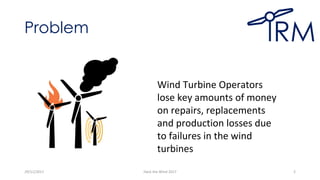
Wind Turbine Operators
lose key amounts of money
on repairs, replacements
and production losses due
to failures in the wind
turbines
Current practice
29/11/2017 Hack the Wind 2017 3
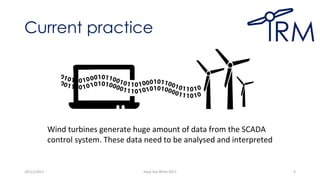
Wind turbines generate huge amount of data from the SCADA
control system. These data need to be analysed and interpreted
Artificial Intelligence
29/11/2017 Hack the Wind 2017 4
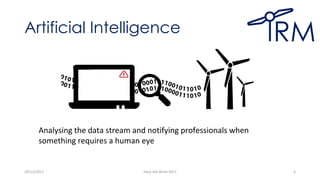
Analysing the data stream and notifying professionals when
something requires a human eye
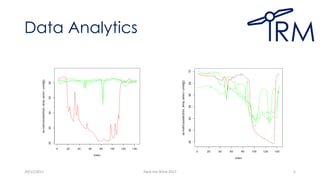
Data Analytics
29/11/2017 Hack the Wind 2017 5
Data driven working
29/11/2017 Hack the Wind 2017 6
Two key things to successful data driven working
• Getting all relevant data in order
• Making relevant data available to the right people
Optimise early prediction through data enhancement and accessibility
29/11/2017 Hack the Wind 2017 7
29/11/2017 Hack the Wind 2017 8
29/11/2017 Hack the Wind 2017
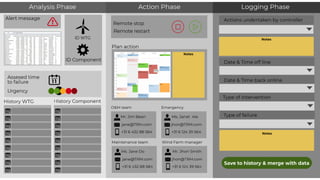
… don’t be satisfied with just an AI. Having the code WON’T generate savings.
An AI plus a system allowing you to work efficiently in a data driven way WILL!
29/11/2017 Hack the Wind 2017 10
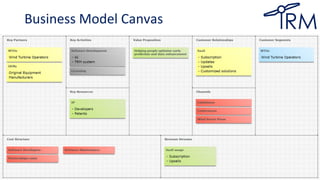
Business Model Canvas
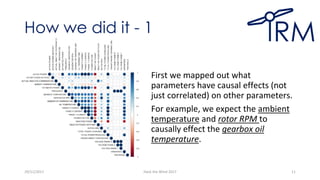
How we did it - 1
First we mapped out what
parameters have causal effects (not
just correlated) on other parameters.
For example, we expect the ambient
temperature and rotor RPM to
causally effect the gearbox oil
temperature.
29/11/2017 Hack the Wind 2017 11
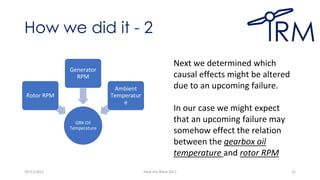
How we did it - 2
GBX Oil
Temperature
Rotor RPM
Generator
RPM
Ambient
Temperatur
e
29/11/2017 Hack the Wind 2017 12
Next we determined which
causal effects might be altered
due to an upcoming failure.
In our case we might expect
that an upcoming failure may
somehow effect the relation
between the gearbox oil
temperature and rotor RPM
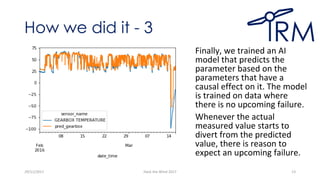
How we did it - 3
Finally, we trained an AI
model that predicts the
parameter based on the
parameters that have a
causal effect on it. The model
is trained on data where
there is no upcoming failure.
Whenever the actual
measured value starts to
divert from the predicted
value, there is reason to
expect an upcoming failure.
29/11/2017 Hack the Wind 2017 13

Trm_pitch_final

  • 1.
    wind turbine relationship management system 29/11/2017 Hackthe Wind 2017 Team members: Carlos Poblacion Daniel Van der Maas Giovanni Battista Picotti Nicolas Juguet Rosalie Van der Maas Helping people optimise early prediction and data enhancement
  • 2.
    Problem 29/11/2017 Hack theWind 2017 2 Wind Turbine Operators lose key amounts of money on repairs, replacements and production losses due to failures in the wind turbines
  • 3.
    Current practice 29/11/2017 Hackthe Wind 2017 3 Wind turbines generate huge amount of data from the SCADA control system. These data need to be analysed and interpreted
  • 4.
    Artificial Intelligence 29/11/2017 Hackthe Wind 2017 4 Analysing the data stream and notifying professionals when something requires a human eye
  • 5.
  • 6.
    Data driven working 29/11/2017Hack the Wind 2017 6 Two key things to successful data driven working • Getting all relevant data in order • Making relevant data available to the right people
  • 7.
    Optimise early predictionthrough data enhancement and accessibility 29/11/2017 Hack the Wind 2017 7
  • 8.
  • 9.
    29/11/2017 Hack theWind 2017 … don’t be satisfied with just an AI. Having the code WON’T generate savings. An AI plus a system allowing you to work efficiently in a data driven way WILL!
  • 10.
    29/11/2017 Hack theWind 2017 10 Business Model Canvas
  • 11.
    How we didit - 1 First we mapped out what parameters have causal effects (not just correlated) on other parameters. For example, we expect the ambient temperature and rotor RPM to causally effect the gearbox oil temperature. 29/11/2017 Hack the Wind 2017 11
  • 12.
    How we didit - 2 GBX Oil Temperature Rotor RPM Generator RPM Ambient Temperatur e 29/11/2017 Hack the Wind 2017 12 Next we determined which causal effects might be altered due to an upcoming failure. In our case we might expect that an upcoming failure may somehow effect the relation between the gearbox oil temperature and rotor RPM
  • 13.
    How we didit - 3 Finally, we trained an AI model that predicts the parameter based on the parameters that have a causal effect on it. The model is trained on data where there is no upcoming failure. Whenever the actual measured value starts to divert from the predicted value, there is reason to expect an upcoming failure. 29/11/2017 Hack the Wind 2017 13