

Trigonometry
WHAT IS TRIGNOMETRY
• Trigonometry is a branch of mathematics
which deals with triangles and their
slides and the angles between these
slides.
• Word tri means three ,gon means sides
and metron means measure
Trigonometric Ratios
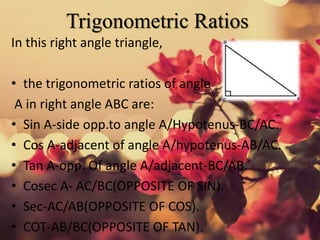
In this right angle triangle,
• the trigonometric ratios of angle
A in right angle ABC are:
• Sin A-side opp.to angle A/Hypotenus-BC/AC.
• Cos A-adjacent of angle A/hypotenus-AB/AC.
• Tan A-opp. Of angle A/adjacent-BC/AB.
• Cosec A- AC/BC(OPPOSITE OF SIN).
• Sec-AC/AB(OPPOSITE OF COS).
• COT-AB/BC(OPPOSITE OF TAN).
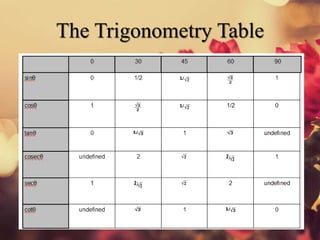
The Trigonometry Table
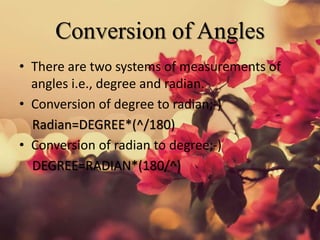
Conversion of Angles
• There are two systems of measurements of
angles i.e., degree and radian.
• Conversion of degree to radian;-)
Radian=DEGREE*(^/180)
• Conversion of radian to degree;-)
DEGREE=RADIAN*(180/^)
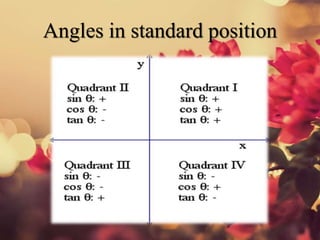
Angles in standard position
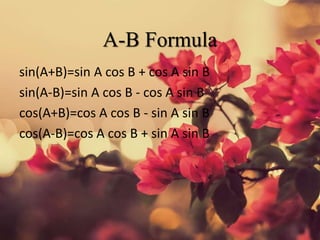
A-B Formula
sin(A+B)=sin A cos B + cos A sin B
sin(A-B)=sin A cos B - cos A sin B
cos(A+B)=cos A cos B - sin A sin B
cos(A-B)=cos A cos B + sin A sin B
SINE AND COSINE RULE-
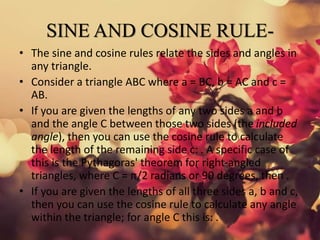
• The sine and cosine rules relate the sides and angles in
any triangle.
• Consider a triangle ABC where a = BC, b = AC and c =
AB.
• If you are given the lengths of any two sides a and b
and the angle C between those two sides (the included
angle), then you can use the cosine rule to calculate
the length of the remaining side c: . A specific case of
this is the Pythagoras' theorem for right-angled
triangles, where C = π/2 radians or 90 degrees, then .
• If you are given the lengths of all three sides a, b and c,
then you can use the cosine rule to calculate any angle
within the triangle; for angle C this is: .
CONTINUE…
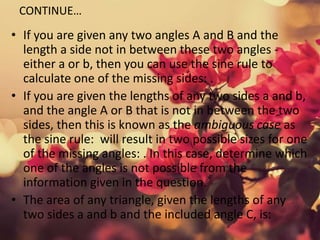
• If you are given any two angles A and B and the
length a side not in between these two angles -
either a or b, then you can use the sine rule to
calculate one of the missing sides: .
• If you are given the lengths of any two sides a and b,
and the angle A or B that is not in between the two
sides, then this is known as the ambiguous case as
the sine rule: will result in two possible sizes for one
of the missing angles: . In this case, determine which
one of the angles is not possible from the
information given in the question.
• The area of any triangle, given the lengths of any
two sides a and b and the included angle C, is:
FROM SINE/COSINE UNIT GRAPH
Bibliography
o Images-
http://jwilson.coe.uga.edu/emt668/EMAT668
0.2002.Fall/Wright/6690/lesson%203/lesson%
203.html
o Contents-ibid mathematics hl core 4th edition
.
Thank u
ppt made by-
Tarun Sharma

Trigonometry

  • 1.
  • 2.
    WHAT IS TRIGNOMETRY •Trigonometry is a branch of mathematics which deals with triangles and their slides and the angles between these slides. • Word tri means three ,gon means sides and metron means measure
  • 3.
    Trigonometric Ratios In thisright angle triangle, • the trigonometric ratios of angle A in right angle ABC are: • Sin A-side opp.to angle A/Hypotenus-BC/AC. • Cos A-adjacent of angle A/hypotenus-AB/AC. • Tan A-opp. Of angle A/adjacent-BC/AB. • Cosec A- AC/BC(OPPOSITE OF SIN). • Sec-AC/AB(OPPOSITE OF COS). • COT-AB/BC(OPPOSITE OF TAN).
  • 4.
  • 5.
    Conversion of Angles •There are two systems of measurements of angles i.e., degree and radian. • Conversion of degree to radian;-) Radian=DEGREE*(^/180) • Conversion of radian to degree;-) DEGREE=RADIAN*(180/^)
  • 6.
  • 7.
    A-B Formula sin(A+B)=sin Acos B + cos A sin B sin(A-B)=sin A cos B - cos A sin B cos(A+B)=cos A cos B - sin A sin B cos(A-B)=cos A cos B + sin A sin B
  • 8.
    SINE AND COSINERULE- • The sine and cosine rules relate the sides and angles in any triangle. • Consider a triangle ABC where a = BC, b = AC and c = AB. • If you are given the lengths of any two sides a and b and the angle C between those two sides (the included angle), then you can use the cosine rule to calculate the length of the remaining side c: . A specific case of this is the Pythagoras' theorem for right-angled triangles, where C = π/2 radians or 90 degrees, then . • If you are given the lengths of all three sides a, b and c, then you can use the cosine rule to calculate any angle within the triangle; for angle C this is: .
  • 9.
    CONTINUE… • If youare given any two angles A and B and the length a side not in between these two angles - either a or b, then you can use the sine rule to calculate one of the missing sides: . • If you are given the lengths of any two sides a and b, and the angle A or B that is not in between the two sides, then this is known as the ambiguous case as the sine rule: will result in two possible sizes for one of the missing angles: . In this case, determine which one of the angles is not possible from the information given in the question. • The area of any triangle, given the lengths of any two sides a and b and the included angle C, is:
  • 10.
  • 11.
  • 12.
    . Thank u ppt madeby- Tarun Sharma