For the teacherʼs guide and all answers
please contact info@putterking.com


                                     Future KingsTM Education Program
                                                 Subject: Math
                                                Level 3 (Queen)


Putter King LLC                                                         All materials copyright © 2011
Level 28 Shinagawa Intercity Tower A                                    Putter King LLC
2-15-1 Konan Minato-ku Tokyo, Japan                                     All rights reserved
  108-6028                                                              Unit #: 2011010301
Math
Level 3 - Queen


       2
Summary
Area of focus: trigonometry and
mathematical proofs

Topics covered:
  • Trigonometry
  • Right triangle definitions
  • Trigonometric functions
  • Special right triangles
  • Law of sines
  • Law of cosines
  • Postulates and axioms
  • Theorems
  • Pythagorean Theorem
  • Mathematical proof
Suggested time to complete (2 hrs):
  • Teaching material (40 minutes)
  • Practice activity (20 minutes)
  • Final project (60 minutes)

                   3
Trigonometry
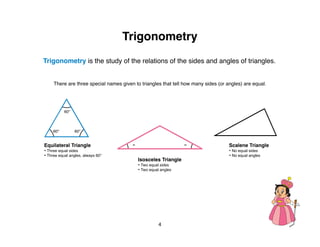
Trigonometry is the study of the relations of the sides and angles of triangles.


     There are three special names given to triangles that tell how many sides (or angles) are equal.


           60°


     60°         60°


Equilateral Triangle                    =                        =                  Scalene Triangle
• Three equal sides                                                                 • No equal sides
• Three equal angles, always 60°                                                    • No equal angles
                                            Isosceles Triangle
                                            • Two equal sides
                                            • Two equal angles


                                                    4
Right Triangle Definitions
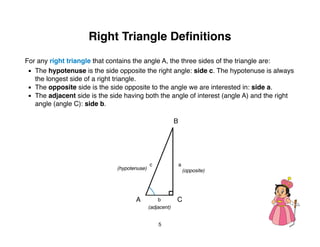
For any right triangle that contains the angle A, the three sides of the triangle are:

 ▪
 The hypotenuse is the side opposite the right angle: side c. The hypotenuse is always
     the longest side of a right triangle.

 ▪
 The opposite side is the side opposite to the angle we are interested in: side a.

 ▪
 The adjacent side is the side having both the angle of interest (angle A) and the right
     angle (angle C): side b.

                                                           B


                                              c                a
                               (hypotenuse)                        (opposite)


                                      A            b       C
                                              (adjacent)


                                                  5
Trigonometric Functions
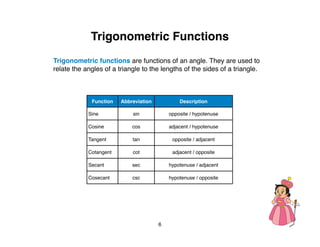
Trigonometric functions are functions of an angle. They are used to
relate the angles of a triangle to the lengths of the sides of a triangle.


             Function   Abbreviation           Description

            Sine            sin            opposite / hypotenuse

            Cosine          cos            adjacent / hypotenuse

            Tangent         tan             opposite / adjacent

            Cotangent       cot             adjacent / opposite

            Secant          sec            hypotenuse / adjacent

            Cosecant        csc            hypotenuse / opposite


                                       6
Trigonometric Functions
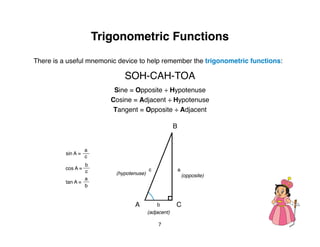
There is a useful mnemonic device to help remember the trigonometric functions:

                               SOH-CAH-TOA
                            Sine = Opposite ÷ Hypotenuse
                           Cosine = Adjacent ÷ Hypotenuse
                            Tangent = Opposite ÷ Adjacent

                                                        B


                    a
          sin A =
                    c
                  b
          cos A =                          c                a
                  c         (hypotenuse)                        (opposite)
                  a
          tan A =
                  b


                                   A            b       C
                                           (adjacent)

                                               7
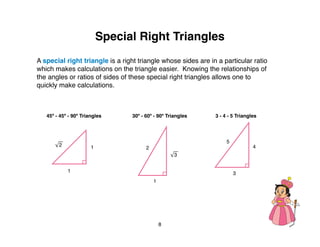
Special Right Triangles
A special right triangle is a right triangle whose sides are in a particular ratio
which makes calculations on the triangle easier. Knowing the relationships of
the angles or ratios of sides of these special right triangles allows one to
quickly make calculations.


   45º - 45º - 90º Triangles     30º - 60º - 90º Triangles     3 - 4 - 5 Triangles


                                                                    5
        2              1                                                        4
                                       2
                                                    3


            1                                                           3
                                           1


                                               8
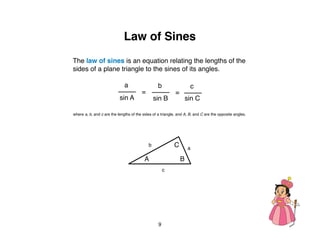
Law of Sines
The law of sines is an equation relating the lengths of the
sides of a plane triangle to the sines of its angles.

                              a                   b                  c
                                        =                   =
                           sin A                sin B               sin C

where a, b, and c are the lengths of the sides of a triangle, and A, B, and C are the opposite angles.


                                            b              C        a

                                          A                     B
                                                      c


                                                  9
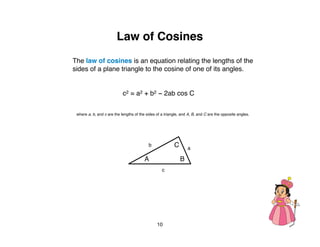
Law of Cosines
The law of cosines is an equation relating the lengths of the
sides of a plane triangle to the cosine of one of its angles.


                            c2 = a2 + b2 − 2ab cos C

 where a, b, and c are the lengths of the sides of a triangle, and A, B, and C are the opposite angles.


                                           b              C       a

                                         A                    B
                                                   c


                                                10
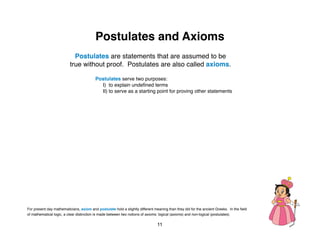
Postulates and Axioms
                            Postulates are statements that are assumed to be
                          true without proof. Postulates are also called axioms.

                                         Postulates serve two purposes:
                                           I) to explain undefined terms
                                           II) to serve as a starting point for proving other statements


For present day mathematicians, axiom and postulate hold a slightly different meaning than they did for the ancient Greeks. In the field
of mathematical logic, a clear distinction is made between two notions of axioms: logical (axioms) and non-logical (postulates).

                                                                               11
Theorems
Theorems are statements that can be deduced and proved from
   definitions, postulates, and previously proved theorems.


         Famous theorems:
           • Pythagorean Theorem
           • Euclidʼs Proof of the Infinitude of Primes
           • The Irrationality of the Square Root of 2
           • sin2 θ + cos2 θ = 1


                              12
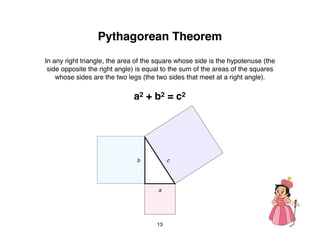
Pythagorean Theorem
In any right triangle, the area of the square whose side is the hypotenuse (the
 side opposite the right angle) is equal to the sum of the areas of the squares
    whose sides are the two legs (the two sides that meet at a right angle).

                              a2 + b2 = c2


                               b           c


                                      a


                                      13
Mathematical Proof
A proof is a convincing demonstration that some mathematical statement is necessarily
true. A proof must demonstrate that a statement is true in all cases, without a single
exception.

A proof is a sequence of steps linked together by modus ponendo ponens (Latin for the
way that affirms by affirming). This rule of logic says that if we know that “A implies B”,
and if we know “A”, then we may conclude B.


                              Typical Methods of Proof
                                • Constructive Proof
                                • Proof by Contrapositive
                                • Proof by Contradiction
                                • Proof by Induction
                                • Counterexamples


                                           14
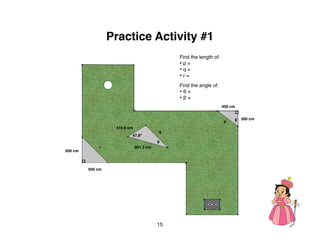
Practice Activity #1
                                              Find the length of:
                                              •p=
                                              •q=
                                              •r=
                                              Find the angle of:
                                              •θ=
                                              •β=
                                                                    400 cm


                                                                    p    β 300 cm

                   410.5 cm
                                         q
                          47.8º
                                         θ
             r                801.3 cm
500 cm


         500 cm


                                         15
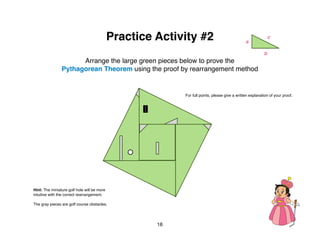
Practice Activity #2                              a
                                                                                                              c


                                                                                                          b
                      Arrange the large green pieces below to prove the
                Pythagorean Theorem using the proof by rearrangement method


                                                           For full points, please give a written explanation of your proof.


Hint: The miniature golf hole will be more
intuitive with the correct rearrangement.

The gray pieces are golf course obstacles.


                                                      16
Final Project

Requirements

Design and label a miniature golf hole that includes at least:
  • special right triangles (2)
  • equilateral triangle (1)
  • isosceles triangle (1)
  • scalene triangle (1)
For full points, be sure to:
  • use the Pythagorean theorem to find the length of a side of a
  triangle in your design
  • use the law of sines to find the length of a side or the measure
  of an angle of a triangle in your design
  • use the law of cosines to find the length of a side of a triangle
  in your design
  • be creative!


                                 17
Grading Rubric


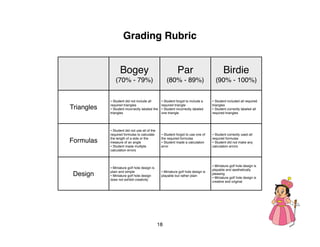
                  Bogey                                    Par                           Birdie
               (70% - 79%)                          (80% - 89%)                     (90% - 100%)


            • Student did not include all     • Student forgot to include a       • Student included all required
            required triangles                required triangle                   triangles
Triangles   • Student incorrectly labeled the • Student incorrectly labeled       • Student correctly labeled all
            triangles                         one triangle                        required triangles


            • Student did not use all of the
            required formulas to calculate      • Student forgot to use one of    • Student correctly used all
            the length of a side or the         the required formulas             required formulas
Formulas    measure of an angle                 • Student made a calculation      • Student did not make any
            • Student made multiple             error                             calculation errors
            calculation errors


            • Miniature golf hole design is                                       • Miniature golf hole design is
                                                                                  playable and aesthetically
            plain and simple                    • Miniature golf hole design is
 Design     • Miniature golf hole design        playable but rather plain
                                                                                  pleasing
                                                                                  • Miniature golf hole design is
            does not exhibit creativity
                                                                                  creative and original


                                               18

Putter King Education - Math (Level 3)

  • 1.
    For the teacherʼsguide and all answers please contact info@putterking.com Future KingsTM Education Program Subject: Math Level 3 (Queen) Putter King LLC All materials copyright © 2011 Level 28 Shinagawa Intercity Tower A Putter King LLC 2-15-1 Konan Minato-ku Tokyo, Japan All rights reserved 108-6028 Unit #: 2011010301
  • 2.
  • 3.
    Summary Area of focus:trigonometry and mathematical proofs Topics covered: • Trigonometry • Right triangle definitions • Trigonometric functions • Special right triangles • Law of sines • Law of cosines • Postulates and axioms • Theorems • Pythagorean Theorem • Mathematical proof Suggested time to complete (2 hrs): • Teaching material (40 minutes) • Practice activity (20 minutes) • Final project (60 minutes) 3
  • 4.
    Trigonometry Trigonometry is thestudy of the relations of the sides and angles of triangles. There are three special names given to triangles that tell how many sides (or angles) are equal. 60° 60° 60° Equilateral Triangle = = Scalene Triangle • Three equal sides • No equal sides • Three equal angles, always 60° • No equal angles Isosceles Triangle • Two equal sides • Two equal angles 4
  • 5.
    Right Triangle Definitions Forany right triangle that contains the angle A, the three sides of the triangle are: ▪ The hypotenuse is the side opposite the right angle: side c. The hypotenuse is always the longest side of a right triangle. ▪ The opposite side is the side opposite to the angle we are interested in: side a. ▪ The adjacent side is the side having both the angle of interest (angle A) and the right angle (angle C): side b. B c a (hypotenuse) (opposite) A b C (adjacent) 5
  • 6.
    Trigonometric Functions Trigonometric functionsare functions of an angle. They are used to relate the angles of a triangle to the lengths of the sides of a triangle. Function Abbreviation Description Sine sin opposite / hypotenuse Cosine cos adjacent / hypotenuse Tangent tan opposite / adjacent Cotangent cot adjacent / opposite Secant sec hypotenuse / adjacent Cosecant csc hypotenuse / opposite 6
  • 7.
    Trigonometric Functions There isa useful mnemonic device to help remember the trigonometric functions: SOH-CAH-TOA Sine = Opposite ÷ Hypotenuse Cosine = Adjacent ÷ Hypotenuse Tangent = Opposite ÷ Adjacent B a sin A = c b cos A = c a c (hypotenuse) (opposite) a tan A = b A b C (adjacent) 7
  • 8.
    Special Right Triangles Aspecial right triangle is a right triangle whose sides are in a particular ratio which makes calculations on the triangle easier. Knowing the relationships of the angles or ratios of sides of these special right triangles allows one to quickly make calculations. 45º - 45º - 90º Triangles 30º - 60º - 90º Triangles 3 - 4 - 5 Triangles 5 2 1 4 2 3 1 3 1 8
  • 9.
    Law of Sines Thelaw of sines is an equation relating the lengths of the sides of a plane triangle to the sines of its angles. a b c = = sin A sin B sin C where a, b, and c are the lengths of the sides of a triangle, and A, B, and C are the opposite angles. b C a A B c 9
  • 10.
    Law of Cosines Thelaw of cosines is an equation relating the lengths of the sides of a plane triangle to the cosine of one of its angles. c2 = a2 + b2 − 2ab cos C where a, b, and c are the lengths of the sides of a triangle, and A, B, and C are the opposite angles. b C a A B c 10
  • 11.
    Postulates and Axioms Postulates are statements that are assumed to be true without proof. Postulates are also called axioms. Postulates serve two purposes: I) to explain undefined terms II) to serve as a starting point for proving other statements For present day mathematicians, axiom and postulate hold a slightly different meaning than they did for the ancient Greeks. In the field of mathematical logic, a clear distinction is made between two notions of axioms: logical (axioms) and non-logical (postulates). 11
  • 12.
    Theorems Theorems are statementsthat can be deduced and proved from definitions, postulates, and previously proved theorems. Famous theorems: • Pythagorean Theorem • Euclidʼs Proof of the Infinitude of Primes • The Irrationality of the Square Root of 2 • sin2 θ + cos2 θ = 1 12
  • 13.
    Pythagorean Theorem In anyright triangle, the area of the square whose side is the hypotenuse (the side opposite the right angle) is equal to the sum of the areas of the squares whose sides are the two legs (the two sides that meet at a right angle). a2 + b2 = c2 b c a 13
  • 14.
    Mathematical Proof A proofis a convincing demonstration that some mathematical statement is necessarily true. A proof must demonstrate that a statement is true in all cases, without a single exception. A proof is a sequence of steps linked together by modus ponendo ponens (Latin for the way that affirms by affirming). This rule of logic says that if we know that “A implies B”, and if we know “A”, then we may conclude B. Typical Methods of Proof • Constructive Proof • Proof by Contrapositive • Proof by Contradiction • Proof by Induction • Counterexamples 14
  • 15.
    Practice Activity #1 Find the length of: •p= •q= •r= Find the angle of: •θ= •β= 400 cm p β 300 cm 410.5 cm q 47.8º θ r 801.3 cm 500 cm 500 cm 15
  • 16.
    Practice Activity #2 a c b Arrange the large green pieces below to prove the Pythagorean Theorem using the proof by rearrangement method For full points, please give a written explanation of your proof. Hint: The miniature golf hole will be more intuitive with the correct rearrangement. The gray pieces are golf course obstacles. 16
  • 17.
    Final Project Requirements Design andlabel a miniature golf hole that includes at least: • special right triangles (2) • equilateral triangle (1) • isosceles triangle (1) • scalene triangle (1) For full points, be sure to: • use the Pythagorean theorem to find the length of a side of a triangle in your design • use the law of sines to find the length of a side or the measure of an angle of a triangle in your design • use the law of cosines to find the length of a side of a triangle in your design • be creative! 17
  • 18.
    Grading Rubric Bogey Par Birdie (70% - 79%) (80% - 89%) (90% - 100%) • Student did not include all • Student forgot to include a • Student included all required required triangles required triangle triangles Triangles • Student incorrectly labeled the • Student incorrectly labeled • Student correctly labeled all triangles one triangle required triangles • Student did not use all of the required formulas to calculate • Student forgot to use one of • Student correctly used all the length of a side or the the required formulas required formulas Formulas measure of an angle • Student made a calculation • Student did not make any • Student made multiple error calculation errors calculation errors • Miniature golf hole design is • Miniature golf hole design is playable and aesthetically plain and simple • Miniature golf hole design is Design • Miniature golf hole design playable but rather plain pleasing • Miniature golf hole design is does not exhibit creativity creative and original 18