Introduction to
Orthopedic Anatomy
Traumatology
RHS 231
Dr. Einas Al-Eisa
Lecture 2
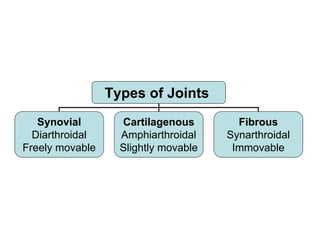
Types of Joints
Synovial
Diarthroidal
Freely movable
Cartilagenous
Amphiarthroidal
Slightly movable
Fibrous
Synarthroidal
Immovable
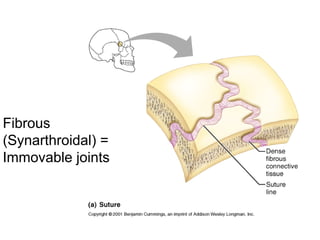
Fibrous
(Synarthroidal) =
Immovable joints
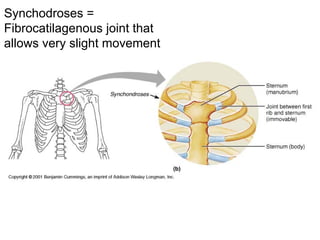
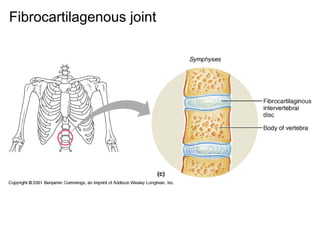
Synchodroses =
Fibrocatilagenous joint that
allows very slight movement
Fibrocartilagenous joint
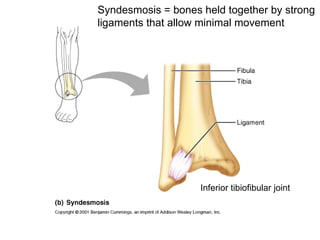
Syndesmosis = bones held together by strong
ligaments that allow minimal movement
Inferior tibiofibular joint
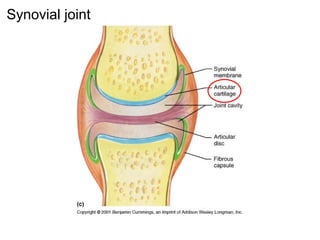
Synovial joint
Characteristics of Synovial Joints
• Articular end plate = a thin layer of
compact bone over the spongy bone
(covering the ends of the bones)
• Articular (hyaline) cartilage for shock
absorption, stability, improved fit for the
surfaces, lubrication
Covered by:
Characteristics of Synovial Joints
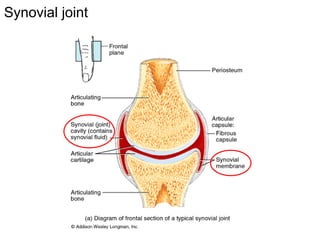
• Joint capsule = a fibrous connective
tissue that surround the bony ends forming
the joint
• Synovial membrane = loose,
vascularized connective tissue that
secretes synovial fluid into the joint cavity
for lubrication
Lined with:
Synovial joint
Characteristics of Synovial Joints
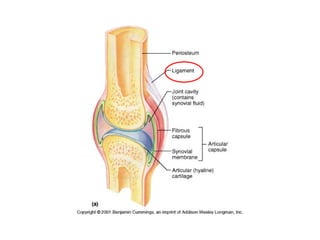
• Where additional support is needed, the
joint capsule is thickened to form tough,
non-elastic ligaments to provide
additional support.
• Stability of a synovial joint is provided by:
the capsule, ligaments, muscles & tendons
spanning the joint, and the congruency of
the bone surfaces.
Types of synovial joints
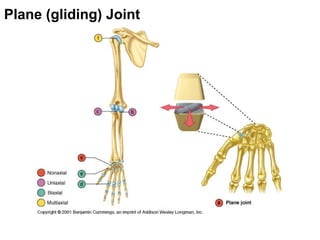
1) Plane (gliding) joint: consists of two flat
surfaces that glide over each other.
Example: carpals & tarsals
Plane (gliding) Joint
Types of synovial joints
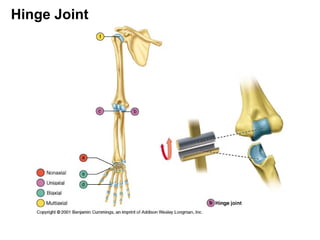
2) Hinge joint: allow movement in one
plane (flexion / extension).
Example: interphalangeal joints (hand),
ulnohumeral joint (elbow)
Hinge Joint
Types of synovial joints
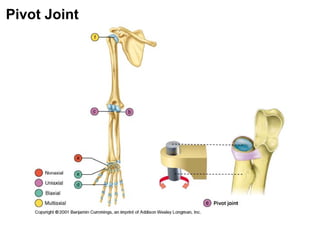
3) Pivot Joint: allows a rotational movement
around a long axis.
Example: superior & inferior radioulnar joint
(pronation / supination), atlantoaxial joint
at the base of the skull (rotation)
Pivot Joint
Types of synovial joints
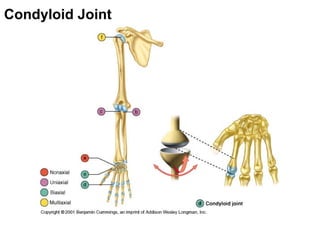
4) Condyloid joint: allows movement in two
planes (flexion / extension and abduction
/adduction) without rotation.
Example: metacarpophalangeal joints
Condyloid Joint
Types of synovial joints
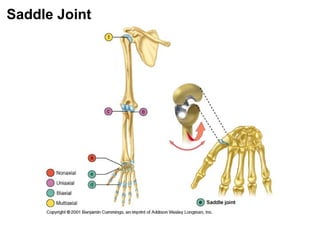
5) Saddle joint: allows two planes of
movement (flexion / extension, abduction /
adduction).
Example: only found at the carpometacarpal
joint of the thumb.
Saddle Joint
Types of synovial joints
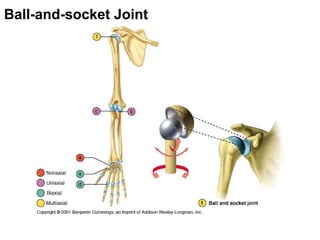
6) Ball-and-socket joint: allows movement
in all three planes (flexion/extension,
abduction/adduction, & rotation)
Example: the hip and shoulder joints.
Ball-and-socket Joint
Architecture of bone
(osseous tissue)
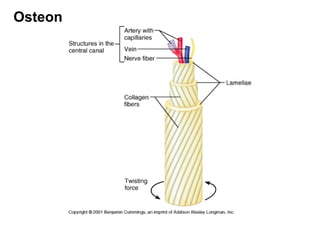
1. Cortical (compact) bone:
– the exterior dense layer of the bone
– consists of hollow tubes called lamellae
(collagen fibers that are arranged in layers
and run in different directions)
– A series of lamellae form an osteon or
haversian system (weight-bearing pillars)
– Provides strength for weight bearing &
stiffness in response to muscle tension
Osteon
Architecture of bone
(osseous tissue)
2. Cancellous (spongy) bone :
– interior to cortical bone
– consists of flat pieces of bone called
trabeculae (collagen runs along the axis of
the trabeculae)
– Provides energy absorption & stress
distribution in response to loads
– Not as strong as cortical bone (risk of
fracture in the elderly)
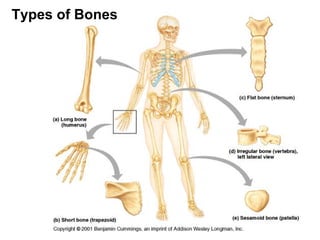
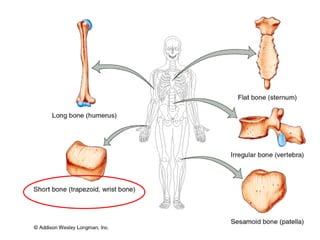
Types of Bones
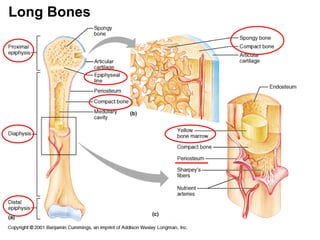
Long Bones
Long Bones
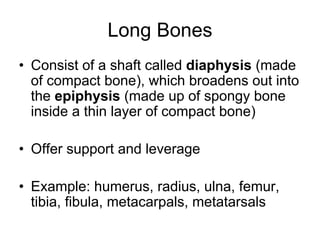
• Consist of a shaft called diaphysis (made
of compact bone), which broadens out into
the epiphysis (made up of spongy bone
inside a thin layer of compact bone)
• Offer support and leverage
• Example: humerus, radius, ulna, femur,
tibia, fibula, metacarpals, metatarsals
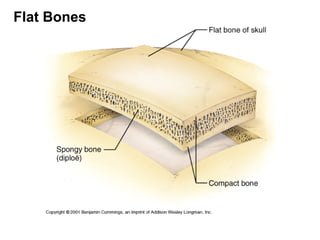
Flat Bones
Flat Bones
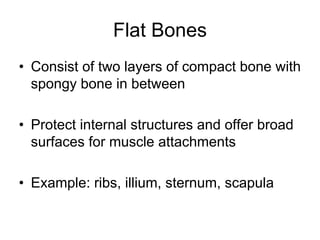
• Consist of two layers of compact bone with
spongy bone in between
• Protect internal structures and offer broad
surfaces for muscle attachments
• Example: ribs, illium, sternum, scapula
Short Bones
• Consist of spongy bone covered with a
thin layer of compact bone
• Play an important role in shock absorption
and transmission of forces
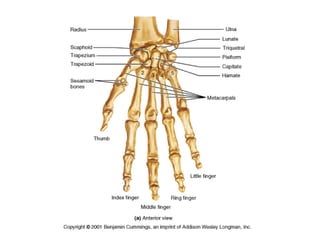
• Example: carpals of the hand and the
tarsals of the foot
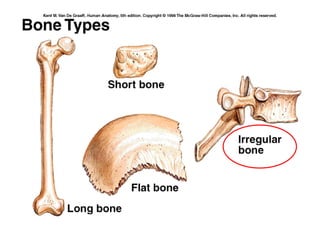
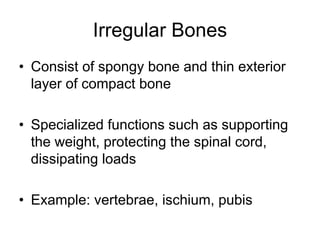
Irregular Bones
• Consist of spongy bone and thin exterior
layer of compact bone
• Specialized functions such as supporting
the weight, protecting the spinal cord,
dissipating loads
• Example: vertebrae, ischium, pubis
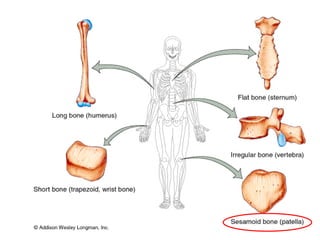
Sesamoid Bones
• Short type of bone embedded in a tendon
or joint capsule
• Alter the angle of muscle insertion to
increase its mechanical advantage
• Example: the patella embedded in the
quadriceps tendon, sesamoid bones within
the flexor tendons of the great toe & thumb
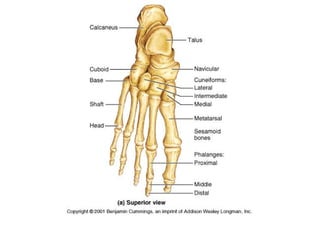
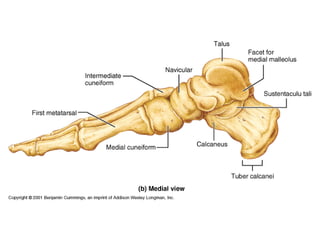
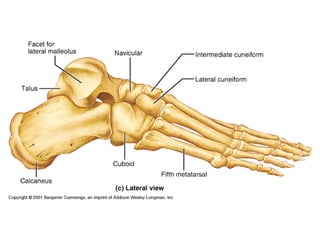
Accessory ossicles
• Occur as variants of normal (only in few
individuals, in addition to the normal
bones).
• Can be mistaken as fractures, but are
harmless.
• Example: the os trigonum behind the talus,
the accessory navicular.
Growth of bone
• Long bones grow from the epiphyseal plate
(growth plate) at each end.
• Both ends grow, but generally one end will grow
faster than the other.
• Example: distal epiphysis of the femur &
proximal epiphysis of the tibia contribute roughly
60% of limb length, but proximal epiphysis of the
humerus contribute 80% of humeral length.
Muscles
• Agonists and antagonists oppose each
other, but still work as balanced groups.
• Muscles are contained within Fascial
Compartments.
• Swelling
compartment pressure
ischaemic pain
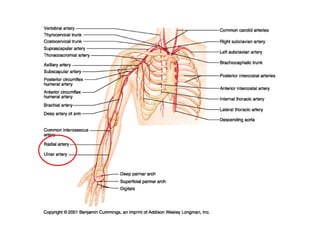
Forearm compartments
• Ventral compartment:
¾median & ulnar nerves
¾Radial & ulnar arteries
• Dorsal compartment:
¾Less common and less serious
¾Posterior interosseous nerve
Lower limb compartments
• Anterior (tibial) compartment:
¾Deep peroneal nerve
¾Anterior tibial artery
• Lateral (peroneal) compartment:
¾Superficial peroneal nerve
¾Rarely affected by compression
Lower limb compartments
• Superficial posterior compartment:
¾Gastrocnemius & soleus muscles
¾No important nerves or vessels
• Deep posterior compartment:
¾Posterior tibial vessels and nerves
¾Peroneal artery
¾Serious consequences if damaged
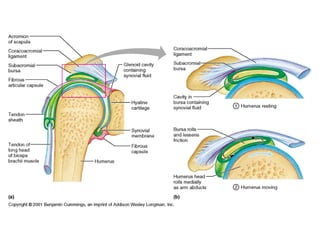
Tendons
• Muscle action depends on the direction of
its tendon.
• Tendons do not tolerate friction
protected by bursae or synovial sheets
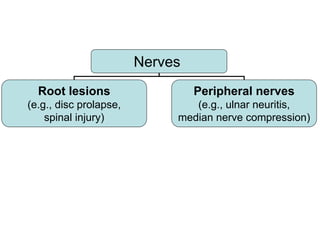
Nerves
Root lesions
(e.g., disc prolapse,
spinal injury)
Peripheral nerves
(e.g., ulnar neuritis,
median nerve compression)
Vulnerable peripheral nerves
Upper limb
• Median nerve
¾Most common: compression at the wrist
(carpal tunnel)
¾Fluid retention in pregnancy
¾Repetitive movement (flexor tenosynovitis)
¾Sensory distribution: thumb, index, and
middle fingers, half the ring finger
Vulnerable peripheral nerves
Upper limb
• Ulnar nerve:
¾Most common: irritation at the elbow
¾Sensory distribution: little finger & ulnar half of
the ring finger
• Radial nerve:
¾Vulnerable in the medial side of the upper arm
(e.g., axillary crutches)
¾Drop wrist (few sensory symptoms)
Vulnerable peripheral nerves
Lower limb
• Sciatic nerve:
¾Posterior dislocation of the hip
• Common peroneal nerve:
¾Trauma causing lesion as the nerve crosses
the neck of fibula
• Lumbar nerve roots
¾Prolapsed intervertebral discs

Trauma_lecture_2.pdf

  • 1.
  • 2.
    Types of Joints Synovial Diarthroidal Freelymovable Cartilagenous Amphiarthroidal Slightly movable Fibrous Synarthroidal Immovable
  • 3.
  • 4.
    Synchodroses = Fibrocatilagenous jointthat allows very slight movement
  • 5.
  • 6.
    Syndesmosis = bonesheld together by strong ligaments that allow minimal movement Inferior tibiofibular joint
  • 7.
  • 8.
    Characteristics of SynovialJoints • Articular end plate = a thin layer of compact bone over the spongy bone (covering the ends of the bones) • Articular (hyaline) cartilage for shock absorption, stability, improved fit for the surfaces, lubrication Covered by:
  • 9.
    Characteristics of SynovialJoints • Joint capsule = a fibrous connective tissue that surround the bony ends forming the joint • Synovial membrane = loose, vascularized connective tissue that secretes synovial fluid into the joint cavity for lubrication Lined with:
  • 10.
  • 11.
    Characteristics of SynovialJoints • Where additional support is needed, the joint capsule is thickened to form tough, non-elastic ligaments to provide additional support. • Stability of a synovial joint is provided by: the capsule, ligaments, muscles & tendons spanning the joint, and the congruency of the bone surfaces.
  • 13.
    Types of synovialjoints 1) Plane (gliding) joint: consists of two flat surfaces that glide over each other. Example: carpals & tarsals
  • 14.
  • 15.
    Types of synovialjoints 2) Hinge joint: allow movement in one plane (flexion / extension). Example: interphalangeal joints (hand), ulnohumeral joint (elbow)
  • 16.
  • 17.
    Types of synovialjoints 3) Pivot Joint: allows a rotational movement around a long axis. Example: superior & inferior radioulnar joint (pronation / supination), atlantoaxial joint at the base of the skull (rotation)
  • 18.
  • 19.
    Types of synovialjoints 4) Condyloid joint: allows movement in two planes (flexion / extension and abduction /adduction) without rotation. Example: metacarpophalangeal joints
  • 20.
  • 21.
    Types of synovialjoints 5) Saddle joint: allows two planes of movement (flexion / extension, abduction / adduction). Example: only found at the carpometacarpal joint of the thumb.
  • 22.
  • 23.
    Types of synovialjoints 6) Ball-and-socket joint: allows movement in all three planes (flexion/extension, abduction/adduction, & rotation) Example: the hip and shoulder joints.
  • 24.
  • 25.
    Architecture of bone (osseoustissue) 1. Cortical (compact) bone: – the exterior dense layer of the bone – consists of hollow tubes called lamellae (collagen fibers that are arranged in layers and run in different directions) – A series of lamellae form an osteon or haversian system (weight-bearing pillars) – Provides strength for weight bearing & stiffness in response to muscle tension
  • 26.
  • 27.
    Architecture of bone (osseoustissue) 2. Cancellous (spongy) bone : – interior to cortical bone – consists of flat pieces of bone called trabeculae (collagen runs along the axis of the trabeculae) – Provides energy absorption & stress distribution in response to loads – Not as strong as cortical bone (risk of fracture in the elderly)
  • 28.
  • 29.
  • 30.
    Long Bones • Consistof a shaft called diaphysis (made of compact bone), which broadens out into the epiphysis (made up of spongy bone inside a thin layer of compact bone) • Offer support and leverage • Example: humerus, radius, ulna, femur, tibia, fibula, metacarpals, metatarsals
  • 31.
  • 32.
    Flat Bones • Consistof two layers of compact bone with spongy bone in between • Protect internal structures and offer broad surfaces for muscle attachments • Example: ribs, illium, sternum, scapula
  • 34.
    Short Bones • Consistof spongy bone covered with a thin layer of compact bone • Play an important role in shock absorption and transmission of forces • Example: carpals of the hand and the tarsals of the foot
  • 37.
    Irregular Bones • Consistof spongy bone and thin exterior layer of compact bone • Specialized functions such as supporting the weight, protecting the spinal cord, dissipating loads • Example: vertebrae, ischium, pubis
  • 39.
    Sesamoid Bones • Shorttype of bone embedded in a tendon or joint capsule • Alter the angle of muscle insertion to increase its mechanical advantage • Example: the patella embedded in the quadriceps tendon, sesamoid bones within the flexor tendons of the great toe & thumb
  • 40.
    Accessory ossicles • Occuras variants of normal (only in few individuals, in addition to the normal bones). • Can be mistaken as fractures, but are harmless. • Example: the os trigonum behind the talus, the accessory navicular.
  • 44.
    Growth of bone •Long bones grow from the epiphyseal plate (growth plate) at each end. • Both ends grow, but generally one end will grow faster than the other. • Example: distal epiphysis of the femur & proximal epiphysis of the tibia contribute roughly 60% of limb length, but proximal epiphysis of the humerus contribute 80% of humeral length.
  • 45.
    Muscles • Agonists andantagonists oppose each other, but still work as balanced groups. • Muscles are contained within Fascial Compartments. • Swelling compartment pressure ischaemic pain
  • 46.
    Forearm compartments • Ventralcompartment: ¾median & ulnar nerves ¾Radial & ulnar arteries • Dorsal compartment: ¾Less common and less serious ¾Posterior interosseous nerve
  • 48.
    Lower limb compartments •Anterior (tibial) compartment: ¾Deep peroneal nerve ¾Anterior tibial artery • Lateral (peroneal) compartment: ¾Superficial peroneal nerve ¾Rarely affected by compression
  • 49.
    Lower limb compartments •Superficial posterior compartment: ¾Gastrocnemius & soleus muscles ¾No important nerves or vessels • Deep posterior compartment: ¾Posterior tibial vessels and nerves ¾Peroneal artery ¾Serious consequences if damaged
  • 50.
    Tendons • Muscle actiondepends on the direction of its tendon. • Tendons do not tolerate friction protected by bursae or synovial sheets
  • 52.
    Nerves Root lesions (e.g., discprolapse, spinal injury) Peripheral nerves (e.g., ulnar neuritis, median nerve compression)
  • 53.
    Vulnerable peripheral nerves Upperlimb • Median nerve ¾Most common: compression at the wrist (carpal tunnel) ¾Fluid retention in pregnancy ¾Repetitive movement (flexor tenosynovitis) ¾Sensory distribution: thumb, index, and middle fingers, half the ring finger
  • 54.
    Vulnerable peripheral nerves Upperlimb • Ulnar nerve: ¾Most common: irritation at the elbow ¾Sensory distribution: little finger & ulnar half of the ring finger • Radial nerve: ¾Vulnerable in the medial side of the upper arm (e.g., axillary crutches) ¾Drop wrist (few sensory symptoms)
  • 55.
    Vulnerable peripheral nerves Lowerlimb • Sciatic nerve: ¾Posterior dislocation of the hip • Common peroneal nerve: ¾Trauma causing lesion as the nerve crosses the neck of fibula • Lumbar nerve roots ¾Prolapsed intervertebral discs