Submittedto - DEPARTMENTOF
ZOOLOGYAND APPLIEDAQUACULTURE,
BARKATULLAHUNIVERSITY,BHOPAL,
MADHYAPRADESH. Submittedby- SmritiBiswas
M.F.Scapplied aquaculture,
1st sem
TOPIC -Transportation of fish seed.
Contents
INTRODUCTION
DEFINITION
IMPORTANCES AND SOURCES OF FISH SEED
HARVESTING OF FISH SEED
CHARACTERISTICS OF SEED
CONDITIONING OF FISH SEED
METHODS OF TRANSPORTATION
VARIOUS TRANSPORTATION UNITS
REASONS FOR MORTALITY DURING TRANSPORT
USE OF DRUGS AND CHEMICALS
INTRODUCTION
•Transport of fish seed from natural environment or
hatcheries is considered to be a crucial step in aquaculture.
•Fry and fingerlings must be transported from hatchery to
pond for stocking.
•Traditional methods of carrying the seeds in earthern pots
called ‘’Hundies’’ but this result in high mortality.
•In modern transporting system various metallic drums
and plastic containers used for seed transportation.
•Fish need to be anaesthetized to reduce the activity to
transport them in good condition.
•Once fish have been placed in their transport container
they are brought to their destination by the quickest
possible means that will provide a relatively smooth and
direct route.
•Current days seed fishes are transported through train, air
and ship.
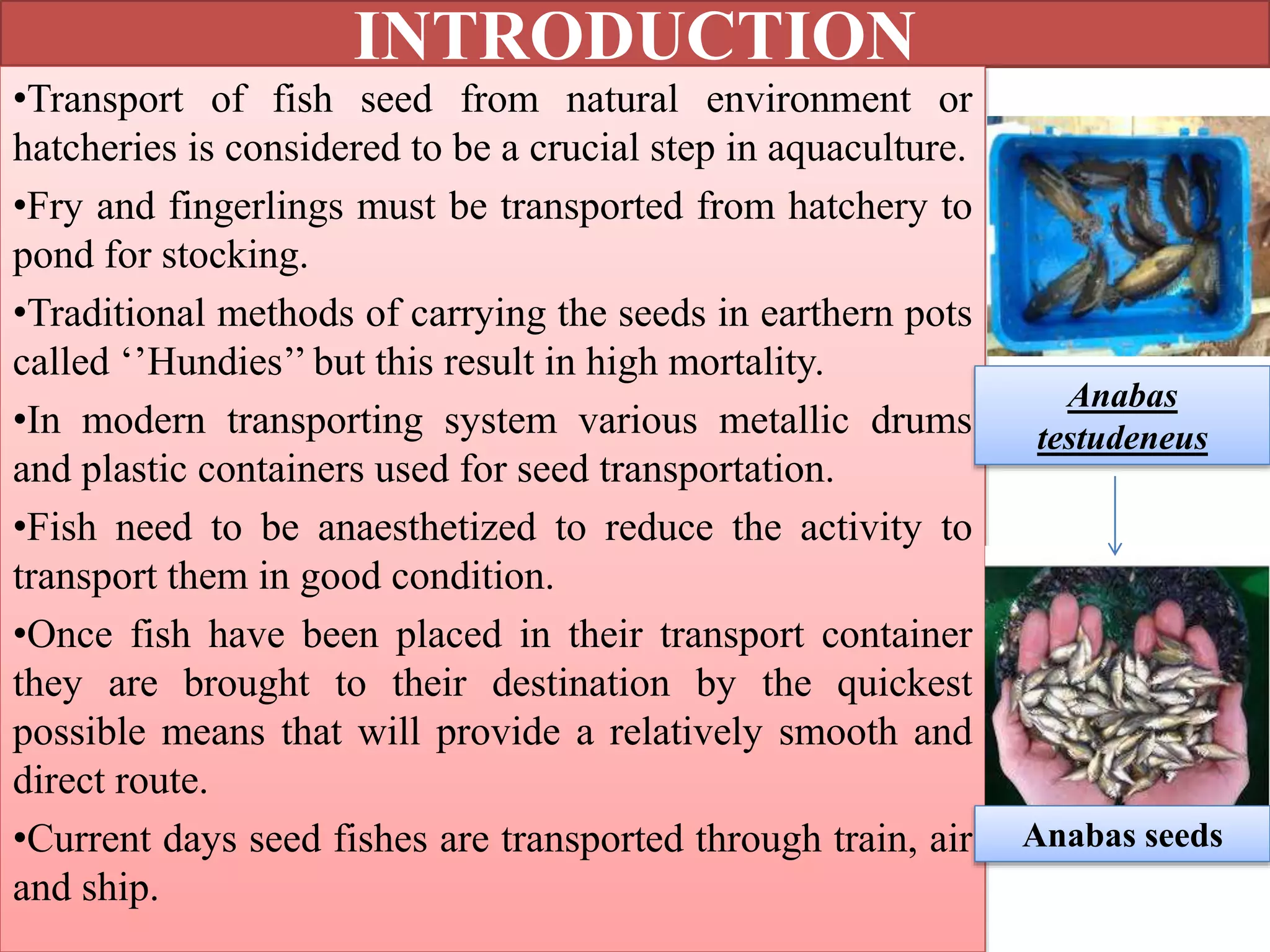
Anabas
testudeneus
Anabas seeds
DEFINITION
Fish seed - Fertilized fish eggs are known as Fish seeds. In simple
words, they are the baby fishes used for seeding new Ponds in
fisheries. The intermediate developmental stages of the fish from the
fertilised eggs, hatchlings, early and late fry, fingerlings, yearlings, etc
are commonly referred to as fish seeds.
The transfer of fish seed from the hatchery or place of
collection to the rearing pond is called transport of fish seed.
Fish seed can be used in 4 stages:
Hatchling: Larvae stage where it have yolk sac
hanging below from where it draws its nutrition for
2–3 days, mouth is not formed.
Spawn: Stage where mouth is formed.
Fry: About 2 cm long, now, it can eat small size
zooplanktons.
Fingerling: About 15 cm long. Easier to transport
these kinds of fishes to Ponds.
Importances of fish seed and their sources:-
Fish seed is a key factor to the expansion of fish
farming.
Save endanger fish from extinction.
High production potentiality.
High economic growth.
SOURCES
Natural sources Bundh sources Hatchery sources
Riverine resources Hapa
Lakes and reservoirs Earthen pot hatchery
Marine resources Glass jar hatchery
Chinese hatchery
Harvesting of Fish seed
• Many methods are used for harvesting fish
seeds, using different types of traditional
and modern equipments.
• By these methods some times fish get
stressed and injured.
• In case of marine fishes with the assistance
of divers and scoop net seeds are collect.
• Generally shooting nets are used to collect
the seed in the rivers.
• The seed moving along with the marginal
current collects in the gamcha and stored in
hapas or containers after removal.
• Benchi jal, midnapur net are commonly
used in bengal for collecting fish seeds from
natural water bodies.
• By the use of trawl net and gill net collect
larger fingerlings .
Trawl net
Scoop net
Gill net
Selected seeds should have the following
phenotypic characteristics:
 Desired shape of body, body should possess the required shape and
proportions.
 Healthy, with desirable hereditary characteristics.
 Having no body wounds, parasites, or deformations of any type.
 There should not be pustules, red/white/black patches in the body of
fry/fingerling fish.
TYPES OF SEED SIZE(mm)
Spawn 6-8
Fry 20-25
Fingerling 100-150
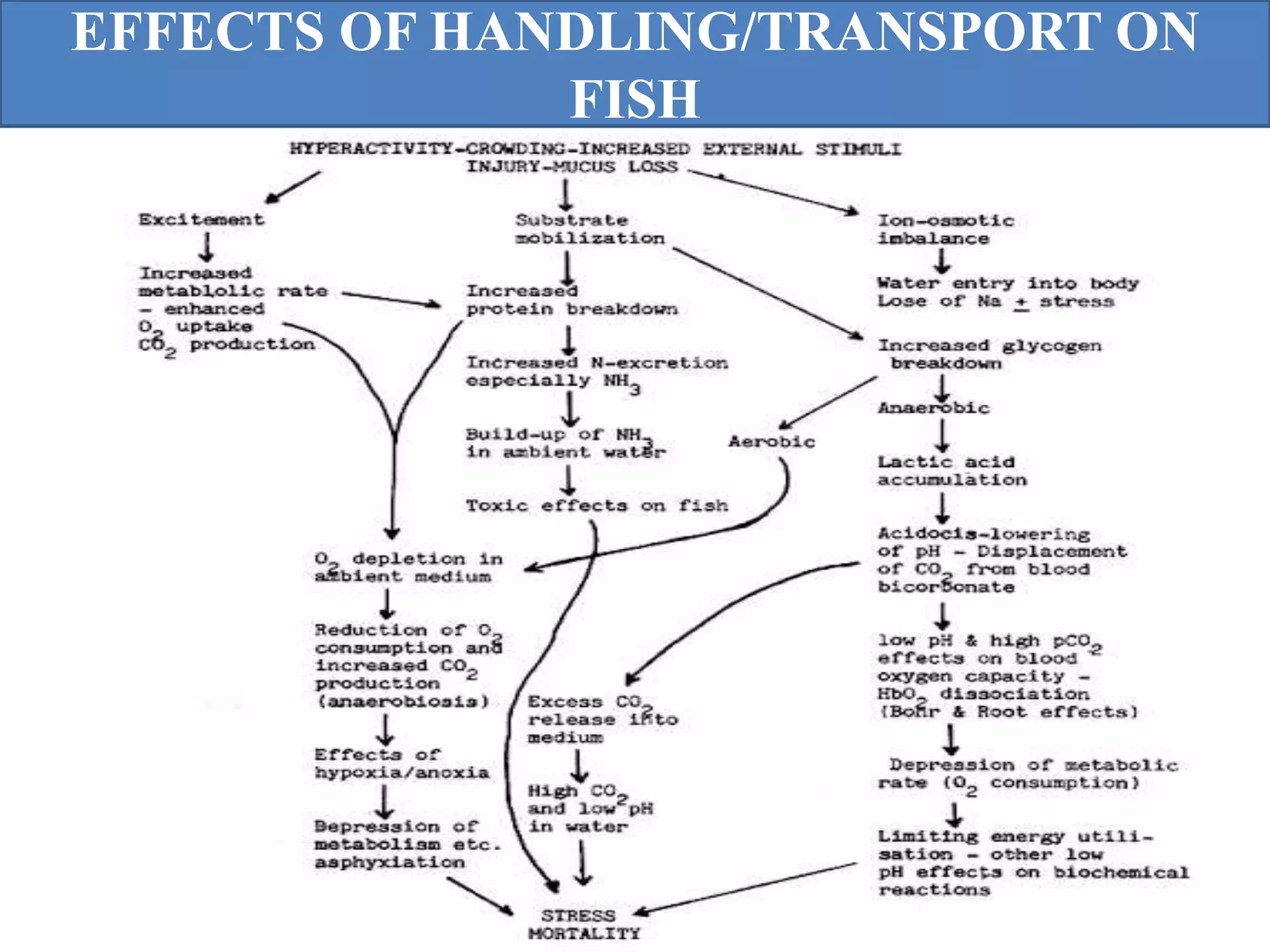
EFFECTS OF HANDLING/TRANSPORT ON
FISH
General guidelines for transportation
•Seedlings should be acclimatized first before packing to new water.
•Transport the seeds either during morning or evening or night to have
the benefit of cooler journey transit.
•Do not excite fishes by carefully handling them, since excitement or
anxiety increases oxygen consumption three to five times in them.
•Oxygen packing is the best method of transportation. Oxygen
requirement ranges from 100-1100mg/kg/hours.
•If the transporting distance is long, glucose powder can be added to the
seed packing bags.
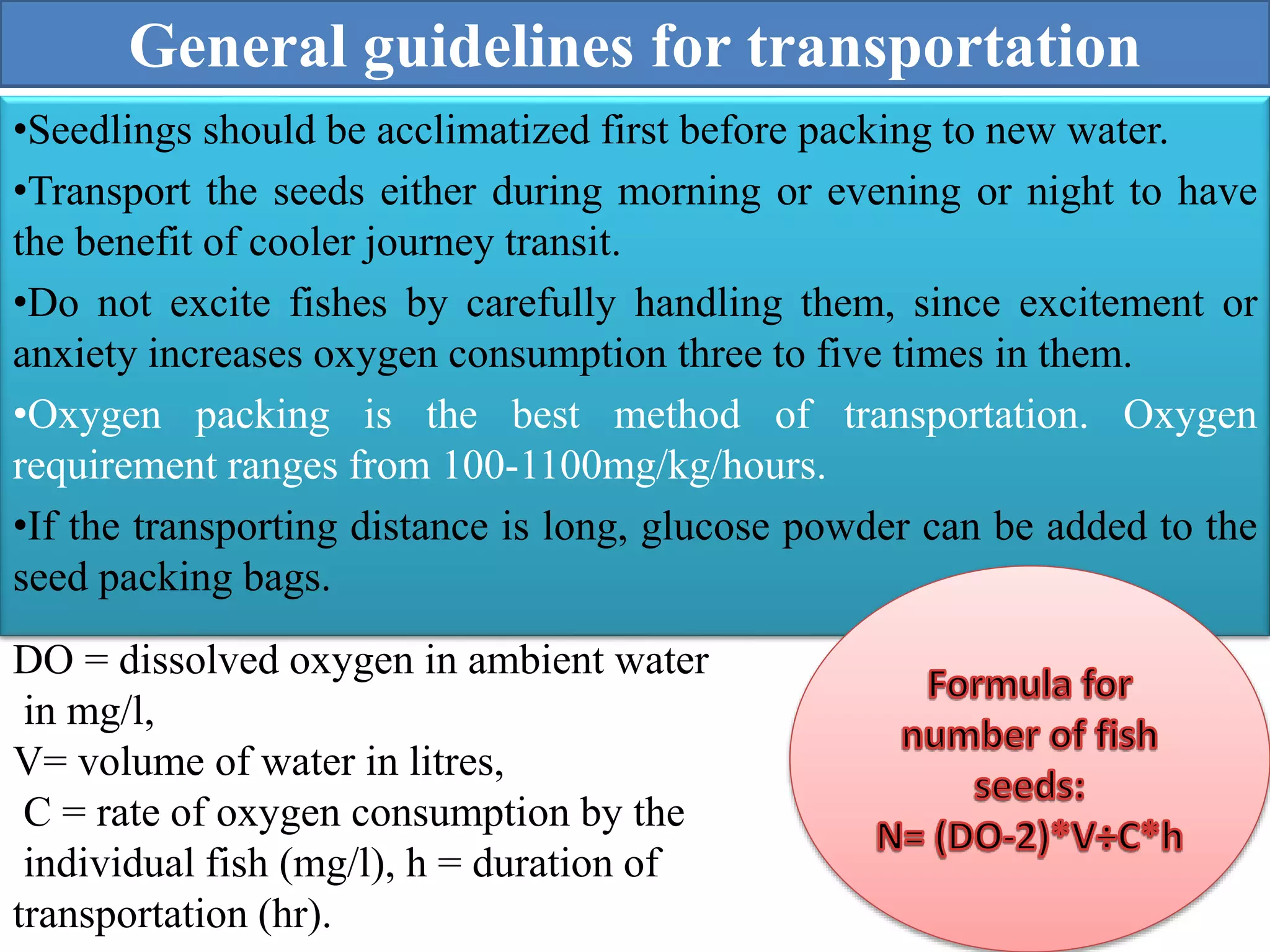
DO = dissolved oxygen in ambient water
in mg/l,
V= volume of water in litres,
C = rate of oxygen consumption by the
individual fish (mg/l), h = duration of
transportation (hr).
Conditioning of Fish seed before Transportation
The fish are kept starving usually in a cloth ‘hapa’ or other containers in
a quiet corner of the fish pond or in relatively quiet water in a canal or
river for a period of time before transferring them to the transport
carrier.
Advantages of conditioning are:
• The fish become used to confined condition.
• The fish are less excited and thus restrained in expenditure of energy.
• The fish recover from the handling effect of capture - increased blood
lactate level and decreased blood pH become normal - excited high
metabolic rates become normal.
• The fish recover from minor injury - mucus loss etc - Ion-osmotic
balance upset by handling becomes normal.
• Gut evacuation takes place and during the period of transport the
medium is not further contaminated by faecal matter.
Methods of Transport
(a) open system comprising (b) closed system having
open carriers, with or without artificial sealed air tight
carriers oxygenation/ water circulation.
with oxygen.
This is a traditional method,
Plastic or metal drums or
traditional earthen pot “hundi” are
used for fish transporting. DO
content is maintained through
splashing of water.
Modern ttransporting system. In this
system , we have o maintain adequate
oxygen supply in the water. Plastic or
metal container, Rubber and plastic
bags are used in this system for
transporting fish. 1/4th of the bag
usually containing water and fish,
remaining part filled with oxygen.
Open system
Merits:
• More suitable for fish.
• It is cheap and easier method.
• Equipment are locally available.
• It keep water cool for long time.
• No need to oxygen supply from outside.
Demerits:
• Relatively less amount of fish can be
transported at a time.
• Needs close observation.
• Not suitable for long distance.
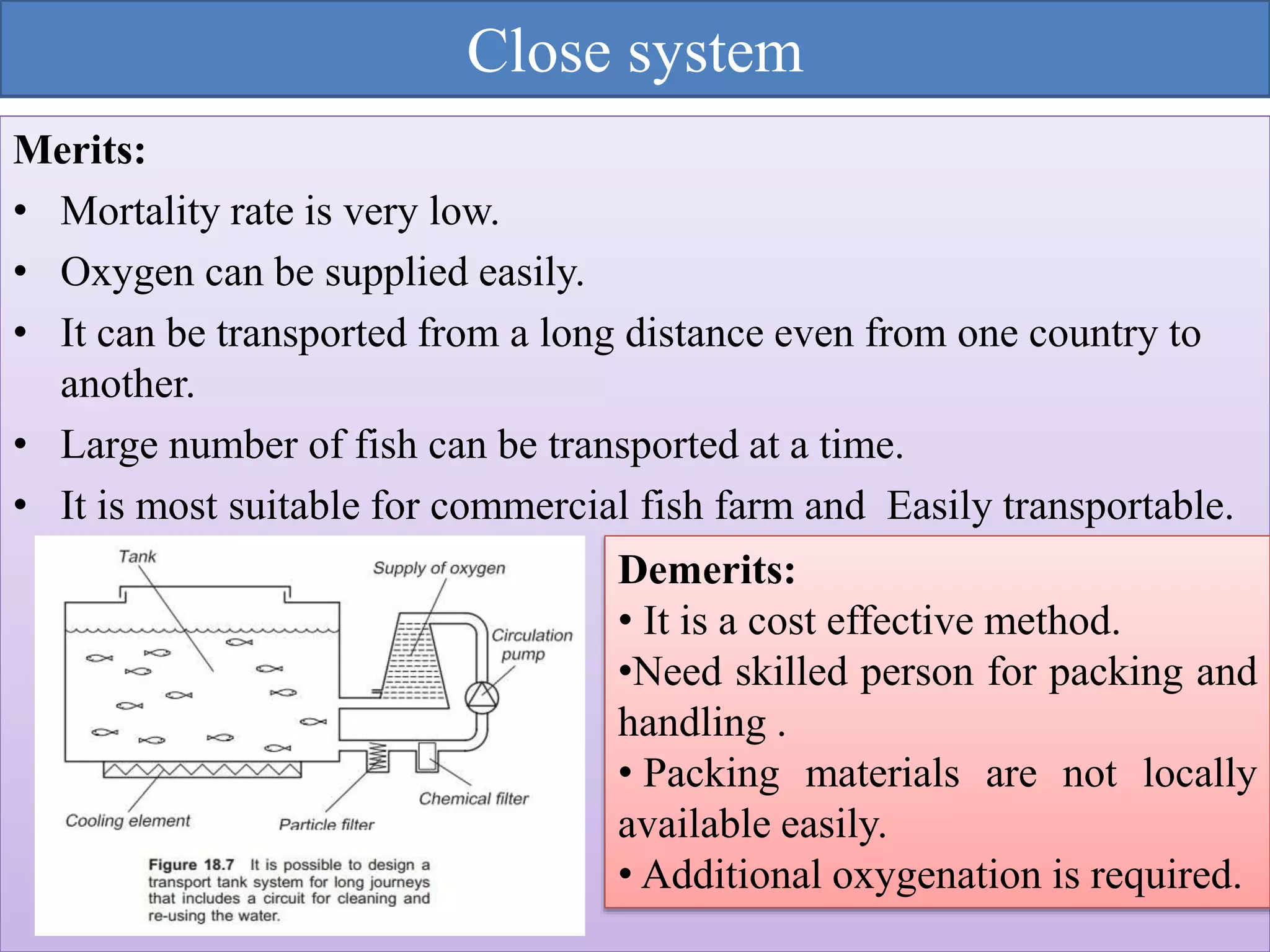
Close system
Merits:
• Mortality rate is very low.
• Oxygen can be supplied easily.
• It can be transported from a long distance even from one country to
another.
• Large number of fish can be transported at a time.
• It is most suitable for commercial fish farm and Easily transportable.
Demerits:
• It is a cost effective method.
•Need skilled person for packing and
handling .
• Packing materials are not locally
available easily.
• Additional oxygenation is required.
Transportation of fish seed
• Transport of bigger fingerlings/yearlings and
brood fish in small packing containers- not
economically feasible.
• Truck mounted open tanks with facilitates for
mechanical aeration and/or circulation were
initially used quite successfully (Hora and Pillay,
1962; Mammen, 1962).
• Open canvas containers (1m x 1m x 1.25m) are
used in Punjab and Madhya Pradesh for
transporting carps.
• In those States galvanized iron drums of 180 liter
capacity are also used.
• In India, two successful models of closed system
of live-fish carrier were designed. One is due to
Mammen (1962), which he called `Splashless
tank’.
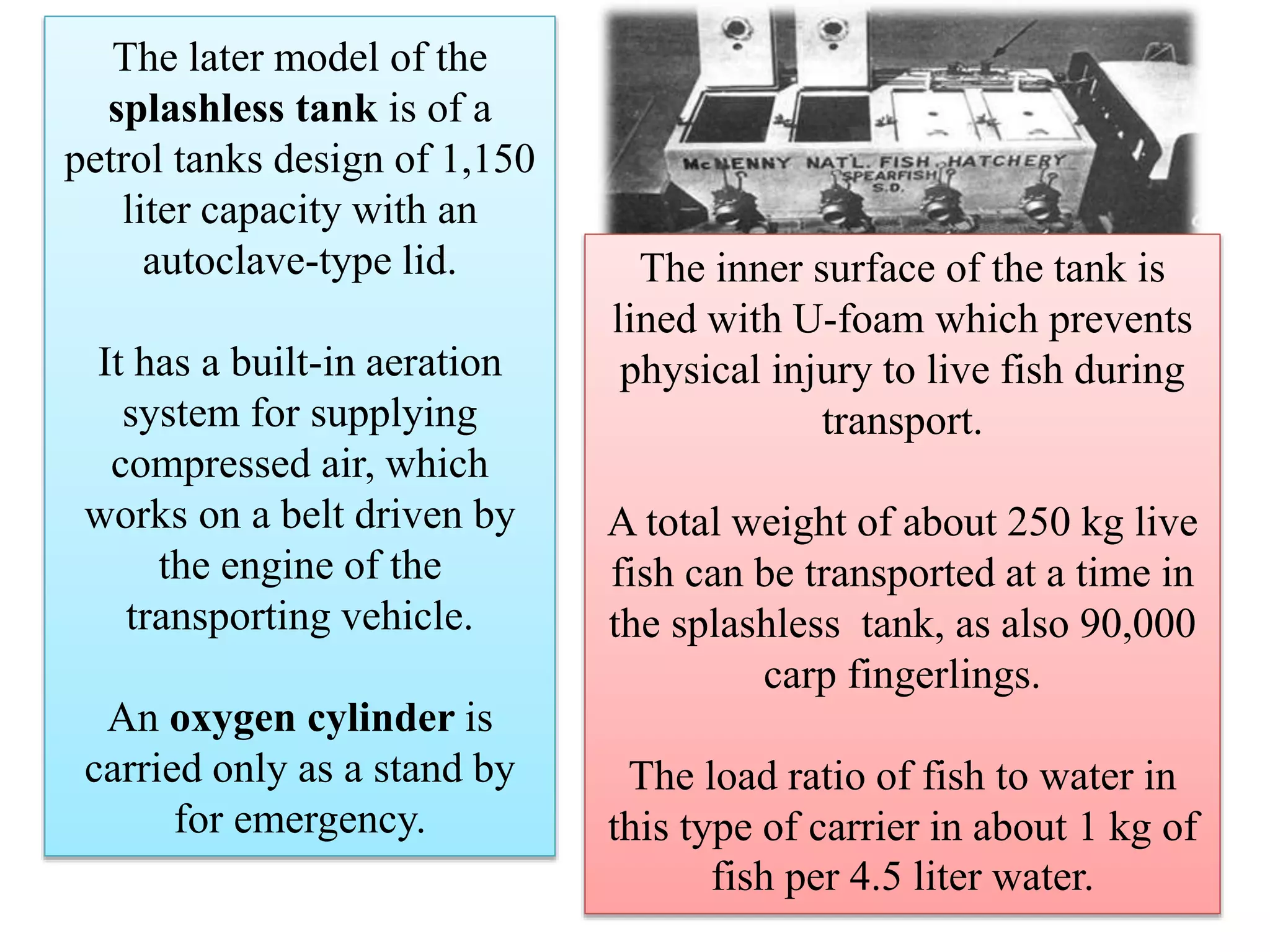
The later model of the
splashless tank is of a
petrol tanks design of 1,150
liter capacity with an
autoclave-type lid.
It has a built-in aeration
system for supplying
compressed air, which
works on a belt driven by
the engine of the
transporting vehicle.
An oxygen cylinder is
carried only as a stand by
for emergency.
The inner surface of the tank is
lined with U-foam which prevents
physical injury to live fish during
transport.
A total weight of about 250 kg live
fish can be transported at a time in
the splashless tank, as also 90,000
carp fingerlings.
The load ratio of fish to water in
this type of carrier in about 1 kg of
fish per 4.5 liter water.
Causes of mortality during transportation
Several factors are may be responsible for mortality of fish in transport:
• Depletion of dissolved oxygen in ambient water due to the respiration
of fish and also due to oxidation of any organic matter (BOD load),
including excreted waste of the fish, by micro-organisms.
• Accumulation of free carbon dioxide (CO2), resulting from
respiration, and ammonia (NH3) as excretory end product.
• Sudden fluctuations in temperature.
• Hyperactivity and stress due to handling and ‘confined space’ - these
result in lactate accumulation and affect again lessening of blood
oxygen capacity and also ‘fatigue collapse’.
• Use of high level of anaesthetics.
• Ion-osmotic imbalance due to stress.
• Physical injury due to handling before transport and during transport.
• Diseases.
Drugs and chemicals used during transportation
Drugs and chemicals are either used as tranquilizers and sedatives or
as antiseptic. Several drugs have been studied for use as anesthetic for
transport of fish. E.g. Tricaine methane sulphonate (MS-222), Sodium
amytal, Quinaldine, Novocaine etc.
They are mainly used for :
I. Reducing metabolic rates.
II. Reducing excitability of fishes.
III.Convenience in handling fish.
Use of antiseptics and antibiotics :
Short-term bath prior to transport reduce
the chances of infections.
Chemical Dosage
(mg/l)
Acriflavine 10ppm
Methylene blue 2ppm
CuSO4 5ppm
KMnO4 3ppm
Chloromycetin 8-10ppm
NaCl 3%
Formalin 15ppm
CONCLUSION
During transportation all the preventive and necessary measure should
be taken.
All types of clean and water proof containers use
during seed transportation .
Fish seed with high growth rate easily reached
at their destination through transportation.
Misuse of drugs and mishandling
reason for the high mortality.
THANK
YOU

Trasportation of fish seed.

  • 1.
    Submittedto - DEPARTMENTOF ZOOLOGYANDAPPLIEDAQUACULTURE, BARKATULLAHUNIVERSITY,BHOPAL, MADHYAPRADESH. Submittedby- SmritiBiswas M.F.Scapplied aquaculture, 1st sem TOPIC -Transportation of fish seed.
  • 2.
    Contents INTRODUCTION DEFINITION IMPORTANCES AND SOURCESOF FISH SEED HARVESTING OF FISH SEED CHARACTERISTICS OF SEED CONDITIONING OF FISH SEED METHODS OF TRANSPORTATION VARIOUS TRANSPORTATION UNITS REASONS FOR MORTALITY DURING TRANSPORT USE OF DRUGS AND CHEMICALS
  • 3.
    INTRODUCTION •Transport of fishseed from natural environment or hatcheries is considered to be a crucial step in aquaculture. •Fry and fingerlings must be transported from hatchery to pond for stocking. •Traditional methods of carrying the seeds in earthern pots called ‘’Hundies’’ but this result in high mortality. •In modern transporting system various metallic drums and plastic containers used for seed transportation. •Fish need to be anaesthetized to reduce the activity to transport them in good condition. •Once fish have been placed in their transport container they are brought to their destination by the quickest possible means that will provide a relatively smooth and direct route. •Current days seed fishes are transported through train, air and ship. Anabas testudeneus Anabas seeds
  • 4.
    DEFINITION Fish seed -Fertilized fish eggs are known as Fish seeds. In simple words, they are the baby fishes used for seeding new Ponds in fisheries. The intermediate developmental stages of the fish from the fertilised eggs, hatchlings, early and late fry, fingerlings, yearlings, etc are commonly referred to as fish seeds. The transfer of fish seed from the hatchery or place of collection to the rearing pond is called transport of fish seed. Fish seed can be used in 4 stages: Hatchling: Larvae stage where it have yolk sac hanging below from where it draws its nutrition for 2–3 days, mouth is not formed. Spawn: Stage where mouth is formed. Fry: About 2 cm long, now, it can eat small size zooplanktons. Fingerling: About 15 cm long. Easier to transport these kinds of fishes to Ponds.
  • 5.
    Importances of fishseed and their sources:- Fish seed is a key factor to the expansion of fish farming. Save endanger fish from extinction. High production potentiality. High economic growth. SOURCES Natural sources Bundh sources Hatchery sources Riverine resources Hapa Lakes and reservoirs Earthen pot hatchery Marine resources Glass jar hatchery Chinese hatchery
  • 6.
    Harvesting of Fishseed • Many methods are used for harvesting fish seeds, using different types of traditional and modern equipments. • By these methods some times fish get stressed and injured. • In case of marine fishes with the assistance of divers and scoop net seeds are collect. • Generally shooting nets are used to collect the seed in the rivers. • The seed moving along with the marginal current collects in the gamcha and stored in hapas or containers after removal. • Benchi jal, midnapur net are commonly used in bengal for collecting fish seeds from natural water bodies. • By the use of trawl net and gill net collect larger fingerlings . Trawl net Scoop net Gill net
  • 7.
    Selected seeds shouldhave the following phenotypic characteristics:  Desired shape of body, body should possess the required shape and proportions.  Healthy, with desirable hereditary characteristics.  Having no body wounds, parasites, or deformations of any type.  There should not be pustules, red/white/black patches in the body of fry/fingerling fish. TYPES OF SEED SIZE(mm) Spawn 6-8 Fry 20-25 Fingerling 100-150
  • 8.
  • 9.
    General guidelines fortransportation •Seedlings should be acclimatized first before packing to new water. •Transport the seeds either during morning or evening or night to have the benefit of cooler journey transit. •Do not excite fishes by carefully handling them, since excitement or anxiety increases oxygen consumption three to five times in them. •Oxygen packing is the best method of transportation. Oxygen requirement ranges from 100-1100mg/kg/hours. •If the transporting distance is long, glucose powder can be added to the seed packing bags. DO = dissolved oxygen in ambient water in mg/l, V= volume of water in litres, C = rate of oxygen consumption by the individual fish (mg/l), h = duration of transportation (hr).
  • 10.
    Conditioning of Fishseed before Transportation The fish are kept starving usually in a cloth ‘hapa’ or other containers in a quiet corner of the fish pond or in relatively quiet water in a canal or river for a period of time before transferring them to the transport carrier. Advantages of conditioning are: • The fish become used to confined condition. • The fish are less excited and thus restrained in expenditure of energy. • The fish recover from the handling effect of capture - increased blood lactate level and decreased blood pH become normal - excited high metabolic rates become normal. • The fish recover from minor injury - mucus loss etc - Ion-osmotic balance upset by handling becomes normal. • Gut evacuation takes place and during the period of transport the medium is not further contaminated by faecal matter.
  • 11.
    Methods of Transport (a)open system comprising (b) closed system having open carriers, with or without artificial sealed air tight carriers oxygenation/ water circulation. with oxygen. This is a traditional method, Plastic or metal drums or traditional earthen pot “hundi” are used for fish transporting. DO content is maintained through splashing of water. Modern ttransporting system. In this system , we have o maintain adequate oxygen supply in the water. Plastic or metal container, Rubber and plastic bags are used in this system for transporting fish. 1/4th of the bag usually containing water and fish, remaining part filled with oxygen.
  • 12.
    Open system Merits: • Moresuitable for fish. • It is cheap and easier method. • Equipment are locally available. • It keep water cool for long time. • No need to oxygen supply from outside. Demerits: • Relatively less amount of fish can be transported at a time. • Needs close observation. • Not suitable for long distance.
  • 13.
    Close system Merits: • Mortalityrate is very low. • Oxygen can be supplied easily. • It can be transported from a long distance even from one country to another. • Large number of fish can be transported at a time. • It is most suitable for commercial fish farm and Easily transportable. Demerits: • It is a cost effective method. •Need skilled person for packing and handling . • Packing materials are not locally available easily. • Additional oxygenation is required.
  • 14.
    Transportation of fishseed • Transport of bigger fingerlings/yearlings and brood fish in small packing containers- not economically feasible. • Truck mounted open tanks with facilitates for mechanical aeration and/or circulation were initially used quite successfully (Hora and Pillay, 1962; Mammen, 1962). • Open canvas containers (1m x 1m x 1.25m) are used in Punjab and Madhya Pradesh for transporting carps. • In those States galvanized iron drums of 180 liter capacity are also used. • In India, two successful models of closed system of live-fish carrier were designed. One is due to Mammen (1962), which he called `Splashless tank’.
  • 15.
    The later modelof the splashless tank is of a petrol tanks design of 1,150 liter capacity with an autoclave-type lid. It has a built-in aeration system for supplying compressed air, which works on a belt driven by the engine of the transporting vehicle. An oxygen cylinder is carried only as a stand by for emergency. The inner surface of the tank is lined with U-foam which prevents physical injury to live fish during transport. A total weight of about 250 kg live fish can be transported at a time in the splashless tank, as also 90,000 carp fingerlings. The load ratio of fish to water in this type of carrier in about 1 kg of fish per 4.5 liter water.
  • 16.
    Causes of mortalityduring transportation Several factors are may be responsible for mortality of fish in transport: • Depletion of dissolved oxygen in ambient water due to the respiration of fish and also due to oxidation of any organic matter (BOD load), including excreted waste of the fish, by micro-organisms. • Accumulation of free carbon dioxide (CO2), resulting from respiration, and ammonia (NH3) as excretory end product. • Sudden fluctuations in temperature. • Hyperactivity and stress due to handling and ‘confined space’ - these result in lactate accumulation and affect again lessening of blood oxygen capacity and also ‘fatigue collapse’. • Use of high level of anaesthetics. • Ion-osmotic imbalance due to stress. • Physical injury due to handling before transport and during transport. • Diseases.
  • 17.
    Drugs and chemicalsused during transportation Drugs and chemicals are either used as tranquilizers and sedatives or as antiseptic. Several drugs have been studied for use as anesthetic for transport of fish. E.g. Tricaine methane sulphonate (MS-222), Sodium amytal, Quinaldine, Novocaine etc. They are mainly used for : I. Reducing metabolic rates. II. Reducing excitability of fishes. III.Convenience in handling fish. Use of antiseptics and antibiotics : Short-term bath prior to transport reduce the chances of infections. Chemical Dosage (mg/l) Acriflavine 10ppm Methylene blue 2ppm CuSO4 5ppm KMnO4 3ppm Chloromycetin 8-10ppm NaCl 3% Formalin 15ppm
  • 18.
    CONCLUSION During transportation allthe preventive and necessary measure should be taken. All types of clean and water proof containers use during seed transportation . Fish seed with high growth rate easily reached at their destination through transportation. Misuse of drugs and mishandling reason for the high mortality.
  • 19.