Translating Verbal Phrases

Jennifer Duggan

Verbal Phrases/Operation
Addition: The sum of a number and 8 x 8
Five is added to a number x 5
Two more than a number x 2
A number increased by 3 x 3
Subtraction: Four is subtracted from a number x 4
Three less than a number x 3
The difference between 7 and a number 7 x
A number decreased by 2 x 2
Multiplication: The product of 5 and a number 5x
Twice a number 2x
One-half of a number x
Five percent of a number 0.05x
Division: The ratio of a number to 6
The quotient of 5 and a number
Three divided by some number.
There is often more than one unknown quantity in a problem, but a
relationship between the unknown quantities is given. For example, if one
unknown number is 5
more than another unknown number, we can use
x and x  5,
to represent them. Note that x and x  5 can also be used to represent two
unknown
numbers that differ by 5, for if two numbers differ by 5, one of the numbers
is 5
more than the other.
How would you represent two numbers that have a sum of 10? If one of
the
numbers is 2, the other is certainly 10 ­ 2, or 8. Thus if x is one of the
numbers,
then 10 ­ x is the other. The expressions
x and 10 ­ x
have a sum of 10 for any value of x.

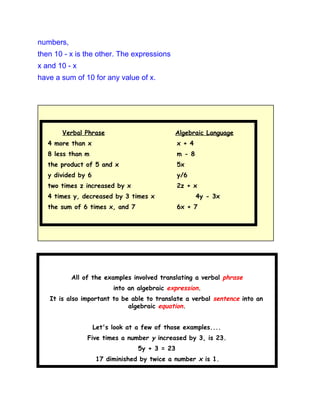
Verbal Phrase

Algebraic Language

4 more than x

x + 4

8 less than m

m - 8

the product of 5 and x

5x

y divided by 6

y/6

two times z increased by x

2z + x

4 times y, decreased by 3 times x
the sum of 6 times x, and 7

4y - 3x
6x + 7

All of the examples involved translating a verbal phrase
into an algebraic expression.
It is also important to be able to translate a verbal sentence into an
algebraic equation.
Let's look at a few of those examples....
Five times a number y increased by 3, is 23.
5y + 3 = 23
17 diminished by twice a number x is 1.
17 - 2x = 1
The quotient of sixteen and x is 8
16/x = 8
If five is increased by the product of three and x,
the result is 26
5 + 3x = 26
If a number y is added to three times y
the result is thirty-six.
3y + y = 36

Translating verbalphrases

  • 1.
         Translating Verbal Phrases JenniferDuggan Verbal Phrases/Operation
  • 2.
    Addition: The sumof a number and 8 x 8 Five is added to a number x 5 Two more than a number x 2 A number increased by 3 x 3 Subtraction: Four is subtracted from a number x 4 Three less than a number x 3 The difference between 7 and a number 7 x A number decreased by 2 x 2 Multiplication: The product of 5 and a number 5x Twice a number 2x One-half of a number x Five percent of a number 0.05x Division: The ratio of a number to 6 The quotient of 5 and a number Three divided by some number. There is often more than one unknown quantity in a problem, but a relationship between the unknown quantities is given. For example, if one unknown number is 5 more than another unknown number, we can use x and x  5, to represent them. Note that x and x  5 can also be used to represent two unknown numbers that differ by 5, for if two numbers differ by 5, one of the numbers is 5 more than the other. How would you represent two numbers that have a sum of 10? If one of the numbers is 2, the other is certainly 10 ­ 2, or 8. Thus if x is one of the
  • 3.
    numbers, then 10 ­ x is the other. The expressions x and 10 ­ x have a sum of 10 for any value of x. Verbal Phrase Algebraic Language 4more than x x + 4 8 less than m m - 8 the product of 5 and x 5x y divided by 6 y/6 two times z increased by x 2z + x 4 times y, decreased by 3 times x the sum of 6 times x, and 7 4y - 3x 6x + 7 All of the examples involved translating a verbal phrase into an algebraic expression. It is also important to be able to translate a verbal sentence into an algebraic equation. Let's look at a few of those examples.... Five times a number y increased by 3, is 23. 5y + 3 = 23 17 diminished by twice a number x is 1.
  • 4.
    17 - 2x= 1 The quotient of sixteen and x is 8 16/x = 8 If five is increased by the product of three and x, the result is 26 5 + 3x = 26 If a number y is added to three times y the result is thirty-six. 3y + y = 36