Traits
Cam-Tu Diep
Traits
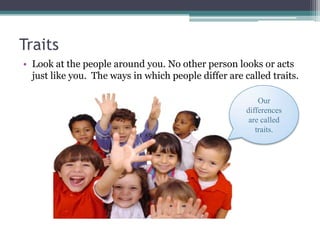
• Look at the people around you. No other person looks or acts
  just like you. The ways in which people differ are called traits.

                                                          Our
                                                      differences
                                                       are called
                                                         traits.
People have many different traits
•   Hair color
•   Skin color
•   Eye color
•   Height
•   Freckles
•   Earlobes
•   Nose shape                              Red hair is a trait.
                                            So are blue eyes.


• Traits help us tell people apart. Traits are
  differences between people.
We also share many of the same traits

• We walk with twos legs
• We sing and speak
• Our hands look like other people hands.
• People are more like one another than like
  animals.                                All people
                                             have the
                                            same basic
                                              parts.
So what make these different traits?
• Genes tell your body how to make different
  traits. Genes are like instruction for the body.
• You got your genes from your birth parents.
  Genes tell your body how to work and grow.
• Genes come in pairs. One copy came from each
  parent. One from your mom. The other came
  from your dad. The copies are called alleles.
Gregor Mendel
• The father of modern genetic
• Mendel studied dichotomous
  traits & how they are passed
  on to offspring
• Mendel demonstrated that the
  inheritance of certain traits in
  pea plants follows particular
  patterns, now referred to as
  the laws of Mendelian
  inheritance.
Mendelian Genetics
• 2 possible "alleles" for each trait
• The combination one has (1 from
  mom, 1 from dad) is called your
  "genotype"
• 2 matching alleles = "homozygous"
• 2 different alleles = "heterozygous"
• In heterozygous individuals, the allele
  that is "expressed" (seen in individual’s
  appearance) is the "dominant" allele.

• The allele that is not expressed is the
  "recessive" allele

• The traits that are expressed make up
  your "phenotype"
• There are more than 2 alleles for some
  traits
• Most traits, in fact, are affected by more
  than 1 gene
Tongue Rolling


 Genes play a part in tongue rolling. Many people roll
 their tongues easily. Others can roll their tongues a little.
 Some people cannot roll their tongues. Sometimes
 people can learn to roll their tongues with practice.
     Rolling up edges (dominant trait) vs not rolling (recessive)
Traits
• Sometime you need two alleles to get a trait.
  Other times, you need just one allele.


                         You needed two
                          alleles to have
                             red hair.
It takes just one
                                            freckle allele to

Freckles                                      give a person
                                                 freckles.


Freckles are traits. Freckles are spot on the skin.
Pigment makes freckles. Pigment gives skin its color.
                                                                 Do you
It’s spread out in those without freckles.                        have
It’s clumped together in those with freckles.                   freckles?

Pigment is a substance that gives color to something.
Hair Color


  Your gene tell the body to make certain pigments.
  Pigments color hair.
Some member of
                                                        this family have

Hair traits                                            straight hair other
                                                         have curly hair.


  For many traits, one of a pair of genes takes control. But that’s
  not true for hair texture.
Ear Traits


       Look at the bottoms of these ears.
       Can you tell how they are different?
Nose Traits
              Noses come in many shapes.
              Gene help decide the shape of
              your nose. Some noses are
              big. Some are small. Some
              curve out. Some are straight.
              Some even have turned-
              up end.
              What is the shape of your
              nose? Is it curved or
              straight?
Which thumb is on top?
Left Brain, Right Brain
Dimples


    Dimples are small dents in a person’s skin. These kids
    have dimples on her cheeks.
    Dimples: Dimples (dominant trait) vs. No dimples (recessive trait)
Cleft chins


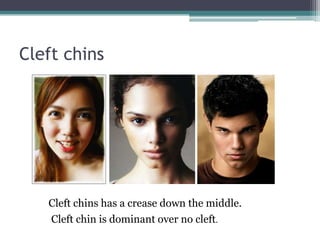
   Cleft chins has a crease down the middle.
   Cleft chin is dominant over no cleft.
Hitchhiker’s thumb
                 Make a fist with one hand.
                 Then hold put your
                 thumb. Is it bent? Or is
                 it straight? A thumb
                 that bends like this one is
                 a hitchhiker’s thumb.
Double-Jointed
Double-Jointed


       This girl have
       double-jointed
          elbow
Hands and Pinkies


 Do you have hair on the middle   This man has some hair on the
 parts of your fingers?           middle part of his fingers. Some
                                  people don’t have any hair.
Some traits are easy to see other traits
are hidden


   Can you smell this? People like
   some foods because of their
   smell.
Not everyone smells the same smells.
                    Your genes play a roll in
                    what you can smell. Your
                    genes let you smell certain
                    scents. Hundreds of genes
                    control our sense of smell.
                    People have different alleles
                    of these genes. So everyone
                    smells things differently.
Asparagus

                                               Most people smell a
                                               funny odor after they
                                               eat asparagus. And
                                               the smell is in a
                                               funny place. It’s in
                                               their pee! But some
                                               people smell nothing.


 Scientists found that there are two different traits. The first trait is
 whether you make the odor. The second trait is whether you can smell it.
Some traits are easy to see other
traits are hidden

                                        Do you like
                                        broccoli?


   Broccoli contain a chemical called Phenylthio carbamide (PTC)
This boy got an allele from his mom for tasting
PTC. His dad passed along an allele that doesn’t
react to PTC. The PTC tasting allele takes
control. The boy taste PTC.
Other interesting facts about PTC
• -Only about half of Aboriginal peoples from
  Australia and New Guinea are tasters. Nearly
  100% of indigenous Americans (i.e. Native
  Americans and Inuits) are tasters.

• -People who can taste PTC are more likely to be
  non-smokers and to not be in the habit of drinking
  coffee or tea. People who are super-tasters are
  more likely to find green vegetables bitter.

• Women, Asians, and African-Americans are all
  more likely to be super- tasters.
Your genes are part of
what makes you

           What special traits
           do you have?
Books
• Unusual Traits: Tongue rolling, Special Taste
  Sensors, and more/ Buffy Silverman
• Body Parts: Double-Jointedness, Hitchhiker’s
  Thumb, and More/ Buffy Silverman
• Facial Features: Freckles, Earlobes, Noses, and
  More/ Jennifer Boothroyd
• Hair Traits: Color, Texture, and More/ Buffy
  Silverman
Hair Color
Traits
Traits
Traits

Traits

  • 1.
  • 2.
    Traits • Look atthe people around you. No other person looks or acts just like you. The ways in which people differ are called traits. Our differences are called traits.
  • 3.
    People have manydifferent traits • Hair color • Skin color • Eye color • Height • Freckles • Earlobes • Nose shape Red hair is a trait. So are blue eyes. • Traits help us tell people apart. Traits are differences between people.
  • 4.
    We also sharemany of the same traits • We walk with twos legs • We sing and speak • Our hands look like other people hands. • People are more like one another than like animals. All people have the same basic parts.
  • 5.
    So what makethese different traits? • Genes tell your body how to make different traits. Genes are like instruction for the body. • You got your genes from your birth parents. Genes tell your body how to work and grow. • Genes come in pairs. One copy came from each parent. One from your mom. The other came from your dad. The copies are called alleles.
  • 6.
    Gregor Mendel • Thefather of modern genetic • Mendel studied dichotomous traits & how they are passed on to offspring • Mendel demonstrated that the inheritance of certain traits in pea plants follows particular patterns, now referred to as the laws of Mendelian inheritance.
  • 7.
    Mendelian Genetics • 2possible "alleles" for each trait • The combination one has (1 from mom, 1 from dad) is called your "genotype" • 2 matching alleles = "homozygous" • 2 different alleles = "heterozygous"
  • 8.
    • In heterozygousindividuals, the allele that is "expressed" (seen in individual’s appearance) is the "dominant" allele. • The allele that is not expressed is the "recessive" allele • The traits that are expressed make up your "phenotype" • There are more than 2 alleles for some traits • Most traits, in fact, are affected by more than 1 gene
  • 9.
    Tongue Rolling Genesplay a part in tongue rolling. Many people roll their tongues easily. Others can roll their tongues a little. Some people cannot roll their tongues. Sometimes people can learn to roll their tongues with practice. Rolling up edges (dominant trait) vs not rolling (recessive)
  • 10.
    Traits • Sometime youneed two alleles to get a trait. Other times, you need just one allele. You needed two alleles to have red hair.
  • 11.
    It takes justone freckle allele to Freckles give a person freckles. Freckles are traits. Freckles are spot on the skin. Pigment makes freckles. Pigment gives skin its color. Do you It’s spread out in those without freckles. have It’s clumped together in those with freckles. freckles? Pigment is a substance that gives color to something.
  • 12.
    Hair Color Your gene tell the body to make certain pigments. Pigments color hair.
  • 13.
    Some member of this family have Hair traits straight hair other have curly hair. For many traits, one of a pair of genes takes control. But that’s not true for hair texture.
  • 14.
    Ear Traits Look at the bottoms of these ears. Can you tell how they are different?
  • 15.
    Nose Traits Noses come in many shapes. Gene help decide the shape of your nose. Some noses are big. Some are small. Some curve out. Some are straight. Some even have turned- up end. What is the shape of your nose? Is it curved or straight?
  • 16.
  • 17.
  • 18.
    Dimples Dimples are small dents in a person’s skin. These kids have dimples on her cheeks. Dimples: Dimples (dominant trait) vs. No dimples (recessive trait)
  • 19.
    Cleft chins Cleft chins has a crease down the middle. Cleft chin is dominant over no cleft.
  • 20.
    Hitchhiker’s thumb Make a fist with one hand. Then hold put your thumb. Is it bent? Or is it straight? A thumb that bends like this one is a hitchhiker’s thumb.
  • 21.
  • 22.
    Double-Jointed This girl have double-jointed elbow
  • 23.
    Hands and Pinkies Do you have hair on the middle This man has some hair on the parts of your fingers? middle part of his fingers. Some people don’t have any hair.
  • 24.
    Some traits areeasy to see other traits are hidden Can you smell this? People like some foods because of their smell.
  • 25.
    Not everyone smellsthe same smells. Your genes play a roll in what you can smell. Your genes let you smell certain scents. Hundreds of genes control our sense of smell. People have different alleles of these genes. So everyone smells things differently.
  • 26.
    Asparagus Most people smell a funny odor after they eat asparagus. And the smell is in a funny place. It’s in their pee! But some people smell nothing. Scientists found that there are two different traits. The first trait is whether you make the odor. The second trait is whether you can smell it.
  • 27.
    Some traits areeasy to see other traits are hidden Do you like broccoli? Broccoli contain a chemical called Phenylthio carbamide (PTC)
  • 28.
    This boy gotan allele from his mom for tasting PTC. His dad passed along an allele that doesn’t react to PTC. The PTC tasting allele takes control. The boy taste PTC.
  • 29.
    Other interesting factsabout PTC • -Only about half of Aboriginal peoples from Australia and New Guinea are tasters. Nearly 100% of indigenous Americans (i.e. Native Americans and Inuits) are tasters. • -People who can taste PTC are more likely to be non-smokers and to not be in the habit of drinking coffee or tea. People who are super-tasters are more likely to find green vegetables bitter. • Women, Asians, and African-Americans are all more likely to be super- tasters.
  • 30.
    Your genes arepart of what makes you What special traits do you have?
  • 31.
    Books • Unusual Traits:Tongue rolling, Special Taste Sensors, and more/ Buffy Silverman • Body Parts: Double-Jointedness, Hitchhiker’s Thumb, and More/ Buffy Silverman • Facial Features: Freckles, Earlobes, Noses, and More/ Jennifer Boothroyd • Hair Traits: Color, Texture, and More/ Buffy Silverman
  • 33.

Editor's Notes

  • #3 Trait: a quality or characteristic that makes one person or thing different from another.Photo Source: http://amotherworld.com/main/wp-content/uploads/2010/11/kids.jpg
  • #6 Allel, is one of a number of alternative forms of the same gene or same genetic locusSometimes, different alleles can result in different observable phenotypic traits, such as different pigmentation. However, many variations at the genetic level result in little or no observable variation.
  • #7 di·chot·o·mous/dɪˈkɒtəməs/ Show Spelled [dih-kot-uh-muhs] Show IPA adjective 1. dividedordividing into twoparts.2. of or pertaining todichotomy.
  • #8 Sex-Linked TraitsIn the case of genes located on the X chromosome, females would have the usual 2 alleles for each gene but males only have 1 X chromosome and thus 1 allele (the Y chromosome contains only a small number of genes related to gender)
  • #10 Photo Source: http://obituarytypo.blogspot.com/2012/03/tongue-rolling.htmlhttp://www.flickr.com/photos/zeitgeistmama/3631601214/
  • #11 Red is not a common hair color. Do you know anyone with red hair? Fewer people have red hair than any other color.Sometime parents have brown hairs. But one of their children has red hair. How can this happen? Each parent has one allele for red hair. One daughter has two copies of that allele. She got one from each parent.Photo Source:http://www.freshsugarblog.com/wp-content/uploads/2009/02/_dsc6641-2blog.jpghttp://media-cache-ec6.pinterest.com/upload/28429041368707262_IRHzSLgH_b.jpghttp://pinterest.com/pin/403564816578663511/
  • #12 Photo Sources:http://www.bloglovin.com/en/blog/1735211/leah-remillet-bloghttp://www.search-institute.org/system/files/all-kids.jpg
  • #13 Your gene control your hair color. They tell the body to make certain pigments. Pigments color hair. Genes also tell the body how much pigment to make.Photo Source: http://www.fulllacewigsbyhottipsfashion.com/chart-of-hair-colors
  • #14 For many traits, one of a pair of genes takes control. But that’s not true for hair texture.Photo Source: mycreditgroup, inc☆ http://www.flickr.com/photos/48515295@N07/4579131169/sizes/z/in/photostream/
  • #15 The bottom part of the ear is called the earlobe. Some people have earlobes that hang away from their face. Other have earlobes that are attached.http://bio1100.nicerweb.com
  • #16 Noses come in many shapes. Gene help decide the shape of your nose. Some noses are big. Some are small. Some curve out. Some are straight.http://pinterest.com/pin/403564816578620043/http://media-cache-ec2.pinterest.com/upload/193373377720919907_HFno9Pno_222.jpg
  • #17 Most people put their left thumb on top. Fewer people put their right thumb on top. Scientists are not sure if genes control this trait.If the left thumb comes on top, you are right brained and artistic, adventurous and accommodative. If the right thumb is on the top, you are analytical, fluent with words and conservative.All of us use both the brain hemispheres all the time. Still, we tend to be dominated by the characteristics of one or the other hemispheres.http://beyond-advaita.blogspot.com/2010/06/arthanareeshwar-bilateral-human-brain.htmlhttp://1.bp.blogspot.com/_EEIhq9944Sw/TCQFQarV02I/AAAAAAAAAAk/IygdgR2ZqOE/s1600/test+1.bmp
  • #19 http://www.wisegeek.org/what-are-dimples.htmhttp://photographicdictionary.com/d/dimple
  • #20 http://farm3.staticflickr.com/2782/4380956305_5b94da85e8_z.jpghttp://swingcool-swaygently.blogspot.com/2011_08_01_archive.htmlhttp://www.modthesims.info/showthread.php?t=380836http://1.bp.blogspot.com/_uPZZGy6ltak/TUnPOmGzgQI/AAAAAAAAEy8/D-PyIGwRTlw/s1600/IMG_8652_3.jpg
  • #21 Some thumbs bend a lot others bend less. Still other thumbs are almost straight. Your gene control this trait.Recessive trait.http://taksnoproblem.pbworks.com/f/1270053575/hitchhikers%20thumb.jpg
  • #22 https://s3.amazonaws.com/healthtap-public/ht-staging/user_answer/reference_image/11372/large/Hypermobility_syndrome.jpeg?1349484960http://1.bp.blogspot.com/-yyK4OIxGrmI/TWU0Va4Z0EI/AAAAAAAABnA/0fODeGVrRC8/s1600/thumb-to-forearm.jpg
  • #23 Hold out your arms. Then bend them. The places where your arms bend are called joints. Joints connect two or more bones.Your elbow is a joint. Your arms bend at the elbow joint. People who are double-jointed don’t have extra joints. But their joints bend more than other people’s. The way your joints bend is a trait.Many people who are double jointed are related to other people who are. If parents have this condition, for example, their kids may be more likely to have it too. It may not be present in all joints, but it might make a child more flexible. Children are generally much more flexible than adults and more prone to have looser joints that tighten up as they age. Some of the genetic factors that could create this condition include the way a person's bones are shaped at joint meetings. Joints are typically sockets, and when one bone is not deep in the socket of the other, it is more flexible. While this may usually be quite benign, it may also make the person more prone to dislocations of the major joints. Some people may be able to self-dislocate joints, popping shoulders or knees out of their sockets and pushing them back in.http://www.wisegeek.org/what-makes-some-people-double-jointed.htmhttp://images.wisegeek.com/young-rhythmic-gymnast-with-a-double-jointed-elbow.jpghttp://www.chinadaily.com.cn/showbiz/images/attachement/jpg/site1/20081125/00221917dec40a959efc1d.jpg
  • #24 Look closely at the back of your fingers. Are tiny hairs growing on the middle section? Genes control whether hair grows there.http://www.retreatinabag.net/wp-content/uploads/bigstockphoto_many_hands_success_3089491.jpg
  • #25 Photo Source: http://en.wikipedia.org/wiki/File:Brownies...yawn...boooring.jpgSome traits are easy to see other traits are hidden
  • #26 When the female cheetah is ready to mate she produces a special scent (estrogen in her urine) to let the male cheetah know that she is ready to mate. The sense of smell is very important in reproduction and passing on your gene in this case.
  • #27 Photo Source: http://www.flickr.com/photos/zeetzjones/6342630543/
  • #28 If not, your genes may be the reason. A chemical called PTC is in broccoli. Your genes control whether you can taste PTC. One form of allele makes PTC taste bitter. The other allele doesn’t react to PTC. If you have two copies of the allele that doesn’t react to PTC, you do not taste it.http://www.feedingyourkids.com/Images/girl-with-broccoli.jpghttp://blog.timesunion.com/opinion/files/2011/11/1107_WVvegetables.jpg
  • #29 There is a single gene which codes for a protein found in our tongues. PTC will bind with the protein if it present and a person will taste it. If the protein is not present, PTC will not bind and a person cannot taste it. Tell the students to look at the numbers and what do they think about the genetic ability to taste PTC. -Being able to taste PTC is a dominant trait. About 2/3 to 3/4 of the class should be able to taste it, while 1/3 to 1/4 will not. Then ask the “PTC-tasters” what it tasted like. They should all say “bitter” (or gross or something like that). Ask them if there were any who thought it was so bitter they simply could not stand it. Hopefully, about 1/3 of the “tasters” (or about ¼ of the total participants) will say that was the case. -“Super tasters” are homozygotes for the dominant allele. It appears as though they produce either more proteins or proteins with more binding sites available to the PTC. Before telling the students this, you can ask them WHY a homozygote dominant thinks PTC tastes more bitter and see if they make the connection with the proteins. http://womenonthefence.com/wp-content/uploads/2012/07/picky_eater.jpg
  • #30 This is a good opportunity to discuss population genetics, “founder effects,” and the like. Another interesting point to discuss: what might be the genetic advantage or disadvantage of being a super-taster? (Advantages include avoiding alkaloid toxic plants, lower fat intake; disadvantages include lower vegetable intake, more narrow consumption of palatable foods) Indigenous peoples are ethnic minorities who have been marginalized as their historical territories became part of a state
  • #33 http://www.lexleeskids.org/wp-content/uploads/2011/12/kids.jpg
  • #34 Photo source: http://twilistaff.proboards.com/index.cgi?board=chariepros&action=display&thread=124
  • #35 http://www.bonsecoursinmotion.com/wp-content/uploads/2011/05/Healthy-happy-kids.jpg
  • #36 Photo Source: http://gamerfitnation.com/2011/09/smile/smiling-kids/
  • #37 http://obituarytypo.blogspot.com/2012/03/tongue-rolling.html