POKA YOKE
TRAINING
MISTAKE PROOFING
TECHNIQUES
Aadya L&D Complete solutions
OBJECTIVES
•Understanding basics of poka yoke
•Examples of poka yoke in the daily life
•Types of poka yoke devices/techniques (case studies)
•Poka yoke implementation strategies
•Where to implement poka-yoke
•Benefits of poka yoke in the work place
•Games & rewards – identify & implement right poke yoke
in the given process
Aadya L&D Complete solutions
WHAT IS POKA YOKE ???
• Poka yoke, pronounced “poh-kah yoh-keh,” is a japanese term that translates to
“mistake-proofing” or “inadvertent error prevention.”
• It was invented in the 1960s by industrial engineer shigeo shingo and applied to
the toyota production system to eliminate errors.
• Poka-yoke is a quality control process used within lean manufacturing to ensure that
products are in perfect condition. It ensures that products are manufactured right the
first time, reducing the cost of trial and error.
• The core principle of poka-yoke is designing the production process to make it
impossible for human error to occur.
Aadya L&D Complete solutions
POKA-YOKE-EXAMPLE IN OUR DAILY LIFE
• One such example of this that is referred to in training that 99% of
people have come across without realizing it poka yoke is the SIM
card shape and SIM card tray.
• If the SIM card did not have that notch, it could be put into the
phone in eight different ways. However, by simply adding a notch
there is only one possible way to put a SIM card in the tray.
• A simple change has saved billions of people from stress and
confusion.
• The widespread use of ATMs has certainly made banking
more convenient and shows no signs of diminishing usage.
• However, early on, the banks encountered a very
inconvenient problem; customers regularly drove off from
the ATM leaving their debit cards in the card slot of the
ATM.
• A simple but effective poka-yoke has been incorporated in
the ATMs so that an alarm sounds and continues to sound
until you have taken your card from the slot.
Aadya L&D Complete solutions
POKA-YOKE-EXAMPLE IN OUR DAILY LIFE
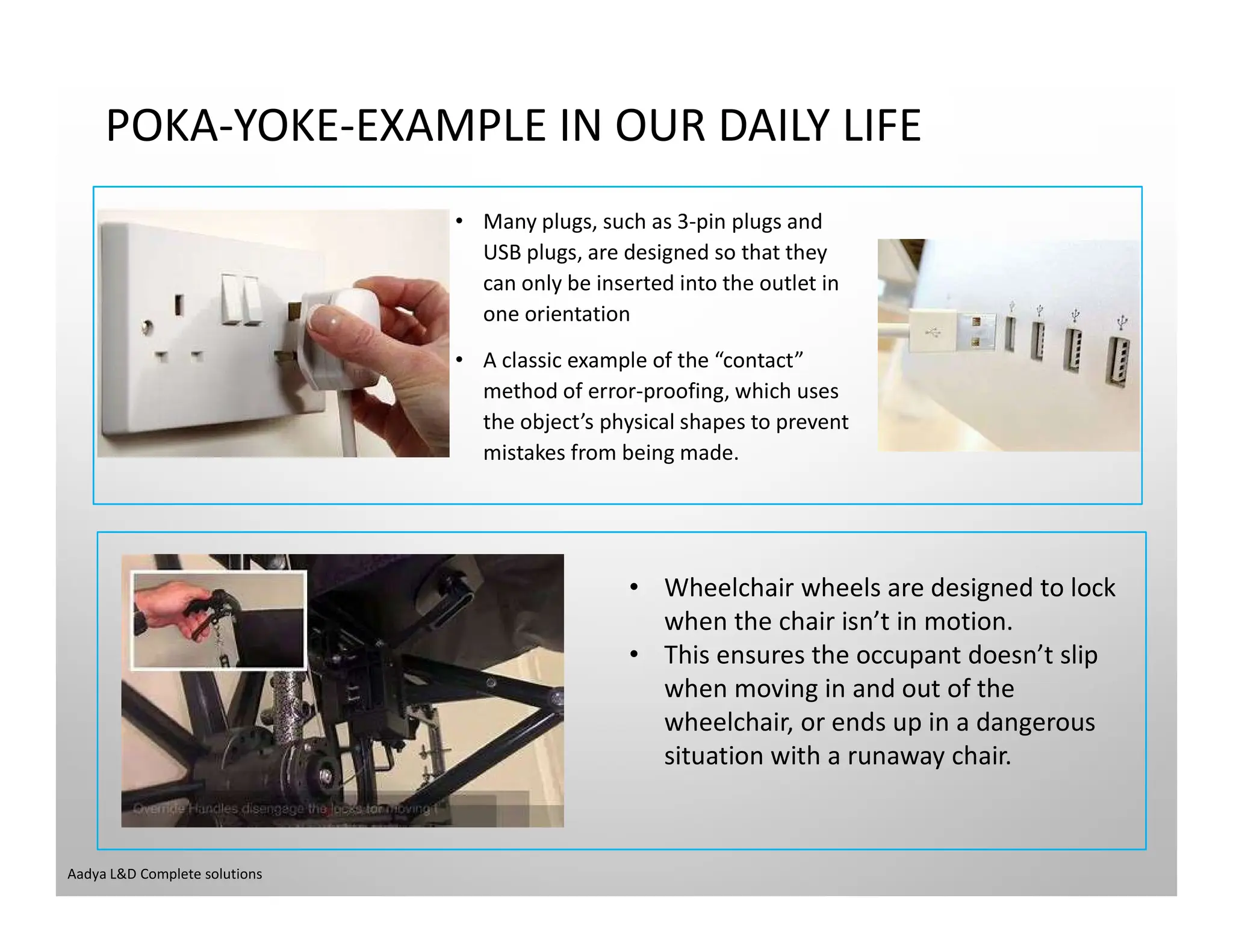
• Many plugs, such as 3-pin plugs and
USB plugs, are designed so that they
can only be inserted into the outlet in
one orientation
• A classic example of the “contact”
method of error-proofing, which uses
the object’s physical shapes to prevent
mistakes from being made.
• Wheelchair wheels are designed to lock
when the chair isn’t in motion.
• This ensures the occupant doesn’t slip
when moving in and out of the
wheelchair, or ends up in a dangerous
situation with a runaway chair.
Aadya L&D Complete solutions
POKA-YOKE-EXAMPLE IN OUR DAILY LIFE
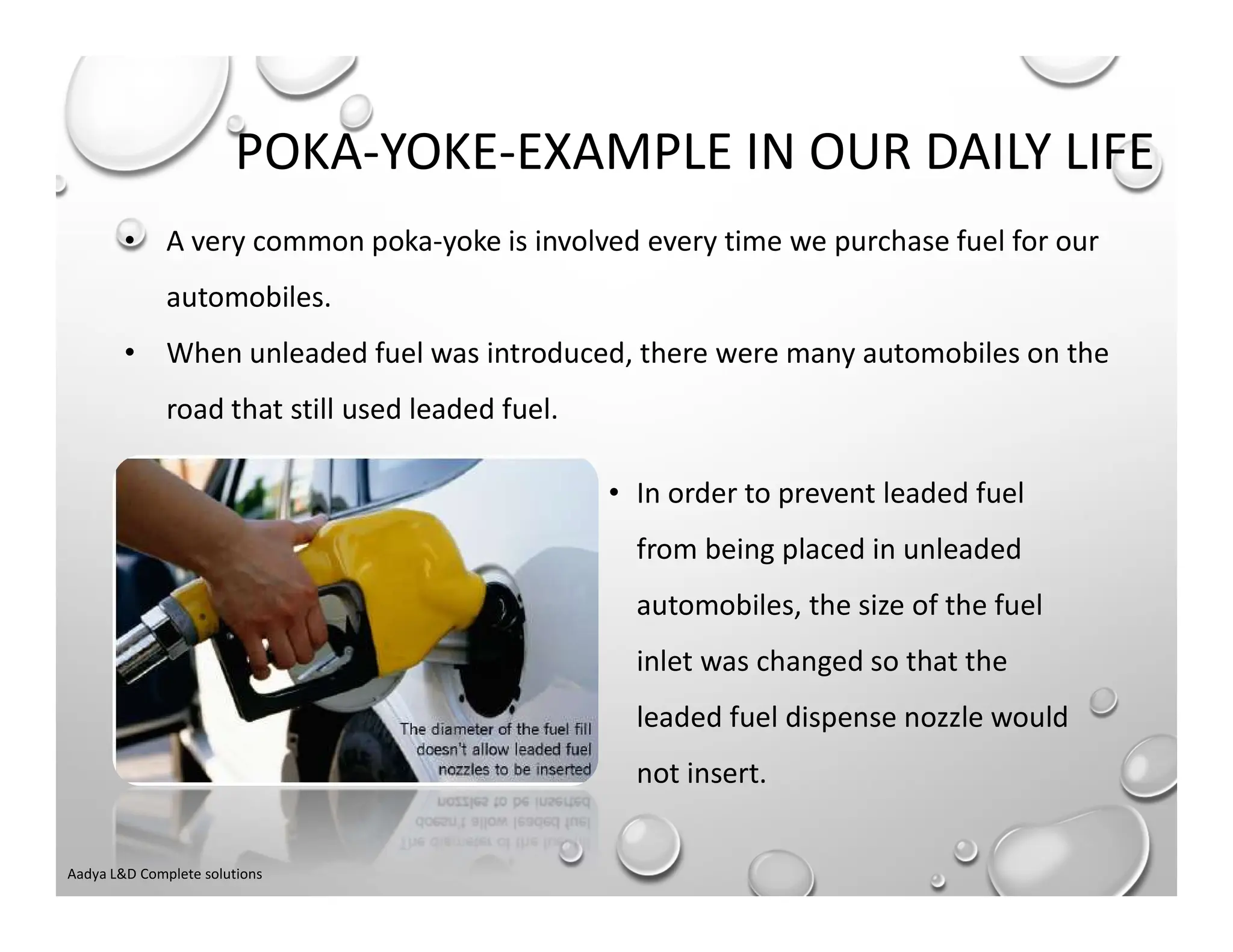
• In order to prevent leaded fuel
from being placed in unleaded
automobiles, the size of the fuel
inlet was changed so that the
leaded fuel dispense nozzle would
not insert.
• A very common poka-yoke is involved every time we purchase fuel for our
automobiles.
• When unleaded fuel was introduced, there were many automobiles on the
road that still used leaded fuel.
Aadya L&D Complete solutions
POKA-YOKE- POP OUT YOUR OWN IDEAS
Idea 1, 2, 3 ……
Personal Life
At work place
Aadya L&D Complete solutions
TYPES OF POKA YOKE DEVICES
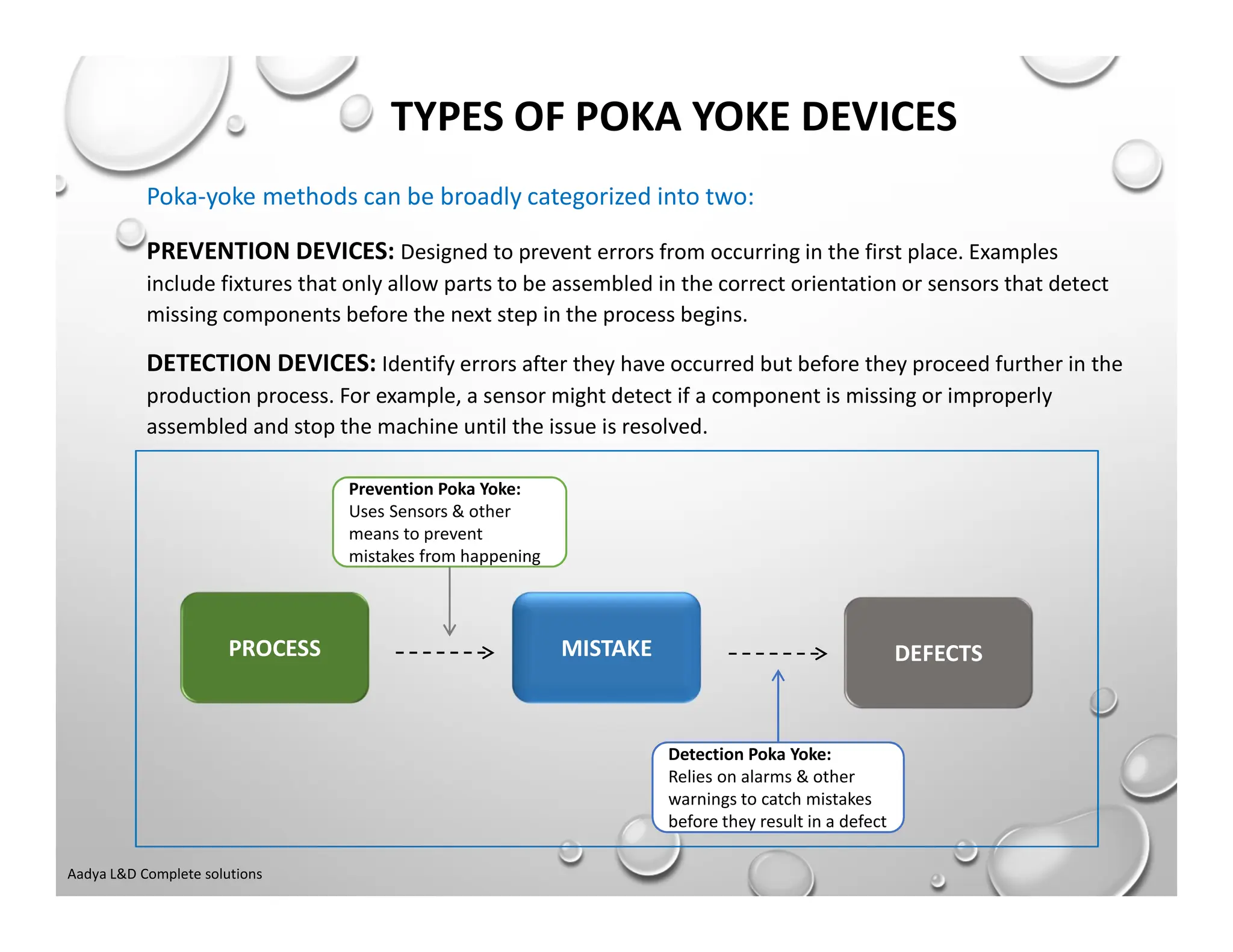
Poka-yoke methods can be broadly categorized into two:
PREVENTION DEVICES: Designed to prevent errors from occurring in the first place. Examples
include fixtures that only allow parts to be assembled in the correct orientation or sensors that detect
missing components before the next step in the process begins.
DETECTION DEVICES: Identify errors after they have occurred but before they proceed further in the
production process. For example, a sensor might detect if a component is missing or improperly
assembled and stop the machine until the issue is resolved.
Detection Poka Yoke:
Relies on alarms & other
warnings to catch mistakes
before they result in a defect
Prevention Poka Yoke:
mistakes from happening
Prevention Poka Yoke:
Uses Sensors & other
means to prevent
mistakes from happening
PROCESS MISTAKE DEFECTS
Aadya L&D Complete solutions
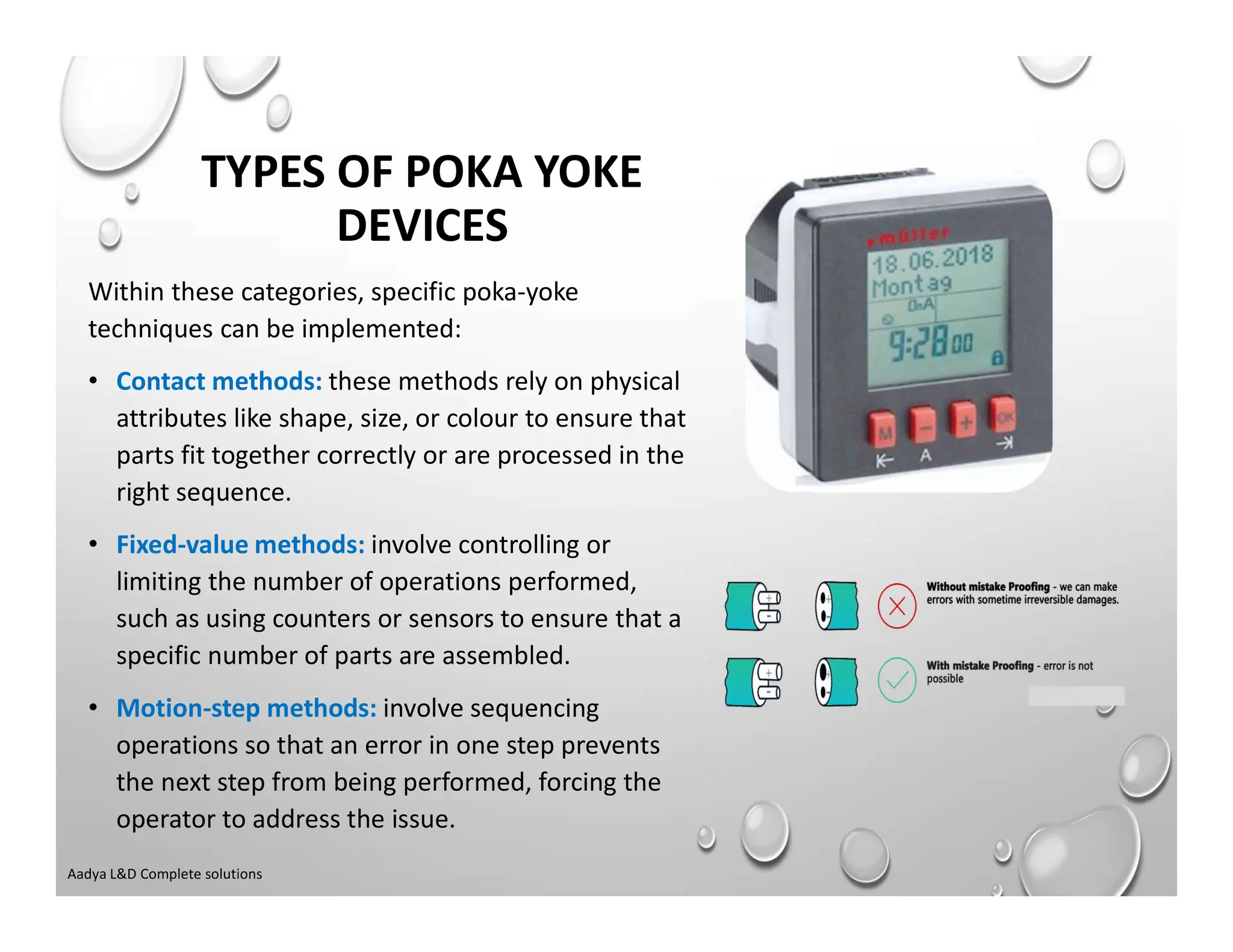
Within these categories, specific poka-yoke
techniques can be implemented:
• Contact methods: these methods rely on physical
attributes like shape, size, or colour to ensure that
parts fit together correctly or are processed in the
right sequence.
• Fixed-value methods: involve controlling or
limiting the number of operations performed,
such as using counters or sensors to ensure that a
specific number of parts are assembled.
• Motion-step methods: involve sequencing
operations so that an error in one step prevents
the next step from being performed, forcing the
operator to address the issue.
TYPES OF POKA YOKE
DEVICES
Aadya L&D Complete solutions
POKA YOKE-
Example In
the Industry
• INTRODUCTION TO POKA-YOKE (LEAN SIX SIGMA)
(YOUTUBE.COM)
• EXAMPLES OF POKA YOKE (YOUTUBE.COM)
• TOYOTA FIXED VALUE POKA YOKE / MISTAKE
PROOFING / ERROR PROOFING; BOLTS DISPENSER
(YOUTUBE.COM)
• POKA YOKE (YOUTUBE.COM)
• LCA POKA YOKE TO ENSURE ONE PIECE FLOW
(YOUTUBE.COM)
Aadya L&D Complete solutions
CASE STUDY - 1
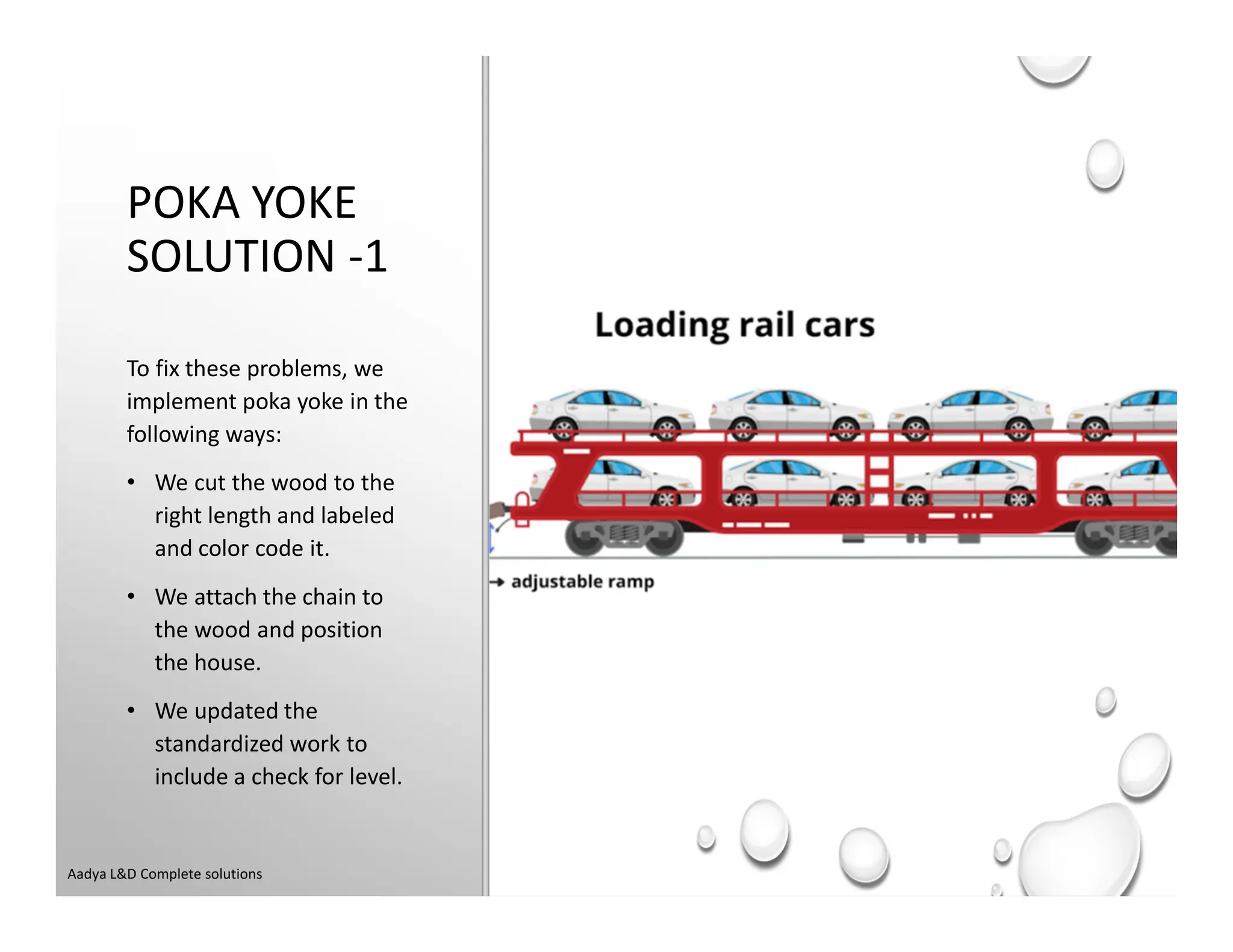
• The car manufacturing industry faces
challenges when loading cars into freight
cars.
• Loading the car into the carrier proves
difficult due to inappropriate height.
• Therefore, we need a method to prevent
damage and ensure safety during car
transportation.
Aadya L&D Complete solutions
POKA YOKE
SOLUTION -1
To fix these problems, we
implement poka yoke in the
following ways:
• We cut the wood to the
right length and labeled
and color code it.
• We attach the chain to
the wood and position
the house.
• We updated the
standardized work to
include a check for level.
Aadya L&D Complete solutions
CASE STUDY 2
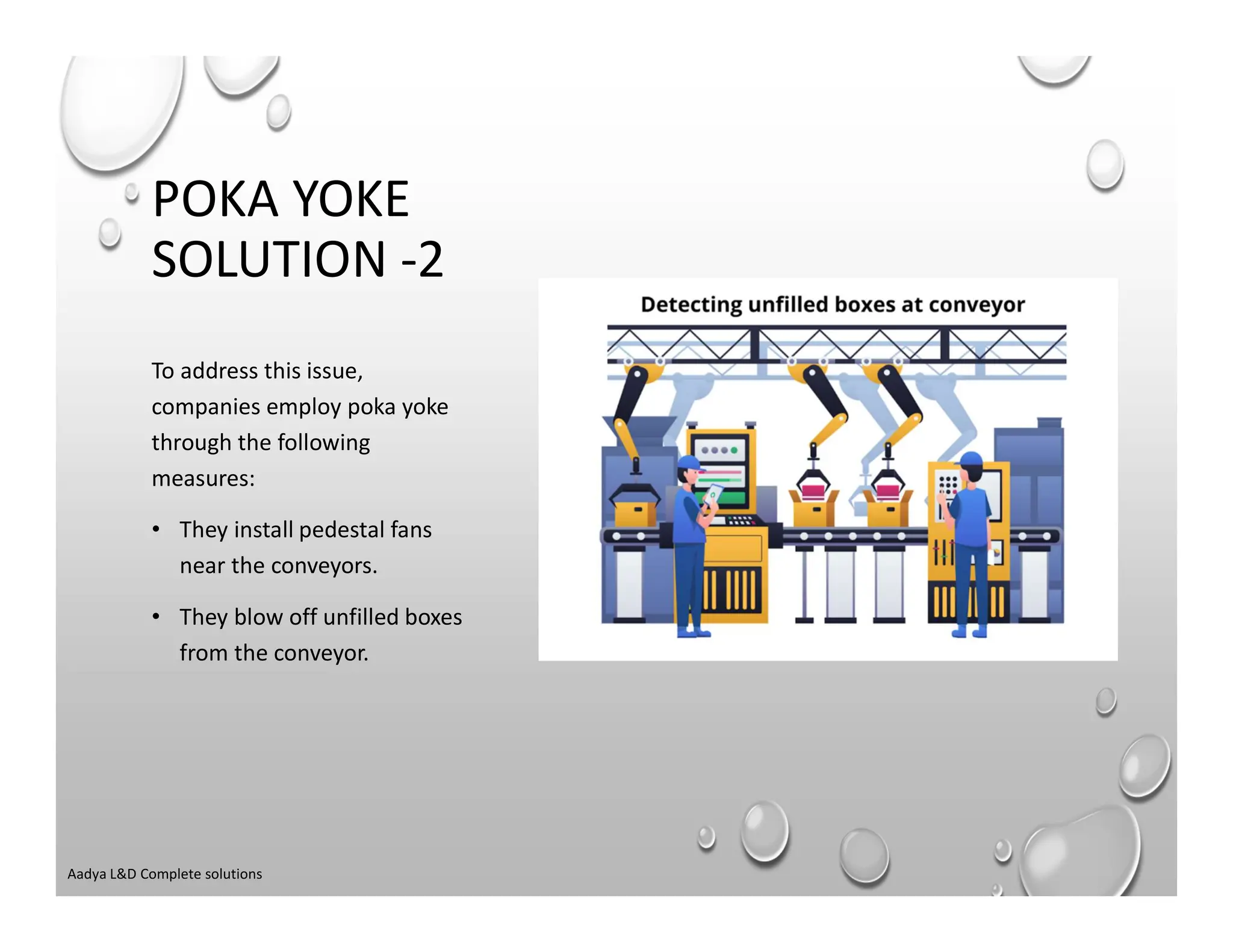
• Previously, detecting unfilled boxes in the
consumer product industry posed a
challenge for companies.
• Occasionally, boxes would remain unfilled
due to machine errors, yet they were still
closed and sent for shipment.
Aadya L&D Complete solutions
To address this issue,
companies employ poka yoke
through the following
measures:
• They install pedestal fans
near the conveyors.
• They blow off unfilled boxes
from the conveyor.
POKA YOKE
SOLUTION -2
Aadya L&D Complete solutions
POKA-YOKE IMPLEMENTATION STRATEGIES
Implementing poka yoke is straightforward and logical. Here are some steps for
you to follow:
• Identify company operations or work processes.
• Analyze the causes of failures using the 5-whys method.
• Determine the most suitable poka-yoke method.
• Test the chosen plan and evaluate the results.
• Train operators, assess performance, and measure the success of the
implemented poka-yoke.
Use Cases
Aadya L&D Complete solutions
WHERE TO IMPLEMENT
POKA-YOKE
Once you've decided on which process could benefit from a poka-
yoke device, there are a few areas to consider placing the device or
method within the workflow.
• The best location for a poka-yoke device is before an operator or
the machine starts a task. In other words, it's best to prevent any
errors by not allowing the process to even begin until a certain set
of conditions are met.
• The second-best location for a poka-yoke device is during a
particular step within a process. This way, an operator or machine
receives an alert in the event of an error and stops the part or
process from moving down the line.
• Finally, the third-best location for a poka-yoke device is
downstream after the process step is finished, typically at an
inspection station. At this point, you're assuming errors or defects
may have occurred and are dependent on detection controls to
find the defects before sending the process down the line.
Aadya L&D Complete solutions
BENEFITS OF
IMPLEMENTING POKA YOKE
• Reduced defects: by preventing errors at the source, the
incidence of defects is minimized, leading to higher quality
products and services.
• Cost savings: fewer defects translate to less rework,
reduced scrap, and lower material wastage, resulting in
significant cost savings.
• Improved efficiency: processes that incorporate poka yoke
mechanisms are more efficient as they experience fewer
disruptions caused by errors.
• Enhanced customer satisfaction: delivering high-quality
products consistently leads to better customer satisfaction
and loyalty.
• Operational excellence: poka yoke contributes to overall
operational excellence by promoting a culture of
continuous improvement and error prevention.
Aadya L&D Complete solutions

Training module on POKA - YOKE Basics.pdf

  • 1.
  • 2.
    OBJECTIVES •Understanding basics ofpoka yoke •Examples of poka yoke in the daily life •Types of poka yoke devices/techniques (case studies) •Poka yoke implementation strategies •Where to implement poka-yoke •Benefits of poka yoke in the work place •Games & rewards – identify & implement right poke yoke in the given process Aadya L&D Complete solutions
  • 3.
    WHAT IS POKAYOKE ??? • Poka yoke, pronounced “poh-kah yoh-keh,” is a japanese term that translates to “mistake-proofing” or “inadvertent error prevention.” • It was invented in the 1960s by industrial engineer shigeo shingo and applied to the toyota production system to eliminate errors. • Poka-yoke is a quality control process used within lean manufacturing to ensure that products are in perfect condition. It ensures that products are manufactured right the first time, reducing the cost of trial and error. • The core principle of poka-yoke is designing the production process to make it impossible for human error to occur. Aadya L&D Complete solutions
  • 4.
    POKA-YOKE-EXAMPLE IN OURDAILY LIFE • One such example of this that is referred to in training that 99% of people have come across without realizing it poka yoke is the SIM card shape and SIM card tray. • If the SIM card did not have that notch, it could be put into the phone in eight different ways. However, by simply adding a notch there is only one possible way to put a SIM card in the tray. • A simple change has saved billions of people from stress and confusion. • The widespread use of ATMs has certainly made banking more convenient and shows no signs of diminishing usage. • However, early on, the banks encountered a very inconvenient problem; customers regularly drove off from the ATM leaving their debit cards in the card slot of the ATM. • A simple but effective poka-yoke has been incorporated in the ATMs so that an alarm sounds and continues to sound until you have taken your card from the slot. Aadya L&D Complete solutions
  • 5.
    POKA-YOKE-EXAMPLE IN OURDAILY LIFE • Many plugs, such as 3-pin plugs and USB plugs, are designed so that they can only be inserted into the outlet in one orientation • A classic example of the “contact” method of error-proofing, which uses the object’s physical shapes to prevent mistakes from being made. • Wheelchair wheels are designed to lock when the chair isn’t in motion. • This ensures the occupant doesn’t slip when moving in and out of the wheelchair, or ends up in a dangerous situation with a runaway chair. Aadya L&D Complete solutions
  • 6.
    POKA-YOKE-EXAMPLE IN OURDAILY LIFE • In order to prevent leaded fuel from being placed in unleaded automobiles, the size of the fuel inlet was changed so that the leaded fuel dispense nozzle would not insert. • A very common poka-yoke is involved every time we purchase fuel for our automobiles. • When unleaded fuel was introduced, there were many automobiles on the road that still used leaded fuel. Aadya L&D Complete solutions
  • 7.
    POKA-YOKE- POP OUTYOUR OWN IDEAS Idea 1, 2, 3 …… Personal Life At work place Aadya L&D Complete solutions
  • 8.
    TYPES OF POKAYOKE DEVICES Poka-yoke methods can be broadly categorized into two: PREVENTION DEVICES: Designed to prevent errors from occurring in the first place. Examples include fixtures that only allow parts to be assembled in the correct orientation or sensors that detect missing components before the next step in the process begins. DETECTION DEVICES: Identify errors after they have occurred but before they proceed further in the production process. For example, a sensor might detect if a component is missing or improperly assembled and stop the machine until the issue is resolved. Detection Poka Yoke: Detection Poka Yoke: Relies on alarms & other warnings to catch mistakes before they result in a defect Prevention Poka Yoke: mistakes from happening Prevention Poka Yoke: Uses Sensors & other means to prevent mistakes from happening PROCESS MISTAKE DEFECTS Aadya L&D Complete solutions
  • 9.
    Within these categories,specific poka-yoke techniques can be implemented: • Contact methods: these methods rely on physical attributes like shape, size, or colour to ensure that parts fit together correctly or are processed in the right sequence. • Fixed-value methods: involve controlling or limiting the number of operations performed, such as using counters or sensors to ensure that a specific number of parts are assembled. • Motion-step methods: involve sequencing operations so that an error in one step prevents the next step from being performed, forcing the operator to address the issue. TYPES OF POKA YOKE DEVICES Aadya L&D Complete solutions
  • 10.
    POKA YOKE- Example In theIndustry • INTRODUCTION TO POKA-YOKE (LEAN SIX SIGMA) (YOUTUBE.COM) • EXAMPLES OF POKA YOKE (YOUTUBE.COM) • TOYOTA FIXED VALUE POKA YOKE / MISTAKE PROOFING / ERROR PROOFING; BOLTS DISPENSER (YOUTUBE.COM) • POKA YOKE (YOUTUBE.COM) • LCA POKA YOKE TO ENSURE ONE PIECE FLOW (YOUTUBE.COM) Aadya L&D Complete solutions
  • 11.
    CASE STUDY -1 • The car manufacturing industry faces challenges when loading cars into freight cars. • Loading the car into the carrier proves difficult due to inappropriate height. • Therefore, we need a method to prevent damage and ensure safety during car transportation. Aadya L&D Complete solutions
  • 12.
    POKA YOKE SOLUTION -1 Tofix these problems, we implement poka yoke in the following ways: • We cut the wood to the right length and labeled and color code it. • We attach the chain to the wood and position the house. • We updated the standardized work to include a check for level. Aadya L&D Complete solutions
  • 13.
    CASE STUDY 2 •Previously, detecting unfilled boxes in the consumer product industry posed a challenge for companies. • Occasionally, boxes would remain unfilled due to machine errors, yet they were still closed and sent for shipment. Aadya L&D Complete solutions
  • 14.
    To address thisissue, companies employ poka yoke through the following measures: • They install pedestal fans near the conveyors. • They blow off unfilled boxes from the conveyor. POKA YOKE SOLUTION -2 Aadya L&D Complete solutions
  • 15.
    POKA-YOKE IMPLEMENTATION STRATEGIES Implementingpoka yoke is straightforward and logical. Here are some steps for you to follow: • Identify company operations or work processes. • Analyze the causes of failures using the 5-whys method. • Determine the most suitable poka-yoke method. • Test the chosen plan and evaluate the results. • Train operators, assess performance, and measure the success of the implemented poka-yoke. Use Cases Aadya L&D Complete solutions
  • 16.
    WHERE TO IMPLEMENT POKA-YOKE Onceyou've decided on which process could benefit from a poka- yoke device, there are a few areas to consider placing the device or method within the workflow. • The best location for a poka-yoke device is before an operator or the machine starts a task. In other words, it's best to prevent any errors by not allowing the process to even begin until a certain set of conditions are met. • The second-best location for a poka-yoke device is during a particular step within a process. This way, an operator or machine receives an alert in the event of an error and stops the part or process from moving down the line. • Finally, the third-best location for a poka-yoke device is downstream after the process step is finished, typically at an inspection station. At this point, you're assuming errors or defects may have occurred and are dependent on detection controls to find the defects before sending the process down the line. Aadya L&D Complete solutions
  • 17.
    BENEFITS OF IMPLEMENTING POKAYOKE • Reduced defects: by preventing errors at the source, the incidence of defects is minimized, leading to higher quality products and services. • Cost savings: fewer defects translate to less rework, reduced scrap, and lower material wastage, resulting in significant cost savings. • Improved efficiency: processes that incorporate poka yoke mechanisms are more efficient as they experience fewer disruptions caused by errors. • Enhanced customer satisfaction: delivering high-quality products consistently leads to better customer satisfaction and loyalty. • Operational excellence: poka yoke contributes to overall operational excellence by promoting a culture of continuous improvement and error prevention. Aadya L&D Complete solutions