T
R
A
D
E
U
N
I
O
NA
C
T
,1
9
2
6
THE TRADE UNION ACT, 1926
T
R
A
D
E
U
N
I
O
NA
C
T
,1
9
2
6
"Trade Union" means any combination, whether
temporary or permanent, formed primarily for the
purpose of regulating the relations between
workmen and employers or between workmen
and workmen, or between employers and
employers, or for imposing restrictive conditions
on the conduct of any trade or business
T
r
a
d
eU
n
i
o
n
s
Trade unions are formed to protect and promote
the interests of their members. Their primary
function is to protect the interests of workers
against discrimination and unfair labor practices.
C
O
N
T
D
…
…
.
D
E
F
I
N
I
T
I
O
N
O
F
T
R
A
D
E
U
N
I
O
N
A trade union is such an organisation which is
created voluntarily on the basis of collective
strength to secure the interests of the workers.
-V. V. Giri
ThisAct provides for the registration of trade unions
and in certain respects in define the law relating to
registered TradeUnions.
The act applies toregistered Trade Unions.
S
C
O
P
E
O
F
T
H
E
A
C
T
This act specifies the mode of their registration:.
The act was passed toregulate :
a) Conditions governing the registration of atrade union.
b) Obligation imposed upon a registered trade unions
and
c) Rights and Liabilities of Registered Trade unions.
C
O
V
E
R
A
G
E
O
F
T
H
E
A
C
T
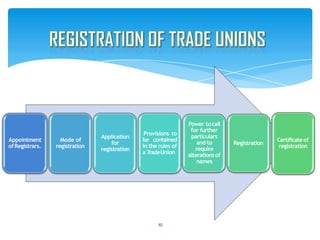
Appointment
ofRegistrars.
Mode of
registration
Application
for
registration
Provisions to
be contained
in the rules of
a TradeUnion
Power tocall
for further
particulars
and to
require
alterationsof
names
Registration
Certificateof
registration
10
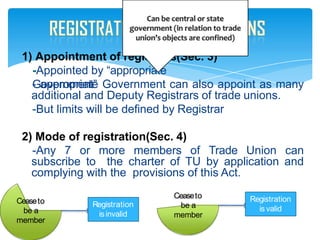
1) Appointment of registrars(Sec. 3)
-Appointed by “appropriate
Government”
- appropriate Government can also appoint as many
additional and Deputy Registrars of trade unions.
-But limits will be defined by Registrar
2) Mode of registration(Sec. 4)
-Any 7 or more members of Trade Union can
subscribe to the charter of TU by application and
complying with the provisions of this Act.
Ceaseto
be a
member
Registration
isinvalid
Ceaseto
be a
member
Registration
is valid
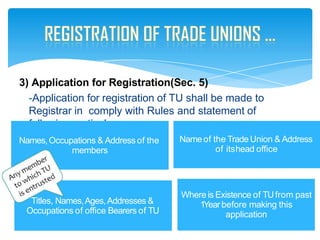
3) Application for Registration(Sec. 5)
-Application for registration of TU shall be made to
Registrar in comply with Rules and statement of
following particulars:
Names,Occupations & Addressof the
members
Nameof the Trade Union & Address
of itshead office
Titles, Names,Ages,Addresses &
Occupations of office Bearers of TU
Where is Existence of TUfrom past
1Year before making this
application
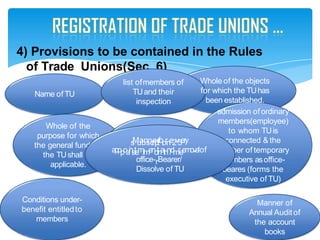
4) Provisions to be contained in the Rules
of Trade Unions(Sec. 6)
Name of TU
Whole of the
purpose for which
the general fundsof
the TUshall be
applicable.
list ofmembers of
TUand their
inspection
Whole of the objects
for which the TUhas
been established.
admission ofordinary
members(employee)
to whom TUis
connected & the
number of temporary
members asoffice-
beares (forms the
executive of TU)
Payment of
Conditions under-
benefit entitledto
members
s
M
u
a
b
n
s
n
c
r
e
i
p
r
tfoiorne2v5ery
a
p
p
p
o
a
i
n
i
ste
m/me
n
o
tn
a
th
n
/d
mre
e
mo
va
lof
office-rBearer/
Dissolve of TU
Manner of
Annual Auditof
the account
books
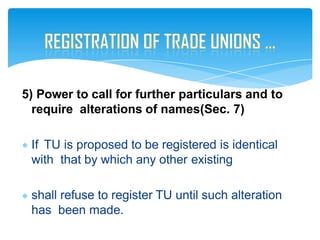
5) Power to call for further particulars and to
require alterations of names(Sec. 7)
If TU is proposed to be registered is identical
with that by which any other existing
shall refuse to register TU until such alteration
has been made.
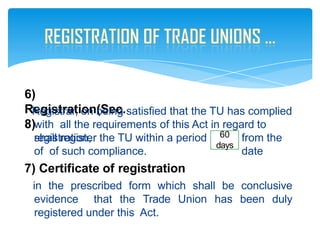
6)
Registration(Sec.
8)
Registrar, on being satisfied that the TU has complied
with all the requirements of this Act in regard to
registration, from the
date
shall register the TU within a period
of of such compliance.
7) Certificate of registration
in the prescribed form which shall be conclusive
evidence that the Trade Union has been duly
registered under this Act.
60
days
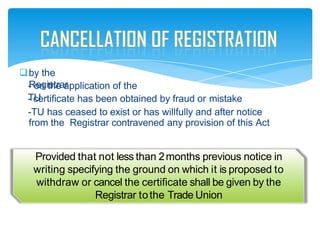
by the
Registrar
- on the application of the
TU
- certificate has been obtained by fraud or mistake
-TU has ceased to exist or has willfully and after notice
from the Registrar contravened any provision of this Act
Provided that not less than 2months previous notice in
writing specifying the ground on which it is proposed to
withdraw or cancel the certificate shall be given by the
Registrar tothe Trade Union
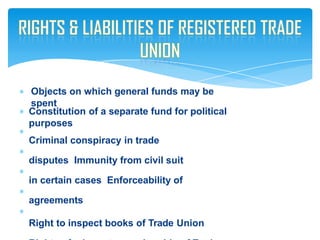
Objects on which general funds may be
spent
Constitution of a separate fund for political
purposes
Criminal conspiracy in trade
disputes Immunity from civil suit
in certain cases Enforceability of
agreements
Right to inspect books of Trade Union
T
R
A
D
E
U
N
I
O
NF
I
N
A
N
C
E
A
N
DF
U
N
D
S
A. Rate of subscription of Union
Members:- Section(6)(ee)
III
.
of the trade union act 1926, provides that the
payment of minimum subscription by member shall
not be less than;
I. One rupee per annum for rural workers;
II. Three rupee per annum for workers in other
un recognized sectors; and
Twelve rupees per annum for workers in other
cases.
B. General Fund
Section 15of the trade union act, 1926lays down the purpose for
which general fund of a registered Trade union can be utilized
namely
1. The payment of salary allowances and
expenses to office bears of trade union;
2. The payment of expenses for the administration of
the trade union including Audit of the accounts of
general funds of the trade union
3. The conduct of trade disputes on behalf of then
trade union or any member thereof;
C. Political Fund:-
Trade unions compelled to get into political spheres.
Trade Unions which are registered are permitted as per
Section 16 of the Act, to raise separate Political Fund for
is members.
The political Fund can be use for the following
expenses.
1.For holding the meeting.
2.For distribution of any document.
3.For holding Political meeting.
4.For registration of electors.
A
M
A
L
G
A
M
A
T
I
O
N
O
F
T
R
A
D
E
U
N
I
O
N(
S
E
C2
4&
2
5
)
Any Registered trade union may amalgamate with
any other union provided that at least 50% of
the members of each such union record their
votes and at least 60% of votes so recorded are in
favour of amalgamation. A notice of amalgamation
signed by the secretary and at least seven
members of each amalgamating union should be
sent to the registrar and the amalgamation shall
be in operation after the registrar registers the
notice.
D
I
S
S
O
L
U
T
I
O
N
O
F
T
R
A
D
E
U
N
I
O
N
A Registered trade union can be dissolved in
accordance with the rule of the union. A notice of
dissolution signed by any seven members and the
secretary of the union should be sent to register
within 14 days of the dissolution. On being
satisfied The registrar shall
register the notice and the union shall stand
dissolved from that date.
 The employees of the hotel used to get 65 days holiday per year,
but the management wanted to reduce it by 15 days due to some
managerial issues.
 The workers readily and strongly opposed this proposal and
approached Maharashtra Samarth Kamgar Sanghatna to solve this
issue.
 MSKS understood the workers dilemma and went to the
management to
reach an understanding via collective bargaining.
C
A
S
E
S
T
U
D
Y
O
F
H
O
T
E
L
O
B
E
R
O
I
1. MSKSagreed to convince the workers but in return asked the
management to pay 20 days extra salary in the month of
December.
2. The management and workers debated over the issue.
The management found that they had the workers working for 15
extra days and the workers found that they were being paid for 20
days just for 15 days of extra work.
3. Both the parties reached an agreement.
Thus, MSKS was successful in creating a win-win situation via
collective bargaining.
C
O
L
L
E
C
T
I
V
E
B
A
R
G
A
I
N
I
N
G
P
R
O
C
E
S
S
Thank
you

tradeunionact1926 in Human resources Management

  • 1.
  • 2.
    THE TRADE UNIONACT, 1926 T R A D E U N I O NA C T ,1 9 2 6
  • 3.
    "Trade Union" meansany combination, whether temporary or permanent, formed primarily for the purpose of regulating the relations between workmen and employers or between workmen and workmen, or between employers and employers, or for imposing restrictive conditions on the conduct of any trade or business T r a d eU n i o n s
  • 4.
    Trade unions areformed to protect and promote the interests of their members. Their primary function is to protect the interests of workers against discrimination and unfair labor practices. C O N T D … … .
  • 5.
    D E F I N I T I O N O F T R A D E U N I O N A trade unionis such an organisation which is created voluntarily on the basis of collective strength to secure the interests of the workers. -V. V. Giri
  • 6.
    ThisAct provides forthe registration of trade unions and in certain respects in define the law relating to registered TradeUnions. The act applies toregistered Trade Unions. S C O P E O F T H E A C T
  • 7.
    This act specifiesthe mode of their registration:. The act was passed toregulate : a) Conditions governing the registration of atrade union. b) Obligation imposed upon a registered trade unions and c) Rights and Liabilities of Registered Trade unions. C O V E R A G E O F T H E A C T
  • 8.
    Appointment ofRegistrars. Mode of registration Application for registration Provisions to becontained in the rules of a TradeUnion Power tocall for further particulars and to require alterationsof names Registration Certificateof registration 10
  • 9.
    1) Appointment ofregistrars(Sec. 3) -Appointed by “appropriate Government” - appropriate Government can also appoint as many additional and Deputy Registrars of trade unions. -But limits will be defined by Registrar 2) Mode of registration(Sec. 4) -Any 7 or more members of Trade Union can subscribe to the charter of TU by application and complying with the provisions of this Act. Ceaseto be a member Registration isinvalid Ceaseto be a member Registration is valid
  • 10.
    3) Application forRegistration(Sec. 5) -Application for registration of TU shall be made to Registrar in comply with Rules and statement of following particulars: Names,Occupations & Addressof the members Nameof the Trade Union & Address of itshead office Titles, Names,Ages,Addresses & Occupations of office Bearers of TU Where is Existence of TUfrom past 1Year before making this application
  • 11.
    4) Provisions tobe contained in the Rules of Trade Unions(Sec. 6) Name of TU Whole of the purpose for which the general fundsof the TUshall be applicable. list ofmembers of TUand their inspection Whole of the objects for which the TUhas been established. admission ofordinary members(employee) to whom TUis connected & the number of temporary members asoffice- beares (forms the executive of TU) Payment of Conditions under- benefit entitledto members s M u a b n s n c r e i p r tfoiorne2v5ery a p p p o a i n i ste m/me n o tn a th n /d mre e mo va lof office-rBearer/ Dissolve of TU Manner of Annual Auditof the account books
  • 12.
    5) Power tocall for further particulars and to require alterations of names(Sec. 7) If TU is proposed to be registered is identical with that by which any other existing shall refuse to register TU until such alteration has been made.
  • 13.
    6) Registration(Sec. 8) Registrar, on beingsatisfied that the TU has complied with all the requirements of this Act in regard to registration, from the date shall register the TU within a period of of such compliance. 7) Certificate of registration in the prescribed form which shall be conclusive evidence that the Trade Union has been duly registered under this Act. 60 days
  • 14.
    by the Registrar - onthe application of the TU - certificate has been obtained by fraud or mistake -TU has ceased to exist or has willfully and after notice from the Registrar contravened any provision of this Act Provided that not less than 2months previous notice in writing specifying the ground on which it is proposed to withdraw or cancel the certificate shall be given by the Registrar tothe Trade Union
  • 15.
    Objects on whichgeneral funds may be spent Constitution of a separate fund for political purposes Criminal conspiracy in trade disputes Immunity from civil suit in certain cases Enforceability of agreements Right to inspect books of Trade Union
  • 17.
    T R A D E U N I O NF I N A N C E A N DF U N D S A. Rate ofsubscription of Union Members:- Section(6)(ee) III . of the trade union act 1926, provides that the payment of minimum subscription by member shall not be less than; I. One rupee per annum for rural workers; II. Three rupee per annum for workers in other un recognized sectors; and Twelve rupees per annum for workers in other cases.
  • 18.
    B. General Fund Section15of the trade union act, 1926lays down the purpose for which general fund of a registered Trade union can be utilized namely 1. The payment of salary allowances and expenses to office bears of trade union; 2. The payment of expenses for the administration of the trade union including Audit of the accounts of general funds of the trade union 3. The conduct of trade disputes on behalf of then trade union or any member thereof;
  • 19.
    C. Political Fund:- Tradeunions compelled to get into political spheres. Trade Unions which are registered are permitted as per Section 16 of the Act, to raise separate Political Fund for is members. The political Fund can be use for the following expenses. 1.For holding the meeting. 2.For distribution of any document. 3.For holding Political meeting. 4.For registration of electors.
  • 20.
    A M A L G A M A T I O N O F T R A D E U N I O N( S E C2 4& 2 5 ) Any Registered tradeunion may amalgamate with any other union provided that at least 50% of the members of each such union record their votes and at least 60% of votes so recorded are in favour of amalgamation. A notice of amalgamation signed by the secretary and at least seven members of each amalgamating union should be sent to the registrar and the amalgamation shall be in operation after the registrar registers the notice.
  • 21.
    D I S S O L U T I O N O F T R A D E U N I O N A Registered tradeunion can be dissolved in accordance with the rule of the union. A notice of dissolution signed by any seven members and the secretary of the union should be sent to register within 14 days of the dissolution. On being satisfied The registrar shall register the notice and the union shall stand dissolved from that date.
  • 22.
     The employeesof the hotel used to get 65 days holiday per year, but the management wanted to reduce it by 15 days due to some managerial issues.  The workers readily and strongly opposed this proposal and approached Maharashtra Samarth Kamgar Sanghatna to solve this issue.  MSKS understood the workers dilemma and went to the management to reach an understanding via collective bargaining. C A S E S T U D Y O F H O T E L O B E R O I
  • 23.
    1. MSKSagreed toconvince the workers but in return asked the management to pay 20 days extra salary in the month of December. 2. The management and workers debated over the issue. The management found that they had the workers working for 15 extra days and the workers found that they were being paid for 20 days just for 15 days of extra work. 3. Both the parties reached an agreement. Thus, MSKS was successful in creating a win-win situation via collective bargaining. C O L L E C T I V E B A R G A I N I N G P R O C E S S
  • 24.