Channel Planning &Tracking your way to success
Developing an online measurement and reporting framework
Who here uses Google Analytics?
Slide 2
Slide 3
Do you ever feel like this?
Slide 4
Or perhaps this?
source: http://nymag.com/intelligencer/2015/04/man-executes-innocent-computer-in-alley.html
There is such a thing as too much data…
I call it “Analysis Paralysis” and it’s a very real problem for
businesses and individuals today.
Slide 5
Signs of Analysis Paralysis
Symptoms to watch out for.
Slide 6
Condition: “The Emu”
Slide 7
Symptoms:
A lack of knowledge, fear
of data and lack the skills
to harness it.
Outcome:
Head in sand.
Noone monitoring.
No insight gained.
Condition: “The Deer Zone”
Slide 8
Symptoms:
Totally overwhelmed by
all the data available.
Outcome:
Action Paralysis.
Unable to gain insight.
Condition: “The Rabbit Hole”
Slide 9
Symptoms:
Thought he’d take a quick look
Google Analytics. Found by wife
or colleague 2 days later…
Outcome:
Wasted time, probably
escaped with more questions
than answers.
Slide 10
Condition: “Blind as a Bat”
Symptoms:
Flies towards noise, hits
wall and learns nothing.
Outcome:
Data Blindness. Chases the
meaningless metrics or is focused on
the wrong things.
Seriously though….
Analysis Paralysis can have a major impact on a business, and
it has to stop!
Here’s why.
Slide 11
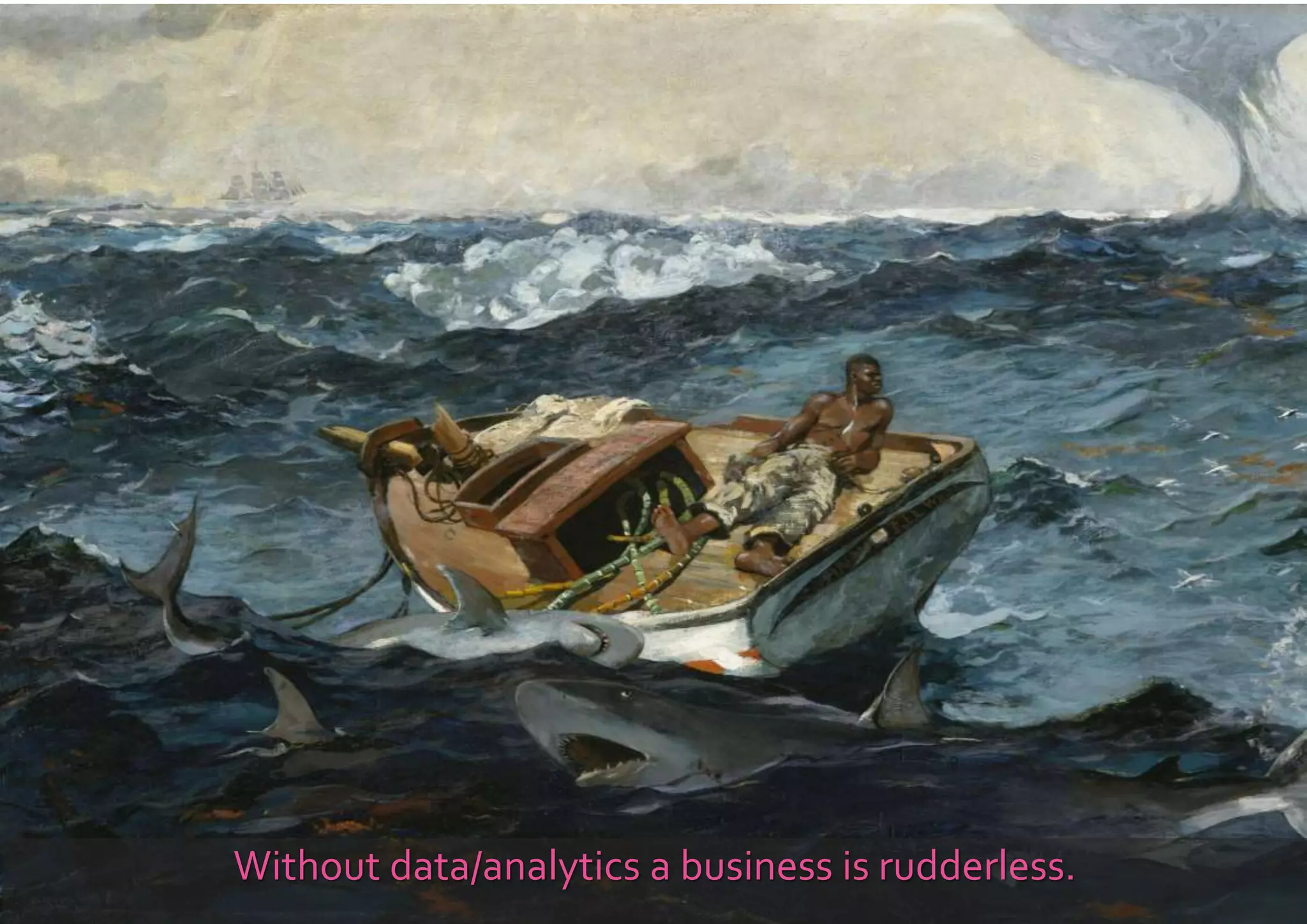
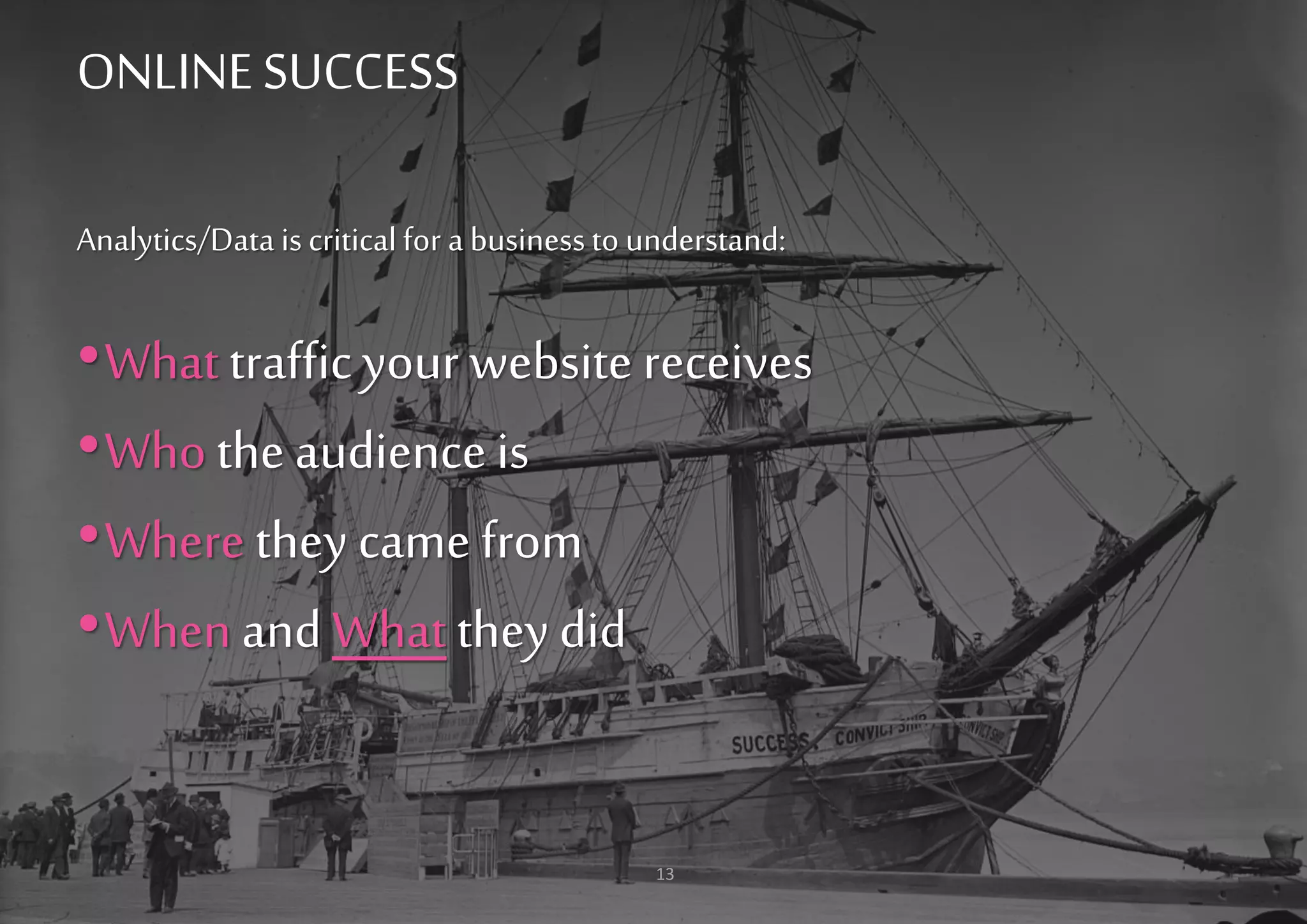
Without data/analytics a business is rudderless.
ONLINESUCCESS
Analytics/Data is criticalfor a business to understand:
•What trafficyour website receives
•Who the audience is
•Where they came from
•When and What they did
13
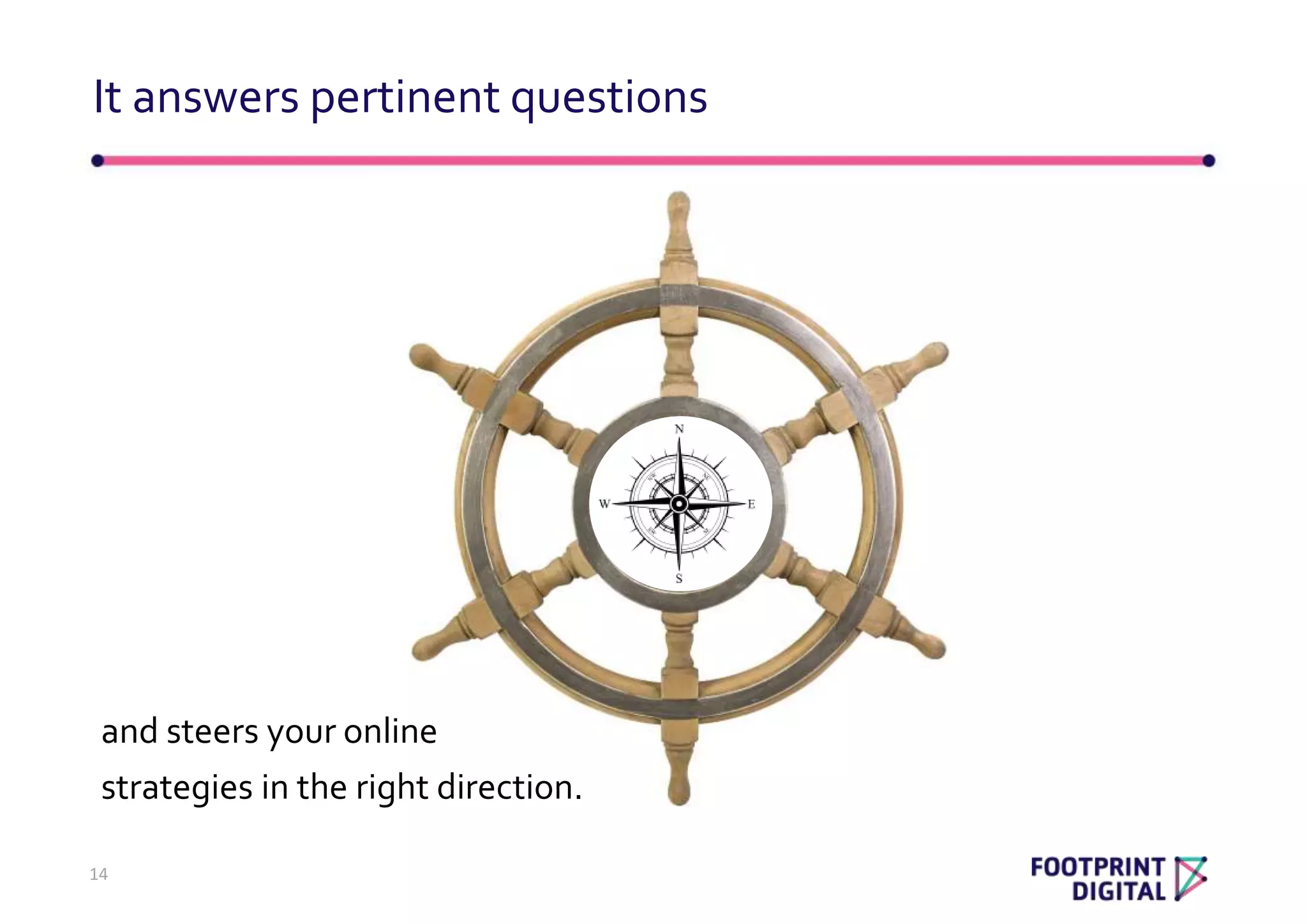
It answers pertinent questions
and steers your online
strategies in the right direction.
14
But data needs to be analysed and
have context in order to be turned into
actionable insights.
Making Sense of the data
15
The secret is in
tracking and looking at
the right things.
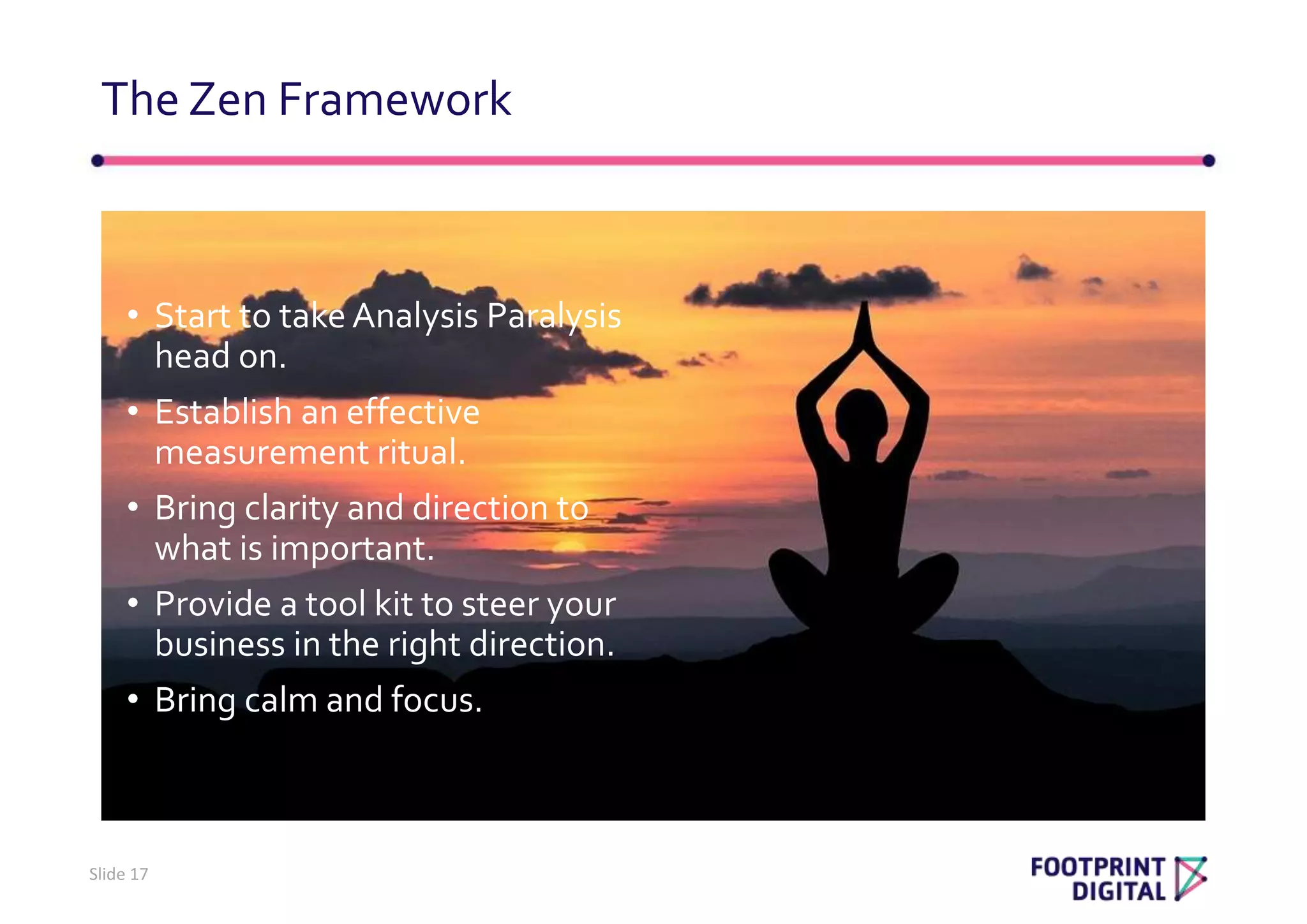
• Start to take Analysis Paralysis
head on.
• Establish an effective
measurement ritual.
• Bring clarity and direction to
what is important.
• Provide a tool kit to steer your
business in the right direction.
• Bring calm and focus.
The Zen Framework
Slide 17
Digital Marketing
Measurement Model
Tracking your way to success.
Slide 18
Words of wisdom…
Slide 19
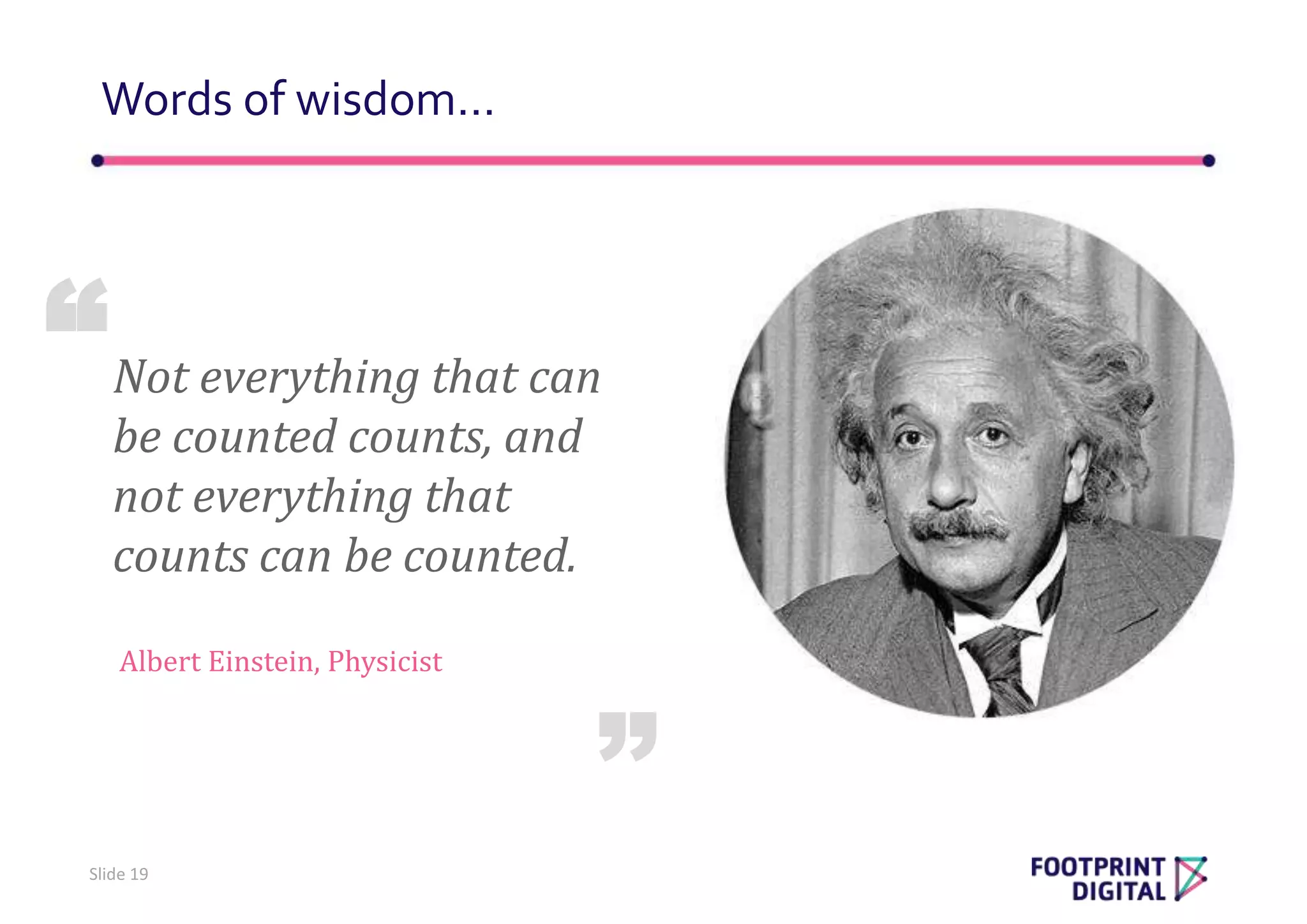
Not everything that can
be counted counts, and
not everything that
counts can be counted.
Albert Einstein, Physicist
“
”
is to tie in Google Analytics to actual
Business Objectives.
This helps businesses focus on what is important and answer the
questions of what is working and what isn’t.
And, where should I be spending my
precious time, energy and money
The ultimate objective
20
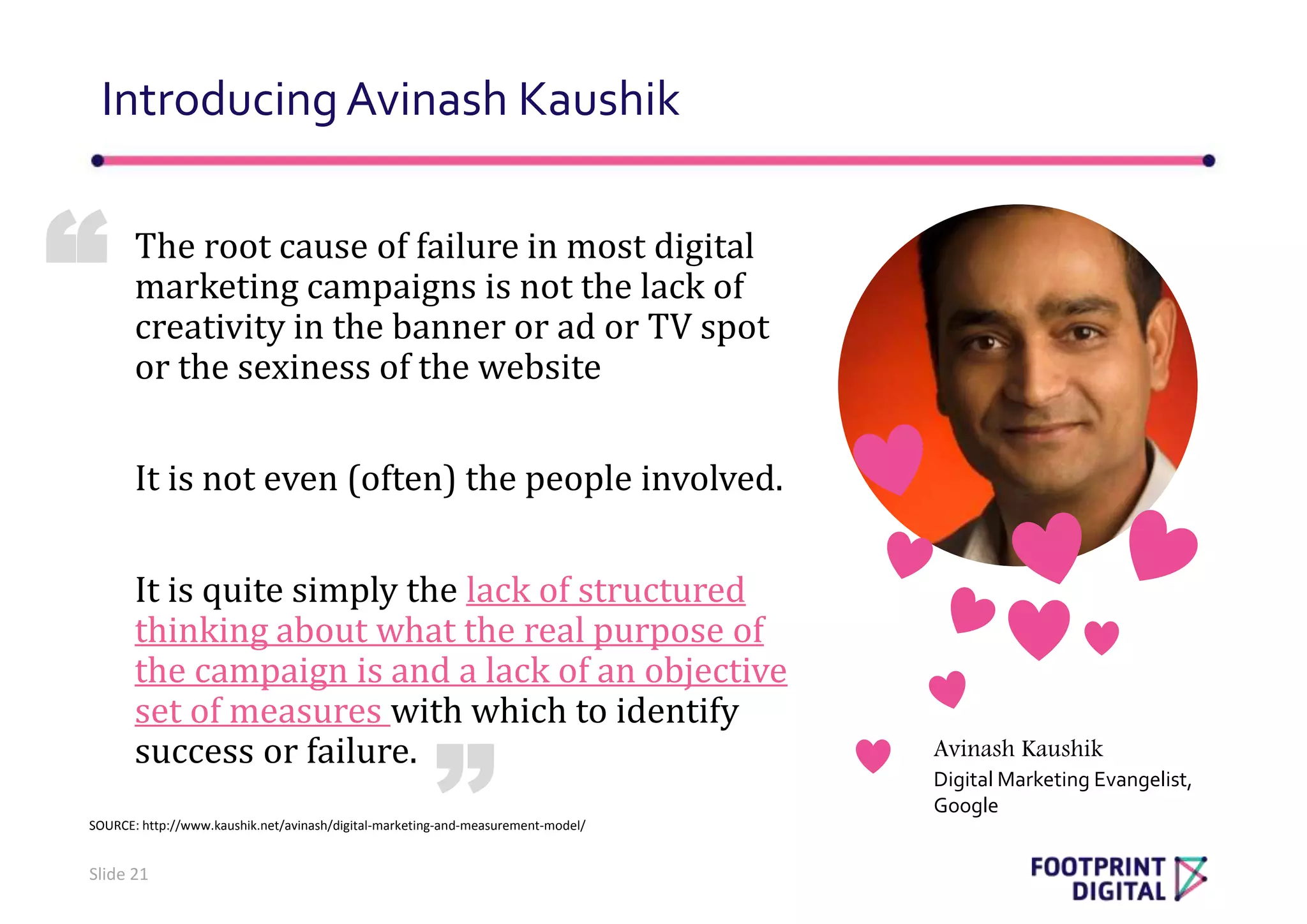
The root cause of failure in most digital
marketing campaigns is not the lack of
creativity in the banner or ad or TV spot
or the sexiness of the website
It is not even (often) the people involved.
It is quite simply the lack of structured
thinking about what the real purpose of
the campaign is and a lack of an objective
set of measures with which to identify
success or failure.
Introducing Avinash Kaushik
Slide 21
“
”
Avinash Kaushik
Digital Marketing Evangelist,
Google
SOURCE: http://www.kaushik.net/avinash/digital-marketing-and-measurement-model/
Avinash’s Measurement Model
Slide 22
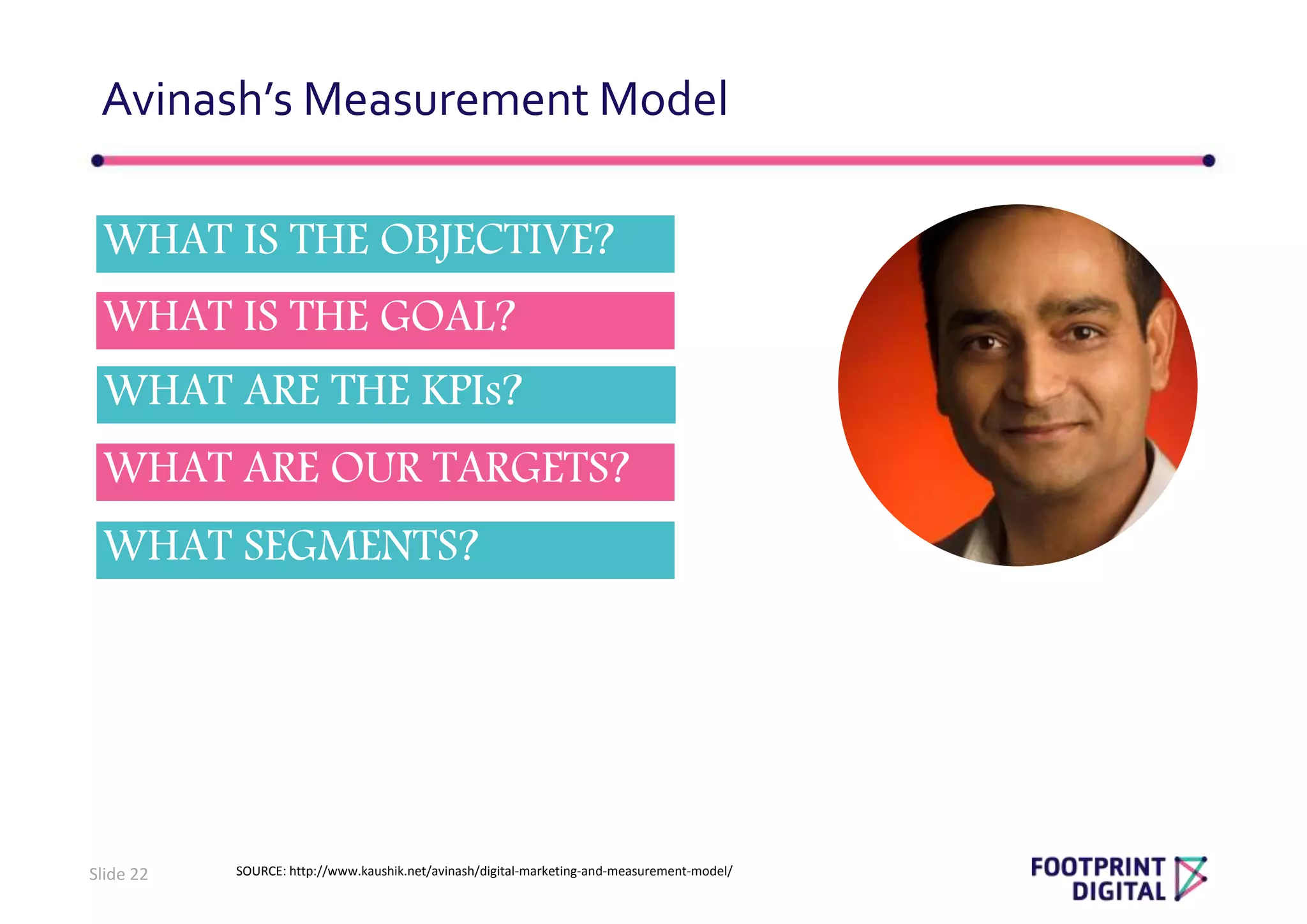
Step one is to force us to identify the business objectives upfront and set
the broadest parameters for the work we are doing. Sr. Executives play a
key role in this step.
Step two is to identify crisp goals for each business objective. Executives
lead the discussion, you’ll play a contributing role.
Step three is to write down the key performance indicators. You’ll lead the
work in this step, in partnership with a “data person” if you have one.
Step four is to set the parameters for success upfront by identifying targets
for each KPI. Organization leaders play a key role here, with input from
Marketing and Finance.
Step five, finally, is to identify the segments of people / behavior / outcomes
that we’ll analyze to understand why we succeed or failed.
SOURCE: http://www.kaushik.net/avinash/digital-marketing-and-measurement-model/
WHAT IS THE OBJECTIVE?
WHAT IS THE GOAL?
WHAT ARE THE KPIs?
WHAT ARE OUR TARGETS?
WHAT SEGMENTS?
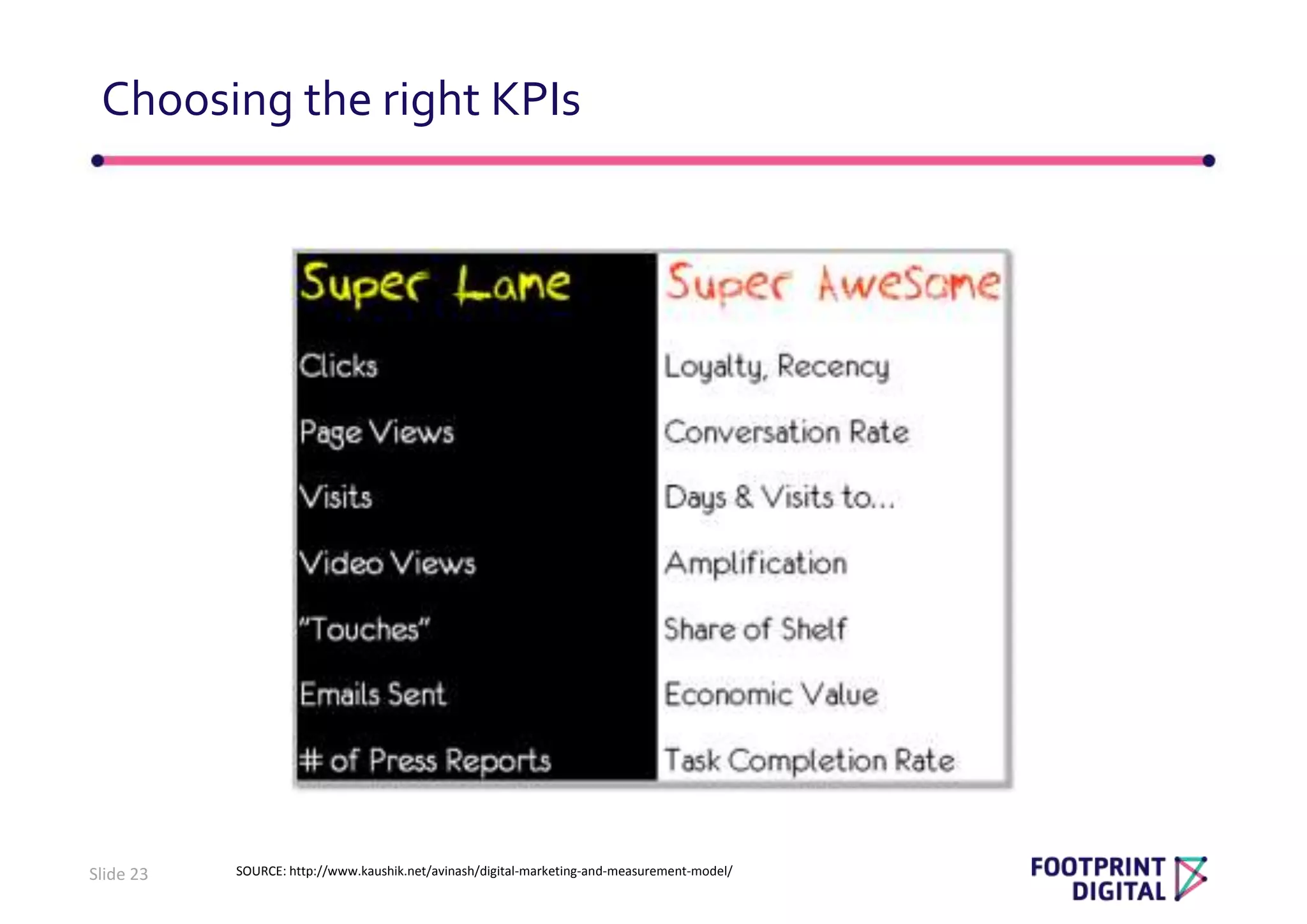
Choosing the right KPIs
Slide 23 SOURCE: http://www.kaushik.net/avinash/digital-marketing-and-measurement-model/
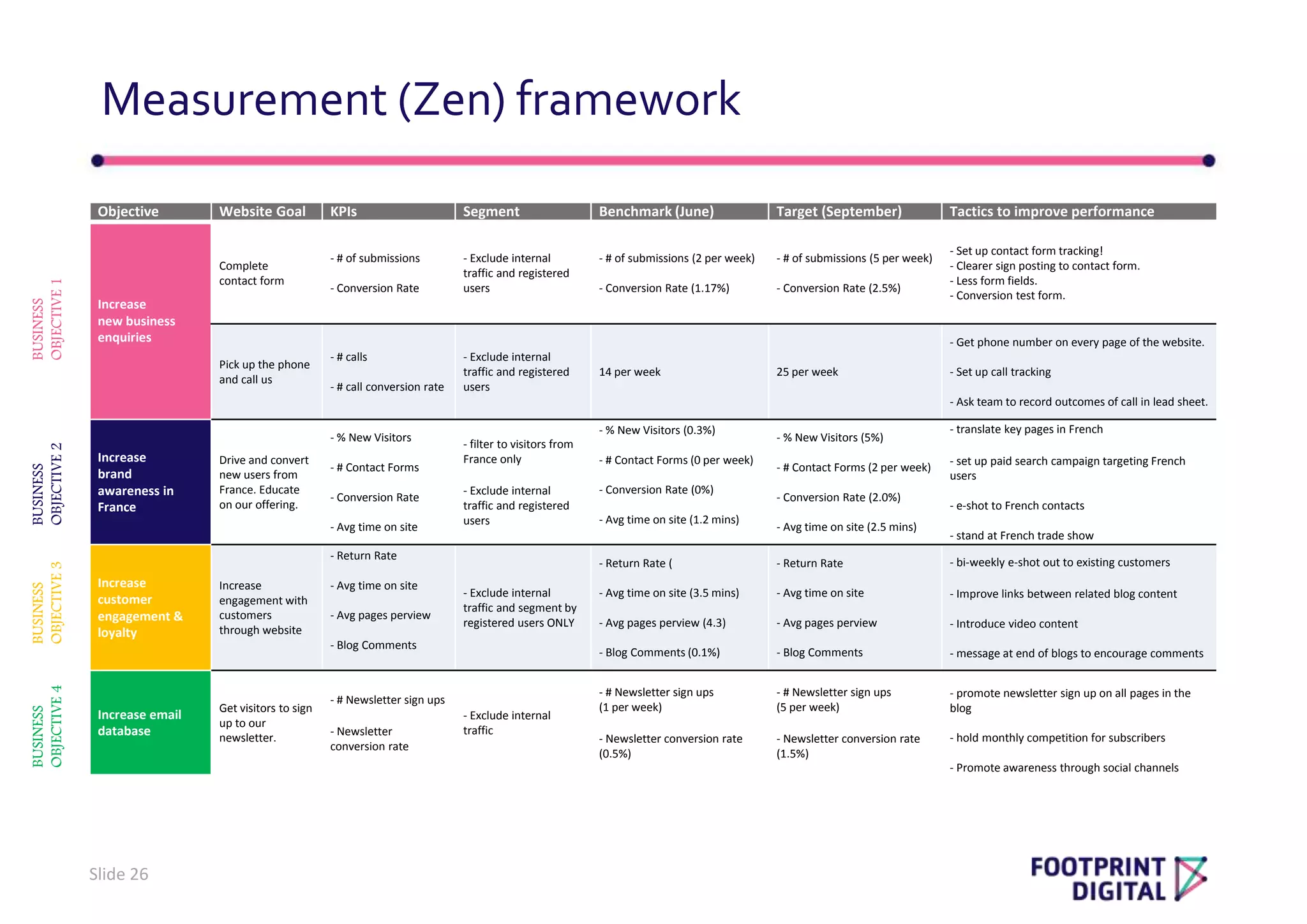
So what does this look like in practice?
Slide 24
Measurement (Zen) framework
Slide 26
Objective Website Goal KPIs Segment Benchmark (June) Target (September) Tactics to improve performance
Increase
new business
enquiries
Complete
contact form
- # of submissions
- Conversion Rate
- Exclude internal
traffic and registered
users
- # of submissions (2 per week)
- Conversion Rate (1.17%)
- # of submissions (5 per week)
- Conversion Rate (2.5%)
- Set up contact form tracking!
- Clearer sign posting to contact form.
- Less form fields.
- Conversion test form.
Pick up the phone
and call us
- # calls
- # call conversion rate
- Exclude internal
traffic and registered
users
14 per week 25 per week
- Get phone number on every page of the website.
- Set up call tracking
- Ask team to record outcomes of call in lead sheet.
Increase
brand
awareness in
France
Drive and convert
new users from
France. Educate
on our offering.
- % New Visitors
- # Contact Forms
- Conversion Rate
- Avg time on site
- filter to visitors from
France only
- Exclude internal
traffic and registered
users
- % New Visitors (0.3%)
- # Contact Forms (0 per week)
- Conversion Rate (0%)
- Avg time on site (1.2 mins)
- % New Visitors (5%)
- # Contact Forms (2 per week)
- Conversion Rate (2.0%)
- Avg time on site (2.5 mins)
- translate key pages in French
- set up paid search campaign targeting French
users
- e-shot to French contacts
- stand at French trade show
Increase
customer
engagement &
loyalty
Increase
engagement with
customers
through website
- Return Rate
- Avg time on site
- Avg pages perview
- Blog Comments
- Exclude internal
traffic and segment by
registered users ONLY
- Return Rate (
- Avg time on site (3.5 mins)
- Avg pages perview (4.3)
- Blog Comments (0.1%)
- Return Rate
- Avg time on site
- Avg pages perview
- Blog Comments
- bi-weekly e-shot out to existing customers
- Improve links between related blog content
- Introduce video content
- message at end of blogs to encourage comments
Increase email
database
Get visitors to sign
up to our
newsletter.
- # Newsletter sign ups
- Newsletter
conversion rate
- Exclude internal
traffic
- # Newsletter sign ups
(1 per week)
- Newsletter conversion rate
(0.5%)
- # Newsletter sign ups
(5 per week)
- Newsletter conversion rate
(1.5%)
- promote newsletter sign up on all pages in the
blog
- hold monthly competition for subscribers
- Promote awareness through social channels
BUSINESS
OBJECTIVE1
BUSINESS
OBJECTIVE2
BUSINESS
OBJECTIVE3
BUSINESS
OBJECTIVE4
Choosing the right metrics
What are the Core Marketing Measurements?
Slide 29
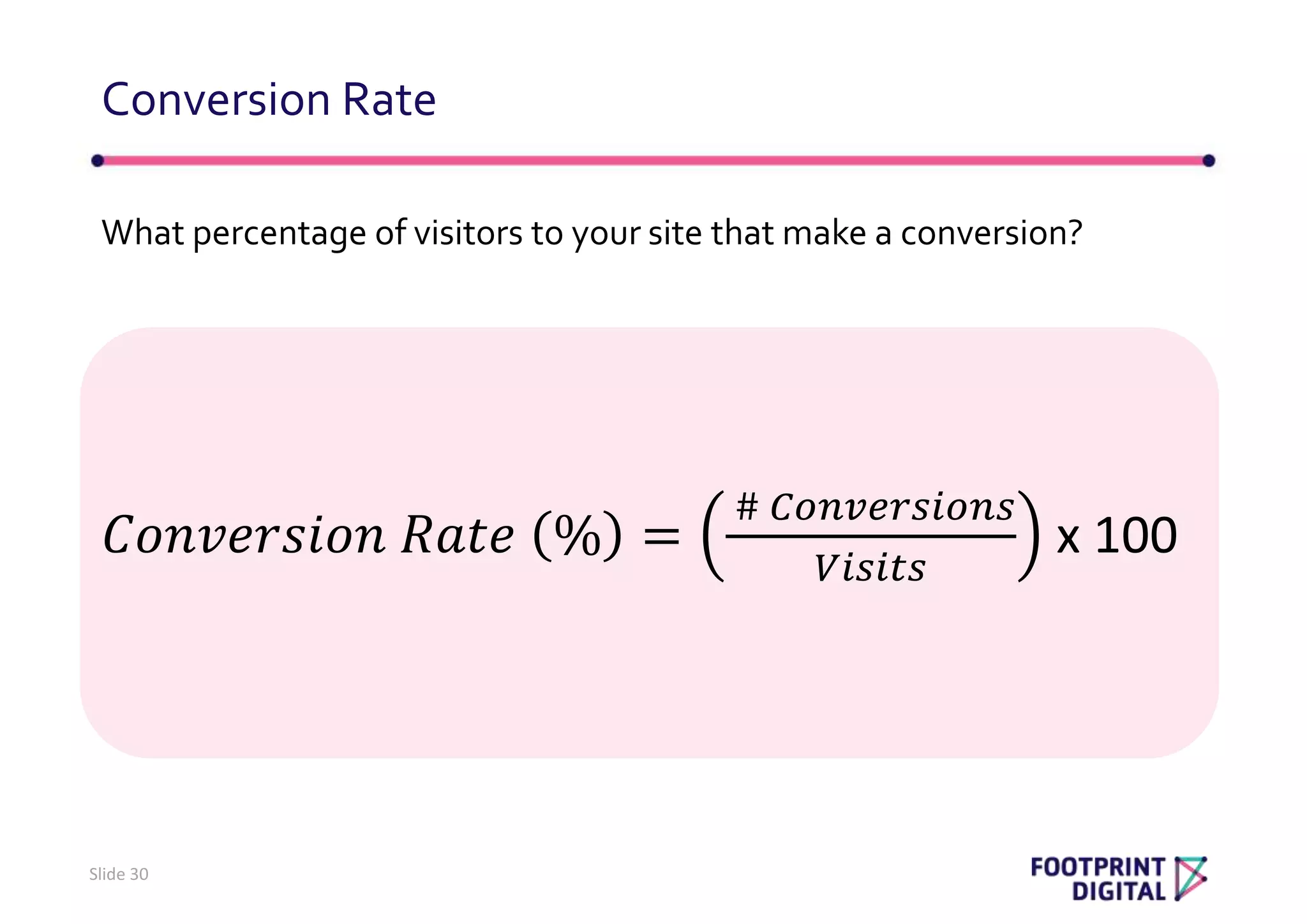
What percentage of visitors to your site that make a conversion?
Conversion Rate
Slide 30
𝐶𝑜𝑛𝑣𝑒𝑟𝑠𝑖𝑜𝑛 𝑅𝑎𝑡𝑒 % =
# 𝐶𝑜𝑛𝑣𝑒𝑟𝑠𝑖𝑜𝑛𝑠
𝑉𝑖𝑠𝑖𝑡𝑠
x 100
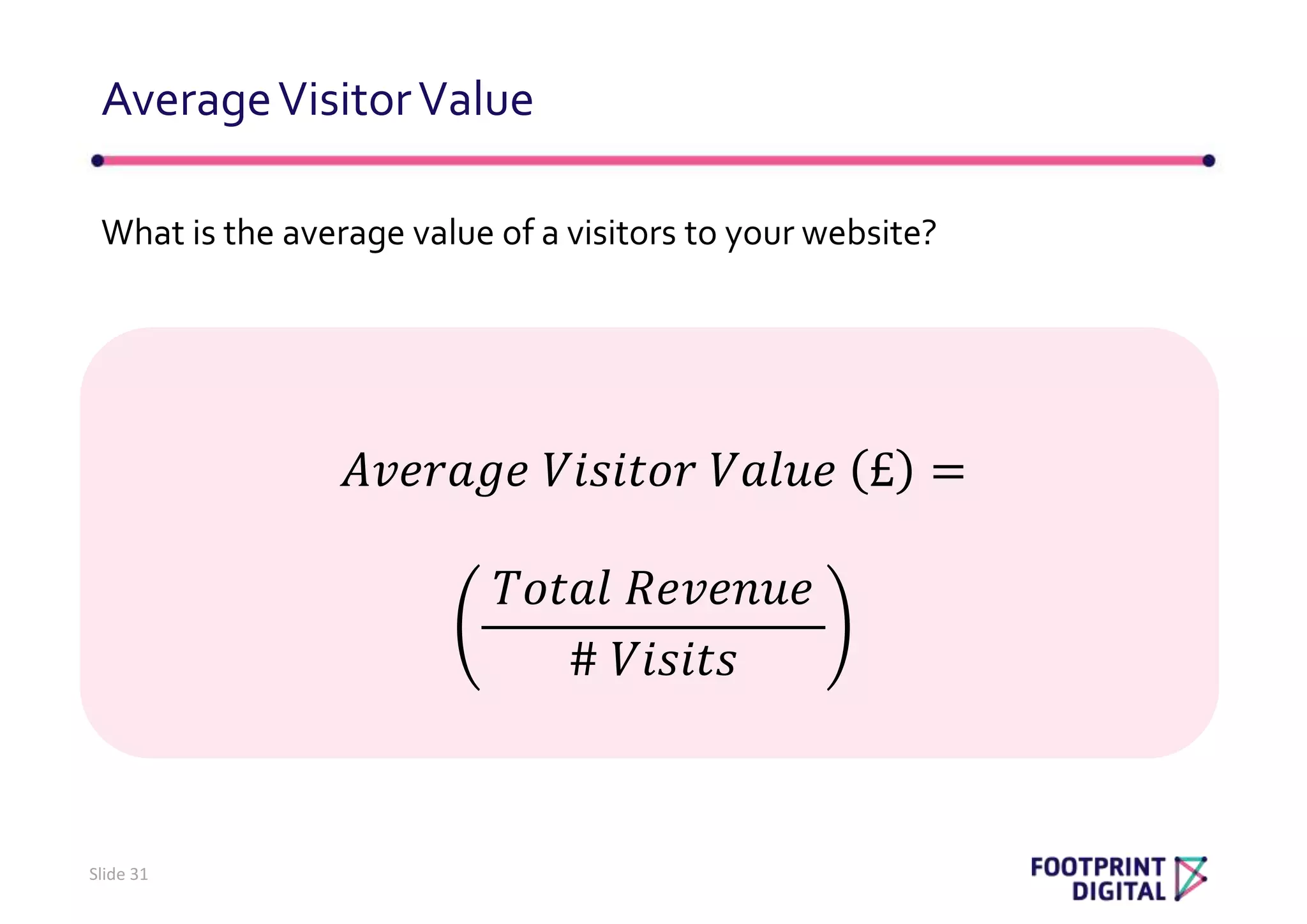
What is the average value of a visitors to your website?
AverageVisitorValue
Slide 31
𝐴𝑣𝑒𝑟𝑎𝑔𝑒 𝑉𝑖𝑠𝑖𝑡𝑜𝑟 𝑉𝑎𝑙𝑢𝑒 £ =
𝑇𝑜𝑡𝑎𝑙 𝑅𝑒𝑣𝑒𝑛𝑢𝑒
# 𝑉𝑖𝑠𝑖𝑡𝑠
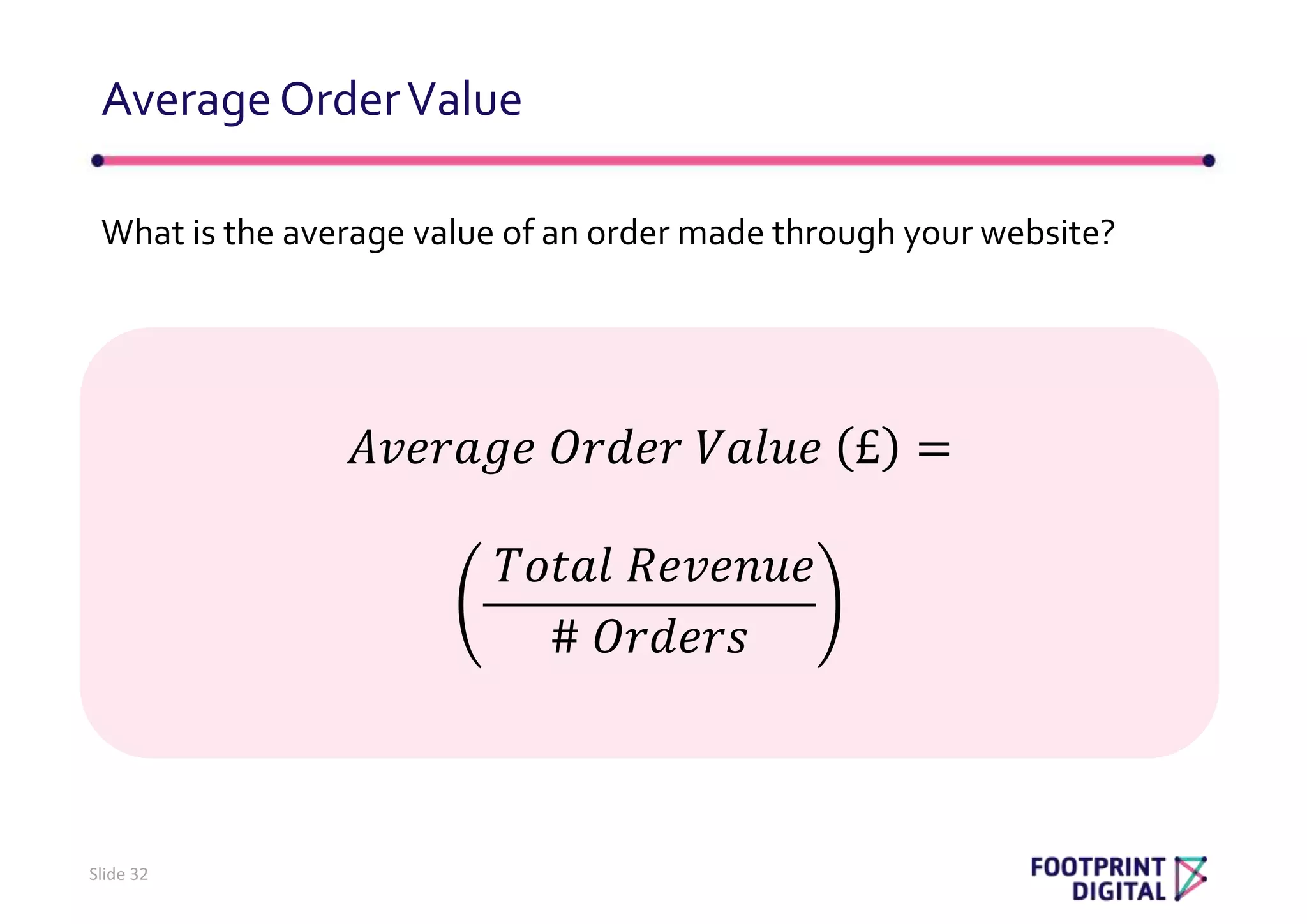
What is the average value of an order made through your website?
AverageOrderValue
Slide 32
𝐴𝑣𝑒𝑟𝑎𝑔𝑒 𝑂𝑟𝑑𝑒𝑟 𝑉𝑎𝑙𝑢𝑒 £ =
𝑇𝑜𝑡𝑎𝑙 𝑅𝑒𝑣𝑒𝑛𝑢𝑒
# 𝑂𝑟𝑑𝑒𝑟𝑠
How much you are spending for each person who makes a conversion?
Cost per Acquisition (CPA)
Slide 33
Cost Per Acquisition £ =
𝑇𝑜𝑡𝑎𝑙 𝐴𝑑 𝑆𝑝𝑒𝑛𝑑
𝑁𝑢𝑚𝑏𝑒𝑟 𝑜𝑓 𝐴𝑐𝑞𝑢𝑖𝑠𝑖𝑡𝑖𝑜𝑛𝑠
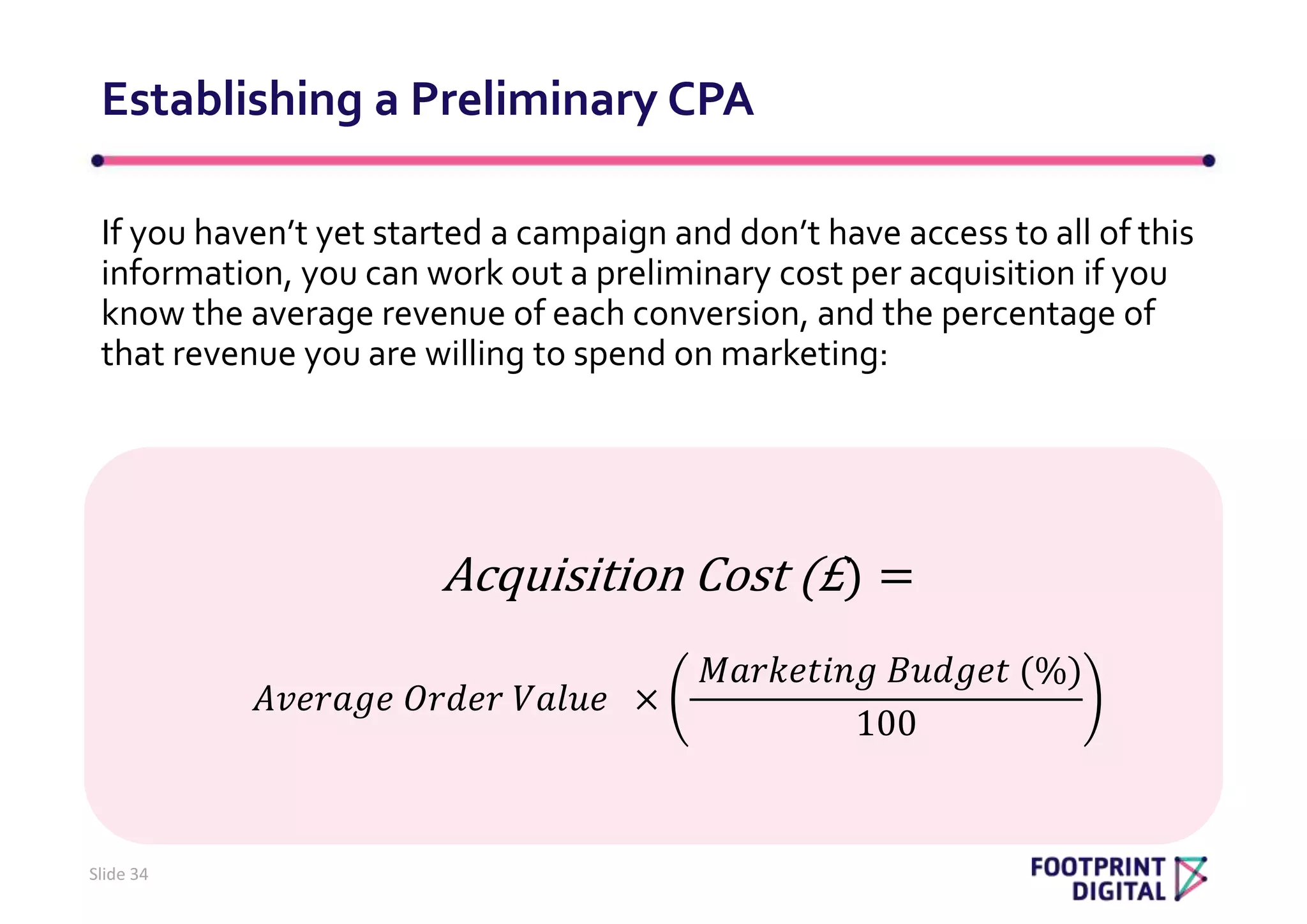
If you haven’t yet started a campaign and don’t have access to all of this
information, you can work out a preliminary cost per acquisition if you
know the average revenue of each conversion, and the percentage of
that revenue you are willing to spend on marketing:
Establishing a Preliminary CPA
Slide 34
Acquisition Cost (£) =
𝐴𝑣𝑒𝑟𝑎𝑔𝑒 𝑂𝑟𝑑𝑒𝑟 𝑉𝑎𝑙𝑢𝑒 ×
𝑀𝑎𝑟𝑘𝑒𝑡𝑖𝑛𝑔 𝐵𝑢𝑑𝑔𝑒𝑡 (%)
100
A percentage measure of how much revenue you are making compared
to your total outgoings (marketing and costs)
Return on Investment (ROI)
Slide 35
Return on Investment (%) =
𝑁𝑒𝑡 𝑃𝑟𝑜𝑓𝑖𝑡 𝑝𝑒𝑟 𝑂𝑟𝑑𝑒𝑟)
𝑇𝑜𝑡𝑎𝑙 𝑂𝑢𝑡𝑔𝑜𝑖𝑛𝑔𝑠
× 100
Let’s start building
your measurement framework
Practical Exercise
Slide 36
• How to structure your digital marketing department for success
• Auditing current performance
• Strategic Brand Communications & Brand Positioning
• Establishing a measurement framework
Summary
Slide 39
Employ a head chef, outsource the rest!
Perform a digital marketing audit to establish strengths & weaknesses.
Have a crystal clear understanding why you exist and who you serve.
Use the right metrics to steer your business in the right direction!
Slide 40
Let’s end the suffering
ThankYou!
Slide 41

Tracking your way to success

  • 1.
    Channel Planning &Trackingyour way to success Developing an online measurement and reporting framework
  • 2.
    Who here usesGoogle Analytics? Slide 2
  • 3.
    Slide 3 Do youever feel like this?
  • 4.
    Slide 4 Or perhapsthis? source: http://nymag.com/intelligencer/2015/04/man-executes-innocent-computer-in-alley.html
  • 5.
    There is sucha thing as too much data… I call it “Analysis Paralysis” and it’s a very real problem for businesses and individuals today. Slide 5
  • 6.
    Signs of AnalysisParalysis Symptoms to watch out for. Slide 6
  • 7.
    Condition: “The Emu” Slide7 Symptoms: A lack of knowledge, fear of data and lack the skills to harness it. Outcome: Head in sand. Noone monitoring. No insight gained.
  • 8.
    Condition: “The DeerZone” Slide 8 Symptoms: Totally overwhelmed by all the data available. Outcome: Action Paralysis. Unable to gain insight.
  • 9.
    Condition: “The RabbitHole” Slide 9 Symptoms: Thought he’d take a quick look Google Analytics. Found by wife or colleague 2 days later… Outcome: Wasted time, probably escaped with more questions than answers.
  • 10.
    Slide 10 Condition: “Blindas a Bat” Symptoms: Flies towards noise, hits wall and learns nothing. Outcome: Data Blindness. Chases the meaningless metrics or is focused on the wrong things.
  • 11.
    Seriously though…. Analysis Paralysiscan have a major impact on a business, and it has to stop! Here’s why. Slide 11
  • 12.
    Without data/analytics abusiness is rudderless.
  • 13.
    ONLINESUCCESS Analytics/Data is criticalfora business to understand: •What trafficyour website receives •Who the audience is •Where they came from •When and What they did 13
  • 14.
    It answers pertinentquestions and steers your online strategies in the right direction. 14
  • 15.
    But data needsto be analysed and have context in order to be turned into actionable insights. Making Sense of the data 15 The secret is in tracking and looking at the right things.
  • 16.
    • Start totake Analysis Paralysis head on. • Establish an effective measurement ritual. • Bring clarity and direction to what is important. • Provide a tool kit to steer your business in the right direction. • Bring calm and focus. The Zen Framework Slide 17
  • 17.
    Digital Marketing Measurement Model Trackingyour way to success. Slide 18
  • 18.
    Words of wisdom… Slide19 Not everything that can be counted counts, and not everything that counts can be counted. Albert Einstein, Physicist “ ”
  • 19.
    is to tiein Google Analytics to actual Business Objectives. This helps businesses focus on what is important and answer the questions of what is working and what isn’t. And, where should I be spending my precious time, energy and money The ultimate objective 20
  • 20.
    The root causeof failure in most digital marketing campaigns is not the lack of creativity in the banner or ad or TV spot or the sexiness of the website It is not even (often) the people involved. It is quite simply the lack of structured thinking about what the real purpose of the campaign is and a lack of an objective set of measures with which to identify success or failure. Introducing Avinash Kaushik Slide 21 “ ” Avinash Kaushik Digital Marketing Evangelist, Google SOURCE: http://www.kaushik.net/avinash/digital-marketing-and-measurement-model/
  • 21.
    Avinash’s Measurement Model Slide22 Step one is to force us to identify the business objectives upfront and set the broadest parameters for the work we are doing. Sr. Executives play a key role in this step. Step two is to identify crisp goals for each business objective. Executives lead the discussion, you’ll play a contributing role. Step three is to write down the key performance indicators. You’ll lead the work in this step, in partnership with a “data person” if you have one. Step four is to set the parameters for success upfront by identifying targets for each KPI. Organization leaders play a key role here, with input from Marketing and Finance. Step five, finally, is to identify the segments of people / behavior / outcomes that we’ll analyze to understand why we succeed or failed. SOURCE: http://www.kaushik.net/avinash/digital-marketing-and-measurement-model/ WHAT IS THE OBJECTIVE? WHAT IS THE GOAL? WHAT ARE THE KPIs? WHAT ARE OUR TARGETS? WHAT SEGMENTS?
  • 22.
    Choosing the rightKPIs Slide 23 SOURCE: http://www.kaushik.net/avinash/digital-marketing-and-measurement-model/
  • 23.
    So what doesthis look like in practice? Slide 24
  • 24.
    Measurement (Zen) framework Slide26 Objective Website Goal KPIs Segment Benchmark (June) Target (September) Tactics to improve performance Increase new business enquiries Complete contact form - # of submissions - Conversion Rate - Exclude internal traffic and registered users - # of submissions (2 per week) - Conversion Rate (1.17%) - # of submissions (5 per week) - Conversion Rate (2.5%) - Set up contact form tracking! - Clearer sign posting to contact form. - Less form fields. - Conversion test form. Pick up the phone and call us - # calls - # call conversion rate - Exclude internal traffic and registered users 14 per week 25 per week - Get phone number on every page of the website. - Set up call tracking - Ask team to record outcomes of call in lead sheet. Increase brand awareness in France Drive and convert new users from France. Educate on our offering. - % New Visitors - # Contact Forms - Conversion Rate - Avg time on site - filter to visitors from France only - Exclude internal traffic and registered users - % New Visitors (0.3%) - # Contact Forms (0 per week) - Conversion Rate (0%) - Avg time on site (1.2 mins) - % New Visitors (5%) - # Contact Forms (2 per week) - Conversion Rate (2.0%) - Avg time on site (2.5 mins) - translate key pages in French - set up paid search campaign targeting French users - e-shot to French contacts - stand at French trade show Increase customer engagement & loyalty Increase engagement with customers through website - Return Rate - Avg time on site - Avg pages perview - Blog Comments - Exclude internal traffic and segment by registered users ONLY - Return Rate ( - Avg time on site (3.5 mins) - Avg pages perview (4.3) - Blog Comments (0.1%) - Return Rate - Avg time on site - Avg pages perview - Blog Comments - bi-weekly e-shot out to existing customers - Improve links between related blog content - Introduce video content - message at end of blogs to encourage comments Increase email database Get visitors to sign up to our newsletter. - # Newsletter sign ups - Newsletter conversion rate - Exclude internal traffic - # Newsletter sign ups (1 per week) - Newsletter conversion rate (0.5%) - # Newsletter sign ups (5 per week) - Newsletter conversion rate (1.5%) - promote newsletter sign up on all pages in the blog - hold monthly competition for subscribers - Promote awareness through social channels BUSINESS OBJECTIVE1 BUSINESS OBJECTIVE2 BUSINESS OBJECTIVE3 BUSINESS OBJECTIVE4
  • 25.
    Choosing the rightmetrics What are the Core Marketing Measurements? Slide 29
  • 26.
    What percentage ofvisitors to your site that make a conversion? Conversion Rate Slide 30 𝐶𝑜𝑛𝑣𝑒𝑟𝑠𝑖𝑜𝑛 𝑅𝑎𝑡𝑒 % = # 𝐶𝑜𝑛𝑣𝑒𝑟𝑠𝑖𝑜𝑛𝑠 𝑉𝑖𝑠𝑖𝑡𝑠 x 100
  • 27.
    What is theaverage value of a visitors to your website? AverageVisitorValue Slide 31 𝐴𝑣𝑒𝑟𝑎𝑔𝑒 𝑉𝑖𝑠𝑖𝑡𝑜𝑟 𝑉𝑎𝑙𝑢𝑒 £ = 𝑇𝑜𝑡𝑎𝑙 𝑅𝑒𝑣𝑒𝑛𝑢𝑒 # 𝑉𝑖𝑠𝑖𝑡𝑠
  • 28.
    What is theaverage value of an order made through your website? AverageOrderValue Slide 32 𝐴𝑣𝑒𝑟𝑎𝑔𝑒 𝑂𝑟𝑑𝑒𝑟 𝑉𝑎𝑙𝑢𝑒 £ = 𝑇𝑜𝑡𝑎𝑙 𝑅𝑒𝑣𝑒𝑛𝑢𝑒 # 𝑂𝑟𝑑𝑒𝑟𝑠
  • 29.
    How much youare spending for each person who makes a conversion? Cost per Acquisition (CPA) Slide 33 Cost Per Acquisition £ = 𝑇𝑜𝑡𝑎𝑙 𝐴𝑑 𝑆𝑝𝑒𝑛𝑑 𝑁𝑢𝑚𝑏𝑒𝑟 𝑜𝑓 𝐴𝑐𝑞𝑢𝑖𝑠𝑖𝑡𝑖𝑜𝑛𝑠
  • 30.
    If you haven’tyet started a campaign and don’t have access to all of this information, you can work out a preliminary cost per acquisition if you know the average revenue of each conversion, and the percentage of that revenue you are willing to spend on marketing: Establishing a Preliminary CPA Slide 34 Acquisition Cost (£) = 𝐴𝑣𝑒𝑟𝑎𝑔𝑒 𝑂𝑟𝑑𝑒𝑟 𝑉𝑎𝑙𝑢𝑒 × 𝑀𝑎𝑟𝑘𝑒𝑡𝑖𝑛𝑔 𝐵𝑢𝑑𝑔𝑒𝑡 (%) 100
  • 31.
    A percentage measureof how much revenue you are making compared to your total outgoings (marketing and costs) Return on Investment (ROI) Slide 35 Return on Investment (%) = 𝑁𝑒𝑡 𝑃𝑟𝑜𝑓𝑖𝑡 𝑝𝑒𝑟 𝑂𝑟𝑑𝑒𝑟) 𝑇𝑜𝑡𝑎𝑙 𝑂𝑢𝑡𝑔𝑜𝑖𝑛𝑔𝑠 × 100
  • 32.
    Let’s start building yourmeasurement framework Practical Exercise Slide 36
  • 33.
    • How tostructure your digital marketing department for success • Auditing current performance • Strategic Brand Communications & Brand Positioning • Establishing a measurement framework Summary Slide 39 Employ a head chef, outsource the rest! Perform a digital marketing audit to establish strengths & weaknesses. Have a crystal clear understanding why you exist and who you serve. Use the right metrics to steer your business in the right direction!
  • 34.
    Slide 40 Let’s endthe suffering
  • 35.