SECONDQUARTER10
THETERRITORY PRESENTS
at the Shanghai Expo
p3
The great gas shutdown 4
Selling Territory mining and supply 8
Splendour on the wetland 14
The consul speaks 18
Future food 20
Welcoming the Indonesian Minister 21
The Territory presents at Shanghai 22
AIG – the Indigenous entrepreneur 24
Captovate – the internet innovators 26
Heifer tracks 29
Rediscovering heritage 32
The original Osbornes 34
The Katherine workover 36
Harold Thomas in the mall 38
Foxy fashion by Anne Hanning 40
The Indigenous Music Awards go national 42
Remote area cater caring 44
Discovering Territory B&Bs 46
New Melanka development for Alice Springs 50
Growing Top End golf 52
REGULAR FEATURES:
Tall Poppy: Barry Coulter—grow, show, make or mine 12
Innovation NT: Seeing is learning 54
Fast Facts: The Territory economy 51
Paddock to Plate: Going for gold 56
Parting Shots! 58
p3
Acknowledgements
Territory Q is published by the
Department of the Chief Minister,
Northern Territory Government. Correspondence
should be directed to
the Department of the Chief Minister, Major
Projects, Asian Relations and Trade,
GPO Box 4396,
Darwin, NT 0801,
Australia
Telephone 08 8999 7171
Email majorprojects.info@nt.gov.au
Writers
Dennis Schulz
Sam McCue
Tess Nekrasov
Photographics
Dennis Schulz
ConocoPhillips
Australian Department of Foreign Affairs and Trade
AIG
Warlukurlangu Artists
Anthology
Captovate
Tourism NT
Bryan Seears
Blueprint Architects
Vergnet
Integrated Metal Services
Kooey
MusicNT
Italk
OFH
Ray Whear
Neil Almond
Nomad Tours
Design/layout
Adzu, Darwin
© Northern Territory Government 2010
While all reasonable efforts have been made to ensure
that the information contained in this publication is
correct, the information covered is subject to change.
The Northern Territory Government does not assume and
hereby disclaims any express or implied liability whatsoever
to any party for any loss or damage caused by errors
or omissions, whether these errors or omissions result
from negligence, accident or any other cause. Opinions
expressed in Territory Q do not necessarily reflect those of
the Northern Territory Government. Requests and inquiries
concerning reproduction and rights should be addressed
to the Strategic Communications Department of the
Chief Minister, Northern Territory Government. All images
appearing in Territory Q are protected by copyright.
The Northern Territory Government respects
Indigenous cultures and has attempted to
ensure no material has been included in
Territory Q that is offensive to Aboriginal and
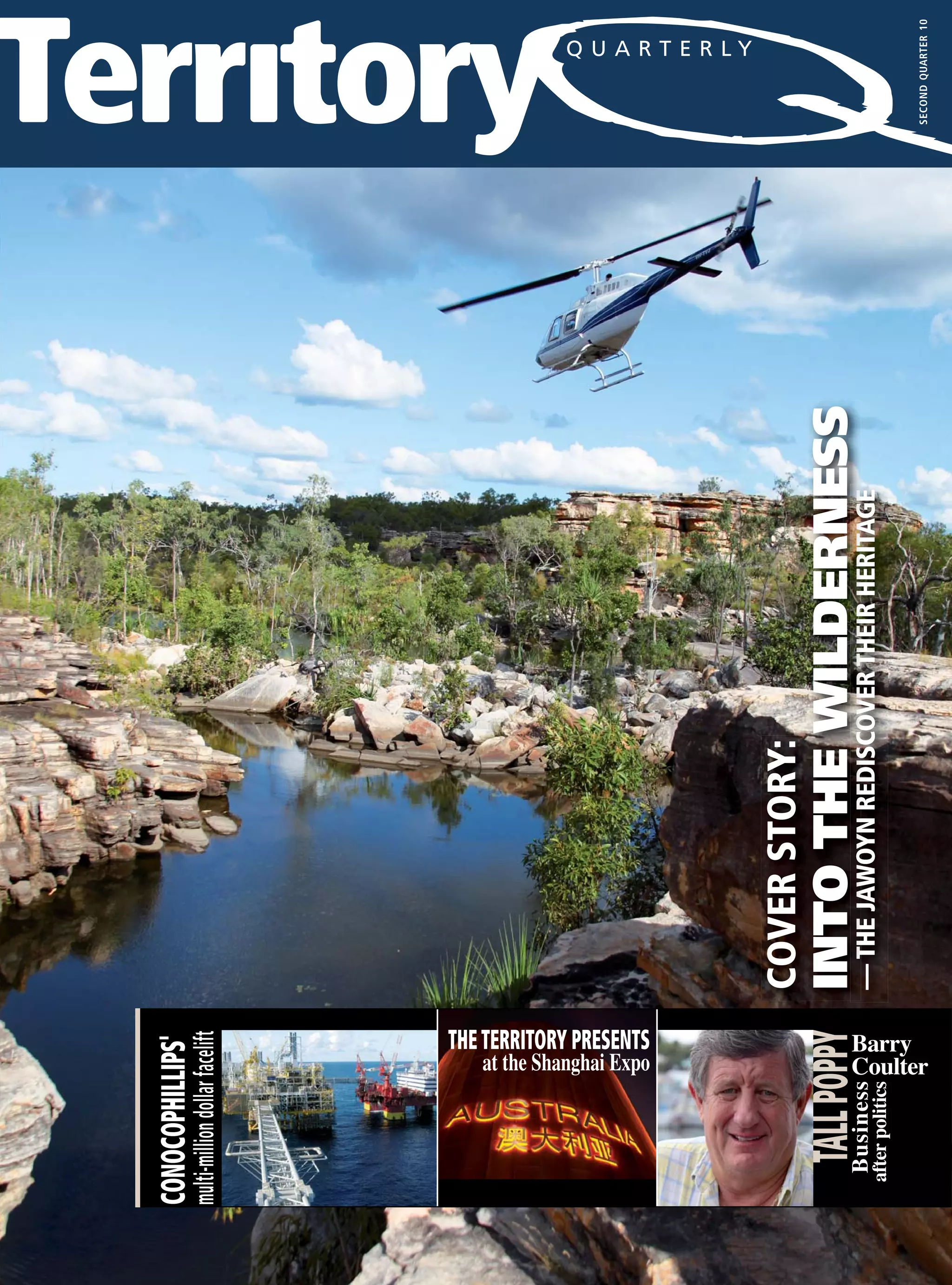
Torres Strait Islander peoples. Cover > Photo by Dennis Schulz in southern Arnhem Land.
Welcome to the
second quarter
edition of Territory Q
for 2010.
Territory Q promotes business and investment
opportunities across the Territory by profiling
the people and organisations that make the
economy work. The magazine connects us
with national and international audiences,
while keeping Territorians informed about
what’s happening in our own backyard.
Our lead story in this issue takes us out to
sea to the Bayu-Undan gas platform where
hundreds of highly skilled tradespeople have
been involved in a shutdown of the facility,
as it underwent a massive multi-million
dollar maintenance regime.
Then we’re off to the Shanghai Expo, where
the Territory Government plans to showcase
its talent and industries at the spectacular
$83 million Australian Pavilion.
Territory Q carries a message that has never
been clearer: the Northern Territory is a
great place to live and make a living—and
a place of unlimited opportunity.
Paul Henderson
Chief Minister of the Northern Territory
Climbing up the flat stones, Aboriginal traditional owner Sybil Ranch enters the
sandstone rock shelter, and calls out in her Jawoyn language, announcing our arrival.
It is a message to her ancestors and the spirits that inhabit this remarkable shelter,
telling them she’s brought a whitefella along to have a look at the bim (rock art).
She seeks their approval and protection.
I enter behind Ranch and in front of
the elder traditional owner Margaret
Katherine. The shelter is geologically
unique featuring pillar-like structures
supporting a heavy stone ceiling that
is covered in layers of Indigenous rock
art. Faded ages-old red ochre paintings
are covered by newer white and yellow
ochre works. X-ray depictions of giant
barramundi and saratoga fish are
painted along with kangaroos and
haunting spirit figures.
Until just a few years ago, Ranch, Margaret
and their Buhymi clan group didn't know
this magnificent southern Arnhem Land
site existed. They were brought here by the
Ray Whear, the cultural and environmental
manager of the Jawoyn Association and
pilot Chris Morgan, who rediscovered the
remote site by helicopter. “When we first
came here there were tears of joy and tears
of sadness,” recalls Ranch. “Why didn’t we
find this place earlier? We didn’t know
about this place. When this old lady
[Margaret Katherine] called out to the
spirits in Jawoyn, we felt their presence
surrounding us. Hugging us close.”
They call this extraordinary site
Nawarla Gabarnmung in Jawoyn. Since
it was rediscovered, an Aboriginal elder
with great cultural knowledge (whose
name cannot be published following his
recent death) was brought to the site.
He remembered visiting the shelter as a
boy, participating in ceremonies nearby,
and being told its name and which clan
traditionally looked after this place. “Old
people tell us this is Buhymi clan land,”
explains Katherine. “It has been from
generation to generation. And the elders
were here when they were young and
were told by the old people in that time so
the next generation would know about it.”
The Jawoyn speaking people of this region
are now rediscovering their heritage. Their
ancestors left this rugged savanna country
generations ago, and cultural knowledge
of the area faded from the collective
memory as the years passed. Then the
Jawoyn Association, the representative
body of the many clans that inhabit the
area from the southern edge of Kakadu
National Park through southern Arnhem
Land, began revisiting this unpopulated
region by helicopter due to the absence of
roads. Because it is an expensive mode of
travel, many activities are shared in each
trip. Whear will take an automatic rifle
along to shoot feral animals that damage
rock art sites, and will take Jawoyn Rangers
along to do large scale fire management.
Federally funded by the Indigenous
Heritage Program, the rediscovery efforts
are already paying dividends. The intrepid
chopper explorers have rediscovered over
4000 complexes of rock art sites in the
region. They have found a remarkable
array of art including depictions of top-
hatted Europeans in their sailing ships
and Makassans sailing traditional praus.
A painting of the giant flightless
Genyornis could be one of the world’s
oldest works of art. The bird became
extinct at least 40,000 years ago with the
coming of humans to Australia.
Not only are the Aboriginal people of
the region learning a great deal about
their cultural heritage, but international
science has taken a strong interest, and
our knowledge of the pre-contact history
of Australia will soon be expanded.
Archaeologist Bruno David from
Monash University and Professor
Jean-Michel Geneste from France have
recently excavated the floor of the
Nawarla Gabarnung site. A French film
crew documented the dig, which will
produce dating results by the year’s end.
The traditional owners and the Jawoyn
Association know that tourists will be
keen to experience this wild region. Not
only are there a myriad of ancient rock
art sites to visit, but there are spectacular
waterfall-laden gorges featuring deep
clear pools of freshwater. It would be
a high end tourism venture with visitor
access restricted to three in a helicopter.
“If the traditional owners are interested,
we will get the right scientists to prepare
plans of management for tourism and
present the pros and cons to them. Then
it’s up to them to decide,” says Whear.
What do the traditional owners think?
“Tourists can come with a traditional
owner guide,” says Ranch. “We don’t
want it like Kakadu. Just a few people.
Just bring them up and show them the
beautiful paintings of the Buhymi clan.”
“When we first came here there were tears of joy and
tears of sadness. Why didn’t we find this place earlier?
We didn’t know about this place.”
p32 p33
Top left image > An isolated gorge
in southern Arnhem Land.
Middle left image > A rock painting of the giant,
extinct flightless bird Genyornis could be the
world’s oldest existing art work.
Bottom left image > A depiction of a Makassan prau.
Middle image > Traditional owner
Margaret Katherine admires a giant barramundi
painting at the Nawarla Gabarnmung site.
Right image > A female spirit figure looms overhead.
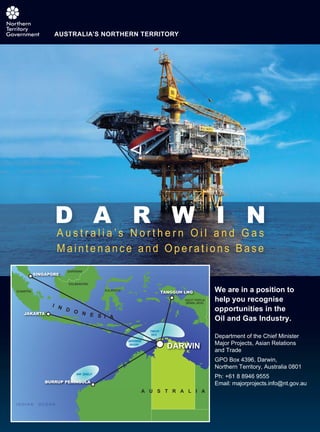
A u s t r a l i a ’ s N o r t h e r n O i l a n d G a s
M a i n t e n a n c e a n d O p e r a t i o n s B a s e
A u s t r a l i a ’ s N o r t h e r n O i l a n d G a s
D A R W I N
AUSTRALIA’S NORTHERN TERRITORY
We are in a position to
help you recognise
opportunities in the
Oil and Gas Industry.
Department of the Chief Minister
Major Projects, Asian Relations
and Trade
GPO Box 4396, Darwin,
Northern Territory, Australia 0801
Ph: +61 8 8946 9555
Email: majorprojects.info@nt.gov.au

TQ-2010

  • 1.
  • 2.
    p3 The great gasshutdown 4 Selling Territory mining and supply 8 Splendour on the wetland 14 The consul speaks 18 Future food 20 Welcoming the Indonesian Minister 21 The Territory presents at Shanghai 22 AIG – the Indigenous entrepreneur 24 Captovate – the internet innovators 26 Heifer tracks 29 Rediscovering heritage 32 The original Osbornes 34 The Katherine workover 36 Harold Thomas in the mall 38 Foxy fashion by Anne Hanning 40 The Indigenous Music Awards go national 42 Remote area cater caring 44 Discovering Territory B&Bs 46 New Melanka development for Alice Springs 50 Growing Top End golf 52 REGULAR FEATURES: Tall Poppy: Barry Coulter—grow, show, make or mine 12 Innovation NT: Seeing is learning 54 Fast Facts: The Territory economy 51 Paddock to Plate: Going for gold 56 Parting Shots! 58 p3 Acknowledgements Territory Q is published by the Department of the Chief Minister, Northern Territory Government. Correspondence should be directed to the Department of the Chief Minister, Major Projects, Asian Relations and Trade, GPO Box 4396, Darwin, NT 0801, Australia Telephone 08 8999 7171 Email majorprojects.info@nt.gov.au Writers Dennis Schulz Sam McCue Tess Nekrasov Photographics Dennis Schulz ConocoPhillips Australian Department of Foreign Affairs and Trade AIG Warlukurlangu Artists Anthology Captovate Tourism NT Bryan Seears Blueprint Architects Vergnet Integrated Metal Services Kooey MusicNT Italk OFH Ray Whear Neil Almond Nomad Tours Design/layout Adzu, Darwin © Northern Territory Government 2010 While all reasonable efforts have been made to ensure that the information contained in this publication is correct, the information covered is subject to change. The Northern Territory Government does not assume and hereby disclaims any express or implied liability whatsoever to any party for any loss or damage caused by errors or omissions, whether these errors or omissions result from negligence, accident or any other cause. Opinions expressed in Territory Q do not necessarily reflect those of the Northern Territory Government. Requests and inquiries concerning reproduction and rights should be addressed to the Strategic Communications Department of the Chief Minister, Northern Territory Government. All images appearing in Territory Q are protected by copyright. The Northern Territory Government respects Indigenous cultures and has attempted to ensure no material has been included in Territory Q that is offensive to Aboriginal and Torres Strait Islander peoples. Cover > Photo by Dennis Schulz in southern Arnhem Land. Welcome to the second quarter edition of Territory Q for 2010. Territory Q promotes business and investment opportunities across the Territory by profiling the people and organisations that make the economy work. The magazine connects us with national and international audiences, while keeping Territorians informed about what’s happening in our own backyard. Our lead story in this issue takes us out to sea to the Bayu-Undan gas platform where hundreds of highly skilled tradespeople have been involved in a shutdown of the facility, as it underwent a massive multi-million dollar maintenance regime. Then we’re off to the Shanghai Expo, where the Territory Government plans to showcase its talent and industries at the spectacular $83 million Australian Pavilion. Territory Q carries a message that has never been clearer: the Northern Territory is a great place to live and make a living—and a place of unlimited opportunity. Paul Henderson Chief Minister of the Northern Territory
  • 3.
    Climbing up theflat stones, Aboriginal traditional owner Sybil Ranch enters the sandstone rock shelter, and calls out in her Jawoyn language, announcing our arrival. It is a message to her ancestors and the spirits that inhabit this remarkable shelter, telling them she’s brought a whitefella along to have a look at the bim (rock art). She seeks their approval and protection. I enter behind Ranch and in front of the elder traditional owner Margaret Katherine. The shelter is geologically unique featuring pillar-like structures supporting a heavy stone ceiling that is covered in layers of Indigenous rock art. Faded ages-old red ochre paintings are covered by newer white and yellow ochre works. X-ray depictions of giant barramundi and saratoga fish are painted along with kangaroos and haunting spirit figures. Until just a few years ago, Ranch, Margaret and their Buhymi clan group didn't know this magnificent southern Arnhem Land site existed. They were brought here by the Ray Whear, the cultural and environmental manager of the Jawoyn Association and pilot Chris Morgan, who rediscovered the remote site by helicopter. “When we first came here there were tears of joy and tears of sadness,” recalls Ranch. “Why didn’t we find this place earlier? We didn’t know about this place. When this old lady [Margaret Katherine] called out to the spirits in Jawoyn, we felt their presence surrounding us. Hugging us close.” They call this extraordinary site Nawarla Gabarnmung in Jawoyn. Since it was rediscovered, an Aboriginal elder with great cultural knowledge (whose name cannot be published following his recent death) was brought to the site. He remembered visiting the shelter as a boy, participating in ceremonies nearby, and being told its name and which clan traditionally looked after this place. “Old people tell us this is Buhymi clan land,” explains Katherine. “It has been from generation to generation. And the elders were here when they were young and were told by the old people in that time so the next generation would know about it.” The Jawoyn speaking people of this region are now rediscovering their heritage. Their ancestors left this rugged savanna country generations ago, and cultural knowledge of the area faded from the collective memory as the years passed. Then the Jawoyn Association, the representative body of the many clans that inhabit the area from the southern edge of Kakadu National Park through southern Arnhem Land, began revisiting this unpopulated region by helicopter due to the absence of roads. Because it is an expensive mode of travel, many activities are shared in each trip. Whear will take an automatic rifle along to shoot feral animals that damage rock art sites, and will take Jawoyn Rangers along to do large scale fire management. Federally funded by the Indigenous Heritage Program, the rediscovery efforts are already paying dividends. The intrepid chopper explorers have rediscovered over 4000 complexes of rock art sites in the region. They have found a remarkable array of art including depictions of top- hatted Europeans in their sailing ships and Makassans sailing traditional praus. A painting of the giant flightless Genyornis could be one of the world’s oldest works of art. The bird became extinct at least 40,000 years ago with the coming of humans to Australia. Not only are the Aboriginal people of the region learning a great deal about their cultural heritage, but international science has taken a strong interest, and our knowledge of the pre-contact history of Australia will soon be expanded. Archaeologist Bruno David from Monash University and Professor Jean-Michel Geneste from France have recently excavated the floor of the Nawarla Gabarnung site. A French film crew documented the dig, which will produce dating results by the year’s end. The traditional owners and the Jawoyn Association know that tourists will be keen to experience this wild region. Not only are there a myriad of ancient rock art sites to visit, but there are spectacular waterfall-laden gorges featuring deep clear pools of freshwater. It would be a high end tourism venture with visitor access restricted to three in a helicopter. “If the traditional owners are interested, we will get the right scientists to prepare plans of management for tourism and present the pros and cons to them. Then it’s up to them to decide,” says Whear. What do the traditional owners think? “Tourists can come with a traditional owner guide,” says Ranch. “We don’t want it like Kakadu. Just a few people. Just bring them up and show them the beautiful paintings of the Buhymi clan.” “When we first came here there were tears of joy and tears of sadness. Why didn’t we find this place earlier? We didn’t know about this place.” p32 p33 Top left image > An isolated gorge in southern Arnhem Land. Middle left image > A rock painting of the giant, extinct flightless bird Genyornis could be the world’s oldest existing art work. Bottom left image > A depiction of a Makassan prau. Middle image > Traditional owner Margaret Katherine admires a giant barramundi painting at the Nawarla Gabarnmung site. Right image > A female spirit figure looms overhead.
  • 4.
    A u st r a l i a ’ s N o r t h e r n O i l a n d G a s M a i n t e n a n c e a n d O p e r a t i o n s B a s e A u s t r a l i a ’ s N o r t h e r n O i l a n d G a s D A R W I N AUSTRALIA’S NORTHERN TERRITORY We are in a position to help you recognise opportunities in the Oil and Gas Industry. Department of the Chief Minister Major Projects, Asian Relations and Trade GPO Box 4396, Darwin, Northern Territory, Australia 0801 Ph: +61 8 8946 9555 Email: majorprojects.info@nt.gov.au