TABLE OF CONTENTS
Overview
Outline of 3 Areas of Learning
Assessment and Discussions
Areas for future development
Evidence for each of your 3 Areas of Learning
 Work Product
Chinwude Nwana
The Philadelphia Center:Fall 2015
Final Portfolio Outline
Overview
The first time I heard about the Philadelphia Center Program, was during my Freshman year at one
of its annual campus visit to my school, Earlham College. It is safe to say that after that presentation, I
made up my mind to attend the program if I ever studied off-campus. A major attraction to me was that
the Philadelphia Center presented an opportunity to have an extensive simulation of Life-After-College in
all its facets. I could explore diverse concepts, acquired from my Liberal Arts education, by working,
living independent living and learning actively. In retrospect, I realize how much lessons this program has
taught me which I can apply later on.
As a fiercely independent individual, I have always fantasized about what it truly means to be
totally responsible for your growth. Although I have had snippets of this liberty through schooling in a
different country and even spending two months in an internship in DC, both of these experiences were
shielded because I had procedures to follow and host parents to rely on respectively. The Philadelphia
Center presented the world to students unfiltered and undiluted while giving them tools to navigate it
without changing the academic,economic and social circumstances they faced. Personally, this program
gave me a chance to move into and get accustomed to a new city, risk an internship in a new field and
challenge stereotypes of others and of me that I never faced square on in an all-new reality. I must say
that the elements herein forced me to explore limits that have now been integrated into my identity.
In this portfolio, I chronicle and reflect upon my journey through the city, classes and internship. I
provide snapshots of evidence to remind me of these experiences in the future and to help me share it with
others. In the city, I have visited severalplaces and done several housekeeping activities. So, I will
present these evidence through pictures, a link to a video clip, event tickets, event flyers, shopping lists
and receipts, a copy of the housing lease,contact list and maps. For my classes,I have made journal
entries, read articles, written reflective assignments and papers. Hence,my evidence will include copies
of monumental journal entries, important articles I choose to keep and my final paper. In my work
placement, I had meetings with my supervisors before working on my given assignments. Therefore,my
evidence will include brief summaries and raw research and data entries for my work products, contact
lists, meeting memos, interview notes and pictures. Overall, I will also give a self-assessment of the
Knowledge, Skill and Value themes that I gained in my independent living, academics and internship
respectively.
The knowledge, skills and values that I gained during my three months of internship validated my
risk of learning about a different field through experience, while sacrificing an opportunity to further
experience in a more familiar field. But apart from learning in a new field, I also experienced the Econsult
Solutions setting which is corporate/private and consulting as opposed to government/public and
regulatory as seen in my past internships at the USEPA. In the beginning, I knew that I wanted an
experience in Economics and Business but choosing the particular experience was an experience in itself
as I can now decipher what a job will be from its description. While in the internship, I participated in
meetings for assignments and eavesdropped on company meetings and these made me understand how
the company operated. Continuous practice with technological tools enabled me to learn about creatively
manipulating data to provide information about whether a project is feasible and the positive impact of a
project already carried out. Being in close proximity with economists permitted me to observe and ask
questions about careers in economics which is one of the reasons I chose to intern at Econsult. I also
learned how to communicate professionally through updates on work given through email and facetime,
all of which helped me form a better connection with my fellow employees. These connections and other
professional ones made in conferences and career fairs will increase my professional network in
Philadelphia and will hopefully be valuable to me as I make the next move in my life.
Both of my classes were eye-opening for me but I would say that my Inside Out class really made
me critically think about my previous worldview and readjust them by incorporating knowledge, skills
and values I gained in this class. This class really brought the subject of mass incarceration into my
psyche. Although I am black, I never fully understood its implications in the criminal justice system. And
so, I learned the importance of open-mindedness to receive insights from my fellow inside students and
learn about the plight of minorities who grew up and are living in the US. This took a great deal of
commitment as we had to get our readings done before attending classes. I also had to learn how to
actively listen when I was not conversant with the topic so that I could see how the opinion or experience
related to the topic. My journal was very important in helping me digest the information, air my thoughts
and relate events outside the prison talks that were concerned with mass incarceration. Finally papers and
research about special topics such as reentry obstacles and the contributions I could make after acquiring
these information helped me to delve deeper into the subject matter. This practice of learning by reading,
listening, discussing, reflecting and then making a decision on how to change the status quo taught me
how to deal with complex societal issues I wished to change. Onwards,I am confident to say that my
experiential education in mass incarceration has laid a template that I hope to adopt whenever I seek to
make a change in a societal issue I am passionate about.
Living in the city offered me an opportunity to experience living independently after College. I
was exposed to the finding housing and home organization process which taught me how to ask
intelligent questions, understand pricing and leasing and negotiate with realtors. I learned how to establish
and manage roommate relationships through communication and negotiation. I learned how to prioritize
my expenses by placing funds for experiences (for example, skating for the first time) at higher value than
funds for material acquisition (for example: buying a new dress). Even with my busy work schedule, I
figured out a way to ensure my social life was not lacking by going to events (movies, festivals), touring
Center city and nearby neighborhoods and touring other cities near Philadelphia. My observations and
exposure allowed me to understand the distinct Philadelphian culture and other cultures from other
countries found in Philadelphia. More so, I got to learn about American history in the struggle for
Independence and the struggle for the abolition of slavery through the Independence Hall and Liberty Bell
tour. Overall, the city humbled me, and changed my views on others different from myself and how I
identified myself, through daily interactions with its inhabitants.
Holistically, the Philadelphia Center experience has changed me positively. It has given me a
wealth of navigators, tools, and contacts/referencesthat I could use in the different spheres of my life in
the future. I am proud of my commitment and the results that this dedication has yielded. I truly cannot

wait to apply it to my life from hence forth.
REFERENCES
Steve Mullin
President, Econsult Solutions
Ph: 267-687-0202
Email: mullin@econsultsolutions.com
Lee Huang
Vice President, Econsult Solutions
Ph: 267-687-0209
Email: huang@econsultsolutions.com
Andrea Mannino
Director, Econsult Solutions
Ph: 267-687-0206
Email: mannino@econsultsolutions.com
Kate Raman
Director, Econsult Solutions
Ph: 267-687-0221
Email: raman@econsultsolutions.com
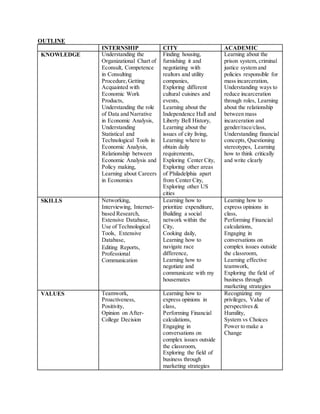
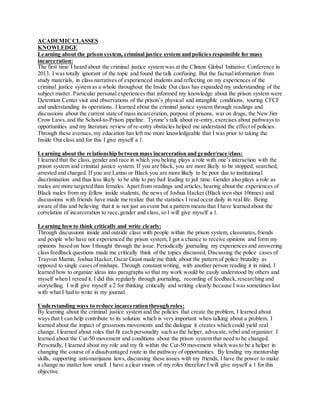
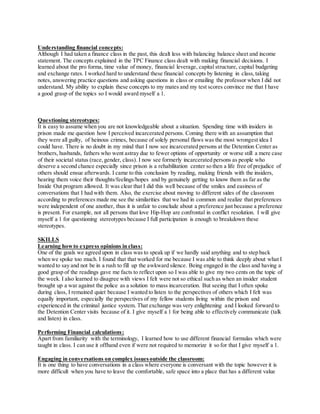
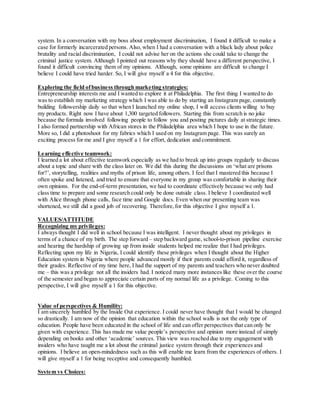
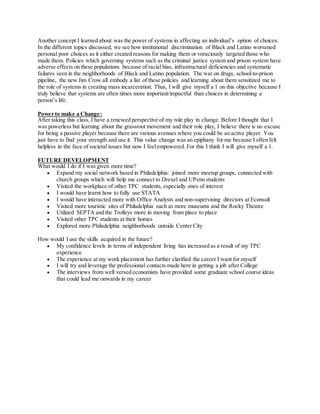
OUTLINE
INTERNSHIP CITY ACADEMIC
KNOWLEDGE Understanding the
Organizational Chart of
Econsult, Competence
in Consulting
Procedure,Getting
Acquainted with
Economic Work
Products,
Understanding the role
of Data and Narrative
in Economic Analysis,
Understanding
Statistical and
Technological Tools in
Economic Analysis,
Relationship between
Economic Analysis and
Policy making,
Learning about Careers
in Economics
Finding housing,
furnishing it and
negotiating with
realtors and utility
companies,
Exploring different
cultural cuisines and
events,
Learning about the
Independence Hall and
Liberty Bell History,
Learning about the
issues of city living,
Learning where to
obtain daily
requirements,
Exploring Center City,
Exploring other areas
of Philadelphia apart
from Center City,
Exploring other US
cities
Learning about the
prison system, criminal
justice system and
policies responsible for
mass incarceration,
Understanding ways to
reduce incarceration
through roles, Learning
about the relationship
between mass
incarceration and
gender/race/class,
Understanding financial
concepts, Questioning
stereotypes, Learning
how to think critically
and write clearly
SKILLS Networking,
Interviewing, Internet-
based Research,
Extensive Database,
Use of Technological
Tools, Extensive
Database,
Editing Reports,
Professional
Communication
Learning how to
prioritize expenditure,
Building a social
network within the
City,
Cooking daily,
Learning how to
navigate race
difference,
Learning how to
negotiate and
communicate with my
housemates
Learning how to
express opinions in
class,
Performing Financial
calculations,
Engaging in
conversations on
complex issues outside
the classroom,
Learning effective
teamwork,
Exploring the field of
business through
marketing strategies
VALUES Teamwork,
Proactiveness,
Positivity,
Opinion on After-
College Decision
Learning how to
express opinions in
class,
Performing Financial
calculations,
Engaging in
conversations on
complex issues outside
the classroom,
Exploring the field of
business through
marketing strategies
Recognizing my
privileges, Value of
perspectives &
Humility,
System vs Choices
Power to make a
Change
WORK PLACEMENT
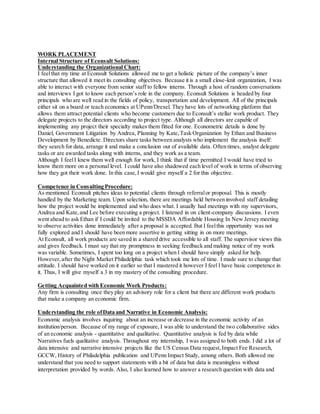
Internal Structure of Econsult Solutions:
Understanding the Organizational Chart:
I feelthat my time at Econsult Solutions allowed me to get a holistic picture of the company’s inner
structure that allowed it meet its consulting objectives. Because it is a small close-knit organization, I was
able to interact with everyone from senior staff to fellow interns. Through a host of random conversations
and interviews I got to know each person’s role in the company. Econsult Solutions is headed by four
principals who are well read in the fields of policy, transportation and development. All of the principals
either sit on a board or teach economics at UPenn/Drexel. They have lots of networking platform that
allows them attract potential clients who become customers due to Econsult’s stellar work product. They
delegate projects to the directors according to project type. Although all directors are capable of
implementing any project their specialty makes them fitted for one. Econometric details is done by
Daniel, Government Litigation by Andrea, Planning by Kate,Task Organization by Ethan and Business
Development by Benedicte. Directors share tasks between analysts who implement the analysis itself:
they search for data, arrange it and make a conclusion out of available data. Often times, analyst delegate
tasks or are awarded tasks along with interns, and they work as a team.
Although I feelI knew them well enough for work, I think that if time permitted I would have tried to
know them more on a personal level. I could have also shadowed each level of work in terms of observing
how they got their work done. In this case,I would give myself a 2 for this objective.
Competence in Consulting Procedure:
As mentioned Econsult pitches ideas to potential clients through referralor proposal. This is mostly
handled by the Marketing team. Upon selection, there are meetings held between involved staff detailing
how the project would be implemented and who does what. I usually had meetings with my supervisors,
Andrea and Kate,and Lee before executing a project. I listened in on client-company discussions. I even
went ahead to ask Ethan if I could be invited to the MSSDA Affordable Housing In New Jersey meeting
to observe activities done immediately after a proposal is accepted. But I feelthis opportunity was not
fully explored and I should have been more assertive in getting sitting in on more meetings.
At Econsult, all work products are saved in a shared drive accessible to all staff. The supervisor views this
and gives feedback. I must say that my promptness in seeking feedback and making notice of my work
was variable. Sometimes, I spent too long on a project when I should have simply asked for help.
However,after the Night Market Philadelphia task which took me lots of time. I made sure to change that
attitude. I should have worked on it earlier so that I mastered it however I feel I have basic competence in
it. Thus, I will give myself a 3 in my mastery of the consulting procedure.
Getting Acquainted with Economic Work Products:
Any firm is consulting once they play an advisory role for a client but there are different work products
that make a company an economic firm.
Understanding the role ofData and Narrative in Economic Analysis:
Economic analysis involves inquiring about an increase or decrease in the economic activity of an
institution/person. Because of my range of exposure, I was able to understand the two collaborative sides
of an economic analysis - quantitative and qualitative. Quantitative analysis is fed by data while
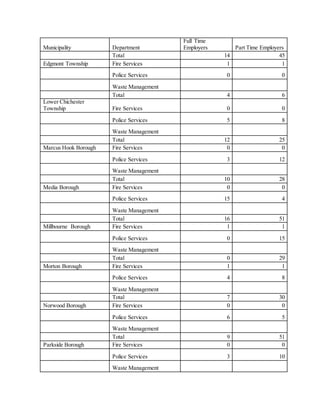
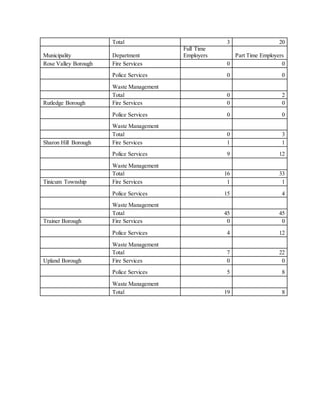
Narratives fuels qualitative analysis. Throughout my internship, I was assigned to both ends. I did a lot of
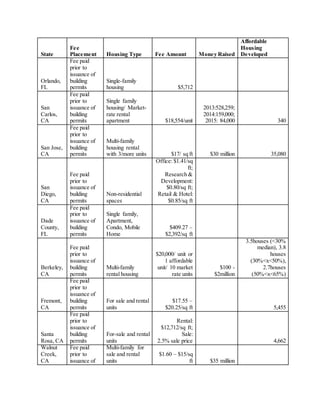
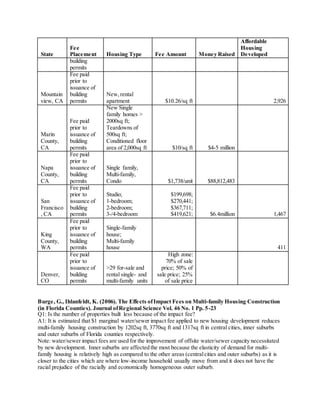
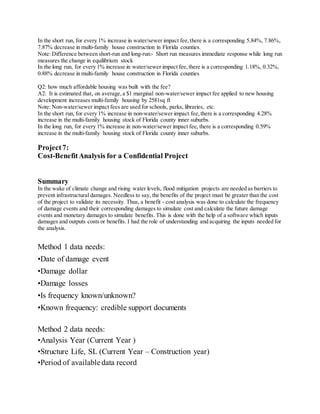
data intensive and narrative intensive projects like the US Census Data request,Impact Fee Research,
GCCW, History of Philadelphia publication and UPenn Impact Study, among others. Both allowed me
understand that you need to support statements with a bit of data but data is meaningless without
interpretation provided by words. Also, I also learned how to answer a research question with data and
narrative. I learned what type of database to pull out certain information from and often suggested this
during meetings. Thus, I will give myself a 1 for understanding when to use numerical versus narrative
data to answer a research question.
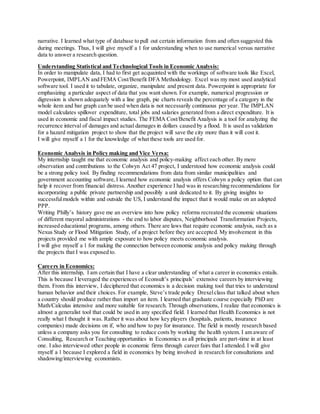
Understanding Statistical and Technological Tools in Economic Analysis:
In order to manipulate data, I had to first get acquainted with the workings of software tools like Excel,
Powerpoint, IMPLAN and FEMA Cost/Benefit DFA Methodology. Excel was my most used analytical
software tool. I used it to tabulate, organize, manipulate and present data. Powerpoint is appropriate for
emphasizing a particular aspect of data that you want shown. For example, numerical progression or
digression is shown adequately with a line graph, pie charts reveals the percentage of a category in the
whole item and bar graph can be used when data is not necessarily continuous per year. The IMPLAN
model calculates spillover expenditure, total jobs and salaries generated from a direct expenditure. It is
used in economic and fiscal impact studies. The FEMA Cost/Benefit Analysis is a tool for analyzing the
recurrence interval of damages and actual damages in dollars caused by a flood. It is used as validation
for a hazard mitigation project to show that the project will save the city more than it will cost it.
I will give myself a 1 for the knowledge of what these tools are used for.
Economic Analysis in Policy making and Vice Versa:
My internship taught me that economic analysis and policy-making affect each other. By mere
observation and contributions to the Colwyn Act 47 project, I understood how economic analysis could
be a strong policy tool. By finding recommendations from data from similar municipalities and
government accounting software,I learned how economic analysis offers Colwyn a policy option that can
help it recover from financial distress. Another experience I had was in researching recommendations for
incorporating a public private partnership and possibly a unit dedicated to it. By giving insights to
successfulmodels within and outside the US, I understand the impact that it would make on an adopted
PPP.
Writing Philly’s history gave me an overview into how policy reforms recreated the economic situations
of different mayoral administrations - the end to labor disputes, Neighborhood Transformation Projects,
increased educational programs, among others. There are laws that require economic analysis, such as a
Nexus Study or Flood Mitigation Study, of a project before they are accepted. My involvement in this
projects provided me with ample exposure to how policy meets economic analysis.
I will give myself a 1 for making the connection between economic analysis and policy making through
the projects that I was exposed to.
Careers in Economics:
After this internship, I am certain that I have a clear understanding of what a career in economics entails.
This is because I leveraged the experiences of Econsult’s principals’ extensive careers by interviewing
them. From this interview, I deciphered that economics is a decision making tool that tries to understand
human behavior and their choices. For example, Steve’s trade policy Drexelclass that talked about when
a country should produce rather than import an item. I learned that graduate course especially PhD are
Math/Calculus intensive and more suitable for research. Through observations, I realize that economics is
almost a generalist tool that could be used in any specified field. I learned that Health Economics is not
really what I thought it was. Rather it was about how key players (hospitals, patients, insurance
companies) made decisions on if, who and how to pay for insurance. The field is mostly research based
unless a company asks you for consulting to reduce costs by working the health system. I am aware of
Consulting, Research or Teaching opportunities in Economics as all principals are part-time in at least
one. I also interviewed other people in economic firms through career fairs that I attended. I will give
myself a 1 because I explored a field in economics by being involved in research for consultations and
shadowing/interviewing economists.
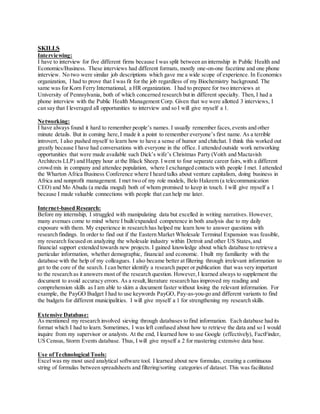
SKILLS
Interviewing:
I have to interview for five different firms because I was split between an internship in Public Health and
Economics/Business. These interviews had different formats, mostly one-on-one facetime and one phone
interview. No two were similar job descriptions which gave me a wide scope of experience. In Economics
organization, I had to prove that I was fit for the job regardless of my Biochemistry background. The
same was for Korn Ferry International, a HR organization. I had to prepare for two interviews at
University of Pennsylvania, both of which concerned research but in different specialty. Then, I had a
phone interview with the Public Health Management Corp. Given that we were allotted 3 interviews, I
can say that I leveraged all opportunities to interview and so I will give myself a 1.
Networking:
I have always found it hard to remember people’s names. I usually remember faces,events and other
minute details. But in coming here,I made it a point to remember everyone’s first name. As a terrible
introvert, I also pushed myself to learn how to have a sense of humor and chitchat. I think this worked out
greatly because I have had conversations with everyone in the office. I attended outside work networking
opportunities that were made available such Dick’s wife’s Christmas Party (Voith and Mactavish
Architects LLP) and Happy hour at the Black Sheep. I went to four separate career fairs,with a different
crowd mix in company and attendee population, where I exchanged contacts with people I met. I attended
the Wharton Africa Business Conference where I heard talks about venture capitalism, doing business in
Africa and nonprofit management. I met two of my role models, Belo Hakeem (a telecommunication
CEO) and Mo Abudu (a media mogul) both of whom promised to keep in touch. I will give myself a 1
because I made valuable connections with people that can help me later.
Internet-based Research:
Before my internship, I struggled with manipulating data but excelled in writing narratives. However,
many avenues come to mind where I built/expanded competence in both analysis due to my daily
exposure with them. My experience in research has helped me learn how to answer questions with
research findings. In order to find out if the Eastern Market Wholesale Terminal Expansion was feasible,
my research focused on analyzing the wholesale industry within Detroit and other US States,and
financial support extended towards new projects. I gained knowledge about which database to retrieve a
particular information, whether demographic, financial and economic. I built my familiarity with the
database with the help of my colleagues. I also became better at filtering through irrelevant information to
get to the core of the search. I can better identify a research paper or publication that was very important
to the research as it answers most of the research question. However,I learned always to supplement the
document to avoid accuracy errors. As a result,literature research has improved my reading and
comprehension skills as I am able to skim a document faster without losing the relevant information. For
example, the PayGO Budget I had to use keywords PayGO, Pay-as-you-go and different variants to find
the budgets for different municipalities. I will give myself a 1 for strengthening my research skills.
Extensive Database:
As mentioned my research involved sieving through databases to find information. Each database had its
format which I had to learn. Sometimes, I was left confused about how to retrieve the data and so I would
inquire from my supervisor or analysts. At the end, I learned how to use Google (effectively), FactFinder,
US Census, Storm Events database. Thus, I will give myself a 2 for mastering extensive data base.
Use ofTechnological Tools:
Excel was my most used analytical software tool. I learned about new formulas, creating a continuous
string of formulas between spreadsheets and filtering/sorting categories of dataset. This was facilitated
through my work in Night Market Philadelphia where I had to organize a large survey data of Night
Market event attendees in 2013 – 2015. I calculated average spending of attendees and how to have few
selected categories of the data appear on the screen by using the sort and filter buttons under the Data tab.
In Powerpoint, I learned how to create and format graphs and pie charts. How to make the numbers align
for easy readership and labelling. I gathered data inputs and the adjustment to be used in the FEMA
Cost/Benefit from FEMA’s Hazus file and the National Climatic Data Center. I compiled Night Market
Attendee data that would be run through the IMPLAN model. The only experience I got on STATA was
when I cleaned out a trend data by going through the list of store addresses making sure that all stores
categories were distinct. I used STATA commands and left comments in the document. I will give myself
a 1 in my skill on using technological tools.
Edit Report:
I proofread the Municipalities Financial Recovery Plan for Colwyn and the New Jersey Institute of
Technology Economic Impact Report (NJIT). I was asked to proofread copies of reports that need to be
sent out to clients. Although I was always detailed oriented in grammar, Econsult has a particular brand
that they keep and I had to adhere to the formatting guidelines. For example, in the Colwyn report, I had
to keep track of the Section numberings and table headings to make sure that there were no errors while
the NJIT Report involved adding edits already made – correcting grammatical errors or adding new
sentences that strength the narrative. I would give myself a 1 because although I was only asked to edit
twice I had mastered the formatting by the second edit.
Professional Communication:
I had a chance to communicate with every Econsult Staff. I learned who to direct what question to. But
the people that I maintained face-to-face dialogue with were my supervisors and those I worked with
closely as a team. In our meetings, I was never good at taking notes while listening because I often could
not process the instructions while writing. However,I learned how to balance my listening,
comprehension then note writing. As for speaking, I think after the first 3-way meeting, I started to gain
more confidence in making my voice heard. One distinct moment for me was contributing in the first
GCCW meeting on a subject matter that I knew about without being necessarily asked. For written
communication, I feel I did well in the language used and ways of address in my emails. Granted, my in-
text citations that helped the next reader understand a research document were not always included on the
first draft. Therefore, I will give myself a 2 in my delivery of professional communication.
ATTITUDE/VALUE
Teamwork:
I am fiercely independent so teamwork was not generally my forte prior to the internship. But I think that
my social skills, which encompasses communication, coordination and dependability, has improved
immensely. Most of the work I did were in teams with everyone understanding their role and sometimes
depending on another to finish their work to begin yours, so knowing this puts one on the edge. I felt that
I worked well with other people, there was never a fall out instead it was mostly collaboration. For this I
give myself a 1 for my ability to play in a team.
Proactiveness:
I remember when I started to feelless challenged during a time in the semester because of slow work days
for me. In order to combat this, I ensured that my presence was known and going as far as asking for
work. Also, I learned fast that due to the busy schedules in the office, I had to seek after my goals. I feel
that I was able to do this effectively as I got the interviews, Drexel class, and quantitative work, sit-ins on
after-proposal meetings by being on the lookout and seizing opportunities when possible. Thus, I will
give myself a 1 for proactiveness.
Positivity:
I believe that my attitude at work was positive. I noticed that each time I left and returned (example,
during my week off at California), my fellow interns especially missed me. Also, my supervisors were
glad to hear me ask for work. This evidence assured me that I made a positive impact and brought a
positive vibe to the team. Therefore,I will give myself a 1 for this value.
Opinion on After-College Decision:
My internship opened me a new door for further exploration. I was able to compare two different fields of
study – Biochemistry and Economics – a rare opportunity. This has made me think about after-graduation
possibilities and has hopefully opened up some doors to achieve this goal. Hopefully, I will be able to
secure a job at a company that mixes healthcare and welfare. I hope to be in the policy side of matters,
which I believe my Econsult Solutions experience will make easier transitioning to. However, just like I
kept my doors opened for this experience I will walk towards my future goals with an open-mind. After
working for two years,I hope to obtain a dual degree in MBA/MPH to help me align into a career where
healthcare and business/policy merge. With the clarity I have for furthering my career,I will give myself
a 1 for my after-College decision.
CITYLIVING
Knowledge
Finding housing, furnishing it and negotiating with realtors and utility companies:
I am really grateful for having experienced the process of finding a house. I visited three houses in West
Philly and two in Center city (one near Comcast and the other at Walnut street). It gave me a sense of
what I value in a home which is natural lighting, sense of safety, large spacing, and how much I am
willing to pay for it. I discussed, read and signed a lease and reported any inconsistencies in the apartment
such as a spoilt window blinds and dishwasher. As a house, I and my roommates determined who would
be in charge of utilities (rent, water, and internet) and furniture. I handled buying the furniture which was
a one-time payment debited to Walmart and shipped to our apartment. I will give myself a 2 for this,
because I did not interact much with the utility company as much because the task was delegated to my
other roommates as agreed upon.
Exploring different cultural cuisines and events:
I must say that living in a big city like Philadelphia, which is a melting pot of cultures, helped me to
experience different cuisine and cultural events. Beginning from the East Coast American experience of
Philly cheesecakes,Sunday brunch at Green Eggs Cafe to the Greek gyros of the Food trucks. I visited the
Philadelphia Chutney Company which serves rare South Indian delicacies and Minar Palace which serves
North Indian food. I explored Thai, Vietnamese and Chinese food during my Chinatown visits. I ate
Mexican food at Chipotle and Qdoba. I even tried East African food at Kilimanjaro, allowing me to see
another side of home while abroad. While here, I attended a Brazilian festival in Penn’s Landing and the
Nigerian Independence Day Celebration in the diaspora at New York. Overall, with the budget I had I
believe that I did a good job on leveraging these opportunities so I would give myself a 1 on this
objective.
Learning about the Independence Hall and Liberty Bell History:
The Independence Hall, Liberty Bell and Independence Visitor Center unlocked the history of
Philadelphia to me as it provided narratives and evidence about the American independence and the
founding fathers,its constitution and implications and the slave trade and its aftermath. I learned there
was a tax without representation caused the civil war, the significance of the bell to civic action against
slavery and personal stories like Harriet Tubman in the Underground Railroad. I also learned about the
Society of Philosophy founded by Benjamin Franklin which played a role in forming the educational
system of America. Being clueless about all these and having information now, I would award myself a 1
for this objective.
Learning about the issuesofcity living:
I spent so much time exploring the nooks and corners of the city which allowed me experience the
disadvantages of the city. The city almost never sleeps with the night-life buzzing, car noises and
construction activities although most shops close by 8pm which is disadvantageous to workers who want
to shop after work. There was also lots of air pollution – compared my school’s location which was rural
(Richmond, IN) – which arose from smoking and construction work. Although there are cheap options,
expenses are generally higher than when living in a town/rural setting. I also learned about the violence in
different parts of the city such as Western Philadelphia where Malwitnessed a person being shot and
Northeastern Philadelphia which is visibly poor. More so, I learned about the educational system whereby
the quality of education one receives is heavily dependent on the class of their neighborhood. I believe
that knowing all these will help me be aware of what to expect if I decide to live in the heart of a busy city
like Philadelphia. For this I give myself a 1.
Learning where to obtain daily requirements:
This was very essential to my survival because I lived on a budget right in the heart of the city. Right on
the first day I was on the lookout for cheap products. Luckily with information from TPC orientation and
simply stumbling into stores, I discovered places I could buy cheap food and items. I purchased my food
from the Italian market, Chinatown stores (found an underground grocery store), Dollar store and Dollar
Variety. I bought my toiletries and cooking utensils from Dollar Variety, Below Five and Dollar Thrifty.
When I went for lunch and it was not necessarily for an experience, I bought lunch from Food trucks and
Wawa. I was able to adequately manage my funds as I did not surpass my budget for the semester,thus, I
will give myself a 1.
Exploring Center City:
Although I came back from work tired, I made efforts to tour Center City and this enriched my
Philadelphia experience. For culinary experiences,I visited Shake shack, Honey Grow, Spice 28, Sweet
Greens, La Bellevue Food Court, Kilimanjaro, Insomnia, Italian Market and Chinatown restaurants.
Outings were awesome. I attended the Opera on the Mall, an outdoor screening of an opera theatre. I
attended the BlueCross RiverRink WinterFEST where I ice-skated for the first time, saw fireworks,
warmed myself with the heat from burning firewood. I went to a jam session at the Kimmel Center, a
comedy improv at the Adrienne Theatre,a party at Loews and three career fairs at Hard Rock Café,
Thomas Jefferson and the Marriott Hotel plus watched Burnt at the Roxy Theatre. I visited the Red Bull
Art exhibition where I did an interview, currently airing on PhillyCam cable channels, on what I thought
about the exhibitions. We went to an Arcade Bar in Fish town, and visited the Painted Bride Gallery,
Center for Art in Wood, Inc., and severalconsignment stores and galleries at Old city. To keep a healthy
lifestyle, I visited and took yoga/zumba classes at the Optimal Sport Health Club, City Fitness Gym and
did Sunday runs with New Balance Philly Run Meetup Group. In the fact that I did everything I planned
to do in Center City, I will give myself a 1 in this objective.
Exploring other areas ofPhiladelphia apart from Center City:
Commitments took me to other parts of Philadelphia. I had classes every Monday at the Detention Center
located in Northeast Philadelphia. Although I never toured the area just being there gave me a platform to
observe the difference between neighborhoods away from Center city and Center city itself. I experienced
South Philly twice, first by walking to a housing option that I considered and secondly a visit to my
cousin’s place. It seemed that although it was a rough neighborhood, there are pockets of influence such
as the Lincoln Financial Field, GSK Office,and so on. We visited Upper Darby for a movie at the Studio
Movie Grill. I also attended a class at Drexelwith my supervisor and went severaltimes to UPenn for job
interviews and the Wharton Africa Business Conference. Since I sincerely do not wish to have visited any
other place, I feelI marked out my list so I give myself a 1 for this objective.
Exploring other US cities:
I used my proximity to New York-New Jersey to visit often. Given that I had a sister, the difference in
experience was visiting New York with my friends and exploring the Nightlife with my sister. My friends
and I visited for 12hours: shopped, cruised and ate at a Peruvian restaurant. I went clubbing on two
occasions and meet some of my High School friends which was great. I also went to Sacramento and San
Francisco for thanksgiving. As a matter of fact that was the first time I had the pies, turkey and yams that
came with thanksgiving. I ate seafood regularly and toured the Golden Gate, Fisherman’s wharf and the
Capitol (in Sacramento). Given my limited budget, I believed I leveraged these experiences well and I
give myself a 1.
SKILLS
Learning howto prioritize expenditure:
With the limited budget I had, it was mandatory that I prioritize my money and find means of saving.
Therefore,money was spent on experiences that I wanted rather than items. I cooked most of the time and
shopped from one dollar stores to keep living costs low. I set an internal budget limit, although I did not
quite follow it at the end I still remained conscious of spending by asking if I truly needed the item that I
was about to buy or if I could get it cheaper. I realize that if I was more self-disciplined I should have
diverted funds from buying unnecessary snacks to buying more lasting clothes. Hence,I give myself a 2
in this objective.
Building a social network within the City:
I had people to call for help - my roommates, Ellery, Jaclyn, Alice and Celina. However,I do not think
that I got close to anyone really because I felt that I was not as received as I wanted to be and affected me
so I put my guard up for a while. Surprisingly, my socialization was from my fellow interns, my cousin,
some church members and some Nigerian friends I knew in the Philly area. Looking back, I think that I
should have remained as open in reaching out to people although the stretch was too far, it was rather
exhausting. Nonetheless, apart from the TPC circle, I could have sought more relationships outside the
TPC circles by attending more meetups, more church events and leveraging the friendships of my friends
and cousin in Philadelphia. For this reason,I will give myself a 3 in this objective.
Cooking daily:
I have always wanted to learn how to cook but the busyness of school never gave me time and I was too
lazy during holidays to cook when there was already prepared food available. I have learned how to eat a
balanced diet ensuring you have nuts & grains, vegetables, fruits and proteins. I also learned seven
recipes, coming from someone who had to ask how to boil an egg. I am grateful for this opportunity
which I used daily for almost four months. I feel that I deserve a 1 in this objective.
Learning howto navigate race difference:
Originally from a racially homogenous country, coming to America has opened me up to the Black
identity and its consequences. Although I had a feelof this at Earlham, because it has a more accepting
culture as it is a ‘hippie’ College I was never fully exposed to the consequences. Taking classes and living
in the city meant I had to navigate an unfiltered version of racialized interaction, that is, favoritism or
discrimination due to skin color. I learned about issues faced by Black people such as mass incarceration,
employment discrimination, and poverty in Black neighborhoods, among others. I experienced what it felt
like to be a Black female in the industrial setting with slight comments about your hair or few friendship
approaches due to an accent or fear influenced by media propaganda, or getting into a club without an ID
because the security guard was Black. Through interactions with professionals and classmates unfamiliar
with a Black person, I learned how to react to microaggression and how to react to undeserved favor and
how to identify myself regardless of how others perceived me. I will give myself a 1 for the maturity in
which I handled these situations through patience and humor.
Learning howto negotiate and communicate with my housemates:
This was a learning process for me as I lived alone for two years of my College life. I had to learn about
my idiosyncrasies that my roommates hated and theirs that made me tick. I had to learn how to take
constructive criticism without feeling attacked and realize that their opinion had to be heard even though I
did not like people telling me what to do. I must say that the tension got overwhelming sometimes and I
shut off instead of communicating. However,after a cool off period we were able to become friends again
and continue our cordial relationships. I will give myself a 2 on this because I should have tried to be
mature and talk instead of shutting off myself.
VALUES/ATTITUDE
Views on Homelessness:
The Thursday night talk from the Director of the HOME Project really helped change my perspective
about homelessness. It made me understand the macrocosmic and microcosmic factors contributing to
homelessness while I was only traversed with the microcosmic factors. I saw this truth in the way I
observed others and myself react to the homeless. But an explanation of economic and cultural factors
such as first-payment-default-and-out and individualistic zeal for money helped sensitize me to the plight
of homeless people. I also learned about the role of mental disability and addiction in homelessness.
Along with the Thursday talk and having a conversation with a mentally disabled person, my perspective
changed and I began to seek genuine, effective ways of giving a helping hand through donations to
appropriate channels like the newspapers sold to generate money. I will give myself a 2 in this objective
as I could have done better by volunteering in a homeless shelter to be more in touch with the matter.
Views on difference:
My perception of gender issues changed a lot while in Philadelphia. Growing up in a highly religious and
traditional environment which is only beginning to open up to gender equality, gender determination and
sexual orientation, I believe I have come a long way in accepting these values more. One major influence
was living in the Gayborhood and being in proximity with people who have chosen the way less travelled,
seeing that they have feelings, aspirations and are humans just like everyone else. Walking home
everyday, observing the pride festival and interacting with people at TPC helped desensitize me to the
“shock” and helped me realize that although we don’t share the same values, we do share the same
humanity. I truly believe that I have come a long way in adopting this value so I would give myself a 1
for this objective.
Value of dialogue and patience:
Sharing spaces with people at work and at home helped me understand the importance of communication.
I am not very patient especially when I feel that I have been clear about my requests however I had to
learn how to repeat myself and be patient or tolerant about the other person’s reaction. There were
certainly roommate agreements which everyone faltered on and I faltered on too. So, it was all about
choosing your battles and my battle was very well communicated, that is, I cannot tolerate this (I cannot
mention this due to confidentiality of my roommates). But even if it was violated, I simply called the
attention of the person and they apologized and set the record straight. Outside, I learned how to approach
people for information - look for a friendly face,smile and ask the question. When uncertain I asked for
directions, tips and recommendations from people on the street,bus drivers, waiters and anyone friendly
enough to approach. I will give myself a 1 for being assertive to ask for what I wanted and bold enough to
ask questions I needed answers to.
ACADEMICCLASSES
KNOWLEDGE
Learning about the prison system, criminal justice system and policies responsible for mass
incarceration:
The first time I heard about the criminal justice system was at the Clinton Global Initiative Conference in
2013. I was totally ignorant of the topic and found the talk confusing. But the factualinformation from
study materials, in class narratives of experienced students and reflecting on my experiences of the
criminal justice system as a whole throughout the Inside Out class has expanded my understanding of the
subject matter. Particular personal experiences that informed my knowledge about the prison system were
Detention Center visit and observations of the prison’s physical and intangible conditions, touring CFCF
and understanding its operations. I learned about the criminal justice system through readings and
discussions about the current state of mass incarceration, purpose of prisons, war on drugs, the New Jim
Crow Laws,and the School-to-Prison pipeline. Tyrone’s talk about re-entry, exercises about pathways to
opportunities and my literature review of re-entry obstacles helped me understand the effect of policies.
Through these avenues, my education has left me more knowledgeable that I was prior to taking the
Inside Out class and for this I give myself a 1.
Learning about the relationship between mass incarceration and gender/race/class:
I learned that the class, gender and race in which you belong plays a role with one’s interaction with the
prison system and criminal justice system. If you are black, you are more likely to be stopped, searched,
arrested and charged. If you are Latino or Black you are more likely to be poor due to institutional
discrimination and thus less likely to be able to pay bail leading to jail time. Gender also plays a role as
males are more targeted than females. Apart from readings and articles, hearing about the experiences of
Black males from my fellow inside students, the news of Joshua Hacker (Black teen shot 10times) and
discussions with friends have made me realize that the statistics I read occur daily in real life. Being
aware of this and believing that it is not just an event but a pattern means that I have learned about the
correlation of incarceration to race,gender and class, so I will give myself a 1.
Learning howto think critically and write clearly:
Through discussions inside and outside class with people within the prison system, classmates,friends
and people who have not experienced the prison system, I got a chance to receive opinions and form my
opinions based on how I thought through the issue. Periodically journaling my experiences and answering
class feedback questions made me critically think of the topics discussed. Discussing the police cases of
Trayvon Martin, Joshua Hacker,Oscar Grant made me think about the pattern of police brutality as
opposed to single cases of mishaps. Through constant writing, with another person reading it in mind, I
learned how to organize ideas into paragraphs so that my work would be easily understood by others and
myself when I reread it. I did this regularly through journaling, recording of feedback,researching and
storytelling. I will give myself a 2 for thinking critically and writing clearly because I was sometimes lost
with what I had to write in my journal.
Understanding ways to reduce incarceration through roles:
By learning about the criminal justice system and the policies that create the problem, I learned about
ways that I can help contribute to its solution which is very important when talking about a problem. I
learned about the impact of grassroots movements and the dialogue it creates which could yield real
change. I learned about roles that fit each personality such as the helper, advocate, rebel and organizer. I
learned about the Cut-50 movement and conditions about the prison system that need to be changed.
Personally, I learned about my role and my fit within the Cut-50 movement which was to be a helper in
changing the course of a disadvantaged route in the pathway of opportunities. By lending my mentorship
skills, supporting anti-marijuana laws, discussing these issues with my friends, I have the power to make
a change no matter how small. I have a clear vision of my roles therefore I will give myself a 1 for this
objective.
Understanding financial concepts:
Although I had taken a finance class in the past, this dealt less with balancing balance sheet and income
statement. The concepts explained in the TPC Finance class dealt with making financial decisions. I
learned about the pro forma, time value of money, financial leverage, capital structure, capital budgeting
and exchange rates. I worked hard to understand these financial concepts by listening in class,taking
notes, answering practice questions and asking questions in class or emailing the professor when I did not
understand. My ability to explain these concepts to my mates and my test scores convince me that I have
a good grasp of the topics so I would award myself a 1.
Questioning stereotypes:
It is easy to assume when you are not knowledgeable about a situation. Spending time with insiders in
prison made me question how I perceived incarcerated persons. Coming there with an assumption that
they were all guilty, of heinous crimes, because of solely personal flaws was the most wrongest idea I
could have. There is no doubt in my mind that I now see incarcerated persons at the Detention Center as
brothers, husbands, fathers who went astray due to fewer options of opportunity or worse still a mere case
of their societal status (race,gender, class). I now see formerly incarcerated persons as people who
deserve a second chance especially since prison is a rehabilitation center so then a life free of prejudice of
others should ensue afterwards. I came to this conclusion by reading, making friends with the insiders,
hearing them voice their thoughts/feelings/hopes and by genuinely getting to know them as far as the
Inside Out program allowed. It was clear that I did this well because of the smiles and easiness of
conversations that I had with them. Also, the exercise about moving to different sides of the classroom
according to preferences made me see the similarities that we had in common and realize that preferences
were independent of one another, thus it is unfair to conclude about a preference just because a preference
is present. For example, not all persons that love Hip-Hop are confrontal in conflict resolution. I will give
myself a 1 for questioning stereotypes because I full participation is enough to breakdown these
stereotypes.
SKILLS
Learning howto express opinions in class:
One of the goals we agreed upon in class was to speak up if we hardly said anything and to step back
when we spoke too much. I found that that worked for me because I was able to think deeply about what I
wanted to say and not be in a rush to fill up the awkward silence. Being engaged in the class and having a
good grasp of the readings gave me facts to reflect upon so I was able to give my two cents on the topic of
the week. I also learned to disagree with views I felt were not so ethical such as when an insider student
brought up a war against the police as a solution to mass incarceration. But seeing that I often spoke
during class, I remained quiet because I wanted to listen to the perspectives of others which I felt was
equally important, especially the perspectives of my fellow students living within the prison and
experienced in the criminal justice system. That exchange was very enlightening and I looked forward to
the Detention Center visits because of it. I give myself a 1 for being able to effectively communicate (talk
and listen) in class.
Performing Financial calculations:
Apart from familiarity with the terminology, I learned how to use different financial formulas which were
taught in class. I can use it offhand even if were not required to memorize it so for that I give myself a 1.
Engaging in conversations on complex issuesoutside the classroom:
It is one thing to have conversations in a class where everyone is conversant with the topic however it is
more difficult when you have to leave the comfortable, safe space into a place that has a different value
system. In a conversation with my boss about employment discrimination, I found it difficult to make a
case for formerly incarcerated persons. Also, when I had a conversation with a black lady about police
brutality and racial discrimination, I could not advise her on the actions she could take to change the
criminal justice system. Although I pointed out reasons why they should have a different perspective, I
found it difficult convincing them of my opinions. Although, some opinions are difficult to change I
believe I could have tried harder. So, I will give myself a 4 for this objective.
Exploring the field ofbusiness through marketing strategies:
Entrepreneurship interests me and I wanted to explore it at Philadelphia. The first thing I wanted to do
was to establish my marketing strategy which I was able to do by starting an Instagram page, constantly
building followership daily so that when I launched my online shop, I will access clients willing to buy
my products. Right now I have about 1,300 targeted followers. Starting this from scratch is no joke
because the formula involved following people to follow you and posting pictures daily at strategic times.
I also formed partnership with African stores in the Philadelphia area which I hope to use in the future.
More so, I did a photoshoot for my fabrics which I used on my Instagram page. This was surely an
exciting process for me and I give myself a 1 for effort, dedication and commitment.
Learning effective teamwork:
I learned a lot about effective teamwork especially as we had to break up into groups regularly to discuss
about a topic and share with the class later on. We did this during the discussions on ‘what are prisons
for?’, storytelling, realities and myths of prison life, among others. I feel that I mastered this because I
often spoke and listened, and tried to ensure that everyone in my group was comfortable in sharing their
own opinions. For the end-of-term presentation, we had to coordinate effectively because we only had
class time to prepare and some research could only be done outside class. I believe I coordinated well
with Alice through phone calls, face time and Google docs. Even when our presenting team was
shortened, we still did a good job of recovering. Therefore,for this objective I give myself a 1.
VALUES/ATTITUDE
Recognizing my privileges:
I always thought I did well in school because I was intelligent. I never thought about my privileges in
terms of a chance of my birth. The step forward – step backward game, school-to-prison pipeline exercise
and hearing the hardship of growing up from inside students helped me realize that I had privileges.
Reflecting upon my life in Nigeria, I could identify these privileges when I thought about the Higher
Education system in Nigeria where people advanced mostly if their parents could afford it, regardless of
their grades. Reflective of my time here, I had the support of my parents and teachers who never doubted
me – this was a privilege not all the insiders had. I noticed many more instances like these over the course
of the semester and began to appreciate certain parts of my normal life as a privilege. Coming to this
perspective, I will give myself a 1 for this objective.
Value of perspectives & Humility:
I am sincerely humbled by the Inside Out experience. I could never have thought that I would be changed
so drastically. I am now of the opinion that education within the school walls is not the only type of
education. People have been educated in the school of life and can offer perspectives that can only be
given with experience. This has made me value people’s perspective and opinion more instead of simply
depending on books and other ‘academic’ sources. This view was reached due to my engagement with
insiders who have taught me a lot about the criminal justice system through their experiences and
opinions. I believe an open-mindedness such as this will enable me learn from the experiences of others. I
will give myself a 1 for being receptive and consequently humbled.
System vs Choices:
Another concept I learned about was the power of systems in affecting an individual’s option of choices.
In the different topics discussed, we see how institutional discrimination of Black and Latino worsened
personal poor choices as it either created reasons for making them or voraciously targeted those who
made them. Policies which governing systems such as the criminal justice system and prison system have
adverse effects on these populations because of racial bias, infrastructural deficiencies and systematic
failures seen in the neighborhoods of Black and Latino population. The war on drugs, school-to-prison
pipeline, the new Jim Crow all embody a list of these policies and learning about them sensitized me to
the role of systems in creating mass incarceration. Thus, I will give myself a 1 on this objective because I
truly believe that systems are often times more important/impactful than choices in determining a
person’s life.
Power to make a Change:
After taking this class, I have a renewed perspective of my role play in change. Before I thought that I
was powerless but learning about the grassroot movement and their role play, I believe there is no excuse
for being a passive player because there are various avenues where you could be an active player. You
just have to find your strength and use it. This value change was an epiphany for me because I often felt
helpless in the face of societal issues but now I feelempowered. For this I think I will give myself a 1.
FUTURE DEVELOPMENT
What would I do if I was given more time?
 Expand my social network based in Philadelphia: joined more meetup groups, connected with
church groups which will help me connect to Drexel and UPenn students
 Visited the workplace of other TPC students, especially ones of interest
 I would have learnt how to fully use STATA
 I would have interacted more with Office Analysts and non-supervising directors at Econsult
 Visited more touristic sites of Philadelphia such as more museums and the Rocky Theatre
 Utilized SEPTA and the Trolleys more in moving from place to place
 Visited other TPC students at their homes
 Explored more Philadelphia neighborhoods outside Center City
How would I use the skills acquired in the future?
 My confidence levels in terms of independent living has increased as a result of my TPC
experience
 The experience at my work placement has further clarified the career I want for myself
 I will try and leverage the professional contacts made here in getting a job after College
 The interviews from well versed economists have provided some graduate school course ideas
that could lead me onwards in my career
Work Product Sample
Chinwude Nwana
EconsultSolutions Internship
Fall 2015
Project1:
“History of Philadelphia: Triumphs, Challenges and Opportunities” – Article
Summary for the Penn Institute of Urban Research
Summary
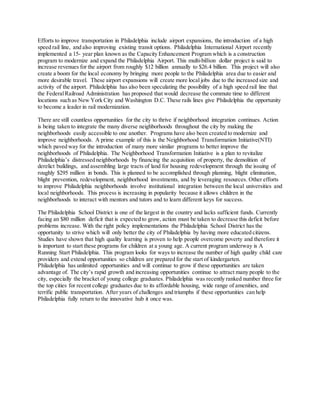
This article gives a brief summary about the history of Philadelphia as an emerging city which rose up
from its slums through efficient public policy reforms. In a publication for the periodical, Penn IUR
Policy Brief, this article talks about the recent triumphs, continuous challenges and possible opportunities
that the city has to progress in the future. My main contribution was talking about the triumphs of
different administrations that built on one another to gradually alleviate Philadelphia from its budget
deficit.
Triumphs - My part
After 40 years of decline from the early 1950s, Philadelphia confronted a future that was uncertain at best
in the early 1990s. By the turn of the century, Philadelphia was showing evidence of joining the
nationwide trend of improving cities. With a plethora of effective administrations, Philadelphia was able
to get back on its feet and repossess its stand among the league of desirable cities to live in. However,this
was not always the case as Philadelphia was hit hard from the 1990-1991 national recession; thus, leading
to limited resources available for construction and maintenance of capital projects and decreased
employment and compensation benefits for city residents. But the Rendell administration ushered in a
new era of confidence in the city through policy reforms that helped balance Philadelphia’s budget
deficits. These reforms concentrated on prioritization and execution of city capital projects, business and
wage tax cuts, better fiscal management and employment opportunities. A highly applauded action for
Philadelphia was putting an end to labor disputes and employee strikes from white- and blue-collar jobs
and public safety agencies. This was achieved through contract negotiations with primary municipal
unions and renegotiation of city vendor contracts. Philadelphia also expanded its welfare reform which
took an alternative route of job search activities to move beneficiaries into the labor market. The
revitalization of the Center City through big budget projects that solidified the area as the cultural
epicenter of Philadelphia. Thus, bringing businesses, employment and an overall change in the internal
and external perception of the city.
The city continued to be transformed through the strategic plans laid out by the John F. Street
administration. With its commercial hub being reconstructed,the new city government strove to give
neighborhoods their most needed attention. The Neighborhood Transformation Project (NTI) was
initiated as an effort to create clean,safe neighborhoods; construct new, affordable and market-rate
housing; and encourage private-sector business investment. $295 million was ploughed into the system,
launching seven housing development sites from 5,000 residential demolitions and 5,000 land
acquisitions. Also, as an incentive to new housing development and rehabilitation, 10 year tax abatements
were offered to the benefit of homeowners and developers. This tax abatement meant that for ten years
taxes will not be taken from the marginal value of a housing property whose monetary value appreciated
due to the new or rehabilitative constructions made. A lot of Philadelphians were able to benefit from this
policy. In 2005 alone, 961 homeowners, 1130 investment owners were able to rehabilitate their properties
while 1,456 home-/investment owners were able to build new constructions. These property incentives
made a huge impact in the desirability of the city as businesses sprung up, housing prices became more
affordable and the competitiveness of the Philadelphia suburbs, as compared to the city, reduced. These
factors drew in a swamp of people who were attracted by the prospects of greener pastures in
Philadelphia. Not only did they come in numbers but they stayed in numbers. Since its population drained
of the ‘80s, Philadelphia finally had capacity to pull in and retain residents.
With the foundations already established, the only direction Philadelphia could go was forward.
One factor that stalled the city’s potential was its not-so-great progress on soft infrastructure, that is, its
societal issues. The crime rate in Philadelphia’s neighborhood, just like in many major cities, was still
relatively high. For this reason, it was important for the incumbent mayor, Michael Nutter,to change this
narrative. Nutter’s policy constituted a mix of strengthening community policing practices and the
workforce implementing it, providing post-release services to select offenders to reduce their rate of
return into the criminal justice system and preventing youths from being involved in crimes through
mentorship programs. Nutter’s policy has made progress since they became effective - crime rate has
declined by 17.5%, the lowest levels recorded since 1971. Apart from creating safety,the long-term
sustainability of a city would be defined by its educated populace. Mayor Nutter understood this when he
decided to improve the educational outcomes from the city. This has been done through a number of
projects such as the $363million investment on Philadelphia’s public schools and libraries, which has led
to a 6.8% increase in the college degree attainment rate. The youth and adult learners are not left behind.
The REACH pilot and myPLACE have enhanced outdoor learning for teenagers and work-readiness for
adult-learners. To ensure that everyone gets the spillover effects of education equally, programs such as
the “My Brother’s Keeper” Challenge and the School Diversion Program help Philadelphia’s educational
system become more inclusive. But these human capital need to be retained in the city through excellent
job offers which can only be provided mostly by private-sector businesses. The development of retail
stores and partnerships to grow start-ups have improved the commercial setting of Philadelphia. As of
2014, there were 130 estate projects under construction, mostly housed on Chestnut street and East
Market in Center City. Continuing from his predecessor,Nutter is expanding the Land Bank and
redeveloping distressed public housing in North Philadelphia. The award of the Promise Zone
Designation has helped to accelerate development in these areas,with increased participation of minority-
owned companies from 29.4% to 18% in 2007. As health is indeed wealth, the government has made a
commitment to advance the wellbeings of Philadelphia. This time the rarely talked about issue of mental-
health and homelessness is given its due attention. Philadelphians now have access to free MentalHealth
First Aid Training and homeless housing units have increased by 80% throughout the city. Also, a major
grant of $10million for the Healthy Start program is aimed at reducing infant mortality. The world is
evolving when it comes to green infrastructure and Philadelphia has surely been part of that conversation.
There is now affordable bike share with 60 stations across the city. The statistics also show that between
2008-2014, Philadelphia has collected 8, 817,000 pounds of trash and 431,031 pounds for recycling with
the help of 84,425 volunteers. Energy reductions have also been prioritized. In 2004, the city completed
its first ever energy efficient contract which is projected to save $1million/annum in utility costs. A lot of
these projects would not have been possible if the funds are not used efficiently. This is why priority
given to government transparency has driven the city to greater heights. Free information through
different media has made the public aware of the distribution and progress of expenditures made by the
city. The Office of the Inspector General stepped up on its integrity policies by recovering $6million in
settlement and fines and terminating the tenures of 200 city employees who have violated their
governmental positions. Now, with the city carting a great comeback, the doors have been open to people
to people invited to benefit and contribute to its further development. A large part of this is improving the
city accessibility through a means of its waterfronts. Numerous projects have been executed such as the
Schuylkill Banks Boardwalk Expansion, Spruce Street Pop Up Park, amongst others.
Challenges
Although once a leading city in diverse manufacturing in the late 1800s through the early 1900s,
Philadelphia has since been faced with many challenges that have caused the city to decline, and
eventually reach near bankruptcy in the early 1990s. This paper examines Philadelphia’s transformation
from its near bankruptcy to the present, with a focus on the past 8 years of the Nutter administration and
the challenges and opportunities that lie ahead.
Philadelphia is faced with four key challenges that are absolutely crucial to the success of
the city: its school district, poverty, unemployment and its pension system. Tackling these challenges are
necessary for the development and growth of the city.
According to U.S census data,Philadelphia’s population has continued to increase for the past eight years.
Between 2010 and 2014 alone, Philadelphia’s population grew by 34,291; a steady increase from
1,526,006 to 1,560,297. Of the 34,291 new Philadelphians, 4,245 new people were accounted for between
2013 and 2014. Despite the positive trends in population levels, much of the growth can be attributed to
the higher number of births than deaths in Philadelphia, rather than an inflow of people into the city.
There have also been an increasing number of people leaving the city, and this is often found in families
who leave the city once their children become old enough to attend school. Those leaving the city are
escaping the poorly performing School Districts of Philadelphia. “Of the 25 largest U.S. cities,
Philadelphia ranks 22nd
in college degree attainment”; 10% of Philadelphia public school alums attain
degrees (Philadelphia gains population despite challenges). Families, who are not leaving the city and can
afford private schooling, are enrolling their children into private schools. According to the 2013
American Census Survey, 66% of students 3 years old and over are enrolled in public school; a
moderately low figure when compared to New York City, which has an enrollment rate of 72%, Chicago
with a rate of 73.8% and to the national average of 83.5%. Enrollment into private schools in
Philadelphia has remained around 34% since 2009, mainly due to the limited seats available in private
schools. Private school enrollment in Philadelphia is relatively high, and will continue to remain high
until there are drastic repairs done in the public school district.
Education is an important tool used to lift up a city because it “remains the single best lever the city has to
break the back of generational poverty just as it has always been” (Philadelphia’s School Crisis: A city on
the Brink). Poor performing schools not only drive families outside of the city, it also has negative
consequences on the overall city’s productivity. Substandard education is a breeding cycle for
unemployment and poverty; especially in a city where “factory jobs and decent pay for unskilled work are
all but extinct” (Philadelphia’s School Crisis: A city on the Brink).
Philadelphia currently faces a high unemployment rate of 8.0% according to the Bureau of Labor
Statistics, 1.6% higher than its neighboring city New York, 3.2% higher than the state of Pennsylvania
and 1.8% higher than the national rate. Philadelphia also suffers from a poverty rate of 26.5%, 6.2%
higher than New York, double its state rate of 12.76% and almost double the national rate of 14.2%.
According to a Pew Charitable report, there were 3,800 more jobs in 2014 than the previous year. There
were 669,900 jobs in 2014; the highest number of jobs since the 2008, a year right before the Great
Recession. Although there is a positive trend in the number of jobs, a majority of the jobs in demand are
for skilled workers. With 90% of the Philadelphia school district alums not attaining degrees after high
school, the labor market is not providing many opportunities for these high school graduates. This
mismatch between the labor force and the jobs available creates additional problems for unemployment
and poverty levels. Crime in Philadelphia is also high, but has been on the decrease. Since 2003, the
highest number of homicides was 406 in 2006. This number decreased to 247 in 2013, a 25% drop from
2012.
Mayor Nutter is optimistic and states that the city will continue to “stay focused on schools and jobs” as
they are two of the main challenges the city has that can help alleviate some of the issues discussed.
Another point of interest on Nutter’s agenda is cutting the city’s pension and healthcare liabilities. The
city’s pension fund only covers 47 percent of its expected pension payments, and utilizes 15 percent of
the city’s budget. The city uses the defined benefit pension plan, which means that “taxpayers owe
workers a predetermined amount of benefits, regardless of market conditions”. Having the defined benefit
plan makes the city financially unstable. Nutter is pushing for the other private sector alternative, which is
the defined contribution fund, also commonly known as the 401 (k). Nutter argues that by pushing more
people to the 401 (k) plan, it will reduce the unfunded amount the city must pay in the future. The defined
benefit pension plan needs restructuring. As Mayor Nutter maintains, the city cannot avoid its obligations
to fund current pensions, but can change the plan for future employees, to avoid additional unfunded
liabilities from incurring. It is important that the city focuses on opportunities that produce long lasting
results. The city has already begun such initiatives to stimulate the economy, and aid it in its
development.
Opportunities
Following many triumphs and challenges Philadelphia has been presented with great opportunities in the
future from increasing development and initiatives to improving all aspects of the city, Philadelphia is
destined to propel to greatness if these opportunities are taken. These improvements include developing
an energy hub, introducing new recreational facilities, and improving the already existing infrastructures
in Philadelphia.
There have been recent discussions about the opportunity that the Philadelphia area has to become a
regional energy hub. This carefully- orchestrated hub has the potential of highlighting the region’s six
refineries including the local Marcus Hook Industrial Complex , its strong transportation infrastructure
and manufacturing history, its seaport,and close proximity to Marcellus Shale gas. The process of turning
Philadelphia into this energy hub has many benefits. According to Econsult Solutions, Sunoco Logistics’
natural gas liquid projects to support more than 30,000 temporary jobs, 400 permanent jobs, and add up to
$4.2 billion to Pennsylvania’s economy. Construction expenditures are estimated to generate $62 million
in total tax revenues for the Commonwealth and operations are estimated to generate $0.8 million to $1.2
million annually in total tax revenues making this project very economically beneficial.
Being named as one of the top ten cities for parks in the world, Philadelphia has taken drastic steps to
increase the amount of recreational facilities, public parks, trails, and green space in the local area to
create a “greener” environment. Since 2013, seventeen new trails have been planned for construction in
the local area to add onto the already existing large amount of trails. Examples of these trails include the
25 mile Schuylkill River trail running from downtown Philadelphia to Oaks in Montgomery County,
Bartram’s Mile, and many others. Along with the introduction of new walking/ riding trails, over 100
miles of bike lanes have been added along with the introduction of Indego, a bike sharing program. Many
parks in the area contribute to these recreational spaces such as Fairmont Park which consists of 9,200
acres where the public can walk, bicycle, rollerblade, and drive. Fairmont Park is one of the world’s
largest municipal parks and it encompasses various recreational facilities as well as many historical
statues and monuments. Plans to redevelop Philadelphia’s water fronts also contribute to this going green
movement. Development of Philadelphia’s water fronts have been greatly increasing in recent years and
plans show this trend to be continuing in future years. The Delaware River waterfront consists of 6 miles
of waterfront and 1,100 acres of property. Currently a 25 year plan is in place to create a network of civic
and public spaces as public amenities and to bring activity and life to the waterfront to extend the thriving
city of Philadelphia. Another opportunity to improve the area would involve eliminating I-95 from
Market Street to Washington Street in order to create more waterfront property for residential,
commercial, and recreational use. An additional program created to promote “going green” in
Philadelphia is the Greenworks Philadelphia project which is an innovative and comprehensive
framework for a greener,more sustainable city. This program involves “greening” Philadelphia through
energy efficiency plans, waste management, air and water quality, clean energy, and public green spaces.
According to the 2015 Greenworks Philadelphia progress report 160/164 initiatives outlined in the initial
plan are either underway or complete.
Efforts to improve transportation in Philadelphia include airport expansions, the introduction of a high
speed rail line, and also improving existing transit options. Philadelphia International Airport recently
implemented a 15- year plan known as the Capacity Enhancement Program which is a construction
program to modernize and expand the Philadelphia Airport. This multi-billion dollar project is said to
increase revenues for the airport from roughly $12 billion annually to $26.4 billion. This project will also
create a boom for the local economy by bringing more people to the Philadelphia area due to easier and
more desirable travel. These airport expansions will create more local jobs due to the increased size and
activity of the airport. Philadelphia has also been speculating the possibility of a high speed rail line that
the FederalRailroad Administration has proposed that would decrease the commute time to different
locations such as New York City and Washington D.C. These rails lines give Philadelphia the opportunity
to become a leader in rail modernization.
There are still countless opportunities for the city to thrive if neighborhood integration continues. Action
is being taken to integrate the many diverse neighborhoods throughout the city by making the
neighborhoods easily accessible to one another. Programs have also been created to modernize and
improve neighborhoods. A prime example of this is the Neighborhood Transformation Initiative(NTI)
which paved way for the introduction of many more similar programs to better improve the
neighborhoods of Philadelphia. The Neighborhood Transformation Initiative is a plan to revitalize
Philadelphia’s distressed neighborhoods by financing the acquisition of property, the demolition of
derelict buildings, and assembling large tracts of land for housing redevelopment through the issuing of
roughly $295 million in bonds. This is planned to be accomplished through planning, blight elimination,
blight prevention, redevelopment, neighborhood investments, and by leveraging resources. Other efforts
to improve Philadelphia neighborhoods involve institutional integration between the local universities and
local neighborhoods. This process is increasing in popularity because it allows children in the
neighborhoods to interact with mentors and tutors and to learn different keys for success.
The Philadelphia School District is one of the largest in the country and lacks sufficient funds. Currently
facing an $80 million deficit that is expected to grow, action must be taken to decrease this deficit before
problems increase. With the right policy implementations the Philadelphia School District has the
opportunity to strive which will only better the city of Philadelphia by having more educated citizens.
Studies have shown that high quality learning is proven to help people overcome poverty and therefore it
is important to start these programs for children at a young age. A current program underway is A
Running Start Philadelphia. This program looks for ways to increase the number of high quality child care
providers and extend opportunities so children are prepared for the start of kindergarten.
Philadelphia has unlimited opportunities and will continue to grow if these opportunities are taken
advantage of. The city’s rapid growth and increasing opportunities continue to attract many people to the
city, especially the bracket of young college graduates. Philadelphia was recently ranked number three for
the top cities for recent college graduates due to its affordable housing, wide range of amenities, and
terrific public transportation. After years of challenges and triumphs if these opportunities can help
Philadelphia fully return to the innovative hub it once was.
Project2:
PayGO Researchfor Confidential ProjectRegarding CapitalInfrastructure
Financing
Summary
This table shows the PayGO distribution within the most recent Capital Budgets for different, large
municipalities. PayGO are funds transferred from an Operations Budget to a capital budget to fund capital
projects. This reduces the need for bond financing (debt). By researching the percentage of PayGO
funding used in the capital budget, a municipality could use this information to inform their own PayGO
policies.
PayGO vs Capital Budget
Municipality State Year PayGO
Funding
Capital Budget % PayGO of Capital
Budget
Arlington1
VA FY2015 $43,500,000 $14,487,000,000 3%
Baltimore2
MD FY2016 $122,899,327 $869,222,000 14%
Boston3
MA FY2015 $ 286,810,884
Chicago4
IL FY2016 $21,000,000,000
NYC5
NY FY2016 $250,000,000 $13,869,131,859 1.8%
Philadelphia6
PA FY2015 $59,017,000 $1,196,058,000 4.93%
Wilmington7
DE FY2016 $77,825,000
State Year PayGO $ Capital Budget % PayGO of Capital
Budget
Virginia8
FY2016 $410,627,622
Maryland9
FY2015 $336,200,000 $1,539,000,000 27%
Massachusetts10
FY2015 $3,660,829,000
Illinois11
FY2015 $9,848,272,000 19,489,664,000
New York12
FY2016 $3,218,000,000 10,927,000,000 29%
Pennsylvania13
FY2015 $1,225,641,000
1
https://arlingtonva.s3.amazonaws.com/wp-content/uploads/sites/18/2014/02/FY15P_Sec-E-Pay-As-You-Go.pdf
https://arlingtonva.s3.amazonaws.com/wp-content/uploads/sites/18/2014/02/FY15P_Sec-A-Budget-Summaries.pdf
2
http://resources.baltimorecountymd.gov/Documents/Budget/16budget/fy16adoptedoperatingcapitalbudget.pdf
3
http://www.cityofboston.gov/images_documents/02%20Summary%20Budget_tcm3-44073.pdf
4http://www.cityofchicago.org/content/dam/city/depts/obm/supp_info/2016Budget/2016BudgetOverviewCoC.pdf
5
http://www.nyc.gov/html/omb/downloads/pdf/cb6_15.pdf
6
http://www.phila.gov/finance/pdfs/FINALFY14_19RecCapitalProgram3%2015%2013.pdf
7
http://www.wilmingtonde.gov/docs/2247/CoW-FY2016-Approved-Annual-Budget-Book.pdf
8
https://solutions.virginia.gov/pbreports/rdPage.aspx?rdReport=BDOC2015_FrontPage
9
http://mgaleg.maryland.gov/pubs/budgetfiscal/2015fy-budget-docs-capital-CAP01-Fiscal-Briefing-Capital.pdf
10
http://www.mass.gov/bb/cap/fy2009/dnld/fy11capitalplanma.pdf
11
http://www.illinois.gov/gov/budget/Documents/Budget%20Book/FY%202015%20Budget%20Book/FY%202015%20I
llinois%20Capital%20Budget%20Book.pdf
12
http://publications.budget.ny.gov/eBudget1516/capitalPlan/CapPlan.pdf
13
www.portal.state.pa.us/portal/server.pt/document/1481984/2015-16_budget_document_pdf
Delaware14
FY2016 $456,307,652
District of
Columbia15
FY2015 $6,450,000 $1,364,941,000 0.47%
14
http://budget.delaware.gov/budget/fy2016/documents/sb-160.pdf
15
http://cfo.dc.gov/sites/default/files/dc/sites/ocfo/publication/attachments/DCOCFO_Volume_6_web.pdf
Project3:
Researchon Wholesale FoodDistribution Centers for a Confidential Project
Summary
In most businesses, before a capital project is approved a feasibility study is carried out to assess if the
project will achieve its objectives. This feasibility study will identify and engage key stakeholders to
discuss how the expansion of a facility will best help the organization as a whole. It will analyze how
organizations, in other locations, which have carried out similar projects, did theirs then use their
experiences as best practices. My research included identifying the stakeholders within the location of the
client and best practices of operations of similar businesses in the United States as a whole. Lastly, I
sought federally and locally funded financial leverages available for expansion projects.
A: Wholesale produce players/network/groups/volume in Detroit area
Google Map Search:
Detroit Produce Terminal
Detroit Wholesale Produce
Ben B Schwartz & Sons Inc.
Atlas Wholesale Food Co.
Network:
Detroit Food Academy
Detroit Food & AG Network
Detroit Food & Fitness Collaborative
Detroit Policy Council
Food Lab Detroit
Next Top Chef
Fair Food Network Grow the Good
Keep Growing Detroit
Gleaners Community Food Bank of Southeastern Michigan
Forgotten Harvest
United Way for Southeastern Michigan
Growers:
Ruhlig Farms & Gardens
Detroit Market Garden
Distributors:
US Foods (Summary Presentation File)
Buyers:
DPS (Summary Presentation File)
Krogers (Summary Presentation File)
Lolasantis Market (Summary Presentation File)
C: Wholesale produce terminal operations characteristics in Detroit and other cities.
Baltimore:
Baltimore Food Hub
Baltimore Food Hub is a $17M project to transform a 3.5-acre parcelin East Baltimore into a campus of
food system facilities and uses. The first phase of the project will include the development of a new
building that will house a culinary social enterprise workforce program and a kitchen incubator–operated
by Humanim. ACT is serving the role of convening developer, working with a number of local partners,
and providing financing and project management. The project has received support from a number of
federal, state,and local funders.
Cincinnati:
The Kitchen at Findlay Market
Findlay Market is an anchor of fresh food and community in the Over the Rhine neighborhood of
Cincinnati serving over a million customers a year. ACT is assisting Findlay Market in
developing an 8,000 square-foot kitchen incubator in order to provide important facilities and
programs to culinary entrepreneurs and market vendors
New York:
Huntspoint/NYC Terminal Produce Market
Economic Impact - $2 billion revenue annually, 10,000 employees
Geographical Reach - Caters to the largest ethnically diverse region in the world with an estimated
population of 23 million.
Volume – 50+ market merchant, Handles 210 million packages of fruits and vegetable a year.
Sales - Generates $2.4 billion in sales annually
Facility size – 50 miles
Operational structure - The market receives produce deliveries daily by rail, tractor trailer and air cargo
from 44 states and 55 countries. Open five days a week,24 hours a day
Philadelphia:
Philadelphia Regional Produce Market
Economic Impact – annual sales of one billion dollars, 25 market merchant
Geographical Reach – Customers range from Florida to Canada. Most come from within a 150-mile
radius of Philadelphia.
Volume – 25 market merchant
Sales – annual sales of one billion dollars
Facility Size – 700,000 square-feet
Operational Structure – Full truckload service, LTL (less-than-truckload) product delivery, Forward
distribution, Daily delivery, Custom repacking, On-site ripening services,On-site USDA inspection
station, Brokers and buying services
Organization –Sonny DiCrecchio, President, CEO
Dan Kane,General Manager
Louis Penza, Jr.,Chairman, Pinto Bros., Inc.
John DeFeliciantonio, Secretary,North American Produce Co.
John Vena, Treasurer,John Vena,Inc.
John Durante, Nardella, Inc.
Frank Wiechec, III, Hunter Brothers, Inc.
Edward Kean, E.W. Kean Co.,Inc.
George Manos, T.M. Kovacevich, Phila., Inc.
Mark Levin, M. Levin Co. Inc.
Joseph Liberta, Wick & Bro., Inc.
Rick Milavsky, BRS Prod. Corp. T/A Frank Leone
Joseph G. Procacci,ProcacciBros.,Sales Corp.
San Francisco:
Economic Impact – $2.2 million in rent revenue; total economic impact for the Bay Area was about $900
million (2009 report); 650 full-time employees
Volume – 30 produce businesses offering a variety of produce products
Conventional produce and Fresh Cuts to Asian and Hispanic items as well as Organics.
Sales – $475 million (2011)
Facility size – 25-acre facility includes 280,000 square feet of recently improved warehouse space.
Operational structure – general hours of operation for the Market are 3am to 10am, Monday through
Friday. Many of the merchants are open for limited hours on Saturday.
Organization – Stanley Corriea, Jr. (Stanley Produce),President
Ray Mah (BertiProduce), Vice President
Rusty Tarpley (What-A-Tomato), Vice President
Ric Tombari (Cooks Company Produce,Inc.), Secretary
Calvin Leong (VegiWorks, Inc.)
Larry Balestra (S&L Produce)
Scott Salisbury (S&L Produce)
Bob Pizza (What-A-Tomato)
Patrick Stewart (Earl's Organic)
Tony Leutza (Washington Vegetable)
G: Public subsidies in Detroit or Michigan that has used or could use.
Detroit Economic Growth Corporation:
Tax Incentives available
Renaissance Zones – Detroit’s Renaissance Zones total more than 1,200 acres in 12 distinct areas
throughout the city. Qualified businesses located in Renaissance Zones receive a waiver of most state or
local taxes for up to 15 years.
Brownfield Redevelopment – State law allows the Detroit Brownfield Redevelopment Authority to
utilize Tax Increment Financing (TIF) to promote the revitalization of contaminated, blighted, and
obsolete properties within the boundaries of the City of Detroit. Developers of an approved Brownfield
plan are eligible for (TIF) reimbursement for activities such as remediation, demolition, site preparation,
and public infrastructure improvements.
Obsolete Property Rehabilitation Act (OPRA / PA 146) – provides an exemption from ad valorem
property taxes (for 1 to 12 years) to commercial property and commercial housing property that is being
rehabilitated. Eligible buildings and improvements will be within stipulated obsolete property
rehabilitation districts. Personalproperty is not eligible.
Commercial Rehabilitation Exemption (PA 210) – Here,commercial means qualified facility which is
primarily used in the operation of a commercial business. Qualified facility may be retail food
establishment such as a supermarket, grocery store, produce market, or delicatessen that offers
unprocessed USDA-inspected meat and poultry products or meat products that carry the USDA organic
seal, fresh fruits and vegetables, and dairy products for sale to the public. A qualified retail food
establishment must be in an underserved area. Rehabilitation is defined as changes made to qualified
facilities that are required to modify the property to an economically efficient condition. The new
investment in the rehabbed property must result in improvements aggregating to no more than 10 percent
of the true cash value of the property at commencement of the rehabilitation of the qualified facility.
Rehabilitation for a qualified retail food establishment also includes new construction.
Loan Assistance Available:
Real Property Gap Fund - Provides loans up to $750,000 or 40% or the project cost to City of Detroit
residents for realproperty rehabilitation projects. Invest Detroit can make loans available to eligible
businesses. The property must be located along the East Riverfront, along the Woodward Corridor (from
Jefferson Ave. to Warren Ave.) and within the Central Business District area. All RealProperty Gap Fund
loans will be limited to real property rehabilitation projects to be owned, operated, and financed by City
of Detroit Residents. City of Detroit resident ownership is defined as a minimum of 60% ownership
belonging to a resident with a minimum of 2 years of residency within the City of Detroit.
DDA Housing/Office/Retail Loan Program: This revolving loan program provides funds for the
construction, redevelopment or improvement of real property located within the DDA’s Downtown
Development Area No. 1. To qualify for the program, an applicant must be either the property owner or
for certain cases the tenant in a building located in the DDA’s Downtown Development Area No. 1.
Loans issued under this program supplement private investment and generally require a minimum ratio of
$2.00 of private funds to every $1.00 of public funds. However, the actual terms and conditions of the
loan will be negotiated on a project by project basis.
DDA Small Business Loan Transaction Program
SmartBuildings Grants/Green Fund Loans – SmartBuildings Detroit includes both leveraged grants and
loans for energy conservation improvements to commercial or industrial buildings in greater downtown
Detroit. Eligible projects can receive grants up to 25% of total project costs,plus loans of up to 40% of
total project costs, to a maximum of $100,000 for all assistance.
Green Grocer Project -
The Green Grocer Project was launched with a $500,000 seed grant from The Kresge Foundation. DEGC
manages the program, which includes:
 A Grocer Clearinghouse for existing store operators and those operators interested in making new
investments in Detroit.
 Technical Assistance:The Program will assist participating grocers in addressing operational and
store development needs that they encounter on a daily basis, in order to ensure the highest
quality provision of fresh foods at the store.
 Loan funding for store improvements: The City of Detroit plans to allocate $500,000 in CDBG-R
funds to seed a revolving loan fund at DEGC. In addition, staff will assist grocers in accessing
other financing sources to carry out the improvements identified through the technical assistance
program.
 A Facade Improvement Program designed to upgrade the exteriors of Detroit’s neighborhood
grocery stores with 50/50 matching grants up to $50,000.
Detroit Food & Ag Network (DFAN) is a business-to-business support network for food processors,
distributors, and agri-businesses.
Our mission is to enhance the capacity of Metro Detroit's food and agriculture industry by providing
support services and technical assistance aimed at alleviating barriers to growth.
The food sector has increasing relevance as a serious economic development tool in Michigan where the
food and agriculture sector is expanding five times faster than the general economy. Entrepreneurial food
producers are gaining traction in the marketplace but they often lack the resources and knowledge to help
grow and expand their businesses. The Detroit Food & Ag Network (DFAN) offers a business-to-
business support network where food and farm entrepreneurs can connect, share ideas, and join forces as
a business community. Our network of professionals can help:
 Navigate regulatory compliance
 Facilitate access to sustainable growth opportunities
 Open doors to gain access to capital
Michigan Economic Development Corporation:
Michigan Business Growth Fund’s Capital Access Program:Small for-profit businesses (greater than 500
employees) located and authorized to do business in Michigan can access capitalwith a loan of $5million
from private bank financing. The loans cannot be used to refinance existing debt.
Michigan Business Growth Fund’s Agribusiness Financing Program:
Loan Participation Program (LPP):Offers loans for expansion or diversification projects when borrowers
have projected cash flows that are considered speculative. LPP will purchase a portion of a loan, giving
the borrower a grace period of 36months to finish off the loan in a sense they are helping them cover
some aspect of their loan to allow free cash flow during grace period.
Collateral Support Program (CSP):Allows borrowers with insufficient or unvalued assets to obtain loans
at a near market rate.
Direct Loans and Loan Participation: Offers loans to businesses in the agriculture industry that create or
retain jobs for low and moderate income individuals.
Michigan Business Growth Fund’s Private Activity Bond Program:
Government borrows money from private capital markets. Interest income earned on government bonds
that is used to fund a private company with good public purpose is exempt from income taxes thereby
reducing cost of capital. After bond issuance, all capital expenditures of municipality must not exceed
$20million. This expenditure includes the bond. Eligibility: not-for-profit corporation projects.
Project4:
Researchon Public Private Partnership PolicyDevelopment for a
Confidential Project
Summary
In most policy decisions, there is always research done to learn from the outcomes that could be adopted
from similar and different political scenarios. Internationally and domestically, government agencies have
leveraged private capital investment and management in financing public projects to enhance efficiency
and cost-effectiveness. However,there are severalways of accomplishing this, that is, different policies
on types of deal procurement, team to select the deal and their structure and authority. I researched the
different successfulpolicy options available internationally and domestically.
Why should one establish a P3 program and a P3 unit to run it?
Recommendations for setting a Public-Private Partnership (P-3) or a P-3 unit:
NOTE FOR DEVELOPINGA PPP FRAMEWORK(DOCUMENT)
Characteristics of a successfulPPP:
Clearly defined political framework:
Defined policies on procedures,structure, management and evaluation of a PPP project
Best practices for Procedures:
Project specifications (attribute, duration, size) that align with the public’s best interest
Desirable characteristics of a PPP option that makes it a priority
Best practices for Structure:
Agreement on costs and means of financing, .e.g. subsidies, user charges,debt financing
Best practices for Management:
Government and Private sector responsibilities defined for each PPP project
Best practices for Evaluation:
Feedback loop set up for assessing project results
Contract payment based on the performance of the contractor
Pro and Con of a P-3 unit:
Pro Con
Can provide expertise on developing, reviewing and
updating PPP policies on guidelines, requirements,
documentation, procurement and dispute resolution
May not be economical if financial and
human capacities of the PPP unit are used for
only one to three sectors
Can provide government entities with expertise for
identifying quality PPP options, procurements and
evaluating the results
In-line ministry staff responsibilities could be
converted towards this role and hence there
may be no need for a separate unit
Actively promotes the PPP program to warrant interest
of quality private-sector partners
Pros of a P-3 program:
Pro
Project efficiency/Value for money: Timely delivery, Shared risks, Best practice
Innovation in infrastructure
Increase in financing available
Improvement in sustainability of infrastructure and services
Improvement in accountability of public expenditure
PUBLIC PRIVATE PARTNERSHIP AGENCIES,A GLOBAL PERSPECTIVE (DOCUMENT)
Pros and Cons of PPP:
Pro Con
Value-for-money: Performance-based payments
Output specifications are discussed
Cost saving on upfront capital and life-cycle
maintenance of the project
Best project delivery option usually taken
PPP within the government ensures:
better synchronization with public entities, prevention of
potential conflicts of interest, greater and easier access to
key decision-makers.
PPP within the government may lead to:
limited trust with the private sector,
smaller salary that make it hard to retain
top talent,
government bureaucracy and red-tape,
Things to consider when starting a new P-3 Unit:
 Model: which PPP unit - in a country that is culturally, politically, legally
similar - can you model from?
 Team: which capable advisors can you bring on board to set up the unit?
 Structure: will the unit be internal, under the central government/quasi-
corporate, or be external, as a private-sector joint venture?
 Spectrum: what sectors will the unit cover? Will there be different PPP units for
every sector or will a unit handle more than one sector? Will few units unevenly
share the management of more than one sector?
 Coverage: will the contracts be for state infrastructure alone or will it include
regions, cities, and counties?
 Statues: what operations will the unit be allowed to do: regulatory,
implementation, program promotion?
 Funding: will the unit be government funded or will its budget be independent,
that is, will it charge a service fee/become profitable?
 Value-for-money Calculation – what method will the unit use in the cost/benefit
analysis of a PPP project,that is, risk, performance improvement, management?
 External Advisors: will the unit employ experts from the private sector or simply
use staff from government agency?
 HR Management – how does the unit plan to attract and retain top talent who are
lured by the highly competitive pay scale offered by the private sector?
 Start out phase: will the unit become standard by writing into law or will it be
simply used as a resource center for PPP and think tank for agencies already
involved in PPP?
PUBLIC PRIVATE PARTNERSHIP UNITS (DOCUMENT)
Pros of an independent PPP unit
Pros
More transparency .e.g. unit cannot be used to outwit set budgetary restraints
More Accountability .e.g. unit can help government follow its overall fiscal budget
Can serve as a coordinating unit for all infrastructure planning which will fasten project delivery
Effectiveness of PPP units can only occur when there is:
· Political and Leadership support
· Supportive Institutional Frameworks .e.g. regulated capital markets, transparent governance
· When the unit’s authority can met its objectives
· When the unit is placed in the centraldecision-making arm of government
· When the unit is continually engaged in the project by developing the skills of responsible agencies
and reviewing/approving the project to be implemented.
Lessons from Queensland, Australia:
Characteristics of a successfulPPP unit:
· PPP unit is located close to the centralgovernment/policy-making body, and not necessarily
independent or in inline agencies
· PPP unit exercises most policy functions without needing to override already existing institutional
framework
· PPP units are well funded to carry out their roles of technical assistance or project development
funding. Placement in Treasury can enable faster funding.
· Involvement of local government with the financial and technical capacity to implement a PPP
project, with coordination from a PPP unit
Characteristics of an unsuccessful PPP program:
· Lax attitude towards PPP by the governing authority – no political and executive structure
· No extra checks for value-for-money outcome or project expectation after bidding stage
· Lack of independent, specialist PPP unit located in the Treasury
· Lack of a long-term plan for project roll-outs that qualify for a PPP procurement
· Insufficient deal flow that is competitive in the bid market
· Forecasting error and misallocation of market risk
· Insufficient availability and cost of project finance
MOVINGFORWARD ON PUBLIC PRIVATE PARTNERSHIPS:U.S. AND INTERNATIONAL
EXPERIENCE WITH PPP UNITS (DOCUMENT)
Reasons to set up a PPP unit:
· Poor procurement incentives available
· Coordination issues between inline agencies
· Lack of information and expertise in handling transaction deals
· High transaction costs in achieving PPP deals
Comparative Description of PPP unit structure in foreign countries:
Country
Features
U.K Canada Australia
Name Infrastructure UK (IUK)
Local Partnerships
PPP Canada Infrastructure Australia
Partnership Victoria
Model Public sector driven Private sector driven Federalist system
Team 60 members from commerce,
finance, law, economics, policy
fields
Board of Directors:
Chairperson, CEO, 6
private-sector members
Members:
Business development –
20
Analysis and Technical
assistance – 20
Administration – 20
National: 5 private sector,3
federallevel, 3 state level
and 1 local government
representatives
Structure Located in the UK Treasury Owned by the
government but
functions as a business
Located in the Australian
Department of Infrastructure
and Transport
Located in Victoria’s
Department of Treasury and
Finance
Spectrum Multi-sectorial,
(National): Transport, Housing,
Defense,Education, IT
(Local): Corporate property and
regeneration; Housing and
sustainable communities;
Culture and sports; Fire and
police services; Corporate and
transactional services; Social
care; Transportation and
regeneration;
schools; Waste management
Multi-sectorial,
Transportation; Water;
Energy; Security; Solid
waste; Culture,
Sports; Connectivity and
broadband; Maritime;
Aerospace; Tourism
Multi-sectorial,
(National): Transportation;
Energy; Communication;
Water
Coverage National PPP,
Municipal level PPP
National PPP promotes
and oversees PPP units
in lower governmental
levels
National: Coordinates the
PPP across allgovernmental
levels
Country
Features
U.K Canada Australia
Statutes Procurement
assistance and
PPP deal
management
Technical advice for
PPP management
nationally, capacity
building and project
approval for sub-
national PPP units
Enforces policy for procurement
and management of PPP deals
done by inline agencies
nationally and sub-nationally;
does not implement project but
gives guidance on contract
management for sub-national
PPP units
Funding P3 Canada Fund:
$1.2billion, 5-year
budget
National: Build Australia Fund
Value-
for-
money
Varying methods
according to the
decision of the sub-
national PPP units
Public Sector Comparator,
Discount Rate method
External
Advisors
Yes,it has private sector
contributors
Start-out
phase
Started out in Victoria then
branched into national operation
Keywords:
 Model: which PPP unit - in a country that is culturally, politically, legally
similar - can you model from?
 Team: which capable advisors can you bring on board to set up the unit?
 Structure: will the unit be internal, under the central government/quasi-
corporate, or be external, as a private-sector joint venture?
 Spectrum: what sectors will the unit cover? Will there be different units for each
different sector? Will a unit handle more than one sector and another unit handle
the other sector?
 Coverage: will the contracts be for state infrastructure alone or will it include
regions, cities, and counties?
 Statutes: will operations will the unit be allowed to do: regulatory,
implementing, program promotion?
 Funding: will the unit be government funded or will its budget be independent,
that is, will it charge a service fee/be profitable?
 Value-for-money Calculation – what method will the unit use in the cost/benefit
analysis of a PPP project,for example, risk, performance improvement
methods?
 External Advisors: will the unit employ experts from the private sector or simply
use staff from government agency?
 Start out phase: will the unit become standard by writing into law/ will it first be
share as a resource center for PPP and think tank for agencies already involved
in PPP?
U.S States with PPP units and their structure:
States
Features
Virginia California Michigan
Name Office of
Transportation
Public-private
Partnerships
Public Infrastructure
Advisory
Commission
Office of Innovative Partnerships
and Alternative Funding
PPP
unit?
Yes Yes Yes
Model Public agency Advisory Board Public agency
Team 9 employees 20 advisors from
academia, industry
and government
Structure Located in
Virginia
Department of
Transportation
Business,
Transportation and
Housing
(BTH) agency
Treasury Department
Spectrum Across all modes
of transportation
Transportation Multi-sectorial
Coverage Across the state Statewide Across the state
Statutes Procure,
implement and
regulate PPP
projects; policy
making activity
Provides advice
during PPP project
development,
especially on its
economic viability; In
charge of the
monitoring system to
ensure best practices
Review and promotion of PPP
projects; provides information on
best practices for policies on PPP
management
Funding Operational
budget from
Secretary of
Transportation
Funding from the
BTH agency
Start-up costs funded by a loan
from Michigan Economic
Development
Corporation; Operational costs
funded through user charges
included in closing costs of PPP
project
Policy considerations that will improve the outcome of a PPP program:
 A PPP unit dedicated to the PPP process: This can help the government avoid the negative
pitfalls that come with no agreements on how the risk and revenue of the project will be shared
between the involved parties. When located within the central government, this unit can be
utilized by various sectors which will benefit from its technical and auditing assistance.
Depending on the institutional structure,this unit can carry out various activities to help in the
success of the PPP program.
 A better understanding of the PPP framework: The PPP project should be seen as a risk/revenue
sharing agreement and not necessarily a funding source or divestment by the government. The
PPP project should also be properly evaluated financially, especially from the value-for-money
perspective, to decide if it is a better option than the traditional government procurement. The
laws in place should enable and not hinder the PPP process,hence legislature support is
mandatory and can be garnered through the promotion of PPP projects. Lastly, adequate funding
should be available to pay the private partners. The funding options should be chosen after the
pros and cons of each funding method are fully considered.
 Availability of Technical Assistance fromFederal PPP units: There should be an option for state
PPP units to receive guidance from government staff who have expertise on PPP procurement.
Workshops on different financing options for a PPP dealwith examples from different states that
implemented a PPP option could be given as an educational course to states considering PPP.
Generally, the PPP program should be included in the infrastructure strategy of a country to
ensure value-for-money is always considered.
Project5:
Researchon Census Data for the 10 largestMetro Areas and their Principal
Cities for a Confidential Project
Summary
In research,there are certain indicators that confirm or negate a category or establish or denounce a
relationship. In this census data, there are three categories for each area and city which could reveal the
relationship between poverty/minority status and owning a car in order to argue a case for need for good
public transportation for these populations. My role was to retrieve the census data from the FactFinder
database and organize it into a table so that comparisons could be easily made and inter- and intra-
relationships established.
Census Data for Metro Area and Principal Cities:
Metro Area City
Metro % non-White % in Poverty
% Households
Without Car
% non-White % in Poverty
% Households
Without Car
New York-
Newark-Jersey
City, NY-NJ-PA
Metro Area
50.96 13.90 30.00 66.93 20.30 39.09
Los Angeles-
Long Beach-
Anaheim, CA
Metro Area
68.72 16.50 9.00 71.42 22.00 13.18
Chicago-
Naperville-Elgin,
IL-IN-WI Metro
Area
45.30 13.80 12.00 67.83 22.60 26.82
Dallas-Fort
Worth-Arlington,
TX Metro Area
70.73 14.70 5.00 50.05 23.80 9.88
Houston-The
Woodlands-Sugar
Land, TX Metro
Area
60.93 16.30 6.00 74.25 22.90 9.94
Philadelphia-
Camden-
Wilmington, PA-
NJ-DE-MD
Metro Area
36.98 12.90 17.00 63.41 26.50 33.16
Washington-
Arlington-
51.68 8.20 10.00 64.91 18.60 36.66
Metro Area City
Metro % non-White % in Poverty
% Households
Without Car
% non-White % in Poverty
% Households
Without Car
Alexandria, DC-
VA-MD-WV
Metro Area
Miami-Fort
Lauderdale-West
Palm Beach,FL
Metro Area
65.68 15.30 9.00 88.67 25.00 20.66
Atlanta-Sandy
Springs-Roswell,
GA Metro Area
49.22 14.50 6.16 63.83 24.30 17.70
Boston-
Cambridge-
Newton, MA-NH
Metro Area
25.55 10.20 13.20 53.45 21.40 35.88
Project6:
Researchon the Economic Impacts of an Housing Impact Fee for a
Confidential Project
Summary
An impact fee is a one-time fee usually included in the building permits of new developments or
expansions/repair. It is applied in place of tax to generate revenue to support new development occurring
in the area so that the households who create the need for public facilities (such as affordable housing,
schools, fire department, etc),sponsor them. In the United States, before a municipality adopts an impact
fee,they must conduct a Nexus Study which will simulate market rate housing and the affordable housing
needed. Further analysis is to evaluate if the impact fee generates adequate revenue from the new
residential developments. My role involved doing a literature research on the effect of new impact fees on
the amount of market rate development in a jurisdiction. Similar to the Fremont Residential Nexus Study.
What are the impact of an impact fee?
We are researching 1 type of impact fee, a fee to be placed on new construction of market rate houses.
That fee will then be used to fund the construction of affordable houses.
Task 1 – Affordable Housing Need Generated by New Market Rate Housing
1. We will start with a simplified illustrative example of the introduction of 100 new market rate housing
units, which we will assume represents 100 households in the project’s location.
2. We will use standard industry averages to estimate the average household income represented by these
housing units, which multiplied by 100 represents the aggregate amount of household income residing
within the project’s location as a result of this illustrative development. (estimated using the most recent
U.S. Census and American Community Survey data available for the project’s location)
3. We will model the economic impact of that amount of household income in the project’s location, in
terms of the jobs supported by the household spending, the industries those jobs are in, and the average
annual salaries for those jobs. (employment impact created by this new household spending, detailed by
industry, was determined using IMPLAN.)
4. Based on the number of jobs and the average annual salaries calculated in the previous step, we can
draw a conclusion about the amount of affordable housing needed by the people who work these jobs, and
the level of affordability needed based on their salary levels. (Newaffordable housing demand is
calculated by comparing the average annual wages by industry to HUD’s FY2015 Income Limits)
5. We will summarize these findings with simple tables and conclusions for your internal use as well as
for any external audiences that you see fit.
Task 2 – Revenue Generation Potential of Impact Fee on Market Rate Development
1. We will review literature that explores the effect of new impact fees on the amount of market rate
development in a jurisdiction (in economics parlance, the “elasticity” of market rate development to new
impact fees).
2. We will construct a basic model that utilizes that literature to make a relationship between impact fee
levels and development levels.
3. We will utilize that model to create three scenarios of impact fee levels, one which is very small and
will therefore have little if any effect on development levels, one which is modest and will therefore have
some but not a major effect on development levels, and one which is large and will therefore may have a
significant impact on development levels.
4. We will calculate the revenue generation potential for each of these scenarios by multiplying the
impact fee by the amount of development we project will occur.
5. We will summarize these findings with a brief narrative including commentary on what they mean for
your exploration of the introduction of an impact fee on market rate development.
State
Fee
Placement Housing Type Fee Amount Money Raised
Affordable
Housing
Developed
Orlando,
FL
Fee paid
prior to
issuance of
building
permits
Single-family
housing $5,712
San
Carlos,
CA
Fee paid
prior to
issuance of
building
permits
Single family
housing/ Market-
rate rental
apartment $18,554/unit
2013:528,259;
2014:159,000;
2015: 84,000 340
San Jose,
CA
Fee paid
prior to
issuance of
building
permits
Multi-family
housing rental
with 3/more units $17/ sq ft $30 million 35,080
San
Diego,
CA
Fee paid
prior to
issuance of
building
permits
Non-residential
spaces
Office: $1.41/sq
ft;
Research &
Development:
$0.80/sq ft;
Retail & Hotel:
$0.85/sq ft
Dade
County,
FL
Fee paid
prior to
issuance of
building
permits
Single family,
Apartment,
Condo, Mobile
Home
$409.27 –
$2,392/sq ft
Berkeley,
CA
Fee paid
prior to
issuance of
building
permits
Multi-family
rental housing
$20,000/ unit or
1 affordable
unit/ 10 market
rate units
$100 -
$2million
3.5houses (<30%
median), 3.8
houses
(30%<x<50%),
2.7houses
(50%<x<65%)
Fremont,
CA
Fee paid
prior to
issuance of
building
permits
For sale and rental
units
$17.55 –
$20.25/sq ft 5,455
Santa
Rosa, CA
Fee paid
prior to
issuance of
building
permits
For-sale and rental
units
Rental:
$12,712/sq ft;
Sale:
2.5% sale price 4,662
Walnut
Creek,
CA
Fee paid
prior to
issuance of
Multi-family for
sale and rental
units
$1.60 – $15/sq
ft $35 million
State
Fee
Placement Housing Type Fee Amount Money Raised
Affordable
Housing
Developed
building
permits
Mountain
view, CA
Fee paid
prior to
issuance of
building
permits
New,rental
apartment $10.26/sq ft 2,926
Marin
County,
CA
Fee paid
prior to
issuance of
building
permits
New Single
family homes >
2000sq ft;
Teardowns of
500sq ft;
Conditioned floor
area of 2,000sq ft $10/sq ft $4-5 million
Napa
County,
CA
Fee paid
prior to
issuance of
building
permits
Single family,
Multi-family,
Condo $1,738/unit $88,812,483
San
Francisco
, CA
Fee paid
prior to
issuance of
building
permits
Studio;
1-bedroom;
2-bedroom;
3-/4-bedroom
$199,698;
$270,441;
$367,711;
$419,621; $6.4million 1,467
King
County,
WA
Fee paid
prior to
issuance of
building
permits
Single-family
house;
Multi-family
house 411
Denver,
CO
Fee paid
prior to
issuance of
building
permits
>29 for-sale and
rental single- and
multi-family units
High zone:
70% of sale
price; 50% of
sale price; 25%
of sale price
Burge, G., Ihlanfeldt, K. (2006). The Effects ofImpact Fees on Multi-family Housing Construction
(in Florida Counties). Journal ofRegional Science Vol. 46 No. 1 Pp. 5-23
Q1: Is the number of properties built less because of the impact fee?
A1: It is estimated that $1 marginal water/sewer impact fee applied to new housing development reduces
multi-family housing construction by 1202sq ft, 3770sq ft and 1317sq ft in central cities, inner suburbs
and outer suburbs of Florida counties respectively.
Note: water/sewer impact fees are used for the improvement of offsite water/sewer capacity necessitated
by new development. Inner suburbs are affected the most because the elasticity of demand for multi-
family housing is relatively high as compared to the other areas (centralcities and outer suburbs) as it is
closer to the cities which are where low-income household usually move from and it does not have the
racial prejudice of the racially and economically homogeneous outer suburb.
In the short run, for every 1% increase in water/sewer impact fee,there is a corresponding 5.84%, 7.86%,
7.87% decrease in multi-family house construction in Florida counties.
Note: Difference between short-run and long-run:- Short run measures immediate response while long run
measures the change in equilibrium stock
In the long run, for every 1% increase in water/sewer impact fee,there is a corresponding 1.18%, 0.32%,
0.88% decrease in multi-family house construction in Florida counties
Q2: how much affordable housing was built with the fee?
A2: It is estimated that, on average,a $1 marginal non-water/sewer impact fee applied to new housing
development increases multi-family housing by 2581sq ft
Note: Non-water/sewer impact fees are used for schools, parks, libraries, etc.
In the short run, for every 1% increase in non-water/sewer impact fee,there is a corresponding 4.28%
increase in the multi-family housing stock of Florida county inner suburbs.
In the long run, for every 1% increase in non-water/sewer impact fee, there is a corresponding 0.59%
increase in the multi-family housing stock of Florida county inner suburbs.
Project7:
Cost-BenefitAnalysis for a Confidential Project
Summary
In the wake of climate change and rising water levels, flood mitigation projects are needed as barriers to
prevent infrastructural damages. Needless to say, the benefits of the project must be greater than the cost
of the project to validate its necessity. Thus, a benefit - cost analysis was done to calculate the frequency
of damage events and their corresponding damages to simulate cost and calculate the future damage
events and monetary damages to simulate benefits. This is done with the help of a software which inputs
damages and outputs costs or benefits. I had the role of understanding and acquiring the inputs needed for
the analysis.
Method 1 data needs:
•Date of damage event
•Damage dollar
•Damage losses
•Is frequency known/unknown?
•Known frequency: credible support documents
Method 2 data needs:
•Analysis Year (Current Year )
•Structure Life, SL (Current Year – Construction year)
•Period of available data record
•Damage year
•Total Damage Dollars (sum all the damage dollars from all events in a year)
•Analysis Duration (has criteria for when user decides or when AD=SL)
•Known Recurrence Intervals: credible support documents with high degree
of confidence = FIS/H&H study with info about project location, FIRM
(Flood Insurance Rate Map) title block and map scale
Project8:
Data presentationusing Pie charts, Bar Graphs and Line Graphs for a
Confidential Project
Summary
Economic analysis involves interpreting data and presenting data to reach meaningful conclusions about
the mentioned data.
Lower Gwynedd Chart Preparation
 Presented the data of the city’s 2000-2015 budget in charts
 The makeup of Federal, State, Local Revenue with a municipality’s budget
 Expenditure and its distribution across government parastatals
 Tax, Capital Financing Structure (Bonds/Notes)
Project9:
Economic Impact Studies for a FoodBazaar
Summary
Whenever there is an expenditure incurred, this initial outlay produces a ripple effect on the economy.
Using the IMPLAN software,we determine the direct and indirect earnings, expenditures and
employment that a recurring street food bazaar generates. I went through survey data for the project.
Project10:
Researchon Employment Density for Confidential Project
Summary
Incubator, Accelerators and Coworking spaces are places,especially with support staff and equipment,
made available at low rent to new small businesses. However, an accelerator takes single-digit chunks of
equity in externally developed ideas in return for small amounts of capital and mentorship. An incubator,
on the other hand, brings in an externalmanagement team to manage an idea that was developed
internally. Coworking is a new way for independent professionals to work in a shared,collaborative
space. In the realestate world this is a new line of service while for the business would this is a new
means of cutting fixed costs (e.g. rent), as employment density is smaller in these spaces compared to
traditional offices. Therefore my role was to research on the average office employee density and the
economic impacts that their services provide.
Office Employee Density:
http://www.usgbc.org/Docs/Archive/General/Docs4111.pdf
ITE – Institute of Transportation Engineers
General Office – Suburbs: 304sq. ft./employee
Corporate HQ – Suburbs: 260sq. ft./employee
Single Tenant Office: 295sq. ft./employee
Office under 100,000 sq.ft: 228 sq.ft/employee
Office over 100,000 sq.ft.: 221 sq.ft/employee
Office Park: 278 sq.ft/employee
Business Park:332 sq.ft/employee
Research & Development Center: 405 sq.ft/employee
https://www.mwcog.org/uploads/committee-documents/YV5WXFhW20110503134223.pdf
Data for Sub-urban BusinessParks,Urban Land Institute:
Office: 244 sq.ft/employee
R & D Laboratory: 35sq. ft/employee
Cordoba Corporation, San Bernardino and Riverside Counties
Down Town Office Space:249sq. ft/employee (San Diego County)
Sub-urban Office Space: 288sq. ft/employee (San Diego County)
Coworking space:
Facts about the Cambridge Innovation Center (CIC) and its job impact
 CIC is a realestate company that provides office management services to start-ups at affordable
prices, i.e, it allows small, medium entrepreneurs rent space for their business and allows them be
in tune with a community of other entrepreneurs.
 They are existent in five domestic locations (Miami, Cambridge, Boston, St. Louis, and
Baltimore) and in an international location (Rotterdam, Netherlands).
 It has been home to about 2,500 companies that have at one point rented the facility for their
business
 They are currently home to 900 companies, three-quarter of which are startup while the rest are
innovative branches of big companies
 Companies range from 1 entrepreneur to a 30-member team
 These companies are in different fields – Consumer Electronics, Digital Media, Web
Design/Marketing, Software,Virtualization, Networking, Enterprise, Hardware,Services,
Robotics, Power,Games,Research and Development
 Example of these companies are Go Ambient, Maven, ScanScout, Visible Measures,Luminus
Devices, Great Point Energy, Conduit Labs, Aileron , Carbonite, Clear Methods, Coatue
 Conduit Labs, Ember, Enterprise Mobile, Fusion Optix, Gloucester Pharmaceuticals,GreatPoint,
Energy, Greenfuel, Groundhog Technologies, H3, Hubspot, In Vivo, iSkoot, LNL, Luminus
Devices, Maven Networks,Mok3, n2n, Racepoint, Scan Scout, Sequation, Stromedix, Thing
Magic, Measures,Vitae Pharmaceuticals,Zafgen and Google Cambridge
 Companies originally headquartered at CIC have raised $2.0b in venture capital and strategic
investment since 2001 (while at CIC and after moving out).
 Companies originally headquartered at CIC have created between $3.5b and $4.3b in publicly
disclosed exit value since 2001.
 CIC itself employs staff under the description of manager, community leader, architectural
services, event coordinator, receptionist, accountant, chef,and administrative staff for all of their
locations.
RocketSpace:
http://venturebeat.com/2013/09/03/rocketspace-30-months-130-companies-75k-square-feet-we-want-to-
be-the-nucleus-of-tech/
75000sq. ft./550employees – 136sq. ft/employee
A recent study conducted by CoreNet Global has predicted that office users will reduce the amount of
space they allocate per person to an average of 151 square feet by 2017, compared to 176 square feet
today, and 225 square feet in 2010.
Further Information from the UK:
IAC (Incubator, Accelerator and Co-working Space)
The average density of desks was around 6 sq.m (approximately 65 sq.ft) per desk, which is twice as high
as the average office employment density in London of 12sq.m (approximately 130 sq.ft)
https://www.london.gov.uk/sites/default/files/180%20IAC%20Report.Artwork_web.pdf
Further Information from Copenhagen, Denmark:
http://www.oeaw.ac.at/isr/comet/documents/Final_Results/COMET_CTT/location/location-120.html
http://www.oeaw.ac.at/isr/comet/documents/Final_Results/COMET_CTT/location/images/large/location-
120_9l.html
Overall Copenhagen - 30sq. m/employee
Inner city Copenhagen – 29sq. m/employee
Rest of the Core City – 36sq. m/employee
Suburban Belt - 27sq. m/employee
Project11:
Economic Impact Studies for an Triple Bottom Line approach to Stormwater
Management
Summary
This report was an assessment of the local economic impact of an environmentally sustainable and
neighborhood serving approach to stormwater management. It explains the reason for this approach and
how and what scale that is executing it, the quality of life benefits and economic implications on real
estate and of being the first to execute green stormwater management. My role in this project is to explain
the need for better stormwater management and why the green stormwater management was the best
approach.
Project12:
Economic Impact Studies of a University
Summary
Whenever there is an expenditure incurred, this initial outlay produces a ripple effect on the economy.
This economic impact study measures the effect of spending from a university located in an urban setting.
That is, the effect of a highly educated population, stable jobs and home ownership for diverse
professionals in the higher education and healthcare sectors, and knowledge base from research conducted
in the school premises, and lastly expenditure from the staff and students which create a healthy fiscal and
economic condition for the neighborhood. My role included researching the course programs and
scholarship availability to validate the accessibility of education to nearby population and the teacher
positions available to diverse populations. I also researched the new retail that was created that is
supported by the University.
Project13:
Assistance with Act 47 for a Confidential Project
Summary
I did a research on the Municipality Employee Breakdown of similar Municipalities to the client to help
an informed policy decision.
Municipality Department
Full Time
Employers Part Time Employers
Aldan Borough Fire Services 0 0
Police Services 5 7
Waste Management
Total 7 24
Chadds Ford Township Fire Services 0 0
Police Services 0 0
Waste Management
Total 3 5
Chester Heights Borough Fire Services 1 1
Police Services 0 0
Waste Management
Total 1 11
Chester Township Fire Services 1 1
Police Services 10 10
Waste Management
Total 17 23
Colwyn Borough Fire Services 0 0
Police Services 1 5
Waste Management
Total 3 7
East Lansdowne Borough Fire Services 0 0
Police Services 3 12
Waste Management
Total 7 18
Eddystone Borough Fire Services 1 1
Police Services 11 9
Waste Management
Municipality Department
Full Time
Employers Part Time Employers
Total 14 45
Edgmont Township Fire Services 1 1
Police Services 0 0
Waste Management
Total 4 6
Lower Chichester
Township Fire Services 0 0
Police Services 5 8
Waste Management
Total 12 25
Marcus Hook Borough Fire Services 0 0
Police Services 3 12
Waste Management
Total 10 28
Media Borough Fire Services 0 0
Police Services 15 4
Waste Management
Total 16 51
Millbourne Borough Fire Services 1 1
Police Services 0 15
Waste Management
Total 0 29
Morton Borough Fire Services 1 1
Police Services 4 8
Waste Management
Total 7 30
Norwood Borough Fire Services 0 0
Police Services 6 5
Waste Management
Total 9 51
Parkside Borough Fire Services 0 0
Police Services 3 10
Waste Management
Total 3 20
Municipality Department
Full Time
Employers Part Time Employers
Rose Valley Borough Fire Services 0 0
Police Services 0 0
Waste Management
Total 0 2
Rutledge Borough Fire Services 0 0
Police Services 0 0
Waste Management
Total 0 3
Sharon Hill Borough Fire Services 1 1
Police Services 9 12
Waste Management
Total 16 33
Tinicum Township Fire Services 1 1
Police Services 15 4
Waste Management
Total 45 45
Trainer Borough Fire Services 0 0
Police Services 4 12
Waste Management
Total 7 22
Upland Borough Fire Services 0 0
Police Services 5 8
Waste Management
Total 19 8
To Whom It May Concern:
Chinwude was very fun to work with. She always smiled and said ‘Hi’ when she came into the Office.
We joked a lot while working but after that I observed that Chinwude could get back to work-mode
seamlessly. We worked on different projects together including Trend and the History of Philadelphia
projects. We shared our tasks equally and combined it before submitting it to the supervisor. She was very
resourceful when I needed someone to answer a question.
Devin Campetti
campetti@econsultsolutions.com
To whom this may concern,
I worked with Chinwude at Econsult Solution, where we were both Research Assistants. During
her time here, we did a lot of collaborative work in order to meet the demanding work load in the
office. Chinwude helped me complete a few projects, in addition to her individual tasks. We
collaboratively researched and aided in the write up of a recovery plan for a small Borough in
Pennsylvania. We also researched and wrote an analytical paper delving into the historic decline
of Philadelphia, as well as its expansion.
I also had the opportunity to explore Philadelphia with Chinwude where we visited Penn's
Landing for the Christmas tree lighting. This brought about exposure to various aspects of the the
city, and the components that truly make Philadelphia a city of brotherly love.
Regards,
Frances Osei-Bonsu
TPC Portfolio

TPC Portfolio

  • 1.
    TABLE OF CONTENTS Overview Outlineof 3 Areas of Learning Assessment and Discussions Areas for future development Evidence for each of your 3 Areas of Learning  Work Product
  • 2.
    Chinwude Nwana The PhiladelphiaCenter:Fall 2015 Final Portfolio Outline Overview The first time I heard about the Philadelphia Center Program, was during my Freshman year at one of its annual campus visit to my school, Earlham College. It is safe to say that after that presentation, I made up my mind to attend the program if I ever studied off-campus. A major attraction to me was that the Philadelphia Center presented an opportunity to have an extensive simulation of Life-After-College in all its facets. I could explore diverse concepts, acquired from my Liberal Arts education, by working, living independent living and learning actively. In retrospect, I realize how much lessons this program has taught me which I can apply later on. As a fiercely independent individual, I have always fantasized about what it truly means to be totally responsible for your growth. Although I have had snippets of this liberty through schooling in a different country and even spending two months in an internship in DC, both of these experiences were shielded because I had procedures to follow and host parents to rely on respectively. The Philadelphia Center presented the world to students unfiltered and undiluted while giving them tools to navigate it without changing the academic,economic and social circumstances they faced. Personally, this program gave me a chance to move into and get accustomed to a new city, risk an internship in a new field and challenge stereotypes of others and of me that I never faced square on in an all-new reality. I must say that the elements herein forced me to explore limits that have now been integrated into my identity. In this portfolio, I chronicle and reflect upon my journey through the city, classes and internship. I provide snapshots of evidence to remind me of these experiences in the future and to help me share it with others. In the city, I have visited severalplaces and done several housekeeping activities. So, I will present these evidence through pictures, a link to a video clip, event tickets, event flyers, shopping lists and receipts, a copy of the housing lease,contact list and maps. For my classes,I have made journal entries, read articles, written reflective assignments and papers. Hence,my evidence will include copies of monumental journal entries, important articles I choose to keep and my final paper. In my work placement, I had meetings with my supervisors before working on my given assignments. Therefore,my evidence will include brief summaries and raw research and data entries for my work products, contact lists, meeting memos, interview notes and pictures. Overall, I will also give a self-assessment of the Knowledge, Skill and Value themes that I gained in my independent living, academics and internship respectively. The knowledge, skills and values that I gained during my three months of internship validated my risk of learning about a different field through experience, while sacrificing an opportunity to further experience in a more familiar field. But apart from learning in a new field, I also experienced the Econsult Solutions setting which is corporate/private and consulting as opposed to government/public and regulatory as seen in my past internships at the USEPA. In the beginning, I knew that I wanted an experience in Economics and Business but choosing the particular experience was an experience in itself as I can now decipher what a job will be from its description. While in the internship, I participated in meetings for assignments and eavesdropped on company meetings and these made me understand how the company operated. Continuous practice with technological tools enabled me to learn about creatively manipulating data to provide information about whether a project is feasible and the positive impact of a project already carried out. Being in close proximity with economists permitted me to observe and ask questions about careers in economics which is one of the reasons I chose to intern at Econsult. I also
  • 3.
    learned how tocommunicate professionally through updates on work given through email and facetime, all of which helped me form a better connection with my fellow employees. These connections and other professional ones made in conferences and career fairs will increase my professional network in Philadelphia and will hopefully be valuable to me as I make the next move in my life. Both of my classes were eye-opening for me but I would say that my Inside Out class really made me critically think about my previous worldview and readjust them by incorporating knowledge, skills and values I gained in this class. This class really brought the subject of mass incarceration into my psyche. Although I am black, I never fully understood its implications in the criminal justice system. And so, I learned the importance of open-mindedness to receive insights from my fellow inside students and learn about the plight of minorities who grew up and are living in the US. This took a great deal of commitment as we had to get our readings done before attending classes. I also had to learn how to actively listen when I was not conversant with the topic so that I could see how the opinion or experience related to the topic. My journal was very important in helping me digest the information, air my thoughts and relate events outside the prison talks that were concerned with mass incarceration. Finally papers and research about special topics such as reentry obstacles and the contributions I could make after acquiring these information helped me to delve deeper into the subject matter. This practice of learning by reading, listening, discussing, reflecting and then making a decision on how to change the status quo taught me how to deal with complex societal issues I wished to change. Onwards,I am confident to say that my experiential education in mass incarceration has laid a template that I hope to adopt whenever I seek to make a change in a societal issue I am passionate about. Living in the city offered me an opportunity to experience living independently after College. I was exposed to the finding housing and home organization process which taught me how to ask intelligent questions, understand pricing and leasing and negotiate with realtors. I learned how to establish and manage roommate relationships through communication and negotiation. I learned how to prioritize my expenses by placing funds for experiences (for example, skating for the first time) at higher value than funds for material acquisition (for example: buying a new dress). Even with my busy work schedule, I figured out a way to ensure my social life was not lacking by going to events (movies, festivals), touring Center city and nearby neighborhoods and touring other cities near Philadelphia. My observations and exposure allowed me to understand the distinct Philadelphian culture and other cultures from other countries found in Philadelphia. More so, I got to learn about American history in the struggle for Independence and the struggle for the abolition of slavery through the Independence Hall and Liberty Bell tour. Overall, the city humbled me, and changed my views on others different from myself and how I identified myself, through daily interactions with its inhabitants. Holistically, the Philadelphia Center experience has changed me positively. It has given me a wealth of navigators, tools, and contacts/referencesthat I could use in the different spheres of my life in the future. I am proud of my commitment and the results that this dedication has yielded. I truly cannot wait to apply it to my life from hence forth.
  • 4.
    REFERENCES Steve Mullin President, EconsultSolutions Ph: 267-687-0202 Email: mullin@econsultsolutions.com Lee Huang Vice President, Econsult Solutions Ph: 267-687-0209 Email: huang@econsultsolutions.com Andrea Mannino Director, Econsult Solutions Ph: 267-687-0206 Email: mannino@econsultsolutions.com Kate Raman Director, Econsult Solutions Ph: 267-687-0221 Email: raman@econsultsolutions.com
  • 5.
    OUTLINE INTERNSHIP CITY ACADEMIC KNOWLEDGEUnderstanding the Organizational Chart of Econsult, Competence in Consulting Procedure,Getting Acquainted with Economic Work Products, Understanding the role of Data and Narrative in Economic Analysis, Understanding Statistical and Technological Tools in Economic Analysis, Relationship between Economic Analysis and Policy making, Learning about Careers in Economics Finding housing, furnishing it and negotiating with realtors and utility companies, Exploring different cultural cuisines and events, Learning about the Independence Hall and Liberty Bell History, Learning about the issues of city living, Learning where to obtain daily requirements, Exploring Center City, Exploring other areas of Philadelphia apart from Center City, Exploring other US cities Learning about the prison system, criminal justice system and policies responsible for mass incarceration, Understanding ways to reduce incarceration through roles, Learning about the relationship between mass incarceration and gender/race/class, Understanding financial concepts, Questioning stereotypes, Learning how to think critically and write clearly SKILLS Networking, Interviewing, Internet- based Research, Extensive Database, Use of Technological Tools, Extensive Database, Editing Reports, Professional Communication Learning how to prioritize expenditure, Building a social network within the City, Cooking daily, Learning how to navigate race difference, Learning how to negotiate and communicate with my housemates Learning how to express opinions in class, Performing Financial calculations, Engaging in conversations on complex issues outside the classroom, Learning effective teamwork, Exploring the field of business through marketing strategies VALUES Teamwork, Proactiveness, Positivity, Opinion on After- College Decision Learning how to express opinions in class, Performing Financial calculations, Engaging in conversations on complex issues outside the classroom, Exploring the field of business through marketing strategies Recognizing my privileges, Value of perspectives & Humility, System vs Choices Power to make a Change
  • 6.
    WORK PLACEMENT Internal Structureof Econsult Solutions: Understanding the Organizational Chart: I feelthat my time at Econsult Solutions allowed me to get a holistic picture of the company’s inner structure that allowed it meet its consulting objectives. Because it is a small close-knit organization, I was able to interact with everyone from senior staff to fellow interns. Through a host of random conversations and interviews I got to know each person’s role in the company. Econsult Solutions is headed by four principals who are well read in the fields of policy, transportation and development. All of the principals either sit on a board or teach economics at UPenn/Drexel. They have lots of networking platform that allows them attract potential clients who become customers due to Econsult’s stellar work product. They delegate projects to the directors according to project type. Although all directors are capable of implementing any project their specialty makes them fitted for one. Econometric details is done by Daniel, Government Litigation by Andrea, Planning by Kate,Task Organization by Ethan and Business Development by Benedicte. Directors share tasks between analysts who implement the analysis itself: they search for data, arrange it and make a conclusion out of available data. Often times, analyst delegate tasks or are awarded tasks along with interns, and they work as a team. Although I feelI knew them well enough for work, I think that if time permitted I would have tried to know them more on a personal level. I could have also shadowed each level of work in terms of observing how they got their work done. In this case,I would give myself a 2 for this objective. Competence in Consulting Procedure: As mentioned Econsult pitches ideas to potential clients through referralor proposal. This is mostly handled by the Marketing team. Upon selection, there are meetings held between involved staff detailing how the project would be implemented and who does what. I usually had meetings with my supervisors, Andrea and Kate,and Lee before executing a project. I listened in on client-company discussions. I even went ahead to ask Ethan if I could be invited to the MSSDA Affordable Housing In New Jersey meeting to observe activities done immediately after a proposal is accepted. But I feelthis opportunity was not fully explored and I should have been more assertive in getting sitting in on more meetings. At Econsult, all work products are saved in a shared drive accessible to all staff. The supervisor views this and gives feedback. I must say that my promptness in seeking feedback and making notice of my work was variable. Sometimes, I spent too long on a project when I should have simply asked for help. However,after the Night Market Philadelphia task which took me lots of time. I made sure to change that attitude. I should have worked on it earlier so that I mastered it however I feel I have basic competence in it. Thus, I will give myself a 3 in my mastery of the consulting procedure. Getting Acquainted with Economic Work Products: Any firm is consulting once they play an advisory role for a client but there are different work products that make a company an economic firm. Understanding the role ofData and Narrative in Economic Analysis: Economic analysis involves inquiring about an increase or decrease in the economic activity of an institution/person. Because of my range of exposure, I was able to understand the two collaborative sides of an economic analysis - quantitative and qualitative. Quantitative analysis is fed by data while Narratives fuels qualitative analysis. Throughout my internship, I was assigned to both ends. I did a lot of data intensive and narrative intensive projects like the US Census Data request,Impact Fee Research, GCCW, History of Philadelphia publication and UPenn Impact Study, among others. Both allowed me understand that you need to support statements with a bit of data but data is meaningless without interpretation provided by words. Also, I also learned how to answer a research question with data and
  • 7.
    narrative. I learnedwhat type of database to pull out certain information from and often suggested this during meetings. Thus, I will give myself a 1 for understanding when to use numerical versus narrative data to answer a research question. Understanding Statistical and Technological Tools in Economic Analysis: In order to manipulate data, I had to first get acquainted with the workings of software tools like Excel, Powerpoint, IMPLAN and FEMA Cost/Benefit DFA Methodology. Excel was my most used analytical software tool. I used it to tabulate, organize, manipulate and present data. Powerpoint is appropriate for emphasizing a particular aspect of data that you want shown. For example, numerical progression or digression is shown adequately with a line graph, pie charts reveals the percentage of a category in the whole item and bar graph can be used when data is not necessarily continuous per year. The IMPLAN model calculates spillover expenditure, total jobs and salaries generated from a direct expenditure. It is used in economic and fiscal impact studies. The FEMA Cost/Benefit Analysis is a tool for analyzing the recurrence interval of damages and actual damages in dollars caused by a flood. It is used as validation for a hazard mitigation project to show that the project will save the city more than it will cost it. I will give myself a 1 for the knowledge of what these tools are used for. Economic Analysis in Policy making and Vice Versa: My internship taught me that economic analysis and policy-making affect each other. By mere observation and contributions to the Colwyn Act 47 project, I understood how economic analysis could be a strong policy tool. By finding recommendations from data from similar municipalities and government accounting software,I learned how economic analysis offers Colwyn a policy option that can help it recover from financial distress. Another experience I had was in researching recommendations for incorporating a public private partnership and possibly a unit dedicated to it. By giving insights to successfulmodels within and outside the US, I understand the impact that it would make on an adopted PPP. Writing Philly’s history gave me an overview into how policy reforms recreated the economic situations of different mayoral administrations - the end to labor disputes, Neighborhood Transformation Projects, increased educational programs, among others. There are laws that require economic analysis, such as a Nexus Study or Flood Mitigation Study, of a project before they are accepted. My involvement in this projects provided me with ample exposure to how policy meets economic analysis. I will give myself a 1 for making the connection between economic analysis and policy making through the projects that I was exposed to. Careers in Economics: After this internship, I am certain that I have a clear understanding of what a career in economics entails. This is because I leveraged the experiences of Econsult’s principals’ extensive careers by interviewing them. From this interview, I deciphered that economics is a decision making tool that tries to understand human behavior and their choices. For example, Steve’s trade policy Drexelclass that talked about when a country should produce rather than import an item. I learned that graduate course especially PhD are Math/Calculus intensive and more suitable for research. Through observations, I realize that economics is almost a generalist tool that could be used in any specified field. I learned that Health Economics is not really what I thought it was. Rather it was about how key players (hospitals, patients, insurance companies) made decisions on if, who and how to pay for insurance. The field is mostly research based unless a company asks you for consulting to reduce costs by working the health system. I am aware of Consulting, Research or Teaching opportunities in Economics as all principals are part-time in at least one. I also interviewed other people in economic firms through career fairs that I attended. I will give myself a 1 because I explored a field in economics by being involved in research for consultations and shadowing/interviewing economists.
  • 8.
    SKILLS Interviewing: I have tointerview for five different firms because I was split between an internship in Public Health and Economics/Business. These interviews had different formats, mostly one-on-one facetime and one phone interview. No two were similar job descriptions which gave me a wide scope of experience. In Economics organization, I had to prove that I was fit for the job regardless of my Biochemistry background. The same was for Korn Ferry International, a HR organization. I had to prepare for two interviews at University of Pennsylvania, both of which concerned research but in different specialty. Then, I had a phone interview with the Public Health Management Corp. Given that we were allotted 3 interviews, I can say that I leveraged all opportunities to interview and so I will give myself a 1. Networking: I have always found it hard to remember people’s names. I usually remember faces,events and other minute details. But in coming here,I made it a point to remember everyone’s first name. As a terrible introvert, I also pushed myself to learn how to have a sense of humor and chitchat. I think this worked out greatly because I have had conversations with everyone in the office. I attended outside work networking opportunities that were made available such Dick’s wife’s Christmas Party (Voith and Mactavish Architects LLP) and Happy hour at the Black Sheep. I went to four separate career fairs,with a different crowd mix in company and attendee population, where I exchanged contacts with people I met. I attended the Wharton Africa Business Conference where I heard talks about venture capitalism, doing business in Africa and nonprofit management. I met two of my role models, Belo Hakeem (a telecommunication CEO) and Mo Abudu (a media mogul) both of whom promised to keep in touch. I will give myself a 1 because I made valuable connections with people that can help me later. Internet-based Research: Before my internship, I struggled with manipulating data but excelled in writing narratives. However, many avenues come to mind where I built/expanded competence in both analysis due to my daily exposure with them. My experience in research has helped me learn how to answer questions with research findings. In order to find out if the Eastern Market Wholesale Terminal Expansion was feasible, my research focused on analyzing the wholesale industry within Detroit and other US States,and financial support extended towards new projects. I gained knowledge about which database to retrieve a particular information, whether demographic, financial and economic. I built my familiarity with the database with the help of my colleagues. I also became better at filtering through irrelevant information to get to the core of the search. I can better identify a research paper or publication that was very important to the research as it answers most of the research question. However,I learned always to supplement the document to avoid accuracy errors. As a result,literature research has improved my reading and comprehension skills as I am able to skim a document faster without losing the relevant information. For example, the PayGO Budget I had to use keywords PayGO, Pay-as-you-go and different variants to find the budgets for different municipalities. I will give myself a 1 for strengthening my research skills. Extensive Database: As mentioned my research involved sieving through databases to find information. Each database had its format which I had to learn. Sometimes, I was left confused about how to retrieve the data and so I would inquire from my supervisor or analysts. At the end, I learned how to use Google (effectively), FactFinder, US Census, Storm Events database. Thus, I will give myself a 2 for mastering extensive data base. Use ofTechnological Tools: Excel was my most used analytical software tool. I learned about new formulas, creating a continuous string of formulas between spreadsheets and filtering/sorting categories of dataset. This was facilitated
  • 9.
    through my workin Night Market Philadelphia where I had to organize a large survey data of Night Market event attendees in 2013 – 2015. I calculated average spending of attendees and how to have few selected categories of the data appear on the screen by using the sort and filter buttons under the Data tab. In Powerpoint, I learned how to create and format graphs and pie charts. How to make the numbers align for easy readership and labelling. I gathered data inputs and the adjustment to be used in the FEMA Cost/Benefit from FEMA’s Hazus file and the National Climatic Data Center. I compiled Night Market Attendee data that would be run through the IMPLAN model. The only experience I got on STATA was when I cleaned out a trend data by going through the list of store addresses making sure that all stores categories were distinct. I used STATA commands and left comments in the document. I will give myself a 1 in my skill on using technological tools. Edit Report: I proofread the Municipalities Financial Recovery Plan for Colwyn and the New Jersey Institute of Technology Economic Impact Report (NJIT). I was asked to proofread copies of reports that need to be sent out to clients. Although I was always detailed oriented in grammar, Econsult has a particular brand that they keep and I had to adhere to the formatting guidelines. For example, in the Colwyn report, I had to keep track of the Section numberings and table headings to make sure that there were no errors while the NJIT Report involved adding edits already made – correcting grammatical errors or adding new sentences that strength the narrative. I would give myself a 1 because although I was only asked to edit twice I had mastered the formatting by the second edit. Professional Communication: I had a chance to communicate with every Econsult Staff. I learned who to direct what question to. But the people that I maintained face-to-face dialogue with were my supervisors and those I worked with closely as a team. In our meetings, I was never good at taking notes while listening because I often could not process the instructions while writing. However,I learned how to balance my listening, comprehension then note writing. As for speaking, I think after the first 3-way meeting, I started to gain more confidence in making my voice heard. One distinct moment for me was contributing in the first GCCW meeting on a subject matter that I knew about without being necessarily asked. For written communication, I feel I did well in the language used and ways of address in my emails. Granted, my in- text citations that helped the next reader understand a research document were not always included on the first draft. Therefore, I will give myself a 2 in my delivery of professional communication. ATTITUDE/VALUE Teamwork: I am fiercely independent so teamwork was not generally my forte prior to the internship. But I think that my social skills, which encompasses communication, coordination and dependability, has improved immensely. Most of the work I did were in teams with everyone understanding their role and sometimes depending on another to finish their work to begin yours, so knowing this puts one on the edge. I felt that I worked well with other people, there was never a fall out instead it was mostly collaboration. For this I give myself a 1 for my ability to play in a team. Proactiveness: I remember when I started to feelless challenged during a time in the semester because of slow work days for me. In order to combat this, I ensured that my presence was known and going as far as asking for work. Also, I learned fast that due to the busy schedules in the office, I had to seek after my goals. I feel that I was able to do this effectively as I got the interviews, Drexel class, and quantitative work, sit-ins on after-proposal meetings by being on the lookout and seizing opportunities when possible. Thus, I will give myself a 1 for proactiveness.
  • 10.
    Positivity: I believe thatmy attitude at work was positive. I noticed that each time I left and returned (example, during my week off at California), my fellow interns especially missed me. Also, my supervisors were glad to hear me ask for work. This evidence assured me that I made a positive impact and brought a positive vibe to the team. Therefore,I will give myself a 1 for this value. Opinion on After-College Decision: My internship opened me a new door for further exploration. I was able to compare two different fields of study – Biochemistry and Economics – a rare opportunity. This has made me think about after-graduation possibilities and has hopefully opened up some doors to achieve this goal. Hopefully, I will be able to secure a job at a company that mixes healthcare and welfare. I hope to be in the policy side of matters, which I believe my Econsult Solutions experience will make easier transitioning to. However, just like I kept my doors opened for this experience I will walk towards my future goals with an open-mind. After working for two years,I hope to obtain a dual degree in MBA/MPH to help me align into a career where healthcare and business/policy merge. With the clarity I have for furthering my career,I will give myself a 1 for my after-College decision. CITYLIVING Knowledge Finding housing, furnishing it and negotiating with realtors and utility companies: I am really grateful for having experienced the process of finding a house. I visited three houses in West Philly and two in Center city (one near Comcast and the other at Walnut street). It gave me a sense of what I value in a home which is natural lighting, sense of safety, large spacing, and how much I am willing to pay for it. I discussed, read and signed a lease and reported any inconsistencies in the apartment such as a spoilt window blinds and dishwasher. As a house, I and my roommates determined who would be in charge of utilities (rent, water, and internet) and furniture. I handled buying the furniture which was a one-time payment debited to Walmart and shipped to our apartment. I will give myself a 2 for this, because I did not interact much with the utility company as much because the task was delegated to my other roommates as agreed upon. Exploring different cultural cuisines and events: I must say that living in a big city like Philadelphia, which is a melting pot of cultures, helped me to experience different cuisine and cultural events. Beginning from the East Coast American experience of Philly cheesecakes,Sunday brunch at Green Eggs Cafe to the Greek gyros of the Food trucks. I visited the Philadelphia Chutney Company which serves rare South Indian delicacies and Minar Palace which serves North Indian food. I explored Thai, Vietnamese and Chinese food during my Chinatown visits. I ate Mexican food at Chipotle and Qdoba. I even tried East African food at Kilimanjaro, allowing me to see another side of home while abroad. While here, I attended a Brazilian festival in Penn’s Landing and the Nigerian Independence Day Celebration in the diaspora at New York. Overall, with the budget I had I believe that I did a good job on leveraging these opportunities so I would give myself a 1 on this objective. Learning about the Independence Hall and Liberty Bell History: The Independence Hall, Liberty Bell and Independence Visitor Center unlocked the history of Philadelphia to me as it provided narratives and evidence about the American independence and the founding fathers,its constitution and implications and the slave trade and its aftermath. I learned there was a tax without representation caused the civil war, the significance of the bell to civic action against slavery and personal stories like Harriet Tubman in the Underground Railroad. I also learned about the Society of Philosophy founded by Benjamin Franklin which played a role in forming the educational
  • 11.
    system of America.Being clueless about all these and having information now, I would award myself a 1 for this objective. Learning about the issuesofcity living: I spent so much time exploring the nooks and corners of the city which allowed me experience the disadvantages of the city. The city almost never sleeps with the night-life buzzing, car noises and construction activities although most shops close by 8pm which is disadvantageous to workers who want to shop after work. There was also lots of air pollution – compared my school’s location which was rural (Richmond, IN) – which arose from smoking and construction work. Although there are cheap options, expenses are generally higher than when living in a town/rural setting. I also learned about the violence in different parts of the city such as Western Philadelphia where Malwitnessed a person being shot and Northeastern Philadelphia which is visibly poor. More so, I learned about the educational system whereby the quality of education one receives is heavily dependent on the class of their neighborhood. I believe that knowing all these will help me be aware of what to expect if I decide to live in the heart of a busy city like Philadelphia. For this I give myself a 1. Learning where to obtain daily requirements: This was very essential to my survival because I lived on a budget right in the heart of the city. Right on the first day I was on the lookout for cheap products. Luckily with information from TPC orientation and simply stumbling into stores, I discovered places I could buy cheap food and items. I purchased my food from the Italian market, Chinatown stores (found an underground grocery store), Dollar store and Dollar Variety. I bought my toiletries and cooking utensils from Dollar Variety, Below Five and Dollar Thrifty. When I went for lunch and it was not necessarily for an experience, I bought lunch from Food trucks and Wawa. I was able to adequately manage my funds as I did not surpass my budget for the semester,thus, I will give myself a 1. Exploring Center City: Although I came back from work tired, I made efforts to tour Center City and this enriched my Philadelphia experience. For culinary experiences,I visited Shake shack, Honey Grow, Spice 28, Sweet Greens, La Bellevue Food Court, Kilimanjaro, Insomnia, Italian Market and Chinatown restaurants. Outings were awesome. I attended the Opera on the Mall, an outdoor screening of an opera theatre. I attended the BlueCross RiverRink WinterFEST where I ice-skated for the first time, saw fireworks, warmed myself with the heat from burning firewood. I went to a jam session at the Kimmel Center, a comedy improv at the Adrienne Theatre,a party at Loews and three career fairs at Hard Rock Café, Thomas Jefferson and the Marriott Hotel plus watched Burnt at the Roxy Theatre. I visited the Red Bull Art exhibition where I did an interview, currently airing on PhillyCam cable channels, on what I thought about the exhibitions. We went to an Arcade Bar in Fish town, and visited the Painted Bride Gallery, Center for Art in Wood, Inc., and severalconsignment stores and galleries at Old city. To keep a healthy lifestyle, I visited and took yoga/zumba classes at the Optimal Sport Health Club, City Fitness Gym and did Sunday runs with New Balance Philly Run Meetup Group. In the fact that I did everything I planned to do in Center City, I will give myself a 1 in this objective. Exploring other areas ofPhiladelphia apart from Center City: Commitments took me to other parts of Philadelphia. I had classes every Monday at the Detention Center located in Northeast Philadelphia. Although I never toured the area just being there gave me a platform to observe the difference between neighborhoods away from Center city and Center city itself. I experienced South Philly twice, first by walking to a housing option that I considered and secondly a visit to my cousin’s place. It seemed that although it was a rough neighborhood, there are pockets of influence such as the Lincoln Financial Field, GSK Office,and so on. We visited Upper Darby for a movie at the Studio Movie Grill. I also attended a class at Drexelwith my supervisor and went severaltimes to UPenn for job interviews and the Wharton Africa Business Conference. Since I sincerely do not wish to have visited any
  • 12.
    other place, IfeelI marked out my list so I give myself a 1 for this objective. Exploring other US cities: I used my proximity to New York-New Jersey to visit often. Given that I had a sister, the difference in experience was visiting New York with my friends and exploring the Nightlife with my sister. My friends and I visited for 12hours: shopped, cruised and ate at a Peruvian restaurant. I went clubbing on two occasions and meet some of my High School friends which was great. I also went to Sacramento and San Francisco for thanksgiving. As a matter of fact that was the first time I had the pies, turkey and yams that came with thanksgiving. I ate seafood regularly and toured the Golden Gate, Fisherman’s wharf and the Capitol (in Sacramento). Given my limited budget, I believed I leveraged these experiences well and I give myself a 1. SKILLS Learning howto prioritize expenditure: With the limited budget I had, it was mandatory that I prioritize my money and find means of saving. Therefore,money was spent on experiences that I wanted rather than items. I cooked most of the time and shopped from one dollar stores to keep living costs low. I set an internal budget limit, although I did not quite follow it at the end I still remained conscious of spending by asking if I truly needed the item that I was about to buy or if I could get it cheaper. I realize that if I was more self-disciplined I should have diverted funds from buying unnecessary snacks to buying more lasting clothes. Hence,I give myself a 2 in this objective. Building a social network within the City: I had people to call for help - my roommates, Ellery, Jaclyn, Alice and Celina. However,I do not think that I got close to anyone really because I felt that I was not as received as I wanted to be and affected me so I put my guard up for a while. Surprisingly, my socialization was from my fellow interns, my cousin, some church members and some Nigerian friends I knew in the Philly area. Looking back, I think that I should have remained as open in reaching out to people although the stretch was too far, it was rather exhausting. Nonetheless, apart from the TPC circle, I could have sought more relationships outside the TPC circles by attending more meetups, more church events and leveraging the friendships of my friends and cousin in Philadelphia. For this reason,I will give myself a 3 in this objective. Cooking daily: I have always wanted to learn how to cook but the busyness of school never gave me time and I was too lazy during holidays to cook when there was already prepared food available. I have learned how to eat a balanced diet ensuring you have nuts & grains, vegetables, fruits and proteins. I also learned seven recipes, coming from someone who had to ask how to boil an egg. I am grateful for this opportunity which I used daily for almost four months. I feel that I deserve a 1 in this objective. Learning howto navigate race difference: Originally from a racially homogenous country, coming to America has opened me up to the Black identity and its consequences. Although I had a feelof this at Earlham, because it has a more accepting culture as it is a ‘hippie’ College I was never fully exposed to the consequences. Taking classes and living in the city meant I had to navigate an unfiltered version of racialized interaction, that is, favoritism or discrimination due to skin color. I learned about issues faced by Black people such as mass incarceration, employment discrimination, and poverty in Black neighborhoods, among others. I experienced what it felt like to be a Black female in the industrial setting with slight comments about your hair or few friendship approaches due to an accent or fear influenced by media propaganda, or getting into a club without an ID because the security guard was Black. Through interactions with professionals and classmates unfamiliar with a Black person, I learned how to react to microaggression and how to react to undeserved favor and
  • 13.
    how to identifymyself regardless of how others perceived me. I will give myself a 1 for the maturity in which I handled these situations through patience and humor. Learning howto negotiate and communicate with my housemates: This was a learning process for me as I lived alone for two years of my College life. I had to learn about my idiosyncrasies that my roommates hated and theirs that made me tick. I had to learn how to take constructive criticism without feeling attacked and realize that their opinion had to be heard even though I did not like people telling me what to do. I must say that the tension got overwhelming sometimes and I shut off instead of communicating. However,after a cool off period we were able to become friends again and continue our cordial relationships. I will give myself a 2 on this because I should have tried to be mature and talk instead of shutting off myself. VALUES/ATTITUDE Views on Homelessness: The Thursday night talk from the Director of the HOME Project really helped change my perspective about homelessness. It made me understand the macrocosmic and microcosmic factors contributing to homelessness while I was only traversed with the microcosmic factors. I saw this truth in the way I observed others and myself react to the homeless. But an explanation of economic and cultural factors such as first-payment-default-and-out and individualistic zeal for money helped sensitize me to the plight of homeless people. I also learned about the role of mental disability and addiction in homelessness. Along with the Thursday talk and having a conversation with a mentally disabled person, my perspective changed and I began to seek genuine, effective ways of giving a helping hand through donations to appropriate channels like the newspapers sold to generate money. I will give myself a 2 in this objective as I could have done better by volunteering in a homeless shelter to be more in touch with the matter. Views on difference: My perception of gender issues changed a lot while in Philadelphia. Growing up in a highly religious and traditional environment which is only beginning to open up to gender equality, gender determination and sexual orientation, I believe I have come a long way in accepting these values more. One major influence was living in the Gayborhood and being in proximity with people who have chosen the way less travelled, seeing that they have feelings, aspirations and are humans just like everyone else. Walking home everyday, observing the pride festival and interacting with people at TPC helped desensitize me to the “shock” and helped me realize that although we don’t share the same values, we do share the same humanity. I truly believe that I have come a long way in adopting this value so I would give myself a 1 for this objective. Value of dialogue and patience: Sharing spaces with people at work and at home helped me understand the importance of communication. I am not very patient especially when I feel that I have been clear about my requests however I had to learn how to repeat myself and be patient or tolerant about the other person’s reaction. There were certainly roommate agreements which everyone faltered on and I faltered on too. So, it was all about choosing your battles and my battle was very well communicated, that is, I cannot tolerate this (I cannot mention this due to confidentiality of my roommates). But even if it was violated, I simply called the attention of the person and they apologized and set the record straight. Outside, I learned how to approach people for information - look for a friendly face,smile and ask the question. When uncertain I asked for directions, tips and recommendations from people on the street,bus drivers, waiters and anyone friendly enough to approach. I will give myself a 1 for being assertive to ask for what I wanted and bold enough to ask questions I needed answers to.
  • 14.
    ACADEMICCLASSES KNOWLEDGE Learning about theprison system, criminal justice system and policies responsible for mass incarceration: The first time I heard about the criminal justice system was at the Clinton Global Initiative Conference in 2013. I was totally ignorant of the topic and found the talk confusing. But the factualinformation from study materials, in class narratives of experienced students and reflecting on my experiences of the criminal justice system as a whole throughout the Inside Out class has expanded my understanding of the subject matter. Particular personal experiences that informed my knowledge about the prison system were Detention Center visit and observations of the prison’s physical and intangible conditions, touring CFCF and understanding its operations. I learned about the criminal justice system through readings and discussions about the current state of mass incarceration, purpose of prisons, war on drugs, the New Jim Crow Laws,and the School-to-Prison pipeline. Tyrone’s talk about re-entry, exercises about pathways to opportunities and my literature review of re-entry obstacles helped me understand the effect of policies. Through these avenues, my education has left me more knowledgeable that I was prior to taking the Inside Out class and for this I give myself a 1. Learning about the relationship between mass incarceration and gender/race/class: I learned that the class, gender and race in which you belong plays a role with one’s interaction with the prison system and criminal justice system. If you are black, you are more likely to be stopped, searched, arrested and charged. If you are Latino or Black you are more likely to be poor due to institutional discrimination and thus less likely to be able to pay bail leading to jail time. Gender also plays a role as males are more targeted than females. Apart from readings and articles, hearing about the experiences of Black males from my fellow inside students, the news of Joshua Hacker (Black teen shot 10times) and discussions with friends have made me realize that the statistics I read occur daily in real life. Being aware of this and believing that it is not just an event but a pattern means that I have learned about the correlation of incarceration to race,gender and class, so I will give myself a 1. Learning howto think critically and write clearly: Through discussions inside and outside class with people within the prison system, classmates,friends and people who have not experienced the prison system, I got a chance to receive opinions and form my opinions based on how I thought through the issue. Periodically journaling my experiences and answering class feedback questions made me critically think of the topics discussed. Discussing the police cases of Trayvon Martin, Joshua Hacker,Oscar Grant made me think about the pattern of police brutality as opposed to single cases of mishaps. Through constant writing, with another person reading it in mind, I learned how to organize ideas into paragraphs so that my work would be easily understood by others and myself when I reread it. I did this regularly through journaling, recording of feedback,researching and storytelling. I will give myself a 2 for thinking critically and writing clearly because I was sometimes lost with what I had to write in my journal. Understanding ways to reduce incarceration through roles: By learning about the criminal justice system and the policies that create the problem, I learned about ways that I can help contribute to its solution which is very important when talking about a problem. I learned about the impact of grassroots movements and the dialogue it creates which could yield real change. I learned about roles that fit each personality such as the helper, advocate, rebel and organizer. I learned about the Cut-50 movement and conditions about the prison system that need to be changed. Personally, I learned about my role and my fit within the Cut-50 movement which was to be a helper in changing the course of a disadvantaged route in the pathway of opportunities. By lending my mentorship skills, supporting anti-marijuana laws, discussing these issues with my friends, I have the power to make a change no matter how small. I have a clear vision of my roles therefore I will give myself a 1 for this objective.
  • 15.
    Understanding financial concepts: AlthoughI had taken a finance class in the past, this dealt less with balancing balance sheet and income statement. The concepts explained in the TPC Finance class dealt with making financial decisions. I learned about the pro forma, time value of money, financial leverage, capital structure, capital budgeting and exchange rates. I worked hard to understand these financial concepts by listening in class,taking notes, answering practice questions and asking questions in class or emailing the professor when I did not understand. My ability to explain these concepts to my mates and my test scores convince me that I have a good grasp of the topics so I would award myself a 1. Questioning stereotypes: It is easy to assume when you are not knowledgeable about a situation. Spending time with insiders in prison made me question how I perceived incarcerated persons. Coming there with an assumption that they were all guilty, of heinous crimes, because of solely personal flaws was the most wrongest idea I could have. There is no doubt in my mind that I now see incarcerated persons at the Detention Center as brothers, husbands, fathers who went astray due to fewer options of opportunity or worse still a mere case of their societal status (race,gender, class). I now see formerly incarcerated persons as people who deserve a second chance especially since prison is a rehabilitation center so then a life free of prejudice of others should ensue afterwards. I came to this conclusion by reading, making friends with the insiders, hearing them voice their thoughts/feelings/hopes and by genuinely getting to know them as far as the Inside Out program allowed. It was clear that I did this well because of the smiles and easiness of conversations that I had with them. Also, the exercise about moving to different sides of the classroom according to preferences made me see the similarities that we had in common and realize that preferences were independent of one another, thus it is unfair to conclude about a preference just because a preference is present. For example, not all persons that love Hip-Hop are confrontal in conflict resolution. I will give myself a 1 for questioning stereotypes because I full participation is enough to breakdown these stereotypes. SKILLS Learning howto express opinions in class: One of the goals we agreed upon in class was to speak up if we hardly said anything and to step back when we spoke too much. I found that that worked for me because I was able to think deeply about what I wanted to say and not be in a rush to fill up the awkward silence. Being engaged in the class and having a good grasp of the readings gave me facts to reflect upon so I was able to give my two cents on the topic of the week. I also learned to disagree with views I felt were not so ethical such as when an insider student brought up a war against the police as a solution to mass incarceration. But seeing that I often spoke during class, I remained quiet because I wanted to listen to the perspectives of others which I felt was equally important, especially the perspectives of my fellow students living within the prison and experienced in the criminal justice system. That exchange was very enlightening and I looked forward to the Detention Center visits because of it. I give myself a 1 for being able to effectively communicate (talk and listen) in class. Performing Financial calculations: Apart from familiarity with the terminology, I learned how to use different financial formulas which were taught in class. I can use it offhand even if were not required to memorize it so for that I give myself a 1. Engaging in conversations on complex issuesoutside the classroom: It is one thing to have conversations in a class where everyone is conversant with the topic however it is more difficult when you have to leave the comfortable, safe space into a place that has a different value
  • 16.
    system. In aconversation with my boss about employment discrimination, I found it difficult to make a case for formerly incarcerated persons. Also, when I had a conversation with a black lady about police brutality and racial discrimination, I could not advise her on the actions she could take to change the criminal justice system. Although I pointed out reasons why they should have a different perspective, I found it difficult convincing them of my opinions. Although, some opinions are difficult to change I believe I could have tried harder. So, I will give myself a 4 for this objective. Exploring the field ofbusiness through marketing strategies: Entrepreneurship interests me and I wanted to explore it at Philadelphia. The first thing I wanted to do was to establish my marketing strategy which I was able to do by starting an Instagram page, constantly building followership daily so that when I launched my online shop, I will access clients willing to buy my products. Right now I have about 1,300 targeted followers. Starting this from scratch is no joke because the formula involved following people to follow you and posting pictures daily at strategic times. I also formed partnership with African stores in the Philadelphia area which I hope to use in the future. More so, I did a photoshoot for my fabrics which I used on my Instagram page. This was surely an exciting process for me and I give myself a 1 for effort, dedication and commitment. Learning effective teamwork: I learned a lot about effective teamwork especially as we had to break up into groups regularly to discuss about a topic and share with the class later on. We did this during the discussions on ‘what are prisons for?’, storytelling, realities and myths of prison life, among others. I feel that I mastered this because I often spoke and listened, and tried to ensure that everyone in my group was comfortable in sharing their own opinions. For the end-of-term presentation, we had to coordinate effectively because we only had class time to prepare and some research could only be done outside class. I believe I coordinated well with Alice through phone calls, face time and Google docs. Even when our presenting team was shortened, we still did a good job of recovering. Therefore,for this objective I give myself a 1. VALUES/ATTITUDE Recognizing my privileges: I always thought I did well in school because I was intelligent. I never thought about my privileges in terms of a chance of my birth. The step forward – step backward game, school-to-prison pipeline exercise and hearing the hardship of growing up from inside students helped me realize that I had privileges. Reflecting upon my life in Nigeria, I could identify these privileges when I thought about the Higher Education system in Nigeria where people advanced mostly if their parents could afford it, regardless of their grades. Reflective of my time here, I had the support of my parents and teachers who never doubted me – this was a privilege not all the insiders had. I noticed many more instances like these over the course of the semester and began to appreciate certain parts of my normal life as a privilege. Coming to this perspective, I will give myself a 1 for this objective. Value of perspectives & Humility: I am sincerely humbled by the Inside Out experience. I could never have thought that I would be changed so drastically. I am now of the opinion that education within the school walls is not the only type of education. People have been educated in the school of life and can offer perspectives that can only be given with experience. This has made me value people’s perspective and opinion more instead of simply depending on books and other ‘academic’ sources. This view was reached due to my engagement with insiders who have taught me a lot about the criminal justice system through their experiences and opinions. I believe an open-mindedness such as this will enable me learn from the experiences of others. I will give myself a 1 for being receptive and consequently humbled. System vs Choices:
  • 17.
    Another concept Ilearned about was the power of systems in affecting an individual’s option of choices. In the different topics discussed, we see how institutional discrimination of Black and Latino worsened personal poor choices as it either created reasons for making them or voraciously targeted those who made them. Policies which governing systems such as the criminal justice system and prison system have adverse effects on these populations because of racial bias, infrastructural deficiencies and systematic failures seen in the neighborhoods of Black and Latino population. The war on drugs, school-to-prison pipeline, the new Jim Crow all embody a list of these policies and learning about them sensitized me to the role of systems in creating mass incarceration. Thus, I will give myself a 1 on this objective because I truly believe that systems are often times more important/impactful than choices in determining a person’s life. Power to make a Change: After taking this class, I have a renewed perspective of my role play in change. Before I thought that I was powerless but learning about the grassroot movement and their role play, I believe there is no excuse for being a passive player because there are various avenues where you could be an active player. You just have to find your strength and use it. This value change was an epiphany for me because I often felt helpless in the face of societal issues but now I feelempowered. For this I think I will give myself a 1. FUTURE DEVELOPMENT What would I do if I was given more time?  Expand my social network based in Philadelphia: joined more meetup groups, connected with church groups which will help me connect to Drexel and UPenn students  Visited the workplace of other TPC students, especially ones of interest  I would have learnt how to fully use STATA  I would have interacted more with Office Analysts and non-supervising directors at Econsult  Visited more touristic sites of Philadelphia such as more museums and the Rocky Theatre  Utilized SEPTA and the Trolleys more in moving from place to place  Visited other TPC students at their homes  Explored more Philadelphia neighborhoods outside Center City How would I use the skills acquired in the future?  My confidence levels in terms of independent living has increased as a result of my TPC experience  The experience at my work placement has further clarified the career I want for myself  I will try and leverage the professional contacts made here in getting a job after College  The interviews from well versed economists have provided some graduate school course ideas that could lead me onwards in my career
  • 18.
    Work Product Sample ChinwudeNwana EconsultSolutions Internship Fall 2015 Project1: “History of Philadelphia: Triumphs, Challenges and Opportunities” – Article Summary for the Penn Institute of Urban Research Summary This article gives a brief summary about the history of Philadelphia as an emerging city which rose up from its slums through efficient public policy reforms. In a publication for the periodical, Penn IUR Policy Brief, this article talks about the recent triumphs, continuous challenges and possible opportunities that the city has to progress in the future. My main contribution was talking about the triumphs of different administrations that built on one another to gradually alleviate Philadelphia from its budget deficit. Triumphs - My part After 40 years of decline from the early 1950s, Philadelphia confronted a future that was uncertain at best in the early 1990s. By the turn of the century, Philadelphia was showing evidence of joining the nationwide trend of improving cities. With a plethora of effective administrations, Philadelphia was able to get back on its feet and repossess its stand among the league of desirable cities to live in. However,this was not always the case as Philadelphia was hit hard from the 1990-1991 national recession; thus, leading to limited resources available for construction and maintenance of capital projects and decreased employment and compensation benefits for city residents. But the Rendell administration ushered in a new era of confidence in the city through policy reforms that helped balance Philadelphia’s budget deficits. These reforms concentrated on prioritization and execution of city capital projects, business and wage tax cuts, better fiscal management and employment opportunities. A highly applauded action for Philadelphia was putting an end to labor disputes and employee strikes from white- and blue-collar jobs and public safety agencies. This was achieved through contract negotiations with primary municipal unions and renegotiation of city vendor contracts. Philadelphia also expanded its welfare reform which took an alternative route of job search activities to move beneficiaries into the labor market. The revitalization of the Center City through big budget projects that solidified the area as the cultural epicenter of Philadelphia. Thus, bringing businesses, employment and an overall change in the internal and external perception of the city. The city continued to be transformed through the strategic plans laid out by the John F. Street administration. With its commercial hub being reconstructed,the new city government strove to give neighborhoods their most needed attention. The Neighborhood Transformation Project (NTI) was initiated as an effort to create clean,safe neighborhoods; construct new, affordable and market-rate housing; and encourage private-sector business investment. $295 million was ploughed into the system, launching seven housing development sites from 5,000 residential demolitions and 5,000 land acquisitions. Also, as an incentive to new housing development and rehabilitation, 10 year tax abatements were offered to the benefit of homeowners and developers. This tax abatement meant that for ten years taxes will not be taken from the marginal value of a housing property whose monetary value appreciated due to the new or rehabilitative constructions made. A lot of Philadelphians were able to benefit from this policy. In 2005 alone, 961 homeowners, 1130 investment owners were able to rehabilitate their properties
  • 19.
    while 1,456 home-/investmentowners were able to build new constructions. These property incentives made a huge impact in the desirability of the city as businesses sprung up, housing prices became more affordable and the competitiveness of the Philadelphia suburbs, as compared to the city, reduced. These factors drew in a swamp of people who were attracted by the prospects of greener pastures in Philadelphia. Not only did they come in numbers but they stayed in numbers. Since its population drained of the ‘80s, Philadelphia finally had capacity to pull in and retain residents. With the foundations already established, the only direction Philadelphia could go was forward. One factor that stalled the city’s potential was its not-so-great progress on soft infrastructure, that is, its societal issues. The crime rate in Philadelphia’s neighborhood, just like in many major cities, was still relatively high. For this reason, it was important for the incumbent mayor, Michael Nutter,to change this narrative. Nutter’s policy constituted a mix of strengthening community policing practices and the workforce implementing it, providing post-release services to select offenders to reduce their rate of return into the criminal justice system and preventing youths from being involved in crimes through mentorship programs. Nutter’s policy has made progress since they became effective - crime rate has declined by 17.5%, the lowest levels recorded since 1971. Apart from creating safety,the long-term sustainability of a city would be defined by its educated populace. Mayor Nutter understood this when he decided to improve the educational outcomes from the city. This has been done through a number of projects such as the $363million investment on Philadelphia’s public schools and libraries, which has led to a 6.8% increase in the college degree attainment rate. The youth and adult learners are not left behind. The REACH pilot and myPLACE have enhanced outdoor learning for teenagers and work-readiness for adult-learners. To ensure that everyone gets the spillover effects of education equally, programs such as the “My Brother’s Keeper” Challenge and the School Diversion Program help Philadelphia’s educational system become more inclusive. But these human capital need to be retained in the city through excellent job offers which can only be provided mostly by private-sector businesses. The development of retail stores and partnerships to grow start-ups have improved the commercial setting of Philadelphia. As of 2014, there were 130 estate projects under construction, mostly housed on Chestnut street and East Market in Center City. Continuing from his predecessor,Nutter is expanding the Land Bank and redeveloping distressed public housing in North Philadelphia. The award of the Promise Zone Designation has helped to accelerate development in these areas,with increased participation of minority- owned companies from 29.4% to 18% in 2007. As health is indeed wealth, the government has made a commitment to advance the wellbeings of Philadelphia. This time the rarely talked about issue of mental- health and homelessness is given its due attention. Philadelphians now have access to free MentalHealth First Aid Training and homeless housing units have increased by 80% throughout the city. Also, a major grant of $10million for the Healthy Start program is aimed at reducing infant mortality. The world is evolving when it comes to green infrastructure and Philadelphia has surely been part of that conversation. There is now affordable bike share with 60 stations across the city. The statistics also show that between 2008-2014, Philadelphia has collected 8, 817,000 pounds of trash and 431,031 pounds for recycling with the help of 84,425 volunteers. Energy reductions have also been prioritized. In 2004, the city completed its first ever energy efficient contract which is projected to save $1million/annum in utility costs. A lot of these projects would not have been possible if the funds are not used efficiently. This is why priority given to government transparency has driven the city to greater heights. Free information through different media has made the public aware of the distribution and progress of expenditures made by the city. The Office of the Inspector General stepped up on its integrity policies by recovering $6million in settlement and fines and terminating the tenures of 200 city employees who have violated their governmental positions. Now, with the city carting a great comeback, the doors have been open to people to people invited to benefit and contribute to its further development. A large part of this is improving the city accessibility through a means of its waterfronts. Numerous projects have been executed such as the Schuylkill Banks Boardwalk Expansion, Spruce Street Pop Up Park, amongst others.
  • 20.
    Challenges Although once aleading city in diverse manufacturing in the late 1800s through the early 1900s, Philadelphia has since been faced with many challenges that have caused the city to decline, and eventually reach near bankruptcy in the early 1990s. This paper examines Philadelphia’s transformation from its near bankruptcy to the present, with a focus on the past 8 years of the Nutter administration and the challenges and opportunities that lie ahead. Philadelphia is faced with four key challenges that are absolutely crucial to the success of the city: its school district, poverty, unemployment and its pension system. Tackling these challenges are necessary for the development and growth of the city. According to U.S census data,Philadelphia’s population has continued to increase for the past eight years. Between 2010 and 2014 alone, Philadelphia’s population grew by 34,291; a steady increase from 1,526,006 to 1,560,297. Of the 34,291 new Philadelphians, 4,245 new people were accounted for between 2013 and 2014. Despite the positive trends in population levels, much of the growth can be attributed to the higher number of births than deaths in Philadelphia, rather than an inflow of people into the city. There have also been an increasing number of people leaving the city, and this is often found in families who leave the city once their children become old enough to attend school. Those leaving the city are escaping the poorly performing School Districts of Philadelphia. “Of the 25 largest U.S. cities, Philadelphia ranks 22nd in college degree attainment”; 10% of Philadelphia public school alums attain degrees (Philadelphia gains population despite challenges). Families, who are not leaving the city and can afford private schooling, are enrolling their children into private schools. According to the 2013 American Census Survey, 66% of students 3 years old and over are enrolled in public school; a moderately low figure when compared to New York City, which has an enrollment rate of 72%, Chicago with a rate of 73.8% and to the national average of 83.5%. Enrollment into private schools in Philadelphia has remained around 34% since 2009, mainly due to the limited seats available in private schools. Private school enrollment in Philadelphia is relatively high, and will continue to remain high until there are drastic repairs done in the public school district. Education is an important tool used to lift up a city because it “remains the single best lever the city has to break the back of generational poverty just as it has always been” (Philadelphia’s School Crisis: A city on the Brink). Poor performing schools not only drive families outside of the city, it also has negative consequences on the overall city’s productivity. Substandard education is a breeding cycle for unemployment and poverty; especially in a city where “factory jobs and decent pay for unskilled work are all but extinct” (Philadelphia’s School Crisis: A city on the Brink). Philadelphia currently faces a high unemployment rate of 8.0% according to the Bureau of Labor Statistics, 1.6% higher than its neighboring city New York, 3.2% higher than the state of Pennsylvania and 1.8% higher than the national rate. Philadelphia also suffers from a poverty rate of 26.5%, 6.2% higher than New York, double its state rate of 12.76% and almost double the national rate of 14.2%. According to a Pew Charitable report, there were 3,800 more jobs in 2014 than the previous year. There were 669,900 jobs in 2014; the highest number of jobs since the 2008, a year right before the Great Recession. Although there is a positive trend in the number of jobs, a majority of the jobs in demand are for skilled workers. With 90% of the Philadelphia school district alums not attaining degrees after high school, the labor market is not providing many opportunities for these high school graduates. This mismatch between the labor force and the jobs available creates additional problems for unemployment and poverty levels. Crime in Philadelphia is also high, but has been on the decrease. Since 2003, the highest number of homicides was 406 in 2006. This number decreased to 247 in 2013, a 25% drop from 2012. Mayor Nutter is optimistic and states that the city will continue to “stay focused on schools and jobs” as they are two of the main challenges the city has that can help alleviate some of the issues discussed. Another point of interest on Nutter’s agenda is cutting the city’s pension and healthcare liabilities. The city’s pension fund only covers 47 percent of its expected pension payments, and utilizes 15 percent of
  • 21.
    the city’s budget.The city uses the defined benefit pension plan, which means that “taxpayers owe workers a predetermined amount of benefits, regardless of market conditions”. Having the defined benefit plan makes the city financially unstable. Nutter is pushing for the other private sector alternative, which is the defined contribution fund, also commonly known as the 401 (k). Nutter argues that by pushing more people to the 401 (k) plan, it will reduce the unfunded amount the city must pay in the future. The defined benefit pension plan needs restructuring. As Mayor Nutter maintains, the city cannot avoid its obligations to fund current pensions, but can change the plan for future employees, to avoid additional unfunded liabilities from incurring. It is important that the city focuses on opportunities that produce long lasting results. The city has already begun such initiatives to stimulate the economy, and aid it in its development. Opportunities Following many triumphs and challenges Philadelphia has been presented with great opportunities in the future from increasing development and initiatives to improving all aspects of the city, Philadelphia is destined to propel to greatness if these opportunities are taken. These improvements include developing an energy hub, introducing new recreational facilities, and improving the already existing infrastructures in Philadelphia. There have been recent discussions about the opportunity that the Philadelphia area has to become a regional energy hub. This carefully- orchestrated hub has the potential of highlighting the region’s six refineries including the local Marcus Hook Industrial Complex , its strong transportation infrastructure and manufacturing history, its seaport,and close proximity to Marcellus Shale gas. The process of turning Philadelphia into this energy hub has many benefits. According to Econsult Solutions, Sunoco Logistics’ natural gas liquid projects to support more than 30,000 temporary jobs, 400 permanent jobs, and add up to $4.2 billion to Pennsylvania’s economy. Construction expenditures are estimated to generate $62 million in total tax revenues for the Commonwealth and operations are estimated to generate $0.8 million to $1.2 million annually in total tax revenues making this project very economically beneficial. Being named as one of the top ten cities for parks in the world, Philadelphia has taken drastic steps to increase the amount of recreational facilities, public parks, trails, and green space in the local area to create a “greener” environment. Since 2013, seventeen new trails have been planned for construction in the local area to add onto the already existing large amount of trails. Examples of these trails include the 25 mile Schuylkill River trail running from downtown Philadelphia to Oaks in Montgomery County, Bartram’s Mile, and many others. Along with the introduction of new walking/ riding trails, over 100 miles of bike lanes have been added along with the introduction of Indego, a bike sharing program. Many parks in the area contribute to these recreational spaces such as Fairmont Park which consists of 9,200 acres where the public can walk, bicycle, rollerblade, and drive. Fairmont Park is one of the world’s largest municipal parks and it encompasses various recreational facilities as well as many historical statues and monuments. Plans to redevelop Philadelphia’s water fronts also contribute to this going green movement. Development of Philadelphia’s water fronts have been greatly increasing in recent years and plans show this trend to be continuing in future years. The Delaware River waterfront consists of 6 miles of waterfront and 1,100 acres of property. Currently a 25 year plan is in place to create a network of civic and public spaces as public amenities and to bring activity and life to the waterfront to extend the thriving city of Philadelphia. Another opportunity to improve the area would involve eliminating I-95 from Market Street to Washington Street in order to create more waterfront property for residential, commercial, and recreational use. An additional program created to promote “going green” in Philadelphia is the Greenworks Philadelphia project which is an innovative and comprehensive framework for a greener,more sustainable city. This program involves “greening” Philadelphia through energy efficiency plans, waste management, air and water quality, clean energy, and public green spaces. According to the 2015 Greenworks Philadelphia progress report 160/164 initiatives outlined in the initial plan are either underway or complete.
  • 22.
    Efforts to improvetransportation in Philadelphia include airport expansions, the introduction of a high speed rail line, and also improving existing transit options. Philadelphia International Airport recently implemented a 15- year plan known as the Capacity Enhancement Program which is a construction program to modernize and expand the Philadelphia Airport. This multi-billion dollar project is said to increase revenues for the airport from roughly $12 billion annually to $26.4 billion. This project will also create a boom for the local economy by bringing more people to the Philadelphia area due to easier and more desirable travel. These airport expansions will create more local jobs due to the increased size and activity of the airport. Philadelphia has also been speculating the possibility of a high speed rail line that the FederalRailroad Administration has proposed that would decrease the commute time to different locations such as New York City and Washington D.C. These rails lines give Philadelphia the opportunity to become a leader in rail modernization. There are still countless opportunities for the city to thrive if neighborhood integration continues. Action is being taken to integrate the many diverse neighborhoods throughout the city by making the neighborhoods easily accessible to one another. Programs have also been created to modernize and improve neighborhoods. A prime example of this is the Neighborhood Transformation Initiative(NTI) which paved way for the introduction of many more similar programs to better improve the neighborhoods of Philadelphia. The Neighborhood Transformation Initiative is a plan to revitalize Philadelphia’s distressed neighborhoods by financing the acquisition of property, the demolition of derelict buildings, and assembling large tracts of land for housing redevelopment through the issuing of roughly $295 million in bonds. This is planned to be accomplished through planning, blight elimination, blight prevention, redevelopment, neighborhood investments, and by leveraging resources. Other efforts to improve Philadelphia neighborhoods involve institutional integration between the local universities and local neighborhoods. This process is increasing in popularity because it allows children in the neighborhoods to interact with mentors and tutors and to learn different keys for success. The Philadelphia School District is one of the largest in the country and lacks sufficient funds. Currently facing an $80 million deficit that is expected to grow, action must be taken to decrease this deficit before problems increase. With the right policy implementations the Philadelphia School District has the opportunity to strive which will only better the city of Philadelphia by having more educated citizens. Studies have shown that high quality learning is proven to help people overcome poverty and therefore it is important to start these programs for children at a young age. A current program underway is A Running Start Philadelphia. This program looks for ways to increase the number of high quality child care providers and extend opportunities so children are prepared for the start of kindergarten. Philadelphia has unlimited opportunities and will continue to grow if these opportunities are taken advantage of. The city’s rapid growth and increasing opportunities continue to attract many people to the city, especially the bracket of young college graduates. Philadelphia was recently ranked number three for the top cities for recent college graduates due to its affordable housing, wide range of amenities, and terrific public transportation. After years of challenges and triumphs if these opportunities can help Philadelphia fully return to the innovative hub it once was.
  • 23.
    Project2: PayGO Researchfor ConfidentialProjectRegarding CapitalInfrastructure Financing Summary This table shows the PayGO distribution within the most recent Capital Budgets for different, large municipalities. PayGO are funds transferred from an Operations Budget to a capital budget to fund capital projects. This reduces the need for bond financing (debt). By researching the percentage of PayGO funding used in the capital budget, a municipality could use this information to inform their own PayGO policies.
  • 24.
    PayGO vs CapitalBudget Municipality State Year PayGO Funding Capital Budget % PayGO of Capital Budget Arlington1 VA FY2015 $43,500,000 $14,487,000,000 3% Baltimore2 MD FY2016 $122,899,327 $869,222,000 14% Boston3 MA FY2015 $ 286,810,884 Chicago4 IL FY2016 $21,000,000,000 NYC5 NY FY2016 $250,000,000 $13,869,131,859 1.8% Philadelphia6 PA FY2015 $59,017,000 $1,196,058,000 4.93% Wilmington7 DE FY2016 $77,825,000 State Year PayGO $ Capital Budget % PayGO of Capital Budget Virginia8 FY2016 $410,627,622 Maryland9 FY2015 $336,200,000 $1,539,000,000 27% Massachusetts10 FY2015 $3,660,829,000 Illinois11 FY2015 $9,848,272,000 19,489,664,000 New York12 FY2016 $3,218,000,000 10,927,000,000 29% Pennsylvania13 FY2015 $1,225,641,000 1 https://arlingtonva.s3.amazonaws.com/wp-content/uploads/sites/18/2014/02/FY15P_Sec-E-Pay-As-You-Go.pdf https://arlingtonva.s3.amazonaws.com/wp-content/uploads/sites/18/2014/02/FY15P_Sec-A-Budget-Summaries.pdf 2 http://resources.baltimorecountymd.gov/Documents/Budget/16budget/fy16adoptedoperatingcapitalbudget.pdf 3 http://www.cityofboston.gov/images_documents/02%20Summary%20Budget_tcm3-44073.pdf 4http://www.cityofchicago.org/content/dam/city/depts/obm/supp_info/2016Budget/2016BudgetOverviewCoC.pdf 5 http://www.nyc.gov/html/omb/downloads/pdf/cb6_15.pdf 6 http://www.phila.gov/finance/pdfs/FINALFY14_19RecCapitalProgram3%2015%2013.pdf 7 http://www.wilmingtonde.gov/docs/2247/CoW-FY2016-Approved-Annual-Budget-Book.pdf 8 https://solutions.virginia.gov/pbreports/rdPage.aspx?rdReport=BDOC2015_FrontPage 9 http://mgaleg.maryland.gov/pubs/budgetfiscal/2015fy-budget-docs-capital-CAP01-Fiscal-Briefing-Capital.pdf 10 http://www.mass.gov/bb/cap/fy2009/dnld/fy11capitalplanma.pdf 11 http://www.illinois.gov/gov/budget/Documents/Budget%20Book/FY%202015%20Budget%20Book/FY%202015%20I llinois%20Capital%20Budget%20Book.pdf 12 http://publications.budget.ny.gov/eBudget1516/capitalPlan/CapPlan.pdf 13 www.portal.state.pa.us/portal/server.pt/document/1481984/2015-16_budget_document_pdf
  • 25.
    Delaware14 FY2016 $456,307,652 District of Columbia15 FY2015$6,450,000 $1,364,941,000 0.47% 14 http://budget.delaware.gov/budget/fy2016/documents/sb-160.pdf 15 http://cfo.dc.gov/sites/default/files/dc/sites/ocfo/publication/attachments/DCOCFO_Volume_6_web.pdf
  • 26.
    Project3: Researchon Wholesale FoodDistributionCenters for a Confidential Project Summary In most businesses, before a capital project is approved a feasibility study is carried out to assess if the project will achieve its objectives. This feasibility study will identify and engage key stakeholders to discuss how the expansion of a facility will best help the organization as a whole. It will analyze how organizations, in other locations, which have carried out similar projects, did theirs then use their experiences as best practices. My research included identifying the stakeholders within the location of the client and best practices of operations of similar businesses in the United States as a whole. Lastly, I sought federally and locally funded financial leverages available for expansion projects. A: Wholesale produce players/network/groups/volume in Detroit area Google Map Search: Detroit Produce Terminal Detroit Wholesale Produce Ben B Schwartz & Sons Inc. Atlas Wholesale Food Co. Network: Detroit Food Academy Detroit Food & AG Network Detroit Food & Fitness Collaborative Detroit Policy Council Food Lab Detroit Next Top Chef Fair Food Network Grow the Good Keep Growing Detroit Gleaners Community Food Bank of Southeastern Michigan Forgotten Harvest United Way for Southeastern Michigan Growers: Ruhlig Farms & Gardens Detroit Market Garden Distributors: US Foods (Summary Presentation File) Buyers: DPS (Summary Presentation File) Krogers (Summary Presentation File) Lolasantis Market (Summary Presentation File)
  • 27.
    C: Wholesale produceterminal operations characteristics in Detroit and other cities. Baltimore: Baltimore Food Hub Baltimore Food Hub is a $17M project to transform a 3.5-acre parcelin East Baltimore into a campus of food system facilities and uses. The first phase of the project will include the development of a new building that will house a culinary social enterprise workforce program and a kitchen incubator–operated by Humanim. ACT is serving the role of convening developer, working with a number of local partners, and providing financing and project management. The project has received support from a number of federal, state,and local funders. Cincinnati: The Kitchen at Findlay Market Findlay Market is an anchor of fresh food and community in the Over the Rhine neighborhood of Cincinnati serving over a million customers a year. ACT is assisting Findlay Market in developing an 8,000 square-foot kitchen incubator in order to provide important facilities and programs to culinary entrepreneurs and market vendors New York: Huntspoint/NYC Terminal Produce Market Economic Impact - $2 billion revenue annually, 10,000 employees Geographical Reach - Caters to the largest ethnically diverse region in the world with an estimated population of 23 million. Volume – 50+ market merchant, Handles 210 million packages of fruits and vegetable a year. Sales - Generates $2.4 billion in sales annually Facility size – 50 miles Operational structure - The market receives produce deliveries daily by rail, tractor trailer and air cargo from 44 states and 55 countries. Open five days a week,24 hours a day Philadelphia: Philadelphia Regional Produce Market Economic Impact – annual sales of one billion dollars, 25 market merchant Geographical Reach – Customers range from Florida to Canada. Most come from within a 150-mile radius of Philadelphia. Volume – 25 market merchant Sales – annual sales of one billion dollars Facility Size – 700,000 square-feet Operational Structure – Full truckload service, LTL (less-than-truckload) product delivery, Forward distribution, Daily delivery, Custom repacking, On-site ripening services,On-site USDA inspection station, Brokers and buying services Organization –Sonny DiCrecchio, President, CEO Dan Kane,General Manager Louis Penza, Jr.,Chairman, Pinto Bros., Inc. John DeFeliciantonio, Secretary,North American Produce Co. John Vena, Treasurer,John Vena,Inc. John Durante, Nardella, Inc. Frank Wiechec, III, Hunter Brothers, Inc. Edward Kean, E.W. Kean Co.,Inc. George Manos, T.M. Kovacevich, Phila., Inc.
  • 28.
    Mark Levin, M.Levin Co. Inc. Joseph Liberta, Wick & Bro., Inc. Rick Milavsky, BRS Prod. Corp. T/A Frank Leone Joseph G. Procacci,ProcacciBros.,Sales Corp. San Francisco: Economic Impact – $2.2 million in rent revenue; total economic impact for the Bay Area was about $900 million (2009 report); 650 full-time employees Volume – 30 produce businesses offering a variety of produce products Conventional produce and Fresh Cuts to Asian and Hispanic items as well as Organics. Sales – $475 million (2011) Facility size – 25-acre facility includes 280,000 square feet of recently improved warehouse space. Operational structure – general hours of operation for the Market are 3am to 10am, Monday through Friday. Many of the merchants are open for limited hours on Saturday. Organization – Stanley Corriea, Jr. (Stanley Produce),President Ray Mah (BertiProduce), Vice President Rusty Tarpley (What-A-Tomato), Vice President Ric Tombari (Cooks Company Produce,Inc.), Secretary Calvin Leong (VegiWorks, Inc.) Larry Balestra (S&L Produce) Scott Salisbury (S&L Produce) Bob Pizza (What-A-Tomato) Patrick Stewart (Earl's Organic) Tony Leutza (Washington Vegetable) G: Public subsidies in Detroit or Michigan that has used or could use. Detroit Economic Growth Corporation: Tax Incentives available Renaissance Zones – Detroit’s Renaissance Zones total more than 1,200 acres in 12 distinct areas throughout the city. Qualified businesses located in Renaissance Zones receive a waiver of most state or local taxes for up to 15 years. Brownfield Redevelopment – State law allows the Detroit Brownfield Redevelopment Authority to utilize Tax Increment Financing (TIF) to promote the revitalization of contaminated, blighted, and obsolete properties within the boundaries of the City of Detroit. Developers of an approved Brownfield plan are eligible for (TIF) reimbursement for activities such as remediation, demolition, site preparation, and public infrastructure improvements. Obsolete Property Rehabilitation Act (OPRA / PA 146) – provides an exemption from ad valorem property taxes (for 1 to 12 years) to commercial property and commercial housing property that is being rehabilitated. Eligible buildings and improvements will be within stipulated obsolete property rehabilitation districts. Personalproperty is not eligible. Commercial Rehabilitation Exemption (PA 210) – Here,commercial means qualified facility which is primarily used in the operation of a commercial business. Qualified facility may be retail food establishment such as a supermarket, grocery store, produce market, or delicatessen that offers unprocessed USDA-inspected meat and poultry products or meat products that carry the USDA organic seal, fresh fruits and vegetables, and dairy products for sale to the public. A qualified retail food establishment must be in an underserved area. Rehabilitation is defined as changes made to qualified facilities that are required to modify the property to an economically efficient condition. The new investment in the rehabbed property must result in improvements aggregating to no more than 10 percent of the true cash value of the property at commencement of the rehabilitation of the qualified facility. Rehabilitation for a qualified retail food establishment also includes new construction.
  • 29.
    Loan Assistance Available: RealProperty Gap Fund - Provides loans up to $750,000 or 40% or the project cost to City of Detroit residents for realproperty rehabilitation projects. Invest Detroit can make loans available to eligible businesses. The property must be located along the East Riverfront, along the Woodward Corridor (from Jefferson Ave. to Warren Ave.) and within the Central Business District area. All RealProperty Gap Fund loans will be limited to real property rehabilitation projects to be owned, operated, and financed by City of Detroit Residents. City of Detroit resident ownership is defined as a minimum of 60% ownership belonging to a resident with a minimum of 2 years of residency within the City of Detroit. DDA Housing/Office/Retail Loan Program: This revolving loan program provides funds for the construction, redevelopment or improvement of real property located within the DDA’s Downtown Development Area No. 1. To qualify for the program, an applicant must be either the property owner or for certain cases the tenant in a building located in the DDA’s Downtown Development Area No. 1. Loans issued under this program supplement private investment and generally require a minimum ratio of $2.00 of private funds to every $1.00 of public funds. However, the actual terms and conditions of the loan will be negotiated on a project by project basis. DDA Small Business Loan Transaction Program SmartBuildings Grants/Green Fund Loans – SmartBuildings Detroit includes both leveraged grants and loans for energy conservation improvements to commercial or industrial buildings in greater downtown Detroit. Eligible projects can receive grants up to 25% of total project costs,plus loans of up to 40% of total project costs, to a maximum of $100,000 for all assistance. Green Grocer Project - The Green Grocer Project was launched with a $500,000 seed grant from The Kresge Foundation. DEGC manages the program, which includes:  A Grocer Clearinghouse for existing store operators and those operators interested in making new investments in Detroit.  Technical Assistance:The Program will assist participating grocers in addressing operational and store development needs that they encounter on a daily basis, in order to ensure the highest quality provision of fresh foods at the store.  Loan funding for store improvements: The City of Detroit plans to allocate $500,000 in CDBG-R funds to seed a revolving loan fund at DEGC. In addition, staff will assist grocers in accessing other financing sources to carry out the improvements identified through the technical assistance program.  A Facade Improvement Program designed to upgrade the exteriors of Detroit’s neighborhood grocery stores with 50/50 matching grants up to $50,000. Detroit Food & Ag Network (DFAN) is a business-to-business support network for food processors, distributors, and agri-businesses. Our mission is to enhance the capacity of Metro Detroit's food and agriculture industry by providing support services and technical assistance aimed at alleviating barriers to growth. The food sector has increasing relevance as a serious economic development tool in Michigan where the food and agriculture sector is expanding five times faster than the general economy. Entrepreneurial food producers are gaining traction in the marketplace but they often lack the resources and knowledge to help grow and expand their businesses. The Detroit Food & Ag Network (DFAN) offers a business-to- business support network where food and farm entrepreneurs can connect, share ideas, and join forces as a business community. Our network of professionals can help:  Navigate regulatory compliance  Facilitate access to sustainable growth opportunities  Open doors to gain access to capital Michigan Economic Development Corporation:
  • 30.
    Michigan Business GrowthFund’s Capital Access Program:Small for-profit businesses (greater than 500 employees) located and authorized to do business in Michigan can access capitalwith a loan of $5million from private bank financing. The loans cannot be used to refinance existing debt. Michigan Business Growth Fund’s Agribusiness Financing Program: Loan Participation Program (LPP):Offers loans for expansion or diversification projects when borrowers have projected cash flows that are considered speculative. LPP will purchase a portion of a loan, giving the borrower a grace period of 36months to finish off the loan in a sense they are helping them cover some aspect of their loan to allow free cash flow during grace period. Collateral Support Program (CSP):Allows borrowers with insufficient or unvalued assets to obtain loans at a near market rate. Direct Loans and Loan Participation: Offers loans to businesses in the agriculture industry that create or retain jobs for low and moderate income individuals. Michigan Business Growth Fund’s Private Activity Bond Program: Government borrows money from private capital markets. Interest income earned on government bonds that is used to fund a private company with good public purpose is exempt from income taxes thereby reducing cost of capital. After bond issuance, all capital expenditures of municipality must not exceed $20million. This expenditure includes the bond. Eligibility: not-for-profit corporation projects.
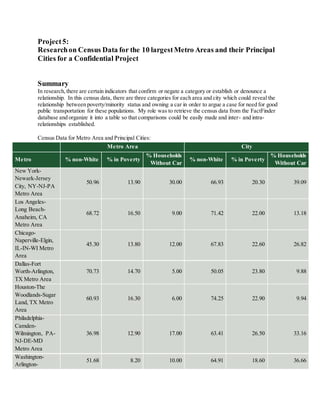
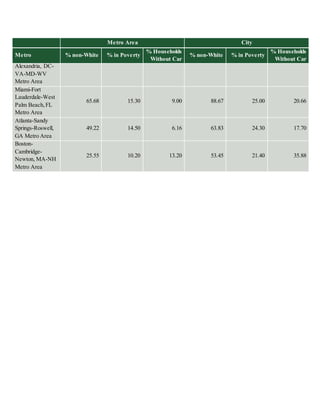
  • 31.
    Project4: Researchon Public PrivatePartnership PolicyDevelopment for a Confidential Project Summary In most policy decisions, there is always research done to learn from the outcomes that could be adopted from similar and different political scenarios. Internationally and domestically, government agencies have leveraged private capital investment and management in financing public projects to enhance efficiency and cost-effectiveness. However,there are severalways of accomplishing this, that is, different policies on types of deal procurement, team to select the deal and their structure and authority. I researched the different successfulpolicy options available internationally and domestically. Why should one establish a P3 program and a P3 unit to run it? Recommendations for setting a Public-Private Partnership (P-3) or a P-3 unit: NOTE FOR DEVELOPINGA PPP FRAMEWORK(DOCUMENT) Characteristics of a successfulPPP: Clearly defined political framework: Defined policies on procedures,structure, management and evaluation of a PPP project Best practices for Procedures: Project specifications (attribute, duration, size) that align with the public’s best interest Desirable characteristics of a PPP option that makes it a priority Best practices for Structure: Agreement on costs and means of financing, .e.g. subsidies, user charges,debt financing Best practices for Management: Government and Private sector responsibilities defined for each PPP project Best practices for Evaluation: Feedback loop set up for assessing project results Contract payment based on the performance of the contractor Pro and Con of a P-3 unit: Pro Con Can provide expertise on developing, reviewing and updating PPP policies on guidelines, requirements, documentation, procurement and dispute resolution May not be economical if financial and human capacities of the PPP unit are used for only one to three sectors Can provide government entities with expertise for identifying quality PPP options, procurements and evaluating the results In-line ministry staff responsibilities could be converted towards this role and hence there may be no need for a separate unit Actively promotes the PPP program to warrant interest of quality private-sector partners
  • 32.
    Pros of aP-3 program: Pro Project efficiency/Value for money: Timely delivery, Shared risks, Best practice Innovation in infrastructure Increase in financing available Improvement in sustainability of infrastructure and services Improvement in accountability of public expenditure PUBLIC PRIVATE PARTNERSHIP AGENCIES,A GLOBAL PERSPECTIVE (DOCUMENT) Pros and Cons of PPP: Pro Con Value-for-money: Performance-based payments Output specifications are discussed Cost saving on upfront capital and life-cycle maintenance of the project Best project delivery option usually taken PPP within the government ensures: better synchronization with public entities, prevention of potential conflicts of interest, greater and easier access to key decision-makers. PPP within the government may lead to: limited trust with the private sector, smaller salary that make it hard to retain top talent, government bureaucracy and red-tape, Things to consider when starting a new P-3 Unit:  Model: which PPP unit - in a country that is culturally, politically, legally similar - can you model from?  Team: which capable advisors can you bring on board to set up the unit?  Structure: will the unit be internal, under the central government/quasi- corporate, or be external, as a private-sector joint venture?  Spectrum: what sectors will the unit cover? Will there be different PPP units for every sector or will a unit handle more than one sector? Will few units unevenly share the management of more than one sector?  Coverage: will the contracts be for state infrastructure alone or will it include regions, cities, and counties?  Statues: what operations will the unit be allowed to do: regulatory, implementation, program promotion?
  • 33.
     Funding: willthe unit be government funded or will its budget be independent, that is, will it charge a service fee/become profitable?  Value-for-money Calculation – what method will the unit use in the cost/benefit analysis of a PPP project,that is, risk, performance improvement, management?  External Advisors: will the unit employ experts from the private sector or simply use staff from government agency?  HR Management – how does the unit plan to attract and retain top talent who are lured by the highly competitive pay scale offered by the private sector?  Start out phase: will the unit become standard by writing into law or will it be simply used as a resource center for PPP and think tank for agencies already involved in PPP? PUBLIC PRIVATE PARTNERSHIP UNITS (DOCUMENT) Pros of an independent PPP unit Pros More transparency .e.g. unit cannot be used to outwit set budgetary restraints More Accountability .e.g. unit can help government follow its overall fiscal budget Can serve as a coordinating unit for all infrastructure planning which will fasten project delivery Effectiveness of PPP units can only occur when there is: · Political and Leadership support · Supportive Institutional Frameworks .e.g. regulated capital markets, transparent governance · When the unit’s authority can met its objectives · When the unit is placed in the centraldecision-making arm of government · When the unit is continually engaged in the project by developing the skills of responsible agencies and reviewing/approving the project to be implemented. Lessons from Queensland, Australia: Characteristics of a successfulPPP unit: · PPP unit is located close to the centralgovernment/policy-making body, and not necessarily independent or in inline agencies · PPP unit exercises most policy functions without needing to override already existing institutional framework · PPP units are well funded to carry out their roles of technical assistance or project development funding. Placement in Treasury can enable faster funding. · Involvement of local government with the financial and technical capacity to implement a PPP project, with coordination from a PPP unit Characteristics of an unsuccessful PPP program: · Lax attitude towards PPP by the governing authority – no political and executive structure · No extra checks for value-for-money outcome or project expectation after bidding stage · Lack of independent, specialist PPP unit located in the Treasury · Lack of a long-term plan for project roll-outs that qualify for a PPP procurement · Insufficient deal flow that is competitive in the bid market · Forecasting error and misallocation of market risk · Insufficient availability and cost of project finance
  • 34.
    MOVINGFORWARD ON PUBLICPRIVATE PARTNERSHIPS:U.S. AND INTERNATIONAL EXPERIENCE WITH PPP UNITS (DOCUMENT) Reasons to set up a PPP unit: · Poor procurement incentives available · Coordination issues between inline agencies · Lack of information and expertise in handling transaction deals · High transaction costs in achieving PPP deals Comparative Description of PPP unit structure in foreign countries: Country Features U.K Canada Australia Name Infrastructure UK (IUK) Local Partnerships PPP Canada Infrastructure Australia Partnership Victoria Model Public sector driven Private sector driven Federalist system Team 60 members from commerce, finance, law, economics, policy fields Board of Directors: Chairperson, CEO, 6 private-sector members Members: Business development – 20 Analysis and Technical assistance – 20 Administration – 20 National: 5 private sector,3 federallevel, 3 state level and 1 local government representatives Structure Located in the UK Treasury Owned by the government but functions as a business Located in the Australian Department of Infrastructure and Transport Located in Victoria’s Department of Treasury and Finance Spectrum Multi-sectorial, (National): Transport, Housing, Defense,Education, IT (Local): Corporate property and regeneration; Housing and sustainable communities; Culture and sports; Fire and police services; Corporate and transactional services; Social care; Transportation and regeneration; schools; Waste management Multi-sectorial, Transportation; Water; Energy; Security; Solid waste; Culture, Sports; Connectivity and broadband; Maritime; Aerospace; Tourism Multi-sectorial, (National): Transportation; Energy; Communication; Water
  • 35.
    Coverage National PPP, Municipallevel PPP National PPP promotes and oversees PPP units in lower governmental levels National: Coordinates the PPP across allgovernmental levels Country Features U.K Canada Australia Statutes Procurement assistance and PPP deal management Technical advice for PPP management nationally, capacity building and project approval for sub- national PPP units Enforces policy for procurement and management of PPP deals done by inline agencies nationally and sub-nationally; does not implement project but gives guidance on contract management for sub-national PPP units Funding P3 Canada Fund: $1.2billion, 5-year budget National: Build Australia Fund Value- for- money Varying methods according to the decision of the sub- national PPP units Public Sector Comparator, Discount Rate method External Advisors Yes,it has private sector contributors Start-out phase Started out in Victoria then branched into national operation Keywords:  Model: which PPP unit - in a country that is culturally, politically, legally similar - can you model from?  Team: which capable advisors can you bring on board to set up the unit?  Structure: will the unit be internal, under the central government/quasi- corporate, or be external, as a private-sector joint venture?  Spectrum: what sectors will the unit cover? Will there be different units for each different sector? Will a unit handle more than one sector and another unit handle the other sector?  Coverage: will the contracts be for state infrastructure alone or will it include regions, cities, and counties?  Statutes: will operations will the unit be allowed to do: regulatory, implementing, program promotion?  Funding: will the unit be government funded or will its budget be independent, that is, will it charge a service fee/be profitable?
  • 36.
     Value-for-money Calculation– what method will the unit use in the cost/benefit analysis of a PPP project,for example, risk, performance improvement methods?  External Advisors: will the unit employ experts from the private sector or simply use staff from government agency?  Start out phase: will the unit become standard by writing into law/ will it first be share as a resource center for PPP and think tank for agencies already involved in PPP? U.S States with PPP units and their structure: States Features Virginia California Michigan Name Office of Transportation Public-private Partnerships Public Infrastructure Advisory Commission Office of Innovative Partnerships and Alternative Funding PPP unit? Yes Yes Yes Model Public agency Advisory Board Public agency Team 9 employees 20 advisors from academia, industry and government Structure Located in Virginia Department of Transportation Business, Transportation and Housing (BTH) agency Treasury Department Spectrum Across all modes of transportation Transportation Multi-sectorial Coverage Across the state Statewide Across the state Statutes Procure, implement and regulate PPP projects; policy making activity Provides advice during PPP project development, especially on its economic viability; In charge of the monitoring system to ensure best practices Review and promotion of PPP projects; provides information on best practices for policies on PPP management Funding Operational budget from Secretary of Transportation Funding from the BTH agency Start-up costs funded by a loan from Michigan Economic Development Corporation; Operational costs funded through user charges
  • 37.
    included in closingcosts of PPP project Policy considerations that will improve the outcome of a PPP program:  A PPP unit dedicated to the PPP process: This can help the government avoid the negative pitfalls that come with no agreements on how the risk and revenue of the project will be shared between the involved parties. When located within the central government, this unit can be utilized by various sectors which will benefit from its technical and auditing assistance. Depending on the institutional structure,this unit can carry out various activities to help in the success of the PPP program.  A better understanding of the PPP framework: The PPP project should be seen as a risk/revenue sharing agreement and not necessarily a funding source or divestment by the government. The PPP project should also be properly evaluated financially, especially from the value-for-money perspective, to decide if it is a better option than the traditional government procurement. The laws in place should enable and not hinder the PPP process,hence legislature support is mandatory and can be garnered through the promotion of PPP projects. Lastly, adequate funding should be available to pay the private partners. The funding options should be chosen after the pros and cons of each funding method are fully considered.  Availability of Technical Assistance fromFederal PPP units: There should be an option for state PPP units to receive guidance from government staff who have expertise on PPP procurement. Workshops on different financing options for a PPP dealwith examples from different states that implemented a PPP option could be given as an educational course to states considering PPP. Generally, the PPP program should be included in the infrastructure strategy of a country to ensure value-for-money is always considered.
  • 38.
    Project5: Researchon Census Datafor the 10 largestMetro Areas and their Principal Cities for a Confidential Project Summary In research,there are certain indicators that confirm or negate a category or establish or denounce a relationship. In this census data, there are three categories for each area and city which could reveal the relationship between poverty/minority status and owning a car in order to argue a case for need for good public transportation for these populations. My role was to retrieve the census data from the FactFinder database and organize it into a table so that comparisons could be easily made and inter- and intra- relationships established. Census Data for Metro Area and Principal Cities: Metro Area City Metro % non-White % in Poverty % Households Without Car % non-White % in Poverty % Households Without Car New York- Newark-Jersey City, NY-NJ-PA Metro Area 50.96 13.90 30.00 66.93 20.30 39.09 Los Angeles- Long Beach- Anaheim, CA Metro Area 68.72 16.50 9.00 71.42 22.00 13.18 Chicago- Naperville-Elgin, IL-IN-WI Metro Area 45.30 13.80 12.00 67.83 22.60 26.82 Dallas-Fort Worth-Arlington, TX Metro Area 70.73 14.70 5.00 50.05 23.80 9.88 Houston-The Woodlands-Sugar Land, TX Metro Area 60.93 16.30 6.00 74.25 22.90 9.94 Philadelphia- Camden- Wilmington, PA- NJ-DE-MD Metro Area 36.98 12.90 17.00 63.41 26.50 33.16 Washington- Arlington- 51.68 8.20 10.00 64.91 18.60 36.66
  • 39.
    Metro Area City Metro% non-White % in Poverty % Households Without Car % non-White % in Poverty % Households Without Car Alexandria, DC- VA-MD-WV Metro Area Miami-Fort Lauderdale-West Palm Beach,FL Metro Area 65.68 15.30 9.00 88.67 25.00 20.66 Atlanta-Sandy Springs-Roswell, GA Metro Area 49.22 14.50 6.16 63.83 24.30 17.70 Boston- Cambridge- Newton, MA-NH Metro Area 25.55 10.20 13.20 53.45 21.40 35.88
  • 40.
    Project6: Researchon the EconomicImpacts of an Housing Impact Fee for a Confidential Project Summary An impact fee is a one-time fee usually included in the building permits of new developments or expansions/repair. It is applied in place of tax to generate revenue to support new development occurring in the area so that the households who create the need for public facilities (such as affordable housing, schools, fire department, etc),sponsor them. In the United States, before a municipality adopts an impact fee,they must conduct a Nexus Study which will simulate market rate housing and the affordable housing needed. Further analysis is to evaluate if the impact fee generates adequate revenue from the new residential developments. My role involved doing a literature research on the effect of new impact fees on the amount of market rate development in a jurisdiction. Similar to the Fremont Residential Nexus Study. What are the impact of an impact fee? We are researching 1 type of impact fee, a fee to be placed on new construction of market rate houses. That fee will then be used to fund the construction of affordable houses. Task 1 – Affordable Housing Need Generated by New Market Rate Housing 1. We will start with a simplified illustrative example of the introduction of 100 new market rate housing units, which we will assume represents 100 households in the project’s location. 2. We will use standard industry averages to estimate the average household income represented by these housing units, which multiplied by 100 represents the aggregate amount of household income residing within the project’s location as a result of this illustrative development. (estimated using the most recent U.S. Census and American Community Survey data available for the project’s location) 3. We will model the economic impact of that amount of household income in the project’s location, in terms of the jobs supported by the household spending, the industries those jobs are in, and the average annual salaries for those jobs. (employment impact created by this new household spending, detailed by industry, was determined using IMPLAN.) 4. Based on the number of jobs and the average annual salaries calculated in the previous step, we can draw a conclusion about the amount of affordable housing needed by the people who work these jobs, and the level of affordability needed based on their salary levels. (Newaffordable housing demand is calculated by comparing the average annual wages by industry to HUD’s FY2015 Income Limits) 5. We will summarize these findings with simple tables and conclusions for your internal use as well as for any external audiences that you see fit. Task 2 – Revenue Generation Potential of Impact Fee on Market Rate Development 1. We will review literature that explores the effect of new impact fees on the amount of market rate development in a jurisdiction (in economics parlance, the “elasticity” of market rate development to new impact fees). 2. We will construct a basic model that utilizes that literature to make a relationship between impact fee levels and development levels. 3. We will utilize that model to create three scenarios of impact fee levels, one which is very small and will therefore have little if any effect on development levels, one which is modest and will therefore have some but not a major effect on development levels, and one which is large and will therefore may have a significant impact on development levels. 4. We will calculate the revenue generation potential for each of these scenarios by multiplying the impact fee by the amount of development we project will occur. 5. We will summarize these findings with a brief narrative including commentary on what they mean for your exploration of the introduction of an impact fee on market rate development.
  • 41.
    State Fee Placement Housing TypeFee Amount Money Raised Affordable Housing Developed Orlando, FL Fee paid prior to issuance of building permits Single-family housing $5,712 San Carlos, CA Fee paid prior to issuance of building permits Single family housing/ Market- rate rental apartment $18,554/unit 2013:528,259; 2014:159,000; 2015: 84,000 340 San Jose, CA Fee paid prior to issuance of building permits Multi-family housing rental with 3/more units $17/ sq ft $30 million 35,080 San Diego, CA Fee paid prior to issuance of building permits Non-residential spaces Office: $1.41/sq ft; Research & Development: $0.80/sq ft; Retail & Hotel: $0.85/sq ft Dade County, FL Fee paid prior to issuance of building permits Single family, Apartment, Condo, Mobile Home $409.27 – $2,392/sq ft Berkeley, CA Fee paid prior to issuance of building permits Multi-family rental housing $20,000/ unit or 1 affordable unit/ 10 market rate units $100 - $2million 3.5houses (<30% median), 3.8 houses (30%<x<50%), 2.7houses (50%<x<65%) Fremont, CA Fee paid prior to issuance of building permits For sale and rental units $17.55 – $20.25/sq ft 5,455 Santa Rosa, CA Fee paid prior to issuance of building permits For-sale and rental units Rental: $12,712/sq ft; Sale: 2.5% sale price 4,662 Walnut Creek, CA Fee paid prior to issuance of Multi-family for sale and rental units $1.60 – $15/sq ft $35 million
  • 42.
    State Fee Placement Housing TypeFee Amount Money Raised Affordable Housing Developed building permits Mountain view, CA Fee paid prior to issuance of building permits New,rental apartment $10.26/sq ft 2,926 Marin County, CA Fee paid prior to issuance of building permits New Single family homes > 2000sq ft; Teardowns of 500sq ft; Conditioned floor area of 2,000sq ft $10/sq ft $4-5 million Napa County, CA Fee paid prior to issuance of building permits Single family, Multi-family, Condo $1,738/unit $88,812,483 San Francisco , CA Fee paid prior to issuance of building permits Studio; 1-bedroom; 2-bedroom; 3-/4-bedroom $199,698; $270,441; $367,711; $419,621; $6.4million 1,467 King County, WA Fee paid prior to issuance of building permits Single-family house; Multi-family house 411 Denver, CO Fee paid prior to issuance of building permits >29 for-sale and rental single- and multi-family units High zone: 70% of sale price; 50% of sale price; 25% of sale price Burge, G., Ihlanfeldt, K. (2006). The Effects ofImpact Fees on Multi-family Housing Construction (in Florida Counties). Journal ofRegional Science Vol. 46 No. 1 Pp. 5-23 Q1: Is the number of properties built less because of the impact fee? A1: It is estimated that $1 marginal water/sewer impact fee applied to new housing development reduces multi-family housing construction by 1202sq ft, 3770sq ft and 1317sq ft in central cities, inner suburbs and outer suburbs of Florida counties respectively. Note: water/sewer impact fees are used for the improvement of offsite water/sewer capacity necessitated by new development. Inner suburbs are affected the most because the elasticity of demand for multi- family housing is relatively high as compared to the other areas (centralcities and outer suburbs) as it is closer to the cities which are where low-income household usually move from and it does not have the racial prejudice of the racially and economically homogeneous outer suburb.
  • 43.
    In the shortrun, for every 1% increase in water/sewer impact fee,there is a corresponding 5.84%, 7.86%, 7.87% decrease in multi-family house construction in Florida counties. Note: Difference between short-run and long-run:- Short run measures immediate response while long run measures the change in equilibrium stock In the long run, for every 1% increase in water/sewer impact fee,there is a corresponding 1.18%, 0.32%, 0.88% decrease in multi-family house construction in Florida counties Q2: how much affordable housing was built with the fee? A2: It is estimated that, on average,a $1 marginal non-water/sewer impact fee applied to new housing development increases multi-family housing by 2581sq ft Note: Non-water/sewer impact fees are used for schools, parks, libraries, etc. In the short run, for every 1% increase in non-water/sewer impact fee,there is a corresponding 4.28% increase in the multi-family housing stock of Florida county inner suburbs. In the long run, for every 1% increase in non-water/sewer impact fee, there is a corresponding 0.59% increase in the multi-family housing stock of Florida county inner suburbs. Project7: Cost-BenefitAnalysis for a Confidential Project Summary In the wake of climate change and rising water levels, flood mitigation projects are needed as barriers to prevent infrastructural damages. Needless to say, the benefits of the project must be greater than the cost of the project to validate its necessity. Thus, a benefit - cost analysis was done to calculate the frequency of damage events and their corresponding damages to simulate cost and calculate the future damage events and monetary damages to simulate benefits. This is done with the help of a software which inputs damages and outputs costs or benefits. I had the role of understanding and acquiring the inputs needed for the analysis. Method 1 data needs: •Date of damage event •Damage dollar •Damage losses •Is frequency known/unknown? •Known frequency: credible support documents Method 2 data needs: •Analysis Year (Current Year ) •Structure Life, SL (Current Year – Construction year) •Period of available data record
  • 44.
    •Damage year •Total DamageDollars (sum all the damage dollars from all events in a year) •Analysis Duration (has criteria for when user decides or when AD=SL) •Known Recurrence Intervals: credible support documents with high degree of confidence = FIS/H&H study with info about project location, FIRM (Flood Insurance Rate Map) title block and map scale
  • 45.
    Project8: Data presentationusing Piecharts, Bar Graphs and Line Graphs for a Confidential Project Summary Economic analysis involves interpreting data and presenting data to reach meaningful conclusions about the mentioned data. Lower Gwynedd Chart Preparation  Presented the data of the city’s 2000-2015 budget in charts  The makeup of Federal, State, Local Revenue with a municipality’s budget  Expenditure and its distribution across government parastatals  Tax, Capital Financing Structure (Bonds/Notes)
  • 46.
    Project9: Economic Impact Studiesfor a FoodBazaar Summary Whenever there is an expenditure incurred, this initial outlay produces a ripple effect on the economy. Using the IMPLAN software,we determine the direct and indirect earnings, expenditures and employment that a recurring street food bazaar generates. I went through survey data for the project.
  • 47.
    Project10: Researchon Employment Densityfor Confidential Project Summary Incubator, Accelerators and Coworking spaces are places,especially with support staff and equipment, made available at low rent to new small businesses. However, an accelerator takes single-digit chunks of equity in externally developed ideas in return for small amounts of capital and mentorship. An incubator, on the other hand, brings in an externalmanagement team to manage an idea that was developed internally. Coworking is a new way for independent professionals to work in a shared,collaborative space. In the realestate world this is a new line of service while for the business would this is a new means of cutting fixed costs (e.g. rent), as employment density is smaller in these spaces compared to traditional offices. Therefore my role was to research on the average office employee density and the economic impacts that their services provide. Office Employee Density: http://www.usgbc.org/Docs/Archive/General/Docs4111.pdf ITE – Institute of Transportation Engineers General Office – Suburbs: 304sq. ft./employee Corporate HQ – Suburbs: 260sq. ft./employee Single Tenant Office: 295sq. ft./employee Office under 100,000 sq.ft: 228 sq.ft/employee Office over 100,000 sq.ft.: 221 sq.ft/employee Office Park: 278 sq.ft/employee Business Park:332 sq.ft/employee Research & Development Center: 405 sq.ft/employee https://www.mwcog.org/uploads/committee-documents/YV5WXFhW20110503134223.pdf Data for Sub-urban BusinessParks,Urban Land Institute: Office: 244 sq.ft/employee R & D Laboratory: 35sq. ft/employee Cordoba Corporation, San Bernardino and Riverside Counties Down Town Office Space:249sq. ft/employee (San Diego County) Sub-urban Office Space: 288sq. ft/employee (San Diego County) Coworking space: Facts about the Cambridge Innovation Center (CIC) and its job impact  CIC is a realestate company that provides office management services to start-ups at affordable prices, i.e, it allows small, medium entrepreneurs rent space for their business and allows them be in tune with a community of other entrepreneurs.  They are existent in five domestic locations (Miami, Cambridge, Boston, St. Louis, and Baltimore) and in an international location (Rotterdam, Netherlands).  It has been home to about 2,500 companies that have at one point rented the facility for their business  They are currently home to 900 companies, three-quarter of which are startup while the rest are innovative branches of big companies  Companies range from 1 entrepreneur to a 30-member team
  • 48.
     These companiesare in different fields – Consumer Electronics, Digital Media, Web Design/Marketing, Software,Virtualization, Networking, Enterprise, Hardware,Services, Robotics, Power,Games,Research and Development  Example of these companies are Go Ambient, Maven, ScanScout, Visible Measures,Luminus Devices, Great Point Energy, Conduit Labs, Aileron , Carbonite, Clear Methods, Coatue  Conduit Labs, Ember, Enterprise Mobile, Fusion Optix, Gloucester Pharmaceuticals,GreatPoint, Energy, Greenfuel, Groundhog Technologies, H3, Hubspot, In Vivo, iSkoot, LNL, Luminus Devices, Maven Networks,Mok3, n2n, Racepoint, Scan Scout, Sequation, Stromedix, Thing Magic, Measures,Vitae Pharmaceuticals,Zafgen and Google Cambridge  Companies originally headquartered at CIC have raised $2.0b in venture capital and strategic investment since 2001 (while at CIC and after moving out).  Companies originally headquartered at CIC have created between $3.5b and $4.3b in publicly disclosed exit value since 2001.  CIC itself employs staff under the description of manager, community leader, architectural services, event coordinator, receptionist, accountant, chef,and administrative staff for all of their locations. RocketSpace: http://venturebeat.com/2013/09/03/rocketspace-30-months-130-companies-75k-square-feet-we-want-to- be-the-nucleus-of-tech/ 75000sq. ft./550employees – 136sq. ft/employee A recent study conducted by CoreNet Global has predicted that office users will reduce the amount of space they allocate per person to an average of 151 square feet by 2017, compared to 176 square feet today, and 225 square feet in 2010. Further Information from the UK: IAC (Incubator, Accelerator and Co-working Space) The average density of desks was around 6 sq.m (approximately 65 sq.ft) per desk, which is twice as high as the average office employment density in London of 12sq.m (approximately 130 sq.ft) https://www.london.gov.uk/sites/default/files/180%20IAC%20Report.Artwork_web.pdf
  • 49.
    Further Information fromCopenhagen, Denmark: http://www.oeaw.ac.at/isr/comet/documents/Final_Results/COMET_CTT/location/location-120.html
  • 50.
    http://www.oeaw.ac.at/isr/comet/documents/Final_Results/COMET_CTT/location/images/large/location- 120_9l.html Overall Copenhagen -30sq. m/employee Inner city Copenhagen – 29sq. m/employee Rest of the Core City – 36sq. m/employee Suburban Belt - 27sq. m/employee
  • 51.
    Project11: Economic Impact Studiesfor an Triple Bottom Line approach to Stormwater Management Summary This report was an assessment of the local economic impact of an environmentally sustainable and neighborhood serving approach to stormwater management. It explains the reason for this approach and how and what scale that is executing it, the quality of life benefits and economic implications on real estate and of being the first to execute green stormwater management. My role in this project is to explain the need for better stormwater management and why the green stormwater management was the best approach.
  • 52.
    Project12: Economic Impact Studiesof a University Summary Whenever there is an expenditure incurred, this initial outlay produces a ripple effect on the economy. This economic impact study measures the effect of spending from a university located in an urban setting. That is, the effect of a highly educated population, stable jobs and home ownership for diverse professionals in the higher education and healthcare sectors, and knowledge base from research conducted in the school premises, and lastly expenditure from the staff and students which create a healthy fiscal and economic condition for the neighborhood. My role included researching the course programs and scholarship availability to validate the accessibility of education to nearby population and the teacher positions available to diverse populations. I also researched the new retail that was created that is supported by the University.
  • 53.
    Project13: Assistance with Act47 for a Confidential Project Summary I did a research on the Municipality Employee Breakdown of similar Municipalities to the client to help an informed policy decision. Municipality Department Full Time Employers Part Time Employers Aldan Borough Fire Services 0 0 Police Services 5 7 Waste Management Total 7 24 Chadds Ford Township Fire Services 0 0 Police Services 0 0 Waste Management Total 3 5 Chester Heights Borough Fire Services 1 1 Police Services 0 0 Waste Management Total 1 11 Chester Township Fire Services 1 1 Police Services 10 10 Waste Management Total 17 23 Colwyn Borough Fire Services 0 0 Police Services 1 5 Waste Management Total 3 7 East Lansdowne Borough Fire Services 0 0 Police Services 3 12 Waste Management Total 7 18 Eddystone Borough Fire Services 1 1 Police Services 11 9 Waste Management
  • 54.
    Municipality Department Full Time EmployersPart Time Employers Total 14 45 Edgmont Township Fire Services 1 1 Police Services 0 0 Waste Management Total 4 6 Lower Chichester Township Fire Services 0 0 Police Services 5 8 Waste Management Total 12 25 Marcus Hook Borough Fire Services 0 0 Police Services 3 12 Waste Management Total 10 28 Media Borough Fire Services 0 0 Police Services 15 4 Waste Management Total 16 51 Millbourne Borough Fire Services 1 1 Police Services 0 15 Waste Management Total 0 29 Morton Borough Fire Services 1 1 Police Services 4 8 Waste Management Total 7 30 Norwood Borough Fire Services 0 0 Police Services 6 5 Waste Management Total 9 51 Parkside Borough Fire Services 0 0 Police Services 3 10 Waste Management
  • 55.
    Total 3 20 MunicipalityDepartment Full Time Employers Part Time Employers Rose Valley Borough Fire Services 0 0 Police Services 0 0 Waste Management Total 0 2 Rutledge Borough Fire Services 0 0 Police Services 0 0 Waste Management Total 0 3 Sharon Hill Borough Fire Services 1 1 Police Services 9 12 Waste Management Total 16 33 Tinicum Township Fire Services 1 1 Police Services 15 4 Waste Management Total 45 45 Trainer Borough Fire Services 0 0 Police Services 4 12 Waste Management Total 7 22 Upland Borough Fire Services 0 0 Police Services 5 8 Waste Management Total 19 8
  • 56.
    To Whom ItMay Concern: Chinwude was very fun to work with. She always smiled and said ‘Hi’ when she came into the Office. We joked a lot while working but after that I observed that Chinwude could get back to work-mode seamlessly. We worked on different projects together including Trend and the History of Philadelphia projects. We shared our tasks equally and combined it before submitting it to the supervisor. She was very resourceful when I needed someone to answer a question. Devin Campetti campetti@econsultsolutions.com
  • 57.
    To whom thismay concern, I worked with Chinwude at Econsult Solution, where we were both Research Assistants. During her time here, we did a lot of collaborative work in order to meet the demanding work load in the office. Chinwude helped me complete a few projects, in addition to her individual tasks. We collaboratively researched and aided in the write up of a recovery plan for a small Borough in Pennsylvania. We also researched and wrote an analytical paper delving into the historic decline of Philadelphia, as well as its expansion. I also had the opportunity to explore Philadelphia with Chinwude where we visited Penn's Landing for the Christmas tree lighting. This brought about exposure to various aspects of the the city, and the components that truly make Philadelphia a city of brotherly love. Regards, Frances Osei-Bonsu