


Systemic design
workshop@namahn
@shiftNGroup
OCTOBER, 2016 #RSD5
Namahn and shiftN
— Namahn
 Human-centred design, digital
products and services (Brussels, BE)
 An experienced, international,
multidisciplinary team:
• 17 designers, 3 staff + expert network
• Founded in 1987
— shiftN
 Futures and systems thinking studio
(Leuven, BE)
 Network of experts
2
About this workshop
— Introduction to our systemic design toolkit
 Why this toolkit?
 Underlying principles
— Overview of all the tools
— Case: child obesity - apply 4 tools to this case
 Actants
 System map
 Intervention strategy
 Paradoxical thinking/matrix
3
Systemic design
toolkit
What is systemic design?
Systemic design is the combination of the tools,
methods and principles of system thinking and
human-centred design.
— Systems thinking offer a realm of methods to understand
complex socio-technical issues but lacks practicality.
— Human centred design is hands-on and solution
oriented but misses the approach to handle complexity
 The current design methodologies are based on our linear way of
problem solving.
5
Why do we make this toolkit?
— Type of projects: more complex, societal
 Interconnectedness, circular thinking needed
 Open solutions with self-adaptive capacity
— More collaboration needed
 Push stakeholders to look at multiple perspectives
 Make systemic design thinking explicit, approachable to all
stakeholders (offer tools to make this simple & accessible to them)
— More about this in the paper sessions
6
Underlying principles
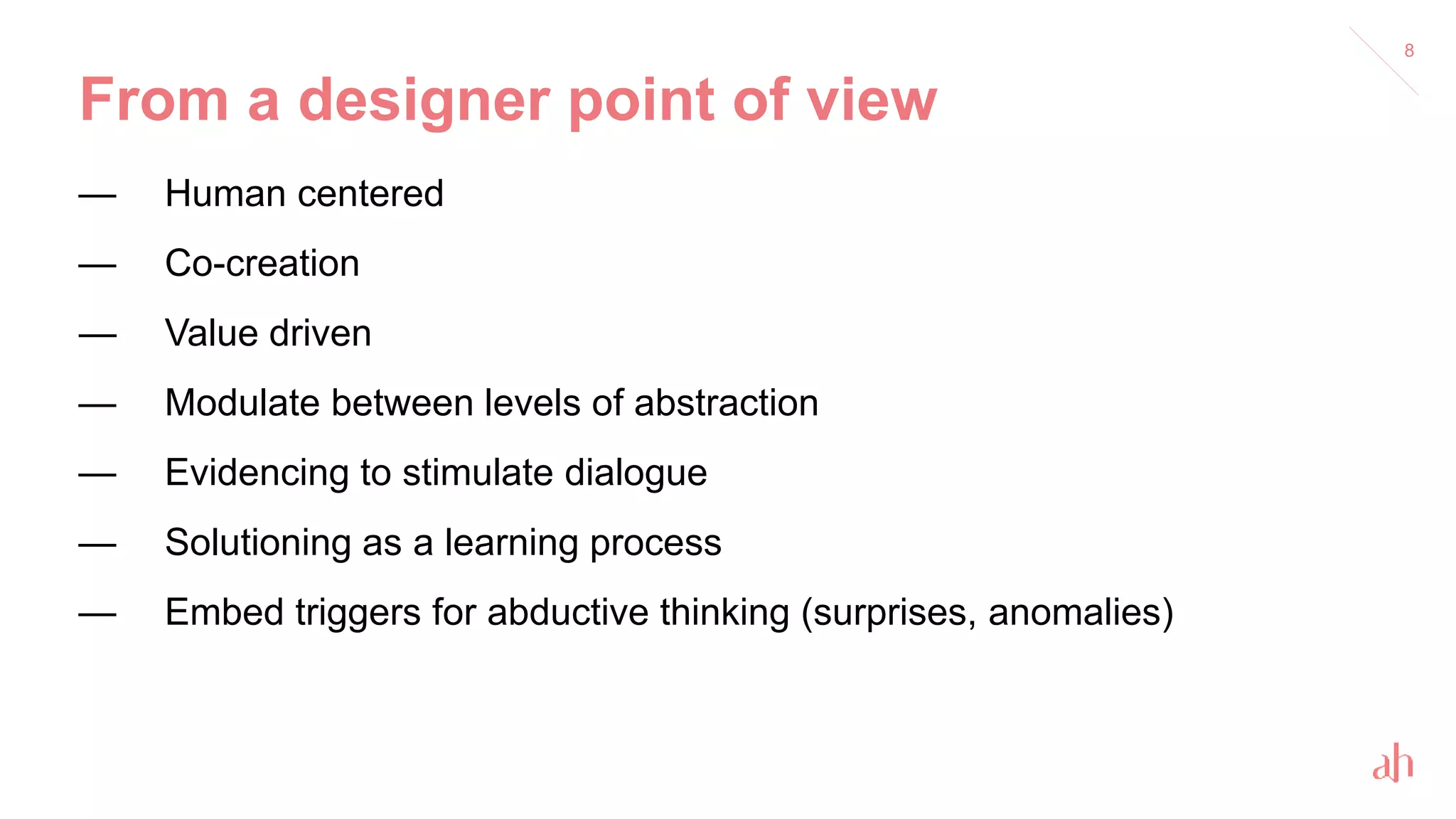
From a designer point of view
— Human centered
— Co-creation
— Value driven
— Modulate between levels of abstraction
— Evidencing to stimulate dialogue
— Solutioning as a learning process
— Embed triggers for abductive thinking (surprises, anomalies)
8
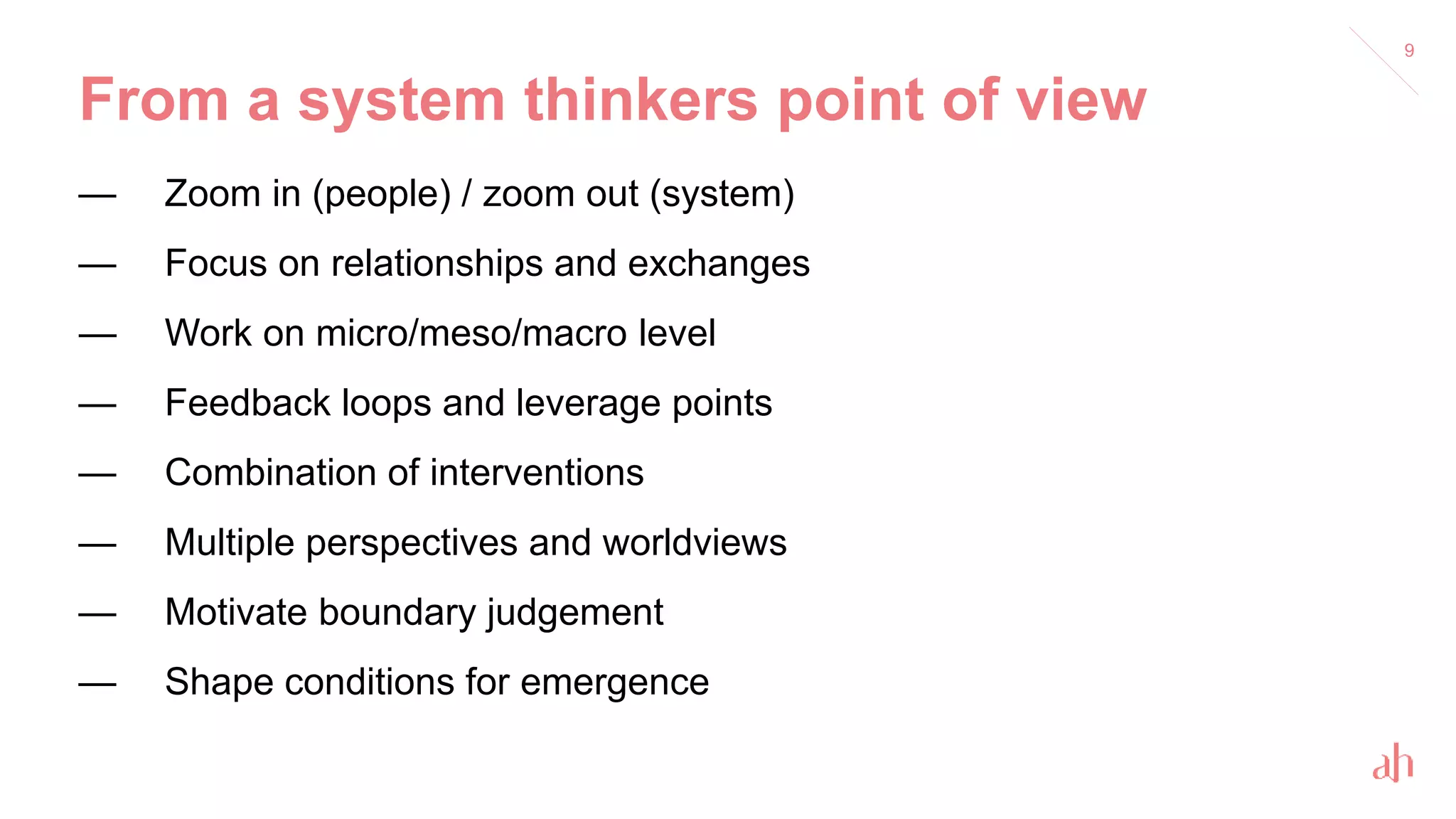
From a system thinkers point of view
— Zoom in (people) / zoom out (system)
— Focus on relationships and exchanges
— Work on micro/meso/macro level
— Feedback loops and leverage points
— Combination of interventions
— Multiple perspectives and worldviews
— Motivate boundary judgement
— Shape conditions for emergence
9
Systemic design
toolkit
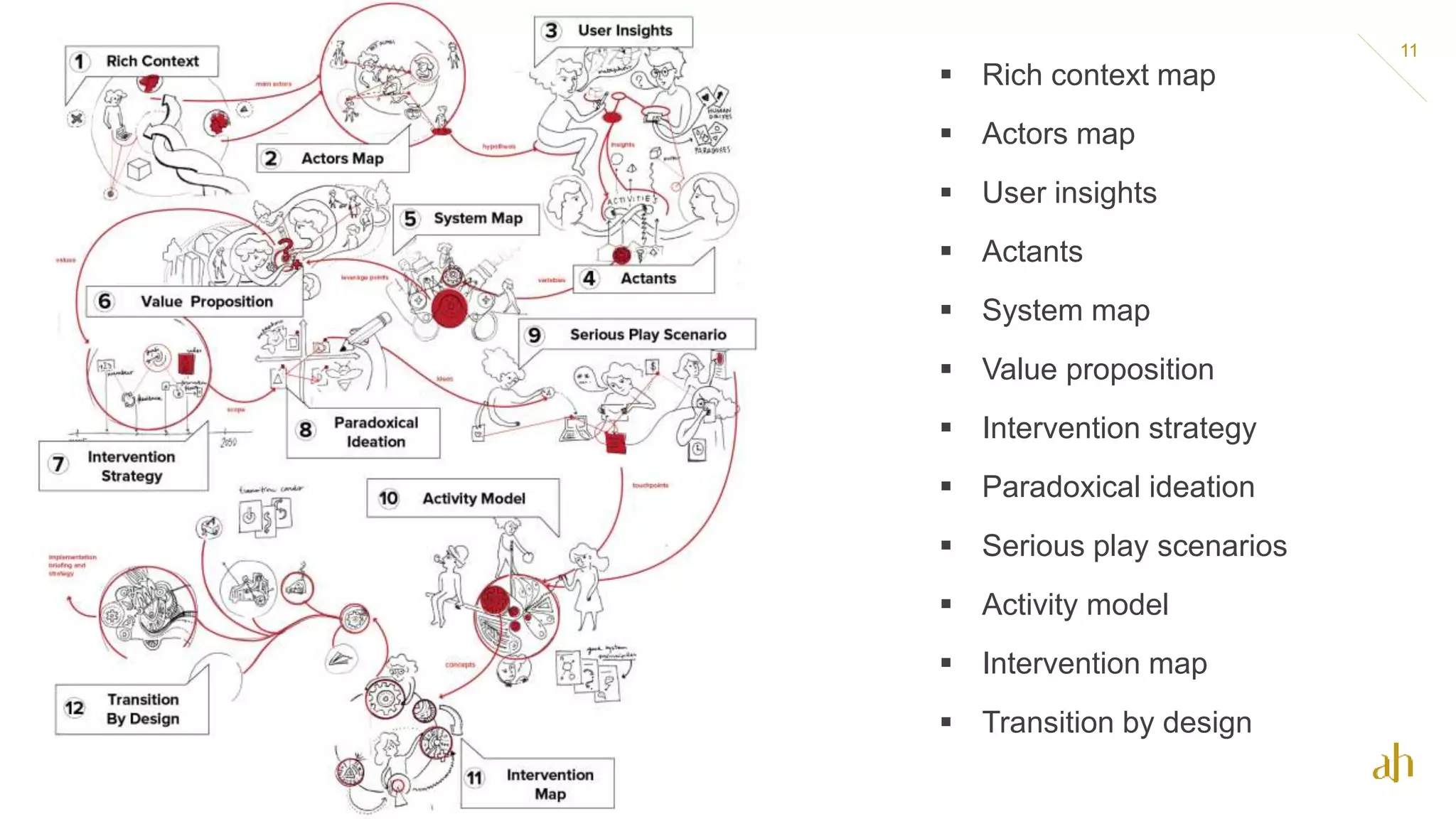
 Rich context map
 Actors map
 User insights
 Actants
 System map
 Value proposition
 Intervention strategy
 Paradoxical ideation
 Serious play scenarios
 Activity model
 Intervention map
 Transition by design
11
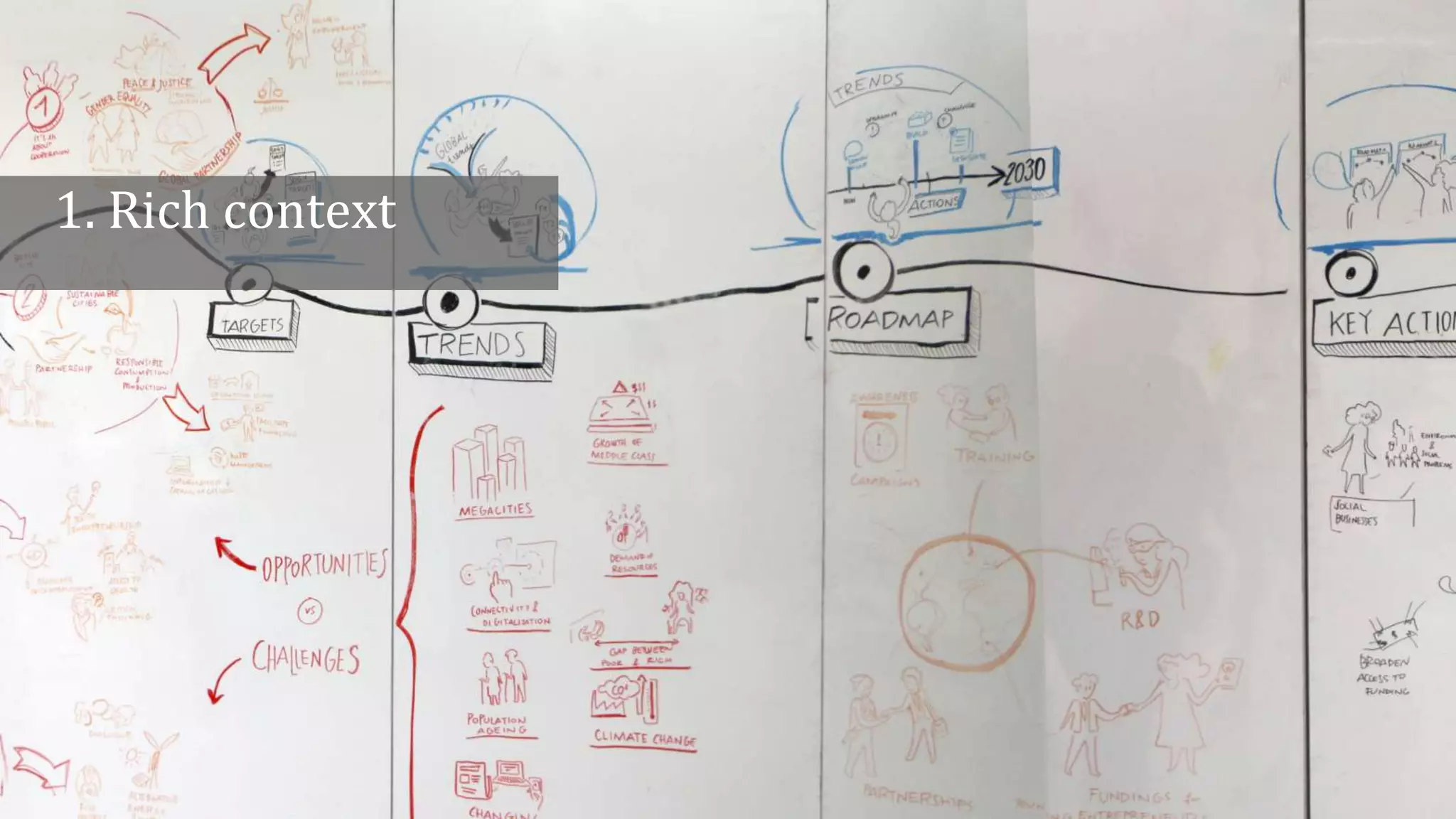
1. Rich context
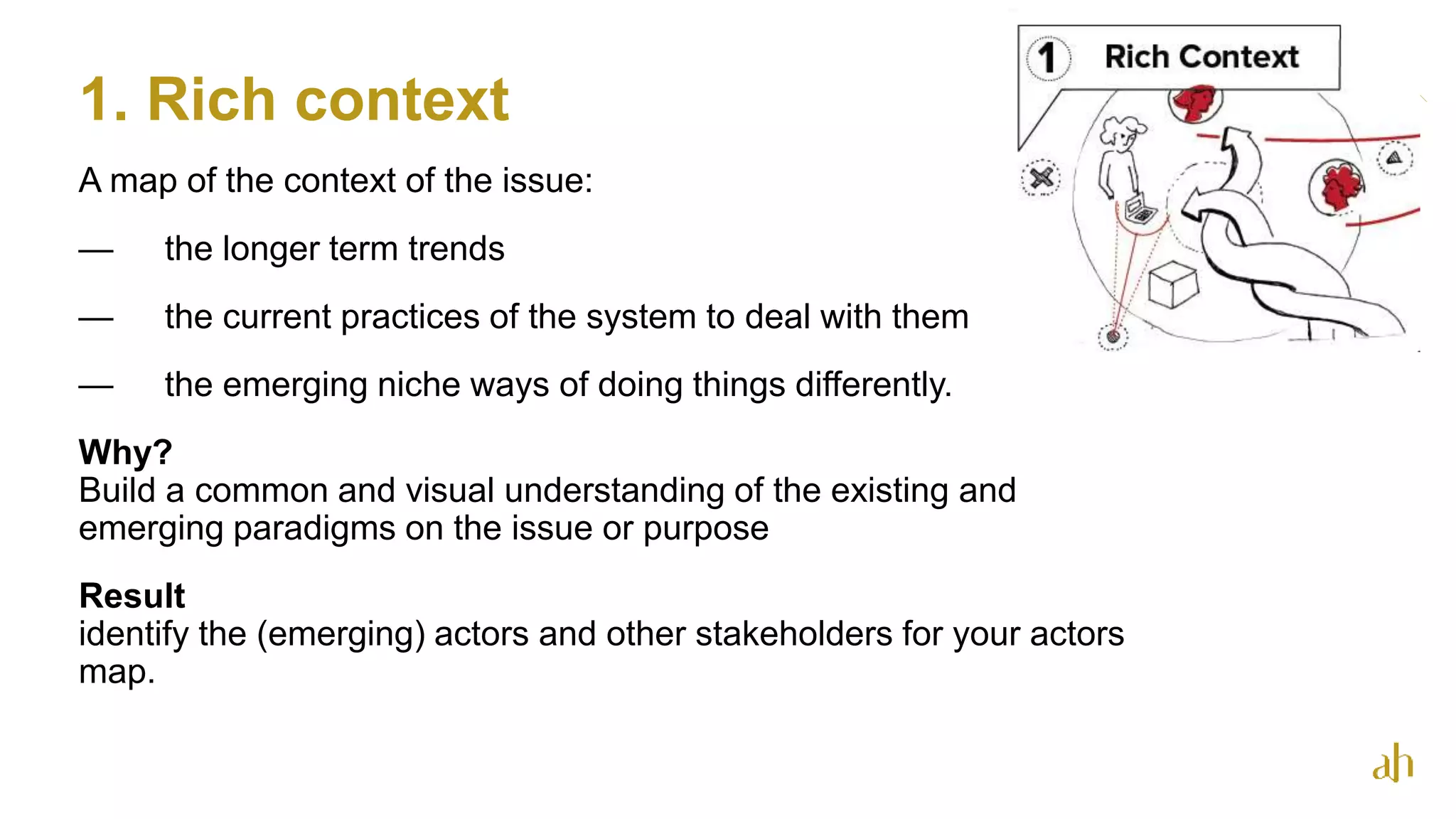
1. Rich context
13
A map of the context of the issue:
— the longer term trends
— the current practices of the system to deal with them
— the emerging niche ways of doing things differently.
Why?
Build a common and visual understanding of the existing and
emerging paradigms on the issue or purpose
Result
identify the (emerging) actors and other stakeholders for your actors
map.
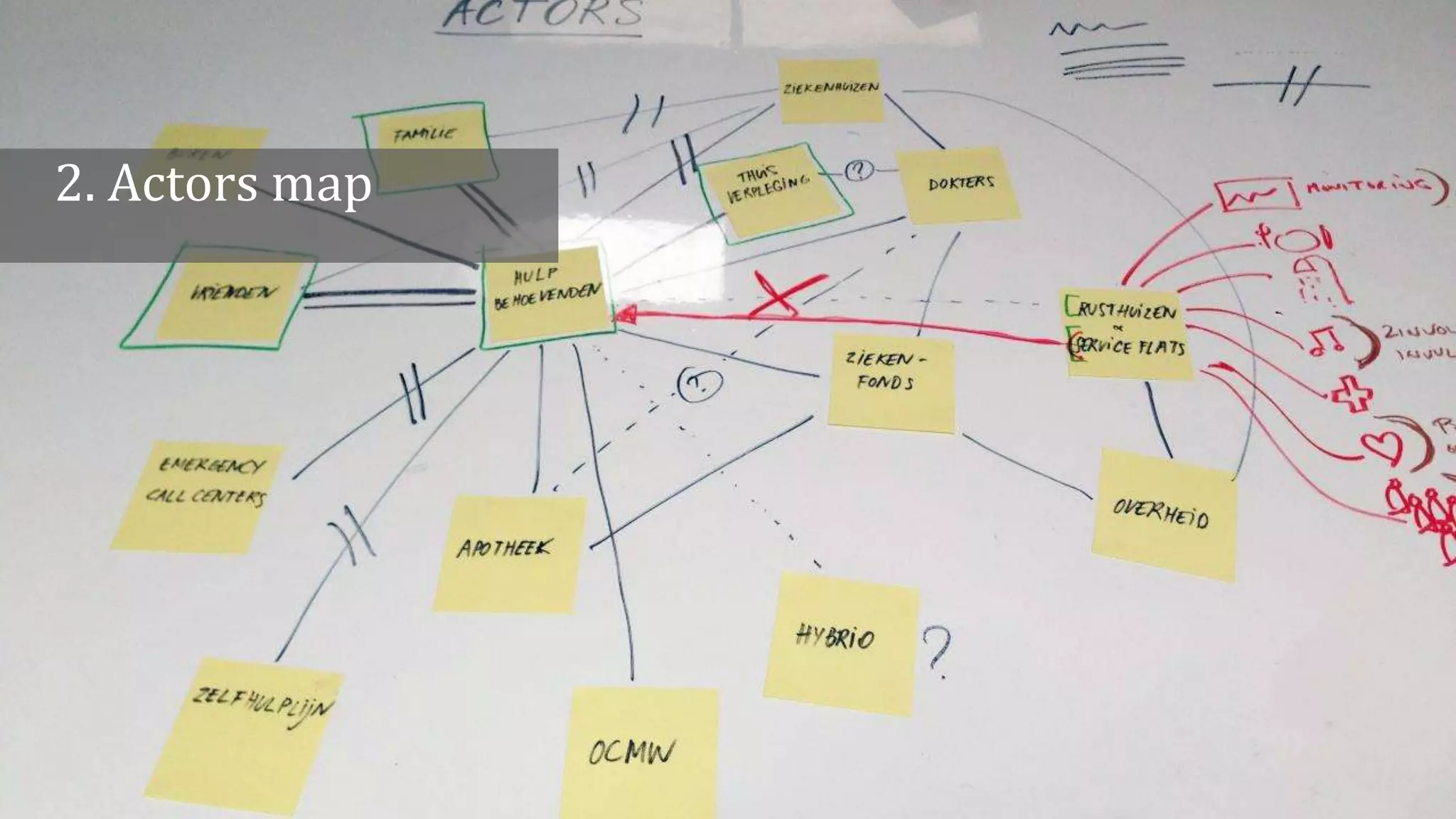
2. Actors map
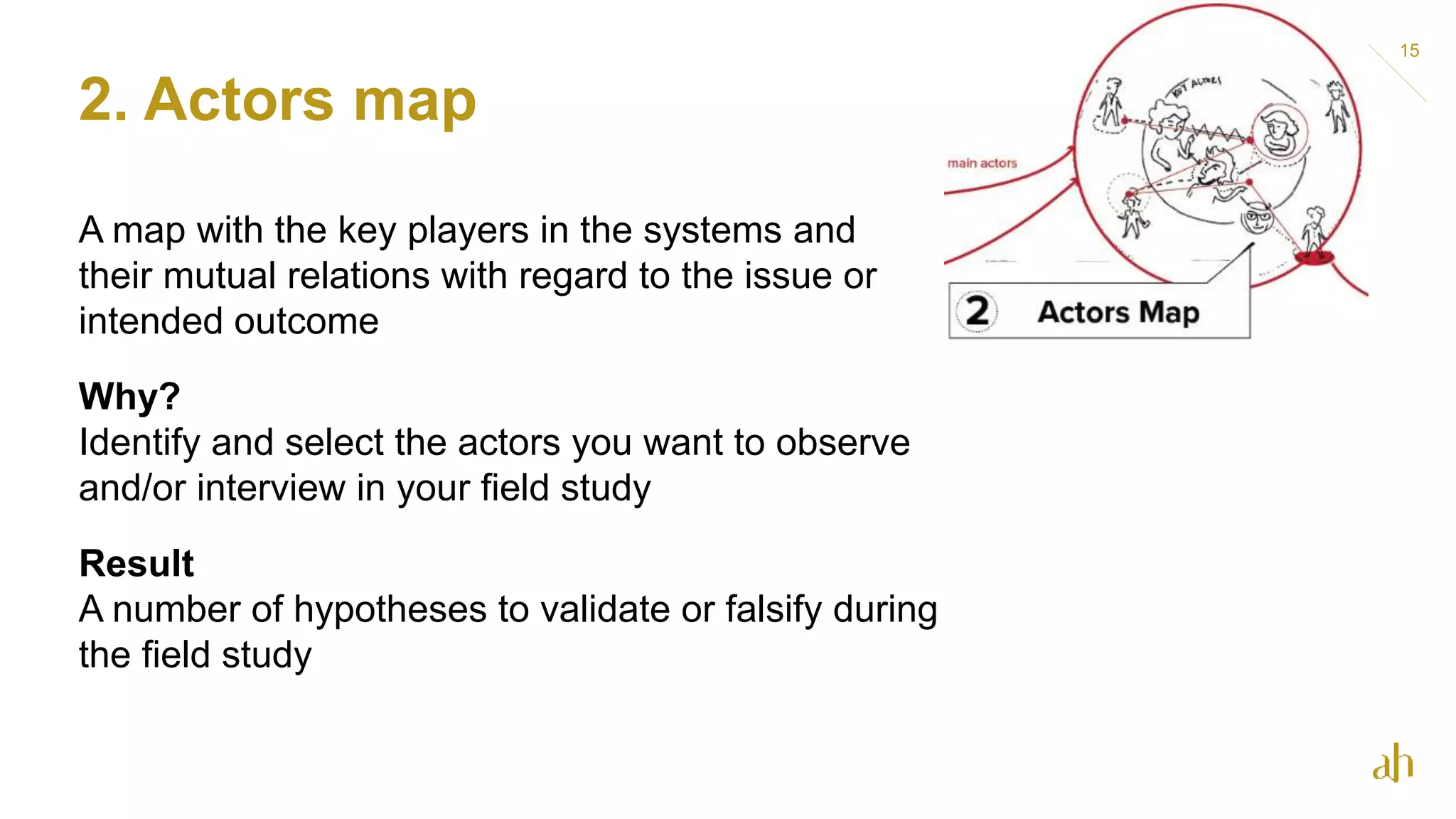
2. Actors map
15
A map with the key players in the systems and
their mutual relations with regard to the issue or
intended outcome
Why?
Identify and select the actors you want to observe
and/or interview in your field study
Result
A number of hypotheses to validate or falsify during
the field study
3. User insights
3. User insights
17
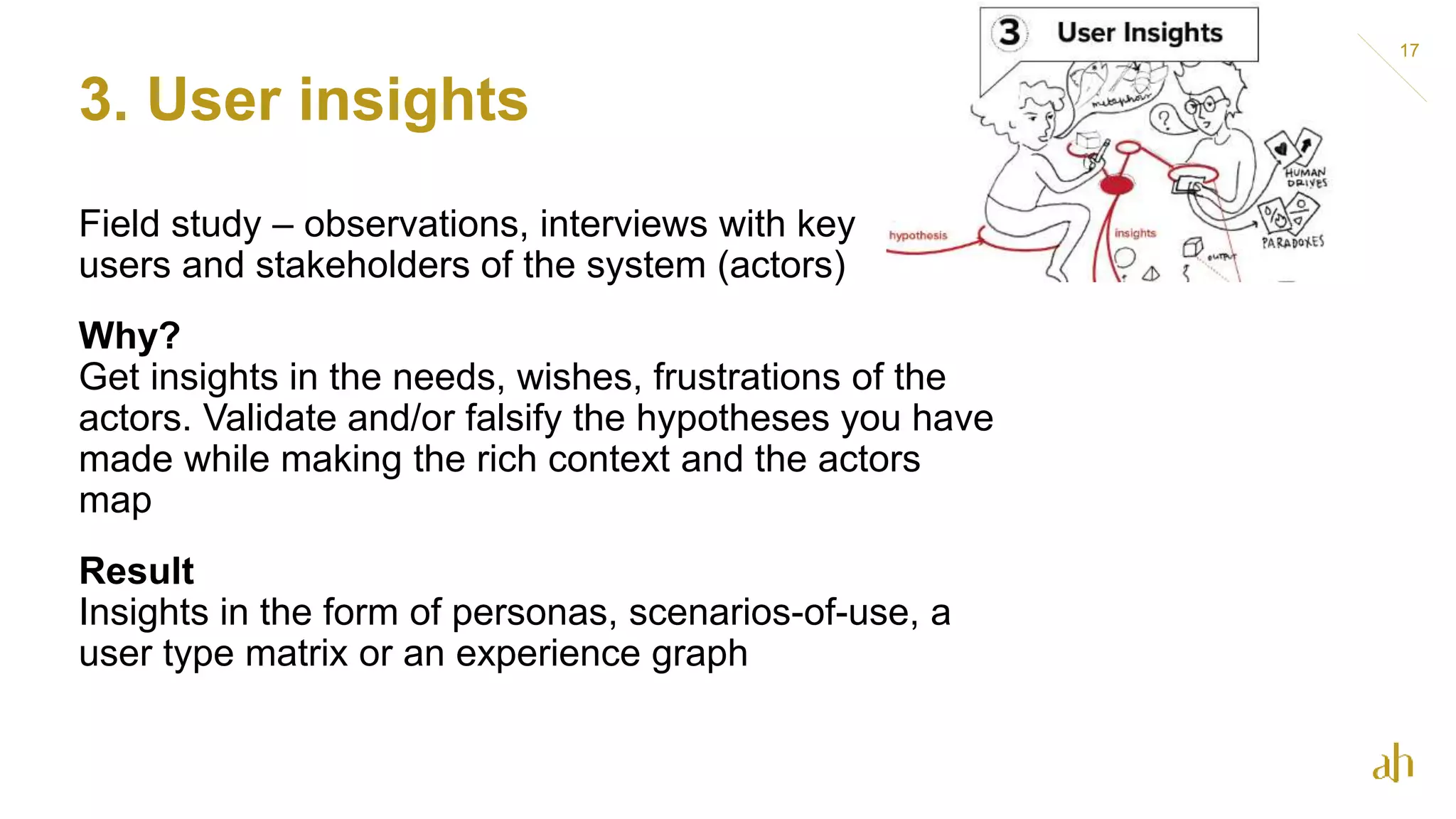
Field study – observations, interviews with key
users and stakeholders of the system (actors)
Why?
Get insights in the needs, wishes, frustrations of the
actors. Validate and/or falsify the hypotheses you have
made while making the rich context and the actors
map
Result
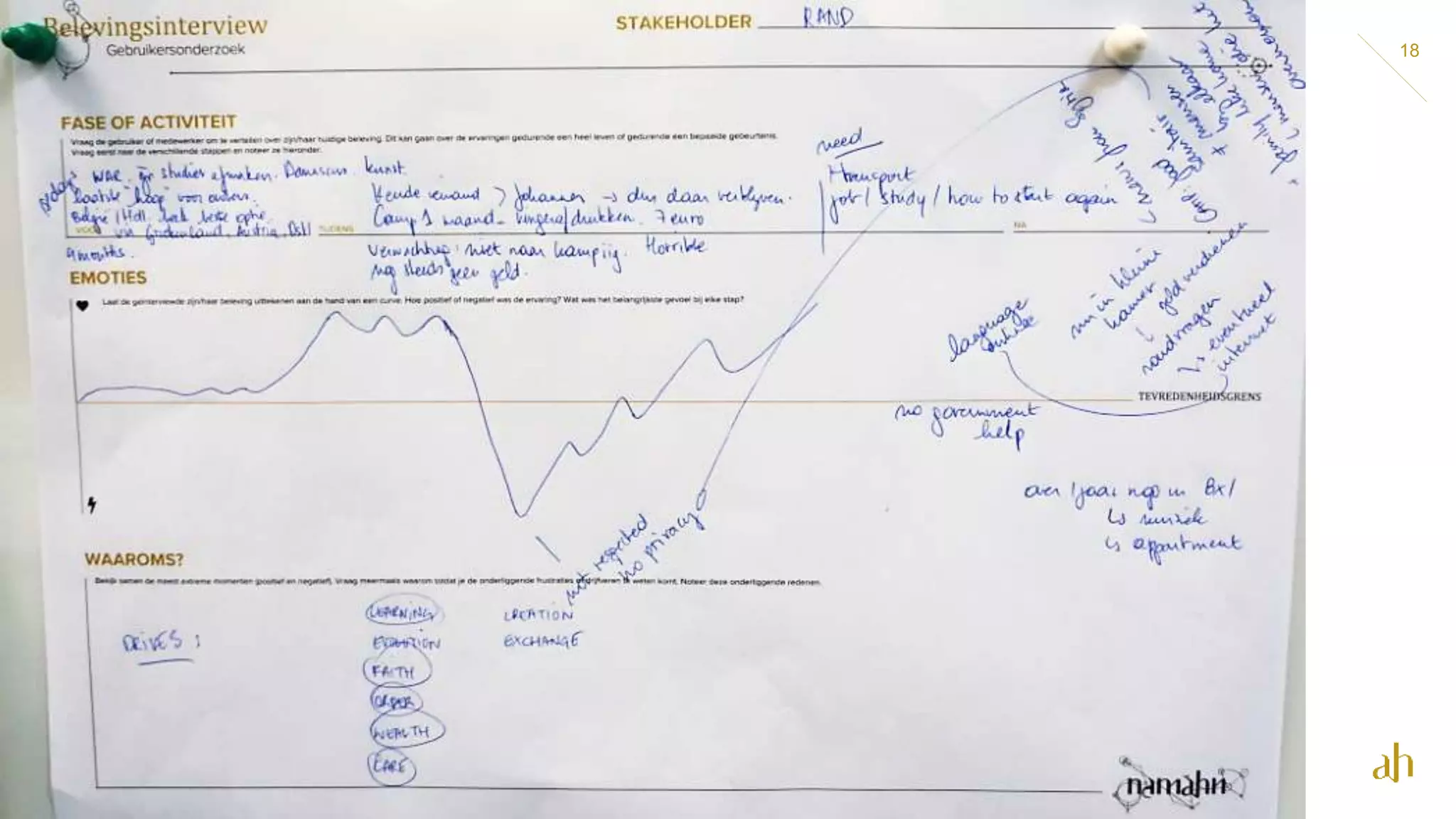
Insights in the form of personas, scenarios-of-use, a
user type matrix or an experience graph
18
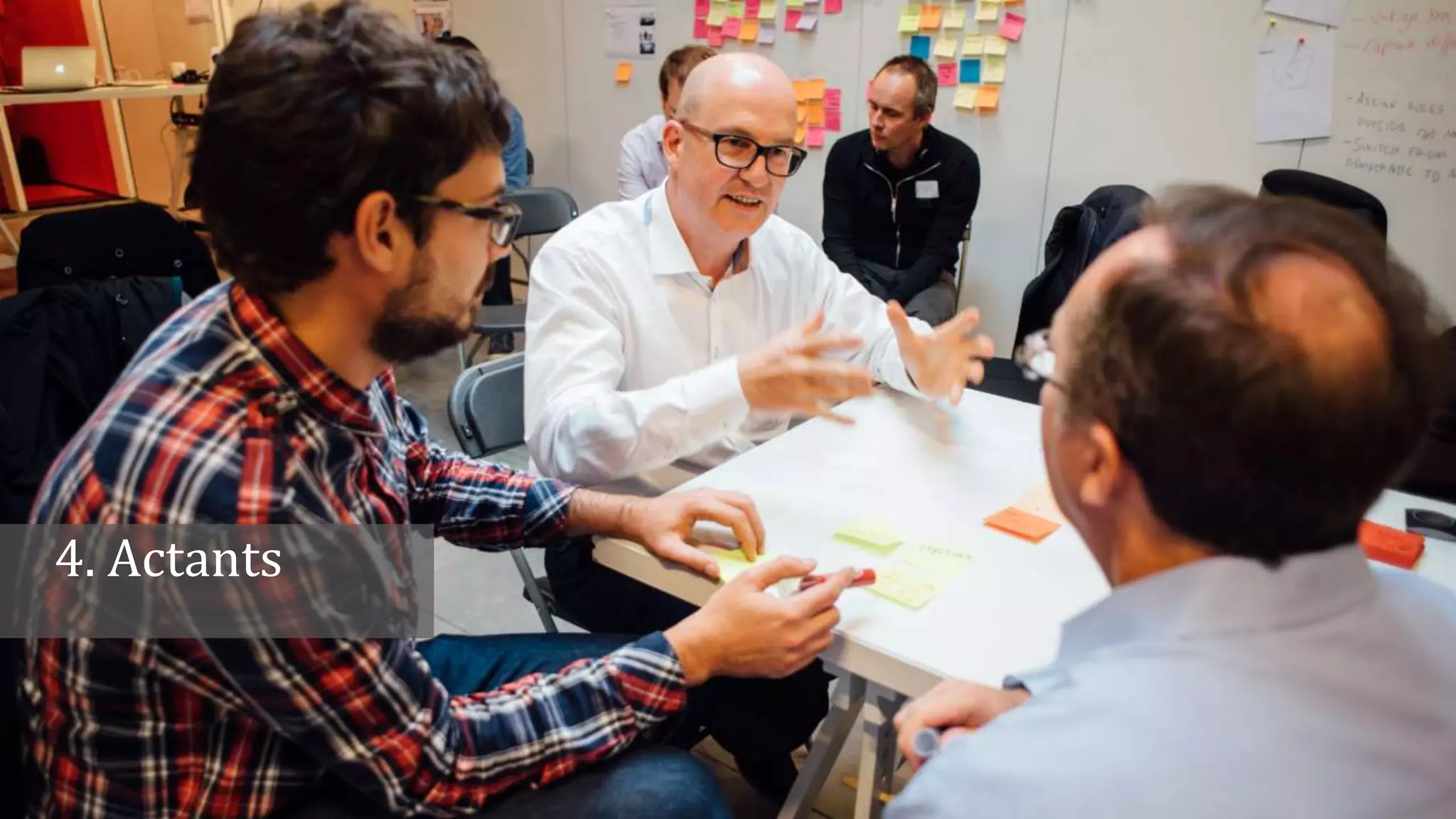
4. Actants
4. Actants
20
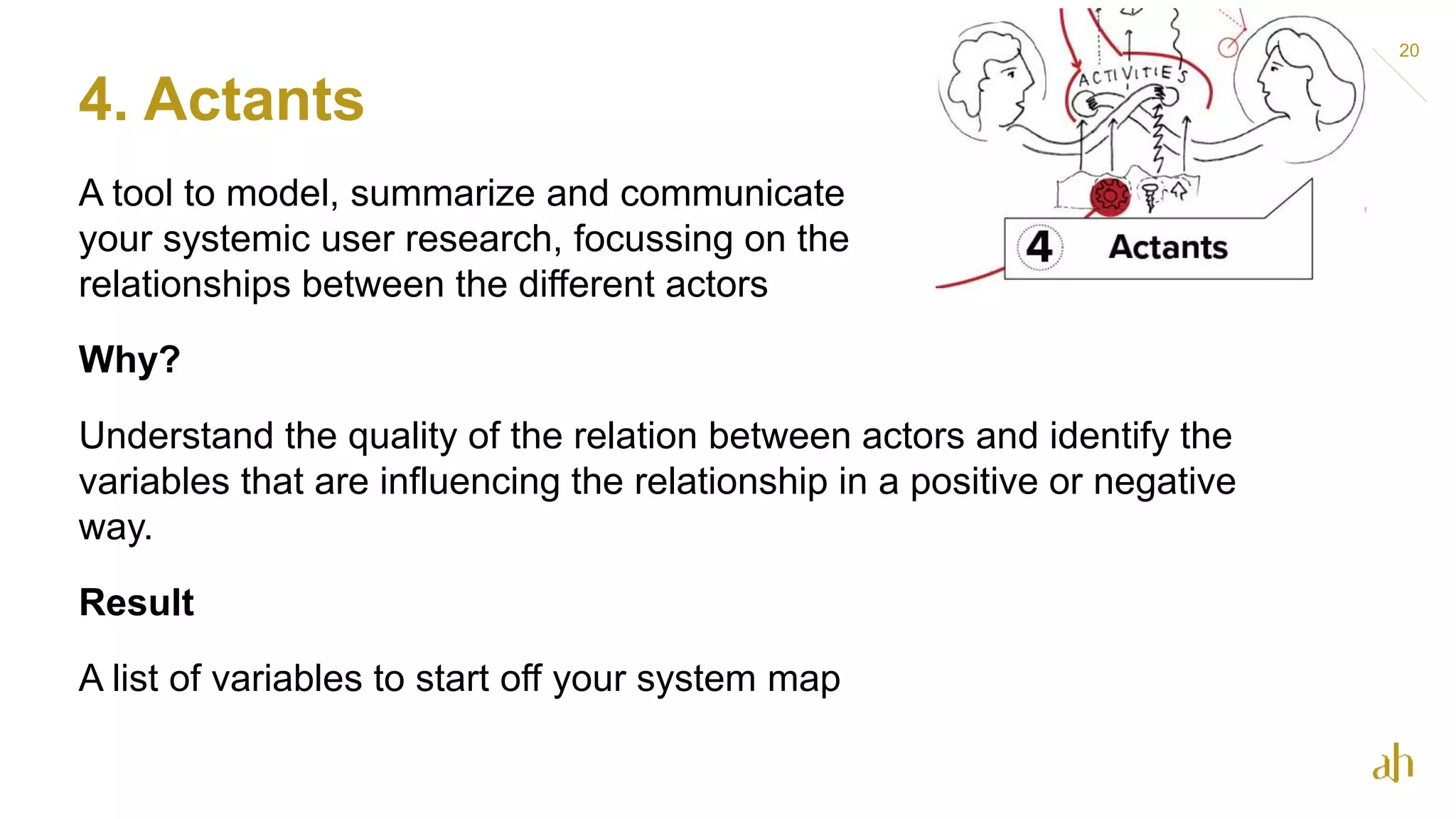
A tool to model, summarize and communicate
your systemic user research, focussing on the
relationships between the different actors
Why?
Understand the quality of the relation between actors and identify the
variables that are influencing the relationship in a positive or negative
way.
Result
A list of variables to start off your system map
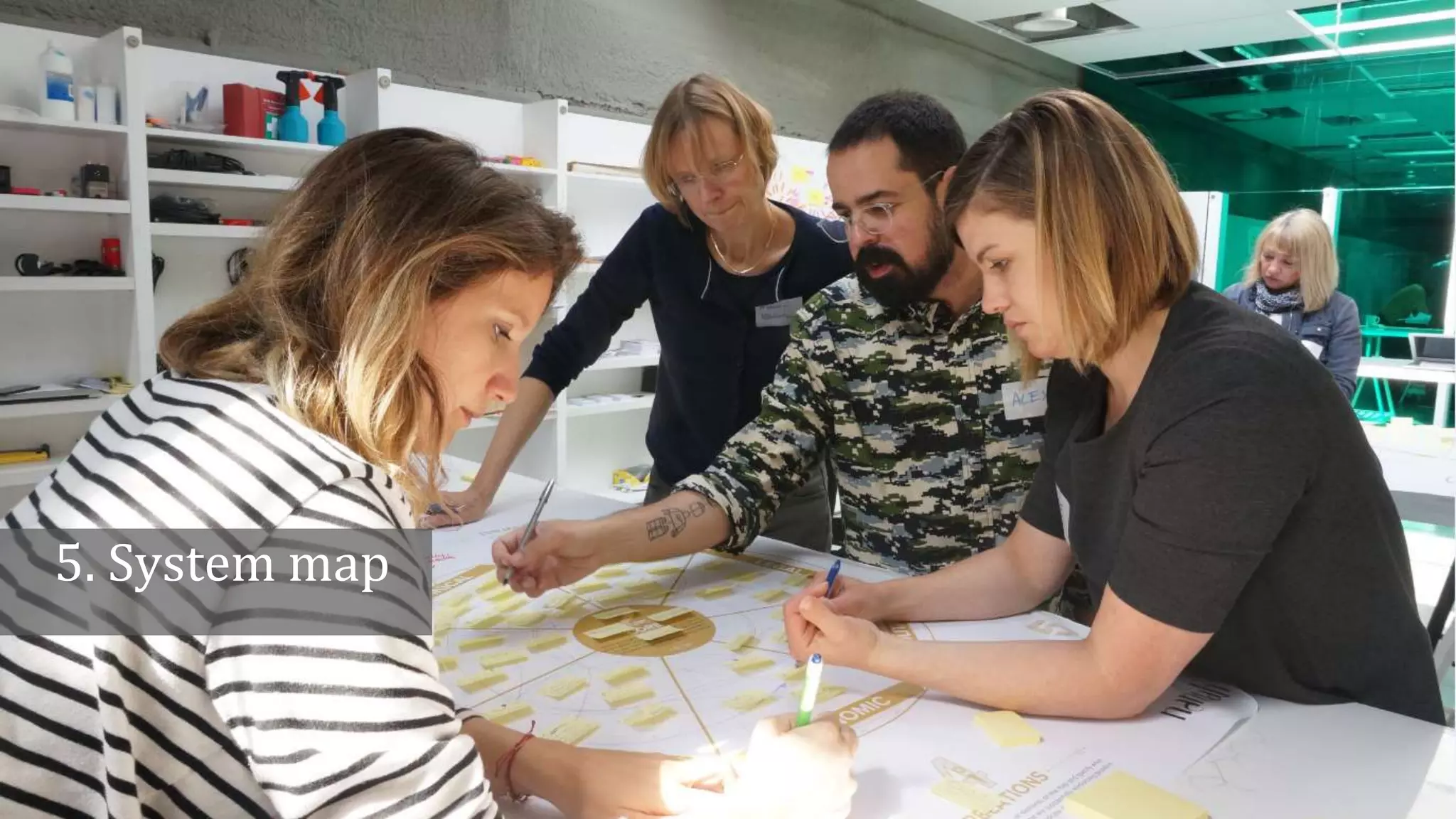
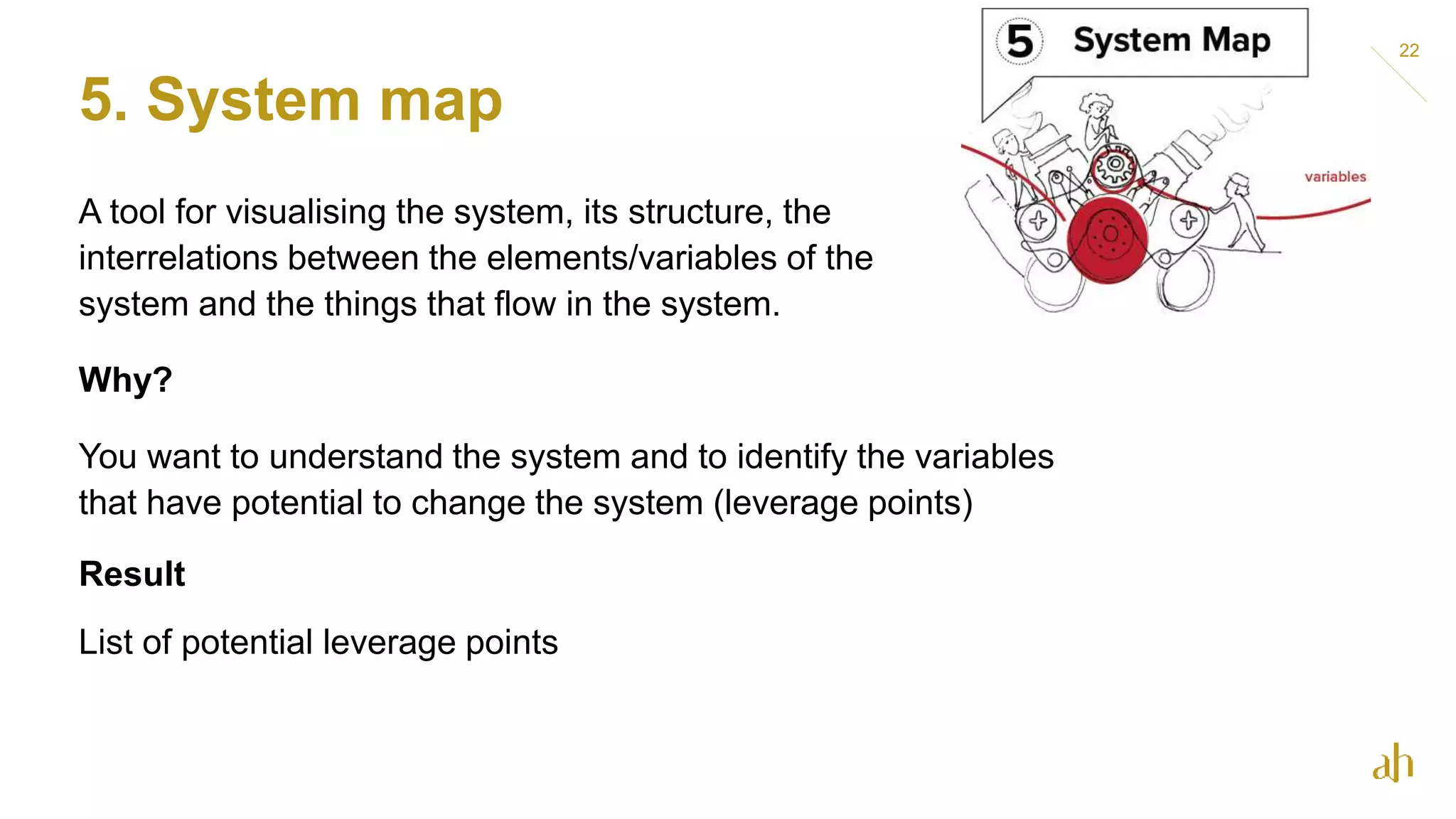
5. System map
5. System map
22
A tool for visualising the system, its structure, the
interrelations between the elements/variables of the
system and the things that flow in the system.
Why?
You want to understand the system and to identify the variables
that have potential to change the system (leverage points)
Result
List of potential leverage points
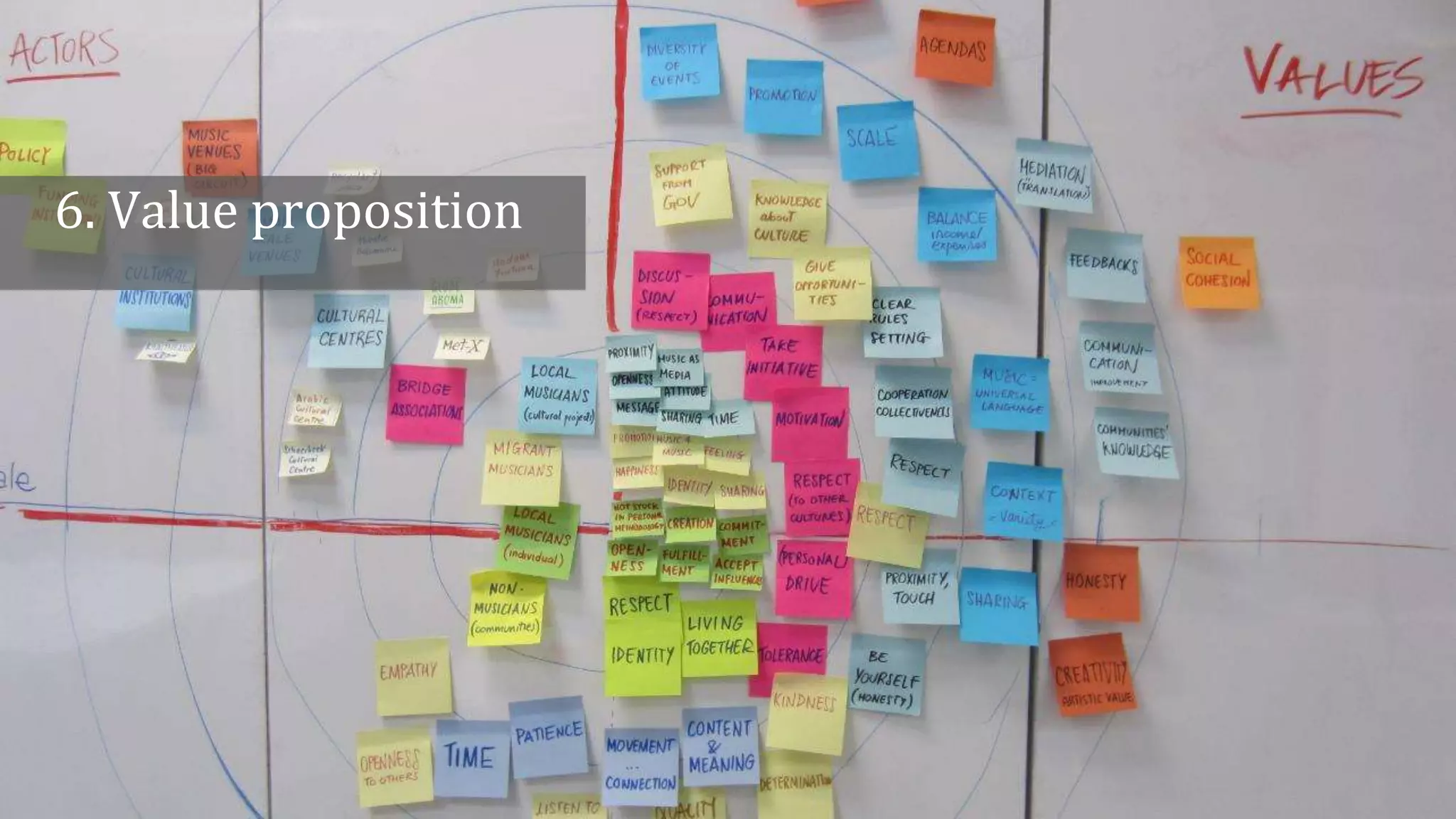
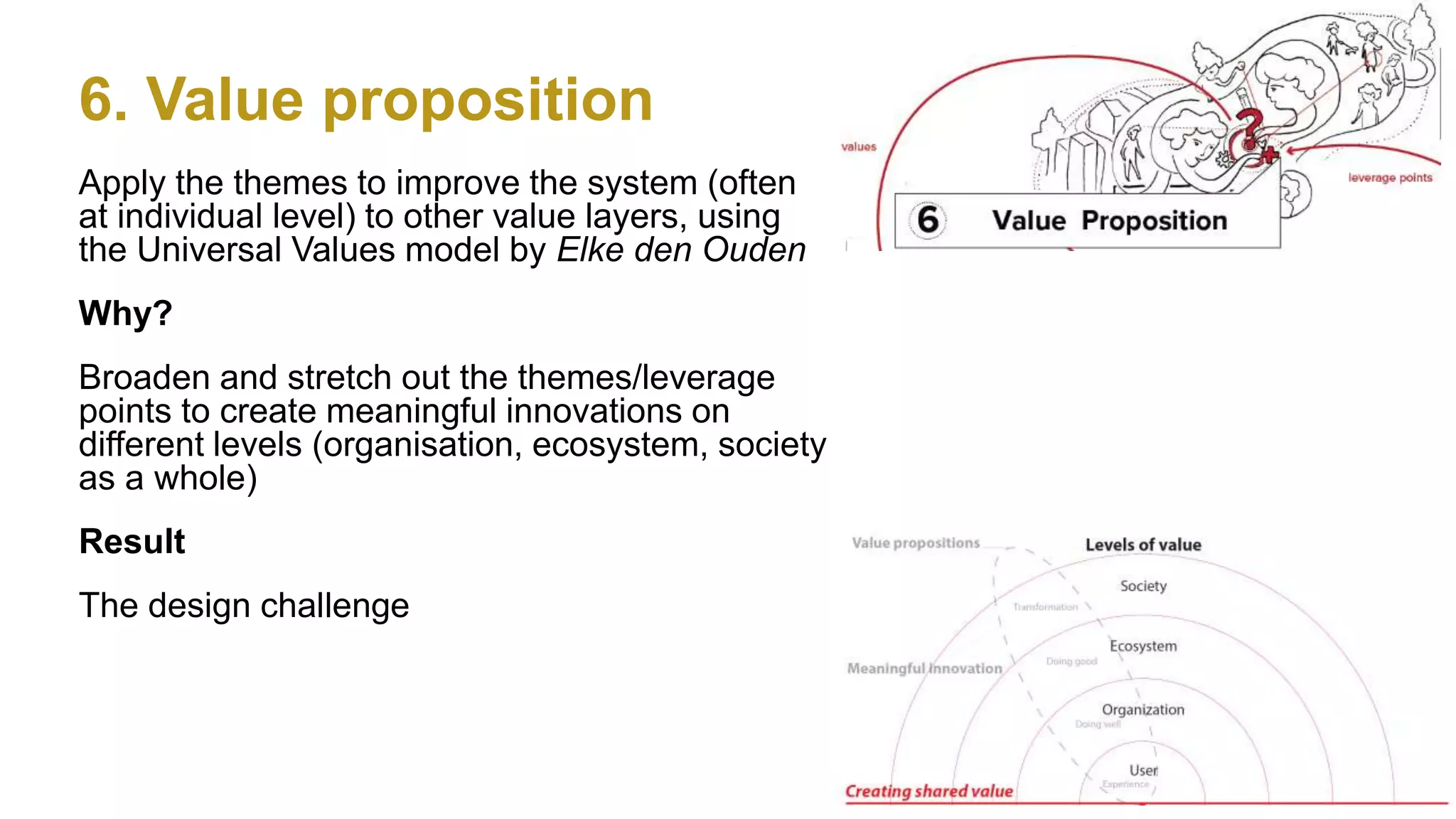
6. Value proposition
24
Apply the themes to improve the system (often
at individual level) to other value layers, using
the Universal Values model by Elke den Ouden
Why?
Broaden and stretch out the themes/leverage
points to create meaningful innovations on
different levels (organisation, ecosystem, society
as a whole)
Result
The design challenge
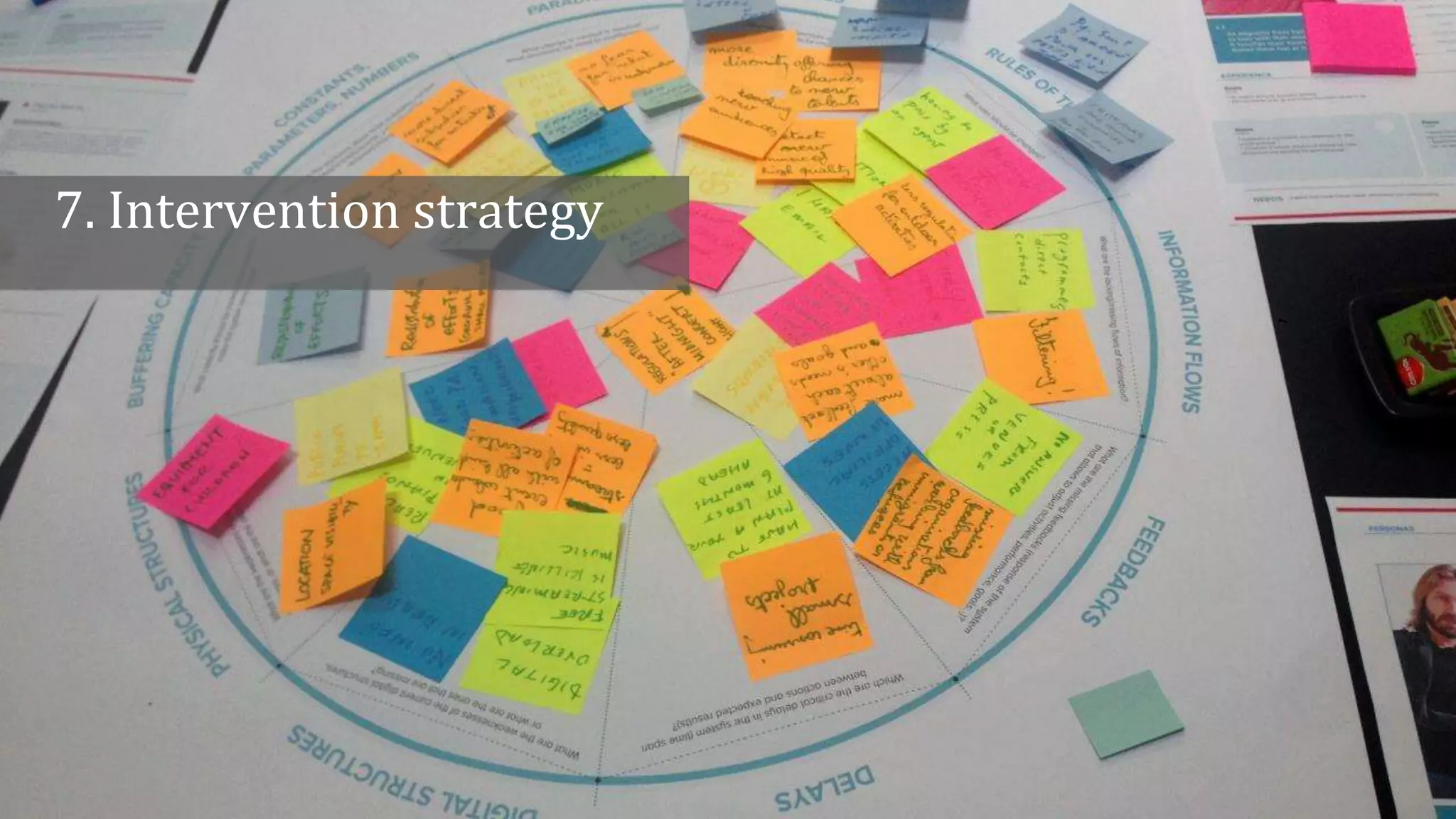
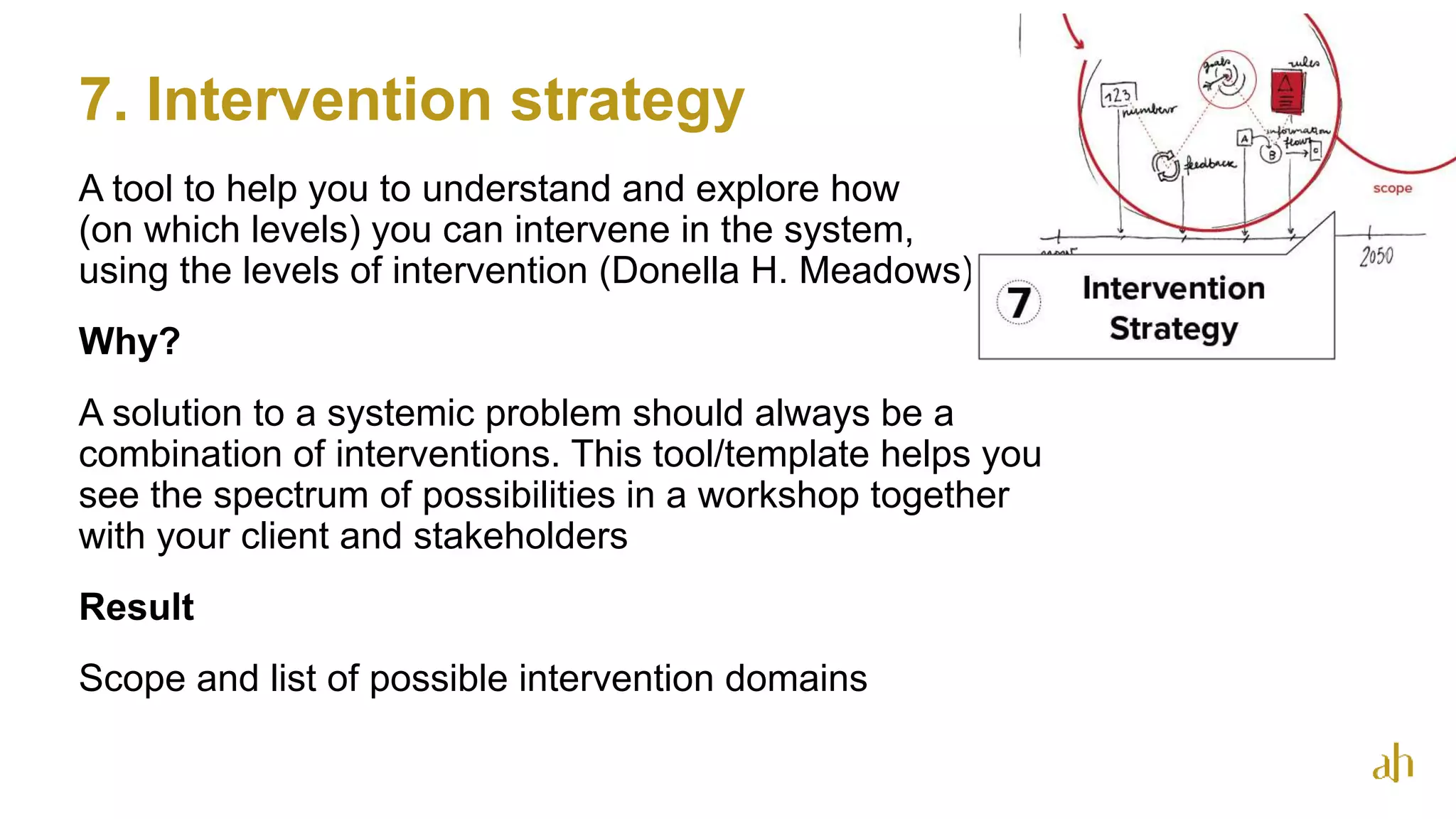
7. Intervention strategy
26
A tool to help you to understand and explore how
(on which levels) you can intervene in the system,
using the levels of intervention (Donella H. Meadows)
Why?
A solution to a systemic problem should always be a
combination of interventions. This tool/template helps you
see the spectrum of possibilities in a workshop together
with your client and stakeholders
Result
Scope and list of possible intervention domains
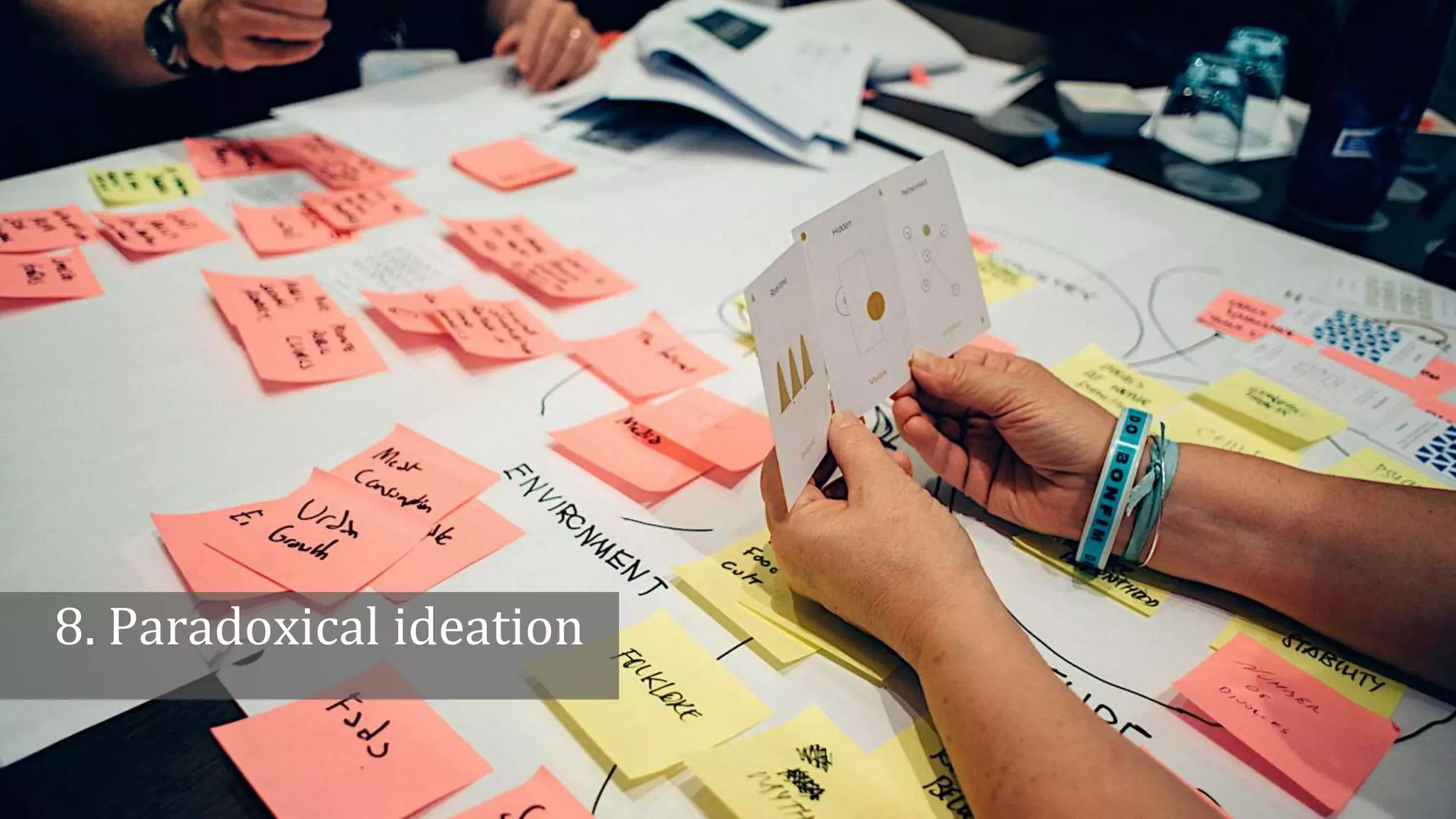
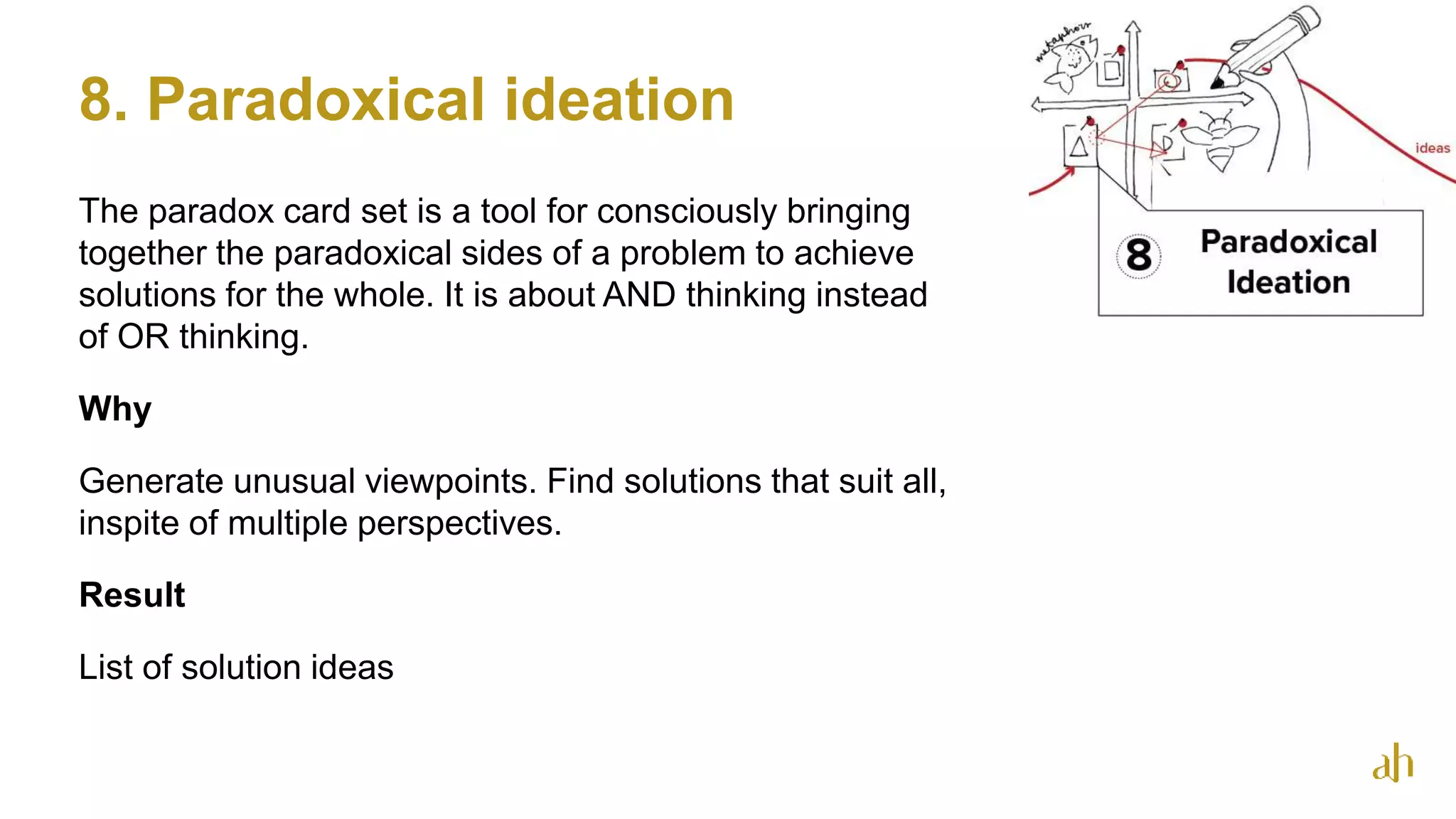
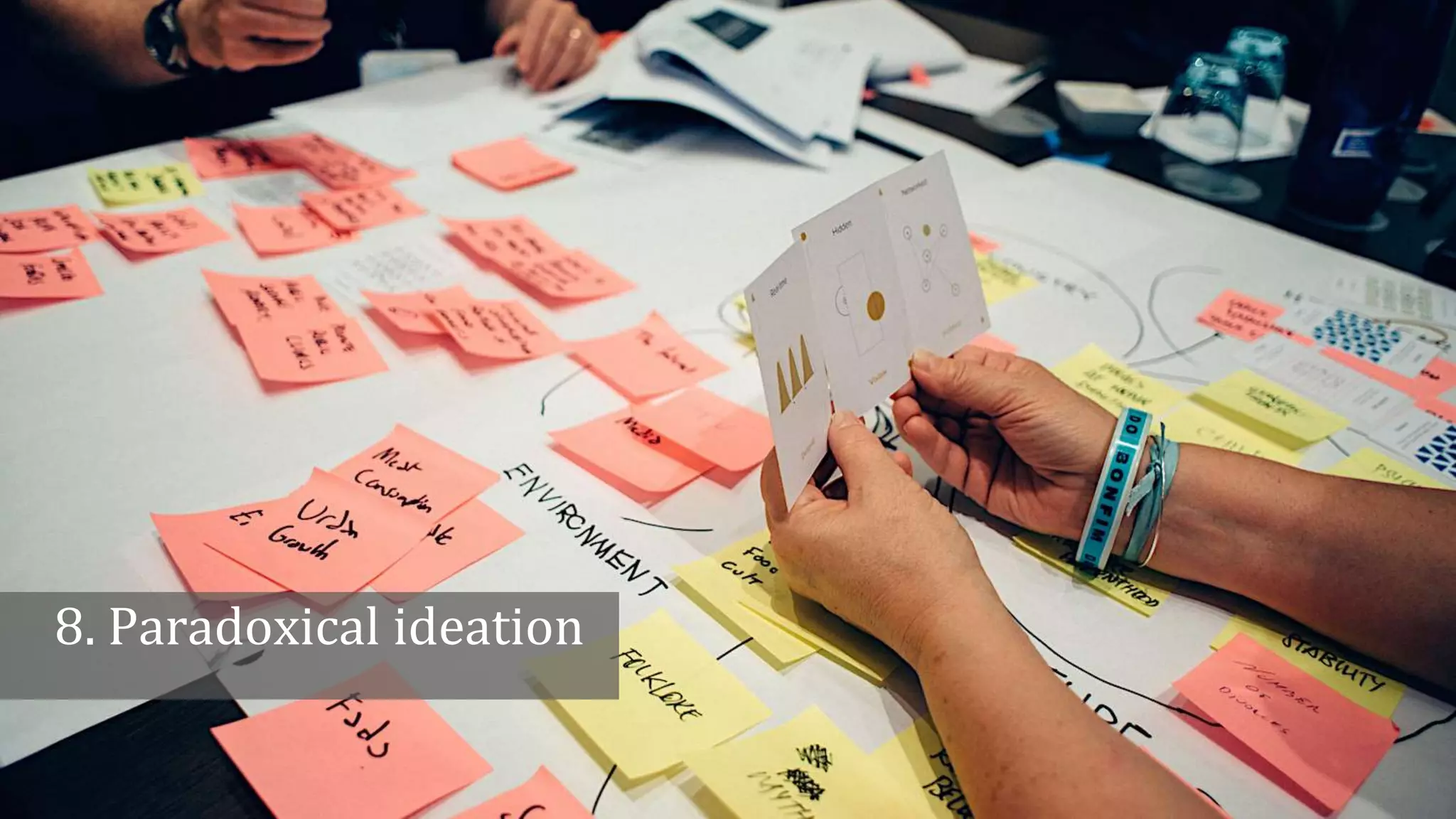
8. Paradoxical ideation
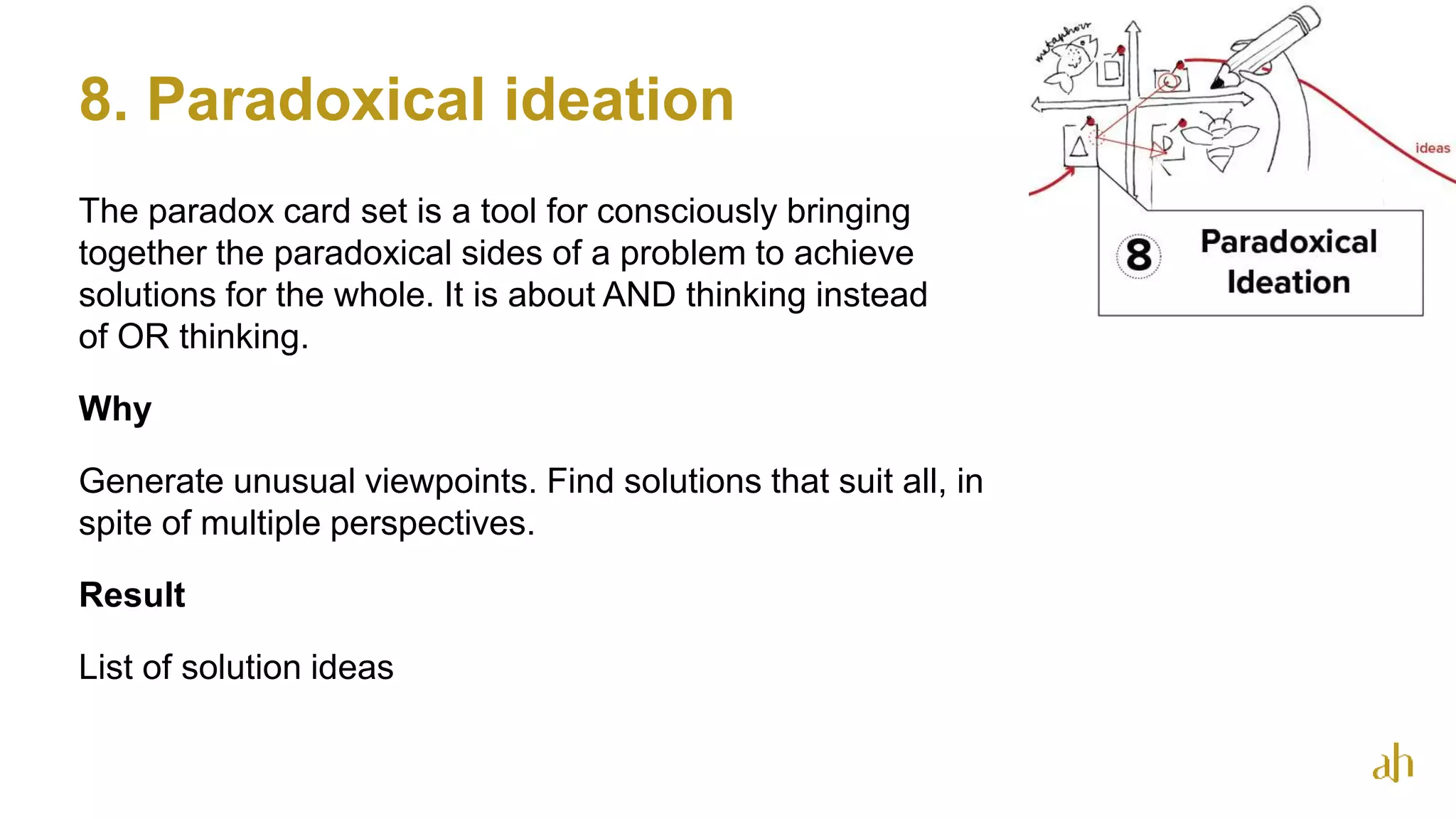
The paradox card set is a tool for consciously bringing
together the paradoxical sides of a problem to achieve
solutions for the whole. It is about AND thinking instead
of OR thinking.
Why
Generate unusual viewpoints. Find solutions that suit all, in
spite of multiple perspectives.
Result
List of solution ideas
28
Develop
Scenarios
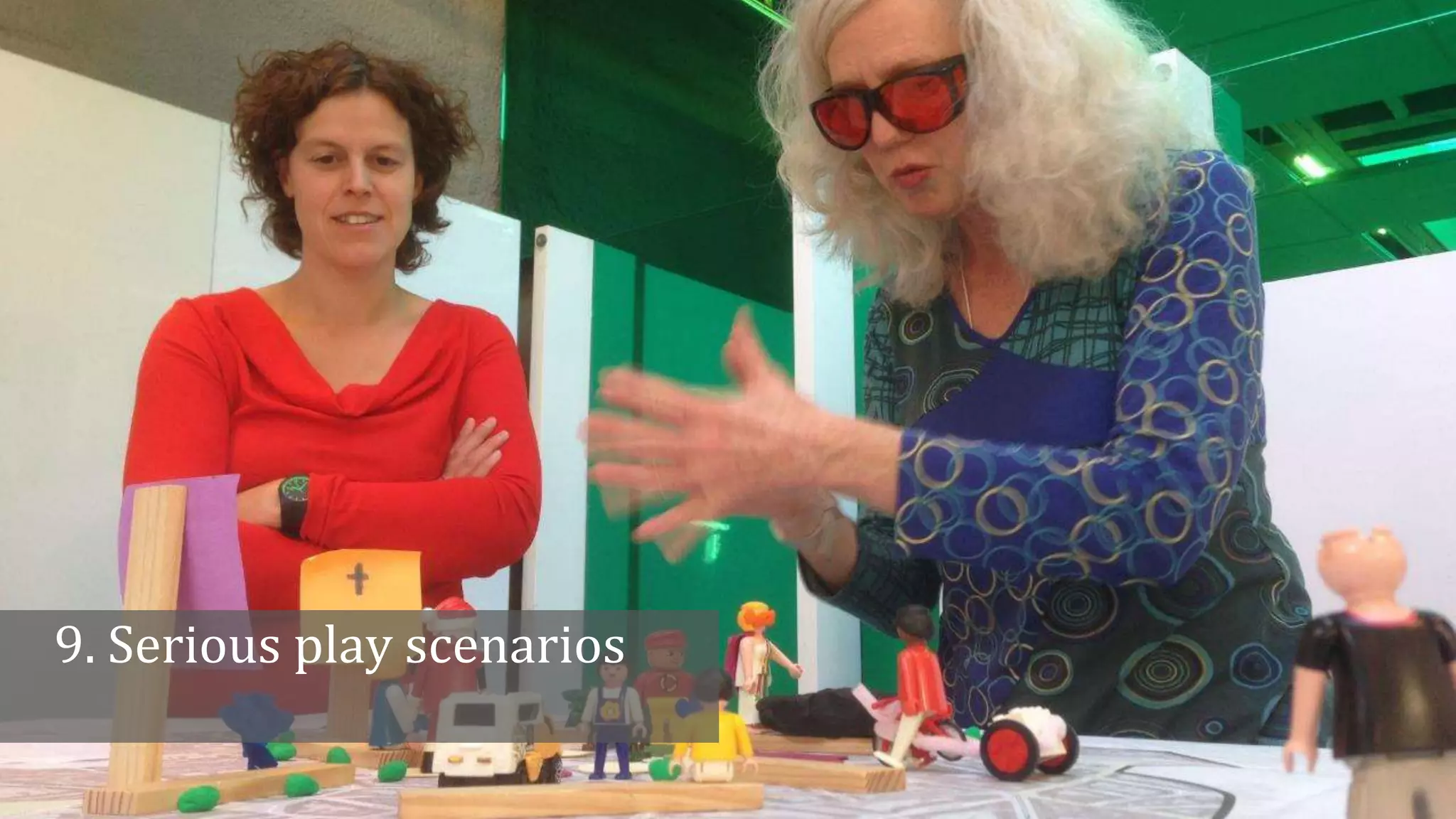
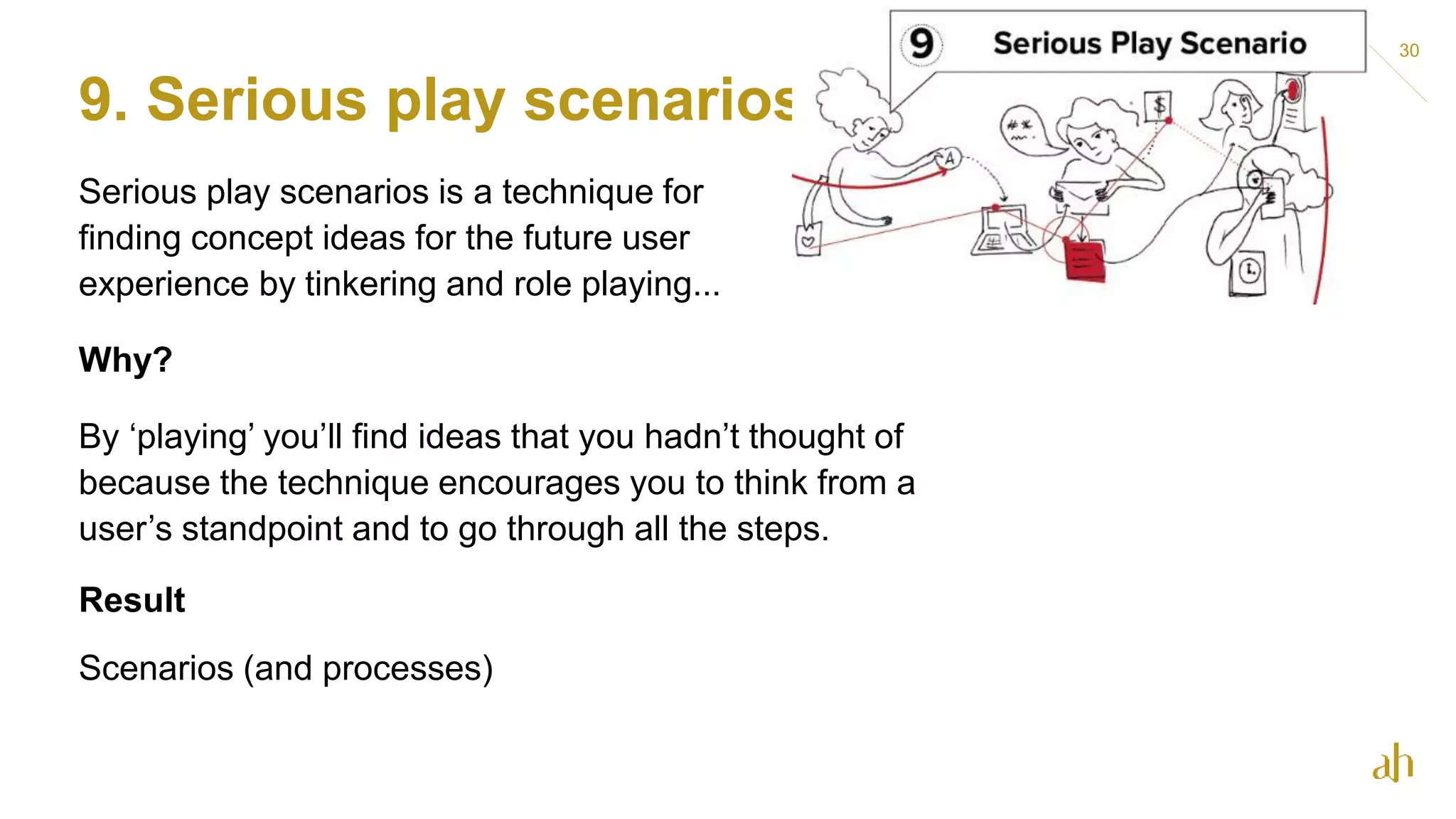
9. Serious play scenarios
Serious play scenarios is a technique for
finding concept ideas for the future user
experience by tinkering and role playing...
Why?
By ‘playing’ you’ll find ideas that you hadn’t thought of
because the technique encourages you to think from a
user’s standpoint and to go through all the steps.
Result
Scenarios (and processes)
30
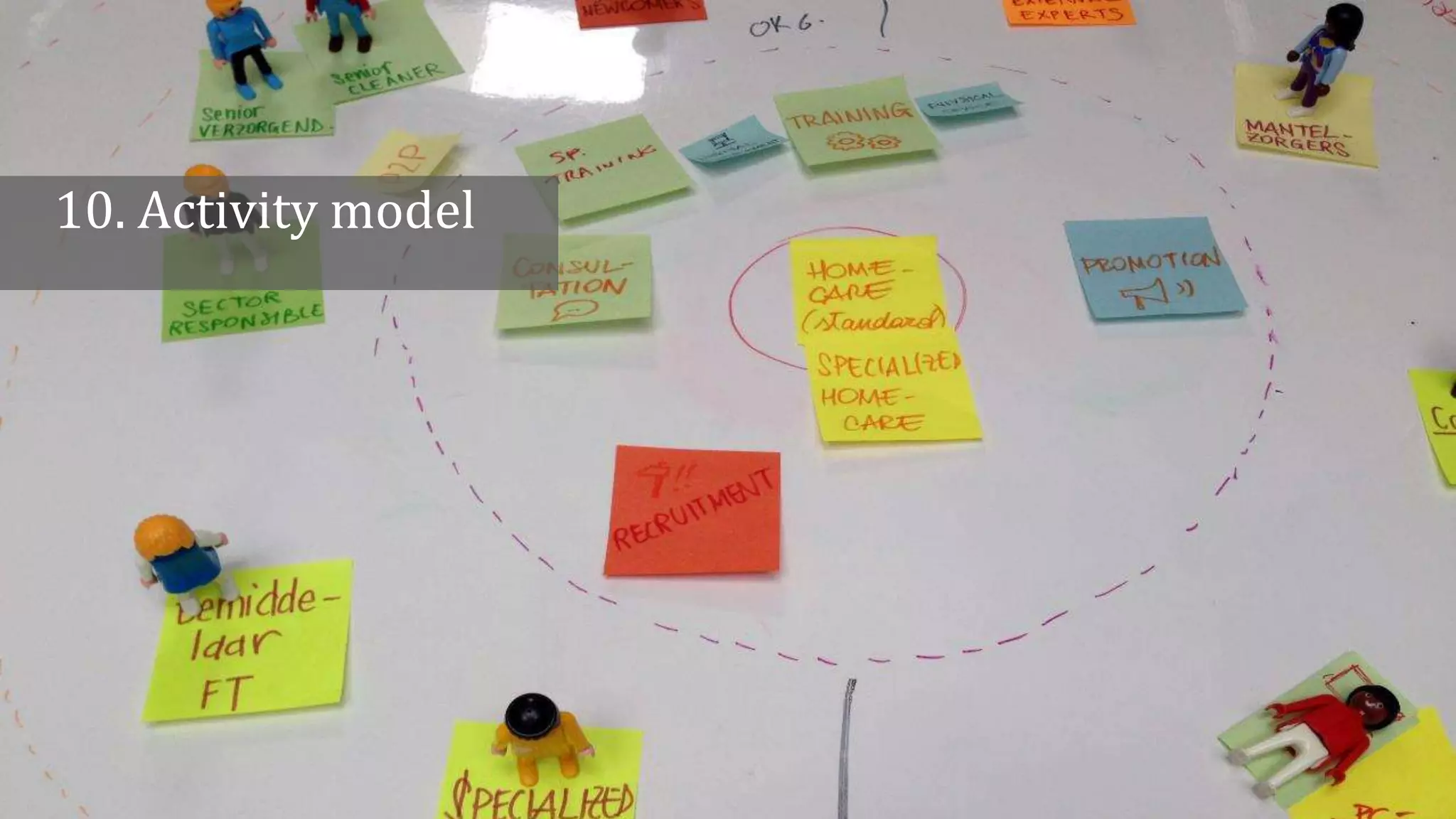
10. Activity model
10. Activity model
32
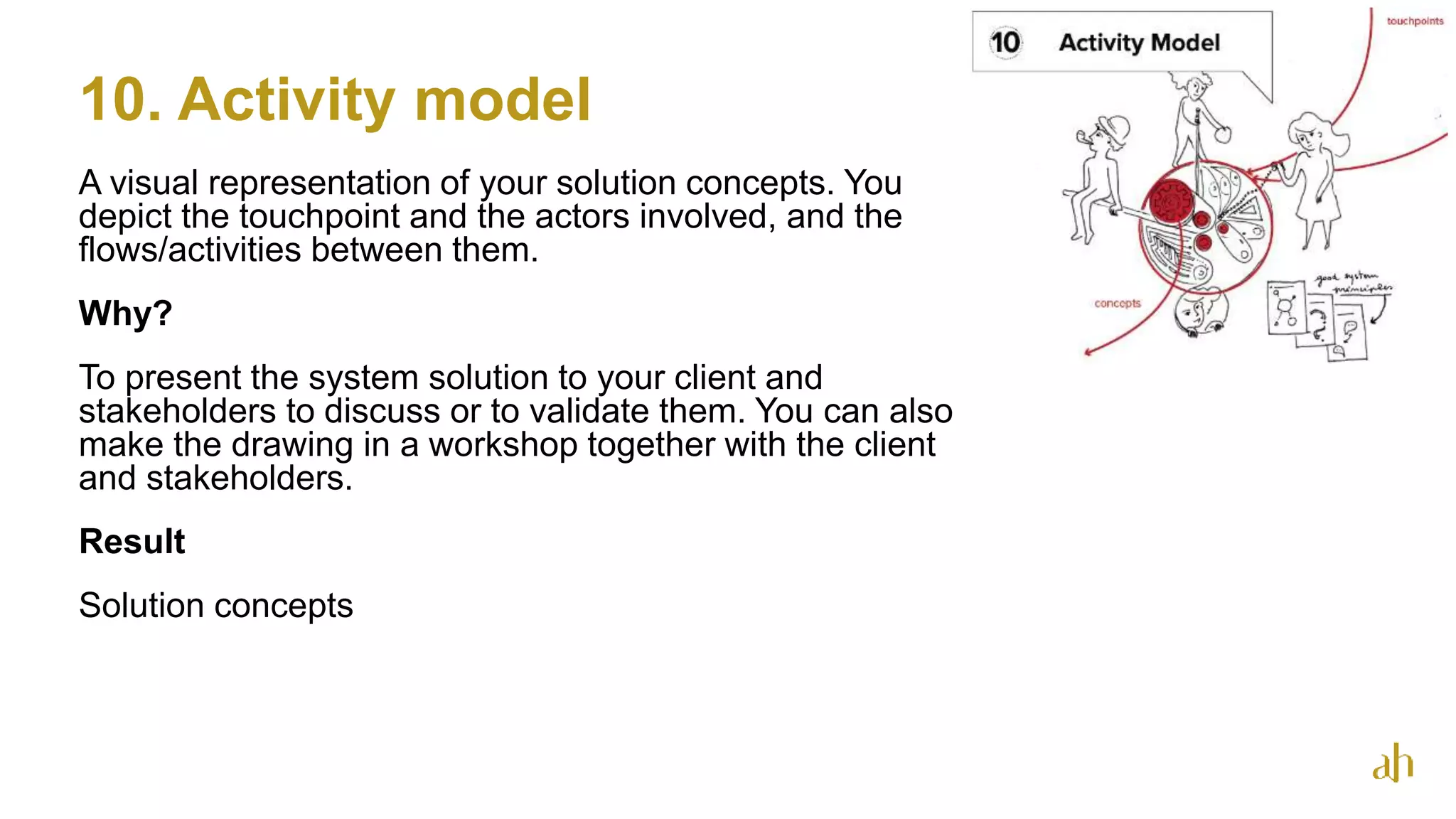
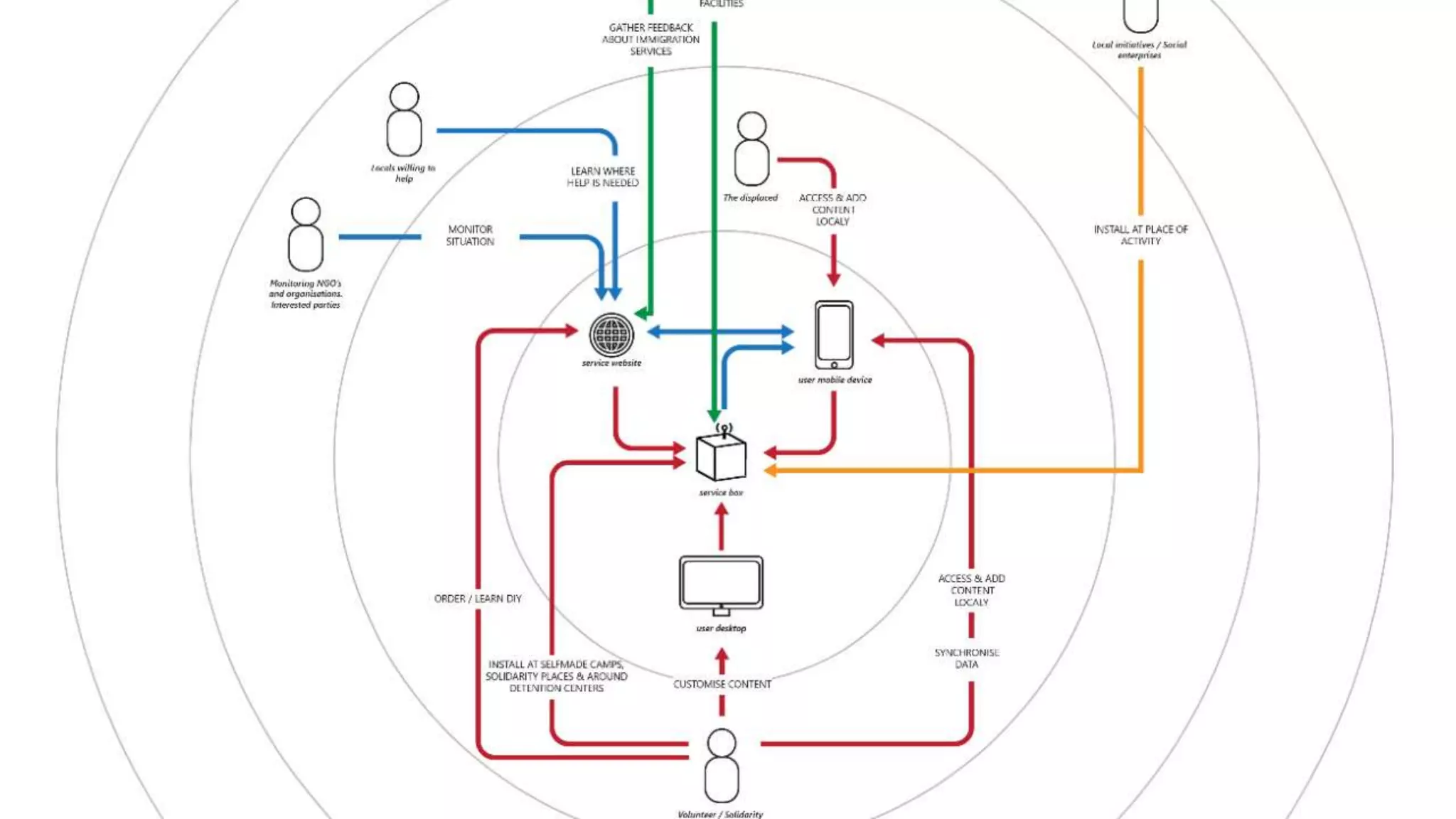
A visual representation of your solution concepts. You
depict the touchpoint and the actors involved, and the
flows/activities between them.
Why?
To present the system solution to your client and
stakeholders to discuss or to validate them. You can also
make the drawing in a workshop together with the client
and stakeholders.
Result
Solution concepts
33
11. Intervention map
35
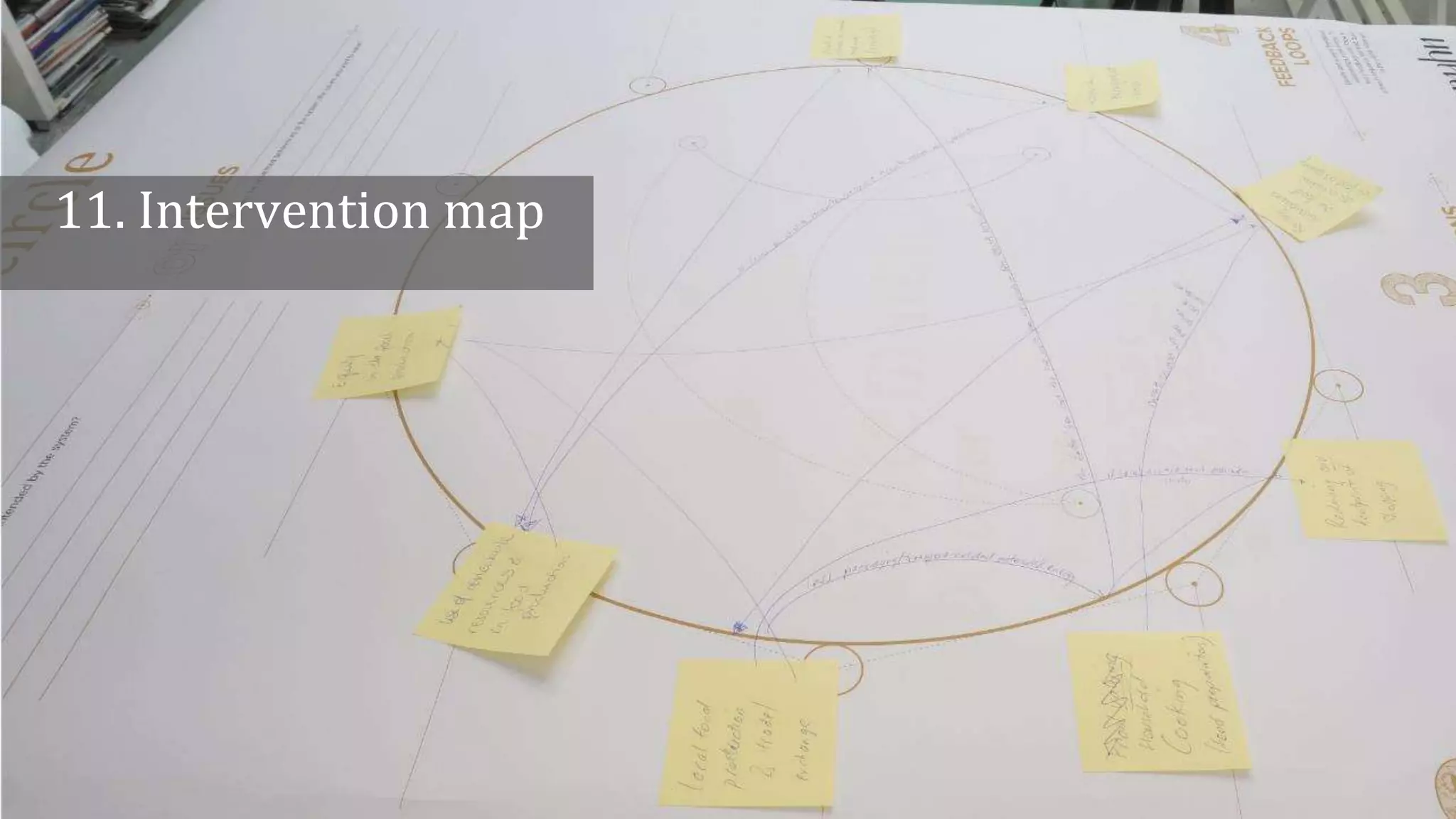
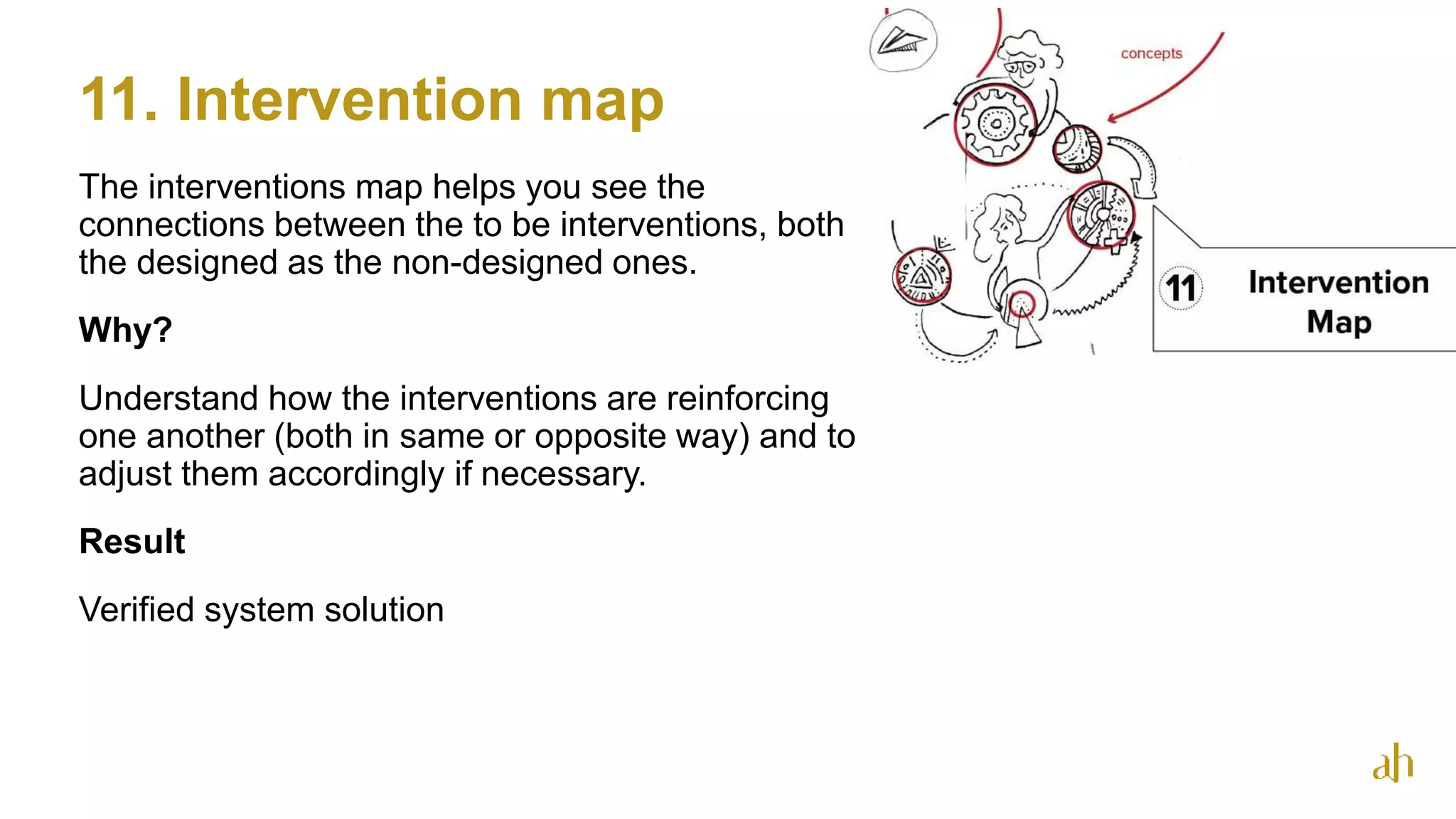
The interventions map helps you see the
connections between the to be interventions, both
the designed as the non-designed ones.
Why?
Understand how the interventions are reinforcing
one another (both in same or opposite way) and to
adjust them accordingly if necessary.
Result
Verified system solution
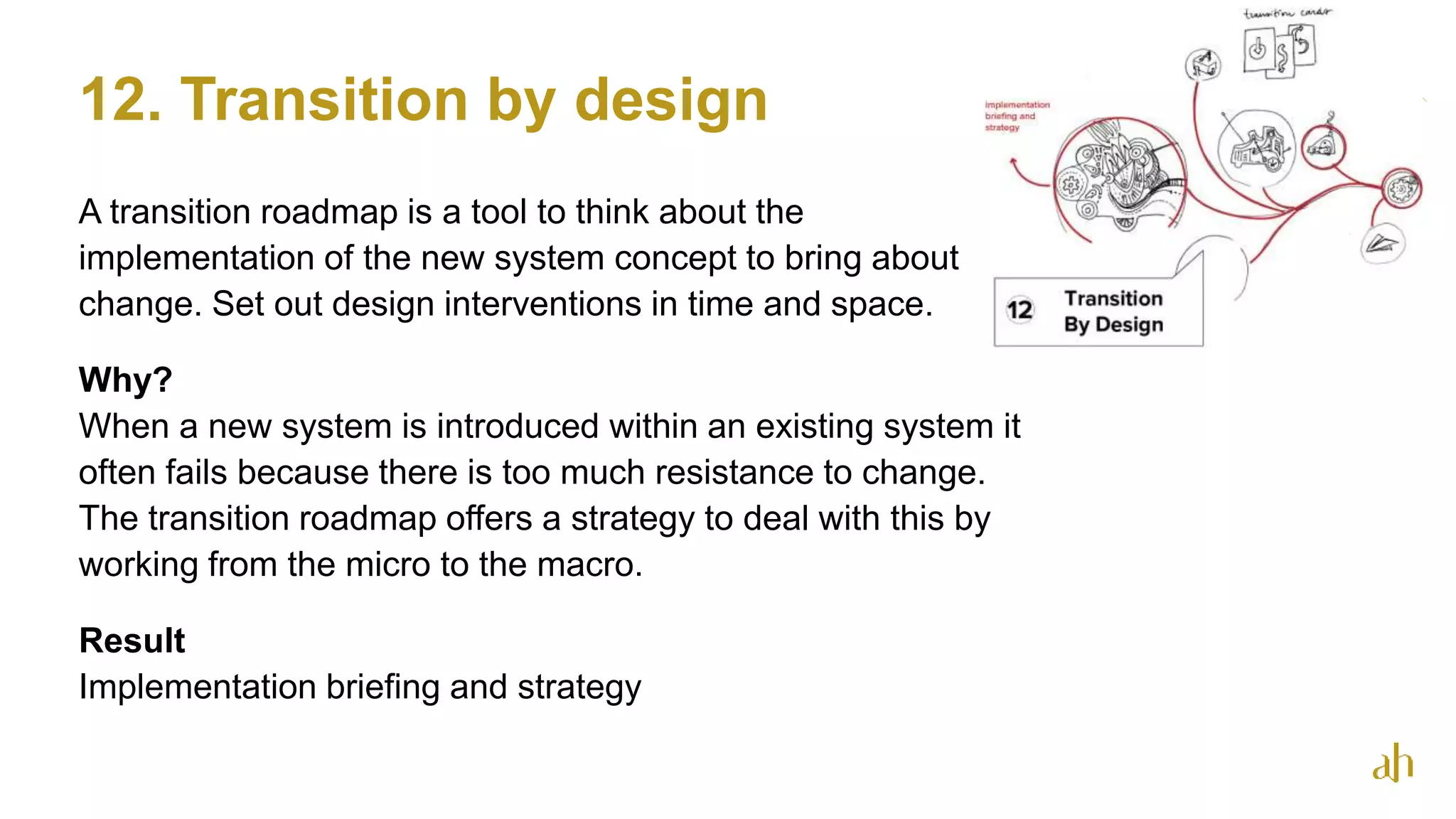
12. Transition by design
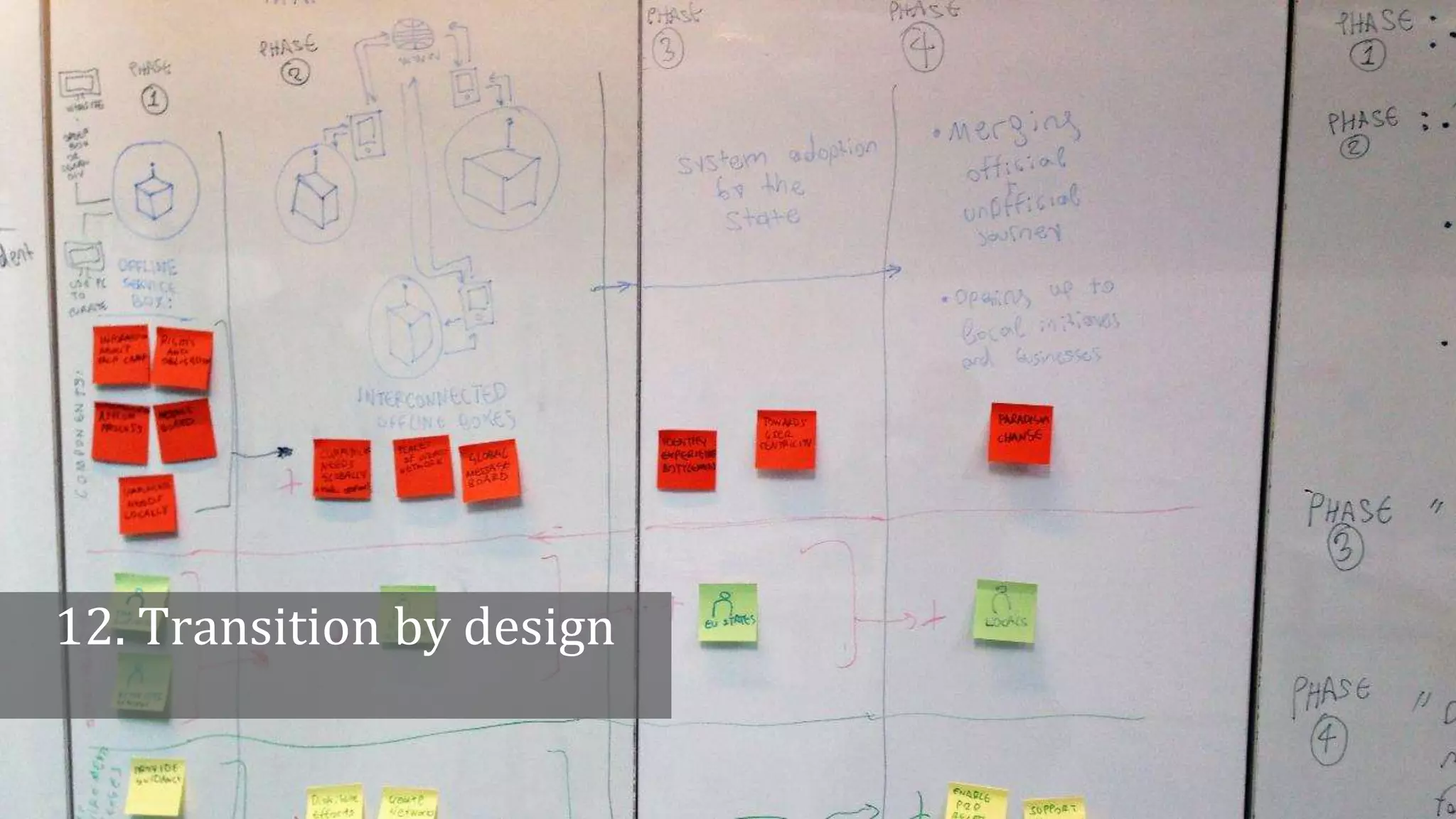
A transition roadmap is a tool to think about the
implementation of the new system concept to bring about
change. Set out design interventions in time and space.
Why?
When a new system is introduced within an existing system it
often fails because there is too much resistance to change.
The transition roadmap offers a strategy to deal with this by
working from the micro to the macro.
Result
Implementation briefing and strategy
37
Case:
child obesity
The problem: child obesity
— Overweight versus obesity - diagnosis based
on BMI
— Obesity has doubled in children and
quadrupled in adolescents in the past 30 years
(U.S.)
— Health effects: short and long term
— Prevention?
— [video]
39
How to deal with the issue of child obesity?
Note: focus is on learning about the tools and
the toolkit! We will not solve the problem…
40
Applying the
systemic design
toolkit
(4 tools, 20’ prep + 10’ present and
discussion per tool)
41
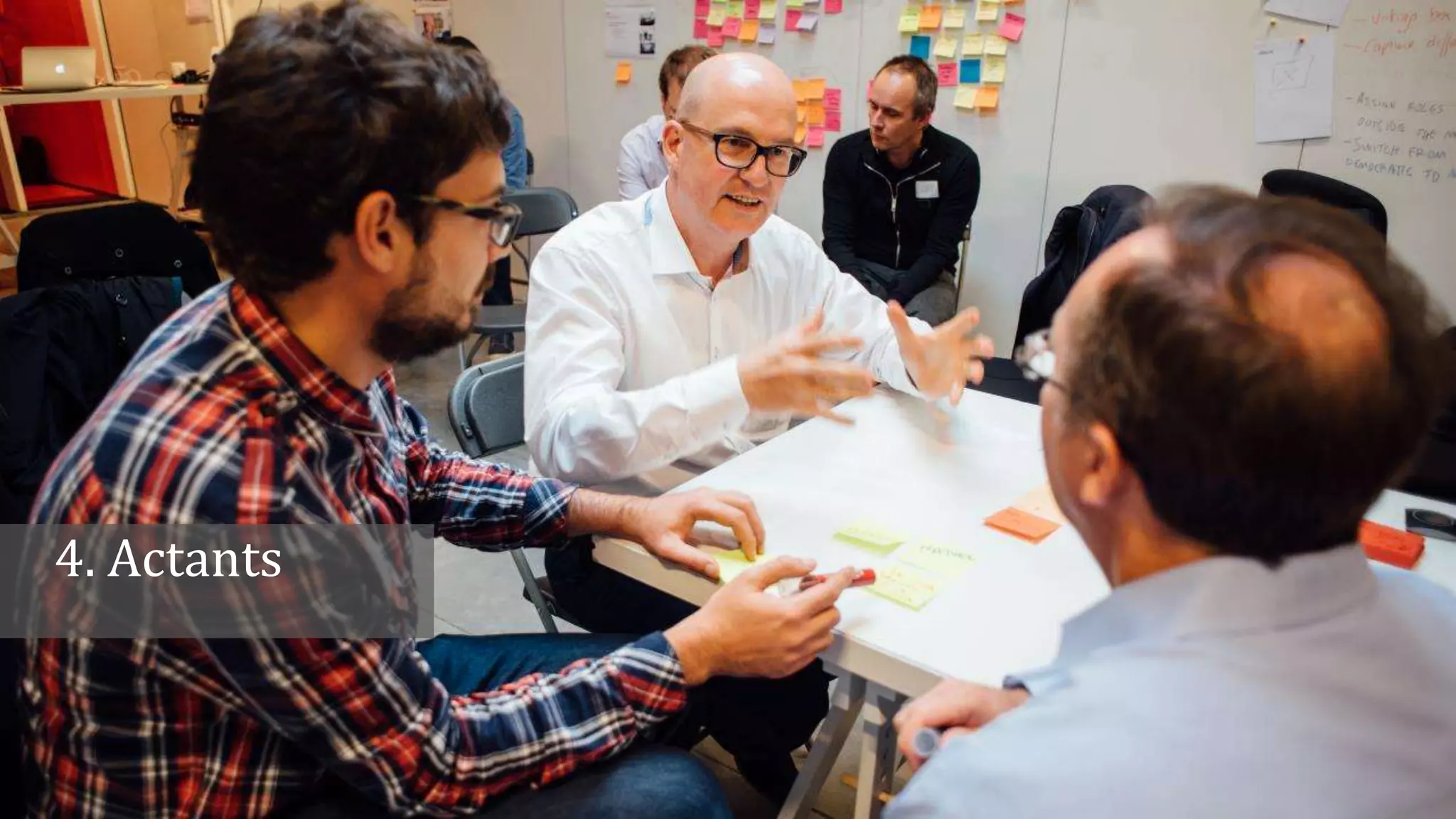
4. Actants
4. Actants
43
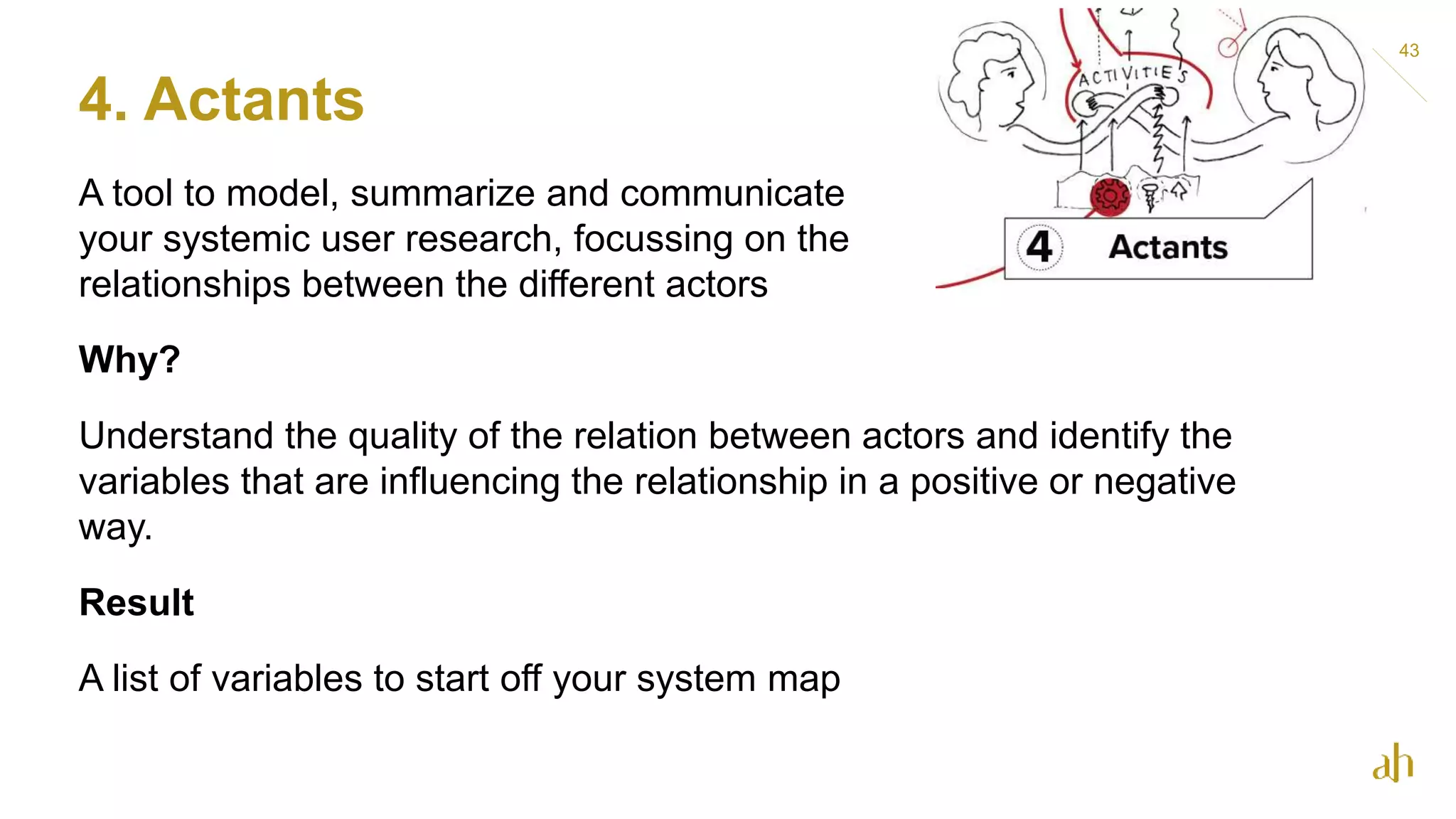
A tool to model, summarize and communicate
your systemic user research, focussing on the
relationships between the different actors
Why?
Understand the quality of the relation between actors and identify the
variables that are influencing the relationship in a positive or negative
way.
Result
A list of variables to start off your system map
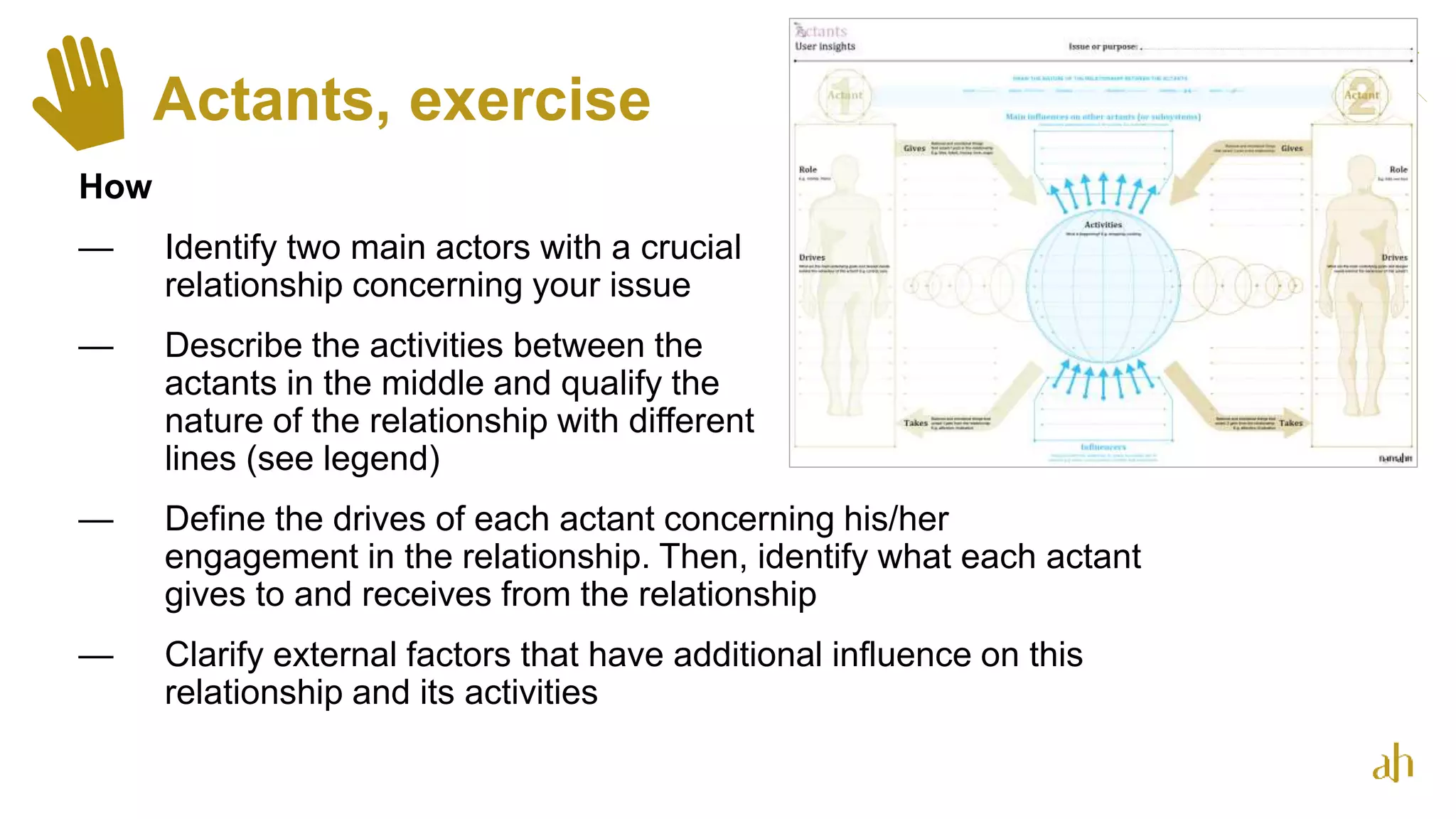
Actants, exercise
How
— Identify two main actors with a crucial
relationship concerning your issue
— Describe the activities between the
actants in the middle and qualify the
nature of the relationship with different
lines (see legend)
— Define the drives of each actant concerning his/her
engagement in the relationship. Then, identify what each actant
gives to and receives from the relationship
— Clarify external factors that have additional influence on this
relationship and its activities
44
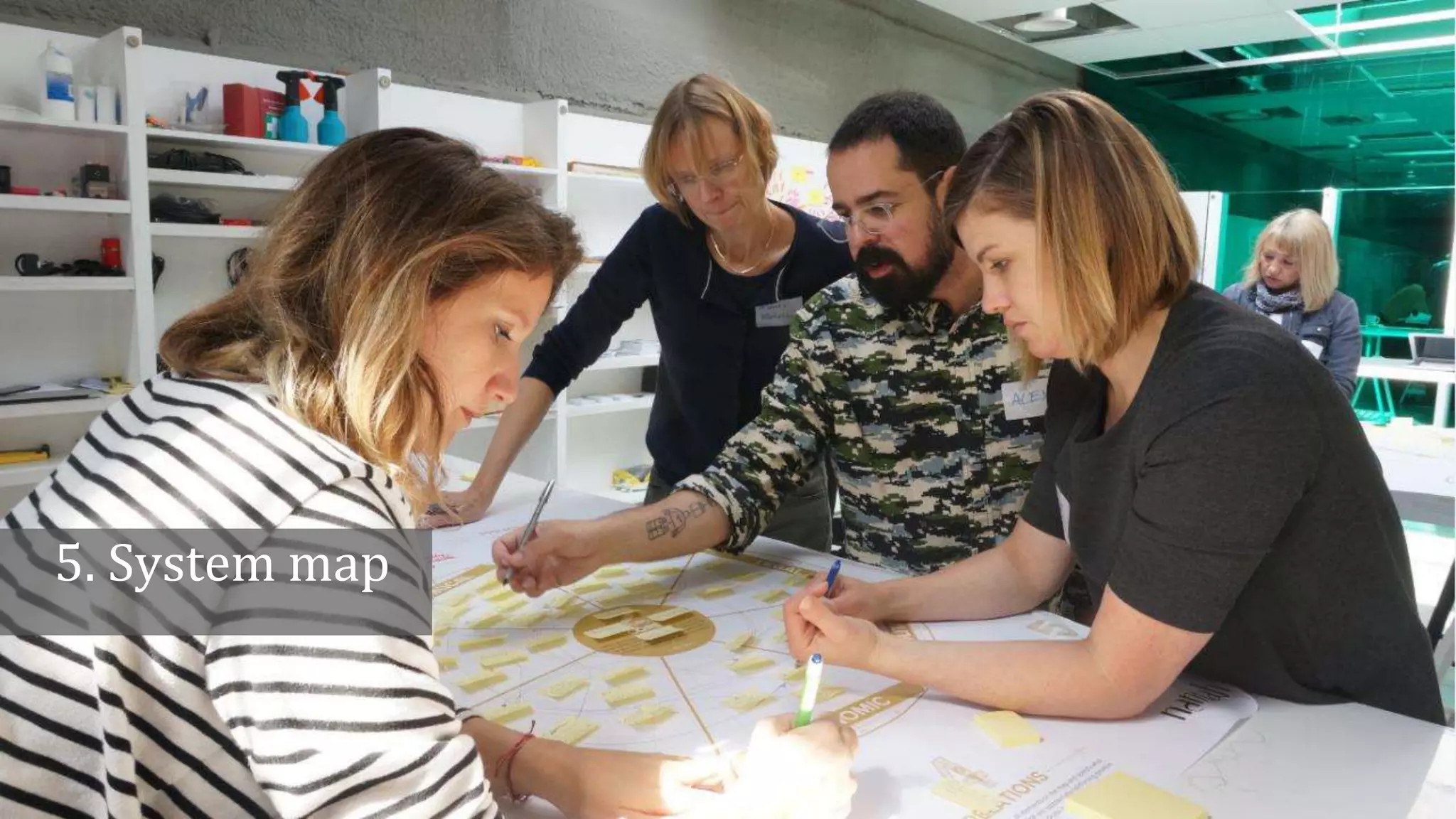
5. System map
5. System map
46
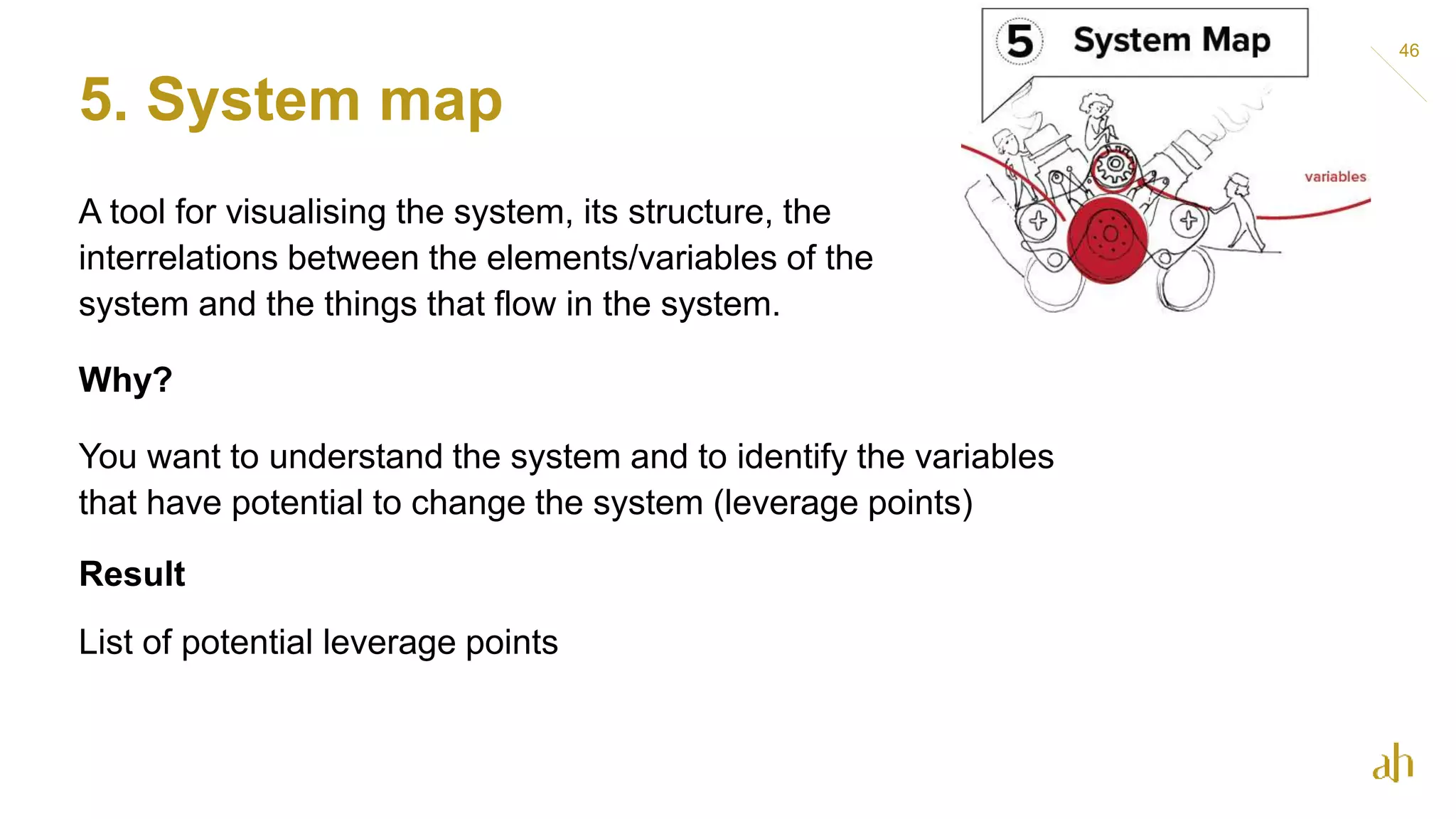
A tool for visualising the system, its structure, the
interrelations between the elements/variables of the
system and the things that flow in the system.
Why?
You want to understand the system and to identify the variables
that have potential to change the system (leverage points)
Result
List of potential leverage points
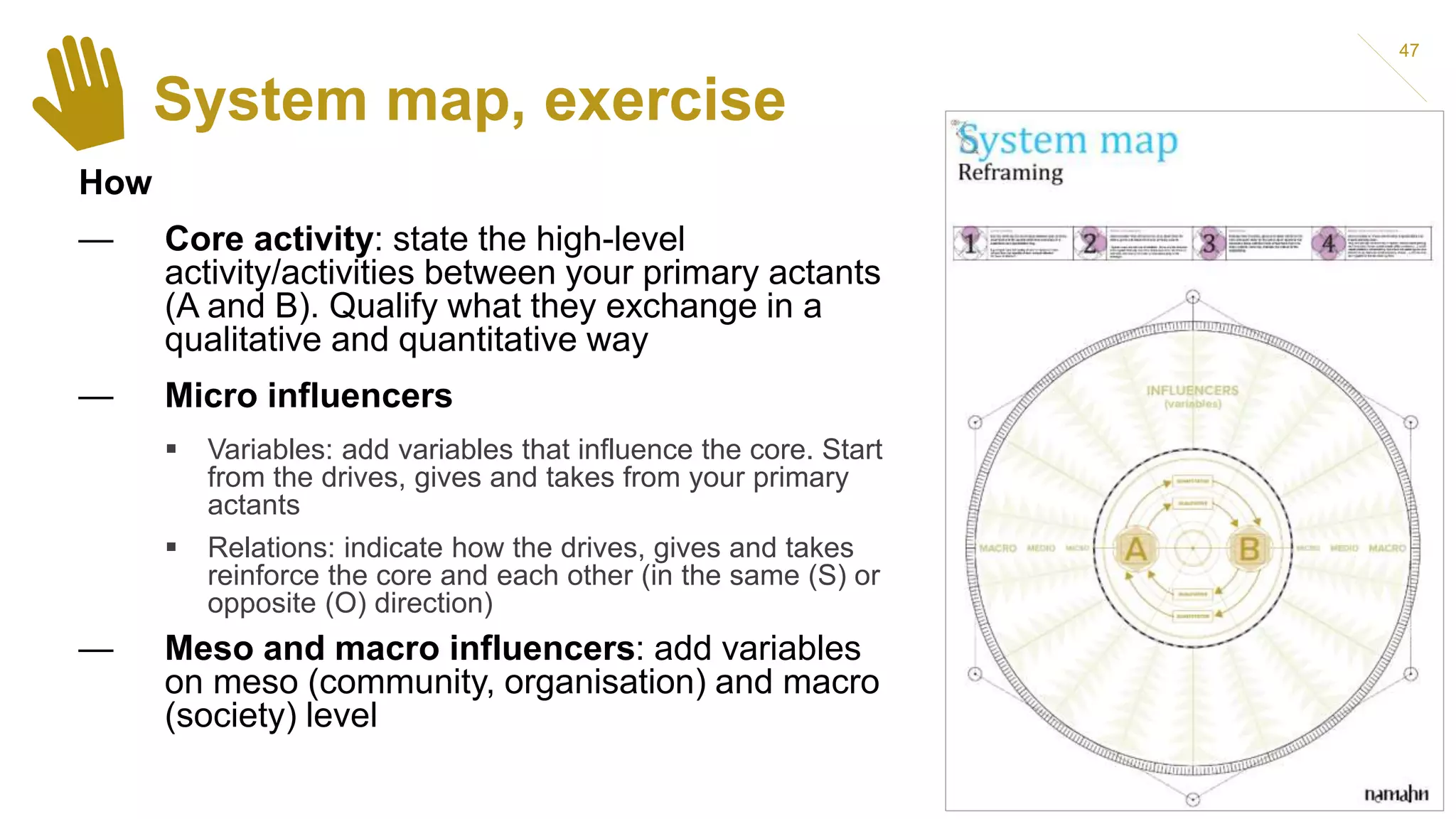
System map, exercise
47
How
— Core activity: state the high-level
activity/activities between your primary actants
(A and B). Qualify what they exchange in a
qualitative and quantitative way
— Micro influencers
 Variables: add variables that influence the core. Start
from the drives, gives and takes from your primary
actants
 Relations: indicate how the drives, gives and takes
reinforce the core and each other (in the same (S) or
opposite (O) direction)
— Meso and macro influencers: add variables
on meso (community, organisation) and macro
(society) level
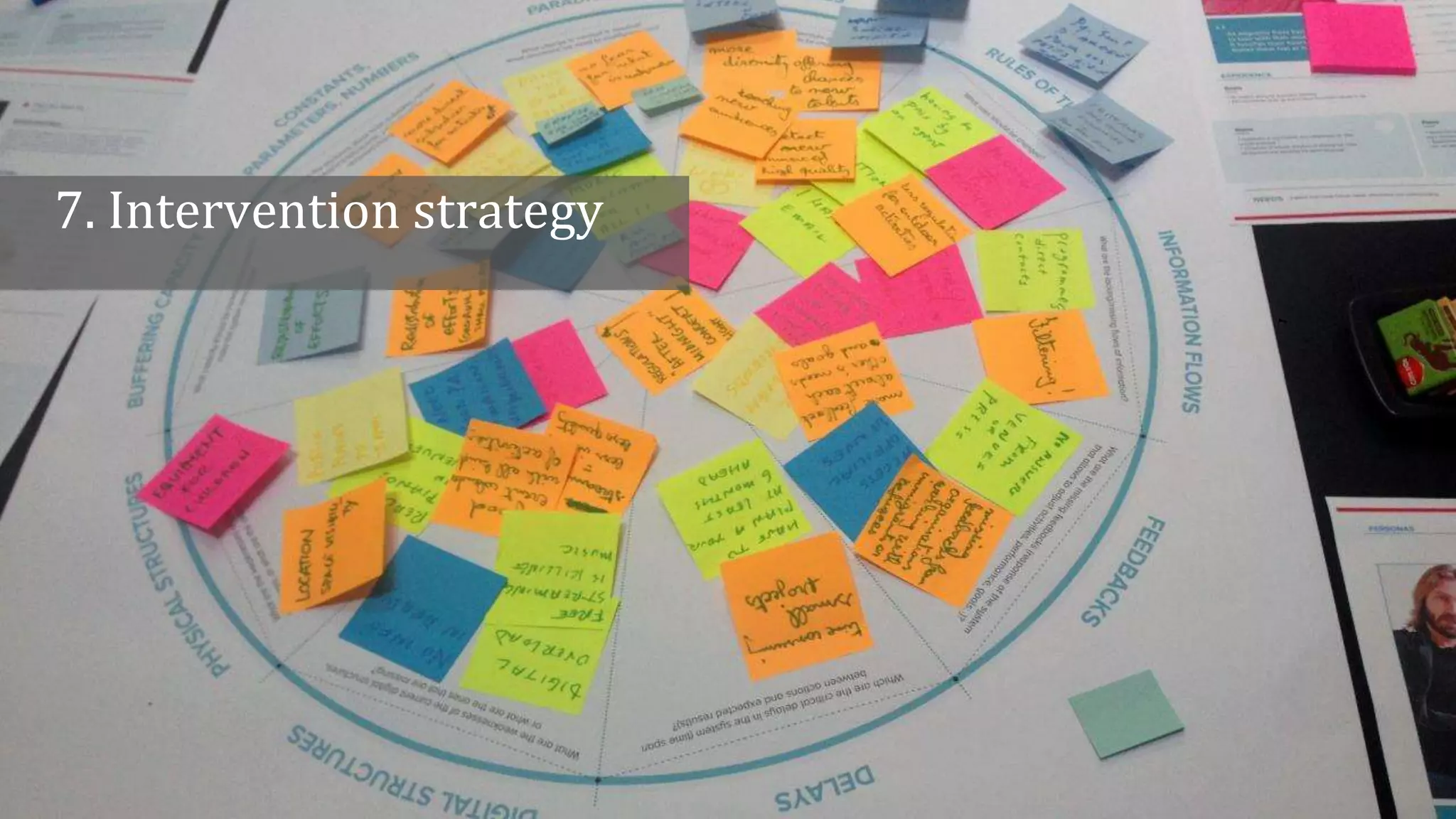
7. Intervention strategy
49
A tool to help you to understand and explore how
(on which levels) you can intervene in the system,
using the levels of intervention (Donella H. Meadows)
Why?
A solution to a systemic problem should always be a
combination of interventions. This tool/template helps you
see the spectrum of possibilities in a workshop together
with your client and stakeholders
Result
Scope and list of possible intervention domains
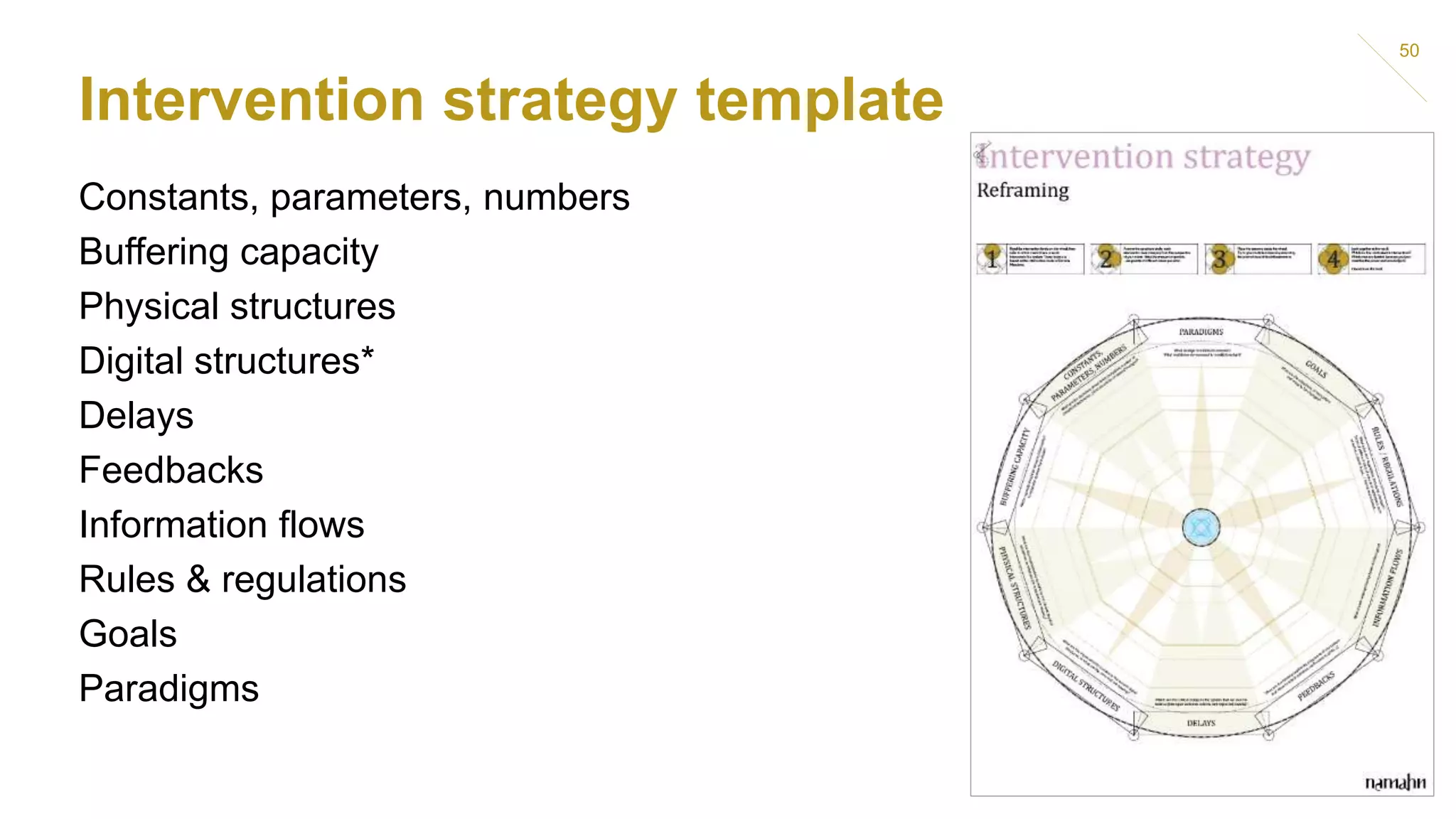
Intervention strategy template
Constants, parameters, numbers
Buffering capacity
Physical structures
Digital structures*
Delays
Feedbacks
Information flows
Rules & regulations
Goals
Paradigms
50
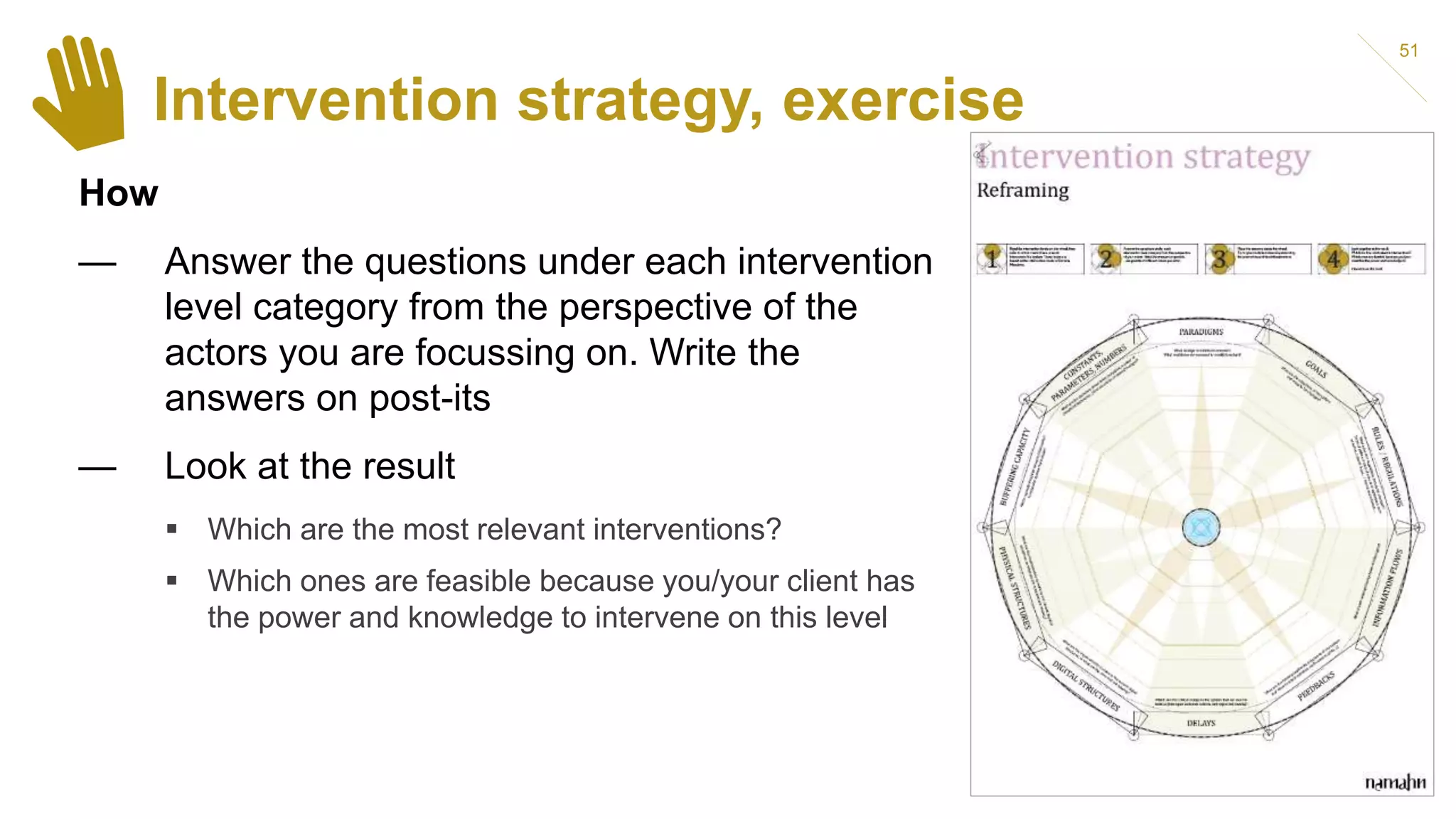
Intervention strategy, exercise
How
— Answer the questions under each intervention
level category from the perspective of the
actors you are focussing on. Write the
answers on post-its
— Look at the result
 Which are the most relevant interventions?
 Which ones are feasible because you/your client has
the power and knowledge to intervene on this level
51
8. Paradoxical ideation
The paradox card set is a tool for consciously bringing
together the paradoxical sides of a problem to achieve
solutions for the whole. It is about AND thinking instead
of OR thinking.
Why
Generate unusual viewpoints. Find solutions that suit all,
inspite of multiple perspectives.
Result
List of solution ideas
53
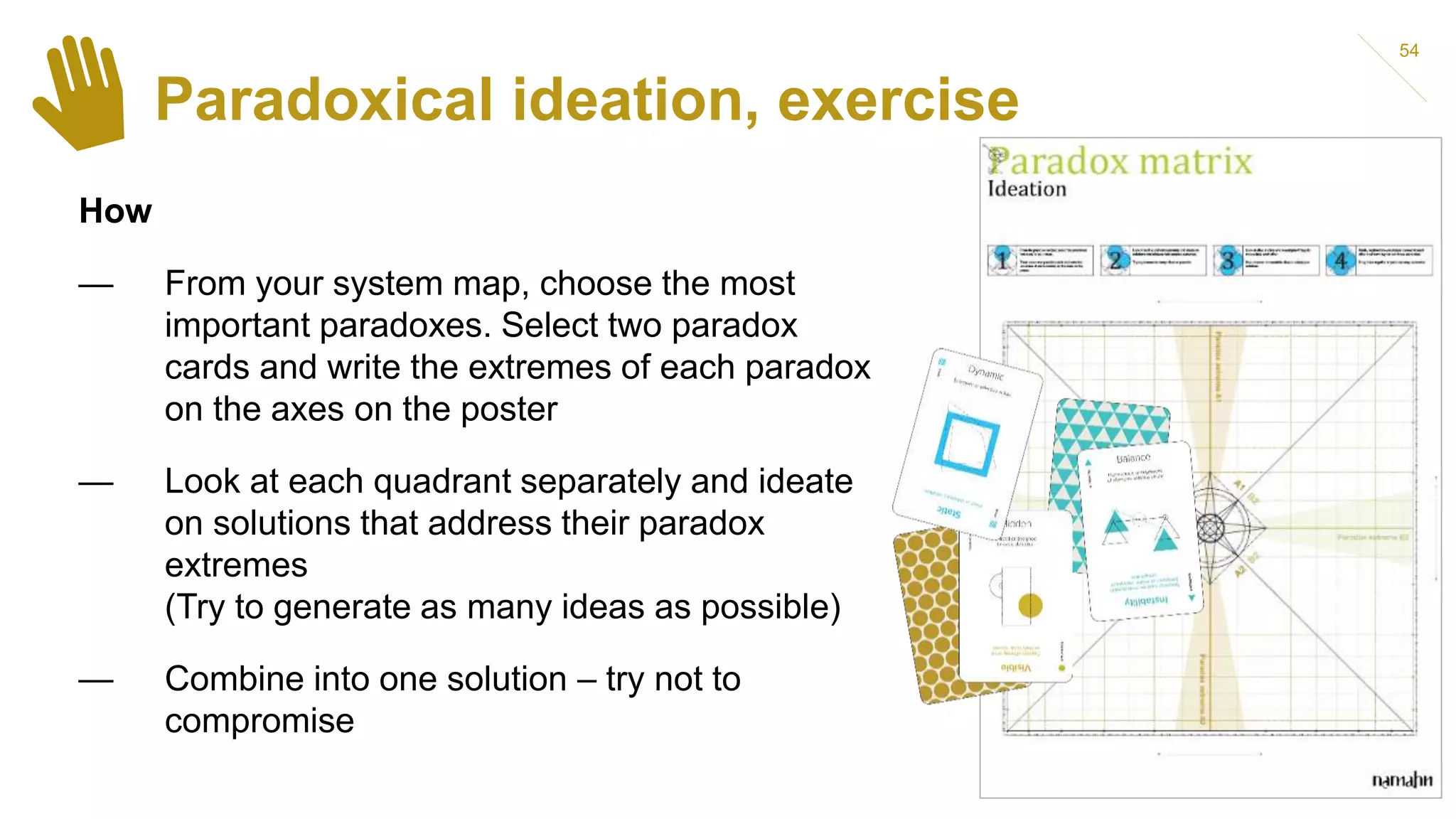
Paradoxical ideation, exercise
How
— From your system map, choose the most
important paradoxes. Select two paradox
cards and write the extremes of each paradox
on the axes on the poster
— Look at each quadrant separately and ideate
on solutions that address their paradox
extremes
(Try to generate as many ideas as possible)
— Combine into one solution – try not to
compromise
54
Some references
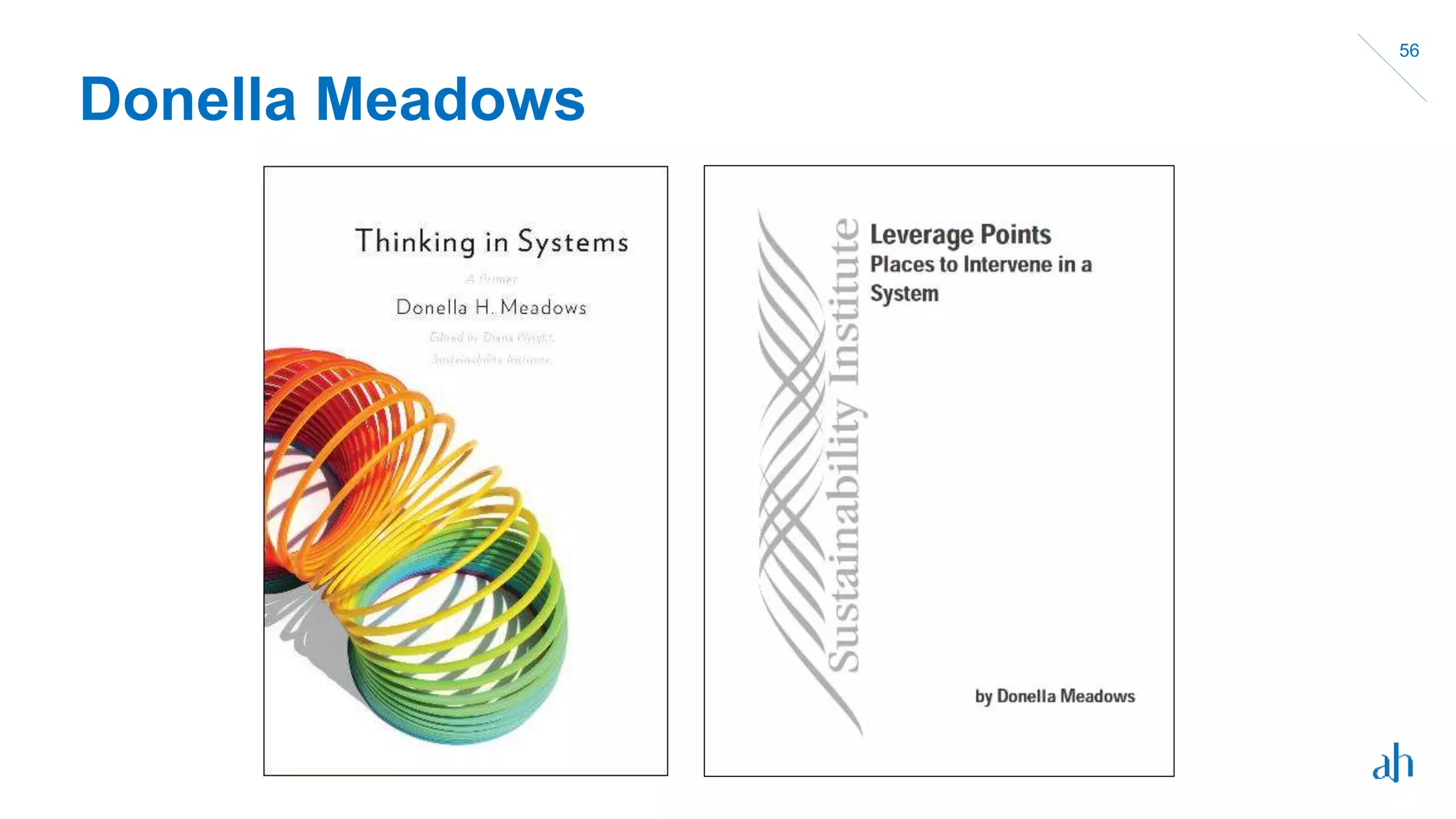
Donella Meadows
56
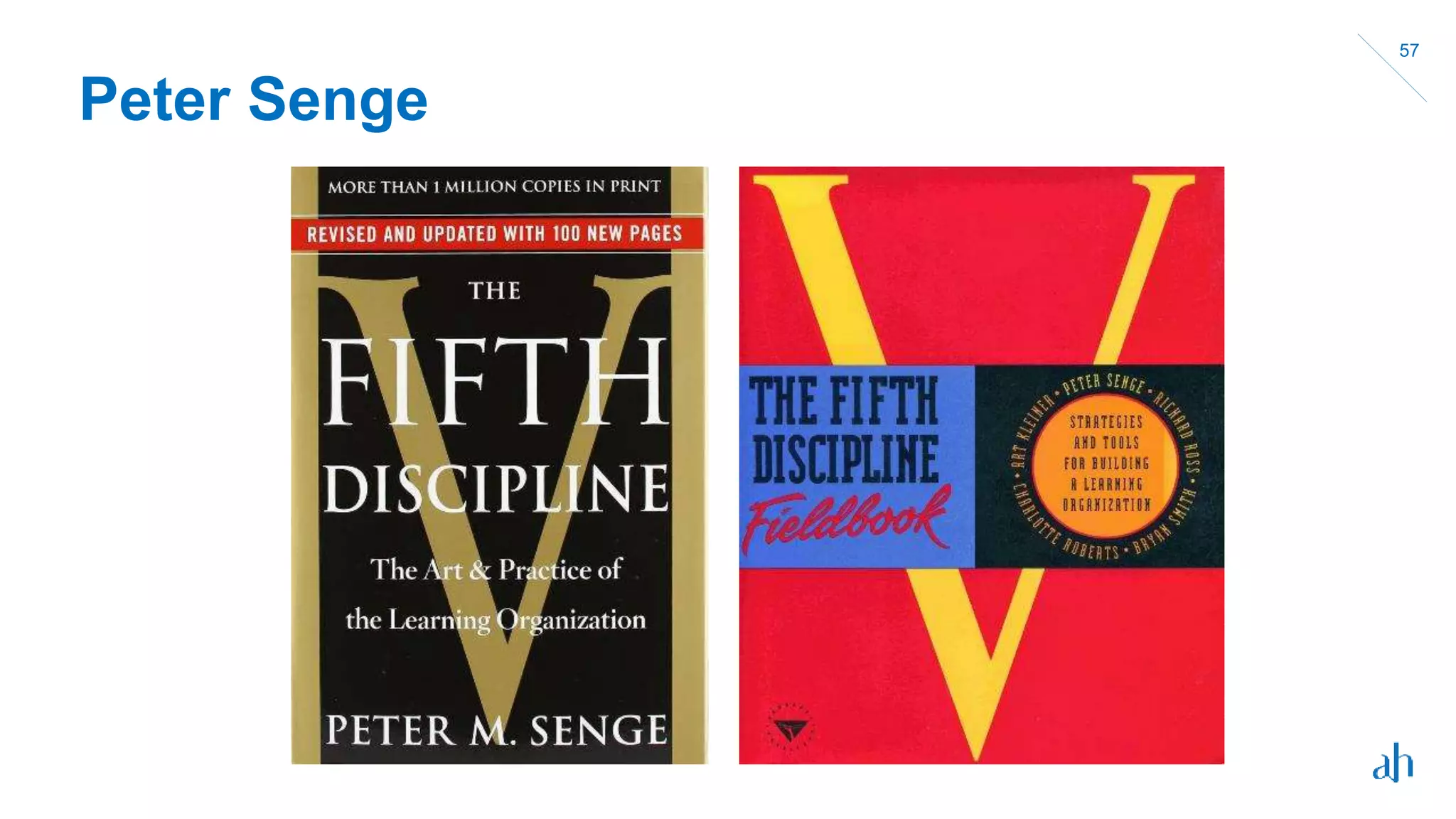
Peter Senge
57
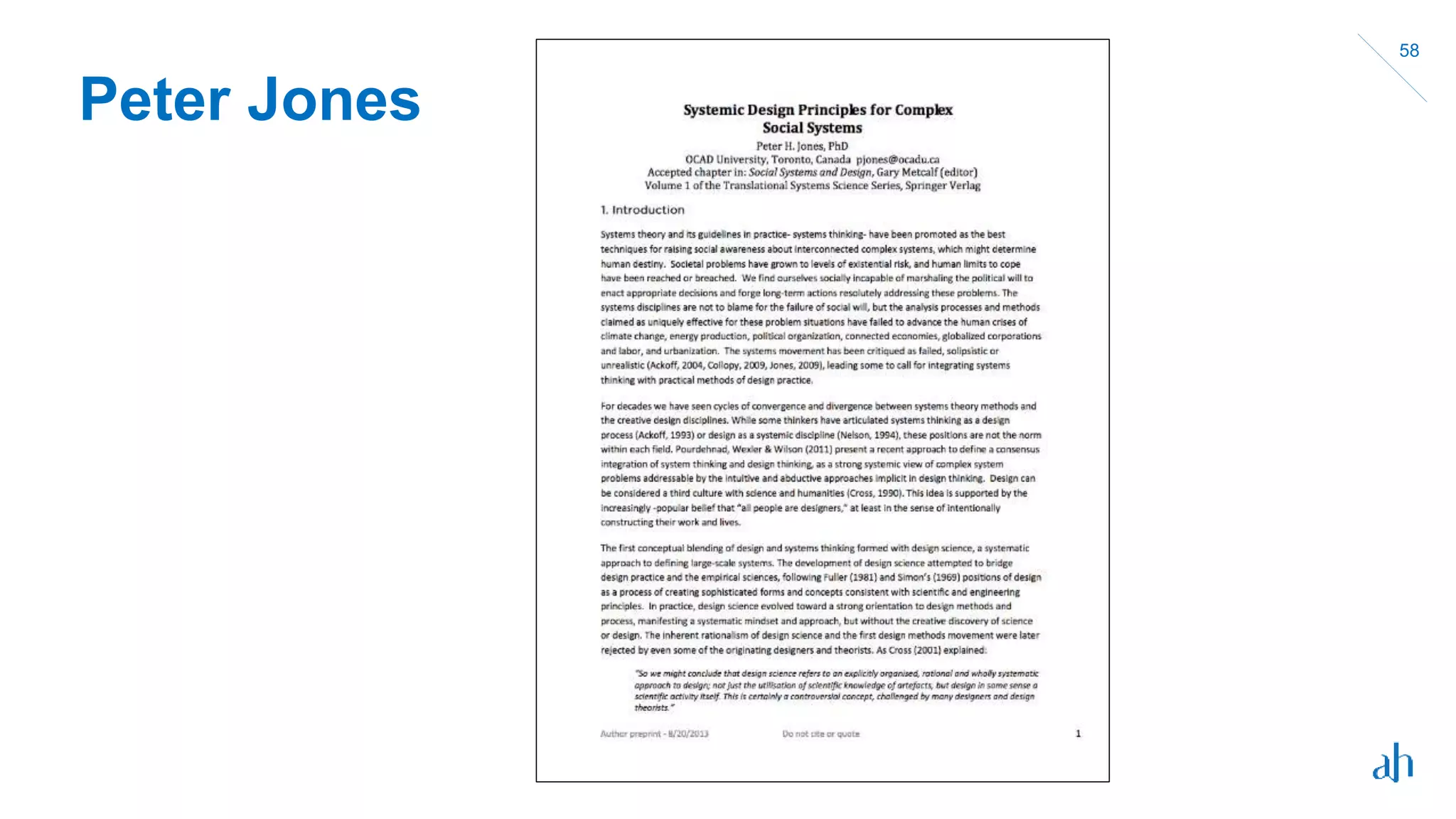
Peter Jones
58
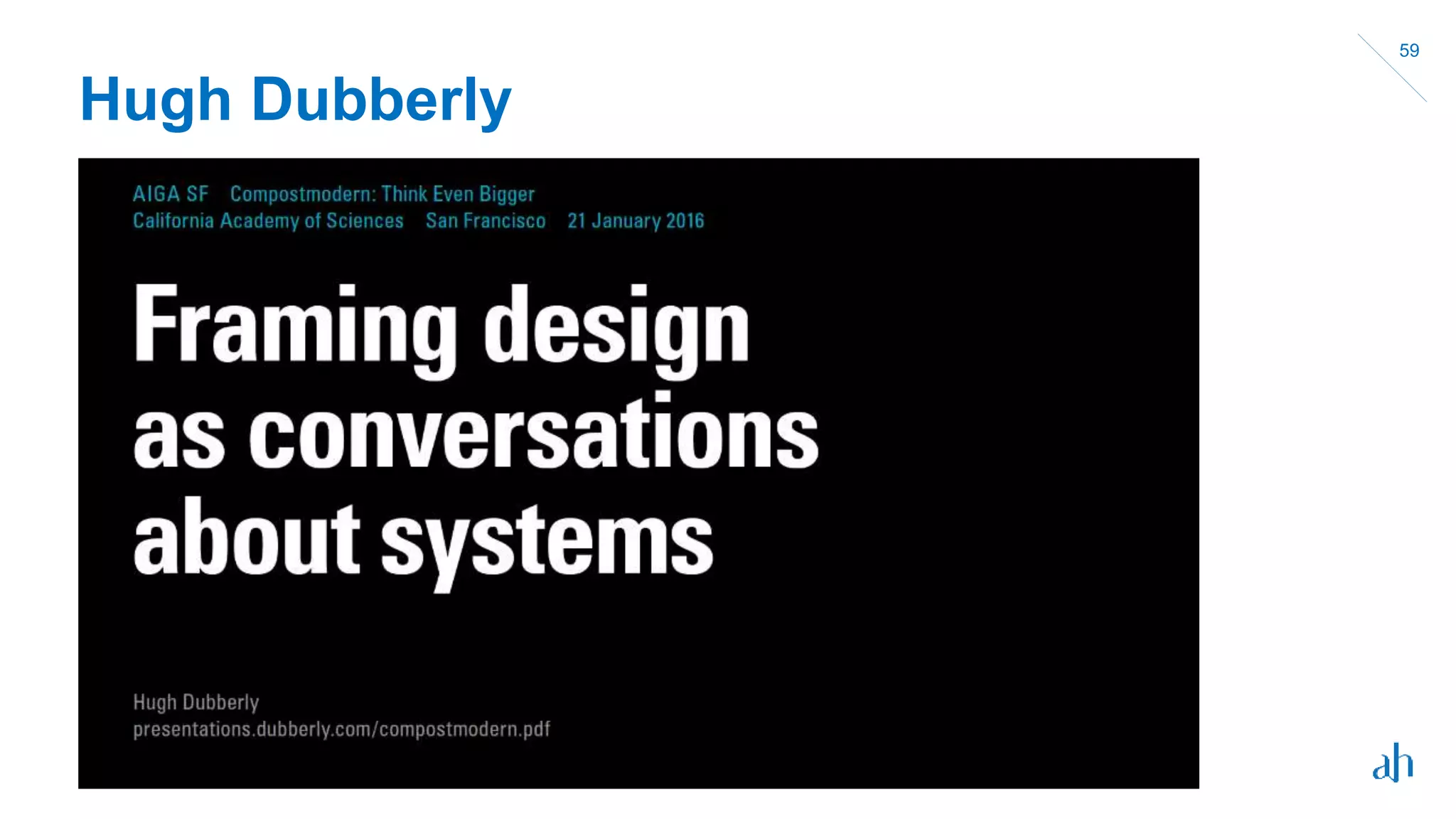
Hugh Dubberly
59
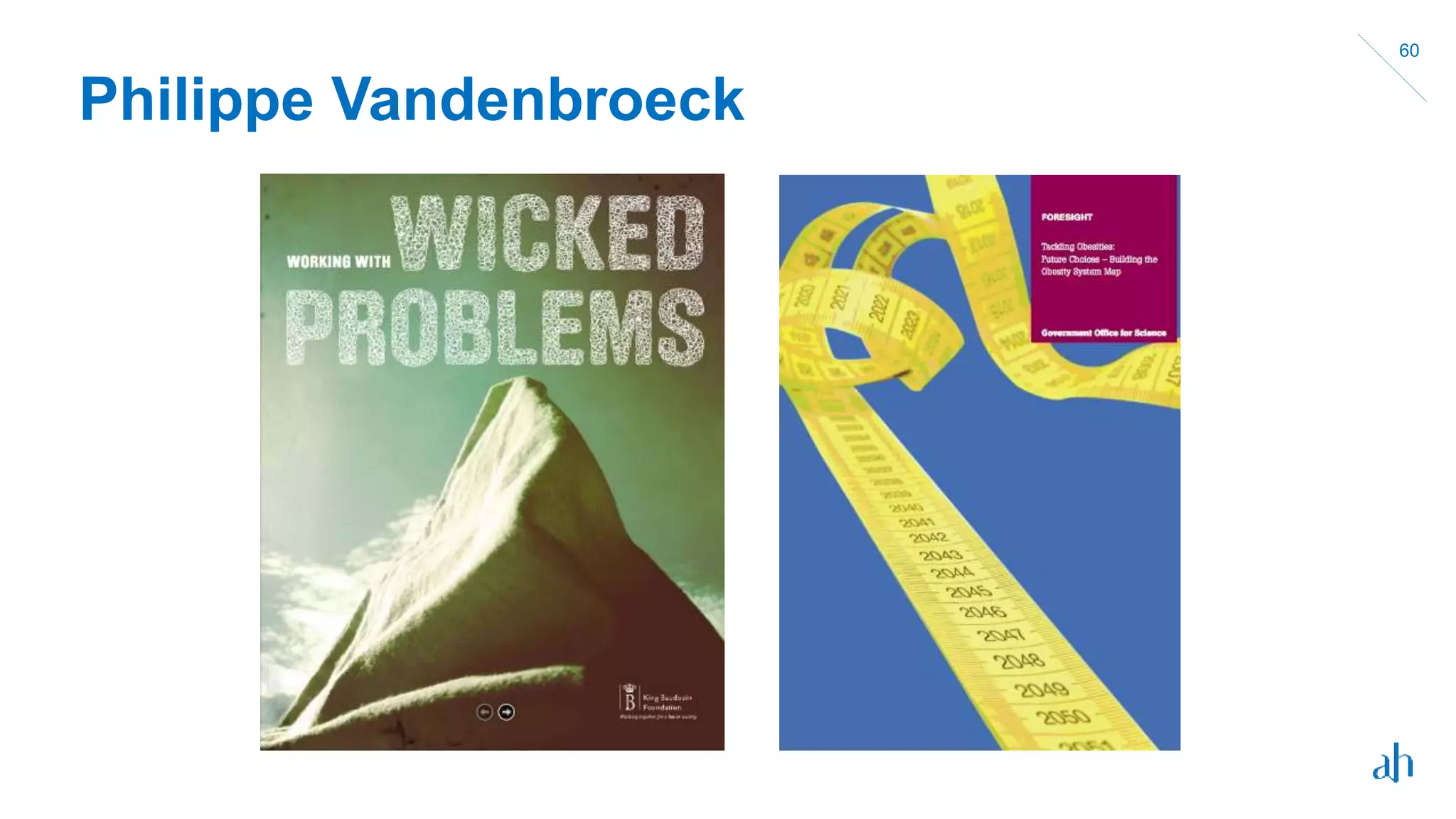
Philippe Vandenbroeck
60
Thank you
systemic@namahn.com
@namahn - @KristelVanAel | @clementina_g | @2pk_koen
@shiftNGroup

Towards a Systemic Design Toolkit: A Practical Workshop - #RSD5 Workshop, Toronto, Oktober 2016

  • 1.
  • 2.
    Namahn and shiftN —Namahn  Human-centred design, digital products and services (Brussels, BE)  An experienced, international, multidisciplinary team: • 17 designers, 3 staff + expert network • Founded in 1987 — shiftN  Futures and systems thinking studio (Leuven, BE)  Network of experts 2
  • 3.
    About this workshop —Introduction to our systemic design toolkit  Why this toolkit?  Underlying principles — Overview of all the tools — Case: child obesity - apply 4 tools to this case  Actants  System map  Intervention strategy  Paradoxical thinking/matrix 3
  • 4.
  • 5.
    What is systemicdesign? Systemic design is the combination of the tools, methods and principles of system thinking and human-centred design. — Systems thinking offer a realm of methods to understand complex socio-technical issues but lacks practicality. — Human centred design is hands-on and solution oriented but misses the approach to handle complexity  The current design methodologies are based on our linear way of problem solving. 5
  • 6.
    Why do wemake this toolkit? — Type of projects: more complex, societal  Interconnectedness, circular thinking needed  Open solutions with self-adaptive capacity — More collaboration needed  Push stakeholders to look at multiple perspectives  Make systemic design thinking explicit, approachable to all stakeholders (offer tools to make this simple & accessible to them) — More about this in the paper sessions 6
  • 7.
  • 8.
    From a designerpoint of view — Human centered — Co-creation — Value driven — Modulate between levels of abstraction — Evidencing to stimulate dialogue — Solutioning as a learning process — Embed triggers for abductive thinking (surprises, anomalies) 8
  • 9.
    From a systemthinkers point of view — Zoom in (people) / zoom out (system) — Focus on relationships and exchanges — Work on micro/meso/macro level — Feedback loops and leverage points — Combination of interventions — Multiple perspectives and worldviews — Motivate boundary judgement — Shape conditions for emergence 9
  • 10.
  • 11.
     Rich contextmap  Actors map  User insights  Actants  System map  Value proposition  Intervention strategy  Paradoxical ideation  Serious play scenarios  Activity model  Intervention map  Transition by design 11
  • 12.
  • 13.
    1. Rich context 13 Amap of the context of the issue: — the longer term trends — the current practices of the system to deal with them — the emerging niche ways of doing things differently. Why? Build a common and visual understanding of the existing and emerging paradigms on the issue or purpose Result identify the (emerging) actors and other stakeholders for your actors map.
  • 14.
  • 15.
    2. Actors map 15 Amap with the key players in the systems and their mutual relations with regard to the issue or intended outcome Why? Identify and select the actors you want to observe and/or interview in your field study Result A number of hypotheses to validate or falsify during the field study
  • 16.
  • 17.
    3. User insights 17 Fieldstudy – observations, interviews with key users and stakeholders of the system (actors) Why? Get insights in the needs, wishes, frustrations of the actors. Validate and/or falsify the hypotheses you have made while making the rich context and the actors map Result Insights in the form of personas, scenarios-of-use, a user type matrix or an experience graph
  • 18.
  • 19.
  • 20.
    4. Actants 20 A toolto model, summarize and communicate your systemic user research, focussing on the relationships between the different actors Why? Understand the quality of the relation between actors and identify the variables that are influencing the relationship in a positive or negative way. Result A list of variables to start off your system map
  • 21.
  • 22.
    5. System map 22 Atool for visualising the system, its structure, the interrelations between the elements/variables of the system and the things that flow in the system. Why? You want to understand the system and to identify the variables that have potential to change the system (leverage points) Result List of potential leverage points
  • 23.
  • 24.
    6. Value proposition 24 Applythe themes to improve the system (often at individual level) to other value layers, using the Universal Values model by Elke den Ouden Why? Broaden and stretch out the themes/leverage points to create meaningful innovations on different levels (organisation, ecosystem, society as a whole) Result The design challenge
  • 25.
  • 26.
    7. Intervention strategy 26 Atool to help you to understand and explore how (on which levels) you can intervene in the system, using the levels of intervention (Donella H. Meadows) Why? A solution to a systemic problem should always be a combination of interventions. This tool/template helps you see the spectrum of possibilities in a workshop together with your client and stakeholders Result Scope and list of possible intervention domains
  • 27.
  • 28.
    8. Paradoxical ideation Theparadox card set is a tool for consciously bringing together the paradoxical sides of a problem to achieve solutions for the whole. It is about AND thinking instead of OR thinking. Why Generate unusual viewpoints. Find solutions that suit all, in spite of multiple perspectives. Result List of solution ideas 28
  • 29.
  • 30.
    9. Serious playscenarios Serious play scenarios is a technique for finding concept ideas for the future user experience by tinkering and role playing... Why? By ‘playing’ you’ll find ideas that you hadn’t thought of because the technique encourages you to think from a user’s standpoint and to go through all the steps. Result Scenarios (and processes) 30
  • 31.
  • 32.
    10. Activity model 32 Avisual representation of your solution concepts. You depict the touchpoint and the actors involved, and the flows/activities between them. Why? To present the system solution to your client and stakeholders to discuss or to validate them. You can also make the drawing in a workshop together with the client and stakeholders. Result Solution concepts
  • 33.
  • 34.
  • 35.
    11. Intervention map 35 Theinterventions map helps you see the connections between the to be interventions, both the designed as the non-designed ones. Why? Understand how the interventions are reinforcing one another (both in same or opposite way) and to adjust them accordingly if necessary. Result Verified system solution
  • 36.
  • 37.
    12. Transition bydesign A transition roadmap is a tool to think about the implementation of the new system concept to bring about change. Set out design interventions in time and space. Why? When a new system is introduced within an existing system it often fails because there is too much resistance to change. The transition roadmap offers a strategy to deal with this by working from the micro to the macro. Result Implementation briefing and strategy 37
  • 38.
  • 39.
    The problem: childobesity — Overweight versus obesity - diagnosis based on BMI — Obesity has doubled in children and quadrupled in adolescents in the past 30 years (U.S.) — Health effects: short and long term — Prevention? — [video] 39
  • 40.
    How to dealwith the issue of child obesity? Note: focus is on learning about the tools and the toolkit! We will not solve the problem… 40
  • 41.
    Applying the systemic design toolkit (4tools, 20’ prep + 10’ present and discussion per tool) 41
  • 42.
  • 43.
    4. Actants 43 A toolto model, summarize and communicate your systemic user research, focussing on the relationships between the different actors Why? Understand the quality of the relation between actors and identify the variables that are influencing the relationship in a positive or negative way. Result A list of variables to start off your system map
  • 44.
    Actants, exercise How — Identifytwo main actors with a crucial relationship concerning your issue — Describe the activities between the actants in the middle and qualify the nature of the relationship with different lines (see legend) — Define the drives of each actant concerning his/her engagement in the relationship. Then, identify what each actant gives to and receives from the relationship — Clarify external factors that have additional influence on this relationship and its activities 44
  • 45.
  • 46.
    5. System map 46 Atool for visualising the system, its structure, the interrelations between the elements/variables of the system and the things that flow in the system. Why? You want to understand the system and to identify the variables that have potential to change the system (leverage points) Result List of potential leverage points
  • 47.
    System map, exercise 47 How —Core activity: state the high-level activity/activities between your primary actants (A and B). Qualify what they exchange in a qualitative and quantitative way — Micro influencers  Variables: add variables that influence the core. Start from the drives, gives and takes from your primary actants  Relations: indicate how the drives, gives and takes reinforce the core and each other (in the same (S) or opposite (O) direction) — Meso and macro influencers: add variables on meso (community, organisation) and macro (society) level
  • 48.
  • 49.
    7. Intervention strategy 49 Atool to help you to understand and explore how (on which levels) you can intervene in the system, using the levels of intervention (Donella H. Meadows) Why? A solution to a systemic problem should always be a combination of interventions. This tool/template helps you see the spectrum of possibilities in a workshop together with your client and stakeholders Result Scope and list of possible intervention domains
  • 50.
    Intervention strategy template Constants,parameters, numbers Buffering capacity Physical structures Digital structures* Delays Feedbacks Information flows Rules & regulations Goals Paradigms 50
  • 51.
    Intervention strategy, exercise How —Answer the questions under each intervention level category from the perspective of the actors you are focussing on. Write the answers on post-its — Look at the result  Which are the most relevant interventions?  Which ones are feasible because you/your client has the power and knowledge to intervene on this level 51
  • 52.
  • 53.
    8. Paradoxical ideation Theparadox card set is a tool for consciously bringing together the paradoxical sides of a problem to achieve solutions for the whole. It is about AND thinking instead of OR thinking. Why Generate unusual viewpoints. Find solutions that suit all, inspite of multiple perspectives. Result List of solution ideas 53
  • 54.
    Paradoxical ideation, exercise How —From your system map, choose the most important paradoxes. Select two paradox cards and write the extremes of each paradox on the axes on the poster — Look at each quadrant separately and ideate on solutions that address their paradox extremes (Try to generate as many ideas as possible) — Combine into one solution – try not to compromise 54
  • 55.
  • 56.
  • 57.
  • 58.
  • 59.
  • 60.
  • 61.
    Thank you systemic@namahn.com @namahn -@KristelVanAel | @clementina_g | @2pk_koen @shiftNGroup

Editor's Notes

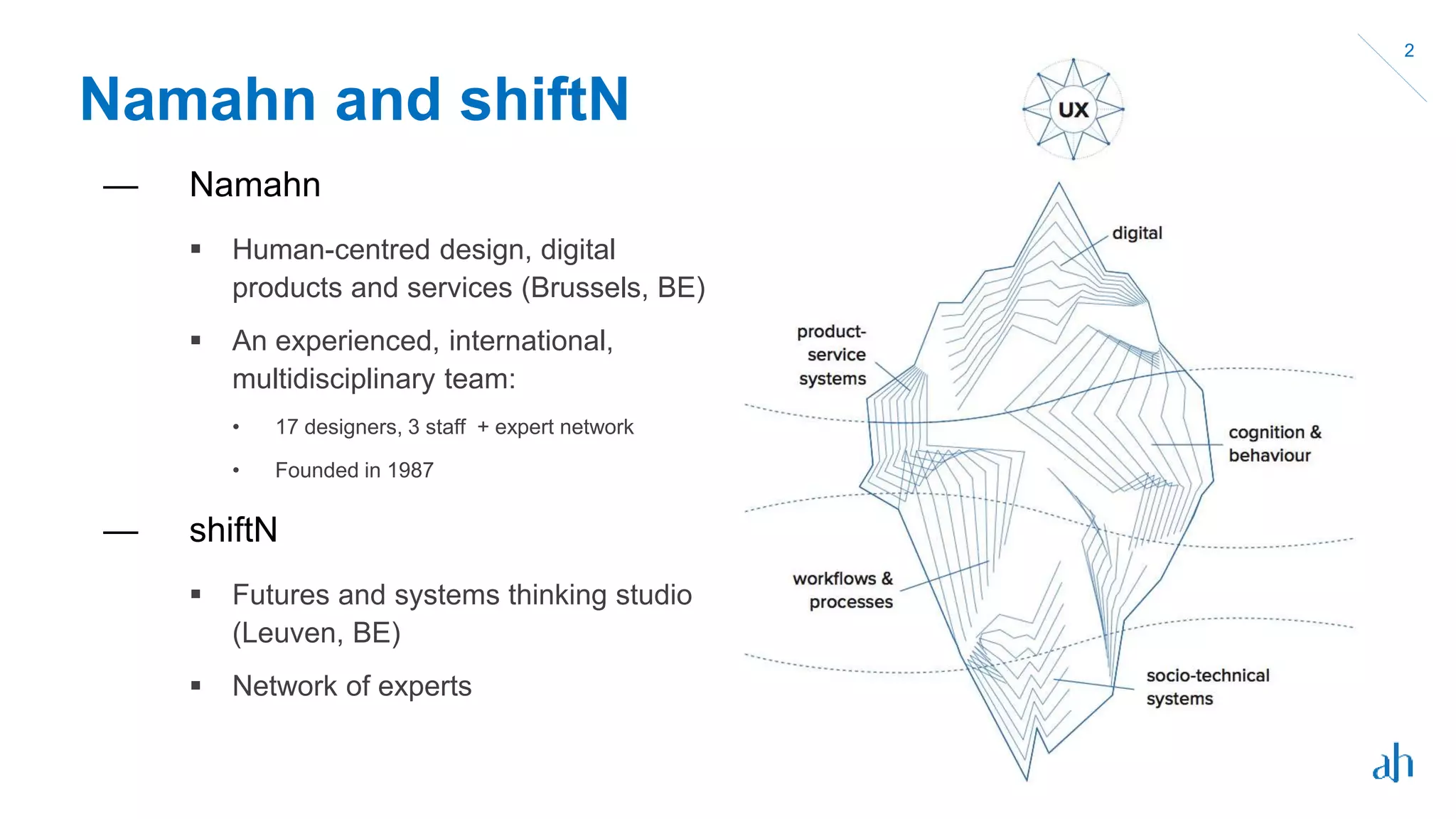
  • #3 Proud to be here in Toronto at RSD5. Let me first present the team behind the systemic design toolkit: Philip vandenbroeck from ShiftN, Clementina Gentile, Kristel Vanael The Iceberg is good metaphor to illustrate what kind of work we do, our methodology, how our service offering has evolved over the years. You need to go all the way to the bottom of the iceberg, to solve systemic problems
  • #14 Source: Frank Geels – theory on how to change: work on different levels - Landscape, regimes/patchwork, niches (new forces)
  • #16 key players (organization/individuals/non human agents) Actors, not personas Types of relation: Normal Strong relation Conflict Ad hoc (time delay) Emerging Oscillating
  • #18 Difference with normal user interviews: Experience over time Their perspective on the system Relations in the system, drivers within the relations, and the system values (use the paradox cards – is the system for you inclusive vs. exclusive, bottom up vs top-down etc.
  • #19 e.g. experience interview: capture the different activities over time, and the emotion that goes with it (positive or negative) + Why?
  • #21 Term Actants comes semiotics Don Norman’s idea: In complex context, look at activities more than at personas Differs from personas by putting the focus on the relationships in which the actors are engaged and not on the individual needs. Create 1 actants scheme per relationship
  • #25 Source: Elke den Ouden en Kees Dorst – Universal values model Broaden and stretch out the themes/leverage points to create innovations on different levels: Individual > organization > ecosystem > society Result = the design challenge, the scope of your project
  • #29 Source: Kees Dorst – paradoxical thinking (University of Eindhoven & Australia)
  • #34 Example
  • #36 Intervention map = verification tool A systemic solution is always a combination if interventions, whereby some can be designed as activities and others are rather principles and recommendations that we as designer can not implement (e.g. rules, bonus systems, organisation values, ...). With the interventions map you can understand how the interventions are reinforcing one another (both in same or opposite way) and to adjust them accordingly if necessary.
  • #38 Unfold your system concept along the micro (individual actors), meso (groups such as communities or organisations) and macro domains (society). You let the new system emerge within the old one. Source: Christopher Alexander – “unfolding a solution by design”
  • #40 Cf. In the US, September = “National Childhood Obesity Awareness Month” + 11 October = “World Obesity Day” Video = montage taking parts of the following documentaries: “our supersized kids” “tipping the scales – a documentary on childhood obesity” This video will kind of replace the field study you would normally do. It will give you an idea of all the actors at play, the variables, elements that play a role in child obesity
  • #44 For example: Mother/father – child Friend/peer – child Teacher – child Media - child