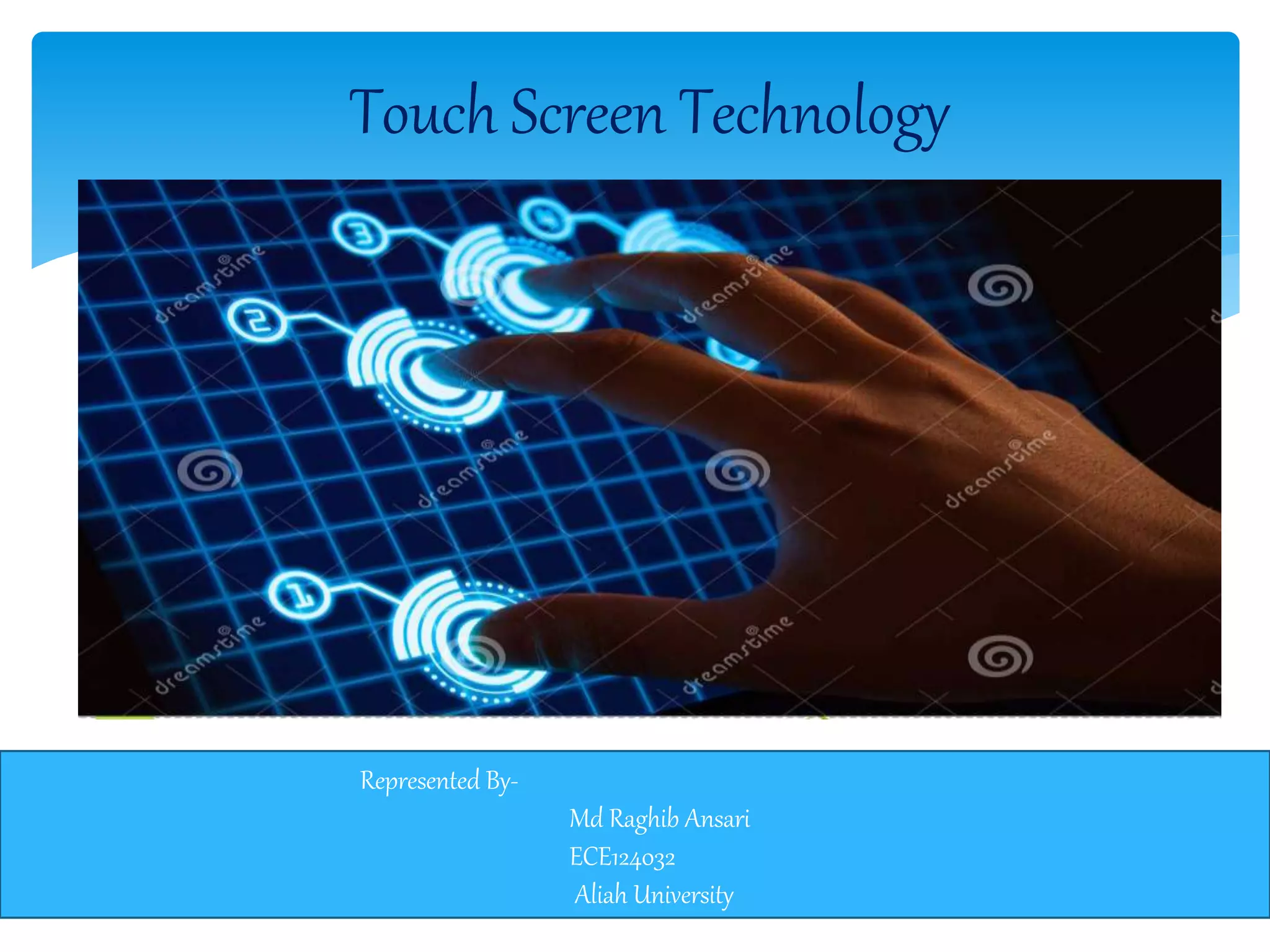
Touch Screen Technology
Represented By-
Md Raghib Ansari
ECE124032
Aliah University
 INTRODUCTION
 HISTORY
 WORKING
 TECHNOLOGIES
 APPLICATION
 CONCLUSION
OVERVIEW
Introduction
What Is a Touch Screen?
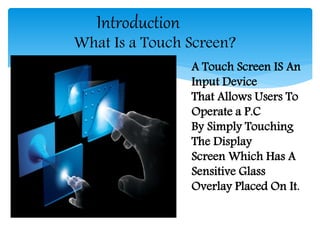
A Touch Screen IS An
Input Device
That Allows Users To
Operate a P.C
By Simply Touching
The Display
Screen Which Has A
Sensitive Glass
Overlay Placed On It.
HISTORY
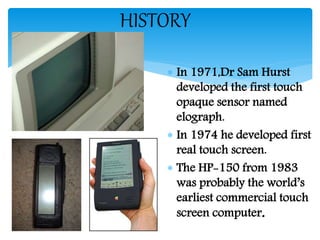
 In 1971,Dr Sam Hurst
developed the first touch
opaque sensor named
elograph.
 In 1974 he developed first
real touch screen.
 The HP-150 from 1983
was probably the world’s
earliest commercial touch
screen computer.
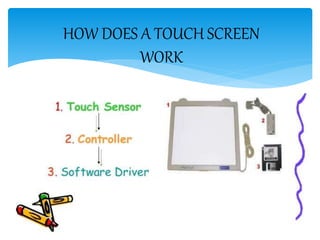
HOW DOES A TOUCH SCREEN
WORK
HOW DOES A
TOUCH SCREEN
WORK
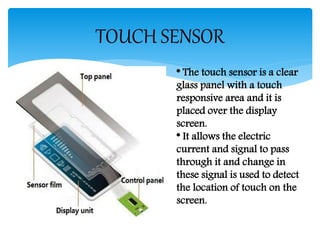
TOUCH SENSOR
* The touch sensor is a clear
glass panel with a touch
responsive area and it is
placed over the display
screen.
* It allows the electric
current and signal to pass
through it and change in
these signal is used to detect
the location of touch on the
screen.
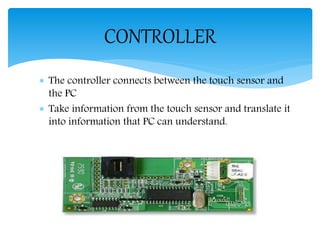
 The controller connects between the touch sensor and
the PC
 Take information from the touch sensor and translate it
into information that PC can understand.
CONTROLLER
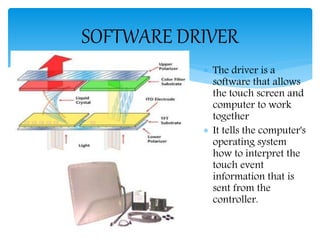
 The driver is a
software that allows
the touch screen and
computer to work
together
 It tells the computer's
operating system
how to interpret the
touch event
information that is
sent from the
controller.
SOFTWARE DRIVER
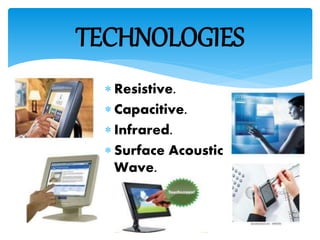
 Resistive.
 Capacitive.
 Infrared.
 Surface Acoustic
Wave.
TECHNOLOGIES
RESISTIVE
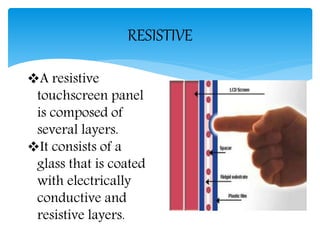
A resistive
touchscreen panel
is composed of
several layers.
It consists of a
glass that is coated
with electrically
conductive and
resistive layers.
Advantages & Disadvantage of
Resistive Touch Screen
• Lower Cost.
• Good For Hand Writing
Recognition
• Can be relatively easily
damaged by
scratching.
• It emits only 75% of
light which make the
image relatively bulky
and dim
Advantages  Disadvantages
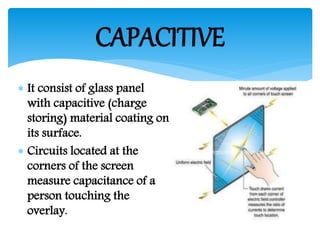
 It consist of glass panel
with capacitive (charge
storing) material coating on
its surface.
 Circuits located at the
corners of the screen
measure capacitance of a
person touching the
overlay.
CAPACITIVE
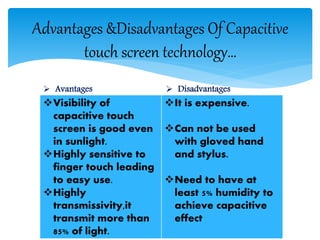
Advantages &Disadvantages Of Capacitive
touch screen technology…
Visibility of
capacitive touch
screen is good even
in sunlight.
Highly sensitive to
finger touch leading
to easy use.
Highly
transmissivity,it
transmit more than
85% of light.
It is expensive.
Can not be used
with gloved hand
and stylus.
Need to have at
least 5% humidity to
achieve capacitive
effect
 Avantages  Disadvantages
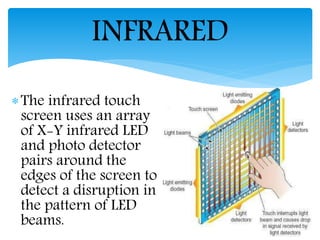
The infrared touch
screen uses an array
of X-Y infrared LED
and photo detector
pairs around the
edges of the screen to
detect a disruption in
the pattern of LED
beams.
INFRARED
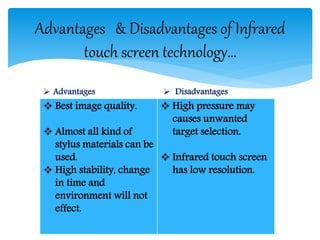
Advantages & Disadvantages of Infrared
touch screen technology…
 Best image quality.
 Almost all kind of
stylus materials can be
used.
 High stability, change
in time and
environment will not
effect.
 High pressure may
causes unwanted
target selection.
 Infrared touch screen
has low resolution.
 Advantages  Disadvantages
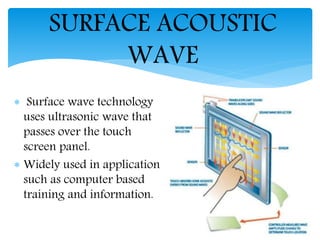
 Surface wave technology
uses ultrasonic wave that
passes over the touch
screen panel.
 Widely used in application
such as computer based
training and information.
SURFACE ACOUSTIC
WAVE
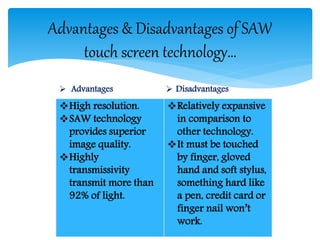
Advantages & Disadvantages of SAW
touch screen technology…
High resolution.
SAW technology
provides superior
image quality.
Highly
transmissivity
transmit more than
92% of light.
Relatively expansive
in comparison to
other technology.
It must be touched
by finger, gloved
hand and soft stylus,
something hard like
a pen, credit card or
finger nail won’t
work.
 Advantages  Disadvantages
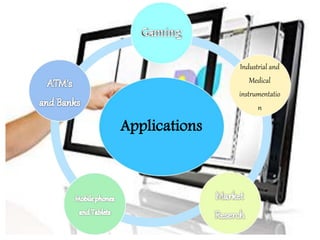
Applications
Industrial and
Medical
instrumentatio
n
Designers are trying to use touch screen to simplify
inputs commands.
Today, touch screen has become adopted by
computers users of all abilities because it is simple,
fast and innovative.
RPO’ s Digital Waveguide Touch.
 3-dimensional Touchscreens.
CONCLUSION & Future Scope
Thank You

Touch screentechnologyraghib

  • 1.
    Touch Screen Technology RepresentedBy- Md Raghib Ansari ECE124032 Aliah University
  • 2.
     INTRODUCTION  HISTORY WORKING  TECHNOLOGIES  APPLICATION  CONCLUSION OVERVIEW
  • 3.
    Introduction What Is aTouch Screen? A Touch Screen IS An Input Device That Allows Users To Operate a P.C By Simply Touching The Display Screen Which Has A Sensitive Glass Overlay Placed On It.
  • 4.
    HISTORY  In 1971,DrSam Hurst developed the first touch opaque sensor named elograph.  In 1974 he developed first real touch screen.  The HP-150 from 1983 was probably the world’s earliest commercial touch screen computer.
  • 5.
    HOW DOES ATOUCH SCREEN WORK HOW DOES A TOUCH SCREEN WORK
  • 6.
    TOUCH SENSOR * Thetouch sensor is a clear glass panel with a touch responsive area and it is placed over the display screen. * It allows the electric current and signal to pass through it and change in these signal is used to detect the location of touch on the screen.
  • 7.
     The controllerconnects between the touch sensor and the PC  Take information from the touch sensor and translate it into information that PC can understand. CONTROLLER
  • 8.
     The driveris a software that allows the touch screen and computer to work together  It tells the computer's operating system how to interpret the touch event information that is sent from the controller. SOFTWARE DRIVER
  • 9.
     Resistive.  Capacitive. Infrared.  Surface Acoustic Wave. TECHNOLOGIES
  • 10.
    RESISTIVE A resistive touchscreen panel iscomposed of several layers. It consists of a glass that is coated with electrically conductive and resistive layers.
  • 11.
    Advantages & Disadvantageof Resistive Touch Screen • Lower Cost. • Good For Hand Writing Recognition • Can be relatively easily damaged by scratching. • It emits only 75% of light which make the image relatively bulky and dim Advantages  Disadvantages
  • 12.
     It consistof glass panel with capacitive (charge storing) material coating on its surface.  Circuits located at the corners of the screen measure capacitance of a person touching the overlay. CAPACITIVE
  • 13.
    Advantages &Disadvantages OfCapacitive touch screen technology… Visibility of capacitive touch screen is good even in sunlight. Highly sensitive to finger touch leading to easy use. Highly transmissivity,it transmit more than 85% of light. It is expensive. Can not be used with gloved hand and stylus. Need to have at least 5% humidity to achieve capacitive effect  Avantages  Disadvantages
  • 14.
    The infrared touch screenuses an array of X-Y infrared LED and photo detector pairs around the edges of the screen to detect a disruption in the pattern of LED beams. INFRARED
  • 15.
    Advantages & Disadvantagesof Infrared touch screen technology…  Best image quality.  Almost all kind of stylus materials can be used.  High stability, change in time and environment will not effect.  High pressure may causes unwanted target selection.  Infrared touch screen has low resolution.  Advantages  Disadvantages
  • 16.
     Surface wavetechnology uses ultrasonic wave that passes over the touch screen panel.  Widely used in application such as computer based training and information. SURFACE ACOUSTIC WAVE
  • 17.
    Advantages & Disadvantagesof SAW touch screen technology… High resolution. SAW technology provides superior image quality. Highly transmissivity transmit more than 92% of light. Relatively expansive in comparison to other technology. It must be touched by finger, gloved hand and soft stylus, something hard like a pen, credit card or finger nail won’t work.  Advantages  Disadvantages
  • 18.
  • 19.
    Designers are tryingto use touch screen to simplify inputs commands. Today, touch screen has become adopted by computers users of all abilities because it is simple, fast and innovative. RPO’ s Digital Waveguide Touch.  3-dimensional Touchscreens. CONCLUSION & Future Scope
  • 20.