P R E S E N T E D B Y S R I S H T I P A L
WHAT IS TORT?
A tort is a civil wrong resulting from an act
or omission that causes harm or injury to
another, leading to legal liability.
It has been derived from the Latin word
"tortum," meaning "twisted" or "crooked,"
indicating conduct that is not straight or
lawful.
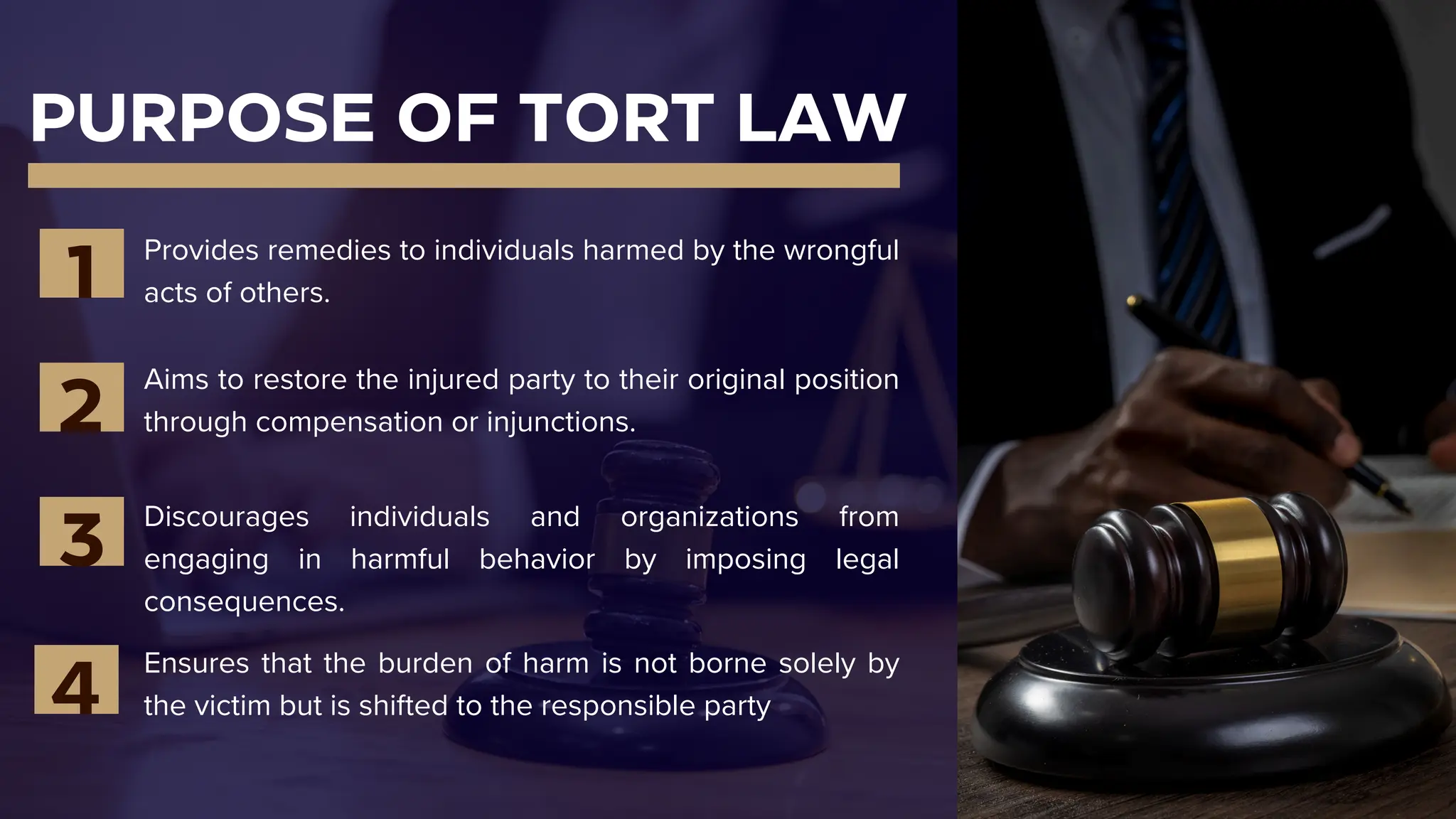
PURPOSE OF TORT LAW
Provides remedies to individuals harmed by the wrongful
acts of others.
1
Aims to restore the injured party to their original position
through compensation or injunctions.
2
Discourages individuals and organizations from
engaging in harmful behavior by imposing legal
consequences.
3
4
Ensures that the burden of harm is not borne solely by
the victim but is shifted to the responsible party
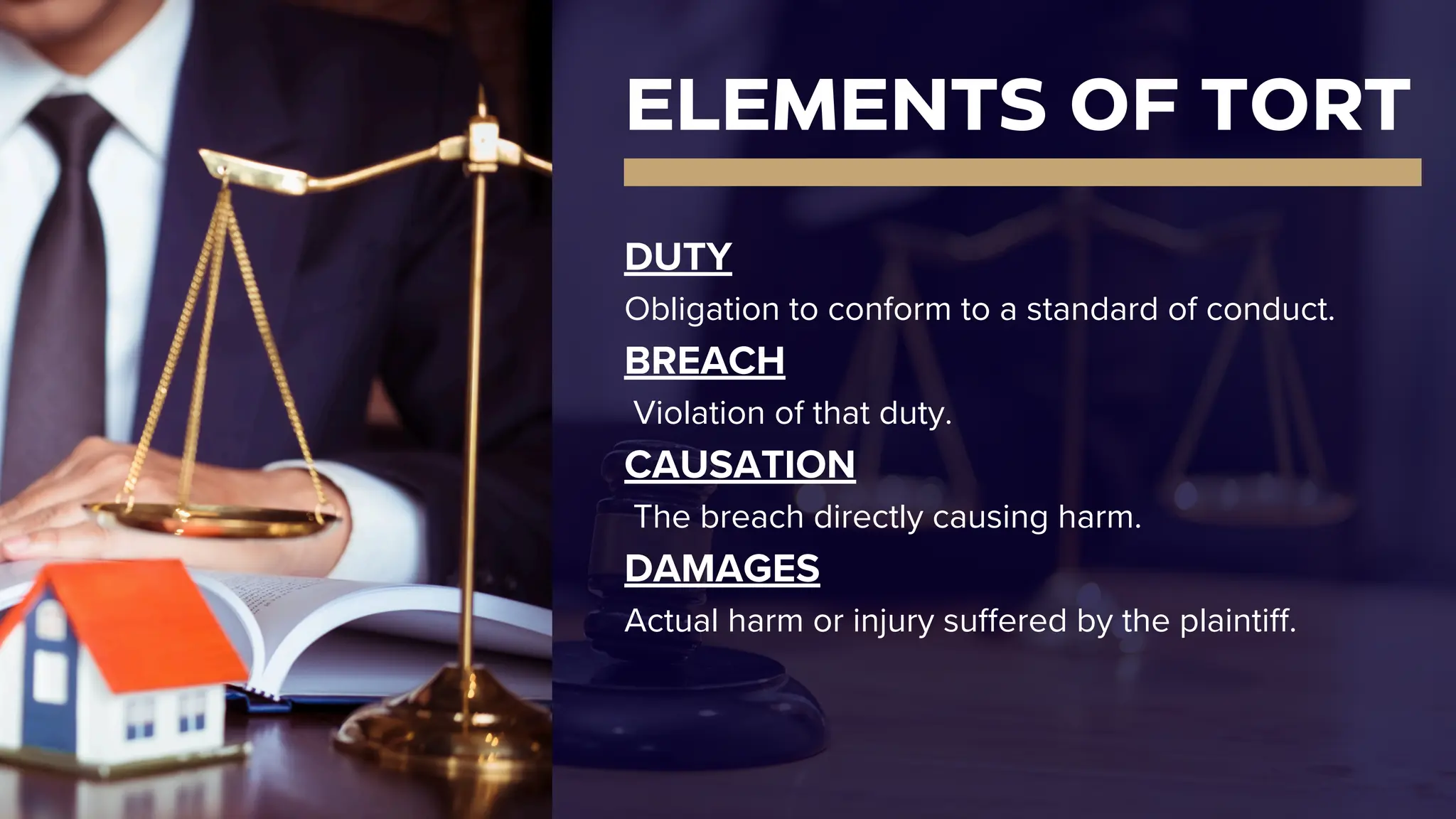
ELEMENTS OF TORT
DUTY
Obligation to conform to a standard of conduct.
BREACH
Violation of that duty.
CAUSATION
The breach directly causing harm.
DAMAGES
Actual harm or injury suffered by the plaintiff.
TYPES OF TORTS
Intentional Torts: Deliberate actions causing harm, such as:
Assault: An act creating apprehension of imminent harmful or offensive contact.
Battery: Intentional and wrongful physical contact with a person without their consent.
False Imprisonment: Unlawful restraint of a person's freedom of movement.
Trespass to Land: Unauthorized entry onto another's property.
Conversion: Unauthorized taking or use of someone else's property.
Defamation: False statements harming another's reputation.
Nuisance: Acts interfering with the use and enjoyment of someone's property.
Negligence: Failure to exercise reasonable care, leading to unintentional harm. For example: A driver causing an
accident by not following traffic rules or a medical professional making an error during surgery due to lack of attention.
Strict Liability: Liability without fault, typically in cases involving inherently dangerous activities or defective products.
For instance: A company held liable for damages caused by its hazardous waste disposal, regardless of the
precautions taken.
Absolute Liability: A stricter form of strict liability where no defense is allowed. It applies in cases involving hazardous
and inherently dangerous activities, and the responsible party is held liable regardless of precautions taken.
DIFFERENCE BETWEEN TORT LAW AND
CONTRACT LAW
TORT LAW CONTRACT LAW
Governs civil wrongs that cause harm or injury to
individuals or their property.
Duty is imposed by law on everyone to act reasonably
and avoid harming others.
Can arise from negligence, intentional wrongdoing, or
strict liability, even without an agreement between the
parties.
No prior consent is required; the wrongdoer’s actions
impose liability.
Protects rights related to safety, property, reputation,
and freedom from harm.
REMEDIES: Damages (compensation), injunctions
(court orders preventing further harm), and restitution
(returning something to its rightful owner).
Governs agreements between parties that
create legal obligations.
Duty arises from a voluntary agreement
between parties.
Can only arise when there is a breach of
terms agreed upon in a contract.
Based on mutual consent of parties who
enter into a contract voluntarily.
Protects economic and business interests
arising from agreements.
REMEDIES: Compensation (monetary
damages), specific performance (forcing a
party to fulfill the contract), or contract
rescission (cancellation).
CASE ANALYSIS
1. Negligence Cases
Donoghue v. Stevenson (1932) – Established duty of care and neighbor principle.
Palsgraf v. Long Island Railroad Co. (1928) – Harm must be foreseeable for liability.
2. Strict Liability Cases
Rylands v. Fletcher (1868) – If you keep something dangerous, you're liable if it escapes.
3. Absolute Liability Cases
M.C. Mehta v. Union of India (1987) – Bhopal Gas Tragedy – Industries with hazardous materials are
fully liable for damage.
4. Intentional Tort Cases
R v. Ireland (1997) – Silent phone calls amounted to assault.
Collins v. Wilcock (1984) – Unwanted physical contact = battery.
New York Times v. Sullivan (1964) – Public officials must prove “actual malice” in defamation cases.
5. Nuisance & Trespass Cases
St. Helen’s Smelting Co. v. Tipping (1865) – Differentiated between personal discomfort and
property damage.
Entick v. Carrington (1765) – Government officials trespassing without a warrant was unlawful.
CONCLUSION
Tort law plays a vital role in ensuring justice by
holding individuals and entities accountable for
wrongful actions. It not only provides compensation
to victims but also acts as a deterrent, encouraging
responsible behavior in society. By protecting rights
related to personal safety, property, and reputation,
tort law helps maintain social order and prevents
conflicts from escalating. As legal challenges evolve
with technological and environmental changes, the
scope of tort law continues to expand, ensuring that
justice adapts to modern needs. Ultimately, it serves
as a crucial mechanism for restoring balance and
fairness in civil disputes.
Torts presentation by srishti pal and his

  • 1.
    P R ES E N T E D B Y S R I S H T I P A L
  • 2.
    WHAT IS TORT? Atort is a civil wrong resulting from an act or omission that causes harm or injury to another, leading to legal liability. It has been derived from the Latin word "tortum," meaning "twisted" or "crooked," indicating conduct that is not straight or lawful.
  • 3.
    PURPOSE OF TORTLAW Provides remedies to individuals harmed by the wrongful acts of others. 1 Aims to restore the injured party to their original position through compensation or injunctions. 2 Discourages individuals and organizations from engaging in harmful behavior by imposing legal consequences. 3 4 Ensures that the burden of harm is not borne solely by the victim but is shifted to the responsible party
  • 4.
    ELEMENTS OF TORT DUTY Obligationto conform to a standard of conduct. BREACH Violation of that duty. CAUSATION The breach directly causing harm. DAMAGES Actual harm or injury suffered by the plaintiff.
  • 5.
    TYPES OF TORTS IntentionalTorts: Deliberate actions causing harm, such as: Assault: An act creating apprehension of imminent harmful or offensive contact. Battery: Intentional and wrongful physical contact with a person without their consent. False Imprisonment: Unlawful restraint of a person's freedom of movement. Trespass to Land: Unauthorized entry onto another's property. Conversion: Unauthorized taking or use of someone else's property. Defamation: False statements harming another's reputation. Nuisance: Acts interfering with the use and enjoyment of someone's property. Negligence: Failure to exercise reasonable care, leading to unintentional harm. For example: A driver causing an accident by not following traffic rules or a medical professional making an error during surgery due to lack of attention. Strict Liability: Liability without fault, typically in cases involving inherently dangerous activities or defective products. For instance: A company held liable for damages caused by its hazardous waste disposal, regardless of the precautions taken. Absolute Liability: A stricter form of strict liability where no defense is allowed. It applies in cases involving hazardous and inherently dangerous activities, and the responsible party is held liable regardless of precautions taken.
  • 6.
    DIFFERENCE BETWEEN TORTLAW AND CONTRACT LAW TORT LAW CONTRACT LAW Governs civil wrongs that cause harm or injury to individuals or their property. Duty is imposed by law on everyone to act reasonably and avoid harming others. Can arise from negligence, intentional wrongdoing, or strict liability, even without an agreement between the parties. No prior consent is required; the wrongdoer’s actions impose liability. Protects rights related to safety, property, reputation, and freedom from harm. REMEDIES: Damages (compensation), injunctions (court orders preventing further harm), and restitution (returning something to its rightful owner). Governs agreements between parties that create legal obligations. Duty arises from a voluntary agreement between parties. Can only arise when there is a breach of terms agreed upon in a contract. Based on mutual consent of parties who enter into a contract voluntarily. Protects economic and business interests arising from agreements. REMEDIES: Compensation (monetary damages), specific performance (forcing a party to fulfill the contract), or contract rescission (cancellation).
  • 7.
    CASE ANALYSIS 1. NegligenceCases Donoghue v. Stevenson (1932) – Established duty of care and neighbor principle. Palsgraf v. Long Island Railroad Co. (1928) – Harm must be foreseeable for liability. 2. Strict Liability Cases Rylands v. Fletcher (1868) – If you keep something dangerous, you're liable if it escapes. 3. Absolute Liability Cases M.C. Mehta v. Union of India (1987) – Bhopal Gas Tragedy – Industries with hazardous materials are fully liable for damage. 4. Intentional Tort Cases R v. Ireland (1997) – Silent phone calls amounted to assault. Collins v. Wilcock (1984) – Unwanted physical contact = battery. New York Times v. Sullivan (1964) – Public officials must prove “actual malice” in defamation cases. 5. Nuisance & Trespass Cases St. Helen’s Smelting Co. v. Tipping (1865) – Differentiated between personal discomfort and property damage. Entick v. Carrington (1765) – Government officials trespassing without a warrant was unlawful.
  • 8.
    CONCLUSION Tort law playsa vital role in ensuring justice by holding individuals and entities accountable for wrongful actions. It not only provides compensation to victims but also acts as a deterrent, encouraging responsible behavior in society. By protecting rights related to personal safety, property, and reputation, tort law helps maintain social order and prevents conflicts from escalating. As legal challenges evolve with technological and environmental changes, the scope of tort law continues to expand, ensuring that justice adapts to modern needs. Ultimately, it serves as a crucial mechanism for restoring balance and fairness in civil disputes.