TOPIC II
EXEMPTIONS TO © INFRINGEMENT
1
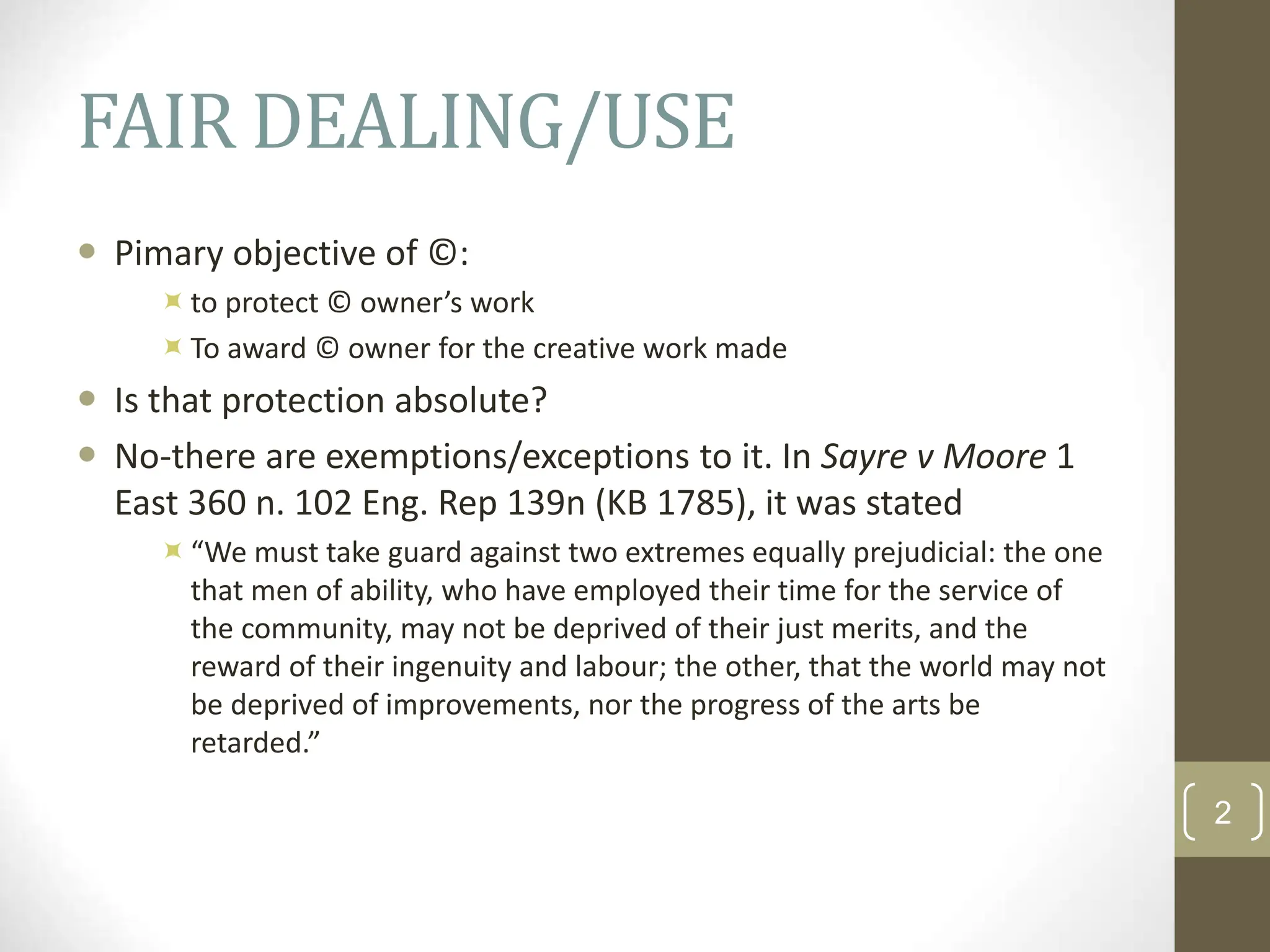
FAIR DEALING/USE
 Pimary objective of ©:
to protect © owner’s work
To award © owner for the creative work made
 Is that protection absolute?
 No-there are exemptions/exceptions to it. In Sayre v Moore 1
East 360 n. 102 Eng. Rep 139n (KB 1785), it was stated
“We must take guard against two extremes equally prejudicial: the one
that men of ability, who have employed their time for the service of
the community, may not be deprived of their just merits, and the
reward of their ingenuity and labour; the other, that the world may not
be deprived of improvements, nor the progress of the arts be
retarded.”
2
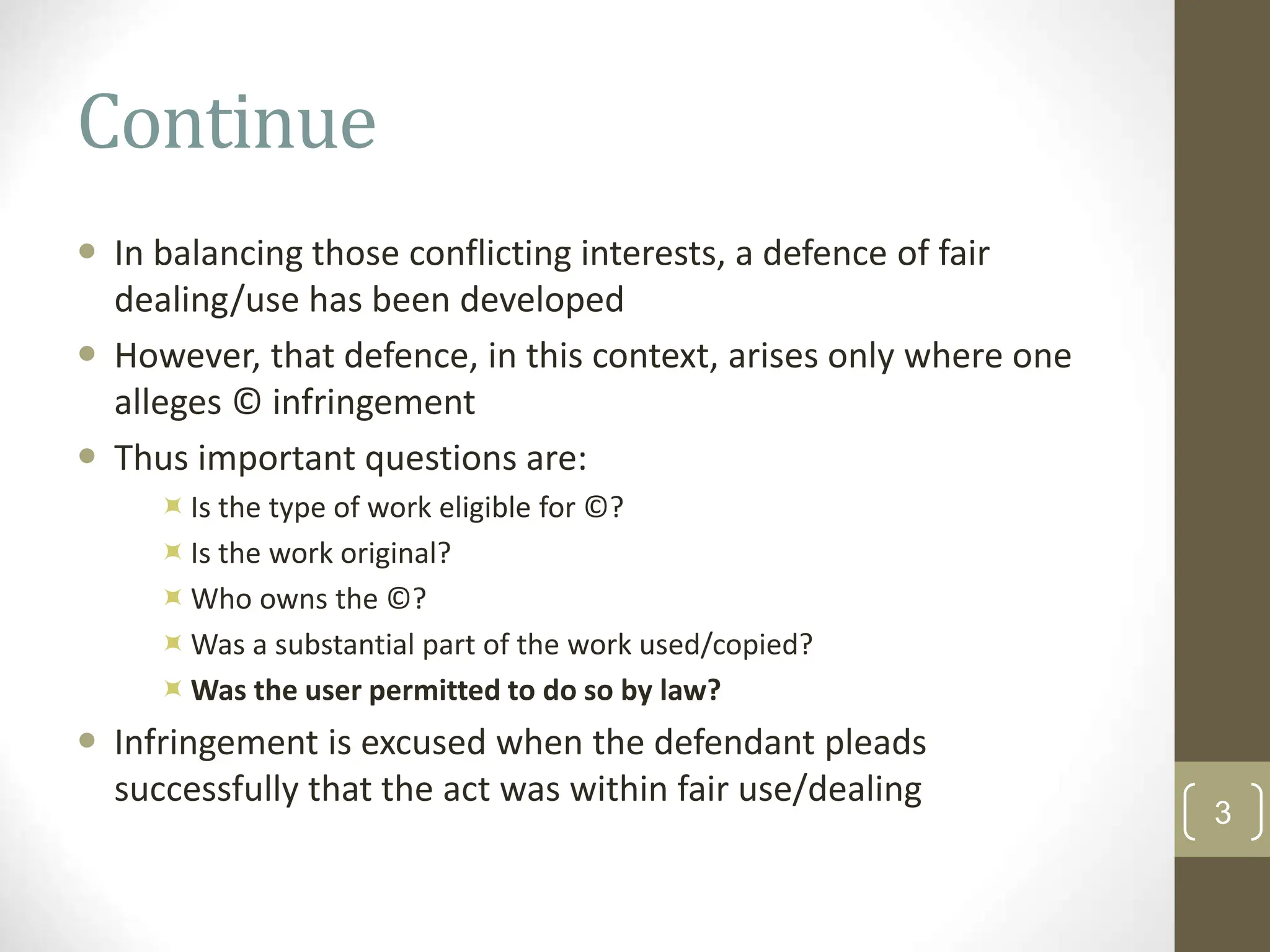
Continue
 In balancing those conflicting interests, a defence of fair
dealing/use has been developed
 However, that defence, in this context, arises only where one
alleges © infringement
 Thus important questions are:
Is the type of work eligible for ©?
Is the work original?
Who owns the ©?
Was a substantial part of the work used/copied?
Was the user permitted to do so by law?
 Infringement is excused when the defendant pleads
successfully that the act was within fair use/dealing
3
Continue
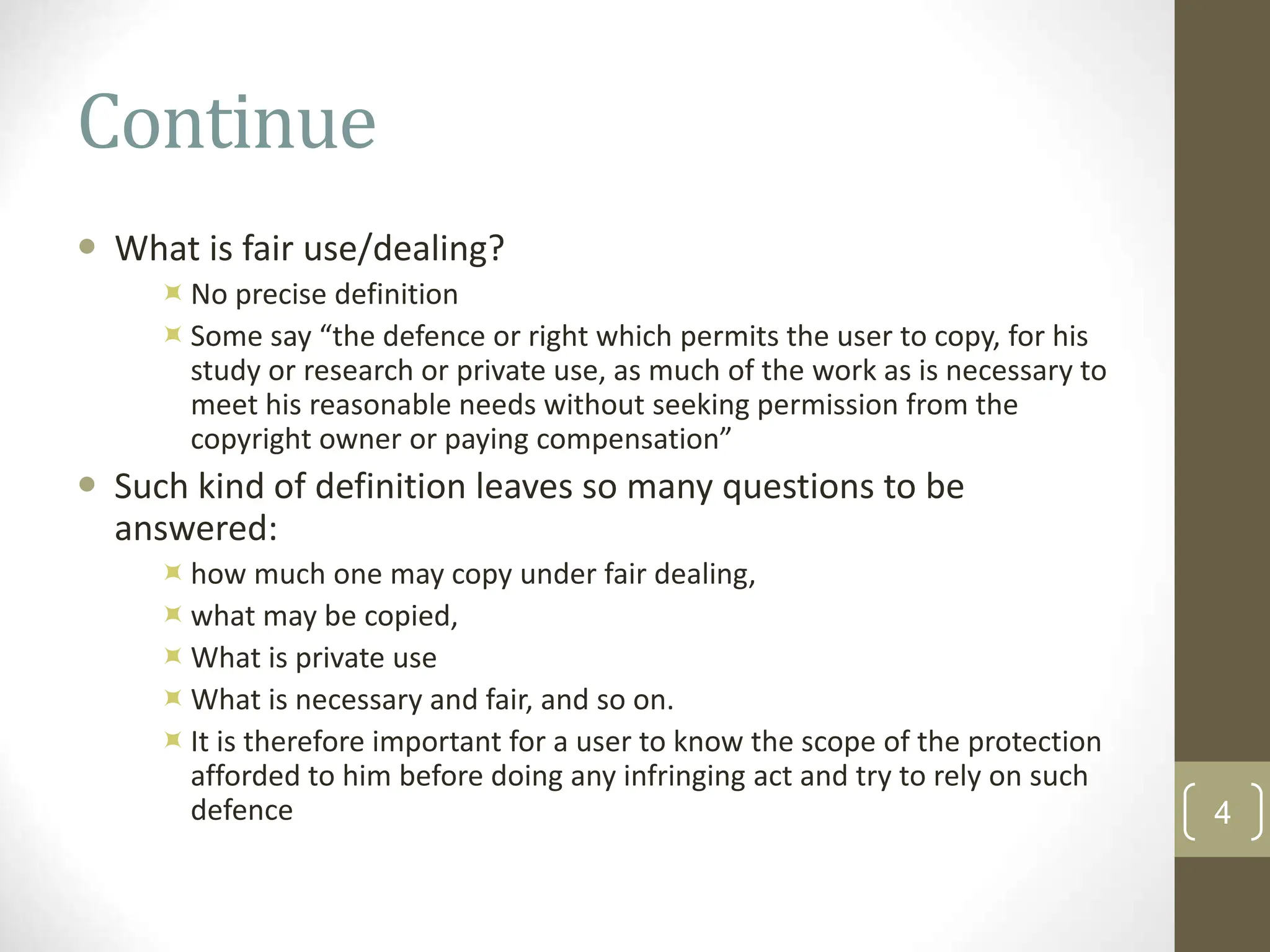
 What is fair use/dealing?
No precise definition
Some say “the defence or right which permits the user to copy, for his
study or research or private use, as much of the work as is necessary to
meet his reasonable needs without seeking permission from the
copyright owner or paying compensation”
 Such kind of definition leaves so many questions to be
answered:
how much one may copy under fair dealing,
what may be copied,
What is private use
What is necessary and fair, and so on.
It is therefore important for a user to know the scope of the protection
afforded to him before doing any infringing act and try to rely on such
defence 4
Continue
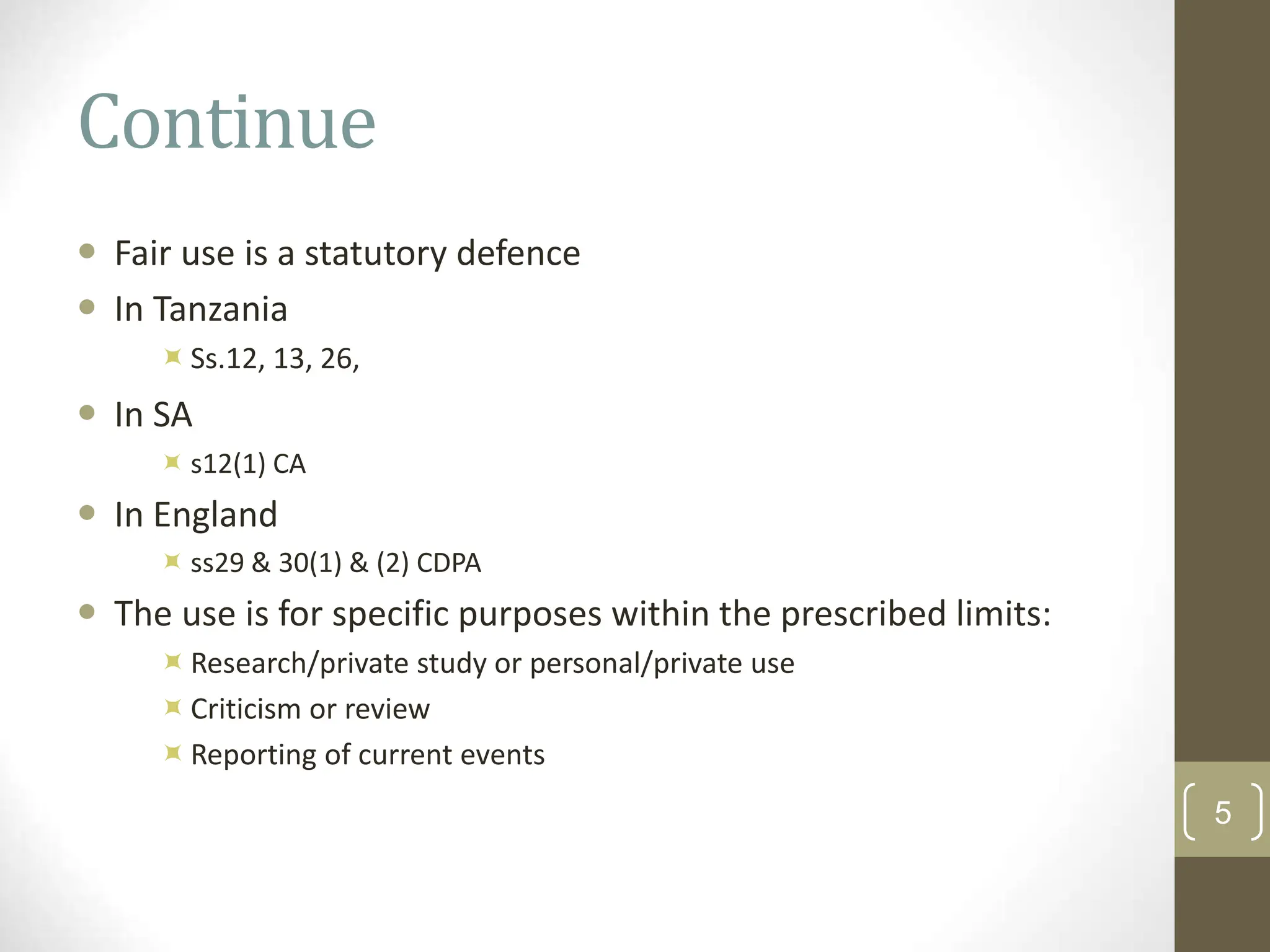
 Fair use is a statutory defence
 In Tanzania
Ss.12, 13, 26,
 In SA
 s12(1) CA
 In England
 ss29 & 30(1) & (2) CDPA
 The use is for specific purposes within the prescribed limits:
Research/private study or personal/private use
Criticism or review
Reporting of current events
5
Continue
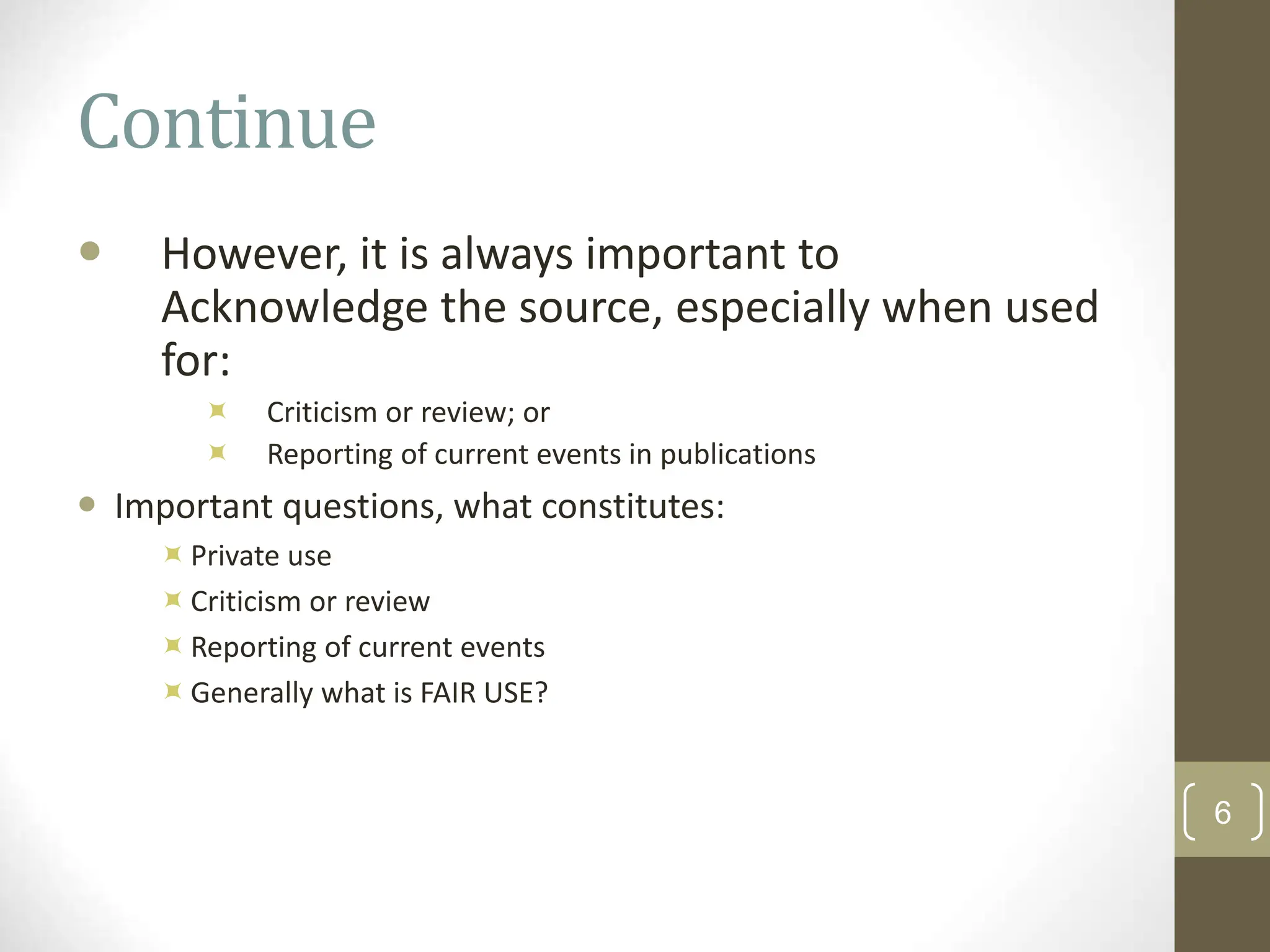
 However, it is always important to
Acknowledge the source, especially when used
for:
 Criticism or review; or
 Reporting of current events in publications
 Important questions, what constitutes:
Private use
Criticism or review
Reporting of current events
Generally what is FAIR USE?
6
CASE LAW APPROACH
 The meaning of fair dealing
 Lord Denning in Hubbard v Vosper [1972] 1 All ER 1023 (CA) stated:
“It is impossible to define what is ‘fair dealing’. It must be a question of
degree. You must consider first the number and extent of the
quotations and extracts. Are they altogether too many and too long to
be fair? Then you must consider the use made of them. If they are
used as a basis for comment, criticism or review, that may be a fair
dealing. If they are used to convey the same information as the author,
for a rival purpose, that may be unfair. Next, you must consider the
proportions. To take long extracts and attach comments may be unfair.
But, short extracts and long comment may be fair. Other
considerations may come to mind also. But, after all is said and done, it
must be a matter of impression. As with fair comment in the law of
libel, so with fair dealing in the law of copyright. The tribunal of fact
must decide.”
 Whether something is fair is a question of fact and depends on the facts of
each case-CCH Canadian Ltd v Law Society of Upper Canada[2004] 1 SCR
339; [2004] SCC 13.
7
Continue
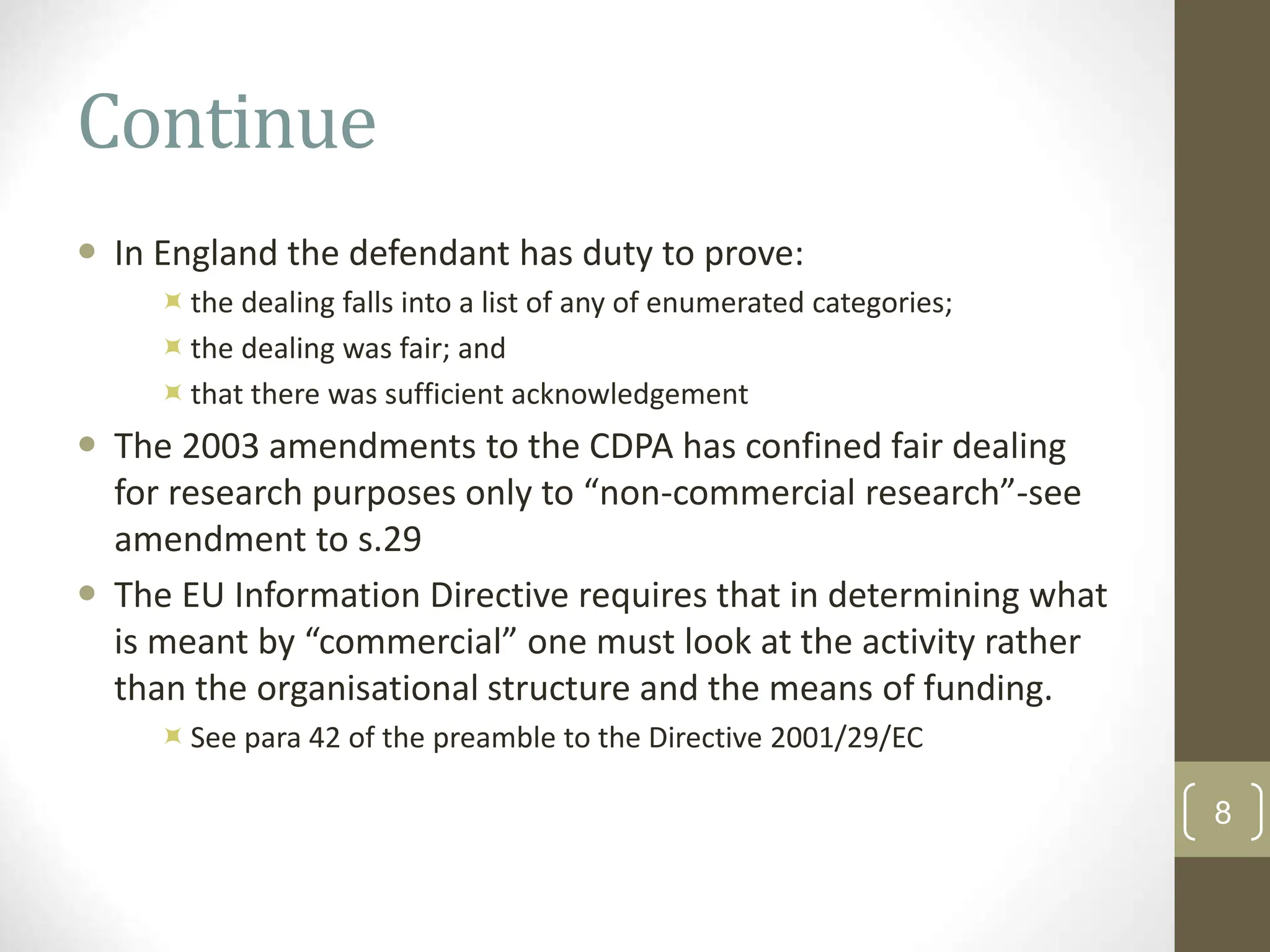
 In England the defendant has duty to prove:
the dealing falls into a list of any of enumerated categories;
the dealing was fair; and
that there was sufficient acknowledgement
 The 2003 amendments to the CDPA has confined fair dealing
for research purposes only to “non-commercial research”-see
amendment to s.29
 The EU Information Directive requires that in determining what
is meant by “commercial” one must look at the activity rather
than the organisational structure and the means of funding.
See para 42 of the preamble to the Directive 2001/29/EC
8
Continue
• The impacts of such amendment were seen in the case of Controller of Her
Majesty’s Stationery Office and another v Green Amps Ltd [2007] EWHC
2755 (Ch).
• Maps protected by Crown copyright were copied by the defendant to
develop a commercial product
• The research had a commercial purpose
• The court stated:
• “Section 29 requires both that what would otherwise be the
act of infringement is ‘for the purposes of research’ and that
such research should be ‘for a non-commercial purpose’. The
second of these requirements is plainly not satisfied”
9
Continue
• For the purpose of review or criticism, the work must have
been previously made available to the public and have
sufficient acknowledgement of its source
• See Sillitoe v McGraw-Hill Book Company [1983] Fleet Street Reports
545 (Ch. D).
• Defendant’s motive can be a determining factor of whether
there is fair dealing for the purpose of criticism
• See Associated Newspapers Group v News Group Ltd [1985] R.P.C.
515
10
Continue
 In determining fair dealing for the purpose of reporting
current-events, court in Ashdown v Telegraph Group Ltd [2001]
EWCA Civ 1142, gave three factors:
Whether the alleged fair dealing is in commercial competition with the
owner's exploitation of the work,
Whether the work has already been published or otherwise exposed
to the public; and
The amount and importance of the work which has been taken
 Courts in England have dismissed this defence if raised against
materials which are unpublished or secured in breach of
confidence
11
Continue
 In British Oxygen Company Limited v Liquid Air Limited [1925] 1 Ch
383, Romer J, stated that;
 “...it would be manifestly unfair that an unpublished literary work should,
without the consent of the author, be the subject of public criticism, review
or newspaper summary. Any such dealing with an unpublished literary
work would not, therefore, in my opinion, be a "fair dealing" with the work.
[1925] 1 Ch 383.
 In Beloff v Pressdam Ltd [1973] 1 AER 241, 263, the court stated:
 "The law by bestowing a right of copyright on an unpublished work
bestows a right to prevent its being published at all; and even though an
unpublished work is not automatically excluded from the defence of fair
dealing, it is yet a much more substantial breach of copyright than
publication of a published work."
 See approval of similar views in:
 Hyde Park Residence Ltd v Yelland [2000] EWCA Civ 37
 His Royal Highness The Prince of Wales v Associated Newspapers Ltd [2006]
EWHC 11 (Ch)
12
Continue
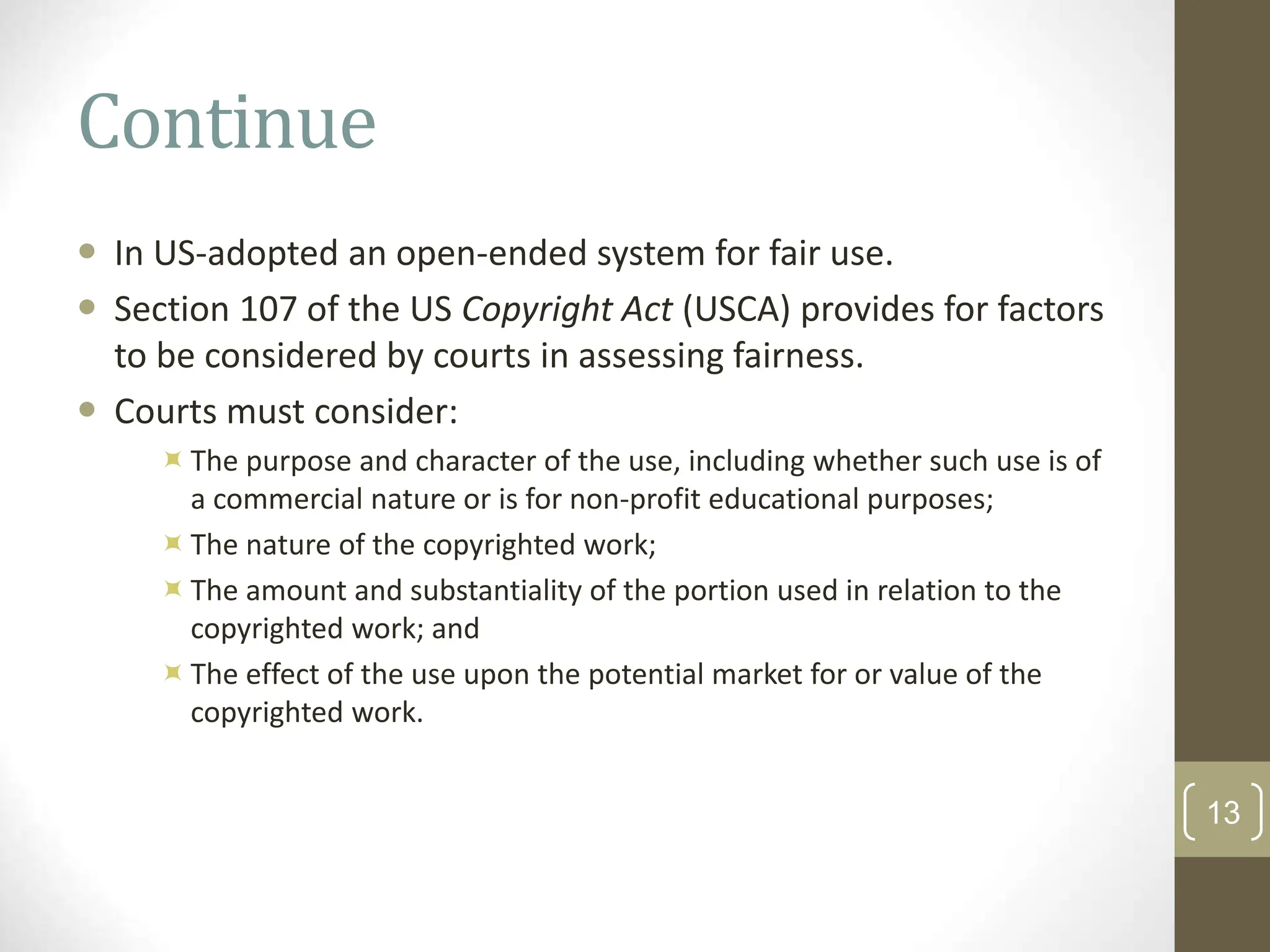
 In US-adopted an open-ended system for fair use.
 Section 107 of the US Copyright Act (USCA) provides for factors
to be considered by courts in assessing fairness.
 Courts must consider:
The purpose and character of the use, including whether such use is of
a commercial nature or is for non-profit educational purposes;
The nature of the copyrighted work;
The amount and substantiality of the portion used in relation to the
copyrighted work; and
The effect of the use upon the potential market for or value of the
copyrighted work.
13
Continue
 In Sony Corp. of America, et al v Universal City Studios, et al
464 U.S 417, 104 S. Ct. 774 (1984).
The issue concerned the use of the Betamax videotape recorder for
private “time shifting” of television programs
Time shifting is the process “whereby the user records a program in
order to watch it at a later time, and then records over it and thereby
erases the program, after a single viewing.” It is different from “library
building” in which “the user records a program in order to keep it for
repeated viewing over a longer term.”
The court had to determine whether the user stood to gain from the
copyright work
It held that time shifting was non-commercial use and that the user
was not infringing the copyright
Obiter: ““every commercial use of copyrighted material is
presumptively ... unfair.”
14
Continue
 In Campbell v Acuff-Rose Music 510 U.S. 569, 114 S. Ct. 1164
(1994)
Commercial presumption in Sony’s case rejected.
The commercial nature of a work should not be dispositive
It depends on the facts of each particular case
But its existence weigh in favour of the plaintifff
 Before 1992-there was presumption of unfair use as against
unpublished materials-see Harper & Row Publishers v Nation
Enterprises 417 U.S 539, 105 S. Ct. 2218 (1985).
That position has been overruled by the 1992 Congress amendments
15
Continue
• Courts in US also take into consideration the effect of the use
upon the potential market for or value of the copyright work
• There is no hard and fast rule on this
• The issue is how to determine curtailment of market
• See Basic Books v Kinko’s Graphics Corp 758 F. Supp. 1522, 1531
(S.D.N.Y. 1991)
16
Continue
• Generally, Factors considered by courts in
determining fairness are:
• Whether commercially competing
• Whether original work published/unpublished
• Amount & importance of portion used
• How original work was obtained
• Added material
• Purpose of exception
• Motives of defendant
• Manner obtained
• Was it necessary to use the work
• Effect of freedom of expression
17
Continue
• For further discussion on fair dealing read:
• Theberge v Galerie d’Art du Petit Champlain [2002] SCR 336
• CCH Canadian Ltd v Law Society of Upper Canada [2004] 1 SCR
• BBC v BSB [1992] Ch 141
• Newspaper Licensing Agency v M&S [2001] UKHL 38
• See the following cases and read the issue parody:
• Laugh it off case (SA)
• Glyn v Weston Feature Film Co(1916) 1 Ch. 261
• Schweppes Ltd v Wellingtons Ltd (1984) F.S.R. 210
• See also other defences like:
• Implied authorization
• Freedom of expression
• Reverse engineering 18

TOPIC II. Intellectual Property Fair Dealing.ppt

  • 1.
    TOPIC II EXEMPTIONS TO© INFRINGEMENT 1
  • 2.
    FAIR DEALING/USE  Pimaryobjective of ©: to protect © owner’s work To award © owner for the creative work made  Is that protection absolute?  No-there are exemptions/exceptions to it. In Sayre v Moore 1 East 360 n. 102 Eng. Rep 139n (KB 1785), it was stated “We must take guard against two extremes equally prejudicial: the one that men of ability, who have employed their time for the service of the community, may not be deprived of their just merits, and the reward of their ingenuity and labour; the other, that the world may not be deprived of improvements, nor the progress of the arts be retarded.” 2
  • 3.
    Continue  In balancingthose conflicting interests, a defence of fair dealing/use has been developed  However, that defence, in this context, arises only where one alleges © infringement  Thus important questions are: Is the type of work eligible for ©? Is the work original? Who owns the ©? Was a substantial part of the work used/copied? Was the user permitted to do so by law?  Infringement is excused when the defendant pleads successfully that the act was within fair use/dealing 3
  • 4.
    Continue  What isfair use/dealing? No precise definition Some say “the defence or right which permits the user to copy, for his study or research or private use, as much of the work as is necessary to meet his reasonable needs without seeking permission from the copyright owner or paying compensation”  Such kind of definition leaves so many questions to be answered: how much one may copy under fair dealing, what may be copied, What is private use What is necessary and fair, and so on. It is therefore important for a user to know the scope of the protection afforded to him before doing any infringing act and try to rely on such defence 4
  • 5.
    Continue  Fair useis a statutory defence  In Tanzania Ss.12, 13, 26,  In SA  s12(1) CA  In England  ss29 & 30(1) & (2) CDPA  The use is for specific purposes within the prescribed limits: Research/private study or personal/private use Criticism or review Reporting of current events 5
  • 6.
    Continue  However, itis always important to Acknowledge the source, especially when used for:  Criticism or review; or  Reporting of current events in publications  Important questions, what constitutes: Private use Criticism or review Reporting of current events Generally what is FAIR USE? 6
  • 7.
    CASE LAW APPROACH The meaning of fair dealing  Lord Denning in Hubbard v Vosper [1972] 1 All ER 1023 (CA) stated: “It is impossible to define what is ‘fair dealing’. It must be a question of degree. You must consider first the number and extent of the quotations and extracts. Are they altogether too many and too long to be fair? Then you must consider the use made of them. If they are used as a basis for comment, criticism or review, that may be a fair dealing. If they are used to convey the same information as the author, for a rival purpose, that may be unfair. Next, you must consider the proportions. To take long extracts and attach comments may be unfair. But, short extracts and long comment may be fair. Other considerations may come to mind also. But, after all is said and done, it must be a matter of impression. As with fair comment in the law of libel, so with fair dealing in the law of copyright. The tribunal of fact must decide.”  Whether something is fair is a question of fact and depends on the facts of each case-CCH Canadian Ltd v Law Society of Upper Canada[2004] 1 SCR 339; [2004] SCC 13. 7
  • 8.
    Continue  In Englandthe defendant has duty to prove: the dealing falls into a list of any of enumerated categories; the dealing was fair; and that there was sufficient acknowledgement  The 2003 amendments to the CDPA has confined fair dealing for research purposes only to “non-commercial research”-see amendment to s.29  The EU Information Directive requires that in determining what is meant by “commercial” one must look at the activity rather than the organisational structure and the means of funding. See para 42 of the preamble to the Directive 2001/29/EC 8
  • 9.
    Continue • The impactsof such amendment were seen in the case of Controller of Her Majesty’s Stationery Office and another v Green Amps Ltd [2007] EWHC 2755 (Ch). • Maps protected by Crown copyright were copied by the defendant to develop a commercial product • The research had a commercial purpose • The court stated: • “Section 29 requires both that what would otherwise be the act of infringement is ‘for the purposes of research’ and that such research should be ‘for a non-commercial purpose’. The second of these requirements is plainly not satisfied” 9
  • 10.
    Continue • For thepurpose of review or criticism, the work must have been previously made available to the public and have sufficient acknowledgement of its source • See Sillitoe v McGraw-Hill Book Company [1983] Fleet Street Reports 545 (Ch. D). • Defendant’s motive can be a determining factor of whether there is fair dealing for the purpose of criticism • See Associated Newspapers Group v News Group Ltd [1985] R.P.C. 515 10
  • 11.
    Continue  In determiningfair dealing for the purpose of reporting current-events, court in Ashdown v Telegraph Group Ltd [2001] EWCA Civ 1142, gave three factors: Whether the alleged fair dealing is in commercial competition with the owner's exploitation of the work, Whether the work has already been published or otherwise exposed to the public; and The amount and importance of the work which has been taken  Courts in England have dismissed this defence if raised against materials which are unpublished or secured in breach of confidence 11
  • 12.
    Continue  In BritishOxygen Company Limited v Liquid Air Limited [1925] 1 Ch 383, Romer J, stated that;  “...it would be manifestly unfair that an unpublished literary work should, without the consent of the author, be the subject of public criticism, review or newspaper summary. Any such dealing with an unpublished literary work would not, therefore, in my opinion, be a "fair dealing" with the work. [1925] 1 Ch 383.  In Beloff v Pressdam Ltd [1973] 1 AER 241, 263, the court stated:  "The law by bestowing a right of copyright on an unpublished work bestows a right to prevent its being published at all; and even though an unpublished work is not automatically excluded from the defence of fair dealing, it is yet a much more substantial breach of copyright than publication of a published work."  See approval of similar views in:  Hyde Park Residence Ltd v Yelland [2000] EWCA Civ 37  His Royal Highness The Prince of Wales v Associated Newspapers Ltd [2006] EWHC 11 (Ch) 12
  • 13.
    Continue  In US-adoptedan open-ended system for fair use.  Section 107 of the US Copyright Act (USCA) provides for factors to be considered by courts in assessing fairness.  Courts must consider: The purpose and character of the use, including whether such use is of a commercial nature or is for non-profit educational purposes; The nature of the copyrighted work; The amount and substantiality of the portion used in relation to the copyrighted work; and The effect of the use upon the potential market for or value of the copyrighted work. 13
  • 14.
    Continue  In SonyCorp. of America, et al v Universal City Studios, et al 464 U.S 417, 104 S. Ct. 774 (1984). The issue concerned the use of the Betamax videotape recorder for private “time shifting” of television programs Time shifting is the process “whereby the user records a program in order to watch it at a later time, and then records over it and thereby erases the program, after a single viewing.” It is different from “library building” in which “the user records a program in order to keep it for repeated viewing over a longer term.” The court had to determine whether the user stood to gain from the copyright work It held that time shifting was non-commercial use and that the user was not infringing the copyright Obiter: ““every commercial use of copyrighted material is presumptively ... unfair.” 14
  • 15.
    Continue  In Campbellv Acuff-Rose Music 510 U.S. 569, 114 S. Ct. 1164 (1994) Commercial presumption in Sony’s case rejected. The commercial nature of a work should not be dispositive It depends on the facts of each particular case But its existence weigh in favour of the plaintifff  Before 1992-there was presumption of unfair use as against unpublished materials-see Harper & Row Publishers v Nation Enterprises 417 U.S 539, 105 S. Ct. 2218 (1985). That position has been overruled by the 1992 Congress amendments 15
  • 16.
    Continue • Courts inUS also take into consideration the effect of the use upon the potential market for or value of the copyright work • There is no hard and fast rule on this • The issue is how to determine curtailment of market • See Basic Books v Kinko’s Graphics Corp 758 F. Supp. 1522, 1531 (S.D.N.Y. 1991) 16
  • 17.
    Continue • Generally, Factorsconsidered by courts in determining fairness are: • Whether commercially competing • Whether original work published/unpublished • Amount & importance of portion used • How original work was obtained • Added material • Purpose of exception • Motives of defendant • Manner obtained • Was it necessary to use the work • Effect of freedom of expression 17
  • 18.
    Continue • For furtherdiscussion on fair dealing read: • Theberge v Galerie d’Art du Petit Champlain [2002] SCR 336 • CCH Canadian Ltd v Law Society of Upper Canada [2004] 1 SCR • BBC v BSB [1992] Ch 141 • Newspaper Licensing Agency v M&S [2001] UKHL 38 • See the following cases and read the issue parody: • Laugh it off case (SA) • Glyn v Weston Feature Film Co(1916) 1 Ch. 261 • Schweppes Ltd v Wellingtons Ltd (1984) F.S.R. 210 • See also other defences like: • Implied authorization • Freedom of expression • Reverse engineering 18