Harness the Power of AI with Specialized Azure Engineering Support
Unlock the power of AI with expert Azure engineering support. Build, scale, and secure intelligent solutions for lasting success. Please visit:- https://ansibytecode.com/harness-the-power-of-ai-azure-engineering-support/
The use ofartificial intelligence has become rampant as companies
strive to remain competitive in their respective industries. For
industries seeking to maintain a competitive advantage, employing
AI can optimize business processes, tailor interactions to individual
users, and automate complex strategic initiatives involving
significant data analysis. Unfortunately, the development,
integration, and deployment of AI solutions in the cloud, such as
Microsoft Azure, is immensely intricate and requires more than
just optimistic endeavors—but rather, considerable talent.
Introduction: Why Specialized Support Matters in Azure AI Projects
3.
For such scenarios,the services of Azure AI engineers and
consultants come in handy. These trained professionals exploit
specialized business knowledge that drives value from Azure’s
sophisticated AI solutions, tools, and frameworks tailored to the
strategic objectives over the ecosystem. Moreover, with the
appropriate guidance, businesses can increase the speed at which
they return investments and deploy rapidly scalable intelligent
solutions.
4.
An Azure AIengineer performs a plethora of tasks, including: a solution architect and a data scientist. These
engineers build, train, deploy, and monitor AI models that run seamlessly within the confines of the Azure cloud
ecosystem. They possess knowledge on the Azure services ecosystem including Cognitive Services, Azure
Machine Learning, and the Azure OpenAI Service.
Emerging technologies like AI have not only transformed the way organization’s function; it has redefined
concepts like productivity and efficiency. Azure engineers don’t only ensure creation of models; they ensure
models capture fundamental business needs. These engineers modify existing models for refinement or design
new models that learn adaptively from your data and intelligently from data patterns. AI-enabled applications
powered with proper design, planning and implementation can troubleshoot beyond automation, allowing
businesses to reap predictive analytics and contextual insights at-a-glance.
The Role of Azure Engineers in Building Intelligent Solutions
5.
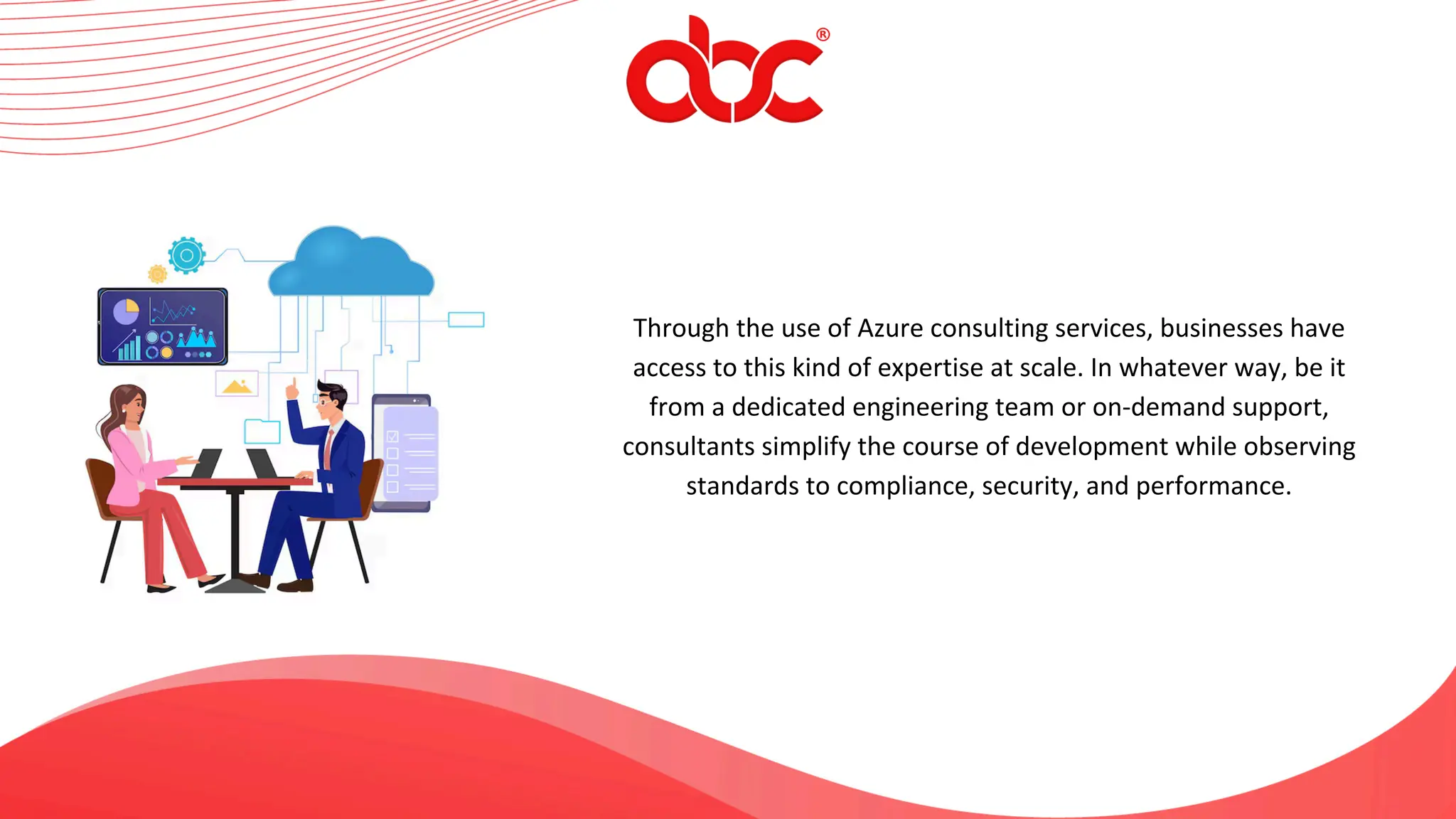
Through the useof Azure consulting services, businesses have
access to this kind of expertise at scale. In whatever way, be it
from a dedicated engineering team or on-demand support,
consultants simplify the course of development while observing
standards to compliance, security, and performance.
6.
The development ofAzure AI services always starts with a well-thought-out design. Azure’s modular
services can be tailored and integrated according to your requirements. Some of the essential features
are listed below:
Azure Machine Learning – A comprehensive solution for constructing, training, and deploying ML
models with recognized frameworks such as PyTorch, TensorFlow, and scikit-learn.
Azure Cognitive Services – APIs that cover language comprehension, image processing, speech
recognition, and functional governance. These services are already trained and prepared for use.
AI Architecture on Azure: Core Components Explained
7.
Azure Synapse Analytics– A platform for data integration and analysis aimed at readying large
datasets for artificial intelligence processes, including preparation, cleansing, and analyzing data.
Azure Kubernetes Service (AKS) – A service for managing containerized AI workloads.
Azure Data Lake and Blob Storage – Offer large-scale storage for both structured and semi-
structured training data.
An Azure AI engineer is responsible for designing and implementing this architecture to match business
goals. They decide how data flows, where models live, and how results are served to applications or
users.
8.
AI solutions undergotransformation. Business dynamics, new data, and compliance requirements constantly
necessitate the evolution of an AI model’s monitoring and updating processes. Here, Azure DevOps is vital.
With the assistance of an Azure consulting team, organizations can design and implement CI/CD pipelines
specific to AI workflows. Such automation decreases human oversight and increases efficiency—automation of
model testing, training, validation, and deployment leads to higher release cadence.
Azure AI engineers can build Machine Learning pipelines for Azure ML Studio and incorporate them into DevOps
workflows to guarantee model retraining with fresh data. AI and DevOps working in conjunction enhances the
ease with which businesses are able to innovate while still supporting agile governance.
Integrating AI Models with Azure DevOps & Pipelines
9.
Maintaining security andscalability is extremely important when putting AI in production. Azure offers
enterprise-level solutions for identity management, access management, data protection, and monitoring
security risks. Nevertheless, protecting an AI workload entails significant understanding of infrastructure and AI
risks.
An Azure AI specialist makes certain that the control of the access keys to the training data is encrypted, the
outlines are executed under the guard of Azure Active Directory, and that all AI models deployed via Azure
Kubernetes or Functions are scoped for holes and guarded. They also implement anomaly detection to alert
teams when AI behaves unexpectedly.
On the scalability front, Azure consulting teams help businesses architect solutions that grow with demand.
Whether it’s horizontal scaling of virtual machines or configuring autoscaling rules in AKS, the goal is to make
sure AI systems can handle peak loads without sacrificing performance or incurring unnecessary cost.
Securing and Scaling AI Solutions in the Cloud
10.
Across industries, businessesare transforming operations with AI built on Azure. Here are just a few
examples:
Healthcare
An automating diagnostics company expedited the process of automated radiology scans by 40% using
Azure Cognitive Services. With the assistance of Azure AI engineers, they managed sensitive patient
information while ensuring HIPAA compliance.
Success Stories: Businesses Leveraging Azure Engineering Expertise
11.
Retail
An e-commerce platformused Azure Machine Learning and Azure DevOps to build a real-time
recommendation engine. Through Azure consulting, they improved their upsell rate by 22% while
optimizing infrastructure costs.
Manufacturing
A global manufacturer deployed predictive maintenance solutions using IoT and Azure AI. With expert
engineering support, they saved millions in downtime and extended machine lifespan.
These examples showcase the real-world impact of pairing AI potential with expert execution.
12.
Choosing the rightAzure partner is as important as selecting the right technology stack. Here are a few
factors to consider
Certifications and Experience: Look for engineers certified in Azure AI and data-related roles.
Verify past project experience in your industry.
Collaborative Approach: As the business need is articulated and documented at the practical level,
it is critical that the team is able to engage with the internal stakeholders and interact with them
to transcribe their requirements into a business solution design.
How to Evaluate and Engage the Right Azure AI Engineering Team
13.
Security & Compliance:Delegate compliance understanding of the related region and industry
standards and mark boundaries by which the team is permitted to operate.
Performance Tuning: Check for experiences in model optimization, orchestration, and even active
surveillance of the data’s journey and outcomes.
Post-Deployment Support: The preferred consultants are those for whom the Azure ‘project’
commences long before the formal launch and does not stop after it. Instead, these consultants
have plans for continuous assistance in refinement, updates, and scaling.
By picking the ideal team, you turn your investment strategy into reasonable and irrefutable AI
strategy work. What’s more, your strategies stand the test of time in the future.
14.
Every business functionis being transformed by artificial intelligence, but its value depends on its
accurate implementation. Azure AI engineers together with an azure consulting team strategically
guide the organizations so they can confidently build, scale, and secure AI-powered solutions on
Microsoft Azure.
These experts extend smarter innovation with smarter outcomes by allowing the creation of advanced
architectures, integrating DevOps, and managing continuous optimization. As your business evolves,
having the right engineering support is what turns potential into measurable success.
Conclusion: Build Smarter with the Right Expertise
15.
Contact Us
+ 9198 980 105 89
info@ansibytecode.com
+91 97 243 145 89
10685-B Hazelhurst Dr. #22591 Houston, TX 77043, USA