Top Common Code Section 403(b) Problems & Solutions
©2003 – 2013 Multnomah Group, Inc. All Rights Reserved.
Brian Montanez, AIF®, CPC, QPA, QKA, TGPC
A Principal of the Multnomah Group, Brian is responsible for client service and
business development in Northern California. Brian advises an array of
organizations,
including
hospitals,
educational
institutions,
not-for-profit
organizations and private employers. Brian regularly consults with plan sponsors
and industry experts on fiduciary governance issues, investment menu construction,
vendor fees and services, as well as plan design.
Brian has over 19 years of combined experience working in the securities,
investment advisory, and retirement services industries. Prior to joining Multnomah
Group, Brian served as both Vice President and Regional Sales Director with other
national investment advisory and retirement services firms.
Brian is an Accredited Investment Fiduciary (AIF®), certified by the Center for
Fiduciary Studies, as well as a Certified Pension Consultant (CPC) and Tax Exempt
& Governmental Plan Consultant (TGPC), certified by the American Society of
Pension Professionals and Actuaries (ASPPA). He holds a B.S. in Economics &
Finance from Bentley University in Massachusetts.

2
Agenda
1.
2.

Brief Overview of DOL Correction Programs

3.

Common Document Issues

4.

Common Governance Issues

5.

3

Brief Overview of IRS Correction Programs

Common Compliance Errors and Failures
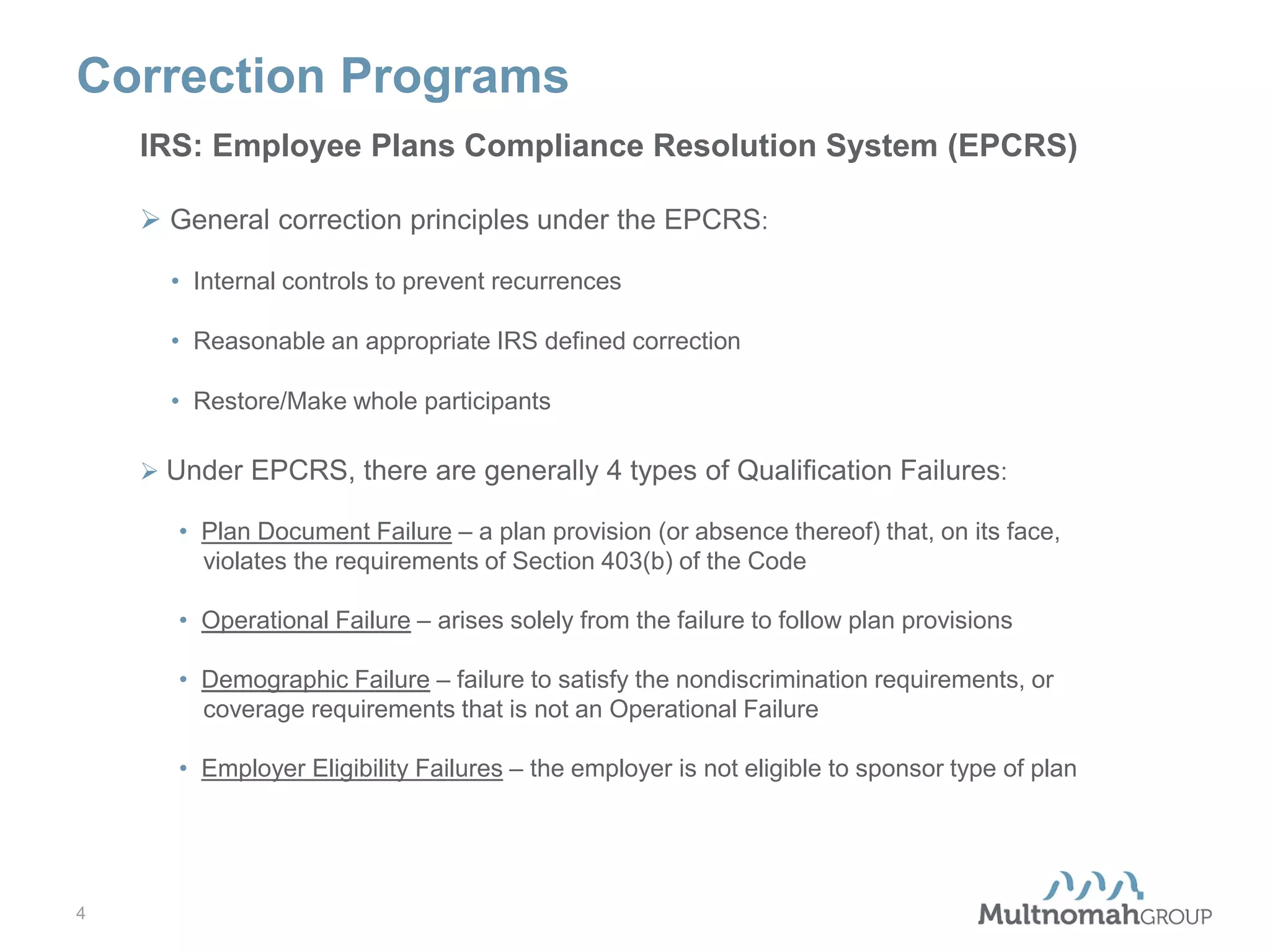
Correction Programs
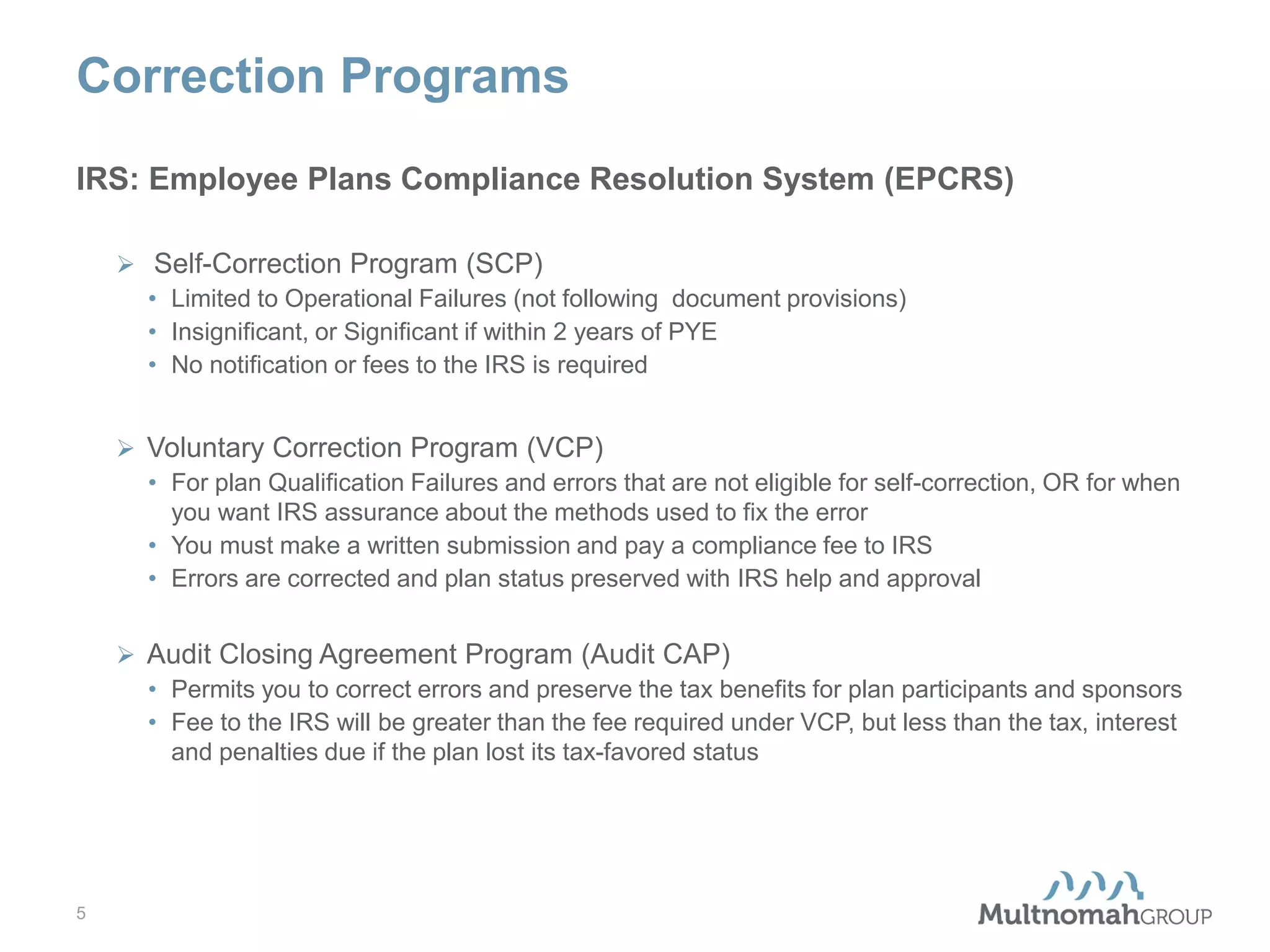
IRS: Employee Plans Compliance Resolution System (EPCRS)
 General correction principles under the EPCRS:
• Internal controls to prevent recurrences
• Reasonable an appropriate IRS defined correction
• Restore/Make whole participants
 Under EPCRS, there are generally 4 types of Qualification Failures:
• Plan Document Failure – a plan provision (or absence thereof) that, on its face,
violates the requirements of Section 403(b) of the Code
• Operational Failure – arises solely from the failure to follow plan provisions
• Demographic Failure – failure to satisfy the nondiscrimination requirements, or
coverage requirements that is not an Operational Failure
• Employer Eligibility Failures – the employer is not eligible to sponsor type of plan

4
Correction Programs
IRS: Employee Plans Compliance Resolution System (EPCRS)
 Self-Correction Program (SCP)
• Limited to Operational Failures (not following document provisions)
• Insignificant, or Significant if within 2 years of PYE
• No notification or fees to the IRS is required
 Voluntary Correction Program (VCP)
• For plan Qualification Failures and errors that are not eligible for self-correction, OR for when
you want IRS assurance about the methods used to fix the error
• You must make a written submission and pay a compliance fee to IRS
• Errors are corrected and plan status preserved with IRS help and approval
 Audit Closing Agreement Program (Audit CAP)
• Permits you to correct errors and preserve the tax benefits for plan participants and sponsors
• Fee to the IRS will be greater than the fee required under VCP, but less than the tax, interest
and penalties due if the plan lost its tax-favored status

5
Correction Programs Cont.
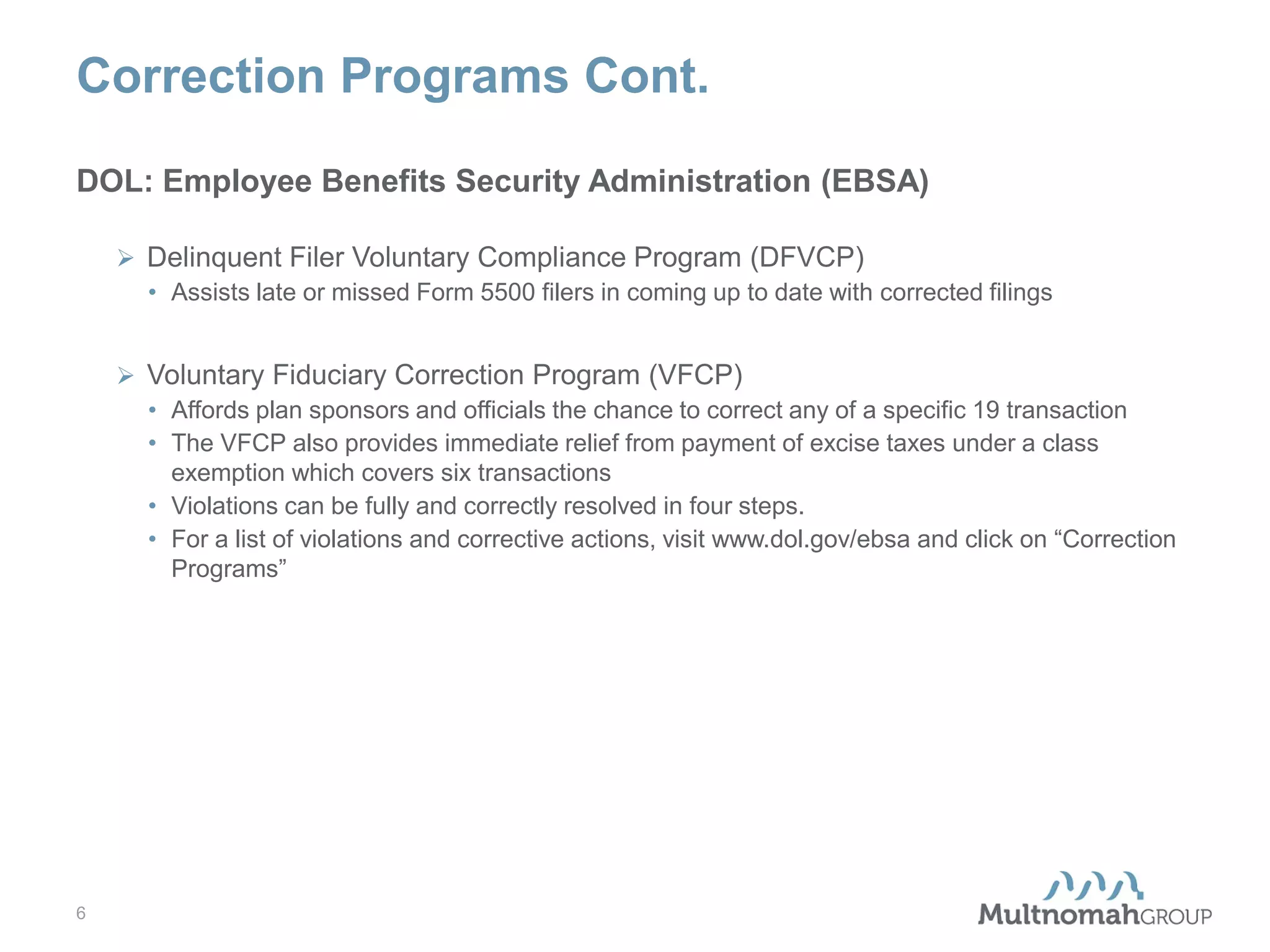
DOL: Employee Benefits Security Administration (EBSA)
 Delinquent Filer Voluntary Compliance Program (DFVCP)
• Assists late or missed Form 5500 filers in coming up to date with corrected filings
 Voluntary Fiduciary Correction Program (VFCP)
• Affords plan sponsors and officials the chance to correct any of a specific 19 transaction
• The VFCP also provides immediate relief from payment of excise taxes under a class
exemption which covers six transactions
• Violations can be fully and correctly resolved in four steps.
• For a list of violations and corrective actions, visit www.dol.gov/ebsa and click on “Correction
Programs”

6
Common Plan Document Issues
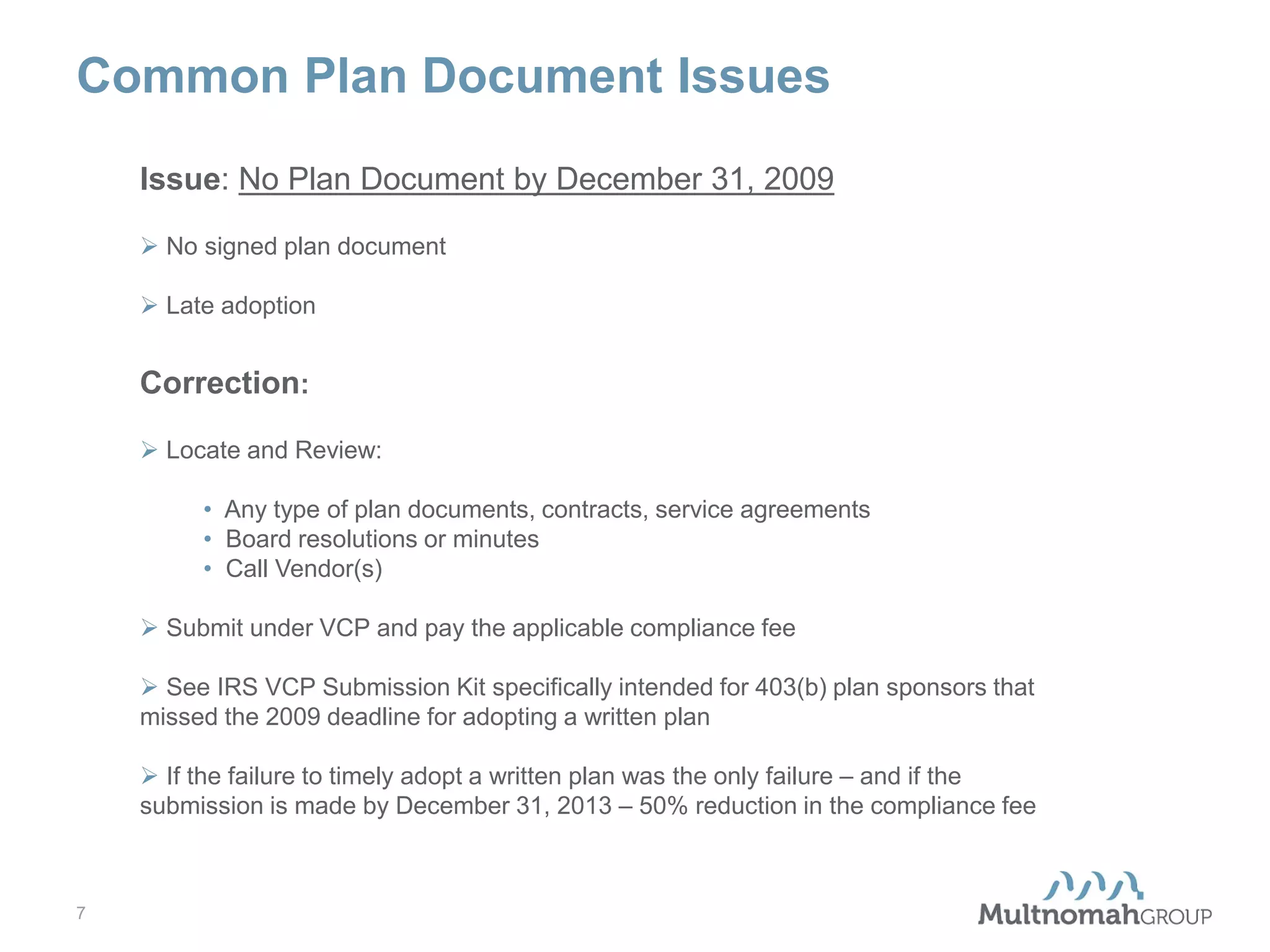
Issue: No Plan Document by December 31, 2009
 No signed plan document
 Late adoption

Correction:
 Locate and Review:
• Any type of plan documents, contracts, service agreements
• Board resolutions or minutes
• Call Vendor(s)
 Submit under VCP and pay the applicable compliance fee
 See IRS VCP Submission Kit specifically intended for 403(b) plan sponsors that
missed the 2009 deadline for adopting a written plan
 If the failure to timely adopt a written plan was the only failure – and if the
submission is made by December 31, 2013 – 50% reduction in the compliance fee

7
Common Plan Document Issues
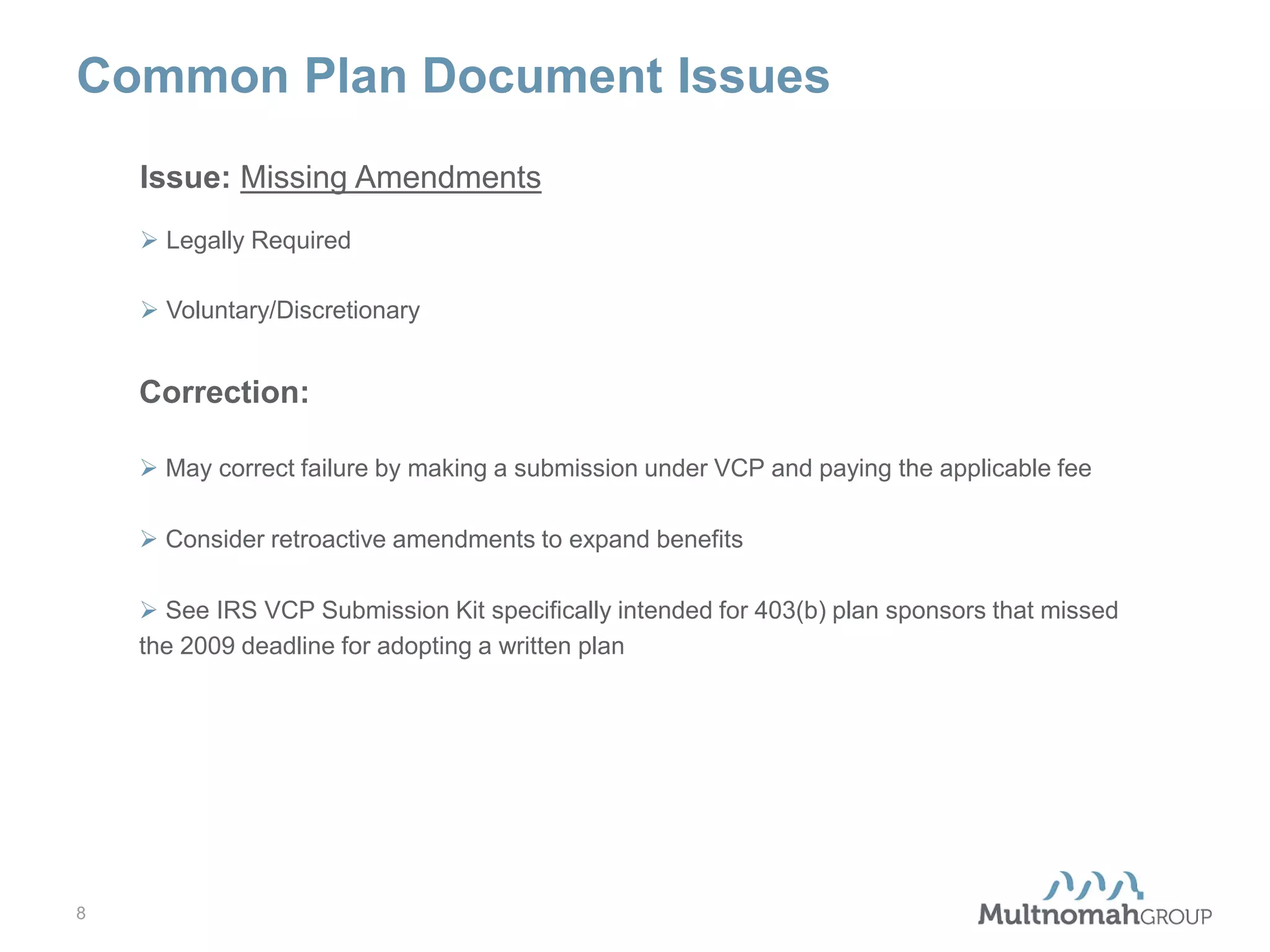
Issue: Missing Amendments
 Legally Required
 Voluntary/Discretionary

Correction:
 May correct failure by making a submission under VCP and paying the applicable fee
 Consider retroactive amendments to expand benefits
 See IRS VCP Submission Kit specifically intended for 403(b) plan sponsors that missed
the 2009 deadline for adopting a written plan

8
Common Plan Document Issues
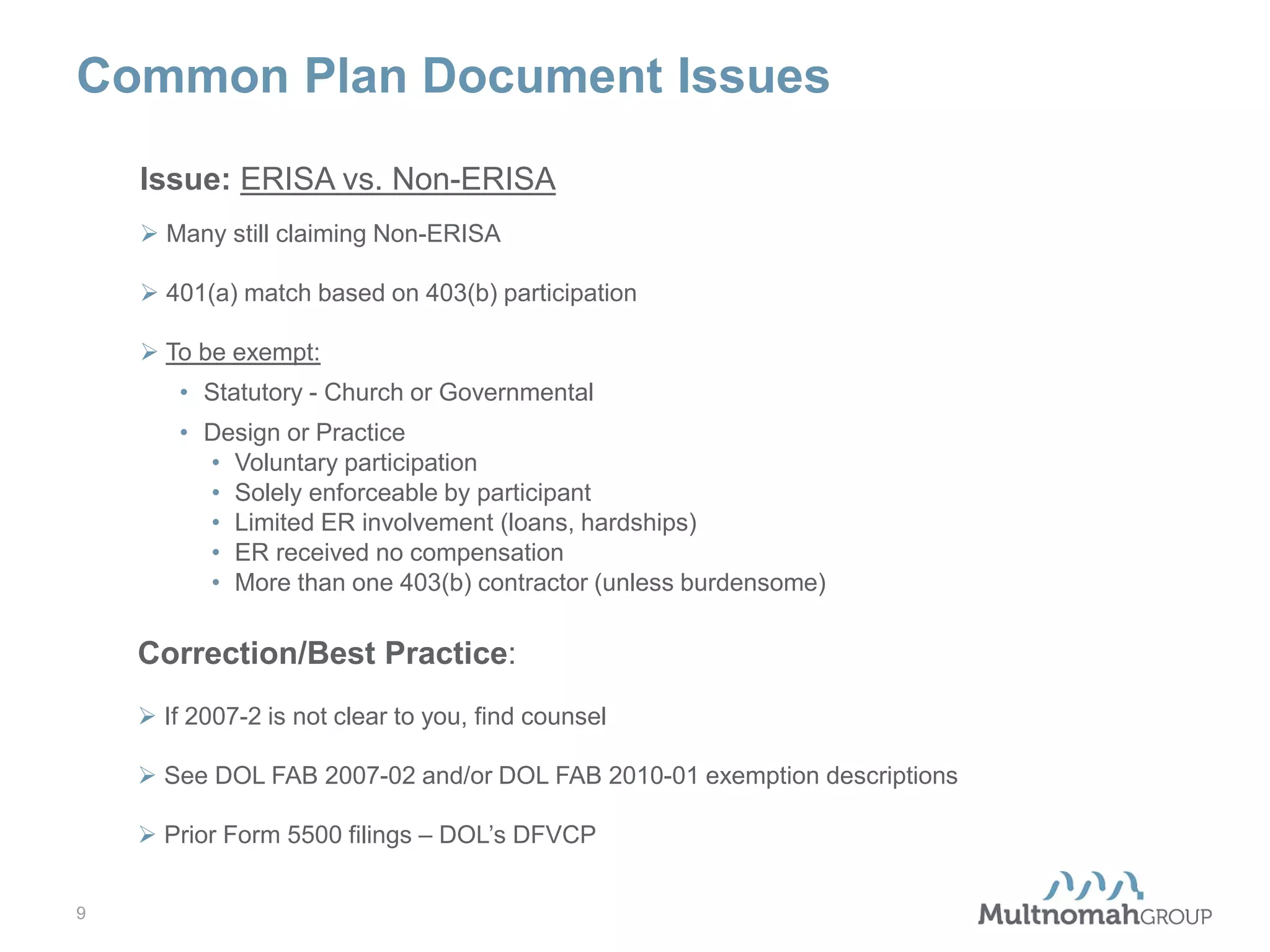
Issue: ERISA vs. Non-ERISA
 Many still claiming Non-ERISA
 401(a) match based on 403(b) participation
 To be exempt:
• Statutory - Church or Governmental
• Design or Practice
• Voluntary participation
• Solely enforceable by participant
• Limited ER involvement (loans, hardships)
• ER received no compensation
• More than one 403(b) contractor (unless burdensome)

Correction/Best Practice:
 If 2007-2 is not clear to you, find counsel
 See DOL FAB 2007-02 and/or DOL FAB 2010-01 exemption descriptions
 Prior Form 5500 filings – DOL’s DFVCP
9
Common Plan Document Issues
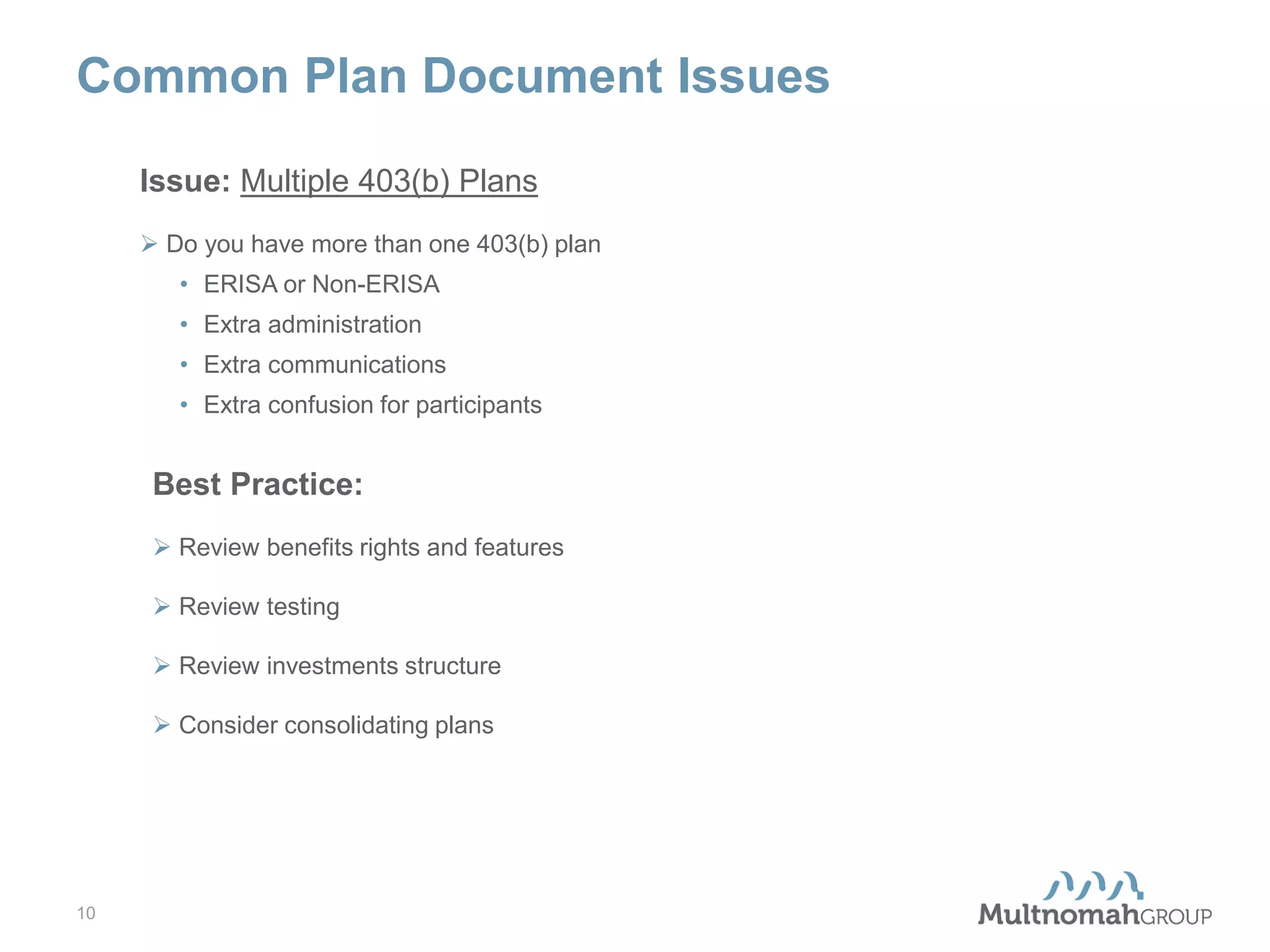
Issue: Multiple 403(b) Plans
 Do you have more than one 403(b) plan
• ERISA or Non-ERISA
• Extra administration
• Extra communications
• Extra confusion for participants

Best Practice:
 Review benefits rights and features
 Review testing
 Review investments structure
 Consider consolidating plans

10
Common Plan Document Issues
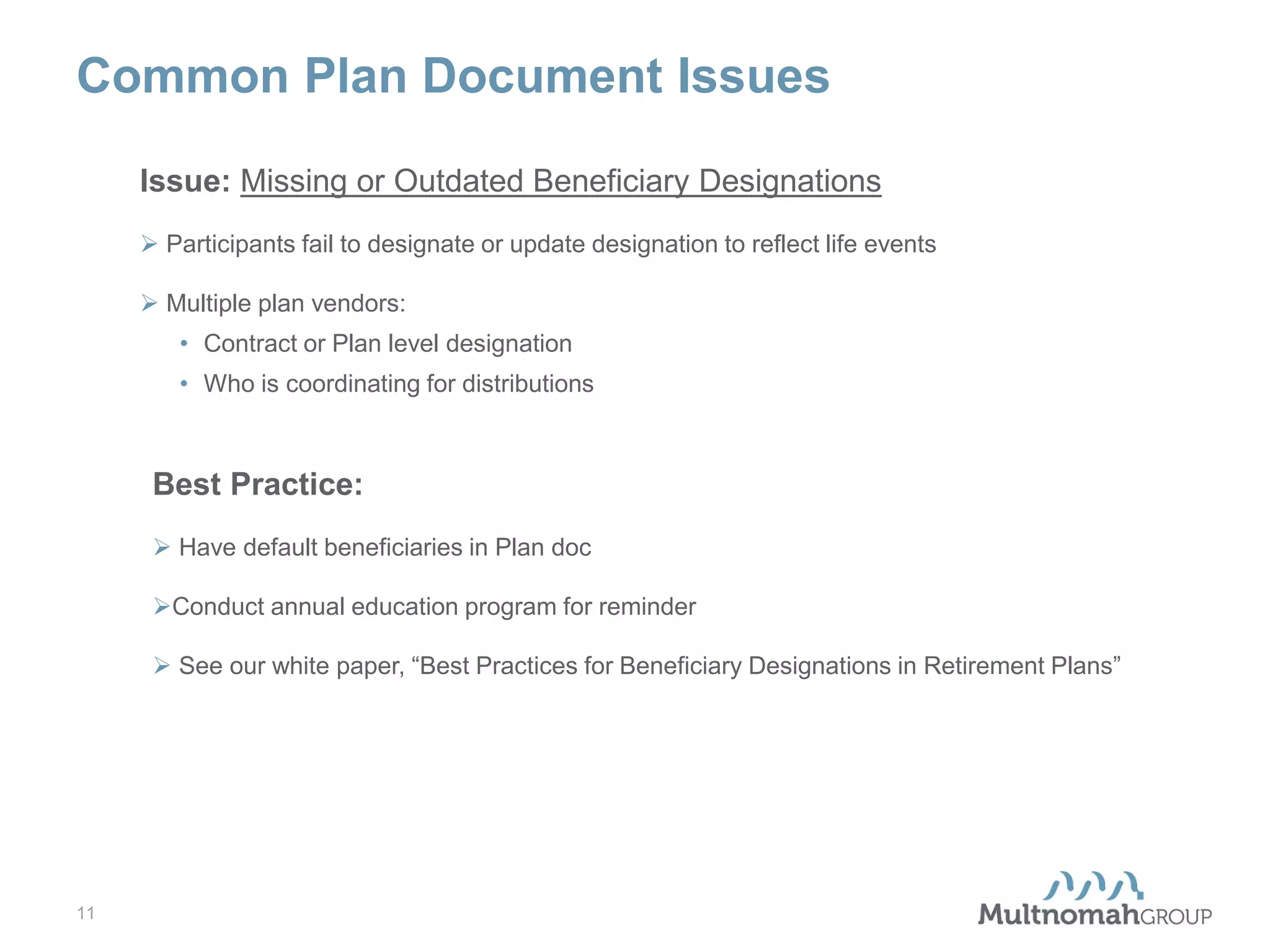
Issue: Missing or Outdated Beneficiary Designations
 Participants fail to designate or update designation to reflect life events
 Multiple plan vendors:
• Contract or Plan level designation
• Who is coordinating for distributions

Best Practice:
 Have default beneficiaries in Plan doc
Conduct annual education program for reminder
 See our white paper, “Best Practices for Beneficiary Designations in Retirement Plans”

11
Common Compliance Errors/Failures
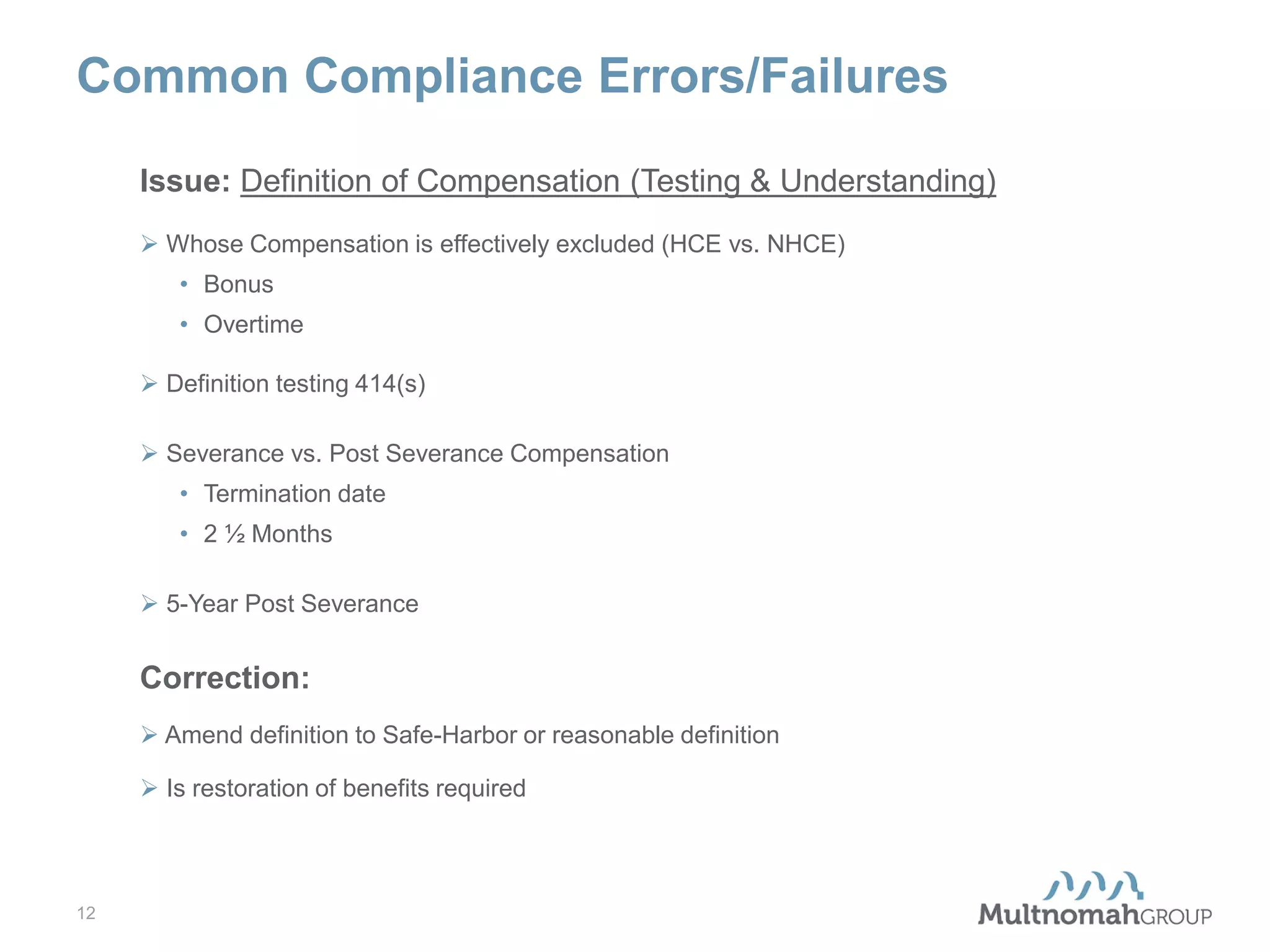
Issue: Definition of Compensation (Testing & Understanding)
 Whose Compensation is effectively excluded (HCE vs. NHCE)
• Bonus
• Overtime
 Definition testing 414(s)
 Severance vs. Post Severance Compensation
• Termination date
• 2 ½ Months
 5-Year Post Severance

Correction:
 Amend definition to Safe-Harbor or reasonable definition
 Is restoration of benefits required

12
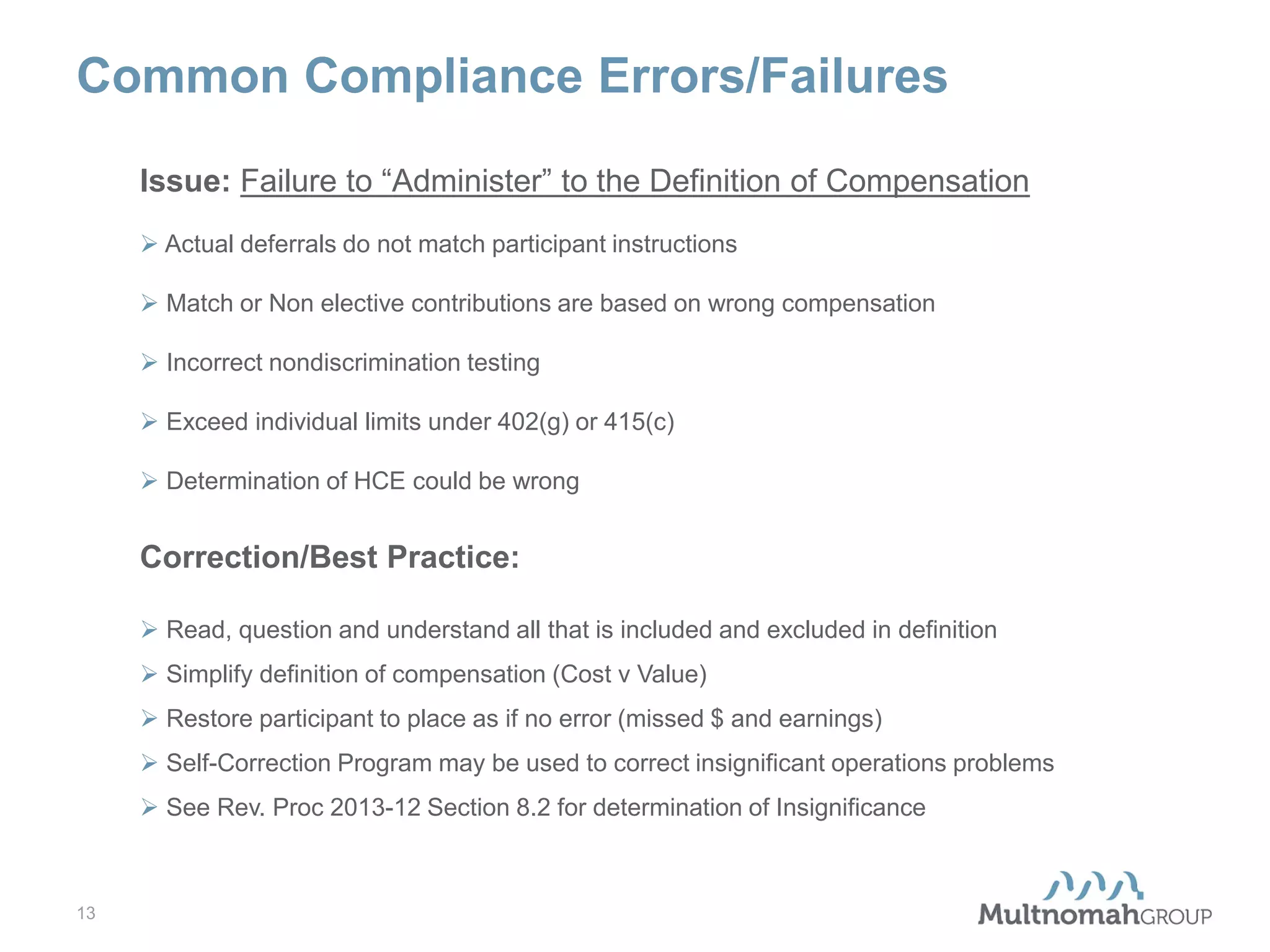
Common Compliance Errors/Failures
Issue: Failure to “Administer” to the Definition of Compensation
 Actual deferrals do not match participant instructions
 Match or Non elective contributions are based on wrong compensation
 Incorrect nondiscrimination testing
 Exceed individual limits under 402(g) or 415(c)
 Determination of HCE could be wrong

Correction/Best Practice:
 Read, question and understand all that is included and excluded in definition
 Simplify definition of compensation (Cost v Value)
 Restore participant to place as if no error (missed $ and earnings)
 Self-Correction Program may be used to correct insignificant operations problems
 See Rev. Proc 2013-12 Section 8.2 for determination of Insignificance

13
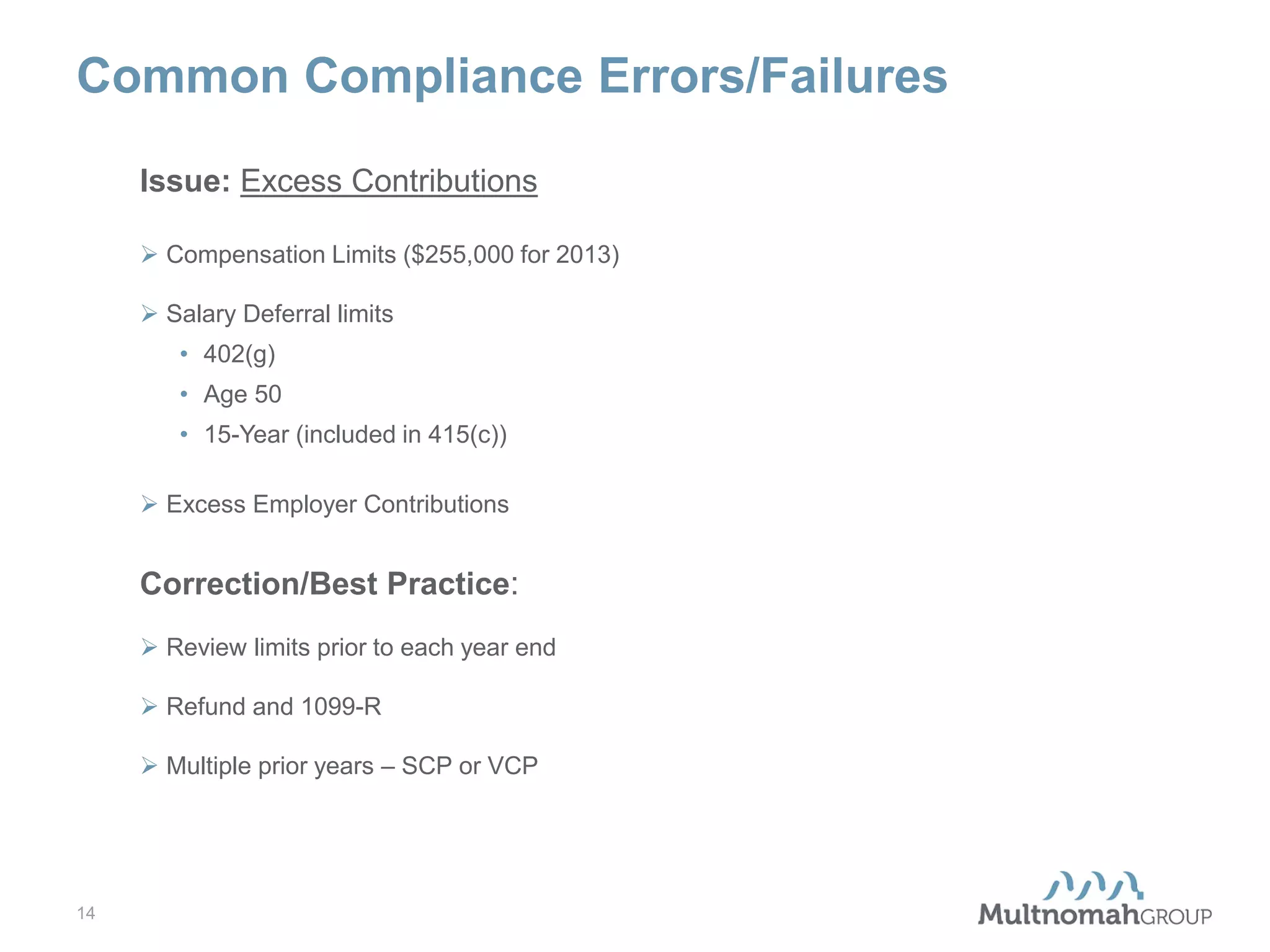
Common Compliance Errors/Failures
Issue: Excess Contributions
 Compensation Limits ($255,000 for 2013)
 Salary Deferral limits
• 402(g)
• Age 50
• 15-Year (included in 415(c))
 Excess Employer Contributions

Correction/Best Practice:
 Review limits prior to each year end
 Refund and 1099-R
 Multiple prior years – SCP or VCP

14
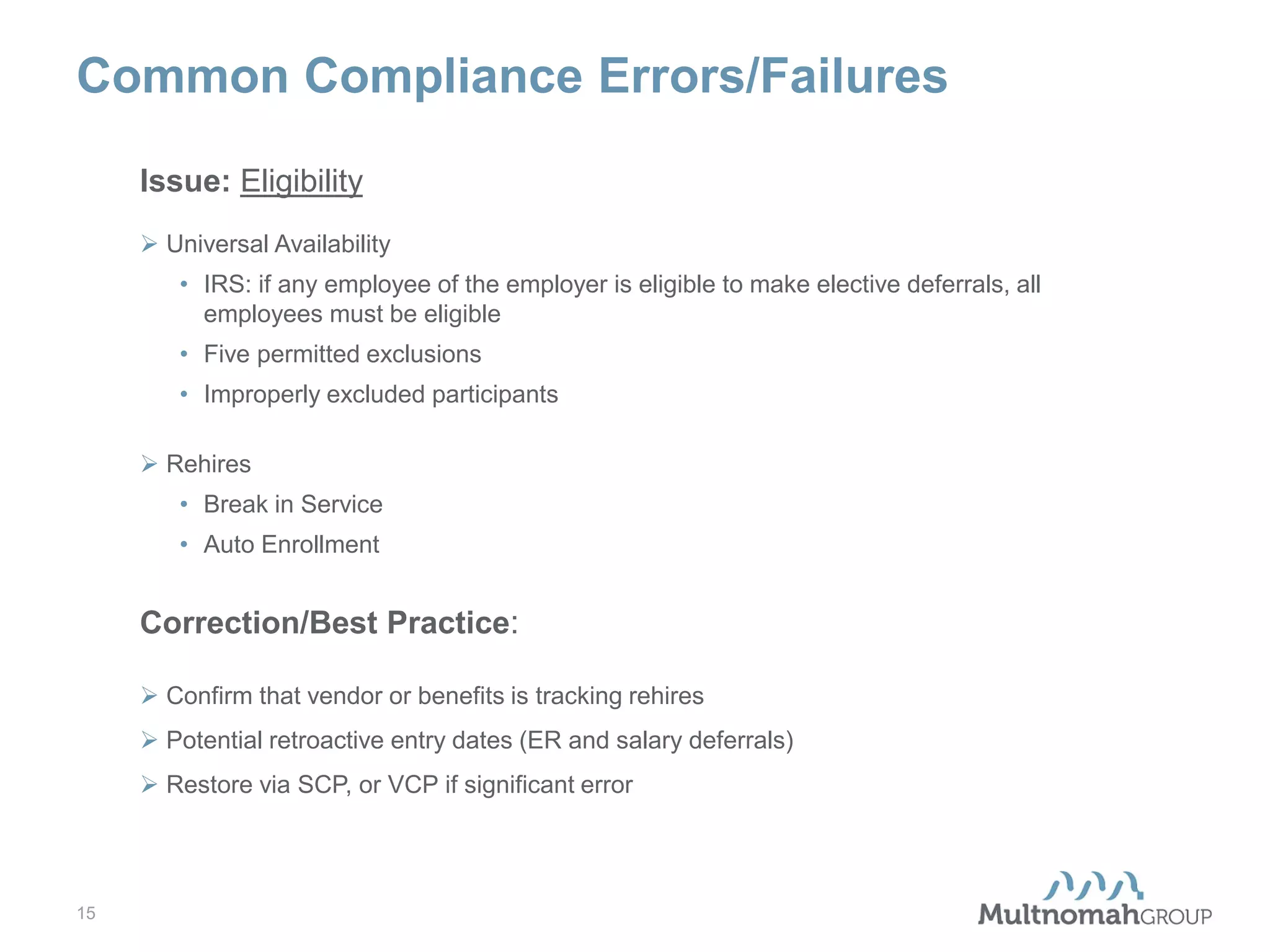
Common Compliance Errors/Failures
Issue: Eligibility
 Universal Availability
• IRS: if any employee of the employer is eligible to make elective deferrals, all
employees must be eligible
• Five permitted exclusions
• Improperly excluded participants
 Rehires
• Break in Service
• Auto Enrollment

Correction/Best Practice:
 Confirm that vendor or benefits is tracking rehires
 Potential retroactive entry dates (ER and salary deferrals)
 Restore via SCP, or VCP if significant error

15
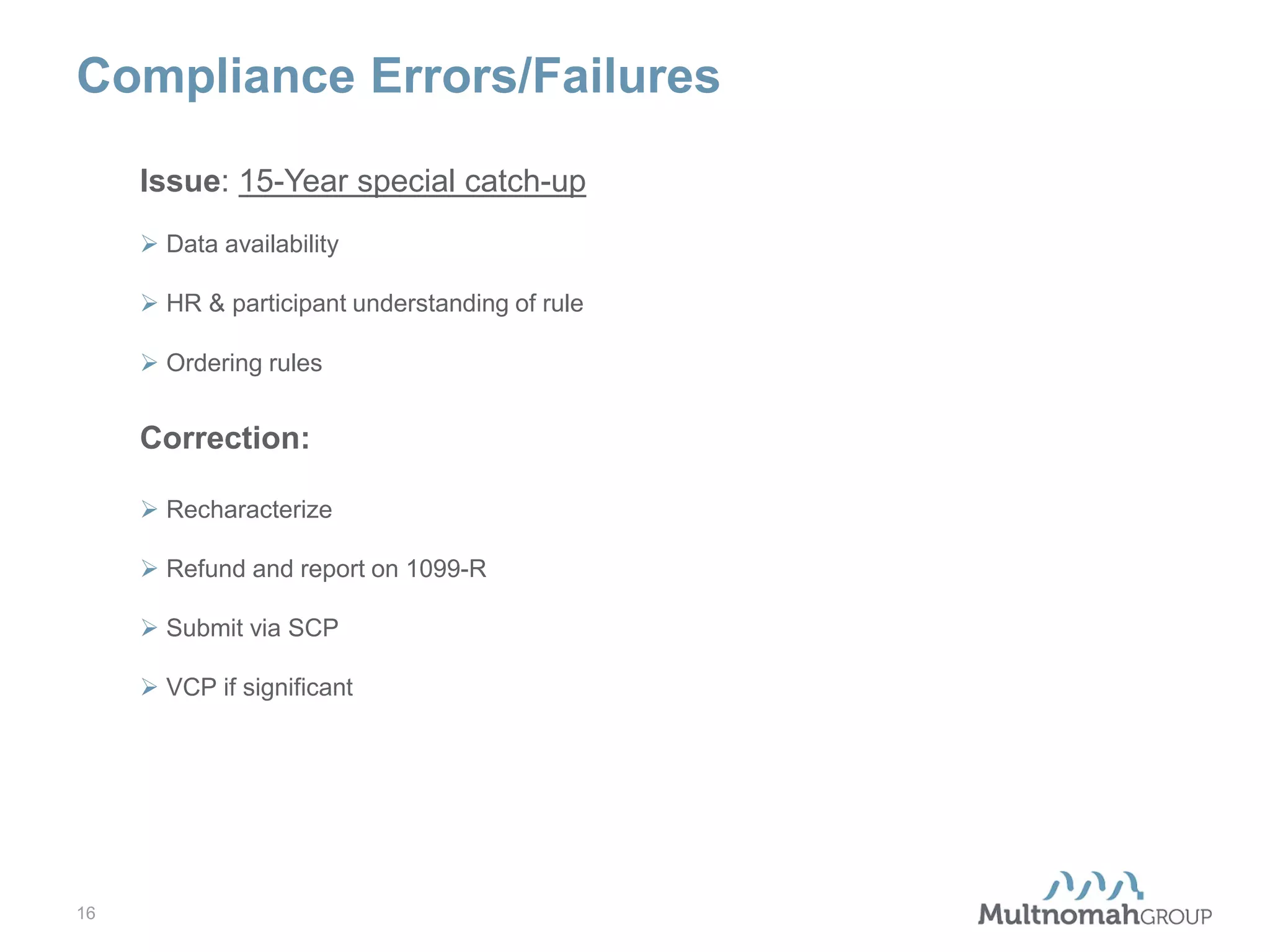
Compliance Errors/Failures
Issue: 15-Year special catch-up
 Data availability
 HR & participant understanding of rule
 Ordering rules

Correction:
 Recharacterize
 Refund and report on 1099-R
 Submit via SCP
 VCP if significant

16
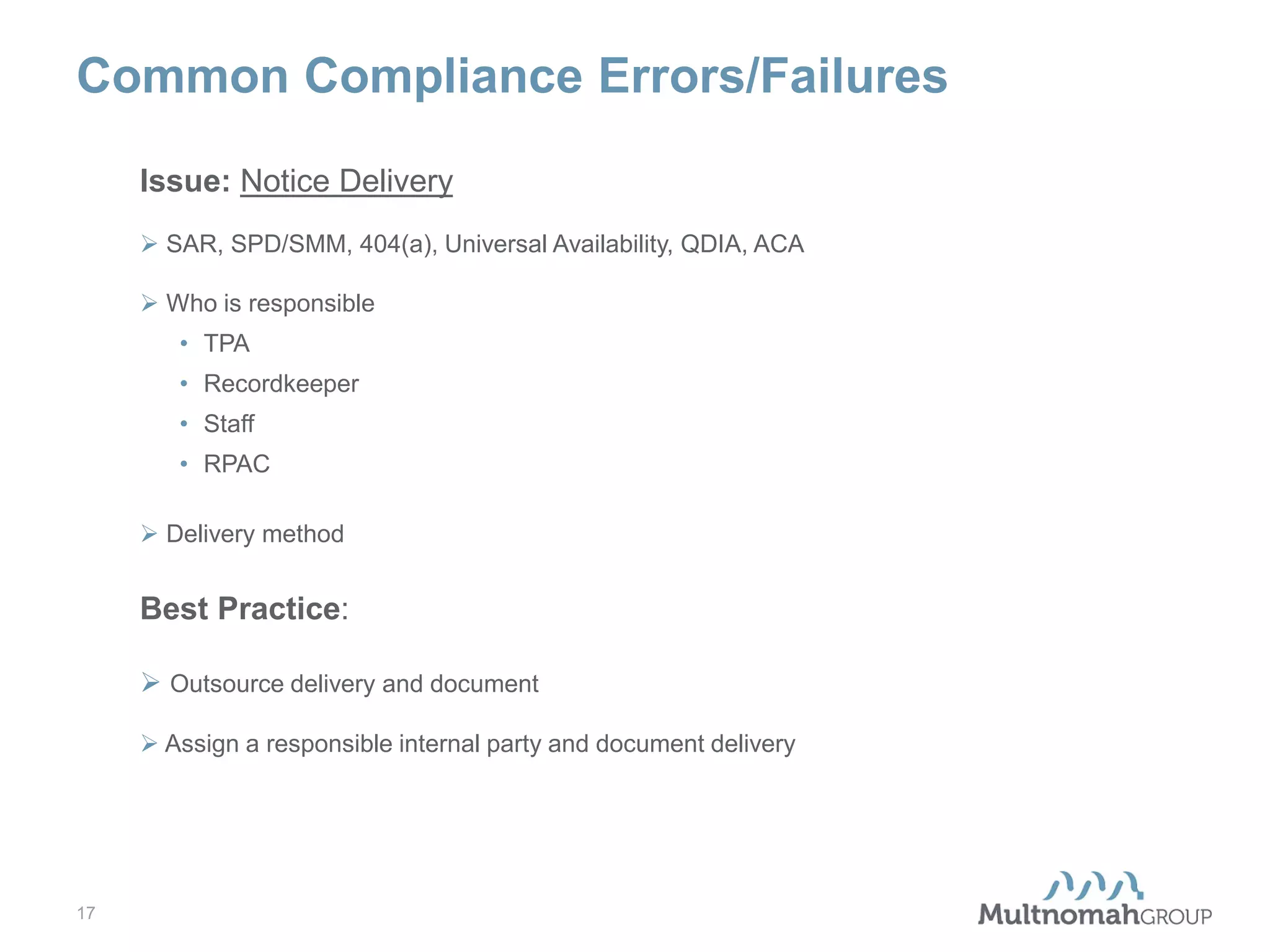
Common Compliance Errors/Failures
Issue: Notice Delivery
 SAR, SPD/SMM, 404(a), Universal Availability, QDIA, ACA
 Who is responsible
• TPA
• Recordkeeper
• Staff
• RPAC
 Delivery method

Best Practice:
 Outsource delivery and document
 Assign a responsible internal party and document delivery

17
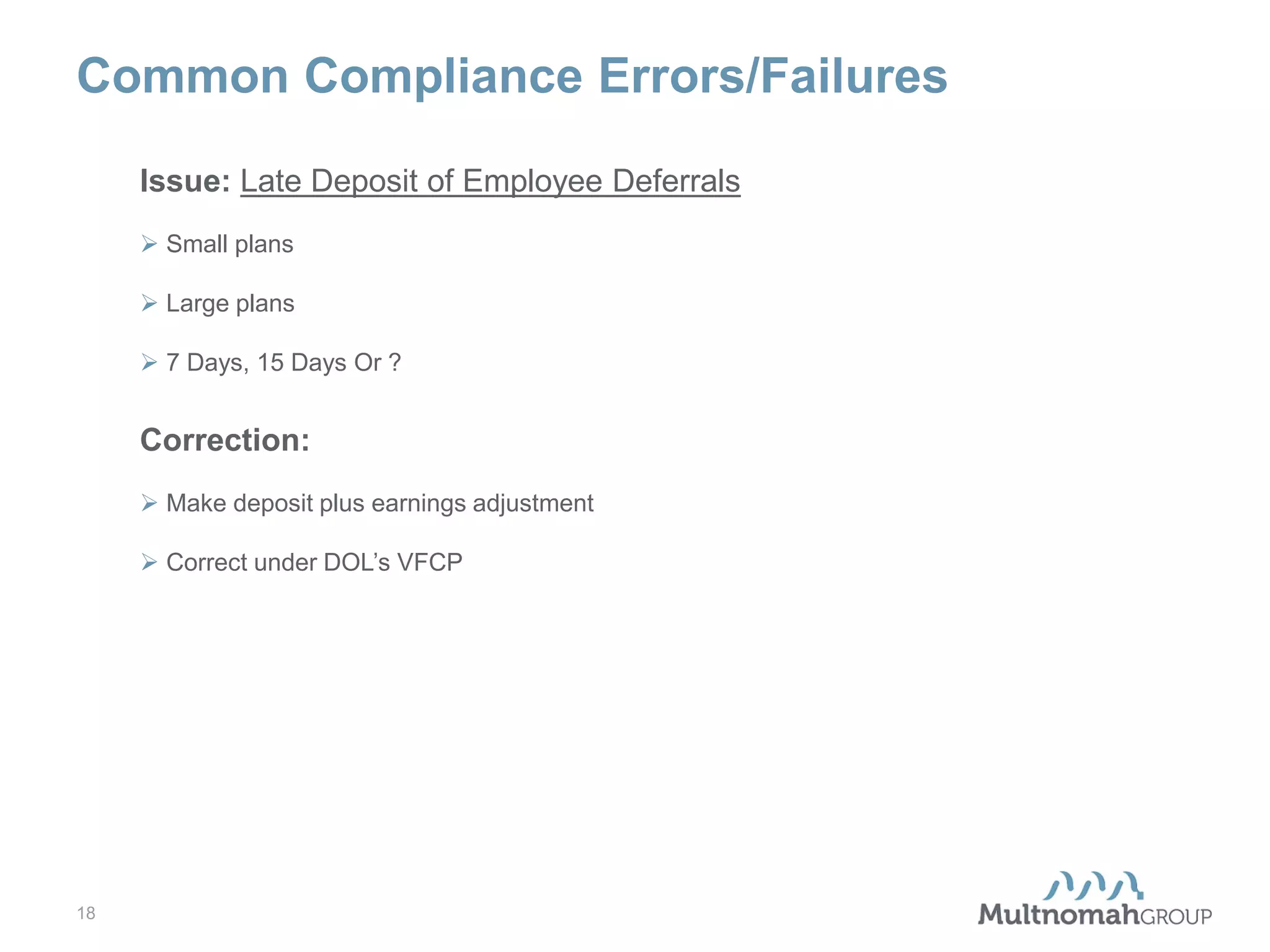
Common Compliance Errors/Failures
Issue: Late Deposit of Employee Deferrals
 Small plans
 Large plans
 7 Days, 15 Days Or ?

Correction:
 Make deposit plus earnings adjustment
 Correct under DOL’s VFCP

18
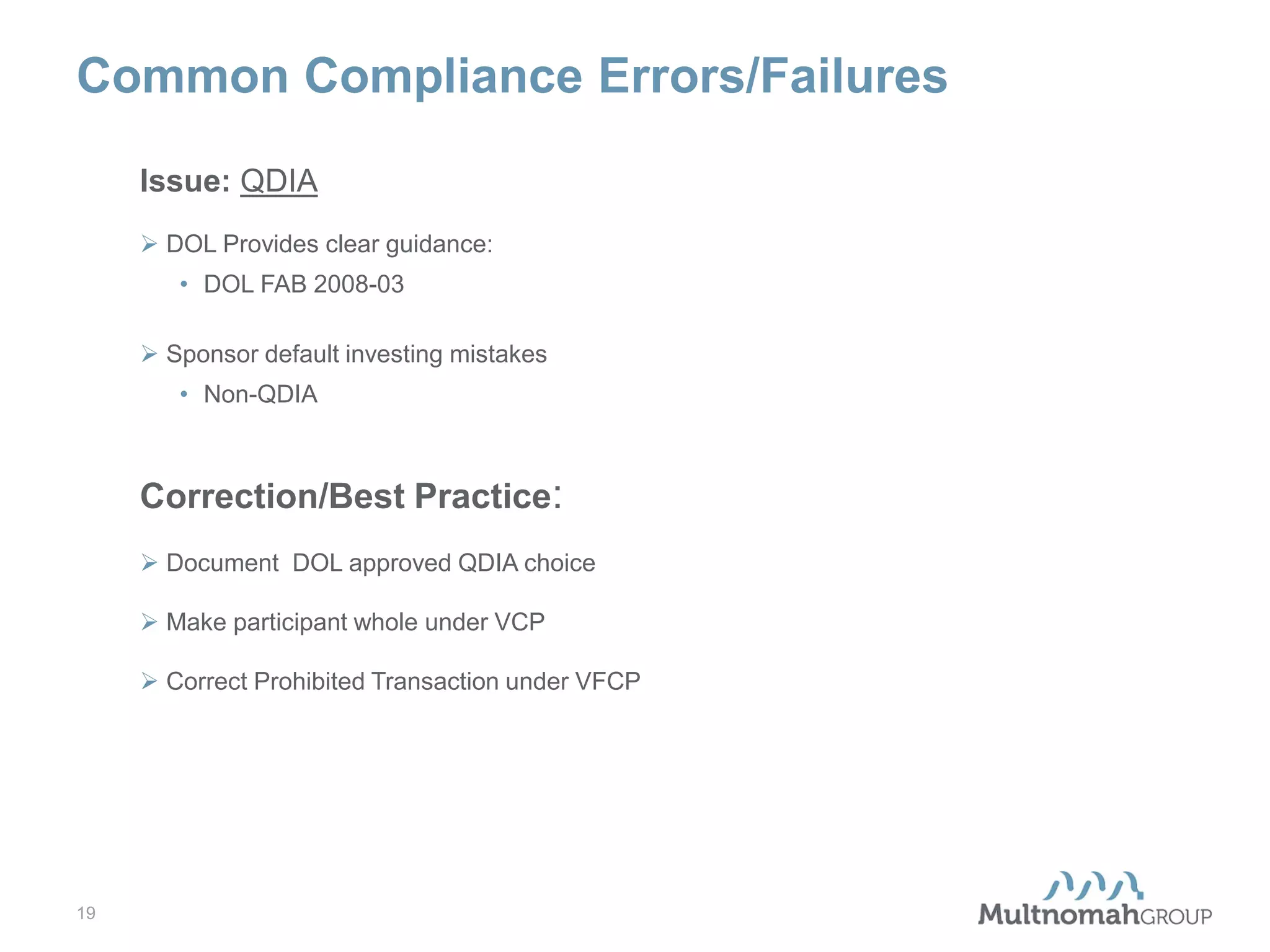
Common Compliance Errors/Failures
Issue: QDIA
 DOL Provides clear guidance:
• DOL FAB 2008-03
 Sponsor default investing mistakes
• Non-QDIA

Correction/Best Practice:
 Document DOL approved QDIA choice
 Make participant whole under VCP
 Correct Prohibited Transaction under VFCP

19
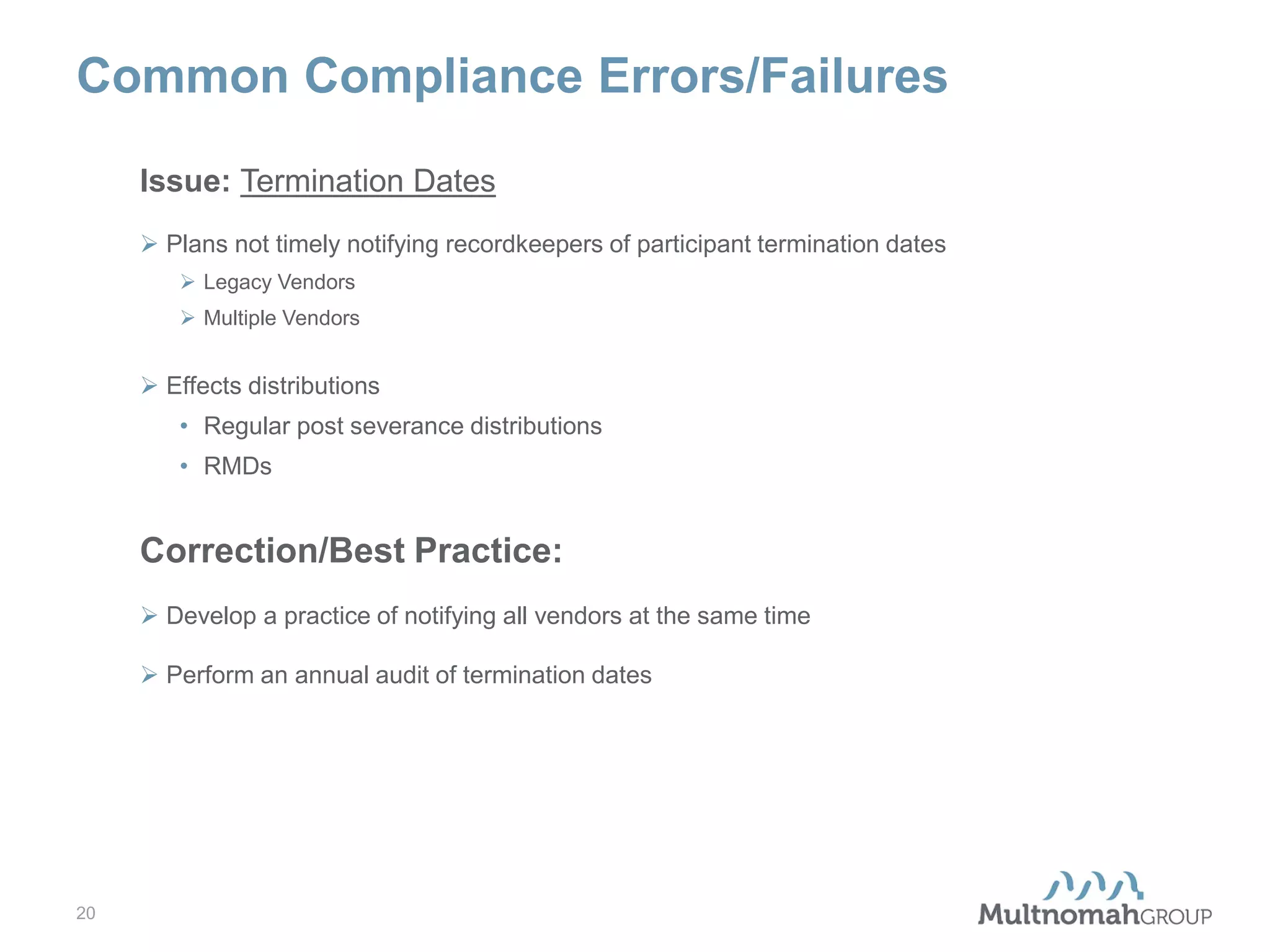
Common Compliance Errors/Failures
Issue: Termination Dates
 Plans not timely notifying recordkeepers of participant termination dates
 Legacy Vendors
 Multiple Vendors

 Effects distributions
• Regular post severance distributions
• RMDs

Correction/Best Practice:
 Develop a practice of notifying all vendors at the same time
 Perform an annual audit of termination dates

20
Common Governance Issues
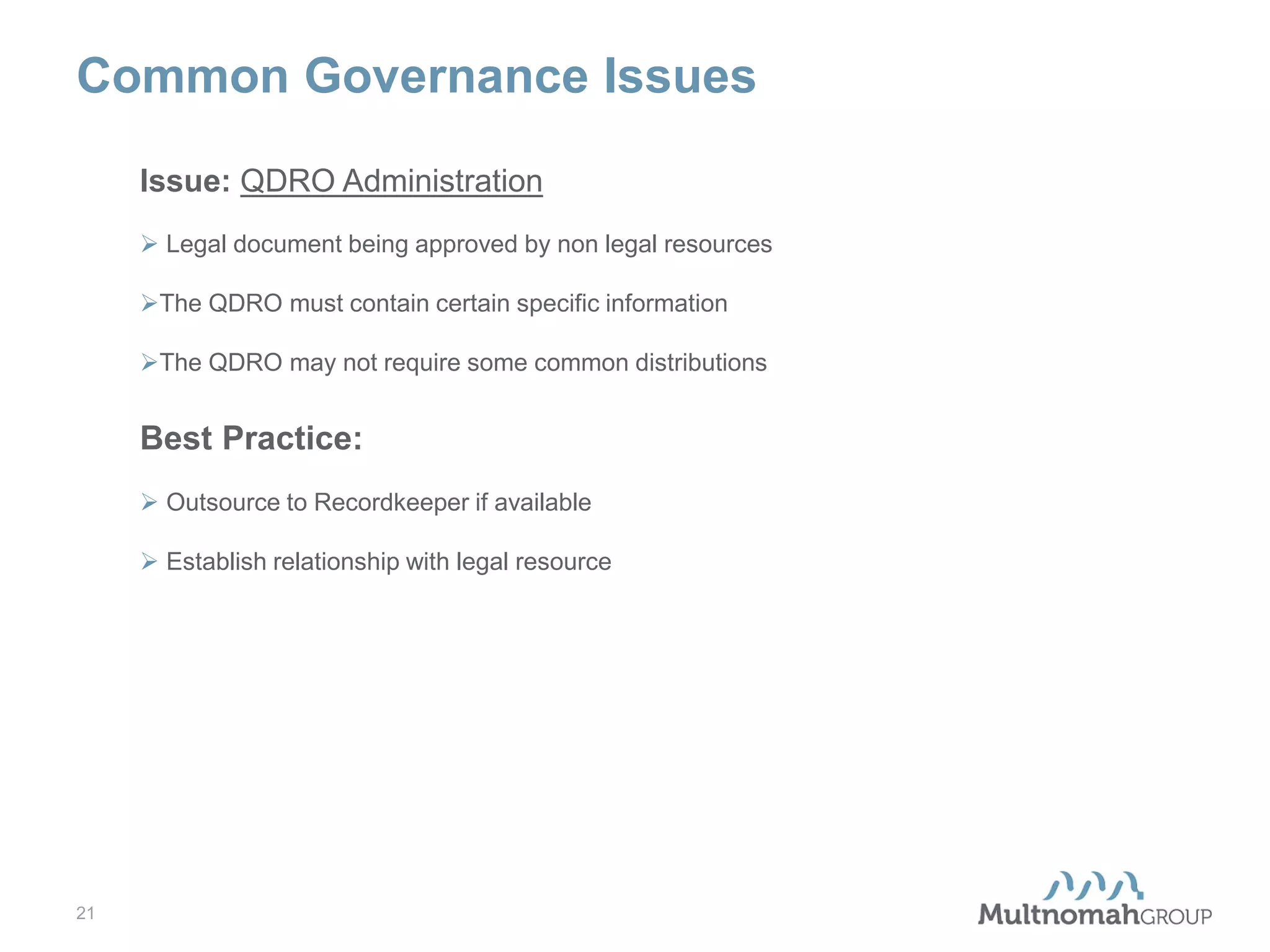
Issue: QDRO Administration
 Legal document being approved by non legal resources
The QDRO must contain certain specific information
The QDRO may not require some common distributions

Best Practice:
 Outsource to Recordkeeper if available
 Establish relationship with legal resource

21
Common Governance Issues
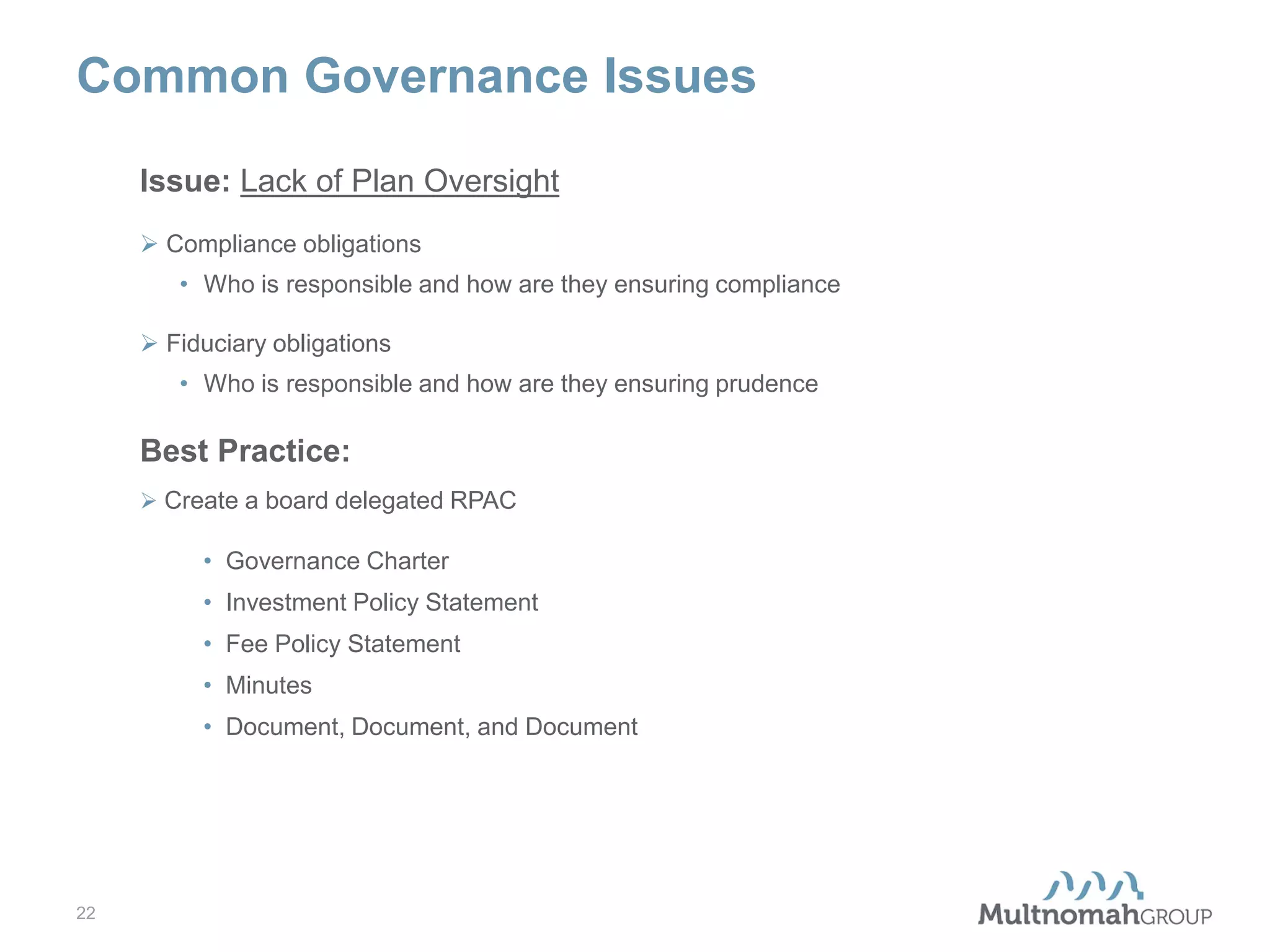
Issue: Lack of Plan Oversight
 Compliance obligations
• Who is responsible and how are they ensuring compliance
 Fiduciary obligations
• Who is responsible and how are they ensuring prudence

Best Practice:
 Create a board delegated RPAC

• Governance Charter
• Investment Policy Statement
• Fee Policy Statement
• Minutes
• Document, Document, and Document

22
Common Governance Issues
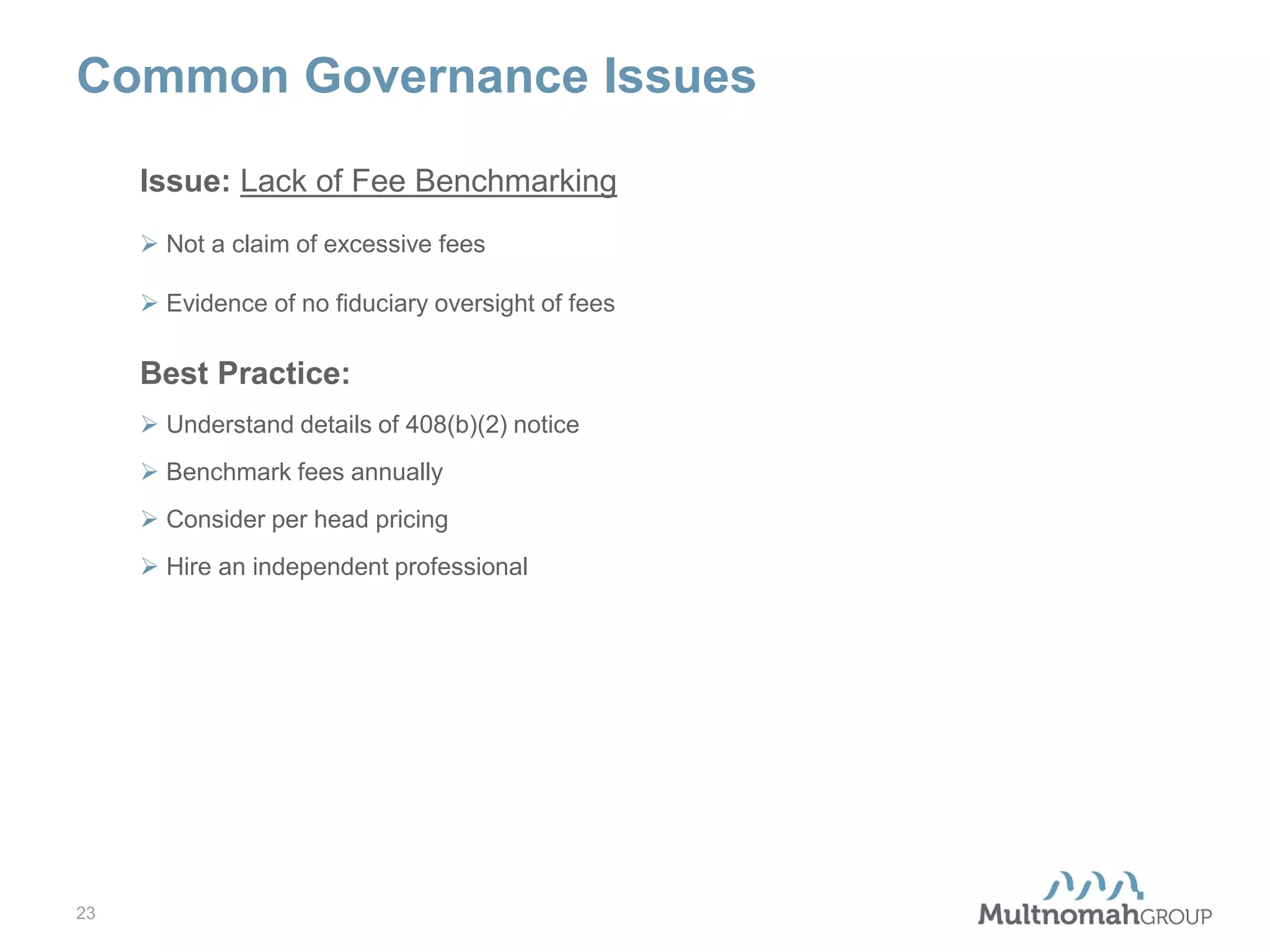
Issue: Lack of Fee Benchmarking
 Not a claim of excessive fees
 Evidence of no fiduciary oversight of fees

Best Practice:
 Understand details of 408(b)(2) notice
 Benchmark fees annually
 Consider per head pricing
 Hire an independent professional

23
Common Governance Issues
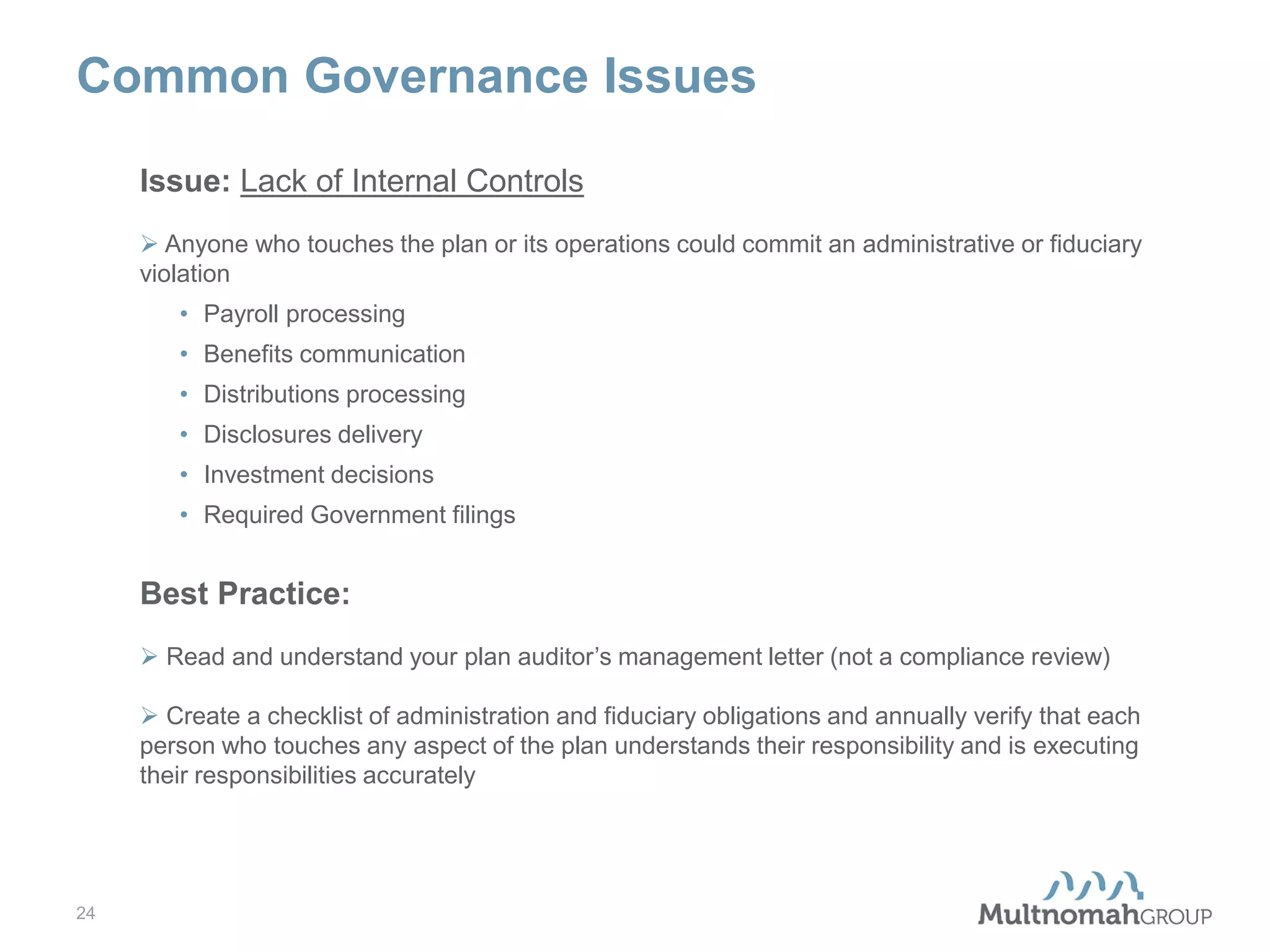
Issue: Lack of Internal Controls
 Anyone who touches the plan or its operations could commit an administrative or fiduciary
violation
• Payroll processing
• Benefits communication
• Distributions processing
• Disclosures delivery
• Investment decisions
• Required Government filings

Best Practice:
 Read and understand your plan auditor’s management letter (not a compliance review)
 Create a checklist of administration and fiduciary obligations and annually verify that each
person who touches any aspect of the plan understands their responsibility and is executing
their responsibilities accurately

24
Resources
Web Search For:
 IRS EPCRS
 403(b) Fix It Guide
 403(b) Check List
 Delinquent Filer Voluntary Compliance Program
 Voluntary Fiduciary Correction Program

25
Questions

Contact:
Brian.Montanez@MultnomahGroup.com
(888) 559-0159, ext. 105

26
Disclosures
Multnomah Group, Inc. is an Oregon corporation and SEC registered investment adviser.
Any information and materials contained herein or on our website are provided for
general informational purposes only and are not intended to be comprehensive for any
particular subject. Multnomah Group utilizes information from third party sources believed
to be reliable but not guaranteed, and as a result, information is provided to you "as is."
We do not represent, guarantee, or provide any warranties (either express or implied)
regarding the completeness, accuracy, or currency of information or its suitability for any
particular purpose. Multnomah Group shall not be liable to you or any third party resulting
from any use or misuse of information provided.
Receipt of information or materials provided herein or on our website does not create an
adviser-client relationship between Multnomah Group and you. Multnomah Group does
not provide tax or legal advice or opinions. You should consult with your own tax or legal
adviser for advice about your specific situation.

27

Top Common Code Section 403(b) Problems and Solutions

  • 1.
    Top Common CodeSection 403(b) Problems & Solutions ©2003 – 2013 Multnomah Group, Inc. All Rights Reserved.
  • 2.
    Brian Montanez, AIF®,CPC, QPA, QKA, TGPC A Principal of the Multnomah Group, Brian is responsible for client service and business development in Northern California. Brian advises an array of organizations, including hospitals, educational institutions, not-for-profit organizations and private employers. Brian regularly consults with plan sponsors and industry experts on fiduciary governance issues, investment menu construction, vendor fees and services, as well as plan design. Brian has over 19 years of combined experience working in the securities, investment advisory, and retirement services industries. Prior to joining Multnomah Group, Brian served as both Vice President and Regional Sales Director with other national investment advisory and retirement services firms. Brian is an Accredited Investment Fiduciary (AIF®), certified by the Center for Fiduciary Studies, as well as a Certified Pension Consultant (CPC) and Tax Exempt & Governmental Plan Consultant (TGPC), certified by the American Society of Pension Professionals and Actuaries (ASPPA). He holds a B.S. in Economics & Finance from Bentley University in Massachusetts. 2
  • 3.
    Agenda 1. 2. Brief Overview ofDOL Correction Programs 3. Common Document Issues 4. Common Governance Issues 5. 3 Brief Overview of IRS Correction Programs Common Compliance Errors and Failures
  • 4.
    Correction Programs IRS: EmployeePlans Compliance Resolution System (EPCRS)  General correction principles under the EPCRS: • Internal controls to prevent recurrences • Reasonable an appropriate IRS defined correction • Restore/Make whole participants  Under EPCRS, there are generally 4 types of Qualification Failures: • Plan Document Failure – a plan provision (or absence thereof) that, on its face, violates the requirements of Section 403(b) of the Code • Operational Failure – arises solely from the failure to follow plan provisions • Demographic Failure – failure to satisfy the nondiscrimination requirements, or coverage requirements that is not an Operational Failure • Employer Eligibility Failures – the employer is not eligible to sponsor type of plan 4
  • 5.
    Correction Programs IRS: EmployeePlans Compliance Resolution System (EPCRS)  Self-Correction Program (SCP) • Limited to Operational Failures (not following document provisions) • Insignificant, or Significant if within 2 years of PYE • No notification or fees to the IRS is required  Voluntary Correction Program (VCP) • For plan Qualification Failures and errors that are not eligible for self-correction, OR for when you want IRS assurance about the methods used to fix the error • You must make a written submission and pay a compliance fee to IRS • Errors are corrected and plan status preserved with IRS help and approval  Audit Closing Agreement Program (Audit CAP) • Permits you to correct errors and preserve the tax benefits for plan participants and sponsors • Fee to the IRS will be greater than the fee required under VCP, but less than the tax, interest and penalties due if the plan lost its tax-favored status 5
  • 6.
    Correction Programs Cont. DOL:Employee Benefits Security Administration (EBSA)  Delinquent Filer Voluntary Compliance Program (DFVCP) • Assists late or missed Form 5500 filers in coming up to date with corrected filings  Voluntary Fiduciary Correction Program (VFCP) • Affords plan sponsors and officials the chance to correct any of a specific 19 transaction • The VFCP also provides immediate relief from payment of excise taxes under a class exemption which covers six transactions • Violations can be fully and correctly resolved in four steps. • For a list of violations and corrective actions, visit www.dol.gov/ebsa and click on “Correction Programs” 6
  • 7.
    Common Plan DocumentIssues Issue: No Plan Document by December 31, 2009  No signed plan document  Late adoption Correction:  Locate and Review: • Any type of plan documents, contracts, service agreements • Board resolutions or minutes • Call Vendor(s)  Submit under VCP and pay the applicable compliance fee  See IRS VCP Submission Kit specifically intended for 403(b) plan sponsors that missed the 2009 deadline for adopting a written plan  If the failure to timely adopt a written plan was the only failure – and if the submission is made by December 31, 2013 – 50% reduction in the compliance fee 7
  • 8.
    Common Plan DocumentIssues Issue: Missing Amendments  Legally Required  Voluntary/Discretionary Correction:  May correct failure by making a submission under VCP and paying the applicable fee  Consider retroactive amendments to expand benefits  See IRS VCP Submission Kit specifically intended for 403(b) plan sponsors that missed the 2009 deadline for adopting a written plan 8
  • 9.
    Common Plan DocumentIssues Issue: ERISA vs. Non-ERISA  Many still claiming Non-ERISA  401(a) match based on 403(b) participation  To be exempt: • Statutory - Church or Governmental • Design or Practice • Voluntary participation • Solely enforceable by participant • Limited ER involvement (loans, hardships) • ER received no compensation • More than one 403(b) contractor (unless burdensome) Correction/Best Practice:  If 2007-2 is not clear to you, find counsel  See DOL FAB 2007-02 and/or DOL FAB 2010-01 exemption descriptions  Prior Form 5500 filings – DOL’s DFVCP 9
  • 10.
    Common Plan DocumentIssues Issue: Multiple 403(b) Plans  Do you have more than one 403(b) plan • ERISA or Non-ERISA • Extra administration • Extra communications • Extra confusion for participants Best Practice:  Review benefits rights and features  Review testing  Review investments structure  Consider consolidating plans 10
  • 11.
    Common Plan DocumentIssues Issue: Missing or Outdated Beneficiary Designations  Participants fail to designate or update designation to reflect life events  Multiple plan vendors: • Contract or Plan level designation • Who is coordinating for distributions Best Practice:  Have default beneficiaries in Plan doc Conduct annual education program for reminder  See our white paper, “Best Practices for Beneficiary Designations in Retirement Plans” 11
  • 12.
    Common Compliance Errors/Failures Issue:Definition of Compensation (Testing & Understanding)  Whose Compensation is effectively excluded (HCE vs. NHCE) • Bonus • Overtime  Definition testing 414(s)  Severance vs. Post Severance Compensation • Termination date • 2 ½ Months  5-Year Post Severance Correction:  Amend definition to Safe-Harbor or reasonable definition  Is restoration of benefits required 12
  • 13.
    Common Compliance Errors/Failures Issue:Failure to “Administer” to the Definition of Compensation  Actual deferrals do not match participant instructions  Match or Non elective contributions are based on wrong compensation  Incorrect nondiscrimination testing  Exceed individual limits under 402(g) or 415(c)  Determination of HCE could be wrong Correction/Best Practice:  Read, question and understand all that is included and excluded in definition  Simplify definition of compensation (Cost v Value)  Restore participant to place as if no error (missed $ and earnings)  Self-Correction Program may be used to correct insignificant operations problems  See Rev. Proc 2013-12 Section 8.2 for determination of Insignificance 13
  • 14.
    Common Compliance Errors/Failures Issue:Excess Contributions  Compensation Limits ($255,000 for 2013)  Salary Deferral limits • 402(g) • Age 50 • 15-Year (included in 415(c))  Excess Employer Contributions Correction/Best Practice:  Review limits prior to each year end  Refund and 1099-R  Multiple prior years – SCP or VCP 14
  • 15.
    Common Compliance Errors/Failures Issue:Eligibility  Universal Availability • IRS: if any employee of the employer is eligible to make elective deferrals, all employees must be eligible • Five permitted exclusions • Improperly excluded participants  Rehires • Break in Service • Auto Enrollment Correction/Best Practice:  Confirm that vendor or benefits is tracking rehires  Potential retroactive entry dates (ER and salary deferrals)  Restore via SCP, or VCP if significant error 15
  • 16.
    Compliance Errors/Failures Issue: 15-Yearspecial catch-up  Data availability  HR & participant understanding of rule  Ordering rules Correction:  Recharacterize  Refund and report on 1099-R  Submit via SCP  VCP if significant 16
  • 17.
    Common Compliance Errors/Failures Issue:Notice Delivery  SAR, SPD/SMM, 404(a), Universal Availability, QDIA, ACA  Who is responsible • TPA • Recordkeeper • Staff • RPAC  Delivery method Best Practice:  Outsource delivery and document  Assign a responsible internal party and document delivery 17
  • 18.
    Common Compliance Errors/Failures Issue:Late Deposit of Employee Deferrals  Small plans  Large plans  7 Days, 15 Days Or ? Correction:  Make deposit plus earnings adjustment  Correct under DOL’s VFCP 18
  • 19.
    Common Compliance Errors/Failures Issue:QDIA  DOL Provides clear guidance: • DOL FAB 2008-03  Sponsor default investing mistakes • Non-QDIA Correction/Best Practice:  Document DOL approved QDIA choice  Make participant whole under VCP  Correct Prohibited Transaction under VFCP 19
  • 20.
    Common Compliance Errors/Failures Issue:Termination Dates  Plans not timely notifying recordkeepers of participant termination dates  Legacy Vendors  Multiple Vendors  Effects distributions • Regular post severance distributions • RMDs Correction/Best Practice:  Develop a practice of notifying all vendors at the same time  Perform an annual audit of termination dates 20
  • 21.
    Common Governance Issues Issue:QDRO Administration  Legal document being approved by non legal resources The QDRO must contain certain specific information The QDRO may not require some common distributions Best Practice:  Outsource to Recordkeeper if available  Establish relationship with legal resource 21
  • 22.
    Common Governance Issues Issue:Lack of Plan Oversight  Compliance obligations • Who is responsible and how are they ensuring compliance  Fiduciary obligations • Who is responsible and how are they ensuring prudence Best Practice:  Create a board delegated RPAC • Governance Charter • Investment Policy Statement • Fee Policy Statement • Minutes • Document, Document, and Document 22
  • 23.
    Common Governance Issues Issue:Lack of Fee Benchmarking  Not a claim of excessive fees  Evidence of no fiduciary oversight of fees Best Practice:  Understand details of 408(b)(2) notice  Benchmark fees annually  Consider per head pricing  Hire an independent professional 23
  • 24.
    Common Governance Issues Issue:Lack of Internal Controls  Anyone who touches the plan or its operations could commit an administrative or fiduciary violation • Payroll processing • Benefits communication • Distributions processing • Disclosures delivery • Investment decisions • Required Government filings Best Practice:  Read and understand your plan auditor’s management letter (not a compliance review)  Create a checklist of administration and fiduciary obligations and annually verify that each person who touches any aspect of the plan understands their responsibility and is executing their responsibilities accurately 24
  • 25.
    Resources Web Search For: IRS EPCRS  403(b) Fix It Guide  403(b) Check List  Delinquent Filer Voluntary Compliance Program  Voluntary Fiduciary Correction Program 25
  • 26.
  • 27.
    Disclosures Multnomah Group, Inc.is an Oregon corporation and SEC registered investment adviser. Any information and materials contained herein or on our website are provided for general informational purposes only and are not intended to be comprehensive for any particular subject. Multnomah Group utilizes information from third party sources believed to be reliable but not guaranteed, and as a result, information is provided to you "as is." We do not represent, guarantee, or provide any warranties (either express or implied) regarding the completeness, accuracy, or currency of information or its suitability for any particular purpose. Multnomah Group shall not be liable to you or any third party resulting from any use or misuse of information provided. Receipt of information or materials provided herein or on our website does not create an adviser-client relationship between Multnomah Group and you. Multnomah Group does not provide tax or legal advice or opinions. You should consult with your own tax or legal adviser for advice about your specific situation. 27