12 Top AI Technology That You Should
Use In 2024
Summary: Technology has become an irreplaceable component of our daily lives. The
role of AI in technology revolutionizes our lives for the betterment of the future. In this
article, we will learn about the top 12 AI technology trends for 2024.
Introduction
In this article, we delve into the rapidly evolving landscape of AI trends in 2024. The
growing technology paves the way for rapid progress. By leveraging trending
technology, businesses can lessen expenses, enhance the customer experience, and
increase revenue. Being knowledgeable about these trends and technologies is crucial
for a better future.
AI Technology Trends for 2024
1. Multimodal AI
According to a report on Markets and Markets, the global multimodal AI development
market is expected to grow by 2028 from USD 1.2 billion to 4.5 billion. The conventional
AI systems were focused on a single modality (text-based generative AI). Instead,
multimodal AI combines data from different sources like tests, video, audio, images, and
sensor data. Such data are combined and analyzed together to offer more detailed
predictions and insights.
2. Quantum AI
The emergence of generative AI has sparked considerable expectation and excitement.
However, the present qualities of AI are constrained by a few limitations inherent in
traditional silicon-based hardware.
In the early stages, major tech industries and startups are rapidly developing and
providing access to quantum computing resources. However, nowadays quantum
computing resources are used for specialized and often experimental purposes.
Using qubits enables the simultaneous processing of extensive information sets,
potentially resulting in quicker solutions or calculations for specific issues when
compared to classical algorithms.
3. Edge AI
In response to the need for faster data processing, Edge AI will emerge as a major topic
in 2024. This approach comprises examining information close to its source, minimizing
delays, and improving application efficiency. Edge AI is particularly useful in
circumstances demanding immediate analysis, such as IoT devices and smart
surroundings, where real-time insights are critical.
Edge AI leverages available local computing power for diverse types of IoT applications.
This proves transformative for scenes requiring real-time decisions, such as
autonomous vehicles or smart medical devices.
4. Ethical AI
Ethical AI is the use of artificial intelligence systems in a way that is accountable,
beneficial, and fair to society. From data collection and the training of data to the design
and use of algorithms, Ethical AI manages all. It includes considering the capability and
ethical implications of AI systems at all stages of development and deployment.
A few key principles of Ethical AI
● Fairness
AI systems must be designed and implemented with no bias or discrimination toward
any individual.
● Accountability
Clear responsibilities should be established for the development, progress,
implementation, and application of AI systems.
● Transparency
Transparency in the operation and decision-making of AI systems is critical.
● Safety
AI systems should prioritize safety and dependability in their design and
implementation.
● Privacy
Individual privacy must be respected when developing and deploying AI systems.
5. Customization of Enterprise AI
As AI technology continues to evolve, customization will remain a key trend,
empowering enterprises to unlock new levels of efficiency, productivity, and success.
Mordor Intelligence published a report analyzing enterprise AI and found that the current
valuation of the enterprise AI market is USD 25.10 billion.
That too, with a projected CAGR of 52.17%. By leveraging AI, enterprises can automate
processes such as data analysis capabilities, tailored chatbots, and more.
6. API-driven AI and Microservices
The process of creating AI-powered applications that are available through well-defined
APIs is called API-driven AI. This AI trend enables them to be seamlessly integrated
into current systems. This method allows developers to use powerful AI capabilities
without needing substantial knowledge of the underlying algorithms.
Furthermore, AI capabilities like natural language processing (NLP), picture
recognition, and machine learning models can be packaged into microservices and
made available through APIs. These AI microservices can then be linked into bigger
applications or workflows, allowing developers to use AI functions as foundational
building blocks for developing new and intelligent software solutions.
In essence, API-driven AI and microservices provide a versatile and scalable foundation
for creating intelligent apps that use AI capabilities to stimulate innovation and provide
considerable value to consumers.
7. AI Hallucination Insurance Policy
Embracing AI presents obstacles, as acknowledged by leaders such as Elon Musk, who
has expressed concern about the potential threats to humans. Despite its seemingly
benign nature, AI hallucination can cause a variety of problems, including disinformation
propagation, privacy violations, reputational injury, identity theft, and financial failures.
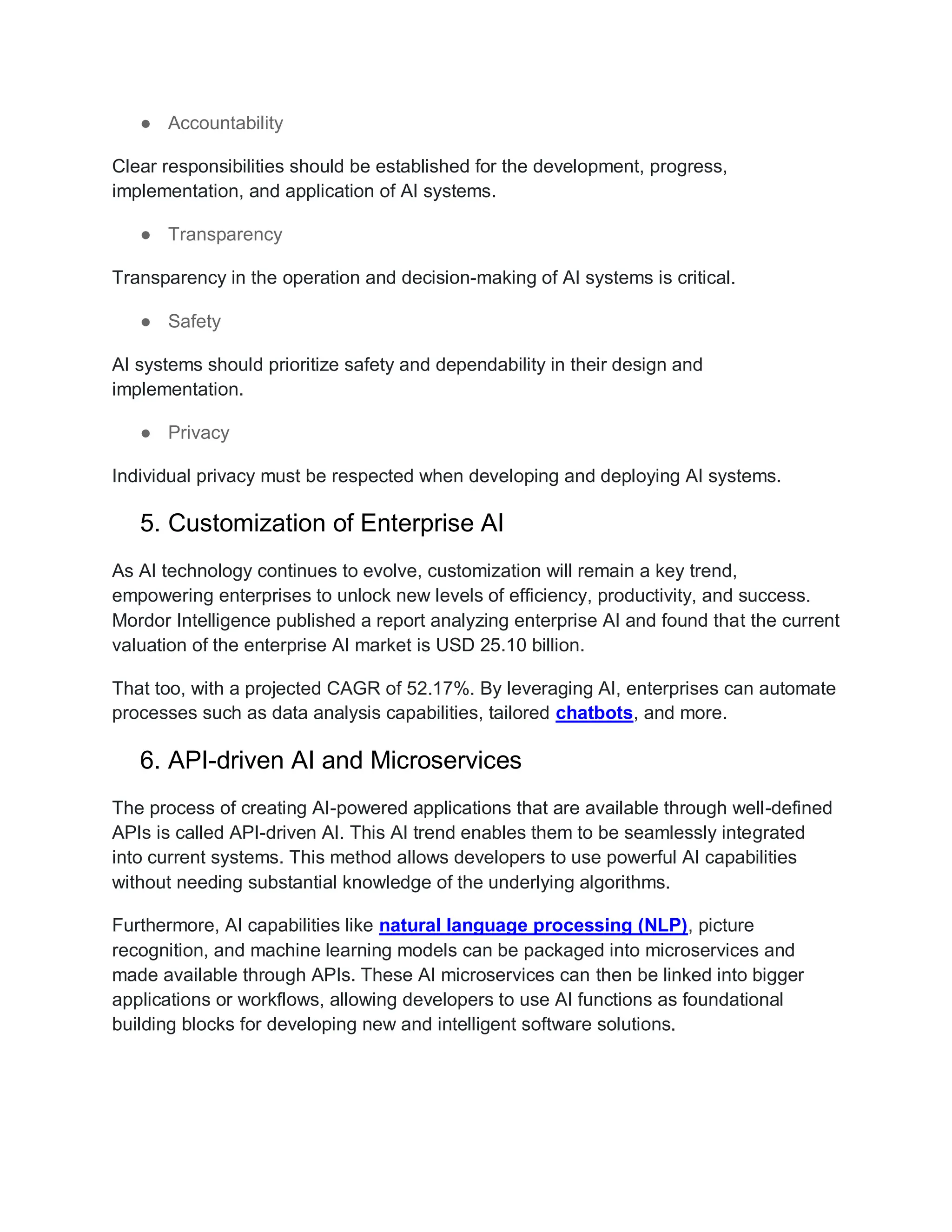
To mitigate these risks, the AI Hallucination Insurance Policy provides coverage and
peace of mind for both organizations and individuals, protecting them against the
unexpected consequences of AI-generated content.
8. Shadow AI
This means the use of AI systems or algorithms without any proper supervision or
permission from the governance or IT department. It boosts employee productivity
without hiring additional staff. Such tools are frequently used by employees to complete
business tasks. But these convenient tools come with a cost. The organization may
have to face functional and operational concerns.
9. The Next-Gen Generative AI
Large language models helped businesses reach new heights. A well-known example
of this is ChatGPT. These AI-powered tools, with their high-speed pace, pave the way
for huge innovation in the future.
Not only the powerful virtual agents, but the next generation of generative AI solutions
has gained significance in recent days. These models are experts in fact-checking the
generated content themselves and are capable of generating their training data.
10. Ease of Model Optimization
Historically, optimizing machine learning models was difficult and time-consuming,
necessitating specific skills and resources. However, advances in AI technology have
made the procedure more accessible and efficient.
The introduction of multiple AI tools and platforms, as well as approaches like
hyperparameter tuning, transfer learning, and pre-trained models, has made model
optimization easier for developers. These breakthroughs allow developers to improve
the performance and efficiency of their AI models more quickly than compared with the
old methods.
11. Digital Human
These are the virtual entities that are designed to mimic human interaction and
behavior. These human avatars are used in diverse fields, such as customer service,
healthcare, education, and entertainment.
The goal of digital human avatars is to improve user experiences and support seamless
communication. Hire AI developers to create an app or a tool that allows you to create
your own Avatar according to your wishes.
12. IoT
The role of IoT is already an unavoidable part of humans' daily lives. With the use of
IoT, humans can process real-time data through digital gadgets and smart devices to
make informed decisions. In IoT interconnected devices can share and exchange data.
This enhances efficiency while promising safety and convenience.
Conclusion
AI promises to bring more innovation that will redefine the way we live now. The 12 AI
trends listed above give a brief outline for the future, filled with unexplored opportunities.
However, in the pursuit of advanced technologies, it is unavoidable to note the core
principles of trust and vigilant governance. Hence, it is best to hire an AI development
company that will adhere to government regulations.

Top 12 AI Technology Trends For 2024.pdf

  • 1.
    12 Top AITechnology That You Should Use In 2024 Summary: Technology has become an irreplaceable component of our daily lives. The role of AI in technology revolutionizes our lives for the betterment of the future. In this article, we will learn about the top 12 AI technology trends for 2024.
  • 2.
    Introduction In this article,we delve into the rapidly evolving landscape of AI trends in 2024. The growing technology paves the way for rapid progress. By leveraging trending technology, businesses can lessen expenses, enhance the customer experience, and increase revenue. Being knowledgeable about these trends and technologies is crucial for a better future. AI Technology Trends for 2024 1. Multimodal AI According to a report on Markets and Markets, the global multimodal AI development market is expected to grow by 2028 from USD 1.2 billion to 4.5 billion. The conventional AI systems were focused on a single modality (text-based generative AI). Instead, multimodal AI combines data from different sources like tests, video, audio, images, and sensor data. Such data are combined and analyzed together to offer more detailed predictions and insights. 2. Quantum AI The emergence of generative AI has sparked considerable expectation and excitement. However, the present qualities of AI are constrained by a few limitations inherent in traditional silicon-based hardware. In the early stages, major tech industries and startups are rapidly developing and providing access to quantum computing resources. However, nowadays quantum computing resources are used for specialized and often experimental purposes. Using qubits enables the simultaneous processing of extensive information sets, potentially resulting in quicker solutions or calculations for specific issues when compared to classical algorithms. 3. Edge AI In response to the need for faster data processing, Edge AI will emerge as a major topic in 2024. This approach comprises examining information close to its source, minimizing delays, and improving application efficiency. Edge AI is particularly useful in circumstances demanding immediate analysis, such as IoT devices and smart surroundings, where real-time insights are critical.
  • 3.
    Edge AI leveragesavailable local computing power for diverse types of IoT applications. This proves transformative for scenes requiring real-time decisions, such as autonomous vehicles or smart medical devices. 4. Ethical AI Ethical AI is the use of artificial intelligence systems in a way that is accountable, beneficial, and fair to society. From data collection and the training of data to the design and use of algorithms, Ethical AI manages all. It includes considering the capability and ethical implications of AI systems at all stages of development and deployment. A few key principles of Ethical AI ● Fairness AI systems must be designed and implemented with no bias or discrimination toward any individual.
  • 4.
    ● Accountability Clear responsibilitiesshould be established for the development, progress, implementation, and application of AI systems. ● Transparency Transparency in the operation and decision-making of AI systems is critical. ● Safety AI systems should prioritize safety and dependability in their design and implementation. ● Privacy Individual privacy must be respected when developing and deploying AI systems. 5. Customization of Enterprise AI As AI technology continues to evolve, customization will remain a key trend, empowering enterprises to unlock new levels of efficiency, productivity, and success. Mordor Intelligence published a report analyzing enterprise AI and found that the current valuation of the enterprise AI market is USD 25.10 billion. That too, with a projected CAGR of 52.17%. By leveraging AI, enterprises can automate processes such as data analysis capabilities, tailored chatbots, and more. 6. API-driven AI and Microservices The process of creating AI-powered applications that are available through well-defined APIs is called API-driven AI. This AI trend enables them to be seamlessly integrated into current systems. This method allows developers to use powerful AI capabilities without needing substantial knowledge of the underlying algorithms. Furthermore, AI capabilities like natural language processing (NLP), picture recognition, and machine learning models can be packaged into microservices and made available through APIs. These AI microservices can then be linked into bigger applications or workflows, allowing developers to use AI functions as foundational building blocks for developing new and intelligent software solutions.
  • 5.
    In essence, API-drivenAI and microservices provide a versatile and scalable foundation for creating intelligent apps that use AI capabilities to stimulate innovation and provide considerable value to consumers. 7. AI Hallucination Insurance Policy Embracing AI presents obstacles, as acknowledged by leaders such as Elon Musk, who has expressed concern about the potential threats to humans. Despite its seemingly benign nature, AI hallucination can cause a variety of problems, including disinformation propagation, privacy violations, reputational injury, identity theft, and financial failures. To mitigate these risks, the AI Hallucination Insurance Policy provides coverage and peace of mind for both organizations and individuals, protecting them against the unexpected consequences of AI-generated content. 8. Shadow AI This means the use of AI systems or algorithms without any proper supervision or permission from the governance or IT department. It boosts employee productivity without hiring additional staff. Such tools are frequently used by employees to complete business tasks. But these convenient tools come with a cost. The organization may have to face functional and operational concerns.
  • 6.
    9. The Next-GenGenerative AI Large language models helped businesses reach new heights. A well-known example of this is ChatGPT. These AI-powered tools, with their high-speed pace, pave the way for huge innovation in the future. Not only the powerful virtual agents, but the next generation of generative AI solutions has gained significance in recent days. These models are experts in fact-checking the generated content themselves and are capable of generating their training data. 10. Ease of Model Optimization Historically, optimizing machine learning models was difficult and time-consuming, necessitating specific skills and resources. However, advances in AI technology have made the procedure more accessible and efficient. The introduction of multiple AI tools and platforms, as well as approaches like hyperparameter tuning, transfer learning, and pre-trained models, has made model optimization easier for developers. These breakthroughs allow developers to improve the performance and efficiency of their AI models more quickly than compared with the old methods. 11. Digital Human These are the virtual entities that are designed to mimic human interaction and behavior. These human avatars are used in diverse fields, such as customer service, healthcare, education, and entertainment. The goal of digital human avatars is to improve user experiences and support seamless communication. Hire AI developers to create an app or a tool that allows you to create your own Avatar according to your wishes. 12. IoT The role of IoT is already an unavoidable part of humans' daily lives. With the use of IoT, humans can process real-time data through digital gadgets and smart devices to make informed decisions. In IoT interconnected devices can share and exchange data. This enhances efficiency while promising safety and convenience.
  • 7.
    Conclusion AI promises tobring more innovation that will redefine the way we live now. The 12 AI trends listed above give a brief outline for the future, filled with unexplored opportunities. However, in the pursuit of advanced technologies, it is unavoidable to note the core principles of trust and vigilant governance. Hence, it is best to hire an AI development company that will adhere to government regulations.