TOP 10
JAVA
INTERVIEW
QUESTIONS
FOR
FRESHERS
A GUIDE TO ACE
YOUR JAVA
DEVELOPER
INTERVIEW
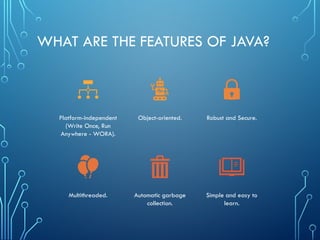
WHAT ARE THE FEATURES OF JAVA?
Platform-independent
(Write Once, Run
Anywhere - WORA).
Object-oriented. Robust and Secure.
Multithreaded. Automatic garbage
collection.
Simple and easy to
learn.
EXPLAIN THE JDK, JRE, AND JVM.
JDK: Java Development Kit - tools for
developing Java applications.
JRE: Java Runtime Environment - runs Java
programs.
JVM: Java Virtual Machine - interprets
bytecode and runs it on the machine.
WHAT IS THE DIFFERENCE BETWEEN
== AND EQUALS()?
==: Compares
reference/memory
addresses.
equals(): Compares
object content
(default
implementation in
Object class can be
overridden).
WHAT IS INHERITANCE IN JAVA?
A mechanism where one class inherits
properties and methods from another.
Enables code reusability.
Types: Single, Multilevel, Hierarchical (no
multiple inheritance with classes in Java).
WHAT IS POLYMORPHISM? GIVE
EXAMPLES.
Polymorphism: Ability of a method to behave differently based on the
object.
Types:
* Compile-time (Method Overloading).
* Runtime (Method Overriding).
Example: Shape class with draw() method implemented differently in
subclasses.
EXPLAIN THE CONCEPT
OF A CONSTRUCTOR IN
JAVA.
Special method used to initialize
objects.
Key Points:
• Same name as the class.
• No return type.
Types: Default, Parameterized,
Copy constructor.
WHAT IS THE DIFFERENCE
BETWEEN AN ABSTRACT
CLASS AND AN INTERFACE?
Abstract Class:
• Can have abstract and concrete
methods.
• Supports inheritance.
Interface:
• Only abstract methods (Java 8+:
default and static methods allowed).
• Implements multiple inheritance.
WHAT IS THE SIGNIFICANCE OF
FINAL, FINALLY, AND FINALIZE?
final: Keyword to declare constants, prevent
method overriding or inheritance.
finally: Block in exception handling, executes
always.
finalize: Method invoked by the garbage
collector before object deletion.
WHAT ARE CHECKED AND
UNCHECKED EXCEPTIONS?
Checked: Compile-
time exceptions
(e.g., IOException,
SQLException).
Unchecked: Runtime
exceptions (e.g.,
NullPointerException
,
ArithmeticException)
.
WHAT IS MULTITHREADING
IN JAVA? HOW IS IT
ACHIEVED?
• Multithreading: Running multiple
threads simultaneously.
• Achieved using:
* Extending Thread class.
* Implementing Runnable interface.
• Benefits: Better CPU utilization, faster
processing.
FINAL TIPS FOR JAVA INTERVIEWS
Brush up on core
concepts and
practice coding.
01
Be ready with
practical
examples.
02
Understand basic
design patterns
and frameworks
like Spring.
03

Top 10 Java Interview Questions for freshers.

  • 1.
    TOP 10 JAVA INTERVIEW QUESTIONS FOR FRESHERS A GUIDETO ACE YOUR JAVA DEVELOPER INTERVIEW
  • 2.
    WHAT ARE THEFEATURES OF JAVA? Platform-independent (Write Once, Run Anywhere - WORA). Object-oriented. Robust and Secure. Multithreaded. Automatic garbage collection. Simple and easy to learn.
  • 3.
    EXPLAIN THE JDK,JRE, AND JVM. JDK: Java Development Kit - tools for developing Java applications. JRE: Java Runtime Environment - runs Java programs. JVM: Java Virtual Machine - interprets bytecode and runs it on the machine.
  • 4.
    WHAT IS THEDIFFERENCE BETWEEN == AND EQUALS()? ==: Compares reference/memory addresses. equals(): Compares object content (default implementation in Object class can be overridden).
  • 5.
    WHAT IS INHERITANCEIN JAVA? A mechanism where one class inherits properties and methods from another. Enables code reusability. Types: Single, Multilevel, Hierarchical (no multiple inheritance with classes in Java).
  • 6.
    WHAT IS POLYMORPHISM?GIVE EXAMPLES. Polymorphism: Ability of a method to behave differently based on the object. Types: * Compile-time (Method Overloading). * Runtime (Method Overriding). Example: Shape class with draw() method implemented differently in subclasses.
  • 7.
    EXPLAIN THE CONCEPT OFA CONSTRUCTOR IN JAVA. Special method used to initialize objects. Key Points: • Same name as the class. • No return type. Types: Default, Parameterized, Copy constructor.
  • 8.
    WHAT IS THEDIFFERENCE BETWEEN AN ABSTRACT CLASS AND AN INTERFACE? Abstract Class: • Can have abstract and concrete methods. • Supports inheritance. Interface: • Only abstract methods (Java 8+: default and static methods allowed). • Implements multiple inheritance.
  • 9.
    WHAT IS THESIGNIFICANCE OF FINAL, FINALLY, AND FINALIZE? final: Keyword to declare constants, prevent method overriding or inheritance. finally: Block in exception handling, executes always. finalize: Method invoked by the garbage collector before object deletion.
  • 10.
    WHAT ARE CHECKEDAND UNCHECKED EXCEPTIONS? Checked: Compile- time exceptions (e.g., IOException, SQLException). Unchecked: Runtime exceptions (e.g., NullPointerException , ArithmeticException) .
  • 11.
    WHAT IS MULTITHREADING INJAVA? HOW IS IT ACHIEVED? • Multithreading: Running multiple threads simultaneously. • Achieved using: * Extending Thread class. * Implementing Runnable interface. • Benefits: Better CPU utilization, faster processing.
  • 12.
    FINAL TIPS FORJAVA INTERVIEWS Brush up on core concepts and practice coding. 01 Be ready with practical examples. 02 Understand basic design patterns and frameworks like Spring. 03