Types of Classroom Assessment
Making assessment an integral part of daily mathematics is a
challenge. It requires planning specific ways to use assignments and
discussions to discover what students do and do not understand. It
also requires teachers to be prepared to deal with students’
responses. Merely spotting when students are incorrect is relatively
easy compared to understanding the reasons behind their errors.
Burns 2005, p.31
Reflection
0 After reading that passage:
Jot down the challenges that you face making
assessment a part of daily mathematics instruction?
What are two ways that would help you overcome
these challenges?
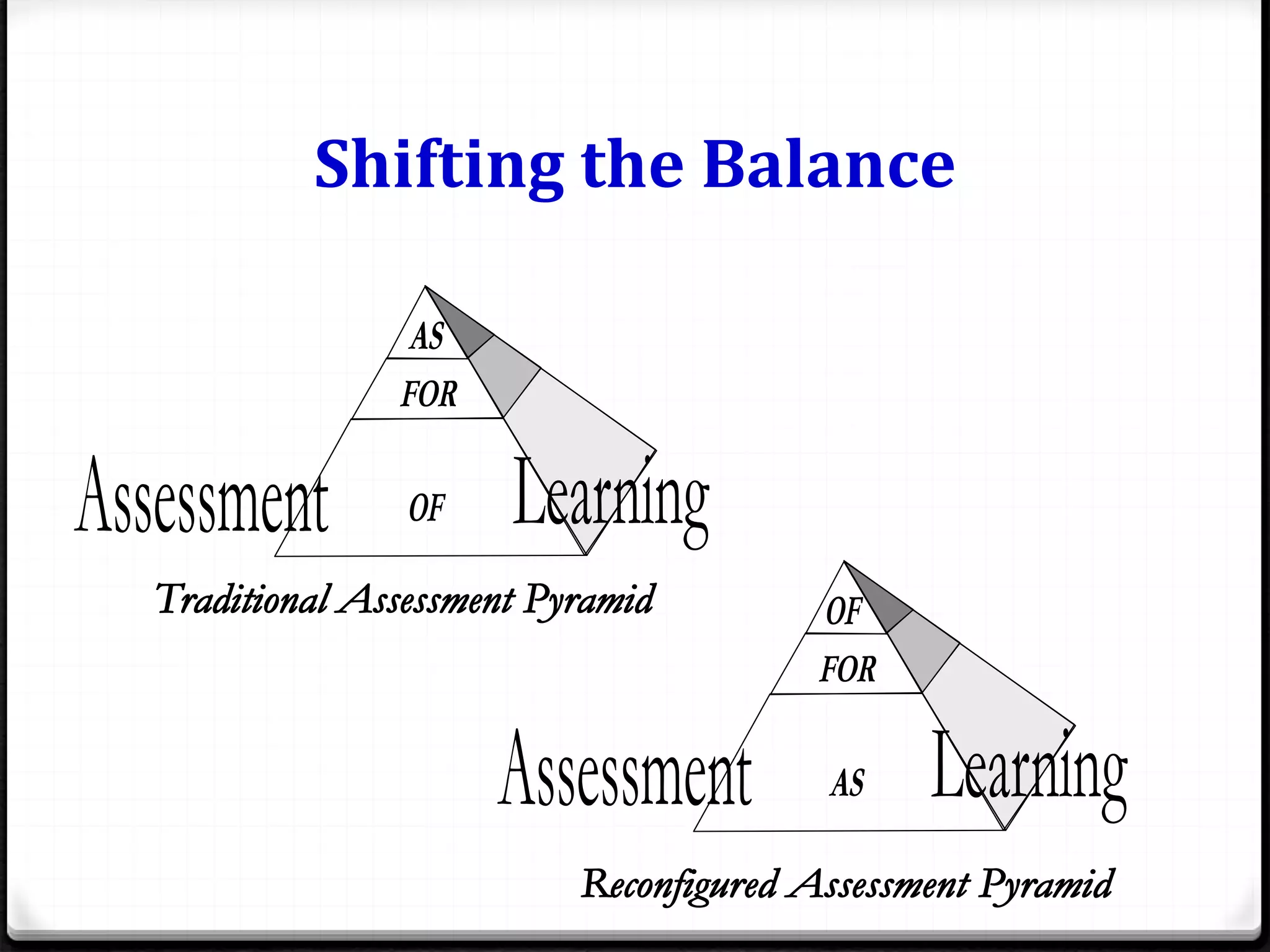
Shifting the Balance
Assessment for Learning
Formative Assessment:
 Assessment and teaching should be integrated into a whole
 Ongoing assessment allows teachers to monitor students on a
daily basis and modify teaching based on what students need to
be successful
 Improves our teaching practices
 Provides students with timely feedback that they need to make
adjustments to their learning.
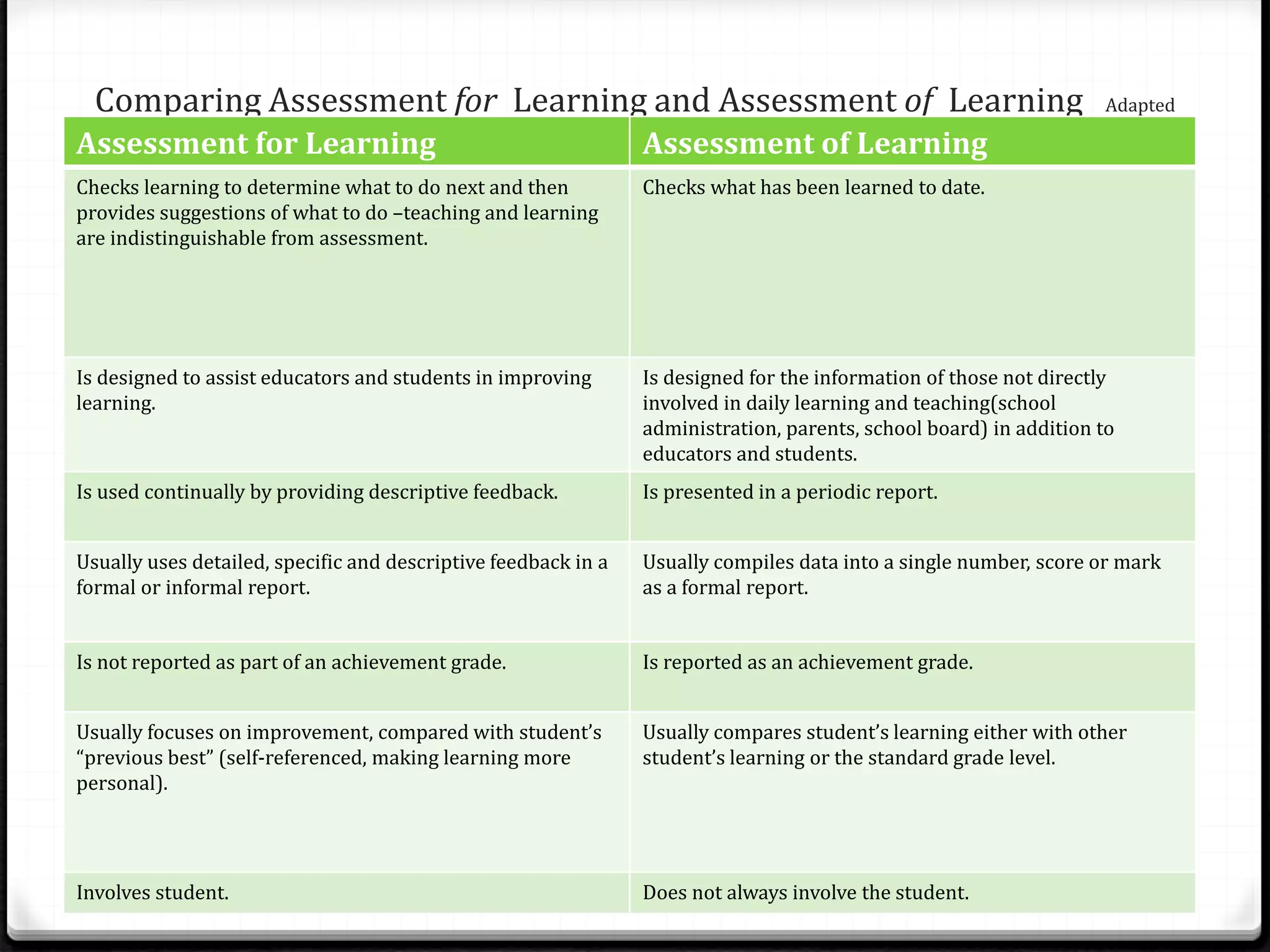
Comparing Assessment for Learning and Assessment of Learning Adapted
from Ruth Sutton Learn Alberta
Assessment for Learning Assessment of Learning
Checks learning to determine what to do next and then
provides suggestions of what to do –teaching and learning
are indistinguishable from assessment.
Checks what has been learned to date.
Is designed to assist educators and students in improving
learning.
Is designed for the information of those not directly
involved in daily learning and teaching(school
administration, parents, school board) in addition to
educators and students.
Is used continually by providing descriptive feedback. Is presented in a periodic report.
Usually uses detailed, specific and descriptive feedback in a
formal or informal report.
Usually compiles data into a single number, score or mark
as a formal report.
Is not reported as part of an achievement grade. Is reported as an achievement grade.
Usually focuses on improvement, compared with student’s
“previous best” (self-referenced, making learning more
personal).
Usually compares student’s learning either with other
student’s learning or the standard grade level.
Involves student. Does not always involve the student.
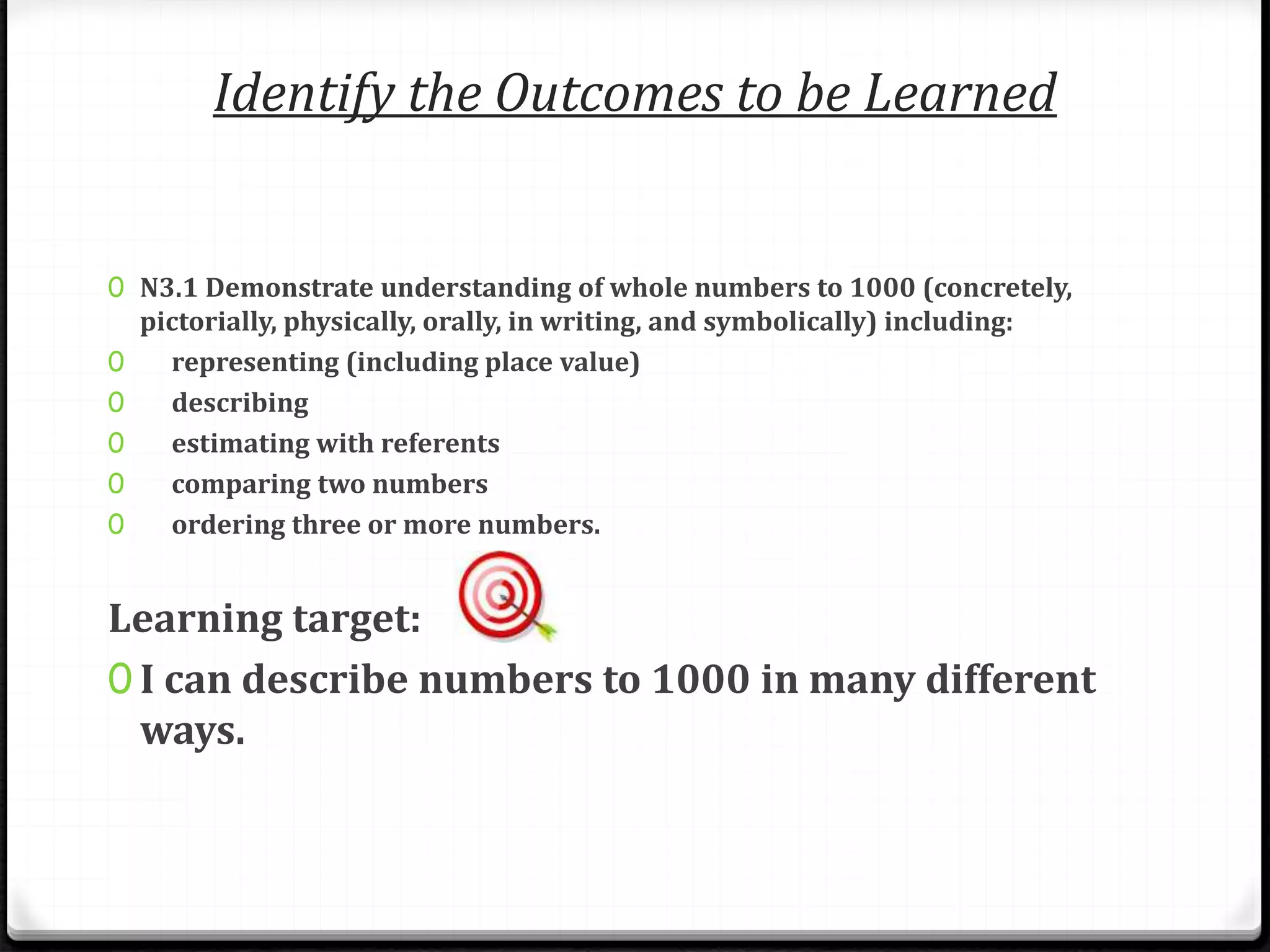
Identify the Outcomes to be Learned
0 N3.1 Demonstrate understanding of whole numbers to 1000 (concretely,
pictorially, physically, orally, in writing, and symbolically) including:
0 representing (including place value)
0 describing
0 estimating with referents
0 comparing two numbers
0 ordering three or more numbers.
Learning target:
0 I can describe numbers to 1000 in many different
ways.
Determine How the Learning Will be Observed
0 What will the children do to know that the learning
has occurred?
0 What should children do to demonstrate the
understanding of the mathematical concepts, skills,
and big ideas?
0 What assessment tools will be the most suitable to
provide evidence of student understanding?
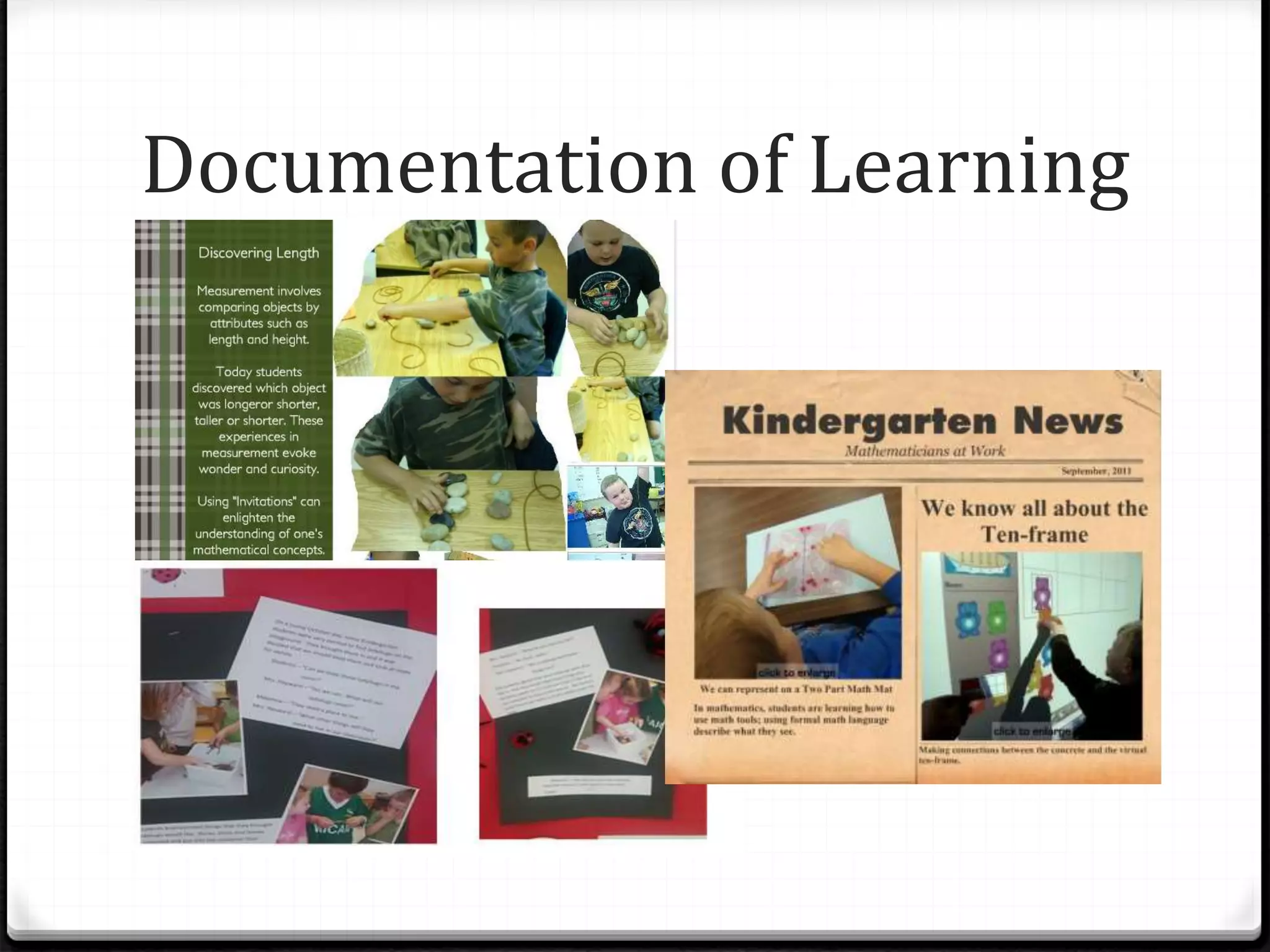
0 How can I document the children’s learning?
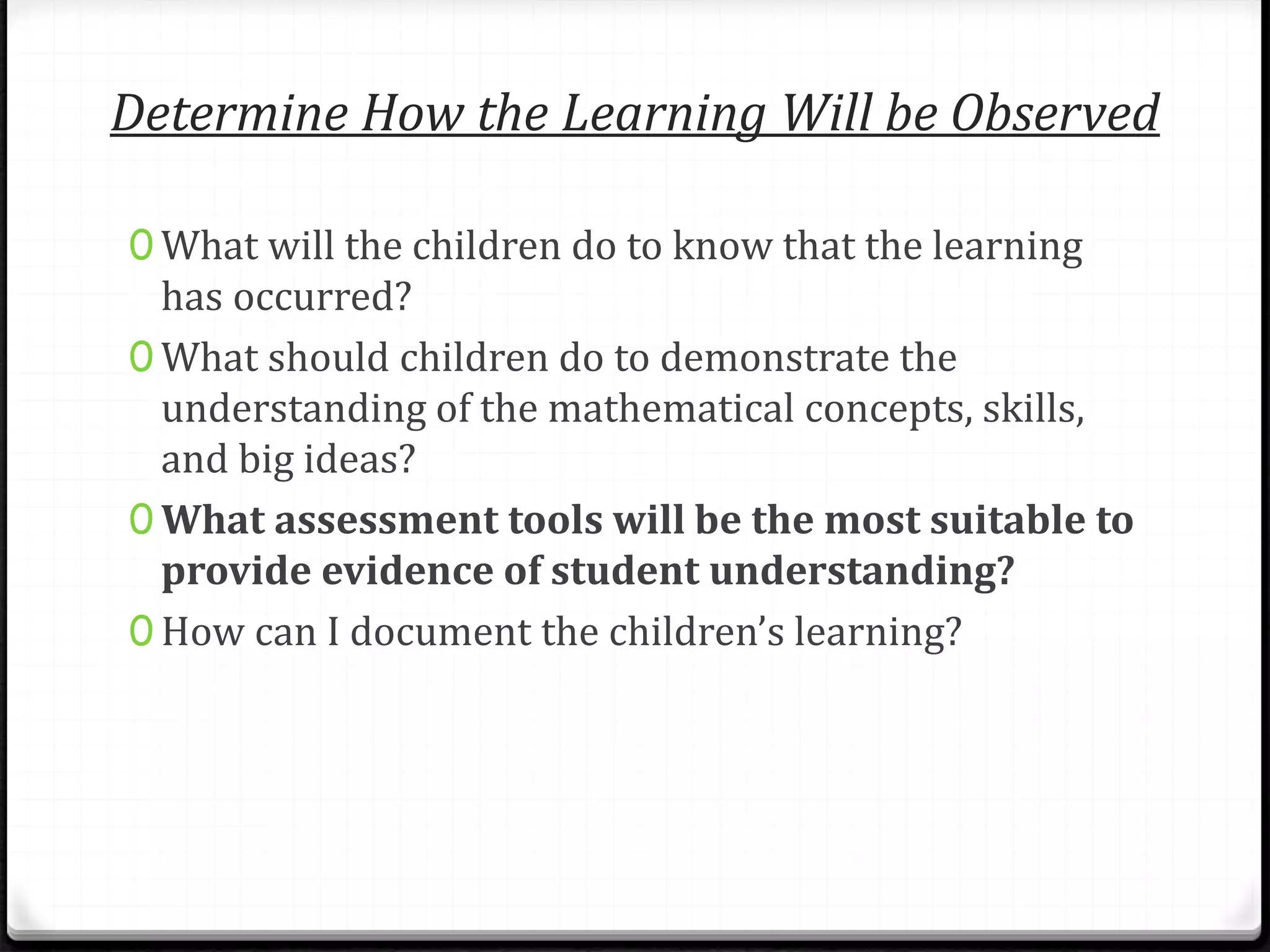
Assessment Tools
0 Anecdotal Notes and
Observations
0 Prepared Bloom’s
Taxonomy Questions
0 Opportunity for Open-
Ended Thinking and
Discussion
0 4 Point Rubric for: of
and as learning (NCTM)
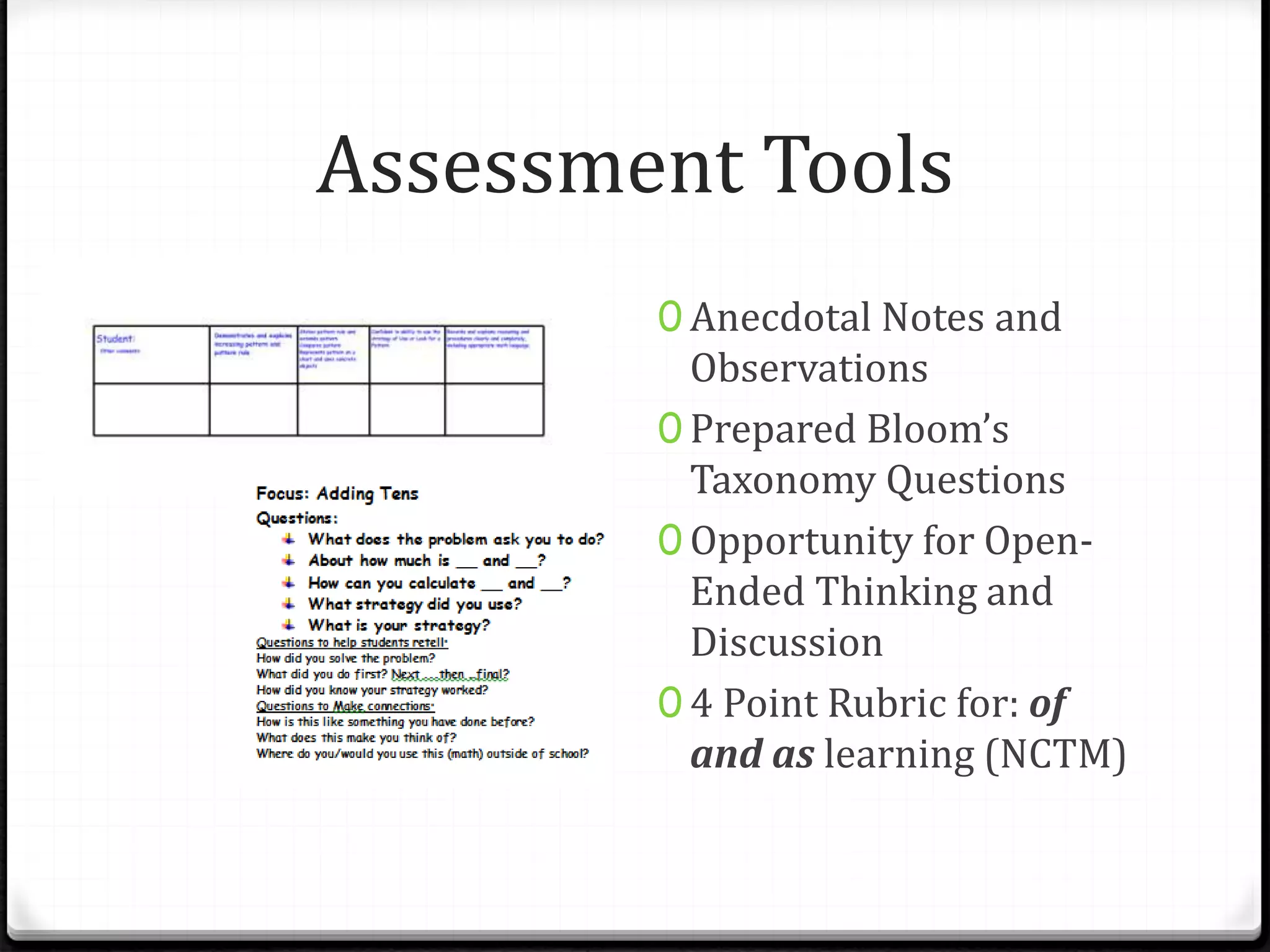
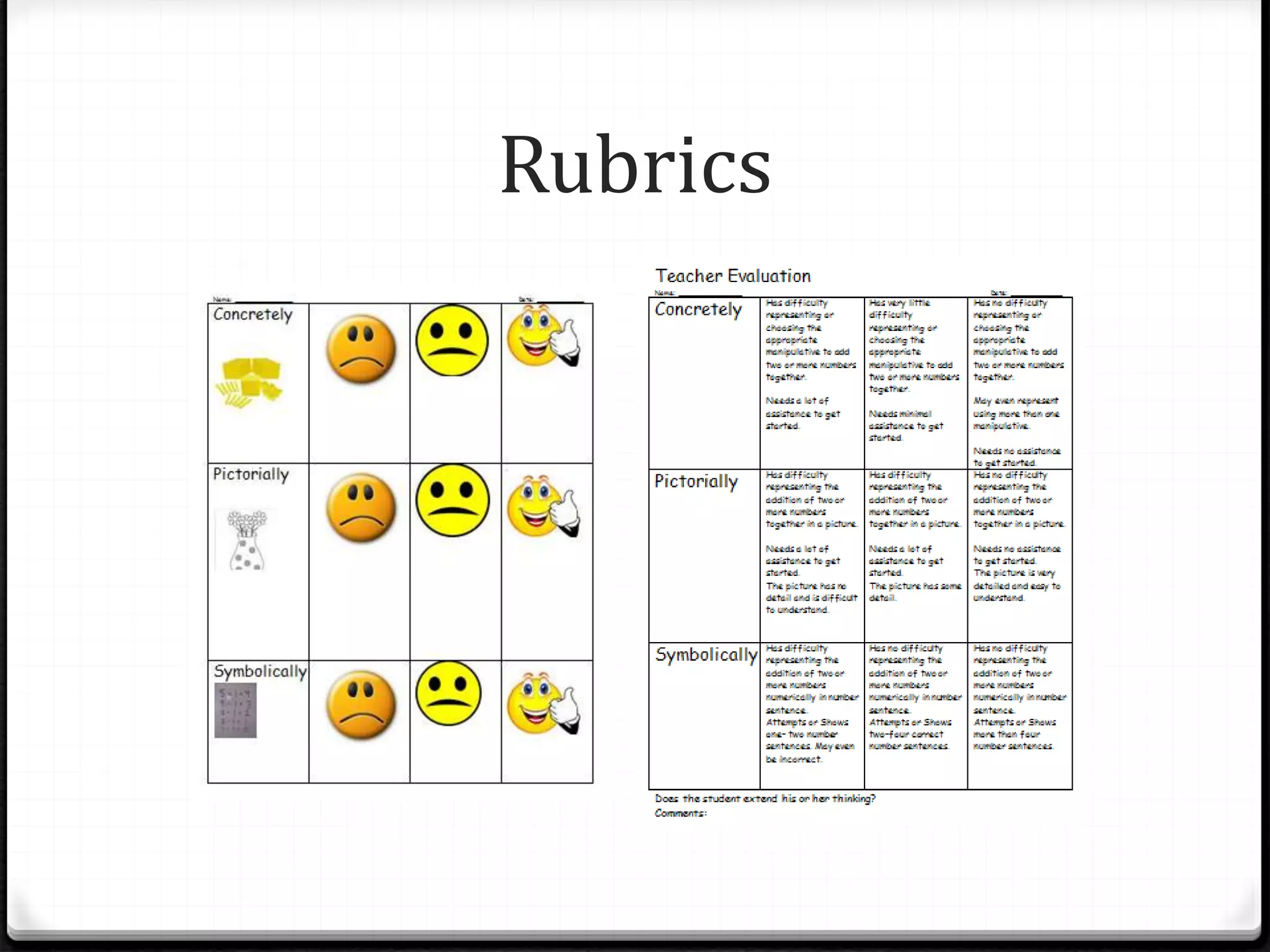
Rubrics
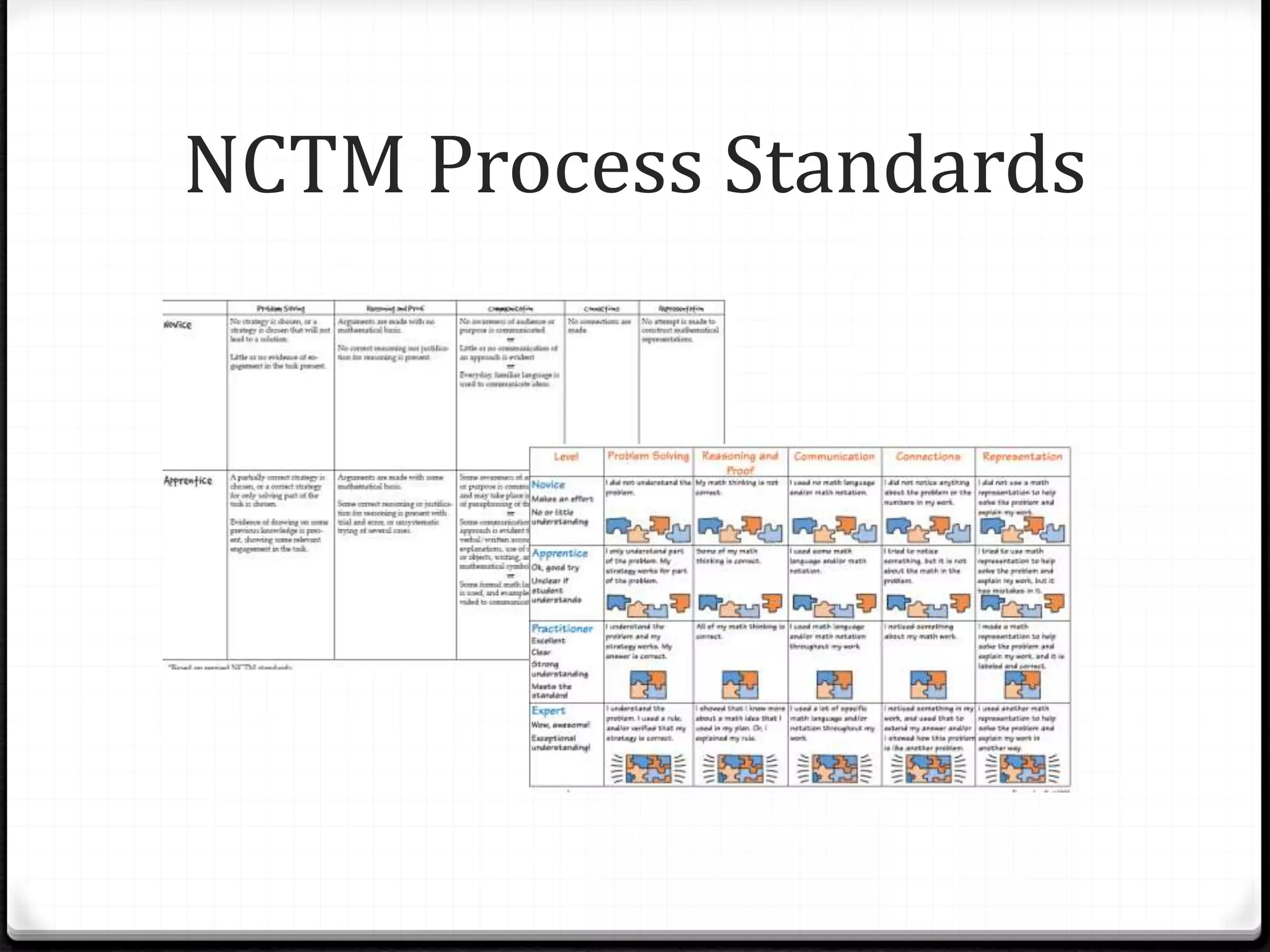
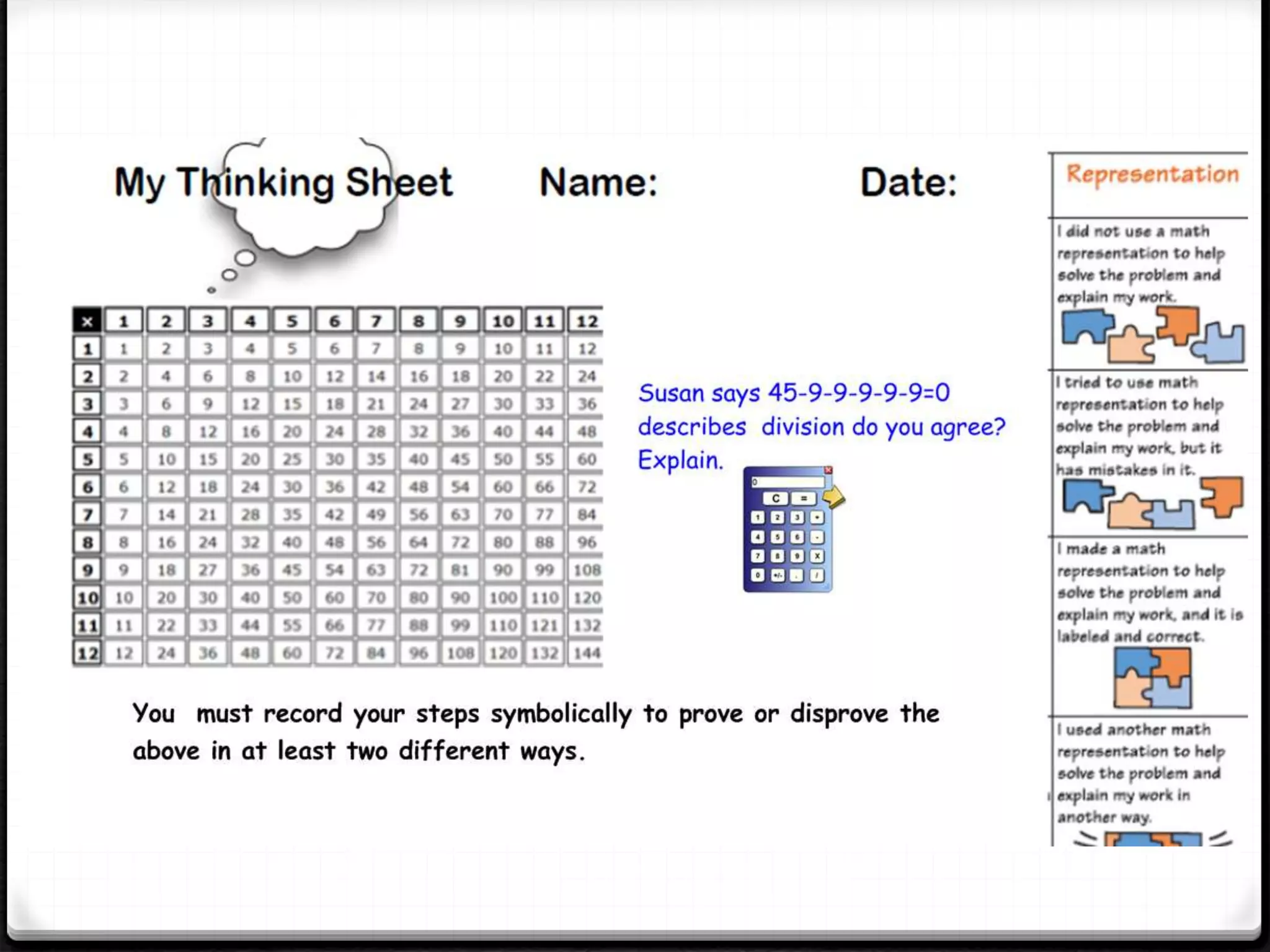
NCTM Process Standards
Documentation of Learning
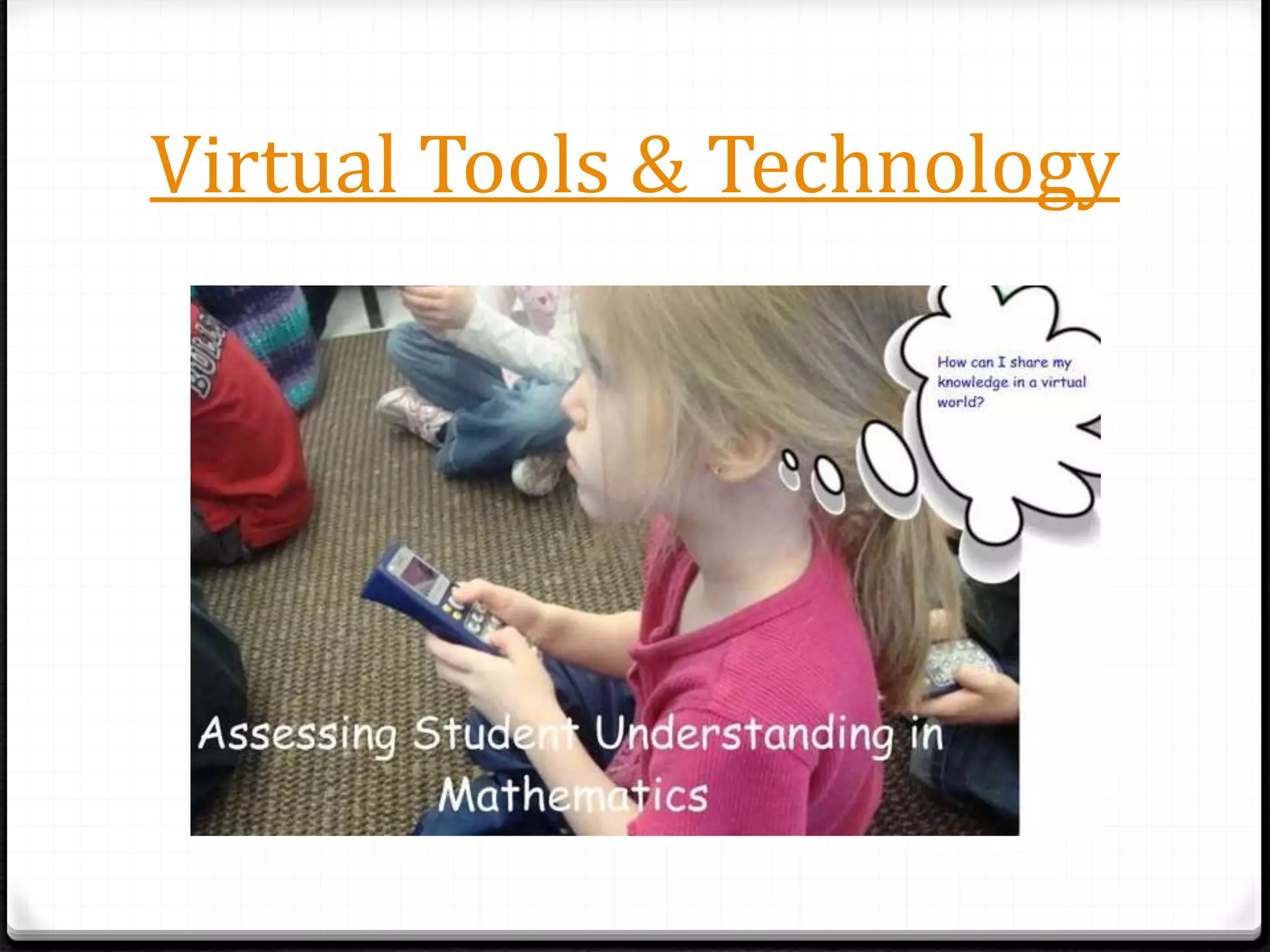
Virtual Tools & Technology
Assessment of Learning
0 Summative Assessment
0 Snapshot in time that lets the teacher, student and their
parents know how well the student completed the learning
task
0 Provides information on student achievement
0 Provides useful reporting information but less affect on
learning
0 Compare Assessment for Learning and Assessment of Learning
Assessment as Learning
0 Develops and supports student’s metacognitive skills
0 Self assessment/Peer Assessment
0 Make sense of information and make connections to
own self
0 Helps students set learning goals
Assessment Strategies and Tools
0 Anecdotal notes
0 Observation checklists
0 Conversations
0 Portfolios
0 Questions and answers
0 Checklists, rating scales and rubrics
Tips for Developing Checklists,
Rating Scales and RubricsTaken from Types of Classroom Assessment Learn Alberta www.learnalberta.ca
1. Use checklists, rating scales and rubrics in relation to outcomes and
standards.
2. Use simple formats that can be understood by students that will
communicate information about students to parents.
3. Ensure the characteristics and descriptors are clear, specific and
observable.
4. Encourage students to assist with constructing appropriate criteria.
5. Ensure that checklists, rating scales and rubrics are dated and track
progress over time.
6. Leave space to record anecdotal notes or comments
7. Use generic templates that become familiar to students to use and to
which various descriptors can be added quickly depending on the
outcome(s) being assessed
8. Provide guidance to students to use to create their own checklists, rating
scales, and rubrics for self-assessment purposes and guidelines for goal
setting.
Developing a Rubric or Rating
Scale
0 What are the specific outcomes in the task?
0 Begin by describing the Acceptable Level then use
Bloom’s Taxonomy to identify differentiating criteria
as you move up the scale. The criteria should not go
on beyond the original performance task but reflect
higher order thinking that students could
demonstrate.
Rating Scales
0 The more precise the descriptors the words are for
each scale, the more reliable the tool.
0 Measures such as frequency (always, usually,
sometimes and never) are better than descriptors
such as quality (fair, good, excellent)
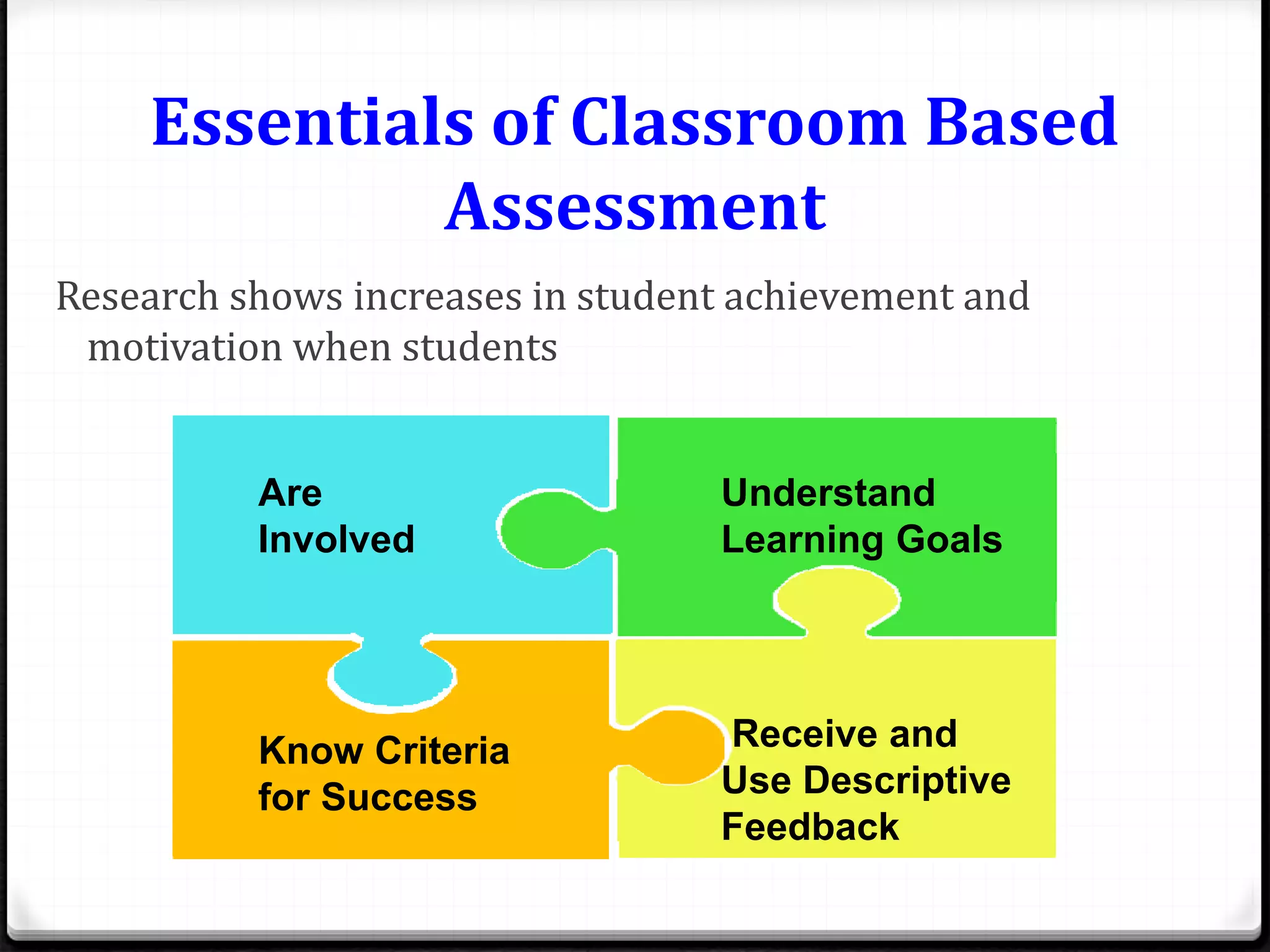
Essentials of Classroom Based
Assessment
Research shows increases in student achievement and
motivation when students
Are
Involved
Understand
Learning Goals
Know Criteria
for Success
Receive and
Use Descriptive
Feedback
Do more
0 Explain purpose and relevance of learning
0 Provide choice and scaffolding toward responsibility
0 Provide opportunities to learn with others
0 Specific, descriptive feedback
0 Self-assessment related to criteria
Do less
0 One form of testing such as pencil-paper
0 Drill and practice for test taking
0 Comparison of students re: test results
0 Competition for marks
Plan the Learning Environment and Instruction
0 What learning opportunities and experiences should I
provide to promote the learning outcomes?
0 What will the learning environment look like?
0 What strategies do children use to access prior
knowledge and continually communicate and
represent understanding?
0 What teaching strategies and resources will I use?
Assess Student Learning and Follow -up
0 What conclusions can be made from assessment
information?
0 How effective have instructional strategies been?
0 What are the next steps for instruction?
0 How will the gaps in the development of
understanding be addressed?
0 How will the children extend their learning?
Reflection
Refer back to:
Jot down the challenges that you face making assessment a part of daily mathematics instruction?
What are two ways that would help you overcome these challenges?
What are some new tools that you learned
today that would help you with your
challenges?
What do you still need?
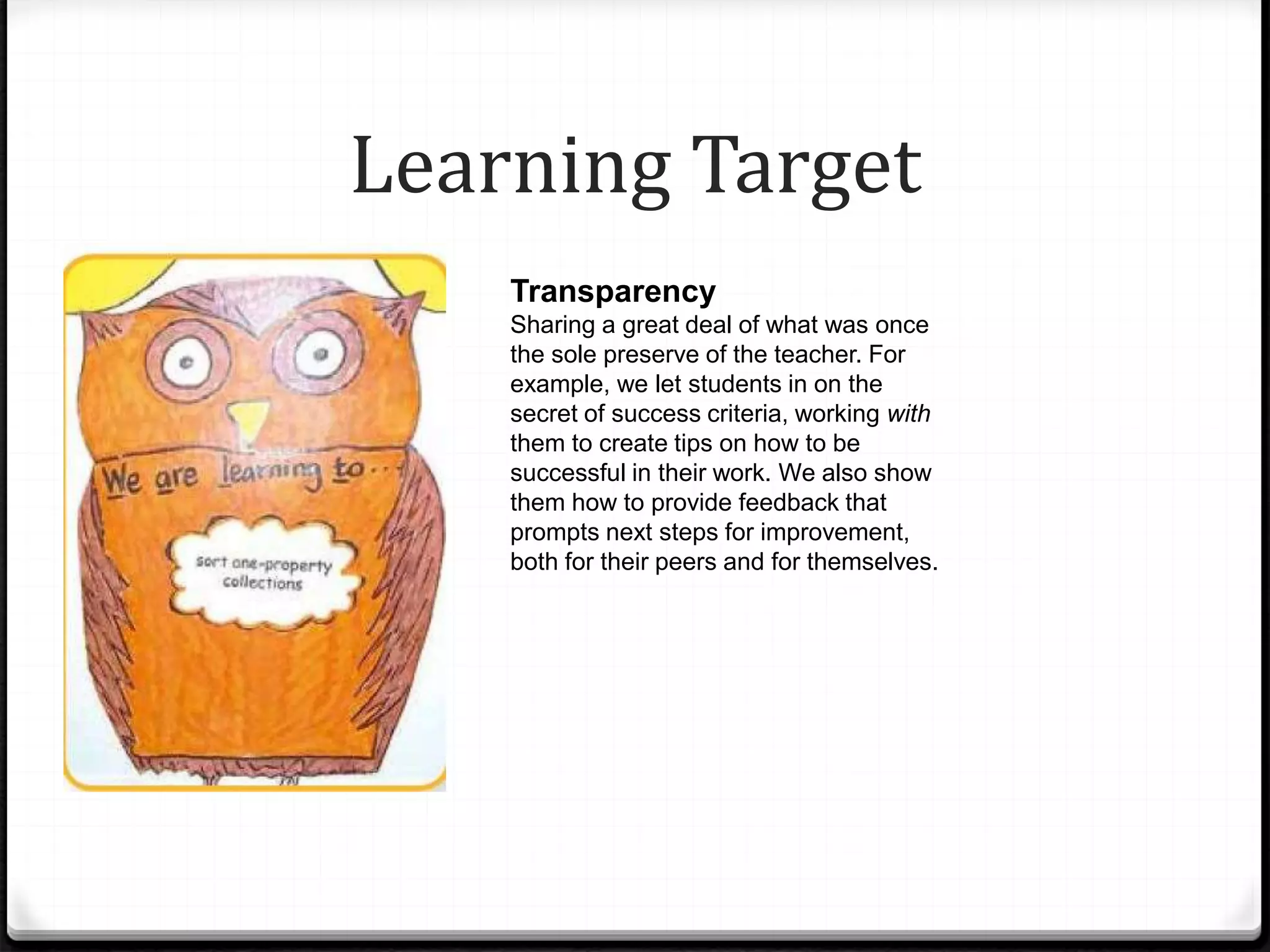
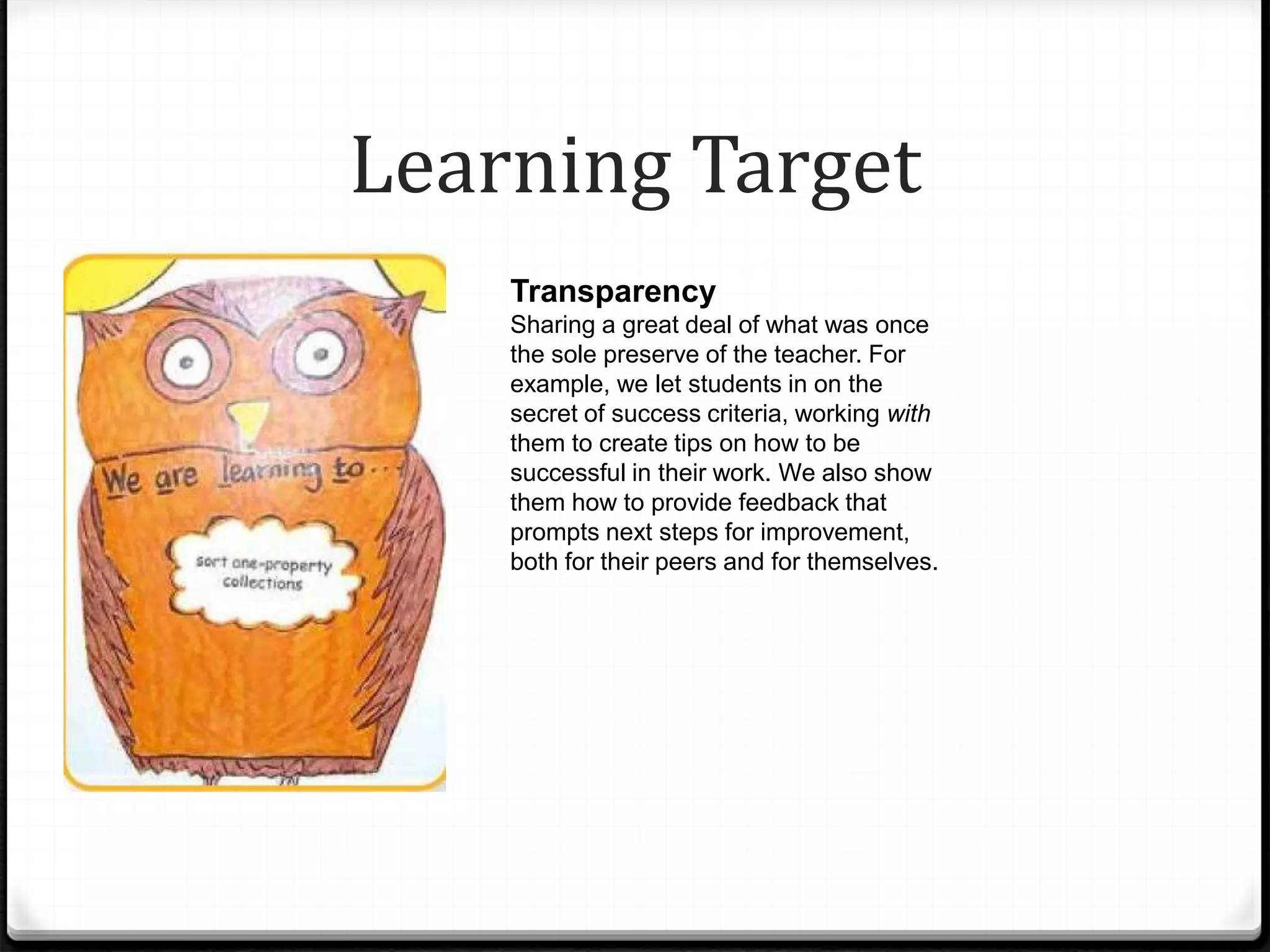
Learning Target
Transparency
Sharing a great deal of what was once
the sole preserve of the teacher. For
example, we let students in on the
secret of success criteria, working with
them to create tips on how to be
successful in their work. We also show
them how to provide feedback that
prompts next steps for improvement,
both for their peers and for themselves.
Focus on the Learning (not
the activity)
0 1. the learning intention: the new learning that pupils
will get from
0 the next stage in their learning programme; and
0 2. success criteria: those parts of the learning activity
that are essential (in helping them to achieve the
learning intention).
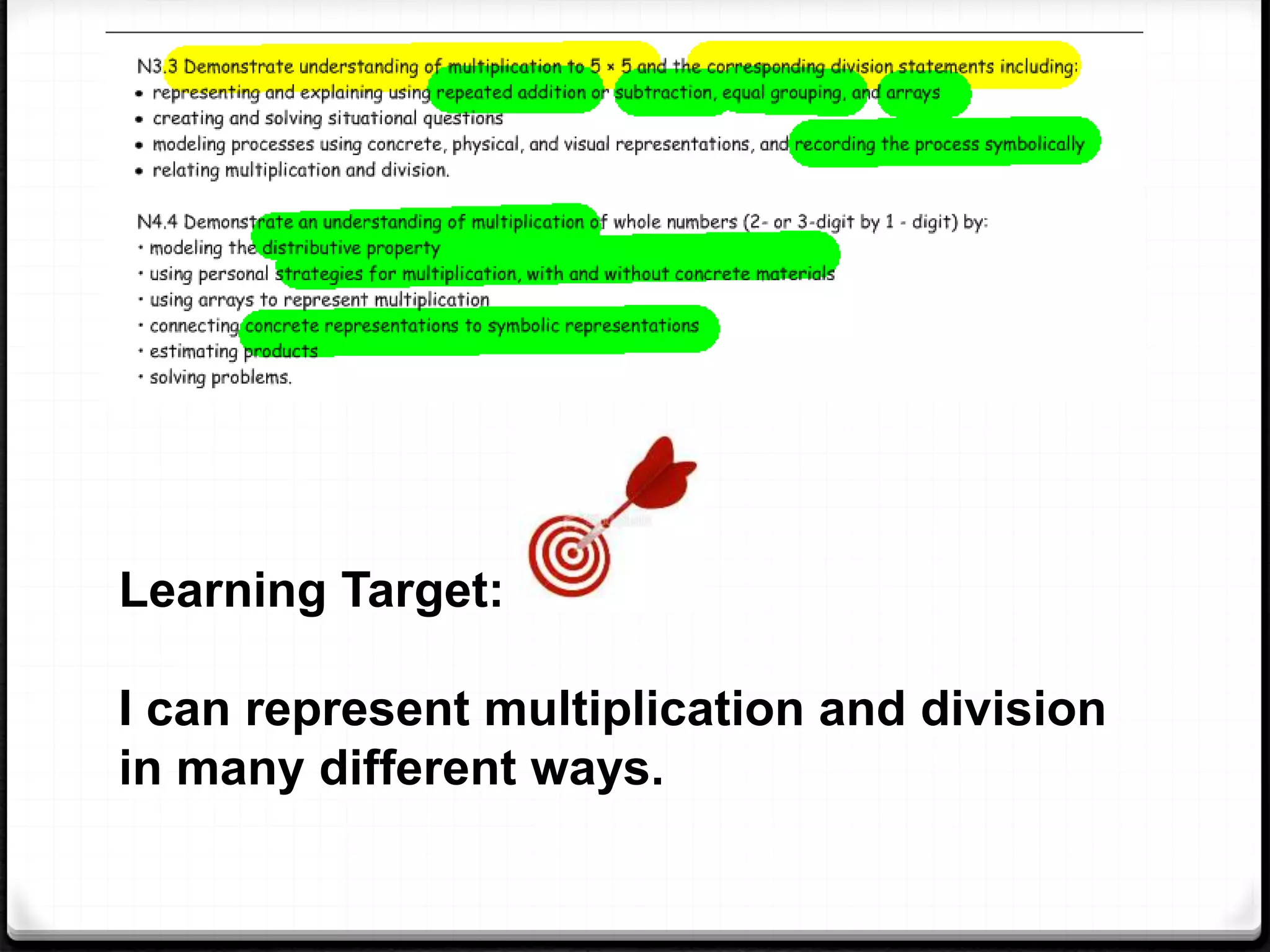
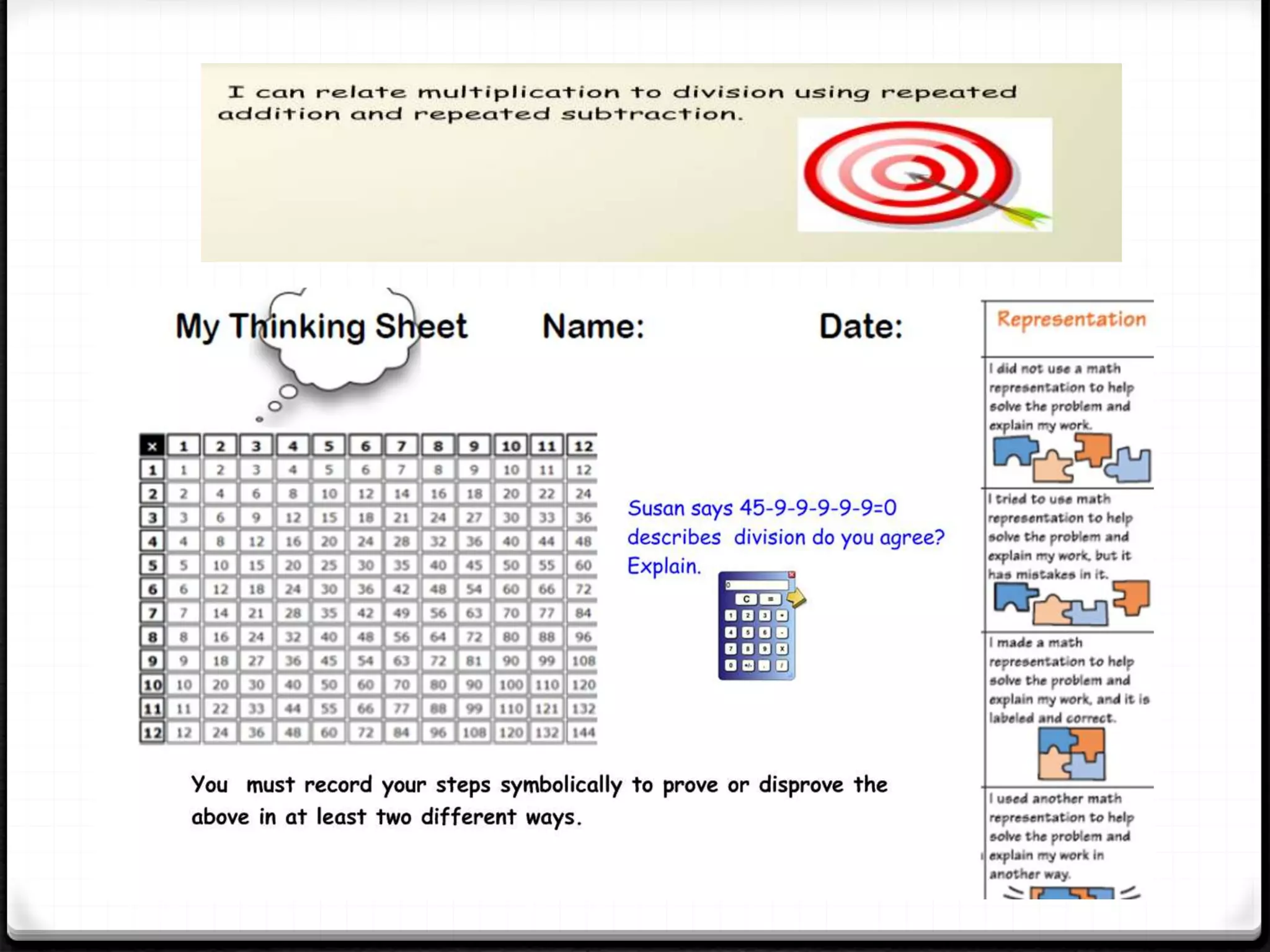
Learning Target:
I can represent multiplication and division
in many different ways.
Details Criteria
Learning Target
Transparency
Sharing a great deal of what was once
the sole preserve of the teacher. For
example, we let students in on the
secret of success criteria, working with
them to create tips on how to be
successful in their work. We also show
them how to provide feedback that
prompts next steps for improvement,
both for their peers and for themselves.
Focus on the Learning (not
the activity)
0 1. the learning intention: the new learning that pupils
will get from
0 the next stage in their learning programme; and
0 2. success criteria: those parts of the learning activity
that are essential (in helping them to achieve the
learning intention).
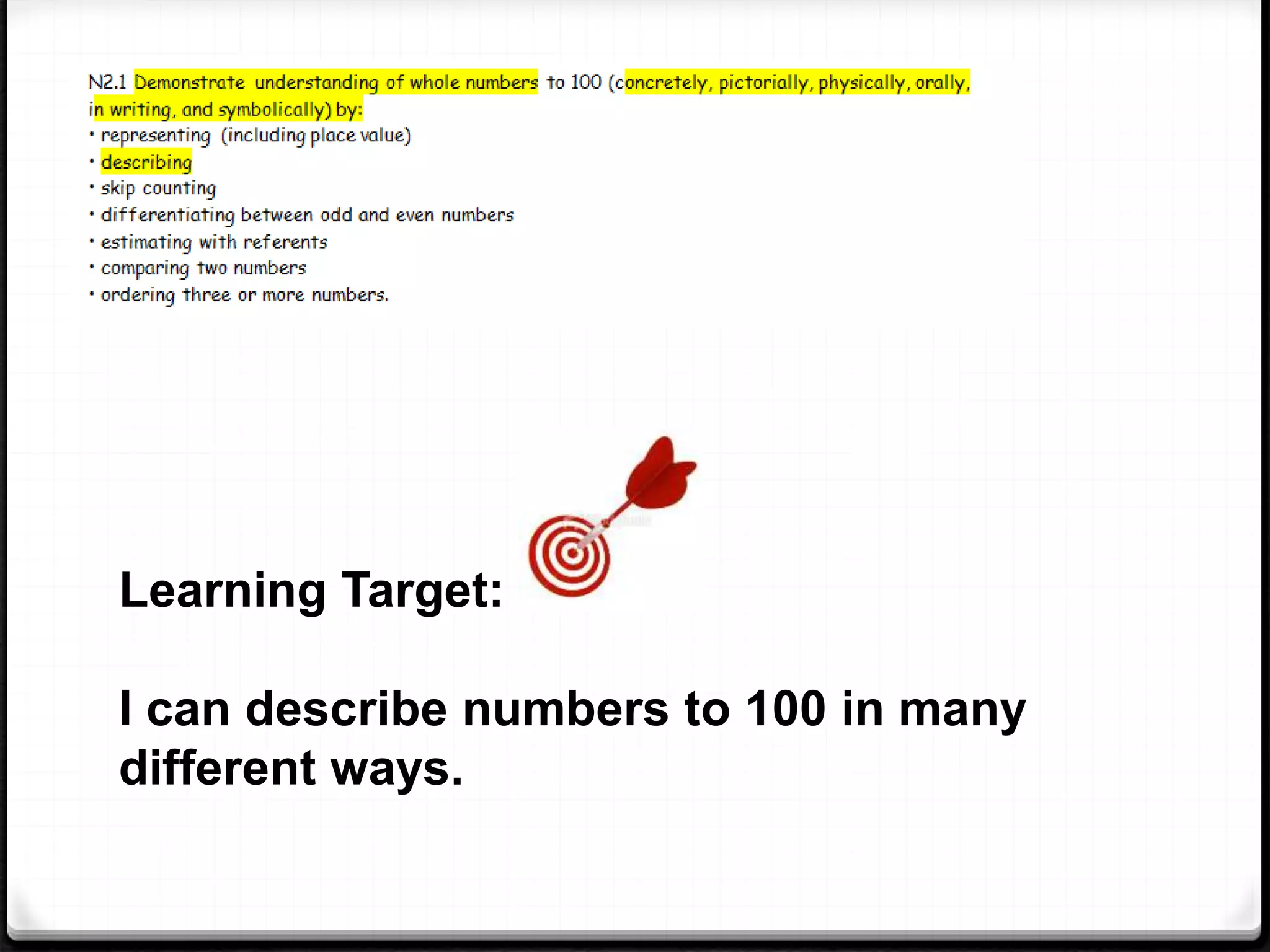
Learning Target:
I can describe numbers to 100 in many
different ways.
Details Criteria
http://smilebox.com/playBlog/4d6a6b344f5
44d314e6a4d3d0d0a&blogview=true
Learning Target
Transparency
Sharing a great deal of what was once
the sole preserve of the teacher. For
example, we let students in on the
secret of success criteria, working with
them to create tips on how to be
successful in their work. We also show
them how to provide feedback that
prompts next steps for improvement,
both for their peers and for themselves.
0 I can find the volume of a rectangular prism.
0 I can find the surface area of a rectangular prism.
Focus on the Learning (not
the activity)
0 1. the learning intention: the new learning that pupils
will get from
0 the next stage in their learning programme; and
0 2. success criteria: those parts of the learning activity
that are essential (in helping them to achieve the
learning intention).
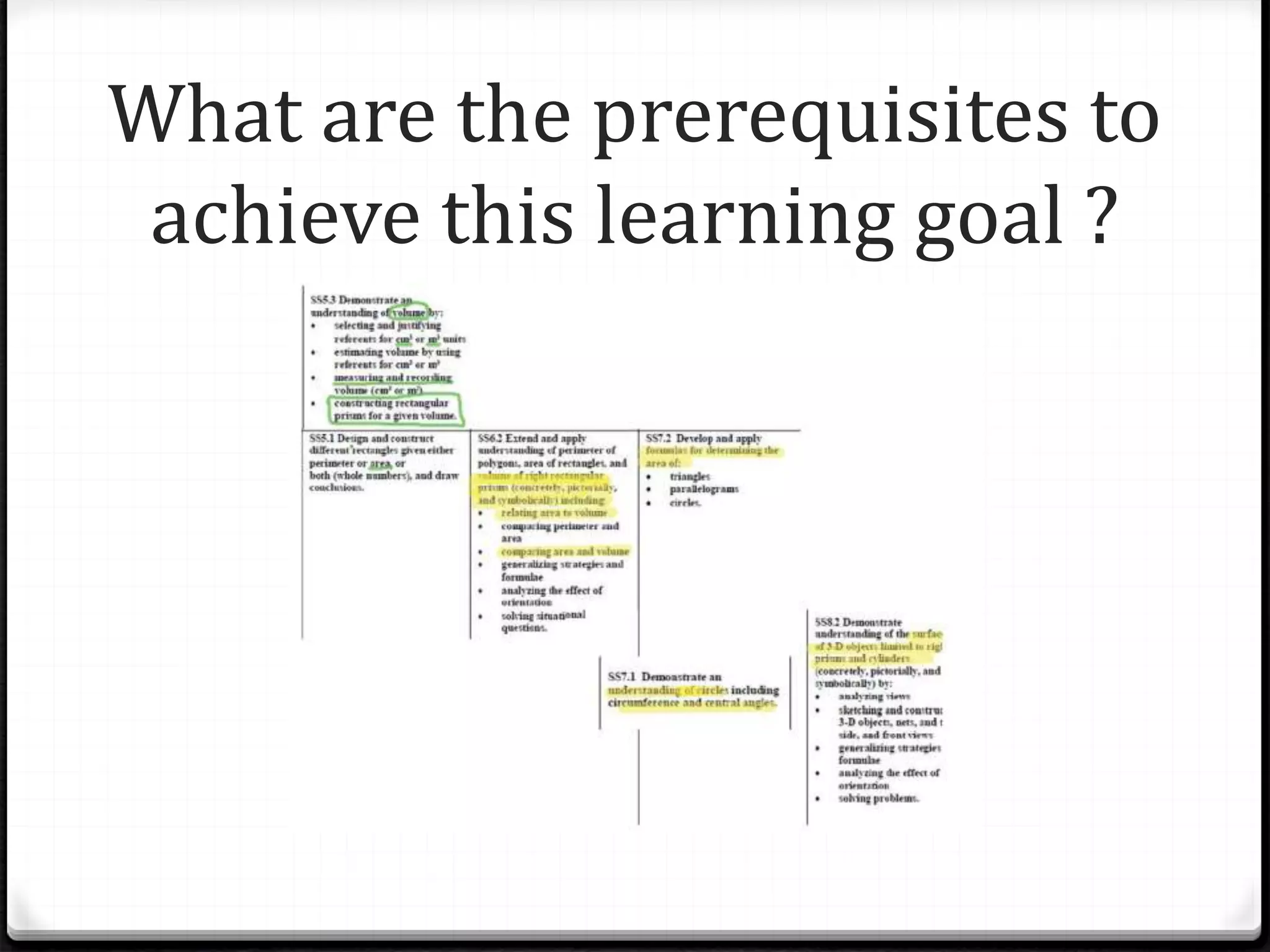
What are the prerequisites to
achieve this learning goal ?
Details Criteria
I can find the surface area of a rectangular prism.
Learning Target:
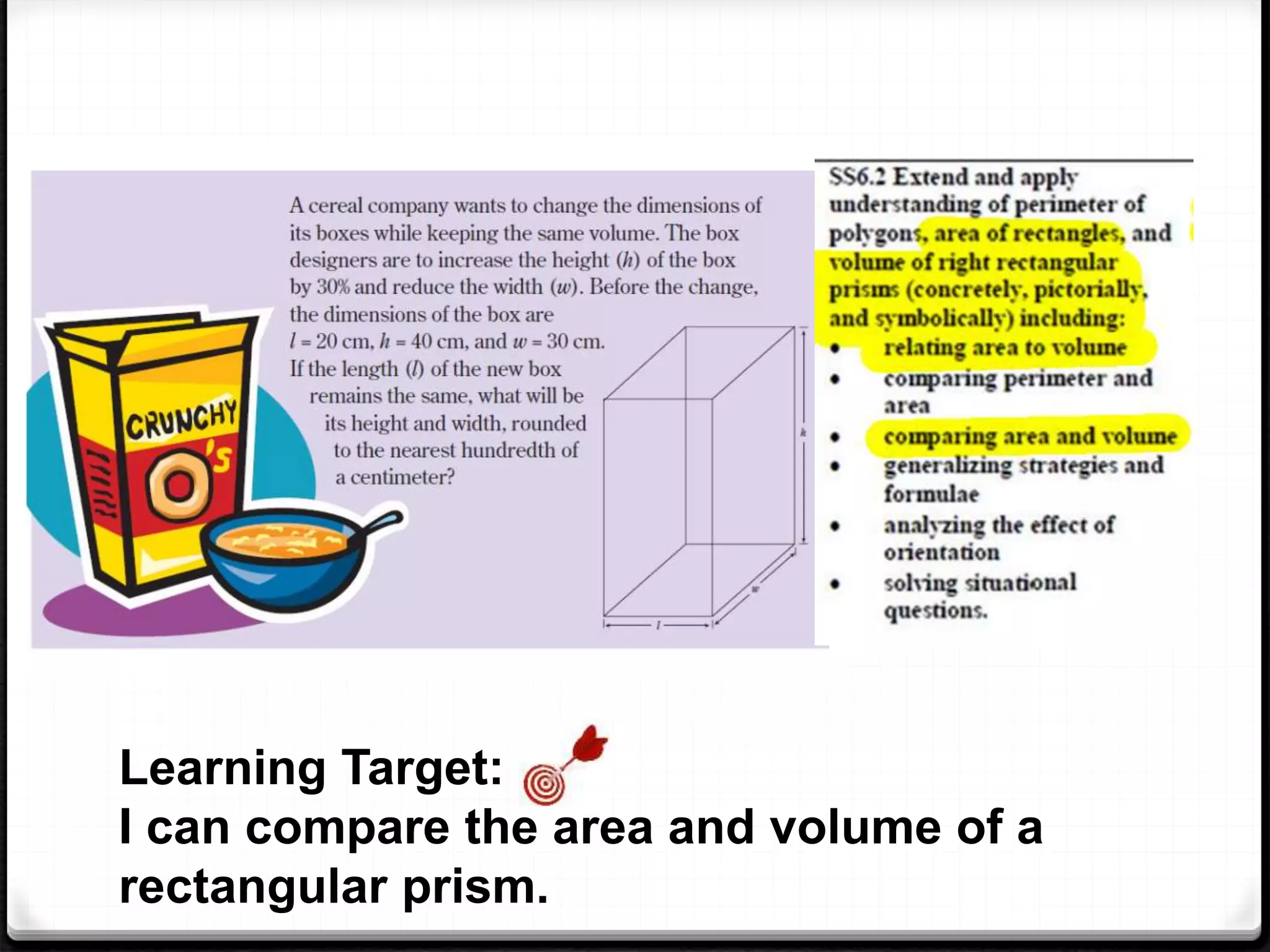
I can compare the area and volume of a
rectangular prism.
Applying formative feedback
0 • Ensure that your students know the criteria for
feedback as they engage in the learning task.
0 • Give feedback that is accurate and realistic by
focusing on the learning intentions and success
criteria.
0 • Use effective questioning, discussion and prompts to
focus on how the learning can be improved.
0 • Model the process of giving feedback, and help
pupils develop the skills and approaches to do it
themselves.
Resources
0 Rethinking Classroom Assessment with Purpose in Mind WNCP
0 Learn Alberta (Assessment)
http://www.learnalberta.ca/content/mewa/html/assessment/process.html
0 Mathematics Assessment a Practical Handbook for grades K-2 NCTM
0 50 Tools and Techniques for Classroom Assessment by Karen Hume
0 http://www.pdesas.org/module/content/resources/6173/view.ashx
0 http://www.shodor.org/interactivate/activities/SurfaceAreaAndVolume/
0 http://youtu.be/QpCTVhETts4
0 http://mathsisinteresting.blogspot.com/2008/08/volume-and-surface-
area-geometrical.html
0 http://www.mathopenref.com/cylinderarea.html

Tools for Assessment

  • 2.
    Types of ClassroomAssessment Making assessment an integral part of daily mathematics is a challenge. It requires planning specific ways to use assignments and discussions to discover what students do and do not understand. It also requires teachers to be prepared to deal with students’ responses. Merely spotting when students are incorrect is relatively easy compared to understanding the reasons behind their errors. Burns 2005, p.31
  • 3.
    Reflection 0 After readingthat passage: Jot down the challenges that you face making assessment a part of daily mathematics instruction? What are two ways that would help you overcome these challenges?
  • 4.
  • 5.
    Assessment for Learning FormativeAssessment:  Assessment and teaching should be integrated into a whole  Ongoing assessment allows teachers to monitor students on a daily basis and modify teaching based on what students need to be successful  Improves our teaching practices  Provides students with timely feedback that they need to make adjustments to their learning.
  • 6.
    Comparing Assessment forLearning and Assessment of Learning Adapted from Ruth Sutton Learn Alberta Assessment for Learning Assessment of Learning Checks learning to determine what to do next and then provides suggestions of what to do –teaching and learning are indistinguishable from assessment. Checks what has been learned to date. Is designed to assist educators and students in improving learning. Is designed for the information of those not directly involved in daily learning and teaching(school administration, parents, school board) in addition to educators and students. Is used continually by providing descriptive feedback. Is presented in a periodic report. Usually uses detailed, specific and descriptive feedback in a formal or informal report. Usually compiles data into a single number, score or mark as a formal report. Is not reported as part of an achievement grade. Is reported as an achievement grade. Usually focuses on improvement, compared with student’s “previous best” (self-referenced, making learning more personal). Usually compares student’s learning either with other student’s learning or the standard grade level. Involves student. Does not always involve the student.
  • 8.
    Identify the Outcomesto be Learned 0 N3.1 Demonstrate understanding of whole numbers to 1000 (concretely, pictorially, physically, orally, in writing, and symbolically) including: 0 representing (including place value) 0 describing 0 estimating with referents 0 comparing two numbers 0 ordering three or more numbers. Learning target: 0 I can describe numbers to 1000 in many different ways.
  • 9.
    Determine How theLearning Will be Observed 0 What will the children do to know that the learning has occurred? 0 What should children do to demonstrate the understanding of the mathematical concepts, skills, and big ideas? 0 What assessment tools will be the most suitable to provide evidence of student understanding? 0 How can I document the children’s learning?
  • 10.
    Assessment Tools 0 AnecdotalNotes and Observations 0 Prepared Bloom’s Taxonomy Questions 0 Opportunity for Open- Ended Thinking and Discussion 0 4 Point Rubric for: of and as learning (NCTM)
  • 11.
  • 12.
  • 13.
  • 14.
    Virtual Tools &Technology
  • 18.
    Assessment of Learning 0Summative Assessment 0 Snapshot in time that lets the teacher, student and their parents know how well the student completed the learning task 0 Provides information on student achievement 0 Provides useful reporting information but less affect on learning 0 Compare Assessment for Learning and Assessment of Learning
  • 19.
    Assessment as Learning 0Develops and supports student’s metacognitive skills 0 Self assessment/Peer Assessment 0 Make sense of information and make connections to own self 0 Helps students set learning goals
  • 20.
    Assessment Strategies andTools 0 Anecdotal notes 0 Observation checklists 0 Conversations 0 Portfolios 0 Questions and answers 0 Checklists, rating scales and rubrics
  • 21.
    Tips for DevelopingChecklists, Rating Scales and RubricsTaken from Types of Classroom Assessment Learn Alberta www.learnalberta.ca 1. Use checklists, rating scales and rubrics in relation to outcomes and standards. 2. Use simple formats that can be understood by students that will communicate information about students to parents. 3. Ensure the characteristics and descriptors are clear, specific and observable. 4. Encourage students to assist with constructing appropriate criteria. 5. Ensure that checklists, rating scales and rubrics are dated and track progress over time. 6. Leave space to record anecdotal notes or comments 7. Use generic templates that become familiar to students to use and to which various descriptors can be added quickly depending on the outcome(s) being assessed 8. Provide guidance to students to use to create their own checklists, rating scales, and rubrics for self-assessment purposes and guidelines for goal setting.
  • 22.
    Developing a Rubricor Rating Scale 0 What are the specific outcomes in the task? 0 Begin by describing the Acceptable Level then use Bloom’s Taxonomy to identify differentiating criteria as you move up the scale. The criteria should not go on beyond the original performance task but reflect higher order thinking that students could demonstrate.
  • 23.
    Rating Scales 0 Themore precise the descriptors the words are for each scale, the more reliable the tool. 0 Measures such as frequency (always, usually, sometimes and never) are better than descriptors such as quality (fair, good, excellent)
  • 24.
    Essentials of ClassroomBased Assessment Research shows increases in student achievement and motivation when students Are Involved Understand Learning Goals Know Criteria for Success Receive and Use Descriptive Feedback
  • 25.
    Do more 0 Explainpurpose and relevance of learning 0 Provide choice and scaffolding toward responsibility 0 Provide opportunities to learn with others 0 Specific, descriptive feedback 0 Self-assessment related to criteria
  • 26.
    Do less 0 Oneform of testing such as pencil-paper 0 Drill and practice for test taking 0 Comparison of students re: test results 0 Competition for marks
  • 27.
    Plan the LearningEnvironment and Instruction 0 What learning opportunities and experiences should I provide to promote the learning outcomes? 0 What will the learning environment look like? 0 What strategies do children use to access prior knowledge and continually communicate and represent understanding? 0 What teaching strategies and resources will I use?
  • 28.
    Assess Student Learningand Follow -up 0 What conclusions can be made from assessment information? 0 How effective have instructional strategies been? 0 What are the next steps for instruction? 0 How will the gaps in the development of understanding be addressed? 0 How will the children extend their learning?
  • 29.
    Reflection Refer back to: Jotdown the challenges that you face making assessment a part of daily mathematics instruction? What are two ways that would help you overcome these challenges? What are some new tools that you learned today that would help you with your challenges? What do you still need?
  • 31.
    Learning Target Transparency Sharing agreat deal of what was once the sole preserve of the teacher. For example, we let students in on the secret of success criteria, working with them to create tips on how to be successful in their work. We also show them how to provide feedback that prompts next steps for improvement, both for their peers and for themselves.
  • 32.
    Focus on theLearning (not the activity) 0 1. the learning intention: the new learning that pupils will get from 0 the next stage in their learning programme; and 0 2. success criteria: those parts of the learning activity that are essential (in helping them to achieve the learning intention).
  • 33.
    Learning Target: I canrepresent multiplication and division in many different ways.
  • 34.
  • 38.
    Learning Target Transparency Sharing agreat deal of what was once the sole preserve of the teacher. For example, we let students in on the secret of success criteria, working with them to create tips on how to be successful in their work. We also show them how to provide feedback that prompts next steps for improvement, both for their peers and for themselves.
  • 39.
    Focus on theLearning (not the activity) 0 1. the learning intention: the new learning that pupils will get from 0 the next stage in their learning programme; and 0 2. success criteria: those parts of the learning activity that are essential (in helping them to achieve the learning intention).
  • 40.
    Learning Target: I candescribe numbers to 100 in many different ways.
  • 41.
  • 42.
  • 44.
    Learning Target Transparency Sharing agreat deal of what was once the sole preserve of the teacher. For example, we let students in on the secret of success criteria, working with them to create tips on how to be successful in their work. We also show them how to provide feedback that prompts next steps for improvement, both for their peers and for themselves. 0 I can find the volume of a rectangular prism. 0 I can find the surface area of a rectangular prism.
  • 45.
    Focus on theLearning (not the activity) 0 1. the learning intention: the new learning that pupils will get from 0 the next stage in their learning programme; and 0 2. success criteria: those parts of the learning activity that are essential (in helping them to achieve the learning intention).
  • 46.
    What are theprerequisites to achieve this learning goal ?
  • 47.
    Details Criteria I canfind the surface area of a rectangular prism.
  • 48.
    Learning Target: I cancompare the area and volume of a rectangular prism.
  • 49.
    Applying formative feedback 0• Ensure that your students know the criteria for feedback as they engage in the learning task. 0 • Give feedback that is accurate and realistic by focusing on the learning intentions and success criteria. 0 • Use effective questioning, discussion and prompts to focus on how the learning can be improved. 0 • Model the process of giving feedback, and help pupils develop the skills and approaches to do it themselves.
  • 50.
    Resources 0 Rethinking ClassroomAssessment with Purpose in Mind WNCP 0 Learn Alberta (Assessment) http://www.learnalberta.ca/content/mewa/html/assessment/process.html 0 Mathematics Assessment a Practical Handbook for grades K-2 NCTM 0 50 Tools and Techniques for Classroom Assessment by Karen Hume 0 http://www.pdesas.org/module/content/resources/6173/view.ashx 0 http://www.shodor.org/interactivate/activities/SurfaceAreaAndVolume/ 0 http://youtu.be/QpCTVhETts4 0 http://mathsisinteresting.blogspot.com/2008/08/volume-and-surface- area-geometrical.html 0 http://www.mathopenref.com/cylinderarea.html

Editor's Notes

  • #3 The latter demands careful attention and deep knowledge of the mathematic concepts and principles that students are learning…The insights we gain by making assessment a regular part of instruction enable us to meet the needs of students who are eager for more challenges and to provide intervention for those who are struggling.Take a moment to read the passage through once and then one more time, thinking more deeply about the words.
  • #4 -Quick writeOver the next hour, we will look at two of the three components of assessment. Assessment for learning and assessment as learning.You will have a chance to look at a few samples of assessment, as well you will be creating your own assessment tools.
  • #8 This type of assessment is ongoing and occurs throughout the student’s learning process. It is designed to make the student’s understanding visible, so teachers can decide what they can do to help students progress.In assessment for learning, teachers use assessment as a tool to find out what students can do, and what confusions, perceptions or gaps they might have.How do I do this?This is what takes place in the first steps of the planning process.
  • #11 Show teachers some of the tools that I have prepared for the lesson.