MEANING:
a process bywhich information
is obtained relative to some
known objective or goal.
the systematic basis for
making inferences about the
learning and development of
students.
3.
identify academicweaknesses and
strengths so that educators can provide
specialized academic support,
educational programming, or social
services to improve educational
programs.
systematic collection, review, and use
of information about educational
programs undertaken for the purpose
of improving student learning and
development
4.
NATURE
embedded in thelearning process
tightly interconnected with curriculum and
instruction
involves students and teachers in continuous
monitoring of students’ learning
gives students a measure of their progress
as learners
helps in collection of frequent feedback on
students’ learning and how they respond to
particular teaching approaches
5.
“Assessment” includes allthose activities
undertaken by teachers, and by their students
in assessing themselves, which provide
information to be used as feedback to modify
the teaching and learning activities in which
they are engaged
ROLE
it plays a constant role in informing
instruction, guiding the students’ next steps,
and checking the progress and achievements
Assessments’ role plays in supporting and improving
student learning; and the most important part of it is
the interpretation and use of the information that is
gleaned for its intended purpose
6.
CONCEPTS OF ASSESSMENT
The ultimate purpose of assessment for
learning is to create self-regulated learners
who can leave school able, and confident to
continue learning throughout their lives
Teachers need to know the outset, where their
students are in terms of their learning and then
continually check on how they are progressing
through strengthening the feedback they get
from their learners
We are continually faced with the challenge of
assessing the progress of our students as well as
our own effectiveness as teachers.
7.
MEASUREMENT
is thequantification of what students have
learned through the use of tests,
questionnaires, rating scales, checklist and
other devices
It answers the question; “how much does a
student learn or know”
ASSESSMENT
refers to the full range of information gathered
and synthesized by teachers about their students
and their classrooms
It looks into: “how much change has occurred on the
student’s acquisition of a skill, knowledge or value
before and after a given learning experience.”
8.
EVALUATION
is a processof making judgments,
assigning value or deciding on the
worth of students performance.
It answers the question; “how good,
adequate or desirable is it”
EDUCATIONAL MANAGEMENT
Knowledge of the subject matter: can
be measured through standardized test
results (the measurement procedure is
testing)
9.
can be measuredthrough perceptions: (ask a
group of experts to rate student’s/teacher’s
knowledge of the subject matter in a scale of 1
to 5)
TYPES OF MEASUREMENT
Objective (as in testing) more stable
than subjective measurements in the sense that
repeated measurements of the same quantity or
quality of interest will produce more or less the
same outcome
Subjective (as in perception) some
facets which cannot be captured by objective
procedures which can be done by subjective
methods
10.
EDUCATIONAL ASSESSMENT
Assessmentis a method of evaluating
personality in which an individual, living in a
group meets and solves a variety of lifelike
problems.
3 Principal Features of Assessment
The use of a variety of techniques
Reliance on observations
Integration of information
Assessment focuses not only on the nature of the
learner but also on what to be learned and how
it is to be learned.
11.
RELEVANCE OF ASSESSMENT
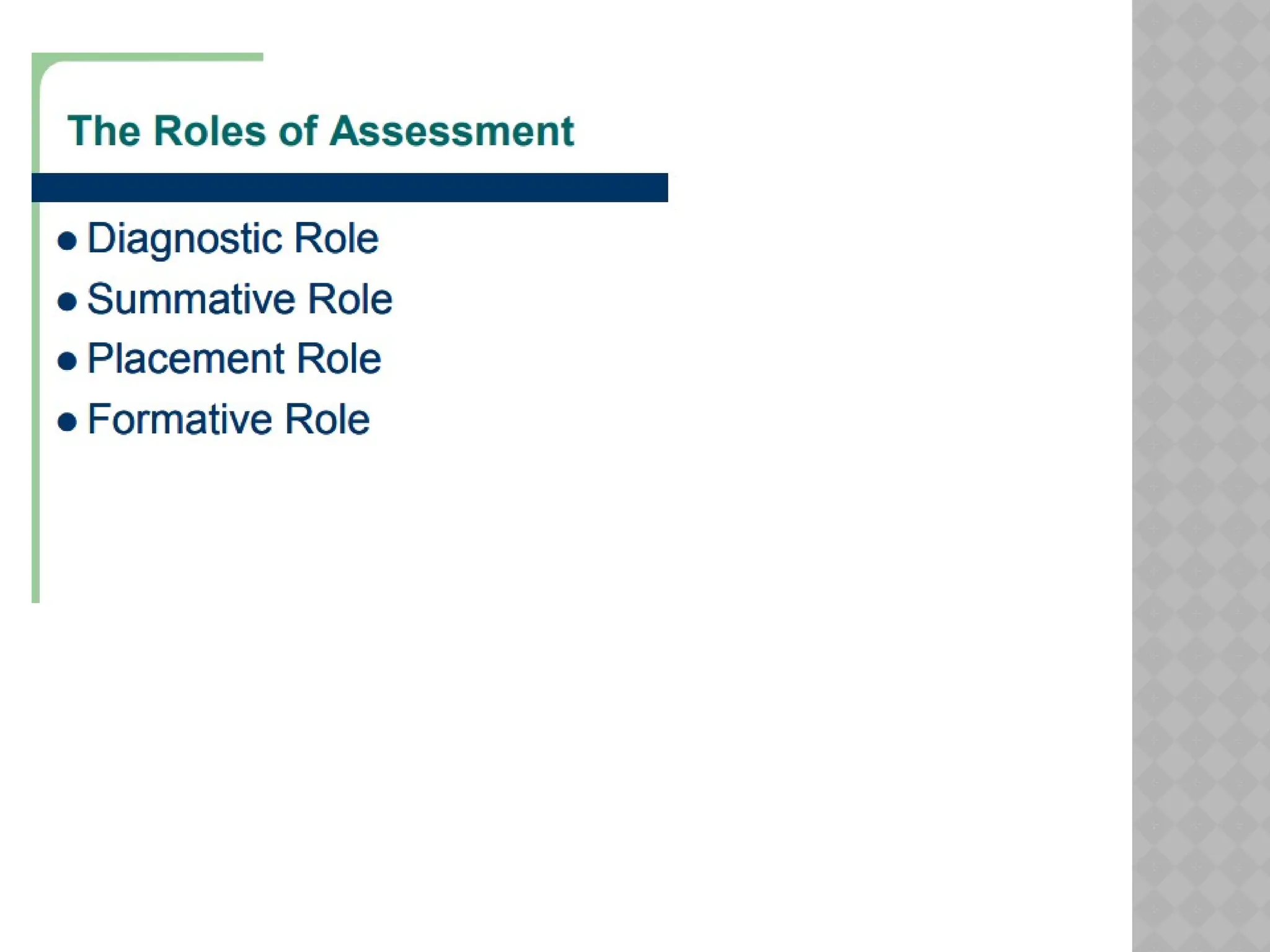
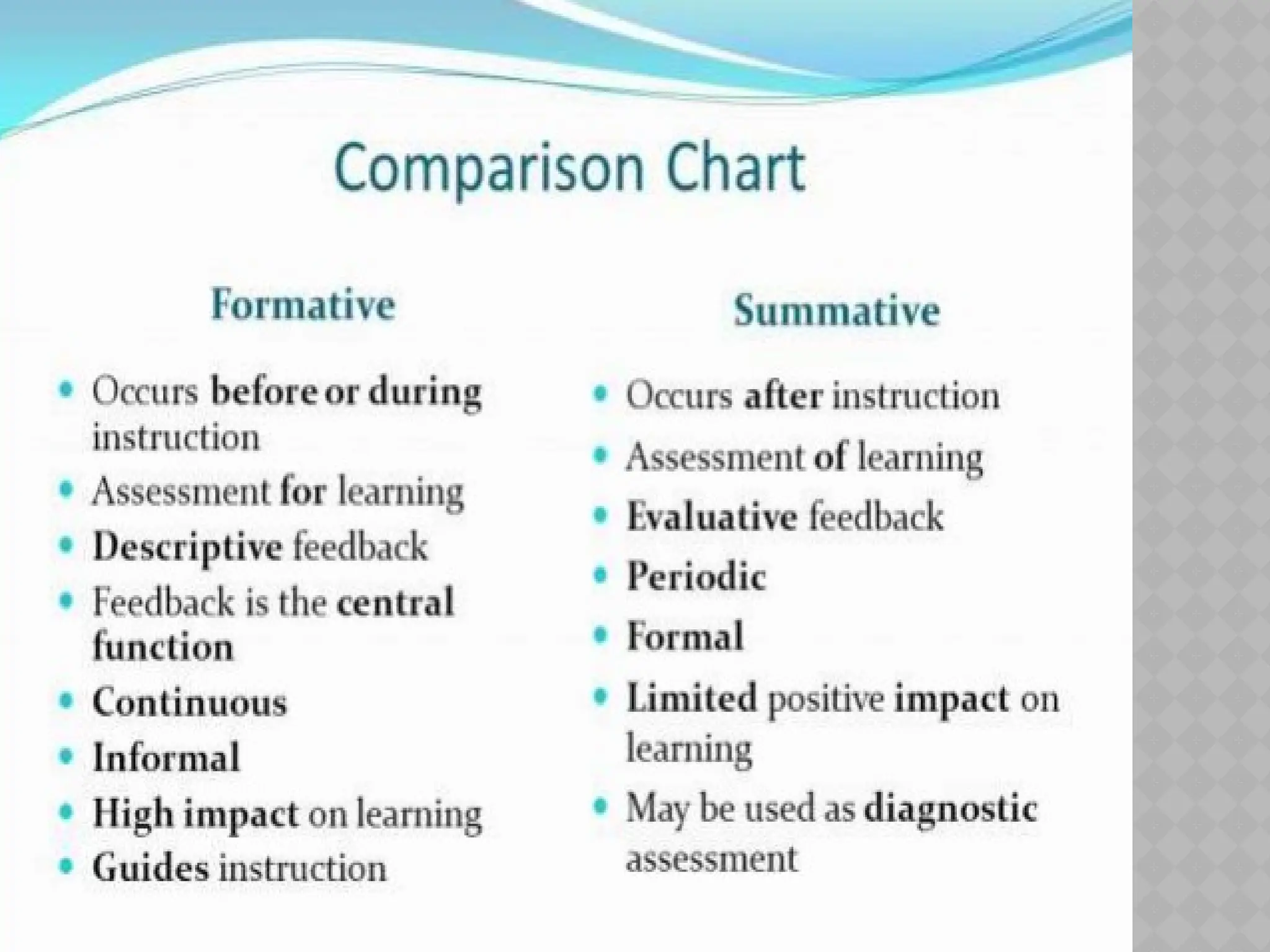
Assessment for learning: where assessment
helps teachers gain insight into what students
understand in order to plan and guide instruction,
and provide helpful feedback to students.
this includes three types of assessment done before
and during instruction. These are placement,
formative and diagnostic.
12.
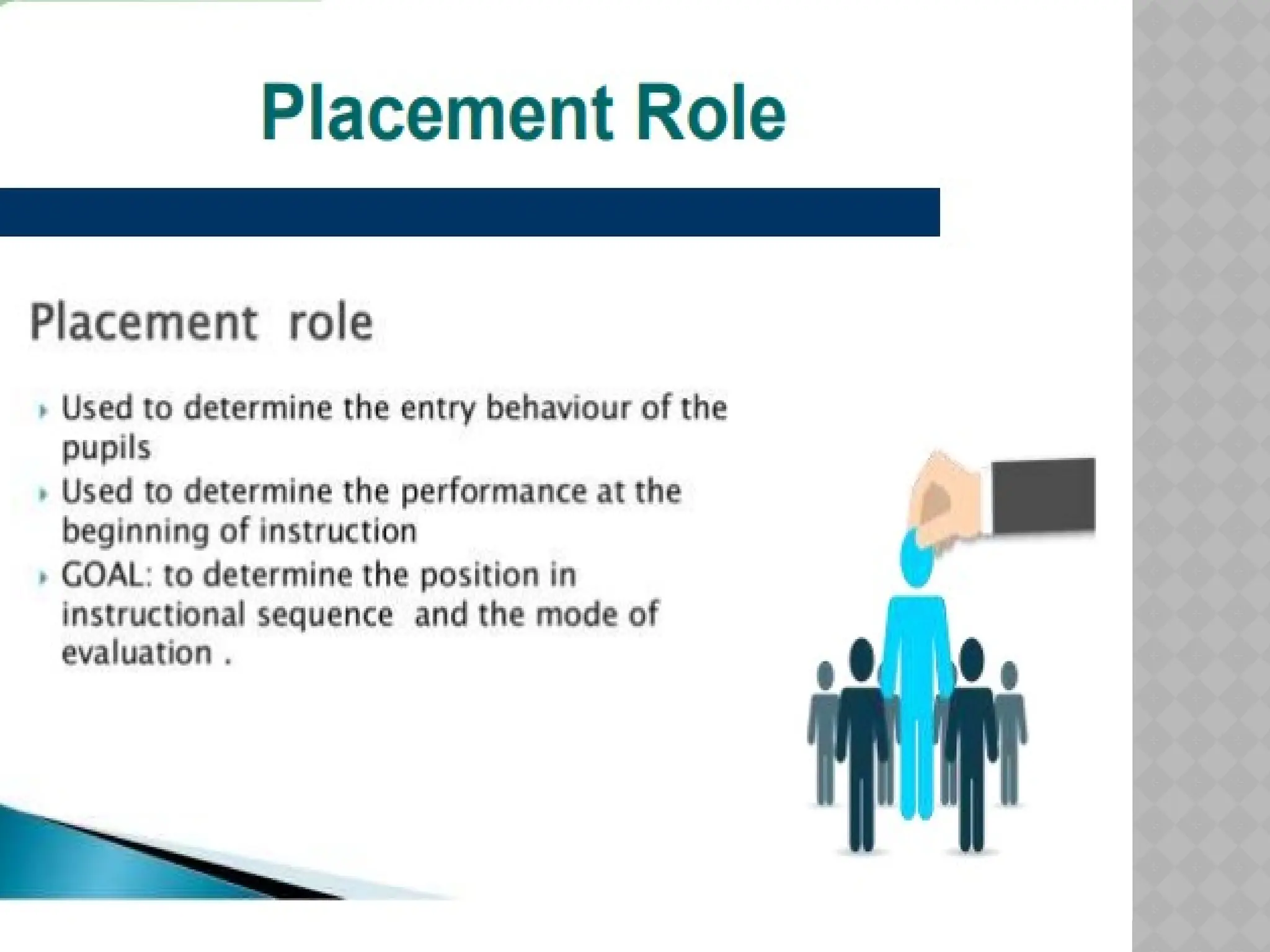
Placement—done prior toinstruction
Its purpose is to assess the needs of the learners to have basis in
planning for a relevant instruction
Teachers use this assessment to know what their students are
bringing into learning situation and use this as a starting point for
instruction.
The results of this assessment place students in specific learning
groups to facilitate teaching and learning
Formative—done during instruction
This assessment is where teachers continuously monitor the
students’ level of attainment of the learning objectives (Stiggins,
2005)
The results of this assessment are communicated clearly and
promptly to the students for them to know their strengths and
weaknesses and the progress of their learning.
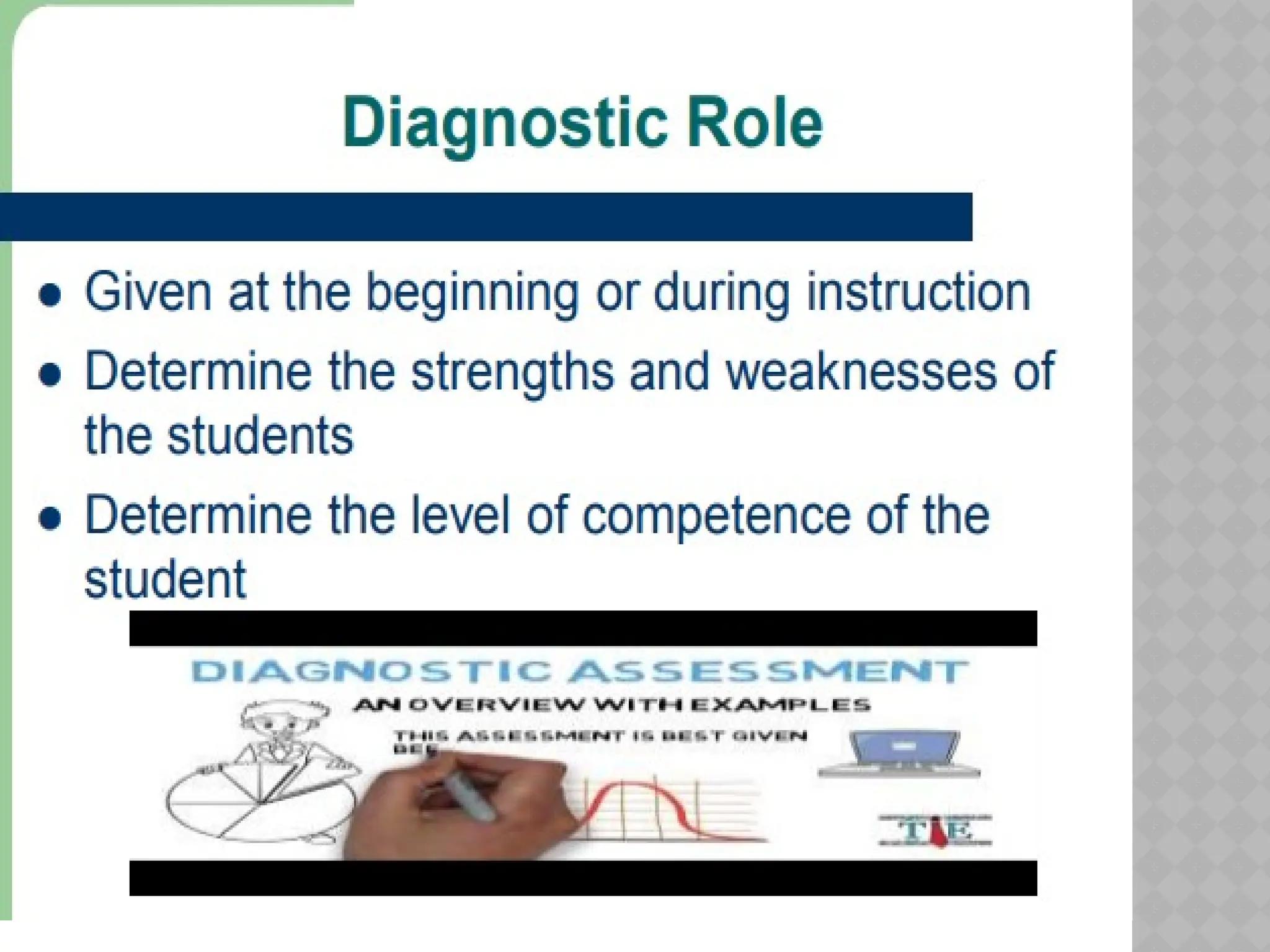
Diagnostic – done during instruction
This is used to determine students’ recurring or persistent
difficulties
It searches for the underlying causes of students’ learning
problems that do not respond to first aid treatment
It helps formulate a plan for detailed remedial instruction
13.
Assessment as learning:where students
develop an awareness of how they learn and use
that awareness to adjust and advance their
learning, taking an increased responsibility for
their learning.
this is done for teachers to understand and
perform well their role of assessing FOR and OF
learning.
It requires teachers to undergo training on how
to assess learning and be equipped with the
following competencies needed in performing
their work as assessors.
14.
Assessment of learning:where assessment
informs students, teachers and parents, as well
as the broader educational community, of
achievement at a certain point in time in order to
celebrate success, plan interventions and support
continued progress.
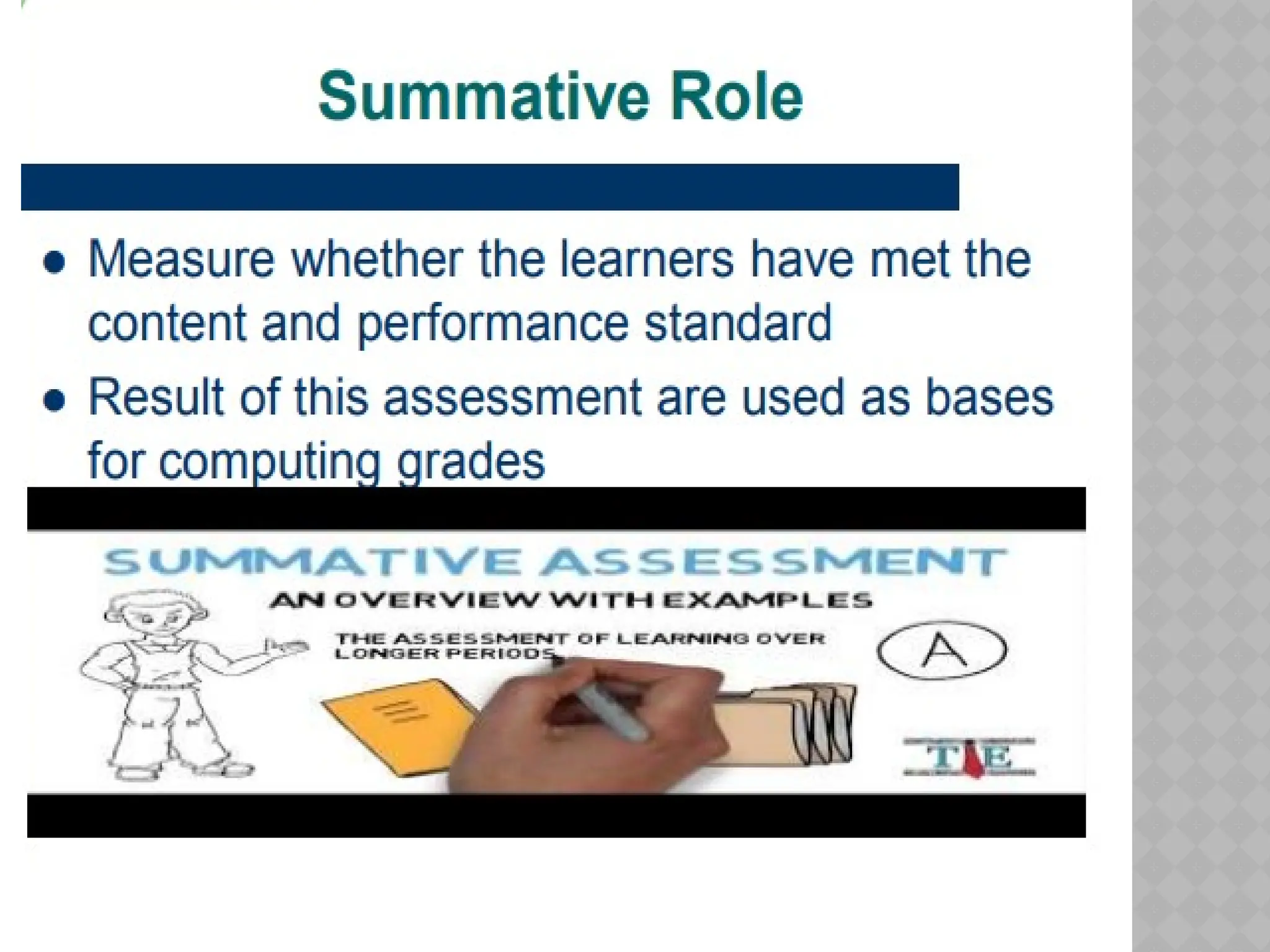
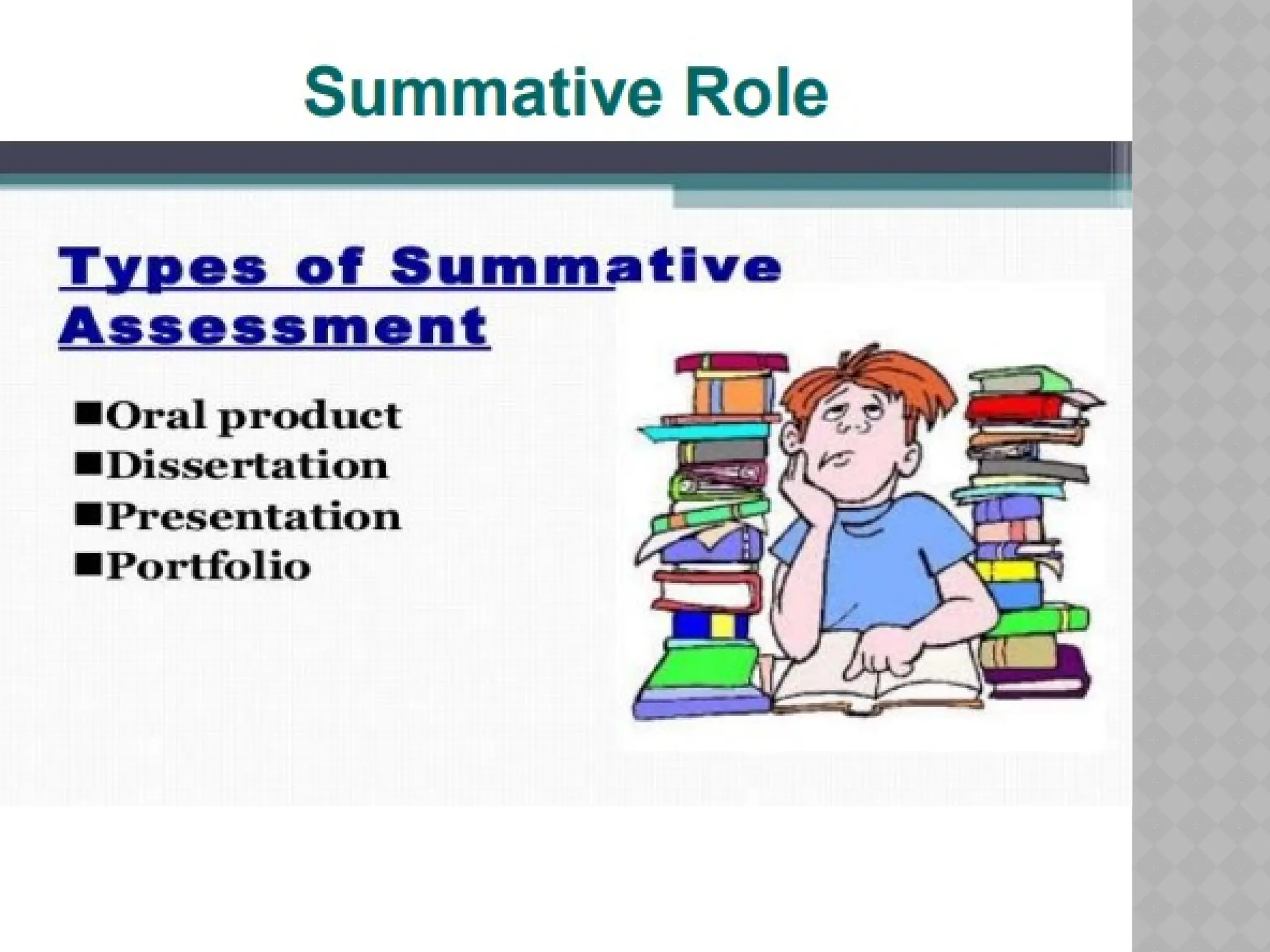
this is done after instruction. This is usually
referred to as the summative assessment
It is used to certify what students know and can do and the level
of their proficiency or competency
Its results reveal whether or not instructions have successfully
achieved the curriculum outcomes
The information form assessment of learning is usually expressed as
marks or letter grades
The results of which are communicated to the students, parents,
and other stakeholders for decision-making
It is also a powerful factor that could pave the way for educational
reforms
15.
RESEARCH AND EXPERIENCESHOW THAT
STUDENT LEARNING IS BEST SUPPORTED WHEN;
Instruction and assessment are based on clear
learning goals Instruction and assessment are
differentiated according to student learning needs
Students are involved in the learning process; (they
understand the learning goal and the criteria for
quality work, receive and use descriptive feedback,
and take steps to adjust their performance)
16.
Assessment information isused to make decisions
that support further learning
Parents are well informed about their child’s
learning, and work with the school to help plan and
provide support
Students, families, and the general public have
confidence in the system
The primary role of assessment is to enhance
teaching and improve student learning and supports
this through the respective agencies and department.
Assessment is a key component of learning because
it helps students learn. When students are able to see
how they are doing in a class, they are able to
determine whether or not they understand course
material. Assessment can also help motivate
students. ... Just as assessment helps students,
assessment helps teachers.
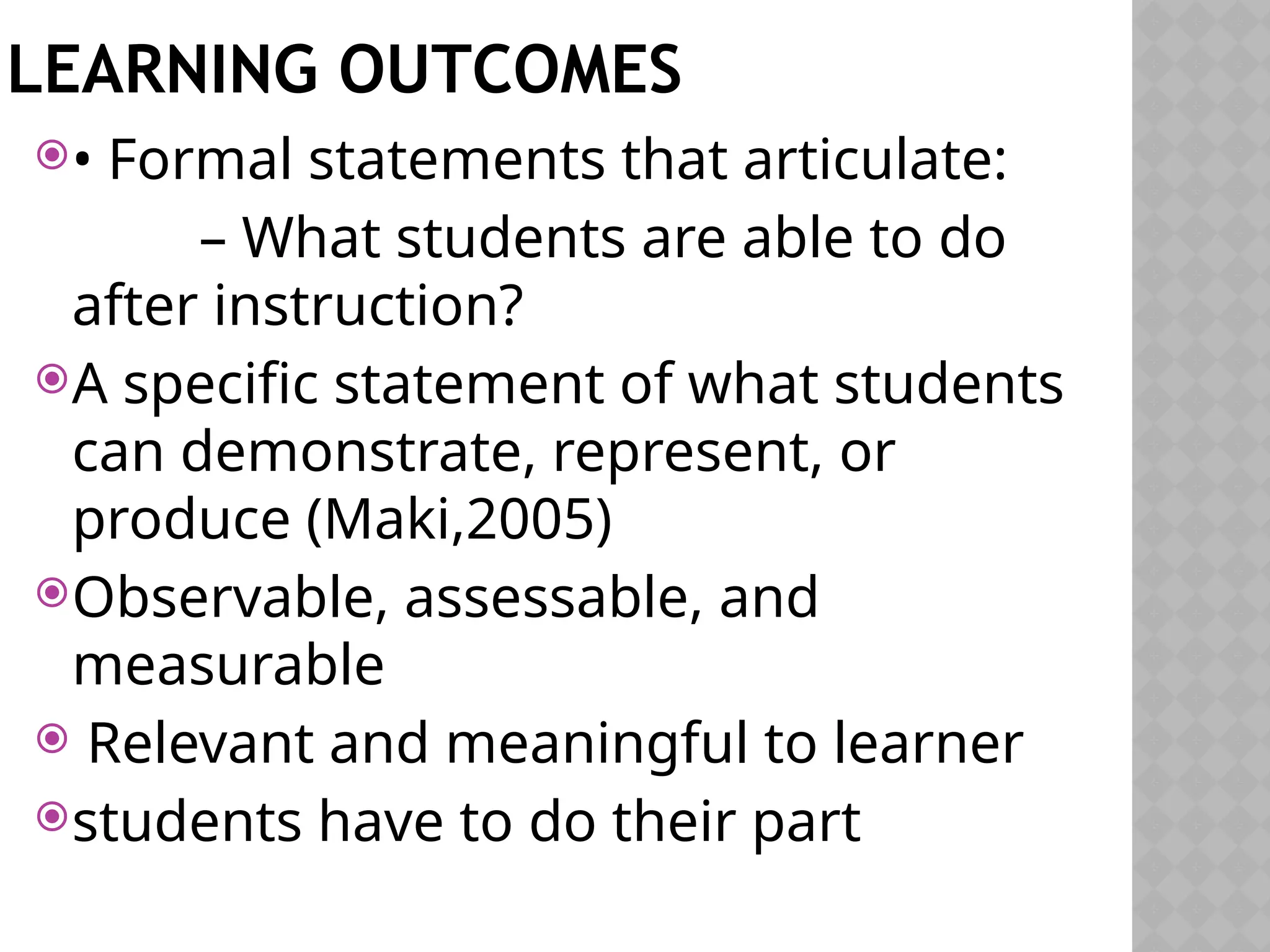
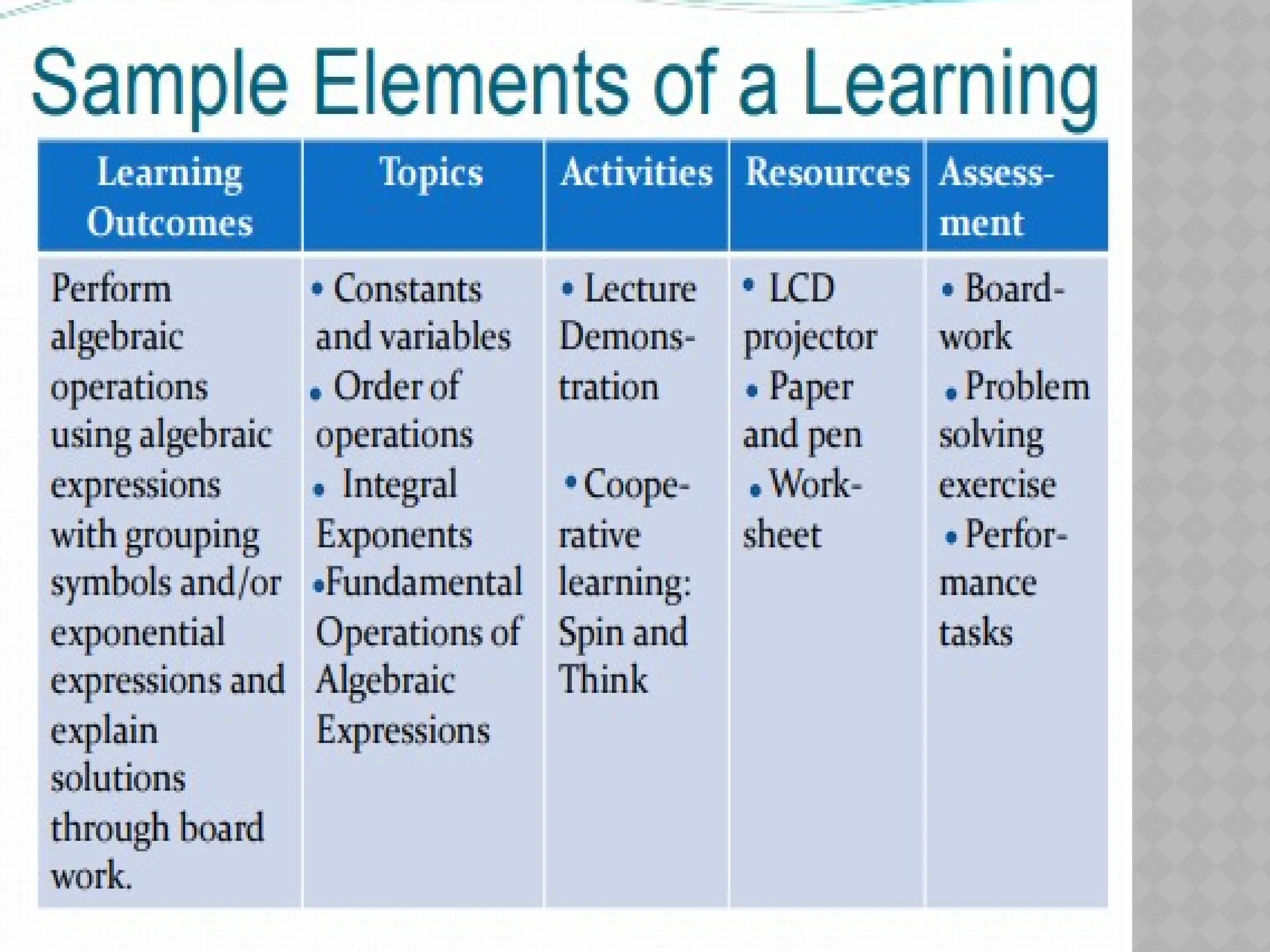
LEARNING OUTCOMES
• Formalstatements that articulate:
– What students are able to do
after instruction?
A specific statement of what students
can demonstrate, represent, or
produce (Maki,2005)
Observable, assessable, and
measurable
Relevant and meaningful to learner
students have to do their part
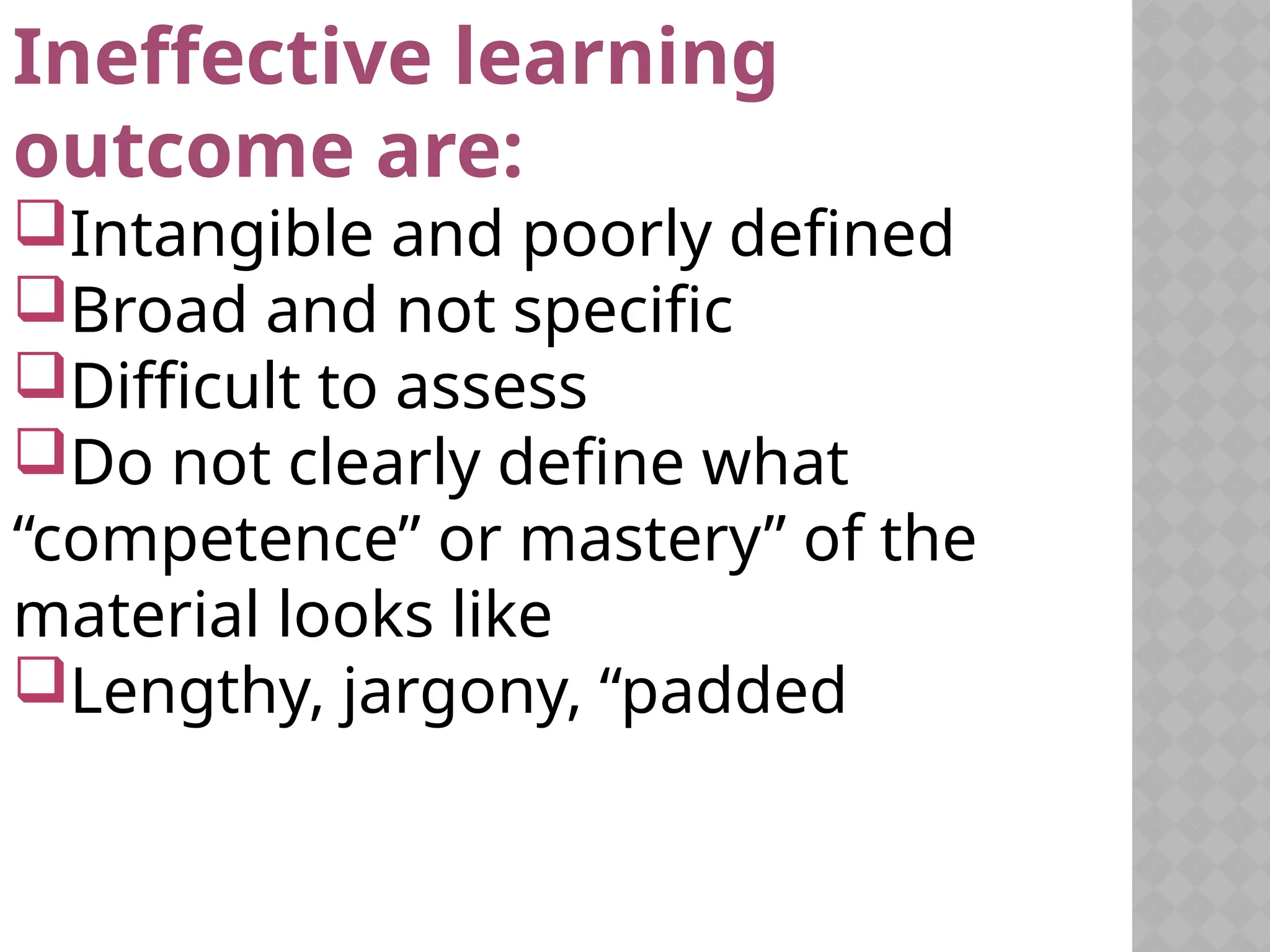
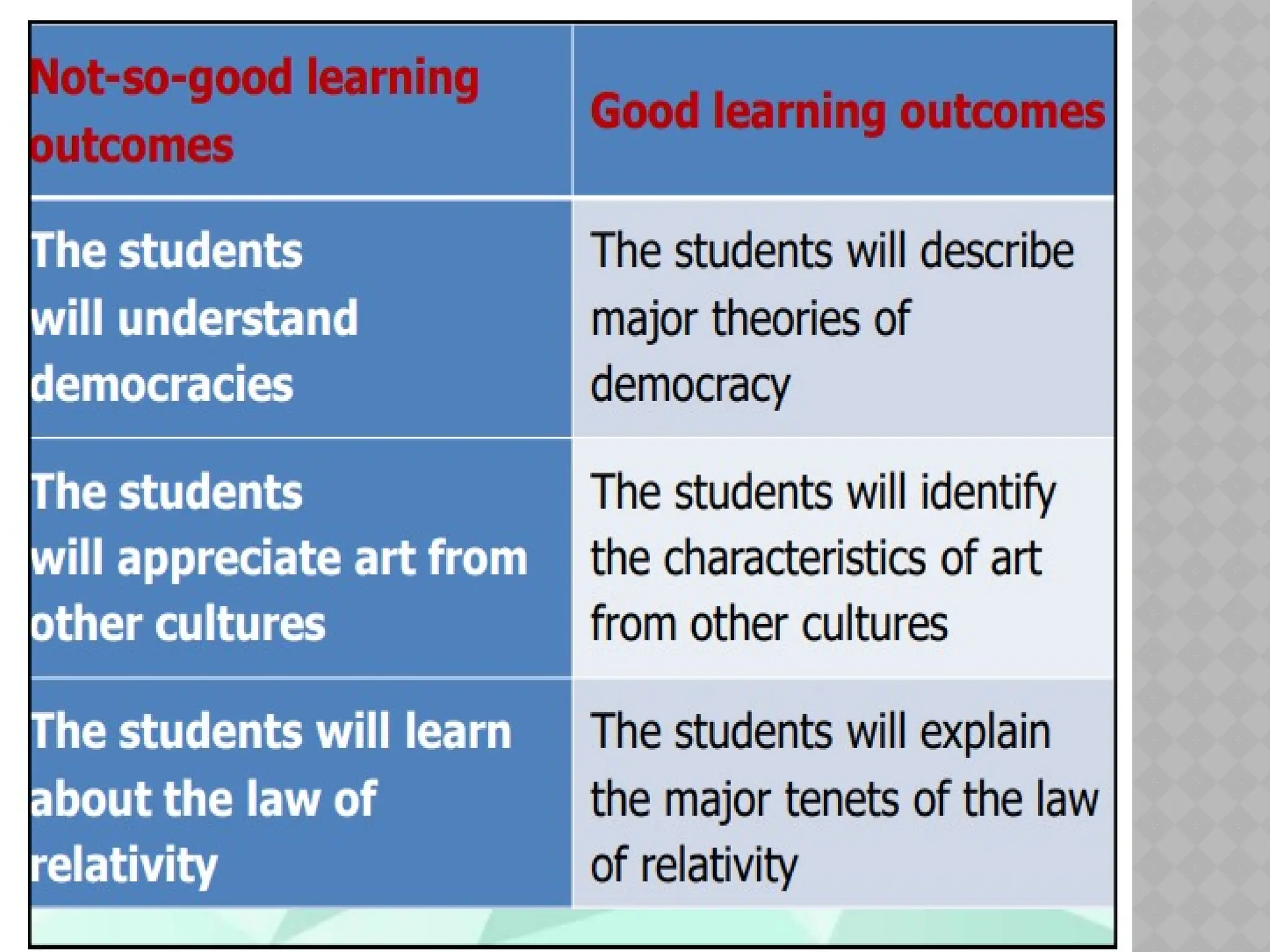
Ineffective learning
outcome are:
Intangibleand poorly defined
Broad and not specific
Difficult to assess
Do not clearly define what
“competence” or mastery” of the
material looks like
Lengthy, jargony, “padded
30.
PARTS OF LEARNINGOUTCOME
“A” for AUDIENCE Who?
Make our learning outcomes student-centered
TSWBAT= the student will be able to
TLSBAT= the learner should be able to
“B” for BEHAVIOR
What do you expect them to be able to do as a result
of the learning?
“C” for CRITERIA
What constitutes a minimum acceptable performance?
31.
HOW TO WRITELEARNING
OUTCOMES
Remember to consider the student's perspective
when writing learning outcomes and ask what
should the student be able to know, do at the end
of this unit that they could not do at the
beginning.
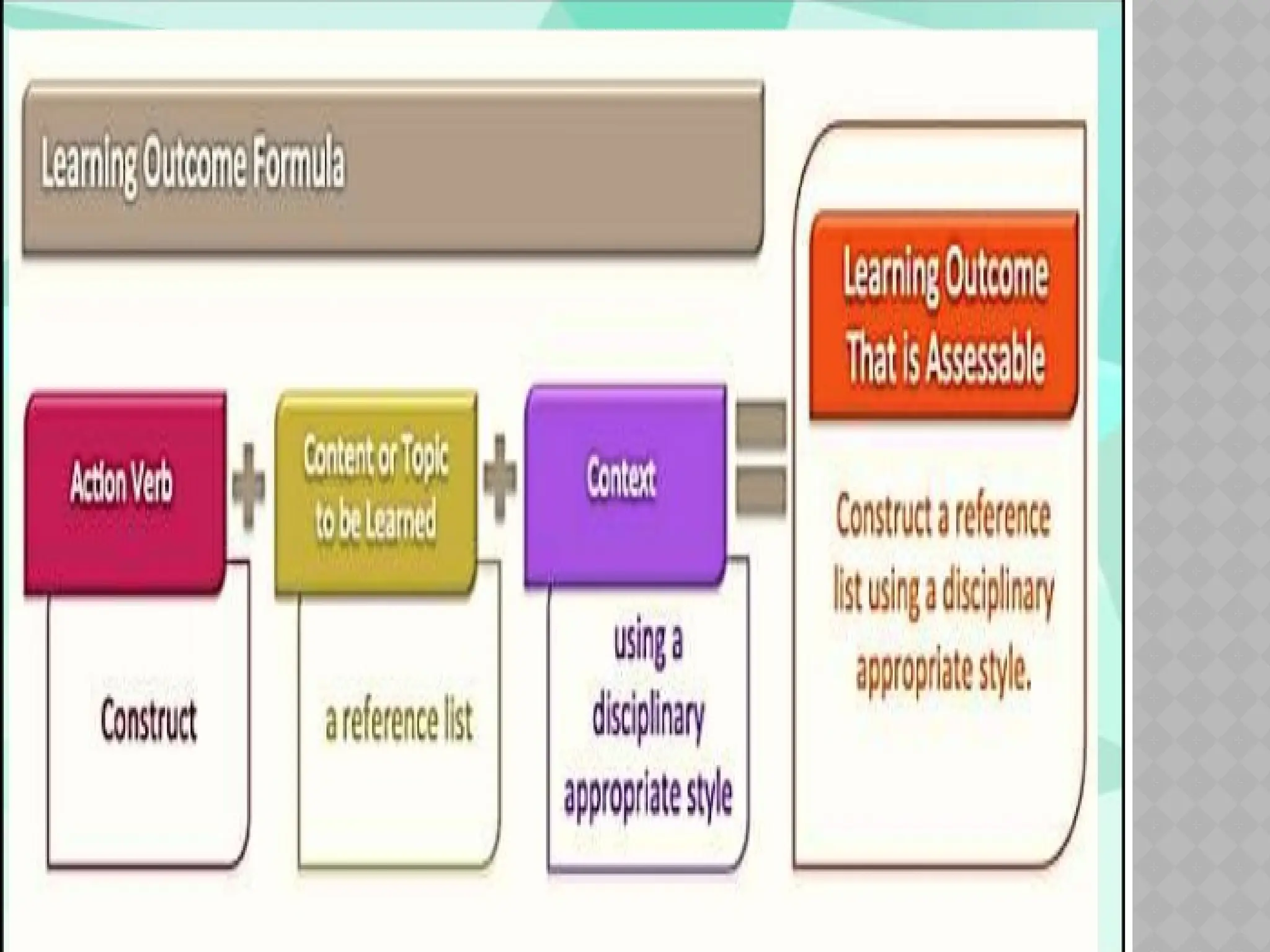
Start your learning outcome statements with an
action verb. For cognitive outcomes use verbs
that go beyond knowledge and comprehension.
Aim for higher-level verbs which require students
to evaluate, analyze, synthesize and critique.
The use of these verbs ensures that the learning
is measurable.
32.
Try tokeep to one discrete learning
outcome per statement, unless they are
closely related.
Focus only on what’s important; avoid the
trivial. An outcome statement should capture
in an integrated way the abilities, skills,
attitudes and/or values that will demonstrate
the attainment of that outcome.
42.
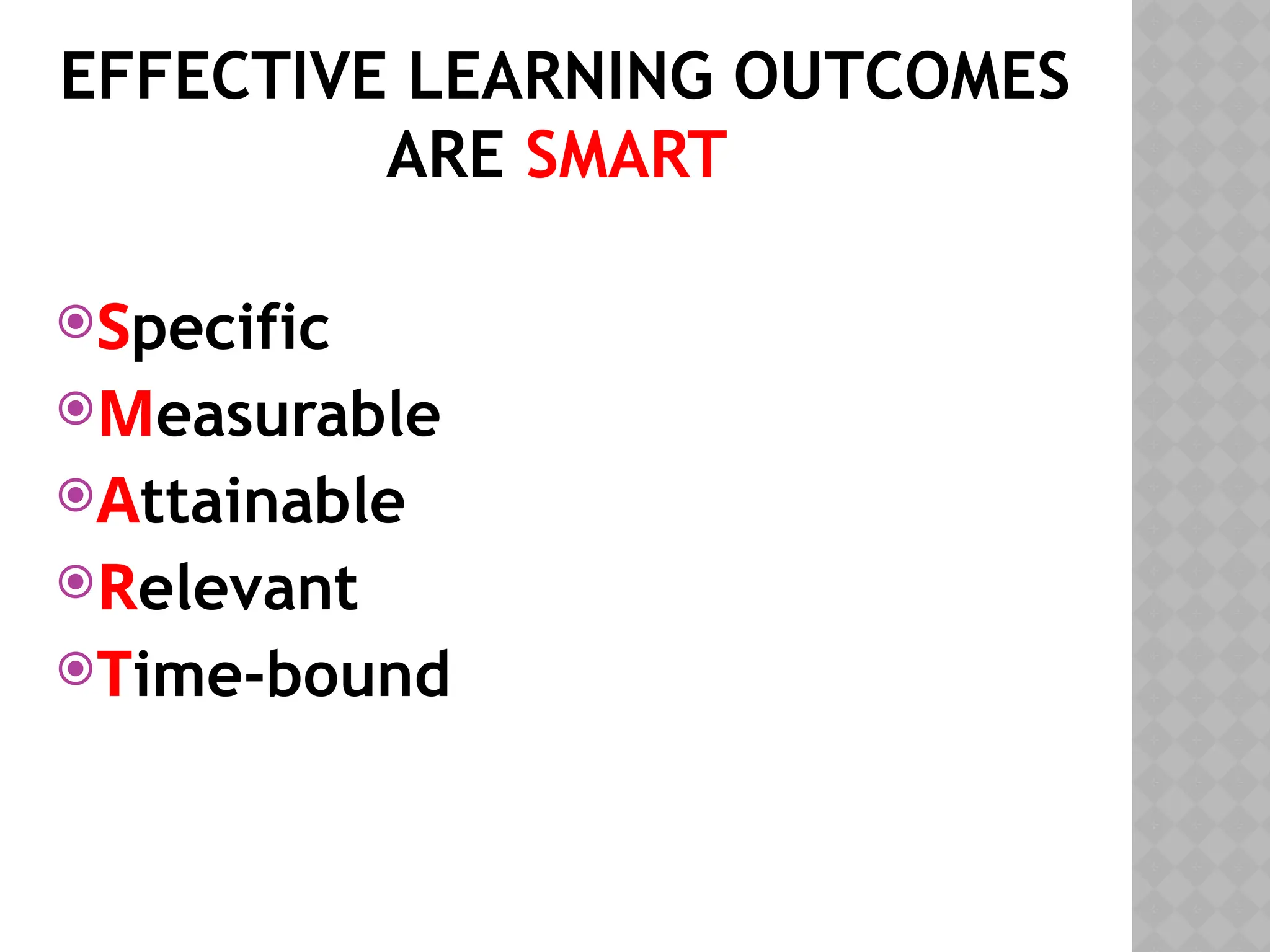
Student Learning Outcome
Tied to specific skills or products students
are expected to learn
Are measurable
CHARACTERISTICS OF LEARNING
OUTCOMES
1. Good student learning outcomes are
centered on the students, on what the learners
are capable of doing instead of teaching
technique.
2. Good learning outcomes are based on the
program mission statement agreed upon by the
program faculty
43.
3.Good student learningoutcomes are
very well understood by both students
and faculty.
4.Good learning outcomes include the
spectrum of thinking skills from simple
to higher order of knowledge and skills.
5.Good learning outcomes are
measurable.
CHARACTERISTICS OF LEARNING
OUTCOMES
44.
SOURCES OF EXPECTED
STUDENTLEARNING OUTCOME
The institution mission statement is a relevant
source of student learning expectation.
Policies on competencies and standards by
government education agencies such as DEPED,
TESDA, CHED are prescribe sources of student
learning outcomes.
• Expected competencies identified by the
different professions, business and industry
should be adopted to ensure that graduates are
able to perform as expected in their respective
work, places and or professions.
45.
SOURCES OF EXPECTED
STUDENTLEARNING OUTCOME
The thrusts and development goals of the
national government are useful integration
in the identified competencies and
expectations from all sector of education.
International trends and development
should also be considered in identifying
and determining student learning
outcomes to ensure the graduates
competitiveness in the employment and
professional practice abroad.
47.
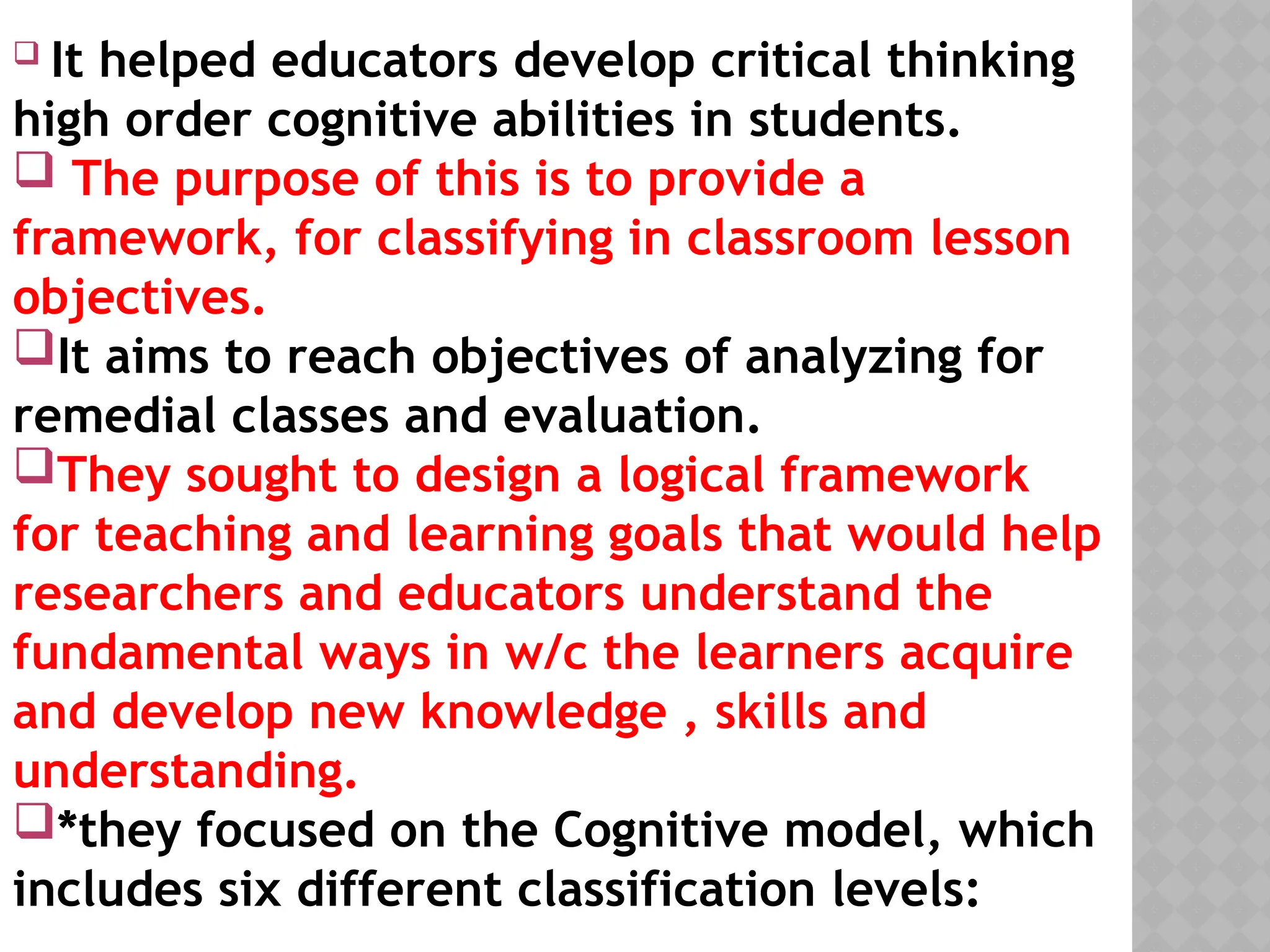
It helpededucators develop critical thinking
high order cognitive abilities in students.
The purpose of this is to provide a
framework, for classifying in classroom lesson
objectives.
It aims to reach objectives of analyzing for
remedial classes and evaluation.
They sought to design a logical framework
for teaching and learning goals that would help
researchers and educators understand the
fundamental ways in w/c the learners acquire
and develop new knowledge , skills and
understanding.
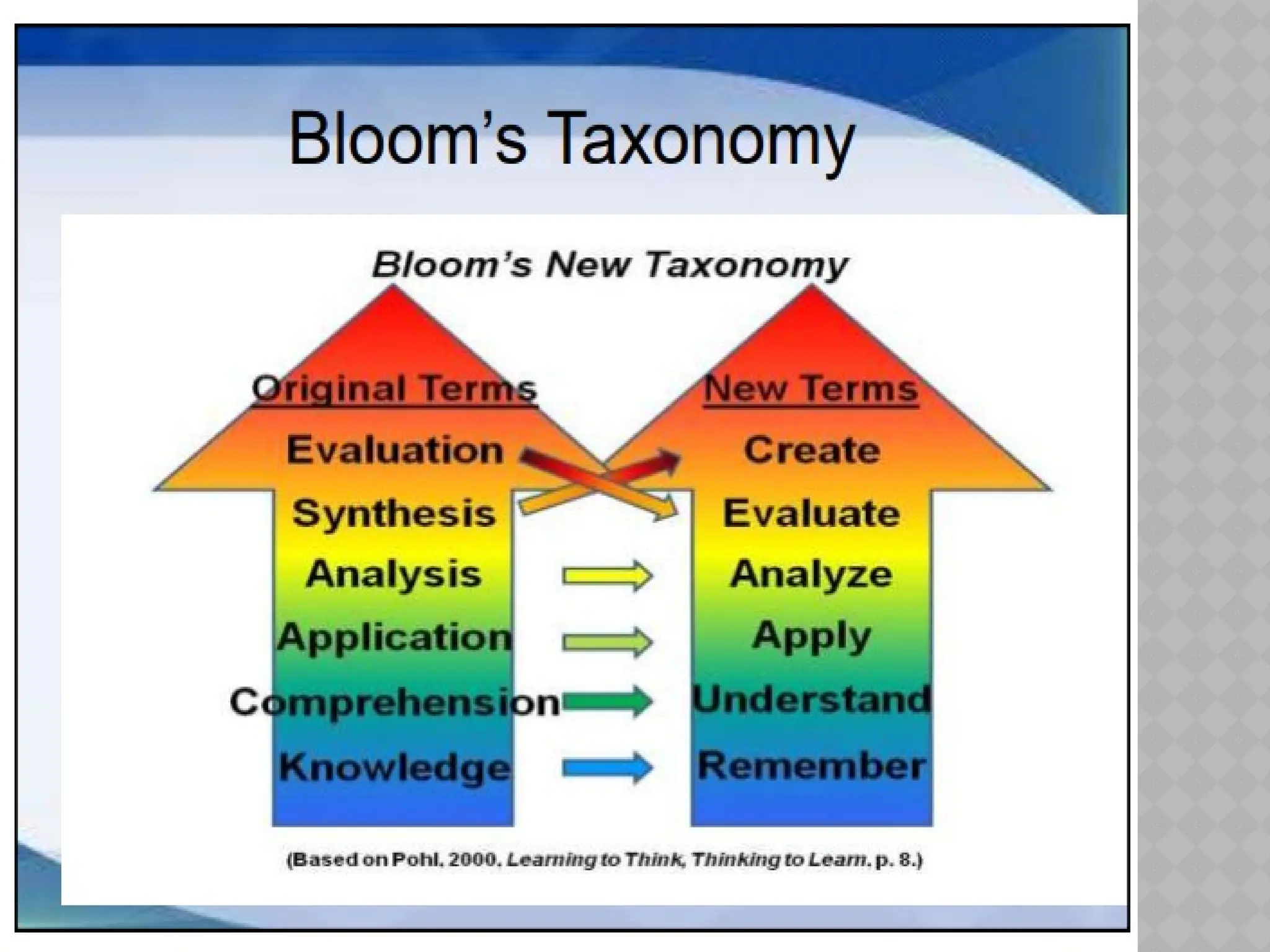
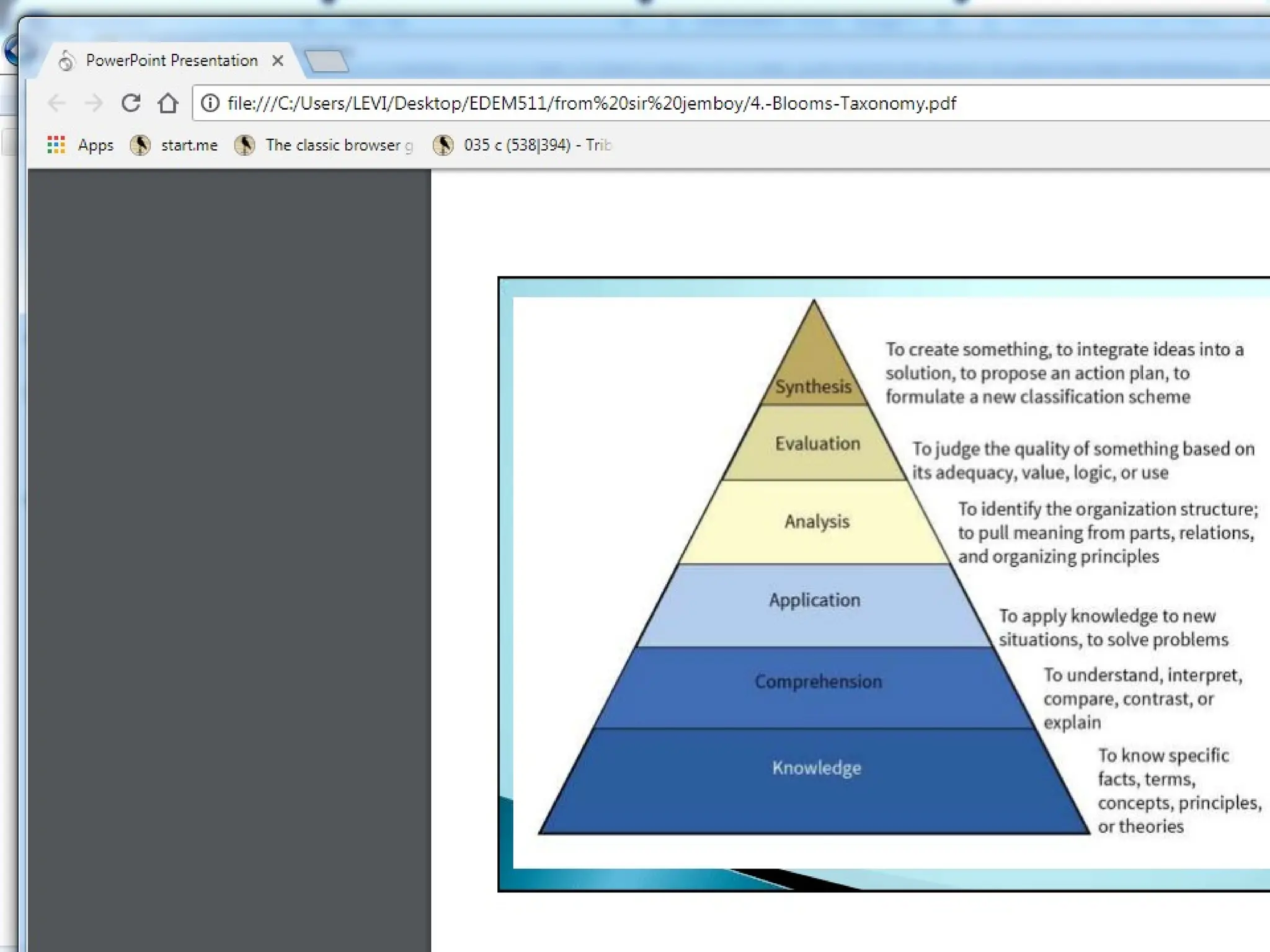
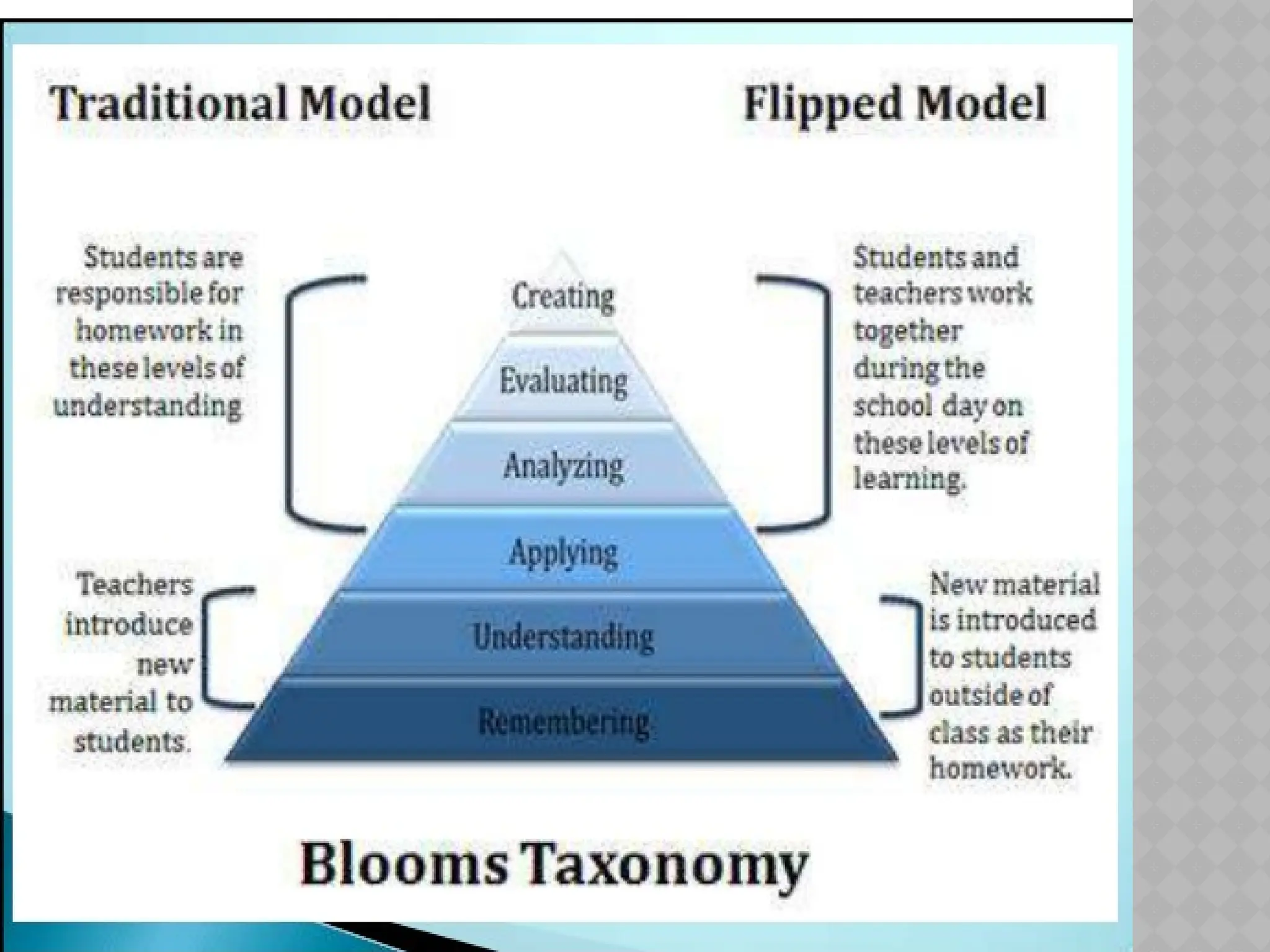
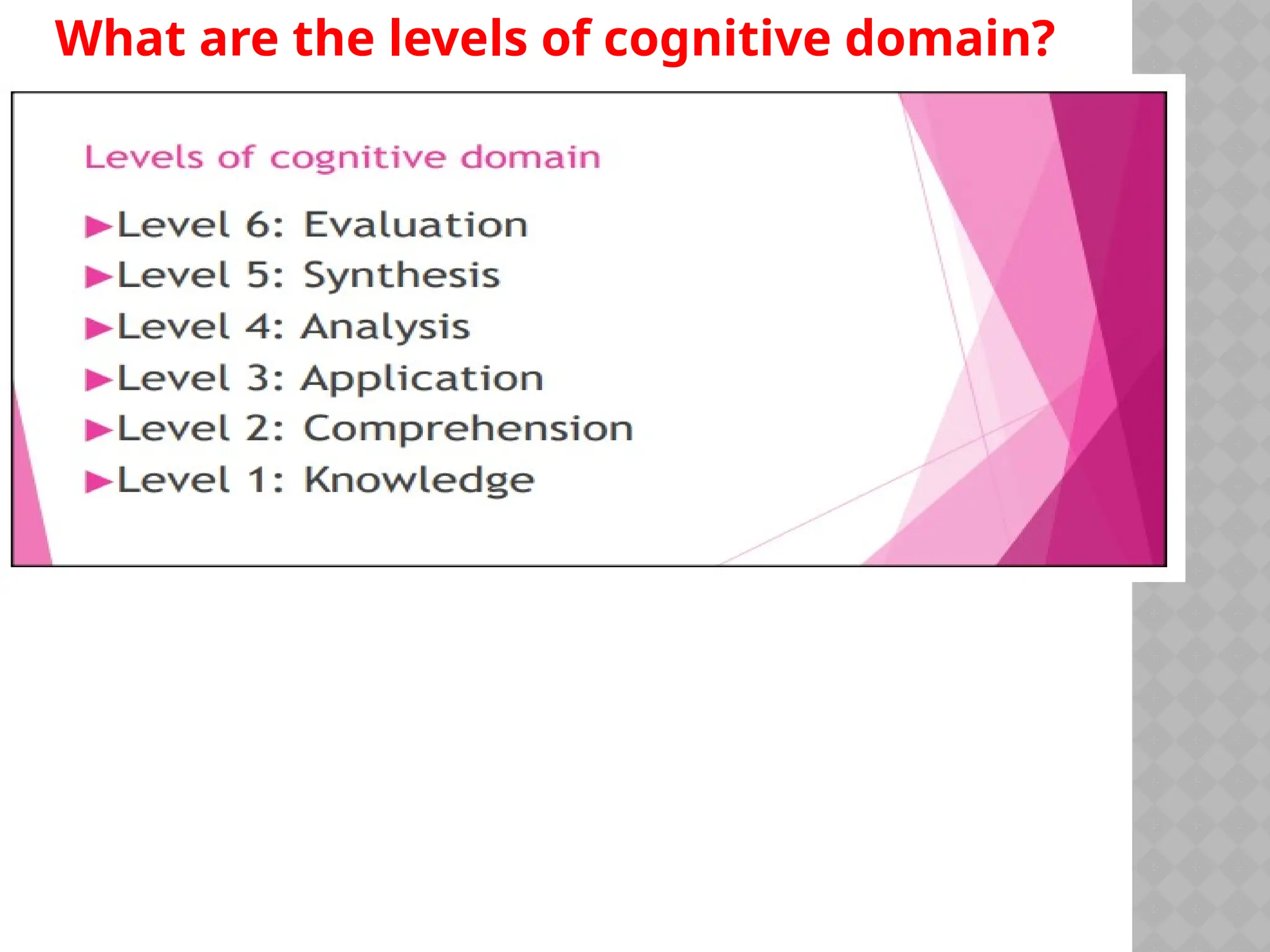
*they focused on the Cognitive model, which
includes six different classification levels:
48.
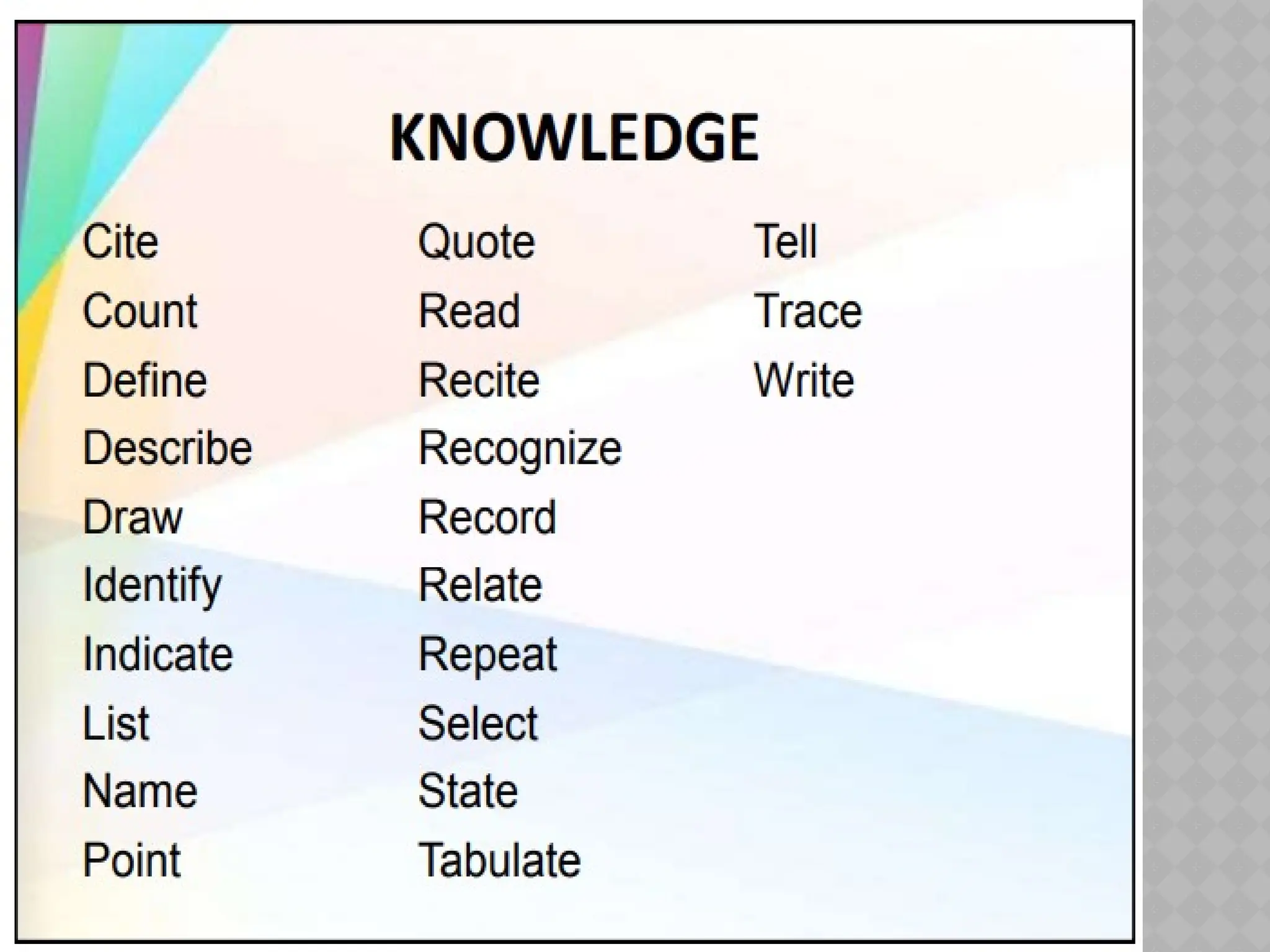
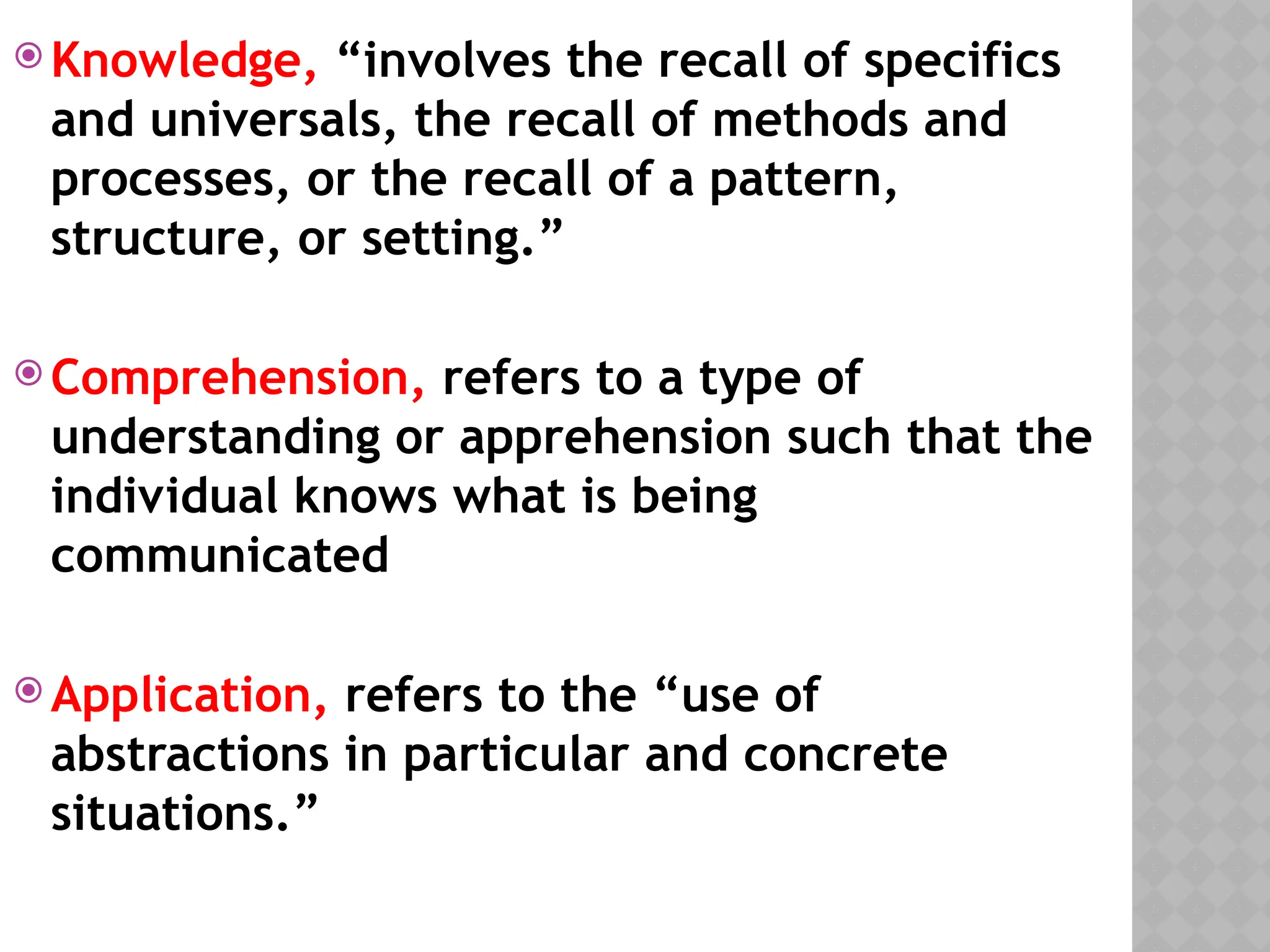
Knowledge, “involvesthe recall of specifics
and universals, the recall of methods and
processes, or the recall of a pattern,
structure, or setting.”
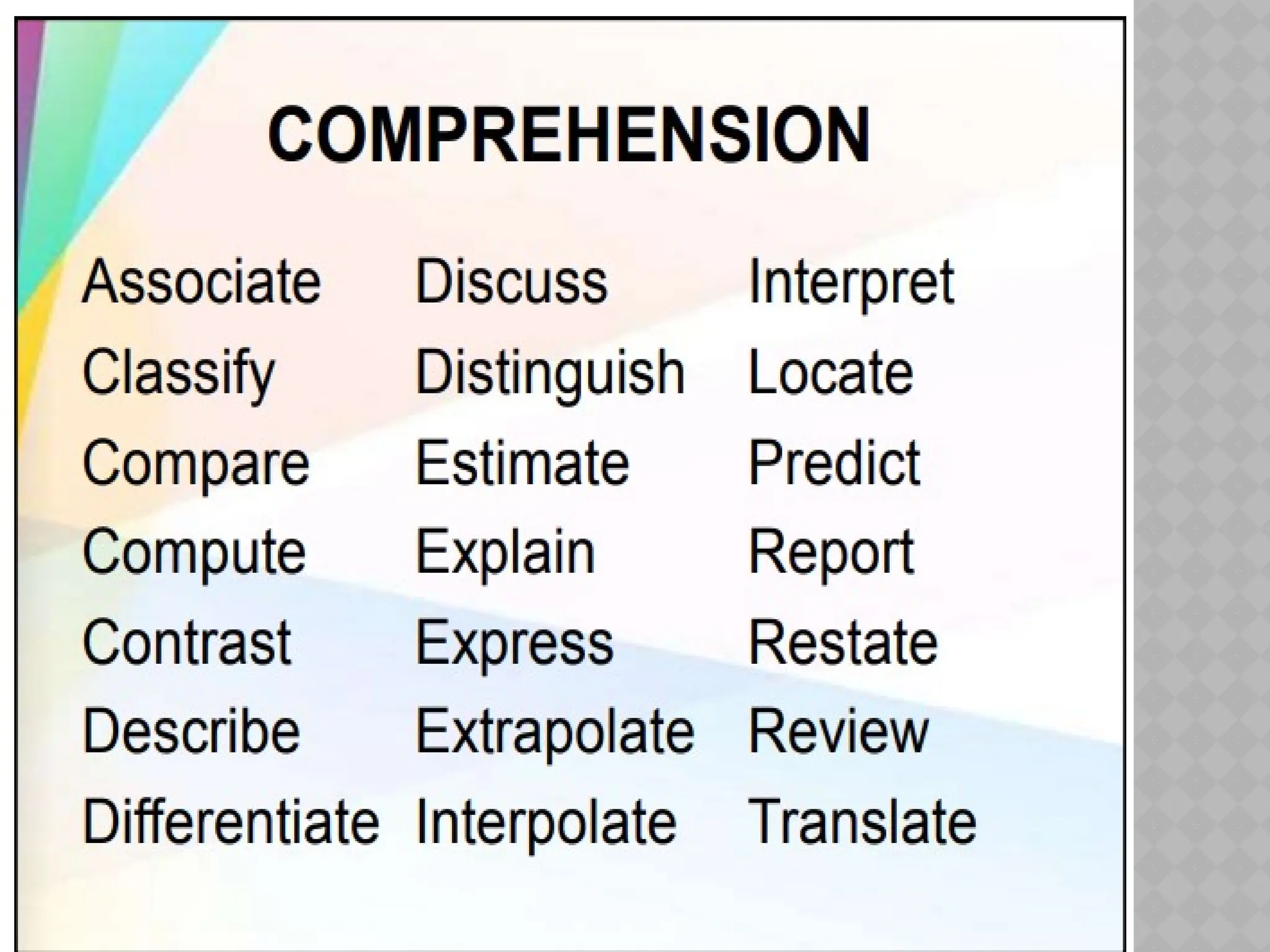
Comprehension, refers to a type of
understanding or apprehension such that the
individual knows what is being
communicated
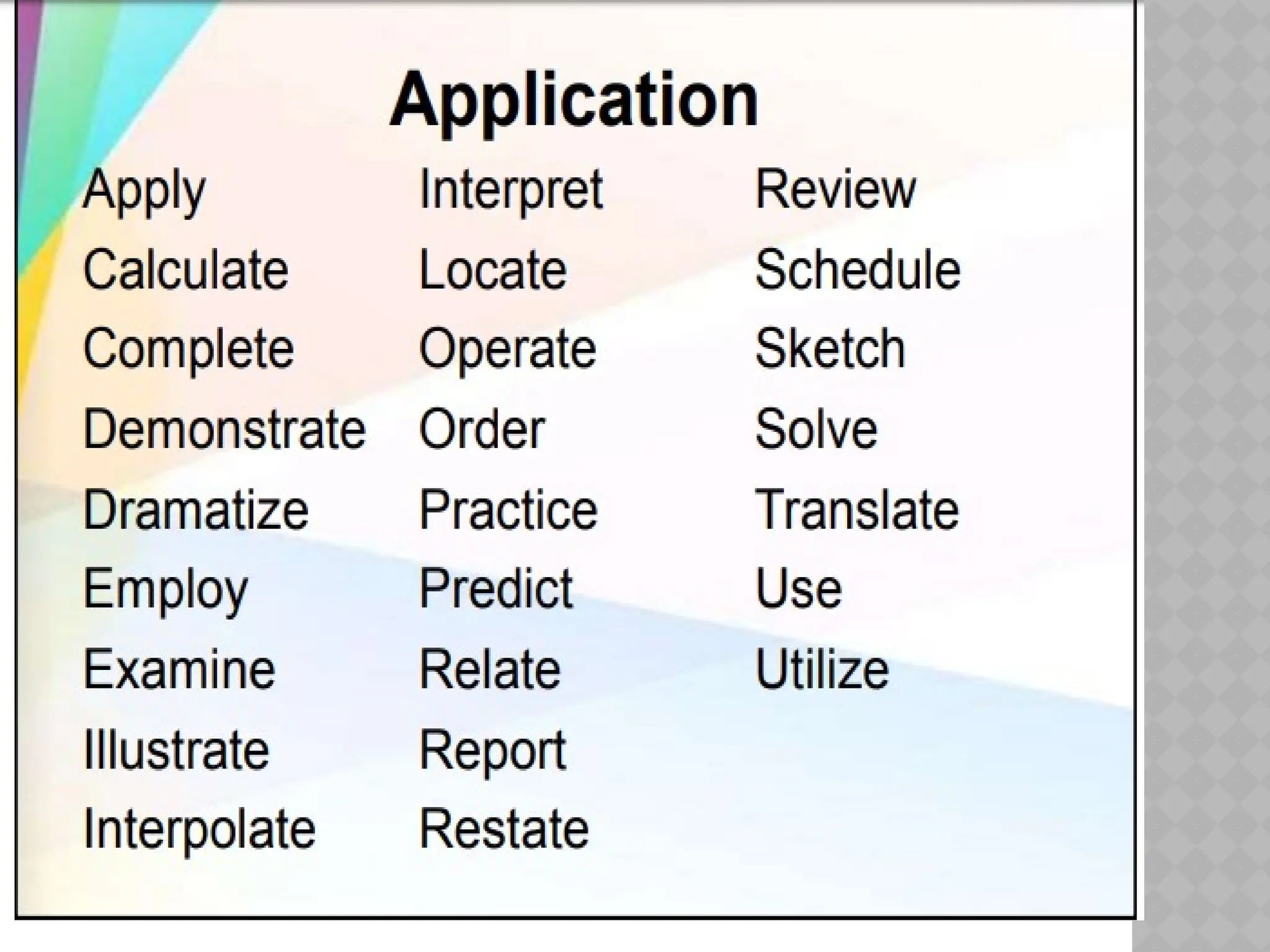
Application, refers to the “use of
abstractions in particular and concrete
situations.”
49.
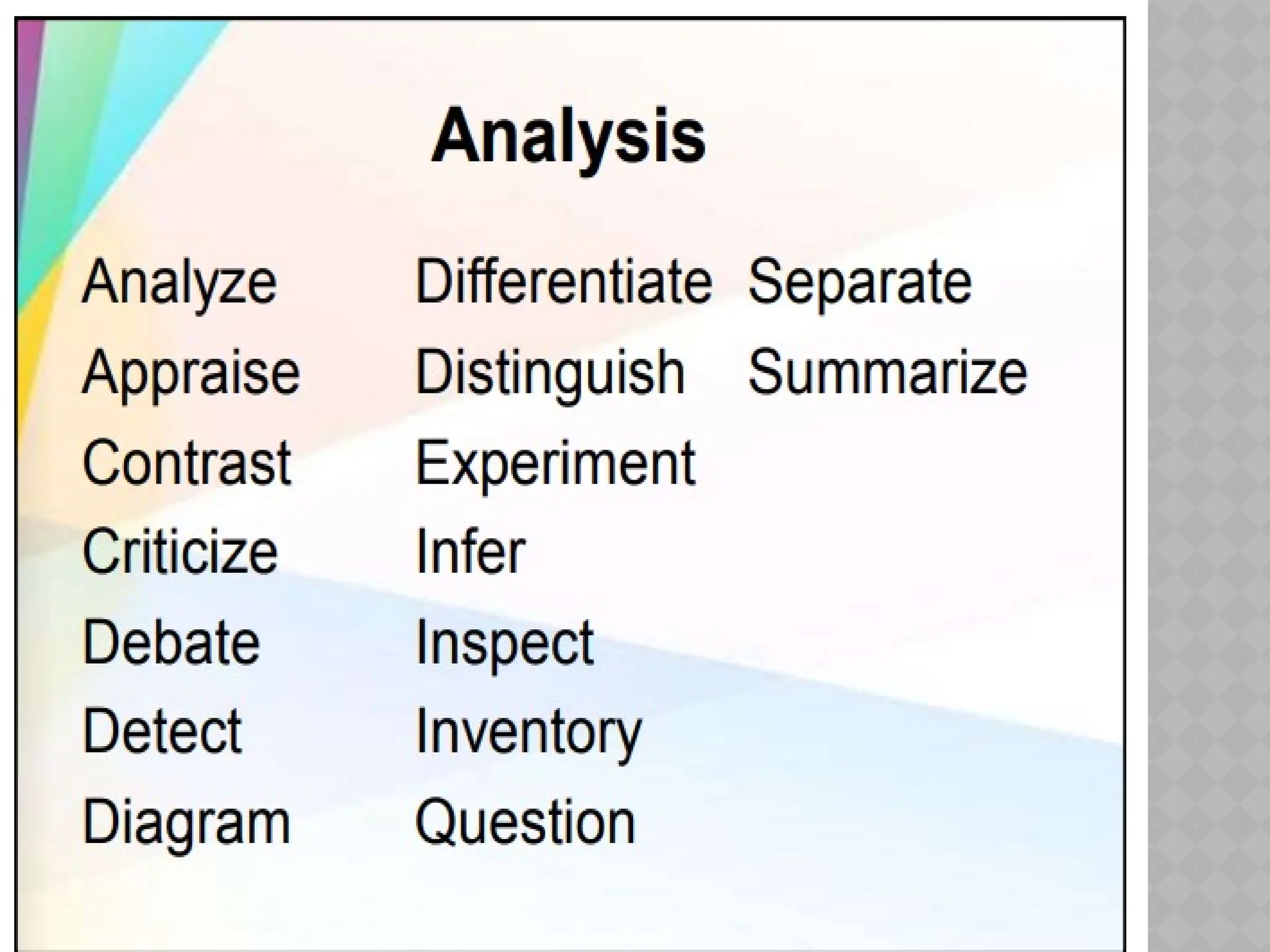
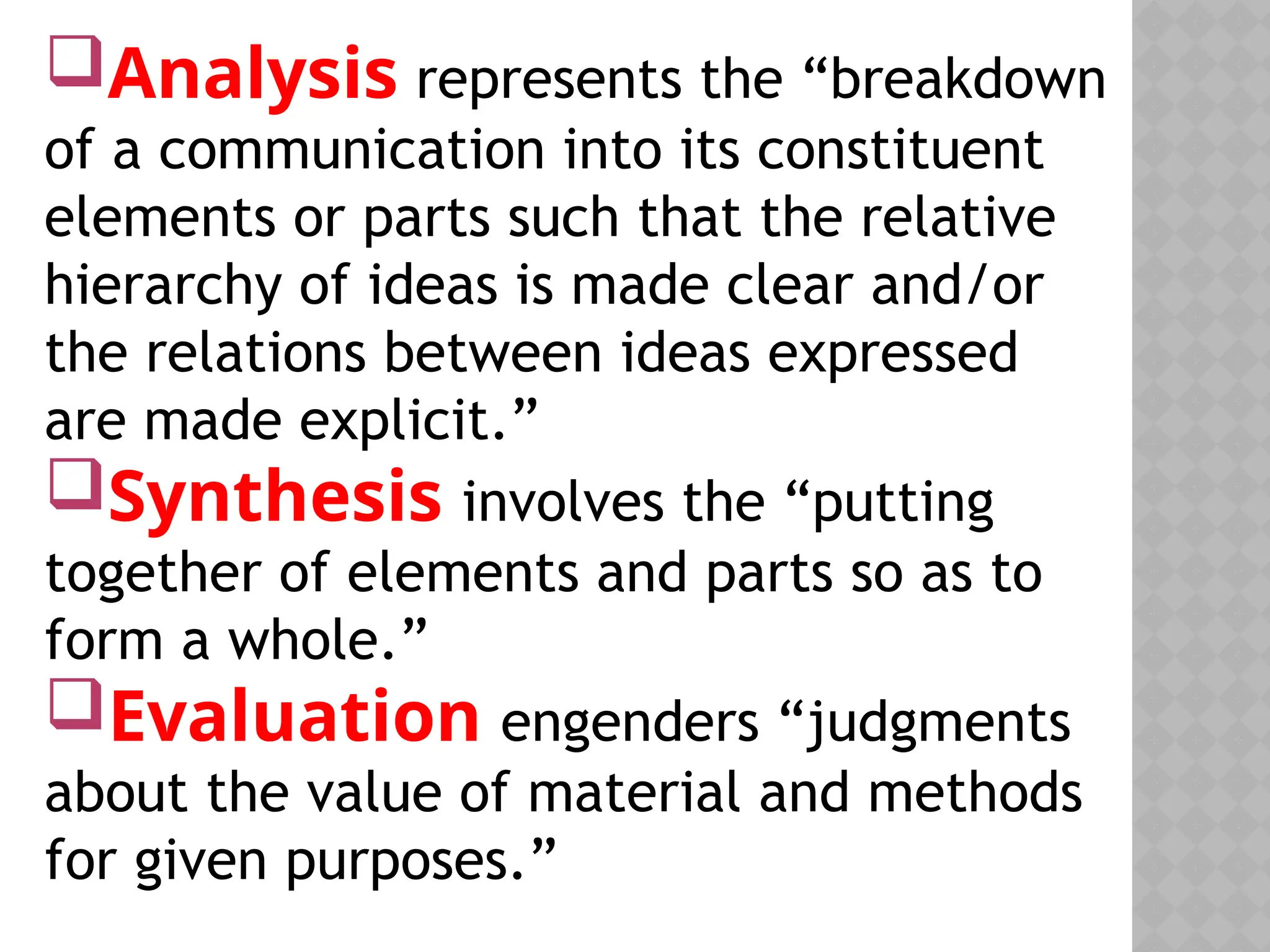
Analysis represents the“breakdown
of a communication into its constituent
elements or parts such that the relative
hierarchy of ideas is made clear and/or
the relations between ideas expressed
are made explicit.”
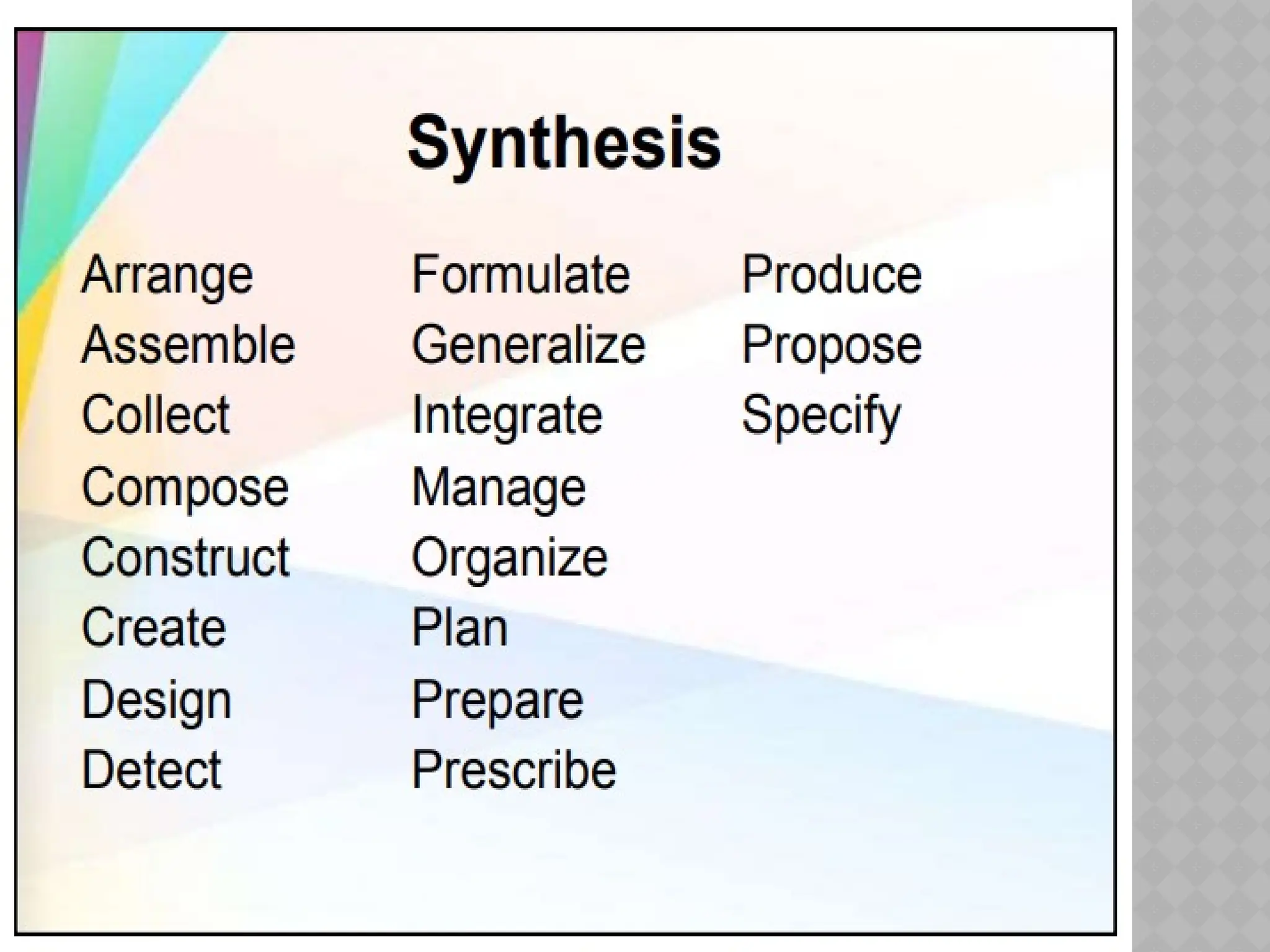
Synthesis involves the “putting
together of elements and parts so as to
form a whole.”
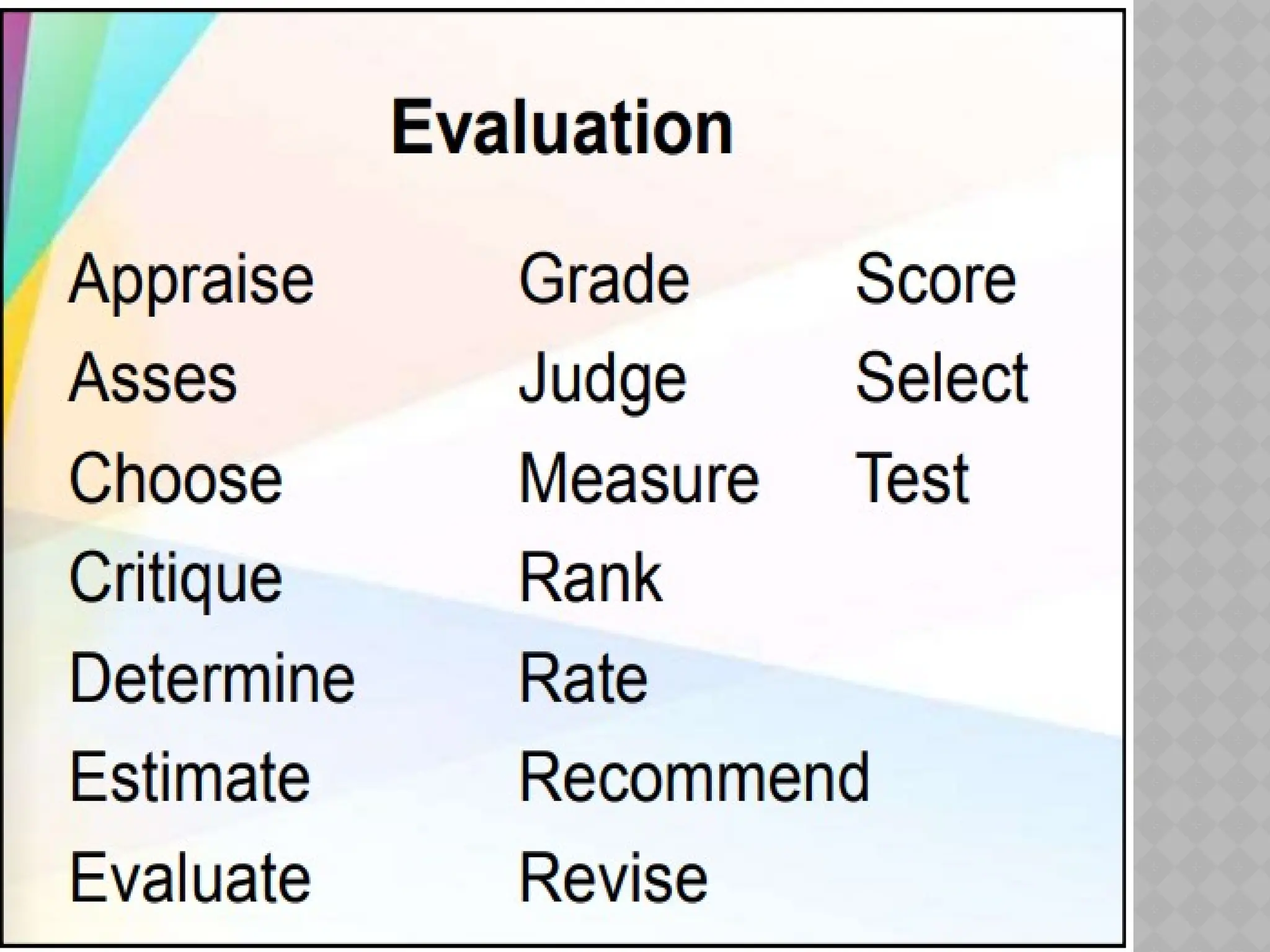
Evaluation engenders “judgments
about the value of material and methods
for given purposes.”
51.
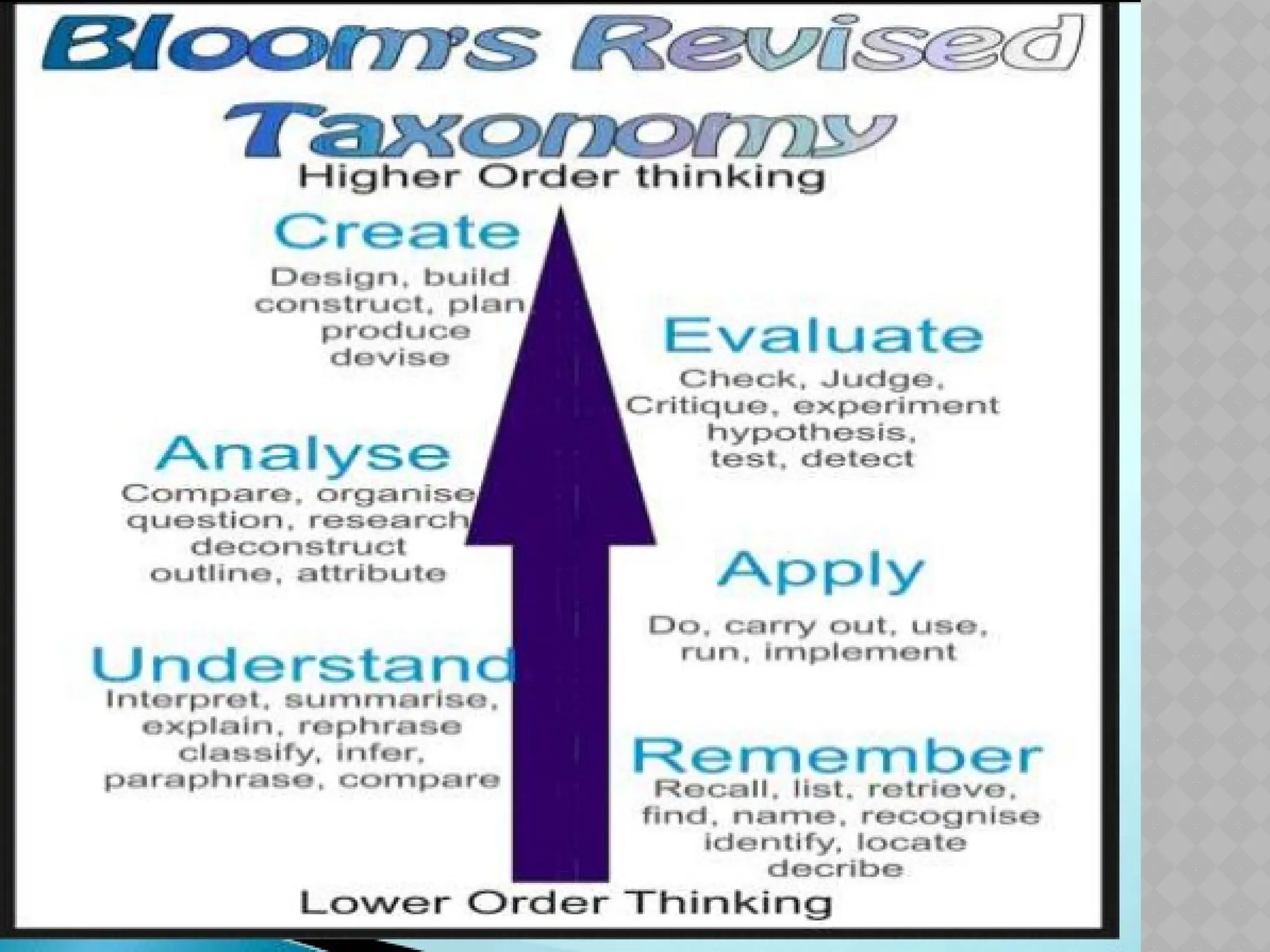
cognitive psychologists, curriculumtheorists
and instructional researchers, and testing
and assessment specialists published in 2001
a revision of Bloom’s Taxonomy with the title
A Taxonomy for Teaching, Learning, and
Assessment.
The authors of the revised taxonomy
using verbs and gerunds to label their
categories and subcategories (rather than
the nouns of the original taxonomy).
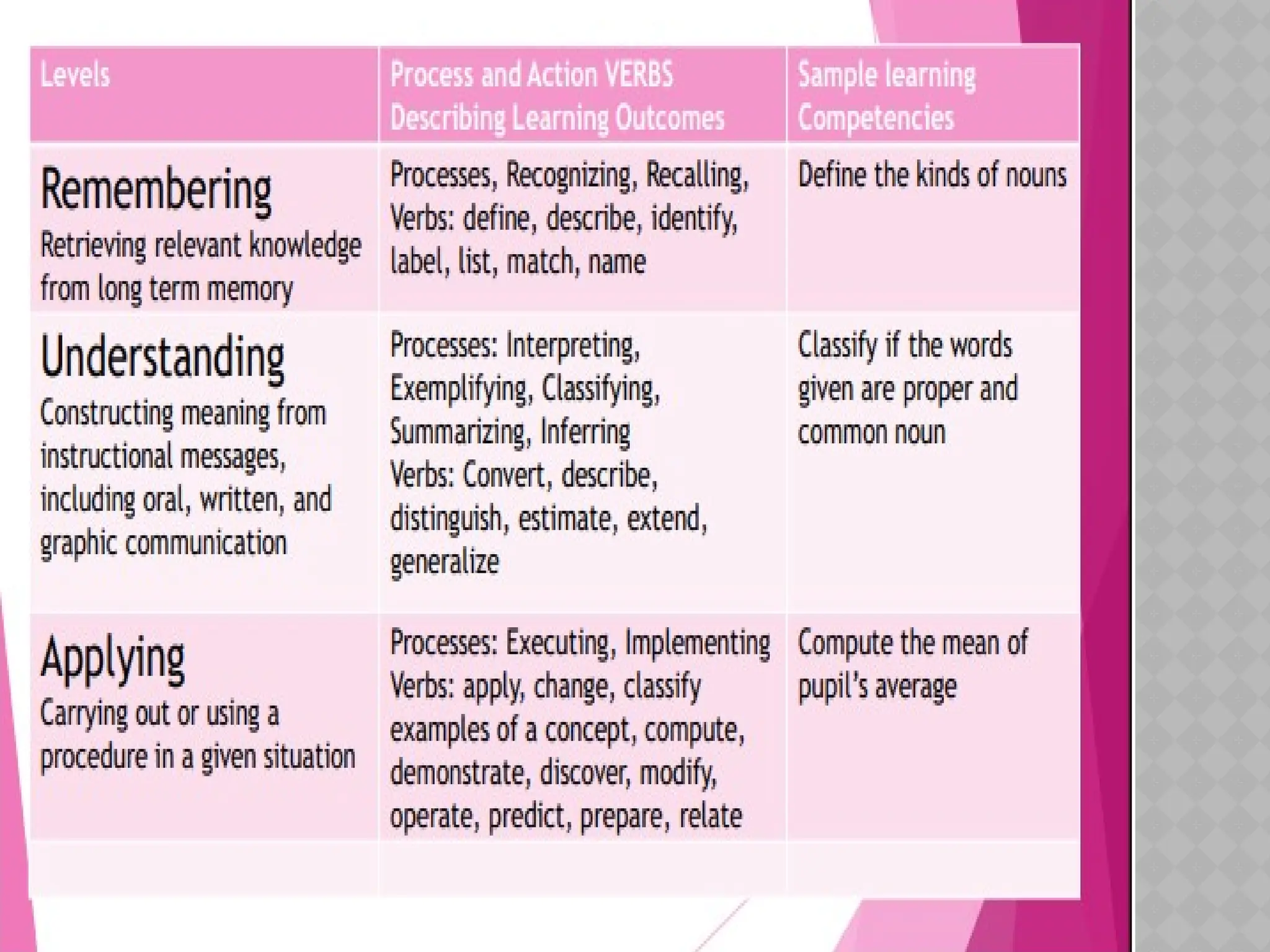
These “action words” describe the
cognitive processes by which thinkers
encounter and work with knowledge:
54.
Summary:
To developcritical thinking its students,
education use Blooms Taxonomy descriptive
verbs to write lesson objectives aligned to
different levels of Blooms Taxonomy.
*How can Bloom’s help with course design?
Before you can understand a concept, you
must remember it .
To apply a concept, you must first
understand it. In order to evaluate a
concept, you must have analyzed it.
To create an accurate conclusion you must
have completed a thorough evaluate.
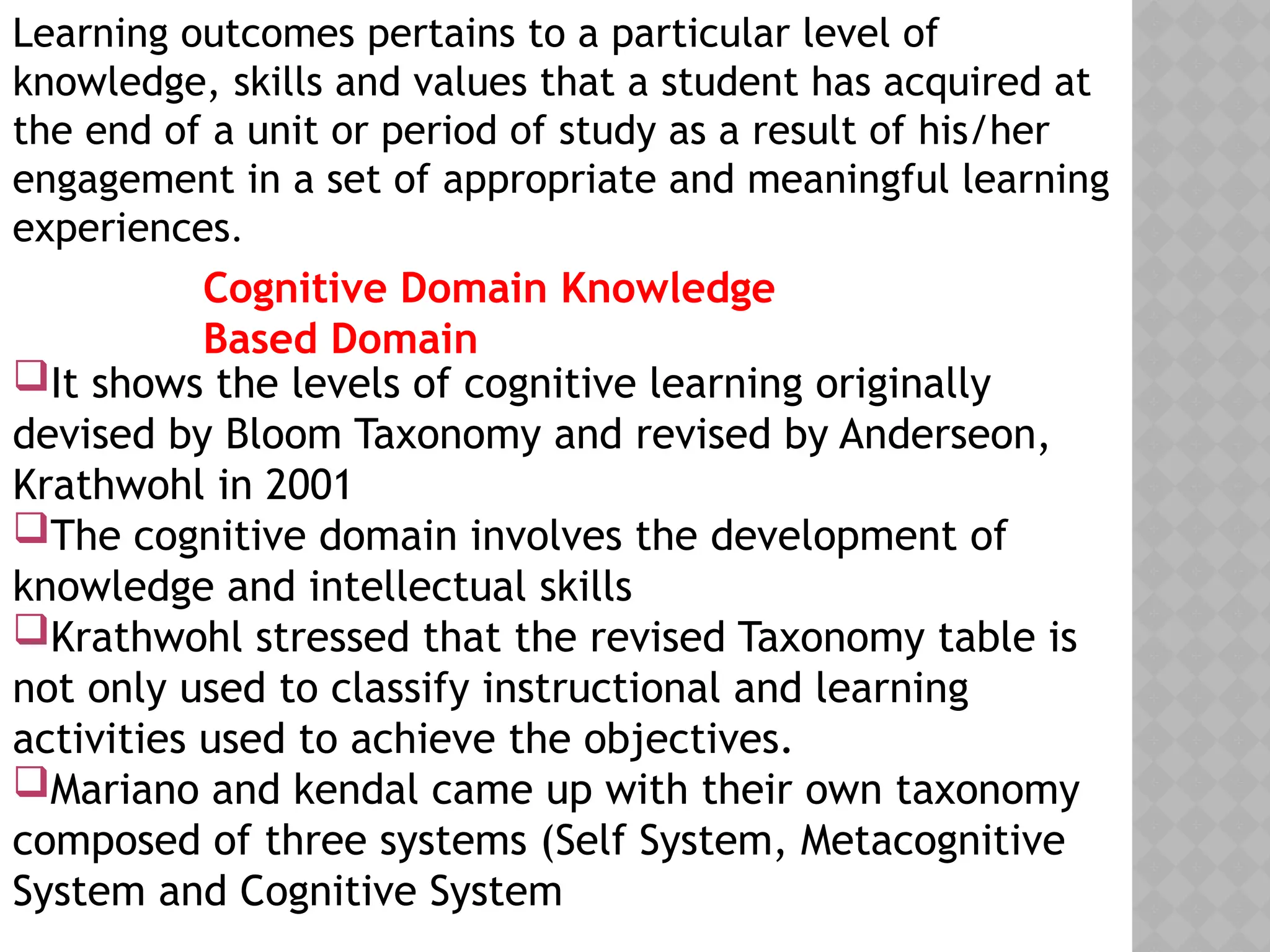
Learning outcomes pertainsto a particular level of
knowledge, skills and values that a student has acquired at
the end of a unit or period of study as a result of his/her
engagement in a set of appropriate and meaningful learning
experiences.
Cognitive Domain Knowledge
Based Domain
It shows the levels of cognitive learning originally
devised by Bloom Taxonomy and revised by Anderseon,
Krathwohl in 2001
The cognitive domain involves the development of
knowledge and intellectual skills
Krathwohl stressed that the revised Taxonomy table is
not only used to classify instructional and learning
activities used to achieve the objectives.
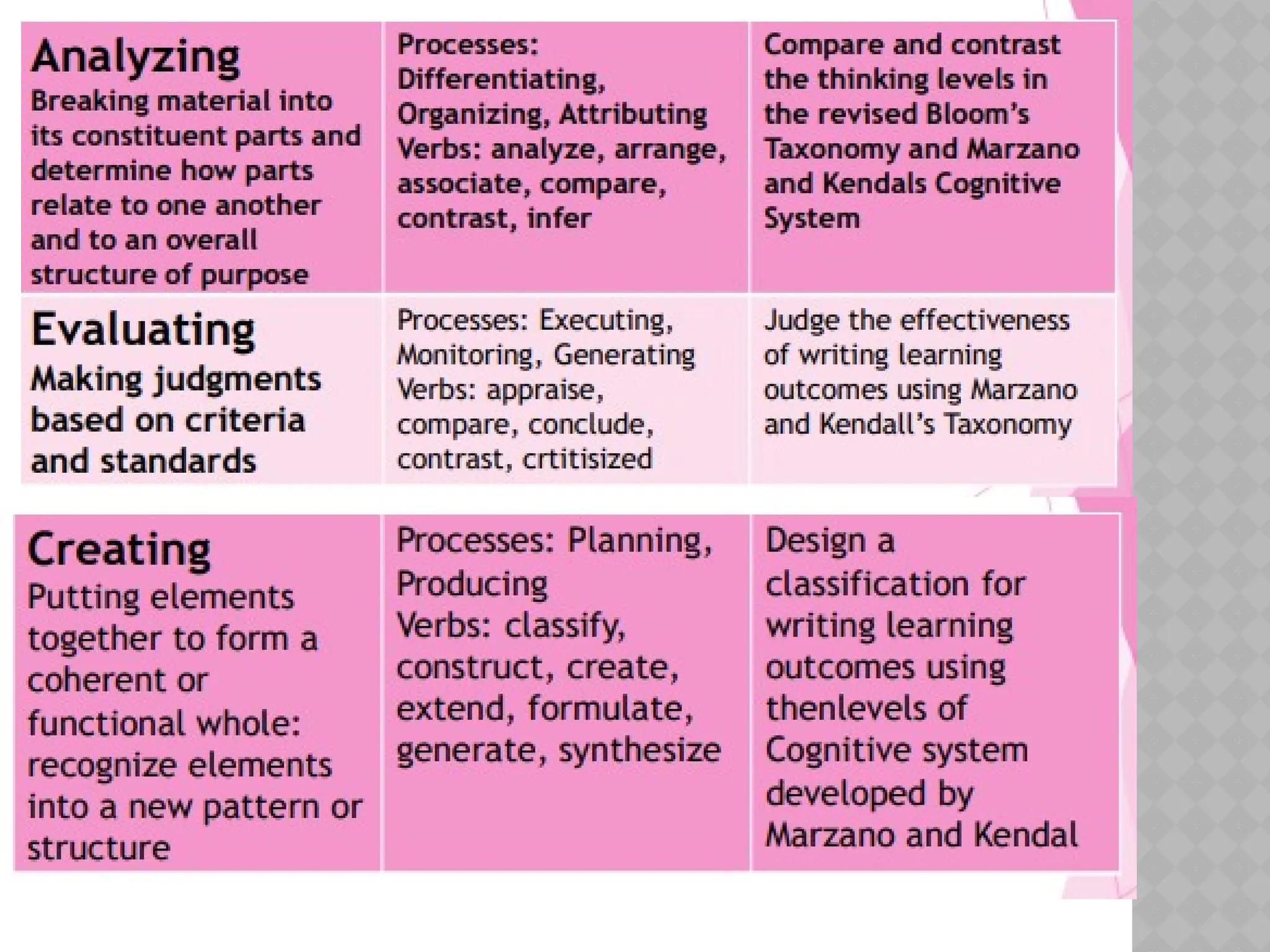
Mariano and kendal came up with their own taxonomy
composed of three systems (Self System, Metacognitive
System and Cognitive System
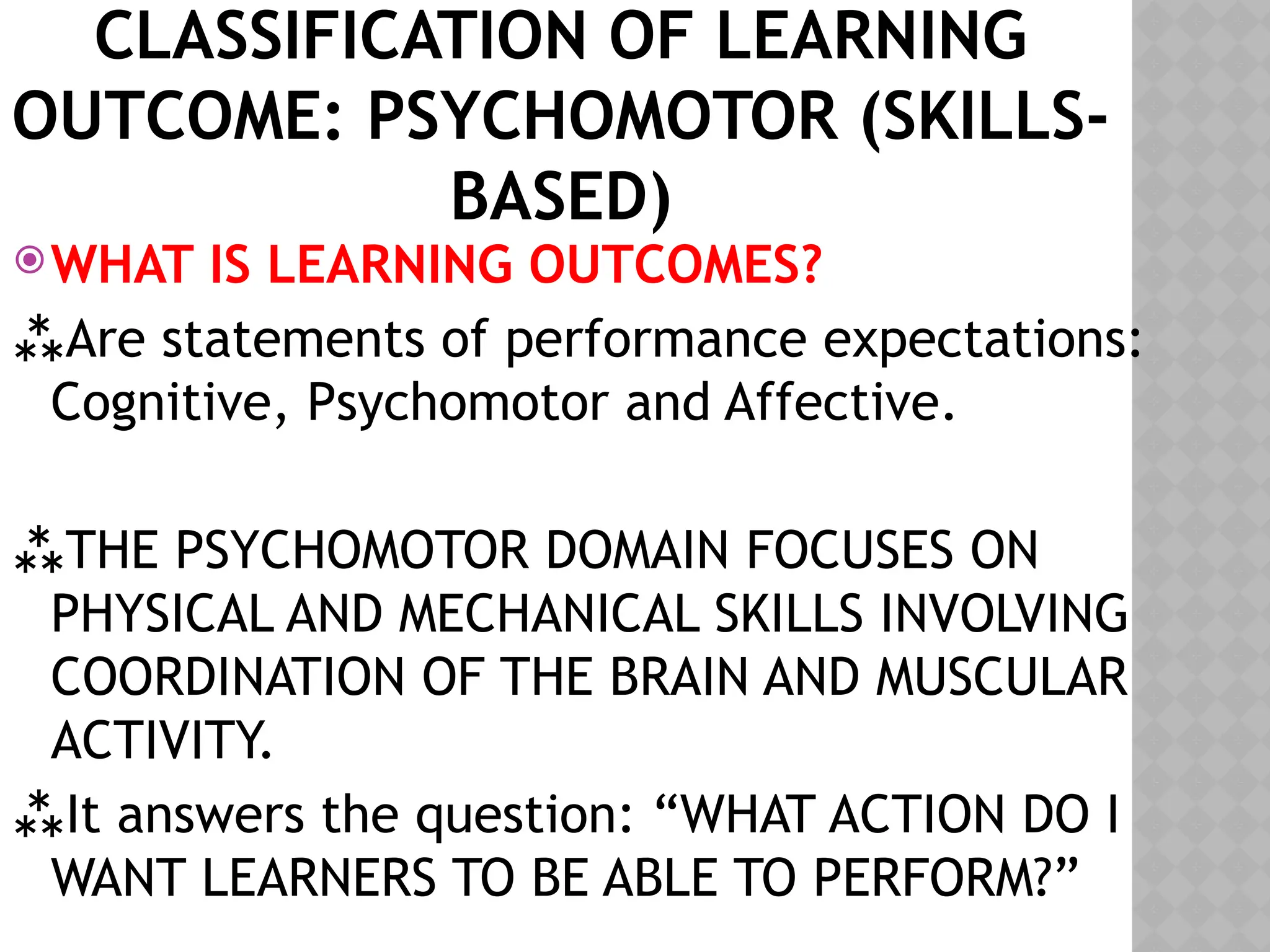
CLASSIFICATION OF LEARNING
OUTCOME:PSYCHOMOTOR (SKILLS-
BASED)
WHAT IS LEARNING OUTCOMES?
Are statements of performance expectations:
Cognitive, Psychomotor and Affective.
THE PSYCHOMOTOR DOMAIN FOCUSES ON
PHYSICAL AND MECHANICAL SKILLS INVOLVING
COORDINATION OF THE BRAIN AND MUSCULAR
ACTIVITY.
It answers the question: “WHAT ACTION DO I
WANT LEARNERS TO BE ABLE TO PERFORM?”
61.
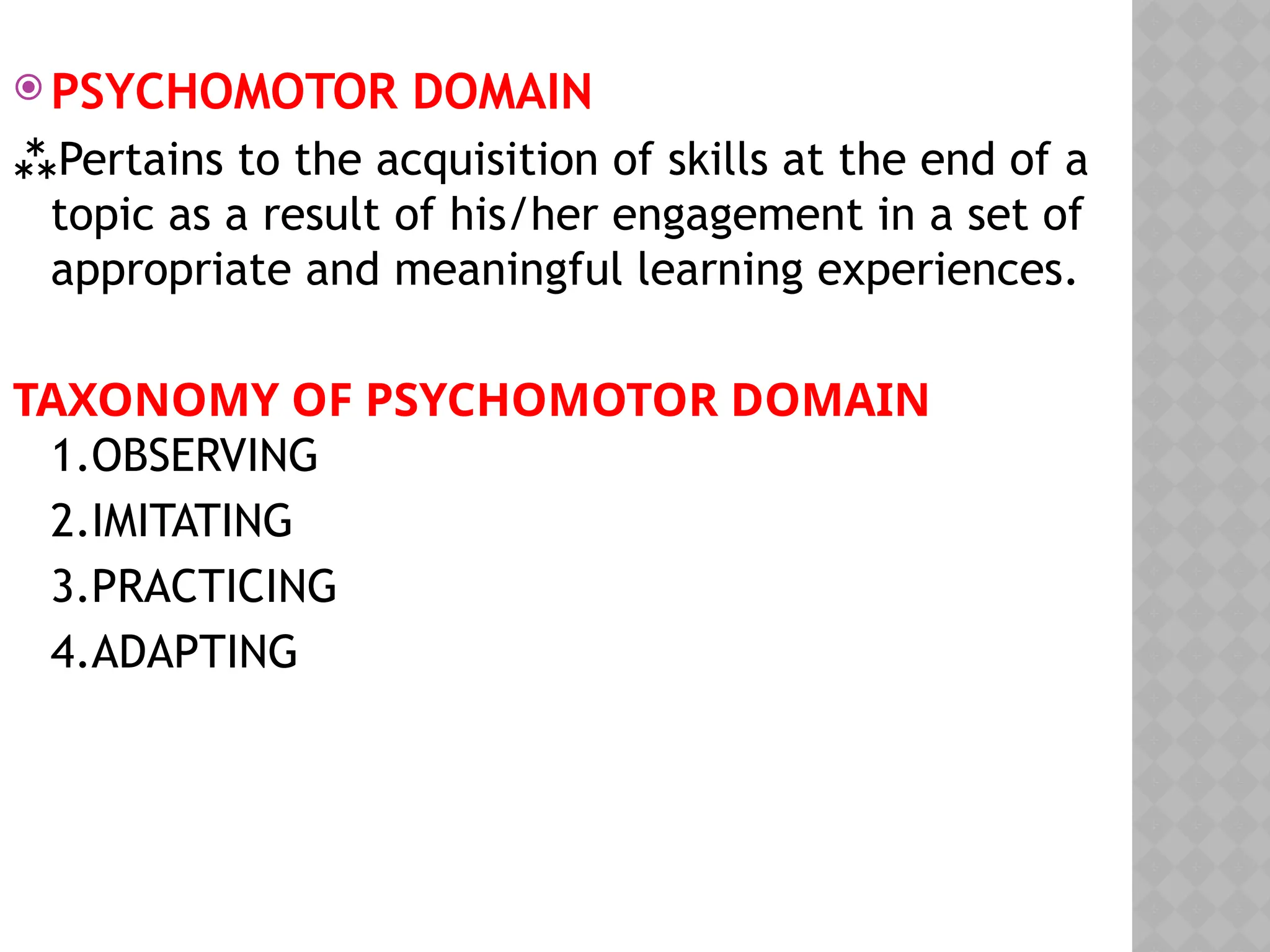
PSYCHOMOTOR DOMAIN
Pertainsto the acquisition of skills at the end of a
topic as a result of his/her engagement in a set of
appropriate and meaningful learning experiences.
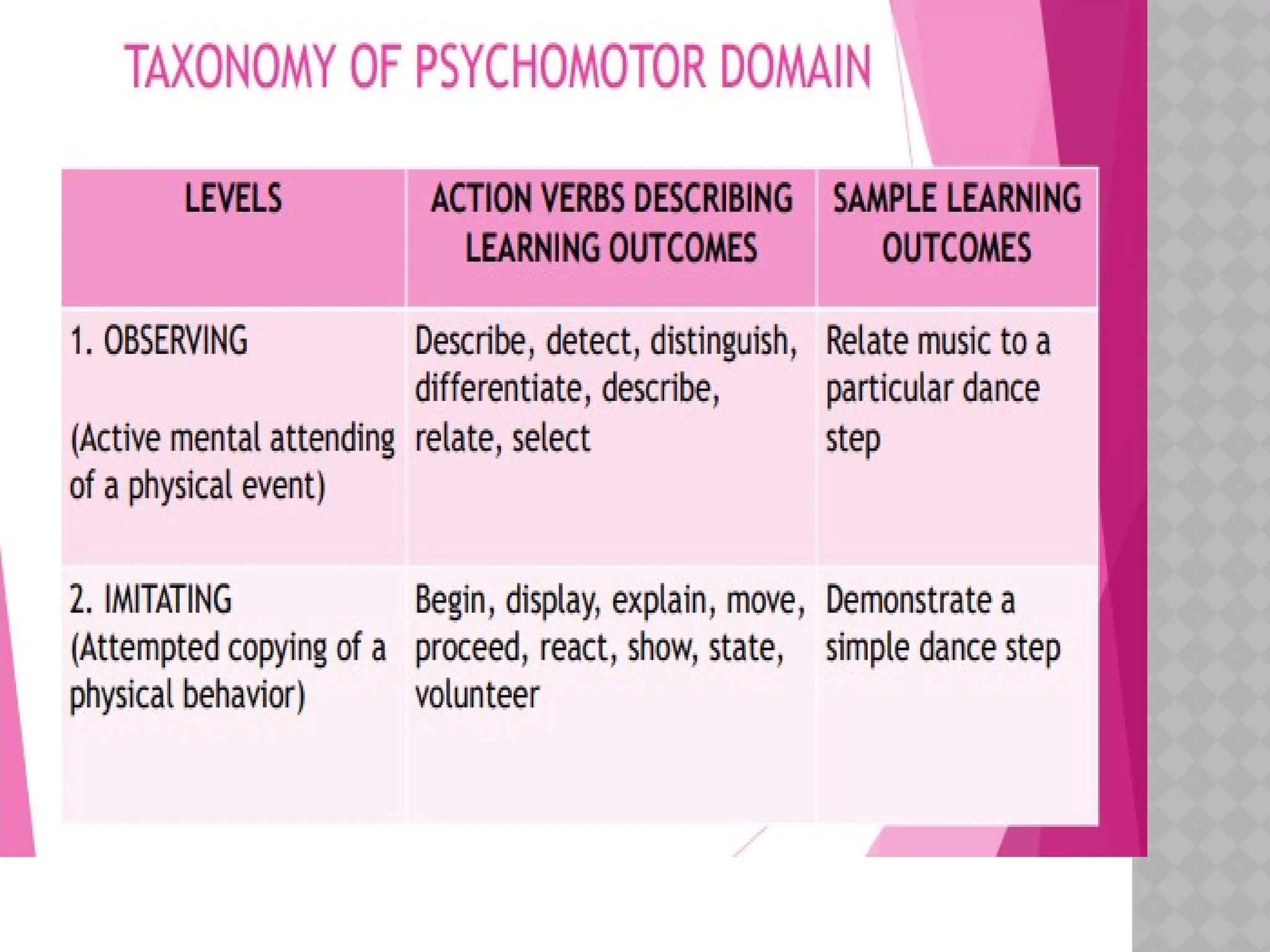
TAXONOMY OF PSYCHOMOTOR DOMAIN
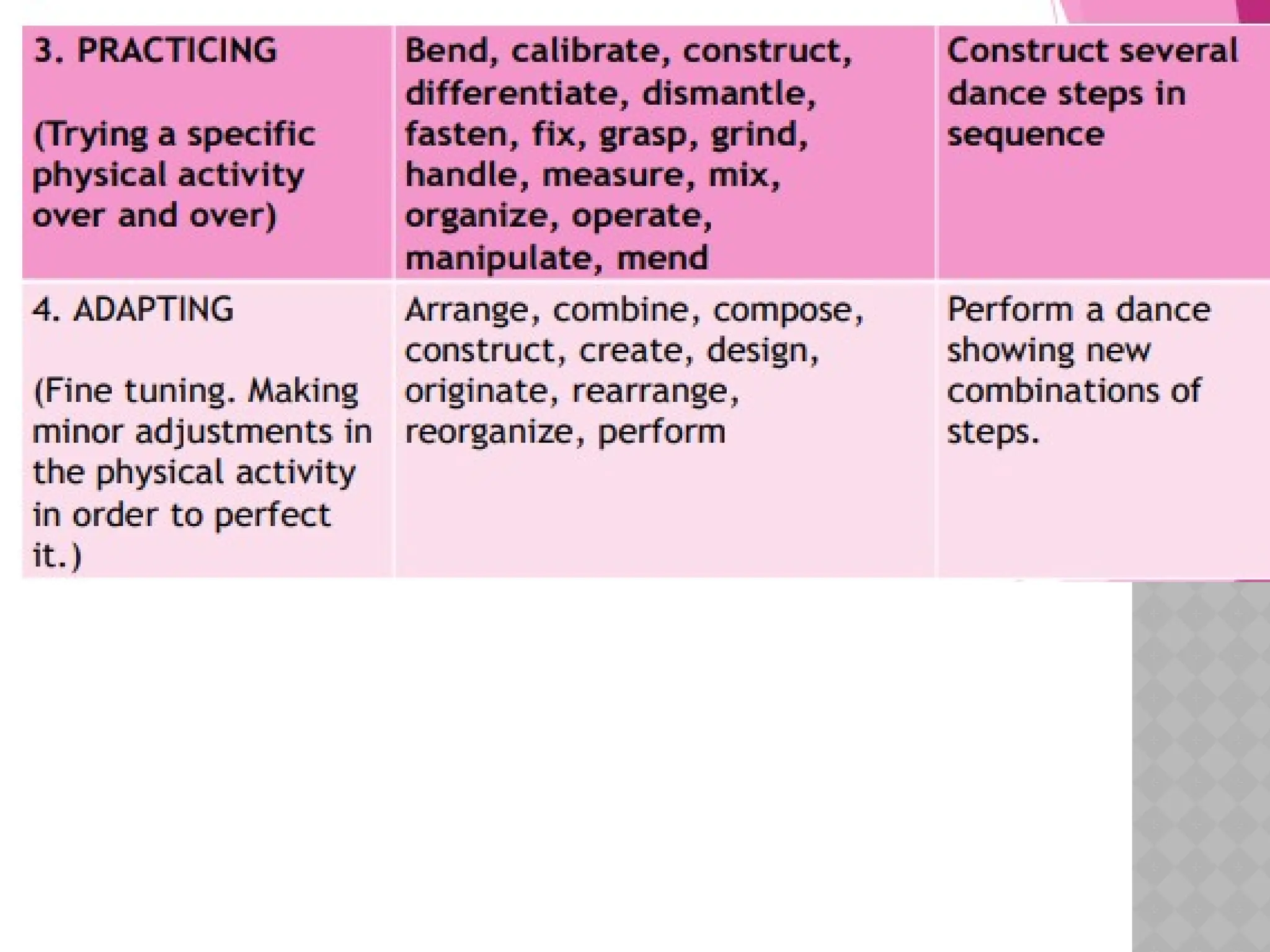
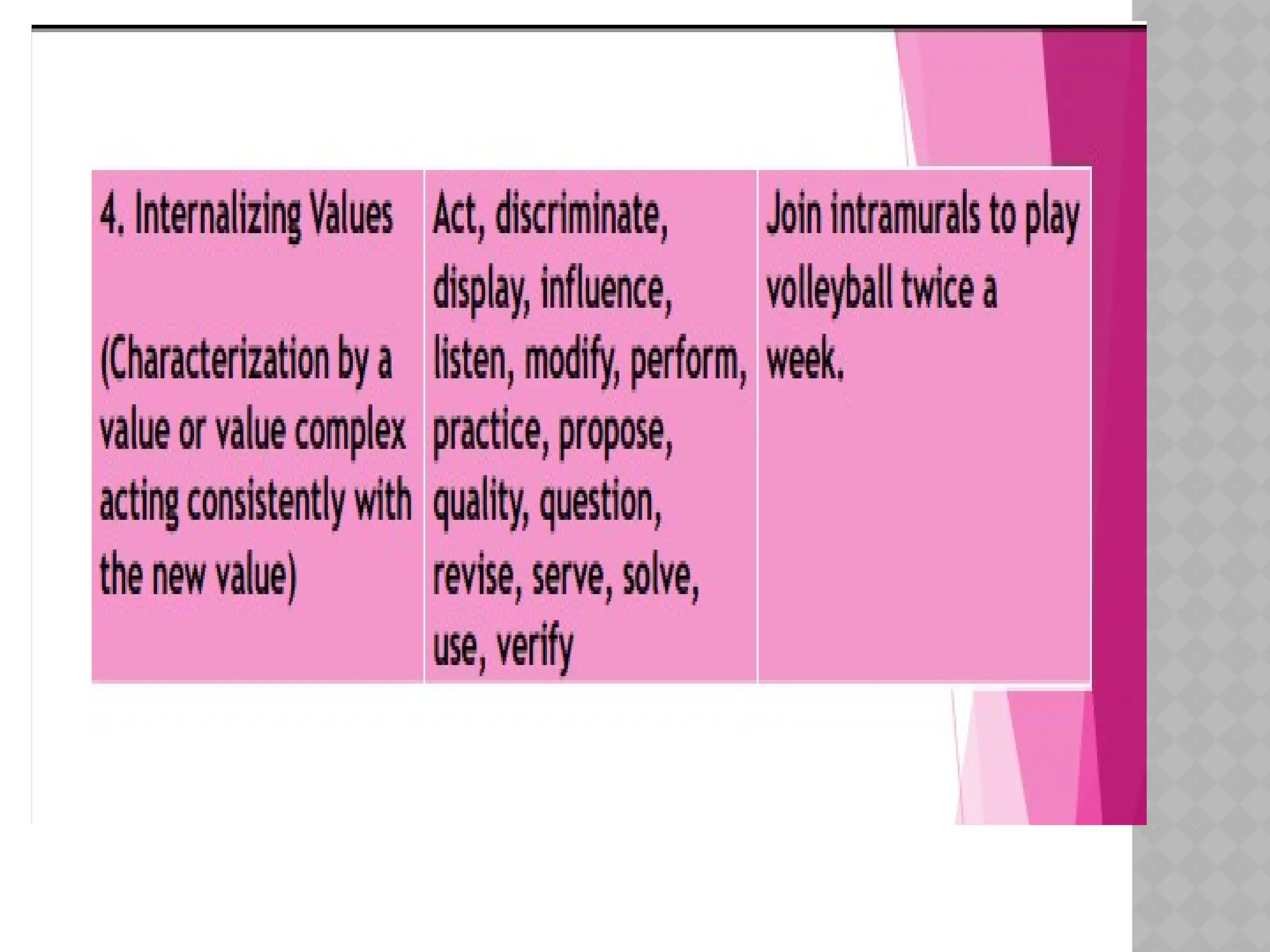
1.OBSERVING
2.IMITATING
3.PRACTICING
4.ADAPTING
64.
CLASSIFICATION OF LEARNING
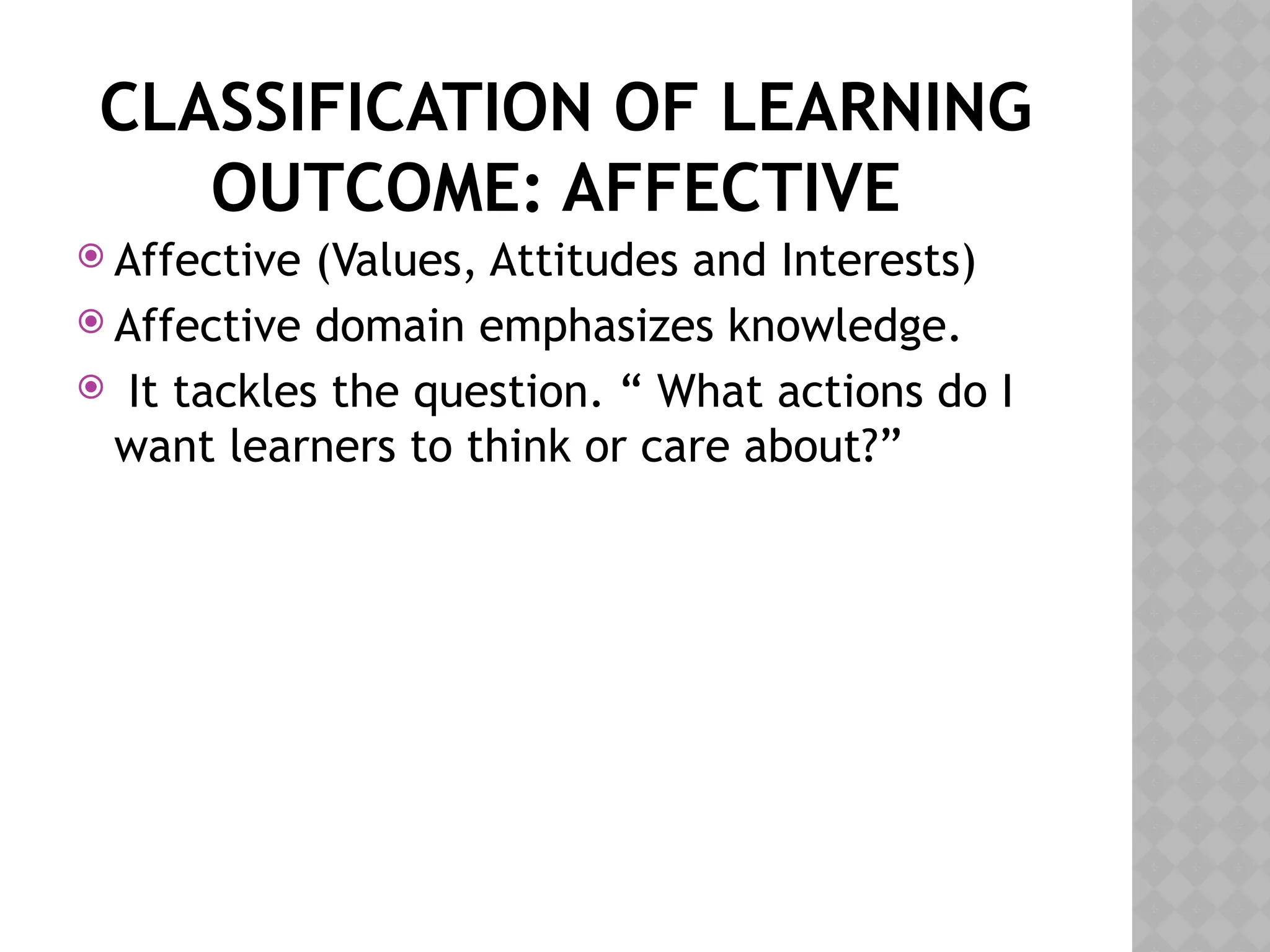
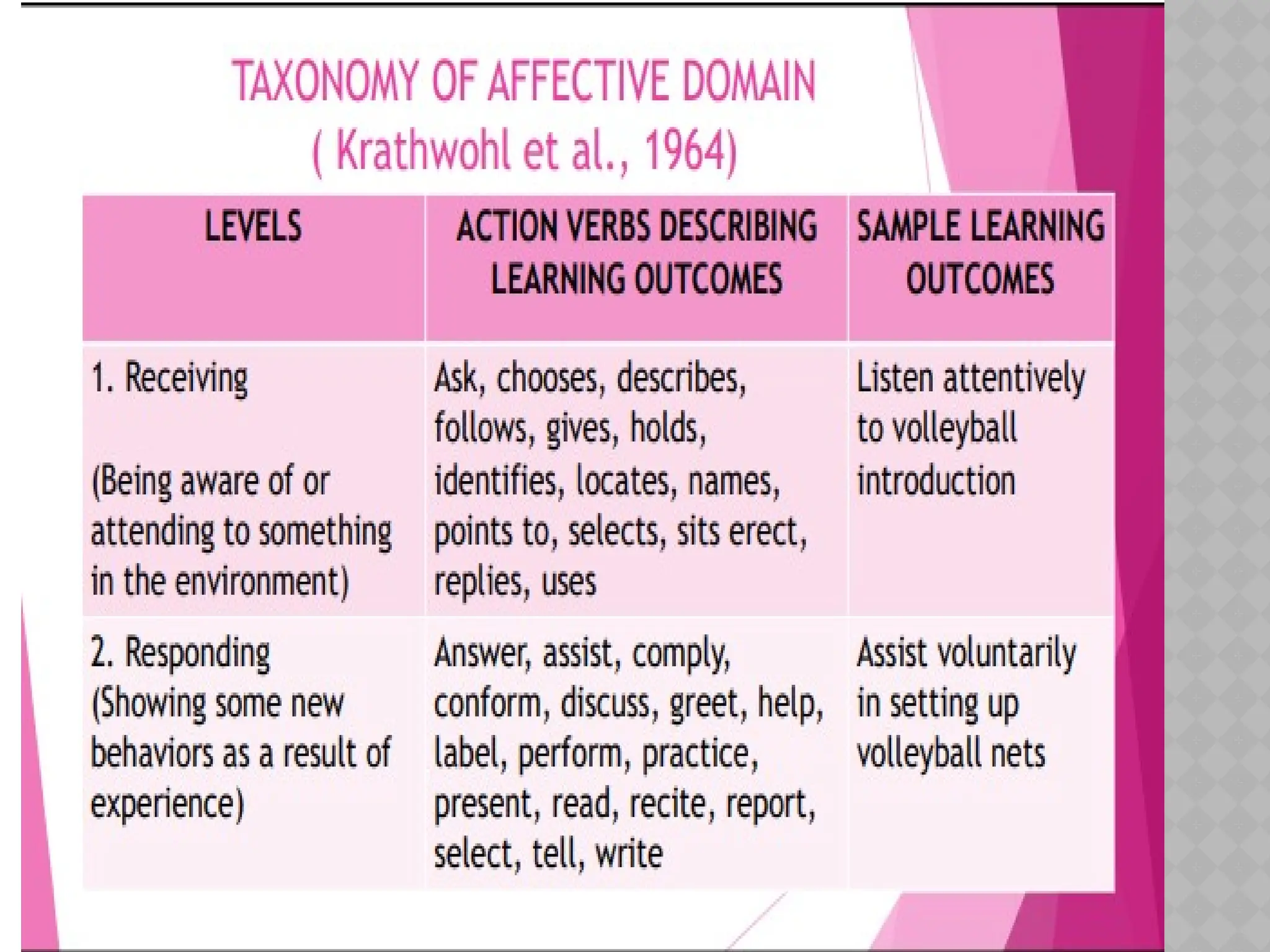
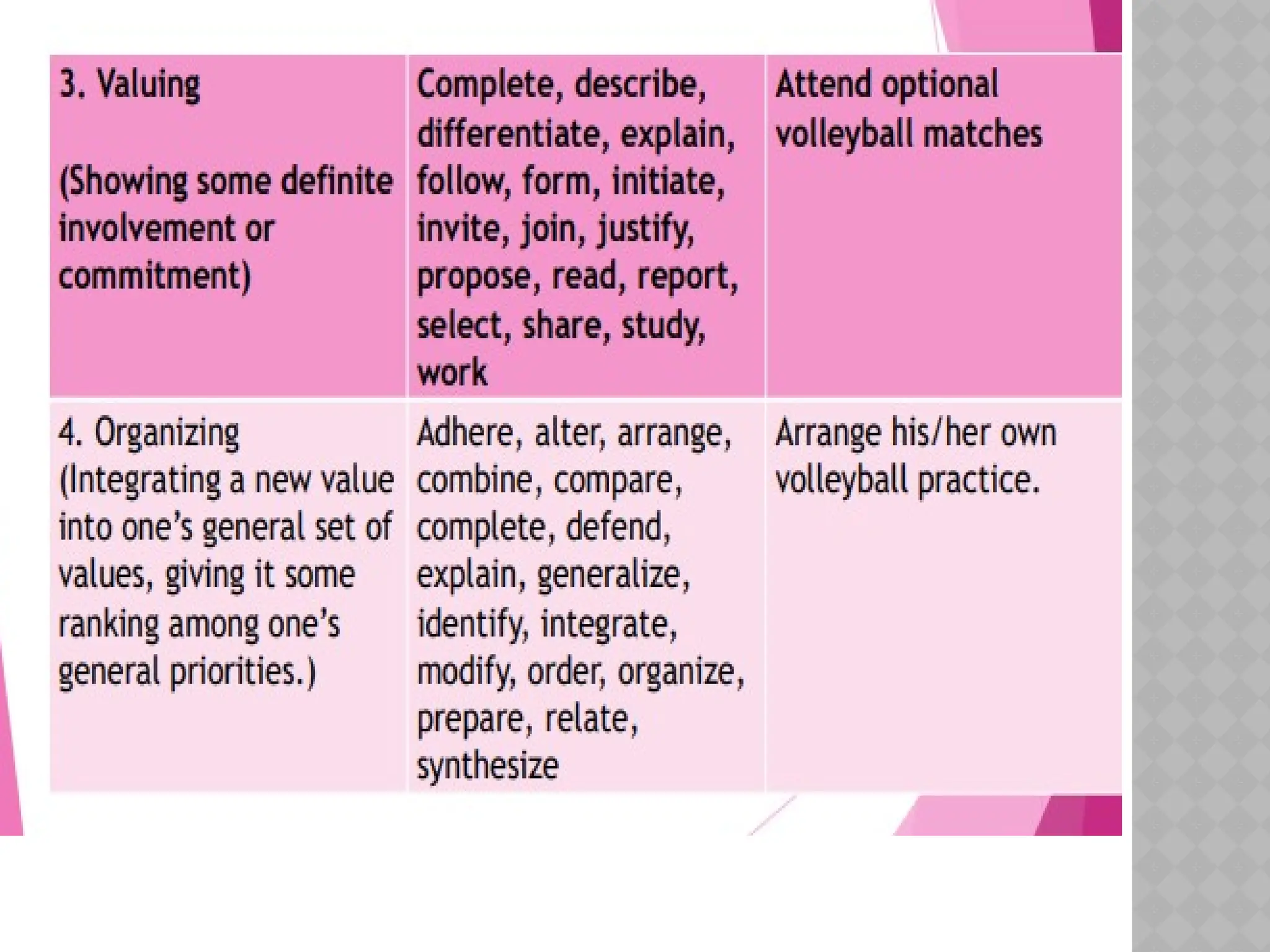
OUTCOME:AFFECTIVE
Affective (Values, Attitudes and Interests)
Affective domain emphasizes knowledge.
It tackles the question. “ What actions do I
want learners to think or care about?”
68.
TYPES OF ASSESSMENT
METHOD
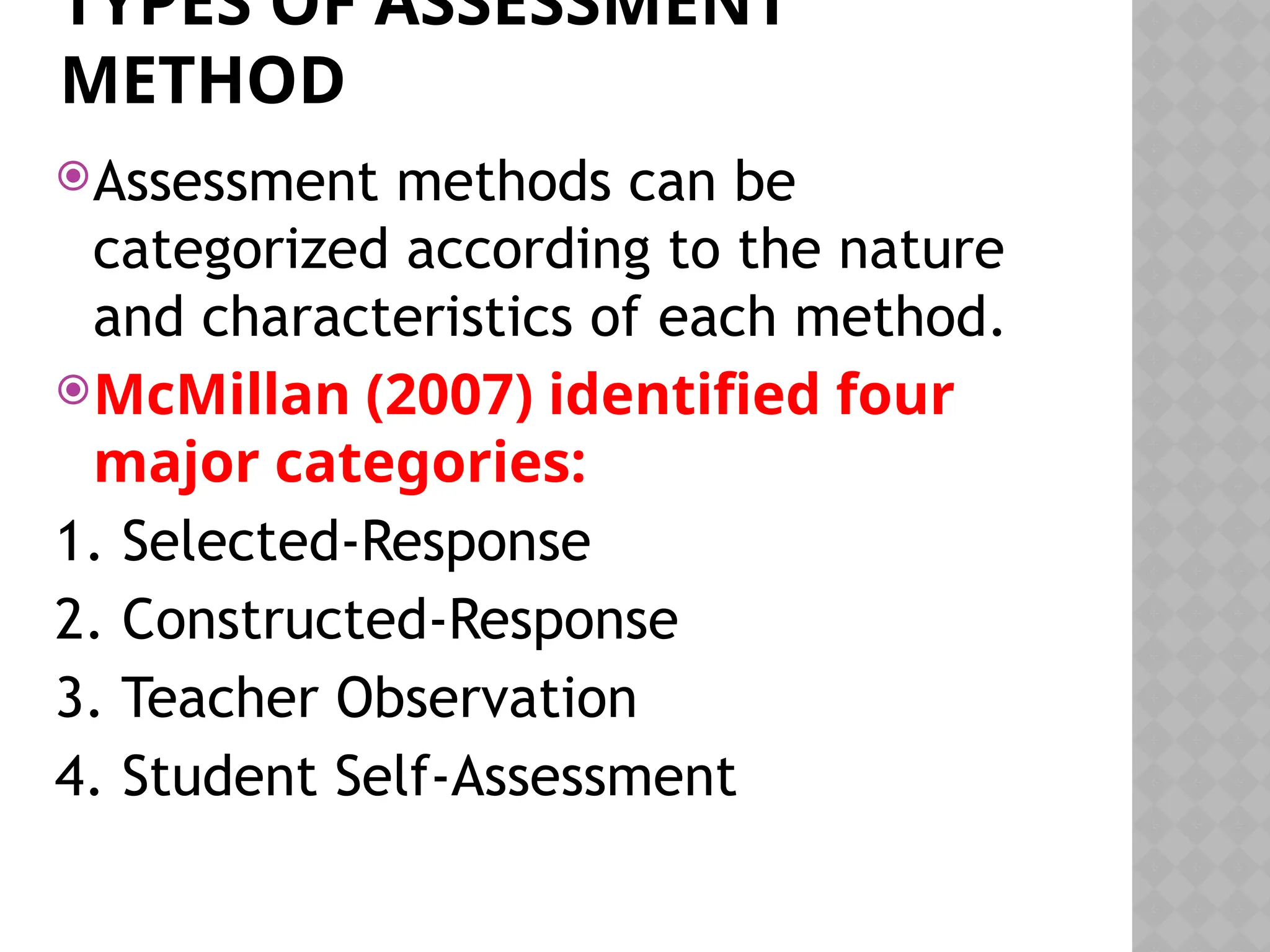
Assessmentmethods can be
categorized according to the nature
and characteristics of each method.
McMillan (2007) identified four
major categories:
1. Selected-Response
2. Constructed-Response
3. Teacher Observation
4. Student Self-Assessment
69.
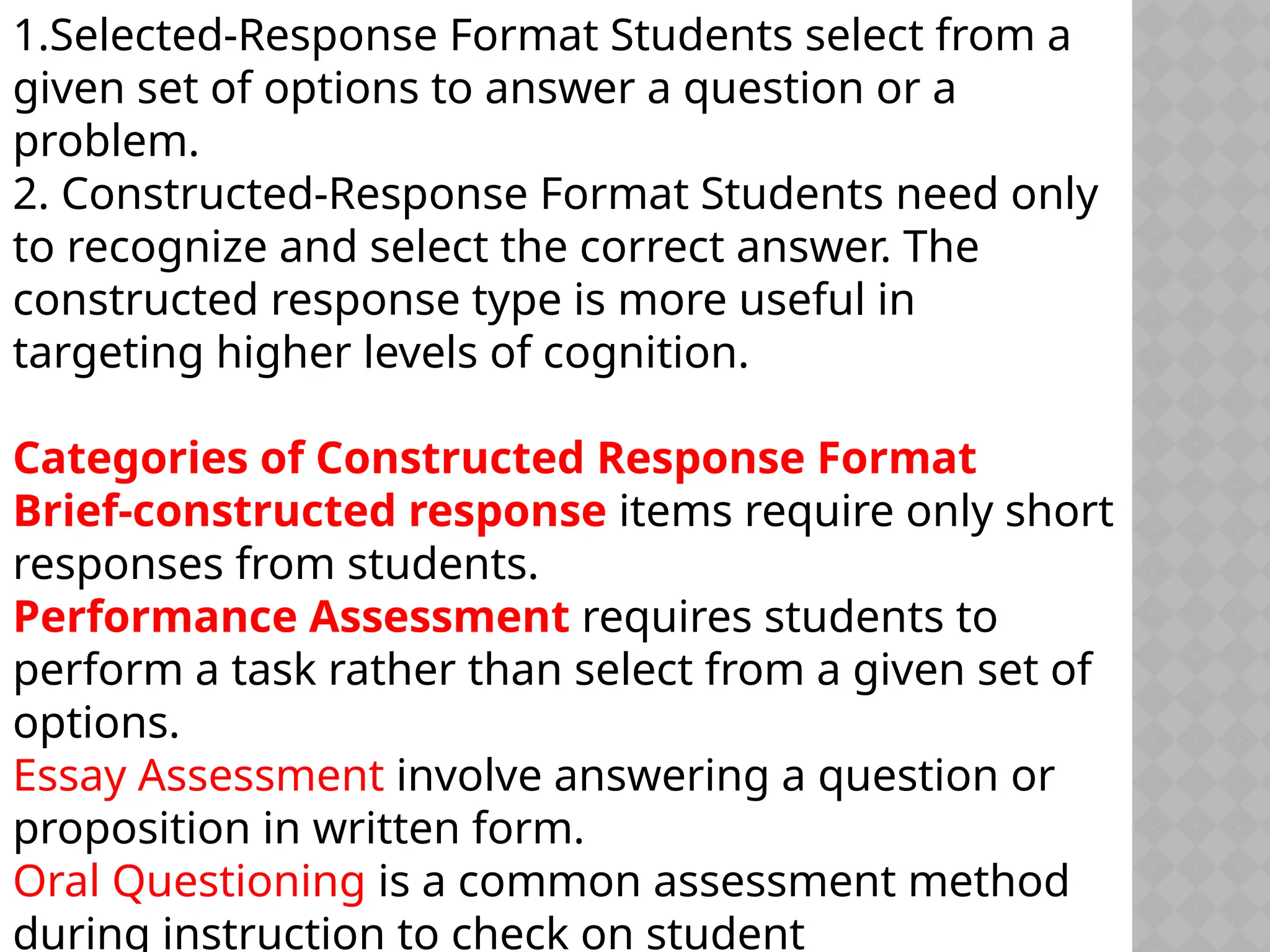
1.Selected-Response Format Studentsselect from a
given set of options to answer a question or a
problem.
2. Constructed-Response Format Students need only
to recognize and select the correct answer. The
constructed response type is more useful in
targeting higher levels of cognition.
Categories of Constructed Response Format
Brief-constructed response items require only short
responses from students.
Performance Assessment requires students to
perform a task rather than select from a given set of
options.
Essay Assessment involve answering a question or
proposition in written form.
Oral Questioning is a common assessment method
during instruction to check on student
70.
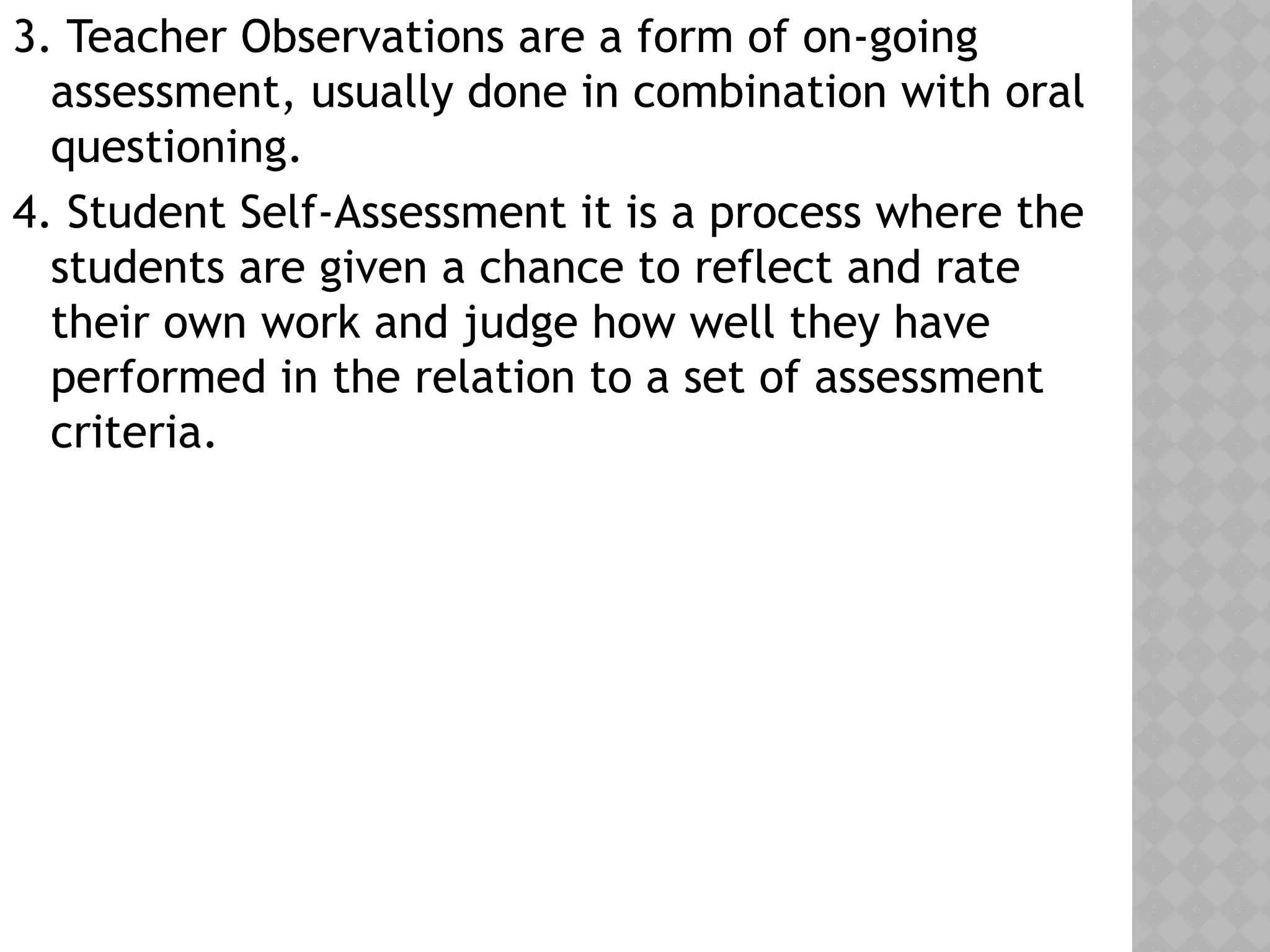
3. Teacher Observationsare a form of on-going
assessment, usually done in combination with oral
questioning.
4. Student Self-Assessment it is a process where the
students are given a chance to reflect and rate
their own work and judge how well they have
performed in the relation to a set of assessment
criteria.
71.
MATCHING LEARNING TARGETS
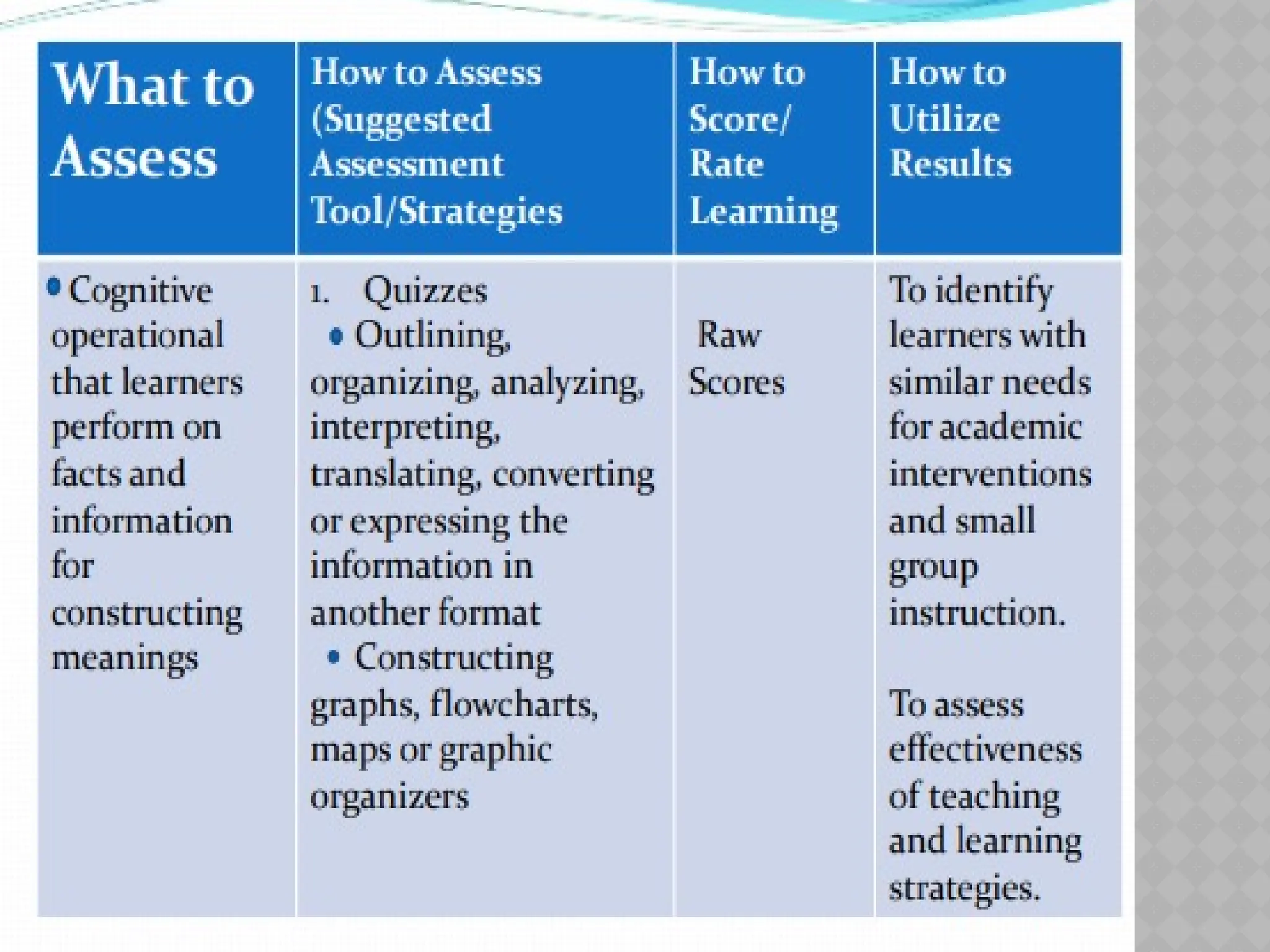
WITHASSESSMENT METHOD
In an outcome-based approach, teaching
methods and resources that are used to
support learning as well as assessment tasks
and rubrics are explicitly linked to the
program and course learning outcomes.
Constructive alignment provides the “how-
to” by verifying that the teachinglearning
activities (TLAs) and the assessment task
(ATs).
Learning Target is defined as a description
of performance that includes what learners
should know and be able to do.
72.
KNOWLEDGE AND SIMPLE
UNDERSTANDING
pertains to mastery of substantive subject
matter and procedures.
in the revised Bloom’s taxonomy, this covers
the lower order thinking skills of
remembering, understanding and applying.
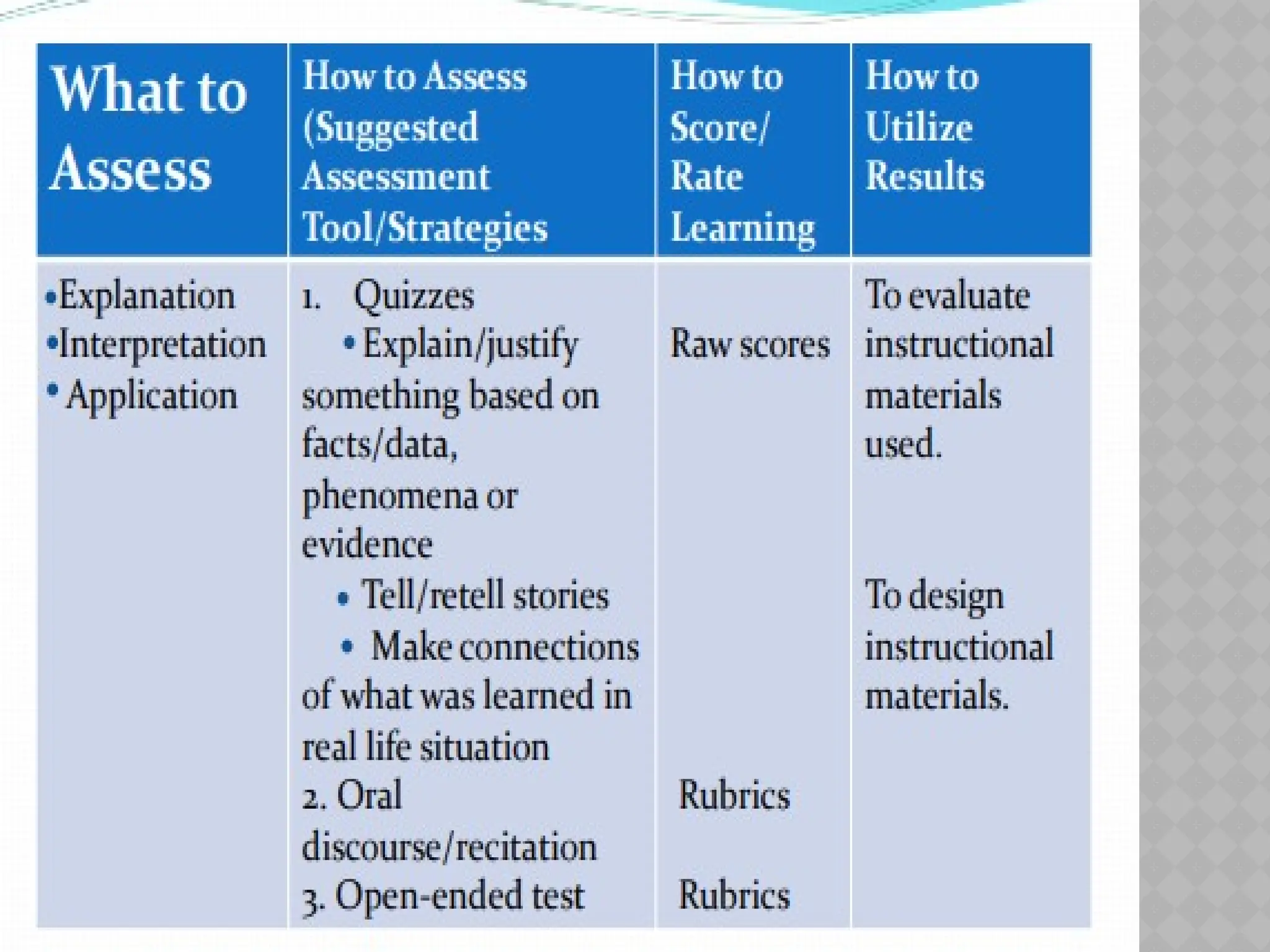
Deep understanding and
reasoning
involve higher order thinking skills of
analyzing, evaluating, and synthesizing.
students may be asked to compare and contrast
two topics or ideas, or explain the pros and cons
of an argument
73.
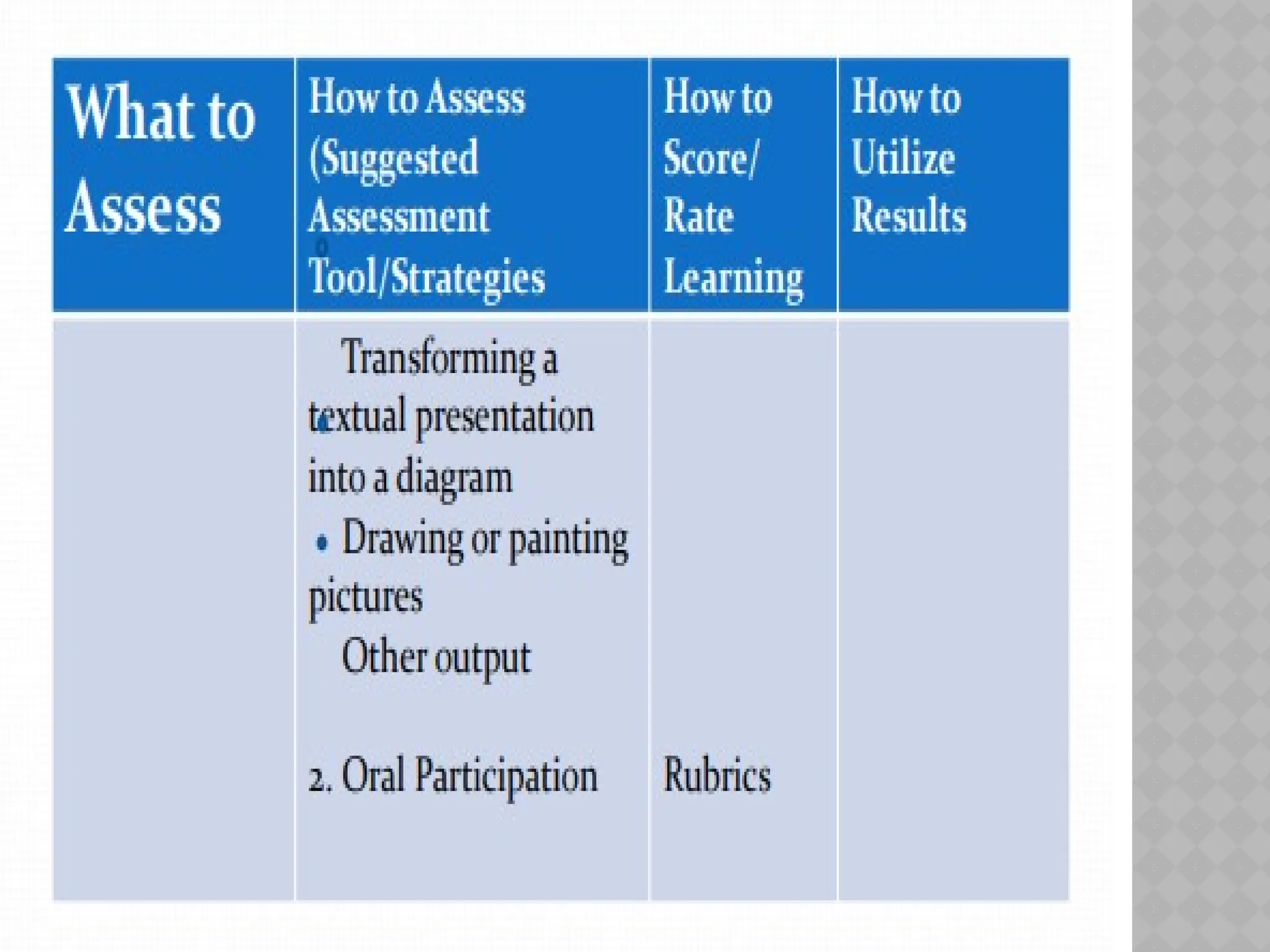
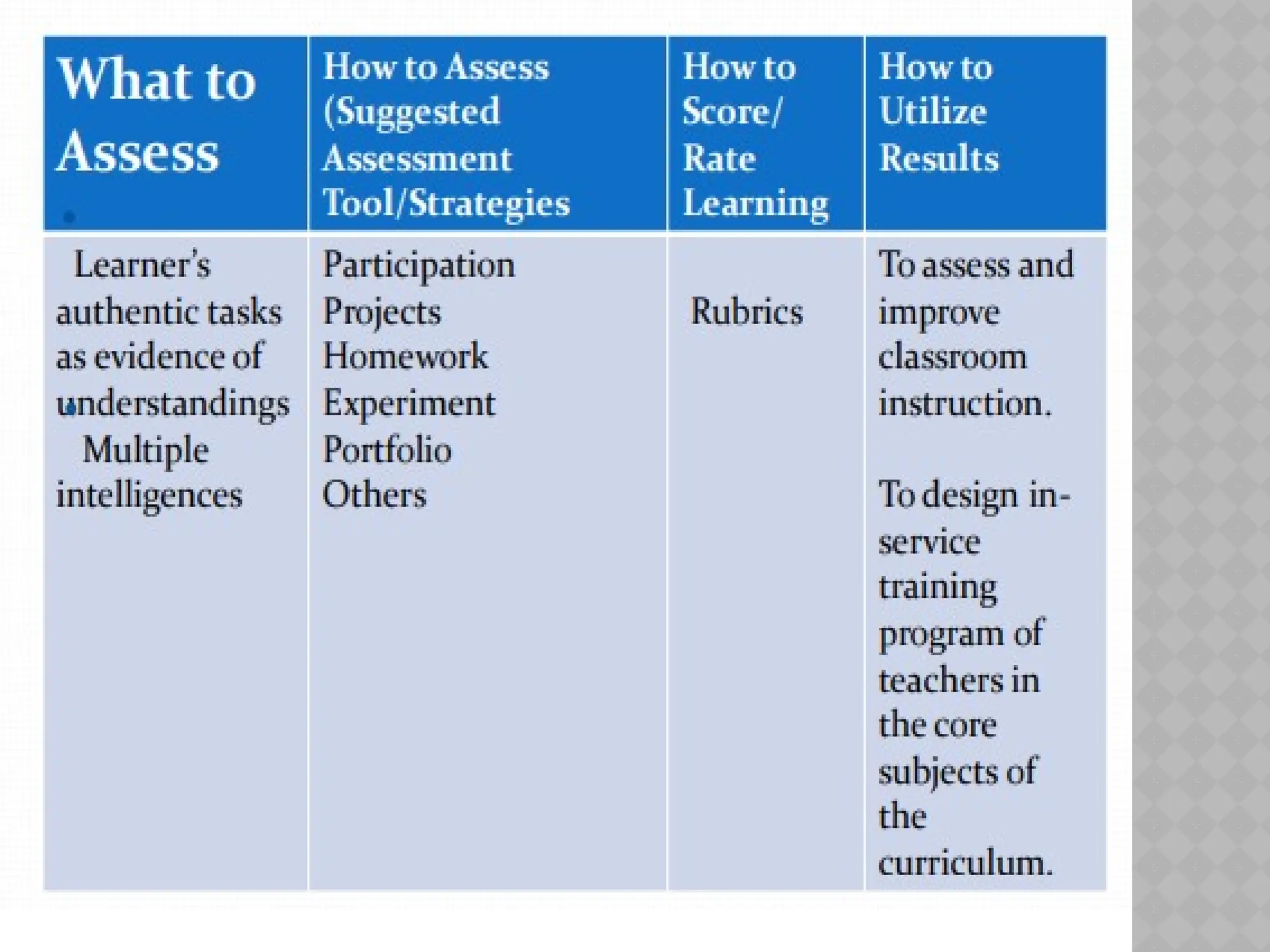
Skills performanceassessment is obviously the
superior assessment method.
Products are most adequately assessed through
performance task.
is a substantial and tangible output that
showcases a student’s understanding of
concepts and skills and their ability to apply,
analyze, evaluate and integrate those concepts
and skills.
Affect cannot be assessed by selected-response or
briefconstructed response tests.
it pertains to attitudes, interests and values
students manifest.
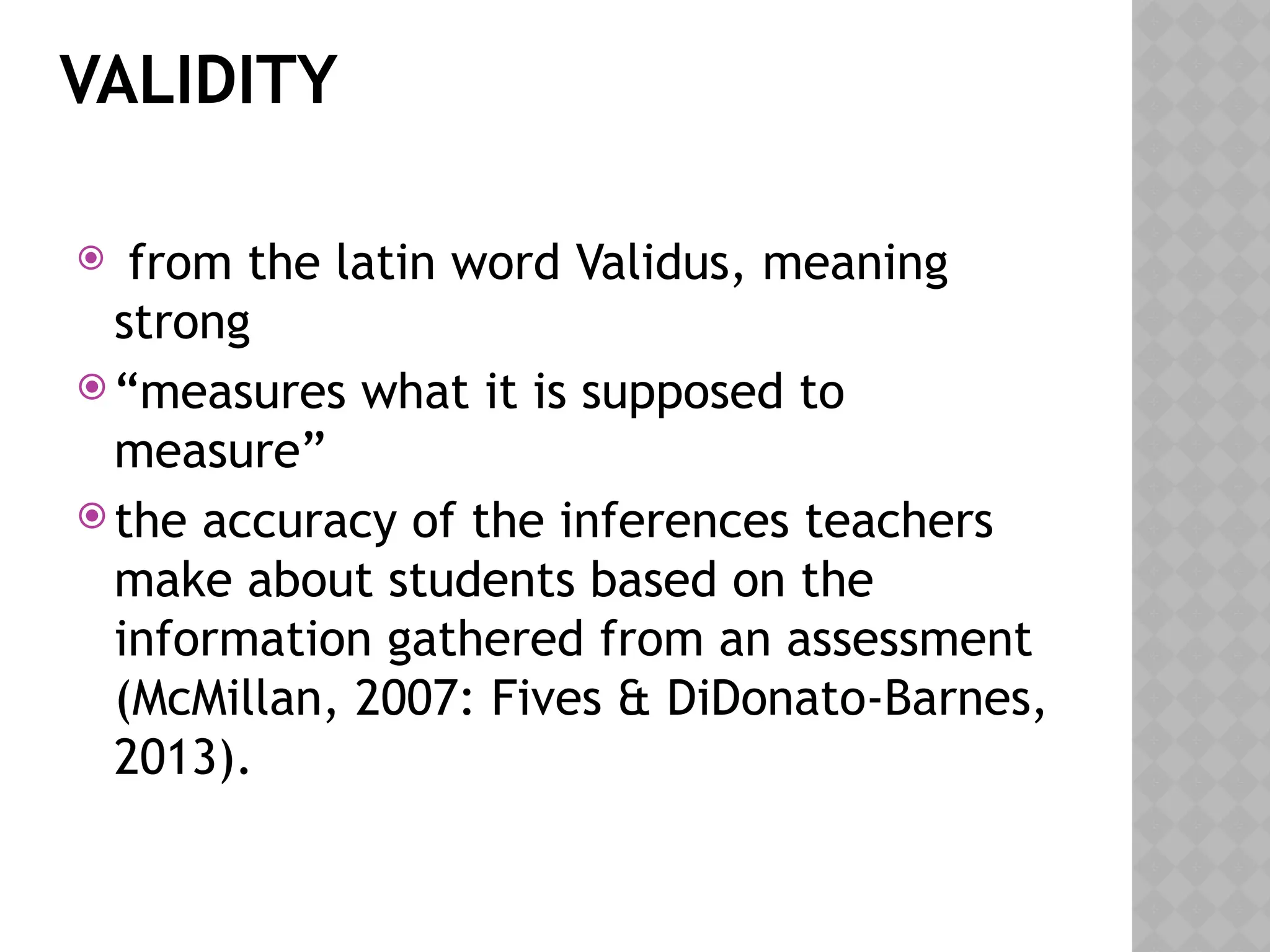
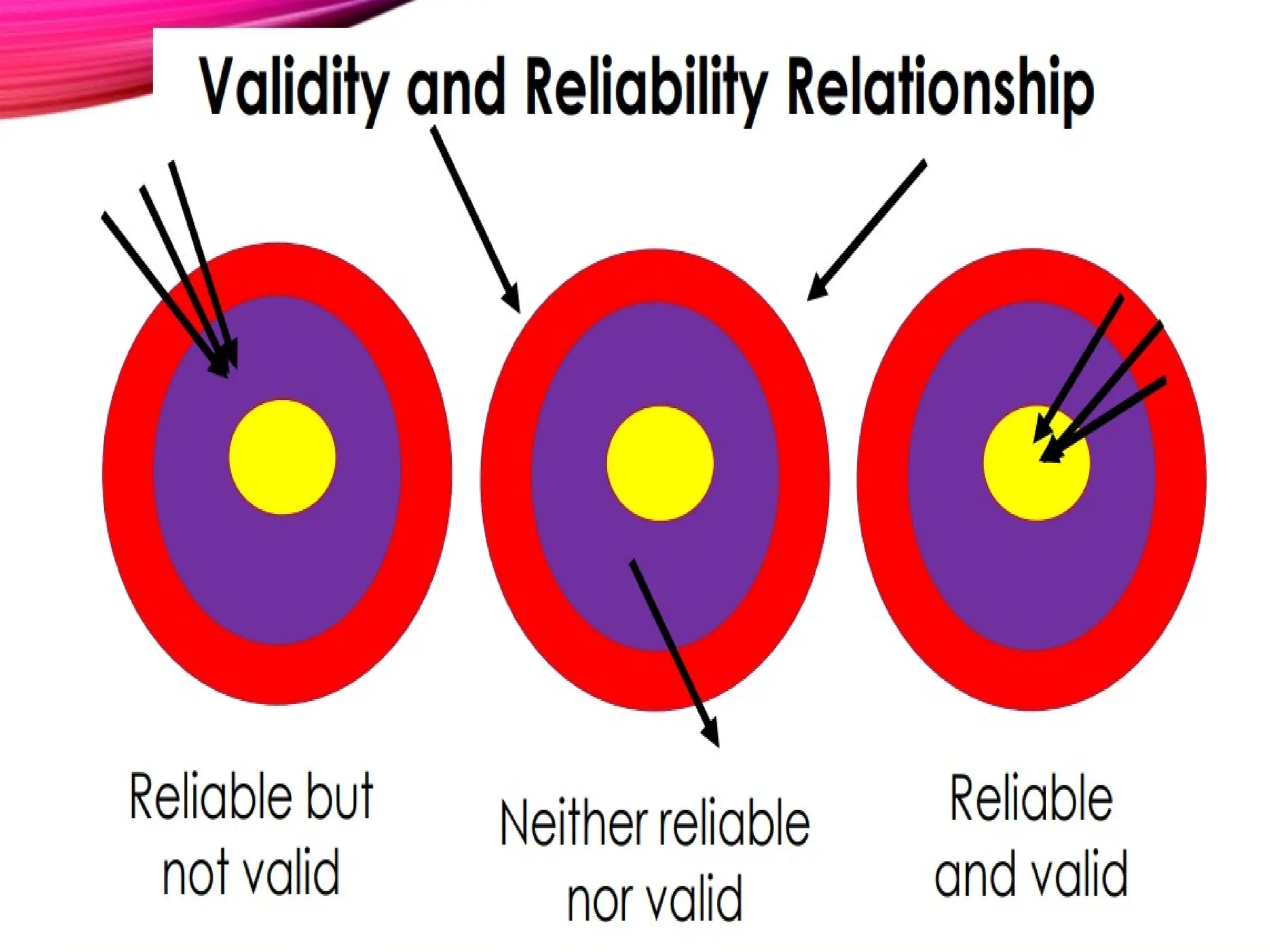
VALIDITY
from thelatin word Validus, meaning
strong
“measures what it is supposed to
measure”
the accuracy of the inferences teachers
make about students based on the
information gathered from an assessment
(McMillan, 2007: Fives & DiDonato-Barnes,
2013).
82.
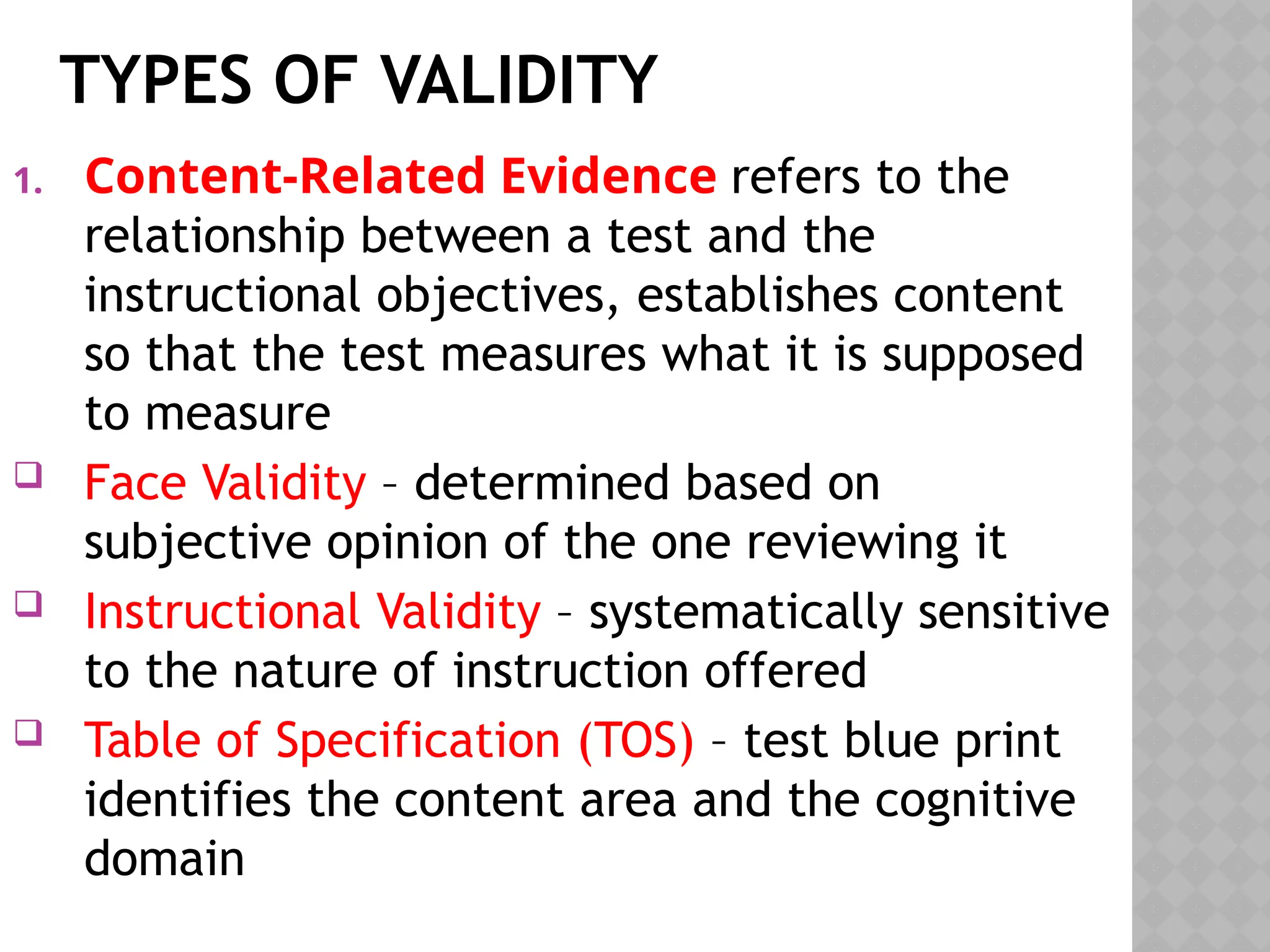
TYPES OF VALIDITY
1.Content-Related Evidence refers to the
relationship between a test and the
instructional objectives, establishes content
so that the test measures what it is supposed
to measure
Face Validity – determined based on
subjective opinion of the one reviewing it
Instructional Validity – systematically sensitive
to the nature of instruction offered
Table of Specification (TOS) – test blue print
identifies the content area and the cognitive
domain
83.
2. Criterion-Related Evidence
avalidation that refers to the extent
to which scores from a test relate to
theoretically similar measures
concurrent validity – uses predictor data
and criterion at the same time
predictive validity – uses predictor data
to estimate accurately the outcome of the
students performance (criterion) at later
time.
84.
3. Construct-Related Evidence
avalidation that refers to the
measure of the extent to which a test
measures a theoretical and observable
convergent validity – constructs that are
related are in fact observed to be related
divergent validity – constructs that are
unrelated are in reality observed not to be
factor analysis – uses complex statistical
procedures conducted with different
procedures
85.
FACTORS AFFECTING THEVALIDITY
AND RELIABILITY OF A TEST ITEM
the test itself
the administration and scoring of a
test
personal factors influencing how
students response to the test
validity is always specific to a
particular group
86.
REASONS THAT REDUCESTHE
VALIDITY OF THE TEST ITEM
Poorly constructed test items
Unclear directions
Ambiguous test items
Too difficult vocabulary
Complicated syntax
Inadequate time limit
Inappropriate level of difficulty
Unintended clues
Improper arrangement of test items
87.
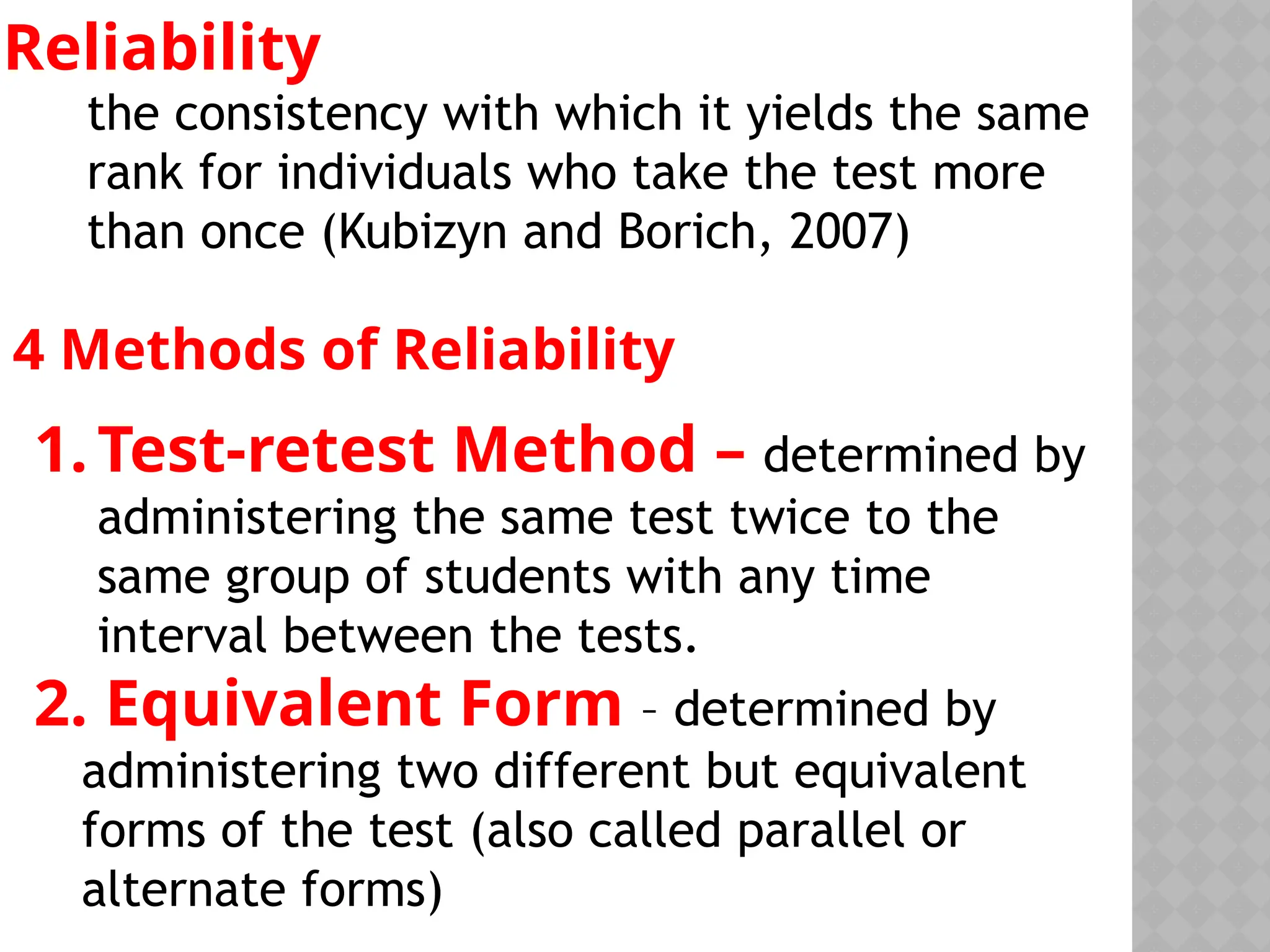
Reliability
the consistency withwhich it yields the same
rank for individuals who take the test more
than once (Kubizyn and Borich, 2007)
4 Methods of Reliability
1.Test-retest Method – determined by
administering the same test twice to the
same group of students with any time
interval between the tests.
2. Equivalent Form – determined by
administering two different but equivalent
forms of the test (also called parallel or
alternate forms)
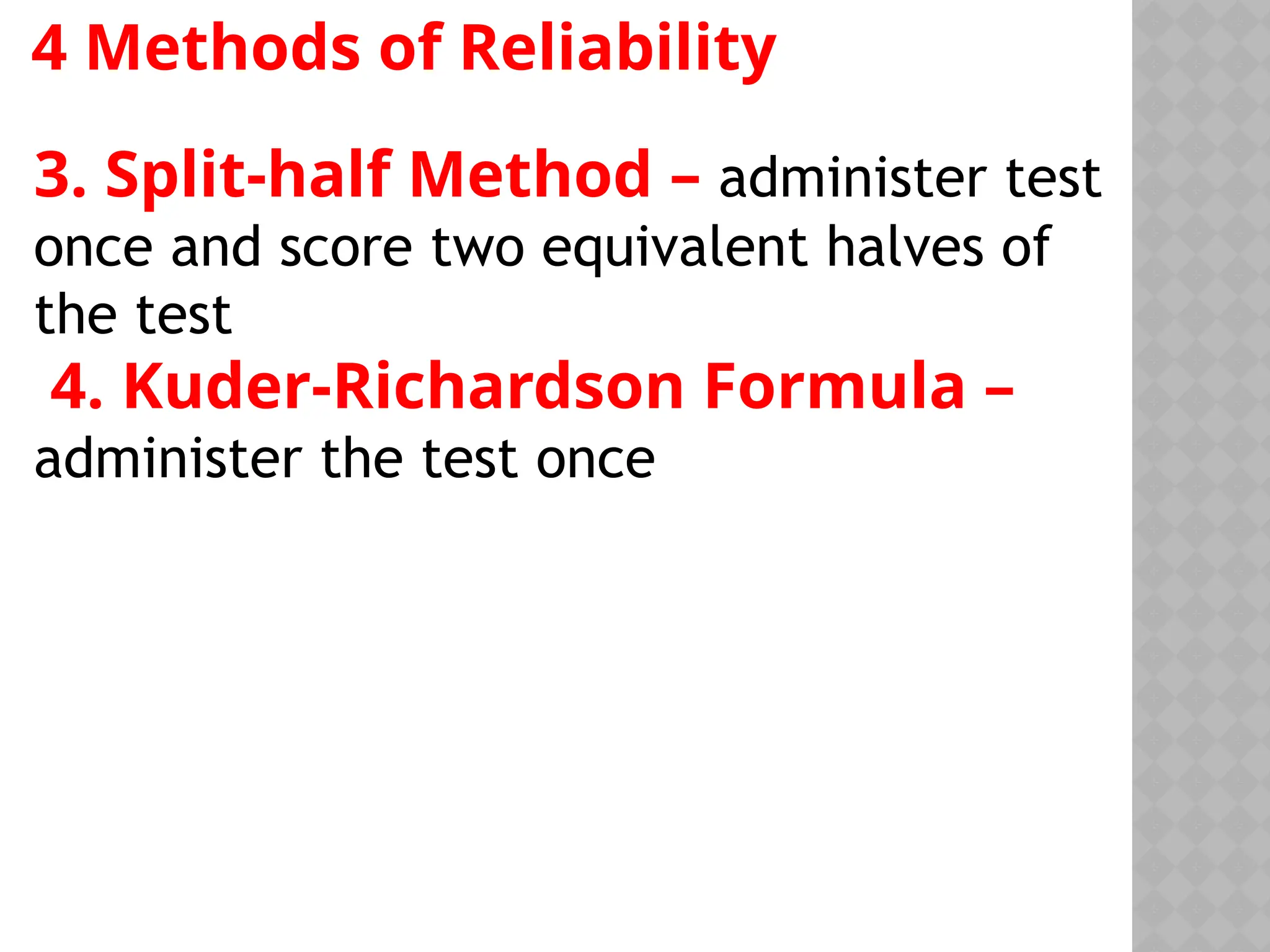
88.
3. Split-half Method– administer test
once and score two equivalent halves of
the test
4. Kuder-Richardson Formula –
administer the test once
4 Methods of Reliability
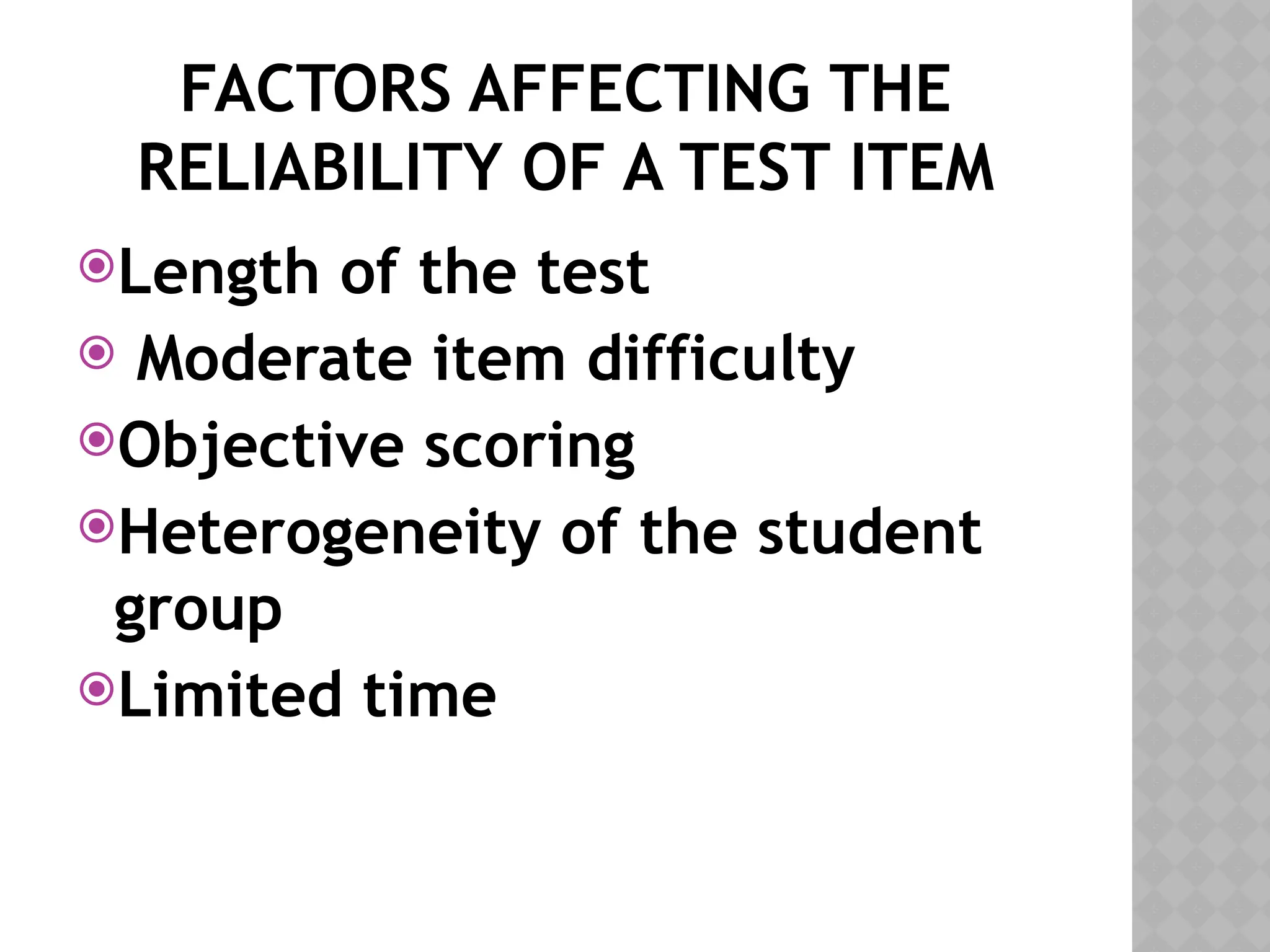
89.
FACTORS AFFECTING THE
RELIABILITYOF A TEST ITEM
Length of the test
Moderate item difficulty
Objective scoring
Heterogeneity of the student
group
Limited time
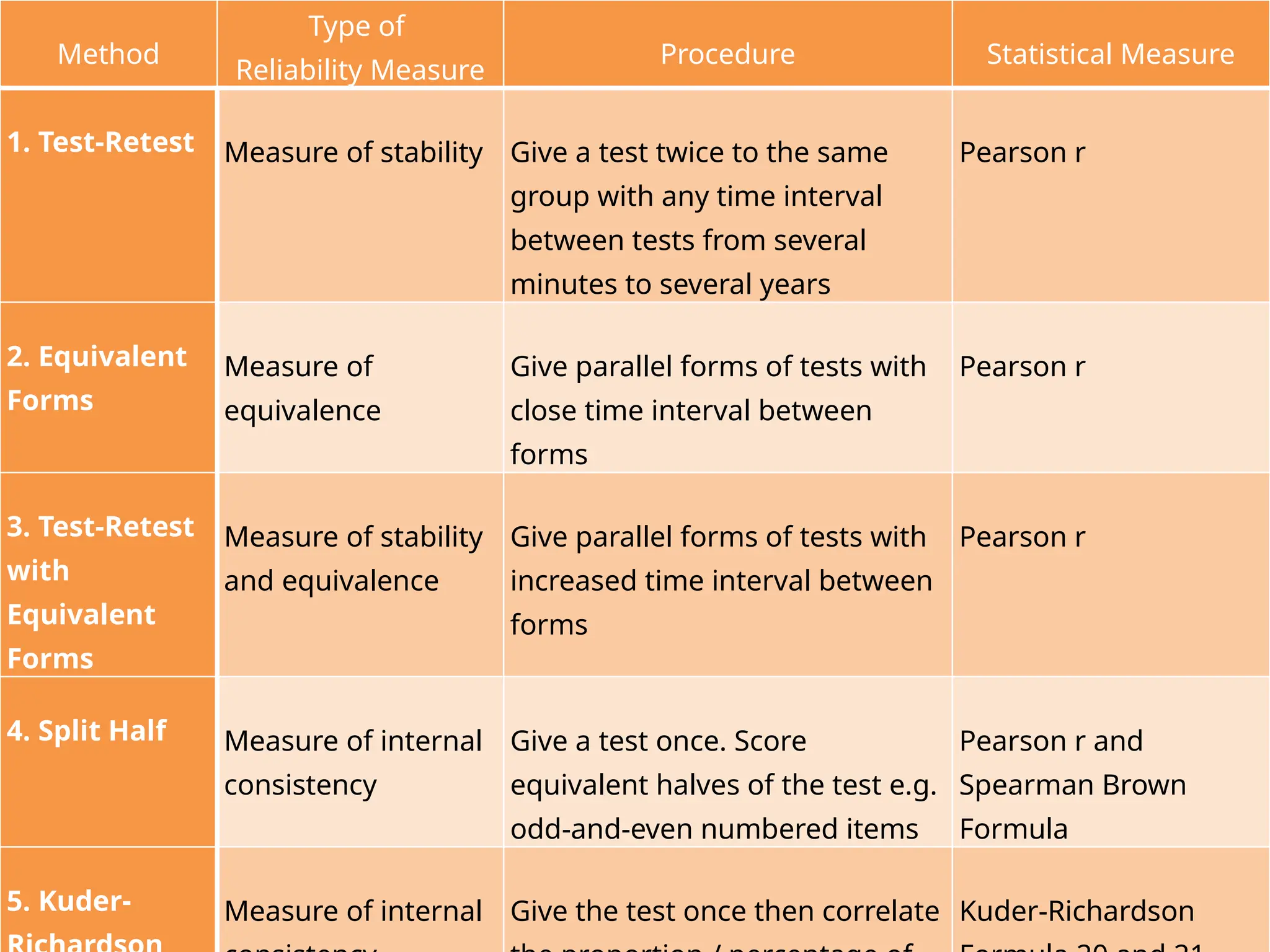
92.
Method
Type of
Reliability Measure
ProcedureStatistical Measure
1. Test-Retest Measure of stability Give a test twice to the same
group with any time interval
between tests from several
minutes to several years
Pearson r
2. Equivalent
Forms
Measure of
equivalence
Give parallel forms of tests with
close time interval between
forms
Pearson r
3. Test-Retest
with
Equivalent
Forms
Measure of stability
and equivalence
Give parallel forms of tests with
increased time interval between
forms
Pearson r
4. Split Half Measure of internal
consistency
Give a test once. Score
equivalent halves of the test e.g.
odd-and-even numbered items
Pearson r and
Spearman Brown
Formula
5. Kuder- Measure of internal Give the test once then correlate Kuder-Richardson
93.
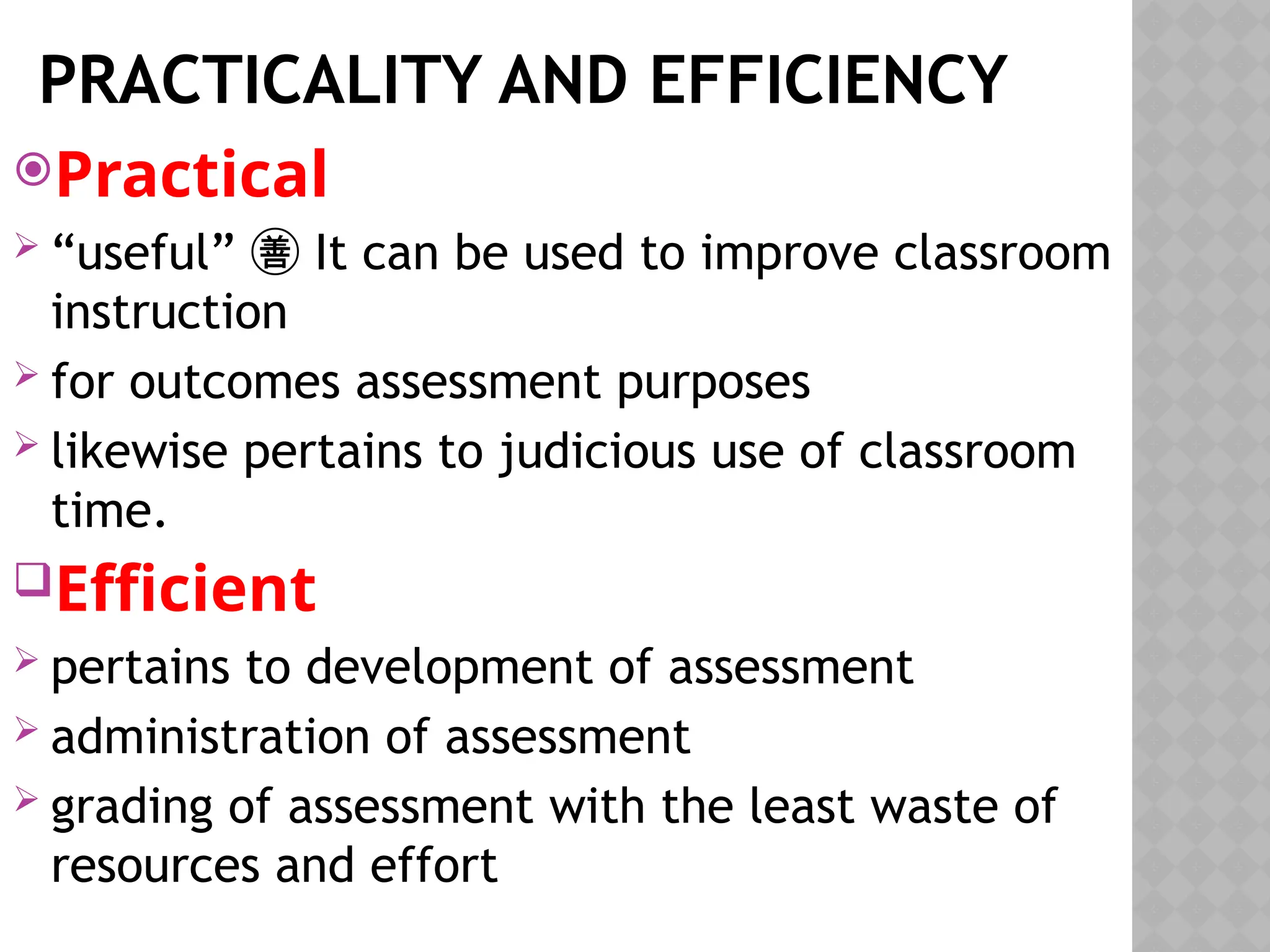
PRACTICALITY AND EFFICIENCY
Practical
“useful” It can be used to improve classroom
instruction
for outcomes assessment purposes
likewise pertains to judicious use of classroom
time.
Efficient
pertains to development of assessment
administration of assessment
grading of assessment with the least waste of
resources and effort
95.
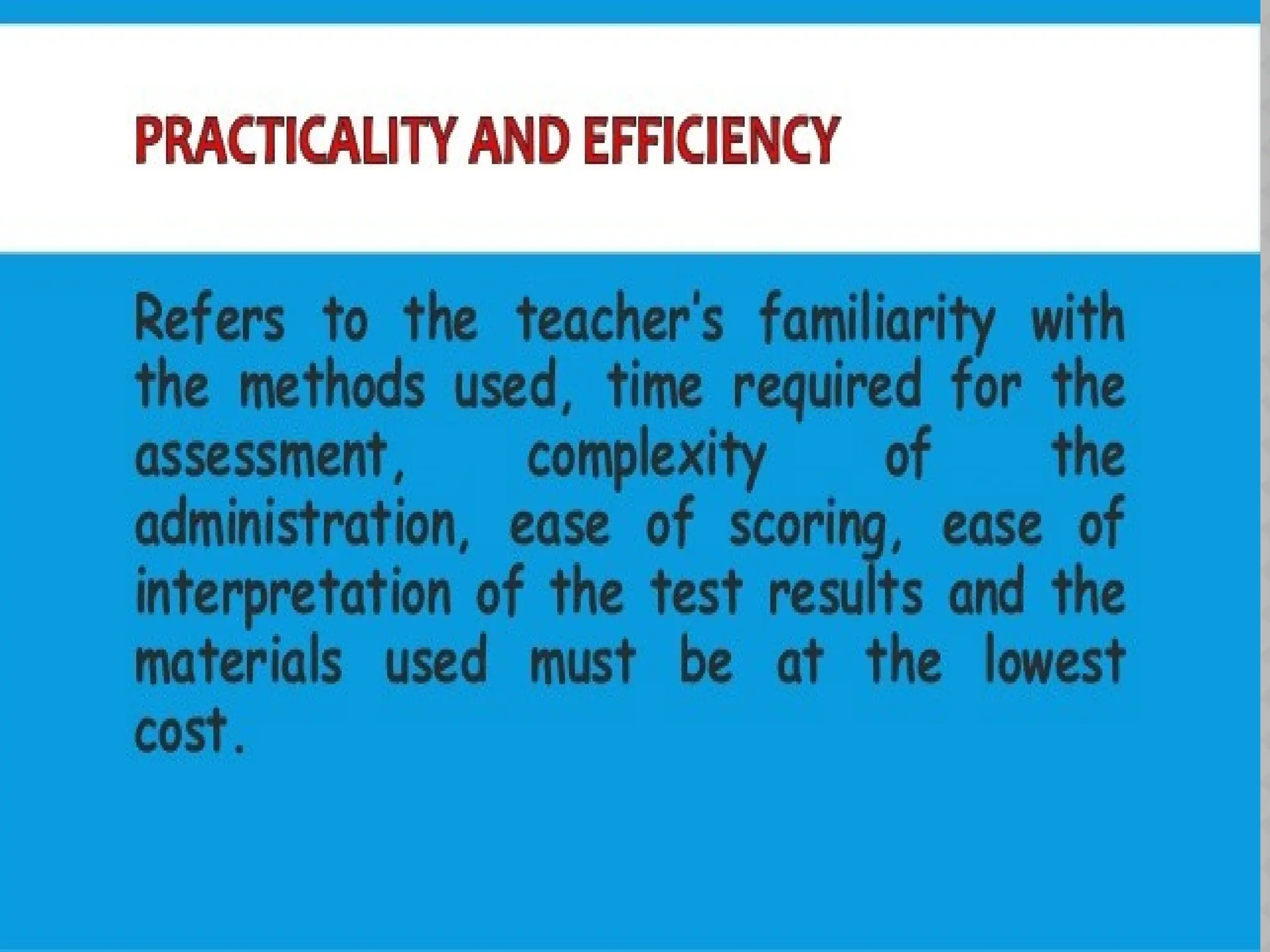
FACTORS ON PRACTICALITYAND
EFFICIENCY
Teacher familiarity with the method
Time required
Complexity or Ease in
administration
Ease of Scoring
Ease of Interpretation
Cost
96.
FAMILIARITY WITH THEMETHODS
teachers should learn the strengths
and weaknesses of each method of
assessment, how they are
developed, administered and
marked.
teachers should be familiar with the
assessment or the test
97.
TIME REQUIRED
a desirableassessment is short yet able to
provide valid and reliable results
quick to develop but not to the point of
reckless construction
scored promptly but not without basis
assessment should be easy to administer
instructions must be clear and complete
Directions and procedures for
administrations and procedures are clear
and that little time and effort is needed
EASE IN ADMINISTRATION
98.
EASE OF SCORING
Selected response formats are the easiest to score
compared to restricted and more so extended-
response essays.
Selected response test are objectively marked
because each item has one correct answer
Use scoring procedures appropriate to your
method and purpose. The easier the procedure,
the more reliable the assessment is.
Objective test are the easiest to interpret
Establishing standard, teacher is able to determine
right away if a student passed the test
Interpretation is easier if there was a plan on how
to use the results prior to assessment.
EASE OF INTERPRETATION
99.
COST
Classroom assessmentsare generally
inexpensive compared to national or high
stakes test.
Other things being equal, the less expense
used to gather information, the better