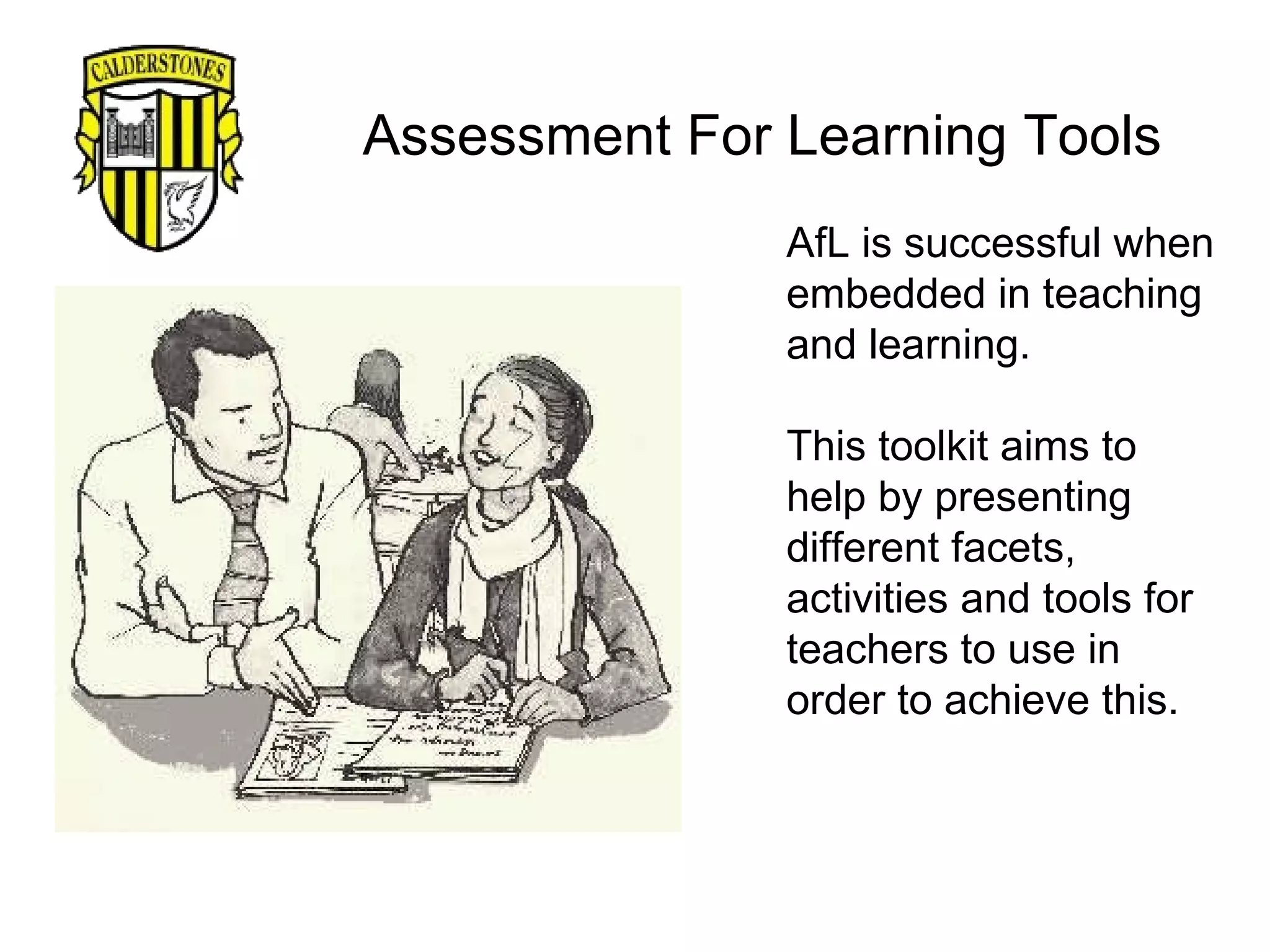
Assessment For Learning Tools AfL is successful when embedded in teaching and learning.  This toolkit aims to help by presenting different facets, activities and tools for teachers to use in order to achieve this.
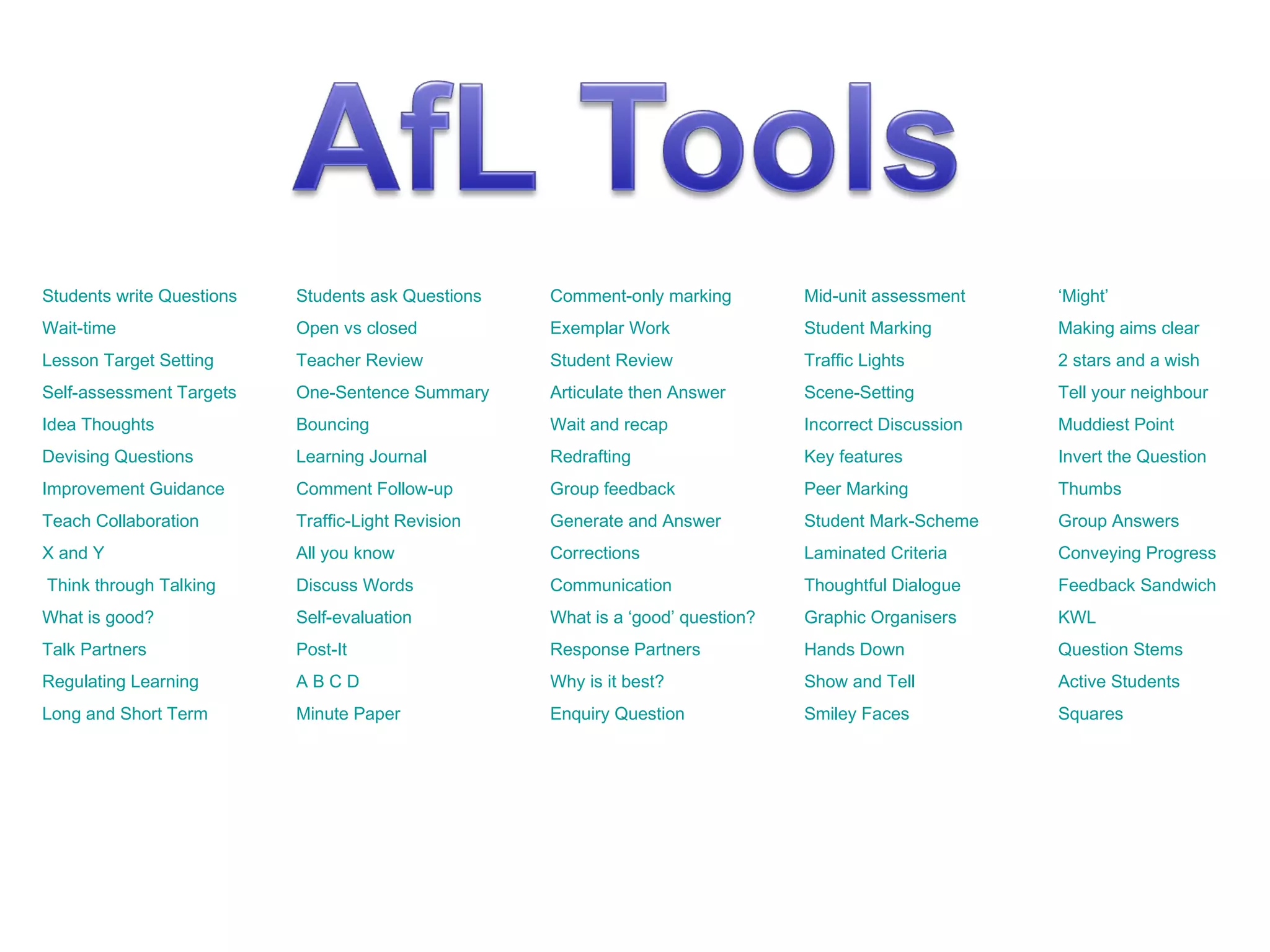
Students write Questions Students ask Questions Comment-only marking Mid-unit assessment ‘Might’ Wait-time Open vs closed Exemplar Work Student Marking Making aims clear Lesson Target Setting Teacher Review Student Review Traffic Lights 2 stars and a wish Self-assessment Targets One-Sentence Summary Articulate then Answer Scene-Setting Tell your neighbour Idea Thoughts Bouncing Wait and recap Incorrect Discussion Muddiest Point Devising Questions Learning Journal Redrafting Key features Invert the Question Improvement Guidance Comment Follow-up Group feedback Peer Marking Thumbs Teach Collaboration Traffic-Light Revision Generate and Answer Student Mark-Scheme Group Answers X and Y All you know Corrections Laminated Criteria Conveying Progress Think through Talking Discuss Words Communication Thoughtful Dialogue Feedback Sandwich What is good? Self-evaluation What is a ‘good’ question? Graphic Organisers KWL Talk Partners Post-It Response Partners Hands Down Question Stems Regulating Learning A B C D Why is it best? Show and Tell Active Students Long and Short Term Minute Paper Enquiry Question Smiley Faces Squares
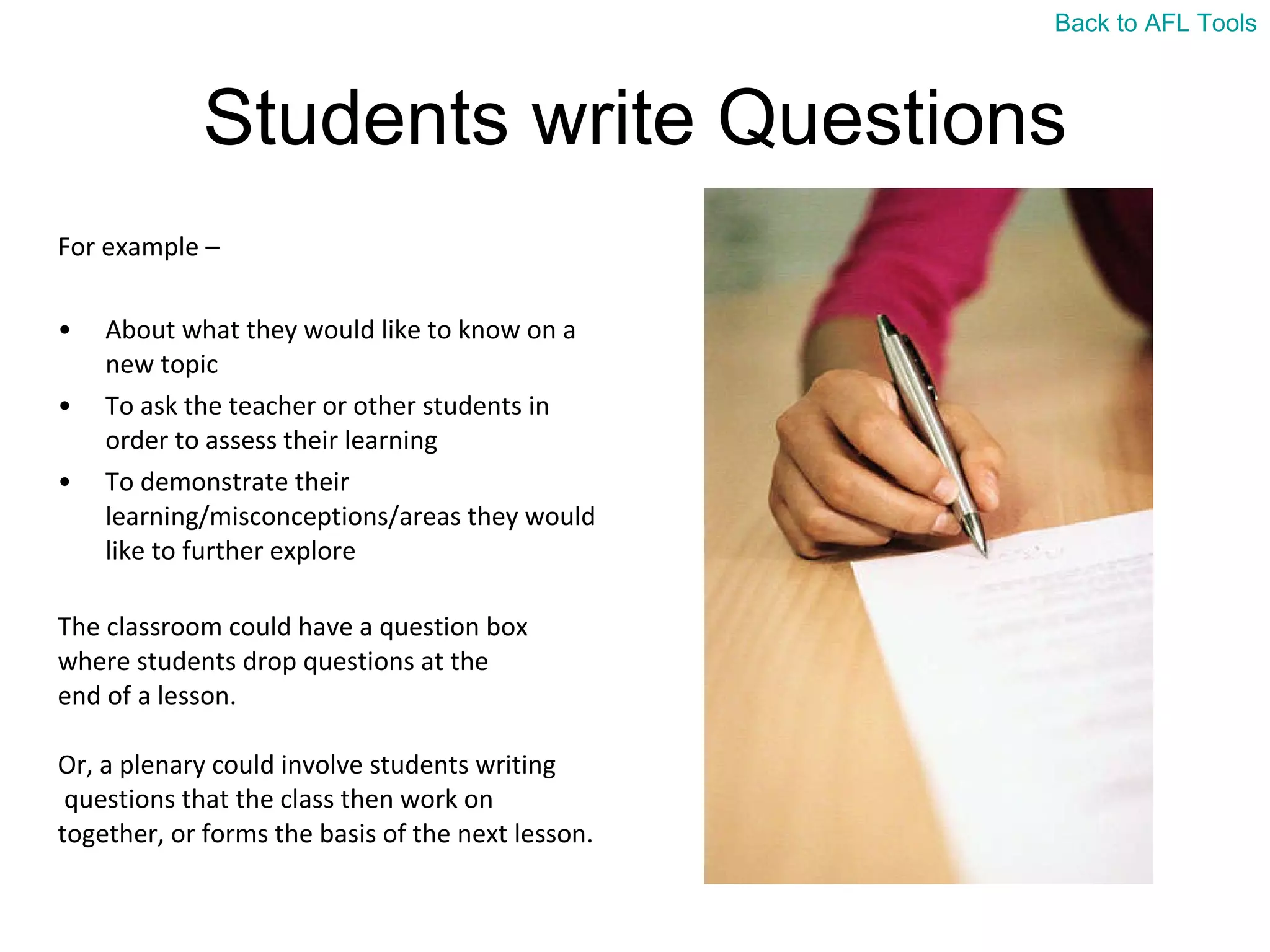
Students write Questions For example –  About what they would like to know on a new topic To ask the teacher or other students in order to assess their learning  To demonstrate their learning/misconceptions/areas they would like to further explore The classroom could have a question box  where students drop questions at the  end of a lesson.  Or, a plenary could involve students writing questions that the class then work on  together, or forms the basis of the next lesson. Back to AFL Tools
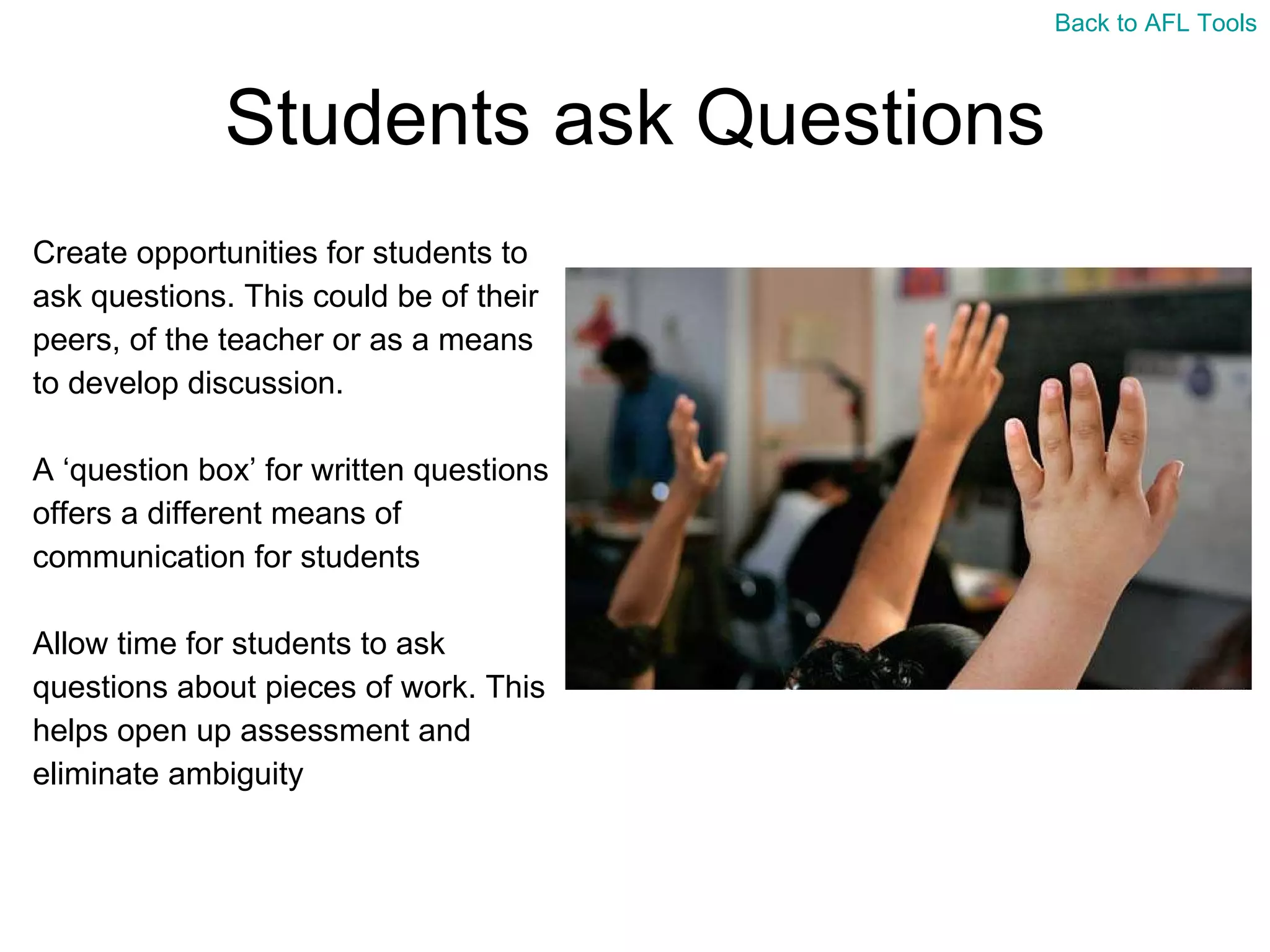
Students ask Questions Create opportunities for students to  ask questions. This could be of their  peers, of the teacher or as a means  to develop discussion. A ‘question box’ for written questions  offers a different means of  communication for students Allow time for students to ask  questions about pieces of work. This  helps open up assessment and  eliminate ambiguity Back to AFL Tools
Comment-only marking Comment-only marking provides students  with a focus for progression instead of a  reward or punishment for their ego (as a  grade does). Comments could be made in books, in a  table at the front of books, in a learning  diary or journal. The latter are helpful for  teacher and student to track the  progression of comments and see  improvement.  Comments should make it clear how the  student can improve. Plan activities and work with feedback in  mind – let the design assist the process. Back to AFL Tools
Mid-unit assessment Having an assessment at the end of a  unit may not provide time for you to  go over areas students have  struggled with, or in which there are  general misconceptions. Timing assessment during a unit (i.e.  lesson 5 of 7) allows time to review,  reflect and revisit. It also gives the teacher an  opportunity to focus explicitly on  areas of weak understanding  supported by evidence. Back to AFL Tools
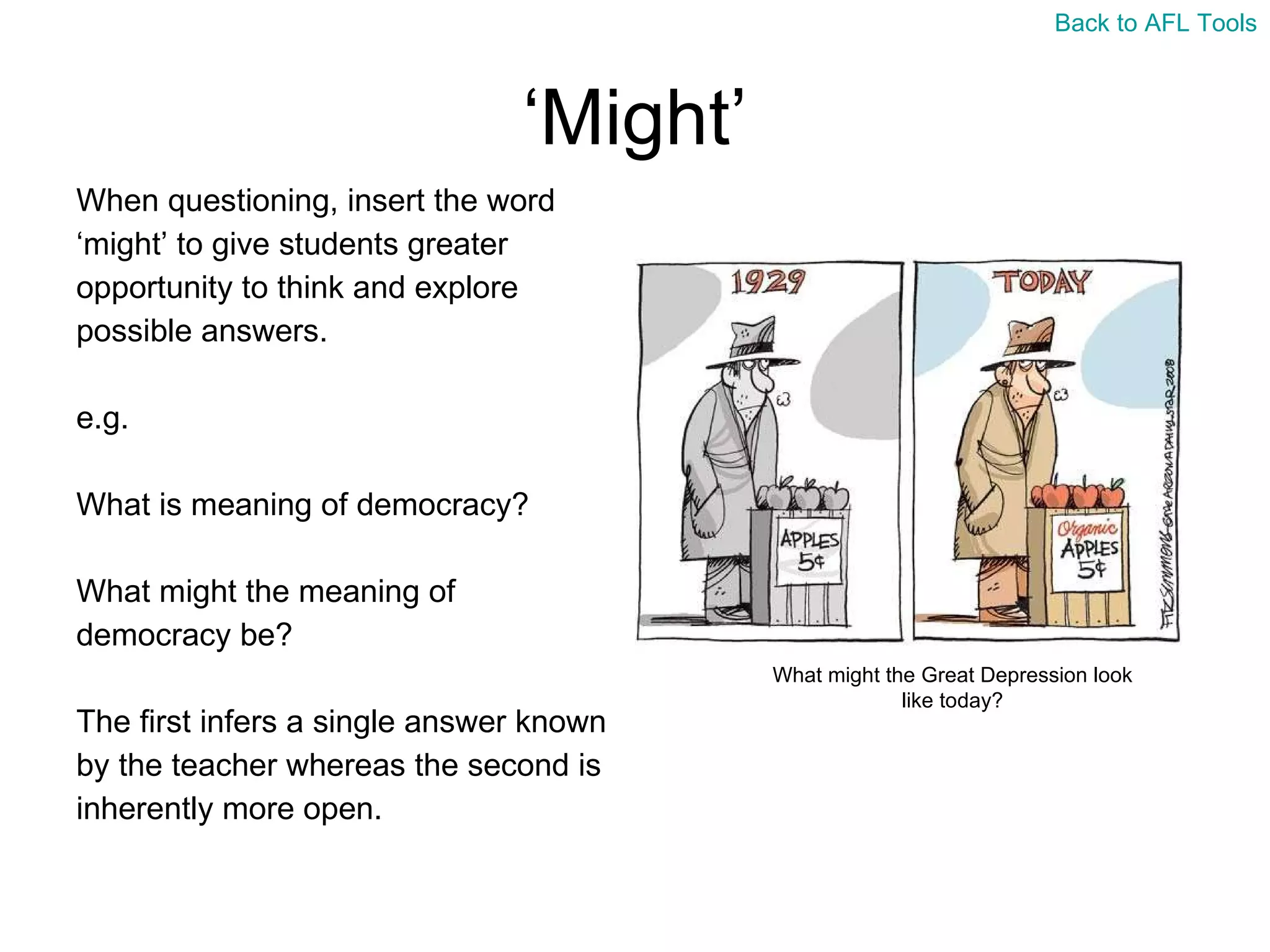
‘ Might’ When questioning, insert the word  ‘ might’ to give students greater opportunity to think and explore  possible answers. e.g. What is meaning of democracy? What might the meaning of  democracy be? The first infers a single answer known  by the teacher whereas the second is  inherently more open. What might the Great Depression look like today? Back to AFL Tools
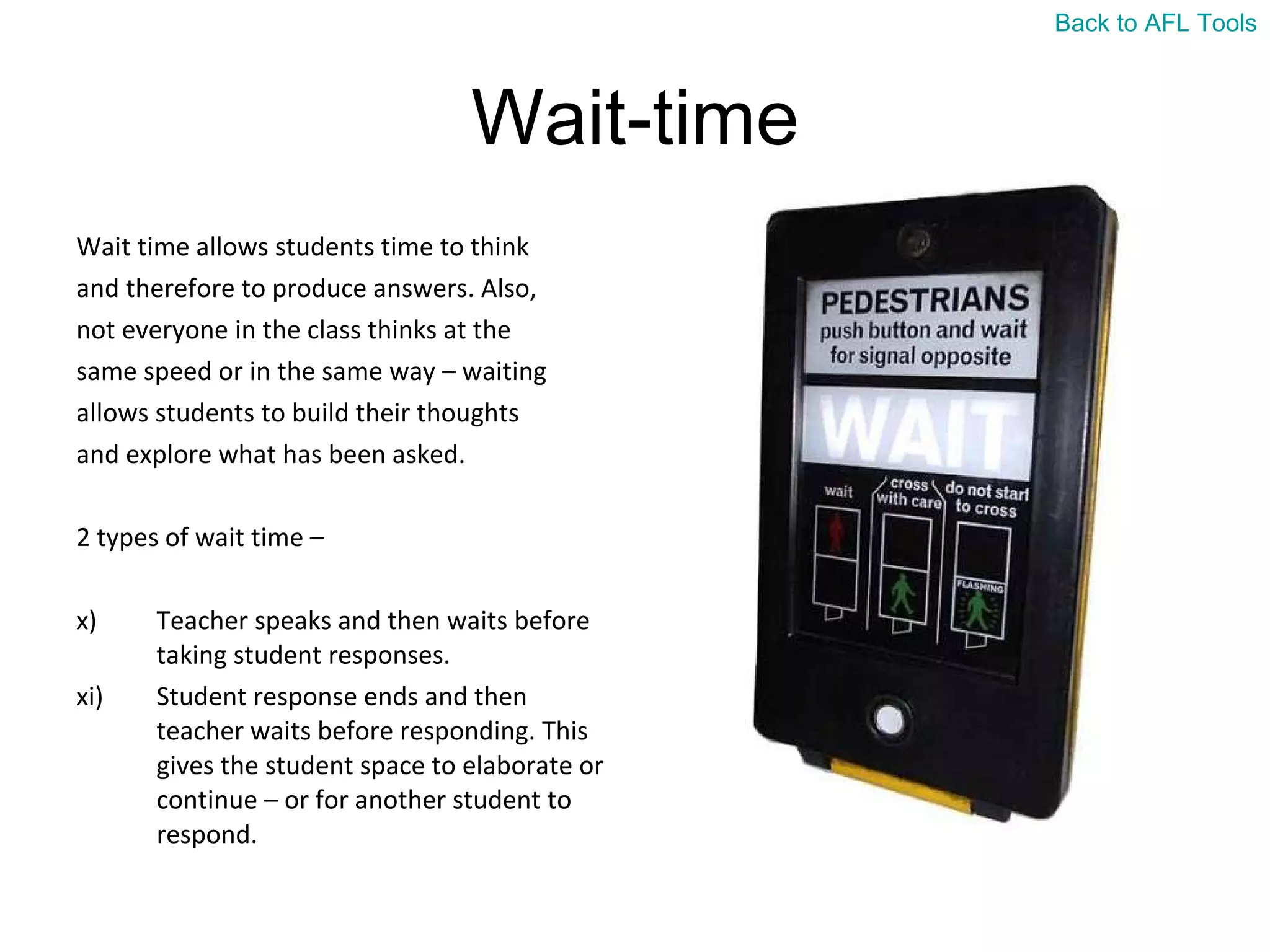
Wait-time Wait time allows students time to think  and therefore to produce answers. Also,  not everyone in the class thinks at the  same speed or in the same way – waiting  allows students to build their thoughts  and explore what has been asked. 2 types of wait time –  Teacher speaks and then waits before taking student responses. Student response ends and then teacher waits before responding. This gives the student space to elaborate or continue – or for another student to respond. Back to AFL Tools
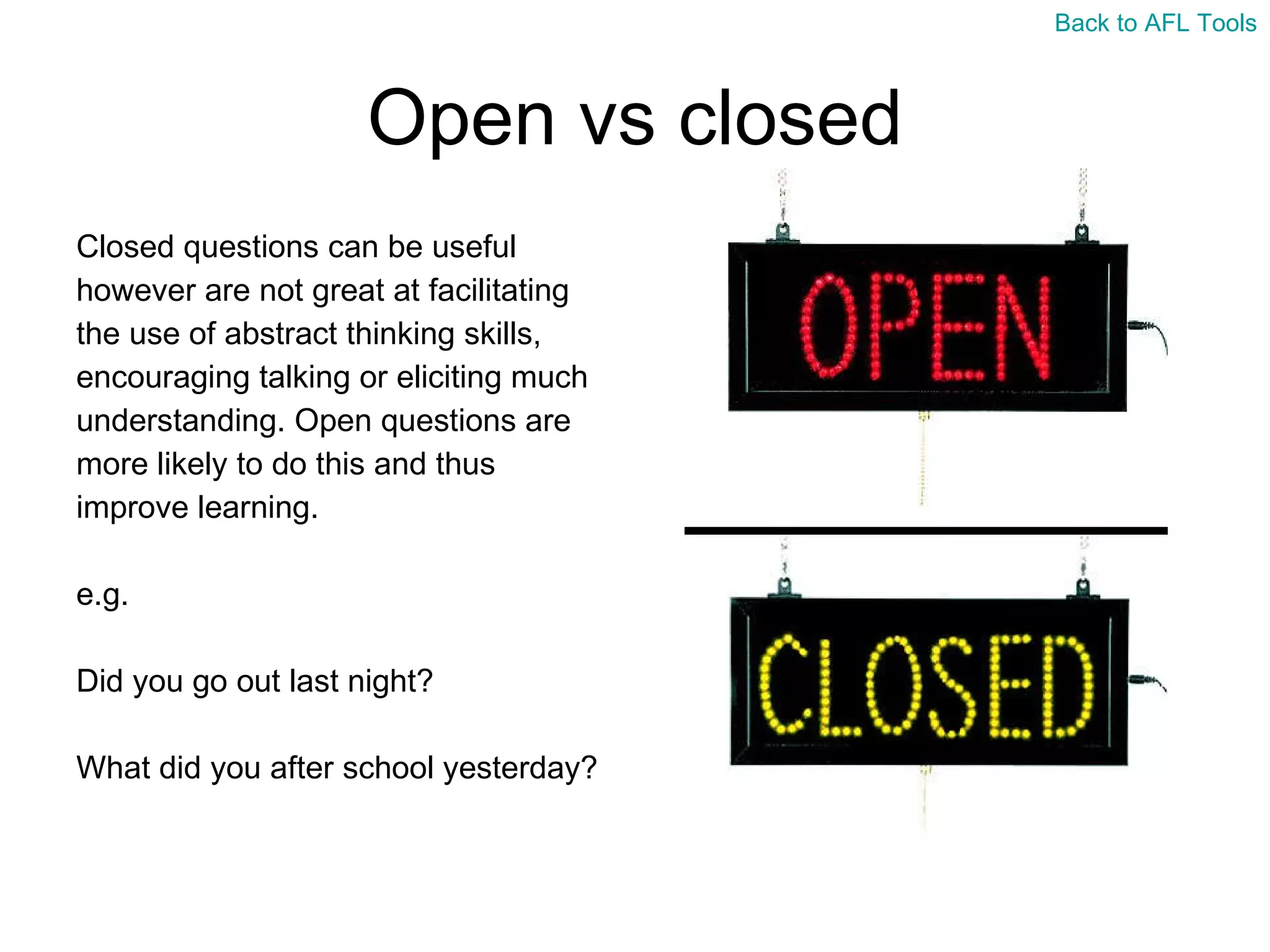
Open vs closed Closed questions can be useful  however are not great at facilitating  the use of abstract thinking skills,  encouraging talking or eliciting much  understanding. Open questions are  more likely to do this and thus  improve learning. e.g.  Did you go out last night?  What did you after school yesterday? Back to AFL Tools
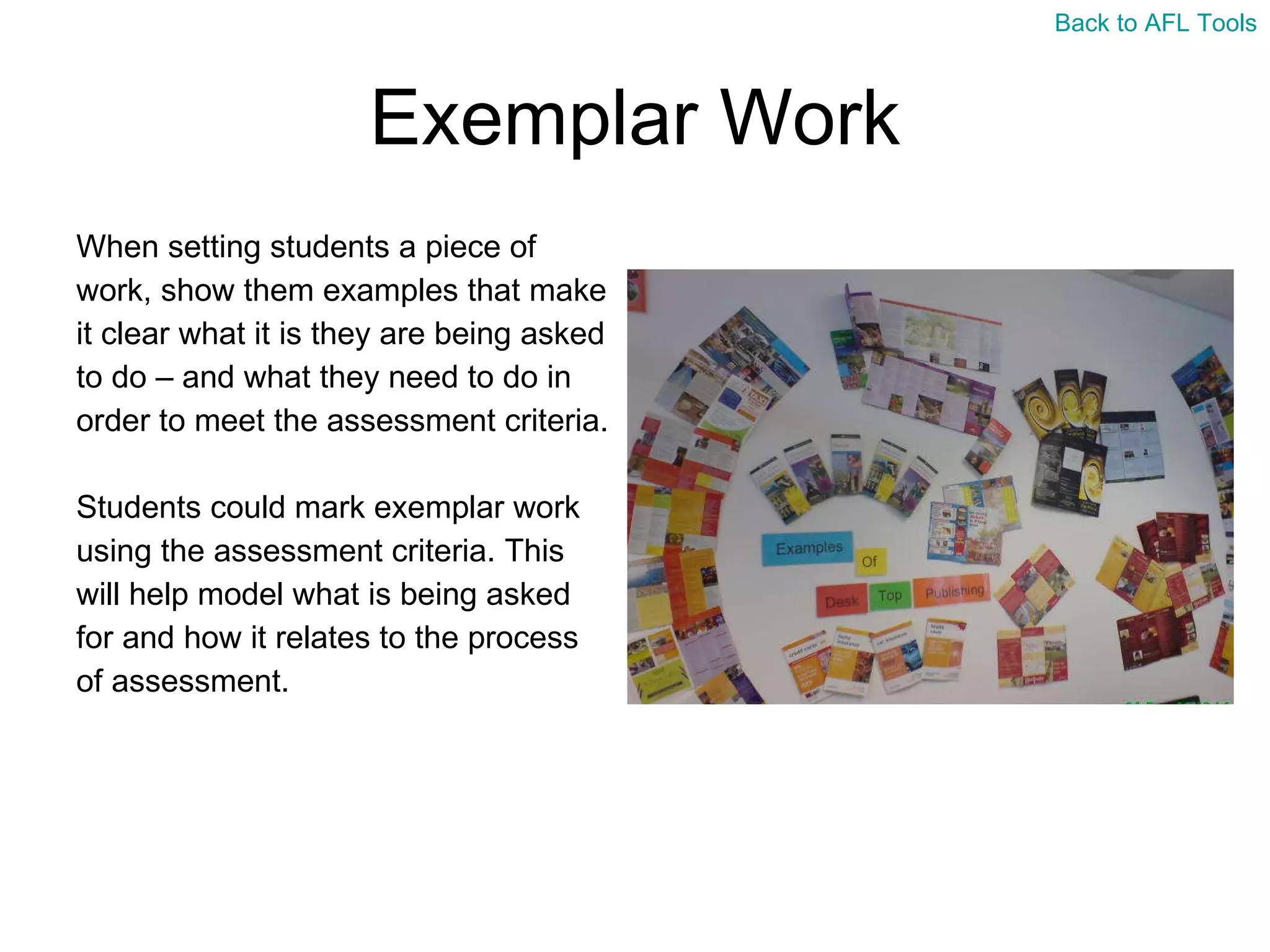
Exemplar Work When setting students a piece of  work, show them examples that make  it clear what it is they are being asked  to do – and what they need to do in  order to meet the assessment criteria. Students could mark exemplar work  using the assessment criteria. This  will help model what is being asked  for and how it relates to the process  of assessment. Back to AFL Tools
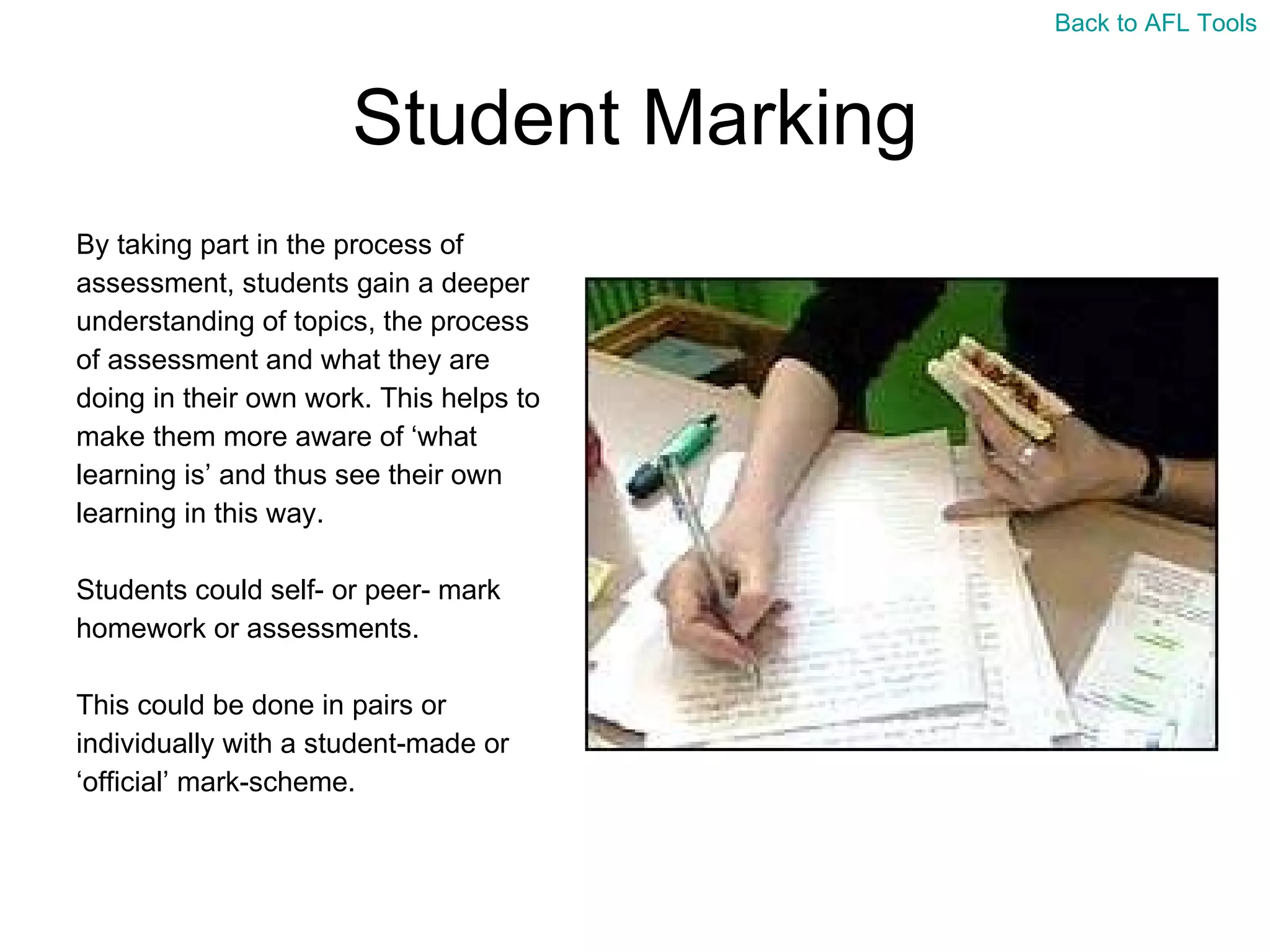
Student Marking By taking part in the process of  assessment, students gain a deeper  understanding of topics, the process  of assessment and what they are  doing in their own work. This helps to  make them more aware of ‘what  learning is’ and thus see their own  learning in this way. Students could self- or peer- mark  homework or assessments. This could be done in pairs or  individually with a student-made or  ‘ official’ mark-scheme. Back to AFL Tools
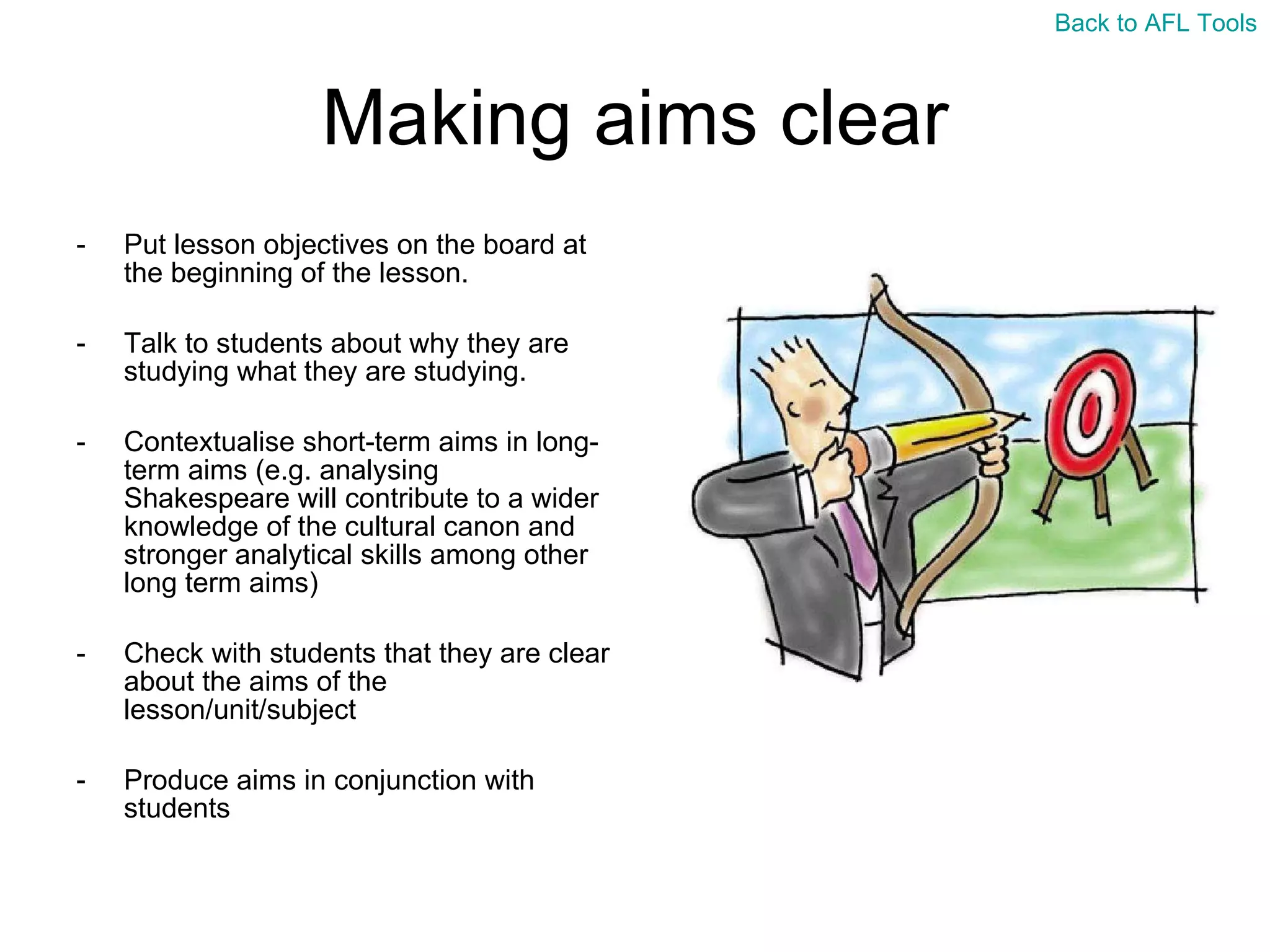
Making aims clear Put lesson objectives on the board at the beginning of the lesson. Talk to students about why they are studying what they are studying. Contextualise short-term aims in long-term aims (e.g. analysing Shakespeare will contribute to a wider knowledge of the cultural canon and stronger analytical skills among other long term aims) Check with students that they are clear about the aims of the lesson/unit/subject Produce aims in conjunction with students  Back to AFL Tools
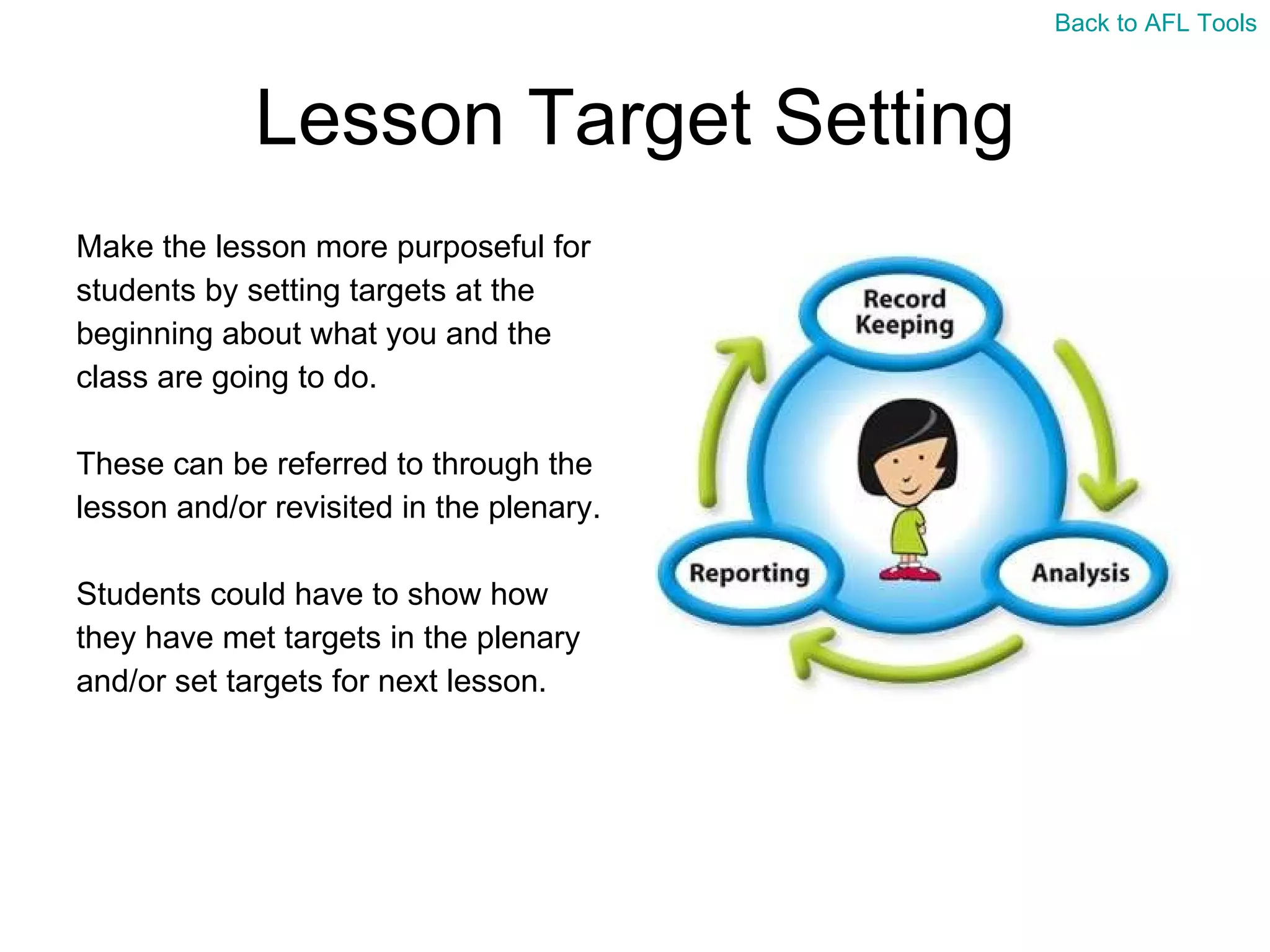
Lesson Target Setting Make the lesson more purposeful for  students by setting targets at the  beginning about what you and the  class are going to do. These can be referred to through the  lesson and/or revisited in the plenary. Students could have to show how  they have met targets in the plenary  and/or set targets for next lesson. Back to AFL Tools
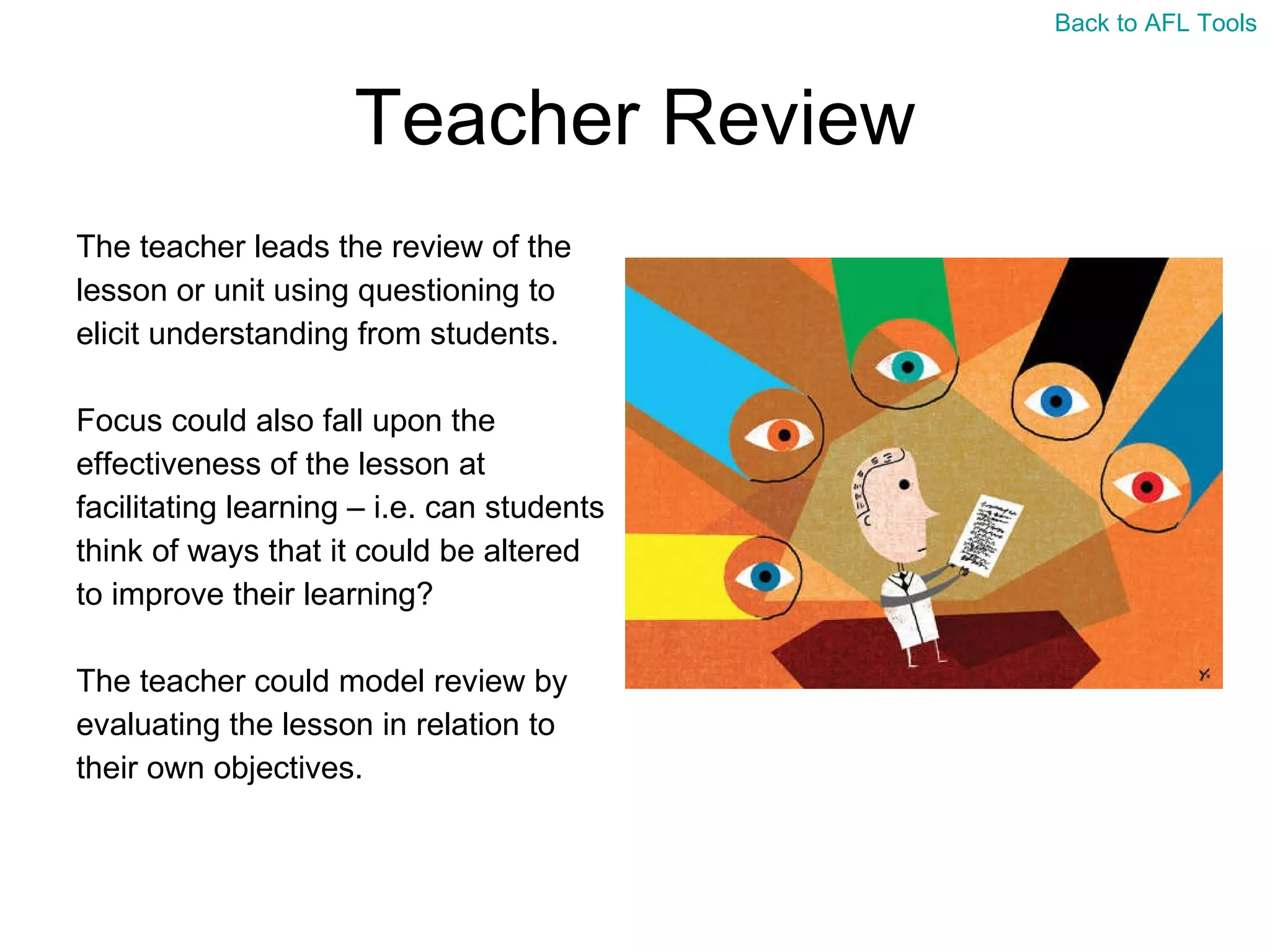
Teacher Review The teacher leads the review of the  lesson or unit using questioning to  elicit understanding from students.  Focus could also fall upon the  effectiveness of the lesson at  facilitating learning – i.e. can students  think of ways that it could be altered  to improve their learning? The teacher could model review by  evaluating the lesson in relation to  their own objectives. Back to AFL Tools
Student Review Students review their own learning  either in groups or individually. This  could be done as a plenary, a  mini-plenary or as an activity to help  planning for future revision or the  remainder of the unit. Back to AFL Tools
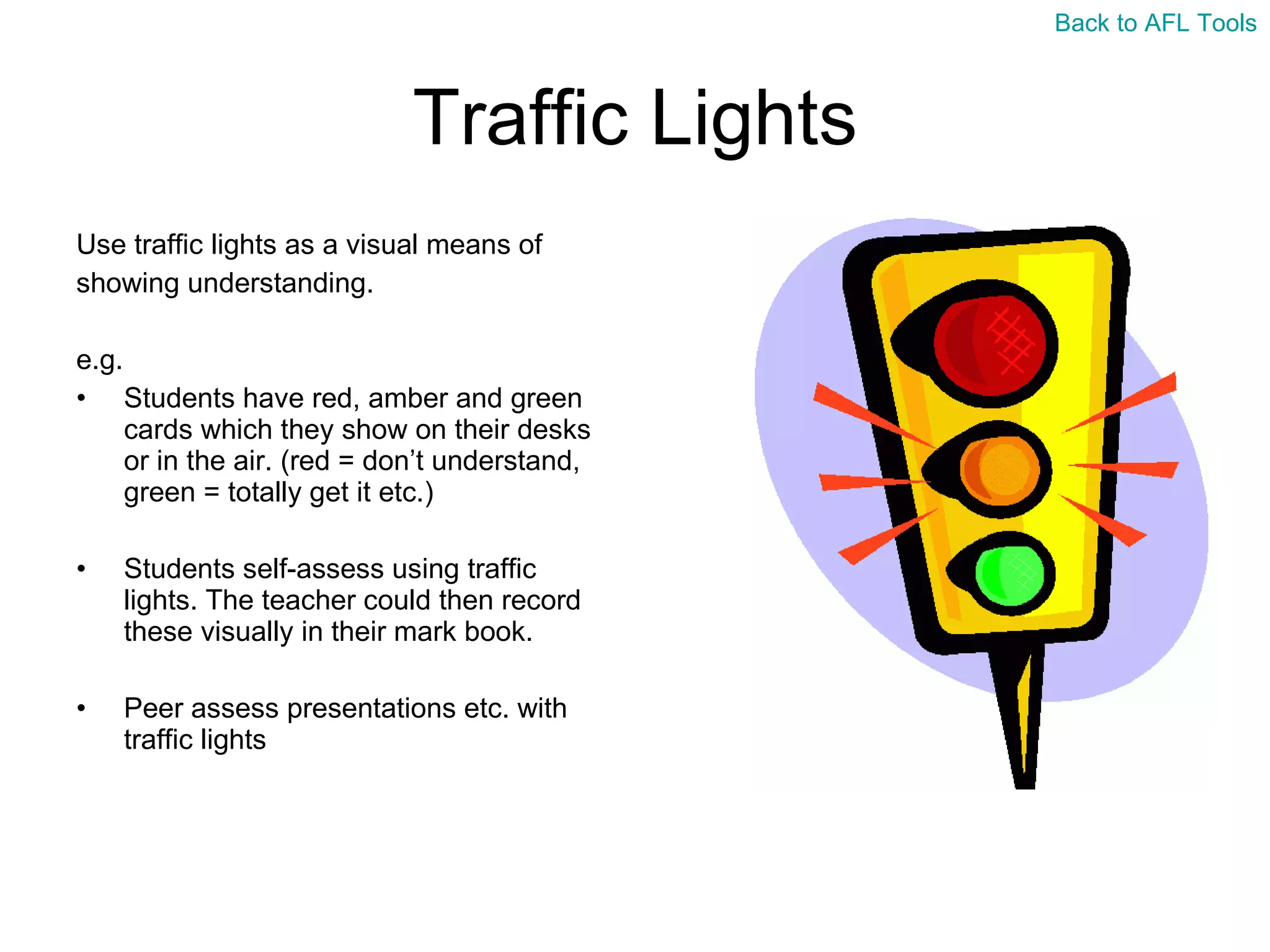
Traffic Lights Use traffic lights as a visual means of  showing understanding. e.g.  Students have red, amber and green cards which they show on their desks or in the air. (red = don’t understand, green = totally get it etc.) Students self-assess using traffic lights. The teacher could then record these visually in their mark book. Peer assess presentations etc. with traffic lights  Back to AFL Tools
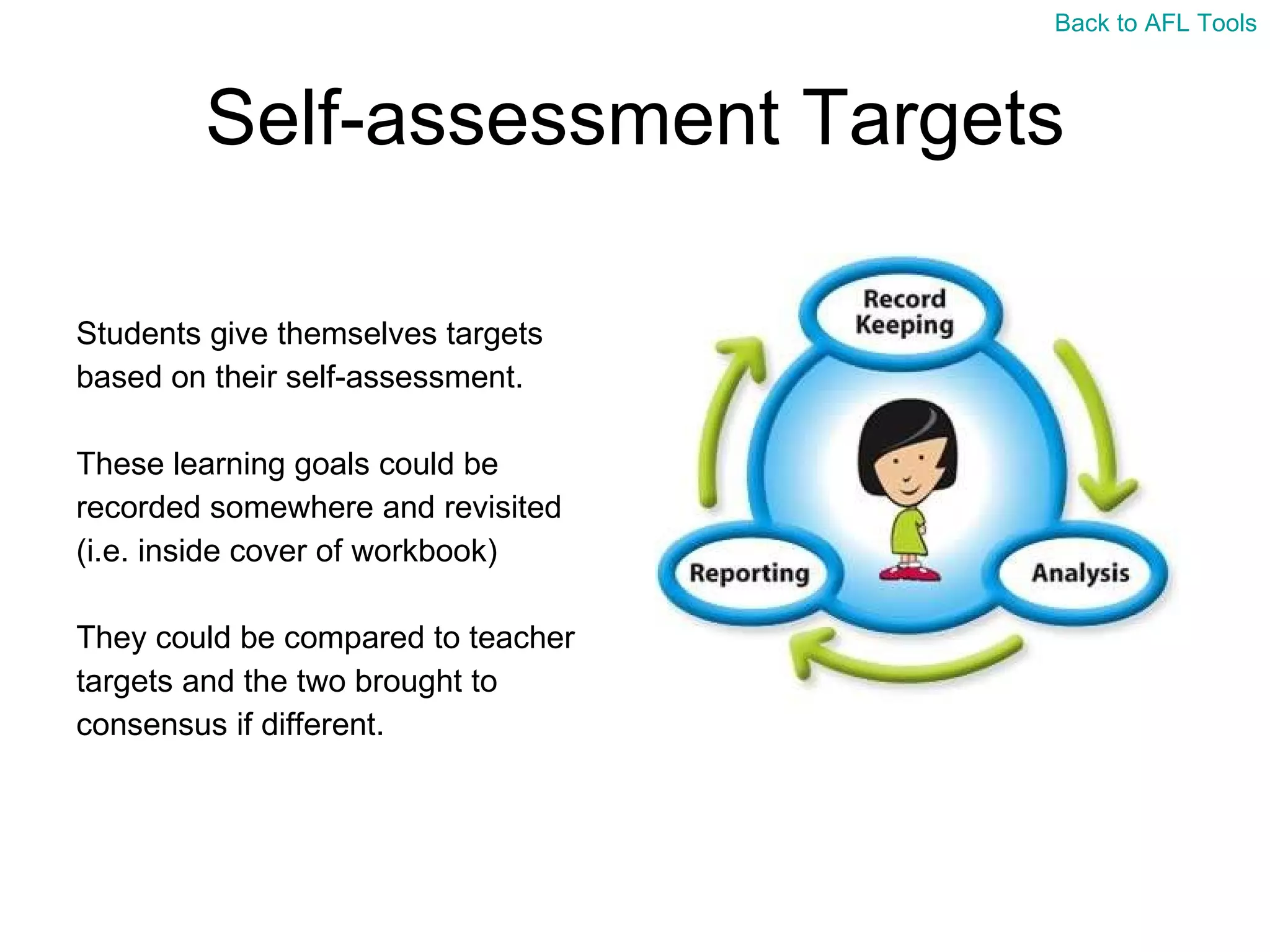
Self-assessment Targets Students give themselves targets  based on their self-assessment. These learning goals could be  recorded somewhere and revisited  (i.e. inside cover of workbook) They could be compared to teacher  targets and the two brought to  consensus if different. Back to AFL Tools
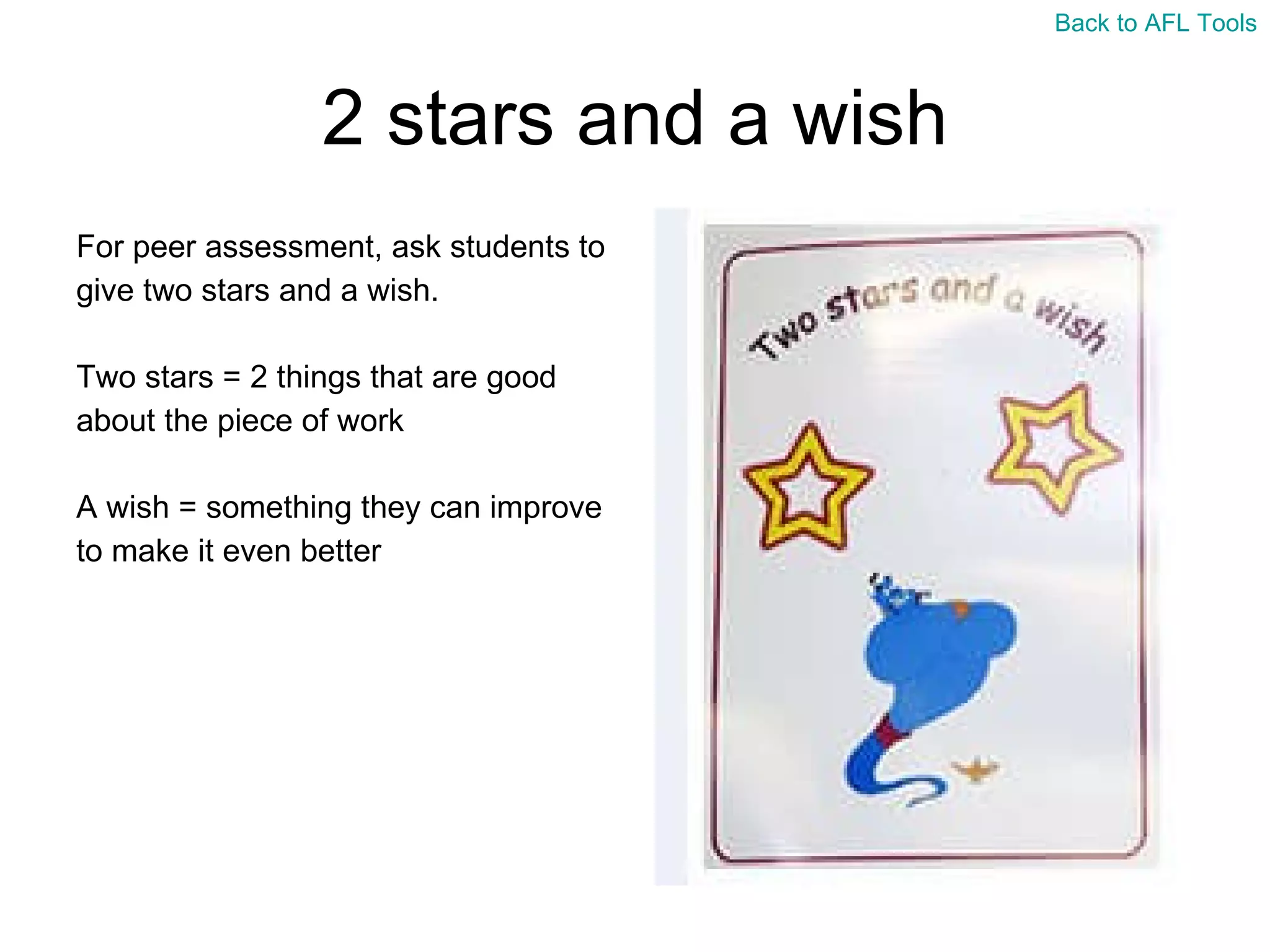
2 stars and a wish For peer assessment, ask students to  give two stars and a wish. Two stars = 2 things that are good  about the piece of work A wish = something they can improve  to make it even better Back to AFL Tools
Articulate then Answer Give students the opportunity to  articulate their thinking before  answering –  30 seconds silent thinking before any answers Brainstorm in pairs first for 2-3 minutes Write some thoughts down before answering Discuss with your neighbour first Back to AFL Tools
Scene-Setting Set the scene for the lesson by using  a big, open question or problem- solving task that requires abstract  thinking skills. Anticipate responses  and follow-up so as to work these  through. E.g. A lesson on the Vietnam War  could begin with the question –  Do Americans think they fight wars, or  win them? Back to AFL Tools
Tell your neighbour Students ‘tell their neighbour’ as a  means of articulating their thoughts. Ask a question, give thinking time  and then ask students to tell their  neighbour their thoughts. Tell students what the new topic is and then ask them to tell their neighbour everything they know about it. Back to AFL Tools
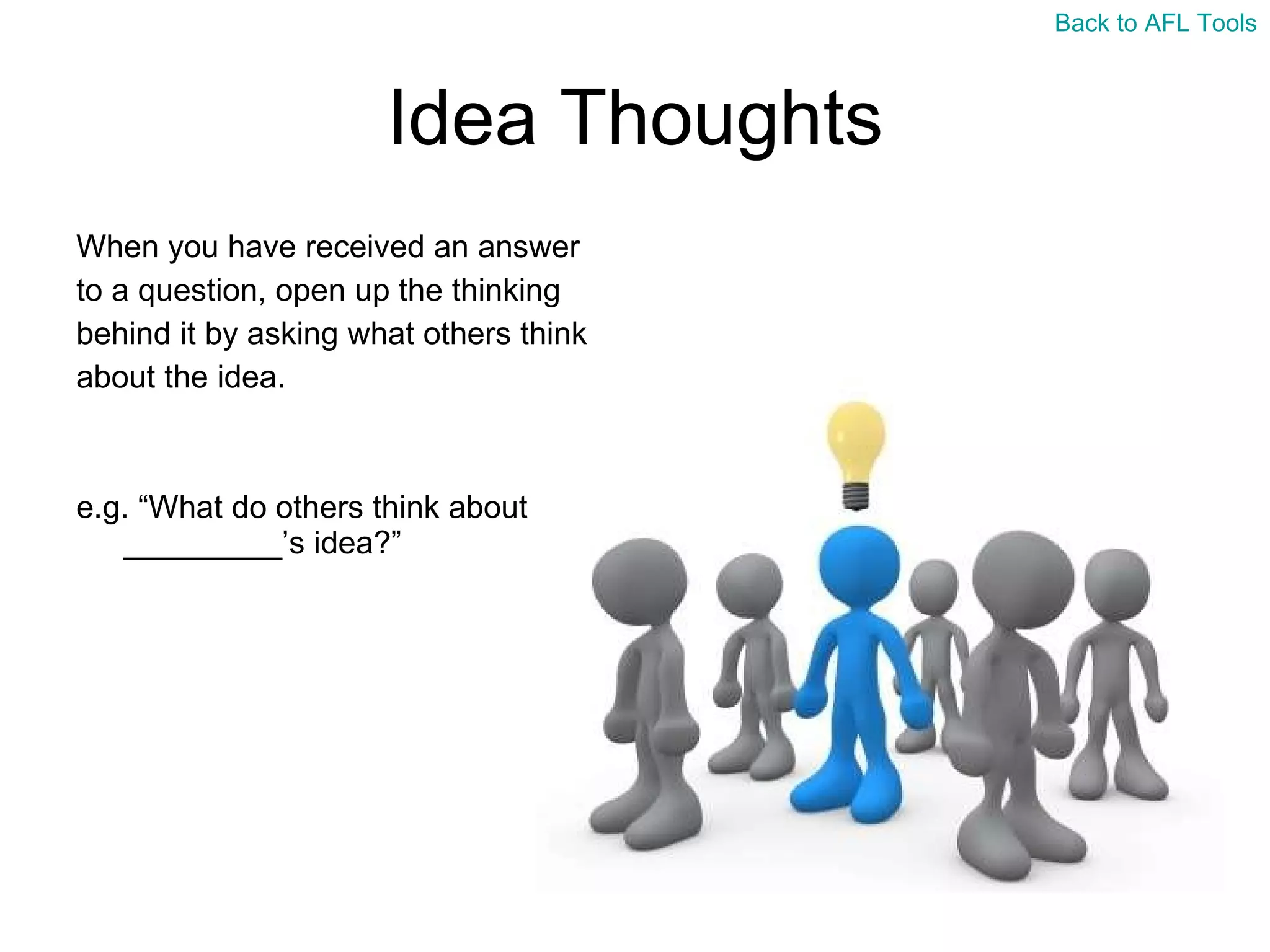
Idea Thoughts When you have received an answer  to a question, open up the thinking  behind it by asking what others think  about the idea. e.g. “What do others think about _________’s idea?” Back to AFL Tools
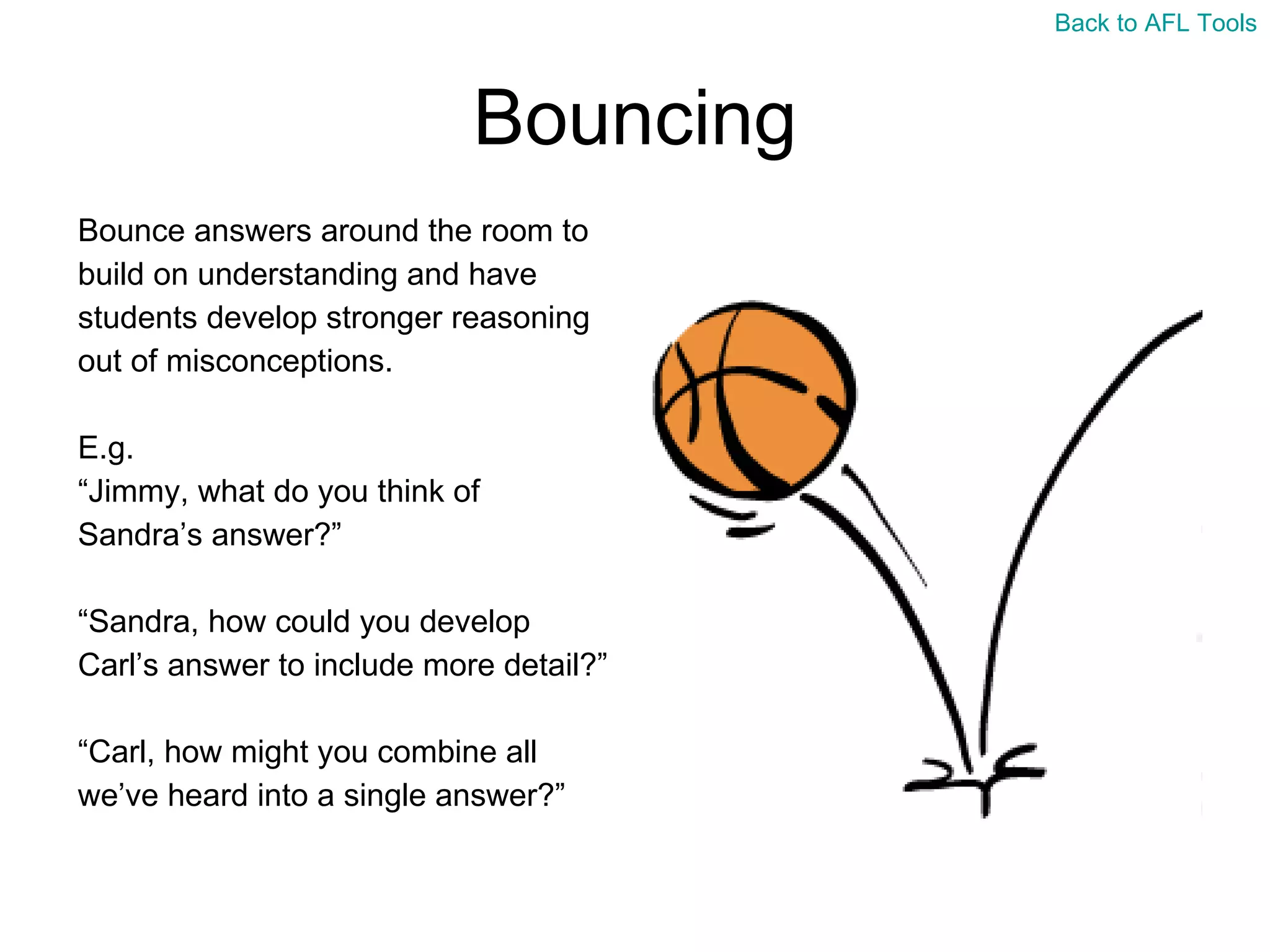
Bouncing Bounce answers around the room to  build on understanding and have  students develop stronger reasoning  out of misconceptions. E.g. “ Jimmy, what do you think of  Sandra’s answer?” “ Sandra, how could you develop  Carl’s answer to include more detail?” “ Carl, how might you combine all  we’ve heard into a single answer?” Back to AFL Tools
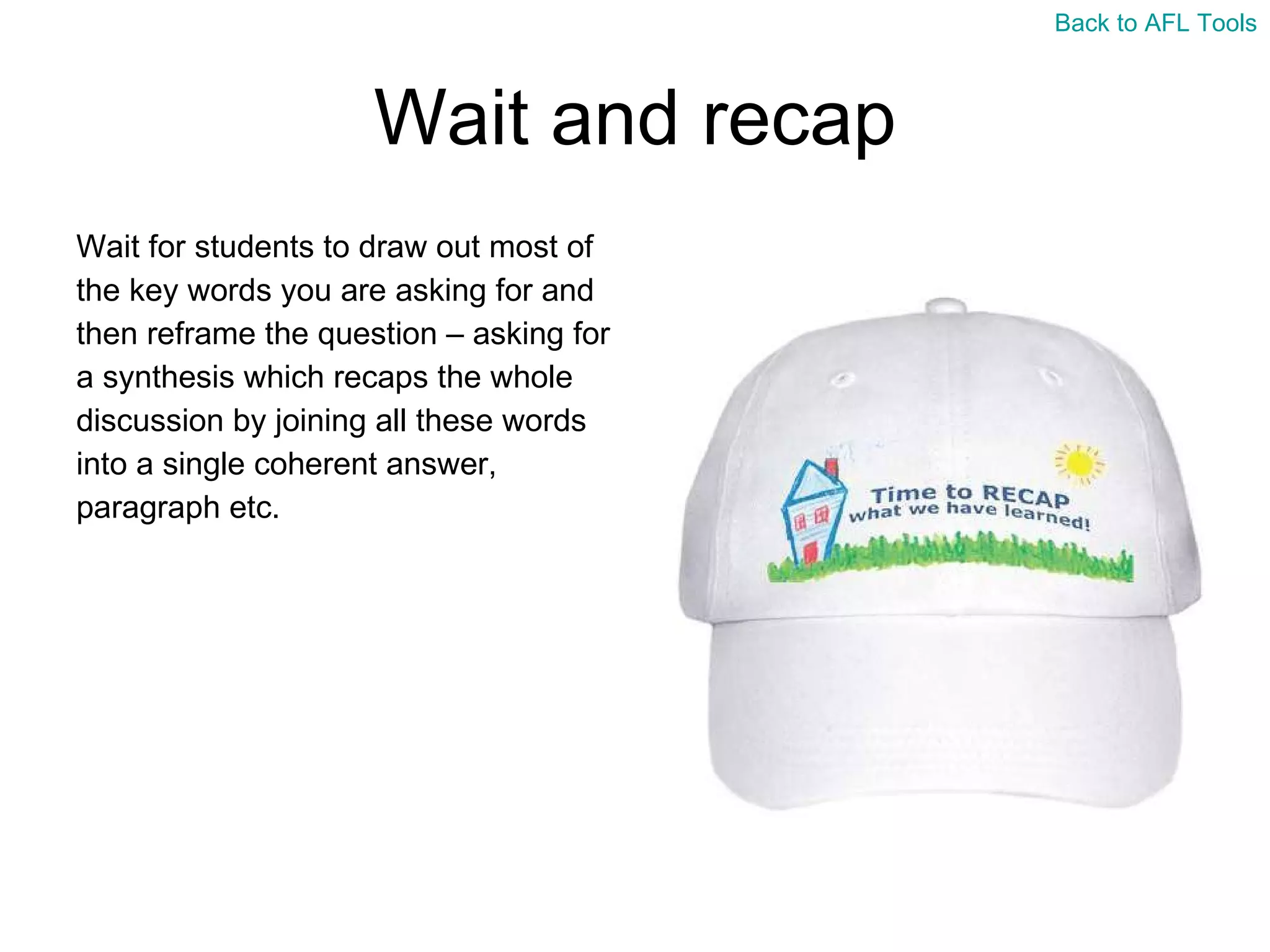
Wait and recap Wait for students to draw out most of  the key words you are asking for and  then reframe the question – asking for  a synthesis which recaps the whole  discussion by joining all these words  into a single coherent answer,  paragraph etc. Back to AFL Tools
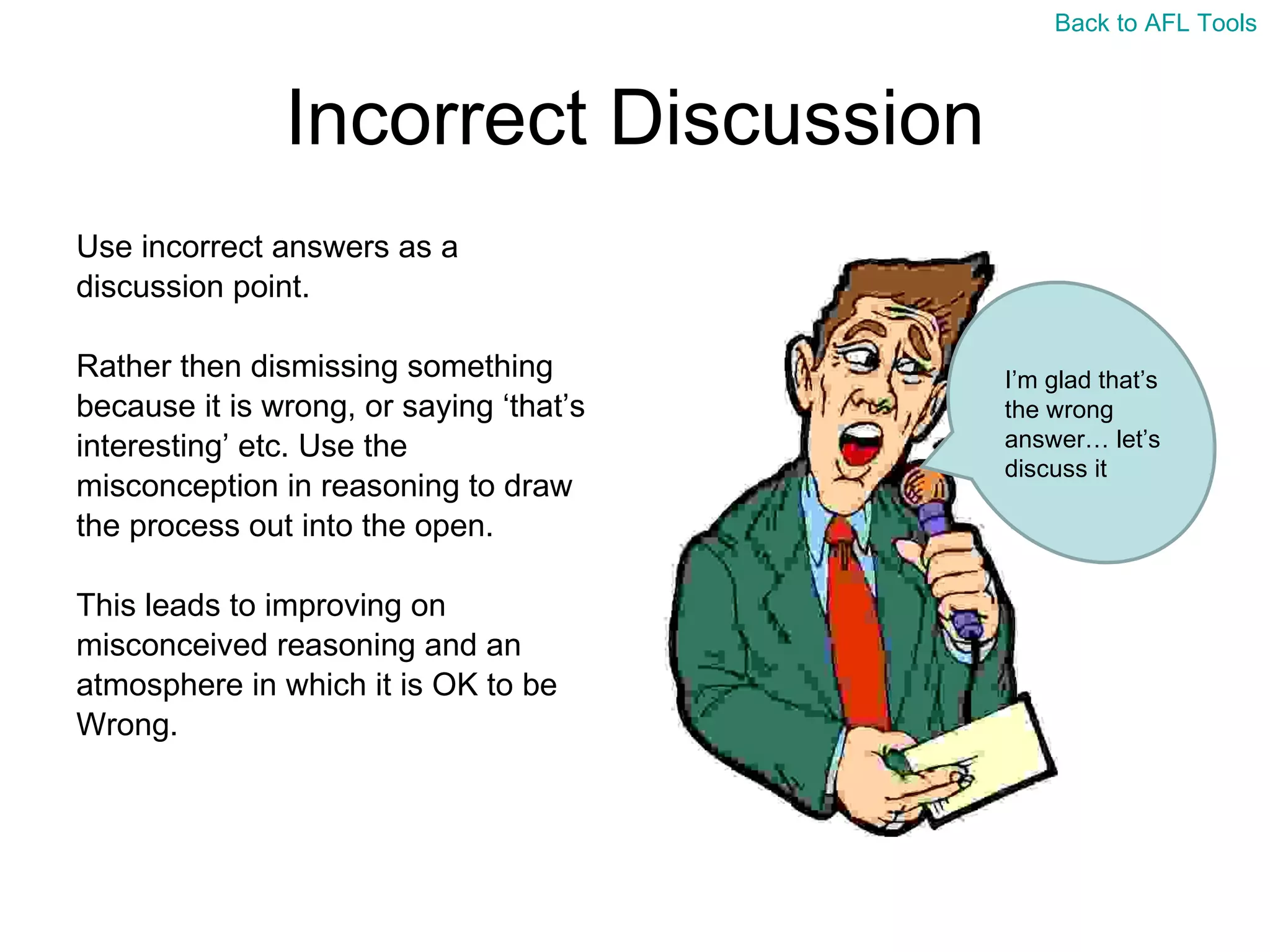
Incorrect Discussion Use incorrect answers as a  discussion point.  Rather then dismissing something  because it is wrong, or saying ‘that’s  interesting’ etc. Use the  misconception in reasoning to draw  the process out into the open. This leads to improving on  misconceived reasoning and an  atmosphere in which it is OK to be  Wrong. I’m glad that’s the wrong answer… let’s discuss it Back to AFL Tools
Devising Questions Devise questions that – Challenge common misconceptions Create conflict that requires discussion Explore ambiguity and encourage discussion and clarification  Back to AFL Tools
Learning Journal Create a learning journal in which  students can reflect on and review  their learning. It could include plenary  activities, a target setting chart, aims  and goals etc. Back to AFL Tools
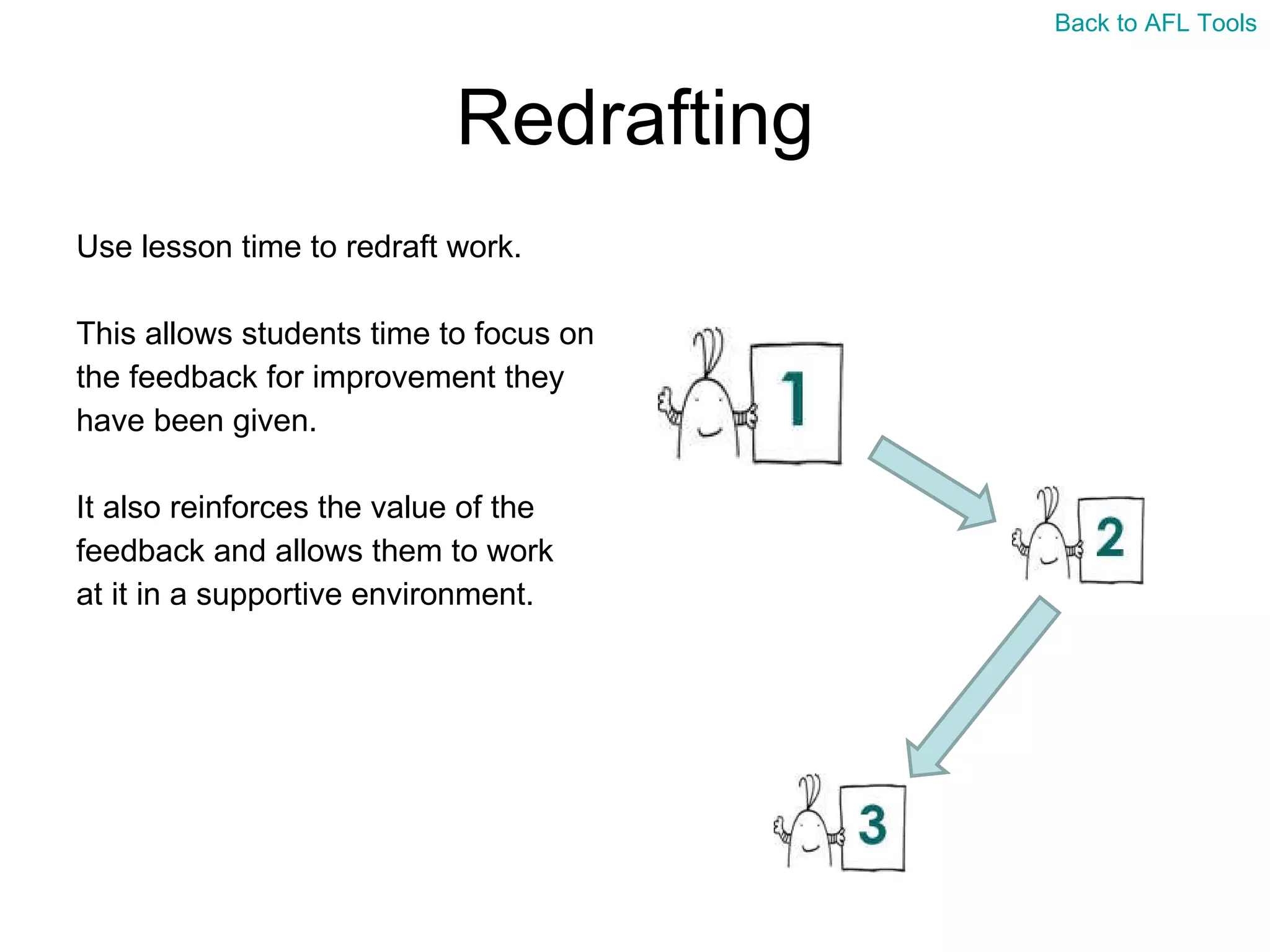
Redrafting Use lesson time to redraft work. This allows students time to focus on  the feedback for improvement they  have been given. It also reinforces the value of the  feedback and allows them to work  at it in a supportive environment. Back to AFL Tools
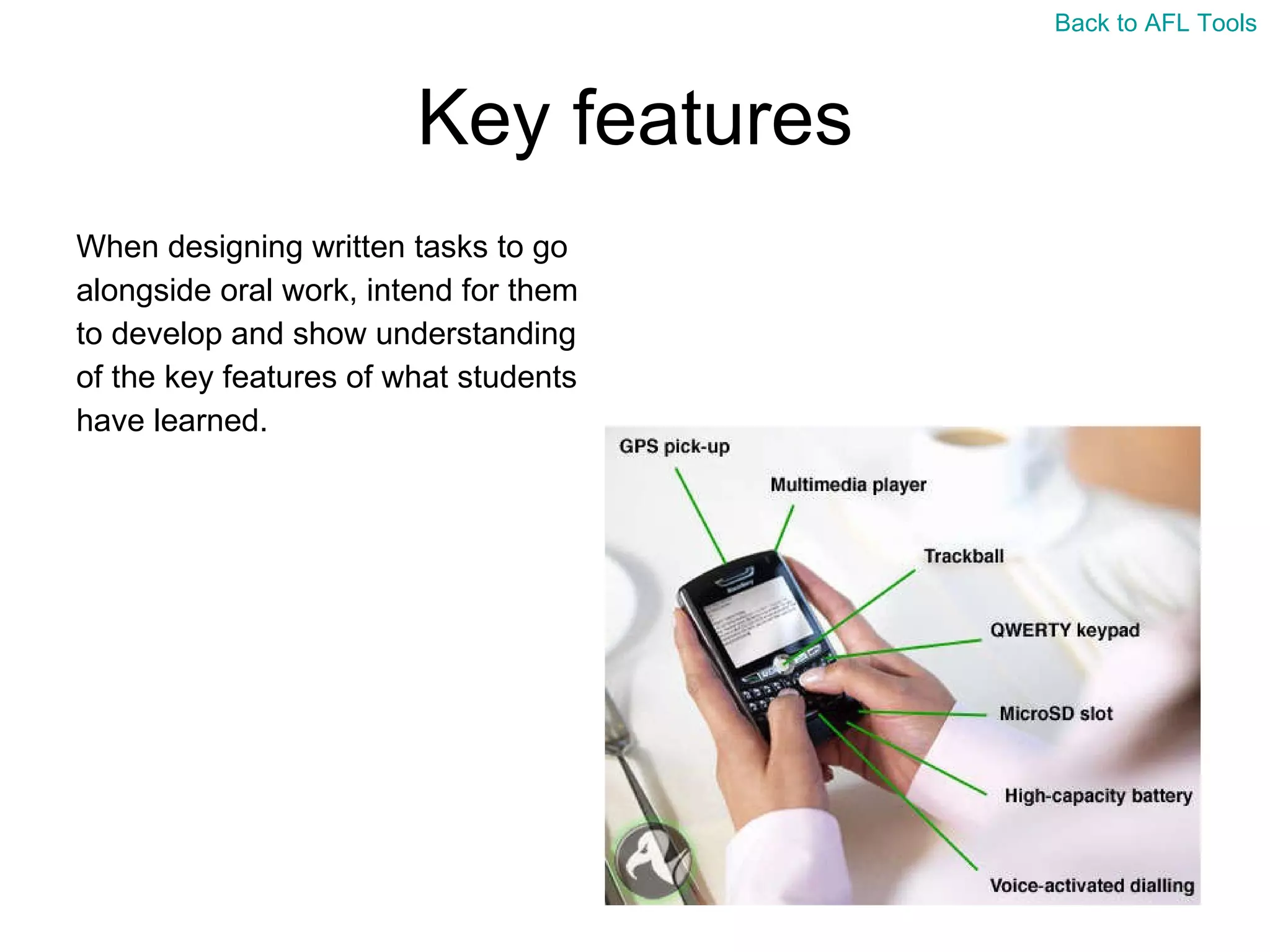
Key features When designing written tasks to go  alongside oral work, intend for them  to develop and show understanding  of the key features of what students  have learned. Back to AFL Tools
Improvement Guidance When making comments on pupils’  work, treat them like guidance  showing how the pupil can improve. Develop this by asking students to  write in the same way when peer  assessing work. Discuss the notion of guidance and  how it differs from other types of  behaviour (i.e. prescription,  admonishment etc.) Back to AFL Tools
Comment Follow-up Give students opportunities to follow  up comments -  Create time in the lesson to talk to individual students. Have a written dialogue in the students’ book. Use a comment tracker or targets sheet to formalise the dialogue in a workbook Back to AFL Tools
Group feedback Group feedback to a teacher  concerning peer-assessment of work  can help make the teacher aware of  learning needs in a manageable way. If a group feeds back then it draws  more attention and presents  information that has already been  ordered and sorted (meaning less  repetition for the teacher). Back to AFL Tools
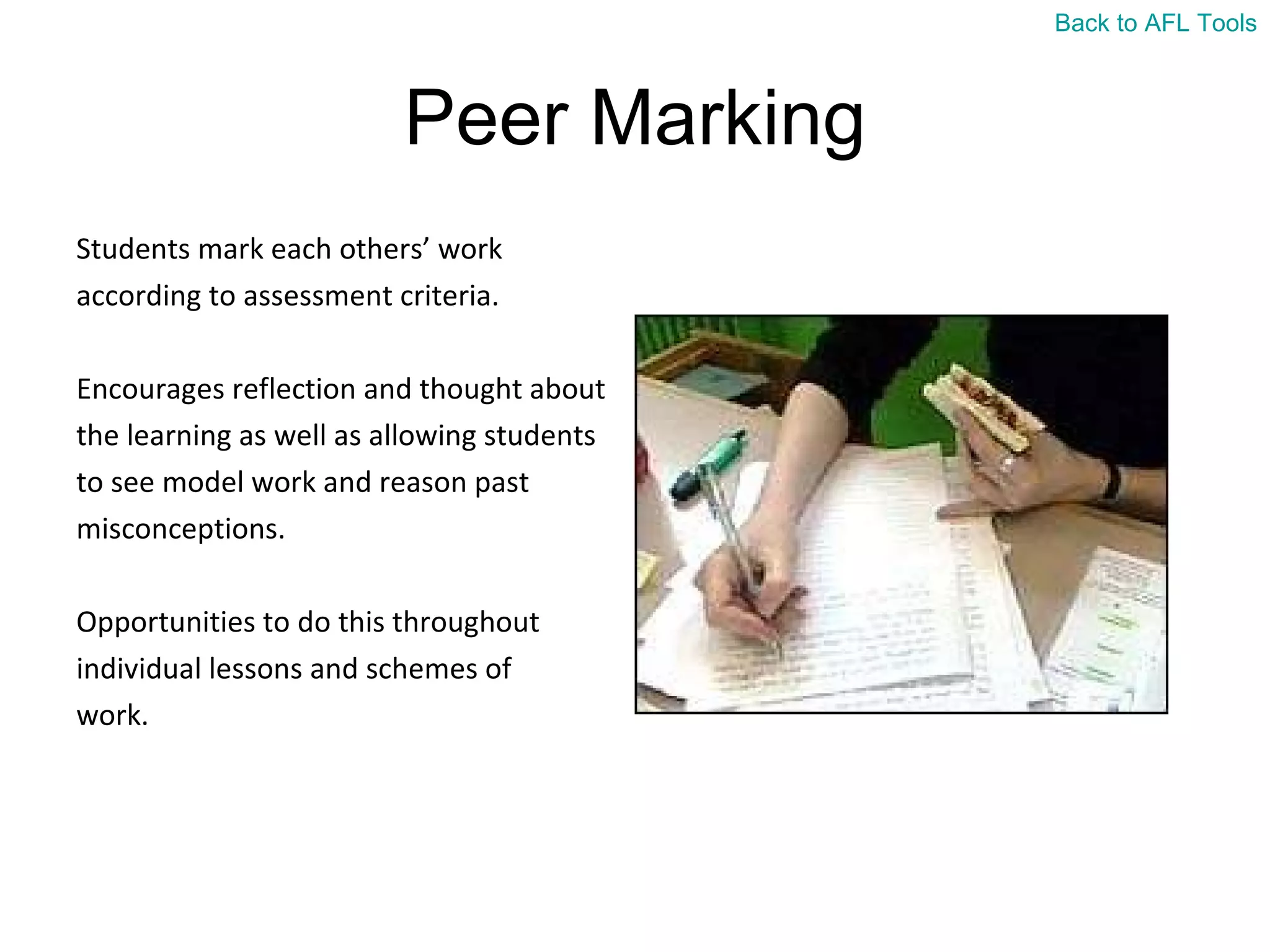
Peer Marking Students mark each others’ work  according to assessment criteria. Encourages reflection and thought about  the learning as well as allowing students  to see model work and reason past  misconceptions. Opportunities to do this throughout  individual lessons and schemes of  work. Back to AFL Tools
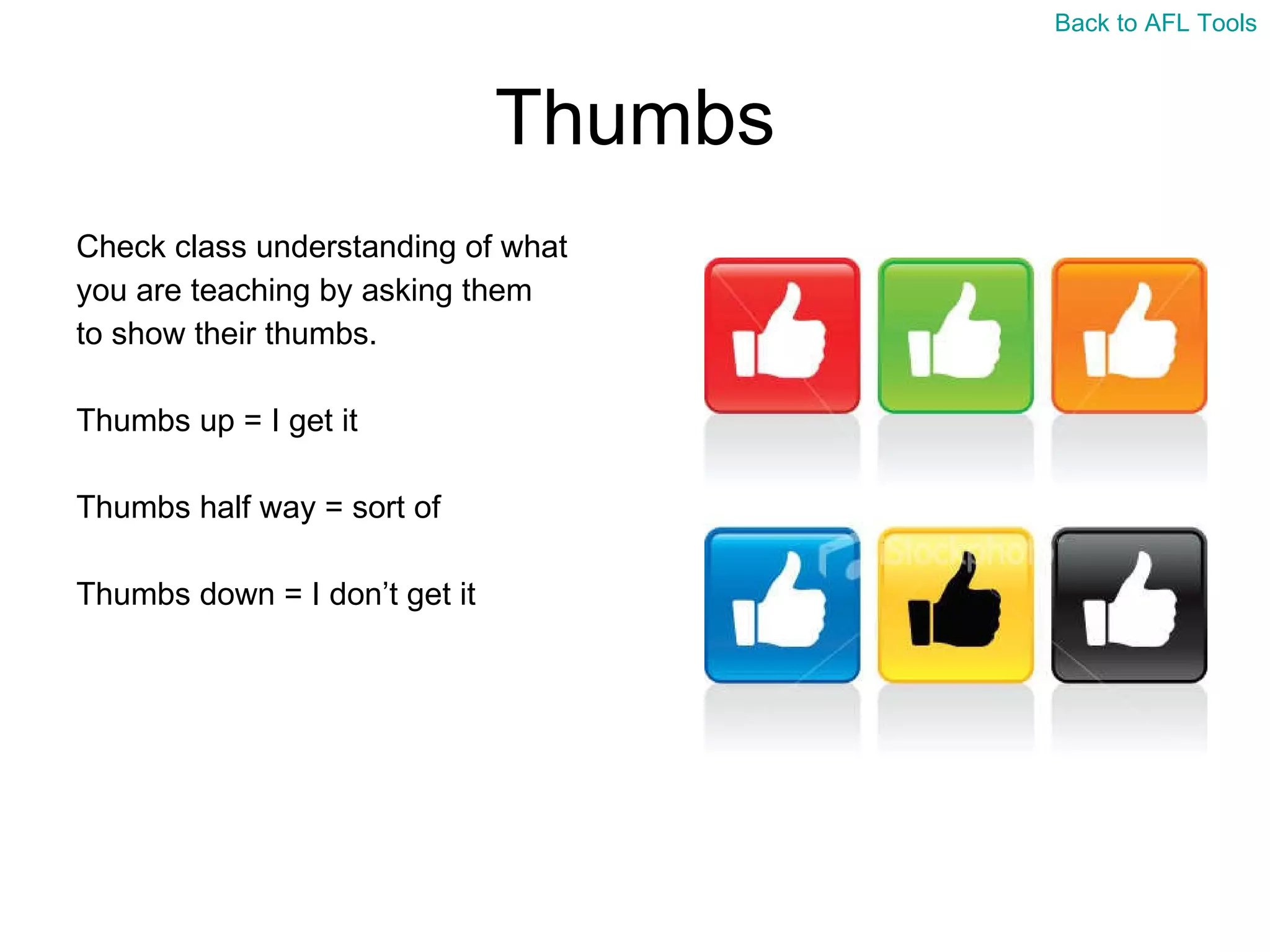
Thumbs Check class understanding of what  you are teaching by asking them  to show their thumbs. Thumbs up = I get it Thumbs half way = sort of Thumbs down = I don’t get it Back to AFL Tools
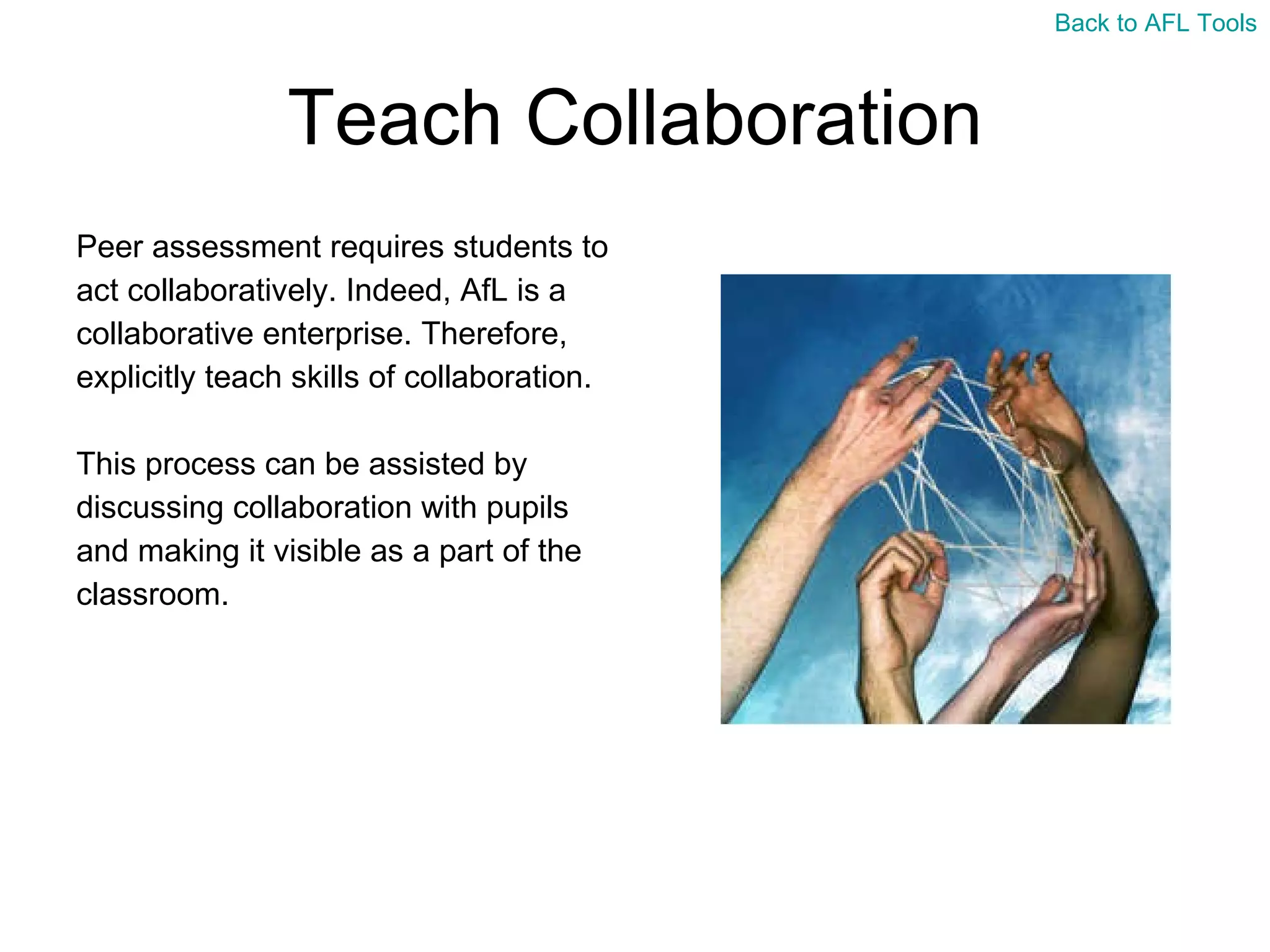
Teach Collaboration Peer assessment requires students to  act collaboratively. Indeed, AfL is a  collaborative enterprise. Therefore,  explicitly teach skills of collaboration. This process can be assisted by  discussing collaboration with pupils  and making it visible as a part of the  classroom.  Back to AFL Tools
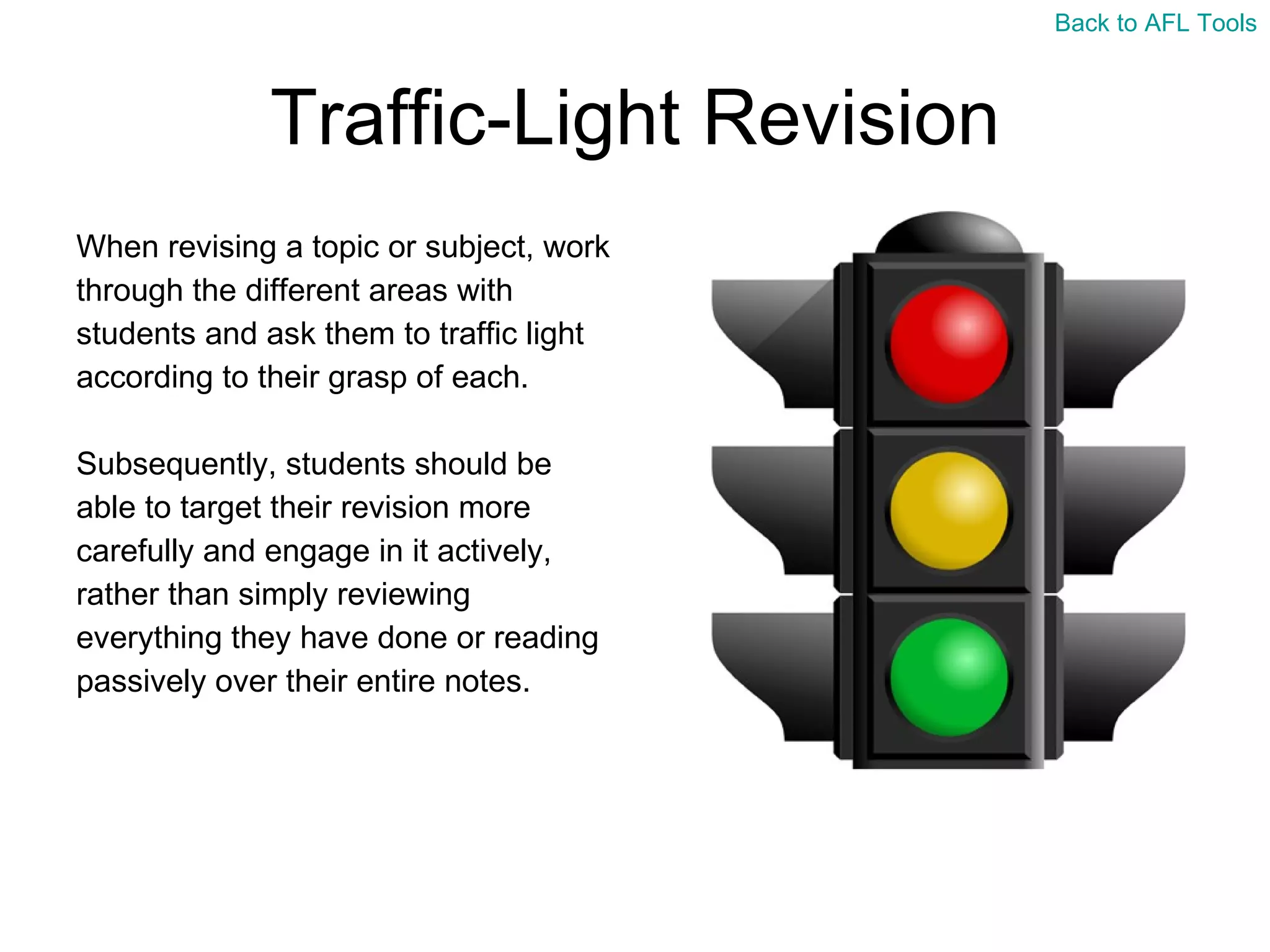
Traffic-Light Revision When revising a topic or subject, work  through the different areas with  students and ask them to traffic light  according to their grasp of each. Subsequently, students should be  able to target their revision more  carefully and engage in it actively,  rather than simply reviewing  everything they have done or reading  passively over their entire notes. Back to AFL Tools
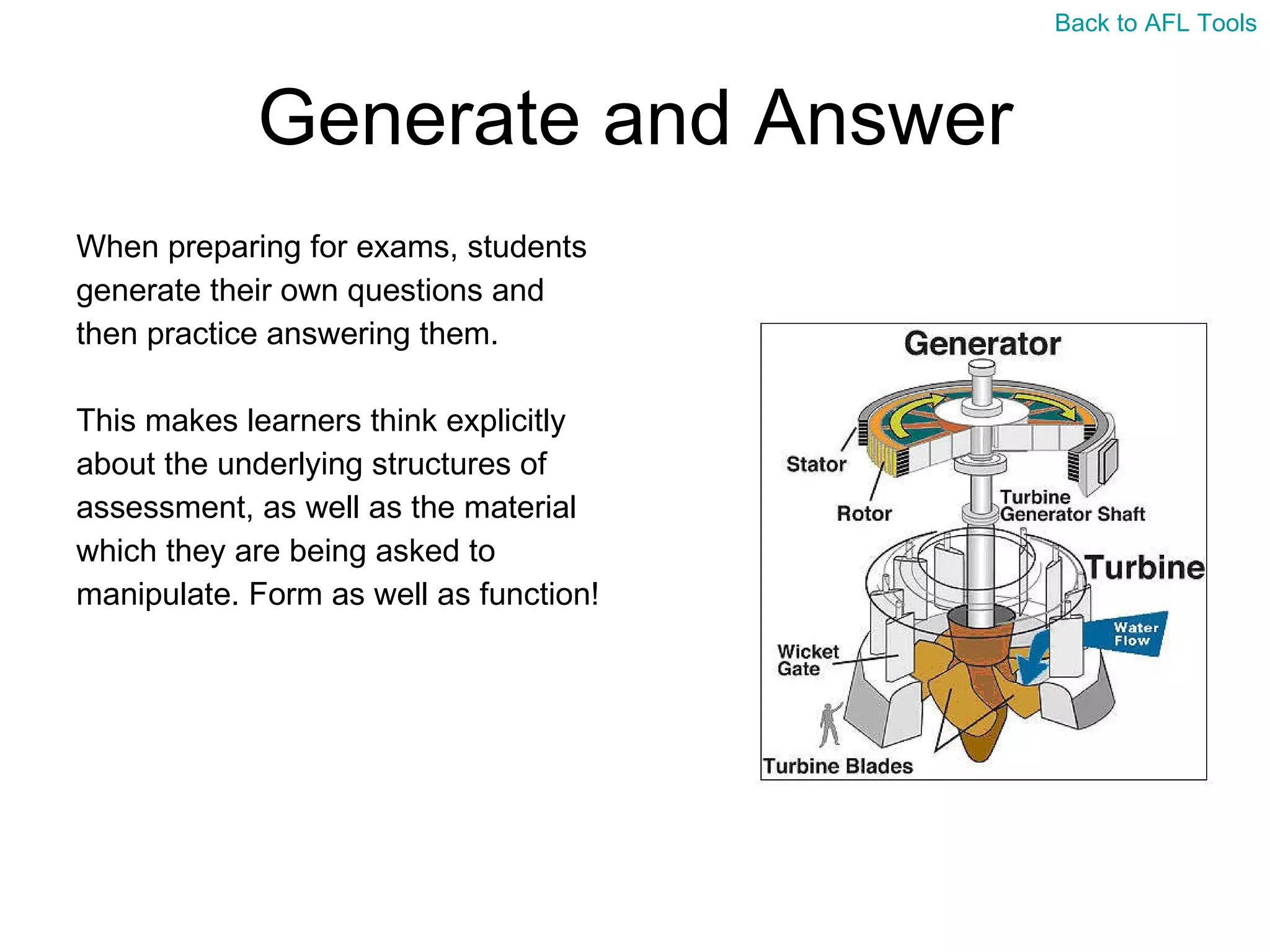
Generate and Answer When preparing for exams, students  generate their own questions and  then practice answering them. This makes learners think explicitly  about the underlying structures of  assessment, as well as the material  which they are being asked to  manipulate. Form as well as function! Back to AFL Tools
Student Mark-Scheme Ask students to produce their own  mark-schemes working individually or  in groups. They can then peer- or  self-assess work in accordance  with these schemes. Talk about the purpose of a mark- scheme with students – judgement,  communication, standardisation etc. Back to AFL Tools
Group Answers Students work in small groups to  agree on answers – when  tests are  returned or in other situations.  The process of agreeing should  include reasoning over the validity of  the consensus answer, as well as  reasoned negation of misconceptions  or wrong answers. Back to AFL Tools
Think through Talking Talking allows students to articulate  their thoughts and thus to learn. Encourage thinking through talking  with –  Discussion activities Structured group/pair work Modelling by teacher and students (small group work increases the  ‘ surface area’ of talk in the classroom  as opposed to whole class  discussions) Back to AFL Tools
Invert the Question Instead of asking a question that  requires factual recall, invert it to  request explicit reasoning. e.g. ‘ Is France a democracy?’ becomes ‘ What does it mean for a country to be a democracy?’ Back to AFL Tools
X and Y Ask students why  X is an example of Y e.g. Why is an apple an example of a fruit? Why is a fox an example of a mammal? Questioning in this way avoids factual  recall and asks for the underlying  reasoning to be made explicit. Back to AFL Tools
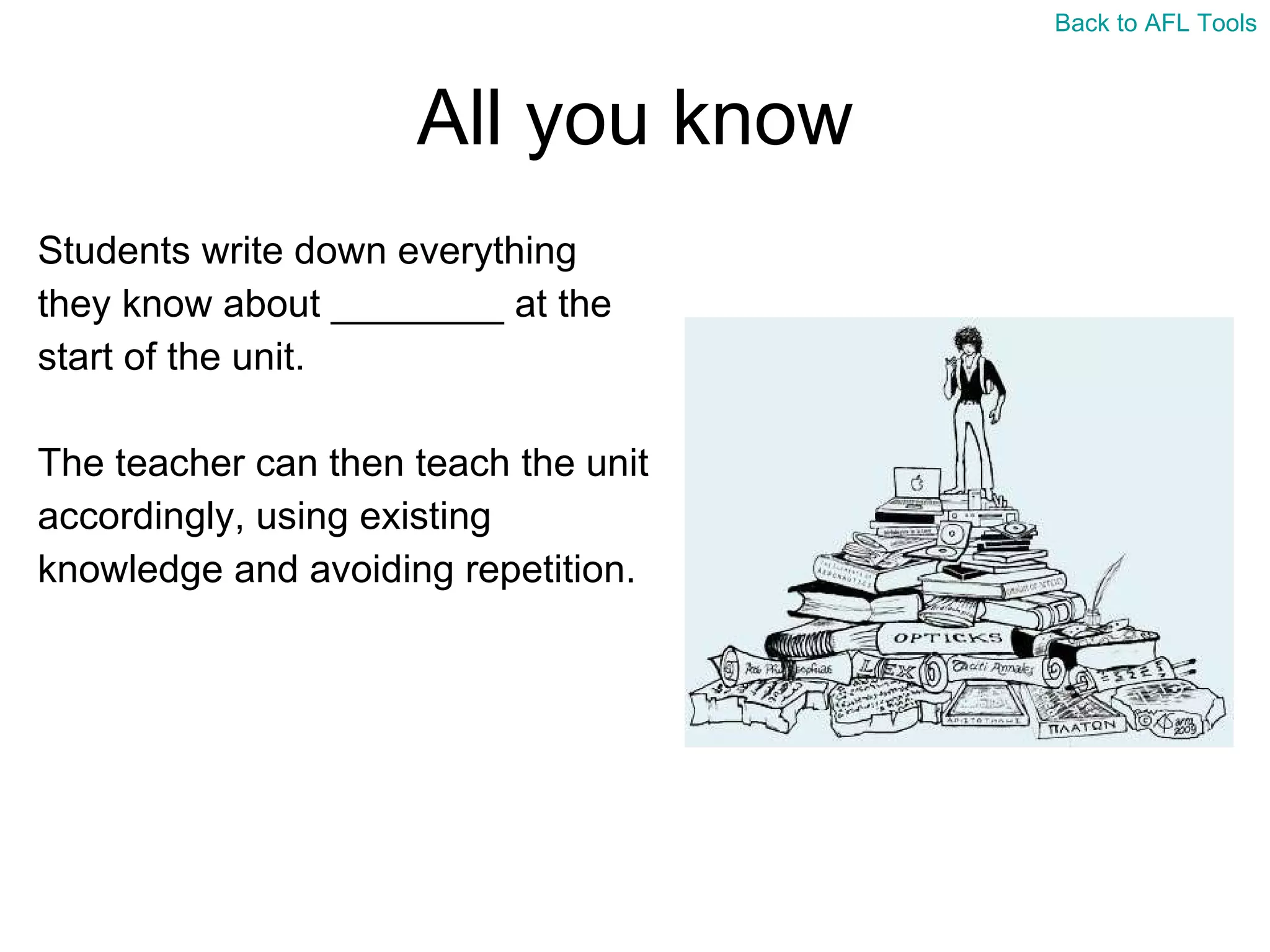
All you know Students write down everything  they know about ________ at the  start of the unit. The teacher can then teach the unit  accordingly, using existing  knowledge and avoiding repetition. Back to AFL Tools
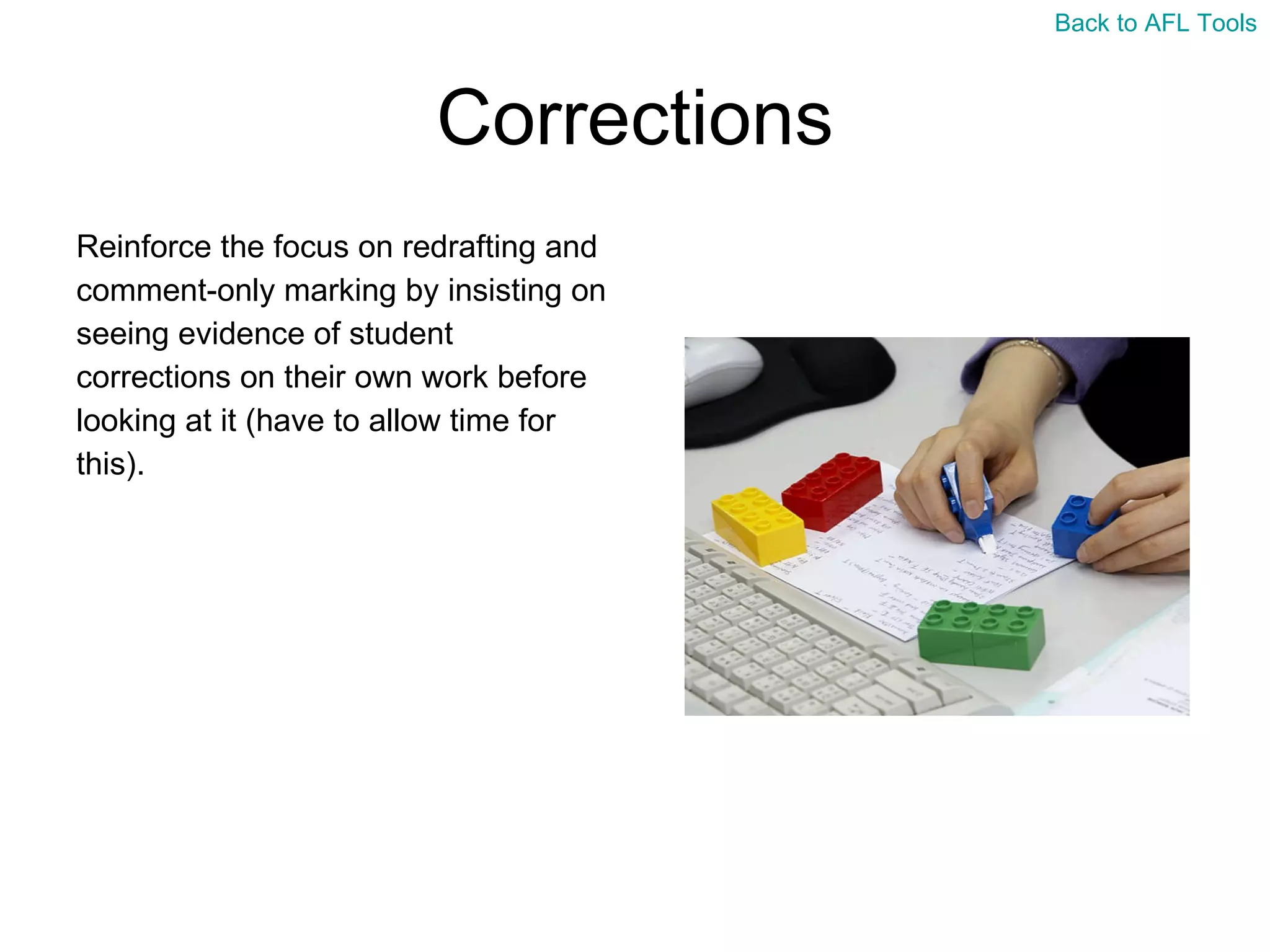
Corrections Reinforce the focus on redrafting and  comment-only marking by insisting on  seeing evidence of student  corrections on their own work before  looking at it (have to allow time for  this). Back to AFL Tools
Laminated Criteria Make laminated, student- friendly assessment criteria  cards. Back to AFL Tools
Conveying Progress Find a means of using  assessment to convey progress to  students and thus make what they  are doing more meaningful. Link learning between units Use a learning journal Refer to past targets and highlight where the student is achieving this Have a target chart where it is visible how the student has progressed Link assessment to student goal-setting Back to AFL Tools
Discuss Words When engaged in discussion take key  words and look at them specifically.  Discuss how they are being used –  Is there any ambiguity?  Is everyone using the word in the  same way?  Back to AFL Tools
Communication Ask students to communicate thinking  through different mediums – not just  writing; drawing, drama, maps,  sculpture etc. The medium is the message and  therefore circumscribes to some  extent how communication can take  place. Using alternative mediums  allows the teacher to ‘see’ students’  understanding from different angles. Back to AFL Tools
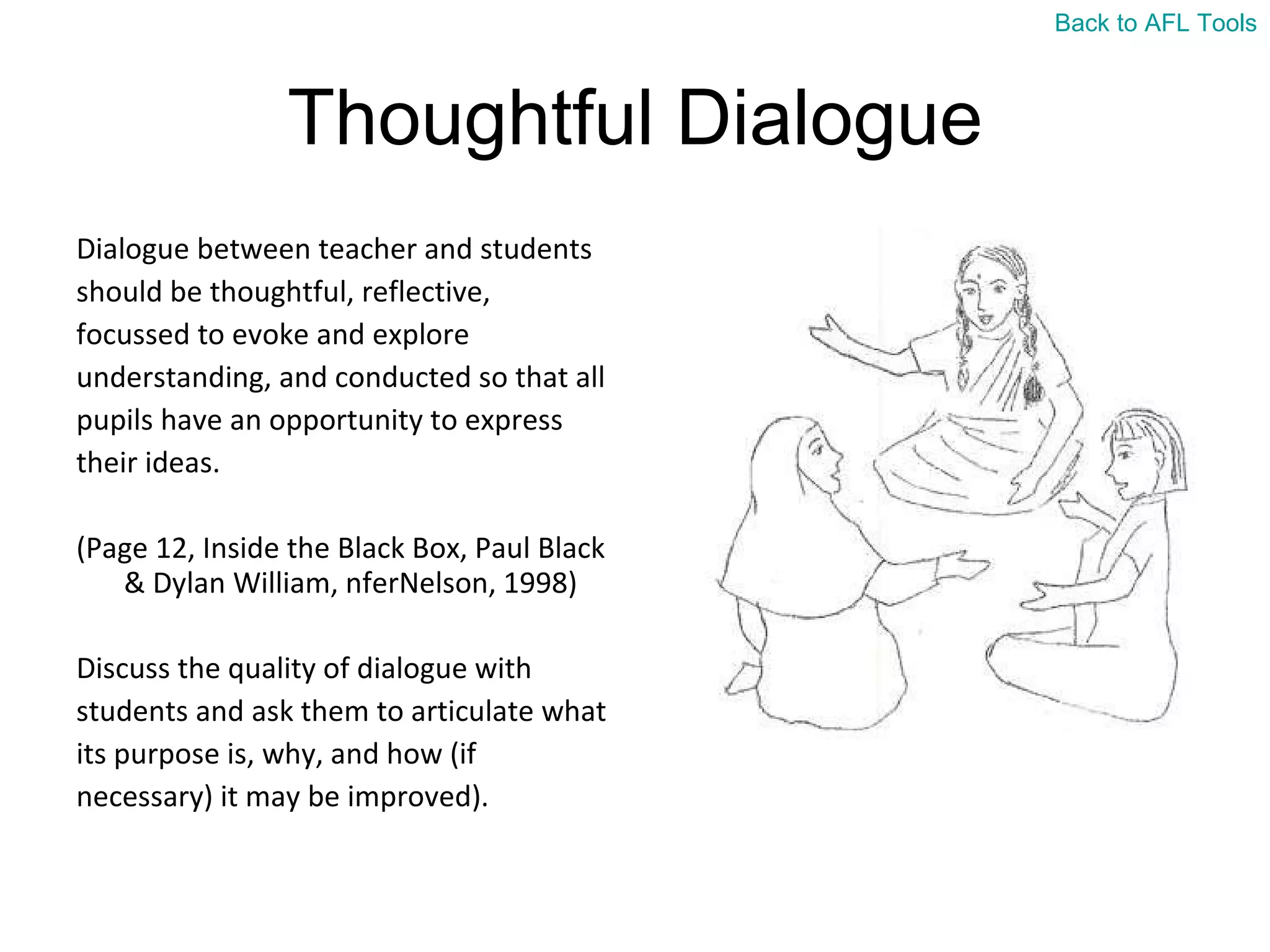
Thoughtful Dialogue Dialogue between teacher and students  should be thoughtful, reflective,  focussed to evoke and explore  understanding, and conducted so that all  pupils have an opportunity to express  their ideas.  (Page 12, Inside the Black Box, Paul Black & Dylan William, nferNelson, 1998) Discuss the quality of dialogue with  students and ask them to articulate what  its purpose is, why, and how (if  necessary) it may be improved). Back to AFL Tools
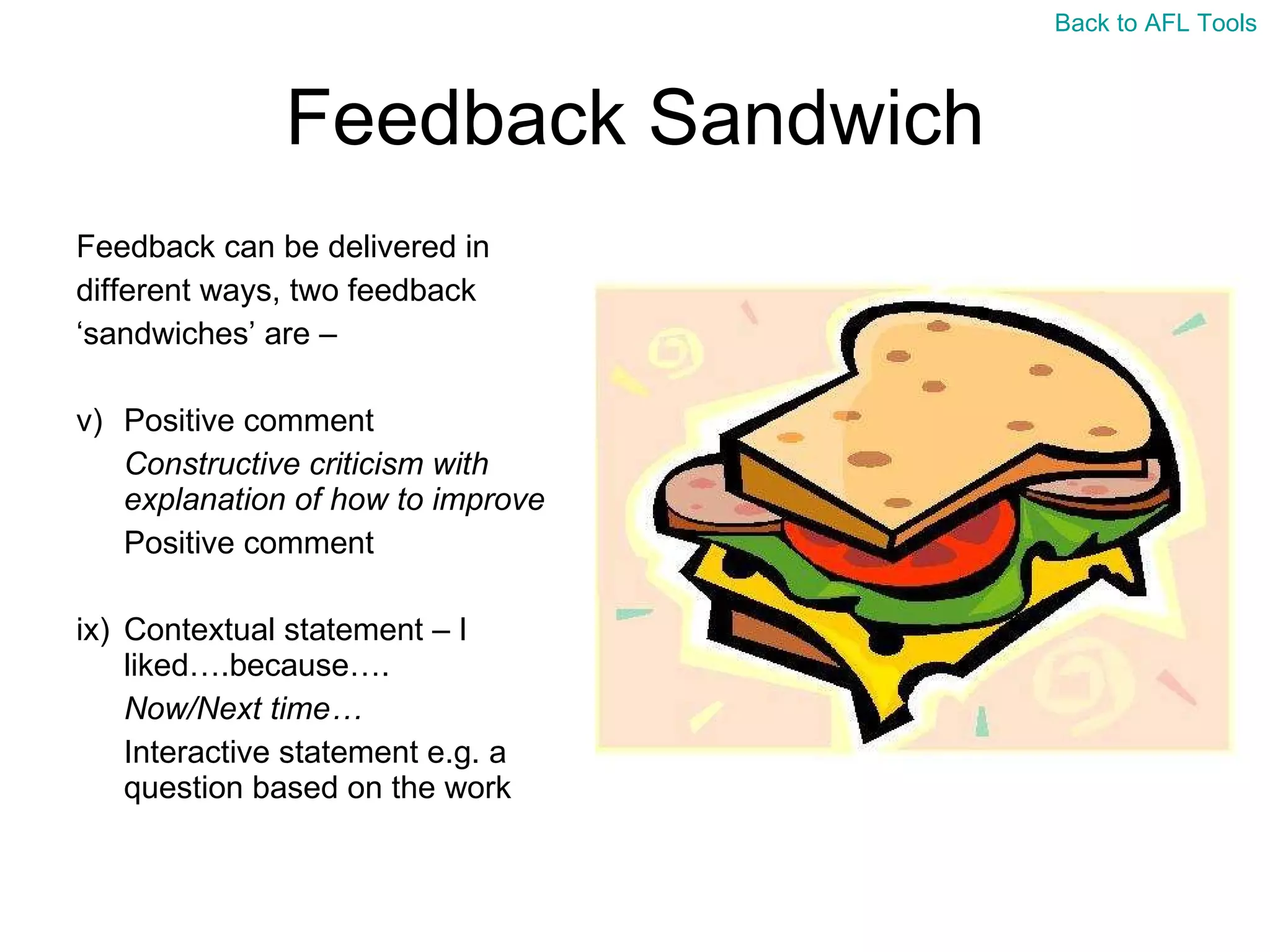
Feedback Sandwich Feedback can be delivered in  different ways, two feedback  ‘ sandwiches’ are –  Positive comment Constructive criticism with explanation of how to improve Positive comment Contextual statement – I liked….because…. Now/Next time… Interactive statement e.g. a question based on the work Back to AFL Tools
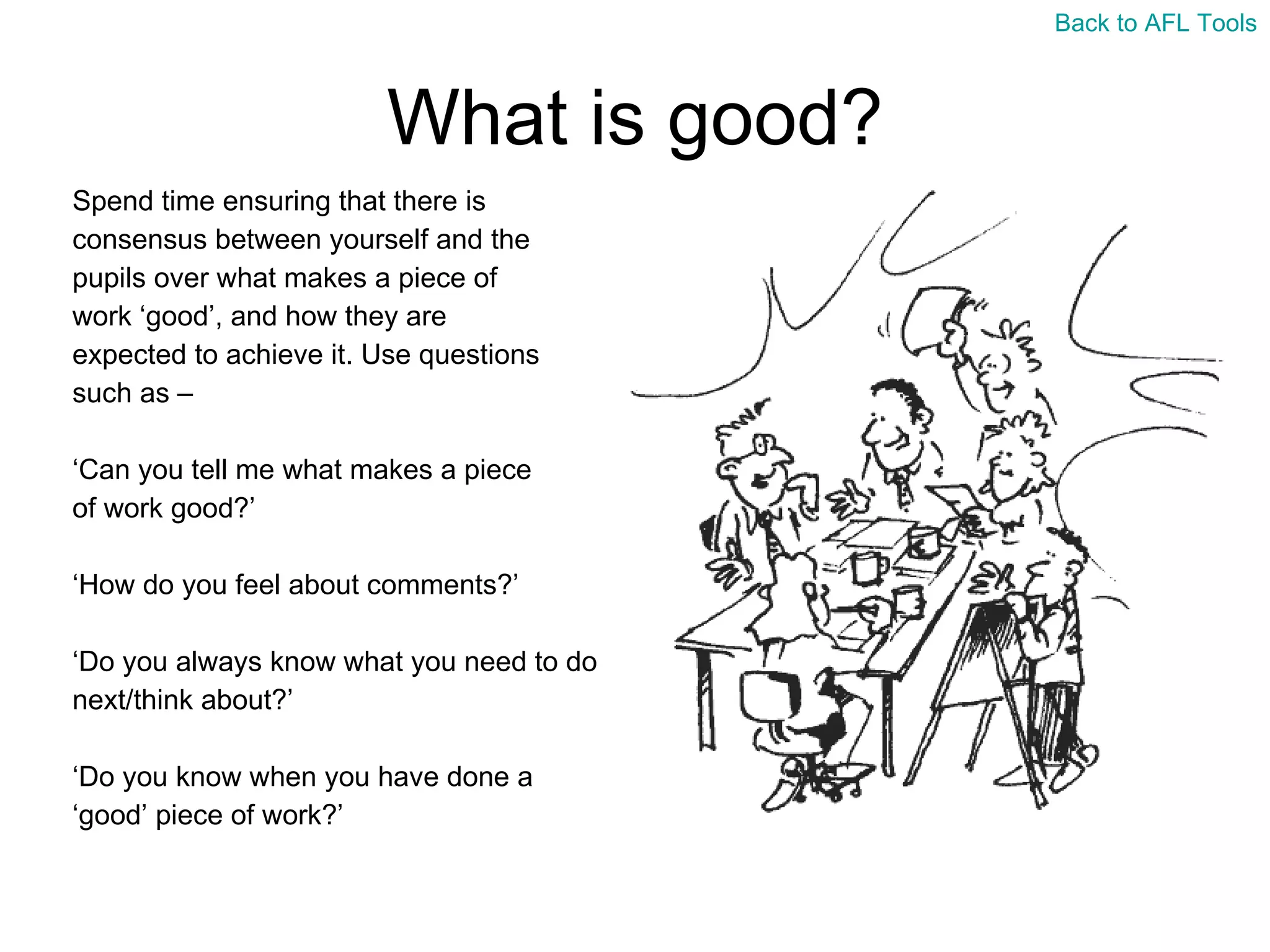
What is good? Spend time ensuring that there is  consensus between yourself and the  pupils over what makes a piece of  work ‘good’, and how they are  expected to achieve it. Use questions  such as –  ‘ Can you tell me what makes a piece  of work good?’ ‘ How do you feel about comments?’ ‘ Do you always know what you need to do  next/think about?’ ‘ Do you know when you have done a  ‘ good’ piece of work?’ Back to AFL Tools
Self-evaluation Self-evaluation involves learning  how  we  learn, whereas self-assessment is  what  we learn. To train pupils in self- evaluation, use questions such as: Think about what has happened when the  learning has taken place What really made you think? What did you  find difficult? What do you need more help with? What are you pleased about? What have you learnt new about X? How would you change the learning  activity to suit another class? The teacher can model answers to these  to  show the pupils how to self-evaluate. Back to AFL Tools
What is a ‘good’ question? Discuss with students what makes a  ‘ good’ question. The process can  explicitly show them the difference  between open and closed questions. They can then come up with  questions on a topic and decide  which are best, and then move on  to discuss and answer these. Back to AFL Tools
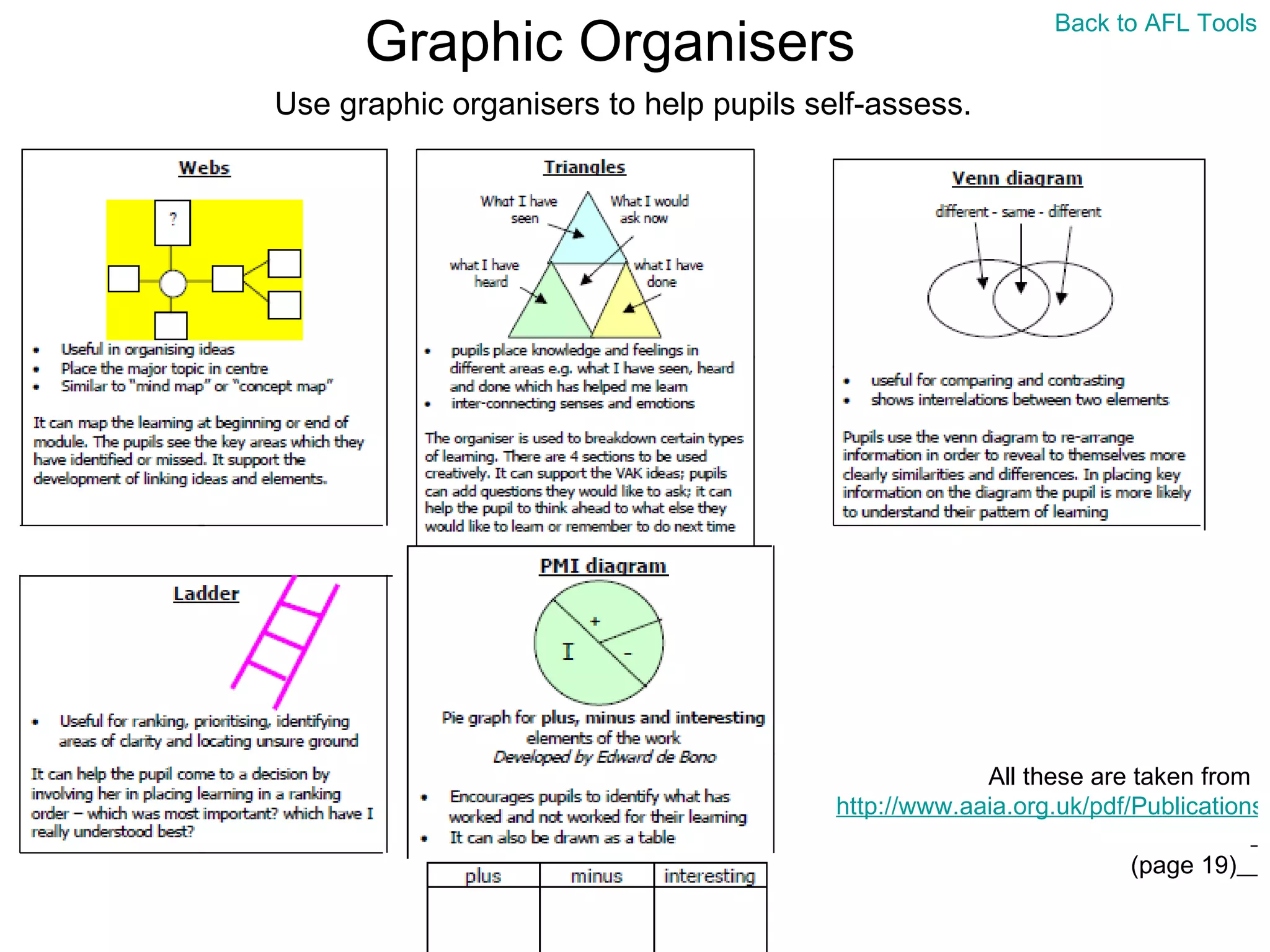
Graphic Organisers Use graphic organisers to help pupils self-assess. All these are taken from  http://www.aaia.org.uk/pdf/Publications/AAIAformat4.pdf   (page 19)   Back to AFL Tools
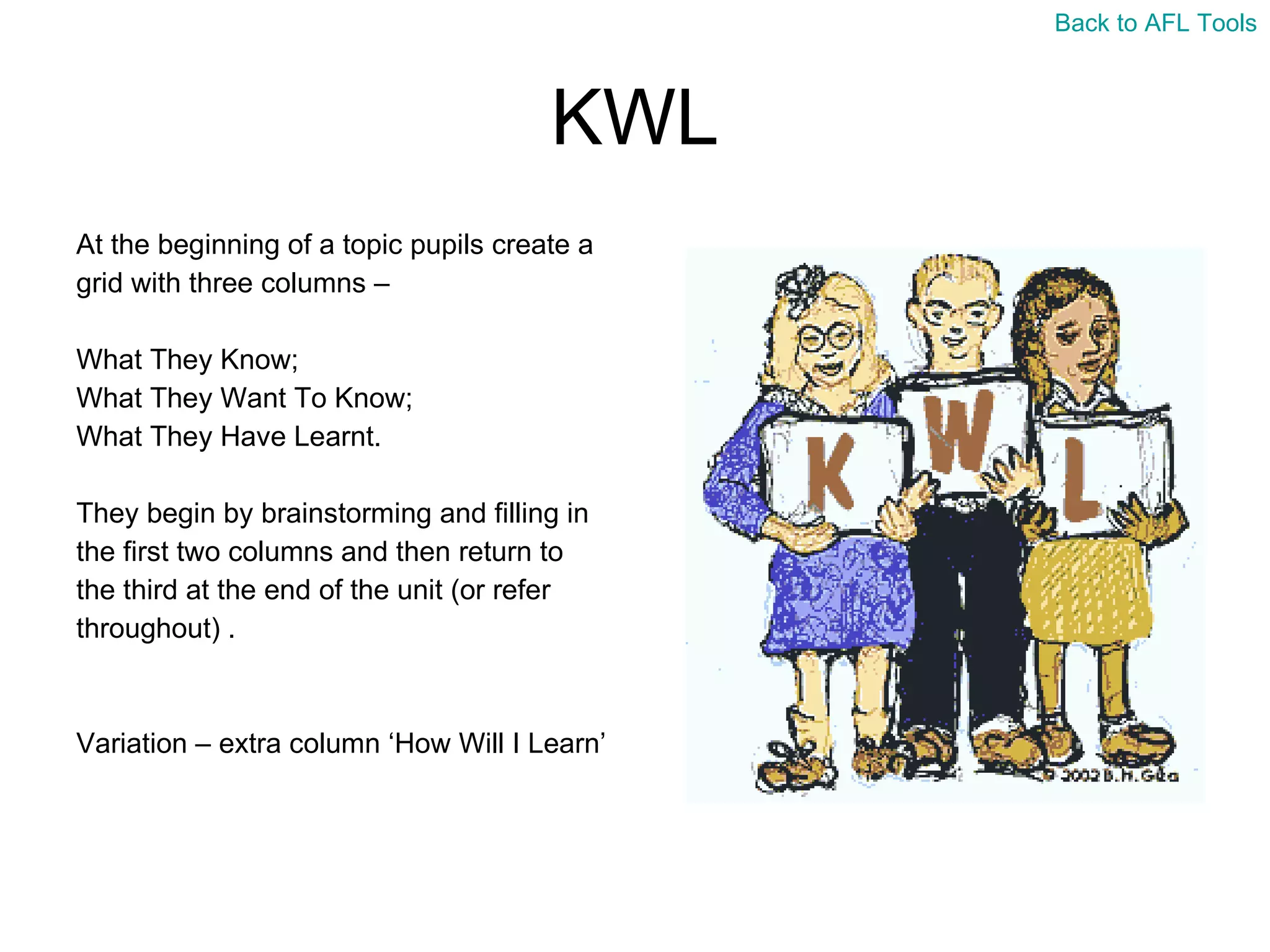
KWL At the beginning of a topic pupils create a  grid with three columns –  What They Know; What They Want To Know; What They Have Learnt. They begin by brainstorming and filling in  the first two columns and then return to  the third at the end of the unit (or refer  throughout) . Variation – extra column ‘How Will I Learn’ Back to AFL Tools
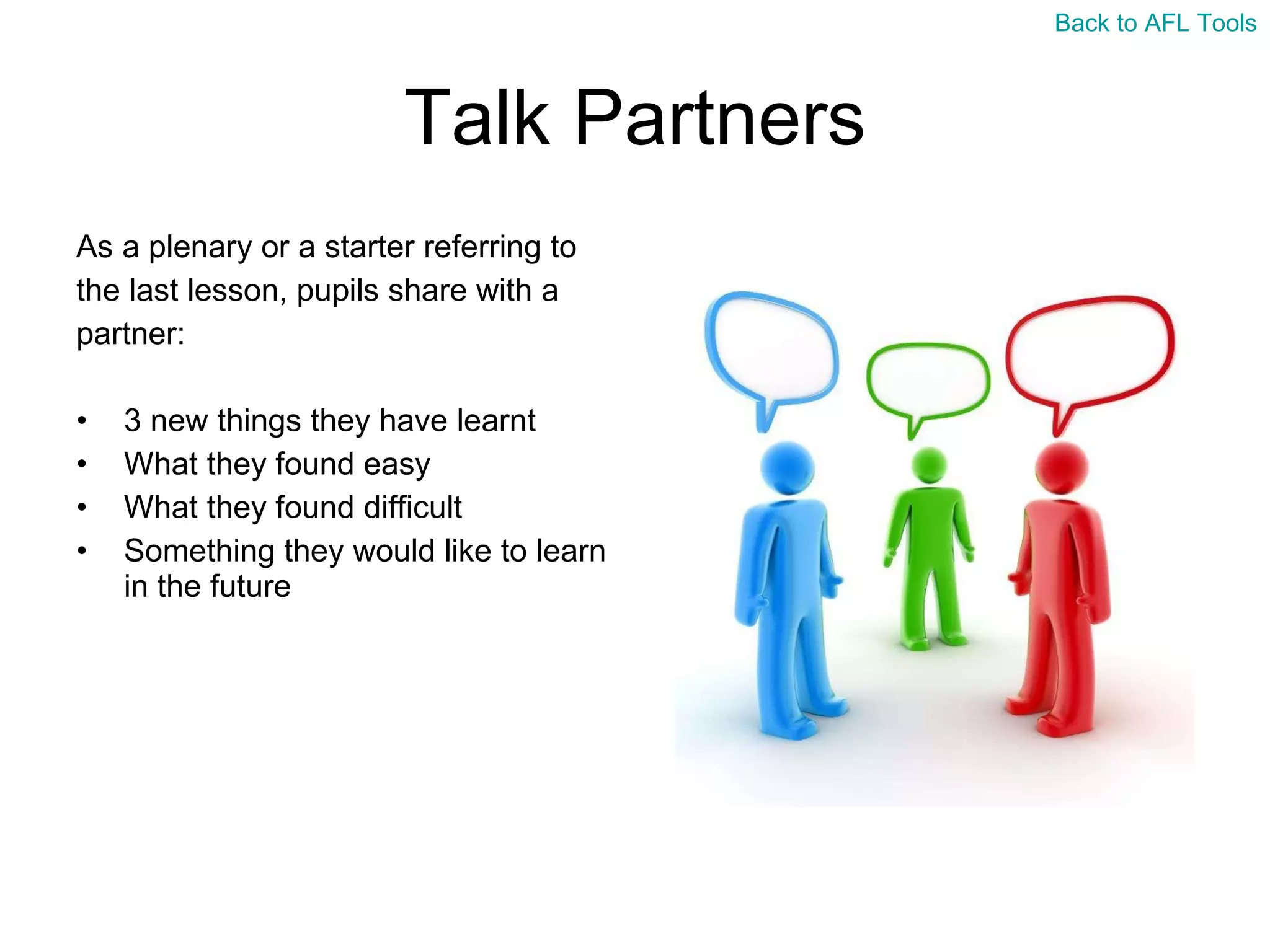
Talk Partners As a plenary or a starter referring to  the last lesson, pupils share with a  partner: 3 new things they have learnt What they found easy What they found difficult Something they would like to learn in the future Back to AFL Tools
Post-It Use post-it notes to evaluate learning. Groups, pairs or individuals can  answer: What have I learnt? What have I found easy? What have I found difficult? What do I want to know now? Back to AFL Tools
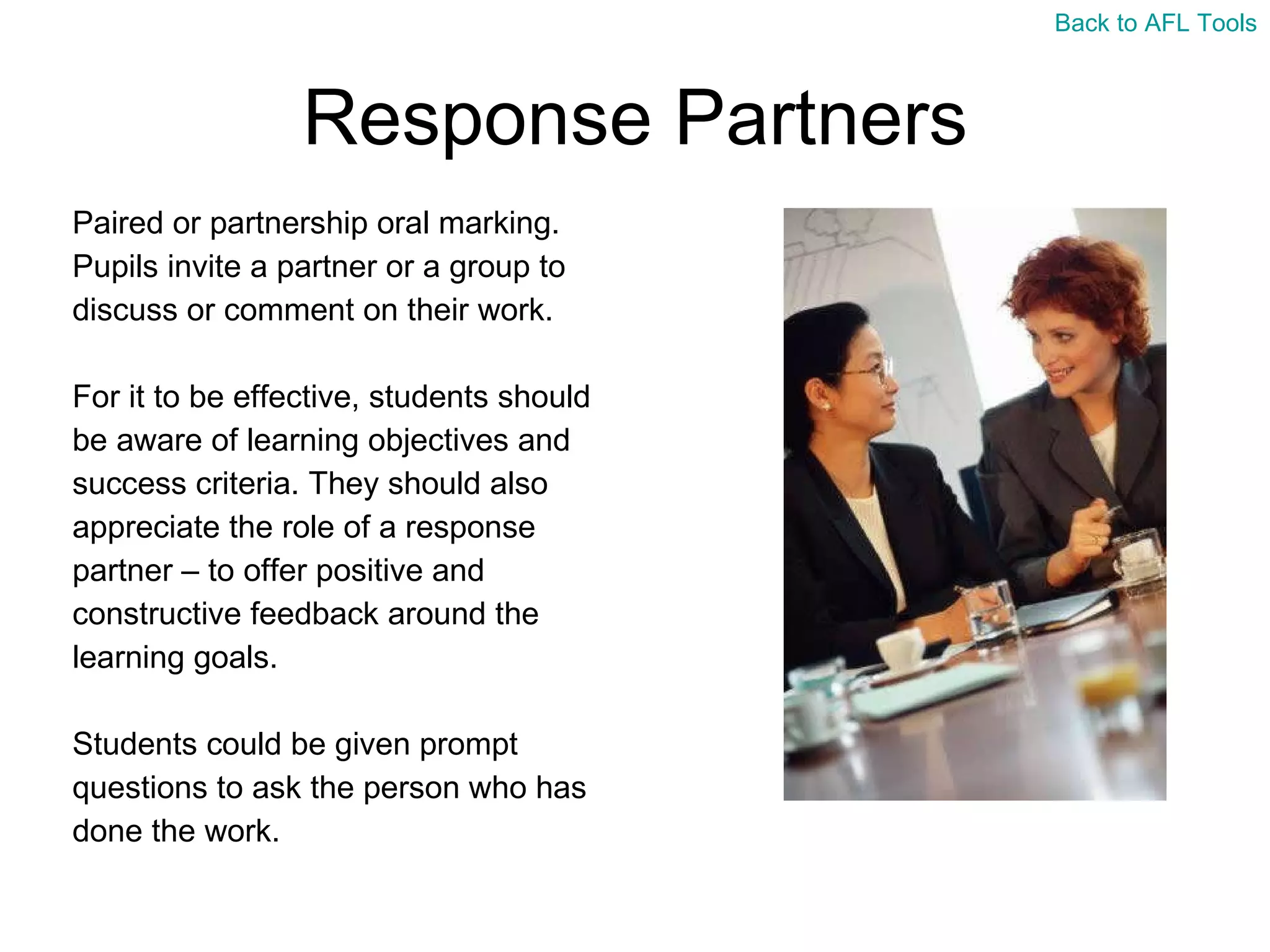
Response Partners Paired or partnership oral marking.  Pupils invite a partner or a group to  discuss or comment on their work.  For it to be effective, students should  be aware of learning objectives and  success criteria. They should also  appreciate the role of a response  partner – to offer positive and  constructive feedback around the  learning goals. Students could be given prompt  questions to ask the person who has  done the work. Back to AFL Tools
Hands Down Tell pupils they should only raise their  hand to ask a question, not to answer one.  The teacher then chooses pupils to  answer, therefore gaining information on  whether everyone is learning. www.classtools.net  – fruit machine  programme on here where you can input  names, save it and play it to choose pupils  at random. Write names on lollipop sticks and pull out  at random to answer. Write numbers on balls or counters that  tally to register or seating position and re- use with every class. Back to AFL Tools
Good Question Stems Why does…? What if…? How would you…? Could you explain…? What might…? Back to AFL Tools
Regulating Learning Circulating through the room whilst  students are engaged in an activity  means the teacher can collect  information on learning, employ  different assessment strategies and  intervene where appropriate. Back to AFL Tools
A B C D Laminate a set of cards so every  member of the class has four, with  A,B,C and D written on them. Ask  questions with four answers and  pupils can show you their answer. Encourage them not to look at other  people’s response so as to copy. Back to AFL Tools
Why is it best? For homework ask students to find  their best piece of work and then to  tell you why it is their best. This  explanation could refer to success  criteria, levels, targets etc. Back to AFL Tools
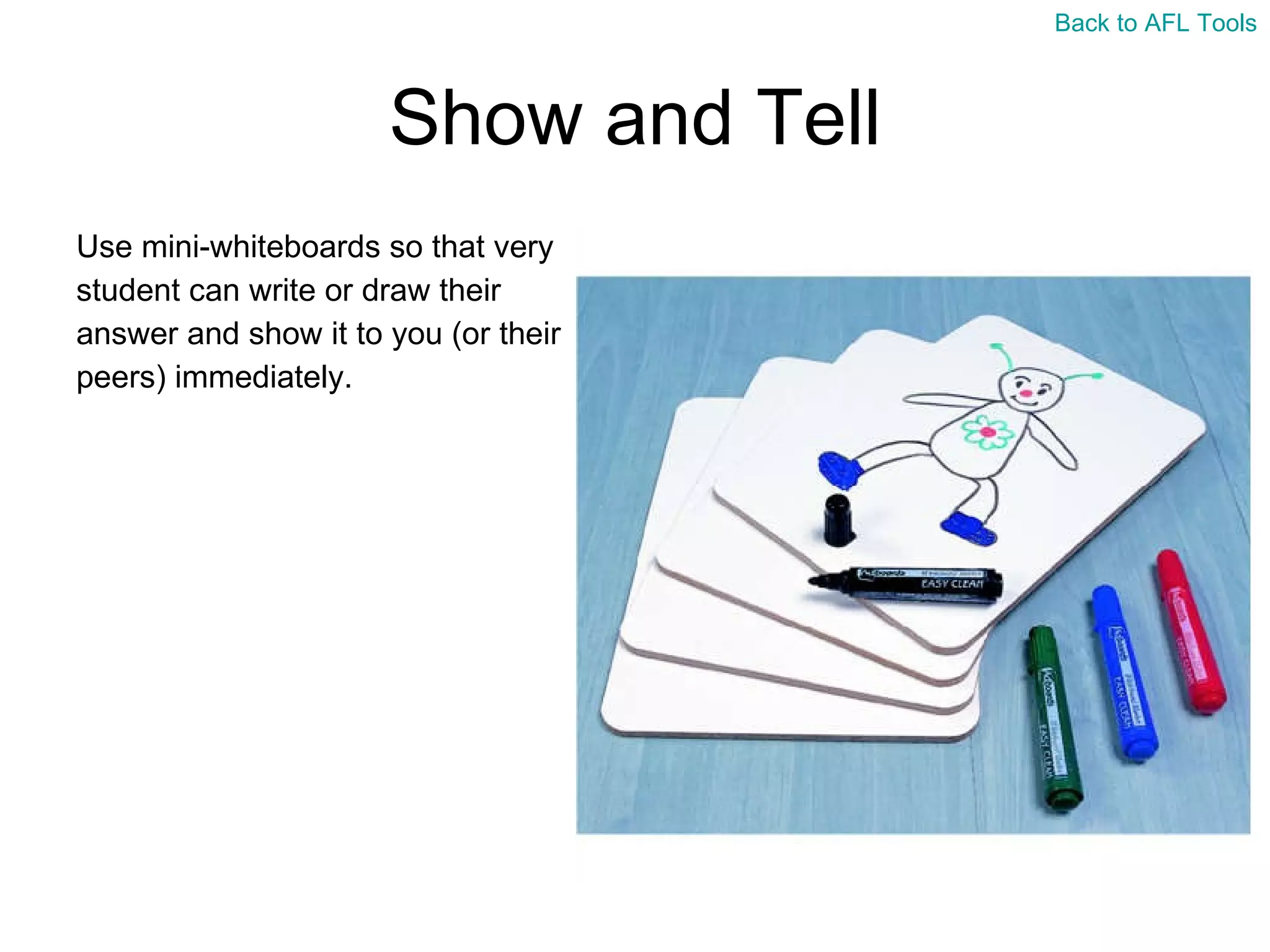
Show and Tell Use mini-whiteboards so that very  student can write or draw their  answer and show it to you (or their  peers) immediately. Back to AFL Tools
Active Students Key to AfL is students being active,  engaged participants in their learning.  Think of ways in which content can be  manipulated for these ends, rather  than the other way round. If the content seems boring then  make the approach fun or interesting. Back to AFL Tools
Long and Short Term To draw together progression with the  big picture, students could set both  long and short term targets.  The short term targets could be  reviewed weekly or fortnightly and the  long term targets at the end of  term. Having a long term target may give  more cogency to the pupil’s and  teacher’s short term targets. It may  also allow the pupil to focus on what  Really motivates them about a  subject. Back to AFL Tools
Minute Paper Students identify the most significant  (useful, meaningful, unlikely) thing  they have learnt during the lesson or  unit. Back to AFL Tools
Enquiry Question Use an enquiry question to stimulate  high-level thinking in the lesson or  unit. e.g. How democratic is the United Kingdom? Why is our school so ethnically diverse? What is enquiry-based learning -  http://www.campus.manchester.ac.uk/ceebl/ebl/   Back to AFL Tools
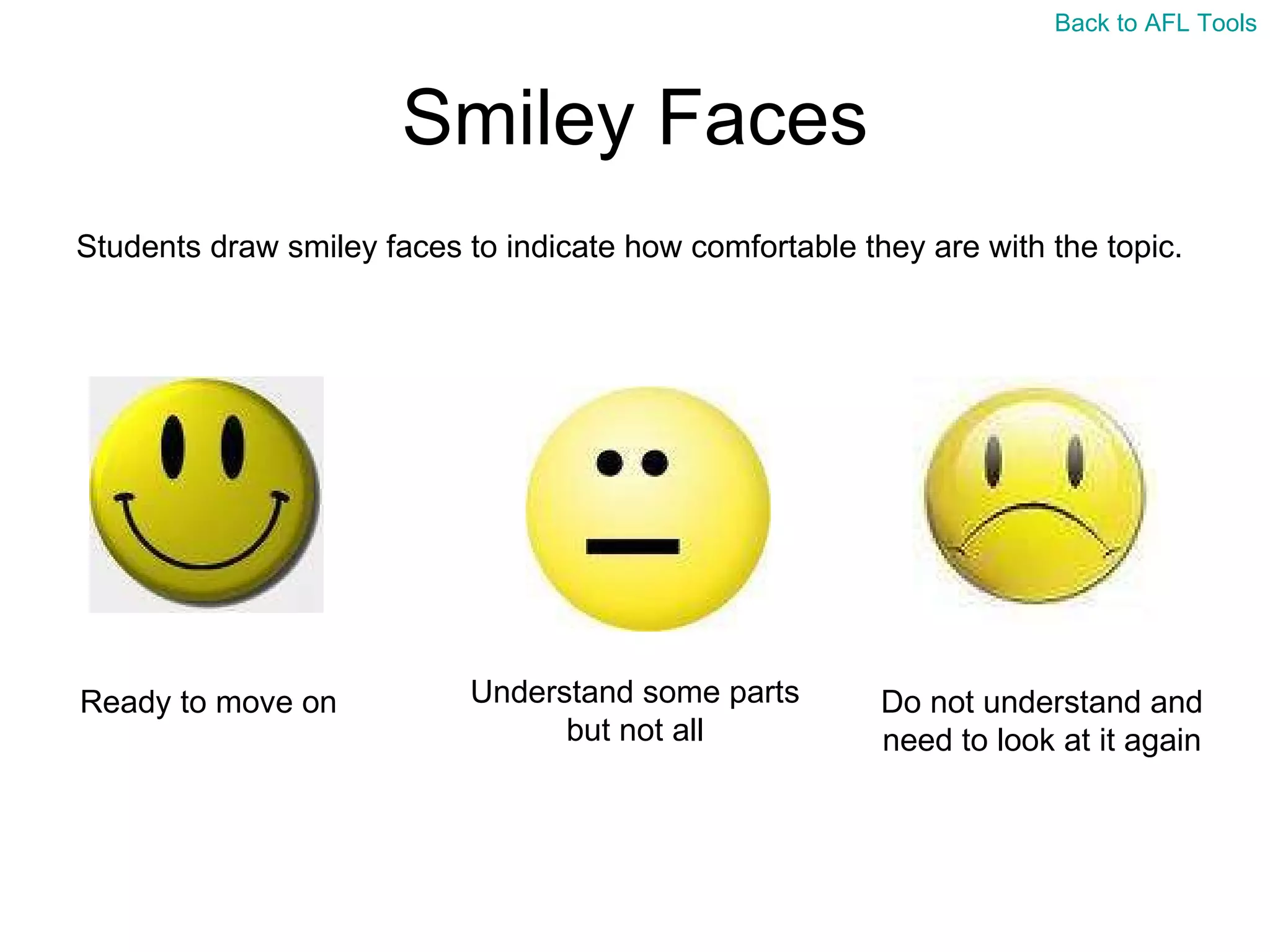
Smiley Faces Students draw smiley faces to indicate how comfortable they are with the topic. Ready to move on Understand some parts but not all Do not understand and need to look at it again Back to AFL Tools
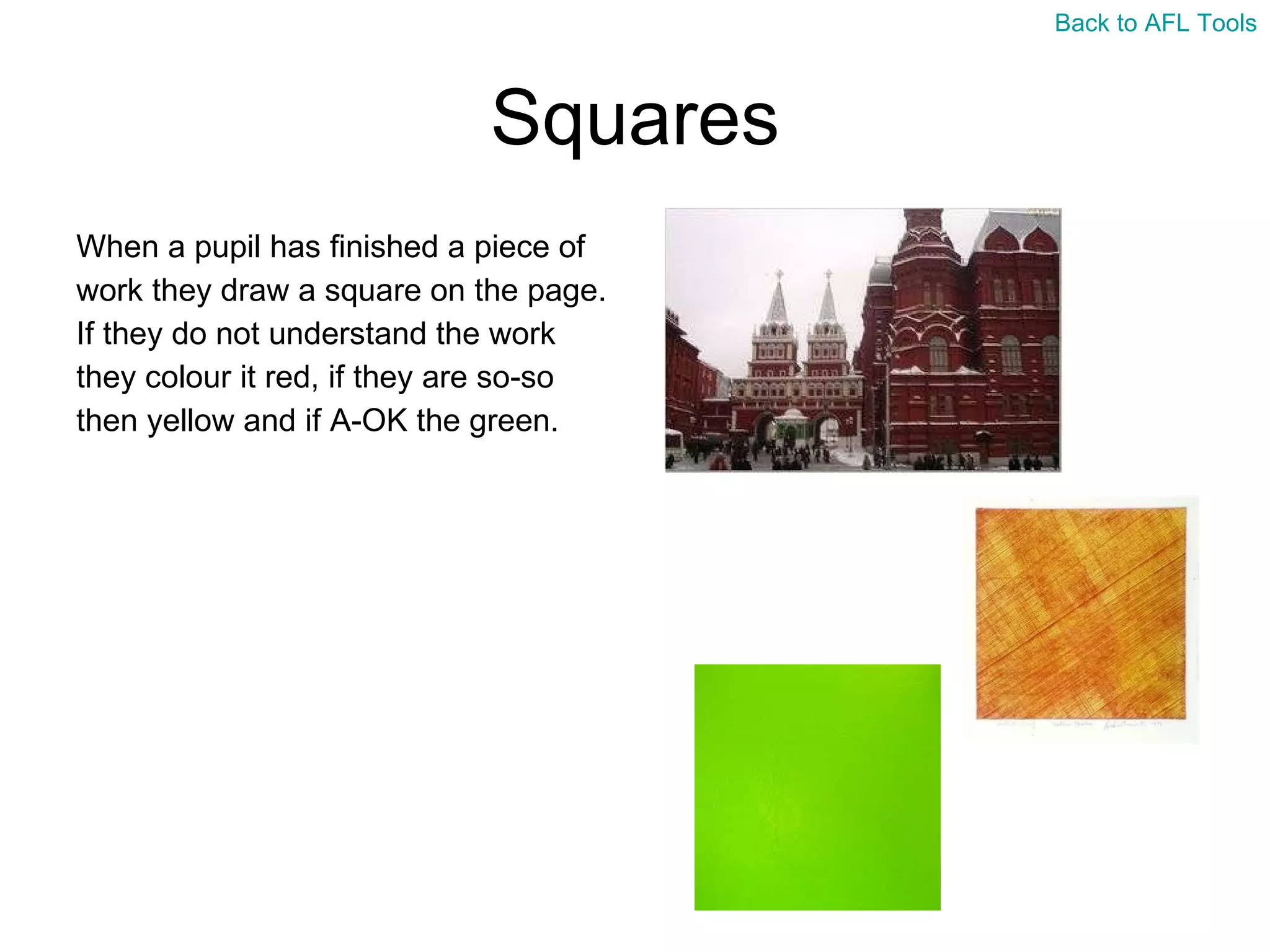
Squares When a pupil has finished a piece of  work they draw a square on the page.  If they do not understand the work  they colour it red, if they are so-so  then yellow and if A-OK the green. Back to AFL Tools
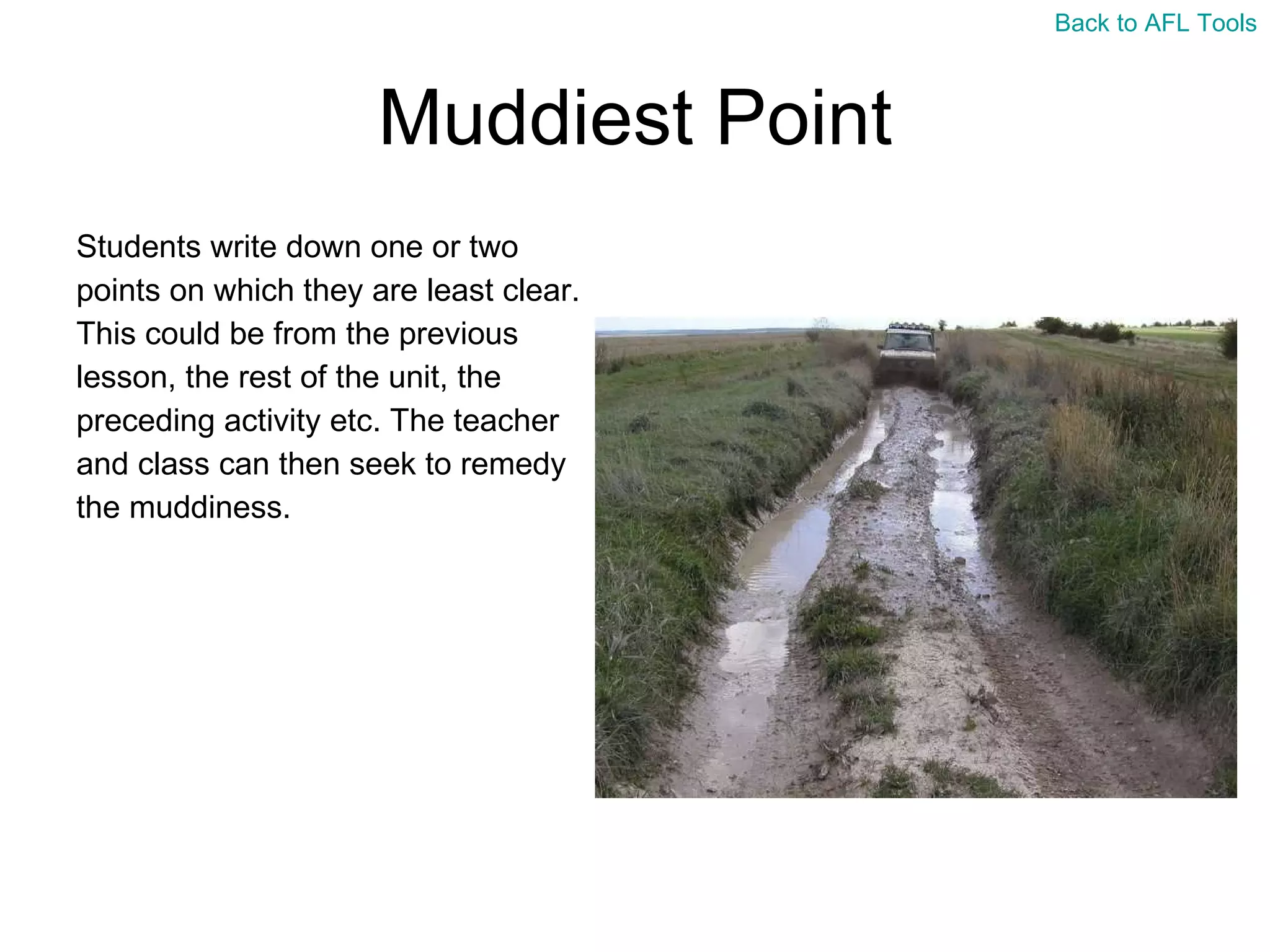
Muddiest Point Students write down one or two  points on which they are least clear.  This could be from the previous  lesson, the rest of the unit, the  preceding activity etc. The teacher  and class can then seek to remedy  the muddiness. Back to AFL Tools
One-Sentence Summary Students write a sentence  summarising their knowledge of a  topic.  The sentence could have to include  who, what when, why, how, where  etc. The sentences could then be peer- assessed, re-drafted and so on. Back to AFL Tools

T&L Assessment for Learning Tools

  • 1.
    Assessment For LearningTools AfL is successful when embedded in teaching and learning. This toolkit aims to help by presenting different facets, activities and tools for teachers to use in order to achieve this.
  • 2.
    Students write QuestionsStudents ask Questions Comment-only marking Mid-unit assessment ‘Might’ Wait-time Open vs closed Exemplar Work Student Marking Making aims clear Lesson Target Setting Teacher Review Student Review Traffic Lights 2 stars and a wish Self-assessment Targets One-Sentence Summary Articulate then Answer Scene-Setting Tell your neighbour Idea Thoughts Bouncing Wait and recap Incorrect Discussion Muddiest Point Devising Questions Learning Journal Redrafting Key features Invert the Question Improvement Guidance Comment Follow-up Group feedback Peer Marking Thumbs Teach Collaboration Traffic-Light Revision Generate and Answer Student Mark-Scheme Group Answers X and Y All you know Corrections Laminated Criteria Conveying Progress Think through Talking Discuss Words Communication Thoughtful Dialogue Feedback Sandwich What is good? Self-evaluation What is a ‘good’ question? Graphic Organisers KWL Talk Partners Post-It Response Partners Hands Down Question Stems Regulating Learning A B C D Why is it best? Show and Tell Active Students Long and Short Term Minute Paper Enquiry Question Smiley Faces Squares
  • 3.
    Students write QuestionsFor example – About what they would like to know on a new topic To ask the teacher or other students in order to assess their learning To demonstrate their learning/misconceptions/areas they would like to further explore The classroom could have a question box where students drop questions at the end of a lesson. Or, a plenary could involve students writing questions that the class then work on together, or forms the basis of the next lesson. Back to AFL Tools
  • 4.
    Students ask QuestionsCreate opportunities for students to ask questions. This could be of their peers, of the teacher or as a means to develop discussion. A ‘question box’ for written questions offers a different means of communication for students Allow time for students to ask questions about pieces of work. This helps open up assessment and eliminate ambiguity Back to AFL Tools
  • 5.
    Comment-only marking Comment-onlymarking provides students with a focus for progression instead of a reward or punishment for their ego (as a grade does). Comments could be made in books, in a table at the front of books, in a learning diary or journal. The latter are helpful for teacher and student to track the progression of comments and see improvement. Comments should make it clear how the student can improve. Plan activities and work with feedback in mind – let the design assist the process. Back to AFL Tools
  • 6.
    Mid-unit assessment Havingan assessment at the end of a unit may not provide time for you to go over areas students have struggled with, or in which there are general misconceptions. Timing assessment during a unit (i.e. lesson 5 of 7) allows time to review, reflect and revisit. It also gives the teacher an opportunity to focus explicitly on areas of weak understanding supported by evidence. Back to AFL Tools
  • 7.
    ‘ Might’ Whenquestioning, insert the word ‘ might’ to give students greater opportunity to think and explore possible answers. e.g. What is meaning of democracy? What might the meaning of democracy be? The first infers a single answer known by the teacher whereas the second is inherently more open. What might the Great Depression look like today? Back to AFL Tools
  • 8.
    Wait-time Wait timeallows students time to think and therefore to produce answers. Also, not everyone in the class thinks at the same speed or in the same way – waiting allows students to build their thoughts and explore what has been asked. 2 types of wait time – Teacher speaks and then waits before taking student responses. Student response ends and then teacher waits before responding. This gives the student space to elaborate or continue – or for another student to respond. Back to AFL Tools
  • 9.
    Open vs closedClosed questions can be useful however are not great at facilitating the use of abstract thinking skills, encouraging talking or eliciting much understanding. Open questions are more likely to do this and thus improve learning. e.g. Did you go out last night? What did you after school yesterday? Back to AFL Tools
  • 10.
    Exemplar Work Whensetting students a piece of work, show them examples that make it clear what it is they are being asked to do – and what they need to do in order to meet the assessment criteria. Students could mark exemplar work using the assessment criteria. This will help model what is being asked for and how it relates to the process of assessment. Back to AFL Tools
  • 11.
    Student Marking Bytaking part in the process of assessment, students gain a deeper understanding of topics, the process of assessment and what they are doing in their own work. This helps to make them more aware of ‘what learning is’ and thus see their own learning in this way. Students could self- or peer- mark homework or assessments. This could be done in pairs or individually with a student-made or ‘ official’ mark-scheme. Back to AFL Tools
  • 12.
    Making aims clearPut lesson objectives on the board at the beginning of the lesson. Talk to students about why they are studying what they are studying. Contextualise short-term aims in long-term aims (e.g. analysing Shakespeare will contribute to a wider knowledge of the cultural canon and stronger analytical skills among other long term aims) Check with students that they are clear about the aims of the lesson/unit/subject Produce aims in conjunction with students Back to AFL Tools
  • 13.
    Lesson Target SettingMake the lesson more purposeful for students by setting targets at the beginning about what you and the class are going to do. These can be referred to through the lesson and/or revisited in the plenary. Students could have to show how they have met targets in the plenary and/or set targets for next lesson. Back to AFL Tools
  • 14.
    Teacher Review Theteacher leads the review of the lesson or unit using questioning to elicit understanding from students. Focus could also fall upon the effectiveness of the lesson at facilitating learning – i.e. can students think of ways that it could be altered to improve their learning? The teacher could model review by evaluating the lesson in relation to their own objectives. Back to AFL Tools
  • 15.
    Student Review Studentsreview their own learning either in groups or individually. This could be done as a plenary, a mini-plenary or as an activity to help planning for future revision or the remainder of the unit. Back to AFL Tools
  • 16.
    Traffic Lights Usetraffic lights as a visual means of showing understanding. e.g. Students have red, amber and green cards which they show on their desks or in the air. (red = don’t understand, green = totally get it etc.) Students self-assess using traffic lights. The teacher could then record these visually in their mark book. Peer assess presentations etc. with traffic lights Back to AFL Tools
  • 17.
    Self-assessment Targets Studentsgive themselves targets based on their self-assessment. These learning goals could be recorded somewhere and revisited (i.e. inside cover of workbook) They could be compared to teacher targets and the two brought to consensus if different. Back to AFL Tools
  • 18.
    2 stars anda wish For peer assessment, ask students to give two stars and a wish. Two stars = 2 things that are good about the piece of work A wish = something they can improve to make it even better Back to AFL Tools
  • 19.
    Articulate then AnswerGive students the opportunity to articulate their thinking before answering – 30 seconds silent thinking before any answers Brainstorm in pairs first for 2-3 minutes Write some thoughts down before answering Discuss with your neighbour first Back to AFL Tools
  • 20.
    Scene-Setting Set thescene for the lesson by using a big, open question or problem- solving task that requires abstract thinking skills. Anticipate responses and follow-up so as to work these through. E.g. A lesson on the Vietnam War could begin with the question – Do Americans think they fight wars, or win them? Back to AFL Tools
  • 21.
    Tell your neighbourStudents ‘tell their neighbour’ as a means of articulating their thoughts. Ask a question, give thinking time and then ask students to tell their neighbour their thoughts. Tell students what the new topic is and then ask them to tell their neighbour everything they know about it. Back to AFL Tools
  • 22.
    Idea Thoughts Whenyou have received an answer to a question, open up the thinking behind it by asking what others think about the idea. e.g. “What do others think about _________’s idea?” Back to AFL Tools
  • 23.
    Bouncing Bounce answersaround the room to build on understanding and have students develop stronger reasoning out of misconceptions. E.g. “ Jimmy, what do you think of Sandra’s answer?” “ Sandra, how could you develop Carl’s answer to include more detail?” “ Carl, how might you combine all we’ve heard into a single answer?” Back to AFL Tools
  • 24.
    Wait and recapWait for students to draw out most of the key words you are asking for and then reframe the question – asking for a synthesis which recaps the whole discussion by joining all these words into a single coherent answer, paragraph etc. Back to AFL Tools
  • 25.
    Incorrect Discussion Useincorrect answers as a discussion point. Rather then dismissing something because it is wrong, or saying ‘that’s interesting’ etc. Use the misconception in reasoning to draw the process out into the open. This leads to improving on misconceived reasoning and an atmosphere in which it is OK to be Wrong. I’m glad that’s the wrong answer… let’s discuss it Back to AFL Tools
  • 26.
    Devising Questions Devisequestions that – Challenge common misconceptions Create conflict that requires discussion Explore ambiguity and encourage discussion and clarification Back to AFL Tools
  • 27.
    Learning Journal Createa learning journal in which students can reflect on and review their learning. It could include plenary activities, a target setting chart, aims and goals etc. Back to AFL Tools
  • 28.
    Redrafting Use lessontime to redraft work. This allows students time to focus on the feedback for improvement they have been given. It also reinforces the value of the feedback and allows them to work at it in a supportive environment. Back to AFL Tools
  • 29.
    Key features Whendesigning written tasks to go alongside oral work, intend for them to develop and show understanding of the key features of what students have learned. Back to AFL Tools
  • 30.
    Improvement Guidance Whenmaking comments on pupils’ work, treat them like guidance showing how the pupil can improve. Develop this by asking students to write in the same way when peer assessing work. Discuss the notion of guidance and how it differs from other types of behaviour (i.e. prescription, admonishment etc.) Back to AFL Tools
  • 31.
    Comment Follow-up Givestudents opportunities to follow up comments - Create time in the lesson to talk to individual students. Have a written dialogue in the students’ book. Use a comment tracker or targets sheet to formalise the dialogue in a workbook Back to AFL Tools
  • 32.
    Group feedback Groupfeedback to a teacher concerning peer-assessment of work can help make the teacher aware of learning needs in a manageable way. If a group feeds back then it draws more attention and presents information that has already been ordered and sorted (meaning less repetition for the teacher). Back to AFL Tools
  • 33.
    Peer Marking Studentsmark each others’ work according to assessment criteria. Encourages reflection and thought about the learning as well as allowing students to see model work and reason past misconceptions. Opportunities to do this throughout individual lessons and schemes of work. Back to AFL Tools
  • 34.
    Thumbs Check classunderstanding of what you are teaching by asking them to show their thumbs. Thumbs up = I get it Thumbs half way = sort of Thumbs down = I don’t get it Back to AFL Tools
  • 35.
    Teach Collaboration Peerassessment requires students to act collaboratively. Indeed, AfL is a collaborative enterprise. Therefore, explicitly teach skills of collaboration. This process can be assisted by discussing collaboration with pupils and making it visible as a part of the classroom. Back to AFL Tools
  • 36.
    Traffic-Light Revision Whenrevising a topic or subject, work through the different areas with students and ask them to traffic light according to their grasp of each. Subsequently, students should be able to target their revision more carefully and engage in it actively, rather than simply reviewing everything they have done or reading passively over their entire notes. Back to AFL Tools
  • 37.
    Generate and AnswerWhen preparing for exams, students generate their own questions and then practice answering them. This makes learners think explicitly about the underlying structures of assessment, as well as the material which they are being asked to manipulate. Form as well as function! Back to AFL Tools
  • 38.
    Student Mark-Scheme Askstudents to produce their own mark-schemes working individually or in groups. They can then peer- or self-assess work in accordance with these schemes. Talk about the purpose of a mark- scheme with students – judgement, communication, standardisation etc. Back to AFL Tools
  • 39.
    Group Answers Studentswork in small groups to agree on answers – when tests are returned or in other situations. The process of agreeing should include reasoning over the validity of the consensus answer, as well as reasoned negation of misconceptions or wrong answers. Back to AFL Tools
  • 40.
    Think through TalkingTalking allows students to articulate their thoughts and thus to learn. Encourage thinking through talking with – Discussion activities Structured group/pair work Modelling by teacher and students (small group work increases the ‘ surface area’ of talk in the classroom as opposed to whole class discussions) Back to AFL Tools
  • 41.
    Invert the QuestionInstead of asking a question that requires factual recall, invert it to request explicit reasoning. e.g. ‘ Is France a democracy?’ becomes ‘ What does it mean for a country to be a democracy?’ Back to AFL Tools
  • 42.
    X and YAsk students why X is an example of Y e.g. Why is an apple an example of a fruit? Why is a fox an example of a mammal? Questioning in this way avoids factual recall and asks for the underlying reasoning to be made explicit. Back to AFL Tools
  • 43.
    All you knowStudents write down everything they know about ________ at the start of the unit. The teacher can then teach the unit accordingly, using existing knowledge and avoiding repetition. Back to AFL Tools
  • 44.
    Corrections Reinforce thefocus on redrafting and comment-only marking by insisting on seeing evidence of student corrections on their own work before looking at it (have to allow time for this). Back to AFL Tools
  • 45.
    Laminated Criteria Makelaminated, student- friendly assessment criteria cards. Back to AFL Tools
  • 46.
    Conveying Progress Finda means of using assessment to convey progress to students and thus make what they are doing more meaningful. Link learning between units Use a learning journal Refer to past targets and highlight where the student is achieving this Have a target chart where it is visible how the student has progressed Link assessment to student goal-setting Back to AFL Tools
  • 47.
    Discuss Words Whenengaged in discussion take key words and look at them specifically. Discuss how they are being used – Is there any ambiguity? Is everyone using the word in the same way? Back to AFL Tools
  • 48.
    Communication Ask studentsto communicate thinking through different mediums – not just writing; drawing, drama, maps, sculpture etc. The medium is the message and therefore circumscribes to some extent how communication can take place. Using alternative mediums allows the teacher to ‘see’ students’ understanding from different angles. Back to AFL Tools
  • 49.
    Thoughtful Dialogue Dialoguebetween teacher and students should be thoughtful, reflective, focussed to evoke and explore understanding, and conducted so that all pupils have an opportunity to express their ideas. (Page 12, Inside the Black Box, Paul Black & Dylan William, nferNelson, 1998) Discuss the quality of dialogue with students and ask them to articulate what its purpose is, why, and how (if necessary) it may be improved). Back to AFL Tools
  • 50.
    Feedback Sandwich Feedbackcan be delivered in different ways, two feedback ‘ sandwiches’ are – Positive comment Constructive criticism with explanation of how to improve Positive comment Contextual statement – I liked….because…. Now/Next time… Interactive statement e.g. a question based on the work Back to AFL Tools
  • 51.
    What is good?Spend time ensuring that there is consensus between yourself and the pupils over what makes a piece of work ‘good’, and how they are expected to achieve it. Use questions such as – ‘ Can you tell me what makes a piece of work good?’ ‘ How do you feel about comments?’ ‘ Do you always know what you need to do next/think about?’ ‘ Do you know when you have done a ‘ good’ piece of work?’ Back to AFL Tools
  • 52.
    Self-evaluation Self-evaluation involveslearning how we learn, whereas self-assessment is what we learn. To train pupils in self- evaluation, use questions such as: Think about what has happened when the learning has taken place What really made you think? What did you find difficult? What do you need more help with? What are you pleased about? What have you learnt new about X? How would you change the learning activity to suit another class? The teacher can model answers to these to show the pupils how to self-evaluate. Back to AFL Tools
  • 53.
    What is a‘good’ question? Discuss with students what makes a ‘ good’ question. The process can explicitly show them the difference between open and closed questions. They can then come up with questions on a topic and decide which are best, and then move on to discuss and answer these. Back to AFL Tools
  • 54.
    Graphic Organisers Usegraphic organisers to help pupils self-assess. All these are taken from http://www.aaia.org.uk/pdf/Publications/AAIAformat4.pdf (page 19) Back to AFL Tools
  • 55.
    KWL At thebeginning of a topic pupils create a grid with three columns – What They Know; What They Want To Know; What They Have Learnt. They begin by brainstorming and filling in the first two columns and then return to the third at the end of the unit (or refer throughout) . Variation – extra column ‘How Will I Learn’ Back to AFL Tools
  • 56.
    Talk Partners Asa plenary or a starter referring to the last lesson, pupils share with a partner: 3 new things they have learnt What they found easy What they found difficult Something they would like to learn in the future Back to AFL Tools
  • 57.
    Post-It Use post-itnotes to evaluate learning. Groups, pairs or individuals can answer: What have I learnt? What have I found easy? What have I found difficult? What do I want to know now? Back to AFL Tools
  • 58.
    Response Partners Pairedor partnership oral marking. Pupils invite a partner or a group to discuss or comment on their work. For it to be effective, students should be aware of learning objectives and success criteria. They should also appreciate the role of a response partner – to offer positive and constructive feedback around the learning goals. Students could be given prompt questions to ask the person who has done the work. Back to AFL Tools
  • 59.
    Hands Down Tellpupils they should only raise their hand to ask a question, not to answer one. The teacher then chooses pupils to answer, therefore gaining information on whether everyone is learning. www.classtools.net – fruit machine programme on here where you can input names, save it and play it to choose pupils at random. Write names on lollipop sticks and pull out at random to answer. Write numbers on balls or counters that tally to register or seating position and re- use with every class. Back to AFL Tools
  • 60.
    Good Question StemsWhy does…? What if…? How would you…? Could you explain…? What might…? Back to AFL Tools
  • 61.
    Regulating Learning Circulatingthrough the room whilst students are engaged in an activity means the teacher can collect information on learning, employ different assessment strategies and intervene where appropriate. Back to AFL Tools
  • 62.
    A B CD Laminate a set of cards so every member of the class has four, with A,B,C and D written on them. Ask questions with four answers and pupils can show you their answer. Encourage them not to look at other people’s response so as to copy. Back to AFL Tools
  • 63.
    Why is itbest? For homework ask students to find their best piece of work and then to tell you why it is their best. This explanation could refer to success criteria, levels, targets etc. Back to AFL Tools
  • 64.
    Show and TellUse mini-whiteboards so that very student can write or draw their answer and show it to you (or their peers) immediately. Back to AFL Tools
  • 65.
    Active Students Keyto AfL is students being active, engaged participants in their learning. Think of ways in which content can be manipulated for these ends, rather than the other way round. If the content seems boring then make the approach fun or interesting. Back to AFL Tools
  • 66.
    Long and ShortTerm To draw together progression with the big picture, students could set both long and short term targets. The short term targets could be reviewed weekly or fortnightly and the long term targets at the end of term. Having a long term target may give more cogency to the pupil’s and teacher’s short term targets. It may also allow the pupil to focus on what Really motivates them about a subject. Back to AFL Tools
  • 67.
    Minute Paper Studentsidentify the most significant (useful, meaningful, unlikely) thing they have learnt during the lesson or unit. Back to AFL Tools
  • 68.
    Enquiry Question Usean enquiry question to stimulate high-level thinking in the lesson or unit. e.g. How democratic is the United Kingdom? Why is our school so ethnically diverse? What is enquiry-based learning - http://www.campus.manchester.ac.uk/ceebl/ebl/ Back to AFL Tools
  • 69.
    Smiley Faces Studentsdraw smiley faces to indicate how comfortable they are with the topic. Ready to move on Understand some parts but not all Do not understand and need to look at it again Back to AFL Tools
  • 70.
    Squares When apupil has finished a piece of work they draw a square on the page. If they do not understand the work they colour it red, if they are so-so then yellow and if A-OK the green. Back to AFL Tools
  • 71.
    Muddiest Point Studentswrite down one or two points on which they are least clear. This could be from the previous lesson, the rest of the unit, the preceding activity etc. The teacher and class can then seek to remedy the muddiness. Back to AFL Tools
  • 72.
    One-Sentence Summary Studentswrite a sentence summarising their knowledge of a topic. The sentence could have to include who, what when, why, how, where etc. The sentences could then be peer- assessed, re-drafted and so on. Back to AFL Tools