•Group Members:
•Saifozzaman-1120884046
•MD.Ismail Tushar-1120210046
• Tissue are groups of cells
similar in structure and
function. For example:
Blood, bone, muscle etc.
There are four types of tissue.
• Epithelial tissue
• Muscular tissue
• Nerve tissue
• Connective tissue
Epithelial tissue is
composed almost
entirely of cells.
It is supported by
connective tissue ,
reticular, and basal
lamina.
Characteristics:
• Usually a basement membrane is present upon
which the cells are arranged.
• Cells remain close together means they have
minimum intercellular space.
• No blood vessel is present
1) Simple epithelium: It consists of a single layer of cells. Example: Bowman’s
capsule of the kidney.
Simple epithelium can be subdivided according to the shape and function of
its cells.
a) Simple Squamous (pavement) epithelium
b) Simple Cuboidal Epithelium
c) Simple Columnar Epithelium
a) Simple Squamous epithelium: In Simple Squamous the cells appear to be
flattened.
• Also found where filtration occurs, for example in the kidneys or lungs.
• Function : Diffusion
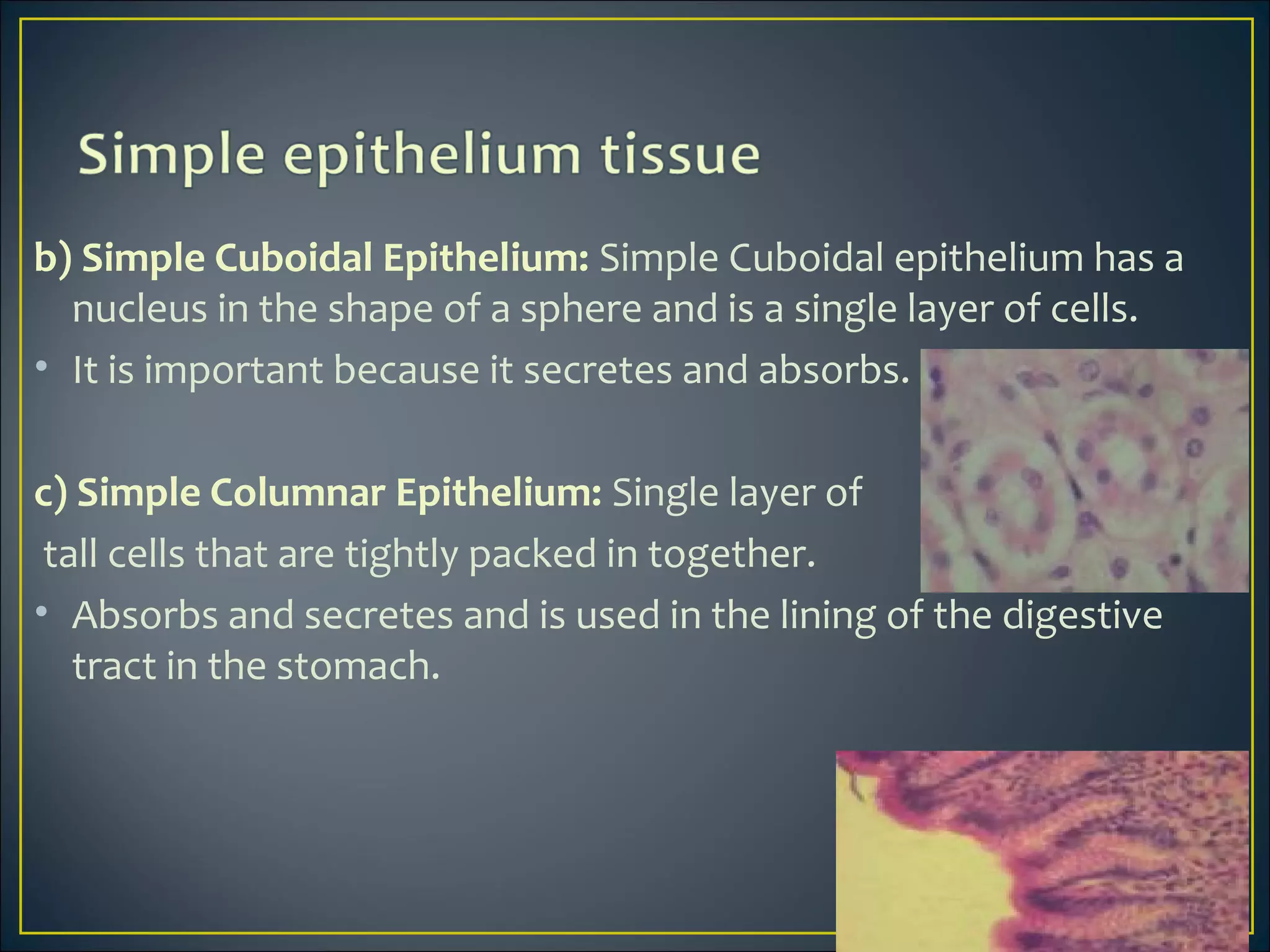
b) Simple Cuboidal Epithelium: Simple Cuboidal epithelium has a
nucleus in the shape of a sphere and is a single layer of cells.
• It is important because it secretes and absorbs.
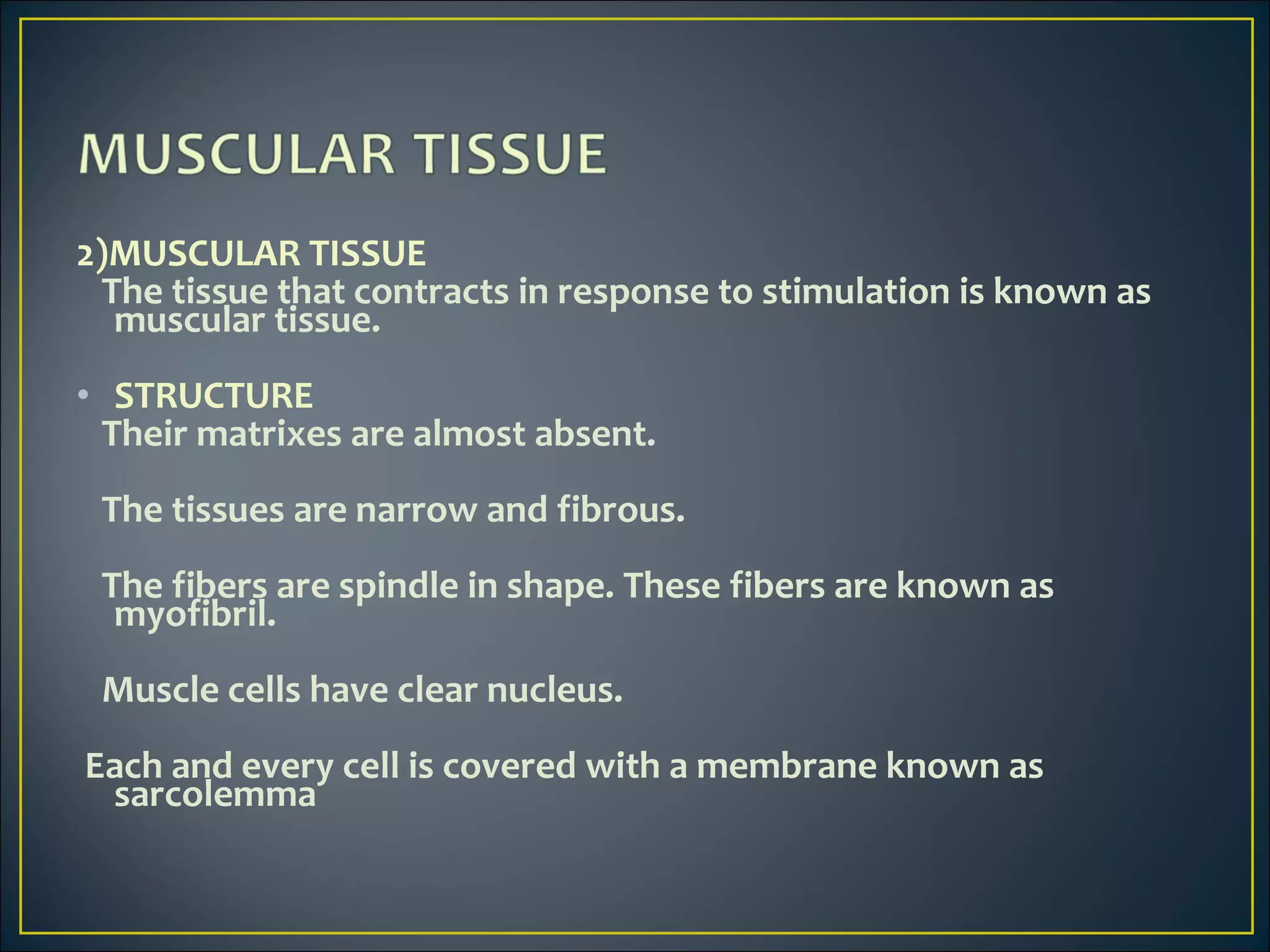
c) Simple Columnar Epithelium: Single layer of
tall cells that are tightly packed in together.
• Absorbs and secretes and is used in the lining of the digestive
tract in the stomach.
2) Stratified epithelium: It consists of multiple layers of cells.
Example: Skin of the vertebrates.
a) Stratified squamous epithelium
b) Stratified cuboidal epithelium
c) Stratified Columnar epithelium
d) Transitional epithelium
a) Stratified squamous epithelium
• in which, more than one layer of flat,
polygonal cells are found arranged on
a basement membrane.
b) Stratified cuboidal epithelium
• In which, more than one layer of
cuboidal cells are found arranged on a
basement membrane.
• It occurs in some parts of the
reproductive system.
c) Stratified Columnar epithelium
• In this type, the epithelium has several layers
of polyhedral cells with columnar cells found
only in the superficial layer.
• It occurs in the large ducts of some glands
and in the male urethra.
d) Transitional epithelium: is a type of tissue
consisting of multiple layers of epithelial cells
which can contract and expand.
• These cells, part of the epithelium, are
usually found in the urinary tract, especially
around the urinary bladder.
2)MUSCULAR TISSUE
The tissue that contracts in response to stimulation is known as
muscular tissue.
• STRUCTURE
Their matrixes are almost absent.
The tissues are narrow and fibrous.
The fibers are spindle in shape. These fibers are known as
myofibril.
Muscle cells have clear nucleus.
Each and every cell is covered with a membrane known as
sarcolemma
• TYPE
There are three types of muscle tissue—
• Smooth/involuntary/visceral muscle.
• Skeletal muscle/striated muscle/voluntary muscle
• Cardiac muscle.
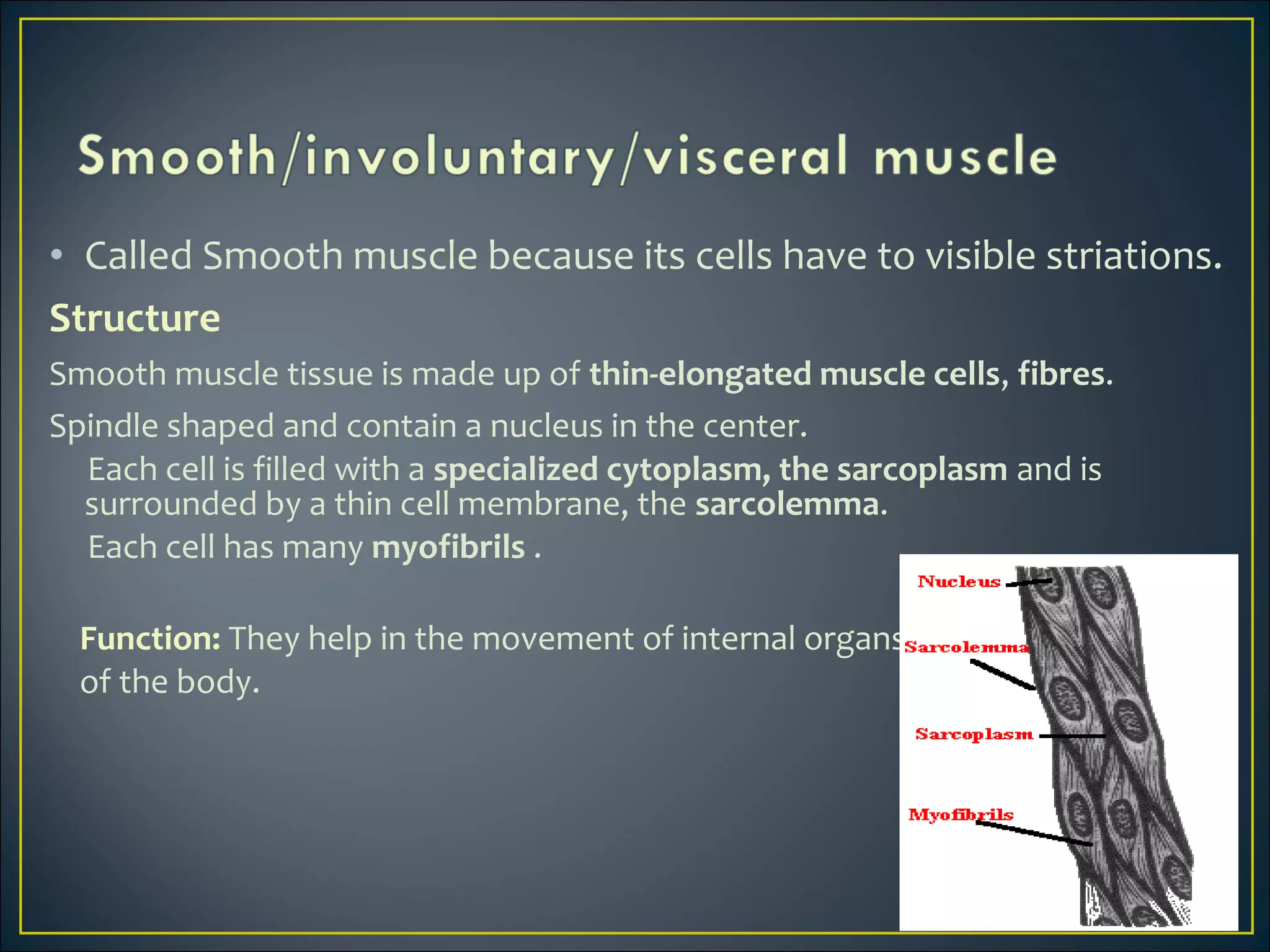
• Called Smooth muscle because its cells have to visible striations.
Structure
Smooth muscle tissue is made up of thin-elongated muscle cells, fibres.
Spindle shaped and contain a nucleus in the center.
Each cell is filled with a specialized cytoplasm, the sarcoplasm and is
surrounded by a thin cell membrane, the sarcolemma.
Each cell has many myofibrils .
Function: They help in the movement of internal organs
of the body.
• Attached by the bones of the skeleton.
• The cells are long, unbranched, extending the length of the
muscle. They are multinucleate.
Function: They maintain locomotion and movement of various
organs.
CARDIAC MUSCLE
• Only found on the wall of the heart.
• When cardiac muscle contracts, it helps flow blood to
the heart.
• Cardiac cell muscles are striated.
Function:
They never get fatigued and thus maintain the
circulation of blood throughout the body
• The tissues that comprise the nervous system of the body
are known as nervous tissue.
• Fast acting control system
• It triggers muscle contraction as well as gland secretion.
• Structure:
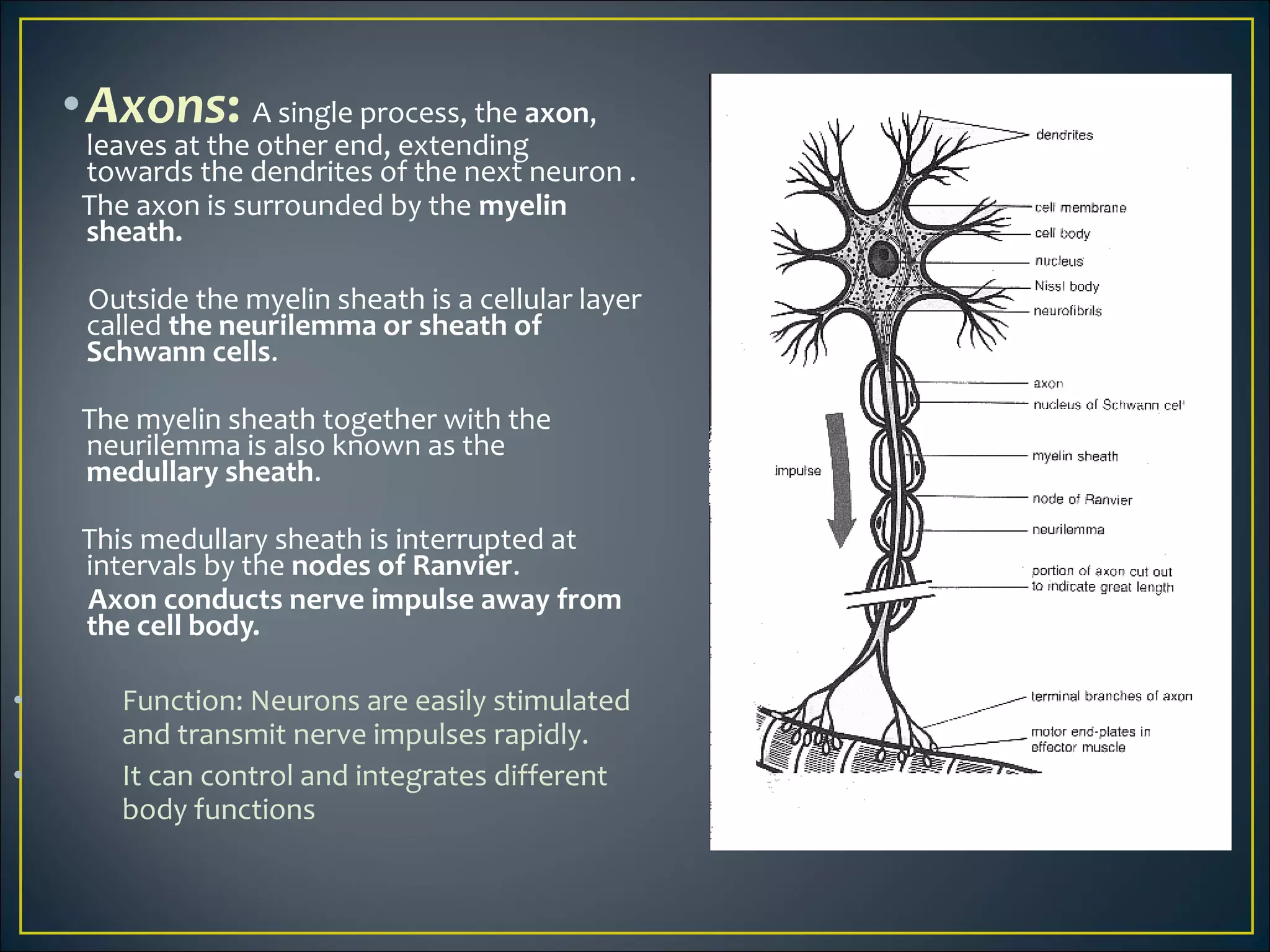
A complete nerve cell is known as neuron.
Neurons consist of three major regions:
• Dendrite: A motor neuron has many processes
(cytoplasmic extensions), called dendtrites, which
enter a large, grey cell body at one end Dendrite
conducts nerve impulse towards the cell body.
• Cell body: The cell body is enclosed by a cell
(plasma) membrane and has a central nucleus. It
contains all the cellularorganelles except
centrioles.
•Axons: A single process, the axon,
leaves at the other end, extending
towards the dendrites of the next neuron .
The axon is surrounded by the myelin
sheath.
Outside the myelin sheath is a cellular layer
called the neurilemma or sheath of
Schwann cells.
The myelin sheath together with the
neurilemma is also known as the
medullary sheath.
This medullary sheath is interrupted at
intervals by the nodes of Ranvier.
Axon conducts nerve impulse away from
the cell body.
• Function: Neurons are easily stimulated
and transmit nerve impulses rapidly.
• It can control and integrates different
body functions
• This type of tissue is very common in the body.
• There are many different forms of connective tissue and it
does way more than just connect body parts.
Structure: Connective tissue contains three kinds of fiber.
• Collagen fiber
• Elastic fiber
• Reticular fiber
i) Loose connective tissue:
• Loose connective tissue are separated by a non-living,
jelly-like matrix & contains collagen fibers for flexibility
and strength.
ii) Dense connective tissue:
• Dense collective tissue are more closely packed than
those of loose connective tissue.
• iii) Skeletal connective tissue: The connective tissue that makes the
internal structure of the body is known as skeletal connective tissue.
• Function:
• It gives the structure of the body
• It protects the internal organs of the body
• Types: These are two types. They are -
i) Cartilage
ii) Bones
• Cartilage: It is a type of connective tissue which is tough, but elastic
and flexible
Functions:
• Reduces friction at joints
• Support
• Growth
• Bone: Bone is one kind of skeletal connective tissue that is rigid
and breakable.
• STRUCTURE OF BONE :In a human body, a living bone is made
up of three layers:
1) The periosteum,
2)The hard compact bone, and
3)The bone marrow.
FUNCTION OF BONE
• allowing the animal to move to more favorable external
conditions.
• Bone also helps regulate blood calcium levels.
• iv) Fluid connective tissue : Fluid connective tissue is liquid in
nature. It contains various organic substances.
Type of Fluid connective tissue
Fluid connective tissues are of two types-
• Blood
• Lymph
Thanks
For
Being with us

Tissue

  • 1.
  • 3.
    • Tissue aregroups of cells similar in structure and function. For example: Blood, bone, muscle etc.
  • 4.
    There are fourtypes of tissue. • Epithelial tissue • Muscular tissue • Nerve tissue • Connective tissue
  • 5.
    Epithelial tissue is composedalmost entirely of cells. It is supported by connective tissue , reticular, and basal lamina.
  • 6.
    Characteristics: • Usually abasement membrane is present upon which the cells are arranged. • Cells remain close together means they have minimum intercellular space. • No blood vessel is present
  • 7.
    1) Simple epithelium:It consists of a single layer of cells. Example: Bowman’s capsule of the kidney. Simple epithelium can be subdivided according to the shape and function of its cells. a) Simple Squamous (pavement) epithelium b) Simple Cuboidal Epithelium c) Simple Columnar Epithelium a) Simple Squamous epithelium: In Simple Squamous the cells appear to be flattened. • Also found where filtration occurs, for example in the kidneys or lungs. • Function : Diffusion
  • 8.
    b) Simple CuboidalEpithelium: Simple Cuboidal epithelium has a nucleus in the shape of a sphere and is a single layer of cells. • It is important because it secretes and absorbs. c) Simple Columnar Epithelium: Single layer of tall cells that are tightly packed in together. • Absorbs and secretes and is used in the lining of the digestive tract in the stomach.
  • 9.
    2) Stratified epithelium:It consists of multiple layers of cells. Example: Skin of the vertebrates. a) Stratified squamous epithelium b) Stratified cuboidal epithelium c) Stratified Columnar epithelium d) Transitional epithelium
  • 10.
    a) Stratified squamousepithelium • in which, more than one layer of flat, polygonal cells are found arranged on a basement membrane. b) Stratified cuboidal epithelium • In which, more than one layer of cuboidal cells are found arranged on a basement membrane. • It occurs in some parts of the reproductive system.
  • 11.
    c) Stratified Columnarepithelium • In this type, the epithelium has several layers of polyhedral cells with columnar cells found only in the superficial layer. • It occurs in the large ducts of some glands and in the male urethra. d) Transitional epithelium: is a type of tissue consisting of multiple layers of epithelial cells which can contract and expand. • These cells, part of the epithelium, are usually found in the urinary tract, especially around the urinary bladder.
  • 12.
    2)MUSCULAR TISSUE The tissuethat contracts in response to stimulation is known as muscular tissue. • STRUCTURE Their matrixes are almost absent. The tissues are narrow and fibrous. The fibers are spindle in shape. These fibers are known as myofibril. Muscle cells have clear nucleus. Each and every cell is covered with a membrane known as sarcolemma
  • 13.
    • TYPE There arethree types of muscle tissue— • Smooth/involuntary/visceral muscle. • Skeletal muscle/striated muscle/voluntary muscle • Cardiac muscle.
  • 14.
    • Called Smoothmuscle because its cells have to visible striations. Structure Smooth muscle tissue is made up of thin-elongated muscle cells, fibres. Spindle shaped and contain a nucleus in the center. Each cell is filled with a specialized cytoplasm, the sarcoplasm and is surrounded by a thin cell membrane, the sarcolemma. Each cell has many myofibrils . Function: They help in the movement of internal organs of the body.
  • 15.
    • Attached bythe bones of the skeleton. • The cells are long, unbranched, extending the length of the muscle. They are multinucleate. Function: They maintain locomotion and movement of various organs.
  • 16.
    CARDIAC MUSCLE • Onlyfound on the wall of the heart. • When cardiac muscle contracts, it helps flow blood to the heart. • Cardiac cell muscles are striated. Function: They never get fatigued and thus maintain the circulation of blood throughout the body
  • 17.
    • The tissuesthat comprise the nervous system of the body are known as nervous tissue. • Fast acting control system • It triggers muscle contraction as well as gland secretion.
  • 18.
    • Structure: A completenerve cell is known as neuron. Neurons consist of three major regions: • Dendrite: A motor neuron has many processes (cytoplasmic extensions), called dendtrites, which enter a large, grey cell body at one end Dendrite conducts nerve impulse towards the cell body. • Cell body: The cell body is enclosed by a cell (plasma) membrane and has a central nucleus. It contains all the cellularorganelles except centrioles.
  • 19.
    •Axons: A singleprocess, the axon, leaves at the other end, extending towards the dendrites of the next neuron . The axon is surrounded by the myelin sheath. Outside the myelin sheath is a cellular layer called the neurilemma or sheath of Schwann cells. The myelin sheath together with the neurilemma is also known as the medullary sheath. This medullary sheath is interrupted at intervals by the nodes of Ranvier. Axon conducts nerve impulse away from the cell body. • Function: Neurons are easily stimulated and transmit nerve impulses rapidly. • It can control and integrates different body functions
  • 20.
    • This typeof tissue is very common in the body. • There are many different forms of connective tissue and it does way more than just connect body parts. Structure: Connective tissue contains three kinds of fiber. • Collagen fiber • Elastic fiber • Reticular fiber
  • 21.
    i) Loose connectivetissue: • Loose connective tissue are separated by a non-living, jelly-like matrix & contains collagen fibers for flexibility and strength. ii) Dense connective tissue: • Dense collective tissue are more closely packed than those of loose connective tissue.
  • 22.
    • iii) Skeletalconnective tissue: The connective tissue that makes the internal structure of the body is known as skeletal connective tissue. • Function: • It gives the structure of the body • It protects the internal organs of the body • Types: These are two types. They are - i) Cartilage ii) Bones • Cartilage: It is a type of connective tissue which is tough, but elastic and flexible Functions: • Reduces friction at joints • Support • Growth
  • 23.
    • Bone: Boneis one kind of skeletal connective tissue that is rigid and breakable. • STRUCTURE OF BONE :In a human body, a living bone is made up of three layers: 1) The periosteum, 2)The hard compact bone, and 3)The bone marrow.
  • 24.
    FUNCTION OF BONE •allowing the animal to move to more favorable external conditions. • Bone also helps regulate blood calcium levels. • iv) Fluid connective tissue : Fluid connective tissue is liquid in nature. It contains various organic substances. Type of Fluid connective tissue Fluid connective tissues are of two types- • Blood • Lymph
  • 25.