p. 1/11
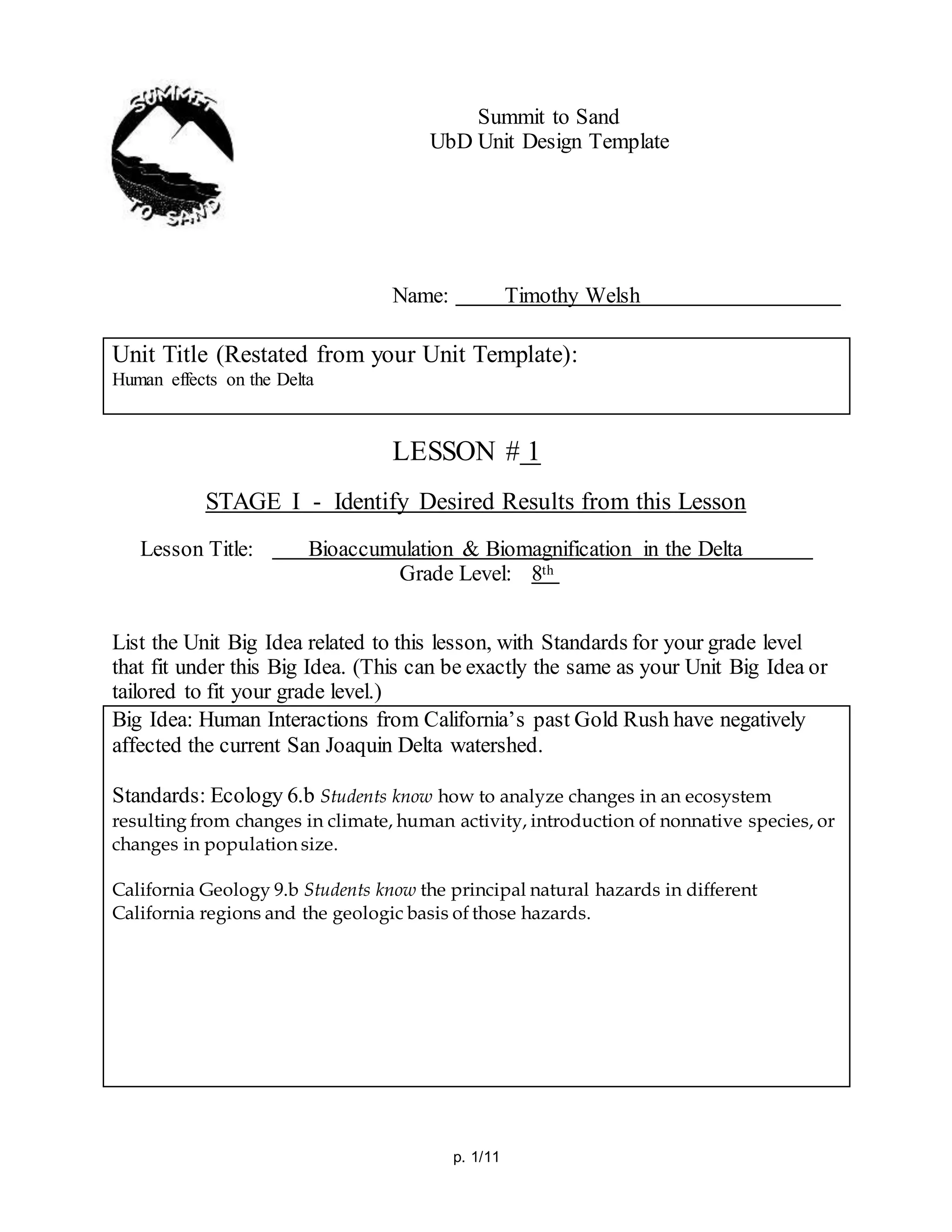
Summit to Sand
UbD Unit Design Template
Name: Timothy Welsh
Unit Title (Restated from your Unit Template):
Human effects on the Delta
LESSON # 1
STAGE I - Identify Desired Results from this Lesson
Lesson Title: Bioaccumulation & Biomagnification in the Delta
Grade Level: 8th
List the Unit Big Idea related to this lesson, with Standards for your grade level
that fit under this Big Idea. (This can be exactly the same as your Unit Big Idea or
tailored to fit your grade level.)
Big Idea: Human Interactions from California’s past Gold Rush have negatively
affected the current San Joaquin Delta watershed.
Standards: Ecology 6.b Students know how to analyze changes in an ecosystem
resulting from changes in climate, human activity, introduction of nonnative species, or
changes in population size.
California Geology 9.b Students know the principal natural hazards in different
California regions and the geologic basis of those hazards.
p. 2/11
p. 3/11
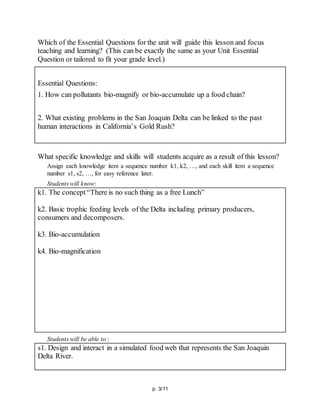
Which of the Essential Questions for the unit will guide this lesson and focus
teaching and learning? (This can be exactly the same as your Unit Essential
Question or tailored to fit your grade level.)
Essential Questions:
1. How can pollutants bio-magnify or bio-accumulate up a food chain?
2. What existing problems in the San Joaquin Delta can be linked to the past
human interactions in California’s Gold Rush?
What specific knowledge and skills will students acquire as a result of this lesson?
Assign each knowledge item a sequence number k1, k2, …, and each skill item a sequence
number s1, s2, …, for easy reference later.
Students will know:
k1. The concept“There is no such thing as a free Lunch”
k2. Basic trophic feeding levels of the Delta including primary producers,
consumers and decomposers.
k3. Bio-accumulation
k4. Bio-magnification
Students will be able to :
s1. Design and interact in a simulated food web that represents the San Joaquin
Delta River.
p. 4/11
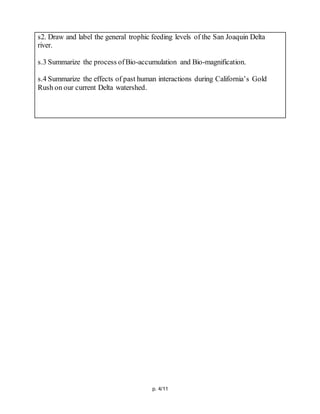
s2. Draw and label the general trophic feeding levels of the San Joaquin Delta
river.
s.3 Summarize the process ofBio-accumulation and Bio-magnification.
s.4 Summarize the effects of past human interactions during California’s Gold
Rush on our current Delta watershed.
p. 5/11
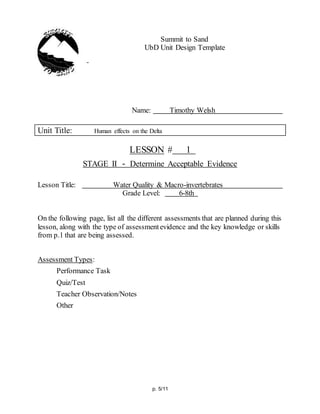
Summit to Sand
UbD Unit Design Template
Name: Timothy Welsh
Unit Title: Human effects on the Delta
LESSON # 1
STAGE II - Determine Acceptable Evidence
Lesson Title: Water Quality & Macro-invertebrates
Grade Level: 6-8th
On the following page, list all the different assessments that are planned during this
lesson, along with the type of assessmentevidence and the key knowledge or skills
from p.1 that are being assessed.
Assessment Types:
Performance Task
Quiz/Test
Teacher Observation/Notes
Other
p. 6/11
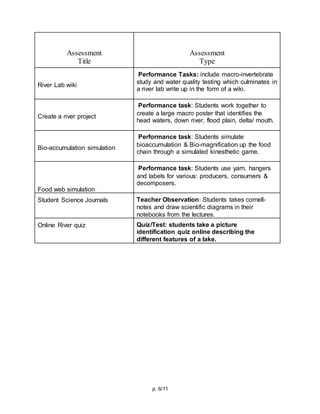
Assessment
Title
Assessment
Type
River Lab wiki
Performance Tasks: include macro-invertebrate
study and water quality testing which culminates in
a river lab write up in the form of a wiki.
Create a river project
Performance task: Students work together to
create a large macro poster that identifies the
head waters, down river, flood plain, delta/ mouth.
Bio-accumulation simulation
Performance task: Students simulate
bioaccumulation & Bio-magnification up the food
chain through a simulated kinesthetic game.
Food web simulation
Performance task: Students use yarn, hangers
and labels for various: producers, consumers &
decomposers.
Student Science Journals Teacher Observation: Students takes cornell-
notes and draw scientific diagrams in their
notebooks from the lectures.
Online River quiz Quiz/Test: students take a picture
identification quiz online describing the
different features of a lake.
p. 7/11
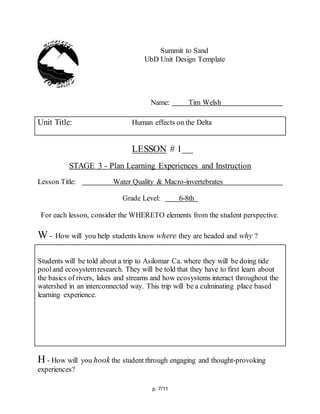
Summit to Sand
UbD Unit Design Template
Name: Tim Welsh
Unit Title: Human effects on the Delta
LESSON # 1
STAGE 3 - Plan Learning Experiences and Instruction
Lesson Title: Water Quality & Macro-invertebrates
Grade Level: 6-8th
For each lesson, consider the WHERETO elements from the student perspective.
W - How will you help students know where they are headed and why ?
Students will be told about a trip to Asilomar Ca. where they will be doing tide
pooland ecosystemresearch. They will be told that they have to first learn about
the basics of rivers, lakes and streams and how ecosystems interact throughout the
watershed in an interconnected way. This trip will be a culminating place based
learning experience.
H - How will you hook the student through engaging and thought-provoking
experiences?
p. 8/11
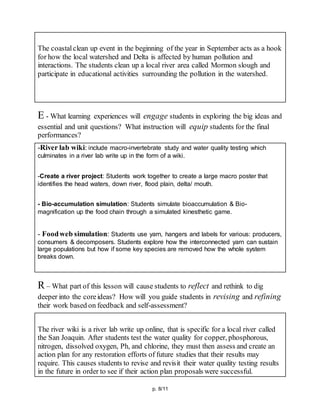
The coastalclean up event in the beginning of the year in September acts as a hook
for how the local watershed and Delta is affected by human pollution and
interactions. The students clean up a local river area called Mormon slough and
participate in educational activities surrounding the pollution in the watershed.
E - What learning experiences will engage students in exploring the big ideas and
essential and unit questions? What instruction will equip students for the final
performances?
-River lab wiki: include macro-invertebrate study and water quality testing which
culminates in a river lab write up in the form of a wiki.
-Create a river project: Students work together to create a large macro poster that
identifies the head waters, down river, flood plain, delta/ mouth.
- Bio-accumulation simulation: Students simulate bioaccumulation & Bio-
magnification up the food chain through a simulated kinesthetic game.
- Foodweb simulation: Students use yarn, hangers and labels for various: producers,
consumers & decomposers. Students explore how the interconnected yarn can sustain
large populations but how if some key species are removed how the whole system
breaks down.
R– What part of this lesson will cause students to reflect and rethink to dig
deeper into the coreideas? How will you guide students in revising and refining
their work based on feedback and self-assessment?
The river wiki is a river lab write up online, that is specific for a local river called
the San Joaquin. After students test the water quality for copper, phosphorous,
nitrogen, dissolved oxygen, Ph, and chlorine, they must then assess and create an
action plan for any restoration efforts of future studies that their results may
require. This causes students to revise and revisit their water quality testing results
in the future in order to see if their action plan proposals were successful.
p. 9/11
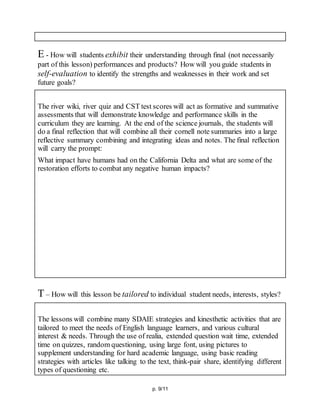
E - How will students exhibit their understanding through final (not necessarily
part of this lesson) performances and products? How will you guide students in
self-evaluation to identify the strengths and weaknesses in their work and set
future goals?
The river wiki, river quiz and CST test scores will act as formative and summative
assessments that will demonstrate knowledge and performance skills in the
curriculum they are learning. At the end of the science journals, the students will
do a final reflection that will combine all their cornell note summaries into a large
reflective summary combining and integrating ideas and notes. The final reflection
will carry the prompt:
What impact have humans had on the California Delta and what are some of the
restoration efforts to combat any negative human impacts?
T – How will this lesson be tailored to individual student needs, interests, styles?
The lessons will combine many SDAIE strategies and kinesthetic activities that are
tailored to meet the needs of English language learners, and various cultural
interest & needs. Through the use of realia, extended question wait time, extended
time on quizzes, random questioning, using large font, using pictures to
supplement understanding for hard academic language, using basic reading
strategies with articles like talking to the text, think-pair share, identifying different
types of questioning etc.
p. 10/11
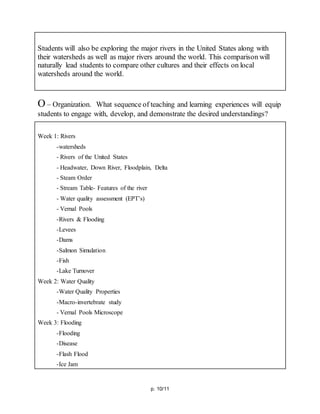
Students will also be exploring the major rivers in the United States along with
their watersheds as well as major rivers around the world. This comparison will
naturally lead students to compare other cultures and their effects on local
watersheds around the world.
O – Organization. What sequence of teaching and learning experiences will equip
students to engage with, develop, and demonstrate the desired understandings?
Week 1: Rivers
-watersheds
- Rivers of the United States
- Headwater, Down River, Floodplain, Delta
- Steam Order
- Stream Table- Features of the river
- Water quality assessment (EPT’s)
- Vernal Pools
-Rivers & Flooding
-Levees
-Dams
-Salmon Simulation
-Fish
-Lake Turnover
Week 2: Water Quality
-Water Quality Properties
-Macro-invertebrate study
- Vernal Pools Microscope
Week 3: Flooding
-Flooding
-Disease
-Flash Flood
-Ice Jam
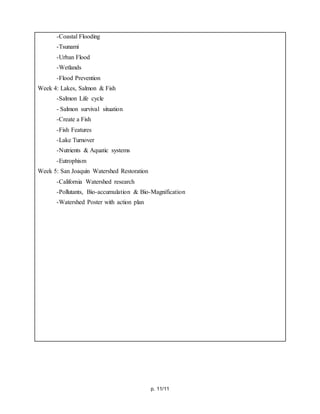
p. 11/11
-Coastal Flooding
-Tsunami
-Urban Flood
-Wetlands
-Flood Prevention
Week 4: Lakes, Salmon & Fish
-Salmon Life cycle
- Salmon survival situation
-Create a Fish
-Fish Features
-Lake Turnover
-Nutrients & Aquatic systems
-Eutrophism
Week 5: San Joaquin Watershed Restoration
-California Watershed research
-Pollutants, Bio-accumulation & Bio-Magnification
-Watershed Poster with action plan

Timothy welsh unit

  • 1.
    p. 1/11 Summit toSand UbD Unit Design Template Name: Timothy Welsh Unit Title (Restated from your Unit Template): Human effects on the Delta LESSON # 1 STAGE I - Identify Desired Results from this Lesson Lesson Title: Bioaccumulation & Biomagnification in the Delta Grade Level: 8th List the Unit Big Idea related to this lesson, with Standards for your grade level that fit under this Big Idea. (This can be exactly the same as your Unit Big Idea or tailored to fit your grade level.) Big Idea: Human Interactions from California’s past Gold Rush have negatively affected the current San Joaquin Delta watershed. Standards: Ecology 6.b Students know how to analyze changes in an ecosystem resulting from changes in climate, human activity, introduction of nonnative species, or changes in population size. California Geology 9.b Students know the principal natural hazards in different California regions and the geologic basis of those hazards.
  • 2.
  • 3.
    p. 3/11 Which ofthe Essential Questions for the unit will guide this lesson and focus teaching and learning? (This can be exactly the same as your Unit Essential Question or tailored to fit your grade level.) Essential Questions: 1. How can pollutants bio-magnify or bio-accumulate up a food chain? 2. What existing problems in the San Joaquin Delta can be linked to the past human interactions in California’s Gold Rush? What specific knowledge and skills will students acquire as a result of this lesson? Assign each knowledge item a sequence number k1, k2, …, and each skill item a sequence number s1, s2, …, for easy reference later. Students will know: k1. The concept“There is no such thing as a free Lunch” k2. Basic trophic feeding levels of the Delta including primary producers, consumers and decomposers. k3. Bio-accumulation k4. Bio-magnification Students will be able to : s1. Design and interact in a simulated food web that represents the San Joaquin Delta River.
  • 4.
    p. 4/11 s2. Drawand label the general trophic feeding levels of the San Joaquin Delta river. s.3 Summarize the process ofBio-accumulation and Bio-magnification. s.4 Summarize the effects of past human interactions during California’s Gold Rush on our current Delta watershed.
  • 5.
    p. 5/11 Summit toSand UbD Unit Design Template Name: Timothy Welsh Unit Title: Human effects on the Delta LESSON # 1 STAGE II - Determine Acceptable Evidence Lesson Title: Water Quality & Macro-invertebrates Grade Level: 6-8th On the following page, list all the different assessments that are planned during this lesson, along with the type of assessmentevidence and the key knowledge or skills from p.1 that are being assessed. Assessment Types: Performance Task Quiz/Test Teacher Observation/Notes Other
  • 6.
    p. 6/11 Assessment Title Assessment Type River Labwiki Performance Tasks: include macro-invertebrate study and water quality testing which culminates in a river lab write up in the form of a wiki. Create a river project Performance task: Students work together to create a large macro poster that identifies the head waters, down river, flood plain, delta/ mouth. Bio-accumulation simulation Performance task: Students simulate bioaccumulation & Bio-magnification up the food chain through a simulated kinesthetic game. Food web simulation Performance task: Students use yarn, hangers and labels for various: producers, consumers & decomposers. Student Science Journals Teacher Observation: Students takes cornell- notes and draw scientific diagrams in their notebooks from the lectures. Online River quiz Quiz/Test: students take a picture identification quiz online describing the different features of a lake.
  • 7.
    p. 7/11 Summit toSand UbD Unit Design Template Name: Tim Welsh Unit Title: Human effects on the Delta LESSON # 1 STAGE 3 - Plan Learning Experiences and Instruction Lesson Title: Water Quality & Macro-invertebrates Grade Level: 6-8th For each lesson, consider the WHERETO elements from the student perspective. W - How will you help students know where they are headed and why ? Students will be told about a trip to Asilomar Ca. where they will be doing tide pooland ecosystemresearch. They will be told that they have to first learn about the basics of rivers, lakes and streams and how ecosystems interact throughout the watershed in an interconnected way. This trip will be a culminating place based learning experience. H - How will you hook the student through engaging and thought-provoking experiences?
  • 8.
    p. 8/11 The coastalcleanup event in the beginning of the year in September acts as a hook for how the local watershed and Delta is affected by human pollution and interactions. The students clean up a local river area called Mormon slough and participate in educational activities surrounding the pollution in the watershed. E - What learning experiences will engage students in exploring the big ideas and essential and unit questions? What instruction will equip students for the final performances? -River lab wiki: include macro-invertebrate study and water quality testing which culminates in a river lab write up in the form of a wiki. -Create a river project: Students work together to create a large macro poster that identifies the head waters, down river, flood plain, delta/ mouth. - Bio-accumulation simulation: Students simulate bioaccumulation & Bio- magnification up the food chain through a simulated kinesthetic game. - Foodweb simulation: Students use yarn, hangers and labels for various: producers, consumers & decomposers. Students explore how the interconnected yarn can sustain large populations but how if some key species are removed how the whole system breaks down. R– What part of this lesson will cause students to reflect and rethink to dig deeper into the coreideas? How will you guide students in revising and refining their work based on feedback and self-assessment? The river wiki is a river lab write up online, that is specific for a local river called the San Joaquin. After students test the water quality for copper, phosphorous, nitrogen, dissolved oxygen, Ph, and chlorine, they must then assess and create an action plan for any restoration efforts of future studies that their results may require. This causes students to revise and revisit their water quality testing results in the future in order to see if their action plan proposals were successful.
  • 9.
    p. 9/11 E -How will students exhibit their understanding through final (not necessarily part of this lesson) performances and products? How will you guide students in self-evaluation to identify the strengths and weaknesses in their work and set future goals? The river wiki, river quiz and CST test scores will act as formative and summative assessments that will demonstrate knowledge and performance skills in the curriculum they are learning. At the end of the science journals, the students will do a final reflection that will combine all their cornell note summaries into a large reflective summary combining and integrating ideas and notes. The final reflection will carry the prompt: What impact have humans had on the California Delta and what are some of the restoration efforts to combat any negative human impacts? T – How will this lesson be tailored to individual student needs, interests, styles? The lessons will combine many SDAIE strategies and kinesthetic activities that are tailored to meet the needs of English language learners, and various cultural interest & needs. Through the use of realia, extended question wait time, extended time on quizzes, random questioning, using large font, using pictures to supplement understanding for hard academic language, using basic reading strategies with articles like talking to the text, think-pair share, identifying different types of questioning etc.
  • 10.
    p. 10/11 Students willalso be exploring the major rivers in the United States along with their watersheds as well as major rivers around the world. This comparison will naturally lead students to compare other cultures and their effects on local watersheds around the world. O – Organization. What sequence of teaching and learning experiences will equip students to engage with, develop, and demonstrate the desired understandings? Week 1: Rivers -watersheds - Rivers of the United States - Headwater, Down River, Floodplain, Delta - Steam Order - Stream Table- Features of the river - Water quality assessment (EPT’s) - Vernal Pools -Rivers & Flooding -Levees -Dams -Salmon Simulation -Fish -Lake Turnover Week 2: Water Quality -Water Quality Properties -Macro-invertebrate study - Vernal Pools Microscope Week 3: Flooding -Flooding -Disease -Flash Flood -Ice Jam
  • 11.
    p. 11/11 -Coastal Flooding -Tsunami -UrbanFlood -Wetlands -Flood Prevention Week 4: Lakes, Salmon & Fish -Salmon Life cycle - Salmon survival situation -Create a Fish -Fish Features -Lake Turnover -Nutrients & Aquatic systems -Eutrophism Week 5: San Joaquin Watershed Restoration -California Watershed research -Pollutants, Bio-accumulation & Bio-Magnification -Watershed Poster with action plan