476 Old Mill Road    -    Fairfield, CT 06824    -    203.259.1847www.river-lab.org
What is River-Lab? WHAT IS RIVER-LAB? River-Lab is a science-based environmental studies curriculum which teaches all Fairfield public and parochial school students Grades 3-6 about the river basin structure of the Earth. The River-Lab program makes up one-third of the Fairfield school system's science curriculum and meets CMT requirements. Classroom teaching is reinforced by study-trips to the Mill River and town estuaries for over 3,500 students each year. These study-trips are organized and run by the Mill River Wetland Study Group.  This arm of the non-profit Mill River Wetland Committee (MRWC) has supplied environmental science curriculum to Fairfield school students since 1969. Each study-trip is led by trained volunteer guides.  River-Lab trains over 150 guides annually. MRWC encourages community commitment to protect rivers and the environment.
River-Lab Grade 4A Basin in Balance
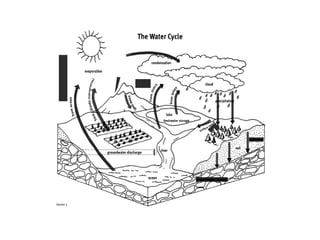
RIVER LAB GRADE 4 COURSE CONCEPT 								A Basin in Balance 	The 4th grade unit, A Basin in Balance, focuses on the role of the underground water system and its role in the river basin system.  The unit builds on the River-Lab course from Grade 3, in which students studied the parts and functions of a river basin system, and how it creates habitats which support organisms.  The students learn that all land on earth is part of a river basin system.	Power point slides, a student reference book, and inquiry-based lessons are used in the classroom to teach the role of the water cycle in river basin dynamics, the formation of rivers and the underground water system, and the role of water in changing the land.  Students develop an understanding that the underground water system is essential in sustaining the web of life in a river basin.   Students will be engaged in discussions of our management of the environment in a river basin system, and how human's impact along with natural phenomena effect life in a river basin system. 	On the study-trip students develop a model of the underground water system to investigate how it works and how it is connected to the surface water system.  Guides lead students to examine habitat factors that either help or hinder water as it is absorbed into the underground system.  Students develop their science skills as they observe and record information along the trail points.
What is Guide Training?Preparation for field study-trips to support and reinforce the classroom unitStudy-trips are led by trained volunteer guides (that’s you!)Training = 1 indoor training, 1 outdoor training,  and 1 follow-trip (recommended)Guides are scheduled for their child’s study-trip; you may schedule other trips at your convenience
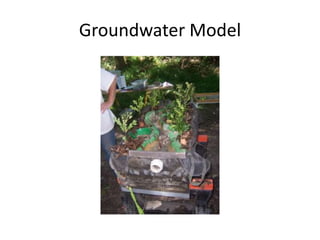
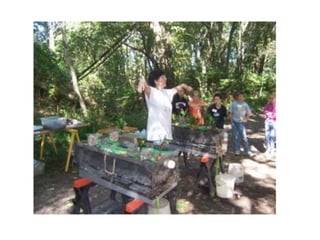
What to expect at a Study-tripTrips are 90 minutes; guides meet at Open Space 15 min. early to help set up Kids arrive by bus: already assigned to groups by teacher; greeted by “model-leader”Study-trip is in 2 parts: 	1.  Whole Group Activity: Groundwater  Model 		(led by experienced guide - not you!)	2.   Small Groups  go to 6 Trail Points  (you’re on!)
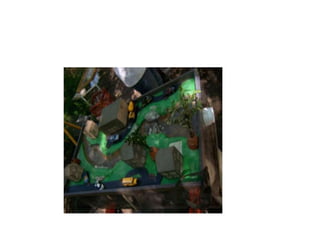
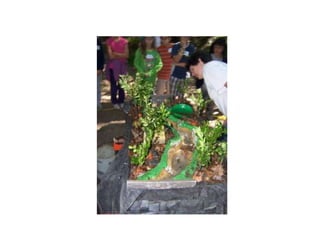
Groundwater Model
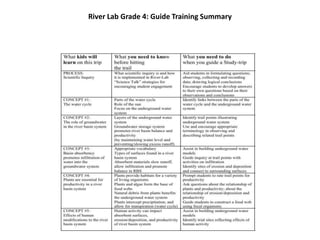
River Lab Grade 4: Guide Training Summary
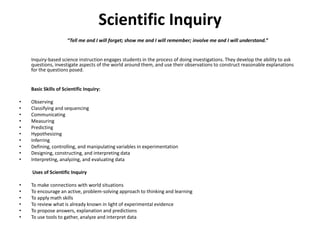
Scientific Inquiry		“Tell me and I will forget; show me and I will remember; involve me and I will understand.”	Inquiry-based science instruction engages students in the process of doing investigations. They develop the ability to ask questions, investigate aspects of the world around them, and use their observations to construct reasonable explanations for the questions posed.	Basic Skills of Scientific Inquiry:ObservingClassifying and sequencingCommunicatingMeasuringPredictingHypothesizingInferringDefining, controlling, and manipulating variables in experimentationDesigning, constructing, and interpreting dataInterpreting, analyzing, and evaluating data	 Uses of Scientific InquiryTo make connections with world situationsTo encourage an active, problem-solving approach to thinking and learning To apply math skillsTo review what is already known in light of experimental evidenceTo propose answers, explanation and predictionsTo use tools to gather, analyze and interpret data 
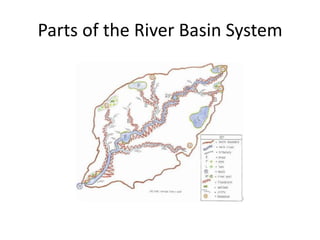
Parts of the River Basin System
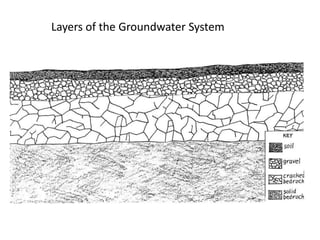
		Layers of the Groundwater System
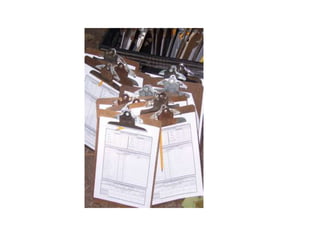
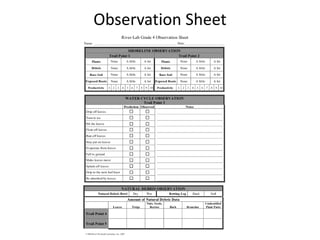
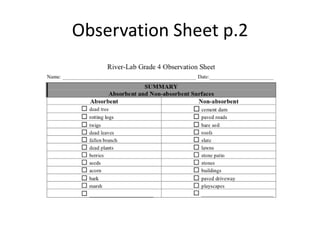
Observation Sheet
Concept # 3 AbsorbencyAbsorbent areasPonds, lakes, feeder streams and brooks, wetlands, woodlands, ground cover all store waterPlants INTERCEPT rain or snow; slow floodwatersDetritus/debris slows runoff and soaks up water Absorbent surfaces hold water above ground AND promote underground water storage.Absorbent features SLOW or STOP RUNOFF and allow water to INFILTRATE the topsoil and into the Groundwater System.   Promote balance between RBS and GWS!
Observation Sheet p.2
HABITAT              BASE OF FOOD CHAIN           ROLE IN WATER CYCLE 													(transpiration) 	All animals are directly or indirectly dependent on plants for food energy. Many food chains start at shoreline habitats (along water's edge), with algae and plants Animals move around, so these food chains expand beyond the shorelineAlgae and plants are "producers" b/c they make their own food using sun's energyAnimals are "consumers" -they cannot produce their own food and must consume other organisms for energyPlants help water infiltrate the GWS by “intercepting”Debris from dead plants is an important absorbent material in the RBS, to replenish GWS     BUT...changes can and do happen… geological events occur  (continental collision, glaciation, volcanic eruptions)flooding and forest fires occurthese events may remove canopy, layers of forest floorthese events are part of the Earth's natural renewal of the landscapeOur current moment in the Earth's maturity has many benefits:  soil has been produced, the river basins have been shaped by water forces, the UWS has been developed, and organisms are supported by their habitats.  All of these features promote balance and productivity in the RBS.Concept #4:  The role of plants
CONCEPT #5:  Human Impact 	The RBS has evolved into a self-maintaining, living, balanced system. All living things depend on this balanced environment.  However, humans are continually making changes that affect this balance.   Resurfacing = lower absorbency/increased run-off = GWS/RBS imbalanceWhen absorbent areas of a basin are covered over and replaced with non-absorbent materials, we lose the natural leafy growth and rotting debris which slows runoff and allows time for infiltration.   Run off remains on the surface causing excessive erosion, siltation, and flooding.  Water that does not infiltrate will not be available to replenish surface bodies.  The GWS then has reduced capacity to replenish lakes, ponds, streams during times of low precip. Ways humans have resurfaced land:Deforestation (trees and shrubs removed).  Result: Lack of canopy to intercept precip, lack of spongy woodland floor that would allow infiltration into GWS.Paved areas (patios, sidewalks, roads, parking lots, etc).  These areas no longer have layer of natural debris to absorb water.  Water runs off theses hard surfaces very quickly, no time for infiltration.Cultivated lawns also create fast runoff and discourage absorption.  Water runs off blades of grass very quickly.  Lawn as "green pavement".Storm Water Management (roofs, gutters, downspouts and drainage pipes) These work by quickly collecting and sending rainwater through pipes and directly into rivers and streams, often causing flooding. 
Directions Perry's Mill Open Space
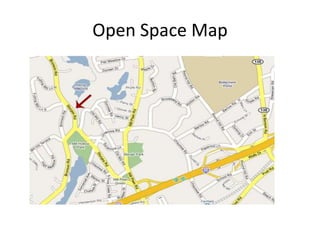
Perry's Mill Open Space is on Sturges Road in Fairfield. It is just south of the fork with Bronson Road and just north of the stone bridge that crosses Mill River. There is a large, brown wooden sign marking the entrance. You may park either at the entrance or along the street. Please be sure to park on the same side of the street as the entrance to the Open Space. The police may ticket your car if you park across the street from the Open Space.
Open Space Map
Chief Seattle "Every shining pine needle, every sandy shore, every mist in the dark woods, every clearing and humming insect is holy in the memory and experience of my people.  Teach your children what we have taught our children, that the Earth is our mother.  The rivers are our brothers, they quench our thirst and feed our children.  The air is precious for all things share the same breath - the beast, the tree, the man, they all share the same breath…   This we know.  The earth does not belong to man; man belongs to the Earth.  Man did not weave a web of life, he is merely a strand in it.  Whatever he does to the web, he does to himself.  All things are connected...” From Keepers of the Earth (Caduto and Bruchac)

Rl 4

  • 1.
    476 Old MillRoad    -    Fairfield, CT 06824    -    203.259.1847www.river-lab.org
  • 2.
    What is River-Lab? WHATIS RIVER-LAB? River-Lab is a science-based environmental studies curriculum which teaches all Fairfield public and parochial school students Grades 3-6 about the river basin structure of the Earth. The River-Lab program makes up one-third of the Fairfield school system's science curriculum and meets CMT requirements. Classroom teaching is reinforced by study-trips to the Mill River and town estuaries for over 3,500 students each year. These study-trips are organized and run by the Mill River Wetland Study Group. This arm of the non-profit Mill River Wetland Committee (MRWC) has supplied environmental science curriculum to Fairfield school students since 1969. Each study-trip is led by trained volunteer guides. River-Lab trains over 150 guides annually. MRWC encourages community commitment to protect rivers and the environment.
  • 3.
    River-Lab Grade 4ABasin in Balance
  • 4.
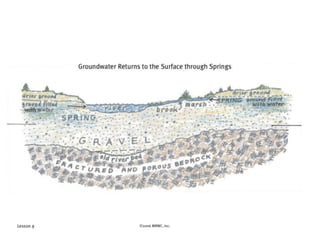
    RIVER LAB GRADE4 COURSE CONCEPT  A Basin in Balance  The 4th grade unit, A Basin in Balance, focuses on the role of the underground water system and its role in the river basin system. The unit builds on the River-Lab course from Grade 3, in which students studied the parts and functions of a river basin system, and how it creates habitats which support organisms. The students learn that all land on earth is part of a river basin system. Power point slides, a student reference book, and inquiry-based lessons are used in the classroom to teach the role of the water cycle in river basin dynamics, the formation of rivers and the underground water system, and the role of water in changing the land. Students develop an understanding that the underground water system is essential in sustaining the web of life in a river basin. Students will be engaged in discussions of our management of the environment in a river basin system, and how human's impact along with natural phenomena effect life in a river basin system.  On the study-trip students develop a model of the underground water system to investigate how it works and how it is connected to the surface water system. Guides lead students to examine habitat factors that either help or hinder water as it is absorbed into the underground system. Students develop their science skills as they observe and record information along the trail points.
  • 5.
    What is GuideTraining?Preparation for field study-trips to support and reinforce the classroom unitStudy-trips are led by trained volunteer guides (that’s you!)Training = 1 indoor training, 1 outdoor training, and 1 follow-trip (recommended)Guides are scheduled for their child’s study-trip; you may schedule other trips at your convenience
  • 6.
    What to expectat a Study-tripTrips are 90 minutes; guides meet at Open Space 15 min. early to help set up Kids arrive by bus: already assigned to groups by teacher; greeted by “model-leader”Study-trip is in 2 parts: 1. Whole Group Activity: Groundwater Model (led by experienced guide - not you!) 2. Small Groups go to 6 Trail Points (you’re on!)
  • 7.
  • 13.
    River Lab Grade4: Guide Training Summary
  • 14.
    Scientific Inquiry “Tell meand I will forget; show me and I will remember; involve me and I will understand.” Inquiry-based science instruction engages students in the process of doing investigations. They develop the ability to ask questions, investigate aspects of the world around them, and use their observations to construct reasonable explanations for the questions posed. Basic Skills of Scientific Inquiry:ObservingClassifying and sequencingCommunicatingMeasuringPredictingHypothesizingInferringDefining, controlling, and manipulating variables in experimentationDesigning, constructing, and interpreting dataInterpreting, analyzing, and evaluating data Uses of Scientific InquiryTo make connections with world situationsTo encourage an active, problem-solving approach to thinking and learning To apply math skillsTo review what is already known in light of experimental evidenceTo propose answers, explanation and predictionsTo use tools to gather, analyze and interpret data 
  • 15.
    Parts of theRiver Basin System
  • 17.
    Layers of theGroundwater System
  • 19.
  • 20.
    Concept # 3AbsorbencyAbsorbent areasPonds, lakes, feeder streams and brooks, wetlands, woodlands, ground cover all store waterPlants INTERCEPT rain or snow; slow floodwatersDetritus/debris slows runoff and soaks up water Absorbent surfaces hold water above ground AND promote underground water storage.Absorbent features SLOW or STOP RUNOFF and allow water to INFILTRATE the topsoil and into the Groundwater System. Promote balance between RBS and GWS!
  • 21.
  • 22.
    HABITAT BASE OF FOOD CHAIN ROLE IN WATER CYCLE (transpiration)  All animals are directly or indirectly dependent on plants for food energy. Many food chains start at shoreline habitats (along water's edge), with algae and plants Animals move around, so these food chains expand beyond the shorelineAlgae and plants are "producers" b/c they make their own food using sun's energyAnimals are "consumers" -they cannot produce their own food and must consume other organisms for energyPlants help water infiltrate the GWS by “intercepting”Debris from dead plants is an important absorbent material in the RBS, to replenish GWS  BUT...changes can and do happen… geological events occur (continental collision, glaciation, volcanic eruptions)flooding and forest fires occurthese events may remove canopy, layers of forest floorthese events are part of the Earth's natural renewal of the landscapeOur current moment in the Earth's maturity has many benefits: soil has been produced, the river basins have been shaped by water forces, the UWS has been developed, and organisms are supported by their habitats. All of these features promote balance and productivity in the RBS.Concept #4: The role of plants
  • 23.
    CONCEPT #5: Human Impact  The RBS has evolved into a self-maintaining, living, balanced system. All living things depend on this balanced environment. However, humans are continually making changes that affect this balance.  Resurfacing = lower absorbency/increased run-off = GWS/RBS imbalanceWhen absorbent areas of a basin are covered over and replaced with non-absorbent materials, we lose the natural leafy growth and rotting debris which slows runoff and allows time for infiltration. Run off remains on the surface causing excessive erosion, siltation, and flooding. Water that does not infiltrate will not be available to replenish surface bodies. The GWS then has reduced capacity to replenish lakes, ponds, streams during times of low precip. Ways humans have resurfaced land:Deforestation (trees and shrubs removed). Result: Lack of canopy to intercept precip, lack of spongy woodland floor that would allow infiltration into GWS.Paved areas (patios, sidewalks, roads, parking lots, etc). These areas no longer have layer of natural debris to absorb water. Water runs off theses hard surfaces very quickly, no time for infiltration.Cultivated lawns also create fast runoff and discourage absorption. Water runs off blades of grass very quickly. Lawn as "green pavement".Storm Water Management (roofs, gutters, downspouts and drainage pipes) These work by quickly collecting and sending rainwater through pipes and directly into rivers and streams, often causing flooding. 
  • 24.
    Directions Perry's MillOpen Space
Perry's Mill Open Space is on Sturges Road in Fairfield. It is just south of the fork with Bronson Road and just north of the stone bridge that crosses Mill River. There is a large, brown wooden sign marking the entrance. You may park either at the entrance or along the street. Please be sure to park on the same side of the street as the entrance to the Open Space. The police may ticket your car if you park across the street from the Open Space.
  • 25.
  • 26.
    Chief Seattle "Everyshining pine needle, every sandy shore, every mist in the dark woods, every clearing and humming insect is holy in the memory and experience of my people.  Teach your children what we have taught our children, that the Earth is our mother.  The rivers are our brothers, they quench our thirst and feed our children.  The air is precious for all things share the same breath - the beast, the tree, the man, they all share the same breath…   This we know.  The earth does not belong to man; man belongs to the Earth.  Man did not weave a web of life, he is merely a strand in it.  Whatever he does to the web, he does to himself.  All things are connected...” From Keepers of the Earth (Caduto and Bruchac)