IDS – 476: Business Forecasting Using Time-series
Final Project Report
Group Members:
Adusumelli, Jaideep – 672039068
Kondathasula, Uday – 656467843
Chowdhury, Gaurav – 651395167
Kompella, Kaushik – 663144176
Sirothia, Shubham – 650889404
Thomas, Shobin – 657777256
Objective
To analyze the monthlyairline passengerrevenue miles*toisolate the seasonalityfromthe trendand analyze the trend
of the airline revenue, so that we could forecast the airline revenue for the next 2 years.
*(The passengerrevenue milesisameasure usedinthe airlineindustrywhichdepictsthe total numberof revenuepaying
passengers multiplied by the total number of miles travelled by each one of them.)
Data
For this project, we used the monthly passenger revenue miles’ data of the spirit airlines from January of 2003 to the
December of 2016. We obtained this data from the Bureau of Transportation statistics, United States of America.
Software or Programming language used: R
Preliminary analysis
The datathat we downloadedconsistedof twovariablesa) MonthlyRevenue,andb) Date.Firstweconvertedallthe dates
into the format of Year and month.
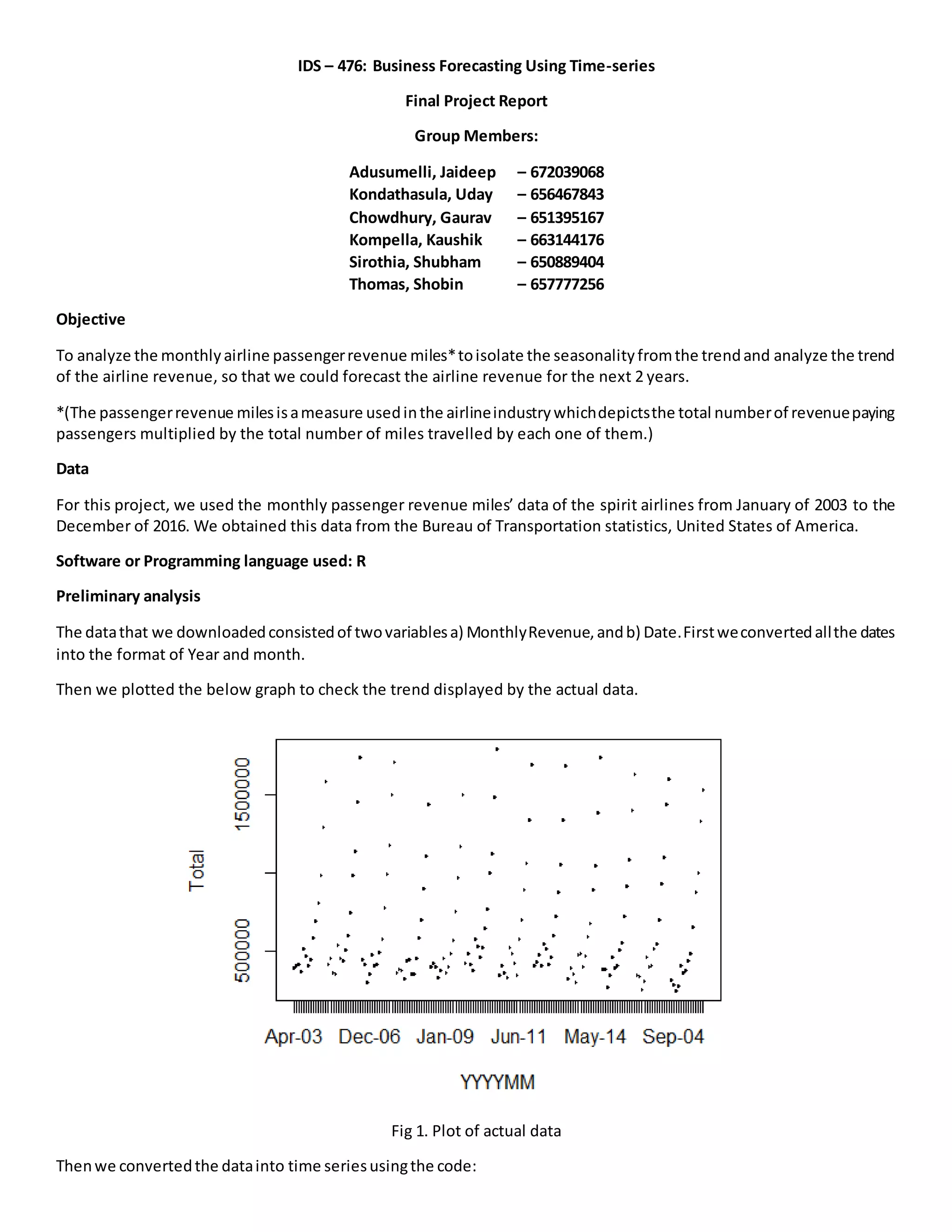
Then we plotted the below graph to check the trend displayed by the actual data.
Fig 1. Plot of actual data
Thenwe convertedthe datainto time seriesusingthe code:
> rpm = read.csv("data.csv")
> rpm.ts = ts(as.numeric(rpm$Total), start=c(2003,01),freq=12)
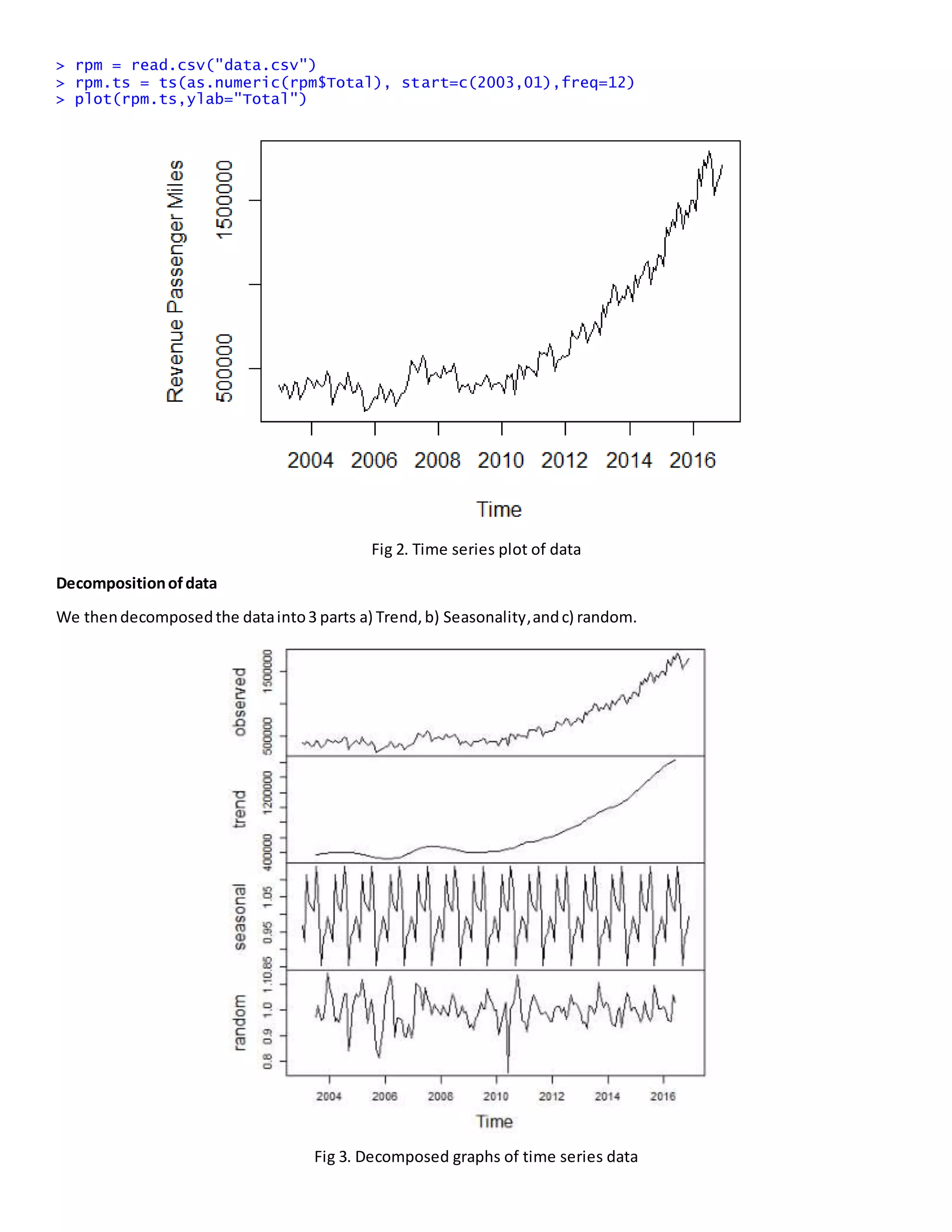
> plot(rpm.ts,ylab="Total")
Fig 2. Time series plot of data
Decompositionofdata
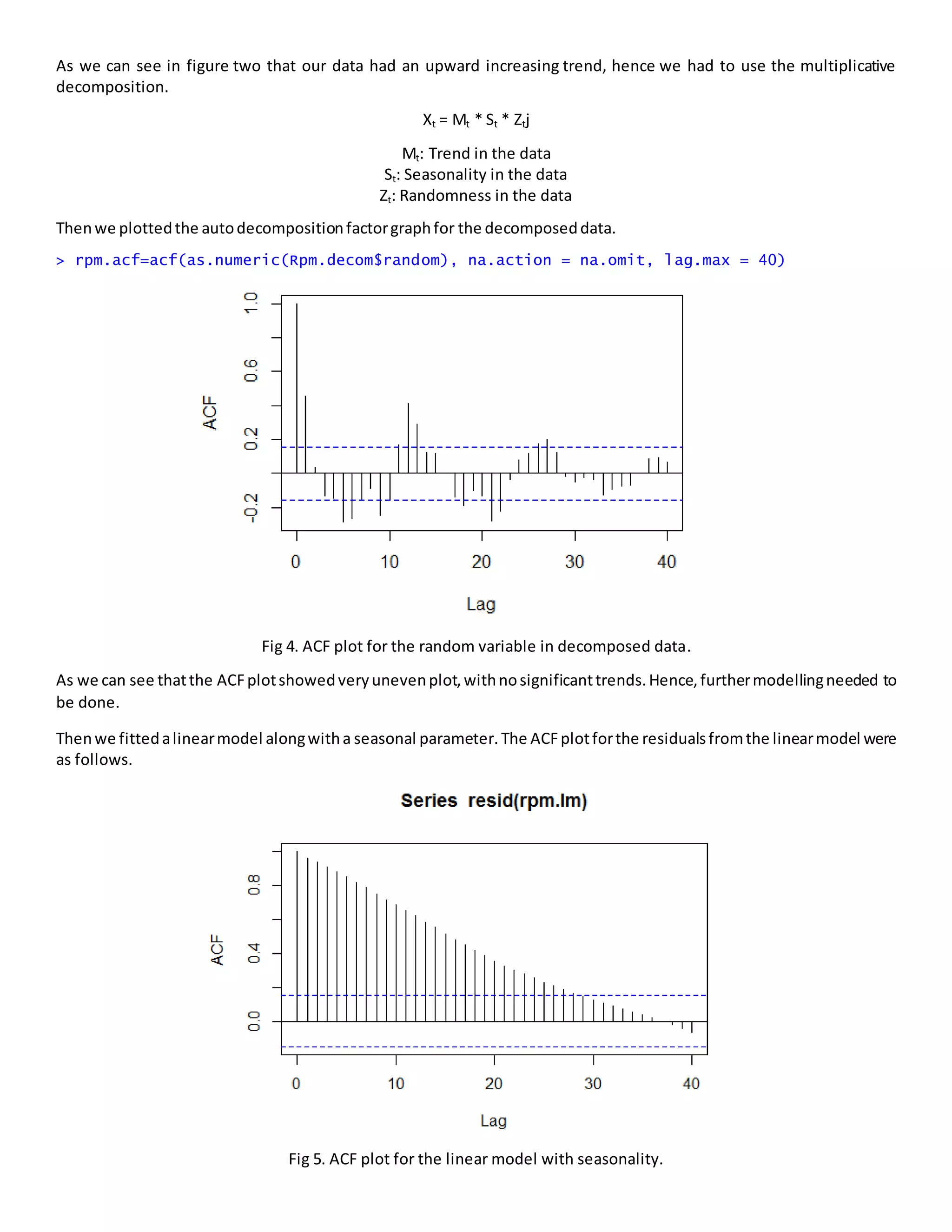
We thendecomposedthe datainto3 parts a) Trend,b) Seasonality,andc) random.
Fig 3. Decomposed graphs of time series data
As we can see in figure two that our data had an upward increasing trend, hence we had to use the multiplicative
decomposition.
Xt = Mt * St * Ztj
Mt: Trend in the data
St: Seasonality in the data
Zt: Randomness in the data
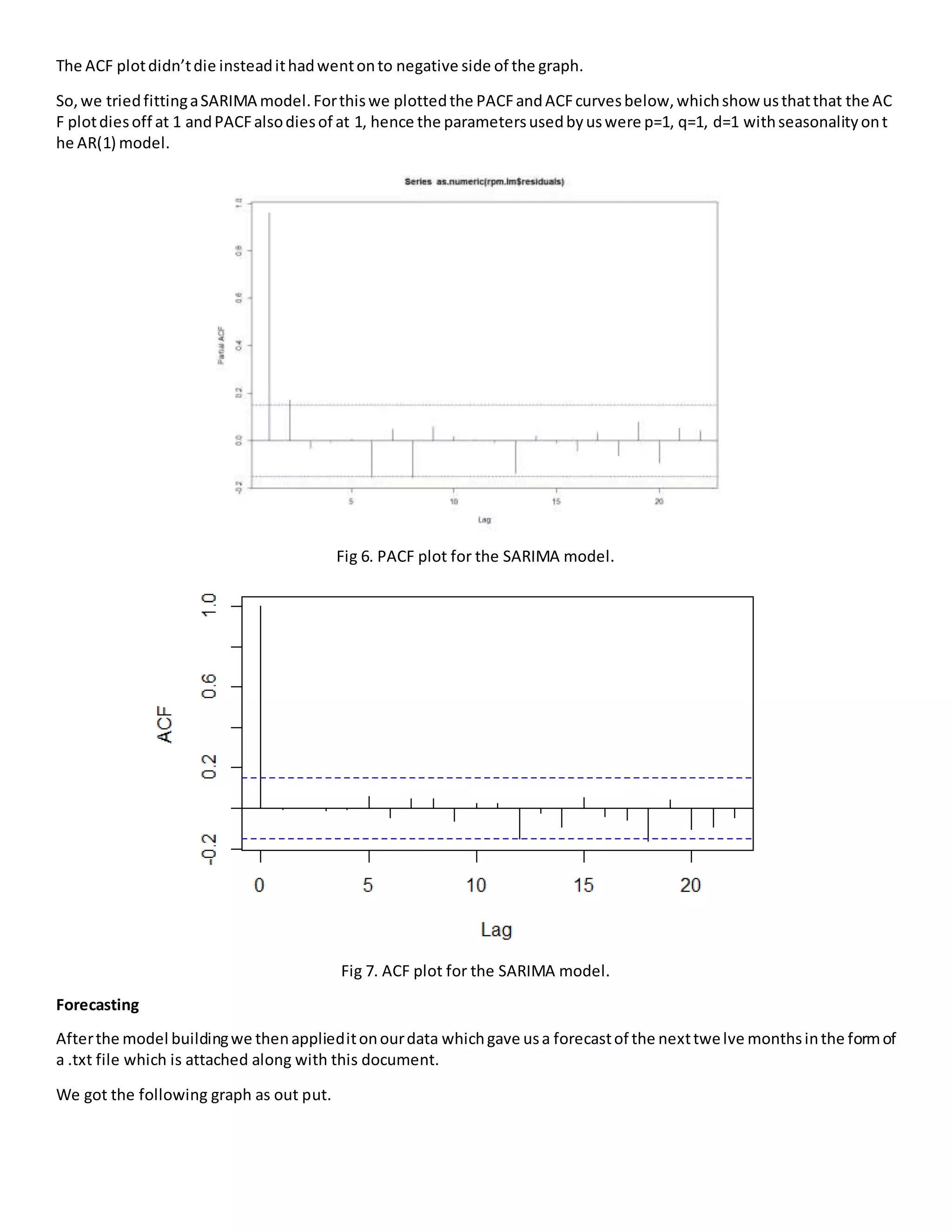
Thenwe plottedthe autodecompositionfactorgraphfor the decomposeddata.
> rpm.acf=acf(as.numeric(Rpm.decom$random), na.action = na.omit, lag.max = 40)
Fig 4. ACF plot for the random variable in decomposed data.
As we can see thatthe ACFplotshowedveryunevenplot,withnosignificanttrends.Hence,furthermodellingneeded to
be done.
Thenwe fittedalinearmodel alongwitha seasonal parameter. The ACFplotforthe residualsfromthe linearmodel were
as follows.
Fig 5. ACF plot for the linear model with seasonality.
The ACF plotdidn’tdie insteadithadwentonto negative side of the graph.
So,we triedfittingaSARIMA model.Forthiswe plottedthe PACFandACFcurvesbelow,whichshow usthatthat the AC
F plotdiesoff at 1 andPACFalsodiesof at 1, hence the parametersusedbyuswere p=1, q=1, d=1 withseasonalityont
he AR(1) model.
Fig 6. PACF plot for the SARIMA model.
Fig 7. ACF plot for the SARIMA model.
Forecasting
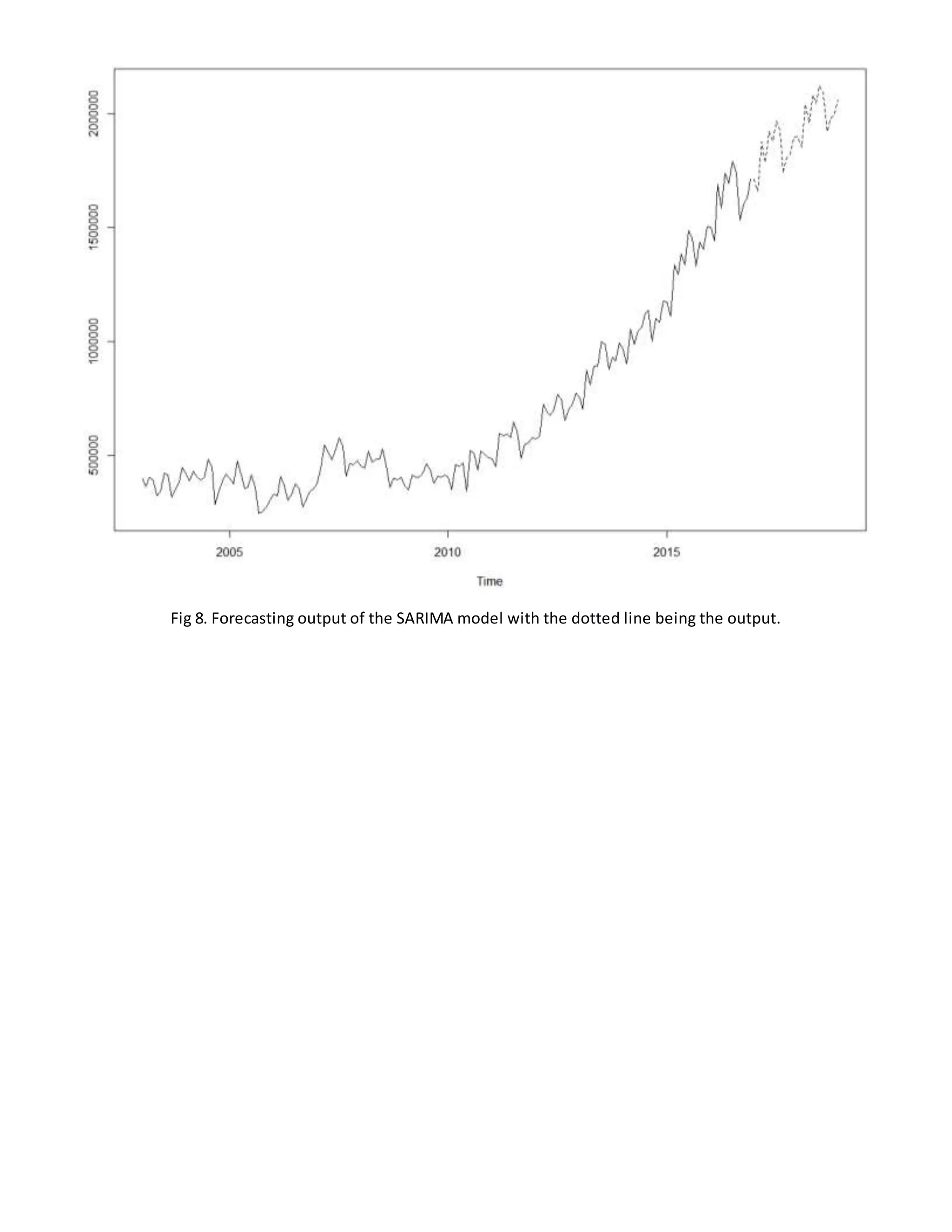
Afterthe model buildingwe thenapplieditonourdata whichgave usa forecastof the nexttwelve monthsinthe formof
a .txt file which is attached along with this document.
We got the following graph as out put.
Fig 8. Forecasting output of the SARIMA model with the dotted line being the output.

Time series project report report

  • 1.
    IDS – 476:Business Forecasting Using Time-series Final Project Report Group Members: Adusumelli, Jaideep – 672039068 Kondathasula, Uday – 656467843 Chowdhury, Gaurav – 651395167 Kompella, Kaushik – 663144176 Sirothia, Shubham – 650889404 Thomas, Shobin – 657777256 Objective To analyze the monthlyairline passengerrevenue miles*toisolate the seasonalityfromthe trendand analyze the trend of the airline revenue, so that we could forecast the airline revenue for the next 2 years. *(The passengerrevenue milesisameasure usedinthe airlineindustrywhichdepictsthe total numberof revenuepaying passengers multiplied by the total number of miles travelled by each one of them.) Data For this project, we used the monthly passenger revenue miles’ data of the spirit airlines from January of 2003 to the December of 2016. We obtained this data from the Bureau of Transportation statistics, United States of America. Software or Programming language used: R Preliminary analysis The datathat we downloadedconsistedof twovariablesa) MonthlyRevenue,andb) Date.Firstweconvertedallthe dates into the format of Year and month. Then we plotted the below graph to check the trend displayed by the actual data. Fig 1. Plot of actual data Thenwe convertedthe datainto time seriesusingthe code:
  • 2.
    > rpm =read.csv("data.csv") > rpm.ts = ts(as.numeric(rpm$Total), start=c(2003,01),freq=12) > plot(rpm.ts,ylab="Total") Fig 2. Time series plot of data Decompositionofdata We thendecomposedthe datainto3 parts a) Trend,b) Seasonality,andc) random. Fig 3. Decomposed graphs of time series data
  • 3.
    As we cansee in figure two that our data had an upward increasing trend, hence we had to use the multiplicative decomposition. Xt = Mt * St * Ztj Mt: Trend in the data St: Seasonality in the data Zt: Randomness in the data Thenwe plottedthe autodecompositionfactorgraphfor the decomposeddata. > rpm.acf=acf(as.numeric(Rpm.decom$random), na.action = na.omit, lag.max = 40) Fig 4. ACF plot for the random variable in decomposed data. As we can see thatthe ACFplotshowedveryunevenplot,withnosignificanttrends.Hence,furthermodellingneeded to be done. Thenwe fittedalinearmodel alongwitha seasonal parameter. The ACFplotforthe residualsfromthe linearmodel were as follows. Fig 5. ACF plot for the linear model with seasonality.
  • 4.
    The ACF plotdidn’tdieinsteadithadwentonto negative side of the graph. So,we triedfittingaSARIMA model.Forthiswe plottedthe PACFandACFcurvesbelow,whichshow usthatthat the AC F plotdiesoff at 1 andPACFalsodiesof at 1, hence the parametersusedbyuswere p=1, q=1, d=1 withseasonalityont he AR(1) model. Fig 6. PACF plot for the SARIMA model. Fig 7. ACF plot for the SARIMA model. Forecasting Afterthe model buildingwe thenapplieditonourdata whichgave usa forecastof the nexttwelve monthsinthe formof a .txt file which is attached along with this document. We got the following graph as out put.
  • 5.
    Fig 8. Forecastingoutput of the SARIMA model with the dotted line being the output.