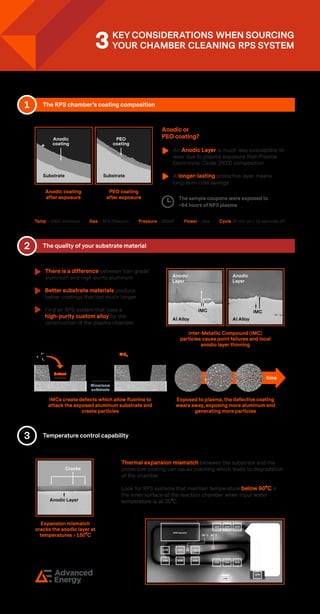
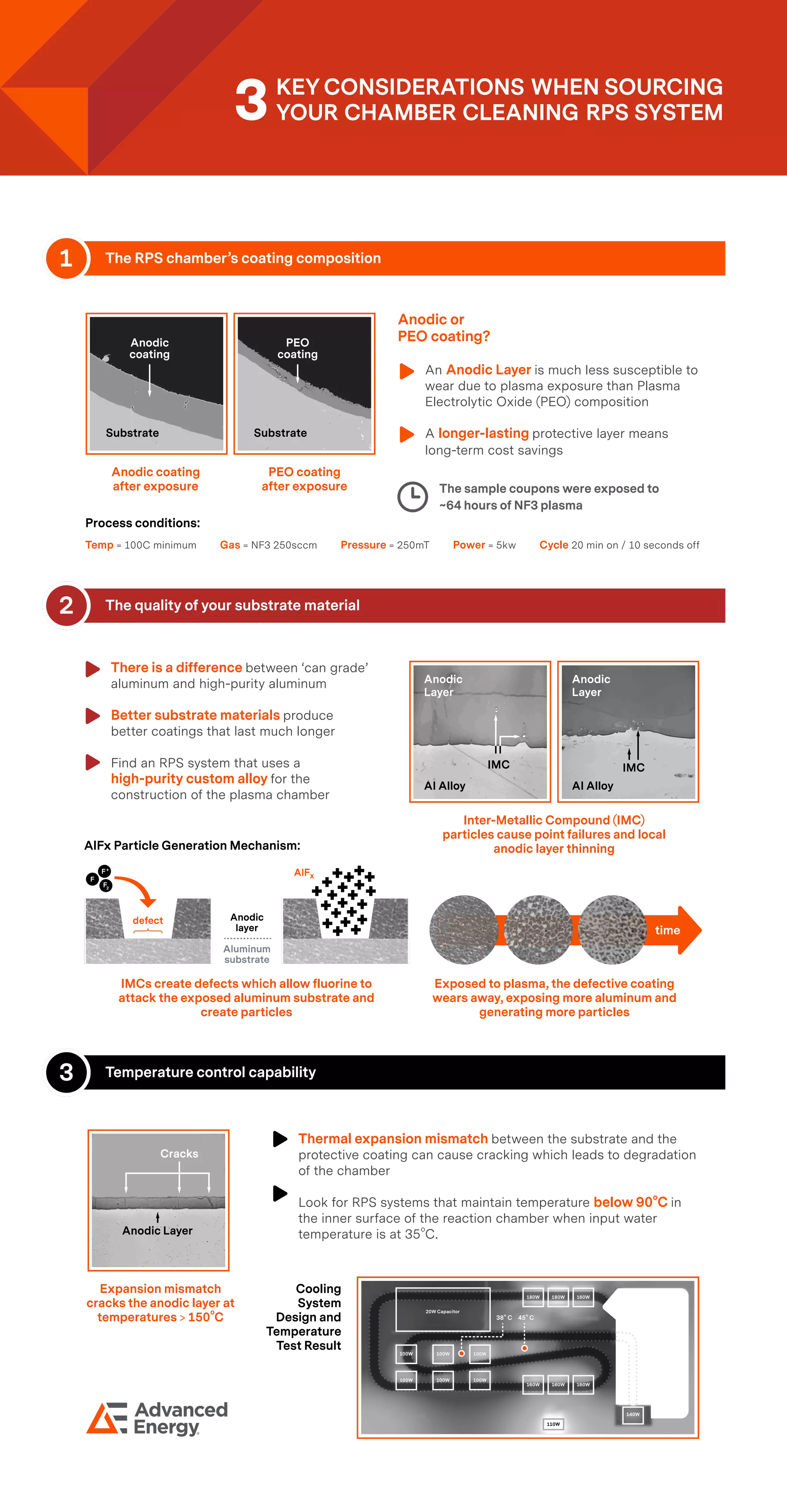
1 The RPS chamber’s coating composition
An Anodic Layer is much less susceptible to
wear due to plasma exposure than Plasma
Electrolytic Oxide (PEO) composition
A longer-lasting protective layer means
long-term cost savings
Anodic coating
after exposure
PEO coating
after exposure
Process conditions:
Temp = 100C minimum Gas = NF3 250sccm Pressure = 250mT Power = 5kw Cycle 20 min on / 10 seconds off
2 The quality of your substrate material
There is a difference between ‘can grade’
aluminum and high-purity aluminum
Better substrate materials produce
better coatings that last much longer
Find an RPS system that uses a
high-purity custom alloy for the
construction of the plasma chamber
AlFx Particle Generation Mechanism:
time
defect Anodic
layer
Aluminum
substrate
AlFx
IMCs create defects which allow fluorine to
attack the exposed aluminum substrate and
create particles
Exposed to plasma, the defective coating
wears away, exposing more aluminum and
generating more particles
Inter-Metallic Compound (IMC)
particles cause point failures and local
anodic layer thinning
AI Alloy
Anodic
Layer
AI Alloy
Anodic
Layer
IMC IMC
3 Temperature control capability
Anodic Layer
Cracks
Expansion mismatch
cracks the anodic layer at
temperatures > 150
o
C
Thermal expansion mismatch between the substrate and the
protective coating can cause cracking which leads to degradation
of the chamber
Look for RPS systems that maintain temperature below 90
o
C in
the inner surface of the reaction chamber when input water
temperature is at 35
o
C.
Cooling
System
Design and
Temperature
Test Result
180W 180W 160W
160W 160W 160W
100W 100W 100W
100W 100W 100W
110W
140W
20W Capacitor
38
o
C 45
o
C
Anodic or
PEO coating?
The sample coupons were exposed to
~64 hours of NF3 plasma
Substrate
Anodic
coating
Substrate
PEO
coating

Three Key Considerations When Sourcing Your Chamber Cleaning RPS System

  • 1.
    1 The RPSchamber’s coating composition An Anodic Layer is much less susceptible to wear due to plasma exposure than Plasma Electrolytic Oxide (PEO) composition A longer-lasting protective layer means long-term cost savings Anodic coating after exposure PEO coating after exposure Process conditions: Temp = 100C minimum Gas = NF3 250sccm Pressure = 250mT Power = 5kw Cycle 20 min on / 10 seconds off 2 The quality of your substrate material There is a difference between ‘can grade’ aluminum and high-purity aluminum Better substrate materials produce better coatings that last much longer Find an RPS system that uses a high-purity custom alloy for the construction of the plasma chamber AlFx Particle Generation Mechanism: time defect Anodic layer Aluminum substrate AlFx IMCs create defects which allow fluorine to attack the exposed aluminum substrate and create particles Exposed to plasma, the defective coating wears away, exposing more aluminum and generating more particles Inter-Metallic Compound (IMC) particles cause point failures and local anodic layer thinning AI Alloy Anodic Layer AI Alloy Anodic Layer IMC IMC 3 Temperature control capability Anodic Layer Cracks Expansion mismatch cracks the anodic layer at temperatures > 150 o C Thermal expansion mismatch between the substrate and the protective coating can cause cracking which leads to degradation of the chamber Look for RPS systems that maintain temperature below 90 o C in the inner surface of the reaction chamber when input water temperature is at 35 o C. Cooling System Design and Temperature Test Result 180W 180W 160W 160W 160W 160W 100W 100W 100W 100W 100W 100W 110W 140W 20W Capacitor 38 o C 45 o C Anodic or PEO coating? The sample coupons were exposed to ~64 hours of NF3 plasma Substrate Anodic coating Substrate PEO coating