Threading is not a model Joe Gregorio Developer Relations, Google Wave
Scope My Opinion
Goal I want to annoy you.
The path A short story, a book, design patterns, and Djikstra
The Principle of Sufficient Irritation "The Short Happy Life  of the Brown Oxford" Philip K. Dick The short story
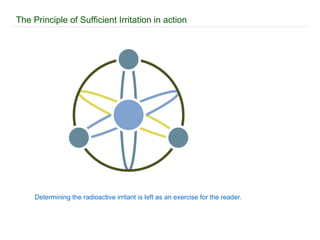
The Principle of Sufficient Irritation in action Determining the radioactive irritant is left as an exercise for the reader.
The path A  short story ,  a book, design patterns, and Djikstra
The Design of Everyday Things The book
The path A short story, a book ,  design patterns, and Djikstra
Setting the record straight Let's talk about Design Patterns I  did not  say that patterns are bad. I  did  say that using them may be a sign of weakness in a language.
A Blog Post Python isn't Java without the compile Design Patterns in Dynamic Programming – Peter Norvig Beyond Java – Bruce Tate
Language Not talking just about Python
Language Aren't patterns good? Yes, but also a sign of weakness
There is a lack of patterns in Python 1. Define 'lack of patterns' 2. Demonstrate that lack 3. Explain why
Hard numbers comp.lang.python 100,000+ messages
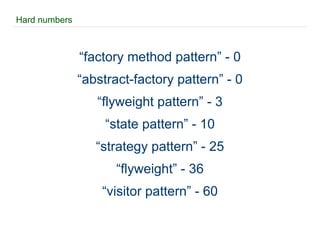
Hard numbers “ factory method pattern” - 0 “ abstract-factory pattern” - 0 “ flyweight pattern” - 3 “ state pattern” - 10 “ strategy pattern” - 25 “ flyweight” - 36 “ visitor pattern” - 60
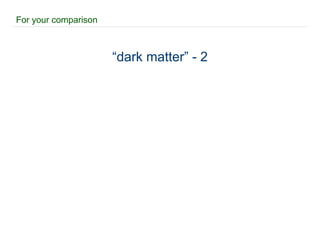
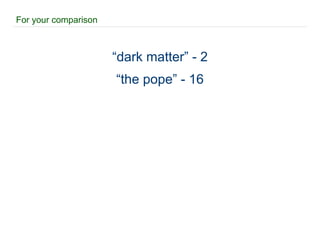
For your comparison “ dark matter” - 2
For your comparison “ dark matter” - 2 “ the pope” - 16
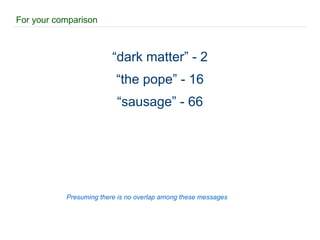
For your comparison “ dark matter” - 2 “ the pope” - 16 “ sausage” - 66 Presuming there is no overlap among these messages
There is a lack of patterns in Python 1.  Define 'lack of patterns' 2.  Demonstrate that lack 3. Explain why
Explain Why The patterns are built in. No one talks about the 'structured programming' pattern or the 'object-oriented' pattern any more.
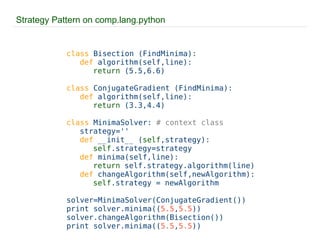
Strategy Pattern on comp.lang.python class  Bisection (FindMinima): def  algorithm(self,line): return  (5.5,6.6) class  ConjugateGradient (FindMinima): def  algorithm(self,line): return  (3.3,4.4) class  MinimaSolver:  # context class strategy='' def  __init__ ( self ,strategy): self .strategy=strategy def  minima(self,line): return  self.strategy.algorithm(line) def  changeAlgorithm(self,newAlgorithm): self .strategy = newAlgorithm solver=MinimaSolver(ConjugateGradient()) print solver.minima(( 5.5 , 5.5 )) solver.changeAlgorithm(Bisection()) print solver.minima(( 5.5 , 5.5 ))
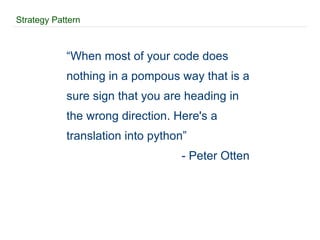
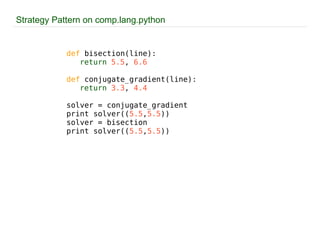
Strategy Pattern “ When most of your code does nothing in a pompous way that is a sure sign that you are heading in the wrong direction. Here's a translation into python” - Peter Otten
Strategy Pattern on comp.lang.python def   bisection(line): return   5.5 ,  6.6 def   conjugate_gradient(line): return   3.3 ,   4.4 solver = conjugate_gradient print solver(( 5.5 , 5.5 )) solver = bisection print solver(( 5.5 , 5.5 ))
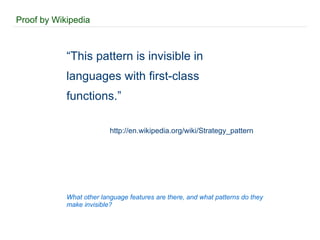
Proof by Wikipedia “ This pattern is invisible in languages with first-class functions.” http://en.wikipedia.org/wiki/Strategy_pattern What other language features are there, and what patterns do they make invisible?
Catalog of Language Features First-class functions Meta-programming Iterators Closures
Proof by Wikipedia In object-oriented programming, the Iterator pattern is a design pattern in which iterators are used to access the elements of an aggregate object sequentially without exposing its underlying representation. http://en.wikipedia.org/wiki/Iterator_pattern The definition of low-hanging fruit.
Iterators for  element  in  [ 1 ,  2 ,  3 ]: print element for  element  in  ( 1 ,  2 ,  3 ): print element for  key  in  { 'one' : 1, 'two' : 2 }: print key for  char  in   "123" : print char for  line  in  open( "myfile.txt" ): print line
There is a lack of patterns in Python 1.  Define 'lack of patterns' 2.  Demonstrate that lack 3.  Explain why
The path A short story, a book , design patterns,  and Djikstra
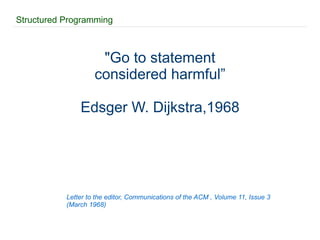
Structured Programming "Go to statement considered harmful” Edsger W. Dijkstra,1968 Letter to the editor, Communications of the ACM , Volume 11, Issue 3  (March 1968)
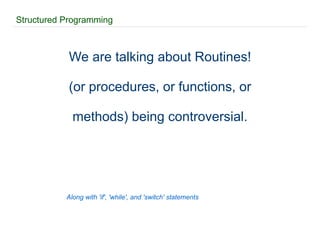
Structured Programming We are talking about Routines! (or procedures, or functions, or methods) being controversial. Along with 'if', 'while', and 'switch' statements
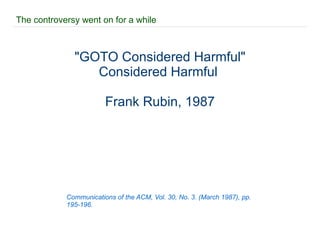
The controversy went on for a while "GOTO Considered Harmful" Considered Harmful  Frank Rubin, 1987 Communications of the ACM, Vol. 30, No. 3. (March 1987), pp. 195-196.
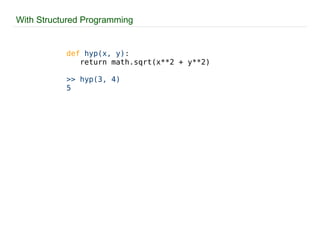
With Structured Programming def  hyp(x, y) : return math.sqrt(x**2 + y**2) >> hyp(3, 4) 5
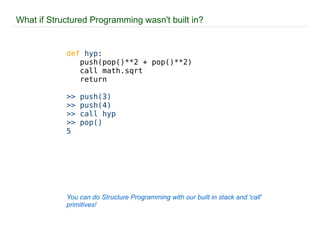
What if Structured Programming wasn't built in? You can do Structure Programming with our built in stack and 'call' primitives! def  hyp : push(pop()**2 + pop()**2) call math.sqrt return >> push(3) >> push(4) >> call hyp >> pop() 5
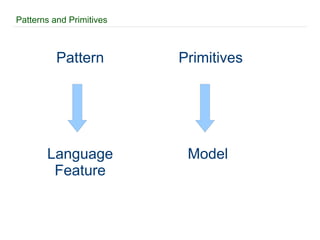
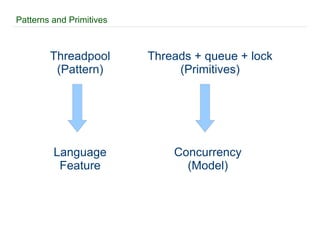
Patterns and Primitives Pattern Language Feature Primitives Model
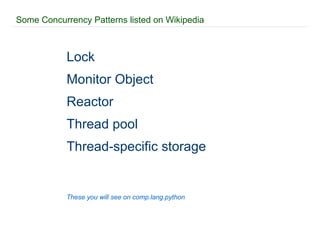
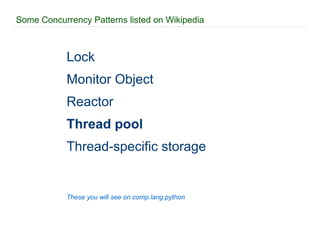
Some Concurrency Patterns listed on Wikipedia Lock Monitor Object Reactor Thread pool Thread-specific storage These you will see on comp.lang.python
Patterns and Primitives Threadpool (Pattern) Language Feature Threads + queue + lock (Primitives) Concurrency (Model)
“ Just” use threads Threading is not a model Threading is a primitive, along with locks, transactional memory, etc.
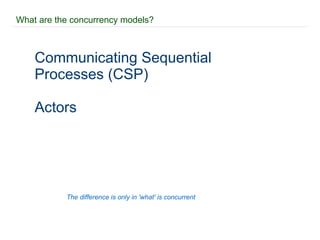
What are the concurrency models? Communicating Sequential Processes (CSP)
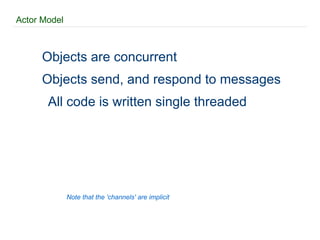
Actors The difference is only in 'what' is concurrent
CSP Model Based on CSP by C.A.R. Hoare.
An actual model for processes
All code is written single threaded
Communication via channels.
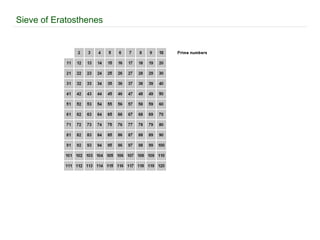
Sieve of Eratosthenes
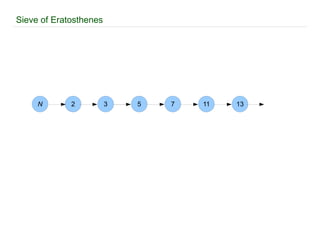
Sieve of Eratosthenes N 2 3 5 7 11 13
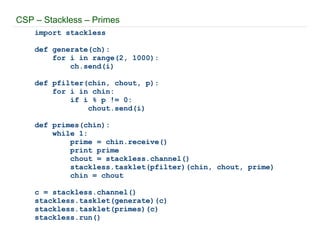
CSP – Stackless – Primes import stackless def generate(ch): for i in range(2, 1000): ch.send(i) def pfilter(chin, chout, p): for i in chin: if i % p != 0: chout.send(i) def primes(chin): while 1: prime = chin.receive() print prime chout = stackless.channel() stackless.tasklet(pfilter)(chin, chout, prime) chin = chout c = stackless.channel() stackless.tasklet(generate)(c) stackless.tasklet(primes)(c) stackless.run()
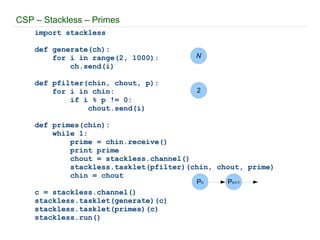
CSP – Stackless – Primes import stackless def generate(ch): for i in range(2, 1000): ch.send(i) def pfilter(chin, chout, p): for i in chin: if i % p != 0: chout.send(i) def primes(chin): while 1: prime = chin.receive() print prime chout = stackless.channel() stackless.tasklet(pfilter)(chin, chout, prime) chin = chout c = stackless.channel() stackless.tasklet(generate)(c) stackless.tasklet(primes)(c) stackless.run() N 2 P n P n+1
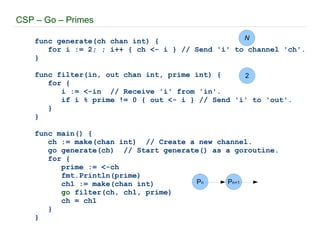
CSP – Go – Primes func generate(ch chan int) { for i := 2; ; i++ { ch <- i } // Send 'i' to channel 'ch'. } func filter(in, out chan int, prime int) { for { i := <-in  // Receive 'i' from 'in'. if i % prime != 0 { out <- i } // Send 'i' to 'out'. } } func main() { ch := make(chan int)  // Create a new channel. go generate(ch)  // Start generate() as a goroutine. for { prime := <-ch fmt.Println(prime) ch1 := make(chan int) go   filter(ch, ch1, prime) ch = ch1 } } N 2 P n P n+1
CSP An implementation could use: Threads
Locks

Threading Is Not A Model

  • 1.
    Threading is nota model Joe Gregorio Developer Relations, Google Wave
  • 2.
  • 3.
    Goal I wantto annoy you.
  • 4.
    The path Ashort story, a book, design patterns, and Djikstra
  • 5.
    The Principle ofSufficient Irritation &quot;The Short Happy Life of the Brown Oxford&quot; Philip K. Dick The short story
  • 6.
    The Principle ofSufficient Irritation in action Determining the radioactive irritant is left as an exercise for the reader.
  • 7.
    The path A short story , a book, design patterns, and Djikstra
  • 8.
    The Design ofEveryday Things The book
  • 9.
    The path Ashort story, a book , design patterns, and Djikstra
  • 10.
    Setting the recordstraight Let's talk about Design Patterns I did not say that patterns are bad. I did say that using them may be a sign of weakness in a language.
  • 11.
    A Blog PostPython isn't Java without the compile Design Patterns in Dynamic Programming – Peter Norvig Beyond Java – Bruce Tate
  • 12.
    Language Not talkingjust about Python
  • 13.
    Language Aren't patternsgood? Yes, but also a sign of weakness
  • 14.
    There is alack of patterns in Python 1. Define 'lack of patterns' 2. Demonstrate that lack 3. Explain why
  • 15.
  • 16.
    Hard numbers “factory method pattern” - 0 “ abstract-factory pattern” - 0 “ flyweight pattern” - 3 “ state pattern” - 10 “ strategy pattern” - 25 “ flyweight” - 36 “ visitor pattern” - 60
  • 17.
    For your comparison“ dark matter” - 2
  • 18.
    For your comparison“ dark matter” - 2 “ the pope” - 16
  • 19.
    For your comparison“ dark matter” - 2 “ the pope” - 16 “ sausage” - 66 Presuming there is no overlap among these messages
  • 20.
    There is alack of patterns in Python 1. Define 'lack of patterns' 2. Demonstrate that lack 3. Explain why
  • 21.
    Explain Why Thepatterns are built in. No one talks about the 'structured programming' pattern or the 'object-oriented' pattern any more.
  • 22.
    Strategy Pattern oncomp.lang.python class Bisection (FindMinima): def algorithm(self,line): return (5.5,6.6) class ConjugateGradient (FindMinima): def algorithm(self,line): return (3.3,4.4) class MinimaSolver: # context class strategy='' def __init__ ( self ,strategy): self .strategy=strategy def minima(self,line): return self.strategy.algorithm(line) def changeAlgorithm(self,newAlgorithm): self .strategy = newAlgorithm solver=MinimaSolver(ConjugateGradient()) print solver.minima(( 5.5 , 5.5 )) solver.changeAlgorithm(Bisection()) print solver.minima(( 5.5 , 5.5 ))
  • 23.
    Strategy Pattern “When most of your code does nothing in a pompous way that is a sure sign that you are heading in the wrong direction. Here's a translation into python” - Peter Otten
  • 24.
    Strategy Pattern oncomp.lang.python def bisection(line): return 5.5 , 6.6 def conjugate_gradient(line): return 3.3 , 4.4 solver = conjugate_gradient print solver(( 5.5 , 5.5 )) solver = bisection print solver(( 5.5 , 5.5 ))
  • 25.
    Proof by Wikipedia“ This pattern is invisible in languages with first-class functions.” http://en.wikipedia.org/wiki/Strategy_pattern What other language features are there, and what patterns do they make invisible?
  • 26.
    Catalog of LanguageFeatures First-class functions Meta-programming Iterators Closures
  • 27.
    Proof by WikipediaIn object-oriented programming, the Iterator pattern is a design pattern in which iterators are used to access the elements of an aggregate object sequentially without exposing its underlying representation. http://en.wikipedia.org/wiki/Iterator_pattern The definition of low-hanging fruit.
  • 28.
    Iterators for element in [ 1 , 2 , 3 ]: print element for element in ( 1 , 2 , 3 ): print element for key in { 'one' : 1, 'two' : 2 }: print key for char in &quot;123&quot; : print char for line in open( &quot;myfile.txt&quot; ): print line
  • 29.
    There is alack of patterns in Python 1. Define 'lack of patterns' 2. Demonstrate that lack 3. Explain why
  • 30.
    The path Ashort story, a book , design patterns, and Djikstra
  • 31.
    Structured Programming &quot;Goto statement considered harmful” Edsger W. Dijkstra,1968 Letter to the editor, Communications of the ACM , Volume 11, Issue 3 (March 1968)
  • 32.
    Structured Programming Weare talking about Routines! (or procedures, or functions, or methods) being controversial. Along with 'if', 'while', and 'switch' statements
  • 33.
    The controversy wenton for a while &quot;GOTO Considered Harmful&quot; Considered Harmful Frank Rubin, 1987 Communications of the ACM, Vol. 30, No. 3. (March 1987), pp. 195-196.
  • 34.
    With Structured Programmingdef hyp(x, y) : return math.sqrt(x**2 + y**2) >> hyp(3, 4) 5
  • 35.
    What if StructuredProgramming wasn't built in? You can do Structure Programming with our built in stack and 'call' primitives! def hyp : push(pop()**2 + pop()**2) call math.sqrt return >> push(3) >> push(4) >> call hyp >> pop() 5
  • 36.
    Patterns and PrimitivesPattern Language Feature Primitives Model
  • 37.
    Some Concurrency Patternslisted on Wikipedia Lock Monitor Object Reactor Thread pool Thread-specific storage These you will see on comp.lang.python
  • 38.
    Some Concurrency Patternslisted on Wikipedia Lock Monitor Object Reactor Thread pool Thread-specific storage These you will see on comp.lang.python
  • 39.
    Patterns and PrimitivesThreadpool (Pattern) Language Feature Threads + queue + lock (Primitives) Concurrency (Model)
  • 40.
    “ Just” usethreads Threading is not a model Threading is a primitive, along with locks, transactional memory, etc.
  • 41.
    What are theconcurrency models? Communicating Sequential Processes (CSP)
  • 42.
    Actors The differenceis only in 'what' is concurrent
  • 43.
    CSP Model Basedon CSP by C.A.R. Hoare.
  • 44.
    An actual modelfor processes
  • 45.
    All code iswritten single threaded
  • 46.
  • 47.
  • 48.
    Sieve of EratosthenesN 2 3 5 7 11 13
  • 49.
    CSP – Stackless– Primes import stackless def generate(ch): for i in range(2, 1000): ch.send(i) def pfilter(chin, chout, p): for i in chin: if i % p != 0: chout.send(i) def primes(chin): while 1: prime = chin.receive() print prime chout = stackless.channel() stackless.tasklet(pfilter)(chin, chout, prime) chin = chout c = stackless.channel() stackless.tasklet(generate)(c) stackless.tasklet(primes)(c) stackless.run()
  • 50.
    CSP – Stackless– Primes import stackless def generate(ch): for i in range(2, 1000): ch.send(i) def pfilter(chin, chout, p): for i in chin: if i % p != 0: chout.send(i) def primes(chin): while 1: prime = chin.receive() print prime chout = stackless.channel() stackless.tasklet(pfilter)(chin, chout, prime) chin = chout c = stackless.channel() stackless.tasklet(generate)(c) stackless.tasklet(primes)(c) stackless.run() N 2 P n P n+1
  • 51.
    CSP – Go– Primes func generate(ch chan int) { for i := 2; ; i++ { ch <- i } // Send 'i' to channel 'ch'. } func filter(in, out chan int, prime int) { for { i := <-in // Receive 'i' from 'in'. if i % prime != 0 { out <- i } // Send 'i' to 'out'. } } func main() { ch := make(chan int) // Create a new channel. go generate(ch) // Start generate() as a goroutine. for { prime := <-ch fmt.Println(prime) ch1 := make(chan int) go filter(ch, ch1, prime) ch = ch1 } } N 2 P n P n+1
  • 52.
    CSP An implementationcould use: Threads
  • 53.