TITLE PAGE
SMART INDIA HACKATHON 2025
• Problem Statement ID -PS10016
• Problem Statement Title-real time food donating
monitoring system
• Theme-miscellaneous
• PS Category- software
• Team ID-
• Team Name-INNOV6
SHAREBITE
2
@SIH Idea submission- Template
INNOV6
Existing Solution
Currently, food donation management is mostly manual or semi-
digital. Restaurants and food providers coordinate with
orphanages and NGOs via phone calls, WhatsApp, or
spreadsheets. This method has several challenges:
1. Inefficient Communication: Donors and recipients face
delays in confirming donations or scheduling deliveries,
which can lead to missed or delayed meals.
2. No Real-Time Tracking: There is no way to monitor the
status of each donation as it moves from the restaurant to
the recipient.
3. Limited Data and Accountability: Manual records make it
hard to track donations accurately, monitor delivery
efficiency, or generate reports for audits and social
responsibility.
4. Food Wastage: Delays and mismanagement increase the
chances of surplus food being wasted.
Proposed Solution
The proposed system is a web-based platform for managing
food donations digitally, without relying on QR codes:
1. Centralized Dashboard: Restaurants, orphanages, and
delivery staff can view, schedule, and update donation
requests in a single platform.
2. Real-Time Updates: Delivery personnel and recipients
can mark donations as “picked up,” “in transit,” or
“delivered,” giving donors visibility of the donation
status.
3. Reduced Food Wastage: Better coordination ensures
donations are delivered promptly, minimizing spoilage.
4. Data-Driven Insights: The system keeps a record of all
donations, allowing stakeholders to analyze patterns,
optimize deliveries, and improve efficiency.
TECHNICALAPPROACH
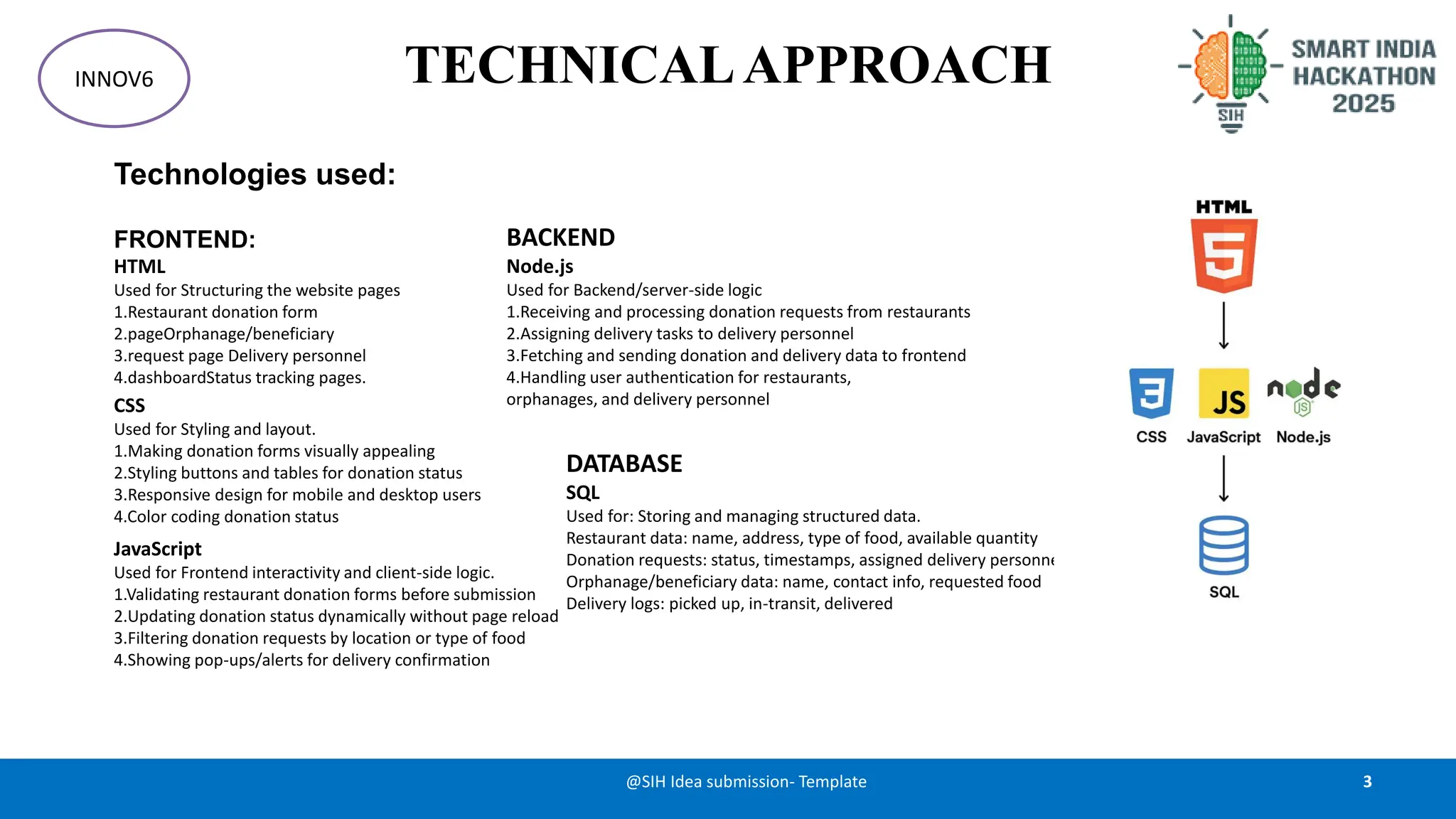
Technologies used:
FRONTEND:
HTML
Used for Structuring the website pages
1.Restaurant donation form
2.pageOrphanage/beneficiary
3.request page Delivery personnel
4.dashboardStatus tracking pages.
3
@SIH Idea submission- Template
INNOV6
CSS
Used for Styling and layout.
1.Making donation forms visually appealing
2.Styling buttons and tables for donation status
3.Responsive design for mobile and desktop users
4.Color coding donation status
JavaScript
Used for Frontend interactivity and client-side logic.
1.Validating restaurant donation forms before submission
2.Updating donation status dynamically without page reload
3.Filtering donation requests by location or type of food
4.Showing pop-ups/alerts for delivery confirmation
BACKEND
Node.js
Used for Backend/server-side logic
1.Receiving and processing donation requests from restaurants
2.Assigning delivery tasks to delivery personnel
3.Fetching and sending donation and delivery data to frontend
4.Handling user authentication for restaurants,
orphanages, and delivery personnel
DATABASE
SQL
Used for: Storing and managing structured data.
Restaurant data: name, address, type of food, available quantity
Donation requests: status, timestamps, assigned delivery personnel
Orphanage/beneficiary data: name, contact info, requested food
Delivery logs: picked up, in-transit, delivered
FEASIBILITY AND VIABILITY
4
@SIH Idea submission- Template
INNOV6
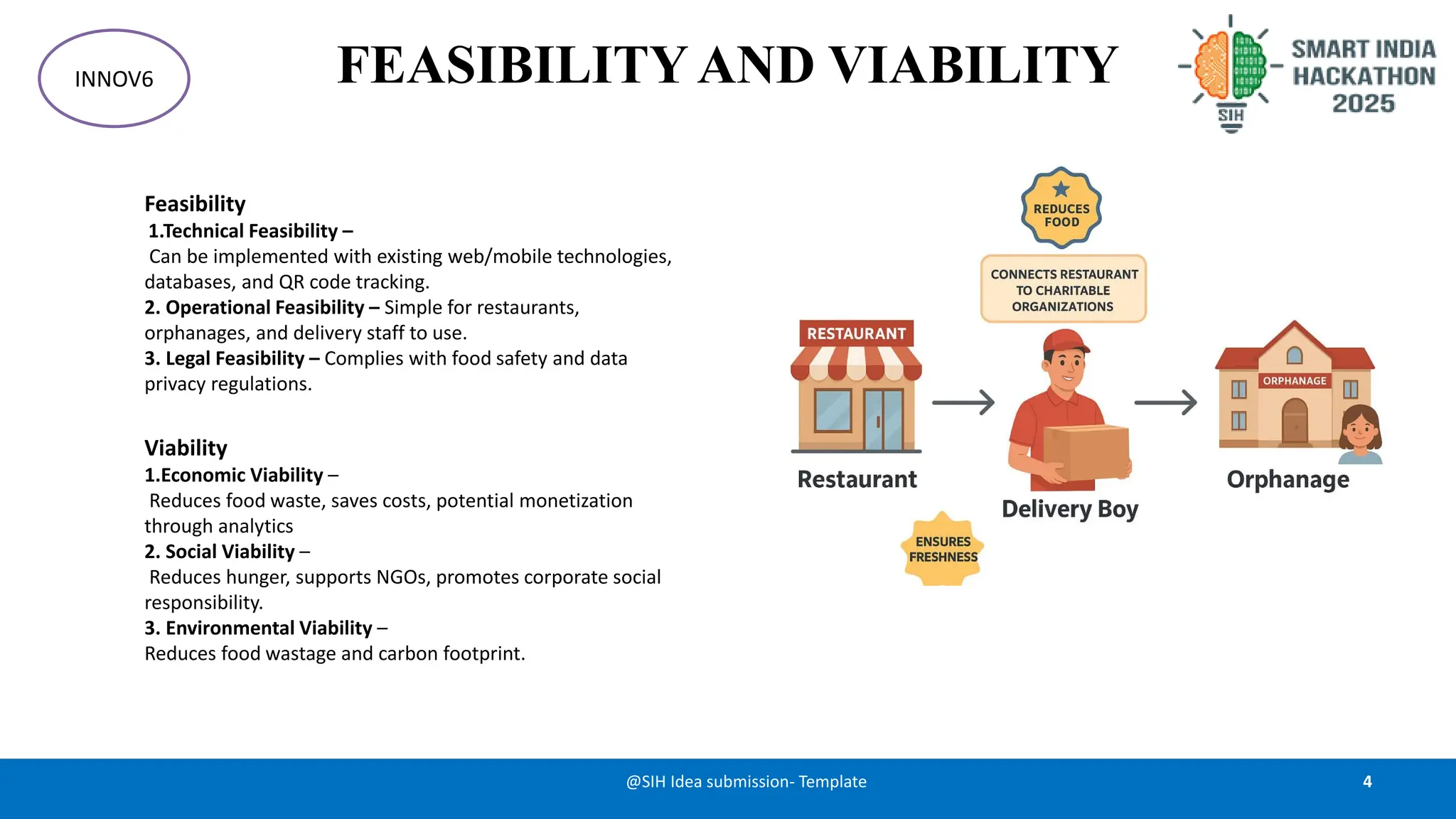
Feasibility
1.Technical Feasibility –
Can be implemented with existing web/mobile technologies,
databases, and QR code tracking.
2. Operational Feasibility – Simple for restaurants,
orphanages, and delivery staff to use.
3. Legal Feasibility – Complies with food safety and data
privacy regulations.
Viability
1.Economic Viability –
Reduces food waste, saves costs, potential monetization
through analytics
2. Social Viability –
Reduces hunger, supports NGOs, promotes corporate social
responsibility.
3. Environmental Viability –
Reduces food wastage and carbon footprint.
IMPACT AND BENEFITS
5
@SIH Idea submission- Template
INNOV6
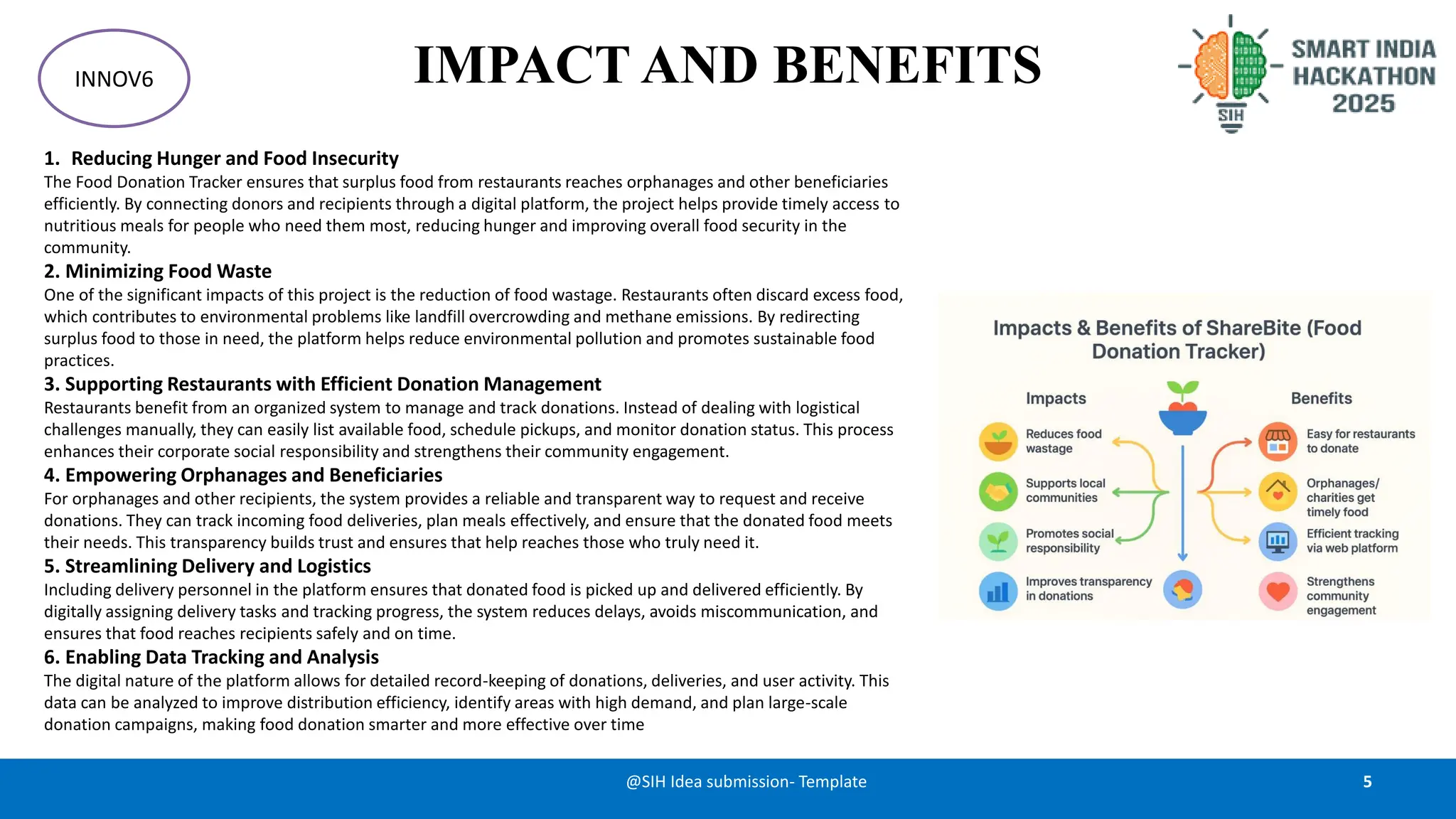
1. Reducing Hunger and Food Insecurity
The Food Donation Tracker ensures that surplus food from restaurants reaches orphanages and other beneficiaries
efficiently. By connecting donors and recipients through a digital platform, the project helps provide timely access to
nutritious meals for people who need them most, reducing hunger and improving overall food security in the
community.
2. Minimizing Food Waste
One of the significant impacts of this project is the reduction of food wastage. Restaurants often discard excess food,
which contributes to environmental problems like landfill overcrowding and methane emissions. By redirecting
surplus food to those in need, the platform helps reduce environmental pollution and promotes sustainable food
practices.
3. Supporting Restaurants with Efficient Donation Management
Restaurants benefit from an organized system to manage and track donations. Instead of dealing with logistical
challenges manually, they can easily list available food, schedule pickups, and monitor donation status. This process
enhances their corporate social responsibility and strengthens their community engagement.
4. Empowering Orphanages and Beneficiaries
For orphanages and other recipients, the system provides a reliable and transparent way to request and receive
donations. They can track incoming food deliveries, plan meals effectively, and ensure that the donated food meets
their needs. This transparency builds trust and ensures that help reaches those who truly need it.
5. Streamlining Delivery and Logistics
Including delivery personnel in the platform ensures that donated food is picked up and delivered efficiently. By
digitally assigning delivery tasks and tracking progress, the system reduces delays, avoids miscommunication, and
ensures that food reaches recipients safely and on time.
6. Enabling Data Tracking and Analysis
The digital nature of the platform allows for detailed record-keeping of donations, deliveries, and user activity. This
data can be analyzed to improve distribution efficiency, identify areas with high demand, and plan large-scale
donation campaigns, making food donation smarter and more effective over time
USP OF THE PROPOSED SOLUTION
6
@SIH Idea submission- Template
INNOV6

this ppt is about food delivery game for hackathons

  • 1.
    TITLE PAGE SMART INDIAHACKATHON 2025 • Problem Statement ID -PS10016 • Problem Statement Title-real time food donating monitoring system • Theme-miscellaneous • PS Category- software • Team ID- • Team Name-INNOV6
  • 2.
    SHAREBITE 2 @SIH Idea submission-Template INNOV6 Existing Solution Currently, food donation management is mostly manual or semi- digital. Restaurants and food providers coordinate with orphanages and NGOs via phone calls, WhatsApp, or spreadsheets. This method has several challenges: 1. Inefficient Communication: Donors and recipients face delays in confirming donations or scheduling deliveries, which can lead to missed or delayed meals. 2. No Real-Time Tracking: There is no way to monitor the status of each donation as it moves from the restaurant to the recipient. 3. Limited Data and Accountability: Manual records make it hard to track donations accurately, monitor delivery efficiency, or generate reports for audits and social responsibility. 4. Food Wastage: Delays and mismanagement increase the chances of surplus food being wasted. Proposed Solution The proposed system is a web-based platform for managing food donations digitally, without relying on QR codes: 1. Centralized Dashboard: Restaurants, orphanages, and delivery staff can view, schedule, and update donation requests in a single platform. 2. Real-Time Updates: Delivery personnel and recipients can mark donations as “picked up,” “in transit,” or “delivered,” giving donors visibility of the donation status. 3. Reduced Food Wastage: Better coordination ensures donations are delivered promptly, minimizing spoilage. 4. Data-Driven Insights: The system keeps a record of all donations, allowing stakeholders to analyze patterns, optimize deliveries, and improve efficiency.
  • 3.
    TECHNICALAPPROACH Technologies used: FRONTEND: HTML Used forStructuring the website pages 1.Restaurant donation form 2.pageOrphanage/beneficiary 3.request page Delivery personnel 4.dashboardStatus tracking pages. 3 @SIH Idea submission- Template INNOV6 CSS Used for Styling and layout. 1.Making donation forms visually appealing 2.Styling buttons and tables for donation status 3.Responsive design for mobile and desktop users 4.Color coding donation status JavaScript Used for Frontend interactivity and client-side logic. 1.Validating restaurant donation forms before submission 2.Updating donation status dynamically without page reload 3.Filtering donation requests by location or type of food 4.Showing pop-ups/alerts for delivery confirmation BACKEND Node.js Used for Backend/server-side logic 1.Receiving and processing donation requests from restaurants 2.Assigning delivery tasks to delivery personnel 3.Fetching and sending donation and delivery data to frontend 4.Handling user authentication for restaurants, orphanages, and delivery personnel DATABASE SQL Used for: Storing and managing structured data. Restaurant data: name, address, type of food, available quantity Donation requests: status, timestamps, assigned delivery personnel Orphanage/beneficiary data: name, contact info, requested food Delivery logs: picked up, in-transit, delivered
  • 4.
    FEASIBILITY AND VIABILITY 4 @SIHIdea submission- Template INNOV6 Feasibility 1.Technical Feasibility – Can be implemented with existing web/mobile technologies, databases, and QR code tracking. 2. Operational Feasibility – Simple for restaurants, orphanages, and delivery staff to use. 3. Legal Feasibility – Complies with food safety and data privacy regulations. Viability 1.Economic Viability – Reduces food waste, saves costs, potential monetization through analytics 2. Social Viability – Reduces hunger, supports NGOs, promotes corporate social responsibility. 3. Environmental Viability – Reduces food wastage and carbon footprint.
  • 5.
    IMPACT AND BENEFITS 5 @SIHIdea submission- Template INNOV6 1. Reducing Hunger and Food Insecurity The Food Donation Tracker ensures that surplus food from restaurants reaches orphanages and other beneficiaries efficiently. By connecting donors and recipients through a digital platform, the project helps provide timely access to nutritious meals for people who need them most, reducing hunger and improving overall food security in the community. 2. Minimizing Food Waste One of the significant impacts of this project is the reduction of food wastage. Restaurants often discard excess food, which contributes to environmental problems like landfill overcrowding and methane emissions. By redirecting surplus food to those in need, the platform helps reduce environmental pollution and promotes sustainable food practices. 3. Supporting Restaurants with Efficient Donation Management Restaurants benefit from an organized system to manage and track donations. Instead of dealing with logistical challenges manually, they can easily list available food, schedule pickups, and monitor donation status. This process enhances their corporate social responsibility and strengthens their community engagement. 4. Empowering Orphanages and Beneficiaries For orphanages and other recipients, the system provides a reliable and transparent way to request and receive donations. They can track incoming food deliveries, plan meals effectively, and ensure that the donated food meets their needs. This transparency builds trust and ensures that help reaches those who truly need it. 5. Streamlining Delivery and Logistics Including delivery personnel in the platform ensures that donated food is picked up and delivered efficiently. By digitally assigning delivery tasks and tracking progress, the system reduces delays, avoids miscommunication, and ensures that food reaches recipients safely and on time. 6. Enabling Data Tracking and Analysis The digital nature of the platform allows for detailed record-keeping of donations, deliveries, and user activity. This data can be analyzed to improve distribution efficiency, identify areas with high demand, and plan large-scale donation campaigns, making food donation smarter and more effective over time
  • 6.
    USP OF THEPROPOSED SOLUTION 6 @SIH Idea submission- Template INNOV6