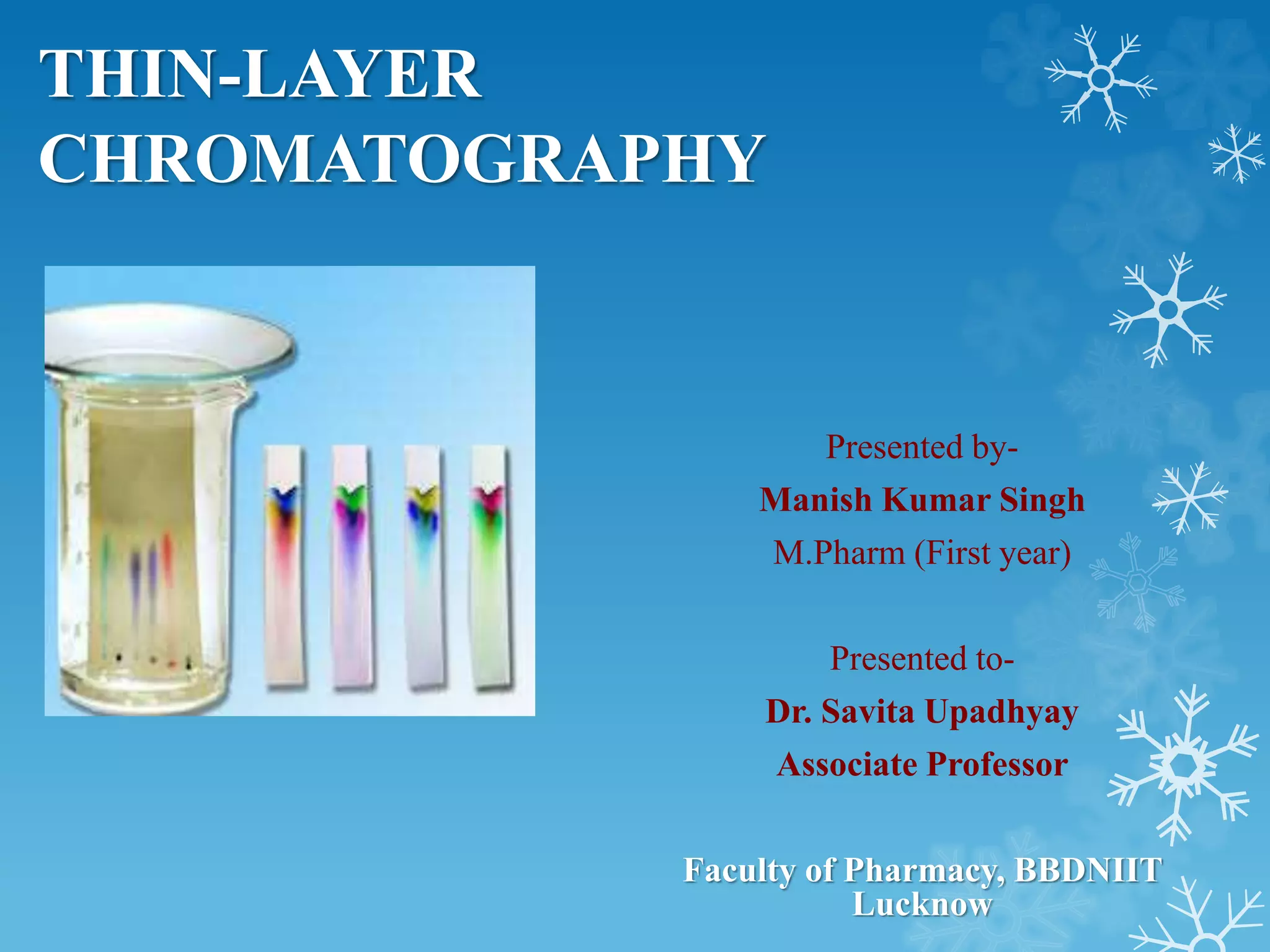
The document discusses thin-layer chromatography (TLC), a technique used for the separation of compounds in mixtures through a stationary phase and a mobile phase. It highlights the principles of TLC, including the types of adsorbents and mobile phases used, as well as the advantages, disadvantages, and applications of the method in various fields. Additional information on preparation, techniques, and standard conditions in TLC is also provided.
Chromatography
Chromatography is essentiallya group of technique for the separation of the
compounds of mixtures by their continuous distribution between two phases, one
of which is moving past the other.
A solid stationary phase and a liquid mobile phase (adsorption
chromatography)
A liquid stationary phase and a liquid mobile phase (partition
chromatography)
2
3.
3
Introduction
TLC isa technique in which a solute undergoes distribution between two
phases, a stationary phase acting through adsorbent and a mobile phase in the
form of liquid.
Separation may also be achieved on the basis of partition, or a combination
of partition and adsorption.
Principle
The principle of separation of TLC is adsorption.
The compound having more affinity towards stationary phase travels slower,
while the component having lesser affinity toward stationary phase travels
faster.
4.
4
Adsorbent for TLC
Inall chromatographic procedure, the separation takes place through neutral
harmonisation of the stationary and mobile phase.
Adsorbents - Inorganic adsorbent
- Organic adsorbent
The grain size of most TLC adsorbent lies between 5 and 50 micrometre.
A. Silica gel : It is amorphous and porous. Particle size for TLC is 10-40 micrometre.
B. Aluminas and other inorganic adsorbents : 1- Alumina
2- Kieselguhr
3- Silicates (calcium and magnisium)
4- Phosphates
5- Bentonite
C. Organic : Cellulose derivative, starch, sucrose, mannitol etc.
5.
5
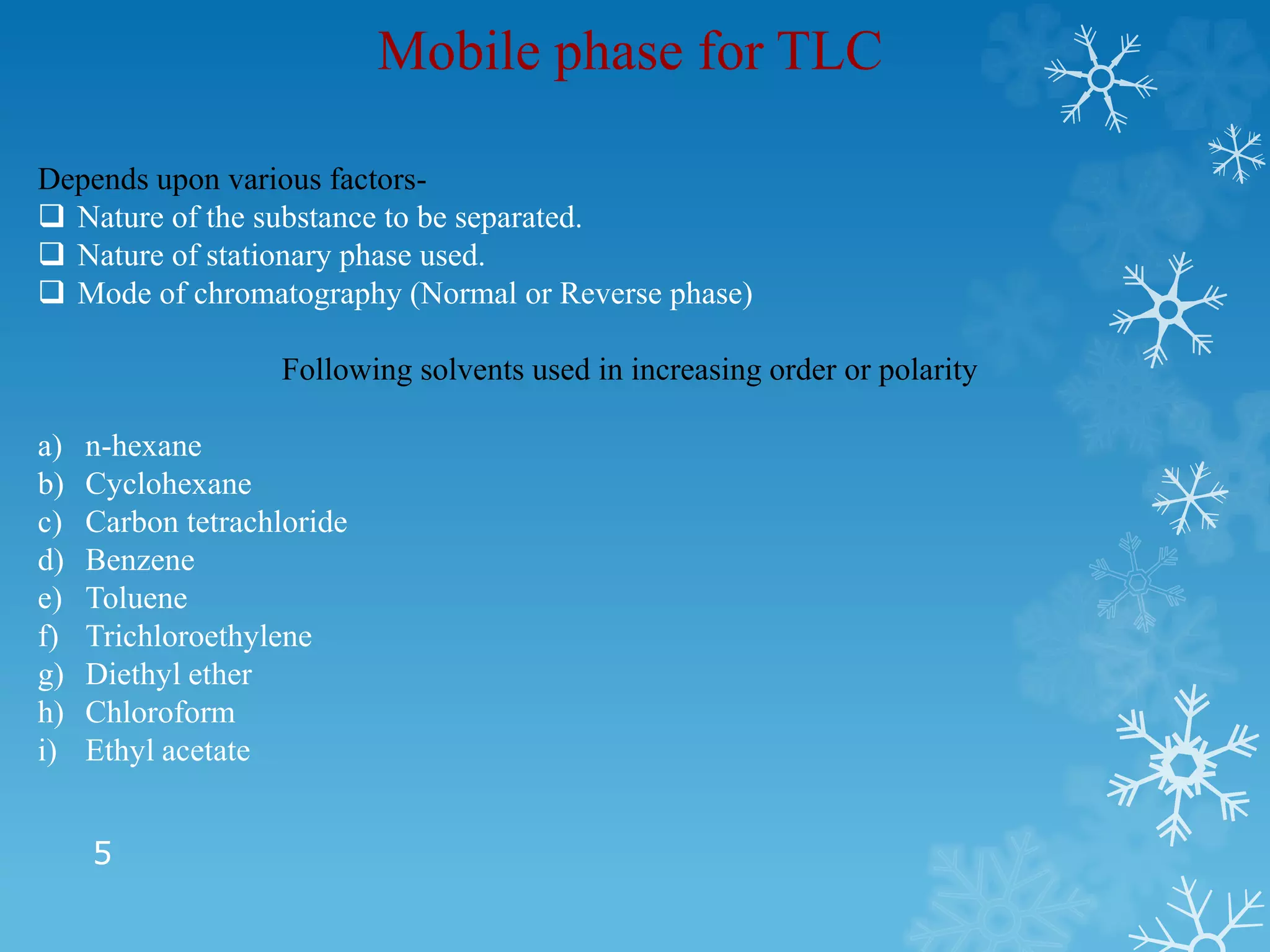
Mobile phase forTLC
Depends upon various factors-
Nature of the substance to be separated.
Nature of stationary phase used.
Mode of chromatography (Normal or Reverse phase)
Following solvents used in increasing order or polarity
a) n-hexane
b) Cyclohexane
c) Carbon tetrachloride
d) Benzene
e) Toluene
f) Trichloroethylene
g) Diethyl ether
h) Chloroform
i) Ethyl acetate
6.
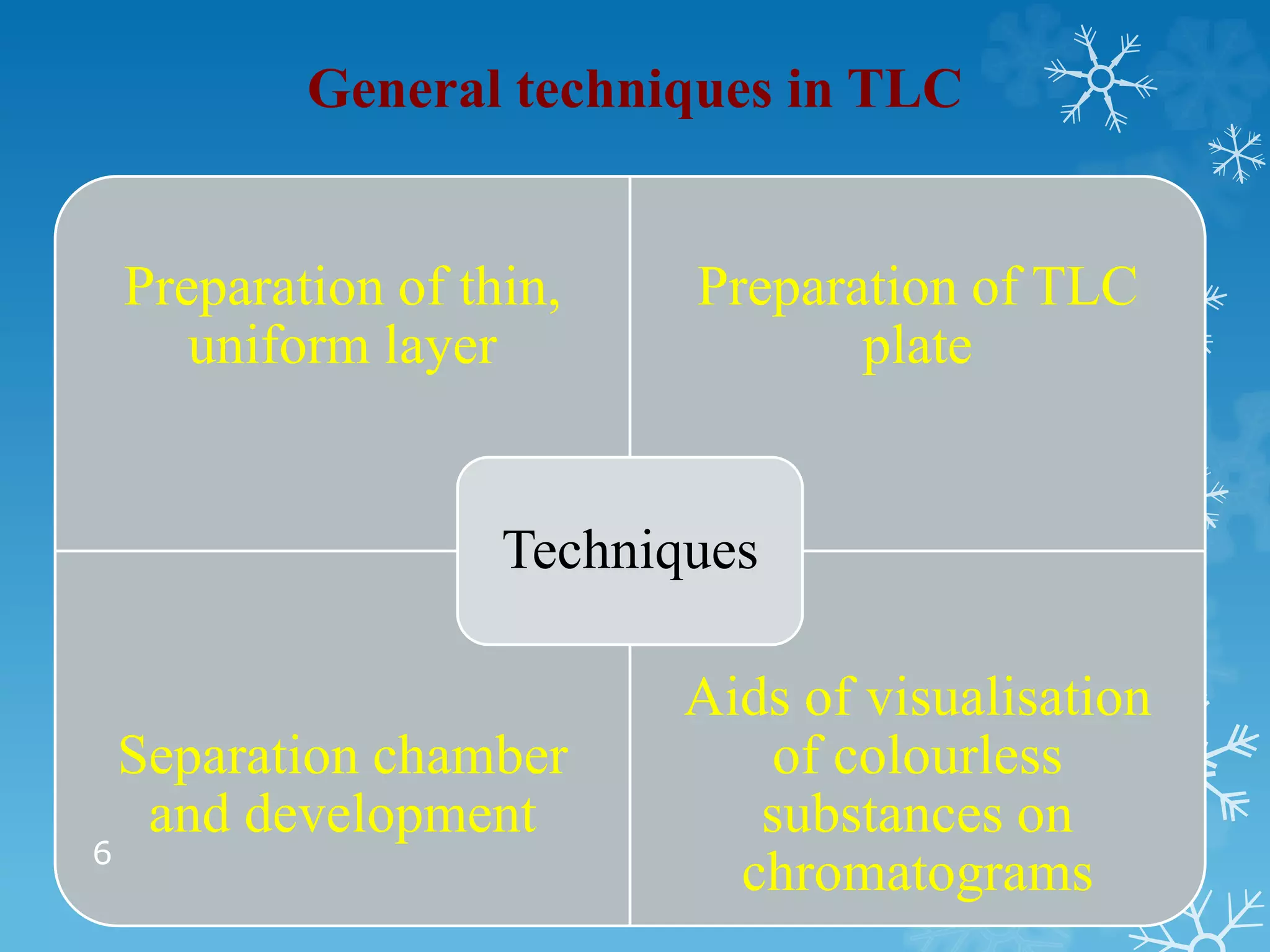
General techniques inTLC
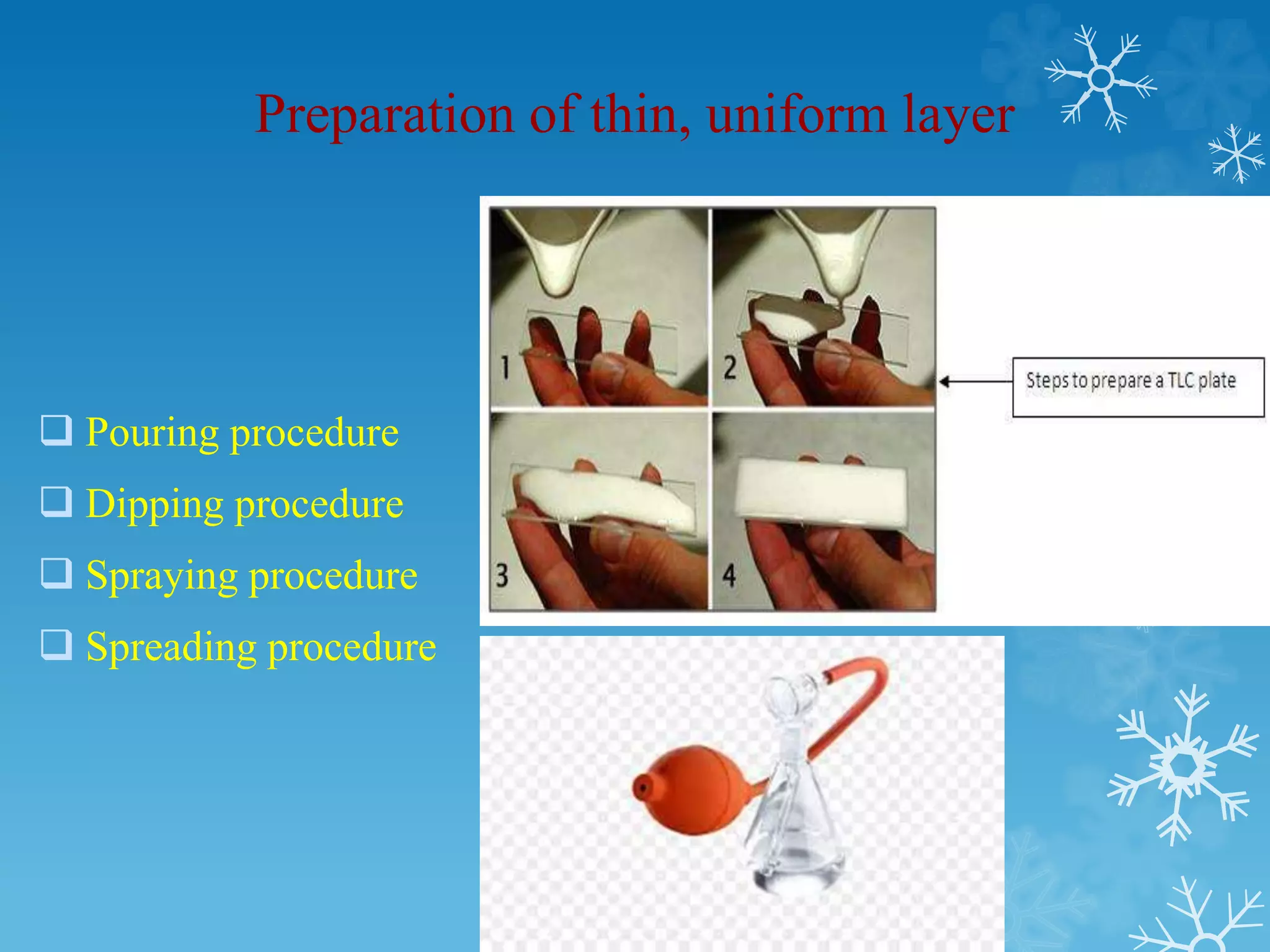
Preparation of thin,
uniform layer
Preparation of TLC
plate
Separation chamber
and development
Aids of visualisation
of colourless
substances on
chromatograms
Techniques
6
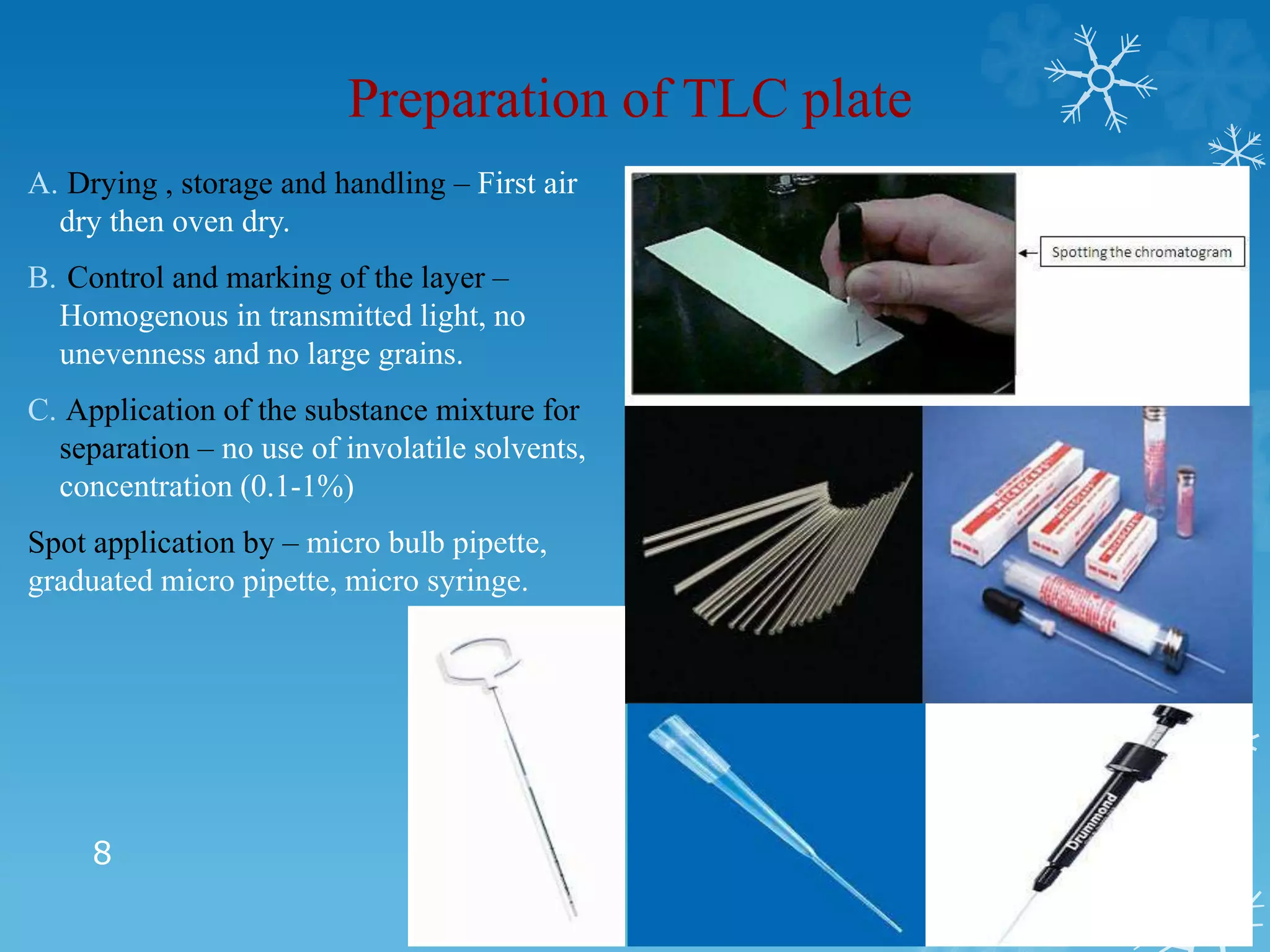
Preparation of TLCplate
A. Drying , storage and handling – First air
dry then oven dry.
B. Control and marking of the layer –
Homogenous in transmitted light, no
unevenness and no large grains.
C. Application of the substance mixture for
separation – no use of involatile solvents,
concentration (0.1-1%)
Spot application by – micro bulb pipette,
graduated micro pipette, micro syringe.
8
9.
Separation chamber anddevelopment
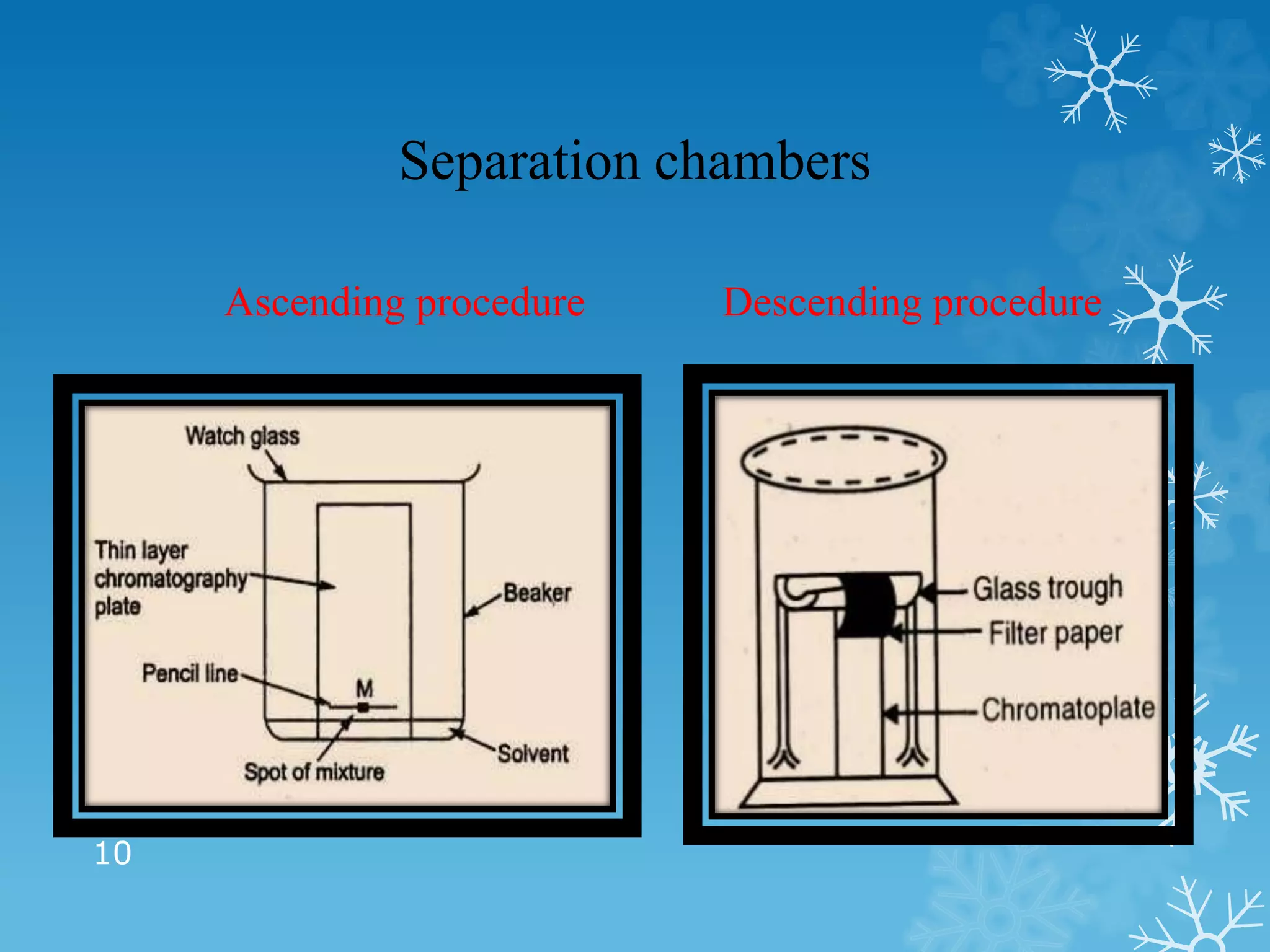
Types of chambers used are classified according to the
nature of the development.
Ascending development
Descending development
Horizontal development
Thin-Layer electrophoresis
9
Aids for visualisationof colourless
substance on chromatogram
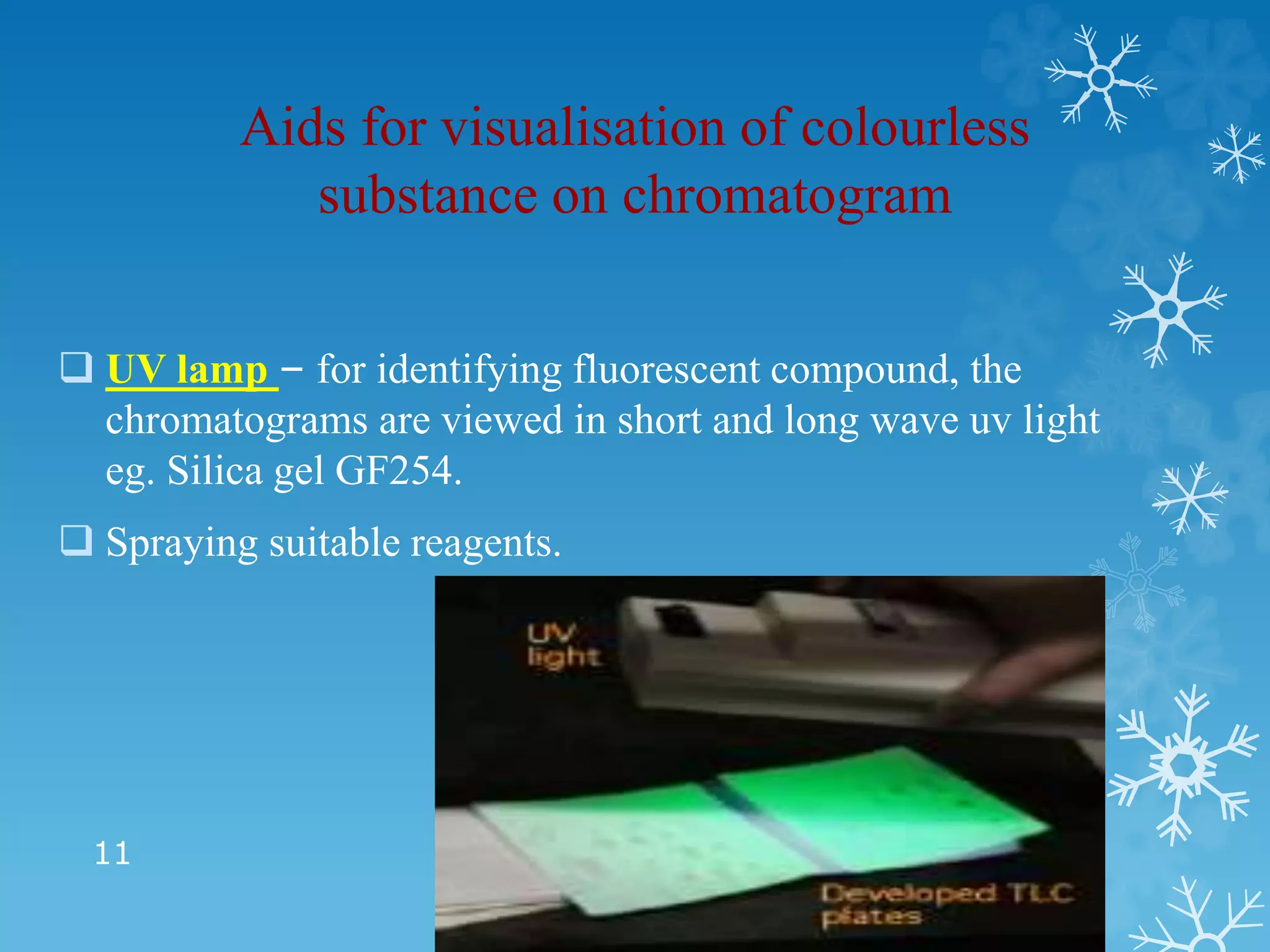
UV lamp – for identifying fluorescent compound, the
chromatograms are viewed in short and long wave uv light
eg. Silica gel GF254.
Spraying suitable reagents.
11
12.
Analysis of spot
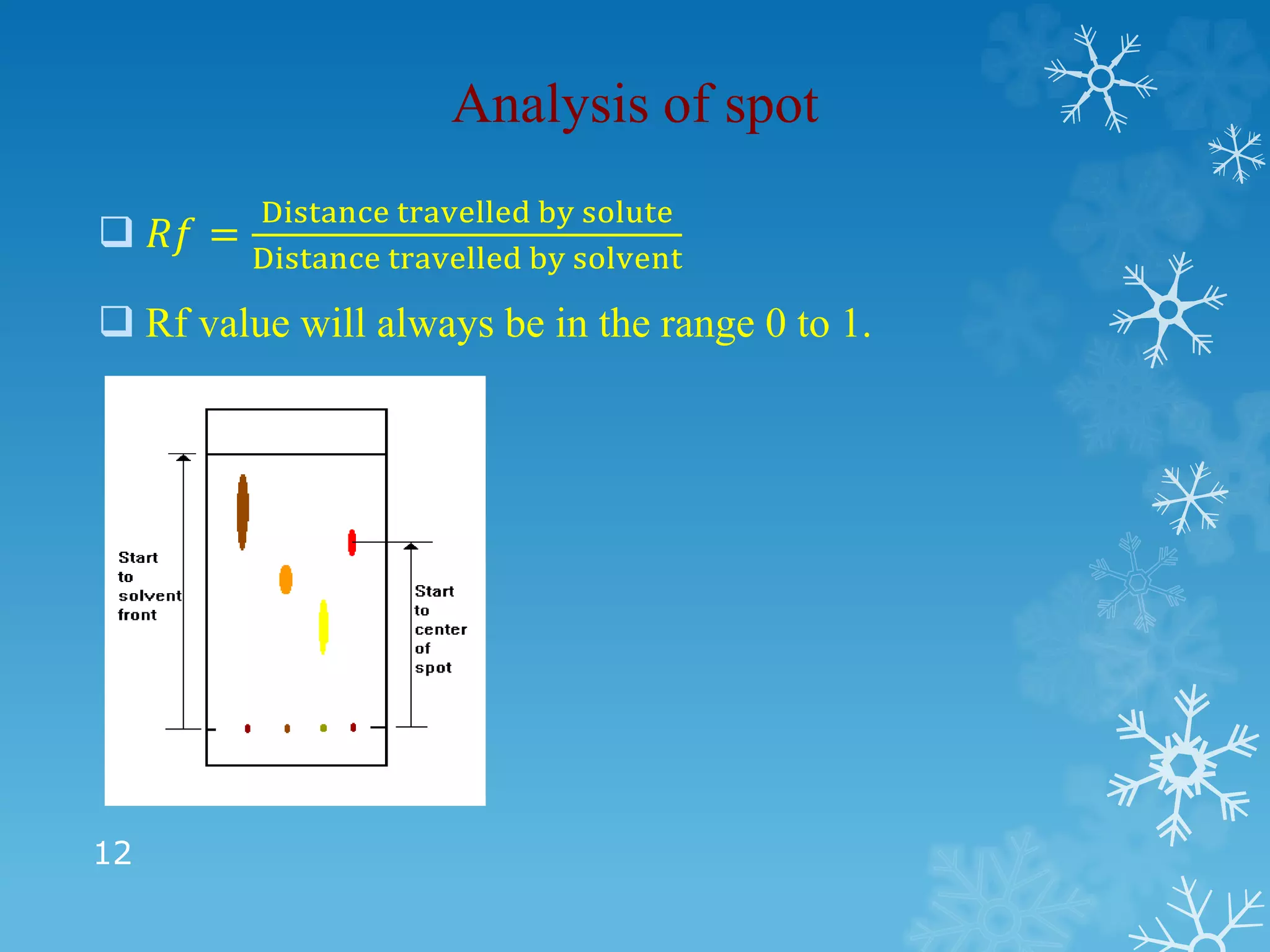
𝑅𝑓 =
Distance travelled by solute
Distance travelled by solvent
Rf value will always be in the range 0 to 1.
12
13.
Standard conditions inTLC [ As per I.P.]
Dimension of the layer – 200×200 mm for analytical purpose, 100×200 mm
for preliminary purpose, 400×200 mm for serial analysis.
Layer thickness – 2 mm for preparative TLC, 150 μm for analytical separation.
Drying of layer – Allow the coated plate to air dry, heat at 100-105 ֗C for at
least 1 hour.
Storage – plate must protect from laboratory fumes, store in dry condition.
Starting point – 15 mm from lower edge, 15 mm between neighbouring points.
Length of run – normally 100 mm i.e. from starting point to front.
Chamber – with plane, ground glass cover with chamber saturation.
Depth of immersion of layer – plate and the layer should dip only about 5 mm
into the solvent.
13
14.
Advantages of TLC
It is simple and fast procedure for all kinds of solid-liquid and liquid-liquid sample.
TLC can be performed on analytical and preparative scale.
It may be applied to almost the entire spectrum and chemical compounds.
It can be employed for checking the chemical reaction in laboratory and synthesis in
industrial scale.
TLC can be used for identifying the adulteration of food as well as decomposition of
food.
Compound in trace amount can be detect by TLC.
Requires less amount of substances.
Less time consuming and take 15-45 minutes for developments.
Even strong acids can be sprayed on plates.
For many separation TLC plate is heated in oven for several hours.
In TLC even corrosive reagent may be coated in plates.
14
15.
Disadvantages
The separationtakes place in an open system or in open condition and hence there
are chances that sample may be affected by the humidity and temperature.
This method is used for the separation of non volatile compounds.
More amount of mobile phase is required.
Edge effect occur due to improper saturation of chamber.
Application
Purity of any sample.
Identification of compounds.
Examination of reactions.
Biochemical analysis.
In chemistry.
In pharmaceutical industry.
In food and cosmetic industry.
15
16.
References
Stahl E., “Thin-Layer Chromatography, A Laboratory Handbook”, 2nd edition,
2005, published by- Springer, Heidelberg, page no- 6,23,27,29-32,52,60-87.
Beckett A.H. , Stenlake J.B. , “Practical Pharmaceutical Chemistry”, 4th edition,
Part- 2, 2001, Published by- CBS Publishers and Distributors, New Delhi, Page
no- 85,116,120,121.
Indian Pharmacopoeia, “Government of India Ministry of Health and Family
Welfare,” 7th edition, Volume- I, 2014, Published by- Indian Pharmacopoeia
Commission, Ghaziabad, Page no- 160.
http://frndzzz.com/disadvantages-advantages-of-tlc
https://www.google.co.in/search?q=disadvantages+of+thin+layer+chromatography
http://www.pharmastuff4u.com/2012/12/applications-of-thin-layer-
chromatography-TLC.html
16