The Connection between Posttraumatic Stress Disorder
and Suicide
By Christopher L. Willis
2
Abstract- This current study is to present the relationship between post-traumatic stress disorder
and suicide among the United States Services Members and Veterans of the Iraq and Afghanistan
wars. This study has examined documents and research that has already been presented along
with new interviews with soldiers that have been diagnosed with post-traumatic stress disorder
after their services were concluded from their perspective military duties. This study will also
have a first person account of the authors’ struggles and the progression of posttraumatic stress
disorder including depression and anxiety. Currently the Department of Defense is dealing with a
rate of 11-20% of military members from Iraq and Afghanistan wars with posttraumatic stress
disorder and of that a rate of 22 service members will commit suicide per day. This number has
surpassed the amount of service members who have died in combat during both wars since the
start of war in Afghanistan in 2001. This is becoming an alarming issue amongst our nation’s
heroes and for that this research will give an insight of the issues that contribute to the
connection between posttraumatic stress disorder and suicide.
3
Introduction- Approximately 1.7 million United States’ Troops have been deployed since the
start of the Afghanistan and Iraq wars and of those Troops, approximately one third came from
our part time Military (National Guard & Reserve Units)[3]. Many of these Troops from the
United States will do more than one deployment to a combat zone in at least one of these
countries. With a RAND (a private non-government organization that studies the many effects of
the military members) study done in 2008 it was estimated that 300,000 United States Troops
met the criteria for posttraumatic stress disorder or depression which is about 18.5 percent of the
total troops deployed at that time [3]. This number may seem low in the bigger picture of the
amount of total Troops deployed, but if you take to in account that most of these Troops will
come home to some type of family or loved ones, this stress disorder can have a heavy effect on
those around the Service Members. Starting in April 2003 the Department of Defense started
requiring deployed Service Members to take a post deployment health assessment upon their
return. With the war in Afghanistan starting in 20001 there was a three year period where
deployed Service Members had no such assessment; they had no type of assessment and were
left to figure it out on their own. The idea of a post assessment was a start in figuring out how the
Department of Defense could help its returning Service Members, but what they didn’t take in to
account, was most of the posttraumatic symptoms didn’t come forward until later on down the
road once the Service Members were home for about three months. In response the Department
of Defense initiated a second assessment called (PDHRA) which was a reassessment about three
months after the first initial assessment. Once again many Service Members have fallen through
the cracks of the system [5]. Service Members dealing with the undiagnosed or diagnosed
symptoms with posttraumatic stress disorder are very unique and distinctive. Service members
with PTSD can go through a variety of issues such as, flashbacks, trouble sleeping or not
4
sleeping, anxiety, paranoia, numb in feelings, hopelessness, easily aroused, aggression, closed
off or sheltered from others, depression, fearless or unstoppable, and many more. Being able to
control and seek help for their symptoms is not as easy as it should be but never the less these
symptoms hinder our Service Members and when gone untreated can lead to bigger problems
including suicide. Our Service Members go off to fight in combat and hope to come home and
leave it behind them, but once they return they have another fight on their hands. In five
interviews done with Veterans from the Afghanistan and Iraq war it was discovered that even
though these Service Members were getting help from the Veterans Affairs they feel like they
are still fighting a constant battle and that the war was the easy part. The Service Members said
that fighting their own emotions back home is the challenging part. They referred to combat as
easy because they were numb while deployed to the combat zone and that the enemy was
someone else and not them. Is there a connection between posttraumatic stress disorder and
suicide, and are we doing enough to combat it and protect our Service Members? With suicide
on the rise in the military and averaging 22 death a day, it has become a hot topic among the
leaders in the ranks of all branches in the United States.
5
Literature Review: I will be reviewing the article “Mental Health Care for Iraq and Afghanistan
War Veterans." By Burnam, M. A., L. S. Meredith, T. Tanielian, and L. H. Jaycox. The mental
health of our returning Troops from the wars in Afghanistan and Iraq is a huge challenge because
of the unforeseen consequences of the dark side of war and its effects on the human physique. In
any war there is always trauma and cases of mental obstacles to overcome. The issues that have
come to the forefront besides the inadequate service of the Veterans Affairs is that there are
many Services Members that are not coming forward to receive help with their issues. Service
Members not coming in for treatment and assessments is not necessarily because they are
reluctant to do so but because they may not trust the system to take care of them. The Service
Members also have a silent code to suck up any and all injuries and drive on with the mission
without stopping.
There are many steps that need to be taken to elicit the proper care for the Troops
returning from combat. One of the steps involves our part time troops in the National Guard and
Reserve Units across the United State. The National Guard and Reservists upon returning from
their deployment can pay for continued health insurance with TRICARE. TRICARE is
affordable but it still comes at the cost of the Service Member to continue to receive benefits to
get help. About 74 percent of the activated part time Service Members return to their civilian
jobs and about 20 percent retire from the service. In either situation the Service Member has to
pay out of pocket [3]. This is just one example the author gives where it makes it harder for the
service member to get help. Making the Service Member pay for help after he or she serves her
country is an insult; then their benefits are reduced or limited. Although the Service Member
loses his or her benefits, if they may qualify for further benefits with an injury sustained from
combat or their services. The Services Member may receive up to 5 years of extended benefits to
6
correct that particular ailment. The only problem with getting that extra 5 years is that the burden
falls on the Service Member to prove it was service connected. The Service Member will have to
jump through hoops and endure an agonizing process to retain the benefits.
This article demonstrates that there is a serious disconnect and a baseline standard when
it comes to diagnosing and dealing with returning Service Members from combat in the Iraq and
Afghanistan wars. The authors describe the system in which diagnoses and treatments have an
unequal standard in placement of facilities to take care of our Service Members. On page four of
their article they state that most specialists concentrate on the urban areas and less on the rural
areas of the United States leaving many Service Members without adequate treatment [3]. Those
living in the rural areas now have the burden to travel to get the help they need. Some of these
Service Members will have to drive hours, in some cases, to receive their treatment leaving them
demoralized and discouraged. The constant traveling becomes grueling and takes a toll on the
Service Member, ultimately, it’s not worth it given the time and money spent to meet the
appointment. The other burden is if a Service Member misses any appointments they become
non-compliant and can be disqualified from their benefits. These strains on the Service Member
with an already melting pot of issues that they are combating makes the drive not worth it. Once
again the Service Member can only rely on themselves and have to go it alone and “suck it up”.
The Service Member is once again left on their own to combat their issues, which can have them
travel that slope of anguish. The Service Member may think they have no other option to stop the
pain that they are dealing with and the pain they cause others.
The authors Burnam, M. A., L. S. Meredith, T. Tanielian, and L. H. Jaycox stated in their
research "Military culture promotes pride in inner strength, self-reliance, toughness, and being
able to “shake it off” ailments or injuries.”[3] When a Service Member arrives to their
7
perspective basic training site when they enlist in to the military they go through many weeks of
extreme stress of physical and psychological pain. You are broken down and rebuilt from the
ground up; it is meant to push your body to its breaking point without breaking. This is supposed
to make you tough internally as well as externally. The whole idea of “suck it up” comes from
this very process. When you spend enough time sucking it up and driving on without coming
forward it has a tendency to stick with you long after your service is over [7]. With the head
strong mentality that was instilled in the Service Member from the start of their careers and the
unsaid code of “suck it up”, it can also be a hindrance of seeking help when a serious enough
issue arises such as posttraumatic stress disorder. It is completely clear that because of this, the
Service Members try to tough it out and go it alone. With posttraumatic stress disorder, going it
alone, and toughing it out mentality does not mix well for the survival of the Service Member.
Combating posttraumatic stress disorder without the proper tools and help is like sending a
Soldier to war without guns and the preparation to survive in combat. The Service Members
reluctance to seek help because of the chance of embarrassment of being seen as weak could
have them so deep and dark in to a hole and pushed up against a wall, it may lead to only way
out and that is suicide. Suicide becomes the means to the end of suffering and quitting the
constant struggle of combat back home.
This article gave a great insight on the services that are provided and the great deal of
work that the Service Members have to go through to get the proper care and assessments that
they need to get better. The authors do in my opinion a remarkable job showing the stresses and
the less than adequate facilities in certain areas. With a Service Member already combating their
posttraumatic stress disorder and now the added stress to fight harder because the burden has
been put on them instead of being taken care of when they return home from war, may cause a
8
point of breaking and then surrender to the battle. It is my opinion that this article has put forth
evidence in the connection between posttraumatic stress disorder and the added pressure that the
Service Member has to go through to survive in what may seem as an unappreciative
government that has left them in the wind.
The second research article I will be reviewing is Abigail C. Angkaw, Giao Q. Tran,
David A. F. Haaga. “Effects of training intensity on observers' ratings of anxiety, social skills,
and alcohol-specific coping skills” [1]. In this article the authors research the differences in how
clinicians rate a Veteran with posttraumatic stress disorder, anxiety, alcohol usage, coping skills,
and bias of the rater. When a Veteran goes to the Veterans Affairs to seek help they will meet
with a psychologist to be examined for any mental disorder. This is a crucial meeting to
determine what type of mental disorder the Veteran is suffering from, so they can adequately
treat them for any mental disorder. The Doctors use a rating scale as a tool in the assessment to
characterize the observed disorders, so they can properly diagnose a treatment. The rating
portion of the Doctor is vital to the assessment, which will depict the psychometric
characteristics of the veterans’ disorder.
The Authors found this process as a point in their research to determine if our veterans
were getting a proper ratings. This would in turn give them the adequate treatment they needed
to get better. Because the rating is vital to their treatment, it must be reliable to determine what
the course of action will be taken to treat the Veteran. The Authors examined the many types of
trainings and styles that the Doctors will undertake before they can rate a Veteran. Some of the
trainings are; rater error training and frame-of-reference, which are used to lower the error of
ratings. The Authors discovered that the Doctors will undergo some training but not what they
9
need to properly rate a Veteran, which leaves a lot of Veterans with inaccurate ratings and miss
diagnoses.
The Veterans Affairs will hire these Doctors to come in and evaluate Veterans and
determine their ratings and the proper care that they recommend. The problem with the rating
and the Doctors, is that they all come from different schools of thought and different types of
training. The Authors have determined in their research that all the Doctors will get some sort of
baseline training when they enter the system, but they are left to use their own bias and
interpretation of the training that was offered. The Doctors that come to work will not necessarily
get the same introduction training to work in the Veterans Affairs system. Training varies all
over the country and there is no particular standard to go by. The Authors determined this by
setting up a research study that had the participants evaluate and rate a subject with their own
skills and minimal standards. Then they would have the Doctors fully trained with all the courses
needed to meet the standards that has been set up. The results showed that those who were left
with basic skills and no real intense training had a greater error when it came to rating s subject.
Those who had received both trainings and a standard with an added Doctor to work with the
rating of the Veteran had a higher accuracy rate. The authors determined that the better the
training and standards in junction with multiple Doctors to rate an individual, showed the least
amount of errors.
This article was useful in that it shows the flawed system set up in the Veterans Affairs,
on how they diagnose service members with mental disorders or issues. The better the system
gets and the more everyone across the board is on the same page with the same training and
standards, the better off the service member is with an appropriate treatment.
10
Methods: It is my goal is to find a relationship between posttraumatic stress disorder and
suicide. I will utilize past and current research and articles that have already been presented in
the area of posttraumatic stress disorder. The research will present a comparison between
posttraumatic stress disorder and suicide. Because posttraumatic stress disorder has to be
diagnosed to be recognized we will have to assume those Service Members in this research that
are undiagnosed suffering from posttraumatic stress disorder are still relevant do to the fact
suicide is still present without an official diagnoses. Because of the complexity of this research I
will be using a two-step process. Step one is to review the research and articles that have already
been presented in this field in order to create a subtenant base of accurate and qualifying data.
The second step will be to utilize my own research and data to compare it against the past
research that has been done and used throughout my paper to determine an accurate and precise
depiction between the connection of posttraumatic stress disorder and suicide. I have chosen the
qualitative research methods along with correlation/regression analysis. I am using the
qualitative research method to uncover data that will prove or disprove my hypothesis in using
research that has already been presented. I will then be using the correlation/regression analysis
data and my own research to find a correlation between posttraumatic stress disorder and suicide
amongst our Service Members of Iraq and Afghanistan wars.
In my research it will contain a sample of five Service Members answering four specific
questions to be analyzed and used in my research. The four questions are designed to elicit first
person information, for the purpose to prove or disprove my hypothesis. The research subjects
11
were not offered any type of compensation or promises. The research subjects were all
volunteers and contributed the information at their own free will. The research subjects were at
the start of the interviews were only offered sources and outlets to help them with any
reoccurring traumas that may come up during the research process.
Data: Table 1. This study that was conducted by Stevens, Daniel and his colleagues [10] with
1,433 participants. The research compares the characteristics of trauma leading to posttraumatic
stress disorder in association to suicide. This shows the lifetime attempts and the traumatic
exposures across subgroups depicting the relationship between posttraumatic stress disorder and
suicide. The mean age of the participants was 39 at the time the interview was conducted. The
table also shows that out of all the participants, 402 of them have had an indication of prior
attempted suicide which is about (28%). In the study the table also shows that the majority of the
participants had, in fact, experienced at least one traumatic or life threatening event and about
14% had been diagnosed with posttraumatic stress disorder. It was clear that that woman had a
more likely chance of experiencing trauma and that there were was no big significant difference
in the educational levels. The one thing that did stand out in this table and the research is it
depicted that minorities were more likely to obtain posttraumatic stress disorder over others.
12
TABLE 1.
In another study done by Veterans and PTSD [11] with the RAND study found that out of
the 2.7 million Service members that served in Iraq and Afghanistan (20%) of them have
posttraumatic stress disorder. Most of the clinicians state that they believe that number is even
Characteristics
Noattempt
(n=179)
Attempt
(n=33)
Noattempt
(n=735)
Attempt
(n=281)
Noattempt
(n=117)
Attempt
(n=88)
Gender
Female 138(83) 27(17) 615(73) 229(27) 102(68) 75(42)
Male 41(87) 6(13) 120(70) 52(30) 15(54) 13(46)
Race
Minority 19(90) 2(10) 46(60) 28(40) 17(50) 14(50)
Non-Minority 160(80) 31(20) 689(73) 253(27) 100(57) 74(43)
Age
19-29 79(90) 9(10) 220(73) 84(27) 27(57) 20(43)
30-39 47(86) 7(14) 210(75) 72(25) 72(25) 25(54)
40-49 24(75) 8(25) 140(69) 64(31) 38(61) 24(39)
>50 29(76) 9(24) 165(73) 61(27) 31(62) 19(38)
Education
H.S.orless 18(82) 4(18) 61(67) 32(33) 8(47) 9(53)
College 96(86) 15(14) 360(68) 171(32) 66(58) 48(42)
Adv.Studies 65(82) 14(18) 314(80) 78(20) 42(58) 31(42)
*Abbreviation:PTSD,PosttraumaticStressDisorder
NoTraumaExposure
(n=212; 15%)
TraumaExposurewithout
PTSD(n=1016;71%) PTSD(n=205;14%)
n(%)
TABLE1.Lifetimesuicideattemptandtraumaticexposureacrosssubgroupsofthesamplepopulation
13
higher with all the unreported or mild cases. The report also states that the number of reported
posttraumatic stress disorder case is increasingly higher than any other conflict. In this study it is
reported that suicide rates are much higher than was initially thought with an average of 22
military/Veterans related suicides a day, that is about 5-8 thousand reported cases a year among
the ranks in the military/Veterans. The distribution of posttraumatic stress disorder throughout
the military are: Army (67%) of cases, Air force (9%), Navy (11%), Marines (13%), which can
be found in the (Congressional Research Service) [11]. Another study done by "Mental and
Physical Health Status and Alcohol and Drug Use Following Return from Deployment to Iraq or
Afghanistan." Susan V. Eisen, PhD, in a research study that was done with 600 Service Members
with posttraumatic stress disorder showed a substantive amount of alcohol abuse. The percent of
Service Members that reported that they have a problem with abusing alcohol was 39% and drug
use was 3%. Also within that study it was reported that major depression was an issue. In a
recent study of 460,000 Veterans of the Afghanistan and Iraq war [13] reported a significant
increase in suicide among Veterans with a posttraumatic stress disorder with a mortality rate of
1.33 and those who were under the care of the Veterans Affairs were 1.77 which is a slight
increase because of the troop serge and the amount of increased traumas from war.
14
TABLE 2.
*providedby Department ofVeterans Affairs Suicide Date report 2012
15
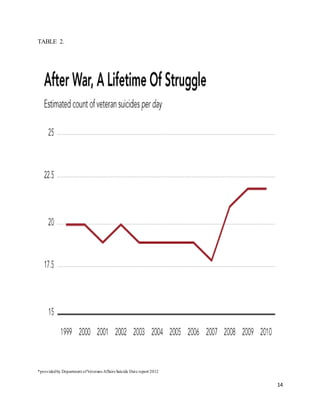
This table was taken from a report done By the Department of Veterans Affairs [12]
showing the alarming rate of suicides among Veterans. The Graph shows that between the start
of the war in Afghanistan in 2001 with a minor spike in 2002 pretty much remained steady until
2008 when the major surges happened in Iraq. From 2008 and on the rise of suicides among
Veterans rose at an alarming rate. The graph also shows that suicide amongst Veterans after their
services has been completed has a major toll on a person’s psyche. Although this is only an
estimate it is clear that in the height of the two wars in Iraq and Afghanistan the rate of suicide
rose and the amount of diagnoses of posttraumatic stress order also increased. There was also a
minor dip in the suicide rate in 2007. This could be explained due to the amount of troops
deployed to the combat zones and very few were left here in the United States to dwell on their
traumas and stresses. While in combat the service members are numb to emotions and stress
because they are not sitting around to feel and think about all that they have scene. It didn’t go
back up until the troops in 2008 started to return from their rotations from the initial surge.
16
TABLE 3.
Table 3. Is a graph provided by the Department of Veterans Affairs From 2002 to 2008, it
shows suicides per 100,000 Veterans who were enrolled in the VA Health Care. [12]. The data
shows that there is a major gap between female Veterans and male Veterans. The reason that
there is a gap between male and female Veterans is because of the roles that each sexes plays in
the war efforts. Traditionally women were not allowed on the front lines of the fighting, women
17
were assigned in a more supportive roll, such as Military Police, Engineers, Administration, and
other rolls. To be fair to their services and not discredit them and their roll which were crucial to
the success of the mission, they experienced trauma as well. As the wars dragged on we
witnessed more and more females fighting on the front lines, but this wasn’t prevalent until later
in the war. The most alarming part is all these Service Members were in the care of the Veterans
Affairs seeking help. This is truly alarming.
There are many Service Members that are left in the wind when they come back from
their perspective tours in Iraq and Afghanistan. The Veterans that carry the weight of
posttraumatic stress disorder from serious combat incidences after serving in Iraq or
Afghanistan. In the RAND study only about half of those who tested positive and met the criteria
for posttraumatic stress disorder or depression received or sought care in their mental health
disorder from the inflicted traumas in the wars in Iraq and Afghanistan. Then less than half of
those who received the treatment got adequate or proper help from their perspective clinics or
treatment centers. In the RAND study those with mental health problems with no treatment were
8.8%, those with no mental health problems were 81.5%, those with mental health problems with
any treatment were 4.1%, and those with mental health problems had minimally adequate
treatment were 5.6%. The facilities in lower priority statuses are most likely to deter the Veteran
because of the inadequate services and treatment that they provide. Getting some treatment is
better than none, but because the Veteran has to deal with their own issues the last thing they
want to deal with is the stress from inadequate treatment. Because of the inadequate services the
stress of the Veterans increases and can only compound the issue of not seeking help [3].
Emotional hiding of is a constant struggle that is hard to cope with. In a study that was
done by Daux, Jeanne in a sample of 400 Veterans with posttraumatic stress disorder, they were
18
less likely to share their emotions about their traumatic events. The study also determined that
the less the Veteran ignores and hides their emotions from social support groups and people the
more likely their posttraumatic stress disorder will get worse and overcome them. The study
showed that disclosing a traumatic event is more likely to help heal the wounds of combat and
their posttraumatic stress disorder. The research also concluded that combat exposure and the
stress of deployments increases the chance of posttraumatic stress disorder, depression,
substance abuse, and impairments in functioning in society. The withdrawal from social
encounters and support are directly symptoms from posttraumatic stress disorder [4].
In a study done by Hannold, Elizabeth depicting the issues with Veterans and driving
after their combat deployments. In the authors research it shows that after a Veteran returns
home after a deployment there chances of vehicular accidents rises by 13%. The study also
shows that Veterans returning have issues adjusting back home when it comes to driving because
of the tactical mind set of combat driving. Some of the terms that describe Veterans and driving
are aggressive, rage, hyper alert, and disregard for others. Driving triggers that make the Veteran
anxious are big trucks, crowds, highway traffic, driving small vehicles, loud or distracting noises,
driving in the dark, getting lost, and being in the rain. The research also determined that stress
and anxiety in Veterans hinders and impairs their driving which speaks to the increased vehicle
accidents upon returning from combat [5].
I conducted a study involving 5 independent Veterans answering a serious of questions in
their experience with posttraumatic stress disorder in conjunction with suicide. The series of
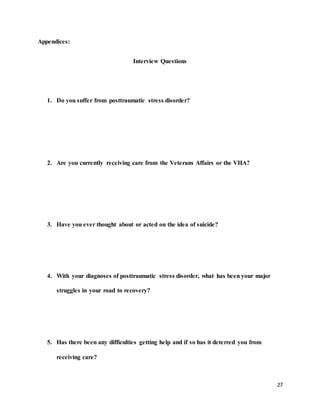
questions are asked with an open-ended answer for the Veteran. There are five questions: 1. Do
you suffer from posttraumatic stress disorder? 2. Are you currently receiving care from the
Veterans Affairs or the VHA? 3. Have you ever thought about or acted on the idea of suicide?
19
4. With your diagnoses of posttraumatic stress disorder, what has been your major struggles in
your road to recovery? 5. Has there been any difficulties getting help and if so has it deterred you
from receiving care? In the study all five (100%) Veterans interviewed have been diagnosed
with posttraumatic stress disorder from the Veterans Affairs. The five (100%) Veterans said they
are currently receiving benefits of some sort from the Veterans Affairs. 3 of the 5 (60%)
admitted to struggling with the concept of suicide to end the pain but only entertained the idea
and never acted on it, 1 out 5 (20%) admitted to actually attempting suicide to become free from
their pain and to ease the pain of their loved ones because they felt as if they were a burden to
their family, and 1 out of 5 (20%) admitted to never thinking about the idea of suicide. 2 out 5
(40%) mentioned that one of their major struggles was trying to feel normal and or to forget
about their particular trauma. 1 out of 5 (20%) said that one of their biggest struggles was being
able to be around large groups of people and socializing. 1 out 5 (20%) said that their major
struggle was caring and feeling for others, they mention that they had not emotional connection
towards loved ones. 1 out of 5 (20%) said that their major struggle was leaving the service where
they felt like they were understood. 5 out of 5 (100%) said that they have had some sort of
difficulties in dealing with the Veterans of Affairs in getting proper care. One of the Veterans
said that it had taken them almost a year to get services from the Veterans Affairs after constant
battles over paperwork and evidence of an existing mental condition from combat. Another
Veteran admitted to just giving up because of the treatment by the employees at the facilities that
they receive care from. One of the Veterans said that the stress of trying to get care was
unbelievably difficult and that it added to their anxiety leaving them disenfranchised with the
system that was supposed to help them. One of the Veterans described their efforts to get help as
debilitating and deflating. One of the Veterans interviewed said that their posttraumatic stress
20
disorder is so bad that they have to take a candy store of drugs that are prescribed to them and all
the drugs that they have to take leaves them laying on their couch like a vegetable. The Veteran
also is fearful in the amount of prescribed drugs they have to take. This Veteran also stated that
he was told by his health care providers that if he didn’t take the prescribed drugs he could be
found non-compliant and could lose all his benefits. The last comment that was made about the
services that they were trying to receive from the Veterans Affairs was that they were treated as
if they were just another name on a piece of paper and were not treated like a person or human
being.
Analysis: This research is to determine the connection between posttraumatic stress
disorder and suicide. I will be analyzing the data used for this research to prove my hypothesis
that there is a connection. It is hard to fathom that our Veterans go to war in many cases multiple
deployments only to be discarded when their services were rendered. The connection between
posttraumatic stress disorder and suicide may not have a direct line to one another, but it is clear
that there are issues that contribute to suicide in conjunction with posttraumatic stress disorder.
It is clear that no matter who you are or where you are from posttraumatic stress disorder can
affect anyone. It doesn’t matter your education level or where you are from the only thing that
matters is that a traumatic event can haunt the mind and psyche of our Veterans. In Stevens,
Daniel’s research he shows that those dealing with posttraumatic stress disorder have a more
likely chance of committing suicide than a normal person without any major traumatic
incident[10]. Posttraumatic stress disorder is a struggle with the will of the mind to overcome an
event so traumatic that in itself could be life or death. This was prevalent in Stevens, Denial’s
research where he discovered that in his research of 1,433 participants with posttraumatic stress
disorder, 402 (28%) of them had signs of attempting suicide more than once. This is evidence
21
that the connection between suicide and posttraumatic stress disorder are strongly tied together.
If more than a quarter of his study had signs of multiple attempts at committing suicide shows
that there is an alarming issue. The issue remains what is being done about suicide and if more
than a quarter of the participants have attempted it more than once?
The wars are dying down with Iraq finished and Afghanistan winding down, what are we
going to do with the Veterans who have experienced major traumatic combat issues? More than
2.7 million Service Members have been deployed to Iraq and Afghanistan and 20% of them have
been diagnosed with posttraumatic stress disorder. These two wars have seen more diagnosed
psychiatric disorders than any other previous conflicts. Yet our health services for our Veterans
are not prepared for the amount of said mental health issues. Clinicians have stated that they
believe that the number of Veterans with posttraumatic stress disorder is a lot higher than
reported because of those who continue to live without getting help. It seems to me with an
average of about 22 suicides a day in the military/Veterans the government isn’t doing enough to
get these Veterans the rightful services that they deserve and need to not find themselves
amongst a growing number of suicides. It is obvious why we see the highest number of case of
posttraumatic stress disorder in the ranks of the Army (67%). The Army is a larger force and has
sent many more Soldiers over to Iraq and Afghanistan. The deployment time is on average
greater than all the other services. It is not because one service is weaker or stronger than the
other, it is solely do to the amount of Troops that are sent overseas in their perspective branch of
service. The data shows that 39% of those that were diagnosed with posttraumatic stress disorder
have a problem with alcohol. Alcohol impairs the judgment and causes depression if not already
set in by their posttraumatic stress disorder. Depression can lead to other mental disorders and
possibly suicide. It is no wonder that 5-8 thousand Veterans die each year from suicide. What is
22
more disturbing is that in a recent study of 460,000 Veterans with posttraumatic stress disorder
the study discovered that it had a mortality rate of 1.33 from suicide and it was even higher with
those under the care of the Veterans Affairs. The suicide rate was higher than those who were
either reluctant to seek ok services or couldn’t deal with the added stress of applying.
It was clear in TABLE 2. That the report shows that in the height of the wars in 2008 we
witnessed more Veterans reporting mental health issues. At the same time the cases of suicides
began to rise in unpresented rate. It wasn’t until 2008 where the struggles of war back home
became a real issue. Around the same time as the increased rise of suicides was the same point
that the United States up the amount of Troops deployed to Iraq for surges to dispense the
country of insurgents and gain ground for a legitimate government in Iraq. The struggles of war
and the constant horrific daily images of war. These images of war even after the veteran leaves
the service sticks with them and makes it hard to leave combat in their minds and causes them to
lose a part of themselves. This is evidence that posttraumatic stress disorder is not just a name
but a serious issue.
In TABLE 3. The graph it shows that for every 100,000 Veterans 43 males commit
suicide and 6 females as well. The 43 and 6 Veterans out of the 100,000 were in the care of the
Veterans Affairs. This just another example of research coming to the conclusion that the
Veterans Affairs is not equipped to adequately care for Veterans. It is hard enough for the
Veterans with posttraumatic stress disorder to relive their trauma everyday but then to rely on a
system to care for you that just lets you down and adds on to your stress is an injustice to the
services that the Veterans provided for the vary country that they fought for.
23
The RAND study told us that of those who met the criteria and tested positive for
posttraumatic stress disorder or depression only half of them sought help from the Veterans
Affairs. Of those who sought help half of them received inadequate treatment for their traumas of
war. The RAND study produced an extreme issue of coverage for those who have met the
criteria for posttraumatic stress disorder. The second highest stat in conjunction with the study on
mental health problems was Veterans that tested positive didn’t receive assistance with their
posttraumatic stress disorder. The third highest stat was that those who met the criteria received
help and it was minimal and less then acceptable services.
Veterans coming back from combat have a tendency to withdraw and hide their emotions
when talking about their experiences form their deployment. Veterans with posttraumatic stress
disorder are more likely not able to associate with society. Veterans feel as if people don’t
understand them and don’t know what they are going through because of their traumatic event
experienced in combat. Other issues such as alcohol, and drugs are disabling products of the
need not to feel and forget. This makes it harder to gain any sort of control to seek help. All these
vices do is disable the Veteran to a point of hopelessness. Seeking help through the Veterans
Affairs or some type of community outreach program can help in the recovery of posttraumatic
stress disorder and lift the heavy weight they carry. Veterans are reluctant to trust anyone outside
of their units and friends in the military because of the bond they build on deployment. Trust is a
priceless value that Veterans don’t give out and because of that it makes it harder for them to
seek help and share their story with others.
Aggression and driving is just one major issue because Veterans are 13% [5] more likely
to get in an accident when returning home from war. Veterans have a hard time assimilating back
to society and what is real and what is just in their head from war. There are many stories of
24
Veterans driving aggressively because in the combat zone the military owns the road and all
traffic basis themselves off of them. Veterans fear the debris on the side of the road because of
all the roadside bombs and the vehicle born improvised explosive devices. Those images and
memories of staying on guard and driving to stay alive, requires the Veteran to remain aggressive
and constantly scan the road. Vehicular deaths are high in the military because of these issues of
returning Veterans from war. Veterans within this study stated that they do not like driving long
distance because it means more time on the road. This is just another example of posttraumatic
stress disorder controlling the lives of the Veterans and how they try to integrate back to society.
In my research 60% of the Veterans with posttraumatic stress disorder that I interviewed
said that they thought about the idea of suicide. There is an issue with suicide and its seriousness,
just the fact that they thought about it tells me that they are hurting in their struggles and they are
not getting the care they need. When someone is thinking about suicide whether they do it or not
shows that the suffering that this disorder brings is very painful. Other findings in the interview
revealed that 20% of the Veterans attempted suicide which falls in the range of the national
average of Veterans with posttraumatic stress disorder. Is this compelling evidence or is it a
coincidence? All the Veterans interviewed in this research admitted to issues with the Veterans
Affairs. The issues varied but they all were unhappy with the services that they received. One
Veteran stated that it was disabling and deflating. This interview only confirms that the
institutions that are supposed to but only make it harder for the Veteran to overcome his or her
mental illnesses. How can a Veteran control their Posttraumatic stress disorder when they have
deal with the stress when seeking help and feeling as if they are not cared about? This is just
another reason why we lose Veterans from seeking help. Veterans just can’t trust the system to
25
help them adequately. The reluctance to seek help is not on the Veteran it is due to the fact that
one less stress is better for them even if there is tools that are offered to help them get better.
Discussion: Veterans with posttraumatic stress disorder have a heavy weight that they carry
around with them every day. The weight seems to never get lighter and continues to pull them
down. Veterans from the Iraq and Afghanistan wars continue to fight as they did in combat to
truly come back even when they are sitting in their own living room. I would ask, is there a
connection between posttraumatic stress disorder and suicide? This research was done to prove
that there is a connection between the two. The other question was is there enough being done by
the measures set up supply proper care for our Veterans with posttraumatic stress disorder?
With my 16 years of experience as a Soldier in the Army and as a Veteran who
understands the struggles of Anxiety because of my services rendered for the Army in the
combat zone of Iraq and Afghanistan, I feel that in this research I have painted a picture of clear
concise research to prove that posttraumatic stress disorder provides the path to suicide. I have
witnessed to many Veterans take their own live because they could not fight anymore and they
just wanted peace in their lives. It is hard to fathom that taking your only is the solution to peace
but remember the heavy weight that the Veterans with posttraumatic stress disorder have to
carry. When you sign in to an organization you expect that just like any job if you get hurt during
work you would be taken care of. This is just not the case, the government is doing what it can to
protect our Veterans but there are so many disabled Veterans returning from war. There are not
enough properly trained clinicians available for each Veteran. The short of clinics and staff
depicts a sign that Veterans will have to take on another fight on top of the one that they are
26
combating already. When we are losing an estimated 22 Veterans a day to suicide is
discouraging and heart felt because there is never a true answer to why this happened. Many
Veterans leave the United States physically and mentally normal and loving before they enter the
combat zone only to return feeling distant. The onset of the symptoms do not come to fruition
until about six months after returning. We must except that there is not enough being done for or
Veterans as they are falling between the cracks of the system and that the connection between
posttraumatic stress disorder and suicide. The levels of stress and weight that the Veterans have
to carry will eventually take them down unless they receive proper and adequate care.
27
Appendices:
Interview Questions
1. Do you suffer from posttraumatic stress disorder?
2. Are you currently receiving care from the Veterans Affairs or the VHA?
3. Have you ever thought about or acted on the idea of suicide?
4. With your diagnoses of posttraumatic stress disorder, what has been your major
struggles in your road to recovery?
5. Has there been any difficulties getting help and if so has it deterred you from
receiving care?
28
Consent Form
Military Members with PTSD
This research is beingconducted by Christopher L. Willis,Student at Western Connecticut State College. This study
is to determine the effects of PTSD. You will be asked how you feel about the care and or treatment and what your
struggles are currently in dealingwith. Your participation in this research isentirely voluntary. There are no
Statement of Benefits to Participant.The Statement Risks could be and not limited to, emotional thoughts in
revisitingthoughts and memories of your experience in and out of the military.The benefits to the interview could
help you by talkingaboutyour pastexperiences and learningaboutprograms that could help you if desired. Some
of the services that arereadily availablefor you are;
this interview will becompletely confidential,Only I Christopher L. Williswill knowthe true Identity of the subject.
I will changeall names of the subjects in my research to protect their true identity. I will havea coded number
system that will belocked away for research purposes of the subjects Identity.The Participants havethe rightto
stop their participation in theinterview at any time with the rightto have all information on the subjectdestroyed
or handed over to them. Any and all information collected from any subjectwill be locked in my safeand only I
Christopher L Williswill haveaccess.
The results will beused in the research as informational purposes to prove or disprovemy Hypothesis.
A copy of this consentform is availablefor your records.
If you have questions aboutthe study, you may contactme @ willis029@connect.wcsu.edu.
This research projecthas been reviewed and approved by the WCSU Institutional ReviewBoard. If you have
questions concerningthe rights of the subjects involved in research studies pleasecontactthe WCSU IRB Chair at
irb@wcsu.edu and mention Protocol # .
This study is valid until .
Before proceeding, you agree to the following:
- You must be 18 years of age or older.
- I have read and understand the above consent form and agree to participatein this study.
____________________________________ __________________
Signature Date
______________________________________
Printed Name
29
Bibliography
1. Abigail C. Angkaw, Giao Q. Tran, David A. F. Haaga. “Effects of training intensity on
observers' ratings of anxiety, social skills, and alcohol-specific coping skills”
Behav Res Ther. 2006 April; 44(4): 533–544. Published online 2005 June 6.
doi: 10.1016/j.brat.2005.04.002
2. Bossarte, Robert M., Cynthia A. Claassen, and Kerry L. Knox. "Evaluating Evidence of
Risk for Suicide Among Veterans." Military Medicine 175.10 (2010): 703-04. Web
3. Burnam, M. A., L. S. Meredith, T. Tanielian, and L. H. Jaycox. "Mental Health Care For
Iraq And Afghanistan War Veterans." Health Affairs 28.3 (2009): 771-82. Web.
4. Duax, Jeanne, M., et al. "Posttraumatic Stress Disorder Symptoms, Levels Of Social
Support, And Emotional Hiding In Returning Veterans." Journal Of Rehabilitation
Research & Development 51.4 (2014): 571-578.
5. Hannold, Elizabeth "Lisa" M., et al. "Exploratory Pilot Study Of Driving Perceptions
Among OIF/OEF Veterans With Mtbi And PTSD." Journal Of Rehabilitation Research
& Development 50.10 (2013): 1315-1330.
6. http://www.va.gov/budget/docs/summary/Fy2016-FastFactsVAsBudgetHighlights.pdf
7. Hoge, Charles W., Carl A. Castro, Stephen C. Messer, Dennis Mcgurk, Dave I. Cotting,
and Robert L. Koffman. "Combat Duty in Iraq and Afghanistan, Mental Health Problems,
and Barriers to Care." New England Journal of Medicine 351.1 (2004): 13-22. Web.
8. Jacobson, Louis. "Katrina Vanden Heuvel Says Congress Has 'slashed Funding for
Veterans' Benefits' in Recent Years." @politifact. N.p., 21 May 2014. Web.
30
9. Shiner, B, et al. "Access To VA Services For Returning Veterans With PTSD." Military
Medicine 177.7 (2012): 814-822.
10. Stevens, Daniel, et al. "Posttraumatic Stress Disorder Increases Risk For Suicide Attempt
In Adults With Recurrent Major Depression." Depression & Anxiety (1091-4269) 30.10
(2013): 940-946. Academic Search Premier. Web. 4 Mar. 2015.
11. http://www.orlandosentinel.com/news/opinion/os-ed-veterans-affairs-health-care-
080813-20130807,0,666522.story
12. http://www.va.gov/opa/docs/suicide-data-report-2012-final.pdf
13. “Veterans statistics: PTSD, Depression, TBI, Suicide.” Veterans and PTSD. February 14,
2015. Web. [month, day, year accessed.] www.veteransandptsd.com/PTSD-statistics.html

Thesis Paper

  • 1.
    The Connection betweenPosttraumatic Stress Disorder and Suicide By Christopher L. Willis
  • 2.
    2 Abstract- This currentstudy is to present the relationship between post-traumatic stress disorder and suicide among the United States Services Members and Veterans of the Iraq and Afghanistan wars. This study has examined documents and research that has already been presented along with new interviews with soldiers that have been diagnosed with post-traumatic stress disorder after their services were concluded from their perspective military duties. This study will also have a first person account of the authors’ struggles and the progression of posttraumatic stress disorder including depression and anxiety. Currently the Department of Defense is dealing with a rate of 11-20% of military members from Iraq and Afghanistan wars with posttraumatic stress disorder and of that a rate of 22 service members will commit suicide per day. This number has surpassed the amount of service members who have died in combat during both wars since the start of war in Afghanistan in 2001. This is becoming an alarming issue amongst our nation’s heroes and for that this research will give an insight of the issues that contribute to the connection between posttraumatic stress disorder and suicide.
  • 3.
    3 Introduction- Approximately 1.7million United States’ Troops have been deployed since the start of the Afghanistan and Iraq wars and of those Troops, approximately one third came from our part time Military (National Guard & Reserve Units)[3]. Many of these Troops from the United States will do more than one deployment to a combat zone in at least one of these countries. With a RAND (a private non-government organization that studies the many effects of the military members) study done in 2008 it was estimated that 300,000 United States Troops met the criteria for posttraumatic stress disorder or depression which is about 18.5 percent of the total troops deployed at that time [3]. This number may seem low in the bigger picture of the amount of total Troops deployed, but if you take to in account that most of these Troops will come home to some type of family or loved ones, this stress disorder can have a heavy effect on those around the Service Members. Starting in April 2003 the Department of Defense started requiring deployed Service Members to take a post deployment health assessment upon their return. With the war in Afghanistan starting in 20001 there was a three year period where deployed Service Members had no such assessment; they had no type of assessment and were left to figure it out on their own. The idea of a post assessment was a start in figuring out how the Department of Defense could help its returning Service Members, but what they didn’t take in to account, was most of the posttraumatic symptoms didn’t come forward until later on down the road once the Service Members were home for about three months. In response the Department of Defense initiated a second assessment called (PDHRA) which was a reassessment about three months after the first initial assessment. Once again many Service Members have fallen through the cracks of the system [5]. Service Members dealing with the undiagnosed or diagnosed symptoms with posttraumatic stress disorder are very unique and distinctive. Service members with PTSD can go through a variety of issues such as, flashbacks, trouble sleeping or not
  • 4.
    4 sleeping, anxiety, paranoia,numb in feelings, hopelessness, easily aroused, aggression, closed off or sheltered from others, depression, fearless or unstoppable, and many more. Being able to control and seek help for their symptoms is not as easy as it should be but never the less these symptoms hinder our Service Members and when gone untreated can lead to bigger problems including suicide. Our Service Members go off to fight in combat and hope to come home and leave it behind them, but once they return they have another fight on their hands. In five interviews done with Veterans from the Afghanistan and Iraq war it was discovered that even though these Service Members were getting help from the Veterans Affairs they feel like they are still fighting a constant battle and that the war was the easy part. The Service Members said that fighting their own emotions back home is the challenging part. They referred to combat as easy because they were numb while deployed to the combat zone and that the enemy was someone else and not them. Is there a connection between posttraumatic stress disorder and suicide, and are we doing enough to combat it and protect our Service Members? With suicide on the rise in the military and averaging 22 death a day, it has become a hot topic among the leaders in the ranks of all branches in the United States.
  • 5.
    5 Literature Review: Iwill be reviewing the article “Mental Health Care for Iraq and Afghanistan War Veterans." By Burnam, M. A., L. S. Meredith, T. Tanielian, and L. H. Jaycox. The mental health of our returning Troops from the wars in Afghanistan and Iraq is a huge challenge because of the unforeseen consequences of the dark side of war and its effects on the human physique. In any war there is always trauma and cases of mental obstacles to overcome. The issues that have come to the forefront besides the inadequate service of the Veterans Affairs is that there are many Services Members that are not coming forward to receive help with their issues. Service Members not coming in for treatment and assessments is not necessarily because they are reluctant to do so but because they may not trust the system to take care of them. The Service Members also have a silent code to suck up any and all injuries and drive on with the mission without stopping. There are many steps that need to be taken to elicit the proper care for the Troops returning from combat. One of the steps involves our part time troops in the National Guard and Reserve Units across the United State. The National Guard and Reservists upon returning from their deployment can pay for continued health insurance with TRICARE. TRICARE is affordable but it still comes at the cost of the Service Member to continue to receive benefits to get help. About 74 percent of the activated part time Service Members return to their civilian jobs and about 20 percent retire from the service. In either situation the Service Member has to pay out of pocket [3]. This is just one example the author gives where it makes it harder for the service member to get help. Making the Service Member pay for help after he or she serves her country is an insult; then their benefits are reduced or limited. Although the Service Member loses his or her benefits, if they may qualify for further benefits with an injury sustained from combat or their services. The Services Member may receive up to 5 years of extended benefits to
  • 6.
    6 correct that particularailment. The only problem with getting that extra 5 years is that the burden falls on the Service Member to prove it was service connected. The Service Member will have to jump through hoops and endure an agonizing process to retain the benefits. This article demonstrates that there is a serious disconnect and a baseline standard when it comes to diagnosing and dealing with returning Service Members from combat in the Iraq and Afghanistan wars. The authors describe the system in which diagnoses and treatments have an unequal standard in placement of facilities to take care of our Service Members. On page four of their article they state that most specialists concentrate on the urban areas and less on the rural areas of the United States leaving many Service Members without adequate treatment [3]. Those living in the rural areas now have the burden to travel to get the help they need. Some of these Service Members will have to drive hours, in some cases, to receive their treatment leaving them demoralized and discouraged. The constant traveling becomes grueling and takes a toll on the Service Member, ultimately, it’s not worth it given the time and money spent to meet the appointment. The other burden is if a Service Member misses any appointments they become non-compliant and can be disqualified from their benefits. These strains on the Service Member with an already melting pot of issues that they are combating makes the drive not worth it. Once again the Service Member can only rely on themselves and have to go it alone and “suck it up”. The Service Member is once again left on their own to combat their issues, which can have them travel that slope of anguish. The Service Member may think they have no other option to stop the pain that they are dealing with and the pain they cause others. The authors Burnam, M. A., L. S. Meredith, T. Tanielian, and L. H. Jaycox stated in their research "Military culture promotes pride in inner strength, self-reliance, toughness, and being able to “shake it off” ailments or injuries.”[3] When a Service Member arrives to their
  • 7.
    7 perspective basic trainingsite when they enlist in to the military they go through many weeks of extreme stress of physical and psychological pain. You are broken down and rebuilt from the ground up; it is meant to push your body to its breaking point without breaking. This is supposed to make you tough internally as well as externally. The whole idea of “suck it up” comes from this very process. When you spend enough time sucking it up and driving on without coming forward it has a tendency to stick with you long after your service is over [7]. With the head strong mentality that was instilled in the Service Member from the start of their careers and the unsaid code of “suck it up”, it can also be a hindrance of seeking help when a serious enough issue arises such as posttraumatic stress disorder. It is completely clear that because of this, the Service Members try to tough it out and go it alone. With posttraumatic stress disorder, going it alone, and toughing it out mentality does not mix well for the survival of the Service Member. Combating posttraumatic stress disorder without the proper tools and help is like sending a Soldier to war without guns and the preparation to survive in combat. The Service Members reluctance to seek help because of the chance of embarrassment of being seen as weak could have them so deep and dark in to a hole and pushed up against a wall, it may lead to only way out and that is suicide. Suicide becomes the means to the end of suffering and quitting the constant struggle of combat back home. This article gave a great insight on the services that are provided and the great deal of work that the Service Members have to go through to get the proper care and assessments that they need to get better. The authors do in my opinion a remarkable job showing the stresses and the less than adequate facilities in certain areas. With a Service Member already combating their posttraumatic stress disorder and now the added stress to fight harder because the burden has been put on them instead of being taken care of when they return home from war, may cause a
  • 8.
    8 point of breakingand then surrender to the battle. It is my opinion that this article has put forth evidence in the connection between posttraumatic stress disorder and the added pressure that the Service Member has to go through to survive in what may seem as an unappreciative government that has left them in the wind. The second research article I will be reviewing is Abigail C. Angkaw, Giao Q. Tran, David A. F. Haaga. “Effects of training intensity on observers' ratings of anxiety, social skills, and alcohol-specific coping skills” [1]. In this article the authors research the differences in how clinicians rate a Veteran with posttraumatic stress disorder, anxiety, alcohol usage, coping skills, and bias of the rater. When a Veteran goes to the Veterans Affairs to seek help they will meet with a psychologist to be examined for any mental disorder. This is a crucial meeting to determine what type of mental disorder the Veteran is suffering from, so they can adequately treat them for any mental disorder. The Doctors use a rating scale as a tool in the assessment to characterize the observed disorders, so they can properly diagnose a treatment. The rating portion of the Doctor is vital to the assessment, which will depict the psychometric characteristics of the veterans’ disorder. The Authors found this process as a point in their research to determine if our veterans were getting a proper ratings. This would in turn give them the adequate treatment they needed to get better. Because the rating is vital to their treatment, it must be reliable to determine what the course of action will be taken to treat the Veteran. The Authors examined the many types of trainings and styles that the Doctors will undertake before they can rate a Veteran. Some of the trainings are; rater error training and frame-of-reference, which are used to lower the error of ratings. The Authors discovered that the Doctors will undergo some training but not what they
  • 9.
    9 need to properlyrate a Veteran, which leaves a lot of Veterans with inaccurate ratings and miss diagnoses. The Veterans Affairs will hire these Doctors to come in and evaluate Veterans and determine their ratings and the proper care that they recommend. The problem with the rating and the Doctors, is that they all come from different schools of thought and different types of training. The Authors have determined in their research that all the Doctors will get some sort of baseline training when they enter the system, but they are left to use their own bias and interpretation of the training that was offered. The Doctors that come to work will not necessarily get the same introduction training to work in the Veterans Affairs system. Training varies all over the country and there is no particular standard to go by. The Authors determined this by setting up a research study that had the participants evaluate and rate a subject with their own skills and minimal standards. Then they would have the Doctors fully trained with all the courses needed to meet the standards that has been set up. The results showed that those who were left with basic skills and no real intense training had a greater error when it came to rating s subject. Those who had received both trainings and a standard with an added Doctor to work with the rating of the Veteran had a higher accuracy rate. The authors determined that the better the training and standards in junction with multiple Doctors to rate an individual, showed the least amount of errors. This article was useful in that it shows the flawed system set up in the Veterans Affairs, on how they diagnose service members with mental disorders or issues. The better the system gets and the more everyone across the board is on the same page with the same training and standards, the better off the service member is with an appropriate treatment.
  • 10.
    10 Methods: It ismy goal is to find a relationship between posttraumatic stress disorder and suicide. I will utilize past and current research and articles that have already been presented in the area of posttraumatic stress disorder. The research will present a comparison between posttraumatic stress disorder and suicide. Because posttraumatic stress disorder has to be diagnosed to be recognized we will have to assume those Service Members in this research that are undiagnosed suffering from posttraumatic stress disorder are still relevant do to the fact suicide is still present without an official diagnoses. Because of the complexity of this research I will be using a two-step process. Step one is to review the research and articles that have already been presented in this field in order to create a subtenant base of accurate and qualifying data. The second step will be to utilize my own research and data to compare it against the past research that has been done and used throughout my paper to determine an accurate and precise depiction between the connection of posttraumatic stress disorder and suicide. I have chosen the qualitative research methods along with correlation/regression analysis. I am using the qualitative research method to uncover data that will prove or disprove my hypothesis in using research that has already been presented. I will then be using the correlation/regression analysis data and my own research to find a correlation between posttraumatic stress disorder and suicide amongst our Service Members of Iraq and Afghanistan wars. In my research it will contain a sample of five Service Members answering four specific questions to be analyzed and used in my research. The four questions are designed to elicit first person information, for the purpose to prove or disprove my hypothesis. The research subjects
  • 11.
    11 were not offeredany type of compensation or promises. The research subjects were all volunteers and contributed the information at their own free will. The research subjects were at the start of the interviews were only offered sources and outlets to help them with any reoccurring traumas that may come up during the research process. Data: Table 1. This study that was conducted by Stevens, Daniel and his colleagues [10] with 1,433 participants. The research compares the characteristics of trauma leading to posttraumatic stress disorder in association to suicide. This shows the lifetime attempts and the traumatic exposures across subgroups depicting the relationship between posttraumatic stress disorder and suicide. The mean age of the participants was 39 at the time the interview was conducted. The table also shows that out of all the participants, 402 of them have had an indication of prior attempted suicide which is about (28%). In the study the table also shows that the majority of the participants had, in fact, experienced at least one traumatic or life threatening event and about 14% had been diagnosed with posttraumatic stress disorder. It was clear that that woman had a more likely chance of experiencing trauma and that there were was no big significant difference in the educational levels. The one thing that did stand out in this table and the research is it depicted that minorities were more likely to obtain posttraumatic stress disorder over others.
  • 12.
    12 TABLE 1. In anotherstudy done by Veterans and PTSD [11] with the RAND study found that out of the 2.7 million Service members that served in Iraq and Afghanistan (20%) of them have posttraumatic stress disorder. Most of the clinicians state that they believe that number is even Characteristics Noattempt (n=179) Attempt (n=33) Noattempt (n=735) Attempt (n=281) Noattempt (n=117) Attempt (n=88) Gender Female 138(83) 27(17) 615(73) 229(27) 102(68) 75(42) Male 41(87) 6(13) 120(70) 52(30) 15(54) 13(46) Race Minority 19(90) 2(10) 46(60) 28(40) 17(50) 14(50) Non-Minority 160(80) 31(20) 689(73) 253(27) 100(57) 74(43) Age 19-29 79(90) 9(10) 220(73) 84(27) 27(57) 20(43) 30-39 47(86) 7(14) 210(75) 72(25) 72(25) 25(54) 40-49 24(75) 8(25) 140(69) 64(31) 38(61) 24(39) >50 29(76) 9(24) 165(73) 61(27) 31(62) 19(38) Education H.S.orless 18(82) 4(18) 61(67) 32(33) 8(47) 9(53) College 96(86) 15(14) 360(68) 171(32) 66(58) 48(42) Adv.Studies 65(82) 14(18) 314(80) 78(20) 42(58) 31(42) *Abbreviation:PTSD,PosttraumaticStressDisorder NoTraumaExposure (n=212; 15%) TraumaExposurewithout PTSD(n=1016;71%) PTSD(n=205;14%) n(%) TABLE1.Lifetimesuicideattemptandtraumaticexposureacrosssubgroupsofthesamplepopulation
  • 13.
    13 higher with allthe unreported or mild cases. The report also states that the number of reported posttraumatic stress disorder case is increasingly higher than any other conflict. In this study it is reported that suicide rates are much higher than was initially thought with an average of 22 military/Veterans related suicides a day, that is about 5-8 thousand reported cases a year among the ranks in the military/Veterans. The distribution of posttraumatic stress disorder throughout the military are: Army (67%) of cases, Air force (9%), Navy (11%), Marines (13%), which can be found in the (Congressional Research Service) [11]. Another study done by "Mental and Physical Health Status and Alcohol and Drug Use Following Return from Deployment to Iraq or Afghanistan." Susan V. Eisen, PhD, in a research study that was done with 600 Service Members with posttraumatic stress disorder showed a substantive amount of alcohol abuse. The percent of Service Members that reported that they have a problem with abusing alcohol was 39% and drug use was 3%. Also within that study it was reported that major depression was an issue. In a recent study of 460,000 Veterans of the Afghanistan and Iraq war [13] reported a significant increase in suicide among Veterans with a posttraumatic stress disorder with a mortality rate of 1.33 and those who were under the care of the Veterans Affairs were 1.77 which is a slight increase because of the troop serge and the amount of increased traumas from war.
  • 14.
    14 TABLE 2. *providedby DepartmentofVeterans Affairs Suicide Date report 2012
  • 15.
    15 This table wastaken from a report done By the Department of Veterans Affairs [12] showing the alarming rate of suicides among Veterans. The Graph shows that between the start of the war in Afghanistan in 2001 with a minor spike in 2002 pretty much remained steady until 2008 when the major surges happened in Iraq. From 2008 and on the rise of suicides among Veterans rose at an alarming rate. The graph also shows that suicide amongst Veterans after their services has been completed has a major toll on a person’s psyche. Although this is only an estimate it is clear that in the height of the two wars in Iraq and Afghanistan the rate of suicide rose and the amount of diagnoses of posttraumatic stress order also increased. There was also a minor dip in the suicide rate in 2007. This could be explained due to the amount of troops deployed to the combat zones and very few were left here in the United States to dwell on their traumas and stresses. While in combat the service members are numb to emotions and stress because they are not sitting around to feel and think about all that they have scene. It didn’t go back up until the troops in 2008 started to return from their rotations from the initial surge.
  • 16.
    16 TABLE 3. Table 3.Is a graph provided by the Department of Veterans Affairs From 2002 to 2008, it shows suicides per 100,000 Veterans who were enrolled in the VA Health Care. [12]. The data shows that there is a major gap between female Veterans and male Veterans. The reason that there is a gap between male and female Veterans is because of the roles that each sexes plays in the war efforts. Traditionally women were not allowed on the front lines of the fighting, women
  • 17.
    17 were assigned ina more supportive roll, such as Military Police, Engineers, Administration, and other rolls. To be fair to their services and not discredit them and their roll which were crucial to the success of the mission, they experienced trauma as well. As the wars dragged on we witnessed more and more females fighting on the front lines, but this wasn’t prevalent until later in the war. The most alarming part is all these Service Members were in the care of the Veterans Affairs seeking help. This is truly alarming. There are many Service Members that are left in the wind when they come back from their perspective tours in Iraq and Afghanistan. The Veterans that carry the weight of posttraumatic stress disorder from serious combat incidences after serving in Iraq or Afghanistan. In the RAND study only about half of those who tested positive and met the criteria for posttraumatic stress disorder or depression received or sought care in their mental health disorder from the inflicted traumas in the wars in Iraq and Afghanistan. Then less than half of those who received the treatment got adequate or proper help from their perspective clinics or treatment centers. In the RAND study those with mental health problems with no treatment were 8.8%, those with no mental health problems were 81.5%, those with mental health problems with any treatment were 4.1%, and those with mental health problems had minimally adequate treatment were 5.6%. The facilities in lower priority statuses are most likely to deter the Veteran because of the inadequate services and treatment that they provide. Getting some treatment is better than none, but because the Veteran has to deal with their own issues the last thing they want to deal with is the stress from inadequate treatment. Because of the inadequate services the stress of the Veterans increases and can only compound the issue of not seeking help [3]. Emotional hiding of is a constant struggle that is hard to cope with. In a study that was done by Daux, Jeanne in a sample of 400 Veterans with posttraumatic stress disorder, they were
  • 18.
    18 less likely toshare their emotions about their traumatic events. The study also determined that the less the Veteran ignores and hides their emotions from social support groups and people the more likely their posttraumatic stress disorder will get worse and overcome them. The study showed that disclosing a traumatic event is more likely to help heal the wounds of combat and their posttraumatic stress disorder. The research also concluded that combat exposure and the stress of deployments increases the chance of posttraumatic stress disorder, depression, substance abuse, and impairments in functioning in society. The withdrawal from social encounters and support are directly symptoms from posttraumatic stress disorder [4]. In a study done by Hannold, Elizabeth depicting the issues with Veterans and driving after their combat deployments. In the authors research it shows that after a Veteran returns home after a deployment there chances of vehicular accidents rises by 13%. The study also shows that Veterans returning have issues adjusting back home when it comes to driving because of the tactical mind set of combat driving. Some of the terms that describe Veterans and driving are aggressive, rage, hyper alert, and disregard for others. Driving triggers that make the Veteran anxious are big trucks, crowds, highway traffic, driving small vehicles, loud or distracting noises, driving in the dark, getting lost, and being in the rain. The research also determined that stress and anxiety in Veterans hinders and impairs their driving which speaks to the increased vehicle accidents upon returning from combat [5]. I conducted a study involving 5 independent Veterans answering a serious of questions in their experience with posttraumatic stress disorder in conjunction with suicide. The series of questions are asked with an open-ended answer for the Veteran. There are five questions: 1. Do you suffer from posttraumatic stress disorder? 2. Are you currently receiving care from the Veterans Affairs or the VHA? 3. Have you ever thought about or acted on the idea of suicide?
  • 19.
    19 4. With yourdiagnoses of posttraumatic stress disorder, what has been your major struggles in your road to recovery? 5. Has there been any difficulties getting help and if so has it deterred you from receiving care? In the study all five (100%) Veterans interviewed have been diagnosed with posttraumatic stress disorder from the Veterans Affairs. The five (100%) Veterans said they are currently receiving benefits of some sort from the Veterans Affairs. 3 of the 5 (60%) admitted to struggling with the concept of suicide to end the pain but only entertained the idea and never acted on it, 1 out 5 (20%) admitted to actually attempting suicide to become free from their pain and to ease the pain of their loved ones because they felt as if they were a burden to their family, and 1 out of 5 (20%) admitted to never thinking about the idea of suicide. 2 out 5 (40%) mentioned that one of their major struggles was trying to feel normal and or to forget about their particular trauma. 1 out of 5 (20%) said that one of their biggest struggles was being able to be around large groups of people and socializing. 1 out 5 (20%) said that their major struggle was caring and feeling for others, they mention that they had not emotional connection towards loved ones. 1 out of 5 (20%) said that their major struggle was leaving the service where they felt like they were understood. 5 out of 5 (100%) said that they have had some sort of difficulties in dealing with the Veterans of Affairs in getting proper care. One of the Veterans said that it had taken them almost a year to get services from the Veterans Affairs after constant battles over paperwork and evidence of an existing mental condition from combat. Another Veteran admitted to just giving up because of the treatment by the employees at the facilities that they receive care from. One of the Veterans said that the stress of trying to get care was unbelievably difficult and that it added to their anxiety leaving them disenfranchised with the system that was supposed to help them. One of the Veterans described their efforts to get help as debilitating and deflating. One of the Veterans interviewed said that their posttraumatic stress
  • 20.
    20 disorder is sobad that they have to take a candy store of drugs that are prescribed to them and all the drugs that they have to take leaves them laying on their couch like a vegetable. The Veteran also is fearful in the amount of prescribed drugs they have to take. This Veteran also stated that he was told by his health care providers that if he didn’t take the prescribed drugs he could be found non-compliant and could lose all his benefits. The last comment that was made about the services that they were trying to receive from the Veterans Affairs was that they were treated as if they were just another name on a piece of paper and were not treated like a person or human being. Analysis: This research is to determine the connection between posttraumatic stress disorder and suicide. I will be analyzing the data used for this research to prove my hypothesis that there is a connection. It is hard to fathom that our Veterans go to war in many cases multiple deployments only to be discarded when their services were rendered. The connection between posttraumatic stress disorder and suicide may not have a direct line to one another, but it is clear that there are issues that contribute to suicide in conjunction with posttraumatic stress disorder. It is clear that no matter who you are or where you are from posttraumatic stress disorder can affect anyone. It doesn’t matter your education level or where you are from the only thing that matters is that a traumatic event can haunt the mind and psyche of our Veterans. In Stevens, Daniel’s research he shows that those dealing with posttraumatic stress disorder have a more likely chance of committing suicide than a normal person without any major traumatic incident[10]. Posttraumatic stress disorder is a struggle with the will of the mind to overcome an event so traumatic that in itself could be life or death. This was prevalent in Stevens, Denial’s research where he discovered that in his research of 1,433 participants with posttraumatic stress disorder, 402 (28%) of them had signs of attempting suicide more than once. This is evidence
  • 21.
    21 that the connectionbetween suicide and posttraumatic stress disorder are strongly tied together. If more than a quarter of his study had signs of multiple attempts at committing suicide shows that there is an alarming issue. The issue remains what is being done about suicide and if more than a quarter of the participants have attempted it more than once? The wars are dying down with Iraq finished and Afghanistan winding down, what are we going to do with the Veterans who have experienced major traumatic combat issues? More than 2.7 million Service Members have been deployed to Iraq and Afghanistan and 20% of them have been diagnosed with posttraumatic stress disorder. These two wars have seen more diagnosed psychiatric disorders than any other previous conflicts. Yet our health services for our Veterans are not prepared for the amount of said mental health issues. Clinicians have stated that they believe that the number of Veterans with posttraumatic stress disorder is a lot higher than reported because of those who continue to live without getting help. It seems to me with an average of about 22 suicides a day in the military/Veterans the government isn’t doing enough to get these Veterans the rightful services that they deserve and need to not find themselves amongst a growing number of suicides. It is obvious why we see the highest number of case of posttraumatic stress disorder in the ranks of the Army (67%). The Army is a larger force and has sent many more Soldiers over to Iraq and Afghanistan. The deployment time is on average greater than all the other services. It is not because one service is weaker or stronger than the other, it is solely do to the amount of Troops that are sent overseas in their perspective branch of service. The data shows that 39% of those that were diagnosed with posttraumatic stress disorder have a problem with alcohol. Alcohol impairs the judgment and causes depression if not already set in by their posttraumatic stress disorder. Depression can lead to other mental disorders and possibly suicide. It is no wonder that 5-8 thousand Veterans die each year from suicide. What is
  • 22.
    22 more disturbing isthat in a recent study of 460,000 Veterans with posttraumatic stress disorder the study discovered that it had a mortality rate of 1.33 from suicide and it was even higher with those under the care of the Veterans Affairs. The suicide rate was higher than those who were either reluctant to seek ok services or couldn’t deal with the added stress of applying. It was clear in TABLE 2. That the report shows that in the height of the wars in 2008 we witnessed more Veterans reporting mental health issues. At the same time the cases of suicides began to rise in unpresented rate. It wasn’t until 2008 where the struggles of war back home became a real issue. Around the same time as the increased rise of suicides was the same point that the United States up the amount of Troops deployed to Iraq for surges to dispense the country of insurgents and gain ground for a legitimate government in Iraq. The struggles of war and the constant horrific daily images of war. These images of war even after the veteran leaves the service sticks with them and makes it hard to leave combat in their minds and causes them to lose a part of themselves. This is evidence that posttraumatic stress disorder is not just a name but a serious issue. In TABLE 3. The graph it shows that for every 100,000 Veterans 43 males commit suicide and 6 females as well. The 43 and 6 Veterans out of the 100,000 were in the care of the Veterans Affairs. This just another example of research coming to the conclusion that the Veterans Affairs is not equipped to adequately care for Veterans. It is hard enough for the Veterans with posttraumatic stress disorder to relive their trauma everyday but then to rely on a system to care for you that just lets you down and adds on to your stress is an injustice to the services that the Veterans provided for the vary country that they fought for.
  • 23.
    23 The RAND studytold us that of those who met the criteria and tested positive for posttraumatic stress disorder or depression only half of them sought help from the Veterans Affairs. Of those who sought help half of them received inadequate treatment for their traumas of war. The RAND study produced an extreme issue of coverage for those who have met the criteria for posttraumatic stress disorder. The second highest stat in conjunction with the study on mental health problems was Veterans that tested positive didn’t receive assistance with their posttraumatic stress disorder. The third highest stat was that those who met the criteria received help and it was minimal and less then acceptable services. Veterans coming back from combat have a tendency to withdraw and hide their emotions when talking about their experiences form their deployment. Veterans with posttraumatic stress disorder are more likely not able to associate with society. Veterans feel as if people don’t understand them and don’t know what they are going through because of their traumatic event experienced in combat. Other issues such as alcohol, and drugs are disabling products of the need not to feel and forget. This makes it harder to gain any sort of control to seek help. All these vices do is disable the Veteran to a point of hopelessness. Seeking help through the Veterans Affairs or some type of community outreach program can help in the recovery of posttraumatic stress disorder and lift the heavy weight they carry. Veterans are reluctant to trust anyone outside of their units and friends in the military because of the bond they build on deployment. Trust is a priceless value that Veterans don’t give out and because of that it makes it harder for them to seek help and share their story with others. Aggression and driving is just one major issue because Veterans are 13% [5] more likely to get in an accident when returning home from war. Veterans have a hard time assimilating back to society and what is real and what is just in their head from war. There are many stories of
  • 24.
    24 Veterans driving aggressivelybecause in the combat zone the military owns the road and all traffic basis themselves off of them. Veterans fear the debris on the side of the road because of all the roadside bombs and the vehicle born improvised explosive devices. Those images and memories of staying on guard and driving to stay alive, requires the Veteran to remain aggressive and constantly scan the road. Vehicular deaths are high in the military because of these issues of returning Veterans from war. Veterans within this study stated that they do not like driving long distance because it means more time on the road. This is just another example of posttraumatic stress disorder controlling the lives of the Veterans and how they try to integrate back to society. In my research 60% of the Veterans with posttraumatic stress disorder that I interviewed said that they thought about the idea of suicide. There is an issue with suicide and its seriousness, just the fact that they thought about it tells me that they are hurting in their struggles and they are not getting the care they need. When someone is thinking about suicide whether they do it or not shows that the suffering that this disorder brings is very painful. Other findings in the interview revealed that 20% of the Veterans attempted suicide which falls in the range of the national average of Veterans with posttraumatic stress disorder. Is this compelling evidence or is it a coincidence? All the Veterans interviewed in this research admitted to issues with the Veterans Affairs. The issues varied but they all were unhappy with the services that they received. One Veteran stated that it was disabling and deflating. This interview only confirms that the institutions that are supposed to but only make it harder for the Veteran to overcome his or her mental illnesses. How can a Veteran control their Posttraumatic stress disorder when they have deal with the stress when seeking help and feeling as if they are not cared about? This is just another reason why we lose Veterans from seeking help. Veterans just can’t trust the system to
  • 25.
    25 help them adequately.The reluctance to seek help is not on the Veteran it is due to the fact that one less stress is better for them even if there is tools that are offered to help them get better. Discussion: Veterans with posttraumatic stress disorder have a heavy weight that they carry around with them every day. The weight seems to never get lighter and continues to pull them down. Veterans from the Iraq and Afghanistan wars continue to fight as they did in combat to truly come back even when they are sitting in their own living room. I would ask, is there a connection between posttraumatic stress disorder and suicide? This research was done to prove that there is a connection between the two. The other question was is there enough being done by the measures set up supply proper care for our Veterans with posttraumatic stress disorder? With my 16 years of experience as a Soldier in the Army and as a Veteran who understands the struggles of Anxiety because of my services rendered for the Army in the combat zone of Iraq and Afghanistan, I feel that in this research I have painted a picture of clear concise research to prove that posttraumatic stress disorder provides the path to suicide. I have witnessed to many Veterans take their own live because they could not fight anymore and they just wanted peace in their lives. It is hard to fathom that taking your only is the solution to peace but remember the heavy weight that the Veterans with posttraumatic stress disorder have to carry. When you sign in to an organization you expect that just like any job if you get hurt during work you would be taken care of. This is just not the case, the government is doing what it can to protect our Veterans but there are so many disabled Veterans returning from war. There are not enough properly trained clinicians available for each Veteran. The short of clinics and staff depicts a sign that Veterans will have to take on another fight on top of the one that they are
  • 26.
    26 combating already. Whenwe are losing an estimated 22 Veterans a day to suicide is discouraging and heart felt because there is never a true answer to why this happened. Many Veterans leave the United States physically and mentally normal and loving before they enter the combat zone only to return feeling distant. The onset of the symptoms do not come to fruition until about six months after returning. We must except that there is not enough being done for or Veterans as they are falling between the cracks of the system and that the connection between posttraumatic stress disorder and suicide. The levels of stress and weight that the Veterans have to carry will eventually take them down unless they receive proper and adequate care.
  • 27.
    27 Appendices: Interview Questions 1. Doyou suffer from posttraumatic stress disorder? 2. Are you currently receiving care from the Veterans Affairs or the VHA? 3. Have you ever thought about or acted on the idea of suicide? 4. With your diagnoses of posttraumatic stress disorder, what has been your major struggles in your road to recovery? 5. Has there been any difficulties getting help and if so has it deterred you from receiving care?
  • 28.
    28 Consent Form Military Memberswith PTSD This research is beingconducted by Christopher L. Willis,Student at Western Connecticut State College. This study is to determine the effects of PTSD. You will be asked how you feel about the care and or treatment and what your struggles are currently in dealingwith. Your participation in this research isentirely voluntary. There are no Statement of Benefits to Participant.The Statement Risks could be and not limited to, emotional thoughts in revisitingthoughts and memories of your experience in and out of the military.The benefits to the interview could help you by talkingaboutyour pastexperiences and learningaboutprograms that could help you if desired. Some of the services that arereadily availablefor you are; this interview will becompletely confidential,Only I Christopher L. Williswill knowthe true Identity of the subject. I will changeall names of the subjects in my research to protect their true identity. I will havea coded number system that will belocked away for research purposes of the subjects Identity.The Participants havethe rightto stop their participation in theinterview at any time with the rightto have all information on the subjectdestroyed or handed over to them. Any and all information collected from any subjectwill be locked in my safeand only I Christopher L Williswill haveaccess. The results will beused in the research as informational purposes to prove or disprovemy Hypothesis. A copy of this consentform is availablefor your records. If you have questions aboutthe study, you may contactme @ willis029@connect.wcsu.edu. This research projecthas been reviewed and approved by the WCSU Institutional ReviewBoard. If you have questions concerningthe rights of the subjects involved in research studies pleasecontactthe WCSU IRB Chair at irb@wcsu.edu and mention Protocol # . This study is valid until . Before proceeding, you agree to the following: - You must be 18 years of age or older. - I have read and understand the above consent form and agree to participatein this study. ____________________________________ __________________ Signature Date ______________________________________ Printed Name
  • 29.
    29 Bibliography 1. Abigail C.Angkaw, Giao Q. Tran, David A. F. Haaga. “Effects of training intensity on observers' ratings of anxiety, social skills, and alcohol-specific coping skills” Behav Res Ther. 2006 April; 44(4): 533–544. Published online 2005 June 6. doi: 10.1016/j.brat.2005.04.002 2. Bossarte, Robert M., Cynthia A. Claassen, and Kerry L. Knox. "Evaluating Evidence of Risk for Suicide Among Veterans." Military Medicine 175.10 (2010): 703-04. Web 3. Burnam, M. A., L. S. Meredith, T. Tanielian, and L. H. Jaycox. "Mental Health Care For Iraq And Afghanistan War Veterans." Health Affairs 28.3 (2009): 771-82. Web. 4. Duax, Jeanne, M., et al. "Posttraumatic Stress Disorder Symptoms, Levels Of Social Support, And Emotional Hiding In Returning Veterans." Journal Of Rehabilitation Research & Development 51.4 (2014): 571-578. 5. Hannold, Elizabeth "Lisa" M., et al. "Exploratory Pilot Study Of Driving Perceptions Among OIF/OEF Veterans With Mtbi And PTSD." Journal Of Rehabilitation Research & Development 50.10 (2013): 1315-1330. 6. http://www.va.gov/budget/docs/summary/Fy2016-FastFactsVAsBudgetHighlights.pdf 7. Hoge, Charles W., Carl A. Castro, Stephen C. Messer, Dennis Mcgurk, Dave I. Cotting, and Robert L. Koffman. "Combat Duty in Iraq and Afghanistan, Mental Health Problems, and Barriers to Care." New England Journal of Medicine 351.1 (2004): 13-22. Web. 8. Jacobson, Louis. "Katrina Vanden Heuvel Says Congress Has 'slashed Funding for Veterans' Benefits' in Recent Years." @politifact. N.p., 21 May 2014. Web.
  • 30.
    30 9. Shiner, B,et al. "Access To VA Services For Returning Veterans With PTSD." Military Medicine 177.7 (2012): 814-822. 10. Stevens, Daniel, et al. "Posttraumatic Stress Disorder Increases Risk For Suicide Attempt In Adults With Recurrent Major Depression." Depression & Anxiety (1091-4269) 30.10 (2013): 940-946. Academic Search Premier. Web. 4 Mar. 2015. 11. http://www.orlandosentinel.com/news/opinion/os-ed-veterans-affairs-health-care- 080813-20130807,0,666522.story 12. http://www.va.gov/opa/docs/suicide-data-report-2012-final.pdf 13. “Veterans statistics: PTSD, Depression, TBI, Suicide.” Veterans and PTSD. February 14, 2015. Web. [month, day, year accessed.] www.veteransandptsd.com/PTSD-statistics.html