School of Psychology 
Faculty of Health Sciences 
The Study of Supershrinks: 
Development and Deliberate Practices of Highly Effective Psychotherapists 
Daryl Chow 
This thesis is presented for the Degree of 
Doctor of Philosophy 
of 
Curtin University 
March 2014
Supervisor: Dr Jenny Thornton (Curtin University of Technology) 
Co-Supervisor: Dr Robert Kane (Curtin University of Technology) 
External Associate Supervisor: Dr Scott D. Miller (Director of the International Center for 
Clinical Excellence, 
and 
Cummings Professor of Behavioral Health, Department of 
Behavioral Health, Arizona State University)
The Study of Supershrinks 
i 
Declaration 
To the best of my knowledge and belief this thesis contains no materials previously 
published by any other person except where due acknowledgement has been made. 
This thesis contains no materials, which has been accepted for the award of any other 
degree or diploma in any university. 
Signature: ___________________ 
Date: ___________________
The Study of Supershrinks 
ii 
Acknowledgements 
“Each one of us must make his own true way, and when we do, that way will express the 
universal way... When you understand one thing through and through, you understand 
everything. When you try to understand everything, you will not understand anything.” 
- Shunryu Suzuki 
“Without education, we are in a horrible and deadly danger of taking educated people 
seriously.” 
- G.K. Chesterton 
The only person who is educated is the one who has learned to learn and change. 
- Carl Rogers 
It’s a myth that a PhD discourse is an “independent” work. Most imagine the student 
indulging in solitary time reading, mulling, analysing, mulling, and hopefully, some writing. 
Though this meditation required a great deal of me, the PhD process is more like a lesson in 
interdependence. I am deeply thankful for the people involved in this journey because they 
made it joyful for me to be actively learning and discovering. My relationship with this 
community of caring and nurturing individuals carried me through. To all these wonderful 
folks listed below, I raise a glass to you. For those who think your name should be listed 
below and isn’t, drinks are on me the next time we meet. 
Professional 
Scott D Miller: For your devotion to this project, and even the years before I embarked on 
this research. I remember in our initial conversation, you insisted that I see you as an equal. I 
will never forget this life lesson on treating others on equal grounds. For your willingness to 
work through this back-and-forth process, for brainstorming ideas and constructing the 
protocol together, for sponsoring my training in Chicago, and for your personal time. You are 
a deep river for me. Your mentorship and friendship is etched in my heart.
The Study of Supershrinks 
Jenny Thornton: I appreciate your on-going guidance and continued checking-in with me, 
making sure that I didn’t drift too far into space and bringing me back to the ground when 
needed. Thanks for being there, and making it a good environment for me. 
Robert Kane: For your willingness to invest so much time with me, bouncing statistical ideas 
back and forth. I don’t know if you know this, our journey together has taught me well 
beyond the numbers. 
K. Anders Ericsson: I recall our first meeting at ACE conference 2010, and what you told me 
about “passing it on.” At our second ACE conference 2013, your reminded me of your 
continued support. Thank you for your continued guidance and encouragement. It meant a 
great deal to me. You left a personal imprint of what it means to be a true professional. 
Bruce Wampold: You have been instrumental in inspiring me to go into the woods of 
psychotherapy research. Your years of research and writing have been like a pillar that I 
could lean on. 
William Andrews: Quite frankly, without you, the project is screwed. Thank you for being 
this crazy to place your trust in me and to support me in this endeavor. 
Participating therapists: We all know how hard it is to get surveys done. Thank you for 
supporting this research, for taking the time to spare, and allowing me to learn from your 
experiences. I also thank all your clients for indirectly helping us to be better at our craft. 
They are blessed to have your healing touch. 
Robbie Wagner: Even though the research with your organisation didn’t take off, I am sure 
we will in the future. Thank you for your support. 
Bill Robinson, Sharon Lu, Eeuwe Schuckard: Thank you all for your patience with me in the 
pilot testing of the research protocol. I treasure your friendship. 
SPOT Team members: Duane, Tandy, Jo, Danielle, Sean, Lou, Dave, and Tom. It’s such a 
joy to be part of this family in Australia. Keep on rockin’! 
Personal 
My wife, Liqin: For allowing me this period of meditation. For providing the foundations of 
which I rest upon. Your love, patience, and willingness for an adventure in down under is 
what made this possible. Words fail me here. 
iii
The Study of Supershrinks 
Parents: So much quiet sacrifices precede the possibility for me to work on my PhD. During 
my early (and not so early) years of school, you did not give up on me, even when I was 
teetering on falling out of formal education. After years of a wondering mind, near the end of 
my army-days, I recall being in the back seat of the car, telling the both of you “maybe I’m 
interested to study this thing called psychology.” You must be glad I finally made up my 
mind… My mind is still changing. 
My sisters and their families: Karen, we share more similarities than we both know. You and 
your family have blessed me with joy in looking forward to our return trips to Singapore. 
Wendy, you have been the “go-to” person, for all things necessary to survive in a then 
foreign land. Your love and care is so much appreciated by my wife and I. Your family, has 
helped us feel “family” in Australia. I’m also thankful for all the free home-cook meals that 
Alvin provided. 
The Redemptorist community and St Vincent de Paul Society (North Perth Conference): 
You’ve created a second home for my wife and I during this period. Honestly, we have 
gained more than we have given. Thank you for the spirit of community. Priceless. 
For the boys back home: Marvin and Mervyn, thank you for letting me go. The music carries 
on. Can’t ask for better friends than the both of you. 
Joel: My old friend. Thanks for keeping the music flowing. It keeps me sane. 
My PhD friends: Magda, Irene, Nathan, Sarah, Daniel, & Maxine. It’s nice to know we are 
all in the same mess. 
God: When I thank all these people, I thank you. How can I not be grateful for the big and 
small of things? 
Conference Presentation: 
Chow, D. L. (2013). The study of supershrinks: Development and deliberate practices of 
highly effective psychotherapists. Paper presented at the Achieving Clinical Excellence 
(ACE) Conference, May 17, 2013, Amsterdam, Holland. 
iv
The Study of Supershrinks 
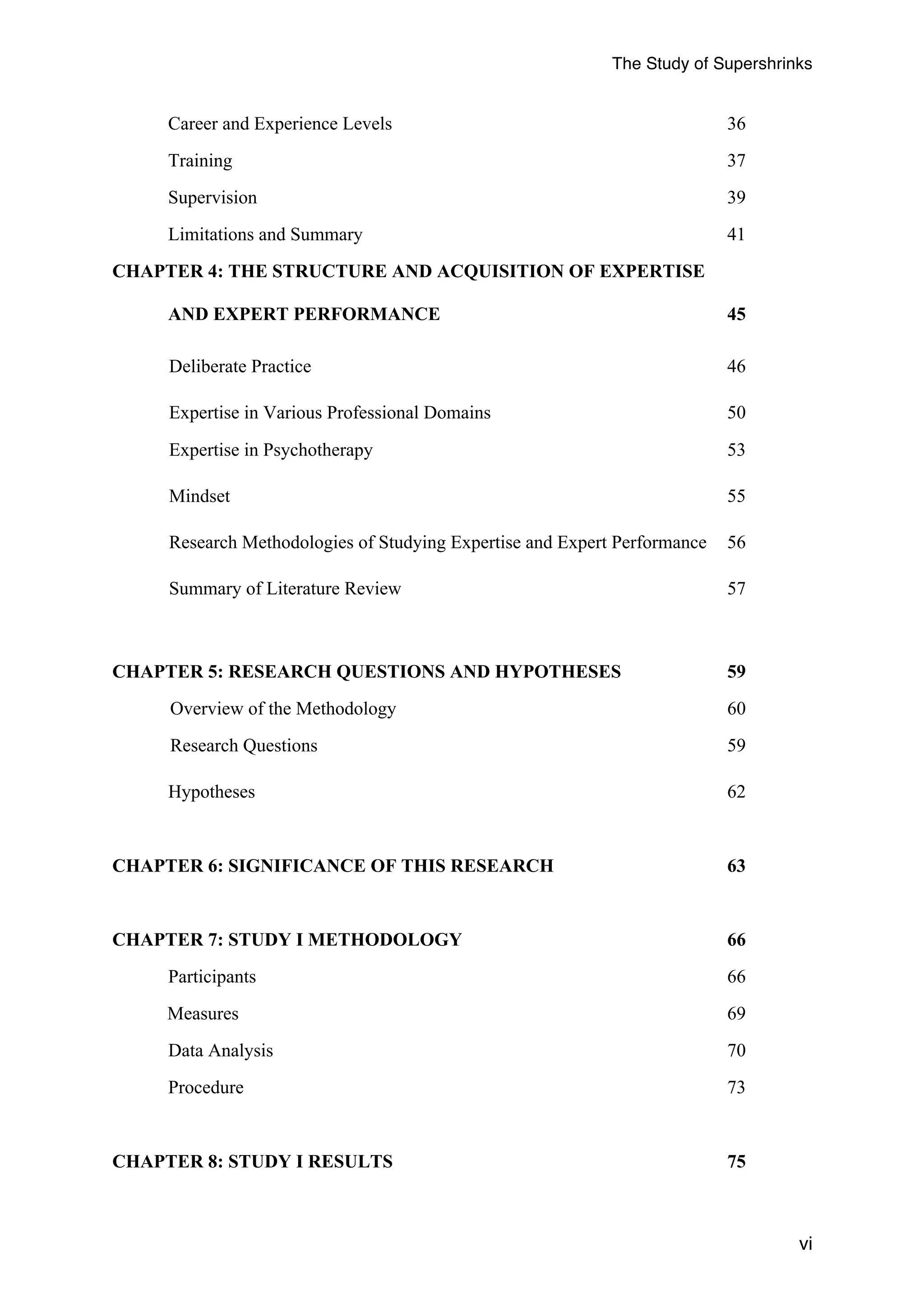
v 
Table of Contents 
Declaration ............................................................................................................ i 
Acknowledgements .................................................................................................vi 
Abstract ….............................................................................................................. xii 
CHAPTER 1 INTRODUCTION 1 
Overview 1 
Aims 5 
Organisation 5 
Definitions of Key Terms 7 
LITERATURE REVIEW 
CHAPTER 2: PSYCHOTHERAPY OUTCOMES 9 
General Effects in Psychotherapy 9 
Common Factors Model 10 
Specific Model & Placebo Effects 12 
Alliance Effects 15 
Feedback Effects 17 
Therapist Effects 19 
CHAPTER 3: THE CONTRIBUTION OF THE THERAPIST 21 
The Study of Therapist Effects 21 
Characteristics of Effective Psychotherapists 24 
The Study of “Master” Therapists 28 
Therapist Skills 29 
Summary of Therapist Effects 31 
The Development of Psychotherapists 31 
Profession & Theoretical Orientation in Clinical Practice 34
The Study of Supershrinks 
vi 
Career and Experience Levels 36 
Training 37 
Supervision 39 
Limitations and Summary 41 
CHAPTER 4: THE STRUCTURE AND ACQUISITION OF EXPERTISE 
AND EXPERT PERFORMANCE 45 
Deliberate Practice 46 
Expertise in Various Professional Domains 50 
Expertise in Psychotherapy 53 
Mindset 55 
Research Methodologies of Studying Expertise and Expert Performance 56 
Summary of Literature Review 57 
CHAPTER 5: RESEARCH QUESTIONS AND HYPOTHESES 59 
Overview of the Methodology 60 
Research Questions 59 
Hypotheses 62 
CHAPTER 6: SIGNIFICANCE OF THIS RESEARCH 63 
CHAPTER 7: STUDY I METHODOLOGY 66 
Participants 66 
Measures 69 
Data Analysis 70 
Procedure 73 
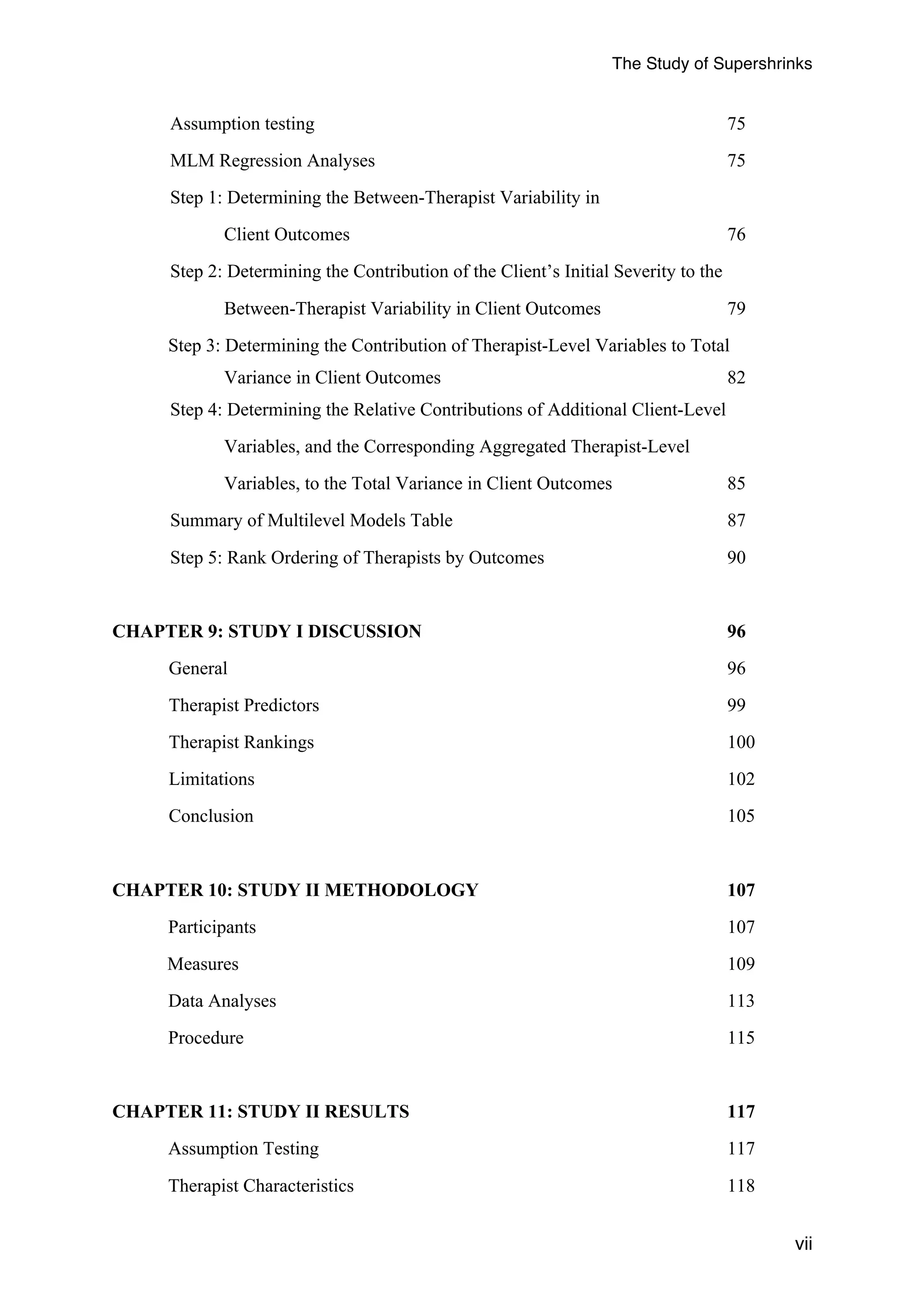
CHAPTER 8: STUDY I RESULTS 75
The Study of Supershrinks 
vii 
Assumption testing 75 
MLM Regression Analyses 75 
Step 1: Determining the Between-Therapist Variability in 
Client Outcomes 76 
Step 2: Determining the Contribution of the Client’s Initial Severity to the 
Between-Therapist Variability in Client Outcomes 79 
Step 3: Determining the Contribution of Therapist-Level Variables to Total 
Variance in Client Outcomes 82 
Step 4: Determining the Relative Contributions of Additional Client-Level 
Variables, and the Corresponding Aggregated Therapist-Level 
Variables, to the Total Variance in Client Outcomes 85 
Summary of Multilevel Models Table 87 
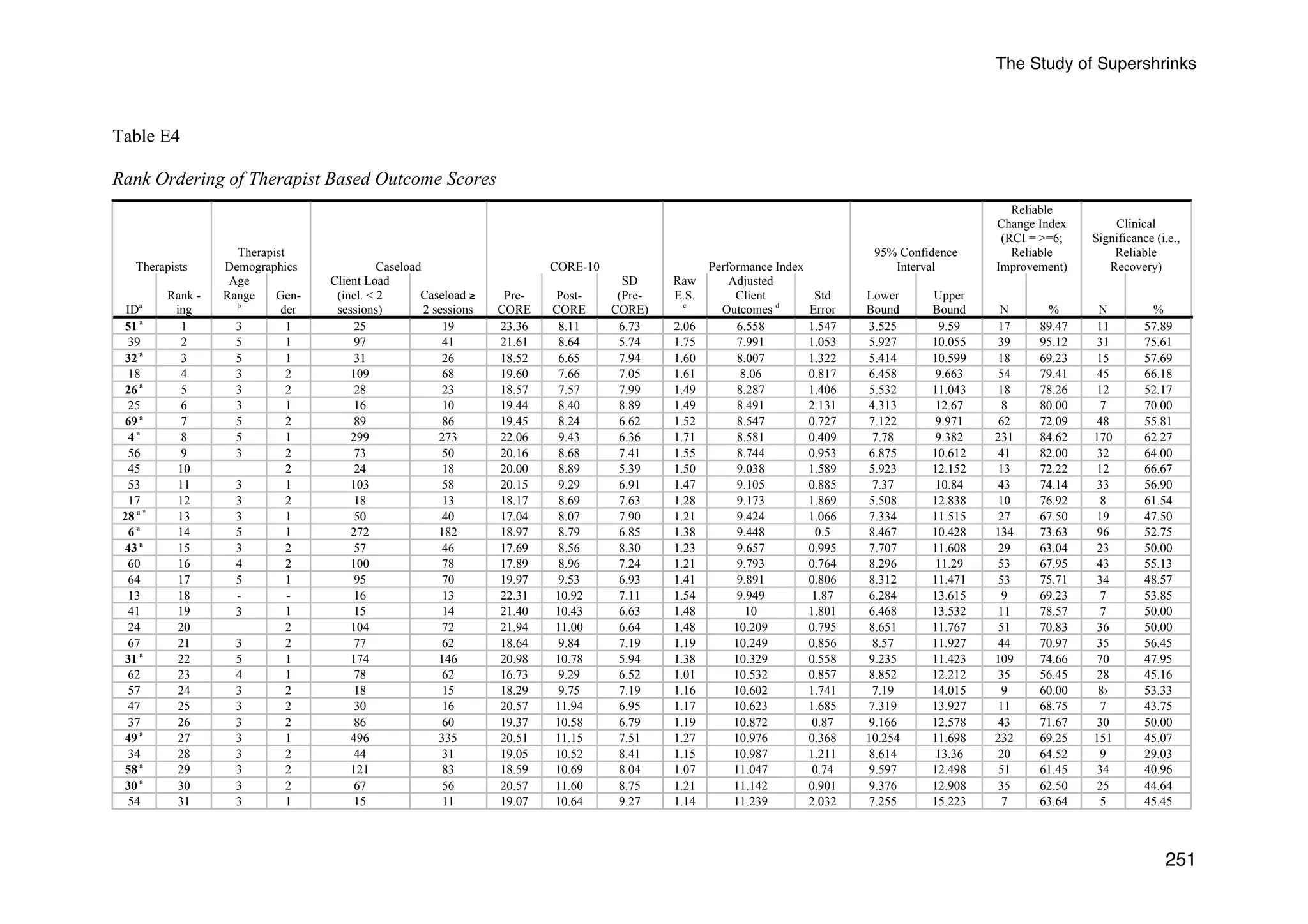
Step 5: Rank Ordering of Therapists by Outcomes 90 
CHAPTER 9: STUDY I DISCUSSION 96 
General 96 
Therapist Predictors 99 
Therapist Rankings 100 
Limitations 102 
Conclusion 105 
CHAPTER 10: STUDY II METHODOLOGY 107 
Participants 107 
Measures 109 
Data Analyses 113 
Procedure 115 
CHAPTER 11: STUDY II RESULTS 117 
Assumption Testing 117 
Therapist Characteristics 118
The Study of Supershrinks 
viii 
Deliberate Practice 119 
The Use of Feedback 121 
Therapists Work Involvement & Professional Development 122 
Self-Assessments 123 
Therapists’ Mindset 125 
Statistical Power 125 
Summary of Multilevel Modeling of Therapist Predictors 127 
Further Analyses 128 
CHAPTER 12: STUDY II DISCUSSION 148 
Therapists Characteristics 148 
Deliberate Practice 149 
Feedback 155 
Development of Psychotherapist 160 
Self-Assessment Bias 161 
Mindset 164 
Limitations 165 
Conclusion 167 
CHAPTER 13: GENERAL DISCUSSION 170 
Implications 170 
Recommendations for Clinical Practice 170 
Recommendations for Psychotherapy Training 174 
Deliberate Practice in Psychotherapy 177 
Recommendations for Future Research 178 
Conclusion 180 
References 182
The Study of Supershrinks 
ix 
Appendices 228 
Appendix A: Information Sheet 229 
Appendix B: Clinical Outcomes in Routine Evaluation-34 231 
Appendix C: Psychotherapists’ Work Involvement & Professional 232 
Development Scales, and Psychotherapist’s Professional 
Development Scales 
Appendix D: The Retrospective Protocol of Psychotherapists’ Engagement 
in Deliberate Practice 235 
Appendix E: Supplementary Tables for Study I 251 
Appendix F: Supplementary Tables for Study II 264 
Appendix G: Descriptive Statistics for Study II 268
The Study of Supershrinks 
x 
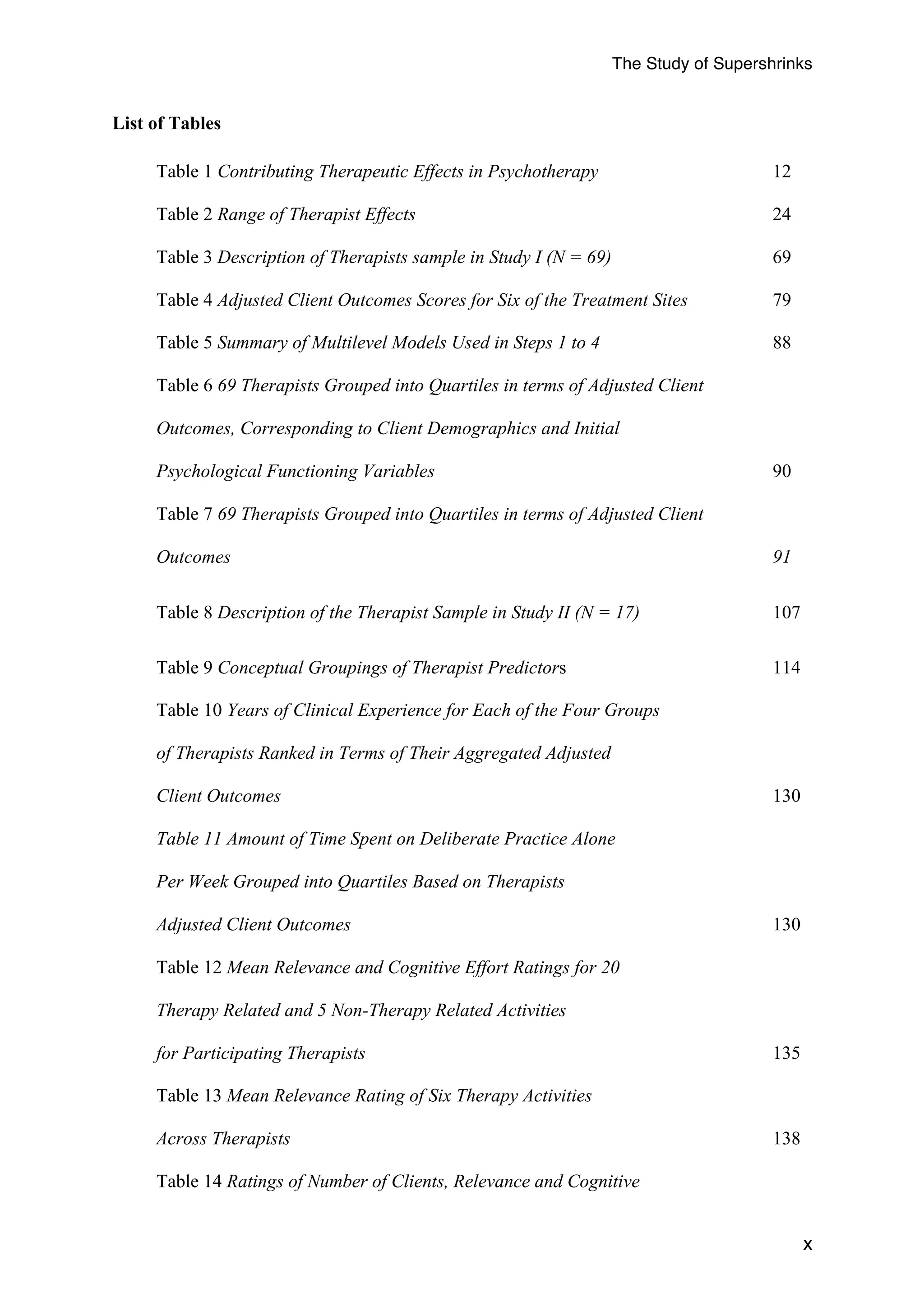
List of Tables 
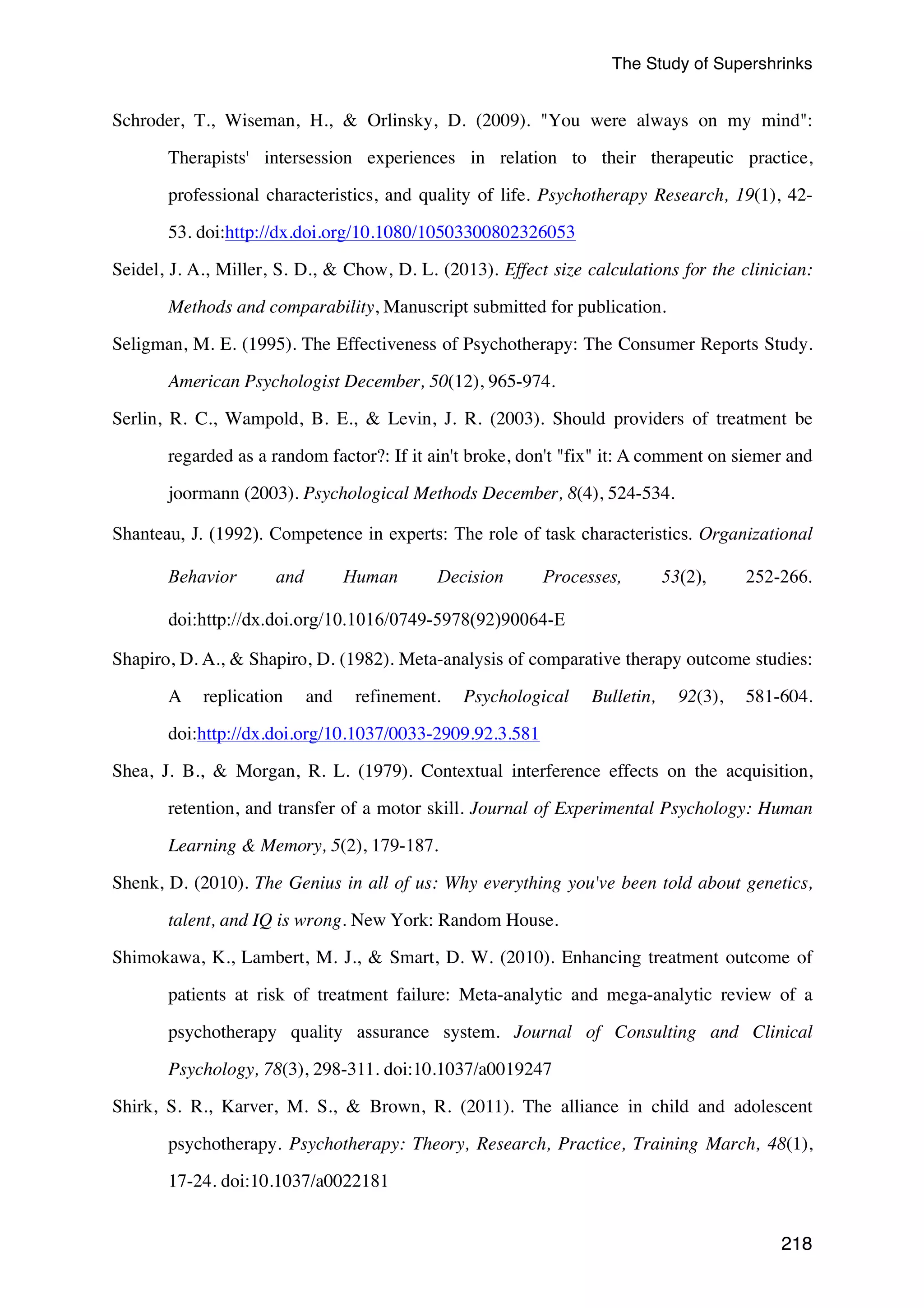
Table 1 Contributing Therapeutic Effects in Psychotherapy 12 
Table 2 Range of Therapist Effects 24 
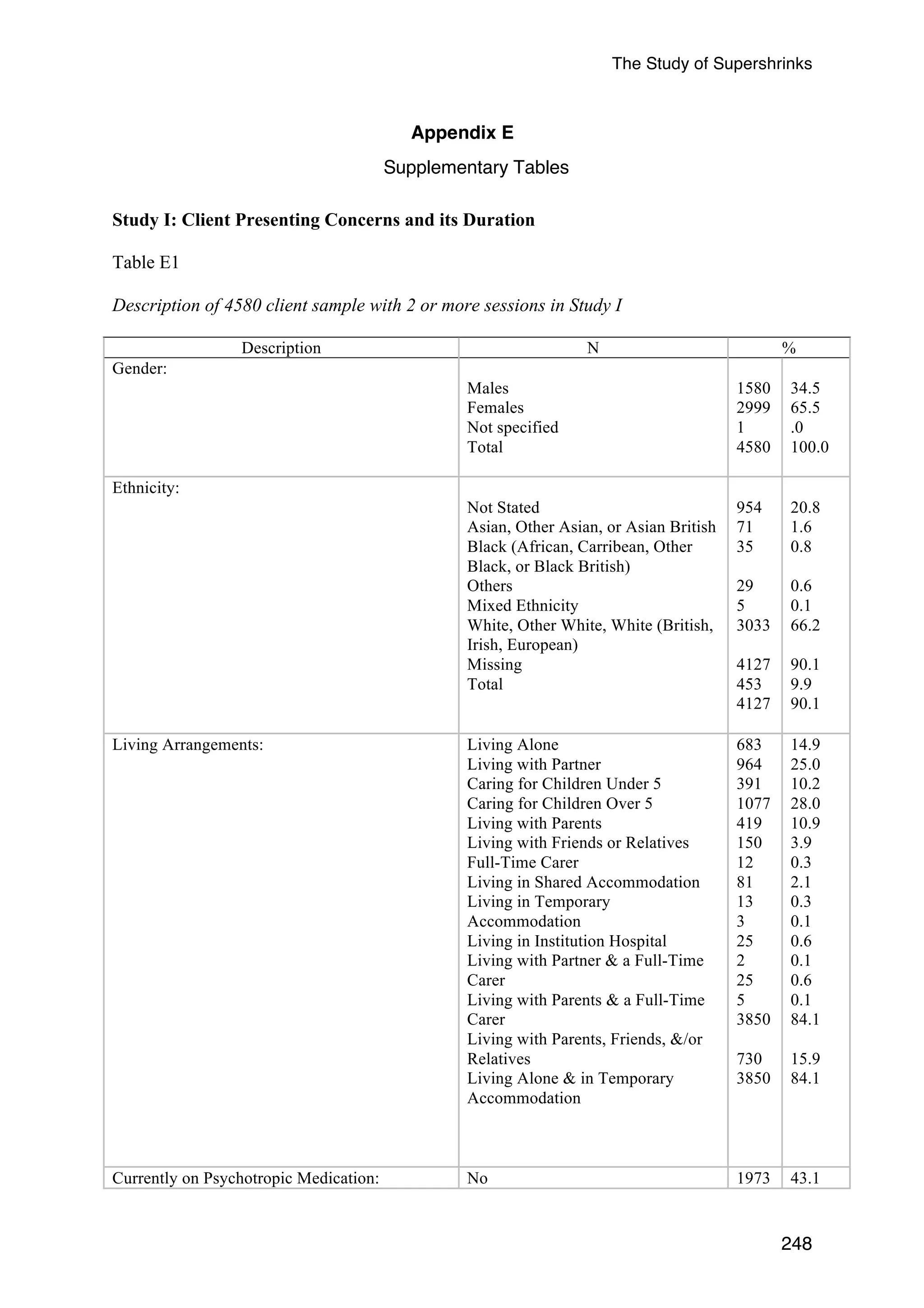
Table 3 Description of Therapists sample in Study I (N = 69) 69 
Table 4 Adjusted Client Outcomes Scores for Six of the Treatment Sites 79 
Table 5 Summary of Multilevel Models Used in Steps 1 to 4 88 
Table 6 69 Therapists Grouped into Quartiles in terms of Adjusted Client 
Outcomes, Corresponding to Client Demographics and Initial 
Psychological Functioning Variables 90 
Table 7 69 Therapists Grouped into Quartiles in terms of Adjusted Client 
Outcomes 91 
Table 8 Description of the Therapist Sample in Study II (N = 17) 107 
Table 9 Conceptual Groupings of Therapist Predictors 114 
Table 10 Years of Clinical Experience for Each of the Four Groups 
of Therapists Ranked in Terms of Their Aggregated Adjusted 
Client Outcomes 130 
Table 11 Amount of Time Spent on Deliberate Practice Alone 
Per Week Grouped into Quartiles Based on Therapists 
Adjusted Client Outcomes 130 
Table 12 Mean Relevance and Cognitive Effort Ratings for 20 
Therapy Related and 5 Non-Therapy Related Activities 
for Participating Therapists 135 
Table 13 Mean Relevance Rating of Six Therapy Activities 
Across Therapists 138 
Table 14 Ratings of Number of Clients, Relevance and Cognitive
The Study of Supershrinks 
Effort for Each of Five Feedback Activities 140 
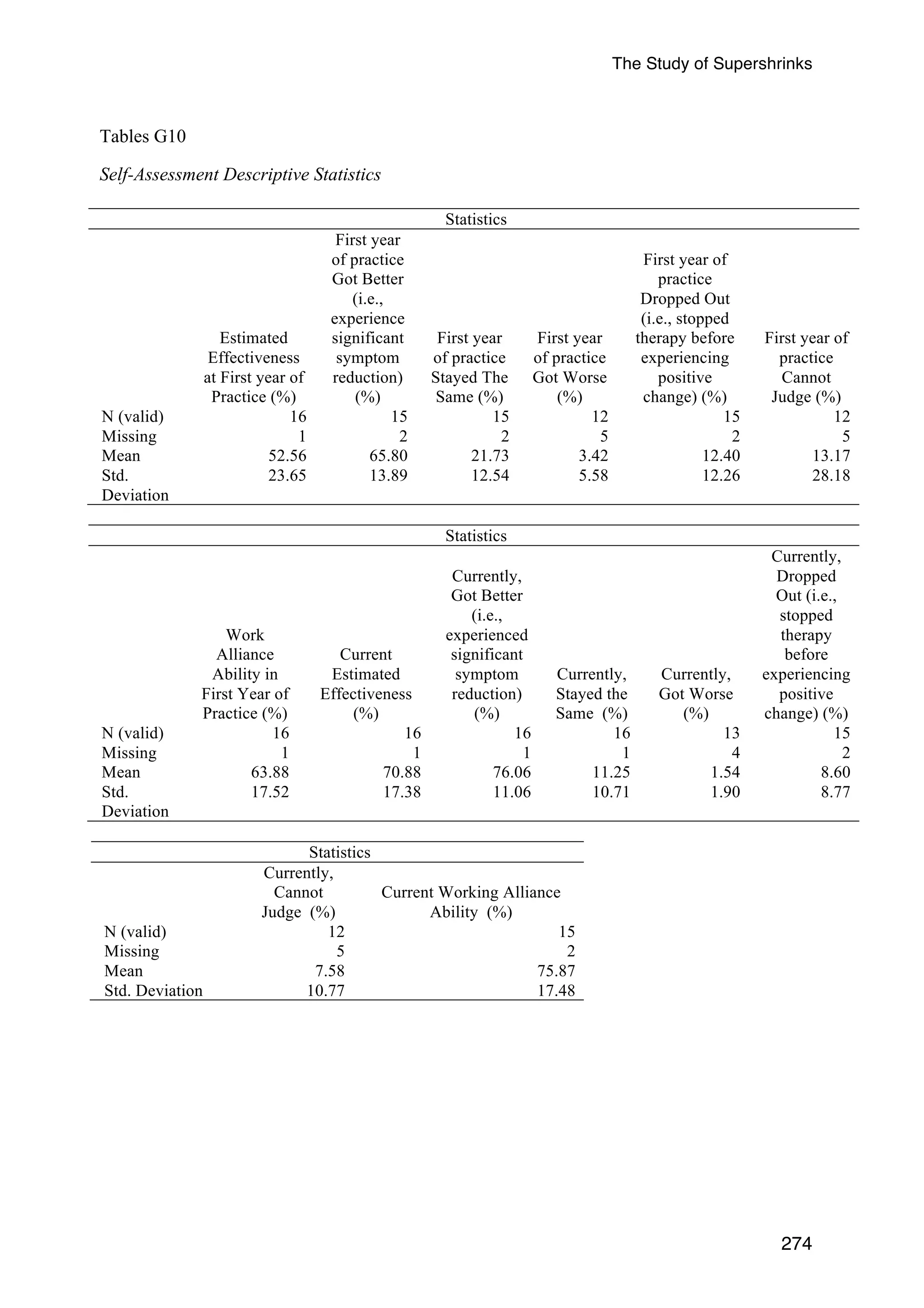
Table 15 Descriptive Statistics on Therapist Self-Ratings 
of Professional Development 143 
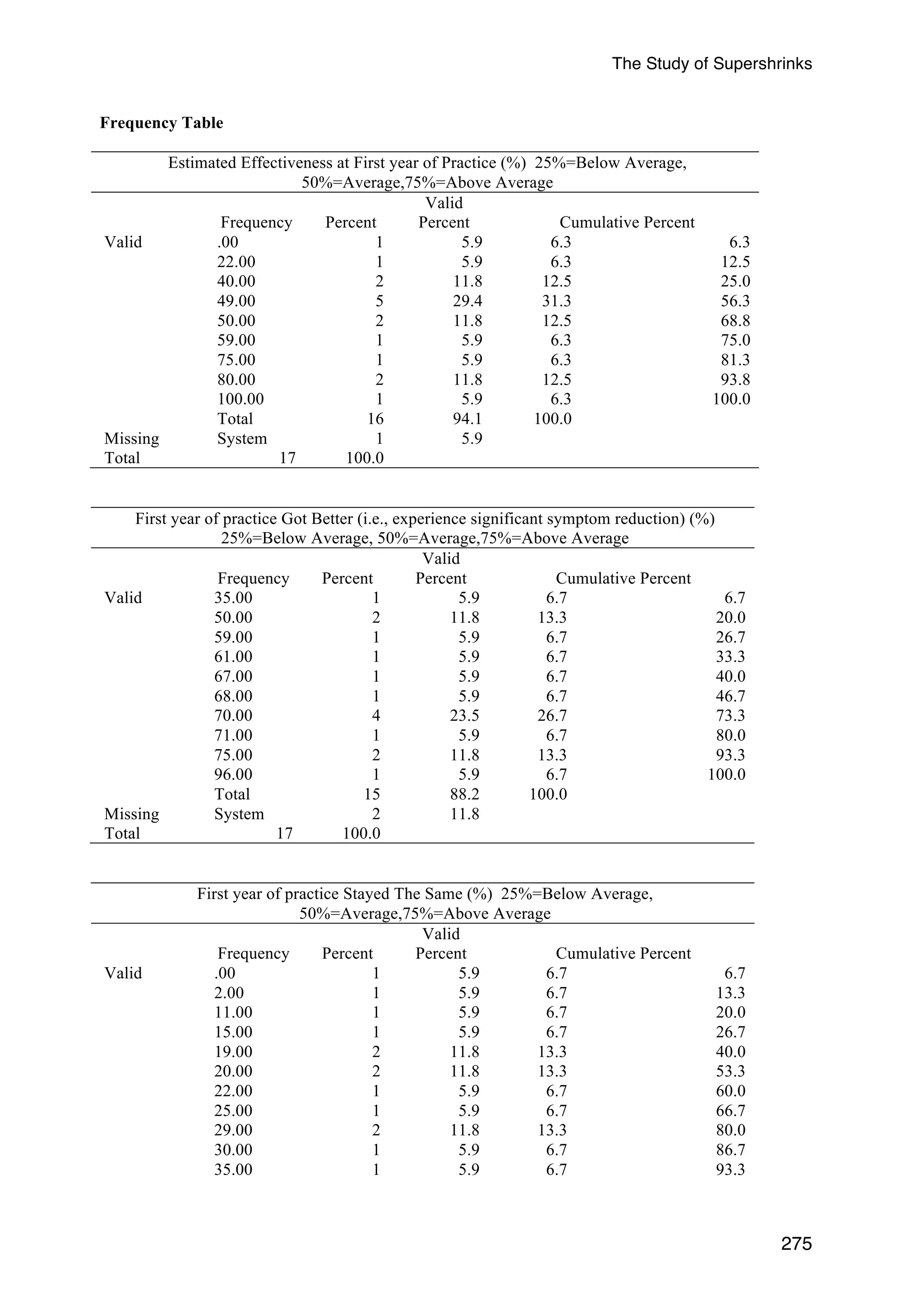
Table 16 Descriptive Statistics of Therapists Self-Assessments 
on First Year of Clinical Practice of Estimated Performance 144 
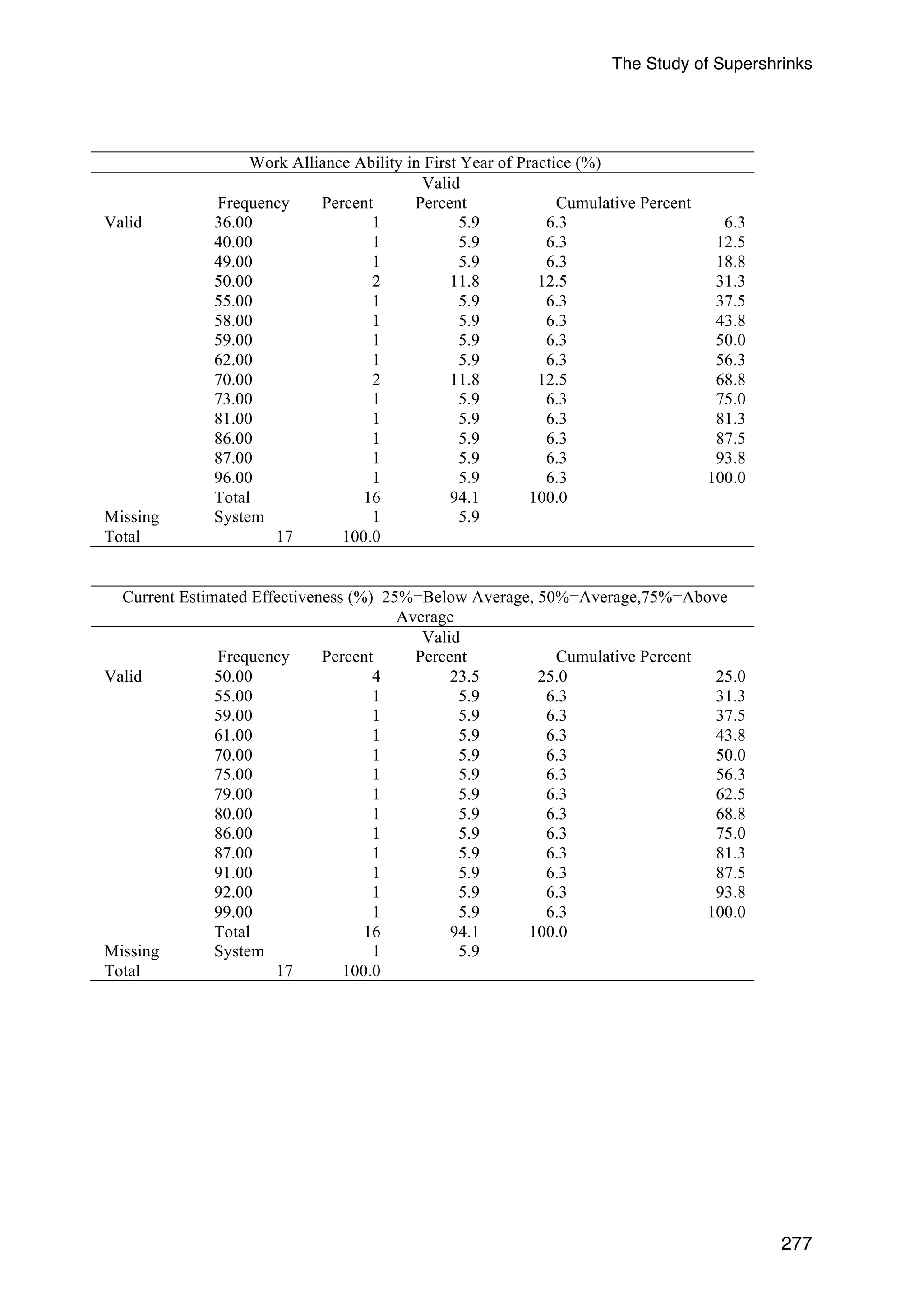
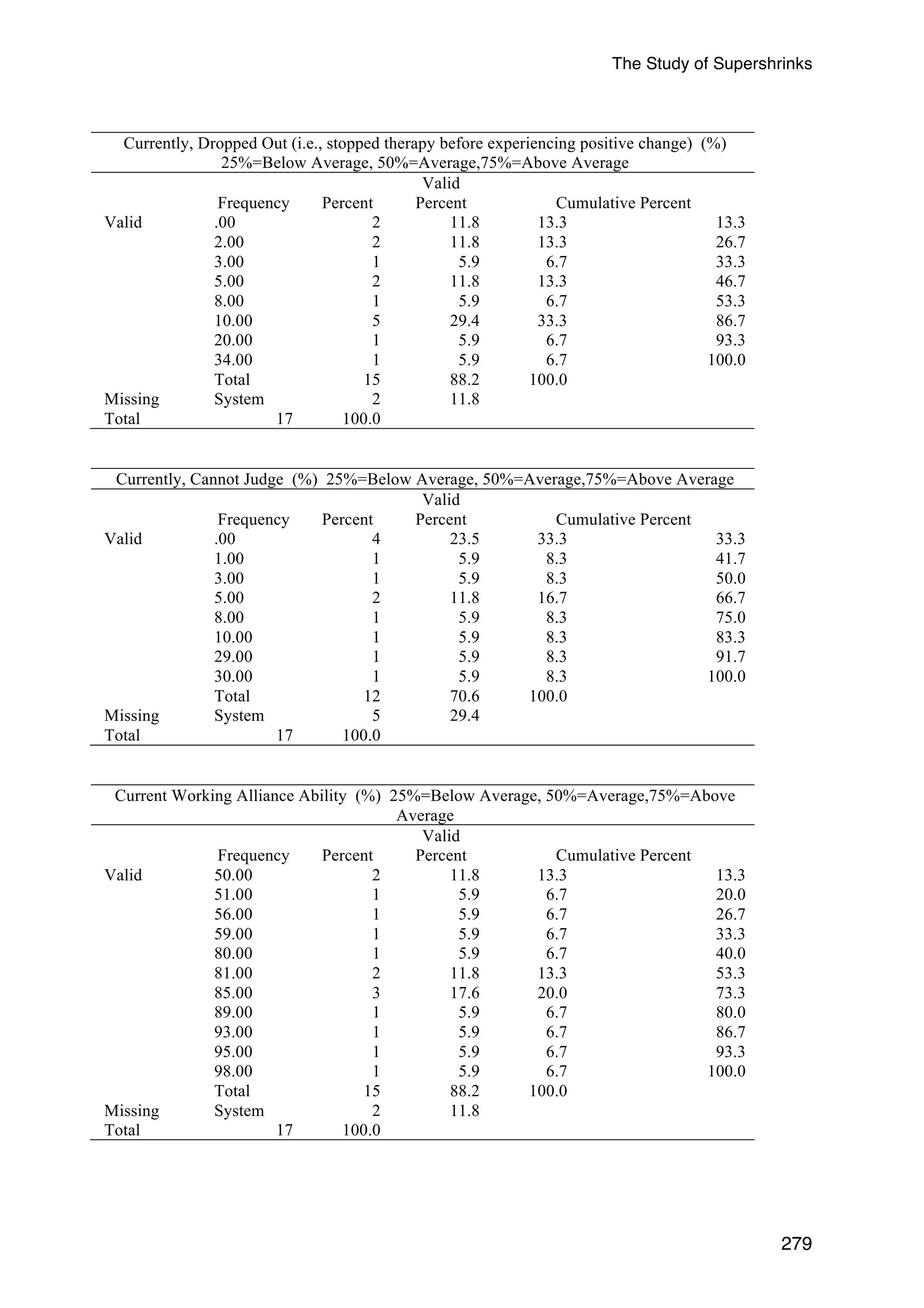
Table 17 Descriptive Statistics of Therapists Self-Assessments 
on Current Estimated Level of Performance 145 
Table 18 Comparisons of Therapists’ Grouping by Performance and 
Self-Assessments on Current Estimated Level of Performance 146 
xi 
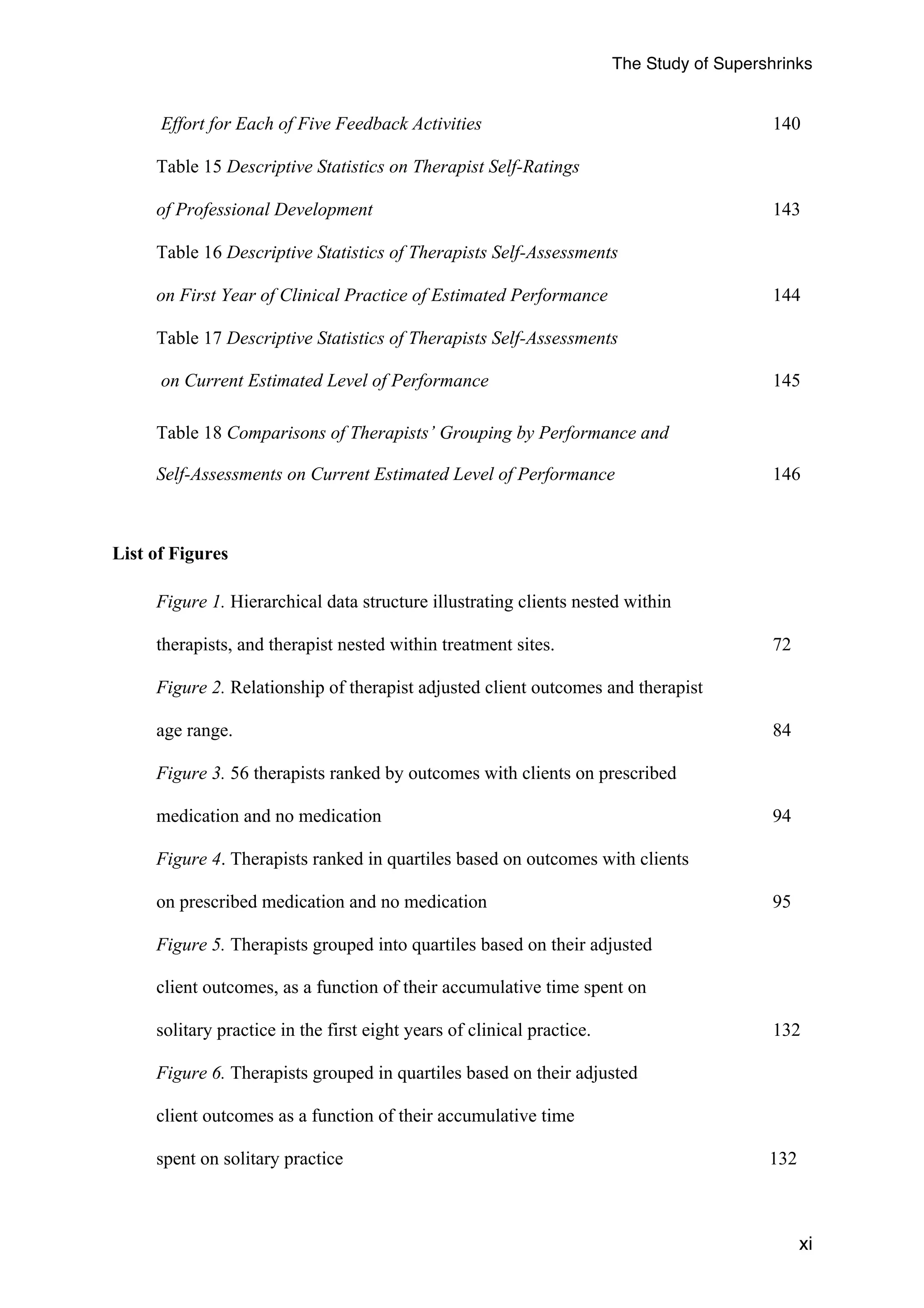
List of Figures 
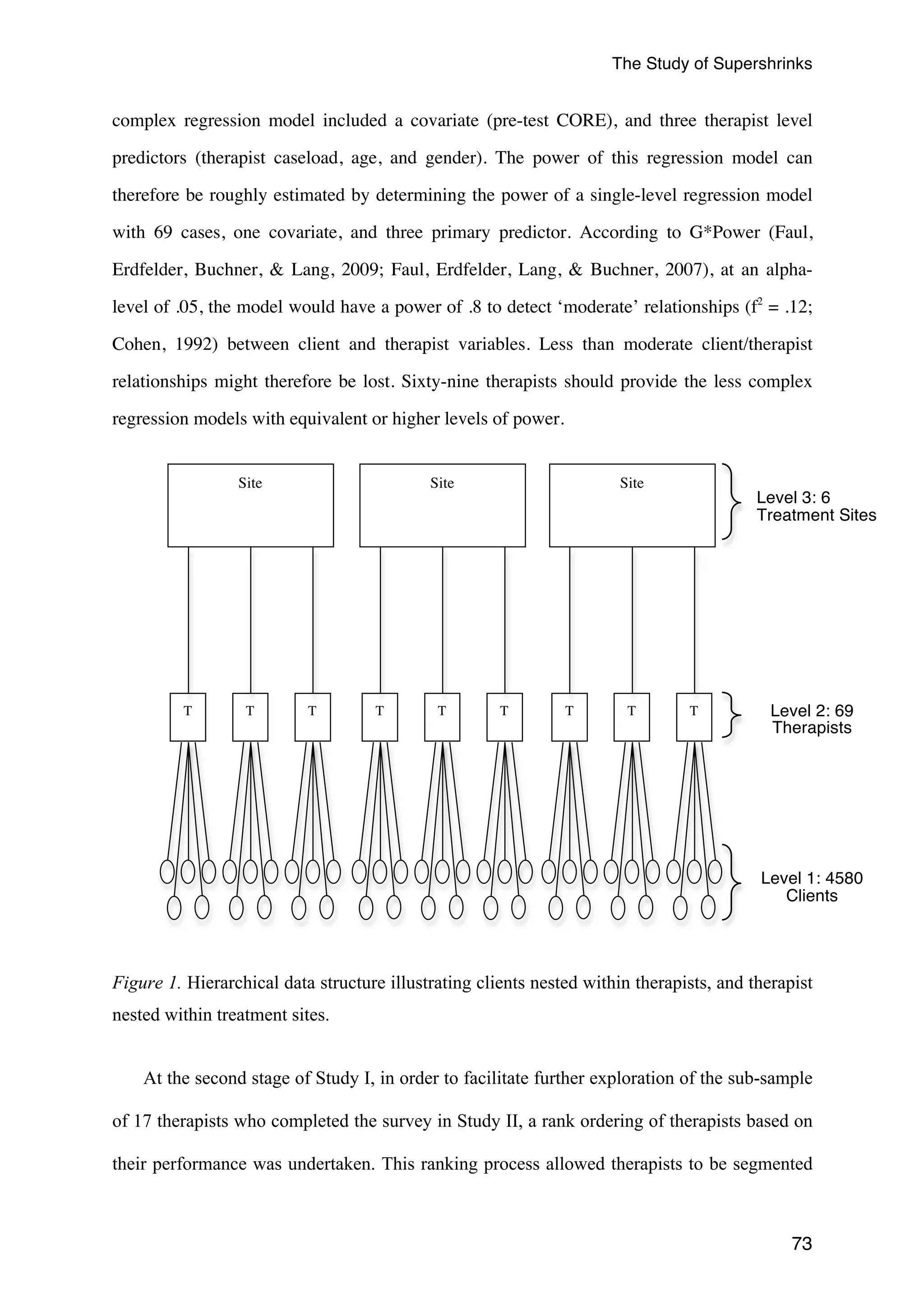
Figure 1. Hierarchical data structure illustrating clients nested within 
therapists, and therapist nested within treatment sites. 72 
Figure 2. Relationship of therapist adjusted client outcomes and therapist 
age range. 84 
Figure 3. 56 therapists ranked by outcomes with clients on prescribed 
medication and no medication 94 
Figure 4. Therapists ranked in quartiles based on outcomes with clients 
on prescribed medication and no medication 95 
Figure 5. Therapists grouped into quartiles based on their adjusted 
client outcomes, as a function of their accumulative time spent on 
solitary practice in the first eight years of clinical practice. 132 
Figure 6. Therapists grouped in quartiles based on their adjusted 
client outcomes as a function of their accumulative time 
spent on solitary practice 132
The Study of Supershrinks 
The Study of Supershrinks: Development and Deliberate Practices of Highly Effective 
xii 
Psychotherapists 
Abstract 
A growing body of evidence suggests that psychotherapists’ outcomes vary to a 
significant extent (Blatt, Sanislow, Zuroff, & Pilkonis, 1996; Kim, Wampold, & Bolt, 2006; 
Luborsky, Mclellan, Diguer, Woody, & Seligman, 1997; Okiishi et al., 2006; Okiishi, 
Lambert, Nielsen, & Ogles, 2003). There is a paucity of empirical evidence of how highly 
effective psychotherapists develop their therapeutic skills, and to what extent the engagement 
of domain specific deliberate practice (e.g., Ericsson, 1996; Ericsson, 2006a; Ericsson, 
Krampe, & Tesch-Romer, 1993) mediates the acquisition and maintenance of superior 
performance. In order to investigate the contribution of the therapist, three-level multilevel 
modeling (Raudenbush & Bryk, 2002; Snijders, 1999) was employed in a study of 
practitioners’ outcomes from the Human Givens Institute Practice Research Network 
(HGIPRN). In Study I (N = 69 therapists; N = 4580 clients), findings revealed that therapist 
effects explain about 5.1% of the variance in outcome, after adjusting for initial severity and 
treatment sites. The number of sessions and planned/unplanned endings at both the client and 
therapist levels explained about 65% of the variance between therapists. Therapist gender, 
caseload, and age range were not significant predictors in the final model. The variability on 
outcome that was due to therapists was greater with clients not on medication, compared with 
those who are on prescribed medication. 
Building upon the rank ordering of therapists derived in Study I, 17 therapists from Study 
I (N = 1632 clients) participated in further investigations about the impact of their 
professional work practices, professional development, and self-assessments in Study II. 
Based on the generalised linear mixed modeling (GLMM), the findings indicated that
The Study of Supershrinks 
therapist demographic factors did not significantly predict client outcomes. The amount of 
time spent in solitary practice targeted at improving one’s therapeutic skills was a significant 
predictor of client outcomes. The number of times therapists were surprised by clients’ 
feedback about the session was also a significant predictor of client outcomes. Therapist who 
reported higher levels of healing involvement (HI) in their clinical practice were more likely 
to perform poorly, in terms of client outcomes. Compared with their peers, therapists’ self-assessment 
of effectiveness was not correlated with actual outcomes, in spite of the use of 
outcome measures in their clinical practice. Finally, therapists’ self-ratings about their 
mindsets were not predictive of client outcomes. The preliminary results from Study II must 
be interpreted with caution, due to the small sample size of therapists and large number of 
therapist variables involved in the analysis. Implications for the employment of deliberate 
practice and use of feedback to enhance clinical practice, continuing professional 
development, and training were discussed. 
Keywords: Deliberate Practice, Expertise in Psychotherapy, Feedback, Professional 
Development, Psychotherapy Outcomes, Therapist Effects. 
xiii
The Study of Supershrinks 
1 
CHAPTER 1 
Chapter 1: Introduction 
A man walking is never in balance, but always correcting for imbalance. 
- Gregory Bateson 
Overview 
Since the initial debate about the potency of psychotherapy (Eysenck, 1964; Strupp, 
1963, 1964), numerous studies have demonstrated the efficacy and effectiveness of a variety 
of psychotherapeutic approaches (Lambert & Ogles, 2004). The contribution of common 
factors (e.g., relational, hope/expectancy, and client/extratherapeutic factors) promoting 
therapeutic change across various models of psychotherapy has been well established (Asay 
& Lambert, 2006; Duncan, 2010; Messer & Wampold, 2002; Rosenzweig, 1936; Sparks, 
Duncan, & Miller, 2008; Wampold, 2001, 2010; Wampold et al., 1997). 
One of the critical findings in the literature, independent of the therapeutic model, is the 
therapist contribution towards client outcomes. Although previous studies neglected to 
account for the role and impact of the therapist, or tried to control for it (Garfield, 1997; 
Wampold & Serlin, 2000), several recent studies have examined the proportion of outcome 
that is attributable to the therapist (e.g., Okiishi, Lambert, Nielson, & Ogles., 2003; Wampold 
& Brown, 2005). In addition, re-analyses of previous clinical trial data have also been 
conducted to account for the variation of outcomes among clients, based on who the 
treatment provider was (e.g., Blatt, Sidney, Sanislow, Zuoff, & Pikonis, 1996; Crits- 
Christoph et al., 1991; Crits-Christoph & Mintz, 1991; Kim, Wampold, & Bolt, 2006). This 
is referred to as the study of therapist effects. Collectively, these studies found that therapist 
effects accounted for more of the variation in client outcomes than the specific treatment 
modality (Kim et al., 2006; Wampold & Brown, 2005). Furthermore, studies which ignored
The Study of Supershrinks 
the nested effects of therapists were likely to overestimate the contribution of treatment 
model that was employed (Wampold & Serlin, 2000). 
In a study examining therapist facilitative skills, Anderson, Ogles, Patterson, Lambert, 
and Vermeersch (2009) indicated that the therapist’s ability to handle challenging interactions 
within sessions was found to be a significant predictor of good client outcomes. This finding 
is consistent with previous research conducted by Baldwin, Wampold, and Imel (2007). 
Using complex multi-level modeling to untangle the alliance-outcome correlation, Baldwin 
and colleagues found that it was therapist variability in the alliance, rather than client 
variability, that predicted outcome. Therapists who on average, formed stronger alliances, 
performed better than therapists who did not form as strong a therapeutic engagement with 
their clients. 
Other studies attempting to investigate the characteristics of effective psychotherapists 
(Jennings, D’Rozario, Goh, Sovereign, Brogger, & Skovholt, 2008; Jennings, Hanson, 
Skovholt, & Grier, 2005; Levitt & Williams, 2010; Skovholt & Jennings, 2005) are limited 
due to their working definition of “master therapists,” which were based on peer-nomination, 
rather than client-rated outcomes (Orlinsky, 1999). While these studies have yielded rich and 
detailed descriptions about the professional development and work practices of therapists 
from various disciplines and cultural backgrounds (Orlinsky, Ambuhl et al., 1999; Orlinsky 
& Ronnestad, 2005), there is a dearth of evidence linking therapist professional development 
to effectiveness. For example, even though the dimensions of “Cumulative Career 
Development”, therapists’ “Theoretical Breadth”, and the therapists’ sense of “Currently 
Experienced Growth” contributed to therapists’ self-rating of “Healing Involvement” (HI), no 
2 
study has yet examined the influence of these factors on client outcomes. 
Even though past studies were able to identify qualities of highly effective therapists, 
such as being more psychologically minded (Blatt et al., 1996), having a flexible
The Study of Supershrinks 
interpersonal style and the ability to develop strong working alliances (Laska, Smith, 
Wislocki, Minami, & Wampold, 2013), no study has yet to examine how these superior 
performing therapists develop and maintain their professional competencies. Numerous 
studies have been conducted on the skill acquisition and maintenance of expertise in various 
fields, however, none has yet been formally conducted in the domain of psychotherapy in 
relation to client outcomes. 
Deliberate practice (Ericsson, Krampe, Tesch-Romer, 1993) refers to activities related to 
focused and systematic effort aimed to improve one’s performance, pursued over extended 
periods of time, with the guidance of a coach/mentor, and informed by immediate feedback 
about performance through repetition and successive refinement. The amount of deliberate 
practice that the person engages in has repeatedly been found to be a significant mediator in 
the acquisition and maintenance of expert performance in various fields, such as music, 
chess, sports, and medicine (e.g., Cote, Ericsson, & Law, 2005; Ericsson, 2007b; Ericsson et 
al., 1993; Gobet & Charness, 2006; Krampe & Ericsson, 1996; Mamede, Schmidt, Rikers, 
Penaforte, & Coelho-Filho, 2007; Norman, Eva, Brooks, & Hamstra, 2006; Schmidt & 
Rikers, 2007). However, the theory of deliberate practice has yet to be investigated in the 
realm of psychotherapy. 
It has also been noted that self-assessments by therapists are inaccurate at predicting 
actual competency levels (Walfish, McAlister, O'Donnell, & Lambert, 2012). No study has 
investigated the relationship between therapists’ self-assessment of effectiveness and the 
perspective of their own professional development in relation to actual client outcomes. 
In addition, while the benefits of routinely using formal feedback mechanisms, such as The 
Partners for Change Outcome Management System (PCOMS; Miller, Duncan, Sorrell, & 
Brown, 2005) and the Outcome Questionnaire System (OQ System; Lambert et al., 1996) to 
inform the treatment process has been well-established (e.g., Botella, 2006; Brown & Jones, 
3
The Study of Supershrinks 
2005; Brown & Minami, 2010; Evans, Mellor-Clark, Margison, & Barkham, 2000; Harmon, 
Hawkins, Lambert, Slade, & Whipple, 2005; Harmon et al., 2007; Hawkins, Lambert, 
Vermeersch, Slade, & Tuttle, 2004; Lambert & Shimokawa, 2011), it has been demonstrated 
that therapist factors moderate the effects of using formal feedback measures (de Jong, Van 
Sluis, Nugter, Heiser, & Spinhoven, 2012). In other words, the role of the therapist is vital, 
even when using feedback mechanisms. 
In another related area, researchers have identified the importance of the types of self-attribution 
theory of ability (i.e., fixed and growth mindset) that might influence performance 
in various domains (Dweck, 2006). For instance, a person who endorses a fixed mindset is 
more likely to view their abilities as innate and stable across time. On the other hand, a 
person who endorses a growth mindset is more likely to believe that their abilities can be 
cultivated and developed throughout their lives. Currently, there is a lack of studies 
4 
investigating how this would predict psychotherapists’ performance. 
Taken together, there are significant gaps in past psychotherapy research: How superior 
performing therapists develop compared to their counterparts; existing empirical evidence of 
the mediating effects of deliberate practice in the field of psychotherapy; the relationship of 
therapists’ self-assessment of their own effectiveness in relation to actual client outcomes; 
how feedback is used and perceived by therapists, and how the mindset of therapists affects 
their client outcomes. 
In summary, given the abovementioned, this thesis aims to conduct a preliminary 
investigation into how these therapist factors (i.e., deliberate practice, work involvements, 
professional development, self-assessments of effectiveness, use of feedback, mindsets) 
influence client outcomes.
The Study of Supershrinks 
Aims 
The overall aim of this thesis was to examine the influence of therapist professional 
development and work practices on client outcomes. Specifically, there were seven main 
objectives, with the first study addressing the first two aims, and the second study addressing 
the other five main aims. The first was to establish if there are between-therapist differences 
in client outcomes. Specification of the amount of variability between therapists was 
highlighted, in terms of their overall therapeutic outcome. Second, the impact of therapist 
characteristics that account for the variability of client outcomes was investigated. Third, a 
preliminary exploration of how psychotherapists’ engagement in deliberate practice (Ericsson 
et al., 1993) predicts differences in client outcomes was conducted. Fourth, the influence of 
using formal feedback measures on predicting differences in client outcomes was examined. 
Fifth, constructs relating to psychotherapists’ professional development, as outlined by 
Orlinsky and Ronnestad (2005), were examined in order to determine how much they 
predicted variability in client outcomes. Sixth, a self-assessment report by the therapists 
regarding their perceived effectiveness was conducted to see if they are accurate in their own 
assessments, in relation to other therapists in the study. Finally, this thesis examined if 
therapist attribution theory of ability, as defined by Dweck (2006), predicted client outcomes. 
5 
Organisation 
The thesis is organised into 12 chapters. The first chapter provides an introductory 
overview and outlines the main directions of the research. The next three chapters provide a 
literature review on the topics relevant to this thesis. Chapter 2 reviews the existing literature 
on the study of psychotherapy outcomes. Chapter 3 examines the findings regarding the 
contributions of the therapist on client outcomes. Chapter 4 elaborates on the structure, 
acquisition, and maintenance of expertise and expert performance in other professional fields,
The Study of Supershrinks 
in order to employ similar research methodologies in investigating the impact of therapists’ 
professional development and work practices. 
Chapter 5 highlights the significant contribution of this thesis to the study of therapist 
factors that affect client outcomes, along with the specific research questions and hypotheses 
to be tested. 
Chapter 6 provides the methodology used for Study I of this thesis, which consists of 69 
therapists who have seen 4580 clients within a practice research network (PRN) in the United 
Kingdom. Chapter 7 reports the results of Study I, which examines client and therapist 
contributions to client outcomes in a step-wise sequence, followed by a ranking of therapists 
based on their aggregated client outcomes. Chapter 8 discusses the key findings and 
limitations in Study I. 
A sub-sample of 17 therapists from Study I responded to a follow-up investigation of 
therapist professional development and work practices in Study II. Chapter 9 provides the 
methodology of Study II. Chapter 10 delineates the results findings of Study II based on the 
sub-sample of therapists from Study I, while Chapter 11 discusses the various key findings 
and limitations in Study II. 
Finally, Chapter 12 concludes with a general discussion of the key findings established in 
Study I and Study II. Implications for clinical practice and training, along with 
recommendations for future research are highlighted in this section. 
6
The Study of Supershrinks 
7 
Definitions of Key Terms 
Client/Patient: These two terms are used interchangeably to define the individuals who 
seek the services of counselling and psychotherapy. 
Counselling/Psychotherapy: Although in some literature this may refer to different 
types of “talking cure” in helping people with psychological distress, I have chosen to regard 
them as synonymous. Nevertheless, the following definition of psychotherapy is derived from 
Wampold (2001), which is consistent with a variety of researchers’ and practitioners’ 
definition in the field: 
Psychotherapy is a primarily interpersonal treatment that is based on psychological 
principles and involves a trained therapist and a client who has a mental disorder, 
problem, or complaint; it is intended by the therapist to be remedial for the client’s 
disorder, problem, or complaint; and it is adapted or individualized for the particular 
client and his or her disorder, problem, or complaint. (p. 3) 
Common Factors: This refers to the universal curative elements or ingredients shared by 
most psychotherapeutic models, such as therapeutic alliance, client characteristics, treatment 
structures, and hope/expectancy. 
Deliberate Practice: Focused and systematic effort to improve one’s performance, 
pursued over extended periods of time, with the guidance of a coach/mentor, and informed by 
the prompt feedback about their performance (Ericsson et al., 1993). 
Feedback Effects: This refers to the variability in client outcomes that is attributable to 
the use of outcome and alliance measures in-session, as a form of feedback tool to guide 
treatment delivery. 
Mindset: Categorised into Fixed and Growth mindsets, this generally refers to the view 
an individual adopts for him/herself. Fixed mindset refers to the belief that qualities and
The Study of Supershrinks 
certain abilities are innate. The individual is likely to believe that they can learn new things 
but can’t change their ability. Growth mindset refers to the belief that basic qualities and 
8 
certain abilities are cultivated and developed through efforts to improve. 
Multilevel Modeling (MLM): Also know as hierarchal linear modeling, MLM is a 
regression based procedure that is particularly useful in analysing nested data structures (e.g., 
clients nested within therapists, therapists nested within organisations), while taking into 
account the variability associated with each level of nesting. 
Psychotherapist/Therapist/Counsellor/Practitioner/Clinician: These terms are used 
interchangeably to denote the primary person delivering the psychotherapy service. 
Therapist Effects: This refers to the variability in client outcomes that is attributable to 
the therapists.
The Study of Supershrinks 
9 
LITERATURE REVIEW 
Chapter 2: Psychotherapy Outcomes 
In this chapter, an overview of the existing psychotherapy outcome research will be 
provided. Emphasis will be given to the review of the literature on common factors 
attributable to good outcomes in psychotherapy, which will provide the necessary contextual 
background for the review of factors that contribute to the differences in therapist 
effectiveness. 
General Effects in Psychotherapy 
According to Orlinsky, Ronnestad, and Willutzuki (2004), 2354 process-outcome 
research findings have been accumulated over the last 40 years. Although there were early 
criticism of psychotherapy not having any causal effects on clients’ well-being (Eysenck, 
1952), based on the combined analyses on the efficacy of psychotherapy across a broad range 
of disorders, it is now well established that the average treated client is better off than 
approximately 80% of the untreated sample (Smith, Glass, & Miller, 1980; Wampold, 2001). 
Qualitative and quantitative studies also indicate that approximately 75% of those who enter 
treatment experience benefit (Lambert & Ogles, 2004). Another index used in the 
understanding of the effectiveness of psychotherapy is number needed to treat (NNT), which 
is defined as the number of patients needed to receive treatment in order to have one more 
successful outcome compared with those who did not receive treatment (Altman & Andersen, 
1999; Cook & Sackett, 1995). This metric is often used in evidence-based medicine. An 
effect size of 0.8 in psychotherapy is equivalent to an NNT of approximately 3 (Kraemer & 
Kupfer, 2006). That is, three patients need to receive psychotherapy in order to experience a 
positive outcome relative to untreated patients (Wampold, 2010). Although it is not likely 
that every one will benefit from psychotherapy, it is as or more effective than established 
evidence-based medical practices, including interventions such as influenza vaccines (NNT:
The Study of Supershrinks 
12), aspirin prophylaxis for heart attacks (NNT: 176), and nicotine inhalers for smoking 
cessation (NNT: 10) (Wampold, 2007). Finally, psychotherapy is as effective as drug 
interventions for emotional concerns and is more sustaining and inoculative in its benefits 
(Barlow, Gorman, Shear, & Woods, 2000; Hollon, Stewart, & Strunk, 2006; Imel, Malterer, 
McKay, & Wampold, 2008). It also has significantly lower drop-out and relapse rates (De 
Maat, Dekkera, Schoeversa, & De Jonghe, 2006), and fewer side-effects than drug treatment 
(Nutt & Sharpe, 2008). 
In terms of the duration expected for clients to experience benefit, improvement occurs 
early in the therapy treatment process rather than later on. Generally, at least 50% of clients 
begin to experience benefits from treatment within 5 to 10 sessions (Asay & Lambert, 2006). 
In a seminal meta-analysis involving more than 2400 patients, Howard, Kopta, Krause, and 
Orlinsky (1986) examined the length of treatment needed for the experience of benefit by the 
client. They found that approximately 50% of the patients experience improvement by the 8th 
session, and approximately 75% experienced improvement by the 26th session. In another 
study, based on a survival analysis of data from an outpatient psychotherapy clinic, Anderson 
and Lambert (2001) estimated that approximately 11-16 sessions are required for 50% of the 
clients to experience reliable recovery (i.e., clinically significant change). Nonetheless, it is 
worth emphasising that there is a significant variability in the rates of change experienced by 
different clients, and it has been argued that it is clinically unjustifiable to restrict the length 
of treatment (Baldwin, Berkeljon, Atkins, Olsen, & Nielsen, 2009). 
In summary, the combined evidence from clinical trials and naturalistic settings are clear 
that the benefits of psychotherapy is demonstrably large across a broad range of clinical 
problems, with improvement typically experienced early on in the process of treatment. 
10
The Study of Supershrinks 
Common factors model. In the field of counselling and psychotherapy, “common 
factors” refer to curative elements or ingredients, such as the therapeutic alliance, shared by 
all (or most) 
models of psychotherapy (Sparks et al., 2008; Wampold, 2001, 2010). Over the 
last four decades, there has been consistent evidence for the contribution of common factors 
in promoting therapeutic change across various models of psychotherapy (Asay & Lambert, 
2006; Duncan, 2010; Messer & Wampold, 2002; Rosenzweig, 1936; Sparks et al., 2008; 
Wampold, 2001, 2010; Wampold et al., 1997). In practice, common factors are not fixed, or 
neatly additive, but are fluid, interdependent, and dynamic, based on the relational context of 
therapy (Hubble, Duncan, Miller, & Wampold, 2010). In a review of past publications, 
Grencavage and Norcross (1990) addressed these commonalities and divided them into five 
categories: client characteristics, change processes, treatment structures, relationship 
elements, and therapist qualities. In an effort to sum up the impact of the common factors 
theory in psychotherapy, Frank and Frank (1993) state: 
My [Jerome Frank] position is not that technique is irrelevant to outcome. Rather, I 
maintain that…the success of all techniques depends on the patient's sense of alliance 
with an actual or symbolic healer. This position implies that ideally therapists should 
select for each patient the therapy that accords, or can be brought to accord, with the 
patient's personal characteristics and view of the problem. Also implied is that therapists 
should seek to learn as many approaches as they find congenial and convincing. Creating 
a good therapeutic match may involve both educating the patient about the therapist's 
conceptual scheme and, if necessary, modifying the scheme to take into account the 
concepts the patient brings to therapy. (Preface section, p. XV) 
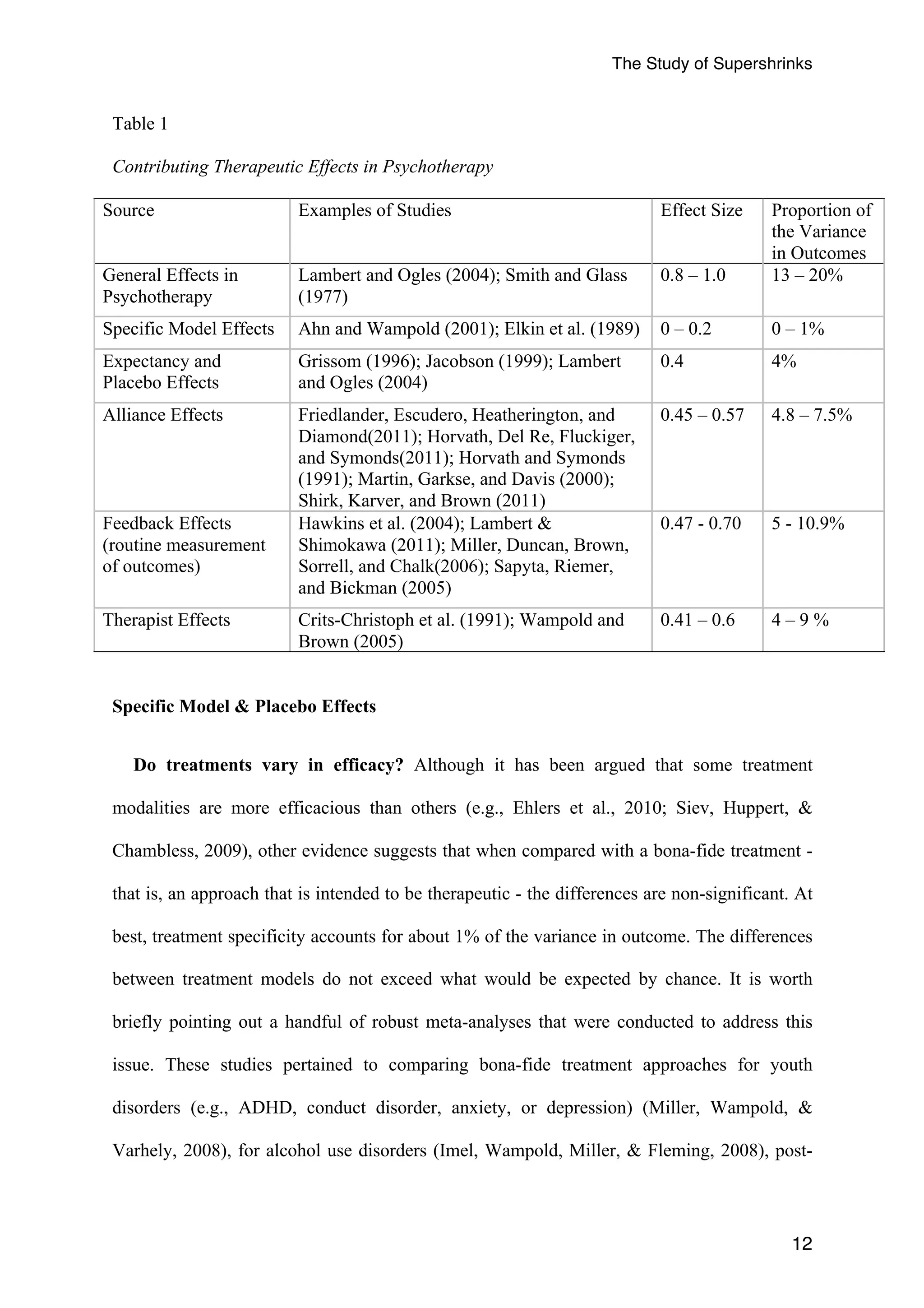
As an overview, Table 1 provides a summary of the therapeutic factors accounting for the 
11 
variance in outcomes in psychotherapy, which will be elaborated in the following sections.
The Study of Supershrinks 
Table 1 
Contributing Therapeutic Effects in Psychotherapy 
Source Examples of Studies Effect Size Proportion of 
the Variance 
in Outcomes 
12 
General Effects in 
Psychotherapy 
Lambert and Ogles (2004); Smith and Glass 
(1977) 
0.8 – 1.0 13 – 20% 
Specific Model Effects Ahn and Wampold (2001); Elkin et al. (1989) 0 – 0.2 0 – 1% 
Expectancy and 
Grissom (1996); Jacobson (1999); Lambert 
0.4 4% 
Placebo Effects 
and Ogles (2004) 
Alliance Effects Friedlander, Escudero, Heatherington, and 
Diamond(2011); Horvath, Del Re, Fluckiger, 
and Symonds(2011); Horvath and Symonds 
(1991); Martin, Garkse, and Davis (2000); 
Shirk, Karver, and Brown (2011) 
0.45 – 0.57 4.8 – 7.5% 
Feedback Effects 
(routine measurement 
of outcomes) 
Hawkins et al. (2004); Lambert & 
Shimokawa (2011); Miller, Duncan, Brown, 
Sorrell, and Chalk(2006); Sapyta, Riemer, 
and Bickman (2005) 
0.47 - 0.70 5 - 10.9% 
Therapist Effects Crits-Christoph et al. (1991); Wampold and 
Brown (2005) 
0.41 – 0.6 4 – 9 % 
Specific Model & Placebo Effects 
Do treatments vary in efficacy? Although it has been argued that some treatment 
modalities are more efficacious than others (e.g., Ehlers et al., 2010; Siev, Huppert, & 
Chambless, 2009), other evidence suggests that when compared with a bona-fide treatment - 
that is, an approach that is intended to be therapeutic - the differences are non-significant. At 
best, treatment specificity accounts for about 1% of the variance in outcome. The differences 
between treatment models do not exceed what would be expected by chance. It is worth 
briefly pointing out a handful of robust meta-analyses that were conducted to address this 
issue. These studies pertained to comparing bona-fide treatment approaches for youth 
disorders (e.g., ADHD, conduct disorder, anxiety, or depression) (Miller, Wampold, & 
Varhely, 2008), for alcohol use disorders (Imel, Wampold, Miller, & Fleming, 2008), post-
The Study of Supershrinks 
traumatic stress disorders (Benish, Imel, & Wampold, 2008), and even the comparison 
between psychotherapy and pharmacotherapy interventions for depression (De Maat et al., 
2006). Consistent with past clinical trials (Elkin et al., 1989), all of these meta-analyses found 
equivalent benefits between treatment modalities, after controlling for researcher allegiance 
(i.e., researcher bias and beliefs about a particular treatment model). In a more recent meta-analysis, 
researcher allegiance was found to explain about 12% of the variance in outcome 
(Munder, Fluckiger, Gerger, Wampold, & Barth, 2012). In other words, all treatments 
intended to be efficacious with the provision of a sound theoretical rationale, work equally 
well. 
Above and beyond the strength of the working alliance, the utilisation of credible 
techniques is nonetheless crucial (Owen, Hilsenroth, & Rodolfa, 2012). Grounded by a 
wealth of empirical evidence (e.g., Addis, Cardemil, Duncan, & Miller, 2006; Ahn & 
Wampold, 2001; Messer & Wampold, 2002; Miller et al., 2008), Wampold (2010) succinctly 
state, “…with some qualifications, all cogent treatments, embraced by therapist and client 
and competently delivered to a client motivated to engage in the process, are equally 
effective” (p. 56). 
It is also noteworthy to mention Seligman’s (1995) specification of the five limitations of 
efficacy studies: 1. Psychotherapy is not of a fixed duration; 2. It is not rigid in adherence to a 
treatment modality, but rather adapts to the patient’s needs; 3. Patients often actively shop for 
a therapist that fits their needs; 4. Unlike clinical trials, real world patients usually have more 
than one problem/diagnosis; and 5. Efficacy studies often focus on the improvement of 
specific symptoms or disorders, and that actual clinical practice is almost always concerned 
with the improvement of general functioning, as well as the reduction of symptoms and 
problems. 
13
The Study of Supershrinks 
Specific versus non-specific ingredients in psychotherapy. There were early proponents 
who advocated that the distinction between specific and non-specific factors in 
psychotherapy was an arbitrary and unnecessary distinction (Butler & Strupp, 1986). Instead 
of focusing on disembodied distillation of specific “active ingredients” of psychotherapy, 
Butler and Strupp (1986) stressed the importance of a paradigm shift and move towards a 
contextual model of understanding, focusing on identifying primary principles of human 
interactional conditions between therapist and client that ultimately promote therapeutic 
change. 
This does not mean that therapeutic models and techniques are unnecessary and that 
“anything goes” (Anderson, Lunnen, & Ogles, 2010). Rather, when a believable myth (i.e., 
approach, rationale) is delivered in a healing context by a practitioner who not only believes 
in its efficacy, but is also persuasive, establishes an emotionally charged and good therapeutic 
alliance, the practitioner is likely to be effective, especially when he or she finds a fit with the 
particular client’s preferences and worldview (Frank & Frank, 1993). Stated differently, this 
ritualistic process of psychotherapy engages both the practitioner and client into a shared 
culture of healing (Fancher, 1995). 
Expectancy and placebo effects. Within the context of psychotherapy research, the 
increase of hope, and positive expectation provided by the clinician to the client is often 
referred to as the expectancy and placebo effect (Kirsch, 1990). Placebo effects have at times 
been labeled as “nonspecific factors” or “common factors” within the literature (Lambert & 
Ogles, 2004). Unlike in medical research, conducted often in either blind or double-blind 
studies, where an active pharmacological agent is compared with one without the active 
substance, the medical model is less applicable within the contextual model of psychological 
interventions, as the placebo effect is regarded as the portion of the treatment that is 
14
The Study of Supershrinks 
accounted for by psychological means, rather than physical (Kirsch, 2005). Moreover, raising 
hope and response expectancy are part of a therapeutic treatment framework. 
Nevertheless, based on one of the most comprehensive investigations of the placebo 
effect, Grissom (1996) delineated the following effect sizes based on 46 meta-analysis 
studies: Psychotherapy versus Control (0.75); Psychotherapy versus Placebo (0.58); and 
Placebo versus Control (0.44). In Grissom’s (1996) definition, Psychotherapy refers to the 
inclusion of specific treatment and expectancy (placebo) effects. Placebo refers to some form 
of expectancy induction, and Control refers to little or no evidence of expectancy (i.e., a wait-list). 
In other words, this indicates that a bona fide treatment approach is more effective that 
the placebo effect. Likewise, a placebo effect which aims to increase hope and expectancy is 
more effective that no treatment at all. 
In summary, therapeutic orientation, techniques, and increasing faith and hope in the 
treatment are necessary to provide a contextual framework for both the therapist and client. 
However, despite the investment and emphasis on empirically supported therapies (ESTs) 
(Chambless & Hollon, 1998; Elliott, 1998; Ingram, Hayes, & Scott, 2000; Silverman & 
Kurtines, 2004; Westen, Novotny, & Thompson-Brenner, 2005), all bona-fide approaches to 
psychotherapy are equally efficacious. Moving forward, this provides an indication that 
future studies should not only examine the specific and non-specific factors of ESTs, or so-called 
highly effective therapies, but also focus on factors that contribute to the development 
15 
of superior performing therapists. 
Alliance Effects 
Along with the contribution of therapist effects, the impact of the working alliance on 
therapeutic outcomes is one of the most established and robust empirical findings (Norcross
The Study of Supershrinks 
& Lambert, 2011; Norcross & Wampold, 2011). The working alliance in psychotherapy has 
been defined based on three factors: the agreement of therapeutic goals, methods used in 
treatment, and the emotional bond between the client and therapist (Bordin, 1979). 
Two previous meta-analyses have found moderately strong alliance effects on 
psychotherapy outcomes, accounting for between 5% to 7% of the variance in outcome 
(Horvath & Symonds, 1991; Martin et al., 2000). Most recently, the American Psychological 
Association (APA), Division of Psychotherapy and Division of Clinical Psychology, 
commissioned a new task force to update the research studies on the therapeutic relationship 
between patient and therapist (Norcross & Lambert, 2011). This effort yielded several meta-analyses 
that found similar modest but robust effects of the working alliance in individual 
psychotherapy (Horvath et al., 2011), couples and family therapy (Friedlander et al., 2011), 
child and adolescent psychotherapy (Shirk et al., 2011), and cohesiveness in group therapy 
(Burlingame, McClendon, & Alonso, 2011), amongst others. Collectively, these studies 
indicated that between 4.8% to 7.5% of the variation in outcome was due to the working 
alliance, which is deemed as “demonstrably effective” elements in the practice of 
psychotherapy by the task force. 
Expanding further, a recent study by Fluckiger, Grosse, Znoj, Caspar, and Wampold 
(2012), using a multilevel longitudinal meta-analysis, revealed that the alliance-outcome 
relationship was maintained, even after accounting for moderator effects, such as research 
design, specificity of the outcome measure, a disorder-specific manual being used, as well as 
researcher allegiance. This is consistent with previous findings on the alliance-outcome 
relationship (Horvath & Symonds, 1991; Martin et al., 2000). 
More importantly, the contribution of the therapist alliance formation skills was 
demonstrated to be more crucial to the outcome than the clients’ ability of alliance formation 
16
The Study of Supershrinks 
(Baldwin et al., 2007). In other words, therapists who on average, formed stronger alliances, 
performed better than therapists who did not form as strong a therapeutic engagement with 
their clients. This lends further support towards the impact of therapist effects. In the next 
chapter, the impact of the therapist will be expanded in greater detail. 
17 
Feedback Effects 
The benefits of using formal feedback mechanisms to measure the outcomes and progress 
of psychotherapy have been well-documented, and several previous studies (e.g., Harmon et 
al., 2005; Harmon et al., 2007; Hawkins et al., 2004; Lambert et al., 2001; Lambert et al., 
2002; Slade et al., 2006; Whipple et al., 2003), meta-analyses, and mega-analyses (e.g., 
Knaup, Koesters, Schoefer, Becker, & Puschner, 2009; Lambert et al., 2003; Shimokawa, 
Lambert, & Smart, 2010; Lambert & Shimokawa, 2011) have been conducted. Information 
obtained from client feedback was reported to be most helpful when it assisted the 
practitioner to bridge any discrepant information between what they perceive of the client’s 
progress, and what the client reports in his/her measure of progress. In addition, without the 
utilisation of feedback mechanisms that track client progress, psychotherapists, like other 
professionals, are not accurate in predicting their own effectiveness (Sapyta et al., 2005). 
A seminal study conducted by Hannan and colleagues (2005) highlighted how therapists 
were rarely accurate at predicting those who were at-risk of treatment failures. Despite 
knowing the purpose of the study and the base rate of deterioration among clients (i.e., 8%), 
the practitioners predicted 3 out of 550 cases to have deteriorated, and they were accurate 
only with one of the three cases. In contrast, the actual outcome data indicated that out of the 
550 clients, 40 deteriorated by the end of treatment. The researchers summed up, “We 
interpret these results as indicating that therapists tend to overpredict improvement and fail to 
recognize clients who worsen during therapy” (p. 161).
The Study of Supershrinks 
If therapists are not accurate in predicting client outcomes, particularly negative 
outcomes, it warrants further consideration of therapists using formal feedback mechanisms 
in their clinical practice. In a recent meta-analysis, Lambert and Shimokawa (2011) examined 
the therapeutic effects of therapists using brief measures to obtain real-time feedback about 
their clients’ psychological functioning and their response to the treatment. Two similar but 
distinct systems for monitoring treatment response were described, namely the Partners for 
Change Outcome Management System (PCOMS) (Miller, Duncan, Sorrell, & Brown, 2005), 
and the Outcome Questionnaire (OQ) system (Lambert et al., 2004). PCOMS employs the 
use of two ultra-brief scales, the Outcome Rating Scale (ORS) (Miller, Duncan, Brown, 
Sparks, & Claud, 2003) and the Session Rating Scale (SRS) (Duncan et al., 2003), while the 
OQ system utilises the OQ-45, which is a 45-item self-reported measure designed to assess 
client functioning at each session of the treatment process. As the OQ system was primarily 
designed to enhance the outcomes of clients who were at-risk of treatment failure at 
termination, a signal-alarm system warns the therapists of a potential poor outcome for a 
given client, and an adjunct instrument called the Assessment for Signal Cases (ASC) is used 
to assist clinicians to problem-solve with the clients who are “at-risk” of treatment failure. 
The ASC is the basic tenet of the Clinical Support Tool (Harmon et al., 2005; Harmon et al., 
2007; Slade, Lambert, Harmon, Smart, & Bailey, 2008), which prompts the clinician to areas 
that warrant further attention, such as the therapeutic alliance, issues relating to social 
support, readiness to change, diagnostic formulation, life events, and need for medication 
referral. 
In a total of 13 studies analysed, Lambert and Shimokawa (2011) found the following: (a) 
the use of PCOMS accounted for about 5.3% of the variance in outcomes (Cohen’s d = .47); 
(b) the use of the OQ system among not-on-track clients accounted for about 6.25% of the 
variance in outcomes (Cohen’s d = .52); and (c) the use of the OQ system Clinical Support 
18
The Study of Supershrinks 
Tools (CSTs) among the not-on-track clients accounted for about 10.9% of the variance in 
outcomes (Cohen’s d = .69). In other words, the use of formal feedback measures improves 
client outcomes. 
Even though psychotherapy has been found to be generally effective, a frequent oversight 
relates to those who do not experience benefit from psychological interventions. Based on 
clinical trials, approximately 5-10% of clients deteriorate in treatment (Lambert & Ogles, 
2004). The use of formal feedback systems has been found to reduce deterioration rates by 
about half its normal rate (e.g., Lambert & Shimokawa, 2011). Nevertheless, little evidence is 
currently available about how such feedback information is perceived and utilised by the 
clinicians that inherently impact outcomes. For instance, it is not clear if therapists actually 
learn from the feedback information and incorporate it into the subsequent sessions (Hays, 
Kornell, & Bjork, 2010). 
The overview provided on feedback effects is of interest to this research. As it will be 
highlighted in the Methodology section, all therapists involved in the current study utilised 
formal feedback mechanisms, such as the Clinical Outcome in Routine Evaluation-Outcome 
Management (CORE-OM) (Barkham et al., 2001; Connell et al., 2007; Evans et al., 2000) in 
their routine clinical practice. 
19 
Therapist Effects 
Evidently, client factors (e.g., severity of dysfunction, motivation, and social support), 
extratherapeutic factors, and other unexplained and error variance accounts for approximately 
87% of outcome (Bohart & Tallman, 2010; Orlinsky, Ronnestad, & Willutzki, 2004; 
Wampold, 2001). Within the 13% of total outcome variance due to treatment effects of 
psychotherapy, therapist effects account for one of the largest proportion of the variance in 
outcome. The variability in outcomes attributable to the therapist is often cited to be
The Study of Supershrinks 
approximately 4-9% (Crits-Christoph et al., 1991; Wampold & Brown, 2005), with one study 
indicating as high as 8-17% in an outpatient psychotherapy naturalistic design study (Lutz, 
Leon, Martinovich, Lyons, & Stiles, 2007). In other words, who the treatment provider is 
matters more than the type of treatment modality that is being employed within the 
psychotherapeutic framework. Thus, researchers have proposed that the focus should be 
shifted away from the study of models of psychotherapy, well-established common factors, 
and even therapists’ qualities (e.g., age, experience, theoretical orientation), and move 
towards the investigation of therapists’ skills and work practices contributing towards good 
outcomes (Miller, Hubble, Chow, & Seidel, 2013; Miller, Hubble, & Duncan, 2007; Miller, 
Hubble, Duncan, & Wampold, 2010; Strupp, 1995; Tracey, Wampold, Lichtenberg, & 
Goodyear, 2014). 
As the previous sections have provided a review of the various contributing factors (e.g., 
alliance, specific model, expectancy, and feedback effects) to the outcome of psychotherapy, 
the next chapter will focus specifically on the key tenet of this study, which is the 
investigation of therapist factors, and how they significantly relate to client outcomes. 
20
The Study of Supershrinks 
21 
Chapter 3: The Contribution of the Therapist 
The Study of Therapist Effects 
Previously, the study of therapist effects was commonly referred to as the “neglected” 
factor (Garfield, 1997). About 50 years ago, Strupp (1963) pointed out the importance of the 
contribution of the therapist. To date, very few clinical trials in psychotherapy have 
considered therapist effects in the primary analyses (Wampold & Bhati, 2004), with a few 
recent exceptions (e.g., Anker, Duncan, & Sparks, 2009; Owen, Leach, Wampold, & 
Rodolfa, 2011; Wampold & Brown, 2005). It is reasonable to expect that like other 
professionals (e.g., lawyers, teachers, physicians, artists), therapists do vary in their 
outcomes. 
In an early study by Ricks (1974) examining the long-term outcomes of ‘highly 
disturbed’ adolescents, when the participants were later reviewed as adults, the results 
dramatically differed between the two therapists who provided the treatment. For example, 
27% of the first therapist’s cases received the diagnosis of schizophrenia as adults, while 84% 
of the second therapist’s cases received that diagnosis. A significant amount of the adults 
who had seen the first therapist were more socially well-adjusted, compared to those who saw 
the second therapist, despite the fact that, at commencement of therapy, both therapists’ 
caseloads were equal in level of disturbance and other variables (gender, IQ level, socio-economic 
status, age, ethnicity, period seen, and frequency of psychotic disturbances found 
in the parents). Considering the consistently varied outcomes between the two therapists, the 
children in the child guidance clinic called the exceptional therapist who repeatedly achieved 
good outcomes “Supershrink”, while the therapist with poor outcomes was subsequently 
referred to as “Pseudoshrink”. 
Even though both therapists were trained in the psychoanalytic tradition, Ricks (1974) 
found that they differed in five major ways in which psychotherapeutic methods were
The Study of Supershrinks 
employed. Compared to the other therapist, the “Supershrink” allotted more of his effort to 
help the more disturbed adolescents, instead of those easier to treat. He also used resources 
external to the therapy context, and was more competent in supporting the youths’ 
development of autonomy, while helping parents to recognise the importance of their 
adolescent’s individuation. Further, the “Supershrink” was firmer and more direct with the 
families and employed fewer intrapsychic interventions. This therapist tended to be more 
skilled than the “Pseudoshrink” in developing a deeper and more lasting therapeutic 
relationship. Finally, it was also apparent that the “Supershrink” was keen to elicit the 
patient’s feedback of each session. 
Although Ricks’ (1974) study comprised only two therapists, it was the first study to 
explore results obtained by therapists with different competency levels. Based on long-term 
outcome criteria, it is alarming to note that the “Pseudoshrink” had an iatrogenic effect on 
some of the boys that he treated. Ricks was one of the first to highlight the salience of 
therapist effects and to emphasise the need to systematically monitor outcomes in 
psychotherapy. In addressing the harmful effects of ineffective therapists, as well as the 
merits of identifying highly effective therapists, Ricks proposed the need to systematically 
monitor outcomes in psychotherapy. He stated, “If a major clinic were to set up an ‘outcomes 
board’ to look over the long-term outcomes of therapy conducted by staff psychotherapists, it 
would be possible to determine, within a few years, whether particular therapists were 
unusually harmful or helpful" (p. 292). Nevertheless, the study is limited in its exploration of 
the relevant therapeutic skills that might have accounted for the significant variance between 
the two therapists. 
A growing body of researchers has since reported similar findings, specifically that the 
variance in therapy outcomes is explained in part by therapist effects (Baldwin & Imel, 2013; 
22
The Study of Supershrinks 
Blatt et al., 1996; Kim et al., 2006; Lambert & Ogles, 2004; Luborsky et al., 1997; Okiishi et 
al., 2006; Okiishi et al., 2003; Wampold & Brown, 2005). In an early study of therapist 
effects, Luborsky et al. (1986) re-analysed four major psychotherapy studies, using the 
therapist as a random factor. They found that therapists varied considerably in their average 
success rates, accounting for more of the variance in outcomes than the type of treatment 
employed. The researchers urged for further examination of highly effective 
psychotherapists. However, after more than 20 years, compared to voluminous research into 
the efficacy of a variety of treatment modalities, there are still limited investigations 
examining successful therapists in naturalistic settings. 
Nevertheless, the current available evidence suggests that therapist effects account for 
approximately four to five times the variance of the outcome, compared to specific treatment 
effects, which accounts for less than 1% of the variance in outcomes (Beutler et al., 2004; 
Wampold, 2001; Wampold & Brown, 2005). Baldwin and Imel’s (2013) recent meta-analysis 
pointed out that in naturalistic/effectiveness studies therapist effects accounted for 7% of the 
variance in outcome, while in efficacy studies this was 5%. Therapist effects might have been 
lower in the efficacy studies due to the higher amounts of training, supervision, and structure 
provided leading to increased homogeneity. Across the total of 45 studies, the researchers 
concluded that therapist effects account for about 5% of the outcome. Table 2 provides 
examples of the range of therapist effects found in past studies. 
Although other researchers would argue for the impact of specific treatment modalities 
for specific disorder while discounting the therapist factor as an error variance (Chambless & 
Hollon, 1998; Siev et al., 2009; Waller, 2009), Wampold and Serlin (2000) stressed that 
ignoring therapist effects in the investigation would falsely inflate the estimates of treatment 
effects. Wampold (2001) succinctly points out: “Clearly, the person of the therapist is a 
critical factor in the success of therapy… The evidence is clear that the type of treatment is 
23
The Study of Supershrinks 
irrelevant, and adherence to a protocol is misguided, but yet the therapist, within each of the 
treatments, makes a tremendous difference” (p. 202). 
Study Description of the study Percentage of 
the outcomes 
attributable to 
Therapist 
Effects 
24 
Table 2 
Range of Therapist Effects 
Crits-Christoph et al. 
(1991) 
Meta-analysis of 15 clinical trials 9% 
Okiishi (2000); 
Okiishi et al., (2003) 
Naturalistic study, in a university counselling centre 4.1% 
Wampold and 
Brown (2005) 
Naturalistic study, in a managed care setting 5% 
Kim, Wampold, and 
Bolt (2006) 
Reanalysis of the National Institute of Mental-Health 
(NIMH)-sponsored Treatment of Depression 
Collaborative Research Program (TDCRP) data 
McKay, Imel, and 
Wampold (2006) 
A multi-level analysis of the data of the NIMH 
TDCRP, examining the impact of psychiatrist 
providing medications 
Lutz, Leon, 
Martinovich, Lyons, 
and Stiles (2007) 
Naturalistic study design, in a managed care 
outpatient setting 
Saxon & Barkham 
(2012) 
Practice-based data set in U.K.’S National Health 
Service (NHS) primary care counseling and 
psychological therapy services 
Laska et al. (2013) Naturalistic study design, delivering an evidenced-based 
treatment in a Veterans Affairs (VA) 
posttraumatic stress disorder (PTSD) specialty clinic 
Characteristics of Effective Psychotherapists 
8% 
7-9% 
8-17% 
6.6% 
12 % 
In one of the most influential early studies of therapist effects in psychotherapy, 
Luborsky, McClellan, Woody, O'Brien, and Auerbach (1985) found significant therapist
The Study of Supershrinks 
differences in effectiveness among nine therapists, despite controlling for training, 
monitoring, supervision, and the use of specified treatment manuals. Three therapist qualities 
were found to distinguish the highly effective group of therapists: (1) therapist’s adjustment, 
skill, and interest in helping patients; (2) the “purity” of adherence to the specified treatment 
they offered; and (3) the quality of the good working alliance at the early stage of treatment. 
However, a recent meta-analysis found that therapist adherence to a particular treatment 
model and therapist competence of the specific treatment (i.e., the skill with which the 
specific techniques were employed) was not related to treatment outcomes (Baldwin & Imel, 
2013; Webb, DeRubeis, & Barber, 2010). Therapist adherence to a treatment model was also 
found to be irrelevant to outcomes when a strong working alliance was forged (Barber, et al., 
2006). 
In a reanalysis of the National Institute of Mental Health (NIMH) Treatment of 
Depression Collaborative Research Project (TDCRP) data, based on therapists’ self-reports, 
Blatt and colleagues (1996) found that the more effective therapists were more 
psychologically minded, as opposed to having a biological orientation (i.e., medication, 
electroconvulsive therapy), and they also expected more outpatient therapy treatment sessions 
than did moderate and less effective therapists. These differences were independent of the 
four types of treatment provided (cognitive-behavioural therapy, interpersonal therapy, 
imipramine plus clinical management, and pill placebo plus clinical management), or the 
research site. The difference in effectiveness was also not related to the therapists’ level of 
clinical experience. Although the overall results obtained by Blatt and colleagues indicated 
that qualities of the therapist are important dimensions that appear to influence therapeutic 
outcome, the results do not suggest any causal inferences of the above therapists’ 
characteristics impacting outcome. Further, as binary variable comparisons between 
psychological mindedness and biological orientations were used in Blatt and colleagues’ 
25
The Study of Supershrinks 
study, the results do not suggest that the more psychologically minded therapist would lead to 
better outcomes. 
Therapist characteristics such as age, experience, and professional degree also did not 
explain the variability among therapists. Beutler and colleagues’ (2004) extensive review 
points out that there were no persuasive indicators that therapist gender, therapist 
involvement in personal therapy, or therapist personality characteristics and traits predicted 
better client outcomes in therapy. Few studies found a modest interactional effect of client 
and therapist variables (e.g., age and gender) on treatment outcome (Beutler et al., 2004). The 
only therapist variable of any influence was the therapist’s emotional well-being, albeit of a 
small effect size. It is plausible that unless there were specific requests by the clients, in terms 
of their therapist’s gender, age group, or ethnicity, these factors generally are not significant 
to the outcomes of psychotherapy. 
In another study, Wampold and Brown (2005) examined 6,146 adults with various 
diagnoses seen in real-world clinical practice by approximately 581 therapists. The 
researchers found factors widely believed to influence treatment outcome accounted for little 
of the variability in outcomes among therapists. Specifically, Wampold and Brown (2005) 
found that patient characteristics such as age, gender, and diagnosis, did not contribute 
significantly to the variability in outcomes. Therapist variables, such as age, gender, and 
years of experience were also not significant in affecting client outcome. As mentioned by 
the researchers, they were limited by access to other therapist or process (i.e., working 
alliance) information, and were thus restricted in identifying other variables that better 
therapists might possess that lead to consistently better client outcomes. 
It is important to state that the study of therapist effects is not without controversy. When 
Elkin, Falconnier, Matinovich, and Mahoney (2006b) recalculated the analysis of the NIMH 
TDCRP data, they did not find any significant evidence of therapist effects, compared to Kim 
26
The Study of Supershrinks 
et al. (2006), who had estimated 8% of the variance to be attributable to therapist effects. In 
response to the debate, comments that were provided indicated that the distinct findings were 
based on (a) the complex methodological difference of Kim and colleagues (2006) employing 
a two-level model (therapists nested within treatments and considered as a random factor), 
with Elkin and colleagues using a three-level model (with time at the first level) of analyses; 
and (b) the different outcome measures of comparison that were used. Kim and colleagues 
(2006) used the termination or last score available, while Elkin and colleagues chose a 
growth curve model (Soldz, 2006). With reference to the same data, Crits-Christoph and 
Gallop (2006) responded that therapist effects are still likely to exist, albeit smaller in 
magnitude, comparable with Okiishi and colleagues’ (2003) findings (4.1%), which were 
based on large-scale naturalistic studies. Regardless, there were exceptional therapists who 
outperformed others in the NIMH TDCRP research, which is consistent with other findings 
(e.g., Blatt et al., 1996; Crits-Christoph & Mintz, 1991; Luborsky et al., 1986; Okiishi et al., 
2003). 
In two more recent studies, Cella, Stahl, Reme, and Chalder (2011) and Dinger, Strack, 
Lechsenring, Wilmers, and Schauenburg (2008) found a lower estimated variance explained 
by therapists (i.e., 0-2% and 3% respectively). Upon close examination of Cella and 
colleagues’ study (2011), which investigated therapist effects on the cognitive behaviour 
therapy (CBT) treatment of patients with chronic fatigue syndrome (CFS), significant effort 
and resources were put into ensuring the homogeneity of the therapists, in terms of theoretical 
orientation, amount and type of training, shared environment and clinical supervision (to 
ensure adherence to the manualised treatment protocol). This is not likely to reflect the 
heterogeneity among therapists in naturalistic practice settings, where therapists are more 
likely to adapt to the client’s needs based on their responsiveness (Stiles, 2013; Stiles, Honos- 
Webb, & Surko, 1998), and employ an eclectic array of skills and techniques to match 
27
The Study of Supershrinks 
clients’ concerns and preferences. Furthermore, the small number of therapists (N = 12) 
limits the estimation of therapist variability, with some of them seeing as few as 8 clients, and 
the 95% confidence interval of therapist effects ranges from 0 to about 10%. The researchers 
also pointed out the low estimated therapist variability might be due to the outcome measure 
used that was symptom-specific to CFS, which does not necessarily reflect general 
psychological functioning and life satisfaction. 
The smaller estimated therapist variability in Dinger and colleagues’ study (2008) might 
be due to the influence of other compensatory factors within the specific context of the 
investigation, which was conducted in an inpatient setting. Other significant factors are likely 
to contribute to the patient’s outcome within an inpatient setting (e.g., the impact of the same 
therapeutic team within the inpatient clinic, and the engagement in other therapeutic 
activities, such as art and body oriented therapies, group therapy, and group treatments with 
qualified nurses). Even though therapist effects on outcome appeared small in this inpatient 
study (3%), a greater variability was found between therapists on the patient-rated working 
alliance scores (33%). As the researchers indicated, this is likely due to patients’ direct 
ratings of their experience with their individual psychotherapists, which has a more direct 
relationship with the therapist’s qualities and influence. The measure of outcome in an 
inpatient setting is more likely to be influenced by several salient factors (e.g., ward 
conditions, level of care by nursing staff), other than the individual psychotherapist. 
28 
The Study of “Master” Therapists 
Other studies attempted to delineate the characteristics of effective psychotherapists. The 
methodology chosen by the investigators for sampling participants deemed as master 
therapists was based solely on nomination by peers, as determined by the chosen therapist’s 
reputation (Jennings et al., 2008; Jennings et al., 2005; Levitt & Williams, 2010; Skovholt & 
Jennings, 2005). Although yielding rich descriptions of seasoned practitioners, in terms of
The Study of Supershrinks 
cognitive, emotional, and relational (CER) characteristics (Jennings & Skoholt, 1999), 
several limitations regarding the definition of “master therapists” are inherent. Primarily, 
there has been a lack of a clear initial definition of the term “master therapist” (Orlinsky, 
1999). Orlinsky (1999) argues the following: 
Sole reliance on reputation among one's colleagues as the criterion for a master therapist 
strongly dilutes the theoretical interest of the concept. Therapeutic mastery must mean 
something more than that, something, in fact, that local colleagues may not be well 
positioned to know. (p. 13) 
Orlinsky (1999) further points out that there was no comparison group to explore the 
cognitive, emotional, and relational characteristics of non-master therapists and master 
therapists. Some of the categories that Jennings and Skovholt (1999) attributed to master 
therapists, such as “voracious learners, draw heavily on accumulated experience, value 
cognitive complexity and ambiguity” (p. 6), are just as likely to characterise non-therapists. 
Third, and more importantly, there were no measures of the level of effectiveness of these 
peer-nominated master therapists. Thus, a master therapist, as defined by the researchers, was 
not necessarily synonymous with being a therapist with a superior level of mastery of 
therapeutic skills and knowledge that translates to highly effective client outcomes. 
29 
Therapist Skills 
Therapist ability in alliance formation. The research on the positive impact of one of 
the common factors, the working alliance, on outcome in psychotherapy is well established 
(e.g., Horvath et al., 2011; Horvath & Luborsky, 1993; Horvath & Symonds, 1991). Some 
studies even suggest the potential of a causal role of alliance in outcomes (Anker, Owen, 
Duncan, & Sparks, 2010; Barber, Connolly, Crits-Christoph, Gladis, & Siqueland, 2000). 
Even more relevant is the finding that therapists who form better alliances, that is, an
The Study of Supershrinks 
agreement on goals, tasks and level of bond between the therapist and client (Bordin, 1979), 
achieve better outcomes than therapists who are less skilled in forging a strong alliance 
(Baldwin et al., 2007). Anderson and colleagues (2009) added that therapists’ ability to 
handle challenging interpersonal encounters, measured via a performance task indicator 
called the facilitative interpersonal skills (FIS; Anderson, Patterson, & Weis, 2007), predicted 
therapist success in terms of outcomes. Anderson et al. (2009) defined FIS as: 
The general and personal qualities of persons who are capable of 1) perceiving, 
understanding, and sending a wide range of interpersonal messages and 2) persuading 
others who have personal problems to apply proposed solutions to their problems and 
abandon maladaptive patterns. (p. 3) 
This suggests the likelihood that in the process of their professional development, 
successful therapists acquire the necessary interpersonal skills to handle a variety of difficult 
situations within the context of therapy. In addition, if highly effective therapists possess such 
heightened relational skills within the context of psychotherapy, it is likely that this group of 
therapists would yield a progressive increase of positive working alliance with their clients 
within treatment, as was found in couples therapy (Anker et al., 2010). Anker and colleagues 
found that therapists whose alliance ratings started over the mean and improved across 
sessions were more likely to achieve reliable or clinical significant change. Nonetheless, 
some authors have suggested that highly effective therapists are more likely to obtain an 
initial lower alliance rating with gradual improvement across sessions, because they are more 
likely to be receptive and able to elicit negative feedback at an early stage of the therapy 
process (Miller et al., 2007). 
Taken together, the abovementioned findings echoes Strupp’s (1995) emphasis on the 
significant contributory role of the therapist’s skill impacting on client outcomes in the 
practice of psychotherapy. 
30
The Study of Supershrinks 
31 
Summary of Therapist Effects 
In summary, cumulative evidence suggests that therapist effects account for a relatively 
large proportion of the variance in therapeutic outcomes (4-17%), as compared to treatment 
and model effects (0-1%). However, therapist characteristics such as experience, age, and 
professional training do not account for a significant proportion of variability in outcomes. 
Rather, the therapist’s ability in employing specific relational skills at the appropriate time 
and context with their clients has a significant impact on therapy outcomes (Anderson et al., 
2009; Cooper, 2008). Ignoring therapist effects in the investigation of psychotherapy 
outcomes falsely inflate the estimates of treatment effects (Wampold & Serlin, 2000). 
The Development of Psychotherapists 
Despite Blatt and colleagues’ (1996) initial study of the characteristics of effective 
therapists, there has been no study, to date, that addresses how highly effective therapists’ 
professional development differs from less effective therapists. In 1989, the Society for 
Psychotherapy Research (SPR) Collaborative Research Network (CRN) was initiated to 
study the development of therapists from various backgrounds, theoretical orientations, and 
nationalities (Orlinsky, Ambuhl et al., 1999). Using 3800 therapists in their database, 
Orlinsky and colleagues were able to substantiate construct validity, internal consistency, 
adequate differentiation, and broad applications of the various subscales found in the package 
of instruments, collectively termed as the Development of Psychotherapist Common Core 
Questionnaire (DPCCQ; see section on Measures for more details). The DPCCQ has been 
translated to approximately 20 languages and used by various countries. 
A considerable amount of research began to use the DPCCQ to examine the development 
of psychotherapists. The studies covered a broad range of issues, such as the 
psychotherapists’ self-assessment of their development (Orlinsky, Ronnestad et al., 1999) and 
the impact of training activities (Orlinsky, Botermans, & Ronnestad, 2001), spiritual practices
The Study of Supershrinks 
of psychotherapists (Smith & Orlinsky, 2004), therapists’ thoughts and feelings about their 
patients between sessions (Schroder, Wiseman, & Orlinsky, 2009), and the influence of 
therapist characteristics on early patient-rated alliance formation (Nissen-Lie, Monsen, & 
Ronnestad, 2010). 
Leading further research efforts in this area, Orlinsky and Ronnestad (2005) conducted a 
comprehensive analysis of the way psychotherapists develop and function in their profession 
using the DPCCQ. This was based on nearly 5000 psychotherapists of all career levels, 
professions, and theoretical orientations in more than a dozen countries worldwide. Of 
interest, the authors found highly plausible convergence between the depiction of effective 
therapeutic process based on 50 years of process-outcome research (Lambert & Ogles, 2004; 
Orlinsky et al., 2004), and the broad dimension of therapeutic work experience, identified as 
Healing Involvement (HI) in the DPCCQ. Orlinsky and Ronnestad (2005) indicated that HI 
represented the therapist as the following: 
Personally invested, (involved, committed) and Efficacious (effective, organized) in 
relational agency, as Affirming (accepting, friendly, warm) and Accommodating 
(permissive, receptive, nurturant) in relational manner, as currently Highly Skillful, as 
experiencing Flow states (stimulated, inspired) during therapy sessions, and as using 
Constructive Coping strategies when dealing with difficulties. (p. 63) 
Reflecting another aspect of therapeutic work experience, Orlinsky and Ronnestad 
32 
(2005) identified this factor as Stressful Involvement (SI), defined as: 
The therapist’s experiences of Frequent Difficulties in practice, accompanied by feelings 
of Anxiety and Boredom during sessions and a tendency to cope with difficulties by 
Avoiding Therapeutic Engagement (avoiding the problem, hoping it will disappear, 
considering transferring or terminating the patient). (p. 65)
The Study of Supershrinks 
The experiences of healing involvement and stressful involvement by a therapist are not 
regarded as mutually exclusive, as it is conceivable for a therapist to experience one of the 
dimensions with some patients and not others, and to experience the other dimension at a 
different point of treating a particular patient (Orlinsky & Ronnestad, 2005). Nevertheless, 
the researchers further delineated four practice patterns experienced by therapists in their 
study: (a) an Effective Practice (much experience of HI and little SI); (b) a Challenging 
Practice (much experience of HI and more than a little of SI); (c) a Distressing Practice (not 
much experience of HI and more than a little SI); and (d) a Disengaged Practice (not much 
experience of HI and little SI). The researchers found that half of the Western therapists 
experienced an Effective Practice pattern, 23% of the participants experienced a 
Challenging Practice pattern, 10% experienced a Distressing Practice pattern and finally, 
17% were experiencing a Disengaged Practice pattern. 
Orlinsky and Ronnestad (2005) were able to further identify three main independent 
sources with the dimension of Healing Involvement (HI): The level of therapists’ Cumulative 
Career Development, therapists’ Theoretical Breadth, and the therapists’ sense of Currently 
Experienced Growth. Cumulative Career Development refers to therapist improvement in 
clinical skills, increments in therapeutic mastery, and overcoming past limitations. 
Theoretical Breadth reflects the therapist’s integration of several theoretical perspectives in 
his or her practice, which allows the practitioner flexibility and the utilisation of multiple 
conceptual lenses to formulate their work with various clients. Currently Experiencing 
Growth is referred to by Orlinsky and Ronnestad as the most significant influence on HI. It 
reflects the “therapist’s positive work morale and the process of learning from clinical 
experience through continuous professional reflection” (Orlinsky & Ronnestad, 2005, p. 
171), which propels further new learning. This is also indicative of a therapist’s motivation 
for continuous improvement. 
33
The Study of Supershrinks 
In order to have a contextual understanding of the professional development of 
psychotherapists, further elaboration will be provided describing the influences of profession 
and theoretical orientation in clinical practice, career and experience levels, formal training, 
and clinical supervision. 
Profession and theoretical orientation in clinical practice. It is clear that 
psychotherapy is considered to be a shared sub-specialty amongst psychiatrists, 
psychologists, counsellors, and social workers (Orlinsky, 2009). With so many professions 
practicing psychotherapy globally, it is not without diversity in its theoretical orientations and 
intervention strategies among practitioners (e.g., psychodynamic, humanistic, cognitive-behavioural). 
There is evidence to suggest that psychotherapists naturally enlarge their initial 
theoretical orientation in the process of their epistemological development (Vasco & Dryden, 
1994). This is, in part, due to the influence of their cumulative clinical experience, and also 
their experience of theoretical dissonance as they seek to infuse other theoretical paradigms 
in an eclectic fashion. Eclecticism in theoretical orientation is found in a vast majority of 
therapists (Lambert & Ogles, 2004). For example, integration of various therapy models is 
common among North American psychotherapists (Cook, Biyanova, Elhai, Schnurr, & 
Coyne, 2010). Nevertheless, sampling a pool of nearly 5000 psychotherapists from various 
nationalities, Orlinsky and Ronnestad (2005) found that the most common salient theoretical 
orientation was analytic/psychodynamic (58%), followed by humanistic (31%), and cognitive 
(24%) orientations. In general, 45.5% reported having integrated two or more theoretical 
orientations. Similarly, in a survey profiling counsellors and psychotherapists in Australia, 
the most common primary theoretical orientation was psychodynamic (30%), although this is 
closely followed by eclectic/integrative (26%) (Schofield, 2008). On the other hand, in 
another study using the DPCCQ (Orlinsky, Ambuhl et al., 1999) with a population of Spanish 
34
The Study of Supershrinks 
psychotherapists (Coscolla et al., 2006), it was found that they were intensely biased towards 
their chosen theoretical orientation, and eschewed eclecticism and integrative orientations. 
Spanish psychotherapists’ highest rated theoretical orientation was analytic/psychodynamic 
(57.5%), followed by systemic (22.9%) and cognitive (21.2%) models. 
In another South Korean study (Bae, Joo, & Orlinsky, 2003), employing the same 
measures, the DPCCQ, an unexpected finding was that the most salient orientation was 
analytic/psychodynamic (38.6%), followed by humanistic (36.1%). Psychotherapists with 
more than one salient orientation accounted for 33.8%. Even though South Korea 
traditionally values more of a collectivistic culture compared to an individualistic mindset, 
the psychotherapists tend to lean towards a more individualistic-oriented framework. Less 
than 7% were systemically oriented in their approach. Bae and colleagues (2003) partially 
attributed this conflict of importing Western therapeutic approaches in a non-Western cultural 
context to two points. First, South Korea is still in the early stages of development of the 
profession in psychotherapy, and many of the therapeutic approaches are extracted from 
Western cultures. Second, it was apparent that the sampled Korean therapists in this study 
were relatively young and lacked clinical experience. There may be evolving differences of 
cultural orientations and lifestyles between generations, in a country that is developing 
rapidly. 
In sum, based on the overarching evidence from the studies of the development of 
psychotherapists, and despite the hegemony of evidence-based research on cognitive-behavioural 
therapies, a large proportion of practitioners are still more analytic-psychodynamically 
oriented, across the various professions and nationalities studied. This is 
not so surprising, if one is to consider the view that psychotherapists are more likely to be 
influenced in their clinical practice by significant mentors, books, formal and informal 
training, integration of knowledge of existing theories, and the effectiveness with their 
35
The Study of Supershrinks 
clients, as compared to the available empirical evidence (Cook, Schnurr, Biyanova, & Coyne, 
2009). 
More importantly, despite the above studies yielding rich descriptions of 
psychotherapists’ professional background and theoretical orientations across nations, there is 
currently no convincing evidence of superior outcomes between professions (e.g., Wampold 
& Brown, 2005) and practitioners with different theoretical orientations (e.g., Elkin et al., 
1989; Okiishi et al., 2006). 
Career and experience levels. In relation to career development, Orlinsky and 
colleagues (1999) examined about 3900 psychotherapists’ evaluation of their own 
development at various career levels. Again, the authors used the Development of 
Psychotherapist Common Core Questionnaire (DPCCQ). They found that “perceived 
therapeutic mastery” was significantly related to years of practice. In addition, the therapists’ 
sense of “currently experiencing growth” did not decline as the years of practice increased, 
but rather remained at a generally high level, even for the senior therapists. There was also a 
moderate significant positive correlation (r = .27) between “currently experiencing growth” 
and “perceived therapeutic mastery.” Nevertheless, Orlinsky and colleagues (1999) pointed 
out that therapist development was not linked to clinical effectiveness. In suggesting potential 
further studies, they cautioned the likelihood that the magnitude of association (i.e., effect 
size) between these two factors is likely to be modest at best, due to multiple mediating and 
moderating variables involved in affecting the final therapy outcomes. They suggested the 
use of a large sample size similar to their study in order to make a fair comparison. 
Although the level of therapist experience has not shown any significant differences in 
outcomes in some studies (Blatt et al., 1996; Shapiro & Shapiro, 1982; Smith & Glass, 1977; 
Wampold & Brown, 2005), in other studies there seems to be evidence of its significance 
(Leon, Martinovich, Lutz, & Lyons, 2005). Beutler (1997) attributed this discrepancy to poor 
36
The Study of Supershrinks 
conceptualisation and operationalisation of the term “experience”. He stressed that using 
years since graduation as an operational definition may not indicate the actual measure of 
years of psychotherapy experience. Nevertheless, with more than 30 years of research on 
clinical experience and training, there is currently no clear consensus that experience level 
affects outcomes in therapy (Sapyta et al., 2005). 
Training. Studies of the impact of psychotherapy training relating to client outcomes 
suggest a lack of significant differences in clinical effectiveness based on the relationship of 
clinical experience and therapist’s degree, with the exception that trained therapists might 
have slightly better retention rates, greater sustained effects on clients, and a larger impact on 
a client’s overall well-being (Atkins & Christensen, 2001; Christensen & Jacobson, 1994; 
Stein & Lambert, 1995). Christensen and Jacobson (1994) found little correlation between 
therapists' experience or amount of training with their effectiveness of treatment provided. 
Based on the available evidence, Atkins and Christensen tentatively postulated the lack of 
differences in therapeutic outcomes between paraprofessionals and professional therapists. 
This led them to suggest the possibility that individuals without formal, professional training 
can develop and improve their effectiveness by acquiring specific skills needed in their 
therapeutic setting through targeted practice and clinical supervision. 
There are many inherent difficulties in studying the influence of training effects, such 
as the complexity of effectively training psychotherapists (O'Donovan & Bain, 2001), as well 
as the array of methodological problems (e.g., inadequate controls, unclear definitions of 
“professionals and paraprofessionals,” “trained and untrained”) (Lambert & Ogles, 2004). 
Beutler (1997) noted that it is insufficient simply to note the presence of training, without the 
knowledge of its content. Notwithstanding, in a large cohort study of more than 4000 
psychotherapists (Orlinsky et al., 2001), the researchers found that therapists of various 
professional backgrounds, years of experience, and theoretical orientations from various 
37
The Study of Supershrinks 
countries consistently rated a higher level of influence from experiential forms of learning, 
such as direct client contact, supervision, and the therapist’s own personal therapy, as 
compared to didactic forms of learning (e.g., taking courses, reading journals). 
In another effort to study the influence of training effects, O’Donovan, Bain, and Dyck 
(2005) attempted to delineate the impact of formal training in clinical psychology, so as to 
improve the clinical competencies of the practitioners. Even though the study found that 
postgraduate trainees performed better than those without postgraduate training, albeit only to 
a modest degree, there were a few critical flaws in the design of the methodology. First, the 
two clients that were used for the comparison of 61 practitioners were actually research 
confederates in role-play experiments. Not using actual clients in the study has been 
highlighted to be a severe limitation in psychotherapy research designs (Mahrer, 2005). 
Justifiably, this also does not represent the typical therapist’s work in a naturalistic setting in 
mental health or agency settings, as they would more than likely to see a variety of types of 
clients. Second, this experiment contained only a 30-minute intake interview, which does not 
represent a typical bona fide psychotherapy endeavor (Wampold et al., 1997). Third, even 
though competence checklists and an alliance inventory were used, the measures that were 
used did not include actual therapy outcome scales to measure the pre-post treatment impact 
(i.e., effect size) of the sessions. At best, the researchers were able to find an association with 
enhanced performance on clinical knowledge and of clinical practice abilities (e.g., 
psychological assessments, diagnostic skills, etc.). At worst, this study did not manage to 
draw any correlation between training effects and clinical outcomes (Barkham et al., 2001; 
Lambert, 2010) within a real-world practice setting. 
Although another previous study indicated that trained therapists experienced a modest 
effect size, and had fewer dropout rates (Stein & Lambert, 1995), a similar conclusion to 
Atkins and Christensen’s (2001) was also reached in Lambert and Ogles’ (2004) study of the 
38
The Study of Supershrinks 
available meta-analyses by the mid-1990s. The researchers stated, “Paraprofessionals, who in 
many cases are selected, trained, and supervised by professional therapists, are often able to 
be as helpful as practicing clinicians” (p. 181). Nevertheless, criticisms were again made 
regarding the use of academic degrees to substantiate the amount of training a 
psychotherapist undertook and not the amount of time vested in studying specific treatment 
concepts and practices (Beutler et al., 2004). Similarly, a more recent investigation found that 
training variables, such as years in training and theoretical orientation, failed to predict not 
only the types of interventions employed, but also the actual session outcome ratings 
(Boswell, Castonguay, & Wasserman, 2010). 
In summary, no consistent pattern has emerged regarding the benefits of treatment 
specific training (Beutler et al., 2004; Sapyta et al., 2005). Nonetheless, Atkins and 
Christensen (2001) indicated the possibility that individuals without formal professional 
training can develop and improve their effectiveness by acquiring the specific skills needed in 
their therapeutic setting through targeted training, which is deliberately designed to improve 
performance (Ericsson et al., 1993). This will be explored in greater detail in the next chapter. 
Supervision. Regarded as a “signature pedagogy” in psychotherapy (Watkins, 2010), 
Watkins (2011) reported that based on the past 30 years of research, 18 empirical studies 
have been published that specifically examined the impact of supervision and client 
outcomes. However, upon further scrutiny, Watkins noted that seven of the studies were not 
actually related to the impact of clinical supervision on client outcome. Nonetheless, trainees 
and experienced psychotherapists rate clinical supervision as a highly integral part of 
professional development (Orlinsky et al., 2001), and supervising the work of other 
psychotherapists is seen as part of the norm as the practitioner experience level increases 
(Ronnestad, Orlinsky, Parks, & Davis, 1997). 
39
The Study of Supershrinks 
Based on a recent naturalistic study by Laska, Smith, Wislocki, Minami, and Wampold 
(2013), despite a uniformity of treatment modality (cognitive processing therapy) for war 
veterans treated with post-traumatic stress disorder (PTSD), along with rigorous training and 
ongoing weekly group supervision by a leading figure in this treatment approach, therapists 
effectiveness still significantly varied, accounting for about 12% of client outcomes. To date, 
Laska and colleagues’ research is the first study to disconfirm the notion that adherence to a 
unified evidence-based treatment approach, coupled with robust training and ongoing 
supervision reduces therapist effects (Aarons, Hurlburt, & Horowitz, 2011). Even though 
there was no formal assessment of therapist adherence in Laska and colleagues’ study, this is 
consistent with other evidence that therapist adherence to a particular method of intervention 
has little impact on client outcome (Baldwin & Imel, 2013; Webb, DeRubeis, & Barber, 
2010). Intriguingly, the supervisor who provided the weekly group supervision for all the 25 
therapists (in addition to weekly individual supervision for four out of the five trainees 
involved in the study), was able to predict the supervisees’ level of effectiveness, in the 
absence of outcome data information. Using a single case-study design, the researchers were 
able to qualitatively identify qualities and characteristics of effective therapists by the 
supervisor (Laska et al., 2013): addressing patient avoidance, the use of language in 
describing cases in supervision, flexibility in interpersonal style, and ability in developing a 
strong therapeutic alliance. Due to the non-generalisablity of a single supervisor providing 
her perspectives from a conceptual framework of cognitive processing therapy, further 
studies would need to either incorporate more supervisor’s perspectives, or therapists reports 
of their activities related to their professional development, as opposed to trait qualities of the 
therapists, which may be less malleable to change. Nonetheless, the findings were still 
interesting, given the fact that the supervisor did not view the actual sessions. 
40
The Study of Supershrinks 
To date, there has been limited empirical evidence that supports the fact that clinical 
supervision is more efficacious than other types of training, despite the fact that many 
trainees would rate supervision as having the highest impact (Hess, Knox, & Hill, 2006; 
Watkins, 2011). 
Efficacy of supervision in therapeutic outcomes. It is assumed that if supervision were 
efficacious in helping supervisees with skills acquisition related to alliance building, case 
formulation, and carrying out therapeutic interventions, it would thereby increase the 
probability of successful outcomes (Holloway & Neufeldt, 1995). In the study of the impact 
of clinical supervision on working alliance and symptom reduction in the brief treatment of 
major depression, Bambling, King, Raue, Schweitzer, and Lambert (2006) found that the 
supervised group of psychotherapists had significant effects on reducing depressive 
symptoms, higher client rated alliance scores at the end of the first session, higher retention 
rates, and better client treatment satisfaction. Interestingly, Bambling and colleagues (2006) 
also found equivalent efficacy between the process-focused (i.e., understanding of 
interpersonal dynamics within therapy) and skill-focused (i.e., explicit guidance to enhance 
client experience of bond, goals, and tasks) supervision conditions. However, allegiance 
effects may have influenced this research finding, as the principal researcher undertook 
extension supervision in both conditions. Nevertheless, this study supports the vital impact of 
clinical supervision on early working alliance formation, at least in the treatment of 
depression. 
Limitations of previous studies in the development of psychotherapists. One of the 
striking limitations of Orlinsky and colleagues’ (Orlinsky, Ambuhl et al., 1999; Orlinsky & 
Ronnestad, 2005) elaborate and widespread studies of the development of psychotherapists 
(e.g., the influence of profession and theoretical orientation, experience levels, training, 
41
The Study of Supershrinks 
clinical supervision), is the lack of any investigation between the various constructs in the 
DPCCQ and the psychotherapists’ actual effectiveness levels, in terms of client outcomes. 
Specifically, even though several factors were identified to contribute to the experiences of 
Healing Involvement (SI) and Stressful Involvement (SI), there were no indications on the 
relationship between these factors, or with other dimensions (e.g., Practice Patterns, 
Currently Experiencing Development) with psychotherapists’ performance. One wonders if, 
for example, a therapist scoring highly on Healing Involvement, a perceived Highly Effective 
Practice pattern, and/or Currently Experiencing Growth, would also be consistently rated as 
highly effective by their clients. Thus, the question of how the above factors influence 
clinician’s overall outcomes, is left unanswered. 
In another related area of investigation conducted by other researchers (Eshel & 
Kadouch-Kowalsky, 2003), even though there was a relationship between professional 
satisfaction and length of time in professional practice, with self-employed, open-minded, 
and psychoanalytically oriented practitioners experiencing more professional satisfaction 
(Topolinski & Hertel, 2007), there was no evidence of differing therapy outcomes between 
psychotherapists who experienced professional satisfaction or professionals who were not 
self-employed and were not psychoanalytically oriented. Furthermore, even though 88% to 
97% reported their stance towards their clients as accepting, committed, friendly, involved, 
and warm, there is a dearth of objective assessments of client’s experience of the rapport and 
working alliance. This inherent deficit of outcome and alliance information, especially in 
naturalistic studies, is possibly due to the lack of actuarial agencies and psychotherapists who 
routinely monitor ongoing outcomes of their clinical practice. As Wampold and Brown 
(2005) highlight: 
42
The Study of Supershrinks 
Exacerbating this problem is that therapists typically are not cognizant of the trajectory 
of change of patients seen by therapists in general. That is to say, they have no way of 
43 
comparing their treatment outcomes with those obtained by other therapists. (p. 922) 
Brown, Dreis, and Nace (2006) elaborate further on this lack of focus on outcomes in 
psychotherapy services: 
Credentials, professional discipline, and preferred theoretical models mean nothing if 
they cannot be translated into measurable improvement in the quality of clients' lives. In 
other words, the outcome rather than the service of psychotherapy is the product that 
therapists have to offer in the behavioral health care marketplace. Psychotherapists who 
fail to measure their outcomes in a reliable and empirically sound manner have no means 
to evaluate their own skills against those of their peers. More importantly, they are 
limited to relying on their own clinical judgment to assess the client progress... Mental 
health professionals need to pay attention to the voices of those they serve - their clients. 
(p. 403) 
Based on the significant absence of such routine data gathering by practitioners, there is 
no clear empirical evidence of how highly effective psychotherapists develop in their 
profession, compared with other psychotherapists. Thus, advocates have been promoting the 
routine use of outcome measures in clinical practice, while emphasising the therapeutic 
benefits in increasing effectiveness via feedback effects (e.g., Hawkins et al., 2004; Lambert, 
2010; Miller et al., 2006), and reducing no-improvement, deterioration, and drop-out rates 
(e.g. Hannan et al., 2005; Harmon et al., 2005; Harmon et al., 2007). As Rogers (1980) 
poignantly declared, "If we wish to become better therapists, we should let our clients tell us 
whether we are understanding them accurately!" (p. 149). 
In summary, due to the lack of consensus in the current literature on how highly effective 
psychotherapists develop, it is hoped that, by investigating the skills acquisition and
The Study of Supershrinks 
maintenance of expert performance in various domains (e.g., sports, music, medicine and 
surgery), as explored in the next chapter, preliminary methodologies might be developed for 
the investigation of skilled acquisition and maintenance of highly effective psychotherapists. 
44
The Study of Supershrinks 
45 
Chapter 4: The Structure, Acquisition, and Maintenance of Expertise and Expert 
Performance 
In this chapter, a deliberate shift was made from psychotherapy research to the realm of 
cognitive sciences, specifically studying the development of expertise and expert 
performance in various professional domains. Experts have been operationally defined as “… 
those who have been recognized within their profession as having the necessary skills and 
abilities to perform at the highest level” (Shanteau, 1992, p. 255). By focusing on the 
development of expertise, it is hoped that parallels can be drawn from other fields, such as 
music, sports, chess, and medicine, which can illuminate the role of key mediating factors 
involved in the development of top-level performances within each of the disciplines. 
Thus, a thorough literature review of the study of the development of expertise was 
conducted. Contemporary theories of skills acquisition typically focused on the acquisition of 
everyday skills, in order for the individuals to reach a level of proficiency to perform 
accurately and efficiently (e.g., Anderson, 1982; Anderson et al. 2004; Speelman & Kirsner, 
2009). Given the nature of the study investigating not just the psychotherapeutic skills 
acquisition of an average practitioner, but rather that of superior performing psychotherapists, 
emphasis was given towards the review of expert-performance paradigm, instead of the skill 
acquisition perspective of normal and beginning levels of performance. This consisted of the 
body of research investigating how experts use their intuition within the field of naturalistic 
decision making (NDM; e.g., Klein, 1997, 2004), as well as how exceptional individuals with 
superior performance in their fields acquire and maintain their skills across time, through the 
mediating effects of deliberate practice (e.g., Cote, Ericsson, & Law, 2005; Ericsson, 2006; 
Ericsson, 2008; Ericsson et al. 1993). 
While it is beneficial to study professionals in their naturalistic work environment, some 
limitations of Klein’s (2004) research on intuition was inherent, as it focused on the use of
The Study of Supershrinks 
patterns and schemas that the experts have already learned, rather than how these specific 
skills were acquired. Another critique of NDM research is that expert performance is 
typically defined based on peer judgement rather than quantifiable performance measures 
(Kahneman & Klein, 2009). Nonetheless, when Klein (1997) reviewed strategies adopted by 
experts in order to develop their ability in critical decision in naturalistic settings, these 
primarily included theoretical underpinnings of Ericsson and colleagues theory of deliberate 
practice (Ericsson et al., 1993). Moreover, the focus on this thesis is not to examine how 
expert psychotherapists execute these skills, but rather how highly effective therapists 
develop their skills, leading to expert performance across time. Further, as the specific 
investigation of therapist factors and work practices in highly effective practitioners is a 
relatively new area in psychotherapy research, a further review of Ericsson and colleagues’ 
work on expert-performance approach was conducted for this thesis, in relation to deliberate 
practice, how it impacts the levels of performance in various fields, and finally, how this 
theoretical construct can be applied to the field of psychotherapy. 
On a related note, in considering intrinsic factors that impact expert performance, a 
review of Dweck and colleagues’ (e.g., Dweck, 2006; Dweck, Chiu, & Hong, 1993) work on 
how the implicit theory of abilities affect learning and development was conducted. Finally, 
since this is a relatively new area of enquiry of expert performance in psychotherapy, an 
inspection of the research methodologies employed by the researchers in this area of inquiry 
will also be examined in detail. 
46 
Deliberate Practice 
The progressive development of studies in expertise and expert performance has led to 
an impressive number of books related to this topic being published in recent times (e.g., 
Colvin, 2008; Coyle, 2009; Galdwell, 2008; Shenk, 2010; Syed, 2010). The overarching
The Study of Supershrinks 
theme that these authors espouse is based on Ericsson and his colleagues’ proposal of 
“deliberate practice” (Ericsson, 1996; Ericsson, 2006a; Ericsson et al., 1993). Deliberate 
practice is defined as 
…Individualized training activities especially designed by a coach or teacher to improve 
specific aspects of an individual’s performance through repetition and successive 
refinement. To receive maximal benefit from feedback, individuals have to monitor their 
training with full concentration, which is effortful and limits the duration of daily 
47 
training. (Ericsson & Lehmann, 1996, pp. 278-279) 
In Ericsson and colleagues’ (1993) pioneering paper, they defined deliberate practice as a 
set of tasks that is “rated very high on relevance for performance, high on effort, and 
comparatively low on inherent enjoyment” (p. 373). This type of practice is often focused, 
systematic, carried out over extended periods of time, guided by conscious monitoring of 
outcomes, and evaluated by analyses of levels of expertise acquired, identification of errors, 
and procedures implemented at reducing errors (Ericsson, 1996; Ericsson, 2006a; Ericsson et 
al., 1993). Ericsson and his colleagues asserted that merely executing skills proficiently 
during routine work does not lead to further improvement, highlighting the point that further 
improvements depend on the goal-directed efforts to improve particular aspects of the 
routine, even though the process of deliberate practice may not be inherently enjoyable. In 
addition, the incremental development of extended deliberate practice, rather than the 
presence of any innate talent (Ericsson, Roring, & Nandagopal, 2007; Ericsson, Nandagopal, 
& Roring, 2005), was found to mediate performance in multiple areas of expertise, such as in 
music (Ericsson et al., 1993; Krampe & Ericsson, 1996), chess (Gobet & Charness, 2006), 
sports (Cote et al., 2005), business (Sonnentag & Kleine, 2000), and medicine and surgery 
(Ericsson, 2007b; Mamede et al., 2007; Norman et al., 2006; Schmidt & Rikers, 2007). 
Ericsson and colleagues (1993) argue, “The search for stable heritable characteristics that
The Study of Supershrinks 
could predict or at least account for superior performance of eminent individuals has been 
surprisingly unsuccessful" (p. 365), with the exception of certain sporting activities (e.g., 
ballet dancers, basketball players) that have a prerequisite of certain physical endowment. 
Nevertheless, deliberate practice in a given domain does not provide magical or dramatic 
improvements of less skilled learners, rather it will help define the necessary pre-requisite 
cognitive skills and knowledge requirements for effective learning to take place (Ericsson, 
2005). 
Reviews of studies of learning and skills acquisition in various fields found three critical 
conditions that aided the participant’s consistent gradual improvement through deliberate 
practices: (a) Instruction to improve on a specific area of a performance for a well-defined 
task, (b) immediate and detailed feedback regarding their performance, and (c) further 
opportunities to repeat the same or similar task so as to improve the performance (Ericsson, 
2004; Ericsson et al., 1993). Furthermore, many of these high-level performers were 
mentored by devoted teachers and coaches, and had the ongoing enthusiastic social 
encouragement from their families through years of development (Hunt, 2006). It is also 
estimated that many of these top performers have invested in over 10,000 hours of deliberate 
practice over a span of approximately 10 years before achieving the expert status of mastery 
in their domain (Ericsson et al., 1993). Other studies have also shown that deliberate practice 
is not only important for the acquisition of superior performance, but also crucial for its 
maintenance (Ericsson, Nandagopal, & Roring, 2009; Krampe & Ericsson, 1996). 
From a psychological perspective in the development of expertise, Feltovich, Prietula, 
and Ericsson (2006) reported that superior performance is domain-specific and is limited to 
the scope of expertise, with limited transferability of high-level proficiency from one domain 
to another, even if the domains seem similar (e.g., Ericsson & Charness, 1994; Ericsson et al., 
1993). Based predominantly on the studies of chess Grand Masters (Charness, Tuffiash, 
48
The Study of Supershrinks 
Krampe, Reingold, & Vasyukova, 2005; Chase & Simon, 1973; Simon & Chase, 1973), 
Feltovich et al. (2006) added that experts are often better able to store and retrieve from their 
memory related and relevant information into a higher order of units , that is, a “chunk”, as 
well having developed more complex and selective representations compare to novice 
performers, which allows them the immediate and assimilated access to relevant knowledge 
structures. Moreover, the mere accumulation of working experience does not guarantee the 
maturation of an expert; experience does not equate to expertise. Although some experts will 
at some point plateau in their performance and become disengaged from deliberate practice, 
evidence suggests that most superior performers counteract automaticity by developing 
increasingly complex mental representations in order to acquire higher levels of control of 
their performance (Ericsson et al., 2009). Finally, expertise requires the meta-cognitive 
engagement of self-reflecting about their own knowledge about their performance, while 
synergistically adapting the mass of knowledge and skills-set in order to perform a particular 
task efficiently and effectively (Feltovich et al., 2006). 
From a theoretical perspective of deliberate practice, expert performance is mediated by 
“complex integrated systems of representations for the planning, analysis, execution, and 
monitoring of performance” (Ericsson, 2006, p. 698). Skill acquisition that leads to expert 
performance is seen as an extended series of gradual changes of the physiological and 
cognitive mechanisms that lead to associated improvement (Ericsson, 1996, 2004). The 
experts’ mental representations serve to mediate the performance while also provide the same 
learning mechanisms that can be incrementally modifiable, in order to enhance performance 
after focused practice. Deliberate-practice activities serve to stretch their performance beyond 
their current ability. The theoretical framework of deliberate practice asserts that 
improvements in performance are caused by changes in cognitive mechanisms, mediating 
how the brain and nervous system control performance (Ericsson, 2006). 
49
The Study of Supershrinks 
In the next section, in order to provide an empirical platform as to how the study of 
expertise in psychotherapy can be conducted, a brief exploration of how the theory of 
deliberate practice was examined in four professional domains will be highlighted. 
50 
Expertise in Various Professional Domains 
Expertise in music. In an elegant series of studies with three group of violinists (best, 
good, and music teacher participants), with 10 in each group from the Music Academy of 
West Berlin, Ericsson and colleagues (1993) systematically collected retrospective data of the 
musicians’ past and current levels of practices and concentration. All of the musicians were 
asked to indicate the total amount of time spent on solitary practice with the violin for each 
year since they started playing. Finally, a one-week diary-log was kept by each of the 
musician’s activities using a thirty-item pre-established taxonomy. 
One of the most important findings in Ericsson and colleagues’ (1993) study was that the 
“best” and “good” violinists spend three time longer than the music teachers in solitary 
practice with their instrument, averaging 3.5 hrs per day for each day of the week including 
weekends, compared with 1.3 hrs per day for the music teachers. In terms of the ratings of 
relevance, enjoyment, and effort for each of the 22 pre-established activities, there were no 
profile differences among the three groups of musicians. The two best groups, as compared to 
the music teacher group, also appeared to take more naps during the day. Using the one-week 
diary log, the analyses revealed that the best group spent less time on leisure, and more time 
on music-related activities, compared with the good group. Finally, the best musicians were 
also more accurate in judging their leisure time, compared with the good musicians, who 
tended to underestimate their leisure time.
The Study of Supershrinks 
Ericsson and colleagues’ (1993) research is one of the first to validate the role of 
deliberate practice in the acquisition of expert performance. The results indicates the high 
predictive validity of cumulative amount of time spent on solitary deliberate practice in 
relations to expertise (Lehmann & Gruber, 2006). 
Expertise in sports. There is no argument on the important function of amount of time 
spent on practice influencing the perceptual-motor and perceptual-cognitive skill 
development in the domain of sports (e.g., Cote et al., 2005; Ericsson, 2007a; Hodges, 
Starkes, & MacMahon, 2006; Starkes, Deakin, Allard, Hodges, & Hayes, 1996; Ward, 
Hodges, Starkes, & Williams, 2007). In a study comparing elite and sub-elite soccer players 
(Ward et al., 2007), the researchers found that elite players were more likely to invest in time 
and effort in decision-making activities during team practice, compared with the sub-elite 
players across age-cohorts. The elite players were found to have higher levels of motivation 
and parental support as well. 
Similar findings were established with studies of rhythmic gymnasts (Law, Cote, & 
Ericsson, 2007). In a retrospective study comparing six elite (Olympic) gymnasts to a six 
sub-elite (international) gymnasts, the researchers found that the Olympic gymnasts spent 
substantially more time to specific practices (e.g., ballet, techniques, routines, conditioning), 
compared to the international gymnasts. 
Expertise in chess. In De Groot’s (1978)1 pioneering experimental studies of top chess 
players, he identified challenging, representative situations in the chess game and required 
the chess players to make a decision about the next move. De Groot found that the players 
who had previously won more chess tournaments were more likely to choose better moves 
than players with lesser success at competitions. These elite chess players also had superior 
51 
1 First published in 1946.
The Study of Supershrinks 
ability in retrieval memory of chess positions, compared to the less successful counterparts. 
Follow-up research found that this higher-level ability pertained only to structured chess 
arrangements on the board, and not to random chess positions (Chase & Simon, 1973). 
In an analysis of two large diverse samples (N= 239, and N = 180) recruited from four 
countries of tournament rated chess players, serious study alone (e.g., analysis of chess 
positions using chess books, magazines, databases) was the single most crucial predictor of a 
player’s current chess rating (i.e., Elo rating) among a series of relevant chess activities 
(Charness et al., 2005). The combination of cumulative log hours spent on deliberate practice 
alone and years of private instruction accounted for approximately 40% of the variance in 
current Elo rating. In contrast, the relevance rating for improving at chess by actively 
participating in chess tournaments is not related to the chess player’s rating, while the amount 
of time spent playing chess games outside of chess tournaments is negatively correlated to 
ratings (Charness, Krampe, & Mayr, 1996). It appears that the better chess players are aware 
of the positive impact of solitary study of chess positions and their performance in the game, 
although the effects of coaching did not appear to be significant, suggesting a more 
instrumental role in helping them develop a rigorous practice routine. 
Expertise in medicine and surgery. The study of expertise in medicine and surgery is 
somewhat similar to the current situation in the field of psychotherapy. Ericsson (2007b) 

reviewed the way previous efforts to categorise medical expertise based on levels of 
experience (masters versus novices) was not correlated with superior performance. In 
comparing physicians’ self-assessment and external measures of their competence, 
researchers found weak or no associations between the two ratings (Davis et al., 2006). Davis 
and colleagues highlighted that this discrepancy between self-rated assessments and external 
assessments was independent of “level of training, specialty, the domain of self-assessment, 
or manner of comparison” (p. 1100). 
52
The Study of Supershrinks 
Nevertheless, consistent with other studies of the acquisition of superior (expert) 
performance, it was found that the effects of deliberate practice positively mediated patient 
outcomes between medical practitioners. It was also found that medical simulator training 
procedures that incorporated aspects of deliberate practice (Ericsson, 2004), such as goal-directed 
tasks and opportunities for repetition in an environment of feedback, improve learner 
outcomes (Issenberg, McGaghie, Petrusa, Lee Gordon, & Scalese, 2005; McGaghie, 
Issenberg, Petrusa, & Scalese, 2006). Further research has also demonstrated a significant 
transfer of learning into actual clinical practice (Park et al., 2007). 
In summary, the empirical evidence gleaned from Ericsson and colleagues in various 
fields of research examining expert performance suggests that the role of intense, purposeful, 
and prolonged deliberate practice is significantly predictive of the acquisition and 
maintenance of superior performance. 
Expertise in psychotherapy. Similar to reports by physicians, self-assessment reports by 
psychotherapists revealed that the least effective therapists rate themselves as the most 
effective therapists (Brown et al., 2006; Hiatt & Hargrave, 1995). Therapists are also more 
likely to overestimate their rates of client improvement and underestimate their rates of client 
deterioration (Walfish et al., 2012). As such, self-reported effectiveness is not likely to be a 
valid representation of actual competency. 
Based on the above review of expertise and expert performance in various fields, a 
proposed re-definition of expertise in the domain of psychotherapy should be focused not just 
on peer-nomination or self-rated assessments, but should rather be based on the actual 
aggregated client outcomes that each individual psychotherapist has obtained within his or 
her work setting over a period of time (Seidel, Miller, & Chow, 2013). This form of 
measuring effectiveness is consistent with various reputed clinical trials (e.g., Anker et al., 
53
The Study of Supershrinks 
2009; Elkin et al., 1989), naturalistic outcome studies (e.g., Andrews, Twigg, Minami, & 
Johnson, 2011; Baldwin et al., 2009; de Beurs et al., 2011) and benchmarking studies (e.g., 
Minami et al., 2009; Minami, Wampold, Serlin, Kircher, & Brown, 2007) that account for the 
client-rated outcomes. If the development of expertise in psychotherapy is regarded similarly 
to the development of skills in other professional fields, the underpinnings and learning 
processes prescribed in the theory of deliberate practice would apply to the development of 
expertise in psychotherapy. Based on the deliberate practice theory of the acquisition of 
mental representations for performance and continued learning, clinical training activities 
could then emphasise the use of formal feedback mechanisms in clinical practice and 
supervisory setting to monitor performance, and for trainees to identify their baseline 
performance and plan for gradual steps towards improvement (Miller et al., 2013). 
As the study of expertise in psychotherapy is relatively new at this point, research should 
endeavor to focus on superior performing therapists, as opposed to expertise confined within 
a certain arbitrary criteria or theoretical orientation (Friedberg, Kuyken, Padesky, & Dudley, 
2010; Rector & Cassin, 2010). Since the work of any given psychotherapist is that of 
providing healing and therapeutic services to each of his/her clients, the emphasis should be 
on a patient-focused research paradigm (Howard, Moras, Brill, Martinovich, & Lutz, 1996), 
taking into account the client’s voice, ideas, desired goals, and opinions about the service 
(Duncan & Miller, 2000; Duncan, Miller, & Sparks, 2004; Johnson & Shaha, 1996). 
Deliberate practice in psychotherapy. Rogers (1980) regarded reviewing recordings of 
his students’ and his own sessions as a vital source of deliberate learning in order to improve 
as a therapist. Rogers further emphasised the importance of not just an intellectual form of 
learning, but rather an integration of cognitive and affective-experiential form of learning, not 
unlike the development of expertise in medicine and surgery (Norman et al., 2006). 
54
The Study of Supershrinks 
In addition, although Ericsson (2005) suggested that such measurements of performance 
can be applied to many other domains of expertise, the working definition of what constitutes 
deliberate practice in psychotherapy has yet to be clearly defined. Nevertheless, K. A. 
Ericsson (personal communication, October 20, 2010) has provided some direction, 
suggesting a preliminary investigation using an a priori designed retrospective 
survey/interview questionnaire, eliciting aspects of deliberate practice that psychotherapists 
utilise in work and personal settings. Ericsson (2005) points to the importance of such a 
research: 
Perhaps the most exciting and socially relevant implications for improved training are 
found in medicine and other professional domains (Ericsson, 2004), where there are 
limited evaluation and standardized assessment of individual differences in performance 
and no organized culture with coaching and deliberate practice. (p. 239) 
55 
Mindset 
In other related studies, social psychologists indicate the importance of a person’s 
subscribed implicit theory of abilities in influencing their motivation and learning 
development of a particular skill (Dweck, 2006; Dweck, Chiu, & Hong, 1995). Based on 
Dweck’s (2006) theoretical constructs of fixed mindset and growth mindset, the author states 
that a fixed entity theory of ability, or fixed mindset posits that a person is likely to view their 
abilities as innate and stable across time. The person is likely to believe that they can learn 
new things but can’t change their ability. On the other hand, Dweck and her colleagues state 
that an incremental theory of ability, or growth mindset, suggests that the person is likely to 
believe that their abilities can be cultivated and developed throughout their lives. They 
believe that through effort and learning, they can become proficient over time (Blackwell, 
Trzesniewski, & Dweck, 2007).
The Study of Supershrinks 
For example, Grant and Dweck (2003) investigated the relations between mindset and 
achievement with 128 premed students who were enrolled in a challenging chemistry course. 
The researchers found that the students who focused on learning rather than proving that they 
were smart in the subject, scored better grades than the rest. In a longitudinal study 
(Blackwell et al., 2007) with 7th graders, the researchers found that those who believed that 
their intelligence is malleable (growth mindset) were more likely to improve their 
mathematic grades over the course of two years. Conversely, those who believed that their 
intelligence is fixed (fixed mindset), flat-lined in their trajectory of improvement in their 
mathematic grades. The growth mindset students were more likely to endorse a learning 
disposition, a belief that hard work was necessary for achievement, whereas the fixed mindset 
students had lesser regard for learning, were less likely to attribute setbacks due to a lack of 
ability, and were less likely to try harder in the future (Blackwell et al., 2007). In a previous 
study, as compared with a fixed mindset, students who endorse a growth mindset are also 
more likely to confront and remediate their deficiencies if their performance was found to be 
poor (Hong, Chiu, Dweck, Lin, & Wan, 1999). 
Although it would be intuitive to assume that effective practitioners would endorse a 
growth mindset more than a fixed mindset, placing a higher premium on the impact of their 
efforts in learning and in the malleability of their ability, no study has yet to examine the area 
of implicit theory of abilities affecting performance in psychotherapy, as measured by client 
outcomes. 
56 
Research Methodologies of Studying Expertise and Expert Performance 
A variety of research methodologies have been employed in the study of the acquisition 
and maintenance of expertise in various domains. For example, laboratory studies were used 
to assess perceptual speed and motor abilities of typing proficiency (Keith & Ericsson, 2007);
The Study of Supershrinks 
the use of the think-aloud protocol analysis with chess players (Ericsson, 2006b; Ericsson & 
Charness, 1994; Ericsson & Simon, 1998; Fox, Ericsson, & Best, 2011); the use of recall 
protocols for medical professionals (Boshuizen, 2009; Norman et al., 2006; Schmidt & 
Rikers, 2007); evaluating pilot performance with flight simulations using a structured 
competency checklist (Schreiber et al., 2009); retrospective interviews of elite athletes’ 
developmental profile and the development of performance across their profession (Cote et 
al., 2005); case study methodology for examining a memorist superior performance 
(Ericsson, Delaney, Weaver, & Mahadevan, 2004); and retrospective time-diary logs and 
analyses of concurrent practice activities in the study of elite musicians (Ericsson et al., 
1993). The latter was first used in studying skilled wrestlers and figure skaters, in order to 
validate the construct of deliberate practice in a sports environment (Starkes et al., 1996). 
Both Ericsson et al. (1993) and Starkes et al. (1996) used a taxonomy of domain related 
activities, in order to prompt recall and report the amount of time spent on each of the 
specified activities. Ratings of relevance, cognitive effort, and level of enjoyment of each of 
the activities was provided by the participants. Both studies also went on to include a one-week 
diary log of participants activities, in order to cross-validate the time-use estimates that 
57 
they previously reported. 
Based on the review of research methodologies employed in the study of skills acquisition 
and maintenance of expertise as described above, there is a need to investigate the application 
of the deliberate practice theory within the field of psychotherapy, with the use of 
retrospective analyses of concurrent practice activities. 
Summary of Literature Review 
An overview of the various common and specific contributing factors to the practice of 
effective psychotherapy was provided, along with specific emphasis on the historical basis of
The Study of Supershrinks 
the study of therapist effects, and the role of therapist factors impacting outcome. It is argued 
that the study of peer-nominated master therapists does not sufficiently illustrate the 
development of expertise and expert performance contributed by highly effective 
practitioners. Although elaborate, previous studies of the development of psychotherapists 
have not yet associated its findings with the different levels of performance of the individual 
clinician. The mediating factor of deliberate practice in skills acquisition and maintenance of 
expert performance was highlighted, as well as a brief review of the differential impact of 
fixed and growth mindsets about learning. Finally, a summary of various research 
methodologies employed in past studies of expert performance was examined, in order to 
shed light on the proposed research strategies in this thesis. 
Taken together, the literature review in Chapters 2, 3, and 4, provides a platform to 
examine the key research aims, as summarised in Chapter 1. The next chapter will provide an 
overview of the methodology, research questions, and hypotheses that were tested. Chapter 6 
will emphasis the significant contribution of this dissertation. 
58
The Study of Supershrinks 
59 
Chapter 5: Research Questions and Hypotheses 
Overview of the Methodology 
Briefly, this study examined data from psychotherapists operating within a practice 
research network (PRN) in the United Kingdom. This network of practitioners has been 
systematically and routinely collecting their clients’ self-reported project information for 
approximately four years. Archival data of their outcomes, and available information about 
client psychological functioning were used for the investigation. Further specific information 
about the therapists’ work involvements, beliefs about their work, and professional practices 
were collected with a sub-sample of the therapists via an online questionnaire. That is, 
therapists who were represented in the archival data were invited to participate in the second 
study on a voluntary basis. 
As the data has a nesting structure with clients nested within therapists, and therapists 
nested within therapists’ treatment sites (see Figure 1), a statistical technique called 
multilevel modeling (MLM) approach (sometimes referred to as hierarchical linear modeling) 
was adopted (Raudenbush & Bryk, 2002; Snijders, 1999). MLM can analyse client outcomes 
within the context of a hierarchical design (Wampold & Serlin, 2000). MLM has several 
advantages compared with multivariate repeated measures, such as ANOVA and ANCOVA. 
MLM does not assume independence of observations like repeated measures analysis of 
variance (Raudenbush & Bryk, 2002; Tasca & Gallop, 2009). It can deal with unequally 
spaced data collection points, and it is robust to unequal group sizes, i.e., different numbers 
of clients per therapist; and it has relatively few assumptions (e.g., Bryk & Raudenbush, 
1987; Dimitrov & Rumrill, 2003). MLM is also particularly suitable for naturalistic studies. 
It allows the researcher to model individual change across time, even though they might be 
missing data at certain points of the data collection. Furthermore, MLM does not require the
The Study of Supershrinks 
data to meet the sphericity assumption employed in repeated measures ANOVA. Last, the 
researcher can also model nonlinear change in the participants. This statistical technique is 
able to partition variation in an outcome variable into its between-group and within-group 
segments (Heck, Thomas, & Tabata, 2010), such as estimating the variability in outcomes 
attributable to the therapists (i.e., the intraclass correlation coefficient) (e.g., Crits-Christoph 
& Mintz, 1991; Kim et al., 2006; Wampold & Brown, 2005), and computing the contribution 
of therapist explanatory variables into the analysis (Beutler et al., 2004). 
This dissertation is organised into two separate, but related studies. Study I examines the 
complete cohort of 69 therapists within the PRN, using existing information about clients and 
therapists to examine the contribution of client and therapist factors that influence client 
outcome. Client outcomes refer to client-rated scores about their subjective well-being. 
Emphasis on the contribution of therapist variability is given in Study I, after controlling for 
clients’ initial psychological functioning and treatment sites. Next, in order to facilitate 
interpretation of therapist performance in Study II, therapists are ranked according to their 
effectiveness levels in Study I. 
Study II is based on a sub-sample of 17 therapists who responded to a detailed on-line 
questionnaire relating to their professional development and work practices. Further analyses 
were conducted, in order to examine a variety of therapist predictors that account for the 
variability between therapists’ performance. 
Research Questions 
Based on the primary objectives of this investigation, the following research questions and 
hypotheses for Study I and II are delineated to guide this research: 
Study I: 
60
The Study of Supershrinks 
1. After adjusting for clients’ initial severity and accounting for differences in treatment 
sites, what is the proportion of variability in client outcomes that is attributable to 
therapists in a practice research network (PRN) setting? 
2. Based on the existing information about the therapists in this cohort, what are the 
therapist factors (e.g., gender, age, caseloads) that account for the variability in client 
outcomes? 
Study II: 
3. To what extent do the types and amount of time spent by therapists in domain related 
61 
deliberate practices, as defined by Ericsson, et al. (1993), predict client outcomes? 
4. Does therapists’ use of formal measures to elicit feedback about the session (i.e., 
Session Rating Scale) predict client outcomes? 
5. To what extent does the development of a psychotherapist, as defined by Orlinsky and 
Ronnestad (2005), influence client outcomes? Specifically, how do the factors of 
healing involvement (HI) and stressful involvement (SI) in work experience, currently 
experiencing growth, motivation to develop, and perceived career development 
predict variability in client outcomes? 
6. Given that therapists in this cohort monitor their outcomes, how much does their self-assessment 
of their overall effectiveness, in relation to other therapists in the study, 
predict client outcomes? 
7. To what extent does differing mindsets, according to Dweck’s (2006) attribution 
model of a fixed entity theory of ability (i.e., Fixed Mindset), and an incremental 
theory of ability (i.e., Growth Mindset), predict differences in client outcomes?
The Study of Supershrinks 
Hypotheses 
Study I 
H1: After adjusting for initial severity and accounting for treatment site differences, a 
62 
significant proportion of the variation in outcome will be due to therapists. 
H2: Therapists factors such as demographics (e.g., gender, age) and caseloads are likely to 
explain a small proportion of the variance in client outcomes. 
Study II 
H3: Time spent by therapists in solitary practice aimed at improving therapeutic 
engagement (i.e., deliberate practice) will predict client outcomes. 
H4: Therapists’ use of formal measures to elicit feedback about the session (i.e., Session 
Rating Scale) will predict client outcomes. 
H5: The dimensions of healing involvement (HI) in work experience, overall current 
development, currently experiencing growth, and motivated to develop in their 
therapeutic work setting will predict client outcomes. 
H6: Therapists’ self-assessment of their overall effectiveness is likely to be predictive of 
client outcomes. 
H7: An endorsement of an incremental theory of ability (i.e., growth mindset), as opposed 
to a fixed entity theory of ability (i.e., fixed mindset), will predict client outcomes.
The Study of Supershrinks 
63 
Chapter 6: Significance of this Research 
Based on the literature review conducted on psychotherapy outcomes, the study of 
therapist effects, and the structure, acquisition and maintenance of expert performance in 
other professional fields, specific contributions from Study I & II in this dissertation relating 
to the therapists’ deliberate practices and professional development impacting client 
outcomes are highlighted in this section. 
With regards to Study I, this is also the first study to account for differences between 
treatment sites by employing a three-level multilevel model (MLM) (Raudenbush & Bryk, 
2002; Snijders & Bosker, 1999). In other words, as suggested by Kahn and Schneider (2013), 
the data structure is hierarchically designed with clients (i.e., Level 1) nested within 
therapists (i.e., Level 2), and therapists nested within treatment sites (i.e., Level 3). Previous 
studies have employed three-level MLM, but instead explored the patterns of change across 
time with sessions (i.e., Level 1) nested within clients (i.e., Level 2), and clients nested within 
therapists (i.e., Level 3) (Lutz et al., 2007). No study has yet to adjust for possible variation 
between treatment sites in a naturalistic study design using a MLM research design. This is 
crucial in order to account for outcome differences that might be due to variability among 
treatment sites. If differences treatment sites were not accounted for, erroneous conclusions 
about the differences between therapists in different workplace might be made, that is, 
differences in therapist performance might be due to contextual differences in treatment sites. 
Finally, other than a recent study by Saxon & Barkham (2012), Study I is the only other 
research that examines therapist variability in a practice research network (PRN) setting. 
Typically, practitioners located within a PRN work in a variety of clinical settings, and are 
not from one organisation. Their collaboration and commitment as a PRN is to use their work 
setting as a means to generate practice-based knowledge. Thus, it is crucial to examine if
The Study of Supershrinks 
differences in therapist performance in a PRN setting, while accounting for the fact that 
clients and therapists are nested in different treatment sites. 
Currently, little is known about therapist professional development factors and work 
practices relating to the effectiveness of psychotherapists (Beutler et al., 2004; Miller et al., 
2010). Build upon the results gathered in Study I, Study II provides preliminary insights into 
various therapist work practices that predict client outcomes, investigating psychotherapists 
collaborating in a PRN setting where they routinely and systematically elicit feedback from 
clients via outcome measures. Specifically, Study II will investigate the relationship between 
the psychotherapists’ types and amount of specific deliberate practices, the use of feedback 
mechanisms in-sessions, self-appraisal of work involvements, self-assessment of their own 
effectiveness, and the mindsets about their abilities, in relation to their overall client 
outcomes. 
One of the key contributions of this research is the development of a retrospective 
protocol examining therapists’ work practices and a variety of self-evaluations about their 
clinical practice. To my knowledge, no previous study has yet to examine therapist 
effectiveness from the expertise and expert performance paradigm. What is of significance is 
the application of deliberate practice theory to the field of psychotherapy. The application of 
an expert-performance approach to skill acquisition and maintenance framework to expertise 
in psychotherapy may provide a unifying theoretical account of the underlying learning 
mechanisms that contribute to therapist performance, and explain the differences between the 
highly effective therapists and from the rest of their cohort. As the field has yet to examine 
therapist effectiveness in terms of the types of professional practices, the protocol was 
developed largely from studying the investigations of top performers in other professional 
domains. 
64
The Study of Supershrinks 
Another contribution of this current investigation is its focus on the study of therapist 
effectiveness in “real-world” settings, as opposed to clinical trials. The former is described as 
effectiveness studies, and the latter as efficacy studies (Seligman, 1995). Despite the logical 
benefits and rigor of conducting clinical trials in a controlled setting, many have argued that 
the artificial context is not representative of the service delivery in practice-based contexts. 
Wampold’s (2001) recommendation of conducting effectiveness studies instead of efficacy 
studies requires clinicians to systematically and routinely monitor their clients’ outcomes 
(Lambert, 2010). From the standpoint of a practice-based effectiveness research, the data 
collected in this study are conducted in a real world setting, with obvious practical 
implications to clinical practice (Barkham, Stiles, Lambert, & Mellor-Clark, 2010), and is 
able to account for the limitations highlighted above by Seligman (1995). 
It is likely that these research findings will further contribute to the training and 
continuous professional development of other psychotherapists, with an emphasis on 
extrapolating work practices from highly effective psychotherapists’ methods of deliberate 
practice, skills acquisition, and maintenance. This was previously emphasised by several 
prominent psychotherapy researchers (e.g., Miller et al., 2010; Okiishi et al., 2006; Snyder & 
Ingram, 2000). Based on past evidence and their studies on the variability of therapist 
effectiveness, Okiishi and colleagues aptly pointed out, “It is arguable that the identification 
and study of the individual psychotherapist may be a highly effective way of improving the 
effects of treatment.” (2006, p. 1170) 
The results of this research will also assist practitioners in delineating areas to structure 
skills training, in order to aid actuarial improvement in their clinical outcomes. As recent 
evidence suggests that highly effective psychotherapists possess well-developed domain-specific 
skills in the interpersonal realm of psychotherapy (Anderson et al., 2009), this study 
65
The Study of Supershrinks 
seeks to imitate parallel learning from other fields, on the acquisition and maintenance of 
expertise and expert performance. 
66
The Study of Supershrinks 
67 
Chapter 7: Study I Methodology 
Participants 
Inclusion criteria. In order to be eligible for the present study, participants were required 
to be trained psychotherapists, psychologists, social workers, marriage and family therapists, 
counsellors, or trained Human Given therapists (for further information, see section on 
Therapists). Based on previous recommendations, all therapist caseloads needed to have 10 
or more clients with at least a pre and a post outcome measure (e.g., Imel, Hubbard, Rutter, & 
Simon, 2013), with each client needing to have attended for at least two sessions. Clients 
must have been aged 18 or above. 
Therapists. The Human Givens Institute Practice Research Network (HGIPRN) is a 
group of practitioners from different organisations within the United Kingdom. All 
participating therapists were trained in Human Givens approach (Griffin & Tyrrell, 2004) and 
accredited either through Human Givens Institute (http://www.hgi.org.uk/) or with other 
professional bodies such as British Association of Counselling and Psychotherapy, or British 
Psychological Society (practitioners already suitably accredited through earlier study 
sometimes choose, or indeed were obliged, to maintain their accreditation with their original 
organisations. What they sought in HG training were the practical skills that they could then 
apply in their work). The HGI accreditation process involves a programme of peripatetic 
training delivered through the Human Givens College 
(http://www.humangivenscollege.com), a rigorous process of assessment, supervision and 
examination, including the submission of video examples of student work, an on-going 
commitment to supervision, and continuing professional development. However, there was 
not strict adherence check in this study to the approach of the Human Givens approach to 
psychotherapy. In naturalistic practice settings, it is typical to expect that therapists are more
The Study of Supershrinks 
likely to adopt an integrative approach in their service delivery, in order to match their 
methods with the clients’ needs. 
Therapists within this PRN are committed to gathering contextual and outcome data, 
using the same instruments, with every service user at every session (www.hgiprn.org). 
HGIPRN started formally measuring outcomes for routine and research purposes from 2007. 
Briefly, Human Givens approach is a form of holistic approach to psychotherapy, with its 
overarching aim at addressing unmet emotional needs and unhelpful emotional patterns 
(Griffin & Tyrrell, 2004). Practice research networks (PRNs) are defined as collaborations of 
practicing providers who commit to using their work settings as laboratories for practice-based 
knowledge generation (McMillen, Lenze, Hawley, & Osborne, 2009). Participation is 
strictly on a voluntary basis. 
In the whole sample, 223 therapists from HGIPRN were involved in the treatment of 12,822 
clients. Within this PRN, 45 organisations were involved in this study. Based on the inclusion 
criteria of therapists with more than 10 adult cases, consisting of 2 or more sessions, the 
number of therapists was reduced to 69. The number of organisations remained at 45, serving 
the needs of 6,618 clients (4580 clients with 2 or more sessions). To ensure independence at 
the organisational level (several therapists practiced at more than one organisation), 
organisations were partitioned into six conceptually distinct between-therapist categories. 
Information about therapist’s gender, age range, and types of organisation are provided in 
Table 3. Nine out of the 69 therapists were working in more than one of the organisational 
categories. For the purposes of analysis, each of the nine therapists was coded with a primary 
organisation based on the largest number of clients they have seen. Based on the total 
caseload among the 69 therapists, the mean caseload of each therapist with more than 1 
session is 66.38 (SD = 70.03, Mdn = 40.00; Min = 10; Max = 335). 
68
The Study of Supershrinks 
Clients. A total of 12,822 cases seen were by the therapists in the practice research 
network (PRN), within the period of October 1st 2007 to Dec 13th 2011. Based on the 
inclusion criteria, 6,618 clients remained after removing the therapists’ caseloads below 10. 
The total number of clients with more than 1 session was reduced to 4580. Due to the 
naturalistic design of this study, some client demographic data is missing. 
Out of this total number of clients, 3923 (85.7%) were formally assessed as being 
accepted for therapy at the end of the first session. The mean age for the 4580 clients was 
40.04 (Mdn: 40.00; SD: 12.86), and 2999 (65.5%) were females and 1580 (34.5%) were 
males. One client’s gender was not specified. The majority of the client’s ethnicity was 
described as White (66.2%). Consistent with most mental health service settings, the majority 
of clients seen by therapists in this PRN presented with mild to severe range of concerns 
relating to anxiety and stress (N = 3670; 74.90%), followed by depression (N = 2690; 
59.58%)2. A total of 3632 out of the 4580 clients provided information about the use of 
medication. In terms of psychiatric medications, 2277 (45.7%) clients were prescribed the use 
of drug interventions, with 1416 (88%) of them were on antidepressants, 255 (15.8%) were 
on anxiolytics, and 82 (5.1%) were on antipsychotics. The average number of sessions 
attended was 4.72 (SD = 3.83). A total of 2503 clients (54.7%) established a planned ending 
to their treatment process with their therapist, whereas 947 clients (20.7%) indicated that they 
had an unplanned ending. In terms of termination, 1130 clients (24.7%) had not indicated if 
they had a planned or unplanned ending. Further details of the client population are provided 
in Appendix E (Table E1, E2, & E3). 
2 The total proportion did not add up to 100% as several clients had co-morbid concerns of anxiety, stress, and 
depression. 
69
The Study of Supershrinks 
70 
Table 3 
Description of Therapist Sample in Study I (N = 69) 
Description N % 
Gender: 
Males 
Females 
Missing 
Total 
28 
38 
3 
69 
40.6 
55.1 
4.3 
100 
Age Range: 
25 or under 
26-40 
41-55 
56-60 
61 or older 
Total 
Missing 
Total 
1 
3 
36 
6 
7 
53 
16 
69 
1.4 
4.3 
52.2 
8.7 
10.1 
76.8 
23.2 
100.0 
Organisation: 
Private 
Voluntary Sector 
Primary Care (NHS) 
Insurance Based 
Secondary Care (NHS) 
Occupational Health & Counselling 
Missing 
Total 
27 
29 
6 
2 
3 
2 
0 
69 
39.1 
42.0 
8.7 
2.9 
4.3 
2.9 
100.0 
Measures. There was one primary outcome measure utilised for the analysis in Study I: 
the Clinical Outcome in Routine Evaluation (Barkham et al., 2001; Barkham, Mullin, Leach, 
Stiles, & Lucock, 2007; Connell et al., 2007; Evans et al., 2000). 
Clinical Outcome in Routine Evaluation-Outcome Management (CORE-OM). The 
CORE-OM (Barkham et al., 2001; Connell et al., 2007; Evans et al., 2000) is a 34-item 
questionnaire addressing domains of subjective well-being; symptoms (anxiety, depression, 
physical problems, trauma); functioning (general functioning, close relationships, social 
relationships) and risk (risk to self, risk to others). Items are scored on a zero to four Likert-type 
scale (from Not at All to Most or All of the Time) rated over the past week and the
The Study of Supershrinks 
clinical score is the mean of all items multiplied by 10. The recommended cutoff between 
clinical and non-clinical populations is 10 (Connell & Barkham, 2007). The CORE-OM 
includes a mixture of positively- and negatively-framed, and high and low-intensity items. 
The internal consistency of the CORE-OM has been reported as α = .94 and the 1-week test-retest 
reliability as Spearman‘s ρ= .90 (Evans et al., 2002). Using the Evans and colleagues 
initial assessment, internal consistency for this sample was α = .93 (CORE-OM; n = 101), 
which was equivalent to the high reliability reported in previous studies. 
Given that the derivative short-form of CORE-OM, CORE-10 was mainly utilised for 
administration to clients in the second and subsequent sessions, the CORE-10 pre-post scores 
were used as the primary outcome measure (see Appendix B). A high correlation (r = .94) 
between the two measures and similar overall effect sizes (d = 1.41 [CORE-OM] vs. d = 1.27 
[CORE-10]) was observed in a previous study (Andrews et al., 2011). The coefficient alphas 
for the CORE-OM and CORE-10 were α = .93 and α = .82, respectively. As expected, 
reliability of the CORE-10, while lower than the CORE-OM, given its brevity, was 
psychometrically acceptable. In addition, a recent follow-up study to the Andrews and 
colleagues (2011) study established that the shorter form CORE-10 was a clinically 
pragmatic alternative to the longer form CORE-OM (Andrews, Wislocki, Short, Chow, & 
71 
Minami, 2013). 
Data Analysis 
In Study I, archival data of outcomes collected was retrieved from the Human Givens 
Institute Practice Research Network (HGIPRN), which was used for the analyses. Similar to 
previous studies (e.g., Kim et al., 2006; Wampold & Brown, 2005), after adjusting for the 
initial severity of clients’ psychological functioning (i.e., first session CORE-10 scores), the 
last outcome score was used. As recommended in previous psychotherapy outcome studies 
(e.g., Baldwin et al., 2007; Gallop & Tasca, 2009; Kahn, 2011; Tasca & Gallop, 2009;
The Study of Supershrinks 
Wampold & Brown, 2005), MLM was applied to the analysis of Study I, with client 
outcomes nested within therapists and therapists nested within treatment sites. 
The current research questions were addressed using MLM as implemented through 
SPSS’s Linear Mixed Models (SPSS Version 19). Model parameters were estimated with 
maximum likelihood (ML) rather than restricted maximum likelihood (REML). With 
sufficiently large data sets, such as the present one, ML and REML produce essentially the 
same results; however, ML is preferable to REML when using the change in log likelihood to 
compare the fits of two successive (nested) models (Heck et al., 2010). All non-categorical 
explanatory variables were grand mean centered (Heck et al., 2010; Raudenbush & Bryk, 
2002; Wampold & Brown, 2005). This facilitates interpretation of the intercept. 
Based on previous researchers’ recommendations in analysing counselling and 
psychotherapy outcome studies, (Baldwin et al., 2007; Gallop & Tasca, 2009; Kahn, 2011; 
Tasca & Gallop, 2009; Wampold & Brown, 2005), the HGIPRN data was analysed at 
different levels using MLM (Raudenbush & Bryk, 2002). In the first stage of Study I, MLM 
was conducted analysing client outcomes within the context of a hierarchical design in which 
clients (i.e., level 1) are nested within therapists (i.e., level 2), and therapists are nested within 
treatment sites (i.e., level 3) (Wampold & Serlin, 2000) (See Figure 1). An unconditional 
model (i.e., no predictors) was first introduced in the analysis, followed by an adjustment of 
client’s initial severity of functioning (i.e., pre-scores as a co-variate), which serves as a base 
model for comparison with subsequent models. Next, therapist explanatory variables were 
introduced to the model, followed by an examination of client and corresponding aggregated 
therapist explanatory variables. 
Power. In total, 4580 clients contributed data to the regression models; but only 69 
therapists who were their treating practitioners contributed. Moreover, each therapist 
contributed a single score, albeit multiple times across clients. The power of the regression 
models would therefore be largely constrained by the number of therapists. The most 
72
The Study of Supershrinks 
complex regression model included a covariate (pre-test CORE), and three therapist level 
predictors (therapist caseload, age, and gender). The power of this regression model can 
therefore be roughly estimated by determining the power of a single-level regression model 
with 69 cases, one covariate, and three primary predictor. According to G*Power (Faul, 
Erdfelder, Buchner, & Lang, 2009; Faul, Erdfelder, Lang, & Buchner, 2007), at an alpha-level 
of .05, the model would have a power of .8 to detect ‘moderate’ relationships (f2 = .12; 
Cohen, 1992) between client and therapist variables. Less than moderate client/therapist 
relationships might therefore be lost. Sixty-nine therapists should provide the less complex 
Level 3: 6 
Treatment Sites 
Level 2: 69 
Therapists 
Level 1: 4580 
Clients 
73 
regression models with equivalent or higher levels of power. 
Site 
T T T 
Site 
T T T 
Site 
T T T 
Figure 1. Hierarchical data structure illustrating clients nested within therapists, and therapist 
nested within treatment sites. 
At the second stage of Study I, in order to facilitate further exploration of the sub-sample 
of 17 therapists who completed the survey in Study II, a rank ordering of therapists based on 
their performance was undertaken. This ranking process allowed therapists to be segmented
The Study of Supershrinks 
into quartiles, and also allowed comparison of performance based on related effectiveness 
criteria (e.g., clinically improved, clinically recovery). For clarity, a step-wise approach was 
adopted (see section in Multilevel Modeling Regression Analyses, p. 72) to systematically 
examine each of the research questions, so as to account for the various predictors that 
contribute to the between-therapist differences. 
74 
Procedure 
Recruitment. Ethics approval was obtained from Curtin University’s Human Research 
and Ethics Committee prior to commencement of the data collection with HGIPRN. Prior to 
the commencement of therapy sessions, HGIPRN utilises a methodology for naturalistic 
setting outcomes audit based on recommendations made by the Department of Health (2004) 
in the United Kingdom. As part of the practice research network database, all participating 
therapists in Study I who voluntarily used the outcome measure consent to the data being 
used anonymously for research purposes. Research using the HGIPRN database was 
approved by the Evidence Based Practice Committee of Luton Teaching Primary Care Trust 
(Andrews et al., 2011). Informed consent specifically pertaining to this Study II was obtained 
for participating therapists. Informed consent has been sought and obtained from all 
participating clients within the agencies for allowing the anonymous data to be used in 
research as part of the practice research network database. All participating therapists and 
clients were given the option to opt out of using the outcome measure at any point in time. In 
order to protect therapists’ anonymity, they were assigned three-digit codes numbers for the 
purposes of the analysis. Clients were de-identified in the dataset. All data and documents are 
kept in a secured, password protected environment.
The Study of Supershrinks 
75 
Chapter 8: Study I Results 
Assumption Testing 
Independence of observations. There are intra-therapist and intra-site dependencies in 
the client data. By analysing client outcomes within the context of a hierarchical data 
structure in which clients are nested within therapists, and therapists are nested within sites, 
the MLM regression analysis is able to model these dependencies. 
Normality. The Linear Mixed Models procedure requires the client outcome scores to be 
normally distributed. This was true for the pre-test scores, but the within-therapist histograms 
of the post-test scores suggested a positive skew. The skew was more evident after collapsing 
across therapists. A square root transformation reduced the skewness coefficient from .858 
(SE = .042) to -.069 (SE = .042). Because MLM analyses conducted on the raw post-test 
scores and the square root transformed post-test scores produced similar results, only the raw 
score results are reported. 
Homogeneity of variance. The Levene’s test for homogeneity of between-therapist 
variability for the post-test client outcomes was violated F(68,4511) = 3.891, p < .001. The 
parameter estimates of the covariance matrix were therefore computed with robust statistics. 
Missing values. Because clients had to have attended the pre-test and post-test 
evaluations in order to be included in the analysis, there were no missing values for client 
outcomes. Missing values on the explanatory variables (namely, therapist age and gender, 
number of sessions attended, planned endings, and caseload) were not replaced. 
Multilevel Modeling Regression Analyses 
For Study I, the results are organised into five sections: 
1. Determining the between-therapist variability in client outcomes. 
2. Determining the contribution of the client’s initial severity to the between-therapist 
variability in client outcomes.
The Study of Supershrinks 
3. Determining the contribution of therapist-level variables to the total variance in client 
76 
outcomes. 
4. Determining the relative contributions of additional client-level variables, and the 
corresponding aggregated therapist-level variables, to the total variance in client 
outcomes. 
5. Rank ordering the therapists in terms of adjusted client outcomes. 
Step 1a: Determining the Between-Therapist Variability in Client Outcomes 
The Linear Mixed Models procedure (SPSS Version 19) was used to test a multi-level 
regression model in which clients were nested within therapist. The final (post-test) CORE- 
10 score, unadjusted for initial (pre-test) CORE score, provided the client outcome. There 
were no explanatory variables in the model and therefore no fixed effects. The model 
included just the two random effects of client and therapist. This regression model is often 
referred to as the null model. 
The ratio of between-therapist variance (4.1622) to the sum of the between-therapist and 
within-therapist variance (60.9827) provides an estimate of the proportion of total variance in 
client outcomes that is attributable to the therapist factor. This estimate is referred to as the 
intra-class correlation (ICC), which refers to the degree of dependence of individuals upon a 
higher order to which they belong (Hox, 2010; Kreft & Leeuw, 1998). In this context, this 
reflects the degree of common experiences of clients seeing the same therapist. The ICC is 
represented as the following equation (Kahn, 2011; Wampold & Serlin, 2000) 
ρ = σ2 
B /( σ2 
B + σ2 
W ) 
where σ2B and σ2W stand for between groups and within groups respectively. In short, the 
ICC is the ratio of between-groups variance to the sum of between- and within-group 
variance (see Table 5). The following is the ICC for the HGIPRN database:
The Study of Supershrinks 
77 
ρ = 4.162/ (4.162 + 56.8206) = 0.0682 [Equation 1] 
In the present analysis, the ICC indicated that 6.82% of the total variance in client 
outcomes is attributable to the therapist factor. This is a statistically significant proportion of 
variance (Wald Z = 4.37, p < .001). Although not of interest to this specific research, it is 
worth stating that there is also significant within-therapist variability (Wald Z = 47.514, p < 
.001). 
The statistical reliability (Rel) of each therapist’s mean post-test CORE-10 score can be 
calculated using the following equation: 
Rel = 4.165/(4.165 + [56.820]/n), 
where n is the number of clients seen by the therapist. The reliabilities range from .524 for 
the therapist with 10 clients to .973 for the therapist with 335 clients. 
Step 1b: Between-Site variance. In the present study, therapists were nested within one of 
six sites: Private sector, voluntary sector, primary care (NHS), secondary care (NHS), 
insurance, and occupational health and counselling. When the third level of nesting (clients at 
Level 1, therapist at Level 2, site at Level 3; random effects model) was incorporated into the 
null model, the ICC was reduced from .0683 to .0535 indicating that 5.35% of the total 
variance in client outcomes is attributable to the therapist factor. The ICC for the therapist-nested- 
within-site factor was based on the following: 
ρ = 3.193/(3.193+56.514) = 0.0535 
This is still a statistically significant proportion of variance (Wald Z = 3.842, p < .001). 
The reduction of ICC in this model from the previous null model accounts for 20.20% (1- 
[0.054/0.068)] = 0.2020) of the total variance in client outcomes. In addition, using the 
reduction in variance estimate (R2) (Heck et al., 2010), 23.29% ([4.162-3.193]/4.162 =
The Study of Supershrinks 
0.2329) of the variance in treatment sites is explained by the level 2 component (i.e., 
therapists). A one-way ANOVA revealed significant differences (F[5, 4573] = 30.25, p < 
.001, η = 0.032) in client outcome among the following pairs of treatment sites: voluntary 
sector and occupational health and counselling (β = 3.64, SE = 0.69, p < .001); primary care 
(NHS) and occupational health and counselling (β = 1.67, SE = 0.73, p = .023); and 
secondary care (NHS) and occupational health and counseling (β = 3.82, SE = 1.08, p > 
.001). As seen in Table 4, on average, the occupational health and counselling treatment site 
achieved the best outcomes (i.e., lower scores have better outcomes), followed by the 
insurance treatment site, and then by those clients seen in a private setting. Clients seen in a 
secondary care (NHS) setting, on average, achieved the poorest outcomes, in comparison to 
other treatment sites. However, due to the small sample sizes in three out of the six of the 
treatment sites (primary care, insurance, secondary care, and occupational health and 
counseling), limited inferences can be made about their differences. Moreover, Monte Carlo 
studies (e.g., Bell, Ferron, & Kromrey, 2008) have shown that having units with only one 
observation at the highest level had no impact on the accuracy of the confidence intervals for 
the lower level predictors. The implication of these findings is that having a small number of 
therapists in some of the treatment sites will not influence the accuracy of the confidence 
intervals for the therapist and client predictors. 
Nonetheless, since this analysis did not take into consideration the effects due to therapists 
even after accounting for treatment sites (i.e., Level 3), a significant proportion of therapist 
variability is still unexplained. To avoid model misspecification, the three-level model was 
thus retained for all subsequent analysis. 
78
The Study of Supershrinks 
79 
Table 4 
Adjusted Client Outcomes Scores for Six of the Treatment Sites 
Sites Re-categorised into 
6 categories N Mean 
Std. 
Error 
95% Confidence Interval 
Lower 
Bound 
Upper 
Bound 
Private 27 10.288a .176 9.943 10.632 
Voluntary Sector 29 12.749a .147 12.461 13.037 
Primary Care (NHS) 6 10.780a .296 10.200 11.360 
Insurance 2 9.807a .526 8.776 10.838 
Secondary Care (NHS) 3 12.933a .851 11.265 14.601 
Occupational Health & 
2 9.112a .669 7.800 10.424 
Counselling 
Note. a. Covariates appearing in the model are evaluated at the following values: Raw Pre-test CORE = 20.0932. 
Step 2: Determining the Contribution of the Client’s Initial Severity to the Between- 
Therapist Variability in Client Outcomes 
The previous analysis established significant between-therapist variability in client 
outcomes. This analysis in Step 2 attempts to identify the client variables that might 
contribute to this variability. Perhaps the between-therapist variability in client outcomes 
merely reflects between-therapist variability in client initial severity (i.e., pre-test CORE 
scores). If this is the case, then the between-therapist variability in client outcomes should be 
significantly reduced when the post-test CORE scores are adjusted for their corresponding 
pre-test CORE scores. Pre-test CORE scores were grand mean centred, which facilitates 
interpretation of the intercept in the regression solution, and included in the model as a 
covariate. 
As expected, pre-test CORE scores significantly predicted post-test CORE scores (β = 
.4725, F[1, 4576.15] = 1151.31, p < .001). Prior to including the pre-test CORE scores as a 
covariate (refer to the previous null model in Step 1b), the therapist factor accounted for 
5.35% of the total variance in client outcomes (see Equation 1). After including the client 
pre-test scores as a covariate (the present model), the therapist factor accounted for 5.1% of
The Study of Supershrinks 
the total variance in client outcomes (see Equation 2). This is still a statistically significant 
proportion of variance (Wald Z = 3.84, p < .001). 
80 
ρ = 2.4262/(2.4262+45.206) = 0.051 [Equation 2] 
The estimate of between-therapist variance in client outcomes provided by the previous 
null model did not control for inter-client variability in pre-test severity. The present estimate 
does. Subtracting the present estimate (2.4262) from the null estimate (3.193) and then 
dividing by the null estimate (3.193) gives the proportion of between-therapist variance in 
client outcomes that can be explained by inter-client variability in pre-test severity (.240 or 
24%). 
In other words, 24% of the variation between-therapists can be attributed to differences 
in the client’s initial severity of psychological functioning. This is also known as the 
reduction in variance estimate (R2) (Heck et al., 2010) (see Equation 3). Henceforth, the term 
‘adjusted client outcomes’ will refer to the post-test CORE scores adjusted for their 
corresponding pre-test CORE scores. For the purposes of this study, this is termed as the base 
model (Hox, 2010), since it is crucial to account for the initial severity before the 
commencement of therapy. Thus, subsequent MLM steps will compare with the base model, 
in order to reflect the reductions in ICC, as well as deducing explained variances at each level 
of the MLM hierarchy. 
R2 =(3.193-2.4262)/3.193 = 0.24015 (Equation 3) 
Since therapists in a “real world” setting typically do not have much control of the types 
of clients that they see, client factors are not the focus of this thesis. Notwithstanding, it is 
possible to consider if, other that the pre-test CORE scores, clients’ demographics and initial 
psychological functioning variables would impact on outcome. First, client demographic 
variables (gender and age) were added into the regression model. Other than the pre-test 
CORE scores, neither gender nor age was a significant predictor of the adjusted client 
outcomes (Pre-test CORE score: β = .47, SE = .02, F[1, 3946.35] = 987.23, p < .001; gender:
The Study of Supershrinks 
β = .45, SE = .23, F[1, 3794.95] = 3.76, p = .053; age: β = .02, SE = .01, F[1, 3940.25] = 
3.31, p = .077. After including the client demographic variables into the MLM, the ICC 
indicated that 4.34% of the total variance in client outcomes is attributable to the therapist 
(2.012/[2.012+44.334] = 0.043). This is still a statistically significant proportion of variance 
(Wald Z = 3.28, p = .001). 
Second, in order to examine if client variables related to their initial psychological 
functioning impacts outcome other than the pre-test CORE scores, clients’ severity ratings of 
the presenting concerns, chronicity (i.e., longest duration of a presenting problem), the 
number of presenting concerns, and whether they were on prescribed psychotropic 
medications were added to the regression analysis. An analysis using the factor of primary 
diagnosis was not conducted, as the survey allowed clients to indicate more than one 
presenting area, with varying degrees of severity and duration for each of the concerns. Other 
than the pre-test CORE scores, none of the client variables regarding their initial 
psychological functioning was a significant predictor of the adjusted client outcomes (Pre-test 
CORE score: β = .47, SE = .02, F[1, 1974.01] = 431.98, p < .001; severity: β = -.23, SE = 
.19, F[1, 1583.33] = 1.43, p = .231; chronicity: β = .09, SE = .11, F[1, 1732.74] = .55, p = 
.459; medication: β = .48, SE = .32, F[1, 1969.14] = 2.30, p = .130), although the number of 
presenting concerns just reached significance (β = .26, SE = .13, F[1, 1522.20] = 4.03, p = 
.045). After including client variables about their initial psychological functioning into the 
MLM, the ICC indicated that 6.60% of the total variance in client outcomes is attributable to 
the therapist (3.055/[3.055+43.184] = 0.066). This is still a statistically significant proportion 
of variance (Wald Z = 3.04, p = .002). 
In summary, clients’ gender and age were not found to be significant explanatory 
variables in the MLM, thus they were not included in the analysis. Because including the 
client demographics and a variety of initial psychological functioning variables (severity 
81
The Study of Supershrinks 
ratings of the presenting concerns, chronicity, the number of presenting concerns, concurrent 
medications) failed to reduce the ICC from the base model (i.e., 5.1%), and previous research 
has also failed to establish any link between these client variables and client outcomes (e.g., 
Wampold & Brown, 2005), they were not included in the MLM. 
Adding a Randomly Varying Slope to the Model. The strength of the relationship between 
pre-test and post-test CORE scores (fixed at β = .4725 in the previous analysis) was allowed 
to vary across therapists. This was accomplished by including the pre-post slope as a 
randomly varying parameter in the model. The slope variance was not significant (Wald Z = 
1.91, p = .056), suggesting that the relationship between the pre-test and post-test client 
CORE scores does not vary significantly across therapists. The slope parameter was therefore 
fixed in subsequent models. 
82 
Step 3: Determining the Contribution of Therapist-Level Variables to the Total 
Variance in Client Outcomes 
This section aims to address the second research question, “Based on the existing 
information about the therapists from the Human Givens Institute Practice Research Network 
(HGIPRN), what are the therapist factors (e.g., gender, age, caseloads) that account for the 
variability in client outcomes?” In this Study 1, the sample of 69 therapists provided 
information about their caseload, gender, and age category (26 – 40, 41 – 55, 56 – 60, 61+; 
see Table 3 for sample sizes of each age category), as well as information about number of 
sessions per client, and planned ending (yes/no) per client. A distinction can be made 
between the variables that are attributable to the client, namely, number of sessions and 
planned endings (note: each client is assigned the number of sessions and whether a planned 
or unplanned ending of therapy was conducted), and must therefore be aggregated across
The Study of Supershrinks 
clients in order to derive a corresponding therapist variable, and the variables that are 
intrinsic to the therapist (namely, caseload, gender, and age category). This section examines 
the variables intrinsic to the therapist; the next section will look at the aggregated therapist 
variables. 
Therapist caseload (grand mean centred), gender, and age category were simultaneously 
added to the multilevel model (see Table 5, Step 3a). None of the therapist variables was a 
significant predictor of the adjusted client outcomes (caseload: β = .0036, SE = .0025, F[1, 
45.95] = 2.12, p = .153; gender: β = .4209, SE = .5582, F[1, 53.12] = 0.5582, p = .454; age 
category: β = -.6555, SE = .3328, F[1, 47.44] = 3.88, p = .055). When the adjusted client 
outcome was plotted against therapist age category, a clear quadratic component emerged 
(see Figure 2). When the quadratic term (therapist age category squared) was added to the 
multilevel model, it proved to be a significant predictor of adjusted client outcomes (β = - 
.7199, SE = .3304, F[1, 36.09] = 4.75, p = .036). In other words, at this stage of the analysis, 
there is a likelihood of a non-linear relationship between therapist effectiveness and their age 
category. Up to the age of 60, therapist effectiveness varies little as a function of age; 
however, there is a clear indication that therapists over 60 are more effective than their 
younger counterparts. 
83
The Study of Supershrinks 
84 
Note. Error bars = 95% confidence intervals 
Figure 2. Relationship of therapist adjusted client outcomes and therapist age range. 
Because therapist caseload and gender were not significant predictors of adjusted client 
outcomes, and previous research has also failed to establish any link between these therapist 
variables and client outcomes (Beutler et al., 2004; Wampold & Brown, 2005), they were 
removed and the multilevel model retested. Once again, therapist age category was a 
significant predictor of adjusted client outcomes when treated as a quadratic effect (β = - 
.7007, SE = .3290, F[1, 35.77] = 4.54, p = .040), but not when treated as a linear effect (β = 
4.7044, SE = 2.5112, F[1, 36.94] = 3.51, p = .069) (see Table 5, Step 3b). 
Prior to including therapist age category as linear and quadratic terms in the multilevel 
model (refer to the previous model that controlled for client initial severity only), the 
therapist factor accounted for 5.1% of the total variance in adjusted client outcomes. After 
including therapist age category as linear and quadratic terms (the present model), the 
therapist factor is reduced to 3.8% of the total variance in adjusted client outcomes. This is 
still a statistically significant proportion of variance (Wald Z = 2.81, p = .005).
The Study of Supershrinks 
The base model ICC, when controlling for client initial severity only, was .051 (see Table 
5, Step 2). When controlling for client initial severity and therapist age category (the present 
model), the ICC was 0.038. Using Equation 3, subtracting the present ICC from the previous 
ICC (base model), and then dividing by the previous ICC (=[0.051-0.038]/0.051) gives the 
proportion of the total variance in client outcomes that can be explained by therapist age 
category. This proportion is .246 (24.6%). Interpretation of the quadratic age effect is 
deferred pending the testing of the final model. 
Step 4: Determining the Relative Contributions of Additional Client-Level Variables, 
and the Corresponding Aggregated Therapist-Level Variables, to the Total Variance in 
Client Outcomes 
Planned endings (yes/no) and number of sessions can be analysed at the client level; they 
can also be aggregated within therapists and analysed at the therapist level. The aggregation 
of the binary planned ending variable provides the proportion of planned endings for a 
particular therapist. Number of sessions and planned endings at both the client and therapist 
level were simultaneously added to the multilevel model. Number of sessions was grand 
mean centred at both the client and therapist levels, whereas planned ending was grand mean 
centred at the therapist level only, due to the binary variable at the client level. 
Based on Table 5, Step 4a, planned ending at the client level was a significant predictor 
of adjusted client outcomes (β = -6.5405, SE = .3001, F[1, 2537.41] = 474.94, p < .001), 
whereas planned ending at the therapist level was only approaching significance (β = - 
2.1652, SE = 1.1655, F[1, 39.77] = 3.45, p = .071). Number of sessions was not a significant 
predictor at either the client level (β = .0553, SE = .0348, F[1, 2530.90] = 2.53, p = .112) or 
at the therapist level (β = .1087, SE = .1249, F[1, 99.29] = 0.76, p = .386). With the addition 
85
The Study of Supershrinks 
of the client and corresponding aggregated therapist variables, therapist age category no 
longer predicted adjusted client outcomes (linear: β = 1.4215, SE = 1.8528, F[1, 27.30] = 
0.59, p = .450; quadratic: β = -.2131, SE = .2393, F[1, 26.91] = 0.79, p = .381) and was 
therefore removed and the multilevel model retested. 
Nevertheless, returning to the base model, when controlling for client initial severity 
only, the total variance in client outcomes that is attributable to the therapist, or the ICC was 
.051 (see Table 5, Step 2). The ICC when controlling for client initial severity, number of 
sessions and planned endings at both the client and therapist levels (the present model) is 
0.014 (see Table 5, Step 4a). Using Equation 3, subtracting the present ICC from the previous 
ICC (base model), and then dividing by the base model ICC (=[0.051-0.014]/0.051) gives the 
proportion of the total variance in client outcomes that can be explained by therapist age 
category. This proportion is 0.726 (72.6%). Interpretation of the quadratic age effect is 
deferred pending the testing of the final model. 
Based on Table 5, Step 4b, after removing the therapist age category factor, planned 
ending at the client level was still a significant predictor of client outcomes (β = -6.21, SE = 
.26, F[1, 3252.54] = 553.77, p < .001). Planned ending at the therapist level was only 
approaching significance (β = -2.00, SE = 1.04, F[1, 58.98] = 3.45, p =. 060), and the other 
two predictors remained non-significant (number of sessions at the client level: β = .04, SE = 
.031, F[1, 3246.78) = 1.66, p = .197; number of sessions at the therapist level: β = .09, SE = 
.01, F[1, 170.54) = .74, p = .391). 
After including number of sessions and planned endings at both the client and therapist 
levels in the multilevel model, the therapist factor accounted for 1.8% of the total variance in 
adjusted client outcomes (see equation 1, ρ = 0.6892/[0.6892+36.3819]). This is still a 
significant proportion of variance (Wald Z = 2.35, p = .019). 
86
The Study of Supershrinks 
The base model ICC, when controlling for client initial severity only, was 0.051 (see 
Table 5, Step 2). The ICC when controlling for initial severity, number of sessions, and 
planned endings at both the client and therapist levels (the present model) is 0.018 (Table 5, 
Step 4b). Using Equation 3, subtracting the present ICC from the previous ICC (base model), 
and then dividing by the previous ICC (=[0.051-0.018]/0.051) gives the proportion of the 
total variance in client outcomes that can be explained by the number of sessions and planned 
endings at both the client and therapist levels. This proportion is 0.64 (64%). 
87 
Summary of Multilevel Models Table 
A summary of the multilevel models employed in Steps 1 to 4 is included in the 
following Table 5:
The Study of Supershrinks 
88 
Table 5 
Summary of Multilevel Models Used in Steps 1 to 4 
Step 1a: Null Model Step 1b: Null Model 
with Treatment Site at 
Level 3 
Step 2: Client-Level 
Variables (initial 
severity) 
Step 3a: Therapist- 
Level Variables 
(caseload, gender, age 
category) 
Step 3b: Therapist- 
Level Variable (age 
category in quadratic 
term) 
Step 4a: Additional 
Client-Level 
Variables and 
Corresponding 
Aggregated 
Therapist-Level 
Variables with 
Therapist Age 
Step 4b: Additional 
Client-Level 
Variables and 
Corresponding 
Aggregated 
Therapist-Level 
Variables 
Variable Est. SE Est. SE Est. SE Est. SE Est. SE Est. SE Est. SE 
Fixed Effects 
Intercepts 11.37 
(<.001) 
0.29 11.07 
(<.001) 
0.62 11.15 
(<.001) 
0.47 11.63 
(<.001) 
0.60 20.36 
(<.001) 
4.36 13.66 
(<.001) 
2.19 10.72 
(<.001) 
0.17 
Predictors 
Pre-Test 
CORE- 
10 
0.47 
(<.001) 
0.01 0.48 
(<.001) 
0.02 0.48 
(<.001) 
0.02 0.40 
(<.001) 
0.17 0.39 
(<.001) 
0.15 
Therapist 
Gender 
-0.42 
(.45) 
0.56 - - - - - - 
Therapist 
Caseloads 
0.004 
(.15) 
0.004 - - - - - - 
Therapist Age 
Category 
-0.66 
(.055) 
0.33 4.70 
(.069) 
2.51 1.42 
(.450) 
1.85 - - 
Therapist Age 
Category 
(Quadratic 
Term) 
-.701 
(.036) 
0.33 -0.21 
(.381) 
0.24 
No. of 
Sessions 
(Client-Level) 
0.055 
(.112) 
0.03 0.04 
(.20) 
0.03 
No of Sessions 0.11 0.12 0.09 0.10
The Study of Supershrinks 
89 
(Therapist- 
Level) 
(.386) (.39) 
Planned 
Endings 
(Client-Level) 
-6.54 
(<.001) 
0.30 -6.21 
(<.001) 
0.26 
Planned 
Endings 
(Therapist- 
Level) 
-2.17 
(.071) 
1.17 -2.00 
(.06) 
1.04 
Random 
Effects 
Within 
Therapist 
56.82 
(<.001) 
56.14 
(<.001) 
1.19 45.21 
(<.001) 
0.95 43.76 
(<.001) 
1.06 43.79 
(<.001) 
34.56 
(<.001) 
0.97 36.38 
(<.001) 
0.90 
Between 
Therapist 
4.16 
(<.001) 
0.95 3.19 
(<.001) 
0.83 2.43 
(<.001) 
0.63 2.03 
(.003) 
0.69 1.75 
(.005) 
0.49 
(.087) 
0.30 0.68 
(.019) 
0.29 
ICC (ρ) 0.068 0.054 0.051 0.044 0.038 0.0141 0.018 
Reduction in ρ 
- 0.2021 0.065 0.130 0.246 0.73 0.640 
from Base 
model (Step 2) 
Explained 
Variance in 
Level 2 
- 0.233 0.240 0.163 0.279 0.798 0.720 
- 2*log 
likelihood 
31603.096 31577.184 30550.460 22871.419 22869.161 16460.286 21229.342 
Note. All continuous predictors were grand mean centered. p values are in parentheses; figures in bold are significant at p < .05. Step 2 was used as a base model. 
1. In Step 1b, the reduction from the base model refers to comparison with the model in step 1a
The Study of Supershrinks 
Step 5: Rank Ordering of Therapists by Outcomes 
Finally, as it is of interest to ascertain therapist performance in terms of client outcomes, 
in comparison with other practitioners within the Human Givens Institute of Practice 
Research Network (HGIPRN), Appendix E (Table E4) provides a rank ordering of therapists 
based on the adjusted client outcomes (i.e., post-test scores adjusted for the grand centred 
mean of the pre-test scores, derived an analysis of covariance using the pre-test scores as the 
covariate and the post-test scores as the dependent variable). This will also facilitate further 
analyses in the next study, which consists of a subset of therapists who responded to the 
online survey about their development and work practices. 
Comparing therapists’ performance. In order to analyse the differences in therapist 
performance, therapists were grouped into quartiles based on their outcomes. Even though 
previous MLM (see Step 2) did not yield any client demographic and initial psychological 
functioning variables that significantly influenced outcomes, descriptive statistics about these 
corresponding client variables are indicated in Table 6. 
Table 6 
69 Therapists Grouped into Quartiles in terms of Adjusted Client Outcomes, 
Corresponding to Client Demographics and Initial Psychological Functioning Variables 
90 
Q a N Gender Age Severity (M)b 
No. of 
presenting 
Concernsc Chronicityd On Meds 
M F M SD M SD M SD M SD (%) 
1st 1101 380 720 40.90 12.73 3.04 .90 2.11 1.77 2.67 1.34 39.24 
2nd 1087 424 663 40.82 13.17 2.77 1.20 2.07 1.97 2.54 1.31 45.47 
3rd 1169 260 909 38.49 12.69 2.98 1.15 1.68 1.50 2.01 1.70 43.95 
4th 1223 516 707 40.00 12.69 2.96 1.24 2.00 1.72 2.85 1.48 58.66 
Note. a Quartiles: The 1st quartile is designated as the best performing group of therapists, and the 4th quartile is 
the poorest performing group. Sample sizes for each of the four quartiles are 17, 17, 17, 18, respectively. 
b Severity range = 0 (nil), 1 (causing minimal difficulty), 2 (causing mild difficulty), 3 (causing moderate 
difficulty) to 4 (causing severe difficulty) 
cNumber of Presenting Concerns were derived from clients scoring 3 or 4 out of 4 for the severity of each of the 
presenting problems
The Study of Supershrinks 
d Chronicity refers to the longest duration of a given client’s presenting problem, ranging from 0 (nil) , 1 (< 6 
months), 2 (6-12 months), 3, (> 12 months), and 4 (recurring/continuous) 
Further information about the therapists’ performance based on their quartile groupings 
91 
are provided in Table 7. 
Table 7 
69 Therapists Grouped into Quartiles in terms of Adjusted Client Outcomes 
Q a Pre 
CORE 
SD Pre 
CORE 
Adjusted 
Client Out-comes 
b 
Raw 
ES 
Meanc 
RCI 
Mean 
(%)d 
C.S. 
Mean 
(%) e 
Deterio-ration 
(%) 
No- 
Change 
(%) 
M No. 
of 
Sessions 
Planned 
Ending 
Mean (%) 
Un-planned 
Ending 
Mean 
(%) 
Accepted 
for Therapy 
Mean (%) 
1st 19.57 7.17 8.75 1.50 76.55 58.86 1.63 21.97 4.52 73.39 12.16 73.75 
2nd 20.10 7.37 10.75 1.25 67.63 46.48 2.19 30.17 4.44 60.51 15.72 86.13 
3rd 19.02 7.45 12.07 0.99 57.78 34.23 3.37 38.85 5.74 51.68 23.34 75.22 
4th 20.05 7.57 14.17 0.76 50.30 25.18 4.68 44.46 6.30 27.68 22.45 64.33 
Note. a Quartiles: The 1st quartile is designated as the best performing group of therapists, and the 4th quartile is 
the poorest performing group. Sample sizes for each of the four quartiles are 17, 17, 17, 18, respectively. 
b Adjusted client outcomes are the Post-CORE scores, adjusted for Pre-CORE scores 
c Raw E.S. = Raw Effect Size 
d RCI = reliable change index, i.e., reliable improvement 
e C.S. = Clinical Significance, i.e., reliable recovery 
Based on Table 7 comparing the first, second, third, and fourth quartile of therapists 
ranked by their outcomes, a one-way ANOVA was calculated in order to determine the 
relationship between the ranking of therapists grouping (by quartiles), and the following four 
variables: Mean percentage of clients reaching a reliable change (i.e., more than or equal to 6 
points reduction); achieving clinical significance (i.e., meet the RCI criteria, and moving 
from clinical to non-clinical population; clinical-cutoff at 10 points); deterioration (i.e, more 
than or equal to 6 points increase), and no-change (i.e., did not meet RCI or deterioration) 
(see Appendix E, Table E5). 
Based on the rank ordering, there were statistically significant differences between the 
four groups of therapists, in terms of the proportion of clients reaching reliable improvement 
(RCI) (F(3, 65) = 39.971, p <.0005), reliable recovery (Clinical Significance) (F(3, 65) =
The Study of Supershrinks 
71.590, p <.0005), deterioration (F(3, 65) = 10.764, p <.0005), and no-change rates (F(3, 65) 
= 23.765, p <.0005). In terms of the percentage of clients with a planned termination of 
therapy, although the multilevel modeling resulted in only approaching significance, there 
were significant differences between the quartile groups of therapists (F(3, 68) = 10.76, p 
<.0001). The Tukey HSD post-hoc test revealed significant differences between the fourth 
quartile and the first, second and third quartiles in planned terminations (p < .0001; p = .002; 
p = .021, respectively). Upon further inspection, a simple correlation coefficient revealed a 
significant relationship between therapists’ aggregated client outcome scores (i.e., post-test, 
adjusted for pre-test) and the percentage of planned termination of treatment, r = -.59, p < 
.0001. There were no significant differences between the three groups in terms of percentage 
of clients with percentage of clients accepted for therapy. 
Employing the Tukey HSD post-hoc test, significant differences were found between the 
1st Quartile of therapists and the 2nd, 3rd, and 4th quartiles for the following: Clients research 
reliable improvement (RCI) (p < .01; p < .0005; p < .0005, respectively); reliable recovery 
(Clinical Significance) (p < .0005; p < .0005; p < .0005, respectively), and rates of no-change 
(p < .05; p < .0005; p < .0005, respectively). For the rates of deterioration, there were 
significant differences only between the 1st and the 4th quartile of therapists (p = .954; p = . 
387; p < .05, respectively). 
To better illustrate these findings, Appendix E (Figures E1 to E4) displays the scatterplots 
based on therapists’ rankings (i.e., un-grouped) and the proportion of clients reaching reliable 
improvement (RCI), reliable recovery (Clinical Significance), deterioration, and no-change 
rates. There were significant linear trends for RCI [F (67, 4512) = 194.99, p <.0005], clinical 
significance [F (67, 4512) = 295.81, p <.0005], deterioration [F (67, 4512) = 34.45, p 
<.0005], and no-change rates [F (67, 4512) = 146.02, p <.0005]. In summary, with the 
exception of whether clients were on prescribed medication, the composite of these findings 
92
The Study of Supershrinks 
suggest that therapists’ higher rankings within the cohort are not due to differences in clients’ 
initial presentation. In addition, the rank ordering portrays a consistent pattern that higher 
ranking therapists performed better in terms of client outcomes than the lower ranking 
therapists. 
The Use of Medication. Although the binary variable of on medication was not a 
significant predictor in the composite of clients’ initial psychological functioning explanatory 
variables in the MLM (see Step 2), a one-way ANOVA revealed significant difference in the 
proportion of clients on concurrent medication between the four quartile groups of therapists 
F(3, 68) = 3.55, p = .019, eta-squared = .14. The Tukey HSD post-hoc test revealed 
significant differences only between the first and fourth quartile (p = .018). In other words, 
therapists in the top quartile saw relatively fewer clients on concurrent medication, as 
indicated at the start of therapy, compared to therapists in the fourth quartile. 
It is noteworthy to recall that the previous MLM analysis in this study indicated 
concurrent medication was not a significant predictor in outcomes. Nevertheless, it is unclear 
at this point if the prescription of psychotropic drug influenced the variability in outcomes 
among therapists, or the top quartile therapist performed better due to a lesser proportion of 
clients who were medicated, compared with other therapists. In order to examine this, a 
reanalysis of the data restricting to therapists who have treated a sufficient number of clients 
who were on concurrent medication was conducted. Thus, therapists with 5 clients or more in 
their caseloads who were given medication during the course of therapy were included in this 
analysis. Based on this inclusion criteria, this resulted in a total of 56 therapists and 3557 
clients (on medication, N = 1626; not on medication, N = 1931) with information of whether 
they were given medication (i.e., binary variable). Based on the post-test score, with the pre-test 
score as a covariate, those not on medication (M = 11.03, SE = .22) seemed to benefit 
93
The Study of Supershrinks 
more from therapy than those who received concurrent medication (M = 11.44, SE = .22), 
although this was not a significant finding, F(1,3500) = 3.03, p = .082 (see Figure 3). 
Figure 3. 56 therapists ranked by outcomes with clients on prescribed medication and no 
94 
medication 
Upon further visual inspection, when categorised into groups based on their performance, 
therapists in the top quartile did not vary in their outcomes, compared to therapists in the 
second, third, and fourth quartile (see Figure 4).
The Study of Supershrinks 
95 
Figure 4. Therapists ranked in quartiles based on outcomes with clients on prescribed 
medication and no medication 
To examine the proportion of variance of outcome that is due to therapist for those on 
medication, the ICC revealed that 3.03% (1.622/(1.62+51.98) = 0.0303) of the variation in 
outcome was due to therapists. In comparison, the proportion of variance of outcome that is 
due to therapist for those who were not on medication, the ICC revealed that 6.26% 
(2.48/(2.48+37.143) of the variation in outcome was due to therapists. In other words, the 
impact of the therapists on the outcome was approximately two times greater with clients not 
on medication, compared with those who were on concurrent medication.
The Study of Supershrinks 
96 
Chapter 9: Study I Discussion 
General 
The overarching purpose of this study was to examine a variety of therapist predictors that 
contribute to the variability in outcomes between therapists. The initial focus of the research 
was to examine the proportion of variability in client outcomes that was attributable to 
therapists. Consistent with past research on the investigation of therapist effects (e.g., Kim et 
al., 2006; Lutz et al., 2007; Wampold & Brown, 2005), using a three-level multilevel 
modeling (MLM) analysis (Level 1: clients, Level 2: therapists; Level 3: treatment sites), the 
intraclass-correlation coefficient (ICC) of the 69 therapists within the Human Givens Institute 
Practice Research Network (HGIPRN) revealed that, after adjusting for initial severity (i.e., 
pre-test scores) and accounting for treatment sites, 5.1% of the variance in outcome was due 
to the therapist. As clients seen by the therapists in this cohort were not randomly assigned, it 
is expected that much of the variability in outcomes would be due to the initial severity of the 
clients. It is therefore important to statistically control for pre-treatment differences. Based on 
the reduction in between-therapist variance, about 24% of the therapist variability was due to 
the initial severity of the client’s functioning, which is comparable to past research (e.g., 
Wampold & Brown, 2005). Other client demographics (age & gender) and initial 
psychological functioning variables (severity ratings of the presenting concerns, chronicity, 
the number of presenting concerns, and whether they were on prescribed psychotropic 
medications) failed to reduce the variance due to therapist (i.e., ICC), and was thus not 
included in the MLM. 
The findings on therapist effects in this study is consistent with Wampold and Brown’s 
(2005) estimates, as well as and Baldwin & Imel’s (2013) meta-analysis on therapist effects 
(i.e., 5-7%), based on a naturalistic study with practitioners working in a managed care 
setting, Similarly, using an identical outcome measure, CORE-OM, Saxon and Barkham
The Study of Supershrinks 
(2012) estimated a therapist effect of 6.6% in a practice-based data set in U.K’s National 
Health Service (NHS) primary care counseling and psychological therapy services. This 
figure is close to our estimate of 5.1%, even though Saxon and Barkham’s (2012) sample was 
restricted to cases with planned endings of therapy. 
Even though the current study’s estimate of therapist effects of 5.1% is smaller than 
previous findings in clinical trials (about 8-9%) (Crits-Christoph et al., 1991; Kim et al., 
2006), Wampold and Brown (2005) argued that the higher estimates of therapist variability in 
clinical trials, compared to naturalistic studies, are most likely due to the homogeneity of 
patients, in terms of both levels of distress and types of problems. As patients in clinical trials 
are selected based on strict inclusion-exclusion criteria, patient variability is thus reduced. 
This has the effect of reducing the denominator of the intraclass correlation coefficient (ICC), 
which in turn increases the between therapist variability (see Equation 1, p.74). On the 
contrary, Baldwin and Imel (2013) proposed that efficacy studies yielded lower estimates of 
therapist variability (about 3%) than effectiveness studies (about 7%). They indicated that 
this is likely due to the influence of a structured environment provided to therapists involved 
in clinical trials, along with rigorous training and clinical supervision. 
Historically, as noted in the literature review, questions related to whether therapists 
should be treated as a fixed or random factor have been raised (Crits-Christoph & Gallop, 
2006; Elkin, Falconnier, Martinovich, & Mahoney, 2006a; Elkin et al., 2006b; Kim et al., 
2006). Taking this debate into consideration, a decision was made for therapists to be treated 
as a random factor in this study. If therapists were treated as a fixed effect, the results would 
be restricted to only therapists who participated in this study. By treating therapists as a 
random effect, statistical inference based on the set of treatment providers in this study is 
more generalisable to a population of treatment providers similar to those in this study. This 
is also consistent with previous recommendations (Serlin, Wampold, & Levin, 2003). 
97
The Study of Supershrinks 
Treatment sites. To our knowledge, this is the first study to take into consideration the 
treatment site as a factor in the multilevel modeling of therapist effects within a practice 
research network. As therapists are nested within various practice settings, with a handful of 
practitioners working in more than one organisation at a given time, a re-categorisation of the 
organisations into six higher order factors (private practice, voluntary sector, primary care 
(NHS), insurance, secondary care (NHS), workplace counselling, and occupational health) 
was conducted, treating sites as a random effect in the MLM analysis. Treatment site was 
thus used as a Level 3 random effect throughout the analyses in this study. Treatment sites 
accounted for about 20% of the total variance in client outcomes. Further analyses revealed 
that out of the six treatment sites, therapists working in the Occupational Health and 
Counselling treatment sites achieved the best outcomes. It is important to note that although 
therapists are nested within treatment sites, therapists are not independent of the treatment 
site effects, and it is therefore possible that the best therapists might be clustered in such a 
work setting. Moreover, there were some treatment sites with smaller number of therapists 
working in that setting than others. Hence, treatment site effects might be confounded by the 
therapist effects. Furthermore, about 23% of the total variability in treatment sites was 
explained by variability at level 2 (i.e., therapists) of the multilevel modeling. In other words, 
the contribution of the therapist’s role is still significant. Once again, in order to avoid 
misspecification, subsequent analyses retained the three-level hierarchy (i.e., therapists nested 
within treatment sites, clients nested within therapists). 
Treatment modality and Treatment Providers. Although practitioners in this practice 
research network subscribe to a primary theoretical orientation (i.e., Human Givens 
approach), differences in their effectiveness levels still exist. Several researchers have echoed 
the findings regarding the relative efficacy of treatment models in a variety of contexts (i.e., 
clinical trials, practice-based settings) and client concerns, that is when the client-therapist 
98
The Study of Supershrinks 
dyad believes in the rational and are engaged in the process of a particular orientation to 
working in therapy, all bona fide treatment approaches work equally well (Benish et al., 
2008; Imel, Wampold et al., 2008; Lambert & Ogles, 2004; Miller et al., 2008; Sparks et al., 
2008; Wampold, Minami, Baskin, & Tierney, 2002). Yet, as exemplified in this study, 
therapist outcomes do vary, in spite of similarities of treatment modality. 
99 
Therapist Predictors 
In an attempt to examine the available therapist predictors that account for the between-therapist 
variability, the findings suggest that therapist caseload and gender did not account 
for any significant proportion of the variance in the multilevel modeling. Even though the age 
of the therapist was a significant predictor when it was treated as a quadratic effect in the 
early stages of model development, suggesting that therapists between the ages of 61- older 
were the most effective age group, it was no longer significant in the final two models of the 
analyses. 
Therapist average number of planned endings (client and therapist levels) accounted for 
64% of the variance in adjusted client outcomes. The log likelihood suggests a possibility of 
a better model fit for Step 4a than Step 4b (see Table 5) (i.e., smaller figure indicates a better 
fit). Only planned endings at the client-level was a significant predictor, although planned 
endings at the therapist-level was approaching significance in the multilevel modeling. 
Nevertheless, when therapists were grouped into quartiles based on their performance, there 
were significant differences in terms of the proportion of planned endings between the 
groups. Simply stated, therapists in the top quartile are more than 2.5 times likely to have a 
planned ending than therapists in the bottom quartile. There was also a moderate correlation 
between therapists’ adjusted outcomes and the proportion of planned endings. The collective
The Study of Supershrinks 
results tentatively suggest that the planned termination of therapy sessions, both at the client 
and therapist level, impact outcomes. 
Taking these results into consideration, it is possible that the more effective practitioners 
are more likely to experience a collaborative planned ending of the therapy sessions with 
their clients, who in turn are also significant contributors to the therapy dyad. However, as 
this is beyond the scope of this thesis, further analyses needs to be conducted to dis-entangle 
the role of client and therapist variability in the number of sessions attended and planned 
endings, its interactional effects, and how it influences client outcomes (Raudenbush & Bryk, 
2002; Snijders & Bosker, 1999). 
100 
Therapist Rankings 
In order to identify therapists’ effectiveness within the HGIPRN based on their adjusted 
scores (i.e., post-test, adjusted for pre-test and treatment sites), a rank ordering of therapists 
(similar to Okiishi et al., 2006; Okiishi et al., 2003) was conducted, based on their overall 
performance. 
For the purpose of illustration, therapists were categorised into quartiles, based on their 
adjusted scores. Significant differences were found between the therapists in the top quartile 
and therapists in the second, third and fourth quartile for the following: Proportion of clients 
reaching reliable improvement, reliable recovery, deterioration, and no-change rates. In other 
words, clients seen by therapists in the top quartile are more likely to improve, and less likely 
to stay the same, compared to therapists in the average and below average therapists. 
For example, in terms of proportion of clients reaching reliable improvement, therapists 
in the top quartile were about 1.5 times higher than the bottom quartile. In terms of rates of 
clients reaching clinical recovery, the therapists in the top quartile were two times more likely 
to “clinically recover”, compared to the therapists in the bottom quartile. Conversely, bottom 
quartile therapists were twice as likely to achieve “no-change” with their clients, compared to 
the top quartile therapists. For the rates of deterioration, there were significant differences
The Study of Supershrinks 
only between the top and bottom quartile therapists, indicating that the bottom quartile 
therapists are nearly 3 times more likely to achieve deterioration with their clients, compared 
to the top quartile therapists. 
Contrary to Okiishi and colleagues’ findings (Okiishi et al., 2006; Okiishi et al., 2003) 
that the more effective therapists were also more efficient with helping their clients, there 
were no significant differences between the four groups of therapists in our sample, in terms 
of the number of sessions attended by the clients. 
With regards to the use of psychotropic medications, Wampold and Brown’s (2005) 
findings suggested that patients of more effective therapists benefited from the combination 
of psycho-pharmacological treatments, compared with patients seen by less effective 
therapists. This is in contrast to the findings from Study I in this thesis. Although therapists in 
the top quartile saw relatively fewer clients on medication, compared to therapists in the 
fourth quartile, there was no significant difference between client outcomes for those who 
were on concurrent medication or not. Given the difference of those on concurrent 
medication or not, it might be hypothesised that the less effective therapists indeed saw more 
difficult clients compared with the more effective therapists. However, there were no 
significant difference in clients’ initial psychological functioning, in terms of the initial pre-test 
scores, severity of the problems, number of presenting concerns, and the chronicity (see 
Table 6). Going further, therapist variability on outcomes was found to be approximately two 
times greater with clients not on concurrent medication than those who were no on 
medication (i.e., only psychotherapy), whereas Wampold and Brown found greater variability 
on outcomes for patients on concurrent medication than those who were receiving 
psychotherapy only. Nonetheless, there was still a significant proportion of the variance due 
to therapists even for those clients who were on concurrent medication during therapy. 
101
The Study of Supershrinks 
Wampold and Brown (2005) cautioned about the generalisability of their findings, given 
the limited number of therapists (N = 15) and clients (on medication, N = 586; not on 
medication, N = 1083; at least three clients on concurrent medication and three clients with 
no medication for each therapist’s caseload) in their analysis. Whereas this thesis employed a 
larger sample of 56 therapists and 3557 clients (on medication, N = 1626; not on medication, 
N = 1931; based on the inclusion criteria, at least five clients on concurrent medication and 
five clients with no medication for each therapist’s caseload). 
In summary, the composite results obtained in Study I reflects a consistent picture 
regarding the rank ordering of therapist based on their overall effectiveness. The more 
effective therapists are more likely to obtain a greater magnitude of improvement and less 
negative outcomes with their clients, compared to their less effective counterparts. There 
were no significant difference between client outcomes for those who were on concurrent 
medication or psychotherapy without medication. 
102 
Limitations 
As documented elsewhere, similar to this study, there are several limitations inherent in 
naturalistic-based setting studies within a practice research network (PRN) (e.g., Barkham et 
al., 2010). First, due to the nature of a naturalistic study design, experimental manipulations 
were not possible. In addition, clients were not randomly assigned to their therapists. In 
addressing this concern, client’s initial severity (i.e., pre-test scores obtained at the start of 
therapy) was used to adjust for client variability. It is also worthy to mention that there is a 
likelihood of non-replicability of the variance explained (R2) in the reduction of ICCs. Some 
researchers noted that it is difficult to interpret when the R2 increases (e.g., Heck et al., 
2010), as evidenced in this thesis after including client initial psychological functioning
The Study of Supershrinks 
variables into the analysis. Another limitation is a possible selection bias of client sampling. 
In addressing this concern, therapists within this PRN were required to input all of their client 
data into an online outcome management program (CORE Net), and only cases with at least a 
pre- and post outcome measure were included in this analysis. Also, therapists with less than 
10 cases were excluded in order to capture a reliable aggregated result within each therapist. 
Even though therapist was treated as a random factor in the model, thus allowing the results 
to be generalisable (Kim et al., 2006; Wampold & Bolt, 2006), the majority of the clients and 
therapists were predominantly white Europeans. It is unclear if this may be generalisable to 
the other ethnicities for the client and therapist populations. 
Although practitioners in this PRN endorse a primary orientation of the Human Givens 
(Griffin & Tyrrell, 2004) approach to psychotherapy, another limitation to this study is a lack 
of verification to the adherence of this theoretical orientation. Nevertheless, typical of most 
therapists in clinical practice (Orlinsky & Ronnestad, 2005), as it is seen in Study II, it is fair 
to assume therapists in this study are likely to integrate other forms of approaches to their 
work as they see fit for a given client. The inclusion of ongoing and completed cases might 
also reduce the impact of therapist variability, but unlike previous studies that examined only 
cases with planned endings (Saxon & Barkham, 2012), this study included all cases with 
planned or unplanned ending to treatment. This is likely to more accurately reflect the nature 
of naturalistic practice settings. 
Even though therapist performance in this study was judged based on individual 
effectiveness across clients, it is crucial to note that each therapist’s overall effectiveness is 
framed within the context of their specific work practice. In other words, the results only 
suggest how effective a given therapist is in his or her work setting, coupled with its 
constrains, and not how effective a given therapist is in general. It is recommended that 
therapist’s performance be evaluated within the context of his/her practice setting, such as the 
103
The Study of Supershrinks 
client population that they are working with, the impact of the organisational culture and its 
constrains, and the professional support that they receive. Another possible confound to this 
study is that three of the treatment sites had only two or three therapists practicing in the 
given setting. Although not the focus of this thesis, future research or studies investigating 
the differences in work settings can ensure more consistent number of therapists practicing in 
each treatment site, along with adequate number of clients seen within each therapist 
caseload. In addition, some of the therapists work in more than one of the seven treatment 
sites. In addressing this concern, therapists who worked in more than one work setting were 
allocated to the site in which they saw the most clients. Nonetheless, the 69 therapists have a 
majority of their clients seen in one of the particular treatment sites. 
Another limitation to this study is the lack of primary diagnostic information in the dataset 
about the client. It is worth considering the possibility that specific diagnosis can confound or 
contribute the differences in therapist outcomes, although Wampold & Brown (2005) has 
shown that the clients’s age, gender, and diagnosis did not account for differences among 
therapists. Similarly, in this thesis, client’s demographics (age & gender) as well as variables 
regarding their initial psychological functioning (severity ratings of the presenting concerns, 
chronicity, the number of presenting concerns, and whether they are on prescribed 
psychotropic medications) did not explain a significant proportion of variability in outcomes 
among therapists. The analysis on the use of concurrent medication was also limited by a 
small sample size of clients (i.e., five clients on concurrent medication and five clients not on 
medication) within each treating therapist caseload, even though it was more than Wampold 
and Brown’s (2005) investigation (i.e., three clients on concurrent medication and three 
clients not on medication). Future studies can ensure a more thorough process of collecting 
such data, as 1023 out of 4580 clients did not indicate whether psychotropic medication was 
being prescribed. 
104
The Study of Supershrinks 
There was also a lack of symptom specific measures to match clients’ disorders, as only 
an outcome measure assessing global functioning was used. It has, however, been previously 
noted in clinical trials that it is unlikely that therapist variability is related to the specificity of 
the measure (Kim et al., 2006). Finally, this study is limited in therapist information, other 
than their gender, age range, and caseloads. In order to examine the effects of other therapist 
characteristics, qualities, and work practices that might account for the differences between 
therapists, more information about their work practices is required to ascertain its impact on 
their work performance. As it will be seen in the next chapter on Study II, 17 of the 69 
therapists in the HGIPRN responded to a follow-up online survey, thus providing the avenue 
to examine specific therapist variables that might account for the variability between 
therapists conducted in Study II. 
105 
Conclusion 
Rarely do practitioners from different organisations and treatment settings collaborate in a 
practice research network (PRN) to systematically gather outcome data of their clients. In 
complimenting the evidence-based practice paradigm, such practice-based evidence 
initiatives provide the foundations for individuals and organisations to evaluate and improve 
service deliveries (Andrews et al., 2011; Barkham et al., 2001; Barkham, Mellor-Clark, 
Connell, & Cahill, 2006; Borkovec, Echemendia, Ragusea, & Ruiz, 2001; Evans, Connell, 
Barkham, Marshall, & Mellor-Clark, 2003; McMillen et al., 2009). It is recommended that 
future research in naturalistic settings continue to adopt similar outcome measures, and use 
multilevel models for examining variables at different levels of the hierarchy, as well as to 
disentangle within- and between-therapist correlations, so as to highlight the impact of 
therapists and clients to the process of change in psychotherapy. Future studies can consider
The Study of Supershrinks 
combining the use of symptom specific measures along with a general outcome scale (e.g., 
OQ, CORE, ORS), examine the rates of change (i.e., efficiency) from session-to-session 
between therapists, alongside with effectiveness investigations (i.e., pre & post-change), as 
well as gather more therapist demographic and work practices information. In addressing the 
latter issue, Study II further explores the impact of therapist work practices and other related 
qualities upon performance. 
In summary, based on the findings in Study I, despite similarities in the primary 
theoretical orientation between the 69 therapists within the Human Givens Institute Practice 
Research Network (HGIPRN), therapists’ effectiveness significantly varied. After adjusting 
for the client initial severity and treatment site, therapist effects was about 5.1%. The number 
of sessions (client and therapist level) and number of planned endings (client and therapist 
level) accounted for 64% of the total variance in client outcomes, after adjusting for initial 
severity of psychological functioning and treatment site. Therapist caseloads and gender were 
not significant predictors of client outcomes. Therapist age was no longer significant when 
added to the multi-predictor model. 
Based on the findings in Study I, further investigation needs to be made to account for 
therapist practice activities that account for the differences in outcomes among therapists. As 
most practitioners are neither able to control for the variability of clients that they see in their 
work setting nor their characterlogical fixed traits, it would be of interest to investigate the 
general factors that are within the therapists’ locus of control, such as their professional 
development activities and work practices. Since a significant proportion of the variance in 
client outcomes is due to the therapist, as replicated in this study, and recent studies suggest 
significant variability of the therapist’s alliance formation skills (Anderson et al., 2009; Imel 
et al., 2013), a different theoretical paradigm is needed to investigate the acquisition and 
maintenance of expertise in psychotherapy. As the primary purpose of Study I was to 
106
The Study of Supershrinks 
establish a baseline to determine the relative effectiveness rating and the variability in 
outcome among therapists, Study II attempts to conduct a preliminary exploration of this 
specific area of enquiry. 
107
The Study of Supershrinks 
108 
Chapter 10: Study II Methodology 
Introduction 
Following Study I, further analyses of a sub-sample of 17 therapists were conducted 
regarding therapist predictors, such as their professional development and work practices. 
Participants 
Therapists. 17 of the 69 therapists who participated in Study I responded to an online-questionnaire 
about their professional development and work practices. The 69 therapists had 
been ranked on the basis of their client outcomes (adjusted for initial severity). The 
subsample of 17 therapists were ranked 1, 3, 5, 7, 8, 13, 14, 15, 22, 27, 29, 30, 31, 36, 43, 44, 
and 54. Eight (47%) of the 17 therapists were in the top quartile of the 69-therapist sample, 5 
(29.4%) were in the second quartile, three (17.6%) were in the third quartile, and only one 
(5.9%) was from the bottom quartile. Further demographic details of the therapist sample are 
provided in Table 8. Briefly, 52.9% of the therapists were male, the majority (64.7%) were 
between the ages of 41 and 55, 58.8% were working in a private setting, and 52.9% were 
practicing as a professional psychotherapist. The average years of experience for the 17 
therapists was 8.45 (SD = 5.24). 
Table 8 
Description of the Therapist Sample in Study II (N = 17) 
Description N % 
Gender: 
Males 
9 
Females 
8 
Missing 
0 
Total 
17 
52.9 
47.1 
0 
100 
Age Range: 
25 or under 
26-40 
41-55 
56-60 
61 or older 
Total 
0 
0 
11 
1 
5 
17 
0 
0 
64.7 
5.9 
29.4 
100 
Organisation: 
Private 
Voluntary Sector 
10 
2 
58.8 
11.8
The Study of Supershrinks 
109 
Missing 
Total 
Primary Care (NHS) 
Insurance Based 
Secondary Care (NHS) 
Occupational Health & 
Counselling 
1 
4 
0 
0 
0 
17 
5.9 
23.5 
0 
0 
100 
Profession 
Missing 
Total 
Counsellor 
Psychotherapist 
Counselling Psychologist 
Clinical Psychologist 
Others1 
3 
9 
2 
1 
2 
0 
17 
17.6 
52.9 
11.8 
5.9 
11.8 
100 
Ranking by Quartiles from the Main Sample in 
Study I: 
First Quartile 
Second Quartile 
Third Quartile 
Fourth Quartile 
8 
5 
3 
1 
47.1 
29.4 
17.6 
5.9 
Note. 1 Refers to Educationalist, and Human Givens Therapists. 
The 17 therapists were distributed across four treatment sites: Private sector (n = 10), 
voluntary sector (n = 2), primary care (n = 1), and insurance (n = 4). There were no 
significant differences in adjusted client outcomes across the treatment sites (F[3, 12] = .49, p 
= .695). The mean therapist caseload was 94.24 (SD = 97.40; Mdn = 46; Min = 10; Max = 
335). 
Clients. Based on the same inclusion criteria as Study I, the 17 therapists saw a total of 
1632 clients who attended more than one session between October 1st 2007 and December 13th 
2011. A total of 1517 (92.95% of 1632) clients were formally assessed as being accepted for 
therapy at the end of the first sessions. The mean age for the 1632 clients was 40.19 (Median: 
40.00; SD: 13.20); 985 (60.4%) were female and 646 (39.6%) were male. Similar to Study I, 
the majority of the clients (83.5%) reported their ethnicity as White. Gender was not 
specified for one of the clients. Further demographic details of the client sample are provided 
in Appendix F (Tables F1 to F3). 
Consistent with most mental health service settings, the majority of clients seen by 
therapists in this practice research network (PRN) presented with mild to severe concerns
The Study of Supershrinks 
relating to anxiety and stress (N = 1357; 57.41%), followed by depression (N = 1234; 
49.69%). A total of 1434 out of 1632 clients provided information about the use of 
medication: 577 (40.24%) were prescribed psychiatric medications, 504 (85.7%) were on 
antidepressants, 89 (15.1%) were on anxiolytics, and 22 (3.7%) were on antipsychotics. 
Measures. In addition to the Clinical Outcome in Routine Evaluation (CORE) measure 
(Barkham et al., 2001; Connell et al., 2007; Evans, Mellor-Clark, Margison, & Barkham, 
2000) used in Study I, Study II employed additional measures in order to elicit more 
information about therapist work practices and their views on professional development. 
These additional measures are described below. 
The Psychotherapists’ Work Involvement Scale and the Psychotherapists’ Professional 
Development Scale. These two short-forms are derived from the Development of 
Psychotherapist Common Core Questionnaire (DPCCQ) (Orlinsky et al., 1999; Orlinsky & 
Ronnestad, 2005), which is a self-report 392-item survey package that covers diverse aspects 
of the therapist’s background, functioning, and experiences; such as professional training, 
experience, overall development as a therapist, personal therapy, theoretical orientation, 
current work as therapist, and personal characteristics. Due to the length of the questionnaire 
and the lack of relevance of some sections to this research, only the two short-form scales, 
the Psychotherapists’ Work Involvement Scale and the Psychotherapists’ Professional 
Development Scale (Orlinsky & Ronnestad, 2005), were employed for this study (see 
Appendix C). Both scales were based on questions identified through previous factor 
analyses. The Psychotherapists’ Work Involvement Scale is based on the configuration of 
work experience called Healing Involvement (HI) and Stressful Involvement (SI). These two 
second-order factors emerged from first-order dimensions. Cronbach’s alpha across the 
dimensions ranged from .66 to .74 In terms of the work involvement scales, it has 
demonstrated good convergent and discriminant validity with external correlates, such as the 
depth and breadth of professional experience, years of experience, theoretical breath, level of 
110
The Study of Supershrinks 
work support, previous experience of personal therapy, and clinical supervision (see Orlinsky 
and Ronnestad, 2005).The Psychotherapists’ Professional Development Scales consists of 
four main factors: 1. Overall Career Development; 2. Currently Experiencing Growth; 3 
Currently Experiencing Depletion; and 4. Motivation to Develop. (Orlinsky et al., 1999). 
Cronbach’s alpha across the lower-order factors ranged from .86 to .69. Orlinsky and 
Ronnestad provided descriptive statistics of these two scales for approximately 5000 
psychotherapists of various experience levels. 
The Retrospective Protocol of Psychotherapists’ Engagement in Deliberate Practice. 
As there has not been any previous exploration into the deliberate practices of 
psychotherapists, a preliminary effort was made to construct a questionnaire that would tap 
into these domains. A thorough review of the literature on methodologies for studying 
expertise and expert performance was conducted. Item generation was guided by the working 
definition of deliberate practice in the study of expertise (Ericsson, 1996; Ericsson, 2004; 
Ericsson, 2006a; Ericsson et al., 1993). To assess content validity, the items were discussed 
at length with two leading experts in the area, namely Scott D. Miller and K. Anders 
Ericsson. 
A trial administration of the retrospective protocol was conducted with four associates 
from the International Center for Clinical Excellence (ICCE) (www. 
centerforclinicalexcellence.com), and another practitioner who has used outcome and alliance 
measures in routine practice. These therapists were based in various countries, namely, 
United Kingdom, New Zealand, Western Australia, and Singapore. The aim of this trial 
administration was to test the feasibility and face validity of the items, to identify unclear or 
ambiguous items, and to eliminate redundant items. The therapists were practicing 
psychotherapists from various backgrounds and work settings (e.g., private practice, non-government 
bodies, government-related hospital setting). They were all familiar with and 
111
The Study of Supershrinks 
routinely collected outcome and alliance data in their clinical practice. They were invited to 
participate on a voluntary basis, and were not the same therapists who participated in the 
main study. Since a majority of the participants were overseas, feedback was obtained via 
individual Skype calls. Based on their collective feedback, items were further refined in order 
to establish coherent constructs. Most of the participants’ feedback was related to re-wording 
of ambiguous and unclear items, and removing unimportant items. 
After the revisions were made, the questionnaire was again given to a leading expert in 
the study of deliberate practice, K. Anders Ericsson, for a reevaluation. Previous research 
eliciting similar self-report practice estimates from experts in sports and music have reported 
test-retest reliabilities at or above .80 (Bengtsson et al., 2005; Cote et al., 2005). The design 
of this structured interview was modeled closely on the assessment methods employed by 
Ericsson and colleagues’ study of expertise and expert performance in various domains (Cote 
et al., 2005; Ericsson et al., 1993). Ultimately, this retrospective protocol yielded high face 
validity. 
The sections within the Retrospective Protocol of Psychotherapists’ Engagement in 
Deliberate Practice are described below (see Appendix D for the complete questionnaire): 
A. Professional Identity: This is an adapted version of the introductory section of the 
DPCCQ (Orlinsky et al., 1999; Orlinsky & Ronnestad, 2005). This section allows 
therapists to provide their professional background information (e.g., qualification, 
years of clinical experience, theoretical orientation). 
B. Self-Assessment: This section focuses on the therapist’s self-assessment of his/her 
professional abilities (effectiveness and working alliance) as a therapist. The 
questions in this section were adapted from a previously unpublished study (Walfish 
et al., 2010), examining the self-assessment bias of mental health professionals. This 
has recently been published (Walfish et al., 2012). 
C. Mindset: As Dweck’s questionnaire on Mindset focused on general principles of 
implicit theories of fixed and incremental mindsets, a scale specific to this profession 
112
The Study of Supershrinks 
has already been developed. It is called the Therapist Mindset Questionnaire (TMQ), 
and has five sub-scales (Beliefs About Ability, Challenges and Obstacles, Effort, 
Criticism, and Success of Others) consisting of 42 items. The well-validated 8-item 
Theory of Intelligence (TOI) (Dweck et al., 1995) scale measuring the participants’ 
beliefs about their ability, was administered to test the construct validity of the 
therapy-related Mindset questionnaire. The term “intelligence” was changed in order 
to accommodate context specific to abilities in therapy. The Cronbach’s alpha for the 
TOI ranged from 94 to .98. The test-retest reliability of the measures over a 2-week 
interval was .80 (Dweck et al., 1995). 
D. Development: This section represents a self-review of the therapist’s progress and 
growth from the first year of practice to current practice. Contributing factors toward 
professional development are also explored. 
E. List of Domain Related Activities: This is defined in terms of 25 activities related to 
improving the skills and competency of a therapist. Participants were asked to rate 
frequency of engaging in specific activities in the last typical work month, the 
confidence rating in the frequency rating (0-10), the relevance rating of the activity in 
relations to improving skills (0-10), and the cognitive effort that was required of them 
while engaging in the each of the given activities (0-10). In addition, in order to 
capture the amount of time therapists spent in solitary practice, participants were 
asked the following question: “How many hours per week (on average) do you spend 
alone seriously engaging in activities related to improving your therapy skills in the 
current year?” 
F. The Use of Feedback: Feedback is defined as the opinions, preferences and comments 
provided by the client regarding the process and progress of treatment. Similar to the 
previous two sections, participants were asked to rate frequency of engaging in 
specific five feedback related activities in the last typical work week, the confidence 
rating in the frequency rating (0-10), the relevance ratings of the activities to 
improving skills (0-10), and the cognitive effort that was required of them while 
engaging in each of the given activities (0-10). 
113 
This protocol takes approximately 1 hr 15 mins to 1hr 30 mins to complete.
The Study of Supershrinks 
114 
Data Analyses 
In Study II, 17 of the 69 HGIPRN therapists volunteered to complete the battery of on-line 
questionnaires relating to their professional development and their work practices. These 
included the Psychotherapists’ Work Involvement Scales and the Psychotherapists’ 
Professional Development Scales (Orlinsky & Ronnestad, 2005), and the Retrospective 
Protocol of Psychotherapists’ Engagement in Deliberate Practice. Since the proportion of 
variance in client outcome that is due to therapists (i.e., the therapist effect) has already been 
established in the larger cohort of Study I, this was not replicated in Study II. The primary 
aim of Study II was to use a series of generalised linear mixed models (GLMMs) to examine 
the relationships between adjusted client outcome and each of several conceptually distinct 
groups of therapist explanatory variables, after controlling for intra-therapist and intra-site 
dependencies in the data. The GLMM is an attempt to overcome the limitations of the 
classical least squares regression procedures (McCulloch, Searle, & Neuhaus, 2008). The 
GLMM is “generalised” in the sense that it can handle several types of non-normal outcome 
variables; it is “mixed” in the sense that it can accommodate a mixture of fixed and random 
effects. In this study, there were three nominal random effects corresponding to client, 
therapist, and site. By analysing client, therapist, and site as random effects, GLMM is able to 
control for the data dependencies produced by the nesting of client within therapist, and 
therapist within site. The fixed effects were the initial (pre-test) CORE score and the therapist 
variables described below. The final (post-test) CORE score provided the outcome variable. 
The GLMMs were implemented through SPSS’s (Version 19) Generalised Linear Mixed 
Models procedure. Unlike the SPSS MIXED procedure, which was used in Study I, GLMM 
was able to accommodate the positively skewed outcome variable that emerged in Study II. 
Following the GLMM analyses, descriptive statistics were computed using standard 
statistical parametric procedures (ANOVA, one-sample t-tests, correlation) in order to further
The Study of Supershrinks 
investigate the relationships between therapist explanatory variables and client outcomes. 
Descriptive statistics of all the main outcome and therapist variables are listed in Appendices 
F and G. 
Since this was a preliminary investigation, there were considerably more therapist 
variables (k = 88) than therapists (N = 17), which meant that the therapist variables could not 
all be entered into the same regression model. The therapist variables were therefore divided 
into six conceptually distinct groups: Therapist characteristics, deliberate practice, use of 
feedback, work involvement and professional development, self-assessment, and mindset. 
The conceptual groupings, and the number of predictors within each group, are listed in 
Table 9: 
115 
Table 9 
Conceptual Groupings of Therapist Predictors 
Conceptual 
Groupings 
Predictors Number of 
Predictors 
Therapist 
Characteristics 
Therapist Demographics 5 
Integration 1 
Caseloads 1 
Deliberate Practice Amount of time spent in deliberate practice alone 1 
Amount of time spent on each of 10 solitary activities 10 
Amount of time spent on nine non-solitary therapy related 
9 
activities 
Amount of time spent on each of five non-therapy related 
activities 
5 
Use of Feedback Number of times each of five types of feedback elicited 
from clients 
5 
Relevance of each type of feedback to improving outcomes 5 
Cognitive effort spent on each type of feedback activity 5 
Work Involvement Psychotherapists’ Work Involvement Scales 11
The Study of Supershrinks 
116 
and Professional 
Development 
Psychotherapists’ Professional Development Scales 4 
Self-Assessments First year effectiveness ratings 7 
Current year effectiveness ratings 7 
Mindset Dweck Mindset Questionnaire 2 
Therapist Mindset Questionnaire 10 
Before conducting the primary analyses, the relationship between each of the 88 
predictors and the adjusted client outcome was examined with a separate generalised linear 
mixed model (GLMM). The aim of these analyses was to identify predictors that were not 
related to the adjusted client outcome. These predictors were dropped from all subsequent 
analyses in order to avoid the suppressor effects (MacKinnon, Krull, & Lockwood, 2000) that 
had plagued preliminary analyses. Within each of the six conceptual groups, the relationships 
between the remaining therapist variables and adjusted client outcomes were analysed with 
one or more GLMMs. Bonferronni adjustments were applied to each test alpha levels within 
each of the six analytical groups in accordance with the number of GLMMs that were tested 
within a given group. 
Procedure 
Recruitment. Informed consent was obtained for all participating therapists. To 
encourage participation and reduce attrition during survey completion (Gorritz & Wolff 
2007), each participant had the opportunity to win one of ten $50 Amazon vouchers upon 
completion of the online survey. 
As a follow-up to Study I, in Study II informed consent was implied through the 
completion and submission of the online questionnaire, when they select the column “I 
hereby consent to participate in this study”. The Information Sheet (see Appendix A) was
The Study of Supershrinks 
also provided in the introduction section of the online survey. “To ensure confidentiality, 
each respondent will not be required to put his or her names on any questionnaire. Instead, 
they will be given a three-digit code number.” At any point of the online survey, participants 
had the right to withdraw from the study by either not clicking the submit button at the end of 
the questionnaire, or by closing the web-browser, upon which any previously answered 
questions would not be retrieved. Due to the length of the protocol, participants were able to 
save their responses and continue at a later stage, so as to reduce fatigue and biased 
responses. All data and documents are kept in a secured, password protected environment. 
117
The Study of Supershrinks 
118 
Chapter 11: Study II Results 
Assumption testing 
Independence of observations. There is the potential for intra-therapist and intra-site 
dependencies in the client data. By analysing client outcomes within the context of a 
hierarchical data structure in which clients are nested within therapists, and therapists are 
nested within sites, the GLMM analysis is able to model these dependencies. 
Normality. Within-therapist histograms of outcome variable suggested a positive skew. 
The skew was more evident after collapsing across therapists. The fixed effects were 
therefore linked to the outcome via a log transformation. 
Homogeneity of variance. Levene’s test for the homogeneity of between-therapist 
variability for the post-test client outcome was violated (F[16,1615] = 4.96, p < .001). The 
parameter estimates of the covariance matrix were therefore computed with robust statistics. 
Missing values. Because clients had to have attended the pre-test and post-test 
evaluations in order to be included in the analysis, there were no missing values for client 
outcomes. Missing values on the therapist variables were not replaced. 
Generalised Linear Mixed Models (GLMMs). In all GLMMs, pre-test CORE scores 
were grand mean centred and included in the model as a covariate and post-test CORE scores 
provided the client outcome. All predictors in the analyses were also grand mean centered for 
interpretability.
The Study of Supershrinks 
119 
Therapist Characteristics 
This first analytical group consists of three separate GLMMs, one for therapists’ 
demographics variables, the other for caseload, and the last for the degree of theoretical 
integration. 
Demographics. Years of experience, gender, age (three categories), profession (five 
categories), highest qualification (seven categories) were initially analysed with separate 
GLMMs in order to identify the predictors that were correlated with adjusted client outcome. 
None of the five predictors was significantly related to client outcome: years of experience (b 
= .003, SE = 0.008, t[1599] = 0.43, p = .667, η2 = 0.0001); gender (b = -.021, SE = 0.087, 
t[1599] = -0.246, p = .806, η2 = 3.7522E-05); profession (F[4, 1596] = 0.73, p = .571, η2 = 
0.0005); age (F[2, 1598] = 2.73, p = .066, η2 = 0.001) and qualification (F[6, 1594] = 1.020, 
p = .410, η2 = 0.0006). No further analyses were conducted on these predictors. 
Caseload. The number of clients seen by a given therapist was indicated as caseload. 
This was entered into a new regression model and was not related to client outcome (b = 
0.000, SE = 0.000, t[1599] = 0.998, p = .381, η2 = 0.0006). No further analyses were 
conducted on this predictor. 
Integration. Therapists in Study II were asked to rate the degree to which they regarded 
their theoretical orientation as integrative on a 6-point likert-scale from “not at all” to “very 
greatly”. Integration was entered into a new regression model and was not significantly 
related to client outcome (b = 0.03, SE = 0.03, t[1599] = 1.07, p = .283, η2 = 0.0007). No 
further analyses were conducted on this predictor.
The Study of Supershrinks 
120 
Deliberate Practice 
In the second analytical group, there were four GLMMs. GLMM1 consisted of a single 
therapist variable that reflected the amount of time spent in solitary deliberate practice. Each 
of the other three GLMMs consisted of a set of predictors reflecting the amount of time 
engaged in solitary therapy activities (GLMM2), non-solitary therapy activities (GLMM3), 
and non-therapy related activities (GLMM4). An a priori decision was made to apportion the 
familywise error in favor of the least complex GLMM1 (Holm, 1979; Klockars & Hancock, 
1992; Klockars, Hancock, & McAweeney, 1995). GLMM1 was therefore evaluated at an 
alpha-level of .04, whereas the other three GLMMs were evaluated at an alpha-level of .003 
(.04 + .003’ + .003’ +.003’ = .05). 
Amount of time spent alone in deliberate practice (1 predictor). Therapists were 
asked, “How many hours per week (on average) do you spend alone seriously engaging in 
activities related to improving your therapy skills in the current year?” This refers to 
deliberate practice alone. Average number of hours per week spent alone in deliberate 
practice was grand mean centered and entered in a new regression model. Based on the 
weighted α level of .04 (Klockars & Hancock, 1992), this was a significant predictor of the 
adjusted client outcome (B = -0.016, SE = 0.007, t[1586] = 2.09, p = .037, η2 = 0.003). The 
negative regression coefficient indicating that client outcome scores decreased (i.e., lowered 
outcome scores means improvement) as therapists spent more time alone in deliberate 
practice. Based on the eta-squared computation, deliberate practice alone explained 0.3% of 
the total variance in the adjusted client outcome. 
The following sections examine the relationship between the Post-CORE scores (adjusted 
for Pre-CORE scores) and the amount of time spent on each of the domain-specific activities 
in the practice of psychotherapy. Each of the therapists provided a rating of their confidence 
[0 (not at all confident in my time estimate) to 10 (highly confident in my time estimate] on
The Study of Supershrinks 
the time spent for each of the 25 activities. Most of the confidence ratings ranged from a 
mean of 6.47 (SD = 2.850) to 9.33 (SD = 1.231). 
Amount of time spent on each of the 10 solitary therapy activities (10 predictors). 
The 10 activities were the average number of hours per month spent on (a) reading 
psychotherapy and counselling journals; (b) reading/re-reading about core counselling and 
therapeutic skills in psychotherapy; (c) reviewing therapy recordings; (d) reviewing 
difficult/challenging cases; (e) reflecting on past sessions; (f) reflecting on what to do in 
future sessions; (g) writing down reflections of previous sessions; (h) writing down plans for 

future sessions; (i) viewing master therapist videos with the aims of developing specific 
therapist skills; and (j) reading case studies. Each of the 10 predictors derived from these 
activities was initially analysed with a separate GLMM in order to determine whether it was 
correlated with adjusted client outcome. None of the 10 predictors was significantly related to 
the client outcome (see Appendix G, Table G4). No further analyses were conducted on these 
predictors. 
Amount of time spent on each of the nine non-solitary therapy activities (9 
predictors). The nine activities were: (a) general clinical supervision as a supervisee without 
review of audio/visual recordings of sessions; (b) clinical supervision as a supervisee with 
review of audio/visual recordings of sessions; (c) clinical supervision as a supervisee 
reviewing challenging cases or cases with no improvement; (d) live supervision provided 
during sessions as co-therapist; (e) focused learning in specific models of psychotherapy; (f) 
reviewing recordings of therapy sessions with peers; (g) attending training workshops for 
specific models of therapy; (h) case discussions with a clinical supervisor; and (i) discussions 
of psychotherapy related subjects with peers or mentors. Each of the 9 predictors derived 
from these activities was initially analysed with a separate GLMM in order to determine 
whether it was correlated with adjusted client outcome. Activity (a) and (c) could not be 
121
The Study of Supershrinks 
analysed due to zero variance (all therapists responding with a zero). None of the remaining 
predictors was significantly related to the client outcome (see Appendix G, Table G4). No 
further analyses were conducted on these predictors. 
Amount of time spent on each of the five non-therapy related activities (5 
122 
predictors). 
The five activities were: (a) self-care activities and tending to emotional needs, (b) 
socialising, (c) exercising, (d) rest (e.g., naps in the day, going for a walk, engaging in a non-therapeutic 
activity that is enjoyable), and (e) others. Each of the 5 predictors derived from 
these activities was initially analysed with a separate GLMM in order to determine whether it 
was correlated with adjusted client outcome. The amount of time spent on self-care was the 
only significant predictor of client outcome (b = 0.007, SE = 0.003, t[1549] = 2.16, p = .031, 
η2 = 0.003) (see Appendix G, Table G5 for all the results of the five predictors). Based on the 
Bonferroni correction, after dividing the alpha value by the number of GLMM models tested 
in this analytical group (i.e., three), the effect was no longer significant. 
The Use of Feedback 
Number of times each of five types of feedback elicited from clients (5 predictors). 
Next, in order to focus on the analysis of therapists’ use of feedback mechanisms with their 
clients, each therapist was asked to recall from a typical work week, out of 10 clients, the 
number of clients that were involved the following five feedback activities: (a) feedback 
formally elicited; (b) feedback informally elicited; (c) surprised by clients’ feedback; (d) 
using formal feedback to compare and contrast therapist’s assessment with the client’s view 
of progress; and (e) perceiving client’s formal feedback as not credible. They were also asked 
to rate their confidence [0 (not at all confident in my time estimate) to 10 (highly confident in
The Study of Supershrinks 
my time estimate] in these estimates. Most of the confidence ratings ranged from a mean of 
8.55 (SD = 2.77) to 9.79 (SD = 0.426). 
Each of the predictors derived from the five aspects of feedback was initially analysed 
with a separate GLMM in order to determine whether it was correlated with adjusted client 
outcome. Feedback activities (a), (b), (d), and (e) were not significant predictors of client 
outcome (see Appendix G, Table G6). The only significant predictor was the number of times 
the therapist was “surprised by the clients’ feedback” (b = -0.134, SE = 0.038, t[1545] = - 
3.543, p < .001, η2 = 0.01). The negative regression coefficient indicates that client outcome 
scores decreased (i.e., improved) the more often therapists reported being surprised by the 
clients’ feedback. Based on the eta-squared computation, surprised by the clients’ feedback 
explained 1% of the total variance in the adjusted client outcome. 
123 
Therapists Work Involvement & Professional Development 
This fourth analytical group consists of two separate GLMMs, one for the work 
involvement factors and the other for the psychotherapists’ professional development factors. 
Psychotherapists’ Work Involvement Scales (11 predictors). The first GLMM was for 
the main factors and component scales in the Psychotherapists’ Work Involvement Scales, 
and the second was for the components in the Psychotherapists’ Professional Development 
Scales. 
The two main factors of the work involvement, Healing Involvement (HI) and Stressful 
Involvement (SI) scores were simultaneously entered into the GLMM. HI was a significant 
predictor of adjusted client outcome (b = 0.076, SE = 0.021, t[1408] = 3.10, p = .002, η2 = 
0.007), but SI was not (b = 0.017, SE = 0.02, t[1408] = 0.79, p = .429, η2 = 0.0004). After 
dividing the alpha value by the number of GLMM models tested in this analytical group (i.e., 
two), HI was still a significant predictor of adjusted client outcome. The positive regression
The Study of Supershrinks 
coefficient for HI indicates that therapists with higher HI self-ratings had poorer client 
outcomes. Based on the eta-squared computation, HI explained 0.7% of the total variance in 
the adjusted client outcome. 
A finer grained analysis of the Psychotherapists’ Work Involvement Scales was 
conducted on the individual components of these factors. The component scales (Basic 
Relational Skills, Invested, Efficacy, Affirming, Flow, Constructive Coping, Difficulties in 
Practice, Boredom; Anxiety, Avoidant Coping, and Net Work Satisfaction) were each 
analysed with a separate GLMM in order to determine whether it was correlated with 
adjusted client outcome and therefore a candidate for inclusion in the multiple predictor 
model. Only 1 out of the 11 component scale predictors were significantly related to client 
outcome: Relational Manner: Affirming component (b = 0.048, SE = 0.021, t[1409] = 2.243, 
p = 0.025, η2 = 0.004) (see Appendix G, Table G7 for the results of the non-significant 
findings). However, after dividing the alpha value by the number of GLMM models tested in 
this analytical group (i.e., two), the effect just reached significance. 
Psychotherapists’ Professional Development Scales (4 predictors). Next, the four 
components of the Psychotherapists’ Professional Development Scales (Overall Career 
Development, Currently Experiencing Growth, Currently Experiencing Depletion, and 
Motivation to Develop) were each analysed with a separate GLMM in order to determine 
whether it was correlated with adjusted client outcome and therefore a candidate for inclusion 
in the multiple predictor model. None of the predictors was significantly related to the client 
outcomes (see Appendix G, Table G8). No further analyses were conducted on these 
predictors. 
124 
Self-Assessments 
This fifth analytical group consists of two separate GLMMs, self-assessment of the first 
year of clinical practice and current self-assessment.
The Study of Supershrinks 
Self-assessment of first year (7 predictors). Therapists reflected on their first year of 
practice and were asked to rate the following relative to other mental health professionals 
within their field (with similar credentials), in terms of a percentile (0-100%) (0-100%, e.g., 
25% = below average, 50% = average, 75% = above average): (a) Level of effectiveness; (b) 
The proportion of clients who got better; (c) The proportion of clients who stayed the 
same;(d) The proportion of clients who got worse; (e) The proportion of clients who dropped 
out of treatment; (f) The proportion of clients of whom they are unable to judge; and (g) 
Their working alliance ability (see Appendix D for this questionnaire). The seven variables 
were each analysed with a separate GLMM in order to determine whether they were 
correlated with adjusted client outcome and therefore a candidate for inclusion in the multiple 
predictor model. Only one predictor, Working alliance in the first year of practice, was 
significantly related to client outcome (b= -0.004, SE = 0.002, t[1409] = -2.092, p = .037, η2 
= 0.003) (see Appendix G, Table G9 for the results of all the 7 predictors). After dividing the 
alpha value by the number of GLMM models tested in this analytical group (i.e., two), the 
effect was no longer significant. 
Current self-assessment (7 predictors). Therapists were asked to give the same ratings 
in relation to their current practice. Once again, each of the seven predictors was analysed 
with a separate GLMM. None of the predictors was significantly related to client outcome 
(see Appendix G, Table G9 for the results of all the 7 predictors, and Tables G10 for 
descriptive statistics). 
125
The Study of Supershrinks 
126 
Therapist’s Mindset 
This sixth analytical group consists of two separate GLMMs, the Dweck’s Mindset 
Questionnaire (DMQ) and the Therapist Mindset Questionnaire (TMQ). 
Dweck Mindset Questionnaire (DMQ) (2 predictors). Fixed mindset 
and growth 
mindset scores from the DMQ were simultaneously entered into the GLMM. Neither was 
significantly related to adjusted client outcome (fixed mindset: b = -0.095, SE = 0.069, 
t[1598] = 1.37, p = .171, η2 = 0.001; growth mindset: b = -0.102, SE = 0.083, t[1598] = 1.24, 
p = .217, η2 =0.001). 
Therapist Mindset Questionnaire (TMQ) (10 predictors). Fixed mindset 
and growth 
mindset scores from the TMQ were simultaneously entered into the GLMM. Neither was 
significantly related to client outcome (fixed mindset: b = 0.068, SE = 0.154, t[1599] = 0.441, 
p = .659, η2 = 0.0001; growth mindset: b = 0.068, SE = 0.125, t[1599] = 0.574, p = .584, η2 = 
0.0002). A finer grained analysis of mindset was therefore conducted on the individual 
components of these factors. Each of the two factors has the same five components (beliefs 
about ability, challenges and obstacles, effort, criticism, and success of others). Each 
component was analysed with a separate GLMM in order to determine whether it was 
correlated with adjusted client outcome and therefore candidate for inclusion in the multiple 
predictor model. None of the components was significantly related to client outcome (see 
Appendix G, Table G10 for all the results of the 10 predictors). 
Statistical power 
Before conducting the primary analyses, the relationship between each of the 88 
predictors and the adjusted client outcome was examined with a separate GLMM. The aim of 
these analyses was to identify predictors that were not related to the adjusted client outcome. 
These predictors were then dropped from all subsequent analyses in order to avoid suppressor
The Study of Supershrinks 
effects. As the significance of these preliminary analyses would determine the nature of the 
GLMM models that were eventually tested, it was therefore essential that these preliminary 
GLMMs were sufficiently powered. In total, 1632 clients contributed data to the preliminary 
GLMMs; but only 17 therapists who were their treating practitioners contributed. Moreover, 
each therapist contributed a single score - albeit multiple times across clients. The power of 
the GLMMs would therefore be largely constrained by the number of therapists. The power 
of the preliminary GLMMs can therefore be estimated by determining the power of a single-level 
regression model with 17 cases, one covariate, and one primary predictor. According to 
G*Power (Faul, Erdfelder, Buchner, & Lang, 2009; Faul, Erdfelder, Lang, & Buchner, 2007), 
at an alpha-level of .05, the model would have a power of just .6 to detect ‘large’ 
relationships between client and therapist variables. A 60% probability of capturing a ‘large’ 
relationship between client and therapist variables in the underlying population is 
substantially short of the 80% probability that is required in the behavioural sciences (Cohen, 
1992). In spite of the inherit limitation of the sample size, three significant findings, albeit 
small in the conventions of eta-squared values (.01 = small; .06 = moderate; .15 or more = 
large), were established, even after corrections were made to the α level to account for 
multiple comparison procedures. 
127
The Study of Supershrinks 
128 
Summary of Multilevel Modeling of Therapist Predictors 
Taking into account the hierarchical structure of clients (Level 1) nested within therapists 
Level 2) and therapists nested within treatment sites (Level 3), the GLMMs revealed several 
interesting effects, after adjusting for initial severity of client’s psychological functioning and 
accounting for the treatment sites. First, therapist demographic variables were not significant 
predictors of client outcomes. 
Second, the amount of time therapists spent alone seriously engaging in activities 
(deliberate practice alone) appeared to predict their effectiveness levels, explaining 0.3% of 
the total variance in client outcomes. 
Third, in the analysis of therapists’ use of feedback in clinical practice, therapists were 
asked to indicate how many client sessions (out of 10) in the last typical work week involved 
a particular feedback activity. Only one of the predictors was significant, namely, the number 
of times the therapist was surprised by clients’ feedback, which accounted for about 1% of 
the total variance in client outcomes. 
Fourth, out of 13 predictors in the Psychotherapists’ Work Involvement Scales, only 
therapist’s HI was a significant predictor to client outcomes. Specifically, therapists who 
rated higher in HI activities achieved poorer client outcomes. 
Finally, none of the 14 therapist self-assessment measures, as well as the therapist 
mindset scales, was a significant predictor of client outcomes.
The Study of Supershrinks 
129 
Further Analyses 
Further analyses were conducted on therapist professional activities, use of feedback, 
professional development, and therapist self-assessments (see Appendix G, Tables G1 & G2 
for descriptive statistics of main outcome and therapist variables). The following analyses 
were predominantly descriptive in nature and served to compliment the more rigorous 
regression analyses conducted in the previous section. Ultimately, these further analyses will 
illustrate the impact of key therapist explanatory variables that impact client outcomes. 
Similar to the rank ordering of therapists analyses conducted in Study I, some of the 
examples split therapist into quartiles, based on their effectiveness levels, in order to illustrate 
the differences in their professional work practices. 
Assumptions for Spearmanʼs r. Spearmanʼs r is the non-parametric version of 
Pearsonʼs r, and therefore does not assume that the two variables being correlated are 
normally distributed (Field, 2005). Spearmanʼs r does assume that the two variables are at 
least ordinal and that the relationship between the two variables – if there is one - is 
monotonic. A monotonic relationship is a relationship that does one of the following: (1) as 
the value of one variable increases, so does the value of the other variable; or (2) as the value 
of one variable increases, the other variable value decreases. The monotonic relationship does 
not have to be linear. The assumption of a monotonic relationship is therefore less restrictive 
than the assumption of a linear relationship that has to be met by the Pearsonʼs r. For these 
reasons, Spearmanʼs r was employed in the present analyses as the measure of association. 
Assumptions of one-sample t-test. The one-sample t-test assumes approximately 
interval data, and normality of the population from which the sample was drawn (Howell, 
2013). The sample distribution for the one-sample t-tests conducted were assumed as an 
approximation of the underlying population distribution. Although some of these
The Study of Supershrinks 
distributions were skewed, this would have little effect on the one-sample t-statistic (Howell, 
2013). 
Therapist age. The relationship of age and adjusted outcomes was non-montonic, that is, 
therapists aged 61 and older performed the best, therapists within the age range of 56-60 
performed the worst, and therapists within the age range of 41-55 performed the second best 
out of the three groups. Consistent with the GLMM analysis, a one-way ANOVA revealed no 
significant differences between the therapist age group F (2, 17) = 1.72, p. = .217, η2= .209 
(41 to 55 age group N = 11; 56 to 60 age group N = 1; 61 or older age group = 5). 
Unfortunately, unlike Study I, therapists younger than 41 years ago were not represented in 
this sub-sample. 
Integration. Out of the 17 therapists, 14 of them (82.4%) viewed their therapeutic 
orientation as eclectic or integrative (based on those who rated moderately, greatly, and very 
greatly). Only one therapist from each group rated as “not at all,” “little,” “some,” and 
“moderately.” There was no significant correlation with ratings of integration/eclectism to 
adjusted client outcomes (rs = -.103, N = 17, p = .694, two-tailed). 
Amount of time spent in deliberate practice alone. As an elaboration of the significant 
findings in the previous multilevel modeling (MLM) section, an examination of the amount 
of time spent in solitary deliberate practice among the therapists who participated in Study II 
was conducted. Using the previous ranking procedure, a significant correlation with the 
amount of time spent in “deliberate practice alone” and adjusted client outcomes was found 
(rs = -.545, N = 15, p = .036, two-tailed). 
For the purpose of illustrating the differences between the highly effective therapists and 
the rest of the cohort, therapists were grouped into quartiles based on their effectiveness (i.e., 
the most effective therapists in the top quartile). The grouping of therapists was derived from 
the ranking of the complete 69 therapists cohort in Study I (see Appendix E, Table E4). As 
130
The Study of Supershrinks 
the average years of experience for the cohort in Study II was 8.45 (SD = 5.24) (See Table 
10), only the first eight years of accumulated time spent on solitary deliberate practice was 
highlighted. 
Table 10 
Years of Clinical Experience for Each of the Four Groups of Therapists Ranked in Terms of 
Their Aggregated Adjusted Client Outcomes 
131 
Years of Clinical Experience 
Ranking by Quartiles based on the 
Main Sample in Study I M N SD 
First Quartile 7.38 8 3.20 
Second Quartile 11.25 5 8.34 
Third Quartile 5.78 3 2.55 
Fourth Quartile 11.00 1 - 
Total 8.45 17 5.24 
Note. N = number of participants; M = Mean; SD = Standard Deviation 
As seen in Table 11, on average, the top quartile group of therapists invested about 1.79 
times more time on “deliberate practice alone”, compared with the second quartile group of 
therapists. The top quartile group spent about 3.7 times more time on “deliberate practice 
alone” than the third quartile group, and the second quartile group spent about twice as much 
time than the third quartile group of therapists. 
Table 11 
Amount of Time Spent on Deliberate Practice Alone Per Week Grouped into Quartiles Based 
on Therapists Adjusted Client Outcomes 
Deliberate Practice Alone N M SD 
Grouped by Quartiles 
1st Quartile 7 7.39 7.56 
2nd Quartile 4 4.13 3.17 
3rd Quartile 3 2.00 1.78 
4th Quartile 1 0.50 - 
Note. Groupings of therapists were based on the ranking of the complete 69 therapists cohort in Study I. Two 
out of the 17 therapists in Study II did not complete this part of the questionnaire. N = number of therapists; M = 
Mean; SD = Standard Deviation.
The Study of Supershrinks 
Figure 5 illustrates the estimated accumulated time spent on solitary deliberate practice 
in the first eight years of professional practice for the first, second, and third quartile group of 
therapists. Based on Ericsson and colleagues (1993) recommendations, the figures were 
derived on the basis of the self-reported amount of time spent in solitary deliberate practice in 
a typical work week, multiplied by 52 weeks per year, followed by the adding the 
accumulative time spent as a function the years of experience. Due to the limitation of the 
self-selection bias of therapist examined within this network of practitioners, only one 
therapist from the bottom quartile group participated in Study II. This was not included in the 
Figure 3. However, for the purposes of comparison, this therapist spent on average, 0.5 hours 
per week on solitary practice, which is 14.78 times lesser than the top quartile group, 8.26 
times lesser than the second quartile group, and 4 times lesser than the third quartile group of 
therapists. 
From another perspective, Figure 6 plots the amount of solitary practice for the first, 
second, third, and fourth quartile group of therapists, as a function of each therapist’s years of 
experience. Once again, an upward trend is observed, as the top quartile group of therapists 
spent more accumulative time in solitary practice, compared to the other three groups of 
therapists. 
132
The Study of Supershrinks 
Note. Error bars = standard error of the mean (SE); due to small sample size at some of the data points, the error bars 
are not so visible in the graph for the 2nd and 3rd Quartile 
Figure 5. Therapists grouped into quartiles based on their adjusted client outcomes, as a 
function of their accumulative time spent on “deliberate practice alone” in the first eight 
years of clinical practice. 
133
The Study of Supershrinks 
Note. SE = Standard Error of Mean; 4th Quartile consist of only one therapist. Therefore, no error bar was 
included. 
Figure 6. Therapists grouped in quartiles based on their adjusted client outcomes as a 
function of their accumulative time spent on “deliberate practice alone”. 
Ratings of relevance and cognitive effort for domain related activities. Along with the 
amount of time spent for each of the 25 domain specific therapy and non-therapy related 
activities, each of the respondents were asked to rate the relevance [0 (not at all relevant) to 
10 (highly relevant] in relation to improving their client outcomes, and the cognitive effort [0 
(no effort exerted at all) to 10 (highest possible effort exerted)] required for each of the 
activities. Unlike the variable of “amount of time spent” on each of the 25 activities, the 
relevance and cognitive effort rating were not included in the multilevel regression models, 
as the focus of this thesis is on the impact of therapists’ investment of time on professional 
activities and how it influences client outcomes. Nonetheless, this analysis compliments the 
findings obtained in the GLMMs, in understanding a therapists’ perception of the relevance 
of a given activity, and the mental effort required to participate in it. 
Using the non-parametric test Friedman two-way analysis of variance by ranks to 
compare dependent observations that are repeated on the same participants (Howell, 2013), 
the analysis revealed significant differences in the relevance ratings across the 25 domain 
related activities, χ2(24) = 58.03, p < .001. For example, “reviewing difficult/challenging 
cases alone”, “attending training workshops for specific models of therapy”, “mentally 
running through and reflecting on past sessions in your mind”, and “mentally running 
through and reflecting on what to do in future sessions” was rated higher than the grand mean 
of relevance ratings. “Live supervision provided during sessions” was rated as less relevant 
than the average ratings. The analysis was repeated for the cognitive effort ratings of the 
activities and similarly indicated significant differences in ratings across the 25 domain 
134
The Study of Supershrinks 
related activities, χ2(24) = 57.12, p < .001. For example, “clinical supervision as a supervisee 
(review of difficult/challenging cases and/or cases with nil improvement)”, and “attending 
training workshops for specific models of therapy” was rated as needing more effort than the 
grand mean ratings of cognitive ratings. An overview of the mean of each of the activities’ 
relevance and cognitive effort ratings are provided in Table 11: 
Based on recommendations made by Keppel and Wickens (2004), all 25 items were rank 
ordered based on their means. A series of one-sample t-tests were conducted comparing the 
grand mean for the relevance rating to each item mean, starting with the item with the highest 
relevance rating and progressing down to the item with the lowest relevance rating. This was 
also repeated starting with the items with the lowest relevance and progressing upwards. The 
process stops at the first non-significant pair-wise comparison. This strategy was repeated for 
ratings of cognitive effort. Similarly formatted to Ericsson et al. (1993) table on domain 
related activities, the results are reported in Table 12. 
135
The Study of Supershrinks 
Table 12 
Mean Relevance and Cognitive Effort Ratings for 20 Therapy Related and 5 Non-Therapy 
Related Activities for Participating Therapists 
136 
Domain Related Activities 
Relevance Cognitive Effort 
N M SD M SD 
1. General clinical supervision as a supervisee (without review of 
Audio/Visual recordings of sessions. 
13 6.92 2.63 7.46 2.63 
2. Clinical Supervision as a supervisee (with review of 
Audio/Visual recordings of sessions). 
10 4.10 3.93 5.30 4.60 
3. Clinical Supervision as a supervisee (review of 
difficult/challenging cases and/or cases with nil improvement). 
12 7.67 2.77 8.00 H 2.76 
4. Live supervision provided during sessions (e.g., supervisor as 
co-therapist, one-way mirror/reflecting team, etc.) 
10 3.40 L 4.01 5.80 5.01 
5. Reading of journals pertaining to psychotherapy and 
counselling. 
14 7.21 1.67 6.71 1.68 
6. Reading/Re-reading of core counselling and therapeutic skills 
in psychotherapy. 
11 6.55 3.24 6.00 2.79 
7. Focused learning in specific model(s) of psychotherapy. 11 7.27 2.87 7.45 2.98 
8. Reviewing therapy recordings alone. 10 4.00 3.71 4.40 3.98 
9. Reviewing of therapy recordings with peers. 10 4.30 3.83 4.50 4.04 
10. Reviewing difficult/challenging cases alone. 14 8.00 H 2.77 7.43 2.59 
11. Attending training workshops for specific models of therapy. 12 8.00 H 2.17 8.25 H 1.96 
12. Case discussion/ conceptualisation/ formulation with a 
mentor/clinical supervisor. 
12 6.25 3.49 6.50 3.26 
13. Mentally running through and reflecting on the past sessions 
in your mind. 
15 8.20 H 2.65 7.13 2.30 
14. Mentally running through and reflecting on what to do in 
future sessions. 
15 8.40 H 2.38 7.07 2.05
The Study of Supershrinks 
15. Writing down your reflections of previous sessions. 12 7.92 3.00 6.92 3.20 
16. Writing down your plans for future sessions. 13 7.00 2.89 6.15 2.97 
17. Case discussion/ conceptualisation/ formulation with peers. 12 6.67 2.64 6.75 2.45 
137 
18. Viewing master therapist videos, with the aims of developing 
specific therapeutic skills as a therapist. 
11 4.36 3.23 4.45 3.70 
19. Reading case examples (e.g., narratives, transcripts, case 
studies). 
12 4.33 3.23 4.92 3.40 
20. Discussion of psychotherapy related subjects with 
contemporaries/peers/mentors. 
13 6.85 3.02 5.69 2.66 
21. Tending to self-care activities and emotional needs. 13 7.31 2.29 4.85 3.58 
22. Socialising. 15 6.80 2.83 5.13 2.83 
23. Exercising. 15 6.27 3.63 4.40 3.68 
24. Rest (e.g., naps in the day, going for a walk, engaging in a 
non-therapeutic activity that is enjoyable) 
15 7.40 2.59 4.13 3.54 
25.Others (Please specify): 7 5.00 4.00 5.57 4.43 
Grand Mean 
6.41 
6.04 
Note. H = significantly higher than the grand mean; L = significantly lower than the grand mean. Similar 
to Ericsson et al. (1993) study, the statistical test employed is conservative as the grand mean includes the 
ratings for the particular activity with the respective comparison. Some therapists did not provide the rating of 
particular activities, as they did not engage in the activity in question. 
“Others” include musical activities, meditation, spiritual practices, child-rearing, reading non-therapy related 
topics, etc. 
N = number of participants; M = Mean; SD = Standard Deviation
The Study of Supershrinks 
As indicated in Table 12, the following activities had significantly higher than average 
relevancy ratings: “Reviewing difficult/challenging cases alone,” t(13)= 2.15, p = .05, 
“attending training workshops for specific models of therapy,” t(12)= 2.53, p = .028, 
“mentally running through and reflecting on the past sessions in your mind,” t(14)= 2.62, p = 
.020, and “mentally running through and reflecting on what to do in future,” t(14)= 3.23, p = 
.006. Interestingly, therapists rated live supervision provided during sessions, t(9)= -2.38, p 
= .041, as the least relevant. 
With regards to the ratings of cognitive efforts among all the activities, therapists rated 
“clinical supervision as a supervisee (review of difficult/challenging cases and/or cases with 
nil improvement) ,” t(11)= 2.46, p = .032, and “attending training/workshops,” t(11)= 3.91, p 
= .002 as requiring significantly higher than average effort. 
There were no significant correlations of therapists’ adjusted client outcomes and the 25 
relevance ratings of the taxonomy of domain related activities. In terms of the cognitive effort 
ratings, only “reviewing of therapy recordings alone” was significantly correlated with 
therapists’ adjusted client outcomes (rs = -.665, N = 10, p = .036, two-tailed). Nevertheless, 
this was not a significant predictor in the GLMM (b = -0.025, SE = 0.025, t[653] = -0.98, p = 
.0328, η2 = 0.002). 
Out of the 25 activities, 21 (“live supervision during sessions,” “reading/re-reading core 
counselling materials,” “writing down plans for future sessions,” and “self-care activities and 
tending to emotional needs” were not significant) were significantly correlated between the 
relevance and cognitive effort ratings for each of the activities, rs ranging from .56 to .92. In 
other words, the majority of activities deemed highly relevant were also likely to be requiring 
high cognitive effort involving in the given activity. 
138
The Study of Supershrinks 
Participants were also asked to provide a relevance rating across six activities for 
improving their current therapy skills (1= not at all relevant and 7=highly relevant) (see 
Table 12). This form of relevance rating is similar to the study of chess players conducted by 
Charness and colleagues (1996). None of the six items was significantly correlated with 
therapists’ adjusted client outcomes. As such, the decision was made once again, to analyse 
all responses across the 17 therapists collectively, regardless of their ranked order. Table 13 
provides a descriptive overview of their responses. 
Table 13 
Mean Relevance Rating of Six Therapy Activities Across Therapists 
Therapy Activities M SD SE 
1. Doing therapy 6.63H .619 .155 
2. Watching better therapists at work 5.38 1.928 .482 
3. Attending training/workshops on psychotherapy. 4.81 1.721 .430 
4. Practicing therapeutic conversations outside of 
2.69L 1.852 .463 
therapy (e.g., role plays, etc.) 
139 
5. Reviewing and reflecting on cases with poor 
outcomes. 
6.13H 1.088 .272 
6. Reviewing and reflecting on cases with good 
outcomes. 
5.75 1.183 .296 
Grand Mean 
5.229 
Note. N=16. H = significantly higher than the grand mean; L = significantly lower than the grand mean. 
The statistical test employed is conservative as the grand mean includes the ratings for the particular activity 
with the respective comparison. M = Mean; SD = Standard Deviation; SE = Standard Error of Mean. 
Among the six items in Table 13, “doing therapy”, t(16)= 9.64, p < .001, and “reviewing 
and reflecting on cases with poor outcomes”, t(16)= 3.64, p = .002, were rated as 
significantly more relevant than average, with “practicing therapeutic conversations outside 
of therapy” being rated as significantly less relevant than average, t(16)= -5.29, p < .001.
The Study of Supershrinks 
Summary of deliberate practice activities. Based on the Generalised Linear Mixed 
Models (GLMMs), the amount of time spent on solitary practice of activities intended to 
assist the therapist in improving their skills accounted for a significant proportion of the total 
variance of client outcomes, explaining 0.3% of the total variance in client outcomes. 
In terms of relevance ratings of the taxonomy of therapist professional activities, the 
following were rated as significantly more relevant than average: “reviewing 
difficult/challenging cases alone”, “attending training workshops for specific models of 
therapy”, “mentally running through and reflecting on the past sessions in your mind”, and 
“mentally running through and reflecting on what to do in future sessions”. Live supervision 
provided during sessions and reading case examples were rated as significantly less relevant 
than average. 
In terms of ratings of cognitive effort required for the 25 activities in the taxonomy of 
therapy related activities, “clinical supervision as a supervisee (review of 
difficult/challenging cases and/or cases with nil improvement)”, and “attending 
training/workshops” were rated as requiring significantly more effort than average. The 
majority of the activities were highly correlated between its relevance and cognitive effort 
ratings for each of the activities. 
Finally, therapists were also asked to rate the relevance of six general activities to 
improving their current therapy skills. “Doing therapy” and “reviewing and reflecting on 
cases with poor outcomes” was rated as significantly more relevant than average, with 
“practicing therapeutic conversations outside of therapy” being rated as significantly less 
relevant than average. 
140
The Study of Supershrinks 
Feedback. The focus in this section is related to the use of client feedback in the 
therapists’ clinical practice. Similar to the previous section on deliberate practice, ratings of 
relevance and cognitive effort required for feedback related activities are highlighted. 
Ratings of relevance and cognitive effort for use of feedback activities. In addition to 
estimating the number of client sessions (out of 10) that were involved in the five feedback 
activities over the last typical work week, therapists were asked to rate the relevance of each 
activity [0 (not at all relevant) to 10 (highly relevant)] to improving their outcomes, and the 
cognitive effort [0 (no effort exerted at all) to 10 (highest possible effort exerted)] required 
for each of the activities. Table 14 summarises therapist responses with regards to the 
relevance and cognitive effort ratings of each of the five activities. 
Table 14 
Ratings of Number of Clients, Relevance, and Cognitive Effort for Each of Five Feedback 
Activities 
Feedback Activities Relevance Cognitive Effort 
M SD M SD 
141 
1. Formally elicit feedback about the session from 
clients (e.g., using the Session Rating Scale). 
6.46 3.50 3.85 3.08 
2. Informally elicit feedback about the 
session from clients, without the use of the 
measures (e.g., SRS). 
8.71H 1.20 5.64 2.59 
3. Surprised by client’s feedback about the 
session. 
7.79 3.42 5.31 2.63 
4. Using formal feedback (e.g. 
CORE/OQ/SRS) to compare and contrast 
my assessment with the client’s view of 
progress. 
8.36H 1.60 4.69 2.39 
5. Perceiving formal client’s feedback (e.g., 
CORE/OQ/SRS) as NOT credible 
information for guiding service delivery. 
5.36 4.34 2.33L 2.50 
Grand Mean 7.34 4.36 
Note. M = Mean; SD = Standard Deviation H = significantly higher than the grand mean; L = significantly 
lower than the grand mean. Similar to Ericsson et al. (1993) study, the statistical test employed is conservative
The Study of Supershrinks 
as the grand mean includes the ratings for the particular activity with the respective comparison. Some therapists 
did not provide the rating of particular activities, as they did not engage in the activity in question. 
Number of Therapists: 15 out of 17 therapists responded to the number of client’s list of questions. 
142 
However, a range of 9 to 14 therapists responded to the relevance and cognitive ratings. 
Using the same approach to the one adopted in examining the relevance ratings for the 
taxonomy of therapy related activities, the five feedback activities were rank ordered based 
on their means (Keppel & Wickens, 2004). A series of one-sample t-tests were then 
conducted comparing the grand mean for the relevance rating to each activity mean, starting 
with the activity with the highest relevance rating and progressing down to the activity with 
the lowest relevance rating. This was also repeated starting with the items with the lowest 
relevance and progressing upward. The process terminates at the first non-significant pair-wise 
comparison. This process was replicated with ratings of cognitive effort. 
As indicated in Table 14, “informally elicit feedback about the session from clients, 
without the use of the measures (e.g., SRS)”, t(13)= 4.27, p = .001, and “using formal 
feedback to compare and contrast my assessment with the client’s view of progress”, t(13)= 
2.38, p = .033, were rated as significantly more relevant than average. In terms of the 
cognitive effort ratings, “perceiving formal client’s feedback as not credible information for 
guiding service delivery” was rated as requiring significantly less effort than average, t(8)= - 
2.43, p = .041. 
Summary of feedback predictors. As indicated in the GLMM analysis, the amount of 
times the therapist was surprised by clients’ feedback is a significant predictor of client 
outcomes, accounting for 1% of the total variance in client outcomes. In terms of the 
relevance ratings of all five feedback related activities, “informally elicit feedback about the 
session from clients, without the use of the measures (e.g., SRS)” and “using formal feedback 
to compare and contrast my assessment with the client’s view of progress” were rated 
significantly higher than the average of the five feedback activities.
The Study of Supershrinks 
143 
Therapist self-assessment. 
Self-assessment of professional development. Next, the focus was on how professional 
psychotherapists in the HGIRPN sub-sample of 17 therapists rated themselves in terms of 
their professional development. As an overview, the respondents were asked to rate seven 
items (see Table 15) on a scale of 1-5 (1= strongly disagree and 5=strongly agree). Most 
therapists viewed themselves as having improved across the years (M = 4.53; SD = .80). 
Twelve out of 17 (70.6%) rated strongly agreed to Item-1 (each rating a 5), and the others 
tended to agree to Item 1 (rating 3 or above). Thirteen out of 17 (76.5%) strongly agreed to 
“I push myself beyond my comfort zone.” (Rating a 4 or 5). Based on the rank ordering of 
therapist effectiveness derived from Study I, only one therapist (ranked 8th) strongly 
disagreed with this statement (rating a 1). Similarly, only one therapist (ranked 7th) strongly 
disagreed with the statement “I am content with my current level of skill as a therapist,” and 
another therapist (ranked 29th) strongly agreed with the statement. 
Self-assessment of effectiveness. In further examining the potential bias in self-assessments, 
a set-list of questions was provided to the 17 therapists. Briefly, the participants 
were asked to rate their perceived percentile (0-100%; 25%=Below Average, 50%=Average, 
75%=Above Average) of current level of effectiveness, the proportion of clients who got 
better, stayed the same, got worse, dropped out of treatment, those of whom they are unable 
to judge, and their working alliance ability. Therapists were also asked to provide estimates 
of these ratings based on their first year of practice. As an extension to the GLMM results, 
none of the variables in the current and first year of practice estimates were significantly 
correlated to therapists’ adjusted client outcomes. 
Table 15 
Descriptive Statistics on Therapist Self-Ratings of Professional Development
The Study of Supershrinks 
Descriptions N Min Max M SD 
144 
1. I have improved as a therapist across the 
years. 
17 3 5 4.53 .80 
2. At times, I worry about losing my edge as a 
therapist. 
17 1 4 1.88 1.05 
3. I push myself beyond my comfort zone (e.g., 
see different clients, try new techniques, 
reading materials or attending workshops 
outside of my dominant theoretical view). 
17 1 5 4.00 1.06 
4. I am content with my current level of skill as 
a therapist. 
17 1 5 3.18 1.02 
5. I encounter setbacks. 17 2 5 3.29 .92 
6. I am discouraged by setbacks. 17 1 3 1.88 .78 
7. I fear that my development as a therapist 
17 1 5 3.18 1.19 
will stagnate if I do not work at it. 
Valid N (listwise) 17 
Note. Ratings of 1-5 (1= strongly disagree and 5=strongly agree); N = number of participants; M = Mean; 
SD = Standard Deviation. 
Expanding on the earlier GLMM results, on average, therapists rated their current 
effectiveness level around the 71st percentile (SD = 17.38). None of them rated below the 50th 
percentile, and half of them rated their current effectiveness at the 75th percentile and above. 
For the purpose of illustration, therapists in the top quartile, in terms of their aggregated 
outcomes, rated their current effectiveness level around the 72.25th percentile (SD = 19.55); 
therapists in the second quartile rated their current effectiveness level around the 69th 
percentile (SD = 18.32); and therapists in the third quartile rated their current effectiveness 
level around the 70.33rd percentile (SD = 15.50). The fourth quartile group of therapists was 
not included as it consisted of only one therapist. 
In terms of the proportion of their clients currently getting better during the course of 
treatment, the average clinician rated at the 76.06th percentile (SD = 11.06) (Table 17). Once 
again, none rated below the 50th percentile, and half of the therapists rated more than 75% of 
their clients as improved (see Appendix G, Table G10).
The Study of Supershrinks 
Based on the average ratings of current performance, therapists estimated that 11.25% 
(SD = 10.71) of their clients stayed the same, and only 1.54% (SD = 1.90) got worse during 
the course of treatment. There were five therapists (38.5%) who indicated that none of their 
clients got worse during treatment. On average, clinicians also noted that 8.6% (SD = 8.77) of 
their clients dropped out of treatment, before experiencing any positive change, and 7.58% 
(SD = 10.77) of their clients were deemed as “cannot judge”. Finally, when they were asked 
to rate their current working alliance ability, on average, clinicians rated about the 76th 
percentile (SD = 17.48), with 66.8% of the therapists rating above the 75th percentile. None of 
them rated below the 50th percentile. The difference between the current and first year of 
clinical practice for each of the items were also not significantly correlated to adjusted client 
outcomes. Tables 16 and 17 below provide the descriptive statistics for therapists’ self-assessments 
about their estimated first and current year of clinical practice level of 
performance. 
Table 16 
Descriptive Statistics of Therapists’ Self-Assessments on First Year of Clinical Practice of 
Estimated Performance 
First Year Ratings N Min Max M SD 
Estimated Effectiveness (%) 15 22.00 100.00 56.07 19.72 
Got Better (i.e., experienced significant 
15 35.00 96.00 65.80 13.89 
symptom reduction) 
Stayed the Same (%) 15 .00 50.00 21.73 12.54 
Got Worse (%) 12 .00 19.00 3.42 5.58 
Dropped Out (i.e., stopped therapy before 
15 .00 35.00 12.40 12.26 
experiencing positive change) (%) 
Cannot Judge (%) 12 .00 100.00 13.17 28.18 
Working Alliance Ability (%) 16 36.00 96.00 63.88 17.52 
Valid N (listwise) 11 
145 
Note. N = number of participants; M = Mean; SD = Standard Deviation
The Study of Supershrinks 
Table 17 
Descriptive Statistics of Therapists’ Self-Assessments on Current Estimated Level of 
Performance 
Current Ratings N Min Max M SD 
146 
Current Estimated Effectiveness 
(%) 
16 50.00 99.00 70.88 17.38 
Got Better (i.e., experienced 
significant symptom reduction) 
16 59.00 92.00 76.06 11.06 
Stayed the Same (%) 16 .00 40.00 11.25 10.71 
Got Worse (%) 13 .00 5.00 1.54 1.90 
Dropped Out (i.e., stopped therapy 
15 .00 34.00 8.60 8.77 
before experiencing positive 
change) (%) 
Cannot Judge (%) 12 .00 30.00 7.58 10.77 
Working Alliance Ability (%) 15 50.00 98.00 75.87 17.48 
Valid N (listwise) 11 
Note. N = number of participants; M = Mean; SD = Standard Deviation 
Therapists were also compared between their actual performance and their self-assessments 
of effectiveness. Evidently, there were no significant differences between the 
groups of therapists, in terms of therapists’ view of their own effectiveness (i.e., estimated 
effectiveness, got better). As seen in Table 18, only therapist self-assessment of the dropout 
rates was significantly different between therapists’ grouped in quartiles, based on their 
actual performance (F (2, 15) = 4.33, p < .038). The Tukey HSD post-hoc test revealed 
significant difference between the dropout rates of the second and third quartile group (p < 
.032), but no significant differences between the first and second quartile group, and the first 
and third quartile group (p < .684; p < .070, respectively).
The Study of Supershrinks 
Table 18 
Comparisons of Therapists’ Grouping by Performance and Self-Assessments on Current 
Estimated Level of Performance 
147 
SELF-ASSESSMENTS (CURRENT) 
Quartiles 
Estimated 
Effectiveness Got Better 
Stayed the 
Same Got Worse 
Dropped 
Out 
Cannot 
Judge 
Working 
Alliance 
1st Quartile 72.25 75.50 9.00 1.17 7.88 11.75 79.00 
2nd Quartile 69.00 80.60 11.60 1.80 4.40 1.20 74.00 
3rd Quartile 70.33 70.00 16.67 2.00 22.00 12.67 71.67 
4th Quartile* 55.00 60.00 40.00 4.00 34.00 3.00 50.00 
Note: * The 4th quartile has only one therapist. Thus, comparisons from this group were not made 
with the other groups. 
As previously seen in Table 17, the self-assessment rate of clients staying the same (i.e., 
no change) was on average 11.25% (SD =10.71; Min = 0; Max = 40), and the rate of clients 
getting worse (i.e., deterioration) was on average 1.54% (SD = 1.90; Min = 0; Max = 5). On 
the other hand, compared with actual outcomes for therapists who participated in Study II, 
the actual rate of clients staying the same (i.e., no change) was on average 28.42% (SD = 
9.12; Min = 15.38; Max = 40), and the rate of clients getting worse (i.e., deterioration) was 
on average 1.35% (SD = 2.05; Min = 0; Max = 7.14). 
Relationship between therapist variables. In order to shed light on the relationship 
between key therapist variables regarding their qualities, views on professional development, 
and work practices, further preliminary investigation was reported in this section. 
Deliberate practice alone. Upon further inspection of the variable deliberate practice 
alone, the data suggest that deliberate practice alone is significantly correlated with the 
amount of time spent on the following solitary activities: “Reading of journals pertaining to 
psychotherapy” (rs = .69, N = 15, p = .004, two-tailed), and “reading of case examples” (rs = 
.673, N = 15, p = .006, two-tailed).
The Study of Supershrinks 
In addition, deliberate practice alone is significantly correlated with motivation to 
develop (rs = .62, N = 14, p = .017, two-tailed), as well as the relevance ratings of “reviewing 
and reflecting cases with poor outcomes” (rs = .68, N = 15, p = .006, two-tailed), and 
“reviewing and reflecting cases with good outcomes” (rs = .57, N = 15, p = .027, two-tailed). 
Surprised by clients’ feedback. The variable surprised by clients’ feedback is negatively 
correlated to therapists’ self-ratings of healing involvement (HI) (rs = - .53, N = 14, p = .049, 
two-tailed), and is not significantly correlated with deliberate practice alone (rs = .50, N = 
15, p = .085, two-tailed). 
Mindset. None of Dweck’s fixed mindset sub-scale was significantly correlated with 
therapist mindset questionnaire (TMQ) sub-scales. Dweck’s growth mindset sub-scale was 
significantly correlated with only TMQ’s growth mindset: beliefs about ability sub-scale (rs = 
-.56, N = 17, p = .020, two-tailed) (see Appendix G, Table G12 for the correlation matrix), 
and approaching significance between Dweck’s growth mindset and TMQ’s total growth 
mindset (rs = - .47, N = 17, p = .059, two-tailed). 
Summary. While noting the limitations of simple correlation analyses, the key 
relationship between the variety of therapist variables suggests that deliberate practice alone 
is significantly correlated with motivation to develop, and is not significantly correlated with 
surprised by clients’ feedback. However, surprised by clients’ feedback is negatively 
correlated to HI. Finally, the results indicate limited relationship between Dweck’s mindset 
and the TMQ sub-scales. 
148
The Study of Supershrinks 
149 
Chapter 12: Study II Discussion 
As a continuation from Study I, 17 out of the 69 therapists from the Human Givens 
Institute Practice Research Network (HGIPRN) participated in a further study examining 
their views of professional development and work practices. Close to half of the therapists in 
this subsample were ranked in the top quartile. 
Therapist Characteristics 
As hypothesised, none of the therapist professional demographic variables such as age 
range, gender, qualifications, profession, and years of experience were significant predictors 
of client outcomes. This is consistent with previous research, which did not indicate a 
significant contribution of therapist demographic variables on client outcomes (Beutler et al., 
2004). 
In terms of theoretical orientation, even though the therapists in this practice research 
network (PRN) primarily endorse a Human Givens (Griffin & Tyrrell, 2004) approach to 
psychotherapy, the majority of the therapists in this study reported that they were 
integrative/eclectic in their approach. Previous large scale cohort studies have also found that 
most therapists endorse an integrative approach to psychotherapy (Orlinsky & Ronnestad, 
2005). The degree of integration was not significantly related to adjusted client outcome (i.e., 
after adjusting for initial severity and treatment sites). The size of the caseload of a given 
therapist was also not a significant predictor of adjusted client outcomes. Even though 
caseload did not significantly impact on client outcomes, past researchers have noted the 
clinical relevance of being psychologically burdened with too many ongoing cases for the 
therapist, which may contribute to burn-out and compassion fatigue (Norcross & Guy, 2007). 
Although the caseloads are high for several of the therapists in this study, it is unclear if they 
are reflective of the current number of clients being seen, or simply a accumulation of
The Study of Supershrinks 
number of cases they have seen during the period of implementing routine outcome 
measurement. 
150 
Deliberate Practice 
In Ericsson and colleagues’ (1993) seminal study, solitary practice was the only relevant 
activity to be defined as deliberate practice. The mediating effect of deliberate practice has 
also been replicated in a variety of other studies conducted in different professional domains 
(Charness et al., 2005; Duckworth, Kirby, Tsukayama, Berstein, & Ericsson, 2011; Keith & 
Ericsson, 2007; Krampe & Ericsson, 1996; Starkes et al., 1996). Consistent with previous 
findings, the amount of time that a therapist spent in solitary practice (i.e., deliberate practice) 
was a significant predictor of therapist performance in the GLMM, after adjusting for initial 
severity and treatment sites. Specifically, based on the operational definition of deliberate 
practice in this thesis, the amount of time spent alone seriously engaging in activities related 
to improving their therapy skills in a typical week, deliberate practice accounted for about 
0.3% of the total variance in client outcomes. Although this is a small proportion of the total 
variance in client outcomes, the significance of this finding is worthy of further speculation 
with regards to the clinical implications of time invested in deliberate practice, given the 
limitations of the small sample size inherent in this study. This will be expounded later on. 
Not surprisingly, the amount of time spent in deliberate practice was highly correlated 
with therapist ratings of their motivation to develop. In turn, therapists who do improve based 
on their efforts are also likely to be more motivated and engaged in the process of 
professional development. 
Somewhat similar to Ericsson and colleagues’ (1993) investigation of violinists’ 
activities, there were no significant relationship between the amount of time spent in the 
taxonomy of the 25 domain related activities and therapists’ adjusted client outcomes.
The Study of Supershrinks 
Parallel to Betan and Binder’s (2010) observation about the irrelevance of pinpointing certain 
skills that contribute to the development of expertise in psychotherapy, this dissertation also 
did not yield any specific therapy related activity that significantly impacts therapist’s 
performance. In other words, there were no “magical” activity or method that contributed 
significantly to a general improvement. Neither did it mean that regardless of what therapists 
did, the amount of time spent on any given activity led to improvement. Rather, different 
domain skill-specific activities may be required for different therapists at different 
competency levels and learning needs. Like other professional fields, conditions that meet the 
criteria of deliberate practice (Ericsson, 1996; Ericsson, 2006a; Ericsson et al., 1993) are 
crucial in the development of expert performance in psychotherapy. 
Nevertheless, only two out of the 25 taxonomy of related activities were significantly 
correlated with deliberate practice alone: “Reading of journals pertaining to psychotherapy” 
and “reading of case examples”. It is worth considering the salience of these activities, as a 
form of skills maintenance (Ericsson, 2004; Krampe & Charness, 2006; Krampe & Ericsson, 
1996), as opposed to a form of skills acquisition. The average therapist years of experience 
was approximately 8-9 years, matching Orlinsky and Ronnestead’s (2005) description of an 
“established” cohort. In other words, even the experienced therapists engage in staying 
abreast with research in psychotherapy, as well as learning from the interactional process in 
reading case examples, so as to make an effort to maintain their professional competencies. 
The findings that the amount of time spent in solitary practice accounts for a significant 
portion of the variability in client outcomes is consistent with past research in other 
professional domains. In a similar study investigating the role of solitary practice in chess 
(Charness et al., 2005), solitary serious analysis of chess and years of private instruction 
accounted for about 40% of the variance in ratings of chess skills. To date, no study has yet 
examined a taxonomy of activities that therapists might engage in that influence their overall 
151
The Study of Supershrinks 
outcomes based on client-rated measures. Notwithstanding, a significant proportion of the 
total variance is still left unexplained, after accounting for the time spent in solitary practice. 
These results need to be interpreted with caution, as this does not necessarily indicate a 
causal relationship of deliberate practice activities on client outcome. 
Developmental perspective of therapist skills. The findings suggest that across their 
professional career, highly effective psychotherapists spend more time in deliberate practice, 
compared with the average and less effective psychotherapists. Even though the accumulative 
amount of time spent on solitary practice is a crude estimate of the actual time spent across 
the years of professional development as a psychotherapist, Figures 3 and 4 clearly highlight 
the impact of deliberate practice. These time estimates comparing the differences in the top 
performing therapists and their cohort are not unlike the trajectories indicated in several 
studies related to the influence of deliberate practice on the acquisition of expertise in other 
domains such as music, chess, and figure skating (e.g., Charness et al., 1996; Ericsson et al., 
1993; Starkes, 1996). 
On the surface, it appears that the “10 year-rule” (Ericsson et al., 1993; Simon & Chase, 
1973) required in developing expertise in a particular domain did not apply to our sample of 
therapists. The top performing therapists in our study had an average of about 7.38 years of 
professional experience. Nevertheless, previous studies have indicated this to be only a very 
rough estimate (e.g., Ericsson, 2006a). In addition, the estimates of the time spent in solitary 
practice may be more representative of the time necessary for skills maintenance, rather than 
skills acquisition, since the figure was indicative of each therapist’s current ratings of the 
time spent in working to improve their clinical skills. It is possible to speculate the likelihood 
of more time spent engaging in deliberate practice during the early professional 
152
The Study of Supershrinks 
developmental phase of skills acquisition, compared with the current maintenance of the 
relevant psychotherapeutic competencies. 
Similar findings were suggested by Ericsson and colleagues’ (1993) study on violinists. 
They found that by age 18, the best violinists had accumulated an average of 7,410 hrs of 
practice, compared to 5,301 hrs of practice by the good violinists, and 3,420 hrs of practice 
by the music teachers. Consistent with the findings in this thesis, modifying the structured 
interview conducted in Ericsson and colleagues’ (1993) study into a questionnaire, Hodges 
and Starkes (1996) found that 6 years into their careers, international wrestlers spent reliably 
more time on training activities related to wrestling than Club-Level westlers. 
Relevance ratings. Further investigation of the self-reported relevance rating of the 20 
therapy related activities and 5 non-therapy related activities did not yield any significant 
profile differences between therapists of different effectiveness levels. Nevertheless, the 
cohort of therapists rated the following four activities as highly relevant, compared to the 
average ratings: “Reviewing difficult/challenging cases alone”, “Attending training 
workshops for specific models of therapy”, “Mentally running through and reflecting on the 
past sessions in your mind”, and “Mentally running through and reflecting on what to do in 
future sessions”. Modeling Charness and colleagues’ (1996) approach to rate chess players on 
what they perceived as relevant to improving their skills, “Doing therapy” and “Reviewing 
and reflecting on cases with poor outcomes” (as opposed to good outcomes) were rated as 
significantly most relevant. “Practicing therapeutic conversations outside of therapy (e.g., 
role plays)” was elected as the least relevant to aid their skills development as a therapist. It is 
likely that this was rated the least relevant in part, due to the fact most of therapists are unable 
to find the provision for such means of training within their clinical practice. 
153
The Study of Supershrinks 
Even though there were a handful of specific therapy related activities that were 
nominated as highly relevant in this study, past research on learning has suggested that 
learners’ and instructors’ self-ratings of effective methods for enhancing learning are 
unreliable (Bjork & Bjork, 2011). In an investigation conducted by Kornell and Bjork (2008), 
they examined the effects of interleaved (spacing) or blocked (consecutive) practice in a 
learning environment. Surprisingly, the learning of a new concept by observing exemplars 
benefited from the effects of spacing-interleaving, as opposed to studying the target object 
one after the other. However, the majority of participants rated blocked practice as a better 
approach to learning. Thus, consistent with similar findings as the above (e.g., Rohrer & 
Taylor, 2007; Shea & Morgan, 1979), participant’s judgment of what is deemed relevant in 
effectively learning in the psychotherapeutic context is potentially not a reliable source of 
informing best practices in modes of learning. Rather, despite the limitations of a 
retrospective self-report, the actual amount of time invested in serious solitary practice has a 
more reliable impact on performance. In light of Bjork and colleagues past findings, other 
forms of conditions need to be considered, in order to enhance learning and instruction 
processes. 
Cognitive effort. In terms of cognitive effort required, the results indicate that “Clinical 
supervision as a supervisee (review of difficult/challenging cases and/or cases with nil 
improvement)”, and “Attending training/workshops for specific models of therapy” 
significantly require the most effort. It is worth emphasising that the cognitive effort ratings 
provided are either the actual or projected amount of effort required for the activity in 
question. A therapist might have rated a particular activity as requiring maximal amount of 
effort, but might not have utilised such an activity in their practice. Interestingly, attending 
training/workshops was also rated as reliably more relevant and requiring more effort than 
the average by all of the therapists. This could possibly be due to the investment of time away 
154
The Study of Supershrinks 
from work, in order to attend workshops that could span from one-day to five-day training 
seminars. Moreover, workshops appear to be the primary means for most therapists to acquire 
new professional knowledge. 
Finally, a significant correlation was found between therapists’ adjusted outcomes and the 
cognitive effort ratings of “reviewing of therapy recordings alone.” In other words, therapists 
with better outcomes rated the activity of reviewing of therapy recordings alone as requiring 
more cognitive effort than other activities. It is possible to infer that the more effective 
therapists would have more deliberate and intentional methods when reviewing their therapy 
recordings, thus requiring a more concerted effort on their part. However, caution needs to be 
adopted regarding interpreting this finding, as this variable was not a significant predictor in 
the multilevel model. 
Why not just do solitary deliberate practice? Although this has been empirically 
validated in other professional domains, to my knowledge, this is the first study to test the 
theory of deliberate practice in the development of expertise and expert performance in the 
field of psychotherapy. Consequently, gleaning from past research outside of this profession, 
the development of a retrospective protocol specific to the practice of psychotherapy was 
developed for this preliminary investigation. 
As described earlier, deliberate practice has been synonymous with solitary forms of 
engaging in focused, goal-directed practice targeted at improving one’s skills. Similar to 
Ericsson and colleagues’ (1993) findings about violinists, in Study II of this thesis, the 
amount of time spent in therapy-related activities did not differ, but the amount of time 
engaged specifically in solitary practice - working towards improving their skills - did differ 
between therapists of different effectiveness. 
155
The Study of Supershrinks 
Does this imply that all psychotherapists should invest all of their time in solitary practice 
at the cost of other forms of practice? Parallel to the development of expertise in sports 
(Starkes, 1996), various professional development activities are necessary to provide the 
scaffold for further focused development of therapeutic skills, based on the level of 
professional competency a given therapist currently possesses. For example, beginning 
therapists would need more exposure to client-contact hours, while more experienced senior 
therapists would likely need more specific forms of on-going skills development (e.g., 
Binder, 1999). Clearly, without the engagement of other forms of non-solitary types of 
training, like clinical supervision, peer consultation, attending workshops, as well as other 
non-therapy self-care related activities, solely engaging in solitary practice is not likely to be 
sufficient in the development of expertise and expert performance. Moreover, the practice of 
psychotherapy is not an individual endeavor, but an ongoing ebb and flow of emotionally 
charged interaction between the therapist and client (Frank & Frank, 1993). In other words, 
the application of deliberate practice needs to co-exist with contextual factors, such as 
therapy related training, client-contact, and time for personal activities, in order to enhance 
learning, skills acquisition, and maintenance of expert performance (e.g., Starkes et al., 
1996). 
156 
Feedback 
Contrary to expectations, the use of formal feedback measures about the session (i.e., 
Session Rating Scale) was not a significant predictor of client adjusted outcomes. However, 
the number of times therapists were surprised by their clients’ feedback given to them in their 
last typical work week, was a significant predictor in the GLMM, explaining about 1% of the 
total variance in client outcome. In other words, higher performing therapists were more 
likely to be surprised by the feedback that they received from their clients. Similar to the
The Study of Supershrinks 
small proportion of the total variance found in the deliberate practice alone variable, in spite 
of the small sample size, this finding warrants further consideration. 
Surprised by clients’ feedback. The therapist ratings of the number of times they were 
surprised by their clients’ feedback infer qualities about the therapist’s openness, receptivity, 
and willingness to receive negative and positive feedback. This is consistent with the concept 
of therapists taking a “not-knowing” stance to the dialogical process of therapy (Anderson, 
1990, 2005; Anderson & Goolishian, 1988). That is, while the therapist uses his or her 
expertise in creating a facilitative environment for the client, the therapist adopts a responsive 
and tentative posture, while conveying a sense of openness and newness towards the client’s 
unfolding narrative. 
Parallel to the Vanderbilt psychotherapy research on the impact of the therapist on client 
outcomes, Najavits and Strupp (1994) found that effective therapists are more self-critical 
and reported making more mistakes then less effective therapists. In a more recent study, 
among other predictors, therapist-reported professional self-doubt (PSD) had a positive effect 
on client ratings of working alliance, as higher levels of PSD suggests an open attitude 
towards admitting their own shortcomings (Nissen-Lie et al., 2010). Taken together, this 
seems to suggest a willingness on more effective therapists’ part to evaluate their contribution 
to the psychotherapeutic process, as well as possibly working on ways to self-correct and 
improve on their performance. In this research, “surprised by clients’ feedback” was 
negatively correlated to therapists’ self-ratings of Healing Involvement (HI). This lends some 
support to Najavits and Strupps (1994) findings about effective therapists being more self-critical 
than other therapists, and Nissen-Lie’s (2010) findings on professional self-doubt. In 
addition, “surprised by clients’ feedback” is also not correlated to “deliberate practice alone,” 
suggesting that both constructs are indeed measuring distinct facets of the therapists’ 
professional qualities and work practices. 
157
The Study of Supershrinks 
Hypercorrection effect. The hypercorrection theory (Barbie & Metcalfe, 2012; 
Butterfield & Metcalfe, 2001; Butterfield & Metcalfe, 2006; Metcalfe & Finn, 2011) suggests 
that individuals are more likely to correct errors made with initial high confidence than those 
made with low-confidence, so long as the corrective feedback is given. Although it may seem 
intuitive that deeply held beliefs are more entrenched and are the hardest to change, 
experimental studies have indicated that individuals are more likely to overwrite their 
responses and correct their beliefs (Butterfield & Metcalfe, 2001; Butterfield & Metcalfe, 
2006), and are more likely to retain the correct answer compared to knowing the correct 
answer at the outset (Barbie & Metcalfe, 2012). The mechanisms behind the hypercorrection 
phenomena indicate the possible mediating influence of being surprised by the feedback 
received, contradicting the initially high confidence beliefs of a particular task, which in turn 
enhances the memory encoding system of the high-confidence error feedback (Butterfield & 
Metcalfe, 2006). 
The phenomenon of hypercorrection is of relevance to this study’s findings on the impact 
of therapists being surprised by their clients’ feedback. Similar to the experimental studies 
conducted by Janet Metcalfe and her colleagues (Barbie & Metcalfe, 2012; Butterfield & 
Metcalfe, 2001; Butterfield & Metcalfe, 2006; Metcalfe & Finn, 2011), it appears that 
therapists in our sub-sample were not only able to elicit “surprising” feedback from their 
clients, but may have implicitly or explicitly communicated through their on-going 
interaction with their clients, a sense of openness and willingness to receive and consider 
their viewpoints, even if it may be contradictory to the therapist existing expectations. On the 
whole, therapists who received such corrective feedback based on their high-confidence 
errors, as the theory of hypercorrection suggests, may also better accommodate specific new 
learning into their practice. In addition, this makes it more likely for them to enhance the 
encoding process of that new information into the working memory. There is also the 
158
The Study of Supershrinks 
possibility that more effective therapists receive more “surprising” feedback than their 
counterparts, due to the fact that they are also more likely to accept making mistakes as part 
of the process of therapy and their professional development, as they see it as part of critical 
learning opportunities (Bjork, 2009; Dweck, 2006; Miller & Hubble, 2011). Notwithstanding, 
this is only speculative at this stage with regards to therapist performance. 
Hindsight Bias. Another consideration that less effective therapists are less “surprised by 
clients’ feedback” than the more effective practitioners might be due to the effects of 
hindsight bias (Fischhoff & Beyth, 1975; Hoffrage, Hertwig, & Gigerenzer, 2000; Roese & 
Vohs, 2012). Hindsight bias is defined that “an event is more predictable after it becomes 
known than it was before it became known” (Roese & Vohns, 2012). The findings suggest 
that less effective therapists might have a disposition to believe that they “knew-it-all-along”, 
whereas the more effective therapists reported more occasions of disconfirming their initial 
knowledge and perceptions about the session. 
The use of outcome measures. Despite the use of outcome measures (i.e., CORE) as a 
form of formal feedback in this study, the results still suggest a substantial proportion of 
variability between therapists. In a recent randomised clinical trial by de Jong, Sluis, Nugter, 
Heiser, and Spinhoven (2012), the results indicated that not all therapists benefited from the 
use of feedback. The effects of feedback were in fact moderated by the therapist’s 
commitment and an open attitude towards the use of feedback. In de Jong and colleagues’ 
study (2012), it is likely that some therapists do indeed benefit from the utilisation of 
feedback mechanisms, whereas others might not. Elsewhere, it was found that there were no 
significant differences in outcomes between groups who used feedback immediately at the 
end of the sessions, about the session (i.e., Session Rating Scale, SRS), or those who did not 
use the SRS (Reese et al., 2013). Concurring with de Jong and colleagues’ (2012) findings, 
the current findings seem to suggest that therapists’ willingness to self-correct and an open 
159
The Study of Supershrinks 
attitude towards learning about clients’ opinions and preferences may have moderated the 
effects of therapist performance, in terms of client outcomes. 
Relevance ratings. Both informal methods of eliciting feedback about the session without 
the use of alliance measures (e.g., Session Rating Scale), and the formal procedure of 
comparing and contrasting the clinician’s assessment with the client’s view of progress were 
rated as highly relevant. The former result concurs with the fact that while therapists in this 
sample utilise outcome measures to guide their treatments, a lesser extent use alliance 
measures to formally guide the engagement of the therapeutic progress. In a recent 
randomised controlled trial (Sripada et al., 2011) investigating a feedback method for 
improving empathic accuracy, therapist-client dyads in the intervention group were allowed 
to compare and contrast their empathy ratings of the clients, while the control group did not. 
Results indicated that therapists in the intervention group displayed greater overall empathic 
accuracy than the control group, and an increase in empathy ratings later in the therapy. 
Intriguingly, therapists in the control group were more overconfident about their empathic 
accuracy, compared to the intervention group (see also Discussion, Self-Assessment Bias). 
It is noteworthy to highlight that compared to the other four feedback related activities, 
“surprised by clients’ feedback” was not rated as significantly relevant, even though the 
estimated number of times a given therapist reported to by surprised by his/her client’s 
feedback was a significant predictor of client outcomes. Given this discrepancy, and as 
discussed previously (see Discussion on Deliberate Practice), it is possible to explain that 
therapists’ judgment of what is deemed relevant in enhancing their learning, may not be a 
reliable source of informing what is actually relevant (Kornell & Bjork, 2008; Rohrer & 
Taylor, 2007; Shea & Morgan, 1979). This further highlights the importance for future 
researchers not to simply ask therapists to rate the importance or relevance of a particular 
160
The Study of Supershrinks 
activity, but rather, to elicit the frequency of a given activity within a specified time-frame, if 
the intention is to examine the impact of a specific behaviour. 
161 
Development of Psychotherapist 
In examining the impact of self-reported views on professional development, as defined 
by Orlinsky and Ronnestad (2005), and its influence on client outcomes, only one main factor 
was a significant predictor to therapists’ adjusted client outcomes. Contrary to expectations, 
therapists who rated higher on the main factor Healing Involvement (HI) and its component 
scale Relational Manner: Affirming had poorer client outcomes. This seems to suggest that 
therapists’ perceptions of how nurturing, invested, and affirming they are in the 
psychotherapeutic process, is at the very least, not indicative, of how well they are actually 
doing in achieving positive outcomes with their clients (e.g., Kahneman, 2011). In other 
words, therapists’ own judgment of their therapeutic involvement is a poor predictor of client 
outcomes, based on client’s ratings of progress. 
Due to the lack of any significant associations of the Psychotherapists’ Professional 
Development Scales with therapist performance, attention was focused on how these self-reported 
professional development predictors related to other aspects of therapist qualities 
and work practices. As previously reported, motivation to develop, was significantly 
correlated with the reported amount of time spent on deliberate practice alone, which is 
targeted at improving one’s performance. Similar to the 5000 therapists examined in Orlinsky 
and Ronnestad’s (2005) study, about 81% of the therapists in Study II rated themselves as 
motivated to develop. 
To date, this is the first study to investigate how the therapist professional development 
factors in Orlinsky and Ronnestad’s (2005) study relate to client outcomes. Two recent
The Study of Supershrinks 
studies revealed psychotherapists’ experience of “difficulties in practice” was a significant 
predictor of the working alliance and patient’s interpersonal functioning (Nissen-Lie et al., 
2010; Nissen-Lie, Monsen, Ulleberg, & Ronnestad, 2012). “Difficulties in practice” was 
factor analysed in their large sample of therapists (N = 68 in Nissen-Lie et al., 2010; N = 70 
in Nissen-Lie et al., 2012), and it indicated two sub-factors, professional self-doubt (PSD) 
and negative personal reaction (NPD). It was found that PSD was a significant positive 
predictor on early working alliance (Nissen-Lie et al., 2010) and the interpersonal functioning 
of the clients (Nissen-Lie et al., 2012), while NPD showed negative effects on early alliance 
formation (Nissen-Lie et al., 2010). 
Even though the number of clients in our study was large in Study II, our sample size of 
therapists was too small to conduct a factor analysis. Although both studies by Niseen-Lie 
and colleagues (Nissen-Lie et al., 2010; Nissen-Lie et al., 2012) contained a sample size of 68 
to 70 therapists, the average number of clients seen by each therapist was small (N = 5). 
Differences in the eight treatment sites were also indicated (Nissen-Lie et al., 2012), but were 
not adjusted for in the multilevel modeling. In our current study, treatment site was accounted 
for in the analyses (i.e., Level 3 of the GLMM). This enabled the analysis to more accurately 
attribute the variance to the therapist-level (Level 2 of the GLMM), after accounting for the 
differences in treatment site. 
162 
Self-Assessment Bias 
Study II indicates that therapists’ perception of their professional development and the 
self-assessment of their own effectiveness did not predict client outcomes. Based on the 
therapists’ self-reports, a majority of therapists viewed that they have improved across the 
years. On average, practitioners rated their current estimated effectiveness around the 71st
The Study of Supershrinks 
percentile (SD = 17.38). Half of the participants rated their current effectiveness as above 
average. None rated below average. Going further, the average practitioner rated the majority 
of their clients as getting better during the course of treatment. None of the therapist viewed 
that less than 50% of their clients got better. Half of them rated more than 75% of their 
clients improving. On average, most therapists viewed that a minority of their clients stayed 
the same, got worse, and dropped out of treatment before experiencing any positive change. 
Interestingly, therapists in the second and third quartile rated somewhat similarly to the 
therapists in the top quartile, in terms of effectiveness. Nevertheless, the data suggests that 
more effective the therapist, the lower the predicted dropout rates in their caseload than their 
lesser effective counterparts. In other words, therapist in a given quartile group, are likely to 
be accurate in their account of the number of dropouts in their caseload, relative to their 
therapists in the other quartile groups. Therapists in this cohort might be able to accurately 
reflect their dropout rates because of the use of routine outcome monitoring system, which 
enables therapists to systematically track clients who are not experiencing benefit and do not 
return for treatment. 
Extending from Walfish and colleagues (2012) investigation, participants in this study 
were also asked to retrospectively estimate their effectiveness in the first year of practice. 
Once again, the estimates from all of the seven items were not significantly associated with 
their adjusted outcomes. Even though the average clinician self-rated significant 
improvement from the first year of clinical practice to current for four out of the seven items 
(i.e., estimated effectiveness, got better, stayed the same, working alliance ability), the 
differences in all seven of the items were not significantly correlated with client outcomes. In 
other words, therapists in this sample who perceived themselves to have improved in their 
overall effectiveness across time, did not necessarily perform better than their peers. Since 
the outcome system utilised in this sample of practitioners does not have an annual or 
163
The Study of Supershrinks 
seasonal breakdown of their effectiveness level, we do not have a partitioned outcome dataset 
of their earlier and current years of clinical practice. Thus, it is unclear if therapists who 
perceived themselves to have improved across time had corresponding with actual 
improvement in their aggregated client outcomes. 
Moreover, in spite of the fact that the individual HGIPRN practitioners are aware of their 
own overall effectiveness (but not of their colleagues), these pattern of responses by the 
therapists suggest the potential of self-assessment bias (Kahneman, 2011), also coined as the 
“Lake Wobegon” effect (Kruger, 1999). In general, this thesis concurs with Walfish and 
colleagues’ (2012) findings. The poorer ratings of the overall current effectiveness of our 
study compared to Walfish et al. (2012), might be in part due to the fact that therapists in our 
sample used formal feedback measures to track their own outcomes, whereas there were no 
evidence of the practitioners in Walfish and colleagues’ (2012) study systematically 
monitoring their outcomes. Likewise, this might also explain the lower no-change rates (i.e., 
currently, stayed the same) and deterioration rates (i.e., currently, got worse) in our sample 
compared to Walfish and colleagues (2012) study. 
The phenomena of self-assessment bias is not uncommon. Kahneman (2011) termed this 
as “the illusion of validity”, describing the fallacy of our judgments about our own abilities, 
especially without any feedback from external sources to confirm or disconfirm our intuitive 
responses. This pitfall is likely to be caused by a self-optimistic bias about an expert’s ability 
to forecast events and make decisions. For example, Kahneman (2011) found that experts 
making political judgments, stock traders, and financial advisors were not only inaccurate in 
their predictions, but also overly-confident in their judgments. Similar self-assessment biases 
have also been found with physicians (Davis et al., 2006). 
164
The Study of Supershrinks 
Failure to detect clients at risk of deterioration can be potentially problematic. As 
highlighted in this literature review, Hannan and colleagues (2005) found that therapists 
under-predicted clients who are at-risk of treatment failures, and over-predicted improvement 
rates. Therapists in our sample were also not immune to “the illusion of validity” when 
comparing to their peers, even though they had individual outcome information based on 
soliciting formal feedback from clients on a routine basis. Even though therapists in this 
study had access to their own outcomes information (e.g., magnitude of change), the reason 
for the inaccuracy of predicting their own effectiveness might be in part due to not utilising a 
normative comparison figure of their results against their peers (or average benchmarks) 
within their practice research network (PRN). This is only speculative, as further information 
about how outcome measures were utilised in this particular PRN was lacking. 
165 
Mindset 
Dweck’s mindset theory did not significantly predict therapists’ client outcomes. In 
addition, based on the Therapist Mindset Questionnaire (TMQ), which was adapted from 
Dweck’s mindset scale, the five sub-scales in the TMQ did not significantly predict client 
outcomes. These findings failed to support our hypothesis, and were not consistent with 
previous studies in other professional domains such as education (Blackwell et al., 2007; 
Grant & Dweck, 2003; Hong et al., 1999). In further investigations of the data, employing 
Dweck’s definition of a fixed mindset (overall 3.0 or below in the Fixed Mindset sub-scale), 
all but one therapist (ranked #22 out of 69 in Study I), indicated they subscribed to a growth 
mindset. Similar to the evidence of other self-assessment bias established earlier in this study, 
it is possible to infer that therapists’ perceptions of their own beliefs about their work 
practices and implicit theories of abilities are not predictive of their actual performance.
The Study of Supershrinks 
Only one of the TMQ’s sub-scale (growth mindset: beliefs about ability) was significantly 
correlated with Dweck’s growth mindset sub-scale. Further validation studies with a larger 
sample size of therapists need to be conducted with the TMQ in order to improve the validity 
and reliability of this measure. 
166 
Limitations 
General. Previous studies examining therapist effects have a range of sample sizes, from 
as large as 91 within a university counselling centre (Okiishi et al., 2003), to as small as nine 
therapists in a mental health clinic for male veterans (Luborsky et al., 1985). In the 
Vanderbilt psychotherapy studies comparing effective to less effective therapists (Najavits & 
Strupp, 1994), the researchers enlisted 16 therapists in their study. Even though there was a 
substantial amount of Level 1 units (1632 clients) in the GLMM of this thesis, one of the key 
limitations to study II is the small number of Level 2 units (i.e., therapists) in the sample. 
Granted that this is a first exploratory study on the effects of therapists’ specific professional 
activities and its impact on outcomes, several therapist variables were analysed in this 
research, making it susceptible to TYPE I error. In order to address this concern, Bonferronni 
corrections were utilised in the various conceptual groupings. 
Another limitation of this study is the lack of information about how the feedback 
mechanisms were actually utilised by therapists. It could be possible that therapists might 
have used the outcome scales solely as a measurement tool, rather than in a dynamic fashion 
to optimally incorporate within the therapy session. 
This study has an inherent natural selection bias, with an over-representation of top 
performing therapists. For instance, 47% of the therapists were ranked in the top quartile of 
the full 69 therapist sample, 29.4% were from the second quartile, 17.6% were from the third
The Study of Supershrinks 
quartile, and only 5.9% (i.e., one therapist) was from the bottom quartile. Not surprisingly, 
therapists in the least effective group were not keen to participate in this study. This 
obviously made meaningful comparisons with the bottom performing therapists impossible. 
Also, the homogeneity or restriction in range in terms of therapist effectiveness may have 
limited the statistical power of the analyses. 
Deliberate practice alone. A limitation of this study was the use of retrospective 
methods in assessing the amount of time spent in a variety of therapy related activities. The 
validity of self-reported recall of related activities were debated upon in previous studies 
(e.g., Charness et al., 2005; Ericsson et al., 1993; Law et al., 2007). Unlike the studies 
conducted on sportsmen where validation of the data is permitted (e.g., interview of parents), 
due to the highly individualised nature of the practice of psychotherapy, this study did not 
allow the cross-validation with independent raters, other than those related to supervisory or 
mentorship roles. This raises questions about the accuracy of the reported time spent in the 
taxonomy of activities, as well as the reported time spent in solitary practice. Similar to 
Charness and colleagues’ (2005) study of chess players, the researchers were also not able to 
ascertain the possibility of an over-estimation of the self-reported time spent on specific 
activities as well. In order to address this concern, the retrospective protocol of the 
questionnaire was thus designed to prime respondents to answer based on recall of past 
episodic experiences (Cote et al., 2005). A consideration for future research is to conduct a 
time-limited prospective study and track therapists’ work related practices. 
A prospective diary log of the estimated time spent on specific the taxonomy of activities 
was not used in this study. This was not feasible as time-estimates of the taxonomy were for 
the duration of one-month, rather than the one-week timeline used in Ericsson et al. (1993) 
and Starkes et al. (1996). The rationale for using one month time-estimate was due to fact 
167
The Study of Supershrinks 
that therapy related activities may not be as frequent as once a week (e.g., clinical 
supervision), especially for the more seasoned practitioners. Moreover, it was difficult to 
enlist respondents within the HGIPRN, as they were not from one organisation, but rather 
linked via a practice network of private practitioners, NHS, voluntary sector, and other 
agency settings across the United Kingdom. 
Finally, it is unclear at this point if therapists were aware of the impact of the mediating 
effect of deliberate practice on their performance. Future research could employ the use of 
qualitative methods to explicate if this was either and explicit or implicit knowledge that 
motivates them to engage in effortful and focused practice, in order to get better at their 
clinical practice. 
168 
Conclusion 
Building upon the investigation of therapist variability in a practice research network 
(PRN) in Study I, a sub-sample of 17 therapists participated in an investigation of their 
professional development and work practices. Study II revealed a number of key findings. 
First, therapist demographical information (e.g., age range, gender, qualifications, profession, 
years of experience), level of integrative practice, and caseload, were not significant 
predictors of client outcomes. 
Second, in testing the theory on deliberate practice (Ericsson, 1996; Ericsson, 2006a; 
Ericsson et al., 1993), the amount of time spent on an individual basis working towards 
improving therapeutic skills accounted for a significant proportion of the variability in client 
outcomes. Reported time spent on solitary practice was also correlated with motivation to 
develop. From a descriptive standpoint, the top quartile group of therapists invested about 
1.78 times more time on deliberate practice alone than the second quartile group of therapist,
The Study of Supershrinks 
3.7 times more than the third quartile group, and the second quartile group spent about twice 
169 
as much time as the third quartile group of therapists. 
In terms of their relevance ratings of work related activities, “reviewing challenging cases 
alone”, “attending training workshops for specific models of therapy”, “mentally running 
through and reflecting on past sessions and preparing for future sessions”, “doing therapy”, 
and “reviewing and reflecting on cases with poor outcomes”, were rated as significantly more 
relevant than the average ratings across all the activities. In terms of cognitive efforts, 
“clinical supervision as a supervisee (review of difficult/challenging cases and/or cases with 
nil improvement)”, and “attending training workshops for specific models of therapy” were 
rated as more relevant in effort than the average ratings across all the activities. 
Third, investigating the use of feedback in psychotherapy, the amount of times therapists 
reported being surprised by clients’ feedback, accounted for a significant proportion of the 
variability in client outcomes. It is possible to hypothesise that therapists’ willingness to 
receive a variety of feedback, while conveying a sense of openness in therapeutic interactions 
with clients, may positively impact on client outcomes. Interestingly, being surprised by 
clients’ feedback was not rated as significantly relevant by therapists, whereas the informal 
approach of eliciting feedback about the session (without the use of a formal alliance 
measure), and the use of formal measures to compare and contrast their assessments with that 
of the clients, were rated as significantly relevant, compared to the average ratings. 
Fourth, only the main factor Healing Involvement (HI) and its component scale 
Relational Manner: Affirming were significant predictors to client outcomes. Therapists who 
rate themselves as more nurturing, invested, and affirming in the psychotherapeutic process 
than their counterparts are more likely to obtain poorer client outcomes. 
Fifth, the evidence suggests that therapists, like other professionals, are prone to a self-assessment 
bias (Kahneman, 2011; Kruger, 1999). Their ratings of effectiveness, in
The Study of Supershrinks 
comparison with their peers, did not correlate with actual client outcomes. On average, 
therapist rated their current estimated effectiveness around the 71st percentile, and half of 
them rated above average. None rated below average. 
Finally, preliminary investigation of therapist’s self-reported mindsets did not reveal any 
170 
significant findings in relations with client outcomes.
The Study of Supershrinks 
171 
Chapter 13: General Discussion 
Implications 
Consistent with past studies, based on Study I results, there was significant variability 
between therapists in terms of client outcomes, even after adjusting for the client’s initial 
severity and the nesting of different treatment sites. Clearly, the ranking of therapists based 
on their adjusted client outcomes paints a consistent picture about the range of therapist 
effectiveness. When therapists were grouped into quartiles according to their aggregated 
performance, there were significant differences between the top quartile and the second, 
third, and fourth quartile, in terms of the proportion of clients reaching reliable improvement, 
reliable recovery, deterioration, and no-change rates. Study I provided the necessary platform 
for further examination of therapist characteristics and work practices that impact outcome in 
Study II, as it was limited in therapist information. Study II yielded useful implications in 
terms of work practices and the development of expertise in the domain of psychotherapy, 
particularly regarding the theory of deliberate practice in the development of expertise, the 
use of feedback in the field of psychotherapy, and the limitations of self-assessments. In two 
recent articles (Miller et al., 2013; Tracey et al., 2014), the authors proposed examining 
psychotherapy from the expert-performance paradigm. This include obtaining session-by-session 
quality feedback from systematic outcome measures, explicitly generating a priori 
disconfirmatory or alternative hypotheses and testing them out, followed by setting aside 
time for focused training activities and reflection outside of therapy. Further specific 
recommendations in relation to clinical practice, training, and future research are provided in 
this chapter.
The Study of Supershrinks 
Recommendations for clinical practice. In highlighting the possible reasons 
professionals do not spend more time in deliberate practice, aside from the lack of monetised 
time to practice, Ericsson (2009) points out 
Most professionals - such as doctors, nurses, stockbrokers, and accountants - do not 
receive the constant pressure from performing in front of an audience of paying ticket 
holders, like actors, musicians, and athletes. The lack of scrutiny and perhaps feedback 
may be an important difference that explains why many doctors do not spontaneously 
adopt the best practice methods for treating their patients, and spend a rather modest 
amount of time engaged in deliberate practice and effortful training to improve and 
maintain their skills… The greatest obstacle for deliberate practice during work is the 
lack of immediate objective feedback. (p. 422) 
There are two issues raised in Ericsson’s (2009) comments: lack of time spent in 
deliberate practice and the lack of immediate feedback. Combining past knowledge on 
feedback systems used to improve client outcomes (Lambert & Shimokawa, 2011; Lambert 
et al., 2003; Miller & Duncan, 2004; Miller et al., 2006; Miller et al., 2005) and strategies to 
prevent deterioration for at-risk cases (Hannan et al., 2005; Simon, Lambert, Harris, Busath, 
& Vazquez, 2012), along with this current thesis findings relating to the impact of time spent 
in solitary practice on therapist performance, it is justifiable to recommend the use of 
available outcome (CORE-OM, OQ, ORS) and alliance (WAI, HAQ, SRS) measures to 
systematically monitor progress in routine clinical practice. This allows the information to be 
fed-back to the therapist-client dyad, providing real-time information about the progress and 
engagement of treatment (Brown & Jones, 2005; Sapyta et al., 2005). On the other hand, 
from an organisational perspective, relying solely on a given client’s outcome and alliance 
ratings is unlikely to be a useful indicator of the therapist performance. This is due to the lack 
of reliability and it does not reflect the variety of types of clients seen within the clinical 
172
The Study of Supershrinks 
practice. Rather, using reliable aggregated data about outcomes and alliance measures for 
each of their therapists, agencies would do well to identify low performing therapists and 
provide the necessary remediation for them (Imel et al., 2013). In addition, agencies and 
practitioners need to consider the implications of devoting time to engage in domain-specific 
forms of intentional practice. Although this investment has inherent costs (i.e., time away 
from seeing clients), this may positively impact the acquisition and maintenance of 
psychotherapeutic skills among the treatment providers, especially if the intentional practices 
are localised to the context of the specific treatment sites. 
Even though analysed as individual predictors in the GLMM, the twin finding in this 
research of the impact of therapists engaging in solitary practice and openness to feedback is 
worth emphasising. The employment of feedback information is consistent with the theory of 
deliberate practice, and how deliberate practice mediates the development of expertise and 
expert performance (Ericsson, 1996; Ericsson, 2006a; Ericsson, 2009; Ericsson et al., 1993). 
Nonetheless, it is still not clear from the current evidence on what sustains motivation to 
engage in effortful and focused forms of practice. 
It is not likely that the repeated effort of conducting therapy sessions will lead to new 
learning and improvement in clinical effectiveness. Robust evidence from the study of 
development of expert and expert performance indicate that it is not just engaging in skills 
acquisition at the early phase of our professional development that matters, but rather the 
continuous on-going investment of time and effort in domain-specific related practices to 
maintain and further develop the skills, is what impacts the development of expertise in a 
given profession. Clearly, as exemplified by past investigations (Beutler et al., 2004) and in 
this thesis, therapists’ years of experience did not influence the performance on client 
outcomes. Despite the early gains of professional competencies in their careers, professionals 
tend to plateau in their development (Ericsson, 2009). In expanding the notion of deliberate 
173
The Study of Supershrinks 
practice, Ericsson (2009) indicated that the key attribute is to “seek out challenges that go 
beyond their current level of reliable achievement - ideally in a safe and optimal learning 
context that allows immediate feedback and gradual refinement by repetition” (p. 425). In 
contrast to conventional wisdom that “practice makes perfect,” deliberate practice in the 
psychotherapy profession should be specifically targeted at working at specific domains 
based on outcome information (i.e., at-risk cases), creating social experiments in naturalistic 
settings to test, re-calibrate, and improve empathic accuracy (Sripada et al., 2011), enhancing 
environments for targeted learning of fundamental therapeutic skills (i.e., rehearsing difficult 
conversations) (Bjork & Bjork, 2011; Burns, 2009; Storm, Bjork, & Storm, 2010), using 
standardised patients’ (SPs) simulated case vignettes to improve interaction with clients 
(Issenberg et al., 1999; Issenberg et al., 2002; Issenberg et al., 2005; Ravitz et al., 2013), and 
setting aside time to reflect and plan ahead (Lemov, Woolway, & Yezzi, 2012; Miller & 
Hubble, 2011). Kottler and Jones (2003) provided other examples of improving clinical 
competency for beginning therapists and seasoned practitioners, such as structuring time to 
review session recordings/transcripts, self-supervision strategies, using feedback from prior 
mistakes as lessons, as well as applying goal-directed strategies similar to the field of sports 
psychology. 
Cognitive science researchers make a distinction between deliberate practice activities 
and actual work activities (Ericsson, 2009; Ericsson et al., 1993). When applied to the field of 
psychotherapy, a distinction needs to be made between deliberate practice and clinical 
practice. Typically, when conducting a therapy session, the therapist is focused on delivering 
the best possible treatment and is attempting to fully engage with the client, while facilitating 
the necessary therapeutic conditions to promote change and growth for the client. As such, 
the therapist is not focused on improving some particular weakness or therapeutic skill. In the 
context of deliberate practice however, the therapist will be specifically investing their time 
174
The Study of Supershrinks 
and effort to improve on a specific area designated by either themselves or in collaboration 
with their clinical supervisor/mentor, based on an assessment of their current skill-set, while 
challenging them to incrementally step beyond their zone of proximal development 
(Vygotsky, 1978). Nevertheless, this does not mean that the time invested in clinical practice 
is not important for improving and maintaining performance. Deliberate practice should be 
coupled with clinical practice and other forms of learning, such as activities related to peer 
consultation, clinical supervision, preparing for a session, acquiring new domain-specific 
knowledge for a case, and reflecting on past sessions. 
Recommendations for psychotherapy training. The recommendations provided in the 
previous section may also apply to the education and training of psychotherapists. More 
specifically, several recommendations can be made based on the findings of this research. 
First, post-graduate programs in counselling, clinical psychology, counselling psychology 
and the like will do well to introduce and implement the use of outcome feedback systems in 
their practicum sites and clinical placements to routinely monitor treatment outcomes. 
Methods for enhancing learning and professional development can incorporate such 
information obtained from outcome data gathered over time, similar to the outcome 
information gathered by the practitioners in this study. Going further, as highlighted by the 
importance of openness to client feedback on client outcomes, trainers can go beyond 
teaching the use of formal outcome mechanisms and teach methods of eliciting specific and 
nuanced client feedback, while encouraging an open interpersonal stance towards receiving 
and using such valuable information to tailor the treatment approach. To date, there are no 
relevant studies that compares the efficacy of different training methods (Malouff, 2012). 
Future psychotherapy outcomes study can compare trainees who are taught in routine 
outcome monitoring, in comparison with trainees who are taught in the usual training 
standards of the institution. 
175
The Study of Supershrinks 
Second, a recent study conducted in the United States by Budge and colleagues (2012) 
compared client outcomes among therapists with different levels of experience (beginning 
practicum, advanced practicum, intern/postdoc, and psychologist) found that interns/postdoc 
therapists achieved more significant changes than psychologists in relation to life-functioning 
and symptom reduction. It was postulated that the frequency of supervision might have 
contributed to the group difference (beginning and advanced practicum therapists, 1 hour of 
individual supervision/week; interns/postdoc therapists, 7-10 hours of individual and group 
supervision/week; psychologist, biweekly peer consultation), in terms of maintenance of 
competency levels. Supervisors for the beginning and advanced therapists, as well as the 
intern/postdoc were provided with ongoing feedback about their sessions via supervisors 
watching video recordings of the sessions, whereas the more experienced cohort (i.e., 
Psychologist) had a less structured and less intense supervisory context. As clinical 
supervision is viewed as an integral part of professional development in the field of 
psychotherapy (Orlinsky et al., 2001), the study by Budge and colleagues (2012) supports the 
findings of this thesis relating to the importance of setting aside time to engage in goal-directed, 
deliberate forms of practice. This is quintessential not just for the skills acquisition 
phase of professional development, but also, and perhaps more importantly, for the skill 
maintenance phase of development of expertise (Ericsson, 2004; Krampe & Charness, 2006; 
Krampe & Ericsson, 1996), so as to overcome “automaticity” in performance, and prevent an 
arrested development in clinical competencies (Ericsson, 1998). As indicated earlier, 
focusing on cases that are at-risk of deterioration, based on the information gathered from 
outcome data, is of particular relevance for trainees, as well as established therapists, in order 
to grow beyond their current level of expertise. 
Third, psychotherapists at different stages of their professional development have 
different learning needs. Building on Binder’s (1999) declarative-procedural model, Bennett- 
176
The Study of Supershrinks 
Levy (2006) suggested that novice therapists are more likely to benefit from gathering 
conceptual knowledge (e.g., reading, lectures, didactic supervision) and interpersonal skills 
(e.g., experiential training, role-play, feedback), whereas established or seasoned practitioners 
are more likely to benefit from more specific conceptual knowledge and reflective practices 
(e.g., reflective writing, reflective reading, self-reflection). It has also been posited that the 
highest form of clinical competence in the field of psychotherapy is related to the ability to 
improvise (Binder, 1999). Although other psychotherapy researchers have also echoed 
similar views on improvisation (e.g., Gilewski, 1996; Keeney, 1991; Kindler, 2010; Kindler 
& Gray, 2010; Madsen, 2011), further empirical studies need to investigate the impact of 
improvisational training, in respect to the practice of psychotherapy, gleaned from other 
professions, such as “improv acting” in the performing arts (Johnstone, 1979; Salinsky & 
Frances-White, 2008), and music (Bailey, 1993; Biasutti & Frezza, 2009; Mirvis, 1998; 
Wigram, 2004). Nonetheless, as mentioned previously, formal feedback systems are likely to 
be a critical component for enhancing treatment outcomes (e.g., Brown & Jones, 2005; 
Lambert, 2010; Lambert, Harmon, Slade, Whipple, & Hawkins, 2005; Lambert & 
Shimokawa, 2011; Lambert et al., 2002; Simon et al., 2012; Slade et al., 2008), as well as for 
informing therapists about specific areas for improvement in terms of clinical competences 
(Ericsson, 2004; Ericsson et al., 1993; Issenberg et al., 2005; McGaghie et al., 2006). 
Continuing Professional development. In the psychotherapy profession, significant 
emphasis is placed on the need for continuing professional development (CPD) and 
continuing education (CE) (Neimeyer & Taylor, 2011). Self-reports of satisfaction ratings 
have also provided encouraging findings about the impact of such formal professional 
training (Neimeyer, Taylor, & Cox, 2012; Neimeyer, Taylor, & Wear, 2009). However, as 
Neimeyer and colleagues (2009) noted, “Although continuing education is generally 
recognized as a vital part of lifelong professional learning for psychologists, surprisingly 
177
The Study of Supershrinks 
little is known about the impact of CE on professional practices, competencies, or outcomes” 
(p. 621). Evidently, there has been a lack of evidence in the correlations of therapists’ 
satisfaction ratings of CPD and CE activities and demonstrable outcomes, such as therapist 
effectiveness in their practice settings (Neimeyer & Taylor, 2011). In other professions, some 
forms of formal training are found to be more effective than others. For example, in the 
medical profession, compared to passive dissemination of information and didactic 
presentations, more interactive techniques in delivering continuing medical education (CME) 
training resulted in changes in physicians’ level of care and improvement in patient outcomes 
(Bloom, 2005). Perhaps in the field of psychotherapy, more evidence needs to be gathered on 
the differential impact of different modes of CPD training. Similar to Bloom’s (2005) 
finding, given the interpersonal nature of psychotherapy, it is possible to speculate that 
interactive modes of formal training are likely to translate to better professional competencies 
and client outcomes, compared to didactic forms of training. This can also be used in concert 
with audio-video recording of sessions by the practitioners, or even viewing “master” 
therapists demonstrating specific therapeutic behaviours, in order to facilitate learning 
targeted at specific factors for development (Norcross & VandenBos, 2011). 
Enhancing learning using desirable difficulties. Bjork and Bjork (2011) differentiates 
between focusing on learning and focusing on performing. They highlight that a focus on 
performing a job may not necessarily translate to an increase in learning. Likewise, a focus 
on learning may not improve performance in the short-term. Nonetheless, giving attention to 
promoting learning may improve performance in the long-term. Using current performance 
as a measure of learning is susceptible to mis-assessing whether learning has or has not 
occurred (Bjork & Bjork, 2011). To this extent, Bjork (1994) has indicated some forms of 
intentional “desirable difficulties” that may enhance learning: (a) varying conditions of 
practice; (b) spacing the timing of learning materials; (c) interleaving or randomising practice 
versus block practice; and (d) use testing as learning, and not just for assessing. 
178
The Study of Supershrinks 
Even though existing post-graduate programs may already include these forms of learning 
into their curriculum it is worth emphasising the applications of Bjork and colleagues’ (Bjork 
& Bjork, 2011; Bjork, 1994) recommendations for enhancing learning in psychotherapy 
training: (a) varying the learning environment between classroom, therapy rooms with one-way 
mirrors, and practicum sites; (b) spacing of practice sessions across the teaching 
curriculum; (c) interleaving the teaching of various psychotherapy models and skills, as 
opposed to blocked, one psychotherapeutic approach at a time; and (d) as opposed to doing 
testing and conducting therapy sessions at the end of a term, administration of test materials 
and making provision for trainees to conduct interview or pseudo-therapy sessions with each 
other at the start of the course before any formal training is provided. 
Deliberate Practice in Psychotherapy. Synthesising the previous discussion on 
recommendations for clinical practice and psychotherapy training based on this thesis 
findings, it is noteworthy to further contemplate the implications of the working definition of 
“deliberate practice” within the context of psychotherapy. Deliberate practice was defined as 
individualised focused goal setting developed with a teacher/coach aimed at improving 
specific aspects of a trainee’s skills, within an environment of feedback and successive 
refinement (Ericsson & Lehmann, 1996). Clearly, in professional domains such as sports, 
music, and chess, the aspects of deliberate practice are well defined. At this point, the field of 
psychotherapy has yet to clearly define these areas. Notwithstanding this limitation, perhaps 
the framework of clinical supervision may be able to provide the tailored learning objectives, 
feedback, and repetition that is required for focused, targeted and effortful practice to take 
place. First, the supervisor can assist in developing key aspects for the supervisee to work on 
in improving his/her psychotherapeutic skills. Second, not only can the supervisee use routine 
outcome monitoring measures to obtain systematic feedback from clients, he/she can also 
receive nuanced feedback from the supervisor regarding the targeted areas for development. 
179
The Study of Supershrinks 
Researchers have advocated the complimentary use of audio-video recording of therapy 
sessions to aid the moment-by-moment focus of the session (e.g., Abbass, 2004). This 
enables both supervisor and supervisee to monitor the process of engagement between the 
client and therapist, thus providing a platform to review and guide areas of to work on for the 
supervisee. Finally, not only can the supervisor provide guidance and consultation “one client 
at a time,” the supervisor can also help design specific training activities in order to improve 
well defined areas of clinical skills “one therapist at a time.” Thus, the supervisee can engage 
in the prescribed activities on their own and attempt to generalise the learnings with other 
clients with similar presentations. Nevertheless, currently, a structured application of the 
concept of deliberate practice into the framework of clinical supervision in psychotherapy has 
yet to be empirically tested. 
Recommendations for future research. Future studies in the area of investigating the 
impact of psychotherapists’ work practices and professional development would benefit from 
replicating this research with a larger sample size, in terms of the number of therapists (i.e., 
level 2 of the GLMM). Even though there were 69 therapists involved in the Study I, there 
was not enough therapist information for further examination of therapist predictors 
impacting client outcomes. Study II, which was a follow-up with more therapist details, had 
only 17 therapists who responded to the on-line survey. The sampling in Study II was still 
nevertheless able to capture a significant proportion of variability between-therapists, 
although there were more representatives from the top performing therapists. The number of 
clients within each therapist (i.e., level 1 of the GLMM) can be raised to 30 clients per 
therapist, so as to ensure greater reliability in terms of the measurement of therapist 
aggregated client outcomes (Seidel, Miller, & Chow, 2013). It would also be interesting to 
consider investigating the influence of such therapist factors constrained by specific treatment 
settings (e.g., hospital, agency-based, university counselling, private practice). In this 
180
The Study of Supershrinks 
research, the type of treatment settings was accounted for by nesting settings as level 3 of the 
GLMM. 
The use of global and symptom specific outcome measures is also recommended. In this 
study, only one global outcome measure was used. Similar to the seminal study by Howard et 
al. (1993) and follow-up studies on the phase model of psychotherapy (Budge et al., 2012; 
Stulz & Lutz, 2007; Swift, Callahan, Heath, Herbert, & Levine, 2010), the combined use of 
well-being, psychological symptoms, and life functioning measures may shed light on the 
specific role of therapists work practices, and their impact on the different aspects and phases 
of psychological treatment. 
The current investigation was based on a retrospective study of therapist work practices 
and self-ratings of their perspective of professional development. Further investigations 
would ideally include a prospective study. Similar to Ericsson et al. (1993), it is 
recommended that the prospective study utilise a time-limited diary-log in order to track 
actual work practices and events in a typical work-week, coupled with collateral information 
from clinical supervisors on the time spent in specific professional activities. Future studies 
can also employ representative tasks or a “think-aloud” protocol (i.e., verbalisation of thought 
process based on a given scenario) to test the reproducibility of superior performance in a 
naturally occurring context of a given typical clinical setting (Ericsson & Simon, 1998). 
These tasks can be primarily setup to be challenging clinical situations (e.g., clients who 
present as highly reactive, angry, passive, or non-compliant to therapy), perhaps based on the 
types of clients that the therapist usually sees in their work setting. Similar representative 
tasks have been conducted on chess players, musicians, typists and soccer players. For 
example, chess players were asked to “think aloud” all the best possible moves for each of 
the chess positions (de Groot, 1978). It was found that the world-class players reliably found 
the best moves, whereas the skilled club players only found the best moves some of the time. 
181
The Study of Supershrinks 
In follow-up studies (Charness et al., 1996; Charness et al., 2005), it was also found that the 
amount of solitary time spent in studying chess strategies was the best predictor of chess 
skill. 
A similar study was conducted on therapists within a university counselling setting 
(Anderson et al., 2009). As highlighted in this literature review, therapists were presented 
with a variety of client-therapist interaction scenarios, and were asked to respond to the 
videos when it stopped. Therapists were measured in terms of their facilitative interpersonal 
skills (FIS) (Anderson et al., 2007), and these were found to be a significant predictor of their 
retrospective aggregated client outcome scores. As an extension to the FIS study (Anderson 
et al., 2007), a prospective intervention study can be employed using the same instrument 
with trainee psychotherapists, measuring them at baseline and re-measuring their FIS scores 
post-training. As an extension, it is also worth considering presenting challenging scenarios, 
and getting therapists to “think aloud” about the various ways of handling the situation 
therapeutically. 
Finally, as highlighted in the previous section, future research can also test the 
effectiveness of applying the tenets of deliberate practice within the context of clinical 
supervision (i.e., targeted learning activities to improve aspects of performance identified 
with a supervisor, ongoing feedback from clients and supervisor, and repetition/successive 
refinement), and how it impact client outcomes. 
182 
Conclusion 
Despite the initial debate over the effectiveness of psychological therapies (Eysenck, 
1952, 1964; 1952; Strupp, 1963, 1964), psychotherapy outcomes research has since 
established the effectiveness of psychotherapy (Lambert & Ogles, 2004; Miller et al., 2013; 
Smith et al., 1980; Wampold, 2001). Common factors across theoretical orientations deemed 
as crucial towards effective outcomes in psychotherapy have also been also identified (Asay
The Study of Supershrinks 
& Lambert, 2006; Duncan, 2010; Messer & Wampold, 2002; Rosenzweig, 1936; Sparks et 
al., 2008; Wampold, 2001, 2010; Wampold et al., 1997), although it has been pointed out that 
common factors cannot exist without the specific delivery of treatment interventions cogent 
to the therapist and client (Wampold & Budge, 2012). Rather than treating the individual 
therapist as a nuisance variable, since the pioneering research on studying effective therapists 
(i.e., Supershrinks) (Ricks, 1974), various researchers began to re-analyse clinical trials with 
the aim of estimating the proportion of variability in outcomes that is due to the therapist 
(Blatt et al., 1996; Crits-Christoph et al., 1991; Crits-Christoph & Mintz, 1991; Elkin et al., 
2006b; Kim et al., 2006). Other studies based on naturalistic settings pursued the study of 
therapist effects as well, and similar findings ensued. The finding in this thesis with therapists 
from the HGIPRN is also consistent with past research. 
Early psychotherapy researchers have previously emphasised the vital role of the therapist 
in the process of psychotherapeutic change (Bordin, 1979; Rogers, 1961). Clearly, therapists 
vary in their competency in engaging their clients and in mastery of their skills, although 
little is known about the therapist’s qualities, work practices, and specific skills set that 
account for this difference in effectiveness between therapists. Concurring with past research, 
this thesis has indicated that therapist general traits, such as age, gender, experience, 
theoretical orientation, professional degree and types of training accounts for little of the 
variance in outcome among therapists (Beutler et al., 2004; Okiishi et al., 2003; Wampold & 
Brown, 2005), whereas therapist’s facilitative interpersonal skills have been found to be a 
significant predictor to client outcomes (Anderson et al., 2009). 
Although it is now evident that the therapist’s psychotherapeutic interpersonal skills is 
crucial to client outcomes, less is known about how therapists develop and maintain these 
skills across time, and how the process of skills acquisition differs between therapists of 
different effectiveness levels. The preliminary findings of this thesis primarily point towards 
183
The Study of Supershrinks 
the important function of time spent in solitary practice targeted at improving therapist’s 
skills, as well as the crucial role of being open to clients’ feedback. Incorporating the past and 
present knowledge of the field, further enquiry regarding the contributory factors on client 
outcomes, such as therapists’ development, work practices, and forms of deliberate practices, 
is likely to further expand the horizons in terms of improving the future outcomes of 
psychotherapy. 
184
The Study of Supershrinks 
185 
References 
Aarons, G. A., & Hurlburt, M., & Horwitz, S. M. (2011). Advancing a conceptual model of 
evidence-based practice implementation in public service sectors Administration and 
Policy in Mental Health and Mental Health Services Research, 38, 4-23. 
doi:10.1007/s10488-010-0327-7 
Abbass, A. (2004). Small group videotape training for psychotherapy skills development. 
Academic Psychiatry, 28(2), 151-155. doi: 10.1037/a0022427 
Addis, M. E., Cardemil, E. V., Duncan, B. L., & Miller, S. D. (2006). Does Manualization 
Improve Therapy Outcomes? [References] Norcross, John C [Ed]; Beutler, Larry E 
[Ed]; Levant, Ronald F [Ed]. (Vol. (2006). Evidence-based practices in mental 
health, pp. Debate and dialogue on the fundamental questions). 
Ahn, H., & Wampold, B. E. (2001). Where Oh Where Are the Specific Ingredients? A Meta- 
Analysis of Component Studies in Counseling and Psychotherapy. Journal of 
Counseling Psychology July, 48(3), 251-257. 
Altman, D. G., & Andersen, P. K. (1999). Calculating the number needed to treat for trials 
where the outcome is time to an event. British Medical Journal, 319(7223), 1492- 
1495. doi:10.1136/bmj.319.7223.1492 
Anderson, E. M., & Lambert, M. J. (2001). A survival analysis of clinically significant 
change in outpatient psychotherapy. Journal of Clinical Psychology, 57(7), 875-888. 
doi:http://dx.doi.org/10.1002/jclp.1056 
Anderson, H. (1990). Then and now: A journey from "knowing" to "not knowing". 
Contemporary Family Therapy, 12(3), 193-198. doi:10.1007/bf00891246 
Anderson, H. (2005). Myths about “not-knowing”. Family Process, 44(4), 497-504. 
doi:10.1111/j.1545-5300.2005.00074.x 
Anderson, H., & Goolishian, H. A. (1988). Human systems as linguistic systems: Preliminary 
and evolving ideas about the implications for clinical theory. Family Process, 27(4), 
371-393. doi:10.1111/j.1545-5300.1988.00371.x 
Anderson, T., Lunnen, K. M., & Ogles, B. M. (2010). Putting models and techniques in
The Study of Supershrinks 
context. In B. L. Duncan, S. D. Miller, B. E. Wampold & M. A. Hubble (Eds.), The 
heart and soul of change: Delivering what works in therapy. (2nd ed., pp. 143-166). 
186 
Washington, DC: American Psychological Association. 
Anderson, T., Ogles, B. M., Patterson, C. L., Lambert, M. J., & Vermeersch, D. A. (2009). 
Therapist effects: Facilitative interpersonal skills as a predictor of therapist success. 
Journal of Clinical Psychology, 65(7), 755-768. 
Anderson, T., Patterson, C. L., & Weis, A. (2007). Facilitative interpersonal skills 
performance analysis rating method. Unpublished coding manual. . Department of 
Psychology, Ohio University, Athens. OH. 
Andrews, W., Twigg, E., Minami, T., & Johnson, G. (2011). Piloting a practice research 
network: A 12-month evaluation of the Human Givens approach in primary care at a 
general medical practice. Psychology and Psychotherapy: Theory, Research and 
Practice, 84(4), 389-405. doi:10.1111/j.2044-8341.2010.02004.x 
Andrews, W., Wislocki, A. P., Short, F., Chow, D. L., & Minami, T. (2013). A 5-year 
evaluation of the human givens therapy using a practice research network. Mental 
Health Review Journal, 18(3), 165-176. doi:10.1108/MHRJ-04-2013-0011 
Anker, M. G., Duncan, B. L., & Sparks, J. A. (2009). Using Client Feedback to Improve 
Couple Therapy Outcomes: A Randomized Clinical Trial in a Naturalistic Setting. 
Journal of Consulting & Clinical Psychology, 77(4), 693-704. 
Anker, M. G., Owen, J., Duncan, B. L., & Sparks, J. A. (2010). The Alliance in Couple 
Therapy: Partner Influence, Early Change, and Alliance Patterns in a Naturalistic 
Sample. Journal of Consulting & Clinical Psychology October, 78(5), 635-645. 
doi:10.1037/a0020051 
Asay, T. P., & Lambert, M. J. (2006). The empirical case for the common factors in therapy: 
Quantitative findings. . In M. A. Hubble, B. L. Duncan & S. D. Miller (Eds.), The 
heart and soul of change: What works in therapy. (pp. 33-56). Washington D.C.: APA 
Press. 
Atkins, D. C., & Christensen, A. (2001). Is professional training worth the bother? A review 
of the impact of psychotherapy training on client outcome. Australian Psychologist,
The Study of Supershrinks 
187 
36(2), 122-130. 
Bae, S. H., Joo, E., & Orlinsky, D. E. (2003). Psychotherapists in South Korea: Professional 
and practice characteristics. Psychotherapy: Theory, Research, Practice, Training, 
40(4), 302-316. doi:http://dx.doi.org/10.1037/0033-3204.40.4.302 
Bailey, D. (1993). Improvisation : its nature and practice in music. New York : Da Capo 
Press. 
Baldwin, S. A., Berkeljon, A., Atkins, D. C., Olsen, J. A., & Nielsen, S. L. (2009). Rates of 
Change in naturalistic psychotherapy: Contrasting dose-effect and good-enough level 
models of change. Journal of Consulting & Clinical Psychology, 77(2), 203-211. 
doi:10.1037/a0015235 
Baldwin, S. A., & Imel, Z. E. (2013). Therapist Effects: Findings and Methods. In M. J. 
Lambert (Ed.), Bergin and Garfield's handbook of psychotherapy and behavior 
change (6th ed., pp. 258-297). New York: Wiley. 
Baldwin, S. A., Wampold, B. E., & Imel, Z. E. (2007). Untangling the alliance-outcome 
correlation: Exploring the relative importance of therapist and patient variability in 
the alliance. Journal of Consulting & Clinical Psychology, 75(6), 842-852. 
doi:10.1037/0022-006X.75.6.842 
Bambling, M., King, R., Raue, P., Schweitzer, R., & Lambert, W. (2006). Clinical 
supervision: Its influence on client-rated working alliance and client symptom 
reduction in the brief treatment of major depression. Psychotherapy Research, 16(3), 
317 - 331. doi:10.1080/10503300500268524 
Barber, J. P., Connolly, M. B., Crits-Christoph, P., Gladis, L., & Siqueland, L. (2000). 
Alliance predicts patients' outcome beyond in-treatment change in symptoms. Journal 
of Consulting & Clinical Psychology December, 68(6), 1027-1032. Retrieved from 
http://ovidsp.ovid.com/ovidweb.cgi?T=JS&NEWS=N&PAGE=fulltext&D=ovftd&A 
N=00004730-200012000-00008 
Barber, J. P., Gallop, R., Crits-Christoph, P., Frank, A., Thase, M. E., Weis, R. D., & 
Gibbons, M. B. (2006). The role of therapist adherence, therapist competence, and 
alliance in predicting outcome of individual drug counseling: Results from the
The Study of Supershrinks 
National Institute Drug Abuse Collaborative Cocaine Treatment Study. 
188 
Psychotherapy Research, 16(2). doi:10.1080/10503300500288951 
Barbie, J. H., & Metcalfe, J. (2012). Making related errors facilitates learning, but learners do 
not know it. Memory & Cognition, 40(4), 54-527. doi:10.3758/s13421-011-0167-z 
Barkham, M., Margison, F., Leach, C., Lucock, M., Mellor-Clark, J., Evans, C., et al. (2001). 
Service profiling and outcomes benchmarking using the CORE-OM: Toward 
practice-based evidence in the psychological therapies. Journal of Consulting and 
Clinical Psychology, 69(2), 184-196. doi:http://dx.doi.org/10.1037/0022- 
006X.69.2.184 
Barkham, M., Mellor-Clark, J., Connell, J., & Cahill, J. (2006). A core approach to practice-based 
evidence: A brief history of the origins and applications of the CORE-OM and 
CORE System. Counselling & Psychotherapy Research, 6(1), 3-15. 
doi:http://dx.doi.org/10.1080/14733140600581218 
Barkham, M., Mullin, T., Leach, C., Stiles, W. B., & Lucock, M. (2007). Stability of the 
CORE-OM and the BDI-I prior to therapy: Evidence from routine practice. 
Psychology and Psychotherapy: Theory, Research and Practice, 80(2), 269-278. 
doi:http://dx.doi.org/10.1348/147608306X148048 
Barkham, M., Stiles, W. B., Lambert, M. J., & Mellor-Clark, J. (2010). Building a rigorous 
and relevant knowledge base for the psychological therapies. In M. Barkham, G. E. 
Hardy & J. Mellor-Clark (Eds.), Developing and delivering practice-based evidence: 
A guide for the psychological therapies (pp. 21-61). West Sussex, UK: Wiley- 
Blackwell. doi:http://dx.doi.org/10.1002/9780470687994.ch2 
Barlow, D. H., Gorman, J. M., Shear, M. K., & Woods, S. W. (2000). Cognitive-Behavioral 
Therapy, imipramine, or their combination for panic disorder. JAMA: The Journal of 
the American Medical Association, 283(19), 2529-2536. 
doi:10.1001/jama.283.19.2529 
Bell, B.A., Ferron, J.M., & Kromrey, J.D. (2008). Cluster size in multilevel models: The 
impact of sparse data structures on point and interval estimates in two-level models. 
Proceedings of the Survey Research Methods Section, American Statistical
The Study of Supershrinks 
189 
Association, 1122 - 1129 
Bengtsson, S. L., Nagy, Z. n., Skare, S., Forsman, L., Forssberg, H., & UllÈn, F. (2005). 
Extensive piano practicing has regionally specific effects on white matter 
development. Nature Neuroscience, 8(9). Retrieved from 
http://proquest.umi.com.dbgw.lis.curtin.edu.au/pqdweb?did=1009512711&Fmt=7&cl 
ientId=22212&RQT=309&VName=PQD 
Benish, S. G., Imel, Z. E., & Wampold, B. E. (2008). The relative efficacy of bona fide 
psychotherapies for treating post-traumatic stress disorder: A meta-analysis of direct 
comparisons. Clinical Psychology Review, 28(5), 746-758. 
doi:10.1016/j.cpr.2007.10.005 
Bennett-Levy, J. (2006). Therapist skills: A cognitive model of their acquisition and 
refinement. Behavioural and Cognitive Psychotherapy, 34(1), 57-78. 
doi:http://dx.doi.org/10.1017/S1352465805002420 
Betan, E., & Binder, J. (2010). Clinical expertise in psychotherapy: How expert therapists use 
Theory in generating case conceptualizations and interventions. Journal of 
Contemporary Psychotherapy, 40(3). Retrieved from 
http://proquest.umi.com.dbgw.lis.curtin.edu.au/pqdweb?did=2057227981&Fmt=7&cl 
ientId=22212&RQT=309&VName=PQD 
Beutler, L. E. (1997). The psychotherapist as a neglected variable in psychotherapy: An 
illustration by reference to the role of therapist experience & training. Clinical 
Psychology: Science and Practice, 4(1), 44-52. Retrieved from 
http://ovidsp.ovid.com/ovidweb.cgi?T=JS&NEWS=N&PAGE=fulltext&D=psyc3&A 
N=1997-07930-005 
Beutler, L. E., Malik, M., Alimohamed, S., Harwood, T. M., H., T., Noble, S., et al. (2004). 
Therapist Variables. In M. J. Lambert (Ed.), Bergin and Garfield's handbook of 
psychotherapy and behavior change. (5th ed., pp. 227-306). New York: Wiley. 
Biasutti, M., & Frezza, L. (2009). Dimensions of music improvisation. Creativity Research 
Journal, 21(2-3), 232-242. doi:http://dx.doi.org/10.1080/10400410902861240
The Study of Supershrinks 
Binder, J. L. (1999). Issues in teaching and learning time-limited psychodynamic 
psychotherapy. Clinical Psychology Review, 19(6), 705-719. Retrieved from 
190 
http://www.sciencedirect.com/science/article/B6VB8-3WWMBDK- 
4/2/51fe71faf7c7620568aa362a150f7c24 
Bjork, E. L., & Bjork, R. A. (2011). Making things hard on yourself, but in a good way: 
Creating desirable difficulties to enhance learning Psychology and the real world: 
Essays illustrating fundamental contributions to society. (pp. 56-64). New York, NY: 
Worth Publishers; US. 
Bjork, R. A. (1994). Memory and metamemory considerations in the training of human 
beings Metacognition: Knowing about knowing. (pp. 185-205). Cambridge, MA: The 
MIT Press; US. 
Bjork, R. A. (2009). Structuring the conditions of training to achieve elite performance: 
Reflections on elite training programs and related themes in chapters 10-13. In K. A. 
Ericsson (Ed.), Development of professional expertise: Toward measurement of expert 
performance and design of optimal learning environments. (pp. 312-329). New York, 
NY: Cambridge University Press; US. 
Blackwell, L. S., Trzesniewski, K. H., & Dweck, C. S. (2007). Implicit theories of 
intelligence predict achievement cross an adolescent transition: A longitudinal study 
and an intervention. Child Development, 78(1), 246-263. doi:10.1111/j.1467- 
8624.2007.00995.x 
Blatt, S. J., Sanislow, C. A., Zuroff, D. C., & Pilkonis, P. A. (1996). Characteristics of 
effective therapists: Further analyses of data from the National Institute of Mental 
Health Treatment of Depression Collaborative Research Program. Journal of 
Consulting & Clinical Psychology 64(6), 1276-1284. Retrieved from 
http://ovidsp.ovid.com/ovidweb.cgi?T=JS&NEWS=N&PAGE=fulltext&AN=000047 
30-199612000-00017&D=ovftb 
Bloom, B. S. (2005). Effects of continuing medical education on improving physician clinical 
care and patient health: A review of systematic reviews. International Journal of 
Technology Assessment in Health Care, 21(03), 380-385.
The Study of Supershrinks 
191 
doi:10.1017/S026646230505049X 
Bordin, E. S. (1979). The generalizability of the psychoanalytic concept of the working 
alliance. Psychotherapy: Theory, Research & Practice, 16(3), 252-260. 
doi:http://dx.doi.org/10.1037/h0085885 
Borkovec, T. D., Echemendia, R. J., Ragusea, S. A., & Ruiz, M. (2001). The Pennsylvania 
Practice Research Network and future possibilities for clinically meaningful and 
scientifically rigorous psychotherapy effectiveness research. Clinical Psychology: 
Science and Practice, 8(2), 155-167. doi:http://dx.doi.org/10.1093/clipsy/8.2.155 
Boshuizen, H. P. A. (2009). Teaching for expertise: Problem-based methods in medicine and 
other professional domains. In K. A. Ericsson (Ed.), Development of professional 
expertise: Toward measurement of expert performance and design of optimal learning 
environments. (pp. 379-404). New York, NY: Cambridge University Press; US. 
Boswell, J. F., Castonguay, L. G., & Wasserman, R. H. (2010). Effects of psychotherapy 
training and intervention sse on session outcome. Journal of Consulting & Clinical 
Psychology October, 78(5), 717-723. doi:10.1037/a0020088 
Botella, L. (2006). Routine evaluation in a psychotherapy service: The use of CORE System 
data. European Journal of Psychotherapy and Counselling, 8(2), 235-241. 
doi:http://dx.doi.org/10.1080/13642530600714672 
Brown, G. S., & Jones, E. R. (2005). Implementation of a feedback system in a managed care 
environment: What are patients teaching us? Journal of Clinical Psychology, 61(2), 
187-198. doi:10.1002/jclp.20110 
Brown, G. S., & Minami, T. (2010). Outcomes management, reimbursement, and the future 
of psychotherapy The heart and soul of change: Delivering what works in therapy. 
(2nd ed., pp. 267-297). Washington, DC: American Psychological Association; US. 
doi:http://dx.doi.org/10.1037/12075-009 
Brown, J., Dreis, S., & Nace, D. K. (2006). What really makes a difference in psychotherapy 
outcomes? Why does managed care want to know? In M. A. Hubble, B. L. Duncan & 
S. D. Miller (Eds.), The heart and soul of change: What works in therapy. (pp. 389- 
406). Washington D.C.: APA Press.
The Study of Supershrinks 
Bryk, A. S., & Raudenbush, S. W. (1987). Application of Hierarchical Linear Models to 
192 
Assessing Change. Psychological Bulletin January, 101(1), 147-158. 
Budge, S. L., Owen, J. J., Kopta, S., Minami, T., Hanson, M. R., & Hirsch, G. (2012). 
Differences among trainees in client outcomes associated with the phase model of 
change. Psychotherapy: Theory, Research, Practice, Training. Advance online 
publication. doi: 10.1037/a0029565 
Burlingame, G. M., McClendon, D. T., & Alonso, J. (2011). Cohesion in group therapy. 
Psychotherapy: Theory, Research, Practice, Training March, 48(1), 34-42. 
doi:10.1037/a0022063 
Burns, D. D. (2009). Advanced empathy skills. Evolution of Psychotherapy Conference, 
Lecture conducted from Anaheim, California. 
Butler, S. F., & Strupp, H. H. (1986). Specific and nonspecific factors in psychotherapy: A 
problematic paradigm for psychotherapy research. Psychotherapy: Theory, Research, 
Practice, Training, 23(1), 30-40. doi:http://dx.doi.org/10.1037/h0085590 
Butterfield, B., & Metcalfe, J. (2001). Errors committed with high confidence are 
hypercorrected. Journal of Experimental Psychology: Learning, Memory, & 
Cognition November, 27(6), 1491-1494. 
Butterfield, B., & Metcalfe, J. (2006). The correction of errors committed with high 
confidence. Metacognition and Learning 1(1), 69-84. 
doi:http://dx.doi.org/10.1007/s11409-006-6894-z 
Cella, M., Stahl, D., Reme, S. E., & Chalder, T. (2011). Therapist effects in routine 
psychotherapy practice: An account from chronic fatigue syndrome. Psychotherapy 
Research. doi:10.1080/10503307.2010.535571 
Chambless, D. L., & Hollon, S. D. (1998). Defining empirically supported therapies. Journal 
of Consulting and Clinical Psychology, 66(1), 7-18. 
doi:http://dx.doi.org/10.1037/0022-006X.66.1.7 
Charness, N., Krampe, R., & Mayr, U. (1996). The role of practice and coaching in 
entrepreneurial skill domains: An international comparison of life-span chess skill 
acquisition. In K. A. Ericsson (Ed.), The road to excellence: The acquisition of expert
The Study of Supershrinks 
performance in the arts and sciences, sports, and games. (pp. 51-80). Hillsdale, NJ, 
193 
England: Lawrence Erlbaum Associates, Inc; England. 
Charness, N., Tuffiash, M., Krampe, R., Reingold, E., & Vasyukova, E. (2005). The role of 
deliberate practice in chess expertise. Applied Cognitive Psychology, 19(2), 151-165. 
doi:http://dx.doi.org/10.1002/acp.1106 
Chase, W. G., & Simon, H. A. (1973). Perception in chess. Cognitive Psychology, 4(1), 55- 
81. Retrieved from 
http://www.sciencedirect.com/science/article/pii/0010028573900042 
Christensen, A., & Jacobson, N. S. (1994). Who (or what) can do psychotherapy: The status 
and challenge of nonprofessional therapies. Psychological Science, 5(1), 8-14. 
doi:http://dx.doi.org/10.1111/j.1467-9280.1994.tb00606.x 
Cohen, J. (1992). A Power Primer. Psychological Bulletin July, 112(1), 155-159. 
Colvin, G. (2008). Talent is overrated: What really separates world-class performers from 
everybody else. Clerkenwell, London: Nicholas Brealey Publishing. 
Connell, J., & Barkham, M. (2007). CORE-10 User Manual, Version 1.1. : CORE System 
Trust & CORE Information Management Systems Ltd. 
Connell, J., Barkham, M., Stiles, W. B., Twigg, E., Singleton, N., Evans, O., et al. (2007). 
Distribution of CORE-OM scores in a general population, clinical cut-off points and 
comparison with the CIS-R. British Journal of Psychiatry, 190(1), 69-74. 
doi:http://dx.doi.org/10.1192/bjp.bp.105.017657 
Cook, J. M., Biyanova, T., Elhai, J., Schnurr, P. P., & Coyne, J. C. (2010). What do 
psychotherapists really do in practice? An Internet study of over 2,000 practitioners. 
Psychotherapy: Theory, Research & Practice, 47(2), 260-267. 
doi:http://dx.doi.org/10.1037/a0019788 
Cook, J. M., Schnurr, P. P., Biyanova, T., & Coyne, J. C. (2009). Apples don't fall far from 
the tree: Influences on psychotherapists' adoption and sustained use of new therapies. 
Psychiatric Services, 60(5), 671-676. doi:http://dx.doi.org/10.1176/appi.ps.60.5.671 
Cook, R. J., & Sackett, D. L. (1995). The Number Needed To Treat: A Clinically Useful 
Measure Of Treatment Effect. BMJ: British Medical Journal, 310(6977), 452-454.
The Study of Supershrinks 
194 
Retrieved from http://www.jstor.org/stable/29726378 
Cooper, M. (2008). Essential findings in counselling and psychotherapy: The facts are 
friendly. London: SAGE Publications. 
Coscolla, A., Caro, I., Avila, A., Alonso, M., Rodriguez, S., & Orlinsky, D. (2006). 
Theoretical orientations of spanish psychotherapists: Integration and eclecticism as 
modern and postmodern cultural trends. Journal of Psychotherapy Integration, 16(4), 
398-416. doi:http://dx.doi.org/10.1037/1053-0479.16.4.398 
Cote, J., Ericsson, K., & Law, M. P. (2005). Tracing the development of athletes using 
retrospective interview Mmethods: A proposed interview and validation procedure for 
reported information. Journal of Applied Sport Psychology, 17(1), 1-19. 
doi:10.1080/10413200590907531 
Coyle, D. (2009). The talent code: Greatness isn't born. It's grown. Here's how. New York: 
Bantam Dell. 
Crits-Christoph, P., Baranackie, K., Kurcias, J. S., Beck, A. T., Carroll, K. M., Perry, K., et al. 
(1991). Meta-analysis of therapist effects in psychotherapy outcome studies. 
Psychotherapy Research, 1(2), 81-91. Retrieved from 
http://ovidsp.ovid.com/ovidweb.cgi?T=JS&NEWS=N&PAGE=fulltext&D=psyc3&A 
N=1992-20595-001 
Crits-Christoph, P., & Gallop, R. (2006). Therapist effects in the National Institute of Mental 
Health Treatment of Depression Collaborative Research Program and other 
psychotherapy studies. Psychotherapy Research, 16(2). Retrieved from 
http://proquest.umi.com.dbgw.lis.curtin.edu.au/pqdweb?did=1051864881&Fmt=7&cl 
ientId=22212&RQT=309&VName=PQD 
Crits-Christoph, P., & Mintz, J. (1991). Implications of therapist effects for the design and 
analysis of comparative studies of psychotherapies. Journal of Consulting and 
Clinical Psychology, 59, 20-26. 
Davis, D. A., Mazmanian, P. E., Fordis, M., Van Harrison, R., Thorpe, K. E., & Perrier, L. 
(2006). Accuracy of physician self-assessment compared with observed measures of 
competence: A systematic review. JAMA, 296(9), 1094-1102.
The Study of Supershrinks 
195 
doi:10.1001/jama.296.9.1094 
de Beurs, E., den Hollander-Gijsman, M. E., van Rood, Y. R., van der Wee, N. J. A., Giltay, 
E. J., van Noorden, M. S., et al. (2011). Routine outcome monitoring in the 
Netherlands: practical experiences with a web-based strategy for the assessment of 
treatment outcome in clinical practice. Clinical Psychology & Psychotherapy, 18(1), 
1-12. doi:10.1002/cpp.696 
de Groot, A. D. (1978). Thought and choice in chess. (2nd ed). Paris: Mouton Publishers. 
de Jong, K., van Sluis, P., Nugter, M. A., Heiser, W. J., & Spinhoven, P. (2012). 
Understanding the differential impact of outcome monitoring: Therapist variables that 
moderate feedback effects in a randomized clinical trial. Psychotherapy Research, 
22(4), 464-474. doi:10.1080/10503307.2012.673023 
De Maat, S., Dekkera, J., Schoeversa, R., & De Jonghe, F. (2006). Relative efficacy of 
psychotherapy and pharmacotherapy in the treatment of depression: A meta-analysis. 
Psychotherapy Research, 16(5), 566-578. 
Department of Health. (2004). Organising and Delivering Psychological therapies: July 
2004. Retrieved from 
http://www.dh.gov.uk/PublicationsAndStatistics/Publications/PublicationsPolicyAnd 
Guidance/PublicationsPolicyAndGuidanceArticle/fs/en?CONTENT_ID=4086100ch 
k=72vikq 
Dimitrov, D. M.,  Rumrill, J. P. D. (2003). Pretest-posttest designs and measurement of 
change. Work, 20(2), 159. 
Dinger, U., Strack, M., Leichsenring, F., Wilmers, F.,  Schauenburg, H. (2008). Therapist 
effects on outcome and alliance in inpatient psychotherapy. Journal of Clinical 
Psychology, 64(3), 344-354. doi:10.1002/jclp.20443 
Duckworth, A. L., Kirby, T. A., Tsukayama, E., Berstein, H.,  Ericsson, K. A. (2011). 
Deliberate practice spells success. Social Psychological and Personality Science, 2(2), 
174-181. doi:10.1177/1948550610385872 
Duncan, B. L. (2010). Saul Rosenweig: The founder of common factors. In B. L. Duncan, S. 
D. Miller, B. E. Wampold  M. A. Hubble (Eds.), The heart and sould of change:
The Study of Supershrinks 
Delivering what works in therapy. (pp. 3-22). Washington, DC: American 
196 
Psychological Association. 
Duncan, B. L.,  Miller, S. D. (2000). The client's theory of change: Consulting the client in 
the integrative process. Journal of Psychotherapy Integration, 10(2), 169-187. 
doi:10.10123/A:1009448200244 
Duncan, B. L., Miller, S. D., Reynolds, L., Sparks, J., Claud, D., Brown, J., et al. (2003). The 
session rating scale: Psychometric properties of a “working” alliance scale. Journal of 
Brief Therapy, 3(1), 3-12. 
Duncan, B. L., Miller, S. D.,  Sparks, J. A. (2004). The heroic client: A revolutionary way 
to improve effectiveness through client-directed, outcome-informed therapy (rev. ed.). 
San Francisco, California: Jossey-Bass Inc. 
Dweck, C. S. (2006). Mindset: The New Psychology of Success. New York: Random House. 
Dweck, C. S., Chiu, C.-y.,  Hong, Y.-y. (1995). Implicit theories and their role in judgments 
and reactions: A world from two perspectives. Psychological Inquiry, 6(4), 267-285. 
doi:http://dx.doi.org/10.1207/s15327965pli0604_1 
Ehlers, A., Bisson, J., Clark, D. M., Creamer, M., Pilling, S., Richards, D., et al. (2010). Do 
all psychological treatments really work the same in posttraumatic stress disorder? 
Clinical Psychology Review, 30(2), 269-276. 
doi:http://dx.doi.org/10.1016/j.cpr.2009.12.001 
Elkin, I., Falconnier, L., Martinovich, Z.,  Mahoney, C. (2006a). Rejoinder to commentaries 
by Stephen Soldz and Paul Crits-Christoph on therapist effects. Psychotherapy 
Research, 16(2). doi:10.1080/10503300500282186 
Elkin, I., Falconnier, L., Martinovich, Z.,  Mahoney, C. (2006b). Therapist effects in the 
National Institute of Mental Health Treatment of Depression Collaborative Research 
Program. Psychotherapy Research, 16(2). Retrieved from 
http://proquest.umi.com.dbgw.lis.curtin.edu.au/pqdweb?did=1051864851Fmt=7cl 
ientId=22212RQT=309VName=PQD 
Elkin, I., Shea, M. T., Watkins, J. T., Imber, S. D., Sotsky, S. M., Collins, J. F., et al. (1989). 
National Institute of Mental Health Treatment of Depression Collaborative Research
The Study of Supershrinks 
Program: General effectiveness of treatments. Archives of General Psychiatry, 46, 
197 
971-982. 
Elliott, R. (1998). Editor's introduction: A guide to the empirically supported treatments 
controversy. Psychotherapy Research, 8(2), 115-115. Retrieved from 
http://search.proquest.com/docview/211975326?accountid=10382 
Ericsson, A. K. (1996). The acquisition of expert performance: An introduction to some of 
the issues. In K. A. Ericsson (Ed.), The road to excellence: The acquisition of expert 
performance in the arts and sciences, sports, and games (pp. 1-50). Mahwah, N.J.: 
Lawrence Erlbaum Associates. 
Ericsson, A. K. (1998). The scientific study of expert levels of performance- General 
implications for optimal learning and creativity. High Ability Studies, 9(1), 76-100. 
Ericsson, K. A. (2004). Deliberate practice and the acquisition and maintenance of expert 
performance in medicine and related domains. Academic Medicine, 79(10 Suppl). 
doi:10.1111/j.1553-2712.2008.00227.x 
Ericsson, K. A. (2005). Recent advances in expertise research: A commentary on the 
contributions to the special Issue. Applied Cognitive Psychology, 19(2), 223-241. 
Ericsson, K. A. (2006a). The Influence of experience and deliberate practice on the 
development of superior expert performance. In K. A. Ericsson, N. Charness, P. J. 
Feltovich  R. R. Hoffman (Eds.), The Cambridge handbook of expertise and expert 
performance. (pp. 683-703). Cambridge: Cambridge University Press. 
Ericsson, K. A. (2006b). Protocol analysis and expert thought: Concurrent verbalizations of 
thinking during experts' performance on representative tasks. In K. A. Ericsson, N. 
Charness, P. J. Feltovich  R. R. Hoffman (Eds.), The Cambridge handbook of 
expertise and expert performance. (pp. 223-241). Cambridge: Cambridge University 
Press. 
Ericsson, K. A. (2007a). Toward a science of expert and exceptional performance in sport: A 
reply to the Commentaries. International Journal of Sport Psychology, 38(1), 109- 
123. 
Ericsson, K. A. (2007b). An expert-performance perspective of research on medical expertise:
The Study of Supershrinks 
the study of clinical performance. Medical Education, 41(12), 1124-1130. 
198 
doi:10.1111/j.1365-2923.2007.02946.x 
Ericsson, K. A. (2009). Enhancing the development of professional performance: 
Implications from the study of deliberate practice. In K. A. Ericsson (Ed.), 
Development of professional expertise: Toward measurement of expert performance 
and design of optimal learning environments. (pp. 405-431). New York, NY: 
Cambridge University Press; US 
Ericsson, K. A.,  Charness, N. (1994). Expert performance: Its structure and acquisition. 
American Psychologist, 49(8), 725-747. 
Ericsson, K. A., Delaney, P. F., Weaver, G.,  Mahadevan, R. (2004). Uncovering the 
structure of a memorist's superior basic memory capacity. Cognitive Psychology, 
49(3), 191-237. doi:http://dx.doi.org/10.1016/j.cogpsych.2004.02.001 
Ericsson, K. A., Krampe, R. T.,  Tesch-Romer, C. (1993). The role of deliberate practice in 
the acquisition of expert performance. Psychological Review, 100(3), 363-406. 
Ericsson, K. A.,  Lehmann, A. C. (1996). Expert and exceptional performance: Evidence of 
maximal adaptation to task constraints. Annual Review of Psychology, 47(1), 273-305. 
doi:10.1146/annurev.psych.47.1.273 
Ericsson, K. A., Nandagopal, K.,  Roring, R. W. (2005). Giftedness viewed from the 
expert-performance perspective. Journal for the Education of the Gifted, 28(3-4), 
287-311. doi:10.4219/jeg- 2005-335 
Ericsson, K. A., Nandagopal, K.,  Roring, R. W. (2009). Toward a science of exceptional 
achievement: Attaining superior performance through deliberate practice. In W. C. 
Bushell, E. L. Olivio  N. D. Theise (Eds.), Longevity, Regeneration, and Optimal 
Health: Integrating Eastern and Western Perspectives (Annals of the New York 
Academy of Sciences). (pp. 199-217). River Street, Hoboken: Wiley-Blackwell. 
Ericsson, K. A., Roring, R. W.,  Nandagopal, K. (2007). Giftedness and evidence for 
reproducibly superior performance: An account based on the expert performance 
framework. High Ability Studies, 18(1), 3-56. 
doi:http://dx.doi.org/10.1080/13598130701350593
The Study of Supershrinks 
Ericsson, K. A.,  Simon, H. A. (1998). How to study thinking in everyday life: Contrasting 
think-aloud protocols with descriptions and explanations of thinking. Mind, Culture, 
199 
and Activity, 5(3), 178-186. 
Eshel, Y.,  Kadouch-Kowalsky, J. (2003). Professional possible selves, anxiety, and 
seniority as determinants of professional satisfaction of psychotherapists. 
Psychotherapy Research, 13(4), 429-442. doi:http://dx.doi.org/10.1093/ptr/kpg042 
Evans, C., Connell, J., Barkham, M., Margison, F., McGrath, G., Mellor-Clark, J., et al. 
(2002). Towards a standardised brief outcome measure: Psychometric properties and 
utility of the CORE-OM. British Journal of Psychiatry, 180(1), 51-60. 
doi:http://dx.doi.org/10.1192/bjp.180.1.51 
Evans, C., Connell, J., Barkham, M., Marshall, C.,  Mellor-Clark, J. (2003). Practice-based 
evidence: benchmarking NHS primary care counselling services at national and local 
levels. Clinical Psychology  Psychotherapy, 10(6), 374-388. 
doi:http://dx.doi.org/10.1002/cpp.384 
Evans, C., Mellor-Clark, J., Margison, F.,  Barkham, M. (2000). CORE: Clinical outcomes 
in routine evaluation. Journal of Mental Health, 9(3). Retrieved from 
http://proquest.umi.com.dbgw.lis.curtin.edu.au/pqdweb?did=57575066Fmt=7clie 
ntId=22212RQT=309VName=PQD 
Eysenck, H. (1964). The outcome problem in psychotherapy: A reply. Psychotherapy: 
Theory, Research  Practice, 1, 97-100. doi:10.1037/h0088591 
Eysenck, H. J. (1952). The effects of psychotherapy: An evaluation. Journal of Consulting 
Psychology, 16, 319-324. doi:10.1037/h0063633 
Fancher, R. T. (1995). Cultures of healing: Correcting the image of American mental health 
care. New York W.H. Freeman. 
Faul, F., Erdfelder, E., Buchner, A.,  Lang, A. G. (2009). Statistical power analyses using 
G*Power 3.1: Tests for correlation and regression analyses. Behavior Research 
Methods, 41(4), 1149-1160. doi:10.3758/BRM.41.4.1149 
Faul, F., Erdfelder, E., Lang, A. G.,  Buchner, A. (2007). G*Power 3: A flexible statistical 
power analysis program for the social, behavioral, and biomedical sciences. Behavior
The Study of Supershrinks 
200 
Research Methods, 39(2), 175-191. 
Feltovich, P. J., Prietula, M. J.,  Ericsson, K. (2006). Studies of expertise from 
psychological perspectives. In K. A. Ericsson, N. Charness, P. J. Feltovich  R. R. 
Hoffman (Eds.), The Cambridge handbook of expertise and expert performance. (pp. 
41-67). Cambridge: Cambridge University Press. 
Field, A. (2005). Discovering statistics using SPSS (2nd ed.). London: Sage. 
Fischhoff, B.,  Beyth, R. (1975). I knew it would happen: Remembered probabilities of 
once—future things. Organizational Behavior and Human Performance, 13(1), 1-16. 
doi:http://dx.doi.org/10.1016/0030-5073(75)90002-1 
Fluckiger, C., Del Re, A., Wampold, B. E., Symonds, D.,  Horvath, A. O. (2012). How 
central is the alliance in psychotherapy? A multilevel longitudinal meta-analysis. 
Journal of Counseling Psychology January, 59(1), 10-17. doi:10.1037/a0025749 
Fox, M. C., Ericsson, K.,  Best, R. (2011). Do procedures for verbal reporting of thinking 
have to be reactive? A meta-analysis and recommendations for best reporting 
methods. Psychological Bulletin March, 137(2), 316-344. doi:10.1037/a0021663 
Frank, J. D.,  Frank, J. B. (1993). Persuasion and healing: A comparative study of 
psychotherapy (3rd ed.). Baltimore: Johns Hopkins University Press. 
Friedberg, R., Kuyken, W., Padesky, C. A.,  Dudley, R. (2010). Collaborative case 
conceptualization: Working effectively with clients in Cognitive Behavioral Therapy. 
Journal of Contemporary Psychotherapy, 40(3). Retrieved from 
http://proquest.umi.com.dbgw.lis.curtin.edu.au/pqdweb?did=2057228001Fmt=7cl 
ientId=22212RQT=309VName=PQD 
Friedlander, M. L., Escudero, V., Heatherington, L.,  Diamond, G. M. (2011). Alliance in 
couple and family therapy. Psychotherapy: Theory, Research, Practice, Training 
March, 48(1), 25-33. doi:10.1037/a0022060 
Galdwell, M. (2008). Outliers: The story of success. Park Avenue, New York: Little, Brown 
and Company. 
Gallop, R.,  Tasca, G. A. (2009). Multilevel modeling of longitudinal data for 
psychotherapy researchers: II. The complexities. Psychotherapy Research, 19(4-5),
The Study of Supershrinks 
201 
438-452. doi:http://dx.doi.org/10.1080/10503300902849475 
Garfield, S. L. (1997). The Therapist as a neglected variable in psychotherapy research. 
Clinical Psychology: Science  Practice, 4(1), 40-43. 
Gilewski, M. J. (1996). Review of Rehearsals for growth: Theater improvisation for 
psychotherapists. Psychotherapy: Theory, Research, Practice, Training, 33(1), 155- 
156. doi:http://dx.doi.org/10.1037/h0092357 
Gobet, F.,  Charness, N. (2006). Expertise in Chess. In K. A. Ericsson, N. Charness, P. J. 
Feltovich  R. R. Hoffman (Eds.), The cambridge handbook of expertise and expert 
performance. (pp. 523-538). Cambridge: Cambridge University Press. 
Gorritz, A. S.,  Wolff, H.-G. (2007). Lotteries as incentives in longitudinal web studies. 
Social Science Computer Review, 25(1), 99-110. doi:10.1177/0894439306292268 
Grant, H.,  Dweck, C. S. (2003). Clarifying Achievement Goals and Their Impact. Journal 
of Personality and Social Psychology, 85(3), 541-553. 
doi:http://dx.doi.org/10.1037/0022-3514.85.3.541 
Grencavage, L. M.,  Norcross, J. C. (1990). Where are the commonalities among the 
therapeutic common factors? Professional Psychology: Research and Practice, 21(5), 
372-378. doi:http://dx.doi.org/10.1037/0735-7028.21.5.372 
Griffin, J.,  Tyrrell, I. (2004). Human Givens: A new approach to emotional health and 
clear thinking. Chalvington: Human Givens Publishing Ltd. 
Grissom, R. J. (1996). The magical number .7+or-.2: Meta-meta-analysis of the probability of 
superior outcome in comparisons involving therapy, placebo, and control. Journal of 
Consulting and Clinical Psychology, Vol 64(5), Oct 1996, 973-982, 64(5), 973-982. 
doi:10.1037/0022-006X.64.5.973 
Hannan, C., Lambert, M. J., Harmon, C., Nielsen, S. L., Smart, D. W., Shimokawa, K., et al. 
(2005). A lab test and algorithms for identifying clients at risk for treatment failure. 
Journal of Clinical Psychology, 61(2), 155-163. doi:10.1002/jclp.20108 
Harmon, C., Hawkins, E. J., Lambert, M. J., Slade, K.,  Whipple, J. S. (2005). Improving 
outcomes for poorly responding clients: The use of clinical support tools and 
feedback to clients. Journal of Clinical Psychology, 61(2), 175-185.
The Study of Supershrinks 
202 
doi:10.1002/jclp.20109 
Harmon, S., Lambert, M. J., Smart, D. M., Hawkins, E., Nielsen, S. L., Slade, K., et al. 
(2007). Enhancing outcome for potential treatment failures: Therapist-client feedback 
and clinical support tools. Psychotherapy Research, 17(4), 379-392. 
doi:http://dx.doi.org/10.1080/10503300600702331 
Hawkins, E. J., Lambert, M. J., Vermeersch, D. A., Slade, K. L.,  Tuttle, K. C. (2004). The 
therapeutic effects of providing patient progress information to therapists and patients. 
Psychotherapy Research, 14(3), 308-327. doi:10.1093/ptr/kph027 
Hays, M. J., Kornell, N.,  Bjork, R. A. (2010). The costs and benefits of providing feedback 
during learning. Psychonomic Bulletin  Review, 17(6), 797-801. 
doi:http://dx.doi.org/10.3758/PBR.17.6.797 
Heck, R. H., Thomas, S. L.,  Tabata, L. N. (2010). Multilevel and longitudinal modeling 
with IBM SPSS. New York, NY: Routledge/Taylor  Francis Group; US. 
Hess, S. A., Knox, S.,  Hill, C. E. (2006). Teaching graduate trainees how to manage client 
anger: a comparison of three types of training. Psychotherapy Research, 16(3), 282 - 
292. doi:10.1080/10503300500264838 
Hiatt, D.,  Hargrave, G. (1995). The characteristics of highly effective therapists in 
managed behavioral providers networks. Behavioral Healthcare Tomorrow, 4, 19-22. 
doi:10.1037//0278-7393.26.3.566 
Hodges, N. J.,  Starkes, J. L. (1996). Wrestling with the nature of expertise: A sport specific 
test of Ericsson, Krampe, and Tesch-Römer’s (1993) theory of “deliberate practice.”. 
International Journal of Sport Psychology, 27, 400-424. 
Hodges, N. J., Starkes, J. L.,  MacMahon, C. (2006). Expert performance in sport: A 
cognitive perspective. In K. A. Ericsson, N. Charness, P. J. Feltovich  R. R. 
Hoffman (Eds.), The Cambridge handbook of expertise and expert performance. (pp. 
471-488). New York, NY: Cambridge University Press; US. 
Hoffrage, U., Hertwig, R.,  Gigerenzer, G. (2000). Hindsight Bias: A By-Product of 
Knowledge Updating? Journal of Experimental Psychology: Learning, Memory,  
Cognition May, 26(3), 566-581.
The Study of Supershrinks 
Hollon, S. D., Stewart, M. O.,  Strunk, D. (2006). Enduring effects for Cognitive Behavior 
Therapy in the treatment of depression and anxiety. Annual Review of Psychology, 
203 
57(1), 285-315. doi:10.1146/annurev.psych.57.102904.190044 
Holloway, E. L.,  Neufeldt, S. A. (1995). Supervision: Its contributions to treatment 
efficacy. Journal of Consulting  Clinical Psychology, 63(2), 207-213. 
doi:10.1037/0022-006X.63.2.207 
Holm, S. (1979). A Simple sequentially rejective multiple test procedure. Scandinavian 
Journal of Statistics, 6(2), 65-70. doi:10.2307/4615733 
Hong, Y.-y., Chiu, C.-y., Dweck, C. S., Lin, D. M.,  Wan, W. (1999). Implicit theories, 
attributions, and coping: A meaning system approach. Journal of Personality and 
Social Psychology, 77(3), 588-599. doi:http://dx.doi.org/10.1037/0022-3514.77.3.588 
Horvath, A. O., Del Re, A., Fluckiger, C.,  Symonds, D. (2011). Alliance in individual 
psychotherapy. Psychotherapy: Theory, Research, Practice, Training, 48(1), 9-16. 
doi:10.1037/a0022186 
Horvath, A. O.,  Luborsky, L. (1993). The role of the therapeutic alliance in psychotherapy. 
Journal of Consulting  Clinical Psychology, 61(4), 561-573. doi:10.1037/0022- 
006X.61.4.561 
Horvath, A. O.,  Symonds, B. (1991). Relation between working alliance and outcome in 
psychotherapy: A meta-analysis. Journal of Counseling Psychology, 38(2), 139-149. 
doi:http://dx.doi.org/10.1037/0022-0167.38.2.139 
Howard, K. I., Kopta, S., Krause, M. S.,  Orlinsky, D. E. (1986). The dose-effect 
relationship in psychotherapy. American Psychologist, 41(2), 159-164. 
doi:http://dx.doi.org/10.1037/0003-066X.41.2.159 
Howard, K. I., Lueger, R. J., Maling, M. S.,  Martinovich, Z. (1993). A phase model of 
psychotherapy outcome: Causal mediation of change. Journal of Consulting and 
Clinical Psychology, 61(4), 678-685. doi:http://dx.doi.org/10.1037/0022- 
006X.61.4.678 
Howard, K. I., Moras, K., Brill, P. L., Martinovich, Z.,  Lutz, W. (1996). Efficacy, 
effectiveness, and patient progress. American Psycbologist, 51, 1059-1064.
The Study of Supershrinks 
204 
Howell, D. (2013). Statistical methods for psychology (8th ed.). NY: Wadsworth. 
Hox, J. (2010). Multilevel Analysis: Techniques and Applications. Hoboken: Routledge 
Academic. Retrieved from 
http://CURTIN.eblib.com.au/patron/FullRecord.aspx?p=574571 
Hubble, M. A., Duncan, B. L., Miller, S. D.,  Wampold, B. E. (2010). Introduction. In B. L. 
Duncan, S. D. Miller, B. E. Wampold  M. A. Hubble (Eds.), The heart and soul of 
change: Delivering what works in therapy. (2nd ed., pp. 23-46). Washington, DC: 
American Psychological Association. 
Hunt, E. (2006). Expertise, talent, and social encouragement. In K. A. Ericsson, N. Charness, 
P. J. Feltovich  R. R. Hoffman (Eds.), The cambridge handbook of expertise and 
expert performance. (pp. 31-38). Cambridge: Cambridge University Press. 
Imel, Z. E., Hubbard, R. A., Rutter, C. M.,  Simon, G. (2013). Patient-rated alliance as a 
measure of therapist performance in two clinical settings. Journal of Consulting  
Clinical Psychology, 81(1), 154-165. doi:10.1037/a0030903 
Imel, Z. E., Malterer, M. B., McKay, K. M.,  Wampold, B. E. (2008). A meta-analysis of 
psychotherapy and medication in unipolar depression and dysthymia. Journal of 
Affective Disorders, 110(3), 197-206. doi:10.1016/j.jad.2008.03.018 
Imel, Z. E., Wampold, B. E., Miller, S. D.,  Fleming, R. R. (2008). Distinctions without a 
difference: Direct comparisons of psychotherapies for alcohol use disorders. 
Psychology of Addictive Behaviors 22(4), 533-543. doi:10.1037/a0013171 
Ingram, R. E., Hayes, A. M.,  Scott, W. (2000). Empiricially supported treatments: A 
critical analysis. In C. R. Snyder  R. E. Ingram (Eds.), Handbook of psychological 
change: Psychotherapy processes  practices for the 21st century. (pp. 40-60). 
Hoboken, NJ: John Wiley  Sons Inc; US. 
Issenberg, S. B., McGaghie W. C., Hart I. R., Mayer, J. W., Felner, J. M., Petrusa, E. R., et al. 
(1999). Simulation technology for health care professional skills training and 
assessment. JAMA, 282(9), 861-866. doi:http://dx.doi.org/10.1001/jama.282.9.861 
Issenberg, S. B., McGaghie, W. C., Gordon, D. L., Symes, S., Petrusa, E. R., Hart, I. R., et al. 
(2002). Effectiveness of a cardiology review course for internal medicine residents
The Study of Supershrinks 
using simulation technology and deliberate practice. Teaching and Learning in 
205 
Medicine, 14(4), 223-228. doi:10.1207/s15328015tlm1404_4 
Issenberg, S. B., McGaghie, W. C., Petrusa, E. R., Lee Gordon, D.,  Scalese, R. J. (2005). 
Features and uses of high-fidelity medical simulations that lead to effective learning: 
a BEME systematic review. Medical Teacher, 27(1), 10-28. 
doi:10.1080/01421590500046924 
Jacobson, N. S. (1999). The role of the allegiance effect in psychotherapy research: 
Controlling and accounting for it. Clinical Psychology: Science  Practice, 6(1), 116- 
119. doi:10.1093/clipsy.6.1.116 
Jennings, L., D’Rozario, V., Goh, M., Sovereign, A.,  Brogger, M.,  Skovholt, T. (2008). 
Psychotherapy expertise in Singapore: A qualitative investigation. Psychotherapy 
Research, 18(5), 508-522. doi:10.1080/10503300802189782 
Jennings, L., Hanson, M., Skovholt, T. M.,  Grier, T. (2005). Searching for mastery. 
Journal of Mental Health Counseling, 27(1). Retrieved from 
http://proquest.umi.com.dbgw.lis.curtin.edu.au/pqdweb?did=787165221Fmt=7cli 
entId=22212RQT=309VName=PQD 
Jennings, L.,  Skoholt, T. M. (1999). The cognitive, emotional, and relational characteristics 
of master therapists. Journal of Counseling Psychology, , 46, 3-11. 
Johnson, L. D.,  Shaha, S. (1996). Improving quality in psychotherapy. Psychotherapy: 
Theory, Research, Practice, Training, 33(2), 225-236. 
doi:http://dx.doi.org/10.1037/0033-3204.33.2.225 
Johnstone, K. (1979). Impro: Improvisation and the theatre. New York: Routledge. 
Kahn, J. H. (2011). Multilevel modeling: Overview and applications to research in counseling 
psychology. Journal of Counseling Psychology April, 58(2), 257-271. 
doi:10.1037/a0022680 
Kahn, J. H.,  Schneider, W. J. (2013). It's the destination and it's the journey: Using 
multilevel modeling to assess patterns of change in psychotherapy. Journal of 
Clinical Psychology, 69(6), 543-570. doi:10.1002/jclp.21964 
Kahneman, D. (2011). Thinking, fast and slow. New York, NY: Farrar, Straus and Giroux;
The Study of Supershrinks 
206 
US. 
Kahneman, D.,  Klein, G. (2009). Conditions for intuitive expertise: A failure to disagree. 
American Psychologist, 64(6), 515-526. doi:http://dx.doi.org/10.1037/a0016755 
Keeney, B. P. (1991). Improvisational therapy: A practical guide for creative clinical 
strategies. New York, NY: Guilford Press; US. 
Keith, N.,  Ericsson, K. (2007). A deliberate practice account of typing proficiency in 
everyday typists. Journal of Experimental Psychology: Applied, 13(3), 135-145. 
doi:http://dx.doi.org/10.1037/1076-898X.13.3.135 
Keppel, G.,  Wickens, T. D. (2004). Design and analysis: A researcher's handbook (4th 
ed.). Upper Saddle River, N. J.: Pearson Prentice Hall. 
Kim, D. M., Wampold, B. E.,  Bolt, D. M. (2006). Therapist effects in psychotherapy: A 
random-effects modeling of the National Institute of Mental Health Treatment of 
Depression Collaborative Research program data. Psychotherapy Research, 16(2), 
161-172. doi:10.1080/10503300500264911 
Kindler, A. (2010). Spontaneity and improvisation in psychoanalysis. Psychoanalytic Inquiry, 
30(3), 222-234. doi:http://dx.doi.org/10.1080/07351690903206181 
Kindler, R. C.,  Gray, A. A. (2010). Theater and therapy: How improvisation informs the 
analytic hour. Psychoanalytic Inquiry, 30(3), 254-266. 
doi:http://dx.doi.org/10.1080/07351690903206223 
Kirsch, I. (1990). Changing expectations: A key to effective psychotherapy. Pacific Grove, 
California: Brooks/Cole 
Kirsch, I. (2005). Placebo psychotherapy: Synonym or oxymoron? Journal of Clinical 
Psychology, 61(7), 791-803. doi:10.1002/jclp.20126 
Klein, G. (1997). Developing expertise in decision making. Thinking  Reasoning, 3(4), 337 
- 352. Retrieved from http://www.informaworld.com/10.1080/135467897394329 
Klein, G. (2004). The Power of intuitions: How to use your gut feelings to make better 
decisions at work. New York: Crown Business.
The Study of Supershrinks 
Klockars, A. J.,  Hancock, G. R. (1992). Power of recent multiple comparison procedures as 
applied to a complete set of planned orthogonal contrasts. Psychological Bulletin 
207 
May, 111(3), 505-510. 
Klockars, A. J., Hancock, G. R.,  McAweeney, M. J. (1995). Power of unweighted and 
weighted versions of simultaneous and sequential multiple-comparison procedures. 
Psychological Bulletin, 118(2), 300-307. doi:10.1037//0033-2909.118.2.300 
Knaup, C., Koesters, M., Schoefer, D., Becker, T.,  Puschner, B. (2009). Effect of feedback 
of treatment outcome in specialist mental healthcare: meta-analysis. The British 
Journal of Psychiatry, 195(1), 15-22. doi:10.1192/bjp.bp.108.053967 
Kornell, N.,  Bjork, R. A. (2008). Learning concepts and categories: Is spacing the enemy 
of induction? Psychological Science, 19(6), 585-592. doi:10.1111/j.1467- 
9280.2008.02127.x 
Kottler, J., A.,  Jones, W. P. (Eds.). (2003). Doing Better: Improving clinical skills and 
professional competence. New York: Brunner-Routledge. 
Kraemer, H. C.,  Kupfer, D. J. (2006). Size of Treatment Effects and Their Importance to 
Clinical Research and Practice. Biological Psychiatry, 59(11), 990-996. 
doi:http://dx.doi.org/10.1016/j.biopsych.2005.09.014 
Krampe, R. T.,  Charness, N. (2006). Aging and expertise. In K. A. Ericsson, N. Charness, 
P. J. Feltovich  R. R. Hoffman (Eds.), The Cambridge handbook of expertise and 
expert performance. (pp. 723-742). New York, NY: Cambridge University Press; US. 
Krampe, R. T.,  Ericsson, K. (1996). Maintaining excellence: Deliberate practice and elite 
performance in young and older pianists. Journal of Experimental Psychology: 
General, 125(4), 331-359. 
Kreft, I. G. G.,  Leeuw, J. d. (1998). Introducing Multilevel Modeling. London: SAGE 
Publications, Ltd. . 
Kruger, J. (1999). Lake Wobegon be gone! The below-average effect and the egocentric 
nature of comparative ability judgments. Journal of Personality and Social 
Psychology, 77(2), 221-232. doi:http://dx.doi.org/10.1037/0022-3514.77.2.221
The Study of Supershrinks 
Lambert, M. J. (2010). Yes, it is time for clinicians to routinely monitor treatment outcome. 
In B. L. Duncan, S. D. Miller, B. E. Wampold  M. A. Hubble (Eds.), The heart and 
soul of change: Delivering what works in therapy. (2nd ed., pp. 239-266). 
208 
Washington, DC: American Psychological Association. 
Lambert, M. J., Burlingame, G. M., Umphress, V., Hansen, N. B., Vermeersch, D. A., 
Clouse, G. C., et al. (1996). The reliability and validity of the Outcome Questionnaire. 
Clinical Psychology  Psychotherapy, 3(4), 249-258. doi:10.1002/(sici)1099- 
0879(199612)3:4249::aid-cpp1063.0.co;2-s 
Lambert, M. J., Harmon, C., Slade, K., Whipple, J. L.,  Hawkins, E. J. (2005). Providing 
feedback to psychotherapists on their patients' progress: Clinical results and practice 
suggestions. Journal of Clinical Psychology, 61(2), 165-174. doi:10.1002/jclp.20113 
Lambert, M. J., Morton, J. J., Hatfield, D., Harmon, C., Hamilton, S., Reid, R. C., et al. 
(2004). Administration and scoring manual for the Outcome Questionnaire-45. Orem, 
UT: American Professional Credentialing Services. 
Lambert, M. J.,  Ogles, B. M. (2004). The efficacy and effectiveness of psychotherapy. In 
M. J. Lambert (Ed.), Bergin and Garfield's handbook of psychotherapy and behavior 
change. (5th ed., pp. 139-193). New York: Wiley. 
Lambert, M. J.,  Shimokawa, K. (2011). Collecting client feedback. Psychotherapy: Theory, 
Research, Practice, Training March, 48(1), 72-79. doi:10.1037/a0022238 
Lambert, M. J., Whipple, J. L., Hawkins, E. J., Vermeersch, D. A., Nielsen, S. L.,  Smart, 
D. W. (2003). Is It time for clinicians to routinely track patient outcome? A meta-analysis. 
Clinical Psychology: Science and Practice, 10(3), 288-301. 
doi:http://dx.doi.org/10.1093/clipsy/bpg025 
Lambert, M. J., Whipple, J. L., Smart, D. W., Vermeersch, D. A., Nielsen, S. L.,  Hawkins, 
E. J. (2001). The effects of providing therapists with feedback on patient progress 
during psychotherapy: Are outcomes enhanced? Psychotherapy Research, 11(1), 49- 
68. doi:10.1080/713663852 
Lambert, M. J., Whipple, J. L., Smart, D. W., Vermeersch, D. A., Nielsen, S. L., Hawkins, E. 
J., et al. (2002). Enhancing psychotherapy outcomes via providing feedback on client
The Study of Supershrinks 
209 
progress. Clinical Psychology  Psychotherapy, 9, 91-103. 
Laska, K. M., Smith, T. L., Wislocki, A. P., Minami, T.,  Wampold, B. E. (2013). 
Uniformity of evidence-based treatments in practice? Therapist effects in the delivery 
of cognitive processing therapy for PTSD. Journal of Counseling Psychology 
January, 60(1), 31-41. doi:10.1037/a0031294 
Law, M. P., Cote, J.,  Ericsson, K. (2007). Characteristics of expert development in 
rhythmic gymnastics: A retrospective study. International Journal of Sport and 
Exercise Psychology, 5(1), 82-103. doi: 
http://dx.doi.org/10.1080/1612197X.2008.9671814 
Lehmann, A. C.,  Gruber, H. (2006). Music. In K. A. Ericsson, N. Charness, P. J. Feltovich 
 R. R. Hoffman (Eds.), The Cambridge handbook of expertise and expert 
performance. (pp. 457-470). New York, NY: Cambridge University Press; US. 
Lemov, D., Woolway, E.,  Yezzi, K. (2012). Practice perfect: 42 rules for getting better at 
getting better. San Francisco, CA: Jossey-Bass. 
Leon, S. C., Martinovich, Z., Lutz, W.,  Lyons, J. S. (2005). The effect of therapist 
experience on psychotherapy outcomes. Clinical Psychology  Psychotherapy, 12(6), 
417-426. doi:http://dx.doi.org/10.1002/cpp.473 
Levitt, H. M.,  Williams, D. C. (2010). Facilitating client change: Principles based upon the 
experience of eminent psychotherapists. Psychotherapy Research, 20(3), 337 - 352. 
Retrieved from http://www.informaworld.com/10.1080/10503300903476708 
Luborsky, L., Crits-Christoph, P., Mclellan, A. T., Woody, G., Piper, W., Liberman, B., et al. 
(1986). Do therapists vary much in their success? Findings from four outcome 
studies. American Journal of Orthopsychiatry, 56(4), 501-512. Retrieved from 
http://ovidsp.ovid.com/ovidweb.cgi?T=JSNEWS=NPAGE=fulltextD=psyc2A 
N=1987-07961-001 
Luborsky, L., McClellan, A. T., Woody, G. E., O'Brien, C. P.,  Auerbach, A. (1985). 
Therapist success and its determinants. Archives of General Psychiatry, 42(6), 602- 
611. 
Luborsky, L., Mclellan, A. T., Diguer, L., Woody, G.,  Seligman, D. A. (1997). The
The Study of Supershrinks 
psychotherapist matters: Comparison of Outcomes across twenty-two therapists and 
210 
seven patient samples. Clinical Psychology: Science and Practice, 4(1), 53-65. 
Lutz, W., Leon, S. C., Martinovich, Z., Lyons, J. S.,  Stiles, W. B. (2007). Therapist effects 
in outpatient psychotherapy: A three-level growth curve approach. Journal of 
Counseling Psychology January, 54(1), 32-39. 
MacKinnon, D. P., Krull, J. L.,  Lockwood, C. M. (2000). Equivalence of the mediation, 
confounding and suppression effect. Prevention Science, 1(4), 173-181. 
doi:http://dx.doi.org/10.1023/A:1026595011371 
Madsen, W. C. (2011). Collaborative helping maps: A tool to guide thinking and action in 
family-centered Sservices. Family Process, 50(4), 529-543. doi:10.1111/j.1545- 
5300.2011.01369.x 
Mahrer, A. R. (2005). Why do research in psychotherapy: Introduction to a revolution. 
Wiley, London  Philadelphia. 
Malouff, J. (2012). The need for empirically supported psychology training standards. 
Psychotherapy in Australia, 18(3), 28-32. Retrieved from 
http://search.informit.com.au/documentSummary;dn=316992349249508;res=IELHE 
A 
Mamede, S., Schmidt, H. G., Rikers, R. M. J. P., Penaforte, J. C.,  Coelho-Filho, J. M. 
(2007). Breaking down automaticity: Case ambiguity and the shift to reflective 
approaches in clinical reasoning. Medical Education, 41(12), 1185-1192. 
doi:10.1111/j.1365-2923.2007.02921.x 
Martin, D. J., Garske, J. P.,  Davis, M. (2000). Relation of the therapeutic alliance with 
outcome and other variables: A meta-analytic review. Journal of Consulting  
Clinical Psychology June, 68(3), 438-450. Retrieved from 
http://ovidsp.ovid.com/ovidweb.cgi?T=JSNEWS=NPAGE=fulltextD=ovftdA 
N=00004730-200006000-00009 
McCulloch, C. E., Searle, S. R.,  Neuhaus, J. M. (2008). Generalized, linear, and mixed 
models (2nd ed.). New York: John Wiley  Sons, Inc. 
McGaghie, W. C., Issenberg, S. B., Petrusa, E. R.,  Scalese, R. J. (2006). Effect of practice
The Study of Supershrinks 
on standardised learning outcomes in simulation-based medical education. Medical 
Education, 40(8), 792-797. Retrieved from 
http://ovidsp.ovid.com/ovidweb.cgi?T=JSCSC=YNEWS=NPAGE=fulltextD= 
211 
medlAN=16869926 
McKay, K. M., Imel, Z. E.,  Wampold, B. E. (2006). Psychiatrist effects in the 
psychopharmacological treatment of depression. Journal of Affective Disorders, 92(2- 
3), 287-290. doi:http://dx.doi.org/10.1016/j.jad.2006.01.020 
McMillen, C. J., Lenze, S. L., Hawley, K. M.,  Osborne, V. A. (2009). Revisiting practice-based 
research networks as a platform for mental health services research. 
Administration and Policy in Mental Health and Mental Health Services Research, 
36(5), 308-321. doi:http://dx.doi.org/10.1007/s10488-009-0222-2 
Messer, S. B.,  Wampold, B. E. (2002). Let's face facts: Common factors are more potent 
than specific therapy ingredients. Clinical Psychology: Science  Practice Spring, 
9(1), 21-25. 
Metcalfe, J.,  Finn, B. (2011). People's hypercorrection of high-confidence errors: Did they 
know it all along? Journal of Experimental Psychology: Learning, Memory, and 
Cognition, 37(2), 437-448. doi:http://dx.doi.org/10.1037/a0021962 
Miller, S., Wampold, B.,  Varhely, K. (2008). Direct comparisons of treatment modalities 
for youth disorders: A meta-analysis. Psychotherapy Research, 18(1), 5-14. 
doi:10.1080/10503300701472131 
Miller, S. D.,  Duncan, B. L. (2004). The Outcome and Session Rating Scale: 
Administration and scoring manual. Chicago: Institute for the Study of Therapeutic 
Change. 
Miller, S. D., Duncan, B. L., Brown, J., Sorrell, R.,  Chalk, M. B. (2006). Using formal 
client feedback to improve retention and outcome: Making ongoing real-time 
assessment feasible. Journal of Brief Therapy, 5(1), 5-22. 
Miller, S. D., Duncan, B. L., Brown, J., Sparks, J.,  Claud, D. (2003). The outcome rating 
scale: A preliminary study of the reliability, validity, and feasibility of a brief visual 
analog measure. Journal of Brief Therapy, 2(2), 91-100.
The Study of Supershrinks 
Miller, S. D., Duncan, B. L.,  Johnson, L. D. (2000). The Session Rating Scale 3.0. 
212 
Chicago, IL: Authors. 
Miller, S. D., Duncan, B. L., Sorrell, R.,  Brown, J. (2005). The partners for change 
outcome system. Journal of Clinical Psychology: In Session, 61, 199-208. 
Miller, S. D.,  Hubble, M. (2011). The Road to mastery. Psychotherapy Networker, 35. 
Miller, S. D., Hubble, M. A., Chow, D. L.,  Seidel, J. A. (2013). The outcome of 
psychotherapy: Yesterday, today, and tomorrow. Psychotherapy: Theory, Research, 
Practice, Training, 50(1), 88-97. doi:10.1037/a0031097 
Miller, S. D., Hubble, M. A.,  Duncan, B. L. (2007). Supershrinks. Psychotherapy 
Networker, 31(6). Retrieved from 
http://proquest.umi.com.dbgw.lis.curtin.edu.au/pqdweb?did=1378057261Fmt=7cl 
ientId=22212RQT=309VName=PQD 
Miller, S. D., Hubble, M. A., Duncan, B. L.,  Wampold, B. E. (2010). Delivering what 
works. In B. L. Duncan, S. D. Miller, B. E. Wampold  M. A. Hubble (Eds.), The 
heart and soul of change: Delivering what works in therapy. (2nd ed., pp. 421-429). 
Washington, DC: American Psychological Association. 
Minami, T., Davies, D., Tierney, S. C., Bettmann, J. E., McAward, S. M., Averill, L. A., et al. 
(2009). Preliminary evidence on the effectiveness of psychological treatments 
delivered at a university counseling center. Journal of Counseling Psychology, 56(2), 
309-320. doi:http://dx.doi.org/10.1037/a0015398 
Minami, T., Wampold, B. E., Serlin, R. C., Kircher, J. C.,  Brown, G. S. (2007). 
Benchmarks for psychotherapy efficacy in adult major depression. Journal of 
Consulting  Clinical Psychology April, 75(2), 232-243. 
Mirvis, P. H. (1998). Practice improvisation. Organization Science, 9(5), 586-592. 
doi:http://dx.doi.org/10.1287/orsc.9.5.586 
Munder, T., Fluckiger, C., Gerger, H., Wampold, B. E.,  Barth, J. (2012). Is the allegiance 
effect an epiphenomenon of true efficacy differences between treatments? A meta-snalysis. 
Journal of Counseling Psychology October, 59(4), 631-637. 
Najavits, L. M.,  Strupp, H. H. (1994). Differences in the effectiveness of psychodynamic
The Study of Supershrinks 
213 
therapists: A process-outcome study. Psychotherapy: Theory, Research, Practice, 
Training, 31(1), 114-123. Retrieved from 
http://ovidsp.ovid.com/ovidweb.cgi?T=JSCSC=YNEWS=NPAGE=fulltextD= 
psyc3AN=1994-46226-001 
Neimeyer, G. J.,  Taylor, J. M. (2011). Continuing education in psychology History of 
psychotherapy: Continuity and change. (2nd ed., pp. 663-672). Washington, DC: 
American Psychological Association; US. doi:http://dx.doi.org/10.1037/12353-043 
Neimeyer, G. J., Taylor, J. M.,  Cox, D. R. (2012). On hope and possibility: Does 
continuing professional development contribute to ongoing professional competence? 
Professional Psychology: Research and Practice, 43(5), 476-486. 
doi:http://dx.doi.org/10.1037/a0029613 
Neimeyer, G. J., Taylor, J. M.,  Wear, D. M. (2009). Continuing education in psychology: 
Outcomes, evaluations, and mandates. Professional Psychology: Research and 
Practice, 40(6), 617-624. doi:http://dx.doi.org/10.1037/a0016655 
Nissen-Lie, H. A., Monsen, J. T.,  Ronnestad, M. H. (2010). Therapist predictors of early 
patient-rated working alliance: A multilevel approach. Psychotherapy Research, 
20(6), 627-646. doi:10.1080/10503307.2010.497633 
Nissen-Lie, H. A., Monsen, J. T., Ulleberg, P.,  Ronnestad, M. H. (2012). Psychotherapists' 
self-reports of their interpersonal functioning and difficulties in practice as predictors 
of patient outcome. Psychotherapy Research, 1-19. Retrieved from 
http://dx.doi.org/10.1080/10503307.2012.735775. 
doi:10.1080/10503307.2012.735775 
Norcross, J. C.,  Guy, J., D. (2007). Leaving It at the office: A guide to psychotherapist self-care. 
New York: Guilford Press. 
Norcross, J. C.,  Lambert, M. J. (2011). Psychotherapy relationships that work II. 
Psychotherapy: Theory, Research, Practice, Training, 48(1), 4-8. Retrieved from 
http://ovidsp.ovid.com/ovidweb.cgi?T=JSCSC=YNEWS=NPAGE=fulltextD= 
ovftlAN=00011673-201104810-00005 
Norcross, J. C.,  VandenBos, G. R. (2011). Training audiotapes and videotapes. In K. A.
The Study of Supershrinks 
Ericsson, N. Charness, P. J. Feltovich  R. R. Hoffman (Eds.), History of 
psychotherapy: Continuity and change. (2nd ed., pp. 693-702). Washington, DC: 
American Psychological Association; US. doi:http://dx.doi.org/10.1037/12353-046 
Norcross, J. C.,  Wampold, B. E. (2011). Evidence-based therapy relationships: Research 
conclusions and clinical practices. Psychotherapy: Theory, Research, Practice, 
214 
Training March, 48(1), 98-102. doi:10.1037/a0022161 
Norman, G., Eva, K., Brooks, L.,  Hamstra, S. (2006). Expertise in medicine and surgery. 
In K. A. Ericsson, N. Charness, P. J. Feltovich  R. R. Hoffman (Eds.), The 
Cambridge handbook of expertise and expert performance. (pp. 339-353). Cambridge: 
Cambridge University Press. 
Nutt, D. J.,  Sharpe, M. (2008). Uncritical positive regard? Issues in the efficacy and safety 
of psychotherapy. Journal of Psychopharmacology, 22(1), 3-6. 
doi:10.1177/0269881107086283 
O'Donovan, A.,  Bain, J. D. (2001). Effective training in clinical and counselling 
psychology: Not as simple as it sounds. Australian Psychologist, 36(2), 92-98. 
O'Donovan, A., Bain, J. D.,  Dyck, M. J. (2005). Does Clinical Psychology Education 
Enhance the Clinical Competence of Practitioners? Professional Psychology Research 
 Practice, 36(1), 104-111. 
Okiishi, J. C. (2000). Waiting for supershrink: An empirical analysis of therapist effects. 
(Ph.D.). Brigham Young University, Utah. Retrieved from 
http://proquest.umi.com.dbgw.lis.curtin.edu.au/pqdweb?did=727783991Fmt=7cli 
entId=22212RQT=309VName=PQD 
Okiishi, J. C., Lambert, M. J., Eggett, D., Nielsen, L., Dayton, D. D.,  Vermeersch, D. A. 
(2006). An analysis of therapist treatment effects: Toward providing feedback to 
individual therapists on their clients' psychotherapy outcome. Journal of Clinical 
Psychology, 62(9), 1157-1172. doi:http://dx.doi.org/10.1002/jclp.20272 
Okiishi, J. C., Lambert, M. J., Nielsen, S. L.,  Ogles, B. M. (2003). Waiting for supershrink: 
An empirical analysis of therapist effects. Clinical Psychology  Psychotherapy, 
10(6), 361-373. doi:http://dx.doi.org/10.1002/cpp.383
The Study of Supershrinks 
Orlinsky, D., Ambuhl, H., Ronnestad, M. H., Davis, J. D., Gerin, P., Davis, M., et al. (1999). 
Development of psychotherapists: Concepts, questions, and methods of a 
collaborative international study. Psychotherapy Research, 9(2), 127-153. Retrieved 
from http://proquest.umi.com.dbgw.lis.curtin.edu.au/pqdweb?did=43313995Fmt=7 
clientId=22212RQT=309VName=PQD 
Orlinsky, D., Ronnestad, M., Ambuhl, H., Willutzki, U., Botersman, J.-F., Cierpka, M., et al. 
(1999). Psychotherapists' assessments of their development at different career levels. 
Psychotherapy: Theory, Research, Practice, Training, 36(3), 203-215. 
215 
doi:http://dx.doi.org/10.1037/h0087772 
Orlinsky, D. E. (1999). The master therapist: Ideal character or clinical friction? Comments 
and questions on Jennings and Skovholt’s “The cognitive, emotional, and relational 
characteristics of master therapists. Journal of Counseling Psychology, 46, 12-15. 
Orlinsky, D. E. (2009). Research on psychotherapy and the psychotherapeutic profession(s): 
A brief introduction. European Journal of Psychotherapy  Counselling, 11(2), 183 - 
190. Retrieved from http://www.informaworld.com/10.1080/13642530902927345 
Orlinsky, D. E., Botermans, J.-F.,  Ronnestad, M. (2001). Towards an empirically grounded 
model of psychotherapy training: Four thousand therapists rate influences on their 
development. Australian Psychologist, 36(2), 139-148. 
doi:http://dx.doi.org/10.1080/00050060108259646 
Orlinsky, D. E.,  Ronnestad, M. H. (2005). How psychotherapists develop: A study of 
therapeutic work and professional growth. Washington: American Psychological 
Association. 
Orlinsky, D. E., Ronnestad, M. H.,  Willutzuki, U. (2004). Fifty years of psychotherapy 
process-outcome research: Continuity and change. In M. Lambert (Ed.), Bergin and 
Garfield's handbook of psychotherapy and behavior change. (5 ed., pp. 307-389). 
New York: Wiley. 
Owen, J., Hilsenroth, M. J.,  Rodolfa, E. (2012). Interaction among alliance, 
psychodynamic–interpersonal and cognitive–behavioural techniques in the prediction 
of post-session change. Clinical Psychology  Psychotherapy, Early View.
The Study of Supershrinks 
216 
doi:10.1002/cpp.1792 
Owen, J., Leach, M. M., Wampold, B.,  Rodolfa, E. (2011). Client and therapist variability 
in clients' perceptions of their therapists' multicultural competencies. Journal of 
Counseling Psychology January, 58(1), 1-9. doi:10.1037/a0021496 
Park, J., MacRae, H., Musselman, L. J., Rossos, P., Hamstra, S. J., Wolman, S., et al. (2007). 
Randomized controlled trial of virtual reality simulator training: transfer to live 
patients. American Journal of Surgery, 194(2), 205-211. 
doi:10.1016/j.amjsurg.2006.11.032 
Raudenbush, S. W.,  Bryk, A. S. (2002). Hierarchical linear models: Applications and data 
analysis methods (2nd ed.). Newbury Park, CA: Sage. 
Ravitz, P., Lancee, W. J., Lawson, A., Maunder, R., Hunter, J. J., Leszcz, M., et al. (2013). 
Improving physician-patient communication through coaching of simulated 
encounters. Academic Psychiatry, 37(2), 87-93. doi:10.1176/appi.ap.11070138 
Rector, N.,  Cassin, S. (2010). Clinical expertise in cognitive behavioural therapy: 
Definition and pathways to acquisition. Journal of Contemporary Psychotherapy, 
40(3). doi:10.1007/s10879-010-9136-2 
Reese, R. J., Gillaspy, J. A., Owen, J. J., Flora, K. L., Cunningham, L. C., Archie, D., et al. 
(2013). The influence of demand characteristics and social desirability on clients’ 
ratings of the therapeutic alliance. Journal of Clinical Psychology, 69(3), n/a-n/a. 
doi:10.1002/jclp.21946 
Ricks, D. F. (1974). Supershrink: Methods of a therapist judged successful on the basis of 
adult outcomes of adolescent patients. In D. F. Ricks  M. Roff (Eds.), Life History 
Research in Psychopathology. (pp. 275-297). Minneapolis: University of Minnesota 
Press. 
Roese, N. J.,  Vohs, K. D. (2012). Hindsight bias. Perspectives on Psychological Science, 
7(5), 411-426. doi:10.1177/1745691612454303 
Rogers, C. (1961). On Becoming a Person. New York: Robinson. Retrieved from 
http://CURTIN.eblib.com.au/patron/FullRecord.aspx?p=767482 
Rogers, C. R. (1980). A way of being. New York: Houghton Mifflin Company.
The Study of Supershrinks 
Rohrer, D.,  Taylor, K. (2007). The shuffling of mathematics practice problems improves 
217 
learning. Instructional Science, 35, 481-498. 
Ronnestad, M. H.,  Ladany, N. (2006). The impact of psychotherapy training: Introduction 
to the special section. Psychotherapy Research, 16(3). doi:10.1080/105033006006 
12241 
Ronnestad, M. H., Orlinsky, D. E., Parks, B. K.,  Davis, J. D. (1997). Supervisors of 
psychotherapy: Mapping experience level and supervisory confidence. European 
Psychologist, 2(3), 191-201. doi:http://dx.doi.org/10.1027/1016-9040.2.3.191 
Rosenzweig, S. (1936). Some implicit common factors in diverse methods of psychotherapy. 
The American Journal of Orthopsychiatry, 6(3), 412-415. 
Salinsky, T.,  Frances-White, D. (2008). The improv handbook: The ultimate guide to 
improvising in theatre, comedy, and beyond. New York: Continuum. 
Sapyta, J., Riemer, M.,  Bickman, L. (2005). Feedback to Clinicians: Theory, Research, and 
Practice. Journal of Clinical Psychology, 6(1), 145-153. 
Saxon, D.,  Barkham, M. (2012). Patterns of therapist variability: Therapist effects and the 
contribution of patient severity and risk. Journal of Consulting  Clinical Psychology 
August, 80(4), 535-546. 
Schmidt, H. G.,  Rikers, R. M. (2007). How expertise develops in medicine: knowledge 
encapsulation and illness script formation. Medical Education, 41(12), 1133-1139. 
doi:10.1111/j.1365-2923.2007.02915.x 
Schofield, M. J. (2008). Australian counsellors and psychotherapists: A profile of the 
profession. Counselling and Psychotherapy Research: Linking research with practice, 
8(1), 4 - 11. Retrieved from 
http://www.informaworld.com/10.1080/14733140801936369 
Schreiber, B. T., Bennett, W., Jr., Colegrove, C. M., Portrey, A. M., Greschke, D. A.,  Bell, 
H. H. (2009). Evaluating pilot performance. In K. A. Ericsson (Ed.), Development of 
professional expertise: Toward measurement of expert performance and design of 
optimal learning environments. (pp. 247-270). New York, NY: Cambridge University 
Press; US.
The Study of Supershrinks 
Schroder, T., Wiseman, H.,  Orlinsky, D. (2009). You were always on my mind: 
Therapists' intersession experiences in relation to their therapeutic practice, 
professional characteristics, and quality of life. Psychotherapy Research, 19(1), 42- 
218 
53. doi:http://dx.doi.org/10.1080/10503300802326053 
Seidel, J. A., Miller, S. D.,  Chow, D. L. (2013). Effect size calculations for the clinician: 
Methods and comparability, Manuscript submitted for publication. 
Seligman, M. E. (1995). The Effectiveness of Psychotherapy: The Consumer Reports Study. 
American Psychologist December, 50(12), 965-974. 
Serlin, R. C., Wampold, B. E.,  Levin, J. R. (2003). Should providers of treatment be 
regarded as a random factor?: If it ain't broke, don't fix it: A comment on siemer and 
joormann (2003). Psychological Methods December, 8(4), 524-534. 
Shanteau, J. (1992). Competence in experts: The role of task characteristics. Organizational 
Behavior and Human Decision Processes, 53(2), 252-266. 
doi:http://dx.doi.org/10.1016/0749-5978(92)90064-E 
Shapiro, D. A.,  Shapiro, D. (1982). Meta-analysis of comparative therapy outcome studies: 
A replication and refinement. Psychological Bulletin, 92(3), 581-604. 
doi:http://dx.doi.org/10.1037/0033-2909.92.3.581 
Shea, J. B.,  Morgan, R. L. (1979). Contextual interference effects on the acquisition, 
retention, and transfer of a motor skill. Journal of Experimental Psychology: Human 
Learning  Memory, 5(2), 179-187. 
Shenk, D. (2010). The Genius in all of us: Why everything you've been told about genetics, 
talent, and IQ is wrong. New York: Random House. 
Shimokawa, K., Lambert, M. J.,  Smart, D. W. (2010). Enhancing treatment outcome of 
patients at risk of treatment failure: Meta-analytic and mega-analytic review of a 
psychotherapy quality assurance system. Journal of Consulting and Clinical 
Psychology, 78(3), 298-311. doi:10.1037/a0019247 
Shirk, S. R., Karver, M. S.,  Brown, R. (2011). The alliance in child and adolescent 
psychotherapy. Psychotherapy: Theory, Research, Practice, Training March, 48(1), 
17-24. doi:10.1037/a0022181
The Study of Supershrinks 
Siev, J., Huppert, J. D.,  Chambless, D. L. (2009). The dodo Bird, treatment technique, and 
disseminating empirically supported treatments. The Behavior Therapist, 32(4), 71- 
219 
76. 
Silverman, W. K.,  Kurtines, W. M. (2004). Research progress on effectiveness, 
transportability, and dissemination of empirically supported treatments: Integrating 
theory and research. Clinical Psychology: Science and Practice, 11(3), 295-295. 
doi:10.1093/clipsy.bph084 
Simon, H. A.,  Chase, W. G. (1973). Skill in chess. American Scientist, 61(4), 394-403. 
Simon, W., Lambert, M. J., Harris, M. W., Busath, G.,  Vazquez, A. (2012). Providing 
patient progress information and clinical support tools to therapists: Effects on 
patients at risk of treatment failure. Psychotherapy Research, 22(6), 1-10. 
doi:10.1080/10503307.2012.698918 
Skovholt, T.,  Jennings, L. (2005). Mastery and expertise in counseling. Journal of Mental 
Health Counseling, 27(1). Retrieved from 
http://proquest.umi.com.dbgw.lis.curtin.edu.au/pqdweb?did=787165181Fmt=7cli 
entId=22212RQT=309VName=PQD 
Slade, K., Lambert, M. J., Harmon, S. C., Smart, D. W.,  Bailey, R. (2008). Improving 
psychotherapy outcome: The use of immediate electronic feedback and revised 
clinical support tools. Clinical Psychology  Psychotherapy, 15(5), 287-303. 
doi:10.1002/cpp.594 
Slade, M., McCrone, P., Kuipers, E., Leese, M., Cahill, S., Parabiaghi, A., et al. (2006). Use 
of standardised outcome measures in adult mental health services: Randomised 
controlled trial. British Journal of Psychiatry, 189(4), 330-336. 
doi:http://dx.doi.org/10.1192/bjp.bp.105.015412 
Smith, D. P.,  Orlinsky, D. E. (2004). Religious and spiritual experience among 
psychotherapists. Psychotherapy: Theory, Research, Practice, Training, 41(2), 144- 
151. doi:http://dx.doi.org/10.1037/0033-3204.41.2.144 
Smith, M. L.,  Glass, G. V. (1977). Meta-analysis of psychotherapy outcome studies. 
American Psychologist, 32(9), 752-760. doi:http://dx.doi.org/10.1037/0003-
The Study of Supershrinks 
220 
066X.32.9.752 
Smith, M. L., Glass, G. V.,  Miller, T. I. (1980). The benefits of psychotherapy. Baltimore: 
Johns Hopkins University Press. 
Snijders, T. A. B.,  Bosker, R. J. (1999). Multilevel analysis: An introduction to basic and 
advanced multilevel modeling London: SAGE Publication Ltd. 
Snyder, C. R.,  Ingram, R. E. (2000). Psychotherapy: Questions for an evolving field 
Handbook of psychological change: Psychotherapy processes  practices for the 21st 
century. (pp. 707-726). Hoboken, NJ: John Wiley  Sons Inc; US. 
Soldz, S. (2006). Models and meanings: Therapist effects and the stories we tell. 
Psychotherapy Research, 16(2). doi:10.1080/10503300500264937 
Sonnentag, S.,  Kleine, B. M. (2000). Deliberate practice at work: A study with insurance 
agents. Journal of Occupational and Organizational Psychology, 73(1), 87-102. 
doi:http://dx.doi.org/10.1348/096317900166895 
Sparks, J. A., Duncan, B. L.,  Miller, S. D. (2008). Common factors in psychotherapy 
Twenty-first century psychotherapies: Contemporary approaches to theory and 
practice. (pp. 453-497). New Jersey: John Wiley  Sons, Inc. 
Sripada, B. N., Henry, D. B., Jobe, T. H., Winer, J. A., Schoeny, M. E.,  Gibbons, R. D. 
(2011). A randomized controlled trial of a feedback method for improving empathic 
accuracy in psychotherapy. Psychology and Psychotherapy: Theory, Research and 
Practice, no-no. doi:10.1348/147608310x495110 
Starkes, J. L., Deakin, J. M., Allard, F., Hodges, N.,  Hayes, A. (1996). Deliberate practice 
in sports: What is it anyway? In K. A. Ericsson (Ed.), The road to excellence: The 
acquisition of expert performance in the arts and sciences, sports, and games. (pp. 
81–106). Mahwah, NJ: Erlbaum. 
Stein, D. M.,  Lambert, M. J. (1995). Graduate training in psychotherapy: Are therapy 
outcomes enhanced? Journal of Consulting  Clinical Psychology April, 63(2), 182- 
196. 
Stiles, W. B. (2013). The variables problem and progress in psychotherapy research. 
Psychotherapy: Theory, Research, Practice, Training March, 50(1), 33-41.
The Study of Supershrinks 
221 
doi:10.1037/a0030569 
Stiles, W. B., Honos-Webb, L.,  Surko, M. (1998). Responsiveness in psychotherapy. 
Clinical Psychology: Science and Practice, 5(4), 439-458. 
Storm, B. C., Bjork, R. A.,  Storm, J. C. (2010). Optimizing retrieval as a learning event: 
When and why expanding retrieval practice enhances long-term retention. Memory  
Cognition, 38(2), 244-253. doi:http://dx.doi.org/10.3758/MC.38.2.244 
Strupp, H. (1963). The outcome problem in psychotherapy revisited. Psychotherapy: Theory, 
Research  Practice, 1(1), 13. doi:10.1037/h0088565 
Strupp, H. (1964). The outcome problem in psychotherapy: A rejoinder. Psychotherapy: 
Theory, Research  Practice, 1, 101. doi:10.1037/h0088579 
Strupp, H. H. (1995). The psychotherapist's skills revisited. Clinical Psychology: Science and 
Practice, 2(1), 70-74. 
Stulz, N.,  Lutz, W. (2007). Multidimensional patterns of change in outpatient 
psychotherapy: The phase model revisited. Journal of Clinical Psychology, 63(9), 
817-833. doi:http://dx.doi.org/10.1002/jclp.20397 
Swift, J. K., Callahan, J. L., Heath, C. J., Herbert, G. L.,  Levine, J. C. (2010). Applications 
of the psychotherapy phase model to clinically significant deterioration. 
Psychotherapy: Theory, Research, Practice, Training, 47(2), 235-248. 
doi:http://dx.doi.org/10.1037/a0019787 
Syed, M. (2010). Bounce: Mozart, Federer, Picasso, Beckham, and the science of success 
Great Britain: Harper Collins Publisher. 
Tasca, G. A.,  Gallop, R. (2009). Multilevel modeling of longitudinal data for 
psychotherapy researchers: I. The basics. Psychotherapy Research, 19(4-5), 429-437. 
doi:http://dx.doi.org/10.1080/10503300802641444 
Tracey, T. J. G., Wampold, B. E., Lichtenberg, J. W.,  Goodyear, R. K. (2014). Expertise in 
psychotherapy: An elusive goal? American Psychologist, Advanced online 
publication. doi: http://dx.doi.org/10.1037/a0035099 
Topolinski, S.,  Hertel, G. (2007). The role of personality in psychotherapists’ careers: 
Relationships between personality traits, therapeutic schools, and job satisfaction.
The Study of Supershrinks 
222 
Psychotherapy Research, 17(3), 365-375. 
Vasco, A. B.,  Dryden, W. (1994). The development of psychotherapists' theoretical 
orientation and clinical practice. British Journal of Guidance  Counselling, 22(3), 
327-341. doi:http://dx.doi.org/10.1080/03069889400760351 
Vygotsky, L. S. (1978). Mind in society: The development of higher psychological processes. 
Cambridge, MA: Harvard University Press. 
Walfish, S., McAlister, B., O'Donnell, P.,  Lambert, M. J. (2012). An investigation of self-assessment 
bias in mental health providers. Psychological Reports, 110(2), 639-644. 
doi:http://dx.doi.org/10.2466/02.07.17.PR0.110.2.639-644 
Waller, G. (2009). Evidence-based treatment and therapist drift. Behaviour Research and 
Therapy, 47(2), 119-127. doi:http://dx.doi.org/10.1016/j.brat.2008.10.018 
Wampold, B. E. (2001). The great psychotherapy debate: Models, methods, and findings. 
Mahwah, NJ Erlbaum. 
Wampold, B. E. (2007). Psychotherapy: The humanistic (and effective) treatment. American 
Psychologist November, 62(8), 857-873. 
Wampold, B. E. (2010). The research evidence for the common factor models: A historically 
situated perspective. In B. L. Duncan, S. D. Miller, B. E. Wampold  M. A. Hubble 
(Eds.), The heart and soul of change: Delivering what works in therapy. (2nd ed., pp. 
49-82). Washington, DC: American Psychological Association. 
Wampold, B. E.,  Bhati, K. S. (2004). Attending to the omissions: A historical examination 
of evidence-based practice movements. Professional Psychology Research  Practice 
December, 35(6), 563-570. 
Wampold, B. E.,  Bolt, D. M. (2006). Therapist effects: Clever ways to make them (and 
everything else) disappear. Psychotherapy Research, 16(2). doi: 
10.1080/10503300500265181 
Wampold, B. E.,  Brown, G. S. (2005). Estimating variability in outcomes attributable to 
therapists: A naturalistic study of outcomes in managed care. Journal of Consulting  
Clinical Psychology, 73(5), 914-923. doi:10.1002/jclp.20110 
Wampold, B. E.,  Budge, S. L. (2012). The 2011 Leona Tyler Award Address: The
The Study of Supershrinks 
223 
relationship‚ and its relationship to the common and specific factors of 
psychotherapy. The Counseling Psychologist, 40(4), 601-623. 
doi:10.1177/0011000011432709 
Wampold, B. E., Budge, S. L., Laska, K. M., Del Re, A. C., Baardseth, T. P., Fluckiger, C., et 
al. (2011). Evidence-based treatments for depression and anxiety versus treatment-as-usual: 
A meta-analysis of direct comparisons. Clinical Psychology Review, 31(8), 
1304-1312. doi:10.1016/j.cpr.2011.07.012 
Wampold, B. E., Minami, T., Baskin, T. W.,  Tierney, S. C. (2002). A meta - (re) analysis 
of the effects of cognitive therapy versus other therapies' for depression. Journal of 
Affective Disorders, 68(2-3), 159-165. doi:http://dx.doi.org/10.1016/S0165- 
0327%2800%2900287-1 
Wampold, B. E., Mondin, G. W., Moody, M., Stich, F., Benson, K.,  Ahn, H.-n. (1997). A 
meta-analysis of outcome studies comparing bona fide psychotherapies: Empirically, 
all must have prizes. Psychological Bulletin November, 122(3), 203-215. 
Wampold, B. E.,  Serlin, R. C. (2000). The consequence of ignoring a nested factor on 
measures of effect size in analysis of variance. Psychological Methods, 5(4), 425-433. 
Ward, P., Hodges, N. J., Starkes, J. L.,  Williams, A. (2007). The road to excellence: 
Deliberate practice and the development of expertise. High Ability Studies, 18(2), 
119-153. doi:http://dx.doi.org/10.1080/13598130701709715 
Watkins, C. E. (2010). Psychotherapy supervision since 1909: Some friendly observations 
about its first century. Journal of Contemporary Psychotherapy, 1-11. 
doi:10.1007/s10879-010-9152-2 
Watkins, C. E. (2011). Does psychotherapy supervision contribute to patient outcomes? 
Considering thirty years of research. The Clinical Supervisor, 30(2), 235-256. 
doi:10.1080/07325223.2011.619417 
Webb, C. A., DeRubeis, R. J.,  Barber, J. P. (2010). Therapist adherence/competence and 
treatment outcome: A meta-analytic review. Journal of Consulting and Clinical 
Psychology, 78(2), 200-211. doi:http://dx.doi.org/10.1037/a0018912 
Westen, D., Novotny, C. M.,  Thompson-Brenner, H. (2005). The empirical status of
The Study of Supershrinks 
empirically supported psychotherapies: Assumptions, findings, and reporting in 
224 
controlled clinical trials. Psychological Bulletin, 131(3), 427-433. 
Whipple, J. L., Lambert, M. J., Vermeersch, D. A., Smart, D. W., Nielsen, S. L.,  Hawkins, 
E. J. (2003). Improving the effects of psychotherapy: The use of early identification of 
treatment and problem-solving strategies in routine practice. Journal of Counseling 
Psychology, 50(1), 59-68. doi:http://dx.doi.org/10.1037/0022-0167.50.1.59 
Wigram, T. (2004). Improvisation: Methods and techniques for music therapy clinicians, 
educators, and students. London: Jessica Kingsley Publishers. 
Every reasonable effort has been made to acknowledge the owners of copyright material. I 
would be pleased to hear from any copyright owner who has been omitted or incorrectly 
acknowledged.
The Study of Supershrinks 
225 
APPENDICES
The Study of Supershrinks 
226 
Appendix A 
Information Sheet 
Greetings! My name is Daryl Chow, a PhD Psychology student at Curtin 
University of Technology. Based on the fact that you have been formally tracking the 
clinical outcomes of your work, you have been cordially invited to participate in a 
research study that will explore the development and work activities of 
psychotherapists in this field. 
There are two phases of the research. In the first phase of the study, you will 
be asked to complete an online survey. These questions are based on two short-forms 
of David Orlinsky and Michael Ronnstad’s (2005) survey package, the 
Development of Psychotherapists Common Core Questionnaire (DPCCQ). The 
short-forms are Work Involvement Scales and Professional Development 
Scales. The full version of the DPCCQ has been used across various practitioners of 
all career levels, professions, and theoretical orientations, across more than a dozen 
countries worldwide. The DPCCQ aims to study the therapeutic work experience as 
well as therapists’ overall development. In addition, you will be asked additional 
questions to describe your work practices and activities that you engage in as a 
therapist. 
As I am interested to learn more from your work experiences, in the second 
phase of the study, nine therapists will be randomly selected for a skype online video 
interview. This interview will be conducted to get a more detailed understanding of 
your current and past practices as a therapist. The interview will be audio/video 
recorded so as to aid transcription of the conversation at a later date. All recordings 
of the interview will be confidentially stored in a password secured external hard 
disk, and kept under lock and key in the University, and can only be accessed by the 
primary investigator and the supervisors. These will be retained for a period of five 
years following the conclusion of the study. Thereafter, the materials will be either be 
destroyed or deleted from any hard drives. Once again, participation is voluntary, 
and you may still choose to withdraw from the study at any time during the interview. 
Based on trial administrations of this study, it is anticipated that the online 
survey would take between 1hr to 1hr 15mins to complete, and the interview section 
will take approximately 1hr – 1hr 30mins. As I acknowledge that this can be tedious 
due to its length, this study is the first of its kind, and we wish to make sure we 
capture as much as possible the critical aspects of your work practices. You may 
save your responses at any point of the online survey, and return to complete it at a 
later date. 
Please click the following if you consent to participate in this research: 
Consent 1 I hereby consent… 
1) To complete this online survey. 
2) For the primary researcher to access information about your overall 
outcomes and alliance results, with the assurance of anonymity (codes will be 
used, instead of names). 
Consent 2 I hereby consent…. 
1) To be part of the random selection of being interviewed after the completion 
of the online survey (note: You would need to tick Consent 1 as well). 
Participation is voluntary, and you may choose to withdraw at any time prior to 
submitting your completed survey.
The Study of Supershrinks 
Anonymity: 
To protect your anonymity, email addresses and answers to the surveys will 
be stored separately so that there will be no way of linking your email address to 
your survey responses. All participants will be given a three-digit code and that will 
be used to identify your data. 
In addition, for the randomly selected therapists for the second phase 
interview, the interviewer will initially be blind to your outcome data that your agency 
has provided for an aggregated analysis. 
As a token of appreciation for your efforts, you will have the option of entering 
your email address at the end of the survey to stand a good chance to win one of 
twenty $50 Amazon vouchers. The nine therapists who participates in the interview 
will automatically receive the gift voucher. 
A link of the survey can be found at the Curtin University School of 
Psychology homepage: 
[link will be inserted here] 
Further Information: 
Do not hesitate to contact one of the following if you have any queries: 
Daryl Chow (Primary Investigator and Doctoral Student): daryl.chow@postgrad.curtin.edu.au 
Dr. Jenny Thornton (Supervisor): J.Thornton@curtin.edu.au 
Dr Jan Grant (Co-Supervisor): J.Grant@exchange.curtin.edu.au 
Dr Robert Kane (Associate-Supervisor): R.T.Kane@curtin.edu.au 
Dr Scott Miller (External Associate-Supervisor): scottdmiller@talkingcure.com 
This study has been approved by the Curtin University Human Research Ethics Committee (Approval 
Number HR 80/2011). The Committee is comprised of members of the public, academics, lawyers, 
doctors and pastoral carers. Its main role is to protect participants. If needed, verification of 
approval can be obtained either by writing to the Curtin University Human Research Ethics 
Committee, c/- Office of Research and Development, Curtin University, GPO Box U1987, Perth, 6845 
or by telephoning 9266 2784 or by emailing hrec@curtin.edu.au 
227
The Study of Supershrinks 
228 
Appendix B 
Clinical Outcomes in Routine Evaluation – 10 (Short Form)
The Study of Supershrinks 
229 
APPENDIX C 
Psychotherapists’ Work Involvement  Professional Development Scales
The Study of Supershrinks 
230
The Study of Supershrinks 
231
The Study of Supershrinks 
232 
Appendix 
D 
The Retrospective Protocol of Psychotherapists’ Engagement in Deliberate 
Practice 
Link to the online version of this protocol on Qualtrics: 
http://curtin.qualtrics.com/SE/?SID=SV_0V2KNnoaAvIP9Tm 
OVERVIEW: 
A. PROFESSIONAL IDENTITY 
B. DEVELOPMENT 
C. MINDSET 
D. SELF-ASSESSMENT 
E. LIST OF DOMAIN RELATED ACTIVITIES 
F. THE USE OF FEEDBACK
The Study of Supershrinks 
Introduction: 
Thank you for agreeing to participate in this research study. Please follow the instructions 
for each of the sections. Click on the most appropriate answers, and complete the open-ended 
233 
questions. 
As some answers are difficult to recall, you may provide you best estimate. You may 
choose to save your responses by clicking on the NEXT PAGE button at the bottom, and 
then exiting this webpage at any point of the online survey, and return to complete it NO 
LATER THAN ONE MONTH'S TIME (i.e., from the date of the first entry), using the SAME 
computer. The percentage completed is listed at the bottom ofeach page. 
Finally, please note that at the end of this survey, you will be asked to consent to be part 
of a random selection for being interviewed. As a small token of appreciation, all selected 
participants for the interview will receive a $50 Amazon voucher. 
Note: If you wish to continue your responses from a different computer, kindly email 
daryl.chow@postgrad.curtin.edu.au , and you will be provided a specific URL to complete 
your answers.
The Study of Supershrinks 
234 
A. PROFESSIONAL IDENTITY 
Age Range: 
25 or under ! 
26 to 40 ! 
41 to 55 ! 
56 to 60 ! 
61 or older ! 
Gender 
Male ! Female ! 
Profession: 
Counsellor ! 
Psychotherapist ! 
Social Worker ! 
Counselling Psychologist ! 
Clinical Psychologist ! 
Educational Psychologist ! 
Health Psychologist ! 
Psychoanalyst ! 
Psychiatrist ! 
Physician ! 
Nurse ! 
Occupational Therapist ! 
Minister ! 
Others (please specify) ! __________________________________________ 
Academic Qualifications: 
Diploma ! 
Bachelor ! 
Grad Diploma ! 
Post Grad Diploma ! 
Masters Degree ! 
PhD/Doctorate ! 
Others (please specify) ! __________________________________________
The Study of Supershrinks 
Current Theoretical Orientation 
How much is your current therapeutic practice guided by each of the following theoretical 
frameworks? Please tick the boxes appropriately. 
Theoretical Orientation Not at all 
Little Some Moderately Greatly 
Very 
greatly 
235 
Analytic/Psychodynamic 
Behavioural 
Cognitive 
Humanistic/Person-Centered 
Existential 
Interpersonal 
Family/Systems Theory 
Experiential 
Somatic 
Expressive 
Transpersonal 
Other (please specify): 
____________________ 
Other (please specify): 
____________________ 
Other (please specify): 
____________________ 
To what extent do you regard your orientation as eclectic or integrative? 
Not at all ! Little ! Some ! Moderately ! Greatly ! Very 
Greatly ! 
TRAINING  SUPERVISION 
Specialisation 
1. Do you consider yourself a specialist in working with particular problem types or 
diagnostic groupings? 
Yes ! No ! 
2. IF YES, Please describe the main problem types or diagnostic groupings: 
1. ____________________________________________ 
2. ____________________________________________ 
3. ____________________________________________ 
3. Are you currently undertaking training in a specific type of psychotherapy/counselling? 
Yes ! No ! 
4. Please state what specific type of psychotherapy/counselling 
_____________________________________________________. 
5. Please state the duration of this training so far
The Study of Supershrinks 
236 
in Years and Months: ________________________ 
6. Please state the value of the above therapy training to your current practice: 
Not at all ! Little ! Some ! Moderately ! Greatly ! Very 
Greatly ! 
Supervision 
1. Are you currently receiving regular supervision for any of your therapy cases? 
Yes ! No ! 
2. IF YES, please say for how many cases? ___________ (No. of cases) 
3. In the last 12 months, how many hours of supervision have you received in total for any of 
your therapy cases? ______hrs 
4. How satisfied are you with your current supervision? 
Very dissatisfied ! 
Moderately dissatisfied ! 
Neither satisfied nor dissatisfied ! 
Moderately satisfied ! 
Very satisfied !
The Study of Supershrinks 
237 
B. DEVELOPMENT 
General Development 
Instructions: Using the scale below, please indicate the extent to which you agree or 
disagree with each of the following statements by indicating from 1-5 (1= strongly 
disagree and 5=strongly agree) that corresponds to your opinion in the space next to 
each statement. 
(1= strongly disagree and 
5=strongly agree) 
1. I have improved as a therapist across the years. 1--------2--------3--------4--------5 
2. At times, I worry about losing my edge as a therapist. 1--------2--------3--------4--------5 
3. I push myself beyond my comfort zone 
(e.g., see different clients, trying new techniques, 
reading materials or attending workshops outside of 
my dominant theoretical view). 1--------2--------3--------4--------5 
4. I am content with my current level of skill as a therapist. 1--------2--------3--------4--------5 
5. I encounter setbacks. 1--------2--------3--------4--------5 
6. I am discouraged by setbacks. 1--------2--------3--------4--------5 
7. I fear that my development as a therapist will stagnate 1--------2--------3--------4--------5 
if I do not work at it. 
I am interested in how relevant you consider various therapy activities listed below with 
respect to improving your current therapy skills. Please start by reading through all 
activities. Subsequently, mark a value between 1 (not at all relevant) and 7 (highly 
relevant) depending on how relevant for improving your current skills as a therapist you 
consider a given activity: 
(1 = not at all relevant and 7 = highly 
relevant) 
a. Doing therapy 1---------2---------3---------4---------5---------6---------7 
b. Watching better therapists at work 1---------2---------3---------4---------5---------6---------7 
c. Attending training/workshops on 1---------2---------3---------4---------5---------6---------7 
psychotherapy 
d. Practicing therapeutic conversations 
outside of therapy 
(e.g., role plays, etc.) 1---------2---------3---------4---------5---------6---------7 
e. Reviewing and reflecting on cases 
with poor outcomes. 1---------2---------3---------4---------5---------6---------7 
f. Reviewing and reflecting on cases 
with good outcomes. 1---------2---------3---------4---------5---------6---------7
The Study of Supershrinks 
C. MINDSET 
Instructions: 
This section has been designed to investigate ideas about therapists' ability and effectiveness. There are 
no right or wrong answers. We are interested in your ideas. 
Using the scale below, please indicate the extent to which you agree or disagree with each of the following 
statements by clicking on the selection that corresponds to your opinion in the space next to each 
statement. 
238 
No. ITEMS 
Strongly 
Agree 
Agree 
Mostly 
Agree 
Mostly 
Disagree 
Disagree 
Strongly 
Disagree 
1 You have a certain amount of ability as a therapist, and you can’t 
really do much to change it. 
2 Your ability as a therapist is something about you that 
you can’t change very much. 
3 No matter who you are, you can significantly change 
your ability level as a therapist. 
4 To be honest, you can’t really change how effective 
you are. 
5 You can always substantially change how 
effective you are as a therapist. 
6 You can learn new things, but you can’t really change 
your basic ability as a therapist. 
7 No matter how effective you are as a therapist, 
you can always change it quite a bit. 
8 You can change even your basic ability level as a 
Therapist considerably.
The Study of Supershrinks 
239 
Instructions 
This questionnaire below has been designed to investigate your ideas about being a therapist. There 
are no right or wrong answers. We are interested in your personal opinion. 
Using the scale below, please indicate the extent to which you agree or disagree with each of the 
following statements by ticking one of the 4 boxes in each item that corresponds to your opinion in 
the space next to each statement. 
(NOTE: The scaling is in a different order from the previous set of questions) 
No. ITEMS 
Completely 
Disagree 
Generally 
Disagree 
Neutral 
Generally 
Agree 
Completely 
Agree 
1 Some people are just natural healers. 
2 Some therapists are more innately talented/gifted 
than others. 
3 You can substantially change how effective you 
are as a therapist. 
4 I am content with my ability as a therapist. 
5 You are born with a certain therapeutic 
temperament, and you can’t do much to change it. 
6 Naturally social people make better therapists. 
7 You can improve your emotional intelligence. 
8 There are some clients that no therapist can help. 
9 I can predict the outcome of a patient largely 
based on a client diagnosis. 
10 You can learn new theories and techniques, but 
you can’t really change your basic effectiveness 
as a therapist. 
11 My level of effectiveness is not likely to change 
much over time.
The Study of Supershrinks 
240 
No. ITEMS 
Completely 
Disagree 
Generally 
Disagree 
Neutral 
Generally 
Agree 
Completely 
Agree 
12 I ask colleagues to watch and critique my work 
13 I frequently feel challenged as a therapist. 
14 I really enjoy the challenge of difficult clinical 
situations where I need to work out new solutions 
through trial and error. 
15 Challenging cases wear me out. 
16 I generally feel it’s best to refer difficult cases to 
a more competent or senior clinician. 
17 I learn a great deal from my successful cases as a 
therapist. 
18 I feel very insecure when I encounter a clinical 
problem that I don’t know how to solve. 
In my experience, the cause of treatment failure is due to…. 
19 Lack of therapist skills. 
20 Lack of supervision/mentoring. 
21 Client not ready and/or unwilling for change. 
22 External circumstances frequently prevent my 
clients from achieving the best results possible. 
23 I find the clients making progress the most 
interesting. 
24 I believe that being an empathic and creative 
therapist comes naturally and can’t be forced by 
working hard. 
25 Highly effective therapists work harder than the 
average therapist. 
26 Success as a therapist is a skill that can be 
developed through practice.
The Study of Supershrinks 
241 
No. ITEMS 
Completely 
Disagree 
Generally 
Disagree 
Neutral 
Generally 
Agree 
Completely 
Agree 
27 No matter how good you are, you will always 
improve if you work at it. 
28 To be successful as a therapist, you need to 
learn techniques and skills and practice them 
regularly. 
29 I work harder on cases that evince little or no 
signs of improvement. 
30 I work the hardest with clients who are 
responsive and/or improving with therapy 
session. 
31 Compared to others therapists I know, I work 
harder on developing my skills as a therapist. 
32 I know what I need to work on in order to 
improve my ability as a therapist. 
33 I tape (video/audio) and review my sessions. 
34 I am still working to improve my core 
counselling skills (relational skills, empathy, 
respect, listening, etc.). 
35 Honestly, I feel hurt by negative feedback I get 
from clients. 
36 Most of the time, the feedback I get from 
clients generally is not helpful in guiding the 
course of services. 
37 I find critical feedback from clients very 
helpful in my development. 
38 The idea of sharing my overall effectiveness 
rate with others makes me uncomfortable. 
39 Privately, I feel threatened by the clinical 
success of my colleagues. 
40 I learn from and inspired by the success of my 
colleagues in their clinical work. 
41 I do not find it useful to compare my 
effectiveness with others. 
42 I try to emulate superior performing clinicians 
I know.
The Study of Supershrinks 
D. SELF-ASSESSMENT 
Instructions: Please complete the following questions. You need not refer to your actual 
outcome results. Simply provide your best estimates. 
Past 
1. How many clients did you have in your first year of practice? (This includes your time 
during internship/practicum/licenseship/residency). Please select one of the following 
ranges: 5-15, 16-30, 31-45, 46-60, 61-75, or 75) ________ 
2. In your first year of practice, how many other therapists did you work with closely (i.e., 
242 
knew how their clients developed during psychotherapy)? 
No. of therapists worked with: __________ 
3. Compared to other mental health professionals within your field (with similar credentials), 
how would you rate your effectiveness when you first started (i.e., first year of 
practice) in terms of a percentile (0-100%, e.g., 25% = below average, 50% = average, 
75% = above average)? ______ % 
4. During the first year of practice, how many of your clients… 
Got Better: ______ % (i.e., experienced significant symptom reduction) 
Stayed the Same: ______ % 
Got Worst: ______ % 
Dropped Out: ______ % (i.e., stopped therapy before experiencing positive change) 
Cannot judge: ______ % 
5. Compared to other mental health professionals, how would you rate your ability to form a 
good working alliance in therapy with a variety of clients during the first year of 
practice? [Percentile] ______ % 
Current 
1. Compared to other mental health professionals within your field (with similar credentials), 
how would you rate your current level of effectiveness in terms of a percentile (0-100%, 
e.g., 25% = below average, 50% = average, 75% = above average)? [Percentile] 
Current level of effectiveness: ______ % 
2. Currently, how many of your clients… 
Got Better: ______ % (i.e., experienced significant symptom reduction) 
Stayed the Same: ______ % 
Got Worst: ______ % 
Dropped Out: ______ % (i.e., stopped therapy before experiencing positive change) 
Cannot Judge: ______ % 
3. Compared to other mental health professionals, how would you rate your current ability 
to form a good working alliance in therapy with a variety of clients? (0-100%, e.g., 25% 
= below average, 50% = average, 75% = above average)?______ %
The Study of Supershrinks 
E. LIST OF DOMAIN RELATED ACTIVITIES 
INSTRUCTIONS: I would like you to think back over the last month of your work as a 
therapist. 
[Note: Check if the last month is a typical work month. If not, recall the previous typical 
work month] 
Please rate the activities below that you feel contribute to the development and 
improvement of your role as a therapist. 
Please indicate 
a. The amount of time (hours) spent. You may use fractions (“#/# hour”) or decimals 
(“#.# hours”) to report partial hours, and you may also use ranges of times (“# to # 
hours”) if you cannot remember the exact duration of an activity. 
b. Your level of confidence in the accuracy of your time estimates on a scale from 0 (not 
243 
at all confident in my time estimate) to 10 (highly confident in my time estimate); 
c. The relevance of following activities in improving your outcomes with your clients on 
a scale from 0 (not at all relevant) to 10 (highly relevant); 
d. The level of mental/cognitive effort that you typically exert when you do the following 
activities on a scale from 0 (no effort exerted at all) to 10 (highest possible effort 
exerted). 
In the table below, please indicate 0 in the Time columns if you did not engage in a particular 
activity in the last week, but still rate the level of relevance and the predicted level of effort 
required for the activity. 
Activities a. 
Time 
(hrs) 
b. 
Confidence 
Ratings 
(0-10) 
c. 
Relevance 
(0-10) 
d. 
Cognitive 
Effort 
(0-10) 
For example: 
Conducting individual therapy 
64hrs 8 7 9 
General clinical supervision (without review 
of Audio/Visual recordings of sessions). 
Clinical Supervision (with review of 
Audio/Visual recordings of sessions). 
Clinical Supervision (review of 
difficult/challenging cases and/or cases with 
nil improvement). 
Reading of journals pertaining to 
psychotherapy and counselling. 
Reading materials of specific 
models/techniques. 
Reading/Re-reading of core counselling and
The Study of Supershrinks 
244 
therapeutic skills in psychotherapy. 
Reviewing therapy recordings alone. 
Reviewing of therapy recordings with peers. 
Reviewing difficult/challenging cases alone. 
Reviewing cases with no improvement/ 
deterioration. 
Attending training workshops for specific 
models of therapy. 
Mentally running through and reflecting on 
the past sessions in your mind. 
Mentally running through and reflecting on 
what to do in future sessions. 
Case discussion/ conceptualisation/ 
formulation with a mentor/clinical supervisor. 
Case discussion/ conceptualisation/ 
formulation with peers. 
Live supervision provided during sessions 
(e.g. supervisor as co-therapist, one-way 
mirror/reflecting team, etc.). 
Viewing master therapist videos, with the 
aims of developing specific therapeutic skills 
as a therapist. 
Reading case examples (e.g. narratives, 
transcripts, etc.). 
Discussion of psychotherapy related subjects 
with contemporaries/peers/mentors. 
Focused learning in one chosen model of 
psychotherapy. 
Tending to self-care activities and emotional 
needs (e.g. attending personal therapy, group 
work, quiet time, meditation, 
spiritual/religious practices, etc.) with the aim 
of being a better helper in the therapeutic 
relationship. Note: Please Specify: 
____________________________________ 
Socialising. 
Exercising. 
Rest (e.g., naps in the day, going for a walk, 
engaging in a non-therapeutic activity that is 
enjoyable)
The Study of Supershrinks 
Not enjoyable at all 0------1------2------3------4------5------6------7------8------9------10 Most enjoyable 
245 
Engaging in any of the above domain related 
activities, above and beyond job 
requirements. 
Others (Please specify): 
____________________________________ 
1. Please rate the level of enjoyment that you typically experience when doing the above 
therapy related activities on a scale from 0 (not enjoyable at all) to 10 (most enjoyable). 
2. How many hours per week (on average) do you spend alone seriously engaging in 
activities related to improving your therapy skills in the current year? ___ (hrs) 
3. How many therapy sessions do you conduct in a typical week? _____sessions.
The Study of Supershrinks 
F. FEEDBACK 
INSTRUCTIONS: I would like you to think back over the last week [Note: check if the last 
WEEK is a typical work week. If not, recall the previous typical work week]. 
Please rate the activities below that you feel contribute to improving your effectiveness as a 
therapist. 
Please indicate 
a. The number of clients you were involved in each activity out of 10 cases that you have 
seen in the last week; 
b. Your level of confidence in the accuracy of your number of client estimates on a scale 
from 0 (not at all confident in my time estimate) to 10 (highly confident in my time 
estimate); 
c. The relevance of following activities in improving your outcomes with your clients on 
a scale from 0 (not at all relevant) to 10 (highly relevant); 
d. The level of mental effort that you typically exert when doing the following activities on 
a scale from 0 (no effort exerted at all) to 10 (highest possible effort exerted). 
In the table below, please indicate 0 in the No. of Clients column if you did not engage in a 
particular activity in the last week, but still rate the level of relevance and the predicted level 
of effort required for the activity. 
246 
Activities a. 
No. of 
Clients 
(Out of 10 
cases) 
b. Confid-ence 
(0-10) 
c. 
Relevance 
(0-10) 
d. 
Cognitive 
Effort 
(0-10) 
For example: 
Writing verbatim feedback into client’s casenotes. 
2 9 8 5 
Formally elicit feedback about the session from 
clients (e.g., using the Session Rating Scale) 
Informally elicit feedback about the session from 
clients, without the use of the SRS. 
Surprised by client’s feedback about the session. 
Using formal feedback (e.g. OQ/SRS, OQ) to 
compare and contrast my assessment with the 
client’s view of progress. 
Perceiving formal client’s feedback (e.g., OQ/SRS) 
as NOT credible information for guiding service 
delivery.
The Study of Supershrinks 
247 
1. Please rate the level of enjoyment that you typically experience when doing the above 
feedback activities on a scale from 0 (not enjoyable at all) to 10 (most enjoyable). 
Not enjoyable at all 0------1------2------3------4------5------6------7------8------9------10 Most enjoyable
The Study of Supershrinks 
248 
Appendix E 
Supplementary Tables 
Study I: Client Presenting Concerns and its Duration 
Table E1 
Description of 4580 client sample with 2 or more sessions in Study I 
Description N % 
Gender: 
Males 
Females 
Not specified 
Total 
1580 
2999 
1 
4580 
34.5 
65.5 
.0 
100.0 
Ethnicity: 
Not Stated 
Asian, Other Asian, or Asian British 
Black (African, Carribean, Other 
Black, or Black British) 
Others 
Mixed Ethnicity 
White, Other White, White (British, 
Irish, European) 
Missing 
Total 
954 
71 
35 
29 
5 
3033 
4127 
453 
4127 
20.8 
1.6 
0.8 
0.6 
0.1 
66.2 
90.1 
9.9 
90.1 
Living Arrangements: 
Living Alone 
Living with Partner 
Caring for Children Under 5 
Caring for Children Over 5 
Living with Parents 
Living with Friends or Relatives 
Full-Time Carer 
Living in Shared Accommodation 
Living in Temporary 
Accommodation 
Living in Institution Hospital 
Living with Partner  a Full-Time 
Carer 
Living with Parents  a Full-Time 
Carer 
Living with Parents, Friends, /or 
Relatives 
Living Alone  in Temporary 
Accommodation 
683 
964 
391 
1077 
419 
150 
12 
81 
13 
3 
25 
2 
25 
5 
3850 
730 
3850 
14.9 
25.0 
10.2 
28.0 
10.9 
3.9 
0.3 
2.1 
0.3 
0.1 
0.6 
0.1 
0.6 
0.1 
84.1 
15.9 
84.1 
Currently on Psychotropic Medication: No 1973 43.1
The Study of Supershrinks 
249 
Yes 
Total 
Missing 
Total 
1659 
3632 
948 
4580 
36.2 
79.3 
20.7 
100.0 
Number of Presenting Concerns: 1 
0 
1 
2 
3 
4 
5 
6 
7 
8 
9 
Total 
Missing 
Total 
477 
506 
495 
287 
158 
113 
63 
25 
12 
3 
2139 
2441 
4580 
10.4 
11.0 
10.8 
6.3 
3.4 
2.5 
1.4 
0.5 
0.3 
0.1 
46.7 
53.3 
100.0 
Chronicity of Presenting Concerns: 2 
Nil 
 6 months 
6-12 months 
 12 months 
 Recurring/ continuous 
Total 
Missing 
Total 
690 
440 
353 
1019 
1402 
3904 
767 
4580 
15.1 
9.6 
7.7 
22.2 
30.6 
85.2 
14.8 
100.0 
Notes: 
1Presenting Concerns include the following rated as 3=moderate difficulty and 4=severe difficulty: 1. 
Depression, 2. Anxiety/Stress, 3. Psychosis, 4. Personality Problems, 5. Cognitive Learning Difficulties, 6. 
Physical Problems, 7. Eating Disorders, 8. Addictions, 9., Trauma/Abuse, 10. Bereavement, 11. Self-Esteem 
issues, 12. Relationship Issues, 13. Living Welfare Concerns, 14. Work/Academic Concerns, 15. Others. 
2Chronicity of Presenting Concerns is coded using the Presenting Concern with the longest duration in terms of 
difficulty experienced, as some clients have more than one presenting concern. 
Table E2 
Types of Presenting Problems of the Client Population 
PRESENTING 
CONCERNS 
N 
Totala 
Mean 
Severity 
(0-4)b 
SD 
Seve-rity 
N from 
Mild to 
Severe 
% from 
Mild to 
Severe 
Mean 
Dura-tion 
SD 
Du-ration 
N  
6mths 
N 6-12 
mths 
N  12 
mths 
Re-curring/ 
con- 
% 
6mth 
s to
The Study of Supershrinks 
Range (0-4)c tinuous Recurr 
250 
-ing 
Range 
Depression 4515 1.80 1.46 2690 59.58 1.62 1.59 1854 526 433 812 80.29 
Anxiety/Stress 4900 2.33 1.39 3670 74.90 1.95 1.58 669 548 1078 1143 70.16 
Psychosis 3021 0.80 0.45 81 2.68 0.12 0.65 22 10 25 65 4.04 
Personality 
Problems 3012 0.13 0.58 134 4.45 0.17 0.77 10 12 34 94 4.98 
Cognitive/Lear 
ning issues 3022 0.15 0.65 153 5.06 0.19 0.82 22 14 20 119 5.79 
Physical 
Problems 3271 0.59 1.21 637 19.47 0.64 1.34 79 64 219 308 20.48 
Eating 
Disorders 3013 0.12 0.57 115 3.82 0.14 0.68 10 11 41 63 4.15 
Addictions 3234 0.45 1.11 463 14.32 0.48 1.21 28 31 178 234 14.56 
Trauma/Abuse 3450 1.12 1.57 1196 34.67 0.98 1.51 133 96 518 374 32.49 
Bereavement 3303 0.74 1.33 804 24.34 0.65 1.28 114 114 319 209 22.89 
Self-Esteem 3642 1.25 1.49 1544 42.39 1.28 1.68 133 126 511 690 40.09 
Relationship 
Issues 3722 1.27 1.50 1568 42.13 1.20 1.57 263 201 579 516 41.89 
Living/Welfare 
concerns 3191 0.38 0.97 419 13.13 0.41 1.07 93 80 133 161 14.63 
Work/Academi 
c Issues 3317 0.68 1.28 738 22.25 0.56 1.18 153 142 232 179 21.28 
Others 3175 0.33 0.95 335 10.55 0.28 0.93 58 30 94 125 9.67 
Notes: 
a The figures are not mutually exclusive, as some clients present with more than one presenting concern. 
b The Severity Range is as follows 
0. Nil; 1. Causing minimal difficulty: Problem reported as present, but only causing minor difficulty 
which does not affect day to day functioning; 2. Causing mild difficulty: Problem present and causing difficulty 
in one area of functioning but does not affect overall day to day functioning; 3. Causing moderate difficulty: 
Problem is causing significant difficulty in one or more areas of day to day functioning, and/or is moderately 
affecting overall functioning; 4. Causing severe difficulty: Problem causing severe impairment in all areas of 
functioning. 
cThe Duration Range is as follows: 
0. Nil; 1.  6 months; 2. 6-12months; 3. 12 months; 4. Recurring/Continuous 
Table E3 
Number of Clients on Psychiatric Medication 
Description Total No. of 
Respondents 
No. Of 
Clients 
on 
Meds 
Percentage 
Currently on Meds 3632 2277 45.7 
Antidepressants 1610 1416 88.0 
Antipsychotics 1610 82 5.1 
Anxiolytics 1610 255 15.8
The Study of Supershrinks 
251 
Table E4 
Rank Ordering of Therapist Based Outcome Scores 
Therapists 
Therapist 
Demographics Caseload CORE-10 Performance Index 
95% Confidence 
Interval 
Reliable 
Change Index 
(RCI = =6; 
Reliable 
Improvement) 
Clinical 
Significance (i.e., 
Reliable 
Recovery) 
IDa 
Rank - 
ing 
Age 
Range 
b 
Gen-der 
Client Load 
(incl.  2 
sessions) 
Caseload ≥ 
2 sessions 
Pre- 
CORE 
Post- 
CORE 
SD 
(Pre- 
CORE) 
Raw 
E.S. 
c 
Adjusted 
Client 
Outcomes d 
Std 
Error 
Lower 
Bound 
Upper 
Bound N % N % 
51 a 1 3 1 25 19 23.36 8.11 6.73 2.06 6.558 1.547 3.525 9.59 17 89.47 11 57.89 
39 2 5 1 97 41 21.61 8.64 5.74 1.75 7.991 1.053 5.927 10.055 39 95.12 31 75.61 
32 a 3 5 1 31 26 18.52 6.65 7.94 1.60 8.007 1.322 5.414 10.599 18 69.23 15 57.69 
18 4 3 2 109 68 19.60 7.66 7.05 1.61 8.06 0.817 6.458 9.663 54 79.41 45 66.18 
26 a 5 3 2 28 23 18.57 7.57 7.99 1.49 8.287 1.406 5.532 11.043 18 78.26 12 52.17 
25 6 3 1 16 10 19.44 8.40 8.89 1.49 8.491 2.131 4.313 12.67 8 80.00 7 70.00 
69 a 7 5 2 89 86 19.45 8.24 6.62 1.52 8.547 0.727 7.122 9.971 62 72.09 48 55.81 
4 a 8 5 1 299 273 22.06 9.43 6.36 1.71 8.581 0.409 7.78 9.382 231 84.62 170 62.27 
56 9 3 2 73 50 20.16 8.68 7.41 1.55 8.744 0.953 6.875 10.612 41 82.00 32 64.00 
45 10 2 24 18 20.00 8.89 5.39 1.50 9.038 1.589 5.923 12.152 13 72.22 12 66.67 
53 11 3 1 103 58 20.15 9.29 6.91 1.47 9.105 0.885 7.37 10.84 43 74.14 33 56.90 
17 12 3 2 18 13 18.17 8.69 7.63 1.28 9.173 1.869 5.508 12.838 10 76.92 8 61.54 
28 a * 13 3 1 50 40 17.04 8.07 7.90 1.21 9.424 1.066 7.334 11.515 27 67.50 19 47.50 
6 a 14 5 1 272 182 18.97 8.79 6.85 1.38 9.448 0.5 8.467 10.428 134 73.63 96 52.75 
43 a 15 3 2 57 46 17.69 8.56 8.30 1.23 9.657 0.995 7.707 11.608 29 63.04 23 50.00 
60 16 4 2 100 78 17.89 8.96 7.24 1.21 9.793 0.764 8.296 11.29 53 67.95 43 55.13 
64 17 5 1 95 70 19.97 9.53 6.93 1.41 9.891 0.806 8.312 11.471 53 75.71 34 48.57 
13 18 - - 16 13 22.31 10.92 7.11 1.54 9.949 1.87 6.284 13.615 9 69.23 7 53.85 
41 19 3 1 15 14 21.40 10.43 6.63 1.48 10 1.801 6.468 13.532 11 78.57 7 50.00 
24 20 2 104 72 21.94 11.00 6.64 1.48 10.209 0.795 8.651 11.767 51 70.83 36 50.00 
67 21 3 2 77 62 18.64 9.84 7.19 1.19 10.249 0.856 8.57 11.927 44 70.97 35 56.45 
31 a 22 5 1 174 146 20.98 10.78 5.94 1.38 10.329 0.558 9.235 11.423 109 74.66 70 47.95 
62 23 4 1 78 62 16.73 9.29 6.52 1.01 10.532 0.857 8.852 12.212 35 56.45 28 45.16 
57 24 3 2 18 15 18.29 9.75 7.19 1.16 10.602 1.741 7.19 14.015 9 60.00 8› 53.33 
47 25 3 2 30 16 20.57 11.94 6.95 1.17 10.623 1.685 7.319 13.927 11 68.75 7 43.75 
37 26 3 2 86 60 19.37 10.58 6.79 1.19 10.872 0.87 9.166 12.578 43 71.67 30 50.00 
49 a 27 3 1 496 335 20.51 11.15 7.51 1.27 10.976 0.368 10.254 11.698 232 69.25 151 45.07 
34 28 3 2 44 31 19.05 10.52 8.41 1.15 10.987 1.211 8.614 13.36 20 64.52 9 29.03 
58 a 29 3 2 121 83 18.59 10.69 8.04 1.07 11.047 0.74 9.597 12.498 51 61.45 34 40.96 
30 a 30 3 2 67 56 20.57 11.60 8.75 1.21 11.142 0.901 9.376 12.908 35 62.50 25 44.64 
54 31 3 1 15 11 19.07 10.64 9.27 1.14 11.239 2.032 7.255 15.223 7 63.64 5 45.45
The Study of Supershrinks 
42 32 3 1 113 57 19.94 11.75 7.90 1.11 11.296 0.893 9.546 13.046 34 59.65 27 47.37 
12 33 - - 45 34 23.34 12.20 7.70 1.51 11.328 1.156 9.061 13.595 23 67.65 16 47.06 
1 a 34 3 2 48 20 20.37 12.09 6.68 1.12 11.354 1.507 8.399 14.31 16 80.00 8 40.00 
46 35 2 2 149 80 18.91 10.56 7.25 1.13 11.399 0.754 9.921 12.876 50 62.50 33 41.25 
7 a 36 3 2 53 28 17.42 10.90 7.91 0.88 11.587 1.274 9.088 14.085 19 67.86 10 35.71 
19 37 3 2 27 10 21.79 11.50 9.03 1.39 11.686 2.131 7.507 15.864 7 70.00 4 40.00 
48 38 2 39 30 17.97 10.19 7.26 1.05 11.709 1.231 9.295 14.123 13 43.33 10 33.33 
3 39 1 1 89 66 15.96 10.26 7.35 0.77 11.733 0.831 10.103 13.363 38 57.58 23 34.85 
11 40 3 2 128 85 16.31 10.67 7.41 0.76 11.822 0.732 10.387 13.256 55 64.71 37 43.53 
23 41 - 2 65 40 20.93 12.73 8.85 1.11 11.841 1.066 9.752 13.93 24 60.00 11 27.50 
44 42 2 345 268 19.28 11.39 7.18 1.07 11.845 0.412 11.037 12.653 153 57.09 96 35.82 
52 a * 43 3 2 29 10 15.50 9.50 6.32 0.81 11.86 2.133 7.679 16.04 5 50.00 1 10.00 
10 a 44 4 1 65 38 16.96 10.64 7.00 0.86 11.933 1.094 9.788 14.078 20 52.63 13 34.21 
14 45 - - 23 17 20.95 12.81 6.27 1.10 11.986 1.635 8.782 15.191 9 52.94 7 41.18 
66 46 2 300 202 20.28 11.96 7.70 1.13 12.111 0.474 11.181 13.041 127 62.87 77 38.12 
22 47 2 2 92 83 20.49 12.74 7.12 1.05 12.653 0.74 11.203 14.104 46 55.42 30 36.14 
29 48 1 253 172 20.26 13.21 7.70 0.95 12.671 0.514 11.664 13.679 105 61.05 52 30.23 
5 49 4 2 22 14 17.24 11.86 7.84 0.73 12.745 1.802 9.213 16.277 8 57.14 3 21.43 
35 50 2 17 12 24.38 15.08 4.65 1.26 12.804 1.947 8.987 16.621 6 50.00 6 50.00 
2 51 2 2 18 14 18.67 12.50 9.86 0.83 12.814 1.801 9.283 16.346 8 57.14 4 28.57 
9 52 3 2 41 22 21.17 13.36 8.86 1.06 12.957 1.437 10.139 15.774 11 50.00 5 22.73 
65 53 4 2 66 39 18.25 12.80 6.91 0.74 13.184 1.079 11.068 15.3 22 56.41 11 28.21 
38 a * 54 3 1 353 190 20.59 13.52 7.52 0.96 13.194 0.489 12.235 14.153 109 57.37 57 30.00 
15 55 3 2 39 20 17.25 11.70 7.50 0.75 13.28 1.508 10.324 16.236 7 35.00 5 25.00 
36 56 3 1 46 42 20.59 13.86 7.45 0.91 13.282 1.04 11.243 15.322 24 57.14 14 33.33 
61 57 2 46 31 21.26 14.76 7.91 0.88 13.363 1.211 10.99 15.737 14 45.16 8 25.81 
55 58 3 1 268 190 21.08 14.36 7.18 0.91 13.646 0.489 12.686 14.605 107 56.32 55 28.95 
8 59 3 2 56 35 19.44 14.38 7.34 0.69 13.92 1.139 11.686 16.154 18 51.43 13 37.14 
63 60 3 1 212 145 21.48 14.74 7.85 0.91 13.938 0.56 12.84 15.037 83 57.24 39 26.90 
16 61 3 1 251 178 20.43 13.77 8.08 0.90 13.948 0.505 12.957 14.938 85 47.75 48 26.97 
27 62 - 1 70 52 18.71 13.60 8.76 0.69 14.127 0.935 12.295 15.96 23 44.23 12 23.08 
68 63 - 2 42 39 18.55 13.54 7.76 0.68 14.322 1.08 12.205 16.438 18 46.15 9 23.08 
59 64 - 1 49 36 17.79 13.46 7.11 0.59 14.534 1.124 12.331 16.736 19 52.78 9 25.00 
50 65 - 1 59 31 18.95 15.00 7.70 0.53 14.888 1.211 12.515 17.262 9 29.03 5 16.13 
21 66 4 2 174 123 23.25 16.89 6.63 0.86 15.379 0.609 14.184 16.573 61 49.59 25 20.33 
40 67 3 1 20 10 20.40 16.80 6.01 0.49 15.474 2.132 11.294 19.653 6 60.00 2 20.00 
33 68 3 1 50 21 21.80 18.19 8.05 0.49 15.782 1.473 12.895 18.669 12 57.14 3 14.29 
20 a 69 3 2 29 19 20.00 15.60 7.62 0.60 15.825 1.546 12.793 18.856 10 52.63 5 26.32 
252 
TOTAL 6618 4580 2921 1884 
AVERAGE 95.91 66.38 19.69 11.42 7.39 1.12 11.47 1.14 9.24 13.71 42.3 
3 62.88 27.3 
0 40.95
The Study of Supershrinks 
Note. a Bold Therapist ID indicates those who participated in the therapist questionnaire, which is reported in the Study 2. An asterisk next to the Therapist ID indicates that 
the therapist questionnaire was not fully completed. 
b Therapist Age Range: 1 = 25 or under; 2 = 26.40; 3 = 41-55; 5 = 61 or older. Dashes were used to represent missing values, which indicate that the particular information 
was not provided. 
c E.S. = Raw Effect Size.The standard deviation used for the calculation of the raw effect size is based on the Pre CORE score, SD = 7.39 
d Unlike the raw effect size, the Adjusted Client Outcomes scores represent the Last CORE scores, adjusted for the Grand Centered Mean of the First CORE score. Lower 
scores mean greater improvement. 
Table E4. 
Rank Ordering of Therapist Based Outcome Scores (cont.) 
253 
Therapists 
No. of Sessions 
Attended Planned Endings Non-Planned Endings Deterioration No-Change 
IDa Ranking M SD N % N % N % N % 
51 a 1 3.63 1.64 17 89.47 2 10.53 0 0.00 2 10.53 
39 2 4.14 1.76 35 85.37 2 4.88 1 2.44 2 4.88 
32 a 3 3.00 1.38 20 76.92 5 19.23 0 0.00 8 30.77 
18 4 6.32 4.41 17 25.00 2 2.94 2 2.94 12 17.65 
26 a 5 3.65 1.70 19 82.61 4 17.39 0 0.00 5 21.74 
25 6 5.25 4.53 7 70.00 1 10.00 1 10.00 1 10.00 
69 a 7 3.87 1.27 79 91.86 7 8.14 0 0.00 24 27.91 
4 a 8 3.58 1.74 205 75.09 55 20.15 0 0.00 42 15.38 
56 9 7.62 2.47 43 86.00 0 0 0 0.00 9 18.00 
45 10 - - - - - - 0 0.00 5 27.78 
53 11 6.27 3.45 33 56.90 10 17.24 1 1.72 14 24.14 
17 12 4.20 2.25 9 69.23 0 0 0 0.00 3 23.08 
28 a * 13 4.13 2.16 22 55.00 7 17.50 0 0.00 13 32.50 
6 a 14 3.88 3.78 151 82.97 28 15.38 4 2.20 44 24.18 
43 a 15 6.20 3.27 34 73.91 6 13.04 2 4.35 15 32.61 
60 16 3.10 1.31 61 78.21 3 3.85 2 2.56 23 29.49 
64 17 3.52 1.42 53 75.71 7 10.00 1 1.43 16 22.86 
13 18 4.46 2.37 9 69.23 4 30.77 0 0.00 4 30.77 
41 19 5.00 2.68 7 50.00 5 35.71 0 0.00 3 21.43 
24 20 5.42 3.49 31 43.06 11 15.28 2 2.78 19 26.39 
67 21 2.95 1.55 41 66.13 2 3.23 0 0.00 18 29.03 
31 a 22 3.04 1.05 113 77.40 15 10.27 0 0.00 37 25.34 
62 23 3.92 1.21 47 75.81 3 4.84 2 3.23 25 40.32
The Study of Supershrinks 
254 
57 24 5.00 1.18 11 73.33 0 0 1 6.67 5 33.33 
47 25 3.60 0.89 4 25.00 1 6.25 0 0.00 5 31.25 
37 26 4.23 1.65 40 66.67 20 33.33 1 1.67 16 26.67 
49 a 27 4.00 2.56 235 70.15 76 22.69 5 1.49 98 29.25 
34 28 4.90 2.28 16 51.61 7 22.58 0 0.00 11 35.48 
58 a 29 3.58 2.83 36 43.37 3 3.61 1 1.20 31 37.35 
30 a 30 6.58 3.01 34 60.71 3 5.36 0 0.00 21 37.50 
54 31 2.40 0.70 10 90.91 0 0.00 1 9.09 3 27.27 
42 32 5.37 7.81 29 50.88 9 15.79 3 5.26 20 35.09 
12 33 7.31 4.60 27 79.41 4 11.76 2 5.88 9 26.47 
1 a 34 3.77 1.48 7 35.00 6 30.00 0 0.00 4 20.00 
46 35 4.29 2.11 49 61.25 21 26.25 3 3.75 27 33.75 
7 a 36 4.00 na 1 3.57 0 0 2 7.14 7 25.00 
19 37 2.50 0.55 4 40.00 4 40.00 0 0.00 3 30.00 
48 38 7.40 6.59 7 23.33 4 13.33 0 0.00 17 56.67 
3 39 4.77 5.98 55 83.33 7 10.61 2 3.03 26 39.39 
11 40 2.91 2.16 57 67.06 10 11.76 5 5.88 25 29.41 
23 41 8.42 3.82 28 70.00 9 22.50 1 2.50 15 37.50 
44 42 5.56 3.51 151 56.34 74 27.61 8 2.99 107 39.93 
52 a * 43 3.60 2.70 8 80.00 0 0 0 0.00 5 50.00 
10 a 44 3.71 2.21 29 76.32 5 13.16 1 2.63 17 44.74 
14 45 6.24 3.17 10 58.82 7 41.18 0 0.00 8 47.06 
66 46 5.27 3.92 72 35.64 81 40.10 10 4.95 65 32.18 
22 47 6.91 8.85 49 59.04 23 27.71 5 6.02 32 38.55 
29 48 5.62 4.32 71 41.28 65 37.79 7 4.07 60 34.88 
5 49 3.18 1.25 9 64.29 2 14.29 1 7.14 5 35.71 
35 50 5.00 3.27 1 8.33 2 16.67 0 0.00 6 50.00 
2 51 18.25 16.87 7 50.00 1 7.14 1 7.14 5 35.71 
9 52 7.20 3.11 5 22.73 1 4.55 1 4.55 10 45.45 
65 53 3.92 2.52 21 53.85 3 7.69 2 5.13 15 38.46 
38 a * 54 4.22 2.98 59 31.05 41 21.58 5 2.63 76 40.00 
15 55 2.89 0.78 4 20.00 5 25.00 0.00 13 65.00 
36 56 6.78 4.57 20 47.62 14 33.33 1 2.38 17 40.48 
61 57 11.86 12.90 8 25.81 1 3.23 0 0.00 17 54.84 
55 58 4.94 4.66 88 46.32 88 46.32 13 6.84 70 36.84 
8 59 6.00 1.41 1 2.86 0 0 3 8.57 14 40.00 
63 60 5.95 4.31 63 43.45 46 31.72 6 4.14 56 38.62 
16 61 4.92 3.62 57 32.02 90 50.56 5 2.81 88 49.44 
27 62 18.00 8 15.38 0 0 1 1.92 28 53.85
The Study of Supershrinks 
255 
68 63 4.39 2.87 24 61.54 13 33.33 3 7.69 18 46.15 
59 64 3.50 2.12 6 16.67 7 19.44 6 16.67 11 30.56 
50 65 9.50 3.54 1 3.23 1 3.23 1 3.23 21 67.74 
21 66 5.25 1.81 18 14.63 7 5.69 3 2.44 59 47.97 
40 67 4.17 1.94 2 20.00 3 30.00 0 0.00 3 30.00 
33 68 2.50 0.71 2 9.52 0 0 1 4.76 8 38.10 
20 a 69 7.40 5.44 6 31.58 4 21.05 2 10.53 7 36.84 
TOTAL 2503 947 131 1528 
AVERAGE 5.28 3.19 36.81 52.64 16.05 18.48 2.98 2.99 22.14 34.02 
Note. a Bold Therapist ID indicates those who participated in the therapist questionnaire, which is reported in the Study 2. An asterisk next to the Therapist ID indicates 
that the therapist questionnaire was not fully completed. 
Dashes were used to represent missing values, which indicate that the particular information was not provided.
The Study of Supershrinks 
Table E5. 
SPSS Output for One-Way ANOVA examining therapists grouped into quartiles based on client 
outcomes and other reported factors for the entire sample. 
256 
ANOVA 
Sum of Squares df 
Mean 
Square F Sig. 
% of Clients 
reaching RCI = =6 
Between Groups 6891.067 3 2297.022 39.971 .000 
Within Groups 3735.398 65 57.468 
Total 10626.466 68 
% Clinc_Signif 
(Reliable Recovery) 
Between Groups 11300.196 3 3766.732 71.590 .000 
Within Groups 3419.992 65 52.615 
Total 14720.188 68 
% of 
Planned_Ending 
Between Groups 13428.938 3 4476.313 10.764 .000 
Within Groups 27030.790 65 415.858 
Total 40459.728 68 
Mean_No_of_Sessio 
ns 
Between Groups 18.714 3 6.238 .988 .404 
Within Groups 410.392 65 6.314 
Total 429.106 68 
Deterioration (%) 
=6 points change 
Between Groups 96.446 3 32.149 3.188 .029 
Within Groups 655.470 65 10.084 
Total 751.916 68 
NoChange (%); 
between -5 to +5 
points change 
Between Groups 5079.818 3 1693.273 23.765 .000 
Within Groups 4631.246 65 71.250 
Total 9711.064 68 
Post Hoc Tests 
Multiple Comparisons 
Tukey HSD 
Dependent 
Variable 
(I) 
Ranking 
in 
Quartiles 
(J) Ranking in 
Quartiles 
Mean 
Difference 
(I-J) 
Std. 
Error Sig. 
95% Confidence 
Interval 
Lower 
Bound 
Upper 
Bound 
% of Clients 
reaching RCI 
= =6 
1st 
Quartile 
2nd Quartile 8.85706* 2.60017 .006 2.0010 15.7131 
3rd Quartile 18.94059* 2.60017 .000 12.0846 25.7966 
4th Quartile 26.24931* 2.56381 .000 19.4892 33.0095 
2nd 
Quartile 
1st Quartile -8.85706* 2.60017 .006 - 
15.7131 
-2.0010 
3rd Quartile 10.08353* 2.60017 .001 3.2275 16.9396 
4th Quartile 17.39225* 2.56381 .000 10.6321 24.1524 
3rd 
Quartile 
1st Quartile -18.94059* 2.60017 .000 - 
25.7966 
- 
12.0846 
2nd Quartile -10.08353* 2.60017 .001 - 
16.9396 
-3.2275 
4th Quartile 7.30873* 2.56381 .029 .5486 14.0689 
4th 
Quartile 
1st Quartile -26.24931* 2.56381 .000 - 
33.0095 
- 
19.4892 
2nd Quartile -17.39225* 2.56381 .000 - 
24.1524 
- 
10.6321 
3rd Quartile -7.30873* 2.56381 .029 - 
14.0689 
-.5486 
% 1st 2nd Quartile 12.22059* 2.48798 .000 5.6604 18.7808
The Study of Supershrinks 
257 
Clinc_Signif 
(Reliable 
Recovery) 
Quartile 3rd Quartile 24.85235* 2.48798 .000 18.2922 31.4126 
4th Quartile 33.68186* 2.45318 .000 27.2134 40.1503 
2nd 
Quartile 
1st Quartile -12.22059* 2.48798 .000 - 
18.7808 
-5.6604 
3rd Quartile 12.63176* 2.48798 .000 6.0716 19.1920 
4th Quartile 21.46127* 2.45318 .000 14.9928 27.9297 
3rd 
Quartile 
1st Quartile -24.85235* 2.48798 .000 - 
31.4126 
- 
18.2922 
2nd Quartile -12.63176* 2.48798 .000 - 
19.1920 
-6.0716 
4th Quartile 8.82951* 2.45318 .003 2.3611 15.2980 
4th 
Quartile 
1st Quartile -33.68186* 2.45318 .000 - 
40.1503 
- 
27.2134 
2nd Quartile -21.46127* 2.45318 .000 - 
27.9297 
- 
14.9928 
3rd Quartile -8.82951* 2.45318 .003 - 
15.2980 
-2.3611 
% of 
Planned_Endi 
ng 
1st 
Quartile 
2nd Quartile 10.57118 6.99461 .437 -7.8719 29.0143 
3rd Quartile 17.39059 6.99461 .072 -1.0525 35.8337 
4th Quartile 37.83631* 6.89677 .000 19.6512 56.0214 
2nd 
Quartile 
1st Quartile -10.57118 6.99461 .437 - 
29.0143 
7.8719 
3rd Quartile 6.81941 6.99461 .764 - 
11.6237 
25.2625 
4th Quartile 27.26513* 6.89677 .001 9.0800 45.4503 
3rd 
Quartile 
1st Quartile -17.39059 6.99461 .072 - 
35.8337 
1.0525 
2nd Quartile -6.81941 6.99461 .764 - 
25.2625 
11.6237 
4th Quartile 20.44572* 6.89677 .021 2.2606 38.6309 
4th 
Quartile 
1st Quartile -37.83631* 6.89677 .000 - 
56.0214 
- 
19.6512 
2nd Quartile -27.26513* 6.89677 .001 - 
45.4503 
-9.0800 
3rd Quartile -20.44572* 6.89677 .021 - 
38.6309 
-2.2606 
Mean_No_of_ 
Sessions 
1st 
Quartile 
2nd Quartile -.41706 .86185 .962 -2.6896 1.8554 
3rd Quartile -.90706 .86185 .719 -3.1796 1.3654 
4th Quartile .49660 .84980 .936 -1.7441 2.7373 
2nd 
Quartile 
1st Quartile .41706 .86185 .962 -1.8554 2.6896 
3rd Quartile -.49000 .86185 .941 -2.7625 1.7825 
4th Quartile .91366 .84980 .706 -1.3271 3.1544 
3rd 
Quartile 
1st Quartile .90706 .86185 .719 -1.3654 3.1796 
2nd Quartile .49000 .86185 .941 -1.7825 2.7625 
4th Quartile 1.40366 .84980 .357 -.8371 3.6444 
4th 
Quartile 
1st Quartile -.49660 .84980 .936 -2.7373 1.7441 
2nd Quartile -.91366 .84980 .706 -3.1544 1.3271 
3rd Quartile -1.40366 .84980 .357 -3.6444 .8371 
Deterioration 
(%) =6 
points change 
1st 
Quartile 
2nd Quartile -.56647 1.08921 .954 -3.4384 2.3055 
3rd Quartile -1.74118 1.08921 .387 -4.6132 1.1308 
4th Quartile -3.05690* 1.07397 .029 -5.8887 -.2251 
2nd 
Quartile 
1st Quartile .56647 1.08921 .954 -2.3055 3.4384 
3rd Quartile -1.17471 1.08921 .704 -4.0467 1.6973 
4th Quartile -2.49042 1.07397 .104 -5.3222 .3414 
3rd 1st Quartile 1.74118 1.08921 .387 -1.1308 4.6132
The Study of Supershrinks 
Quartile 2nd Quartile 1.17471 1.08921 .704 -1.6973 4.0467 
4th Quartile -1.31572 1.07397 .613 -4.1475 1.5161 
258 
4th 
Quartile 
1st Quartile 3.05690* 1.07397 .029 .2251 5.8887 
2nd Quartile 2.49042 1.07397 .104 -.3414 5.3222 
3rd Quartile 1.31572 1.07397 .613 -1.5161 4.1475 
NoChange 
(%); between 
-5 to +5 
points change 
1st 
Quartile 
2nd Quartile -8.20235* 2.89523 .030 - 
15.8364 
-.5683 
3rd Quartile -16.88118* 2.89523 .000 - 
24.5152 
-9.2472 
4th Quartile -22.49275* 2.85473 .000 - 
30.0200 
- 
14.9655 
2nd 
Quartile 
1st Quartile 8.20235* 2.89523 .030 .5683 15.8364 
3rd Quartile -8.67882* 2.89523 .020 - 
16.3128 
-1.0448 
4th Quartile -14.29039* 2.85473 .000 - 
21.8176 
-6.7631 
3rd 
Quartile 
1st Quartile 16.88118* 2.89523 .000 9.2472 24.5152 
2nd Quartile 8.67882* 2.89523 .020 1.0448 16.3128 
4th Quartile -5.61157 2.85473 .212 - 
13.1388 
1.9157 
4th 
Quartile 
1st Quartile 22.49275* 2.85473 .000 14.9655 30.0200 
2nd Quartile 14.29039* 2.85473 .000 6.7631 21.8176 
3rd Quartile 5.61157 2.85473 .212 -1.9157 13.1388 
*. The mean difference is significant at the 0.05 level.
The Study of Supershrinks 
259 
Scatterplots of Therapists Rankings and Performance Indicators 
Figure E1. Scatterplot of Therapist Rankings and Reliable Change Index (RCI) 
Figure E2 . Scatterplot of Therapist Rankings and Clinical Significance
The Study of Supershrinks 
260 
Figure E3. Scatterplot of Therapist Rankings and Deterioration Rates 
Figure E4. Scatterplot of Therapist Rankings and No-Change Rates
The Study of Supershrinks 
261 
Appendix F 
Study II: Client Presenting Concerns and its Duration 
Table F1 
Description of 1632 client sample with 2 or more sessions in Study II 
Description N % 
Gender: Male 646 39.6 
Female 985 60.4 
Not Specified 1 .1 
Total 1632 100.0 
Ethnicity: N/A or not Stated 105 6.4 
Asian,Other Asian, or Asian British 46 2.8 
Black (African, Carribean, Other Black, or Black 
30 1.8 
Brit 
Other 15 .9 
Mixed Background 3 .2 
White, Other White, White (Brit, Irish, 
1363 83.5 
European) 
Total 1562 95.7 
Missing 70 4.3 
Living Arrangements: Living Alone 240 14.7 
Living w Partner 443 27.1 
Caring for Children under 5 133 8.1 
Caring for children over 5 355 21.8 
Living w Parents 181 11.1 
Living w friends or relatives 51 3.1 
Full Time Carer 5 .3 
Living Shared Accommodation 60 3.7 
Living Temp Accommodation 2 .1 
Living in Institution Hospital 2 .1 
Living w Partner  Full Time Carer 7 .4 
Living w Parents  Full-time Carer 1 .1 
Living w Parents, Friends /or relatives 8 .5 
Living alone  living Temporary 
5 .3 
Accommodation 
Total 1493 91.5 
Missing 
139 
8.5
The Study of Supershrinks 
262 
Currently on 
Psychotropic 
Medication: 
No 857 52.5 
Yes 577 35.4 
Total 1434 87.9 
Missing 
198 
12.1 
Total 
1632 
100.0 
Number of Presenting 
Concerns: 1 
.00 194 11.9 
1.00 207 12.7 
2.00 151 9.3 
3.00 91 5.6 
4.00 54 3.3 
5.00 52 3.2 
6.00 31 1.9 
7.00 19 1.2 
8.00 11 .7 
9.00 2 .1 
Total 812 49.8 
Missing 
820 50.2 
Total 1632 100.0 
Chronicity of Presenting 
Concerns: 2 
Nil 135 8.3 
 6 months 274 16.8 
6-12 months 155 9.5 
12 months 450 27.6 
Recurring / Continuous 487 29.8 
Total 1501 92.0 
Missing 
131 8.0 
Total 1632 100.0 
Notes: 
1Presenting Concerns include the following rated as 3=moderate difficulty and 4=severe difficulty: 1. Depression, 
2. Anxiety/Stress, 3. Psychosis, 4. Personality Problems, 5. Cognitive Learning Difficulties, 6. Physical Problems, 
7. Eating Disorders, 8. Addictions, 9., Trauma/Abuse, 10. Bereavement, 11. Self-Esteem issues, 12. Relationship 
Issues, 13. Living Welfare Concerns, 14. Work/Academic Concerns, 15. Others. 
2Chronicity of Presenting Concerns is coded using the Presenting Concern with the longest duration in difficulty.
The Study of Supershrinks 
263 
Table F2 
Types of Presenting Problems of the Client Population 
PRESENTING 
CONCERNS 
N 
Totala 
M 
Severit 
y (0-4)b 
SD 
Seve-rity 
N 
from 
Mild 
to 
Severe 
% from 
Mild to 
Severe 
Range 
M Durat-ion 
(0-4)c 
SD 
Durat-ion 
N  
6mths 
N 
6- 
12 
mth 
s 
N  
12 
mths 
Recurr-ing/ 
cont-inuous 
% 
6mths 
to 
Recurr-ing 
Range 
Depression 1234 2.00 1.39 613 49.68 1.80 1.54 398 195 292 226 90.03 
Anxiety/Stress 1357 2.37 1.26 779 57.41 2.07 1.48 249 151 368 288 77.82 
Psychosis 836 0.04 0.32 6 0.72 0.06 0.45 2 4 5 7 2.15 
Personality 
830 0.08 0.47 13 1.57 0.12 0.64 1 0 12 15 3.37 
Problems 
Cognitive/Lean 
ing issues 
832 0.05 0.37 9 1.08 0.06 0.44 2 2 8 5 2.04 
Physical 
Problems 
879 0.53 1.15 102 11.60 0.52 1.17 13 19 92 33 17.86 
Eating 
Disorders 
836 0.15 0.63 26 3.11 0.14 0.70 2 2 14 18 4.31 
Addictions 853 0.34 0.95 60 7.03 0.36 1.04 7 7 49 35 11.49 
Trauma/Abuse 963 1.40 1.65 319 33.13 1.13 1.56 36 29 188 107 37.38 
Bereavement 888 0.55 1.18 104 11.71 0.45 1.08 23 21 78 26 16.67 
Self-Esteem 936 1.15 1.45 239 25.53 1.10 1.61 26 18 143 135 34.40 
Relationship 
990 1.25 1.50 281 28.38 1.07 1.51 Issues 
72 37 160 109 38.18 
Living/Welfare 
concerns 
863 0.29 0.87 45 5.21 0.26 0.87 17 13 26 25 9.39 
Work/Academi 
c Issues 
902 0.75 1.35 148 16.41 0.56 1.19 28 36 77 43 20.40 
Others 915 0.37 0.97 83 9.07 0.34 1.00 58 30 94 125 33.55 
Notes: 
a The figures are not mutually exclusive, as some clients present with more than one presenting concern. 
b The Severity Range is as follows 
0. Nil; 1. Causing minimal difficulty: Problem reported as present, but only causing minor difficulty which 
does not affect day to day functioning; 2. Causing mild difficulty: Problem present and causing difficulty in one 
area of functioning but does not affect overall day to day functioning; 3. Causing moderate difficulty: Problem is 
causing significant difficulty in one or more areas of day to day functioning, and/or is moderately affecting overall 
functioning; 4. Causing severe difficulty: Problem causing severe impairment in all areas of functioning. 
cThe Duration Range is as follows: 
0. Nil; 1.  6 months; 2. 6-12months; 3. 12 months; 4. Recurring/Continuous
The Study of Supershrinks 
264 
Table F3 
Number of Clients on Psychiatric Medication 
Description Total No. of 
Respondents 
No. Of 
Clients 
on 
Meds 
Percentage 
Currently on Meds 1434 577 40.2 
Antidepressants 588 504 85.7 
Antipsychotics 588 22 3.7 
Anxiolytics 588 89 15.1
The Study of Supershrinks 
265 
Appendix G 
Descriptive Statistics for Study II 
Tables G1 
Descriptive Statistics of Therapist Categorical Variables in Study II 
Therapist Age Range: 
Frequency Percent Valid Percent 
Cumulative 
Percent 
Valid 41 to 55 11 64.7 64.7 64.7 
56 to 60 1 5.9 5.9 70.6 
61 or older 5 29.4 29.4 100.0 
Total 17 100.0 100.0 
Gender 
Frequency Percent Valid Percent 
Cumulative 
Percent 
Valid Male 9 52.9 52.9 52.9 
Female 8 47.1 47.1 100.0 
Total 17 100.0 100.0 
PROFESSION 
Frequency Percent Valid Percent 
Cumulative 
Percent 
Valid Counsellor 3 17.6 17.6 17.6 
Psychotherapist 9 52.9 52.9 70.6 
Counselling Psych 2 11.8 11.8 82.4 
Clinical Psych 1 5.9 5.9 88.2 
Others 2 11.8 11.8 100.0 
Total 17 100.0 100.0 
Highest Qualification 
Frequency Percent Valid Percent 
Cumulative 
Percent 
Valid Diploma 2 11.8 11.8 11.8 
Post-Graduate 
Diploma 
6 35.3 35.3 47.1 
Masters Degree 3 17.6 17.6 64.7
The Study of Supershrinks 
266 
PhD /Doctorate 2 11.8 11.8 76.5 
Others 4 23.5 23.5 100.0 
Total 17 100.0 100.0 
Table G2 
Descriptive Statistics of Main Outcome and Therapist Variables in Study II 
Descriptive Statistics 
N Mean SD 
OUTCOME MEASURES 
Post_CORE10 scores 17 9.78 1.83 
Pre_CORE10 scores 17 19.24 2.03 
THERAPIST MEASURES 
Therapist Demographics 
Years of Experience 17 8.45 5.24 
Integration (To what extent do you regard your orientation 
as eclectic or integrative?) 17 4.65 1.46 
Number of Caseloads 17 94.24 97.40 
Deliberate Practice 
Deliberate Practice Alone (“How many hours per week (on 
average) do you spend alone seriously engaging in activities 
15 4.85 5.86 
related to improving your therapy skills in the current year?) 
Domain Related Activities (Time Spent in a typical work 
month, hours) 
1. General clinical supervision as a supervisee (without review 
of Audio/Visual recordings of sessions).Time (hrs) 15 1.08 0.71 
2. Clinical Supervision as a supervisee (with review of 
Audio/Visual recordings of sessions). 14 0.00 0.00 
3. Clinical Supervision as a supervisee (review of 
difficult/challenging cases and/or cases with nil improvement). 14 0.68 0.46 
4. Live supervision provided during sessions (e.g., supervisor 
as co-therapist, one-way mirror/reflecting team, etc.). 14 0.00 0.00 
5. Reading of journals pertaining to psychotherapy and 
counselling. 15 4.47 3.72 
6. Reading/Re-reading of core counselling and therapeutic 
skills in psychotherapy. 15 2.69 7.61 
7. Focused learning in specific model(s) of psychotherapy. 
14 
1.36 
1.45
The Study of Supershrinks 
267 
N Mean SD 
8. Reviewing therapy recordings alone. 14 0.14 0.53 
9. Reviewing of therapy recordings with peers. 14 0.11 0.40 
10. Reviewing difficult/challenging cases alone. 15 1.60 1.64 
11. Attending training workshops for specific models of 
therapy. 15 4.87 7.78 
12 .Case discussion/ conceptualisation/ formulation with a 
mentor/clinical supervisor. 15 1.23 1.80 
13 .Mentally running through and reflecting on the past 
sessions in your mind. 15 2.05 1.78 
14. Mentally running through and reflecting on what to do in 
future sessions. 15 5.65 10.25 
15. Writing down your reflections of previous sessions. 15 2.93 4.10 
16. Writing down your plans for future sessions. 15 1.62 1.97 
17.Case discussion/ conceptualisation/ formulation with peers. 15 0.93 1.15 
18. Viewing master therapist videos, with the aims of 
developing specific therapeutic skills as a therapist. 14 0.29 0.61 
19. Reading case examples (e.g., narratives, transcripts, case 
studies). 15 0.57 0.73 
20. Discussion of psychotherapy related subjects with 
contemporaries/peers/mentors. 15 3.23 4.30 
21. Tending to self-care activities and emotional needs 15 8.37 10.92 
22. Socialising. 15 15.00 19.06 
23. Exercising. 15 12.27 13.62 
24. Rest (e.g., naps in the day, going for a walk, engaging in a 
non-therapeutic activity that is enjoyable) 15 17.40 16.29 
25. Others. 8 23.56 40.94 
Feedback Activities (Number of clients, out of 10, in the last 
typical work week) 
1. Formally elicit feedback about the session from clients 
(e.g., using the Session Rating Scale) 15 3.20 4.38 
2. Informally elicit feedback about the session from clients, 
without the use of the measures (e.g., SRS). 15 5.87 3.80 
3. Surprised by client's feedback about the session. 15 0.68 0.97 
4. Using formal feedback (e.g. CORE/OQ/SRS) to compare 
and contrast my assessment with the client's view of progress. 15 6.07 4.48 
5. Perceiving formal client';s feedback (e.g., CORE/OQ/SRS) 
as NOT credible information for guiding service delivery 15 0.61 1.29 
Psychotherapists' Work Involvement Scales 
Healing Involvement_FULL: (HI_1 + HI_2)/25 16 11.71 1.06 
Stressful Involvement = (SI_1 + SI_2) / 22 16 2.46 1.54 
Current Therapeutic Skills: Basic Relational Skills (ltems 
3,4,5,6; a = .79). 16 16.94 2.29 
Relational Agency: Invested (ltems 8, 13, 14; a = .67). 16 7.06 1.61 
Relational Agency: Efficacy (ltems 10, 15,17,18; c = .59). 16 8.63 2.03
The Study of Supershrinks 
Relational Manner: Affirming (Items 7, Il, 19,20; a = .69). 16 10.19 1.52 
268 
N Mean SD 
Coping Strategies:C onstructive Coping (ltems 29, 3I, 33, 
34,35, 40; a = .67). 16 23.13 3.32 
Coping Strategies: Avoidant Coping (ltems3 0, 32, 36, 37, 38, 
39;a =.64). 16 6.38 3.91 
Difficulties in Practice: Frequent Difficulties (Items 21, 
22,23,24,25,26,27, 28 a= .8l). 16 7.31 5.02 
In-Session Feelings: Flow (ltems 44,46,48,5I; a = .62). 16 8.63 1.89 
In-Session Feelings: Boredom (ltems 41, 43,45,47;a =.66). 16 1.00 1.37 
In-Session Feelings: Anxiety (Items 42, 49,50,57; a =.74). 16 1.63 1.54 
Net Work Satisfaction (tem 1 - Item 2). (range +5 to -5). 16 3.56 1.79 
Psychotherapists' Professional Development Scales 
Overall Career Development = (ltems2 + 3 + 4 + 5 + 6 + 7 +8 
+ 9 + 10+ 11)/ 1O 16 3.65 0.62 
Currently Experienced Growth = (ltemsl2 + 13 + 15+ 16+ l7 + 
18)/ 6 16 3.65 1.02 
Currently Experienced Depletion = (ltems 14 + 19 + 20 + 21) 
/4 16 0.42 0.43 
Motivation to Develop = Item 22 16 4.38 1.15 
Self-Assessment of Effectiveness 
First Year of Practice 
Estimated Effectiveness (%) 15 56.07 19.72 
Got Better (i.e., experience significant symptom reduction) 
(%) 15 65.80 13.89 
Stayed The Same (%) 15 21.73 12.54 
Got Worse (%) 12 3.42 5.58 
Dropped Out (i.e., stopped therapy before experiencing 
positive change) (%) 15 12.40 12.26 
Cannot Judge (%) 12 13.17 28.18 
Work Alliance Ability (%) 16 63.88 17.52 
Current Year of Practice 
Estimated Effectiveness (%) 16 70.88 17.38 
Got Better (i.e., experienced significant symptom reduction) 
(%) 16 76.06 11.06 
Stayed the Same (%) 16 11.25 10.71 
Got Worse (%) 13 1.54 1.90 
Dropped Out (i.e., stopped therapy before experiencing 
positive change) (%) 15 8.60 8.77 
Cannot Judge (%) 12 7.58 10.77 
Working Alliance Ability (%) 15 75.87 17.48 
Dweck's Mindset Questionnaire 
Dweck's Fixed Mindset: Total of (Q1, Q2, Q4.  Q6)/ 4 
(overall 3.0 or below=Fixed Mindset) 17 4.81 0.90
The Study of Supershrinks 
Dweck's Growth Mindset: Total of (Q3, Q5, Q7, Q 8) /4 17 2.74 0.77 
269 
N Mean SD 
Therapists' Mindset Questionnaire (TMQ) 
Fixed Mindset: Believes About Ability (Questions 
1,2,3,5,6,7,9,10,12,14) 17 2.84 0.49 
Growth Mindset: Believes About Ability (Questions 4, 8, 11, 
13) 17 3.93 0.57 
Fixed Mindset: Challenges  Obstacles (Questions 18, 19, 20, 
21, 23, 24, 25, 26, 27) 17 2.71 0.30 
Growth Mindset: Challenges  Obstacles (Questions 15, 16, 
17, 22, 28) 17 3.59 0.48 
Fixed Mindset: Effort (Question 32) 17 2.24 0.56 
Growth Mindset: Effort (Questions 29, 30, 31, 33, 34, 35, 36) 17 3.50 0.46 
Fixed Mindset: Criticism (Questions 37, 38, 40) 17 1.82 0.52 
Growth Mindset: Criticism (Question 39) 17 4.18 0.73 
Fixed Mindset: Success of Others (Questions 41,43) 17 2.15 0.81 
Growth Mindset: Success of Others (Questions 42, 44) 17 3.82 0.68 
TMQ Fixed Mindset Total Average 17 2.59 0.30 
TMQ Growth Mindset Total Average 17 3.68 0.35 
Table G3 
Fixed Effects for Multilevel Models in Study II: Amount of time Spent on Each of the 10 
Solitary Therapy Activities 
Amount of Time Spent on Each of 10 
Solitary Therapy Activities 
Variable Est. SE p 
Fixed Effects 
Predictors 
(a) Reading psychotherapy and counselling journals -0.01 0.01 .270 
(b) Reading about core counselling and therapeutic skills in 
0.002 0.01 .754 
psychotherapy 
(c) Reviewing therapy recordings -0.10 0.11 .374 
(d) Reviewing difficult/challenging cases -0.02 0.03 .406 
(e) Reflecting on past sessions -0.04 0.03 .101 
(f) Reflecting on what to do in future sessions 0.001 0.004 .752 
(g) Writing down reflections of previous sessions -0.02 0.01 .153 
(h) Writing down plans for future sessions -0.01 0.02 .560 
(i) Viewing master therapist videos with the aims of 
0.02 0.08 .762 
developing specific therapist skills 
(j) Reading case studies 0.02 0.07 .771
The Study of Supershrinks 
270 
Note. All predictors were grand mean centered. Est. = coefficient estimates; SE = standard error of mean; p = 
significance value 
Table G4 
Fixed Effects for Multilevel Models in Study II: Amount of time Spent on Each of the Nine Non- 
Solitary Therapy Activities 
Amount of Time Spent on Each of 
Nine Non-Solitary Therapy 
Activities 
Variable Est. SE p 
Fixed Effects 
Predictors 
(a) General clinical supervision as a supervisee without review 
0.01 0.07 .900 
of audio/visual recordings of sessions 
(b) Clinical supervision as a supervisee with review of 
audio/visual recordings of sessions 
0a - - 
(c) Clinical supervision as a supervisee reviewing challenging 
cases or cases with no improvement 
0.08 0.10 .414 
(d) Live supervision provided during sessions as co-therapist 0a - - 
(e) Focused learning in specific models of psychotherapy 0.01 0.3 .837 
(f) Reviewing recordings of therapy sessions with peers -0.17 0.12 .158 
(g) Attending training workshops for specific models of 
0.000 0.01 .989 
therapy 
(h) Case discussions with a clinical supervisor -0.01 0.03 .669 
(i) Discussions of psychotherapy related subjects with peers or 
-0.01 0.1 .433 
mentors 
Note. a could not be analysed due to zero variance (all therapists responding with a zero). All predictors were 
grand mean centered. Est. = coefficient estimates; SE = standard error of mean; p = significance value.
The Study of Supershrinks 
271 
Table G5 
Fixed Effects for Multilevel Models in Study II: Amount of Time Spent on Each of the Five 
Non-Therapy Related Activities (5 predictors). 
Amount of Time Spent on Each of 10 
Solitary Therapy Activities 
Variable Est. SE p 
Fixed Effects 
Predictors 
(a) Self-care activities and tending to emotional needs 0.01 0.003 .031* 
(b) Socialising 0.001 0.003 .563 
(c) Exercising 0.002 0.003 .643 
(d) Rest (e.g., naps in the day, going for a walk, engaging in a 
-0.002 0.003 .692 
non-therapeutic activity that is enjoyable) 
(e) Others 0.002 0.002 .128 
Table G6 
Fixed Effects for Multilevel Models in Study II: Number of Times Each of the Five Types of 
Feedback Elicited from Clients 
Number of Times Each of the Five 
Types of Feedback Elicited from 
Clients* 
Variable Est. SE p 
Fixed Effects 
Predictors 
(a) Feedback formally elicited 0.002 0.01 .826 
(b) Feedback informally elicited -0.01 0.01 .660 
c) Surprised by client’s feedback -0.13 0.04 .001* 
(d) Using formal feedback (e.g. CORE/OQ/SRS) to compare 
0.002 0.01 .887 
and contrast my assessment with the client’s view of progress 
(e) Perceived formal client’s feedback as not credible 0.02 0.02 .128 
Note. * Number of clients, out of 10, in the last typical work week. 
Table G7
The Study of Supershrinks 
272 
Fixed Effects for Multilevel Models in Study II: 11 Component Scales of Psychotherapists’ 
Work Involvement Scales 
11 Component Scales of 
Psychotherapists’ Work 
Involvement Scales 
Variable Est. SE p 
Fixed Effects 
Predictors 
Basic Relational Skills 0.000 0.02 .985 
Invested 0.03 0.02 .077 
Efficacy 0.02 0.02 .180 
Affirming 0.05 0.02 .025* 
Flow 0.03 0.02 .148 
Constructive Coping 0.01 0.01 .598 
Difficulties in Practice 0.01 0.01 .136 
Boredom -0.001 0.03 .966 
Anxiety 0.000 0.03 .991 
Avoidant Coping -0.003 0.01 .758 
Net Work Satisfaction 0.02 0.02 .302 
Table G8 
Fixed Effects for Multilevel Models in Study II: 4 Component Scales of Psychotherapists’ 
Professional Development Scales 
4 Component Scales of 
Psychotherapists’ Professional 
Development Scales 
Variable Est. SE p 
Fixed Effects 
Predictors 
Overall Career Development 0.03 0.07 .618 
Currently Experiencing Growth 0.05 0.03 .160 
Currently Experiencing Depletion -0.04 0.10 .693 
Motivation to Develop 0.004 0.033 .897
The Study of Supershrinks 
273 
Table G9 
Fixed Effects for Multilevel Models in Study II: 11 Self-Assessment of Effectiveness (First Year 
and Current Year of Practice) 
Self-Assessment of 
Effectiveness: First Year 
Self-Assessment of 
Effectiveness: Current Year 
of Clinical Practice 
Variable Est. SE p Est. SE p 
Fixed Effects 
Predictors 
(a) Level of Effectiveness -0.001 0.002 .498 -0.002 0.002 .373 
(b) The proportion of clients who 
-0.003 0.003 .304 -0.001 0.004 .820 
got better 
(c) The proportion of clients who 
stayed the same 
0.002 0.003 .590 0.005 0.004 .127 
(d) The proportion of clients who 
got worse 
-0.003 0.008 .714 0.013 0.02 .558 
(e) The proportion of clients who 
dropped out of treatment 
0.001 0.004 .697 0.004 0.005 .394 
(f) The proportion of clients of 
whom they are unable to judge 
-0.000 0.002 .917 -0.003 0.005 .560 
(g) Working alliance ability -0.004 0.002 .037* -0.000 0.002 .865
The Study of Supershrinks 
274 
Tables G10 
Self-Assessment Descriptive Statistics 
Statistics 
Estimated 
Effectiveness 
at First year of 
Practice (%) 
First year 
of practice 
Got Better 
(i.e., 
experience 
significant 
symptom 
reduction) 
(%) 
First year 
of practice 
Stayed The 
Same (%) 
First year 
of practice 
Got Worse 
(%) 
First year of 
practice 
Dropped Out 
(i.e., stopped 
therapy before 
experiencing 
positive 
change) (%) 
First year of 
practice 
Cannot 
Judge (%) 
N (valid) 
Missing 
16 15 15 12 15 12 
1 2 2 5 2 5 
Mean 52.56 65.80 21.73 3.42 12.40 13.17 
Std. 
23.65 13.89 12.54 5.58 12.26 28.18 
Deviation 
Statistics 
Work 
Alliance 
Ability in 
First Year of 
Practice (%) 
Current 
Estimated 
Effectiveness 
(%) 
Currently, 
Got Better 
(i.e., 
experienced 
significant 
symptom 
reduction) 
(%) 
Currently, 
Stayed the 
Same (%) 
Currently, 
Got Worse 
(%) 
Currently, 
Dropped 
Out (i.e., 
stopped 
therapy 
before 
experiencing 
positive 
change) (%) 
N (valid) 
Missing 
16 16 16 16 13 15 
1 1 1 1 4 2 
Mean 63.88 70.88 76.06 11.25 1.54 8.60 
Std. 
17.52 17.38 11.06 10.71 1.90 8.77 
Deviation 
Statistics 
Currently, 
Cannot 
Judge (%) 
Current Working Alliance 
Ability (%) 
N (valid) 
Missing 
12 15 
5 2 
Mean 7.58 75.87 
Std. Deviation 10.77 17.48
The Study of Supershrinks 
275 
Frequency Table 
Estimated Effectiveness at First year of Practice (%) 25%=Below Average, 
50%=Average,75%=Above Average 
Frequency Percent 
Valid 
Percent Cumulative Percent 
Valid .00 1 5.9 6.3 6.3 
22.00 1 5.9 6.3 12.5 
40.00 2 11.8 12.5 25.0 
49.00 5 29.4 31.3 56.3 
50.00 2 11.8 12.5 68.8 
59.00 1 5.9 6.3 75.0 
75.00 1 5.9 6.3 81.3 
80.00 2 11.8 12.5 93.8 
100.00 1 5.9 6.3 100.0 
Total 16 94.1 100.0 
Missing System 1 5.9 
Total 17 100.0 
First year of practice Got Better (i.e., experience significant symptom reduction) (%) 
25%=Below Average, 50%=Average,75%=Above Average 
Frequency Percent 
Valid 
Percent Cumulative Percent 
Valid 35.00 1 5.9 6.7 6.7 
50.00 2 11.8 13.3 20.0 
59.00 1 5.9 6.7 26.7 
61.00 1 5.9 6.7 33.3 
67.00 1 5.9 6.7 40.0 
68.00 1 5.9 6.7 46.7 
70.00 4 23.5 26.7 73.3 
71.00 1 5.9 6.7 80.0 
75.00 2 11.8 13.3 93.3 
96.00 1 5.9 6.7 100.0 
Total 15 88.2 100.0 
Missing System 2 11.8 
Total 17 100.0 
First year of practice Stayed The Same (%) 25%=Below Average, 
50%=Average,75%=Above Average 
Frequency Percent 
Valid 
Percent Cumulative Percent 
Valid .00 1 5.9 6.7 6.7 
2.00 1 5.9 6.7 13.3 
11.00 1 5.9 6.7 20.0 
15.00 1 5.9 6.7 26.7 
19.00 2 11.8 13.3 40.0 
20.00 2 11.8 13.3 53.3 
22.00 1 5.9 6.7 60.0 
25.00 1 5.9 6.7 66.7 
29.00 2 11.8 13.3 80.0 
30.00 1 5.9 6.7 86.7 
35.00 1 5.9 6.7 93.3
The Study of Supershrinks 
276 
50.00 1 5.9 6.7 100.0 
Total 15 88.2 100.0 
Missing System 2 11.8 
Total 17 100.0 
First year of practice Got Worse (%) 25%=Below Average, 50%=Average,75%=Above 
Average 
Frequency Percent 
Valid 
Percent Cumulative Percent 
Valid .00 6 35.3 50.0 50.0 
1.00 1 5.9 8.3 58.3 
4.00 2 11.8 16.7 75.0 
5.00 1 5.9 8.3 83.3 
8.00 1 5.9 8.3 91.7 
19.00 1 5.9 8.3 100.0 
Total 12 70.6 100.0 
Missing System 5 29.4 
Total 17 100.0 
First year of practice Dropped Out (i.e., stopped therapy before experiencing positive change) 
(%) 25%=Below Average, 50%=Average,75%=Above Average 
Frequency Percent 
Valid 
Percent Cumulative Percent 
Valid .00 2 11.8 13.3 13.3 
1.00 1 5.9 6.7 20.0 
4.00 1 5.9 6.7 26.7 
5.00 2 11.8 13.3 40.0 
8.00 1 5.9 6.7 46.7 
9.00 1 5.9 6.7 53.3 
10.00 3 17.6 20.0 73.3 
26.00 1 5.9 6.7 80.0 
29.00 1 5.9 6.7 86.7 
34.00 1 5.9 6.7 93.3 
35.00 1 5.9 6.7 100.0 
Total 15 88.2 100.0 
Missing System 2 11.8 
Total 17 100.0 
First year of practice Cannot Judge (%) 25%=Below Average, 50%=Average,75%=Above 
Average 
Frequency Percent 
Valid 
Percent Cumulative Percent 
Valid .00 4 23.5 33.3 33.3 
1.00 2 11.8 16.7 50.0 
6.00 2 11.8 16.7 66.7 
8.00 1 5.9 8.3 75.0 
14.00 1 5.9 8.3 83.3 
22.00 1 5.9 8.3 91.7 
100.00 1 5.9 8.3 100.0 
Total 12 70.6 100.0 
Missing System 5 29.4 
Total 17 100.0
The Study of Supershrinks 
277 
Work Alliance Ability in First Year of Practice (%) 
Frequency Percent 
Valid 
Percent Cumulative Percent 
Valid 36.00 1 5.9 6.3 6.3 
40.00 1 5.9 6.3 12.5 
49.00 1 5.9 6.3 18.8 
50.00 2 11.8 12.5 31.3 
55.00 1 5.9 6.3 37.5 
58.00 1 5.9 6.3 43.8 
59.00 1 5.9 6.3 50.0 
62.00 1 5.9 6.3 56.3 
70.00 2 11.8 12.5 68.8 
73.00 1 5.9 6.3 75.0 
81.00 1 5.9 6.3 81.3 
86.00 1 5.9 6.3 87.5 
87.00 1 5.9 6.3 93.8 
96.00 1 5.9 6.3 100.0 
Total 16 94.1 100.0 
Missing System 1 5.9 
Total 17 100.0 
Current Estimated Effectiveness (%) 25%=Below Average, 50%=Average,75%=Above 
Average 
Frequency Percent 
Valid 
Percent Cumulative Percent 
Valid 50.00 4 23.5 25.0 25.0 
55.00 1 5.9 6.3 31.3 
59.00 1 5.9 6.3 37.5 
61.00 1 5.9 6.3 43.8 
70.00 1 5.9 6.3 50.0 
75.00 1 5.9 6.3 56.3 
79.00 1 5.9 6.3 62.5 
80.00 1 5.9 6.3 68.8 
86.00 1 5.9 6.3 75.0 
87.00 1 5.9 6.3 81.3 
91.00 1 5.9 6.3 87.5 
92.00 1 5.9 6.3 93.8 
99.00 1 5.9 6.3 100.0 
Total 16 94.1 100.0 
Missing System 1 5.9 
Total 17 100.0
The Study of Supershrinks 
278 
Currently, Got Better (i.e., experienced significant symptom reduction) (%) 25%=Below 
Average, 50%=Average,75%=Above Average 
Frequency Percent 
Valid 
Percent Cumulative Percent 
Valid 59.00 1 5.9 6.3 6.3 
60.00 1 5.9 6.3 12.5 
61.00 1 5.9 6.3 18.8 
70.00 2 11.8 12.5 31.3 
71.00 2 11.8 12.5 43.8 
73.00 1 5.9 6.3 50.0 
78.00 1 5.9 6.3 56.3 
80.00 2 11.8 12.5 68.8 
81.00 1 5.9 6.3 75.0 
90.00 2 11.8 12.5 87.5 
91.00 1 5.9 6.3 93.8 
92.00 1 5.9 6.3 100.0 
Total 16 94.1 100.0 
Missing System 1 5.9 
Total 17 100.0 
Currently, Stayed the Same (%) 25%=Below Average, 50%=Average,75%=Above Average 
Frequency Percent 
Valid 
Percent Cumulative Percent 
Valid .00 3 17.6 18.8 18.8 
4.00 1 5.9 6.3 25.0 
6.00 1 5.9 6.3 31.3 
9.00 3 17.6 18.8 50.0 
10.00 4 23.5 25.0 75.0 
13.00 1 5.9 6.3 81.3 
21.00 1 5.9 6.3 87.5 
29.00 1 5.9 6.3 93.8 
40.00 1 5.9 6.3 100.0 
Total 16 94.1 100.0 
Missing System 1 5.9 
Total 17 100.0 
Currently, Got Worse (%) 25%=Below Average, 50%=Average,75%=Above Average 
Frequency Percent 
Valid 
Percent Cumulative Percent 
Valid .00 5 29.4 38.5 38.5 
1.00 4 23.5 30.8 69.2 
2.00 1 5.9 7.7 76.9 
4.00 1 5.9 7.7 84.6 
5.00 2 11.8 15.4 100.0 
Total 13 76.5 100.0 
Missing System 4 23.5 
Total 17 100.0
The Study of Supershrinks 
279 
Currently, Dropped Out (i.e., stopped therapy before experiencing positive change) (%) 
25%=Below Average, 50%=Average,75%=Above Average 
Frequency Percent 
Valid 
Percent Cumulative Percent 
Valid .00 2 11.8 13.3 13.3 
2.00 2 11.8 13.3 26.7 
3.00 1 5.9 6.7 33.3 
5.00 2 11.8 13.3 46.7 
8.00 1 5.9 6.7 53.3 
10.00 5 29.4 33.3 86.7 
20.00 1 5.9 6.7 93.3 
34.00 1 5.9 6.7 100.0 
Total 15 88.2 100.0 
Missing System 2 11.8 
Total 17 100.0 
Currently, Cannot Judge (%) 25%=Below Average, 50%=Average,75%=Above Average 
Frequency Percent 
Valid 
Percent Cumulative Percent 
Valid .00 4 23.5 33.3 33.3 
1.00 1 5.9 8.3 41.7 
3.00 1 5.9 8.3 50.0 
5.00 2 11.8 16.7 66.7 
8.00 1 5.9 8.3 75.0 
10.00 1 5.9 8.3 83.3 
29.00 1 5.9 8.3 91.7 
30.00 1 5.9 8.3 100.0 
Total 12 70.6 100.0 
Missing System 5 29.4 
Total 17 100.0 
Current Working Alliance Ability (%) 25%=Below Average, 50%=Average,75%=Above 
Average 
Frequency Percent 
Valid 
Percent Cumulative Percent 
Valid 50.00 2 11.8 13.3 13.3 
51.00 1 5.9 6.7 20.0 
56.00 1 5.9 6.7 26.7 
59.00 1 5.9 6.7 33.3 
80.00 1 5.9 6.7 40.0 
81.00 2 11.8 13.3 53.3 
85.00 3 17.6 20.0 73.3 
89.00 1 5.9 6.7 80.0 
93.00 1 5.9 6.7 86.7 
95.00 1 5.9 6.7 93.3 
98.00 1 5.9 6.7 100.0 
Total 15 88.2 100.0 
Missing System 2 11.8 
Total 17 100.0
The Study of Supershrinks 
280 
Table G11 
Fixed Effects for Multilevel Models in Study II: Therapist Mindset Questionnaire (TMQ) 
Therapist Mindset 
Questionnaire (TMQ) 
Variable Est. SE p 
Fixed Effects 
Predictors 
Growth Mindset: Beliefs about Ability 0.022 0.078 .774 
Fixed Mindset: Beliefs about Ability -0.014 0.087 .875 
Growth Mindset: Challenges and observations 0.012 0.089 .892 
Fixed Mindset Challenges and observations 0.127 0.143 .375 
Growth Mindset: Effort 0.017 0.047 .722 
Fixed Mindset Effort 0.062 0.056 .272 
Growth Mindset: Criticism 0.031 0.058 .587 
Fixed Mindset Criticism 0.014 0.089 .875 
Growth Mindset: Success of others 0.026 0.065 .690 
Fixed Mindset: Success of others 0.001 0.053 .979
The Study of Supershrinks 
281 
Table G12 
Dweck’s Mindset and Therapist Mindset Questionnaire (TMQ) Spearman’s Nonparametric Correlations 
1 2 3 4 5 6 7 8 9 10 11 12 13 14 
1. Dweck’s Fixed 
Mindset 
- 
2. Dweck’s Growth 
Mindset 
-.657** - 
3. TMQ: Beliefs About 
Ability (Fixed) 
-.313 .217 - 
4. TMQ: Beliefs About 
Ability (Growth) 
.399 -.559* -.443 - 
5. TMQ: Challenges  
Obstacles (Fixed) 
-.365 -.093 -.129 
.143 - 
6. TMQ: Challenges  
Obstacles (Growth) 
.295 -.473 .102 .398 .134 - 
7. TMQ: Effort (Fixed) 
-.376 .361 .539* -.485* .059 -.063 -
The Study of Supershrinks 
282 
8. TMQ: Effort 
(Growth) 
.152 -.207 -.381 .245 .397 .232 -.317 - 
9. TMQ: Criticism 
(Fixed) 
.141 -.263 .224 -.071 .266 .125 -.131 .151 - 
10. TMQ: Criticism 
(Growth) 
.037 -.265 -.395 .284 .092 .221 -.079 .345 -.623** - 
11. TMQ: Success of 
Others (Fixed) 
-.305 .081 .309 -.159 .088 -.162 -.188 .123 .308 -.226 - 
12. TMQ: Success of 
Others (Growth) 
-.102 .017 -383 .092 .680** -.071 .-12 .182 .207 -.192 .048 - 
13. TMQ: Total Fixed 
Mindset 
-.369 .224 .864** -.371 .168 .162 .281 -.125 .522* -.566* .516* -.096 - 
14. TMQ: Total 
Growth Mindset 
.253 -.467 -.358 .679** .355 .683** -.463 .733** .030 .409 .024 .172 .131 - 
**. Correlation is significant at the 0.01 level (2-tailed). 
*. Correlation is significant at the 0.05 level (2-tailed).

The study of supershrinks (Chow, 2014)

  • 1.
    School of Psychology Faculty of Health Sciences The Study of Supershrinks: Development and Deliberate Practices of Highly Effective Psychotherapists Daryl Chow This thesis is presented for the Degree of Doctor of Philosophy of Curtin University March 2014
  • 2.
    Supervisor: Dr JennyThornton (Curtin University of Technology) Co-Supervisor: Dr Robert Kane (Curtin University of Technology) External Associate Supervisor: Dr Scott D. Miller (Director of the International Center for Clinical Excellence, and Cummings Professor of Behavioral Health, Department of Behavioral Health, Arizona State University)
  • 3.
    The Study ofSupershrinks i Declaration To the best of my knowledge and belief this thesis contains no materials previously published by any other person except where due acknowledgement has been made. This thesis contains no materials, which has been accepted for the award of any other degree or diploma in any university. Signature: ___________________ Date: ___________________
  • 4.
    The Study ofSupershrinks ii Acknowledgements “Each one of us must make his own true way, and when we do, that way will express the universal way... When you understand one thing through and through, you understand everything. When you try to understand everything, you will not understand anything.” - Shunryu Suzuki “Without education, we are in a horrible and deadly danger of taking educated people seriously.” - G.K. Chesterton The only person who is educated is the one who has learned to learn and change. - Carl Rogers It’s a myth that a PhD discourse is an “independent” work. Most imagine the student indulging in solitary time reading, mulling, analysing, mulling, and hopefully, some writing. Though this meditation required a great deal of me, the PhD process is more like a lesson in interdependence. I am deeply thankful for the people involved in this journey because they made it joyful for me to be actively learning and discovering. My relationship with this community of caring and nurturing individuals carried me through. To all these wonderful folks listed below, I raise a glass to you. For those who think your name should be listed below and isn’t, drinks are on me the next time we meet. Professional Scott D Miller: For your devotion to this project, and even the years before I embarked on this research. I remember in our initial conversation, you insisted that I see you as an equal. I will never forget this life lesson on treating others on equal grounds. For your willingness to work through this back-and-forth process, for brainstorming ideas and constructing the protocol together, for sponsoring my training in Chicago, and for your personal time. You are a deep river for me. Your mentorship and friendship is etched in my heart.
  • 5.
    The Study ofSupershrinks Jenny Thornton: I appreciate your on-going guidance and continued checking-in with me, making sure that I didn’t drift too far into space and bringing me back to the ground when needed. Thanks for being there, and making it a good environment for me. Robert Kane: For your willingness to invest so much time with me, bouncing statistical ideas back and forth. I don’t know if you know this, our journey together has taught me well beyond the numbers. K. Anders Ericsson: I recall our first meeting at ACE conference 2010, and what you told me about “passing it on.” At our second ACE conference 2013, your reminded me of your continued support. Thank you for your continued guidance and encouragement. It meant a great deal to me. You left a personal imprint of what it means to be a true professional. Bruce Wampold: You have been instrumental in inspiring me to go into the woods of psychotherapy research. Your years of research and writing have been like a pillar that I could lean on. William Andrews: Quite frankly, without you, the project is screwed. Thank you for being this crazy to place your trust in me and to support me in this endeavor. Participating therapists: We all know how hard it is to get surveys done. Thank you for supporting this research, for taking the time to spare, and allowing me to learn from your experiences. I also thank all your clients for indirectly helping us to be better at our craft. They are blessed to have your healing touch. Robbie Wagner: Even though the research with your organisation didn’t take off, I am sure we will in the future. Thank you for your support. Bill Robinson, Sharon Lu, Eeuwe Schuckard: Thank you all for your patience with me in the pilot testing of the research protocol. I treasure your friendship. SPOT Team members: Duane, Tandy, Jo, Danielle, Sean, Lou, Dave, and Tom. It’s such a joy to be part of this family in Australia. Keep on rockin’! Personal My wife, Liqin: For allowing me this period of meditation. For providing the foundations of which I rest upon. Your love, patience, and willingness for an adventure in down under is what made this possible. Words fail me here. iii
  • 6.
    The Study ofSupershrinks Parents: So much quiet sacrifices precede the possibility for me to work on my PhD. During my early (and not so early) years of school, you did not give up on me, even when I was teetering on falling out of formal education. After years of a wondering mind, near the end of my army-days, I recall being in the back seat of the car, telling the both of you “maybe I’m interested to study this thing called psychology.” You must be glad I finally made up my mind… My mind is still changing. My sisters and their families: Karen, we share more similarities than we both know. You and your family have blessed me with joy in looking forward to our return trips to Singapore. Wendy, you have been the “go-to” person, for all things necessary to survive in a then foreign land. Your love and care is so much appreciated by my wife and I. Your family, has helped us feel “family” in Australia. I’m also thankful for all the free home-cook meals that Alvin provided. The Redemptorist community and St Vincent de Paul Society (North Perth Conference): You’ve created a second home for my wife and I during this period. Honestly, we have gained more than we have given. Thank you for the spirit of community. Priceless. For the boys back home: Marvin and Mervyn, thank you for letting me go. The music carries on. Can’t ask for better friends than the both of you. Joel: My old friend. Thanks for keeping the music flowing. It keeps me sane. My PhD friends: Magda, Irene, Nathan, Sarah, Daniel, & Maxine. It’s nice to know we are all in the same mess. God: When I thank all these people, I thank you. How can I not be grateful for the big and small of things? Conference Presentation: Chow, D. L. (2013). The study of supershrinks: Development and deliberate practices of highly effective psychotherapists. Paper presented at the Achieving Clinical Excellence (ACE) Conference, May 17, 2013, Amsterdam, Holland. iv
  • 7.
    The Study ofSupershrinks v Table of Contents Declaration ............................................................................................................ i Acknowledgements .................................................................................................vi Abstract ….............................................................................................................. xii CHAPTER 1 INTRODUCTION 1 Overview 1 Aims 5 Organisation 5 Definitions of Key Terms 7 LITERATURE REVIEW CHAPTER 2: PSYCHOTHERAPY OUTCOMES 9 General Effects in Psychotherapy 9 Common Factors Model 10 Specific Model & Placebo Effects 12 Alliance Effects 15 Feedback Effects 17 Therapist Effects 19 CHAPTER 3: THE CONTRIBUTION OF THE THERAPIST 21 The Study of Therapist Effects 21 Characteristics of Effective Psychotherapists 24 The Study of “Master” Therapists 28 Therapist Skills 29 Summary of Therapist Effects 31 The Development of Psychotherapists 31 Profession & Theoretical Orientation in Clinical Practice 34
  • 8.
    The Study ofSupershrinks vi Career and Experience Levels 36 Training 37 Supervision 39 Limitations and Summary 41 CHAPTER 4: THE STRUCTURE AND ACQUISITION OF EXPERTISE AND EXPERT PERFORMANCE 45 Deliberate Practice 46 Expertise in Various Professional Domains 50 Expertise in Psychotherapy 53 Mindset 55 Research Methodologies of Studying Expertise and Expert Performance 56 Summary of Literature Review 57 CHAPTER 5: RESEARCH QUESTIONS AND HYPOTHESES 59 Overview of the Methodology 60 Research Questions 59 Hypotheses 62 CHAPTER 6: SIGNIFICANCE OF THIS RESEARCH 63 CHAPTER 7: STUDY I METHODOLOGY 66 Participants 66 Measures 69 Data Analysis 70 Procedure 73 CHAPTER 8: STUDY I RESULTS 75
  • 9.
    The Study ofSupershrinks vii Assumption testing 75 MLM Regression Analyses 75 Step 1: Determining the Between-Therapist Variability in Client Outcomes 76 Step 2: Determining the Contribution of the Client’s Initial Severity to the Between-Therapist Variability in Client Outcomes 79 Step 3: Determining the Contribution of Therapist-Level Variables to Total Variance in Client Outcomes 82 Step 4: Determining the Relative Contributions of Additional Client-Level Variables, and the Corresponding Aggregated Therapist-Level Variables, to the Total Variance in Client Outcomes 85 Summary of Multilevel Models Table 87 Step 5: Rank Ordering of Therapists by Outcomes 90 CHAPTER 9: STUDY I DISCUSSION 96 General 96 Therapist Predictors 99 Therapist Rankings 100 Limitations 102 Conclusion 105 CHAPTER 10: STUDY II METHODOLOGY 107 Participants 107 Measures 109 Data Analyses 113 Procedure 115 CHAPTER 11: STUDY II RESULTS 117 Assumption Testing 117 Therapist Characteristics 118
  • 10.
    The Study ofSupershrinks viii Deliberate Practice 119 The Use of Feedback 121 Therapists Work Involvement & Professional Development 122 Self-Assessments 123 Therapists’ Mindset 125 Statistical Power 125 Summary of Multilevel Modeling of Therapist Predictors 127 Further Analyses 128 CHAPTER 12: STUDY II DISCUSSION 148 Therapists Characteristics 148 Deliberate Practice 149 Feedback 155 Development of Psychotherapist 160 Self-Assessment Bias 161 Mindset 164 Limitations 165 Conclusion 167 CHAPTER 13: GENERAL DISCUSSION 170 Implications 170 Recommendations for Clinical Practice 170 Recommendations for Psychotherapy Training 174 Deliberate Practice in Psychotherapy 177 Recommendations for Future Research 178 Conclusion 180 References 182
  • 11.
    The Study ofSupershrinks ix Appendices 228 Appendix A: Information Sheet 229 Appendix B: Clinical Outcomes in Routine Evaluation-34 231 Appendix C: Psychotherapists’ Work Involvement & Professional 232 Development Scales, and Psychotherapist’s Professional Development Scales Appendix D: The Retrospective Protocol of Psychotherapists’ Engagement in Deliberate Practice 235 Appendix E: Supplementary Tables for Study I 251 Appendix F: Supplementary Tables for Study II 264 Appendix G: Descriptive Statistics for Study II 268
  • 12.
    The Study ofSupershrinks x List of Tables Table 1 Contributing Therapeutic Effects in Psychotherapy 12 Table 2 Range of Therapist Effects 24 Table 3 Description of Therapists sample in Study I (N = 69) 69 Table 4 Adjusted Client Outcomes Scores for Six of the Treatment Sites 79 Table 5 Summary of Multilevel Models Used in Steps 1 to 4 88 Table 6 69 Therapists Grouped into Quartiles in terms of Adjusted Client Outcomes, Corresponding to Client Demographics and Initial Psychological Functioning Variables 90 Table 7 69 Therapists Grouped into Quartiles in terms of Adjusted Client Outcomes 91 Table 8 Description of the Therapist Sample in Study II (N = 17) 107 Table 9 Conceptual Groupings of Therapist Predictors 114 Table 10 Years of Clinical Experience for Each of the Four Groups of Therapists Ranked in Terms of Their Aggregated Adjusted Client Outcomes 130 Table 11 Amount of Time Spent on Deliberate Practice Alone Per Week Grouped into Quartiles Based on Therapists Adjusted Client Outcomes 130 Table 12 Mean Relevance and Cognitive Effort Ratings for 20 Therapy Related and 5 Non-Therapy Related Activities for Participating Therapists 135 Table 13 Mean Relevance Rating of Six Therapy Activities Across Therapists 138 Table 14 Ratings of Number of Clients, Relevance and Cognitive
  • 13.
    The Study ofSupershrinks Effort for Each of Five Feedback Activities 140 Table 15 Descriptive Statistics on Therapist Self-Ratings of Professional Development 143 Table 16 Descriptive Statistics of Therapists Self-Assessments on First Year of Clinical Practice of Estimated Performance 144 Table 17 Descriptive Statistics of Therapists Self-Assessments on Current Estimated Level of Performance 145 Table 18 Comparisons of Therapists’ Grouping by Performance and Self-Assessments on Current Estimated Level of Performance 146 xi List of Figures Figure 1. Hierarchical data structure illustrating clients nested within therapists, and therapist nested within treatment sites. 72 Figure 2. Relationship of therapist adjusted client outcomes and therapist age range. 84 Figure 3. 56 therapists ranked by outcomes with clients on prescribed medication and no medication 94 Figure 4. Therapists ranked in quartiles based on outcomes with clients on prescribed medication and no medication 95 Figure 5. Therapists grouped into quartiles based on their adjusted client outcomes, as a function of their accumulative time spent on solitary practice in the first eight years of clinical practice. 132 Figure 6. Therapists grouped in quartiles based on their adjusted client outcomes as a function of their accumulative time spent on solitary practice 132
  • 14.
    The Study ofSupershrinks The Study of Supershrinks: Development and Deliberate Practices of Highly Effective xii Psychotherapists Abstract A growing body of evidence suggests that psychotherapists’ outcomes vary to a significant extent (Blatt, Sanislow, Zuroff, & Pilkonis, 1996; Kim, Wampold, & Bolt, 2006; Luborsky, Mclellan, Diguer, Woody, & Seligman, 1997; Okiishi et al., 2006; Okiishi, Lambert, Nielsen, & Ogles, 2003). There is a paucity of empirical evidence of how highly effective psychotherapists develop their therapeutic skills, and to what extent the engagement of domain specific deliberate practice (e.g., Ericsson, 1996; Ericsson, 2006a; Ericsson, Krampe, & Tesch-Romer, 1993) mediates the acquisition and maintenance of superior performance. In order to investigate the contribution of the therapist, three-level multilevel modeling (Raudenbush & Bryk, 2002; Snijders, 1999) was employed in a study of practitioners’ outcomes from the Human Givens Institute Practice Research Network (HGIPRN). In Study I (N = 69 therapists; N = 4580 clients), findings revealed that therapist effects explain about 5.1% of the variance in outcome, after adjusting for initial severity and treatment sites. The number of sessions and planned/unplanned endings at both the client and therapist levels explained about 65% of the variance between therapists. Therapist gender, caseload, and age range were not significant predictors in the final model. The variability on outcome that was due to therapists was greater with clients not on medication, compared with those who are on prescribed medication. Building upon the rank ordering of therapists derived in Study I, 17 therapists from Study I (N = 1632 clients) participated in further investigations about the impact of their professional work practices, professional development, and self-assessments in Study II. Based on the generalised linear mixed modeling (GLMM), the findings indicated that
  • 15.
    The Study ofSupershrinks therapist demographic factors did not significantly predict client outcomes. The amount of time spent in solitary practice targeted at improving one’s therapeutic skills was a significant predictor of client outcomes. The number of times therapists were surprised by clients’ feedback about the session was also a significant predictor of client outcomes. Therapist who reported higher levels of healing involvement (HI) in their clinical practice were more likely to perform poorly, in terms of client outcomes. Compared with their peers, therapists’ self-assessment of effectiveness was not correlated with actual outcomes, in spite of the use of outcome measures in their clinical practice. Finally, therapists’ self-ratings about their mindsets were not predictive of client outcomes. The preliminary results from Study II must be interpreted with caution, due to the small sample size of therapists and large number of therapist variables involved in the analysis. Implications for the employment of deliberate practice and use of feedback to enhance clinical practice, continuing professional development, and training were discussed. Keywords: Deliberate Practice, Expertise in Psychotherapy, Feedback, Professional Development, Psychotherapy Outcomes, Therapist Effects. xiii
  • 16.
    The Study ofSupershrinks 1 CHAPTER 1 Chapter 1: Introduction A man walking is never in balance, but always correcting for imbalance. - Gregory Bateson Overview Since the initial debate about the potency of psychotherapy (Eysenck, 1964; Strupp, 1963, 1964), numerous studies have demonstrated the efficacy and effectiveness of a variety of psychotherapeutic approaches (Lambert & Ogles, 2004). The contribution of common factors (e.g., relational, hope/expectancy, and client/extratherapeutic factors) promoting therapeutic change across various models of psychotherapy has been well established (Asay & Lambert, 2006; Duncan, 2010; Messer & Wampold, 2002; Rosenzweig, 1936; Sparks, Duncan, & Miller, 2008; Wampold, 2001, 2010; Wampold et al., 1997). One of the critical findings in the literature, independent of the therapeutic model, is the therapist contribution towards client outcomes. Although previous studies neglected to account for the role and impact of the therapist, or tried to control for it (Garfield, 1997; Wampold & Serlin, 2000), several recent studies have examined the proportion of outcome that is attributable to the therapist (e.g., Okiishi, Lambert, Nielson, & Ogles., 2003; Wampold & Brown, 2005). In addition, re-analyses of previous clinical trial data have also been conducted to account for the variation of outcomes among clients, based on who the treatment provider was (e.g., Blatt, Sidney, Sanislow, Zuoff, & Pikonis, 1996; Crits- Christoph et al., 1991; Crits-Christoph & Mintz, 1991; Kim, Wampold, & Bolt, 2006). This is referred to as the study of therapist effects. Collectively, these studies found that therapist effects accounted for more of the variation in client outcomes than the specific treatment modality (Kim et al., 2006; Wampold & Brown, 2005). Furthermore, studies which ignored
  • 17.
    The Study ofSupershrinks the nested effects of therapists were likely to overestimate the contribution of treatment model that was employed (Wampold & Serlin, 2000). In a study examining therapist facilitative skills, Anderson, Ogles, Patterson, Lambert, and Vermeersch (2009) indicated that the therapist’s ability to handle challenging interactions within sessions was found to be a significant predictor of good client outcomes. This finding is consistent with previous research conducted by Baldwin, Wampold, and Imel (2007). Using complex multi-level modeling to untangle the alliance-outcome correlation, Baldwin and colleagues found that it was therapist variability in the alliance, rather than client variability, that predicted outcome. Therapists who on average, formed stronger alliances, performed better than therapists who did not form as strong a therapeutic engagement with their clients. Other studies attempting to investigate the characteristics of effective psychotherapists (Jennings, D’Rozario, Goh, Sovereign, Brogger, & Skovholt, 2008; Jennings, Hanson, Skovholt, & Grier, 2005; Levitt & Williams, 2010; Skovholt & Jennings, 2005) are limited due to their working definition of “master therapists,” which were based on peer-nomination, rather than client-rated outcomes (Orlinsky, 1999). While these studies have yielded rich and detailed descriptions about the professional development and work practices of therapists from various disciplines and cultural backgrounds (Orlinsky, Ambuhl et al., 1999; Orlinsky & Ronnestad, 2005), there is a dearth of evidence linking therapist professional development to effectiveness. For example, even though the dimensions of “Cumulative Career Development”, therapists’ “Theoretical Breadth”, and the therapists’ sense of “Currently Experienced Growth” contributed to therapists’ self-rating of “Healing Involvement” (HI), no 2 study has yet examined the influence of these factors on client outcomes. Even though past studies were able to identify qualities of highly effective therapists, such as being more psychologically minded (Blatt et al., 1996), having a flexible
  • 18.
    The Study ofSupershrinks interpersonal style and the ability to develop strong working alliances (Laska, Smith, Wislocki, Minami, & Wampold, 2013), no study has yet to examine how these superior performing therapists develop and maintain their professional competencies. Numerous studies have been conducted on the skill acquisition and maintenance of expertise in various fields, however, none has yet been formally conducted in the domain of psychotherapy in relation to client outcomes. Deliberate practice (Ericsson, Krampe, Tesch-Romer, 1993) refers to activities related to focused and systematic effort aimed to improve one’s performance, pursued over extended periods of time, with the guidance of a coach/mentor, and informed by immediate feedback about performance through repetition and successive refinement. The amount of deliberate practice that the person engages in has repeatedly been found to be a significant mediator in the acquisition and maintenance of expert performance in various fields, such as music, chess, sports, and medicine (e.g., Cote, Ericsson, & Law, 2005; Ericsson, 2007b; Ericsson et al., 1993; Gobet & Charness, 2006; Krampe & Ericsson, 1996; Mamede, Schmidt, Rikers, Penaforte, & Coelho-Filho, 2007; Norman, Eva, Brooks, & Hamstra, 2006; Schmidt & Rikers, 2007). However, the theory of deliberate practice has yet to be investigated in the realm of psychotherapy. It has also been noted that self-assessments by therapists are inaccurate at predicting actual competency levels (Walfish, McAlister, O'Donnell, & Lambert, 2012). No study has investigated the relationship between therapists’ self-assessment of effectiveness and the perspective of their own professional development in relation to actual client outcomes. In addition, while the benefits of routinely using formal feedback mechanisms, such as The Partners for Change Outcome Management System (PCOMS; Miller, Duncan, Sorrell, & Brown, 2005) and the Outcome Questionnaire System (OQ System; Lambert et al., 1996) to inform the treatment process has been well-established (e.g., Botella, 2006; Brown & Jones, 3
  • 19.
    The Study ofSupershrinks 2005; Brown & Minami, 2010; Evans, Mellor-Clark, Margison, & Barkham, 2000; Harmon, Hawkins, Lambert, Slade, & Whipple, 2005; Harmon et al., 2007; Hawkins, Lambert, Vermeersch, Slade, & Tuttle, 2004; Lambert & Shimokawa, 2011), it has been demonstrated that therapist factors moderate the effects of using formal feedback measures (de Jong, Van Sluis, Nugter, Heiser, & Spinhoven, 2012). In other words, the role of the therapist is vital, even when using feedback mechanisms. In another related area, researchers have identified the importance of the types of self-attribution theory of ability (i.e., fixed and growth mindset) that might influence performance in various domains (Dweck, 2006). For instance, a person who endorses a fixed mindset is more likely to view their abilities as innate and stable across time. On the other hand, a person who endorses a growth mindset is more likely to believe that their abilities can be cultivated and developed throughout their lives. Currently, there is a lack of studies 4 investigating how this would predict psychotherapists’ performance. Taken together, there are significant gaps in past psychotherapy research: How superior performing therapists develop compared to their counterparts; existing empirical evidence of the mediating effects of deliberate practice in the field of psychotherapy; the relationship of therapists’ self-assessment of their own effectiveness in relation to actual client outcomes; how feedback is used and perceived by therapists, and how the mindset of therapists affects their client outcomes. In summary, given the abovementioned, this thesis aims to conduct a preliminary investigation into how these therapist factors (i.e., deliberate practice, work involvements, professional development, self-assessments of effectiveness, use of feedback, mindsets) influence client outcomes.
  • 20.
    The Study ofSupershrinks Aims The overall aim of this thesis was to examine the influence of therapist professional development and work practices on client outcomes. Specifically, there were seven main objectives, with the first study addressing the first two aims, and the second study addressing the other five main aims. The first was to establish if there are between-therapist differences in client outcomes. Specification of the amount of variability between therapists was highlighted, in terms of their overall therapeutic outcome. Second, the impact of therapist characteristics that account for the variability of client outcomes was investigated. Third, a preliminary exploration of how psychotherapists’ engagement in deliberate practice (Ericsson et al., 1993) predicts differences in client outcomes was conducted. Fourth, the influence of using formal feedback measures on predicting differences in client outcomes was examined. Fifth, constructs relating to psychotherapists’ professional development, as outlined by Orlinsky and Ronnestad (2005), were examined in order to determine how much they predicted variability in client outcomes. Sixth, a self-assessment report by the therapists regarding their perceived effectiveness was conducted to see if they are accurate in their own assessments, in relation to other therapists in the study. Finally, this thesis examined if therapist attribution theory of ability, as defined by Dweck (2006), predicted client outcomes. 5 Organisation The thesis is organised into 12 chapters. The first chapter provides an introductory overview and outlines the main directions of the research. The next three chapters provide a literature review on the topics relevant to this thesis. Chapter 2 reviews the existing literature on the study of psychotherapy outcomes. Chapter 3 examines the findings regarding the contributions of the therapist on client outcomes. Chapter 4 elaborates on the structure, acquisition, and maintenance of expertise and expert performance in other professional fields,
  • 21.
    The Study ofSupershrinks in order to employ similar research methodologies in investigating the impact of therapists’ professional development and work practices. Chapter 5 highlights the significant contribution of this thesis to the study of therapist factors that affect client outcomes, along with the specific research questions and hypotheses to be tested. Chapter 6 provides the methodology used for Study I of this thesis, which consists of 69 therapists who have seen 4580 clients within a practice research network (PRN) in the United Kingdom. Chapter 7 reports the results of Study I, which examines client and therapist contributions to client outcomes in a step-wise sequence, followed by a ranking of therapists based on their aggregated client outcomes. Chapter 8 discusses the key findings and limitations in Study I. A sub-sample of 17 therapists from Study I responded to a follow-up investigation of therapist professional development and work practices in Study II. Chapter 9 provides the methodology of Study II. Chapter 10 delineates the results findings of Study II based on the sub-sample of therapists from Study I, while Chapter 11 discusses the various key findings and limitations in Study II. Finally, Chapter 12 concludes with a general discussion of the key findings established in Study I and Study II. Implications for clinical practice and training, along with recommendations for future research are highlighted in this section. 6
  • 22.
    The Study ofSupershrinks 7 Definitions of Key Terms Client/Patient: These two terms are used interchangeably to define the individuals who seek the services of counselling and psychotherapy. Counselling/Psychotherapy: Although in some literature this may refer to different types of “talking cure” in helping people with psychological distress, I have chosen to regard them as synonymous. Nevertheless, the following definition of psychotherapy is derived from Wampold (2001), which is consistent with a variety of researchers’ and practitioners’ definition in the field: Psychotherapy is a primarily interpersonal treatment that is based on psychological principles and involves a trained therapist and a client who has a mental disorder, problem, or complaint; it is intended by the therapist to be remedial for the client’s disorder, problem, or complaint; and it is adapted or individualized for the particular client and his or her disorder, problem, or complaint. (p. 3) Common Factors: This refers to the universal curative elements or ingredients shared by most psychotherapeutic models, such as therapeutic alliance, client characteristics, treatment structures, and hope/expectancy. Deliberate Practice: Focused and systematic effort to improve one’s performance, pursued over extended periods of time, with the guidance of a coach/mentor, and informed by the prompt feedback about their performance (Ericsson et al., 1993). Feedback Effects: This refers to the variability in client outcomes that is attributable to the use of outcome and alliance measures in-session, as a form of feedback tool to guide treatment delivery. Mindset: Categorised into Fixed and Growth mindsets, this generally refers to the view an individual adopts for him/herself. Fixed mindset refers to the belief that qualities and
  • 23.
    The Study ofSupershrinks certain abilities are innate. The individual is likely to believe that they can learn new things but can’t change their ability. Growth mindset refers to the belief that basic qualities and 8 certain abilities are cultivated and developed through efforts to improve. Multilevel Modeling (MLM): Also know as hierarchal linear modeling, MLM is a regression based procedure that is particularly useful in analysing nested data structures (e.g., clients nested within therapists, therapists nested within organisations), while taking into account the variability associated with each level of nesting. Psychotherapist/Therapist/Counsellor/Practitioner/Clinician: These terms are used interchangeably to denote the primary person delivering the psychotherapy service. Therapist Effects: This refers to the variability in client outcomes that is attributable to the therapists.
  • 24.
    The Study ofSupershrinks 9 LITERATURE REVIEW Chapter 2: Psychotherapy Outcomes In this chapter, an overview of the existing psychotherapy outcome research will be provided. Emphasis will be given to the review of the literature on common factors attributable to good outcomes in psychotherapy, which will provide the necessary contextual background for the review of factors that contribute to the differences in therapist effectiveness. General Effects in Psychotherapy According to Orlinsky, Ronnestad, and Willutzuki (2004), 2354 process-outcome research findings have been accumulated over the last 40 years. Although there were early criticism of psychotherapy not having any causal effects on clients’ well-being (Eysenck, 1952), based on the combined analyses on the efficacy of psychotherapy across a broad range of disorders, it is now well established that the average treated client is better off than approximately 80% of the untreated sample (Smith, Glass, & Miller, 1980; Wampold, 2001). Qualitative and quantitative studies also indicate that approximately 75% of those who enter treatment experience benefit (Lambert & Ogles, 2004). Another index used in the understanding of the effectiveness of psychotherapy is number needed to treat (NNT), which is defined as the number of patients needed to receive treatment in order to have one more successful outcome compared with those who did not receive treatment (Altman & Andersen, 1999; Cook & Sackett, 1995). This metric is often used in evidence-based medicine. An effect size of 0.8 in psychotherapy is equivalent to an NNT of approximately 3 (Kraemer & Kupfer, 2006). That is, three patients need to receive psychotherapy in order to experience a positive outcome relative to untreated patients (Wampold, 2010). Although it is not likely that every one will benefit from psychotherapy, it is as or more effective than established evidence-based medical practices, including interventions such as influenza vaccines (NNT:
  • 25.
    The Study ofSupershrinks 12), aspirin prophylaxis for heart attacks (NNT: 176), and nicotine inhalers for smoking cessation (NNT: 10) (Wampold, 2007). Finally, psychotherapy is as effective as drug interventions for emotional concerns and is more sustaining and inoculative in its benefits (Barlow, Gorman, Shear, & Woods, 2000; Hollon, Stewart, & Strunk, 2006; Imel, Malterer, McKay, & Wampold, 2008). It also has significantly lower drop-out and relapse rates (De Maat, Dekkera, Schoeversa, & De Jonghe, 2006), and fewer side-effects than drug treatment (Nutt & Sharpe, 2008). In terms of the duration expected for clients to experience benefit, improvement occurs early in the therapy treatment process rather than later on. Generally, at least 50% of clients begin to experience benefits from treatment within 5 to 10 sessions (Asay & Lambert, 2006). In a seminal meta-analysis involving more than 2400 patients, Howard, Kopta, Krause, and Orlinsky (1986) examined the length of treatment needed for the experience of benefit by the client. They found that approximately 50% of the patients experience improvement by the 8th session, and approximately 75% experienced improvement by the 26th session. In another study, based on a survival analysis of data from an outpatient psychotherapy clinic, Anderson and Lambert (2001) estimated that approximately 11-16 sessions are required for 50% of the clients to experience reliable recovery (i.e., clinically significant change). Nonetheless, it is worth emphasising that there is a significant variability in the rates of change experienced by different clients, and it has been argued that it is clinically unjustifiable to restrict the length of treatment (Baldwin, Berkeljon, Atkins, Olsen, & Nielsen, 2009). In summary, the combined evidence from clinical trials and naturalistic settings are clear that the benefits of psychotherapy is demonstrably large across a broad range of clinical problems, with improvement typically experienced early on in the process of treatment. 10
  • 26.
    The Study ofSupershrinks Common factors model. In the field of counselling and psychotherapy, “common factors” refer to curative elements or ingredients, such as the therapeutic alliance, shared by all (or most) models of psychotherapy (Sparks et al., 2008; Wampold, 2001, 2010). Over the last four decades, there has been consistent evidence for the contribution of common factors in promoting therapeutic change across various models of psychotherapy (Asay & Lambert, 2006; Duncan, 2010; Messer & Wampold, 2002; Rosenzweig, 1936; Sparks et al., 2008; Wampold, 2001, 2010; Wampold et al., 1997). In practice, common factors are not fixed, or neatly additive, but are fluid, interdependent, and dynamic, based on the relational context of therapy (Hubble, Duncan, Miller, & Wampold, 2010). In a review of past publications, Grencavage and Norcross (1990) addressed these commonalities and divided them into five categories: client characteristics, change processes, treatment structures, relationship elements, and therapist qualities. In an effort to sum up the impact of the common factors theory in psychotherapy, Frank and Frank (1993) state: My [Jerome Frank] position is not that technique is irrelevant to outcome. Rather, I maintain that…the success of all techniques depends on the patient's sense of alliance with an actual or symbolic healer. This position implies that ideally therapists should select for each patient the therapy that accords, or can be brought to accord, with the patient's personal characteristics and view of the problem. Also implied is that therapists should seek to learn as many approaches as they find congenial and convincing. Creating a good therapeutic match may involve both educating the patient about the therapist's conceptual scheme and, if necessary, modifying the scheme to take into account the concepts the patient brings to therapy. (Preface section, p. XV) As an overview, Table 1 provides a summary of the therapeutic factors accounting for the 11 variance in outcomes in psychotherapy, which will be elaborated in the following sections.
  • 27.
    The Study ofSupershrinks Table 1 Contributing Therapeutic Effects in Psychotherapy Source Examples of Studies Effect Size Proportion of the Variance in Outcomes 12 General Effects in Psychotherapy Lambert and Ogles (2004); Smith and Glass (1977) 0.8 – 1.0 13 – 20% Specific Model Effects Ahn and Wampold (2001); Elkin et al. (1989) 0 – 0.2 0 – 1% Expectancy and Grissom (1996); Jacobson (1999); Lambert 0.4 4% Placebo Effects and Ogles (2004) Alliance Effects Friedlander, Escudero, Heatherington, and Diamond(2011); Horvath, Del Re, Fluckiger, and Symonds(2011); Horvath and Symonds (1991); Martin, Garkse, and Davis (2000); Shirk, Karver, and Brown (2011) 0.45 – 0.57 4.8 – 7.5% Feedback Effects (routine measurement of outcomes) Hawkins et al. (2004); Lambert & Shimokawa (2011); Miller, Duncan, Brown, Sorrell, and Chalk(2006); Sapyta, Riemer, and Bickman (2005) 0.47 - 0.70 5 - 10.9% Therapist Effects Crits-Christoph et al. (1991); Wampold and Brown (2005) 0.41 – 0.6 4 – 9 % Specific Model & Placebo Effects Do treatments vary in efficacy? Although it has been argued that some treatment modalities are more efficacious than others (e.g., Ehlers et al., 2010; Siev, Huppert, & Chambless, 2009), other evidence suggests that when compared with a bona-fide treatment - that is, an approach that is intended to be therapeutic - the differences are non-significant. At best, treatment specificity accounts for about 1% of the variance in outcome. The differences between treatment models do not exceed what would be expected by chance. It is worth briefly pointing out a handful of robust meta-analyses that were conducted to address this issue. These studies pertained to comparing bona-fide treatment approaches for youth disorders (e.g., ADHD, conduct disorder, anxiety, or depression) (Miller, Wampold, & Varhely, 2008), for alcohol use disorders (Imel, Wampold, Miller, & Fleming, 2008), post-
  • 28.
    The Study ofSupershrinks traumatic stress disorders (Benish, Imel, & Wampold, 2008), and even the comparison between psychotherapy and pharmacotherapy interventions for depression (De Maat et al., 2006). Consistent with past clinical trials (Elkin et al., 1989), all of these meta-analyses found equivalent benefits between treatment modalities, after controlling for researcher allegiance (i.e., researcher bias and beliefs about a particular treatment model). In a more recent meta-analysis, researcher allegiance was found to explain about 12% of the variance in outcome (Munder, Fluckiger, Gerger, Wampold, & Barth, 2012). In other words, all treatments intended to be efficacious with the provision of a sound theoretical rationale, work equally well. Above and beyond the strength of the working alliance, the utilisation of credible techniques is nonetheless crucial (Owen, Hilsenroth, & Rodolfa, 2012). Grounded by a wealth of empirical evidence (e.g., Addis, Cardemil, Duncan, & Miller, 2006; Ahn & Wampold, 2001; Messer & Wampold, 2002; Miller et al., 2008), Wampold (2010) succinctly state, “…with some qualifications, all cogent treatments, embraced by therapist and client and competently delivered to a client motivated to engage in the process, are equally effective” (p. 56). It is also noteworthy to mention Seligman’s (1995) specification of the five limitations of efficacy studies: 1. Psychotherapy is not of a fixed duration; 2. It is not rigid in adherence to a treatment modality, but rather adapts to the patient’s needs; 3. Patients often actively shop for a therapist that fits their needs; 4. Unlike clinical trials, real world patients usually have more than one problem/diagnosis; and 5. Efficacy studies often focus on the improvement of specific symptoms or disorders, and that actual clinical practice is almost always concerned with the improvement of general functioning, as well as the reduction of symptoms and problems. 13
  • 29.
    The Study ofSupershrinks Specific versus non-specific ingredients in psychotherapy. There were early proponents who advocated that the distinction between specific and non-specific factors in psychotherapy was an arbitrary and unnecessary distinction (Butler & Strupp, 1986). Instead of focusing on disembodied distillation of specific “active ingredients” of psychotherapy, Butler and Strupp (1986) stressed the importance of a paradigm shift and move towards a contextual model of understanding, focusing on identifying primary principles of human interactional conditions between therapist and client that ultimately promote therapeutic change. This does not mean that therapeutic models and techniques are unnecessary and that “anything goes” (Anderson, Lunnen, & Ogles, 2010). Rather, when a believable myth (i.e., approach, rationale) is delivered in a healing context by a practitioner who not only believes in its efficacy, but is also persuasive, establishes an emotionally charged and good therapeutic alliance, the practitioner is likely to be effective, especially when he or she finds a fit with the particular client’s preferences and worldview (Frank & Frank, 1993). Stated differently, this ritualistic process of psychotherapy engages both the practitioner and client into a shared culture of healing (Fancher, 1995). Expectancy and placebo effects. Within the context of psychotherapy research, the increase of hope, and positive expectation provided by the clinician to the client is often referred to as the expectancy and placebo effect (Kirsch, 1990). Placebo effects have at times been labeled as “nonspecific factors” or “common factors” within the literature (Lambert & Ogles, 2004). Unlike in medical research, conducted often in either blind or double-blind studies, where an active pharmacological agent is compared with one without the active substance, the medical model is less applicable within the contextual model of psychological interventions, as the placebo effect is regarded as the portion of the treatment that is 14
  • 30.
    The Study ofSupershrinks accounted for by psychological means, rather than physical (Kirsch, 2005). Moreover, raising hope and response expectancy are part of a therapeutic treatment framework. Nevertheless, based on one of the most comprehensive investigations of the placebo effect, Grissom (1996) delineated the following effect sizes based on 46 meta-analysis studies: Psychotherapy versus Control (0.75); Psychotherapy versus Placebo (0.58); and Placebo versus Control (0.44). In Grissom’s (1996) definition, Psychotherapy refers to the inclusion of specific treatment and expectancy (placebo) effects. Placebo refers to some form of expectancy induction, and Control refers to little or no evidence of expectancy (i.e., a wait-list). In other words, this indicates that a bona fide treatment approach is more effective that the placebo effect. Likewise, a placebo effect which aims to increase hope and expectancy is more effective that no treatment at all. In summary, therapeutic orientation, techniques, and increasing faith and hope in the treatment are necessary to provide a contextual framework for both the therapist and client. However, despite the investment and emphasis on empirically supported therapies (ESTs) (Chambless & Hollon, 1998; Elliott, 1998; Ingram, Hayes, & Scott, 2000; Silverman & Kurtines, 2004; Westen, Novotny, & Thompson-Brenner, 2005), all bona-fide approaches to psychotherapy are equally efficacious. Moving forward, this provides an indication that future studies should not only examine the specific and non-specific factors of ESTs, or so-called highly effective therapies, but also focus on factors that contribute to the development 15 of superior performing therapists. Alliance Effects Along with the contribution of therapist effects, the impact of the working alliance on therapeutic outcomes is one of the most established and robust empirical findings (Norcross
  • 31.
    The Study ofSupershrinks & Lambert, 2011; Norcross & Wampold, 2011). The working alliance in psychotherapy has been defined based on three factors: the agreement of therapeutic goals, methods used in treatment, and the emotional bond between the client and therapist (Bordin, 1979). Two previous meta-analyses have found moderately strong alliance effects on psychotherapy outcomes, accounting for between 5% to 7% of the variance in outcome (Horvath & Symonds, 1991; Martin et al., 2000). Most recently, the American Psychological Association (APA), Division of Psychotherapy and Division of Clinical Psychology, commissioned a new task force to update the research studies on the therapeutic relationship between patient and therapist (Norcross & Lambert, 2011). This effort yielded several meta-analyses that found similar modest but robust effects of the working alliance in individual psychotherapy (Horvath et al., 2011), couples and family therapy (Friedlander et al., 2011), child and adolescent psychotherapy (Shirk et al., 2011), and cohesiveness in group therapy (Burlingame, McClendon, & Alonso, 2011), amongst others. Collectively, these studies indicated that between 4.8% to 7.5% of the variation in outcome was due to the working alliance, which is deemed as “demonstrably effective” elements in the practice of psychotherapy by the task force. Expanding further, a recent study by Fluckiger, Grosse, Znoj, Caspar, and Wampold (2012), using a multilevel longitudinal meta-analysis, revealed that the alliance-outcome relationship was maintained, even after accounting for moderator effects, such as research design, specificity of the outcome measure, a disorder-specific manual being used, as well as researcher allegiance. This is consistent with previous findings on the alliance-outcome relationship (Horvath & Symonds, 1991; Martin et al., 2000). More importantly, the contribution of the therapist alliance formation skills was demonstrated to be more crucial to the outcome than the clients’ ability of alliance formation 16
  • 32.
    The Study ofSupershrinks (Baldwin et al., 2007). In other words, therapists who on average, formed stronger alliances, performed better than therapists who did not form as strong a therapeutic engagement with their clients. This lends further support towards the impact of therapist effects. In the next chapter, the impact of the therapist will be expanded in greater detail. 17 Feedback Effects The benefits of using formal feedback mechanisms to measure the outcomes and progress of psychotherapy have been well-documented, and several previous studies (e.g., Harmon et al., 2005; Harmon et al., 2007; Hawkins et al., 2004; Lambert et al., 2001; Lambert et al., 2002; Slade et al., 2006; Whipple et al., 2003), meta-analyses, and mega-analyses (e.g., Knaup, Koesters, Schoefer, Becker, & Puschner, 2009; Lambert et al., 2003; Shimokawa, Lambert, & Smart, 2010; Lambert & Shimokawa, 2011) have been conducted. Information obtained from client feedback was reported to be most helpful when it assisted the practitioner to bridge any discrepant information between what they perceive of the client’s progress, and what the client reports in his/her measure of progress. In addition, without the utilisation of feedback mechanisms that track client progress, psychotherapists, like other professionals, are not accurate in predicting their own effectiveness (Sapyta et al., 2005). A seminal study conducted by Hannan and colleagues (2005) highlighted how therapists were rarely accurate at predicting those who were at-risk of treatment failures. Despite knowing the purpose of the study and the base rate of deterioration among clients (i.e., 8%), the practitioners predicted 3 out of 550 cases to have deteriorated, and they were accurate only with one of the three cases. In contrast, the actual outcome data indicated that out of the 550 clients, 40 deteriorated by the end of treatment. The researchers summed up, “We interpret these results as indicating that therapists tend to overpredict improvement and fail to recognize clients who worsen during therapy” (p. 161).
  • 33.
    The Study ofSupershrinks If therapists are not accurate in predicting client outcomes, particularly negative outcomes, it warrants further consideration of therapists using formal feedback mechanisms in their clinical practice. In a recent meta-analysis, Lambert and Shimokawa (2011) examined the therapeutic effects of therapists using brief measures to obtain real-time feedback about their clients’ psychological functioning and their response to the treatment. Two similar but distinct systems for monitoring treatment response were described, namely the Partners for Change Outcome Management System (PCOMS) (Miller, Duncan, Sorrell, & Brown, 2005), and the Outcome Questionnaire (OQ) system (Lambert et al., 2004). PCOMS employs the use of two ultra-brief scales, the Outcome Rating Scale (ORS) (Miller, Duncan, Brown, Sparks, & Claud, 2003) and the Session Rating Scale (SRS) (Duncan et al., 2003), while the OQ system utilises the OQ-45, which is a 45-item self-reported measure designed to assess client functioning at each session of the treatment process. As the OQ system was primarily designed to enhance the outcomes of clients who were at-risk of treatment failure at termination, a signal-alarm system warns the therapists of a potential poor outcome for a given client, and an adjunct instrument called the Assessment for Signal Cases (ASC) is used to assist clinicians to problem-solve with the clients who are “at-risk” of treatment failure. The ASC is the basic tenet of the Clinical Support Tool (Harmon et al., 2005; Harmon et al., 2007; Slade, Lambert, Harmon, Smart, & Bailey, 2008), which prompts the clinician to areas that warrant further attention, such as the therapeutic alliance, issues relating to social support, readiness to change, diagnostic formulation, life events, and need for medication referral. In a total of 13 studies analysed, Lambert and Shimokawa (2011) found the following: (a) the use of PCOMS accounted for about 5.3% of the variance in outcomes (Cohen’s d = .47); (b) the use of the OQ system among not-on-track clients accounted for about 6.25% of the variance in outcomes (Cohen’s d = .52); and (c) the use of the OQ system Clinical Support 18
  • 34.
    The Study ofSupershrinks Tools (CSTs) among the not-on-track clients accounted for about 10.9% of the variance in outcomes (Cohen’s d = .69). In other words, the use of formal feedback measures improves client outcomes. Even though psychotherapy has been found to be generally effective, a frequent oversight relates to those who do not experience benefit from psychological interventions. Based on clinical trials, approximately 5-10% of clients deteriorate in treatment (Lambert & Ogles, 2004). The use of formal feedback systems has been found to reduce deterioration rates by about half its normal rate (e.g., Lambert & Shimokawa, 2011). Nevertheless, little evidence is currently available about how such feedback information is perceived and utilised by the clinicians that inherently impact outcomes. For instance, it is not clear if therapists actually learn from the feedback information and incorporate it into the subsequent sessions (Hays, Kornell, & Bjork, 2010). The overview provided on feedback effects is of interest to this research. As it will be highlighted in the Methodology section, all therapists involved in the current study utilised formal feedback mechanisms, such as the Clinical Outcome in Routine Evaluation-Outcome Management (CORE-OM) (Barkham et al., 2001; Connell et al., 2007; Evans et al., 2000) in their routine clinical practice. 19 Therapist Effects Evidently, client factors (e.g., severity of dysfunction, motivation, and social support), extratherapeutic factors, and other unexplained and error variance accounts for approximately 87% of outcome (Bohart & Tallman, 2010; Orlinsky, Ronnestad, & Willutzki, 2004; Wampold, 2001). Within the 13% of total outcome variance due to treatment effects of psychotherapy, therapist effects account for one of the largest proportion of the variance in outcome. The variability in outcomes attributable to the therapist is often cited to be
  • 35.
    The Study ofSupershrinks approximately 4-9% (Crits-Christoph et al., 1991; Wampold & Brown, 2005), with one study indicating as high as 8-17% in an outpatient psychotherapy naturalistic design study (Lutz, Leon, Martinovich, Lyons, & Stiles, 2007). In other words, who the treatment provider is matters more than the type of treatment modality that is being employed within the psychotherapeutic framework. Thus, researchers have proposed that the focus should be shifted away from the study of models of psychotherapy, well-established common factors, and even therapists’ qualities (e.g., age, experience, theoretical orientation), and move towards the investigation of therapists’ skills and work practices contributing towards good outcomes (Miller, Hubble, Chow, & Seidel, 2013; Miller, Hubble, & Duncan, 2007; Miller, Hubble, Duncan, & Wampold, 2010; Strupp, 1995; Tracey, Wampold, Lichtenberg, & Goodyear, 2014). As the previous sections have provided a review of the various contributing factors (e.g., alliance, specific model, expectancy, and feedback effects) to the outcome of psychotherapy, the next chapter will focus specifically on the key tenet of this study, which is the investigation of therapist factors, and how they significantly relate to client outcomes. 20
  • 36.
    The Study ofSupershrinks 21 Chapter 3: The Contribution of the Therapist The Study of Therapist Effects Previously, the study of therapist effects was commonly referred to as the “neglected” factor (Garfield, 1997). About 50 years ago, Strupp (1963) pointed out the importance of the contribution of the therapist. To date, very few clinical trials in psychotherapy have considered therapist effects in the primary analyses (Wampold & Bhati, 2004), with a few recent exceptions (e.g., Anker, Duncan, & Sparks, 2009; Owen, Leach, Wampold, & Rodolfa, 2011; Wampold & Brown, 2005). It is reasonable to expect that like other professionals (e.g., lawyers, teachers, physicians, artists), therapists do vary in their outcomes. In an early study by Ricks (1974) examining the long-term outcomes of ‘highly disturbed’ adolescents, when the participants were later reviewed as adults, the results dramatically differed between the two therapists who provided the treatment. For example, 27% of the first therapist’s cases received the diagnosis of schizophrenia as adults, while 84% of the second therapist’s cases received that diagnosis. A significant amount of the adults who had seen the first therapist were more socially well-adjusted, compared to those who saw the second therapist, despite the fact that, at commencement of therapy, both therapists’ caseloads were equal in level of disturbance and other variables (gender, IQ level, socio-economic status, age, ethnicity, period seen, and frequency of psychotic disturbances found in the parents). Considering the consistently varied outcomes between the two therapists, the children in the child guidance clinic called the exceptional therapist who repeatedly achieved good outcomes “Supershrink”, while the therapist with poor outcomes was subsequently referred to as “Pseudoshrink”. Even though both therapists were trained in the psychoanalytic tradition, Ricks (1974) found that they differed in five major ways in which psychotherapeutic methods were
  • 37.
    The Study ofSupershrinks employed. Compared to the other therapist, the “Supershrink” allotted more of his effort to help the more disturbed adolescents, instead of those easier to treat. He also used resources external to the therapy context, and was more competent in supporting the youths’ development of autonomy, while helping parents to recognise the importance of their adolescent’s individuation. Further, the “Supershrink” was firmer and more direct with the families and employed fewer intrapsychic interventions. This therapist tended to be more skilled than the “Pseudoshrink” in developing a deeper and more lasting therapeutic relationship. Finally, it was also apparent that the “Supershrink” was keen to elicit the patient’s feedback of each session. Although Ricks’ (1974) study comprised only two therapists, it was the first study to explore results obtained by therapists with different competency levels. Based on long-term outcome criteria, it is alarming to note that the “Pseudoshrink” had an iatrogenic effect on some of the boys that he treated. Ricks was one of the first to highlight the salience of therapist effects and to emphasise the need to systematically monitor outcomes in psychotherapy. In addressing the harmful effects of ineffective therapists, as well as the merits of identifying highly effective therapists, Ricks proposed the need to systematically monitor outcomes in psychotherapy. He stated, “If a major clinic were to set up an ‘outcomes board’ to look over the long-term outcomes of therapy conducted by staff psychotherapists, it would be possible to determine, within a few years, whether particular therapists were unusually harmful or helpful" (p. 292). Nevertheless, the study is limited in its exploration of the relevant therapeutic skills that might have accounted for the significant variance between the two therapists. A growing body of researchers has since reported similar findings, specifically that the variance in therapy outcomes is explained in part by therapist effects (Baldwin & Imel, 2013; 22
  • 38.
    The Study ofSupershrinks Blatt et al., 1996; Kim et al., 2006; Lambert & Ogles, 2004; Luborsky et al., 1997; Okiishi et al., 2006; Okiishi et al., 2003; Wampold & Brown, 2005). In an early study of therapist effects, Luborsky et al. (1986) re-analysed four major psychotherapy studies, using the therapist as a random factor. They found that therapists varied considerably in their average success rates, accounting for more of the variance in outcomes than the type of treatment employed. The researchers urged for further examination of highly effective psychotherapists. However, after more than 20 years, compared to voluminous research into the efficacy of a variety of treatment modalities, there are still limited investigations examining successful therapists in naturalistic settings. Nevertheless, the current available evidence suggests that therapist effects account for approximately four to five times the variance of the outcome, compared to specific treatment effects, which accounts for less than 1% of the variance in outcomes (Beutler et al., 2004; Wampold, 2001; Wampold & Brown, 2005). Baldwin and Imel’s (2013) recent meta-analysis pointed out that in naturalistic/effectiveness studies therapist effects accounted for 7% of the variance in outcome, while in efficacy studies this was 5%. Therapist effects might have been lower in the efficacy studies due to the higher amounts of training, supervision, and structure provided leading to increased homogeneity. Across the total of 45 studies, the researchers concluded that therapist effects account for about 5% of the outcome. Table 2 provides examples of the range of therapist effects found in past studies. Although other researchers would argue for the impact of specific treatment modalities for specific disorder while discounting the therapist factor as an error variance (Chambless & Hollon, 1998; Siev et al., 2009; Waller, 2009), Wampold and Serlin (2000) stressed that ignoring therapist effects in the investigation would falsely inflate the estimates of treatment effects. Wampold (2001) succinctly points out: “Clearly, the person of the therapist is a critical factor in the success of therapy… The evidence is clear that the type of treatment is 23
  • 39.
    The Study ofSupershrinks irrelevant, and adherence to a protocol is misguided, but yet the therapist, within each of the treatments, makes a tremendous difference” (p. 202). Study Description of the study Percentage of the outcomes attributable to Therapist Effects 24 Table 2 Range of Therapist Effects Crits-Christoph et al. (1991) Meta-analysis of 15 clinical trials 9% Okiishi (2000); Okiishi et al., (2003) Naturalistic study, in a university counselling centre 4.1% Wampold and Brown (2005) Naturalistic study, in a managed care setting 5% Kim, Wampold, and Bolt (2006) Reanalysis of the National Institute of Mental-Health (NIMH)-sponsored Treatment of Depression Collaborative Research Program (TDCRP) data McKay, Imel, and Wampold (2006) A multi-level analysis of the data of the NIMH TDCRP, examining the impact of psychiatrist providing medications Lutz, Leon, Martinovich, Lyons, and Stiles (2007) Naturalistic study design, in a managed care outpatient setting Saxon & Barkham (2012) Practice-based data set in U.K.’S National Health Service (NHS) primary care counseling and psychological therapy services Laska et al. (2013) Naturalistic study design, delivering an evidenced-based treatment in a Veterans Affairs (VA) posttraumatic stress disorder (PTSD) specialty clinic Characteristics of Effective Psychotherapists 8% 7-9% 8-17% 6.6% 12 % In one of the most influential early studies of therapist effects in psychotherapy, Luborsky, McClellan, Woody, O'Brien, and Auerbach (1985) found significant therapist
  • 40.
    The Study ofSupershrinks differences in effectiveness among nine therapists, despite controlling for training, monitoring, supervision, and the use of specified treatment manuals. Three therapist qualities were found to distinguish the highly effective group of therapists: (1) therapist’s adjustment, skill, and interest in helping patients; (2) the “purity” of adherence to the specified treatment they offered; and (3) the quality of the good working alliance at the early stage of treatment. However, a recent meta-analysis found that therapist adherence to a particular treatment model and therapist competence of the specific treatment (i.e., the skill with which the specific techniques were employed) was not related to treatment outcomes (Baldwin & Imel, 2013; Webb, DeRubeis, & Barber, 2010). Therapist adherence to a treatment model was also found to be irrelevant to outcomes when a strong working alliance was forged (Barber, et al., 2006). In a reanalysis of the National Institute of Mental Health (NIMH) Treatment of Depression Collaborative Research Project (TDCRP) data, based on therapists’ self-reports, Blatt and colleagues (1996) found that the more effective therapists were more psychologically minded, as opposed to having a biological orientation (i.e., medication, electroconvulsive therapy), and they also expected more outpatient therapy treatment sessions than did moderate and less effective therapists. These differences were independent of the four types of treatment provided (cognitive-behavioural therapy, interpersonal therapy, imipramine plus clinical management, and pill placebo plus clinical management), or the research site. The difference in effectiveness was also not related to the therapists’ level of clinical experience. Although the overall results obtained by Blatt and colleagues indicated that qualities of the therapist are important dimensions that appear to influence therapeutic outcome, the results do not suggest any causal inferences of the above therapists’ characteristics impacting outcome. Further, as binary variable comparisons between psychological mindedness and biological orientations were used in Blatt and colleagues’ 25
  • 41.
    The Study ofSupershrinks study, the results do not suggest that the more psychologically minded therapist would lead to better outcomes. Therapist characteristics such as age, experience, and professional degree also did not explain the variability among therapists. Beutler and colleagues’ (2004) extensive review points out that there were no persuasive indicators that therapist gender, therapist involvement in personal therapy, or therapist personality characteristics and traits predicted better client outcomes in therapy. Few studies found a modest interactional effect of client and therapist variables (e.g., age and gender) on treatment outcome (Beutler et al., 2004). The only therapist variable of any influence was the therapist’s emotional well-being, albeit of a small effect size. It is plausible that unless there were specific requests by the clients, in terms of their therapist’s gender, age group, or ethnicity, these factors generally are not significant to the outcomes of psychotherapy. In another study, Wampold and Brown (2005) examined 6,146 adults with various diagnoses seen in real-world clinical practice by approximately 581 therapists. The researchers found factors widely believed to influence treatment outcome accounted for little of the variability in outcomes among therapists. Specifically, Wampold and Brown (2005) found that patient characteristics such as age, gender, and diagnosis, did not contribute significantly to the variability in outcomes. Therapist variables, such as age, gender, and years of experience were also not significant in affecting client outcome. As mentioned by the researchers, they were limited by access to other therapist or process (i.e., working alliance) information, and were thus restricted in identifying other variables that better therapists might possess that lead to consistently better client outcomes. It is important to state that the study of therapist effects is not without controversy. When Elkin, Falconnier, Matinovich, and Mahoney (2006b) recalculated the analysis of the NIMH TDCRP data, they did not find any significant evidence of therapist effects, compared to Kim 26
  • 42.
    The Study ofSupershrinks et al. (2006), who had estimated 8% of the variance to be attributable to therapist effects. In response to the debate, comments that were provided indicated that the distinct findings were based on (a) the complex methodological difference of Kim and colleagues (2006) employing a two-level model (therapists nested within treatments and considered as a random factor), with Elkin and colleagues using a three-level model (with time at the first level) of analyses; and (b) the different outcome measures of comparison that were used. Kim and colleagues (2006) used the termination or last score available, while Elkin and colleagues chose a growth curve model (Soldz, 2006). With reference to the same data, Crits-Christoph and Gallop (2006) responded that therapist effects are still likely to exist, albeit smaller in magnitude, comparable with Okiishi and colleagues’ (2003) findings (4.1%), which were based on large-scale naturalistic studies. Regardless, there were exceptional therapists who outperformed others in the NIMH TDCRP research, which is consistent with other findings (e.g., Blatt et al., 1996; Crits-Christoph & Mintz, 1991; Luborsky et al., 1986; Okiishi et al., 2003). In two more recent studies, Cella, Stahl, Reme, and Chalder (2011) and Dinger, Strack, Lechsenring, Wilmers, and Schauenburg (2008) found a lower estimated variance explained by therapists (i.e., 0-2% and 3% respectively). Upon close examination of Cella and colleagues’ study (2011), which investigated therapist effects on the cognitive behaviour therapy (CBT) treatment of patients with chronic fatigue syndrome (CFS), significant effort and resources were put into ensuring the homogeneity of the therapists, in terms of theoretical orientation, amount and type of training, shared environment and clinical supervision (to ensure adherence to the manualised treatment protocol). This is not likely to reflect the heterogeneity among therapists in naturalistic practice settings, where therapists are more likely to adapt to the client’s needs based on their responsiveness (Stiles, 2013; Stiles, Honos- Webb, & Surko, 1998), and employ an eclectic array of skills and techniques to match 27
  • 43.
    The Study ofSupershrinks clients’ concerns and preferences. Furthermore, the small number of therapists (N = 12) limits the estimation of therapist variability, with some of them seeing as few as 8 clients, and the 95% confidence interval of therapist effects ranges from 0 to about 10%. The researchers also pointed out the low estimated therapist variability might be due to the outcome measure used that was symptom-specific to CFS, which does not necessarily reflect general psychological functioning and life satisfaction. The smaller estimated therapist variability in Dinger and colleagues’ study (2008) might be due to the influence of other compensatory factors within the specific context of the investigation, which was conducted in an inpatient setting. Other significant factors are likely to contribute to the patient’s outcome within an inpatient setting (e.g., the impact of the same therapeutic team within the inpatient clinic, and the engagement in other therapeutic activities, such as art and body oriented therapies, group therapy, and group treatments with qualified nurses). Even though therapist effects on outcome appeared small in this inpatient study (3%), a greater variability was found between therapists on the patient-rated working alliance scores (33%). As the researchers indicated, this is likely due to patients’ direct ratings of their experience with their individual psychotherapists, which has a more direct relationship with the therapist’s qualities and influence. The measure of outcome in an inpatient setting is more likely to be influenced by several salient factors (e.g., ward conditions, level of care by nursing staff), other than the individual psychotherapist. 28 The Study of “Master” Therapists Other studies attempted to delineate the characteristics of effective psychotherapists. The methodology chosen by the investigators for sampling participants deemed as master therapists was based solely on nomination by peers, as determined by the chosen therapist’s reputation (Jennings et al., 2008; Jennings et al., 2005; Levitt & Williams, 2010; Skovholt & Jennings, 2005). Although yielding rich descriptions of seasoned practitioners, in terms of
  • 44.
    The Study ofSupershrinks cognitive, emotional, and relational (CER) characteristics (Jennings & Skoholt, 1999), several limitations regarding the definition of “master therapists” are inherent. Primarily, there has been a lack of a clear initial definition of the term “master therapist” (Orlinsky, 1999). Orlinsky (1999) argues the following: Sole reliance on reputation among one's colleagues as the criterion for a master therapist strongly dilutes the theoretical interest of the concept. Therapeutic mastery must mean something more than that, something, in fact, that local colleagues may not be well positioned to know. (p. 13) Orlinsky (1999) further points out that there was no comparison group to explore the cognitive, emotional, and relational characteristics of non-master therapists and master therapists. Some of the categories that Jennings and Skovholt (1999) attributed to master therapists, such as “voracious learners, draw heavily on accumulated experience, value cognitive complexity and ambiguity” (p. 6), are just as likely to characterise non-therapists. Third, and more importantly, there were no measures of the level of effectiveness of these peer-nominated master therapists. Thus, a master therapist, as defined by the researchers, was not necessarily synonymous with being a therapist with a superior level of mastery of therapeutic skills and knowledge that translates to highly effective client outcomes. 29 Therapist Skills Therapist ability in alliance formation. The research on the positive impact of one of the common factors, the working alliance, on outcome in psychotherapy is well established (e.g., Horvath et al., 2011; Horvath & Luborsky, 1993; Horvath & Symonds, 1991). Some studies even suggest the potential of a causal role of alliance in outcomes (Anker, Owen, Duncan, & Sparks, 2010; Barber, Connolly, Crits-Christoph, Gladis, & Siqueland, 2000). Even more relevant is the finding that therapists who form better alliances, that is, an
  • 45.
    The Study ofSupershrinks agreement on goals, tasks and level of bond between the therapist and client (Bordin, 1979), achieve better outcomes than therapists who are less skilled in forging a strong alliance (Baldwin et al., 2007). Anderson and colleagues (2009) added that therapists’ ability to handle challenging interpersonal encounters, measured via a performance task indicator called the facilitative interpersonal skills (FIS; Anderson, Patterson, & Weis, 2007), predicted therapist success in terms of outcomes. Anderson et al. (2009) defined FIS as: The general and personal qualities of persons who are capable of 1) perceiving, understanding, and sending a wide range of interpersonal messages and 2) persuading others who have personal problems to apply proposed solutions to their problems and abandon maladaptive patterns. (p. 3) This suggests the likelihood that in the process of their professional development, successful therapists acquire the necessary interpersonal skills to handle a variety of difficult situations within the context of therapy. In addition, if highly effective therapists possess such heightened relational skills within the context of psychotherapy, it is likely that this group of therapists would yield a progressive increase of positive working alliance with their clients within treatment, as was found in couples therapy (Anker et al., 2010). Anker and colleagues found that therapists whose alliance ratings started over the mean and improved across sessions were more likely to achieve reliable or clinical significant change. Nonetheless, some authors have suggested that highly effective therapists are more likely to obtain an initial lower alliance rating with gradual improvement across sessions, because they are more likely to be receptive and able to elicit negative feedback at an early stage of the therapy process (Miller et al., 2007). Taken together, the abovementioned findings echoes Strupp’s (1995) emphasis on the significant contributory role of the therapist’s skill impacting on client outcomes in the practice of psychotherapy. 30
  • 46.
    The Study ofSupershrinks 31 Summary of Therapist Effects In summary, cumulative evidence suggests that therapist effects account for a relatively large proportion of the variance in therapeutic outcomes (4-17%), as compared to treatment and model effects (0-1%). However, therapist characteristics such as experience, age, and professional training do not account for a significant proportion of variability in outcomes. Rather, the therapist’s ability in employing specific relational skills at the appropriate time and context with their clients has a significant impact on therapy outcomes (Anderson et al., 2009; Cooper, 2008). Ignoring therapist effects in the investigation of psychotherapy outcomes falsely inflate the estimates of treatment effects (Wampold & Serlin, 2000). The Development of Psychotherapists Despite Blatt and colleagues’ (1996) initial study of the characteristics of effective therapists, there has been no study, to date, that addresses how highly effective therapists’ professional development differs from less effective therapists. In 1989, the Society for Psychotherapy Research (SPR) Collaborative Research Network (CRN) was initiated to study the development of therapists from various backgrounds, theoretical orientations, and nationalities (Orlinsky, Ambuhl et al., 1999). Using 3800 therapists in their database, Orlinsky and colleagues were able to substantiate construct validity, internal consistency, adequate differentiation, and broad applications of the various subscales found in the package of instruments, collectively termed as the Development of Psychotherapist Common Core Questionnaire (DPCCQ; see section on Measures for more details). The DPCCQ has been translated to approximately 20 languages and used by various countries. A considerable amount of research began to use the DPCCQ to examine the development of psychotherapists. The studies covered a broad range of issues, such as the psychotherapists’ self-assessment of their development (Orlinsky, Ronnestad et al., 1999) and the impact of training activities (Orlinsky, Botermans, & Ronnestad, 2001), spiritual practices
  • 47.
    The Study ofSupershrinks of psychotherapists (Smith & Orlinsky, 2004), therapists’ thoughts and feelings about their patients between sessions (Schroder, Wiseman, & Orlinsky, 2009), and the influence of therapist characteristics on early patient-rated alliance formation (Nissen-Lie, Monsen, & Ronnestad, 2010). Leading further research efforts in this area, Orlinsky and Ronnestad (2005) conducted a comprehensive analysis of the way psychotherapists develop and function in their profession using the DPCCQ. This was based on nearly 5000 psychotherapists of all career levels, professions, and theoretical orientations in more than a dozen countries worldwide. Of interest, the authors found highly plausible convergence between the depiction of effective therapeutic process based on 50 years of process-outcome research (Lambert & Ogles, 2004; Orlinsky et al., 2004), and the broad dimension of therapeutic work experience, identified as Healing Involvement (HI) in the DPCCQ. Orlinsky and Ronnestad (2005) indicated that HI represented the therapist as the following: Personally invested, (involved, committed) and Efficacious (effective, organized) in relational agency, as Affirming (accepting, friendly, warm) and Accommodating (permissive, receptive, nurturant) in relational manner, as currently Highly Skillful, as experiencing Flow states (stimulated, inspired) during therapy sessions, and as using Constructive Coping strategies when dealing with difficulties. (p. 63) Reflecting another aspect of therapeutic work experience, Orlinsky and Ronnestad 32 (2005) identified this factor as Stressful Involvement (SI), defined as: The therapist’s experiences of Frequent Difficulties in practice, accompanied by feelings of Anxiety and Boredom during sessions and a tendency to cope with difficulties by Avoiding Therapeutic Engagement (avoiding the problem, hoping it will disappear, considering transferring or terminating the patient). (p. 65)
  • 48.
    The Study ofSupershrinks The experiences of healing involvement and stressful involvement by a therapist are not regarded as mutually exclusive, as it is conceivable for a therapist to experience one of the dimensions with some patients and not others, and to experience the other dimension at a different point of treating a particular patient (Orlinsky & Ronnestad, 2005). Nevertheless, the researchers further delineated four practice patterns experienced by therapists in their study: (a) an Effective Practice (much experience of HI and little SI); (b) a Challenging Practice (much experience of HI and more than a little of SI); (c) a Distressing Practice (not much experience of HI and more than a little SI); and (d) a Disengaged Practice (not much experience of HI and little SI). The researchers found that half of the Western therapists experienced an Effective Practice pattern, 23% of the participants experienced a Challenging Practice pattern, 10% experienced a Distressing Practice pattern and finally, 17% were experiencing a Disengaged Practice pattern. Orlinsky and Ronnestad (2005) were able to further identify three main independent sources with the dimension of Healing Involvement (HI): The level of therapists’ Cumulative Career Development, therapists’ Theoretical Breadth, and the therapists’ sense of Currently Experienced Growth. Cumulative Career Development refers to therapist improvement in clinical skills, increments in therapeutic mastery, and overcoming past limitations. Theoretical Breadth reflects the therapist’s integration of several theoretical perspectives in his or her practice, which allows the practitioner flexibility and the utilisation of multiple conceptual lenses to formulate their work with various clients. Currently Experiencing Growth is referred to by Orlinsky and Ronnestad as the most significant influence on HI. It reflects the “therapist’s positive work morale and the process of learning from clinical experience through continuous professional reflection” (Orlinsky & Ronnestad, 2005, p. 171), which propels further new learning. This is also indicative of a therapist’s motivation for continuous improvement. 33
  • 49.
    The Study ofSupershrinks In order to have a contextual understanding of the professional development of psychotherapists, further elaboration will be provided describing the influences of profession and theoretical orientation in clinical practice, career and experience levels, formal training, and clinical supervision. Profession and theoretical orientation in clinical practice. It is clear that psychotherapy is considered to be a shared sub-specialty amongst psychiatrists, psychologists, counsellors, and social workers (Orlinsky, 2009). With so many professions practicing psychotherapy globally, it is not without diversity in its theoretical orientations and intervention strategies among practitioners (e.g., psychodynamic, humanistic, cognitive-behavioural). There is evidence to suggest that psychotherapists naturally enlarge their initial theoretical orientation in the process of their epistemological development (Vasco & Dryden, 1994). This is, in part, due to the influence of their cumulative clinical experience, and also their experience of theoretical dissonance as they seek to infuse other theoretical paradigms in an eclectic fashion. Eclecticism in theoretical orientation is found in a vast majority of therapists (Lambert & Ogles, 2004). For example, integration of various therapy models is common among North American psychotherapists (Cook, Biyanova, Elhai, Schnurr, & Coyne, 2010). Nevertheless, sampling a pool of nearly 5000 psychotherapists from various nationalities, Orlinsky and Ronnestad (2005) found that the most common salient theoretical orientation was analytic/psychodynamic (58%), followed by humanistic (31%), and cognitive (24%) orientations. In general, 45.5% reported having integrated two or more theoretical orientations. Similarly, in a survey profiling counsellors and psychotherapists in Australia, the most common primary theoretical orientation was psychodynamic (30%), although this is closely followed by eclectic/integrative (26%) (Schofield, 2008). On the other hand, in another study using the DPCCQ (Orlinsky, Ambuhl et al., 1999) with a population of Spanish 34
  • 50.
    The Study ofSupershrinks psychotherapists (Coscolla et al., 2006), it was found that they were intensely biased towards their chosen theoretical orientation, and eschewed eclecticism and integrative orientations. Spanish psychotherapists’ highest rated theoretical orientation was analytic/psychodynamic (57.5%), followed by systemic (22.9%) and cognitive (21.2%) models. In another South Korean study (Bae, Joo, & Orlinsky, 2003), employing the same measures, the DPCCQ, an unexpected finding was that the most salient orientation was analytic/psychodynamic (38.6%), followed by humanistic (36.1%). Psychotherapists with more than one salient orientation accounted for 33.8%. Even though South Korea traditionally values more of a collectivistic culture compared to an individualistic mindset, the psychotherapists tend to lean towards a more individualistic-oriented framework. Less than 7% were systemically oriented in their approach. Bae and colleagues (2003) partially attributed this conflict of importing Western therapeutic approaches in a non-Western cultural context to two points. First, South Korea is still in the early stages of development of the profession in psychotherapy, and many of the therapeutic approaches are extracted from Western cultures. Second, it was apparent that the sampled Korean therapists in this study were relatively young and lacked clinical experience. There may be evolving differences of cultural orientations and lifestyles between generations, in a country that is developing rapidly. In sum, based on the overarching evidence from the studies of the development of psychotherapists, and despite the hegemony of evidence-based research on cognitive-behavioural therapies, a large proportion of practitioners are still more analytic-psychodynamically oriented, across the various professions and nationalities studied. This is not so surprising, if one is to consider the view that psychotherapists are more likely to be influenced in their clinical practice by significant mentors, books, formal and informal training, integration of knowledge of existing theories, and the effectiveness with their 35
  • 51.
    The Study ofSupershrinks clients, as compared to the available empirical evidence (Cook, Schnurr, Biyanova, & Coyne, 2009). More importantly, despite the above studies yielding rich descriptions of psychotherapists’ professional background and theoretical orientations across nations, there is currently no convincing evidence of superior outcomes between professions (e.g., Wampold & Brown, 2005) and practitioners with different theoretical orientations (e.g., Elkin et al., 1989; Okiishi et al., 2006). Career and experience levels. In relation to career development, Orlinsky and colleagues (1999) examined about 3900 psychotherapists’ evaluation of their own development at various career levels. Again, the authors used the Development of Psychotherapist Common Core Questionnaire (DPCCQ). They found that “perceived therapeutic mastery” was significantly related to years of practice. In addition, the therapists’ sense of “currently experiencing growth” did not decline as the years of practice increased, but rather remained at a generally high level, even for the senior therapists. There was also a moderate significant positive correlation (r = .27) between “currently experiencing growth” and “perceived therapeutic mastery.” Nevertheless, Orlinsky and colleagues (1999) pointed out that therapist development was not linked to clinical effectiveness. In suggesting potential further studies, they cautioned the likelihood that the magnitude of association (i.e., effect size) between these two factors is likely to be modest at best, due to multiple mediating and moderating variables involved in affecting the final therapy outcomes. They suggested the use of a large sample size similar to their study in order to make a fair comparison. Although the level of therapist experience has not shown any significant differences in outcomes in some studies (Blatt et al., 1996; Shapiro & Shapiro, 1982; Smith & Glass, 1977; Wampold & Brown, 2005), in other studies there seems to be evidence of its significance (Leon, Martinovich, Lutz, & Lyons, 2005). Beutler (1997) attributed this discrepancy to poor 36
  • 52.
    The Study ofSupershrinks conceptualisation and operationalisation of the term “experience”. He stressed that using years since graduation as an operational definition may not indicate the actual measure of years of psychotherapy experience. Nevertheless, with more than 30 years of research on clinical experience and training, there is currently no clear consensus that experience level affects outcomes in therapy (Sapyta et al., 2005). Training. Studies of the impact of psychotherapy training relating to client outcomes suggest a lack of significant differences in clinical effectiveness based on the relationship of clinical experience and therapist’s degree, with the exception that trained therapists might have slightly better retention rates, greater sustained effects on clients, and a larger impact on a client’s overall well-being (Atkins & Christensen, 2001; Christensen & Jacobson, 1994; Stein & Lambert, 1995). Christensen and Jacobson (1994) found little correlation between therapists' experience or amount of training with their effectiveness of treatment provided. Based on the available evidence, Atkins and Christensen tentatively postulated the lack of differences in therapeutic outcomes between paraprofessionals and professional therapists. This led them to suggest the possibility that individuals without formal, professional training can develop and improve their effectiveness by acquiring specific skills needed in their therapeutic setting through targeted practice and clinical supervision. There are many inherent difficulties in studying the influence of training effects, such as the complexity of effectively training psychotherapists (O'Donovan & Bain, 2001), as well as the array of methodological problems (e.g., inadequate controls, unclear definitions of “professionals and paraprofessionals,” “trained and untrained”) (Lambert & Ogles, 2004). Beutler (1997) noted that it is insufficient simply to note the presence of training, without the knowledge of its content. Notwithstanding, in a large cohort study of more than 4000 psychotherapists (Orlinsky et al., 2001), the researchers found that therapists of various professional backgrounds, years of experience, and theoretical orientations from various 37
  • 53.
    The Study ofSupershrinks countries consistently rated a higher level of influence from experiential forms of learning, such as direct client contact, supervision, and the therapist’s own personal therapy, as compared to didactic forms of learning (e.g., taking courses, reading journals). In another effort to study the influence of training effects, O’Donovan, Bain, and Dyck (2005) attempted to delineate the impact of formal training in clinical psychology, so as to improve the clinical competencies of the practitioners. Even though the study found that postgraduate trainees performed better than those without postgraduate training, albeit only to a modest degree, there were a few critical flaws in the design of the methodology. First, the two clients that were used for the comparison of 61 practitioners were actually research confederates in role-play experiments. Not using actual clients in the study has been highlighted to be a severe limitation in psychotherapy research designs (Mahrer, 2005). Justifiably, this also does not represent the typical therapist’s work in a naturalistic setting in mental health or agency settings, as they would more than likely to see a variety of types of clients. Second, this experiment contained only a 30-minute intake interview, which does not represent a typical bona fide psychotherapy endeavor (Wampold et al., 1997). Third, even though competence checklists and an alliance inventory were used, the measures that were used did not include actual therapy outcome scales to measure the pre-post treatment impact (i.e., effect size) of the sessions. At best, the researchers were able to find an association with enhanced performance on clinical knowledge and of clinical practice abilities (e.g., psychological assessments, diagnostic skills, etc.). At worst, this study did not manage to draw any correlation between training effects and clinical outcomes (Barkham et al., 2001; Lambert, 2010) within a real-world practice setting. Although another previous study indicated that trained therapists experienced a modest effect size, and had fewer dropout rates (Stein & Lambert, 1995), a similar conclusion to Atkins and Christensen’s (2001) was also reached in Lambert and Ogles’ (2004) study of the 38
  • 54.
    The Study ofSupershrinks available meta-analyses by the mid-1990s. The researchers stated, “Paraprofessionals, who in many cases are selected, trained, and supervised by professional therapists, are often able to be as helpful as practicing clinicians” (p. 181). Nevertheless, criticisms were again made regarding the use of academic degrees to substantiate the amount of training a psychotherapist undertook and not the amount of time vested in studying specific treatment concepts and practices (Beutler et al., 2004). Similarly, a more recent investigation found that training variables, such as years in training and theoretical orientation, failed to predict not only the types of interventions employed, but also the actual session outcome ratings (Boswell, Castonguay, & Wasserman, 2010). In summary, no consistent pattern has emerged regarding the benefits of treatment specific training (Beutler et al., 2004; Sapyta et al., 2005). Nonetheless, Atkins and Christensen (2001) indicated the possibility that individuals without formal professional training can develop and improve their effectiveness by acquiring the specific skills needed in their therapeutic setting through targeted training, which is deliberately designed to improve performance (Ericsson et al., 1993). This will be explored in greater detail in the next chapter. Supervision. Regarded as a “signature pedagogy” in psychotherapy (Watkins, 2010), Watkins (2011) reported that based on the past 30 years of research, 18 empirical studies have been published that specifically examined the impact of supervision and client outcomes. However, upon further scrutiny, Watkins noted that seven of the studies were not actually related to the impact of clinical supervision on client outcome. Nonetheless, trainees and experienced psychotherapists rate clinical supervision as a highly integral part of professional development (Orlinsky et al., 2001), and supervising the work of other psychotherapists is seen as part of the norm as the practitioner experience level increases (Ronnestad, Orlinsky, Parks, & Davis, 1997). 39
  • 55.
    The Study ofSupershrinks Based on a recent naturalistic study by Laska, Smith, Wislocki, Minami, and Wampold (2013), despite a uniformity of treatment modality (cognitive processing therapy) for war veterans treated with post-traumatic stress disorder (PTSD), along with rigorous training and ongoing weekly group supervision by a leading figure in this treatment approach, therapists effectiveness still significantly varied, accounting for about 12% of client outcomes. To date, Laska and colleagues’ research is the first study to disconfirm the notion that adherence to a unified evidence-based treatment approach, coupled with robust training and ongoing supervision reduces therapist effects (Aarons, Hurlburt, & Horowitz, 2011). Even though there was no formal assessment of therapist adherence in Laska and colleagues’ study, this is consistent with other evidence that therapist adherence to a particular method of intervention has little impact on client outcome (Baldwin & Imel, 2013; Webb, DeRubeis, & Barber, 2010). Intriguingly, the supervisor who provided the weekly group supervision for all the 25 therapists (in addition to weekly individual supervision for four out of the five trainees involved in the study), was able to predict the supervisees’ level of effectiveness, in the absence of outcome data information. Using a single case-study design, the researchers were able to qualitatively identify qualities and characteristics of effective therapists by the supervisor (Laska et al., 2013): addressing patient avoidance, the use of language in describing cases in supervision, flexibility in interpersonal style, and ability in developing a strong therapeutic alliance. Due to the non-generalisablity of a single supervisor providing her perspectives from a conceptual framework of cognitive processing therapy, further studies would need to either incorporate more supervisor’s perspectives, or therapists reports of their activities related to their professional development, as opposed to trait qualities of the therapists, which may be less malleable to change. Nonetheless, the findings were still interesting, given the fact that the supervisor did not view the actual sessions. 40
  • 56.
    The Study ofSupershrinks To date, there has been limited empirical evidence that supports the fact that clinical supervision is more efficacious than other types of training, despite the fact that many trainees would rate supervision as having the highest impact (Hess, Knox, & Hill, 2006; Watkins, 2011). Efficacy of supervision in therapeutic outcomes. It is assumed that if supervision were efficacious in helping supervisees with skills acquisition related to alliance building, case formulation, and carrying out therapeutic interventions, it would thereby increase the probability of successful outcomes (Holloway & Neufeldt, 1995). In the study of the impact of clinical supervision on working alliance and symptom reduction in the brief treatment of major depression, Bambling, King, Raue, Schweitzer, and Lambert (2006) found that the supervised group of psychotherapists had significant effects on reducing depressive symptoms, higher client rated alliance scores at the end of the first session, higher retention rates, and better client treatment satisfaction. Interestingly, Bambling and colleagues (2006) also found equivalent efficacy between the process-focused (i.e., understanding of interpersonal dynamics within therapy) and skill-focused (i.e., explicit guidance to enhance client experience of bond, goals, and tasks) supervision conditions. However, allegiance effects may have influenced this research finding, as the principal researcher undertook extension supervision in both conditions. Nevertheless, this study supports the vital impact of clinical supervision on early working alliance formation, at least in the treatment of depression. Limitations of previous studies in the development of psychotherapists. One of the striking limitations of Orlinsky and colleagues’ (Orlinsky, Ambuhl et al., 1999; Orlinsky & Ronnestad, 2005) elaborate and widespread studies of the development of psychotherapists (e.g., the influence of profession and theoretical orientation, experience levels, training, 41
  • 57.
    The Study ofSupershrinks clinical supervision), is the lack of any investigation between the various constructs in the DPCCQ and the psychotherapists’ actual effectiveness levels, in terms of client outcomes. Specifically, even though several factors were identified to contribute to the experiences of Healing Involvement (SI) and Stressful Involvement (SI), there were no indications on the relationship between these factors, or with other dimensions (e.g., Practice Patterns, Currently Experiencing Development) with psychotherapists’ performance. One wonders if, for example, a therapist scoring highly on Healing Involvement, a perceived Highly Effective Practice pattern, and/or Currently Experiencing Growth, would also be consistently rated as highly effective by their clients. Thus, the question of how the above factors influence clinician’s overall outcomes, is left unanswered. In another related area of investigation conducted by other researchers (Eshel & Kadouch-Kowalsky, 2003), even though there was a relationship between professional satisfaction and length of time in professional practice, with self-employed, open-minded, and psychoanalytically oriented practitioners experiencing more professional satisfaction (Topolinski & Hertel, 2007), there was no evidence of differing therapy outcomes between psychotherapists who experienced professional satisfaction or professionals who were not self-employed and were not psychoanalytically oriented. Furthermore, even though 88% to 97% reported their stance towards their clients as accepting, committed, friendly, involved, and warm, there is a dearth of objective assessments of client’s experience of the rapport and working alliance. This inherent deficit of outcome and alliance information, especially in naturalistic studies, is possibly due to the lack of actuarial agencies and psychotherapists who routinely monitor ongoing outcomes of their clinical practice. As Wampold and Brown (2005) highlight: 42
  • 58.
    The Study ofSupershrinks Exacerbating this problem is that therapists typically are not cognizant of the trajectory of change of patients seen by therapists in general. That is to say, they have no way of 43 comparing their treatment outcomes with those obtained by other therapists. (p. 922) Brown, Dreis, and Nace (2006) elaborate further on this lack of focus on outcomes in psychotherapy services: Credentials, professional discipline, and preferred theoretical models mean nothing if they cannot be translated into measurable improvement in the quality of clients' lives. In other words, the outcome rather than the service of psychotherapy is the product that therapists have to offer in the behavioral health care marketplace. Psychotherapists who fail to measure their outcomes in a reliable and empirically sound manner have no means to evaluate their own skills against those of their peers. More importantly, they are limited to relying on their own clinical judgment to assess the client progress... Mental health professionals need to pay attention to the voices of those they serve - their clients. (p. 403) Based on the significant absence of such routine data gathering by practitioners, there is no clear empirical evidence of how highly effective psychotherapists develop in their profession, compared with other psychotherapists. Thus, advocates have been promoting the routine use of outcome measures in clinical practice, while emphasising the therapeutic benefits in increasing effectiveness via feedback effects (e.g., Hawkins et al., 2004; Lambert, 2010; Miller et al., 2006), and reducing no-improvement, deterioration, and drop-out rates (e.g. Hannan et al., 2005; Harmon et al., 2005; Harmon et al., 2007). As Rogers (1980) poignantly declared, "If we wish to become better therapists, we should let our clients tell us whether we are understanding them accurately!" (p. 149). In summary, due to the lack of consensus in the current literature on how highly effective psychotherapists develop, it is hoped that, by investigating the skills acquisition and
  • 59.
    The Study ofSupershrinks maintenance of expert performance in various domains (e.g., sports, music, medicine and surgery), as explored in the next chapter, preliminary methodologies might be developed for the investigation of skilled acquisition and maintenance of highly effective psychotherapists. 44
  • 60.
    The Study ofSupershrinks 45 Chapter 4: The Structure, Acquisition, and Maintenance of Expertise and Expert Performance In this chapter, a deliberate shift was made from psychotherapy research to the realm of cognitive sciences, specifically studying the development of expertise and expert performance in various professional domains. Experts have been operationally defined as “… those who have been recognized within their profession as having the necessary skills and abilities to perform at the highest level” (Shanteau, 1992, p. 255). By focusing on the development of expertise, it is hoped that parallels can be drawn from other fields, such as music, sports, chess, and medicine, which can illuminate the role of key mediating factors involved in the development of top-level performances within each of the disciplines. Thus, a thorough literature review of the study of the development of expertise was conducted. Contemporary theories of skills acquisition typically focused on the acquisition of everyday skills, in order for the individuals to reach a level of proficiency to perform accurately and efficiently (e.g., Anderson, 1982; Anderson et al. 2004; Speelman & Kirsner, 2009). Given the nature of the study investigating not just the psychotherapeutic skills acquisition of an average practitioner, but rather that of superior performing psychotherapists, emphasis was given towards the review of expert-performance paradigm, instead of the skill acquisition perspective of normal and beginning levels of performance. This consisted of the body of research investigating how experts use their intuition within the field of naturalistic decision making (NDM; e.g., Klein, 1997, 2004), as well as how exceptional individuals with superior performance in their fields acquire and maintain their skills across time, through the mediating effects of deliberate practice (e.g., Cote, Ericsson, & Law, 2005; Ericsson, 2006; Ericsson, 2008; Ericsson et al. 1993). While it is beneficial to study professionals in their naturalistic work environment, some limitations of Klein’s (2004) research on intuition was inherent, as it focused on the use of
  • 61.
    The Study ofSupershrinks patterns and schemas that the experts have already learned, rather than how these specific skills were acquired. Another critique of NDM research is that expert performance is typically defined based on peer judgement rather than quantifiable performance measures (Kahneman & Klein, 2009). Nonetheless, when Klein (1997) reviewed strategies adopted by experts in order to develop their ability in critical decision in naturalistic settings, these primarily included theoretical underpinnings of Ericsson and colleagues theory of deliberate practice (Ericsson et al., 1993). Moreover, the focus on this thesis is not to examine how expert psychotherapists execute these skills, but rather how highly effective therapists develop their skills, leading to expert performance across time. Further, as the specific investigation of therapist factors and work practices in highly effective practitioners is a relatively new area in psychotherapy research, a further review of Ericsson and colleagues’ work on expert-performance approach was conducted for this thesis, in relation to deliberate practice, how it impacts the levels of performance in various fields, and finally, how this theoretical construct can be applied to the field of psychotherapy. On a related note, in considering intrinsic factors that impact expert performance, a review of Dweck and colleagues’ (e.g., Dweck, 2006; Dweck, Chiu, & Hong, 1993) work on how the implicit theory of abilities affect learning and development was conducted. Finally, since this is a relatively new area of enquiry of expert performance in psychotherapy, an inspection of the research methodologies employed by the researchers in this area of inquiry will also be examined in detail. 46 Deliberate Practice The progressive development of studies in expertise and expert performance has led to an impressive number of books related to this topic being published in recent times (e.g., Colvin, 2008; Coyle, 2009; Galdwell, 2008; Shenk, 2010; Syed, 2010). The overarching
  • 62.
    The Study ofSupershrinks theme that these authors espouse is based on Ericsson and his colleagues’ proposal of “deliberate practice” (Ericsson, 1996; Ericsson, 2006a; Ericsson et al., 1993). Deliberate practice is defined as …Individualized training activities especially designed by a coach or teacher to improve specific aspects of an individual’s performance through repetition and successive refinement. To receive maximal benefit from feedback, individuals have to monitor their training with full concentration, which is effortful and limits the duration of daily 47 training. (Ericsson & Lehmann, 1996, pp. 278-279) In Ericsson and colleagues’ (1993) pioneering paper, they defined deliberate practice as a set of tasks that is “rated very high on relevance for performance, high on effort, and comparatively low on inherent enjoyment” (p. 373). This type of practice is often focused, systematic, carried out over extended periods of time, guided by conscious monitoring of outcomes, and evaluated by analyses of levels of expertise acquired, identification of errors, and procedures implemented at reducing errors (Ericsson, 1996; Ericsson, 2006a; Ericsson et al., 1993). Ericsson and his colleagues asserted that merely executing skills proficiently during routine work does not lead to further improvement, highlighting the point that further improvements depend on the goal-directed efforts to improve particular aspects of the routine, even though the process of deliberate practice may not be inherently enjoyable. In addition, the incremental development of extended deliberate practice, rather than the presence of any innate talent (Ericsson, Roring, & Nandagopal, 2007; Ericsson, Nandagopal, & Roring, 2005), was found to mediate performance in multiple areas of expertise, such as in music (Ericsson et al., 1993; Krampe & Ericsson, 1996), chess (Gobet & Charness, 2006), sports (Cote et al., 2005), business (Sonnentag & Kleine, 2000), and medicine and surgery (Ericsson, 2007b; Mamede et al., 2007; Norman et al., 2006; Schmidt & Rikers, 2007). Ericsson and colleagues (1993) argue, “The search for stable heritable characteristics that
  • 63.
    The Study ofSupershrinks could predict or at least account for superior performance of eminent individuals has been surprisingly unsuccessful" (p. 365), with the exception of certain sporting activities (e.g., ballet dancers, basketball players) that have a prerequisite of certain physical endowment. Nevertheless, deliberate practice in a given domain does not provide magical or dramatic improvements of less skilled learners, rather it will help define the necessary pre-requisite cognitive skills and knowledge requirements for effective learning to take place (Ericsson, 2005). Reviews of studies of learning and skills acquisition in various fields found three critical conditions that aided the participant’s consistent gradual improvement through deliberate practices: (a) Instruction to improve on a specific area of a performance for a well-defined task, (b) immediate and detailed feedback regarding their performance, and (c) further opportunities to repeat the same or similar task so as to improve the performance (Ericsson, 2004; Ericsson et al., 1993). Furthermore, many of these high-level performers were mentored by devoted teachers and coaches, and had the ongoing enthusiastic social encouragement from their families through years of development (Hunt, 2006). It is also estimated that many of these top performers have invested in over 10,000 hours of deliberate practice over a span of approximately 10 years before achieving the expert status of mastery in their domain (Ericsson et al., 1993). Other studies have also shown that deliberate practice is not only important for the acquisition of superior performance, but also crucial for its maintenance (Ericsson, Nandagopal, & Roring, 2009; Krampe & Ericsson, 1996). From a psychological perspective in the development of expertise, Feltovich, Prietula, and Ericsson (2006) reported that superior performance is domain-specific and is limited to the scope of expertise, with limited transferability of high-level proficiency from one domain to another, even if the domains seem similar (e.g., Ericsson & Charness, 1994; Ericsson et al., 1993). Based predominantly on the studies of chess Grand Masters (Charness, Tuffiash, 48
  • 64.
    The Study ofSupershrinks Krampe, Reingold, & Vasyukova, 2005; Chase & Simon, 1973; Simon & Chase, 1973), Feltovich et al. (2006) added that experts are often better able to store and retrieve from their memory related and relevant information into a higher order of units , that is, a “chunk”, as well having developed more complex and selective representations compare to novice performers, which allows them the immediate and assimilated access to relevant knowledge structures. Moreover, the mere accumulation of working experience does not guarantee the maturation of an expert; experience does not equate to expertise. Although some experts will at some point plateau in their performance and become disengaged from deliberate practice, evidence suggests that most superior performers counteract automaticity by developing increasingly complex mental representations in order to acquire higher levels of control of their performance (Ericsson et al., 2009). Finally, expertise requires the meta-cognitive engagement of self-reflecting about their own knowledge about their performance, while synergistically adapting the mass of knowledge and skills-set in order to perform a particular task efficiently and effectively (Feltovich et al., 2006). From a theoretical perspective of deliberate practice, expert performance is mediated by “complex integrated systems of representations for the planning, analysis, execution, and monitoring of performance” (Ericsson, 2006, p. 698). Skill acquisition that leads to expert performance is seen as an extended series of gradual changes of the physiological and cognitive mechanisms that lead to associated improvement (Ericsson, 1996, 2004). The experts’ mental representations serve to mediate the performance while also provide the same learning mechanisms that can be incrementally modifiable, in order to enhance performance after focused practice. Deliberate-practice activities serve to stretch their performance beyond their current ability. The theoretical framework of deliberate practice asserts that improvements in performance are caused by changes in cognitive mechanisms, mediating how the brain and nervous system control performance (Ericsson, 2006). 49
  • 65.
    The Study ofSupershrinks In the next section, in order to provide an empirical platform as to how the study of expertise in psychotherapy can be conducted, a brief exploration of how the theory of deliberate practice was examined in four professional domains will be highlighted. 50 Expertise in Various Professional Domains Expertise in music. In an elegant series of studies with three group of violinists (best, good, and music teacher participants), with 10 in each group from the Music Academy of West Berlin, Ericsson and colleagues (1993) systematically collected retrospective data of the musicians’ past and current levels of practices and concentration. All of the musicians were asked to indicate the total amount of time spent on solitary practice with the violin for each year since they started playing. Finally, a one-week diary-log was kept by each of the musician’s activities using a thirty-item pre-established taxonomy. One of the most important findings in Ericsson and colleagues’ (1993) study was that the “best” and “good” violinists spend three time longer than the music teachers in solitary practice with their instrument, averaging 3.5 hrs per day for each day of the week including weekends, compared with 1.3 hrs per day for the music teachers. In terms of the ratings of relevance, enjoyment, and effort for each of the 22 pre-established activities, there were no profile differences among the three groups of musicians. The two best groups, as compared to the music teacher group, also appeared to take more naps during the day. Using the one-week diary log, the analyses revealed that the best group spent less time on leisure, and more time on music-related activities, compared with the good group. Finally, the best musicians were also more accurate in judging their leisure time, compared with the good musicians, who tended to underestimate their leisure time.
  • 66.
    The Study ofSupershrinks Ericsson and colleagues’ (1993) research is one of the first to validate the role of deliberate practice in the acquisition of expert performance. The results indicates the high predictive validity of cumulative amount of time spent on solitary deliberate practice in relations to expertise (Lehmann & Gruber, 2006). Expertise in sports. There is no argument on the important function of amount of time spent on practice influencing the perceptual-motor and perceptual-cognitive skill development in the domain of sports (e.g., Cote et al., 2005; Ericsson, 2007a; Hodges, Starkes, & MacMahon, 2006; Starkes, Deakin, Allard, Hodges, & Hayes, 1996; Ward, Hodges, Starkes, & Williams, 2007). In a study comparing elite and sub-elite soccer players (Ward et al., 2007), the researchers found that elite players were more likely to invest in time and effort in decision-making activities during team practice, compared with the sub-elite players across age-cohorts. The elite players were found to have higher levels of motivation and parental support as well. Similar findings were established with studies of rhythmic gymnasts (Law, Cote, & Ericsson, 2007). In a retrospective study comparing six elite (Olympic) gymnasts to a six sub-elite (international) gymnasts, the researchers found that the Olympic gymnasts spent substantially more time to specific practices (e.g., ballet, techniques, routines, conditioning), compared to the international gymnasts. Expertise in chess. In De Groot’s (1978)1 pioneering experimental studies of top chess players, he identified challenging, representative situations in the chess game and required the chess players to make a decision about the next move. De Groot found that the players who had previously won more chess tournaments were more likely to choose better moves than players with lesser success at competitions. These elite chess players also had superior 51 1 First published in 1946.
  • 67.
    The Study ofSupershrinks ability in retrieval memory of chess positions, compared to the less successful counterparts. Follow-up research found that this higher-level ability pertained only to structured chess arrangements on the board, and not to random chess positions (Chase & Simon, 1973). In an analysis of two large diverse samples (N= 239, and N = 180) recruited from four countries of tournament rated chess players, serious study alone (e.g., analysis of chess positions using chess books, magazines, databases) was the single most crucial predictor of a player’s current chess rating (i.e., Elo rating) among a series of relevant chess activities (Charness et al., 2005). The combination of cumulative log hours spent on deliberate practice alone and years of private instruction accounted for approximately 40% of the variance in current Elo rating. In contrast, the relevance rating for improving at chess by actively participating in chess tournaments is not related to the chess player’s rating, while the amount of time spent playing chess games outside of chess tournaments is negatively correlated to ratings (Charness, Krampe, & Mayr, 1996). It appears that the better chess players are aware of the positive impact of solitary study of chess positions and their performance in the game, although the effects of coaching did not appear to be significant, suggesting a more instrumental role in helping them develop a rigorous practice routine. Expertise in medicine and surgery. The study of expertise in medicine and surgery is somewhat similar to the current situation in the field of psychotherapy. Ericsson (2007b) reviewed the way previous efforts to categorise medical expertise based on levels of experience (masters versus novices) was not correlated with superior performance. In comparing physicians’ self-assessment and external measures of their competence, researchers found weak or no associations between the two ratings (Davis et al., 2006). Davis and colleagues highlighted that this discrepancy between self-rated assessments and external assessments was independent of “level of training, specialty, the domain of self-assessment, or manner of comparison” (p. 1100). 52
  • 68.
    The Study ofSupershrinks Nevertheless, consistent with other studies of the acquisition of superior (expert) performance, it was found that the effects of deliberate practice positively mediated patient outcomes between medical practitioners. It was also found that medical simulator training procedures that incorporated aspects of deliberate practice (Ericsson, 2004), such as goal-directed tasks and opportunities for repetition in an environment of feedback, improve learner outcomes (Issenberg, McGaghie, Petrusa, Lee Gordon, & Scalese, 2005; McGaghie, Issenberg, Petrusa, & Scalese, 2006). Further research has also demonstrated a significant transfer of learning into actual clinical practice (Park et al., 2007). In summary, the empirical evidence gleaned from Ericsson and colleagues in various fields of research examining expert performance suggests that the role of intense, purposeful, and prolonged deliberate practice is significantly predictive of the acquisition and maintenance of superior performance. Expertise in psychotherapy. Similar to reports by physicians, self-assessment reports by psychotherapists revealed that the least effective therapists rate themselves as the most effective therapists (Brown et al., 2006; Hiatt & Hargrave, 1995). Therapists are also more likely to overestimate their rates of client improvement and underestimate their rates of client deterioration (Walfish et al., 2012). As such, self-reported effectiveness is not likely to be a valid representation of actual competency. Based on the above review of expertise and expert performance in various fields, a proposed re-definition of expertise in the domain of psychotherapy should be focused not just on peer-nomination or self-rated assessments, but should rather be based on the actual aggregated client outcomes that each individual psychotherapist has obtained within his or her work setting over a period of time (Seidel, Miller, & Chow, 2013). This form of measuring effectiveness is consistent with various reputed clinical trials (e.g., Anker et al., 53
  • 69.
    The Study ofSupershrinks 2009; Elkin et al., 1989), naturalistic outcome studies (e.g., Andrews, Twigg, Minami, & Johnson, 2011; Baldwin et al., 2009; de Beurs et al., 2011) and benchmarking studies (e.g., Minami et al., 2009; Minami, Wampold, Serlin, Kircher, & Brown, 2007) that account for the client-rated outcomes. If the development of expertise in psychotherapy is regarded similarly to the development of skills in other professional fields, the underpinnings and learning processes prescribed in the theory of deliberate practice would apply to the development of expertise in psychotherapy. Based on the deliberate practice theory of the acquisition of mental representations for performance and continued learning, clinical training activities could then emphasise the use of formal feedback mechanisms in clinical practice and supervisory setting to monitor performance, and for trainees to identify their baseline performance and plan for gradual steps towards improvement (Miller et al., 2013). As the study of expertise in psychotherapy is relatively new at this point, research should endeavor to focus on superior performing therapists, as opposed to expertise confined within a certain arbitrary criteria or theoretical orientation (Friedberg, Kuyken, Padesky, & Dudley, 2010; Rector & Cassin, 2010). Since the work of any given psychotherapist is that of providing healing and therapeutic services to each of his/her clients, the emphasis should be on a patient-focused research paradigm (Howard, Moras, Brill, Martinovich, & Lutz, 1996), taking into account the client’s voice, ideas, desired goals, and opinions about the service (Duncan & Miller, 2000; Duncan, Miller, & Sparks, 2004; Johnson & Shaha, 1996). Deliberate practice in psychotherapy. Rogers (1980) regarded reviewing recordings of his students’ and his own sessions as a vital source of deliberate learning in order to improve as a therapist. Rogers further emphasised the importance of not just an intellectual form of learning, but rather an integration of cognitive and affective-experiential form of learning, not unlike the development of expertise in medicine and surgery (Norman et al., 2006). 54
  • 70.
    The Study ofSupershrinks In addition, although Ericsson (2005) suggested that such measurements of performance can be applied to many other domains of expertise, the working definition of what constitutes deliberate practice in psychotherapy has yet to be clearly defined. Nevertheless, K. A. Ericsson (personal communication, October 20, 2010) has provided some direction, suggesting a preliminary investigation using an a priori designed retrospective survey/interview questionnaire, eliciting aspects of deliberate practice that psychotherapists utilise in work and personal settings. Ericsson (2005) points to the importance of such a research: Perhaps the most exciting and socially relevant implications for improved training are found in medicine and other professional domains (Ericsson, 2004), where there are limited evaluation and standardized assessment of individual differences in performance and no organized culture with coaching and deliberate practice. (p. 239) 55 Mindset In other related studies, social psychologists indicate the importance of a person’s subscribed implicit theory of abilities in influencing their motivation and learning development of a particular skill (Dweck, 2006; Dweck, Chiu, & Hong, 1995). Based on Dweck’s (2006) theoretical constructs of fixed mindset and growth mindset, the author states that a fixed entity theory of ability, or fixed mindset posits that a person is likely to view their abilities as innate and stable across time. The person is likely to believe that they can learn new things but can’t change their ability. On the other hand, Dweck and her colleagues state that an incremental theory of ability, or growth mindset, suggests that the person is likely to believe that their abilities can be cultivated and developed throughout their lives. They believe that through effort and learning, they can become proficient over time (Blackwell, Trzesniewski, & Dweck, 2007).
  • 71.
    The Study ofSupershrinks For example, Grant and Dweck (2003) investigated the relations between mindset and achievement with 128 premed students who were enrolled in a challenging chemistry course. The researchers found that the students who focused on learning rather than proving that they were smart in the subject, scored better grades than the rest. In a longitudinal study (Blackwell et al., 2007) with 7th graders, the researchers found that those who believed that their intelligence is malleable (growth mindset) were more likely to improve their mathematic grades over the course of two years. Conversely, those who believed that their intelligence is fixed (fixed mindset), flat-lined in their trajectory of improvement in their mathematic grades. The growth mindset students were more likely to endorse a learning disposition, a belief that hard work was necessary for achievement, whereas the fixed mindset students had lesser regard for learning, were less likely to attribute setbacks due to a lack of ability, and were less likely to try harder in the future (Blackwell et al., 2007). In a previous study, as compared with a fixed mindset, students who endorse a growth mindset are also more likely to confront and remediate their deficiencies if their performance was found to be poor (Hong, Chiu, Dweck, Lin, & Wan, 1999). Although it would be intuitive to assume that effective practitioners would endorse a growth mindset more than a fixed mindset, placing a higher premium on the impact of their efforts in learning and in the malleability of their ability, no study has yet to examine the area of implicit theory of abilities affecting performance in psychotherapy, as measured by client outcomes. 56 Research Methodologies of Studying Expertise and Expert Performance A variety of research methodologies have been employed in the study of the acquisition and maintenance of expertise in various domains. For example, laboratory studies were used to assess perceptual speed and motor abilities of typing proficiency (Keith & Ericsson, 2007);
  • 72.
    The Study ofSupershrinks the use of the think-aloud protocol analysis with chess players (Ericsson, 2006b; Ericsson & Charness, 1994; Ericsson & Simon, 1998; Fox, Ericsson, & Best, 2011); the use of recall protocols for medical professionals (Boshuizen, 2009; Norman et al., 2006; Schmidt & Rikers, 2007); evaluating pilot performance with flight simulations using a structured competency checklist (Schreiber et al., 2009); retrospective interviews of elite athletes’ developmental profile and the development of performance across their profession (Cote et al., 2005); case study methodology for examining a memorist superior performance (Ericsson, Delaney, Weaver, & Mahadevan, 2004); and retrospective time-diary logs and analyses of concurrent practice activities in the study of elite musicians (Ericsson et al., 1993). The latter was first used in studying skilled wrestlers and figure skaters, in order to validate the construct of deliberate practice in a sports environment (Starkes et al., 1996). Both Ericsson et al. (1993) and Starkes et al. (1996) used a taxonomy of domain related activities, in order to prompt recall and report the amount of time spent on each of the specified activities. Ratings of relevance, cognitive effort, and level of enjoyment of each of the activities was provided by the participants. Both studies also went on to include a one-week diary log of participants activities, in order to cross-validate the time-use estimates that 57 they previously reported. Based on the review of research methodologies employed in the study of skills acquisition and maintenance of expertise as described above, there is a need to investigate the application of the deliberate practice theory within the field of psychotherapy, with the use of retrospective analyses of concurrent practice activities. Summary of Literature Review An overview of the various common and specific contributing factors to the practice of effective psychotherapy was provided, along with specific emphasis on the historical basis of
  • 73.
    The Study ofSupershrinks the study of therapist effects, and the role of therapist factors impacting outcome. It is argued that the study of peer-nominated master therapists does not sufficiently illustrate the development of expertise and expert performance contributed by highly effective practitioners. Although elaborate, previous studies of the development of psychotherapists have not yet associated its findings with the different levels of performance of the individual clinician. The mediating factor of deliberate practice in skills acquisition and maintenance of expert performance was highlighted, as well as a brief review of the differential impact of fixed and growth mindsets about learning. Finally, a summary of various research methodologies employed in past studies of expert performance was examined, in order to shed light on the proposed research strategies in this thesis. Taken together, the literature review in Chapters 2, 3, and 4, provides a platform to examine the key research aims, as summarised in Chapter 1. The next chapter will provide an overview of the methodology, research questions, and hypotheses that were tested. Chapter 6 will emphasis the significant contribution of this dissertation. 58
  • 74.
    The Study ofSupershrinks 59 Chapter 5: Research Questions and Hypotheses Overview of the Methodology Briefly, this study examined data from psychotherapists operating within a practice research network (PRN) in the United Kingdom. This network of practitioners has been systematically and routinely collecting their clients’ self-reported project information for approximately four years. Archival data of their outcomes, and available information about client psychological functioning were used for the investigation. Further specific information about the therapists’ work involvements, beliefs about their work, and professional practices were collected with a sub-sample of the therapists via an online questionnaire. That is, therapists who were represented in the archival data were invited to participate in the second study on a voluntary basis. As the data has a nesting structure with clients nested within therapists, and therapists nested within therapists’ treatment sites (see Figure 1), a statistical technique called multilevel modeling (MLM) approach (sometimes referred to as hierarchical linear modeling) was adopted (Raudenbush & Bryk, 2002; Snijders, 1999). MLM can analyse client outcomes within the context of a hierarchical design (Wampold & Serlin, 2000). MLM has several advantages compared with multivariate repeated measures, such as ANOVA and ANCOVA. MLM does not assume independence of observations like repeated measures analysis of variance (Raudenbush & Bryk, 2002; Tasca & Gallop, 2009). It can deal with unequally spaced data collection points, and it is robust to unequal group sizes, i.e., different numbers of clients per therapist; and it has relatively few assumptions (e.g., Bryk & Raudenbush, 1987; Dimitrov & Rumrill, 2003). MLM is also particularly suitable for naturalistic studies. It allows the researcher to model individual change across time, even though they might be missing data at certain points of the data collection. Furthermore, MLM does not require the
  • 75.
    The Study ofSupershrinks data to meet the sphericity assumption employed in repeated measures ANOVA. Last, the researcher can also model nonlinear change in the participants. This statistical technique is able to partition variation in an outcome variable into its between-group and within-group segments (Heck, Thomas, & Tabata, 2010), such as estimating the variability in outcomes attributable to the therapists (i.e., the intraclass correlation coefficient) (e.g., Crits-Christoph & Mintz, 1991; Kim et al., 2006; Wampold & Brown, 2005), and computing the contribution of therapist explanatory variables into the analysis (Beutler et al., 2004). This dissertation is organised into two separate, but related studies. Study I examines the complete cohort of 69 therapists within the PRN, using existing information about clients and therapists to examine the contribution of client and therapist factors that influence client outcome. Client outcomes refer to client-rated scores about their subjective well-being. Emphasis on the contribution of therapist variability is given in Study I, after controlling for clients’ initial psychological functioning and treatment sites. Next, in order to facilitate interpretation of therapist performance in Study II, therapists are ranked according to their effectiveness levels in Study I. Study II is based on a sub-sample of 17 therapists who responded to a detailed on-line questionnaire relating to their professional development and work practices. Further analyses were conducted, in order to examine a variety of therapist predictors that account for the variability between therapists’ performance. Research Questions Based on the primary objectives of this investigation, the following research questions and hypotheses for Study I and II are delineated to guide this research: Study I: 60
  • 76.
    The Study ofSupershrinks 1. After adjusting for clients’ initial severity and accounting for differences in treatment sites, what is the proportion of variability in client outcomes that is attributable to therapists in a practice research network (PRN) setting? 2. Based on the existing information about the therapists in this cohort, what are the therapist factors (e.g., gender, age, caseloads) that account for the variability in client outcomes? Study II: 3. To what extent do the types and amount of time spent by therapists in domain related 61 deliberate practices, as defined by Ericsson, et al. (1993), predict client outcomes? 4. Does therapists’ use of formal measures to elicit feedback about the session (i.e., Session Rating Scale) predict client outcomes? 5. To what extent does the development of a psychotherapist, as defined by Orlinsky and Ronnestad (2005), influence client outcomes? Specifically, how do the factors of healing involvement (HI) and stressful involvement (SI) in work experience, currently experiencing growth, motivation to develop, and perceived career development predict variability in client outcomes? 6. Given that therapists in this cohort monitor their outcomes, how much does their self-assessment of their overall effectiveness, in relation to other therapists in the study, predict client outcomes? 7. To what extent does differing mindsets, according to Dweck’s (2006) attribution model of a fixed entity theory of ability (i.e., Fixed Mindset), and an incremental theory of ability (i.e., Growth Mindset), predict differences in client outcomes?
  • 77.
    The Study ofSupershrinks Hypotheses Study I H1: After adjusting for initial severity and accounting for treatment site differences, a 62 significant proportion of the variation in outcome will be due to therapists. H2: Therapists factors such as demographics (e.g., gender, age) and caseloads are likely to explain a small proportion of the variance in client outcomes. Study II H3: Time spent by therapists in solitary practice aimed at improving therapeutic engagement (i.e., deliberate practice) will predict client outcomes. H4: Therapists’ use of formal measures to elicit feedback about the session (i.e., Session Rating Scale) will predict client outcomes. H5: The dimensions of healing involvement (HI) in work experience, overall current development, currently experiencing growth, and motivated to develop in their therapeutic work setting will predict client outcomes. H6: Therapists’ self-assessment of their overall effectiveness is likely to be predictive of client outcomes. H7: An endorsement of an incremental theory of ability (i.e., growth mindset), as opposed to a fixed entity theory of ability (i.e., fixed mindset), will predict client outcomes.
  • 78.
    The Study ofSupershrinks 63 Chapter 6: Significance of this Research Based on the literature review conducted on psychotherapy outcomes, the study of therapist effects, and the structure, acquisition and maintenance of expert performance in other professional fields, specific contributions from Study I & II in this dissertation relating to the therapists’ deliberate practices and professional development impacting client outcomes are highlighted in this section. With regards to Study I, this is also the first study to account for differences between treatment sites by employing a three-level multilevel model (MLM) (Raudenbush & Bryk, 2002; Snijders & Bosker, 1999). In other words, as suggested by Kahn and Schneider (2013), the data structure is hierarchically designed with clients (i.e., Level 1) nested within therapists (i.e., Level 2), and therapists nested within treatment sites (i.e., Level 3). Previous studies have employed three-level MLM, but instead explored the patterns of change across time with sessions (i.e., Level 1) nested within clients (i.e., Level 2), and clients nested within therapists (i.e., Level 3) (Lutz et al., 2007). No study has yet to adjust for possible variation between treatment sites in a naturalistic study design using a MLM research design. This is crucial in order to account for outcome differences that might be due to variability among treatment sites. If differences treatment sites were not accounted for, erroneous conclusions about the differences between therapists in different workplace might be made, that is, differences in therapist performance might be due to contextual differences in treatment sites. Finally, other than a recent study by Saxon & Barkham (2012), Study I is the only other research that examines therapist variability in a practice research network (PRN) setting. Typically, practitioners located within a PRN work in a variety of clinical settings, and are not from one organisation. Their collaboration and commitment as a PRN is to use their work setting as a means to generate practice-based knowledge. Thus, it is crucial to examine if
  • 79.
    The Study ofSupershrinks differences in therapist performance in a PRN setting, while accounting for the fact that clients and therapists are nested in different treatment sites. Currently, little is known about therapist professional development factors and work practices relating to the effectiveness of psychotherapists (Beutler et al., 2004; Miller et al., 2010). Build upon the results gathered in Study I, Study II provides preliminary insights into various therapist work practices that predict client outcomes, investigating psychotherapists collaborating in a PRN setting where they routinely and systematically elicit feedback from clients via outcome measures. Specifically, Study II will investigate the relationship between the psychotherapists’ types and amount of specific deliberate practices, the use of feedback mechanisms in-sessions, self-appraisal of work involvements, self-assessment of their own effectiveness, and the mindsets about their abilities, in relation to their overall client outcomes. One of the key contributions of this research is the development of a retrospective protocol examining therapists’ work practices and a variety of self-evaluations about their clinical practice. To my knowledge, no previous study has yet to examine therapist effectiveness from the expertise and expert performance paradigm. What is of significance is the application of deliberate practice theory to the field of psychotherapy. The application of an expert-performance approach to skill acquisition and maintenance framework to expertise in psychotherapy may provide a unifying theoretical account of the underlying learning mechanisms that contribute to therapist performance, and explain the differences between the highly effective therapists and from the rest of their cohort. As the field has yet to examine therapist effectiveness in terms of the types of professional practices, the protocol was developed largely from studying the investigations of top performers in other professional domains. 64
  • 80.
    The Study ofSupershrinks Another contribution of this current investigation is its focus on the study of therapist effectiveness in “real-world” settings, as opposed to clinical trials. The former is described as effectiveness studies, and the latter as efficacy studies (Seligman, 1995). Despite the logical benefits and rigor of conducting clinical trials in a controlled setting, many have argued that the artificial context is not representative of the service delivery in practice-based contexts. Wampold’s (2001) recommendation of conducting effectiveness studies instead of efficacy studies requires clinicians to systematically and routinely monitor their clients’ outcomes (Lambert, 2010). From the standpoint of a practice-based effectiveness research, the data collected in this study are conducted in a real world setting, with obvious practical implications to clinical practice (Barkham, Stiles, Lambert, & Mellor-Clark, 2010), and is able to account for the limitations highlighted above by Seligman (1995). It is likely that these research findings will further contribute to the training and continuous professional development of other psychotherapists, with an emphasis on extrapolating work practices from highly effective psychotherapists’ methods of deliberate practice, skills acquisition, and maintenance. This was previously emphasised by several prominent psychotherapy researchers (e.g., Miller et al., 2010; Okiishi et al., 2006; Snyder & Ingram, 2000). Based on past evidence and their studies on the variability of therapist effectiveness, Okiishi and colleagues aptly pointed out, “It is arguable that the identification and study of the individual psychotherapist may be a highly effective way of improving the effects of treatment.” (2006, p. 1170) The results of this research will also assist practitioners in delineating areas to structure skills training, in order to aid actuarial improvement in their clinical outcomes. As recent evidence suggests that highly effective psychotherapists possess well-developed domain-specific skills in the interpersonal realm of psychotherapy (Anderson et al., 2009), this study 65
  • 81.
    The Study ofSupershrinks seeks to imitate parallel learning from other fields, on the acquisition and maintenance of expertise and expert performance. 66
  • 82.
    The Study ofSupershrinks 67 Chapter 7: Study I Methodology Participants Inclusion criteria. In order to be eligible for the present study, participants were required to be trained psychotherapists, psychologists, social workers, marriage and family therapists, counsellors, or trained Human Given therapists (for further information, see section on Therapists). Based on previous recommendations, all therapist caseloads needed to have 10 or more clients with at least a pre and a post outcome measure (e.g., Imel, Hubbard, Rutter, & Simon, 2013), with each client needing to have attended for at least two sessions. Clients must have been aged 18 or above. Therapists. The Human Givens Institute Practice Research Network (HGIPRN) is a group of practitioners from different organisations within the United Kingdom. All participating therapists were trained in Human Givens approach (Griffin & Tyrrell, 2004) and accredited either through Human Givens Institute (http://www.hgi.org.uk/) or with other professional bodies such as British Association of Counselling and Psychotherapy, or British Psychological Society (practitioners already suitably accredited through earlier study sometimes choose, or indeed were obliged, to maintain their accreditation with their original organisations. What they sought in HG training were the practical skills that they could then apply in their work). The HGI accreditation process involves a programme of peripatetic training delivered through the Human Givens College (http://www.humangivenscollege.com), a rigorous process of assessment, supervision and examination, including the submission of video examples of student work, an on-going commitment to supervision, and continuing professional development. However, there was not strict adherence check in this study to the approach of the Human Givens approach to psychotherapy. In naturalistic practice settings, it is typical to expect that therapists are more
  • 83.
    The Study ofSupershrinks likely to adopt an integrative approach in their service delivery, in order to match their methods with the clients’ needs. Therapists within this PRN are committed to gathering contextual and outcome data, using the same instruments, with every service user at every session (www.hgiprn.org). HGIPRN started formally measuring outcomes for routine and research purposes from 2007. Briefly, Human Givens approach is a form of holistic approach to psychotherapy, with its overarching aim at addressing unmet emotional needs and unhelpful emotional patterns (Griffin & Tyrrell, 2004). Practice research networks (PRNs) are defined as collaborations of practicing providers who commit to using their work settings as laboratories for practice-based knowledge generation (McMillen, Lenze, Hawley, & Osborne, 2009). Participation is strictly on a voluntary basis. In the whole sample, 223 therapists from HGIPRN were involved in the treatment of 12,822 clients. Within this PRN, 45 organisations were involved in this study. Based on the inclusion criteria of therapists with more than 10 adult cases, consisting of 2 or more sessions, the number of therapists was reduced to 69. The number of organisations remained at 45, serving the needs of 6,618 clients (4580 clients with 2 or more sessions). To ensure independence at the organisational level (several therapists practiced at more than one organisation), organisations were partitioned into six conceptually distinct between-therapist categories. Information about therapist’s gender, age range, and types of organisation are provided in Table 3. Nine out of the 69 therapists were working in more than one of the organisational categories. For the purposes of analysis, each of the nine therapists was coded with a primary organisation based on the largest number of clients they have seen. Based on the total caseload among the 69 therapists, the mean caseload of each therapist with more than 1 session is 66.38 (SD = 70.03, Mdn = 40.00; Min = 10; Max = 335). 68
  • 84.
    The Study ofSupershrinks Clients. A total of 12,822 cases seen were by the therapists in the practice research network (PRN), within the period of October 1st 2007 to Dec 13th 2011. Based on the inclusion criteria, 6,618 clients remained after removing the therapists’ caseloads below 10. The total number of clients with more than 1 session was reduced to 4580. Due to the naturalistic design of this study, some client demographic data is missing. Out of this total number of clients, 3923 (85.7%) were formally assessed as being accepted for therapy at the end of the first session. The mean age for the 4580 clients was 40.04 (Mdn: 40.00; SD: 12.86), and 2999 (65.5%) were females and 1580 (34.5%) were males. One client’s gender was not specified. The majority of the client’s ethnicity was described as White (66.2%). Consistent with most mental health service settings, the majority of clients seen by therapists in this PRN presented with mild to severe range of concerns relating to anxiety and stress (N = 3670; 74.90%), followed by depression (N = 2690; 59.58%)2. A total of 3632 out of the 4580 clients provided information about the use of medication. In terms of psychiatric medications, 2277 (45.7%) clients were prescribed the use of drug interventions, with 1416 (88%) of them were on antidepressants, 255 (15.8%) were on anxiolytics, and 82 (5.1%) were on antipsychotics. The average number of sessions attended was 4.72 (SD = 3.83). A total of 2503 clients (54.7%) established a planned ending to their treatment process with their therapist, whereas 947 clients (20.7%) indicated that they had an unplanned ending. In terms of termination, 1130 clients (24.7%) had not indicated if they had a planned or unplanned ending. Further details of the client population are provided in Appendix E (Table E1, E2, & E3). 2 The total proportion did not add up to 100% as several clients had co-morbid concerns of anxiety, stress, and depression. 69
  • 85.
    The Study ofSupershrinks 70 Table 3 Description of Therapist Sample in Study I (N = 69) Description N % Gender: Males Females Missing Total 28 38 3 69 40.6 55.1 4.3 100 Age Range: 25 or under 26-40 41-55 56-60 61 or older Total Missing Total 1 3 36 6 7 53 16 69 1.4 4.3 52.2 8.7 10.1 76.8 23.2 100.0 Organisation: Private Voluntary Sector Primary Care (NHS) Insurance Based Secondary Care (NHS) Occupational Health & Counselling Missing Total 27 29 6 2 3 2 0 69 39.1 42.0 8.7 2.9 4.3 2.9 100.0 Measures. There was one primary outcome measure utilised for the analysis in Study I: the Clinical Outcome in Routine Evaluation (Barkham et al., 2001; Barkham, Mullin, Leach, Stiles, & Lucock, 2007; Connell et al., 2007; Evans et al., 2000). Clinical Outcome in Routine Evaluation-Outcome Management (CORE-OM). The CORE-OM (Barkham et al., 2001; Connell et al., 2007; Evans et al., 2000) is a 34-item questionnaire addressing domains of subjective well-being; symptoms (anxiety, depression, physical problems, trauma); functioning (general functioning, close relationships, social relationships) and risk (risk to self, risk to others). Items are scored on a zero to four Likert-type scale (from Not at All to Most or All of the Time) rated over the past week and the
  • 86.
    The Study ofSupershrinks clinical score is the mean of all items multiplied by 10. The recommended cutoff between clinical and non-clinical populations is 10 (Connell & Barkham, 2007). The CORE-OM includes a mixture of positively- and negatively-framed, and high and low-intensity items. The internal consistency of the CORE-OM has been reported as α = .94 and the 1-week test-retest reliability as Spearman‘s ρ= .90 (Evans et al., 2002). Using the Evans and colleagues initial assessment, internal consistency for this sample was α = .93 (CORE-OM; n = 101), which was equivalent to the high reliability reported in previous studies. Given that the derivative short-form of CORE-OM, CORE-10 was mainly utilised for administration to clients in the second and subsequent sessions, the CORE-10 pre-post scores were used as the primary outcome measure (see Appendix B). A high correlation (r = .94) between the two measures and similar overall effect sizes (d = 1.41 [CORE-OM] vs. d = 1.27 [CORE-10]) was observed in a previous study (Andrews et al., 2011). The coefficient alphas for the CORE-OM and CORE-10 were α = .93 and α = .82, respectively. As expected, reliability of the CORE-10, while lower than the CORE-OM, given its brevity, was psychometrically acceptable. In addition, a recent follow-up study to the Andrews and colleagues (2011) study established that the shorter form CORE-10 was a clinically pragmatic alternative to the longer form CORE-OM (Andrews, Wislocki, Short, Chow, & 71 Minami, 2013). Data Analysis In Study I, archival data of outcomes collected was retrieved from the Human Givens Institute Practice Research Network (HGIPRN), which was used for the analyses. Similar to previous studies (e.g., Kim et al., 2006; Wampold & Brown, 2005), after adjusting for the initial severity of clients’ psychological functioning (i.e., first session CORE-10 scores), the last outcome score was used. As recommended in previous psychotherapy outcome studies (e.g., Baldwin et al., 2007; Gallop & Tasca, 2009; Kahn, 2011; Tasca & Gallop, 2009;
  • 87.
    The Study ofSupershrinks Wampold & Brown, 2005), MLM was applied to the analysis of Study I, with client outcomes nested within therapists and therapists nested within treatment sites. The current research questions were addressed using MLM as implemented through SPSS’s Linear Mixed Models (SPSS Version 19). Model parameters were estimated with maximum likelihood (ML) rather than restricted maximum likelihood (REML). With sufficiently large data sets, such as the present one, ML and REML produce essentially the same results; however, ML is preferable to REML when using the change in log likelihood to compare the fits of two successive (nested) models (Heck et al., 2010). All non-categorical explanatory variables were grand mean centered (Heck et al., 2010; Raudenbush & Bryk, 2002; Wampold & Brown, 2005). This facilitates interpretation of the intercept. Based on previous researchers’ recommendations in analysing counselling and psychotherapy outcome studies, (Baldwin et al., 2007; Gallop & Tasca, 2009; Kahn, 2011; Tasca & Gallop, 2009; Wampold & Brown, 2005), the HGIPRN data was analysed at different levels using MLM (Raudenbush & Bryk, 2002). In the first stage of Study I, MLM was conducted analysing client outcomes within the context of a hierarchical design in which clients (i.e., level 1) are nested within therapists (i.e., level 2), and therapists are nested within treatment sites (i.e., level 3) (Wampold & Serlin, 2000) (See Figure 1). An unconditional model (i.e., no predictors) was first introduced in the analysis, followed by an adjustment of client’s initial severity of functioning (i.e., pre-scores as a co-variate), which serves as a base model for comparison with subsequent models. Next, therapist explanatory variables were introduced to the model, followed by an examination of client and corresponding aggregated therapist explanatory variables. Power. In total, 4580 clients contributed data to the regression models; but only 69 therapists who were their treating practitioners contributed. Moreover, each therapist contributed a single score, albeit multiple times across clients. The power of the regression models would therefore be largely constrained by the number of therapists. The most 72
  • 88.
    The Study ofSupershrinks complex regression model included a covariate (pre-test CORE), and three therapist level predictors (therapist caseload, age, and gender). The power of this regression model can therefore be roughly estimated by determining the power of a single-level regression model with 69 cases, one covariate, and three primary predictor. According to G*Power (Faul, Erdfelder, Buchner, & Lang, 2009; Faul, Erdfelder, Lang, & Buchner, 2007), at an alpha-level of .05, the model would have a power of .8 to detect ‘moderate’ relationships (f2 = .12; Cohen, 1992) between client and therapist variables. Less than moderate client/therapist relationships might therefore be lost. Sixty-nine therapists should provide the less complex Level 3: 6 Treatment Sites Level 2: 69 Therapists Level 1: 4580 Clients 73 regression models with equivalent or higher levels of power. Site T T T Site T T T Site T T T Figure 1. Hierarchical data structure illustrating clients nested within therapists, and therapist nested within treatment sites. At the second stage of Study I, in order to facilitate further exploration of the sub-sample of 17 therapists who completed the survey in Study II, a rank ordering of therapists based on their performance was undertaken. This ranking process allowed therapists to be segmented
  • 89.
    The Study ofSupershrinks into quartiles, and also allowed comparison of performance based on related effectiveness criteria (e.g., clinically improved, clinically recovery). For clarity, a step-wise approach was adopted (see section in Multilevel Modeling Regression Analyses, p. 72) to systematically examine each of the research questions, so as to account for the various predictors that contribute to the between-therapist differences. 74 Procedure Recruitment. Ethics approval was obtained from Curtin University’s Human Research and Ethics Committee prior to commencement of the data collection with HGIPRN. Prior to the commencement of therapy sessions, HGIPRN utilises a methodology for naturalistic setting outcomes audit based on recommendations made by the Department of Health (2004) in the United Kingdom. As part of the practice research network database, all participating therapists in Study I who voluntarily used the outcome measure consent to the data being used anonymously for research purposes. Research using the HGIPRN database was approved by the Evidence Based Practice Committee of Luton Teaching Primary Care Trust (Andrews et al., 2011). Informed consent specifically pertaining to this Study II was obtained for participating therapists. Informed consent has been sought and obtained from all participating clients within the agencies for allowing the anonymous data to be used in research as part of the practice research network database. All participating therapists and clients were given the option to opt out of using the outcome measure at any point in time. In order to protect therapists’ anonymity, they were assigned three-digit codes numbers for the purposes of the analysis. Clients were de-identified in the dataset. All data and documents are kept in a secured, password protected environment.
  • 90.
    The Study ofSupershrinks 75 Chapter 8: Study I Results Assumption Testing Independence of observations. There are intra-therapist and intra-site dependencies in the client data. By analysing client outcomes within the context of a hierarchical data structure in which clients are nested within therapists, and therapists are nested within sites, the MLM regression analysis is able to model these dependencies. Normality. The Linear Mixed Models procedure requires the client outcome scores to be normally distributed. This was true for the pre-test scores, but the within-therapist histograms of the post-test scores suggested a positive skew. The skew was more evident after collapsing across therapists. A square root transformation reduced the skewness coefficient from .858 (SE = .042) to -.069 (SE = .042). Because MLM analyses conducted on the raw post-test scores and the square root transformed post-test scores produced similar results, only the raw score results are reported. Homogeneity of variance. The Levene’s test for homogeneity of between-therapist variability for the post-test client outcomes was violated F(68,4511) = 3.891, p < .001. The parameter estimates of the covariance matrix were therefore computed with robust statistics. Missing values. Because clients had to have attended the pre-test and post-test evaluations in order to be included in the analysis, there were no missing values for client outcomes. Missing values on the explanatory variables (namely, therapist age and gender, number of sessions attended, planned endings, and caseload) were not replaced. Multilevel Modeling Regression Analyses For Study I, the results are organised into five sections: 1. Determining the between-therapist variability in client outcomes. 2. Determining the contribution of the client’s initial severity to the between-therapist variability in client outcomes.
  • 91.
    The Study ofSupershrinks 3. Determining the contribution of therapist-level variables to the total variance in client 76 outcomes. 4. Determining the relative contributions of additional client-level variables, and the corresponding aggregated therapist-level variables, to the total variance in client outcomes. 5. Rank ordering the therapists in terms of adjusted client outcomes. Step 1a: Determining the Between-Therapist Variability in Client Outcomes The Linear Mixed Models procedure (SPSS Version 19) was used to test a multi-level regression model in which clients were nested within therapist. The final (post-test) CORE- 10 score, unadjusted for initial (pre-test) CORE score, provided the client outcome. There were no explanatory variables in the model and therefore no fixed effects. The model included just the two random effects of client and therapist. This regression model is often referred to as the null model. The ratio of between-therapist variance (4.1622) to the sum of the between-therapist and within-therapist variance (60.9827) provides an estimate of the proportion of total variance in client outcomes that is attributable to the therapist factor. This estimate is referred to as the intra-class correlation (ICC), which refers to the degree of dependence of individuals upon a higher order to which they belong (Hox, 2010; Kreft & Leeuw, 1998). In this context, this reflects the degree of common experiences of clients seeing the same therapist. The ICC is represented as the following equation (Kahn, 2011; Wampold & Serlin, 2000) ρ = σ2 B /( σ2 B + σ2 W ) where σ2B and σ2W stand for between groups and within groups respectively. In short, the ICC is the ratio of between-groups variance to the sum of between- and within-group variance (see Table 5). The following is the ICC for the HGIPRN database:
  • 92.
    The Study ofSupershrinks 77 ρ = 4.162/ (4.162 + 56.8206) = 0.0682 [Equation 1] In the present analysis, the ICC indicated that 6.82% of the total variance in client outcomes is attributable to the therapist factor. This is a statistically significant proportion of variance (Wald Z = 4.37, p < .001). Although not of interest to this specific research, it is worth stating that there is also significant within-therapist variability (Wald Z = 47.514, p < .001). The statistical reliability (Rel) of each therapist’s mean post-test CORE-10 score can be calculated using the following equation: Rel = 4.165/(4.165 + [56.820]/n), where n is the number of clients seen by the therapist. The reliabilities range from .524 for the therapist with 10 clients to .973 for the therapist with 335 clients. Step 1b: Between-Site variance. In the present study, therapists were nested within one of six sites: Private sector, voluntary sector, primary care (NHS), secondary care (NHS), insurance, and occupational health and counselling. When the third level of nesting (clients at Level 1, therapist at Level 2, site at Level 3; random effects model) was incorporated into the null model, the ICC was reduced from .0683 to .0535 indicating that 5.35% of the total variance in client outcomes is attributable to the therapist factor. The ICC for the therapist-nested- within-site factor was based on the following: ρ = 3.193/(3.193+56.514) = 0.0535 This is still a statistically significant proportion of variance (Wald Z = 3.842, p < .001). The reduction of ICC in this model from the previous null model accounts for 20.20% (1- [0.054/0.068)] = 0.2020) of the total variance in client outcomes. In addition, using the reduction in variance estimate (R2) (Heck et al., 2010), 23.29% ([4.162-3.193]/4.162 =
  • 93.
    The Study ofSupershrinks 0.2329) of the variance in treatment sites is explained by the level 2 component (i.e., therapists). A one-way ANOVA revealed significant differences (F[5, 4573] = 30.25, p < .001, η = 0.032) in client outcome among the following pairs of treatment sites: voluntary sector and occupational health and counselling (β = 3.64, SE = 0.69, p < .001); primary care (NHS) and occupational health and counselling (β = 1.67, SE = 0.73, p = .023); and secondary care (NHS) and occupational health and counseling (β = 3.82, SE = 1.08, p > .001). As seen in Table 4, on average, the occupational health and counselling treatment site achieved the best outcomes (i.e., lower scores have better outcomes), followed by the insurance treatment site, and then by those clients seen in a private setting. Clients seen in a secondary care (NHS) setting, on average, achieved the poorest outcomes, in comparison to other treatment sites. However, due to the small sample sizes in three out of the six of the treatment sites (primary care, insurance, secondary care, and occupational health and counseling), limited inferences can be made about their differences. Moreover, Monte Carlo studies (e.g., Bell, Ferron, & Kromrey, 2008) have shown that having units with only one observation at the highest level had no impact on the accuracy of the confidence intervals for the lower level predictors. The implication of these findings is that having a small number of therapists in some of the treatment sites will not influence the accuracy of the confidence intervals for the therapist and client predictors. Nonetheless, since this analysis did not take into consideration the effects due to therapists even after accounting for treatment sites (i.e., Level 3), a significant proportion of therapist variability is still unexplained. To avoid model misspecification, the three-level model was thus retained for all subsequent analysis. 78
  • 94.
    The Study ofSupershrinks 79 Table 4 Adjusted Client Outcomes Scores for Six of the Treatment Sites Sites Re-categorised into 6 categories N Mean Std. Error 95% Confidence Interval Lower Bound Upper Bound Private 27 10.288a .176 9.943 10.632 Voluntary Sector 29 12.749a .147 12.461 13.037 Primary Care (NHS) 6 10.780a .296 10.200 11.360 Insurance 2 9.807a .526 8.776 10.838 Secondary Care (NHS) 3 12.933a .851 11.265 14.601 Occupational Health & 2 9.112a .669 7.800 10.424 Counselling Note. a. Covariates appearing in the model are evaluated at the following values: Raw Pre-test CORE = 20.0932. Step 2: Determining the Contribution of the Client’s Initial Severity to the Between- Therapist Variability in Client Outcomes The previous analysis established significant between-therapist variability in client outcomes. This analysis in Step 2 attempts to identify the client variables that might contribute to this variability. Perhaps the between-therapist variability in client outcomes merely reflects between-therapist variability in client initial severity (i.e., pre-test CORE scores). If this is the case, then the between-therapist variability in client outcomes should be significantly reduced when the post-test CORE scores are adjusted for their corresponding pre-test CORE scores. Pre-test CORE scores were grand mean centred, which facilitates interpretation of the intercept in the regression solution, and included in the model as a covariate. As expected, pre-test CORE scores significantly predicted post-test CORE scores (β = .4725, F[1, 4576.15] = 1151.31, p < .001). Prior to including the pre-test CORE scores as a covariate (refer to the previous null model in Step 1b), the therapist factor accounted for 5.35% of the total variance in client outcomes (see Equation 1). After including the client pre-test scores as a covariate (the present model), the therapist factor accounted for 5.1% of
  • 95.
    The Study ofSupershrinks the total variance in client outcomes (see Equation 2). This is still a statistically significant proportion of variance (Wald Z = 3.84, p < .001). 80 ρ = 2.4262/(2.4262+45.206) = 0.051 [Equation 2] The estimate of between-therapist variance in client outcomes provided by the previous null model did not control for inter-client variability in pre-test severity. The present estimate does. Subtracting the present estimate (2.4262) from the null estimate (3.193) and then dividing by the null estimate (3.193) gives the proportion of between-therapist variance in client outcomes that can be explained by inter-client variability in pre-test severity (.240 or 24%). In other words, 24% of the variation between-therapists can be attributed to differences in the client’s initial severity of psychological functioning. This is also known as the reduction in variance estimate (R2) (Heck et al., 2010) (see Equation 3). Henceforth, the term ‘adjusted client outcomes’ will refer to the post-test CORE scores adjusted for their corresponding pre-test CORE scores. For the purposes of this study, this is termed as the base model (Hox, 2010), since it is crucial to account for the initial severity before the commencement of therapy. Thus, subsequent MLM steps will compare with the base model, in order to reflect the reductions in ICC, as well as deducing explained variances at each level of the MLM hierarchy. R2 =(3.193-2.4262)/3.193 = 0.24015 (Equation 3) Since therapists in a “real world” setting typically do not have much control of the types of clients that they see, client factors are not the focus of this thesis. Notwithstanding, it is possible to consider if, other that the pre-test CORE scores, clients’ demographics and initial psychological functioning variables would impact on outcome. First, client demographic variables (gender and age) were added into the regression model. Other than the pre-test CORE scores, neither gender nor age was a significant predictor of the adjusted client outcomes (Pre-test CORE score: β = .47, SE = .02, F[1, 3946.35] = 987.23, p < .001; gender:
  • 96.
    The Study ofSupershrinks β = .45, SE = .23, F[1, 3794.95] = 3.76, p = .053; age: β = .02, SE = .01, F[1, 3940.25] = 3.31, p = .077. After including the client demographic variables into the MLM, the ICC indicated that 4.34% of the total variance in client outcomes is attributable to the therapist (2.012/[2.012+44.334] = 0.043). This is still a statistically significant proportion of variance (Wald Z = 3.28, p = .001). Second, in order to examine if client variables related to their initial psychological functioning impacts outcome other than the pre-test CORE scores, clients’ severity ratings of the presenting concerns, chronicity (i.e., longest duration of a presenting problem), the number of presenting concerns, and whether they were on prescribed psychotropic medications were added to the regression analysis. An analysis using the factor of primary diagnosis was not conducted, as the survey allowed clients to indicate more than one presenting area, with varying degrees of severity and duration for each of the concerns. Other than the pre-test CORE scores, none of the client variables regarding their initial psychological functioning was a significant predictor of the adjusted client outcomes (Pre-test CORE score: β = .47, SE = .02, F[1, 1974.01] = 431.98, p < .001; severity: β = -.23, SE = .19, F[1, 1583.33] = 1.43, p = .231; chronicity: β = .09, SE = .11, F[1, 1732.74] = .55, p = .459; medication: β = .48, SE = .32, F[1, 1969.14] = 2.30, p = .130), although the number of presenting concerns just reached significance (β = .26, SE = .13, F[1, 1522.20] = 4.03, p = .045). After including client variables about their initial psychological functioning into the MLM, the ICC indicated that 6.60% of the total variance in client outcomes is attributable to the therapist (3.055/[3.055+43.184] = 0.066). This is still a statistically significant proportion of variance (Wald Z = 3.04, p = .002). In summary, clients’ gender and age were not found to be significant explanatory variables in the MLM, thus they were not included in the analysis. Because including the client demographics and a variety of initial psychological functioning variables (severity 81
  • 97.
    The Study ofSupershrinks ratings of the presenting concerns, chronicity, the number of presenting concerns, concurrent medications) failed to reduce the ICC from the base model (i.e., 5.1%), and previous research has also failed to establish any link between these client variables and client outcomes (e.g., Wampold & Brown, 2005), they were not included in the MLM. Adding a Randomly Varying Slope to the Model. The strength of the relationship between pre-test and post-test CORE scores (fixed at β = .4725 in the previous analysis) was allowed to vary across therapists. This was accomplished by including the pre-post slope as a randomly varying parameter in the model. The slope variance was not significant (Wald Z = 1.91, p = .056), suggesting that the relationship between the pre-test and post-test client CORE scores does not vary significantly across therapists. The slope parameter was therefore fixed in subsequent models. 82 Step 3: Determining the Contribution of Therapist-Level Variables to the Total Variance in Client Outcomes This section aims to address the second research question, “Based on the existing information about the therapists from the Human Givens Institute Practice Research Network (HGIPRN), what are the therapist factors (e.g., gender, age, caseloads) that account for the variability in client outcomes?” In this Study 1, the sample of 69 therapists provided information about their caseload, gender, and age category (26 – 40, 41 – 55, 56 – 60, 61+; see Table 3 for sample sizes of each age category), as well as information about number of sessions per client, and planned ending (yes/no) per client. A distinction can be made between the variables that are attributable to the client, namely, number of sessions and planned endings (note: each client is assigned the number of sessions and whether a planned or unplanned ending of therapy was conducted), and must therefore be aggregated across
  • 98.
    The Study ofSupershrinks clients in order to derive a corresponding therapist variable, and the variables that are intrinsic to the therapist (namely, caseload, gender, and age category). This section examines the variables intrinsic to the therapist; the next section will look at the aggregated therapist variables. Therapist caseload (grand mean centred), gender, and age category were simultaneously added to the multilevel model (see Table 5, Step 3a). None of the therapist variables was a significant predictor of the adjusted client outcomes (caseload: β = .0036, SE = .0025, F[1, 45.95] = 2.12, p = .153; gender: β = .4209, SE = .5582, F[1, 53.12] = 0.5582, p = .454; age category: β = -.6555, SE = .3328, F[1, 47.44] = 3.88, p = .055). When the adjusted client outcome was plotted against therapist age category, a clear quadratic component emerged (see Figure 2). When the quadratic term (therapist age category squared) was added to the multilevel model, it proved to be a significant predictor of adjusted client outcomes (β = - .7199, SE = .3304, F[1, 36.09] = 4.75, p = .036). In other words, at this stage of the analysis, there is a likelihood of a non-linear relationship between therapist effectiveness and their age category. Up to the age of 60, therapist effectiveness varies little as a function of age; however, there is a clear indication that therapists over 60 are more effective than their younger counterparts. 83
  • 99.
    The Study ofSupershrinks 84 Note. Error bars = 95% confidence intervals Figure 2. Relationship of therapist adjusted client outcomes and therapist age range. Because therapist caseload and gender were not significant predictors of adjusted client outcomes, and previous research has also failed to establish any link between these therapist variables and client outcomes (Beutler et al., 2004; Wampold & Brown, 2005), they were removed and the multilevel model retested. Once again, therapist age category was a significant predictor of adjusted client outcomes when treated as a quadratic effect (β = - .7007, SE = .3290, F[1, 35.77] = 4.54, p = .040), but not when treated as a linear effect (β = 4.7044, SE = 2.5112, F[1, 36.94] = 3.51, p = .069) (see Table 5, Step 3b). Prior to including therapist age category as linear and quadratic terms in the multilevel model (refer to the previous model that controlled for client initial severity only), the therapist factor accounted for 5.1% of the total variance in adjusted client outcomes. After including therapist age category as linear and quadratic terms (the present model), the therapist factor is reduced to 3.8% of the total variance in adjusted client outcomes. This is still a statistically significant proportion of variance (Wald Z = 2.81, p = .005).
  • 100.
    The Study ofSupershrinks The base model ICC, when controlling for client initial severity only, was .051 (see Table 5, Step 2). When controlling for client initial severity and therapist age category (the present model), the ICC was 0.038. Using Equation 3, subtracting the present ICC from the previous ICC (base model), and then dividing by the previous ICC (=[0.051-0.038]/0.051) gives the proportion of the total variance in client outcomes that can be explained by therapist age category. This proportion is .246 (24.6%). Interpretation of the quadratic age effect is deferred pending the testing of the final model. Step 4: Determining the Relative Contributions of Additional Client-Level Variables, and the Corresponding Aggregated Therapist-Level Variables, to the Total Variance in Client Outcomes Planned endings (yes/no) and number of sessions can be analysed at the client level; they can also be aggregated within therapists and analysed at the therapist level. The aggregation of the binary planned ending variable provides the proportion of planned endings for a particular therapist. Number of sessions and planned endings at both the client and therapist level were simultaneously added to the multilevel model. Number of sessions was grand mean centred at both the client and therapist levels, whereas planned ending was grand mean centred at the therapist level only, due to the binary variable at the client level. Based on Table 5, Step 4a, planned ending at the client level was a significant predictor of adjusted client outcomes (β = -6.5405, SE = .3001, F[1, 2537.41] = 474.94, p < .001), whereas planned ending at the therapist level was only approaching significance (β = - 2.1652, SE = 1.1655, F[1, 39.77] = 3.45, p = .071). Number of sessions was not a significant predictor at either the client level (β = .0553, SE = .0348, F[1, 2530.90] = 2.53, p = .112) or at the therapist level (β = .1087, SE = .1249, F[1, 99.29] = 0.76, p = .386). With the addition 85
  • 101.
    The Study ofSupershrinks of the client and corresponding aggregated therapist variables, therapist age category no longer predicted adjusted client outcomes (linear: β = 1.4215, SE = 1.8528, F[1, 27.30] = 0.59, p = .450; quadratic: β = -.2131, SE = .2393, F[1, 26.91] = 0.79, p = .381) and was therefore removed and the multilevel model retested. Nevertheless, returning to the base model, when controlling for client initial severity only, the total variance in client outcomes that is attributable to the therapist, or the ICC was .051 (see Table 5, Step 2). The ICC when controlling for client initial severity, number of sessions and planned endings at both the client and therapist levels (the present model) is 0.014 (see Table 5, Step 4a). Using Equation 3, subtracting the present ICC from the previous ICC (base model), and then dividing by the base model ICC (=[0.051-0.014]/0.051) gives the proportion of the total variance in client outcomes that can be explained by therapist age category. This proportion is 0.726 (72.6%). Interpretation of the quadratic age effect is deferred pending the testing of the final model. Based on Table 5, Step 4b, after removing the therapist age category factor, planned ending at the client level was still a significant predictor of client outcomes (β = -6.21, SE = .26, F[1, 3252.54] = 553.77, p < .001). Planned ending at the therapist level was only approaching significance (β = -2.00, SE = 1.04, F[1, 58.98] = 3.45, p =. 060), and the other two predictors remained non-significant (number of sessions at the client level: β = .04, SE = .031, F[1, 3246.78) = 1.66, p = .197; number of sessions at the therapist level: β = .09, SE = .01, F[1, 170.54) = .74, p = .391). After including number of sessions and planned endings at both the client and therapist levels in the multilevel model, the therapist factor accounted for 1.8% of the total variance in adjusted client outcomes (see equation 1, ρ = 0.6892/[0.6892+36.3819]). This is still a significant proportion of variance (Wald Z = 2.35, p = .019). 86
  • 102.
    The Study ofSupershrinks The base model ICC, when controlling for client initial severity only, was 0.051 (see Table 5, Step 2). The ICC when controlling for initial severity, number of sessions, and planned endings at both the client and therapist levels (the present model) is 0.018 (Table 5, Step 4b). Using Equation 3, subtracting the present ICC from the previous ICC (base model), and then dividing by the previous ICC (=[0.051-0.018]/0.051) gives the proportion of the total variance in client outcomes that can be explained by the number of sessions and planned endings at both the client and therapist levels. This proportion is 0.64 (64%). 87 Summary of Multilevel Models Table A summary of the multilevel models employed in Steps 1 to 4 is included in the following Table 5:
  • 103.
    The Study ofSupershrinks 88 Table 5 Summary of Multilevel Models Used in Steps 1 to 4 Step 1a: Null Model Step 1b: Null Model with Treatment Site at Level 3 Step 2: Client-Level Variables (initial severity) Step 3a: Therapist- Level Variables (caseload, gender, age category) Step 3b: Therapist- Level Variable (age category in quadratic term) Step 4a: Additional Client-Level Variables and Corresponding Aggregated Therapist-Level Variables with Therapist Age Step 4b: Additional Client-Level Variables and Corresponding Aggregated Therapist-Level Variables Variable Est. SE Est. SE Est. SE Est. SE Est. SE Est. SE Est. SE Fixed Effects Intercepts 11.37 (<.001) 0.29 11.07 (<.001) 0.62 11.15 (<.001) 0.47 11.63 (<.001) 0.60 20.36 (<.001) 4.36 13.66 (<.001) 2.19 10.72 (<.001) 0.17 Predictors Pre-Test CORE- 10 0.47 (<.001) 0.01 0.48 (<.001) 0.02 0.48 (<.001) 0.02 0.40 (<.001) 0.17 0.39 (<.001) 0.15 Therapist Gender -0.42 (.45) 0.56 - - - - - - Therapist Caseloads 0.004 (.15) 0.004 - - - - - - Therapist Age Category -0.66 (.055) 0.33 4.70 (.069) 2.51 1.42 (.450) 1.85 - - Therapist Age Category (Quadratic Term) -.701 (.036) 0.33 -0.21 (.381) 0.24 No. of Sessions (Client-Level) 0.055 (.112) 0.03 0.04 (.20) 0.03 No of Sessions 0.11 0.12 0.09 0.10
  • 104.
    The Study ofSupershrinks 89 (Therapist- Level) (.386) (.39) Planned Endings (Client-Level) -6.54 (<.001) 0.30 -6.21 (<.001) 0.26 Planned Endings (Therapist- Level) -2.17 (.071) 1.17 -2.00 (.06) 1.04 Random Effects Within Therapist 56.82 (<.001) 56.14 (<.001) 1.19 45.21 (<.001) 0.95 43.76 (<.001) 1.06 43.79 (<.001) 34.56 (<.001) 0.97 36.38 (<.001) 0.90 Between Therapist 4.16 (<.001) 0.95 3.19 (<.001) 0.83 2.43 (<.001) 0.63 2.03 (.003) 0.69 1.75 (.005) 0.49 (.087) 0.30 0.68 (.019) 0.29 ICC (ρ) 0.068 0.054 0.051 0.044 0.038 0.0141 0.018 Reduction in ρ - 0.2021 0.065 0.130 0.246 0.73 0.640 from Base model (Step 2) Explained Variance in Level 2 - 0.233 0.240 0.163 0.279 0.798 0.720 - 2*log likelihood 31603.096 31577.184 30550.460 22871.419 22869.161 16460.286 21229.342 Note. All continuous predictors were grand mean centered. p values are in parentheses; figures in bold are significant at p < .05. Step 2 was used as a base model. 1. In Step 1b, the reduction from the base model refers to comparison with the model in step 1a
  • 105.
    The Study ofSupershrinks Step 5: Rank Ordering of Therapists by Outcomes Finally, as it is of interest to ascertain therapist performance in terms of client outcomes, in comparison with other practitioners within the Human Givens Institute of Practice Research Network (HGIPRN), Appendix E (Table E4) provides a rank ordering of therapists based on the adjusted client outcomes (i.e., post-test scores adjusted for the grand centred mean of the pre-test scores, derived an analysis of covariance using the pre-test scores as the covariate and the post-test scores as the dependent variable). This will also facilitate further analyses in the next study, which consists of a subset of therapists who responded to the online survey about their development and work practices. Comparing therapists’ performance. In order to analyse the differences in therapist performance, therapists were grouped into quartiles based on their outcomes. Even though previous MLM (see Step 2) did not yield any client demographic and initial psychological functioning variables that significantly influenced outcomes, descriptive statistics about these corresponding client variables are indicated in Table 6. Table 6 69 Therapists Grouped into Quartiles in terms of Adjusted Client Outcomes, Corresponding to Client Demographics and Initial Psychological Functioning Variables 90 Q a N Gender Age Severity (M)b No. of presenting Concernsc Chronicityd On Meds M F M SD M SD M SD M SD (%) 1st 1101 380 720 40.90 12.73 3.04 .90 2.11 1.77 2.67 1.34 39.24 2nd 1087 424 663 40.82 13.17 2.77 1.20 2.07 1.97 2.54 1.31 45.47 3rd 1169 260 909 38.49 12.69 2.98 1.15 1.68 1.50 2.01 1.70 43.95 4th 1223 516 707 40.00 12.69 2.96 1.24 2.00 1.72 2.85 1.48 58.66 Note. a Quartiles: The 1st quartile is designated as the best performing group of therapists, and the 4th quartile is the poorest performing group. Sample sizes for each of the four quartiles are 17, 17, 17, 18, respectively. b Severity range = 0 (nil), 1 (causing minimal difficulty), 2 (causing mild difficulty), 3 (causing moderate difficulty) to 4 (causing severe difficulty) cNumber of Presenting Concerns were derived from clients scoring 3 or 4 out of 4 for the severity of each of the presenting problems
  • 106.
    The Study ofSupershrinks d Chronicity refers to the longest duration of a given client’s presenting problem, ranging from 0 (nil) , 1 (< 6 months), 2 (6-12 months), 3, (> 12 months), and 4 (recurring/continuous) Further information about the therapists’ performance based on their quartile groupings 91 are provided in Table 7. Table 7 69 Therapists Grouped into Quartiles in terms of Adjusted Client Outcomes Q a Pre CORE SD Pre CORE Adjusted Client Out-comes b Raw ES Meanc RCI Mean (%)d C.S. Mean (%) e Deterio-ration (%) No- Change (%) M No. of Sessions Planned Ending Mean (%) Un-planned Ending Mean (%) Accepted for Therapy Mean (%) 1st 19.57 7.17 8.75 1.50 76.55 58.86 1.63 21.97 4.52 73.39 12.16 73.75 2nd 20.10 7.37 10.75 1.25 67.63 46.48 2.19 30.17 4.44 60.51 15.72 86.13 3rd 19.02 7.45 12.07 0.99 57.78 34.23 3.37 38.85 5.74 51.68 23.34 75.22 4th 20.05 7.57 14.17 0.76 50.30 25.18 4.68 44.46 6.30 27.68 22.45 64.33 Note. a Quartiles: The 1st quartile is designated as the best performing group of therapists, and the 4th quartile is the poorest performing group. Sample sizes for each of the four quartiles are 17, 17, 17, 18, respectively. b Adjusted client outcomes are the Post-CORE scores, adjusted for Pre-CORE scores c Raw E.S. = Raw Effect Size d RCI = reliable change index, i.e., reliable improvement e C.S. = Clinical Significance, i.e., reliable recovery Based on Table 7 comparing the first, second, third, and fourth quartile of therapists ranked by their outcomes, a one-way ANOVA was calculated in order to determine the relationship between the ranking of therapists grouping (by quartiles), and the following four variables: Mean percentage of clients reaching a reliable change (i.e., more than or equal to 6 points reduction); achieving clinical significance (i.e., meet the RCI criteria, and moving from clinical to non-clinical population; clinical-cutoff at 10 points); deterioration (i.e, more than or equal to 6 points increase), and no-change (i.e., did not meet RCI or deterioration) (see Appendix E, Table E5). Based on the rank ordering, there were statistically significant differences between the four groups of therapists, in terms of the proportion of clients reaching reliable improvement (RCI) (F(3, 65) = 39.971, p <.0005), reliable recovery (Clinical Significance) (F(3, 65) =
  • 107.
    The Study ofSupershrinks 71.590, p <.0005), deterioration (F(3, 65) = 10.764, p <.0005), and no-change rates (F(3, 65) = 23.765, p <.0005). In terms of the percentage of clients with a planned termination of therapy, although the multilevel modeling resulted in only approaching significance, there were significant differences between the quartile groups of therapists (F(3, 68) = 10.76, p <.0001). The Tukey HSD post-hoc test revealed significant differences between the fourth quartile and the first, second and third quartiles in planned terminations (p < .0001; p = .002; p = .021, respectively). Upon further inspection, a simple correlation coefficient revealed a significant relationship between therapists’ aggregated client outcome scores (i.e., post-test, adjusted for pre-test) and the percentage of planned termination of treatment, r = -.59, p < .0001. There were no significant differences between the three groups in terms of percentage of clients with percentage of clients accepted for therapy. Employing the Tukey HSD post-hoc test, significant differences were found between the 1st Quartile of therapists and the 2nd, 3rd, and 4th quartiles for the following: Clients research reliable improvement (RCI) (p < .01; p < .0005; p < .0005, respectively); reliable recovery (Clinical Significance) (p < .0005; p < .0005; p < .0005, respectively), and rates of no-change (p < .05; p < .0005; p < .0005, respectively). For the rates of deterioration, there were significant differences only between the 1st and the 4th quartile of therapists (p = .954; p = . 387; p < .05, respectively). To better illustrate these findings, Appendix E (Figures E1 to E4) displays the scatterplots based on therapists’ rankings (i.e., un-grouped) and the proportion of clients reaching reliable improvement (RCI), reliable recovery (Clinical Significance), deterioration, and no-change rates. There were significant linear trends for RCI [F (67, 4512) = 194.99, p <.0005], clinical significance [F (67, 4512) = 295.81, p <.0005], deterioration [F (67, 4512) = 34.45, p <.0005], and no-change rates [F (67, 4512) = 146.02, p <.0005]. In summary, with the exception of whether clients were on prescribed medication, the composite of these findings 92
  • 108.
    The Study ofSupershrinks suggest that therapists’ higher rankings within the cohort are not due to differences in clients’ initial presentation. In addition, the rank ordering portrays a consistent pattern that higher ranking therapists performed better in terms of client outcomes than the lower ranking therapists. The Use of Medication. Although the binary variable of on medication was not a significant predictor in the composite of clients’ initial psychological functioning explanatory variables in the MLM (see Step 2), a one-way ANOVA revealed significant difference in the proportion of clients on concurrent medication between the four quartile groups of therapists F(3, 68) = 3.55, p = .019, eta-squared = .14. The Tukey HSD post-hoc test revealed significant differences only between the first and fourth quartile (p = .018). In other words, therapists in the top quartile saw relatively fewer clients on concurrent medication, as indicated at the start of therapy, compared to therapists in the fourth quartile. It is noteworthy to recall that the previous MLM analysis in this study indicated concurrent medication was not a significant predictor in outcomes. Nevertheless, it is unclear at this point if the prescription of psychotropic drug influenced the variability in outcomes among therapists, or the top quartile therapist performed better due to a lesser proportion of clients who were medicated, compared with other therapists. In order to examine this, a reanalysis of the data restricting to therapists who have treated a sufficient number of clients who were on concurrent medication was conducted. Thus, therapists with 5 clients or more in their caseloads who were given medication during the course of therapy were included in this analysis. Based on this inclusion criteria, this resulted in a total of 56 therapists and 3557 clients (on medication, N = 1626; not on medication, N = 1931) with information of whether they were given medication (i.e., binary variable). Based on the post-test score, with the pre-test score as a covariate, those not on medication (M = 11.03, SE = .22) seemed to benefit 93
  • 109.
    The Study ofSupershrinks more from therapy than those who received concurrent medication (M = 11.44, SE = .22), although this was not a significant finding, F(1,3500) = 3.03, p = .082 (see Figure 3). Figure 3. 56 therapists ranked by outcomes with clients on prescribed medication and no 94 medication Upon further visual inspection, when categorised into groups based on their performance, therapists in the top quartile did not vary in their outcomes, compared to therapists in the second, third, and fourth quartile (see Figure 4).
  • 110.
    The Study ofSupershrinks 95 Figure 4. Therapists ranked in quartiles based on outcomes with clients on prescribed medication and no medication To examine the proportion of variance of outcome that is due to therapist for those on medication, the ICC revealed that 3.03% (1.622/(1.62+51.98) = 0.0303) of the variation in outcome was due to therapists. In comparison, the proportion of variance of outcome that is due to therapist for those who were not on medication, the ICC revealed that 6.26% (2.48/(2.48+37.143) of the variation in outcome was due to therapists. In other words, the impact of the therapists on the outcome was approximately two times greater with clients not on medication, compared with those who were on concurrent medication.
  • 111.
    The Study ofSupershrinks 96 Chapter 9: Study I Discussion General The overarching purpose of this study was to examine a variety of therapist predictors that contribute to the variability in outcomes between therapists. The initial focus of the research was to examine the proportion of variability in client outcomes that was attributable to therapists. Consistent with past research on the investigation of therapist effects (e.g., Kim et al., 2006; Lutz et al., 2007; Wampold & Brown, 2005), using a three-level multilevel modeling (MLM) analysis (Level 1: clients, Level 2: therapists; Level 3: treatment sites), the intraclass-correlation coefficient (ICC) of the 69 therapists within the Human Givens Institute Practice Research Network (HGIPRN) revealed that, after adjusting for initial severity (i.e., pre-test scores) and accounting for treatment sites, 5.1% of the variance in outcome was due to the therapist. As clients seen by the therapists in this cohort were not randomly assigned, it is expected that much of the variability in outcomes would be due to the initial severity of the clients. It is therefore important to statistically control for pre-treatment differences. Based on the reduction in between-therapist variance, about 24% of the therapist variability was due to the initial severity of the client’s functioning, which is comparable to past research (e.g., Wampold & Brown, 2005). Other client demographics (age & gender) and initial psychological functioning variables (severity ratings of the presenting concerns, chronicity, the number of presenting concerns, and whether they were on prescribed psychotropic medications) failed to reduce the variance due to therapist (i.e., ICC), and was thus not included in the MLM. The findings on therapist effects in this study is consistent with Wampold and Brown’s (2005) estimates, as well as and Baldwin & Imel’s (2013) meta-analysis on therapist effects (i.e., 5-7%), based on a naturalistic study with practitioners working in a managed care setting, Similarly, using an identical outcome measure, CORE-OM, Saxon and Barkham
  • 112.
    The Study ofSupershrinks (2012) estimated a therapist effect of 6.6% in a practice-based data set in U.K’s National Health Service (NHS) primary care counseling and psychological therapy services. This figure is close to our estimate of 5.1%, even though Saxon and Barkham’s (2012) sample was restricted to cases with planned endings of therapy. Even though the current study’s estimate of therapist effects of 5.1% is smaller than previous findings in clinical trials (about 8-9%) (Crits-Christoph et al., 1991; Kim et al., 2006), Wampold and Brown (2005) argued that the higher estimates of therapist variability in clinical trials, compared to naturalistic studies, are most likely due to the homogeneity of patients, in terms of both levels of distress and types of problems. As patients in clinical trials are selected based on strict inclusion-exclusion criteria, patient variability is thus reduced. This has the effect of reducing the denominator of the intraclass correlation coefficient (ICC), which in turn increases the between therapist variability (see Equation 1, p.74). On the contrary, Baldwin and Imel (2013) proposed that efficacy studies yielded lower estimates of therapist variability (about 3%) than effectiveness studies (about 7%). They indicated that this is likely due to the influence of a structured environment provided to therapists involved in clinical trials, along with rigorous training and clinical supervision. Historically, as noted in the literature review, questions related to whether therapists should be treated as a fixed or random factor have been raised (Crits-Christoph & Gallop, 2006; Elkin, Falconnier, Martinovich, & Mahoney, 2006a; Elkin et al., 2006b; Kim et al., 2006). Taking this debate into consideration, a decision was made for therapists to be treated as a random factor in this study. If therapists were treated as a fixed effect, the results would be restricted to only therapists who participated in this study. By treating therapists as a random effect, statistical inference based on the set of treatment providers in this study is more generalisable to a population of treatment providers similar to those in this study. This is also consistent with previous recommendations (Serlin, Wampold, & Levin, 2003). 97
  • 113.
    The Study ofSupershrinks Treatment sites. To our knowledge, this is the first study to take into consideration the treatment site as a factor in the multilevel modeling of therapist effects within a practice research network. As therapists are nested within various practice settings, with a handful of practitioners working in more than one organisation at a given time, a re-categorisation of the organisations into six higher order factors (private practice, voluntary sector, primary care (NHS), insurance, secondary care (NHS), workplace counselling, and occupational health) was conducted, treating sites as a random effect in the MLM analysis. Treatment site was thus used as a Level 3 random effect throughout the analyses in this study. Treatment sites accounted for about 20% of the total variance in client outcomes. Further analyses revealed that out of the six treatment sites, therapists working in the Occupational Health and Counselling treatment sites achieved the best outcomes. It is important to note that although therapists are nested within treatment sites, therapists are not independent of the treatment site effects, and it is therefore possible that the best therapists might be clustered in such a work setting. Moreover, there were some treatment sites with smaller number of therapists working in that setting than others. Hence, treatment site effects might be confounded by the therapist effects. Furthermore, about 23% of the total variability in treatment sites was explained by variability at level 2 (i.e., therapists) of the multilevel modeling. In other words, the contribution of the therapist’s role is still significant. Once again, in order to avoid misspecification, subsequent analyses retained the three-level hierarchy (i.e., therapists nested within treatment sites, clients nested within therapists). Treatment modality and Treatment Providers. Although practitioners in this practice research network subscribe to a primary theoretical orientation (i.e., Human Givens approach), differences in their effectiveness levels still exist. Several researchers have echoed the findings regarding the relative efficacy of treatment models in a variety of contexts (i.e., clinical trials, practice-based settings) and client concerns, that is when the client-therapist 98
  • 114.
    The Study ofSupershrinks dyad believes in the rational and are engaged in the process of a particular orientation to working in therapy, all bona fide treatment approaches work equally well (Benish et al., 2008; Imel, Wampold et al., 2008; Lambert & Ogles, 2004; Miller et al., 2008; Sparks et al., 2008; Wampold, Minami, Baskin, & Tierney, 2002). Yet, as exemplified in this study, therapist outcomes do vary, in spite of similarities of treatment modality. 99 Therapist Predictors In an attempt to examine the available therapist predictors that account for the between-therapist variability, the findings suggest that therapist caseload and gender did not account for any significant proportion of the variance in the multilevel modeling. Even though the age of the therapist was a significant predictor when it was treated as a quadratic effect in the early stages of model development, suggesting that therapists between the ages of 61- older were the most effective age group, it was no longer significant in the final two models of the analyses. Therapist average number of planned endings (client and therapist levels) accounted for 64% of the variance in adjusted client outcomes. The log likelihood suggests a possibility of a better model fit for Step 4a than Step 4b (see Table 5) (i.e., smaller figure indicates a better fit). Only planned endings at the client-level was a significant predictor, although planned endings at the therapist-level was approaching significance in the multilevel modeling. Nevertheless, when therapists were grouped into quartiles based on their performance, there were significant differences in terms of the proportion of planned endings between the groups. Simply stated, therapists in the top quartile are more than 2.5 times likely to have a planned ending than therapists in the bottom quartile. There was also a moderate correlation between therapists’ adjusted outcomes and the proportion of planned endings. The collective
  • 115.
    The Study ofSupershrinks results tentatively suggest that the planned termination of therapy sessions, both at the client and therapist level, impact outcomes. Taking these results into consideration, it is possible that the more effective practitioners are more likely to experience a collaborative planned ending of the therapy sessions with their clients, who in turn are also significant contributors to the therapy dyad. However, as this is beyond the scope of this thesis, further analyses needs to be conducted to dis-entangle the role of client and therapist variability in the number of sessions attended and planned endings, its interactional effects, and how it influences client outcomes (Raudenbush & Bryk, 2002; Snijders & Bosker, 1999). 100 Therapist Rankings In order to identify therapists’ effectiveness within the HGIPRN based on their adjusted scores (i.e., post-test, adjusted for pre-test and treatment sites), a rank ordering of therapists (similar to Okiishi et al., 2006; Okiishi et al., 2003) was conducted, based on their overall performance. For the purpose of illustration, therapists were categorised into quartiles, based on their adjusted scores. Significant differences were found between the therapists in the top quartile and therapists in the second, third and fourth quartile for the following: Proportion of clients reaching reliable improvement, reliable recovery, deterioration, and no-change rates. In other words, clients seen by therapists in the top quartile are more likely to improve, and less likely to stay the same, compared to therapists in the average and below average therapists. For example, in terms of proportion of clients reaching reliable improvement, therapists in the top quartile were about 1.5 times higher than the bottom quartile. In terms of rates of clients reaching clinical recovery, the therapists in the top quartile were two times more likely to “clinically recover”, compared to the therapists in the bottom quartile. Conversely, bottom quartile therapists were twice as likely to achieve “no-change” with their clients, compared to the top quartile therapists. For the rates of deterioration, there were significant differences
  • 116.
    The Study ofSupershrinks only between the top and bottom quartile therapists, indicating that the bottom quartile therapists are nearly 3 times more likely to achieve deterioration with their clients, compared to the top quartile therapists. Contrary to Okiishi and colleagues’ findings (Okiishi et al., 2006; Okiishi et al., 2003) that the more effective therapists were also more efficient with helping their clients, there were no significant differences between the four groups of therapists in our sample, in terms of the number of sessions attended by the clients. With regards to the use of psychotropic medications, Wampold and Brown’s (2005) findings suggested that patients of more effective therapists benefited from the combination of psycho-pharmacological treatments, compared with patients seen by less effective therapists. This is in contrast to the findings from Study I in this thesis. Although therapists in the top quartile saw relatively fewer clients on medication, compared to therapists in the fourth quartile, there was no significant difference between client outcomes for those who were on concurrent medication or not. Given the difference of those on concurrent medication or not, it might be hypothesised that the less effective therapists indeed saw more difficult clients compared with the more effective therapists. However, there were no significant difference in clients’ initial psychological functioning, in terms of the initial pre-test scores, severity of the problems, number of presenting concerns, and the chronicity (see Table 6). Going further, therapist variability on outcomes was found to be approximately two times greater with clients not on concurrent medication than those who were no on medication (i.e., only psychotherapy), whereas Wampold and Brown found greater variability on outcomes for patients on concurrent medication than those who were receiving psychotherapy only. Nonetheless, there was still a significant proportion of the variance due to therapists even for those clients who were on concurrent medication during therapy. 101
  • 117.
    The Study ofSupershrinks Wampold and Brown (2005) cautioned about the generalisability of their findings, given the limited number of therapists (N = 15) and clients (on medication, N = 586; not on medication, N = 1083; at least three clients on concurrent medication and three clients with no medication for each therapist’s caseload) in their analysis. Whereas this thesis employed a larger sample of 56 therapists and 3557 clients (on medication, N = 1626; not on medication, N = 1931; based on the inclusion criteria, at least five clients on concurrent medication and five clients with no medication for each therapist’s caseload). In summary, the composite results obtained in Study I reflects a consistent picture regarding the rank ordering of therapist based on their overall effectiveness. The more effective therapists are more likely to obtain a greater magnitude of improvement and less negative outcomes with their clients, compared to their less effective counterparts. There were no significant difference between client outcomes for those who were on concurrent medication or psychotherapy without medication. 102 Limitations As documented elsewhere, similar to this study, there are several limitations inherent in naturalistic-based setting studies within a practice research network (PRN) (e.g., Barkham et al., 2010). First, due to the nature of a naturalistic study design, experimental manipulations were not possible. In addition, clients were not randomly assigned to their therapists. In addressing this concern, client’s initial severity (i.e., pre-test scores obtained at the start of therapy) was used to adjust for client variability. It is also worthy to mention that there is a likelihood of non-replicability of the variance explained (R2) in the reduction of ICCs. Some researchers noted that it is difficult to interpret when the R2 increases (e.g., Heck et al., 2010), as evidenced in this thesis after including client initial psychological functioning
  • 118.
    The Study ofSupershrinks variables into the analysis. Another limitation is a possible selection bias of client sampling. In addressing this concern, therapists within this PRN were required to input all of their client data into an online outcome management program (CORE Net), and only cases with at least a pre- and post outcome measure were included in this analysis. Also, therapists with less than 10 cases were excluded in order to capture a reliable aggregated result within each therapist. Even though therapist was treated as a random factor in the model, thus allowing the results to be generalisable (Kim et al., 2006; Wampold & Bolt, 2006), the majority of the clients and therapists were predominantly white Europeans. It is unclear if this may be generalisable to the other ethnicities for the client and therapist populations. Although practitioners in this PRN endorse a primary orientation of the Human Givens (Griffin & Tyrrell, 2004) approach to psychotherapy, another limitation to this study is a lack of verification to the adherence of this theoretical orientation. Nevertheless, typical of most therapists in clinical practice (Orlinsky & Ronnestad, 2005), as it is seen in Study II, it is fair to assume therapists in this study are likely to integrate other forms of approaches to their work as they see fit for a given client. The inclusion of ongoing and completed cases might also reduce the impact of therapist variability, but unlike previous studies that examined only cases with planned endings (Saxon & Barkham, 2012), this study included all cases with planned or unplanned ending to treatment. This is likely to more accurately reflect the nature of naturalistic practice settings. Even though therapist performance in this study was judged based on individual effectiveness across clients, it is crucial to note that each therapist’s overall effectiveness is framed within the context of their specific work practice. In other words, the results only suggest how effective a given therapist is in his or her work setting, coupled with its constrains, and not how effective a given therapist is in general. It is recommended that therapist’s performance be evaluated within the context of his/her practice setting, such as the 103
  • 119.
    The Study ofSupershrinks client population that they are working with, the impact of the organisational culture and its constrains, and the professional support that they receive. Another possible confound to this study is that three of the treatment sites had only two or three therapists practicing in the given setting. Although not the focus of this thesis, future research or studies investigating the differences in work settings can ensure more consistent number of therapists practicing in each treatment site, along with adequate number of clients seen within each therapist caseload. In addition, some of the therapists work in more than one of the seven treatment sites. In addressing this concern, therapists who worked in more than one work setting were allocated to the site in which they saw the most clients. Nonetheless, the 69 therapists have a majority of their clients seen in one of the particular treatment sites. Another limitation to this study is the lack of primary diagnostic information in the dataset about the client. It is worth considering the possibility that specific diagnosis can confound or contribute the differences in therapist outcomes, although Wampold & Brown (2005) has shown that the clients’s age, gender, and diagnosis did not account for differences among therapists. Similarly, in this thesis, client’s demographics (age & gender) as well as variables regarding their initial psychological functioning (severity ratings of the presenting concerns, chronicity, the number of presenting concerns, and whether they are on prescribed psychotropic medications) did not explain a significant proportion of variability in outcomes among therapists. The analysis on the use of concurrent medication was also limited by a small sample size of clients (i.e., five clients on concurrent medication and five clients not on medication) within each treating therapist caseload, even though it was more than Wampold and Brown’s (2005) investigation (i.e., three clients on concurrent medication and three clients not on medication). Future studies can ensure a more thorough process of collecting such data, as 1023 out of 4580 clients did not indicate whether psychotropic medication was being prescribed. 104
  • 120.
    The Study ofSupershrinks There was also a lack of symptom specific measures to match clients’ disorders, as only an outcome measure assessing global functioning was used. It has, however, been previously noted in clinical trials that it is unlikely that therapist variability is related to the specificity of the measure (Kim et al., 2006). Finally, this study is limited in therapist information, other than their gender, age range, and caseloads. In order to examine the effects of other therapist characteristics, qualities, and work practices that might account for the differences between therapists, more information about their work practices is required to ascertain its impact on their work performance. As it will be seen in the next chapter on Study II, 17 of the 69 therapists in the HGIPRN responded to a follow-up online survey, thus providing the avenue to examine specific therapist variables that might account for the variability between therapists conducted in Study II. 105 Conclusion Rarely do practitioners from different organisations and treatment settings collaborate in a practice research network (PRN) to systematically gather outcome data of their clients. In complimenting the evidence-based practice paradigm, such practice-based evidence initiatives provide the foundations for individuals and organisations to evaluate and improve service deliveries (Andrews et al., 2011; Barkham et al., 2001; Barkham, Mellor-Clark, Connell, & Cahill, 2006; Borkovec, Echemendia, Ragusea, & Ruiz, 2001; Evans, Connell, Barkham, Marshall, & Mellor-Clark, 2003; McMillen et al., 2009). It is recommended that future research in naturalistic settings continue to adopt similar outcome measures, and use multilevel models for examining variables at different levels of the hierarchy, as well as to disentangle within- and between-therapist correlations, so as to highlight the impact of therapists and clients to the process of change in psychotherapy. Future studies can consider
  • 121.
    The Study ofSupershrinks combining the use of symptom specific measures along with a general outcome scale (e.g., OQ, CORE, ORS), examine the rates of change (i.e., efficiency) from session-to-session between therapists, alongside with effectiveness investigations (i.e., pre & post-change), as well as gather more therapist demographic and work practices information. In addressing the latter issue, Study II further explores the impact of therapist work practices and other related qualities upon performance. In summary, based on the findings in Study I, despite similarities in the primary theoretical orientation between the 69 therapists within the Human Givens Institute Practice Research Network (HGIPRN), therapists’ effectiveness significantly varied. After adjusting for the client initial severity and treatment site, therapist effects was about 5.1%. The number of sessions (client and therapist level) and number of planned endings (client and therapist level) accounted for 64% of the total variance in client outcomes, after adjusting for initial severity of psychological functioning and treatment site. Therapist caseloads and gender were not significant predictors of client outcomes. Therapist age was no longer significant when added to the multi-predictor model. Based on the findings in Study I, further investigation needs to be made to account for therapist practice activities that account for the differences in outcomes among therapists. As most practitioners are neither able to control for the variability of clients that they see in their work setting nor their characterlogical fixed traits, it would be of interest to investigate the general factors that are within the therapists’ locus of control, such as their professional development activities and work practices. Since a significant proportion of the variance in client outcomes is due to the therapist, as replicated in this study, and recent studies suggest significant variability of the therapist’s alliance formation skills (Anderson et al., 2009; Imel et al., 2013), a different theoretical paradigm is needed to investigate the acquisition and maintenance of expertise in psychotherapy. As the primary purpose of Study I was to 106
  • 122.
    The Study ofSupershrinks establish a baseline to determine the relative effectiveness rating and the variability in outcome among therapists, Study II attempts to conduct a preliminary exploration of this specific area of enquiry. 107
  • 123.
    The Study ofSupershrinks 108 Chapter 10: Study II Methodology Introduction Following Study I, further analyses of a sub-sample of 17 therapists were conducted regarding therapist predictors, such as their professional development and work practices. Participants Therapists. 17 of the 69 therapists who participated in Study I responded to an online-questionnaire about their professional development and work practices. The 69 therapists had been ranked on the basis of their client outcomes (adjusted for initial severity). The subsample of 17 therapists were ranked 1, 3, 5, 7, 8, 13, 14, 15, 22, 27, 29, 30, 31, 36, 43, 44, and 54. Eight (47%) of the 17 therapists were in the top quartile of the 69-therapist sample, 5 (29.4%) were in the second quartile, three (17.6%) were in the third quartile, and only one (5.9%) was from the bottom quartile. Further demographic details of the therapist sample are provided in Table 8. Briefly, 52.9% of the therapists were male, the majority (64.7%) were between the ages of 41 and 55, 58.8% were working in a private setting, and 52.9% were practicing as a professional psychotherapist. The average years of experience for the 17 therapists was 8.45 (SD = 5.24). Table 8 Description of the Therapist Sample in Study II (N = 17) Description N % Gender: Males 9 Females 8 Missing 0 Total 17 52.9 47.1 0 100 Age Range: 25 or under 26-40 41-55 56-60 61 or older Total 0 0 11 1 5 17 0 0 64.7 5.9 29.4 100 Organisation: Private Voluntary Sector 10 2 58.8 11.8
  • 124.
    The Study ofSupershrinks 109 Missing Total Primary Care (NHS) Insurance Based Secondary Care (NHS) Occupational Health & Counselling 1 4 0 0 0 17 5.9 23.5 0 0 100 Profession Missing Total Counsellor Psychotherapist Counselling Psychologist Clinical Psychologist Others1 3 9 2 1 2 0 17 17.6 52.9 11.8 5.9 11.8 100 Ranking by Quartiles from the Main Sample in Study I: First Quartile Second Quartile Third Quartile Fourth Quartile 8 5 3 1 47.1 29.4 17.6 5.9 Note. 1 Refers to Educationalist, and Human Givens Therapists. The 17 therapists were distributed across four treatment sites: Private sector (n = 10), voluntary sector (n = 2), primary care (n = 1), and insurance (n = 4). There were no significant differences in adjusted client outcomes across the treatment sites (F[3, 12] = .49, p = .695). The mean therapist caseload was 94.24 (SD = 97.40; Mdn = 46; Min = 10; Max = 335). Clients. Based on the same inclusion criteria as Study I, the 17 therapists saw a total of 1632 clients who attended more than one session between October 1st 2007 and December 13th 2011. A total of 1517 (92.95% of 1632) clients were formally assessed as being accepted for therapy at the end of the first sessions. The mean age for the 1632 clients was 40.19 (Median: 40.00; SD: 13.20); 985 (60.4%) were female and 646 (39.6%) were male. Similar to Study I, the majority of the clients (83.5%) reported their ethnicity as White. Gender was not specified for one of the clients. Further demographic details of the client sample are provided in Appendix F (Tables F1 to F3). Consistent with most mental health service settings, the majority of clients seen by therapists in this practice research network (PRN) presented with mild to severe concerns
  • 125.
    The Study ofSupershrinks relating to anxiety and stress (N = 1357; 57.41%), followed by depression (N = 1234; 49.69%). A total of 1434 out of 1632 clients provided information about the use of medication: 577 (40.24%) were prescribed psychiatric medications, 504 (85.7%) were on antidepressants, 89 (15.1%) were on anxiolytics, and 22 (3.7%) were on antipsychotics. Measures. In addition to the Clinical Outcome in Routine Evaluation (CORE) measure (Barkham et al., 2001; Connell et al., 2007; Evans, Mellor-Clark, Margison, & Barkham, 2000) used in Study I, Study II employed additional measures in order to elicit more information about therapist work practices and their views on professional development. These additional measures are described below. The Psychotherapists’ Work Involvement Scale and the Psychotherapists’ Professional Development Scale. These two short-forms are derived from the Development of Psychotherapist Common Core Questionnaire (DPCCQ) (Orlinsky et al., 1999; Orlinsky & Ronnestad, 2005), which is a self-report 392-item survey package that covers diverse aspects of the therapist’s background, functioning, and experiences; such as professional training, experience, overall development as a therapist, personal therapy, theoretical orientation, current work as therapist, and personal characteristics. Due to the length of the questionnaire and the lack of relevance of some sections to this research, only the two short-form scales, the Psychotherapists’ Work Involvement Scale and the Psychotherapists’ Professional Development Scale (Orlinsky & Ronnestad, 2005), were employed for this study (see Appendix C). Both scales were based on questions identified through previous factor analyses. The Psychotherapists’ Work Involvement Scale is based on the configuration of work experience called Healing Involvement (HI) and Stressful Involvement (SI). These two second-order factors emerged from first-order dimensions. Cronbach’s alpha across the dimensions ranged from .66 to .74 In terms of the work involvement scales, it has demonstrated good convergent and discriminant validity with external correlates, such as the depth and breadth of professional experience, years of experience, theoretical breath, level of 110
  • 126.
    The Study ofSupershrinks work support, previous experience of personal therapy, and clinical supervision (see Orlinsky and Ronnestad, 2005).The Psychotherapists’ Professional Development Scales consists of four main factors: 1. Overall Career Development; 2. Currently Experiencing Growth; 3 Currently Experiencing Depletion; and 4. Motivation to Develop. (Orlinsky et al., 1999). Cronbach’s alpha across the lower-order factors ranged from .86 to .69. Orlinsky and Ronnestad provided descriptive statistics of these two scales for approximately 5000 psychotherapists of various experience levels. The Retrospective Protocol of Psychotherapists’ Engagement in Deliberate Practice. As there has not been any previous exploration into the deliberate practices of psychotherapists, a preliminary effort was made to construct a questionnaire that would tap into these domains. A thorough review of the literature on methodologies for studying expertise and expert performance was conducted. Item generation was guided by the working definition of deliberate practice in the study of expertise (Ericsson, 1996; Ericsson, 2004; Ericsson, 2006a; Ericsson et al., 1993). To assess content validity, the items were discussed at length with two leading experts in the area, namely Scott D. Miller and K. Anders Ericsson. A trial administration of the retrospective protocol was conducted with four associates from the International Center for Clinical Excellence (ICCE) (www. centerforclinicalexcellence.com), and another practitioner who has used outcome and alliance measures in routine practice. These therapists were based in various countries, namely, United Kingdom, New Zealand, Western Australia, and Singapore. The aim of this trial administration was to test the feasibility and face validity of the items, to identify unclear or ambiguous items, and to eliminate redundant items. The therapists were practicing psychotherapists from various backgrounds and work settings (e.g., private practice, non-government bodies, government-related hospital setting). They were all familiar with and 111
  • 127.
    The Study ofSupershrinks routinely collected outcome and alliance data in their clinical practice. They were invited to participate on a voluntary basis, and were not the same therapists who participated in the main study. Since a majority of the participants were overseas, feedback was obtained via individual Skype calls. Based on their collective feedback, items were further refined in order to establish coherent constructs. Most of the participants’ feedback was related to re-wording of ambiguous and unclear items, and removing unimportant items. After the revisions were made, the questionnaire was again given to a leading expert in the study of deliberate practice, K. Anders Ericsson, for a reevaluation. Previous research eliciting similar self-report practice estimates from experts in sports and music have reported test-retest reliabilities at or above .80 (Bengtsson et al., 2005; Cote et al., 2005). The design of this structured interview was modeled closely on the assessment methods employed by Ericsson and colleagues’ study of expertise and expert performance in various domains (Cote et al., 2005; Ericsson et al., 1993). Ultimately, this retrospective protocol yielded high face validity. The sections within the Retrospective Protocol of Psychotherapists’ Engagement in Deliberate Practice are described below (see Appendix D for the complete questionnaire): A. Professional Identity: This is an adapted version of the introductory section of the DPCCQ (Orlinsky et al., 1999; Orlinsky & Ronnestad, 2005). This section allows therapists to provide their professional background information (e.g., qualification, years of clinical experience, theoretical orientation). B. Self-Assessment: This section focuses on the therapist’s self-assessment of his/her professional abilities (effectiveness and working alliance) as a therapist. The questions in this section were adapted from a previously unpublished study (Walfish et al., 2010), examining the self-assessment bias of mental health professionals. This has recently been published (Walfish et al., 2012). C. Mindset: As Dweck’s questionnaire on Mindset focused on general principles of implicit theories of fixed and incremental mindsets, a scale specific to this profession 112
  • 128.
    The Study ofSupershrinks has already been developed. It is called the Therapist Mindset Questionnaire (TMQ), and has five sub-scales (Beliefs About Ability, Challenges and Obstacles, Effort, Criticism, and Success of Others) consisting of 42 items. The well-validated 8-item Theory of Intelligence (TOI) (Dweck et al., 1995) scale measuring the participants’ beliefs about their ability, was administered to test the construct validity of the therapy-related Mindset questionnaire. The term “intelligence” was changed in order to accommodate context specific to abilities in therapy. The Cronbach’s alpha for the TOI ranged from 94 to .98. The test-retest reliability of the measures over a 2-week interval was .80 (Dweck et al., 1995). D. Development: This section represents a self-review of the therapist’s progress and growth from the first year of practice to current practice. Contributing factors toward professional development are also explored. E. List of Domain Related Activities: This is defined in terms of 25 activities related to improving the skills and competency of a therapist. Participants were asked to rate frequency of engaging in specific activities in the last typical work month, the confidence rating in the frequency rating (0-10), the relevance rating of the activity in relations to improving skills (0-10), and the cognitive effort that was required of them while engaging in the each of the given activities (0-10). In addition, in order to capture the amount of time therapists spent in solitary practice, participants were asked the following question: “How many hours per week (on average) do you spend alone seriously engaging in activities related to improving your therapy skills in the current year?” F. The Use of Feedback: Feedback is defined as the opinions, preferences and comments provided by the client regarding the process and progress of treatment. Similar to the previous two sections, participants were asked to rate frequency of engaging in specific five feedback related activities in the last typical work week, the confidence rating in the frequency rating (0-10), the relevance ratings of the activities to improving skills (0-10), and the cognitive effort that was required of them while engaging in each of the given activities (0-10). 113 This protocol takes approximately 1 hr 15 mins to 1hr 30 mins to complete.
  • 129.
    The Study ofSupershrinks 114 Data Analyses In Study II, 17 of the 69 HGIPRN therapists volunteered to complete the battery of on-line questionnaires relating to their professional development and their work practices. These included the Psychotherapists’ Work Involvement Scales and the Psychotherapists’ Professional Development Scales (Orlinsky & Ronnestad, 2005), and the Retrospective Protocol of Psychotherapists’ Engagement in Deliberate Practice. Since the proportion of variance in client outcome that is due to therapists (i.e., the therapist effect) has already been established in the larger cohort of Study I, this was not replicated in Study II. The primary aim of Study II was to use a series of generalised linear mixed models (GLMMs) to examine the relationships between adjusted client outcome and each of several conceptually distinct groups of therapist explanatory variables, after controlling for intra-therapist and intra-site dependencies in the data. The GLMM is an attempt to overcome the limitations of the classical least squares regression procedures (McCulloch, Searle, & Neuhaus, 2008). The GLMM is “generalised” in the sense that it can handle several types of non-normal outcome variables; it is “mixed” in the sense that it can accommodate a mixture of fixed and random effects. In this study, there were three nominal random effects corresponding to client, therapist, and site. By analysing client, therapist, and site as random effects, GLMM is able to control for the data dependencies produced by the nesting of client within therapist, and therapist within site. The fixed effects were the initial (pre-test) CORE score and the therapist variables described below. The final (post-test) CORE score provided the outcome variable. The GLMMs were implemented through SPSS’s (Version 19) Generalised Linear Mixed Models procedure. Unlike the SPSS MIXED procedure, which was used in Study I, GLMM was able to accommodate the positively skewed outcome variable that emerged in Study II. Following the GLMM analyses, descriptive statistics were computed using standard statistical parametric procedures (ANOVA, one-sample t-tests, correlation) in order to further
  • 130.
    The Study ofSupershrinks investigate the relationships between therapist explanatory variables and client outcomes. Descriptive statistics of all the main outcome and therapist variables are listed in Appendices F and G. Since this was a preliminary investigation, there were considerably more therapist variables (k = 88) than therapists (N = 17), which meant that the therapist variables could not all be entered into the same regression model. The therapist variables were therefore divided into six conceptually distinct groups: Therapist characteristics, deliberate practice, use of feedback, work involvement and professional development, self-assessment, and mindset. The conceptual groupings, and the number of predictors within each group, are listed in Table 9: 115 Table 9 Conceptual Groupings of Therapist Predictors Conceptual Groupings Predictors Number of Predictors Therapist Characteristics Therapist Demographics 5 Integration 1 Caseloads 1 Deliberate Practice Amount of time spent in deliberate practice alone 1 Amount of time spent on each of 10 solitary activities 10 Amount of time spent on nine non-solitary therapy related 9 activities Amount of time spent on each of five non-therapy related activities 5 Use of Feedback Number of times each of five types of feedback elicited from clients 5 Relevance of each type of feedback to improving outcomes 5 Cognitive effort spent on each type of feedback activity 5 Work Involvement Psychotherapists’ Work Involvement Scales 11
  • 131.
    The Study ofSupershrinks 116 and Professional Development Psychotherapists’ Professional Development Scales 4 Self-Assessments First year effectiveness ratings 7 Current year effectiveness ratings 7 Mindset Dweck Mindset Questionnaire 2 Therapist Mindset Questionnaire 10 Before conducting the primary analyses, the relationship between each of the 88 predictors and the adjusted client outcome was examined with a separate generalised linear mixed model (GLMM). The aim of these analyses was to identify predictors that were not related to the adjusted client outcome. These predictors were dropped from all subsequent analyses in order to avoid the suppressor effects (MacKinnon, Krull, & Lockwood, 2000) that had plagued preliminary analyses. Within each of the six conceptual groups, the relationships between the remaining therapist variables and adjusted client outcomes were analysed with one or more GLMMs. Bonferronni adjustments were applied to each test alpha levels within each of the six analytical groups in accordance with the number of GLMMs that were tested within a given group. Procedure Recruitment. Informed consent was obtained for all participating therapists. To encourage participation and reduce attrition during survey completion (Gorritz & Wolff 2007), each participant had the opportunity to win one of ten $50 Amazon vouchers upon completion of the online survey. As a follow-up to Study I, in Study II informed consent was implied through the completion and submission of the online questionnaire, when they select the column “I hereby consent to participate in this study”. The Information Sheet (see Appendix A) was
  • 132.
    The Study ofSupershrinks also provided in the introduction section of the online survey. “To ensure confidentiality, each respondent will not be required to put his or her names on any questionnaire. Instead, they will be given a three-digit code number.” At any point of the online survey, participants had the right to withdraw from the study by either not clicking the submit button at the end of the questionnaire, or by closing the web-browser, upon which any previously answered questions would not be retrieved. Due to the length of the protocol, participants were able to save their responses and continue at a later stage, so as to reduce fatigue and biased responses. All data and documents are kept in a secured, password protected environment. 117
  • 133.
    The Study ofSupershrinks 118 Chapter 11: Study II Results Assumption testing Independence of observations. There is the potential for intra-therapist and intra-site dependencies in the client data. By analysing client outcomes within the context of a hierarchical data structure in which clients are nested within therapists, and therapists are nested within sites, the GLMM analysis is able to model these dependencies. Normality. Within-therapist histograms of outcome variable suggested a positive skew. The skew was more evident after collapsing across therapists. The fixed effects were therefore linked to the outcome via a log transformation. Homogeneity of variance. Levene’s test for the homogeneity of between-therapist variability for the post-test client outcome was violated (F[16,1615] = 4.96, p < .001). The parameter estimates of the covariance matrix were therefore computed with robust statistics. Missing values. Because clients had to have attended the pre-test and post-test evaluations in order to be included in the analysis, there were no missing values for client outcomes. Missing values on the therapist variables were not replaced. Generalised Linear Mixed Models (GLMMs). In all GLMMs, pre-test CORE scores were grand mean centred and included in the model as a covariate and post-test CORE scores provided the client outcome. All predictors in the analyses were also grand mean centered for interpretability.
  • 134.
    The Study ofSupershrinks 119 Therapist Characteristics This first analytical group consists of three separate GLMMs, one for therapists’ demographics variables, the other for caseload, and the last for the degree of theoretical integration. Demographics. Years of experience, gender, age (three categories), profession (five categories), highest qualification (seven categories) were initially analysed with separate GLMMs in order to identify the predictors that were correlated with adjusted client outcome. None of the five predictors was significantly related to client outcome: years of experience (b = .003, SE = 0.008, t[1599] = 0.43, p = .667, η2 = 0.0001); gender (b = -.021, SE = 0.087, t[1599] = -0.246, p = .806, η2 = 3.7522E-05); profession (F[4, 1596] = 0.73, p = .571, η2 = 0.0005); age (F[2, 1598] = 2.73, p = .066, η2 = 0.001) and qualification (F[6, 1594] = 1.020, p = .410, η2 = 0.0006). No further analyses were conducted on these predictors. Caseload. The number of clients seen by a given therapist was indicated as caseload. This was entered into a new regression model and was not related to client outcome (b = 0.000, SE = 0.000, t[1599] = 0.998, p = .381, η2 = 0.0006). No further analyses were conducted on this predictor. Integration. Therapists in Study II were asked to rate the degree to which they regarded their theoretical orientation as integrative on a 6-point likert-scale from “not at all” to “very greatly”. Integration was entered into a new regression model and was not significantly related to client outcome (b = 0.03, SE = 0.03, t[1599] = 1.07, p = .283, η2 = 0.0007). No further analyses were conducted on this predictor.
  • 135.
    The Study ofSupershrinks 120 Deliberate Practice In the second analytical group, there were four GLMMs. GLMM1 consisted of a single therapist variable that reflected the amount of time spent in solitary deliberate practice. Each of the other three GLMMs consisted of a set of predictors reflecting the amount of time engaged in solitary therapy activities (GLMM2), non-solitary therapy activities (GLMM3), and non-therapy related activities (GLMM4). An a priori decision was made to apportion the familywise error in favor of the least complex GLMM1 (Holm, 1979; Klockars & Hancock, 1992; Klockars, Hancock, & McAweeney, 1995). GLMM1 was therefore evaluated at an alpha-level of .04, whereas the other three GLMMs were evaluated at an alpha-level of .003 (.04 + .003’ + .003’ +.003’ = .05). Amount of time spent alone in deliberate practice (1 predictor). Therapists were asked, “How many hours per week (on average) do you spend alone seriously engaging in activities related to improving your therapy skills in the current year?” This refers to deliberate practice alone. Average number of hours per week spent alone in deliberate practice was grand mean centered and entered in a new regression model. Based on the weighted α level of .04 (Klockars & Hancock, 1992), this was a significant predictor of the adjusted client outcome (B = -0.016, SE = 0.007, t[1586] = 2.09, p = .037, η2 = 0.003). The negative regression coefficient indicating that client outcome scores decreased (i.e., lowered outcome scores means improvement) as therapists spent more time alone in deliberate practice. Based on the eta-squared computation, deliberate practice alone explained 0.3% of the total variance in the adjusted client outcome. The following sections examine the relationship between the Post-CORE scores (adjusted for Pre-CORE scores) and the amount of time spent on each of the domain-specific activities in the practice of psychotherapy. Each of the therapists provided a rating of their confidence [0 (not at all confident in my time estimate) to 10 (highly confident in my time estimate] on
  • 136.
    The Study ofSupershrinks the time spent for each of the 25 activities. Most of the confidence ratings ranged from a mean of 6.47 (SD = 2.850) to 9.33 (SD = 1.231). Amount of time spent on each of the 10 solitary therapy activities (10 predictors). The 10 activities were the average number of hours per month spent on (a) reading psychotherapy and counselling journals; (b) reading/re-reading about core counselling and therapeutic skills in psychotherapy; (c) reviewing therapy recordings; (d) reviewing difficult/challenging cases; (e) reflecting on past sessions; (f) reflecting on what to do in future sessions; (g) writing down reflections of previous sessions; (h) writing down plans for future sessions; (i) viewing master therapist videos with the aims of developing specific therapist skills; and (j) reading case studies. Each of the 10 predictors derived from these activities was initially analysed with a separate GLMM in order to determine whether it was correlated with adjusted client outcome. None of the 10 predictors was significantly related to the client outcome (see Appendix G, Table G4). No further analyses were conducted on these predictors. Amount of time spent on each of the nine non-solitary therapy activities (9 predictors). The nine activities were: (a) general clinical supervision as a supervisee without review of audio/visual recordings of sessions; (b) clinical supervision as a supervisee with review of audio/visual recordings of sessions; (c) clinical supervision as a supervisee reviewing challenging cases or cases with no improvement; (d) live supervision provided during sessions as co-therapist; (e) focused learning in specific models of psychotherapy; (f) reviewing recordings of therapy sessions with peers; (g) attending training workshops for specific models of therapy; (h) case discussions with a clinical supervisor; and (i) discussions of psychotherapy related subjects with peers or mentors. Each of the 9 predictors derived from these activities was initially analysed with a separate GLMM in order to determine whether it was correlated with adjusted client outcome. Activity (a) and (c) could not be 121
  • 137.
    The Study ofSupershrinks analysed due to zero variance (all therapists responding with a zero). None of the remaining predictors was significantly related to the client outcome (see Appendix G, Table G4). No further analyses were conducted on these predictors. Amount of time spent on each of the five non-therapy related activities (5 122 predictors). The five activities were: (a) self-care activities and tending to emotional needs, (b) socialising, (c) exercising, (d) rest (e.g., naps in the day, going for a walk, engaging in a non-therapeutic activity that is enjoyable), and (e) others. Each of the 5 predictors derived from these activities was initially analysed with a separate GLMM in order to determine whether it was correlated with adjusted client outcome. The amount of time spent on self-care was the only significant predictor of client outcome (b = 0.007, SE = 0.003, t[1549] = 2.16, p = .031, η2 = 0.003) (see Appendix G, Table G5 for all the results of the five predictors). Based on the Bonferroni correction, after dividing the alpha value by the number of GLMM models tested in this analytical group (i.e., three), the effect was no longer significant. The Use of Feedback Number of times each of five types of feedback elicited from clients (5 predictors). Next, in order to focus on the analysis of therapists’ use of feedback mechanisms with their clients, each therapist was asked to recall from a typical work week, out of 10 clients, the number of clients that were involved the following five feedback activities: (a) feedback formally elicited; (b) feedback informally elicited; (c) surprised by clients’ feedback; (d) using formal feedback to compare and contrast therapist’s assessment with the client’s view of progress; and (e) perceiving client’s formal feedback as not credible. They were also asked to rate their confidence [0 (not at all confident in my time estimate) to 10 (highly confident in
  • 138.
    The Study ofSupershrinks my time estimate] in these estimates. Most of the confidence ratings ranged from a mean of 8.55 (SD = 2.77) to 9.79 (SD = 0.426). Each of the predictors derived from the five aspects of feedback was initially analysed with a separate GLMM in order to determine whether it was correlated with adjusted client outcome. Feedback activities (a), (b), (d), and (e) were not significant predictors of client outcome (see Appendix G, Table G6). The only significant predictor was the number of times the therapist was “surprised by the clients’ feedback” (b = -0.134, SE = 0.038, t[1545] = - 3.543, p < .001, η2 = 0.01). The negative regression coefficient indicates that client outcome scores decreased (i.e., improved) the more often therapists reported being surprised by the clients’ feedback. Based on the eta-squared computation, surprised by the clients’ feedback explained 1% of the total variance in the adjusted client outcome. 123 Therapists Work Involvement & Professional Development This fourth analytical group consists of two separate GLMMs, one for the work involvement factors and the other for the psychotherapists’ professional development factors. Psychotherapists’ Work Involvement Scales (11 predictors). The first GLMM was for the main factors and component scales in the Psychotherapists’ Work Involvement Scales, and the second was for the components in the Psychotherapists’ Professional Development Scales. The two main factors of the work involvement, Healing Involvement (HI) and Stressful Involvement (SI) scores were simultaneously entered into the GLMM. HI was a significant predictor of adjusted client outcome (b = 0.076, SE = 0.021, t[1408] = 3.10, p = .002, η2 = 0.007), but SI was not (b = 0.017, SE = 0.02, t[1408] = 0.79, p = .429, η2 = 0.0004). After dividing the alpha value by the number of GLMM models tested in this analytical group (i.e., two), HI was still a significant predictor of adjusted client outcome. The positive regression
  • 139.
    The Study ofSupershrinks coefficient for HI indicates that therapists with higher HI self-ratings had poorer client outcomes. Based on the eta-squared computation, HI explained 0.7% of the total variance in the adjusted client outcome. A finer grained analysis of the Psychotherapists’ Work Involvement Scales was conducted on the individual components of these factors. The component scales (Basic Relational Skills, Invested, Efficacy, Affirming, Flow, Constructive Coping, Difficulties in Practice, Boredom; Anxiety, Avoidant Coping, and Net Work Satisfaction) were each analysed with a separate GLMM in order to determine whether it was correlated with adjusted client outcome and therefore a candidate for inclusion in the multiple predictor model. Only 1 out of the 11 component scale predictors were significantly related to client outcome: Relational Manner: Affirming component (b = 0.048, SE = 0.021, t[1409] = 2.243, p = 0.025, η2 = 0.004) (see Appendix G, Table G7 for the results of the non-significant findings). However, after dividing the alpha value by the number of GLMM models tested in this analytical group (i.e., two), the effect just reached significance. Psychotherapists’ Professional Development Scales (4 predictors). Next, the four components of the Psychotherapists’ Professional Development Scales (Overall Career Development, Currently Experiencing Growth, Currently Experiencing Depletion, and Motivation to Develop) were each analysed with a separate GLMM in order to determine whether it was correlated with adjusted client outcome and therefore a candidate for inclusion in the multiple predictor model. None of the predictors was significantly related to the client outcomes (see Appendix G, Table G8). No further analyses were conducted on these predictors. 124 Self-Assessments This fifth analytical group consists of two separate GLMMs, self-assessment of the first year of clinical practice and current self-assessment.
  • 140.
    The Study ofSupershrinks Self-assessment of first year (7 predictors). Therapists reflected on their first year of practice and were asked to rate the following relative to other mental health professionals within their field (with similar credentials), in terms of a percentile (0-100%) (0-100%, e.g., 25% = below average, 50% = average, 75% = above average): (a) Level of effectiveness; (b) The proportion of clients who got better; (c) The proportion of clients who stayed the same;(d) The proportion of clients who got worse; (e) The proportion of clients who dropped out of treatment; (f) The proportion of clients of whom they are unable to judge; and (g) Their working alliance ability (see Appendix D for this questionnaire). The seven variables were each analysed with a separate GLMM in order to determine whether they were correlated with adjusted client outcome and therefore a candidate for inclusion in the multiple predictor model. Only one predictor, Working alliance in the first year of practice, was significantly related to client outcome (b= -0.004, SE = 0.002, t[1409] = -2.092, p = .037, η2 = 0.003) (see Appendix G, Table G9 for the results of all the 7 predictors). After dividing the alpha value by the number of GLMM models tested in this analytical group (i.e., two), the effect was no longer significant. Current self-assessment (7 predictors). Therapists were asked to give the same ratings in relation to their current practice. Once again, each of the seven predictors was analysed with a separate GLMM. None of the predictors was significantly related to client outcome (see Appendix G, Table G9 for the results of all the 7 predictors, and Tables G10 for descriptive statistics). 125
  • 141.
    The Study ofSupershrinks 126 Therapist’s Mindset This sixth analytical group consists of two separate GLMMs, the Dweck’s Mindset Questionnaire (DMQ) and the Therapist Mindset Questionnaire (TMQ). Dweck Mindset Questionnaire (DMQ) (2 predictors). Fixed mindset and growth mindset scores from the DMQ were simultaneously entered into the GLMM. Neither was significantly related to adjusted client outcome (fixed mindset: b = -0.095, SE = 0.069, t[1598] = 1.37, p = .171, η2 = 0.001; growth mindset: b = -0.102, SE = 0.083, t[1598] = 1.24, p = .217, η2 =0.001). Therapist Mindset Questionnaire (TMQ) (10 predictors). Fixed mindset and growth mindset scores from the TMQ were simultaneously entered into the GLMM. Neither was significantly related to client outcome (fixed mindset: b = 0.068, SE = 0.154, t[1599] = 0.441, p = .659, η2 = 0.0001; growth mindset: b = 0.068, SE = 0.125, t[1599] = 0.574, p = .584, η2 = 0.0002). A finer grained analysis of mindset was therefore conducted on the individual components of these factors. Each of the two factors has the same five components (beliefs about ability, challenges and obstacles, effort, criticism, and success of others). Each component was analysed with a separate GLMM in order to determine whether it was correlated with adjusted client outcome and therefore candidate for inclusion in the multiple predictor model. None of the components was significantly related to client outcome (see Appendix G, Table G10 for all the results of the 10 predictors). Statistical power Before conducting the primary analyses, the relationship between each of the 88 predictors and the adjusted client outcome was examined with a separate GLMM. The aim of these analyses was to identify predictors that were not related to the adjusted client outcome. These predictors were then dropped from all subsequent analyses in order to avoid suppressor
  • 142.
    The Study ofSupershrinks effects. As the significance of these preliminary analyses would determine the nature of the GLMM models that were eventually tested, it was therefore essential that these preliminary GLMMs were sufficiently powered. In total, 1632 clients contributed data to the preliminary GLMMs; but only 17 therapists who were their treating practitioners contributed. Moreover, each therapist contributed a single score - albeit multiple times across clients. The power of the GLMMs would therefore be largely constrained by the number of therapists. The power of the preliminary GLMMs can therefore be estimated by determining the power of a single-level regression model with 17 cases, one covariate, and one primary predictor. According to G*Power (Faul, Erdfelder, Buchner, & Lang, 2009; Faul, Erdfelder, Lang, & Buchner, 2007), at an alpha-level of .05, the model would have a power of just .6 to detect ‘large’ relationships between client and therapist variables. A 60% probability of capturing a ‘large’ relationship between client and therapist variables in the underlying population is substantially short of the 80% probability that is required in the behavioural sciences (Cohen, 1992). In spite of the inherit limitation of the sample size, three significant findings, albeit small in the conventions of eta-squared values (.01 = small; .06 = moderate; .15 or more = large), were established, even after corrections were made to the α level to account for multiple comparison procedures. 127
  • 143.
    The Study ofSupershrinks 128 Summary of Multilevel Modeling of Therapist Predictors Taking into account the hierarchical structure of clients (Level 1) nested within therapists Level 2) and therapists nested within treatment sites (Level 3), the GLMMs revealed several interesting effects, after adjusting for initial severity of client’s psychological functioning and accounting for the treatment sites. First, therapist demographic variables were not significant predictors of client outcomes. Second, the amount of time therapists spent alone seriously engaging in activities (deliberate practice alone) appeared to predict their effectiveness levels, explaining 0.3% of the total variance in client outcomes. Third, in the analysis of therapists’ use of feedback in clinical practice, therapists were asked to indicate how many client sessions (out of 10) in the last typical work week involved a particular feedback activity. Only one of the predictors was significant, namely, the number of times the therapist was surprised by clients’ feedback, which accounted for about 1% of the total variance in client outcomes. Fourth, out of 13 predictors in the Psychotherapists’ Work Involvement Scales, only therapist’s HI was a significant predictor to client outcomes. Specifically, therapists who rated higher in HI activities achieved poorer client outcomes. Finally, none of the 14 therapist self-assessment measures, as well as the therapist mindset scales, was a significant predictor of client outcomes.
  • 144.
    The Study ofSupershrinks 129 Further Analyses Further analyses were conducted on therapist professional activities, use of feedback, professional development, and therapist self-assessments (see Appendix G, Tables G1 & G2 for descriptive statistics of main outcome and therapist variables). The following analyses were predominantly descriptive in nature and served to compliment the more rigorous regression analyses conducted in the previous section. Ultimately, these further analyses will illustrate the impact of key therapist explanatory variables that impact client outcomes. Similar to the rank ordering of therapists analyses conducted in Study I, some of the examples split therapist into quartiles, based on their effectiveness levels, in order to illustrate the differences in their professional work practices. Assumptions for Spearmanʼs r. Spearmanʼs r is the non-parametric version of Pearsonʼs r, and therefore does not assume that the two variables being correlated are normally distributed (Field, 2005). Spearmanʼs r does assume that the two variables are at least ordinal and that the relationship between the two variables – if there is one - is monotonic. A monotonic relationship is a relationship that does one of the following: (1) as the value of one variable increases, so does the value of the other variable; or (2) as the value of one variable increases, the other variable value decreases. The monotonic relationship does not have to be linear. The assumption of a monotonic relationship is therefore less restrictive than the assumption of a linear relationship that has to be met by the Pearsonʼs r. For these reasons, Spearmanʼs r was employed in the present analyses as the measure of association. Assumptions of one-sample t-test. The one-sample t-test assumes approximately interval data, and normality of the population from which the sample was drawn (Howell, 2013). The sample distribution for the one-sample t-tests conducted were assumed as an approximation of the underlying population distribution. Although some of these
  • 145.
    The Study ofSupershrinks distributions were skewed, this would have little effect on the one-sample t-statistic (Howell, 2013). Therapist age. The relationship of age and adjusted outcomes was non-montonic, that is, therapists aged 61 and older performed the best, therapists within the age range of 56-60 performed the worst, and therapists within the age range of 41-55 performed the second best out of the three groups. Consistent with the GLMM analysis, a one-way ANOVA revealed no significant differences between the therapist age group F (2, 17) = 1.72, p. = .217, η2= .209 (41 to 55 age group N = 11; 56 to 60 age group N = 1; 61 or older age group = 5). Unfortunately, unlike Study I, therapists younger than 41 years ago were not represented in this sub-sample. Integration. Out of the 17 therapists, 14 of them (82.4%) viewed their therapeutic orientation as eclectic or integrative (based on those who rated moderately, greatly, and very greatly). Only one therapist from each group rated as “not at all,” “little,” “some,” and “moderately.” There was no significant correlation with ratings of integration/eclectism to adjusted client outcomes (rs = -.103, N = 17, p = .694, two-tailed). Amount of time spent in deliberate practice alone. As an elaboration of the significant findings in the previous multilevel modeling (MLM) section, an examination of the amount of time spent in solitary deliberate practice among the therapists who participated in Study II was conducted. Using the previous ranking procedure, a significant correlation with the amount of time spent in “deliberate practice alone” and adjusted client outcomes was found (rs = -.545, N = 15, p = .036, two-tailed). For the purpose of illustrating the differences between the highly effective therapists and the rest of the cohort, therapists were grouped into quartiles based on their effectiveness (i.e., the most effective therapists in the top quartile). The grouping of therapists was derived from the ranking of the complete 69 therapists cohort in Study I (see Appendix E, Table E4). As 130
  • 146.
    The Study ofSupershrinks the average years of experience for the cohort in Study II was 8.45 (SD = 5.24) (See Table 10), only the first eight years of accumulated time spent on solitary deliberate practice was highlighted. Table 10 Years of Clinical Experience for Each of the Four Groups of Therapists Ranked in Terms of Their Aggregated Adjusted Client Outcomes 131 Years of Clinical Experience Ranking by Quartiles based on the Main Sample in Study I M N SD First Quartile 7.38 8 3.20 Second Quartile 11.25 5 8.34 Third Quartile 5.78 3 2.55 Fourth Quartile 11.00 1 - Total 8.45 17 5.24 Note. N = number of participants; M = Mean; SD = Standard Deviation As seen in Table 11, on average, the top quartile group of therapists invested about 1.79 times more time on “deliberate practice alone”, compared with the second quartile group of therapists. The top quartile group spent about 3.7 times more time on “deliberate practice alone” than the third quartile group, and the second quartile group spent about twice as much time than the third quartile group of therapists. Table 11 Amount of Time Spent on Deliberate Practice Alone Per Week Grouped into Quartiles Based on Therapists Adjusted Client Outcomes Deliberate Practice Alone N M SD Grouped by Quartiles 1st Quartile 7 7.39 7.56 2nd Quartile 4 4.13 3.17 3rd Quartile 3 2.00 1.78 4th Quartile 1 0.50 - Note. Groupings of therapists were based on the ranking of the complete 69 therapists cohort in Study I. Two out of the 17 therapists in Study II did not complete this part of the questionnaire. N = number of therapists; M = Mean; SD = Standard Deviation.
  • 147.
    The Study ofSupershrinks Figure 5 illustrates the estimated accumulated time spent on solitary deliberate practice in the first eight years of professional practice for the first, second, and third quartile group of therapists. Based on Ericsson and colleagues (1993) recommendations, the figures were derived on the basis of the self-reported amount of time spent in solitary deliberate practice in a typical work week, multiplied by 52 weeks per year, followed by the adding the accumulative time spent as a function the years of experience. Due to the limitation of the self-selection bias of therapist examined within this network of practitioners, only one therapist from the bottom quartile group participated in Study II. This was not included in the Figure 3. However, for the purposes of comparison, this therapist spent on average, 0.5 hours per week on solitary practice, which is 14.78 times lesser than the top quartile group, 8.26 times lesser than the second quartile group, and 4 times lesser than the third quartile group of therapists. From another perspective, Figure 6 plots the amount of solitary practice for the first, second, third, and fourth quartile group of therapists, as a function of each therapist’s years of experience. Once again, an upward trend is observed, as the top quartile group of therapists spent more accumulative time in solitary practice, compared to the other three groups of therapists. 132
  • 148.
    The Study ofSupershrinks Note. Error bars = standard error of the mean (SE); due to small sample size at some of the data points, the error bars are not so visible in the graph for the 2nd and 3rd Quartile Figure 5. Therapists grouped into quartiles based on their adjusted client outcomes, as a function of their accumulative time spent on “deliberate practice alone” in the first eight years of clinical practice. 133
  • 149.
    The Study ofSupershrinks Note. SE = Standard Error of Mean; 4th Quartile consist of only one therapist. Therefore, no error bar was included. Figure 6. Therapists grouped in quartiles based on their adjusted client outcomes as a function of their accumulative time spent on “deliberate practice alone”. Ratings of relevance and cognitive effort for domain related activities. Along with the amount of time spent for each of the 25 domain specific therapy and non-therapy related activities, each of the respondents were asked to rate the relevance [0 (not at all relevant) to 10 (highly relevant] in relation to improving their client outcomes, and the cognitive effort [0 (no effort exerted at all) to 10 (highest possible effort exerted)] required for each of the activities. Unlike the variable of “amount of time spent” on each of the 25 activities, the relevance and cognitive effort rating were not included in the multilevel regression models, as the focus of this thesis is on the impact of therapists’ investment of time on professional activities and how it influences client outcomes. Nonetheless, this analysis compliments the findings obtained in the GLMMs, in understanding a therapists’ perception of the relevance of a given activity, and the mental effort required to participate in it. Using the non-parametric test Friedman two-way analysis of variance by ranks to compare dependent observations that are repeated on the same participants (Howell, 2013), the analysis revealed significant differences in the relevance ratings across the 25 domain related activities, χ2(24) = 58.03, p < .001. For example, “reviewing difficult/challenging cases alone”, “attending training workshops for specific models of therapy”, “mentally running through and reflecting on past sessions in your mind”, and “mentally running through and reflecting on what to do in future sessions” was rated higher than the grand mean of relevance ratings. “Live supervision provided during sessions” was rated as less relevant than the average ratings. The analysis was repeated for the cognitive effort ratings of the activities and similarly indicated significant differences in ratings across the 25 domain 134
  • 150.
    The Study ofSupershrinks related activities, χ2(24) = 57.12, p < .001. For example, “clinical supervision as a supervisee (review of difficult/challenging cases and/or cases with nil improvement)”, and “attending training workshops for specific models of therapy” was rated as needing more effort than the grand mean ratings of cognitive ratings. An overview of the mean of each of the activities’ relevance and cognitive effort ratings are provided in Table 11: Based on recommendations made by Keppel and Wickens (2004), all 25 items were rank ordered based on their means. A series of one-sample t-tests were conducted comparing the grand mean for the relevance rating to each item mean, starting with the item with the highest relevance rating and progressing down to the item with the lowest relevance rating. This was also repeated starting with the items with the lowest relevance and progressing upwards. The process stops at the first non-significant pair-wise comparison. This strategy was repeated for ratings of cognitive effort. Similarly formatted to Ericsson et al. (1993) table on domain related activities, the results are reported in Table 12. 135
  • 151.
    The Study ofSupershrinks Table 12 Mean Relevance and Cognitive Effort Ratings for 20 Therapy Related and 5 Non-Therapy Related Activities for Participating Therapists 136 Domain Related Activities Relevance Cognitive Effort N M SD M SD 1. General clinical supervision as a supervisee (without review of Audio/Visual recordings of sessions. 13 6.92 2.63 7.46 2.63 2. Clinical Supervision as a supervisee (with review of Audio/Visual recordings of sessions). 10 4.10 3.93 5.30 4.60 3. Clinical Supervision as a supervisee (review of difficult/challenging cases and/or cases with nil improvement). 12 7.67 2.77 8.00 H 2.76 4. Live supervision provided during sessions (e.g., supervisor as co-therapist, one-way mirror/reflecting team, etc.) 10 3.40 L 4.01 5.80 5.01 5. Reading of journals pertaining to psychotherapy and counselling. 14 7.21 1.67 6.71 1.68 6. Reading/Re-reading of core counselling and therapeutic skills in psychotherapy. 11 6.55 3.24 6.00 2.79 7. Focused learning in specific model(s) of psychotherapy. 11 7.27 2.87 7.45 2.98 8. Reviewing therapy recordings alone. 10 4.00 3.71 4.40 3.98 9. Reviewing of therapy recordings with peers. 10 4.30 3.83 4.50 4.04 10. Reviewing difficult/challenging cases alone. 14 8.00 H 2.77 7.43 2.59 11. Attending training workshops for specific models of therapy. 12 8.00 H 2.17 8.25 H 1.96 12. Case discussion/ conceptualisation/ formulation with a mentor/clinical supervisor. 12 6.25 3.49 6.50 3.26 13. Mentally running through and reflecting on the past sessions in your mind. 15 8.20 H 2.65 7.13 2.30 14. Mentally running through and reflecting on what to do in future sessions. 15 8.40 H 2.38 7.07 2.05
  • 152.
    The Study ofSupershrinks 15. Writing down your reflections of previous sessions. 12 7.92 3.00 6.92 3.20 16. Writing down your plans for future sessions. 13 7.00 2.89 6.15 2.97 17. Case discussion/ conceptualisation/ formulation with peers. 12 6.67 2.64 6.75 2.45 137 18. Viewing master therapist videos, with the aims of developing specific therapeutic skills as a therapist. 11 4.36 3.23 4.45 3.70 19. Reading case examples (e.g., narratives, transcripts, case studies). 12 4.33 3.23 4.92 3.40 20. Discussion of psychotherapy related subjects with contemporaries/peers/mentors. 13 6.85 3.02 5.69 2.66 21. Tending to self-care activities and emotional needs. 13 7.31 2.29 4.85 3.58 22. Socialising. 15 6.80 2.83 5.13 2.83 23. Exercising. 15 6.27 3.63 4.40 3.68 24. Rest (e.g., naps in the day, going for a walk, engaging in a non-therapeutic activity that is enjoyable) 15 7.40 2.59 4.13 3.54 25.Others (Please specify): 7 5.00 4.00 5.57 4.43 Grand Mean 6.41 6.04 Note. H = significantly higher than the grand mean; L = significantly lower than the grand mean. Similar to Ericsson et al. (1993) study, the statistical test employed is conservative as the grand mean includes the ratings for the particular activity with the respective comparison. Some therapists did not provide the rating of particular activities, as they did not engage in the activity in question. “Others” include musical activities, meditation, spiritual practices, child-rearing, reading non-therapy related topics, etc. N = number of participants; M = Mean; SD = Standard Deviation
  • 153.
    The Study ofSupershrinks As indicated in Table 12, the following activities had significantly higher than average relevancy ratings: “Reviewing difficult/challenging cases alone,” t(13)= 2.15, p = .05, “attending training workshops for specific models of therapy,” t(12)= 2.53, p = .028, “mentally running through and reflecting on the past sessions in your mind,” t(14)= 2.62, p = .020, and “mentally running through and reflecting on what to do in future,” t(14)= 3.23, p = .006. Interestingly, therapists rated live supervision provided during sessions, t(9)= -2.38, p = .041, as the least relevant. With regards to the ratings of cognitive efforts among all the activities, therapists rated “clinical supervision as a supervisee (review of difficult/challenging cases and/or cases with nil improvement) ,” t(11)= 2.46, p = .032, and “attending training/workshops,” t(11)= 3.91, p = .002 as requiring significantly higher than average effort. There were no significant correlations of therapists’ adjusted client outcomes and the 25 relevance ratings of the taxonomy of domain related activities. In terms of the cognitive effort ratings, only “reviewing of therapy recordings alone” was significantly correlated with therapists’ adjusted client outcomes (rs = -.665, N = 10, p = .036, two-tailed). Nevertheless, this was not a significant predictor in the GLMM (b = -0.025, SE = 0.025, t[653] = -0.98, p = .0328, η2 = 0.002). Out of the 25 activities, 21 (“live supervision during sessions,” “reading/re-reading core counselling materials,” “writing down plans for future sessions,” and “self-care activities and tending to emotional needs” were not significant) were significantly correlated between the relevance and cognitive effort ratings for each of the activities, rs ranging from .56 to .92. In other words, the majority of activities deemed highly relevant were also likely to be requiring high cognitive effort involving in the given activity. 138
  • 154.
    The Study ofSupershrinks Participants were also asked to provide a relevance rating across six activities for improving their current therapy skills (1= not at all relevant and 7=highly relevant) (see Table 12). This form of relevance rating is similar to the study of chess players conducted by Charness and colleagues (1996). None of the six items was significantly correlated with therapists’ adjusted client outcomes. As such, the decision was made once again, to analyse all responses across the 17 therapists collectively, regardless of their ranked order. Table 13 provides a descriptive overview of their responses. Table 13 Mean Relevance Rating of Six Therapy Activities Across Therapists Therapy Activities M SD SE 1. Doing therapy 6.63H .619 .155 2. Watching better therapists at work 5.38 1.928 .482 3. Attending training/workshops on psychotherapy. 4.81 1.721 .430 4. Practicing therapeutic conversations outside of 2.69L 1.852 .463 therapy (e.g., role plays, etc.) 139 5. Reviewing and reflecting on cases with poor outcomes. 6.13H 1.088 .272 6. Reviewing and reflecting on cases with good outcomes. 5.75 1.183 .296 Grand Mean 5.229 Note. N=16. H = significantly higher than the grand mean; L = significantly lower than the grand mean. The statistical test employed is conservative as the grand mean includes the ratings for the particular activity with the respective comparison. M = Mean; SD = Standard Deviation; SE = Standard Error of Mean. Among the six items in Table 13, “doing therapy”, t(16)= 9.64, p < .001, and “reviewing and reflecting on cases with poor outcomes”, t(16)= 3.64, p = .002, were rated as significantly more relevant than average, with “practicing therapeutic conversations outside of therapy” being rated as significantly less relevant than average, t(16)= -5.29, p < .001.
  • 155.
    The Study ofSupershrinks Summary of deliberate practice activities. Based on the Generalised Linear Mixed Models (GLMMs), the amount of time spent on solitary practice of activities intended to assist the therapist in improving their skills accounted for a significant proportion of the total variance of client outcomes, explaining 0.3% of the total variance in client outcomes. In terms of relevance ratings of the taxonomy of therapist professional activities, the following were rated as significantly more relevant than average: “reviewing difficult/challenging cases alone”, “attending training workshops for specific models of therapy”, “mentally running through and reflecting on the past sessions in your mind”, and “mentally running through and reflecting on what to do in future sessions”. Live supervision provided during sessions and reading case examples were rated as significantly less relevant than average. In terms of ratings of cognitive effort required for the 25 activities in the taxonomy of therapy related activities, “clinical supervision as a supervisee (review of difficult/challenging cases and/or cases with nil improvement)”, and “attending training/workshops” were rated as requiring significantly more effort than average. The majority of the activities were highly correlated between its relevance and cognitive effort ratings for each of the activities. Finally, therapists were also asked to rate the relevance of six general activities to improving their current therapy skills. “Doing therapy” and “reviewing and reflecting on cases with poor outcomes” was rated as significantly more relevant than average, with “practicing therapeutic conversations outside of therapy” being rated as significantly less relevant than average. 140
  • 156.
    The Study ofSupershrinks Feedback. The focus in this section is related to the use of client feedback in the therapists’ clinical practice. Similar to the previous section on deliberate practice, ratings of relevance and cognitive effort required for feedback related activities are highlighted. Ratings of relevance and cognitive effort for use of feedback activities. In addition to estimating the number of client sessions (out of 10) that were involved in the five feedback activities over the last typical work week, therapists were asked to rate the relevance of each activity [0 (not at all relevant) to 10 (highly relevant)] to improving their outcomes, and the cognitive effort [0 (no effort exerted at all) to 10 (highest possible effort exerted)] required for each of the activities. Table 14 summarises therapist responses with regards to the relevance and cognitive effort ratings of each of the five activities. Table 14 Ratings of Number of Clients, Relevance, and Cognitive Effort for Each of Five Feedback Activities Feedback Activities Relevance Cognitive Effort M SD M SD 141 1. Formally elicit feedback about the session from clients (e.g., using the Session Rating Scale). 6.46 3.50 3.85 3.08 2. Informally elicit feedback about the session from clients, without the use of the measures (e.g., SRS). 8.71H 1.20 5.64 2.59 3. Surprised by client’s feedback about the session. 7.79 3.42 5.31 2.63 4. Using formal feedback (e.g. CORE/OQ/SRS) to compare and contrast my assessment with the client’s view of progress. 8.36H 1.60 4.69 2.39 5. Perceiving formal client’s feedback (e.g., CORE/OQ/SRS) as NOT credible information for guiding service delivery. 5.36 4.34 2.33L 2.50 Grand Mean 7.34 4.36 Note. M = Mean; SD = Standard Deviation H = significantly higher than the grand mean; L = significantly lower than the grand mean. Similar to Ericsson et al. (1993) study, the statistical test employed is conservative
  • 157.
    The Study ofSupershrinks as the grand mean includes the ratings for the particular activity with the respective comparison. Some therapists did not provide the rating of particular activities, as they did not engage in the activity in question. Number of Therapists: 15 out of 17 therapists responded to the number of client’s list of questions. 142 However, a range of 9 to 14 therapists responded to the relevance and cognitive ratings. Using the same approach to the one adopted in examining the relevance ratings for the taxonomy of therapy related activities, the five feedback activities were rank ordered based on their means (Keppel & Wickens, 2004). A series of one-sample t-tests were then conducted comparing the grand mean for the relevance rating to each activity mean, starting with the activity with the highest relevance rating and progressing down to the activity with the lowest relevance rating. This was also repeated starting with the items with the lowest relevance and progressing upward. The process terminates at the first non-significant pair-wise comparison. This process was replicated with ratings of cognitive effort. As indicated in Table 14, “informally elicit feedback about the session from clients, without the use of the measures (e.g., SRS)”, t(13)= 4.27, p = .001, and “using formal feedback to compare and contrast my assessment with the client’s view of progress”, t(13)= 2.38, p = .033, were rated as significantly more relevant than average. In terms of the cognitive effort ratings, “perceiving formal client’s feedback as not credible information for guiding service delivery” was rated as requiring significantly less effort than average, t(8)= - 2.43, p = .041. Summary of feedback predictors. As indicated in the GLMM analysis, the amount of times the therapist was surprised by clients’ feedback is a significant predictor of client outcomes, accounting for 1% of the total variance in client outcomes. In terms of the relevance ratings of all five feedback related activities, “informally elicit feedback about the session from clients, without the use of the measures (e.g., SRS)” and “using formal feedback to compare and contrast my assessment with the client’s view of progress” were rated significantly higher than the average of the five feedback activities.
  • 158.
    The Study ofSupershrinks 143 Therapist self-assessment. Self-assessment of professional development. Next, the focus was on how professional psychotherapists in the HGIRPN sub-sample of 17 therapists rated themselves in terms of their professional development. As an overview, the respondents were asked to rate seven items (see Table 15) on a scale of 1-5 (1= strongly disagree and 5=strongly agree). Most therapists viewed themselves as having improved across the years (M = 4.53; SD = .80). Twelve out of 17 (70.6%) rated strongly agreed to Item-1 (each rating a 5), and the others tended to agree to Item 1 (rating 3 or above). Thirteen out of 17 (76.5%) strongly agreed to “I push myself beyond my comfort zone.” (Rating a 4 or 5). Based on the rank ordering of therapist effectiveness derived from Study I, only one therapist (ranked 8th) strongly disagreed with this statement (rating a 1). Similarly, only one therapist (ranked 7th) strongly disagreed with the statement “I am content with my current level of skill as a therapist,” and another therapist (ranked 29th) strongly agreed with the statement. Self-assessment of effectiveness. In further examining the potential bias in self-assessments, a set-list of questions was provided to the 17 therapists. Briefly, the participants were asked to rate their perceived percentile (0-100%; 25%=Below Average, 50%=Average, 75%=Above Average) of current level of effectiveness, the proportion of clients who got better, stayed the same, got worse, dropped out of treatment, those of whom they are unable to judge, and their working alliance ability. Therapists were also asked to provide estimates of these ratings based on their first year of practice. As an extension to the GLMM results, none of the variables in the current and first year of practice estimates were significantly correlated to therapists’ adjusted client outcomes. Table 15 Descriptive Statistics on Therapist Self-Ratings of Professional Development
  • 159.
    The Study ofSupershrinks Descriptions N Min Max M SD 144 1. I have improved as a therapist across the years. 17 3 5 4.53 .80 2. At times, I worry about losing my edge as a therapist. 17 1 4 1.88 1.05 3. I push myself beyond my comfort zone (e.g., see different clients, try new techniques, reading materials or attending workshops outside of my dominant theoretical view). 17 1 5 4.00 1.06 4. I am content with my current level of skill as a therapist. 17 1 5 3.18 1.02 5. I encounter setbacks. 17 2 5 3.29 .92 6. I am discouraged by setbacks. 17 1 3 1.88 .78 7. I fear that my development as a therapist 17 1 5 3.18 1.19 will stagnate if I do not work at it. Valid N (listwise) 17 Note. Ratings of 1-5 (1= strongly disagree and 5=strongly agree); N = number of participants; M = Mean; SD = Standard Deviation. Expanding on the earlier GLMM results, on average, therapists rated their current effectiveness level around the 71st percentile (SD = 17.38). None of them rated below the 50th percentile, and half of them rated their current effectiveness at the 75th percentile and above. For the purpose of illustration, therapists in the top quartile, in terms of their aggregated outcomes, rated their current effectiveness level around the 72.25th percentile (SD = 19.55); therapists in the second quartile rated their current effectiveness level around the 69th percentile (SD = 18.32); and therapists in the third quartile rated their current effectiveness level around the 70.33rd percentile (SD = 15.50). The fourth quartile group of therapists was not included as it consisted of only one therapist. In terms of the proportion of their clients currently getting better during the course of treatment, the average clinician rated at the 76.06th percentile (SD = 11.06) (Table 17). Once again, none rated below the 50th percentile, and half of the therapists rated more than 75% of their clients as improved (see Appendix G, Table G10).
  • 160.
    The Study ofSupershrinks Based on the average ratings of current performance, therapists estimated that 11.25% (SD = 10.71) of their clients stayed the same, and only 1.54% (SD = 1.90) got worse during the course of treatment. There were five therapists (38.5%) who indicated that none of their clients got worse during treatment. On average, clinicians also noted that 8.6% (SD = 8.77) of their clients dropped out of treatment, before experiencing any positive change, and 7.58% (SD = 10.77) of their clients were deemed as “cannot judge”. Finally, when they were asked to rate their current working alliance ability, on average, clinicians rated about the 76th percentile (SD = 17.48), with 66.8% of the therapists rating above the 75th percentile. None of them rated below the 50th percentile. The difference between the current and first year of clinical practice for each of the items were also not significantly correlated to adjusted client outcomes. Tables 16 and 17 below provide the descriptive statistics for therapists’ self-assessments about their estimated first and current year of clinical practice level of performance. Table 16 Descriptive Statistics of Therapists’ Self-Assessments on First Year of Clinical Practice of Estimated Performance First Year Ratings N Min Max M SD Estimated Effectiveness (%) 15 22.00 100.00 56.07 19.72 Got Better (i.e., experienced significant 15 35.00 96.00 65.80 13.89 symptom reduction) Stayed the Same (%) 15 .00 50.00 21.73 12.54 Got Worse (%) 12 .00 19.00 3.42 5.58 Dropped Out (i.e., stopped therapy before 15 .00 35.00 12.40 12.26 experiencing positive change) (%) Cannot Judge (%) 12 .00 100.00 13.17 28.18 Working Alliance Ability (%) 16 36.00 96.00 63.88 17.52 Valid N (listwise) 11 145 Note. N = number of participants; M = Mean; SD = Standard Deviation
  • 161.
    The Study ofSupershrinks Table 17 Descriptive Statistics of Therapists’ Self-Assessments on Current Estimated Level of Performance Current Ratings N Min Max M SD 146 Current Estimated Effectiveness (%) 16 50.00 99.00 70.88 17.38 Got Better (i.e., experienced significant symptom reduction) 16 59.00 92.00 76.06 11.06 Stayed the Same (%) 16 .00 40.00 11.25 10.71 Got Worse (%) 13 .00 5.00 1.54 1.90 Dropped Out (i.e., stopped therapy 15 .00 34.00 8.60 8.77 before experiencing positive change) (%) Cannot Judge (%) 12 .00 30.00 7.58 10.77 Working Alliance Ability (%) 15 50.00 98.00 75.87 17.48 Valid N (listwise) 11 Note. N = number of participants; M = Mean; SD = Standard Deviation Therapists were also compared between their actual performance and their self-assessments of effectiveness. Evidently, there were no significant differences between the groups of therapists, in terms of therapists’ view of their own effectiveness (i.e., estimated effectiveness, got better). As seen in Table 18, only therapist self-assessment of the dropout rates was significantly different between therapists’ grouped in quartiles, based on their actual performance (F (2, 15) = 4.33, p < .038). The Tukey HSD post-hoc test revealed significant difference between the dropout rates of the second and third quartile group (p < .032), but no significant differences between the first and second quartile group, and the first and third quartile group (p < .684; p < .070, respectively).
  • 162.
    The Study ofSupershrinks Table 18 Comparisons of Therapists’ Grouping by Performance and Self-Assessments on Current Estimated Level of Performance 147 SELF-ASSESSMENTS (CURRENT) Quartiles Estimated Effectiveness Got Better Stayed the Same Got Worse Dropped Out Cannot Judge Working Alliance 1st Quartile 72.25 75.50 9.00 1.17 7.88 11.75 79.00 2nd Quartile 69.00 80.60 11.60 1.80 4.40 1.20 74.00 3rd Quartile 70.33 70.00 16.67 2.00 22.00 12.67 71.67 4th Quartile* 55.00 60.00 40.00 4.00 34.00 3.00 50.00 Note: * The 4th quartile has only one therapist. Thus, comparisons from this group were not made with the other groups. As previously seen in Table 17, the self-assessment rate of clients staying the same (i.e., no change) was on average 11.25% (SD =10.71; Min = 0; Max = 40), and the rate of clients getting worse (i.e., deterioration) was on average 1.54% (SD = 1.90; Min = 0; Max = 5). On the other hand, compared with actual outcomes for therapists who participated in Study II, the actual rate of clients staying the same (i.e., no change) was on average 28.42% (SD = 9.12; Min = 15.38; Max = 40), and the rate of clients getting worse (i.e., deterioration) was on average 1.35% (SD = 2.05; Min = 0; Max = 7.14). Relationship between therapist variables. In order to shed light on the relationship between key therapist variables regarding their qualities, views on professional development, and work practices, further preliminary investigation was reported in this section. Deliberate practice alone. Upon further inspection of the variable deliberate practice alone, the data suggest that deliberate practice alone is significantly correlated with the amount of time spent on the following solitary activities: “Reading of journals pertaining to psychotherapy” (rs = .69, N = 15, p = .004, two-tailed), and “reading of case examples” (rs = .673, N = 15, p = .006, two-tailed).
  • 163.
    The Study ofSupershrinks In addition, deliberate practice alone is significantly correlated with motivation to develop (rs = .62, N = 14, p = .017, two-tailed), as well as the relevance ratings of “reviewing and reflecting cases with poor outcomes” (rs = .68, N = 15, p = .006, two-tailed), and “reviewing and reflecting cases with good outcomes” (rs = .57, N = 15, p = .027, two-tailed). Surprised by clients’ feedback. The variable surprised by clients’ feedback is negatively correlated to therapists’ self-ratings of healing involvement (HI) (rs = - .53, N = 14, p = .049, two-tailed), and is not significantly correlated with deliberate practice alone (rs = .50, N = 15, p = .085, two-tailed). Mindset. None of Dweck’s fixed mindset sub-scale was significantly correlated with therapist mindset questionnaire (TMQ) sub-scales. Dweck’s growth mindset sub-scale was significantly correlated with only TMQ’s growth mindset: beliefs about ability sub-scale (rs = -.56, N = 17, p = .020, two-tailed) (see Appendix G, Table G12 for the correlation matrix), and approaching significance between Dweck’s growth mindset and TMQ’s total growth mindset (rs = - .47, N = 17, p = .059, two-tailed). Summary. While noting the limitations of simple correlation analyses, the key relationship between the variety of therapist variables suggests that deliberate practice alone is significantly correlated with motivation to develop, and is not significantly correlated with surprised by clients’ feedback. However, surprised by clients’ feedback is negatively correlated to HI. Finally, the results indicate limited relationship between Dweck’s mindset and the TMQ sub-scales. 148
  • 164.
    The Study ofSupershrinks 149 Chapter 12: Study II Discussion As a continuation from Study I, 17 out of the 69 therapists from the Human Givens Institute Practice Research Network (HGIPRN) participated in a further study examining their views of professional development and work practices. Close to half of the therapists in this subsample were ranked in the top quartile. Therapist Characteristics As hypothesised, none of the therapist professional demographic variables such as age range, gender, qualifications, profession, and years of experience were significant predictors of client outcomes. This is consistent with previous research, which did not indicate a significant contribution of therapist demographic variables on client outcomes (Beutler et al., 2004). In terms of theoretical orientation, even though the therapists in this practice research network (PRN) primarily endorse a Human Givens (Griffin & Tyrrell, 2004) approach to psychotherapy, the majority of the therapists in this study reported that they were integrative/eclectic in their approach. Previous large scale cohort studies have also found that most therapists endorse an integrative approach to psychotherapy (Orlinsky & Ronnestad, 2005). The degree of integration was not significantly related to adjusted client outcome (i.e., after adjusting for initial severity and treatment sites). The size of the caseload of a given therapist was also not a significant predictor of adjusted client outcomes. Even though caseload did not significantly impact on client outcomes, past researchers have noted the clinical relevance of being psychologically burdened with too many ongoing cases for the therapist, which may contribute to burn-out and compassion fatigue (Norcross & Guy, 2007). Although the caseloads are high for several of the therapists in this study, it is unclear if they are reflective of the current number of clients being seen, or simply a accumulation of
  • 165.
    The Study ofSupershrinks number of cases they have seen during the period of implementing routine outcome measurement. 150 Deliberate Practice In Ericsson and colleagues’ (1993) seminal study, solitary practice was the only relevant activity to be defined as deliberate practice. The mediating effect of deliberate practice has also been replicated in a variety of other studies conducted in different professional domains (Charness et al., 2005; Duckworth, Kirby, Tsukayama, Berstein, & Ericsson, 2011; Keith & Ericsson, 2007; Krampe & Ericsson, 1996; Starkes et al., 1996). Consistent with previous findings, the amount of time that a therapist spent in solitary practice (i.e., deliberate practice) was a significant predictor of therapist performance in the GLMM, after adjusting for initial severity and treatment sites. Specifically, based on the operational definition of deliberate practice in this thesis, the amount of time spent alone seriously engaging in activities related to improving their therapy skills in a typical week, deliberate practice accounted for about 0.3% of the total variance in client outcomes. Although this is a small proportion of the total variance in client outcomes, the significance of this finding is worthy of further speculation with regards to the clinical implications of time invested in deliberate practice, given the limitations of the small sample size inherent in this study. This will be expounded later on. Not surprisingly, the amount of time spent in deliberate practice was highly correlated with therapist ratings of their motivation to develop. In turn, therapists who do improve based on their efforts are also likely to be more motivated and engaged in the process of professional development. Somewhat similar to Ericsson and colleagues’ (1993) investigation of violinists’ activities, there were no significant relationship between the amount of time spent in the taxonomy of the 25 domain related activities and therapists’ adjusted client outcomes.
  • 166.
    The Study ofSupershrinks Parallel to Betan and Binder’s (2010) observation about the irrelevance of pinpointing certain skills that contribute to the development of expertise in psychotherapy, this dissertation also did not yield any specific therapy related activity that significantly impacts therapist’s performance. In other words, there were no “magical” activity or method that contributed significantly to a general improvement. Neither did it mean that regardless of what therapists did, the amount of time spent on any given activity led to improvement. Rather, different domain skill-specific activities may be required for different therapists at different competency levels and learning needs. Like other professional fields, conditions that meet the criteria of deliberate practice (Ericsson, 1996; Ericsson, 2006a; Ericsson et al., 1993) are crucial in the development of expert performance in psychotherapy. Nevertheless, only two out of the 25 taxonomy of related activities were significantly correlated with deliberate practice alone: “Reading of journals pertaining to psychotherapy” and “reading of case examples”. It is worth considering the salience of these activities, as a form of skills maintenance (Ericsson, 2004; Krampe & Charness, 2006; Krampe & Ericsson, 1996), as opposed to a form of skills acquisition. The average therapist years of experience was approximately 8-9 years, matching Orlinsky and Ronnestead’s (2005) description of an “established” cohort. In other words, even the experienced therapists engage in staying abreast with research in psychotherapy, as well as learning from the interactional process in reading case examples, so as to make an effort to maintain their professional competencies. The findings that the amount of time spent in solitary practice accounts for a significant portion of the variability in client outcomes is consistent with past research in other professional domains. In a similar study investigating the role of solitary practice in chess (Charness et al., 2005), solitary serious analysis of chess and years of private instruction accounted for about 40% of the variance in ratings of chess skills. To date, no study has yet examined a taxonomy of activities that therapists might engage in that influence their overall 151
  • 167.
    The Study ofSupershrinks outcomes based on client-rated measures. Notwithstanding, a significant proportion of the total variance is still left unexplained, after accounting for the time spent in solitary practice. These results need to be interpreted with caution, as this does not necessarily indicate a causal relationship of deliberate practice activities on client outcome. Developmental perspective of therapist skills. The findings suggest that across their professional career, highly effective psychotherapists spend more time in deliberate practice, compared with the average and less effective psychotherapists. Even though the accumulative amount of time spent on solitary practice is a crude estimate of the actual time spent across the years of professional development as a psychotherapist, Figures 3 and 4 clearly highlight the impact of deliberate practice. These time estimates comparing the differences in the top performing therapists and their cohort are not unlike the trajectories indicated in several studies related to the influence of deliberate practice on the acquisition of expertise in other domains such as music, chess, and figure skating (e.g., Charness et al., 1996; Ericsson et al., 1993; Starkes, 1996). On the surface, it appears that the “10 year-rule” (Ericsson et al., 1993; Simon & Chase, 1973) required in developing expertise in a particular domain did not apply to our sample of therapists. The top performing therapists in our study had an average of about 7.38 years of professional experience. Nevertheless, previous studies have indicated this to be only a very rough estimate (e.g., Ericsson, 2006a). In addition, the estimates of the time spent in solitary practice may be more representative of the time necessary for skills maintenance, rather than skills acquisition, since the figure was indicative of each therapist’s current ratings of the time spent in working to improve their clinical skills. It is possible to speculate the likelihood of more time spent engaging in deliberate practice during the early professional 152
  • 168.
    The Study ofSupershrinks developmental phase of skills acquisition, compared with the current maintenance of the relevant psychotherapeutic competencies. Similar findings were suggested by Ericsson and colleagues’ (1993) study on violinists. They found that by age 18, the best violinists had accumulated an average of 7,410 hrs of practice, compared to 5,301 hrs of practice by the good violinists, and 3,420 hrs of practice by the music teachers. Consistent with the findings in this thesis, modifying the structured interview conducted in Ericsson and colleagues’ (1993) study into a questionnaire, Hodges and Starkes (1996) found that 6 years into their careers, international wrestlers spent reliably more time on training activities related to wrestling than Club-Level westlers. Relevance ratings. Further investigation of the self-reported relevance rating of the 20 therapy related activities and 5 non-therapy related activities did not yield any significant profile differences between therapists of different effectiveness levels. Nevertheless, the cohort of therapists rated the following four activities as highly relevant, compared to the average ratings: “Reviewing difficult/challenging cases alone”, “Attending training workshops for specific models of therapy”, “Mentally running through and reflecting on the past sessions in your mind”, and “Mentally running through and reflecting on what to do in future sessions”. Modeling Charness and colleagues’ (1996) approach to rate chess players on what they perceived as relevant to improving their skills, “Doing therapy” and “Reviewing and reflecting on cases with poor outcomes” (as opposed to good outcomes) were rated as significantly most relevant. “Practicing therapeutic conversations outside of therapy (e.g., role plays)” was elected as the least relevant to aid their skills development as a therapist. It is likely that this was rated the least relevant in part, due to the fact most of therapists are unable to find the provision for such means of training within their clinical practice. 153
  • 169.
    The Study ofSupershrinks Even though there were a handful of specific therapy related activities that were nominated as highly relevant in this study, past research on learning has suggested that learners’ and instructors’ self-ratings of effective methods for enhancing learning are unreliable (Bjork & Bjork, 2011). In an investigation conducted by Kornell and Bjork (2008), they examined the effects of interleaved (spacing) or blocked (consecutive) practice in a learning environment. Surprisingly, the learning of a new concept by observing exemplars benefited from the effects of spacing-interleaving, as opposed to studying the target object one after the other. However, the majority of participants rated blocked practice as a better approach to learning. Thus, consistent with similar findings as the above (e.g., Rohrer & Taylor, 2007; Shea & Morgan, 1979), participant’s judgment of what is deemed relevant in effectively learning in the psychotherapeutic context is potentially not a reliable source of informing best practices in modes of learning. Rather, despite the limitations of a retrospective self-report, the actual amount of time invested in serious solitary practice has a more reliable impact on performance. In light of Bjork and colleagues past findings, other forms of conditions need to be considered, in order to enhance learning and instruction processes. Cognitive effort. In terms of cognitive effort required, the results indicate that “Clinical supervision as a supervisee (review of difficult/challenging cases and/or cases with nil improvement)”, and “Attending training/workshops for specific models of therapy” significantly require the most effort. It is worth emphasising that the cognitive effort ratings provided are either the actual or projected amount of effort required for the activity in question. A therapist might have rated a particular activity as requiring maximal amount of effort, but might not have utilised such an activity in their practice. Interestingly, attending training/workshops was also rated as reliably more relevant and requiring more effort than the average by all of the therapists. This could possibly be due to the investment of time away 154
  • 170.
    The Study ofSupershrinks from work, in order to attend workshops that could span from one-day to five-day training seminars. Moreover, workshops appear to be the primary means for most therapists to acquire new professional knowledge. Finally, a significant correlation was found between therapists’ adjusted outcomes and the cognitive effort ratings of “reviewing of therapy recordings alone.” In other words, therapists with better outcomes rated the activity of reviewing of therapy recordings alone as requiring more cognitive effort than other activities. It is possible to infer that the more effective therapists would have more deliberate and intentional methods when reviewing their therapy recordings, thus requiring a more concerted effort on their part. However, caution needs to be adopted regarding interpreting this finding, as this variable was not a significant predictor in the multilevel model. Why not just do solitary deliberate practice? Although this has been empirically validated in other professional domains, to my knowledge, this is the first study to test the theory of deliberate practice in the development of expertise and expert performance in the field of psychotherapy. Consequently, gleaning from past research outside of this profession, the development of a retrospective protocol specific to the practice of psychotherapy was developed for this preliminary investigation. As described earlier, deliberate practice has been synonymous with solitary forms of engaging in focused, goal-directed practice targeted at improving one’s skills. Similar to Ericsson and colleagues’ (1993) findings about violinists, in Study II of this thesis, the amount of time spent in therapy-related activities did not differ, but the amount of time engaged specifically in solitary practice - working towards improving their skills - did differ between therapists of different effectiveness. 155
  • 171.
    The Study ofSupershrinks Does this imply that all psychotherapists should invest all of their time in solitary practice at the cost of other forms of practice? Parallel to the development of expertise in sports (Starkes, 1996), various professional development activities are necessary to provide the scaffold for further focused development of therapeutic skills, based on the level of professional competency a given therapist currently possesses. For example, beginning therapists would need more exposure to client-contact hours, while more experienced senior therapists would likely need more specific forms of on-going skills development (e.g., Binder, 1999). Clearly, without the engagement of other forms of non-solitary types of training, like clinical supervision, peer consultation, attending workshops, as well as other non-therapy self-care related activities, solely engaging in solitary practice is not likely to be sufficient in the development of expertise and expert performance. Moreover, the practice of psychotherapy is not an individual endeavor, but an ongoing ebb and flow of emotionally charged interaction between the therapist and client (Frank & Frank, 1993). In other words, the application of deliberate practice needs to co-exist with contextual factors, such as therapy related training, client-contact, and time for personal activities, in order to enhance learning, skills acquisition, and maintenance of expert performance (e.g., Starkes et al., 1996). 156 Feedback Contrary to expectations, the use of formal feedback measures about the session (i.e., Session Rating Scale) was not a significant predictor of client adjusted outcomes. However, the number of times therapists were surprised by their clients’ feedback given to them in their last typical work week, was a significant predictor in the GLMM, explaining about 1% of the total variance in client outcome. In other words, higher performing therapists were more likely to be surprised by the feedback that they received from their clients. Similar to the
  • 172.
    The Study ofSupershrinks small proportion of the total variance found in the deliberate practice alone variable, in spite of the small sample size, this finding warrants further consideration. Surprised by clients’ feedback. The therapist ratings of the number of times they were surprised by their clients’ feedback infer qualities about the therapist’s openness, receptivity, and willingness to receive negative and positive feedback. This is consistent with the concept of therapists taking a “not-knowing” stance to the dialogical process of therapy (Anderson, 1990, 2005; Anderson & Goolishian, 1988). That is, while the therapist uses his or her expertise in creating a facilitative environment for the client, the therapist adopts a responsive and tentative posture, while conveying a sense of openness and newness towards the client’s unfolding narrative. Parallel to the Vanderbilt psychotherapy research on the impact of the therapist on client outcomes, Najavits and Strupp (1994) found that effective therapists are more self-critical and reported making more mistakes then less effective therapists. In a more recent study, among other predictors, therapist-reported professional self-doubt (PSD) had a positive effect on client ratings of working alliance, as higher levels of PSD suggests an open attitude towards admitting their own shortcomings (Nissen-Lie et al., 2010). Taken together, this seems to suggest a willingness on more effective therapists’ part to evaluate their contribution to the psychotherapeutic process, as well as possibly working on ways to self-correct and improve on their performance. In this research, “surprised by clients’ feedback” was negatively correlated to therapists’ self-ratings of Healing Involvement (HI). This lends some support to Najavits and Strupps (1994) findings about effective therapists being more self-critical than other therapists, and Nissen-Lie’s (2010) findings on professional self-doubt. In addition, “surprised by clients’ feedback” is also not correlated to “deliberate practice alone,” suggesting that both constructs are indeed measuring distinct facets of the therapists’ professional qualities and work practices. 157
  • 173.
    The Study ofSupershrinks Hypercorrection effect. The hypercorrection theory (Barbie & Metcalfe, 2012; Butterfield & Metcalfe, 2001; Butterfield & Metcalfe, 2006; Metcalfe & Finn, 2011) suggests that individuals are more likely to correct errors made with initial high confidence than those made with low-confidence, so long as the corrective feedback is given. Although it may seem intuitive that deeply held beliefs are more entrenched and are the hardest to change, experimental studies have indicated that individuals are more likely to overwrite their responses and correct their beliefs (Butterfield & Metcalfe, 2001; Butterfield & Metcalfe, 2006), and are more likely to retain the correct answer compared to knowing the correct answer at the outset (Barbie & Metcalfe, 2012). The mechanisms behind the hypercorrection phenomena indicate the possible mediating influence of being surprised by the feedback received, contradicting the initially high confidence beliefs of a particular task, which in turn enhances the memory encoding system of the high-confidence error feedback (Butterfield & Metcalfe, 2006). The phenomenon of hypercorrection is of relevance to this study’s findings on the impact of therapists being surprised by their clients’ feedback. Similar to the experimental studies conducted by Janet Metcalfe and her colleagues (Barbie & Metcalfe, 2012; Butterfield & Metcalfe, 2001; Butterfield & Metcalfe, 2006; Metcalfe & Finn, 2011), it appears that therapists in our sub-sample were not only able to elicit “surprising” feedback from their clients, but may have implicitly or explicitly communicated through their on-going interaction with their clients, a sense of openness and willingness to receive and consider their viewpoints, even if it may be contradictory to the therapist existing expectations. On the whole, therapists who received such corrective feedback based on their high-confidence errors, as the theory of hypercorrection suggests, may also better accommodate specific new learning into their practice. In addition, this makes it more likely for them to enhance the encoding process of that new information into the working memory. There is also the 158
  • 174.
    The Study ofSupershrinks possibility that more effective therapists receive more “surprising” feedback than their counterparts, due to the fact that they are also more likely to accept making mistakes as part of the process of therapy and their professional development, as they see it as part of critical learning opportunities (Bjork, 2009; Dweck, 2006; Miller & Hubble, 2011). Notwithstanding, this is only speculative at this stage with regards to therapist performance. Hindsight Bias. Another consideration that less effective therapists are less “surprised by clients’ feedback” than the more effective practitioners might be due to the effects of hindsight bias (Fischhoff & Beyth, 1975; Hoffrage, Hertwig, & Gigerenzer, 2000; Roese & Vohs, 2012). Hindsight bias is defined that “an event is more predictable after it becomes known than it was before it became known” (Roese & Vohns, 2012). The findings suggest that less effective therapists might have a disposition to believe that they “knew-it-all-along”, whereas the more effective therapists reported more occasions of disconfirming their initial knowledge and perceptions about the session. The use of outcome measures. Despite the use of outcome measures (i.e., CORE) as a form of formal feedback in this study, the results still suggest a substantial proportion of variability between therapists. In a recent randomised clinical trial by de Jong, Sluis, Nugter, Heiser, and Spinhoven (2012), the results indicated that not all therapists benefited from the use of feedback. The effects of feedback were in fact moderated by the therapist’s commitment and an open attitude towards the use of feedback. In de Jong and colleagues’ study (2012), it is likely that some therapists do indeed benefit from the utilisation of feedback mechanisms, whereas others might not. Elsewhere, it was found that there were no significant differences in outcomes between groups who used feedback immediately at the end of the sessions, about the session (i.e., Session Rating Scale, SRS), or those who did not use the SRS (Reese et al., 2013). Concurring with de Jong and colleagues’ (2012) findings, the current findings seem to suggest that therapists’ willingness to self-correct and an open 159
  • 175.
    The Study ofSupershrinks attitude towards learning about clients’ opinions and preferences may have moderated the effects of therapist performance, in terms of client outcomes. Relevance ratings. Both informal methods of eliciting feedback about the session without the use of alliance measures (e.g., Session Rating Scale), and the formal procedure of comparing and contrasting the clinician’s assessment with the client’s view of progress were rated as highly relevant. The former result concurs with the fact that while therapists in this sample utilise outcome measures to guide their treatments, a lesser extent use alliance measures to formally guide the engagement of the therapeutic progress. In a recent randomised controlled trial (Sripada et al., 2011) investigating a feedback method for improving empathic accuracy, therapist-client dyads in the intervention group were allowed to compare and contrast their empathy ratings of the clients, while the control group did not. Results indicated that therapists in the intervention group displayed greater overall empathic accuracy than the control group, and an increase in empathy ratings later in the therapy. Intriguingly, therapists in the control group were more overconfident about their empathic accuracy, compared to the intervention group (see also Discussion, Self-Assessment Bias). It is noteworthy to highlight that compared to the other four feedback related activities, “surprised by clients’ feedback” was not rated as significantly relevant, even though the estimated number of times a given therapist reported to by surprised by his/her client’s feedback was a significant predictor of client outcomes. Given this discrepancy, and as discussed previously (see Discussion on Deliberate Practice), it is possible to explain that therapists’ judgment of what is deemed relevant in enhancing their learning, may not be a reliable source of informing what is actually relevant (Kornell & Bjork, 2008; Rohrer & Taylor, 2007; Shea & Morgan, 1979). This further highlights the importance for future researchers not to simply ask therapists to rate the importance or relevance of a particular 160
  • 176.
    The Study ofSupershrinks activity, but rather, to elicit the frequency of a given activity within a specified time-frame, if the intention is to examine the impact of a specific behaviour. 161 Development of Psychotherapist In examining the impact of self-reported views on professional development, as defined by Orlinsky and Ronnestad (2005), and its influence on client outcomes, only one main factor was a significant predictor to therapists’ adjusted client outcomes. Contrary to expectations, therapists who rated higher on the main factor Healing Involvement (HI) and its component scale Relational Manner: Affirming had poorer client outcomes. This seems to suggest that therapists’ perceptions of how nurturing, invested, and affirming they are in the psychotherapeutic process, is at the very least, not indicative, of how well they are actually doing in achieving positive outcomes with their clients (e.g., Kahneman, 2011). In other words, therapists’ own judgment of their therapeutic involvement is a poor predictor of client outcomes, based on client’s ratings of progress. Due to the lack of any significant associations of the Psychotherapists’ Professional Development Scales with therapist performance, attention was focused on how these self-reported professional development predictors related to other aspects of therapist qualities and work practices. As previously reported, motivation to develop, was significantly correlated with the reported amount of time spent on deliberate practice alone, which is targeted at improving one’s performance. Similar to the 5000 therapists examined in Orlinsky and Ronnestad’s (2005) study, about 81% of the therapists in Study II rated themselves as motivated to develop. To date, this is the first study to investigate how the therapist professional development factors in Orlinsky and Ronnestad’s (2005) study relate to client outcomes. Two recent
  • 177.
    The Study ofSupershrinks studies revealed psychotherapists’ experience of “difficulties in practice” was a significant predictor of the working alliance and patient’s interpersonal functioning (Nissen-Lie et al., 2010; Nissen-Lie, Monsen, Ulleberg, & Ronnestad, 2012). “Difficulties in practice” was factor analysed in their large sample of therapists (N = 68 in Nissen-Lie et al., 2010; N = 70 in Nissen-Lie et al., 2012), and it indicated two sub-factors, professional self-doubt (PSD) and negative personal reaction (NPD). It was found that PSD was a significant positive predictor on early working alliance (Nissen-Lie et al., 2010) and the interpersonal functioning of the clients (Nissen-Lie et al., 2012), while NPD showed negative effects on early alliance formation (Nissen-Lie et al., 2010). Even though the number of clients in our study was large in Study II, our sample size of therapists was too small to conduct a factor analysis. Although both studies by Niseen-Lie and colleagues (Nissen-Lie et al., 2010; Nissen-Lie et al., 2012) contained a sample size of 68 to 70 therapists, the average number of clients seen by each therapist was small (N = 5). Differences in the eight treatment sites were also indicated (Nissen-Lie et al., 2012), but were not adjusted for in the multilevel modeling. In our current study, treatment site was accounted for in the analyses (i.e., Level 3 of the GLMM). This enabled the analysis to more accurately attribute the variance to the therapist-level (Level 2 of the GLMM), after accounting for the differences in treatment site. 162 Self-Assessment Bias Study II indicates that therapists’ perception of their professional development and the self-assessment of their own effectiveness did not predict client outcomes. Based on the therapists’ self-reports, a majority of therapists viewed that they have improved across the years. On average, practitioners rated their current estimated effectiveness around the 71st
  • 178.
    The Study ofSupershrinks percentile (SD = 17.38). Half of the participants rated their current effectiveness as above average. None rated below average. Going further, the average practitioner rated the majority of their clients as getting better during the course of treatment. None of the therapist viewed that less than 50% of their clients got better. Half of them rated more than 75% of their clients improving. On average, most therapists viewed that a minority of their clients stayed the same, got worse, and dropped out of treatment before experiencing any positive change. Interestingly, therapists in the second and third quartile rated somewhat similarly to the therapists in the top quartile, in terms of effectiveness. Nevertheless, the data suggests that more effective the therapist, the lower the predicted dropout rates in their caseload than their lesser effective counterparts. In other words, therapist in a given quartile group, are likely to be accurate in their account of the number of dropouts in their caseload, relative to their therapists in the other quartile groups. Therapists in this cohort might be able to accurately reflect their dropout rates because of the use of routine outcome monitoring system, which enables therapists to systematically track clients who are not experiencing benefit and do not return for treatment. Extending from Walfish and colleagues (2012) investigation, participants in this study were also asked to retrospectively estimate their effectiveness in the first year of practice. Once again, the estimates from all of the seven items were not significantly associated with their adjusted outcomes. Even though the average clinician self-rated significant improvement from the first year of clinical practice to current for four out of the seven items (i.e., estimated effectiveness, got better, stayed the same, working alliance ability), the differences in all seven of the items were not significantly correlated with client outcomes. In other words, therapists in this sample who perceived themselves to have improved in their overall effectiveness across time, did not necessarily perform better than their peers. Since the outcome system utilised in this sample of practitioners does not have an annual or 163
  • 179.
    The Study ofSupershrinks seasonal breakdown of their effectiveness level, we do not have a partitioned outcome dataset of their earlier and current years of clinical practice. Thus, it is unclear if therapists who perceived themselves to have improved across time had corresponding with actual improvement in their aggregated client outcomes. Moreover, in spite of the fact that the individual HGIPRN practitioners are aware of their own overall effectiveness (but not of their colleagues), these pattern of responses by the therapists suggest the potential of self-assessment bias (Kahneman, 2011), also coined as the “Lake Wobegon” effect (Kruger, 1999). In general, this thesis concurs with Walfish and colleagues’ (2012) findings. The poorer ratings of the overall current effectiveness of our study compared to Walfish et al. (2012), might be in part due to the fact that therapists in our sample used formal feedback measures to track their own outcomes, whereas there were no evidence of the practitioners in Walfish and colleagues’ (2012) study systematically monitoring their outcomes. Likewise, this might also explain the lower no-change rates (i.e., currently, stayed the same) and deterioration rates (i.e., currently, got worse) in our sample compared to Walfish and colleagues (2012) study. The phenomena of self-assessment bias is not uncommon. Kahneman (2011) termed this as “the illusion of validity”, describing the fallacy of our judgments about our own abilities, especially without any feedback from external sources to confirm or disconfirm our intuitive responses. This pitfall is likely to be caused by a self-optimistic bias about an expert’s ability to forecast events and make decisions. For example, Kahneman (2011) found that experts making political judgments, stock traders, and financial advisors were not only inaccurate in their predictions, but also overly-confident in their judgments. Similar self-assessment biases have also been found with physicians (Davis et al., 2006). 164
  • 180.
    The Study ofSupershrinks Failure to detect clients at risk of deterioration can be potentially problematic. As highlighted in this literature review, Hannan and colleagues (2005) found that therapists under-predicted clients who are at-risk of treatment failures, and over-predicted improvement rates. Therapists in our sample were also not immune to “the illusion of validity” when comparing to their peers, even though they had individual outcome information based on soliciting formal feedback from clients on a routine basis. Even though therapists in this study had access to their own outcomes information (e.g., magnitude of change), the reason for the inaccuracy of predicting their own effectiveness might be in part due to not utilising a normative comparison figure of their results against their peers (or average benchmarks) within their practice research network (PRN). This is only speculative, as further information about how outcome measures were utilised in this particular PRN was lacking. 165 Mindset Dweck’s mindset theory did not significantly predict therapists’ client outcomes. In addition, based on the Therapist Mindset Questionnaire (TMQ), which was adapted from Dweck’s mindset scale, the five sub-scales in the TMQ did not significantly predict client outcomes. These findings failed to support our hypothesis, and were not consistent with previous studies in other professional domains such as education (Blackwell et al., 2007; Grant & Dweck, 2003; Hong et al., 1999). In further investigations of the data, employing Dweck’s definition of a fixed mindset (overall 3.0 or below in the Fixed Mindset sub-scale), all but one therapist (ranked #22 out of 69 in Study I), indicated they subscribed to a growth mindset. Similar to the evidence of other self-assessment bias established earlier in this study, it is possible to infer that therapists’ perceptions of their own beliefs about their work practices and implicit theories of abilities are not predictive of their actual performance.
  • 181.
    The Study ofSupershrinks Only one of the TMQ’s sub-scale (growth mindset: beliefs about ability) was significantly correlated with Dweck’s growth mindset sub-scale. Further validation studies with a larger sample size of therapists need to be conducted with the TMQ in order to improve the validity and reliability of this measure. 166 Limitations General. Previous studies examining therapist effects have a range of sample sizes, from as large as 91 within a university counselling centre (Okiishi et al., 2003), to as small as nine therapists in a mental health clinic for male veterans (Luborsky et al., 1985). In the Vanderbilt psychotherapy studies comparing effective to less effective therapists (Najavits & Strupp, 1994), the researchers enlisted 16 therapists in their study. Even though there was a substantial amount of Level 1 units (1632 clients) in the GLMM of this thesis, one of the key limitations to study II is the small number of Level 2 units (i.e., therapists) in the sample. Granted that this is a first exploratory study on the effects of therapists’ specific professional activities and its impact on outcomes, several therapist variables were analysed in this research, making it susceptible to TYPE I error. In order to address this concern, Bonferronni corrections were utilised in the various conceptual groupings. Another limitation of this study is the lack of information about how the feedback mechanisms were actually utilised by therapists. It could be possible that therapists might have used the outcome scales solely as a measurement tool, rather than in a dynamic fashion to optimally incorporate within the therapy session. This study has an inherent natural selection bias, with an over-representation of top performing therapists. For instance, 47% of the therapists were ranked in the top quartile of the full 69 therapist sample, 29.4% were from the second quartile, 17.6% were from the third
  • 182.
    The Study ofSupershrinks quartile, and only 5.9% (i.e., one therapist) was from the bottom quartile. Not surprisingly, therapists in the least effective group were not keen to participate in this study. This obviously made meaningful comparisons with the bottom performing therapists impossible. Also, the homogeneity or restriction in range in terms of therapist effectiveness may have limited the statistical power of the analyses. Deliberate practice alone. A limitation of this study was the use of retrospective methods in assessing the amount of time spent in a variety of therapy related activities. The validity of self-reported recall of related activities were debated upon in previous studies (e.g., Charness et al., 2005; Ericsson et al., 1993; Law et al., 2007). Unlike the studies conducted on sportsmen where validation of the data is permitted (e.g., interview of parents), due to the highly individualised nature of the practice of psychotherapy, this study did not allow the cross-validation with independent raters, other than those related to supervisory or mentorship roles. This raises questions about the accuracy of the reported time spent in the taxonomy of activities, as well as the reported time spent in solitary practice. Similar to Charness and colleagues’ (2005) study of chess players, the researchers were also not able to ascertain the possibility of an over-estimation of the self-reported time spent on specific activities as well. In order to address this concern, the retrospective protocol of the questionnaire was thus designed to prime respondents to answer based on recall of past episodic experiences (Cote et al., 2005). A consideration for future research is to conduct a time-limited prospective study and track therapists’ work related practices. A prospective diary log of the estimated time spent on specific the taxonomy of activities was not used in this study. This was not feasible as time-estimates of the taxonomy were for the duration of one-month, rather than the one-week timeline used in Ericsson et al. (1993) and Starkes et al. (1996). The rationale for using one month time-estimate was due to fact 167
  • 183.
    The Study ofSupershrinks that therapy related activities may not be as frequent as once a week (e.g., clinical supervision), especially for the more seasoned practitioners. Moreover, it was difficult to enlist respondents within the HGIPRN, as they were not from one organisation, but rather linked via a practice network of private practitioners, NHS, voluntary sector, and other agency settings across the United Kingdom. Finally, it is unclear at this point if therapists were aware of the impact of the mediating effect of deliberate practice on their performance. Future research could employ the use of qualitative methods to explicate if this was either and explicit or implicit knowledge that motivates them to engage in effortful and focused practice, in order to get better at their clinical practice. 168 Conclusion Building upon the investigation of therapist variability in a practice research network (PRN) in Study I, a sub-sample of 17 therapists participated in an investigation of their professional development and work practices. Study II revealed a number of key findings. First, therapist demographical information (e.g., age range, gender, qualifications, profession, years of experience), level of integrative practice, and caseload, were not significant predictors of client outcomes. Second, in testing the theory on deliberate practice (Ericsson, 1996; Ericsson, 2006a; Ericsson et al., 1993), the amount of time spent on an individual basis working towards improving therapeutic skills accounted for a significant proportion of the variability in client outcomes. Reported time spent on solitary practice was also correlated with motivation to develop. From a descriptive standpoint, the top quartile group of therapists invested about 1.78 times more time on deliberate practice alone than the second quartile group of therapist,
  • 184.
    The Study ofSupershrinks 3.7 times more than the third quartile group, and the second quartile group spent about twice 169 as much time as the third quartile group of therapists. In terms of their relevance ratings of work related activities, “reviewing challenging cases alone”, “attending training workshops for specific models of therapy”, “mentally running through and reflecting on past sessions and preparing for future sessions”, “doing therapy”, and “reviewing and reflecting on cases with poor outcomes”, were rated as significantly more relevant than the average ratings across all the activities. In terms of cognitive efforts, “clinical supervision as a supervisee (review of difficult/challenging cases and/or cases with nil improvement)”, and “attending training workshops for specific models of therapy” were rated as more relevant in effort than the average ratings across all the activities. Third, investigating the use of feedback in psychotherapy, the amount of times therapists reported being surprised by clients’ feedback, accounted for a significant proportion of the variability in client outcomes. It is possible to hypothesise that therapists’ willingness to receive a variety of feedback, while conveying a sense of openness in therapeutic interactions with clients, may positively impact on client outcomes. Interestingly, being surprised by clients’ feedback was not rated as significantly relevant by therapists, whereas the informal approach of eliciting feedback about the session (without the use of a formal alliance measure), and the use of formal measures to compare and contrast their assessments with that of the clients, were rated as significantly relevant, compared to the average ratings. Fourth, only the main factor Healing Involvement (HI) and its component scale Relational Manner: Affirming were significant predictors to client outcomes. Therapists who rate themselves as more nurturing, invested, and affirming in the psychotherapeutic process than their counterparts are more likely to obtain poorer client outcomes. Fifth, the evidence suggests that therapists, like other professionals, are prone to a self-assessment bias (Kahneman, 2011; Kruger, 1999). Their ratings of effectiveness, in
  • 185.
    The Study ofSupershrinks comparison with their peers, did not correlate with actual client outcomes. On average, therapist rated their current estimated effectiveness around the 71st percentile, and half of them rated above average. None rated below average. Finally, preliminary investigation of therapist’s self-reported mindsets did not reveal any 170 significant findings in relations with client outcomes.
  • 186.
    The Study ofSupershrinks 171 Chapter 13: General Discussion Implications Consistent with past studies, based on Study I results, there was significant variability between therapists in terms of client outcomes, even after adjusting for the client’s initial severity and the nesting of different treatment sites. Clearly, the ranking of therapists based on their adjusted client outcomes paints a consistent picture about the range of therapist effectiveness. When therapists were grouped into quartiles according to their aggregated performance, there were significant differences between the top quartile and the second, third, and fourth quartile, in terms of the proportion of clients reaching reliable improvement, reliable recovery, deterioration, and no-change rates. Study I provided the necessary platform for further examination of therapist characteristics and work practices that impact outcome in Study II, as it was limited in therapist information. Study II yielded useful implications in terms of work practices and the development of expertise in the domain of psychotherapy, particularly regarding the theory of deliberate practice in the development of expertise, the use of feedback in the field of psychotherapy, and the limitations of self-assessments. In two recent articles (Miller et al., 2013; Tracey et al., 2014), the authors proposed examining psychotherapy from the expert-performance paradigm. This include obtaining session-by-session quality feedback from systematic outcome measures, explicitly generating a priori disconfirmatory or alternative hypotheses and testing them out, followed by setting aside time for focused training activities and reflection outside of therapy. Further specific recommendations in relation to clinical practice, training, and future research are provided in this chapter.
  • 187.
    The Study ofSupershrinks Recommendations for clinical practice. In highlighting the possible reasons professionals do not spend more time in deliberate practice, aside from the lack of monetised time to practice, Ericsson (2009) points out Most professionals - such as doctors, nurses, stockbrokers, and accountants - do not receive the constant pressure from performing in front of an audience of paying ticket holders, like actors, musicians, and athletes. The lack of scrutiny and perhaps feedback may be an important difference that explains why many doctors do not spontaneously adopt the best practice methods for treating their patients, and spend a rather modest amount of time engaged in deliberate practice and effortful training to improve and maintain their skills… The greatest obstacle for deliberate practice during work is the lack of immediate objective feedback. (p. 422) There are two issues raised in Ericsson’s (2009) comments: lack of time spent in deliberate practice and the lack of immediate feedback. Combining past knowledge on feedback systems used to improve client outcomes (Lambert & Shimokawa, 2011; Lambert et al., 2003; Miller & Duncan, 2004; Miller et al., 2006; Miller et al., 2005) and strategies to prevent deterioration for at-risk cases (Hannan et al., 2005; Simon, Lambert, Harris, Busath, & Vazquez, 2012), along with this current thesis findings relating to the impact of time spent in solitary practice on therapist performance, it is justifiable to recommend the use of available outcome (CORE-OM, OQ, ORS) and alliance (WAI, HAQ, SRS) measures to systematically monitor progress in routine clinical practice. This allows the information to be fed-back to the therapist-client dyad, providing real-time information about the progress and engagement of treatment (Brown & Jones, 2005; Sapyta et al., 2005). On the other hand, from an organisational perspective, relying solely on a given client’s outcome and alliance ratings is unlikely to be a useful indicator of the therapist performance. This is due to the lack of reliability and it does not reflect the variety of types of clients seen within the clinical 172
  • 188.
    The Study ofSupershrinks practice. Rather, using reliable aggregated data about outcomes and alliance measures for each of their therapists, agencies would do well to identify low performing therapists and provide the necessary remediation for them (Imel et al., 2013). In addition, agencies and practitioners need to consider the implications of devoting time to engage in domain-specific forms of intentional practice. Although this investment has inherent costs (i.e., time away from seeing clients), this may positively impact the acquisition and maintenance of psychotherapeutic skills among the treatment providers, especially if the intentional practices are localised to the context of the specific treatment sites. Even though analysed as individual predictors in the GLMM, the twin finding in this research of the impact of therapists engaging in solitary practice and openness to feedback is worth emphasising. The employment of feedback information is consistent with the theory of deliberate practice, and how deliberate practice mediates the development of expertise and expert performance (Ericsson, 1996; Ericsson, 2006a; Ericsson, 2009; Ericsson et al., 1993). Nonetheless, it is still not clear from the current evidence on what sustains motivation to engage in effortful and focused forms of practice. It is not likely that the repeated effort of conducting therapy sessions will lead to new learning and improvement in clinical effectiveness. Robust evidence from the study of development of expert and expert performance indicate that it is not just engaging in skills acquisition at the early phase of our professional development that matters, but rather the continuous on-going investment of time and effort in domain-specific related practices to maintain and further develop the skills, is what impacts the development of expertise in a given profession. Clearly, as exemplified by past investigations (Beutler et al., 2004) and in this thesis, therapists’ years of experience did not influence the performance on client outcomes. Despite the early gains of professional competencies in their careers, professionals tend to plateau in their development (Ericsson, 2009). In expanding the notion of deliberate 173
  • 189.
    The Study ofSupershrinks practice, Ericsson (2009) indicated that the key attribute is to “seek out challenges that go beyond their current level of reliable achievement - ideally in a safe and optimal learning context that allows immediate feedback and gradual refinement by repetition” (p. 425). In contrast to conventional wisdom that “practice makes perfect,” deliberate practice in the psychotherapy profession should be specifically targeted at working at specific domains based on outcome information (i.e., at-risk cases), creating social experiments in naturalistic settings to test, re-calibrate, and improve empathic accuracy (Sripada et al., 2011), enhancing environments for targeted learning of fundamental therapeutic skills (i.e., rehearsing difficult conversations) (Bjork & Bjork, 2011; Burns, 2009; Storm, Bjork, & Storm, 2010), using standardised patients’ (SPs) simulated case vignettes to improve interaction with clients (Issenberg et al., 1999; Issenberg et al., 2002; Issenberg et al., 2005; Ravitz et al., 2013), and setting aside time to reflect and plan ahead (Lemov, Woolway, & Yezzi, 2012; Miller & Hubble, 2011). Kottler and Jones (2003) provided other examples of improving clinical competency for beginning therapists and seasoned practitioners, such as structuring time to review session recordings/transcripts, self-supervision strategies, using feedback from prior mistakes as lessons, as well as applying goal-directed strategies similar to the field of sports psychology. Cognitive science researchers make a distinction between deliberate practice activities and actual work activities (Ericsson, 2009; Ericsson et al., 1993). When applied to the field of psychotherapy, a distinction needs to be made between deliberate practice and clinical practice. Typically, when conducting a therapy session, the therapist is focused on delivering the best possible treatment and is attempting to fully engage with the client, while facilitating the necessary therapeutic conditions to promote change and growth for the client. As such, the therapist is not focused on improving some particular weakness or therapeutic skill. In the context of deliberate practice however, the therapist will be specifically investing their time 174
  • 190.
    The Study ofSupershrinks and effort to improve on a specific area designated by either themselves or in collaboration with their clinical supervisor/mentor, based on an assessment of their current skill-set, while challenging them to incrementally step beyond their zone of proximal development (Vygotsky, 1978). Nevertheless, this does not mean that the time invested in clinical practice is not important for improving and maintaining performance. Deliberate practice should be coupled with clinical practice and other forms of learning, such as activities related to peer consultation, clinical supervision, preparing for a session, acquiring new domain-specific knowledge for a case, and reflecting on past sessions. Recommendations for psychotherapy training. The recommendations provided in the previous section may also apply to the education and training of psychotherapists. More specifically, several recommendations can be made based on the findings of this research. First, post-graduate programs in counselling, clinical psychology, counselling psychology and the like will do well to introduce and implement the use of outcome feedback systems in their practicum sites and clinical placements to routinely monitor treatment outcomes. Methods for enhancing learning and professional development can incorporate such information obtained from outcome data gathered over time, similar to the outcome information gathered by the practitioners in this study. Going further, as highlighted by the importance of openness to client feedback on client outcomes, trainers can go beyond teaching the use of formal outcome mechanisms and teach methods of eliciting specific and nuanced client feedback, while encouraging an open interpersonal stance towards receiving and using such valuable information to tailor the treatment approach. To date, there are no relevant studies that compares the efficacy of different training methods (Malouff, 2012). Future psychotherapy outcomes study can compare trainees who are taught in routine outcome monitoring, in comparison with trainees who are taught in the usual training standards of the institution. 175
  • 191.
    The Study ofSupershrinks Second, a recent study conducted in the United States by Budge and colleagues (2012) compared client outcomes among therapists with different levels of experience (beginning practicum, advanced practicum, intern/postdoc, and psychologist) found that interns/postdoc therapists achieved more significant changes than psychologists in relation to life-functioning and symptom reduction. It was postulated that the frequency of supervision might have contributed to the group difference (beginning and advanced practicum therapists, 1 hour of individual supervision/week; interns/postdoc therapists, 7-10 hours of individual and group supervision/week; psychologist, biweekly peer consultation), in terms of maintenance of competency levels. Supervisors for the beginning and advanced therapists, as well as the intern/postdoc were provided with ongoing feedback about their sessions via supervisors watching video recordings of the sessions, whereas the more experienced cohort (i.e., Psychologist) had a less structured and less intense supervisory context. As clinical supervision is viewed as an integral part of professional development in the field of psychotherapy (Orlinsky et al., 2001), the study by Budge and colleagues (2012) supports the findings of this thesis relating to the importance of setting aside time to engage in goal-directed, deliberate forms of practice. This is quintessential not just for the skills acquisition phase of professional development, but also, and perhaps more importantly, for the skill maintenance phase of development of expertise (Ericsson, 2004; Krampe & Charness, 2006; Krampe & Ericsson, 1996), so as to overcome “automaticity” in performance, and prevent an arrested development in clinical competencies (Ericsson, 1998). As indicated earlier, focusing on cases that are at-risk of deterioration, based on the information gathered from outcome data, is of particular relevance for trainees, as well as established therapists, in order to grow beyond their current level of expertise. Third, psychotherapists at different stages of their professional development have different learning needs. Building on Binder’s (1999) declarative-procedural model, Bennett- 176
  • 192.
    The Study ofSupershrinks Levy (2006) suggested that novice therapists are more likely to benefit from gathering conceptual knowledge (e.g., reading, lectures, didactic supervision) and interpersonal skills (e.g., experiential training, role-play, feedback), whereas established or seasoned practitioners are more likely to benefit from more specific conceptual knowledge and reflective practices (e.g., reflective writing, reflective reading, self-reflection). It has also been posited that the highest form of clinical competence in the field of psychotherapy is related to the ability to improvise (Binder, 1999). Although other psychotherapy researchers have also echoed similar views on improvisation (e.g., Gilewski, 1996; Keeney, 1991; Kindler, 2010; Kindler & Gray, 2010; Madsen, 2011), further empirical studies need to investigate the impact of improvisational training, in respect to the practice of psychotherapy, gleaned from other professions, such as “improv acting” in the performing arts (Johnstone, 1979; Salinsky & Frances-White, 2008), and music (Bailey, 1993; Biasutti & Frezza, 2009; Mirvis, 1998; Wigram, 2004). Nonetheless, as mentioned previously, formal feedback systems are likely to be a critical component for enhancing treatment outcomes (e.g., Brown & Jones, 2005; Lambert, 2010; Lambert, Harmon, Slade, Whipple, & Hawkins, 2005; Lambert & Shimokawa, 2011; Lambert et al., 2002; Simon et al., 2012; Slade et al., 2008), as well as for informing therapists about specific areas for improvement in terms of clinical competences (Ericsson, 2004; Ericsson et al., 1993; Issenberg et al., 2005; McGaghie et al., 2006). Continuing Professional development. In the psychotherapy profession, significant emphasis is placed on the need for continuing professional development (CPD) and continuing education (CE) (Neimeyer & Taylor, 2011). Self-reports of satisfaction ratings have also provided encouraging findings about the impact of such formal professional training (Neimeyer, Taylor, & Cox, 2012; Neimeyer, Taylor, & Wear, 2009). However, as Neimeyer and colleagues (2009) noted, “Although continuing education is generally recognized as a vital part of lifelong professional learning for psychologists, surprisingly 177
  • 193.
    The Study ofSupershrinks little is known about the impact of CE on professional practices, competencies, or outcomes” (p. 621). Evidently, there has been a lack of evidence in the correlations of therapists’ satisfaction ratings of CPD and CE activities and demonstrable outcomes, such as therapist effectiveness in their practice settings (Neimeyer & Taylor, 2011). In other professions, some forms of formal training are found to be more effective than others. For example, in the medical profession, compared to passive dissemination of information and didactic presentations, more interactive techniques in delivering continuing medical education (CME) training resulted in changes in physicians’ level of care and improvement in patient outcomes (Bloom, 2005). Perhaps in the field of psychotherapy, more evidence needs to be gathered on the differential impact of different modes of CPD training. Similar to Bloom’s (2005) finding, given the interpersonal nature of psychotherapy, it is possible to speculate that interactive modes of formal training are likely to translate to better professional competencies and client outcomes, compared to didactic forms of training. This can also be used in concert with audio-video recording of sessions by the practitioners, or even viewing “master” therapists demonstrating specific therapeutic behaviours, in order to facilitate learning targeted at specific factors for development (Norcross & VandenBos, 2011). Enhancing learning using desirable difficulties. Bjork and Bjork (2011) differentiates between focusing on learning and focusing on performing. They highlight that a focus on performing a job may not necessarily translate to an increase in learning. Likewise, a focus on learning may not improve performance in the short-term. Nonetheless, giving attention to promoting learning may improve performance in the long-term. Using current performance as a measure of learning is susceptible to mis-assessing whether learning has or has not occurred (Bjork & Bjork, 2011). To this extent, Bjork (1994) has indicated some forms of intentional “desirable difficulties” that may enhance learning: (a) varying conditions of practice; (b) spacing the timing of learning materials; (c) interleaving or randomising practice versus block practice; and (d) use testing as learning, and not just for assessing. 178
  • 194.
    The Study ofSupershrinks Even though existing post-graduate programs may already include these forms of learning into their curriculum it is worth emphasising the applications of Bjork and colleagues’ (Bjork & Bjork, 2011; Bjork, 1994) recommendations for enhancing learning in psychotherapy training: (a) varying the learning environment between classroom, therapy rooms with one-way mirrors, and practicum sites; (b) spacing of practice sessions across the teaching curriculum; (c) interleaving the teaching of various psychotherapy models and skills, as opposed to blocked, one psychotherapeutic approach at a time; and (d) as opposed to doing testing and conducting therapy sessions at the end of a term, administration of test materials and making provision for trainees to conduct interview or pseudo-therapy sessions with each other at the start of the course before any formal training is provided. Deliberate Practice in Psychotherapy. Synthesising the previous discussion on recommendations for clinical practice and psychotherapy training based on this thesis findings, it is noteworthy to further contemplate the implications of the working definition of “deliberate practice” within the context of psychotherapy. Deliberate practice was defined as individualised focused goal setting developed with a teacher/coach aimed at improving specific aspects of a trainee’s skills, within an environment of feedback and successive refinement (Ericsson & Lehmann, 1996). Clearly, in professional domains such as sports, music, and chess, the aspects of deliberate practice are well defined. At this point, the field of psychotherapy has yet to clearly define these areas. Notwithstanding this limitation, perhaps the framework of clinical supervision may be able to provide the tailored learning objectives, feedback, and repetition that is required for focused, targeted and effortful practice to take place. First, the supervisor can assist in developing key aspects for the supervisee to work on in improving his/her psychotherapeutic skills. Second, not only can the supervisee use routine outcome monitoring measures to obtain systematic feedback from clients, he/she can also receive nuanced feedback from the supervisor regarding the targeted areas for development. 179
  • 195.
    The Study ofSupershrinks Researchers have advocated the complimentary use of audio-video recording of therapy sessions to aid the moment-by-moment focus of the session (e.g., Abbass, 2004). This enables both supervisor and supervisee to monitor the process of engagement between the client and therapist, thus providing a platform to review and guide areas of to work on for the supervisee. Finally, not only can the supervisor provide guidance and consultation “one client at a time,” the supervisor can also help design specific training activities in order to improve well defined areas of clinical skills “one therapist at a time.” Thus, the supervisee can engage in the prescribed activities on their own and attempt to generalise the learnings with other clients with similar presentations. Nevertheless, currently, a structured application of the concept of deliberate practice into the framework of clinical supervision in psychotherapy has yet to be empirically tested. Recommendations for future research. Future studies in the area of investigating the impact of psychotherapists’ work practices and professional development would benefit from replicating this research with a larger sample size, in terms of the number of therapists (i.e., level 2 of the GLMM). Even though there were 69 therapists involved in the Study I, there was not enough therapist information for further examination of therapist predictors impacting client outcomes. Study II, which was a follow-up with more therapist details, had only 17 therapists who responded to the on-line survey. The sampling in Study II was still nevertheless able to capture a significant proportion of variability between-therapists, although there were more representatives from the top performing therapists. The number of clients within each therapist (i.e., level 1 of the GLMM) can be raised to 30 clients per therapist, so as to ensure greater reliability in terms of the measurement of therapist aggregated client outcomes (Seidel, Miller, & Chow, 2013). It would also be interesting to consider investigating the influence of such therapist factors constrained by specific treatment settings (e.g., hospital, agency-based, university counselling, private practice). In this 180
  • 196.
    The Study ofSupershrinks research, the type of treatment settings was accounted for by nesting settings as level 3 of the GLMM. The use of global and symptom specific outcome measures is also recommended. In this study, only one global outcome measure was used. Similar to the seminal study by Howard et al. (1993) and follow-up studies on the phase model of psychotherapy (Budge et al., 2012; Stulz & Lutz, 2007; Swift, Callahan, Heath, Herbert, & Levine, 2010), the combined use of well-being, psychological symptoms, and life functioning measures may shed light on the specific role of therapists work practices, and their impact on the different aspects and phases of psychological treatment. The current investigation was based on a retrospective study of therapist work practices and self-ratings of their perspective of professional development. Further investigations would ideally include a prospective study. Similar to Ericsson et al. (1993), it is recommended that the prospective study utilise a time-limited diary-log in order to track actual work practices and events in a typical work-week, coupled with collateral information from clinical supervisors on the time spent in specific professional activities. Future studies can also employ representative tasks or a “think-aloud” protocol (i.e., verbalisation of thought process based on a given scenario) to test the reproducibility of superior performance in a naturally occurring context of a given typical clinical setting (Ericsson & Simon, 1998). These tasks can be primarily setup to be challenging clinical situations (e.g., clients who present as highly reactive, angry, passive, or non-compliant to therapy), perhaps based on the types of clients that the therapist usually sees in their work setting. Similar representative tasks have been conducted on chess players, musicians, typists and soccer players. For example, chess players were asked to “think aloud” all the best possible moves for each of the chess positions (de Groot, 1978). It was found that the world-class players reliably found the best moves, whereas the skilled club players only found the best moves some of the time. 181
  • 197.
    The Study ofSupershrinks In follow-up studies (Charness et al., 1996; Charness et al., 2005), it was also found that the amount of solitary time spent in studying chess strategies was the best predictor of chess skill. A similar study was conducted on therapists within a university counselling setting (Anderson et al., 2009). As highlighted in this literature review, therapists were presented with a variety of client-therapist interaction scenarios, and were asked to respond to the videos when it stopped. Therapists were measured in terms of their facilitative interpersonal skills (FIS) (Anderson et al., 2007), and these were found to be a significant predictor of their retrospective aggregated client outcome scores. As an extension to the FIS study (Anderson et al., 2007), a prospective intervention study can be employed using the same instrument with trainee psychotherapists, measuring them at baseline and re-measuring their FIS scores post-training. As an extension, it is also worth considering presenting challenging scenarios, and getting therapists to “think aloud” about the various ways of handling the situation therapeutically. Finally, as highlighted in the previous section, future research can also test the effectiveness of applying the tenets of deliberate practice within the context of clinical supervision (i.e., targeted learning activities to improve aspects of performance identified with a supervisor, ongoing feedback from clients and supervisor, and repetition/successive refinement), and how it impact client outcomes. 182 Conclusion Despite the initial debate over the effectiveness of psychological therapies (Eysenck, 1952, 1964; 1952; Strupp, 1963, 1964), psychotherapy outcomes research has since established the effectiveness of psychotherapy (Lambert & Ogles, 2004; Miller et al., 2013; Smith et al., 1980; Wampold, 2001). Common factors across theoretical orientations deemed as crucial towards effective outcomes in psychotherapy have also been also identified (Asay
  • 198.
    The Study ofSupershrinks & Lambert, 2006; Duncan, 2010; Messer & Wampold, 2002; Rosenzweig, 1936; Sparks et al., 2008; Wampold, 2001, 2010; Wampold et al., 1997), although it has been pointed out that common factors cannot exist without the specific delivery of treatment interventions cogent to the therapist and client (Wampold & Budge, 2012). Rather than treating the individual therapist as a nuisance variable, since the pioneering research on studying effective therapists (i.e., Supershrinks) (Ricks, 1974), various researchers began to re-analyse clinical trials with the aim of estimating the proportion of variability in outcomes that is due to the therapist (Blatt et al., 1996; Crits-Christoph et al., 1991; Crits-Christoph & Mintz, 1991; Elkin et al., 2006b; Kim et al., 2006). Other studies based on naturalistic settings pursued the study of therapist effects as well, and similar findings ensued. The finding in this thesis with therapists from the HGIPRN is also consistent with past research. Early psychotherapy researchers have previously emphasised the vital role of the therapist in the process of psychotherapeutic change (Bordin, 1979; Rogers, 1961). Clearly, therapists vary in their competency in engaging their clients and in mastery of their skills, although little is known about the therapist’s qualities, work practices, and specific skills set that account for this difference in effectiveness between therapists. Concurring with past research, this thesis has indicated that therapist general traits, such as age, gender, experience, theoretical orientation, professional degree and types of training accounts for little of the variance in outcome among therapists (Beutler et al., 2004; Okiishi et al., 2003; Wampold & Brown, 2005), whereas therapist’s facilitative interpersonal skills have been found to be a significant predictor to client outcomes (Anderson et al., 2009). Although it is now evident that the therapist’s psychotherapeutic interpersonal skills is crucial to client outcomes, less is known about how therapists develop and maintain these skills across time, and how the process of skills acquisition differs between therapists of different effectiveness levels. The preliminary findings of this thesis primarily point towards 183
  • 199.
    The Study ofSupershrinks the important function of time spent in solitary practice targeted at improving therapist’s skills, as well as the crucial role of being open to clients’ feedback. Incorporating the past and present knowledge of the field, further enquiry regarding the contributory factors on client outcomes, such as therapists’ development, work practices, and forms of deliberate practices, is likely to further expand the horizons in terms of improving the future outcomes of psychotherapy. 184
  • 200.
    The Study ofSupershrinks 185 References Aarons, G. A., & Hurlburt, M., & Horwitz, S. M. (2011). Advancing a conceptual model of evidence-based practice implementation in public service sectors Administration and Policy in Mental Health and Mental Health Services Research, 38, 4-23. doi:10.1007/s10488-010-0327-7 Abbass, A. (2004). Small group videotape training for psychotherapy skills development. Academic Psychiatry, 28(2), 151-155. doi: 10.1037/a0022427 Addis, M. E., Cardemil, E. V., Duncan, B. L., & Miller, S. D. (2006). Does Manualization Improve Therapy Outcomes? [References] Norcross, John C [Ed]; Beutler, Larry E [Ed]; Levant, Ronald F [Ed]. (Vol. (2006). Evidence-based practices in mental health, pp. Debate and dialogue on the fundamental questions). Ahn, H., & Wampold, B. E. (2001). Where Oh Where Are the Specific Ingredients? A Meta- Analysis of Component Studies in Counseling and Psychotherapy. Journal of Counseling Psychology July, 48(3), 251-257. Altman, D. G., & Andersen, P. K. (1999). Calculating the number needed to treat for trials where the outcome is time to an event. British Medical Journal, 319(7223), 1492- 1495. doi:10.1136/bmj.319.7223.1492 Anderson, E. M., & Lambert, M. J. (2001). A survival analysis of clinically significant change in outpatient psychotherapy. Journal of Clinical Psychology, 57(7), 875-888. doi:http://dx.doi.org/10.1002/jclp.1056 Anderson, H. (1990). Then and now: A journey from "knowing" to "not knowing". Contemporary Family Therapy, 12(3), 193-198. doi:10.1007/bf00891246 Anderson, H. (2005). Myths about “not-knowing”. Family Process, 44(4), 497-504. doi:10.1111/j.1545-5300.2005.00074.x Anderson, H., & Goolishian, H. A. (1988). Human systems as linguistic systems: Preliminary and evolving ideas about the implications for clinical theory. Family Process, 27(4), 371-393. doi:10.1111/j.1545-5300.1988.00371.x Anderson, T., Lunnen, K. M., & Ogles, B. M. (2010). Putting models and techniques in
  • 201.
    The Study ofSupershrinks context. In B. L. Duncan, S. D. Miller, B. E. Wampold & M. A. Hubble (Eds.), The heart and soul of change: Delivering what works in therapy. (2nd ed., pp. 143-166). 186 Washington, DC: American Psychological Association. Anderson, T., Ogles, B. M., Patterson, C. L., Lambert, M. J., & Vermeersch, D. A. (2009). Therapist effects: Facilitative interpersonal skills as a predictor of therapist success. Journal of Clinical Psychology, 65(7), 755-768. Anderson, T., Patterson, C. L., & Weis, A. (2007). Facilitative interpersonal skills performance analysis rating method. Unpublished coding manual. . Department of Psychology, Ohio University, Athens. OH. Andrews, W., Twigg, E., Minami, T., & Johnson, G. (2011). Piloting a practice research network: A 12-month evaluation of the Human Givens approach in primary care at a general medical practice. Psychology and Psychotherapy: Theory, Research and Practice, 84(4), 389-405. doi:10.1111/j.2044-8341.2010.02004.x Andrews, W., Wislocki, A. P., Short, F., Chow, D. L., & Minami, T. (2013). A 5-year evaluation of the human givens therapy using a practice research network. Mental Health Review Journal, 18(3), 165-176. doi:10.1108/MHRJ-04-2013-0011 Anker, M. G., Duncan, B. L., & Sparks, J. A. (2009). Using Client Feedback to Improve Couple Therapy Outcomes: A Randomized Clinical Trial in a Naturalistic Setting. Journal of Consulting & Clinical Psychology, 77(4), 693-704. Anker, M. G., Owen, J., Duncan, B. L., & Sparks, J. A. (2010). The Alliance in Couple Therapy: Partner Influence, Early Change, and Alliance Patterns in a Naturalistic Sample. Journal of Consulting & Clinical Psychology October, 78(5), 635-645. doi:10.1037/a0020051 Asay, T. P., & Lambert, M. J. (2006). The empirical case for the common factors in therapy: Quantitative findings. . In M. A. Hubble, B. L. Duncan & S. D. Miller (Eds.), The heart and soul of change: What works in therapy. (pp. 33-56). Washington D.C.: APA Press. Atkins, D. C., & Christensen, A. (2001). Is professional training worth the bother? A review of the impact of psychotherapy training on client outcome. Australian Psychologist,
  • 202.
    The Study ofSupershrinks 187 36(2), 122-130. Bae, S. H., Joo, E., & Orlinsky, D. E. (2003). Psychotherapists in South Korea: Professional and practice characteristics. Psychotherapy: Theory, Research, Practice, Training, 40(4), 302-316. doi:http://dx.doi.org/10.1037/0033-3204.40.4.302 Bailey, D. (1993). Improvisation : its nature and practice in music. New York : Da Capo Press. Baldwin, S. A., Berkeljon, A., Atkins, D. C., Olsen, J. A., & Nielsen, S. L. (2009). Rates of Change in naturalistic psychotherapy: Contrasting dose-effect and good-enough level models of change. Journal of Consulting & Clinical Psychology, 77(2), 203-211. doi:10.1037/a0015235 Baldwin, S. A., & Imel, Z. E. (2013). Therapist Effects: Findings and Methods. In M. J. Lambert (Ed.), Bergin and Garfield's handbook of psychotherapy and behavior change (6th ed., pp. 258-297). New York: Wiley. Baldwin, S. A., Wampold, B. E., & Imel, Z. E. (2007). Untangling the alliance-outcome correlation: Exploring the relative importance of therapist and patient variability in the alliance. Journal of Consulting & Clinical Psychology, 75(6), 842-852. doi:10.1037/0022-006X.75.6.842 Bambling, M., King, R., Raue, P., Schweitzer, R., & Lambert, W. (2006). Clinical supervision: Its influence on client-rated working alliance and client symptom reduction in the brief treatment of major depression. Psychotherapy Research, 16(3), 317 - 331. doi:10.1080/10503300500268524 Barber, J. P., Connolly, M. B., Crits-Christoph, P., Gladis, L., & Siqueland, L. (2000). Alliance predicts patients' outcome beyond in-treatment change in symptoms. Journal of Consulting & Clinical Psychology December, 68(6), 1027-1032. Retrieved from http://ovidsp.ovid.com/ovidweb.cgi?T=JS&NEWS=N&PAGE=fulltext&D=ovftd&A N=00004730-200012000-00008 Barber, J. P., Gallop, R., Crits-Christoph, P., Frank, A., Thase, M. E., Weis, R. D., & Gibbons, M. B. (2006). The role of therapist adherence, therapist competence, and alliance in predicting outcome of individual drug counseling: Results from the
  • 203.
    The Study ofSupershrinks National Institute Drug Abuse Collaborative Cocaine Treatment Study. 188 Psychotherapy Research, 16(2). doi:10.1080/10503300500288951 Barbie, J. H., & Metcalfe, J. (2012). Making related errors facilitates learning, but learners do not know it. Memory & Cognition, 40(4), 54-527. doi:10.3758/s13421-011-0167-z Barkham, M., Margison, F., Leach, C., Lucock, M., Mellor-Clark, J., Evans, C., et al. (2001). Service profiling and outcomes benchmarking using the CORE-OM: Toward practice-based evidence in the psychological therapies. Journal of Consulting and Clinical Psychology, 69(2), 184-196. doi:http://dx.doi.org/10.1037/0022- 006X.69.2.184 Barkham, M., Mellor-Clark, J., Connell, J., & Cahill, J. (2006). A core approach to practice-based evidence: A brief history of the origins and applications of the CORE-OM and CORE System. Counselling & Psychotherapy Research, 6(1), 3-15. doi:http://dx.doi.org/10.1080/14733140600581218 Barkham, M., Mullin, T., Leach, C., Stiles, W. B., & Lucock, M. (2007). Stability of the CORE-OM and the BDI-I prior to therapy: Evidence from routine practice. Psychology and Psychotherapy: Theory, Research and Practice, 80(2), 269-278. doi:http://dx.doi.org/10.1348/147608306X148048 Barkham, M., Stiles, W. B., Lambert, M. J., & Mellor-Clark, J. (2010). Building a rigorous and relevant knowledge base for the psychological therapies. In M. Barkham, G. E. Hardy & J. Mellor-Clark (Eds.), Developing and delivering practice-based evidence: A guide for the psychological therapies (pp. 21-61). West Sussex, UK: Wiley- Blackwell. doi:http://dx.doi.org/10.1002/9780470687994.ch2 Barlow, D. H., Gorman, J. M., Shear, M. K., & Woods, S. W. (2000). Cognitive-Behavioral Therapy, imipramine, or their combination for panic disorder. JAMA: The Journal of the American Medical Association, 283(19), 2529-2536. doi:10.1001/jama.283.19.2529 Bell, B.A., Ferron, J.M., & Kromrey, J.D. (2008). Cluster size in multilevel models: The impact of sparse data structures on point and interval estimates in two-level models. Proceedings of the Survey Research Methods Section, American Statistical
  • 204.
    The Study ofSupershrinks 189 Association, 1122 - 1129 Bengtsson, S. L., Nagy, Z. n., Skare, S., Forsman, L., Forssberg, H., & UllÈn, F. (2005). Extensive piano practicing has regionally specific effects on white matter development. Nature Neuroscience, 8(9). Retrieved from http://proquest.umi.com.dbgw.lis.curtin.edu.au/pqdweb?did=1009512711&Fmt=7&cl ientId=22212&RQT=309&VName=PQD Benish, S. G., Imel, Z. E., & Wampold, B. E. (2008). The relative efficacy of bona fide psychotherapies for treating post-traumatic stress disorder: A meta-analysis of direct comparisons. Clinical Psychology Review, 28(5), 746-758. doi:10.1016/j.cpr.2007.10.005 Bennett-Levy, J. (2006). Therapist skills: A cognitive model of their acquisition and refinement. Behavioural and Cognitive Psychotherapy, 34(1), 57-78. doi:http://dx.doi.org/10.1017/S1352465805002420 Betan, E., & Binder, J. (2010). Clinical expertise in psychotherapy: How expert therapists use Theory in generating case conceptualizations and interventions. Journal of Contemporary Psychotherapy, 40(3). Retrieved from http://proquest.umi.com.dbgw.lis.curtin.edu.au/pqdweb?did=2057227981&Fmt=7&cl ientId=22212&RQT=309&VName=PQD Beutler, L. E. (1997). The psychotherapist as a neglected variable in psychotherapy: An illustration by reference to the role of therapist experience & training. Clinical Psychology: Science and Practice, 4(1), 44-52. Retrieved from http://ovidsp.ovid.com/ovidweb.cgi?T=JS&NEWS=N&PAGE=fulltext&D=psyc3&A N=1997-07930-005 Beutler, L. E., Malik, M., Alimohamed, S., Harwood, T. M., H., T., Noble, S., et al. (2004). Therapist Variables. In M. J. Lambert (Ed.), Bergin and Garfield's handbook of psychotherapy and behavior change. (5th ed., pp. 227-306). New York: Wiley. Biasutti, M., & Frezza, L. (2009). Dimensions of music improvisation. Creativity Research Journal, 21(2-3), 232-242. doi:http://dx.doi.org/10.1080/10400410902861240
  • 205.
    The Study ofSupershrinks Binder, J. L. (1999). Issues in teaching and learning time-limited psychodynamic psychotherapy. Clinical Psychology Review, 19(6), 705-719. Retrieved from 190 http://www.sciencedirect.com/science/article/B6VB8-3WWMBDK- 4/2/51fe71faf7c7620568aa362a150f7c24 Bjork, E. L., & Bjork, R. A. (2011). Making things hard on yourself, but in a good way: Creating desirable difficulties to enhance learning Psychology and the real world: Essays illustrating fundamental contributions to society. (pp. 56-64). New York, NY: Worth Publishers; US. Bjork, R. A. (1994). Memory and metamemory considerations in the training of human beings Metacognition: Knowing about knowing. (pp. 185-205). Cambridge, MA: The MIT Press; US. Bjork, R. A. (2009). Structuring the conditions of training to achieve elite performance: Reflections on elite training programs and related themes in chapters 10-13. In K. A. Ericsson (Ed.), Development of professional expertise: Toward measurement of expert performance and design of optimal learning environments. (pp. 312-329). New York, NY: Cambridge University Press; US. Blackwell, L. S., Trzesniewski, K. H., & Dweck, C. S. (2007). Implicit theories of intelligence predict achievement cross an adolescent transition: A longitudinal study and an intervention. Child Development, 78(1), 246-263. doi:10.1111/j.1467- 8624.2007.00995.x Blatt, S. J., Sanislow, C. A., Zuroff, D. C., & Pilkonis, P. A. (1996). Characteristics of effective therapists: Further analyses of data from the National Institute of Mental Health Treatment of Depression Collaborative Research Program. Journal of Consulting & Clinical Psychology 64(6), 1276-1284. Retrieved from http://ovidsp.ovid.com/ovidweb.cgi?T=JS&NEWS=N&PAGE=fulltext&AN=000047 30-199612000-00017&D=ovftb Bloom, B. S. (2005). Effects of continuing medical education on improving physician clinical care and patient health: A review of systematic reviews. International Journal of Technology Assessment in Health Care, 21(03), 380-385.
  • 206.
    The Study ofSupershrinks 191 doi:10.1017/S026646230505049X Bordin, E. S. (1979). The generalizability of the psychoanalytic concept of the working alliance. Psychotherapy: Theory, Research & Practice, 16(3), 252-260. doi:http://dx.doi.org/10.1037/h0085885 Borkovec, T. D., Echemendia, R. J., Ragusea, S. A., & Ruiz, M. (2001). The Pennsylvania Practice Research Network and future possibilities for clinically meaningful and scientifically rigorous psychotherapy effectiveness research. Clinical Psychology: Science and Practice, 8(2), 155-167. doi:http://dx.doi.org/10.1093/clipsy/8.2.155 Boshuizen, H. P. A. (2009). Teaching for expertise: Problem-based methods in medicine and other professional domains. In K. A. Ericsson (Ed.), Development of professional expertise: Toward measurement of expert performance and design of optimal learning environments. (pp. 379-404). New York, NY: Cambridge University Press; US. Boswell, J. F., Castonguay, L. G., & Wasserman, R. H. (2010). Effects of psychotherapy training and intervention sse on session outcome. Journal of Consulting & Clinical Psychology October, 78(5), 717-723. doi:10.1037/a0020088 Botella, L. (2006). Routine evaluation in a psychotherapy service: The use of CORE System data. European Journal of Psychotherapy and Counselling, 8(2), 235-241. doi:http://dx.doi.org/10.1080/13642530600714672 Brown, G. S., & Jones, E. R. (2005). Implementation of a feedback system in a managed care environment: What are patients teaching us? Journal of Clinical Psychology, 61(2), 187-198. doi:10.1002/jclp.20110 Brown, G. S., & Minami, T. (2010). Outcomes management, reimbursement, and the future of psychotherapy The heart and soul of change: Delivering what works in therapy. (2nd ed., pp. 267-297). Washington, DC: American Psychological Association; US. doi:http://dx.doi.org/10.1037/12075-009 Brown, J., Dreis, S., & Nace, D. K. (2006). What really makes a difference in psychotherapy outcomes? Why does managed care want to know? In M. A. Hubble, B. L. Duncan & S. D. Miller (Eds.), The heart and soul of change: What works in therapy. (pp. 389- 406). Washington D.C.: APA Press.
  • 207.
    The Study ofSupershrinks Bryk, A. S., & Raudenbush, S. W. (1987). Application of Hierarchical Linear Models to 192 Assessing Change. Psychological Bulletin January, 101(1), 147-158. Budge, S. L., Owen, J. J., Kopta, S., Minami, T., Hanson, M. R., & Hirsch, G. (2012). Differences among trainees in client outcomes associated with the phase model of change. Psychotherapy: Theory, Research, Practice, Training. Advance online publication. doi: 10.1037/a0029565 Burlingame, G. M., McClendon, D. T., & Alonso, J. (2011). Cohesion in group therapy. Psychotherapy: Theory, Research, Practice, Training March, 48(1), 34-42. doi:10.1037/a0022063 Burns, D. D. (2009). Advanced empathy skills. Evolution of Psychotherapy Conference, Lecture conducted from Anaheim, California. Butler, S. F., & Strupp, H. H. (1986). Specific and nonspecific factors in psychotherapy: A problematic paradigm for psychotherapy research. Psychotherapy: Theory, Research, Practice, Training, 23(1), 30-40. doi:http://dx.doi.org/10.1037/h0085590 Butterfield, B., & Metcalfe, J. (2001). Errors committed with high confidence are hypercorrected. Journal of Experimental Psychology: Learning, Memory, & Cognition November, 27(6), 1491-1494. Butterfield, B., & Metcalfe, J. (2006). The correction of errors committed with high confidence. Metacognition and Learning 1(1), 69-84. doi:http://dx.doi.org/10.1007/s11409-006-6894-z Cella, M., Stahl, D., Reme, S. E., & Chalder, T. (2011). Therapist effects in routine psychotherapy practice: An account from chronic fatigue syndrome. Psychotherapy Research. doi:10.1080/10503307.2010.535571 Chambless, D. L., & Hollon, S. D. (1998). Defining empirically supported therapies. Journal of Consulting and Clinical Psychology, 66(1), 7-18. doi:http://dx.doi.org/10.1037/0022-006X.66.1.7 Charness, N., Krampe, R., & Mayr, U. (1996). The role of practice and coaching in entrepreneurial skill domains: An international comparison of life-span chess skill acquisition. In K. A. Ericsson (Ed.), The road to excellence: The acquisition of expert
  • 208.
    The Study ofSupershrinks performance in the arts and sciences, sports, and games. (pp. 51-80). Hillsdale, NJ, 193 England: Lawrence Erlbaum Associates, Inc; England. Charness, N., Tuffiash, M., Krampe, R., Reingold, E., & Vasyukova, E. (2005). The role of deliberate practice in chess expertise. Applied Cognitive Psychology, 19(2), 151-165. doi:http://dx.doi.org/10.1002/acp.1106 Chase, W. G., & Simon, H. A. (1973). Perception in chess. Cognitive Psychology, 4(1), 55- 81. Retrieved from http://www.sciencedirect.com/science/article/pii/0010028573900042 Christensen, A., & Jacobson, N. S. (1994). Who (or what) can do psychotherapy: The status and challenge of nonprofessional therapies. Psychological Science, 5(1), 8-14. doi:http://dx.doi.org/10.1111/j.1467-9280.1994.tb00606.x Cohen, J. (1992). A Power Primer. Psychological Bulletin July, 112(1), 155-159. Colvin, G. (2008). Talent is overrated: What really separates world-class performers from everybody else. Clerkenwell, London: Nicholas Brealey Publishing. Connell, J., & Barkham, M. (2007). CORE-10 User Manual, Version 1.1. : CORE System Trust & CORE Information Management Systems Ltd. Connell, J., Barkham, M., Stiles, W. B., Twigg, E., Singleton, N., Evans, O., et al. (2007). Distribution of CORE-OM scores in a general population, clinical cut-off points and comparison with the CIS-R. British Journal of Psychiatry, 190(1), 69-74. doi:http://dx.doi.org/10.1192/bjp.bp.105.017657 Cook, J. M., Biyanova, T., Elhai, J., Schnurr, P. P., & Coyne, J. C. (2010). What do psychotherapists really do in practice? An Internet study of over 2,000 practitioners. Psychotherapy: Theory, Research & Practice, 47(2), 260-267. doi:http://dx.doi.org/10.1037/a0019788 Cook, J. M., Schnurr, P. P., Biyanova, T., & Coyne, J. C. (2009). Apples don't fall far from the tree: Influences on psychotherapists' adoption and sustained use of new therapies. Psychiatric Services, 60(5), 671-676. doi:http://dx.doi.org/10.1176/appi.ps.60.5.671 Cook, R. J., & Sackett, D. L. (1995). The Number Needed To Treat: A Clinically Useful Measure Of Treatment Effect. BMJ: British Medical Journal, 310(6977), 452-454.
  • 209.
    The Study ofSupershrinks 194 Retrieved from http://www.jstor.org/stable/29726378 Cooper, M. (2008). Essential findings in counselling and psychotherapy: The facts are friendly. London: SAGE Publications. Coscolla, A., Caro, I., Avila, A., Alonso, M., Rodriguez, S., & Orlinsky, D. (2006). Theoretical orientations of spanish psychotherapists: Integration and eclecticism as modern and postmodern cultural trends. Journal of Psychotherapy Integration, 16(4), 398-416. doi:http://dx.doi.org/10.1037/1053-0479.16.4.398 Cote, J., Ericsson, K., & Law, M. P. (2005). Tracing the development of athletes using retrospective interview Mmethods: A proposed interview and validation procedure for reported information. Journal of Applied Sport Psychology, 17(1), 1-19. doi:10.1080/10413200590907531 Coyle, D. (2009). The talent code: Greatness isn't born. It's grown. Here's how. New York: Bantam Dell. Crits-Christoph, P., Baranackie, K., Kurcias, J. S., Beck, A. T., Carroll, K. M., Perry, K., et al. (1991). Meta-analysis of therapist effects in psychotherapy outcome studies. Psychotherapy Research, 1(2), 81-91. Retrieved from http://ovidsp.ovid.com/ovidweb.cgi?T=JS&NEWS=N&PAGE=fulltext&D=psyc3&A N=1992-20595-001 Crits-Christoph, P., & Gallop, R. (2006). Therapist effects in the National Institute of Mental Health Treatment of Depression Collaborative Research Program and other psychotherapy studies. Psychotherapy Research, 16(2). Retrieved from http://proquest.umi.com.dbgw.lis.curtin.edu.au/pqdweb?did=1051864881&Fmt=7&cl ientId=22212&RQT=309&VName=PQD Crits-Christoph, P., & Mintz, J. (1991). Implications of therapist effects for the design and analysis of comparative studies of psychotherapies. Journal of Consulting and Clinical Psychology, 59, 20-26. Davis, D. A., Mazmanian, P. E., Fordis, M., Van Harrison, R., Thorpe, K. E., & Perrier, L. (2006). Accuracy of physician self-assessment compared with observed measures of competence: A systematic review. JAMA, 296(9), 1094-1102.
  • 210.
    The Study ofSupershrinks 195 doi:10.1001/jama.296.9.1094 de Beurs, E., den Hollander-Gijsman, M. E., van Rood, Y. R., van der Wee, N. J. A., Giltay, E. J., van Noorden, M. S., et al. (2011). Routine outcome monitoring in the Netherlands: practical experiences with a web-based strategy for the assessment of treatment outcome in clinical practice. Clinical Psychology & Psychotherapy, 18(1), 1-12. doi:10.1002/cpp.696 de Groot, A. D. (1978). Thought and choice in chess. (2nd ed). Paris: Mouton Publishers. de Jong, K., van Sluis, P., Nugter, M. A., Heiser, W. J., & Spinhoven, P. (2012). Understanding the differential impact of outcome monitoring: Therapist variables that moderate feedback effects in a randomized clinical trial. Psychotherapy Research, 22(4), 464-474. doi:10.1080/10503307.2012.673023 De Maat, S., Dekkera, J., Schoeversa, R., & De Jonghe, F. (2006). Relative efficacy of psychotherapy and pharmacotherapy in the treatment of depression: A meta-analysis. Psychotherapy Research, 16(5), 566-578. Department of Health. (2004). Organising and Delivering Psychological therapies: July 2004. Retrieved from http://www.dh.gov.uk/PublicationsAndStatistics/Publications/PublicationsPolicyAnd Guidance/PublicationsPolicyAndGuidanceArticle/fs/en?CONTENT_ID=4086100ch k=72vikq Dimitrov, D. M., Rumrill, J. P. D. (2003). Pretest-posttest designs and measurement of change. Work, 20(2), 159. Dinger, U., Strack, M., Leichsenring, F., Wilmers, F., Schauenburg, H. (2008). Therapist effects on outcome and alliance in inpatient psychotherapy. Journal of Clinical Psychology, 64(3), 344-354. doi:10.1002/jclp.20443 Duckworth, A. L., Kirby, T. A., Tsukayama, E., Berstein, H., Ericsson, K. A. (2011). Deliberate practice spells success. Social Psychological and Personality Science, 2(2), 174-181. doi:10.1177/1948550610385872 Duncan, B. L. (2010). Saul Rosenweig: The founder of common factors. In B. L. Duncan, S. D. Miller, B. E. Wampold M. A. Hubble (Eds.), The heart and sould of change:
  • 211.
    The Study ofSupershrinks Delivering what works in therapy. (pp. 3-22). Washington, DC: American 196 Psychological Association. Duncan, B. L., Miller, S. D. (2000). The client's theory of change: Consulting the client in the integrative process. Journal of Psychotherapy Integration, 10(2), 169-187. doi:10.10123/A:1009448200244 Duncan, B. L., Miller, S. D., Reynolds, L., Sparks, J., Claud, D., Brown, J., et al. (2003). The session rating scale: Psychometric properties of a “working” alliance scale. Journal of Brief Therapy, 3(1), 3-12. Duncan, B. L., Miller, S. D., Sparks, J. A. (2004). The heroic client: A revolutionary way to improve effectiveness through client-directed, outcome-informed therapy (rev. ed.). San Francisco, California: Jossey-Bass Inc. Dweck, C. S. (2006). Mindset: The New Psychology of Success. New York: Random House. Dweck, C. S., Chiu, C.-y., Hong, Y.-y. (1995). Implicit theories and their role in judgments and reactions: A world from two perspectives. Psychological Inquiry, 6(4), 267-285. doi:http://dx.doi.org/10.1207/s15327965pli0604_1 Ehlers, A., Bisson, J., Clark, D. M., Creamer, M., Pilling, S., Richards, D., et al. (2010). Do all psychological treatments really work the same in posttraumatic stress disorder? Clinical Psychology Review, 30(2), 269-276. doi:http://dx.doi.org/10.1016/j.cpr.2009.12.001 Elkin, I., Falconnier, L., Martinovich, Z., Mahoney, C. (2006a). Rejoinder to commentaries by Stephen Soldz and Paul Crits-Christoph on therapist effects. Psychotherapy Research, 16(2). doi:10.1080/10503300500282186 Elkin, I., Falconnier, L., Martinovich, Z., Mahoney, C. (2006b). Therapist effects in the National Institute of Mental Health Treatment of Depression Collaborative Research Program. Psychotherapy Research, 16(2). Retrieved from http://proquest.umi.com.dbgw.lis.curtin.edu.au/pqdweb?did=1051864851Fmt=7cl ientId=22212RQT=309VName=PQD Elkin, I., Shea, M. T., Watkins, J. T., Imber, S. D., Sotsky, S. M., Collins, J. F., et al. (1989). National Institute of Mental Health Treatment of Depression Collaborative Research
  • 212.
    The Study ofSupershrinks Program: General effectiveness of treatments. Archives of General Psychiatry, 46, 197 971-982. Elliott, R. (1998). Editor's introduction: A guide to the empirically supported treatments controversy. Psychotherapy Research, 8(2), 115-115. Retrieved from http://search.proquest.com/docview/211975326?accountid=10382 Ericsson, A. K. (1996). The acquisition of expert performance: An introduction to some of the issues. In K. A. Ericsson (Ed.), The road to excellence: The acquisition of expert performance in the arts and sciences, sports, and games (pp. 1-50). Mahwah, N.J.: Lawrence Erlbaum Associates. Ericsson, A. K. (1998). The scientific study of expert levels of performance- General implications for optimal learning and creativity. High Ability Studies, 9(1), 76-100. Ericsson, K. A. (2004). Deliberate practice and the acquisition and maintenance of expert performance in medicine and related domains. Academic Medicine, 79(10 Suppl). doi:10.1111/j.1553-2712.2008.00227.x Ericsson, K. A. (2005). Recent advances in expertise research: A commentary on the contributions to the special Issue. Applied Cognitive Psychology, 19(2), 223-241. Ericsson, K. A. (2006a). The Influence of experience and deliberate practice on the development of superior expert performance. In K. A. Ericsson, N. Charness, P. J. Feltovich R. R. Hoffman (Eds.), The Cambridge handbook of expertise and expert performance. (pp. 683-703). Cambridge: Cambridge University Press. Ericsson, K. A. (2006b). Protocol analysis and expert thought: Concurrent verbalizations of thinking during experts' performance on representative tasks. In K. A. Ericsson, N. Charness, P. J. Feltovich R. R. Hoffman (Eds.), The Cambridge handbook of expertise and expert performance. (pp. 223-241). Cambridge: Cambridge University Press. Ericsson, K. A. (2007a). Toward a science of expert and exceptional performance in sport: A reply to the Commentaries. International Journal of Sport Psychology, 38(1), 109- 123. Ericsson, K. A. (2007b). An expert-performance perspective of research on medical expertise:
  • 213.
    The Study ofSupershrinks the study of clinical performance. Medical Education, 41(12), 1124-1130. 198 doi:10.1111/j.1365-2923.2007.02946.x Ericsson, K. A. (2009). Enhancing the development of professional performance: Implications from the study of deliberate practice. In K. A. Ericsson (Ed.), Development of professional expertise: Toward measurement of expert performance and design of optimal learning environments. (pp. 405-431). New York, NY: Cambridge University Press; US Ericsson, K. A., Charness, N. (1994). Expert performance: Its structure and acquisition. American Psychologist, 49(8), 725-747. Ericsson, K. A., Delaney, P. F., Weaver, G., Mahadevan, R. (2004). Uncovering the structure of a memorist's superior basic memory capacity. Cognitive Psychology, 49(3), 191-237. doi:http://dx.doi.org/10.1016/j.cogpsych.2004.02.001 Ericsson, K. A., Krampe, R. T., Tesch-Romer, C. (1993). The role of deliberate practice in the acquisition of expert performance. Psychological Review, 100(3), 363-406. Ericsson, K. A., Lehmann, A. C. (1996). Expert and exceptional performance: Evidence of maximal adaptation to task constraints. Annual Review of Psychology, 47(1), 273-305. doi:10.1146/annurev.psych.47.1.273 Ericsson, K. A., Nandagopal, K., Roring, R. W. (2005). Giftedness viewed from the expert-performance perspective. Journal for the Education of the Gifted, 28(3-4), 287-311. doi:10.4219/jeg- 2005-335 Ericsson, K. A., Nandagopal, K., Roring, R. W. (2009). Toward a science of exceptional achievement: Attaining superior performance through deliberate practice. In W. C. Bushell, E. L. Olivio N. D. Theise (Eds.), Longevity, Regeneration, and Optimal Health: Integrating Eastern and Western Perspectives (Annals of the New York Academy of Sciences). (pp. 199-217). River Street, Hoboken: Wiley-Blackwell. Ericsson, K. A., Roring, R. W., Nandagopal, K. (2007). Giftedness and evidence for reproducibly superior performance: An account based on the expert performance framework. High Ability Studies, 18(1), 3-56. doi:http://dx.doi.org/10.1080/13598130701350593
  • 214.
    The Study ofSupershrinks Ericsson, K. A., Simon, H. A. (1998). How to study thinking in everyday life: Contrasting think-aloud protocols with descriptions and explanations of thinking. Mind, Culture, 199 and Activity, 5(3), 178-186. Eshel, Y., Kadouch-Kowalsky, J. (2003). Professional possible selves, anxiety, and seniority as determinants of professional satisfaction of psychotherapists. Psychotherapy Research, 13(4), 429-442. doi:http://dx.doi.org/10.1093/ptr/kpg042 Evans, C., Connell, J., Barkham, M., Margison, F., McGrath, G., Mellor-Clark, J., et al. (2002). Towards a standardised brief outcome measure: Psychometric properties and utility of the CORE-OM. British Journal of Psychiatry, 180(1), 51-60. doi:http://dx.doi.org/10.1192/bjp.180.1.51 Evans, C., Connell, J., Barkham, M., Marshall, C., Mellor-Clark, J. (2003). Practice-based evidence: benchmarking NHS primary care counselling services at national and local levels. Clinical Psychology Psychotherapy, 10(6), 374-388. doi:http://dx.doi.org/10.1002/cpp.384 Evans, C., Mellor-Clark, J., Margison, F., Barkham, M. (2000). CORE: Clinical outcomes in routine evaluation. Journal of Mental Health, 9(3). Retrieved from http://proquest.umi.com.dbgw.lis.curtin.edu.au/pqdweb?did=57575066Fmt=7clie ntId=22212RQT=309VName=PQD Eysenck, H. (1964). The outcome problem in psychotherapy: A reply. Psychotherapy: Theory, Research Practice, 1, 97-100. doi:10.1037/h0088591 Eysenck, H. J. (1952). The effects of psychotherapy: An evaluation. Journal of Consulting Psychology, 16, 319-324. doi:10.1037/h0063633 Fancher, R. T. (1995). Cultures of healing: Correcting the image of American mental health care. New York W.H. Freeman. Faul, F., Erdfelder, E., Buchner, A., Lang, A. G. (2009). Statistical power analyses using G*Power 3.1: Tests for correlation and regression analyses. Behavior Research Methods, 41(4), 1149-1160. doi:10.3758/BRM.41.4.1149 Faul, F., Erdfelder, E., Lang, A. G., Buchner, A. (2007). G*Power 3: A flexible statistical power analysis program for the social, behavioral, and biomedical sciences. Behavior
  • 215.
    The Study ofSupershrinks 200 Research Methods, 39(2), 175-191. Feltovich, P. J., Prietula, M. J., Ericsson, K. (2006). Studies of expertise from psychological perspectives. In K. A. Ericsson, N. Charness, P. J. Feltovich R. R. Hoffman (Eds.), The Cambridge handbook of expertise and expert performance. (pp. 41-67). Cambridge: Cambridge University Press. Field, A. (2005). Discovering statistics using SPSS (2nd ed.). London: Sage. Fischhoff, B., Beyth, R. (1975). I knew it would happen: Remembered probabilities of once—future things. Organizational Behavior and Human Performance, 13(1), 1-16. doi:http://dx.doi.org/10.1016/0030-5073(75)90002-1 Fluckiger, C., Del Re, A., Wampold, B. E., Symonds, D., Horvath, A. O. (2012). How central is the alliance in psychotherapy? A multilevel longitudinal meta-analysis. Journal of Counseling Psychology January, 59(1), 10-17. doi:10.1037/a0025749 Fox, M. C., Ericsson, K., Best, R. (2011). Do procedures for verbal reporting of thinking have to be reactive? A meta-analysis and recommendations for best reporting methods. Psychological Bulletin March, 137(2), 316-344. doi:10.1037/a0021663 Frank, J. D., Frank, J. B. (1993). Persuasion and healing: A comparative study of psychotherapy (3rd ed.). Baltimore: Johns Hopkins University Press. Friedberg, R., Kuyken, W., Padesky, C. A., Dudley, R. (2010). Collaborative case conceptualization: Working effectively with clients in Cognitive Behavioral Therapy. Journal of Contemporary Psychotherapy, 40(3). Retrieved from http://proquest.umi.com.dbgw.lis.curtin.edu.au/pqdweb?did=2057228001Fmt=7cl ientId=22212RQT=309VName=PQD Friedlander, M. L., Escudero, V., Heatherington, L., Diamond, G. M. (2011). Alliance in couple and family therapy. Psychotherapy: Theory, Research, Practice, Training March, 48(1), 25-33. doi:10.1037/a0022060 Galdwell, M. (2008). Outliers: The story of success. Park Avenue, New York: Little, Brown and Company. Gallop, R., Tasca, G. A. (2009). Multilevel modeling of longitudinal data for psychotherapy researchers: II. The complexities. Psychotherapy Research, 19(4-5),
  • 216.
    The Study ofSupershrinks 201 438-452. doi:http://dx.doi.org/10.1080/10503300902849475 Garfield, S. L. (1997). The Therapist as a neglected variable in psychotherapy research. Clinical Psychology: Science Practice, 4(1), 40-43. Gilewski, M. J. (1996). Review of Rehearsals for growth: Theater improvisation for psychotherapists. Psychotherapy: Theory, Research, Practice, Training, 33(1), 155- 156. doi:http://dx.doi.org/10.1037/h0092357 Gobet, F., Charness, N. (2006). Expertise in Chess. In K. A. Ericsson, N. Charness, P. J. Feltovich R. R. Hoffman (Eds.), The cambridge handbook of expertise and expert performance. (pp. 523-538). Cambridge: Cambridge University Press. Gorritz, A. S., Wolff, H.-G. (2007). Lotteries as incentives in longitudinal web studies. Social Science Computer Review, 25(1), 99-110. doi:10.1177/0894439306292268 Grant, H., Dweck, C. S. (2003). Clarifying Achievement Goals and Their Impact. Journal of Personality and Social Psychology, 85(3), 541-553. doi:http://dx.doi.org/10.1037/0022-3514.85.3.541 Grencavage, L. M., Norcross, J. C. (1990). Where are the commonalities among the therapeutic common factors? Professional Psychology: Research and Practice, 21(5), 372-378. doi:http://dx.doi.org/10.1037/0735-7028.21.5.372 Griffin, J., Tyrrell, I. (2004). Human Givens: A new approach to emotional health and clear thinking. Chalvington: Human Givens Publishing Ltd. Grissom, R. J. (1996). The magical number .7+or-.2: Meta-meta-analysis of the probability of superior outcome in comparisons involving therapy, placebo, and control. Journal of Consulting and Clinical Psychology, Vol 64(5), Oct 1996, 973-982, 64(5), 973-982. doi:10.1037/0022-006X.64.5.973 Hannan, C., Lambert, M. J., Harmon, C., Nielsen, S. L., Smart, D. W., Shimokawa, K., et al. (2005). A lab test and algorithms for identifying clients at risk for treatment failure. Journal of Clinical Psychology, 61(2), 155-163. doi:10.1002/jclp.20108 Harmon, C., Hawkins, E. J., Lambert, M. J., Slade, K., Whipple, J. S. (2005). Improving outcomes for poorly responding clients: The use of clinical support tools and feedback to clients. Journal of Clinical Psychology, 61(2), 175-185.
  • 217.
    The Study ofSupershrinks 202 doi:10.1002/jclp.20109 Harmon, S., Lambert, M. J., Smart, D. M., Hawkins, E., Nielsen, S. L., Slade, K., et al. (2007). Enhancing outcome for potential treatment failures: Therapist-client feedback and clinical support tools. Psychotherapy Research, 17(4), 379-392. doi:http://dx.doi.org/10.1080/10503300600702331 Hawkins, E. J., Lambert, M. J., Vermeersch, D. A., Slade, K. L., Tuttle, K. C. (2004). The therapeutic effects of providing patient progress information to therapists and patients. Psychotherapy Research, 14(3), 308-327. doi:10.1093/ptr/kph027 Hays, M. J., Kornell, N., Bjork, R. A. (2010). The costs and benefits of providing feedback during learning. Psychonomic Bulletin Review, 17(6), 797-801. doi:http://dx.doi.org/10.3758/PBR.17.6.797 Heck, R. H., Thomas, S. L., Tabata, L. N. (2010). Multilevel and longitudinal modeling with IBM SPSS. New York, NY: Routledge/Taylor Francis Group; US. Hess, S. A., Knox, S., Hill, C. E. (2006). Teaching graduate trainees how to manage client anger: a comparison of three types of training. Psychotherapy Research, 16(3), 282 - 292. doi:10.1080/10503300500264838 Hiatt, D., Hargrave, G. (1995). The characteristics of highly effective therapists in managed behavioral providers networks. Behavioral Healthcare Tomorrow, 4, 19-22. doi:10.1037//0278-7393.26.3.566 Hodges, N. J., Starkes, J. L. (1996). Wrestling with the nature of expertise: A sport specific test of Ericsson, Krampe, and Tesch-Römer’s (1993) theory of “deliberate practice.”. International Journal of Sport Psychology, 27, 400-424. Hodges, N. J., Starkes, J. L., MacMahon, C. (2006). Expert performance in sport: A cognitive perspective. In K. A. Ericsson, N. Charness, P. J. Feltovich R. R. Hoffman (Eds.), The Cambridge handbook of expertise and expert performance. (pp. 471-488). New York, NY: Cambridge University Press; US. Hoffrage, U., Hertwig, R., Gigerenzer, G. (2000). Hindsight Bias: A By-Product of Knowledge Updating? Journal of Experimental Psychology: Learning, Memory, Cognition May, 26(3), 566-581.
  • 218.
    The Study ofSupershrinks Hollon, S. D., Stewart, M. O., Strunk, D. (2006). Enduring effects for Cognitive Behavior Therapy in the treatment of depression and anxiety. Annual Review of Psychology, 203 57(1), 285-315. doi:10.1146/annurev.psych.57.102904.190044 Holloway, E. L., Neufeldt, S. A. (1995). Supervision: Its contributions to treatment efficacy. Journal of Consulting Clinical Psychology, 63(2), 207-213. doi:10.1037/0022-006X.63.2.207 Holm, S. (1979). A Simple sequentially rejective multiple test procedure. Scandinavian Journal of Statistics, 6(2), 65-70. doi:10.2307/4615733 Hong, Y.-y., Chiu, C.-y., Dweck, C. S., Lin, D. M., Wan, W. (1999). Implicit theories, attributions, and coping: A meaning system approach. Journal of Personality and Social Psychology, 77(3), 588-599. doi:http://dx.doi.org/10.1037/0022-3514.77.3.588 Horvath, A. O., Del Re, A., Fluckiger, C., Symonds, D. (2011). Alliance in individual psychotherapy. Psychotherapy: Theory, Research, Practice, Training, 48(1), 9-16. doi:10.1037/a0022186 Horvath, A. O., Luborsky, L. (1993). The role of the therapeutic alliance in psychotherapy. Journal of Consulting Clinical Psychology, 61(4), 561-573. doi:10.1037/0022- 006X.61.4.561 Horvath, A. O., Symonds, B. (1991). Relation between working alliance and outcome in psychotherapy: A meta-analysis. Journal of Counseling Psychology, 38(2), 139-149. doi:http://dx.doi.org/10.1037/0022-0167.38.2.139 Howard, K. I., Kopta, S., Krause, M. S., Orlinsky, D. E. (1986). The dose-effect relationship in psychotherapy. American Psychologist, 41(2), 159-164. doi:http://dx.doi.org/10.1037/0003-066X.41.2.159 Howard, K. I., Lueger, R. J., Maling, M. S., Martinovich, Z. (1993). A phase model of psychotherapy outcome: Causal mediation of change. Journal of Consulting and Clinical Psychology, 61(4), 678-685. doi:http://dx.doi.org/10.1037/0022- 006X.61.4.678 Howard, K. I., Moras, K., Brill, P. L., Martinovich, Z., Lutz, W. (1996). Efficacy, effectiveness, and patient progress. American Psycbologist, 51, 1059-1064.
  • 219.
    The Study ofSupershrinks 204 Howell, D. (2013). Statistical methods for psychology (8th ed.). NY: Wadsworth. Hox, J. (2010). Multilevel Analysis: Techniques and Applications. Hoboken: Routledge Academic. Retrieved from http://CURTIN.eblib.com.au/patron/FullRecord.aspx?p=574571 Hubble, M. A., Duncan, B. L., Miller, S. D., Wampold, B. E. (2010). Introduction. In B. L. Duncan, S. D. Miller, B. E. Wampold M. A. Hubble (Eds.), The heart and soul of change: Delivering what works in therapy. (2nd ed., pp. 23-46). Washington, DC: American Psychological Association. Hunt, E. (2006). Expertise, talent, and social encouragement. In K. A. Ericsson, N. Charness, P. J. Feltovich R. R. Hoffman (Eds.), The cambridge handbook of expertise and expert performance. (pp. 31-38). Cambridge: Cambridge University Press. Imel, Z. E., Hubbard, R. A., Rutter, C. M., Simon, G. (2013). Patient-rated alliance as a measure of therapist performance in two clinical settings. Journal of Consulting Clinical Psychology, 81(1), 154-165. doi:10.1037/a0030903 Imel, Z. E., Malterer, M. B., McKay, K. M., Wampold, B. E. (2008). A meta-analysis of psychotherapy and medication in unipolar depression and dysthymia. Journal of Affective Disorders, 110(3), 197-206. doi:10.1016/j.jad.2008.03.018 Imel, Z. E., Wampold, B. E., Miller, S. D., Fleming, R. R. (2008). Distinctions without a difference: Direct comparisons of psychotherapies for alcohol use disorders. Psychology of Addictive Behaviors 22(4), 533-543. doi:10.1037/a0013171 Ingram, R. E., Hayes, A. M., Scott, W. (2000). Empiricially supported treatments: A critical analysis. In C. R. Snyder R. E. Ingram (Eds.), Handbook of psychological change: Psychotherapy processes practices for the 21st century. (pp. 40-60). Hoboken, NJ: John Wiley Sons Inc; US. Issenberg, S. B., McGaghie W. C., Hart I. R., Mayer, J. W., Felner, J. M., Petrusa, E. R., et al. (1999). Simulation technology for health care professional skills training and assessment. JAMA, 282(9), 861-866. doi:http://dx.doi.org/10.1001/jama.282.9.861 Issenberg, S. B., McGaghie, W. C., Gordon, D. L., Symes, S., Petrusa, E. R., Hart, I. R., et al. (2002). Effectiveness of a cardiology review course for internal medicine residents
  • 220.
    The Study ofSupershrinks using simulation technology and deliberate practice. Teaching and Learning in 205 Medicine, 14(4), 223-228. doi:10.1207/s15328015tlm1404_4 Issenberg, S. B., McGaghie, W. C., Petrusa, E. R., Lee Gordon, D., Scalese, R. J. (2005). Features and uses of high-fidelity medical simulations that lead to effective learning: a BEME systematic review. Medical Teacher, 27(1), 10-28. doi:10.1080/01421590500046924 Jacobson, N. S. (1999). The role of the allegiance effect in psychotherapy research: Controlling and accounting for it. Clinical Psychology: Science Practice, 6(1), 116- 119. doi:10.1093/clipsy.6.1.116 Jennings, L., D’Rozario, V., Goh, M., Sovereign, A., Brogger, M., Skovholt, T. (2008). Psychotherapy expertise in Singapore: A qualitative investigation. Psychotherapy Research, 18(5), 508-522. doi:10.1080/10503300802189782 Jennings, L., Hanson, M., Skovholt, T. M., Grier, T. (2005). Searching for mastery. Journal of Mental Health Counseling, 27(1). Retrieved from http://proquest.umi.com.dbgw.lis.curtin.edu.au/pqdweb?did=787165221Fmt=7cli entId=22212RQT=309VName=PQD Jennings, L., Skoholt, T. M. (1999). The cognitive, emotional, and relational characteristics of master therapists. Journal of Counseling Psychology, , 46, 3-11. Johnson, L. D., Shaha, S. (1996). Improving quality in psychotherapy. Psychotherapy: Theory, Research, Practice, Training, 33(2), 225-236. doi:http://dx.doi.org/10.1037/0033-3204.33.2.225 Johnstone, K. (1979). Impro: Improvisation and the theatre. New York: Routledge. Kahn, J. H. (2011). Multilevel modeling: Overview and applications to research in counseling psychology. Journal of Counseling Psychology April, 58(2), 257-271. doi:10.1037/a0022680 Kahn, J. H., Schneider, W. J. (2013). It's the destination and it's the journey: Using multilevel modeling to assess patterns of change in psychotherapy. Journal of Clinical Psychology, 69(6), 543-570. doi:10.1002/jclp.21964 Kahneman, D. (2011). Thinking, fast and slow. New York, NY: Farrar, Straus and Giroux;
  • 221.
    The Study ofSupershrinks 206 US. Kahneman, D., Klein, G. (2009). Conditions for intuitive expertise: A failure to disagree. American Psychologist, 64(6), 515-526. doi:http://dx.doi.org/10.1037/a0016755 Keeney, B. P. (1991). Improvisational therapy: A practical guide for creative clinical strategies. New York, NY: Guilford Press; US. Keith, N., Ericsson, K. (2007). A deliberate practice account of typing proficiency in everyday typists. Journal of Experimental Psychology: Applied, 13(3), 135-145. doi:http://dx.doi.org/10.1037/1076-898X.13.3.135 Keppel, G., Wickens, T. D. (2004). Design and analysis: A researcher's handbook (4th ed.). Upper Saddle River, N. J.: Pearson Prentice Hall. Kim, D. M., Wampold, B. E., Bolt, D. M. (2006). Therapist effects in psychotherapy: A random-effects modeling of the National Institute of Mental Health Treatment of Depression Collaborative Research program data. Psychotherapy Research, 16(2), 161-172. doi:10.1080/10503300500264911 Kindler, A. (2010). Spontaneity and improvisation in psychoanalysis. Psychoanalytic Inquiry, 30(3), 222-234. doi:http://dx.doi.org/10.1080/07351690903206181 Kindler, R. C., Gray, A. A. (2010). Theater and therapy: How improvisation informs the analytic hour. Psychoanalytic Inquiry, 30(3), 254-266. doi:http://dx.doi.org/10.1080/07351690903206223 Kirsch, I. (1990). Changing expectations: A key to effective psychotherapy. Pacific Grove, California: Brooks/Cole Kirsch, I. (2005). Placebo psychotherapy: Synonym or oxymoron? Journal of Clinical Psychology, 61(7), 791-803. doi:10.1002/jclp.20126 Klein, G. (1997). Developing expertise in decision making. Thinking Reasoning, 3(4), 337 - 352. Retrieved from http://www.informaworld.com/10.1080/135467897394329 Klein, G. (2004). The Power of intuitions: How to use your gut feelings to make better decisions at work. New York: Crown Business.
  • 222.
    The Study ofSupershrinks Klockars, A. J., Hancock, G. R. (1992). Power of recent multiple comparison procedures as applied to a complete set of planned orthogonal contrasts. Psychological Bulletin 207 May, 111(3), 505-510. Klockars, A. J., Hancock, G. R., McAweeney, M. J. (1995). Power of unweighted and weighted versions of simultaneous and sequential multiple-comparison procedures. Psychological Bulletin, 118(2), 300-307. doi:10.1037//0033-2909.118.2.300 Knaup, C., Koesters, M., Schoefer, D., Becker, T., Puschner, B. (2009). Effect of feedback of treatment outcome in specialist mental healthcare: meta-analysis. The British Journal of Psychiatry, 195(1), 15-22. doi:10.1192/bjp.bp.108.053967 Kornell, N., Bjork, R. A. (2008). Learning concepts and categories: Is spacing the enemy of induction? Psychological Science, 19(6), 585-592. doi:10.1111/j.1467- 9280.2008.02127.x Kottler, J., A., Jones, W. P. (Eds.). (2003). Doing Better: Improving clinical skills and professional competence. New York: Brunner-Routledge. Kraemer, H. C., Kupfer, D. J. (2006). Size of Treatment Effects and Their Importance to Clinical Research and Practice. Biological Psychiatry, 59(11), 990-996. doi:http://dx.doi.org/10.1016/j.biopsych.2005.09.014 Krampe, R. T., Charness, N. (2006). Aging and expertise. In K. A. Ericsson, N. Charness, P. J. Feltovich R. R. Hoffman (Eds.), The Cambridge handbook of expertise and expert performance. (pp. 723-742). New York, NY: Cambridge University Press; US. Krampe, R. T., Ericsson, K. (1996). Maintaining excellence: Deliberate practice and elite performance in young and older pianists. Journal of Experimental Psychology: General, 125(4), 331-359. Kreft, I. G. G., Leeuw, J. d. (1998). Introducing Multilevel Modeling. London: SAGE Publications, Ltd. . Kruger, J. (1999). Lake Wobegon be gone! The below-average effect and the egocentric nature of comparative ability judgments. Journal of Personality and Social Psychology, 77(2), 221-232. doi:http://dx.doi.org/10.1037/0022-3514.77.2.221
  • 223.
    The Study ofSupershrinks Lambert, M. J. (2010). Yes, it is time for clinicians to routinely monitor treatment outcome. In B. L. Duncan, S. D. Miller, B. E. Wampold M. A. Hubble (Eds.), The heart and soul of change: Delivering what works in therapy. (2nd ed., pp. 239-266). 208 Washington, DC: American Psychological Association. Lambert, M. J., Burlingame, G. M., Umphress, V., Hansen, N. B., Vermeersch, D. A., Clouse, G. C., et al. (1996). The reliability and validity of the Outcome Questionnaire. Clinical Psychology Psychotherapy, 3(4), 249-258. doi:10.1002/(sici)1099- 0879(199612)3:4249::aid-cpp1063.0.co;2-s Lambert, M. J., Harmon, C., Slade, K., Whipple, J. L., Hawkins, E. J. (2005). Providing feedback to psychotherapists on their patients' progress: Clinical results and practice suggestions. Journal of Clinical Psychology, 61(2), 165-174. doi:10.1002/jclp.20113 Lambert, M. J., Morton, J. J., Hatfield, D., Harmon, C., Hamilton, S., Reid, R. C., et al. (2004). Administration and scoring manual for the Outcome Questionnaire-45. Orem, UT: American Professional Credentialing Services. Lambert, M. J., Ogles, B. M. (2004). The efficacy and effectiveness of psychotherapy. In M. J. Lambert (Ed.), Bergin and Garfield's handbook of psychotherapy and behavior change. (5th ed., pp. 139-193). New York: Wiley. Lambert, M. J., Shimokawa, K. (2011). Collecting client feedback. Psychotherapy: Theory, Research, Practice, Training March, 48(1), 72-79. doi:10.1037/a0022238 Lambert, M. J., Whipple, J. L., Hawkins, E. J., Vermeersch, D. A., Nielsen, S. L., Smart, D. W. (2003). Is It time for clinicians to routinely track patient outcome? A meta-analysis. Clinical Psychology: Science and Practice, 10(3), 288-301. doi:http://dx.doi.org/10.1093/clipsy/bpg025 Lambert, M. J., Whipple, J. L., Smart, D. W., Vermeersch, D. A., Nielsen, S. L., Hawkins, E. J. (2001). The effects of providing therapists with feedback on patient progress during psychotherapy: Are outcomes enhanced? Psychotherapy Research, 11(1), 49- 68. doi:10.1080/713663852 Lambert, M. J., Whipple, J. L., Smart, D. W., Vermeersch, D. A., Nielsen, S. L., Hawkins, E. J., et al. (2002). Enhancing psychotherapy outcomes via providing feedback on client
  • 224.
    The Study ofSupershrinks 209 progress. Clinical Psychology Psychotherapy, 9, 91-103. Laska, K. M., Smith, T. L., Wislocki, A. P., Minami, T., Wampold, B. E. (2013). Uniformity of evidence-based treatments in practice? Therapist effects in the delivery of cognitive processing therapy for PTSD. Journal of Counseling Psychology January, 60(1), 31-41. doi:10.1037/a0031294 Law, M. P., Cote, J., Ericsson, K. (2007). Characteristics of expert development in rhythmic gymnastics: A retrospective study. International Journal of Sport and Exercise Psychology, 5(1), 82-103. doi: http://dx.doi.org/10.1080/1612197X.2008.9671814 Lehmann, A. C., Gruber, H. (2006). Music. In K. A. Ericsson, N. Charness, P. J. Feltovich R. R. Hoffman (Eds.), The Cambridge handbook of expertise and expert performance. (pp. 457-470). New York, NY: Cambridge University Press; US. Lemov, D., Woolway, E., Yezzi, K. (2012). Practice perfect: 42 rules for getting better at getting better. San Francisco, CA: Jossey-Bass. Leon, S. C., Martinovich, Z., Lutz, W., Lyons, J. S. (2005). The effect of therapist experience on psychotherapy outcomes. Clinical Psychology Psychotherapy, 12(6), 417-426. doi:http://dx.doi.org/10.1002/cpp.473 Levitt, H. M., Williams, D. C. (2010). Facilitating client change: Principles based upon the experience of eminent psychotherapists. Psychotherapy Research, 20(3), 337 - 352. Retrieved from http://www.informaworld.com/10.1080/10503300903476708 Luborsky, L., Crits-Christoph, P., Mclellan, A. T., Woody, G., Piper, W., Liberman, B., et al. (1986). Do therapists vary much in their success? Findings from four outcome studies. American Journal of Orthopsychiatry, 56(4), 501-512. Retrieved from http://ovidsp.ovid.com/ovidweb.cgi?T=JSNEWS=NPAGE=fulltextD=psyc2A N=1987-07961-001 Luborsky, L., McClellan, A. T., Woody, G. E., O'Brien, C. P., Auerbach, A. (1985). Therapist success and its determinants. Archives of General Psychiatry, 42(6), 602- 611. Luborsky, L., Mclellan, A. T., Diguer, L., Woody, G., Seligman, D. A. (1997). The
  • 225.
    The Study ofSupershrinks psychotherapist matters: Comparison of Outcomes across twenty-two therapists and 210 seven patient samples. Clinical Psychology: Science and Practice, 4(1), 53-65. Lutz, W., Leon, S. C., Martinovich, Z., Lyons, J. S., Stiles, W. B. (2007). Therapist effects in outpatient psychotherapy: A three-level growth curve approach. Journal of Counseling Psychology January, 54(1), 32-39. MacKinnon, D. P., Krull, J. L., Lockwood, C. M. (2000). Equivalence of the mediation, confounding and suppression effect. Prevention Science, 1(4), 173-181. doi:http://dx.doi.org/10.1023/A:1026595011371 Madsen, W. C. (2011). Collaborative helping maps: A tool to guide thinking and action in family-centered Sservices. Family Process, 50(4), 529-543. doi:10.1111/j.1545- 5300.2011.01369.x Mahrer, A. R. (2005). Why do research in psychotherapy: Introduction to a revolution. Wiley, London Philadelphia. Malouff, J. (2012). The need for empirically supported psychology training standards. Psychotherapy in Australia, 18(3), 28-32. Retrieved from http://search.informit.com.au/documentSummary;dn=316992349249508;res=IELHE A Mamede, S., Schmidt, H. G., Rikers, R. M. J. P., Penaforte, J. C., Coelho-Filho, J. M. (2007). Breaking down automaticity: Case ambiguity and the shift to reflective approaches in clinical reasoning. Medical Education, 41(12), 1185-1192. doi:10.1111/j.1365-2923.2007.02921.x Martin, D. J., Garske, J. P., Davis, M. (2000). Relation of the therapeutic alliance with outcome and other variables: A meta-analytic review. Journal of Consulting Clinical Psychology June, 68(3), 438-450. Retrieved from http://ovidsp.ovid.com/ovidweb.cgi?T=JSNEWS=NPAGE=fulltextD=ovftdA N=00004730-200006000-00009 McCulloch, C. E., Searle, S. R., Neuhaus, J. M. (2008). Generalized, linear, and mixed models (2nd ed.). New York: John Wiley Sons, Inc. McGaghie, W. C., Issenberg, S. B., Petrusa, E. R., Scalese, R. J. (2006). Effect of practice
  • 226.
    The Study ofSupershrinks on standardised learning outcomes in simulation-based medical education. Medical Education, 40(8), 792-797. Retrieved from http://ovidsp.ovid.com/ovidweb.cgi?T=JSCSC=YNEWS=NPAGE=fulltextD= 211 medlAN=16869926 McKay, K. M., Imel, Z. E., Wampold, B. E. (2006). Psychiatrist effects in the psychopharmacological treatment of depression. Journal of Affective Disorders, 92(2- 3), 287-290. doi:http://dx.doi.org/10.1016/j.jad.2006.01.020 McMillen, C. J., Lenze, S. L., Hawley, K. M., Osborne, V. A. (2009). Revisiting practice-based research networks as a platform for mental health services research. Administration and Policy in Mental Health and Mental Health Services Research, 36(5), 308-321. doi:http://dx.doi.org/10.1007/s10488-009-0222-2 Messer, S. B., Wampold, B. E. (2002). Let's face facts: Common factors are more potent than specific therapy ingredients. Clinical Psychology: Science Practice Spring, 9(1), 21-25. Metcalfe, J., Finn, B. (2011). People's hypercorrection of high-confidence errors: Did they know it all along? Journal of Experimental Psychology: Learning, Memory, and Cognition, 37(2), 437-448. doi:http://dx.doi.org/10.1037/a0021962 Miller, S., Wampold, B., Varhely, K. (2008). Direct comparisons of treatment modalities for youth disorders: A meta-analysis. Psychotherapy Research, 18(1), 5-14. doi:10.1080/10503300701472131 Miller, S. D., Duncan, B. L. (2004). The Outcome and Session Rating Scale: Administration and scoring manual. Chicago: Institute for the Study of Therapeutic Change. Miller, S. D., Duncan, B. L., Brown, J., Sorrell, R., Chalk, M. B. (2006). Using formal client feedback to improve retention and outcome: Making ongoing real-time assessment feasible. Journal of Brief Therapy, 5(1), 5-22. Miller, S. D., Duncan, B. L., Brown, J., Sparks, J., Claud, D. (2003). The outcome rating scale: A preliminary study of the reliability, validity, and feasibility of a brief visual analog measure. Journal of Brief Therapy, 2(2), 91-100.
  • 227.
    The Study ofSupershrinks Miller, S. D., Duncan, B. L., Johnson, L. D. (2000). The Session Rating Scale 3.0. 212 Chicago, IL: Authors. Miller, S. D., Duncan, B. L., Sorrell, R., Brown, J. (2005). The partners for change outcome system. Journal of Clinical Psychology: In Session, 61, 199-208. Miller, S. D., Hubble, M. (2011). The Road to mastery. Psychotherapy Networker, 35. Miller, S. D., Hubble, M. A., Chow, D. L., Seidel, J. A. (2013). The outcome of psychotherapy: Yesterday, today, and tomorrow. Psychotherapy: Theory, Research, Practice, Training, 50(1), 88-97. doi:10.1037/a0031097 Miller, S. D., Hubble, M. A., Duncan, B. L. (2007). Supershrinks. Psychotherapy Networker, 31(6). Retrieved from http://proquest.umi.com.dbgw.lis.curtin.edu.au/pqdweb?did=1378057261Fmt=7cl ientId=22212RQT=309VName=PQD Miller, S. D., Hubble, M. A., Duncan, B. L., Wampold, B. E. (2010). Delivering what works. In B. L. Duncan, S. D. Miller, B. E. Wampold M. A. Hubble (Eds.), The heart and soul of change: Delivering what works in therapy. (2nd ed., pp. 421-429). Washington, DC: American Psychological Association. Minami, T., Davies, D., Tierney, S. C., Bettmann, J. E., McAward, S. M., Averill, L. A., et al. (2009). Preliminary evidence on the effectiveness of psychological treatments delivered at a university counseling center. Journal of Counseling Psychology, 56(2), 309-320. doi:http://dx.doi.org/10.1037/a0015398 Minami, T., Wampold, B. E., Serlin, R. C., Kircher, J. C., Brown, G. S. (2007). Benchmarks for psychotherapy efficacy in adult major depression. Journal of Consulting Clinical Psychology April, 75(2), 232-243. Mirvis, P. H. (1998). Practice improvisation. Organization Science, 9(5), 586-592. doi:http://dx.doi.org/10.1287/orsc.9.5.586 Munder, T., Fluckiger, C., Gerger, H., Wampold, B. E., Barth, J. (2012). Is the allegiance effect an epiphenomenon of true efficacy differences between treatments? A meta-snalysis. Journal of Counseling Psychology October, 59(4), 631-637. Najavits, L. M., Strupp, H. H. (1994). Differences in the effectiveness of psychodynamic
  • 228.
    The Study ofSupershrinks 213 therapists: A process-outcome study. Psychotherapy: Theory, Research, Practice, Training, 31(1), 114-123. Retrieved from http://ovidsp.ovid.com/ovidweb.cgi?T=JSCSC=YNEWS=NPAGE=fulltextD= psyc3AN=1994-46226-001 Neimeyer, G. J., Taylor, J. M. (2011). Continuing education in psychology History of psychotherapy: Continuity and change. (2nd ed., pp. 663-672). Washington, DC: American Psychological Association; US. doi:http://dx.doi.org/10.1037/12353-043 Neimeyer, G. J., Taylor, J. M., Cox, D. R. (2012). On hope and possibility: Does continuing professional development contribute to ongoing professional competence? Professional Psychology: Research and Practice, 43(5), 476-486. doi:http://dx.doi.org/10.1037/a0029613 Neimeyer, G. J., Taylor, J. M., Wear, D. M. (2009). Continuing education in psychology: Outcomes, evaluations, and mandates. Professional Psychology: Research and Practice, 40(6), 617-624. doi:http://dx.doi.org/10.1037/a0016655 Nissen-Lie, H. A., Monsen, J. T., Ronnestad, M. H. (2010). Therapist predictors of early patient-rated working alliance: A multilevel approach. Psychotherapy Research, 20(6), 627-646. doi:10.1080/10503307.2010.497633 Nissen-Lie, H. A., Monsen, J. T., Ulleberg, P., Ronnestad, M. H. (2012). Psychotherapists' self-reports of their interpersonal functioning and difficulties in practice as predictors of patient outcome. Psychotherapy Research, 1-19. Retrieved from http://dx.doi.org/10.1080/10503307.2012.735775. doi:10.1080/10503307.2012.735775 Norcross, J. C., Guy, J., D. (2007). Leaving It at the office: A guide to psychotherapist self-care. New York: Guilford Press. Norcross, J. C., Lambert, M. J. (2011). Psychotherapy relationships that work II. Psychotherapy: Theory, Research, Practice, Training, 48(1), 4-8. Retrieved from http://ovidsp.ovid.com/ovidweb.cgi?T=JSCSC=YNEWS=NPAGE=fulltextD= ovftlAN=00011673-201104810-00005 Norcross, J. C., VandenBos, G. R. (2011). Training audiotapes and videotapes. In K. A.
  • 229.
    The Study ofSupershrinks Ericsson, N. Charness, P. J. Feltovich R. R. Hoffman (Eds.), History of psychotherapy: Continuity and change. (2nd ed., pp. 693-702). Washington, DC: American Psychological Association; US. doi:http://dx.doi.org/10.1037/12353-046 Norcross, J. C., Wampold, B. E. (2011). Evidence-based therapy relationships: Research conclusions and clinical practices. Psychotherapy: Theory, Research, Practice, 214 Training March, 48(1), 98-102. doi:10.1037/a0022161 Norman, G., Eva, K., Brooks, L., Hamstra, S. (2006). Expertise in medicine and surgery. In K. A. Ericsson, N. Charness, P. J. Feltovich R. R. Hoffman (Eds.), The Cambridge handbook of expertise and expert performance. (pp. 339-353). Cambridge: Cambridge University Press. Nutt, D. J., Sharpe, M. (2008). Uncritical positive regard? Issues in the efficacy and safety of psychotherapy. Journal of Psychopharmacology, 22(1), 3-6. doi:10.1177/0269881107086283 O'Donovan, A., Bain, J. D. (2001). Effective training in clinical and counselling psychology: Not as simple as it sounds. Australian Psychologist, 36(2), 92-98. O'Donovan, A., Bain, J. D., Dyck, M. J. (2005). Does Clinical Psychology Education Enhance the Clinical Competence of Practitioners? Professional Psychology Research Practice, 36(1), 104-111. Okiishi, J. C. (2000). Waiting for supershrink: An empirical analysis of therapist effects. (Ph.D.). Brigham Young University, Utah. Retrieved from http://proquest.umi.com.dbgw.lis.curtin.edu.au/pqdweb?did=727783991Fmt=7cli entId=22212RQT=309VName=PQD Okiishi, J. C., Lambert, M. J., Eggett, D., Nielsen, L., Dayton, D. D., Vermeersch, D. A. (2006). An analysis of therapist treatment effects: Toward providing feedback to individual therapists on their clients' psychotherapy outcome. Journal of Clinical Psychology, 62(9), 1157-1172. doi:http://dx.doi.org/10.1002/jclp.20272 Okiishi, J. C., Lambert, M. J., Nielsen, S. L., Ogles, B. M. (2003). Waiting for supershrink: An empirical analysis of therapist effects. Clinical Psychology Psychotherapy, 10(6), 361-373. doi:http://dx.doi.org/10.1002/cpp.383
  • 230.
    The Study ofSupershrinks Orlinsky, D., Ambuhl, H., Ronnestad, M. H., Davis, J. D., Gerin, P., Davis, M., et al. (1999). Development of psychotherapists: Concepts, questions, and methods of a collaborative international study. Psychotherapy Research, 9(2), 127-153. Retrieved from http://proquest.umi.com.dbgw.lis.curtin.edu.au/pqdweb?did=43313995Fmt=7 clientId=22212RQT=309VName=PQD Orlinsky, D., Ronnestad, M., Ambuhl, H., Willutzki, U., Botersman, J.-F., Cierpka, M., et al. (1999). Psychotherapists' assessments of their development at different career levels. Psychotherapy: Theory, Research, Practice, Training, 36(3), 203-215. 215 doi:http://dx.doi.org/10.1037/h0087772 Orlinsky, D. E. (1999). The master therapist: Ideal character or clinical friction? Comments and questions on Jennings and Skovholt’s “The cognitive, emotional, and relational characteristics of master therapists. Journal of Counseling Psychology, 46, 12-15. Orlinsky, D. E. (2009). Research on psychotherapy and the psychotherapeutic profession(s): A brief introduction. European Journal of Psychotherapy Counselling, 11(2), 183 - 190. Retrieved from http://www.informaworld.com/10.1080/13642530902927345 Orlinsky, D. E., Botermans, J.-F., Ronnestad, M. (2001). Towards an empirically grounded model of psychotherapy training: Four thousand therapists rate influences on their development. Australian Psychologist, 36(2), 139-148. doi:http://dx.doi.org/10.1080/00050060108259646 Orlinsky, D. E., Ronnestad, M. H. (2005). How psychotherapists develop: A study of therapeutic work and professional growth. Washington: American Psychological Association. Orlinsky, D. E., Ronnestad, M. H., Willutzuki, U. (2004). Fifty years of psychotherapy process-outcome research: Continuity and change. In M. Lambert (Ed.), Bergin and Garfield's handbook of psychotherapy and behavior change. (5 ed., pp. 307-389). New York: Wiley. Owen, J., Hilsenroth, M. J., Rodolfa, E. (2012). Interaction among alliance, psychodynamic–interpersonal and cognitive–behavioural techniques in the prediction of post-session change. Clinical Psychology Psychotherapy, Early View.
  • 231.
    The Study ofSupershrinks 216 doi:10.1002/cpp.1792 Owen, J., Leach, M. M., Wampold, B., Rodolfa, E. (2011). Client and therapist variability in clients' perceptions of their therapists' multicultural competencies. Journal of Counseling Psychology January, 58(1), 1-9. doi:10.1037/a0021496 Park, J., MacRae, H., Musselman, L. J., Rossos, P., Hamstra, S. J., Wolman, S., et al. (2007). Randomized controlled trial of virtual reality simulator training: transfer to live patients. American Journal of Surgery, 194(2), 205-211. doi:10.1016/j.amjsurg.2006.11.032 Raudenbush, S. W., Bryk, A. S. (2002). Hierarchical linear models: Applications and data analysis methods (2nd ed.). Newbury Park, CA: Sage. Ravitz, P., Lancee, W. J., Lawson, A., Maunder, R., Hunter, J. J., Leszcz, M., et al. (2013). Improving physician-patient communication through coaching of simulated encounters. Academic Psychiatry, 37(2), 87-93. doi:10.1176/appi.ap.11070138 Rector, N., Cassin, S. (2010). Clinical expertise in cognitive behavioural therapy: Definition and pathways to acquisition. Journal of Contemporary Psychotherapy, 40(3). doi:10.1007/s10879-010-9136-2 Reese, R. J., Gillaspy, J. A., Owen, J. J., Flora, K. L., Cunningham, L. C., Archie, D., et al. (2013). The influence of demand characteristics and social desirability on clients’ ratings of the therapeutic alliance. Journal of Clinical Psychology, 69(3), n/a-n/a. doi:10.1002/jclp.21946 Ricks, D. F. (1974). Supershrink: Methods of a therapist judged successful on the basis of adult outcomes of adolescent patients. In D. F. Ricks M. Roff (Eds.), Life History Research in Psychopathology. (pp. 275-297). Minneapolis: University of Minnesota Press. Roese, N. J., Vohs, K. D. (2012). Hindsight bias. Perspectives on Psychological Science, 7(5), 411-426. doi:10.1177/1745691612454303 Rogers, C. (1961). On Becoming a Person. New York: Robinson. Retrieved from http://CURTIN.eblib.com.au/patron/FullRecord.aspx?p=767482 Rogers, C. R. (1980). A way of being. New York: Houghton Mifflin Company.
  • 232.
    The Study ofSupershrinks Rohrer, D., Taylor, K. (2007). The shuffling of mathematics practice problems improves 217 learning. Instructional Science, 35, 481-498. Ronnestad, M. H., Ladany, N. (2006). The impact of psychotherapy training: Introduction to the special section. Psychotherapy Research, 16(3). doi:10.1080/105033006006 12241 Ronnestad, M. H., Orlinsky, D. E., Parks, B. K., Davis, J. D. (1997). Supervisors of psychotherapy: Mapping experience level and supervisory confidence. European Psychologist, 2(3), 191-201. doi:http://dx.doi.org/10.1027/1016-9040.2.3.191 Rosenzweig, S. (1936). Some implicit common factors in diverse methods of psychotherapy. The American Journal of Orthopsychiatry, 6(3), 412-415. Salinsky, T., Frances-White, D. (2008). The improv handbook: The ultimate guide to improvising in theatre, comedy, and beyond. New York: Continuum. Sapyta, J., Riemer, M., Bickman, L. (2005). Feedback to Clinicians: Theory, Research, and Practice. Journal of Clinical Psychology, 6(1), 145-153. Saxon, D., Barkham, M. (2012). Patterns of therapist variability: Therapist effects and the contribution of patient severity and risk. Journal of Consulting Clinical Psychology August, 80(4), 535-546. Schmidt, H. G., Rikers, R. M. (2007). How expertise develops in medicine: knowledge encapsulation and illness script formation. Medical Education, 41(12), 1133-1139. doi:10.1111/j.1365-2923.2007.02915.x Schofield, M. J. (2008). Australian counsellors and psychotherapists: A profile of the profession. Counselling and Psychotherapy Research: Linking research with practice, 8(1), 4 - 11. Retrieved from http://www.informaworld.com/10.1080/14733140801936369 Schreiber, B. T., Bennett, W., Jr., Colegrove, C. M., Portrey, A. M., Greschke, D. A., Bell, H. H. (2009). Evaluating pilot performance. In K. A. Ericsson (Ed.), Development of professional expertise: Toward measurement of expert performance and design of optimal learning environments. (pp. 247-270). New York, NY: Cambridge University Press; US.
  • 233.
    The Study ofSupershrinks Schroder, T., Wiseman, H., Orlinsky, D. (2009). You were always on my mind: Therapists' intersession experiences in relation to their therapeutic practice, professional characteristics, and quality of life. Psychotherapy Research, 19(1), 42- 218 53. doi:http://dx.doi.org/10.1080/10503300802326053 Seidel, J. A., Miller, S. D., Chow, D. L. (2013). Effect size calculations for the clinician: Methods and comparability, Manuscript submitted for publication. Seligman, M. E. (1995). The Effectiveness of Psychotherapy: The Consumer Reports Study. American Psychologist December, 50(12), 965-974. Serlin, R. C., Wampold, B. E., Levin, J. R. (2003). Should providers of treatment be regarded as a random factor?: If it ain't broke, don't fix it: A comment on siemer and joormann (2003). Psychological Methods December, 8(4), 524-534. Shanteau, J. (1992). Competence in experts: The role of task characteristics. Organizational Behavior and Human Decision Processes, 53(2), 252-266. doi:http://dx.doi.org/10.1016/0749-5978(92)90064-E Shapiro, D. A., Shapiro, D. (1982). Meta-analysis of comparative therapy outcome studies: A replication and refinement. Psychological Bulletin, 92(3), 581-604. doi:http://dx.doi.org/10.1037/0033-2909.92.3.581 Shea, J. B., Morgan, R. L. (1979). Contextual interference effects on the acquisition, retention, and transfer of a motor skill. Journal of Experimental Psychology: Human Learning Memory, 5(2), 179-187. Shenk, D. (2010). The Genius in all of us: Why everything you've been told about genetics, talent, and IQ is wrong. New York: Random House. Shimokawa, K., Lambert, M. J., Smart, D. W. (2010). Enhancing treatment outcome of patients at risk of treatment failure: Meta-analytic and mega-analytic review of a psychotherapy quality assurance system. Journal of Consulting and Clinical Psychology, 78(3), 298-311. doi:10.1037/a0019247 Shirk, S. R., Karver, M. S., Brown, R. (2011). The alliance in child and adolescent psychotherapy. Psychotherapy: Theory, Research, Practice, Training March, 48(1), 17-24. doi:10.1037/a0022181
  • 234.
    The Study ofSupershrinks Siev, J., Huppert, J. D., Chambless, D. L. (2009). The dodo Bird, treatment technique, and disseminating empirically supported treatments. The Behavior Therapist, 32(4), 71- 219 76. Silverman, W. K., Kurtines, W. M. (2004). Research progress on effectiveness, transportability, and dissemination of empirically supported treatments: Integrating theory and research. Clinical Psychology: Science and Practice, 11(3), 295-295. doi:10.1093/clipsy.bph084 Simon, H. A., Chase, W. G. (1973). Skill in chess. American Scientist, 61(4), 394-403. Simon, W., Lambert, M. J., Harris, M. W., Busath, G., Vazquez, A. (2012). Providing patient progress information and clinical support tools to therapists: Effects on patients at risk of treatment failure. Psychotherapy Research, 22(6), 1-10. doi:10.1080/10503307.2012.698918 Skovholt, T., Jennings, L. (2005). Mastery and expertise in counseling. Journal of Mental Health Counseling, 27(1). Retrieved from http://proquest.umi.com.dbgw.lis.curtin.edu.au/pqdweb?did=787165181Fmt=7cli entId=22212RQT=309VName=PQD Slade, K., Lambert, M. J., Harmon, S. C., Smart, D. W., Bailey, R. (2008). Improving psychotherapy outcome: The use of immediate electronic feedback and revised clinical support tools. Clinical Psychology Psychotherapy, 15(5), 287-303. doi:10.1002/cpp.594 Slade, M., McCrone, P., Kuipers, E., Leese, M., Cahill, S., Parabiaghi, A., et al. (2006). Use of standardised outcome measures in adult mental health services: Randomised controlled trial. British Journal of Psychiatry, 189(4), 330-336. doi:http://dx.doi.org/10.1192/bjp.bp.105.015412 Smith, D. P., Orlinsky, D. E. (2004). Religious and spiritual experience among psychotherapists. Psychotherapy: Theory, Research, Practice, Training, 41(2), 144- 151. doi:http://dx.doi.org/10.1037/0033-3204.41.2.144 Smith, M. L., Glass, G. V. (1977). Meta-analysis of psychotherapy outcome studies. American Psychologist, 32(9), 752-760. doi:http://dx.doi.org/10.1037/0003-
  • 235.
    The Study ofSupershrinks 220 066X.32.9.752 Smith, M. L., Glass, G. V., Miller, T. I. (1980). The benefits of psychotherapy. Baltimore: Johns Hopkins University Press. Snijders, T. A. B., Bosker, R. J. (1999). Multilevel analysis: An introduction to basic and advanced multilevel modeling London: SAGE Publication Ltd. Snyder, C. R., Ingram, R. E. (2000). Psychotherapy: Questions for an evolving field Handbook of psychological change: Psychotherapy processes practices for the 21st century. (pp. 707-726). Hoboken, NJ: John Wiley Sons Inc; US. Soldz, S. (2006). Models and meanings: Therapist effects and the stories we tell. Psychotherapy Research, 16(2). doi:10.1080/10503300500264937 Sonnentag, S., Kleine, B. M. (2000). Deliberate practice at work: A study with insurance agents. Journal of Occupational and Organizational Psychology, 73(1), 87-102. doi:http://dx.doi.org/10.1348/096317900166895 Sparks, J. A., Duncan, B. L., Miller, S. D. (2008). Common factors in psychotherapy Twenty-first century psychotherapies: Contemporary approaches to theory and practice. (pp. 453-497). New Jersey: John Wiley Sons, Inc. Sripada, B. N., Henry, D. B., Jobe, T. H., Winer, J. A., Schoeny, M. E., Gibbons, R. D. (2011). A randomized controlled trial of a feedback method for improving empathic accuracy in psychotherapy. Psychology and Psychotherapy: Theory, Research and Practice, no-no. doi:10.1348/147608310x495110 Starkes, J. L., Deakin, J. M., Allard, F., Hodges, N., Hayes, A. (1996). Deliberate practice in sports: What is it anyway? In K. A. Ericsson (Ed.), The road to excellence: The acquisition of expert performance in the arts and sciences, sports, and games. (pp. 81–106). Mahwah, NJ: Erlbaum. Stein, D. M., Lambert, M. J. (1995). Graduate training in psychotherapy: Are therapy outcomes enhanced? Journal of Consulting Clinical Psychology April, 63(2), 182- 196. Stiles, W. B. (2013). The variables problem and progress in psychotherapy research. Psychotherapy: Theory, Research, Practice, Training March, 50(1), 33-41.
  • 236.
    The Study ofSupershrinks 221 doi:10.1037/a0030569 Stiles, W. B., Honos-Webb, L., Surko, M. (1998). Responsiveness in psychotherapy. Clinical Psychology: Science and Practice, 5(4), 439-458. Storm, B. C., Bjork, R. A., Storm, J. C. (2010). Optimizing retrieval as a learning event: When and why expanding retrieval practice enhances long-term retention. Memory Cognition, 38(2), 244-253. doi:http://dx.doi.org/10.3758/MC.38.2.244 Strupp, H. (1963). The outcome problem in psychotherapy revisited. Psychotherapy: Theory, Research Practice, 1(1), 13. doi:10.1037/h0088565 Strupp, H. (1964). The outcome problem in psychotherapy: A rejoinder. Psychotherapy: Theory, Research Practice, 1, 101. doi:10.1037/h0088579 Strupp, H. H. (1995). The psychotherapist's skills revisited. Clinical Psychology: Science and Practice, 2(1), 70-74. Stulz, N., Lutz, W. (2007). Multidimensional patterns of change in outpatient psychotherapy: The phase model revisited. Journal of Clinical Psychology, 63(9), 817-833. doi:http://dx.doi.org/10.1002/jclp.20397 Swift, J. K., Callahan, J. L., Heath, C. J., Herbert, G. L., Levine, J. C. (2010). Applications of the psychotherapy phase model to clinically significant deterioration. Psychotherapy: Theory, Research, Practice, Training, 47(2), 235-248. doi:http://dx.doi.org/10.1037/a0019787 Syed, M. (2010). Bounce: Mozart, Federer, Picasso, Beckham, and the science of success Great Britain: Harper Collins Publisher. Tasca, G. A., Gallop, R. (2009). Multilevel modeling of longitudinal data for psychotherapy researchers: I. The basics. Psychotherapy Research, 19(4-5), 429-437. doi:http://dx.doi.org/10.1080/10503300802641444 Tracey, T. J. G., Wampold, B. E., Lichtenberg, J. W., Goodyear, R. K. (2014). Expertise in psychotherapy: An elusive goal? American Psychologist, Advanced online publication. doi: http://dx.doi.org/10.1037/a0035099 Topolinski, S., Hertel, G. (2007). The role of personality in psychotherapists’ careers: Relationships between personality traits, therapeutic schools, and job satisfaction.
  • 237.
    The Study ofSupershrinks 222 Psychotherapy Research, 17(3), 365-375. Vasco, A. B., Dryden, W. (1994). The development of psychotherapists' theoretical orientation and clinical practice. British Journal of Guidance Counselling, 22(3), 327-341. doi:http://dx.doi.org/10.1080/03069889400760351 Vygotsky, L. S. (1978). Mind in society: The development of higher psychological processes. Cambridge, MA: Harvard University Press. Walfish, S., McAlister, B., O'Donnell, P., Lambert, M. J. (2012). An investigation of self-assessment bias in mental health providers. Psychological Reports, 110(2), 639-644. doi:http://dx.doi.org/10.2466/02.07.17.PR0.110.2.639-644 Waller, G. (2009). Evidence-based treatment and therapist drift. Behaviour Research and Therapy, 47(2), 119-127. doi:http://dx.doi.org/10.1016/j.brat.2008.10.018 Wampold, B. E. (2001). The great psychotherapy debate: Models, methods, and findings. Mahwah, NJ Erlbaum. Wampold, B. E. (2007). Psychotherapy: The humanistic (and effective) treatment. American Psychologist November, 62(8), 857-873. Wampold, B. E. (2010). The research evidence for the common factor models: A historically situated perspective. In B. L. Duncan, S. D. Miller, B. E. Wampold M. A. Hubble (Eds.), The heart and soul of change: Delivering what works in therapy. (2nd ed., pp. 49-82). Washington, DC: American Psychological Association. Wampold, B. E., Bhati, K. S. (2004). Attending to the omissions: A historical examination of evidence-based practice movements. Professional Psychology Research Practice December, 35(6), 563-570. Wampold, B. E., Bolt, D. M. (2006). Therapist effects: Clever ways to make them (and everything else) disappear. Psychotherapy Research, 16(2). doi: 10.1080/10503300500265181 Wampold, B. E., Brown, G. S. (2005). Estimating variability in outcomes attributable to therapists: A naturalistic study of outcomes in managed care. Journal of Consulting Clinical Psychology, 73(5), 914-923. doi:10.1002/jclp.20110 Wampold, B. E., Budge, S. L. (2012). The 2011 Leona Tyler Award Address: The
  • 238.
    The Study ofSupershrinks 223 relationship‚ and its relationship to the common and specific factors of psychotherapy. The Counseling Psychologist, 40(4), 601-623. doi:10.1177/0011000011432709 Wampold, B. E., Budge, S. L., Laska, K. M., Del Re, A. C., Baardseth, T. P., Fluckiger, C., et al. (2011). Evidence-based treatments for depression and anxiety versus treatment-as-usual: A meta-analysis of direct comparisons. Clinical Psychology Review, 31(8), 1304-1312. doi:10.1016/j.cpr.2011.07.012 Wampold, B. E., Minami, T., Baskin, T. W., Tierney, S. C. (2002). A meta - (re) analysis of the effects of cognitive therapy versus other therapies' for depression. Journal of Affective Disorders, 68(2-3), 159-165. doi:http://dx.doi.org/10.1016/S0165- 0327%2800%2900287-1 Wampold, B. E., Mondin, G. W., Moody, M., Stich, F., Benson, K., Ahn, H.-n. (1997). A meta-analysis of outcome studies comparing bona fide psychotherapies: Empirically, all must have prizes. Psychological Bulletin November, 122(3), 203-215. Wampold, B. E., Serlin, R. C. (2000). The consequence of ignoring a nested factor on measures of effect size in analysis of variance. Psychological Methods, 5(4), 425-433. Ward, P., Hodges, N. J., Starkes, J. L., Williams, A. (2007). The road to excellence: Deliberate practice and the development of expertise. High Ability Studies, 18(2), 119-153. doi:http://dx.doi.org/10.1080/13598130701709715 Watkins, C. E. (2010). Psychotherapy supervision since 1909: Some friendly observations about its first century. Journal of Contemporary Psychotherapy, 1-11. doi:10.1007/s10879-010-9152-2 Watkins, C. E. (2011). Does psychotherapy supervision contribute to patient outcomes? Considering thirty years of research. The Clinical Supervisor, 30(2), 235-256. doi:10.1080/07325223.2011.619417 Webb, C. A., DeRubeis, R. J., Barber, J. P. (2010). Therapist adherence/competence and treatment outcome: A meta-analytic review. Journal of Consulting and Clinical Psychology, 78(2), 200-211. doi:http://dx.doi.org/10.1037/a0018912 Westen, D., Novotny, C. M., Thompson-Brenner, H. (2005). The empirical status of
  • 239.
    The Study ofSupershrinks empirically supported psychotherapies: Assumptions, findings, and reporting in 224 controlled clinical trials. Psychological Bulletin, 131(3), 427-433. Whipple, J. L., Lambert, M. J., Vermeersch, D. A., Smart, D. W., Nielsen, S. L., Hawkins, E. J. (2003). Improving the effects of psychotherapy: The use of early identification of treatment and problem-solving strategies in routine practice. Journal of Counseling Psychology, 50(1), 59-68. doi:http://dx.doi.org/10.1037/0022-0167.50.1.59 Wigram, T. (2004). Improvisation: Methods and techniques for music therapy clinicians, educators, and students. London: Jessica Kingsley Publishers. Every reasonable effort has been made to acknowledge the owners of copyright material. I would be pleased to hear from any copyright owner who has been omitted or incorrectly acknowledged.
  • 240.
    The Study ofSupershrinks 225 APPENDICES
  • 241.
    The Study ofSupershrinks 226 Appendix A Information Sheet Greetings! My name is Daryl Chow, a PhD Psychology student at Curtin University of Technology. Based on the fact that you have been formally tracking the clinical outcomes of your work, you have been cordially invited to participate in a research study that will explore the development and work activities of psychotherapists in this field. There are two phases of the research. In the first phase of the study, you will be asked to complete an online survey. These questions are based on two short-forms of David Orlinsky and Michael Ronnstad’s (2005) survey package, the Development of Psychotherapists Common Core Questionnaire (DPCCQ). The short-forms are Work Involvement Scales and Professional Development Scales. The full version of the DPCCQ has been used across various practitioners of all career levels, professions, and theoretical orientations, across more than a dozen countries worldwide. The DPCCQ aims to study the therapeutic work experience as well as therapists’ overall development. In addition, you will be asked additional questions to describe your work practices and activities that you engage in as a therapist. As I am interested to learn more from your work experiences, in the second phase of the study, nine therapists will be randomly selected for a skype online video interview. This interview will be conducted to get a more detailed understanding of your current and past practices as a therapist. The interview will be audio/video recorded so as to aid transcription of the conversation at a later date. All recordings of the interview will be confidentially stored in a password secured external hard disk, and kept under lock and key in the University, and can only be accessed by the primary investigator and the supervisors. These will be retained for a period of five years following the conclusion of the study. Thereafter, the materials will be either be destroyed or deleted from any hard drives. Once again, participation is voluntary, and you may still choose to withdraw from the study at any time during the interview. Based on trial administrations of this study, it is anticipated that the online survey would take between 1hr to 1hr 15mins to complete, and the interview section will take approximately 1hr – 1hr 30mins. As I acknowledge that this can be tedious due to its length, this study is the first of its kind, and we wish to make sure we capture as much as possible the critical aspects of your work practices. You may save your responses at any point of the online survey, and return to complete it at a later date. Please click the following if you consent to participate in this research: Consent 1 I hereby consent… 1) To complete this online survey. 2) For the primary researcher to access information about your overall outcomes and alliance results, with the assurance of anonymity (codes will be used, instead of names). Consent 2 I hereby consent…. 1) To be part of the random selection of being interviewed after the completion of the online survey (note: You would need to tick Consent 1 as well). Participation is voluntary, and you may choose to withdraw at any time prior to submitting your completed survey.
  • 242.
    The Study ofSupershrinks Anonymity: To protect your anonymity, email addresses and answers to the surveys will be stored separately so that there will be no way of linking your email address to your survey responses. All participants will be given a three-digit code and that will be used to identify your data. In addition, for the randomly selected therapists for the second phase interview, the interviewer will initially be blind to your outcome data that your agency has provided for an aggregated analysis. As a token of appreciation for your efforts, you will have the option of entering your email address at the end of the survey to stand a good chance to win one of twenty $50 Amazon vouchers. The nine therapists who participates in the interview will automatically receive the gift voucher. A link of the survey can be found at the Curtin University School of Psychology homepage: [link will be inserted here] Further Information: Do not hesitate to contact one of the following if you have any queries: Daryl Chow (Primary Investigator and Doctoral Student): daryl.chow@postgrad.curtin.edu.au Dr. Jenny Thornton (Supervisor): J.Thornton@curtin.edu.au Dr Jan Grant (Co-Supervisor): J.Grant@exchange.curtin.edu.au Dr Robert Kane (Associate-Supervisor): R.T.Kane@curtin.edu.au Dr Scott Miller (External Associate-Supervisor): scottdmiller@talkingcure.com This study has been approved by the Curtin University Human Research Ethics Committee (Approval Number HR 80/2011). The Committee is comprised of members of the public, academics, lawyers, doctors and pastoral carers. Its main role is to protect participants. If needed, verification of approval can be obtained either by writing to the Curtin University Human Research Ethics Committee, c/- Office of Research and Development, Curtin University, GPO Box U1987, Perth, 6845 or by telephoning 9266 2784 or by emailing hrec@curtin.edu.au 227
  • 243.
    The Study ofSupershrinks 228 Appendix B Clinical Outcomes in Routine Evaluation – 10 (Short Form)
  • 244.
    The Study ofSupershrinks 229 APPENDIX C Psychotherapists’ Work Involvement Professional Development Scales
  • 245.
    The Study ofSupershrinks 230
  • 246.
    The Study ofSupershrinks 231
  • 247.
    The Study ofSupershrinks 232 Appendix D The Retrospective Protocol of Psychotherapists’ Engagement in Deliberate Practice Link to the online version of this protocol on Qualtrics: http://curtin.qualtrics.com/SE/?SID=SV_0V2KNnoaAvIP9Tm OVERVIEW: A. PROFESSIONAL IDENTITY B. DEVELOPMENT C. MINDSET D. SELF-ASSESSMENT E. LIST OF DOMAIN RELATED ACTIVITIES F. THE USE OF FEEDBACK
  • 248.
    The Study ofSupershrinks Introduction: Thank you for agreeing to participate in this research study. Please follow the instructions for each of the sections. Click on the most appropriate answers, and complete the open-ended 233 questions. As some answers are difficult to recall, you may provide you best estimate. You may choose to save your responses by clicking on the NEXT PAGE button at the bottom, and then exiting this webpage at any point of the online survey, and return to complete it NO LATER THAN ONE MONTH'S TIME (i.e., from the date of the first entry), using the SAME computer. The percentage completed is listed at the bottom ofeach page. Finally, please note that at the end of this survey, you will be asked to consent to be part of a random selection for being interviewed. As a small token of appreciation, all selected participants for the interview will receive a $50 Amazon voucher. Note: If you wish to continue your responses from a different computer, kindly email daryl.chow@postgrad.curtin.edu.au , and you will be provided a specific URL to complete your answers.
  • 249.
    The Study ofSupershrinks 234 A. PROFESSIONAL IDENTITY Age Range: 25 or under ! 26 to 40 ! 41 to 55 ! 56 to 60 ! 61 or older ! Gender Male ! Female ! Profession: Counsellor ! Psychotherapist ! Social Worker ! Counselling Psychologist ! Clinical Psychologist ! Educational Psychologist ! Health Psychologist ! Psychoanalyst ! Psychiatrist ! Physician ! Nurse ! Occupational Therapist ! Minister ! Others (please specify) ! __________________________________________ Academic Qualifications: Diploma ! Bachelor ! Grad Diploma ! Post Grad Diploma ! Masters Degree ! PhD/Doctorate ! Others (please specify) ! __________________________________________
  • 250.
    The Study ofSupershrinks Current Theoretical Orientation How much is your current therapeutic practice guided by each of the following theoretical frameworks? Please tick the boxes appropriately. Theoretical Orientation Not at all Little Some Moderately Greatly Very greatly 235 Analytic/Psychodynamic Behavioural Cognitive Humanistic/Person-Centered Existential Interpersonal Family/Systems Theory Experiential Somatic Expressive Transpersonal Other (please specify): ____________________ Other (please specify): ____________________ Other (please specify): ____________________ To what extent do you regard your orientation as eclectic or integrative? Not at all ! Little ! Some ! Moderately ! Greatly ! Very Greatly ! TRAINING SUPERVISION Specialisation 1. Do you consider yourself a specialist in working with particular problem types or diagnostic groupings? Yes ! No ! 2. IF YES, Please describe the main problem types or diagnostic groupings: 1. ____________________________________________ 2. ____________________________________________ 3. ____________________________________________ 3. Are you currently undertaking training in a specific type of psychotherapy/counselling? Yes ! No ! 4. Please state what specific type of psychotherapy/counselling _____________________________________________________. 5. Please state the duration of this training so far
  • 251.
    The Study ofSupershrinks 236 in Years and Months: ________________________ 6. Please state the value of the above therapy training to your current practice: Not at all ! Little ! Some ! Moderately ! Greatly ! Very Greatly ! Supervision 1. Are you currently receiving regular supervision for any of your therapy cases? Yes ! No ! 2. IF YES, please say for how many cases? ___________ (No. of cases) 3. In the last 12 months, how many hours of supervision have you received in total for any of your therapy cases? ______hrs 4. How satisfied are you with your current supervision? Very dissatisfied ! Moderately dissatisfied ! Neither satisfied nor dissatisfied ! Moderately satisfied ! Very satisfied !
  • 252.
    The Study ofSupershrinks 237 B. DEVELOPMENT General Development Instructions: Using the scale below, please indicate the extent to which you agree or disagree with each of the following statements by indicating from 1-5 (1= strongly disagree and 5=strongly agree) that corresponds to your opinion in the space next to each statement. (1= strongly disagree and 5=strongly agree) 1. I have improved as a therapist across the years. 1--------2--------3--------4--------5 2. At times, I worry about losing my edge as a therapist. 1--------2--------3--------4--------5 3. I push myself beyond my comfort zone (e.g., see different clients, trying new techniques, reading materials or attending workshops outside of my dominant theoretical view). 1--------2--------3--------4--------5 4. I am content with my current level of skill as a therapist. 1--------2--------3--------4--------5 5. I encounter setbacks. 1--------2--------3--------4--------5 6. I am discouraged by setbacks. 1--------2--------3--------4--------5 7. I fear that my development as a therapist will stagnate 1--------2--------3--------4--------5 if I do not work at it. I am interested in how relevant you consider various therapy activities listed below with respect to improving your current therapy skills. Please start by reading through all activities. Subsequently, mark a value between 1 (not at all relevant) and 7 (highly relevant) depending on how relevant for improving your current skills as a therapist you consider a given activity: (1 = not at all relevant and 7 = highly relevant) a. Doing therapy 1---------2---------3---------4---------5---------6---------7 b. Watching better therapists at work 1---------2---------3---------4---------5---------6---------7 c. Attending training/workshops on 1---------2---------3---------4---------5---------6---------7 psychotherapy d. Practicing therapeutic conversations outside of therapy (e.g., role plays, etc.) 1---------2---------3---------4---------5---------6---------7 e. Reviewing and reflecting on cases with poor outcomes. 1---------2---------3---------4---------5---------6---------7 f. Reviewing and reflecting on cases with good outcomes. 1---------2---------3---------4---------5---------6---------7
  • 253.
    The Study ofSupershrinks C. MINDSET Instructions: This section has been designed to investigate ideas about therapists' ability and effectiveness. There are no right or wrong answers. We are interested in your ideas. Using the scale below, please indicate the extent to which you agree or disagree with each of the following statements by clicking on the selection that corresponds to your opinion in the space next to each statement. 238 No. ITEMS Strongly Agree Agree Mostly Agree Mostly Disagree Disagree Strongly Disagree 1 You have a certain amount of ability as a therapist, and you can’t really do much to change it. 2 Your ability as a therapist is something about you that you can’t change very much. 3 No matter who you are, you can significantly change your ability level as a therapist. 4 To be honest, you can’t really change how effective you are. 5 You can always substantially change how effective you are as a therapist. 6 You can learn new things, but you can’t really change your basic ability as a therapist. 7 No matter how effective you are as a therapist, you can always change it quite a bit. 8 You can change even your basic ability level as a Therapist considerably.
  • 254.
    The Study ofSupershrinks 239 Instructions This questionnaire below has been designed to investigate your ideas about being a therapist. There are no right or wrong answers. We are interested in your personal opinion. Using the scale below, please indicate the extent to which you agree or disagree with each of the following statements by ticking one of the 4 boxes in each item that corresponds to your opinion in the space next to each statement. (NOTE: The scaling is in a different order from the previous set of questions) No. ITEMS Completely Disagree Generally Disagree Neutral Generally Agree Completely Agree 1 Some people are just natural healers. 2 Some therapists are more innately talented/gifted than others. 3 You can substantially change how effective you are as a therapist. 4 I am content with my ability as a therapist. 5 You are born with a certain therapeutic temperament, and you can’t do much to change it. 6 Naturally social people make better therapists. 7 You can improve your emotional intelligence. 8 There are some clients that no therapist can help. 9 I can predict the outcome of a patient largely based on a client diagnosis. 10 You can learn new theories and techniques, but you can’t really change your basic effectiveness as a therapist. 11 My level of effectiveness is not likely to change much over time.
  • 255.
    The Study ofSupershrinks 240 No. ITEMS Completely Disagree Generally Disagree Neutral Generally Agree Completely Agree 12 I ask colleagues to watch and critique my work 13 I frequently feel challenged as a therapist. 14 I really enjoy the challenge of difficult clinical situations where I need to work out new solutions through trial and error. 15 Challenging cases wear me out. 16 I generally feel it’s best to refer difficult cases to a more competent or senior clinician. 17 I learn a great deal from my successful cases as a therapist. 18 I feel very insecure when I encounter a clinical problem that I don’t know how to solve. In my experience, the cause of treatment failure is due to…. 19 Lack of therapist skills. 20 Lack of supervision/mentoring. 21 Client not ready and/or unwilling for change. 22 External circumstances frequently prevent my clients from achieving the best results possible. 23 I find the clients making progress the most interesting. 24 I believe that being an empathic and creative therapist comes naturally and can’t be forced by working hard. 25 Highly effective therapists work harder than the average therapist. 26 Success as a therapist is a skill that can be developed through practice.
  • 256.
    The Study ofSupershrinks 241 No. ITEMS Completely Disagree Generally Disagree Neutral Generally Agree Completely Agree 27 No matter how good you are, you will always improve if you work at it. 28 To be successful as a therapist, you need to learn techniques and skills and practice them regularly. 29 I work harder on cases that evince little or no signs of improvement. 30 I work the hardest with clients who are responsive and/or improving with therapy session. 31 Compared to others therapists I know, I work harder on developing my skills as a therapist. 32 I know what I need to work on in order to improve my ability as a therapist. 33 I tape (video/audio) and review my sessions. 34 I am still working to improve my core counselling skills (relational skills, empathy, respect, listening, etc.). 35 Honestly, I feel hurt by negative feedback I get from clients. 36 Most of the time, the feedback I get from clients generally is not helpful in guiding the course of services. 37 I find critical feedback from clients very helpful in my development. 38 The idea of sharing my overall effectiveness rate with others makes me uncomfortable. 39 Privately, I feel threatened by the clinical success of my colleagues. 40 I learn from and inspired by the success of my colleagues in their clinical work. 41 I do not find it useful to compare my effectiveness with others. 42 I try to emulate superior performing clinicians I know.
  • 257.
    The Study ofSupershrinks D. SELF-ASSESSMENT Instructions: Please complete the following questions. You need not refer to your actual outcome results. Simply provide your best estimates. Past 1. How many clients did you have in your first year of practice? (This includes your time during internship/practicum/licenseship/residency). Please select one of the following ranges: 5-15, 16-30, 31-45, 46-60, 61-75, or 75) ________ 2. In your first year of practice, how many other therapists did you work with closely (i.e., 242 knew how their clients developed during psychotherapy)? No. of therapists worked with: __________ 3. Compared to other mental health professionals within your field (with similar credentials), how would you rate your effectiveness when you first started (i.e., first year of practice) in terms of a percentile (0-100%, e.g., 25% = below average, 50% = average, 75% = above average)? ______ % 4. During the first year of practice, how many of your clients… Got Better: ______ % (i.e., experienced significant symptom reduction) Stayed the Same: ______ % Got Worst: ______ % Dropped Out: ______ % (i.e., stopped therapy before experiencing positive change) Cannot judge: ______ % 5. Compared to other mental health professionals, how would you rate your ability to form a good working alliance in therapy with a variety of clients during the first year of practice? [Percentile] ______ % Current 1. Compared to other mental health professionals within your field (with similar credentials), how would you rate your current level of effectiveness in terms of a percentile (0-100%, e.g., 25% = below average, 50% = average, 75% = above average)? [Percentile] Current level of effectiveness: ______ % 2. Currently, how many of your clients… Got Better: ______ % (i.e., experienced significant symptom reduction) Stayed the Same: ______ % Got Worst: ______ % Dropped Out: ______ % (i.e., stopped therapy before experiencing positive change) Cannot Judge: ______ % 3. Compared to other mental health professionals, how would you rate your current ability to form a good working alliance in therapy with a variety of clients? (0-100%, e.g., 25% = below average, 50% = average, 75% = above average)?______ %
  • 258.
    The Study ofSupershrinks E. LIST OF DOMAIN RELATED ACTIVITIES INSTRUCTIONS: I would like you to think back over the last month of your work as a therapist. [Note: Check if the last month is a typical work month. If not, recall the previous typical work month] Please rate the activities below that you feel contribute to the development and improvement of your role as a therapist. Please indicate a. The amount of time (hours) spent. You may use fractions (“#/# hour”) or decimals (“#.# hours”) to report partial hours, and you may also use ranges of times (“# to # hours”) if you cannot remember the exact duration of an activity. b. Your level of confidence in the accuracy of your time estimates on a scale from 0 (not 243 at all confident in my time estimate) to 10 (highly confident in my time estimate); c. The relevance of following activities in improving your outcomes with your clients on a scale from 0 (not at all relevant) to 10 (highly relevant); d. The level of mental/cognitive effort that you typically exert when you do the following activities on a scale from 0 (no effort exerted at all) to 10 (highest possible effort exerted). In the table below, please indicate 0 in the Time columns if you did not engage in a particular activity in the last week, but still rate the level of relevance and the predicted level of effort required for the activity. Activities a. Time (hrs) b. Confidence Ratings (0-10) c. Relevance (0-10) d. Cognitive Effort (0-10) For example: Conducting individual therapy 64hrs 8 7 9 General clinical supervision (without review of Audio/Visual recordings of sessions). Clinical Supervision (with review of Audio/Visual recordings of sessions). Clinical Supervision (review of difficult/challenging cases and/or cases with nil improvement). Reading of journals pertaining to psychotherapy and counselling. Reading materials of specific models/techniques. Reading/Re-reading of core counselling and
  • 259.
    The Study ofSupershrinks 244 therapeutic skills in psychotherapy. Reviewing therapy recordings alone. Reviewing of therapy recordings with peers. Reviewing difficult/challenging cases alone. Reviewing cases with no improvement/ deterioration. Attending training workshops for specific models of therapy. Mentally running through and reflecting on the past sessions in your mind. Mentally running through and reflecting on what to do in future sessions. Case discussion/ conceptualisation/ formulation with a mentor/clinical supervisor. Case discussion/ conceptualisation/ formulation with peers. Live supervision provided during sessions (e.g. supervisor as co-therapist, one-way mirror/reflecting team, etc.). Viewing master therapist videos, with the aims of developing specific therapeutic skills as a therapist. Reading case examples (e.g. narratives, transcripts, etc.). Discussion of psychotherapy related subjects with contemporaries/peers/mentors. Focused learning in one chosen model of psychotherapy. Tending to self-care activities and emotional needs (e.g. attending personal therapy, group work, quiet time, meditation, spiritual/religious practices, etc.) with the aim of being a better helper in the therapeutic relationship. Note: Please Specify: ____________________________________ Socialising. Exercising. Rest (e.g., naps in the day, going for a walk, engaging in a non-therapeutic activity that is enjoyable)
  • 260.
    The Study ofSupershrinks Not enjoyable at all 0------1------2------3------4------5------6------7------8------9------10 Most enjoyable 245 Engaging in any of the above domain related activities, above and beyond job requirements. Others (Please specify): ____________________________________ 1. Please rate the level of enjoyment that you typically experience when doing the above therapy related activities on a scale from 0 (not enjoyable at all) to 10 (most enjoyable). 2. How many hours per week (on average) do you spend alone seriously engaging in activities related to improving your therapy skills in the current year? ___ (hrs) 3. How many therapy sessions do you conduct in a typical week? _____sessions.
  • 261.
    The Study ofSupershrinks F. FEEDBACK INSTRUCTIONS: I would like you to think back over the last week [Note: check if the last WEEK is a typical work week. If not, recall the previous typical work week]. Please rate the activities below that you feel contribute to improving your effectiveness as a therapist. Please indicate a. The number of clients you were involved in each activity out of 10 cases that you have seen in the last week; b. Your level of confidence in the accuracy of your number of client estimates on a scale from 0 (not at all confident in my time estimate) to 10 (highly confident in my time estimate); c. The relevance of following activities in improving your outcomes with your clients on a scale from 0 (not at all relevant) to 10 (highly relevant); d. The level of mental effort that you typically exert when doing the following activities on a scale from 0 (no effort exerted at all) to 10 (highest possible effort exerted). In the table below, please indicate 0 in the No. of Clients column if you did not engage in a particular activity in the last week, but still rate the level of relevance and the predicted level of effort required for the activity. 246 Activities a. No. of Clients (Out of 10 cases) b. Confid-ence (0-10) c. Relevance (0-10) d. Cognitive Effort (0-10) For example: Writing verbatim feedback into client’s casenotes. 2 9 8 5 Formally elicit feedback about the session from clients (e.g., using the Session Rating Scale) Informally elicit feedback about the session from clients, without the use of the SRS. Surprised by client’s feedback about the session. Using formal feedback (e.g. OQ/SRS, OQ) to compare and contrast my assessment with the client’s view of progress. Perceiving formal client’s feedback (e.g., OQ/SRS) as NOT credible information for guiding service delivery.
  • 262.
    The Study ofSupershrinks 247 1. Please rate the level of enjoyment that you typically experience when doing the above feedback activities on a scale from 0 (not enjoyable at all) to 10 (most enjoyable). Not enjoyable at all 0------1------2------3------4------5------6------7------8------9------10 Most enjoyable
  • 263.
    The Study ofSupershrinks 248 Appendix E Supplementary Tables Study I: Client Presenting Concerns and its Duration Table E1 Description of 4580 client sample with 2 or more sessions in Study I Description N % Gender: Males Females Not specified Total 1580 2999 1 4580 34.5 65.5 .0 100.0 Ethnicity: Not Stated Asian, Other Asian, or Asian British Black (African, Carribean, Other Black, or Black British) Others Mixed Ethnicity White, Other White, White (British, Irish, European) Missing Total 954 71 35 29 5 3033 4127 453 4127 20.8 1.6 0.8 0.6 0.1 66.2 90.1 9.9 90.1 Living Arrangements: Living Alone Living with Partner Caring for Children Under 5 Caring for Children Over 5 Living with Parents Living with Friends or Relatives Full-Time Carer Living in Shared Accommodation Living in Temporary Accommodation Living in Institution Hospital Living with Partner a Full-Time Carer Living with Parents a Full-Time Carer Living with Parents, Friends, /or Relatives Living Alone in Temporary Accommodation 683 964 391 1077 419 150 12 81 13 3 25 2 25 5 3850 730 3850 14.9 25.0 10.2 28.0 10.9 3.9 0.3 2.1 0.3 0.1 0.6 0.1 0.6 0.1 84.1 15.9 84.1 Currently on Psychotropic Medication: No 1973 43.1
  • 264.
    The Study ofSupershrinks 249 Yes Total Missing Total 1659 3632 948 4580 36.2 79.3 20.7 100.0 Number of Presenting Concerns: 1 0 1 2 3 4 5 6 7 8 9 Total Missing Total 477 506 495 287 158 113 63 25 12 3 2139 2441 4580 10.4 11.0 10.8 6.3 3.4 2.5 1.4 0.5 0.3 0.1 46.7 53.3 100.0 Chronicity of Presenting Concerns: 2 Nil 6 months 6-12 months 12 months Recurring/ continuous Total Missing Total 690 440 353 1019 1402 3904 767 4580 15.1 9.6 7.7 22.2 30.6 85.2 14.8 100.0 Notes: 1Presenting Concerns include the following rated as 3=moderate difficulty and 4=severe difficulty: 1. Depression, 2. Anxiety/Stress, 3. Psychosis, 4. Personality Problems, 5. Cognitive Learning Difficulties, 6. Physical Problems, 7. Eating Disorders, 8. Addictions, 9., Trauma/Abuse, 10. Bereavement, 11. Self-Esteem issues, 12. Relationship Issues, 13. Living Welfare Concerns, 14. Work/Academic Concerns, 15. Others. 2Chronicity of Presenting Concerns is coded using the Presenting Concern with the longest duration in terms of difficulty experienced, as some clients have more than one presenting concern. Table E2 Types of Presenting Problems of the Client Population PRESENTING CONCERNS N Totala Mean Severity (0-4)b SD Seve-rity N from Mild to Severe % from Mild to Severe Mean Dura-tion SD Du-ration N 6mths N 6-12 mths N 12 mths Re-curring/ con- % 6mth s to
  • 265.
    The Study ofSupershrinks Range (0-4)c tinuous Recurr 250 -ing Range Depression 4515 1.80 1.46 2690 59.58 1.62 1.59 1854 526 433 812 80.29 Anxiety/Stress 4900 2.33 1.39 3670 74.90 1.95 1.58 669 548 1078 1143 70.16 Psychosis 3021 0.80 0.45 81 2.68 0.12 0.65 22 10 25 65 4.04 Personality Problems 3012 0.13 0.58 134 4.45 0.17 0.77 10 12 34 94 4.98 Cognitive/Lear ning issues 3022 0.15 0.65 153 5.06 0.19 0.82 22 14 20 119 5.79 Physical Problems 3271 0.59 1.21 637 19.47 0.64 1.34 79 64 219 308 20.48 Eating Disorders 3013 0.12 0.57 115 3.82 0.14 0.68 10 11 41 63 4.15 Addictions 3234 0.45 1.11 463 14.32 0.48 1.21 28 31 178 234 14.56 Trauma/Abuse 3450 1.12 1.57 1196 34.67 0.98 1.51 133 96 518 374 32.49 Bereavement 3303 0.74 1.33 804 24.34 0.65 1.28 114 114 319 209 22.89 Self-Esteem 3642 1.25 1.49 1544 42.39 1.28 1.68 133 126 511 690 40.09 Relationship Issues 3722 1.27 1.50 1568 42.13 1.20 1.57 263 201 579 516 41.89 Living/Welfare concerns 3191 0.38 0.97 419 13.13 0.41 1.07 93 80 133 161 14.63 Work/Academi c Issues 3317 0.68 1.28 738 22.25 0.56 1.18 153 142 232 179 21.28 Others 3175 0.33 0.95 335 10.55 0.28 0.93 58 30 94 125 9.67 Notes: a The figures are not mutually exclusive, as some clients present with more than one presenting concern. b The Severity Range is as follows 0. Nil; 1. Causing minimal difficulty: Problem reported as present, but only causing minor difficulty which does not affect day to day functioning; 2. Causing mild difficulty: Problem present and causing difficulty in one area of functioning but does not affect overall day to day functioning; 3. Causing moderate difficulty: Problem is causing significant difficulty in one or more areas of day to day functioning, and/or is moderately affecting overall functioning; 4. Causing severe difficulty: Problem causing severe impairment in all areas of functioning. cThe Duration Range is as follows: 0. Nil; 1. 6 months; 2. 6-12months; 3. 12 months; 4. Recurring/Continuous Table E3 Number of Clients on Psychiatric Medication Description Total No. of Respondents No. Of Clients on Meds Percentage Currently on Meds 3632 2277 45.7 Antidepressants 1610 1416 88.0 Antipsychotics 1610 82 5.1 Anxiolytics 1610 255 15.8
  • 266.
    The Study ofSupershrinks 251 Table E4 Rank Ordering of Therapist Based Outcome Scores Therapists Therapist Demographics Caseload CORE-10 Performance Index 95% Confidence Interval Reliable Change Index (RCI = =6; Reliable Improvement) Clinical Significance (i.e., Reliable Recovery) IDa Rank - ing Age Range b Gen-der Client Load (incl. 2 sessions) Caseload ≥ 2 sessions Pre- CORE Post- CORE SD (Pre- CORE) Raw E.S. c Adjusted Client Outcomes d Std Error Lower Bound Upper Bound N % N % 51 a 1 3 1 25 19 23.36 8.11 6.73 2.06 6.558 1.547 3.525 9.59 17 89.47 11 57.89 39 2 5 1 97 41 21.61 8.64 5.74 1.75 7.991 1.053 5.927 10.055 39 95.12 31 75.61 32 a 3 5 1 31 26 18.52 6.65 7.94 1.60 8.007 1.322 5.414 10.599 18 69.23 15 57.69 18 4 3 2 109 68 19.60 7.66 7.05 1.61 8.06 0.817 6.458 9.663 54 79.41 45 66.18 26 a 5 3 2 28 23 18.57 7.57 7.99 1.49 8.287 1.406 5.532 11.043 18 78.26 12 52.17 25 6 3 1 16 10 19.44 8.40 8.89 1.49 8.491 2.131 4.313 12.67 8 80.00 7 70.00 69 a 7 5 2 89 86 19.45 8.24 6.62 1.52 8.547 0.727 7.122 9.971 62 72.09 48 55.81 4 a 8 5 1 299 273 22.06 9.43 6.36 1.71 8.581 0.409 7.78 9.382 231 84.62 170 62.27 56 9 3 2 73 50 20.16 8.68 7.41 1.55 8.744 0.953 6.875 10.612 41 82.00 32 64.00 45 10 2 24 18 20.00 8.89 5.39 1.50 9.038 1.589 5.923 12.152 13 72.22 12 66.67 53 11 3 1 103 58 20.15 9.29 6.91 1.47 9.105 0.885 7.37 10.84 43 74.14 33 56.90 17 12 3 2 18 13 18.17 8.69 7.63 1.28 9.173 1.869 5.508 12.838 10 76.92 8 61.54 28 a * 13 3 1 50 40 17.04 8.07 7.90 1.21 9.424 1.066 7.334 11.515 27 67.50 19 47.50 6 a 14 5 1 272 182 18.97 8.79 6.85 1.38 9.448 0.5 8.467 10.428 134 73.63 96 52.75 43 a 15 3 2 57 46 17.69 8.56 8.30 1.23 9.657 0.995 7.707 11.608 29 63.04 23 50.00 60 16 4 2 100 78 17.89 8.96 7.24 1.21 9.793 0.764 8.296 11.29 53 67.95 43 55.13 64 17 5 1 95 70 19.97 9.53 6.93 1.41 9.891 0.806 8.312 11.471 53 75.71 34 48.57 13 18 - - 16 13 22.31 10.92 7.11 1.54 9.949 1.87 6.284 13.615 9 69.23 7 53.85 41 19 3 1 15 14 21.40 10.43 6.63 1.48 10 1.801 6.468 13.532 11 78.57 7 50.00 24 20 2 104 72 21.94 11.00 6.64 1.48 10.209 0.795 8.651 11.767 51 70.83 36 50.00 67 21 3 2 77 62 18.64 9.84 7.19 1.19 10.249 0.856 8.57 11.927 44 70.97 35 56.45 31 a 22 5 1 174 146 20.98 10.78 5.94 1.38 10.329 0.558 9.235 11.423 109 74.66 70 47.95 62 23 4 1 78 62 16.73 9.29 6.52 1.01 10.532 0.857 8.852 12.212 35 56.45 28 45.16 57 24 3 2 18 15 18.29 9.75 7.19 1.16 10.602 1.741 7.19 14.015 9 60.00 8› 53.33 47 25 3 2 30 16 20.57 11.94 6.95 1.17 10.623 1.685 7.319 13.927 11 68.75 7 43.75 37 26 3 2 86 60 19.37 10.58 6.79 1.19 10.872 0.87 9.166 12.578 43 71.67 30 50.00 49 a 27 3 1 496 335 20.51 11.15 7.51 1.27 10.976 0.368 10.254 11.698 232 69.25 151 45.07 34 28 3 2 44 31 19.05 10.52 8.41 1.15 10.987 1.211 8.614 13.36 20 64.52 9 29.03 58 a 29 3 2 121 83 18.59 10.69 8.04 1.07 11.047 0.74 9.597 12.498 51 61.45 34 40.96 30 a 30 3 2 67 56 20.57 11.60 8.75 1.21 11.142 0.901 9.376 12.908 35 62.50 25 44.64 54 31 3 1 15 11 19.07 10.64 9.27 1.14 11.239 2.032 7.255 15.223 7 63.64 5 45.45
  • 267.
    The Study ofSupershrinks 42 32 3 1 113 57 19.94 11.75 7.90 1.11 11.296 0.893 9.546 13.046 34 59.65 27 47.37 12 33 - - 45 34 23.34 12.20 7.70 1.51 11.328 1.156 9.061 13.595 23 67.65 16 47.06 1 a 34 3 2 48 20 20.37 12.09 6.68 1.12 11.354 1.507 8.399 14.31 16 80.00 8 40.00 46 35 2 2 149 80 18.91 10.56 7.25 1.13 11.399 0.754 9.921 12.876 50 62.50 33 41.25 7 a 36 3 2 53 28 17.42 10.90 7.91 0.88 11.587 1.274 9.088 14.085 19 67.86 10 35.71 19 37 3 2 27 10 21.79 11.50 9.03 1.39 11.686 2.131 7.507 15.864 7 70.00 4 40.00 48 38 2 39 30 17.97 10.19 7.26 1.05 11.709 1.231 9.295 14.123 13 43.33 10 33.33 3 39 1 1 89 66 15.96 10.26 7.35 0.77 11.733 0.831 10.103 13.363 38 57.58 23 34.85 11 40 3 2 128 85 16.31 10.67 7.41 0.76 11.822 0.732 10.387 13.256 55 64.71 37 43.53 23 41 - 2 65 40 20.93 12.73 8.85 1.11 11.841 1.066 9.752 13.93 24 60.00 11 27.50 44 42 2 345 268 19.28 11.39 7.18 1.07 11.845 0.412 11.037 12.653 153 57.09 96 35.82 52 a * 43 3 2 29 10 15.50 9.50 6.32 0.81 11.86 2.133 7.679 16.04 5 50.00 1 10.00 10 a 44 4 1 65 38 16.96 10.64 7.00 0.86 11.933 1.094 9.788 14.078 20 52.63 13 34.21 14 45 - - 23 17 20.95 12.81 6.27 1.10 11.986 1.635 8.782 15.191 9 52.94 7 41.18 66 46 2 300 202 20.28 11.96 7.70 1.13 12.111 0.474 11.181 13.041 127 62.87 77 38.12 22 47 2 2 92 83 20.49 12.74 7.12 1.05 12.653 0.74 11.203 14.104 46 55.42 30 36.14 29 48 1 253 172 20.26 13.21 7.70 0.95 12.671 0.514 11.664 13.679 105 61.05 52 30.23 5 49 4 2 22 14 17.24 11.86 7.84 0.73 12.745 1.802 9.213 16.277 8 57.14 3 21.43 35 50 2 17 12 24.38 15.08 4.65 1.26 12.804 1.947 8.987 16.621 6 50.00 6 50.00 2 51 2 2 18 14 18.67 12.50 9.86 0.83 12.814 1.801 9.283 16.346 8 57.14 4 28.57 9 52 3 2 41 22 21.17 13.36 8.86 1.06 12.957 1.437 10.139 15.774 11 50.00 5 22.73 65 53 4 2 66 39 18.25 12.80 6.91 0.74 13.184 1.079 11.068 15.3 22 56.41 11 28.21 38 a * 54 3 1 353 190 20.59 13.52 7.52 0.96 13.194 0.489 12.235 14.153 109 57.37 57 30.00 15 55 3 2 39 20 17.25 11.70 7.50 0.75 13.28 1.508 10.324 16.236 7 35.00 5 25.00 36 56 3 1 46 42 20.59 13.86 7.45 0.91 13.282 1.04 11.243 15.322 24 57.14 14 33.33 61 57 2 46 31 21.26 14.76 7.91 0.88 13.363 1.211 10.99 15.737 14 45.16 8 25.81 55 58 3 1 268 190 21.08 14.36 7.18 0.91 13.646 0.489 12.686 14.605 107 56.32 55 28.95 8 59 3 2 56 35 19.44 14.38 7.34 0.69 13.92 1.139 11.686 16.154 18 51.43 13 37.14 63 60 3 1 212 145 21.48 14.74 7.85 0.91 13.938 0.56 12.84 15.037 83 57.24 39 26.90 16 61 3 1 251 178 20.43 13.77 8.08 0.90 13.948 0.505 12.957 14.938 85 47.75 48 26.97 27 62 - 1 70 52 18.71 13.60 8.76 0.69 14.127 0.935 12.295 15.96 23 44.23 12 23.08 68 63 - 2 42 39 18.55 13.54 7.76 0.68 14.322 1.08 12.205 16.438 18 46.15 9 23.08 59 64 - 1 49 36 17.79 13.46 7.11 0.59 14.534 1.124 12.331 16.736 19 52.78 9 25.00 50 65 - 1 59 31 18.95 15.00 7.70 0.53 14.888 1.211 12.515 17.262 9 29.03 5 16.13 21 66 4 2 174 123 23.25 16.89 6.63 0.86 15.379 0.609 14.184 16.573 61 49.59 25 20.33 40 67 3 1 20 10 20.40 16.80 6.01 0.49 15.474 2.132 11.294 19.653 6 60.00 2 20.00 33 68 3 1 50 21 21.80 18.19 8.05 0.49 15.782 1.473 12.895 18.669 12 57.14 3 14.29 20 a 69 3 2 29 19 20.00 15.60 7.62 0.60 15.825 1.546 12.793 18.856 10 52.63 5 26.32 252 TOTAL 6618 4580 2921 1884 AVERAGE 95.91 66.38 19.69 11.42 7.39 1.12 11.47 1.14 9.24 13.71 42.3 3 62.88 27.3 0 40.95
  • 268.
    The Study ofSupershrinks Note. a Bold Therapist ID indicates those who participated in the therapist questionnaire, which is reported in the Study 2. An asterisk next to the Therapist ID indicates that the therapist questionnaire was not fully completed. b Therapist Age Range: 1 = 25 or under; 2 = 26.40; 3 = 41-55; 5 = 61 or older. Dashes were used to represent missing values, which indicate that the particular information was not provided. c E.S. = Raw Effect Size.The standard deviation used for the calculation of the raw effect size is based on the Pre CORE score, SD = 7.39 d Unlike the raw effect size, the Adjusted Client Outcomes scores represent the Last CORE scores, adjusted for the Grand Centered Mean of the First CORE score. Lower scores mean greater improvement. Table E4. Rank Ordering of Therapist Based Outcome Scores (cont.) 253 Therapists No. of Sessions Attended Planned Endings Non-Planned Endings Deterioration No-Change IDa Ranking M SD N % N % N % N % 51 a 1 3.63 1.64 17 89.47 2 10.53 0 0.00 2 10.53 39 2 4.14 1.76 35 85.37 2 4.88 1 2.44 2 4.88 32 a 3 3.00 1.38 20 76.92 5 19.23 0 0.00 8 30.77 18 4 6.32 4.41 17 25.00 2 2.94 2 2.94 12 17.65 26 a 5 3.65 1.70 19 82.61 4 17.39 0 0.00 5 21.74 25 6 5.25 4.53 7 70.00 1 10.00 1 10.00 1 10.00 69 a 7 3.87 1.27 79 91.86 7 8.14 0 0.00 24 27.91 4 a 8 3.58 1.74 205 75.09 55 20.15 0 0.00 42 15.38 56 9 7.62 2.47 43 86.00 0 0 0 0.00 9 18.00 45 10 - - - - - - 0 0.00 5 27.78 53 11 6.27 3.45 33 56.90 10 17.24 1 1.72 14 24.14 17 12 4.20 2.25 9 69.23 0 0 0 0.00 3 23.08 28 a * 13 4.13 2.16 22 55.00 7 17.50 0 0.00 13 32.50 6 a 14 3.88 3.78 151 82.97 28 15.38 4 2.20 44 24.18 43 a 15 6.20 3.27 34 73.91 6 13.04 2 4.35 15 32.61 60 16 3.10 1.31 61 78.21 3 3.85 2 2.56 23 29.49 64 17 3.52 1.42 53 75.71 7 10.00 1 1.43 16 22.86 13 18 4.46 2.37 9 69.23 4 30.77 0 0.00 4 30.77 41 19 5.00 2.68 7 50.00 5 35.71 0 0.00 3 21.43 24 20 5.42 3.49 31 43.06 11 15.28 2 2.78 19 26.39 67 21 2.95 1.55 41 66.13 2 3.23 0 0.00 18 29.03 31 a 22 3.04 1.05 113 77.40 15 10.27 0 0.00 37 25.34 62 23 3.92 1.21 47 75.81 3 4.84 2 3.23 25 40.32
  • 269.
    The Study ofSupershrinks 254 57 24 5.00 1.18 11 73.33 0 0 1 6.67 5 33.33 47 25 3.60 0.89 4 25.00 1 6.25 0 0.00 5 31.25 37 26 4.23 1.65 40 66.67 20 33.33 1 1.67 16 26.67 49 a 27 4.00 2.56 235 70.15 76 22.69 5 1.49 98 29.25 34 28 4.90 2.28 16 51.61 7 22.58 0 0.00 11 35.48 58 a 29 3.58 2.83 36 43.37 3 3.61 1 1.20 31 37.35 30 a 30 6.58 3.01 34 60.71 3 5.36 0 0.00 21 37.50 54 31 2.40 0.70 10 90.91 0 0.00 1 9.09 3 27.27 42 32 5.37 7.81 29 50.88 9 15.79 3 5.26 20 35.09 12 33 7.31 4.60 27 79.41 4 11.76 2 5.88 9 26.47 1 a 34 3.77 1.48 7 35.00 6 30.00 0 0.00 4 20.00 46 35 4.29 2.11 49 61.25 21 26.25 3 3.75 27 33.75 7 a 36 4.00 na 1 3.57 0 0 2 7.14 7 25.00 19 37 2.50 0.55 4 40.00 4 40.00 0 0.00 3 30.00 48 38 7.40 6.59 7 23.33 4 13.33 0 0.00 17 56.67 3 39 4.77 5.98 55 83.33 7 10.61 2 3.03 26 39.39 11 40 2.91 2.16 57 67.06 10 11.76 5 5.88 25 29.41 23 41 8.42 3.82 28 70.00 9 22.50 1 2.50 15 37.50 44 42 5.56 3.51 151 56.34 74 27.61 8 2.99 107 39.93 52 a * 43 3.60 2.70 8 80.00 0 0 0 0.00 5 50.00 10 a 44 3.71 2.21 29 76.32 5 13.16 1 2.63 17 44.74 14 45 6.24 3.17 10 58.82 7 41.18 0 0.00 8 47.06 66 46 5.27 3.92 72 35.64 81 40.10 10 4.95 65 32.18 22 47 6.91 8.85 49 59.04 23 27.71 5 6.02 32 38.55 29 48 5.62 4.32 71 41.28 65 37.79 7 4.07 60 34.88 5 49 3.18 1.25 9 64.29 2 14.29 1 7.14 5 35.71 35 50 5.00 3.27 1 8.33 2 16.67 0 0.00 6 50.00 2 51 18.25 16.87 7 50.00 1 7.14 1 7.14 5 35.71 9 52 7.20 3.11 5 22.73 1 4.55 1 4.55 10 45.45 65 53 3.92 2.52 21 53.85 3 7.69 2 5.13 15 38.46 38 a * 54 4.22 2.98 59 31.05 41 21.58 5 2.63 76 40.00 15 55 2.89 0.78 4 20.00 5 25.00 0.00 13 65.00 36 56 6.78 4.57 20 47.62 14 33.33 1 2.38 17 40.48 61 57 11.86 12.90 8 25.81 1 3.23 0 0.00 17 54.84 55 58 4.94 4.66 88 46.32 88 46.32 13 6.84 70 36.84 8 59 6.00 1.41 1 2.86 0 0 3 8.57 14 40.00 63 60 5.95 4.31 63 43.45 46 31.72 6 4.14 56 38.62 16 61 4.92 3.62 57 32.02 90 50.56 5 2.81 88 49.44 27 62 18.00 8 15.38 0 0 1 1.92 28 53.85
  • 270.
    The Study ofSupershrinks 255 68 63 4.39 2.87 24 61.54 13 33.33 3 7.69 18 46.15 59 64 3.50 2.12 6 16.67 7 19.44 6 16.67 11 30.56 50 65 9.50 3.54 1 3.23 1 3.23 1 3.23 21 67.74 21 66 5.25 1.81 18 14.63 7 5.69 3 2.44 59 47.97 40 67 4.17 1.94 2 20.00 3 30.00 0 0.00 3 30.00 33 68 2.50 0.71 2 9.52 0 0 1 4.76 8 38.10 20 a 69 7.40 5.44 6 31.58 4 21.05 2 10.53 7 36.84 TOTAL 2503 947 131 1528 AVERAGE 5.28 3.19 36.81 52.64 16.05 18.48 2.98 2.99 22.14 34.02 Note. a Bold Therapist ID indicates those who participated in the therapist questionnaire, which is reported in the Study 2. An asterisk next to the Therapist ID indicates that the therapist questionnaire was not fully completed. Dashes were used to represent missing values, which indicate that the particular information was not provided.
  • 271.
    The Study ofSupershrinks Table E5. SPSS Output for One-Way ANOVA examining therapists grouped into quartiles based on client outcomes and other reported factors for the entire sample. 256 ANOVA Sum of Squares df Mean Square F Sig. % of Clients reaching RCI = =6 Between Groups 6891.067 3 2297.022 39.971 .000 Within Groups 3735.398 65 57.468 Total 10626.466 68 % Clinc_Signif (Reliable Recovery) Between Groups 11300.196 3 3766.732 71.590 .000 Within Groups 3419.992 65 52.615 Total 14720.188 68 % of Planned_Ending Between Groups 13428.938 3 4476.313 10.764 .000 Within Groups 27030.790 65 415.858 Total 40459.728 68 Mean_No_of_Sessio ns Between Groups 18.714 3 6.238 .988 .404 Within Groups 410.392 65 6.314 Total 429.106 68 Deterioration (%) =6 points change Between Groups 96.446 3 32.149 3.188 .029 Within Groups 655.470 65 10.084 Total 751.916 68 NoChange (%); between -5 to +5 points change Between Groups 5079.818 3 1693.273 23.765 .000 Within Groups 4631.246 65 71.250 Total 9711.064 68 Post Hoc Tests Multiple Comparisons Tukey HSD Dependent Variable (I) Ranking in Quartiles (J) Ranking in Quartiles Mean Difference (I-J) Std. Error Sig. 95% Confidence Interval Lower Bound Upper Bound % of Clients reaching RCI = =6 1st Quartile 2nd Quartile 8.85706* 2.60017 .006 2.0010 15.7131 3rd Quartile 18.94059* 2.60017 .000 12.0846 25.7966 4th Quartile 26.24931* 2.56381 .000 19.4892 33.0095 2nd Quartile 1st Quartile -8.85706* 2.60017 .006 - 15.7131 -2.0010 3rd Quartile 10.08353* 2.60017 .001 3.2275 16.9396 4th Quartile 17.39225* 2.56381 .000 10.6321 24.1524 3rd Quartile 1st Quartile -18.94059* 2.60017 .000 - 25.7966 - 12.0846 2nd Quartile -10.08353* 2.60017 .001 - 16.9396 -3.2275 4th Quartile 7.30873* 2.56381 .029 .5486 14.0689 4th Quartile 1st Quartile -26.24931* 2.56381 .000 - 33.0095 - 19.4892 2nd Quartile -17.39225* 2.56381 .000 - 24.1524 - 10.6321 3rd Quartile -7.30873* 2.56381 .029 - 14.0689 -.5486 % 1st 2nd Quartile 12.22059* 2.48798 .000 5.6604 18.7808
  • 272.
    The Study ofSupershrinks 257 Clinc_Signif (Reliable Recovery) Quartile 3rd Quartile 24.85235* 2.48798 .000 18.2922 31.4126 4th Quartile 33.68186* 2.45318 .000 27.2134 40.1503 2nd Quartile 1st Quartile -12.22059* 2.48798 .000 - 18.7808 -5.6604 3rd Quartile 12.63176* 2.48798 .000 6.0716 19.1920 4th Quartile 21.46127* 2.45318 .000 14.9928 27.9297 3rd Quartile 1st Quartile -24.85235* 2.48798 .000 - 31.4126 - 18.2922 2nd Quartile -12.63176* 2.48798 .000 - 19.1920 -6.0716 4th Quartile 8.82951* 2.45318 .003 2.3611 15.2980 4th Quartile 1st Quartile -33.68186* 2.45318 .000 - 40.1503 - 27.2134 2nd Quartile -21.46127* 2.45318 .000 - 27.9297 - 14.9928 3rd Quartile -8.82951* 2.45318 .003 - 15.2980 -2.3611 % of Planned_Endi ng 1st Quartile 2nd Quartile 10.57118 6.99461 .437 -7.8719 29.0143 3rd Quartile 17.39059 6.99461 .072 -1.0525 35.8337 4th Quartile 37.83631* 6.89677 .000 19.6512 56.0214 2nd Quartile 1st Quartile -10.57118 6.99461 .437 - 29.0143 7.8719 3rd Quartile 6.81941 6.99461 .764 - 11.6237 25.2625 4th Quartile 27.26513* 6.89677 .001 9.0800 45.4503 3rd Quartile 1st Quartile -17.39059 6.99461 .072 - 35.8337 1.0525 2nd Quartile -6.81941 6.99461 .764 - 25.2625 11.6237 4th Quartile 20.44572* 6.89677 .021 2.2606 38.6309 4th Quartile 1st Quartile -37.83631* 6.89677 .000 - 56.0214 - 19.6512 2nd Quartile -27.26513* 6.89677 .001 - 45.4503 -9.0800 3rd Quartile -20.44572* 6.89677 .021 - 38.6309 -2.2606 Mean_No_of_ Sessions 1st Quartile 2nd Quartile -.41706 .86185 .962 -2.6896 1.8554 3rd Quartile -.90706 .86185 .719 -3.1796 1.3654 4th Quartile .49660 .84980 .936 -1.7441 2.7373 2nd Quartile 1st Quartile .41706 .86185 .962 -1.8554 2.6896 3rd Quartile -.49000 .86185 .941 -2.7625 1.7825 4th Quartile .91366 .84980 .706 -1.3271 3.1544 3rd Quartile 1st Quartile .90706 .86185 .719 -1.3654 3.1796 2nd Quartile .49000 .86185 .941 -1.7825 2.7625 4th Quartile 1.40366 .84980 .357 -.8371 3.6444 4th Quartile 1st Quartile -.49660 .84980 .936 -2.7373 1.7441 2nd Quartile -.91366 .84980 .706 -3.1544 1.3271 3rd Quartile -1.40366 .84980 .357 -3.6444 .8371 Deterioration (%) =6 points change 1st Quartile 2nd Quartile -.56647 1.08921 .954 -3.4384 2.3055 3rd Quartile -1.74118 1.08921 .387 -4.6132 1.1308 4th Quartile -3.05690* 1.07397 .029 -5.8887 -.2251 2nd Quartile 1st Quartile .56647 1.08921 .954 -2.3055 3.4384 3rd Quartile -1.17471 1.08921 .704 -4.0467 1.6973 4th Quartile -2.49042 1.07397 .104 -5.3222 .3414 3rd 1st Quartile 1.74118 1.08921 .387 -1.1308 4.6132
  • 273.
    The Study ofSupershrinks Quartile 2nd Quartile 1.17471 1.08921 .704 -1.6973 4.0467 4th Quartile -1.31572 1.07397 .613 -4.1475 1.5161 258 4th Quartile 1st Quartile 3.05690* 1.07397 .029 .2251 5.8887 2nd Quartile 2.49042 1.07397 .104 -.3414 5.3222 3rd Quartile 1.31572 1.07397 .613 -1.5161 4.1475 NoChange (%); between -5 to +5 points change 1st Quartile 2nd Quartile -8.20235* 2.89523 .030 - 15.8364 -.5683 3rd Quartile -16.88118* 2.89523 .000 - 24.5152 -9.2472 4th Quartile -22.49275* 2.85473 .000 - 30.0200 - 14.9655 2nd Quartile 1st Quartile 8.20235* 2.89523 .030 .5683 15.8364 3rd Quartile -8.67882* 2.89523 .020 - 16.3128 -1.0448 4th Quartile -14.29039* 2.85473 .000 - 21.8176 -6.7631 3rd Quartile 1st Quartile 16.88118* 2.89523 .000 9.2472 24.5152 2nd Quartile 8.67882* 2.89523 .020 1.0448 16.3128 4th Quartile -5.61157 2.85473 .212 - 13.1388 1.9157 4th Quartile 1st Quartile 22.49275* 2.85473 .000 14.9655 30.0200 2nd Quartile 14.29039* 2.85473 .000 6.7631 21.8176 3rd Quartile 5.61157 2.85473 .212 -1.9157 13.1388 *. The mean difference is significant at the 0.05 level.
  • 274.
    The Study ofSupershrinks 259 Scatterplots of Therapists Rankings and Performance Indicators Figure E1. Scatterplot of Therapist Rankings and Reliable Change Index (RCI) Figure E2 . Scatterplot of Therapist Rankings and Clinical Significance
  • 275.
    The Study ofSupershrinks 260 Figure E3. Scatterplot of Therapist Rankings and Deterioration Rates Figure E4. Scatterplot of Therapist Rankings and No-Change Rates
  • 276.
    The Study ofSupershrinks 261 Appendix F Study II: Client Presenting Concerns and its Duration Table F1 Description of 1632 client sample with 2 or more sessions in Study II Description N % Gender: Male 646 39.6 Female 985 60.4 Not Specified 1 .1 Total 1632 100.0 Ethnicity: N/A or not Stated 105 6.4 Asian,Other Asian, or Asian British 46 2.8 Black (African, Carribean, Other Black, or Black 30 1.8 Brit Other 15 .9 Mixed Background 3 .2 White, Other White, White (Brit, Irish, 1363 83.5 European) Total 1562 95.7 Missing 70 4.3 Living Arrangements: Living Alone 240 14.7 Living w Partner 443 27.1 Caring for Children under 5 133 8.1 Caring for children over 5 355 21.8 Living w Parents 181 11.1 Living w friends or relatives 51 3.1 Full Time Carer 5 .3 Living Shared Accommodation 60 3.7 Living Temp Accommodation 2 .1 Living in Institution Hospital 2 .1 Living w Partner Full Time Carer 7 .4 Living w Parents Full-time Carer 1 .1 Living w Parents, Friends /or relatives 8 .5 Living alone living Temporary 5 .3 Accommodation Total 1493 91.5 Missing 139 8.5
  • 277.
    The Study ofSupershrinks 262 Currently on Psychotropic Medication: No 857 52.5 Yes 577 35.4 Total 1434 87.9 Missing 198 12.1 Total 1632 100.0 Number of Presenting Concerns: 1 .00 194 11.9 1.00 207 12.7 2.00 151 9.3 3.00 91 5.6 4.00 54 3.3 5.00 52 3.2 6.00 31 1.9 7.00 19 1.2 8.00 11 .7 9.00 2 .1 Total 812 49.8 Missing 820 50.2 Total 1632 100.0 Chronicity of Presenting Concerns: 2 Nil 135 8.3 6 months 274 16.8 6-12 months 155 9.5 12 months 450 27.6 Recurring / Continuous 487 29.8 Total 1501 92.0 Missing 131 8.0 Total 1632 100.0 Notes: 1Presenting Concerns include the following rated as 3=moderate difficulty and 4=severe difficulty: 1. Depression, 2. Anxiety/Stress, 3. Psychosis, 4. Personality Problems, 5. Cognitive Learning Difficulties, 6. Physical Problems, 7. Eating Disorders, 8. Addictions, 9., Trauma/Abuse, 10. Bereavement, 11. Self-Esteem issues, 12. Relationship Issues, 13. Living Welfare Concerns, 14. Work/Academic Concerns, 15. Others. 2Chronicity of Presenting Concerns is coded using the Presenting Concern with the longest duration in difficulty.
  • 278.
    The Study ofSupershrinks 263 Table F2 Types of Presenting Problems of the Client Population PRESENTING CONCERNS N Totala M Severit y (0-4)b SD Seve-rity N from Mild to Severe % from Mild to Severe Range M Durat-ion (0-4)c SD Durat-ion N 6mths N 6- 12 mth s N 12 mths Recurr-ing/ cont-inuous % 6mths to Recurr-ing Range Depression 1234 2.00 1.39 613 49.68 1.80 1.54 398 195 292 226 90.03 Anxiety/Stress 1357 2.37 1.26 779 57.41 2.07 1.48 249 151 368 288 77.82 Psychosis 836 0.04 0.32 6 0.72 0.06 0.45 2 4 5 7 2.15 Personality 830 0.08 0.47 13 1.57 0.12 0.64 1 0 12 15 3.37 Problems Cognitive/Lean ing issues 832 0.05 0.37 9 1.08 0.06 0.44 2 2 8 5 2.04 Physical Problems 879 0.53 1.15 102 11.60 0.52 1.17 13 19 92 33 17.86 Eating Disorders 836 0.15 0.63 26 3.11 0.14 0.70 2 2 14 18 4.31 Addictions 853 0.34 0.95 60 7.03 0.36 1.04 7 7 49 35 11.49 Trauma/Abuse 963 1.40 1.65 319 33.13 1.13 1.56 36 29 188 107 37.38 Bereavement 888 0.55 1.18 104 11.71 0.45 1.08 23 21 78 26 16.67 Self-Esteem 936 1.15 1.45 239 25.53 1.10 1.61 26 18 143 135 34.40 Relationship 990 1.25 1.50 281 28.38 1.07 1.51 Issues 72 37 160 109 38.18 Living/Welfare concerns 863 0.29 0.87 45 5.21 0.26 0.87 17 13 26 25 9.39 Work/Academi c Issues 902 0.75 1.35 148 16.41 0.56 1.19 28 36 77 43 20.40 Others 915 0.37 0.97 83 9.07 0.34 1.00 58 30 94 125 33.55 Notes: a The figures are not mutually exclusive, as some clients present with more than one presenting concern. b The Severity Range is as follows 0. Nil; 1. Causing minimal difficulty: Problem reported as present, but only causing minor difficulty which does not affect day to day functioning; 2. Causing mild difficulty: Problem present and causing difficulty in one area of functioning but does not affect overall day to day functioning; 3. Causing moderate difficulty: Problem is causing significant difficulty in one or more areas of day to day functioning, and/or is moderately affecting overall functioning; 4. Causing severe difficulty: Problem causing severe impairment in all areas of functioning. cThe Duration Range is as follows: 0. Nil; 1. 6 months; 2. 6-12months; 3. 12 months; 4. Recurring/Continuous
  • 279.
    The Study ofSupershrinks 264 Table F3 Number of Clients on Psychiatric Medication Description Total No. of Respondents No. Of Clients on Meds Percentage Currently on Meds 1434 577 40.2 Antidepressants 588 504 85.7 Antipsychotics 588 22 3.7 Anxiolytics 588 89 15.1
  • 280.
    The Study ofSupershrinks 265 Appendix G Descriptive Statistics for Study II Tables G1 Descriptive Statistics of Therapist Categorical Variables in Study II Therapist Age Range: Frequency Percent Valid Percent Cumulative Percent Valid 41 to 55 11 64.7 64.7 64.7 56 to 60 1 5.9 5.9 70.6 61 or older 5 29.4 29.4 100.0 Total 17 100.0 100.0 Gender Frequency Percent Valid Percent Cumulative Percent Valid Male 9 52.9 52.9 52.9 Female 8 47.1 47.1 100.0 Total 17 100.0 100.0 PROFESSION Frequency Percent Valid Percent Cumulative Percent Valid Counsellor 3 17.6 17.6 17.6 Psychotherapist 9 52.9 52.9 70.6 Counselling Psych 2 11.8 11.8 82.4 Clinical Psych 1 5.9 5.9 88.2 Others 2 11.8 11.8 100.0 Total 17 100.0 100.0 Highest Qualification Frequency Percent Valid Percent Cumulative Percent Valid Diploma 2 11.8 11.8 11.8 Post-Graduate Diploma 6 35.3 35.3 47.1 Masters Degree 3 17.6 17.6 64.7
  • 281.
    The Study ofSupershrinks 266 PhD /Doctorate 2 11.8 11.8 76.5 Others 4 23.5 23.5 100.0 Total 17 100.0 100.0 Table G2 Descriptive Statistics of Main Outcome and Therapist Variables in Study II Descriptive Statistics N Mean SD OUTCOME MEASURES Post_CORE10 scores 17 9.78 1.83 Pre_CORE10 scores 17 19.24 2.03 THERAPIST MEASURES Therapist Demographics Years of Experience 17 8.45 5.24 Integration (To what extent do you regard your orientation as eclectic or integrative?) 17 4.65 1.46 Number of Caseloads 17 94.24 97.40 Deliberate Practice Deliberate Practice Alone (“How many hours per week (on average) do you spend alone seriously engaging in activities 15 4.85 5.86 related to improving your therapy skills in the current year?) Domain Related Activities (Time Spent in a typical work month, hours) 1. General clinical supervision as a supervisee (without review of Audio/Visual recordings of sessions).Time (hrs) 15 1.08 0.71 2. Clinical Supervision as a supervisee (with review of Audio/Visual recordings of sessions). 14 0.00 0.00 3. Clinical Supervision as a supervisee (review of difficult/challenging cases and/or cases with nil improvement). 14 0.68 0.46 4. Live supervision provided during sessions (e.g., supervisor as co-therapist, one-way mirror/reflecting team, etc.). 14 0.00 0.00 5. Reading of journals pertaining to psychotherapy and counselling. 15 4.47 3.72 6. Reading/Re-reading of core counselling and therapeutic skills in psychotherapy. 15 2.69 7.61 7. Focused learning in specific model(s) of psychotherapy. 14 1.36 1.45
  • 282.
    The Study ofSupershrinks 267 N Mean SD 8. Reviewing therapy recordings alone. 14 0.14 0.53 9. Reviewing of therapy recordings with peers. 14 0.11 0.40 10. Reviewing difficult/challenging cases alone. 15 1.60 1.64 11. Attending training workshops for specific models of therapy. 15 4.87 7.78 12 .Case discussion/ conceptualisation/ formulation with a mentor/clinical supervisor. 15 1.23 1.80 13 .Mentally running through and reflecting on the past sessions in your mind. 15 2.05 1.78 14. Mentally running through and reflecting on what to do in future sessions. 15 5.65 10.25 15. Writing down your reflections of previous sessions. 15 2.93 4.10 16. Writing down your plans for future sessions. 15 1.62 1.97 17.Case discussion/ conceptualisation/ formulation with peers. 15 0.93 1.15 18. Viewing master therapist videos, with the aims of developing specific therapeutic skills as a therapist. 14 0.29 0.61 19. Reading case examples (e.g., narratives, transcripts, case studies). 15 0.57 0.73 20. Discussion of psychotherapy related subjects with contemporaries/peers/mentors. 15 3.23 4.30 21. Tending to self-care activities and emotional needs 15 8.37 10.92 22. Socialising. 15 15.00 19.06 23. Exercising. 15 12.27 13.62 24. Rest (e.g., naps in the day, going for a walk, engaging in a non-therapeutic activity that is enjoyable) 15 17.40 16.29 25. Others. 8 23.56 40.94 Feedback Activities (Number of clients, out of 10, in the last typical work week) 1. Formally elicit feedback about the session from clients (e.g., using the Session Rating Scale) 15 3.20 4.38 2. Informally elicit feedback about the session from clients, without the use of the measures (e.g., SRS). 15 5.87 3.80 3. Surprised by client's feedback about the session. 15 0.68 0.97 4. Using formal feedback (e.g. CORE/OQ/SRS) to compare and contrast my assessment with the client's view of progress. 15 6.07 4.48 5. Perceiving formal client';s feedback (e.g., CORE/OQ/SRS) as NOT credible information for guiding service delivery 15 0.61 1.29 Psychotherapists' Work Involvement Scales Healing Involvement_FULL: (HI_1 + HI_2)/25 16 11.71 1.06 Stressful Involvement = (SI_1 + SI_2) / 22 16 2.46 1.54 Current Therapeutic Skills: Basic Relational Skills (ltems 3,4,5,6; a = .79). 16 16.94 2.29 Relational Agency: Invested (ltems 8, 13, 14; a = .67). 16 7.06 1.61 Relational Agency: Efficacy (ltems 10, 15,17,18; c = .59). 16 8.63 2.03
  • 283.
    The Study ofSupershrinks Relational Manner: Affirming (Items 7, Il, 19,20; a = .69). 16 10.19 1.52 268 N Mean SD Coping Strategies:C onstructive Coping (ltems 29, 3I, 33, 34,35, 40; a = .67). 16 23.13 3.32 Coping Strategies: Avoidant Coping (ltems3 0, 32, 36, 37, 38, 39;a =.64). 16 6.38 3.91 Difficulties in Practice: Frequent Difficulties (Items 21, 22,23,24,25,26,27, 28 a= .8l). 16 7.31 5.02 In-Session Feelings: Flow (ltems 44,46,48,5I; a = .62). 16 8.63 1.89 In-Session Feelings: Boredom (ltems 41, 43,45,47;a =.66). 16 1.00 1.37 In-Session Feelings: Anxiety (Items 42, 49,50,57; a =.74). 16 1.63 1.54 Net Work Satisfaction (tem 1 - Item 2). (range +5 to -5). 16 3.56 1.79 Psychotherapists' Professional Development Scales Overall Career Development = (ltems2 + 3 + 4 + 5 + 6 + 7 +8 + 9 + 10+ 11)/ 1O 16 3.65 0.62 Currently Experienced Growth = (ltemsl2 + 13 + 15+ 16+ l7 + 18)/ 6 16 3.65 1.02 Currently Experienced Depletion = (ltems 14 + 19 + 20 + 21) /4 16 0.42 0.43 Motivation to Develop = Item 22 16 4.38 1.15 Self-Assessment of Effectiveness First Year of Practice Estimated Effectiveness (%) 15 56.07 19.72 Got Better (i.e., experience significant symptom reduction) (%) 15 65.80 13.89 Stayed The Same (%) 15 21.73 12.54 Got Worse (%) 12 3.42 5.58 Dropped Out (i.e., stopped therapy before experiencing positive change) (%) 15 12.40 12.26 Cannot Judge (%) 12 13.17 28.18 Work Alliance Ability (%) 16 63.88 17.52 Current Year of Practice Estimated Effectiveness (%) 16 70.88 17.38 Got Better (i.e., experienced significant symptom reduction) (%) 16 76.06 11.06 Stayed the Same (%) 16 11.25 10.71 Got Worse (%) 13 1.54 1.90 Dropped Out (i.e., stopped therapy before experiencing positive change) (%) 15 8.60 8.77 Cannot Judge (%) 12 7.58 10.77 Working Alliance Ability (%) 15 75.87 17.48 Dweck's Mindset Questionnaire Dweck's Fixed Mindset: Total of (Q1, Q2, Q4. Q6)/ 4 (overall 3.0 or below=Fixed Mindset) 17 4.81 0.90
  • 284.
    The Study ofSupershrinks Dweck's Growth Mindset: Total of (Q3, Q5, Q7, Q 8) /4 17 2.74 0.77 269 N Mean SD Therapists' Mindset Questionnaire (TMQ) Fixed Mindset: Believes About Ability (Questions 1,2,3,5,6,7,9,10,12,14) 17 2.84 0.49 Growth Mindset: Believes About Ability (Questions 4, 8, 11, 13) 17 3.93 0.57 Fixed Mindset: Challenges Obstacles (Questions 18, 19, 20, 21, 23, 24, 25, 26, 27) 17 2.71 0.30 Growth Mindset: Challenges Obstacles (Questions 15, 16, 17, 22, 28) 17 3.59 0.48 Fixed Mindset: Effort (Question 32) 17 2.24 0.56 Growth Mindset: Effort (Questions 29, 30, 31, 33, 34, 35, 36) 17 3.50 0.46 Fixed Mindset: Criticism (Questions 37, 38, 40) 17 1.82 0.52 Growth Mindset: Criticism (Question 39) 17 4.18 0.73 Fixed Mindset: Success of Others (Questions 41,43) 17 2.15 0.81 Growth Mindset: Success of Others (Questions 42, 44) 17 3.82 0.68 TMQ Fixed Mindset Total Average 17 2.59 0.30 TMQ Growth Mindset Total Average 17 3.68 0.35 Table G3 Fixed Effects for Multilevel Models in Study II: Amount of time Spent on Each of the 10 Solitary Therapy Activities Amount of Time Spent on Each of 10 Solitary Therapy Activities Variable Est. SE p Fixed Effects Predictors (a) Reading psychotherapy and counselling journals -0.01 0.01 .270 (b) Reading about core counselling and therapeutic skills in 0.002 0.01 .754 psychotherapy (c) Reviewing therapy recordings -0.10 0.11 .374 (d) Reviewing difficult/challenging cases -0.02 0.03 .406 (e) Reflecting on past sessions -0.04 0.03 .101 (f) Reflecting on what to do in future sessions 0.001 0.004 .752 (g) Writing down reflections of previous sessions -0.02 0.01 .153 (h) Writing down plans for future sessions -0.01 0.02 .560 (i) Viewing master therapist videos with the aims of 0.02 0.08 .762 developing specific therapist skills (j) Reading case studies 0.02 0.07 .771
  • 285.
    The Study ofSupershrinks 270 Note. All predictors were grand mean centered. Est. = coefficient estimates; SE = standard error of mean; p = significance value Table G4 Fixed Effects for Multilevel Models in Study II: Amount of time Spent on Each of the Nine Non- Solitary Therapy Activities Amount of Time Spent on Each of Nine Non-Solitary Therapy Activities Variable Est. SE p Fixed Effects Predictors (a) General clinical supervision as a supervisee without review 0.01 0.07 .900 of audio/visual recordings of sessions (b) Clinical supervision as a supervisee with review of audio/visual recordings of sessions 0a - - (c) Clinical supervision as a supervisee reviewing challenging cases or cases with no improvement 0.08 0.10 .414 (d) Live supervision provided during sessions as co-therapist 0a - - (e) Focused learning in specific models of psychotherapy 0.01 0.3 .837 (f) Reviewing recordings of therapy sessions with peers -0.17 0.12 .158 (g) Attending training workshops for specific models of 0.000 0.01 .989 therapy (h) Case discussions with a clinical supervisor -0.01 0.03 .669 (i) Discussions of psychotherapy related subjects with peers or -0.01 0.1 .433 mentors Note. a could not be analysed due to zero variance (all therapists responding with a zero). All predictors were grand mean centered. Est. = coefficient estimates; SE = standard error of mean; p = significance value.
  • 286.
    The Study ofSupershrinks 271 Table G5 Fixed Effects for Multilevel Models in Study II: Amount of Time Spent on Each of the Five Non-Therapy Related Activities (5 predictors). Amount of Time Spent on Each of 10 Solitary Therapy Activities Variable Est. SE p Fixed Effects Predictors (a) Self-care activities and tending to emotional needs 0.01 0.003 .031* (b) Socialising 0.001 0.003 .563 (c) Exercising 0.002 0.003 .643 (d) Rest (e.g., naps in the day, going for a walk, engaging in a -0.002 0.003 .692 non-therapeutic activity that is enjoyable) (e) Others 0.002 0.002 .128 Table G6 Fixed Effects for Multilevel Models in Study II: Number of Times Each of the Five Types of Feedback Elicited from Clients Number of Times Each of the Five Types of Feedback Elicited from Clients* Variable Est. SE p Fixed Effects Predictors (a) Feedback formally elicited 0.002 0.01 .826 (b) Feedback informally elicited -0.01 0.01 .660 c) Surprised by client’s feedback -0.13 0.04 .001* (d) Using formal feedback (e.g. CORE/OQ/SRS) to compare 0.002 0.01 .887 and contrast my assessment with the client’s view of progress (e) Perceived formal client’s feedback as not credible 0.02 0.02 .128 Note. * Number of clients, out of 10, in the last typical work week. Table G7
  • 287.
    The Study ofSupershrinks 272 Fixed Effects for Multilevel Models in Study II: 11 Component Scales of Psychotherapists’ Work Involvement Scales 11 Component Scales of Psychotherapists’ Work Involvement Scales Variable Est. SE p Fixed Effects Predictors Basic Relational Skills 0.000 0.02 .985 Invested 0.03 0.02 .077 Efficacy 0.02 0.02 .180 Affirming 0.05 0.02 .025* Flow 0.03 0.02 .148 Constructive Coping 0.01 0.01 .598 Difficulties in Practice 0.01 0.01 .136 Boredom -0.001 0.03 .966 Anxiety 0.000 0.03 .991 Avoidant Coping -0.003 0.01 .758 Net Work Satisfaction 0.02 0.02 .302 Table G8 Fixed Effects for Multilevel Models in Study II: 4 Component Scales of Psychotherapists’ Professional Development Scales 4 Component Scales of Psychotherapists’ Professional Development Scales Variable Est. SE p Fixed Effects Predictors Overall Career Development 0.03 0.07 .618 Currently Experiencing Growth 0.05 0.03 .160 Currently Experiencing Depletion -0.04 0.10 .693 Motivation to Develop 0.004 0.033 .897
  • 288.
    The Study ofSupershrinks 273 Table G9 Fixed Effects for Multilevel Models in Study II: 11 Self-Assessment of Effectiveness (First Year and Current Year of Practice) Self-Assessment of Effectiveness: First Year Self-Assessment of Effectiveness: Current Year of Clinical Practice Variable Est. SE p Est. SE p Fixed Effects Predictors (a) Level of Effectiveness -0.001 0.002 .498 -0.002 0.002 .373 (b) The proportion of clients who -0.003 0.003 .304 -0.001 0.004 .820 got better (c) The proportion of clients who stayed the same 0.002 0.003 .590 0.005 0.004 .127 (d) The proportion of clients who got worse -0.003 0.008 .714 0.013 0.02 .558 (e) The proportion of clients who dropped out of treatment 0.001 0.004 .697 0.004 0.005 .394 (f) The proportion of clients of whom they are unable to judge -0.000 0.002 .917 -0.003 0.005 .560 (g) Working alliance ability -0.004 0.002 .037* -0.000 0.002 .865
  • 289.
    The Study ofSupershrinks 274 Tables G10 Self-Assessment Descriptive Statistics Statistics Estimated Effectiveness at First year of Practice (%) First year of practice Got Better (i.e., experience significant symptom reduction) (%) First year of practice Stayed The Same (%) First year of practice Got Worse (%) First year of practice Dropped Out (i.e., stopped therapy before experiencing positive change) (%) First year of practice Cannot Judge (%) N (valid) Missing 16 15 15 12 15 12 1 2 2 5 2 5 Mean 52.56 65.80 21.73 3.42 12.40 13.17 Std. 23.65 13.89 12.54 5.58 12.26 28.18 Deviation Statistics Work Alliance Ability in First Year of Practice (%) Current Estimated Effectiveness (%) Currently, Got Better (i.e., experienced significant symptom reduction) (%) Currently, Stayed the Same (%) Currently, Got Worse (%) Currently, Dropped Out (i.e., stopped therapy before experiencing positive change) (%) N (valid) Missing 16 16 16 16 13 15 1 1 1 1 4 2 Mean 63.88 70.88 76.06 11.25 1.54 8.60 Std. 17.52 17.38 11.06 10.71 1.90 8.77 Deviation Statistics Currently, Cannot Judge (%) Current Working Alliance Ability (%) N (valid) Missing 12 15 5 2 Mean 7.58 75.87 Std. Deviation 10.77 17.48
  • 290.
    The Study ofSupershrinks 275 Frequency Table Estimated Effectiveness at First year of Practice (%) 25%=Below Average, 50%=Average,75%=Above Average Frequency Percent Valid Percent Cumulative Percent Valid .00 1 5.9 6.3 6.3 22.00 1 5.9 6.3 12.5 40.00 2 11.8 12.5 25.0 49.00 5 29.4 31.3 56.3 50.00 2 11.8 12.5 68.8 59.00 1 5.9 6.3 75.0 75.00 1 5.9 6.3 81.3 80.00 2 11.8 12.5 93.8 100.00 1 5.9 6.3 100.0 Total 16 94.1 100.0 Missing System 1 5.9 Total 17 100.0 First year of practice Got Better (i.e., experience significant symptom reduction) (%) 25%=Below Average, 50%=Average,75%=Above Average Frequency Percent Valid Percent Cumulative Percent Valid 35.00 1 5.9 6.7 6.7 50.00 2 11.8 13.3 20.0 59.00 1 5.9 6.7 26.7 61.00 1 5.9 6.7 33.3 67.00 1 5.9 6.7 40.0 68.00 1 5.9 6.7 46.7 70.00 4 23.5 26.7 73.3 71.00 1 5.9 6.7 80.0 75.00 2 11.8 13.3 93.3 96.00 1 5.9 6.7 100.0 Total 15 88.2 100.0 Missing System 2 11.8 Total 17 100.0 First year of practice Stayed The Same (%) 25%=Below Average, 50%=Average,75%=Above Average Frequency Percent Valid Percent Cumulative Percent Valid .00 1 5.9 6.7 6.7 2.00 1 5.9 6.7 13.3 11.00 1 5.9 6.7 20.0 15.00 1 5.9 6.7 26.7 19.00 2 11.8 13.3 40.0 20.00 2 11.8 13.3 53.3 22.00 1 5.9 6.7 60.0 25.00 1 5.9 6.7 66.7 29.00 2 11.8 13.3 80.0 30.00 1 5.9 6.7 86.7 35.00 1 5.9 6.7 93.3
  • 291.
    The Study ofSupershrinks 276 50.00 1 5.9 6.7 100.0 Total 15 88.2 100.0 Missing System 2 11.8 Total 17 100.0 First year of practice Got Worse (%) 25%=Below Average, 50%=Average,75%=Above Average Frequency Percent Valid Percent Cumulative Percent Valid .00 6 35.3 50.0 50.0 1.00 1 5.9 8.3 58.3 4.00 2 11.8 16.7 75.0 5.00 1 5.9 8.3 83.3 8.00 1 5.9 8.3 91.7 19.00 1 5.9 8.3 100.0 Total 12 70.6 100.0 Missing System 5 29.4 Total 17 100.0 First year of practice Dropped Out (i.e., stopped therapy before experiencing positive change) (%) 25%=Below Average, 50%=Average,75%=Above Average Frequency Percent Valid Percent Cumulative Percent Valid .00 2 11.8 13.3 13.3 1.00 1 5.9 6.7 20.0 4.00 1 5.9 6.7 26.7 5.00 2 11.8 13.3 40.0 8.00 1 5.9 6.7 46.7 9.00 1 5.9 6.7 53.3 10.00 3 17.6 20.0 73.3 26.00 1 5.9 6.7 80.0 29.00 1 5.9 6.7 86.7 34.00 1 5.9 6.7 93.3 35.00 1 5.9 6.7 100.0 Total 15 88.2 100.0 Missing System 2 11.8 Total 17 100.0 First year of practice Cannot Judge (%) 25%=Below Average, 50%=Average,75%=Above Average Frequency Percent Valid Percent Cumulative Percent Valid .00 4 23.5 33.3 33.3 1.00 2 11.8 16.7 50.0 6.00 2 11.8 16.7 66.7 8.00 1 5.9 8.3 75.0 14.00 1 5.9 8.3 83.3 22.00 1 5.9 8.3 91.7 100.00 1 5.9 8.3 100.0 Total 12 70.6 100.0 Missing System 5 29.4 Total 17 100.0
  • 292.
    The Study ofSupershrinks 277 Work Alliance Ability in First Year of Practice (%) Frequency Percent Valid Percent Cumulative Percent Valid 36.00 1 5.9 6.3 6.3 40.00 1 5.9 6.3 12.5 49.00 1 5.9 6.3 18.8 50.00 2 11.8 12.5 31.3 55.00 1 5.9 6.3 37.5 58.00 1 5.9 6.3 43.8 59.00 1 5.9 6.3 50.0 62.00 1 5.9 6.3 56.3 70.00 2 11.8 12.5 68.8 73.00 1 5.9 6.3 75.0 81.00 1 5.9 6.3 81.3 86.00 1 5.9 6.3 87.5 87.00 1 5.9 6.3 93.8 96.00 1 5.9 6.3 100.0 Total 16 94.1 100.0 Missing System 1 5.9 Total 17 100.0 Current Estimated Effectiveness (%) 25%=Below Average, 50%=Average,75%=Above Average Frequency Percent Valid Percent Cumulative Percent Valid 50.00 4 23.5 25.0 25.0 55.00 1 5.9 6.3 31.3 59.00 1 5.9 6.3 37.5 61.00 1 5.9 6.3 43.8 70.00 1 5.9 6.3 50.0 75.00 1 5.9 6.3 56.3 79.00 1 5.9 6.3 62.5 80.00 1 5.9 6.3 68.8 86.00 1 5.9 6.3 75.0 87.00 1 5.9 6.3 81.3 91.00 1 5.9 6.3 87.5 92.00 1 5.9 6.3 93.8 99.00 1 5.9 6.3 100.0 Total 16 94.1 100.0 Missing System 1 5.9 Total 17 100.0
  • 293.
    The Study ofSupershrinks 278 Currently, Got Better (i.e., experienced significant symptom reduction) (%) 25%=Below Average, 50%=Average,75%=Above Average Frequency Percent Valid Percent Cumulative Percent Valid 59.00 1 5.9 6.3 6.3 60.00 1 5.9 6.3 12.5 61.00 1 5.9 6.3 18.8 70.00 2 11.8 12.5 31.3 71.00 2 11.8 12.5 43.8 73.00 1 5.9 6.3 50.0 78.00 1 5.9 6.3 56.3 80.00 2 11.8 12.5 68.8 81.00 1 5.9 6.3 75.0 90.00 2 11.8 12.5 87.5 91.00 1 5.9 6.3 93.8 92.00 1 5.9 6.3 100.0 Total 16 94.1 100.0 Missing System 1 5.9 Total 17 100.0 Currently, Stayed the Same (%) 25%=Below Average, 50%=Average,75%=Above Average Frequency Percent Valid Percent Cumulative Percent Valid .00 3 17.6 18.8 18.8 4.00 1 5.9 6.3 25.0 6.00 1 5.9 6.3 31.3 9.00 3 17.6 18.8 50.0 10.00 4 23.5 25.0 75.0 13.00 1 5.9 6.3 81.3 21.00 1 5.9 6.3 87.5 29.00 1 5.9 6.3 93.8 40.00 1 5.9 6.3 100.0 Total 16 94.1 100.0 Missing System 1 5.9 Total 17 100.0 Currently, Got Worse (%) 25%=Below Average, 50%=Average,75%=Above Average Frequency Percent Valid Percent Cumulative Percent Valid .00 5 29.4 38.5 38.5 1.00 4 23.5 30.8 69.2 2.00 1 5.9 7.7 76.9 4.00 1 5.9 7.7 84.6 5.00 2 11.8 15.4 100.0 Total 13 76.5 100.0 Missing System 4 23.5 Total 17 100.0
  • 294.
    The Study ofSupershrinks 279 Currently, Dropped Out (i.e., stopped therapy before experiencing positive change) (%) 25%=Below Average, 50%=Average,75%=Above Average Frequency Percent Valid Percent Cumulative Percent Valid .00 2 11.8 13.3 13.3 2.00 2 11.8 13.3 26.7 3.00 1 5.9 6.7 33.3 5.00 2 11.8 13.3 46.7 8.00 1 5.9 6.7 53.3 10.00 5 29.4 33.3 86.7 20.00 1 5.9 6.7 93.3 34.00 1 5.9 6.7 100.0 Total 15 88.2 100.0 Missing System 2 11.8 Total 17 100.0 Currently, Cannot Judge (%) 25%=Below Average, 50%=Average,75%=Above Average Frequency Percent Valid Percent Cumulative Percent Valid .00 4 23.5 33.3 33.3 1.00 1 5.9 8.3 41.7 3.00 1 5.9 8.3 50.0 5.00 2 11.8 16.7 66.7 8.00 1 5.9 8.3 75.0 10.00 1 5.9 8.3 83.3 29.00 1 5.9 8.3 91.7 30.00 1 5.9 8.3 100.0 Total 12 70.6 100.0 Missing System 5 29.4 Total 17 100.0 Current Working Alliance Ability (%) 25%=Below Average, 50%=Average,75%=Above Average Frequency Percent Valid Percent Cumulative Percent Valid 50.00 2 11.8 13.3 13.3 51.00 1 5.9 6.7 20.0 56.00 1 5.9 6.7 26.7 59.00 1 5.9 6.7 33.3 80.00 1 5.9 6.7 40.0 81.00 2 11.8 13.3 53.3 85.00 3 17.6 20.0 73.3 89.00 1 5.9 6.7 80.0 93.00 1 5.9 6.7 86.7 95.00 1 5.9 6.7 93.3 98.00 1 5.9 6.7 100.0 Total 15 88.2 100.0 Missing System 2 11.8 Total 17 100.0
  • 295.
    The Study ofSupershrinks 280 Table G11 Fixed Effects for Multilevel Models in Study II: Therapist Mindset Questionnaire (TMQ) Therapist Mindset Questionnaire (TMQ) Variable Est. SE p Fixed Effects Predictors Growth Mindset: Beliefs about Ability 0.022 0.078 .774 Fixed Mindset: Beliefs about Ability -0.014 0.087 .875 Growth Mindset: Challenges and observations 0.012 0.089 .892 Fixed Mindset Challenges and observations 0.127 0.143 .375 Growth Mindset: Effort 0.017 0.047 .722 Fixed Mindset Effort 0.062 0.056 .272 Growth Mindset: Criticism 0.031 0.058 .587 Fixed Mindset Criticism 0.014 0.089 .875 Growth Mindset: Success of others 0.026 0.065 .690 Fixed Mindset: Success of others 0.001 0.053 .979
  • 296.
    The Study ofSupershrinks 281 Table G12 Dweck’s Mindset and Therapist Mindset Questionnaire (TMQ) Spearman’s Nonparametric Correlations 1 2 3 4 5 6 7 8 9 10 11 12 13 14 1. Dweck’s Fixed Mindset - 2. Dweck’s Growth Mindset -.657** - 3. TMQ: Beliefs About Ability (Fixed) -.313 .217 - 4. TMQ: Beliefs About Ability (Growth) .399 -.559* -.443 - 5. TMQ: Challenges Obstacles (Fixed) -.365 -.093 -.129 .143 - 6. TMQ: Challenges Obstacles (Growth) .295 -.473 .102 .398 .134 - 7. TMQ: Effort (Fixed) -.376 .361 .539* -.485* .059 -.063 -
  • 297.
    The Study ofSupershrinks 282 8. TMQ: Effort (Growth) .152 -.207 -.381 .245 .397 .232 -.317 - 9. TMQ: Criticism (Fixed) .141 -.263 .224 -.071 .266 .125 -.131 .151 - 10. TMQ: Criticism (Growth) .037 -.265 -.395 .284 .092 .221 -.079 .345 -.623** - 11. TMQ: Success of Others (Fixed) -.305 .081 .309 -.159 .088 -.162 -.188 .123 .308 -.226 - 12. TMQ: Success of Others (Growth) -.102 .017 -383 .092 .680** -.071 .-12 .182 .207 -.192 .048 - 13. TMQ: Total Fixed Mindset -.369 .224 .864** -.371 .168 .162 .281 -.125 .522* -.566* .516* -.096 - 14. TMQ: Total Growth Mindset .253 -.467 -.358 .679** .355 .683** -.463 .733** .030 .409 .024 .172 .131 - **. Correlation is significant at the 0.01 level (2-tailed). *. Correlation is significant at the 0.05 level (2-tailed).