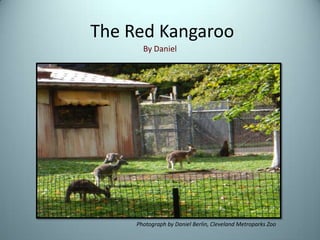
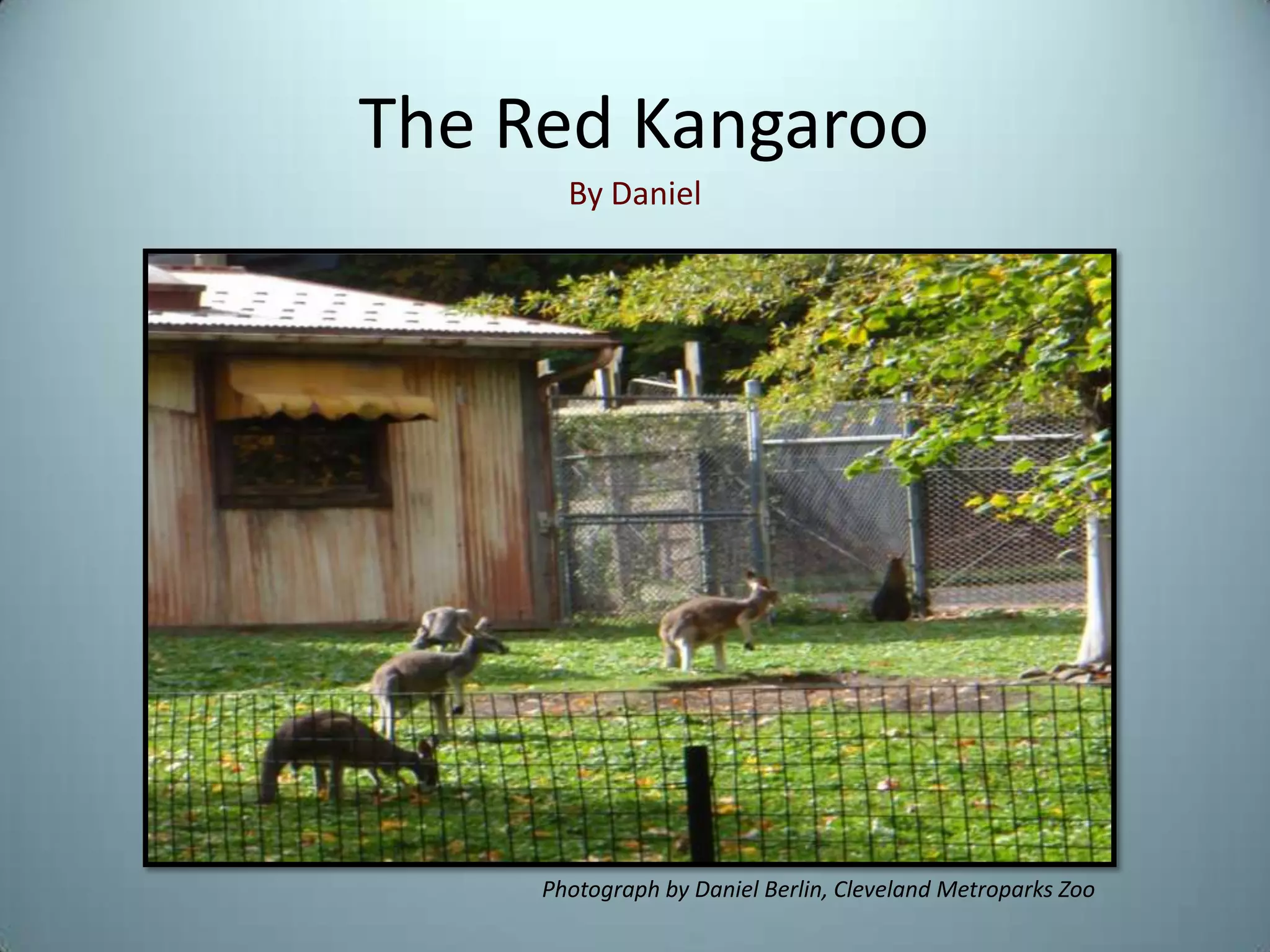
The Red KangarooBy Daniel Photograph by Daniel Berlin, Cleveland Metroparks Zoo
TaxonomyFamily: MacropodOrder: DiprotodontiaClass: MammaliaPhylum: ChordataKingdom: Animalia
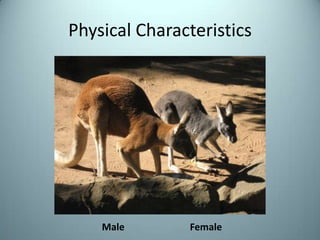
Physical CharacteristicsColor:Males: reddish-gray, brilliant red fur in mating season Females: mostly gray
Physical CharacteristicsColor:Males: reddish-gray, brilliant red fur in mating season Females: mostly graySize:Males up to 6 feet tall, 200 poundsFemales about 2 to 3 feet tallJoeys (babies) about 1 foot
Physical CharacteristicsColor:Males: reddish-gray, brilliant red fur in mating season Females: mostly graySize:Males up to 6 feet tall, 200 poundsFemales about 2 to 3 feet tallJoeys (babies) about 1 footLong strong tail Large distinctive, donkey-like earsPowerful hind legs
Physical CharacteristicsMaleFemale
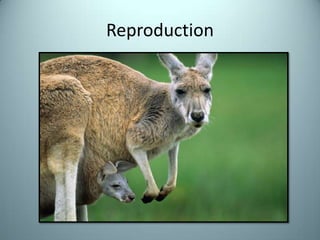
ReproductionGestation : 33 days Pouch time: 240 daysOne “joey” or baby per gestation (born the size of a cherry)Mother kangaroo cares for her young for 1 year after the 240 days in the pouch
Reproduction
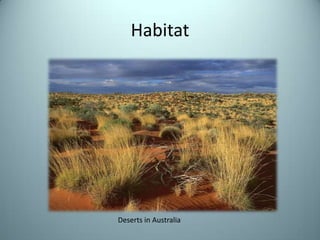
HabitatThe Red Kangaroo is found in AustraliaLives in grassy habitats usually with no trees or bushes
HabitatThe Red Kangaroo is found in AustraliaLives in grassy habitats usually with no trees or bushesNot endangered
HabitatThe Red Kangaroo is found in AustraliaLives in grassy habitats usually with no trees or bushesNot endangeredTerrestrialTerritorial, except for during droughts
HabitatDeserts in Australia
FoodConsumes mostly grass and leaves
FoodConsumes mostly grass and leavesPredators are the dingo and humans
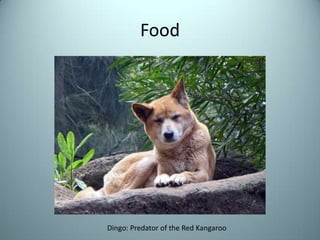
FoodDingo: Predator of the Red Kangaroo
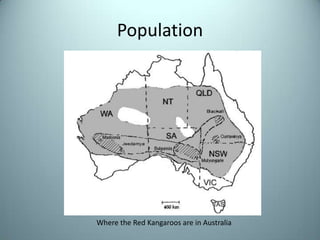
PopulationNo, the Red Kangaroo is not endangered; they are, in fact, overpopulated in Australia, just like the White Tailed Deer here in Ohio
PopulationWhere the Red Kangaroos are in Australia
Interesting FactsCan travel up to 35 MPHCan jump 27 feet in one leap
Interesting FactsCan travel up to 35 MPHCan jump 27 feet in one leapCan jump over a ten foot wallCan survive by drinking only once a week
Interesting FactsCan travel up to 35 MPHCan jump 27 feet in one leapCan jump over a ten foot wallCan survive by drinking only once a weekCan delay the birth of a second joey until the first joey is out of the pouch (Embryonic diapause)Largest marsupial in the world
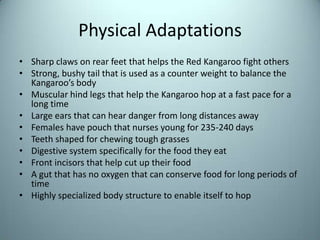
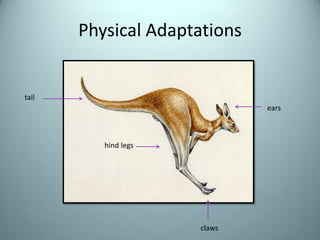
Physical AdaptationsSharp claws on rear feet that helps the Red Kangaroo fight othersStrong, bushy tail that is used as a counter weight to balance the Kangaroo’s body
Physical AdaptationsSharp claws on rear feet that helps the Red Kangaroo fight othersStrong, bushy tail that is used as a counter weight to balance the Kangaroo’s bodyMuscular hind legs that help the Kangaroo hop at a fast pace for a long timeLarge ears that can hear danger from long distances away
Physical AdaptationsSharp claws on rear feet that helps the Red Kangaroo fight othersStrong, bushy tail that is used as a counter weight to balance the Kangaroo’s bodyMuscular hind legs that help the Kangaroo hop at a fast pace for a long timeLarge ears that can hear danger from long distances awayFemales have pouch that nurses young for 235-240 days
Physical AdaptationsSharp claws on rear feet that helps the Red Kangaroo fight othersStrong, bushy tail that is used as a counter weight to balance the Kangaroo’s bodyMuscular hind legs that help the Kangaroo hop at a fast pace for a long timeLarge ears that can hear danger from long distances awayFemales have pouch that nurses young for 235-240 daysTeeth shaped for chewing tough grasses Digestive system specifically for the food they eatFront incisors that help cut up their food
Physical AdaptationsSharp claws on rear feet that helps the Red Kangaroo fight othersStrong, bushy tail that is used as a counter weight to balance the Kangaroo’s bodyMuscular hind legs that help the Kangaroo hop at a fast pace for a long timeLarge ears that can hear danger from long distances awayFemales have pouch that nurses young for 235-240 daysTeeth shaped for chewing tough grasses Digestive system specifically for the food they eatFront incisors that help cut up their foodA gut that has no oxygen that can conserve food for long periods of timeHighly specialized body structure to enable itself to hop
Physical Adaptationstailearshind legsclaws
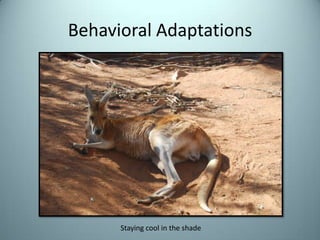
Behavioral AdaptationsPanting when the Kangaroo gets hot during daytimeLess active and stays in shade when the temperature is high
Behavioral AdaptationsPanting when the Kangaroo gets hot during daytimeLess active and stays in shade when the temperature is highLicking forelimbs helps keep the Kangaroo cool in the heat of the dayTraveling in mobs keeps the Kangaroos safe from Dingos and other danger
Behavioral AdaptationsPanting when the Kangaroo gets hot during daytimeLess active and stays in shade when the temperature is highLicking forelimbs helps keep the Kangaroo cool in the heat of the dayTraveling in mobs keeps the Kangaroos safe from Dingos and other dangerStamp feet to let the “joeys” know to get into the mothers pouch during times of danger
Behavioral AdaptationsStaying cool in the shade
At the ZooPerfect size, plenty of breathing roomShould have had a heated room for the cold parts of the year because the Red Kangaroo comes from Australia, a generally warm country
At the ZooPerfect size, plenty of breathing roomShould have had a heated room for the cold parts of the year because the Red Kangaroo comes from Australia, a generally warm countryHad a perfect setup with not that many trees or bushes, just like it’s habitat in AustraliaShould’ve had higher fences that are harder to hop over, since the Kangaroo can hop up to ten feet in the air
At the ZooPerfect size, plenty of breathing roomShould have had a heated room for the cold parts of the year because the Red Kangaroo comes from Australia, a generally warm countryHad a perfect setup with not that many trees or bushes, just like it’s habitat in AustraliaThe zoo should have put food and water out just in case the animals got hungry or thirstyShould’ve had higher fences that are harder to hop over to insure safety, since the Kangaroo can hop up to ten feet in the air
At the ZooHad lots of space in between the pedestrians and animals so that the animal wouldn’t be overwhelmed by noise or other activitiesHabitat had grass underlying the  exhibit which allowed the kangaroos to graze and feel more at homeThe tram ran right next to the exhibit and could have overwhelmed the animalsThere were 7 kangaroos in the exhibit, which is enough to form a small mob and provide some feeling of safety to the kangaroos
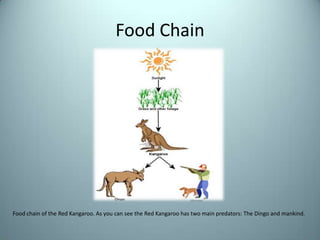
Food ChainFood chain of the Red Kangaroo. As you can see the Red Kangaroo has two main predators: The Dingo and mankind.
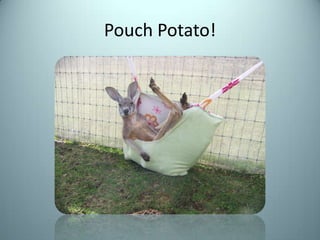
Pouch Potato!
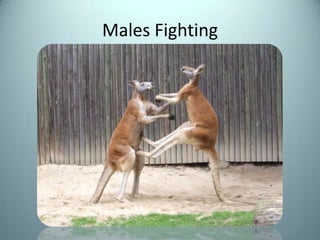
Males Fighting
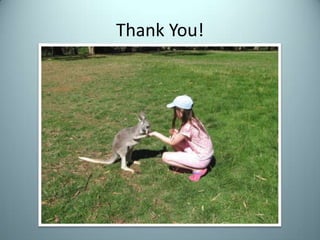
Thank You!

The red kangaroo[1]

  • 1.
    The RedKangarooBy Daniel Photograph by Daniel Berlin, Cleveland Metroparks Zoo
  • 2.
    TaxonomyFamily: MacropodOrder: DiprotodontiaClass:MammaliaPhylum: ChordataKingdom: Animalia
  • 3.
    Physical CharacteristicsColor:Males: reddish-gray,brilliant red fur in mating season Females: mostly gray
  • 4.
    Physical CharacteristicsColor:Males: reddish-gray,brilliant red fur in mating season Females: mostly graySize:Males up to 6 feet tall, 200 poundsFemales about 2 to 3 feet tallJoeys (babies) about 1 foot
  • 5.
    Physical CharacteristicsColor:Males: reddish-gray,brilliant red fur in mating season Females: mostly graySize:Males up to 6 feet tall, 200 poundsFemales about 2 to 3 feet tallJoeys (babies) about 1 footLong strong tail Large distinctive, donkey-like earsPowerful hind legs
  • 6.
  • 7.
    ReproductionGestation : 33days Pouch time: 240 daysOne “joey” or baby per gestation (born the size of a cherry)Mother kangaroo cares for her young for 1 year after the 240 days in the pouch
  • 8.
  • 9.
    HabitatThe Red Kangaroois found in AustraliaLives in grassy habitats usually with no trees or bushes
  • 10.
    HabitatThe Red Kangaroois found in AustraliaLives in grassy habitats usually with no trees or bushesNot endangered
  • 11.
    HabitatThe Red Kangaroois found in AustraliaLives in grassy habitats usually with no trees or bushesNot endangeredTerrestrialTerritorial, except for during droughts
  • 12.
  • 13.
  • 14.
    FoodConsumes mostly grassand leavesPredators are the dingo and humans
  • 15.
    FoodDingo: Predator ofthe Red Kangaroo
  • 16.
    PopulationNo, the RedKangaroo is not endangered; they are, in fact, overpopulated in Australia, just like the White Tailed Deer here in Ohio
  • 17.
    PopulationWhere the RedKangaroos are in Australia
  • 18.
    Interesting FactsCan travelup to 35 MPHCan jump 27 feet in one leap
  • 19.
    Interesting FactsCan travelup to 35 MPHCan jump 27 feet in one leapCan jump over a ten foot wallCan survive by drinking only once a week
  • 20.
    Interesting FactsCan travelup to 35 MPHCan jump 27 feet in one leapCan jump over a ten foot wallCan survive by drinking only once a weekCan delay the birth of a second joey until the first joey is out of the pouch (Embryonic diapause)Largest marsupial in the world
  • 21.
    Physical AdaptationsSharp clawson rear feet that helps the Red Kangaroo fight othersStrong, bushy tail that is used as a counter weight to balance the Kangaroo’s body
  • 22.
    Physical AdaptationsSharp clawson rear feet that helps the Red Kangaroo fight othersStrong, bushy tail that is used as a counter weight to balance the Kangaroo’s bodyMuscular hind legs that help the Kangaroo hop at a fast pace for a long timeLarge ears that can hear danger from long distances away
  • 23.
    Physical AdaptationsSharp clawson rear feet that helps the Red Kangaroo fight othersStrong, bushy tail that is used as a counter weight to balance the Kangaroo’s bodyMuscular hind legs that help the Kangaroo hop at a fast pace for a long timeLarge ears that can hear danger from long distances awayFemales have pouch that nurses young for 235-240 days
  • 24.
    Physical AdaptationsSharp clawson rear feet that helps the Red Kangaroo fight othersStrong, bushy tail that is used as a counter weight to balance the Kangaroo’s bodyMuscular hind legs that help the Kangaroo hop at a fast pace for a long timeLarge ears that can hear danger from long distances awayFemales have pouch that nurses young for 235-240 daysTeeth shaped for chewing tough grasses Digestive system specifically for the food they eatFront incisors that help cut up their food
  • 25.
    Physical AdaptationsSharp clawson rear feet that helps the Red Kangaroo fight othersStrong, bushy tail that is used as a counter weight to balance the Kangaroo’s bodyMuscular hind legs that help the Kangaroo hop at a fast pace for a long timeLarge ears that can hear danger from long distances awayFemales have pouch that nurses young for 235-240 daysTeeth shaped for chewing tough grasses Digestive system specifically for the food they eatFront incisors that help cut up their foodA gut that has no oxygen that can conserve food for long periods of timeHighly specialized body structure to enable itself to hop
  • 26.
  • 27.
    Behavioral AdaptationsPanting whenthe Kangaroo gets hot during daytimeLess active and stays in shade when the temperature is high
  • 28.
    Behavioral AdaptationsPanting whenthe Kangaroo gets hot during daytimeLess active and stays in shade when the temperature is highLicking forelimbs helps keep the Kangaroo cool in the heat of the dayTraveling in mobs keeps the Kangaroos safe from Dingos and other danger
  • 29.
    Behavioral AdaptationsPanting whenthe Kangaroo gets hot during daytimeLess active and stays in shade when the temperature is highLicking forelimbs helps keep the Kangaroo cool in the heat of the dayTraveling in mobs keeps the Kangaroos safe from Dingos and other dangerStamp feet to let the “joeys” know to get into the mothers pouch during times of danger
  • 30.
  • 31.
    At the ZooPerfectsize, plenty of breathing roomShould have had a heated room for the cold parts of the year because the Red Kangaroo comes from Australia, a generally warm country
  • 32.
    At the ZooPerfectsize, plenty of breathing roomShould have had a heated room for the cold parts of the year because the Red Kangaroo comes from Australia, a generally warm countryHad a perfect setup with not that many trees or bushes, just like it’s habitat in AustraliaShould’ve had higher fences that are harder to hop over, since the Kangaroo can hop up to ten feet in the air
  • 33.
    At the ZooPerfectsize, plenty of breathing roomShould have had a heated room for the cold parts of the year because the Red Kangaroo comes from Australia, a generally warm countryHad a perfect setup with not that many trees or bushes, just like it’s habitat in AustraliaThe zoo should have put food and water out just in case the animals got hungry or thirstyShould’ve had higher fences that are harder to hop over to insure safety, since the Kangaroo can hop up to ten feet in the air
  • 34.
    At the ZooHadlots of space in between the pedestrians and animals so that the animal wouldn’t be overwhelmed by noise or other activitiesHabitat had grass underlying the exhibit which allowed the kangaroos to graze and feel more at homeThe tram ran right next to the exhibit and could have overwhelmed the animalsThere were 7 kangaroos in the exhibit, which is enough to form a small mob and provide some feeling of safety to the kangaroos
  • 35.
    Food ChainFood chainof the Red Kangaroo. As you can see the Red Kangaroo has two main predators: The Dingo and mankind.
  • 36.
  • 37.
  • 38.