THE OLD MAN AND THE SEA
- NOVEL BY ERNEST HEMINGWAY
About novel
Author Ernest Hemingway
Country United States
Language English
Genre Literary Fiction
Published 1952 (Charles Scribner's Sons)
Media type Print (hardback & paperback)
Pages 127
Awards Pulitzer Prize for Fiction(1953)
Nobel Prize in Literature(1954)
About the author
• Ernest Miller Hemingway (July 21, 1899 – July 2, 1961) was an
American novelist, short-story writer, and journalist. His economical and
understated style—which he termed the iceberg theory—had a strong influence
on 20th-century fiction, while his adventurous lifestyle and public image brought
him admiration from later generations. Hemingway produced most of his work
between the mid-1920s and the mid-1950s, and he was awarded the 1954 Nobel
Prize in Literature. He published seven novels, six short-story collections, and two
nonfiction works. Three of his novels, four short-story collections, and three
nonfiction works were published posthumously. Many of his works are considered
classics of American literature.
Summary
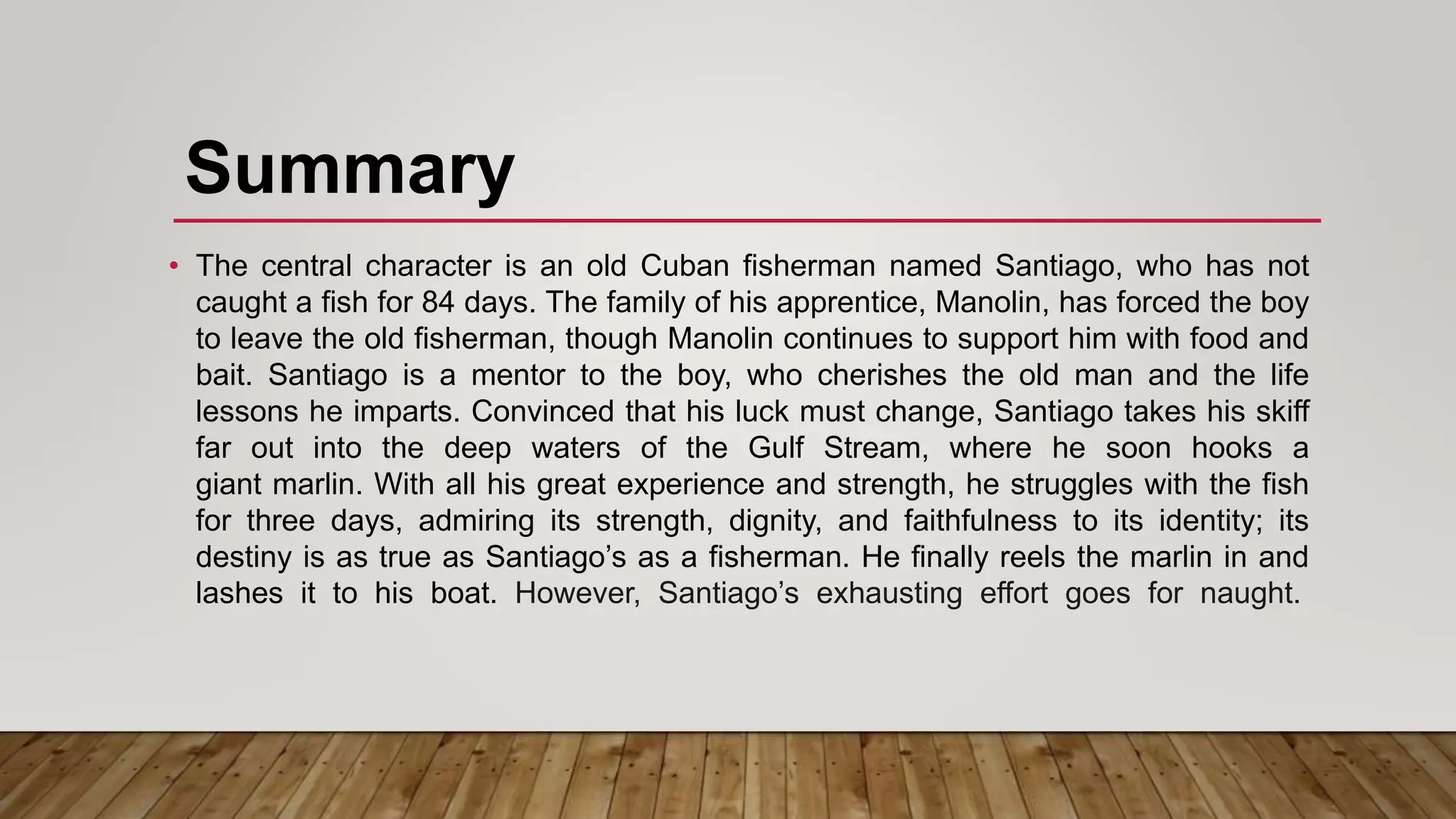
• The central character is an old Cuban fisherman named Santiago, who has not
caught a fish for 84 days. The family of his apprentice, Manolin, has forced the boy
to leave the old fisherman, though Manolin continues to support him with food and
bait. Santiago is a mentor to the boy, who cherishes the old man and the life
lessons he imparts. Convinced that his luck must change, Santiago takes his skiff
far out into the deep waters of the Gulf Stream, where he soon hooks a
giant marlin. With all his great experience and strength, he struggles with the fish
for three days, admiring its strength, dignity, and faithfulness to its identity; its
destiny is as true as Santiago’s as a fisherman. He finally reels the marlin in and
lashes it to his boat. However, Santiago’s exhausting effort goes for naught.
Summary
• Sharks are drawn to the tethered marlin, and, although Santiago manages to kill a
few, the sharks eat the fish, leaving behind only its skeleton. After returning to the
harbour, the discouraged Santiago goes to his home to sleep. In the meantime,
others see the skeleton tied to his boat and are amazed. A concerned Manolin is
relieved to find Santiago alive, and the two agree to go fishing together.
Characterization
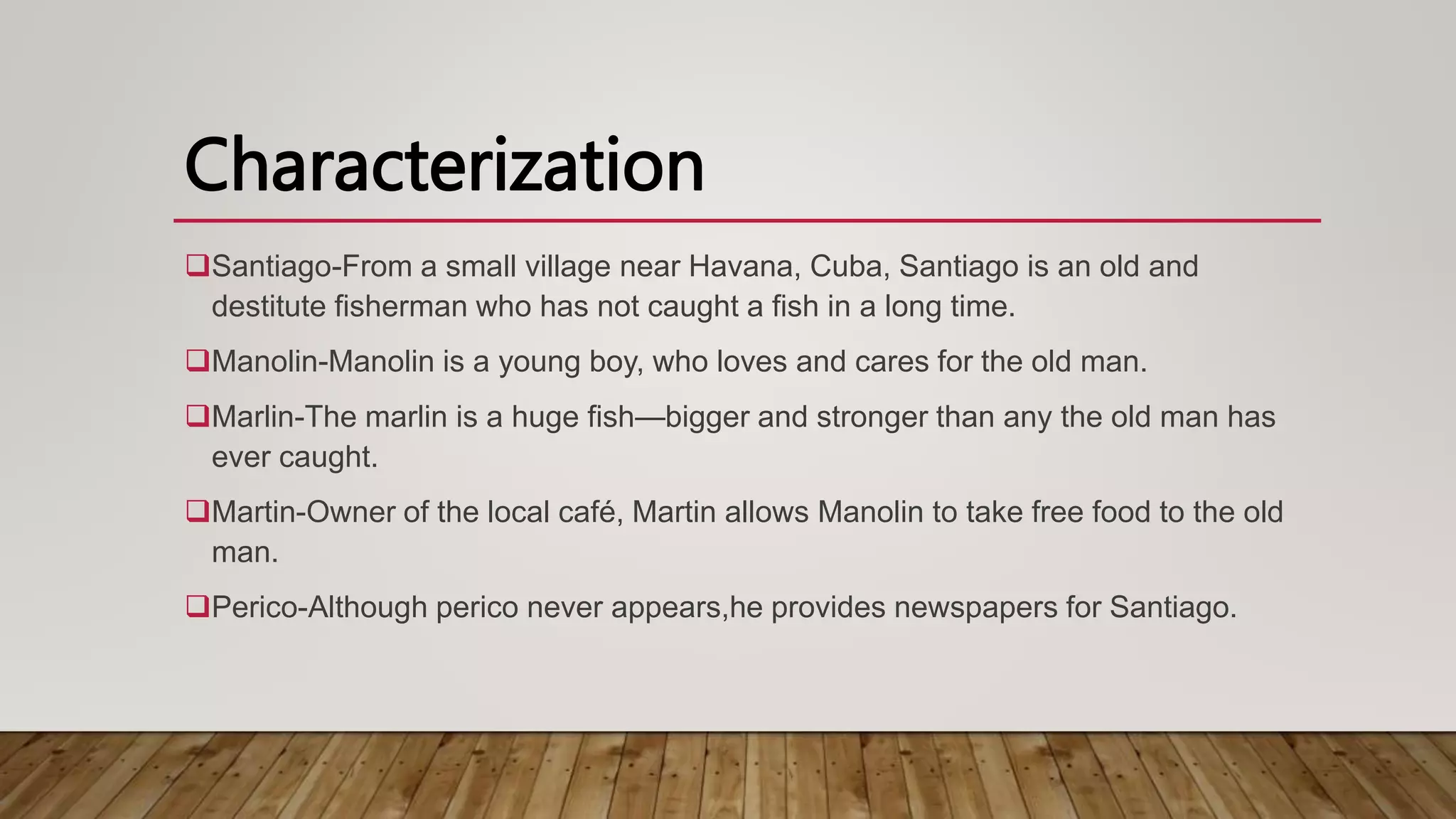
Santiago-From a small village near Havana, Cuba, Santiago is an old and
destitute fisherman who has not caught a fish in a long time.
Manolin-Manolin is a young boy, who loves and cares for the old man.
Marlin-The marlin is a huge fish—bigger and stronger than any the old man has
ever caught.
Martin-Owner of the local café, Martin allows Manolin to take free food to the old
man.
Perico-Although perico never appears,he provides newspapers for Santiago.
Important aspects
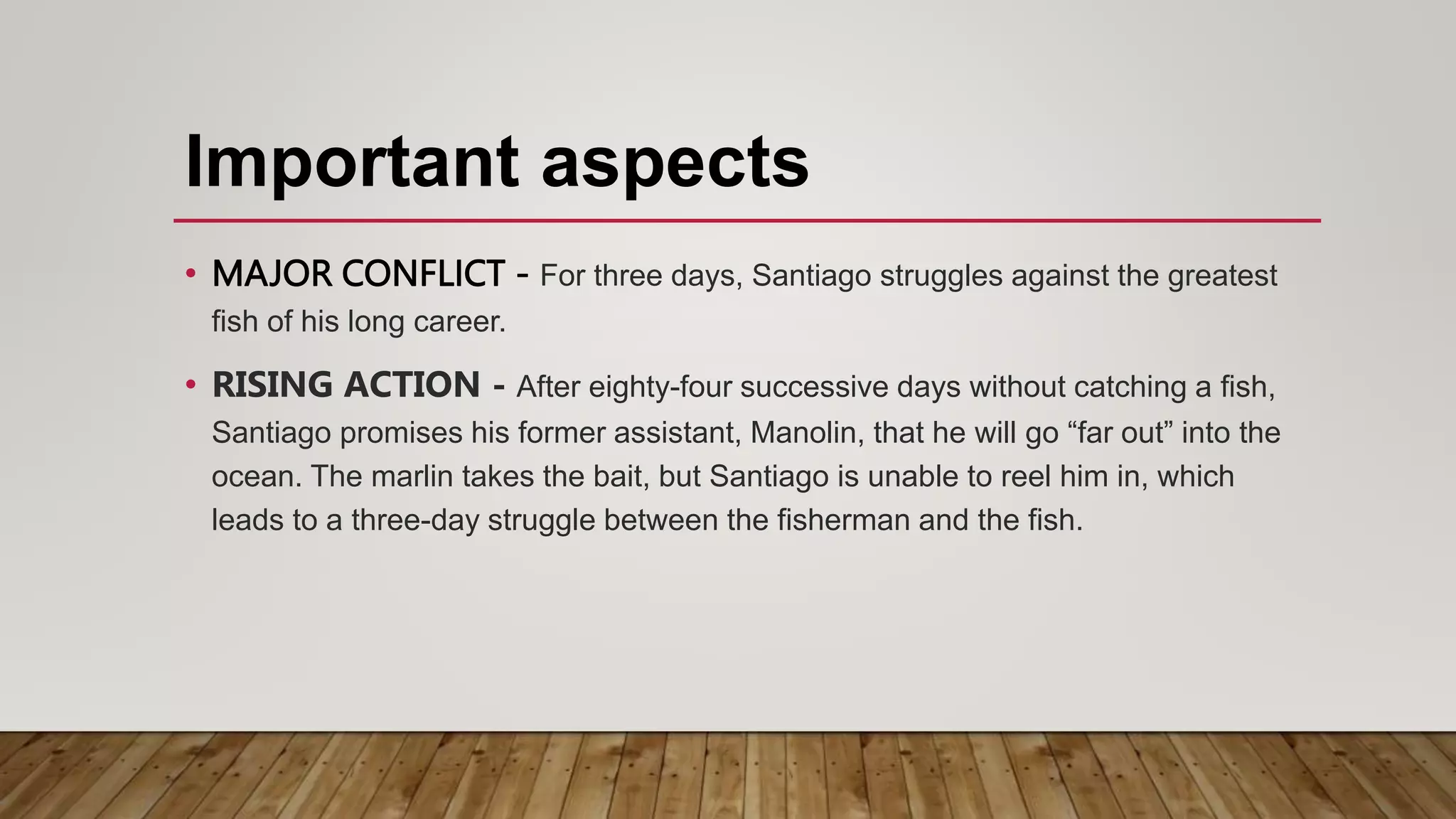
• MAJOR CONFLICT - For three days, Santiago struggles against the greatest
fish of his long career.
• RISING ACTION - After eighty-four successive days without catching a fish,
Santiago promises his former assistant, Manolin, that he will go “far out” into the
ocean. The marlin takes the bait, but Santiago is unable to reel him in, which
leads to a three-day struggle between the fisherman and the fish.
Important aspects
• CLIMAX - The marlin circles the skiff while Santiago slowly reels him in.
Santiago nearly passes out from exhaustion but gathers enough strength to
harpoon the marlin through the heart, causing him to lurch in an almost sexual
climax of vitality before dying.
Theme • Being determined and never giving up
indicates what kind of human being one is.
A man continues to do whatever he must do to the best of
his ability, no matter what tribulations befall him. While
challenges and setbacks can strip a man of all outward
signs of success, still his spirit can remain undefeated.
“A man can be destroyed but not defeated.”

The Old Man and the Sea.pptx

  • 1.
    THE OLD MANAND THE SEA - NOVEL BY ERNEST HEMINGWAY
  • 2.
    About novel Author ErnestHemingway Country United States Language English Genre Literary Fiction Published 1952 (Charles Scribner's Sons) Media type Print (hardback & paperback) Pages 127 Awards Pulitzer Prize for Fiction(1953) Nobel Prize in Literature(1954)
  • 3.
    About the author •Ernest Miller Hemingway (July 21, 1899 – July 2, 1961) was an American novelist, short-story writer, and journalist. His economical and understated style—which he termed the iceberg theory—had a strong influence on 20th-century fiction, while his adventurous lifestyle and public image brought him admiration from later generations. Hemingway produced most of his work between the mid-1920s and the mid-1950s, and he was awarded the 1954 Nobel Prize in Literature. He published seven novels, six short-story collections, and two nonfiction works. Three of his novels, four short-story collections, and three nonfiction works were published posthumously. Many of his works are considered classics of American literature.
  • 4.
    Summary • The centralcharacter is an old Cuban fisherman named Santiago, who has not caught a fish for 84 days. The family of his apprentice, Manolin, has forced the boy to leave the old fisherman, though Manolin continues to support him with food and bait. Santiago is a mentor to the boy, who cherishes the old man and the life lessons he imparts. Convinced that his luck must change, Santiago takes his skiff far out into the deep waters of the Gulf Stream, where he soon hooks a giant marlin. With all his great experience and strength, he struggles with the fish for three days, admiring its strength, dignity, and faithfulness to its identity; its destiny is as true as Santiago’s as a fisherman. He finally reels the marlin in and lashes it to his boat. However, Santiago’s exhausting effort goes for naught.
  • 5.
    Summary • Sharks aredrawn to the tethered marlin, and, although Santiago manages to kill a few, the sharks eat the fish, leaving behind only its skeleton. After returning to the harbour, the discouraged Santiago goes to his home to sleep. In the meantime, others see the skeleton tied to his boat and are amazed. A concerned Manolin is relieved to find Santiago alive, and the two agree to go fishing together.
  • 6.
    Characterization Santiago-From a smallvillage near Havana, Cuba, Santiago is an old and destitute fisherman who has not caught a fish in a long time. Manolin-Manolin is a young boy, who loves and cares for the old man. Marlin-The marlin is a huge fish—bigger and stronger than any the old man has ever caught. Martin-Owner of the local café, Martin allows Manolin to take free food to the old man. Perico-Although perico never appears,he provides newspapers for Santiago.
  • 7.
    Important aspects • MAJORCONFLICT - For three days, Santiago struggles against the greatest fish of his long career. • RISING ACTION - After eighty-four successive days without catching a fish, Santiago promises his former assistant, Manolin, that he will go “far out” into the ocean. The marlin takes the bait, but Santiago is unable to reel him in, which leads to a three-day struggle between the fisherman and the fish.
  • 8.
    Important aspects • CLIMAX- The marlin circles the skiff while Santiago slowly reels him in. Santiago nearly passes out from exhaustion but gathers enough strength to harpoon the marlin through the heart, causing him to lurch in an almost sexual climax of vitality before dying.
  • 9.
    Theme • Beingdetermined and never giving up indicates what kind of human being one is.
  • 10.
    A man continuesto do whatever he must do to the best of his ability, no matter what tribulations befall him. While challenges and setbacks can strip a man of all outward signs of success, still his spirit can remain undefeated. “A man can be destroyed but not defeated.”