The new React
Maurice de Beijer - @mauricedb
 Maurice de Beijer
 The Problem Solver
 Microsoft MVP
 Freelance developer/instructor
 Twitter: @mauricedb
 Web: http://www.TheProblemSolver.nl
 E-mail: maurice.de.beijer@gmail.com
2ABL - The Problem Solver
The React
Newsletter
© ABL - The Problem Solver 3
http://bit.ly/ReactNewsletter
Topics
 Intro into React hooks
 Basic hooks
 useState()
 useEffect()
 useEffect() with asynchronous actions
 useContext()
 Custom hooks
 Advanced hooks
 useDebugValue()
 useMemo()
 useReducer()
 useRef()
 Suspense
 lazy()
 StrictMode
 ConcurrentMode
 React Cache
© ABL - The Problem Solver 4
Follow along
 Git repository with slides and code
 https://github.com/mauricedb/the-new-react-vilnius-2019
© ABL - The Problem Solver 5
Type it out
by hand?
“Typing it drills it into your brain much better than
simply copying and pasting it.You're forming new
neuron pathways.Those pathways are going to
help you in the future. Help them out now!”
© ABL - The Problem Solver 6
Prerequisites
Install Node & NPM
© ABL - The Problem Solver 7
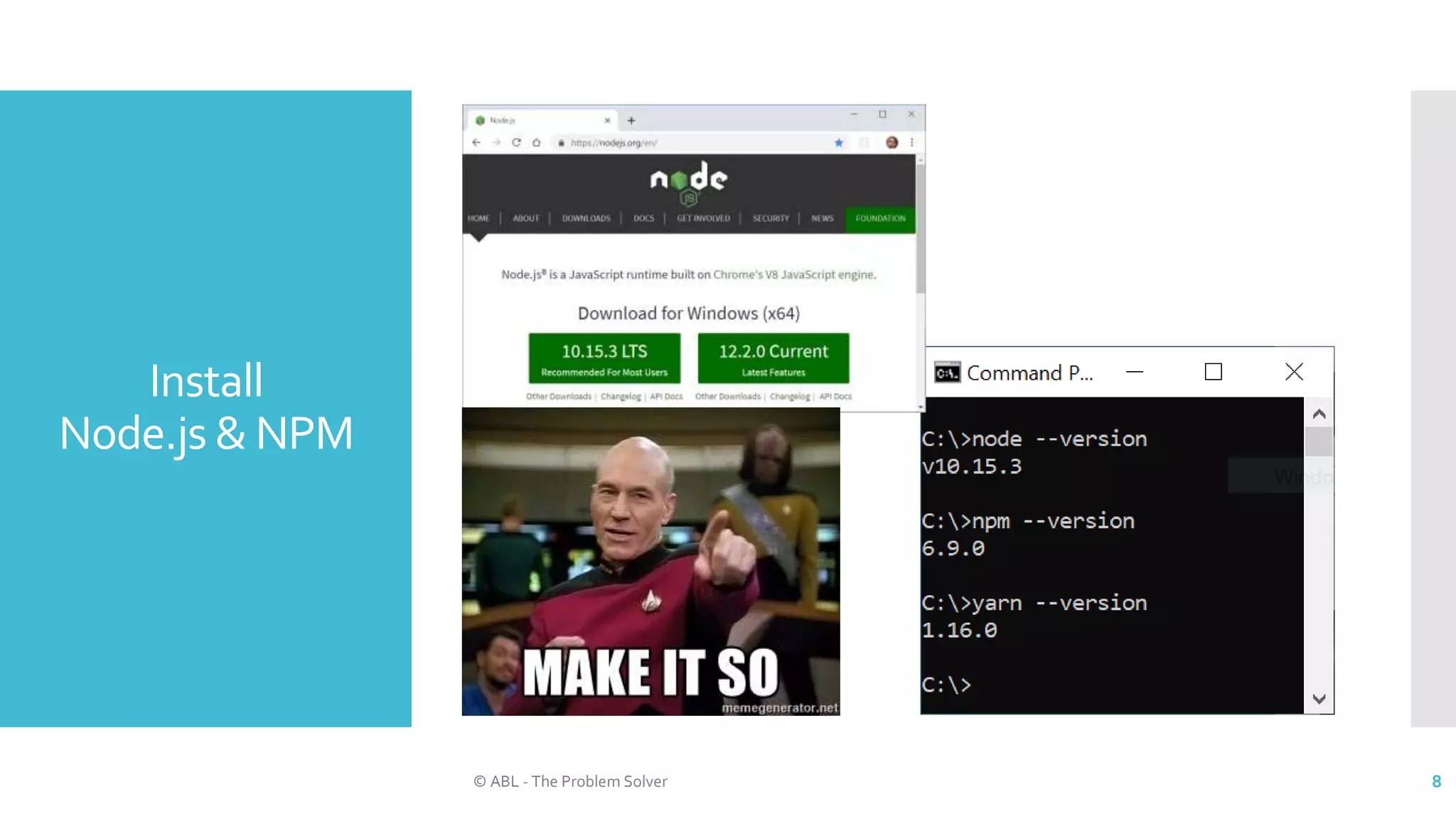
Install
Node.js & NPM
© ABL - The Problem Solver 8
Basic hooks
© ABL - The Problem Solver 9
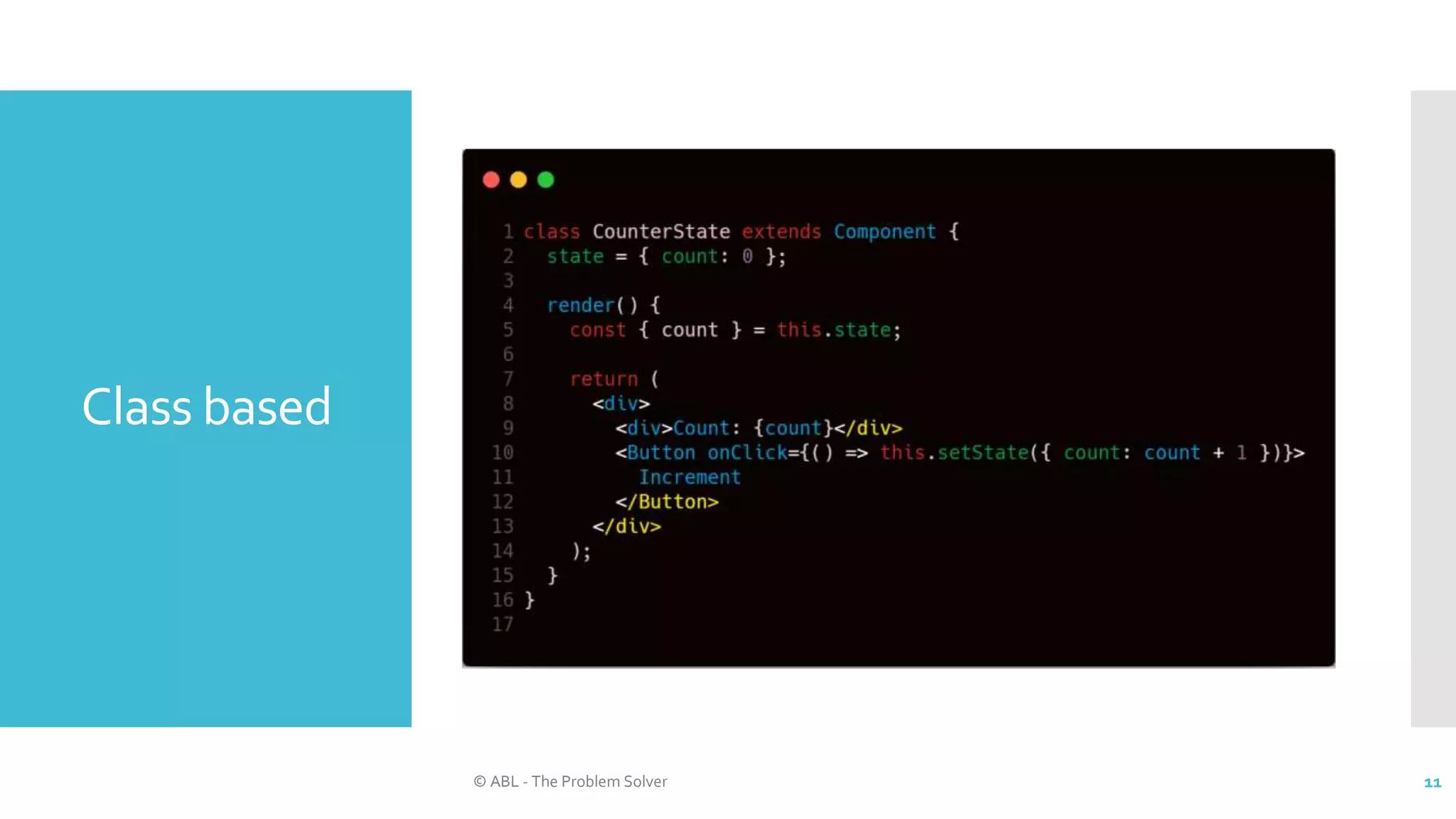
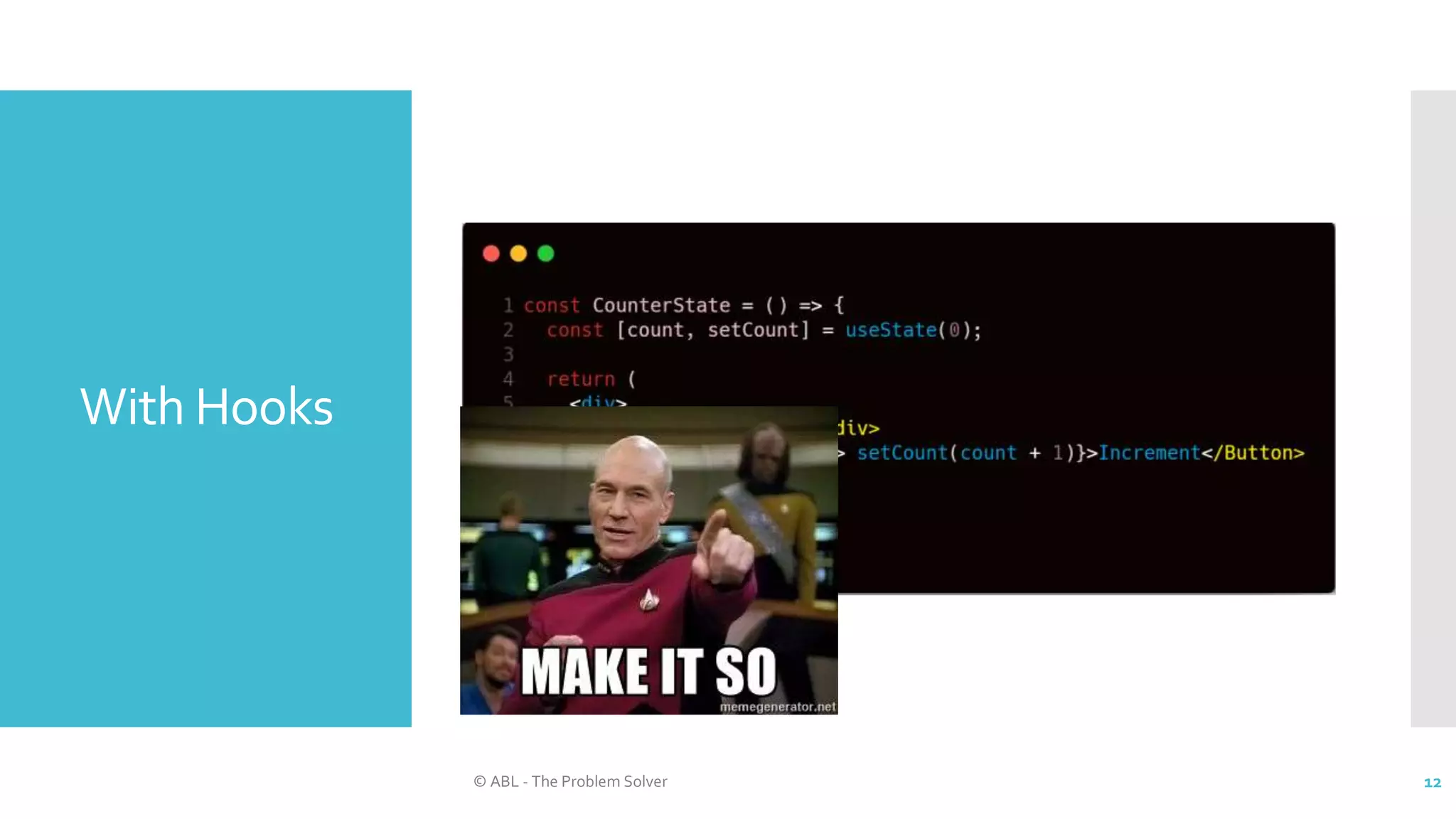
useState()
 Returns a persisted stateful value and a function to update it
 Values can be object or scalar values
 Starts with an initial value
 Can be a lazy initialization function
 The updater function replaces the original state
 Doesn’t merge state like the class based setState()
 The update value can also be a function
© ABL - The Problem Solver 10
Class based
© ABL - The Problem Solver 11
With Hooks
© ABL - The Problem Solver 12
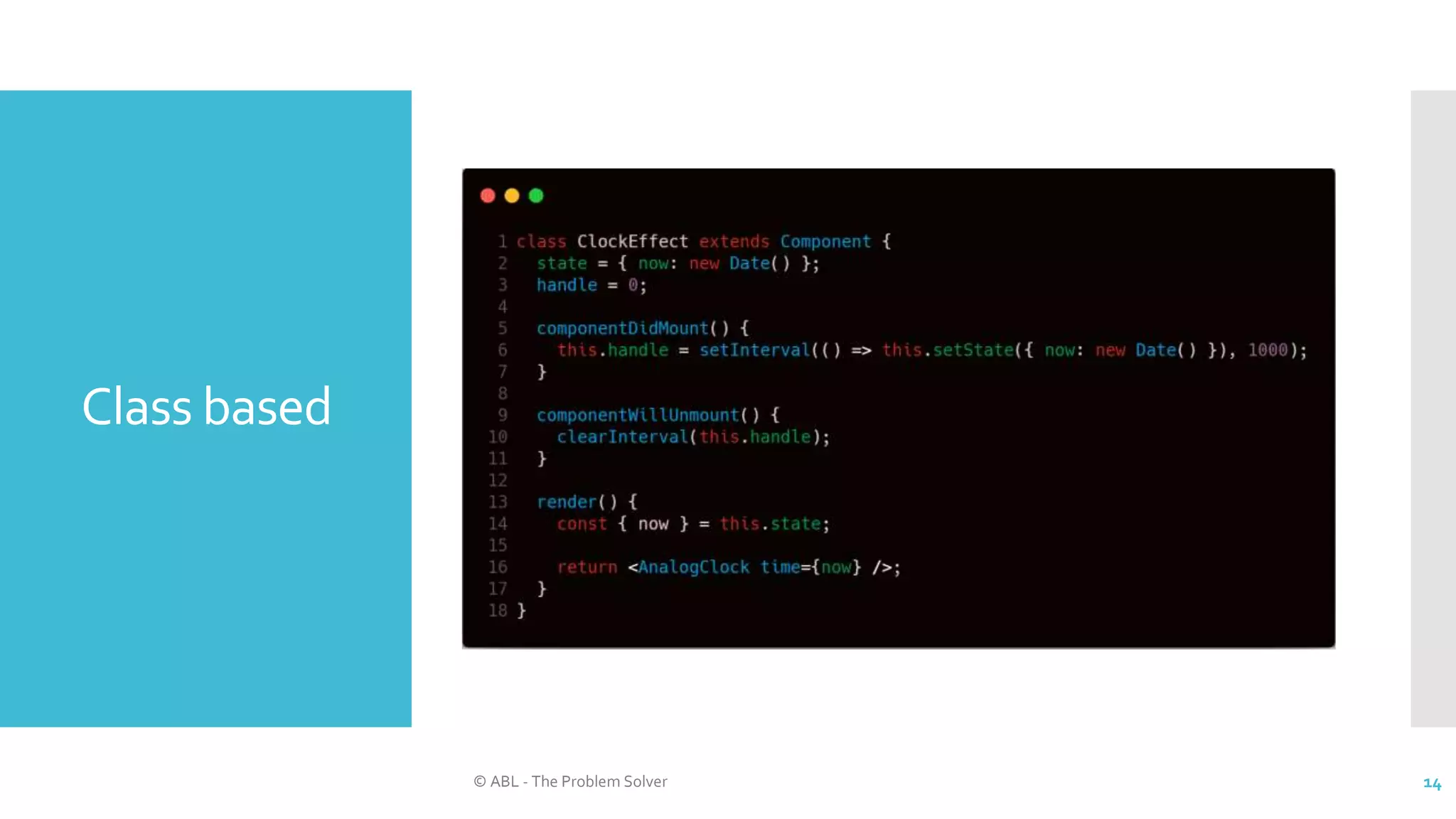
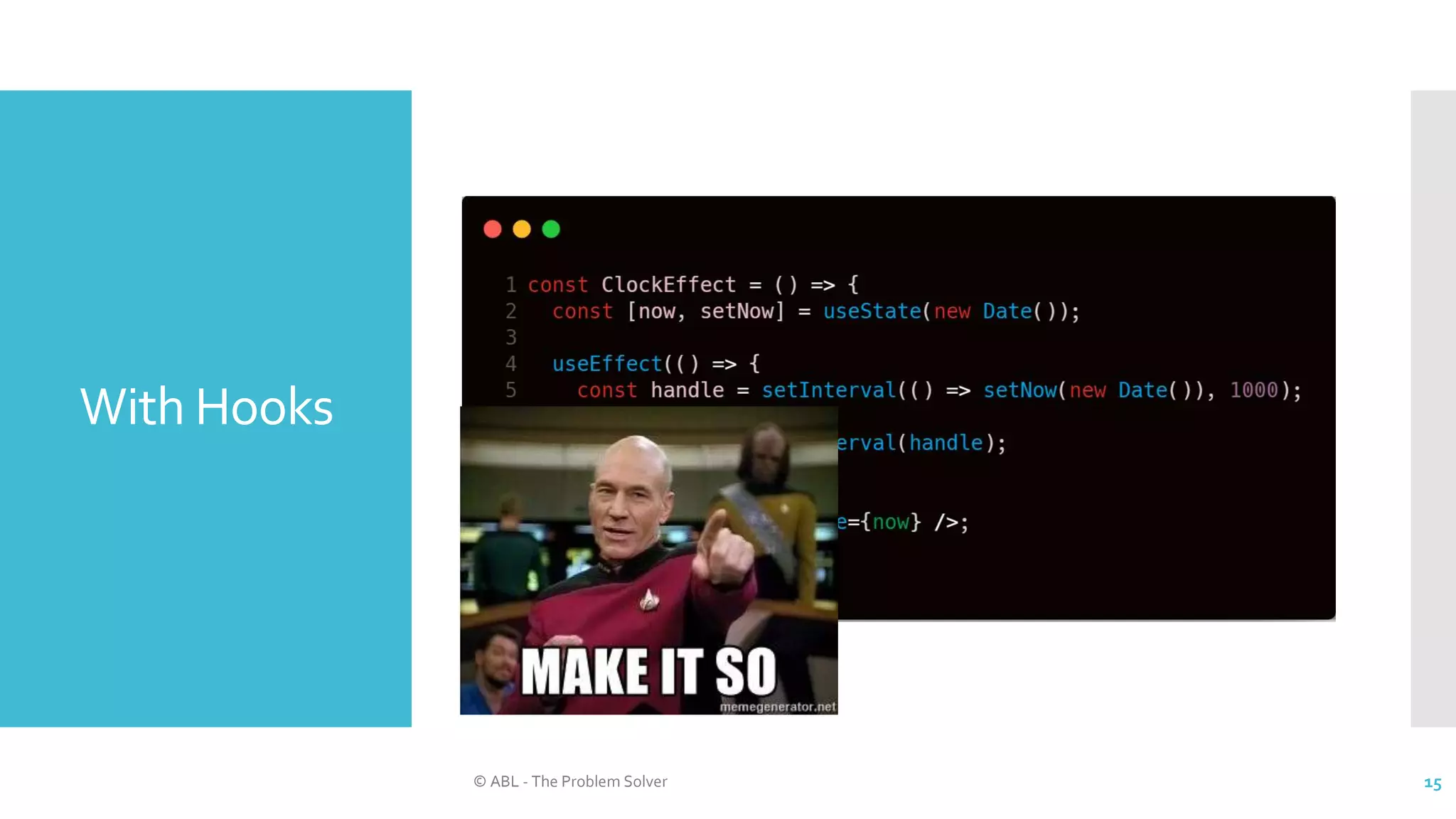
useEffect()
 Accepts a function that contains imperative code
 The code is used to execute (asynchronous) side effects
 useEffect() fires after layout and paint, during a deferred event
 Use useLayoutEffect() for code that should not be deferred
 Runs both on component mount as well as updates
 Control when using the dependencies array
 Optionally return a cleanup function
© ABL - The Problem Solver 13
Class based
© ABL - The Problem Solver 14
With Hooks
© ABL - The Problem Solver 15
useEffect()
with
asynchronous
actions
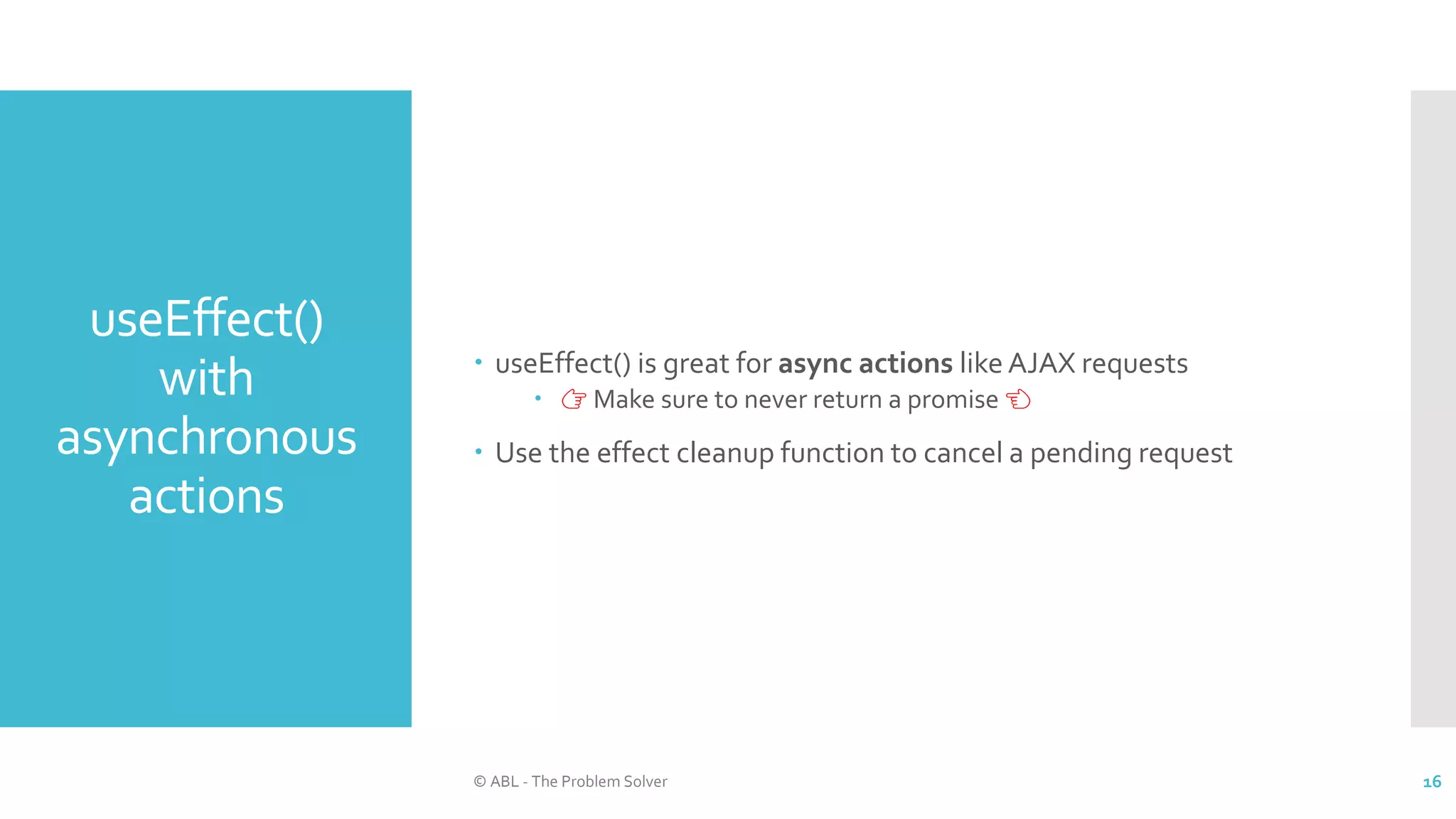
 useEffect() is great for async actions like AJAX requests
 👉 Make sure to never return a promise 👈
 Use the effect cleanup function to cancel a pending request
© ABL - The Problem Solver 16
Class based
© ABL - The Problem Solver 17
With Hooks
© ABL - The Problem Solver 18
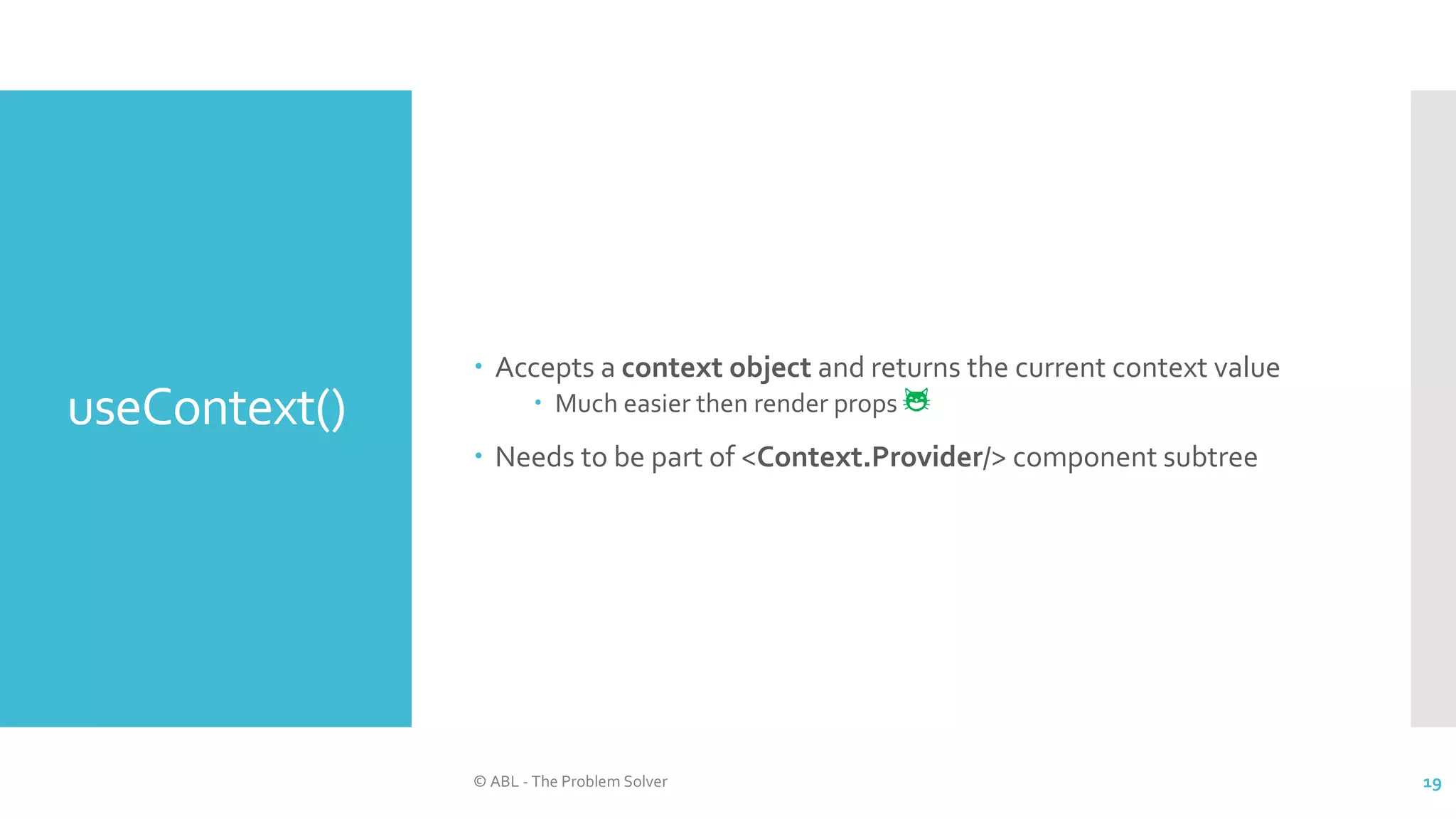
useContext()
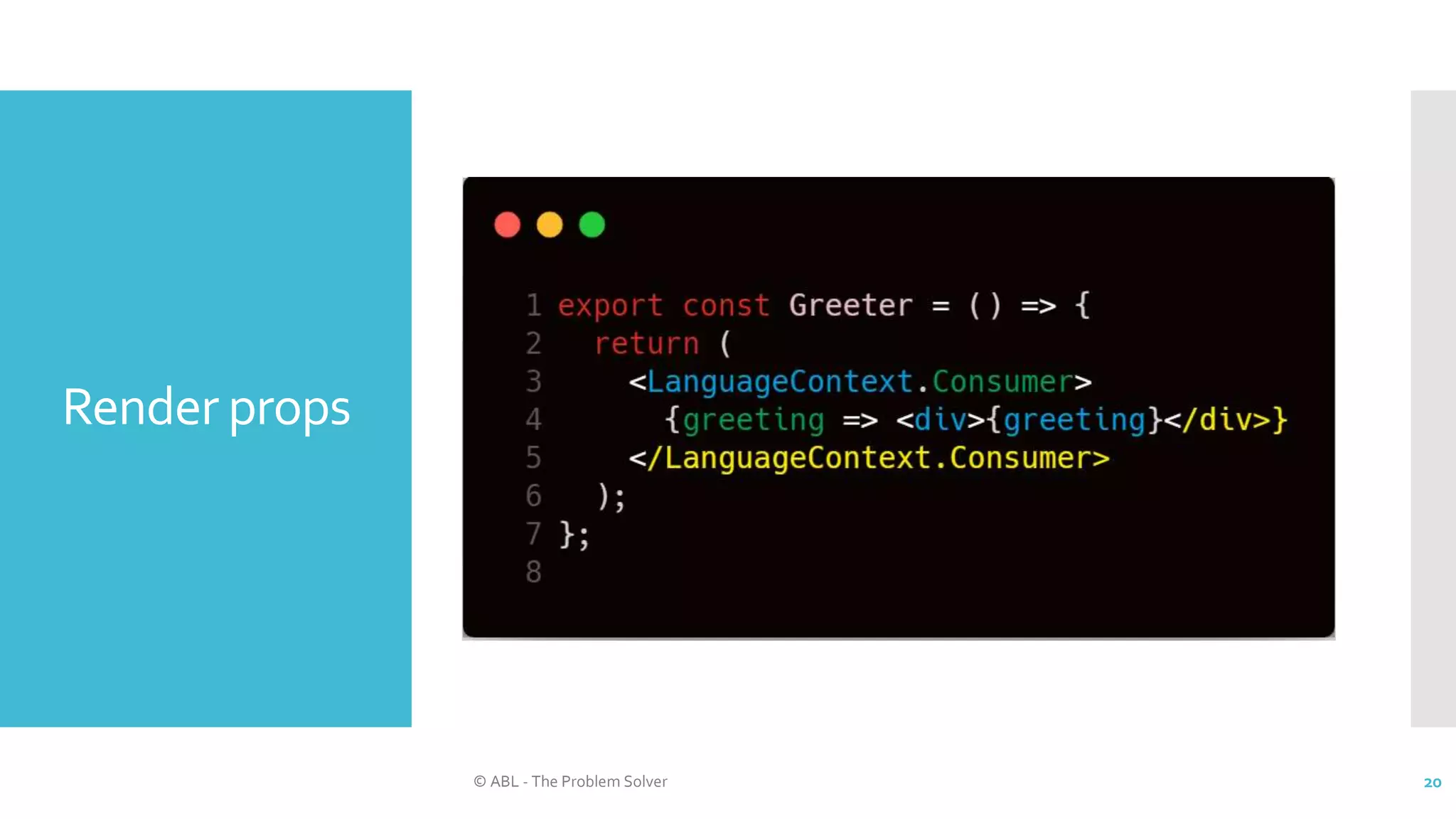
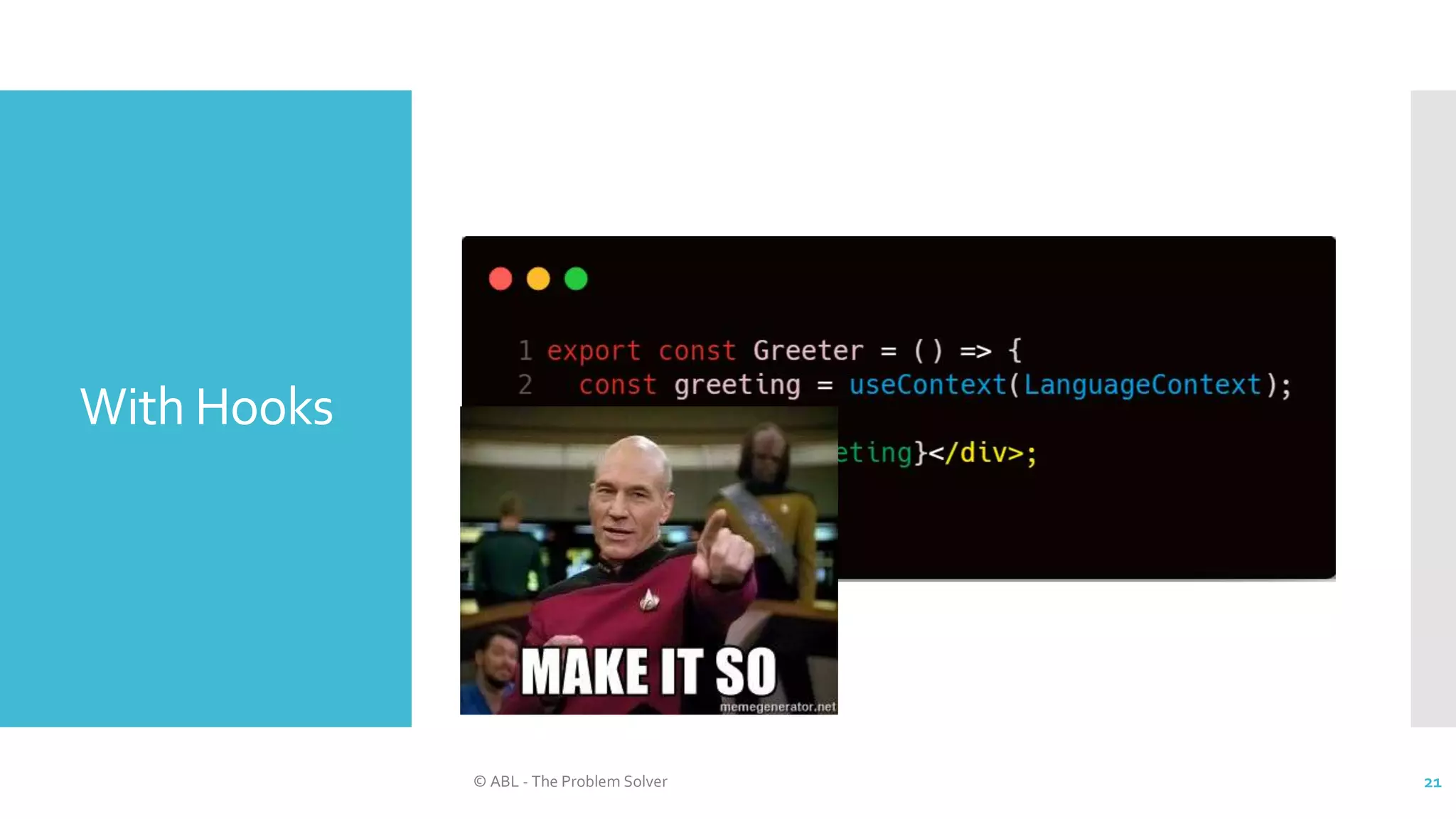
 Accepts a context object and returns the current context value
 Much easier then render props 😺
 Needs to be part of <Context.Provider/> component subtree
© ABL - The Problem Solver 19
Render props
© ABL - The Problem Solver 20
With Hooks
© ABL - The Problem Solver 21
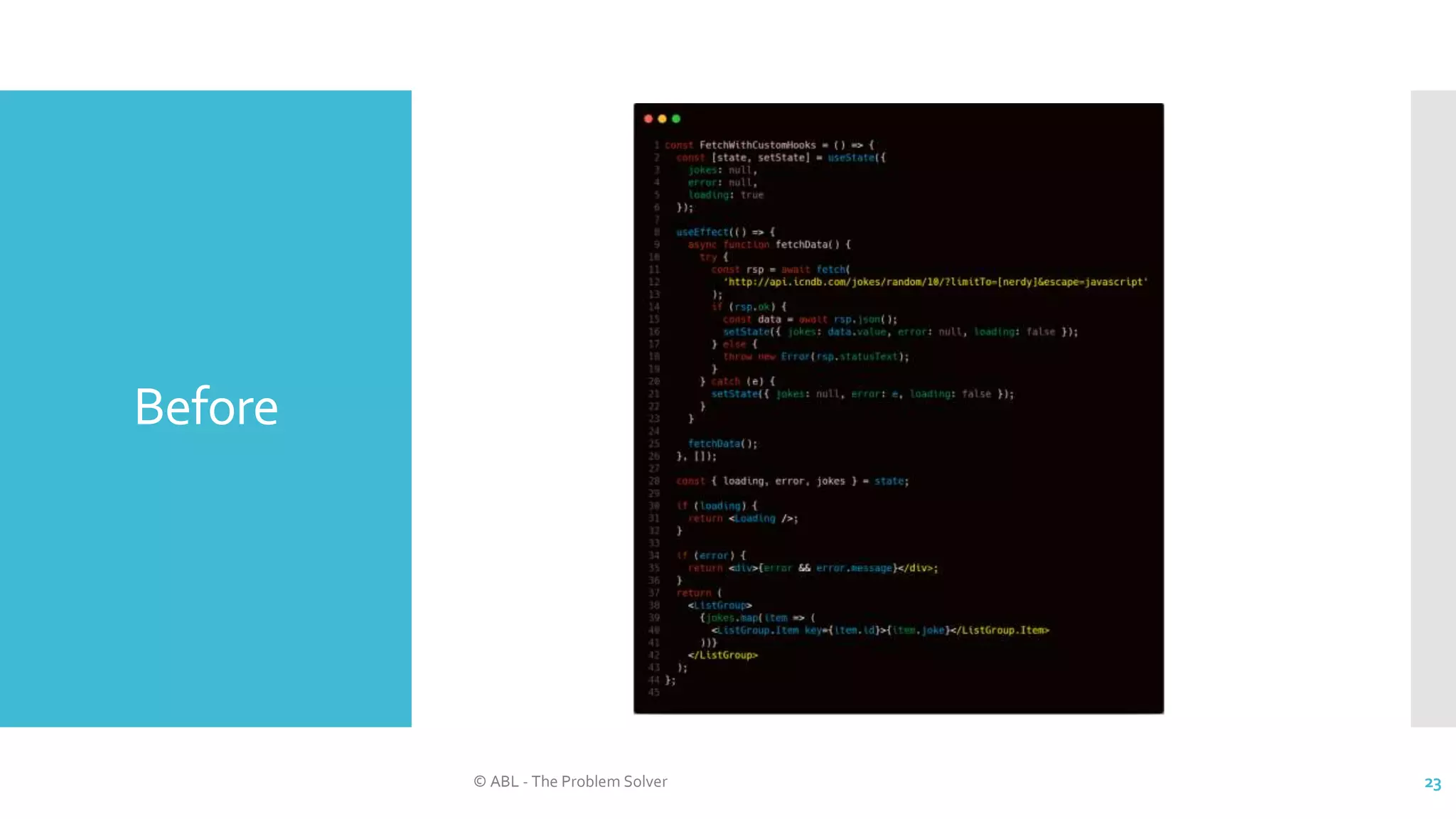
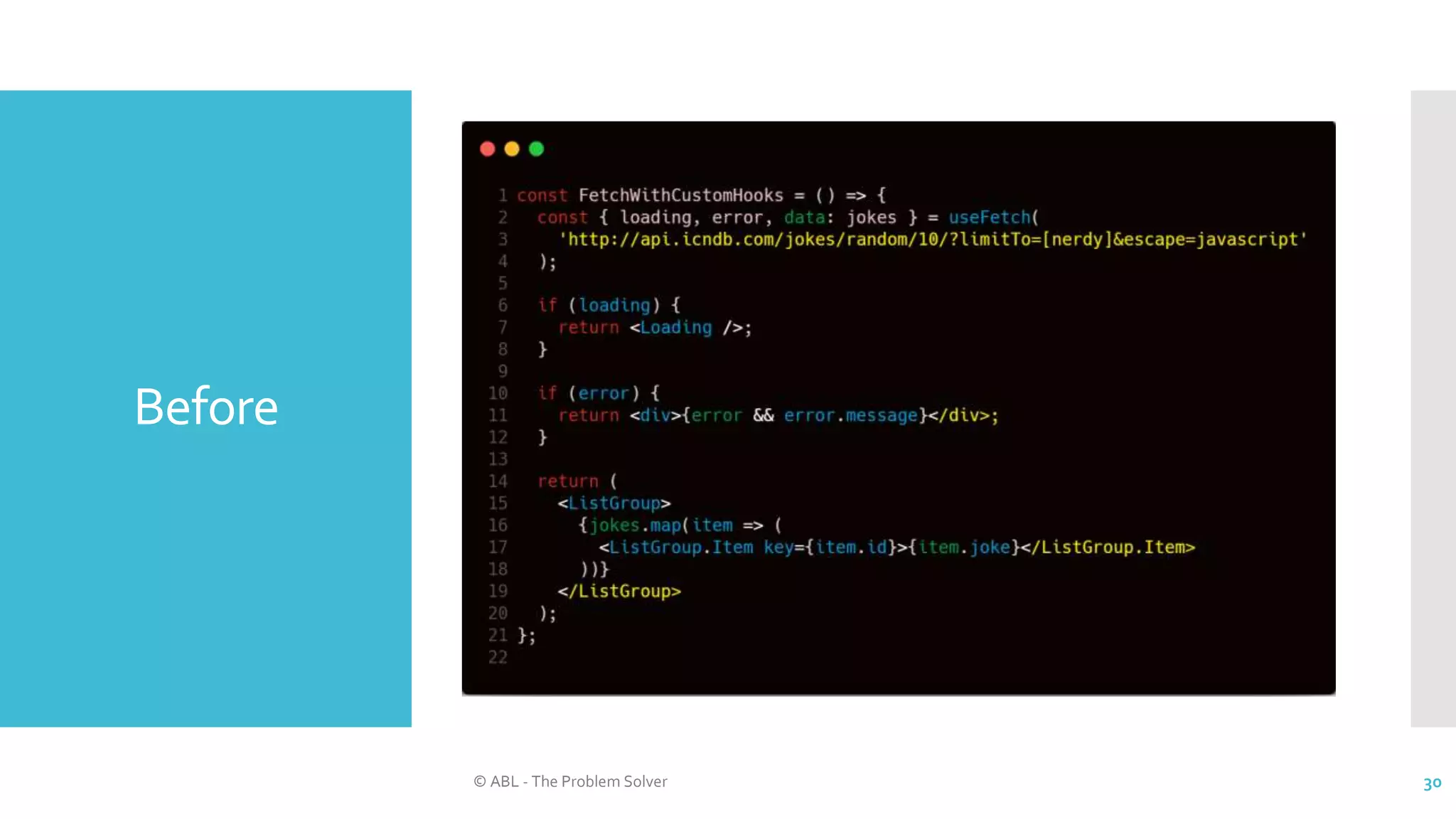
Custom hooks
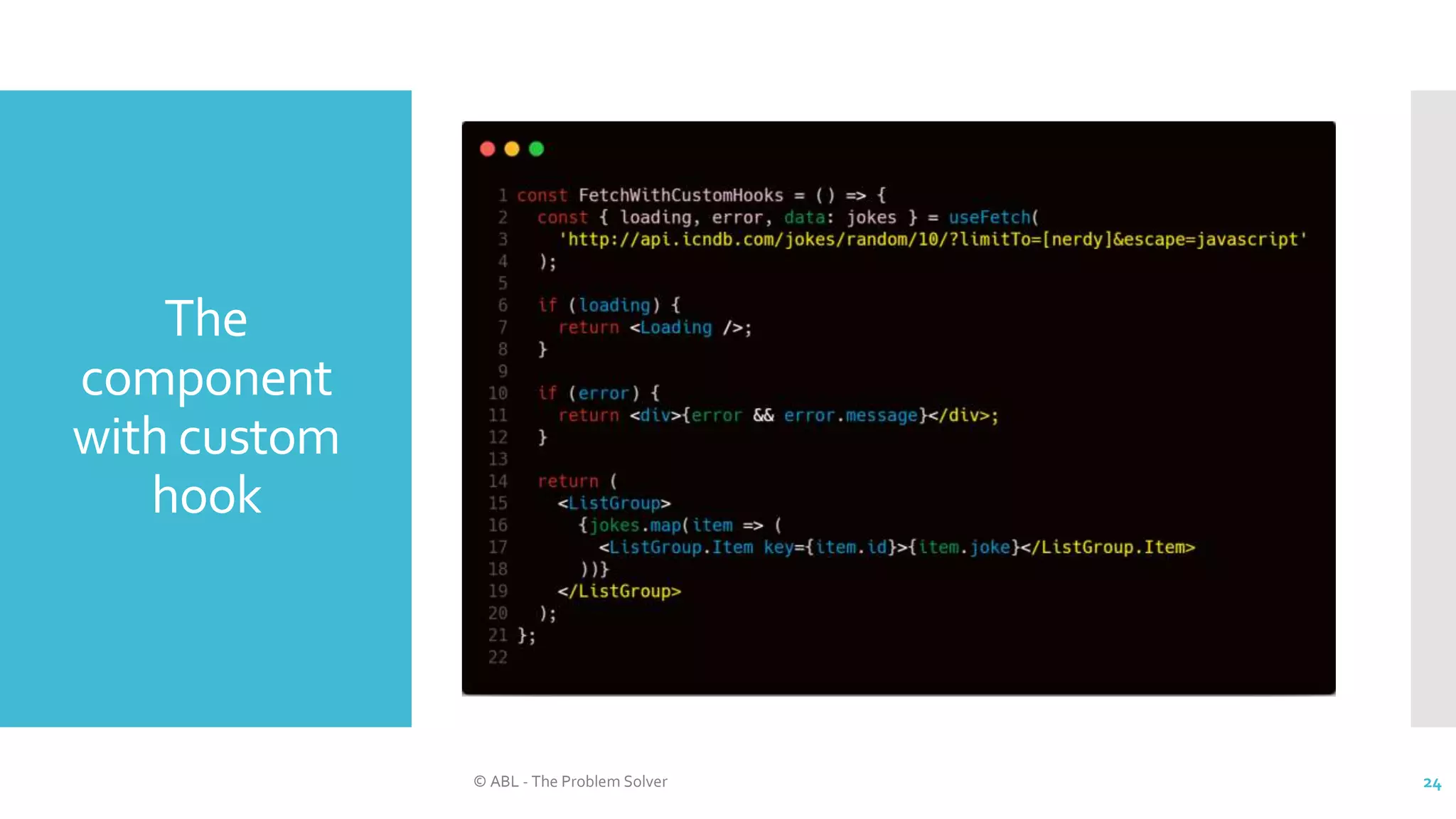
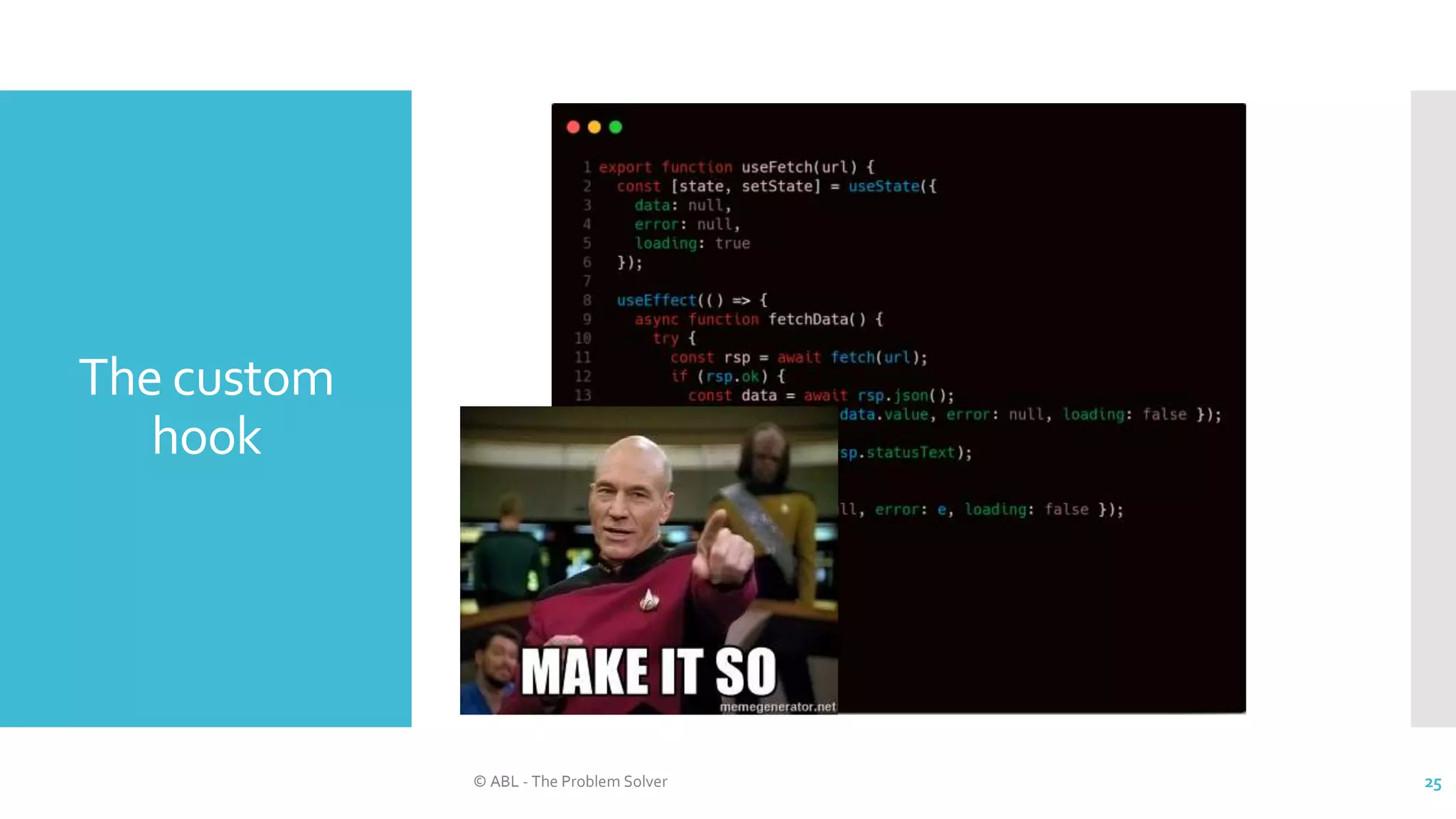
 Extract code from a component into a reusable custom hook
 Makes the code more reusable
 Can use other hooks as needed
 Just like a functional component
 Must be named useSomething()
 For React to recognize it as a hook
 Publish to NPM for others to use if you like
 See: https://nikgraf.github.io/react-hooks/
© ABL - The Problem Solver 22
Before
© ABL - The Problem Solver 23
The
component
with custom
hook
© ABL - The Problem Solver 24
The custom
hook
© ABL - The Problem Solver 25
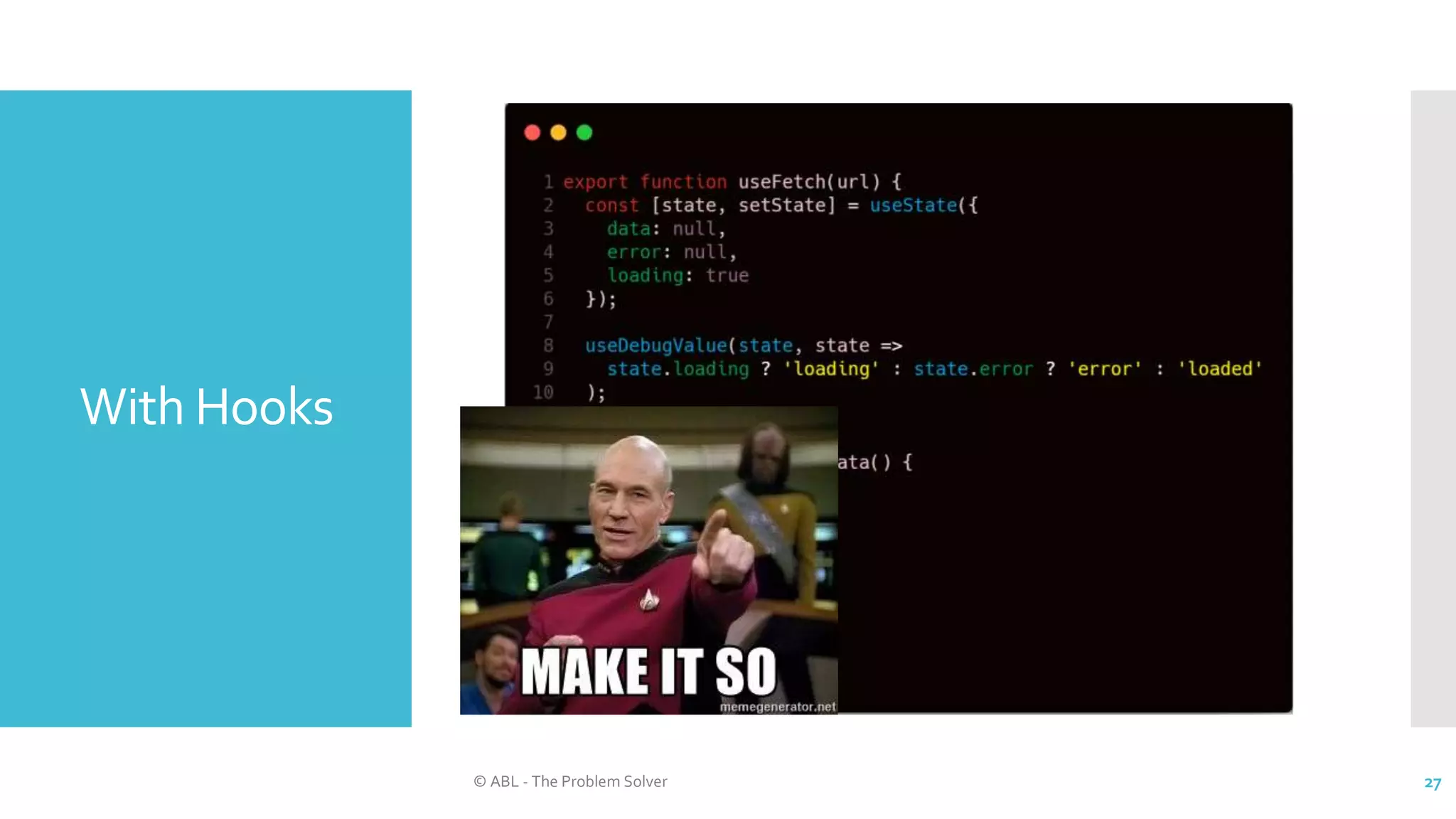
useDebugValue()  Displays a label for a custom hook in React DevTools
 👉 Useful for custom Hooks that are part of shared libraries 👈
© ABL - The Problem Solver 26
With Hooks
© ABL - The Problem Solver 27
Additional Hooks
© ABL - The Problem Solver 28
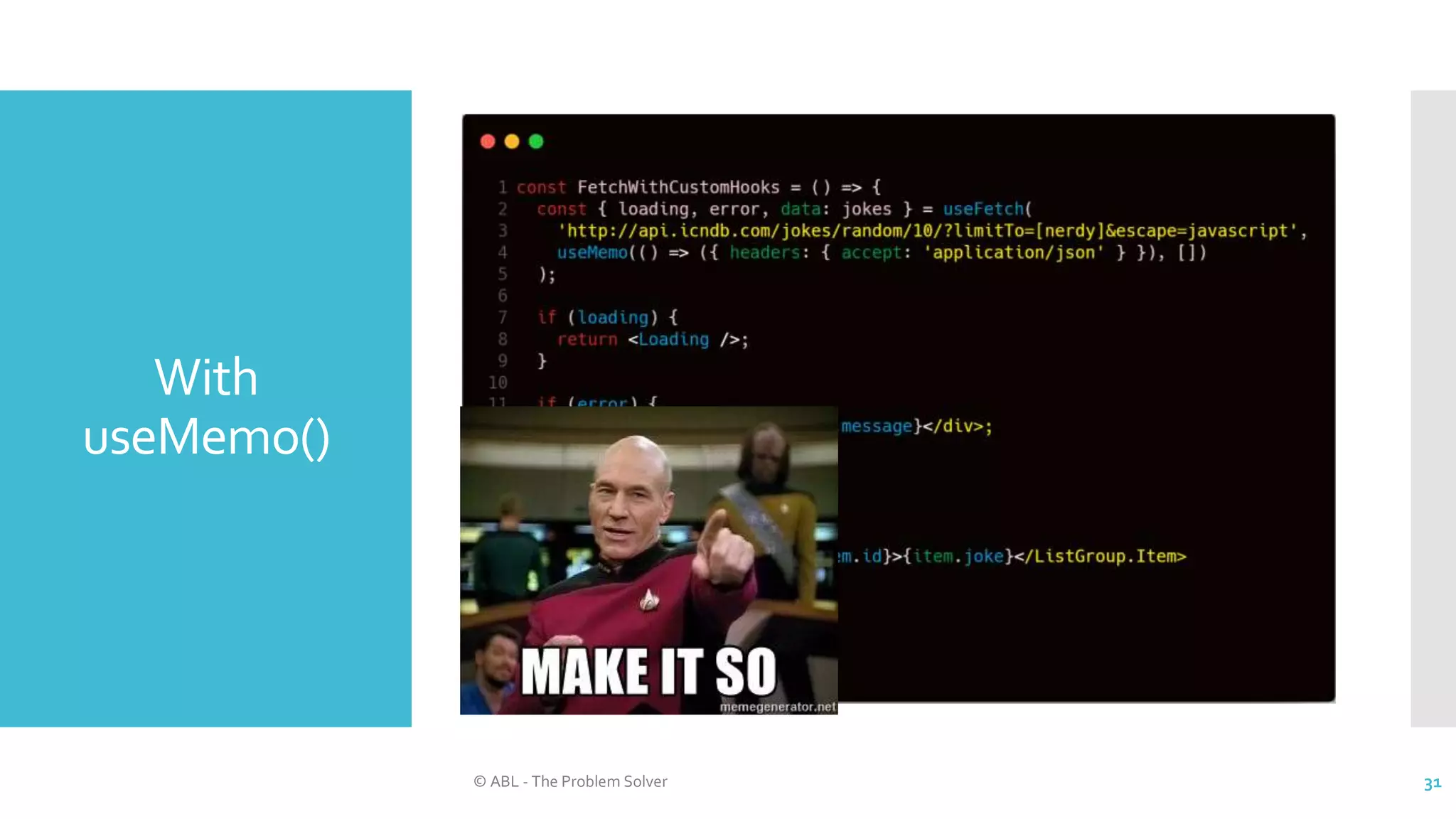
useMemo()
 Returns a memoized value
 Same inputs return the same result
 It’s a performance optimization
 Not as a guarantee
© ABL - The Problem Solver 29
Before
© ABL - The Problem Solver 30
With
useMemo()
© ABL - The Problem Solver 31
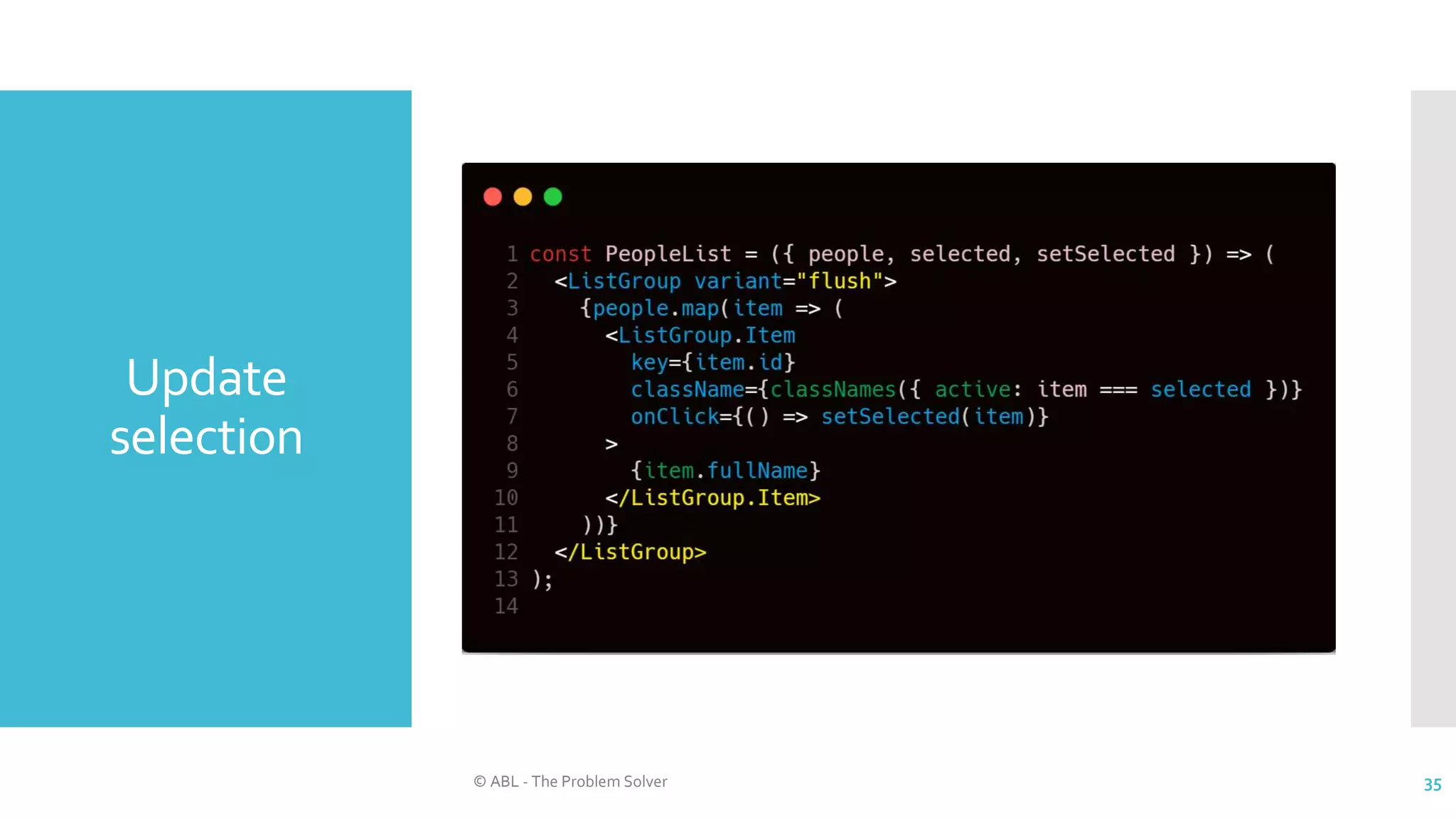
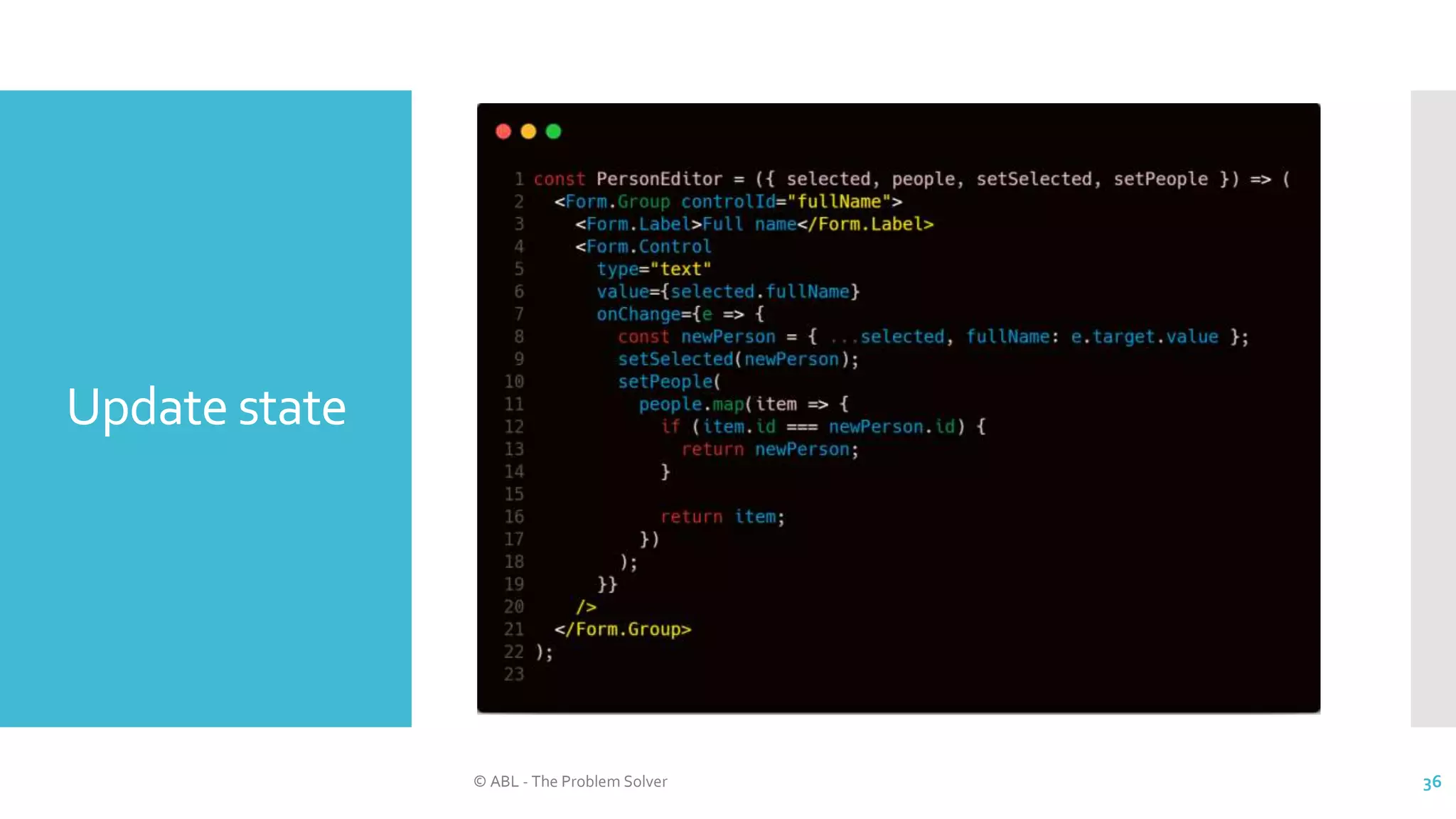
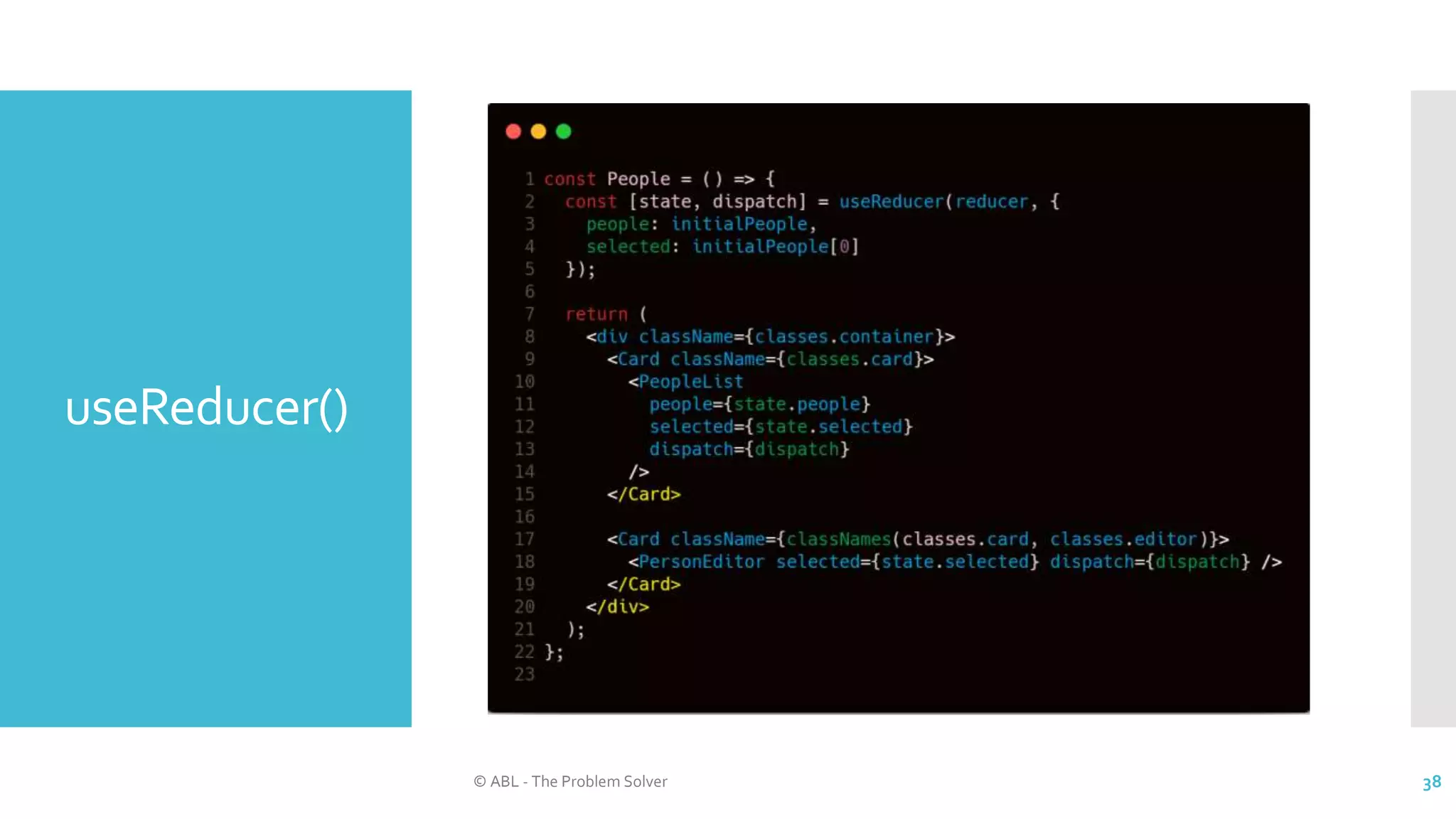
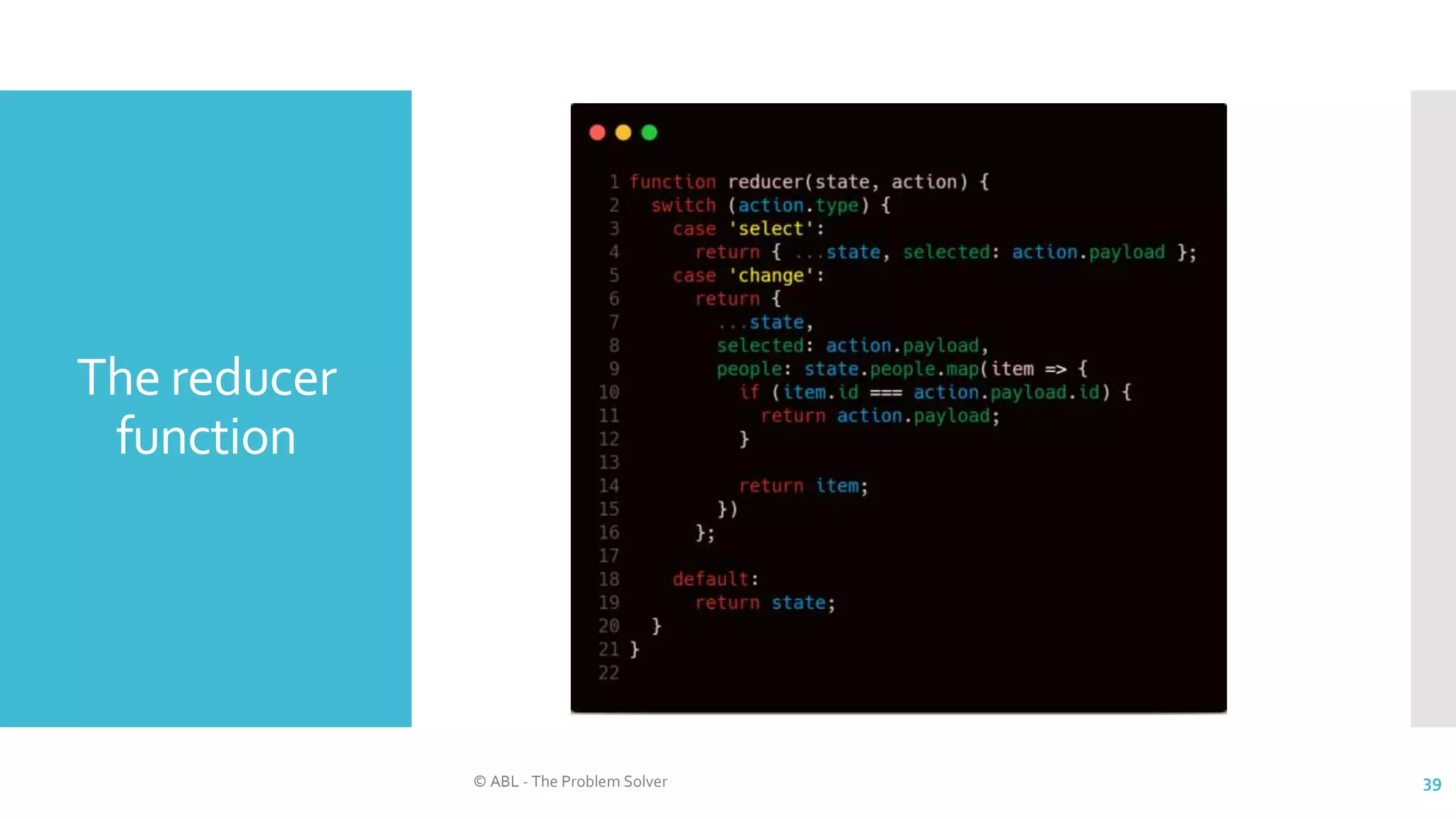
useReducer()
 A more powerful version of useState()
 Uses a reducer function to manage state
 Just like Redux
 The reducer function always has the same signature
 (oldState, action) => newState
 Preferred when state logic is more complex
 Much easier to write in aTDD style
 👉The dispatch function won’t change with re-renders 👈
© ABL - The Problem Solver 32
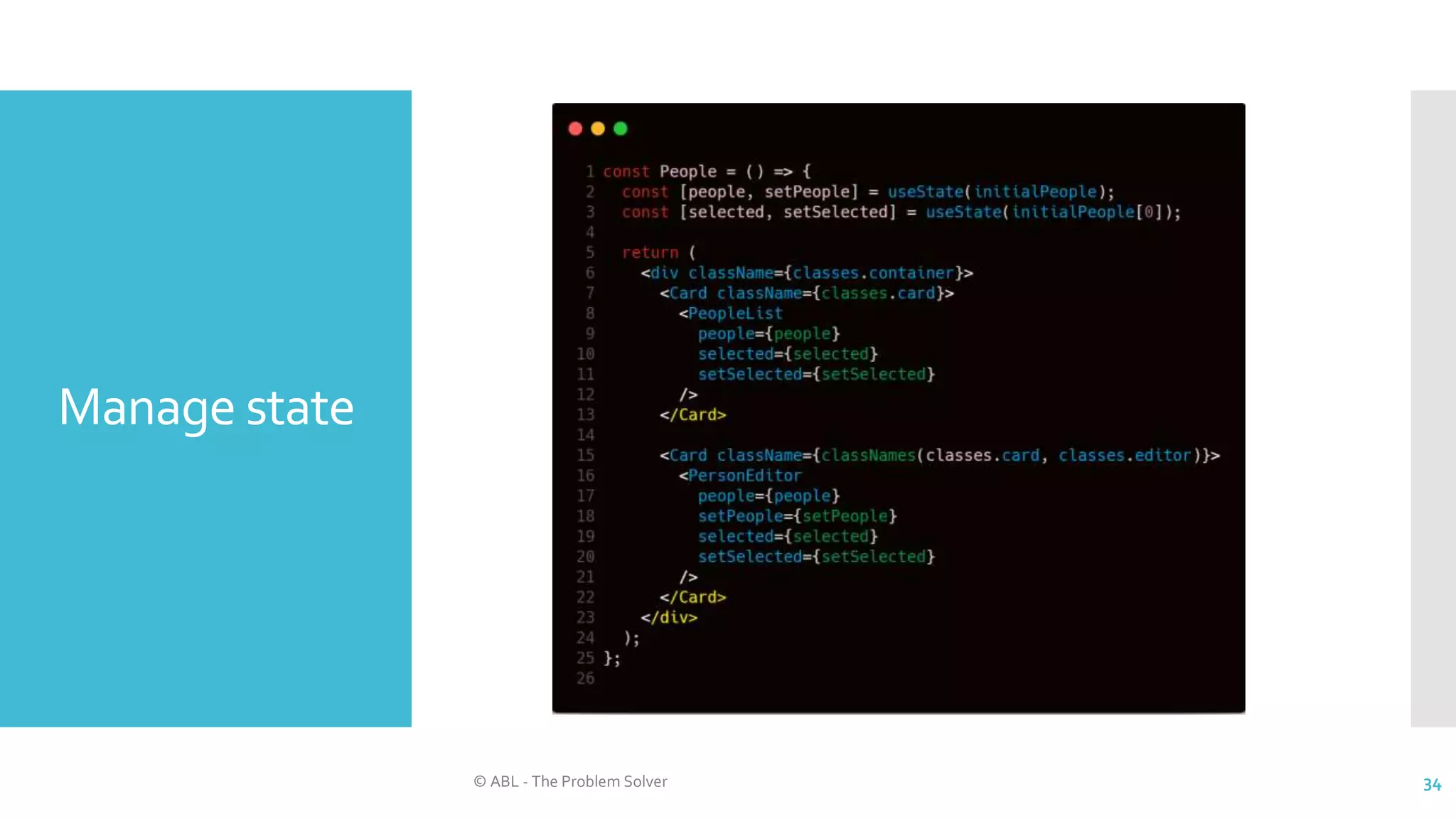
With useState()
© ABL - The Problem Solver 33
Manage state
© ABL - The Problem Solver 34
Update
selection
© ABL - The Problem Solver 35
Update state
© ABL - The Problem Solver 36
With useReducer()
© ABL - The Problem Solver 37
useReducer()
© ABL - The Problem Solver 38
The reducer
function
© ABL - The Problem Solver 39
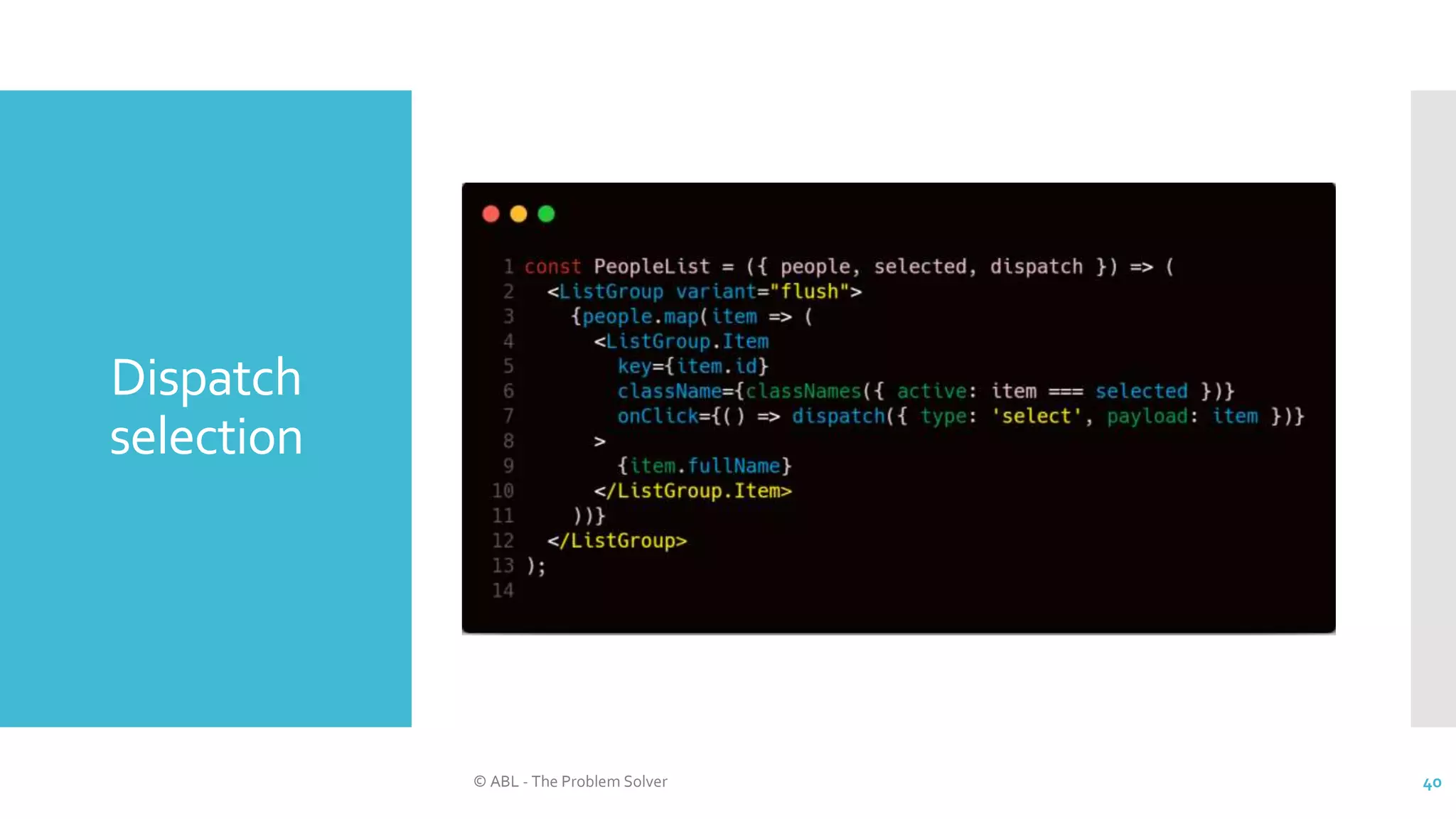
Dispatch
selection
© ABL - The Problem Solver 40
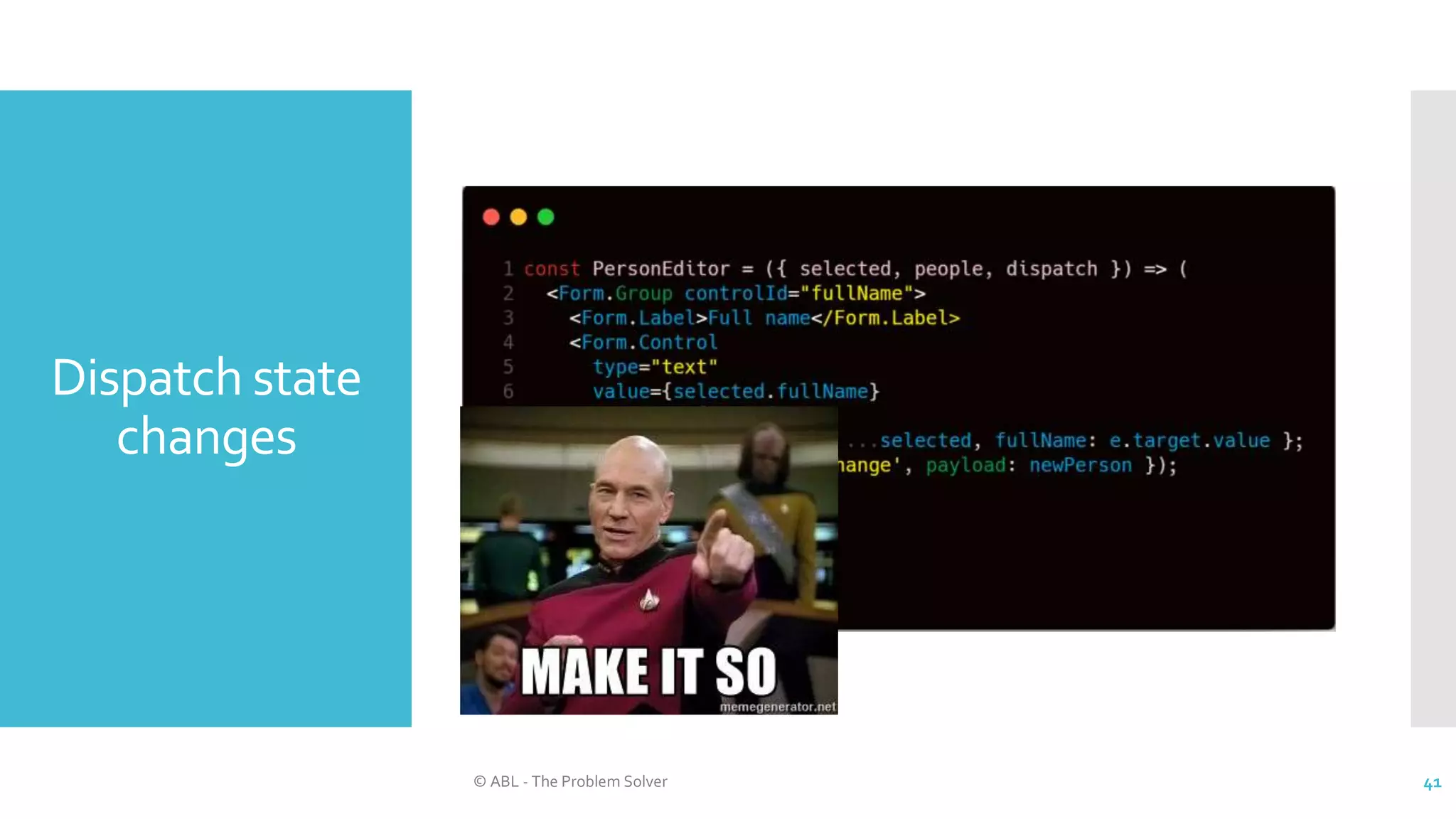
Dispatch state
changes
© ABL - The Problem Solver 41
useRef()
 Maintain state between each re-render
 Without triggering a render on updates
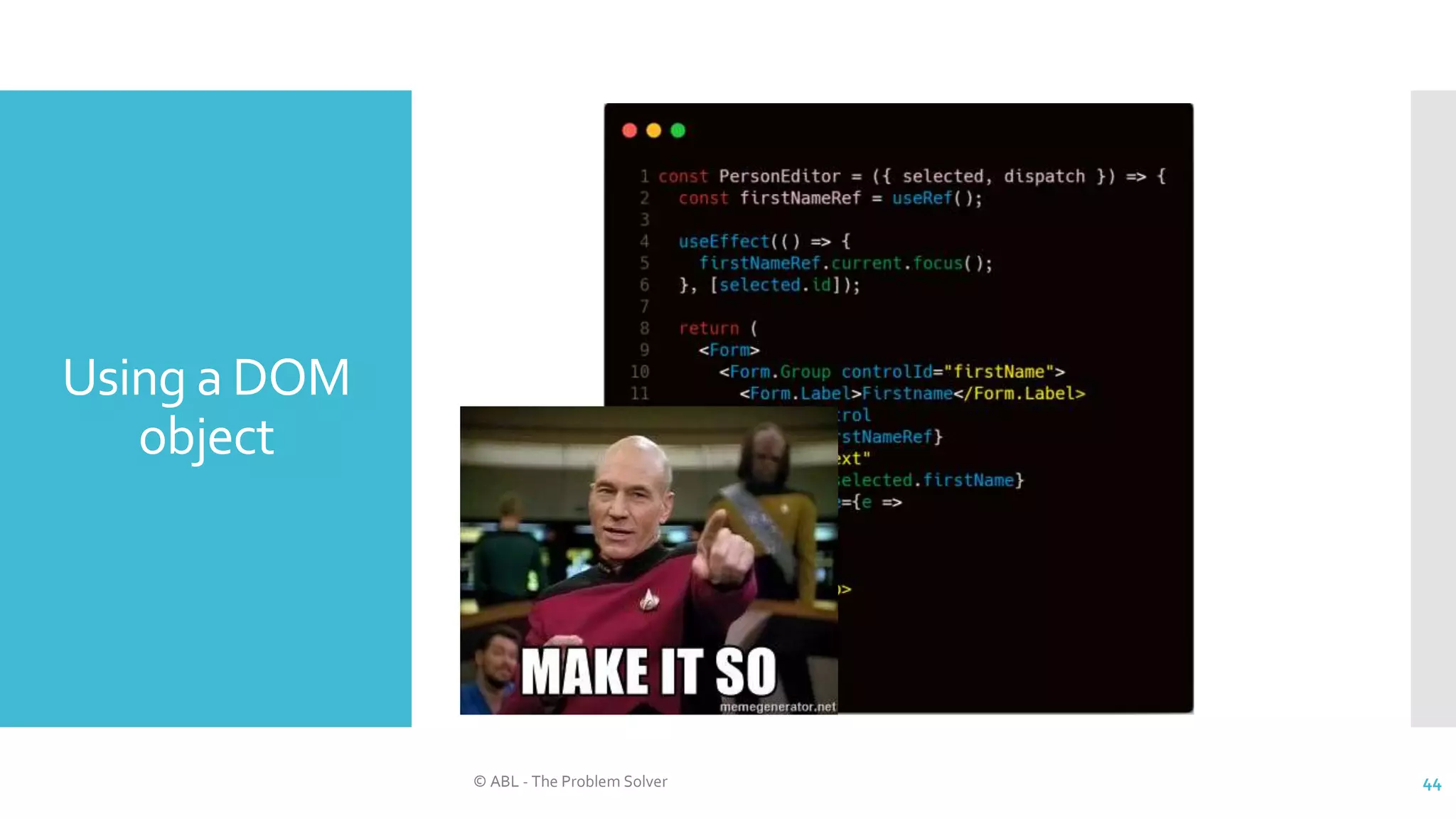
 Typically used for DOM object and useEffect()
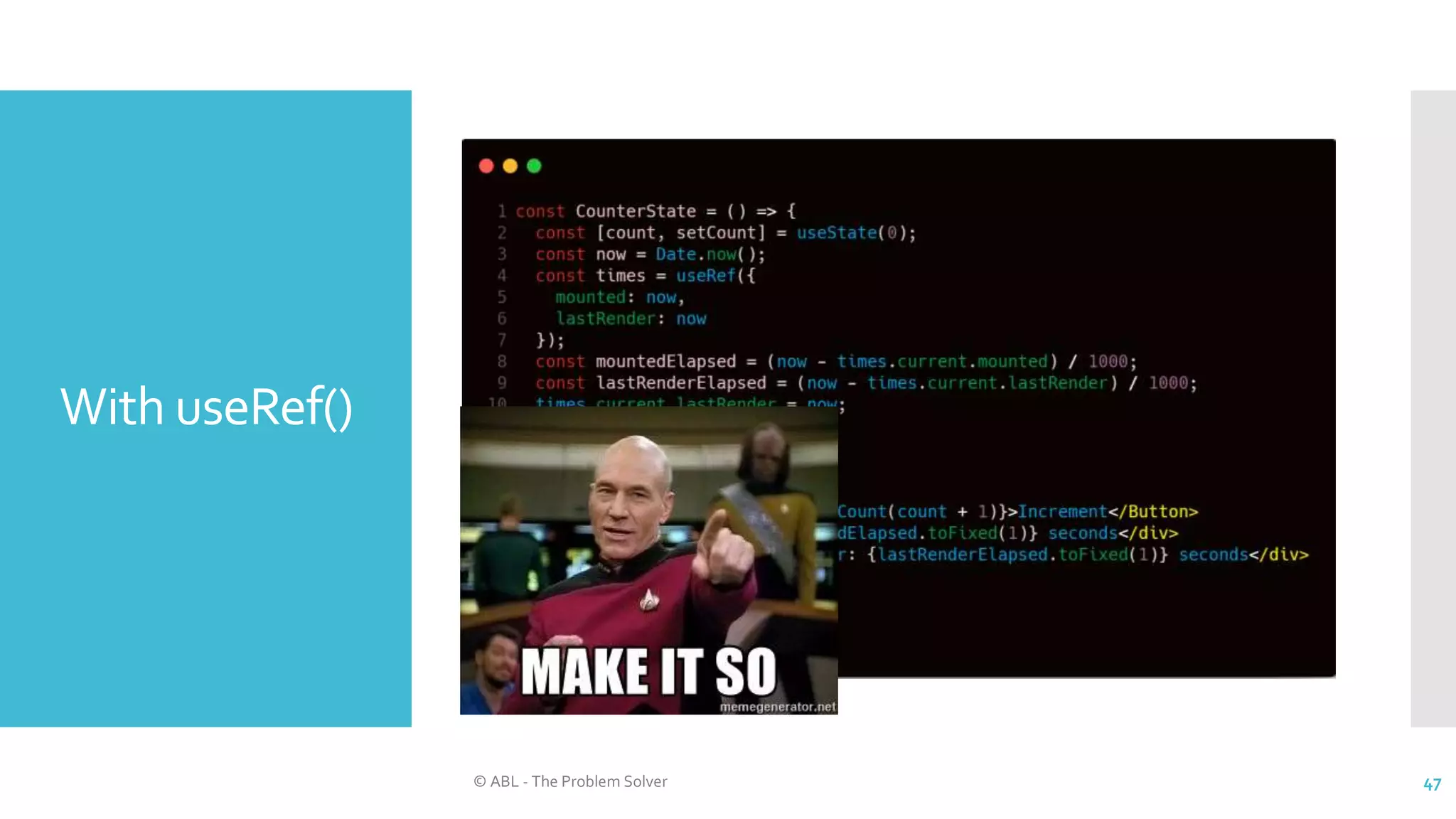
 But can be used for any kind of state
© ABL - The Problem Solver 42
Manipulating DOM
objects with useRef()
© ABL - The Problem Solver 43
Using a DOM
object
© ABL - The Problem Solver 44
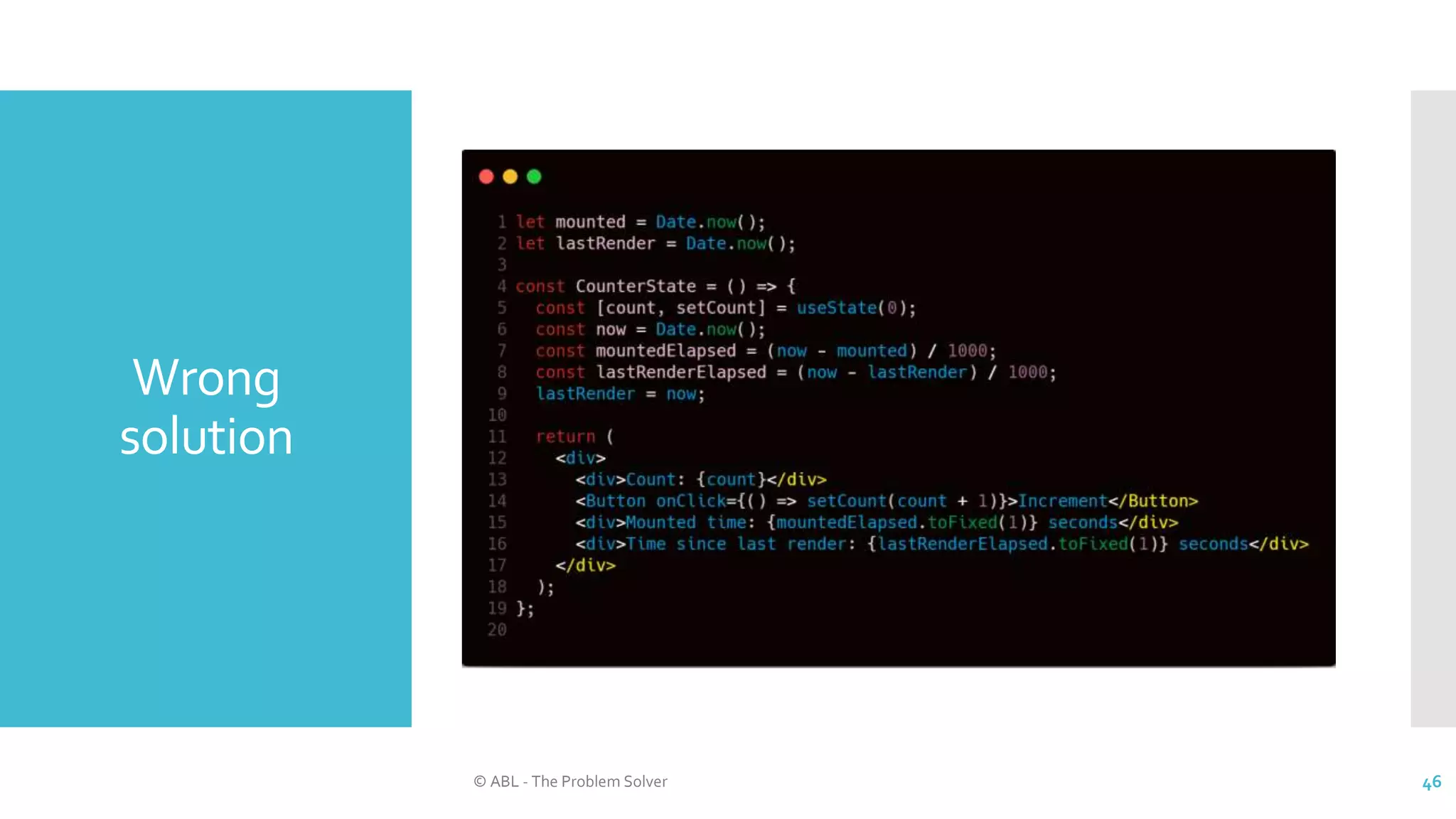
Remembering other
values using useRef()
© ABL - The Problem Solver 45
Wrong
solution
© ABL - The Problem Solver 46
With useRef()
© ABL - The Problem Solver 47
Concurrent React
© ABL - The Problem Solver 48
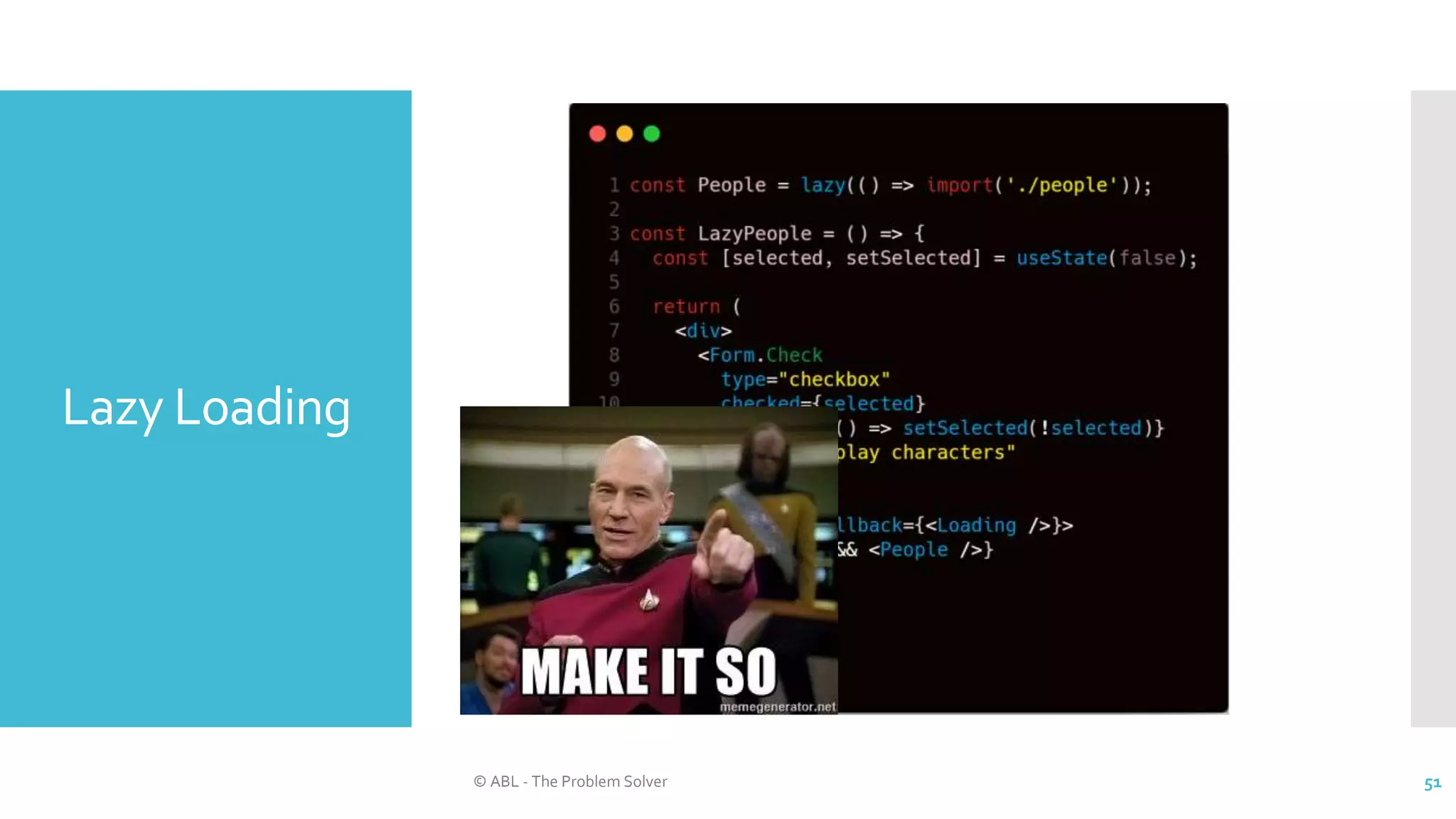
lazy()
 Create a component that is loaded dynamically
 With automatic bundle splitting by Webpack
 Requires a <Suspense /> component as a parent
 The fallback UI is required
 Typically a spinner or something similar
© ABL - The Problem Solver 49
Eager Loading
© ABL - The Problem Solver 50
Lazy Loading
© ABL - The Problem Solver 51
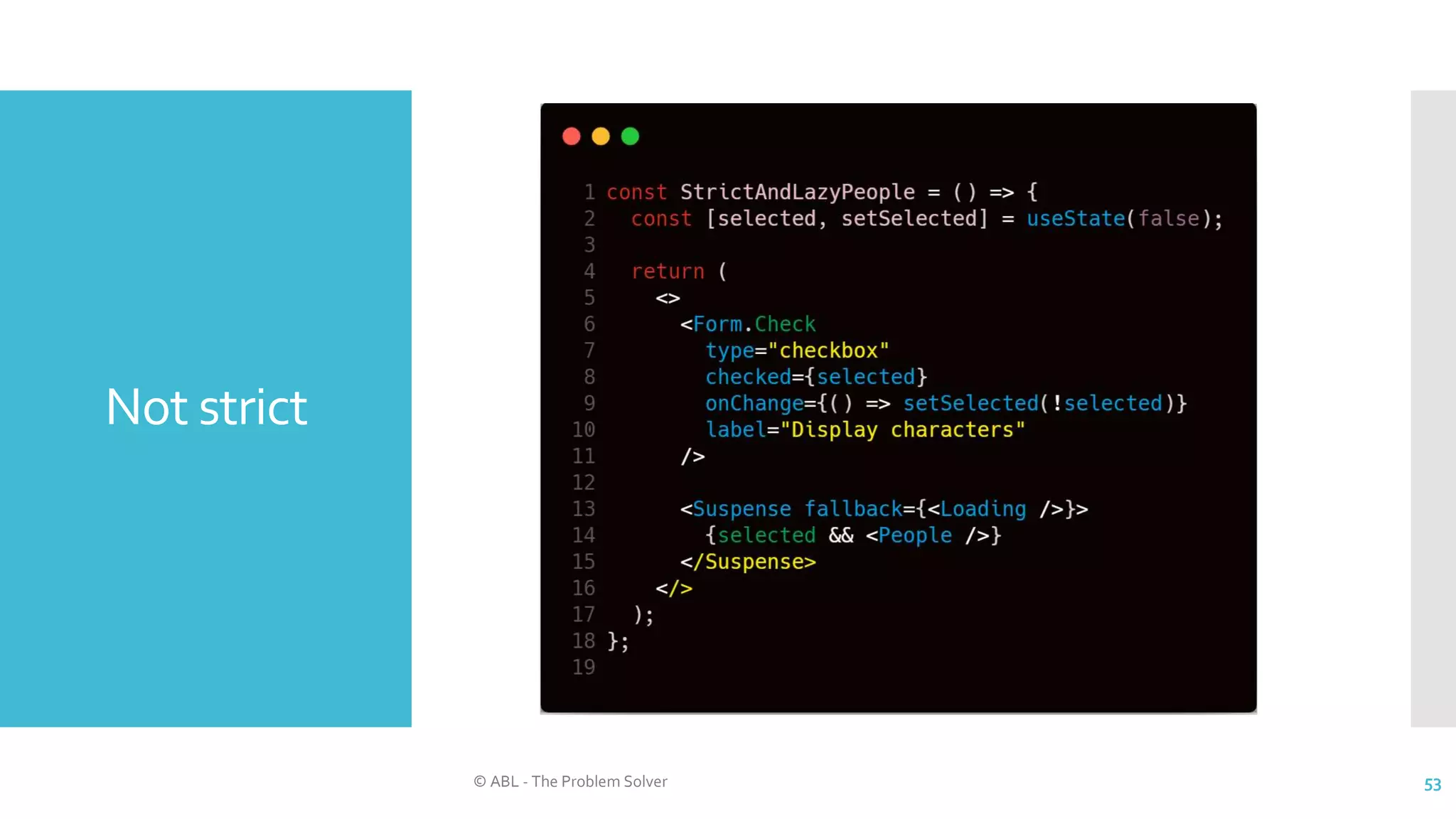
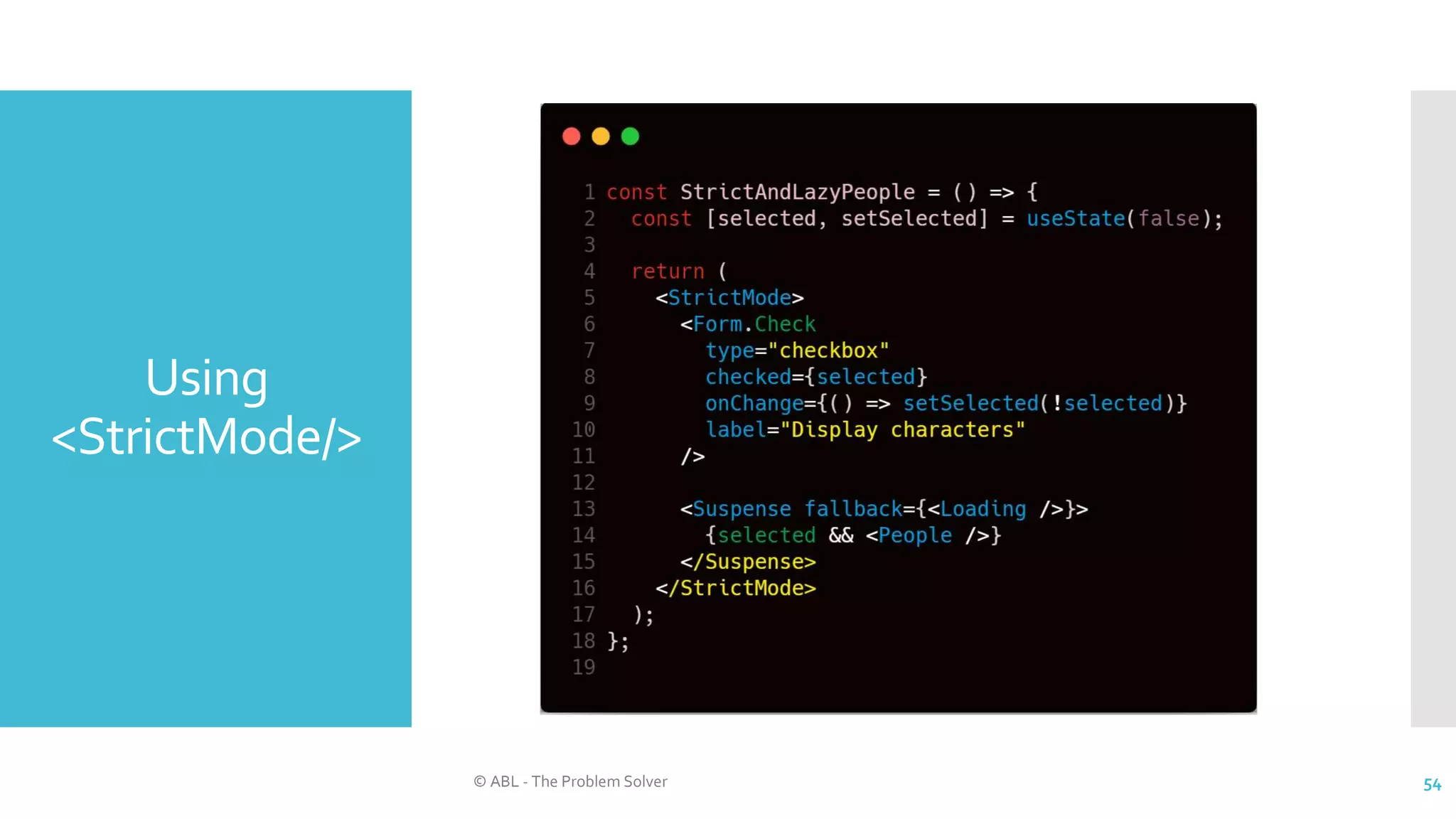
StrictMode
 The <StrictMode /> component helps prepare for async rendering
 Warns about unsafe lifecycle functions like componentWillMount()
 As well as other deprecated React features
 Will try to detect illegal side effects by rendering twice
 The same applies to some state management functions
 👉 Does nothing in a production build 👈
 Will make a development build run slower
© ABL - The Problem Solver 52
Not strict
© ABL - The Problem Solver 53
Using
<StrictMode/>
© ABL - The Problem Solver 54
Fixing the strict error
© ABL - The Problem Solver 55
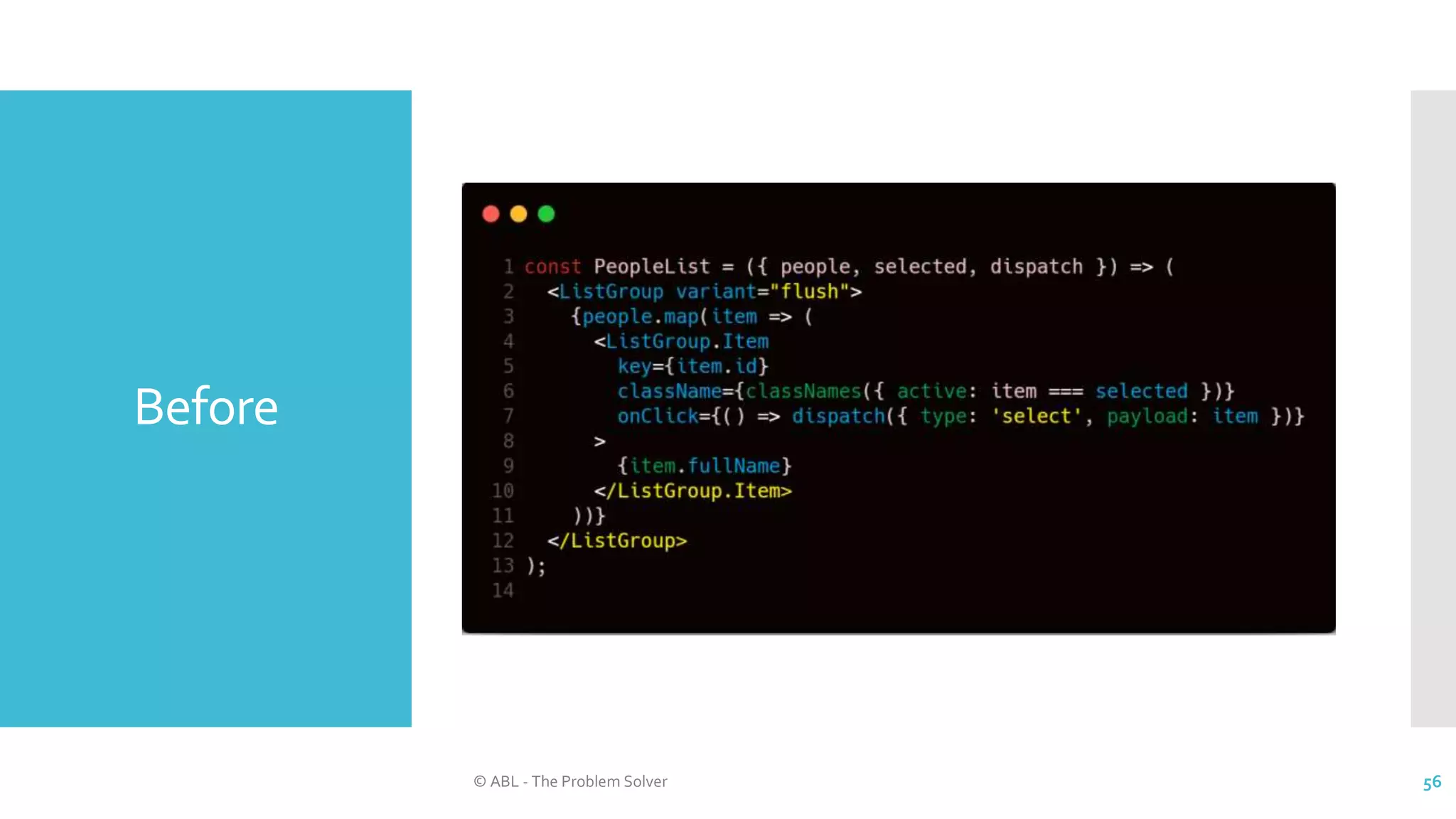
Before
© ABL - The Problem Solver 56
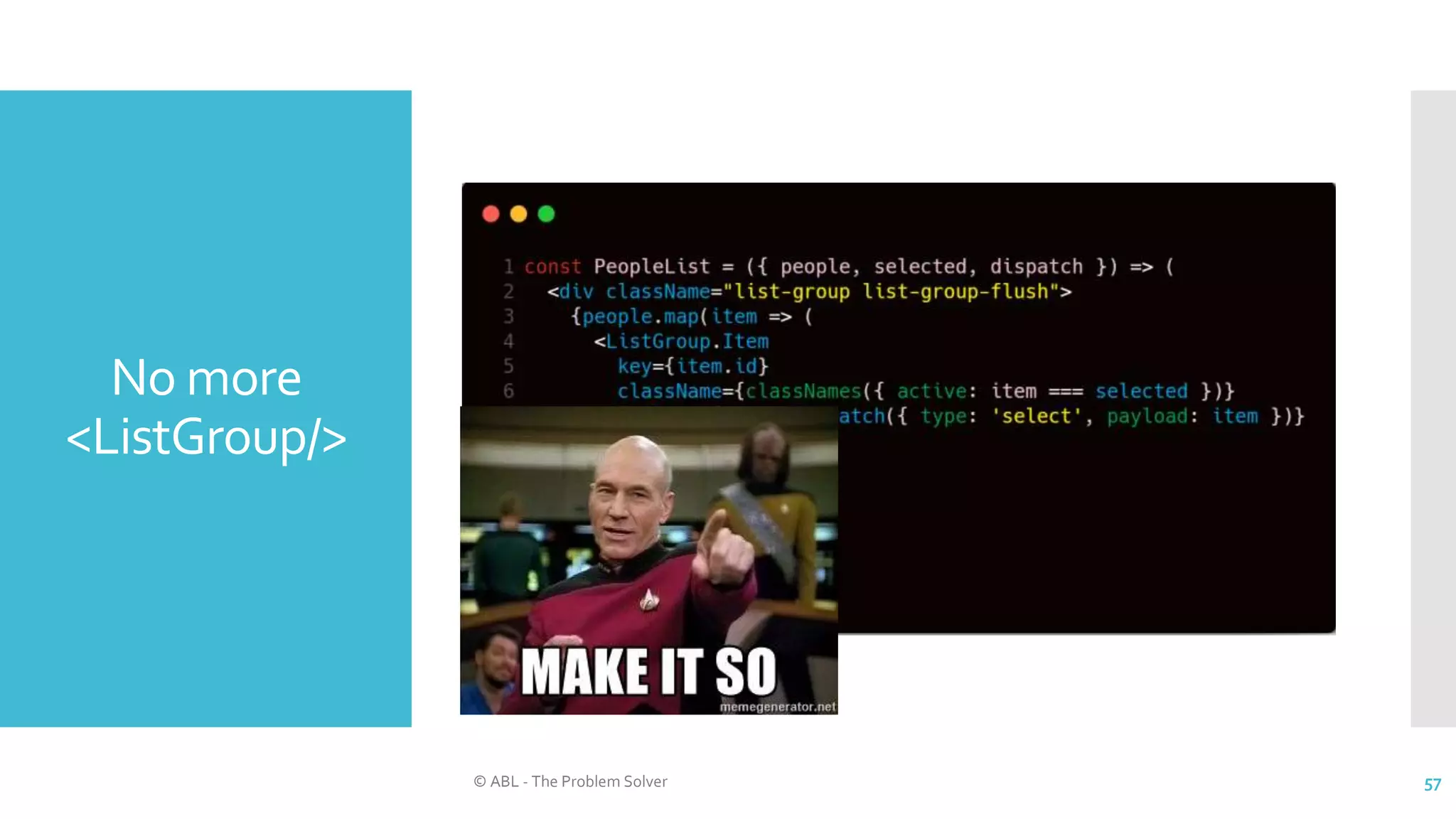
No more
<ListGroup/>
© ABL - The Problem Solver 57
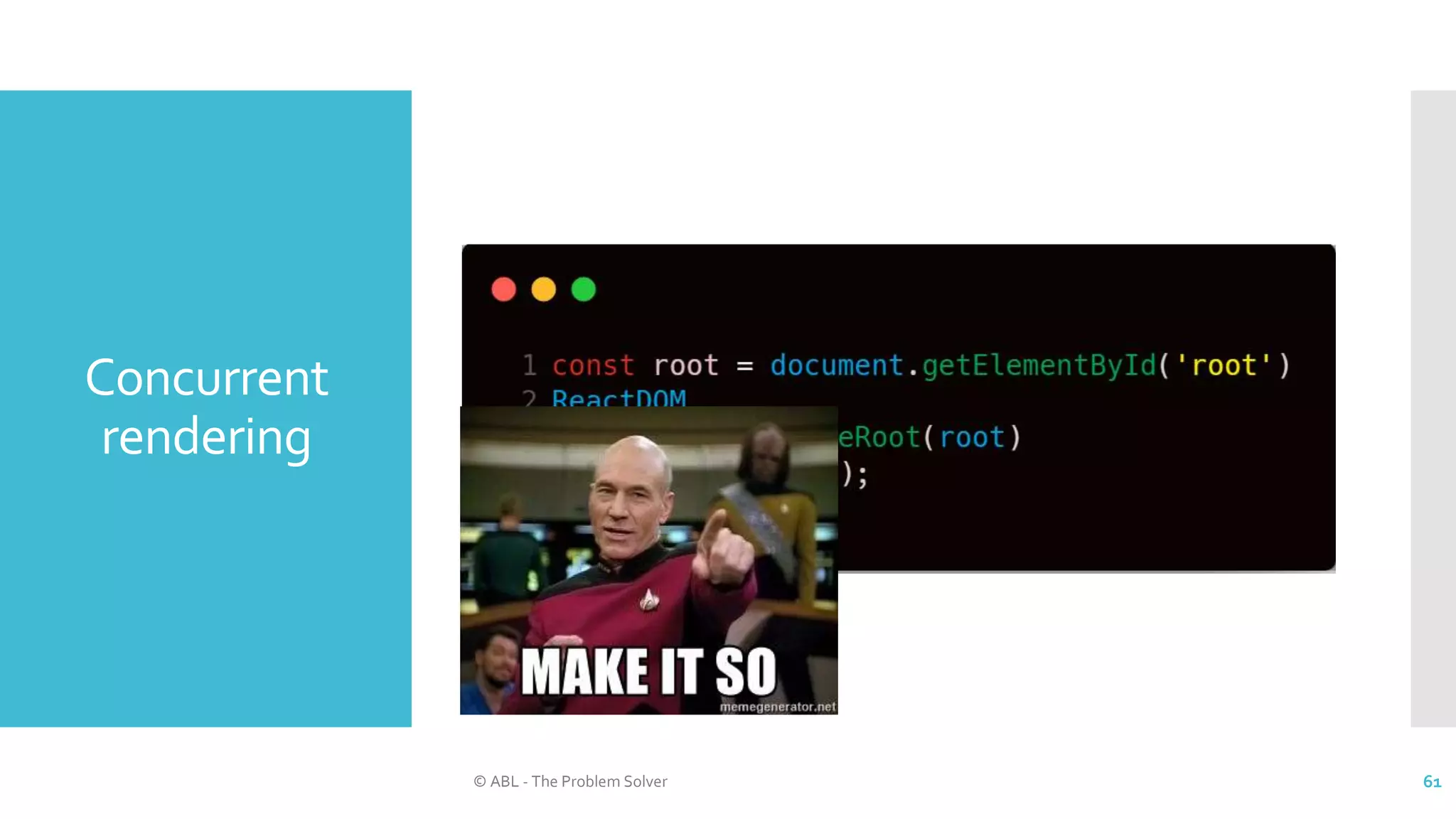
Concurrent
mode
 React can render in concurrent mode
 Rendering happens in time slices
 React can prioritize user events over other work
 Results in more responsive applications
 Either for the whole application using ReactDOM.createRoot()
 Or a component subtree using <ConcurrentMode/>
© ABL - The Problem Solver 58
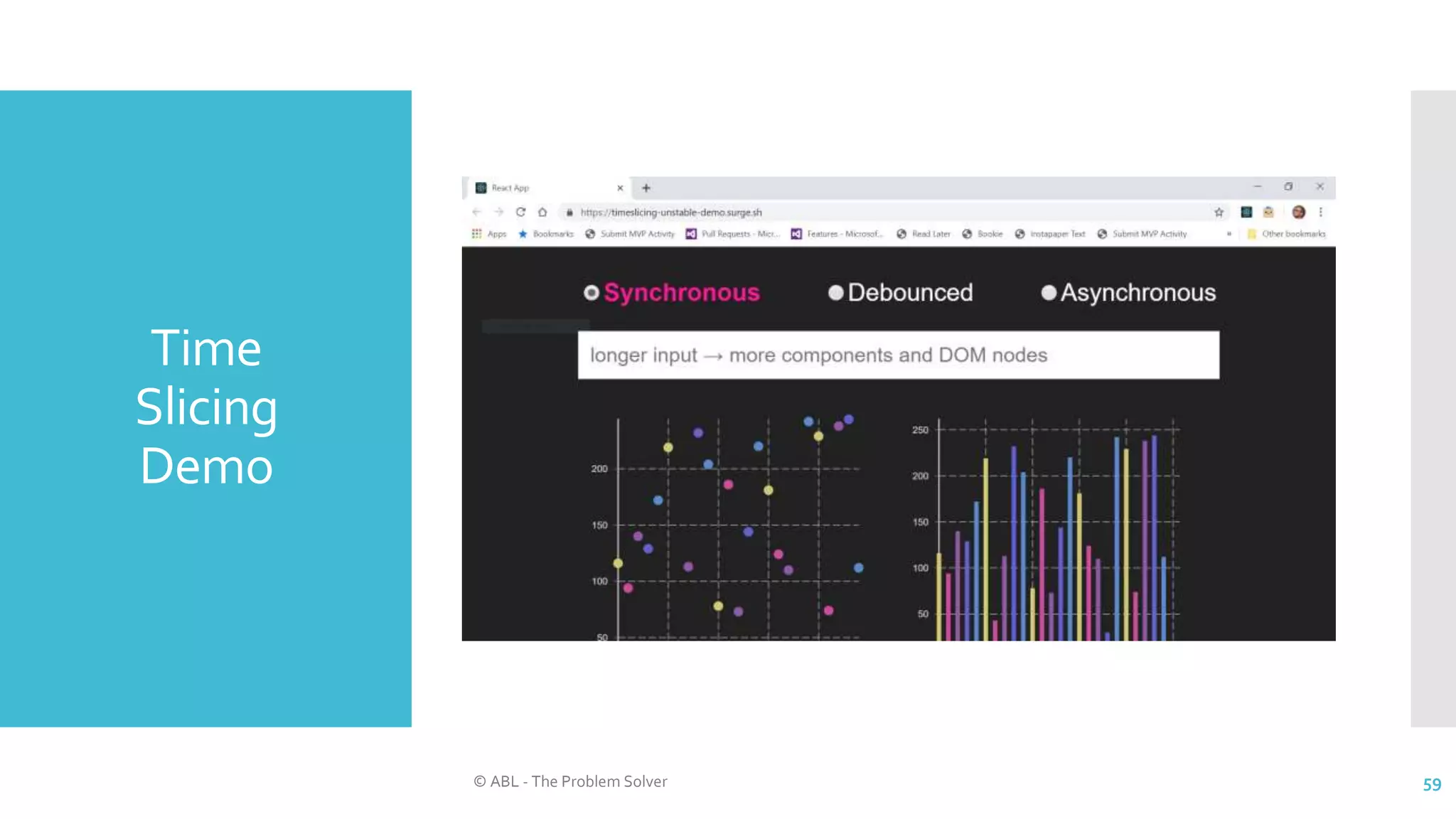
Time
Slicing
Demo
© ABL - The Problem Solver 59
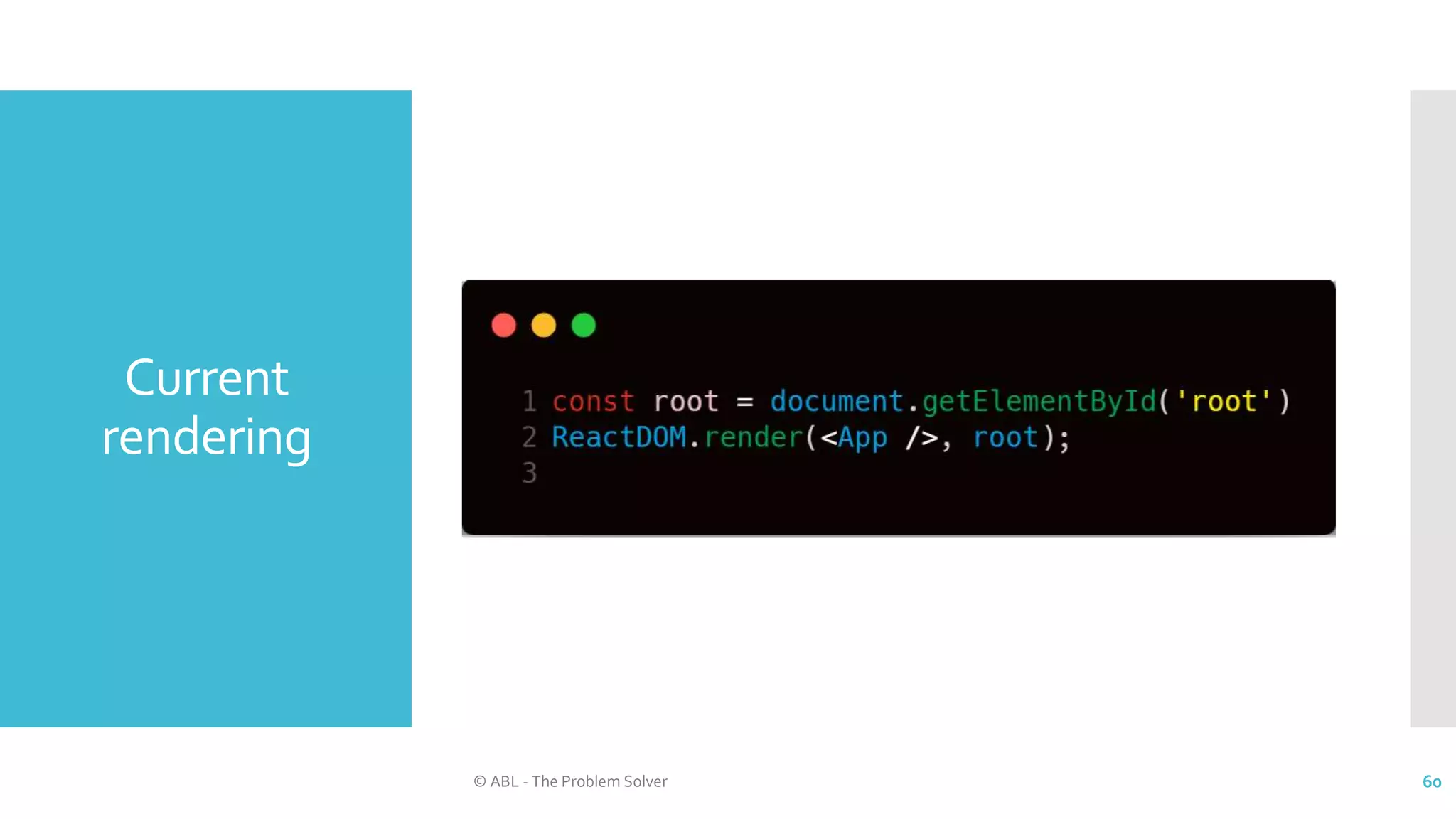
Current
rendering
© ABL - The Problem Solver 60
Concurrent
rendering
© ABL - The Problem Solver 61
ReactCache
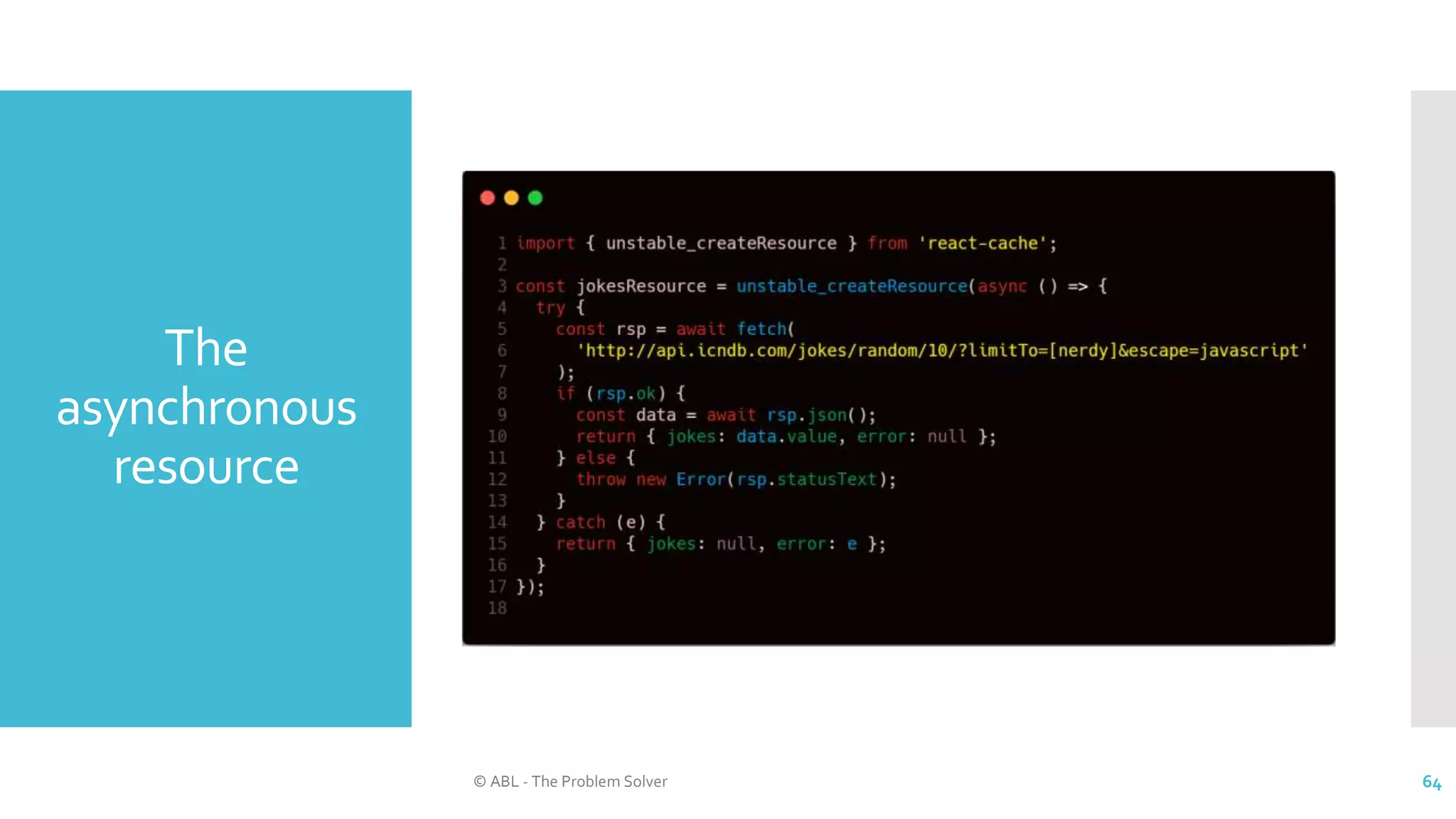
 Creates a resource manager to load data asynchronous
 Can work with anything that return a promise
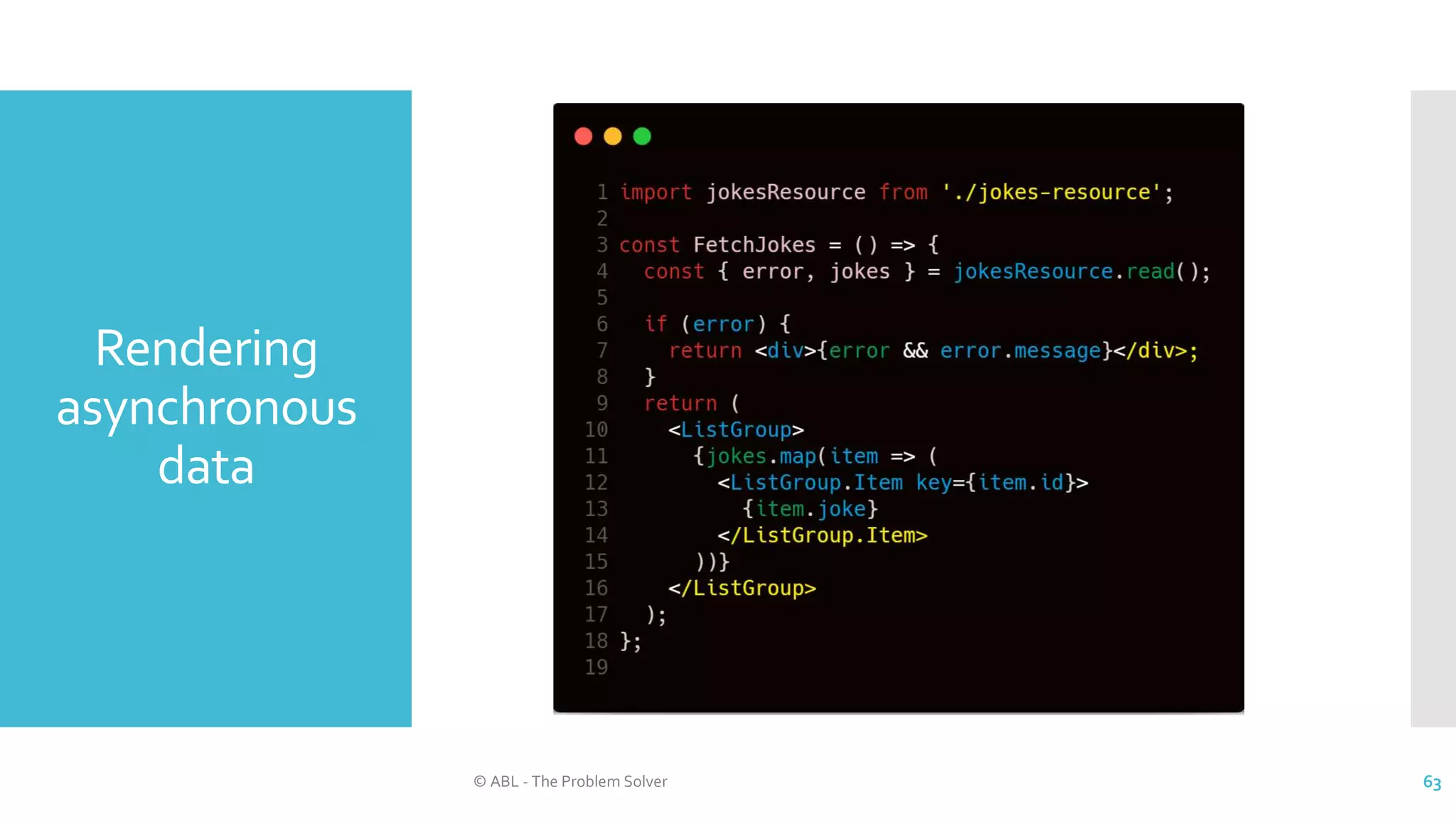
 Can be called from a components render() function
 Will pause rendering until the promise resolves
 💔The NPM package is broken for the current React version 💔
© ABL - The Problem Solver 62
Rendering
asynchronous
data
© ABL - The Problem Solver 63
The
asynchronous
resource
© ABL - The Problem Solver 64
Conclusion
 The future of React is bright
 Functional components and hooks is the future of components
 But class based components will continue to work
 Concurrent React makes large complex application responsive
 Easy to implement in most cases
 React Cache will make data loading easier
 But not quite yet
© ABL - The Problem Solver 65
Maurice de Beijer
@mauricedb
© ABL - The Problem Solver 66

The new React

  • 1.
    The new React Mauricede Beijer - @mauricedb
  • 2.
     Maurice deBeijer  The Problem Solver  Microsoft MVP  Freelance developer/instructor  Twitter: @mauricedb  Web: http://www.TheProblemSolver.nl  E-mail: maurice.de.beijer@gmail.com 2ABL - The Problem Solver
  • 3.
    The React Newsletter © ABL- The Problem Solver 3 http://bit.ly/ReactNewsletter
  • 4.
    Topics  Intro intoReact hooks  Basic hooks  useState()  useEffect()  useEffect() with asynchronous actions  useContext()  Custom hooks  Advanced hooks  useDebugValue()  useMemo()  useReducer()  useRef()  Suspense  lazy()  StrictMode  ConcurrentMode  React Cache © ABL - The Problem Solver 4
  • 5.
    Follow along  Gitrepository with slides and code  https://github.com/mauricedb/the-new-react-vilnius-2019 © ABL - The Problem Solver 5
  • 6.
    Type it out byhand? “Typing it drills it into your brain much better than simply copying and pasting it.You're forming new neuron pathways.Those pathways are going to help you in the future. Help them out now!” © ABL - The Problem Solver 6
  • 7.
    Prerequisites Install Node &NPM © ABL - The Problem Solver 7
  • 8.
    Install Node.js & NPM ©ABL - The Problem Solver 8
  • 9.
    Basic hooks © ABL- The Problem Solver 9
  • 10.
    useState()  Returns apersisted stateful value and a function to update it  Values can be object or scalar values  Starts with an initial value  Can be a lazy initialization function  The updater function replaces the original state  Doesn’t merge state like the class based setState()  The update value can also be a function © ABL - The Problem Solver 10
  • 11.
    Class based © ABL- The Problem Solver 11
  • 12.
    With Hooks © ABL- The Problem Solver 12
  • 13.
    useEffect()  Accepts afunction that contains imperative code  The code is used to execute (asynchronous) side effects  useEffect() fires after layout and paint, during a deferred event  Use useLayoutEffect() for code that should not be deferred  Runs both on component mount as well as updates  Control when using the dependencies array  Optionally return a cleanup function © ABL - The Problem Solver 13
  • 14.
    Class based © ABL- The Problem Solver 14
  • 15.
    With Hooks © ABL- The Problem Solver 15
  • 16.
    useEffect() with asynchronous actions  useEffect() isgreat for async actions like AJAX requests  👉 Make sure to never return a promise 👈  Use the effect cleanup function to cancel a pending request © ABL - The Problem Solver 16
  • 17.
    Class based © ABL- The Problem Solver 17
  • 18.
    With Hooks © ABL- The Problem Solver 18
  • 19.
    useContext()  Accepts acontext object and returns the current context value  Much easier then render props 😺  Needs to be part of <Context.Provider/> component subtree © ABL - The Problem Solver 19
  • 20.
    Render props © ABL- The Problem Solver 20
  • 21.
    With Hooks © ABL- The Problem Solver 21
  • 22.
    Custom hooks  Extractcode from a component into a reusable custom hook  Makes the code more reusable  Can use other hooks as needed  Just like a functional component  Must be named useSomething()  For React to recognize it as a hook  Publish to NPM for others to use if you like  See: https://nikgraf.github.io/react-hooks/ © ABL - The Problem Solver 22
  • 23.
    Before © ABL -The Problem Solver 23
  • 24.
  • 25.
    The custom hook © ABL- The Problem Solver 25
  • 26.
    useDebugValue()  Displaysa label for a custom hook in React DevTools  👉 Useful for custom Hooks that are part of shared libraries 👈 © ABL - The Problem Solver 26
  • 27.
    With Hooks © ABL- The Problem Solver 27
  • 28.
    Additional Hooks © ABL- The Problem Solver 28
  • 29.
    useMemo()  Returns amemoized value  Same inputs return the same result  It’s a performance optimization  Not as a guarantee © ABL - The Problem Solver 29
  • 30.
    Before © ABL -The Problem Solver 30
  • 31.
    With useMemo() © ABL -The Problem Solver 31
  • 32.
    useReducer()  A morepowerful version of useState()  Uses a reducer function to manage state  Just like Redux  The reducer function always has the same signature  (oldState, action) => newState  Preferred when state logic is more complex  Much easier to write in aTDD style  👉The dispatch function won’t change with re-renders 👈 © ABL - The Problem Solver 32
  • 33.
    With useState() © ABL- The Problem Solver 33
  • 34.
    Manage state © ABL- The Problem Solver 34
  • 35.
    Update selection © ABL -The Problem Solver 35
  • 36.
    Update state © ABL- The Problem Solver 36
  • 37.
    With useReducer() © ABL- The Problem Solver 37
  • 38.
    useReducer() © ABL -The Problem Solver 38
  • 39.
    The reducer function © ABL- The Problem Solver 39
  • 40.
    Dispatch selection © ABL -The Problem Solver 40
  • 41.
    Dispatch state changes © ABL- The Problem Solver 41
  • 42.
    useRef()  Maintain statebetween each re-render  Without triggering a render on updates  Typically used for DOM object and useEffect()  But can be used for any kind of state © ABL - The Problem Solver 42
  • 43.
    Manipulating DOM objects withuseRef() © ABL - The Problem Solver 43
  • 44.
    Using a DOM object ©ABL - The Problem Solver 44
  • 45.
    Remembering other values usinguseRef() © ABL - The Problem Solver 45
  • 46.
    Wrong solution © ABL -The Problem Solver 46
  • 47.
    With useRef() © ABL- The Problem Solver 47
  • 48.
    Concurrent React © ABL- The Problem Solver 48
  • 49.
    lazy()  Create acomponent that is loaded dynamically  With automatic bundle splitting by Webpack  Requires a <Suspense /> component as a parent  The fallback UI is required  Typically a spinner or something similar © ABL - The Problem Solver 49
  • 50.
    Eager Loading © ABL- The Problem Solver 50
  • 51.
    Lazy Loading © ABL- The Problem Solver 51
  • 52.
    StrictMode  The <StrictMode/> component helps prepare for async rendering  Warns about unsafe lifecycle functions like componentWillMount()  As well as other deprecated React features  Will try to detect illegal side effects by rendering twice  The same applies to some state management functions  👉 Does nothing in a production build 👈  Will make a development build run slower © ABL - The Problem Solver 52
  • 53.
    Not strict © ABL- The Problem Solver 53
  • 54.
    Using <StrictMode/> © ABL -The Problem Solver 54
  • 55.
    Fixing the stricterror © ABL - The Problem Solver 55
  • 56.
    Before © ABL -The Problem Solver 56
  • 57.
    No more <ListGroup/> © ABL- The Problem Solver 57
  • 58.
    Concurrent mode  React canrender in concurrent mode  Rendering happens in time slices  React can prioritize user events over other work  Results in more responsive applications  Either for the whole application using ReactDOM.createRoot()  Or a component subtree using <ConcurrentMode/> © ABL - The Problem Solver 58
  • 59.
    Time Slicing Demo © ABL -The Problem Solver 59
  • 60.
    Current rendering © ABL -The Problem Solver 60
  • 61.
    Concurrent rendering © ABL -The Problem Solver 61
  • 62.
    ReactCache  Creates aresource manager to load data asynchronous  Can work with anything that return a promise  Can be called from a components render() function  Will pause rendering until the promise resolves  💔The NPM package is broken for the current React version 💔 © ABL - The Problem Solver 62
  • 63.
  • 64.
  • 65.
    Conclusion  The futureof React is bright  Functional components and hooks is the future of components  But class based components will continue to work  Concurrent React makes large complex application responsive  Easy to implement in most cases  React Cache will make data loading easier  But not quite yet © ABL - The Problem Solver 65
  • 66.
    Maurice de Beijer @mauricedb ©ABL - The Problem Solver 66

Editor's Notes

  • #9 https://nodejs.org/ https://www.npmjs.com/ Welcome to the From Zero to Hero with ReactJS workshop. To prevent delays it would be helpful if you could prepare your laptop ahead of time. This way we won't be overloading the local WiFi connection when getting started.  There is not much needed to take part. But you will need to install NodeJS and NPM as a general dependency. To create the initial React application you will need to install Create-React-App. Use the command npm install --global create-react-app to do this. The biggest internet download is when you create the initial React application using Create-React-App. It would be helpful if you can create the initial project ahead of time. You can do this by opening a command prompt at a location where you would like the project to be on your hard drive. There execute the command create-react-app Nitflex. This will create a folder named Nitflex and add all required NPM packages to it. No time to do the setup? No need to worry about it, we will go through these steps during the workshop. With a  slow internet connection, this will take a bit of time but you will still be able to do everything.