THE MERAK.
T. B. S. BATCHELOR & CO., LTD (OWNERS
OF CARGO ON THE MERAK) V. OWNERS
OF S.S. MERAK.(1965) 1 E.R 230 (CA)
CASE PRESENTATION BY
UBA HELEN DORATHY
BRIEF FACTS OFTHE CASE
The Plaintiffs as Charterers, entered into a Charter Party dated Apr. 21
1961, with W. D. & Co. for the carriage of a cargo of timber.
By a sub-charter party dated Sept. 15 1961,W. D. & Co. Chartered a Ship
from the Defendants, under which bills of lading for the Cargo were to be
signed with reference to the Charter Party of Apr. 21 1961, which was
guaranteed to be the same as the sub-charter party except as regards rate
of freight.
The Plaintiffs indorsed thirteen bills of lading Oct. 24, 1961, each of which
recited that the voyage was to be as per charter dated Apr.21 1961 and
contained an incorporation clause providing that:
Brief facts cont..
“All the terms, conditions, clauses and exceptions including cl. 30 contained
in the said charter party apply to the bills of lading and are deemed to be
incorporated herein”.
Cl.30 of the Charter Party however, was not concerned with arbitration and
had no relevance to the bills of lading contract. The arbitration clause was
contained in cl.32 of the Charter Party and it provides that:
“any dispute arising out of the charter or any bill of lading “issued
hereunder” was to be referred to arbitration and the Claimants’ arbitrator had
to be appointed within twelve months of the date of final discharge of cargo,
otherwise the claim would be deemed to be waived and absolutely barred”.
Brief facts cont..
The incorporation clause was followed by a paramount clause incorporating
the Hague Rules and making void any term of each bill of lading to the extent
to which it should be repugnant to such provision.
During the course of the voyage some of the cargo was damaged. Final
discharge of the cargo took place on Nov. 21, 1961. The Plaintiffs did not
appoint an arbitrator , but on Nov.15, 1962 (shortly before the expiration of
the 12 months time limit allowed by art. 3 r 6 of Hague Rules) issued a writ
claiming damages from the Defendants. Justice Scarman on July 28,1964
ordered a Stay of proceeding pursuant to s. 4(2) of the Arb. Act 1950.
The Plaintiffs then filed this appeal against the order of stay.
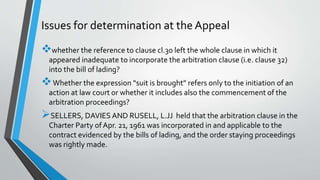
Issues for determination at the Appeal
whether the reference to clause cl.30 left the whole clause in which it
appeared inadequate to incorporate the arbitration clause (i.e. clause 32)
into the bill of lading?
Whether the expression “suit is brought” refers only to the initiation of an
action at law court or whether it includes also the commencement of the
arbitration proceedings?
SELLERS, DAVIES AND RUSELL, L.JJ held that the arbitration clause in the
Charter Party of Apr. 21, 1961 was incorporated in and applicable to the
contract evidenced by the bills of lading, and the order staying proceedings
was rightly made.
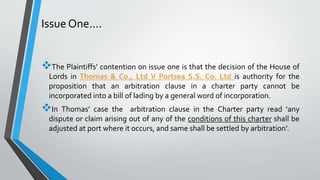
Issue One….
The Plaintiffs’ contention on issue one is that the decision of the House of
Lords in Thomas & Co., Ltd V Portsea S.S. Co. Ltd is authority for the
proposition that an arbitration clause in a charter party cannot be
incorporated into a bill of lading by a general word of incorporation.
In Thomas’ case the arbitration clause in the Charter party read ‘any
dispute or claim arising out of any of the conditions of this charter shall be
adjusted at port where it occurs, and same shall be settled by arbitration’.
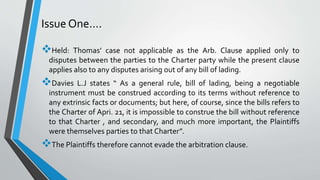
Issue One….
Held: Thomas’ case not applicable as the Arb. Clause applied only to
disputes between the parties to the Charter party while the present clause
applies also to any disputes arising out of any bill of lading.
Davies L.J states “ As a general rule, bill of lading, being a negotiable
instrument must be construed according to its terms without reference to
any extrinsic facts or documents; but here, of course, since the bills refers to
the Charter of Apri. 21, it is impossible to construe the bill without reference
to that Charter , and secondary, and much more important, the Plaintiffs
were themselves parties to that Charter”.
The Plaintiffs therefore cannot evade the arbitration clause.
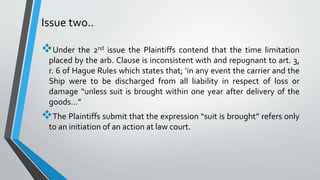
Issue two..
Under the 2nd issue the Plaintiffs contend that the time limitation
placed by the arb. Clause is inconsistent with and repugnant to art. 3,
r. 6 of Hague Rules which states that; ‘in any event the carrier and the
Ship were to be discharged from all liability in respect of loss or
damage “unless suit is brought within one year after delivery of the
goods…”
The Plaintiffs submit that the expression “suit is brought” refers only
to an initiation of an action at law court.
Issue two..
• Held: The object of art.3 r.6, of the Hague Rules would appear to be not to
specify any particular mode of procedure for the settlement of disputes but
rather to ensure that such disputes are speedily notified and speedily
settled. Since the parties have by their contract chosen to opt for arbitration
rather than litigation, by so doing they have merely prescribed the mode of
bringing the suit and the word ‘suit’ does not exclude arbitration.
• The L.JJ refused to follow the United States Federal Court of Appeal
decision in Sun Shipping Co., Inc. v De Fosse & Tanghe, Solel Bonel Ltd
which held otherwise.
Finally
• The Plaintiffs argued that cl. 32 relates only to disputes arising out of any bill
of lading ‘issued hereunder’ – that is, under the charter party of Apr. 21 1961;
whereas the Merak bill of lading was issued under the later charter of Sept.
1961, the owners of the Merak not being party to the Apr. Charter.
• Held: Plaintiffs’ contention wrong. The bill was issued under the second
charter: but it was also issued under the first charter, W. D. & Co having
procured it to be so in fulfilment of their obligations. To hold the contrary
would be to hold that no bill of lading was ever issued under the first charter.
• Appeal dismissed and Order for Stay of Proceeding pending Arbitration
upheld.
THE END
THANKYOU

The MERAK CASE

  • 1.
    THE MERAK. T. B.S. BATCHELOR & CO., LTD (OWNERS OF CARGO ON THE MERAK) V. OWNERS OF S.S. MERAK.(1965) 1 E.R 230 (CA) CASE PRESENTATION BY UBA HELEN DORATHY
  • 2.
    BRIEF FACTS OFTHECASE The Plaintiffs as Charterers, entered into a Charter Party dated Apr. 21 1961, with W. D. & Co. for the carriage of a cargo of timber. By a sub-charter party dated Sept. 15 1961,W. D. & Co. Chartered a Ship from the Defendants, under which bills of lading for the Cargo were to be signed with reference to the Charter Party of Apr. 21 1961, which was guaranteed to be the same as the sub-charter party except as regards rate of freight. The Plaintiffs indorsed thirteen bills of lading Oct. 24, 1961, each of which recited that the voyage was to be as per charter dated Apr.21 1961 and contained an incorporation clause providing that:
  • 3.
    Brief facts cont.. “Allthe terms, conditions, clauses and exceptions including cl. 30 contained in the said charter party apply to the bills of lading and are deemed to be incorporated herein”. Cl.30 of the Charter Party however, was not concerned with arbitration and had no relevance to the bills of lading contract. The arbitration clause was contained in cl.32 of the Charter Party and it provides that: “any dispute arising out of the charter or any bill of lading “issued hereunder” was to be referred to arbitration and the Claimants’ arbitrator had to be appointed within twelve months of the date of final discharge of cargo, otherwise the claim would be deemed to be waived and absolutely barred”.
  • 4.
    Brief facts cont.. Theincorporation clause was followed by a paramount clause incorporating the Hague Rules and making void any term of each bill of lading to the extent to which it should be repugnant to such provision. During the course of the voyage some of the cargo was damaged. Final discharge of the cargo took place on Nov. 21, 1961. The Plaintiffs did not appoint an arbitrator , but on Nov.15, 1962 (shortly before the expiration of the 12 months time limit allowed by art. 3 r 6 of Hague Rules) issued a writ claiming damages from the Defendants. Justice Scarman on July 28,1964 ordered a Stay of proceeding pursuant to s. 4(2) of the Arb. Act 1950. The Plaintiffs then filed this appeal against the order of stay.
  • 5.
    Issues for determinationat the Appeal whether the reference to clause cl.30 left the whole clause in which it appeared inadequate to incorporate the arbitration clause (i.e. clause 32) into the bill of lading? Whether the expression “suit is brought” refers only to the initiation of an action at law court or whether it includes also the commencement of the arbitration proceedings? SELLERS, DAVIES AND RUSELL, L.JJ held that the arbitration clause in the Charter Party of Apr. 21, 1961 was incorporated in and applicable to the contract evidenced by the bills of lading, and the order staying proceedings was rightly made.
  • 6.
    Issue One…. The Plaintiffs’contention on issue one is that the decision of the House of Lords in Thomas & Co., Ltd V Portsea S.S. Co. Ltd is authority for the proposition that an arbitration clause in a charter party cannot be incorporated into a bill of lading by a general word of incorporation. In Thomas’ case the arbitration clause in the Charter party read ‘any dispute or claim arising out of any of the conditions of this charter shall be adjusted at port where it occurs, and same shall be settled by arbitration’.
  • 7.
    Issue One…. Held: Thomas’case not applicable as the Arb. Clause applied only to disputes between the parties to the Charter party while the present clause applies also to any disputes arising out of any bill of lading. Davies L.J states “ As a general rule, bill of lading, being a negotiable instrument must be construed according to its terms without reference to any extrinsic facts or documents; but here, of course, since the bills refers to the Charter of Apri. 21, it is impossible to construe the bill without reference to that Charter , and secondary, and much more important, the Plaintiffs were themselves parties to that Charter”. The Plaintiffs therefore cannot evade the arbitration clause.
  • 8.
    Issue two.. Under the2nd issue the Plaintiffs contend that the time limitation placed by the arb. Clause is inconsistent with and repugnant to art. 3, r. 6 of Hague Rules which states that; ‘in any event the carrier and the Ship were to be discharged from all liability in respect of loss or damage “unless suit is brought within one year after delivery of the goods…” The Plaintiffs submit that the expression “suit is brought” refers only to an initiation of an action at law court.
  • 9.
    Issue two.. • Held:The object of art.3 r.6, of the Hague Rules would appear to be not to specify any particular mode of procedure for the settlement of disputes but rather to ensure that such disputes are speedily notified and speedily settled. Since the parties have by their contract chosen to opt for arbitration rather than litigation, by so doing they have merely prescribed the mode of bringing the suit and the word ‘suit’ does not exclude arbitration. • The L.JJ refused to follow the United States Federal Court of Appeal decision in Sun Shipping Co., Inc. v De Fosse & Tanghe, Solel Bonel Ltd which held otherwise.
  • 10.
    Finally • The Plaintiffsargued that cl. 32 relates only to disputes arising out of any bill of lading ‘issued hereunder’ – that is, under the charter party of Apr. 21 1961; whereas the Merak bill of lading was issued under the later charter of Sept. 1961, the owners of the Merak not being party to the Apr. Charter. • Held: Plaintiffs’ contention wrong. The bill was issued under the second charter: but it was also issued under the first charter, W. D. & Co having procured it to be so in fulfilment of their obligations. To hold the contrary would be to hold that no bill of lading was ever issued under the first charter. • Appeal dismissed and Order for Stay of Proceeding pending Arbitration upheld.
  • 11.