“We hold these truths to be self evident…”
Thomas Jefferson, great man, one of our
founding fathers‟, and played a prominent role in
shaping and writing the Declaration of
Independence.
This famous line in the United State‟s
Declaration of Independence kept resonating with
the author throughout his research for this
document. The research uncovers unsettling,
historical injustices directed at the Native American
Indians.

Thomas Jefferson

From the earliest formation of our great
country, men of all standing, even one of our
founding fathers, Thomas Jefferson, contrived to
deprive Native American Indians of their lives,
land, liberty, religion, and culture through
coercion, murder, deceitfulness and forced
relocation (Miller,2006).
The research into Lipan Apache history and particularly
the Native American Indians led to unexpected revelations,
and when not documented, would be labeled to one as
unbelievable.
The case may be made that the forced removal of Native
Indians from their historic lands may have been formulated
and implemented with much forethought, beginning with
Jefferson. “Jefferson's first promotions of Indian Removal
were between 1776 and 1779, when he recommended forcing
the Cherokee and Shawnee tribes to be driven out of their
ancestral homelands to lands west of the Mississippi River “
(Miller, 2006).
One Indian removal from Georgia to Oklahoma resulted in
8,000deaths. It became known as “The Trail of Tears”
( Stannard, 1993, p. 151).
Blackfoot warrior. Image chosen for
prideful profile.
The saying, „We hold these truths to be self evident that all
men are created equal‟ was separate and foreign from
Jefferson‟s true vision of Native Americans was the most
saddening revelation.

“In the image the United States of America portrays itself to
the world, as a source and reference point for true democracy,
fairness in trade and benefactor to the needy, and victims of
atrocities or genocide, let history reveal, that the U.S. acquired
the collective conscience and courage, to find an honorable
remedy to this darkened corner of U. S. history” (Lopez,2013).

Apache Bride
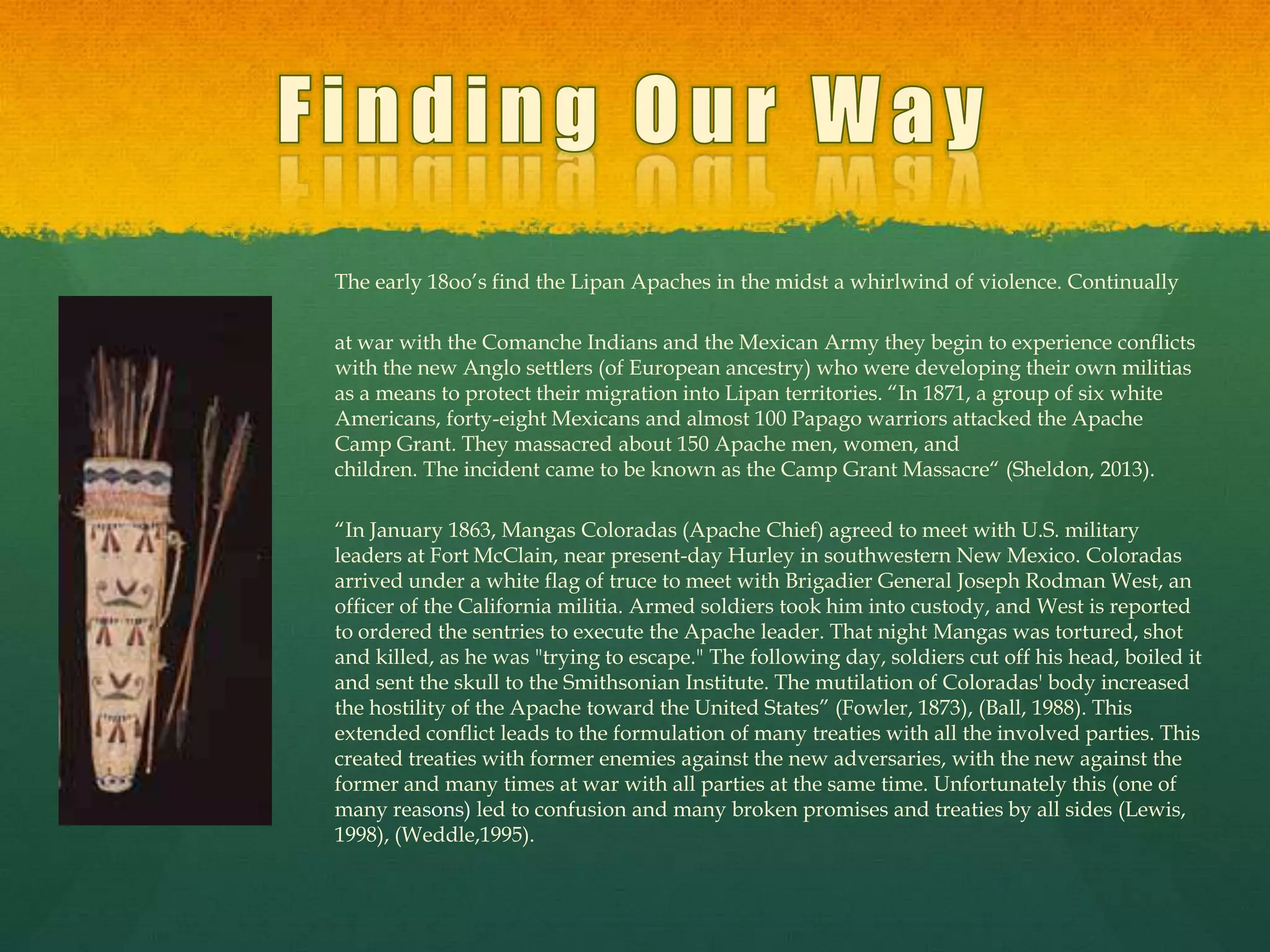
The early 18oo‟s find the Lipan Apaches in the midst a whirlwind of violence. Continually
at war with the Comanche Indians and the Mexican Army they begin to experience conflicts
with the new Anglo settlers (of European ancestry) who were developing their own militias
as a means to protect their migration into Lipan territories. “In 1871, a group of six white
Americans, forty-eight Mexicans and almost 100 Papago warriors attacked the Apache
Camp Grant. They massacred about 150 Apache men, women, and
children. The incident came to be known as the Camp Grant Massacre“ (Sheldon, 2013).
“In January 1863, Mangas Coloradas (Apache Chief) agreed to meet with U.S. military
leaders at Fort McClain, near present-day Hurley in southwestern New Mexico. Coloradas
arrived under a white flag of truce to meet with Brigadier General Joseph Rodman West, an
officer of the California militia. Armed soldiers took him into custody, and West is reported
to ordered the sentries to execute the Apache leader. That night Mangas was tortured, shot
and killed, as he was "trying to escape." The following day, soldiers cut off his head, boiled it
and sent the skull to the Smithsonian Institute. The mutilation of Coloradas' body increased
the hostility of the Apache toward the United States” (Fowler, 1873), (Ball, 1988). This
extended conflict leads to the formulation of many treaties with all the involved parties. This
created treaties with former enemies against the new adversaries, with the new against the
former and many times at war with all parties at the same time. Unfortunately this (one of
many reasons) led to confusion and many broken promises and treaties by all sides (Lewis,
1998), (Weddle,1995).
Should any tribe be foolhardy enough to take up the
hatchet at any time, the seizing the whole country of
that tribe, and driving them across the Mississippi, as
the only condition of peace, would be an example to
others, and a furtherance of our final consolidation.”
(Rockwell, 2010), (p.88), (Jefferson, 1803) Jefferson
believed that this strategy would "get rid of this pest,
without giving offence or umbrage to the Indians"
(Jefferson,1803)

Rockwell also added … , “ that Harrison was to keep
the contents of the letter "sacred" and "kept within
[Harrison's] own breast, and especially how improper
for the Indians to understand.” “ Richard Drinnon
went on to say, “For their interests and their tranquility,
it is best they should see only the present age of their
history." (Drinnon, 1997). A case can be made that
Jefferson perceived human nature more malleable if it
resides in a tranquil state. Writers Miller, Owens, and
Sheenan in the following excerpt provide an example of
this…
The violence of these times, in the form of oral history, as passed down to
the author, Bernardo Lopez from his grandparents, reveals the Lipans, that while
they did scatter as a result of actions by Mexican and American armies, many
filtered back by wearing Mexican style clothing and living in the general
population (Castoreno, 1958). The violence that engulfed the Lipan led them to be
categorized almost extinct by some historical writers.
The author‟s grandfather, Lipan Apache Margarito Costoreno and his wife
Refugia Castillo Castoreno and their first five children, according to the 1910 census
and border crossing records, were back living in the Medina, Texas Hill Country. In
a single generation Refugia would bear nineteen children and adopt five. One of her
children would have sixteen children. Refugia would finish the raising of her brood
in San Antonio, Texas where she was a practicing Herbalist and Mid-Wife to the
Indigenous and poor and eventually would deliver more than 100 babies. Local
physicians referred many of their poor patients to her. She would never set a fee,
rather accept whatever the patient could afford (Castoreno, 1958). Her unselfishness
to those in need might shed light on how the Lipan survived in spite of the many
centuries of warfare.

Refugia castoreno

Margarito Castoreno
Many nations have constructed mythical naratives of freedom, while
continuing policies of oppression. For a government to continue this oppression
via laws, treaties, edits, and enforcement of unfair and outdated policies in
today‟s enlightened world should be foreign to the image, our country, the
United States of America tries to project and uphold throughout the world. The
United States (U.S.) has channeled untold amounts of capital to champion
human rights and in the case of the Palestinians, the right of return to their
ancestral lands. Indeed it encourages and participates in a United Nations (U.N.)
effort to finance the Palestinians and coerce a “solution” between the parties
involved. America did likewise in South Africa to remedy the oppression of
blacks. Indeed, when those efforts are championed in the media, America basks
in the glow of self-righteousness. A person could ask these questions:

Apache girl

1. How can it be the U.S. does not welcome those same efforts by the U.N. to
remedy the centuries old oppression of Native Americans, here, in it‟s
own
backyard?
2. How is it our government is continually permeated generation after
generation with individuals that not only condone oppressive policies but
also enforce them with zeal?
The overreach of government is still evident today as government still
encroaches on land owned by Native Americans resulting in a familiar,
continuing struggle.
A struggle is being waged in South Texas as documented by writer
Margo Tamez in her “Open Letter to Cameron County Commission,” on
behalf of her mother, Eloisa Garcia Tamez. It begins:
“In late July 2007, Eloisa Garcia Tamez began receiving telephone
calls from U.S. Department of Homeland Security (DHS) agents
informing her of the government's plans to construct a wall across her
lands. Their insistent pursuit of a signed waiver allowing the
government access and title led to a series of controversial invasions of
Tamez' privacy-at her place of work, at home in the evenings, on
weekends, and in public spaces. DHS' demands that she sign a waiver
granting the government title to her lands turned into volatile verbal
confrontations and threats. Tamez is a Lipan Apache and land grant title
heir to lands originally held collectively by her ancestors in the Rancheria
of El Calaboz, Cameron County, South Texas. By August of 2007, DHS,

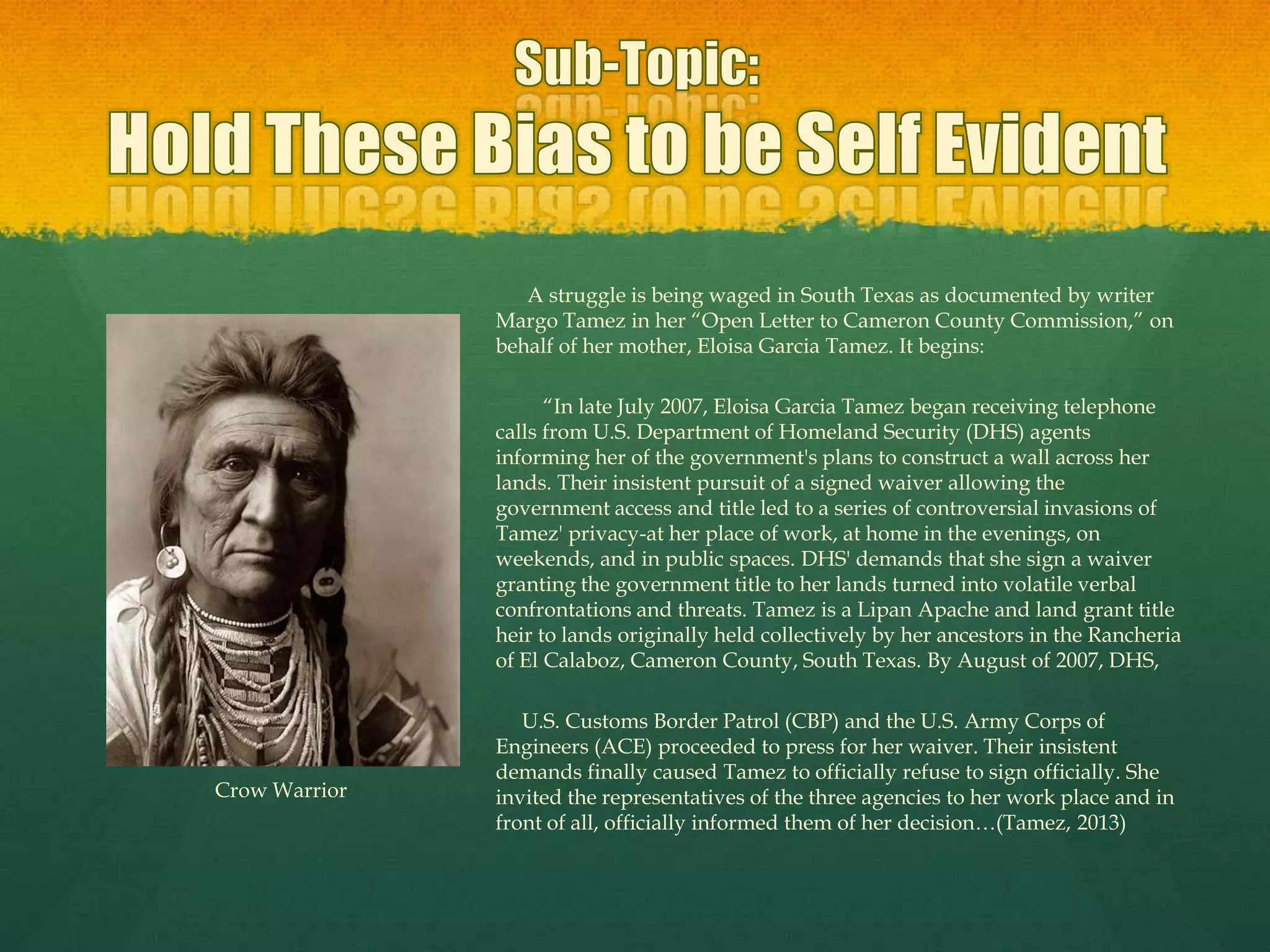
Crow Warrior

U.S. Customs Border Patrol (CBP) and the U.S. Army Corps of
Engineers (ACE) proceeded to press for her waiver. Their insistent
demands finally caused Tamez to officially refuse to sign officially. She
invited the representatives of the three agencies to her work place and in
front of all, officially informed them of her decision…(Tamez, 2013)
One might ask, how can someone remain optimistic in the face of oppression
and maltreatment? Today, in the United States, the disenfranchised are not
being allowed to suffer, at least in regards to healthcare. For example,
Secretary Kathleen Sebelius of Health and Human Services answered
questions on, Oct 30, 2013, about Obama care. The championing of the basic
right for affordable healthcare is front and center and made possible by
coercing all Americans to participate in one form or another. Again,
someone could ask these questions:
1. Why can‟t the same effort be made to resolve the historical, cultural
disenfranchisement of the Native American?

2. Can the reason be, that to help the Indian, who has to be legitimized,
he would have to be allowed to live his culture and practice his
religion?
3. Is everyone aware that an American with Indian ancestry cannot call
himself/herself Native American, that the Government holds the
final word on whether a person may claim Native ethnicity
regardless of documentation?
The United States (U.S.) today has their 1st African
American President, President Barack Obama. President
Obama can champion his heritage or culture as he
chooses. An American with Indian heritage, in some
cases, can be arrested, for claiming to be Native
American without the appropriate Government issued
documentation on his person. At their best, the
Government‟s Policies have been Orwellian in nature
towards the Native American.
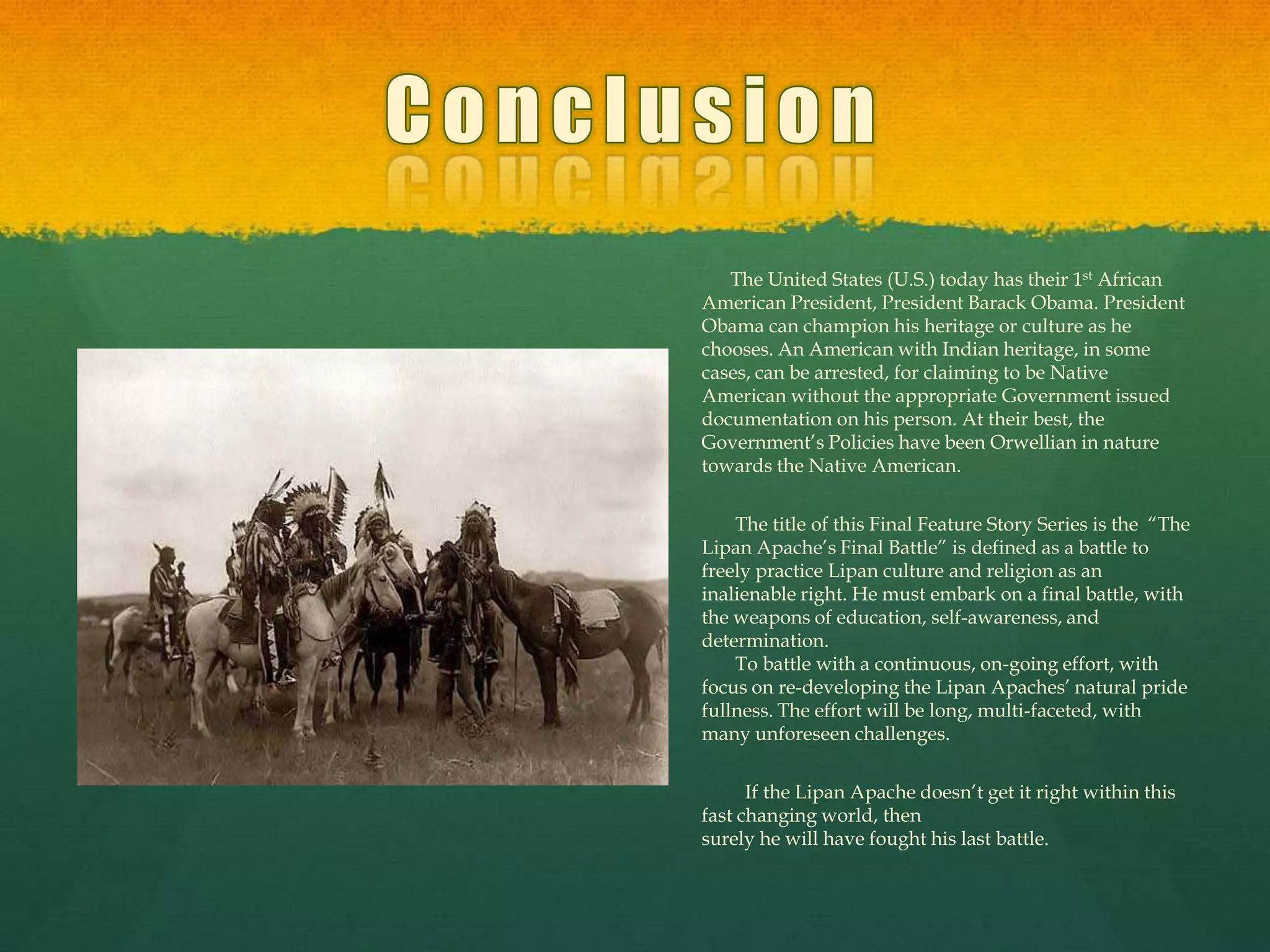
The title of this Final Feature Story Series is the “The
Lipan Apache‟s Final Battle” is defined as a battle to
freely practice Lipan culture and religion as an
inalienable right. He must embark on a final battle, with
the weapons of education, self-awareness, and
determination.
To battle with a continuous, on-going effort, with
focus on re-developing the Lipan Apaches‟ natural pride
fullness. The effort will be long, multi-faceted, with
many unforeseen challenges.
If the Lipan Apache doesn‟t get it right within this
fast changing world, then
surely he will have fought his last battle.
Drinnon, Richard (1997). Facing West: The Metaphysics of Indian-Hating and

Lopez, Bernardo, (2013) Student: Houston Community College Course,
IMED 1359, Writing for Digital Media

Jefferson, Thomas (1803)
President Jefferson to William Henry Harrison: February
27,1803". In Prucha, Francis Paul. (2000), (p.22).Documents of
United States Indian policy. University of Nebraska Press. p. 22.

Miller, Robert (2006). Native America, Discovered and Conquered: Thomas

Empire-Building. University of Oklahoma Press (pp. 87. 88).

Kierman, Ben (2007). Blood and Soil: A World History of Genocide and
Extermination from Sparta to Darfur. Yale University Press,
(pp. 328,330).
Castoreno, Refugia (1958) Refugia Castoreno, oral history interview by
Bernardo Lopez in a migrant workers camp in Traverse City,
Michigan http://www.folklife.si.edu/resources/pdf/
interviewingguide.pdf Oral History — a process of collecting,
usually by means of a tape-recorded interview, recollections,
accounts, a personal experience narratives of individuals for the
purpose of expanding the historical record of a place, event,
person, or cultural group

Jefferson,
Lewis & Clark, and Manifest Destiny. Greenwood Publishing Group. (p. 161)
Rockwell, Stephen J. (2010). Indian Affairs and the Administrative State in the
Nineteenth Century. Cambridge University Press. p. 88
Sheldon, Howard (2013). Arizona‟s Camp Grant Massacre, DesertUSA.com and
Digital West Media, Inc.
Stannard, David E. (1993). American Holocaust: The Conquest of the New World: The
Conquest of the New World, Oxford University Press, USA (p. 151).
Tamez, Margo,(2013) Cameron County Commission:
http://heinonline.org/HOL/LandingPage?handle=hein.journals/t
crit2&div=6&id=&page
Weddle, Robert S. (1995). Changing Tides; Twilight and Dawn in the Spanish Sea,
1763-1803, Centennial Series of Former Students Number 58, College
Station,TX; Texas A&M University Press

Indians in a reservation waiting in line for their
government rations . The ACA had not been
formed at this time.

The Lipan Apache's Final Battle

  • 2.
    “We hold thesetruths to be self evident…” Thomas Jefferson, great man, one of our founding fathers‟, and played a prominent role in shaping and writing the Declaration of Independence. This famous line in the United State‟s Declaration of Independence kept resonating with the author throughout his research for this document. The research uncovers unsettling, historical injustices directed at the Native American Indians. Thomas Jefferson From the earliest formation of our great country, men of all standing, even one of our founding fathers, Thomas Jefferson, contrived to deprive Native American Indians of their lives, land, liberty, religion, and culture through coercion, murder, deceitfulness and forced relocation (Miller,2006).
  • 3.
    The research intoLipan Apache history and particularly the Native American Indians led to unexpected revelations, and when not documented, would be labeled to one as unbelievable. The case may be made that the forced removal of Native Indians from their historic lands may have been formulated and implemented with much forethought, beginning with Jefferson. “Jefferson's first promotions of Indian Removal were between 1776 and 1779, when he recommended forcing the Cherokee and Shawnee tribes to be driven out of their ancestral homelands to lands west of the Mississippi River “ (Miller, 2006). One Indian removal from Georgia to Oklahoma resulted in 8,000deaths. It became known as “The Trail of Tears” ( Stannard, 1993, p. 151). Blackfoot warrior. Image chosen for prideful profile.
  • 4.
    The saying, „Wehold these truths to be self evident that all men are created equal‟ was separate and foreign from Jefferson‟s true vision of Native Americans was the most saddening revelation. “In the image the United States of America portrays itself to the world, as a source and reference point for true democracy, fairness in trade and benefactor to the needy, and victims of atrocities or genocide, let history reveal, that the U.S. acquired the collective conscience and courage, to find an honorable remedy to this darkened corner of U. S. history” (Lopez,2013). Apache Bride
  • 6.
    The early 18oo‟sfind the Lipan Apaches in the midst a whirlwind of violence. Continually at war with the Comanche Indians and the Mexican Army they begin to experience conflicts with the new Anglo settlers (of European ancestry) who were developing their own militias as a means to protect their migration into Lipan territories. “In 1871, a group of six white Americans, forty-eight Mexicans and almost 100 Papago warriors attacked the Apache Camp Grant. They massacred about 150 Apache men, women, and children. The incident came to be known as the Camp Grant Massacre“ (Sheldon, 2013). “In January 1863, Mangas Coloradas (Apache Chief) agreed to meet with U.S. military leaders at Fort McClain, near present-day Hurley in southwestern New Mexico. Coloradas arrived under a white flag of truce to meet with Brigadier General Joseph Rodman West, an officer of the California militia. Armed soldiers took him into custody, and West is reported to ordered the sentries to execute the Apache leader. That night Mangas was tortured, shot and killed, as he was "trying to escape." The following day, soldiers cut off his head, boiled it and sent the skull to the Smithsonian Institute. The mutilation of Coloradas' body increased the hostility of the Apache toward the United States” (Fowler, 1873), (Ball, 1988). This extended conflict leads to the formulation of many treaties with all the involved parties. This created treaties with former enemies against the new adversaries, with the new against the former and many times at war with all parties at the same time. Unfortunately this (one of many reasons) led to confusion and many broken promises and treaties by all sides (Lewis, 1998), (Weddle,1995).
  • 7.
    Should any tribebe foolhardy enough to take up the hatchet at any time, the seizing the whole country of that tribe, and driving them across the Mississippi, as the only condition of peace, would be an example to others, and a furtherance of our final consolidation.” (Rockwell, 2010), (p.88), (Jefferson, 1803) Jefferson believed that this strategy would "get rid of this pest, without giving offence or umbrage to the Indians" (Jefferson,1803) Rockwell also added … , “ that Harrison was to keep the contents of the letter "sacred" and "kept within [Harrison's] own breast, and especially how improper for the Indians to understand.” “ Richard Drinnon went on to say, “For their interests and their tranquility, it is best they should see only the present age of their history." (Drinnon, 1997). A case can be made that Jefferson perceived human nature more malleable if it resides in a tranquil state. Writers Miller, Owens, and Sheenan in the following excerpt provide an example of this…
  • 8.
    The violence ofthese times, in the form of oral history, as passed down to the author, Bernardo Lopez from his grandparents, reveals the Lipans, that while they did scatter as a result of actions by Mexican and American armies, many filtered back by wearing Mexican style clothing and living in the general population (Castoreno, 1958). The violence that engulfed the Lipan led them to be categorized almost extinct by some historical writers. The author‟s grandfather, Lipan Apache Margarito Costoreno and his wife Refugia Castillo Castoreno and their first five children, according to the 1910 census and border crossing records, were back living in the Medina, Texas Hill Country. In a single generation Refugia would bear nineteen children and adopt five. One of her children would have sixteen children. Refugia would finish the raising of her brood in San Antonio, Texas where she was a practicing Herbalist and Mid-Wife to the Indigenous and poor and eventually would deliver more than 100 babies. Local physicians referred many of their poor patients to her. She would never set a fee, rather accept whatever the patient could afford (Castoreno, 1958). Her unselfishness to those in need might shed light on how the Lipan survived in spite of the many centuries of warfare. Refugia castoreno Margarito Castoreno
  • 9.
    Many nations haveconstructed mythical naratives of freedom, while continuing policies of oppression. For a government to continue this oppression via laws, treaties, edits, and enforcement of unfair and outdated policies in today‟s enlightened world should be foreign to the image, our country, the United States of America tries to project and uphold throughout the world. The United States (U.S.) has channeled untold amounts of capital to champion human rights and in the case of the Palestinians, the right of return to their ancestral lands. Indeed it encourages and participates in a United Nations (U.N.) effort to finance the Palestinians and coerce a “solution” between the parties involved. America did likewise in South Africa to remedy the oppression of blacks. Indeed, when those efforts are championed in the media, America basks in the glow of self-righteousness. A person could ask these questions: Apache girl 1. How can it be the U.S. does not welcome those same efforts by the U.N. to remedy the centuries old oppression of Native Americans, here, in it‟s own backyard? 2. How is it our government is continually permeated generation after generation with individuals that not only condone oppressive policies but also enforce them with zeal? The overreach of government is still evident today as government still encroaches on land owned by Native Americans resulting in a familiar, continuing struggle.
  • 10.
    A struggle isbeing waged in South Texas as documented by writer Margo Tamez in her “Open Letter to Cameron County Commission,” on behalf of her mother, Eloisa Garcia Tamez. It begins: “In late July 2007, Eloisa Garcia Tamez began receiving telephone calls from U.S. Department of Homeland Security (DHS) agents informing her of the government's plans to construct a wall across her lands. Their insistent pursuit of a signed waiver allowing the government access and title led to a series of controversial invasions of Tamez' privacy-at her place of work, at home in the evenings, on weekends, and in public spaces. DHS' demands that she sign a waiver granting the government title to her lands turned into volatile verbal confrontations and threats. Tamez is a Lipan Apache and land grant title heir to lands originally held collectively by her ancestors in the Rancheria of El Calaboz, Cameron County, South Texas. By August of 2007, DHS, Crow Warrior U.S. Customs Border Patrol (CBP) and the U.S. Army Corps of Engineers (ACE) proceeded to press for her waiver. Their insistent demands finally caused Tamez to officially refuse to sign officially. She invited the representatives of the three agencies to her work place and in front of all, officially informed them of her decision…(Tamez, 2013)
  • 11.
    One might ask,how can someone remain optimistic in the face of oppression and maltreatment? Today, in the United States, the disenfranchised are not being allowed to suffer, at least in regards to healthcare. For example, Secretary Kathleen Sebelius of Health and Human Services answered questions on, Oct 30, 2013, about Obama care. The championing of the basic right for affordable healthcare is front and center and made possible by coercing all Americans to participate in one form or another. Again, someone could ask these questions: 1. Why can‟t the same effort be made to resolve the historical, cultural disenfranchisement of the Native American? 2. Can the reason be, that to help the Indian, who has to be legitimized, he would have to be allowed to live his culture and practice his religion? 3. Is everyone aware that an American with Indian ancestry cannot call himself/herself Native American, that the Government holds the final word on whether a person may claim Native ethnicity regardless of documentation?
  • 12.
    The United States(U.S.) today has their 1st African American President, President Barack Obama. President Obama can champion his heritage or culture as he chooses. An American with Indian heritage, in some cases, can be arrested, for claiming to be Native American without the appropriate Government issued documentation on his person. At their best, the Government‟s Policies have been Orwellian in nature towards the Native American. The title of this Final Feature Story Series is the “The Lipan Apache‟s Final Battle” is defined as a battle to freely practice Lipan culture and religion as an inalienable right. He must embark on a final battle, with the weapons of education, self-awareness, and determination. To battle with a continuous, on-going effort, with focus on re-developing the Lipan Apaches‟ natural pride fullness. The effort will be long, multi-faceted, with many unforeseen challenges. If the Lipan Apache doesn‟t get it right within this fast changing world, then surely he will have fought his last battle.
  • 13.
    Drinnon, Richard (1997).Facing West: The Metaphysics of Indian-Hating and Lopez, Bernardo, (2013) Student: Houston Community College Course, IMED 1359, Writing for Digital Media Jefferson, Thomas (1803) President Jefferson to William Henry Harrison: February 27,1803". In Prucha, Francis Paul. (2000), (p.22).Documents of United States Indian policy. University of Nebraska Press. p. 22. Miller, Robert (2006). Native America, Discovered and Conquered: Thomas Empire-Building. University of Oklahoma Press (pp. 87. 88). Kierman, Ben (2007). Blood and Soil: A World History of Genocide and Extermination from Sparta to Darfur. Yale University Press, (pp. 328,330). Castoreno, Refugia (1958) Refugia Castoreno, oral history interview by Bernardo Lopez in a migrant workers camp in Traverse City, Michigan http://www.folklife.si.edu/resources/pdf/ interviewingguide.pdf Oral History — a process of collecting, usually by means of a tape-recorded interview, recollections, accounts, a personal experience narratives of individuals for the purpose of expanding the historical record of a place, event, person, or cultural group Jefferson, Lewis & Clark, and Manifest Destiny. Greenwood Publishing Group. (p. 161) Rockwell, Stephen J. (2010). Indian Affairs and the Administrative State in the Nineteenth Century. Cambridge University Press. p. 88 Sheldon, Howard (2013). Arizona‟s Camp Grant Massacre, DesertUSA.com and Digital West Media, Inc. Stannard, David E. (1993). American Holocaust: The Conquest of the New World: The Conquest of the New World, Oxford University Press, USA (p. 151). Tamez, Margo,(2013) Cameron County Commission: http://heinonline.org/HOL/LandingPage?handle=hein.journals/t crit2&div=6&id=&page Weddle, Robert S. (1995). Changing Tides; Twilight and Dawn in the Spanish Sea, 1763-1803, Centennial Series of Former Students Number 58, College Station,TX; Texas A&M University Press Indians in a reservation waiting in line for their government rations . The ACA had not been formed at this time.