APPLICATION OF AI IN SPORTS
Dr. S. Devi Narayani
Assistant Professor
SRM Institute of Science and Technology
Ramapuram, Chennai
Introduction:
The integration of artificial intelligence (AI) in sports training has emerged as a
transformative approach to enhancing individual performance, optimising training
strategies, and providing personalised insights for athletes and coaches.
This article presents a comprehensive review of the applications, algorithms,
challenges, and future directions of AI in individual sport training. We explore the
utilization of AI algorithms and techniques, including machine learning, deep learning,
and computer vision, in sports apps to personalize training programs, analyze
performance, provide feedback, assess injury risks, and optimize training
methodologies.
Application of AI in Sports
1. AI Referee
2. Training and diet plans
3. Player performance
4. Match predictions
5. Ticketing
6. Automated sports journalism
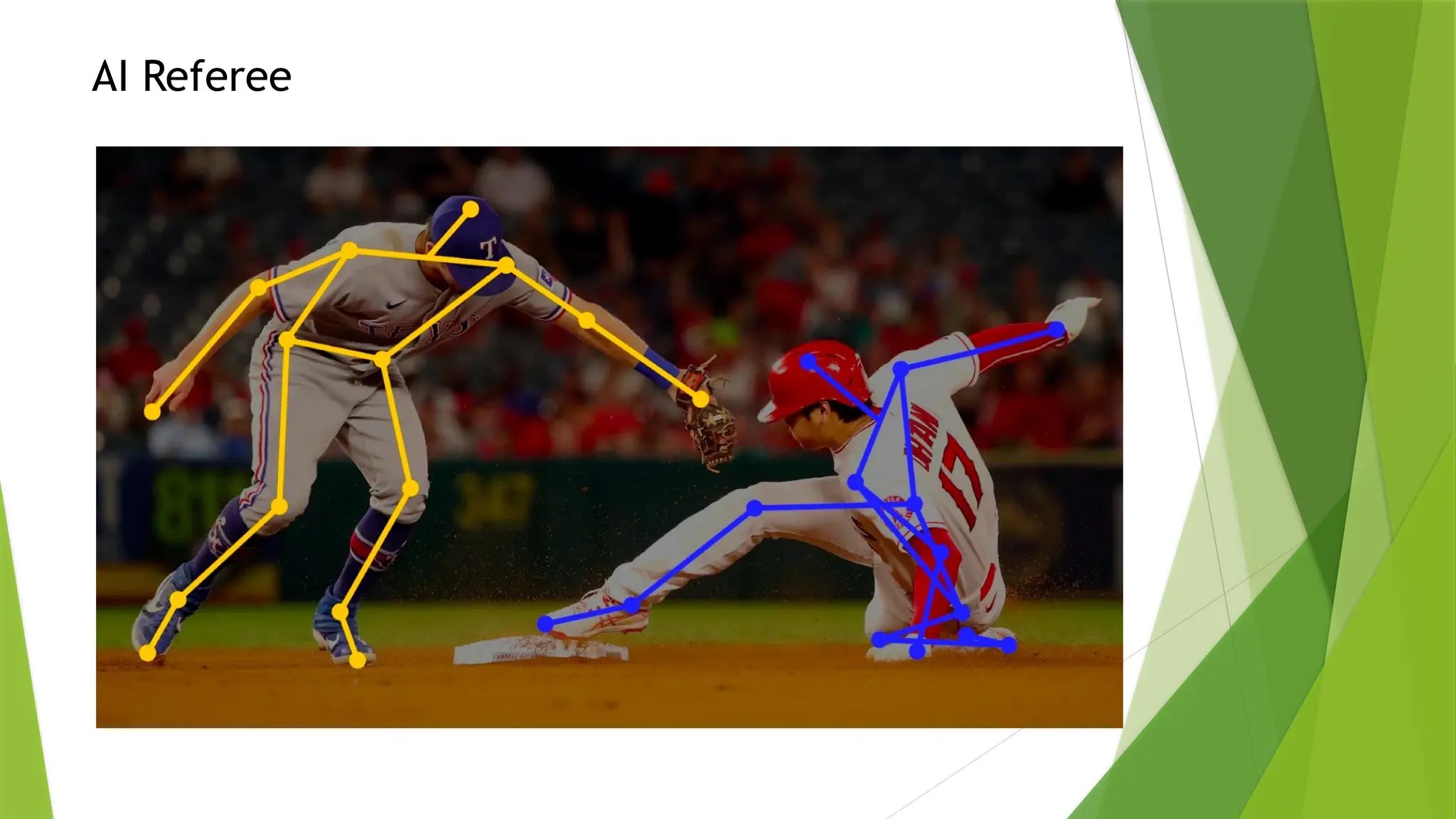
AI Referee
Sports Training and Diet Plan
While the integration of AI in sports training holds immense
potential, it also presents several challenges that need to be
addressed. This section explores the scientific challenges and
highlights future directions in AI-enhanced sports training,
identifying key areas of focus for researchers, practitioners, and
stakeholders in the field.
Monitoring Player performance:
Player performance Enhancement
1. Structured Training Program
2. Individual Training
3. Proper nutrition
4. Sports-specific skill development
5. Strength and Conditioning
Match predictions
 Machine Learning is used to predict matches.
 Sports like cricket and football’ have a large amount of
data and outcomes can be created using these
technologies. It enables model-building based on
copious amounts of data without explicit commands.
Ticketing
 Perhaps the most popular AI-use case, but also the most controversial, is
artificial intelligence used in the Dynamic Pricing Model. Artificial intelligence
is helping ticketing services find the right pricing strategy for the right situation.
 While airlines have used dynamic pricing for more than a decade, the
entertainment and events industry has been a bit later to the game. Dynamic
pricing allows venues and ticket sellers to match their prices to demand and
other factors, such as presale, ongoing sales results, news about the artist, and
search request trends. An artificial intelligence system synthesizes data to
supply recommendations on best pricing.
Automated sports journalism
 Automated sports journalism refers to the use of artificial
intelligence (AI) and machine learning algorithms to
generate sports news articles, match reports, and other
content.
 This technology has been increasingly adopted by news
organizations to cover a wide range of sports, providing
faster and more comprehensive coverage while freeing up
human journalists to focus on in-depth analysis and
storytelling.
Conclusion
The application of AI in sports training has shown promising results in
improving performance outcomes, enhancing training efficiency, and
aiding in injury prevention and rehabilitation. AI algorithms, such as
machine learning and computer vision, have been utilized to analyze data,
generate personalized training programs, provide real-time feedback, and
assist in decision-making processes. Case studies and empirical evidence
have showcased the positive impact of AI on individual performance,
training effectiveness, and long-term monitoring. However, several
challenges, including data quality, interpretability, ethical considerations,
collaboration, and generalization, need to be addressed to fully leverage
the potential of AI in sports training
The Integration of AI in sports training

  • 1.
    APPLICATION OF AIIN SPORTS Dr. S. Devi Narayani Assistant Professor SRM Institute of Science and Technology Ramapuram, Chennai
  • 2.
    Introduction: The integration ofartificial intelligence (AI) in sports training has emerged as a transformative approach to enhancing individual performance, optimising training strategies, and providing personalised insights for athletes and coaches. This article presents a comprehensive review of the applications, algorithms, challenges, and future directions of AI in individual sport training. We explore the utilization of AI algorithms and techniques, including machine learning, deep learning, and computer vision, in sports apps to personalize training programs, analyze performance, provide feedback, assess injury risks, and optimize training methodologies.
  • 3.
    Application of AIin Sports 1. AI Referee 2. Training and diet plans 3. Player performance 4. Match predictions 5. Ticketing 6. Automated sports journalism
  • 4.
  • 5.
    Sports Training andDiet Plan While the integration of AI in sports training holds immense potential, it also presents several challenges that need to be addressed. This section explores the scientific challenges and highlights future directions in AI-enhanced sports training, identifying key areas of focus for researchers, practitioners, and stakeholders in the field.
  • 6.
  • 7.
    Player performance Enhancement 1.Structured Training Program 2. Individual Training 3. Proper nutrition 4. Sports-specific skill development 5. Strength and Conditioning
  • 8.
    Match predictions  MachineLearning is used to predict matches.  Sports like cricket and football’ have a large amount of data and outcomes can be created using these technologies. It enables model-building based on copious amounts of data without explicit commands.
  • 9.
    Ticketing  Perhaps themost popular AI-use case, but also the most controversial, is artificial intelligence used in the Dynamic Pricing Model. Artificial intelligence is helping ticketing services find the right pricing strategy for the right situation.  While airlines have used dynamic pricing for more than a decade, the entertainment and events industry has been a bit later to the game. Dynamic pricing allows venues and ticket sellers to match their prices to demand and other factors, such as presale, ongoing sales results, news about the artist, and search request trends. An artificial intelligence system synthesizes data to supply recommendations on best pricing.
  • 10.
    Automated sports journalism Automated sports journalism refers to the use of artificial intelligence (AI) and machine learning algorithms to generate sports news articles, match reports, and other content.  This technology has been increasingly adopted by news organizations to cover a wide range of sports, providing faster and more comprehensive coverage while freeing up human journalists to focus on in-depth analysis and storytelling.
  • 11.
    Conclusion The application ofAI in sports training has shown promising results in improving performance outcomes, enhancing training efficiency, and aiding in injury prevention and rehabilitation. AI algorithms, such as machine learning and computer vision, have been utilized to analyze data, generate personalized training programs, provide real-time feedback, and assist in decision-making processes. Case studies and empirical evidence have showcased the positive impact of AI on individual performance, training effectiveness, and long-term monitoring. However, several challenges, including data quality, interpretability, ethical considerations, collaboration, and generalization, need to be addressed to fully leverage the potential of AI in sports training