1
The importance of
normalizing your security
data
Jamie Hynds - Product Manager - Security Integrations
Mat Martin - Tech Lead - Elastic Common Schema
2
This presentation and the accompanying oral presentation contain forward-looking statements, including statements
concerning plans for future offerings; the expected strength, performance or benefits of our offerings; and our future
operations and expected performance. These forward-looking statements are subject to the safe harbor provisions
under the Private Securities Litigation Reform Act of 1995. Our expectations and beliefs in light of currently
available information regarding these matters may not materialize. Actual outcomes and results may differ materially
from those contemplated by these forward-looking statements due to uncertainties, risks, and changes in
circumstances, including, but not limited to those related to: the impact of the COVID-19 pandemic on our business
and our customers and partners; our ability to continue to deliver and improve our offerings and successfully
develop new offerings, including security-related product offerings and SaaS offerings; customer acceptance and
purchase of our existing offerings and new offerings, including the expansion and adoption of our SaaS offerings;
our ability to realize value from investments in the business, including R&D investments; our ability to maintain and
expand our user and customer base; our international expansion strategy; our ability to successfully execute our
go-to-market strategy and expand in our existing markets and into new markets, and our ability to forecast customer
retention and expansion; and general market, political, economic and business conditions.
Additional risks and uncertainties that could cause actual outcomes and results to differ materially are included in
our filings with the Securities and Exchange Commission (the “SEC”), including our Annual Report on Form 10-K for
the most recent fiscal year, our quarterly report on Form 10-Q for the most recent fiscal quarter, and any
subsequent reports filed with the SEC. SEC filings are available on the Investor Relations section of Elastic’s
website at ir.elastic.co and the SEC’s website at www.sec.gov.
Any features or functions of services or products referenced in this presentation, or in any presentations, press
releases or public statements, which are not currently available or not currently available as a general availability
release, may not be delivered on time or at all. The development, release, and timing of any features or functionality
described for our products remains at our sole discretion. Customers who purchase our products and services
should make the purchase decisions based upon services and product features and functions that are currently
available.
All statements are made only as of the date of the presentation, and Elastic assumes no obligation to, and does not
currently intend to, update any forward-looking statements or statements relating to features or functions of services
or products, except as required by law.
Forward-Looking Statements
3
Agenda
• Security Data Challenges
• What is ECS?
• Elastic Security Integrations
• Mapping data to ECS
• Demo
• Get started with ECS
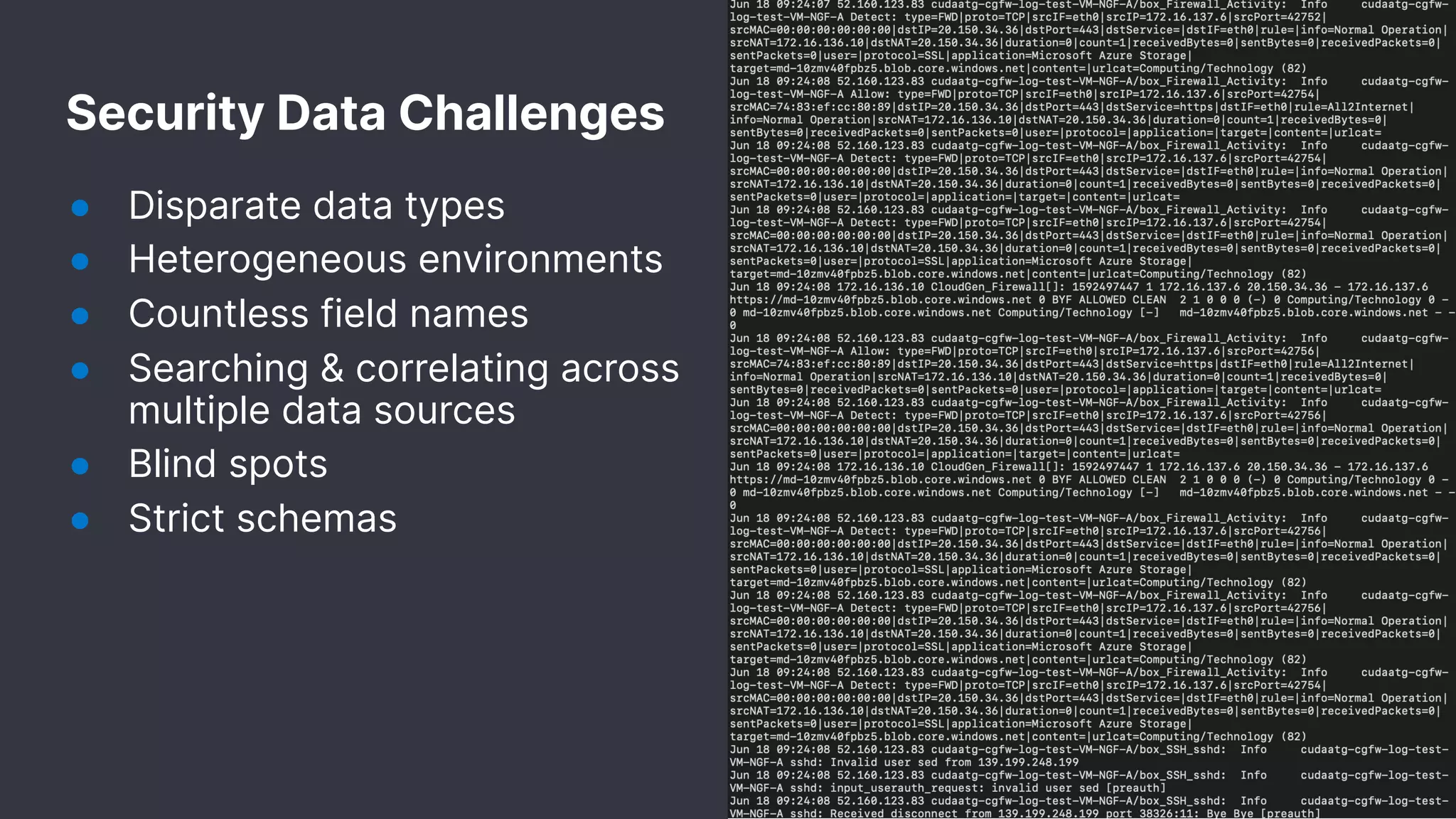
Security Data Challenges
● Disparate data types
● Heterogeneous environments
● Countless field names
● Searching & correlating across
multiple data sources
● Blind spots
● Strict schemas
5
ECS - Elastic Common Schema
• Defines a common set of fields
• Works across multiple data sources
• Remember common field names
• Reduces blind spots
• Integrate custom sources to Elastic Security
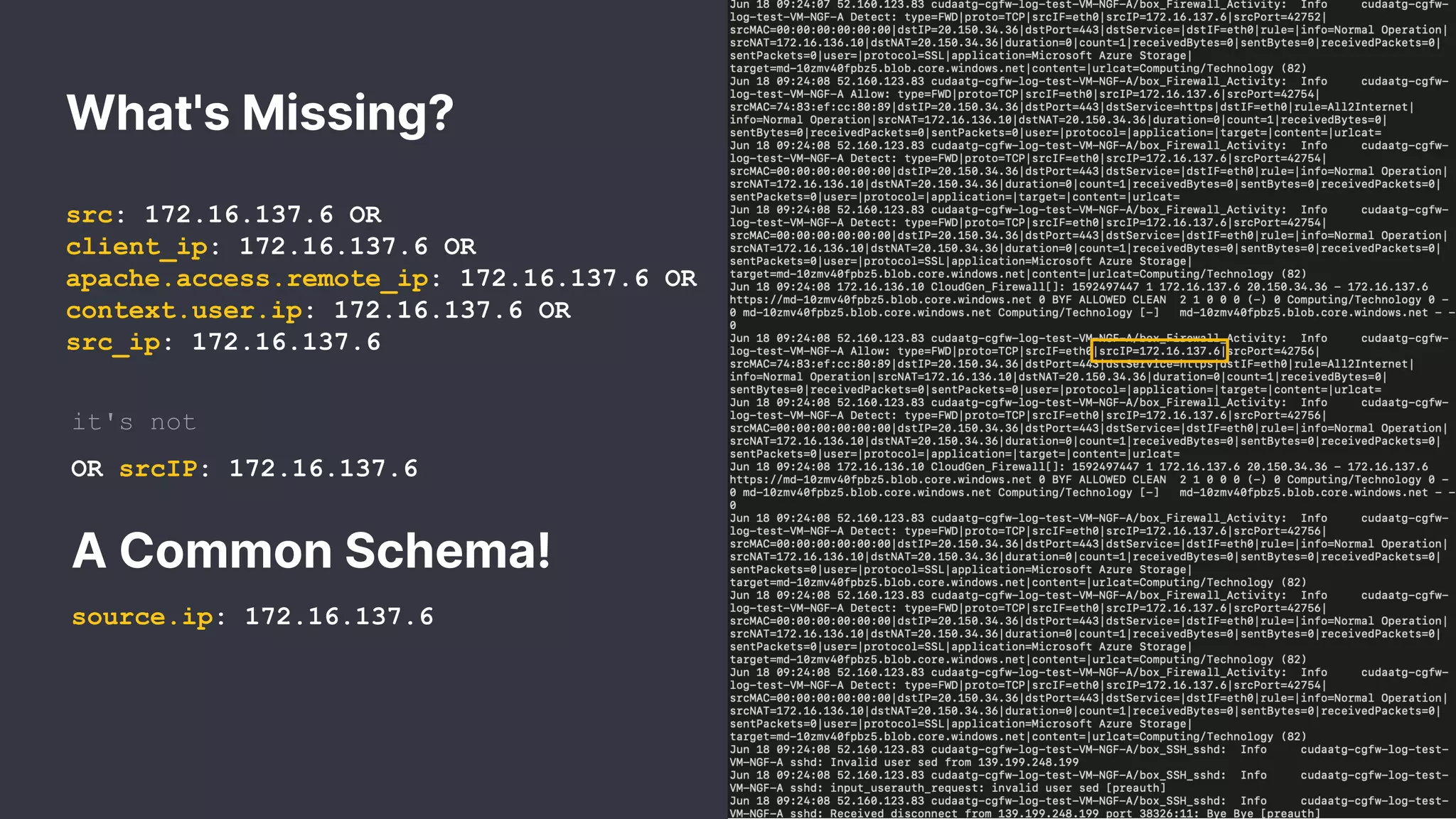
What's Missing?
src: 172.16.137.6 OR
client_ip: 172.16.137.6 OR
apache.access.remote_ip: 172.16.137.6 OR
context.user.ip: 172.16.137.6 OR
src_ip: 172.16.137.6
it's not
OR srcIP: 172.16.137.6
A Common Schema!
source.ip: 172.16.137.6
7
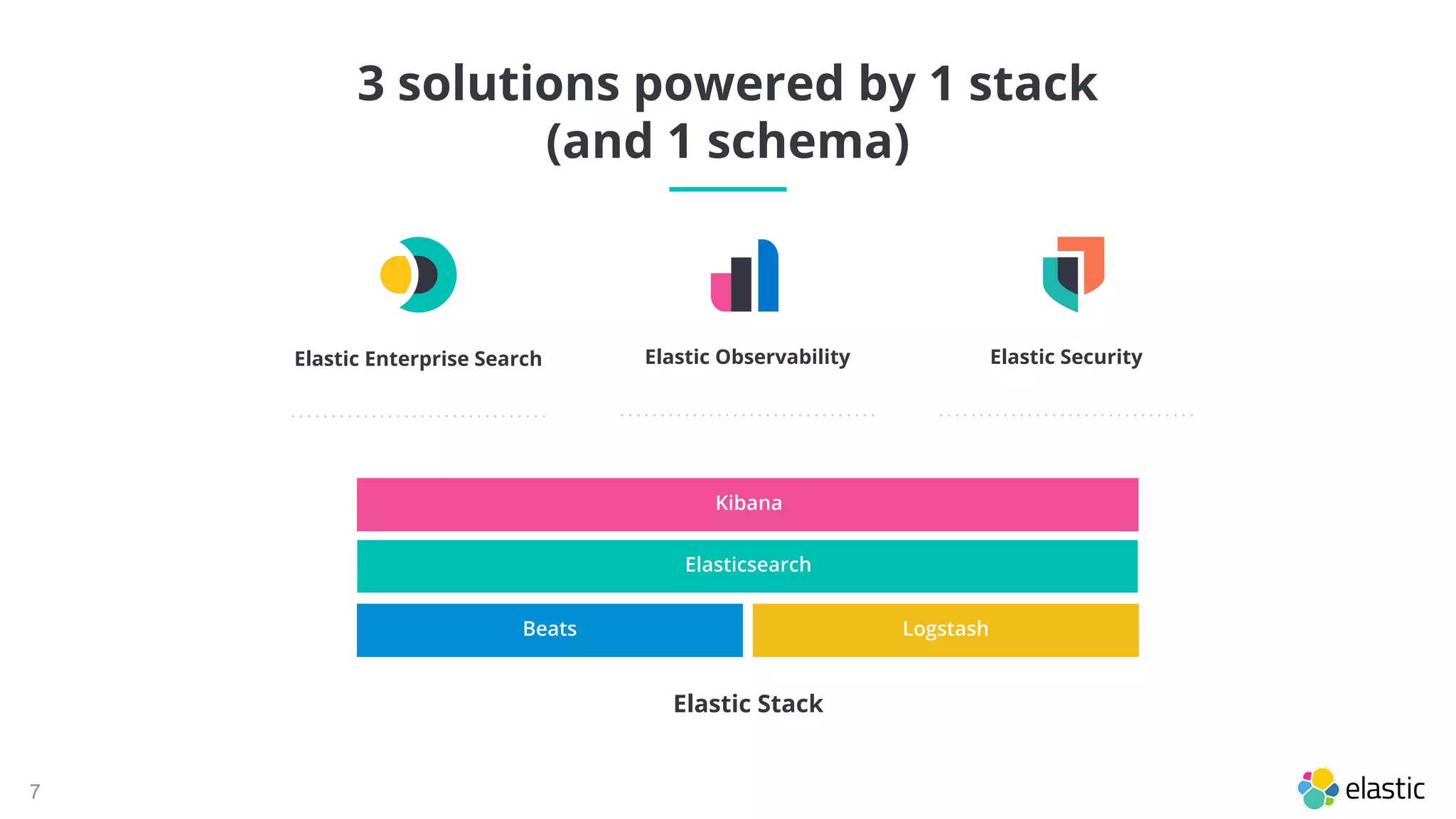
3 solutions powered by 1 stack
(and 1 schema)
Kibana
Elasticsearch
Beats Logstash
Elastic Stack
Elastic Enterprise Search Elastic SecurityElastic Observability
8
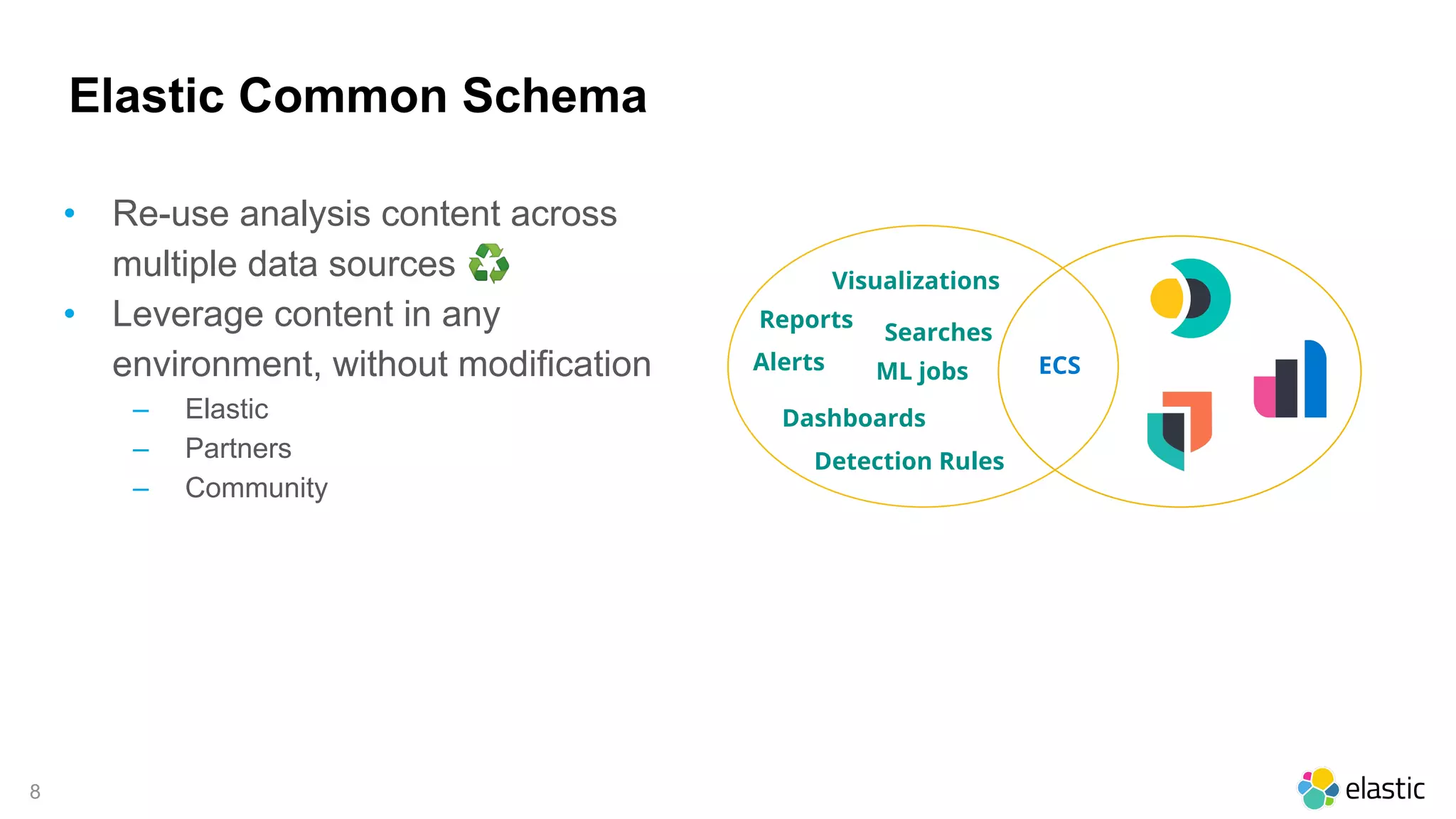
Elastic Common Schema
• Re-use analysis content across
multiple data sources ♻
• Leverage content in any
environment, without modification
– Elastic
– Partners
– Community
ECS
Visualizations
Alerts
Reports
Searches
ML jobs
Dashboards
Detection Rules
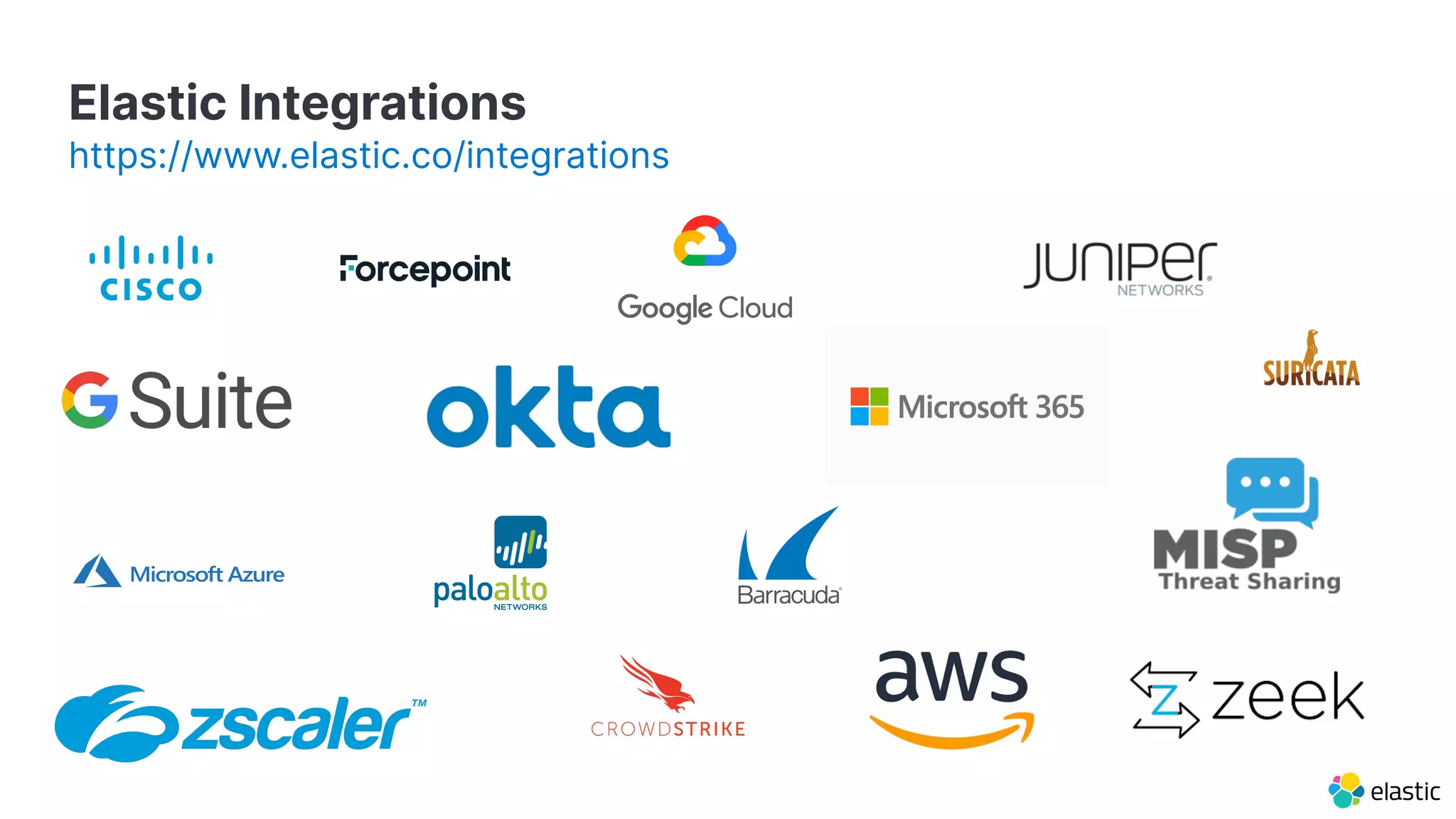
Elastic Integrations
https://www.elastic.co/integrations
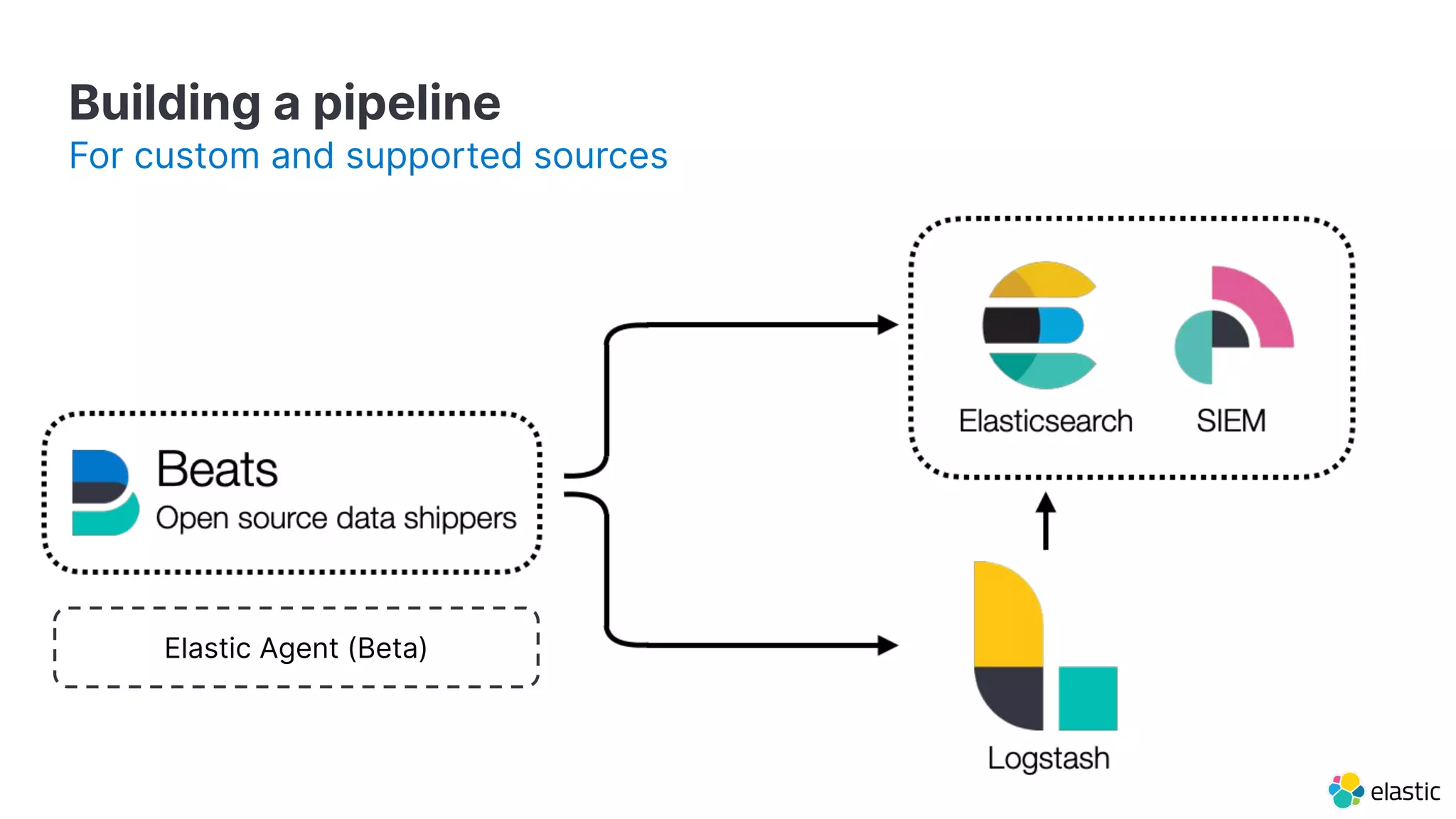
Building a pipeline
For custom and supported sources
Elastic Agent (Beta)
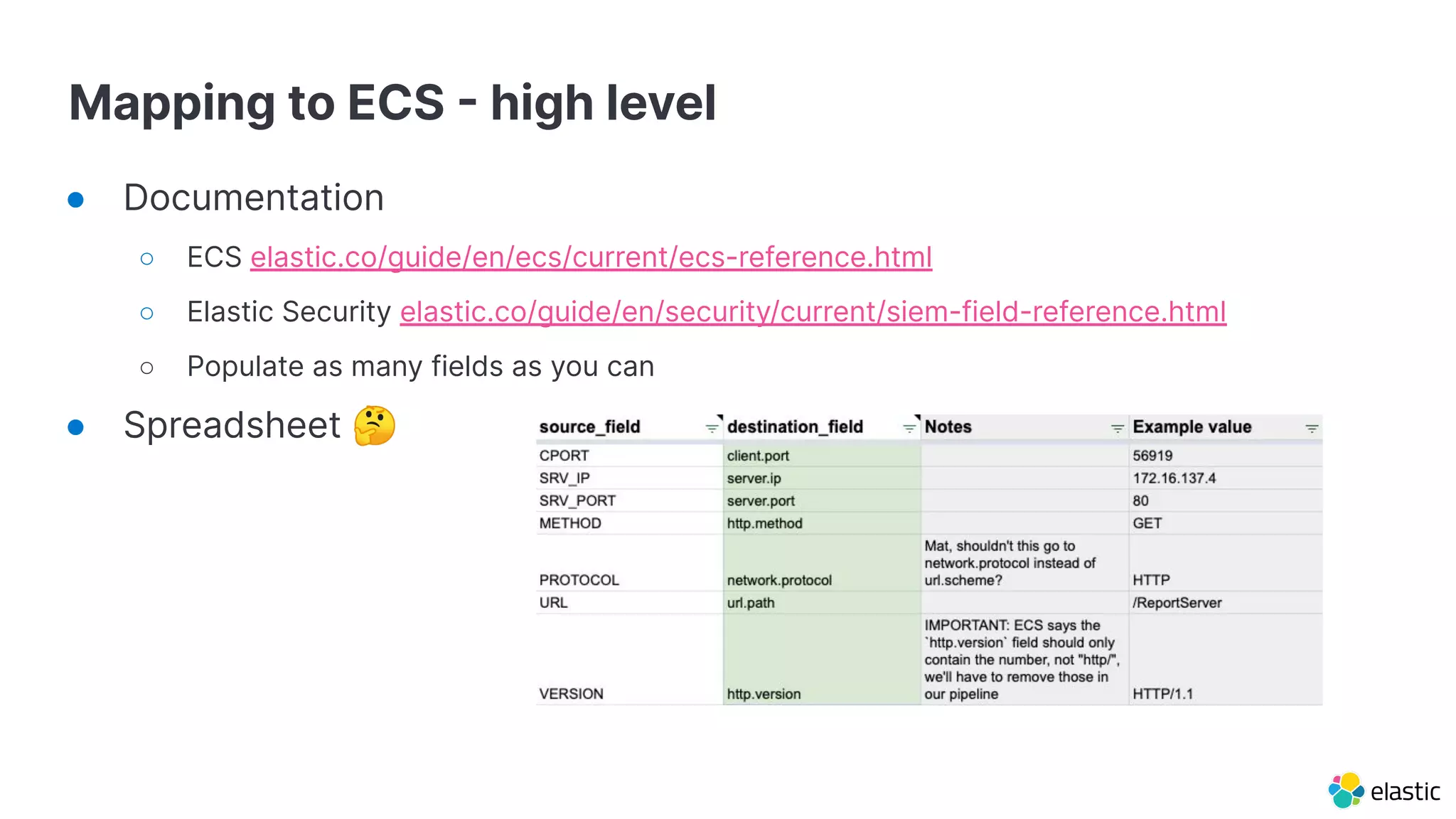
Mapping to ECS  high level
● Documentation
○ ECS elastic.co/guide/en/ecs/current/ecs-reference.html
○ Elastic Security elastic.co/guide/en/security/current/siem-field-reference.html
○ Populate as many fields as you can
● Spreadsheet 🤔
Mapping to ECS field names
● Plaintext logs
○ Use ECS field names in your grok or dissect
● Structured events
○ Multiple field renames
○ ecs-mapper: mapping spreadsheet ⇒ 3 starter pipelines
useradd[12507]: new user: name=bob, UID=1002, GID=1003
%{DATA:process.name}[%{POSINT:process.pid}]: new user: name=%{DATA:user.name},
UID=%{NUMBER:user.id}, GID=%{NUMBER:group.id}
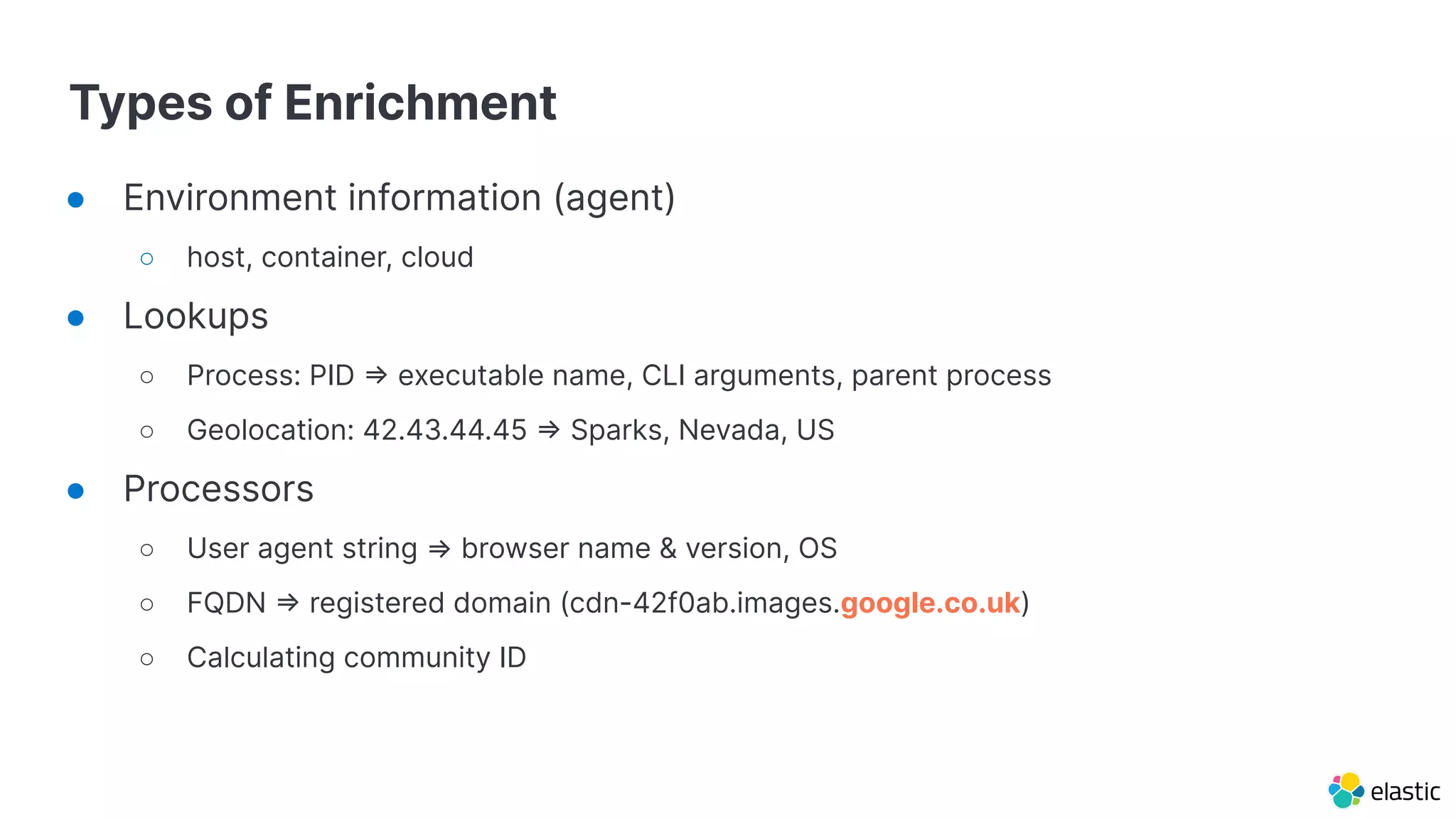
Types of Enrichment
● Environment information (agent)
○ host, container, cloud
● Lookups
○ Process: PID => executable name, CLI arguments, parent process
○ Geolocation: 42.43.44.45 => Sparks, Nevada, US
● Processors
○ User agent string ⇒ browser name & version, OS
○ FQDN => registered domain (cdn-42f0ab.images.google.co.uk)
○ Calculating community ID
Building on your logs
{
"message": "pam_unix(su:session)...",
"agent": {
"type": "filebeat",
"version": "7.9.1"
},
"host": {
"name": "bob-laptop",
"id": "7fa34c7914aa4e4...",
"os": {
"name": "Ubuntu",
"version": "18.04.4 LTS"
},
"ip": [ "10.0.2.15" ]
},
su[9000]: pam_unix(su:session): session opened for user root by vagrant(uid=0)
"process": {
"start": "2020-08-26T17:20:38.430Z",
"pid": 9000,
"name": "su",
"executable": "/bin/su",
"parent": {
"pid": 8999,
"name": "sudo",
"executable": "/usr/bin/sudo"
}
}
}
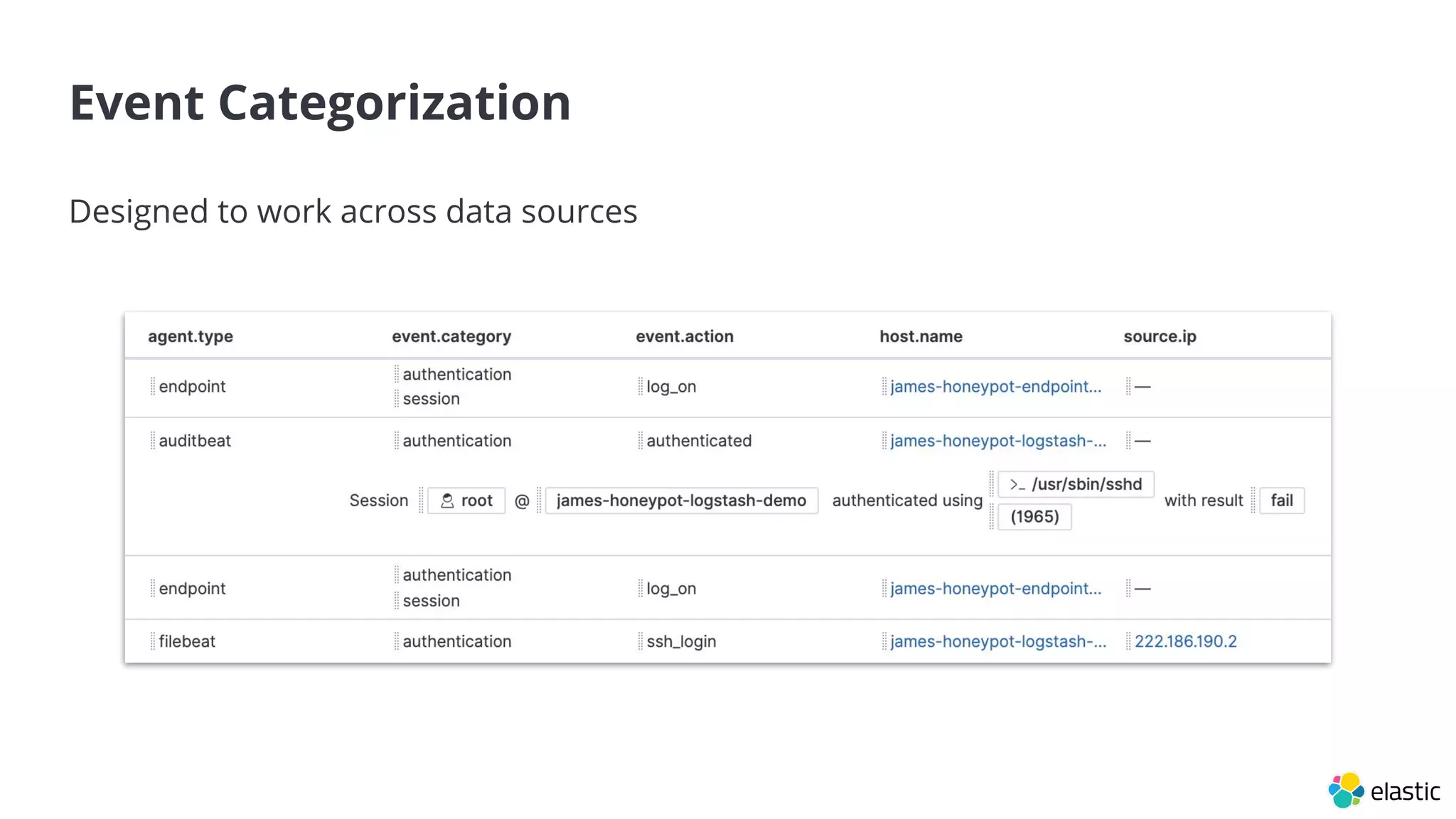
Event Categorization
Designed to work across data sources
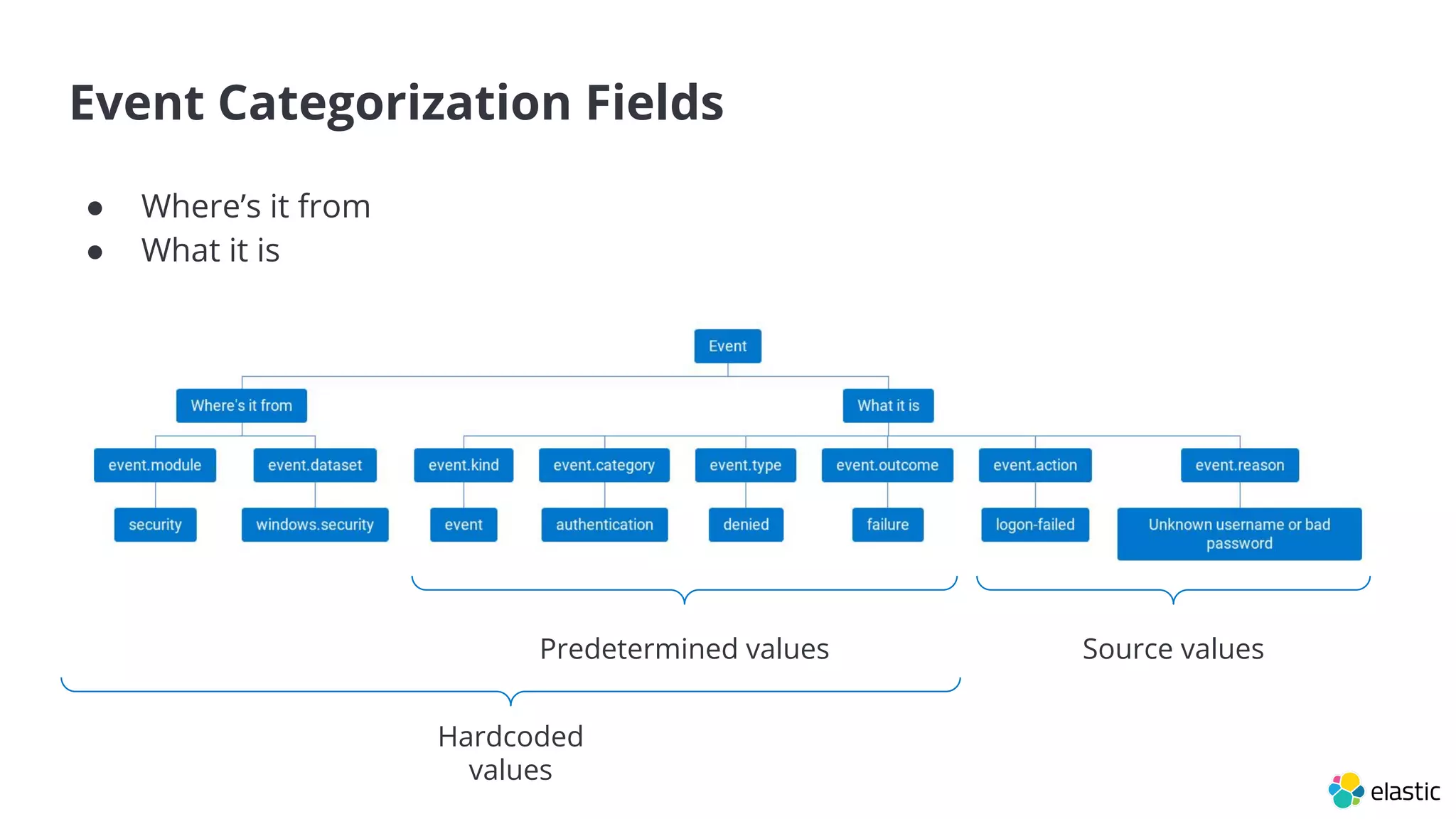
Event Categorization Fields
● Where’s it from
● What it is
Predetermined values Source values
Hardcoded
values
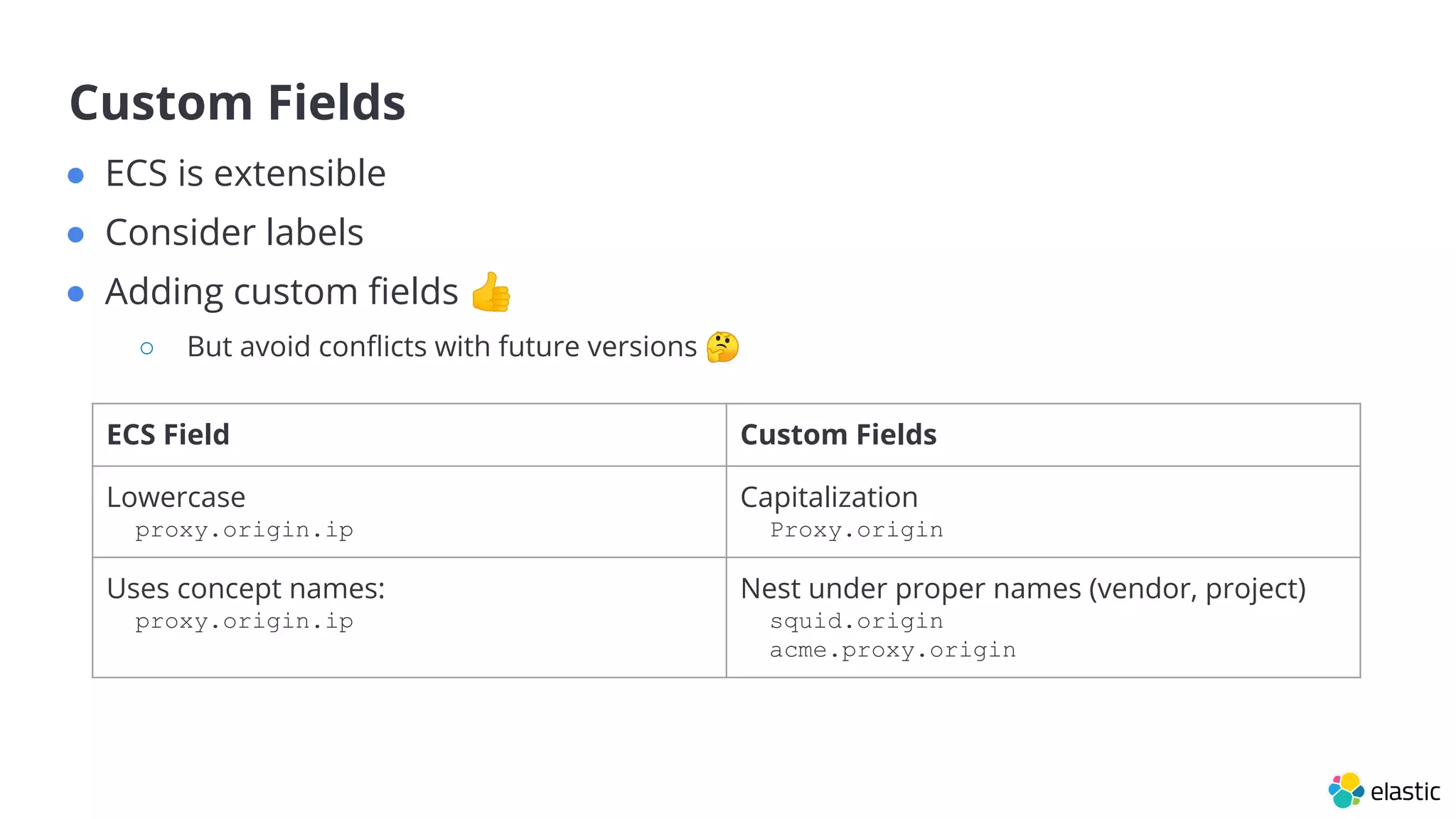
Custom Fields
● ECS is extensible
● Consider labels
● Adding custom fields 👍
○ But avoid conflicts with future versions 🤔
ECS Field Custom Fields
Lowercase
proxy.origin.ip
Capitalization
Proxy.origin
Uses concept names:
proxy.origin.ip
Nest under proper names (vendor, project)
squid.origin
acme.proxy.origin
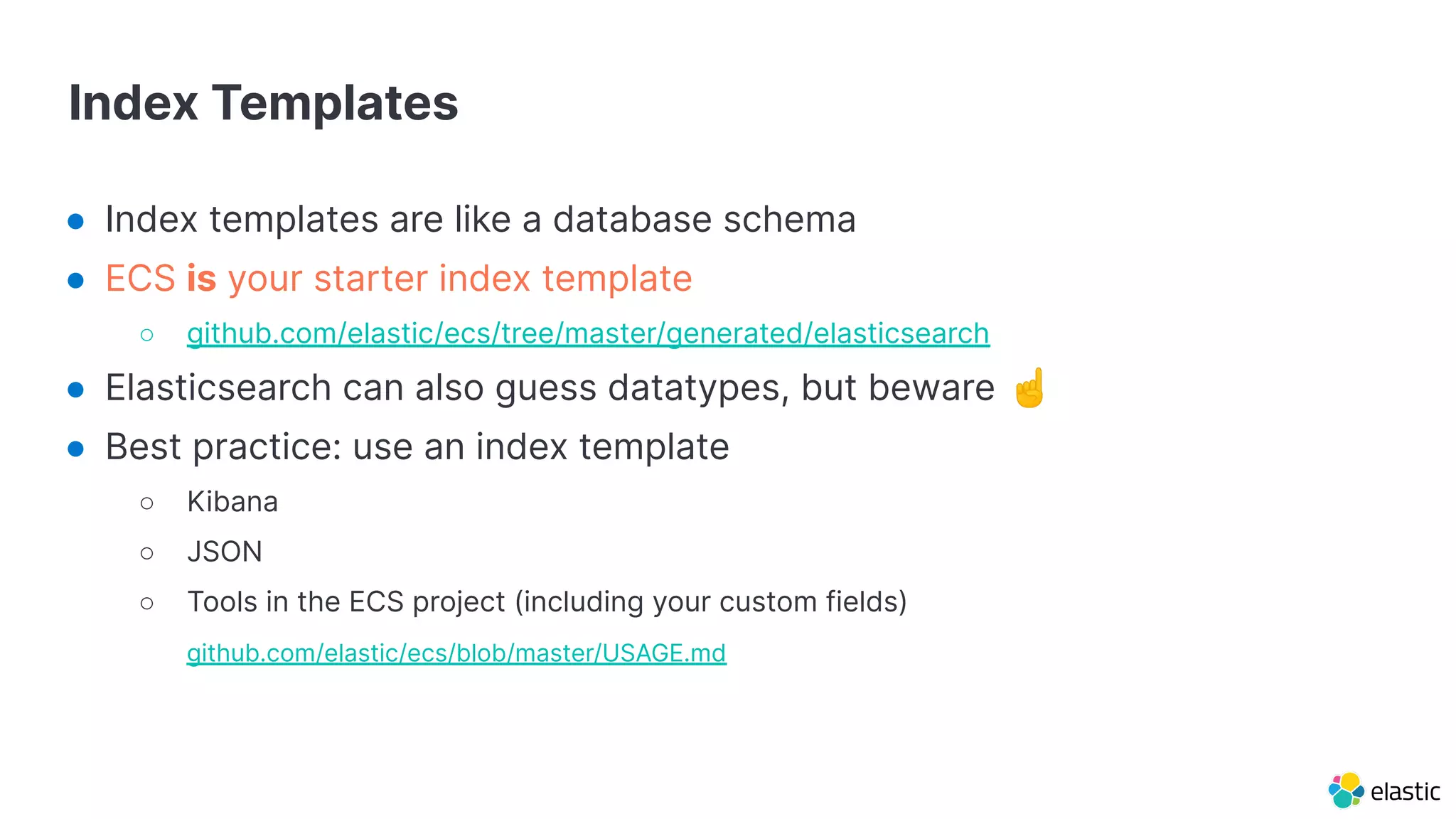
Index Templates
● Index templates are like a database schema
● ECS is your starter index template
○ github.com/elastic/ecs/tree/master/generated/elasticsearch
● Elasticsearch can also guess datatypes, but beware ☝
● Best practice: use an index template
○ Kibana
○ JSON
○ Tools in the ECS project (including your custom fields)
○ github.com/elastic/ecs/blob/master/USAGE.md
Demo
20
Implementing a common event
model (ECS) has been a force
multiplier for our team, that
dramatically streamlines
investigations
Wes Connell - Security Engineering Lead, Uber
“
Summary
● Security requires a consistent data format
● ECS is used across Elastic solutions
● ECS allows for custom fields
● Elastic Integrations
● Tools available to map your data to ECS
Resources
Documentation
ECS
elastic.co/guide/en/ecs/current/index.html
Elastic Security
elastic.co/guide/en/ecs/current/ecs-field-reference.html
Tools
ECS Mapper
github.com/elastic/ecs-mapper
Customizing the ECS Template
github.com/elastic/ecs/blob/master/USAGE.md
Get in touch!
Community Slack
elasticstack.slack.com ⇒ #stack-ecs
Forum
discuss.elastic.co/tag/ecs-elastic-common-schema
23
Try free on Cloud:
ela.st/siem
Take a quick spin:
demo.elastic.co
Connect on Slack:
ela.st/slack
Join the Elastic Security community
24
Thank You!

The importance of normalizing your security data to ECS

  • 1.
    1 The importance of normalizingyour security data Jamie Hynds - Product Manager - Security Integrations Mat Martin - Tech Lead - Elastic Common Schema
  • 2.
    2 This presentation andthe accompanying oral presentation contain forward-looking statements, including statements concerning plans for future offerings; the expected strength, performance or benefits of our offerings; and our future operations and expected performance. These forward-looking statements are subject to the safe harbor provisions under the Private Securities Litigation Reform Act of 1995. Our expectations and beliefs in light of currently available information regarding these matters may not materialize. Actual outcomes and results may differ materially from those contemplated by these forward-looking statements due to uncertainties, risks, and changes in circumstances, including, but not limited to those related to: the impact of the COVID-19 pandemic on our business and our customers and partners; our ability to continue to deliver and improve our offerings and successfully develop new offerings, including security-related product offerings and SaaS offerings; customer acceptance and purchase of our existing offerings and new offerings, including the expansion and adoption of our SaaS offerings; our ability to realize value from investments in the business, including R&D investments; our ability to maintain and expand our user and customer base; our international expansion strategy; our ability to successfully execute our go-to-market strategy and expand in our existing markets and into new markets, and our ability to forecast customer retention and expansion; and general market, political, economic and business conditions. Additional risks and uncertainties that could cause actual outcomes and results to differ materially are included in our filings with the Securities and Exchange Commission (the “SEC”), including our Annual Report on Form 10-K for the most recent fiscal year, our quarterly report on Form 10-Q for the most recent fiscal quarter, and any subsequent reports filed with the SEC. SEC filings are available on the Investor Relations section of Elastic’s website at ir.elastic.co and the SEC’s website at www.sec.gov. Any features or functions of services or products referenced in this presentation, or in any presentations, press releases or public statements, which are not currently available or not currently available as a general availability release, may not be delivered on time or at all. The development, release, and timing of any features or functionality described for our products remains at our sole discretion. Customers who purchase our products and services should make the purchase decisions based upon services and product features and functions that are currently available. All statements are made only as of the date of the presentation, and Elastic assumes no obligation to, and does not currently intend to, update any forward-looking statements or statements relating to features or functions of services or products, except as required by law. Forward-Looking Statements
  • 3.
    3 Agenda • Security DataChallenges • What is ECS? • Elastic Security Integrations • Mapping data to ECS • Demo • Get started with ECS
  • 4.
    Security Data Challenges ●Disparate data types ● Heterogeneous environments ● Countless field names ● Searching & correlating across multiple data sources ● Blind spots ● Strict schemas
  • 5.
    5 ECS - ElasticCommon Schema • Defines a common set of fields • Works across multiple data sources • Remember common field names • Reduces blind spots • Integrate custom sources to Elastic Security
  • 6.
    What's Missing? src: 172.16.137.6OR client_ip: 172.16.137.6 OR apache.access.remote_ip: 172.16.137.6 OR context.user.ip: 172.16.137.6 OR src_ip: 172.16.137.6 it's not OR srcIP: 172.16.137.6 A Common Schema! source.ip: 172.16.137.6
  • 7.
    7 3 solutions poweredby 1 stack (and 1 schema) Kibana Elasticsearch Beats Logstash Elastic Stack Elastic Enterprise Search Elastic SecurityElastic Observability
  • 8.
    8 Elastic Common Schema •Re-use analysis content across multiple data sources ♻ • Leverage content in any environment, without modification – Elastic – Partners – Community ECS Visualizations Alerts Reports Searches ML jobs Dashboards Detection Rules
  • 9.
  • 10.
    Building a pipeline Forcustom and supported sources Elastic Agent (Beta)
  • 11.
    Mapping to ECS high level ● Documentation ○ ECS elastic.co/guide/en/ecs/current/ecs-reference.html ○ Elastic Security elastic.co/guide/en/security/current/siem-field-reference.html ○ Populate as many fields as you can ● Spreadsheet 🤔
  • 12.
    Mapping to ECSfield names ● Plaintext logs ○ Use ECS field names in your grok or dissect ● Structured events ○ Multiple field renames ○ ecs-mapper: mapping spreadsheet ⇒ 3 starter pipelines useradd[12507]: new user: name=bob, UID=1002, GID=1003 %{DATA:process.name}[%{POSINT:process.pid}]: new user: name=%{DATA:user.name}, UID=%{NUMBER:user.id}, GID=%{NUMBER:group.id}
  • 13.
    Types of Enrichment ●Environment information (agent) ○ host, container, cloud ● Lookups ○ Process: PID => executable name, CLI arguments, parent process ○ Geolocation: 42.43.44.45 => Sparks, Nevada, US ● Processors ○ User agent string ⇒ browser name & version, OS ○ FQDN => registered domain (cdn-42f0ab.images.google.co.uk) ○ Calculating community ID
  • 14.
    Building on yourlogs { "message": "pam_unix(su:session)...", "agent": { "type": "filebeat", "version": "7.9.1" }, "host": { "name": "bob-laptop", "id": "7fa34c7914aa4e4...", "os": { "name": "Ubuntu", "version": "18.04.4 LTS" }, "ip": [ "10.0.2.15" ] }, su[9000]: pam_unix(su:session): session opened for user root by vagrant(uid=0) "process": { "start": "2020-08-26T17:20:38.430Z", "pid": 9000, "name": "su", "executable": "/bin/su", "parent": { "pid": 8999, "name": "sudo", "executable": "/usr/bin/sudo" } } }
  • 15.
    Event Categorization Designed towork across data sources
  • 16.
    Event Categorization Fields ●Where’s it from ● What it is Predetermined values Source values Hardcoded values
  • 17.
    Custom Fields ● ECSis extensible ● Consider labels ● Adding custom fields 👍 ○ But avoid conflicts with future versions 🤔 ECS Field Custom Fields Lowercase proxy.origin.ip Capitalization Proxy.origin Uses concept names: proxy.origin.ip Nest under proper names (vendor, project) squid.origin acme.proxy.origin
  • 18.
    Index Templates ● Indextemplates are like a database schema ● ECS is your starter index template ○ github.com/elastic/ecs/tree/master/generated/elasticsearch ● Elasticsearch can also guess datatypes, but beware ☝ ● Best practice: use an index template ○ Kibana ○ JSON ○ Tools in the ECS project (including your custom fields) ○ github.com/elastic/ecs/blob/master/USAGE.md
  • 19.
  • 20.
    20 Implementing a commonevent model (ECS) has been a force multiplier for our team, that dramatically streamlines investigations Wes Connell - Security Engineering Lead, Uber “
  • 21.
    Summary ● Security requiresa consistent data format ● ECS is used across Elastic solutions ● ECS allows for custom fields ● Elastic Integrations ● Tools available to map your data to ECS
  • 22.
    Resources Documentation ECS elastic.co/guide/en/ecs/current/index.html Elastic Security elastic.co/guide/en/ecs/current/ecs-field-reference.html Tools ECS Mapper github.com/elastic/ecs-mapper Customizingthe ECS Template github.com/elastic/ecs/blob/master/USAGE.md Get in touch! Community Slack elasticstack.slack.com ⇒ #stack-ecs Forum discuss.elastic.co/tag/ecs-elastic-common-schema
  • 23.
    23 Try free onCloud: ela.st/siem Take a quick spin: demo.elastic.co Connect on Slack: ela.st/slack Join the Elastic Security community
  • 24.