The Evolution of AI
Agents: From Simple
Tasks to Complex
Problem Solving
This presentation explores the captivating journey of AI agents, from their
humble beginnings to their transformative impact on the world today.
by Sol Guruz
The Rise of Autonomous AI Agents
From Rule-Based to Adaptive
AI agents have transitioned from rigid rule-following programs
to systems capable of learning and adapting to new situations.
Emergence of Deep Learning
The advent of deep learning algorithms fueled the
development of powerful agents that can process complex
data and make nuanced decisions.
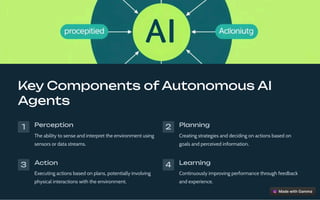
Key Components of Autonomous AI
Agents
1 Perception
The ability to sense and interpret the environment using
sensors or data streams.
2 Planning
Creating strategies and deciding on actions based on
goals and perceived information.
3 Action
Executing actions based on plans, potentially involving
physical interactions with the environment.
4 Learning
Continuously improving performance through feedback
and experience.
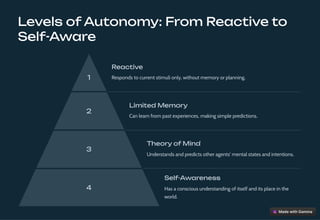
Levels of Autonomy: From Reactive to
Self-Aware
1
Reactive
Responds to current stimuli only, without memory or planning.
2
Limited Memory
Can learn from past experiences, making simple predictions.
3
Theory of Mind
Understands and predicts other agents' mental states and intentions.
4
Self-Awareness
Has a conscious understanding of itself and its place in the
world.
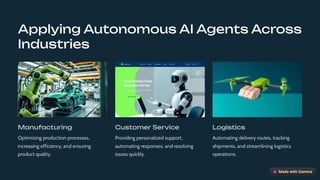
Applying Autonomous AI Agents Across
Industries
Manufacturing
Optimizing production processes,
increasing efficiency, and ensuring
product quality.
Customer Service
Providing personalized support,
automating responses, and resolving
issues quickly.
Logistics
Automating delivery routes, tracking
shipments, and streamlining logistics
operations.
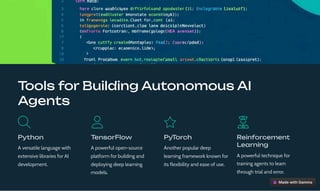
Tools for Building Autonomous AI
Agents
Python
A versatile language with
extensive libraries for AI
development.
TensorFlow
A powerful open-source
platform for building and
deploying deep learning
models.
PyTorch
Another popular deep
learning framework known for
its flexibility and ease of use.
Reinforcement
Learning
A powerful technique for
training agents to learn
through trial and error.
Benefits and Challenges of
Autonomous AI Agents
Benefits
Increased efficiency, improved decision-making, and enhanced
human capabilities.
Challenges
Ethical concerns, bias in algorithms, and potential job
displacement.
The Future of AI
Agents: Collaboration
and Societal
Integration
The future of AI agents lies in their ability to collaborate with humans and
seamlessly integrate into society, creating a world of unprecedented
possibilities.

The Evolution of AI Agents: From Simple Tasks to Complex Problem Solving

  • 1.
    The Evolution ofAI Agents: From Simple Tasks to Complex Problem Solving This presentation explores the captivating journey of AI agents, from their humble beginnings to their transformative impact on the world today. by Sol Guruz
  • 2.
    The Rise ofAutonomous AI Agents From Rule-Based to Adaptive AI agents have transitioned from rigid rule-following programs to systems capable of learning and adapting to new situations. Emergence of Deep Learning The advent of deep learning algorithms fueled the development of powerful agents that can process complex data and make nuanced decisions.
  • 3.
    Key Components ofAutonomous AI Agents 1 Perception The ability to sense and interpret the environment using sensors or data streams. 2 Planning Creating strategies and deciding on actions based on goals and perceived information. 3 Action Executing actions based on plans, potentially involving physical interactions with the environment. 4 Learning Continuously improving performance through feedback and experience.
  • 4.
    Levels of Autonomy:From Reactive to Self-Aware 1 Reactive Responds to current stimuli only, without memory or planning. 2 Limited Memory Can learn from past experiences, making simple predictions. 3 Theory of Mind Understands and predicts other agents' mental states and intentions. 4 Self-Awareness Has a conscious understanding of itself and its place in the world.
  • 5.
    Applying Autonomous AIAgents Across Industries Manufacturing Optimizing production processes, increasing efficiency, and ensuring product quality. Customer Service Providing personalized support, automating responses, and resolving issues quickly. Logistics Automating delivery routes, tracking shipments, and streamlining logistics operations.
  • 6.
    Tools for BuildingAutonomous AI Agents Python A versatile language with extensive libraries for AI development. TensorFlow A powerful open-source platform for building and deploying deep learning models. PyTorch Another popular deep learning framework known for its flexibility and ease of use. Reinforcement Learning A powerful technique for training agents to learn through trial and error.
  • 7.
    Benefits and Challengesof Autonomous AI Agents Benefits Increased efficiency, improved decision-making, and enhanced human capabilities. Challenges Ethical concerns, bias in algorithms, and potential job displacement.
  • 8.
    The Future ofAI Agents: Collaboration and Societal Integration The future of AI agents lies in their ability to collaborate with humans and seamlessly integrate into society, creating a world of unprecedented possibilities.