Name:-Soumyajeet Mukhopadhyay
Roll:- 31801222066
Semester:- 6th
Subject Code: BCAD601B
Topic:- AI Agent, and Classification of Agent with Diagram
JIS College Of Engineering
CA1 Assignment
Unraveling the Mysteries of AI Agents: Intelligent Autonomous
Systems Shaping the Future.
This presentation delves into AI agent’s core concepts,
architectures, and applications, fascinating entities that are
revolutionizing numerous aspects of our lives.
Introduction to AI agents: A Deep Dive into Intelligent
Autonomous Systems
AI agents are autonomous systems that use artificial
intelligence to perceive their environment, make decisions, and
take actions to achieve specific goals. These agents can be simple
or complex and are designed to operate independently, using their
intelligence to adapt to changing situations.
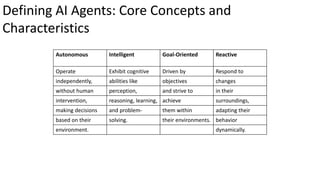
Autonomous Intelligent Goal-Oriented Reactive
Operate Exhibit cognitive Driven by Respond to
independently, abilities like objectives changes
without human perception, and strive to in their
intervention, reasoning, learning, achieve surroundings,
making decisions and problem- them within adapting their
based on their solving. their environments. behavior
environment. dynamically.
Defining AI Agents: Core Concepts and
Characteristics
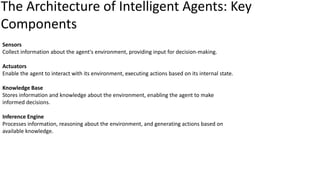
Sensors
Collect information about the agent's environment, providing input for decision-making.
Actuators
Enable the agent to interact with its environment, executing actions based on its internal state.
Knowledge Base
Stores information and knowledge about the environment, enabling the agent to make
informed decisions.
Inference Engine
Processes information, reasoning about the environment, and generating actions based on
available knowledge.
The Architecture of Intelligent Agents: Key
Components
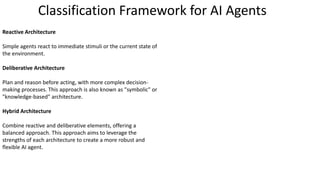
Reactive Architecture
Simple agents react to immediate stimuli or the current state of
the environment.
Deliberative Architecture
Plan and reason before acting, with more complex decision-
making processes. This approach is also known as "symbolic" or
"knowledge-based" architecture.
Hybrid Architecture
Combine reactive and deliberative elements, offering a
balanced approach. This approach aims to leverage the
strengths of each architecture to create a more robust and
flexible AI agent.
Classification Framework for AI Agents
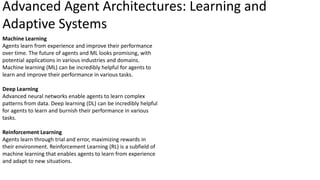
Machine Learning
Agents learn from experience and improve their performance
over time. The future of agents and ML looks promising, with
potential applications in various industries and domains.
Machine learning (ML) can be incredibly helpful for agents to
learn and improve their performance in various tasks.
Deep Learning
Advanced neural networks enable agents to learn complex
patterns from data. Deep learning (DL) can be incredibly helpful
for agents to learn and burnish their performance in various
tasks.
Reinforcement Learning
Agents learn through trial and error, maximizing rewards in
their environment. Reinforcement Learning (RL) is a subfield of
machine learning that enables agents to learn from experience
and adapt to new situations.
Advanced Agent Architectures: Learning and
Adaptive Systems
Real-World Applications and Use Cases of AI Agents
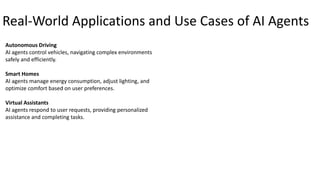
Autonomous Driving
AI agents control vehicles, navigating complex environments
safely and efficiently.
Smart Homes
AI agents manage energy consumption, adjust lighting, and
optimize comfort based on user preferences.
Virtual Assistants
AI agents respond to user requests, providing personalized
assistance and completing tasks.
Future Trends and Emerging Challenges in
Agent-Based AI
> Multi-Agent Systems
Systems with multiple interacting agents, enable collaborative
problem-solving.
> Explainable AI
Making AI decisions understandable to humans, building trust
and transparency.
> Ethical Considerations
Addressing biases, fairness, and accountability in AI agent
development.
> Human-Agent Collaboration
Designing AI agents that seamlessly collaborate with humans,
enhancing productivity and innovation.
Conclusion
AI agents are revolutionizing the way we interact with technology, enabling automation, decision-making, and adaptability across
various domains. From simple reactive agents to complex hybrid models integrating deep learning and reinforcement learning,
these intelligent systems continue to evolve. Their applications, ranging from autonomous vehicles to smart assistants, highlight
their growing impact on society. As AI agent technology advances, challenges such as ethical considerations, transparency, and
human-agent collaboration must be addressed. The future of AI agents lies in their ability to work seamlessly with humans,
ensuring intelligent, ethical, and efficient solutions. By embracing innovation while mitigating risks, we can harness the full
potential of AI agents to shape a smarter and more connected world. The future scope of AI agents is vast and exciting, with
numerous real-world applications and use cases emerging across various industries. The future of agents and reinforcement
learning looks promising, with potential applications in various industries and domains.

Prensentation_on_AI_Agents_and_their_classification

  • 1.
    Name:-Soumyajeet Mukhopadhyay Roll:- 31801222066 Semester:-6th Subject Code: BCAD601B Topic:- AI Agent, and Classification of Agent with Diagram JIS College Of Engineering CA1 Assignment
  • 2.
    Unraveling the Mysteriesof AI Agents: Intelligent Autonomous Systems Shaping the Future. This presentation delves into AI agent’s core concepts, architectures, and applications, fascinating entities that are revolutionizing numerous aspects of our lives. Introduction to AI agents: A Deep Dive into Intelligent Autonomous Systems AI agents are autonomous systems that use artificial intelligence to perceive their environment, make decisions, and take actions to achieve specific goals. These agents can be simple or complex and are designed to operate independently, using their intelligence to adapt to changing situations.
  • 3.
    Autonomous Intelligent Goal-OrientedReactive Operate Exhibit cognitive Driven by Respond to independently, abilities like objectives changes without human perception, and strive to in their intervention, reasoning, learning, achieve surroundings, making decisions and problem- them within adapting their based on their solving. their environments. behavior environment. dynamically. Defining AI Agents: Core Concepts and Characteristics
  • 4.
    Sensors Collect information aboutthe agent's environment, providing input for decision-making. Actuators Enable the agent to interact with its environment, executing actions based on its internal state. Knowledge Base Stores information and knowledge about the environment, enabling the agent to make informed decisions. Inference Engine Processes information, reasoning about the environment, and generating actions based on available knowledge. The Architecture of Intelligent Agents: Key Components
  • 5.
    Reactive Architecture Simple agentsreact to immediate stimuli or the current state of the environment. Deliberative Architecture Plan and reason before acting, with more complex decision- making processes. This approach is also known as "symbolic" or "knowledge-based" architecture. Hybrid Architecture Combine reactive and deliberative elements, offering a balanced approach. This approach aims to leverage the strengths of each architecture to create a more robust and flexible AI agent. Classification Framework for AI Agents
  • 6.
    Machine Learning Agents learnfrom experience and improve their performance over time. The future of agents and ML looks promising, with potential applications in various industries and domains. Machine learning (ML) can be incredibly helpful for agents to learn and improve their performance in various tasks. Deep Learning Advanced neural networks enable agents to learn complex patterns from data. Deep learning (DL) can be incredibly helpful for agents to learn and burnish their performance in various tasks. Reinforcement Learning Agents learn through trial and error, maximizing rewards in their environment. Reinforcement Learning (RL) is a subfield of machine learning that enables agents to learn from experience and adapt to new situations. Advanced Agent Architectures: Learning and Adaptive Systems
  • 7.
    Real-World Applications andUse Cases of AI Agents Autonomous Driving AI agents control vehicles, navigating complex environments safely and efficiently. Smart Homes AI agents manage energy consumption, adjust lighting, and optimize comfort based on user preferences. Virtual Assistants AI agents respond to user requests, providing personalized assistance and completing tasks.
  • 8.
    Future Trends andEmerging Challenges in Agent-Based AI > Multi-Agent Systems Systems with multiple interacting agents, enable collaborative problem-solving. > Explainable AI Making AI decisions understandable to humans, building trust and transparency. > Ethical Considerations Addressing biases, fairness, and accountability in AI agent development. > Human-Agent Collaboration Designing AI agents that seamlessly collaborate with humans, enhancing productivity and innovation.
  • 9.
    Conclusion AI agents arerevolutionizing the way we interact with technology, enabling automation, decision-making, and adaptability across various domains. From simple reactive agents to complex hybrid models integrating deep learning and reinforcement learning, these intelligent systems continue to evolve. Their applications, ranging from autonomous vehicles to smart assistants, highlight their growing impact on society. As AI agent technology advances, challenges such as ethical considerations, transparency, and human-agent collaboration must be addressed. The future of AI agents lies in their ability to work seamlessly with humans, ensuring intelligent, ethical, and efficient solutions. By embracing innovation while mitigating risks, we can harness the full potential of AI agents to shape a smarter and more connected world. The future scope of AI agents is vast and exciting, with numerous real-world applications and use cases emerging across various industries. The future of agents and reinforcement learning looks promising, with potential applications in various industries and domains.